Russian space news and articles
- 1986
- 1987
- 2001
- 2002
- 2003
- 2004
- 2005
- 2006
- 2007
- 2008
- 2009
- 2015
- 2016
- 2017
- 2018
- 2019
- 2020
- 2021
- 2022
- 2023
- 2024
- To most recent ↓
- News links
A page for occasional news articles of interest. I stopped putting articles on the original version of this page while I was keeping my RuSpace blog at Blogger.com, but have ceased writing there. A lot of older articles are now offline so I have linked to them at Archive.org where available.
1986
October 1986
“Soviets in space: are they ahead?” , National Geographic. What now seems like the “good old days” of the Soviet space program … The current one is a sad contrast!
1987
5/10/1987
“Surging Ahead: The Soviets overtake the U.S. as the №1 spacefaring nation,” TIME.com. A similar article to the previous National Geographic one.
2001
10/2/2001
“The Murder of Mir,” Gregory Klerkx. “Next month the Mir space station is set to come crashing to Earth – ditching somewhere off south-east Australia. NASA has long called the Communist creation an orbiting deathtrap, but is it really on its last legs? Gregory Klerkx looks at the real reason the US wants Mir dead.”
17/3/2001
“Russia, Australia Work Together in Space Research,” Space.com. This was a promising project that apparently never got off the ground, as I have heard nothing since (I did read somewhere that there were funding problems). The Asia Pacific Space Centre site was still online in the Internet Archive up to 2008, but not updated since 2001.
9/4/2001
“Touring the Yuri Gagarin Cosmonaut Training Center Museum,” Robert Pearlman, Space.com.
November 2001
“In the footsteps of Gagarin,” Focus magazine. A positive portrayal of Zvyozdniy Gorodok, Звёздный Городок, and the Russian space program, for a change!
2002
Spring 2002
“Inside Russia’s Unique Space Science Institute,” 21st Century magazine. Interview with TsNIIMash director Dr. Nikolai A. Anfimov about the Russian space program.
31/10/2002
“Space loses its appeal for Russian teens,” Ireland Online.
2003
October 2003
“Saving the Station,” by James Oberg, Anatoly Zak & Stephen Cass, IEEE Spectrum.
2004
January 2004
“Russian space medicine still aims for Mars,” by Dominic Phelan, Spaceflight magazine. Article about the Institute for Bio-Medical Problems.
“Too far from home,” Esquire, Chris Jones. Account of Expedition 6 after the Columbia shuttle disaster; the article was later expanded into a book.
July 2004
“The First 1000 Days” by astronaut Tom Jones; published in Air & Space Smithsonian, July 2004. His view of the first 3 years on the ISS; some interesting insights.
18/10/2004
“Space lessons from the Russians,” MSNBC.com. After Columbia, NASA will be dependent upon Soyuz flights to get its Expedition Crew astronauts to the ISS.
2005
28/1/2005
“The Russians are coming” by Robert Zimmerman, Space Daily.
At the annual Goddard Symposium, held by the American Astronautical Society in late March 2004 in Beltsville, Md., one NASA engineer outlined the need to design closed environmental recycling systems for any spaceship traveling to Mars.
To illustrate what was already known, he described the systems used on NASA’s Mercury, Gemini, and Apollo capsules, as well as on the shuttle, Skylab, and the U.S. half of the ISS.
Nowhere in his presentation, however, was there any mention of a Russian system, even though since 1971 the Russians have built seven successful space stations prior to the ISS with a remarkable track record of efficient and practical atmospheric and water recycling systems.
When asked by this reporter why he had left the Russians out of his presentation, he explained that he did not take their systems very seriously. “We don’t have faith in them,” he said.
To put it mildly, when it comes to space exploration, U.S. space officials have developed the annoying habit of underestimating the Russians.
So it might be prudent to consider the possibility that the first humans to reach Mars might be speaking Russian – not English – when they get there.
10/2/2005
“Men will be first to go to Mars,” RIA Novosti (found via NASA Watch). Some silly remarks from Anatolii Grigoriyev (Director of the Institute of Medical and Biological Problems) regarding women’s supposed unsuitability for long-term spaceflight:
“After all, women are fragile and delicate creatures; that is why men should lead the way to distant planets and carry women there in their strong hands,” the head of IMBP said with a smile.
Perhaps he should visit the Soviet Women Pilots in the Great Patriotic War website and read up on what his supposedly “fragile and delicate” countrywomen accomplished during World War 2!
11/2/2005
“Does Mars need women? Russians say no”: James Oberg’s commentary on Anatolii Grigoryev’s dumb remarks. Perhaps ladies could send Prof. Grigoryev some irate e-mails! As James Oberg notes, there has been chauvinism in the Russian space program since its inception, and though there have been plenty of qualified and determined Russian women, only three made it into space, and there are now none in the current cosmonaut corps :-(. [Update 6/10/2011: As of 2011, there is one in training: Elena Serova.] One thing I would love to see on the ISS is an all-woman crew (one from Russia, NASA and ESA) … something that is likely to remain a dream, sadly.
8/4/2005
“Press Conference With Federal Space Agency Director Anatoly Perminov,” ESA News from Moscow. At this press conference, Roskosmos director Anatolii Perminov speaks about the future directions of the Russian space program. A fascinating read! Of course, as usual this went entirely ignored by the Western media.
6/5/2005
“Roskosmos vision of the ISS Program after 2005 and beyond,” ESA News from Moscow newsletter, Special Issue №6 (in PDF form at their website).
9/5/2005
“Space station stars in a tale of endurance” and “Astronaut explains secret of space station’s success,” James Oberg, MSNBC.com. Two articles “on the International Space Station’s endurance amid adversity.” But “Space Station Endurance” doesn’t sound quite right – I still like t5he name Aurora myself.
11/5/2005
“Russians shake up their space industry,” James Oberg, MSNBC.com. Some bickering between Energiya and the Russian Government over control of the company, which could see the current head of Energiya, Yurii Semyonov, being replaced. (He was, after the 28 May elections, by Nikolai Nikolayevich Sevastianov.)
10/6/2005
“Russia ready to take lead on space station,” James Oberg, MSNBC.com. “Russia is prepared to take over if the United States decides to scale back its support of the International Space Station, a Russian space official said this week.” Russia has some interesting (and viable) proposals for new space vehicles, including the Kliper spaceship (to replace the Soyuz), an automated cargo ship replacement for the Progress called the Parom, and a method of returning cargo to Earth via an inflatable heat shield. Aleksandr Medvedchikov, deputy head of the Russian Space Agency, “even suggested that at some future point, if required, the Russians could restart their Buran shuttle program.” I don’t know how realistic this last is as it would require billions of dollars (the Buran orbiters’ avionics, for example, would have to be updated to modern digital technology). Russia and ESA have agreed to partner on the Kliper program.
July 2005
“Spacemen become inventive by necessity,” James Oberg, Ad Astra magazine (PDF file, 382 kb). Mir and ISS crews have proven inventive when it comes to inflight repairs, but these are still dependent upon getting supplies and parts from Earth. There is still a lot of equipment development to do for beyond-Earth missions, though – equipment that will need to be maintained and repaired for months- or years-long interplanetary missions.
14/7/2005
“Russia launches 10-year space program,” MSNBC.com. “Russia’s government approved a 10-year space program on Thursday and space agency chief Anatoly Perminov said it sought growth and innovation as the industry shakes off post-Soviet stagnation. A space agency source said the 2006-15 Federal Space Program budget was around $10.50 billion – ‘substantially higher’ than previously, but still modest compared to the resources of fellow space giant the United States.”
18/7/2005
“The real lessons of international cooperation in space,” James Oberg, The Space Review. For the Soyuz-Apollo 30th anniversary, a look at Russian-American space co-operation.
Some of the revisionist history touted at these celebrations wasn’t nearly as benign. At the NASM, Vance Brand delicately described the cautious first meetings when “we’d all heard a lot of bad things about the other country.” Brand wasn’t so rude as to elaborate that the “bad things” Americans had heard about the USSR were mostly true and the “bad things” the Soviet public had been fed about the West were mostly propagandistic lies … If Earthside history teaches anything, it is that Moscow was indeed the capital of an “evil empire” and the world is far better off that the Soviet regime wound up on the “ash heap of history,” in the then-controversial words of President Reagan.
27/7/2005
“Russia keeps going by keeping it simple,” Mike Thomas, Chicago Tribune. “It’s time to thank the Russians. Thank them for keeping the International Space Station afloat while the shuttle has been in Mr. Goodwrench’s shop … And to think NASA officials once wanted to jettison the Russians from the space station.”
The article was also commented on at the Russian Federal Space Agency site: 01/08/2005 «Пришло время сказать русским спасибо … »; they have obviously been aware of all the criticism and snide remarks from certain commentators over the years of the ISS program.
5/8/2005
“Europe to Join Russia in Building Next Space Shuttle,” Anatoly Zak, Spectrum.org. Maybe.
22/8/2005
“Russia, space tourism, and exploration,” Taylor Dinerman, The Space Review. “The Russian government’s space program may not be doing much, aside from its central role in the ISS, but Russia’s space companies seem to be healthy and profitable.” But what happened to the original Soviet-era vision of conquering the cosmos? The obsession with making money has in some ways cheapened the Russian space program, and it has been sidetracked from the focus on exploring and colonizing space.
29/9/2005
“Russia thriving again on the final frontier,” MSNBC.com. Russia’s plans for future space exploration.
Like NASA, the Russians plan to develop a new breed of spaceship: a winged craft called the Kliper, capable of carrying a crew of six and built in partnership with the European Space Agency. Like NASA, the Russians plan to work toward lunar landings in the latter half of the next decade, leading to the establishment of permanent moon bases as stepping-stones to Mars and beyond.
Unlike NASA, the Russians plan to keep selling tickets to space, seeing it as a way to boost both budgets and public perception of the space program. Their goals are ambitious here as well, with plans to sell a trip around the moon for $100 million a seat.
2/11/2005
“The International Space Station So Far: Five Years of Service, But Incomplete,” Space.com.
24/11/2005
“The mission to Mars is to be international,” Energiya: President Nikolai Sevostianov interview. A bit too much blathering about shares and stocks, but he at least mentions missions to the Moon and Mars near the end.
2/12/2005
“Russian Technologies Can Put Cosmonauts On Moon,” SpaceDaily.com/Andrei Kislyakov, RIA Novosti.
Meanwhile, Russian technologies, despite falling well behind in financing terms, promise to put cosmonauts on the Moon’s surface in seven to nine years’ time, with the whole exercise to cost no more than $2 billion.
“We could bring about a landing,” said Nikolai Sevastyanov, president of the Energiya Rocket and Space Corporation, “as early as 2012-2014 by using the technology of Soyuz-type spacecraft. If we had a $2 billion program, we could land on the Moon after mounting only three expeditions.”
27/12/2005
“Press conference with Federal Space Agency head Anatolii Perminov (ITAR TASS),” TMCnet.com.
2006
6/1/2006
“Russian space city builds new route to heavens,” James Oberg, MSNBC.com. A new Russian Orthodox church was built at the Baikonur launch site.
February 2006
“Manned Spaceflight to be Cost-efficient,” Energiya. An article from Russian Space magazine, №2/2006.
6/2/2006
“Moonscam: Russians try to sell the Moon for foreign cash,” James Oberg, The Space Review. Energiya head Nikolai Sevastianov (and a few others) spouting a lot of hot air and giving people yet another opportunity of making fun of the Russian space program.
“Press Conference with RKK Energiya President Nikolai Sevastyanov et al. on Russian Advanced Space Exploration Projects,” ESA News from Moscow newsletter, Special Issue №2 (in PDF form at their website). Of interest are Boris Chertok’s comments towards the end.
17 February
“Records offer rare look at space medical secrets,” James Oberg, MSNBC.com. Space tourist Greg Olsen makes his medical records public (a rarity – there is little public documentation on spaceflight medical issues) and his mysterious ailment is revealed: a CT scan found a spot on his lung that was initially thought to be lung cancer, but it cleared up spontaneously. (No link to the documents yet, if they are online.)
27/3/2006
“‘Every launch is like the first one’,” James Oberg, MSNBC.com. Description of a Soyuz rocket launch at Baikonur.
April 2006
7/4/2006
“A quiet man gets the spotlight in space,” James Oberg, MSNBC.com. A portrait of the cosmonaut Valerii Tokarev.
10/4/2006
“Behind the beautiful Soyuz launch: overcoming a communications emergency,” James Oberg, The Space Review. During the launch of Soyuz TMA-8, a Molniya comm satellite failed for a short time (but was restored). “This is the story of a ‘space dog that didn’t bark’, of what might have been an international incident casting doubt on the efficacy of the international partnership. Had that happened, no doubt it would have been big news. So on balance, it’s only fair to pay some attention to how well it did work, while reminding ourselves of some outstanding issues that need further work.”
12/4/2006
“Russian Aerospace Firm Aims for Moon Exploration,” Space.com. Nikolai Sevast’yanov describes ambitious space plans for his company, Energiya. But government support is lacking, though funding for the space program has increased due to oil exports (18.3 billion rubles last year, about U.S.$660 million – still only a fraction of what the U.S. space program receives – U.S.$16.5 billion). “‘As long as the Russian economy continues to rely on raw materials, programs like conquering the moon and Mars can’t be implemented,’ said Boris Chertok, one of the fathers of the Soviet space program who designed control system for Gagarin’s spacecraft.”
“Russia’s President Hails ISS Crew on Spaceflight Anniversary,” Space.com.
“Russia remains a recognised leader in the exploration of outer space” and “Extracts from Transcript of Meeting with Cosmonauts and Heads of the Space Sector,” Kremlin.ru.
13/4/2006
“Putin Shows His Star Cards to America,” Kommersant.com.
19/4/2006
“What does Russia plan to do in outer space?,” RIA Novosti | “Russia Has Plans For Outer Space In The 21st Century,” Space Daily.com.
21/4/2006
“China and Russia Challenging the Space Leadership of the United States,” Global Security. It’s the “leadership” obsession again. “One day we may wake up to a Russian and or Chinese geopolitical technological surprise and realize that with little warning that Russia or China has launched a precursor un-crewed earth orbital rendezvous (EOR) lunar circumnavigation mission to be followed by a human lunar circumnavigation mission soon afterwards.”
8/5/2006
“The real significance of the ISS thruster test failure,” James Oberg, The Space Review. “In this case, a significant station operation appears to have been planned without adequate understanding of how changes to the station’s external configuration might impact the process.”
24/5/2006
RKK Energiya: Concept of Russian Manned Space Navigation Development, Energiya site. “The meeting-interview between S.Kh. Shamsutdinov, editor-correspondent of the News of Cosmonautics journal and N.N. SEVASTIYANOV, Korolev RKK Energiya President, General Designer.” The interview was originally published in NK No..7 (282), July 2006.
June 2006
“The Future of the Russian Space Program,” JamesOberg.com. Russia’s space program is in better shape than in the 1990s, but there are still problems, one of the most serious being an aging workforce with a low replacement rate. Funding is still largely dependent on Russia selling its program’s products to other countries and co-operating with them for various projects. Projects like the Kliper spaceship and Angara rocket are still in doubt.
4/6/2006
“Russia’s Lunar Return,” Spaceref.com. “Russia, which pioneered and then abandoned robotic exploration of the Moon after loss of the Space Race and collapse of the Soviet Union, is starting the development of its first lunar mission in 30 years.” Russia hasn’t sent any unmanned missions beyond Earth orbit since the failed Mars 96 probe in 1996, so hopefully this one will come to pass. (Just go somewhere! Anywhere!)
7/6/2006
“Griffin Welcomes Russian Help In Future Space Missions,” SpaceDaily.com. “He said it is a ‘rare NASA science mission that doesn’t have a substantial international component to it,’ but added that it has been a long time ‘since the Russians have expressed any interest in planetary explorations, so with the energy dollars that are flowing into Russia, if they are interested in revitalizing their very proud history of planetary exploration, I’d say I’m all for it and we would absolutely look forward to working with them.’”
26/6/2006
“Cosmos unmasked: studying Soviet and Russian space history in the 21st century,” Dwayne A. Day, The Space Review.
“Earthly threats for a spaceport,” James Oberg, The Space Review. Potential threats to the security of Baikonur spaceport after the withdrawal of Russian military forces there. Threats include the usual nationalist and religious crazies.
2/8/2006
“Kliper: too many unknowns,” RIA Novosti. The Russian Space Agency has decided not to support the Kliper manned spaceship; Energiya will continue to develop it more slowly with its own funds and foreign investment. “Late in June, speaking at the Farnborough aerospace show, the Roskosmos leadership suddenly announced that they were suspending the tender and would instead adopt a multi-stage program of creating a space transport vehicle. Now the main emphasis is on the time-tested orbital workhorse, the Soyuz spacecraft.”
4/8/2006
“Shut-Ins Wanted: Russia Seeks Volunteers for Simulated Mars Mission,” Space.com. Volunteers are being recruited for the “Mars-500” mission. IMBP site section: About the Project “Mars-500”.
5/9/2006
“Is The Golden Age Of Russian Space Science Still Ahead?,” RIA Novosti (also at Space Daily). Russian plans for scientific unmanned missions, which have been dismally absent since the fall of the USSR.
8/9/2006
“Inside Russia’s space camp,” BBC News. Brief look at Star City.
24/9/2006
“The Ultimate Vacation: Chronicles Of A Citizen In Space,” Orato.com. Greg Olsen’s recollection of his space trip.
30/10/2006
“Russian Dreams Of Reaching Mars First,” Space Daily.
2/11/2006
“A Mission To Mars (Part Two),” Space Daily.
25/11/2006
“Cosmonaut careers are losing their luster,” MSNBC.com. Article also at Space.com: “Cosmonaut Careers: Russian Interest in Homegrown Spaceflyers Flags.”
Undated
“Russia’s Plans For The Next 26 Years In Space,” Interspace News.
2007
11/1/2007
“Russia kicks off big year for space history,” James Oberg, MSNBC.com. Tribute to Sergei Korolyov, who would have been 100 this year.
26/1/2007
“What suit do you wear to a spacewalk?,” James Oberg, MSNBC.com. Which spacesuit (Russian or American) to wear on the spacewalk to free a jammed antenna on a Progress ship; the advantages and disadvantages of each suit.
5/3/2007
Death throes and grand delusions, The Space Review. Dwayne Day summarizes the current problems in Russia’s space industry and program.
13/3/2007
“The Kourou-cosmonaut connection,” James Oberg, MSNBC.com. Future prospects for the new French-Russian Kourou spaceport. (The tropical climate, though, is unpleasant: “High humidity, rain seasons, aggressive insects” – ugh!.)
27/3/2007
“Space station trip will push the envelope,” James Oberg, MSNBC.com. The Soyuz TMA-9 spaceship will have stayed in space longer than any previous Soyuz (214 days – previous record is 210 days).
6/4/2007
“Russian rookie takes spaceship’s helm,” James Oberg, MSNBC.com. Profile of cosmonaut Oleg Kotov.
9/4/2007
“Russians fear becoming space cabbies,” MSNBC.com. “Space experts worry new role will take away from needed development.”
14/5/2007
“A tale of two rockets … with a happy ending,” James Oberg, MSNBC.com. 15 May is the 50th anniversary of the R7 rocket, and the 20th anniversary of the first launch of the Energiya booster rocket. Both were originally intended for military purposes, but the R7 became a successful launch rocket for civilian missions, and the Energiya was intended to covertly launch weapons but was canceled after the USSR collapsed.
July 2007
“Russia’s Space Program at Fifty – An Assessment” (PDF, 118 KB), James Oberg. A look at the program as it is in 2007: in better shape since the near-catastrophic 1990s, but a lot of work still needs to be done. A lot of it seems to be precariously dependent upon foreign funding and sales.
2008
January/winter 2008
“Star City Limits,” Russia! magazine. Short article on Star City, Звёздный Городок.
August 2008
“Going to Space? First Stop: Eight Months of Grueling Training in Russia’s Star City,” Wired.com.
1/11/2008
“If I Were to Land on Mars ….”, Air & Space Magazine. Don Pettit’s account of Expedition 6’s off-nominal (and off-course) Soyuz landing on 3 May 2003.
2009
January/February 2009
“‘Very Stunning, Very Space, and Very Cool’: An oral history of the launch of space tourism,” Technology Review.
2015
September 2015
Aerospace America articles (in PDF format) – two views on Russian space: “The case for optimism,” Anatoly Zak; “Stuck in decline,” James Oberg. (Reproduced locally in more accessible HTML format.)
2016
18/1/2016
A Russian space program update – but no good news.
“Roskosmos 10-Year Budget Cut for Third Time,” 1/12; “Russia to Rewrite Space Program As Economic Crisis Bites,” 29/12, Moscow Times. The Russian economic crisis (a decline in oil revenue, Western sanctions due to Ukraine conflict) has affected Roskosmos, with its budget being cut for the third time.
Russia’s federal space agency Roskosmos will receive just 1.5 trillion rubles ($22.5 billion) in government funding over the next ten years, less than half of estimated figures cited by space officials earlier this year, a Roskosmos statement said on Monday evening.
The space agency was planning on receiving around 3.4 trillion rubles as part of the Federal Space Program 2016-2025 (FSP), a decade-long planning document that lays out Russia’s goals in space and allocates funding for them.
From a NASASpaceflight.com thread:
It is possible that Russian economy would not rebound at all. Russian companies’ share prices mostly did not recover from 2008 crisis, unlike Western ones.
Unlike worldwide 2008 crisis which did end, current crisis in Russian economy has no end in sight: sanctions are likely to remain until Putin retreats from Crimea which he won’t do; Russian companies have ~700bn of foreign debt which they can’t refinance (no one is willing to lend them money b/c of the sanctions); because of interest rate hike businesses are closing or downsizing (no, it’s not wishful thinking, I see numerous reports about this in Russian web); capital flight grew x2 in 2014; emigration of young educated people has increased too.
“Blow for new cosmodrome as officials say first manned launch is still a decade away,” Siberian Times, 25/8.
Russian space officials say they remain on target for the first unmanned launch from Vostochnyi in December this year. But plans for manned launches to commence in 2018 have been shelved, which means Russia will depend on Baikonur in Kazakhstan for another ten years.
Also (via NASAWatch) a director was caught embezzling Cosmodrome funds. “Russian Space Follies” in another post mentions Russian Moon base plans, now on hold.
President Vladimir Putin officially dissolved Roskosmos on 28 December (Decree №666), to be replaced by a state-run agency, Roskosmos State Corporation, merged with the United Rocket and Space Corporation.
So the future for Russian spaceflight looks very constrained for the time being.
2017
20/2/2017
“The status of Russia’s human spaceflight program – parts 1, 2, 3,” The Space Review (and Archive.org link – parts 1, 2, 3). A detailed overview by Bart Hendrickx; in general not very positive as the program is beset by the usual underfunding and consequent delays.
21/3/2017
“Russia’s Space Program Is Struggling Mightily,” Asif Siddiqi, Slate.com (and a local copy without all the annoying cruft from that site).
17/4/2017
“The Roskosmos view of the future of human spaceflight,” The Space Review.
14/5/2017
“How Gorbachev Destroyed the USSR’s Military Space Program, & What It Cost Russia,” Sputnik News.
2018
15/10/2018
“So, you want to become a cosmonaut? Inside the 2018 cosmonaut selection process,” The Space Review.
November 2018
“Safety requires the right culture,” Aerospace America. By James Oberg.
26/11/2018
“There are no Russians there …” The Space Review. The increasingly moribund state of the Russian space program, unmanned in this article’s focus.
2019
20/5/2019
“Cosmic Imagination in Revolutionary Russia,” Cosmonaut Magazine. “Before the rise of the Soviet Space Program, utopian visions of space travel existed alongside serious scientific work to make it a reality. Donald Parkinson explores the culture of space exploration that existed both before and after the Bolshevik Revolution and how it laid the groundwork for Sputnik. ”
2020
8/6/2020
Kommersant.ru: “«Прошлым можно гордиться, но им нельзя жить» (One can be proud of the past, but should not dwell in it)” – a candid interview with cosmonaut Fyodor Yurchikhin on the current state of the Russian space program. (Via a Twitter post by Katya Pavlushchenko.)
Roskosmos: “‘This war is theirs – not ours’: Dmitry Rogozin on Elon Musk’s Crew Dragon launch”
11/6/2020
Roskosmos: “Олег Кононенко о корабле «Союз» для «Комсомольской правды» (Oleg Kononenko about the Soyuz ship for the Komsomolskaya Pravda)” – Cosmonaut Oleg Kononenko in defence of the Soyuz spaceship.
17/11/2020
Academic article: “Eternity in Low Earth Orbit: Icons on the International Space Station”
2021
April 2021
Russian Right Stuff, BBC Future: a collection of articles.
30/4/2021
“Roskosmos discusses ISS withdrawal strategy and new space station for mid-2020s,” Katya Pavlushchenko for NASASpaceflight.com.
9/6/2021
Glavkosmos reveals travel details for future space tourists
The official website of the Glavkosmos company (part of the Roskosmos State Corporation) contains information for potential customers who wish to go on a commercial flight to the International Space Station as tourists.
“Potential customers of commercial manned space flights can now easily get information from the primary source on how their flight to the International Space Station will be organized,” said General Director of Glavkosmos Dmitry Loskutov. “Future commercial participants in space flights will be able to understand in which spacecraft and rocket they will go on space travel, what tasks will be solved in the process of their pre-flight preparation, what they will be able to do during their stay in space. And the most important thing is that on the site they can easily contact our managers, get feedback and additional information.”
Information on commercial flights to the ISS is available in Russian and English. It is divided into several blocks and is designed to answer the most frequently asked questions. In case of a real interest in space travel, a potential tourist or his representative can contact the managers of Glavkosmos for more detailed and specific information on the flight by contacting them by phone or e-mail.
Glavkosmos is a subsidiary of the Roskosmos State Corporation. The main task of the company is to promote the achievements of the Russian rocket and space industry to world markets and to manage complex international projects. For more than thirty years of the company’s history, more than 140 international contracts have been successfully implemented, including the launch of more than 150 spacecraft as an associated payload.
9/7/2021
“The Space Race: Technical Facts vs Popular Narrative – by Gordog,” Moon of Alabama. “The US is far behind important core technologies like advanced rocket engines and space station tech, both of which it acquired from Russia. China has similarly acquired nearly all of its core space technology from Russia, but has built impressively on that technology transfe – including developing its very own space station tech, and its own advanced rocket engines.”
2022
Due to the controversial intervention of Russia in Ukraine, and subsequent excessively harsh economic sanctions against Russia from Western nations (and Russophobic hysteria), some Russian spaceflight websites are unavailable from non-Russian locations (no thanks to vandal hacker “activists”), and international spaceflight co-operation is in turmoil, possibly to end. I have been able to access Roskosmos via a configuration in the TOR browser, for now; it is unaccessible through a normal browser, and the Energiya website seems to be offline altogether. TsUP is still available, as is TsENKI.
The Roskosmos website has a page, Z-news/Z-новости: “Information section dedicated to the current agenda in the world,” namely the Russian view of the war.
13/3/2022
Roskosmos news item on the future plans for the manned Russian spaceflight program and the Russian Orbital Service Station (ROSS) as presented by the General Designer of RKK Energiya, Vladimir Solovyov.
Looking ahead
One of the most interesting presentations at the traditional “Korolyov Readings” held in Moscow in January, twice Hero of the Soviet Union, pilot-cosmonaut of the USSR, was made by the General Designer of RKK Energiya (part of the Roskosmos State Corporation), Corresponding Member of the Russian Academy of Sciences Vladimir Solovyov. The most important thing is in the magazine’s material Russian Cosmos (Issue 36). (ROSS computer images: 1, 2, 3.)
On the demand for manned space exploration
Vladimir Alekseyevich began by justifying the need for manned cosmonautics:
“The main purpose of flight on orbital stations is research, conducting scientific experiments, testing technologies, and implementing them for the benefit of humans.”
Over the past 22 years, about 100 scientific and applied programs and more than 400 scientific experiments have been implemented or are currently being implemented on the Russian segment of the ISS.
According to the general designer, one can argue for a long time which of them are useful and which are not very useful, but all of them were carried out at a high technical level and gave many serious results. He recalled that manned cosmonautics is an indicator of the country’s scientific and technical potential, it stimulates the breakthrough development of new technologies not only in rocket and space technology, but also to improve the standard of living on Earth.
V.A. Solovyov noted and justified the advantages of a human over a machine gun. In difficult or abnormal situations, as well as in difficult to predict conditions, a person acts significantly more efficiently than automation. In addition, only the crew can carry out complex installation and repair work of unique scientific and service equipment of the station or spacecraft during the flight. In addition, only a person can perform the functions of both a researcher and a test pilot in flight, thereby providing flexibility in the application of research methods. Finally, only with human participation in the course of experiments can you make changes and adjustments, as well as attract additional technical means directly during space flight, which is not available to automatons.
To improve life on Earth
Speaking about the benefits of manned space exploration, Vladimir Solovyov highlighted the following areas:
- Introduction of the achievements of space medicine in terrestrial healthcare (from telemedicine methods, diagnostic tools and medical care to airmobile hospitals of disaster medicine). The speaker recalled how a few years ago, together with the Institute of Medical and Biological Problems, he presented the head of the Ministry of Emergency Situations (at that time) Sergey Shoigu with new inflatable airmobile modular hospitals that were deployed at the landing site of crews. Now such mobile hospitals are widely used in the Ministry of Defense and the Ministry of Emergency Situations;
- development of biotechnologies to produce new medicines, vaccines, and microbial strains for pharmaceutical applications (from decoding the structure of drug proteins to 3D-printed tissue engineering methods);
- development of new instruments for the system of rapid detection and monitoring of the consequences of natural disasters and catastrophes; stimulating young people’s interest in science and space research, improving the educational level of students and schoolchildren.
“A lot of time is now devoted to some kind of lessons from space, this is a very important and necessary matter,” V. A. Solovyov emphasized.
About the new station
Vladimir Alekseyevich noted that RKK Energiya is currently in full swing with the preliminary design of a new Russian Service Orbital Station (ROSS) / Российской служебной орбитальной станции (РОСС). He named the tasks that should be solved using this station:
“It is necessary to provide maximum opportunities for observing the entire territory of the Russian Federation, including high-latitude regions of the Earth, and to begin research with the participation of a protected person with the greatest impact of radiation belts and cosmic radiation, which is necessary for a more complete understanding of the problems that future manned interplanetary expeditions may encounter.”
These tasks can be solved by creating ROSS in an orbit with a higher inclination than that of the ISS. Now the station is flying in an orbit with an inclination of 51.7°, which provides an overview of about 20% of the territory of our country.
The choice of an inclination of more than 80° and an orbit height of ~300-350 km provides:
- Complete Earth survey with constant monitoring of circumpolar regions every hour and a half;
- the use of Russian spaceports and ground-based measuring points, which is very important for tracking traffic along the Northern Sea Route and monitoring the ice situation. Such monitoring, according to organizations related to the Northern Sea Route, will have a huge economic effect. Of course, this will require new modern equipment;
- landing of ships on the territory of the Russian Federation.
Stages of ROSS deployment
At the first stage, the frame of the station will be built in orbit. The general designer of RKK Energiya called it a “butterfly” with wings, referring to large solar panels. The station will initially include a scientific and energy module, which has already been created in metal, as well as the base, gateway and node modules, which have yet to be created and launched into orbit in the period 2026-2028. The volume of ROSS pressurized compartments at this stage will be about 228 m3.
“From now on, we can start flights to ROSS and develop a circumpolar orbit,” Vladimir Solovyov assured. According to him, at the second stage, ROSS will include two large modules – target production and target (thematic), as well as an arsenal of various external platforms.
“We need to think through a new philosophy of manned flights right now, which allows us to implement the system of visited stations without reducing the effectiveness of targeted work carried out in orbit. I would like to use ROSS in this mode and see what happens, ” he concluded.
Maintenance of automated spacecraft
Vladimir Solovyov noted another possibility of the new station:
“At ROSS, it is proposed to create a complex where the base platform is also a manned mother station, which allows you to confidently operate a large number of spacecraft. Among them are inspectors for external inspection of the station and detection of approaching objects, universal platforms for testing replaceable payloads, tugs for transporting faulty satellites, remote sensing devices of the Earth and high-speed communication.
Another fundamental feature of ROSS:
“Navigational tracking and understanding of the development of ice conditions, major oil-bearing areas and pollution will have a huge economic effect. This requires quite modern equipment, but this is the future that is very important for our country.”
About the delivery of crews and cargo
Judging by the slides of the presentation, at the first stage, the crews will be delivered to ROSS on the next modification of the Soyuz spacecraft. Reducing the crew to two people, as well as working out a super-fast flight to the station in two hours, will reduce the mass of the ship and use existing Soyuz-2.1b launch vehicles to launch it.
Vladimir Alekseevich briefly discussed this issue:
“At the first stage, it is planned to launch the Soyuz rocket and Soyuz spacecraft. Progress “from the Baikonur cosmodrome and possibly from Vostochnyi. In the future, to replace Soyuz and Progress we should receive promised transport ships. In particular, on the basis of the lunar Oryol / Орёл spacecraft, it is necessary to create a lighter, more modern and necessarily reusable transport ship that could be launched by the Soyuz-5 launch vehicle and which would replace the Soyuz spacecraft.”
“We are aware,” he continued – “that the development of ultra-fast delivery of the crew to the station showed that there is no need for the ship to have a household compartment, previously intended to increase the comfort of the crew during long-term autonomous flights. Now we can give up this compartment and thereby lighten the ship. Now we are working out a single-turn (in two hours) delivery scheme. We will start using it on Progress cargo ships in 2023.”
About flights to the Moon
In conclusion, Vladimir Solovyov touched upon the long-term prospects of the Russian manned program-the flight of astronauts to the Moon.
He explained: “… the program of manned development of the satellite should be started only after the creation of a certain reserve both on the Moon and on Earth. Otherwise, it will be just a single flight to install the Russian flag in the right place, which in fact would be a repeat of the American Apollo lunar program. Therefore, we are developing a two-launch scheme for a flight to the Moon using a superheavy launch vehicle. At the same time, the first launch we launch into the Moon’s orbit is a take-off and landing vehicle (VPA) / взлетно-посадочный аппарат (ВПА). The second is a manned transport ship (PTK) / пилотируемый транспортный корабль (ПТК) with a crew of four people. In lunar orbit, they dock, the crew moves from the ship to the module, lands on it on the surface, then takes off, docks again with the ship, on which the crew returns to Earth. This scheme has been discussed repeatedly. It is feasible. It’s a small matter – you need to have a super-heavy class carrier.”
About the lunar base
Then V. A. Solovyov presented an image of a possible lunar base in the initial configuration:
“But the question of what to do on the lunar base is still subject to discussion with the Institute for Space Research, and with By the Academy of Sciences. Nevertheless, we believe that its creation should begin only when we are fully confident in the reliability of equipment and the safety of the crew. Of course, by this time we should have learned how to use lunar resources, including water. And, of course, by this time, navigation and communication facilities should be created that work on the Moon and in near-lunar orbit. It would be nice to have a backup takeoff and landing ship. All this is very, very important to create before the start of manned flights.”
According to Vladimir Alekseevich, all elements of the lunar program should be used in the future when forming the program of flight to Mars and its development.
Russian Kosmos Journal, March 2022
“SPACE OUTSIDE POLITICS,” THEY SAID – CHRONICLE OF SPACE SANCTIONS.” A passionate opinion piece in the magazine about the international reaction to the Ukraine intervention by head of the press service of Roskosmos, Dmitry Strugovets
27/3/2022
Roskosmos news article:
From the first person. Dmitry Rogozin at an event at the site of the death of Yu.A. Gagarin and V.S. Seryogin
On Sunday, March 27, 2022, Dmitry Rogozin, Director General of the Roskosmos State Corporation, laid flowers at the monument erected near the village of Novoselovo, Kirzhachsky District, Vladimir Region, at the site of a plane crash that killed two Heroes of the Soviet Union 54 years ago – First Cosmonaut Yuri Gagarin and test pilot Vladimir Seregin. After that, he answered questions from journalists.
On the work of the industry in the context of sanctions: “Under the conditions of sanctions, we must move very actively and see the future. This is the time for decisive action.”
On a priority for the industry: “The main thing for us is the doubling of the orbital constellation: surveillance, communications, digital television, navigation, broadband Internet access. Therefore, more missiles, engines and control systems will be needed. This is the goal that spins the entire flywheel of the industry.”
About helping the aviation industry: “The rocket and space industry has a colossal resource – 170,000 very highly qualified people. We plan to lend a shoulder to other industries experiencing difficulties. First of all, it is aviation. I proposed to start production of components for aircraft engines on the basis of the Energomash Research and Production Association (part of the Roskosmos State Corporation). We are ready to launch the production of avionics for aviation on the basis of the Russian Space Systems holding (part of Roskosmos).
On assistance to agriculture: “Our launch vehicle control systems firms have already started working with our villagers. Because many have bought foreign harvesters, where foreign companies cut down the control system, and, thereby, their accuracy is lost. We analyze the depth of the problem and offer our technical solutions.”
On assistance to the oil and gas industry: “The scale and technology of rocket propulsion allows us to quickly establish the production of the necessary power equipment for our oil and gas companies. These are gas turbine units, turbopumps, shut-off and Christmas trees and sensors.”
On strengthening the military component of the industry: “We are creating intercontinental ballistic missiles – the basis of our nuclear shield, combat missile systems. Some of our products are already being used against the enemy, those that are the most compact. We are now creating a dual-purpose orbital constellation so that all satellites in this difficult time help the army and navy to see, hear and feel everything that happens with the enemy. We are starting to deploy more high-precision satellites Glonass-K and Glonass-K2 this year.
About the Luna-25 station: “Science always suffers due to the reduction of resources. But we will not allow this. We will launch the first launch this year, hopefully in July, of our scientific station, which is to land on the South Pole of the Moon.”
About cooperation on the ISS: “March 31 is the last day when we expect NASA, the European and Canadian Space Agencies to lift the sanctions announced against TsNIIMash and the Progress RCC (part of Roskosmos). I wrote letters to them. If they ignore and do not answer or write all sorts of rubbish, then we will determine our position on how long the ISS will operate. The American side defiantly emphasizes the desire to continue full-scale cooperation on the ISS. But in addition to professional work, we have a civic position. When Biden has absolutely no control over his speech and starts directly insulting our president, when the United States supplies ammunition, militants, trains Nazis in Ukraine and they shoot civilians and our soldiers – I have to pretend that nothing is happening, and in space us, as in Baghdad, is everything calm? I can’t and I can’t.”
About cross flights of cosmonauts and astronauts on the ISS: “Cross-flying is an element of cooperation, far from being the most important. Necessary for good and kind relations. And when, in fact, the United States sponsors state terrorism against the Russian people, our compatriots, our highest national interests, then there can be no “business as usual.”
About the Mars landing platform “Kazachok”: “Will they (European Space Agency – Ed.) return the landing module to us? They may or may not return. Our technical team contacted ESA last week to discuss this issue. But whether they return or not return is not such a fundamental question, because we are already slipping through the launch window (to Mars) in 2022, the next one will be in 2024. It is easier to create a new module by equipping it with additional hardware. We have the entire technology chain to do it ourselves. The only question is: are we ready to pull it financially ourselves or do we need some kind of investor? Therefore, I do not rule out that instead of the Europeans we will have a different partner. It can be, for example, the Persian Gulf country or China. We will now begin these negotiations.”
On the creation of communication satellites “Express-RV”: “In April, we sign a contract with our company “Information satellite systems named after M.F. Reshetnev and plan to launch one or two Express-RV devices no later than autumn 2025. If we do not do this, we will lose the orbital-frequency resource, which expires in March 2026. We have received confirmation, signed by Nikolai Alekseevich Testoedov, General Director of ISS, that the Express-RV devices will be made exclusively on the Russian microelectronic base.”
About the first satellite “Skif”: “We are launching the first apparatus of this group (into orbit) at the end of this year, somewhere in November. It will be a technology demonstrator (broadband Internet access).”
2/4/2022
From the first person. Dmitry Rogozin on cooperation on the ISS in the context of anti-Russian sanctions
Dmitry Rogozin, Director General of the Roskosmos State Corporation, spoke on the Rossiya 24 TV channel about the extreme irritation caused by rumors that Roskosmos would not return NASA astronaut Mark Vande Hei from the International Space Station to Earth, as well as about the responses received from the heads of the ISS partner space agencies to the demand to cancel sanctions against State Corporation enterprises.
We publish the full text of the statement.
On March 30, as we had planned in advance, our Soyuz MS-19 manned spacecraft returned to Earth. This is the same expedition that was on the ISS for a whole year – consisting of Anton Shkaplerov, Pyotr Dubrov and the American astronaut [Mark] Vande Hei. Anton Shkaplerov was less than his colleagues: he flew there together with our “cinematic” crew on October 5 last year. The other two were in orbit for almost a year, which is generally commendable. This is a very serious result, because we believe that we also trained an American astronaut at the Cosmonaut Training Center (TsPK). And this underlines that, in fact, today the Roskosmos State Corporation and our subordinate organizations – TsPK, the Energiya Rocket and Space Corporation, our scientific institutes, which provided preparation for this launch, have achieved the necessary competencies that make it possible to provide long-term space missions, not only near-Earth, but in the future, respectively, these technologies they will be required for a flight to the Moon, and maybe to other planets of the Solar system.
There is nothing to be surprised about lately about the Western reaction to what is happening in our country. In particular, in Russian cosmonautics. Some of our non-partners claimed that Russia and Roskosmos decided to leave the American astronaut Vande Hei in orbit. And this is not a joke, even in all seriousness, as far as we know, the mother of this astronaut was informed that such a disaster had happened – and he, by the evil will of the Russians, would now fly forever in space. We took it with great surprise at first, then it caused us extreme irritation, because nothing but speculation and inappropriate hints about the dishonesty of Russian colleagues is behind this. We are always very sacred about the safety criteria of our crews working on the ISS. And it doesn’t matter who is flying – we are doing everything possible to make the process of their adaptation in orbit and the further execution of the flight task as painless as possible. And all of us – from the General Director of the State Corporation to an ordinary employee who works in TsPK or the Mission Control Center – carefully monitor every moment and nuance of both the launch and the return to Earth.
From 2011 to 2020, Russia was the only country that, with the help of its manned ships, provided the delivery of international crews to the ISS. The Americans, after two disasters [the Columbia and Challenger shuttles], when they lost their crews, abandoned their manned ships. And our only Soyuz is a hard worker who, as its flights progressed, achieved better and better results, in particular, the shortest flight to the ISS is a little more than three hours, here you can’t get from Moscow to Moscow in such a time, and we delivered crews aboard the ISS – our ship performed all these tasks. Roskosmos conducted this work solo and, in fact, the flight opportunity provided by us is invaluable in terms of the fact that without us, neither NASA, nor the European Space Agency, nor JAXA, no one would have coped with this task. When we found out that, they say, the Russians are so bad and they are going to leave an astronaut in orbit, SpaceX suddenly urgently got together about how they would use their ship to deliver an astronaut abandoned by the Russians in orbit. Nevertheless, I want to say that the crew is on the ground, the crew feels good. They have already rested after landing and now the difficult process of getting used to gravity begins.
Literally just now we also received another interesting news. Sanctions against the Progress Rocket and Space Center, which is located in Samara – this is our manufacturer of Soyuz-2 launch vehicles – are insane, because it is on these rockets that astronauts fly to the ISS. This is the most reliable rocket, the highest manifestation of professional engineering skill. This rocket served a common cause, that is, international space cooperation. And suddenly sanctions were imposed against the manufacturer of Soyuz-2. Similar sanctions have been imposed against other organizations [Roskosmos] that are also directly related to international space cooperation: this is Russian Space Systems – our holding company, which is engaged in space instrumentation, this is our leading parent institute – TsNIIMash, which includes the Mission Control Center.
Therefore, I addressed a letter to my colleagues on the ISS [project], where I invited them to answer our questions by March 31, whether they are going to lift these sanctions, because, as stated in my appeal, based on the answers or the absence of these answers, Roskosmos will make a decision on how long and in which and we will continue our joint work on the ISS.
I received a letter from my colleague, the head of NASA, Senator Bill Nelson, where, in the vague forms inherent in our American colleagues, it is said that NASA will continue to cooperate with federal agencies and departments of the United States in order to ensure the smooth operation, including of Russian partners on the ISS. I emphasize: in a sense, this is an exemption from sanctions. That is, they need the ISS, they can’t cope there without the Russians, because no one but us can deliver fuel to the ISS, no one except the engines of our cargo ships can adjust the position of the ISS, avoiding it from “space debris.” But no one cancels the sanctions.
The letters from the European and Canadian Space Agencies, to which I also addressed, have not yet arrived, so, as I promised, we will analyze the text and content of these letters and make a decision. This will not be an independent decision of Roskosmos, since our cooperation program is determined by an intergovernmental agreement.
We will report our position to the Government of the Russian Federation and President [Vladimir] Putin. But it is quite obvious that these sanctions that have been announced against our country, for the most part, will be either long-term or eternal in nature. Therefore, we need to get used to [living] in new conditions, and if we respect ourselves and feel a sense of national and state dignity, then we need to be appropriate. We are Russians, Russians, we were the first in space and we will not allow someone to dictate how we behave, how and with whom to work. We will make a decision after Roskosmos conducts an analysis and reports its position to the political leadership of the country.
Dmitry Rogozin on NASA, ESA and CSA responses
Director General of Roskosmos State Corporation Dmitry Rogozin on the responses of NASA, the European and Canadian Space Agencies, which had previously received letters demanding that sanctions be lifted from the Central Research Institute of Mechanical Engineering (which includes the Mission Control Center) and the Progress Rocket and Space Center (manufacturer of Soyuz-2 rocket):
Head of NASA, Senator Nelson, head of the European Space Agency Josef Aschbacher and head of the Canadian Space Agency Lisa Campbell responded to my appeal to them demanding the lifting of sanctions against a number of enterprises in the Russian rocket and space industry. The American and Canadian responses are almost carbon-copied.
In particular, Bill Nelson’s letter states that “NASA will continue to engage with the relevant federal and US agencies to promote further cooperation within the ISS and its operation, including any necessary cooperation on the ISS program with the support of JSC “Central Research Institute of Mechanical Engineering (JSC TsNIIMash) and JSC RCC Progress. Maintaining safe and successful ISS operations remains a priority for the United States.”
With regard to the response of the European Space Agency, Josef Aschbacher acted as a postman, confirming that he does not solve such issues, and therefore forwarded my appeal to the EU member states. That is, we are invited to wait until the bureaucracies of all 28 EU countries deign to read the letter from Roskosmos. By this time, either the donkey will die, or the ISS will die of its own death.
Nevertheless, the position of our partners is clear: the sanctions will not be lifted. At the same time, fearing the destruction of cooperation on the ISS, where the role of Russia is of a fundamentally important nature for ensuring the viability and safety of the station, Western partners make it clear that, in reality, sanctions in terms of work in the interests of the ISS will not work.
I consider this state of affairs unacceptable. Sanctions from the United States, Canada, the European Union and Japan are aimed at blocking the financial, economic and production activities of our high-tech enterprises. The purpose of the sanctions is to kill the Russian economy, plunge our people into despair and hunger, and bring our country to its knees. It is clear that they will not be able to do this, but the intentions are clear. Therefore, I believe that the restoration of normal relations between partners in the International Space Station and other joint projects is possible only with the complete and unconditional lifting of illegal sanctions.
Specific proposals of Roskosmos on the timing of the completion of cooperation within the framework of the ISS with the space agencies of the United States, Canada, the European Union and Japan will be reported to the leadership of our country in the near future.
National Aeronautics and Space Administration (NASA) response
March 30, 2022
Dr. Dmitry Olegovich Rogozin
to CEO
State Corporation Roskosmos
Moscow Russian FederationDear CEO Dmitry Olegovich Rogozin,
Thank you for your letter dated March 14, 2022 asking for clarification on the potential impact of US Government sanctions on the ongoing implementation of the ISS program.
The United States continues to support intergovernmental space cooperation, especially those activities related to the operation of the ISS involving Russia, Canada, Europe, and Japan. New and existing US export controls continue to allow continued interaction between the US and Russia to ensure continued safe operation of the ISS.
In this regard, NASA will continue to engage with relevant federal and US agencies to promote further cooperation within the ISS and its operation, including any necessary cooperation on the ISS program with the support of JSC Central Research Institute of Mechanical Engineering (JSC TsNIIMash) and JSC RCC Progress. Maintaining safe and successful ISS operations remains a priority for the United States.
Yours sincerely,
Bill Nelson (handwritten)
European Space Agency (ESA) response
Dmitry Rogozin
to CEO
State Corporation Roskosmos
Russia, 129110, Moscow, st. Shchepkina, 42DG/187 Paris, 17 March 2022
Dear Mr. Rogozin!
I acknowledge receipt of your letter dated March 14, 2022 regarding sanctions against TsNIIMash JSC and Progress RCC JSC.
I will forward your request to the ESA Member States, as such matters are in their area of responsibility.
Yours sincerely,
Joseph Aschbacher
Canadian Space Agency (CSA) response
March 31, 2022
Dr. Dmitry Olegovich Rogozin
to CEO
State Corporation Roskosmos
Moscow Russian FederationGeneral Director Dmitry Olegovich Rogozin,
Thank you for your letter dated March 14, 2022 asking for clarification on the possible sanctions imposed by the Government of Canada on the continued operation of the International Space Station (ISS) program.
I can assure you that Canada continues to support the ISS program and is committed to its safe and successful operation. Although the Canadian Space Agency does not have direct cooperation with JSC TsNIIMash and JSC RCC Progress, we will continue to work with relevant Canadian government organizations to promote further cooperation and operation of the ISS.
Sincerely,
Lisa Campbell
8/5/2022
Great heritage: Roskosmos changes its logo to the Red Star
At a turning point in history, when Russia is in the context of an undeclared war unleashed by the collective West, when the country is resisting the unprecedented pressure of economic sanctions, the people are being subjected to real nationalist harassment, and our Russian army is conducting a special operation to denazify Ukraine, Roskosmos State Corporation cannot stand aside.
The rocket industry was, is and will be with the people and the army. Half of the products of Roskosmos enterprises are produced as part of the state defense order.
During the Great Patriotic War, all our victories took place under the Red Banner and the Red Star. It was with these symbols that we defeated Nazism in Europe.
With them, our country opened the way to outer space: it was the first to put a satellite into orbit, sent the pioneer of the Universe Yuri Alekseevich Gagarin, whose name the West is trying to erase from history, into flight. The first picture of the far side of the Moon, the first soft landing on the Moon, the first woman in space, the first man in outer space, the first automatic docking, the exploration of Venus and Mars, the first orbital station, the first woman in outer space – the achievements of our country, implemented under the rays of a red five-pointed star.
In memory of those who died in the Great Patriotic War, in honor of the great achievements of the USSR in space and as part of the support of our Armed Forces in Ukraine, Roskosmos is temporarily changing the logo of the State Corporation to the Red Star – a symbol of the great victories and achievements of our country.
Let us never forget that our leading enterprises, before they started working for space, during the years of the Great Patriotic War, created in their workshops weapons for the Red Army – the winner of fascism. These are artillery cannons, machine guns and mortars, the legendary Katyushas, mines and shells, military radio stations, tanks and aircraft – light fighters and heavy bombers and much more – all that has become for us the “Weapon of Victory.”
Today the Red Star is a symbol of not only ideological, but also structural changes. In the current foreign policy conditions, the State Corporation prioritizes the task of ensuring the security of the state, in which, in addition to the creation of intercontinental ballistic missiles and ballistic missiles of submarines, a satellite constellation plays a significant role, providing communications, navigation, reconnaissance, obtaining meteorological data and other information for the Armed Forces and economic development of the country.

17/5/2022
Russian doctors have determined the qualities of the commander of an interplanetary expedition
Specialists of the Institute of Medical and Biological Problems of the Russian Academy of Sciences and the S. M. Kirov Military Medical Academy published an article in the journal Aerospace and Environmental Medicine devoted to the peculiarities of selecting candidates for commanders of future interplanetary expeditions.
The main factor that distinguishes interplanetary manned flights from near-Earth ones is autonomy, that is, the inability to communicate with the Mission Control Center in real time, constant exchange of information, consultations, additional delivery of water, food and equipment, psychological support and emergency return of cosmonauts to Earth.
Since, according to doctors, during long-term flights in low-Earth orbit, tension and negative emotions in the crew are shifted to ground specialists, then in interplanetary missions, nervous and emotional tension will not have such an outlet and, accordingly, will lead to conflict situations within the crew. Therefore, the commander of an interplanetary expedition must ensure the cohesion of the crew, that is, be a person with a pronounced character of a leader and a high level of professional training and reliability.
To the professional reliability of the commander of the interplanetary crew, doctors attributed the necessary level of professional training and professional health, as well as perfect professionally important qualities. Among the latter, they identified psychological selectivity, practical psychological orientation, psychological tact, social energy, demanding, critical, and a tendency to organizational activity.
Doctors believe that psychological training is important in the development of professionally important organizational qualities and ensuring high reliability of the professional activity of the commander of an interplanetary expedition. At the same time, it is divided into general (studying pedagogy, psychology, conflictology and medicine), special (training for crew actions after an emergency landing, simulator and special parachute training) and target (modeling fragments of a real interplanetary flight program as part of a specific crew).
Interview: Sergei Krikalyov: “The ISS has a safety margin”
26/5/2022
Dmitrii Rogozin: ESA is trying to destroy Roskosmos’ ties with its partners
Representatives of the European Space Agency are trying to “bribe” some partners of Roskosmos so that they do not cooperate with the State Corporation, said Dmitrii Rogozin, Director General of Roskosmos. The Russian Federation is ready to help rising space powers in manned space exploration.
On Wednesday, a meeting was held between the heads of the space departments of the BRICS countries, dedicated to the implementation of the Agreement on cooperation in the field of the orbital constellation of Earth remote sensing satellites. Dmitrii Rogozin made a presentation on recent achievements ….
Representatives of the European Space Agency are trying to manipulate our traditional partners in order to destroy their ties with Roskosmos. They offer money and technology that they supposedly have. I was informed about this personally and informally by my colleagues “on the sidelines” of the meeting of the heads of the space agencies of the BRICS member countries.
In fact, the EU’s thesis about the possibility of replacing Russia in helping, for example, India in launching its piloted program looks ridiculous. Brussels and Paris do not even have suitable launch vehicles for delivering modules to near-Earth space, not to mention manned spacecraft. They understand this business as a plumber at the piano, but portray the maestro. NASA is behaving more prudently, realistically evaluating its capabilities.
Roskosmos confirms its readiness to help emerging space powers in manned space exploration. Such support will save you from unacceptable risks and disasters when launching manned ships into space. Your European partners, who have shown amazing cowardice and unprofessionalism in the disruption of joint space projects with us, will not help you, and at the first problem they will shift the responsibility onto you. We saw this when the Europeans disrupted a joint mission with us to fly to Mars in 2020. This is a very bitter experience of our work with them. If you want to take a risk and work with them – please, but you will soon be convinced that we are right.
2/6/2022
Program statement of the head of Roskosmos, Dmitrii Rogozin
15/7/2022: Rogozin replaced with Yuri Borisov
Dmitrii Rogozin was dismissed from the post of General Director of the Roskosmos State Corporation
The President signed the Decree “On D. O. Rogozin.” Decree text:
- Release Dmitrii Olegovich Rogozin from the post of General Director of the Roskosmos State Corporation for Space Activities.
- This Decree shall enter into force from the date of its signing.
Yuri Borisov has been appointed General Director of Roskosmos State Corporation
The head of state signed the Decree “On the General Director of the Roskosmos State Corporation for Space Activities.” Decree text:
- Appoint Yurii Ivanovich Borisov as General Director of the Roskosmos State Corporation for Space Activities.
- This Decree shall enter into force from the date of its signing.
Dmitii Rogozin on the results of his work at Roskosmos
I came to work at Roskosmos at the end of May 2018, that is, four years ago, at the most difficult time for our industry. I remember how every day I had to look for solutions and money so that backbone enterprises would not stop.
The Khrunichev Center, in fact, was in a bankrupt state: there was not even money to pay salaries. The situation was no better at other enterprises. Design, as well as 50 years ago, proceeded with the help of whatman paper and drawing boards. Processing equipment is outdated and worn out.
The so-called long-term construction was a heavy burden on the industry – for 20 years the Nauka Multifunctional Laboratory Module was gathering dust in the shops. On Vostochnyi, the previous general contractor of the first stage of the construction of the cosmodrome abandoned unfinished key infrastructure facilities, including housing for rocket and launchers.
The accident rate went through the roof – every year there are several accidents. The industry was practically demoralized. There was no understanding of further development paths: how and where to move? Corruption scandals did not stop. Financing was not enough, it was cut off under the pretext of low cash execution of programs. The scientific and technical reserve has been completely exhausted since Soviet times. The industry began to lose its former leadership position in the global launch services market. Disbelief and apathy – approximately such an atmosphere reigned in the offices and corridors of Roskosmos enterprises.
Four years later, I am leaving the industry that managed to get out of the swamp of the systemic crisis, which has a vision of its prospects, which is actively working on the creation of a fundamentally new and competitive rocket and space technology.
Roskosmos enterprises are completing work on modernizing the foundation of our sovereignty and security – the strategic nuclear forces and their combat command and control system. Flight tests of the Sarmat heavy intercontinental ballistic missile – a thunderstorm for NATO and any potential aggressor – have been successfully launched. The industry, thanks to the timely deployment of the import substitution program, turned out to be the most ready to repel hostile Western sanctions, moreover, it took retaliatory painful countermeasures against their instigators.
Despite the activity of American competitors, our manned cosmonautics came to life – our pride! The Russian segment of the ISS was replenished with two modules at once, including the Nauka Multifunctional Laboratory Module. We decided to launch it, corrected past mistakes and did this very important work. Our legendary most reliable manned spacecraft Soyuz MS showed its colossal margin of safety in a tough competitive battle. It set an unattainable world speed record for flying to the ISS in just three hours. Moreover, the Energiya Corporation is already testing our new Oryol lunar manned spacecraft – its flight tests will begin in 2024. A new Russian orbital service station is also being designed; its first module has already been created in metal. The new station will work in close conjunction with the Zeus interplanetary nuclear tug. The elements of this tug Zeus and its test base have already been created. The launch by Roskosmos of a nuclear tug into orbit in 2030 will be a powerful breakthrough for humanity into deep space.
Thanks to the support of the President of Russia, Vladimir Vladimirovich Putin, we have significantly raised the salaries of our cosmonauts, and the cosmonaut corps has been replenished with new personnel. We are proud of our courageous guys: they are doing their feat in space! The Yu. A. Gagarin Cosmonaut Training Center presented a new technology for accelerated training of space flight participants, which was successfully tested in the course of the “Challenge” scientific and educational project. The whole country and, one might say, the whole world were chained to the TV screens, watching this flight. Of course, all this helped to restore the tremendous interest of society in cosmonautics and, of course, in our domestic, space science!
During these four years, our enterprises have also changed. New workshops, fitted with modern equipment, appeared at the Khrunichev Center plants in Moscow and Omsk, in the Samara RCC Progress, in Perm Proton-PM. The construction of the second stage of the Vostochnyi cosmodrome is nearing completion: a powerful cable-filling tower at the Angara launch complex has recently reached its last tier. The first stage of the cosmodrome is also working stably: our Soyuz-2 rocket, which has now completely switched over to the Russian digital control system, regularly launches from it. New housing is being built for young specialists of the cosmodrome. An airport is being built nearby.
We have not forgotten about Baikonur either. The city has been put in order, new roads to the launch complexes have been built. The friendly and multinational city of Baikonur defended its security and order during the days of the January pogroms in Kazakhstan.
Our rocket and space industry boldly implements new projects. The unique Spektr-RG space observatory has been successfully launched at a distance of one and a half million kilometers from the Earth. I hope that our scientists will receive from this observatory important information about the world of stars, which will more than pay off the colossal efforts and experiences of the starters during its launch.
This year, the Government approved the federal project developed by Roskosmos for the “Sphere” multi-satellite orbital constellation, the first apparatus of which, by the way, will go into space this year. The first radar apparatus in Russia is also being prepared for launch. The renewal of the GLONASS orbital constellation with a new generation of satellites has begun. A robotic avatar has been successfully tested in real space, and we will definitely need this technology in the future!
Flight tests of the Angara modular missile have successfully resumed, both in the light and heavy classes. The designs of the latest Soyuz-5 rocket are being tested. Work has been launched on new methane and hydrogen rocket engines. The design of the unique reusable “Korona” rocket and space complex has begun.
The industry is concentrating, resolutely getting rid of duplication and non-core assets, while concentrating all its resources and forces on the main objective – on the development of new rocket and space technology. Integrated structures have already been created in rocket engine building and space instrumentation, a unified technical policy is being pursued: it was this policy that made it possible to effectively repel Western sanctions.
The National Space Center is being built in Moscow Fili. 20 thousand engineers and designers of Roskosmos will soon get high-tech jobs there.
Thinking about space, we did not forget about the Earth. The first hydraulic fracturing fleet in Russia was created. We have developed and supplied a wide range of power equipment for our fuel and energy complex. We are building modern high-speed light rail transport for citizens, and unmanned control systems for tractors and combines for farmers, control systems for nuclear reactors for nuclear scientists, new medical equipment for doctors, and water purification and desalination systems for ground and sea water for cities. After all, water is life!
The rocket and space industry has emerged from a systemic crisis. Zero accidents! The industry regains the respect and love of our citizens. Yes, of course, there are still many problems, but it is clear how to overcome them. And I am happy that I was directly involved in the revival of Russian space, that I became part of the family of our Roskosmos.
Thank you, my comrades, for your service, for sleepless, anxious nights, for the stress of rocket launches and for the happiness that we shared when everything worked out for us.
WORK BROTHERS!
Yuri Borisov held the first meeting with the leadership of Roskosmos as head of the State Corporation
Yuri Borisov thanked his predecessor Dmitrii Rogozin and named the strategic development paths for the corporation. The emphasis is on serial production of spacecraft in the interests of creating orbital constellations for the Ministry of Defense and the civil sector, space instrumentation, and unification of the component base.
“Colleagues, in your presence I would like to express my gratitude to Dmitrii Olegovich Rogozin. Quite a lot has been accomplished in the four years of work as General Director of the State Corporation. The very fact that not a single serious accident has happened in more than three years speaks volumes,” Borisov said.
Pioneer work has begun, which for many years could not start, he noted. Roskosmos decided on the need to create a Russian orbital station, on the technical aspects of promising carriers, and on many other issues.
“We must bring all this to the final result, which will become a showcase of the corporation’s achievements,” said Yuri Borisov.
The issue of sanctions will remain serious for a long time, Borisov is sure. Pressure on Russia from the West is only growing, especially in the area of sanctions on the supply of microelectronics, and, specifically, components for rocket and space technology.
The State Corporation will have to solve the problems of space instrumentation, which underlies the creation of all space constellations. The issues of unification and standardization, reduction of the type of element base nomenclature in a different way allows us to approach the solution of this difficult issue. Serial production of spacecraft in the interests of creating orbital constellations for the Ministry of Defense and the civil sector is on the agenda.
“This is a target function, the country cannot live without space services,” Borisov noted. “The situation is not easy, but together we will try to solve it.”
26/7/2022
Vladimir Solovyov on the progress of the design of the Russian Orbital Station
29/7/2022
A clarification of the Russian announcement of the drawing down of participation after 2024 that caused some media consternation.
Yuri Borisov about the ISS project
If we talk about the timing of the termination of Russia’s participation in the ISS project, we announced that we intend to do this not from 2024, but after 2024. In Russian, these are two big differences.
Let’s try to understand this situation in more detail – from a technical, scientific and political point of view.
The Russian side bore the brunt of the ISS project for the establishment and operation of the station, especially at the initial stages – in the 2000s, when our colleagues were unable to deliver either astronauts or cargo. And the ISS was formed from the launch of our block in 1998.
To date, the resources of the main modules of the ISS have been developed many times. This is the technical side of the issue. Warranties have long been exceeded. Frankly speaking, here the priority is the life of not only Russian cosmonauts, but also American astronauts and other international crews.
There is such a thing – metal aging, many engineers know what it is. Today, the intensity of various kinds of emergencies, failure of equipment, the appearance of microcracks is beginning to increase. This is a natural process at the end of the life cycle of any product. It is unlikely that any specialist in any country in the world will be able to predict exactly when this process will become an avalanche and create a real threat to the crew. All these predictions are rather probabilistic. But according to the authoritative opinion of many experts, the likelihood of such a process is just possible after 2024, which is why I announced this period.
In general, Russia was the pioneer of the world’s manned cosmonautics. Our cosmonaut Yuri Alekseevich Gagarin was the first to fly into space. For us, cosmonautics is a national treasure and, of course, we will preserve manned cosmonautics.
But here is just a fork – the future of the Russian manned program depends on the correct positioning, taking into account the completion of the ISS life cycle and the creation of a Russian station. This also needs to be understood.
Based on the opinion of our strength engineers, reliability specialists, who predict that after 2024 avalanche-like processes are possible due to the failure of various equipment in the ISS modules, about two years ago we began to seriously think about continuing the manned program and developing a domestic orbital station.
Let me add this to the technical aspect: today, the time that our cosmonauts, including American astronauts, spend searching for possible malfunctions and eliminating them, begins to exceed all reasonable limits. This is done at the expense of scientific research. When you spend time on recovery, it does not remain for scientific programs.
Moreover, the stations are already 24 years old and a number of components, units that need to be changed for one reason or another, can even be difficult to reproduce today, because the cooperation that started working at the start could change, and the technology has changed during this time. And it is not always possible to repeat that device one-on-one. It just may not be that element base or something else. This, too, is probably clear even to a non-engineer.
The combination of these technical problems makes us think about the goal of continuing the manned program – the creation of a Russian station. And this transition – the completion of work on the ISS and the beginning of work at the Russian station – must certainly be synchronized.
Now legal and organizational questions. The procedure for the withdrawal of the Russian side from the international ISS project is clearly regulated by the relevant document. We must warn our colleagues a year in advance that we will do this for such and such circumstances. We have not warned about this yet, there is no need for this. We just said that after 2024 we start the exit process. Whether it will be in the middle of 2024 or in 2025 – it all depends, in fact, including on the state of health of the ISS itself. But the fact that we will start doing this is also no secret, and I reported this to the President.
As for the scientific aspect, from the point of view of the interests of the Russian side, the lion’s share of plans for this orbital inclination (51.6 degrees), in particular, experiments on the ISS, have been completed. From a scientific point of view, we do not see any additional dividends by stretching this process until 2030. And the funds that will be spent on maintaining the Russian part and our participation are huge.
And therefore, it is purely economically expedient to spend this money on a new station in order to obtain a new quality and the prospect of new scientific achievements. Why? Perhaps this is also understandable. Technologies for 24 years have gone far ahead and the main modules for conducting scientific experiments still on Earth must be equipped with appropriate equipment, which cannot always be brought by a transport ship.
By the way, our international colleagues have an advantage in this regard – they launched their modules much later. And they have not yet exhausted the list of those scientific problems that they are currently solving on the ISS. But even the Americans predict the work of the ISS, at best, until 2030.
Once again, I will make a reservation that the exit from the ISS project will be made in strict accordance with our obligations. Moreover, I will say that this process is not momentary. According to experts, it can take up to two years.
And in addition to this, sadly to report, someday the life path of the ISS will stop and we will have to properly deorbit it. And in the opinion of our Western colleagues and our specialists, most likely, this will not be possible without Russian participation. We were the progenitors of this brainchild, we participated in all stages of its formation, today it is objectively aging, like everything else in this world. We will be responsible at all stages of the life cycle of this product.
Now the political aspects. I’ll disappoint you, they don’t exist. And I don’t think they should be. The ISS project has enriched world science in the field of knowledge about the Universe and the Earth, has given all participants in this process new knowledge, and has united us to some extent. I believe that both today and in the future, such projects should be out of politics. I am very sorry that sometimes in this difficult time our joint projects in space, which are of interest to all mankind, begin to give a political coloring. It is not right.
August 2022
Noted by the Kosmosnews site (in French), Roskosmos appears to have quietly reverted back to its previous logo (8/5 entry), the Red Star having been removed (but one save at the Internet Archive!). Presumably the new General Director wants to take a more diplomatic or muted tone than his combative predecessor.
The Roskosmos website has been available online in the normal manner since July, so hopefully its maintainers have hardened their servers against malicious hackers! (And it is hopefully safe to link to pages there normally again, though I now take the precaution of saving everything to my own PC.)
September 2022
And Roskosmos is unavailable again …
21/9/2022
Yuri Borisov on Russia’s participation in the ISS project after 2024
On Wednesday, September 21, 2022, after the successful launch and docking to the International Space Station of the Soyuz MS-22 manned spacecraft with the crew of the 68th long-term expedition, a press conference was held at Baikonur, at which Yuri Borisov, General Director of Roskosmos State Corporation, spoke about about Russia’s participation in the ISS project after 2024 and the results of negotiations with the head of the NASA delegation, Kenneth Bowersox.
On Russia’s participation in the ISS project: “Russia always strictly fulfills its international obligations. We had a conversation with Kenneth Bowersox about the continuation of work on the ISS project. Our plan is to work on it until 2024 inclusive. Then, depending on the state of the ISS, we will continue our participation in this international project with a high probability until 2028. And then everything will depend, first of all, on the technical condition of the station.”
About negotiations with the NASA delegation: “We noted the importance of cross-flights under the agreement that was signed in July 2022. I believe that this is a practice in the interests of both parties, which ensures the safe work of crews on the ISS. The technique is complex, anything is possible. Cross-flying will bring some reliability to this international mission.
“We shared plans for manned programs. Colleagues told us about the lunar program. We agreed that in any case, in the future it will be necessary to provide for all technical measures to ensure the safety of crews in orbit.”
About the flights of Russian cosmonauts on the American spacecraft Starliner: “We will always welcome when new ships appear. But there are certain rules: you need to collect reliability statistics – this is at least three flights.”
About past launch and docking of Soyuz MS-22: “The launch, flight and docking were surprisingly normal, without any nuances. I have already talked to the crew, they have already equalized the pressure, the hatches will be opened soon and they will move to the station. The crew is happy with the flight. We wished them the fulfillment of the entire planned scientific program and a speedy return home.”
In turn, the head of the NASA delegation, Kenneth Bowersox, thanked the Director General of Roskosmos and specialists of the Russian rocket and space industry for the successful launch and docking of the Soyuz MS-22 spacecraft.
“I would like to express my gratitude to Yuri Ivanovich and all the specialists at Baikonur. They made us part of their traditions. We took part in all stages from start to finish. I would also like to thank all the responsible persons both in Russia and in the United States who took part in the development of the agreement on cross flights and its implementation in practice,” he said.
5/10/2022
Yuri Borisov on the priority tasks of Russian cosmonautics
On Tuesday, October 4, 2022, at the Days of Space Science at the Space Research Institute of the Russian Academy of Sciences, Yury Borisov, General Director of Roskosmos State Corporation, spoke about the priority tasks of Russian cosmonautics.
The truly grandiose achievements of our country in space exploration would not have been possible without the contribution of academic space science, scientists who have brought us to leading positions in the world in many directions. These are academicians Sergei Pavlovich Korolev, Boris Viktorovich Raushenbakh, Mstislav Vsevolodovich Keldysh, Valentin Petrovich Glushko. In fact, they were decades ahead of their time. And today Russia still remains among the world space leaders in space exploration, academic space and astronomical science.
Space exploration is not a cheap project. You need to choose the right goals and set priorities. Moreover, in such a way as to obtain the necessary results in the foreseeable future, to get a return on them and to choose such directions that we can handle today, including in terms of providing funding.
I well understand the feelings of scientists who are now not always able to develop the topics they have been working on for a sufficient amount of time. I also understand how great the temptation is to repeat what others have already been able to do. However, goal-setting in our science should exclude blind repetition of what has already been achieved. We should learn, based on the results achieved, to set new breakthrough goals for ourselves.
Of course, this does not exclude mutually beneficial and useful international cooperation, in particular, in such projects as the International Space Station, the Spektr-RG space observatory, and Exomars. We value our partners, and we ourselves try to be obligatory, reliable and predictable. Agree that in doing so we must be partners of equal rights, of equal size. We must set ourselves tasks that are necessary for the solution of all mankind.
As part of the lunar program, we are preparing the Luna-25 automatic lander to be sent to the Moon. It will be followed by Luna-26, Luna-27 and Luna-28, and by 2030 we will be technologically ready to land Russian cosmonauts on the Moon.
The International Space Station is nearing the end of its planned service life, but we are sorry to part with the unique space infrastructure, including the multifunctional laboratory module recently introduced into the station, which has not yet exhausted its resource and can bring many truly unique scientific results.
We do not intend to stop our manned program even for a minute, so our future plans will be connected with the creation of the Russian Orbital Station. We have laid the foundation “in hardware” – the NEM and UM modules that are now in operation at Energiya. It will be a station with a completely different quality, tasks and impact. Agree that the value of the work of the future station depends on a properly formed and implemented scientific program, so we, of course, want to see partners in the person of our colleagues who will help us form and jointly approve this program.
One of the really breakthrough projects for us is the work on the creation of a transport and energy module using nuclear fuel. Our groundwork in this direction by 2030 allows us to create a space tug with a capacity of 0.5 MW. Today we are 5-7 years ahead of the rest of the world in this direction. The implementation of this project will make it possible to solve problems, including scientific ones, of a completely different level and not just dream, but carry out flights into deep space. And you will agree that already today you and I need to think about setting research and search tasks that would meet the scale of this new project.
We continue to consider the Academy of Sciences as one of our main thematic and functional customers. The cooperation agreement between the Russian Academy of Sciences and the Roskosmos State Corporation is aimed at implementing the Federal Space Program. We also interact well on the preservation and development of scientific schools, the formation of an innovative infrastructure, as well as the development of international cooperation.
Undoubtedly, we have reserves to make our relations more flexible, oriented towards more concrete and obvious results. I would like our work to be more transparent, and we could clearly and convincingly be able to convey to our fellow citizens the tasks and meanings of scientific space activities. I will give as an example the unique Spektr-RG device and its results – we must be able to convey and make them popular for the whole society. The popularization of science is also the most important direction of educating our citizens on the values of knowledge and knowledge of the world.
I would like to remind you of the words of Sergei Pavlovich Korolev: “Cosmonautics has a limitless future, and its prospects are as endless as the Universe itself.” Let this be the motto of our work with you.
It’s a shame that politicians invade science and interfere with knowledge, knowledge that is needed not just by Russians, they are needed by all Humanity. It hurts. I think that we will not follow this path and will do our best to protect our activities from such encroachments. I believe that this is correct.
The Russian space industry is now facing very serious challenges. I keep saying that we owe our economy, we cannot provide it with a list of various kinds of space services. Today, without space services, without navigation, without communications, without data transmission, without broadband Internet access, without weather forecasts, environmental monitoring, it is simply impossible to imagine our life.
Of course, we must actively work on replenishing our space constellation. This will require us, perhaps even a serious transition to new models of production and operation of space systems.
Of course, we cannot forget about the scientific space. The desire to know the Universe cannot be stopped. As long as humanity lives, so much will deal with this issue. And, of course, it is necessary to find funding opportunities in order to continue these studies. I would like the research to have an international aspect, because today it is both costly and difficult to move in this direction alone. When the knowledge of scientists from different countries is added up, this effect is more tangible and more valuable.
It is unfortunate that the political situation affected the implementation of already finishing projects, in particular, Exomars. Lev Matveyevich Zeleny and I, believe me, were looking for any attempts and are still looking for, and we hope that healthy sense will still prevail and the many years of work of many scientists, European and Russian, should not be wasted.
We are also open for our other projects. With regard to the lunar program, I really hope that our Chinese colleagues and I will find common ground and combine our competencies in order to get a more tangible result.
It was not in vain that I mentioned when I spoke about the Russian Orbital Station that the essence of the work will be determined by a really correct, verified and effective scientific program. These are very expensive projects and the return from them, in the case of a correctly formulated goal and experiments, will exceed the costs that the state spends by a multiple. But they need to be found, you need to set the right goal.
Therefore, in conclusion, I would like to call for the close fruitful work of our space agency together with the Academy of Sciences and IKI RAS.
12/10/2022
A nice human interest story!
Old Believers and space rockets: how TsENKI takes care of the Siberian recluse Agafya Lykova
TsENKI specialists carried out work to ensure integrated security in the areas of impact of the separating parts of the Proton-M launch vehicle, which will launch the Angolan satellite. The notification of local residents and workers of reserves is carried out jointly with local governments and the Ministry of Emergency Situations of Russia.
The fall of the separating parts can occur in the territories of the Republics of Tuva, Khakassia and Altai. And it is in the Republic of Khakassia that one especially important and dear resident lives for TsENKI employees (the Center for the Operation of Ground-Based Space Infrastructure Facilities, TsENKI JSC, is part of the Roskosmos State Corporation). This is Agafya Lykova, the only surviving representative of a family of Old Believers who have lived in isolation since 1937.
74-year-old Agafya Lykova lives on the territory of the Khakassky nature reserve, in a remote area on the banks of the mountain river Erinat. The representative of the schismatics considers a solitary life far from human civilization to be saving for the soul and body.
Therefore, she can only be reached by helicopter, the possibility of landing in the summer is hampered by dense vegetation and swampy terrain. But during the pre-launch flights, the working group of TsENKI JSC always visits Lykova’s lodge in order to notify her about the upcoming launch and possible evacuation.
Agafya Karpovna always refuses to be evacuated, but the Siberian hermit is very dear to TsENKI specialists, so they always leave the necessary safety recommendations. Arriving to visit the zaimka, заимку [settlement], the crew of representatives of TsENKI and the Ministry of Emergency Situations each time brings gifts, medicines, food and items necessary for life in a harsh climate and remote location.



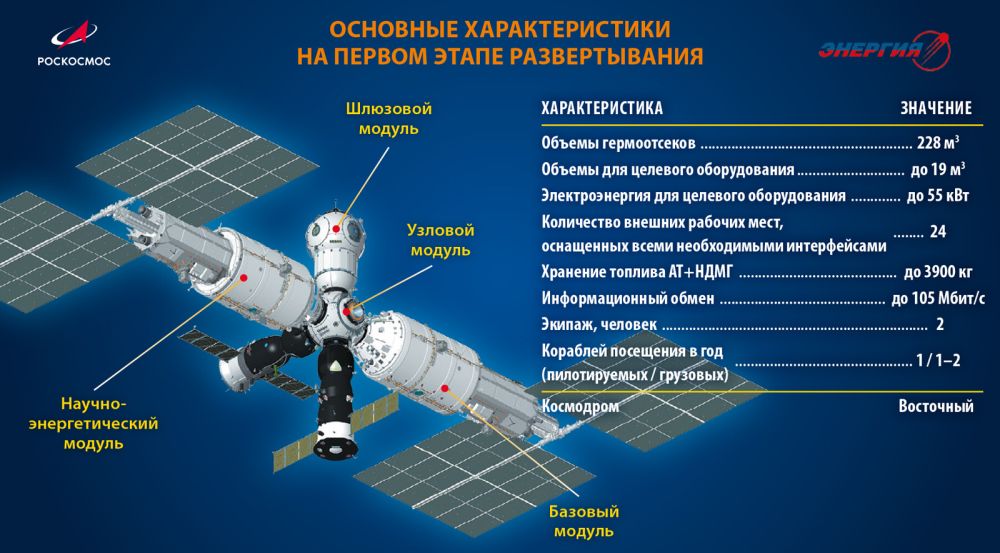
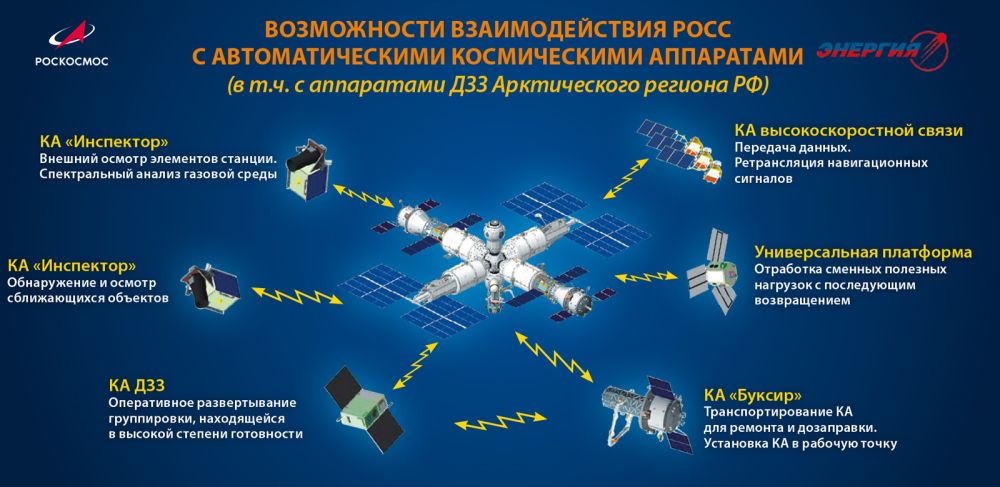
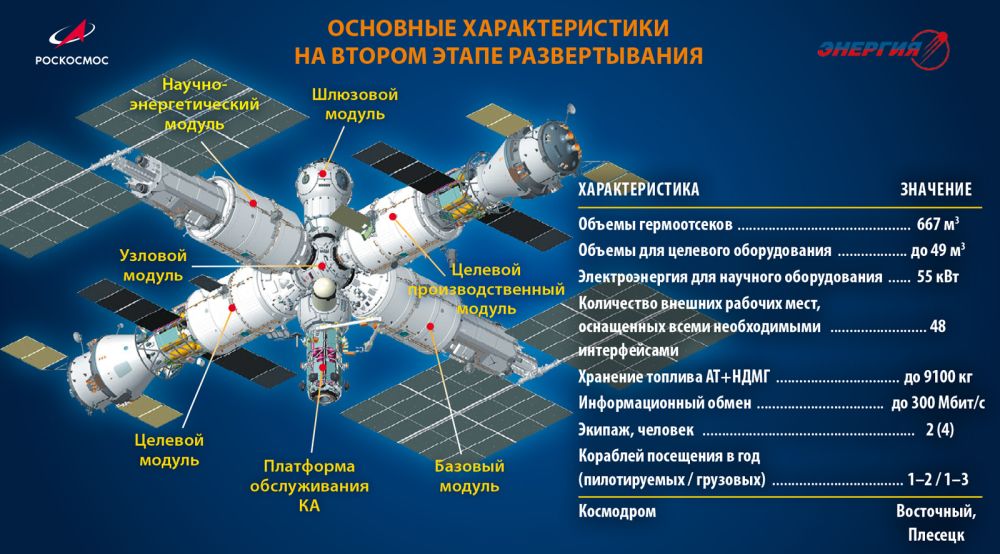
14/11/2022
Sergei Krikalyov: for the solution of complex problems in space, one cannot do without a person yet
Sergei Krikalyov, Executive Director for Manned Space Programs of the Roskosmos State Corporation, gave an interview to the MIR24 TV channel and spoke about cross-flights, the future of the ISS, the new Russian space station, and whether automatic weapons will replace humans in space.
Cross flights
MIR24: Recently, the flight of the Crew Dragon spacecraft took place, the crew is working in orbit. As part of the American crew, Russian Anna Kikina flew on this ship for the first time as part of the cross-flight program between NASA and Roskosmos.
Krikalyov: Let me clarify a bit. We believe that the flight took place when the ship returned, so the flight began. There may also be a bit of confusion over “cross flights.” In fact, Anna Kikina was included in the crew of the Crew Dragon ship and flew on this ship for exactly one day. She is a member of the Russian crew of the ISS, and Crew Dragon in this case is just a delivery vehicle. It’s like working in a laboratory, you can come there in your own or someone else’s car. Thus, “cross flights” is a cross means of delivery to the station. Each of us works as part of its own segment. At the station, we work in our segments – our cosmonauts work mainly on Russian tasks, and American astronauts work on American ones.
MIR24: That is, despite the difficult political situation, international cooperation in space continues.
Krikalyov: We started talking about cross flights quite a long time ago. The point is that in such risky industries, where we need to have backup options and alternatives, we always try to duplicate crews and tasks. We sometimes build even triple systems. In order for the station to work steadily, we need representatives of both the Russian and American segments. While everyone flew on our ships, the crews were always mixed. Now the Americans have begun to fly their ships. They had a long pause of several years. There was a period when everyone flew on shuttles, including me. There were options when we flew on a shuttle, and landed on the Soyuz. This is exactly what my flight was like when we started the first expedition to the ISS.
When everyone flies their own ship, we must take into account the risk – it’s not that big, but it exists. Something happened at the start or with the docking system … The crew took off and for various reasons did not dock. In 2018, we had an accident during the launch of the launch vehicle and the crew did not reach the station. In this case, there is a risk that the station will be left without specialists in one of the segments. Then it was decided to put one representative of the Russian segment on an American ship and vice versa. Even if an emergency occurs, at least one person from another segment will be on the ISS.
Manned cosmonautics of Russia after 2024
MIR24: I understand that the following question has been asked many times. This is a question regarding the statement that after 2024 Russia will withdraw from the ISS project.
Krikalyov: It would be more correct to say that sooner or later the ISS project will end. The words “after 2024” should be considered as “not earlier than 2024.” When we go “after” will depend on many factors. We discussed a lot of further scenarios for the development of the manned program. One of the main criteria that we agreed on is that the manned flight must be continuous. The Americans had a period when the Apollo flights ended and the shuttle flights had not yet begun. The Americans say that they are only now getting out of the problems that were created by this break. It was necessary to re-develop some methods, to assemble teams of specialists in a new way. And this may even be more important, since long breaks in flights destroy these teams.
MIR24: So they are now getting out of the problems that were caused by the break between the Apollo and the shuttles? But they still had a gap of nine years between the shuttles and Dragon?
Krikalyov: They compensated for the second break through partnership, and here there was no break between the manned flights of the American program. They continued to fly to the station. These flights did not stop, the experiments did not stop. The construction of the station by the American side was completed, but integrated crews flew on Soyuz spacecraft for many years – and this was the only way to bring people to the station. They, realizing that it would be much more expensive to restore the program later, compensated for this problem. If the American segment did not work for nine years, now we would have to start everything from scratch. So the first priority is continuity.
The second question is that we are considering the construction of a new Russian orbital station. When it will be and in what form is determined at the design stage. Now there is a preliminary design. The project itself has not yet been approved by the state – the process of forming the image is underway, so that later some technical grounds can be discussed. How much does it cost, what is the order of deployment, what will be the priorities, etc.
About the ROS station
MIR24: Is it possible to say something out loud already?
Krikalyov: We can say that the groundwork that was created on the Salyuts and transferred to the Mir, which was created on the Mir and transferred to the ISS, will be transferred to the development of a new space station. Those decisions that proved to be successful and confirmed their viability will be preserved.
In some ways, the new station will repeat the previous stations. For example, what was laid down during the creation of the Mir station, when we moved from a single-module Salyut to multi-module stations. This station is created in such a way that modules can be added to the station, the configuration of the station can change. We had a small manipulator on the Mir station modules that allowed them to dock from one node to another. The idea was this: when the module had served its time, it could be removed and the new module docked with the new scientific equipment.
MIR24: Such a Lego constructor in space.
Krikalyov: This idea was developed in the early 1980s, in the late 1980s it was implemented. The base unit of the Mir station was launched and the first modules began to dock to it. Didn’t get to replace the modules. In the future station, probably, the same option will be provided when the modules can be docked and undocked. In fact, we are doing about the same thing now on the ISS. There are additional docking stations on the Russian segment that allow modules to be docked. Small research modules docked to them, Progress ships docked. Last year, the Nauka multi-purpose laboratory module was docked to one of these nodes. Therefore, the development of the station due to modularity began during the construction of the Mir station.
MIR24: But the Mir had docking nodes on all sides.
Krikalyov: The base block of the Mir station had a transition compartment, which had a longitudinal docking port, like the Salyut station, and had four docking nodes along the periphery. That is, having docked, it was possible to re-dock and change configurations.
Future of the ISS
MIR24: What will happen to the ISS? There are several completely different projects. They said that in 2030 it will be flooded. There have also been proposals to turn it into a hotel for space tourists. There have even been projects to dock modular units there specifically for tourists.
Krikalyov: “Tourists” is a very broad term. Rather, it is correct to talk about the creation of commercial modules, and this is not necessarily tourism. When people talk about Dragon commercial flights these days, they are being flown by professionals. Commerce is that NASA orders the delivery of crew members to commercial companies.
We have a similar situation. RKK Energiya, which builds the Soyuz ships, is a joint-stock company where the state has only a part of the shares, and the state orders the creation of the ships. If earlier commercial companies created some components for ships that the state created, now they are building ships as a whole. Now the stations are being built by states, as there is a lot of uncertainty, but it is clear how to build a station. It is possible that commercial modules will also appear, places on which will be ordered by the state or other commercial companies. Such options are possible, so the final scenario for the fate of the ISS has not been determined. It could be a space museum, a continuation of space experiments. It is possible to create some assembly slipway, on which several modules can be created and they can be docked together. This allows you to check that the work is debugged and they can be undocked. After that they will work separately from the station with their own tasks.
In 1998, when the first unit of the ISS was launched, it was planned for 15 years. We believed that in 15 years it would be flooded. Perhaps some new modules can be used further, such scenarios were considered. Then it turned out that the station was in good shape – it was made with a large margin. Despite the fact that the warranty period has expired, this does not mean that it should be thrown away. The work was continued until 2020, then until 2024.
Now we are discussing the continuation of the work of the ISS after 2024. Our partners have already carried out a technical assessment of their segment and have decided that the station can be operated until 2028-2030. Now such decisions are made by other partner countries. We continue to assess the state of the Russian segment of the station. According to preliminary estimates, after 2024 the station will still continue to operate. Exactly when, after 2024, we will finish this question has not yet been determined.
Is the future of space exploration a man or an automaton?
MIR24: After each flight, the question arises whether a manned program is needed in principle. Since there are already machines, drones, artificial intelligence. Therefore, disputes arise whether it is necessary to send people into space, or whether to give everything at the mercy of machines?
Krikalyov: Automata are becoming more and more perfect, and they solve more and more problems, but they do not conduct research, but only answer the questions posed. A person is needed to ask these questions. There are, for example, studies – remote sensing of the Earth (the simplest things). Gagarin looked out the window, Titov took photographs of the Earth from space during the second flight. Observation techniques were developed. Now it would be strange to force an cosmonaut to constantly photograph the Earth. Such routine tasks are well performed by machines. They do them better than humans.
And there are tasks that are not very clearly set, where you need to formulate a question and determine the methodology for completing the task. In these cases, the person is irreplaceable. Indeed, at one time there were such disputes “a man or an automaton,” but by conducting a deep analysis, we realized that the truth is in the cooperation of a man and an automaton. Some methods will be given to automatic weapons, some will be practiced on a manned flight. If we compare cosmonautics, for example, with the production of cars, then an automatic machine is a conveyor.
MIR24: But a person sets the program for the conveyor.
Krikalyov: Yes, the program is set by a person. Not only that, a person creates experimental samples, several experimental samples, which are not very cheap. People don’t wear them to the bakery. These concept cars allow you to understand what needs to be put on the conveyor. The companies that developed concept cars continue to work on, and those who said that they didn’t need anything other than the conveyor, and “spanked” cars on this conveyor for decades, no one needs them anymore. I think that in cosmonautics there will be something similar. For complex tasks, for testing technologies, we cannot do without a person yet. To perform routine operations, a machine is good. Therefore, a combination of automatic and manned missions will have the maximum effect.
17/11/2022
Yuri Borisov: Russia has all the capacities for serial production of satellites
In a long interview with TASS, Yuri Borisov, Director General of the Roskosmos State Corporation, spoke about the need to switch to serial production of satellites in order to multiply the domestic constellation and commercialize space services. And also about how long it will take, what stage the National/Russian Orbital Station (ROS) project is at, and why cooperation with NASA on the ISS continues.
TASS: Almost in the first days after your appointment to Roskosmos, you outlined ambitious plans, among which is the doubling of the Russian satellite constellation. How much time will it take?
Borisov: At some point, the industry was held hostage by several factors in the satellite industry. Firstly, it is the presence of a huge number of heterogeneous technical solutions for the payload, service systems and spacecraft platforms. Each individual satellite, one might say, was invented from scratch. Secondly, enterprises regularly missed the deadlines for their construction – during this time, the electronic component base became obsolete and discontinued, and previously issued documentation had to be redone.
A decision was made to switch to an industrial model for creating space technology and, as a result, to mass production of a multi-satellite constellation. To do this, it is necessary to unify technical solutions and service systems of satellites, apply the best of them and standardize protocols and information exchange interfaces.
At the moment we are producing 15 satellites a year, technically it is possible to increase production to 40. But even this is not enough. With the transition to mass production, we plan to assemble a satellite per day. This will require a radical restructuring of the entire industry. It is necessary to ensure the scientific, technological and production readiness of the main enterprises, build new logistics with subcontractors, and train personnel. We expect that starting from 2026, when these works are carried out and the necessary production capacities are prepared, it will be possible to gradually reach the declared indicators of the serial production of Russian satellites.
The main tool for solving this problem will be the federal project “Integrated development of space information technologies” (“Sphere”) approved by the Russian government. It is based on five communication orbital constellations and five new Earth remote sensing constellations based on small spacecraft, which will make it possible to multiply the orbital constellation and dramatically increase its value for consumers.
The first satellite demonstrating this program, Skif-D, flew into orbit on October 22. We have launched advanced work on the creation of new multi-satellite constellations of the “Internet of Things” “Marathon” and broadband Internet access “Skif.” The first demonstrator of the Marathon low-orbit system will fly in 2023, and from 2026 the first stage of the system of 137 devices will be deployed. The new multi-satellite constellation of remote sensing [Earth remote sensing – TASS note] “Berkut” will consist of space systems for panoramic and highly detailed optical surveys, as well as radar surveillance.
TASS: Does Russia have the necessary capacities and competencies for this?
Borisov: To create communication satellites from JSC “ISS” them. Academician M. F. Reshetnev will require the introduction of serial mass production and the transition to other quality management standards. As for remote sensing satellites, which will be assembled at the Lavochkin NPO, the development of a unified satellite platform, on the basis of which the constellation will be created, is already being completed. To satisfy the interests of Russia, there should be at least 100 such satellites.
In order to provide manufacturers with the necessary component base, we are developing an industry-wide integrated structure of space instrumentation. JSC “RCS” has created a catalog of elements, integrated on-board information systems, their mass production will be located at the Yaroslavl Radio Plant, which has recently entered the circuit of JSC “RCS.”
Thus, we will have the whole set of unified solutions for mass production of devices, and the necessary components in warehouses. The country has all the necessary capacities, and we are already creating modern domestic technical solutions as part of promising research work of the federal project “Sphere.”
TASS: In addition, you said that the industry needs to be commercialized. What specific services does Roskosmos plan to bring to the market?
Borisov: The space industry is the largest sector of the world economy with a turnover of about $469 billion. Good rates of commercialization of services are demonstrated by those countries that have managed to balance the economic interests of governments and private investors at the level of public policy. State mechanisms should be set up so that science has an incentive to develop space technologies, and business has to introduce them into a wide range of civilian products and order new satellites. The leaders are the United States, where the volume of private investment in the space industry in 2021 amounted to about $9 billion (for comparison: in Europe this figure is $2 billion). I can’t say it’s a fast process. In the United States, it took almost 40 years, but now the country controls 50% of the space services market.
We have the same path, only in a shorter time frame. Work is underway on a regulatory framework that will make the space services market attractive to private investors. A business model is being formed. At the forefront should be the consumer, who will form the requirements for space services. Funds for space systems should be attracted from the market – banks, investment companies, etc. And we see the role of the state, represented by the state corporation Roskosmos, in stimulating the development of the industry through subsidizing interest on loans and risk insurance (guaranteed loans), as well as in controlling and additionally financing projects that are not related to the economic interests of society – science and state security. Remote sensing data for the Ministry of Defense, the Federal Security Service, the Ministry of Internal Affairs, the National Guard, the Ministry of Emergency Situations should be provided free of charge, in a quality manner and on time.
But this is an ideal scheme, in reality everything is more complicated: space systems have a lot of consumers, it is not so easy to bring their requirements to a common denominator, systems for managing risks and operating costs, etc. are needed.
One of the most promising areas is the sector of remote sensing of the Earth. In 2020, the volume of the global commercial remote sensing data market amounted to $1.6 billion, by 2030 it is expected to grow to $5 billion. So far, governments and defense departments remain the main customers for many private companies.
According to Euroconsult, this segment accounted for up to 45% of the total data market in 2020. And this is understandable, because for decades remote sensing technologies have been used mainly for military and defense purposes, including control over land and sea borders, obtaining up-to-date information on infrastructure, logistics and military facilities. But with the development of new technologies, the structure of the market will change. With the growth in the amount of data received from satellites, sensors and the Internet of Things, there are opportunities for solving business problems and how to make everyday life more comfortable for a person. According to forecasts, by 2025 the share of B2G operations in the market will decrease to 25%, B2B will grow to 65%, and B2C to 10%. The main clients will be large commercial enterprises in the oil and gas, metallurgy, mining, agriculture, construction and shipping industries. In fact, we must offer the country a new quality of monitoring the environment, especially dangerous objects, subsoil use, construction, land use, etc.
The funds that we will receive in the process of monetizing the use of remote sensing data will allow us to increase the satellite constellation.
There is already a positive experience of commercialization of the market for the services of state-owned companies in Russia – this is the State Corporation Rosatom, where very effective management forms new high-tech markets based on the use of modern technological solutions.
TASS: When you held the position of Deputy Prime Minister, you were not enthusiastic about the filming of the film Challenge. Has your opinion changed?
Borisov: If you remember exactly my words and position, I was against the fact that the shooting was financed from the budget of the state corporation Roskosmos, which is not in the best financial situation. Especially considering the number of the most important tasks that the industry has faced and faces in the field of ensuring the national and economic security of the country. We have to build satellites, launch rockets … These are colossal costs. And billions for filming is still a luxury and non-core activity of a state corporation. My position has not changed to this day.
But let’s talk about the fait accompli – the film is shot. An amazing team of actors and directors took part in its creation, who put their talent and soul into it.
There will undoubtedly be an enlightening effect from the film and the entire project. Of this I am sure.
In addition to the film, the project also includes a cycle of popular science programs, which reflects all stages of the selection and special training of flight participants at the Cosmonaut Training Center. This is the work of a wide range of industry specialists: doctors, instructors, enterprise engineers, employees of the Mission Control Center, cosmonaut rescue services, and many others. In addition, Channel One continues to shoot a special cycle of documentaries about the work and promising tasks of the national cosmonautics. In April of this year, the first film dedicated to the Day of Cosmonautics (Baikonur. The first on planet Earth) was aired.
The popular science component is one of the most important for the industry. During the filming, for the first time, the technology of operational training of non-professional participants in space flight and the control system of the spacecraft, its docking with the ISS by one professional cosmonaut were worked out. This experience came in handy when preparing a tourist space mission in December 2021 [Japanese billionaire Yusaku Maezawa and his assistant Yozo Hirano became the first space tourists from Japan – they made their flight to the ISS from Baikonur together with Roskosmos cosmonaut Alexander Misurkin. Soyuz MS-20 launched on December 8 and returned to Earth 12 days later].
At all stages of shooting the film of the Roskosmos enterprise, our specialized specialists supported the team – expertly and informationally. The final stage of ground surveys took place during the Soyuz MS-22 launch campaign in September 2022 at the Baikonur Cosmodrome. According to Channel One, the release of the feature film is scheduled for Spring 2023.
TASS: Why did Russia decide to withdraw from the ISS project? What is the status of the Russian Orbital Station (ROS) project?
Borisov: The decision to extend Russia’s participation in the ISS program or withdraw from it is made at the level of the Russian government and must be formalized by a special decision of the Russian government.
Now we have the decision of the government of the Russian Federation (dated July 2, 2015 No. DM-P7-4368) to extend the flight of the ISS RS Russian segment – TASS note until 2024. There is no other official document regulating the continuation of participation or withdrawal from the ISS program after 2024. Therefore, it is premature to talk about Russia’s withdrawal from the ISS program. Our main task is to ensure the continuity of manned space flights.
The decision on the timing of participation in the ISS program will depend on the technical condition of the ISS RS, which should ensure the guaranteed safety of the station crew members, the timing of the deployment of the ROS and the start of flights to it by Russian cosmonauts, as well as a number of other factors.
The Roskosmos State Corporation is carrying out development work on the development of a draft design of the space complex of the Russian Orbital Station, within the framework of which options for creating the Russian Orbital Station, the concept of construction, composition and tasks to be solved are considered. According to the results of the development of this preliminary design, it will be approximately clear how much it can cost. We will build the Russian orbital station on domestic solutions.
TASS: What tasks are supposed to be solved at the ROS?
Borisov: The tasks that are supposed to be solved at the ROS will be determined after the adoption of the draft design of the ROS space complex. In general, the main directions of development of the domestic space industry: the development of an orbital space constellation, the development of space instrumentation, the implementation of manned programs, the implementation of scientific programs, the commercialization of the industry.
TASS: Most recently, during the launch of the American Crew Dragon spacecraft with Russian cosmonaut Anna Kikina on board, the head of manned programs of Roskosmos Sergei Krikalyov told reporters that you are in contact with the head of NASA and even plan to meet with him before the end of this year. Is this so? And doesn’t such cooperation contradict the position of Russia towards the countries of the West and especially the United States? Are other joint projects planned and for how long can space remain out of politics?
Borisov: Russia has a number of international obligations, and cross flights are included in this list. Being a reliable partner and keeping agreements is normal and right. Especially if the same model of behavior is maintained by NASA.
But there is another important point: however surprising it may seem at first glance, the more tense and difficult the situation between countries, the more important it becomes to maintain contact. Remember, the US and the USSR continued to communicate and cooperate even during the Cold War, albeit through the Iron Curtain. Negotiations were also held in the space sphere, thanks to which, for example, the Soyuz-Apollo project took place.
So it is now: communication at the level of heads of space agencies is a guarantee of fundamental security in outer space. Not only Russian space, but Russia as a whole. We cannot allow the creation of an information vacuum, it is important for Russia to know and understand what NASA is doing, what their intentions are.
Roskosmos has many very important tasks: to build and launch satellites, and in series, to provide the national economy of our vast country with all the necessary services, to strengthen the nuclear shield – the guarantee of Russia’s security, and to explore deep space. And this task [deep space exploration – TASS note] requires not only huge investments, which are often very costly for one state, but also technological and scientific cooperation. Different countries have different competencies, and only by combining them, it is possible to achieve the set goals.
For example, the European Space Agency (ESA) completely refused to cooperate with Russia, jeopardizing the Mars exploration program. Who will benefit from this – us or the Europeans? Everyone will lose. Therefore, I consider it a great success that on the other side of the ocean, at NASA, there are people who find the strength and intelligence in themselves not to let politics interfere with scientific cooperation. The cross-flight program of Roskosmos and NASA is aimed at continuous operation of the Russian and American segments of the ISS in manned mode. The station must always have a crew: at least one Russian cosmonaut on the Russian segment, one astronaut on the American segment. In simple terms, this is mutual insurance in case of emergency situations with Roskosmos and NASA ships.
I am convinced that true patriotism is not in slogans and calls to spite everyone to cut off their fingers. We must do everything to ensure that Russia does not lose its scientific potential and opportunities to ensure technological security and sovereignty, despite sanctions and attempts by Western politicians to cut us off from access to technology, from communication with colleagues in the scientific community.
As for the meeting with Mr. Nelson [NASA head Bill Nelson – TASS note]. Until the political situation changes, neither his arrival in Russia nor mine in the US is possible. Unfortunately, my participation in the World Space Congress in Paris also did not take place – our delegation was not given a visa. Here is another example of stupidity and shortsightedness on the part of the European Union. The congress was supposed to discuss plans for the exploration of deep space, and not a position on Ukraine. And while there are no signs that in the coming days something will change for the better.
In conclusion, I can only add: our President Vladimir Putin has repeatedly stated that Russia is open to cooperation with everyone who is interested in this. We did not start this campaign to isolate Russia. This path is erroneous and criminal – not only in relation to our country, but also in relation to the peoples of those countries that today are forced to endure the consequences of such a policy. Roskosmos adheres to exactly the same position – we are open to cooperation with those who are interested in this.
26/12/2022
Sergei Krikalyov: the work of the Russian segment of the ISS can be extended until at least 2028
Sergei Krikalyov, Executive Director of the Roskosmos State Corporation for manned space programs, in an interview with Interfax correspondent Artem Rukavov spoke about the possibility of extending participation in the International Space Station project, designing a new Russian orbital station, the future of cross-flights and the prospects for Russian-Chinese relations in space.
Interfax: Sergei Konstantinovich, has a request been sent to the government regarding the continuation of Russian participation in the ISS project after 2024?
Krikalyov: There is a certain procedure for how this is done. The Americans, as integrators, offered to extend the ISS flight to all partner countries. In order to make a decision on this, we determined the technical feasibility of extending the flight of the Russian segment of the station. Documents for approval of the continuation of the work of the ISS were sent to the government. They are then reviewed and approved.
Interfax: Until what year does Roskosmos propose to extend the operation of the Russian segment of the ISS?
Krikalyov: We are still talking about 2028. Historically, renewals have been in four-year increments: we had an agreement until 2020, now it is until 2024. It can be extended until 2028, and then look at the situation and the analysis of technical and program feasibility.
Interfax: It was reported that other agencies could be included in the new agreement on cross-flights to the ISS between Roskosmos and NASA …
Krikalyov: This was not discussed. We have two parties participating in these negotiations – we and the Americans. Only we and the Americans have the ability to deliver people into space, except for the Chinese, who are not included in the ISS program. The crossover lies in the fact that we only cross-use delivery vehicles, but each member of the ISS crew works in its own segment. Another thing is that a fairly large number of countries are included in the work on the American segment – these are the European, Canadian and Japanese space agencies. They have their own internal relationships on the balance of contributions, on the rights to a place in various expeditions. That is, any of the astronauts can be from the American segment, not necessarily NASA. But now there is a conversation on cross-flights between the Russian and American sides.
Interfax: That is, the astronauts of the European Space Agency will be able to fly again on the Russian Soyuz?
Krikalyov: Theoretically, they can. As professionals working in the American segment, they can fly our ship. The question is whether the Americans will make such a decision. We don’t just fly to ride each other’s ships. This is done to parry an emergency situation: the arrival of one of the ships – ours or the American. So that none of the segments is left without a crew. If the Americans consider that one of the European astronauts will be able to perform the functions on the American segment, being there alone, then this is probably possible. By the way, we already had Europeans flying in the American segment quota, and they were crew commanders. So theoretically everything is possible. Whether these will be American astronauts is already up to NASA, it is they who decide which of their partners to land.
Interfax: In August, they presented a model of the new Russian orbital station (Российской орбитальной станции/Rossiiskoi Orbital’noi Stantsii). Is this the final version?
Krikalyov: A layout is a kind of vision. This is not the final version, but one of the options for the development of the station. Much will depend on the results of the preliminary design. At the first stage, the flight path was chosen, how we would fly, how the rescue of the crews would be ensured, and approximately how much it would cost. That is, all assessments of the first stage are not the final decision on the formation of the station. After preliminary design, the next stage in the creation of ROS will be the development of working design documentation. What will the station look like in hardware? Life will show.
Interfax: What changes are planned for the second stage of design?
Krikalyov: It is not correct to talk about changes now, we are only creating a station, comprehending what it should be like, conceptually defining its parameters and a list of tasks. The version of the layout that you saw on the Army forum is like Tsiolkovskii’s drawings. That is, this is a completely normal vision, as it can be. This does not mean that later we changed Tsiolkovskii’s project. When Korolev built his rockets, he built them in his own way, based on the knowledge that had been accumulated at that time. Therefore, the layout that you saw should be treated as a concept, it is in many ways ideologically similar to the idea of the Mir station, where the modules were also docked and could theoretically change. The presented layout is just one of the possible options for further creation of the station.
Interfax: Is the scenario of using the Russian segment of the ISS in the new orbital station still being considered?
Krikalyov: So far, in the concept that the Energiya Rocket and Space Corporation showed and solidified after the first stage, it is assumed that the station will fly in a new orbit, which does not have the ability to interact with the orbit in which the ISS is currently located. ROS should be absolutely autonomous from the existing ISS infrastructure.
Interfax: At what stage of creation is the first ROS module, the Scientific and Energy Module (Научно-энергетический модуль/Naauchno-Energeticheskii Modul’), now?
Krikalyov: As you know, NEM was originally conceived as the last module of the Russian segment of the ISS, but, taking into account the prospects for completing the operation of the station in the coming years, the question arose of the expediency of sending the module to the ISS and the possibility of its use as part of the ROS. Now this issue is being discussed. The module itself is in a high state of readiness at RKK Energiya, and we must determine how it can be used as efficiently as possible in the interests of Russian cosmonautics. This will be done based on the results of the preliminary design, the completion of which is scheduled for the second half of next year.
Interfax: In what year will flight tests of a promising new generation transport ship take place? Will a ship layout be used for them?
Krikalyov: The timing of flight tests will depend on how the date of the start of financing the creation of ground infrastructure for it at the Vostochnyi Cosmodrome is determined. So it’s too early to say anything right now. The creation of a model ship for flight tests is not expected and was not expected before. During the first tests, the ship may not have a complete set, because the first flights are planned to be carried out in unmanned mode. Therefore, a complete set of life support systems is not as necessary for this ship as for the one that will be made already in a manned version. During flight tests, the ship should be used already in almost complete configuration, which must endure temperature loads and overloads, and be controllable.
Interfax: Is the flight of this ship to the Moon being considered, as the American Orion has flown?
Krikalyov: At the first stage, no. The first stage includes tests in low Earth orbit – the first two flights are unmanned, the third should be manned. A mission to the Moon will be possible when a heavier-class rocket appears, which will be able to launch there not only the ship itself, but also the upper stage. By the way, it was the same with the Orion ship. First, they conducted its flight tests in near-Earth orbit, and the flight to the Moon became possible with the advent of the SLS super-heavy class rocket.
Interfax: Is it possible to integrate a Russian advanced transport ship of a new generation with a Chinese super-heavy missile?
Krikalyov: It is theoretically possible, but in practice it is quite a difficult question. It is much more likely that the ships will interact already in space, just as the Soyuz and Apollo docked in our time, as the shuttles docked to the Mir station, and so on. Because in order to put a ship on a rocket, you need to have all the ground equipment in the place where the rocket is located in order to technically prepare the device for launch. Perhaps it is possible, but the expediency is not yet clear. And such conversations have not even been conducted yet. There was talk about possible interaction already in space with both the American program and the Chinese one.
Interfax: Do you discuss with China the issues of cooperation in manned cosmonautics?
Krikalyov: Not yet, although it is possible in the future. The current Chinese station flies at a different inclination than the one we launch ships from Baikonur and plan to launch from Vostochnyi. There have been discussions about possible cooperation in low Earth orbit, but so far everyone is going their own way. In the future, probably, especially for long-range flights, this cooperation will be more technically feasible. Maybe we will cooperate in low orbit, but for this we need to solve a lot of both technical and organizational issues.
Interviewed by Artem Rukavov, Interfax
28/12/2022
“Russian space program facing challenges ahead of ambitious 2023,” NASASpaceflight.com. A – one suspects – very restrained and pointedly neutral article on Russia’s spaceflight plans for the next year. All Western spaceflight enthusiast and news sites are fanatically pro-Ukrainian and Russophobic, so I rarely visit them now.
29/12/2022
Results of Russia’s space activities in 2022
The Center for Internal and External Communications of the State Corporation Roskosmos has chosen the most significant events in the Russian cosmonautics that took place this year.
Record series
In 2022, 22 launches of Russian space launch vehicles took place: 13 from the Plesetsk Cosmodrome, seven from Baikonur, and one each from the Vostochnyi and Guiana Space Centers. Among them, 19 launches of rockets of the Soyuz-2 family (eight Soyuz-2.1a and Soyuz-2.1b, two Soyuz-2.1v and one Soyuz-ST-B), two – rockets Angara-1.2 and one – missiles Proton-M. All of them were successful.
Thus, the record series of accident-free launches of Russian space launch vehicles, which began in October 2018, has continued, which has now reached 98 launches.
In November 2022, the Director General of Roskosmos, Yuri Borisov, in the face of the need for a significant increase in the domestic orbital constellation, demanded that the heads of the main enterprises of the State Corporation ensure 100% success of space launches next year.
In August, 16 Russian small scientific and educational spacecraft were simultaneously launched from Baikonur – a record number in the history of Russian cosmonautics. They were created as part of the Space-Pi project, organized by the Innovation Promotion Foundation with the support of Roskosmos, the Russian Movement of Schoolchildren and other organizations.
It is also worth highlighting the implementation in 2022 of two successful launches of the Angara-1.2 rocket as part of flight tests of the Angara space rocket complex at the Plesetsk cosmodrome, the refinement of the launch complex systems of the Soyuz-2 space rocket complex at the Vostochnyi cosmodrome under Naftil fuel and carrying out the first launch of the Soyuz-2.1b rocket from it completely on Naftil.
Sarmat tests
In April 2022, the first launch of the Sarmat intercontinental ballistic missile was carried out from the Plesetsk cosmodrome under the state test program. Its training warheads arrived in a designated area of the Kura training ground on the Kamchatka Peninsula.
The Sarmat is the most powerful missile with the longest range in the world and was created exclusively by Russian industrial cooperation. It is to replace the missile of the Voevoda complex, developed in the Soviet Union in the 1980s.
In August, the State Rocket Center named after Academician V.P. Makeeva (part of Roskosmos) and the Ministry of Defense of the Russian Federation at the Army-2022 International Military-Technical Forum signed a contract for the supply of Sarmat missiles.
Satellites for Iran and Angola
In August 2022, the Soyuz-2.1b launch vehicle with the Fregat upper stage from the Baikonur cosmodrome launched the Iranian Khayaam Earth remote sensing spacecraft, and in October the Proton-M launch vehicle with the upper stage DM-03 is an Angolan telecommunications satellite Angosat-2.
Both devices were created by Roskosmos enterprises – and, as Yuri Borisov, head of the State Corporation, later noted, Russia will continue to create and launch satellites for friendly countries.
Building cooperation with China
In 2022, the intensification of cooperation with the Chinese side in the exploration of outer space continued.
On November 25, a program for the development of cooperation in space activities between Roskosmos and the Chinese National Space Administration for 2023-2027 was signed. On the same day, an agreement was signed between the Governments of the Russian Federation and the People’s Republic of China on cooperation in the creation of the International Scientific Lunar Station (ISLS), which is a serious step in the study of the Earth’s natural satellite.
In February, an agreement was signed between Roskosmos and the Commission on the Chinese satellite navigation system on cooperation in ensuring the complementarity of the global navigation satellite systems GLONASS and Beidou in terms of system time scales. And in September, contracts were signed for the mutual placement of GLONASS and Beidou ground stations, according to which it is planned to build three Russian measuring stations in the Chinese cities of Changchun, Urumqi and Shanghai and three Chinese ones in the Russian cities of Obninsk, Irkutsk and Petropavlovsk-Kamchatsky.
Preparation of the legal basis for international cooperation
In 2022, the ratification of the following agreements was completed:
- between the Governments of the Russian Federation and the United Mexican States on cooperation in the exploration and use of outer space for peaceful purposes of September 28, 2021 (the President of the Russian Federation signed the relevant federal law of October 7, 2022 No. 380-FZ);
- between the Governments of the Russian Federation and the United Arab Emirates on cooperation in the exploration and use of outer space for peaceful purposes of October 26, 2021 (the President of the Russian Federation signed the relevant federal law of December 19, 2022 No. 527-FZ);
- between the Governments of the Russian Federation and the Republic of India on measures to protect technologies in connection with cooperation in the field of exploration and use of outer space for peaceful purposes and in the creation and operation of launch vehicles and ground-based space infrastructure dated December 1, 2021 (the President of the Russian Federation signed the relevant federal law dated December 19 December 2022 No. 526-FZ).
New station design
In April 2022, Roskosmos signed a contract with the Energiya Rocket and Space Corporation named after S.P. Korolev to develop a draft design of a new Russian orbital station (российской орбитальной станции).
Preliminary design is carried out in two stages. The first stage has already been completed, which provides for an analysis according to various criteria and the choice of a scenario for the deployment and inclination of the station’s target orbit.
The second stage includes the development of a preliminary design of the station, taking into account the selected deployment scenario, including the development of technical specifications for its components, as well as a feasibility study of the cost of the station.
The main purpose of the station is to deploy and ensure the intended use of a new generation of manned orbital infrastructure in low Earth orbit, which ensures the implementation of Russia’s national interests in the field of manned space activities, the development of domestic science and the economy.
The first satellite of the Sphere project
In October 2022, the Soyuz-2.1b launch vehicle with the Fregat upper stage launched three Gonets-M personal satellite communications satellites and the Skif-D demonstration satellite into orbit from the Vostochnyi cosmodrome.
Skif-D is the first spacecraft of the Sfera federal project, which in the future will include five communications satellite constellations and five Earth remote sensing satellite constellations. The experimental spacecraft Skif-D is designed to protect the orbital-frequency resource of Russia and to develop communication technologies for a satellite communication system and broadband access to the Internet.
In the interests of the Sphere project, the development of two Marathon-D Internet of Things demonstrator satellites and four Express-RV highly elliptical communication spacecraft has also begun.
New industrial model
The main priority for the domestic rocket and space industry, the head of Roskosmos, Yuri Borisov, outlined a significant increase in the Russian orbital constellation, which requires the introduction of a new industrial model for the production of spacecraft based on unification and standardization.
We are talking about a radical restructuring of the main processes of the technological cycle – development, production, testing, an increase in the terms of active existence, as well as the deployment of serial production of satellites and the modernization of capacities for the mass production of their service equipment.
In the future, this will make it possible to produce satellites in greater quantities – one satellite per day instead of the current 15 per year – and of high quality. And along with the expansion of the orbital constellation, the number of space services provided in the country will increase – communications, television broadcasting, relaying, broadband Internet access, the Internet of things, navigation and remote sensing of the Earth.
Cross flights to the ISS
In July 2022, the State Corporation Roskosmos and NASA signed an agreement within the framework of the International Space Station program, which provides for three flights of Russian cosmonauts on American manned spacecraft Crew Dragon and three flights of American astronauts on Russian manned spacecraft Soyuz MS in 2022–2024.
In accordance with the contract, in September, NASA astronaut Francisco Rubio was delivered to the station on the Soyuz MS-22 spacecraft, and in October Roskosmos cosmonaut Anna Kikina was delivered on the Crew Dragon spacecraft.
The agreement will allow, in case of cancellation or significant delay in the launch of a Russian or American spacecraft, to ensure the presence on the ISS of at least one Roskosmos cosmonaut and one NASA astronaut to service the Russian and American segments of the station, respectively.
2023
3/1/2023
Manned cosmonautics of Russia in 2022
In 2022, as part of the International Space Station program, ROSKOSMOS successfully launched Soyuz MS-21 and Soyuz MS-22 manned spacecraft and Progress MS-19 and Progress MS-20 cargo spacecraft from the Baikonur Cosmodrome, and Progress MS-21, which made it possible to fully ensure the uninterrupted delivery of crews, dry cargo, water, gases and fuel to the station.
At the Russian segment of the station, work was carried out to integrate the Multi-Purpose Laboratory Module Nauka:
- delivery and installation on its outer surface of means for fastening large-sized objects;
- transfer of the European ERA remote manipulator from the transport position to the working one and testing its functioning;
- preparatory work for the installation on the module of the previously delivered additional radiation heat exchanger and lock chamber.
To do this, the Russian participants of the 66th, 67th and 68th long-term expeditions made a record number of exits per year (seven) under the Russian program within the framework of the ISS project.
Roskosmos cosmonauts also conducted 59 experiments on the ISS, of which six were new.
In accordance with the order of the Government of the Russian Federation, in order to maintain the reliability of the operation of the ISS as a whole and the guaranteed presence of at least one Roskosmos cosmonaut on the Russian segment of the station and at least one NASA astronaut on the American segment, an agreement was signed on the implementation of the agreement between the State Corporation Roskosmos and NASA regarding flights of integrated crews on Russian and American manned spacecraft, as well as a joint plan for its implementation.
Roskosmos has completed an agreement with Axiom Space to conduct the flight of NASA astronaut Mark Vande Hei to the ISS from April 2021 (launch on the Soyuz MS-18 spacecraft) to March 2022 (landing on the Soyuz MS-19 spacecraft). Also, the implementation of the contract with Space Adventures for organizing the flight of two Japanese tourists on the Soyuz MS-20 spacecraft to the ISS in December 2021 was completed – a mock-up of the Soyuz MS descent vehicle and three mock-ups of the Sokol KV-2 spacesuits were manufactured and transported to the customer.
In addition, the State Corporation, in agreement with the European Space Agency, prepared astronaut Samantha Cristoforetti for a spacewalk, which was conducted from the Russian segment of the ISS in July 2022.
In 2022, Roskosmos, under a contract with NASA, continued to provide engineering support services for the Zarya Functional Cargo Block on the ISS, and also signed a number of additions to the contract with NASA:
- on the training of American astronauts for the implementation of cross-flights;
- training Russian cosmonauts for extravehicular activities and robotics on the American segment of the station;
- to support NASA personnel and organize the work of its representatives at the Baikonur Cosmodrome in order to ensure participation in the integration of cargo into the Soyuz MS-22 spacecraft and its launch, as well as in pre-launch activities during the launch of the Progress MS-21 spacecraft.
5/1/2023
International space cooperation of Russia in 2022
Last year, despite the difficult foreign policy background and sanctions pressure, Roskosmos State Corporation managed to make significant progress in strengthening international relations.
Agreements were ratified between the Government of Russia and the Governments of Mexico and the United Arab Emirates on cooperation in the exploration and use of outer space for peaceful purposes, as well as an intergovernmental Russian-Indian agreement on measures for the protection of technologies in connection with cooperation in the exploration and use of outer space for peaceful purposes. purposes and in the creation and operation of launch vehicles and ground-based space infrastructure.
Also signed:
- agreement between the State Corporation Roskosmos and the Commission on the Chinese satellite navigation system on cooperation in the field of ensuring the complementarity of the global navigation satellite systems GLONASS and Beidou in terms of system time scales (February 4);
- contract on the mutual placement of measuring stations of the GLONASS and Beidou systems in Russia and China (September 27);
- an agreement between the Governments of Russia and China on cooperation in the field of the creation of the International Scientific Lunar Station (November 25);
- program for the development of cooperation in the field of space activities between Roskosmos and the Chinese National Space Administration for 2023-2027 (November 25).
In 2022, in the interests of foreign customers, the following launches were carried out: the Soyuz-ST-B launch vehicle with the Fregat-M upper stage and 34 OneWeb spacecraft from the Guiana Space Center; launch vehicle Soyuz-2.1b with the upper stage Fregat and the Khayaam Iranian satellite for remote sensing of the Earth from the Baikonur cosmodrome; launch vehicle Proton-M with upper stage DM-03 and the Angolan telecommunications spacecraft Angosat-2 from the Baikonur cosmodrome.
In addition, there were:
- the third meeting of the Interstate Council on Space of the CIS Member States (June 9);
- 23rd meeting of the subcommittee on cooperation in space of the Russian-Chinese commission for the preparation of regular meetings of heads of government (July 8);
- a meeting at the Vostochnyi cosmodrome between the leadership of Roskosmos and a delegation headed by the Chairman of the State Administrative Council, Prime Minister, Supreme Commander of the Armed Forces of the Republic of the Union of Myanmar Min Aung Hlain to negotiate all areas of cooperation of mutual interest (September 8);
- the ninth meeting of the Russian-Chinese Project Committee on Important Strategic Cooperation in the Field of Satellite Navigation (September 27);
- meeting of the working group on issues of military-economic cooperation under the Chairman of the Interstate Commission on military-economic cooperation of the CSTO (October 17-19);
- negotiations with the Minister of Higher and Professional Education, Innovation, Science and Technological Development of the Republic of Zimbabwe Amon Murvira, during which an agreement was reached on further cooperation in the creation and launch of small spacecraft for educational and communications purposes (November 24).
ROSKOSMOS State Corporation regularly participated in the activities of the open-ended working group established by UN General Assembly Resolution 76/231. A number of states, including the Russian delegation, in contrast to the concept of “responsible behavior” in their speeches promote the need to develop a legally binding document with verification mechanisms as the only effective mechanism for solving the problems of preventing an arms race in outer space.
As a result of international events, conferences and exhibitions organized with the participation of Roskosmos and enterprises of the rocket and space industry, the following were signed:
- a contract for the supply of the latest Sarmat intercontinental ballistic missiles;
- agreement on the creation of the Sverdlovsk dual-purpose scientific and industrial cluster for transport engineering;
- an agreement on financing the creation of hydraulic fracturing complexes with Novikombank;
- cooperation agreements with the Republic of Komi, Promsvyazbank, Roskartography and the Roscongress Foundation;
- a memorandum of intent to jointly implement an import substitution program between NPO Iskra and the New Electric Machines society;
- memorandum between the State Space Research and Production Center named after M.V. Khrunichev and Rusatom Overseas on the intentions of cooperation in the field of hydrogen energy;
- memorandums of cooperation in the field of launch services with Iranian companies SAHAB and SpaceOmid.
6/1/2023
Creation of automated spacecraft in Russia in 2022
In 2022, the State Corporation Roskosmos continued work on the creation of automated spacecraft.
In October last year, a Soyuz-2.1b launch vehicle with a Fregat upper stage launched three Gonets-M personal satellite communications satellites and the first demonstration satellite of the Sfera federal project, Skif-D, from the Vostochnyi cosmodrome.
Also, the implementation of the scientific research program by the Spektr-RG space astrophysical observatory, located 1.5 million km from the Earth, was continued – with the help of the Russian ART-XC telescope, world-class scientific data were obtained based on the results of scanning the celestial sphere and the plane of the galaxy in the X-ray range of the spectrum electromagnetic radiation.
In addition, work was carried out to create:
- the Luna-25 lander, designed to develop soft landing technology and integrated research on the lunar surface in the southern near-polar region (launch is planned for 2023);
- Luna-27 lunar orbiter Luna-26 and lander;
- Bion-M No.2 biological satellite;
- Spektr-UV space astrophysical observatory;
- Resonance satellites for fundamental space research;
- Spektr-M scientific equipment for the space astrophysical observatory.
A landmark event in the exploration of the Moon was the signing on November 25, 2022 of an agreement between the Governments of the Russian Federation and China on cooperation in the field of creating the International Scientific Lunar Station.
Prior to the termination by the European Space Agency (July 12, 2022) of bilateral cooperation with Roskosmos under the Mars exploration program, the ExoMars-2022 lander was created, which went through all stages of ground experimental testing and was prepared for transportation to the Baikonur Cosmodrome for launch in September 2022.
19/1/2023
“Meeting with head of Roscosmos Yuri Borisov,” Kremlin.ru.
6/2/2023
The Council of Chief Designers recommended extending the life of the Russian segment of the ISS until 2028
Today, February 6, at the Energiya Rocket and Space Corporation named after S.P. Korolev (part of the Roskosmos State Corporation), a meeting of the Council of Chief Designers was held, at which it was recommended to extend the life of the Russian segment of the International Space Station until 2028. This is the first step in preparing the relevant decision of the Government of the Russian Federation.
The Council of Chief Designers was attended by the leadership of Roskosmos, divisions of RKK Energiya, organizations and enterprises co-executing work on the ISS project, which made reports on the results of the flight and the current technical condition of the Russian segment of the station.
The decision of the Council of Chief Designers will be considered at a meeting of the Scientific and Technical Council of Roskosmos, based on the results of which the State Corporation will prepare an appropriate appeal to the Government of the Russian Federation.
General Designer Vladimir Solov’ev on recommendations for extending the operation of the Russian segment of the ISS
Today, February 6, RKK Energiya (part of the Roskosmos State Corporation) hosted a Council of Chief Designers, which recommended extending the life of the Russian segment of the International Space Station until 2028. We are publishing the comments of General Designer on Manned Space Systems and Complexes.
In July 2021, a meeting of the Council of Chief Designers was held, at which the technical condition of the onboard systems and module housings of the ISS Russian Segment was considered in detail. It was found that about 80% of its onboard systems are out of service, and that there are quite a few questions about the performance of attitude control and power supply systems.
According to Vladimir Solov’ev, the Russian Segment of the ISS has been taken very seriously over the past two years, a large number of repairs and retrofitting have been carried out. Many different methods have been devised to continue the flight of the Russian segment of the ISS and increase the service life of onboard systems.
“Today, at the Council of Chief Designers, we thoroughly and carefully considered all the problems and results of the work carried out. We came to the conclusion that the operation of the Russian segment of the ISS can be continued until 2028. Previously, we had such a decision until 2024 inclusive. This requires certain financial resources,” said Vladimir Solov’ev.
According to him, an agreement was reached with Yuri Koptev, Chairman of the Scientific and Technical Council of Roskosmos, to hold several meetings this week. All the materials developed in the Council of Chief Designers will be transferred to the Scientific and Technical Council for them. On February 16 or later, Yuri Koptev will hold a presidium of the Scientific and Technical Council, where the recommendations submitted will be considered.
“In the end, we – RKK Energiya, Roskosmos, the Military Industrial Commission – will come to a common understanding on extending the life of the Russian segment of the ISS. We proposed a program with many new jobs, spacewalks, tasks in robotics. At the same time, we are not slowing down work on the Russian Orbital Station. This year we will release a draft design of the station and we will defend it,” added Vladimir Solov’ev.
9/2/2023
Russia completed 100 consecutive successful launches of space launch vehicles
From October 2018 to the present, 100 consecutive successful launches of Russian space launch vehicles have been carried out.
At the same time, 46 launches were made from the Baikonur Cosmodrome, 36 from Plesetsk, nine each from the Vostochnyi Cosmodrome and from the Guiana Space Center.
Among them, 82 launches of carrier rockets of the Soyuz family (36 Soyuz-2.1b, 27 Soyuz-2.1a, five Soyuz-FG, Soyuz-ST-B and Soyuz-2.1v each), four Soyuz-ST-A), 11 launches of Proton-M carrier rockets, four launches of carrier rockets of the Angara family (two Angara-A5 and two Angara-1.2), three rocket launches of Rokot carriers.
10/2/2023
Yuri Borisov: Russia should produce 250 satellites annually by 2025
Roskosmos has set a new record this year: since October 2018, the state corporation has completed 100 accident-free launches of space rockets in a row. In the history of modern Russia, such an indicator has been achieved for the first time. Director General of Roskosmos State Corporation Yuri Borisov held a meeting in the media group Russia Today with the editors-in-chief of the Russian media, at which he spoke about the successes and problems of the domestic rocket and space industry Based on its results, he gave an interview to RIA Novosti , in which he said what goals the corporation faces, whether Russia will be able to switch to conveyor production of satellites when an alternative to the ISS appears – the Russian orbital station, and what will be the cooperation with China on the lunar program.
RIAN: Yuri Ivanovich, at the end of last year you announced the need for a radical restructuring of the industry and the introduction of an industrial model for the production of satellites. Is there such a technological possibility to put the production of satellites on stream? Is there money for this?
Borisov: We have no other choice. With the number of satellites that we currently have in orbit, we cannot fully provide the country with space services – communications, navigation, Earth remote sensing, weather forecasting, and so on. Let’s just say that we “overslept” the transition to an industrial model for the production of satellites. Historically, we have always paid more attention to manned astronautics. We still spend 35% of our funds on it, while Europe and the USA spend 16-18%. The outside world is more rational in this regard. They placed more emphasis, including financial, on the creation of satellite constellations.
In addition, we mainly built heavy satellites that were launched into high orbits, where there are quite serious requirements for the element base (use of the space class) and the terms of active existence. Dear companion must work out his own. And due to high orbits, there is a certain delay in the provision of services, for example, communications.
Other countries have reduced orbits and increased the number of satellites in the constellation, simplifying the requirements for them and making them cheaper. The reliability of the service has come to be determined by the reliability of not just one device, but of the entire satellite constellation, which can contain several hundred, sometimes thousands of satellites. And the failure of one, five, ten is no longer critical. This is a fundamentally different approach. But for this it is necessary to change the production model – to mass-produce satellites, to replenish the constellation.
Accordingly, this is already a different economy – all over the world they have switched to the development of satellites for a given cost. In fact, this required a change in the entire industrial model, as in other industries. It is one thing to assemble a car in the “Skilled Hands” circle in one copy, and another to put it on the conveyor. That is, these are questions of standardization, unification, reduction of the type of element base used, without which mass production cannot be reached.
We were practically not ready for this model. All our enterprises have historically developed satellites with their own cooperation, with their own approaches. Perhaps it was right to provide a competitive advantage in the face of artificial competition in the Soviet Union. We have several centers for the creation of satellites. The main one, which created two-thirds of all satellites, is the Reshetnev ISS with its cooperation. They made GLONASS navigation satellites, communications and digital television satellites. Science, as a rule, was handled by NPO Lavochkin, meteorological satellites by VNIIEM, satellites for remote sensing of the Earth by RKTs Progress.
And each had its own approaches, platforms, cooperation and technical solutions. The satellite differs from the satellite, replication in such a situation is impossible. Plus, the timing of the slipway assembly is long. How does it happen? Here is the platform, they begin to mount equipment on it, mount, mount, they have reached a certain point, something is out of order. Everything is dismantled, sent to the manufacturer, waiting for it to come back. On average, the satellite production time is 15-18 months. With this approach, it is impossible to talk about serial production. It’s a completely different industry. The logistics of supplying components, the technological process – everything is completely different.
Have you thought about it? Certainly. And they thought before me, because life forced them when Europe and America imposed sanctions. They accepted us with open arms in the 1990s into their club, provided access to a wide range of element base. We stopped developing our production, and then they began to tighten the screws. It is good that we realized this a little before the special military operation took place. They began to think about reducing the range of the element base. It is one thing to replace imports with 30,000 denominations, and another for 1,000. Previously, each engineer could choose on the Internet what was most acceptable to him for his scheme.
I found out that all Roskosmos enterprises can theoretically produce 42 satellites a year. But in fact, due to funding restrictions and deadlines, they release 15-17.
RIAN: How many satellites are produced by the USA and China?
Borisov: The production capacity of the United States at the pace of the same SpaceX is somewhere under a thousand satellites a year. Among the Chinese, I know about four factories with a total capacity of about 450 per year. And we have 42. If we do not change anything, then by 2030 we will reach a space constellation of about 360 satellites. It seems like a lot compared to today’s 190. But then, from today’s 3.5% of the volume of space services in the world market, we will fall to 0.5%. India, which is seriously lagging behind Russia today, will overtake us by five times in terms of the number of satellites, not to mention America, Europe and China. In order to remain in the market, the minimum orbital grouping of Russia, according to our specialists, should be 1000-1200 by 2030. And in order to pull out such rates, it is necessary to increase production many times today. Somewhere at the turn of 2025, reach 250 satellites per year, and by 2030 – a satellite per day.
There is serious work to be done. The holding “Russian Space Systems” should develop a canonical range of equipment. Any satellite consists of a universal platform with service equipment, which is responsible for launching the satellite to a given point, its orientation, deploying solar panels, ensuring operability, collecting and transmitting telemetry to Earth. That is, any satellite is 60-70% unified, moreover, only the payload, depending on one or another space constellation. RKS must learn to produce this equipment in the right quantity. The main production asset will be the Yaroslavl Radio Plant, which we will re-equip. And we will build two centers for the serial production of satellites: at the ISS named after Reshetnev (telecommunications direction) and, probably, at NPO Lavochkin (direction of remote sensing of the Earth and scientific space). The principle is simple – maximum unification to ensure serial production. Is it worth the money? Yes.
RIAN: How much additional funding will be needed?
Borisov: You know, for many years of work I have accumulated enough life and professional experience not to count on any serious additional budget injections. Of course, you can come and say that you need this much money. But they will tell me, “the financial situation is difficult.” And they will be right.
We discussed for a long time, even when I was in the White House, the option of attracting extrabudgetary funds through the issuance of securities – long-term bonds of Roskosmos for 50 billion rubles. The population can buy them if there is a guaranteed profitability. Discussed this with the president. We are working with the Ministry of Finance and the Central Bank on the possibility of issuing them.
RIAN: An agreement was recently signed with eight private companies on investments in space projects. How will it help, and what will come of it?
Borisov: It is still difficult to give an accurate forecast. We take into account world experience, but at the same time, both the regulatory framework and the financial culture we have with America, Europe and Asia are different. What will come of this, let’s see in practice.
Today, the need for space data and services in Russia is such that the more satellites we build, the better, and it does not matter whether these are enterprises within the Roskosmos circuit or not. We have proclaimed an open door policy for private traders. We are ready not only to launch their devices into space, but also to provide them with a technological and testing base for satellites. For example, vacuum and anechoic chambers are not very cheap equipment. We are glad to see high-tech companies in our country that tell us: we can build satellites. They have ambitions that Roskosmos will eventually be able to delegate to them the creation of separate orbital constellations. Time will tell, but I am optimistic about this process.
RIAN: You announced the creation of youth design bureaus and the special conditions for their work. How will this help the industry?
Borisov: The industry is in dire need of changes from the inside, and it is necessary to rely on young people here. At the moment, we are working with universities, creating an online platform for startups, and expanding opportunities for young employees at enterprises. But in the future, we want to create separate youth teams, set ambitious goals for them and provide them with special conditions. Free them from bureaucratic procedures, give them the opportunity to move away from the established regulatory framework, and somehow stimulate them. They will work in several promising areas – satellite engineering, the creation of a promising launch vehicle to replace the Soyuz-2, and, possibly, space instrumentation.
Remember Sergei Pavlovich Korolyov, who himself, in his youth, went against the rules and conditions, designed and launched rockets. Later, he relied on young and talented guys. Or an example of the same Elon Musk: NASA tells him what is possible, what is impossible, and what cannot be done. And he goes against prohibitions and forecasts and proves in practice what is possible and what is possible. I want to create a situation so that our young Korolyovs and Musks are not afraid.
RIAN: Musk has money, so he can.
Borisov: Money, as they say in mathematics, is a necessary but not a sufficient condition. There must also be a desire to make the eyes burn. The youth have it. If we set ambitious tasks for them, in the solution of which they will participate on equal and even advanced positions, there will be an effect. Our task is to organize this work.
RIAN: When can we expect the Russian orbital station?
Borisov: This year we will complete a draft design that will determine the main purpose, appearance, technical, economic and financial parameters of this project, and the stages of implementation. The first module – scientific and energy – should appear in 2027, we have already begun to do it.
The ISS is a great achievement, but today the equivalent of the return from the station for us is much lower than the cost of its operation. In addition, none of the engineers can say when the life cycle of the station will end. The Americans expect to operate the ISS and after 2030 – to roll tourists there.
But we need to have an alternative and form our station starting from 2027. What it will be is still being discussed. The expediency of creating the station is due, first of all, to a competent, systematic and very popular scientific program. The goal is to gain new knowledge, and not just send astronauts there.
One of the problems that I noted for myself in Roskosmos, in addition to financial and organizational problems that exist in any large organization, is the lack of a sane, understandable to everyone strategy for the development of the industry. I felt this very strongly. If the goals change in the process of work, then this disorients the teams, the semantic load is lost. It should be clear to everyone where we are going and what we are doing right now.
The development of scientific and technical policy in all areas – from the construction of satellites to manned space exploration – is what we have been doing since my arrival at Roskosmos. The chairman of the scientific and technical council of Roskosmos, Yuri Nikolayevich Koptev, says: “Just look like that Moses, don’t drive them through the desert for 40 years.” Okay, we won’t be 40 years old, we can’t drag out the process. I think we’ll finish it next quarter.
RIAN: Yuri Ivanovich, often the information agenda related to Roskosmos, especially with its recent past, is of a slightly criminal nature. Third-party readers may get the impression that Roskosmos and its enterprises are places where teams steal. In your opinion, what was the reason for such an unprecedented concentration of such cases at Roskosmos enterprises, and have all the prerequisites been created so that this does not happen again?
Borisov: The background story around Roskosmos is really difficult. You probably noticed that the surge in criminal cases began in 2018. This is also explained by the way the work of the internal audit service of the corporation was built. By the time I came to Roskosmos, this structural unit had conducted more than 120 inspections, and considered the number of initiated criminal cases as the main indicators of the quality of its work not so much the prevention of offenses. Acts were handed over in batches to supervisory and law enforcement agencies – without proper technical, economic and legal expertise. How many of them were transferred, we do not fully know. Now, together with law enforcement agencies, we are updating the data, compiling a single register of criminal cases.
In my understanding, an internal audit is needed to have an independent view of the financial condition of enterprises, to engage in preventive control, to offer the right legal tools for spending funds, to help colleagues and guide them. In other words, to engage in the prevention of violations. In the conditions, in fact, of the sanctions war against Russia, this is extremely important for the industry. And to punish is already the bread of other state bodies. In its current form, the audit service in the corporation works to achieve the goals that I just told you about. Including, and thanks to personnel changes.
As for the criminal case with the general director of NPO Lavochkin, Vladimir Kolmykov. The case was also initiated by the verification of the internal audit department of Roskosmos. The court made a decision, but the official position of Roskosmos is not a secret, and we have already voiced it. I have a certificate on my desk: the positions of the investigation, the court and the corporation. Has there been any damage in terms of the transfer of technical documentation and a one-time payment for it? No. There is a conclusion from the FSTEC of Russia. Experts on intellectual property rights did not see any violations either. The Board of Directors did not challenge the deal. However, a guilty verdict was issued. What is left for us? Walk this path to the end – of course, within the legal framework. We will file an appeal, we expect to change the verdict. I think this is my duty as a leader and just as a human being.
I want to emphasize that we, Roskosmos, are extremely interested in disclosing any corruption schemes. By the way, we are now working very actively with our colleagues from the Prosecutor General’s Office and are transmitting a lot of materials on serious violations. But I will repeat what I have already stated: objectivity and impartiality are extremely important for us. The people who run the enterprises bear enormous material and moral responsibility. And they should not live in fear that tomorrow they will be taken directly from the office to the cell, not understanding why, and no one will stand up for them. So all the competent personnel will leave the industry, and no one will want to come to the vacant place. By the way, more than a thousand employees of the industry are ready to sign in defense of Kolmykov and Solntsev.
RIAN: How do you see the export earnings of Roskosmos after the completion of contracts for the supply of rocket engines to the United States? To what extent is interaction with India and China possible here? Will they replace the Americans?
I am very sorry for the loss of these contracts. I remain of the opinion that space should be out of politics. This is a common human heritage, and its development is the right of all citizens of the Earth. We stopped supplying RD-180 engines, but why not continue supplying RD-181 engines, given the civilian purpose of the Antares launch vehicle. Afterwards, the Europeans abandoned the ExoMars project jointly with us. I was almost upset to tears, I did not know what to do. Readiness for launch – September last year, spent 20 billion rubles, a joint project with the Europeans – down the drain.
I do not take steps that destroy this fragile cooperation. The same Americans on the ISS in an emergency situation with the Soyuz MS-22 spacecraft behave decently, like human beings. Although they make it clear that the old days are over: “It was possible to build a lunar program with you, there were such plans, now we won’t.”
We are trying to replace the shortfall in export earnings with other countries. First of all, this is China. I will say this, unfortunately, we already have something to learn from them. But we also have competencies that interest them. We have good ties with Iran. We launched a satellite for them last August. There is a prospect for a small circulation of such satellites. There are plans with Angola, Algeria, Vietnam and the Arab world. Of course, new directions are needed.
Now everyone is worried about space debris, everyone is interested in creating a reliable system for detecting it. After all, the volume of space constellations will grow, the problem will only get worse. And here’s a living example for you – a small meteorite flew into our ship to the ISS. You know what kind of problem it resulted in ….
There are such directions, of course, we will work with everyone who wants to. But now it’s a different world. You can’t come to another country and say: let’s launch your astronaut for money, and that’s it. They put the question differently: we want to develop ourselves, to master new technologies, they are waiting for what we will pass on to them.
RIAN: Is there any certainty regarding the Luna-25 interplanetary station that we will launch it this year?
Borisov: Yes. The launch window is July-August. As they say, I would be glad tomorrow too, but such is the ballistics. All technical issues have been completed, the laser rangefinder, which the Vega concern did, has been finalized. All risks have been eliminated, planned preparations for launch are underway. Further, the implementation of the lunar program will continue with the automatic stations Luna-26, Luna-27 and Luna-28. They will make it possible to determine a possible deployment site for the future lunar station, which we are going to build together with China. These are expensive projects. We will discuss in detail the role and place of Russia in the joint program in order to be adequately represented, and not just a country that will share its accumulated competencies.
RIAN: According to the situation with a small meteorite that caused such a rustle … It turns out that the ship does not have anti-meteorite protection?
Borisov: Can you imagine what damage a “grain of sand” 1 mm in size, flying at a speed of 7 km/s, can cause? The manipulator looked at the nature of the hole itself, the size, the edge. And very unequivocal conclusions were made, they were confirmed by the Americans. We do not hide anything from them, the crew is a common one.
RIAN: When and on the basis of what factors will a decision be made to extend the expedition to the ISS?
All decisions have already been made. It is impossible to deorbit the crew on the damaged Soyuz MS-22. Now the temperature inside the ship keeps from 20 to 30 degrees, there is nothing terrible. But who knows how things can go if a crew is landing on it? Here, human lives are at stake.
The crew – Sergei Prokop’ev, Dmitrii Petelin and Frank Rubio – were supposed to return to Earth in March, and will now return in September on the Soyuz MS-23, which will arrive at the station on February 22. That is, we are shifting the program for six months to the right.
RIAN: Will the flight of the cosmonaut of Belarus planned earlier take place?
Borisov: It will move back for six months exactly.
13/2/2023
ROS chief designer: the new orbital station will be practically “eternal”
Rocket and Space Corporation (RKK) Energiya/Ракетно-космическая корпорация (РКК) «Энергия» is engaged in preliminary design of a promising Russian Orbital Station (ROS)/Российской орбитальной станции (РОС). It is expected that these studies will be completed this year. As Yury Borisov, Director General of Roscosmos, announced at the end of January, the ROS will become a key element of the sovereign infrastructure for manned space flights to low Earth orbit. Vladimir Kozhevnikov, Deputy General Designer of RKK Energiya, Chief Designer of ROS, spoke about the timing of the deployment and inclination of the station, its protection from space debris and means of rescuing the crew in an interview with TASS.
TASS: Vladimir Evgenievich, when will the Russian orbital station be deployed?
Borisov: The timing of the deployment of the ROS will be determined based on the results of the preliminary design of the station, which should be completed in 2023. At the moment, the launch date of the first – Scientific and Energy Module (NEM)/научно-энергетического модуля (НЭМ) – is planned for the end of 2027, the nodal, gateway, base and target modules – for the period 2028-2030.
Works on NEM after some pause are deployed in full. The preliminary design of the ROS defines the requirements for its completion, which will be implemented starting from 2024. The launch of the NEM into the ROS orbit is planned with the help of the Angara-A5M rocket.
Crews are planned to be delivered to the new station using a prospective transport ship (PTK)/перспективного транспортного корабля (ПТК), which will be launched from the Vostochnyi cosmodrome. Thus, the strategy must be implemented: new station – new ship – new spaceport.
TASS: The station will be built on the principle of a constructor – will it be “eternal” or will its service life be limited to the lifetime of the base module?
Borisov: The station will really be practically “eternal.” The proposed project provides for the possibility of replacing the modules that have reached their lifespan. This will allow not only to maintain its performance, but also to ensure the maintenance of the technical and technological equipment of the station at a modern level.
TASS: Has the inclination of the station’s orbit been determined?
Borisov: Yes, based on the results of the first stage of the draft design, a “high” orbital inclination was chosen at the ROS: from 96.8° to 97°, which will allow obtaining new operational capabilities compared to the Russian segment of the ISS and the previous stations of the Soviet period of cosmonautics development.
TASS: Please, tell us about the ways of rescuing cosmonauts in case of emergency situations during the launch. Over what areas will the launch route pass? Is a launch route over the Arctic Ocean and the deployment of rescue helicopters in three archipelagos really being considered?
Borisov: Methods for rescuing cosmonauts in the event of emergency situations have already been worked out for many years during the launches of Soyuz manned transport spacecraft, but for launches to the ROS, it is necessary to take into account the features of the launch route associated with the harsh climate of the Arctic and subarctic belts and underdeveloped transport infrastructure, which limits the deployment of search and rescue equipment. If timely evacuation of the crew is not possible, aircraft with rescue paratrooper groups on board, having rescue and life support equipment at their disposal, will be sent to the landing area.
The launch route will pass through the regions of Eastern Siberia and the Far North, including over the waters of the Arctic Ocean. The airfield network along the launch route makes it possible to carry out search and rescue operations throughout the land section, as well as in a significant part of the offshore section due to airfields on the islands of Severnaya Zemlya and Franz Josef Land.
Most of the offshore section of the launch route passes through the western part of the Russian Arctic, where the headquarters of marine operations (on the bases of FSUE Atomflot/ФГУП «Атомфлот») and marine rescue centers operate year-round. The launch site in the Greenland Sea will be covered by a rescue ship, as well as aircraft from the airfield in Severomorsk.
In general, the task of search and rescue operations during launches into orbit with an inclination of 97° is feasible.
TASS: Will the new station have improved protection against radiation, meteorites and space debris compared to the ISS?
Borisov: The design of the ROS modules will provide for the shielding of the zones of the cosmonauts’ stay. The radiation situation on board will be monitored by a specialized dosimetric monitoring system.
The protection of the ROS against micrometeoroids and space debris will not differ significantly from that of the ISS. The ROS modules will be “dressed” in a kind of multi-layered armor – anti-meteoroid screens. It also provides for the possibility of the station performing shrapnel avoidance maneuvers similar to the ISS. Space debris avoidance maneuvers will normally be carried out with the help of the station’s engines; it is also possible to use the engines of docked spacecraft. ROS will be protected from breakdown for particles up to 1 cm, flying at speeds up to 10 km/s.
TASS: In general, what new technologies will be used?
Borisov: Structural elements and assemblies of ROS are planned to be created from new materials and alloys using additive technologies. This will reduce the cost of creating the station and facilitate its construction.
It is planned to control the orientation of the station with the help of gyrostabilizers powered by electricity, which will significantly reduce the need for delivered fuel. Fuel compressor manufacturing technologies will also be improved.
It is planned to modernize the life support system for the crew in orbit; the whole complex of systems, which makes the stay of a person at the station more comfortable, safe and efficient. The autonomy of the crew will thus be increased, and the need for cargo traffic, for example, for the delivery of water and gases to the station, will be reduced. Spacesuits for spacewalks will also be improved.
TASS: Will robots be used?
Borisov: To facilitate the work of a person in orbit, robotic means will be created on board the ROS, it is planned to use virtual and augmented reality technologies.
Compared to the Russian segment of the ISS, the number of jobs for connecting the target equipment will be multiplied at the ROS. We will get much more special points on the surface of the station to accommodate various scientific and applied equipment for experiments and targeted work.
ROS should become a kind of springboard for testing promising and improving existing technologies in space, including communication technologies, production of materials and components.
The public will be involved to improve the technical design of the RSS during its design. We are already working together with students and teachers of the Stroganov Academy.
TASS: How much money will be required for the first stage of the creation of ROS?
Borisov: As I said, now we are at the stage of preliminary design of the station. It is too early to talk about specific figures, it is necessary to agree, including with government agencies. But in any case, these costs are much less than for the creation and operation of the ISS – at the moment, according to expert estimates, they have already exceeded $150 billion.
TASS: What enterprises are involved in the creation of ROS? Is it a big collaboration?
Borisov: About 30 enterprises were involved at the preliminary design stage. When the project enters the stage of development of working documentation, manufacturing and testing, the number of cooperation enterprises may approach 100.
In the history of modern Russian cosmonautics, there has never been a project of such scale and such complexity, and our common task is to implement it within the specified time frame, while maintaining the principle of continuity in manned cosmonautics.
Interviewed by Ekaterina Moskvich, TASS
14/2/2023
Students of the Stroganov University will take part in the development of the interior of the Russian Orbital Station
A joint project of the State Corporation Roskosmos, the Rocket and Space Corporation Energiya and the Russian State University of Art and Industry named after A.I. S.G. Stroganov to develop interior concepts for the prospective Russian Orbital Station (ROS). The best works will be used to create the interior of the station.
The preliminary design of the station is currently underway, and students have a rare opportunity to participate in the creation of this unique space object. The competition will allow the developer of ROS – Energiya Corporation – to apply successful developments in creating the final internal appearance of the station. At the same time, students will be able to participate in a real project with a large customer and specialists in the field of space technology.
It is planned to involve students of the departments “Industrial Design,” “Design of Means of Transport” and “Artistic Design of Interiors” to solve the problem.
The project started on February 14 with a lecture by the leading specialist of the flight test department of RKK Energiya, Mark Serov, who spoke to the students of the famous Stroganovk and helped to plunge into the atmosphere of creating orbital space complexes.
The presentation of the project results will take place in May-June 2023. The best concept is planned to be used when creating the interior of the ROS.
21/2/2023
The Scientific and Technical Council of Roscosmos approved the decision to extend the operation of the Russian segment of the ISS until 2028
Today, a meeting of the Presidium of the Scientific and Technical Council (NTS)/президиума научно-технического совета (НТС) was held at the State Corporation Rosckosmos, at which the decision of the Council of Chief Designers to extend the life of the Russian segment of the International Space Station until 2028 was considered and approved.
During the meeting, which was attended by the leadership of Roskosmos, its enterprises and organizations of the Russian Academy of Sciences – co-executors of work on the ISS project – the technical condition of the Russian segment of the station, measures to extend its service life, issues of medical support and expansion of the program of scientific and applied research were discussed.
8/3/2023
US intelligence has called Russia a key rival to the United States in space
WASHINGTON, March 8 – RIA Novosti. Russia remains a key competitor in space for the United States, despite the sanctions imposed against it, according to the annual threat assessment published by US intelligence agencies.
“Russia will remain a key contender in space,” the report says. At the same time, US intelligence believes that the potential of the Russian space sector and the implementation of “long-term space goals” may be limited due to sanctions, “a myriad of problems in its own space sector,” as well as “competition for resources” between different departments.
US intelligence believes that under such conditions, Russia is likely to focus on the development of space-based communications, geolocation and intelligence as areas of critical national security importance.
The report draws attention to Russia’s claim that commercial infrastructure used for military purposes could become a legitimate target for retaliatory strikes. Intelligence notes the continued improvement of anti-satellite weapons, including related missiles, and ground-based jamming of GPS signals, space communications or radar.
Russian cosmonautics, like all other sectors of the country, has come under unprecedented pressure due to US and EU sanctions. Russian President Vladimir Putin has previously called US sanctions on the Russian space industry an attempt to curb Russia’s development. Roskosmos previously stated that US sanctions would not affect the fulfillment of the tasks and plans facing the state corporation.
Relevant extract from the report (very negative towards Russia generally, as one might expect):
SPACE
Russia will remain a key space competitor, but it may have difficulty achieving its long-term space goals because of the effects of additional international sanctions and export controls following its invasion of Ukraine, a myriad of domestic space-sector problems, and increasingly strained competition for program resources within Russia.
Moscow probably will focus on prioritizing and integrating space services – such as communications; positioning, navigation, and timing; geolocation; and intelligence, surveillance, and reconnaissance – deemed critical to its national security.
- Moscow is capable of employing its civil and commercial remote sensing satellites to supplement military-dedicated capabilities that reduce the U.S. ability to perform sensitive military activities undetected. In addition to improving its launch capability, it is working to support human spaceflight and future deep space missions.
- Russia warned during a UN meeting in October 2022 that commercial infrastructure in outer space used for military purposes “can become a legitimate target for retaliation.”
Russia continues to train its military space elements, and field new antisatellite weapons to disrupt and degrade U.S. and allied space capabilities. It is developing, testing, and fielding an array of nondestructive and destructive counterspace weapons – including jamming and cyberspace capabilities, directed energy weapons, on-orbit capabilities, and ground-based ASAT capabilities – to try to target U.S. and allied satellites. Similar to the space sector, resource and technology challenges could have an impact on the quality and quantity of Russia’s future counterspace capabilities.
Russia is investing in electronic warfare and directed energy weapons to counter Western on-orbit assets. These systems work by disrupting or disabling adversary C4ISR capabilities and by disrupting GPS, tactical and satellite communications, and radars. Russia also continues to develop ground-based ASAT missiles capable of destroying space targets in low Earth orbit.
20/3/2023
“Russia’s Space Program Is in Big Trouble,” Wired.com. A doomer article predicting the demise of the Russian space program (though such predictions have been made since the regrettable collapse of the USSR). Features grim remarks by spokespeople from “think tanks” (which are biased against Russia) and fifth columnist/Ukraine shill Anatoly Zak (of the RussianSpaceWeb site), whose negativity about his former country has reached new lows since the Russian SMO.
6/4/2023
Roskosmos sent proposals to the Government on extending the operation of the Russian segment of the ISS until 2028
Roskosmos State Corporation has submitted proposals to the Government of the Russian Federation on extending the life of the Russian segment of the International Space Station until 2028 inclusive.
The decision to extend was recommended by the Council of Chief Designers at the S.P. Korolyov Energiya Rocket and Space Corporation (part of the Roskosmos State Corporation) February 6. It was reviewed and approved by the Scientific and Technical Council of Roskosmos on February 21 and by the State Commission on March 24.
10/4/2023
Two interviews: Andrei El’chaninov, Андрей Ельчанинов, First Deputy General Director of the Roskosmos State Corporation and Aleksei Varochko, Алексей Варочко, General Director of the Khrunichev Center on a variety of topics.
12/4/2023
“Meeting with head of Roskosmos Yurii Borisov”; “Gala event to celebrate Cosmonautics Day,” President of Russia.
TASS reports: “Shape of Russia’s orbital station, stages of its creation already clear – Roskosmos,” “Roskosmos chief says Putin gave the go-ahead to build Russian orbital station,” “Putin sees future orbital station as Russia’s sovereign outpost in space,” “Russia to allocate over $3.1 bln for space activities in 2023 – Putin.” Key extracts:
“The preliminary design will be ready in the summer. Today, we already know the station’s main parameters and shape and the stages of its creation,” he said. Putin noted that one of the purposes of the station would be to implement the Moon program. “As far as I understand, one of the functions, one of the purposes of this Russian orbital station will be, among other things, to prepare for the implementation of our plans regarding the Moon,” Putin said. […]
Borisov confirmed that the new orbit and radiation environment will allow for deepening and mastering the technologies that will be needed for deep space exploration, in particular for the Moon program. This is one of the advantages of the new orbit and the new orbital makeup of Russia’s future station,” Borisov concluded.
“Today at my meeting with the president, in addition to approving all our proposals for the creation of the Russian Orbital Station and readiness for the transition to mass production of satellites, Vladimir Vladimirovich approved our proposal to establish an order named after Yurii Alekseevich Gagarin,” Borisov said. […] The deputy chief designer of the space rocket corporation Energiya (a subsidiary of Roskosmos) Vladimir Kozhevnikov, appointed the future orbital station’s chief designer, told TASS in February that the launch of the first research and energy supply module was scheduled for late 2027 and that of the node, airlock, base and special purpose modules, for 2028-2030. […]
Russian President Vladimir Putin believes that the national orbital station, currently in the development phase, will become the country’s sovereign outpost in space. “Undoubtedly, we need to create sovereign space systems and a new-generation component base and to design Russia’s own orbital station, which will serve as an outpost of our country for exploring outer space, especially deep space,” Putin said at a gala meeting on the occasion of Cosmonautics Day on Wednesday. “The country’s Earthly needs should not be forgotten, too. Specialists know that the new station will be configured for solving, among other things, the tasks facing our country in the broadest sense,” Putin said.
Earlier on Wednesday, he held a meeting with Roskosmos CEO Yurii Borisov to discussed the creation of Russia’s future orbital station. The Russian government decided to extend the operation of the Russian segment of the International Space Station until 2028. Borisov believes that “time is running fast” and that “no interruptions in crewed space flights should be allowed.” The draft design of the new station will be ready in the summer. The station’s main parameters and shape and the stages of its creation are already well-known. Putin said that “one of the functions and goals” of the Russian orbital station will be to prepare for the implementation of Russia’s plans regarding the Moon. […]
“In my view, our budget allocations for space activity are slightly higher this year. [It was] about 224-odd bln [rubles ($2.7 bln)] last year, and more than 251 bln [rubles] this year. Revenues are growing,” Putin said.
Yurii Borisov: the project to create a super-heavy missile system is being agreed
On April 12, the world celebrates Cosmonautics Day. 62 years ago, Soviet cosmonaut Yurii Gagarin was the first person in the world to fly into orbit. Having completed one revolution around the Earth on the Vostok ship, he landed in the Saratov region. The development of manned space exploration, the Russian lunar program and the testing of the promising Oryol, «Орел» (“Eagle”) spacecraft were discussed in an interview with TASS by Yurii Borisov, director general of the state corporation Roskosmos.
TASS: What ways of development of manned cosmonautics do you see? The main work remains on the promising Russian Orbital Station (ROS), Российской орбитальной станции (РОС), or a flight to the Moon? When will a Russian cosmonaut be able to visit the moon?
Borisov: Both directions are key for the development of Russian manned cosmonautics. Roskosmos is developing a draft design of the new Russian orbital station, during which its appearance will be determined and the main deployment option and inclination of the station’s target orbit will be selected. We have involved the widest circle of the public in the discussion of what ROS should be like, from specialized universities to the Russian Academy of Sciences.
As for the flight to the Moon, for the mission to land an astronaut on the surface of the Moon, approval of the program for the creation of a super-heavy-class space rocket complex (KRK STK), космического ракетного комплекса сверхтяжелого класса (КРК СТК), is required. At present, the draft program, as well as the development and approval of the lunar program, are being coordinated by the federal executive authorities (FOIV), федеральных органах исполнительной власти (ФОИВ).
TASS: When will the training of cosmonauts for flights to the ROS begin?
Borisov: After the preliminary design of the Russian orbital station is approved. Based on the results of this work, the development of a program for preparing crews for flight under the ROS expedition program will begin.
TASS: If we talk about the promising manned spacecraft Oryol, will it be ready for the first flight in 2024? What is the state of the work?
Borisov: The piloted Oryol is at the stage of making models and prototypes, conducting autonomous tests of the ship’s components. Work has begun on the experimental development of a manned transport ship on full-size mock-ups.
Initially, it was planned to carry out flight tests of a promising transport ship (PTK), перспективного транспортного корабля (ПТК), with docking to the International Space Station. But taking into account the fact that we are simultaneously working on the creation of a new orbital station, it seems logical to link the systems of the ship and the ROS, to synchronize flight tests with the deployment of the ROS. Roskosmos is developing a federal project to create a space complex ROS. It will include funds for the creation of ground infrastructure for launching modules and PTK from the Vostochnyi cosmodrome.
TASS: Will the ship retain the name Oryol or will it be renamed?
Borisov: There are no plans to rename the Oryol ship.
TASS: One of the main directions of Roskosmos now is the serial production of satellites. Is it possible to start serial production of spacecraft in order to increase the number of space tourists?
Borisov: The development of serial production of spacecraft is already being carried out by RKK Energiya, the developer and manufacturer of TPK Soyuz MS, ТПК «Союз МС», and TGK Progress MS, ТГК «Прогресс МС». The approach to this issue requires special attention. First of all, we must ensure the safety of the astronauts.
TASS: Are tourists expected to fly in the foreseeable future? When? What about astronauts from other countries? Perhaps the countries of Africa have expressed a desire to fly into space on the Russian Soyuz?
Borisov: Negotiations are underway with representatives of a number of foreign countries on the possibility of organizing manned space missions for them. The negotiations are at different stages. You will learn about the results after reaching agreements and concluding contracts.
Interview: “Vladimir Kozhevnikov, RKK Energiya: The Russian orbital station will become a testing ground for everything new in space.”
25/4/2023
Roskosmos informed partners about the extension of Russia’s participation in the ISS project until 2028
Today, Yurii Borisov, Director General of Roskosmos State Corporation, informed the heads of the space agencies of the partner countries on the International Space Station project about the approval by the Government of the Russian Federation of the extension of Russia’s participation in the project until 2028.
Letters were sent to National Aeronautics and Space Administration (NASA) Administrator Bill Nelson, European Space Agency (ESA) Director General Josef Aschbacher, Canadian Space Agency (CSA) President Lisa Campbell and Education Minister for Culture, Sports, Science and Technology Japan Keiko Nagaoki. “I hereby inform you that the Government of the Russian Federation has approved the extension of Russia’s participation in the International Space Station program until 2028. The ISS program is the largest and most successful international project in the field of space, and I am glad that such a unique laboratory will continue its work and will contribute to the realization of the most daring ideas of mankind in space exploration,” Yurii Borisov said in letters to partners.
May 2023
Book chapter extract: “Russia in retrograde,” from The Future of Geography by Tim Marshall, released in this month. A gloomy, negative survey of Russia’s current space program with the usual misreporting, as one might expect from a Western Ukraine supporter.
17/5/2023
Via Kosmosnews, a brief TASS article on how ESA sabotaged itself in ending co-operation with Russia.
The head of the ESA called the difficult decision to terminate cooperation with Russia
Josef Aschbacher said there is no formula for returning interaction with the Russian Federation “to what it was before the war”
MADRID, 17 May. Director General of the European Space Agency (ESA) Josef Aschbacher said that the decision to end cooperation with Russia was not an easy one. “This is probably the first time in history,” he said in an interview published on Wednesday with the Spanish newspaper El Pais [relevant paragraphs quoted below]. “ESA had a big joint project with Russia - ExoMars – which was developed for 12 years and in which we invested more than €1 billion and Russia about the same amount,” Aschbacher recalled. According to him, after the start of the Russian special operation in Ukraine, “a decision was made to stop all cooperation with the Russian Federation. The same thing happened with the rest of the joint projects, he said. “And I can tell you that this is not an easy decision. Over the years we have built a strong industrial partnership, and now we need to find a way to start from scratch and do everything on our own, with new allies,” said the head of ESA.
“I don’t see a formula for cooperation [with the Russian Federation] to return to what it was before the war,” he said. “It’s impossible to know what will happen in 20 years, but in the medium term, such a division of blocks will last long enough.”
Aschbacher specified that “Europe is determined to continue operating the [International Space] Station until the end of this decade.” “USA, Canada, Japan too,” he said. “Russia recently said it would support operations until at least 2028. We don’t know if their cooperation will continue after this date,” the head of ESA said. “But I think there is a good chance that the facility will operate until the end of the decade. It is also clear that this is the limit.”
Q: The war in Ukraine has divided the world into two blocks and it seems that the confrontation between the two is also reaching space with the new race to the Moon. Are you concerned about this situation?
A: It is the first time in history that something like this has happened, probably. In the past, on most occasions, space was an area of encounter and cooperation between countries of very different political persuasions; even in times of the Cold War, with all its conflicts and tensions. This has changed drastically due to the Russian invasion of the Ukraine. ESA had a large joint project with Russia, Exomars, which had been in development for 12 years and in which we had invested more than 1,000 million euros and Russia approximately the same. After the invasion it became clear that this could not continue. What I did as Director General was consult the Member States and recommend an action plan to them. The decision was to cancel all cooperation with Russia. The same has happened with the rest of joint projects. And I can tell you that it is not an easy decision. Over the years we had built a strong industrial collaboration and now we have to find a way to start from scratch and do it all on our own, with new allies.
Q: Do you think the situation will change in the future?
A: I don’t see the way for cooperation to go back to what it was before the war. It is impossible to know what will happen in 20 years, but certainly in the medium term, this division of blocks is going to last for a long time.
Q: What will happen to the main area of cooperation that remains between the two blocks, the International Space Station ?
A: Europe has a firm commitment to continue operating the station until the end of this decade, in 2030. The United States, Canada, Japan, too. Russia has recently declared that it will support operations until at least 2028. We do not know if their collaboration will continue after that date . But I think there’s a good chance that the facility will operate until the end of the decade. What is also clear is that this is the limit. In its 2024 budget proposal, the White House has already set aside funds to deorbit the station in 2031, so that will be its end date.
26/10/2023
Meeting with young scientists and space industry specialists
Oleg Platonov: Good afternoon.
I am Oleg Platonov, a Roscosmos test cosmonaut at the Cosmonaut Training Centre.
I was selected for the cosmonauts’ team five years ago, and since then I have been working hard to prepare for future space missions. You can say that it is my life. Like all the staff members at the centre and the cosmonauts’ team, I have been seriously concerned about future missions after the programme of flights to the International Space Station is over. We need new spacecraft and a new orbital station.
In this connection, we would like to ask you to give all-round support to the idea of creating a Russian orbital station, the ROS. Of course, we are aware of the current situation and the current conditions.
Here is my question: Does our country have the resources, desire and will to prevent a gap in the space flights of our people, our cosmonauts, and to implement all our space plans?
Vladimir Putin: The first point, which I regard as the most important one, is that all of us, including the Government, should understand – I believe we have this understanding – that we cannot develop space [research] and space services without manned flights. This is the first point.
The second and no less important point is that we must do everything in a timely fashion. If we fail to do the financial and hence technological groundwork in due time, this will create a gap in the sphere of manned flights. We will talk about this today as well.
Our goal is to prevent any gaps and to work systematically, so that by the time the ISS resource runs out we can gradually and eventually have not just one segment but a whole new station.
We saw one of such segments today. When can it be launched?
Yury Borisov: In 2027.
Vladimir Putin: The first segment must be orbited in 2027.
Meeting on the development of the space sector
According to our colleagues, the creation of a Russian orbital station will become a new and significant step by this country in the field of space exploration. I agree that we need to quickly adopt decisions on this issue. All meeting participants are familiar with the matter. Nevertheless, I would like to say that, this coming November, we will mark the 25th anniversary of the International Space Station (ISS) which is now in orbit. According to initial plans, it was to have completed its mission next year. Since the ISS is unable to function without Russian competences, we have extended our involvement in the project until 2028.
Obviously, this is only a temporary and interim solution. As a leading space power, Russia should look far ahead, heed the objectives of our long-term sovereign development and, of course, efforts to ensure our national security. This is exactly why our specialists have started developing the specifications of our own Russian orbital station and its performance.
Undoubtedly, such high-level projects should heed all advanced science and technological achievements and possess a potential for accomplishing future objectives. Our orbital station should become Russia’s outpost for studying and exploring the universe. Of course, it should also ensure our interests in the security and economic spheres to the greatest possible extent; we have just discussed this issue with the sector’s top managers. Today, the ISS orbit is inclined at 51.6 degrees to the Equator, and you suggested that our station’s orbital inclination should be 96 degrees. That way it would cover the entire territory of the Russian Federation.
27/10/2023
Vladimir Putin visited RKK Energiya (Energiya/President of Russia)
President of the Russian Federation Vladimir Vladimirovich Putin/Президент Российской Федерации Владимир Владимирович Путин visited RKK Energiya/РКК «Энергия» on October 26. At the corporation, the head of state toured an exhibition of promising projects, talked with young specialists and held a meeting on the development of the space industry. The President was accompanied by Deputy Prime Minister – Minister of Industry and Trade Denis Valentinovich Manturov/Денис Валентинович Мантуров, General Director of Roscosmos Yuri Ivanovich Borisov/Юрий Иванович Борисо and General Designer of RKK Energiya Vladimir Alekseevich Solovyov/Владимир Алексеевич Соловьёв.
At a meeting with young specialists, the head of state noted the unconditional demand for their profession, answered questions and listened to proposals for further optimization of the space industry.
“Here, I see, there are very young people, but all of you are already working in this very interesting, promising field, without which not only development – the life of humanity will soon become completely impossible, and the existence of individual countries, their status on the world stage, the quality of development of countries It’s impossible without space,” the President said.
An important task was set at a meeting on the development of the space industry. The President instructed the Government of the Russian Federation to develop and approve a specialized national project by July 1, 2024.
“When developing such a project, it is important to specify the goals as much as possible, identify clear tasks that can be solved with the help of space, the parameters of space services provided to consumers, build clear rules that meet the challenges of the time, a modern regulatory framework, and reduce regulatory barriers. We have now met with young specialists from the industry, and several questions were raised on this very topic – about reducing regulatory barriers. And of course, effective steps are needed to make domestic services high-quality and globally competitive. Please note: the new national project should be built on the basis of modern financial and organizational mechanisms, including diversification of funding sources and attraction of extra-budgetary funds into the space sector. To do this, it is imperative to offer effective incentives to expand the participation of private companies in the development of the domestic space industry,” the head of state emphasized.
The President highlighted the creation of the Russian orbital station/Российской орбитальной станции, which RKK Energiya specialists are currently working on, as one of the significant steps in the further use of outer space.
“Since the operation of the ISS is hardly possible without our Russian competencies, we have extended our participation in the project until 2028. Obviously, this is only a temporary, interim solution. And Russia, as one of the leading space powers, must look far ahead and take into account the tasks of our sovereign long-term development and, of course, ensuring national security. That is why our specialists began to develop the tactical and technical characteristics of our own, Russian orbital station. Without a doubt, projects of this level must take into account all the advanced achievements of science and technology and have the potential to fulfill the tasks of the future. So, as regards our orbital station directly, it is intended to become an outpost of Russia for the study and conquest of the Universe,” the President said.
Among the important characteristics of the future ROS, Vladimir Putin noted a polar orbit with an inclination to the equator of about 97°. This factor will give the station an overview of the entire territory of Russia, including the Northern Sea Route.
28/12/2023
Results of Russian cosmonautics in 2023
[Extracts relevant to the current manned space program.]
The Center for Internal and External Communications of the Roskosmos State Corporation has selected the most significant events in Russian cosmonautics that occurred this year.
Continuation of the record series of launches
For more than five years, a record series of accident-free launches of Russian space rockets has been going on, which has now reached 117 launches.
In 2023, 19 launches of Russian space rockets took place: nine from the Baikonur Cosmodrome, seven from the Plesetsk Cosmodrome and three from the Vostochnyi Cosmodrome. Among them are 17 launches of the Soyuz-2 family of launch vehicles (nine Soyuz-2.1a, six Soyuz-2.1b and two Soyuz-2.1v) and two launches of the Proton-M launch vehicle. All of them were successful.
In June 2023, during the launch of the Soyuz-2.1b launch vehicle with the Fregat upper stage from the Vostochnyi Cosmodrome, 40 Russian spacecraft were launched into orbit – the hydrometeorological Meteor-M No. 2-3 and 39 small satellites created, in particular, within the framework of the Universat program and in the interests of the Space-Pi project. The simultaneous launch of such a number of Russian satellites became a record in the history of Russian cosmonautics.
Financial indicators
This year, the Roskosmos State Corporation ends with consolidated revenue of 24 billion rubles more than in 2022. The loss was minimized: at the end of 2022 – 18.3 billion rubles, which is almost three times less than the forecast. In 2023, the trend will continue, and at the turn of 2025-2026 it is planned to completely stabilize the financial and economic situation in the industry.
Extension of ISS operation
In April 2023, Roskosmos General Director Yuri Borisov informed the heads of space agencies of partner countries on the International Space Station project about the approval by the Government of the Russian Federation of extending our country’s participation in the project until 2028 inclusive.
Before this, in February 2023, the Scientific and Technical Council of the State Corporation approved the decision of the Council of Chief Designers to extend the operation of the Russian segment of the ISS until 2028 inclusive. In March 2023, it was approved by the State Commission. Based on this, Roskosmos sent corresponding proposals to the Government of the Russian Federation.
Cross-flights to the ISS
In 2023, in order to maintain the reliability of the functioning of the ISS as a whole and to ensure the presence of at least one representative of Roskosmos on the Russian segment and the presence of at least one representative of NASA on the American segment, an agreement was reached with American partners to continue cross-flights until 2025 inclusive.
In July and December 2023, two amendments were signed to the agreement on the implementation of the agreement between Roskosmos and NASA regarding flights of integrated crews on Russian and American manned spacecraft.
Annual expeditions to the ISS
In September 2023, the landing of the manned spacecraft Soyuz MS-23 successfully completed the annual flight of Roskosmos cosmonauts Sergei Prokopyev and Dmitry Petelin. The duration of their stay on the ISS was 371 days. During the flight, they fully completed the program of scientific research and experiments, ensured the functionality of the Russian segment and carried out six spacewalks with a total duration of 39 hours and 44 minutes.
At the same time, in September 2023, participants of the next annual flight – Roskosmos cosmonauts Oleg Kononenko and Nikolai Chub – arrived on the Soyuz MS-24 spacecraft to the ISS, whose return to Earth is scheduled for September 23, 2024.
Development of the Russian orbital station
In June 2023, the Rocket and Space Corporation Energiya completed the development of the preliminary design of the Russian orbital station. It passed an examination in the main research organizations of the State Corporation, according to the results of which it was adjusted. The preliminary design has been submitted to Roskosmos for final approval.
Following a meeting on the development of the space industry with the President of the Russian Federation Vladimir Putin in October 2023, Yuri Borisov announced that instructions had been given to approve the federal project to create the ROS.
The station is planned to be deployed in a high-latitude orbit with an inclination of 96.8 degrees in two stages. At the first stage, launches of the scientific and energy module (in 2027), hub and gateway modules (in 2028) and the base module (in 2029) are expected. At the second stage, until 2032, it is planned to equip the ROS with target modules, including free-flying ones. […]
Resumption of the lunar program
In August 2023, the Luna-25 automatic station was launched from the Vostochnyi cosmodrome on a Soyuz-2.1b launch vehicle with a Fregat upper stage – the first domestic spacecraft in almost half a century to study the Earth’s natural satellite.
During the flight to the Moon, the station took the first photographs from space using the STS-L television complex. After entering the orbit of the artificial lunar satellite, the station surveyed the south polar Zeeman crater on the far side of the Moon, measured the fluxes of gamma rays and neutrons from the lunar surface with the ADRON-LR instrument, obtained the parameters of the cislunar space plasma with the ARIES-L instrument and the surrounding plasma in the lunar orbit with PmL device.
On August 19, 2023 at 14:57 Moscow time, as a result of issuing a corrective impulse with a deviation from the calculated parameters, the station switched to an off-design orbit and ceased to exist, colliding with the surface of the Moon. Currently, research is ongoing to determine the reasons for the abnormal functioning of the spacecraft, and a set of measures is being formed to prevent similar situations in the future.
Yuri Borisov emphasized that the Russian lunar program will continue. In 2027, it is planned to launch the Luna-26 station for research from the lunar polar orbit, and in 2028 – the landing Luna-27 to take and study samples of lunar soil.
2024
5/1/2024
Russian manned cosmonautics in 2023
In order to ensure the continuity of the domestic manned program during the creation of the Russian orbital station, in accordance with the order of the Government of the Russian Federation issued in 2022, a state contract was concluded in March 2023 with the Rocket and Space Corporation Energiya for the production of spacecraft for the implementation of the International Space Station flight program in 2025-2027.
In 2023, as part of the transport and technical support of the ISS, all planned launches of the manned spacecraft Soyuz MS-23 (in an unmanned version) and Soyuz MS-24, cargo ships Progress MS-22, Progress MS-23, Progress MS-24 and Progress MS-25, as well as the return to Earth of the descent modules of the manned spacecraft Soyuz MS-22 (in an unmanned version) and Soyuz MS-23. This made it possible to implement the rotation of crews of the Russian segment of the ISS and the delivery of more than 10.5 tons of dry cargo, water, gases and fuel to the station.
In 2023, Russian cosmonauts carried out six spacewalks: VKD-56 – to transfer an additional radiation heat exchanger from the Rassvet small research module to the Nauka multipurpose laboratory module using the ERA remote manipulator; VKD-57 – for transferring and docking the airlock chamber from Rassvet to Nauka using ERA; VKD-58 – for opening and integrating an additional radiation heat exchanger on Nauka, installing halyards on the ERA and installing transition handrails between Nauka and the Prichal node module; VKD-59 – for installation and connection on the Zvezda service module of RSPI-M equipment for high-speed data transfer from the Russian segment of the ISS to the ground station; VKD-60 – for installing micrometeoroid protection on Rassvet and moving a portable workstation from Rassvet to Nauka using ERA; VKD-61 – to study the damaged radiator-heat exchanger on the Nauka, install an Earth remote sensing radar on Nauka under the Napor-miniRSA experiment program and manually launch the university experimental nanosatellite Parus-MGTU.
In 2023, work was carried out to integrate Nauka into the Russian segment of the ISS: the ERA manipulator was put into operation; The crew of the Russian segment of the ISS, using a manipulator, installed an additional radiation heat exchanger and an airlock chamber on Nauka.
The creation of a static mock-up of a new-generation manned transport ship has also been completed, including a re-entry vehicle and an engine compartment for static testing, and its static tests are being carried out. The production of full-size mock-ups of the ship for vibration and helicopter tests is being completed.
In 2023, a passport for the Federal Program “Russian Orbital Station”/«Российская орбитальная станция» was developed and submitted to the Government of the Russian Federation. The President of the Russian Federation gave instructions to the Government of the Russian Federation for its approval.
As part of the state contract for the Russian orbital station RKK Energiya, in 2023, the development of a preliminary design was completed, which was examined by the leading research organizations and submitted to the Roskosmos State Corporation for the purpose of consideration by the Scientific and Technical Council of Roskosmos and the state customer commission for issuing a conclusion.
In 2023, under the program of the Russian segment of the ISS, work was carried out to implement and process the results of 48 space experiments. 51 experiments were carried out on board the station, six of which were new. The on-board implementation of three experiments has been completed.
In July 2023, the Roskosmos State Corporation announced an open selection for the cosmonaut corps. A total of 263 packages of documents from applicants were received, 69 of which were women. 63 out of 263 applications with packages of documents were sent by military applicants. 45 applicants work at enterprises of the rocket and space industry. 41 people (33 men, 8 women) were invited to the face-to-face selection stage. At the moment, 20 applicants are participating in the in-person selection stage, two of whom have successfully completed it, and are awaiting approval of the decision of the medical expert commission at a meeting of the Main Medical Commission. On December 20, 2023, the acceptance of documents for participation in the open selection for the Roskosmos cosmonaut corps was completed.
In 2023, the Roskosmos State Corporation carried out work to continue the participation of the Russian Federation in the ISS program until 2028. The corresponding decision of the Government of the Russian Federation was made in April 2023.
Also, in accordance with the instructions of the President of the Russian Federation, Roskosmos carried out work to organize the flight of a space flight participant from the Republic of Belarus to the Russian segment of the ISS. In November 2023, an agreement was signed between the State Corporation and the National Academy of the Republic of Belarus for a flight on the Soyuz MS manned spacecraft to the Russian segment of the ISS in the spring of 2024.
In 2023, in accordance with the orders of the Government of the Russian Federation, in order to maintain the reliability of the functioning of the ISS as a whole and to guarantee the presence on the Russian segment of the ISS of at least one Roskosmos cosmonaut and the presence on the American segment of the ISS of at least one NASA astronaut, an agreement was reached with American partners to continue cross-border flights until 2025.
22/1/2024
Vladimir Kozhevnikov on new approaches to the design of the orbital complex and its main tasks
The first cosmonauts will work at the new Russian Orbital Station (ROS)/Российской орбитальной станции (РОС) already in 2028. Deputy General Designer of RKK Energiya and Chief Designer of ROS Vladimir Kozhevnikov told Izvestia about this. By this time, three basic modules will already be docked in orbit – science and energy, the hub and the gateway. This configuration will allow the station to be operated in manned mode. At the same time, the chief designer said what technologies will be developed at ROS for human flights to the Moon and Mars and whether space tourists will be able to go beyond the station.
Izvestiya: Vladimir Evgenievich, the creation of the preliminary design of the ROS is nearing completion. Tell me, when will they start building the station?
Vladimir Evgenievich: Indeed, we have completed development. The volume of the final document amounted to more than one and a half thousand volumes. Such a large-scale project has not been undertaken in Russian cosmonautics over the past 30 years. In terms of volume, it can be compared with the Energiya-Buran program, but this was Soviet history. The preliminary design was examined by the leading scientific organizations of Roscosmos and submitted to the state corporation for approval. We hope that it will be adopted in early February.
Izvestiya: What’s next?
VE: Next, government contracts will be concluded and the process of creating a station, ground infrastructure, manufacturing the necessary launch vehicles, training cosmonauts, and so on will begin. The main milestones are the end of 2027, when the first scientific and energy module will be launched into orbit, and 2032, when the creation of the station in its basic configuration (six main modules) will be completed. In the first half of 2028, it is planned to launch the hub and gateway modules into orbit. They will be docked with the scientific and energy module, which will allow the first cosmonauts to fly to the station. It is important to note that ROS is a system project that entails other programs and subprograms. In general, at least 100 domestic enterprises and about 200 thousand highly qualified specialists will be involved in the creation of the station.
Izvestiya: Why is the station called “eternal”/«вечной»?
VE: The ROS concept is based on a modular principle. This scheme allows you to endlessly expand the station, like a designer, adding new modules to it. Moreover, any of them, including basic ones, can be replaced with new ones as the resource is exhausted. To redock the modules, the ROS will be equipped with a special robotic complex. Deep robotization of the external circuit is one of the key features of the station. In addition to the large manipulator, ROS will be equipped with a system of small manipulators. They are designed to perform various operations outside the station and will be reliable assistants when cosmonauts carry out extravehicular activities. I would like to note that there are no Russian robotic equipment on the ISS, and there were none on the Mir station either. There was a lot of development for the Buran ship, but for obvious reasons it was not completed.
Izvestiya: What other know-how awaits us?
VE: Starting from the chosen polar orbit, which provides visibility of the entire globe, and ending with the ideology of joint work with satellite constellations. For example, the option of creating a slipway at the station for servicing spacecraft is being considered. This is necessary to refuel and repair them in orbit. Of course, this requires a change in the philosophy of creating satellite constellations. A 3D printer is provided at the station to print components. A number of spare parts will come from Earth. Thanks to this approach, ROS can significantly increase the service life of satellite constellations, multiplying their efficiency. At the same time, the station will be able to take over the tasks of those devices that, for one reason or another, are out of order. Replacing them can sometimes take considerable time, but the ROS will enable orbital constellations to continue to perform their functions until the missing link is restored. In general, ROS will be able to take on the role of a control center for satellite constellations. And I’ll emphasize once again that ROS is not a competitor to automatic devices; ROS provides the opportunity to develop and test technologies.
Izvestiya: Is there enough computing power for these purposes?
VE: Yes, it is planned to have high computing power, a so-called supercomputer. Its tasks, among other things, will include receiving raw data from satellites, processing this data on board and transmitting it to Earth. Such a symbiosis will increase the efficiency of orbital constellations both by saving energy on communications and by increasing the volume of useful information. Also, the ROS supercomputer will be able to provide its redundant computing resources to the onboard computers of the satellites. I would like to note that in order to implement these ideas, it is necessary to accelerate the development of laser communication technologies and quantum data transfer – both between objects in space and on the orbit-Earth line.
Izvestiya: What functions can ROS perform independently?
VE: The station will have high energy. Large-area solar panels will provide it with 54 kW of power. For comparison, the Russian segment of the ISS currently uses only 6 kW (that’s like three electric kettles on). The network voltage at the ROS is planned to be 120 V, whereas currently on the Russian segment of the ISS cosmonauts use 28 V. Thanks to its resources, the station will have significantly greater capabilities compared to any small space objects. In particular, ROS will be able to support the operation of equipment that performs remote sensing of the Earth in all frequency ranges at once. For example, the station’s equipment will make it possible to simultaneously receive images in the visible, infrared and x-ray ranges. Such granular data can provide a powerful boost to onshore industries that use this data. For example, the development of agriculture, the development of the Northern Sea Route.
Izvestiya: Why is it important for ROS and satellites to work together?
VE: ROS offers the possibility of creating a new satellite control scheme. The station will interact with them within a single intelligent system. Moreover, the more devices included in this circuit, the better. This design provides satellites with much more capabilities. We hope that the new approach will become truly breakthrough and will allow the domestic astronautics to move to a new technological level.
Izvestiya: How will the station become a stepping stone for deep space exploration?
VE: There are no plans to use ROS as a transshipment base for flights. Calculations show that it is still cheaper to send devices directly. However, the station can act as a testing ground for testing equipment and testing technologies for long-distance space flights. This is due to the fact that its flight path passes through the radiation belts near the North and South poles of the Earth. The situation there resembles the conditions of deep space. Therefore, the station will develop technologies and equipment for flights, for example, to the Moon or Mars.
Izvestiya: How will the station be used commercially? What will it give for the economy of Russia and the world?
VE: The station provides fundamentally new opportunities for conducting scientific experiments and creating high-tech products in space. For example, growing ultra-pure crystals, 3D printing in zero gravity, or creating new medical drugs. Now both Russian and foreign participants are invited to work at the station. Interaction can be implemented in the form of using the ROS infrastructure. It is also possible to create specialized modules in orbit – laboratories, farms, factories and living quarters in space. It will be important for manufacturers of space technology to test it in “combat” conditions, and ROS can provide such an opportunity. Essentially, at the station, new equipment can become flight qualified. This is important, since a lot of new domestic equipment and element base components are currently being created that require development and testing in space.
Izvestiya: What spacecraft will serve ROS?
VE: We considered many options. Including the famous Soyuz aircraft, which have flown many times. As a result, we settled on a new promising PTK ship. Yes, during the development of the ship the concept changed several times, but in the end everything settled down and the ship is being built. Cargo will be delivered to the station by modernized Progress unmanned transport cargo ships. During the construction phase of the station, they will make about three to four flights per year. In the future, the frequency will depend on the intensity of operation of the station. “Progress ROS” is initially planned to be used from Baikonur with subsequent transfer to the Vostochnyi cosmodrome. To launch manned spacecraft to the ROS, the new Russian Angara-A5M launch vehicle will be used, launching from the Vostochnyi Cosmodrome.
Izvestiya: They said that the constant presence of cosmonauts at the ROS is not necessary. Is this true?
VE: Yes, the station can operate in automatic, manned, and visited mode. During the design, it was provided that its transfer to unmanned mode and back would be carried out in a few hours. For comparison: on the ISS, this requires a huge amount of work to be done manually, which will take about a month.
Izvestiya: How will space tourism be implemented at the station?
VE: In fact, Russia was the founder of this type of activity, and ROS will also provide such an opportunity. The life support system of the station itself is designed for six people, while its crew consists of three cosmonauts. It turns out that there are three empty seats left. The four-seater PTK also has two seats for passengers. In the future, that is, beyond the horizon of 2032, the station can be equipped with hotel-type modules, which, among other things, can be equipped with panoramic windows. Russian industry has such opportunities. However, such travel will remain an extremely expensive service for a long time.
Izvestiya: Will space tourists be able to go outside of the station?
VE: Extravehicular activity is a complex and risky procedure. Therefore, first we need to solve the safety issues of tourists. Preparing to go out is a long individual sequence of actions, so walking in outer space is still a distant prospect.
23/1/2024
Yuri Borisov on priority projects in the rocket and space industry
Today at the XLVIII Academic Readings on Cosmonautics (“Royal Readings – 2024”) at the Moscow State Technical University named after N.E. Bauman, General Director of the Roskosmos State Corporation Yuri Borisov spoke about the key challenges facing the domestic rocket and space industry.
About a series of trouble-free launches
The head of Roskosmos noted that the accident-free series of launches of Russian launch vehicles continued in 2023. “We constantly pay attention to issues of quality of rocket and space technology. The industry is currently hosting a quality conference, where we are examining all the prerequisites that can lead to emergency situations,” he said.
About conveyor production of satellites
Yuri Borisov called the main priority of the State Corporation the provision of a wide range of space services through the creation of multi-satellite constellations. “Unfortunately, neither in scientific, nor in technological, nor in production terms, Roskosmos enterprises today do not provide the required level and pace of creation of multi-satellite constellations. Therefore, our main task is to switch to a new industrial model in order to ensure serial production of space technology,” he explained. According to him, the transition is planned to be completed in 2025, which will allow Roskosmos enterprises to produce up to 250 small satellites per year and create an orbital constellation of 1.5-1.7 thousand spacecraft by 2035.
About the Sphere project
The head of Roskosmos said that as part of the federal project “Sphere,” it is planned to launch into orbit the experimental data transmission spacecraft “Marathon” in 2024. “It will be launched in the first quarter. We want to confirm the declared characteristics in order to move on to serial production from 2025-2026,” explained Yuri Borisov. He said that last year a contract was signed for three experimental Berkut satellites for remote sensing of the Earth – two highly detailed devices with optics from the Belarusian enterprise Peleng and one radar. Yuri Borisov noted that work on creating multi-satellite constellations is being carried out in close contact with private companies.
On the commercialization of remote sensing data
Yuri Borisov reported that the State Corporation has submitted to the State Duma of the Russian Federation a bill on the commercial use of Earth remote sensing data. “It passed the first reading. We hope that it will appear this year, and from January 1, 2025, we will gradually switch to monetization of space services,” he noted.
About promising means of removal
The head of Roskosmos said that work on the technical design of the promising Amur-LNG space rocket complex, which began last year, will ensure the reuse of the first stage up to 50 times. “We hope that with a successful combination of circumstances, the backlog of this rocket can be transferred to a super-heavy carrier,” noted Yuri Borisov. According to him, the reusable single-stage Korona launch vehicle being developed may be useful in servicing the new Russian orbital staion. In addition, work is underway to create an ultra-light launch vehicle, in the future – with a returnable first stage.
About the Vostochnyi Cosmodrome
Yuri Borisov said that at the Vostochnyi cosmodrome, work on the construction of the launch complex for the Angara launch vehicle is 99% completed. “Comprehensive tests are being completed, and we are ready to launch the Angara in the first ten days of April. The rocket is already at Vostochnyi along with the upper stage. This will be a new page in the development of our modern cosmodrome,” he noted. According to him, in the future it is planned to build launch complexes for Amur-LNG and, possibly, Soyuz-5 at Vostochnyi. “Without losing contact with Kazakhstan, we must ensure the independent launch of all types of missiles, including manned ones, from Russian territory. This task set by the president will certainly be completed,” explained the head of Roskosmos.
About the new Russian orbital station
Yuri Borisov expressed hope that in 2024 full-scale work will begin on the creation of a new Russian orbital station in order to deploy it in space in its full configuration by 2032. “The station will see the territory of Russia 16 times a day. It is possible to provide many consumers with this information content. In particular, ice conditions on the Northern Sea Route are a service that Rosatom is looking forward to today for escorting ships,” he said.
About international cooperation
Yuri Borisov noted that sanctions after February 2022 have practically nullified the capabilities of Roskosmos in the global space services market. “The fact is that 70% of all our contracts were related to unfriendly countries. These are serious material losses—180 billion rubles. We spent 2023 refocusing our efforts on new customers and visiting colleagues in Africa and Southeast Asia a lot. We feel that there is demand and desire to work with Russia,” he said. The head of Roskosmos expressed hope that in the next three to five years the State Corporation will restore lost export potential.
About space science
According to Yuri Borisov, Roskosmos will continue to study the Earth’s natural satellite with automatic stations Luna-26, -27 and -28. “Together with our colleagues from the Russian Academy of Sciences, we will form a full-fledged lunar program, and, possibly, a Venusian one. We have signed an agreement with China on the exploration of the Moon – this is also a big responsibility,” he added.
News links
- KosmosNews: French-language personal site with many articles from Roskosmos
- NASASpaceflight.com: Russian news section
- TASS news – space programs (Russian-language version is more up-to-date)
- Роскосмос Новости
Updated: 14/4/2024