Soviets in space: are they ahead?
By Thomas Y. Canby, Senior Assistant Editor, National Geographic, October 1986
[This is the “bare-bones” article, without all the diagrams, photos, sidenotes, etc. A PDF is currently at Archive.org. Low-resolution screenshots of the article pages: Cover, Assignment, 1, 2, 3, 4, 5, 6, 7, 8, 9, 10, 11, 12, 13, 14, 15, 16, 17, 18, 19.]
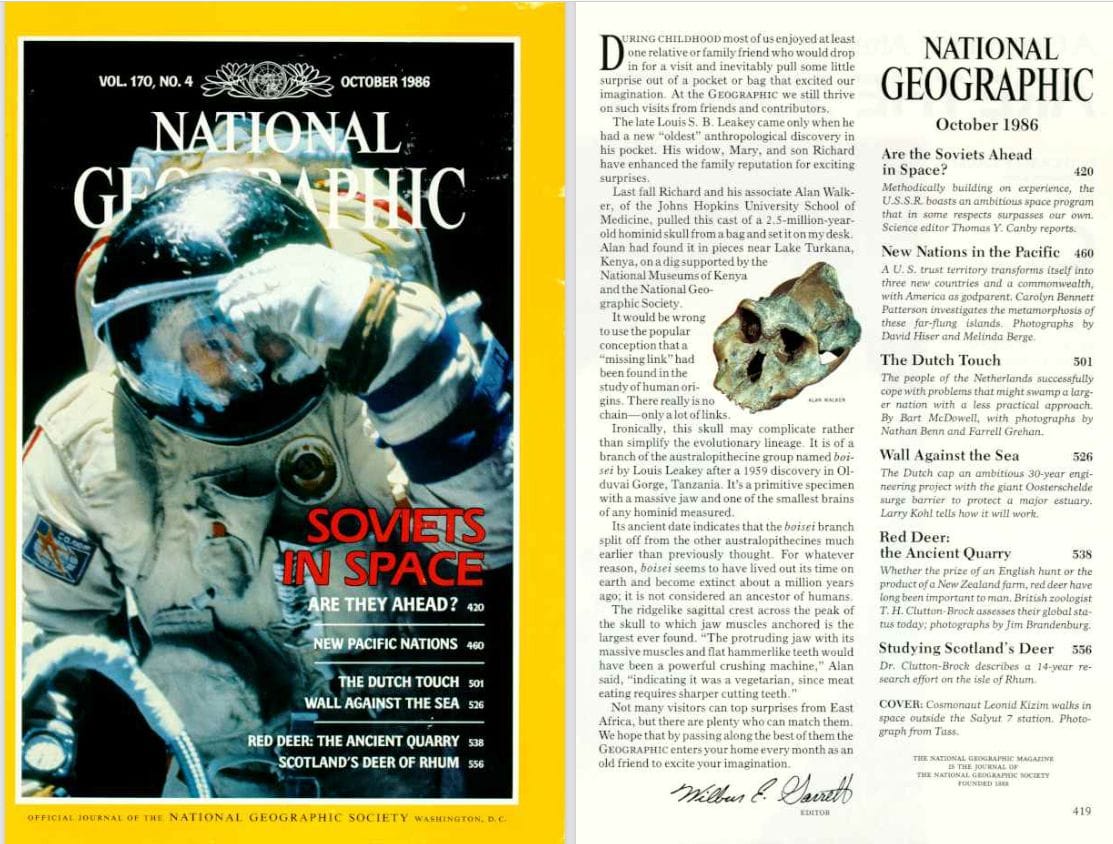
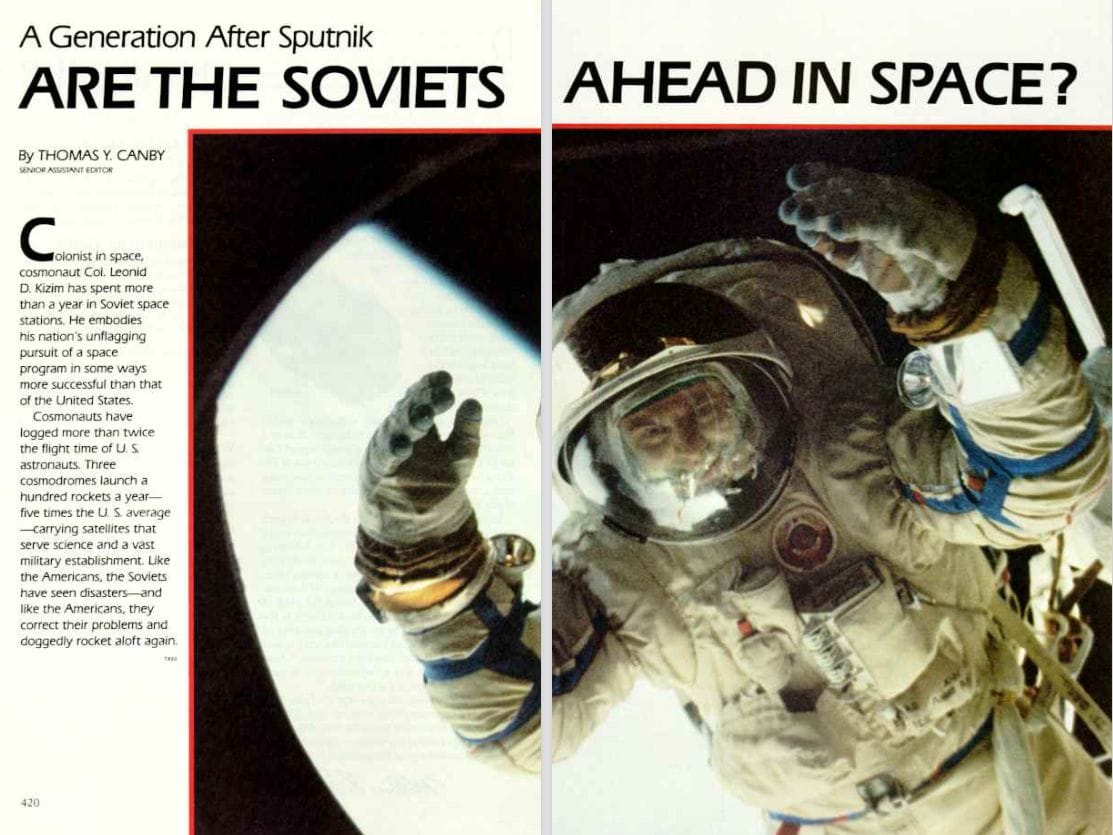

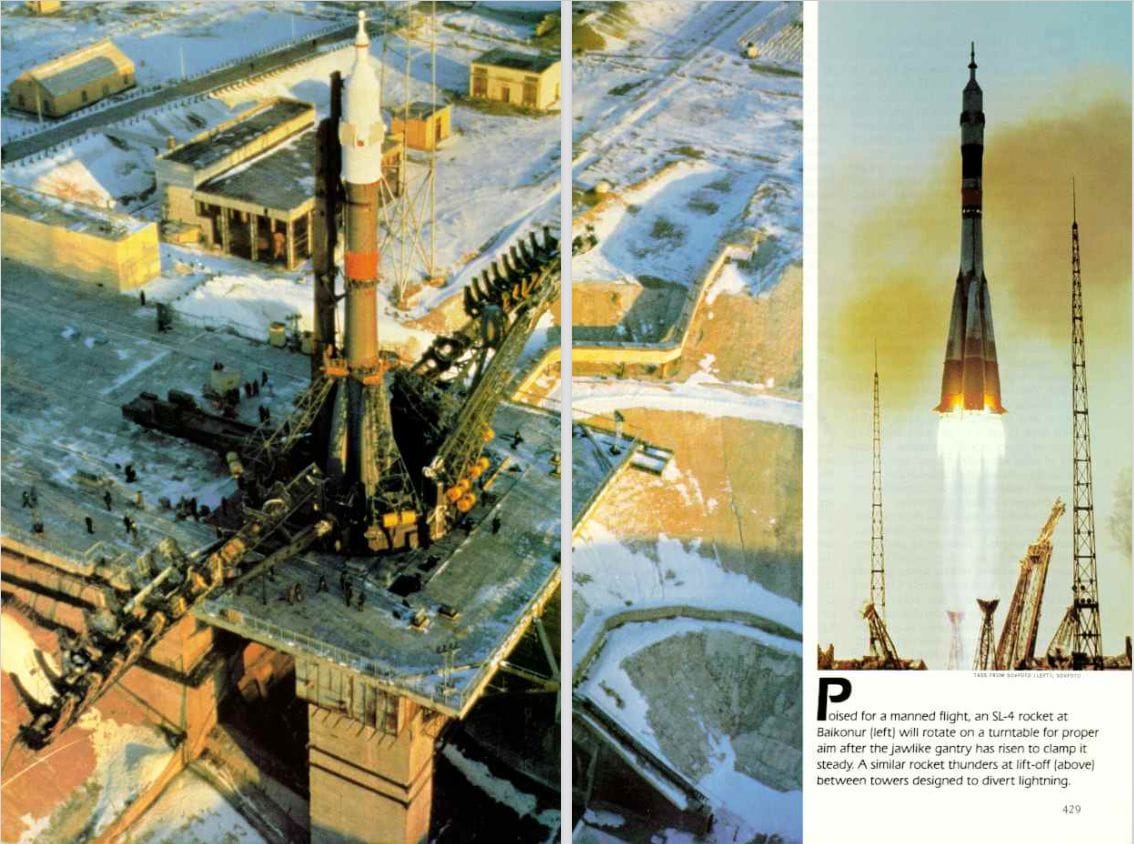
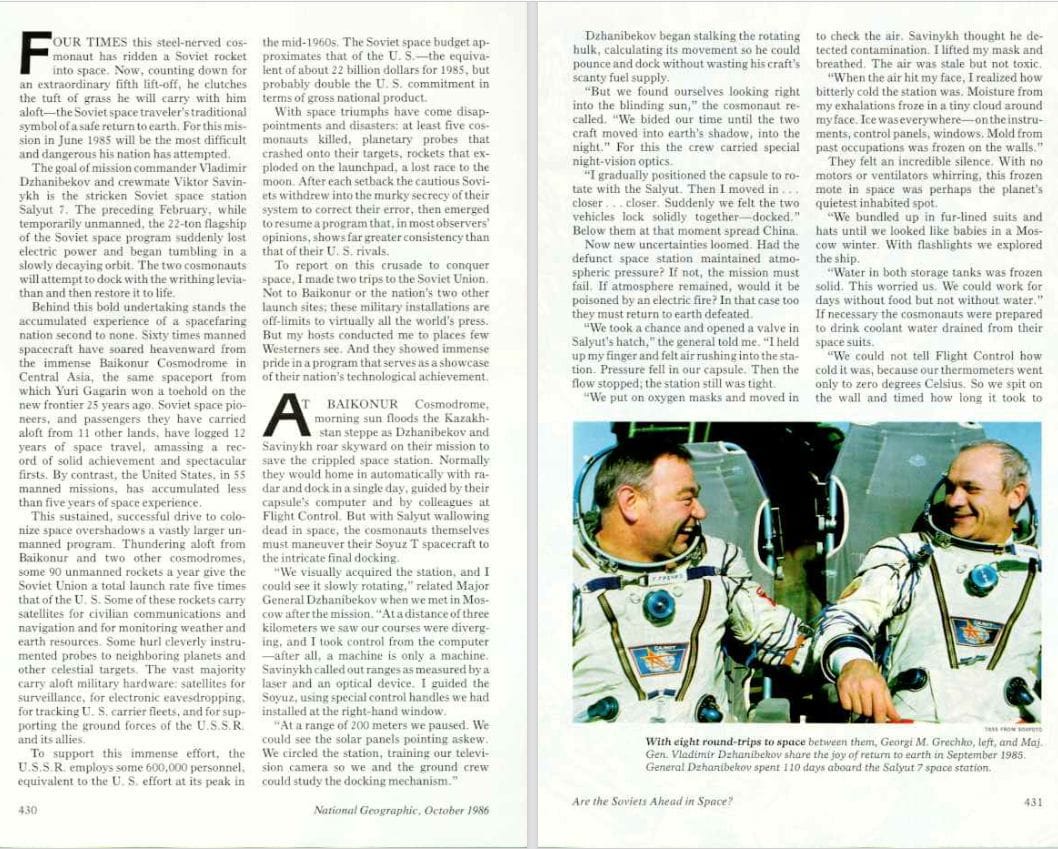
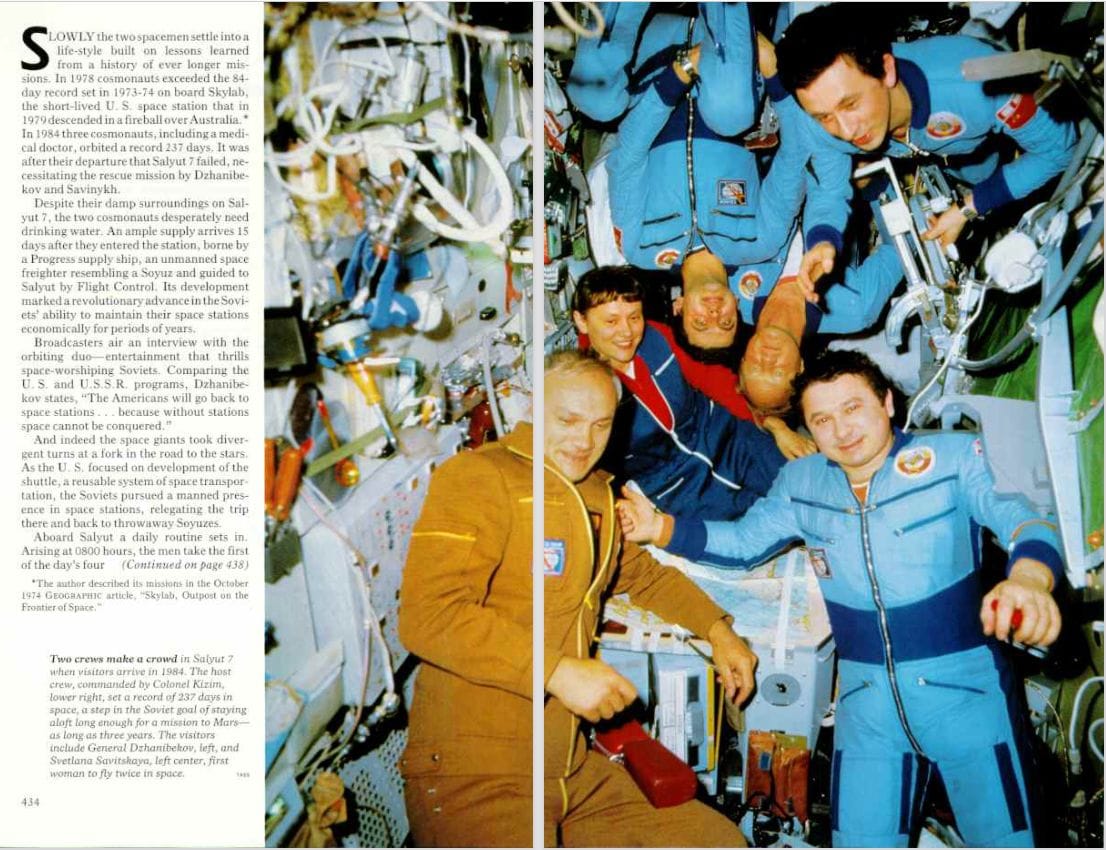

Colonist in space, cosmonaut Col. Leonid D. Kizim has spent more than a year in Soviet space stations. He embodies his nation’s unflagging pursuit of a space program in some ways more successful than that of the United States.
Cosmonauts have logged more than twice the flight time of U.S. astronauts. Three cosmodromes launch a hundred rockets a year – five times the U.S. average – carrying satellites that serve science and a vast military establishment. Like the Americans, the Soviets have seen disasters – and like the Americans, they correct their problems and doggedly rocket aloft again.
Four times this steel-nerved cosmonaut has ridden a Soviet rocket into space. Now, counting down for an extraordinary fifth lift-off, he clutches the tuft of grass he will carry with him aloft the Soviet space traveler’s traditional symbol of a safe return to Earth. For this mission in June 1985 will be the most difficult and dangerous his nation has attempted.
The goal of mission commander Vladimir Dzhanibekov and crewmate Viktor Savinykh is the stricken Soviet space station Salyut 7. The preceding February, while temporarily unmanned, the 22-ton flagship of the Soviet space program suddenly lost electric power and began tumbling in a slowly decaying orbit. The two cosmonauts will attempt to dock with the writhing leviathan and then restore it to life.
Behind this bold undertaking stands the accumulated experience of a spacefaring nation second to none. Sixty times manned spacecraft have soared heavenward from the immense Baikonur Cosmodrome in Central Asia, the same spaceport from which Yuri Gagarin won a toehold on the new frontier 25 years ago. Soviet space pioneers, and passengers they have carried aloft from 11 other lands, have logged 12 years of space travel, amassing a record of solid achievement and spectacular firsts. By contrast, the United States, in 55 manned missions, has accumulated less than five years of space experience.
This sustained, successful drive to colonize space overshadows a vastly larger unmanned program. Thundering aloft from Baikonur and two other cosmodromes, some 90 unmanned rockets a year give the Soviet Union a total launch rate five times that of the U.S. Some of these rockets carry satellites for civilian communications and navigation and for monitoring weather and Earth resources. Some hurl cleverly instrumented probes to neighboring planets and other celestial targets. The vast majority carry aloft military hardware: satellites for surveillance, for electronic eavesdropping, for tracking U.S. carrier fleets, and for supporting the ground forces of the U.S.S.R. and its allies.
To support this immense effort, the U.S.S.R. employs some 600,000 personnel, equivalent to the U.S. effort at its peak in the mid-1960s. The Soviet space budget approximates that of the U.S. – the equivalent of about 22 billion dollars for 1985, but probably double the U.S. commitment in terms of gross national product.
With space triumphs have come disappointments and disasters: at least five cosmonauts killed, planetary probes that crashed onto their targets, rockets that exploded on the launch pad, a lost race to the Moon. After each setback the cautious Soviets withdrew into the murky secrecy of their system to correct their error, then emerged to resume a program that, in most observers’ opinions, shows far greater consistency than that of their U.S. rivals.
To report on this crusade to conquer space, I made two trips to the Soviet Union. Not to Baikonur or the nation’s two other launch sites; these military installations are off-limits to virtually all the world’s press. But my hosts conducted me to places few Westerners see. And they showed immense pride in a program that serves as a showcase of their nation’s technological achievement.
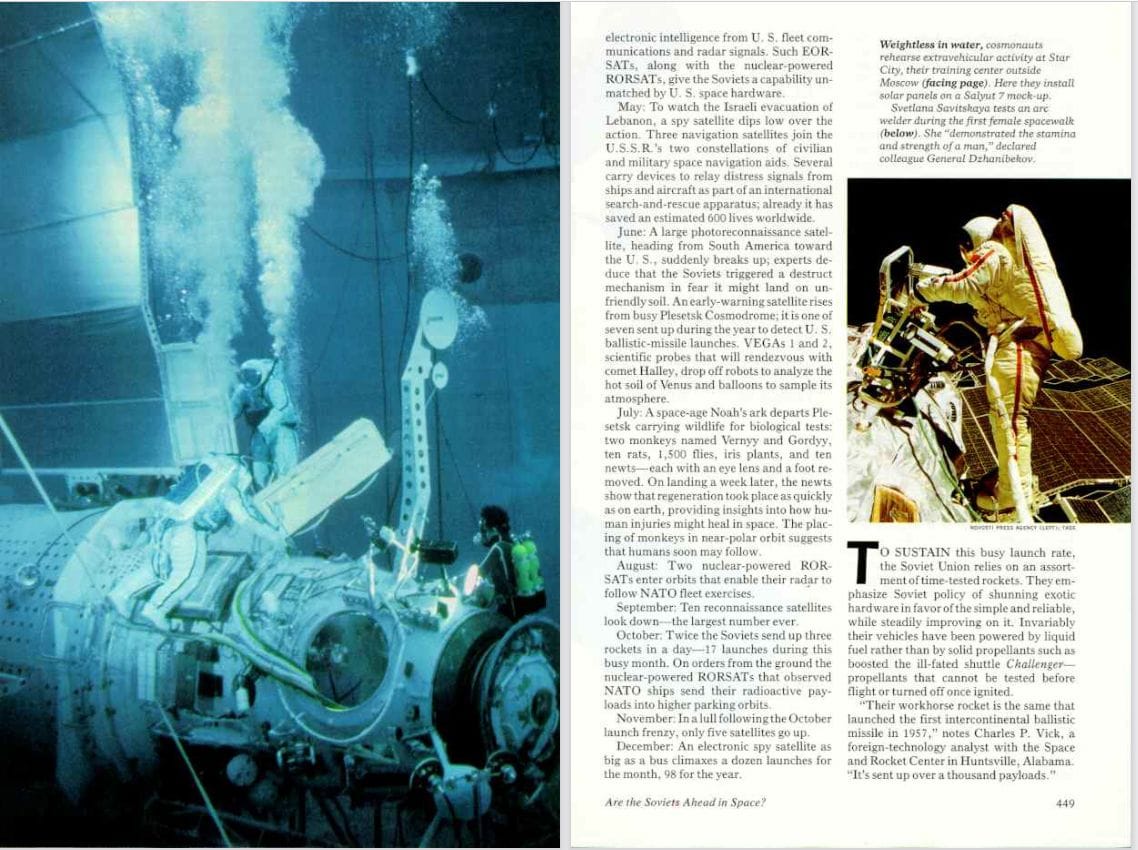
At Baikonur Cosmodrome, morning sun floods the Kazakhstan steppe as Dzhanibekov and Savinykh roar skyward on their mission to save the crippled space station. Normally they would home in automatically with radar and dock in a single day, guided by their capsule’s computer and by colleagues at Flight Control. But with Salyut wallowing dead in space, the cosmonauts themselves must maneuver their Soyuz T spacecraft to the intricate final docking.
“We visually acquired the station, and I could see it slowly rotating,” related Major General Dzhanibekov when we met in Moscow after the mission. “At a distance of three kilometers we saw our courses were diverging, and I took control from the computer – after all, a machine is only a machine. Savinykh called out ranges as measured by a laser and an optical device. I guided the Soyuz, using special control handles we had installed at the right-hand window.
“At a range of 200 meters we paused. We could see the solar panels pointing askew. We circled the station, training our television camera so we and the ground crew could study the docking mechanism.”
Dzhanibekov began stalking the rotating hulk, calculating its movement so he could pounce and dock without wasting his craft’s scanty fuel supply.
“But we found ourselves looking right into the blinding sun,” the cosmonaut recalled. “We bided our time until the two craft moved into Earth’s shadow, into the night.” For this the crew carried special night-vision optics.
“I gradually positioned the capsule to rotate with the Salyut. Then I moved in … closer … closer. Suddenly we felt the two vehicles lock solidly together – docked.” Below them at that moment spread China.
Now new uncertainties loomed. Had the defunct space station maintained atmospheric pressure? If not, the mission must fail. If atmosphere remained, would it be poisoned by an electric fire? In that case too they must return to Earth defeated.
“We took a chance and opened a valve in Salyut’s hatch,” the general told me. “I held up my finger and felt air rushing into the station. Pressure fell in our capsule. Then the flow stopped; the station still was tight.
“We put on oxygen masks and moved in to check the air. Savinykh thought he detected contamination. I lifted my mask and breathed. The air was stale but not toxic.
“When the air hit my face, I realized how bitterly cold the station was. Moisture from my exhalations froze in a tiny cloud around my face. Ice was everywhere – on the instruments, control panels, windows. Mold from past occupations was frozen on the walls.”
They felt an incredible silence. With no motors or ventilators whirring, this frozen mote in space was perhaps the planet’s quietest inhabited spot.
“We bundled up in fur-lined suits and hats until we looked like babies in a Moscow winter. With flashlights we explored the ship.
“Water in both storage tanks was frozen solid. This worried us. We could work for days without food but not without water.” If necessary the cosmonauts were prepared to drink coolant water drained from their space suits.
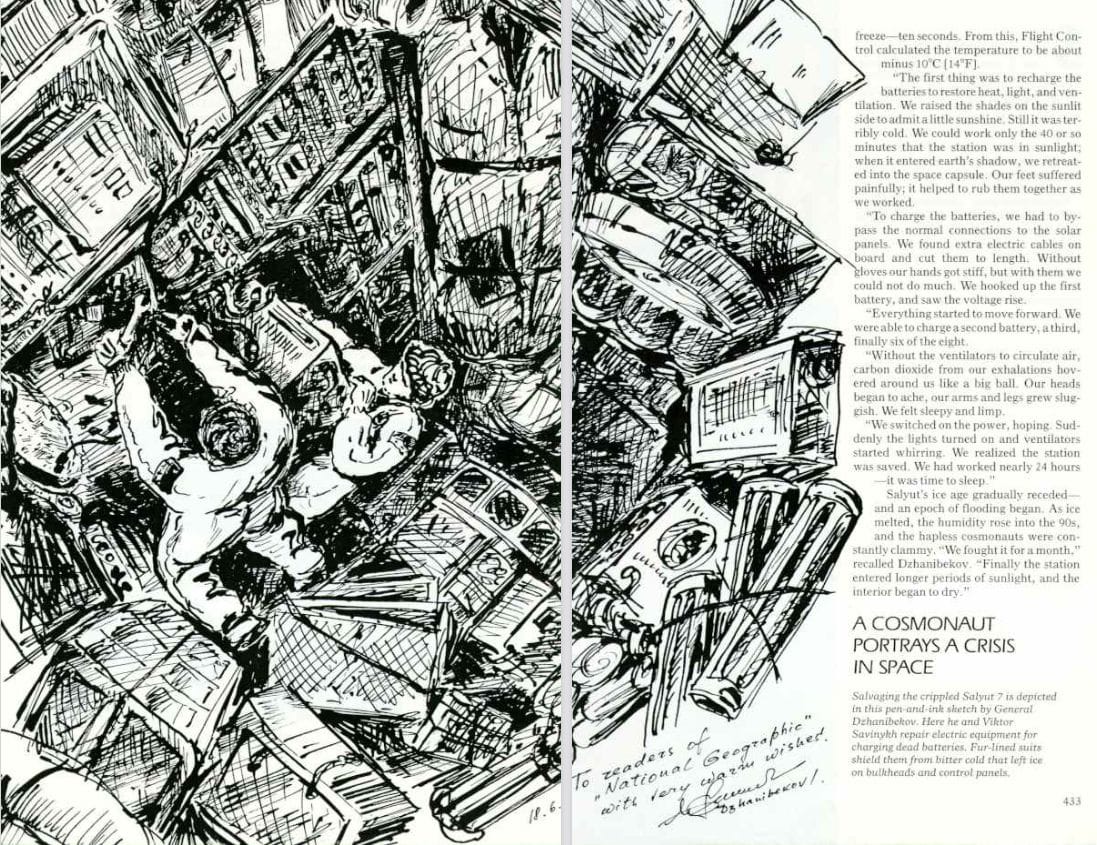
“We could not tell Flight Control how cold it was, because our thermometers went only to zero degrees Celsius. So we spit on the wall and timed how long it took to freeze – ten seconds. From this, Flight Control calculated the temperature to be about minus 10°C [14°F].
“The first thing was to recharge the batteries to restore heat, light, and ventilation. We raised the shades on the sunlit side to admit a little sunshine. Still it was terribly cold. We could work only the 40 or so minutes that the station was in sunlight; when it entered Earth’s shadow, we retreated into the space capsule. Our feet suffered painfully; it helped to rub them together as we worked.
“To charge the batteries, we had to bypass the normal connections to the solar panels. We found extra electric cables onboard and cut them to length. Without gloves our hands got stiff, but with them we could not do much. We hooked up the first battery, and saw the voltage rise.
“Everything started to move forward. We were able to charge a second battery, a third, finally six of the eight. “Without the ventilators to circulate air, carbon dioxide from our exhalations hovered around us like a big ball. Our heads began to ache, our arms and legs grew sluggish. We felt sleepy and limp.
“We switched on the power, hoping. Suddenly the lights turned on and ventilators started whirring. We realized the station was saved. We had worked nearly 24 hours – it was time to sleep.”
Salyut’s ice age gradually receded and an epoch of flooding began. As ice melted, the humidity rose into the 90s, and the hapless cosmonauts were constantly clammy. “We fought it for a month,” recalled Dzhanibekov. “Finally the station entered longer periods of sunlight, and the interior began to dry.”
Slowly the two spacemen settle into a life-style built on lessons learned from a history of ever longer missions. In 1978 cosmonauts exceeded the 84-day record set in 1973-74 on board Skylab, the short-lived U.S. space station that in 1979 descended in a fireball over Australia. In 1984 three cosmonauts, including a medical doctor, orbited a record 237 days. It was after their departure that Salyut 7 failed, necessitating the rescue mission by Dzhanibekov and Savinykh.
Despite their damp surroundings on Salyut 7, the two cosmonauts desperately need drinking water. An ample supply arrives 15 days after they entered the station, borne by a Progress supply ship, an unmanned space freighter resembling a Soyuz and guided to Salyut by Flight Control. Its development marked a revolutionary advance in the Soviets’ ability to maintain their space stations economically for periods of years.
Broadcasters air an interview with the orbiting duo – entertainment that thrills space-worshiping Soviets. Comparing the U.S. and U.S.S.R. programs, Dzhanibekov states, “The Americans will go back to space stations … because without stations space cannot be conquered.”
And indeed the space giants took divergent turns at a fork in the road to the stars. As the U.S. focused on development of the shuttle, a reusable system of space transportation, the Soviets pursued a manned presence in space stations, relegating the trip there and back to throwaway Soyuzes.
Aboard Salyut a daily routine sets in. Arising at 08:00 hours, the men take the first of the day’s four meals – pork, cheese, honey cake, prunes, and coffee. Turning to Salyut’s array of 85 scientific instruments, they begin six hours of work: observing Earth’s surface, conducting technical experiments, working with the station’s astronomical and medical equipment. Tea breaks and two more meals ease the grind.
The daily chore they loathe: two hours of strenuous exercise on Salyut’s jogging treadmill and stationary bicycle. If they slack off, Flight Control will nag, because in an environment without gravity muscles atrophy with appalling swiftness. With each exercise session the cosmonauts generate an envelope of sweat that they try futilely to towel off. Every ten days they shower, a complex process that consumes an entire day.
After a supper that might include cottage cheese, assorted meats, bread, dessert, and tea, the men visit with their families on two-way television or talk with athletes and entertainers – diversions arranged by a psychological support team that oversees the mental health of the lonely spacemen. Then at 23:00 they tuck into sleeping cocoons fastened to a wall and hope for sound sleep, a rare luxury in an alien environment in which they can never entirely relax.
In mid-July the crewmen load trash and wastes into the Progress. The freighter silently slips its docking latches and moves away, to plunge back toward Earth and incinerate in the atmosphere.
In one of many biological experiments, the cosmonauts plant cotton seeds in ingenious little greenhouses that simulate gravity and Earth’s geomagnetic field. Earlier crews struggled with limited results to grow plants in an environment that knows neither up nor down. Healthy vegetation could be essential for recycling air, water, and wastes and providing food for longer flights, such as a three-year round-trip to Mars.
On July 21 the cosmonauts receive another Progress visitor. Along with fresh food, water, and fuel it brings another greenhouse and new space suits – indicators that the men will soon venture outside the station to work.
The cosmonauts revel in newly arrived photographs and video films of their families, looking at them again and again. They play recordings of Earth sounds – of falling rain, rustling leaves, singing birds. With the absence of gravity they have gained an inch in height. They have grown accustomed to the station’s fetid atmosphere but not to the awkward hygienic facilities, which substitute a vacuum for gravity in handling human wastes.
The first cotton planting fails, and the discouraged gardeners sow again.
Donning their new space suits, the crewmen open the hatch and emerge. Their goal: to install more solar panels on the underpowered station. Using tools designed for their clumsy gloves, they erect structures to hold the panels, then hoist them with lines, like seamen unfurling a sail.
In late August they load trash into the second Progress. Flight Control fires its thrusters to adjust Salyut’s orbit. The freighter departs for oblivion in the atmosphere.
The gray-thumbed gardeners, twice defeated by reluctant cotton seeds, exult to see sprouts emerge.
Red-letter day: the arrival of a Soyuz bringing three comrades! Docking latches click, the hatch opens, and the crewmen embrace Vladimir Vasyutin, Georgi Grechko, and Aleksander Volkov. Dzhanibekov and Savinykh offer their guests bread and salt, traditional symbols of Soviet hospitality even in space.
For a week the five cosmonauts share the crowded cylinder, conducting experiments, the hosts familiarizing the newcomers with Salyut’s welter of equipment. Grechko studies the pollution of the atmosphere, which he compares to a dandelion’s fragile seed puff, so easily blown away. Each day Dzhanibekov wears a special vacuum suit that stimulates blood circulation in the lower body, a sign he will soon be feeling Earth’s gravity – going home!
Using themselves as human guinea pigs – a frequent and unloved chore – the men employ a small medical device to study acupuncture points for reducing the discomforts of living in zero gravity. They experiment with electrophoresis – isolating pure materials for lifesaving drugs – possibly an early space-based industry.
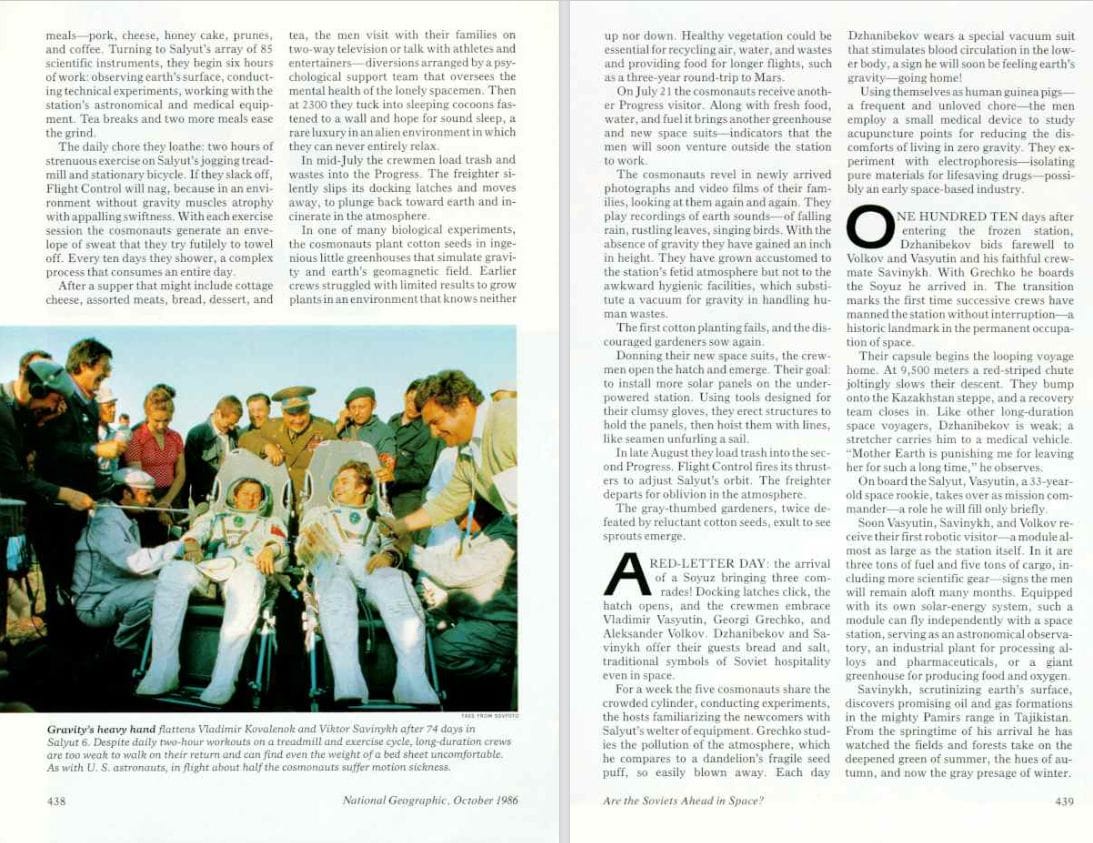
One hundred ten days after entering the frozen station, Dzhanibekov bids farewell to Volkov and Vasyutin and his faithful crewmate Savinykh. With Grechko he boards the Soyuz he arrived in. The transition marks the first time successive crews have manned the station without interruption – a historic landmark in the permanent occupation of space.
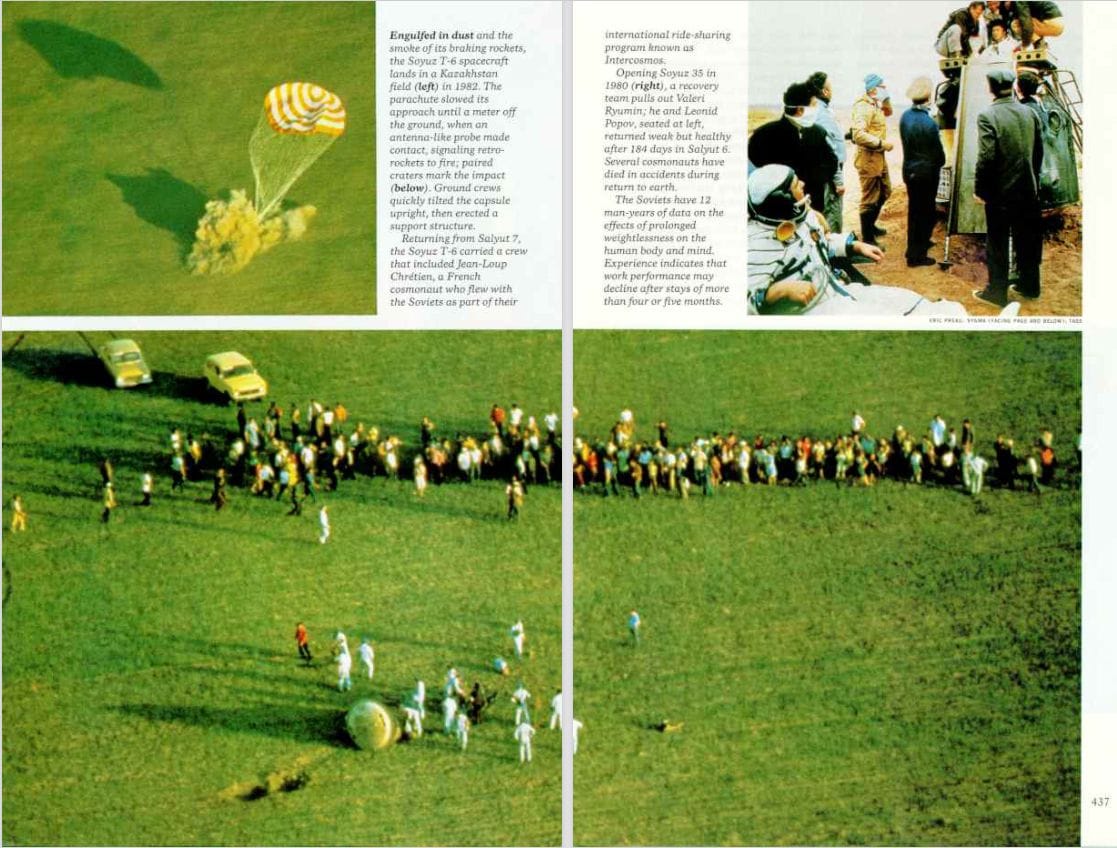
Their capsule begins the looping voyage home. At 9500 meters a red-striped chute joltingly slows their descent. They bump onto the Kazakhstan steppe, and a recovery team closes in. Like other long-duration space voyagers, Dzhanibekov is weak; a stretcher carries him to a medical vehicle. “Mother Earth is punishing me for leaving her for such a long time,” he observes.
On board the Salyut, Vasyutin, a 33-year-old space rookie, takes over as mission commander – a role he will fill only briefly.
Soon Vasyutin, Savinykh, and Volkov receive their first robotic visitor – a module almost as large as the station itself. In it are three tons of fuel and five tons of cargo, including more scientific gear – signs the men will remain aloft many months. Equipped with its own solar-energy system, such a module can fly independently with a space station, serving as an astronomical observatory, an industrial plant for processing alloys and pharmaceuticals, or a giant greenhouse for producing food and oxygen.
Savinykh, scrutinizing Earth’s surface, discovers promising oil and gas formations in the mighty Pamirs range in Tajikistan. From the springtime of his arrival he has watched the fields and forests take on the deepened green of summer, the hues of autumn, and now the gray presage of winter.
The new crew members have brought a green thumb. The tiny greenhouses burgeon with sprouts of onions and lettuce.
They have also brought trouble.
Soon after Vasyutin takes command, his crewmates observe that he is behaving abnormally – “tense, a bundle of nerves,” Savinykh confides in his diary. Racked by fever, he remains all day in his sleeping bag. Increasingly the work load falls on the experienced but mission-weary Savinykh. He and Volkov persuade Vasyutin to consult with the ground. Around the world Soviet space-watchers eavesdropping on Salyut transmissions detect scrambled signals; they assume the conversations concern military matters, the usual cause for secrecy.
Back from Flight Control come recommendations from Academician Oleg Gazenko, the U.S.S.R.’s top space doctor. Vasyutin’s mood improves, but anxiety permeates the mission. In the long history of Soviet manned flight, with its rigorous psychological and physical screenings (even a tooth that can cause trouble is pulled before lift-off), illness has never curtailed a mission. To have to abort would be both costly and a blow to morale.
The scrambled communications continue, heightening the interest of Western observers. Savinykh and Volkov begin to deactivate the station. On November 21 the three disappointedly enter their Soyuz taxi. Savinykh closes the hatch on the station that he and Dzhanibekov had entered with such hardship 167 days before.
Their capsule descends through a wintry sky and thuds onto the bleak steppe. A helicopter whisks Vasyutin to a nearby town, then an airplane bears him to a Moscow hospital. Later, word spreads that the youthful cosmonaut has suffered a severe inflammation, perhaps pneumonia. Savinykh and Volkov are weak but healthy. The nation lavishes praise on their accomplishments, which include 400 scientific observations and the photographing of 16 million square kilometers of Earth’s surface.
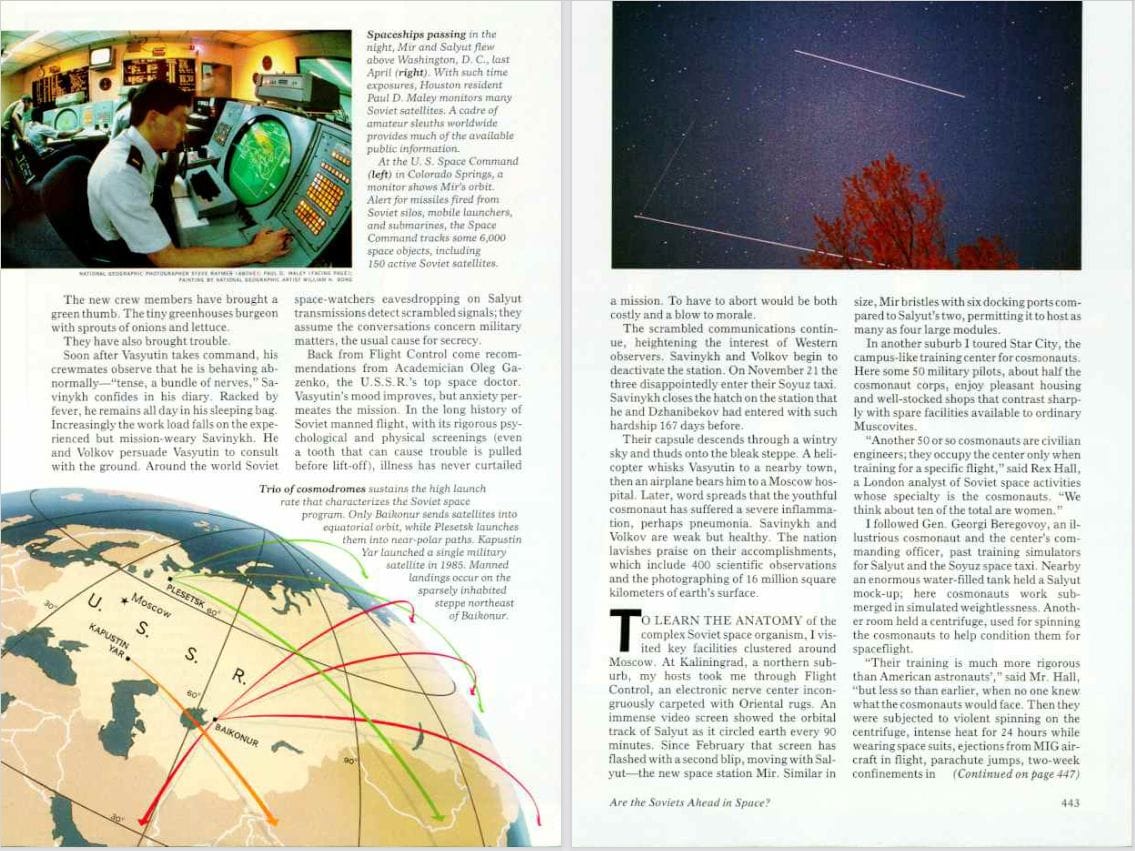
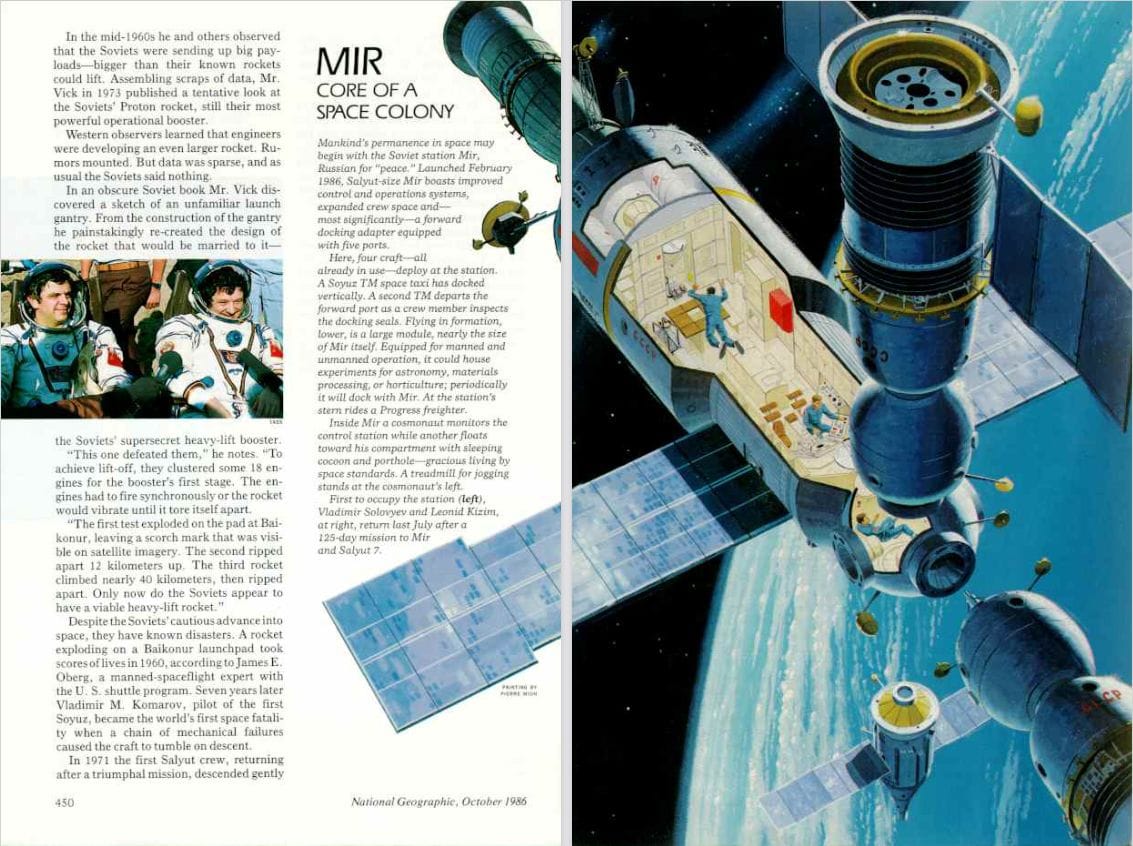
To learn the anatomy of the complex Soviet space organism, I visited key facilities clustered around Moscow. At Kaliningrad, a northern suburb, my hosts took me through Flight Control, an electronic nerve center incongruously carpeted with Oriental rugs. An immense video screen showed the orbital track of Salyut as it circled Earth every 90 minutes. Since February that screen has flashed with a second blip, moving with Salyut – the new space station Mir. Similar in size, Mir bristles with six docking ports compared to Salyut’s two, permitting it to host as many as four large modules.
In another suburb I toured Star City, the campus-like training center for cosmonauts. Here some 50 military pilots, about half the cosmonaut corps, enjoy pleasant housing and well-stocked shops that contrast sharply with spare facilities available to ordinary Muscovites.
“Another 50 or so cosmonauts are civilian engineers; they occupy the center only when training for a specific flight,” said Rex Hall, a London analyst of Soviet space activities whose specialty is the cosmonauts. “We think about ten of the total are women.”
I followed Gen. Georgi Beregovoy, an illustrious cosmonaut and the center’s commanding officer, past training simulators for Salyut and the Soyuz space taxi. Nearby an enormous water-filled tank held a Salyut mock-up; here cosmonauts work submerged in simulated weightlessness. Another room held a centrifuge, used for spinning the cosmonauts to help condition them for spaceflight.
“Their training is much more rigorous than American astronauts’,” said Mr. Hall, “but less so than earlier, when no one knew what the cosmonauts would face. Then they were subjected to violent spinning on the centrifuge, intense heat for 24 hours while wearing space suits, ejections from MIG aircraft in flight, parachute jumps, two-week confinements in isolation chambers. We believe several trainees died from stress.”
General Beregovoy spoke of the space program’s large user community – the hundreds of organizations that benefit from space activities. I visited a few: Intersputnik, the small Soviet-bloc version of the worldwide Intelsat communications network; the meteorology office, whose director said space observations had sharpened forecasting by perhaps 20 percent; the Earth resources office that processes imagery as sophisticated as that from U.S. Landsats.
Except for the cosmonauts’ uniforms, the biggest user remained unseen: the Soviet military establishment. Subordinate only to the Communist Party apparatus, the Ministry of Defense and its Strategic Rocket Forcesthe elite of the armed services – direct a farflung empire of design bureaus, manufacturing centers, and launch sites. “Of the 98 missions of 1985, two-thirds were military, and many more had dual roles,” according to Nicholas L. Johnson, a leading Soviet space analyst with Teledyne Brown Engineering. Each January he publishes a meaty review of the preceding year’s activities. Selective combing of his Soviet Year in Space 1985 reveals much:
January: On command from military planners in the Kremlin, a six-ton spy satellite changes orbit to swoop low over the Iraq-Iran battlefield; three weeks later Iraq, a Soviet ally, launches a major offensive. From Baikonur a satellite known as a Gorizont lifts into geostationary orbit; there it joins other satellites that relay television signals and the backup hot line between the Kremlin and the White House.
February: A mystery satellite, one of several for the year, goes into geostationary orbit; observers speculate that it is a new type of military communications satellite. U.S. radar observes the strange death dance of a radar ocean-reconnaissance satellite, or RORSAT: On command from the ground a nuclear reactor that powers the satellite separates and is propelled to a higher orbit, where it will park for centuries with its radioactive wastes. (In 1978 a similar satellite turned rogue; ignoring commands to separate, it tumbled out of control and spewed a swath of radioactivity across Canada’s Northwest Territories.)
March: A new-generation spy satellite goes up, and it will function for 207 days – a record for the usually short-lived Soviet orbiters. In an intriguing multiple launch a rocket carries up eight communications satellites and dribbles them into orbit. Authorities announce the death of Venera 15, which for a year and a half made radar maps of Venus; a companion satellite, Venera 16, still scans Earth’s sister planet.
April: The Soviets orbit an ocean surveillance satellite designed to garner electronic intelligence from U.S. fleet communications and radar signals. Such EORSATs, along with the nuclear-powered RORSATs, give the Soviets a capability unmatched by U.S. space hardware.
May: To watch the Israeli evacuation of Lebanon, a spy satellite dips low over the action. Three navigation satellites join the U.S.S.R.’s two constellations of civilian and military space navigation aids. Several carry devices to relay distress signals from ships and aircraft as part of an international search-and-rescue apparatus; already it has saved an estimated 600 lives worldwide.
June: A large photoreconnaissance satellite, heading from South America toward the U.S., suddenly breaks up; experts deduce that the Soviets triggered a destruct mechanism in fear it might land on unfriendly soil. An early-warning satellite rises from busy Plesetsk Cosmodrome; it is one of seven sent up during the year to detect U.S. ballistic-missile launches. VEGAs 1 and 2, scientific probes that will rendezvous with comet Halley, drop off robots to analyze the hot soil of Venus and balloons to sample its atmosphere.
July: A space-age Noah’s ark departs Plesetsk carrying wildlife for biological tests: two monkeys named Vernyy and Gordyy, ten rats, 1500 flies, iris plants, and ten newts – each with an eye lens and a foot removed. On landing a week later, the newts show that regeneration took place as quickly as on Earth, providing insights into how human injuries might heal in space. The placing of monkeys in near-polar orbit suggests that humans soon may follow.
August: Two nuclear-powered RORSATs enter orbits that enable their radar to follow NATO fleet exercises.
September: Ten reconnaissance satellites look down – the largest number ever.
October: Twice the Soviets send up three rockets in a day – 17 launches during this busy month. On orders from the ground the nuclear-powered RORSATs that observed NATO ships send their radioactive payloads into higher parking orbits.
November: In a lull following the October launch frenzy, only five satellites go up.
December: An electronic spy satellite as big as a bus climaxes a dozen launches for the month, 98 for the year.
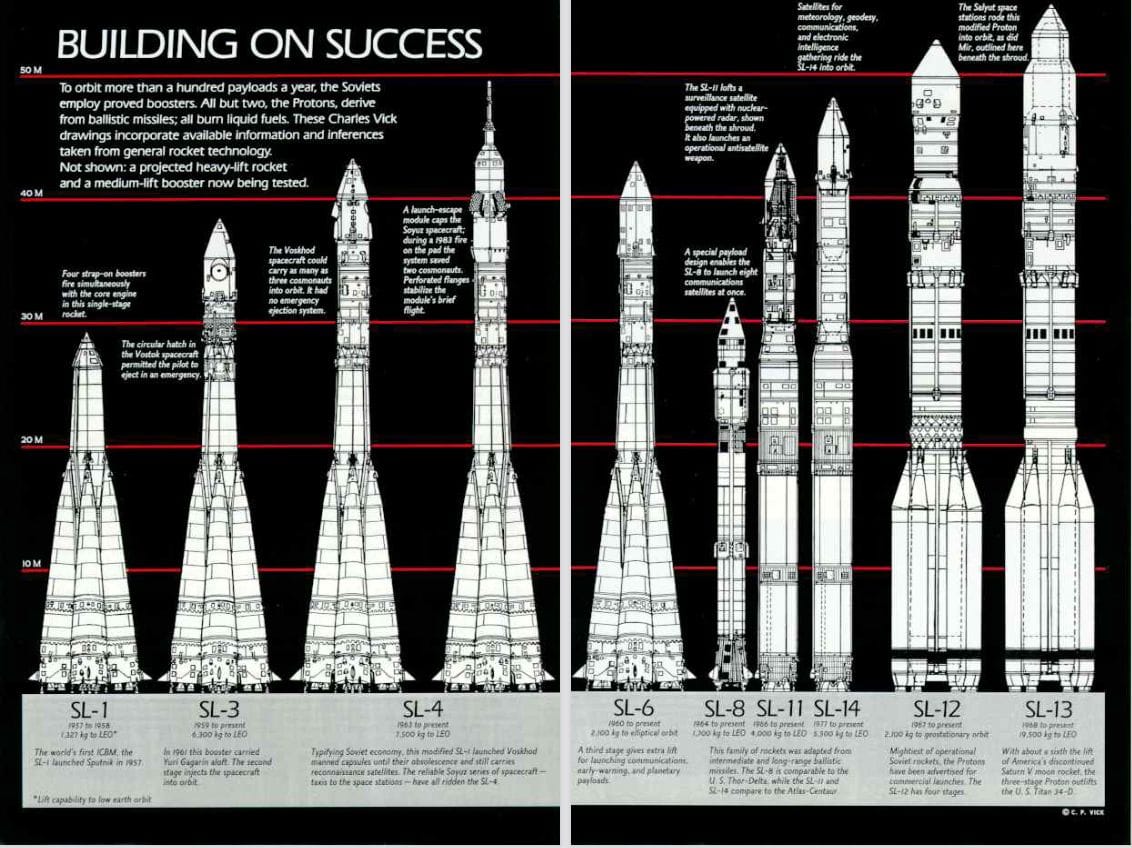
To sustain this busy launch rate, the Soviet Union relies on an assortment of time-tested rockets. They emphasize Soviet policy of shunning exotic hardware in favor of the simple and reliable, while steadily improving on it. Invariably their vehicles have been powered by liquid fuel rather than by solid propellants such as boosted the ill-fated shuttle Challenger – propellants that cannot be tested before flight or turned off once ignited.
“Their workhorse rocket is the same that launched the first intercontinental ballistic missile in 1957,” notes Charles P. Vick, a foreign-technology analyst with the Space and Rocket Center in Huntsville, Alabama. “It’s sent up over a thousand payloads.”
In the mid-1960s he and others observed that the Soviets were sending up big payloads – bigger than their known rockets could lift. Assembling scraps of data, Mr. Vick in 1973 published a tentative look at the Soviets’ Proton rocket, still their most powerful operational booster.
Western observers learned that engineers were developing an even larger rocket. Rumors mounted. But data was sparse, and as usual the Soviets said nothing.
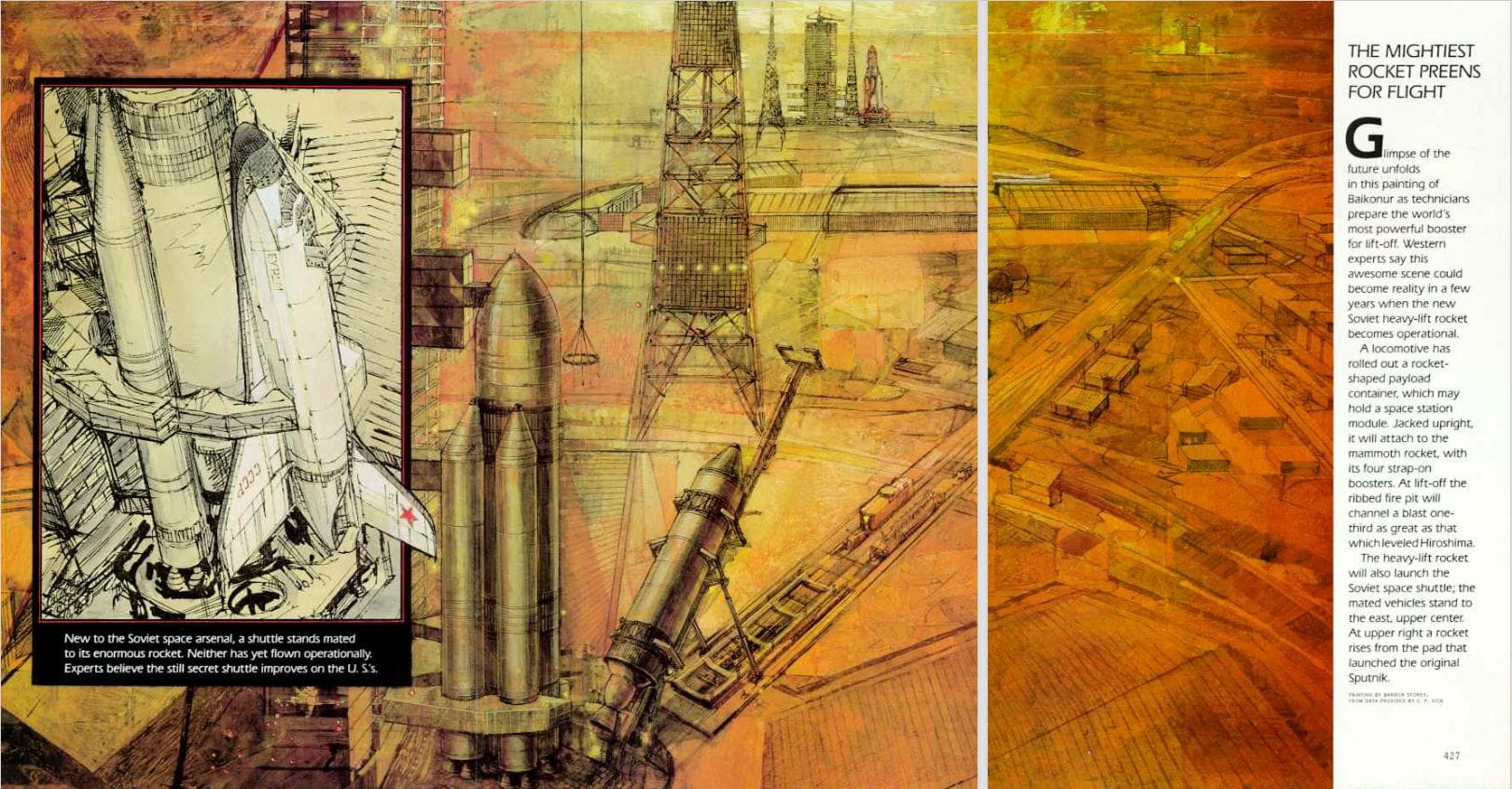
In an obscure Soviet book Mr. Vick discovered a sketch of an unfamiliar launch gantry. From the construction of the gantry he painstakingly re-created the design of the rocket that would be married to it – the Soviets’ supersecret heavy-lift booster.
“This one defeated them,” he notes. “To achieve lift-off, they clustered some 18 engines for the booster’s first stage. The engines had to fire synchronously or the rocket would vibrate until it tore itself apart.
“The first test exploded on the pad at Baikonur, leaving a scorch mark that was visible on satellite imagery. The second ripped apart 12 kilometers up. The third rocket climbed nearly 40 kilometers, then ripped apart. [Note: reference to the N-1 Moon rocket?] Only now do the Soviets appear to have a viable heavy-lift rocket.”
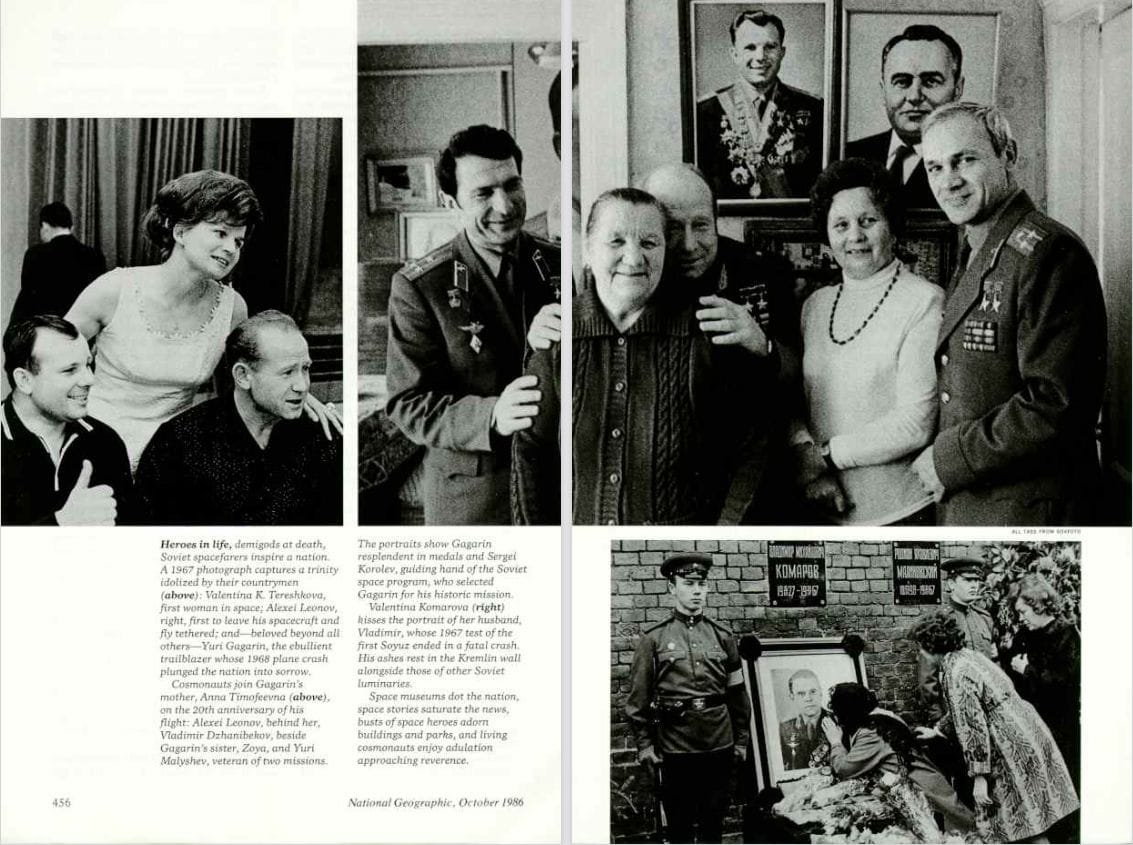
Despite the Soviets’ cautious advance into space, they have known disasters. A rocket exploding on a Baikonur launchpad took scores of lives in 1960, according to James E. Oberg, a manned-spaceflight expert with the U.S. shuttle program. Seven years later Vladimir M. Komarov, pilot of the first Soyuz, became the world’s first space fatality when a chain of mechanical failures caused the craft to tumble on descent.
In 1971 the first Salyut crew, returning after a triumphal mission, descended gently in their Soyuz. Recovery crews opened the hatch, and the three men stared from their seats – dead. A defective valve had permitted their atmosphere to escape.
In 1983 a rocket stood on a pad at Baikonur, poised to hurl a two-man Soyuz crew toward Salyut 7. Suddenly launch crews saw flames leap up the rocket shaft; with horror they realized the fire had destroyed the automatic switch for the escape system. Now controllers in two different stations had to order it to fire simultaneously. Seconds passed. Flame enveloped the rocket. It exploded in a massive fireball – just as the escape capsule shot upward. At one kilometer it slowed, a chute emerged, and the men landed, shaken but unhurt.
Charles Vick, Nicholas Johnson, Rex Hall, and James Oberg belong to a loose confederation of analysts who, spurred by the challenge of Soviet secrecy, devote time and immense ingenuity to penetrating and publicizing the U.S.S.R.’s space program. One center for this benign espionage is the English town of Kettering, an hour by fast train north of London. Its leader is a retired physics teacher named Geoffrey Perry, who two decades ago started a worldwide network known as the Kettering Group.
“Every satellite transmits a distinctive sequence of beeps; the beeps and their frequencies indicate the nature of the mission,” explained Mr. Perry of his sleuthing. “We also depend on your U.S. Space Command in Colorado Springs.” Every day it reports on the orbits of all space objects, including the 150 active Soviet satellites. “We look for changes in orbits,” said Mr. Perry, “things out of the ordinary. Then we know the Soviets are up to something. For example, I’ve been following a reconnaissance satellite that sends back information by television. They’ve been moving it up and down like a yo-yo, looking at trouble spots.”
Inside tunnels honeycombing Cheyenne Mountain, the Space Command maintains a vigil of awesome sophistication. In large measure it is a monument to the Soviet military presence in space.
Three times already, on the day I entered the mountain, an alarm had shrilled and a red light flashed in the Missile Warning Center. Three times the warning was relayed to Washington, D. C., and a command center in Canada, partner in standing sentry over the U.S.S.R.’s 1400 ICBMs and 62 missile-laden submarines. All three alarms were ICBM tests, detected by U.S. early-warning satellites.
Early in the space race the U.S.S.R. and the U.S. began experimenting with antisatellite measures – rockets and other devices for destroying the other side’s orbiters. In 1968 the Soviets tested a killer satellite that closed on its target and exploded, disabling the prey with shrapnel. A score of tests followed, with about half successful; then in 1983 the Soviets announced a test moratorium. Meanwhile the U.S. had responded with an antisatellite rocket borne by an F-15 fighter; it was fired three times before Congress put tests on hold in 1985.
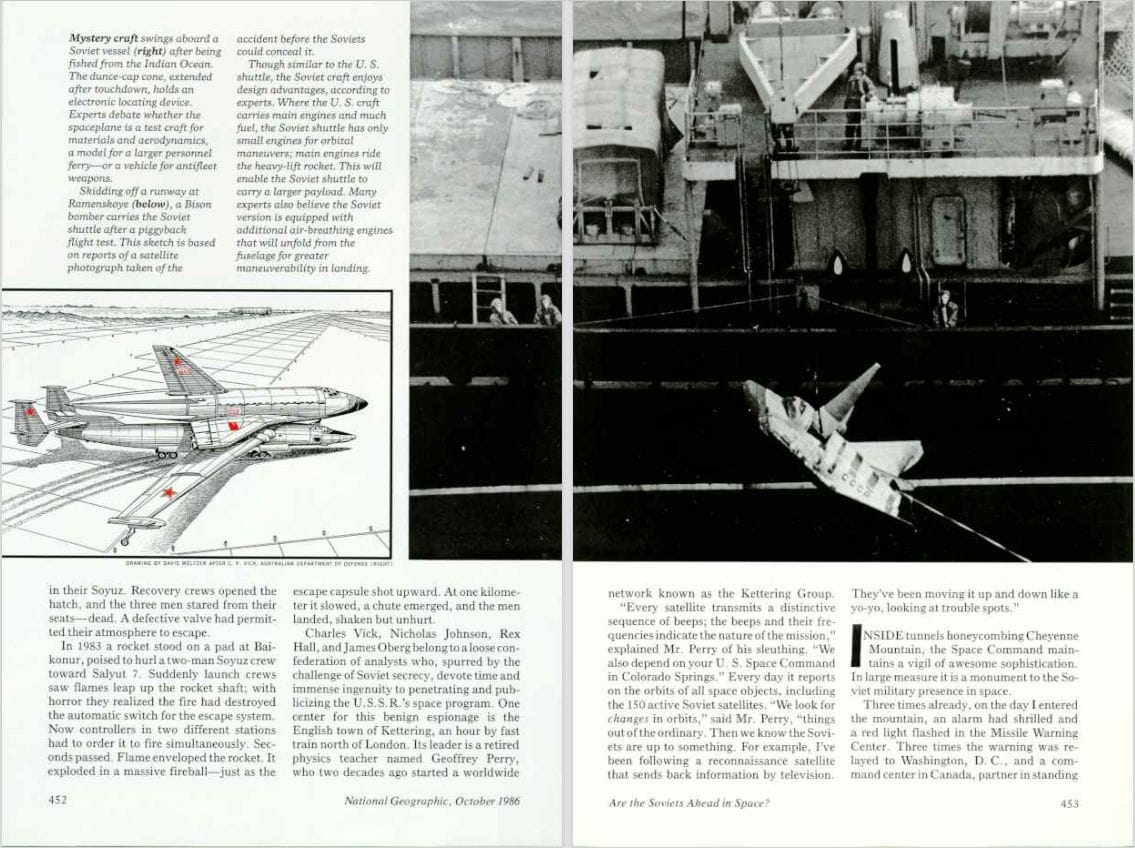
In 1983 a Royal Australian Air Force unit photographed Soviet seamen recovering a small space plane that had splashed down in the Indian Ocean after a single orbit. Four such flights have now been made. Some experts believe the space plane could be a test model of a larger vehicle to ferry personnel to Soviet space stations. Others suspect it is a missile carrier that could drop out of space onto U.S. carrier fleets.
On a rainy day in Moscow I visited a great gray structure housing the Space Research Institute. The facility had a worn look, as did its less-than-new computers. Worn, but not tired. For here a galaxy of scientists directs a vast panoply of space programs for exploring the Earth, the Moon, and points beyond. Reflecting the hospitality of its personable director, English-speaking Academician Roald Z. Sagdeev, the institute has fostered warm international cooperation during the chilliest of international climates.
During the Moon race the institute sent a procession of vehicles to that great goal – lunar flybys, lunar orbiters, lunar soil samplers. While Apollo 15 astronauts were exploring the Moon’s Mare Imbrium, the robotic rover Lunokhod-1 was analyzing soil samples only 1000 kilometers away.
The red planet beckoned, and the Soviets sent forth a succession of probing spacecraft, each laden with tons of equipment. Two missed the planet entirely. Two crashed on the Martian surface – accidents U.S. experts fear may have introduced Earth microbes to the Martian environment. Four other probes making the long journey met with only partial success.
In 1988 two huge Soviet vehicles will again venture to Mars, to study its enigmatic Moon Phobos. If everything goes well, small landers will descend, then hop about in great kangaroo leaps, chemically analyzing the surface.
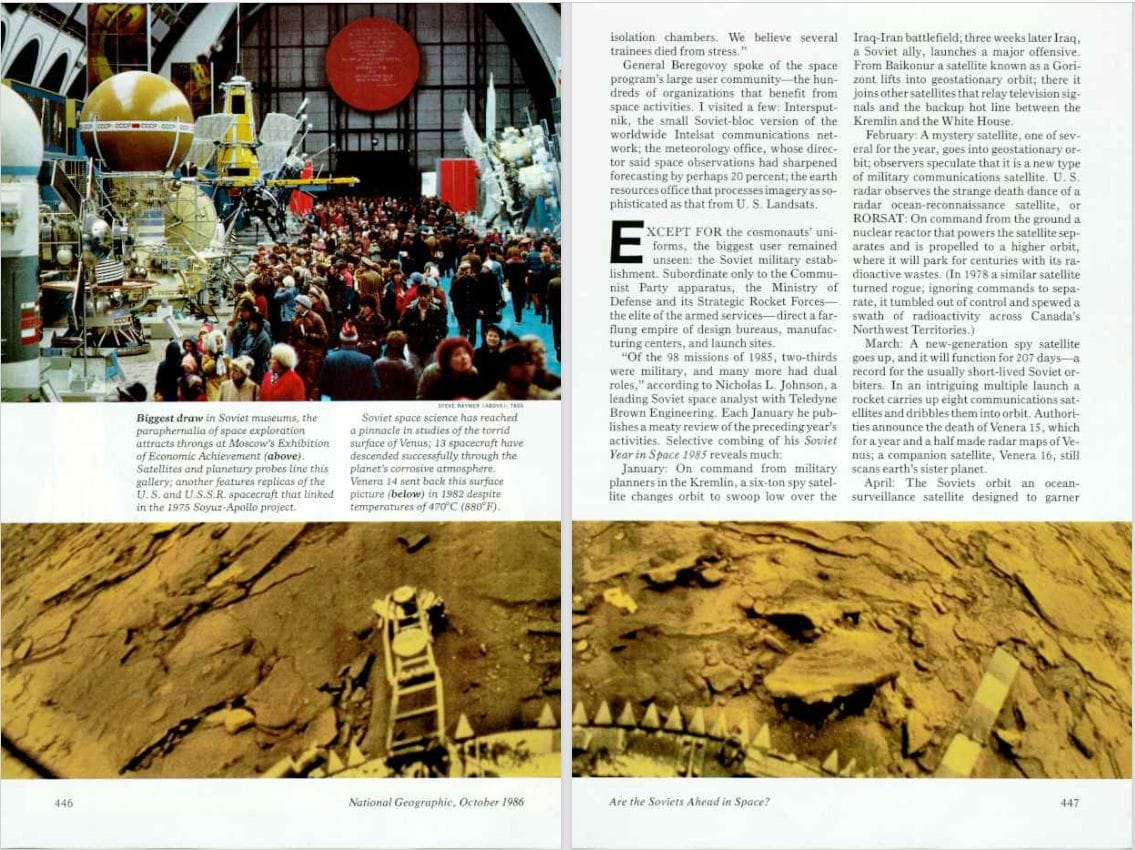
The institute’s greatest successes were to inhospitable Venus. Time after time Soviet robots have raced through the solar system to overtake the planet, groped downward through its searing gases, and soft-landed to photograph and taste-test the scalding soil. “The missions are a remarkable testimony to Soviet capabilities,” observed Dr. James Head of Brown University, a leading U.S. planetary scientist who has worked cooperatively with Soviet counterparts.
Cooperation between the two space powers reached an apogee in 1975, when their spacecraft rendezvoused in orbit and the crews – two Soviets and three Americans spoke each other’s languages as they conducted experiments. Known to the Soviets as the Soyuz-Apollo project, it still is a source of national pride.
As commander the Soviets chose Alexei Leonov, first man to walk in space and a demigod in the pantheon of Soviet space heroes. Three-flight veteran Tom Stafford led the American crew, which included Vance Brand and Donald K. “Deke” Slayton.
During training, Soyuz-Apollo crews and support teams visited each other’s countries half a dozen times, giving U.S. experts their closest look at the Soviet space program. I talked with crew member Deke Slayton, now president of Space Services, Inc., a commercial launch company.
“Fine, generous guys,” he recalled of his Soviet colleagues. “We were all pilots, with a lot in common. Their training was like ours except they spent less time in simulators and more in the classroom. They weren’t as technically oriented. We were involved in engineering, while their role was primarily medical. They didn’t like being guinea pigs, but they went along.”
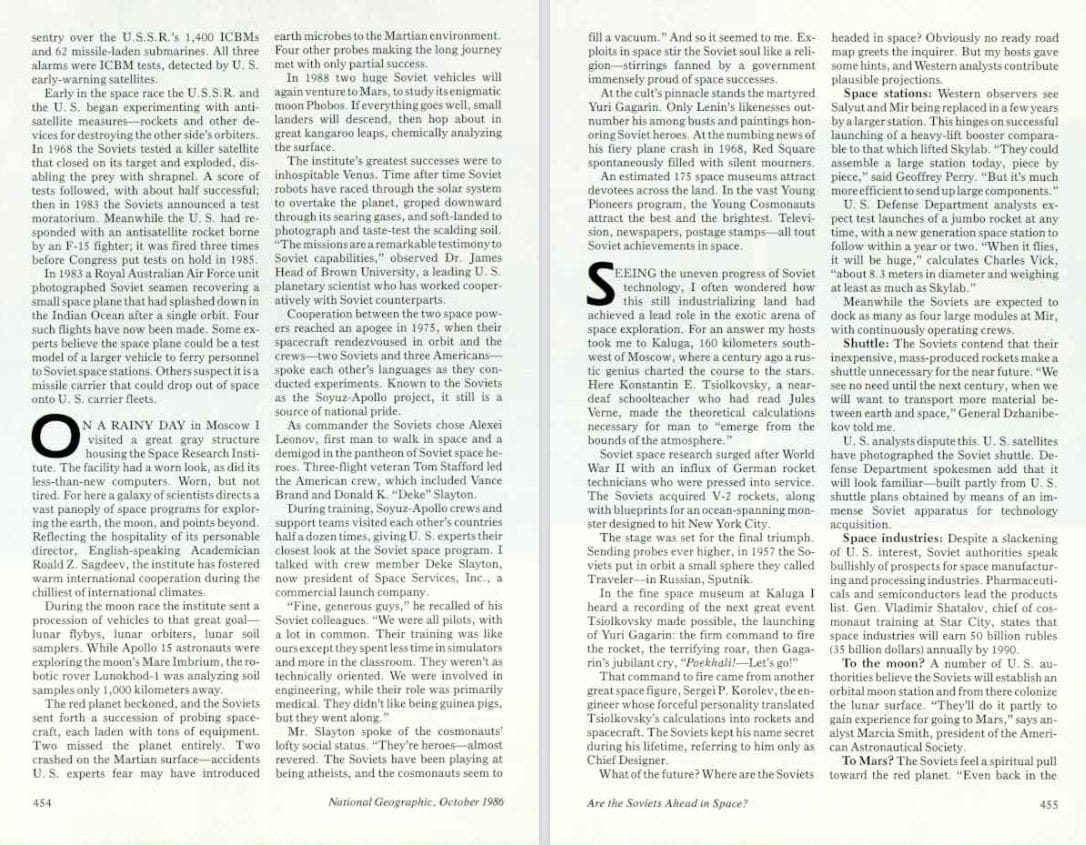
Mr. Slayton spoke of the cosmonauts’ lofty social status. “They’re heroes – almost revered. The Soviets have been playing at being atheists, and the cosmonauts seem to fill a vacuum.” And so it seemed to me. Exploits in space stir the Soviet soul like a religion – stirrings fanned by a government immensely proud of space successes.
At the cult’s pinnacle stands the martyred Yuri Gagarin. Only Lenin’s likenesses outnumber his among busts and paintings honoring Soviet heroes. At the numbing news of his fiery plane crash in 1968, Red Square spontaneously filled with silent mourners.
An estimated 175 space museums attract devotees across the land. In the vast Young Pioneers program, the Young Cosmonauts attract the best and the brightest. Television, newspapers, postage stamps – all tout Soviet achievements in space.
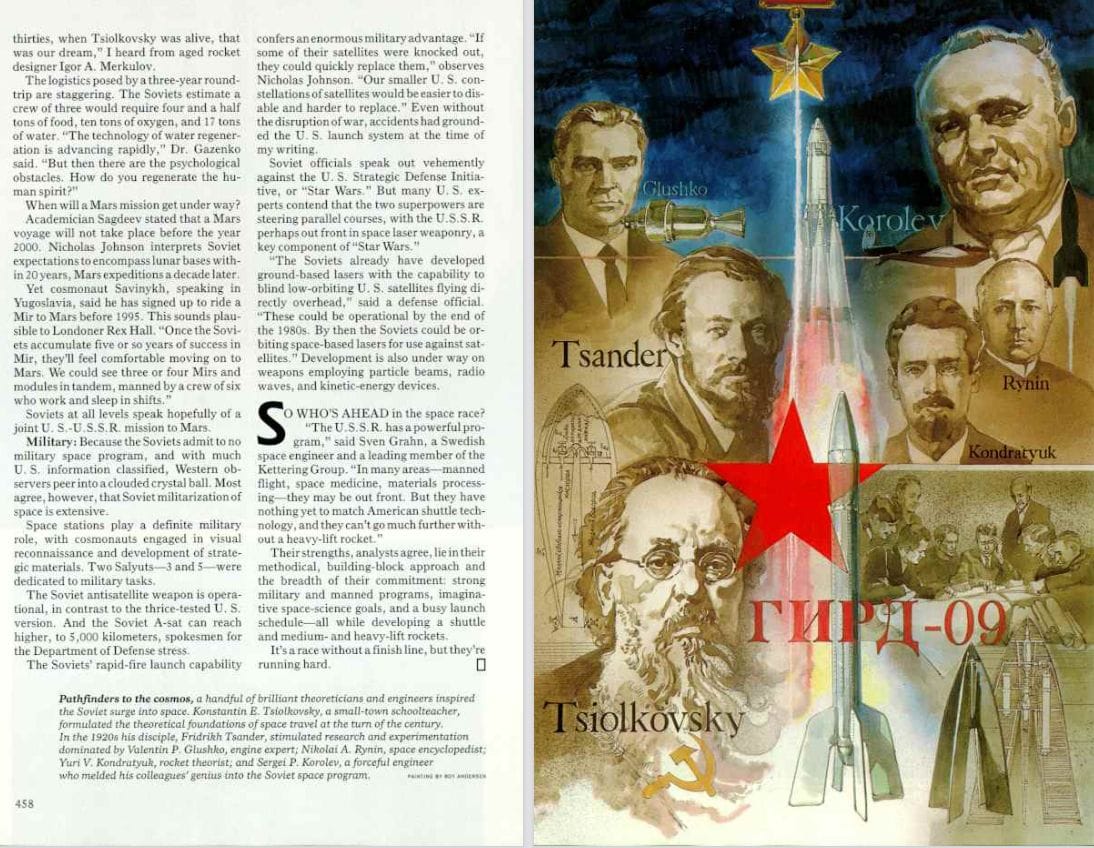
Seeing the uneven progress of Soviet technology, I often wondered how this still industrializing land had achieved a lead role in the exotic arena of space exploration. For an answer my hosts took me to Kaluga, 160 kilometers southwest of Moscow, where a century ago a rustic genius charted the course to the stars. Here Konstantin E. Tsiolkovsky, a near-deaf schoolteacher who had read Jules Verne, made the theoretical calculations necessary for man to “emerge from the bounds of the atmosphere.”
Soviet space research surged after World War II with an influx of German rocket technicians who were pressed into service. The Soviets acquired V-2 rockets, along with blueprints for an ocean-spanning monster designed to hit New York City.
The stage was set for the final triumph. Sending probes ever higher, in 195 7 the Soviets put in orbit a small sphere they called Traveler – in Russian, Sputnik.
In the fine space museum at Kaluga I heard a recording of the next great event Tsiolkovsky made possible, the launching of Yuri Gagarin: the firm command to fire the rocket, the terrifying roar, then Gagarin’s jubilant cry, “Poekhali! – Let’s go!“
That command to fire came from another great space figure, Sergei P. Korolev, the engineer whose forceful personality translated Tsiolkovsky’s calculations into rockets and spacecraft. The Soviets kept his name secret during his lifetime, referring to him only as Chief Designer.
What of the future? Where are the Soviets headed in space? Obviously no ready road map greets the inquirer. But my hosts gave some hints, and Western analysts contribute plausible projections.
Space stations: Western observers see Salyut and Mir being replaced in a few years by a larger station. This hinges on successful launching of a heavy-lift booster comparable to that which lifted Skylab. “They could assemble a large station today, piece by piece,” said Geoffrey Perry. “But it’s much more efficient to send up large components.”
U.S. Defense Department analysts expect test launches of a jumbo rocket at any time, with a new generation space station to follow within a year or two. “When it flies, it will be huge,” calculates Charles Vick, “about 8.3 meters in diameter and weighing at least as much as Skylab.”
Meanwhile the Soviets are expected to dock as many as four large modules at Mir, with continuously operating crews.
Shuttle: The Soviets contend that their inexpensive, mass-produced rockets make a shuttle unnecessary for the near future. “We see no need until the next century, when we will want to transport more material between Earth and space,” General Dzhanibekov told me.
U.S. analysts dispute this. U.S. satellites have photographed the Soviet shuttle. Defense Department spokesmen add that it will look familiar – built partly from U.S. shuttle plans obtained by means of an immense Soviet apparatus for technology acquisition.
Space industries: Despite a slackening of U.S. interest, Soviet authorities speak bullishly of prospects for space manufacturing and processing industries. Pharmaceuticals and semiconductors lead the products list. Gen. Vladimir Shatalov, chief of cosmonaut training at Star City, states that space industries will earn 50 billion rubles (35 billion dollars) annually by 1990.
To the Moon? A number of U.S. authorities believe the Soviets will establish an orbital Moon station and from there colonize the lunar surface. “They’ll do it partly to gain experience for going to Mars,” says analyst Marcia Smith, president of the American Astronautical Society.
To Mars? The Soviets feel a spiritual pull toward the red planet. “Even back in the thirties, when Tsiolkovsky was alive, that was our dream,” I heard from aged rocket designer Igor A. Merkulov.
The logistics posed by a three-year roundtrip are staggering. The Soviets estimate a crew of three would require four and a half tons of food, ten tons of oxygen, and 17 tons of water. “The technology of water regeneration is advancing rapidly,” Dr. Gazenko said. “But then there are the psychological obstacles. How do you regenerate the human spirit?”
When will a Mars mission get under way?
Academician Sagdeev stated that a Mars voyage will not take place before the year 2000. Nicholas Johnson interprets Soviet expectations to encompass lunar bases within 20 years, Mars expeditions a decade later.
Yet cosmonaut Savinykh, speaking in Yugoslavia, said he has signed up to ride a Mir to Mars before 1995. This sounds plausible to Londoner Rex Hall. “Once the Soviets accumulate five or so years of success in Mir, they’ll feel comfortable moving on to Mars. We could see three or four Mirs and modules in tandem, manned by a crew of six who work and sleep in shifts.”
Soviets at all levels speak hopefully of a joint U.S.-U.S.S.R. mission to Mars.
Military: Because the Soviets admit to no military space program, and with much U.S. information classified, Western observers peer into a clouded crystal ball. Most agree, however, that Soviet militarization of space is extensive.
Space stations play a definite military role, with cosmonauts engaged in visual reconnaissance and development of strategic materials. Two Salyuts – 3 and 5 – were dedicated to military tasks.
The Soviet antisatellite weapon is operational, in contrast to the thrice-tested U.S. version. And the Soviet A-sat can reach higher, to 5000 kilometers, spokesmen for the Department of Defense stress.
The Soviets’ rapid-fire launch capability confers an enormous military advantage. “If some of their satellites were knocked out, they could quickly replace them,” observes Nicholas Johnson. “Our smaller U.S. constellations of satellites would be easier to disable and harder to replace.” Even without the disruption of war, accidents had grounded the U.S. launch system at the time of my writing.
Soviet officials speak out vehemently against the U.S. Strategic Defense Initiative, or “Star Wars.” But many U.S. experts contend that the two superpowers are steering parallel courses, with the U.S.S.R. perhaps out front in space laser weaponry, a key component of “Star Wars.”
“The Soviets already have developed ground-based lasers with the capability to blind low-orbiting U.S. satellites flying directly overhead,” said a defense official. “These could be operational by the end of the 1980s. By then the Soviets could be orbiting space-based lasers for use against satellites.” Development is also under way on weapons employing particle beams, radio waves, and kinetic-energy devices.
So who’s ahead in the space race?
“The U.S.S.R. has a powerful program,” said Sven Grahn, a Swedish space engineer and a leading member of the Kettering Group. “In many areas – manned flight, space medicine, materials processing – they may be out front. But they have nothing yet to match American shuttle technology, and they can’t go much further without a heavy-lift rocket.”
Their strengths, analysts agree, lie in their methodical, building-block approach and the breadth of their commitment: strong military and manned programs, imaginative space-science goals, and a busy launch schedule – all while developing a shuttle and medium- and heavy-lift rockets.
It’s a race without a finish line, but they’re running hard.
On assignment
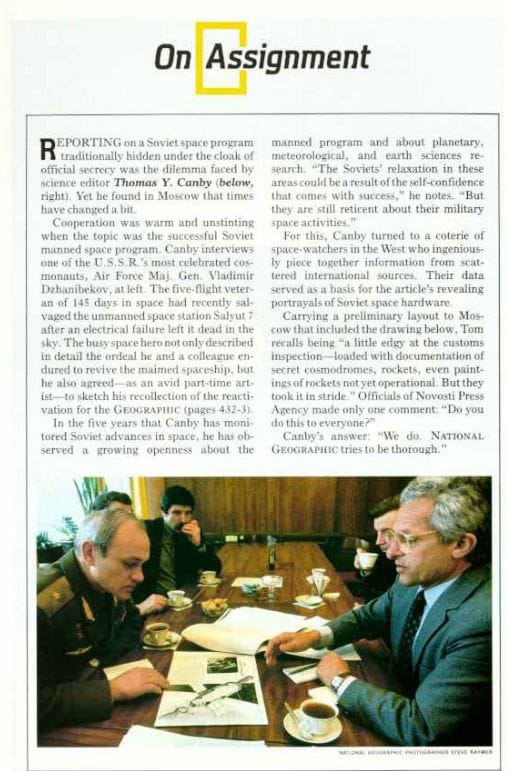
Reporting on a Soviet space program traditionally hidden under the cloak of official secrecy was the dilemma faced by science editor Thomas Y. Canby. Yet he found in Moscow that times have changed a bit.
Cooperation was warm and unstinting when the topic was the successful Soviet manned space program. Canby interviews one of the U.S.S.R.’s most celebrated cosmonauts, Air Force Maj. Gen. Vladimir Dzhanibekov. The five-flight veteran of 145 days in space had recently salvaged the unmanned space station Salyut 7 after an electrical failure left it dead in the sky. The busy space hero not only described in detail the ordeal he and a colleague endured to revive the maimed spaceship, but he also agreed – as an avid part-time artist – to sketch his recollection of the reactivation for the GEOGRAPHIC.
In the five years that Canby has monitored Soviet advances in space, he has observed a growing openness about the manned program and about planetary, meteorological, and Earth sciences research. “The Soviets’ relaxation in these areas could be a result of the self-confidence that comes with success,” he notes. “But they are still reticent about their military space activities.”
For this, Canby turned to a coterie of space-watchers in the West who ingeniously piece together information from scattered international sources. Their data served as a basis for the article’s revealing portrayals of Soviet space hardware.
Carrying a preliminary layout to Moscow that included the drawing below, Tom recalls being “a little edgy at the customs inspection – loaded with documentation of secret cosmodromes, rockets, even paintings of rockets not yet operational. But they took it in stride.” Officials of Novosti Press Agency made only one comment: “Do you do this to everyone?”
Canby’s answer: “We do. NATIONAL GEOGRAPHIC tries to be thorough.”
Linked from 7/1/2007, 31/3/2022 Journals; 7/1/2007 2007 RuSpace blog; RuSpace news