RuSpace: 2007
January
7/1: The good old days?
Back In Time - Moscow Takes the Lead: A posting at NASASpaceflight.com linked to this 5 October 1987 TIME magazine article, “Surging Ahead: The Soviets overtake the U.S. as the №1 spacefaring nation.” It is similar to the October 1986 National Geographic article, “Soviets in space: are they ahead?” (stored on my site as it isn’t available online – don’t tell anyone!). These articles were published four years or so before everything imploded, and are a poignant reminder of how much has been lost or squandered. Glasnost was initiated with good intentions (much-needed reforms of the Soviet government) but turned out to be a death sentence for the country.
Indeed, space experts in the U.S. and Europe are now conceding publicly what they would have found laughable a decade ago: although the Soviets lag far behind in electronic gadgetry, they have surged past the U.S. in almost all areas of space exploration. If unchallenged, Moscow is likely to become the world’s dominant power in space by the 21st century. Says Heinz Hermann Koelle, a West German space-technology professor and former director of future projects at NASA’s Marshall Space Flight Center: “American pre-eminence in space simply no longer exists.” Warns James Oberg, an expert on the Soviet space program: “If the Soviets can aggressively exploit this operational advantage, they can make us eat space dust for a long time to come.” […]
The new rocket will make possible the deployment of larger, more sophisticated Soviet space stations. Says Bogodyazh: “There will be a Mir-2.” Explains Alexander Dunayev, head of Glavkosmos: “Space stations weigh up to several dozen tons. What’s needed are stations that weigh several hundred tons. We should soon learn to build big structures out there, not tens of meters but kilometers across, multifunctional platforms. Cosmonauts may well live there permanently. And from these structures, there may be flights to other planets.” If so, then first on the agenda, undoubtedly, would be Mars.
The lure is strong. Mars is the only other known planet that may be habitable – and thus the only realistic location for a space colony. That makes it a logical target for the Soviets, who are committed to establishing a permanent presence in space for both scientific and military reasons. Besides, the national prestige resulting from a visit to Mars would be immense.
As the article notes, however, the Soviets were well behind the USA in electronic technology.
For all these accomplishments, Soviet microelectronics and computers are ten years behind those of the U.S. Military satellites sometimes break down in a matter of weeks. Photoreconnaissance satellites literally drop their film to earth for processing. The ultraconservative Soviet military is just now beginning to experiment with the techniques of electronic imaging developed by U.S. scientists years ago. Still, admits Geoffrey Briggs, NASA’s director of solar-system exploration, “it’s not clear that you need state of the art to be effective.”
“Russian Space Goals In The Early 21st Century,” Space Daily.
Charles Simonyi has started his blog at long last (beginning from December).
12/1: Retirements
Anik said in the NASASpaceflight.com forum that cosmonaut Sergei Treshchyov retired voluntarily on 30 November last year (2006). He will continue to work at RKK Energiya, in the 291st test department. Konstantin Kozeev and Aleksandr Lazutkin are also due to retire in the near future. Konstantin had some problems keeping his weight down (I can relate to that problem! But it seems an odd reason for retiring). Aleksandr had heart problems (faintness, a feeling of heartburn, chest pains) when he was in Houston on 1 August 2005 for training as part of the Expedition 12 backup crew. He was taken to hospital and an ECG revealed an abnormal heartbeat. He had a blockage in an artery, which was removed by the insertion of a catheter. He recovered well from the ordeal, but it effectively grounded him from spaceflight.
Another three experienced cosmonauts gone (well, one gone and two to depart soon); that will only leave thirteen with flight experience!
“Russia kicks off big year for space history,” James Oberg, MSNBC.com, 11/1. Tribute to Sergei Korolyov, who would have been 100 this year.
14/1: Unhappy cosmonaut
There was a posting at NASASpaceflight.com with a link to some NASA PDF documents, the one of interest to me being a huge publication about the ISS – a 182 MB download. I did download it (yay for broadband!) and it is worth it! Lots of technical diagrams of all components (including diagrams of the insides of the Russian modules, which I have been wanting for years). The download page is here at the NASA Technical Reports Server. It seems to be the same book (SP-2006-557) mentioned in postings at CollectSPACE and NASASpaceflight.com.
Unfortunately a LOT of computer memory/RAM is needed to open and view it – my 512 MB is barely adequate and the PDF slows my computer down so much after a while it is almost unusable! I did manage to view most of it, but what a struggle! Looks like I will have to add more memory sometime this year. They should have divided the document into several small PDF files.
[Update 21/1/2007: you can download the document in separate PDF chapters at Spaceref.]
There is an interview with cosmonaut Pavel Vinogradov in Novosti Kosmonavtiki magazine №1 2007 (issue 288), in Russian: «Рассказывает командир МКС-13 Павел Виноградов» (“ISS-13 commander Pavel Vinogradov tells”), in November 2006. Near the end of the interview he makes it clear he is not happy with the current state of the Cosmonaut Group and the Russian space program, which can be summed up as moribund. Actually he echoes much of what I have been saying. I could not make sense of parts of the computer translation (my Russian is very poor anyway), so I will paraphrase most of what he said:
There is nothing for the new cosmonauts to fly as all the third seats are sold to foreigners; he does not understand Roskosmos’ policy on this at all. It is a worthless policy. The tourist flights could be delayed until they could build extra Soyuzes and fly them up on short visiting missions. He feels that the Russian manned space program is at a dead end. The agreement with the Americans to provide six crew places at the Station means that the required Soyuzes are being build now, and at NASA’s insistence they are the older versions as they do not wish to fly in the modified ship. When the Americans begin constructing their new Orion ship, Russia will be stuck with their old ships and not be neccessary to anybody.
Roskosmos does not support Energiya’s initiative to update the Soyuz, or create a new transport system and the Klipper.
Now we try to assemble crews from inexperienced cosmonauts. Yurchikhin will fly with Kotov. Feodor, though he flew on a shuttle, practically did not see our segment and he will be the Expedition commander. The next crew: Sergei Volkov has spent about 10 years in the group. Of them, only Lonchakov has flown. It seems to me that it is necessary to change the system of general preparation of cosmonauts, and for this purpose there must be more funding. What is now happening at TsPK is incomprehensible. Simply unbelievable! It has completely ruined our preparation! The people who could train as cosmonauts are simply not present! Thank God, the old men are still going … It is all different and all bad. And it is no better at Energiya. I had the impression, that at Energiya the majority works to work, instead of for the sake of results. Nothing advances. No ideology, which, of course, should motivate Roscosmos. When the MOM (Мinistry of General Мachine Building) existed, everything was clear. Now, as weeds from under asphalt, ideas make their way from the bottom and are cut off at the roots …
There are no cosmonauts in any management positions of the piloted program to represent those in the Cosmonaut Group. In comparison, NASA has astronaut representatives in six out of eight posts in their management.
In the previous six months of 2006, the relations between Roskosmos and Energiya took a turn for the worse. N.N. Sevastyanov, whom A.N. Perminov at first supported, broke away and refused to support the Roskosmos program.
In five to six years the Americans will tell us “good-bye.” In fact they now tolerate us only because they need the time in order to create the “Orion.” Then we will be left with our 40-year-old Soyuz … Everything, all is absolute the astronauts who flew on the Soyuz, say: “It is so primitive!” For them it is a shock. And they are not simple people – among them are many test pilots who have flown a lot, so they have much to compare the Soyuz to. Jeff, when he was pulled out from the Descent Module, remarked: “This is a soft landing? What is a hard one?” [Laughs]
In comparison, in Soviet times there was a space strategy and a State policy. Many of the Russian experiments date from Salyut and Mir and it is not clear what they are advancing. Funding for the experiments is inadequate. Over half of crew time is spent on Station maintenance, in any case.
In general the situation is pitiable. It seems to me, it is necessary to develop as soon as possible a strategy of piloted space, to create cooperation throughout the industry and science, to make appropriate adjustments in the unambitious space program of Russia and to achieve state financing.
Given all this, it is hardly surprising that cosmonauts are retiring!
[Update 20/2/2007: Another translation is at FPSpace.]
19/1: A launch, and a reprimand
Progress M-59/24P (24th Progress to the ISS) launched successfully on 18 January at 02:12:15 UTC. There are some nice snowy scenes (well, they look nice during a sweltering Australian summer) at the Energiya site of the launcher being rolled out to the launchpad on the 16th. I wish Energiya would post high-resolution versions of their photos! There are some also posted at the NASA Human Spaceflight Gallery: JSC2007-E-03078, 03079, 03080, 03801, 03802, 03803, 03804.
There was a portrait of Sergei Korolyov on the side of the Soyuz rocket as part of his 100th birthday celebrations (what would have been his 100th birthday). If he were still alive today, I wonder what he would think of the current Russian space program? Probably not much! I think he would be very annoyed at the rather dismal state it is in (though it is somewhat better than it was ten years ago). It is a pity he died so prematurely (during an operation).
(And “Darth Vader” mentioned it too ;-). More Sergei articles (his name is pronouced Korolyov, in Russian Королёв (like Sergei Krikalyov’s surname) (Korolyov means “king,” appropriately enough!):
- “Celebrating Korolyov,” The Space Review.
- “Ambitious Goal Of Sergei Korolev” and “Russia Celebrates 100th Birthday Of Space Pioneer,” Space Daily.
Energiya president Nikolai Sevast’yanov was reprimanded by Roskosmos (По поводу «приступов лунатизма», “On the matter of ‘Lunar assaults’”) for his somewhat overenthusiastic proposals in the past year about going to the Moon!
Roskosmos has regretfully corrected the rhetoric, repeated by a number of mass-media, by the president, the general designer of Energiya N.N. Sevast’yanov, regarding the as yet-unformed program of Russia on flights on the Moon.
Roskosmos, together with other interested departments and organizations, works above a definition of the strategy of development of domestic astronautics, including in the piloted area. However, it is premature to speak about the existence of national decisions on the development of the Moon and other planets.
The desire of the parent organization Energiya to accept the most active participation in realization of such decisions will be necessarily accepted in attention as soon as decisions on a lunar theme are formulated.
More at Space Daily: “Russian Space Agency Irked By Moon Program Debate.” Perhaps though Roskosmos should be more ambitious – it would interest people more than the current rather limited program.
Mentioned in Novosti Kosmonavtiki news №602 is this new site, Федерации космонавтики России (Russian Cosmonautics Federation). But on following the link – yikes! The site design looks like something from ten years ago, complete with a garish animated starry background (reproduced below, in case they [hopefully!] change the design). The designer should pay a visit to Web Pages that Suck and take note!

fkrus.ru background
Also from Novosti Kosmonavtiki news №602:
19/01/2007/00:08 RKK Energiya will develop a variant of the Soyuz spaceship for returning cargo from orbit
The Rocket & Space Corporation Energiya is preparing for Roskosmos a proposal for the creation of a variant of the Soyuz spacecraft, the РКК Energiya president, Nikolay Sevast’yanov, told journalists on Thursday. “Considering, that from 2010 the American shuttles will stop flying to the ISS, we are preparing the project “Reusable/revolving cargo Soyuz” (грузовозвращаемого «Союза»), explained N. Sevast’yanov.
As he said, the need for an additional vehicle for returning cargoes from an orbit will increase, as by 2010 the Station will be completed and will begin functioning at a high capacity, and on it the quantity of experiments will increase. It will be necessary to return results of experiments to Earth.
According to N. Sevast’yanov, the reusable cargo variant of Soyuz will differ in that the cosmonauts’ seats and other equipment will be removed. These Soyuz will then be able to return to the Earth in an automatic mode with up to 500 kg of various cargoes, reports Interfax.
27/1: Mars reality show
Mixed messages on Russian space tourism at Personal Spaceflight; commentary on this article, “A journey to space is not a jaunt to the Caribbean,” at RIA Novosti. It is a bit hard to figure out the author’s opinion in the second article, though he remarks:
I am no judge of the future tourist’s professional training or the value of his scientific program “in the interests of several space agencies.” But one thing is clear: the Russian-U.S. manned program, which just now pulled out of its critical nosedive with tremendous pain, and which is the only one in the world except for China’s, badly needs experienced and practiced professionals rather than amateurs.
As I have said many times before, Russia should prioritize sending up its own professional cosmonauts rather than space tourists. Roskosmos seems eager to fly up the paying guests of other countries, but this is demoralizing for its own cosmonauts (the Cosmonaut Group only has two flight opportunities a year – one seat per Soyuz flight).
Another article at RIAN (29/12/2006) reports that five volunteers were chosen for the Mars-500 experiment, to begin later this year. No names have been released yet. Be interesting to follow this and see how the crew cope with being locked up for a year-and-a-half! Maybe I should have volunteered (I have spent years as a semi-recluse already) but my embarrassing lack of any qualifications would preclude this. It sounds like it will be a real endurance test, though! And it will hopefully be more successful than the previous experiment in 1999 (Sphinx-99), described in this James Oberg article, “Violence and Sexual Assault in ‘Space’.”
The International Space Station Heads of Agencies met at ESA Headquarters on 23 January to review the status of the program. (Mr. NASA Watch was of the opinion it was a Yawn from Paris.)
NASA Cassini Image: The Greatest Saturn Portrait … Yet at Spaceref. Russia, sad to say, has never achieved anything like this.
James Oberg asks, “What suit do you wear to a spacewalk?” at MSNBC.com, looking at the advantages and disavantages of the U.S. and Russian Orlan spacesuits on the ISS. The U.S. EMUs have more technological advantages, such as live helmet cameras, but are somewhat more complicated to put on.
Worth visiting is Ivan Safronov’s Space Video Archive, with lots of videos and films to download. One is the Nedelin disaster video (a screenshot is below, with the arrows pointing to the burning people fleeing) on the Unique Footage page. Russian Space Web has a page about the disaster (as does Wikipedia), which I think is still the worst in the history of rocketry.
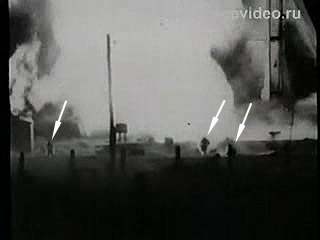
A more recent disaster was the Brazilian rocket explosion in 2003 where 21 people were killed (incinerated).
29/1: Grumpy cosmonaut
“Race to the Moon,” Newsweek/MSNBC. Starts off with a none-too-flattering remark about Sergei, much to his admirers’ indignation! (This author included!) As the article goes on, it seems that Sergei is (not surprisingly) unhappy with the chronic underfunding of his country’s manned space program, which is bad for morale. (He isn’t the only cosmonaut who is – see 14/1 entry).
For a space hero, Sergey Krikalev is something of a grump. Krikalev holds the world’s record for time spent in outer space – he has logged an incredible 803 days, including time on Russia’s Mir space station back in the 1980s, when the International Space Station was still a distant dream. Between flights, Krikalev works at Energiya, which makes some of the biggest and most reliable rockets in the world. Despite these accomplishments, however, Krikalev, like many of his colleagues in Russia’s space program, seems to spend much of his time complaining about a lack of funds. He may have a point. Energiya’s glass and concrete offices outside Moscow are drab 1970s retro. Salaries at Energiya average a mere $400 a month, though Krikalev, at the top of the scale, gets $1000.
This legendary stinginess is the bane of Krikalev, and Russia’s ace in the hole. Although it lost the moon race in the 1960s, since then Russia’s space program has made a habit of performing heroic deeds on a shoestring – in many respects besting its well-heeled U.S. rival. While NASA struggled with its unreliable and fabulously complex space shuttle, Russia was racking up the mileage with its simple, durable Proton boosters – even during the chaotic years following the Soviet Union’s collapse. Now, despite Krikalev’s complaints, Russia’s space program is emerging from the lean years.
(Comments at CollectSPACE on the article)
Some brief summaries from Novosti Kosmonavtiki №603:
Colonel-General Vladimir Popovkin of the Space Forces (Космические войска) said that an officer from the Space Forces could go into space in five years to carry out “experiments in the interests of the military department.” One Space Forces officer has already done a short flight: Yurii Shargin. C-G Popovkin also thinks that Russian manned spaceflight should have a “national idea.” The Space Forces are now at 100% strength in staffing levels.
He also said that Svobodny Cosmodrome is to be closed, or at least not used for rocket launches. (There seems to be some confusion about this as it is not officially confirmed?)
(Svobodny Cosmodrome to closed in 2007 at NASASpaceflight.com)
On 30 December 2006 Michael Fradkov, the Chairman of the government of the Russian Federation, signed the order №1860-P which approved the prospective financial plan of the Russian Federation for 2007-2009. According to the plan, the financing of Federal Space Agency activities in 2007 is stipulated in volume of 32,985,322,3 thousand roubles, in 2008 – 34,327,724,8 thousand roubles, in 2009 – 36,903,201,1 thousand roubles. From these sums it is supposed to allocate for national defense 4,103,067,6; 3,758,094,0 and 3,861,377,5 thousand roubles accordingly, and on national economy 28,818,454,7; 30,486,976,2 and 32,951,892,0 thousand roubles accordingly. The rest of the means allocated from the budget to the Federal Space Agency, will be spent for housing-and-municipal construction (55,800,0; 60,654,6 and 65,931,6 thousand roubles accordingly) and on social policy (8,000,0; 22,000,0 and 24,000,0 thousand roubles accordingly). In spite of the fact that in the budget of the Federal Space Agency financing works in the field of national defense, not all of money which Russia spends for military space is stipulated. Some amounts “are buried” in the budget of the Defence Minister.
February
1/2: News tidbits
In Novosti Kosmonavtiki №605 Nikolai Sevast’yanov made some more pronouncements. Energiya proposes four phases of the Russian space program up to the year 2050:
- Modernization of the existing Soyuz transport ship by 2012 which would increase its load by 7-15 tons;
- Creation of the “Parom” ferry to replace the Progress cargo ship; it would increase the cargo weight carried into orbit from 2.5 to 15 tons;
- A piloted flight to the Moon by 2015 and an operational base by 2030;
- A mission to Mars by 2030 and colonization to begin by 2050.
All these plans and schemes seem to keep moving into the future like a mirage … I will be 60 in 2030 and 80 in 2050! Hopefully things will happen sooner than that!
Russia is also considering a longterm plan to keep the Station operational until 2025 (article also at RIA Novosti). NASA also has changed its mind about supporting the ISS; it initially planned to stop support after 2016 but now plans to extend space station support to 2020.
A page on the Energiya site commemorates the 100th anniversary of the practical cosmonautics founder, academician Sergei Pavlovich Korolyov.
Andrei Kislyakov on the 11 January destruction of a satellite by China: “Oriental satellite killer: case №1”: Part 1, Part 2, Part 3.
“Astronaut diaries used to study mood,” MSNBC.com, 30/1. Unfortunately these diaries are not for public viewing! They would make interesting reading. The diaries posted at the NASA Astronaut Journal site are all cheery and perky, which can get a bit tedious.
A Sea Launch Zenit exploded on its pad destroying a communications satellite it was carrying. No one was injured. (Sea Launch site.) (There is an interesting post describing the Sea Launch procedures at NASASpaceflight.com.)
Vassili Petrovitch has posted an extensive collection of Aerospace Transport Systems: Book of Technical Papers on his Buran space shuttle site. It is an excellent resource for the Russian shuttle. I was interested in Buran until 2002 when the hangar collapsed in May, destroying the Buran orbiter that made it into orbit, and killing seven workers. Before that tragedy there seemed to be some hope of resurrecting the Russian shuttle, but it seems dead now, sadly.
6/2: Astronaut love drama!
Not exactly Russian spaceflight-related, but this is too dramatic to ignore! Reported at MSNBC.com and the Sun Sentinel: a female astronaut called Capt. Lisa Nowak (married with three children) attempted to kidnap a female air force officer, Capt. Colleen Shipman, apparently believing her to be a rival in love for Cdr. Bill Oefelein (married, two children; he piloted STS-116). She botched the attempt and was later arrested. Sounds like a case of obsessive love. Wonder what she was planning to do with all that equipment she was carrying?
There is a thread discussing the drama at NASA Spaceflight.com, but some are getting all moralistic and huffy about discussing it, and it looks like the thread will be deleted. *Rolls eyes*
The charges for attempted kidnapping are quite serious: life in prison! Perhaps she will get a reduced sentence because of mental instability. Such obsessions can affect and unbalance anyone.
“Cruising For A Space Flight,” Andrei Kislyakov, Space Daily. A continuation of a previous article, “A journey to space is not a jaunt to the Caribbean.”
12/2: Promotions
Mentioned in the Energiya official press release: February 5, 2007. Korolev, Moscow region, Sergei Krikalyov was given a new job as Vice-President of Manned Flights; his flight status is unchanged (backup for Soyuz TMA-12 to launch in March 2008, and commander of Soyuz TMA-14 in March 2009). (Discussed in this thread at NASASpaceflight.com.) Various other appointments were made in the organization. There is also speculation that the current President, Nikolai Sevast’yanov, might be replaced, a contender being Yurii Koptev (who was head of Rosaviakosmos in the 1990s, replaced by Anatolii Perminov), as some are unhappy with Nikolai’s performance and his tendency to make outlandish statements about Energiya’s future space exploration plans without the funding to back them up. His appointment was controversial in 2005. There would be problems with Yurii Koptev’s appointment though, as listed in Novosti Kosmonavtiki news №607:
- As he replaced Anatolii Perminov, there might be some latent hostility between the two.
- He is not accustomed to heading a large enterprise like Energiya.
- He made the unpopular decision to deorbit the Mir Space Station, which many would hold against him.
- He is old (born in 1940); Energiya wants to “promote young managers in order to implement long-term space programs.”
The shareholders’ meeting is in May, so see what transpires then.
The deputy director of the Institute of Medical-Biological Problems, Valerii Bogomolov, said Russia had no plans to strengthen the psychological testing of its cosmonauts following the Lisa Nowak case, as the psychological requirements are already at a high level. It is the first time something like this has occurred in the NASA Astronaut Group, and is not related to her space flight which was over half a year ago. In the near future, Russian experts will discuss the case with NASA medical personnel and those of other countries in the ISS program, and advise them to strengthen the psychological requirements when selecting astronauts, as Lisa Nowak’s case has caused unfavorable publicity. It will also not affect the selection of candidates for the Mars-500 isolation experiment.
March
27/3: Back from the dead!
After deleting my website and blog in a fit of depression last month (February) (and perhaps due to a bit of PMS), we are back – Blogger were able to restore the blog (email for this is support@blogger.com – it is quite hard to find contact details in the Help section). Some annoying company also grabbed the URL to redirect it to their stupid commercial site (which is another reason not to delete – opportunistic spammers wait to grab the URL). So the two or three people who actually read this blog (and presumably weren’t too bored by it) can continue to be riveted by my ramblings :-D.
Now for some catching up! I’ll just go through the postings in my manual journal. There is rather a lot, sorry!
February news
Expedition 14 completed a spacewalk wearing the Orlan spacesuits on 22 February – see Spacewalkers Successfully Retract Progress Antenna at NASA.
Space junk in Siberia, CollectSpace.com. Russia launches its rockets over land as its launch centers are not near any ocean, and the accumulated debris is a source of environmental pollution from the toxic fuels used (though the locals can make a trade in scrap metal from the rockets). The photo essay Spaceship Junkyard at Slate.com shows images of crashed rockets. I am not sure if there is any organized clean-up by the government. It poses a vexed question of whether the environment or space program should have priority.
“Why are we fighting for the Moon again?,” Andrei Kislyakov, RIA Novosti, 19/2 on why is the space race to the Moon being re-enacted again?
More details on the retraction of the stuck Progress antenna during the last spacewalk – it took quite a lot of effort – and the problems with Mikhail Tyurin’s Orlan spacesuit (the “phantom torque” experienced on previous spacewalks does appear to be due to “high-velocity water molecule ejection by the sublimators of the Russian spacesuits.”
A possibly interesting new novel featuring a Soviet cosmonaut. I hope the ending isn’t disappointing – i.e. that he defects! Probably won’t be available in Australia though (as usual). Though the excerpt (which I just read) is somewhat stomach-churning (involves rape and graphic violence). Ugh – maybe I will give it a miss!
A RIA Novosti letter:
Sir, thank you for producing such an informative and useful online resource. I am writing today in response to the opinion editorial piece by writer, Andrei Kislyakov. As a person who came of age during the “bad old days” of the cold war space race, I was steeped in the competitive nature of those endeavors. Now that I have gone back and studied the awesome and heroic achievements of the Soviet and Russian space programs, I really appreciate the talent and courage displayed by Korolev and the cosmonaut community. NASA has a great deal to learn from the logical, step-by-step approach used by Russia’s space pioneers. Too often our space program is driven by short-term politics in Washington. You can count me as one American who does not ever wish to see again the close-minded space races of the past. America and Russia should work together and share their strengths, not work against each other. Thank you for the fine piece. Ad Astra!
– Vernon Helvey, 21/2
The Soyuz launch base construction site in French Guiana was officially opened on 26 February. A commemorative stone from the Soyuz L-1 launch pad at Baikonur was placed at the new site. It is possible that manned launches could take place there in the future (especially if Russian relations with Kazakhstan break down). Though French Guiana is a colony (which some people there oppose); it has many social problems.
March news
The Independent Safety Task Force’s final report is online (as a PDF). Makes for some interesting reading! The Russian Segment unfortunately doesn’t get a good report, though the problems are old ones. Some extracts:
Acoustics (p.57)
An important aspect of human space flight is the control of the ambient noise level in the crew’s working and sleeping environment. The ISS acoustic environment has been high in the Russian SM, with continuous noise levels exceeding limits by 5-10 dBA in work and sleep areas. Hearing protection systems have been provided and are necessary for the crew while in the SM; however, comfort and the operational need to communicate prevent continuous use of hearing protection. Acoustic mitigation hardware has been developed and launched for the highest noise-contributing hardware in the SM, and installation of some of this hardware has improved the acoustic environment. As limited crew time is available, additional hardware will be installed that is expected to bring the SM acoustic levels to within design specifications. Hearing acuity of the crew is monitored before, during, and after the mission. There has been a permanent hearing threshold shift (hearing damage) at the highest frequency tested (8000 Hz) in one U.S. ISS crew member. There have also been temporary hearing deficits documented in other U.S. and Russian crew members, all of which recovered to pre-mission levels. The ISS Program continues to monitor the acoustic environment, and is making efforts to adequately address this threat to crew health.
5.1 Micrometeoroid and Orbital Debris (p.60)
It should be noted that Russians technical specialists believe that the U.S. models are too conservative in their predictions related to potential MMOD damage. This is based upon their experience from operating the Mir space station, where only four MMOD events are known to have occurred in its 15 years of flight. The Russians have a debris strike measuring system deployed on the Station that measures MMOD strikes on the system.
In general, NASA, ESA, and JAXA elements meet the specification for MMOD protection. The Russian docking compartment does not meet this requirement; however, it is a small contributor to the total MMOD risk. Russian hardware elements that were designed before they were intended for use on the ISS (i.e., Russian SM, Soyuz, and Progress) fall short of meeting the specifications. Modifications are being implemented to increase the SM MMOD protection as follows:
- Conformal debris panels installed on the SM outer skin
- Flight UF-2 delivered six debris panels in June 2002 that remain stowed but uninstalled.
- Flight 12A.1 delivered 17 more debris panels in December 2006 to be stowed on orbit.
- Installation of these panels is planned during spacewalks in April 2007.
- Orientation of the SM solar arrays in the vertical position relative to the velocity vector (this option is available after the NASA power configuration is completed, enabling NASA to supply additional power to the Russian elements)
- Deploying additional “wings” forward of the SM arrays
Technical agreements on possible enhancements to the Russian Progress and Soyuz vehicles have been made, but implementation is pending a Russian decision to proceed. The primary impact of the enhancements would be approximately 48 pounds of additional launch weight for each vehicle. […]
The data above do not include the Russian multipurpose laboratory module (MLM), which is currently under development. The MLM meets the Program’s specified requirements for MMOD protection, and its installation does not significantly alter the overall ISS MMOD posture.
5.11 Service Module Windows
Observations
The 13 SM windows are Russian-heritage hardware for which designers did not consider currently available data regarding MMOD in their design. The design consists of a two-windowpane (primary and secondary) configuration with the volume between the panes pressurized. This results in the external pane being the primary pressure pane. Unlike other windows on the ISS, most Russian windows do not have an external debris pane to protect against MMOD or an internal scratch pane to protect against damage caused by inadvertent crew activities. The probability of a critical failure (i.e., loss of a primary pane) is estimated by NASA to be one chance in six for all SM windows combined and one chance in nine for SM windows 1 and 2 over a six-year period. Loss of the primary pane would result in loss of redundancy in the window with respect to maintaining ISS atmospheric pressure. Early in the NASA assessment of the SM windows there were concerns that failure of the primary pane might cause failure of the secondary pane as well due to near instantaneous change in differential pressure since the volume between the two panes is pressurized. However, tests conducted by NASA using SM window hardware have demonstrated that the loss of the primary pane does not result in the loss of secondary pane.
Should the primary window pane fail, the concern is the need for protection of the secondary pane from damage that might cause a loss of ISS pressure. This protection involves first the determination that the primary pane has failed and then the installation of an internal cover to prevent further damage that might result in a failure of the final remaining pane. There are insufficient pressure covers on orbit at this time to protect against existing and future damage to primary window pressure panes.
Detection of a primary pane failure requires regular and methodical inspection and photography of the SM window so that analysis can be conducted to determine the structural integrity of the pane in question. Well-defined window inspection and photography procedures have not been developed to date, and routine inspections and photography have not been performed. NASA and Russian technical experts agreed on an implementation plan in September 2006, but it is unclear whether Russian management will implement its part of the plan.
Recommendation
5.11.1 The ISS Program should proactively, methodically, and routinely monitor the SM windows for critical damage and be prepared to implement protection of the secondary pane by having hardware available on board or as launch-on-need for implementation.
There are also some concerns about the upcoming ATV flight:
Observations (ATV)
There will be no test flights of the integrated ATV before the first vehicle will rendezvous and dock with the ISS. The ATV safety strategy is operationally implemented at three levels.
- On the first flight, flight safety demonstrations will be conducted before the proximity operations safing functions might be required.
- A two-fault-tolerant vehicle design protects the ISS from critical and catastrophic hazards.
- Flight crew and MCC monitoring and control protect against unexpected scenarios.
The guidelines for the safety demonstrations are that:
- all safety functions will be demonstrated in a region that is not hazardous to the ISS before they would be needed.
- each activity is built upon in distinct demonstration phases.
- success criteria are provided for each demonstration phase.
- contingency plans are provided in the event that success criteria are not met.
- each step is evaluated before proceeding to the next step.
While this is a sound approach, the ATV systems that are used to accomplish a safe rendezvous and docking are complex and require a high degree of human interaction. To guard against failure, all aspects of vehicle design and operation must rigorously adhere to the defined safety strategy. Additionally, new rendezvous technology has been flown on two previous missions: the Japanese engineering test satellite (ETS) series and the NASA demonstration of autonomous rendezvous technology (DART). Both missions had problems with their autonomous rendezvous; and, in fact, the DART spacecraft collided with the target vehicle. The Japanese ETS rendezvous was eventually successful, but only after a month of on-orbit troubleshooting and modifications. With no planned test flight and two instances where other automated rendezvous systems had initial performance problems, the ATV is scheduled to rendezvous and dock with the crewed ISS on its very first mission. Without first requiring a successful test flight, and given the complexities of the new MCC in Toulouse, new flight controllers, the cultural and language differences among the three control centers of France, Russia, and the United States, and U.S. Export Control/ITAR restrictions that limit data exchange and conversations among the technical integrators and operators; the plan to demonstrate safety functions during an actual rendezvous on the first mission is considered ambitious.
Russia also announced it is looking for a new launch site in case Baikonur is unavailable. The main contender is Kapustin Yar (love the sound of that name!).
“Death throes and grand delusions,” The Space Review. Dwayne Day summarizes the current problems in Russia’s space industry and program. Not happy reading.
“Korolev R-7 Rocket Leads The Field For Reliability,” Space Daily.
Lisa Nowak was officially fired from NASA. Every time she is mentioned at the NASASpaceflight.com forum, the threads keep getting locked, rather annoyingly! People keep saying in moralistic tones, “We really shouldn’t discuss this,” but they do anyway :->. It makes a change from the mind-numbingly dull discussions about COTS and so forth. (I have no idea of what COTS is; I just pulled that up at random. :-D
New article posted at the Energiya site: MoonGasTransport Inc., “The interview given by Nikolai N. SEVASTIYANOV, the President and Designer General of the S.P. Korolev Rocket and Space Corporation Energia to a reporter from ITOGY weekly Svetlana SUKHOVA.” More ambitious schemes from Mr. Sevast’yanov – he just needs 2.5 billion dollars to implement them! Perhaps one of the oligarches could do something useful with their billions and donate to the cause.
“The Story Of Women In Space,” Space Daily. Russian women were faced with many barriers to getting into orbit, one of the major ones being sexism from their male counterparts; something which is still apparent today. Only three Russian women have made it into orbit so far (the last in 1997).
Through this post at NASASpaceflight.com, found a document written by Sergei Krikalyov (27 December 2004), stored at the Русский фонд (Russian Fund) site. They are the PDF documents (in English and Russian) at the top of the page (the Russian one is online). (I posted this on the 2004 News page at my Sergei site.)
The report on international program for Earth defense from asteroid-comet threat is prepared under a Russian Federation patent from 27.12.2004 (RU 2243621 C1) “Method and device for generation of directed and coherent gamma-radiation.” In this patent under physico-mathematical and quantum analysis as well as work over constructional and technical details there is shown a unique and real way of defense a human civilization from a ruthless outer space.
In other words, using a laser to zap rogue asteroids!
Two recent articles by James Oberg at MSNBC.com:
- “The Kourou-cosmonaut connection”: future prospects for the new French-Russian Kourou spaceport. (The climate, though, is unpleasant: “High humidity, rain seasons, aggressive insects” – ugh!.)
- “Space station sinks to a new low”: the complex calculations needed to keep the ISS aloft and orientated.
From Novosti Kosmonavtiki news №614; criticism from the State Duma Deputy Valerii Rashkin over the closing of Svobodnyi Cosmodrome:
15/03/2007/16:56 – The Deputy of the State Duma of the Russian Federation Valery Rashkin: Russia does not wish to have free access to space
The deputy of the State Duma of the Russian Federation Valery Rakshin has made a statement in connection with closing of the Svobodnyi Cosmodrome. In the statement he said:
“As it became known today from press statements, the Governor of the Amur area Leonid Korotkov has declared Svobodnyi Cosmodrome, which is located in this region, closed.
“The second is closed remained on territory of our country the space project focused on peace and military use of space. There is the Russian-only northern Plesetsk Cosmodrome. For all educated people it is clear that the more northern the cosmodrome (further from the Equator), there are subsequently reduced opportunities for the launch of large and heavy objects into orbit, let alone devices for distant orbital piloted space flights. The well-known Baikonur Cosmodrome remains in Kazakhstan; we only rent it. The Sea Launch project does not exist without problems and is not wholly Russian. The Kourou Cosmodrome is under the jurisdiction of France.
“Authorities of Russia, having made grand statements for ten years about new space projects and creation of the high-grade Russian Svobodnyi Cosmodrome, have again acted pragmatically and not strategically. They have shown only average thinking at the management level. Almost on the quiet (through the statement of the governor of the area – not that status of event) the country refuses space, scientific and innovative ambitions. And again hundreds and hundreds of qualified experts of the Military-Space forces will be dismissed. If this is innovative Russia with independent democracy, where is the innovativeness and especially the sovereignty?”
(Russian version, Русская версия)
Too Far from Home is a book mentioned in this thread at CollectSPACE.com. Seems to be yet another example of inaccurate reporting, if the reviews are anything to go by:
Though extensive accounts of the Americans’ backgrounds seems at first to put the brakes on, it’s a necessary counterweight to parallel passages about the little-understood Russian space program – essential information because the three eventually took “an accelerated, lung-crushing dive” in a Soyuz capsule.
Um, the Russian program is reasonably well-understood by now?
Too Far from Home vividly captures the hazardous realities of space travel. Every time an astronaut makes the trip into space, he faces the possibility of death from the slightest mechanical error or instance of bad luck: a cracked O-ring, an errant piece of space junk, an oxygen leak … There are a myriad of frighteningly probable events that would result in an astronaut’s death. In fact, twenty-one people who have attempted the journey have been killed.
Everytime a person ventures on the road in a car they face the possibility of maiming or death in an accident, occurrences that happen to people every day. Thousands of people are killed on the roads each year. And people think space travel is dangerous …?
With the launch program suspended indefinitely, these astronauts had suddenly lost their ride home. Too Far from Home chronicles the efforts of the beleaguered Mission Controls in Houston and Moscow as they work frantically against the clock to bring their men safely back to Earth, ultimately settling on a plan that felt, at best, like a long shot. Latched to the side of the space station was a Russian-built Soyuz TMA-1 capsule, whose technology dated from the late 1960s (in 1971 a malfunction in the Soyuz 11 capsule left three Russian astronauts dead.) Despite the inherent danger, the Soyuz became the only hope to return Bowersox, Budarin, and Pettit home.
The crew always had a ride home – the Soyuz served as a backup should the Shuttle be canceled (as it was). The technology in the Soyuz has been upgraded since the 1960s! And the last Soyuz fatalities to date were in Soyuz 11 (though there have been some near-misses).
From another review:
He wrote an award-wining article for Esquire on how American astronauts Donald Pettit and Kenneth Bowersox and Russian engineer Nikolai Budarin were stranded on the International Space Station after their ride home – the shuttle Columbia – exploded on re-entry Feb. 1, 2003. With the remaining shuttles grounded, there seemed to be no way to retrieve them. ([They eventually returned aboard a Russian space capsule])
*Exasperated sigh* No, the crew were not stranded… Inaccuracy really, really irritates me!
In the 19 March edition of The Space Review there is an article by Dwayne Day about the movie Virus – “V is for Virus, Volkov, and Vandenberg”! Turns out that the ship used in the movie was not the Academican Vladislav Volkov, «Аладемикан Владислав Вольков» (as I thought when I saw the movie screened on TV last year), but a decommissioned American missile tracking ship, the Vandenberg.
“Russian contradictions,” Taylor Dinerman, The Space Review. A typical neoconservative view of Russia’s intentions in politics (President Putin’s “vicious anti-American speech,” which can be read at Kremlin.ru, was stating a few truths and was hardly vicious), but does point out that Russia is doing quite well in its space program.
Regarding The Space Review site, Nicolas Pillet says in this forum thread, Article dans The Space Review sur le programme russe (in French) (approximate translation):
Before even reading the article, I would like simply to warn those who do not know “The Space Review” that it is an extremely “patriotic” media (I put quotation marks because actually it is necessary to include/understand “nationalist”…) It is the kind of magazine which, at the time of the war in Iraq, told off the “enemies of the freedom” which we are … I do not know any more which article it was, but once they said (one can more explicitly) Europe could not make anything in space, except for Italy which had modest experience in the construction of habitable modules … They are hardly nicer, I believe, with the “Soviets”… Then mistrust …
Taylor Dinerman seems to be one of the resident “Paranoid Patriot” writers there; articles by him (which Nicolas might have meant) include “How much international cooperation is really needed in space exploration?,” “NASA and ESA: a parting of ways?,” “Italy: seeking to maintain its political equilibrium in space,” “More international delusions,” “The French ‘non’, the Dutch ‘nee’, and their impact on Europe’s space policy,” “The European (French) response to Bush’s space strategy.” He has the typical neoconservative view of disliking Europe and its “welfare state.” (The neos wish to cut taxes, eliminate welfare, give corporations free rein and leave people to fend for themselves.)
I neglected to mention that 6 March was Valentina Tereshkova’s 70th birthday. (She is a year older than my mother!) RIA Novosti had an article about her (in Russian): «Валентина Терешкова открыла тайну, которую хранила 40 лет» (The first woman Russian cosmonaut Valentina Tereshkova reveals a 40-year-old secret) – no English version, unfortunately (there is a French version which might be easier to translate). At the end of the article:
At present, Tereshkova dreams to go to Mars, “a marvelous and mysterious planet.” “I am ready to go there, perhaps never to return,” acknowledged the woman cosmonaut.
I noticed that the Soyuz Crew Operations Manual (SoyCOM) – final (258 pages) is available in the subscription-only L2 section at NASASpaceflight.com. *Covets* Seems like all the good stuff has been moved over there!
The Kliper spaceship concept is to be resubmitted to Russian Space Agency by late 2007.
Expedition 15 cosmonauts Fyodor Yurchikhin and Oleg Kotov said they would be happy to carry out a spacewalk with an appropriately-trained space tourist.
Information via Anik at NASASpaceflight.com:
New information from Sergey Shamsutdinov (one of editors of Novosti Kosmonavtiki magazine): On March 6 the Russian Main Medical Commission (GMK) has declared Konstantin Kozeev and Aleksandr Lazutkin unusable to spaceflight due to medical problems, therefore they will leave RSC Energia’s Cosmonaut Group very soon … Also the new commander for the backup Expedition 17 crew is Gennadii Padalka now (instead of Sergei Krikalyov)… And Yuri Lonchakov, not Michael Barratt, will be the commander of the backup Expedition 18 crew …
Sergei is still commanding Expedition 19/TMA-14; he does not want to train as backup as he is very busy (and knows everything, anyway!).
30/3: News tidbits
Some news tidbits from the last few days.
Neglected to mention that Energiya president Nikolai Sevast’yanov was in a car accident on 3 March in Moscow (NK News №611); he collided head-on with a 23-year-old driver in a Opel Astra who came out of a side-street unexpectedly. He got a brain concussion and various injuries, but he evidently recovered as it was not mentioned on the Energiya site, and he was attending meetings a week or so later.
“The first Soyuz mission – forty years on,” RIA Novosti, 23/3.
“Space station trip will push the envelope,” James Oberg, MSNBC.com, 28/3. The Soyuz TMA-9 spaceship will have stayed in space longer than any previous Soyuz (214 days – previous record is 210 days).
“China And Russia Plan Mars Mission,” Space Daily, 28/3. A small Chinese satellite is to be launched with the Russian “Phobos Explorer” spacecraft.
“China To Pursue Space Instead Of Socialism,” Space Daily, 28/3. Andrei Kislyakov opinion piece.
“Fireball fears stoked by space history,” James Oberg, MSNBC.com, 29/3. A fireball seen from a Chilean airliner was initially thought to be the deorbiting Progress M-58 cargo ship, but this was later discredited. The sea dump site is in the South Pacific, 45°S and 140°W.
Progress M-58 undocked on 27/3 at 18:11, deorbited at 22:44:30 and was destroyed at 23:30:22.
“Space brings Russia glory but not money – experts,” RIA Novosti/Gazeta (news roundup for 30/3):
On Thursday, the Presidium of the State Council, which comprises Russia’s regional leaders, held its visiting session in Kaluga, a city south-west of Moscow, to discuss how the national space program could benefit the economy. The Presidium said the Russian economy could only benefit from communication satellites, while experts doubt their efficiency.
The Global Navigation Satellite System (GLONASS) is just about the only cost-effective space program to date. Although pocket personal computers and cell phones still cannot operate outside the U.S. Global Positioning System (GPS), Russia and the European Union are working hard to develop their own navigation systems. The EU’s satellite-navigation system Galileo faces serious problems; and the European Commission even threatened to terminate the project, unless the parties reached a consensus on principled issues.Russia’s GLONASS project is not very successful either because only eight GLONASS satellites are currently in orbit.
In early March, First Deputy Prime Minister Sergei Ivanov, one of the likely candidates to succeed President Vladimir Putin, said the GLONASS system will be opened to commercial users late this year. But analysts doubt the system’s market prospects. Eldar Murtazin, a leading analyst at Mobile Research Group, said Russia does not need a GPS-type system. He said the GLONASS system will be adapted for civilian use to make it profitable. But it will not be very popular because few people will install GLONASS receivers into personal pocket computers and cell phones, Murtazin said. The GLONASS system will become cost-effective only if the Government persuades corporate users to adopt it, he told the paper.
This project has political implications because Russia will elect its parliament and president in December 2007 and March 2008, respectively. By promoting the GLONASS system, Russia wants to prove that it is not dependent on Western technology, Alexei Makarkin, deputy director of the Center for Political Technologies, said. He said the Kremlin is trying to improve its reputation through space programs, and society thinks Russia is therefore reasserting itself as a powerful and influential country.
Some unflown cosmonauts from the Cosmonaut Group appeared on a show called What? Where? When?, «Что? Где? Когда?» on 30 March on the First, Первому channel, competing against television viewers. The participants: Sergei Zhukov (team captain), Anatolii Ivanishin, Sergei Ryazansky, Aleksander Samokutyaev, Anton Shkaplerov, Mukhtar Aimakhanov (Kazakhstan). Unfortunately they lost (6:3). (NK news №617, №618)
April
3/4: Mars-500 update
ESA prepares for a human mission to Mars, ESA news, 2/4. ESA is also partaking in the Russian Mars-500 experiment, contributing to the research. The actual experiment seems to have been moved back to 2009 (from the latter half of 2007), with two shorter 100-day missions to take place in 2008 that will test the facility and procedures. A diagram of the complex can be found in a PDF on this page; I posted it at NASASpaceflight.com.
The Expedition 15/Soyuz TMA-12 crew launch on the 7th, so they are now at Baikonur Cosmodrome. Charles’ site takes about two minutes to load (on broadband) and you have to wait for it all to load before anything is visible. Flash-animated sites are evil!
Sergei Krikalyov was there as part of Energiya management: in Energiya photo-report, March 27, 2007. Baikonur Cosmodrome, RSC Energia’s branch. Sergei was at the Baikonur cosmodrome Krainii, Крайний airport with other Energiya managers to greet the Soyuz TMA-10 prime and backup crews. He appears in photos 3 and 6. Also in Energiya photo-report, March 28, 2007. The crew report on their readiness to proceed with their final training phase to General Designer N.N. Sevast’yanov and other managers. Sergei appears in photos 4 and 13.


10/4: Another rich guy in orbit
… Big yawn. Just can’t get enthusiastic about that. The only time the Russian space program gets mentioned in the media here (Australia) is when a tourist goes up. A pertinent article at MSNBC.com: Russians fear becoming space cabbies – “Space experts worry new role will take away from needed development.” Which states exactly what I have been grumbling about in previous entries. The Russian space program has been reduced to a taxi service for bored rich space tourists and if that is all it is to be, they might as well end it. Sergei Korolyov would not be impressed with the way things are now.
However, this focus on tourism and making a profit has distracted the Russians from their original goal of building interplanetary space vessels. Rather, they are focusing on turning their portion of the ISS into a tourist and entertainment center in order to generate the funds to keep their operation aloft.
– Leaving Earth, Robert Zimmerman
For the record, Soyuz TMA-10 launched at 17:31:14 UTC on 7 April with ISS-15 and Visiting Crew-12 aboard, and docked at 19:10:44 on 9 April to the nadir port of the Zarya FGB module.
There is also a profile of cosmonaut Oleg Kotov – who is making his first spaceflight (at long last!) – by James Oberg at MSNBC.com. (The previous unflown cosmonaut to fly was Yurii Shargin on Soyuz TMA-5 in 2004.) The promised blogs of cosmonauts Kotov and Yurchikhin at Charles Simonyi’s site failed to eventuate, disappointingly.
More Sergei Krikalyov sightings at the launch: Energiya photo-report, April 6, 2007. Baikonur Cosmodrome, RSC Energia’s branch. Sergei appears in photos 1, 7, and 9 at a meeting of the State Commission the day before launch of Soyuz TMA-10. Energiya photo-report, April 7, 2007. Baikonur Cosmodrome, RSC Energia’s branch. Sergei appears in photos 14 and 16 at the final meeting of the crew and the State Commission.


Some news tidbits, from Space Daily:
- “The Future Of Russia And Europe In Space,” 5/4
- “NASA Extends Contract With Russian Federal Space Agency,” 10/4
- “Russia To Expand GLONASS Satellite Group By Year’s End”
12/4: Happy Cosmonautics Day!
С Днем Космонавтики! It is 46 years since Yurii Gagarin was launched.
Cosmonaut Fyodor Yurchikhin said that Bill Gates is considering a flight into space (he could probably afford to fund his own space program if he were inclined to).
From Novosti Kosmonavtiki news №619:
The number of people wishing to become cosmonauts has decreased considerably
For modern youth, a cosmonaut career has ceased to be prestigious, Pavel Vinogradov, the chief of the flight-test department of Rocket & Space Corporation (RKK) Energiya declared to journalists at the Baikonur cosmodrome. “If in 1985-1988 RKK Energiya examined some hundreds of applications in a year from candidates for the cosmonaut group, now the number of interested persons is only 20-30 people in a year,” Vinogradov complained. In the autumn of 2006 he returned to the Earth after a six-month expedition on the International Space Station. According to Vinogradov, the decline of prestige of the cosmonaut profession in society is in many respects connected with the low level of material compensation for work of the cosmonaut who receive the salary, “as ordinary engineers.” Interfax reported this.
(Russian version, Русская версия)
22/4: TMA-9 back home
Soyuz TMA-9, with Expedition 14 (Michael Lopez-Alegria and Mikhail Tyurin) and Charles Simonyi aboard, undocked yesterday (21st) at 09:11 UTC and landed at 12:31:30. It was the longest stay by a visiting crew (13d 19h 0m 16s – delayed by one day due to flooding in the original landing zone) and the longest stay by an Expedition Crew (215d 8h 22m 48s). Sunita Williams remains onboard and will accumulate the longest stay by a female NASA astronaut when she eventually returns home (on STS-117, launch delayed to at least 8 June because of damage to the External Tank from hail when it was on the launchpad in February).
News tidbits from the past couple of weeks:
From RIA Novosti, 12/4:
ISS is a mistake we fear to acknowledge – cosmonaut Grechko
“Manned orbital stations lead nowhere, I wrote in my report back in 1978, after a flight that set an endurance record,” Soviet pilot-cosmonaut Georgy Grechko has told the newspaper. “I said that human crews on the stations did not always combine happily with automated instruments. There are plenty of situations where a human being is a nuisance to automatic devices, rather than a help. I argued that stations should be visited only when their equipment needed repairs or replacement.
“Twelve or so years after I wrote that, the United States launched its automatic Hubble telescope into orbit. Since then, astronauts have mended it three times, and are now thinking of doing it a fourth time. The Hubble has made dozens of times more discoveries than all the orbiting stations taken together, complete with their crews and supply craft.
“Experience has shown that I was right 30 years ago. But we are all still sitting snugly on the International Space Station (ISS), in effect keeping it merely alive. For it to bring a profit, it must have a standing crew of six, while the actual number is mostly two. And they have no time for science. My colleague Sergei Krikalyov told me that when he was on board the station he could do science only on Sundays.
“A six-member complement on board the ISS is so far out of the question because no rescue ship that size exists in case something happens. Our Soyuz is a fine craft, but it no longer matches up to new tasks. Even following several upgrades, it is morally outdated.
“The Americans have money both for winding up the ISS program and for launching an interplanetary travel project. But when our state wants to make money on space tourists, you don’t know whether to laugh or cry.
“Russian pioneering space scientist Konstantin Tsiolkovsky said that space would bring us mountains of bread and a heap of might. But tourists bring neither. And I am not sure that the $20 million paid by the present tourist will all go to benefit space studies.
“As President Boris Yeltsin said in his day, commenting on a $5 billion IMF credit: ‘The devil knows where it has gone’.”
“Russia-Australian launch pad project unfeasible – expert,” Interfax, 15/4. Rather disappointing news that the co-operative project with Russia on building a launch pad at Christmas Island is unlikely to go ahead, due to lack of finances and the building of a launchpad at Kourou.
Discussion at NASASpaceflight.com of an ISS Russian module, the Docking Cargo Module (don’t know the Russian name), to be delivered aboard STS-131/ULF4 in 2009. It is part of the extended NASA contract with the Russian Space Agency.
With the modification, NASA also is purchasing the capability for the Russian Docking Cargo Module (DCM) to carry 1.4 metric tons of NASA cargo to the space station. That module is scheduled to fly in 2010. By adding the module, NASA will be able to fly outfitting hardware for the Russian Multipurpose Laboratory Module on the DCM, eliminating the need to fly a cargo carrier and some ballast on a shuttle flight. NASA is obligated to deliver the Russian outfitting hardware to the station under a 2006 addendum to the ISS Balance of Contributions Agreement between NASA and the Russian Federal Space Agency.
“The Space Partnership Between Russia And Brazil,” Space Daily, 17/4.
Via NK news №622, oligarch Roman Abramovich, looking for more ways to spend his ill-gotten wealth, has expressed interest in a flight around the Moon on a Soyuz spaceship, costing $300 million – mere small change for him. “In my opinion, it is much better for Russia than buying foreign football clubs,” remarks news editor Aleksandr Zheleznyakov somewhat sardonically. Perhaps one of the crew could shove Mr. Abramovich out the airlock. (News items at FP Space and RIA Novosti)
May
1/5: Cosmonaut Group update
An updated list of the Cosmonaut Group was posted by Anik at NASASpaceflight.com, reproduced below:
| Cosmonauts of GCTC Detachment | |
|---|---|
| Baturin, Yurii Mikhailovich | Deputy Commander of GCTC Detachment, Instructor-Cosmonaut-Tester of 2nd Class, 2 spaceflights |
| Ivanishin, Anatolii Alekseievich | Cosmonaut-Tester |
| Kondrat’ev, Dmitrii Yur’evich | Commander of Group of GCTC Detachment, Cosmonaut-Tester |
| Kotov, Oleg Valeriovich | Commander of Group of GCTC Detachment, Cosmonaut-Tester, 1 spaceflight |
| Lonchakov, Yurii Valentinovich | Commander of GCTC Detachment, Cosmonaut-Tester of 2nd Class, 2 spaceflights |
| Malenchenko, Yurii Ivanovich | Instructor-Cosmonaut-Tester of 2nd Class, 3 spaceflights |
| Padalka, Gennadii Ivanovich | Instructor-Cosmonaut-Tester of 2nd Class, 2 spaceflights |
| Romanenko, Roman Yur’evich | Cosmonaut-Tester |
| Samokutyaev, Aleksandr Mikhaylovich | Cosmonaut-Tester |
| Sharipov, Salizhan Shakirovich | Deputy Commander of GCTC Detachment, Cosmonaut-Tester of 3rd Class, 2 spaceflights |
| Shkaplerov, Anton Nikolaevich | Cosmonaut-Tester |
| Skvortsov, Aleksandr Aleksandrovich | Cosmonaut-Tester |
| Sura’ev, Maksim Viktorovich | Commander of Group of GCTC Detachment, Cosmonaut-Tester |
| Tarelkin, Evgenii Igorevich | Cosmonaut-Tester |
| Tokarev, Valerii Ivanovich | Commander of Group of GCTC Detachment, Cosmonaut-Tester of 3rd Class, 2 spaceflights |
| Val’kov, Konstantin Anatolievich | Cosmonaut-Tester |
| Volkov, Sergei Aleksandrovich | Cosmonaut-Tester |
| Cosmonauts of RSC Energiya Detachment | |
| Artem’ev, Oleg Germanovich | Cosmonaut-Tester |
| Borisenko, Andrei Ivanovich | Cosmonaut-Tester |
| Kaleri, Aleksandr Yur’evich | Instructor-Cosmonaut-Tester of 1st Class, 4 spaceflights |
| Kononenko, Oleg Dmitrievich | Cosmonaut-Tester |
| Kornienko, Mikhail Borisovich | Cosmonaut-Tester |
| Kozeev, Konstantin Mirovich | Cosmonaut-Tester of 3rd Class, 1 spaceflight |
| Krikalyov, Sergei Konstantinovich | Instructor-Cosmonaut-Tester of 1st Class, 6 spaceflights |
| Lazutkin, Aleksandr Ivanovich | Cosmonaut-Tester of 3rd Class, 1 spaceflight |
| Revin, Sergei Nikolaevich | Cosmonaut-Tester |
| Serov, Mark Vyacheslavovich | Cosmonaut-Tester |
| Skripochka, Oleg Ivanovich | Cosmonaut-Tester |
| Tyurin, Mikhail Vladislavovich | Cosmonaut-Tester of 3rd Class, 2 spaceflights |
| Vinogradov, Pavel Vladimirovich | Commander of RSC Energiya Detachment, Instructor-Cosmonaut-Tester of 3rd Class, 2 spaceflights |
| Yurchikhin, Fyodor Nikolaevich | Cosmonaut-Tester of 3rd Class, 2 spaceflights |
| Cosmonauts of IMBP Detachment | |
| Morukov, Boris Vladimirovich | Commander of IMBP Detachment, Cosmonaut-Researcher of 3rd Class, 1 spaceflight |
| Ryazanskii, Sergei Nikolaevich | Cosmonaut-Researcher |
| Cosmonauts not included in Detachments | |
| Moshchenko, Sergei Ivanovich | Cosmonaut-Tester |
| Zhukov, Sergei Aleksandrovich | Cosmonaut-Tester |
| Shargin, Yurii Georg’evich | Cosmonaut-Tester of 3rd Class, 1 spaceflight |
| Russian cosmonaut candidates | |
| Misurkin, Aleksandr Aleksandrovich | Candidate for cosmonaut-tester for GCTC Detachment |
| Novitskii, Oleg Viktorovich | Candidate for cosmonaut-tester for GCTC Detachment |
| Ovchinin, Aleksei Nikolaevich | Candidate for cosmonaut-tester for GCTC Detachment |
| Ponomarev, Maksim Vladimirovich | Candidate for cosmonaut-tester for GCTC Detachment |
| Ryzhikov, Sergei Nikolaevich | Candidate for cosmonaut-tester for GCTC Detachment |
| Serova, Elena Olegovna | Candidate for cosmonaut-tester for RSC Energiya Detachment |
| Tikhonov, Nikolai Vladimirovich | Candidate for cosmonaut-tester for RSC Energiya Detachment |
Groups of preparation in GCTC
| Group | Prime | Backup |
|---|---|---|
| MKS-16 (ISS Expedition 16) | Whitson | Fincke |
| Malenchenko | Sharipov | |
| Tani | Magnus | |
| Eyharts | De Winne | |
| Reisman | Kopra | |
| MKS-17 (ISS Expedition 17) | Volkov | Padalka |
| Kononenko | Sura’ev | |
| Magnus | Stott | |
| MKS-18 (ISS Expedition 18) | Fincke | Lonchakov |
| Sharipov | Barratt | |
| Wakata | Noguchi | |
| Chamitoff | Creamer |
| MKS-gr1 (ISS Group 1) | Baturin, Kaleri, Tokarev |
| MKS-gr2 (ISS Group 2) | Kondrat’ev, Skvortsov, Valkov |
| MKS-gr3 (ISS Group 3) | Moshchenko, Revin, Skripochka, Shargin |
| MKS-gr4 (ISS Group 4) | Ivanishin, Samokutyaev, Tarelkin |
| MKS-gr5 (ISS Group 5) | Aimbetov, Artem’ev, Aymakhanov, Borisenko, Serov |
| EP-13 (Visiting Crew 13) | Prime/Backup: Shukor/Bin Khaleed |
| OKP (General Space Preparation) | Novitskii, Misurkin, Ovchinin, Ponomarev, Ryzhikov, Serova, Tikhonov |
| Yuzhnaya Koreya (South Korea) | Ko San, Yi So-yeon |
Cosmonauts not included in Groups of preparation in GCTC
- Yurchikhin and Kotov are performing spaceflight aboard ISS as the Expedition 15 commander and flight engineer-1 accordingly
- Tyurin is on post-flight rehabilitation at GCTC
- Shkaplerov is GCTC representative at JSC (replacing Dmitrii Kondrat’ev, who was there twice more than previous representatives)
- Kozeev, Krikalyov, Lazutkin and Vinogradov are working in RSC Energia
- Morukov and Ryazanskii are working in IMBP
- Zhukov is working in Roskosmos
There was some confused reports that Anatolii Perminov said that NASA had rejected a proposal to co-operate in exploring the Moon, but as reported by New Scientist Space, NASA has denied this. In any case, the relevant thread at NASASpaceflight.com brought out the usual “Paranoid Patriots.”
I am debating whether to transfer this blog to an account at Wordpress.com; still can’t decide! The one thing I dislike about the free WP account is that the style sheet can’t be altered as it can with Blogger. The link to my blog isn’t showing up on my Blogger profile for some reason.
16/5: Progress M-60 launches
Progress M-60, the 25th Progress flight to the ISS, launched on 12 May 2007 at 03:25:38 UTC and docked to Zvezda at 15 May 2007 at 05:10 with no problems.
Alexei Krasnov, the head of the Russian Space Agency’s department for manned flights, said that ISS crews will be increased to six people by 2009 on 11 May.
“A tale of two rockets … with a happy ending,” James Oberg, MSNBC.com, 14/5. 15 May is the 50th anniversary of the R7 rocket, and the 20th anniversary of the first launch of the Energiya booster rocket. Both were originally intended for military purposes, but the R7 became a successful launch rocket for civilian missions, and the Energiya was intended to covertly launch weapons but was canceled after the USSR collapsed.
From Novosti Kosmonavtiki news №627. Nikolai Sevast’yanov told journalists at Baikonur Cosmodrome on 15 May that Energiya would present the Kliper project to Roskosmos at year’s end. Energiya’s primary goal is the development of a new space transport system of a new qualitative level.
Energiya has begun the construction of the 6 piloted Soyuz and 3 Progress cargo spaceships ordered by NASA under contract for nearly U.S.$1 billion. The ships will be completed between 2009-2011. As the construction takes 2-3 years, Energiya has begun “bookmarking” the ships, though the method of financing is not certain yet; the company is beginning the work with its own resources.
31/5: Award and spacewalk
On 23 May, Sergei Konstantinovich Krikalyov, Vice-president of S.P. Korolev RSC Energia, pilot cosmonaut, Hero of the Soviet Union, Hero of the Russian Federation, was elected an honorary freeman/citizen of Saint-Petersburg. This decision was taken by the Deputies of the Legislative Assembly of Petersburg. Honorable citizens have the right to introduce laws for examination by the urban parliament, their pensions will be increased, and they do not have to pay public transport fares. The award was presented on the 27th, and photos (low-resolution only) of the presentation are available at the Official Portal of the Administration of St. Petersburg website. Photos showing Sergei (note the tie he is wearing!): 2, 8, 9, 10. Governor V.I. Matviyenko thanked cosmonaut Sergei Krikalyov for his help to St. Petersburg, his support of many undertakings and projects, and active participation in the public life of his native city. There is also a press release at the Energiya site (and a portrait photo).


Commander Fyodor Yurchikhin and flight engineer Oleg Kotov of Expedition 15 successfully completed their spacewalk this morning (the first time for both of them). There was a 45-minute delay in starting because of communications difficulties, but the rest of the spacewalk proceeded well for 5h 25m (19:05-00:30 UTC). Fyodor Yurchikhin was EV1, Orlan-M №26 (blue stripes), BRTA-13 telemetry system; Oleg Kotov was EV2, Orlan №0520025 (25) (red stripes), BRTA-18). (Relevant thread at NASASpaceflight.com.) The second spacewalk is on 6 June.
June
15/6: Computer woes
Yurchikhin and Kotov successfully completed their second spacewalk on 6 June, taking 5h 37m (14:25-20:02 UTC). A micrometerorite or space debris impact hole was found on the Zarya module, as this photo shows. Photos taken during the spacewalk are on pages 12 and 13 of the Human Spaceflight Gallery.
The launch and docking of STS-117 Atlantis went well (launched on the first attempt on 8/6 at 23:38 UTC; docked at 19:36 UTC on 10/6).
Computer problems on the Russian segment of the ISS. This happened after the new solar array (S3/S4 truss) was unfurled, so a possibility is electromagnetic interference from the array. I think the computers in question are the Data Management System. It seems to be one of those unforeseen issues that are only revealed in live operation rather than testing on the ground.
“Space station glitch puzzles the experts,” James Oberg, MSNBC.com, 14/6, and “Atlantis ready to support ISS troubleshooting” at NASASpaceflight.com.
[Update 18/6/2007: the ISS computer problems appear to be fixed; details in “Teamwork, Expertise and Confidence – solving the ISS’ troubles” at NASASpaceflight.com and STS-117 MCC Status Report #17. The situation predictably brought out the Russia-bashers, such as this post at Habitable Zone.]
From Novosti Kosmonavtiki news №633:
15/06/2007/00:06: The new (2006) group of cosmonauts will prove their proficiency in free flight and under the canopy of a parachute
The new group of cosmonauts admitted to general spaceflight preparation in October of last year, today begin the first serious test. As Yurii Gidzenko – the head of the Special Preparation Department of the Cosmonaut Preparation/Training Center (TsPK, ЦПК) – informed an ITAR-TASS correspondent, “from 14 June to 14 July in Yeysk, the cosmonauts candidate for will undertake the first of two stages of special parachute preparation (SPPK, Специальной парашютной подготовки, СППК).” Such preparation is intended to determine the speed of thinking, control and other qualities of the future cosmonauts, he specified.
Seven recruits – among whom there is one woman, an engineer from Rocket & Space Corporation Energiya, Elena Serova – will demonstrate the psychological stability and skill to operate in an extreme situation, which is so necessary in the cosmonaut profession. Before the candidates start tests from a great height, they will undertake more than 20 fact-finding jumps from heights of 1 km up to 1.5 km, Gidzenko specified. That completed, the future cosmonauts will demonstrate these qualities during 2-3 control jumps from a height of 2.5-3 km, to where they will be flown with a Mi-8 helicopter.
Before the “examination” test, each candidate will receive their task on a card at which he can glance only before jumping from the flying machine, explained the ITAR-TASS correspondent in TsPK’s search and rescue and paraborne service. In the set time before opening a parachute, in free fall mode, and then under a parachute canopy, the examined should solve the tasks put in “ticket” in a set time and, through a built-in helmet microphone, comment on the actions in an extreme situation.
Comments are stored on a small dictaphone fixed to the belt of the cosmonaut, then psychologists will analyse this, and physicians will decipher the data from special devices monitoring the condition of the basic bodies during a jump. The sensors of these devices are attached to the body of the examinee, enabling them to monitor his medical parameters in online mode, TsPK said. Besides this, an operator flying by a line records the pose and behaviour of the cosmonaut on a videocamera, and these records are analyzed also by experts on the ground.
The second stage of SPPK for the new group will take place in following year. “Now we shall teach the cosmonauts to jump with a parachute and to speak during a jump, which in itself is not easy, and at the second stage the card with tasks becomes more difficult,” Gidzenko explained.
Russian version, Русская версия
12/6/2007/18:06: The space industry should not be held hostage to commerce
Russia should work out effective ways to ensure national security in the space industry. This was the view of Grigorii Chernyavskii (Deputy CEO Russian Space Research Institute of Robotics and Member of the Russian Academy of Sciences), reports RIA Novosti. Chernyavskii believes that the Russian space industry should not stoop to the provision of space tourists. Unfortunately, Russia has opted for the commercialization of space and space-based services instead of creating and effective space means of ensuring national security, as is customary in the world, said the specialist. According to Chernyavskii, to make a difference, the government must declare the establishment of security at the state level, to measure the number of manned flights with real opportunities and increase public financing for space activities.
Russian version, Русская версия
24/6: Energiya vs. Roskosmos
Energiya and Roskosmos are bickering again, with the Federal Space Agency moving to fire Energiya President Nikolai Sevast’yanov (temporarily replacing him with Vice-President Aleksandr Strekalov).
- “Government wants to sack Energia space corp. head – source,” RIA Novosti, 22/6. “During his tenure, Sevastyanov has not been on good terms with the Federal Space Agency, a government regulator in the space industry. The Energia head has been repeatedly criticized primarily for his daring projects on Moon exploration, which the agency called ‘lunacy’ and looked to restrict Sevastyanov’s powers.”
- “Strekalov to become acting Energia space corp. president,” RIA Novosti, 22/6
- Roskosmos has almost achieved Sevastyanov’s resignation, NASASpaceflight.com thread. “I am very disappointed. Mr. Sevast’yanov very much loves unrealizable projects, but such people move astronautics forward.”
- “What Is Happening At The Russian Rocket Corporation,” RIA Novosti, 28/6 (also at SpaceDaily)
Energiya’s management (including Sergei Krikalyov) signed a statement in support of Mr. Sevast’yanov (currently in Russian [Update 6/9/2007: Gone]; no English translation yet). This seems somewhat ironic, as his election was initially opposed in 2005, and the management of then signed a statement in support of the-then President, Yurii Semyonov! (The original collective letter. [Update 6/9/2007: Gone]) He must have made a good impression since then. At least he had a Vision for the future. Some interviews with him are on Energiya’s Publications page.
These sort of political machinations are wasteful and are hardly likely to inspire younger people to join the Russian space program (of whom it is in desperate need of).
July
12/7: Russian loos rule!
As evidence that Russian space toilets are superior :-D, NASA will be paying Energiya $19 million to construct another toilet to be installed in the U.S. segment, to cater for the crew increase to 6 in 2009 (the loo will be installed in 2008). (This was even reported in Saturday’s The Age.) There is a thread on the topic at NASASpaceflight.com.
I found an official website, Angkasawan Programme Website, for the Malaysian cosmonauts to go up on the next Soyuz flight (TMA-11). Spacemen are called “Angkasawan” in Malaysian. They are also keeping a blog, which is interesting reading (though they need to close the earlier entry comments as the pesky spammers are posting). The site is, thankfully, not as cumbersome as Charles Simonyi’s Flash-animated site (though it still uses tables for layout, tsk, tsk).
The programme is part of an offset agreement between Malaysia and Russia in relation to Malaysia’s purchase of Russian-made Sukhoi-30MKM fighter jets. Through this package, the Russian government agreed to train two Malaysians, one of which will make the journey while the other one will act as his backup. The Russian Government will bear the costs.
If the Australian government would buy Su-30s perhaps we could get to send up an Australian in exchange! Wishful thought …
“Russia Declares Its Independence In Space,” Space Daily, 12/7. A short history of the Plesetsk Cosmodrome, Russia’s only independent launch center (i.e. not dependent upon other countries, such as the Baikonur Cosmodrome in Kazakhstan is).
August
1/8: New Energiya president
A new president of Energiya was elected, Vitali Aleksandrovich Lopota. The company also seems to be in financial trouble. [Update 2/8/2007: According to this post at FP Space, the “bankruptcy” statement was a slight mistranslation.] The Klipper spaceship won’t be displayed at the upcoming MAKS 2007 airshow. The deputy head of Roskosmos, Vitali Davidov, informed journalists on Tuesday that in the Federal space program of Russia, no flights of Russian cosmonauts to the Moon are planned until at least 2012.
Other news tidbits:
- “Oxygen Generating System activated onboard ISS,” NASASpaceflight.com, 12/7. The OGS in the Destiny module has been turned on, so it will be interesting to see how this performs over time! The cantankerous Elektron seems to have been behaving itself the last few months (at least, there have been no reports of any trouble).
- “The 1st Russian Space Tourist?”: NASASpaceflight.com forum thread about a rumor that a Russian tourist will be going up in spring 2008 (autumn in the Northern Hemisphere). Hope they are not an obnoxious oligarch or the equally obnoxious Sergei Polonskii.
- Clayton Anderson (EV1, EMU №3008) and Fyodor Yurchikhin (EV2, EMU №3006) successfully completed their spacewalk on 23 July, taking 7h 41m (10:24-18:05 UTC). Some photos start from this page at the ISS-15 Gallery.
- An article by Asif Siddiqi: “Russia’s Long Love Affair with Space,” August 2007.
From Novosti Kosmonavtiki news №640:
20/07/2007/10:42 – Scientists will contact the ISS from the bottom of the ocean at the North Pole
The participants of the expedition of the Russian “Mir” deep-water manned devices – who, for the first time in history, will make a dive at a point of the North Pole – plan to communicate from the bottom of the Arctic ocean via TsUP (Moscow Mission Control) with the crew of the International Space Station. The special representative of the president of the Russian Federation – State Duma Vice-President Artur Tchilingarov – announced this in connection with the third International Polar Year.
According to Tchilingarov – who will head this expedition – the beginning of the immersing of the devices Mir-1 and Mir-2 in an area of the North Pole is planned for 29 July of this year.
The “Mir” submersibles appeared in the 1997 Titanic movie. A test dive was made on the 29th.
Progress M-61 is to launch on 2 August.
6/8: Progress M-61 launches
Progress M-61 launched on 2/8 at 17:33:48 and docked with the Pirs module on 5/8 at 18:40:25 UTC.
The Progress M-59 cargo ship undocked on 1/8 at 14:07 UTC, deorbited at 18:42 and the remains entered the ocean near Christmas Island at 19:27.
“Russia’s space effort: one step forward, two steps backward,” RIA Novosti opinion piece, 2/8. (Same article at SpaceDaily)
“By 2014, Russia may drop behind the United States, China and the European Union in manned flights unless it continues developing a new spacecraft. By 2014, the U.S. is planning to complete a new ship, the Orion, which will put up stiff competition against our Soyuz craft on the international market. We may seriously fall behind in technologies by that time,” a worried Sevastyanov said. […]
Of course, one can take it easy and continue taking pride in the number of annual launches and link research plans with the number of tourists wishing to have a ride on the ISS. But then it is not clear whether the Russian space effort has any future prospects worth pursuing.
“Soviet Space Art,” Metafilter, 2/8. Links to an article at GlobalSecurity.org, “Pop Culture Materials Highlight Soviet Commitment to Manned Lunar Flight, Provide Hints of Actual Plans” with lots of illustrations of propaganda cards, postage stamps, and so on.
There was a post about a miniseries called Race to Mars at the Uplink forum. Synopsis:
In the year 2030, the race to be the first to reach the Red Planet is on – and China is leading the way. China has stunned the world by leapfrogging over America’s long-term plans and has landed a series of advanced rovers and robotic landers in their quest to make the most important discovery in history – extraterrestrial life on Mars. Once again, America and its partners, including Canada, are thrust into a winner-take-all space race – but the stakes are higher than the race to the Moon nearly seven decades earlier.
The international team accelerates its plans – when China prepares to send its final wave of rovers, this consortium will surge ahead and at last launch a human crew. Six extraordinary individuals from Canada, the United States, Russia, France and Japan are selected for this gruelling two-year mission. These four men and two women must work together as a team, rise above their secret fears and struggle with the sacrifice of leaving friends and family behind. Training and determination will get them only so far, and when this crew sets out on humanity’s first expedition to another world, nothing can prepare them for the unexpected danger and staggering wonder of what they will experience.
Note how Russia has been reduced to a “bit player” (though at least they don’t seem to be the bad guys), but China is now where Russia used to be in the public consciousness. (I would like to see Russia “stun the world” by putting the first humans on Mars, but realistically that doesn’t seem likely to happen. Would like to be proven wrong, though!)
10/8: Where’s Sergei?
After the restructuring of Energiya’s top management on 6 August, Sergei Krikalyov seems to have vanished from the Top Management page (he was elected Vice-President of Manned Flights on 5 February). (First noticed by Olaf.) Has he been removed from his position there after 6 months, or did they just neglect to mention him?
The interviews with Nikolai Sevast’yanov that were at the top of the Energiya website for some time were removed; here are links to all 4 of them at the site:
- “The mission to Mars is to be international,” 24/11/2005
- “Manned spaceflight to be cost-efficient,” 1/2/2006
- “Concept of Russian manned space navigation development,” 1/7/2006
- “MoonGasTransport Inc.,” 12/2/2007
24/8: Nukes in space and other news
Andrei Kislyakov opinion pieces:
- “Russian Space Program Needs To Change,” 12/8
- “Outside View: Space industry confusions,” 13/8
- “What’s the outlook for the ISS?,” 14/8.
Two-part article on “Nuclear Power in Space” by Yurii Zaitsev: Part 1 (RIAN/SpaceDaily, 13/8) and Part 2 (RIAN/SpaceDaily, 15/8). For an interplanetary mission (eg. to Mars) a small nuclear reactor would provide a more efficient power source than solar panels (which are increasingly ineffective the further away from the Sun a spaceship gets). Russia developed a unit called “Topaz” during the Soviet era, which has been flown in space on satellites. (I first saw mention of the Topaz in the Stephen Baxter novel Titan).
Unfortunately, with current technology only nuclear fission (splitting an atom) is used with its unpleasant side-effects of radiation; fusion (combining atoms) would be ideal. There is also the environmental problem of how to bring a reactor back to Earth!
- “Obsolete space industry,” Space Daily, 15/8: Andrei Kislyakov opinion piece.
For Russia, the ISS is all that is left of its once stupendous manned program. Its loss would shake the industry to its foundations. But the question arises: If Russia is to stay on, which is beyond discussion, then what is to be done and, most importantly, how?
- FP Space posting: “Soyuz/Progress upgrades,” 20/8. Summary of a Novosti Kosmonavtiki article about planned upgrades to the spacecraft.
- “Bold New Projects Critical To Future Of Russian Space Exploration,” Space Daily, 20/8. Interview with former Energiya president Nikolai Sevast’yanov.
- “Russian, European Space Agencies To Develop Manned Spaceship,” RIAN/Space Daily, 22/8. Announcement at the MAKS-2007 Airshow.
- “Russian space agency to form three space holdings by 2015,” RIAN/Space Daily, 22/8.
- “50th Aniversary Of The Russian ICBM Rocket,” Space Daily, 23/8.
- “Mars-500 Experiment Could Be Extended To 700 Days,” RIAN/Space Daily, 23/8. Pity this can’t be a real mission, even just one going around Mars (not landing on it).
- “Russia’s space guru opts for evolution,” RIAN/Space Daily, 23/8. Andrei Kislyakov on the dismayingly limited plans for Russia’s space program – just upgrade some old designs.
And why can’t the Russian space program do something similar to this: “NASA and Internet Archive Team to Digitize Space Imagery,” SpaceRef, 23/8. There must be a lot of things in the Russian archives that the public hasn’t seen; it would be a great way of getting their attention.
September
18/9: Russian space tourist?
Haven’t felt much like posting; just don’t feel much interested, so here is some collected news as remarked on in my other journal.
As-yet unconfirmed reports say that a Russian businessman-politician, Vladimir Gruzdev, looks set to be a space tourist in September 2008 or in 2009. I bet the cosmonauts won’t be happy about that! Especially those who have spent years waiting for their first flight (eg. Dmitri Kondrat’ev – selected 1997, Oleg Kononenko – selected 1996, Roman Romanenko – selected 1997), only to have someone with loads of money “jump the queue.”
Energiya changed some of the links at their site, so I had to redo most of the links to them on my site (and blog), rather annoyingly! I think they are all working.
Cosmonaut Mikhail Kornienko climbed Mt. Kilimanjaro in Africa!
S.P. Korolev RSC Energia, Korolev, Moscow region. Cosmonaut tester of the S.P. Korolev Rocket and Space Corporation cosmonaut team Mikhail Borisovich Kornienko, upon his return to Moscow after climbing mountain Kilimanjaro (5895 meters high) as a member of a team of three mountaineers, was received by the Head of the Federal Space Agency A.N. Perminov.
M.B. Kornienko accomplished this climb while being on vacation. On the highest peak of Africa he left one copy of the Roskosmos commemorative badge and planted the flag of S.P. Korolev RSC Energia. The second copy of that badge that had been to the top of Kilimanjaro, M.B. Kornienko handed over to the Head of Roskosmos.
A.N. Perminov pointed out the high level of preparedness of the cosmonaut tester for working in extreme conditions, which allowed him, the only one of the whole team, to overcome the difficulties of the climb in its final phase.
Russian Federal Space Agency: Космонавт вышел на «малую» орбиту – покорил Килиманджаро (Cosmonaut has reached a “small” orbit – he conquered Kilimanjaro).
A Russian Proton-M rocket with a Japanese satellite onboard crashed on launch on 9/9.
“Russia To Get A New Space Port,” RIAN/SpaceDaily, 11/9.
On the last day of summer, the Russian Space Agency made a sensational announcement. Its head Anatoly Perminov painted an epic picture of Russia’s immediate future in space, specifically its manned part. A week and a half ago, during a final news conference with journalists at the MAKS-2007 International Air Show, to the surprise of many, he spoke modestly about the evolutionary path to be taken by the space industry. “Our primary objective,” he said, “is to stick to existing reliable systems already used in manned flights.” Evidently they found the air show to be the wrong place to disclose the Agency’s truly revolutionary ambitions.
“Female commanders set for landmark mission,” MSNBC.com, 13/9. Two female NASA astronauts will command the ISS (Peggy Whitson) and Space Shuttle (Pamela Melroy, STS-120 Discovery) next month. No Russian woman has been in space since Elena Kondakova in 1997, and none will for a few years yet (assuming the only current female cosmonaut, Elena Serova, successfully completes her candidate training). Russia are now dismayingly far behind in this area.
A Soyuz-U rocket successfully launched yesterday with an unmanned Foton spacecraft carrying various experiments (listed in Russian and English at the FKA site). Some fish and Mongolian gerbils (small rodents) are getting a ride into space as part of the experiments. A space tether experiment will also be performed (James Oberg’s comments about it at FPSpace).
“Mice and men: space gerbils blaze trail for humans to Mars,” Space Daily, 14/9. More on the gerbils getting their first and only spaceflight; unfortunately some of the hapless creatures will be dissected after landing. (A brief RIA Novosti news item on the creatures the Foton is carrying.)
From Novosti Kosmonavtiki news №653:
18/9/2007/00:01: Russian manned spacecraft will fly to Mars, possibly in 2020, Aleksandr Kaleri thinks
A Russian spacecraft with the crew aboard will fly to Mars, possibly in 2020. About this stated the chief of the flying space center of company Energiya, airman-cosmonaut Aleksandr Kaleri, at the All-Russian astronomical conference the “Space Boundaries of the 21st Century,” that was opened on 17 September in Kazan. “The flight duration will be two years with a one-month stay on Mars,” noted the cosmonaut. It is assumed that aboard the ship with a weight of up to 600 tons will fly the crew of 4-6 people. To put this ship immediately into orbit is impossible, therefore they will assemble it in orbit from the modules, said Kaleri.
According to him, the dimensions of modules and subsistence maintenance system are developed, the methods of creating the large constructions now are selected: so the length of each of two solar batteries will compose 700 meters. Studies with respect to the guarantee of reliability of flight are conducted. For example, for the protection from the solar radiation it is proposed the walls of crew quarters for the cosmonauts are to be filled with inert gas.
According to the most optimistic forecasts, the flights will begin in 2020, with the most pessimistic beginning in 2025. In the first flight only the circling around the “red planet” will be undertaken. The second flight will carry a full-scale landing module, but also without the embarkation of cosmonauts. And only in the third flight half of the crew will land on the planet, the cosmonaut concluded.
(Russian version, Русская версия)
20/9: Wooden spaceship
The Accidental Russophile alerted me to these two interesting articles about the upcoming “Mars-500” long-duration simulation experiment:
“Russians Prepare to Go to Mars Without Leaving the Ground,” James Oberg, IEEE Spectrum, September 2007. He visited the simulation complex at the Institute of Medical and Biological Problems. Staying in the simulator for that length of time will be challenging! Like being imprisoned. Once the novelty wears off after about 2 months or so things will start to get “interesting.” Still, I almost wish I could volunteer – I am doing nothing with my life and it wouldn’t be too much different to being in my bedroom – but I am lacking any qualifications whatsoever. (I’d volunteer for a solo Mars mission, though, even if it resulted in my death!) Such an experiment would be bearable if there were Internet access, but unfortunately there isn’t! The crew can only send and receive emails. I’d be having Internet-deprivation withdrawal symptoms after the first week!
The interior of the simulator is constructed with wood – very nice woodwork! – which “is supposed to induce a feeling of cozy hominess.” It does add a warm feeling to the rooms, unlike metal. Couldn’t have wooden décor on a real spaceship though; a fire hazard and too heavy to carry into orbit.
One unresolved problem:
As pieces fall into place, a few unsolved problems stand out in greater relief. Dyomin confesses that one entirely ordinary Earth side process was giving him fits: “We still don’t know what to do with the garbage,” he ruefully admits. Throwing it overboard (as the Russians did on their Salyut and Mir space stations) would cost too much in terms of the air lost with each jettison, and on a real Mars mission it would fill the skies with twinkling garbage bags that would drift for months, confusing stellar navigation sensors and potentially bumping into the ship and fouling exterior mechanisms. Keeping it inside will require strict sanitary isolation. But with decades of long-term human spaceflight experience under their belts, the team will think of something.
In Stephen Baxter’s novel Titan the crew on the journey to Saturn’s moon used this device to dispose of garbage:
She checked the SCWO reactor, the Supercritical Wet Oxidation system. The SCWO was a remarkable piece of gear. Inside, slurry was heated to 480°C and 240 atmospheres, conditions where water went supercritical. It was like liquid steam. If you jetted in oxygen, you could get an open flame, under water. The SCWO would burn anything, any waste they threw into it: crap, urine, food scraps, garbage, mixed up with organic wastes and water. Out came steam, carbon dioxide and a whole bunch of nitrates – compounds of nitrogen they could use in the [hydroponic] farm.
It looked to Benacerraf as if the temperature control inside the reactor had been a little variable. That was a worry; not everything that happened inside that reactor was well understood. The SCWO was a relatively new technology – the reactor and its backup fitted in Discovery were actually upgrades of breadboard prototypes. There were safety concerns around the high temperatures and pressures in the reactor, and corrosion of the pressure chamber. That corrosion could leak metals into the liquid effluent, which could then end up in the food chain.
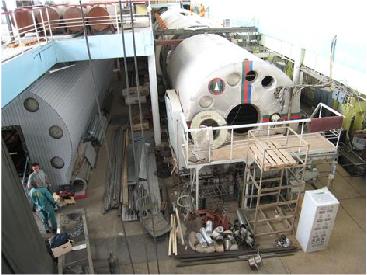
The cylindrical chambers at IMBP, used for 40 years
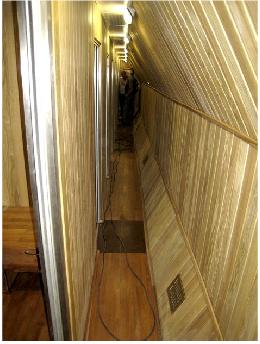
Habitation module hallway; side doorways lead to small cabins
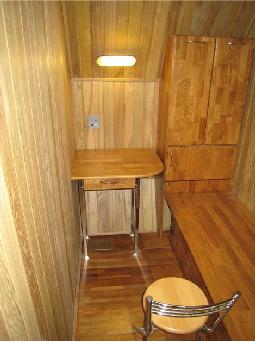
Closet-sized personal cabin
“Russia Prepares for Mars Mission with ‘Big Brother’ Experiment,” Spiegel Online, 14/9. Here is revealed that one of the participants is cosmonaut Sergei Ryazanskii!
Sergei Ryazanskii has already passed all the necessary medical and psychological tests. The athletic, blue-eyed, 32-year-old Russian is testing one of the wooden cots in the mock spacecraft’s sleeping module. His grandfather helped build one of the very first Soviet rockets and two years ago he managed to graduate from Russia’s cosmonaut training program. A romantic attraction to outer space simply runs in the family blood. “My wife was the only one who couldn’t understand that,” Sergei sighs. She divorced him.
From his training, Ryazanskii knows how extreme conditions can affect a person’s psychological well-being. “In total isolation with five people, you’re burdened by five times as many problems, and so are the others,” he says. It’s exactly that sort of group dynamic that the IBMP wants to examine.
Divorced! (They had one child.) That must have been recent. He is only 4 years younger than me. (He had a Livejournal, but seems to have deleted it. His website is still online. Hopefully he will keep an online journal for the experiment?)
October
4/10: Anniversaries
Today is 50 years since the launch of Sputnik.
In that BBC article it is noted that the Russian space program “have been given $12bn (£6bn) to spend over the next decade – a small amount compared with NASA’s budget but enough for the Russians to have ambitious plans.” NASA’s budget for one year is about $16 billion.
More articles from the past couple of weeks:
“Russia aims for new far east space launch pad by 2020,” The Raw Story, 21/9; RIAN 26/9.
From Novosti Kosmonavtiki news №655:
25/09/2007/00:01: The head of Roskosmos is convinced that it is necessary to more actively involve young cosmonauts from the Russian force
The leader of the Roskosmos Federal Space Agency, Anatolii Perminov, is convinced of the necessity of more actively involving young cosmonauts from the Russian force. About this he stated on Thursday during the traditional tea drinking with the prime and duplicating crews of the 16th Expedition to the ISS, reports ITAR- TASS.
After noting that the “Cosmonaut Training Center and Rocket & Space Corporation Energiya insure themselves by sending experienced cosmonauts into orbit,” Perminov added: “but I always support those who have yet to fly, since I have no doubts that the young will manage.”
In the Russian group about two dozen astronauts have sat “on the replacement bench” for 10 years or more. They are habitually refered to as “young,” but most of these guys are over 30 years old.
But this 16th expedition, which starts on 10 October, will be very difficult; therefore it is good that an experienced crew flies, Perminov believes.
The next paying space tourist to go up will be Richard Garriott, in October 2008. He has a rather formidable CV, and is the son of former NASA astronaut Owen Garriott. Though as pointed out by a NASA Watch reader, he will be the second 2nd-generation astronaut to launch – Sergei Volkov (son of Aleksandr) will launch in April 2008 – not the first as reported by Space Adventures. He is also the creator of a rather nice-looking MMORPG called Tabula Rasa (I have been admiring the graphics on the site and wishing I could design things like that).
“Game guru going into space,” Cosmic Log entry, 28/9.
“50 years after Sputnik, Russia revives space ambitions,” Space Daily, 30/9.
As Russia commemorates the 50th anniversary on Thursday of the launch of Sputnik 1 and the start of the Space Race, there is a sense of cautious optimism among its space scientists, says Igor Lysov, an expert with monthly magazine Space Industry News. Next year, state spending on space is projected to equal about 1.5 billion dollars (one billion euros). As Lysov observes: “That’s 11 times less than the financing for NASA but 10 times better than the financing for the Russian space programme a decade ago.” […]
Nonetheless, uncertainty remains due to funding problems and Russia’s difficulties countering a brain drain of its most talented scientists, says the head of spacecraft designer RKK Energia, Leonid Gorshkov. “Even if commercial projects help us survive, the development of the space programme is impossible without state support,” said Gorshkov.
“The discovered space,” RIA Novosti, 3/10.
2007 sees four space related anniversaries: 150 years since the birth of Konstantin Tsiolkovsky, the theoretician of cosmonautics, who translated the bold dream of space flight into maths; 110 years since the birth of Alexander Chizhevsky, the founder of geliobiology, a new field of research into the influence of solar and geomagnetic activity on living beings; 100 years since the birth of Sergei Korolyov, who put cosmonautics on a practical plane, and 50 years since the start of the space era, ushered in by the launch of the Earth’s first artificial satellite.
“Russian science to ride on NASA probes,” MSNBC.com, 3/10. Plans for Russian science instruments to be installed on NASA probes to the Moon and Mars. The Russian unmanned exploration program seems to only exist in this form now – hitching rides on others’ spacecraft.
Found an article, “What’s Wrong With Libertarianism,” while wandering around the Hard Science Fiction site. There seem to be many people in the space community who prescribe these views (the ones who optimistically believe the private space industry will take over from governments in exploring space). I find Libertarianism a detestable philosophy – my view is that corporations and business cannot be trusted to ensure the public good – that is why we have governments.
An example of the space Libertarians is the Space Liberates Us! site (found via NASA Watch, who posted about a contributor who died). There is a place for private space exploration (mainly near-Earth space tourism), but I don’t believe it will ever replace government-funded programs.
16/10: Soyuz TMA-11 launched, and a rant
Soyuz TMA-11 launched on 10 October at 13:22:39 UTC/11:22:39 p.m. Melbourne time with Expedition 16 and the Malaysian guest cosmonaut on board. It docked on 12/10 at 14:50:05 UTC.
Depressing thread at CollectSpace on why there are currently no women cosmonauts (aside from the one currently in training, who might never make it into space). Quite a lot of men in the Russian space program deserve a punch in the nose – their attitude towards women just sucks. The Americans have now had female Shuttle commanders, and Peggy Whitson will be the first female ISS commander, and there is no questioning their competence. So why do Russian men have this archaic attitude that women are weak and inferior (“Does Mars need women? Russians say no”)? This attitude pisses me off in the extreme and is one reason I am disillusioned with their program (the other being the focus on space tourism at the expense of exploration – though they don’t seem to have a problem with flying paying foreign female space tourists).
(On the Wikipedia “History of Women in the Military” page is a mention of military women in Russia. Women fought well in combat in World War 2. But I was disgusted to read: “Today, the Russian army runs the Miss Russian Army beauty contest for attractive female Russian soldiers. Colonel Gennady Dzyuba, of the Defense Ministry, said of the 2005 contest that ‘Those who have served, especially in hot spots, know the importance of women in the armed forces.’” Beauty contest?! WTF is with that bullsh*t?? No wonder women aren’t regarded seriously!)
“Space Station: Internal NASA Reports Explain Origins of June Computer Crisis,” James Oberg, IEEE Spectrum October 2007.
31/10: A year old
It is just over a year since my first entry (20/10/2006). The blog is not exactly hugely popular, either because I am too boring or no one is interested. Or both. Oh, well.
A news roundup:
China launched its first lunar orbiter, Chang’e 1, on 4 October. If China can do this, why can’t Russia?
“Russians blast off without space pistol,” Guardian, 15/10. “Russia is sending a cosmonaut into space without a fearsome triple-barrelled ‘space pistol’ for the first time in 20 years, due to a shortage of ammunition.” Yurii Malenchenko is instead taking a normal pistol/handgun.
“Giant leap looming for womankind,” MSNBC.com, 20/10. “It will be the first time in the 50-year history of spaceflight that two women are in charge of two spacecraft at the same time.” I grumbled about Russia’s dismal failing in this area in my 16/10/2007 entry.
Soyuz TMA-10 landed at 10:36 UTC on 21 October after undocking from Zvezda at 07:14. There was a glitch when the computers for some as-yet undetermined reason switched to the backup, automatically controlled ballistic descent mode, which imposes higher g-forces on the crew.
“Back in the Space Race: Russian Revival Raises New Questions,” Moscow News, 18/10. NASA’s dependence on Russia for manned space access after the Shuttle retires could become a problem if Russia’s plans change or U.S.-Russian relations become tense. Security at the Baikonur launch site is also an issue (as well as the future of the complex itself) – James Oberg wrote an article about it at The Space Review last year: “Earthly threats for a spaceport,” 26/6/2006.
“China eyes the Moon,” RIAN/Space Daily, 25/10.
On October 4, with Russia and the U.S. apparently unable to do more than talk about flights to the Moon, China, strictly on schedule, launched a Long March 3A rocket carrying the satellite Chang-e 1 on a mission to map the Moon’s surface.
“Two women spacecraft commanders: the meaning of the meeting,” James Oberg, The Space Review, 29/10. Mentions the issues on Russia’s attitude towards women in space grumbled about in my previous 16/10 entry.
November
12/11: Russian Mars plans
“The appeal of Mars,” RIA Novosti: Parts 1, 2, 3. A series by Yuri Zaitsev concerning Russian plans for Mars missions.
Ex-Energiya president Nikolai Sevastyanov believes the Martian project could be realized after 2025 and would consist of three stages: a trial expedition around the Moon, a non-landing manned expedition to Mars and then a manned Mars landing. Anatoly Perminov, head of the Russian Space Agency (Roskosmos), said: “We are planning a Mars mission after 2035.” The ultimate decision is likely to be made at the top. Before the year is out the government must approve a program for the development of the space industry until 2040. […]
Technically speaking, a manned mission to Mars would be no more difficult than a flight to the Moon. Experts believe that the hardware required for reaching the Red Planet is largely already available. But it is the human element that is both the most important, and the most vulnerable, part of the mission. Before sending astronauts to Mars, scientists will have to solve the numerous medical and biological problems associated with deep space flight. […]
U.S. experts estimate the cost of a manned mission to Mars at $500 billion. Russia believes it can place cosmonauts on the planet’s surface in the next 12 years for just $14 billion, a sum roughly equivalent to 10 national space programs. However, this would entail a doubling of federal space spending and the launch of several unmanned reconnaissance probes to explore Mars in greater detail. Nikolai Anfimov, a member of the Russian Academy of Sciences and Director General of the Central Research Institute of Machine Building (TsNIIMash), believes the total cost of the manned Mars mission would run to over $100 billion.
2025 or later is much too far away! How about … 2015? I reckon a simple mission could be done for … under $10 billion? A test mission around Mars (but not landing on it) could be done for maybe $3 billion or so:
- A crew of two (possibly suicidal!) cosmonauts who don’t mind the possibility of long-term damage to their health, or dying – the tradeoff is they would be forever remembered in history (first humans to leave the Earth-Moon system!).
- Mission profile based on the one at Energiya (12 months to Mars, 1 month around/on Mars, 11 months back).
- Spaceship based on the Russian ISS modules with a nuclear reactor (of the Topaz-2 type) that provides power for the engines (rather than the huge solar array in the Energiya plan). There would be no means of artificial gravity (designing this would incur extra expense).
- Progress launches to bring up supplies (don’t know how many would be needed).
- Soyuz spaceship used to fly crew up to the interplanetary spacecraft, and later back to Earth (need to have a 2-year lifespan).
- A small automated probe could be used to retrieve Mars surface samples.
- Developing a Mars lander would add extra time to the mission preparations.
- Upcoming Mars launch windows (low-energy type): December 2009, February 2012.
My bargain-basement Mars mission! So, build a spaceship and go! Enough with the fussing around – after 40 years or so of spaceflight we know the effects of weightlessness on mental and physical health, so how many more studies do they need? Accept that there will be risk to the crew, and just go. (Yes, I am impatient.)
More articles of interest:
“Protecting Earth Against Asteroids,” Part 1 & 2, Space Daily. Russian ideas for trying to deflect threatening asteroids.
“Does Russia Have A Nuclear Engine Advantage?,” Space Daily, 5/11.
18/11: 7th International Scientific Conference reports
The Russian FKA site has a page of children’s space paintings, which are colorful and imaginative!
Some Novosti Kosmonavtiki news №666 items for 16/11; reports from the 7th International Scientific Conference “Manned Flights into Space.”
16/11/2007/00:03 – ISS operations are considerably less effective than those on Mir, says the chief of the Cosmonaut Training Center
In six years of ISS operation the volume of scientific works at the station grew threefold, reports ITAR-TASS. Such data was announced on 15 November by the chief of the Cosmonaut Training Center, Vasilii Tsibliyev, at the opening of the 7th International Scientific Conference “Manned Flights into Space.”
“Since 2001, 240 different experiments were carried out on the ISS, the main themes of the NPI applied-scientific studies being biomedical, biotechnological, geophysical and physics of the sun,” he said.
Tsibliev, however, recognized that by volume the NPI ISS operation is considerably less effective than that of the Mir orbital complex, where each crew perfomred up to 250 experiments during the flight. In his opinion, “When the construction of the Station is finished, the science portion will grow.”
The TSPK chief focused attention on the problems which decrease effectiveness of NPI on the ISS. One of the basic problems: “searching for the necessary scientific gear aboard,” because of which “sometimes an experiment is not carried out by the crew for which it was prepared, but a following crew […] There has even appeared a joke: an engineer is not one who knows, but who knows where to find things,” noted Tsibliyev. In his opinion, for increasing the return of scientific work “it is necessary to develop more efficient mechanisms for crew accountability, more actively to use incentive leverages, including material from both the cosmonauts and the specialists who prepare experiments, and to also prepare cosmonauts as specialist researchers.”
The chief of the flight-test center of the Energiya Rocket & Space corporation, ISS-14 commander Pavel Vinogradov, in turn emphasized that the colossal scientific potential in space is used very poorly, the returns from ISS crew activity is considerably lower than 10-15 years ago. “From the idea of experiment to obtaining the first concrete results there passes years, and even decades,” the cosmonaut complained. Furthermore, “There are only 1 or 2 new, bright experiments on the ISS; the rest are repeats of those performed on Mir.
One of the basic problems, in his opinion, is the absence on the ISS Russian segment of a normal communication channel with the Earth. “That that we have is the Stone Age in comparison,” said Vinogradov. To work and not to have any possibility transfering acceptable volumes of information is unacceptable.” Furthermore, the cosmonaut issued a call for the producers of the experiments to support closer contacts with the crews and to inform them about the results of the onboard studies carried out by the crews. In the opinion of Vinogradov, if scientists and cosmonauts exchanged information more often, the effectiveness of scientific studies would improve.
The cosmonaut also noted that at present, “scientific gear occupies only a small percentage of general goods traffic […] when half of the Progress cargo ship will be loaded with science, we will begin to obtain real results,” Vinogradov is convinced.
16/11/2007/00:03 – since 2001 the quantity of experiments conducted on the ISS has grown three times
In six years of ISS operation, the quantity of scientific experiments conducted by crews has grown threefold. The crew of the 16th ISS Expedition will conduct 48 scientific experiments in the course of their flight, while the first crew conducted only 15, reported the leader of the Cosmonaut Training Center, Vasilii Tsebliev, at the opening of the 7th International Scientific Conference “Manned Flights into Space.”
Meanwhile cosmonaut Pavel Vinogradov, coming forward after he critically answered about the experiments conducted on the Station, said: “We repeat the fact that most were done 5-10 years ago. The experiments – two or three are new but not more […] in this sense I do not agree with the opinion of our leaders that everything is good. When half of the Progress cargo ship is loaded scientific gear, then only then will I agree that everything is good,” said P. Vinogradov.
Today, he noted, in the total volume of cargo delivered to the ISS, only a small percentage is allotted to scientific equipment. Furthermore, P. Vinogradov came out with criticism of the communications system of the ISS Russian segment with the ground. Thus, because of the absence of the specialized relay satellites, video images and data for Russian Mission Control Center TsUP during the presence of the ISS beyond the zones of radio visibility not controlled by Russia are downlinked via the American satellites (TDRSS).
Cosmonaut Pavel Vinogradov had a lot of criticisms about aspects of the Russian program in an NK interview last year (see my 14/1/2007 entry) – at least someone involved is trying to draw attention to this!
A report on preparations for the “Mars-500” experiment:
16/11/2007/00:03 – crew of volunteers begins checking the systems of the “Martian ship”
At the Institute of Biomedical Problems IMBP/RAN (Russian Academy of Science), on 15 November there began the first 14-day stage of the experiment on the preparation of the manned space flight to Mars. The IMBP deputy director, Boris Morukov, announced this at the 7th International Scientific Conference “Manned Flights into Space.”
Previously the IMBP director, the RAN Academician Anatolii Grigor’ev stated that prior to the beginning of the “manned space flight to Mars,” which was planned for the end of 2008, at IMBP two preliminary experiments will be carried out: a 14-day and a 105-day. “During the 14 days we will verify technical equipment, and then in the 105-day experiment we will conduct the selection of the Russian and European scientific proposals, which then will be realized in the ‘Mars-500’ program,” he explained. According to him, the international crew of the 105-daily experiment will be formed prior to the end of this year, which will begin in the beginning of 2008.
In parallel continues the intensive selection of basic crew for the “Martian flight,” that will comprise 4 Russians and 2 Europeans. The main requirement for the candidates are possession of Russian and English languages, outstanding physical fitness and professional qualifications in several specialties is desirable.
Grigor’ev noted that among the aspirants, whom they already passed dispensary inspection, there is one woman. However, the gender composition of crew will be determined not earlier than the end of 2008, when it is planned to promulgate the list of the happy fellows, who during 520 days will completely isolated from the external world aboard the created “Martian” ship in IMBP with a volume of 550 m3 and communicate with the external world only through electronic mail. All the life-support systems of the “ship” are designed to be completely independent.
Requirements for the international crew are most serious. Preferred professions are doctors, engineers, biologists, specialists in computer technology. Moreover it is desirable that the candidates would combine several specialties. Furthermore, they must provide proof to the selection commission of the absence of serious diseases, harmful habits and problems with the law.
Future projects at Khrunichev:
16/11/2007/00:03 – the Khrunichev space center is developing rockets for manned space flights and habitable complexes for the lunar and Martian expeditions
In the State Space Scientific Production Center GKNPTS Khrunichev, work is continuing on the creation of rockets for manned space flights and habitable complexes for lunar expeditions. The division head of KB Salyut GKNPTS, Sergei Pugachenko, reported this on 14 November at the 7th International Scientific Conference “Manned Flights into Space.”
The discussion, first of all, deals with the modification of the future rocket of the RN carrier of the Angar-5 heavy class. The Angar-5P “can be used for the launch of manned ships, including the following generation.” For the delivery of cargo to Low Earth Orbit it is intended to also use the superheavy Angar-7 with a load capacity of 41 tonnes.
But to deliver a crew in orbit is only half the battle; it is necessary to create standard conditions to support human life. In GKNPTS, where the first ISS module was built – the Functional Cargo Block Zarya, and also the airtight housing of the official module Zvezda – already they are working on a new, more contemporary inhabited module. “Over the long term the creation and installing on the RN Angara “of a housing of a larger volume, which will improve the conditions of crew stay aboard,” explained Pugachenko.
Furthermore, the specialists at GKNPTS are developing their versions of a lunar orbital station and manned lunar base, which is intended to be delivered into Earth orbit with the aid of a superheavy RN with a load capacity of 100 tonnes. The lunar orbital station will be intended for the transfer and the storage of cargo and fuel, temporary crew stay, and also studies of the Moon, explained Pugachenko. But the manned lunar complex will serve as a home for the cosmonaut-trailblazers. An analogous complex is also being developed for Mars. “In GKNPTS there are all the basic technologies for the lunar missions,” said Pugachenko.
December
4/12: Redesigning space sites
NASA’s website launched a newer, more modern design on 30 November - it looks much nicer and the clunky HTML table layout has been dumped at last! (The site does, however, require Javascript to display properly, and takes nearly a minute to load on broadband because of the huge amount of JS files loaded.)
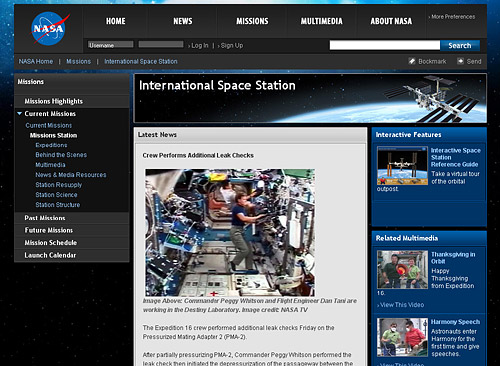
NASA website screencapture
Now if only the Russian space websites would redesign and upgrade! Some quick observations:
- Energiya: site appearance is neat and somewhat conservative, but the HTML layout consists of old-fashioned tables and is a bit messy.
- Federal Space Agency: tables layout and navigation requires Javascript to function, so it is not very accessible.
- TsUP: design looks outdated (color scheme is not very attractive) and the site menu is Javascript-based, so without this enabled the site can’t be accessed
- IMBP: ugh! Uses frames and an image map. Very outdated and totally inaccessible.
News tidbits:
Mark Wade has abandoned his Pausanius blog. He sounds as disillusioned as I do, though for different reasons.
“AstroMom and Basstronaut, revisited,” The Space Review, 19/11. What happened to the space-tourists-who-weren’t, Lori Garver and Lance Bass. To me it was another example of how dismally avaricious the Russian space program has become – the word that come to mind is “prostitution.”
“Russia To Launch Manned Spacecraft From New Site In 2018,” Space Daily, 22/11. The new site is to be called Восточный, Vostochnyi (“Eastern”), so you can guess in what direction it is located. Baikonur will continue to be used until at least 2020.
Ivanov confirmed that Russia would continue to use the Baikonur launch site until at least 2020, and would also build new facilities at the Kazakh center under the joint Baiterek project to support launches of the future Angara family of launch vehicles.
At the same time, the first deputy premier called for urgent measures to develop the country as a leading space power rather than to turn it into a provider of launch services for other countries. “I would like to stress that Russia should not turn into a country providing only launching services – a kind of space hauler, although this alarming trend has been taking shape lately,” Ivanov said. “This trend may become a reality, unless proper measures are taken urgently to develop all aspects of space activities,” he said.
On 15 November, Space Adventures offered anyone who could come up with the $3 million fee a chance to train as space tourist Richard Garriott’s backup. The contender was announced in the 26/11 Herald-Sun: a 38-year-old Australian businessman, Nik Halik. (Note that the article might disappear.) I have not seen this mentioned anywhere else yet.
“Russia Conducts First Experiment In Preparation For Mars-500,” RIA Novosti/Space Daily, 30/11. A short test of the modules was conducted by a Russian crew (5 men, 1 woman) from 15-29 November. There is disappointingly little information on the Mars-500 site, though.
Novosti Kosmonavtiki news №669 has a more detailed report on the recent completion of the first Mars-500 short test run, including short biographies of the participants, who all have intimidatingly impressive qualifications. (Yes, I am envious of them.)
30/11/2007/00:03 – Flight to Mars from the Khoroshevskogo highway of the capital city
Within the framework of the “Mars-500” project – an international crew flight simulation to the Red Planet – the Institute of Medical and Biological Problems of the Russian Academy of Science held a two-week experiment involving six testers.
The purpose of the two week experiment, which was conducted in IMPB RAN with the active assistance of the Federal Space Agency, was checking the conformity of the technical and operating characteristics of the modules and their systems to the requirements of the developed technical and operational documentation under the conditions maximally approximating real operation. The experiment was conducted in two modules of the medical-technical complex: EU-150/ЭУ-150 (habitable module with a volume of 150 m3) and EU-100/ЭУ-100 (medical module with a volume of 100 m3). In the course of the experiment, the crew lived and worked in these completely isolated modules. During the experiment was tested newly-developed life-support systems, monitoring and control, information management and the local tele-medical network.
The experiment began on 15 November at 11:00 and was completed on 29 November at 14:00.
The crew successfully managed the tasks entrusted to it. During 14 days there was performed the estimation of modules and their systems in terms of their suitability to conducting of the more prolonged experiments, which are part of the Mars-500 program.
The deputy chief of the Federal Space Agency, V.A. Davydov, and the chief for the administration of the manned programs Roskosmos, A.B. Krasnov, became acquainted with the progress of the experiment and the work of the support systems during a visit to IMBP on 22 November.
The experiment was attended by major developers: ФГУП ЦЭНКИ/FGUP TsENKI, ЗАО МИУС/EAO MIUS, ОАО ВНИСИ/OAO VNISI, ОАО НИИХИММАШ/OAO NIIKhIMMASH, ФГУП ЦНИИМАШ ЦУП-МФ/FGUP TsNIIMASH TsUP-MF, ЗАО ЦВТ/EAO TsVT. During the experiment some elements of the crew uniforms were tried, designed and provided by ЗАО НПО «Динафорс»/EAO NPO “Dinafors” working within the framework of the partnership program for the project “Mars-500.”
The crew consisted of five men and one woman:
- Artamonov, Anton Anatol’evich/Артамонов Антон Анатольевич (1982). Engineer physicist, and IMBP engineer-programmer. After graduating from the physical chemistry department of Moscow Institute of Steel and Alloys, he specialized in the department of theoretical physics in the region of the superconductivity of nanomaterial. His research interests are the properties and the functioning of muscular apparatus, and the application of laws governing physics of materials in biomechanics. At present he works on his thesis.
- Artem’ev, Oleg Germanovich/Артемьев Олег Германович (1970). Mechanical engineer, he graduated as RKK Energiya engineer and finished at N.E. Bauman MGTU. His specialization is technology and low-temperature physics. After the successful completion of general space training, he obtained qualified as a cosmonaut-researcher and was enrolled as a cosmonaut-tester in the RKK Energiya group, specializing in extravehicular activity. Has a number of publications in this region.
- Kovalev, Aleksandr Sergeevich/Ковалев Александр Сергеевич (1982). Engineer, works in the telemedicine laboratory at IMBP. He graduated from the MAI in the specialty “Engineering in the biomedical practice.” He participated in the experiments on the study of the influence of the simulated effects of microgravity on the human organism. His scientific interests are the influence of the extreme conditions of living environment on the cardiorespiratory system of the body.
- Perfilov, Dmitrii Vladimirovich/Перфилов Дмитрий Владимирович (1975). Doctor, works in the IMBP telemedicine laboratory. Graduated from Moscow Medico-stomatological University, specializing in therapeutic matter. Upon completion of his clinical internship, he qualified as a therapeutist and has additional qualification as a anesthesiologist-resuscitator. Scientific interests: pain sensitivity by changing the factors of space flight, which assumes the possible correction of the existing scheme of the treatment of cosmonauts.
- Ryazanskii, Sergei Nikolaevich/Рязанский Сергей Николаевич (born 1974), expedition commander. Graduated from the Faculty of Biology of Moscow State University named after M.V. Lomonosov in the specialty of biochemistry. In 2005, after completing training he received general space training and cosmonaut-researcher qualifications. He is a member of the Bioethical Commission SRC RF IMBP-RAS. According to the results of studies performed, he has published 19 works, and made 12 reports, eight of them in international conferences. In 2006, he defended his candidate’s thesis on the specialty “physiology” and “aviation and space medicine.”
- Tugusheva, Marina Petrovna/Тугушева Марина Петровна (1983). Biologist, Researcher IMBP. She graduated with honors from the biological department of the Tverskii State University in the department “Anatomies and physiologies of man and animals.” After completion of university she was invited to undertake full-time post-graduate study at GNTS RF of the RAN Institute of Biomedical Problems in the specialty “Aviation, space and sea medicine.” She is at present a graduate student in her 3rd year of learning and a scientific worker in the division of Barophysiology and Diving Medicine. She participated in the conferences of young scientists in the years 2006-2007, in the 8th International Congress for Adaptive Medicine in 2006, and also in 2007 in the I.P. Pavlov Congress of the Physiologists and the “Cosmos and Medicine” conference . She has repeatedly participated in experiments.
(A blog gripe: I hate having to think up a title for each blog entry; I find it hard to come up with anything, sometimes!)
23/12: Russia-bashing
NASAWatch notes the excessive “Russia-bashing” contained in this Bill being put forward by a Congressman Weldon to prolong the operations of the Space Shuttle to 2015 (rather than the current end date of 2010). “RUSSIA IS NOT A RELIABLE PARTNER,” etc … (There is a long discussion thread at NASASpaceflight.com.) What a Paranoid Patriot Weldon is (a Republican, not surprisingly)! The thought of someone like him becoming U.S. President is dismaying!
Progress M-61 undocked from the ISS yesterday (22/12) at 3:57 UTC. It will remain in autonomous orbit for about a month, performing a series of technical experiments. Progress M-62 launched today at 7:12:35 from Baikonur.
12 December: Cosmonaut candidates visit the Khrunichev Center
Today, for the purpose of acquaintance with the activities of one of the most important enterprises of the rocket-space industry, the cosmonaut candidates and the instructors of the Yu. A. Gagarin Cosmonaut Training Center visited GKNPTs Khrunichev.
The state space scientific and industrial center named after M.V. Khrunichev was selected on purpose. The old enterprise has almost a half-century length of employment in the field of creation and operation of rocket-space technology.
The Center has a special role in the implementation of the manned programs of the USSR and Russia. Here was created the “Salyut” orbital manned stations and the TKS transport supply ships, the large-dimension modules for the Mir orbital complex, and the FGB Zarya and SM Zvezda modules for the International Space Station. At present, according to the ISS program, work is conducted here on the creation of the third module, the Multifunctional Laboratory Module.
The manager of the rocket-space plant, Victor Latyshev, described all this to his guests. The instructors of TSPK – V. Kolyasnikov, A. Radchenya and A. Larin – and also the cosmonaut candidates O. Novitskii, A. Ovchinin, S. Ryzhikov, A. Misurkin, M. Ponomarev, E. Serova and N. Tikhonov visited the assembly shops of the space center, and with their eyes they saw the process of assembling the “Proton-M” heavy carrier rocket, and boarded the full-scale copy of the legendary complex Mir.
Taking into account that the encounter in GKNPTs Khrunichev passed on the threshold of the New Year, the center management presented memorable gifts to the cosmonaut candidates.
«Кандидаты в космонавты посетили Центр имени Хруничева», Khrunichev.