RuSpace: 2008
January
7/1: Mars-500 updates
“Mars-500 Simulated Space Mission,” 24/12: image gallery at RIA Novosti. The latest issue of Novosti Kosmonavtiki magazine, №1 2008, has an article about the recent Mars-500 experiment on its site: «В ИМБП стартовал проект «Марс-500»», “IMBP began the Mars-500 project,” including an interview with cosmonaut Sergei Ryazanskii (use Babelfish for a rough translation – the article is very long and I do not have the energy to struggle to correct the translator’s convoluted attempts!).
Sergei Krikalyov seems to have been dropped from the Soyuz TMA-14/ISS-19 crew as commander; he is no longer in the latest ISS flight crew roster up to ISS-21, though the roster is not yet finalized. (Via Olaf and this thread at the Novosti Kosmonavtiki forum, posted in August.) So perhaps he was moved to a later mission? Or will he be in management for a few years, though he is still an active cosmonaut?
| Expedition | Prime crew | Backup crew |
|---|---|---|
| ISS-17 | Sergei Volkov, Oleg Kononenko | Maksim Sura’ev, Oleg Skripochka |
| ISS-18 | Salizhan Sharipov | Yurii Lonchakov |
| ISS-18S (6-person crew begins) | Gennadii Padalka | Maksim Sura’ev |
| ISS-19S | Yurii Lonchakov | Dimitri Kondrat’ev |
| ISS-20S | Mikhail Kornienko, Roman Romanenko | Aleksandr Skvortsov, Oleg Skripochka |
| ISS-21S | Maksim Sura’ev | Fyodor Yurchikhin |
Anatoly Zak has a new article on his website: “Russian space program: a decade review (2000-2010),” 3/1. After the near-catastrophic social turmoil in the 1990s, Russia’s space program is slowly being reinvigorated, but it is dangerously dependent upon continued high oil prices for most of its funding.
17/1: Mars over Moscow
In this nicely symbolic photo by Seiji Yoshimoto at the NPO Intercos site, the red planet Mars is visible over the red star of the Kremlin! (Full photo page of Moscow scenes here – there are a lot of high-resolution photos on the one page.) Let’s hope that is a good omen! (As in landing there one day.)
From Novosti Kosmonavtiki news №677:
10/01/2008/00:02 – The cost of the Mars flight simulation experiment will exceed 15 million dollars
The total cost of the Russian project on the “Mars-500” flight simulation to the Red Planet, which will take place at the site of the Institute of Biomedical Problems (IMBP, Moscow), will exceed 15 million dollars, reported the project leader, the first deputy director of IMBP Victor Baranov. “If some additional expenditures appear, then general expenditures will be increased,” he added.
Among the first unplanned expenditures V. Baranov named was the elimination of some deficiencies and observations, that were revealed in the activities of the experimental complex during the daily technical experiment carried out during November. He also reported that the material reward of volunteers for the participation in the “Mars-500” experiment will compose 50 thousand Euros. This number was announced by the European space agency, which participates in the experiment. “We have an understanding with ESA that the payment for the Russian and European participants must not differ,” said V. Baranov.
He also did not exclude that the basic material reward of the highly professional participants will be above average. According to V. Baranov, there was also discussed the question of encouragement by rewarding those participants who carry out the experiment more honestly. “But this question will be linked with the personal contracts with each of the testers,” the Russian scientist specified.
The Mars flight simulation experiment will be prolonged more than 520 days – precisely this many days will be required in order to fly so far to the planet, to spend 30 days on its surface and then to return. All this time the six testers will be located in the isolated modules, fulfilling the functional duties of participants in the Martian expedition. Two participants in the experiment will be selected from ESA, which signed with the Institute of Biomedical Problems (IMBP) of RAN (Russian Academy of Science) an agreement on participating in the project. Four more will be selected by the IMBP specialists.
“Russia set to develop new launch vehicle despite problems,” RIAN, 11/1. The Angara rocket is supposed to launch from the «Восточный», Eastern space center, but the rocket has yet to be developed.
25/1: 30 years of Progress
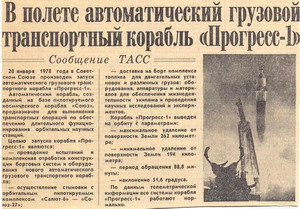
Energiya press release: 20 January 2008 marked 30 years since the launch of the first Progress cargo ship. The Progress ships have served the Russian space program reliably (and mostly been ignored in the media). ESA’s Automated Transfer Vehicle cargo ship uses Russian propellant and tanks in its design, and the first launch is currently set for 22 February. It will dock to the aft of the Zvezda Service Module.
From Novosti Kosmonavtiki news №679:
20/01/2008/08:35 – Russian scientists will conduct a series of experiments to investigate the Moon, including the use of Japanese instruments
The project “Luna-Glob” (Luna-Globe) is planned to solve complex research tasks for the Study of Earth satellite, said Lev Zelenyi, the director of the Institute for Space Research at the Russian Academy of Sciences. The project “was broadened. It includes several phases, including the dumping on the surface of the Moon of so-called penetrators to study our satellite,” said Lev Zelenyi.
He explained that penetratory (impact penetrating probes) are planned to be fired from the automatic spacecraft, which will be placed in the Moon’s orbit. The probes under the action of lunar gravity will drive away also at a high speed and enter into the soil of the Moon at the depth of several meters. The on-board sensors, which operate from autonomous power supplies, can transmit information about the composition and the properties of lunar soil, and the seismic characteristics of Earth’s natural satellite. “It was decided to use penetrators of Japanese production, since the Russian technologies in this region can be considered lost,” reported L. Zelenyi.
Besides the use of impact probes, the “Luna -Glob” project provides for the launch of lunar orbital apparatuses, and over the long term and the creation of a rover landing station, which will travel across the lunar surface.
The equipment installed on the orbital devices, in the words of L. Zelenyi, in particular, will have to investigate the exosphere of the Moon, the space around it, and also magnetic and gravity anomalies whose nature is not yet clear.
Furthermore, on the orbital lunar apparatus will be established the instrument “LORD,” designed to study ultra-high-energy cosmic rays. The device would capture elementary particles with enormous speed and energy. Under normal circumstances, such a particle can not be caught by any devices, since they can easily pass through layers of any substance. The “LORD” instrument will recover those particles of superhigh energies, which “after piercing” the Moon, will be slowed down, said L. Zelenyi.
“The China gambit,” The Space Review, 21/1. Article by Dwayne Day on how the USA could involve China in its space program (mainly the ISS) and use such involvement as leverage against Russia should the latter country become hostile and deny astronauts access to space via Soyuz flights once the Shuttle program is shut down. A pragmatic plan I guess, though it comes across as somewhat patronizing; of the dominant country “managing” others. Equally, Russia and China could team up to “manage” the USA! So it’s a 3-way game.
Manber’s proposal is clever and thought-provoking. He has not simply proposed cooperation with China for its own sake, or even for the benefit of improving relations with China, but to use such cooperation as a lever against the Russians. This is not the first time that someone has proposed that encouraging China in space could have strategic benefits for the United States – four years ago I wrote about the benefits of a cooperative/competitive space race with China (see “The benefits of a new space race,” The Space Review, April 26, 2004), suggesting that we encourage them to spend money on human spacecraft instead of missiles. But Manber is apparently the first to suggest that we use China to moderate the Russians, something that Nixon gained as a side benefit of his China rapprochement nearly four decades ago.
“Russia To Raise Space Funding, Build New Space Center,” 22/1, RIAN /Space Daily . Space funding is to be raised by 13% (doesn’t say the actual amount).
“Russian space center to launch boosters,” Space Daily, 23/1. The new Vostochnii space center will be built near Uglegorsk in the Amur region of eastern Russia. Manned flights are expected to begin by 2018.
“Ivanov Says Russia Must Not Turn Into Space Cabman,” Space Daily, 24/1. Russia shouldn’t rely on revenue from launches of foreign satellites for most of its space funding, and should focus on creating the new space center, Vostochnii, to ensure the country’s access to space (rather than risk being blackmailed by Kazakhstan, which leases out Baikonur to Russia).
30/1: Soyuz TMA-10 ballistic landing cause determined
Via José (and also reported at MSNBC.com):
The reason for the rough landing of Soyuz TMA-10 has been determined
29/1/2008, Lenta.ru
The reason for the ballistic descent of the descent vehicle Soyuz TMA-10 with the ISS crew members onboard during 21 October 2007, was caused by damage to a cable in the spacecraft’s control panel, said RKK Energiya leader Vitalii Lopota.
“The Commission of Inquiry for the reasons for the contingency situation finished its work and established that the reason for ballistic descent was the cable fault, which connected the control panel with the Soyuz descent equipment,” said Lopota. According to him, RKK Energiya will take all measures to avoid a repetition of this situation.
On 21 October 2007 the descending ship capsule Soyuz TMA-10, on which was being returned the members of the 15th ISS Expedition – Russians Fyodor Yurchikhin and Oleg Kotov (more half a year in orbit) and the first cosmonaut of Malaysia, Sheik Muzafar Shukor (11 days in orbit) – passed from the controlled regime to ballistic. The capsule landed 70 kilometers from the planned landing place and the cosmonauts endured overloads up to nine gravities/units.
According to the chief ballistician of Mission Control Center (TSUP), Nikolai Ivanov, the overload was short-term and did not threaten the health and life of the cosmonauts. “The ballistic descent – into the regime of which the day before, the descent vehicle with the cosmonauts of the 15th Expedition and the first cosmonaut of Malaysia, the control system transferred in the section of descent into the Earth’s atmosphere – is not a nonstandard regime, and the overload to nine units, tested by the crew and which was being continued of approximately ten seconds, did not threaten their life and health,” said Ivanov. “There was a failure, but the Soyuz control system not only did not refuse, but, that – of principal importance – successfully transferred the descent vehicle into the more reliable regime of descent into the Earth’s atmosphere. If this happened, God forbid, with the American shuttle, in which a regime of ballistic descent is not provided, then it would be necessary to go with a funeral procession to meet the astronauts inside it.”
The difference between the ballistic and controlled descent is that the controlled automation constantly orients the descent vehicle by its flat lower part to the Earth, which ensures lift due to the incidental airflow, and it ensures minimum overloads for the crew up to four gravities/units, Ivanov explained. “The descent along the ballistic trajectory without the participation of lift is comparable with a falling stone, but if we permitted it to fall like a stone, then the overload would reach a limit incompatible with human life. Therefore we constantly rotated the descent vehicle around its axis, it achieved approximately one revolution after half a minute, what contributed (to transfer) the life-threatening ‘foot-head’ overload into the more acceptable ‘chest-spin’ overload due to the centrifugal force,” said the ballistics chief.
According to the 15th Expedition commander Fyodor Yurchikhin, “The rotation of the descent vehicle was sharp, rigid, with strong vestibular irritation, which I could feel from the left seat of the capsule in which I sat. The overload increased gradually, up to a tolerable 8.56 g’s. After overload at seven g’s we ceased to report to Earth about our health in order to concentrate on maintaining our respiration. But the crew members did not experience loss of sight and consciousness, and we understood that we just had to endure the ordeal.”
“Russia may build new shuttle spacecraft by 2015,” RIA Novosti, 29/1. Energiya’s spacecraft proposal (it has 6 projects, 2 of which it will submit to the Russian Space Agency in the near future) would likely have a lifting-body design and carry a crew of 6. More via Novosti Kosmonavtiki news №682: Sergei Krikalyov, Energiya’s deputy design project leader, is convinced that several different spacecraft designs will be required to realize Russia’s space projects. “It is not possible to create a ship which would equally be suitable for flights the Moon, Mars, and for the flights to near-Earth orbit. Therefore I do not exclude that not one manned ship will be built, but several,” emphasized the cosmonaut. He said the new ship will be constructed at the new spaceport.
Energiya chief Valerii Lopota said at the 31st Academic Readings in Cosmonautics conference that the Soyuz and Progress ships would be transferred over to digital technologies in the 2008-2009 period which would increase their reliability.
March
8/3: A busy launch week
The European Space Agency’s unmanned ATV cargo spacecraft, Jules Verne, is due to launch tomorrow! At 04:03 UTC (3:03 p.m. in Melbourne). It will be the first new spacecraft (for the human space program) to enter orbit since China’s Shenzhou launch in 2003. The Space Shuttle, STS-123 Endeavour, is also to launch on 11 March at 6:28 UTC; the main components to be installed are the Japanese Experiment Module (Kibo), and the Canadian Special Purpose Dexterous Manipulator (SPDM) Dextre robotics system. A busy week in orbit, assuming both launch on time! (Russia is getting overshadowed a bit; it has not launched a module since Pirs in 2001 – though the ATV has some Russian components and will dock to the end of Zvezda – “Our Russian colleagues look at the ATV as though it were also their own vehicle.”)
“NASA wary of relying on Russia,” MSNBC, 7/3. With the imminent retirement of the Space Shuttle, Russian Soyuz spaceships will be the only way for NASA to get its astronauts into space until the Orion spaceship is developed.
I spent most of the afternoon doing 2 pages for my “RuSpace” site about Russian space toilets! (For the ISS and Soyuz.)
I didn’t make any posts last month (February); there wasn’t much that interested me!
The new Russian President was elected on 2 March: Dmitrii Medvedev (Дмитрий Анатольевич Медведев) – to no-one’s surprise! I wonder if he will take any interest in his country’s space program. (Vladimir Putin looks set to become Prime Minister.)
Some previous collected news tidbits:
“Russia has the corner on guns in space,” James Oberg, MSNBC, 12/2. An overview of the gun carried on board the Soyuz spaceship that the relevant authorities don’t want to acknowledge!
Perhaps a year or so ago, nobody would have raised an eyebrow over “trained spacefarers” being able to grab a gun at will, for whatever reason they felt like. But in the wake of the past year’s tragic violence involving professional astronauts and space center veterans, and in light of stories now surfacing over psychological crises on past missions (including one threatened suicide that the mission commander took very seriously), the open access to such lethal hardware needs reappraisal.
At the very least, the survival kit needs to be locked, with the key (or combination) in the possession of the capsule commander. The very presence of the gun probably also needs to be reviewed again, to determine if it is a critical piece of safety gear or a space disaster just waiting to go off.
I can just imagine the headline: “Psychotic astronaut slaughters crewmates on Space Station!”
“An interview with Richard Garriott,” The Space Review, 18/2. He is also updating his journal more regularly. He seems to be missing the greater variety of foods back home!
The United Nations flag is to be taken onboard the next Soyuz flight in April with Korean guest cosmonaut Ko San.
A tidbit of information about Sergei Krikalyov from his page at Space Encyclopedia ASTROnote is that “in December 2007 he was a candidate for the Deputies of the State Duma 5th convocation on the list of the All Russia political party ‘United Russia’, the regional group №81 (St. Petersburg). Despite the fact that the party overcame the 5% barrier, being the 16th in the list of regional groups in the allocation of seats, in the number of deputies has not shown up.” Is he getting involved in politics?
From Novosti Kosmonavtiki news №687:
In Star City (Звездном городке, Zvezdni Gorodok) an exhibition was opened of the photographic works of airman-cosmonaut, Hero of the Soviet Union and Hero of Russia Sergei Krikalyov with the symbolic name “Paintings of the Creator.” Our planet Earth is presented in an unusual perspective – from space. All photographs were taken from onboard the International Space Station.
11/3: Disqualified
In a somewhat surprising announcement, the South Korean astronaut Ko San was dropped from the upcoming Soyuz TMA-12 mission because he apparently removed some training manuals from Star City without authorization. The manuals are Soyuz flight manuals – not exactly state secret material – so they seem to have been making more of a statement about his doing things he wasn’t supposed to do:
“The Russian space agency has stressed that a minor mistake and disobedience can cause serious consequences,” Lee told reporters. Lee said he believed the materials in question were not classified.
It seems a bit harsh, though. His backup is a woman, Yi So-yeon, so she will get to go up instead. (James Oberg comments at FP Space.)
There were several comments at FP Space regarding the article “NASA wary of relying on Russia,” starting with Kirill Simon and replies following.
As reported at the Buran-Energiya site, the experimental space shuttle Buran OK-GLI will be shipped to the Sinsheim Auto & Technik Museum in Germany from Bahrain where it has been languishing for over 4 years during a dispute over its ownership. The model was exhibited in Sydney in 2000 but the organization that owned it then went bankrupt. It will at last be properly looked-after, though it’s a pity it could not be returned to Russia and exhibited.(CollectSPACE thread: Buran found, sold to German museum .)
The ATV Jules Verne ran into a technical problem after its successful launch: one of the four “electronics chains” controlling its propulsion system detected an anamoly and shut down. It is only a glitch so far; it’s unclear if the fault is with the electronics or the propulsion system.
April
5/4: ATV docked
The ATV successfully docked to the ISS on 4/4. The NASA Human Spaceflight Gallery has some nice photos from its earlier test run for the docking on 31/3.
“Response to a reporter of a Russian periodical: Upper stages Block DM built by S.P.Korolev RSC Energia are of highest reliability” on the Energiya site; apparently even some Russian reporters can’t get the facts accurate on their own country’s space program! The name of the publication isn’t given.
Sergei Krikalyov sightings in photos (he is looking ever-greyer :-( – he’ll be 50 this year!):
- 4/3: Novosti-Kosmonavtiki photo gallery: «Торжественное собрание в посольстве Чехии по случаю 30-летия первого пилотируемого полёта по программе «Интеркосмос»» (ceremonial meeting at the embassy of the Czech Republic on the occasion of the 30th anniversary of the first manned flight program Intercosmos). Sergei appears in photos: 7, 28, 67, 69 .
- 18/3: Energiya photo-report: “S.P. Korolev RSC Energia, Korolev, Moscow region. The Chief Designers Board meeting At OAO S.P. Korolev Rocket and Space Corporation Energia, the Chief Designers Board meeting chaired by V.A. Lopota, the Corporation President, General Designer, took place. Among the issues under review were the following: current state of the International Space Station Russian Segment and going on with its mission Program implementation, progress in prelaunch processing of Soyuz TMA-12 transport manned space vehicle and final works phase, which Expedition 16 crew will perform.” Sergei appears in photo 13 .
The io9 blog mentioned a computer game based on a trilogy of novels by Russian author Alexander Zorich (actually two authors writing under the pseudonym); they write science fiction and fantasy novels, only available in Russia though (and not translated into English). The game is an alternative history where Russia has expanded into outer space and has contact (and conflict) with 4 alien races. I don’t know if I would like the novels or not if I were able to read them, but I would be curious to see how they would compare with the usual (and predictable) U.S./British sci-fi that dominates the novels available in Australia. (The sci-fi I like is of the “aliens and spaceships” sort.)
9/4: Soyuz TMA-12 into orbit
Soyuz TMA-12 launched yesterday at 11:16:39 UTC with Expedition 17 and Visiting Crew-14 (South Korean astronaut Yi So-yeon). Somewhat surprisingly there are Koreans living in Baikonur and Kazakhstan (courtesy of Joseph Stalin).
Yi So-yeon (I think Yi is her surname, if last names are presented first in Chinese fashion) has the usual intimidating array of qualifications (a biosystems engineer) and is a tae-kwon-do expert. She seems very enthusiastic.
Sergei Volkov is the son of a cosmonaut, Aleksandr Volkov, and is the first second-generation cosmonaut to go into space.
“Three Rocketeers For Shenzhou,” Space Daily, 9/4. Three Chinese astronauts are to go into space and one will make China’s first spacewalk later this year (at the time of the Olympics), but there is annoyingly little information about them or the mission!
11/4: ISS RS delays
“Russian ISS segment construction delayed for 5 years,” RIA Novosti, 10/4. Insufficient funding means the completion of the ISS RS might be pushed back from 2010 to 2015, requiring Russia to request of the other partners that the ISS lifetime be extended to 2020.
Sergei Krikalyov news:
- Energiya photo-report, 7/4: “Baikonur launch site, branch office of S.P.Korolev RSC Energia A meeting of the State commission was held. Director of Gagarin Cosmonaut Training Center V.V. Tsibliev reported about the crew readiness for the planned spaceflight. RSC Energia President and General Designer V.A. Lopota reported about readiness of the Soyuz FG/Soyuz TMA-12 rocket-space complex for further prelaunch processing. The State commission approved the prime and backup crews for the Soyuz TMA-12 spacecraft and the ISS-17 and also a decision was adopted to continue preparation of the Soyuz-FG/Soyuz TMA-12 rocket-space complex for fueling and launch at the set time on April 8, 2008, namely at 15 hr. 16 min Moscow time.” Sergei appears in photos 7, 8, 11 .
- «Космонавты могут снимать более качественно, чем спутники – Крикалев», RIA Novosti, 10/4.
Cosmonauts can photograph better than satellites, says Krikalyov
A skilled cosmonaut onboard the International Space Station can make a photo of the surface of the Earth, of a quality comparable to the pictures received from satellites that cost hundred millions of dollars; besides he, unlike the automatic device, can analyze a situation and make pictures at the appropriate angles, Russian cosmonaut Sergei Krikalyov considers.
Krikalyov, the record-holder for the total duration of flights on the Mir space station and the ISS, presented on Thursday an exhibition of photos from space, as part of the Institute of Space Research (IKI) exhibition “Science on the ISS Russian segment.”
“NASA experts expected that from a camera in a manual mode with a telephoto lens from board the ISS, the pictures would turn out with a resolution worse than 15 meters. However the photos taken through windows have shown, after a careful studying of the ground, that separate pictures are obtained with a resolution of 10 meters, and with using the nadir (a point opposite to zenith) – about 5 meters,” said Krikalyov, answering a question from RIA News.
He explained that automatic satellites cannot replace a person as some Earth sites are often overcast above, and only a person can – having analyzed real-time conditions – take pictures at the correct angle.
“Even NASA experts say that they are reconsidering their attitude to the photos taken in a manual mode by cosmonauts. Earlier they relied only on photos from satellites,” the cosmonaut said. He also said that with the advent of new digital technology on board the ISS may enable things previously inaccessible. “For example, Polar Lights [aurora] from space appeared recently, and I am confident that no one else has done such imagery,” said the cosmonaut.
Six-flight veteran Krikalyov said that he took both art photography, and images on behalf of the Roscosmos and NASA. He used film at first, then Nikon digital cameras with a 400-millimetre telephoto lens and an extender.
From Novosti Kosmonavtiki news №696:
11/04/2008/00:09 – A mini-satellite will be released from a Progress cargo ship for studying lightning
In 2009 in orbit a unique experiment will be carried out for the first time: after undocking from the ISS, the Progress space cargo ship will release a mini- satellite, «Чибис», “Chibis” (“Lapwing”), intended for studying lightning, reported Leo Zelenyi, the head of the Institute of Space Research (IKI) RAN (Russian Academy of Science). The Chibis “mini-satellite,” intended for studying lightning discharges, is planned to first be delivered to the ISS with the flight of the Progress cargo ship, after which the following Station crew will install a container with the small automatic spacecraft inside the Progress, which is usually deorbited. This ship, which depleted its resources as part of the ISS, not will be deorbited immediately, but instead raised in orbit by height about 500 kilometers, where the automated mini-satellite will be separated from the cargo ship, a scientist explained.
“The ship itself after this will be brought down from orbit and deorbited in the calculated unnavigable region of the Pacific Ocean,” added Zelenyi.
Cosmonaut Sergei Krikalyov added, from his side, that in RKK Energiya at present begins the fundamental decision of conducting of this unique experiment. “We must study the question of ballistics, make a decision about servicing the Progress before launch with an additional volume of fuel so that it would be sufficient to raise the cargo ship to an altitude of 500 kilometers,” said the cosmonaut. The mass of the Chibis satellite is 40 kilograms, scientific instruments weigh 12.5 kilograms, and additional equipment is 18.2 additional kilograms. The satellite is developed by the specialists of the Institute of Space Research.
12/4: Happy Cosmonautics Day!
Energiya said it would need $5 billion to complete the ISS Russian segment.
“Will Russia give space industry a boost?,” MSNBC.com, 11/4. Some items discussed at a conference dedicated to Cosmonautics Day:
- Space tourist flights will end after 2010 with the increase of the ISS crew to 6 (which will include 3 Russian cosmonauts).
- All Russian manned space programs would be transferred to the new cosmodrome in Russia’s Far East region of Amur, Vostochnyi,Восточны, by 2020.
- The Angara heavy booster rockets should continue to be developed.
The Buran test-analog OK-GLI arrived in Germany, transported by barge to the Speyer museum (description on their site). It is still described in some news articles as the orbiter that flew in space! It was an atmospheric model only, with two jet engines attached. Some photos of the journey along the river are at NASASpaceflight.com.
I was very enthusiastic about the Buran orbiter for a while, up to the hangar collapse in May 2002. After that I became disheartened and lost much interest (the Buran-Energiya program was unlikely to be resurrected again).
16/4: Empty promises
Some Russian officials – or reporters – have an unfortunate habit of making ambitious statements about things their space program will do, with nothing to verify it. An example is “Russia claims to be ahead in race to put man on Mars” (8/1). This inevitably leads to much derision and no-one taking them seriously, as the reactions to the article in this thread at NASASpaceflight.com display:
As for the Russian space program in this world, I personally look forward to every one of their news releases about their future plans, each more ridiculously audacious than the previous. Still waiting for “Russia Plans Alpha Centauri Mission.” I know it’s coming one day.
Reminds me of the fable “The Boy Who Cried Wolf” – meaning that, if Russia ever does begin a serious Mars mission, no one will believe them! Perhaps the better option is to keep silent, plan and develop a mission in secret then surprise everyone by announcing on launch day that they’re going to Mars. China is secretive about their space program; perhaps that’s what they’re doing!
Be nice if Russia could surprise everyone and get to Mars before 2020 (or better, 2015) – but that seems unlikely, unless they get a President who is a spaceflight enthusiast.
“Space Research Can Improve Life On Earth,” RIA Novosti, 11/4.
“Scrap unlucky 13th mission: Russian space chief,” Space Daily, 14/4. Anatolii Perminov suggests renaming Soyuz TMA-13 to -14 out of superstition! Maybe he is joking! Though remember what happened to Apollo-13 …
“Russia continues flight simulation experiments for Mars-500,” RIAN /Space Daily, 15/4. Four volunteers will spend ten days in a compression chamber with a reduced oxygen level as preparation for Mars-500; this will provide information on the physiological impact of a flight to Mars and back. No date for the experiment given in the article.
18/4: Monkeys to Mars?
“Russia tests monkeys for Mars trip,” BBC News, 14/4. Poor monkeys! I thought this sort of experiment belonged in the past; it won’t help Russia’s image. They should find some human volunteers and send them – I’m sure there would be plenty who would volunteer, despite the risks! Also, how do they think the monkeys would cope with the months of confinement? Unlike humans, the monkeys would have no understanding of why they were being enclosed for so long, and would probably be insane when they got back.
“Russia To Create Manned Assembly Complex In Orbit,” Space Daily, 14/4. Will this come true or is it another empty promise, as grumbled about in my 16/4 entry?
“Russia To Build New Space Center In The Far East,” RIAN /Space Daily, 15/4. Andrei Kislyakov opinion piece. The financing for the project seems doubtful as there could be cost overruns.
“In last Soviet outpost, space pioneers cling on,” Space Daily, 15/4. Many people in Baikonur prefer to stay there rather than return to Russia.
21/4: Another rough landing
Expedition 16 commander Peggy Whitson, Soyuz commander Yuri Malenchenko and South Korean guest cosmonaut So-Yeon Yi undocked in Soyuz TMA-11 and landed safely on 19/4, but it was another ballistic re-entry and they were 475 km short of the landing zone! The previous Soyuz flight, TMA-10, had the same problem, as did Expedition 6 in TMA-1. The crew endured up to 10.5 G’s briefly, though they were generally unharmed. There was about a half-hour delay between landing and re-establishment of communications, which also caused some worry! (The Expedition 16 thread from landing onwards at NASASpaceflight.com covers the landing.)
Also, Russian Federal Space Agency chief Anatolii Perminov made some rather tactless remarks about women on board being bad luck:
Later, Perminov was asked about the presence of two women on the Soyuz, and referred to a naval superstition that having women aboard a ship was bad luck. “You know in Russia, there are certain bad omens about this sort of thing, but thank God that everything worked out successfully,” he said. “Of course in the future, we will work somehow to ensure that the number of women will not surpass” the number of men. Challenged by a reporter, Perminov responded: “This isn’t discrimination. I’m just saying that when a majority [of the crew] is female, sometimes certain kinds of unsanctioned behavior or something else occurs, that’s what I’m talking about.”
– “Astronauts rescued as capsule lands off-target,” MSNBC.com, 19/4.
Maybe he was joking (and the superstition is an old one), but Peggy Whitson probably won’t be impressed! I ranted about archaic attitudes to women in my 16/10/2007 entry.
28/4: Rough landing continued
More on the Soyuz TMA-11 rough landing:
- “Possible Soyuz separation problem under scrutiny,” Spaceflight Now, 22/4. The Instrument Assembly Module (the rear section, PAO) may have been attached longer than intended when beginning descent, forcing the Descent Module (SA) into a ballistic profile. The previous Soyuz landing also had separation problems.
- “The Real Soyuz Problem – Looking Past the Smoke and Flames,” James Oberg for NASASpaceflight.com, 27/4. This article is more critical of Russian space officials who have a habit of downplaying or covering up safety issues. (Relevant thread at NSF.)
May
6/5: Chinese spacesuit
“Suits For Shenzhou,” Space Daily, 5/5. The spacesuits that will be used for the Chinese spacewalk are derived from the Russian Orlan spacesuit. It’s not clear whether these are Chinese-made, or purchased from Russia.
In this week’s edition of The Space Review, there are two articles about available space magazines: “Dead trees and the final frontier” and “A quick guide to space news publications in print.” The only spaceflight-specific magazine available in Australia that I know of is Spaceflight – I quit buying it a few years ago because it got too expensive (now over $10), and most articles tend not to be of interest to me. Novosti Kosmonavtiki seems to be the best one, but it is not available in an English translation.
Not much more information on the cause of the Soyuz TMA-11 rough landing. Russian Space Web notes that the TMA-12 relocation from one port to another (Pirs to Zarya) is canceled (there is a remote possibility that the crew would have to abandon the ISS if anything went wrong, and they don’t want to risk another ballistic landing). A contingency spacewalk might be undertaken to inspect one of the pyrotechnic locks that separate the modules before descent. Yi So-yeon also suffered unspecified back injuries from the landing as she was on the side that hit the ground hardest (FPSpace May 2008).
15/5: Recruitment difficulties
“Internal NASA Documents Give Clues to Scary Soyuz Return Flight,” James Oberg, IEEE Spectrum, May 2008. James Oberg gives a measured account of the events of the off-nominal Soyuz TMA-11 landing; what is known to date. There are also some diagrams from a NASA document. Novosti Kosmonavtiki news №702 also mentioned the article, saying that it is interesting material with a calmer tone in contrast to reports in the Russian media. “Oberg writes that the events on 19 April were very unpleasant, but they again demonstrated the reliability of the Soyuz spacecraft, which has accumulated nearly 100 manned missions. A flattering estimation, but it reflects reality.” Comments at the relevant thread at NASASpaceflight.com. There are some at the NK forum (in Russian, try Babelfish to translate), though they seem a little more dismissive (as much as I can make out from the translator).
“Perilous Landings by Soyuz Worry NASA,” Washington Post, 12/5.
Progress M-64 launched on 14 May at 20:22:56.216 UTC. One item it carries is a new Sokol pressure suit for ISS Commander Sergei Volkov as his has a damaged zipper (4 teeth misaligned).
From Novosti Kosmonavtiki news №703, concerns with difficulties in recruiting cosmonauts:
4/5/2008/00:18 – Manpower is a serious problem for NPO Energomash, and for RKK Energiya’s cosmonaut group
Manpower is a serious problem for the famous creator of rocket engines NPO Energomash, and the RSC Energia cosmonaut group. This was stated by the CEO of NPO, Nikolai Pirogov, and the Deputy Leader Flight Space Center RSC Energiya pilot-cosmonaut Pavel Vinogradov at a recent meeting with the cosmonauts at Energomash.
“The problem of manpower and the problem of technical reequipping are the main challenges before us,” Nikolai Pirogov said in reply to a question. “With regard to personnel,” he elaborated, “this is an extremely acute problem. For three years we have managed to reduce the average age of staff for 4 years and now it is 49 years old, but it is still an advanced age.” As pointed out by the Director General, “a good, qualified fitter takes 5-6 years to train.”
As for his side, said Pavel Vinogradov, “the staffing problem, the problem of recruiting youth into the cosmonaut group is serious.” “We would like to recruit 5-7-8 people a year,” he said “but, unfortunately, today we select only one or two.”
“The problem is not serious because few are willing to apply,” added the pilot-cosmonaut, “many do apply, but we have a very strict selection system. According to our statistics, from thousands of military pilots, who are understandable, initially are healthy people, we initially draw 20 people. Then, when they start to take our commission, we select the healthiest two or three. We are reaping the fruits of what happened in the country 15-20 years ago, and healthwise, from a medical point of view, it is very difficult to select people.”
“In Energiya the requirements are considerably more stringent,” noted Vinogradov. “Besides being healthy, an applicant must have professional knowledge, must be very good engineer, be very diversified, multitalented, with good preparation from a good university. And such people there are generally only one, if not less.”
According to him, “the financial side is also a problem.” “Today the highest salary among pilots, cosmonauts, who have classes already flew at 15,940 rubles,” he said. “We once tried to solve this problem, in particular, by paying the remainder to us from the corporation. But it is abnormal when a cosmonaut receives less than a subway train driver. I can not say that we do not pay attention,” stressed Vinogradov, “unfortunately, there are many unresolved legal and legislative problems that have remained since the Soviet Union and deal with them is very difficult. But we are working toward a solution.”
18/5: Tourists replacing professionals
From Novosti Kosmonavtiki news №703. Cosmonaut Pavel Vinogradov criticizes the space agency’s emphasis on flying space tourists who take the seats of professional cosmonauts.
5/5/2008/20:11 – Space tourism is a problem for professional astronauts, pilot astronaut Pavel Vinogradov believes
Space tourism is a great challenge for professional astronauts. This opinion was expressed in an interview with a correspondent from ITAR-TASS news agency during a recent leadership meeting of NPO Energomash with the cosmonaut deputy head of Flight Space Center, RSC Energiya pilot-cosmonaut Pavel Vinogradov.
“Space tourism,” he said, “for we professionals to date, unfortunately, is a big problem. It does not solve any of our financial problems and undermines the foundations of our manned space program because we are forced to remove young cosmonauts and put in their place tourists. They to some extent, interfere with normal operations.”
According to him, “when the ISS crews are complete, when there are no issues – let the ‘tourists ’ fly.” “Personally, I,” said Vinogradov “have no complaints about any of the tourists, they are all very good people, professionals of the highest rank in their fields. But they are not professional cosmonauts. And today, unfortunately, we can find a place for them but not professionals.”
Speaking of the scientific programme of the International Space Station, the pilot-astronaut, in particular, noted that “the ISS, in terms of its solvable scientific problems, unfortunately does not so far justify itself. Today we obtain results from the Station that are a percentage of what we received at the Station Mir,” he explained. “Of course, the reliability of ISS is much higher than that of Mir and even more so with the Salyuts, but we are constantly behind with the scientific programs.”
“Today a crew of three people can do some science and can fully occupied on the Station,” added Vinogradov, “but when a crew of 6 people lives on the Station, there will arise the issue of how to occupy them. Research is so constructed that we must always anticipate the possibilities of the delivery of scientific experiments on board, and we always lag behind.” According to the cosmonaut, “today we to a larger degree fly for this reason, or to transport our American and other partners to the ISS.”
“Soyuz debate considers removing US presence from the ISS,” NASASpaceflight.com, 16/5. NASA officials are considering bringing the U.S. ISS crewman, Garrett Reisman, down on the next Shuttle flight (STS-124 Discovery), because of the uncertainty around the cause of Soyuz TMA-11’s off-nominal ballistic landing. In that case, Sergei Volkov and Oleg Kononenko would have to entrust themselves to the TMA-12 and hope it works OK!
26/5: Toilet troubles
Expedition 17 has been having some trouble with the toilet (ASU) in the Zvezda Service Module malfunctioning! It’s been fairly reliable for many years (as far as I know), but has developed some mechanical problems (noted in this NASASpaceflight.com thread):
Russian ASU malfunction: While using the ASU toilet system in the SM, the crew heard a loud noise and the fan stopped working. After some troubleshooting the crew reported that the air/water Separator (MNR-RS) was not working. The crew then replaced the separator with a spare unit but reported afterwards that the ASU lacked suction. The crew next replaced the F-V filter insert, which provided good suction for a while but again exhibited weak suction. TsUP/Moscow instructed the crew to deactivate the ASU and use the toilet facility in the Soyuz spacecraft. (21 May ISS Daily Report)
The Soyuz toilet provides some backup and if all else fails:
Yes, the toilet is working again – but we are holding our breath. There were some spare parts but I do not think they came on the ATV. When this breaks down there is a toilet in the Soyuz but it has limited functionality and is not popular among the crew. There are also Apollo bags (developed on Apollo, just a basic bag). Not very pleasant.
They got the ASU partially working but then it stopped again. Update from the 25/5 ISS Daily Report:
The decision was made today to have the crew R&R the MNR (Micropump Separator) with the last spare they had onboard. Preliminary indications are that the R&R of the MNR has fixed the problem, although specialists continue to monitor the situation. Preparations are in work to fly a replacement MNR on 1J if requested.
There was also a spill of Freon coolant:
The Freon spill (~600 g) occurred on 29/4 after the replacement of the SKV-2 air conditioner compressor. To clean up quickly, the Russian BMP (Russian Harmful Impurities Removal System) was moded to regenerate its absorbent beds every 5 days instead of the regular 20 days. Freon-218 (Octafluoropropane/C3F8, Russian: Khladon) is safe (low toxicity, perhaps some irritation) and noncorrosive if not heated above ~600°C. Primary hazard is oxygen displacement, as witness the Ozone Layer, but there is not enough C3F8 on board the ISS to significantly deplete any atmospheric oxygen.
Replacement parts were sent up on the recent Progress M-64:
Part of its cargo complement includes replacement freon and parts to hopefully allow repair of the Service Module thermal system. If successful, the Russian segment can once again collect condensate and process water to use in the Elektron to provide O 2.
The Mars Phoenix Lander successfully landed yesterday at 23:38:44 UTC, (Melbourne time today at 9:38 a.m.) or 23:53:44 UTC as recorded on Earth – it takes 15 minutes for signals to travel from Mars to Earth at their current distance (30 minutes there and back). It was launched on 4 August last year, so that is over 9 months to travel to Mars. Russia has no involvement in the mission – their unmanned space exploration program has been dismally absent since the failed 1996 Mars 96 mission.
The main official sites for the lander are at NASA and the University of Arizona . Some images have been sent back but rather disappointingly they are black-and-white. I wonder why a true-color camera that would record colors as humans would see them has not been included on any mission? There is a color-calibration tool which gives an approximation of the colors.
The NASASpaceflight.com forum just changed over to new updated forum software. They managed it much better than the botched Space.com changeover in February – the awful unusability of the latter’s forum software is beyond belief! It is slow, needs Javascript to display at all and the URLs of pages are hideously long; the complaints from users have been endless. I rarely post or visit there now.
27/5: Russian Mars plans
“Another visit to Mars. It’s the Americans again,” RIA Novosti, 26/5. Opinion piece by Andrei Kislyakov on what Russia’s Mars plans are (none for the near-future, unfortunately).
The Russian Space Agency does not have a clearly articulated Martian program. There is a reason for that. Russia at present is implementing the Federal Space Program for 2006-2015, which does not envisage large-scale Martian projects.
At the same time Roscosmos has repeatedly said that manned missions to Mars are certain to take place after 2030-2035. Next year will see the start of the much-touted Mars-500 project, when a group of volunteers will spend 520 days in a special module simulating the conditions of a prolonged spaceflight. As part of that project the Russian Medical-Biological Research Institute in late May completed experiments to assess the capacity of the human body to spend prolonged periods in a confined space with low oxygen content.
In addition, a detailed plan of a manned expedition to Mars has long been developed, as many Russian space officials have declared. The head of RKK Energia corporation, Vitalii Lopota, has been speaking about the Martian project developed by his corporation.
“The complex includes an interplanetary orbital vehicle, the power tug, and the take-off and landing complex. The interplanetary expedition complex should be assembled and tested in the near-Earth orbit as a reusable vehicle with a mass of up to 500 tons and a life span of 15 years. It would have a crew of four to six people. The mission to Mars would last up to 900 days, including a one-month stay on Mars of a crew of two to three people,” Lopota said in a interview with Rossiyskaya Gazeta in early February of this year.
If Russia did manage to put the first humans on Mars, this would more than compensate for past disappointments!
“Pyrobolt failure caused Soyuz bumpy re-entry – Roscosmos,” RIA Novosti, 24/5. The main cause of the Soyuz TMA-11 ballistic re-entry was the failure of one of five pyrobolts to separate the Descent Module from the Instrumentation/Propulsion Module, so the separation occured later in the descent.
Mars-500 update: 24 May 2008 was the last day of a week of interviews at the ESA’s European Astronaut Center at Cologne (32 candidates were called, 8 will be selected). The results (final ESA choice) will be communicated to the candidates by the end of this month. Training for the 105-day mission will begin in August/September 2008.
An annoyed posting in defence of the Buran space shuttle at the Unmanned Spaceflight.com forum:
“How the Soviets Stole a Space Shuttle” >:-(
“How the Soviet Space Shuttle Fizzled” >:-(
What utter rubbish. Reading these biased hachet-jobs, one would think that the Buran orbiters were some sort of stolen xerox-copy of the US Shuttle. That is complete nonsense. The Buran orbiter was an aerodynamic copy of the Shuttle because that is what the customer (Soviet Military) wanted, ie a like-for-like equivalent of what they believed would be a strategic weapon system. From the outside it looks very similar (especially to technically-challenged journalists) but internally the Buran was engineered indigenously using Soviet technology & engineering practises.
This shoddy and parochial “journalism” is just another example refusing to give the Soviets appropriate recognition for their acheivements. Mean spirited and petty, some people just don’t get that the Cold War is over.
Vassili Petrovitch has a section on his Buran site recounting his group tour of Star City and Baikonur in Russia, attending the recent launch of TMA-12.
28/5: ISS toilet troubles continue
“Space Station struggles with balky toilet,” James Oberg, MSNBC.com, 27/5. An overview of the ISS ASU malfunction. Despite attempted fixes it is still not working properly, so some spare parts will be flown up on the next Shuttle flight.
Byerly did not address other reports, passed along privately to MSNBC.com, that a “fabrication flaw” has been discovered in the toilet’s compressor units. One source in Houston said that the hardware used there for crew training may be flown to Florida for launch aboard Discovery, even though it too is expected to fail quickly. The source was not authorized to discuss the situation publicly, and thus spoke on condition of anonymity.
A major new unit, intended to allow the expansion of crew size from three to six members, is being prepared for launch late this year. Until then, the current hardware – and the supply of “Apollo bags” for fecal collection – may have to suffice. And if previous experience is any guide, the Russian engineers and cosmonauts will find McGyver -type solutions to make it work.
Ugh! Maybe the crew should go on a “low-residue” diet until the parts are replaced! From the latest 27/5 ISS Daily Report:
ASU Update: Troubleshooting continues on the Russian ASU toilet facility. Almost all system components have been changed out at this time, including the separator with no improvement in function. Specialists feel the problem is with the separator pump, though they have never before seen this failure signature. New procedures for temporary manual operation of the pump are in work, and the crew is using a backup system of wring collectors which are functioning nominally. Since they are a consumable, 1J is being last-minute manifested with additional wring collectors and a new ASU separator pump (KSC ground unit).
“Time To Break Out The Bags” at NASA Watch gives instances of where the ASU has been down before, though these are relatively minor. 14/2/2005: ASU parts were replaced as they had come to the end of their operational life; 29/7/2003: three components replaced. The ASU has otherwise been generally reliable.
[Update 29/5/2008: To clarify, the urine collection is affected, not the solid waste collection!]
“The losing hand: tradition and superstition in spaceflight,” The Space Review, 27/5. An overview of various spaceflight superstitions. (I have a page at my “RuSpace” website describing some.)
29/5: ESA Mars-500 candidates selected
“Mars500 – European candidates selected,” ESA news, 27 May 2008. 32 candidates were selected out of the thousands of applicants, and the final selection (two ESA candidates) for the experiment will be taken from these 32. (I do wish the IMBP would redesign their awful website !)
“NASA puts rush order on space toilet fix,” MSNBC.com, 28/5. Spare parts for the troubled ISS toilet will be delivered by the Shuttle STS-124 Discovery when it launches on 31/5 at 21:02 UTC.
June
5/6: ASU fixed, hopefully!
STS-124 Discovery docked to the ISS and the next elements of the Kibo module (Kibo Pressurized Module) were installed. The new pump was installed in the ASU and appears to be working normally so far! From the 4/6/2008 Daily Report:
FE-1 Kononenko had two hours set aside for working a major IFM (In-flight Maintenance) on the Russian ASU toilet facility in the SM (Service Module), removing the failed MNR-NS gas/liquid separator pump of the facility and replacing it with a new unit delivered on STS-124. As of now, the IFM appears to have been successful: the ASU is working nominally, so far.
The STS-124 Flight Day 3 images show how big and gangly the ISS looks now; the ESA ATV can be seen docked to the end of Zvezda.
Soyuz TMA-11 landing photos are up at the Novosti Kosmonavtiki website.
8/6: More funding needed
Some tidbits from NK news.
Novosti Kosmonavtiki news №707:
3/6/2008/18:00 – Russia and the United States are finalizing negotiations on the delivery of American astronauts to the ISS aboard the Soyuz Russian spacecraft
The outcome of the negotiations between Russia and the United States on the use of Russian spacecraft for the delivery of NASA astronauts on the International Space Station during the period from 2011 till 2013, will be known this week, Mark Bouman, Deputy Head of NASA manned programs in Russia, told journalists on Monday. “The results will be known in meetings this week. The decision of the U.S. Congress concerning this matter will be known towards the end of summer,” said the NASA representative.
According to him, the Russian delegation is now in Houston, “and is negotiating on the matter.” From 2010, the U.S. shuttles will cease their flights. The new manned spacecraft which will replace them, according to reports by NASA, may not appear before 2015, From 2009 to 2011 NASA astronauts will have to fly to the ISS on the Russian Soyuz spaceship. To deliver astronauts to the Station after the deadline, the U.S. Congress this year should allow NASA to purchase seats from Russia on the manned Soyuz.
4/6/2008/13:40 – RAN Academicians are concerned about the state of the Russian scientific space program
The academicians of the Russian Academy of Sciences are concerned about the state of Russia’s scientific space program. Leading national experts in the field of space research expressed this opinion in an interview with an ITAR-TASS correspondent.
Thus, the director of the Institute for Space Studies academician Lev Zelenyi, in particular, said: “We certainly are waiting for a new, clear, ambitious program. And I – and particularly our young scientists,” added the academician, “want it to be bold, ambitious and to again put Russia at the forefront of world space science.”
For his part, Academician Anatoly Grigoryev, the director of the Institute of Medico-Biological Problems, expressed hope that “we will better exploit the International Space Station. When in the near future it will support a crew of six people,” added the scientist, “ the opportunities will be greater and it is thus most important that our Russian modules are completed on time and that they are replete with science. Then we will be on parity with the rest of the world community,” stressed Academician Grigoryev. “Look, the Europeans have launched their module, the Japanese module is launched, the Americans launch module, but we remain behind. But I hope that we will launch soon.” According to him, “we understand it is necessary to fly to get new knowledge.” Talking about the work of his institute, Grigoriev, in particular, said that “our dream is, of course, to fly far and long. Unfortunately,” he said “for objective reasons the Mars-500 experiment has been delayed a little, but I hope that next year [2009] we’ll begin. This will be a small step in the understanding of how people live in an isolated environment with life-support systems that can adequately maintain the necessary conditions.”
“We are now rapidly losing position in the scientific space, although the country had been №1,” noted Yuri Osipov, the President of the Russian Academy of Sciences. “After the failed launch of the 1996 Mars-96 space probe, we were able to subsequently launch only two scientific apparatus. Many of our projects are postponed from year to year and this has resulted in the international participants of our projects simply leaving. A clear example is the absolutely original project ‘Radioastron’, in which the Americans invested nearly 100 million dollars, but because we have delayed the launch of the facility from year to year because of lack of funds, the Americans withdrew from the project.”
As another example, the “Spectra” program of space observatories where we were absolute leaders, too, was canceled, because the Europeans left it. Again, we are violating the timing of launches,” stressed Yuri Osipov, “this is an acute problem.”
Novosti Kosmonavtiki news №708:
6/6/2008/00:20 – Russia has spent 30 times less on the ISS than the USA
Russia has spent about $ 3.5 billion to construct its segment of the International Space Station (ISS) and the implementation of scientific programmes, said Vitalii Lopota, the President of the Rocket and Space Corporation Energiya, in an article posted on the Roscosmos site on Wednesday.
“For 10 years the Russian budget (Roscosmos) spent for this purpose (ISS creation and implementation of scientific programmes – IF-AVN) in the order of U.S. $2 billion, and there is already about $100 billion invested in this project.” In addition, said V. Lopota, in providing a range of services, RSC Energiya earned and sent to the ISS development of $1.3 billion, that is “40% of all funds invested by Russia.” This, according to the head of the corporation, “allowed domestic cooperation to survive in the difficult years and save the Russian space industry from collapse.”
He also said that the market of space services today ranges from 170 to 200 billion dollars a year. “And unfortunately, the share of Russia, including all services, is less than 1%,” said V. Lopota.
He added that the United States spends 12-13 times greater on space programmes, and China spends three times more than Russia. According to him, the United States spent up to 95% of its budget on space development in Earth orbit, primarily geostationary, and to meet the challenges on the Exploration and Development of deep space it allocated no more than 5% of the budget. In addition, the head of RKK Energia said that the cost of shipping into orbit 1 kg is $10-12 thousand, and each astronaut used in their daily life about 10 kg of cargo, including water, food, etc.
6/6/2008/00:20 – By 2015, in the Russian segment of the International Space Station will be nine modules for various purposes
RSC Energiya is implementing the program for the development of the Russian segment of the International Space Station (ISS), said Vitalii Lopota, the president of RSC Energiya. “At the Russian segment of the ISS based on the anticipated government funding, work should be allocated in two stages: the building of the Station’s infrastructure and its functional capacity. In doing so, by 2015 must work nine modules,” said V. Lopota, the text of which is posted on the official Roscosmos site.
Now the ISS RS is composed of three modules. Among them, there is are no scientific modules. V. Lopota reported that in 2009 and 2010 there is planned to add two small research modules in the Russian segment of the Station. In 2011, a multi-laboratory module is planned to be constructed, which will add 12 working places to the segment. “This module is a key in expanding our scientific program,” he said.
In addition, he said, in 2012 a new docking module with a few ports and gateways will be added to the ISS Russian segment. According to V. Lopota, an important task is boosting the energy capabilities of the ISS Russian segment. “We will need to provide full energy resources in the years 2014-2015,” said the head of RSC Energiya.
He said that the termination of American shuttle flights in the coming years will increase pressure on the Russian “Progress” transport cargo spacecraft. “The number of launches will increase. Virtually every two months we will be undocking a cargo ship from the Station.” Today, Russia launches three or four Progress ships to the ISS each year.
From a Roskosmos news item:
7/6/2008: Russia may send ships to Mars and the Moon after 2020
Russia is considering the possibility of manned flights to the Moon and Mars after 2020. This was stated today by Anatoly Perminov, the head of the Federal Space Agency (Roskosmos), in a broadcast by the “Russia” TV channel.
“We are considering the possibility of manned flights to the Moon and Mars after 2020, making use of the cosmodrome Vostochnyi (Восточный, East) (Amur Region),” the head of Roscosmos said. “By this time new manned ships will be introduced.”
He also said that if the crew of the International Space Station (ISS) increases to six people, Russia will be forced to suspend the flights of space tourists. “If in 2009 the leaders of heads of national space agencies will come to an agreement to increase the ISS crew to six people, Russia will be forced to suspend flights of space tourists,” said the Roscosmos head.
“Siberian Tiger” at the Orbiter Forum posted Vladimir Soloviev’s report on the RS/ISS development, with some cellphone photos of diagrams – more at the NK forum: Перспективные ракетно-космические системы РКК Энергия (“RKK Energiya’s projected rocket & space systems”) (lot of images on the page).
15/6: More space tourist hype
“Russia could learn from U.S. space program,” RIA Novosti, 9/6. Andrei Kislyakov opinion piece, reiterating what was mentioned in my previous entry.
Space Daily: “Two Suits For Shenzhou”; “China manned spaceflight set for October.”China is to launch Shenzhou-7 with 3 taikonauts aboard in October, one (or maybe two) of whom will perform a spacewalk.
“Google co-founder aims for space,” Cosmic Log, 11/6. More ambitious Russia-related space tourist plans were announced last week by Space Adventures: it is to purchase a Soyuz flight and fly 2 space tourists with a cosmonaut pilot, one of who will be Sergei Brin (a founder of Google), but Anatolii Perminov denied that he had information about any of these plans. “‘There is simply no room for space tourists,’ he was quoted as saying. ‘Space tourism will be suspended.’” The professional cosmonauts, many of whom have been waiting for their first flight for more than 10 years, won’t be impressed! As I have grumbled many times before, the Russian space program has degenerated into a Soyuz taxi service, not a real exploration program. Tourism should be done by private operators (if they ever manage to get viable spaceships going).
26/6: News tidbits
A news roundup from NK; the usual computer translations. Cosmonaut sea survival training, Russia’s space budget, another space tourist craft proposal, the new Russian Orlan-MK spacesuits, an IMBP experiment.
Novosti Kosmonavtiki news №210:
18/6/2008/00:08 – The annual training of cosmonauts began in the District of Sevastopol, with the support of the Black Sea Fleet rescuers
At the Black Sea on June 17 began the annual training exercises for the cosmonauts. According to Igor Dygalo, Assistant Commander-in-Chief of the Navy, “The training in the sea in the vicinity of Sevastopol Center is conducted by the GCTC cosmonauts in conjunction with the Office of Search and Rescue of the Black Sea Fleet of Russia.”
According to Dygalo, the purpose of exercises, which are a serious test for all participants in the upcoming flights, including backup crews and visiting crews, is “the development of the spacecraft crews’ skills of action after an unexpected splashdown of the capsule at descent.” Two Black Sea fleet vessels are provided for the cosmonauts’ training.
Weather in the area is conductive to the holding of the exercises: water temperature 21 degrees, cloudy, sea nearly completely calm.
20/6/2008/00:08 – Russia spends two times less in space than the USSR
Financing of Russian civil space has fallen more than twice since Soviet times, said Roskosmos. In 2007, the civilian space programs of Roskosmos was allocated $1.34 billion, while in 1989 the Soviet space program funding was $3.28 billion, said the report, published on the Federal Space Agency site.
From 1991 to 2004, Russia spent on space roughly the same as India. Only in 2004 did the budget of Roscosmos exceed that of the Indian Space Agency and amounted to $770 million. In 2006, funding for the Russian space program has been increased by another $100 million, the report said.
In so doing, it is still at $400 million below the cost of France for civilian space and $600 million below the cost of space in Japan. The European Space Agency is funding its space programme in the amount of $4.3 billion, that is more than three times as much as “generous” Russia. NASA’s space and aeronautics budget, the report noted, has grown from $11 billion to $17 billion since 1989. Over the past seven years, NASA costs are increasing annually by about $500 million.
Novosti Kosmonavtiki news №211:
24/6/2008/20:31 – Russian scientists began an experiment to prevent diseases requiring surgical intervention during interplanetary travel
At the Institute of Biomedical Problems (IMBP), Russian Academy of Sciences an experiment began on June 24 that will help scientists to develop a methodology for treatment of diseases requiring surgical intervention for future interplanetary expeditions, reported IMBP press secretary Pavel Morgunov.
“The experiment will last about a month, during which at least 8 healthy volunteers aged from 20 to 35 years will be required several times during the day to lie in conditions simulating the effects of microgravity (where the legs are up in the air at 15 degrees above the head),” he explained. In doing so, scientists will conduct infusion therapy (intravenous solutions introducing various drugs) and observe the redistribution of body fluids during the stay of subjects under the conditions of “weightlessness.”
In orbital flight when a disease requires an urgent operation, or is a critical condition, there is the opportunity to suspend the expedition as soon as possible and return the cosmonaut to Earth, recalled Morgunov, but this would not be possible during an interplanetary mission. Therefore, when preparing the system of medical support for an interplanetary flight, scientists are obliged to consider these principles and develop techniques for treatment of these diseases.
One of the fundamental components of surgical care and intensive therapy is infusion therapy. Modern hardware makes it possible to carry out infusion therapy even under weightlessness conditions. However, since there is no data on the impact of infusion in different environments on the parameters of the central and peripheral hemodynamics, gas exchange microcirculation and tissue in conditions of spaceflight, the scientists suggested a series of experiments modeling the effects of spaceflight to determine the impact on the effectiveness of various infusion media. According to Morgunov, “it is planned to assess the influence of some solutions on the volume of circulating blood, central and peripheral hemodynamics, the state of the microcirculation, tissue gas exchange and rheological properties of blood.”
After each day “resting,” the subject will undergo a thorough examination, because the main purpose of the experiment is “to compare the effectiveness of some infusion media in compensating for the losses of fluid in conditions simulating the effects of microgravity.”
24/6/2008/20:31 On the ISS next year crews will work in open space in the new “smart” Russian spacesuit
On the ISS, where crews are now working in open space, the complete replacement of the “Orlan-M” Russian spacesuit with the more modern “Orlan-MK” is scheduled.. The first Orlan-MK will be taken into orbit at the end of this year on a Progress Russian cargo ship, and in early 2009, to the International Space Station will receive two more, Sergei Pozdnyakov – general director of the “Zvezda” Scientific and industrial enterprise, where all domestic spacesuits are manufactured – said Tuesday.
The new spacesuits will gradually replace the ISS Orlan-M at the end of their life, which have faithfully “served” several crews.
The Orlan-MK is the fifth Orlan version and the first computerized Russian spacesuit, Pozdnyakov said. In the process of donning the suit, it prompts the cosmonaut for the sequence of system checks he must follow before going out in open space and reports on the status of these systems. If there are abnormal situations – for example, increased consumption of oxygen, etc. – relevant information is displayed on the signal panel, with a warning beep and instructions on what procedure to follow.
The new “intelligent” spacesuit would avoid situations like what happened during the exit of ISS Expedition 9 in June 2004. At the very beginning of EVA activities, the TsUP Mission Control Center specialists recorded an oxygen leak in Michael Fincke’s spacesuit, and the crew was forced to return to the station. The determination of the cause of the pressure drop in the Orlan took several hours, and the EVA was postponed for a few days. Now the spacesuit itself will “communicate” with the cosmonaut as to the reason for his “malaise.”
According to Pozdnyakov, ISS Expedition 18, which will be launched into orbit in October, has already trained to operate the Orlan-MK. If a cosmonaut forgets a procedure during an EVA, a special program will help him translate into the more simple Orlan-M management regime.
The new EVA suit weighs 120 kg and has a service life of 15 EVAs within 4 years of operation. In open space it protects the cosmonaut from the low barometric pressure, ionizing radiation, solar power, and micrometeorites. The system uses a high-performance thermal method of diverting the heat emitted by man through a water cooling garment. The intensity of heat removal is manually controlled by the cosmonaut by reallocating water flows coming in the heat exchanger for cooling.
24/6/2008/20:31 in the Black Sea near Sevastopol Russian, Canadian and Dutch astronauts are training
In the Black Sea near Sevastopol cosmonauts from Russia, Canada and the Netherlands are training. “The purpose of training is to prepare cosmonauts for a possible splashdown in the sea in the event of unexpected situations in orbit,” Yurii Gidzenko – pilot-cosmonaut, Hero of the Russian Federation, head of special training at the Cosmonaut Training Centre – told reporters .
“During one week we train two crew, which include not only Russian cosmonauts, but one astronaut each from Canada and Holland. They come to replace another two crews, who are also within seven days will be trained,” emphasized Gidzenko. In doing so, he clarified that “the technical equipment for training includes the Russian Black Sea Fleet ships and special equipment which was brought from the town of Star City.”
According Gidzenko, the sea training of cosmonauts was formerly conducted in Feodosia, Kudepste and other coastal cities. “For the past five years, cosmonauts have trained in Sevastopol. This is convenient and for us and the seamen the base is nearby with ships on the spot,” he said.
Gidzenko also noted the “close economic and scientific link” between Roscosmos and the National Space Agency of Ukraine. “We do not and never had problems with our Ukrainian colleagues,” the Russian pilot-astronaut asserted.
24/6/2008/20:31 – Russian small spacecraft “Dandelion,” designed exclusively for space tourism, to appear by 2012
A Russian small spacecraft (IAC) «Одуванчик» (Oduvanchik, “Dandelion”), designed exclusively for space tourism, will appear by 2012. This assumption was made on Tuesday at a press conference in Moscow by Igor Bulanov, Vice-Chancellor, Chairman of the department “Rocket and Space composite structures” at the Moscow State Technical University named after N.E. Bauman.
The specialized ship, which will “convey” only space tourists into orbit, is being developed by students and scientists at MSTU. According Bulanov “at the moment already started production of ship models.” “Tentatively, we expect to finish work by 2012,” he said.
According to the Vice-Chancellor, Dandelion can not be compared with any similar development in the world – it was “much cheaper and outperformed many other proposals.”
It is anticipated that Dandelion will take on board a pilot and four passengers or 600 kg of payload, and will perform a suborbital or orbital flights. It will be able to take off from a mobile automatic platform installed anywhere, and to land both with the aid of the parachutes and independently on a takeoff and landing runway.
“The Glass ceiling In Space,” Space Daily, 17/6. On the dismal state of Russia’s women cosmonauts (only 3 made it into space, and there are currently no active ones, though there is one in the training group, Elena Serova).
“Options for space tourists,” RIA Novosti, 23/6. Andrei Kislyakov opinion piece. Russia began space tourism, but has not managed it very well.
Pavel Vinogradov, a pilot-cosmonaut and deputy head of the Energiya Rocket Space Corporation, says: “Regrettably, space tourism is a big headache for us today. It does not resolve any financial problems, and undermines the foundations of our cosmonautics. We have to replace young cosmonauts with tourists … They are all good people but they are not professionals. Regrettably, we can only find room for them at the expense of professionals.”
July
2/7: Mars-500 delayed
Unfortunately the Mars-500 has been delayed for 6 months. From Novosti Kosmonavtiki news №213:
1/7/2008/16:50 – Mars-500 experiment postponed for at least six months
The beginning of a major scientific experiment in which scientists intended to simulate the conditions of a manned flight to Mars, has been delayed more than six months. This was announced by Moscow’s Institute for Space Research (IMBP), which will host the experiment named “Mars-500.”
According to new data, a preliminary 105-day study is rescheduled for the first quarter of 2009. Accordingly the start date of the implementation of the 520-day experiment is also moved back. Maybe it will begin in late 2009, the Institute says.
IMBP notified all partners involved in the project of the postponement of the experiment, said a representative of the institution. He also said that at the moment, the institute had selected 10 Russians, who may take part in the ground “flight” to Mars. Six of them are participating in the ongoing two-week research study in the IMBP on the development of methods of non-surgical treatment of disorders that may arise during the flight to Mars.
The source also added that the institute completed the pilot complex ground volume 550 cubic meters, consisting of five airtight linked modules. The only module remaining unfinished is the one which simulates the Martian surface.
Cosmonaut Aleksei Leonov had some complications after surgery on 16 June for lower stomach pain (he was treated by the urology department) and was put in intensive care, but was released from hospital on 23 June. He is 74 years old. (Relevant NASASpaceflight.com and CollectSpace threads)
3/7: Upcoming Russian spacewalks
Two Russian spacewalks in Orlan spacesuits are to take place at long last – the previous one was just over a year ago (6 June 2007). James Oberg gives an overview in “Next spacewalk will have an explosive twist,” MSNBC.com, 2/7.
Two Russian cosmonauts on the international space station practiced Thursday for a dramatic spacewalk planned in July, which will involve taking an explosive bolt from the exterior of a docked Soyuz spacecraft and bringing it into the station itself. The risky operation is aimed at figuring out why similar bolts on earlier Soyuz spaceships misfired, leading to two rugged, off-course landings over the past year. The cosmonauts hope to avoid similar problems when they use the currently docked Soyuz to return to Earth at the end of their mission in October.
The 2/7 ISS Daily Report provides an outline of both spacewalks (20A and 20):
EVA-20A Timeline Preview: Orlan EVA-20a by Volkov/EV1 & Kononenko/EV2 is scheduled to begin at ~2:18 p.m. EDT [18:18 UTC] (DC1 EV hatch open) on 10/7, to last an estimated 6 hrs. During the spacewalk, EV2 will be riding on the DC1-based Strela 1 crane, operated via hand crank by EV1, who will then join EV2. Main objective is the inspection of the Soyuz TMA-12 spacecraft at its first separation plane (Plane I) followed by removal of one pyrobolt for return to Earth. Before removing the separation bolt, EV2 will install temporary protective covers on the spacecraft’s DPO attitude control thrusters, open up the MLI (Multi-Layer Insulation), demate the pyrobolt’s electrical connector and cut the wiretie between the pyrobolts. MLI will then be reattached and the covers removed again. If enough time remains after the Soyuz activity, the spacewalkers will also install a docking target (for the new MLM/Multipurpose Laboratory Module) in the SM PkhO (Transfer Compartment) area for zenith port docking. [Background: Before their separation, Descent Module (SA) & Instrumentation Compartment (AO) are connected by five locks, each “zamok” containing two pyrobolts with individual electrical connection, of which only one needs to fire to release the lock. The locks are equally spaced around the 360-degree circumference of the separation plane, i.e., 72 deg apart. After the five locks have released, five pushers, also equally spaced, separate the two modules by pre-loaded spring force. Each lock and pusher is located at the apex (node) of two triangularly arranged aluminum pipes, i.e., altogether 20 inclined pipes, which make up the open truss structure between the modules.]
EVA-20 Timeline Preview (preliminary): The Orlan EVA-20 by Volkov (EV1) & Kononenko (EV2) on 7/15 is scheduled to begin at ~1:14 p.m. EDT [17:14 UTC] (DC1 EV hatch open), to last an estimated 5 hrs 30 min, i.e., concluding at approximately 6:44 p.m. [22:44 UTC] Part of the EVA will be supported by the DC1-based Strela 1 crane, operated via hand crank. Main objectives of the Russian spacewalk are:
- Closeout ops on Soyuz TMA-12 Plane I inspection/pyrobolt removal (if not completed during EVA-20A);
- Installation of a new docking target on SM PkhO (Transfer Compartment), Plane IV, for MLM (if not completed during EVA-20A);
- Post-installation photography of the new docking target;
- Inspection of mounting holes for an adapter of a Kurs antenna (4AO-VKA) on PkhO-RO (SM Working Compartment, small diameter section);
- Transferring one “Yakor” foot restraint (of two) from the DC1 EVA ladder to the SM and installing it in an attachment socket at a PkhO handrail (two Yakors were installed on DC1 ladder during EVA-17A on 2/22/07);
- Installing the VSPLESK (“Burst”) science payload on the SM RO (large diameter section); and
- Removing the BIORISK-MSN (BIO-2) experiment container 1 from the DC1 for return to the station (BIORISK-MSN #1 was installed with two other BIO-2 containers during EVA-19 on 6/6/07).
5/7: Soyuz tourist ship
“Russia seals agreement with private investor for space tourism,” Space Daily, 2/7. After some confusion it seems this project is real (see announcement at Space Adventures early in June).
The Russian space agency has sealed a deal with a private investor to build a Soyuz spacecraft specially for tourist hire and operational in 2011, a statement said Wednesday. “We have concluded an agreement with an investor to begin financing such a Soyuz vessel with an anticipated launch date of 2011,” the Roskosmos website stated. The craft, piloted by a professional astronaut, is designed to carry two so-called space adventurers.
I can’t feel much enthusiasm for it (see 15/6 entry and Cosmonaut Pavel Vinogradov’s complaints in the 18/5 entry). The once-grand vision of the Soviet space program has been degraded into a taxi service for bored rich capitalists. I don’t believe government programs should be providing rides for tourists – leave that to the private industry! (Whenever the latter actually launches a spaceship into orbit.)
6/7: Sergei Krikalyov back on flight list
According to Sergei’s biography page at Astronaut.ru (in Russian), he has reappeared on the ISS crew list, initially as a backup for ISS-21A (for cosmonaut Aleksandr Kaleri on the prime crew):
In 2008, Sergei has tentatively been named as part of the backup crew of ISS-21A. According to these plans, the prime crew will launch on Soyuz TMA-18 in March 2010. This will be the first flight of a new modification of the Soyuz-TMA spaceship (700 – Series 1).
11/7: EVA-20a completed
“Phew! Spacewalkers remove explosive bolt,” MSNBC.com, 10/7. Sergei Volkov (EVA-1, Orlan #27, red stripes) and Oleg Kononenko (EV-2, Orlan #26, blue stripes) completed their first spacewalk to retrieve a suspected faulty pyro bolt from Soyuz TMA-12. The spacewalk lasted 6h 18m. More reports at NASA and this NASASpaceflight.com thread. Their next EVA is to take place on 15 July.
This blog entry regarded them as somewhat amateurish:
They fumbled and they stumbled, and wrestled with their space tools, but in the end, cosmonauts Oleg Kononenko and Sergei Volkov managed to cut through insulation and pull an explosive bolt from a Soyuz spacecraft parked at the International Space Station.
[…]
Nowhere near as polished as U.S.-trained spacewalkers, the Russians had problems finding their tools which were tethered to a special case and often tangled. At times the pair looked like a couple of amateur car mechanics with fishbowls on their heads, working with oven mitts, trying to change spark plugs with a spoon.
This was the first EVA for both; they also did not have extensive rehearsal training on Earth like the NASA Shuttle astronauts do. Russian EVA training tends to be more general, rather than focus on learning specific tasks like U.S. EVAs do (for Shuttle missions). The EVA was also somewhat unexpected (not initially scheduled). This item from Novosti Kosmonavtiki news №714 elaborates:
8/7/2008/09:28 – The ISS crew for the first time in the history of the Station conducted a second “general rehearsal” before going out in open space
A “general rehearsal” for the upcoming EVA will be held again today on the ISS. Sergei Volkov and Oleg Kononenko will hold a second so-called “dry run” in the Russian space suit Orlan-M for the EVA, scheduled for July 10, said Valerii Lyndin, the official representative of Moscow Mission Control Center. The first rehearsal was similar to that of June 26, he recalled.
The Russians dismantled ducts in the Pirs docking module from where they will step into space, then donned 130 kg Orlans and “took a walk” in them in the module. There is provision also for entrance to the docking compartment of the Soyuz attached to Pirs, in which the crew could return to Earth in case of emergency. In addition, the crew must test the system transition and living quarters.
On the ISS this is the first precedent of this prolonged and thorough preparation for an EVA; usually crew conducts one training session in their flight suits and one in the spacesuits. However, this time Volkov and Kononenko decided to twice practice abandoning the Station and entering the “lifeboat” in the Orlan-M spacesuits. The reasons for this are several. First, Volkov and Kononenko are novices; for them this is their first EVA. Certainly, they worked out in detail all EVA operations in the hydrolaboratory of the Zvezdni Gorodok/Star City; however, training on Earth is still not work in open space. Furthermore, this output is unplanned; the cosmonauts before the flight did not do extensive training for it. The novices have to inspect “the lifeboat” – the Soyuz spacecraft – and extract the cartridge, which the specialists consider the reason “for the disruption” to the ballistic descent of two previous expeditions – ISS-15 in October 2007 and ISS-16 in April this year. This is not a trivial task even for an experienced crew, since the Soyuz is not fitted with handrails unlike other ISS modules. And one additional difficulty: conditions are complicated by the unusual configuration of the Station, when the Soyuz spacecraft, which usually is docket to the end of the Russian segment, is “moored” to Pirs, from where cosmonauts exit into space. In the case of a contingency situation for Volkov and Kononenko, it is necessary for them to move directly into the Soyuz Orbital Module in their bulky spacesuits so they can, after removing their spacesuits, take their seats in the Descent Module of the Soyuz spacecraft vehicle, in which the third member of the ISS-17 crew – American Gregory Shamitoff – will already be waiting.
According to Lyndin, the only precedent for such operations before Volkov and Kononenko VKD are Russian Alexander Kaleri and NASA astronaut Michael Foale (ISS crew-9), but both had experience of several long-duration flights on the orbital complex Mir, and the ISS Station crew then consisted only of two people, so the cosmonauts did not have to worry about the safety of a third crew member.
After some comments (from the NASASpaceflight.com forum!), the blog author edited:
Many readers rightly point out (see the comments section) that this was the first spacewalk for these cosmonauts and that Russians don’t traditionally undergo the same level of highly choreographed EVA training as their U.S. counterparts. They also point out the spacewalk achieved its objectives and was a success. Agreed on all counts and important points. No disrespect was intended. Nevertheless, it was a markedly different experience from recent NASA spacewalks. – RB
More on cosmonaut training from NK news №214:
9/7/2008/00:09 – Russian cosmonauts will do parachute training in Siberia
The group of GCTC cosmonauts who are undergoing parachute training will be based in a separate helicopter regiment of the Siberian air force and air defense, said Lieutenant Vladimir Drik, temporarily Acting Assistant Commander of the Air Force, on Tuesday.
“The main program for the group, which will be prolonged to the middle of August, consists of jump training, which is part of a comprehensive training for the cosmonauts crews for work in space,” said Drik.
According to him, the special exercises for the training of cosmonauts, developed by domestic specialists, which are to be undertaken in just a few seconds of flight, make it possible to train for complex combined activities. During the exercises the instructors check the rapidity of reaction, the speed of decision-making of the cosmonauts and the clarity of their actions, specified the assistant Commander.
“During the jump the cosmonaut must be able to simultaneously keep track of many sources of information, and at the same time be prepared for any abnormal situations. Parachute jumping for the cosmonauts brings out the necessary qualities for spaceflight – concentration, attentiveness, courage,” said Drik.
“Will We Ever Reach Mars?,” RIAN/Space Daily, 7/7. Andrei Kislyakov opinion piece, mainly to do with the upcoming IMBP medical experiment (26/6 entry).
16/7: EVA-20 completed
Sergei Volkov (EVA-1, Orlan #27, red stripes) and Oleg Kononenko (EV-2, Orlan #26, blue stripes) completed their second spacewalk. This was the originally-scheduled spacewalk for various tasks. The duration was 5h 54m (17:08-23:02 on 15 July). Reports:
- ISS Daily Report
- MSNBC.com: “Spacewalkers spruce up the station,” 15/7
- NASA
- NASASpaceflight.com forum thread
August
3/8: ISS medical training
Some information on the medical training cosmonauts receive for an ISS stay, from Novosti Kosmonavtiki news №719:
31/7/2008/12:30 – ISS commander and military pilot Sergei Volkov was trained for a new profession as the head physician
Sergei Volkov – ISS-17 commander and Lieutenant Colonel of the Russian Federation VVS (Air Force) – has for some time been trained for a new profession as the head physician of the Station. The more so because today in orbit is medical day. The official representative of TsUP (Moscow Mission Control Center), Valerii Lyndin, said, “Today the physicians are evaluating the physical fitness level of the of Russian cosmonauts on the treadmill, and Volkov is still developing critical skills for the medical operations.”
“Exercises are conducted with the cosmonaut on working with the onboard American medical equipment of which there is a lot onboard the Station,” explained Irina Alferova, the head of the TsUP Medical Group. According to her, NASA assigns a specialist in each expedition to be responsible for medicine and train them to use onboard equipment and to render aid to associates aboard. If there is a doctor in the composition of the crew – as there was, for example, in ISS-15, where Oleg Kotov had medical qualifications – that question is solved. But if the ISS crew only comprises pilots and engineers, then one of them is selected, who will, during the entire flight, fulfill the function of head physician and will periodically refresh his skills by training with the medical equipment.
Several times during the flight, training is conducted aboard to deal with a non-standard medical situation, which includes the additional training of crew for the use of equipment for the rendering of first aid. The NASA specialists assign to the cosmonauts a specific situation – for example, to remove a mote from the eye of an associate or to dress a wound – and they perform the function of physicians, using the multifunctional medical equipment existing onboard the ISS. “Through the Russian program we do not carry out such training, since we consider that our cosmonauts without this are wonderfully prepared and can render each other practical assistance,” emphasized Alferova.
“Before the flight, all Russian cosmonauts during the year pass a special course on medicine and obtain knowledge and habits, which correspond to a unfinished higher medical education.” Onboard the ISS there is all that is necessary for the rendering of first aid. Cosmonauts can give each other an electrocardiogram, take a blood analysis, or perform intravenous infusion. On the sudden stopping of heart of one of the crew members, their partner can use a defibrilator, which is located on the Station in a special medical case. There is on the ISS dentistry equipment, which includes the necessary tool for the treatment and the removal of teeth. “Truthfully, in the entire time of the operation of the Station, the dental tools have so far been not required, since before the flight the cosmonauts treat their teeth with a special composition of fluorine.”
“Can people live on Mars?,” RIA Novosti, 25/7. NASA’s Mars Science Laboratory (MSL) will carry some Russian equipment, the Russian Dynamic Albedo of Neutrons, or DAN. On a side note, when the New Horizons space probe reaches Pluto, NASA will have visited every planet in the solar system! Russia, in contrast, hasn’t done anything in unmanned spaceflight since the failed Mars-96 launch in 1996.
Russian President Dmitrii Medvedev declared 2011 the “Year of Russian Cosmonautics.” He could back that up with some funding for a manned Russian Mars mission! (Wishful thinking …)
12/8: He started it!
Georgia’s pea-brained f*ckwit of a president decided to provoke Russia by invading South Ossetia, this while the Olympics are on too. Naturally the Western media are siding with Saakashvilli, who has them well and truly conned (“Saakashvili as a propaganda phenomenon,” RIA Novosti). This thread at NASASpaceflight.com speculates whether the hostilites will affect the ISS partnership, seeing as the USA has sided with Georgia (whose military has been trained by U.S. forces). Though as one notes, the U.S. invasion of Iraq didn’t affect the partnership.
Some blog commentaries: Da Russophile (beginning from this entry); Saakashvilli’s War at Sean’s Russia Blog. The Western media is generally useless for anything approaching impartial reporting when regards to Russia (some exceptions: “Russo-Georgian conflict is not all Russia’s fault,” Christian Science Monitor; “Plucky little Georgia? No, the cold war reading won’t wash,” Guardian).
24/8: Star City article
I’ve had a head cold since last week, so I haven’t felt much like doing anything. *Snuffle*
“Going to Space? First Stop: Eight Months of Grueling Training in Russia’s Star City,” Wired Magazine, September 2008. An overview of Star City, Звёздный Городок. A somewhat quirky overview of the place from the point-of-view of the space tourists training there.
Marina Driga, a military captain and press liaison, confides what some around Star City think of its high-profile trainees: “People say it is better to send monkey.”
“Mission Possible,” Anatoly Zak, Air & Space Magazine, 1/9. An overview of the Phobos-Grunt probe to be launched in 2009 (hopefully).
27/8: Happy Birthday Sergei
Cosmonaut Sergei Krikalyov turns 50 today! С днём рожденья, Сергей! (Not that he ever reads this …) I wonder what he will achieve in his next half-century? Maybe be 1st on Mars!
From Novosti Kosmonavtiki news №724:
28/08/2008/00:09 – The President of Russia, D.A. Medvedev, congratulated the pilot-cosmonaut S.K. Krikalyov on his 50th birthday
On 27 August the President of Russia, Dmitrii Medvedev, congratulated pilot-astronaut and deputy chief designer of Rocket and Space Corporation Energiya, Sergei Krikalyov, on his 50th birthday.
“You are deservedly considered one of the record holders among cosmonauts for the total length of time spent in orbit,” Mr. Medvedev said in his telegram. “Your truly heroic biography is an outstanding example of courage, strength of will and firmness of character. Your competence, organisational talents and professional and personal qualities have earned the deserved respect of your colleagues and friends.”
From the Energiya website:
August 28, 2008. S.P.Korolyov RSC Energiya, Korolyov, Moscow region.
An S.P. Korolyov RSC Energiya deputy general designer, instructor-cosmonaut-tester, 1st Class, Hero of the Soviet Union and of the Russian Federation, Sergei Konstantinovich Krikalyov turned 50 on August 27, 2008.
The President of the Russian Federation D.A. Medvedev sent him a congratulatory telegram, which, among other things, says: “You are rightfully considered one of the record-breakers among active cosmonauts with regard to the total duration of your orbital missions. Your truly heroic biography became an outstanding example of courage, will-power and fortitude. Your competence, managerial ability, professional and personal qualities earned you a due respect of your colleagues and friends” (news on the web site of the Russian President www.kremlin.ru).
On this significant day, S.K. Krikalyov was congratulated by Governor of St.Petersburg V.I. Matvienko, heads of the Federal Space Agency, management and staff of the S.P. Korolyov Rocket and Space Corporation Energiya, representatives of various companies and organizations in the Russian space industry and Russian Academy of Sciences, including the Gagarin Cosmonaut Training Center, Head of the town of Korolyov A.F. Morozenko, S.P. Korolyov RSC Energiya cosmonaut team, NASA representatives, friends and colleagues.
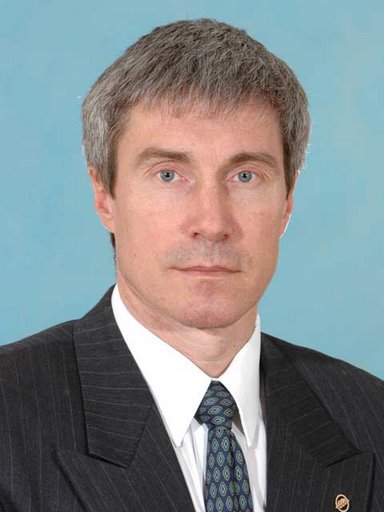
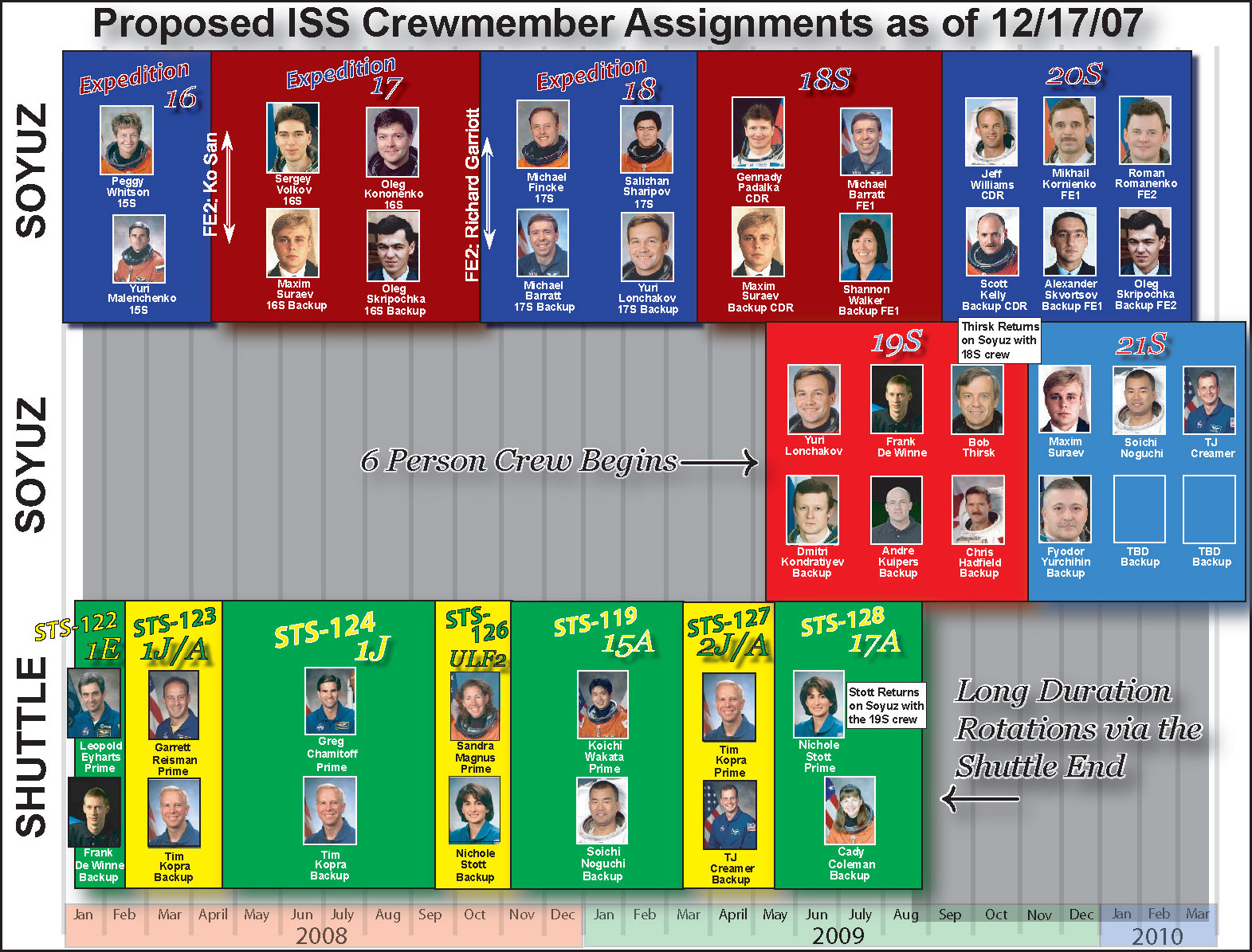
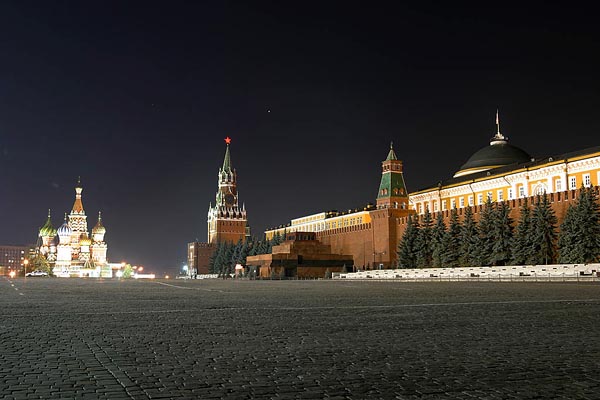


Dear Sergei Konstantinovich!
The management and staff of the S.P. Korolyov Rocket and Space Corporation Energiya heartily congratulate you on this significant day of your 50th anniversary!
Upon graduating with honors from the Leningrad Mechanical Institute in 1981, you took a job with the world-known Korolyov’s company, where you have been working for more than a quarter of a century now, having risen through the ranks from an engineer to a deputy general designer.
You worked on developing manuals for cosmonauts, proposals on displaying operator’s data on consoles of the Mir space station, updating the on-board documentation of the Salyut-7 space station. You worked at the Mission Control Center during several long-term missions. After communication was lost with Salyut-7 in 1985, you, as a member of a “ground crew,” took part in developing various options for procedures of flying and docking with the uncontrollable space station. Afterwards, this operation was successfully performed for the first time in history! The same year you joined the team of cosmonauts of NPO Energiya. You were training yourself and were taking an active part in training cosmonauts at the Gagarin Cosmonaut Training Center and at Baikonur.
You have accomplished six space missions to the muti-modular space station Mir, the unique creation of the 20th century, and the International Space Station, an ambitious international project of the 21st century, during which hundreds of sessions of scientific and applied research experiments were carried out, providing invaluable results for Russian and world science. And your pictures taken in space are the envy of any professional photographer!
Special milestones in your career are the activities on the International Space Station. Three times you worked onboard the station, and each of these missions was unique in its own way. The first mission was the first manned mission under the International Space Station assembly program, in the course of which US Node 1 module was docked to the Functional Cargo Module Zarya. Together with Space Shuttle Commander R. Cabana, you were the first to open the hatch leading to ISS. The second mission was under the program of the first expedition to ISS (ISS-1). It started the continuous operation of the ISS. You were the first to make habitable the Service Module Zvezda and Functional Cargo Module Zarya, and, later on, the Laboratory Module Destiny, and started scientific research under Russian and US programs. In the third mission you set up the absolute world record for the total space flight endurance of 803 days, which remains unbroken by any other nation in the world!
For the courage and heroism displayed during your missions into space, you were given titles of the Hero of the Soviet Union and the Hero of the Russian Federation, and awarded both Russian and foreign orders and medals. You are an honorary citizen of St. Petersburg. Your energy, commitment and perseverance in achieving your goal, high professionalism and erudition, communication skills and kindness towards people earned you due respect among your Russian colleagues and foreign partners. Everybody also knows about your achievements in sports: you have learned to fly several types of airplanes, including a foreign airplane, and you won prizes several times at the USSR, Europe and world championships.
On this great day, dear Sergei Konstantinovich, please accept our heartfelt wishes of good health, happiness and prosperity to you and your relatives, of new creative successes and luck in the course of flight design tests and operation of the rocket and space hardware for the sake of strengthening the power and prosperity of Russia.
– President, General Designer V.A. Lopota
September
10/9: Aleksei’s annus horribilis
Cosmonaut Aleksei Leonov is having a really bad year (annus horribilis). I am a bit confused about the sequence of events: in June he had to be resuscitated after having unspecified surgery. In August he developed pneumonia and this worsened, causing him to have a heart attack. He was given drug treatment in the clinic as the specialists were reluctant to operate because of his age (74), but his condition contined to worsen and he was operated on, in a procedure called a coronarography. One cause of his deterioration was his accidentally learning of the death of his 87-year-old sister, Raisa (his parents and 9 other siblings are deceased). Then to add insult to injury, his house near Star City was recently robbed! Details at the CollectSPACE forum here and here, and the Orbiter Forum.
“The Politics Of Shenzhou,” Space Daily, 8/9. The launch of the third Chinese manned space mission is due to take place between 25-30 September, carrying a crew of three.
13/9: Hurricane havoc
Progress M-65 (30P) launched on 10/9 at 19:50:02 and was due to dock on 12/9, but this has been delayed until 17/9 due to Hurricane Ike forcing the evacuation of Houston Mission Control (and the rest of the city) – “Hurricane Ike disrupts traffic in space,” MSNBC.com, 12/9.
NASA has set up backup Mission Control teams for the space station near Austin, Texas, and in Huntsville, Ala. Yembrick said that the main Mission Control room in Houston is preferred to feather the space station’s U.S. solar arrays into an edge-on position to incoming spacecraft to avoid damage from thruster firings.
From orbit the hurricane looks deceptively calm and serene (ISS photos ISS017-E-015751 and ISS017-E-015752); like swirled cotton wool or whipped cream. NASA has a Hurricane Resource Page with updates, and the NASASpaceflight.com forum has a dedicated thread. The hurricane is a Category 2 and is very wide (nearly 1000 km across). The low-lying Texas coast means the storm surge will flood the region.
The Progress is carrying the first of the new Orlan-MK spacesuits, numbered 4; this is fitted with a digital computer in its life support backpack to process and transmit systems information, rather than the previous BRTA, БРТА radio-telemetry equipment. It will also indicate malfunctions and display the necessary recommendations to deal with these on a new special liquid crystal display (LCD) screen on the front chest part of the spacesuit. The Orlan-MK will be able to work in two modes: with the digital computer (as the MK) or without (as the previous M version).
Interesting tidbit: if a spacesuit’s serial number has a last even digit (2, 4, 6, etc.), then the spacesuit has blue stripes, if a last odd digit (1, 3, 5, etc.), then red stripes – a tradition of NPP Zvezda. (Via Anik) Thus Orlan-MK №4 has red stripes.
Some photo links of the spacesuits used for testing:
- NPO InterCoS: the Zvezda Museum page has 3 photos (1, 2, 3) of Orlan-MK №3
- Orlan-MK №1 in exhibition during MAKS-2005
- VisualRIAN.com: Orlan-MK №2
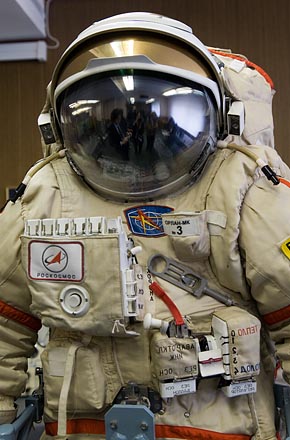
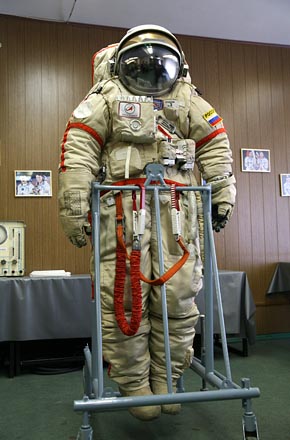

“Florida lawmaker opposes giving NASA permission to buy Russian spacecraft,” The Write Stuff, 12/9. If NASA loses its Russian/Soyuz access to space, the blame can be laid squarely upon cranky U.S. politicians! “Russia invaded Georgia” is somewhat more accurately phrased as “Russia responded to Georgia’s invasion of South Ossetia.”
Former astronaut LeRoy Chiao has a reasonably balanced blog post on the topic: “U.S.-Russian relations,” 31/8.
Prime Minister Putin signed a directive allocating 45 billion rubles ($1.8 bln) in additional funding for Russia’s space program. Funds will go firstly toward the construction of the new Russian spaceport, Vostochnii, in the Amur Region. Secondly will be ensured compliance with all the manned programs, which Russia exercises in the framework of international cooperation, taking into account all their commitments to the ISS. The third aspect is spacecraft, designed to enhance the effectiveness of Russia’s economy, such as meteorology, weather forecasting and scientific research.
22/9: Ballistic landings on Mars
“If I Were to Land on Mars …,” Air & Space Magazine, 1/11. Astronaut Don Pettitt’s account of the Soyuz ballistic landing he and Expedition 6 endured on 3 May 2003. He does note one positive aspect: the landings could be regarded as rehearsals for Mars landings!
So we had made a serendipitous discovery: Because of how the mission unfolded and culminated in a lost recovery, it had an uncanny resemblance to a trip to, and a landing on, Mars. We showed that barriers associated with such a trip, in the form of human physical performance deficits, can be overcome with the knowledge gained from the similar effects experienced on long-duration space station missions.
The parallels are striking. First we lived in a weightless environment for five and a half months. Depending on the choice of propulsion, six months is a good estimate for a one-way trip to Mars. So our level of deconditioning was about the same as that of a crew arriving at the Red Planet. We piloted our own spacecraft through a high-G entry maneuver, similar to what a crew may have to do at Mars. Our landing sequence involved a combination of parachutes and landing rockets, culminating in a hard landing on dry ground in one of the more remote places on Earth. For reaching the Martian surface, such a combination is an attractive option. And the landing site will be remote.
On our own, we performed a number of basic operational tasks not unlike those a crew might execute after landing on Mars, such as spacecraft safing, which involves reading procedures, flipping switches, and pushing buttons on the control panel to power down unneeded equipment to extend battery life for the radios. Since the Soyuz capsule ended up on its side, we did this strapped into a seat fixed to a slanted ceiling. We then opened the hatch by ourselves, unstrapped, and crawled out. In my spacesuit, I weighed 200 Earth pounds. On Mars, at 0.38 of Earth’s gravity, it would require over 500 Earth pounds to equal the same loading on my body. So while future Mars astronauts will wear heavier suits with life support systems, they will be lighter there than I was in Earth’s gravity. We deployed the survival gear that was scattered in numerous small bundles throughout the spacecraft. It takes a pair of strong hands to pull these bundles from their stowage in odd nooks and crannies – woolen clothes, food, water, a medical kit, a portable radio, and a flare-shooting pistol.
We performed all these operations with no outside help. We might as well have been on Mars.
“Opening The Window For Shenzhou 7,” SpaceDaily, 19/9. Shenzhou-7 is due to liftoff on 25 September. Zhai Zhigang will perform the EVA in an experimental Chinese-built suit, called “Feitian” after a mythological flying god; it weighs 120 kilograms, and each model will cost about 30 million yuan ($4.4 million) to produce. Liu Boming will wear a Russian Orlan suit to come to his rescue if necessary. Jing Haipeng will remain inside the pressurized Descent Module
“Russia And France Sign Contract To Launch 10 Rockets From Kourou,” RIAN/SpaceDaily, 22/9. The rockets will be Soyuz-ST carrier rockets used to launch geostationary satellites.
(Oh, and thanks to “FlyingSinger” for the nice post!)
26/9: Shenzhou-7 launches
China’s third manned space mission, Shenzhou-7, launched yesterday at 13:10 UTC with 3 taikonauts onboard. They are only staying in orbit for 68 hours, less than 3 days. The spacewalk will take place between the 29th and 30th orbits of Earth and last for around 20 minutes.
- CollectSPACE.com forum: China’s Shenzhou VII mission
- NASASpaceflight.com forum: LIVE: Shenzhou 7 Launch Day Updates
- “Russian experts to support China’s first spacewalk,” RIAN, 24/9
- “China launches riskiest space mission yet,” Space Daily, 25/9
A trivia note is that this is the first Shenzhou with a toilet!
No toilet was on board of the previous two manned spaceships. The men had to wear diapers. But this time a toilet is set up. The toilet seat is tailor-made to the astronauts’ physiques and it also includes a separate urinal.
From Novosti Kosmonavtiki news №731:
26/9/2008/00:05 – Roskosmos believes China is not a competitor but a partner
China’s space program is not considered by Roskosmos as a competitor. “We do not see China as a competitor rather see it our partner in the exploration of outer space,” said Aleksander Vorobyov, the head of the Roscosmos press service on Thursday, commenting on the launch of China’s third manned spacecraft Shenzhou-7 with three cosmonauts.
He congratulated China on the successful launch, recalling that the Russian and Chinese space agencies are cooperating on a wide range of works, including the first EVA of Chinese astronauts into space. One of the spacesuits on the ship Shenzhou-7, was produced in Russia.
In the coming years, Russia and China will organize joint projects of the exploration of Mars and the Moon with automated spacecraft. The project “Phobos-Grunt,” whose main task is to deliver to Earth samples of soil Martian satellite Phobos, the Russian interplanetary station will carry a Chinese autonomous vehicle to carry out Martian research. In turn, Russian specialists are directly involved in the Chinese lunar research program (orbiting, photography, landing on the surface, sampling soil and delivering it to Earth).
26/9/2008/00:05 – Russia needs to reorient its space program to co-operate with China
Russia should think about strengthening its co-operation in space with China, said a member of the K.E. Tsiolkovskii Russian Academy of Space.
“Today we need to think about who are our key partners in space. Perhaps the time has come to switch our focus from the West to the East. Economic, technological and political centers are concentrated in the Asia-Pacific region, where a vigorously developing China, Japan and South Korea are located,” a Russian expert, Aleksandr Ionin, commented during the launch of the third manned Chinese spacecraft.
In this context, said A. Ionin, the decision to build a cosmodrome in the Far East from a strategic perspective is the right step. He called for increasing cooperation with China in space. “Our country, unlike the U.S., does not suffer the affliction of an ambitious world leader and is ready to engage in manned and unmanned space,” said A. Ionin.
According to him, launching China’s third manned spacecraft during the flight of which a taikonaut will attempt an EVA, “this is a big step for China, but a small accomplishment for the world of space. In today’s world, beginning of EVA, which the Soviet Union and the U.S. have carried out more than 40 years ago, is a normal activity,” said the expert.
A development for a protective Martian diet:
26/09/2008/00:05 – Cosmonauts going to Mars will drink “light water” during the flight
Cosmonauts on the interplanetary flights may drink “light water” – water from which has been removed the heavy hydrogen isotopes and oxygen and possessing positive biological side-effects, which in particular, provide protection from radiation, Russian scientists said.
As the professor of the Institute of Biomedical Problems Yurii Sinyak reported at the conference in Moscow, dedicated to the development of life-support system for space flights, studies showed that “light water,” where deuterium and heavy oxygen are absent or their content considerably lowered, on the contrary, possess a number of useful biological properties.
In the experiments at the IMBP it was shown that light water protects from radiation: mice that received a significant radiation dose, had the longer lifetime, if they drank light water.
Furthermore, the anti-carcinogenic properties of light water was discovered; experiments showed that it slows down an increase in some types of tumors.
In experiments on Japanese quail birds, those that drank light water had a higher weight.
Professor Yurii Sinyak noted that studies of water with the changed isotopic composition began from the study of melt water, which also possessed a number of useful properties. He expressed the opinion that these properties were connected precisely with its isotopic special features.
“We decided to completely remove deuterium and then to verify how it worked. Then they began to remove heavy oxygen. They decided to test on plants, then on animals and finally man, to explain its anti-carcinogenic and anti-radiation properties,” said the agency representative.
He explained that the anti-radiation properties of light water are especially important for space flights. “If we fly to Mars, there there is no shielding from magnetic belts (Earth is protected from the cosmic rays by its magnetic field); therefore the danger will considerably higher for cosmonauts. It is necessary to search for methods both chemical and mechanical to reduce such radiation exposure,” said the professor. At the same time he emphasized that “everything which in space is achieved, is applicable on the Earth.”
(Article also at the Russian Federal Space Agency site, in Russian: «Космонавты в полете на Марс будут пить легкую воду», 25/9/2008)
“The US Has No Option But To Use Russia’s Soyuz Craft,” RIAN/Space Daily, 23/9.
NASA administrator Michael Griffin has described extending the service life of the hopelessly outdated shuttles, costing an additional $4 billion, as a jihad. Hence, he believes, the first and most obvious likelihood is that there will be no American astronauts or cosmonauts from U.S. or international partners on the space station after December 31, 2011. Only Russians will be there, he said.
The American concern has not a leg to stand on: Russia has always been noted for the scrupulous observance of its commitments. It never broke them even during the Cold War. Still, it will not give free rides to the Americans. The problem needs to be solved before 2009: Russian ships have a two-year production cycle.
Russia does not yet believe that the Americans can quit a multi-billion dollar project and let down their European, Canadian and Japanese partners. What’s more, Griffin said the ISS’s life could be extended beyond the established deadline of 2015. He said the U.S. was committed to building and using the station for most of the next decade. He added that the ISS held the main niche in U.S. space policy over the coming years and that medical and biological research on it would contribute to future Moon and Mars expeditions.
Typical of the negative attitude of many towards such co-operation is this post at NASASpaceflight.com, from the generation who grew up during the worst of the Cold War. Perhaps when my generation and those following (born in the 1970s onwards) are in power this nonsense will fade into the past?
I am in my 38th year as an engineer, I have worked Apollo, Shuttle and part time with Constellation. I normally only comment about the orbiters on this fine website as there’s a heart warming amount of interested people. However for the first time in my career I am now considering immediate retirement.
This is related to the passing of the INKSNA waiver, because NASA, and the U.S. showed how weak we are to countries like Russia, Iran and anyone else who have little regard for us.
Led by Mike Griffin, and a number of gullible politicians, we have sacrificed not only our domestic manned launch capability, but we have roadblocked domestic options to bridge the gap, with no regard for national security.
Well, you only have yourselves (namely, clueless U.S. politicians) to blame!
The next time Russia invades an ally of the U.S. and we see lots of angry reaction from the elected few, turn off the television, because they are liars.
More accurately, “when Russia responded to the Georgian invasion of South Ossetia,” but who cares about the facts? And since when was Georgia such an important ally anyway?
We’ve just approved billions of tax payers dollars to be taken out of the pockets of hard working American engineers, and into the pockets of the regime in Moscow. I’m old enough to remember the Soviet threats to my family and myself and a leopard does not change its spots, as we have seen recently. The message is “invade as many of our allies as you wish, we’ll stamp and shout, but we’ll also happily keep writing checks. Feel free to tell us to sit down and be a good USA.”
Griffin will tell you Shuttle is at the risk of a 1/8 chance of a disaster: An insult to the hundreds of engineers who have worked tirelessly after Columbia, which was a FREAK accident, and people like myself who have worked hard after Challenger, which was a FREAK accident, to ensure over 100 safe missions. And you think Soyuz is safe? It nearly killed its crew on the last two landings.
Two “freak” accidents? Perhaps indicative of design flaws? The Soyuz isn’t 100% safe either, but the two off-nominal ballistic landings were back-up modes and they certainly did not “nearly kill” their crew (though they caused some discomfort).
I won’t bother to post a snarky reply in that thread as it will likely just get deleted.
October
2/10: Chinese mission successful
China’s third manned spaceflight and first spacewalk last weekend were successful.
- Space Daily: “First Chinese EVA Goes Off Smoothly,” 27/9; “China astronauts return as heroes after historic spacewalk,” 28/9; “Good Grades For Shenzhou 7,” 29/9
- Spacefacts: Shenzhou VII page
“Now, NASA and Russians need each other,” MSNBC.com, 1/10. A new James Oberg opinion piece on the contentious NASA deal with Russia to fly NASA astronauts during the period where the Shuttle is retired and whenever Orion makes its first flight.
“Magnetic Hunger Could Drive Space Travelers Insane,” RIAN/Space Daily, 2/10. Rat experiments have shown that the absence of Earth’s magnetic field has deleterious effects on the brain, which has implications for long spaceflights to Mars.
15/10: TMA-13 launched
Soyuz TMA-13 launched on 12/10 at 7:01:33 UTC and docked on 14/10 to the Zarya module at 8:26. TMA-12 is due to land on 24/10; its main issue is whether there will be another ballistic landing or not! Depending upon what counting method is used, this is the 100th Soyuz flight (What is the Number of Soyuz TMA-13 Mission to be Launched Soon?, Roskosmos site; also a CollectSPACE article).
Information about Soyuz space missions (for all Soyuz modifications).
Soyuz – the following vehicles bearing this name flew into space:
- Soyuz: 40 vehicles (Soyuz-1 – 23/4/1967, Soyuz-40 – 14/5/1981). Among these vehicles, Soyuz-2 (25/10/1968), Soyuz-20 (17/11/1975) and Soyuz-34 (06/6/1979) were launched unmanned. Though Soyuz-34 returned cosmonauts V. Lyakhov and V. Ryumin, who were launched in Soyuz-32, which returned to the Earth unmanned. In addition, one Soyuz launch – 5/4/1975 – failed; this vehicle followed suborbital trajectory during its mission (numbered Soyuz-18-1).
- Soyuz Т: 15 vehicles (Soyuz Т-1 – 16/12/1979, Soyuz Т-15 – 13/3/1986). In this row, Soyuz Т-1 (16/12/1979) was unmanned. A launcher exploded during prelaunch processing of one Soyuz Т-type vehicle (26/9/1983), and the cosmonauts escaped due to proper triggering of the launch escape system (numbered Soyuz Т-10А).
- Soyuz ТМ: 34 vehicles (Soyuz ТМ-1 – 21/5/1986, Soyuz ТМ-34 – 25/4/2002). Soyuz ТМ-1 (21/5/1986) was launched unmanned.
- Soyuz ТМА: 12 vehicles (Soyuz ТМА-1 – 30/10/2002, Soyuz ТМА-12 – 8/4/2008).
Totally, 101 Soyuzes were orbited from 1967 up to now. Out of this number, 97 vehicles were manned, (95 – up and down, 1 – only up, 1 – only down).
In addition to official Soyuzes, Kosmos vehicles (unmanned) were also launched.
If Kosmos vehicles are taken into account, we have even more Soyuz missions. Soyuz mission 100 can result from the count if we include:
- 37 vehicles of Soyuz type (1, from 3 to 19, from 21 to 33, from 35 to 40)- launched manned
- + 1 vehicle of Soyuz type (34) – returned manned
- + 1 vehicle of Soyuz type – which made suborbital mission
- + 14 vehicles of Soyuz Т type – launched manned
- + 1 vehicle of Soyuz Т type (in which LES was triggered during a blow-up at the launch pad)
- + 33 vehicles of Soyuz ТМ type – launched manned
- + 12 vehicles of Soyuz ТМА type – launched manned.
Total: 99. In other words, Soyuz ТМА-13 can be considered the 100th mission in this case. However such estimation looks doubtful, and such procedure/method has never been used. I do not recommend to use this counting method, since it would be difficult to explain the way to obtain this number (100). Moreover, this number is not reasonable.
(Following the request from Roscosmos site, Mr. Aleksander Zheleznyakov prepared this answer.)
Somewhat alarmingly, the ISS toilet broke down again (same gas-separator issue), but was apparently fixed.
“Space Crew Conflicts Not Expected,” Aviation Week, 6/10. Sergei Krikalyov’s opinions on crew interactions during long space missions. He was in Scotland for the 59th International Astronautical Congress. Best quote:
Asked about disagreements in which one astronaut might consider another’s approach to a problem “stupid,” Krikalev drew applause from the audience when he said “the way we do it in Russian space program, U.S. space program, the European program, we don’t have stupid people in our programs.”
“What Will Flight To Mars Reveal,” RIAN/Space Daily, 13/10. The main challenge for interplanetary missions is creating a sustainable Life Support System (LSS); the ones on the ISS are still dependent upon regular supplies from Earth.
“The Long Countdown,” New York Times, 14/10. Quite a good article about NASA/Americans’ experiences in Star City. International relations there have much improved since the tense and uncertain 1990s.
Those who work side by side with their Russian counterparts say that strong relationships and mutual respect have resulted from the many years of collaboration. And they say that whatever the broader geopolitical concerns about relying on Russia for space transportation during the five years when the United States cannot get to the space station on its own rockets, they believe that the multinational partnership that built the station will hold. […]
But the shuttle will soon be out of the picture. Those who are most familiar with the nations’ joint efforts in space say that the controversial pause between American flights can go smoothly, if the politicians would only stay out of the way. […]
The American workers at Star City say that on a personal level, geopolitics simply do not matter. Mr. Thiessen said that when such issues came up in conversation with his Russian counterparts, they would say: “That’s politics. Let the government worry about the government. We’re engineers. Let’s solve this problem.”
And this anecdote is rather funny:
Those early days were also marked by wariness and distrust, and the first Americans had a strong impression they were being watched. Mark Bowman, an early contract employee in Russia who is now back in Moscow as deputy director of NASA’s human space flight program in Russia, recalled a weekly teleconference with his boss in Houston. “Thirty minutes into the call the line would go dead,” Mr. Bowman said. “And that would happen every 30 minutes.”
One day during the teleconference, Mr. Bowman warned 28 minutes in that the line was about to go dead and said testily, “I sure wish these damned KGB guys would get longer tapes.”
“The next telecon we had,” Mr. Bowman recalled, “I swear to you, it went 45 minutes and then it went dead.” Apparently, he said, his hosts had upgraded to 90-minute cassettes.
17/10: Soyuz interactive
Forgot to mention last entry that along with the New York Times article “The Long Countdown,” there was a Soyuz interactive diagram, so below are all the screenshots from the Flash-animated diagram (I hate Flash as individual images can’t be linked to!).
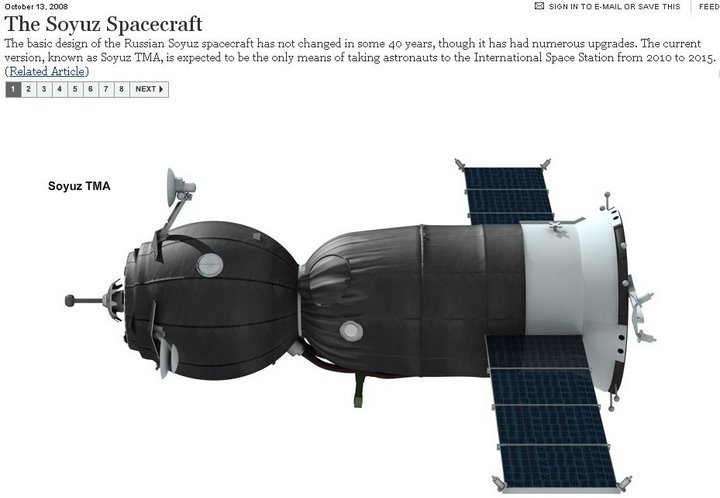
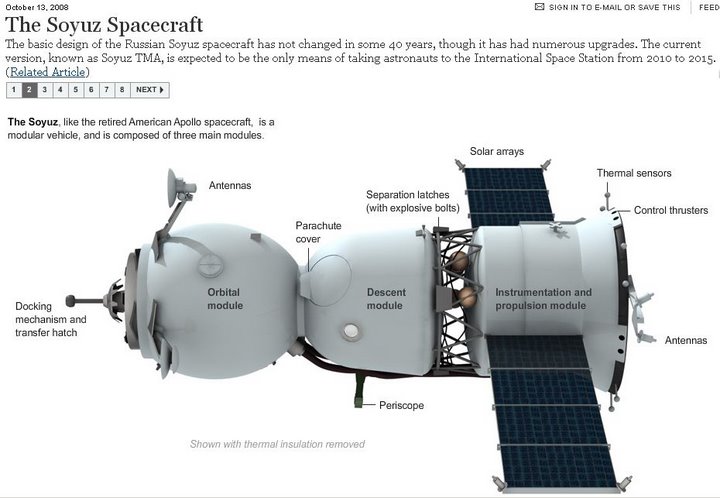
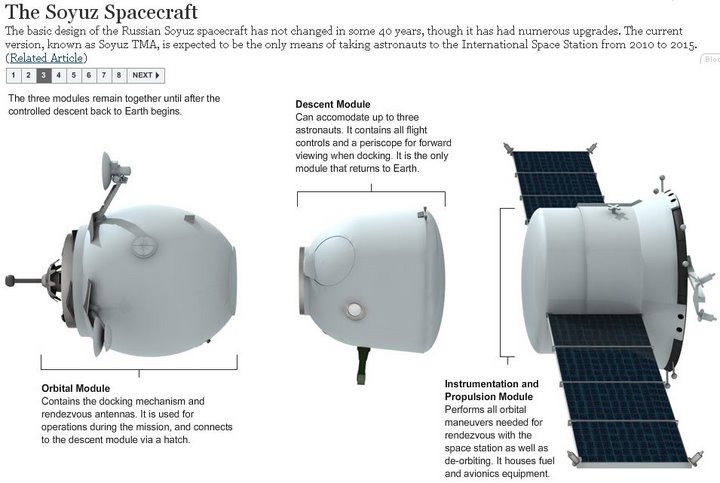
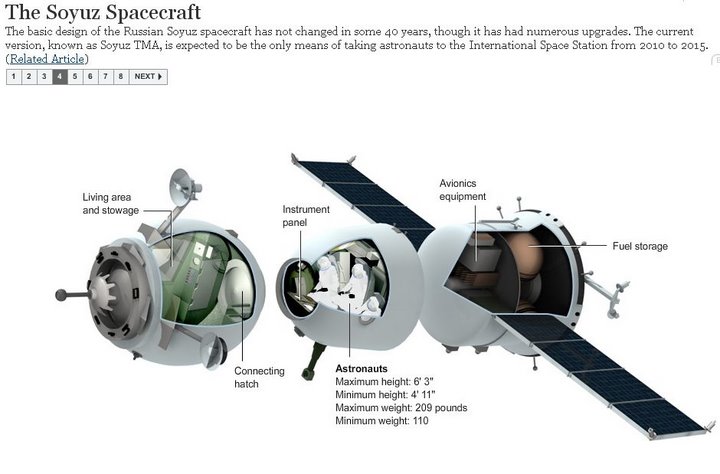
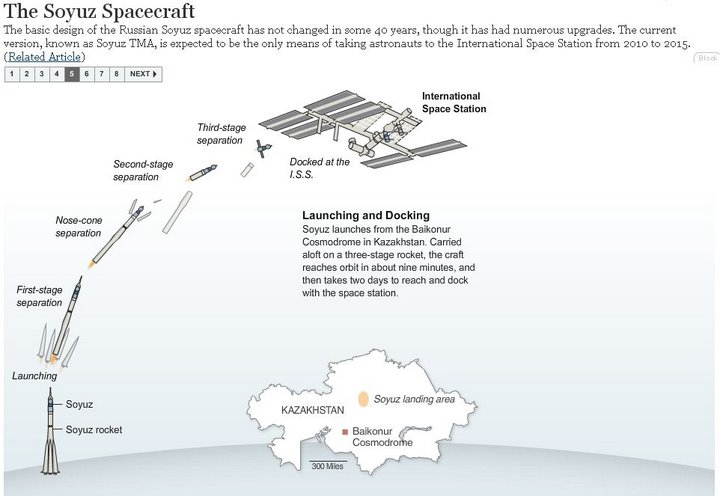
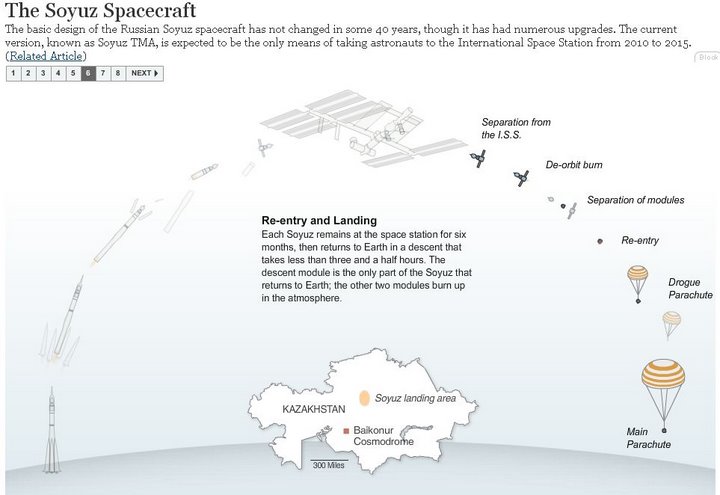
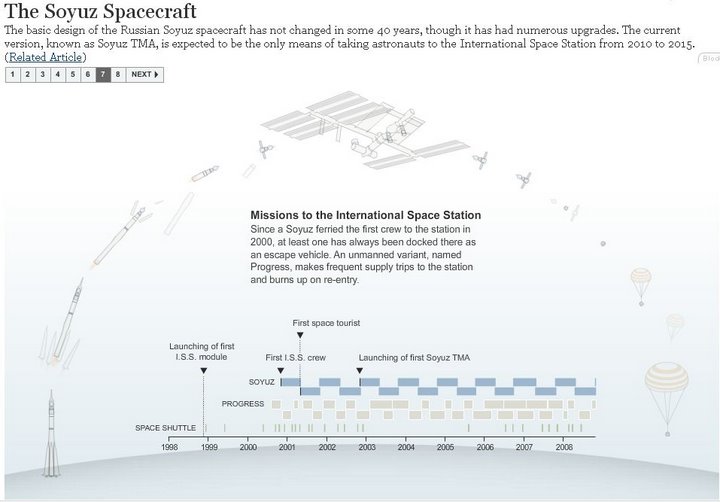
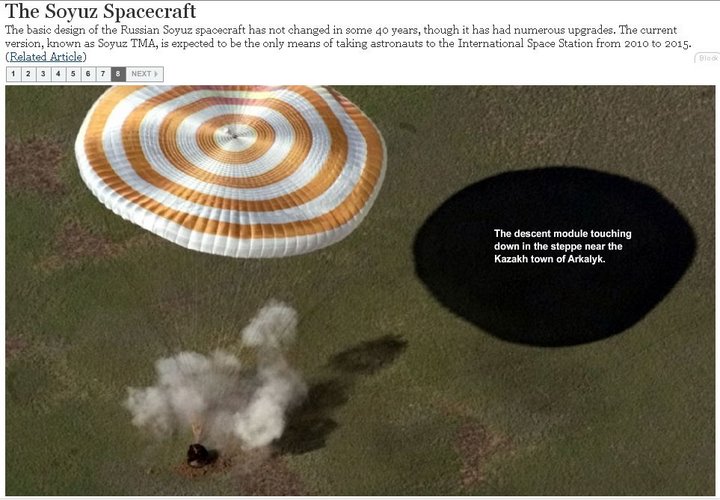
November
15/11: Buran 20th anniversary
Been depressed and haven’t felt much motivation to write here. Turning 38 doesn’t help my mood!
Soyuz TMA-12 landed on 24/10 at 03:36 UTC with no incidents (i.e. a normal not a ballistic landing). Expedition 18 is now on the ISS. STS-126 Endeavour launched successfully; its crew will install equipment (such as a regenerative environmental control and life support system) to enable the ISS’s crew to expand to 6 next year.
More money woes for Energiya (a familiar lament): “No Money, No Spacecraft, Russian Producer Warns”; “Finances may threaten Soyuz construction,” Space Daily, 24/10.
Astronaut Leroy Chiao has a blog entry about getting a look at a Chinese spacesuit.
“A Russian resurgence? (part one),” The Space Review, 10/11. The situation for Russia’s space program has much improved since the dismal 1990s, but there are still funding problems to contend with, and the economy is precarious.
14 November marked 20 years since the first and only launch of the Buran space shuttle; a rather poignant anniversary of what could have been.
Today, 14 November, the Rocket and Space Corporation Energiya marked the 20th anniversary of the flight of the space shuttle Buran.
In the Conference Room, Energiya brought together those who took part in creating this unique system, the representatives of various enterprises rocket and space industry of Russia, whose combined efforts made this flight possible.
Leading the commemorative meeting, the president and general designer of RKK Energiya, Vitalii A. Lopota presented a welcoming speech, congratulated the anniversary and screened a documentary about the creation of the Buran system. Those actors in the film were familiar – the guests and employees of Energiya recognized their much younger selves. A scene of the Buran landing was met with thunderous applause.
At the meeting, several shared their memories of that time: Vitalii Khusseinovich Doguzhiev (Виталий Хуссейнович Догужиев), Minister of General Machine- Building in the Soviet Union between 1988-89; Oleg Dimetrievich Baklanov (Олег Дмитриевич Бакланов), Minister of General Machine-Building USSR between 1983-88 and the secretary of the CPSU Central Committee in 1988; Yurii Pavlovich Semenov (Юрий Павлович Семенов), Academician of the Russian Academy of Sciences, General Designer of RKK Energiya, 1989-2005, and one of the leaders of the Buran development; Vakhtang D. Vachnadze (Вахтанг Дмитриевич Вачнадзе), Director General of NGO Energiya between 1977-1991; Maj. Gen. Vladimir Evgeni’evich Gudilin (Владимир Евгеньевич Гудилин), head of training and of the start-up launcher Energiya and the universal space-rocket transportation system Energiya-Buran.
All speakers pointed out that the achievements of the time and date are unique in the world, and regretted the closure of the Energia-Buran program, said that today Russia needs to pay more attention to space programs, and improve support and development of the personnel policy branch.
In conclusion, V.A. Lopota once again congratulated all the participants of the meeting. “Who knows whether history will repeat its mistakes,” said Vitalii Alexandrovich, thus expressing the mood and aspirations of all those present.
A cosmonaut from Kazakhstan will fly on the ISS in October 2009. There are two in the Cosmonaut Group with the qualification of cosmonaut-tester (космонавт-испытатель): Mukhtar Aimakhanov (Мухтар Аймаханов) and Aidyn Aimbetov (Айдын Аимбетов). Both joined the 2003 selection group.
18/11: Grumpy Old Moonwalker
As noted at NASA Watch, former Moonwalker Harrison “Jack” Schmitt resigned from the Planetary Society, apparently miffed over the direction their goals have taken (as stated in this press release): namely, focus on a manned mission to Mars first (rather than the Moon) as a goal, and strive for international co-operation. These are laudable goals in my opinion (the Moon has been landed on and is rather boring anyway – unless there happen to be mysterious alien monoliths to be discovered!), but it’s brought out the Cranky Conservatives in the comments, who are paranoid and insular, and are horrified at the prospect of co-operating with “them foreigners.” I posted a somewhat irate comment:
He’s a cranky old conservative with outdated, insular views (like some of the posters above :-P). I’d love to see an INTERNATIONAL Mars mission!! [From an exasperated 38-year-old female :-D]
He also thinks global warming a hoax, which doesn’t say much for his scientific credibility.
One would think that the humbling experience of seeing the Earth from the Moon would have broadened his views, but apparently not.
I would, in fact, rather have seen an international Mars mission launched, rather than the ISS project, but too late for that now.
“40 Years Later, It’s Moon Race 2.0,” TIME magazine, 13/11. The media seems obsessed to a tedious degree with the prospect of a “space race.” Nations new to spaceflight are sending out space probes, namely India (who landed a probe last week from the Chandrayaan-1 Moon satellite) , China and Japan. Russia barely gets a mention except as providers of the Soyuz taxi service to the ISS; a sad contrast to the Soviet era.
“Russian ISS spacecraft producer Energia gets $106 mln loan,” RIAN, 17/11. Energiya managed to get bank credit to allow them to construct more Soyuz and Progress spacecraft (2.9 billion rubles for a period of up to 12 November 2010).
“A Russian resurgence? (part two),” The Space Review, 17/11.
I neglected to mention that this blog is now just over 2 years old! Not that it is hugely popular …
My Firefox browser is currently reporting the Russian Federal Space Agency site as an attack site, possibly through third-party applications (a reason not to use these):
Malicious software is hosted on 3 domain(s), including mmcounter.com, yanndex.su, ff-freehosting.com. 2 domain(s) appear to be functioning as intermediaries for distributing malware to visitors of this site, including yanndex.su, mmcounter.com.
Hope they fix that soon! Considering it’s an official government site, it is rather poor!

21/11: 10 years of the ISS
“Nations Around the World Mark 10th Anniversary of International Space Station,” NASA, 17/11. 20 November marked 10 years since the first element of the International Space Station, the Zarya Functional Cargo Block («Заря» ФГБ, Функционально Грузовой Блок, Funktsional’no Gruzovoi Blok). James Oberg also provides an overview: “What a trip! Space station turns 10,” MSNBC, 20/11.
“Buran – the Soviet ‘space shuttle’,” BBC News, 20/11. Article by Anatoly Zak of RussianSpaceWeb.com.
A new version of the Russian Orlan spacesuit, the Orlan-MK, was delivered to the ISS in September 2008 on Progress M-65 (Orlan-MK №1170004, blue stripes). Two more will be delivered in 2009: Orlan №005 (red stripes) on Progress M-66, and №006 (blue stripes) on Progress M-02M. As with previous Orlans, NPO Zvezda are the designers and makers of the MK. I have a page on my website about it.
30/11: Charred cosmonaut
A thread at the CollectSPACE.com forum links to an online photo of what are purportedly the remains of cosmonaut Vladimir Komarov, who died on impact in the Soyuz-1 landing after its parachutes malfunctioned. Being the ghoulish and morbidly curious type, I have to post the photo below (in case it disappears):
From one post:
I think these paragraphs in the Kamanin Diaries 1967-68 (General Kamanin is on the right adjusting his tie) give the context of when the picture was taken:
Kamanin returned to the place of the accident and ordered a group of doctors to remove Komarov’s body from the ship’s wreckage … at 21.45 (Moscow time) Komarov’s remains were placed aboard the II-18 airplane. Ten minutess before departure an An-12 arrived from the cosmodrome with General Kuznetsov and the Soyuz-2 prime and back-up cosmonauts, who would accompany their perished colleague to Moscow … Komarov’s remains were transferred to the morgue of the Burdenko hospital in Moscow, allowing doctors to write an official report on the cause of death. Subsequently the remains were cremated and an urn with the ashes was placed in the central House of the Soviet Army later that day were endless line of people came to pay their respects. The following day Komarov’s ashes were interred in the Kremlin Wall.
My initial impression on looking at that was “lump of charcoal” – not much left of him! He died immediately on impact, then the capsule burst into flame.
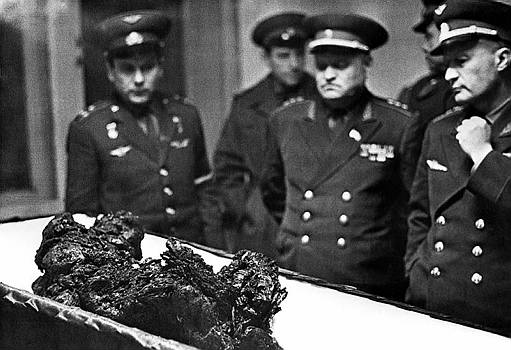
From Challenge to Apollo, page 587:
Finding the body had been a difficult job. One of the rescuers recalled:
The group’s physicians set to work – they shoveled away the top layer of dirt from the top of the mound from the hatch cover. After the dirt and certain parts of instruments and equipment were removed, the cosmonaut’s body was found lying in the center chair. The physicians cleaned the dirt and the remnants of the burned helmet phone from the head. They pronounced the death to be from multiple injuries to the cranium, spinal cord and bones. […]
In a grisly aside to his death, not all of Komarov’s remains were found during the initial search, and a group of Young Pioneers, the equivalent of Boy Scouts in the Soviet Union, discovered additional remains that were later buried at the crash site itself. Reportedly, Party officials took great pains to hide this from the general public.
I wonder how they could determine so much detail from those remains, if they are him.
Progress M-01M/№401, the first of the new Progresses with new onboard computer, TsVM-101, a digital telemetry system, launched on 26/11.
December
22/12: Mars-500 ESA selections
The final 4 participants, all male, were selected for the 105-day study/test mission to begin on 31 March 2009; their training begins on 26 January 2009. Two of the group will undergo the mission, while the other 2 are backups. Four Russian crew (as yet unnamed) will also participate in the mission. The 4 Europeans are: Cyrille Fournier (France), Arc’hanmael Gaillard (France), Oliver Knickel (Germany), Cedric Mabilotte (France).
- “ESA presents European participants in Mars-500 isolation study,” 5 December 2008
- “European Mars-500 participants announced,” 11 December 2008
The «Программа «Марс-500»» page at the IMBP site lists the crew (in Russian).
- Europeans (two are prime crew, the other two are backups):
- Cyrille Fournier (France)
- Arc’hanmael Gaillard (France)
- Oliver Knickel (Germany)
- Cedric Mabilotte (France)
- Russians (includes one woman):
- Oleg Germanovich Artem’ev, Артемьев Олег Германович
- Aleksei Viktorovich Baranov, Баранов Алексей Викторович
- Sergei Nikolaevich Ryazanskii, Рязанский Сергей Николаевич
- Sergei Alekseevich Spitsa, Спица Сергей Алексеевич
- Marina Petrovna Tugusheva, Тугушева Марина Петровна
- Aleksei Vasil’evich Shpakov, Шпаков Алексей Васильевич
“Russians Close In on Cause of Soyuz Landing Anomaly,” James Oberg, IEEE Spectrum, December 2008. Electromagnetic interference (EMI) from plasma flows over the surface of the ISS is thought to have damaged one of the pyrotechnic bolts that fire to separate the Soyuz segments, and thus initiated a ballistic landing, for Soyuz TMA-10 and -11.
“New space toilet has no door … yet,” MSNBC.com, 19/12. The new Russian-made toilet, installed in the Destiny Lab module, has no privacy screen but is otherwise functional. A second toilet will be much-needed, especially with the occasional breakdowns the original one has had! The design is generally reliable, though.
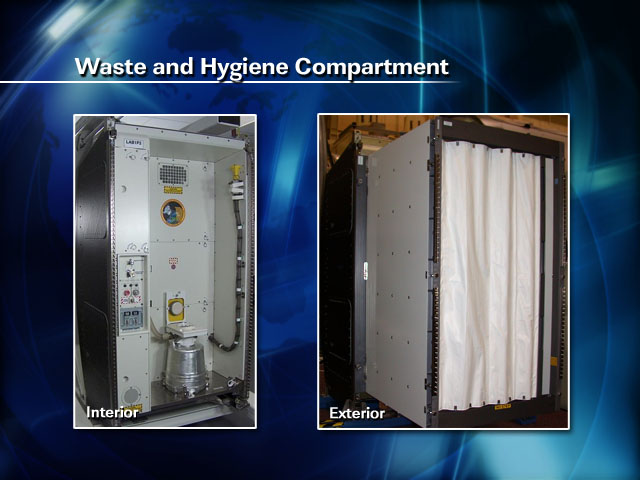
25/12: Haigneré suicide attempt?
Yesterday there was the rather surprising news that former ESA astronaut Claudie Haigneré had attempted suicide:
First Frenchwoman in space hospitalised after suicide attempt
Paris (AFP) – The first Frenchwoman in space and former government minister Claudie Haigneré was hospitalised late Tuesday after attempting suicide, a French government source said.
Haigneré, 51, was rushed to hospital after being discovered at her Paris home, where according to another source, she had overdosed on pills. She was conscious when hospitalized, the source said.
Haigneré was an astronaut with the French space agency CNES, flying on a mission to the Mir space station in 1996 and to the International Space Station in 2001, the first European woman to do so.
She later entered politics, serving as minister for research and new technologies from June 2002 to March 2004, before becoming European Affairs minister in the government of Jean-Pierre Raffarin, a post she held until May 2005.
She is married to another French astronaut, Jean-Pierre Haigneré, who flew on two missions to the Mir space station, in 1993 and 1999, the second for a six-month stay.
Although there is another report with her husband saying that the overdose was accidental (at the Le forum de la conquête spatiale, in French), so the circumstances are unclear as yet. I can’t understand why someone with such a successful career (unlike this writer) would want to take her own life as she would have everything to live for (she has a daughter also).
The news has been reported in a few spaceflight forums but – as with the case of Lisa Nowak (6/2/2007 entry) (whose trial is still ongoing) – there are some who get all sanctimonious about the topic and want to lock it.
31/12: New NASA Columbia report
NASA has released a Columbia Crew Survival Investigation Report (16.2 MB PDF – press release page) featuring a detailed description of the sequence of events for the crew and orbiter during its breakup. A summary from the report is below:
1.1.1 Events with lethal potential
There were five events identified with lethal potential to the crew.
The first event with lethal potential was depressurization of the crew module, which started at or shortly after orbiter breakup.The majority of the SCSIIT findings related to the first lethal event were connected to the operational incompatibilities of the advanced crew escape suit (ACES) with the orbiter. The launch and entry suit was added in response to the Challenger accident, rather than as a part of the original vehicle design. The ACES was the successor to that suit. The suit protects the crew in many scenarios; however, there are several areas where integration difficulties diminish the capability of the suit to protect the crew. Integration issues include: the crew cannot keep their visors down throughout entry because doing so results in high oxygen concentrations in the cabin; gloves can inhibit the performance of nominal tasks; and the cabin stow/deorbit preparation timeframe is so busy that sometimes crew members do not have enough time to complete suit-related steps prior to atmospheric entry.
As Columbia entered the atmosphere, one crew member was not yet wearing the ACES helmet and three crew members were not wearing gloves. Per nominal procedures, the crew wearing helmets had visors up. There was a period of about 40 seconds after the orbiter loss of control (LOC) but prior to depressurization when the crew was conscious and capable of action. Part of this short timeframe was undoubtedly employed in recognizing that a problem existed, as the indications of LOC developed gradually. The crew members could have closed their visors in this timeframe but did not. The SCSIIT attributed this to the training regimen, which separates vehicle systems training from emergency egress training and does not emphasize the transition between problem resolution and a survival situation. Once the cabin depressurization began, the rate of depressurization incapacitated the crew so quickly that even those crew members who had fully donned the ACES did not have time to lower their visors. Although circulatory systems functioned for a brief time, the crew could not have regained consciousness upon descent to lower altitudes due to the effects of the depressurization.
The second event with lethal potential was unconscious or deceased crew members exposed to a dynamic rotating load environment with nonconformal helmets and a lack of upper body restraint. The orbiter lost control, probably when the hydraulic systems failed due to hot gas intrusion in the left wing. The resulting motion was not lethal but did require bracing by the crew. The forebody (crew module and forward fuselage) eventually separated and the crew module lost pressure at orbiter break- up. When it separated, the forebody began a multi-axis rotation at approximately 0.1 revolution/second. Loads due to deceleration significantly decreased at the moment of breakup due to the change in ballistic number, but began to climb as the forebody continued to decelerate.
After the crew module depressurized and the crew lost consciousness, the seat inertial reel mechanisms failed to lock despite the off-nominal motion. The reels were not defective; they were simply not designed to lock under the conditions the forebody experienced. The upper harness straps failed at some point prior to the forebody breakup, causing the straps to recoil back into the inertial reel mech- anism. Because the reel mechanisms did not lock, the unconscious or deceased crew members were exposed to cyclical rotational motion while their upper bodies were inadequately restrained. Helmets that did not conform to the head and the lack of upper body restraint resulted in injuries and lethal trauma.
- The third event with lethal potential was separation from the crew module and the seats with associated forces, material interactions, and thermal consequences. This event is the least understood due to limitations in current knowledge of mechanisms at this Mach number and altitude. Seat restraints played a role in the lethality of this event. The breakup of the crew module and resultant exposure of the crew to entry conditions was an extremely significant event but was very difficult to characterize since many related events occurred in a short period of time. The consequences of exposure to entry conditions included traumatic injury related to seat restraints, high loads associated with deceleration due to a change in ballistic number, aero- dynamic loads, and thermal events. All crew were deceased before, or by the end of, this event. The ACES has no performance requirements for occupant protection from thermal events and may not provide adequate protection even for egress scenarios involving heat and flames. There is no known complete protection from the breakup event except to prevent its occurrence.
- The fourth event with lethal potential was exposure to near vacuum, aerodynamic accelerations, and cold temperatures. The ACES system is certified to operate at a maximum altitude of 100,000 feet, and certified to survive exposure to a maximum velocity of 560 knots equivalent air speed. The operating envelope of the orbiter is much greater than this. The actual maximum protection environment for the ACES is not known.
- The final event with lethal potential was ground impact. The ACES system provides protection from ground impact with a parachute system. The current parachute system requires manual action by a crew member to activate the opening sequence.
There are some “Redacted” sections; presumably containing details about the crew’s remains that the report authors didn’t want to be made public. There were reports of body parts found scattered over the landscape (sorry, this brings out my inner ghoul):
Reports of body parts being found started coming in Saturday night as emergency workers and residents searched hundreds of square miles of Texas and Louisiana for bits of what once was space shuttle Columbia.
In Hemphill, near the Louisiana state line, hospital employee Mike Gibbs reported finding what appeared to be a charred torso, thigh bone and skull on a rural road near what was believed to be other debris. Billy Smith, an emergency coordinator for three East Texas counties, confirmed the find.
“I wouldn’t want anybody seeing what I saw,” Gibbs said. “It was pretty gruesome.”
On a farm not far away, two young boys found a charred human leg, The Dallas Morning News reported Sunday. “From the hip to the foot, it’s all there, scorched from the fire,” said their father, Bob White.
I wonder if the bodies broke up during re-entry or on impact? Human bodies aren’t designed for high-g forces, as innumerable airplane crashes have demonstrated. [Update 3/1/2009: According to Dad, bodies that are found in pieces mean they have been shredded when in a fragmenting aircraft in the air; if not they turn into a “blob of jelly” when they impact the ground and all the bones shatter. So that’s some trivia you probably didn’t want to know.]
On a more cheerful note, Expedition 18 completed a spacewalk last week on 23 December wearing Russian Orlan spacesuits. Yurii Lonchakov (EV1, Orlan-M №26) and Michael Fincke (EV2, Orlan-M №27) were outside for 5h 38m (00:51-06:29 UTC). Reports: ISS Daily Report, NASA.
A random observation: I visit various spaceflight forums (see my links list) and it is rare to encounter other females! I don’t know why that is, as there are plenty of women in the aerospace industry (at least there are in the USA and Europe). (I did have a chance to begin a career in the industry a long time ago, but as with so much of my life, I botched that chance.)