RuSpace: 2009
January
24/1: Space tourist oral histories
“Very Stunning, Very Space, and Very Cool,” Technology Review, Jan/Feb 2009. An oral history of the launch of space tourism.
Ansari: I didn’t let them see it. I thought, “Oh my God, they will think I’m stupid. I have my vomit floating around the cabin.” I managed to grab a bag before it got too bad. I just had a little bit of it floating around. The good thing about it is it’s floating, so you can catch it. I was able to catch it with a napkin and put it in the bag before they all could see it. […]
Simonyi: The final checkout is in a doctor’s office, with a medical team of three or four doctors. It’s the most junior one who gives you the enema.
Garriott: The thing is to try to make sure you don’t need to use the rest room on board the Soyuz.
Olsen: Here’s the reason: on the Soyuz capsule, there’s a facility for a bowel movement, but you really don’t want to make a bowel movement on it. Imagine using a teapot to make a bowel movement. All right?
And similar “delightful” anecdotes! These are laypersons’ views of space travel, rather than those of professional astronauts and cosmonauts, so are of particular interest to the general public.
“Russia: No more space tourists after 2009,” MSNBC.com, 21/1. Russian Space Agency chief Anatolii Perminov said there won’t be any more room for space tourists when the ISS crew expands from 3 to 6. The last commercial flight is to be made by Charles Simonyi (again!); he previously went up on Soyuz TMA-10 in April 2007.
March
17/3: Russian moon rocket – maybe
I have not posted much as I just haven’t felt like it, and there has been little space news to interest me.
“Final European crewmembers announced for human Mars mission simulation,” 26 February 2009. Selected for the prime crew are Oliver Knickel, a mechanical engineer in the German army, and airline pilot Cyrille Fournier from France. Cedric Mabilotte and Arc’hanmael Gaillard, both from France, are assigned as backup crewmembers.
“Russia to approve new Moon rocket,” BBC News, 16/3. Anatoly Zak reports that Russian space officials are to select the winning proposal for a new rocket intended to carry cosmonauts on missions to the Moon. The rocket is to fly its first test mission in 2015 (if all goes to plan).
According to the objectives given by the Russian space agency (Roscosmos) to industry, a future rocket should be able to hoist a payload three times heavier than Russia’s veteran Soyuz spacecraft, including twice the number of crew, and use environmentally friendly propellants. The development of the new rocket should be accompanied by work on Russia’s next-generation manned spacecraft, which will use it to get into orbit. Russian space officials say the yet-to-be-named rocket should carry its first manned spacecraft in 2018.
Expedition 18 completed a spacewalk (#21A) from the Pirs docking module wearing Russian Orlan-M spacesuits on 10 March. This is the last time the -M designation will be worn; the next Russian spacewalk will test the new -MK suits with digital controls.
- Yurii Lonchakov (EV1, Orlan-M №26, blue stripes)
- Michael Fincke (EV2, Orlan-M №27, red stripes)
- 4h 49m (16:22-20:11)
- ISS Daily Report; NASA
Suits Orlan-M №26 & 27 have an on-orbit lifetime till 30 June 2009. In future they will be jettisoned respectively as RadioSkaf-2 and RadioSkaf-3 satellites in Russian spacewalks: the first of them will be launched during EVA #24 in November/December, the second of them – in 2010.
In the next Russian spacewalk (EVA #22, 5 June 2009) the new Orlan-MK spacesuits will be tested. At this time there will be three modernized spacesuits onboard ISS. The first of them, Orlan-MK #4 (#1170004) with blue stripes, was delivered by Progress M-65 cargo ship on 17 September 2008. The second of them, Orlan-MK #5 (#1080005) with red stripes, arrived aboard Progress M-66 on 13 February. The third spacesuit, Orlan-MK #6 (#1080006) with blue stripes, will be delivered by Progress M-02M on 12 May. (via Anik)
STS-119 Discovery launched on 15 March. It carries the S6 truss segment, and ISS 18-19 Flight Engineer-2, Japan Aerospace Exploration Agency astronaut Koichi Wakata, who will be the first long-duration Japanese astronaut on the ISS.
The March 2009 edition of Russian Space, «Российский космос», has an article, «Надежда – мой компас …» (“Nadezhda/Hope – my compass …) on what former cosmonaut Nadezhda Kuzhel’naya, Надежда Кужельная, is doing now with her life: an Aeroflot pilot of the A-320. She was never given a space flight despite waiting ten years, and resigned in 2004. I have yet to do a translation of the article.
In the history of Soviet and Russian space activities, only three women have been in space: Valentina Tereshkova, Svetlana Savitskaya and Elena Kondakova. Until a few years ago on this list might have appeared Nadezhda Kuzhelnaya. But …
According to the old memory and the visitors to loyal friends, she sometimes comes to the Federal Space Agency. An elegant, slender, beautiful pilot in a coat. There are no grievances, complaints about bad luck or someone’s intrigues. This is not false bravado. All her face radiates confidence. She has something to be proud of. Once beyond the gates of Star Camp, she was not lost, but was able to penetrate into the sky.
To suit, sat
“When will my new suit be ready?”
Prior to 8 March, Nadezhda Kuzhelnaya time after time phoned a sewing workshop. Alas, there has so far been no reply. Throwing up her hands, she complained:
“There is no other way I can find a suitable coat size. They are all calculated on the measurements of a large man.”
Of course, on a petite woman such a garment would look baggy. It is impossible to present a graceful figure with a wasp waist in the similar dress. Hence it is necessary to tailor the suit to order. A pilot of the aircraft A-320 – her current designated position at «Aeroflot» – should look perfect.
“Passengers, of course, do not see us during the flight, but not only the stewardess represents the company,” said Nadezhda.
Incidentally, women pilots in Russia can be counted on the fingers of one hand. But in a world of several hundred, all are united in a kind of ladies’ club. Its chairman is American Linda Wright a Commander of the Boeing-737 aircraft at International Airlines. Her flight hours total about 15 000. During a recent meeting at a conference of female pilots, Linda gave Nadezhda a pilot scarf out of particular respect. American history is very impressed with the Russian Space pilot – Kuzhelnaya is the world’s only operating pilot possessing a cosmonaut diploma!
Moscow does not believe in tears
Aerobatics
Sold seat
The story of the «eagles»
Tickets to the private club
One item of information I am coveting but have been unable to find is a diagram of the TsUP/Moscow Mission Control Room, similar to this one of the new FCR-1. I have looked on the TsUP site, but there doesn’t seem to be anything. I would like to know the positions and roles of the TsUP flight controllers! (I posted this request at NASASpaceflight.com forum, but it has languished unanswered.)
I happened upon a copy of The Thrillionaire® by Nik Halik in my local library (Nik was Richard Garriott’s backup for Soyuz TMA-13 in October 2008). I have not actually read the book yet; just skimmed through parts of it. Nik is an Australian of Greek descent, born 1971. His book is evidently self-published (being a millionaire, he can obviously afford it!). Some advice: for a professional-appearing book, don’t:
- use the Photoshop “3D text effect” for your cover page title (looks tacky);
- double-space paragraphs rather than indent (double-spacing is the default for webpage paragraphs, but is hard to read on printed pages).
The “Thrillionaire®” title is rather gag-worthy (and the “registered trademark” symbol after it gets irritating). The book mostly consists of a bored rich guy’s adventures – namely doing activities such as deep-sea diving to the Titanic, climbing mountains, staying with a bemused Tuareg tribe, presumably to see how “the other half live” (I can imagine them muttering amongst themselves, “Who the f**k is this wanker?” or whatever the equivalent is in Tuareg :-D; incidently the men veil themselves rather than the women – a nice change!), and so on. There are also a lot of “motivational” stories of the corporate variety (which I regard with eye-rolling cynicism). So that’s my impressions without actually reading the book. He’s certainly not shy about promoting himself.
27/3: ISS symmetrical
A busy few days at the ISS. STS-119 undocked after having installed the fourth and last set of solar arrays, so the Station looks symmetrical again (NASA photos). Soyuz TMA-14 launched on 26/3, carrying Expedition 19 and space tourist Charles Simonyi on his second visit to orbit.
I rather liked this comment in a NASA Watch article:
You have to note the differences between the shuttle and Station crews. The shuttle people appear to be very hyped up, still living in 1983 and full of false bravado (and what’s with those MIT baseball hats the wrong way around and cheesy embroided polo shirts, they look like an OAPs golf club on tour). Where as the station crew (presumably with its heavy slavic influence) is reassuringly nonchalant about the whole thing. “Spacewalk to connect some pipes? We do that every week.”
Vive la difference! I can’t wait for the permanent european and japanese crew members to arrive. Then we might be somewhere close to Kubrick’s best-guess. From the shuttle-heavy NASA coverage you might think it was Uncle Sam who built and paid for everything.
– Posted by: Ben at March 22, 2009, 5:14 p.m.
“Valley Girls: Esther Dyson,” BBC News, 29/1. Interview with Charles Simonyi’s backup, Esther Dyson.
“My parents were European. Mum was a mathematician and dad a physicist. We travelled a lot and knew about the world. I actually thought salesmen were the scum of the earth. I have certainly changed my opinion on that,” she said.
Her original opinion was correct! She has a website, and a Flickr account with photos.
April
1/4: Territorial dispute
Various news reports have appeared across the Internet about ISS-19’s commander, Gennadii Padalka, saying that rules requiring the crew to use their own nations’ resources and not those of others (eg. food items, exercise equipment) are hurting morale. (Yahoo news report – reproduced below in case it disappears; the relevant NASASpaceflight forum post.)
Report: cosmonaut grumbles about space bureaucracy
Associated Press Writer Vladimir Isachenkov – Mon Mar 30, 12:42 p.m. ET
Moscow – Squabbles on Earth over how cosmonauts and astronauts divide up the space station’s food, water, toilets and other facilities are hurting the crew’s morale and complicating work in space, a veteran Russian cosmonaut said, according to an interview published Monday.
Russia, the United States and other countries require cosmonauts and astronauts to eat their own food and follow stringent rules on access to other facilities, like toilets.
“What is going on has an adverse effect on our work,” Padalka, 50, was quoted as saying in an interview conducted before he and his crew mates blasted off to the station last Thursday. They arrived safely at the outpost Saturday.
Russian space agency spokesman Alexander Vorobyov said he would not comment until he had read the interview.
Padalka, who will be the station’s next commander, said the arguments date back to 2003, when Russia started charging other space agencies for the resources used by their astronauts. Other partners in space station responded in kind.
“Cosmonauts are above the ongoing squabble, no matter what officials decide,” said Padalka, a veteran of two space missions, according to the newspaper. “We are grown-up, well-educated and good-mannered people and can use our own brains to create normal relationship. It’s politicians and bureaucrats who can’t reach agreement, not us, cosmonauts and astronauts.”
He said he had inquired before the current mission whether he could use an American gym machine to stay fit.
“They told me: ‘Yes, you can.’ Then they said no,” he was quoted as saying. “Then they hold consultations and they approve it again. And now, right before the flight, it turns out again that the answer is negative.”
While sharing food in the past helped the crew feel like a team, the new rules oblige Russian cosmonauts and U.S. and other astronauts to eat their own food, Padalka said, according to the report.
“They also recommend us to only use national toilets,” he was quoted as saying.
Russian Soyuz and Progress spacecraft were the only link to the space station when the U.S. space shuttle fleet was temporarily grounded following the 2003 Columbia disaster. They have continued to ferry crews and supplies to the station, and a Soyuz capsule is permanently docked at the station to serve as a lifeboat.
Padalka was also quoted as criticizing the Russian portion of the station, saying it looks backward compared to other sections.
“It’s built on technologies dating back to the mid-1980s, at the very latest,” he said. according to the report. “We are lagging seven to 30 years back in various space technologies.”
Russia’s space program fell on hard times after the Soviet collapse and struggled to stay afloat by selling seats on its Russia tries to weather its worst financial crisis since 1998.
“Siberian Tiger” posted a more extensive translation of the article at the Orbiter Forum and NASASpaceflight.com.
“Russian-European crew starts ‘Mars mission’,” ESA news, 31/3. The selected crew began their 105-day stay on 31 March. ESA has a dedicated website to the experiment. The ESA participants will be keeping journals; unfortunately the Russian ones don’t appear to be (unless they are posting on a Russian site somewhere I don’t know of).
A brief note in NK news №773 about Cosmonaut Sergei Krikalyov’s latest assignment:
1/4/2009 / 00:05 – Cosmonaut Sergei Krikalev becomes the leader of the civil Astronauts Training Center
The head of the Center of the civilian astronauts will be pilot-cosmonaut Sergei Konstantinovich Krikalyov, who is currently the Deputy General Designer of RSC Energia. All necessary documents were signed this week, said the head of Roscosmos AN Perminov. It was reported by a source in the Russian space industry, says Cyber Security.
Official FKA/Russian Space Agency press release:
By the order of the head of the Russian Space Department, from 27 March 2009, the Hero of the Soviet Union №97, the Hero of Russia (the Gold Star of the Hero №1) Sergei Konstantinovich Krikalyov, is appointed to the post of the chief of the Federal state budgetary establishment, the Yu. A. Gagarin Russian State Scientific-Research and Test Centre of Cosmonaut Training Research (RGNIITsPK) since 30 March of this year.
On 27 March, as communicated by a submitted statement, the 1st class instructor-cosmonaut-verifier of the Open Society RKK Energiya, and the assistant to the Open Society general designer of RKK Energiya, Sergei Konstantinovich Krikalyov, has been released from the position of the 1st class test instructor-cosmonaut, according to the order of the head of the Russian Space Agency.
CollectSpace mentioned a graphic novel called Station, about a murder on the ISS. I was able to find 3 of the 4 issues online. Some minor nitpicks and observations from the first few pages of the Amazon preview (images below):
- The Russian cosmonaut in the first issue is out doing an EVA by himself in an American EMU spacesuit – WTF? To my knowledge, solo EVAs are not done, and he would be wearing an Orlan spacesuit if he’s working on the Russian segment (bit hard to ascertain from the drawings).
- By the appearance of the ISS, its configuration is drawn from the way it was in 2005 (see NASA ISS assembly gallery).
- “Two days with our knees in our chests and our backs on fire.” That position is only for the few minutes of the Shuttle launch. The crew do get to float around!
Life on the ISS tends to be routine – not much to write about – so for fictional purposes, things need to be “livened up” with various disasters!
12/4: New Russian spaceship (maybe)
“Russia launches effort to design new spaceship,” MSNBC.com, 7/4. The Russian Federal Space Agency, Roskosmos, announced their choice for the Advanced Crew Transport System (ACTS/ППСТ) that is to replace the Soyuz: a design by RSC Energiya. It includes an Advanced Crew Vehicle which is to be named Rus’, «Русь». The design is to be done by June 2010; a cargo flight is to take place in 2015, and the first manned flight in 2018. Not surprisingly, the reaction to the announcement is one of cynicism (see this NASA Watch entry) as there is a big gulf between pretty computer images and bringing it into reality:
Every few years, the Russian space agency comes up with yet another plan for a Soyuz replacement. Sometimes this even includes a new launch vehicle proposal. Yet Soyuz is still flying and it flies on the same launch vehicle. I agree with Anon E. Mouse. “Show me the money!”
Some information can be found at: Russian Space Web; “UPDATE: ROSCOSMOS: ACTS’ design work until late 2010” at the Hyperbola blog; NASASpaceflight.com thread; Orbiter-Forum thread.
“Russian rocket plans may prompt new space race,” James Oberg, New Scientist, 7/4.
“Happy US-Russian crew deny ‘divorce in space’,” Space Daily, 10/4. NASA astronaut Michael Fincke denied the reports of tensions over supplies on the ISS. Also noted were some remarks from President Medvedev:
Meanwhile, Russian President Dmitrii Medvedev pledged that despite the financial crisis Russia will not cut funds to its space programme. “We will in any case earmark funds for the space sector,” Medvedev told journalists at a award ceremony for two Russian cosmonauts. “If we now – even temporarily – slow development, we will fall 10 years behind … I hope that our cosmonauts will always be at the forefront of the world,” the Russian president said.
“Interview of Anatolii Perminov, Head of the Russian Federal Space Agency, to the Vesti TV-Channel,” Roskosmos, 11/4. Provides an overview of the space program at the moment.
“Russia to Delay Martian Moon Mission,” IEEE Spectrum, 7/4. The Phobos-Grunt Mars probe has, disappointingly, been delayed from 2009 to 2011.
Critics have long called the Phobos-Grunt an overly ambitious enterprise that is beyond the current experience of a Russian space industry battered by a decade of economic crisis, dwindling staff, inadequate funding, and poor management. “All this is going to end up in a scandal,” says Roald Sagdeev, a physics professor at the University of Maryland and former director of the Space Research Institute (IKI), in Moscow, which oversees the science program of the Phobos-Grunt mission. “This project became so politically loaded that people involved will probably be reluctant to admit the true state of affairs until the very last minute,” he says.
16/4: Grim City
“Russia’s cosmonauts prepare for letdown,” LA Times, 10/4. A rather gloomy account by a reporter who was given a (paid) tour of the Gagarin Cosmonaut Training Center, portraying it as a mordant and run-down place. Cosmonaut Yurii Baturin had some pointed remarks about the space program:
Yuri Baturin is the only cosmonaut authorized to speak with reporters. He has cotton-white hair, tinted glasses and the calm presence of a man who, after two voyages into space, has lost the capacity to worry over details. You ask him about the Russian program and prepare yourself for exuberance.
Instead, Baturin pauses and sighs.
“This is a very difficult and painful question, because it’s not very proper to criticize your own government, especially in a foreign newspaper,” he says. “But our politicians who talk about the space program don’t understand a thing about it. I state today that Russia does not have a real space program.”
You remember when you’d just gotten to Moscow and your Russian-language teacher mentioned Yuri Gagarin. She stared, stupefied, at your blank face, as if contemplating whether she could teach her language to a cretin who didn’t recognize the name of the first man to soar into space.
And now here you are, eyeball to eyeball with an heir to Gagarin’s heroic legacy, and the more he talks, the more disappointed he sounds.
“Our space agency for several years is not calling the tender for a new ship,” he says. “They don’t know what for and where to fly.”
And: “The politicians don’t understand the complexity of the task. They announce Russia will land on Mars by 2030, which creates the illusion that Russia has a mission to Mars … [but] the government should not just try to be the first to put a flag on Mars.”
Finally: “Space tourism is only harmful to the Russian space program, in my opinion. In the corridors here you can find dozens of cosmonauts who would have accompanied a flight in the past seven years but didn’t because their seat was occupied by a tourist. It leads us into a dead end.” […]
Later, you’ll try to figure out whether what he said was true: whether, behind the screen of extravagant political statements, high-rolling space tourism junkets and U.S. dependence on Russia for lifts to the space station, there is a vacuum of purpose and projects. You ask around, and others agree.
“Unfortunately, we can’t say right now that Russia has a powerful space program,” Igor Marinin, editor in chief of Space News magazine, says when you call. “For a very long time we simply lived on the verge of extinction.”
“Russia to start flight-testing new cargo spacecraft in 2016-17,” 13/4, RIAN/Space Daily. Announcement by Energiya chief Vitalii Lopota on the spacecraft-rocket transport system to be designed by Energiya for Roskosmos’ Advanced Crew Transport System (PPTS). The spacecraft is to be launched at the Vostochnyi, Восточный space center (near Uglegorsk in the Amur region of eastern Russia), this to be completed in 5 years and operational in 2015.
18/4: Cosmonaut recruiting changes
“US Astronauts will Learn Russian. Talent for Science will Take High Priority in Russian Cosmonaut Selection,” Roskosmos, 15/4. NASA astronauts will be required to learn Russian and study the Soyuz spacecraft as this will be their only means of transport to the ISS after the Space Shuttle is retired (and there is much controversy over that!). Also, when recruiting future cosmonauts, those who are researchers will be more emphasized:
Selection process of the future cosmonauts is intended to be based on their abilities to implement scientific and research programs. The Commission also discussed additional recruitment of test cosmonauts and research cosmonauts in 2009 for the ISS program (until 2015). The meeting was led by Roscosmos Head Anatolii Perminov, chairman of the Inter-Agency Commission.
A.N. Perminov proposed to introduce some changes into the Commission Protocol. He stated that “not only pilots, but researchers from the universities shall be hired to become cosmonauts.” The main emphasis should be made on the talented young people, who study prospective scientific topics. These people would continue their work during the space mission, and after it.
“Baikonur: Progress M-02M Prelaunch Operations,” Roskosmos, 16/4. This features some photos of the Orlan-MK spacesuit (№6) being tested at Baikonur; it is to be launched on the next Progress cargo ship.
29/4: Star City meeting
Roskosmos news: “Anatolii Perminov, Head of the Federal Space Agency, Held a Meeting with GCTC Management” concerning the reorganization of the Center from military to civilian control. Sergei Krikalyov, the new civilian chief of the Gagarin Cosmonaut Training Center, appears in two of the photos.
On April 27, Anatolii Perminov, Head of the Russian Federal Space Agency, held a meeting with the management of Gagarin Cosmonaut Training Center.
The meeting was attended by Alexey Panteleev, Vice Governor of the Moscow region, Valery Chernov, Territorial Settlement Minister of Government of the Moscow region, Vitaly Davyidov, State-Secretary-Deputy Head of Roscosmos, and the heads of Roscosmos Directorates.
Anatolii Perminov opened the meeting. In particular, he said:
“… GCTC history is linked tightly with foundation and evolution of the Russian and world human space programs. GCTC has everything required for crew training: modern unique labs and simulators, validated methods, high-quality expertise. The renewed Center will face more achievements in space exploration.
“Following the Order of the Russian Government, Roscosmos and Ministry of Defense now carry out the reorganization work to establish a Federal State Budget Entity under Roscosmos. There are some problems connected with GCTC hand-over to Roscosmos, and we discussed those with D.A. Medvedev, Russian President, at the meeting devoted to the Cosmonautics Day.
“The Act of the Russian President dated Jan. 19 also defines reorganization of the military city into a Restricted Administrative Territorial Settlement. Here, we appreciate the support provided by the Governor and the Government of the Moscow region a lot …
“Roscosmos and Ministry of Defence still have to do much to finalize liquidation process until July 2009. All the assets are to be handed over to Roscosmos, personnel is to get new appointments in the Federal State Entity, etc.
“All the issues regarding social protection of GCTC personnel will be solved.
“We have to work hard to establish a renewed Center, and to found a new City, which deserves its name of the Cosmonaut Training Center.
“I am sure that the personnel will support implementation of all current and future tasks related to cosmonaut training, and add more pages to the history book of the Russian space exploration.”
I wonder what this means for military cosmonauts – will they still be in the Russian Air Force, as NASA military astronauts are on assignment to NASA from their military services?
May
1/5: Spaceship name change
The PPTS future Russian spacecraft proposal is renamed the PTK NP (ПТК НП, пилотируемый транспортный корабль нового поколения) – New Generation Crew Transport Spaceship by Energiya.
“Russia mulls rocket power ‘first’,” BBC News, 29/4. The landing system for the PTK NP might be a rocket-powered landing system, the first in history (the Soyuz uses parachutes, with retro-rocket engines to cushion the landing, and the Shuttle uses wings). The PTK NP return vehicle, at around 8 tonnes, would be too heavy to land safely with parachutes alone (though one could be carried for a backup).
6/5: Phobos-Grunt: launching or not?
Contrary to the article mentioned in my 12/4/2009 entry , more media reports have surfaced that the Phobos-Grunt («Фобос-Грунт», Photos-Soil) probe to the Martian moon will launch later this year after all, as noted in this month’s FP Space posts, but it is hard to know what to believe! The article below is from a post at NASASpaceflight.com:
Preparations For Launch Of Phobos-Grunt Probe Proceed As Planned
Moscow ITAR-TASS in English 1307 GMT 05 May 09
Moscow, May 5 (Itar-Tass) – All preparations for launching the Phobos-Grunt space probe, expected to deliver to the Earth samples of Martian soil, proceed strictly as planned, the general director and general designer of the Lavochkin research and production association (the probe’s manufacturer), Georgy Polishchuk, told Itar-Tass on Tuesday.
“The work schedule is tight, but everything is on time and the question of shifting the launch from 2009 to 2001 has not been discussed anywhere,” Polishchuk told Itar-Tass in the wake of media rumors the probe’s launch had to be delayed due to a shortage of personnel.
Polishchuk said the Phobos-Grunt probe, which is on the list of the federal space program extending till 2015, is a number one priority for the Lavochkin Association.
“At the launch site and at the head office work is in full swing. Cooperation with the Chinese partners proceeds well,” he said.
The Lavochkin Association has already integrated a test sample of the Chinese micro-satellite with the Russian probe, and the flight sample will be delivered to Russia on June 17.
The probe’s Wikipedia page has more information.
“Focused On Phobos,” Space Daily/Astrobiology Magazine, 4/5. Describes planned missions to the Martian moon.
From Novosti Kosmonavtiki №779:
05/05/2009/11:45 – The waiting period for cosmonaut flight in Russia will be reduced by half
Russian cosmonauts, who are now waiting for their turn to fly more than a decade, will no longer have to wait so long. Starting this year, the ISS will be expanded to a crew of six people.
“This year we will send four Soyuz ships to the ISS, and the queue will move much faster,” said Yuri Gidzenko, the first deputy head of cosmonauts.
In turn, the first hereditary cosmonaut Sergei Volkov, the acting commander of the cosmonaut detachment at TsPK (Star City), said that in his opinion, the younger cosmonauts will “sit on the bench” only half as long as his generation. “If there will be four launches a year, they will have to wait five years for a flight, not eleven as we did,” he said.
Progress M-02M is to launch from Baikonur on 8/5, carrying the third Orlan-MK #6 (#1080006) with blue stripes. Progress M-66 is to undock from the ISS (Pirs DC) today at 15:15 UTC.
7/5: MIM-2 update
Expedition 20 is to launch at the end of this month on Soyuz TMA-15; they will join Expedition 19 to make the first 6-person crew. Keeping track of comings and goings will be much more complicated from this year!
There is a NASA preflight interview with cosmonaut Roman Romanenko, who will be making his first flight. He, like Sergei Volkov (Expedition 17) is a second-generation cosmonaut (son of Yurii Romanenko). He gave some details about the next Russian module to be launched this year, MIM-2, МИМ-2:
Q: According to the plan currently, shortly after your arrival there is a pair of spacewalks planned for Gennady and Mike to make. Tell me about what they’ll be doing outside the station, and what you will be doing inside to support that work.
A: Yes, during our increment there will be a lot of EVA activities; in other words, spacewalks. In addition to two Russian scheduled EVAs, there will be seven or eight EVAs by the shuttle crew members. They will need to perform a lot of tasks. However, the main objective for all EVAs is to outfit the ISS with all those elements and modules and hardware units that will ensure successful operation of a six-person crew on board the ISS. EVAs that will be performed by Gennady and Mike Barratt, those EVAs will also address the tasks of outfitting the Russian segment with the new Mini Research Module #2, delivery of which is scheduled for this year. We’re hoping that we will receive this module during our mission; it is scheduled for delivery at the end of summer, beginning of the fall. It will dock to the Russian segment and Gennady, during his EVA with his U.S. colleague, will have to route cables in order to ensure docking of this module. […]
Q: Another new component for the Russian segment of the space station is due to arrive before the end of the year. It’s called the Mini Research Module 2. Can you describe what that is for us and what that will add to Russian segment operations?
A: I think that this new module will be slightly larger than the Docking Compartment. However, it will provide additional vole for various experiments on the Russian segment. It may also be used as the additional airlock for EVAs, or a connecting module for subsequent addition of a larger, another larger module to the Russian segment. The reason why the name of this new module is Mini Research Module is due to the fact that this new addition to the station will house a number of scientific experiments that will be performed under the Russian space agency science program.
Progress M-66 undocked yesterday at 15:18 UTC, and will deorbit on 18/5 after performing the Plazma-Progress geophysical experiment this week.
8/5: Orlan for Mars on Earth
On the IMBP Mars-500 site there is a photo gallery showing a modified Orlan spacesuit to be used by the participants when they do their simulated excursion onto the Mars surface. I am curious as to what spacesuit designs Russia is planning to use for future Mars missions – the spacesuit will need to be worn in 1⁄3 Earth gravity, so the current Orlan won’t be suitable as it weighs 120 kg. I can’t find any information online about this, though!
“How Diverting! The Entertainment Aboard the Space Station,” Popvox blog, 5/5. A year ago, NASA Watch made a Freedom of Information request to NASA for a list of films on the ISS, and this PDF (1.8 MB) was the result, listing films and books (mostly from the USA side – the only Russian film mentioned is Хочу в Тюрму). The list has undoubtedly been added to by then. (Annoyingly, the list was scanned in as images, so I do not feel like typing them all out!)
Off topic: Rather oddly, I received an email from Blogger saying my blog had been identified as a potential spam blog! So if the blog has been inaccessible, that’s the reason! (I have already responded to the request to verify it, and the blog seems to have been approved.) Wonder what triggered that alert? There’s certainly nothing offensive on the blog (it’s G-rated!), though I do have a lot of links – but that’s necessary to comment on news articles and such.
9/5: Future Russian spacesuit
A selection of items from Novosti Kosmonavtiki №781, including details of the spacesuit to follow the Orlan-MK: the Orlan-MKS.
08/05/2009/00:05 – Cosmonaut Romanenko is happy with the new Orlan-MK spacesuit
Hereditary Russian cosmonaut Roman Romanenko, flight engineer of the ISS-20/21 crew, was satisfied with NPP Zvezda’s new computerized spacesuit Orlan-MK while training in it in the Hydrolab at the Gagarin Cosmonaut Training Center.
“It is different from the previous model – in fact, somewhere in between the American EMU and Russian Orlan-M.” The main innovation is its full computerization – the suit itself “suggests” actions for the cosmonaut to take in case of emergencies. It is important that the computer tips can be disabled if you want; the cosmonaut himself can decide which mode of operation is preferable,” said Romanenko at a preflight press conference on Thursday at the Gagarin Cosmonaut Training Center.
07/05/2009/00:05 Participants in the Mars-105 experiment have been “in flight” already more than a month
The participants in the 105-day scientific experiment in which a flight to Mars is being simulated, have been in ground “Mars flight” already more than a month, said the Institute of Biomedical Problems, Russian Academy of Sciences.
“A third path shall be taken. The six testers ‘fly’ on. The most difficult stage is behind us: the creation of this team,” said the representative of the Russian Academy of Sciences IMBP, Paul Morgunov.
According to him, despite the fact that the crew was formed and tested in advance, the work in isolation brought about changes. “But the scientists were lucky: the crew harmonized. According to the reports of the participants, time dragged slowly at first, but now they are accustomed to, and have not even noticed as more than a month has passed in “flight.”
“Scientific data, and material already has been gathered for the next flight to Mars, but the most complex experiments are yet to come,” said the IMBP representative.
07.05.2009 / 00:05 In 2012, Russian cosmonauts will have a new survival suit
A new Russian survival suit for work in free space will be created in a few years, Sergei Pozdnyakov, the general director and the main designer of the research and production enterprise (NPP) Zvezda, said. “The first models will appear in 2012, and the definitive variant should be ready by 2015,” he said.
According to S. Pozdnyakov, the following series of survival suits will be called “Orlan-MKS” (modified, with a computer and a synthetic cover – модифицированный, с компьютером и синтетической оболочкой). For the survival suit’s cover, polyurethane will be used instead of rubber. “Polyurethane is a very reliable and durable material. Its structure is such, that even when damaged by a sharp object, the material does not tear open. Such reliability will allow us to use a double cover for modern survival suits, to make the new Orlan more mobile and comfortable,” he explained.
Use of the new cover will positively affect the survival suit’s service life. This will increase from 4-5 years to 6-7. At the same time the quantity of exits in which it will be possible to use the new Orlan will be increased. “The Orlan-M is calculated to last for 12 extravehicular activity of a duration of about 6 hours, the Orlan-MK for 15 EVAs, and the Orlan-MKS for 20 EVAs,” noted S. Pozdnyakov.
07/05/2009/00:05 – Cosmonauts of the new Russian spaceship Rus’ will not wear survival suits, being placed in tight capsules
In the new Russian piloted ship Rus’, «Русь», whose design outline is planned to be finished next year, instead of flight survival suits there may be individual tight capsules.
“There are ideas to place cosmonauts who do not take part in piloting the ship, in tight capsules instead of survival suits. The cosmonaut enters into such capsule, closes the hatch and sits in it like an egg at the dangerous stages of flight,” the general director and the main designer of the research and production enterprise Zvezda, Sergei Pozdnyakov, said.
However this is only an idea. As often in reality, this idea will become clear after requirements for the systems of protection and life-support of the new ship’s crew arrive at NPP Zvezda. “We wait for the initial data on the ship: the sizes, parametres of overloads, time of flight in case of cabin depressurization,” S. Pozdnjakov said.
The general director of the enterprise hopes that NPP Zvezda, together with Rocket & Space Corporation Energiya, will work together on designing new seats, a life-support system and waste-disposal for the ship.
07/05/2009/00:05 – A survival suit for work on the Moon’s surface can be created in a short time, says the General Director of NPP Zvezda
The Russian Orlan spacesuit, in which the Russian astronauts go into outer space, can, with little refinement, be used for walking on the moon. “We should start thinking now about creating the suit to work on the lunar surface. In principle, we can create a suit based on the Orlan – which, in turn, evolved from the Krechet spacesuit created for a Soviet lunar expedition,” said Sergei Pozdnyakov, Сергей Поздняков, the director and chief designer of the Scientific-Production Enterprise Zvezda. As he said, for a cosmonaut to work in the Orlan on the Moon, the design of the foot coverings needs to be changed.
“If such a task is assigned to us, we are ready to execute it quickly,” noted S. Pozdnyakov. According to him, for a cosmonaut to work in the Orlan on the Moon, the design of the shell toe needs to be changed.
“New dinner table top priority as ISS expands,” Space Daily, 7/5. An ISS crew of 6 means a new dinner table will need to be constructed.
19/5: Past glories
“Can a Space Museum Help Russia Get Its Glory Back?,” TIME, 17/5. The Memorial Museum of Cosmonautics in Moscow reopened after 3 years of renovations. (Its website still is not online yet, though.) There is a relevant thread at NASASpaceflight.com. I found this comment by a visitor insightful:
Wandering past model rockets, orange cosmonaut suits emblazoned with red U.S.S.R. emblems and a diorama of happy cosmonaut mannequins sitting around a campfire next to a crashed space capsule waiting for pickup, Lynn Nordstrom of Albuquerque, N.M., and her two sons – in Moscow for the Eurovision song contest – say they are enjoying their visit. But “after looking at this, I’m afraid of the Egypt syndrome, where all you do is talk about how great you used to be,” Nordstrom says. “The museum is terrific, but you need to look to the future. My whole youth was spent hearing about the U.S.S.R. making advances in science and us always feeling like we were behind.” Now, with a revamped museum, a new rocket program and possibly a new space base, it’s Russia that’s trying to catch up.
This comment, in a scene from a story I’m writing, makes much the same point:
“Our space program has endured much since the Fall,” the General Designer continued with passion – they all knew what he referred to: the disastrous and traumatizing collapse of the Soviet Union in 1991. “Our once-great space program is now reduced to providing Soyuz taxi rides for foreign astronauts and bored wealthy space tourists! The first General Designer, Sergei Korolyov, would be horrified. We get little mention in the foreign media – all attention is on NASA, and also China as the next upcoming space power.” The others nodded and murmured in agreement.
“This is our chance to regain some of that glory before we fade into obscurity, looking back nostalgically at the greatness that once was.”
From NK №782 – another assertion that the Phobos-Grunt, «Фобос-Грунт» probe really will launch this year:
12/05/2009/20:15 – There are no doubts as regards the date of the launch of the “Fobos-Grunt” probe, says Roskosmos
There are no doubts as regards the date of the launch of the “Fobos-Grunt” probe. The assistant to the head of the Federal Space Agency Roskosmos, Anatolii Shilov, asserted this today at a press conference.
He has reminded that according to the plan, Fobos-Grunt should start in the second half of October 2009. Another similar launch window will open only in 2011. Earlier, some in the mass-media reported about possibility of carrying over of the launch date to then.
“We are making all efforts to ensure that this launch will take place according to plan,” Shilov said. “While all turns out. Today such fears are not present.”
The Russian automatic interplanetary station is intended for researching Phobos, the companion of Mars , and delivery of soil samples back to Earth.
Some in the NSF.com Phobos-Grunt thread feel that it is better for the launch to be delayed and thus ensure everything is working right, rather than rush for a launch this year. It would be extremely disheartening for the first Russian probe launch in 13 years to end up like Mars-96!
23/5: Loss of dignity
“Past and future of ‘New Space’,” Cosmic Log, 21/5. This entry concerns a documentary, Orphans of Apollo, on the attempts to privatize the Mir space station.
An earlier article from the New York Times, “American Megamillionaire Gets Russki Space Heap!,” 23 July 2000, is a curious and somewhat discomforting article on the eccentric millionaire who founded the short-lived MirCorp.
According to the Russian philosopher Grigori Pomerants, his country has slipped into “a state of mass disorientation” since the collapse of the Soviet empire. MirCorp’s presence here, surely, does not help. Anderson’s company comes with its fat wallets, its precocious grandmasters of capitalism, buying at deep discount the detritus of the space race, the Soviet Union, the cold war.
Cosmonaut Sergei Krikalyov gets a brief mention:
In Korolev, the morning of the docking, television crews trail muddy tracks as they push through the command-and-control center’s drab marble foyer. Everyone’s in a hurry – who are these rich investors? – and no one is wiping his feet. Upstairs, the control room proper resembles an aging 1950’s college lecture hall – rows of concentric half-circles, a projection screen up front. Old men fill the back landing, clasping hands and taking pictures. The engineers and cosmonauts of years past are on hand: Boris Chertok, 89 years old, who commanded the first space docking ever; Sergei Krikalev, still young and mustached [?], who in 1991 orbited overhead in Mir while the Soviet Union dissolved below, asking, “Is it true that Russia is going to sell the Mir space station, together with us?’’ All have seen communism, perestroika and failed capitalism; all regard Anderson’s impassioned, impertinent largess with irresolute, blank stares.
My own feelings on these attempts at privatization: has the Russian space program really come to this? Yurii Gagarin and Sergei Korolyov (if they were still alive) would have an apoplectic fit.
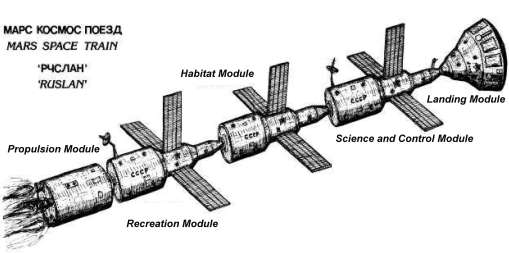
“Russia ‘to save its ISS modules’,” BBC News, 22/5. This report by Anatoly Zak says that Russian officials are speculating on the possibility of detaching the ISS Russian segment and keeping it going as an independent station/launching port for 20 or 30 years. Is it possible the detached Russian modules could be utilized as a basic spaceship to Mars, say with a module containing a nuclear reactor on the end added (to power electric engines)? This page from a 1987 book at Astronaut.ru features a spaceship design that looks a little like the Russian ISS segment, with a propulsion module and lander added.
June
2/6: Digital Soyuz and other news
My main website, SuzyMcHale.com, is still not online (server failure). Hopefully back soon …?
“Russia’s Dark Horse Plan to Get to Mars,” James Oberg, Discovery Magazine, 21/5. On the Phobos-Grunt mission. Another article at IEEE Spectrum by Anatoly Zak is “A Russian Return to a Martian Moon,” June 2009. The Chinese microsatellite that will ride onboard is to be delivered to the probe manufacturer, NPO Lavochkin in Russia, on 17 June.
Soyuz TMA-15 launched last week (27/5) with Expedition 20, so there is now a crew of 6 onboard the ISS for the first time, all from the different space agencies involved.
Contradicting earlier media reports, Roscosmos representatives said that there are no plans to disconnect the Russian segment of the ISS from 2015 and turn it into an autonomous space station. Instead, there are plans to extend the lifetime of the ISS as much as its technical capabilities will allow.
From NK №786:
02/06/2009 / 00:05 – Russia has no plans to disconnect its segment of the ISS after 2015
Roscosmos has no plans to disconnect the Russian segment of International Space Station from the U.S. and create an autonomous station from 2015. “There are no plans for disconnecting us from the ISS. On the contrary, we have a plan for extending the operation of the Station, as far as its technical capabilities will allow,” said Aleksei Krasnov, the supervisor of manned programs at Roscosmos, on Friday at a news conference at TsUP mission control center.
“There is no reason to have the segments of the ISS partner countries taken apart,” added, in turn, the president of Rocket-Space Corporation Energiya, Vitalii Lopota.
They commented on reports by some Russian and foreign media that Russian specialists are discussing the possibility of removing the ISS Russian segment in the event that other participating countries of the project did not prolong the operation of the station until 2020. According to current plans, the ISS is planned to be in use up to 2015.
At the same time, A. Krasnov noted that even before the deorbiting of the station Mir, the possibility of using part of its modules as part of the International Space Station was explored. It is a similar situation in the case of the ISS.
“We do not exclude that we will explore the possibility of using the modules of the ISS assembly, consisting of orbital research complex in low orbit that would allow the Russian space program to develop further,” said Aleksander Krasnov.
Earlier, representatives of Roscosmos has been reported on the possibility of construction in orbit from 2020, a new space station that would become an orbital plant for the production of unique materials, as well as a trans-shipment base on the way to the Moon and Mars.
A ceremony was held for the lowering of the TsPK flag, but it attracted little official or media interest (the translation is a bit incoherent):
02/06/2009 / 00:05 – In Star City the unit banner has been farewelled
On 29 May 2009 in the town of Star City a farewell ceremony was held for the banner, writesYurii Baturin. The famous Cosmonaut Training Center in Star City, established in 1960 as a military unit, was eliminated in accordance with a governmental order (№1435 from 1/10/2008). In its place there will be a new organization to train cosmonauts, but as a civilian federal government budgetary institution.
A monument to Yuri Gagarin Cosmonauts Alley to put members of the part. There were present family members of the military and the center, many with children. We cosmonaut veterans shed copious tears. And now, the last solemn march. Then the photographs of the flag. The standard-bearers probably have, as expected, began packing the banner for shipment, and the assembly did not disperse, but remembered, remembered … The mood for all was sad.
Representatives of NASA and the European space agency paid a tribute of respect to the banner and TsPK. But no-one from the Military-air forces command attended the farewell ritual. And after all the military unit as the Center of preparation of cosmonauts of the Air Forces was formed and for half a centur has made considerable glory for this kind of Armed forces of the country. There was nobody from the Ministry of Defence, nor from the Joint Staff, as if only an ordinary battalion of air field service was being disbanded. And this is a unique military division. It was not counted a significant event and in Russian Space Agency, under whose command TsPK now falls. Usually, generals from the Air Forces, and the management of the Federal Space Agency liked to address Star City from a podium and say high words to the heroes of space. Now words for some reason were not found, probably, it was difficult to look in the faces of the gathered. Probably, such a general lack of official attendance was an indirect recognition of the inaccuracy of the decision to reform TsPK.
Unfortunately, the press, except Novoi, «Новой» and Cosmonautics News, «Новостей космонавтики», has not been interested. There was no TV (possibly because there were no space tourists – a favourite central theme of space reportings).
Maybe this was for the better: no hypocrisy, had only their own flag.
Cosmonaut Aleksandr Kaleri will be the first to command the new digital Soyuz in September 2010, along with Cosmonaut Oleg Skripochka and the American astronaut Scott Kelly. (Sergei Krikalyov was at one time to be the first to pilot the digital version, but he now has other duties.) From NK №785:
28/05/2009 / 17:15 – Cosmonaut Kaleri will test the new Soyuz version
Flight tests of the “digital” piloted ship Soyuz are entrusted to the experienced Russian cosmonaut Alexander Kaleri.
“Flight of the first ship in the new Soyuz series, which is equipped with a digital control system, is scheduled for September of next year. Cosmonaut Alexander Kaleri has been entrusted to pilot the ship, having had experience of four space flights,” the space-rocket industry interlocutor said. According to him, the appointment of the flight commander was preceded by a long dispute about who to entrust the management of the new machine.
Experience in piloting of the Soyuz ships was the basic requirement during selection of candidates. “On the list were many surnames, but eventually Kaleri was appointed as the commander of the ship,” the agency interlocutor said.
In the crew of the “digital” Soyuz, the Russian cosmonaut Oleg Skripochka and the American astronaut Scott Kelly are appointed as flight engineers.
In April, 2008 the president of Rocket & Space Corporation Energiya, Vitalii Lopota during a scientific conference in Moscow said that the first “digital” Soyuz would go to space in the spring of 2009. But the launch did not take place in the announced time. In connection with necessity of carrying out of additional tests of the ship, the launch was delayed to autumn of 2010.
According to V. Lopota, installation of digital systems on the piloted ship Soyuz will require a crew of one professional cosmonaut, instead of two, as now. In that case, two nonprofessional cosmonauts can fly at once.
The modernisation of spaceships, according to V. Lopota, will bring Russian astronautics to a new technological level and to raise the safety of space flight. For the docking of the new ship to the International Space Station it is planned to use the standard scheme of docking. “We cannot afford to risk anything. Even though the ship systems were analogue, and are now digital. In no event will use of the new modernised systems change the planned algorithm,” said V. Lopota. The docking of the ship to the ISS will continue under the standard scheme, that is on the second day of flight, he has added. Visually, the president of RSC Energiya admitted, the digital Soyuz will not differ from previous versions of the ship.
The basic difference of the new ships is in the digital control systems. The control system of movement and system of onboard measurements has undergone modernisation. Innovations have allowed to increase speed and to lower weight of equipment. In contrast with the previous version, the digital cargo ship is capable to take aboard on 80 kg of more cargo, than its predecessors.
8/6: First Orlan-MK EVA
Gennadii Padalka (EV1, Orlan-MK №5, red stripes) and Michael Barratt (EV2, Orlan-MK №6, blue stripes) performed the first EVA in the new spacesuits on 5/6 for 4h 54m (07:52-12:46 UTC). The spacewalk was successful, aside from an initial delay caused by a faulty sensor reading saying there was excess CO2.
- ISS Daily Report
- MSNBC: “Delayed spacewalk ends successfully”
- NASA
- NASASpaceflight.com: LIVE: Expedition 20 first spacewalk – June 5, 2009
- Spacewalk Briefing Materials
- TsUP
“Esther Dyson, Space Tourist in Training,” IEEE Spectrum, June 2006. Interview with the backup for space tourist Charles Simonyi.
A novel way of protecting ISS occupants from radiation is to use damp napkins! From NK №784:
22/05/2009/00:05 – Damp napkins will reduce the risk of adverse effects of space radiation
A special screen, which will serve as additional protection against radiation for the crews of the ISS, should appear on board the Station in early 2010.
“We have been successfully producing prototype draft-screen curtains and by the end of this year, the Rocket and Space Corporation Energiya specialists will put the product in a Progress cargo ship to be launched to the ISS in early 2010,” said Vyacheslav Shurshakov, Head of the Laboratory at the Institute of Biomedical Problems, part of the Russian Academy of Sciences, where the screen was developed.
The screen is equipped with curtain-pockets, in which will be inserted plastic packaging with wet towels used for personal hygiene and cleaning crews of the station.
The packaged napkins are impregnated with a material containing hydrogen, carbon and nitrogen, which effectively weaken the cosmic radiation, the scientist explained. Sensors are installed outside and inside the curtains to monitor radiation doses.
Additional protection for the ISS crew is provided by securing three layers of polyethylene packaging with wet towels on the walls of the cabin which, in the opinion of scientists, will further reduce the risk of the adverse effects of space radiation.
According to Shurshakova, the first results of the “Matryoshka,” «Матрешка» experiment on the ISS showed that the dose of radiation received by the vital organs decreases almost twice when you remove the person from the walls of the station to its center. “The Matryoshka-R with sensors installed on the ISS will allow us to test the effectiveness of the radiation protection provided by the sanitary napkins delivered to the Station,” he said.
It is anticipated that the experimental screens will be fitted in the cabins of the ISS Service Module Zvezda. If the effectiveness of the new protection is confirmed, future orbital stations and interplanetary ships will be equipped with similar screens.
The sanitary napkins can be used not only for radiation protection, but also to reduce noise in the cabin from constantly-operating machinery and devices, added the scientist.
“The Phantom Torso Returns,” Space Daily, 28/5, has more about the Matryoshka experiment.
The Kazbek-UM seats in the Soyuz are to be made reusable:
26/05/2009/00:05 – Seats for the Soyuz Russian spaceships will be made reusable
The Research-and-production enterprise (NPP) Zvezda is working on prolonging the life of the Kazbek seat. “Whereas it was previously a single-use device, in connection with the increase in the number of manned launches a series of modifications is being made in order to enable its re-use,” said an interlocutor in the Russian space industry.
According to him, after the return of the ship from orbit, the seats will be returned to NPP Zvezda to evaluate their condition. Specialists will do a range of repair work, after which the seats can be used repeatedly.
The speaker recalled that the last major change in the design of the Kazbek seats were made during the development of the Soyuz TMA variant, calculated for the flight to the International Space Station of both Russian and American astronauts.
The requirements of the anthropometric parameters of NASA astronauts were greater than for the selection of cosmonauts in Russia [in other words, the Americans were better-fed :-)]. In order to accommodate the Americans in the Soyuz, the seats had to be lengthened and increased in size, explained the interlocutor.
The Kazbek seat allows a cosmonaut to endure g-forces during launch and re-entry into the atmosphere, cushioning the blow when the Descent Module hits the ground.
9/6: Paranoid silliness
The next space tourist is to be the founder of Cirque du Soleil, Guy Laliberté. He has a mini-site and blog, Guy Laliberté’s Poetic Social Mission in space (I have to admit the title makes me roll my eyes cynically, but idealism has that effect on me – yes I am disillusioned). He will launch on TMA-16, currently set to launch on 30 September. His backup (not yet confirmed) is Barbara Barrett, who has a training blog; unfortunately its viewing is currently restricted.
A Russian artist called Sergey Krainev, Сергей Крайнев, does nice space-themed paintings (found this while browsing the NK forum through an online translator).
Astronaut Leroy Chiao was soliciting opinions on his blog for the Augustine Human Space Flight Review Commission. I have no interest in this, therefore no opinion. But I found one comment that was somewhere between unintentionally amusing and exasperating as it was of the “Paranoid Patriot” variety (I might note that Leroy Chiao is of Chinese descent), so it’s worth reproducing (with minor editing as some paragraphs were repeated):
The United States, as a nation and leader of the Free World, needs to be the guardian of the Lunar Future. The last thing I want to see on a full moon is a future Chinese Territory and have to have that countries approved visa for future visits, explorations and permission for development.
By our leadership we will make sure the Lunar Future will be a free and democratic society. Sure, we will invite other nations to participate, but through U.S. leadership we will ensure it is a just system for future resource development. It may look like a large rock in the sky at the moment, but as soon as commercial development finds a way to make money there, it becomes real estate. The question will be who gets to control the distribution of the best sites, who decides future taxation of resources, etc.
We have a unique situation that we have not seen for couple hundred years, and history is about to repeat itself. We need to claim this stepping stone now, and the Liberation points, then Mars. We can do it with international participation, but it must be with bold U.S. leadership for a democratic future. The investments we make now do not just effect the next couple of decades, but the next several hundred years.
For a fraction of what we are now spending on bailouts, we could have a very aggressive infrastructure on the Moon, then on to Mars. NASA must lead the way, then get out of the way, and let private companies find a way to make money and spur further development. Once lunar surface operations can be economically self-sustaining, then NASA can concentrate on Mars and beyond.
As Ronald Reagan said in his speech to console a grieving nation during the space shuttle Challenger tragedy; “The Future Belongs to the Brave, not the Faint Hearted, Now’s the time to be brave, there will only be one opportunity for Lunar Leadership, we need to make it ours.”
There is a reason why God put us in the position of being the first nation there [WTF???]. By our leadership we will make sure the Lunar Future will be a free and democratic society.
I still have a copy of the earlier Augustine Commission’s report after Challenger. I for one do not want a Red Moon Rising.
That’s why I find the space community such a turnoff generally – too many anti-environmentalist Libertarians/Conservatives who have overdosed on Heinlein (whom I have never read, incidentally) and who think (or hope!) that colonizing space will be a re-enactment of the founding of the USA. (I have a related rant, “Space cadet growthists,” on my overpopulation blog.)
12/6: MIM-2 photos
Energiya has some photos online of the next Russian module due to be launched, MIM-2, МИМ-2 (to make things more confusing, referred to in English as MRM-2, Mini-Research Module-2). It is currently due to be launced on 10 November, propelled by a modified Progress cargo ship. The last Russian module launched was Pirs in 2001, so another one is long overdue!
A very short (12 minutes!) internal spacewalk was carried out on 10/6 inside Pirs to change over a hatch in preparation for the docking of MIM-2.
- Gennadii Padalka (EV1, Orlan-MK №5)
- Michael Barratt (EV2, Orlan-MK №6)
- 12m (06:55-07:07 UTC)
- ISS Daily Report
- NASA
- TsUP
18/6: Space nukes
From NK №788:
12/06/2009 / 00:05 – Russia will create a nuclear tug for interplanetary travel
Russia will revive a program to develop nuclear power plants for space purposes, the director of the RRC Kurchatov Institute, Mikhail Kovalchuk, said at a press conference in Moscow on Thursday.
“We need to create an atomic tug,” Kovalchuk said, recalling that in Soviet times there was a program to develop nuclear power plants; in particular the “Topaz” reactor was designed by the Kurchatov Institute.
“Using an atomic tug, you can save money for the future Russian lunar and Mars programs,” said the head of the institute. “This is a cheap way.”
According to him, the program was discussed with the management of RSC Energia, and a number of other space and nuclear institutions.
“We will reanimate these topics. We consider it as possibility to create not only engines, but also as energy sources (for spaceships).”
The Topaz reactor featured in Stephen Baxter’s Titan novel as a power source for the Space Shuttle on its mission to Saturn.
Energiya has another news report featuring ISS crews familiarizing themselves with the MIM-2 module, the next Russian module to be launched. A Buran – defunct Russian space shuttle – analog can be seen in the background of this photo. (It is the 3M [or OK-KS] full-size test model as seen on this page at Vassili’s Buran site, according to Anik.)

July
2/7: Phobos-Grunt on schedule
According to Anatoly Zak who was at the Paris Air and Space Show on 15 June, and who spoke to the head of NPO Lavochkin Georgii Poleshyuk, the components of the Phobos-Grunt, «Фобос-Грунт» probe were being integrated, beginning 20 June. The probe’s main propulsion unit is the most complex and critical element. Everything will be transported to Baikonur Cosmodrome in September of this year.
Progress M-02M undocked from the ISS (Pirs docking module) on 30/6 for autonomous flight tests of its systems; it will redock on 2/7.
From NK №789:
19/06/2009 / 08:46 – The economic crisis could derail the creation of a new Russian cosmodrome
The economic crisis could prevent modernisation of the Russian space-rocket industry, and also disrupt the establishment of our own “window” in space – the Vostochnyi, Восточный cosmodrome, Vitalii Davidov declared on Thursday.
According to him, last year’s re-financing of the industry has dramatically increased.
“Before it was one per cent, and in order to re-branch had about 70 years, starting this year, especially for the next year we have planned investments in retooling the industry, which should have been raised by 15% -20% of the overall funding level,” said the official, speaking at a meeting of the working group on innovative legislation in the Presidential Administration of the Russian Federation.
He noted that the same magnitude of re-financing was needed during the implementation of programs for the Soviet space shuttle Buran in the late 1980s.
But Davydov fears that the crisis could disrupt plans for re-equipment: “What happened at the end of last year, this crisis, we thought it would not affect our plans, but today we realize it is not possible. This is a significant impact on our plans, especially in terms of security, including independent access to space, the development of the new cosmodrome on the territory of Russia,” said the Roscosmos Deputy.
Sergei Krikalyov’s photo has at last appeared on the Gagarin Cosmonauts’ Training Center website (the Russian version so far), so he must now have officially assumed command. According to Anik, he left the Cosmonauts’ Group of RSC Energiya on 27 March 2009.
3/7: Mars-500 pointless?
From NK 792. Former cosmonaut Valentin Lebedev is of the opinion that the Mars-500 experiment will not reveal anything new, and is not an effective simulation of a journey to Mars.
03/07/2009 / 00:05 – Valentin Lebedev: Mars-500 experiment “will not provide the necessary scientific data for a manned flight to Mars”
The Mars-500 scientific experiment, which is scheduled to begin next spring, will not give scientists the data needed to understand the possibility of interplanetary flight, said the member of Russian Academy of Sciences, pilot-cosmonaut, twice Hero of the Soviet Union Valentin Lebedev.
“As for the ground experiments, the similar Mars-500 experiments, which now try to mimic the conditions of the Martian mission, offer little understanding of the problems of human flight in deep space, while we have for decades made long flights on orbital stations,” said V. Lebedev, whose paper is published on the Roscosmos site.
According to him, an experiment with human habitation in an enclosed space does not provide the necessary psychological conditions, as participants at any time may leave the premises. “It’s conditional, as if preparing to drift on ice floes in the Arctic held in winter on a pond near Moscow,” said the cosmonaut.
As noted by Lebedev, ground-based studies have little relevance to real interplanetary flight, adding that experiments on living people in closed spaces were conducted in the country several times, and the Mars-500 experiment is just a repeat of this.
The cosmonaut suggested that a special module be developed that would simulate a Mars mission, and attach it to the ISS. “Then it will be possible to create conditions in the module closest to interplanetary flight,” said V. Lebedev.
The beginning of the Mars-500 experiment, during which the scientists are planning to simulate a manned flight of six volunteers to Mars, is scheduled for the beginning of 2010. During the 520-day virtual flight, scheduled work will take place on the Martian surface for a month by two participants in the experiment inside the simulator constructed in the Institute of Biomedical Problems building.
He does have a valid point – the experiment also takes place in full gravity with no worries about radiation exposure from deep space. Attaching a specialized module to the ISS is a valid alternative; but it would be expensive (though perhaps not much more than the $10 million or so for the ground experiment?).
The rather graphic diagram below – “Mechanism of lumbar spine distraction fracture (Chance Fracture)” – is from a report on the STS-107 Columbia accident, showing the seatbelt of a crewperson cutting through their waist and snapping their spine. Ugh! That’s about the most gruesome image in the report – no photos of the bodies, alas.I suppose they would have looked something like the charred cosmonaut in my 30/11/2008 entry , but broken into pieces. There is another of a charred helmet, also below – temperatures it endured are given as 300-400°C, so one can imagine the state of the head inside. (If I go asking such morbid questions on forums though, I will be told off, so I will have to restrict my ghoulish curiosity about such things to my blog. Well, Dad was an Airworthiness Inspector [who saw dead bodies!] and Mum was a nurse [who saw dead bodies!], so I’ll blame this on them.)
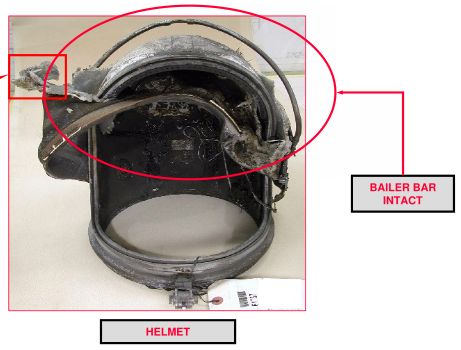
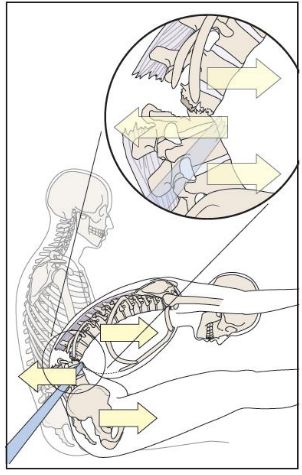
Columbia accident report photo and diagram
6/7: Module names
Anik posted some names for the next 3 Russian ISS modules suggested by Roskosmos to Energiya:
- MRM-2: Поиск/Poisk/Search (or Quest ;-))
- MRM-1: Развитие/Rasvitie/Development
- MLM: Перспектива/Perspektiva/Perspective
Hmm … not very evocative? I would like to continue with the theme of the first two modules, something like:
- Zarya, «Заря»: Sunrise
- Zvezda, «Звезда»: Star
- Svet, «Свет»: Light
- Voskhod, «Восход»: Dawn
- Avrora, «Аврора»: Aurora
7/7: Future directions
Anatolii Perminov gave some indications of the future directions of the Russian space program when he answered the questions of Russian and foreign students:
Answering one of the questions, Anatolii Nikolaevich said: “Designs of this type are not carried out in Roscosmos entities. On the other hand, these issues are studied in some R&D institutes. My opinion, not as a manager, but as a specialist, is that it is necessary to search for new energy-generation forms and ways based on different principles for space exploration. However my personal point of view may differ from the views of scientists …”
Foreign students were interested in development of the lunar habitation.
“Currently, we carry out an outstanding international project Mars-500. It intends to test feasibility of human spaceflight to Mars and return back to the Earth. Roscosmos and ESA researchers are involved in the project. The experiment is controlled from the Mission Control Center. NASA’s lunar base project has been approved. But now some changes may occur in their program due to changes of NASA Administration. We discussed it with NASA representatives in Paris. Today it is unclear if the USA will build the lunar base on their own, or involve some international partners. Lunar projects on different development stages exist in China, India, Japan, and Russia as well,” Mr. Perminov said.
Roscosmos Head also explained about perspectives of the Vostochnyi space port construction in Amurskaya region:
“Russian Government defined that up to late 2011, design and research on-site activities are to be completed and Vostochnyi construction plan is to be prepared. That is, what we are doing now on the funding appropriated. This funding is not so big, but still sufficient to accomplish this objective. Then, we will report to the Government which is to make the decision about the date to start the construction. Roscosmos believes that the construction shall start in 2012. This is in line with the space exploration strategy approved by the Russian Government, which intends maiden launch of the first cargo vehicle from Vostochnyi in 2015, and the first human spacecraft launch in 2018.”
“Aldrin thinks U.S. should set its sights on Mars,” MSNBC.com, 6/7. Apollo astronaut/Moon Man №2 Buzz Aldrin, who is outspoken on space matters, is of the opinion that:
- the U.S. “oversee” an international team of lunar explorers, which includes China.
- While other countries are occupied there, the U.S. sneaks off to Mars and gets there first.
I would, of course, like to see a Russian manned mission get to Mars first! Would be compensation for missing out on the Moon.
8/7: Quit whinging!
The front page of the Roskosmos site featured a graph showing funding of the civil space programs of various countries for 2008. The figures, in billions of dollars, are:
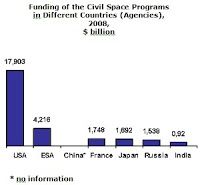
- USA: $17.903
- ESA: $4.216
- China: unknown
- France: $1.748
- Japan: $1.692
- Russia: $1.538
- India: $0.92
The USA, represented by NASA, gets more funding than the other countries put together! People on space forums keep whinging about NASA’s supposed lack of funding, but compared to what little Russia and other countries have to make do with, NASA is comfortably well-off.
13/7: Moon melancholy
The 40th anniversary of the first Apollo Moon landing is coming up, so there is a lot of blather and angst in the media and on various forums. No Russian cosmonaut has yet been out of low Earth orbit – one wonders if they ever will. The anniversary has inevitably brought out the Paranoid Patriots, as evidenced in these quotes:
Now potential rivals such as China seek to challenge US dominance in space, and some see the new space race as once again a battle between ideologies.
“From the point of view of the future of the western world and its Asian allies it’s imperative that the US, Europe, Japan, Australia, Canada and other like-minded countries be competitive in deep space,” Moonwalker and geologist Harrison Schmitt told AFP.
Schmitt said he believed that “non-democratic nations of the world, China, Russia and maybe others, fully intend to be dominant in space …[and] gain that kind of prestige, that kind of advantage in technology and education and other fields that come with being the dominant space power.
“With the Apollo program we taught them how,” said Schmitt, who was the last astronaut to step out of a lunar craft and onto the moon surface in 1972.
– “Space, man’s greatest challenge, 40 years after Moon walk,” Space Daily, 12/7/2009
STS-127 Atlantis is still trying to launch; it has had 4 scrubs so far! Originally to have launched on 13 June, the first delay was due to a hydrogen gas vent leak; the second because of a work light knob embedded between the pressure pane on Atlantis’ pilot window and the dashboard panel, and the last two because of thunderstorms. The next attempt is in a few hours. A very frustrating process for all involved, as the orange External Tank has to be drained and refueled each time, and the Shuttle crew has to prepare themselves, only to be disappointed. (Maybe they should try sacrificing a goat.) The Soyuz manned rocket launches are, in contrast, rarely delayed (I don’t know if any have been).
Posters at the Novosti Kosmonavtiki forum are not too impressed with the proposed names (6/7/2009 entry ) for the next 3 Russian ISS modules, describing them as “utilitarian,” lacking in romanticism, difficult to pronounce (i.e. too long) and imitating NASA’s pointedly symbolic names. Some proposed are: «Спектр», Spektr (Spectrum), «Природа» Priroda (Nature), «Радуга», Raduga (Rainbow), «Горизонт», Gorizont (Horizon). The names are “recycled” (used on previous projects, such as the Mir space station) but are nicer than the officially-proposed ones.
Progress M-02M successfully performed a re-rendezvous test today to verify the new passive KURS-P system antennas and TORU target installation accuracy at the SM PkhO (Service Module Transfer Compartment) zenith port. There was some nervousness about this as a similar 1997 Progress (M-34) rendezvous with Mir bumped into the space station.
15/7: Mars-105 completed
The Mars-105 isolation experiment was concluded yesterday (14th) at 10:00 UTC, the 6 participants emerging in good spirits. One wonders if the same will be the case after 500 days! I suspect not. Mars-500 is currently due to begin in early 2010. “Mars flight simulation experiment ends,” MSNBC.com, 14/7, has some details. Having no Internet access would be a major deprivation for me!
NASA’s fifth launch attempt of STS-127 Atlantis was unsuccessful, so they are trying for a sixth today! (22:03 UTC) The record for the most launch attempts is 6 for STS-61C in 1985-86 (launched on the 7th attempt). The External Tank is certified for 13 refill cycles before it is no longer usable. There are 7 flights left before the Shuttle program ends.
16/7: Space welding anniversary
A somewhat obscure anniversary for the 15th is the first electrical welding during an EVA, according to Roskosmos:
Electrical welding was first performed in space 25 years ago by Svetlana Savitskaya and Vladimir Dzhanibekov, Russian cosmonauts. They spent 3.5 hours in outer space cutting and welding pieces of metal. The universal space welding machine was designed by Electrical Welding Institute, Kiev. For more than 10 years, the scientists were developing this complicated instrument.
Today the cosmonauts involved in this first space welding attempt tell about their experience.
“It was easy due to 0-gravity,” says Svetlana Saviskaya. “However, many people thought that we had made a special performance, that we hadn’t been working in space. Like with the first step on the Moon.”
“In outer space, with this invisible ray, it was a real miracle,” adds Vladimir Dzhanibekov.
The machine was tested deeply, but the developers could not define its behaviour in space precisely.
Specialists of the Kiev institute are still sure that their instrument will be used in future. The first welding in space opened one more page in the space exploration history.
Today Russian cosmonauts and scientists from Kiev recollect their past achievements and the time when Russia and Ukraine were conquering space together …
Below is a photo of Svetlana welding, possibly the only photo of a female cosmonaut doing an EVA? (From the Capcomespace site)
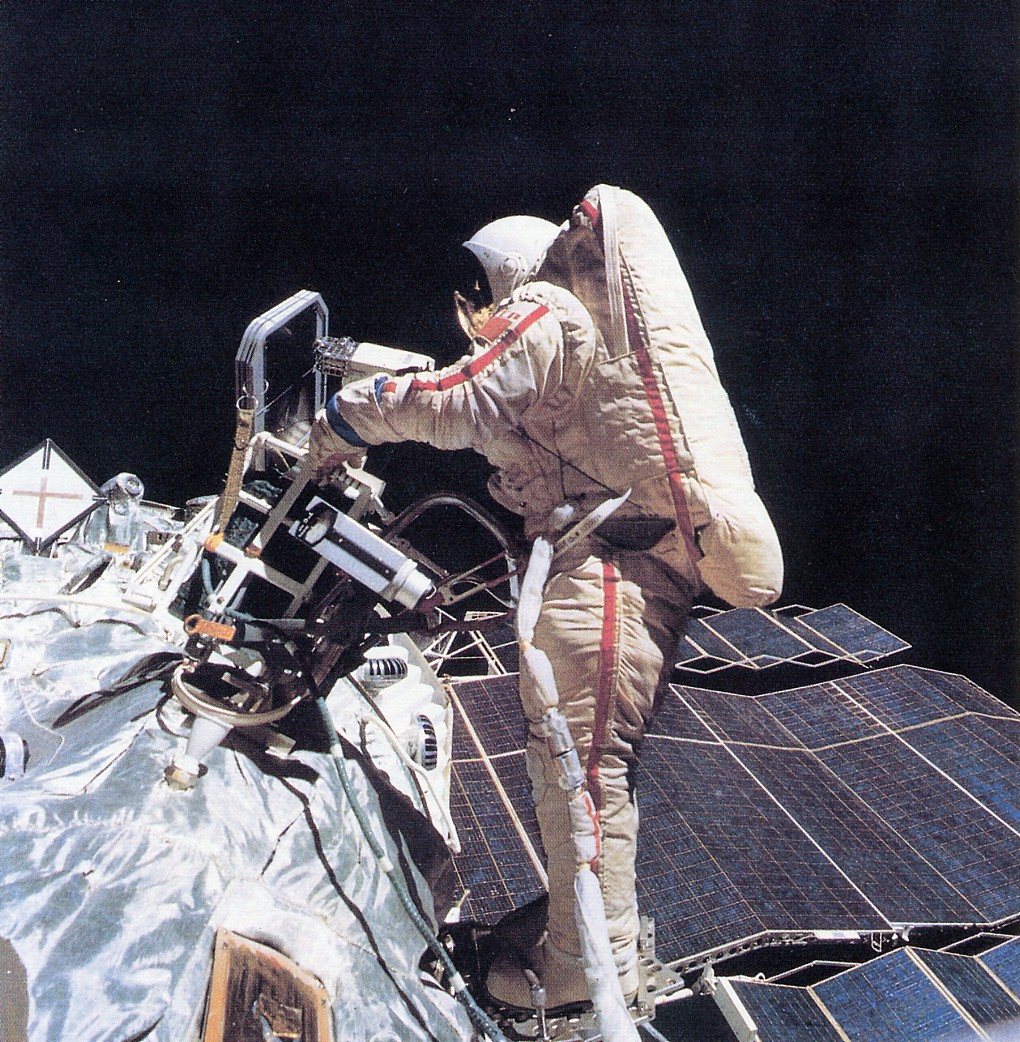
STS-127 Atlantis launched at long last on its 6th attempt. More segments for the Japanese Kibo module will be installed, and two crewmembers will swap places (Koichi Wakata down; Timothy Kopra up). With 6 people on board going up or down at different times on different spaceships, keeping track of them all can be confusing!
21/7: Sergei on the Moon
Cosmonaut/Star City Chief Sergei Krikalyov is quoted in this article at MSNBC.com, “Russia still blue over moon landing”:
“Beginning with the first flight with a primitive capsule, and then getting to the moon, it was a great achievement for humanity,” Russian astronaut Sergei Krikalev said.
“Of course, we would have liked to see the first man on the moon be Soviet, Russian, but that’s life … Our own achievements were very many,” he told Associated Press Television News. […]
Russian space officials meanwhile still seem to be dreaming about winning the next stage of the space race. They keep talking in tantalizing terms about mounting a manned mission to Mars, although they say that would take at least another 20 years to get off the ground.
“I think this is fine. It’s like sports – at one stage one person wins, at another it’s somebody else,” said Krikalev.
I wonder if he will go into space again; in 2005 he said he would be willing to fly to the Moon if a program was developed.
“Soviet Top Secret Space Project Gets Second Life,” Roskosmos, 20/7. The NK-33 rocket engines used in the unsuccessful N-1 lunar rocket project are still quite advanced, and Russia and the USA are co-operating to make use of them.
25/7: Armchair experts
One source of continuing amusement and exasperation is the pontificating of the “armchair experts” regarding the future of the U.S. space program. They proliferate on spaceflight forums. Many are of the opinion that NASA should “get out” of designing and launching rockets, and leave this to the “expertise” of private industry (despite NASA employing hordes of experts and launched rockets for 50 years or so). This commenter on a NASA Watch article had what I thought was a great rebuff:
Sorry to rain on the “private space is great” parade, but as of today they have yet to make even one orbit of this rock for all of the money they’ve spent.
What happened to the second flight of SpaceShipOne? No floating candy as it falls back to Earth, unable to break free of the gravity well.
Listen up, people! This isn’t aviation, nor ocean sailing. It’s spaceflight, and it’s much more difficult to accomplish than it looks. Sure, NASA and the Russians make it look easy, but 50 years ago, it wasn’t. And if you are realistic about it, it still is not easy. Other than submarining, it’s the most difficult activity known to humanity.
So keep on trumpeting the “accomplishments” of the private space industry, but don’t be so quick to turn over access to space to the same people who brought us the meltdown of our financial system. 30 years ago, trusting Wall Street with your retirement made as much sense as playing the ponies. It still does.
Meanwhile, Stevie Wonder created a song just for the “private space industry”: “You Haven’t Done Nothing.”
Orbit the planet. Bring the pilot back alive. Then we’ll talk.
“Perhaps a better analogy would be ‘Why doesn’t the federal government farm out its automobile transportation needs to Hertz or Avis or Enterprise Rent-A-Car’ ‘Why should the government own cars?’ ‘The government should get out of the car ownership business’.”
Yes, by all means, let’s turn this over to companies who will collude to give the government a “special rate.” And please, spare me any talk about “competition.”
When Warren Buffett and Bill Gates pony up their billions for private spaceflight, then we the taxpayers will do the same.
We buy enough snake oil every day!
– Posted by: Dave H. at July 24, 2009 9:01 p.m.
There doesn’t seem to be the equivalent for the Russian space program; perhaps there are some on Russian-language forums, but I can’t read these.
“Alexey Leonov: ‘I Could See Armstrong Bouncing on the Moon’,” Roskosmos, 20/7. A lengthy interview with cosmonaut Aleksei Leonov on various topics, including the Apollo Moon landings (he gets irate at those who believe the program was faked), Yurii Gagarin’s death, and the prospect of a Mars mission (not any time soon).
Cosmonaut Gennadii Padalka, currently in orbit on the ISS, accumulated 500 days in space on 18/7, over 3 missions (Soyuz TM-28, TMA-4/ISS-9, TMA-14/ISS-19).
26/7: What never was
From NK №796. Reminisces by Academican Mikhail Marov on why the USSR’s manned lunar program was unsuccessful, and of watching the Moon landing from TsUP.
21/07/2009/20:53 – The Soviet machines did as much science as the American “Apollo” – scientist
The Soviet program for the exploration of the Moon using robotic missions brought about the same amount of basic science knowledge as the U.S. “Apollo” manned missions, but were much cheaper, said Academician Mikhail Marov, who was one of the developers for the Soviet lunar program.
“I can say that we have got equivalent results, because we have sampled a substance, we investigated, and it was a major task. Moreover, we received very meaningful results from the automatic lunar rover or mobile devices, they worked on the surface for many months,” said the Agency representative.
However, he stressed that he does not want to minimize the scientific value of these flights. Marov recalled that one of the members of the Apollo expedition – Harrison Schmitt – a professional geologist: “And he walked on the moon with hammers, and, of course, he, being a professional, garnered much important geological information.”
“Man is a very important component, because he is much more able to multi-task, he is able to adapt to the challenges he poses for himself. But this in no way underestimates the role of machines as well,” said the Agency representative.
21/07/2009/20:53 – The Soviet moon landing program was prevented by the death of Korolyov – opinion
That the Soviet program of manned flights to the Moon did not take place is largely due to the sudden death of Chief Designer Sergei Korolyov, and also because of problems with the carrier – the N-1 rocket, said one of the participants of the Soviet lunar program, Academician Mikhail Marov.
Korolyov had always dreamed about exploring the Moon and, of course, it is surprising that less than two years after launching the first satellite we were able to implement the first launches to it, said Marov.
He recalled that the Soviet probe Luna-2 in September 1959 was the first one in the world to land on the lunar surface. Then this program was successfully developed, but in 1961, following the flight of Gagarin, the “Moon race” started – U.S. President John Kennedy’s message to Congress set a target of within 10 years to plant people to the moon, and thus negate the achievements of Soviet space exploration.
“We could not surpass this, and our efforts at the Design Bureau Korolyov start the program to grow. But there were many difficulties, and the main difficulty was the development of the heavy vehicle N-1 – the equivalent of the American Saturn-5, with the help of which were carried out expeditions to the Moon,” said Marov. The N-1 heavy vehicle, which was to bring the Soviet L3 lunar spacecraft to the Moon, had suffered setbacks since the first launch in February 1969. All four test launches ended in disaster. The American lunar vehicle Saturn-5 first launched in November 1967.
“If you now look at the situation in retrospect, I believe that our failure to a very high degree was associated with the sudden death of Korolyov in January 1966, and this, of course, had very, very harmful consequences,” said the Academician. Korolyov died in January 1966, several days after a routine operation.
21/07/2009/20:53 – Soviet-era TsUP met the landing of Americans on the Moon with silence – Academician
The Soviet military, engineers and scientists, observing the disembarkation of American astronauts on the moon in the Mission Control Center near Moscow, responded to this event with silence, remembers one of the participants of the Soviet lunar program, academician Mikhail Marov.
Exactly 40 years ago, on 20 July 1969, American astronauts Neil Armstrong and Buzz Aldrin left the landing module Eagle and became the first humans to set foot on the lunar surface. “I watched this in the mission control center, Korolyov, Moscow. This information was not broadcast on normal television, but was broadcast on the big screen in TsUP. We observed all phases of flight carefully, but the culmination, of course, was the landing,” said Marov, who already in those years was one of the leading researchers of the Institute of Applied Mathematics, Keldysh, which was developed by the Soviet lunar program of study.
He remembers that he experienced contradictory feelings, which in his opinion, did not differ from those of colleagues.
“First – this is certainly admirable – I saw such a landmark event, which was a few years ago and the dream it was not easy. And, of course, I was delighted that this was realized in the lifetime of my generation when I could witness it,” said the scientist. “And the second feeling was, but why have we not done this. We are also able to do it.”
However, those assembled in TsUP did not express their emotions. “For the most part they were silent. At the time, space was controlled by the military to a very strong degree. There were a lot of military generals, conservative, tough-minded people. They were silent. There was admiration, applause,” remembers Marov. According to him, the professionals assembled understood what a colossal achievement this was, and how this was a great engineering achievement.
“Although later it became clear that Americans on several occasions were literally on the verge of breakdown, including the first flight, but they did have great flexibility in system management, and had superbly trained crew to ensure perfect execution of the program,” said the Academician.
Russia getting humans first to Mars would make up for the disappointment of missing out on the Moon.
“Unraveling Russia’s moon riddles,” James Oberg, MSNBC.com, 24/7. Many Soviet-era space artifacts ended up being auctioned off in the West, rather sadly, because those in the space program at the time needed money more.
August
30/8: Forward to Mars
I haven’t felt much like writing, so some catching-up to do.
“Sexual Discrimination in Space,” Roskosmos/Russia Today, 25/7. An interview with Svetlana Savitskaya, the second Russian woman in space and the first to do an EVA. Unfortunately there have been only 3 Russian women to fly in space to date (none currently in orbit), and there is still discrimination.
“Russia Reveals Vision for Manned Spaceflight,” IEEE Spectrum, August 2009. Russia revealed yet another future vision at this year’s MAKS Airshow. The ultimate goal is to get to Mars first (hooray!). Of course they don’t have the budget, so they aim for international co-operation to share the load.
“I believe that we should move [straight] to Mars … as the moon cannot be a goal by itself,” says Vitaly Lopota, the head of RKK Energia. “Nevertheless, all the infrastructure that we are proposing for the Interplanetary Expeditionary Complex could be used for operations in Earth orbit, but also for the lunar exploration, if such goals emerge,” Lopota told IEEE Spectrum.
Anatoly Zak, the article’s author, will be following developments on his website.
“NASA suggests teaming up with Russia for Mars flight,” RIAN, 25/8. Don’t know how serious this is! It generated the usual cynicism and paranoid patriotism on this thread at NASASpaceflight.com forum.
Some differing opinions via NK №803 on how far in the future a Mars mission might be – hopefully sooner than later! Nice to see that some in the industry want to go to Mars first. (NSF.com thread)
25/08/2009 / 20:07 – Manned expedition to Mars will not take place in less than a hundred years
In today’s economic and scientific situation, the prospect of sending a manned expedition to Mars is unprofitable, Boris Chertok – Chief Scientific Adviser, Rocket and Space Corporation Energia, Academician of the Russian Academy of Sciences – said today at the Sixth International Aerospace Congress.
“Until now, a manned mission not made the fundamental discoveries of such a level as unmanned,” he said. “It is therefore wiser to spend money on exploration of Mars machine than an expensive place to send an expedition, which will bring no more, and perhaps even less information.”
According to the academician, “the time for human flight to the Red Planet will come in a hundred years, at least fifty, while the same slogan of modern space must be “Forward to Mars!” And “Onward to the moon!” NASA is planning an expedition to Mars after 2020.
According to the scientist, “people must return to the moon not to promote the national image, but as a researcher, and must return there for a long time.” And Chertok sees a man not so much space explorers as “assembler, builder, and in the future – space tourist.”
28/08/2009 / 00:05 – A full-scale manned expedition to Mars could be realized in the years 2029-2031 – Academician at the RAS
A full-scale manned expedition to Mars could be realized in 2029-2031, respectively. This opinion was expressed in Moscow, at the Sixth International Aerospace Congress by Lev Zelenyi, Academician at the Russia Academy of Sciences, director of the RAS Space Research Institute.
He said the manned mission will be preceded by several preparatory steps. In the first stage, in the period from 2012 to 2020 an engineering model of the physical conditions in the flight path, around and on the surface of Mars will be created through a special program of automated scientific satellites, including meteorological conditions in the atmosphere. The rationale for the choice of a landing site will be made as well.
In the second stage, from 2018 to 2025, it is expected to work out the infrastructure elements of the Martian expedition.
For the third – from 2025 to 2028 – there will be implemented a piloted flight expedition to the placing of an inhabited spacecraft into orbit around Mars, with the possibility of controlling automatic moving vehicles on the Martian surface from orbit.
“A full-scale manned expedition to landing on the Martian surface can be realized in 2029-2031 years,” says Zelenyi. The Academician himself has no doubt that if you choose between a flight to the Moon and Mars, it is better to make a choice in favor of the red planet. “I belong to the ‘left’ faction, which believes that the study of Mars is more interesting than the Moon” – an insider joke, he said. “At Mars, we can expect great discoveries,” he suggests.
September
21/9: Modules named
Via Anik at NASASpaceflight.com, the modules have been officially named, listed in launch order:
- МИМ-2/MIM-2/MRM-2 – «Поиск»/Poisk/“Search” (launch 15/8/2009)
- МИМ-1/MIM-1/MRM-1 – «Рассвет»/Rassvet/“Dawn” (8/4/2010)
- МЛМ/MLM/MLM – «Наука»/Nauka/“Science” (December 2011)
“Russia celebrates half a century since touching the moon,” Energiya/RT, 14/9. It is 50 years since an unmanned Soviet spacecraft, Luna-2, landed on the lunar surface.
“Crunch time for Russia Mars probe,” BBC News, 14/9. Roskosmos was to decide whether the Phobos-Grunt probe should be delayed until the 2011 launch window; it confirmed this on the 16th as the flight control systems need more testing to confirm reliability. Disappointing, but better safe than sorry.
A PDF document, “ISS Program International Cooperation, Paris, June 17, 2009” (500 KB), can be downloaded from NASA; it is a Russian Powerpoint plan of future developments, reproduced below:
Head of Russian Federal Space Agency – ISS Program International Cooperation – Paris, June 17, 2009
1. Roscosmos View On NASA Current Plan For Human Space Flight
- Critical to the ISS program implementation are the issues of technical and transportation support (crew rotation, crew rescue, cargo delivery, etc.).
- Roscosmos welcomes NASA endeavor to speed up the development of the new piloted transportation system “Orion” and the new launch vehicle “ARES-1.”
- Successful implementation of Commercial Orbital Transportation Services for the ISS would allow to streamline technical and transportation support of the station and to make it more systematic and stable.
- NASA human space flight program looks quite balanced and promising to us.
2. Cooperation with NASA in ISS Program
- Roscosmos-NASA cooperation over recent years has provided the following results:
- After Columbia accident in 2003 the permanent crew presence on the ISS was ensured and maintained;
- The ISS international crews rotation has been conducted including rescue capability in case of contingency situations; the ISS cargo delivery and utilization has been ensured taking into account the planned Space Shuttle retirement in 2010;
- ISS US Segment deployment has been completed;
- The launch of Soyuz TMA in May 2009 increased the ISS crew up to six persons.
- Cooperation experience accumulated by Roscosmos and NASA allows us to proceed to the next stage of ISS utilization: a full-scale implementation of the national programs of scientific experiments in space and ISS utilization as an international space laboratory.
3. Desirability of ISS Operation Beyond 2016
- Completion of the ISS US segment deployment as well as Roscosmos plans to additionally equip the ISS Russian segment in the nearest future will significantly increase the ISS scientific potential.
- By 2015 the ISS will have the unique capabilities for scientific research in space, engineering development and implementation of humanitarian, educational and commercial projects.
- Taking into account these circumstances, as well as recommendations approved at June 2008 meeting of Heads of Agencies Roscosmos considers it expedient to prolong the ISS utilization term up to 2020 at the minimum.
4. Russia Future Plans For Human Space Flight Program
- The prospective plans for the Russian human space flight are determined by the Federal Space Program of Russia for the period from 2006 to 2015, the Concept of Russian Human Space Flight Development till 2020 and a number of other documents.
- The main objectives of the future human space flights are:
- Exploration and efficient utilization of the near Earth space.
- Study and exploration of the Moon, Mars and deep space in order to resolve global problems on the Earth and in space and to generate new knowledge for the benefit of the humankind.
- In order to achieve the above mentioned goals we expect to make the following steps in the timeframe till 2020:
- Complete the assembly of the ISS Russian Segment and to continue its utilization in full configuration;
- Provide the creation of the prospective crew transportation system based on a new generation piloted spacecraft;
- Build and prepare for operation the first elements of the orbital assembly experimental piloted space complex by the end the ISS life cycle;
- Develop elements, technologies and key systems of prospective interplanetary complexes for missions to the Moon and Mars, and develop new means and methods of biomedical support to ensure long-term human space flights, including the interplanetary flights, and so on.
5. Future Interaction With NASA In Space Exploration
- The experience gained by Russia, US and Europe in the area of piloted space complexes and their long-term utilization, including the ISS activities, allows us to proceed to the implementation of the larger-scale projects, in particular, the development of piloted spacecraft for missions to the Moon and Mars.
- Roscosmos supports the necessity of involving technical and scientific potential of other countries for such large-scale projects implementation.
- Russia finds acceptable those projects which ensure equal rights of partners who will share the obtained results and also Russia’s participation in the development of critical elements (launch vehicles, power propulsion systems, technologies and experience of long-term crew life support in space).
- In this connection Roscosmos considers it expedient to establish the international joint expert group to conduct comprehensive analysis of integration feasibility in the sphere of space exploration.
6. What has Roscosmos learned from the ISS partnership?
- Apparently, the ISS lessons show that any critical element in the project should have a backup (should be redundant). As a rule, such elements include launch vehicles, crew and cargo transportation spacecraft and Mission Control Centers.
- During the utilization phase the redundancy should be provided by various modules and project elements for the specific functions such as habitation, power supply and, partly, the payload complexes and systems.
- The ISS could serve as a unique test stand for developing advanced technologies. This process has already started and will expand as we accumulate more experience and capabilities for autonomous stay on the ISS.
- The ISS lessons show that educational and public outreach activities are very important for attracting the young people’s interest to space.
- The ISS international management structure has already demonstrated its success. It would make sense to apply this experience to other big international projects.
7. How would you characterize the Russian obligations and that of the US to the ISS in terms of its operational life?
- The main tasks of Russia and the US at this point are as follows:
- maintenance of operation of the ISS Russian and US Segments for implementation of the national programs of space experiments and research;
- fulfillment of mutual obligations under existing international arrangements;
- maintenance of ground infrastructure for the ISS nominal operation;
- transportation and technical provision of the ISS according to the agreements achieved with NASA in view of the Shuttle retirement in 2010;
- participation in managing the ISS program (the ISS coordination boards and groups);
- provision of the ISS efficient utilization.
- We believe that the Unites States, as the main coordinator of the project, will promote stable and planned implementation of the ISS program, including the transportation and technical provision of the station, the required conditions for the crew presence onboard, improvement of the station control structure, etc.
8. How does ISS and its extension past 2015 connect to Russia’s future plans for human and robotic exploration beyond low-Earth orbit?
- By the end of the ISS life cycle Roscosmos plans to develop and prepare for operation the first elements of the orbital assembly experimental piloted space complex which will become a basis for engineering development for future human missions to Mars beyond 2030.
- It is impossible to create such a complex without a preliminary testing of its elements in space and verification of engineering solutions and technologies.
- The ISS operation experience demonstrates that the station utilization allows to solve the unique tasks of extending the life of both the station elements and the automatic space instruments (space telescopes, etc) in autonomous flight. This adds another good argument in favor of the ISS program extension till 2020 and beyond.
Accompanying diagrams:
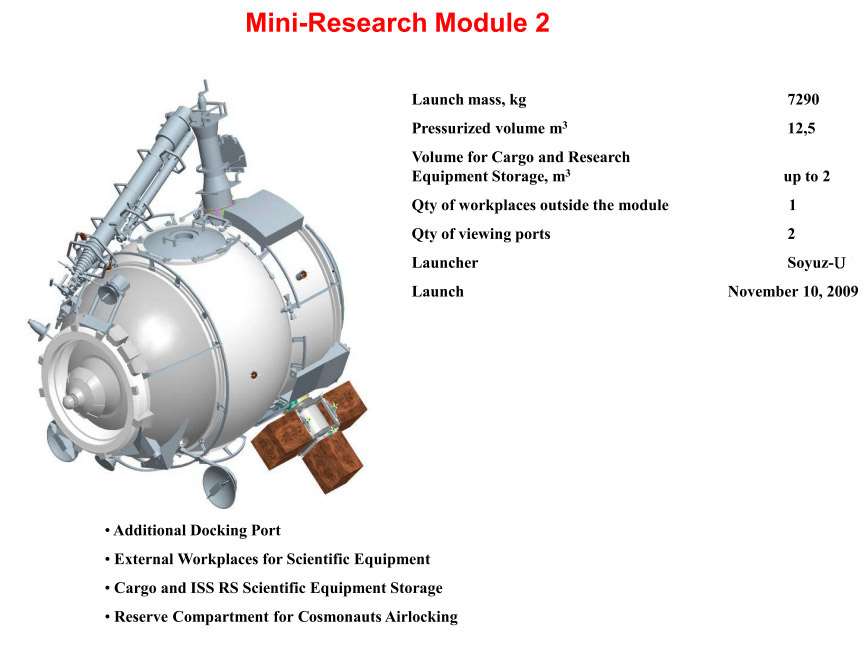
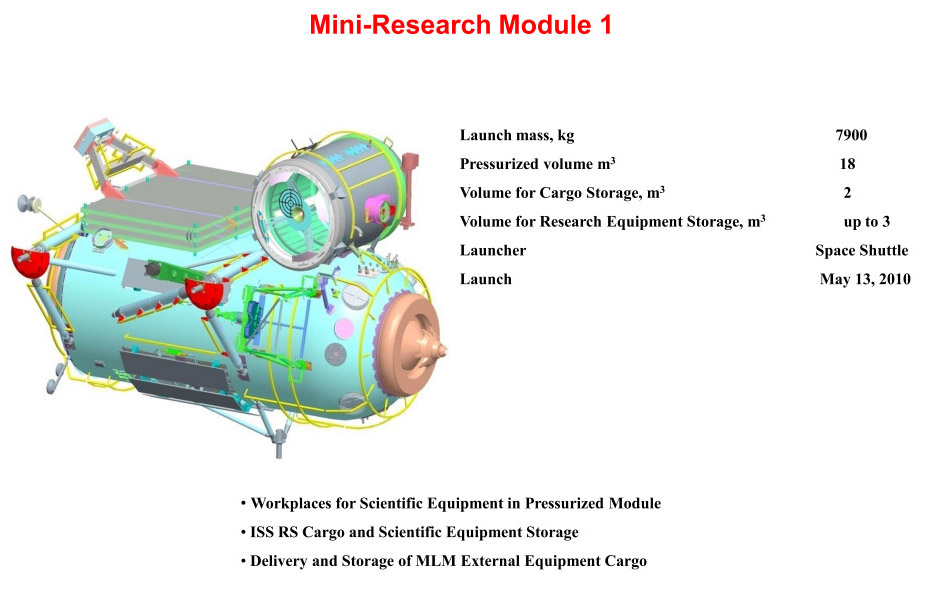
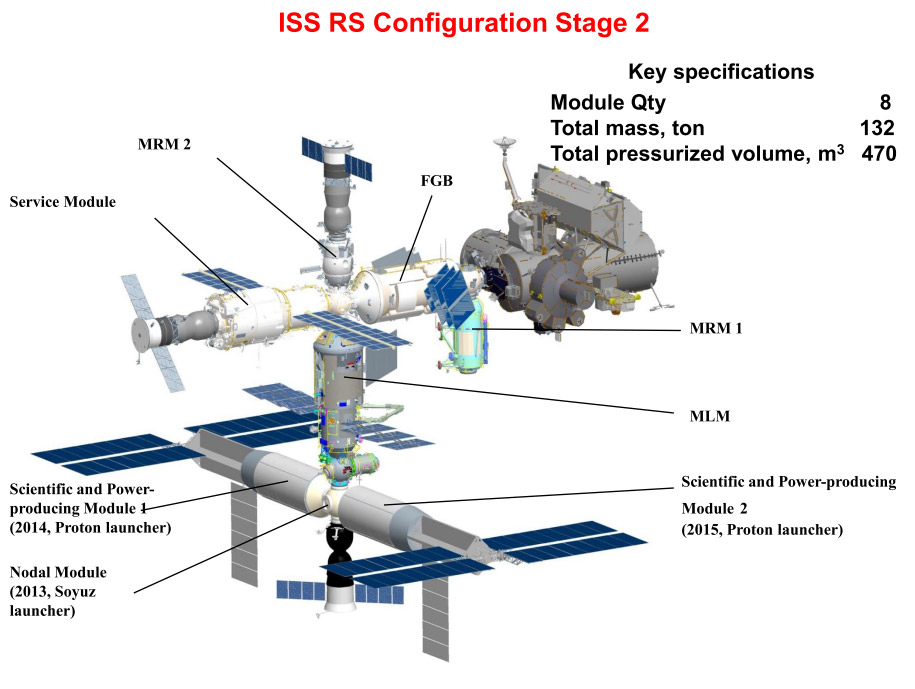
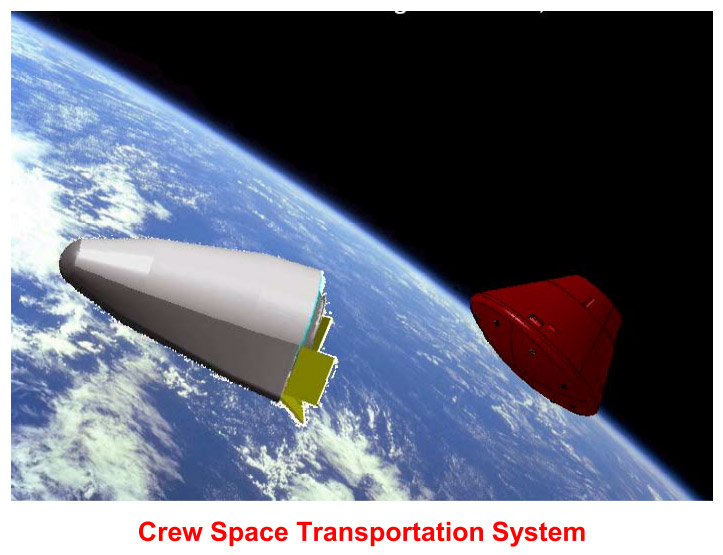
29/9: A futile endeavor
“‘Space clown’ buoyant ahead of space launch,” MSNBC, 28/9. I can’t say I feel impressed with the anticipated antics of the latest space tourist, who is soon to launch on Soyuz TMA-16. Yes, I know it’s his money and he can do with it as he likes, but the “poetical social” blather he plans on indulging in seems frivolous.
Other space tourists have used their time at the space station to conduct scientific experiments, but Laliberté has different aims for his 12 days aboard the orbiting lab. “I am not a scientist, I’m not a doctor, I’m not an engineer,” he said. “I’m an organizer, a showman, and a creator – I have an entertaining personality, so that is really what I am bringing here.” Laliberté has promised to bring each crew member of the space station their own clown nose to wear, but plans to take two along for himself: one red, one yellow – “the yellow one I will wear when I am a little grumpy, and the red one I will wear when I am happy and joyful.”
*Rolls eyes in cynical disgust*
Laliberté also aims to use the trip to promote awareness of world water supply problems. On Oct. 9, he will lead a “poetical social” performance from aboard the station for the One Drop Foundation, an organization he set up in 2007.
“I start with the simple idea of reading a poem, which will involve characters like the sun, the moon and a drop of water,” he explains. “Those characters will then engage in a discussion, which will take the form of a little poetic story that we will read to the population of Earth.” Activists and celebrities, including former U.S. Vice President Al Gore and Colombian pop star Shakira, are to contribute to the performance from 14 cities worldwide, and all of it is to be shown on the foundation’s Web site.
One major reason for water shortages is human overpopulation, but I can be certain he won’t mention that factor. He also, incidentally, has 5 children, which is not helping the environment!
I was oddly reminded of this scene from Stephen Baxter’s novel Titan, where the renegade astronauts enroute to the moon of Saturn are going a bit crazy:
Benacerraf watched, discreetly, as Angel took up position near the water spigots of the galley. And, with his skinny, spindled legs folded under him, he started to play with water. Angel took a syringe now, for example, and filled it with water from a spigot. When he pressed the plunger, slowly and carefully, injecting water into the air, a small bubble grew from the needle’s tip. He jerked the needle away and the water took the form of a tiny planet, floating in the air. Angel worked his needle and produced a whole set of the little water globes, drifting in the air around his head.
Then he took smaller syringes from a set he’d improvised from medical waste, and injected the bubbles with iodine, grape juice, diluted orange juice, to stain them blue, green, yellow, red. Soon he had a whole Solar System, Benacerraf thought, with a miniature Mars and Earth and Jupiter, floating around his bearded head as if around a sun. Angel’s eyes followed the little spheres, entranced. […]
Benacerraf was no expert on abnormal states of the mind. But she hadn’t tried to discuss this with Mission Control. She wasn’t sure who would be listening any more anyhow. And on a planet where local wars were flaring over water management problems, the image of gaunt Americans playing head games with the wet stuff on some dumb Buck Rogers mission halfway to Saturn would not play well with the public.
October
29/10: Scandal in Star City
Former cosmonaut Aleksandr Volkov became Head of Star City Administration on 22/10. Coincidentally, he did two long space missons with Sergei (Mir Principal Expeditions 4 and 10). (Roskosmos interview, only in Russian). There was a scandal surrounding the initial candidate, as described in this news article (reproduced below), where Colonel of the FSB Nikolay Rybkin was arrested for allegedly organizing the illegal delivery of an exceptionally large contraband of Chinese goods through Baltic Customs. This caused much indignation in Star City as he was a popular figure, and some thought the arrest a set-up.
The Star City scandal
By: Aleksandr Emelianikov, Vladimir Bogdanov
Yesterday, Star City held mayoral elections for the first time. The elections took place in scandalous and highly strung conditions related to the recent arrest of the main candidate, resigned Colonel of the FSB Nikolay Rybkin.
The situation got so heated that many respectable residents of Star City wrote to the president, asking him to support the free will of the citizens. 63-year-old Rybkin was detained late night on the territory of Star City on June 24. The next day, Basmanny Court gave orders for his arrest.
Rybkin is suspected of organizing the illegal delivery of an exceptionally large contraband of Chinese goods through Baltic Customs. A dummy organization was used, Rosmoravia, and Rybkin, a former chekist (KGB serviceman), is one of the founders of the company. These goods, with an estimated cost of 10 million roubles, were later sold on the Russian market. The judicial investigation suggests that part of the contraband was directed to Moscow’s Cherkizovo market.
The criminal case against the members of Baltic Customs involved in the smuggling from China and selling the goods on the markets of Moscow Oblast and other regions, including on markets the group of companies of ACT, was initiated in February of this year. The cofounders of LLC Rosmoravia, Tarakanov and Potocky, have also been arrested.
The Head of the Investigation Committee, Aleksandr Bastrykin, announced that he will be fighting to eliminate the Cherkizovo market:
“We have been searching for those responsible for these illegal goods in the amount of $2 billion. No one knows who had delivered these products here,” he commented on the outcomes of the investigation for the first six months of the investigation during the board meeting of his committee. He continued to say that “this pigsty needs to be shut down, and we will bring it to an end in the near future. Though not everything is so simple. When one digs deeper into the problem, protection rackets come to light that one cannot even dream of.”
Rybkin’s arrest provoked a huge response in Star City. The suspect was considered a respectable figure of authority who did many things for Star City’s residents. He was considered a great sponsor of the town. One of his widely known acts was reintroducing twelve swans that inhabit the town’s lake. There was a time when Star City was proud of these birds, but during perestroika, someone ate the swans and sent the bones to the town’s administration. Rybkin, once again, ordered the swans from abroad. He restored fountains. Near his house, he built an exact copy of the home where Yury Gagarin was born and raised in the Smolensk Oblast, and opened a museum named after Gagarin.
According to our sources in the special services, the chekist headed the local counterintelligence department for the last 25 years. In his youth, for several years he was a radio-gunner on a Tu-16 bomber. He then graduated from the KGB school, and in 1976 began working at the cosmonaut training center where he ensured the protection of classified government intelligence on human spaceflight.
In his line of work with counterintelligence, he got promoted to the post of Deputy Chief of the Center. He completed missions abroad. In particular, he took part in rescuing hostages in Somalia and Ethiopia, for which he was awarded the Order of the Red Star. In 1995 he stopped a dangerous criminal who was responsible for 200 crimes, including 28 murders. For that, the former KGB man was awarded the Order of Courage.
Right after the arrest over the scandal, his attorney Roman Smadych announced that his client would be prepared to go on hunger strike if there was not going to be an impartial investigation into his case, or if he isn’t granted the constitutional right to participate in the Star City mayoral election. Rybkin, however, did not go on a hunger strike after all, and his surname can still be found on the list of mayoral candidates.
Many residents of Star City are connecting Rybkin’s arrest with the elections. They think that someone is trying to eliminate the leading candidate from the race.
Aleksandr Volkov, Commander of the Cosmonaut Corps (1991-1998), and Hero of the Soviet Union: “I’ve known Nikolai Rybkin for more than 30 years. I doubt I will be mistaken if I say that no one worries about Star City more than he does: he worked with pensioners, cared for the veterans of the Great Patriotic War and those of the Afghanistan war. This is a person who cares about the future of this town, and the people who live here.
“One ought to consider that many people cast their votes well before the court ordered his arrest. I know that Aleksey Leonov cast an early vote. He especially went to Shchyolkovo to vote. And if one were to judge from our two houses, the election day turnout must have been high as well. Everyone perfectly understands that the decision of who will lead Star City depends on our vote.”
A curious bit of trivia noted in the article is that some Australian black swans (one of which can be seen in this Roskosmos news report) inhabit the Star City lake! (Some hapless swans got eaten.)
«Звездный с трудом снимает погоны» (“Star City difficult to demilitarize”), Roskosmos, 23/10 (only in Russian). Interview with Sergei Krikalyov on the problems of administrating Star City and transferring it from military from civilian control. A lot of the infrastructure is old and needs upgrading. The Russian Air Force/Defence Ministry seems eager to secede control over Star City – I thought it would have been an asset? One reason for the transfer is cost-cutting by Minister of Defence Anatolii Serdyukov (source). Something they may regret?
Soyuz TMA-14 landed on 11 October. Guy Laliberté was still wearing that blasted red nose! (I really hate clowns.)

November
2/11: Cosmonaut journal
Roskosmos seems to have taken inspiration from NASA and is (at long last!) hosting a journal by Maksim Suraev, now in orbit. It is currently only in Russian. [Update 5/11/2009: Also now in English at Russia Today]
“Why does the Cosmos attract me?,” Russian Cosmos magazine, November 2009. An interview with NASA Administrator Charles Bolden. He mentions Sergei Krikalyov as they both flew on STS-60 in 1994.
Progress M-MIM2/M-MRM2 («Прогресс М-МИМ2»), carrying the new module Poisk, «Поиск» (“Search”), is due to be launched on 10 November (the day after my birthday!). The Energiya site has a series of pre-launch preparation photos.
“Russian president backs nuclear spaceship,” MSNBC.com, 28/10. Russian officials said they wanted to build a nuclear-powered spaceship (the preliminary design ready by 2012, and 9 more years to build it), an announcement met with the usual skepticism (“Show me the money!”). I am not sure if the nuclear component is a reactor powering electrical propulsion engines, or an actual nuclear rocket propelling the ship. A diagram below, which illustrates the former version (from “Russian nuclear-powered spaceship” at the Orbiter Forum):
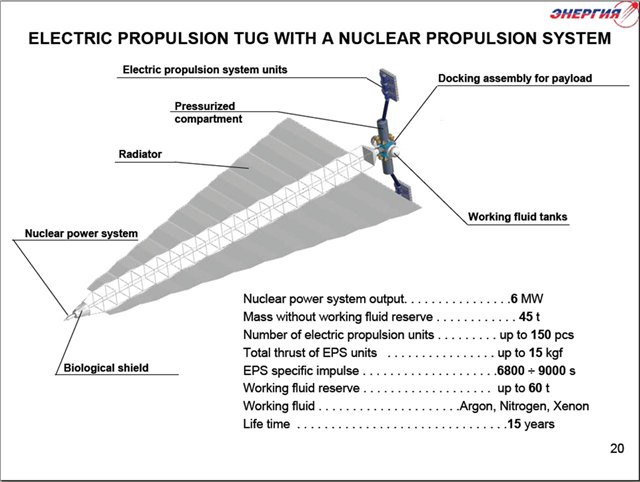
Energiya nuclear tug
This entry at NASASpaceflight.com also mentions the proposal. According to another commentator:
It is basically the solar electric tug Energia proposed some years ago for a Mars mission, but they now replaced the huge solar power arrays by a nuclear reactor. The solar-powered version must have been too much in terms of required orbital assembly operations (mentioned in the following link), so they opted for the nuke.
Daniel Marin has an entry (in Spanish) at his blog – “Russian nuclear ships” – detailing various Russian developments for nuclear-powered space missions.
6/11: Nuclear space tug
On the Roskosmos site is a “Presentation by A.S.Koroteev, Keldysh Center Director: ‘Significant Objectives of Space Exploration in the 21st Century’,” showing Powerpoint plans for a nuclear space tug (click the English flag in the top right corner).
“New Russian Crew Vehicle Simulator will be Built in Three Years,” Roskosmos, 3/11.
Simulator of the new Russian crew vehicle Rus’ will be built in three years, Director of the Simulator Design Center Valentin Shukshunov says. The process can be started once draft design of the vehicle is completed. The simulator system will consist of 4 trainers intended to train diferrent exercises. Integrated simulator is the first one to be built, then there will come docking and vehicle control simulators. In other words, Shukshunov says, the simulator will appear earlier than the vehicle itself.
Via NK №817: the training simulator for the proposed “Rus” spaceship could be created 3 years after the design of the ship is completed – in 2013 – the director of the Flight Simulator Training Center (Центра тренажеростроения), Valentine Shukshunov, has said. A virtual model would be created first, then the training apparatus. The training complex would include at least 4 different apparatus, including a complete spaceship simulator, another for docking, and another for in-orbit flight. The simulator would be ready before the actual spaceship made its first flight. For 30 years of the history of the enterprise, only once has the training apparatus been created earlier than a spaceship’s launch into space, or a space station module has been sent into an orbit. This has been the case for the training apparatus of the small laboratory module (MIM-2). The training apparatus for it already operates, though the module is not sent yet into orbit.
“Poisk Module: Brief Description,” Roskosmos, 4/11. Includes two computer images of MIM-2, though not translated into English yet.
Poisk, also known as the Mini-Research Module 2 (MRM 2), is a new Russian docking module of the International Space Station. Its original name was Docking Module 2 (Stykovochniy Otsek 2 [SO-2]), as it is almost identical to Pirs already on the station.
It will be added to the zenith port of the Zvezda module, and will serve as an additional docking port for Soyuz and Progress spacecraft and as an airlock for spacewalks. Poisk will also provide extra space for scientific experiments, and provide power-supply outlets and data-transmission interfaces for two external scientific payloads to be developed by the Russian Academy of Sciences. The mass of the module is 4,000 kg. It has a diameter of 2.6 m and length of 4.6, providing 12.5 cubic meters of internal volume.
14/11: MIM-2 docked
The fourth Russian module «Поиск», Poisk is now safely docked to the ISS. Some launch data:
- Launch date: 10 Nov 2009 at 14:22:04 UTC
- Launcher: Progress M-SO2 №302 on a Soyuz-U rocket
- Docking date: 12 Nov 2009 at 15:41:42 UTC
- NASA Human Spaceflight Gallery MIM-2 photos: JSC2009-E-214432, JSC2009-E-214433, ISS021-E-024516, ISS021-E-024517, ISS021-E-024518, ISS021-E-024520, ISS021-E-024522, ISS021-E-024524, ISS021-E-024527, ISS021-E-024531, ISS021-E-024534
- NASASpaceflight.com thread: Progress M-MIM2 launch
22/11: Left behind
“Cosmonaut: Russia falling behind in space race,” MSNBC.com, 20/11. Cosmonaut Mikhail Tyurin is concerned at Russia’s tardiness of developing a new spacecraft, and that it will fall behind other countries and become irrelevant. Cosmonaut Pavel Vinogradov voiced similar concerns last year (18/5/2008 entry), about Russia being relegated to a space tourist taxi service.
He said officials’ talk of using the ship to fly to the International Space Station, and then the moon and Mars, are unfeasible. “One vehicle can’t be both a steamroller and a Formula One racer,” he said. […]
Tyurin said that work on the prospective ship has proceeded slowly, with engineers continuing to argue over such basic things as whether the new spacecraft should come back using parachutes, like the Soyuz, or land like a plane, similar to the U.S. shuttles. […]
But Tyurin warned that the failure to develop new space technologies would relegate Russia to a secondary role in the near future. “Very soon, no one will need the Russian space program,” he said. “Our partners already have got all they could from us. They won’t take us into the future.”
“Russian room ready for space station launch,” MSNBC.com, 9/11. On the new Russian module, Poisk, launched 2 weeks ago.
“Industry Insiders Foresaw Delay of Russia’s Phobos-Grunt,” Spacenews.com, 5/10. Article by Anatoly Zak on why the Phobos probe has been delayed until 2011: more equipment testing is needed, the onboard flight control system wasn’t ready, nore are ground control facilities.
“Russian Cosmonaut’s Blog Much Funnier Than NASA,” Wired.com, 18/9. On Maksim Suraev’s blog (at Roskosmos and translated into English).
Not exactly what you’d find NASA astronauts like Mike Massimino writing about, and that’s exactly what makes the reflections worth reading. We tend to receive our vision of space exploration through the American lens, so it’s great to get some outside perspective on what’s going on up there. And Suraev’s site really feels like someone’s blog.
December
4/12: Connected at last
Good news for orbiting Internet addicts – the ISS has access at last (though experimental at the moment) – 3/12/2009 On-Orbit Report:
At ~11:05 a.m. EST, Jeff Williams conducted a one-hour video-based training session on the exciting new CSL (Crew Support Local Area Network) capabilities and hardware. [Crew Support LAN Phase 1 will provide live Internet access to the ISS crew (initially only USOS crewmembers) as safely, securely and reliably as possible whenever Ku-band is available. The access will be accomplished by connecting to a remote desktop session on a remote server (Citrix server) located on the ground, which hosts the virtual desktops, and the crew sees only an image of the remote desktop which does the Internet surfing. Video and audio can be received (but may be choppy or sometimes out of sync). The CSL, a virtual network completely separate from the station-wide Ops LAN, will use existing IBM A31p laptops and existing network hardware. Initially, there will be only one CSL laptop (Client 1) and one CSL server (CREWLAN SERVER) both set up in Node-2. After the initial testing, the CSL will be expanded to include up to four clients.]
The Roskosmos/Russian Space Agency site has had a makeover (though still using tables for layout, tsk, tsk) – the English-translated pages seem to have gone. Hopefully they will return? Also, my links in previous blog entries to their pages now seem to be broken – I hate it when that happens!
Soyuz TMA-15 landed on 1 Dec 2009 at 07:16 UTC with ISS-21 aboard. (NASA photo gallery)
25/12: TMA-17 docked
Soyuz TMA-17 docked on 22 Dec 2009 at 22:48 to Zarya FGB nadir port with ISS-22/23 on board, adding to Maksim Suraev and Jeffrey Williams. Maksim is still keeping his Orbital Log (link in my blog links to the right).
There was a post at the Mars-500 Livejournal blog (in Russian) that a Chinese volunteer might be included in Mars-500 (replacing one Russian volunteer).
From 15 to 18 December 2009 a meeting was held between IBMP specialists and Chinese Cosmonauts Training Center (KTSPK). The meeting was devoted to discussing issues related to the possible participation of Chinese experts in the project “Mars-500.” As a result of the meeting was agreed on the possibility of inclusion in the scientific program of the 520-day isolation in the framework of the project “Mars-500” three scientific methods. In addition, discussed the possibility of inclusion in the crew of a Chinese volunteer.