RuSpace: 2010
January
24/1: ISS online
The first ISS spacewalk for this year took place on 14/1, from the Russian segment, the 24th Russian spacewalk. Details:
- Maksim Suraev (EV1, Orlan-MK №4)
- Oleg Kotov (EV2, Orlan-MK №5)
- Duration: 5h 44m (10:05-15:49)
- From Pirs
- ISS Daily Report, NASASpaceflight.com thread, TsUP
“At last, space station crew gets live Internet,” MSNBC.com, 22/1. I did mention in my 4/12/2009 entry that the ISS crews were getting Internet, and this article gives more details (see also “NASA Extends the World Wide Web Out Into Space,” NASA Media Advisory, 22/1/2010).
Humphries said the space Internet uses the station’s high-speed Ku-band antenna, so it is active whenever the station has that connection. To surf the Web, astronauts can use a station laptop to control a desktop computer on Earth. It is that ground computer that has the physical connection to the Internet. There are security restrictions in place to protect the Internet portal, which NASA is calling the Crew Support LAN (Local Access Network).
Energiya’s website is undergoing a makeover with a new design (reminiscent of NASA’s current site); the old one has been in place since the 1990s. They are still using a table for page layout though (a very outdated method now), and the site is not very accessible (too much Javascript, and I wish they would discontinue the images appearing in pop-up windows!).
I decided to rename my “Kosmonavtka” sub-site to “RuSpace” (Russian Spaceflight) which is easier to say and remember. I wish I had not chosen the Kosmonavtka name – it makes no sense (it means “lady cosmonaut,” «Космонавтка») and sounds weird – but was stuck for a name at the time, and happened to see it in a book. Thankfully I did not choose it for my main site URL (it was an option I considered).
I found out how to do 301 redirects, so have spent the afternoon moving files. Unfortunately it means anyone who has linked to my site will have to update bookmarks or links (there are quite a lot), and search engines will have to reindex, which might take many months.
I don’t update my space site (or this blog) much anymore; I feel little enthusiasm for it. The manned space program itself is going nowhere slowly – or around in circles – and just seems stagnant. Perhaps if there were an international manned Mars mission my interest would rekindle, but such a mission is unlikely to happen for a long time, if ever, given the numerous problems in the world.
February
13/2: Mars-500 spacesuits tested
From NK №836, rough computer translations of two Mars-related news items. First, a manned Mars mission is not in current Russian plans, disappointingly. I would like to see one happen before 2020! Hopefully before China or other countries send a mission there.
11/02/2010/00:05 – A piloted flight to Mars is not yet included in Russian Space Department plans
A piloted flight to Mars is not included in the upcoming plans of the Russian Space Department and is not included in the space program of Russia, the head of department Anatoly Perminov said Wednesday on air at the radio station “Voice of Russia.”
“In the foreseeable future no flights to Mars are planned. New modern or future systems of power impellent installations are for this purpose necessary; as well as these, there may also be nuclear installations developed,” Perminov noted.
For a performance of such flight, he considers it necessary at first to solve a number of scientific problems. “The ground experiment Mars-500 will soon begin, and a number of the European countries are actively participating in it.”
For a flight to the Red planet, according to Perminov, new power impellent installations will be required.
“Perhaps, these will be nuclear installations. Are we working on this? Yes. There are no secrets. Because the president of our country has set us this task. In one of programs there is development of power impellent nuclear installation. With its help it will be already possible in the future to reach Mars in under a year and and a half, and in the shortest possible time,” Perminov stated.
The head of the Russian Space Department has also confirmed the readiness of the Russian Space Department to co-operate from NASA in developing such systems. “It would be desirable, that such large-scale projects were international, with faster results, and lessening costs. We are ready to co -operate. If for some reasons it does not turn out, we will develop in parallel,” Perminov said.
The spacesuits for Mars-500 are modified/recycled Orlan-DMA suits, an older version of the current Orlan-MK used in orbit on the ISS. They were successfully tested. There is a gallery at the Mars-500 site from mid-2009 of a spacesuit being tested.
12/02/2010/00:05 – “Marsonauts” from experiment “Mars-500” will work on the surface of the Red Planet using Russian lunar tools
In the research-and-production enterprise NPP Zvezda situated near Moscow on Wednesday has passed a control “run” of a new spacesuit which will be involved in the “Mars-500” experiment, simulating a piloted flight to Mars.
Two testers for NPP Zvezda worked for hours in spacesuits on a surface imitating that of the Red Planet, carrying out various manipulations with special tools. One of the “marsonauts” broke up large chunks of rock, and then using the probe would pick up wooden blocks, simulating pieces of Martian soil, and put them in a pouch hanging from her utility belt. Another “pioneer” scooped up sand with a small shovel (the sand imitating loose soil) and dumped it in a special container.
“These tools were developed in the 60 years of the last century for a national lunar program,” explained one of the leaders of the Soviet lunar program from RSC Energiya, Oleg Tsygankov. After the program was canceled, the miraculously preserved instruments can now be used in the experiments on the preparation of manned flights to other planets, he said.
After collecting rocks, the space travelers imitated Michael Jackson’s famous moonwalk in their spacesuits and dropped to one knee, like a knight offering his hands and heart to his lady.
“The spacesuits are based on the old Orlan-DMA Russian suit,” which is different from the new Orlans which the ISS crews wear in space,” the chief of department NPP Zvezda, Gennadii Shchavelev, said. First of all, they are smaller in size: length and chest. As well, they weigh only 30 kg – four times less than the zero-g Orlans – as the testers on Earth are not helped by weightlessness. One more difference: the Orlans have a self-contained life-support system, while in the “Martian” spacesuits, air for cosmonauts moves through long hoses from special compressors.
The colour of the new “suits” is unusual also – unlike the white Orlans, their “Martian” colleagues are made of a brilliant peach-coloured fabric. “We could not decide on a color for the new spacesuits,” designer Galina Borisova said. “We looked at many fabrics – blue, steel, dark blue – but eventually settled on this color that is harmonious with the reddish Martian surface.”
“The spacesuits behaved impeccably, all systems functioned normally, no improvements are not required,” Shchavelev summed up the test run.
After drying, the “Martian” spacesuits will go to the warehouse, and then, after a fitting with the selected Mars-500 crew, the suits will be transferred to the “Martian spacecraft,” situated in the Institute of Biomedical Problems of RAS, which in April will begin the 520-day experiment.
15/2: Into the sunset
One of the ISS-22 crew took a striking photo of STS-130 Endeavour silhouetted against an orbital sunset (the photo is a bit blurry). It seems pointedly symbolic! There are just 4 more flights after this, in 2010 (if the schedule holds): STS-131, -132, -134, -133.
Cranky curmudgeonly Apollo astronaut Jack Schmitt (who has featured here before) wrote another opinion piece on the U.S. space program changes, “New Space Policy Cedes Moon To China, Space Station To Russia, And Liberty To The Ages,” full of the usual “paranoid patriot” hysteria about the loss of America’s dominance in space. Mate, there’s plenty of room out there for everyone! The article seems to have been removed from the site where I originally read it, but there is a copy on another blog. Some extracts below and my trite commentary (there should be a “drinking game” for everytime the words “leadership” and “freedom/liberty” are mentioned for these types of articles).
The Administration finally has announced its formal retreat on American Space Policy after a year of morale destroying clouds of uncertainty. The lengthy delay, the abandonment of human exploration, and the wimpy, un-American thrust of the proposed budget indicates that the Administration does not understand, or want to acknowledge, the essential role space plays in the future of the United States and liberty. This continuation of other apologies and retreats in the global arena would cede the Moon to China, the American Space Station to Russia, and assign liberty to the ages.
Just a bit histronic. “Wimpy, un-American thrust”?? That sounds … suggestive.
Histories of nations tell us that an aggressive program to return Americans permanently to deep space must form an essential component of national policy. Americans would find it unacceptable, as well as devastating to liberty, if we abandon leadership in space to the Chinese, Europe, or any other nation or group of nations. Potentially equally devastating to billions of people would be loss of freedom’s access to the energy resources of the Moon as fossil fuels diminish and populations and demand increase.
Again the obsession with leadership. Diminishing resources will be better coped with by learning to live more sustainably and decreasing population growth, rather than hold out a nebulous hope of magically solving these problems by exploiting the Solar System’s resources (not with current spaceship technology we won’t!).
Returning to the Moon and to deep space constitutes the right and continuing space policy choice for the Congress of the United States. It compares in significance to Jefferson’s dispatch of Lewis and Clark to explore the Louisiana Purchase. The lasting significance to American growth and survival of Jefferson’s decision cannot be questioned. Human exploration of space embodies the same basic instincts as the exploration of the West – the exercise of freedom, betterment of one’s conditions, and curiosity about nature. Such instincts lie at the very core of America’s unique and special society of immigrants.
The frontier myth cited yet again *groan*. The exploration of the West came at the cost of the original inhabitants (Native Americans).
With a permanent resumption of the exploration of deep space, one thing is certain: our efforts will be as significant as those of our ancestors as they migrated out of Africa and into a global habitat. Further, a permanent human presence away from Earth provides another opportunity for the expansion of free institutions, with all their attendant rewards, as humans face new situations and new individual and societal challenges.
Outer space = Libertarian paradise? He’s been reading too much Heinlein.
Returning to the Moon first and as soon as possible meets the requirements for an American space policy that maintains deep space leadership, as well as providing major new scientific returns. Properly conceived and implemented, returning to the Moon prepares the way to go to and land on Mars. This also can provide a policy in which freedom-loving peoples throughout the world can participate as active partners.
Moon’s been done. It’s boring! Go to Mars.
Again, if we abandon leadership in deep space to any other nation or group of nations, particularly a non-democratic regime, the ability for the United States and its allies to protect themselves and liberty will be at great risk and potentially impossible. To others would accrue the benefits – psychological, political, economic, and scientific – that the United States harvested as a consequence of Apollo’s success 40 years ago. This lesson has not been lost on our ideological and economic competitors.
How about trying co-operation rather than competition? Space colonization is too big and expensive for any one country to do it alone.
22/2: Anatolii Perminov interview
“Roscosmos Head Anatoly Perminov Answered the Questions of Novosti Kosmonavtiki Magazine,” RK, 22/2. A reprinted interview on the Roskosmos site. As the English version which I linked to may or may not show up because of the peculiar content management system their site uses (and the HTML code is mangled), I have reproduced it below.
The Hydrolaboratory (Gidrolaboratoriya, Гидролаборатория) where cosmonauts and astronauts train for EVAs at Star City marked 30 years of operations on 18/2. I have a page about it on my website.
26/2: Mars-500 shortlist
Selection candidates for the 520-day Mars flight simulation have been announced (though not on the official site yet). There is one Chinese candidate (he is not on the lists at Spacefacts or Wikipedia), and no women:
| Name | Age | Country | Profession (for simulation) |
|---|---|---|---|
| Sukhrob Kamolov Камолов, Сухроб Рустамович |
32 | Russia | Doctor, surgeon Хирург |
| Mikhail Sidel’nikov Синельников, Михаил Олегович |
37 | Russia | Engineer-electrician Инженер-электромеханик |
| Aleksei Sitev Ситев, Алексей Сергеевич |
38 | Russia | Engineer Инженер-кораблестроитель |
| Alexander Smoleevskii Смолеевский, Александр Егорович |
33 | Russia | Doctor, GP Врач общей практики |
| Alexander Sukhov Сухов, Александр Викторович |
32 | Russia | Engineer |
| Boris Yegorov Егоров, Борис Афанасьевич |
44 | Russia | Engineer |
| Andrei Zhirnov Жирнов, Андрей Александрович |
30 | Russia | Engineer |
| Jerome Clevers | 30 | Belgium | Engineer |
| Arc’hanmael Gaillard | 34 | France | Engineer |
| Diego Urbina | 27 | Italy | Engineer |
| Wang Yue | 27 | China | Tester Исследователь |
After the 6 finalists have been selected, the simulation is to begin in late April, consisting of a 250-day outward trip, a 30-day stay on its surface, and a 240-day return flight.
March
6/3: Mars-500 food taste testing
IMBP has the news of the candidate shortlist posted on their website, and a group photo.
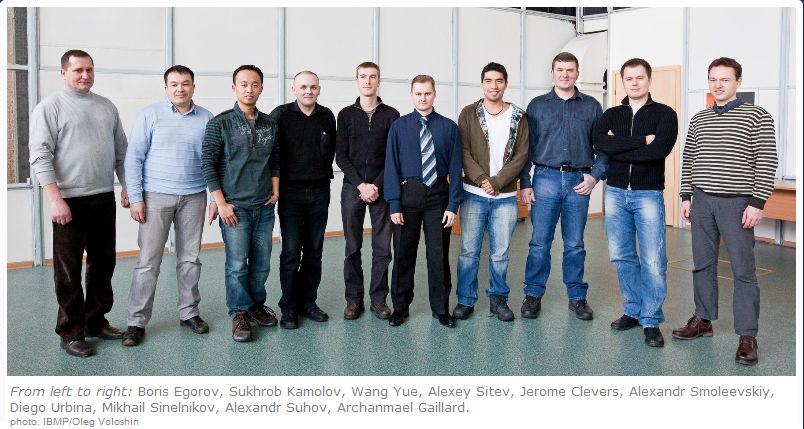
Mars-500 candidates
The candidates also had to do food taste testing (not an onerous chore!) for the prepackaged food they will need to take on board for 520 days (nearly 1½ years). There won’t be any fresh fruit or vegetables (unless they manage to grow these in a greenhouse).
Doctor Alexandr Agureev (head of the department of nutrition in IBMP and the head of works on nutrition in “Mars-500” project) informed the investigators about the fact that in the given experiment for each stage of the experiment its own variant of food ration would be used:
- The stage of simulation of the flight to Mars. The ration is formed from the products (including semi-finished products of dishes), manufactured by a series of European firms («Apetito», «Kellogg», «Hipp», «Coppenrath», «Enervit», «Knorr»). This part of the ration is supervised by German scientist Doctor Jens Titze from the University in Erlangen.
- The stage of landing to Mars. The second variant of the ration will have 2 kinds. For the three crew members who will simulate descent and going to the Martian surface, the food ration will be formed from the products ready for consumption without heating and it will only foresee consumption of hot drinks. For these purposes real space products used during forming of food ration for the crews of transportation vehicle “Soyuz” are most suitable. The rest three crew members who will simulate flight on the Martian orbit, will eat the ration of the first and third variants.
- The most difficult task is forming of the 3rd variant of food ration for the stage of simulation of the flight from Mars to Earth. It is connected with the fact that the main mass of products for cosmonauts has shelf life in temperature conditions of the environment from 1 to 2 years. However, assortment of products having 2-year shelf life is extremely limited.
In 520-day experiment this food ration will be formed from products produced by food enterprises of Korea, Italy, China and Russian (“Gala-Gala” firm and enterprises of food industry Michurinsk city).
I think I will be feeling more interested in Mars-500 than the real manned space program, which is currently limited to a few people going up to the ISS, staying a few months, going down, etc. It has been suggested that an ISS crew member stay up there for a year or more (as cosmonaut Valerii Polyakov did on Mir for 437 days during 1994-1995), but nothing has come of that so far.
The estimated cost of the project is €15 million (around $20.5 million U.S. dollars). I really wish that could have been put toward a real Mars mission. My own (quasi-suicidal) plan is for a manned test mission to Mars and back, orbiting the planet without landing (thus the extra expense for a Mars lander would not yet be needed). The crew would be a minimal two, and the spaceship would be based on the structure of the ISS Russian segment, with a “Topaz” nuclear reactor in an extra rear module to provide power for electrical propulsion (solar power is not enough that far out to Mars). As the mission is experimental, the crew would need to accept the inherent risks (will the life support systems function for that long? Will they survive the effects of background radiation exposure?). Maybe Russia and China could team up to do such a mission. This mission could pave the way for a more expensive manned landing. It would also excite public interest, especially with the risks involved.
20/3: Soyuz TMA-16 landed
Expedition 22 (Maksim Suraev & Jeffrey Williams) landed on 18/3. Maksim was the first Russian space blogger, and his informal entries proved very popular with the public.
Roskosmos chief Anatolii Perminov said at the traditional meeting for the Soyuz TMA-18 crew on 19/3 that the financial crisis had not affected the process of preparing the cosmonauts for flight.
Some items from NK No.843:
Russia could possibly increase the number of yearly Soyuz manned spacecraft launches from 4 to 5 from 2012 onwards, because of the timing of the construction cycle that takes 2.5 years. The fifth would carry a space tourist. Since 2009, Russia has doubled the number of launches from 2 to 4 to service the ISS with an increased crew of 6; space tourist flights were thus suspended in 2010. Two Indian cosmonauts will make an orbital flight on one of the extra ships in the 2013-2015 period, according to an agreement reached recently between Russia and India. The chief of Enerigya, Vitalii Lopota, said that a fifth Soyuz could possibly be constructed in 2010 to carry a tourist, possibly in mid-year.
Academican Lev Zelenyi (Лев Зеленый) of the Russian Academy of Sciences said that Russian scientists are not satisfied by the small quantity of the research experiments implemented on the International Space Station (only 2 or 3 out of 500 experiments proposed). Most experiments carried out are technological rather than pure science (one of the latter being “Plasma Crystal”). Despite his misgivings, though, his own opinion of the ISS has become more positive.
“In the beginning I was a complete opponent of the ISS, considering that it was a waste of time and resources. Why? It was the 90s, in space no nothing, space science ceased existence under Yeltsin. We started to put our scientific instruments on Western machines, and ISS absorbed most funding. This was done not in the name of science, but for the sake of political prestige. But now it is possible to assess what happened, not to look guilty or innocent, and to perceive what become a reality. ISS made it possible to preserve the ‘human face’ of our space program, and that its merit. It is certainly important in developing space medicine. Americans in this area have we learn something. And if we start talking, and then carry out a manned flight to Mars, some experience on the ISS will certainly be in demand and useful. Over the past years, we have much lost in space, but the experience of long flights is still preserved,” concluded the Academican.
They seem to be a bit more enlightened than Russia regarding women in space! (See 16/10/2007 entry.)
Two women will be part of the second generation Chinese spaceflight group (along with 5 men), selected from a shortlist of 15. They are all aged between 27 and 34, are qualified to fly fighter jets, and all must be married mothers. (Guardian, Space Daily)
Xu Xianrong, an expert at the air force general hospital, said women had advantages as astronauts over men because they were more mentally stable, better able to bear loneliness and had better communication skills. The insistence that they should also be wives and mothers does not relate to their multi-tasking abilities. Officials are concerned that space flight might affect their fertility. “It’s out of the consideration of being responsible for the female pilots,” Xu told the state news agency Xinhua. “Though there is little evidence on how the space experience will affect the female constitution, we have to be extra cautious. After all, it’s unprecedented in China.”
China is to launch the 1st unmanned experimental module of a planned space station next year (2011). It is an 8.5 ton (7.7 tonne) module, named Tiangong-1, or “Heavenly Palace,” and is to be first used for docking practice by the Shenzhou spacecraft – an unmanned Shenzhou-8 in 2013 – then manned -9 & -10 flights.
23/3: Mars-500 ESA cosmonauts
“‘Cosmonauts’ ready for Mars test,” BBC, 22/3. The European Mars-500 candidates are briefly profiled, along with an overview of the experiment. See also the related thread at NASAspaceflight.com, where the European astronauts were presented at a press conferenceat ESA’s European Space Research and Technology Centre in Noordwijk, the Netherlands on 22/3 – also reported at the ESA Mars-500 site, “To Mars and back – as real as it gets.”
“Kazakhstan hindering Russian space missions: official,” Space Daily, 27/2. Kazhakstan officials being difficult because they can (and there is probably some payback for the USSR period). I think they will eventually make a bid to take over Baikonur. Hence the need for the new launch complex at Восточный, Vostochnyi (“Eastern”) in the Amurskaya region. Another thread at NSF.com shows ground reservation maps for Vostochnyi.
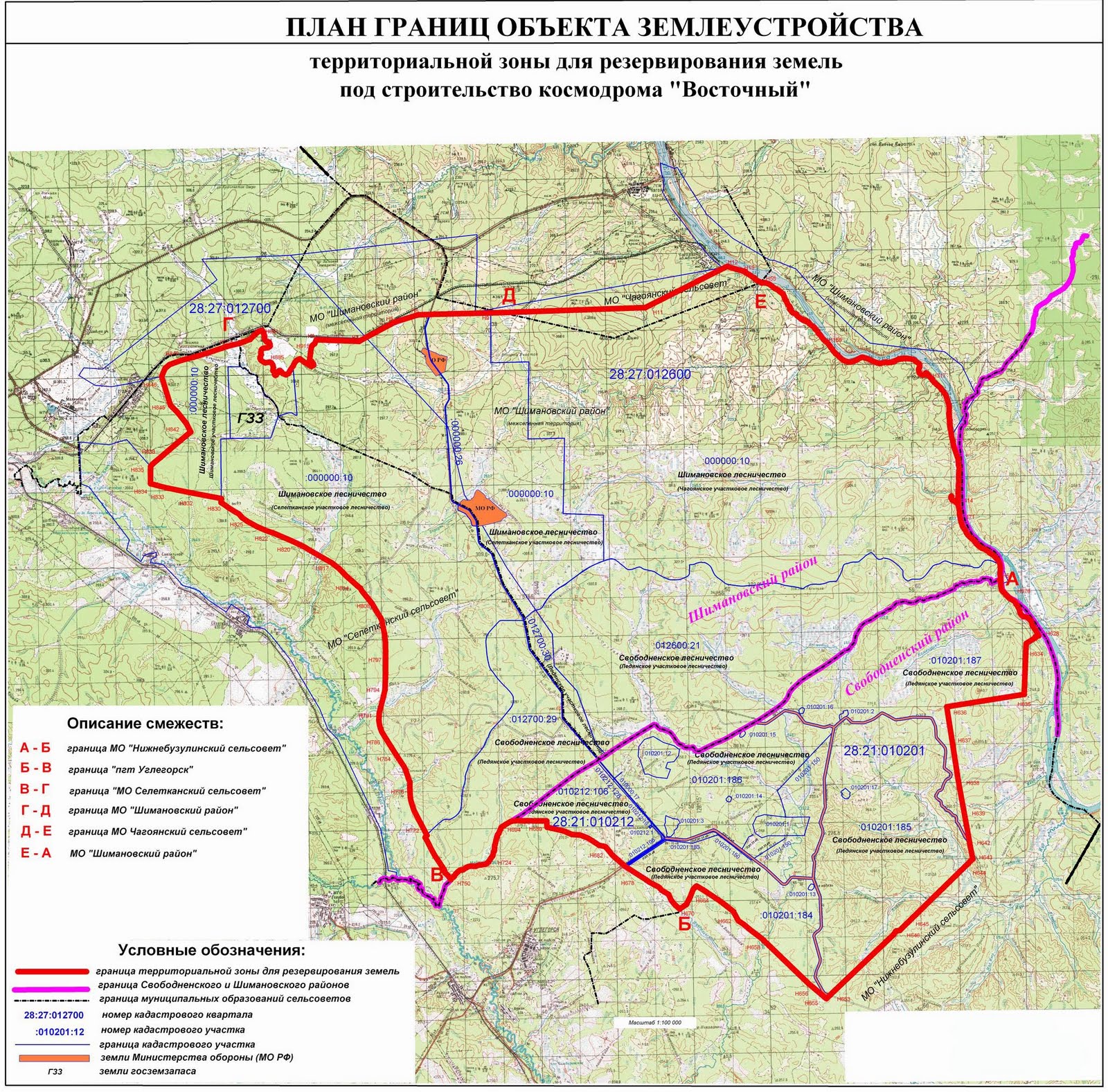
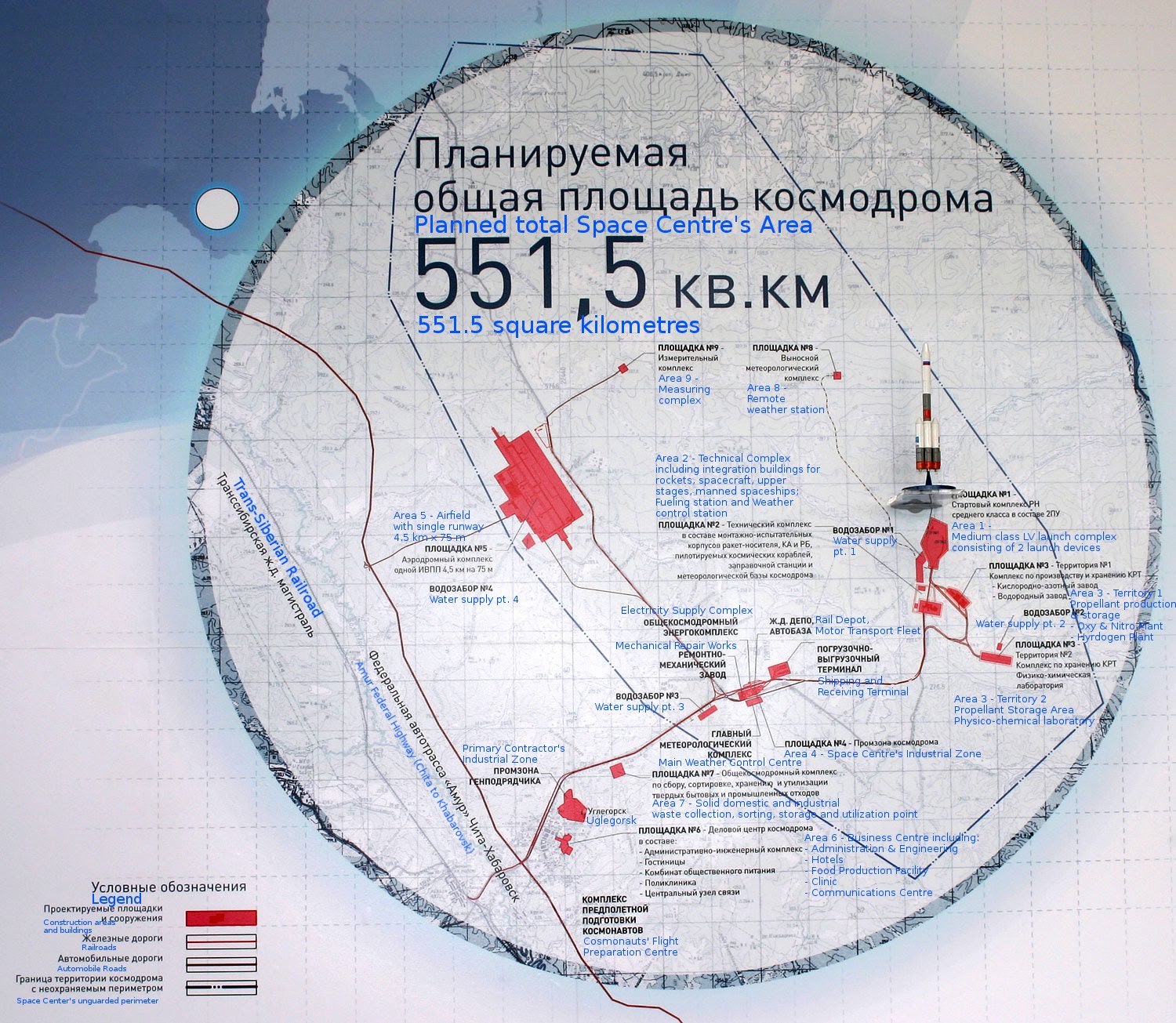
Vostochnyi ground reservation maps
May
11/5: Final Mars-500 ESA candidates
Two European candidates for Mars-500 have been selected: Diego Urbina, 26, Italian-Colombian and Romain Charles, 31, from France. The others in the crew will be announced later in May, and the mission will begin in June.
Roskosmos magazine has two translated Mars-500 articles online: “The Martian Chronicles. Prologue.” and “It’s impossible to reach Mars from Michurinsk without any pickles.”
“Cosmonauts Earn 150 000 Dollars A Mission,” Space Daily, 22/1/2010. They still seem to be using the contract system which was disliked during the Mir era. NASA astronauts get an annual salary of up to $130,000.
“Russians report snag in space safety system,” James Oberg, MSNBC.com, 31/3. The launch escape system for Soyuz TMA-15 last May did not function properly, for still-unknown reasons. Declining quality control in the rocket-and-space manufacturing industry is mentioned as one culprit.
I haven’t been posting for the usual reasons (lack of enthusiasm, lethargy, etc.).
19/5: New Dawn module in orbit
The ISS received another module yesterday: Mini Research Module-1, MIM-1 Rassvet, “Dawn” (МИМ-1 «Рассвет»), the 5th Russian module to reach orbit (or 4th, discounting Zarya). It was carried up by STS-132 Atlantis, and docked at 12:19:45 GMT, 18/5. I have a dedicated page about it on my website.
The Mars-500 finalists were also announced yesterday. They are, from left to right and top to bottom in the photo (from the IMBP page): Sukhrob Kamolov (Russia), Romain Charles (ESA), Diego Urbina (ESA), Wang Yue (China), Aleksei Sitev (Russia), Aleksandr Smoleevskii (Russia), Mikhail Sidel’nikov (Russia). The mission begins 3 June 2010, and ends in November 2011. Each participant will recieve 3 million rubles (nearly USD$100,000).
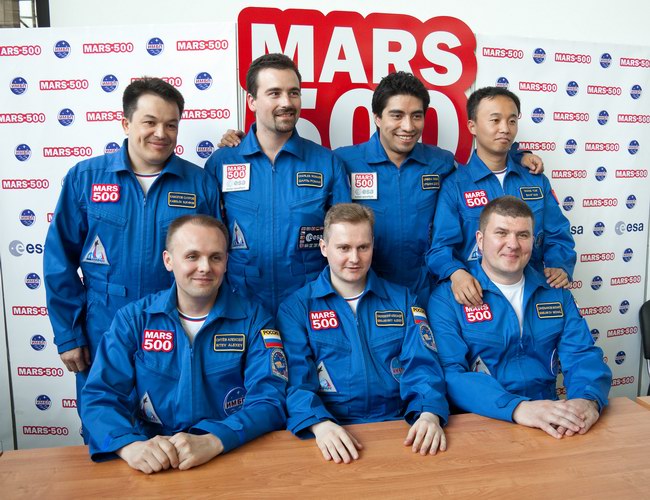
Mars-500 candidates finalists
June
4/6: Locked in
Mars-500 is officially underway as of yesterday, with the crew secluded until November 2011. It is disappointing, though, that no women are participating – “Discrimination row after Russia ‘bans’ women from 18-month mock mission to Mars” suggests that they were unofficially banned for fears of repeating the SFINCSS-99 experiment. The decision has received criticism from various experts.
“The absence of women in Mars-500 Project yet again proves the presence on old-fashioned Earthly gender stereotypes,” complained Mikhail Salkin of the Moscow Human Rights Protection Centre. “The organisers were likely set on choosing men from the start. We suspect the endurance tests they set were more suitable to men than women, and the results will be a biased judgement because it will only apply to males, so will not fit the full picture. “Women should have equal access to any job so we are ready to apply to the Russian General Prosecutor on this and ask him to investigate. The organisers have also forgotten the social tension they can face among six men which might have been softened by having a woman on board.” […]
Psychiatrist Egor Rozenkov warned single sex isolation was “more dangerous” than sending a mixed group. “There is a lot of psychological and psychiatric evidence about the social pathologies that develop in isolated male groups, like in jails, the army or schools. And don’t forget about the danger of sexual inversion. From the point of view of the health of the crew it will be a huge mistake to ‘send’ not a mixed but an all-male crew.”
Soyuz TMA-17 landed on 2 June with ISS-22/23. TMA-19 will launch on 15 June with ISS-24/25.
U.K. Russian space expert Rex Hall died of cancer on 31 May aged 63. Tributes at CollectSPACE, NASASpaceflight.com.
24/6: 21 days later
The Mars-500 crew are 21 days or three weeks into their “mission.”
On their Google site a serial story is being published each week, each chapter written by a different Russian author. Unfortunately the only translation provided is a computer one, which is imperfect at best – I wish they had spent some $ on a human translator. The title of the first chapter is computer translated as “Start need to cancel?” which human translates into something like “Cancel launch?,” and struggling to make sense of the tortured syntax takes away from enjoying the story.
“How risky is it to rely on Russian spaceflight?,” James Oberg, MSNBC.com, 15/6.
“The People’s Capsule,” Foreign Policy, August 2010. A rather gloomy overview of the Russian space program and its manned Soyuz spaceship.
July
3/7: Progress gone astray
Progress M-06M launched successfully on 30 June, but its attempted docking on 2 July was aborted when 20 minutes/3 km from the Station:
Progress Docking Abort: Docking of Progress M-06M/38P was aborted about 20 minutes before its scheduled linkup with ISS at 12:58 p.m. EDT due to loss of radio lock between KURS-P on the SM (Service Module) and KURS-A on Progress. The cargo drone passed by ISS at a safe distance and continues to be in its safe fly-by mode, circling Earth along with ISS every 92 minutes. Docking will not be re-attempted today. ISS systems are being reconfigured back to nominal stage operations configuration. Evaluations are underway for subsequent docking attempts.
– ISS OOR 2/7/2010
The backup manual docking system (ТОРУ, TORU), controlled by crew on the ISS, was also unsuccessful when activated. The next docking attempt will be on Sunday 4 July. (Relevant NASASpaceflight.com thread)
[Update 4/7/2010: Progress M-06M successfully docked on 4 July at 16:17:26 to Zvezda SM.]
Yest kasaniye! At 12:17 p.m. EDT, Progress M-06M (38P) docked successfully to the SM (Service Module) aft port under KURS autopilot control, followed by a final DPO post-contact thrusting burn, docking probe retraction and hook closure (“sborka”) after motion damp-out while the ISS was in free drift for ~20 min (12:17 p.m.-12:37 p.m.). At “hooks closed” signal, the SM returned to active attitude control, maneuvering the ISS to LVLH TEA (local vertical/local horizontal Torque Equilibrium Attitude) at ~12:37 p.m. Control authority returns to US Momentum Management at ~2:10 p.m. Russian thrusters will be disabled temporarily during clamps install and leak check (2:10 p.m.-4:10 p.m.). [This was the second docking attempt after yesterday’s aborted linkup, now traced to an interruption of the TORU radio signal by the SM’s Klest/Simvol television system. The dropout of the TORU teleoperated rendezvous & docking system then generated the command “cancel dynamic operations” which aborted KURS automatic rendezvous mode and switched Progress to a safe, passive flightpath, as designed. For today’s docking, TORU, which is usually in “hot standby” mode during Kurs-controlled dockings, was not activated.]
August
12/8: Mars and magic curtains
Energiya has a brief report at its site (also at Roskosmos) on the cause of the Progress M-06M docking abort last month: due to interference over a communication channel, a cosmonaut accidentally pressed one of the buttons on the control panel.
“Difficult rebirth for Russian space science,” BBC News, 29/6/2010. Article by Anatoly Zak on the difficult task facing Russian engineers trying to relaunch their country’s long-dormant unmanned space exploration program.
“Russia to kick off construction of a new spaceport,” BBC News, 20/7/2010. Восточный, Vostochnyi (“Eastern”) cosmodrome, an alternative to Baikonur, is to be constructed in Russia’s Far East, intended to be finished by 2015.
“Magic Anti-Radiation Curtain to be Installed in the ISS,” RK, 6/7/2010. An anti-radiation curtain developed by IMBP was delivered on M-06M:
Progress M-06M cargo supply vehicle has delivered a so-called “magic curtain” to the International Space Station. Flight engineer Fyodor Yurchikhin will install the curtain in the starboard’s cabin of the Zvezda module. The curtain designed by IBMP has special pockets for special wet hygienic towels used by cosmonauts onboard the station. The towels are saturated with hydrogen, carbon, nitrogen, which mitigate space radiation effects. The curtain is equipped with the radiation doze meters. Additional anti-radiation crew protection may be provided by three-layer wet towels on the walls of the cabins, thus mitigating radiation effects for cosmonauts, scientists believe.
Result of Matreshka experiment carried out in the station since 2004 show that the radiation is about two times weaker in the center of the station then near the walls. Phantom Matreshka-R is to monitor anti-radiation effectiveness of the wet towels. Experiment Matreshka is to study and to analyze radiation dose distribution in cosmonaut's body during long-term mission aboard the International space station (ISS). Dose from ionizing space radiation was determined with the help of thermoluminescent dosimeters mounted in conditional depths of critical organs in human body modeled in a dosimetric device, i.e. a ball-like tissue-equivalent phantom designed and manufactured in Russia for international space experiment Matreshka-R.
“Roscosmos Head Anatoly Perminov: Mission to Mars is to Take Place after 2035,” RK, 7/7/2010. More disappointing confirmation that there won’t be a Russian Martian attempt for some decades. I hope circumstances alter this! (Perhaps discovery of an alien artifact somewhere in the Solar System …)
Roscosmos Head Anatoly Perminov stated that the mission to Mars is planned after 2035, answering the questions of the students at the opening ceremony of International Students Science School “Space Exploration: Theory and Practice” in Russian Federal Space Agency. “Russia, Europe, the USA are interested in Martian missions today. India and China also have similar projects. There are more talks about human space missions to Mars. Russian Government have approved Federal Space Program which clearly defines sequence of automated space missions, as well as future human missions. The basic strategy implies Martian program to be implemented after 2035,” Perminov stated.
He also explained that there are no engines and propulsions systems capable to deliver humans to Mars in 2-3 months. “This is feasible only with nuclear propulsion. Many countries are trying to develop engines of new type, which can make mission time 20 times less- to reduce it from 1.5 years to 2 months,” Roscosmos Head said.
He added that there is another issue – human protection against solar radiation and radiation of the nuclear propulsion (if it is used). “This leads us to increasing mass of the launcher. No country is able of reaching Mars or other planets quickly. We are facing the energy problem. That’s why 2035 is defined in our plans,” Perminov said. “There is another option proposed by Russia and negotiated with heads of other space agencies. Interplanetary vehicles could be assembled in LEO. This approach can help us making the interplanetary missions sooner. Young generation will work with it, develop a new propulsion with a brand new operation principle,” Roscosmos Head concluded.
The Mars-500 crew are now over 2 months into their mission. They are no longer in real-time contact with TsUP:
25/07/2010: Today is important crucial point in the life and work of the crew because voice communication sessions will be completely ceased since the 26th of July. We change over to batch communication with gradual (stepwise) increment of the delays of communication. Batch communication means video-voice messages to the crew and similar answers. It can be used for the implementation of difficult experiments, for regular medical control and for psychological support. In addition to this the communication with the crew via electronic messages will be kept.
Blogger/Google have at last instigated comment spam filtering, so perhaps I can block my persistent Chinese spammer!
October
17/10: New Soyuz in orbit
The first ship of the new Soyuz variant, TMA-01M, launched to the ISS on 7 October.