Vladimir Kozhevnikov, RKK Energiya: The Russian orbital station will become a testing ground for everything new in space
- Land on demand
- Star traffic on schedule
- Docking port
- Cabin with a view of Earth
- Protection from ice
- Hub in orbit
Which station after the ISS will the Russian cosmonauts “transfer” to. Hub in space? A slipway for assembling interplanetary complexes? A stepping stone to the Moon and Mars? On the eve of Cosmonautics Day, Vladimir Kozhevnikov, Владимир Кожевников, Deputy General Designer of RKK Energiya, заместитель генерального конструктора РКК «Энергия», Chief Designer of the Russian Orbital Station (ROS), главный конструктор Российской орбитальной станции (РОС), gave an interview to Rossiyskaya Gazeta, «Российской газете».
Land on demand
RG: Vladimir Evgenievich, there is a lot of talk about the new national space station, but so far there is little concrete information. Hence fantasies and conjectures. But first, this question: the Scientific and Technical Council of Roscosmos approved the decision of the Council of Chief Designers to extend the life of the Russian segment of the International Space Station (ISS) until 2028. Do you know when the decision will be made at the highest level?
Kozhevnikov: The final decision will be made by the Government of the Russian Federation, taking into account the technical condition of the ISS. It’s no secret that the resource of its first modules, designed for fifteen years, has been exceeded by more than one and a half times. So far, we believe that the ISS is capable of flying until 2028. The successor to our segment should be the Russian Orbital Station – ROS. Moreover, it must be created in time to avoid a break in the Russian manned space program. That is, until the completion of the operation of the Russian segment of the ISS.
RG: Why is the creation of ROS so important for Russia?
Kozhevnikov: Russia has been and remains one of the world leaders in the field of manned cosmonautics. However, the operation of the Russian segment of the ISS – the basis of our manned program – is coming to an end. The creation of a new station will allow not only to preserve unique competencies and personnel, but also to move from the exploration of near-Earth space to its practical intended use. Space technologies should serve Russia and bring concrete results.
Fundamental point: a high orbital inclination was chosen for the new station. This will allow the ROS to obtain unique operational capabilities compared to the ISS. What does the “tilt” of the station mean? If it’s quite simple, then this is how far its orbit is from the equator. For example, the ISS has an inclination angle of less than 52 degrees, which is why cosmonauts can only see about 10 percent of Russia’s territory. At ROS, the “tilt” will reach 97 degrees. That is, our station will be in a sun-synchronous orbit, where the solar panels are always illuminated. Where is a complete overview of the earth’s surface, including the Arctic zone. Moreover, in all spectra – from conventional optical to infrared and radar. Where we will have a guaranteed stable connection with the ground control complex.
RG: Now the preliminary design is in full swing. What is already clear?
Kozhevnikov: Preliminary design should be completed before the end of summer. At the moment, the launch date of the first module in 2027 is being considered, and the completion of the deployment of the ROS is in 2032. The scope of work is very large. For the first time in the practice of RKK Energiya, the project is completely done using paperless technology, using modern product life cycle management systems. We are working out in detail the issues of using the so-called digital twins, optimizing the scope of tests to reduce time and cost while unconditionally maintaining quality.
RG: As I understand it, we are not starting from scratch: does the hardware already have a scientific and energy module (NEM), научно-энергетический модуль (НЭМ)?
Kozhevnikov: That’s right. NEM was created for the International Space Station. In order not to dispose of the practically new module together with the ISS, it was decided to use it as the first block of the Russian Orbital Station. Of course, improvements will be needed. In particular, control, docking and life support systems will be retrofitted. It will be possible to install power gyroscopic complexes (gyrodins) for cost-free attitude control.
Star traffic on schedule
RG: What other modules are planned and in what sequence will they be launched?
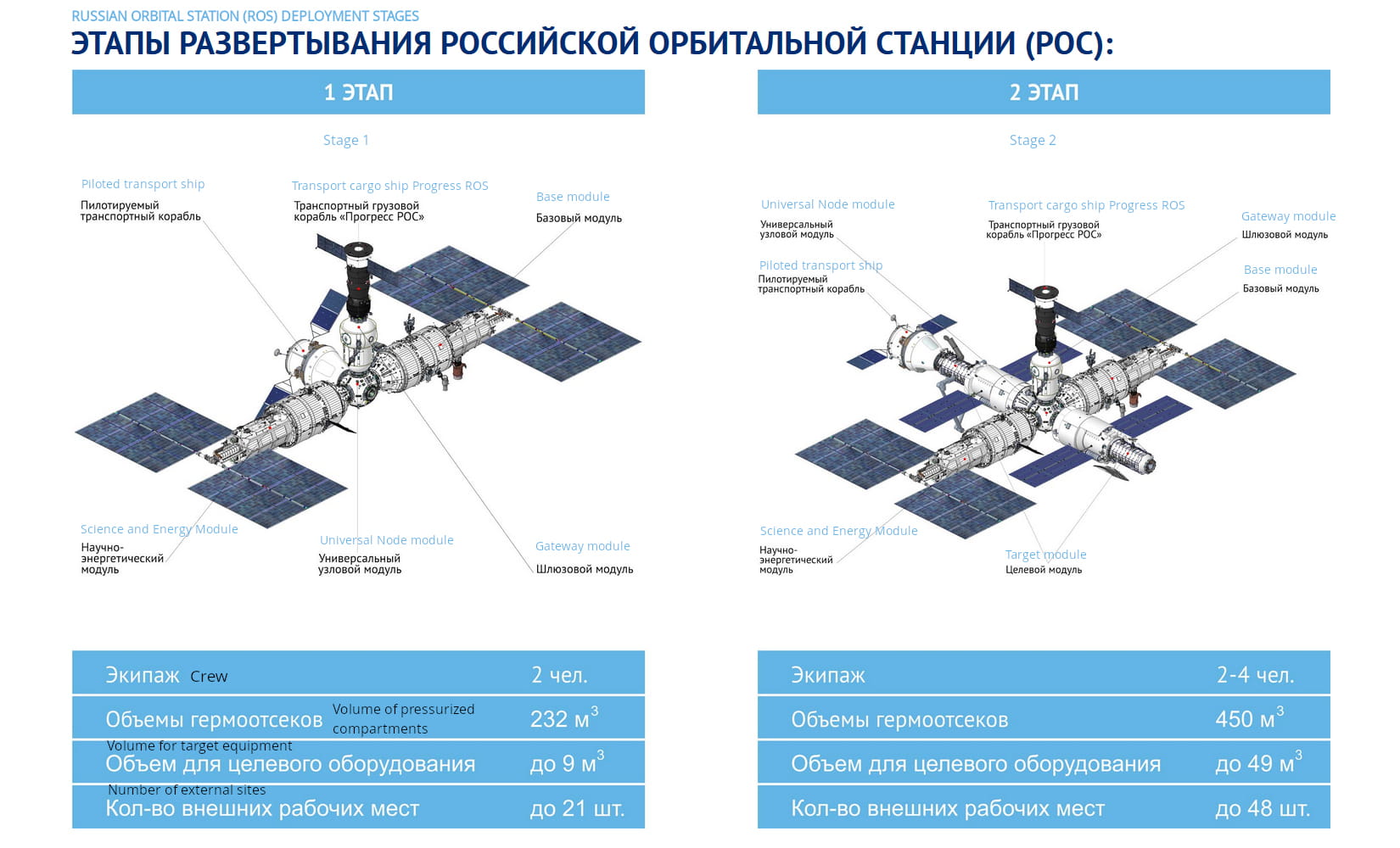
Kozhevnikov: After the scientific and energy one, the nodal and gateway modules will go into orbit. Moreover, it is planned to do this with one launch, on the Angara-A5M launch vehicle. The nodal module will provide an opportunity for further development of the station, and the gateway module will provide the crew with spacewalks. Then we will launch the base module, which will take over the station control functions. Further development of ROS will be supported by targeted modules.
RG: We talked a lot about the development of a transformable module. The Americans are already testing theirs on the ISS. Will there be a similar one for ROS?
Kozhevnikov: RKK Energiya and TsNIIMash have developed their own projects of “transformers.” For understanding: such a module consists of a central rigid compartment and a multilayer soft containment deployed around it. What does it mean? It flies into orbit in a folded form: the dimensions at launch are approximately three times smaller. And after launching into space, it opens up. And this is where the main advantage lies. At the same time, the use of transformable structures is limited by the possibilities to ensure their thermal regime.
I can say that at the first stage there will be no such module as part of the ROS. But it is possible that one of the future modules will receive an inflatable shell at subsequent stages. This will significantly increase the volume for storing goods. It will also increase the living space of the cosmonauts, and will allow placing a centrifuge. Perhaps, if one of the private companies comes up with such an idea, then we will certainly provide support.
RG: You name rather strict terms for the deployment of the station, 2027-2032. Are they real?
Kozhevnikov: Deadlines are really tight. But they are real under certain conditions. What? First of all, in the summer of 2023, complete the development of a preliminary design and successfully defend it at the state corporation Roscosmos. At the same time, conclude the necessary state contracts for the creation of the space complex of the Russian Orbital Station with the start of work in 2024.
At the same time, work should be deployed in all directions at once: the creation of the orbital complex ROS, the creation of a ground control complex, and the necessary improvements to the Vostochnii cosmodrome. The work of all cooperation must be effectively organized. For the initial transport and technical support of the ROS, it is planned to use the new PTK manned transport ship and the Progress cargo ship, which has proven its reliability, in the version for the new Progress-ROS station.
Docking port
RG: You said that the station will be built on the principle of a designer and can be “eternal.” What does it mean? Why couldn’t the Mir station be eternal?
Kozhevnikov: The new architecture of ROS – the construction of the station immediately using the node module of an increased resource. Roughly speaking, this is a sphere with six docking ports. The remaining modules are docked to it. Let’s say the base one has exhausted its resource. It can be undocked and deorbited, and a new one can be docked in its place. And in exactly the same way, in case of failure of the node module itself, you can make a new one. Dock it on the other side of the base module, as if creating a new center of the station. By the way, the arrival of ships from other countries to the ROS is also possible. But only if their docking units meet the parameters of our docking units, recognized as a standard at the international level.
RG: One of the most interesting innovations is an external platform for servicing, repairing and even refueling satellites. After all, this has never happened before?
Kozhevnikov: Not previously. The task of servicing satellites and other spacecraft is a new one. For this we provide special mechanical, electrical and hydraulic interfaces. Service on an “external sling” will be possible both by cosmonauts during spacewalks, and using robotic means. By the way, we worked out refueling in space back in 1978. ESA also ordered this system from us for its ATV cargo ship.
RG: How else will ROS be fundamentally different from the ISS, Mir, Salyut?
Kozhevnikov: The station will be created using new materials and alloys. With the use of additive technologies, including for the manufacture of complex metal parts for the design of modules. We plan to install a 3D printer at the station to print from plastic the necessary instrument and interior parts. It is envisaged the creation of robotic means, which have never been in our cosmonautics, the groundwork was created for the Buran space shuttle, but they did not reach space. The means of virtual and augmented reality will be used, especially in terms of training cosmonauts.
In addition, we plan to restore lost technologies that were not used in the construction of the ISS. The same power gyroscopic complexes, high-power power supply. On the ISS, there are gyrodines only on the American segment, the main electric power comes from there too.
But we have our own production, it is necessary and necessary to do our own. In general, ROS will become a springboard for testing promising and improving new domestic technologies in space. Including communication technologies, production of materials and components.
RG: At one time, valuable equipment was transported from the Salyut-7 station, the flight of which was nearing completion, to the Mir station. More than 800 kilograms of cargo! There are also many unique things on the Russian segment of the ISS. Will it be ported to ROS?
Kozhevnikov: No. It’s practically impossible. The difference between the inclinations of the orbits of the ISS and the ROS does not allow such flights from one station to another. Fuel consumption will be too high. However, we will definitely preserve the continuity of the scientific program, we will make new equipment.
RG: Is it possible that the crews will be able to work both on the ISS and on the ROS at the same time?
Kozhevnikov: The project provides for the simultaneous operation of the Russian segment of the ISS and the new station at the first stage of ROS deployment. Accordingly, the crews of both stations will work simultaneously for some time, a similar situation was during the deployment of the ISS and the completion of the operation of the Mir station. But, I repeat, there is no talk of a flight from the ISS to ROS and back.
Cabin with a view of Earth
RG: Man has not yet flown in high-latitude orbit. How will the station and cosmonauts be protected from galactic rays and radiation?
Kozhevnikov: Module cases, devices, assemblies and cables themselves partially protect against radiation. The rest of the radiation will be shielded by means of radiation protection, primarily in the areas where the crew stays. The radiation situation on board will be monitored by a specialized dosimetric monitoring system. The flight of the biosatellite “Bion-M” No. 2 is currently being prepared, which will provide practical information on radiation loads in this orbit. So far, calculations show that the situation at these latitudes is quite acceptable for manned flights.
RG: I know that the question of what kind of ROS will be was widely discussed: permanently inhabited or visited? Are we talking about records of staying in weightlessness for up to a year?
Kozhevnikov: No records. The duration of the crew’s stay at the station is clearly determined by the program. We think that the following scheme is expedient: at the deployment stage, the cosmonauts will be on board all the time. Why? A very large amount of work will be required. Subsequently, the station can become visited. Arrived, performed the necessary work, flew away. By the way, the Russian segment of the ISS cannot “live” without cosmonauts. Its conservation is very labor intensive. And here, literally in a day, we can completely and mothball the station, and prepare it for work.
RG: In general, how many cosmonauts will be able to work at the same time? Will everyone have a sleeping cabin?
Kozhevnikov: The station will be able to accept and provide everything necessary for up to six people. However, we expect that the level of automation of the systems will not require the constant presence of more than two people on board. At the initial stage of the expedition, it is planned to last about 240 days, and then they will be carried out in the format of a visit, depending on specific tasks. Therefore, two cabins will be immediately equipped. But on future target modules we will be able to place additional ones. Including, for example, for space tourists.
RG: Cosmonauts say that the sleeping cabins in the American segment of the ISS are slightly larger than ours. But in ours there are portholes. And this is what you need for the mood. Are designers thinking about this?
Kozhevnikov: Certainly. We try to take into account the wishes of cosmonauts as much as possible. And the cabins at our station will definitely be equipped with portholes.
RG: In 1968, a group of American architects and industrial designers, over the objections of engineers, convinced NASA to add a viewing window to the design of the Skylab orbital laboratory. Then, they say, the peculiarities of human psychology began to influence the design of spacecraft. Are there any special options on the ROS to improve crew comfort?
Kozhevnikov: As for special options, I will not say yet. But the fact that everything is aimed at comfortable work and life of cosmonauts is a fact. Color, light, module layout, free space …. For the first time in history, design students from Stroganovka were invited to develop space station interior concepts.
We met with the guys. These are graduate students who have chosen specific working areas of promising modules of the new station for study in terms of technical aesthetics and ergonomics. Their ideas are through the roof, up to the futuristic ones. But we immediately agreed: empty fantasies are not needed. When the work is completed, we will definitely show them.
At the final stage of preliminary design, an examination of the project is planned with the involvement of the Cosmonaut Training Center. Gagarin, of course, with the participation of the Roscosmos cosmonaut corps.
Protection from ice
RG: Emergency situations with breakdowns of Soyuz MS-22 and Progress MS-21 showed how vulnerable today spacecraft are, roughly speaking, to meteoroids and space debris. It was reported that the ROC will be protected from breakdown for particles up to 1 cm flying at speeds up to 10 km/sec. It’s real?
Kozhevnikov: Yes, the ROS modules will be “dressed” in a kind of multilayer armor – anti-meteoroid screens. The possibilities of these screens will be confirmed not only by calculation, but also experimentally.
RG: Crews to the ROS will be delivered from the Vostochnii cosmodrome on the new PTK manned spacecraft. At what stage is its development?
Kozhevnikov: By now, the production of working design documentation has been completed and the production of hull elements of the flight sample compartments of a manned transport vehicle has begun. Airborne equipment is being supplied to complete the first flight machine. Experimental testing is in full swing: static tests of the ship’s hulls are being carried out, dynamic and helicopter models are at the final stage of equipment. It can be said with certainty that by the beginning of the operation of the ROS, the first crew will be delivered to the station on this very ship.
RG: Is it true that the PTK launch route will pass over the Arctic Ocean? If so, how will the crew be protected in the event of an emergency?
Kozhevnikov: Various launch trajectories are being worked out. If by emergency you mean an emergency landing in the Arctic Ocean, then a lot depends on the time of year of launch. When the ocean is frozen, it can be regarded as a landing on a hard surface. And search and rescue activities will be carried out according to the scenario of a winter landing, similar to the Soyuz one. Of course, taking into account the climatic features of the region. If the ocean along the landing trajectory is partially or completely free of ice cover, then this can already be regarded as a splashdown. Search and rescue activities in this case will be carried out according to the search scenario on the water surface.
In both cases, the crew will simply have to wait for the search and rescue team. To keep the crew alive, there is a wearable emergency supply. It ensures the survival of cosmonauts in all climatic zones, including such extreme ones as the desert, mountains and the Arctic. It consists of a heat-protective suit, supplies of food and water. In case of splashdown, there are Trout, «Форель», Forel’ wetsuits: they provide autonomous stay afloat at water temperatures from minus 1°C to plus 30°C and sea waves up to 5 points for at least 12 hours.
RG: Why is water minus 1°C?
Kozhevnikov: No, this is not a mistake: In the ocean, the water is salty and freezes at lower temperatures. So our guys are reliably protected from various emergency situations, and even from such as the Arctic Ocean.
Hub in orbit
RG: The Russian orbital station is supposed to be a hub for servicing satellites, providing communication with orbital constellations and much more, which is necessary for both government agencies and businesses?
Kozhevnikov: Yes it is. The first direction is just the provision of services commissioned by government agencies and businesses. For example, surveying specified areas of the globe with the required frequency and transmitting data to Earth. Moreover, we set ourselves the task of ensuring the possibility of delivering information to the consumer in almost real time. The second direction is the presentation of a platform service for installing customer equipment. We will provide a workplace, electrical and information interfaces, data transmission to Earth. The third direction is advertising and information activities.
There is also a fourth possible direction, which we, as developers, are very interested in: the station as a platform for integrating commercial modules into its composition. Now this topic is being actively discussed within the American segment of the ISS. Next year, it is planned to begin integrating Axiom’s modules for space tourism and research into the station. We are also ready and will in every possible way welcome the appearance of private companies that will be ready to develop their own modules (including transformable inflatable ones) for their possible inclusion in the ROS. Such organizations can fully count on any assistance from RKK Energiya in terms of supporting the development and integration of modules into the station.
Several memorandums on possible cooperation have already been signed, and there is mutual interest.
RG: A question from the blogosphere: why launch a new station, if with the help of “one hundred satellites for remote sensing of the Earth, you can do the same better and cheaper?
Kozhevnikov: A very popular question, which has been asked, probably, since the birth of manned astronautics. I’ll try to answer. Firstly, the station will cost much less than 100 remote sensing devices. And most importantly: the station is not just a large Earth sensing satellite. The station is a set of various target equipment and tasks. These are medical and biological experiments, equipment for experimental production, scientific and educational activities, as well as telescopes and radars of different ranges, Earth scanning equipment. We are talking about tasks that today robots cannot do without human intervention.
We are now setting ourselves the goal of changing the principle of creating orbital stations. In order to go from the task of the intended use, the object must be aimed immediately at obtaining the result of practical or scientific activity. Therefore, it is supposed to have many jobs – more than 30 – for the installation of equipment. If necessary, use free-flying modules, provide the consumer with a sufficient level of energy, which, first of all, is required for large radio systems.
Yes, in modern terms, the station is supposed to be a kind of ecosystem, a hub. We are ready to provide our space enterprises with the opportunity to develop technologies and obtain flight qualifications for advanced equipment. It also seems in demand to quickly replenish the functionality in the event of a failure of specialized satellites: you can bring the equipment, install it on the station and receive useful information before the restoration of the target spacecraft.
At the same time, no one removed from us the tasks of studying the complex of problems “man in space.” Including to solve the main target biomedical task of ROS – to ensure human flights in deep space beyond the limits of low Earth orbit. The chosen orbital inclination of 96.8 degrees makes this possible. Work on biotechnological experiments will be continued.
Now, at the stage of the preliminary design, the possibilities of using the ROS as a slipway for assembling large structures, including interplanetary flight complexes, are being explored. Of course, this task is not today, but we must consider such a possibility.
RG: What can be the dimensions of the ROS? Bigger or smaller than the Russian ISS module? And if you compare with Mir?
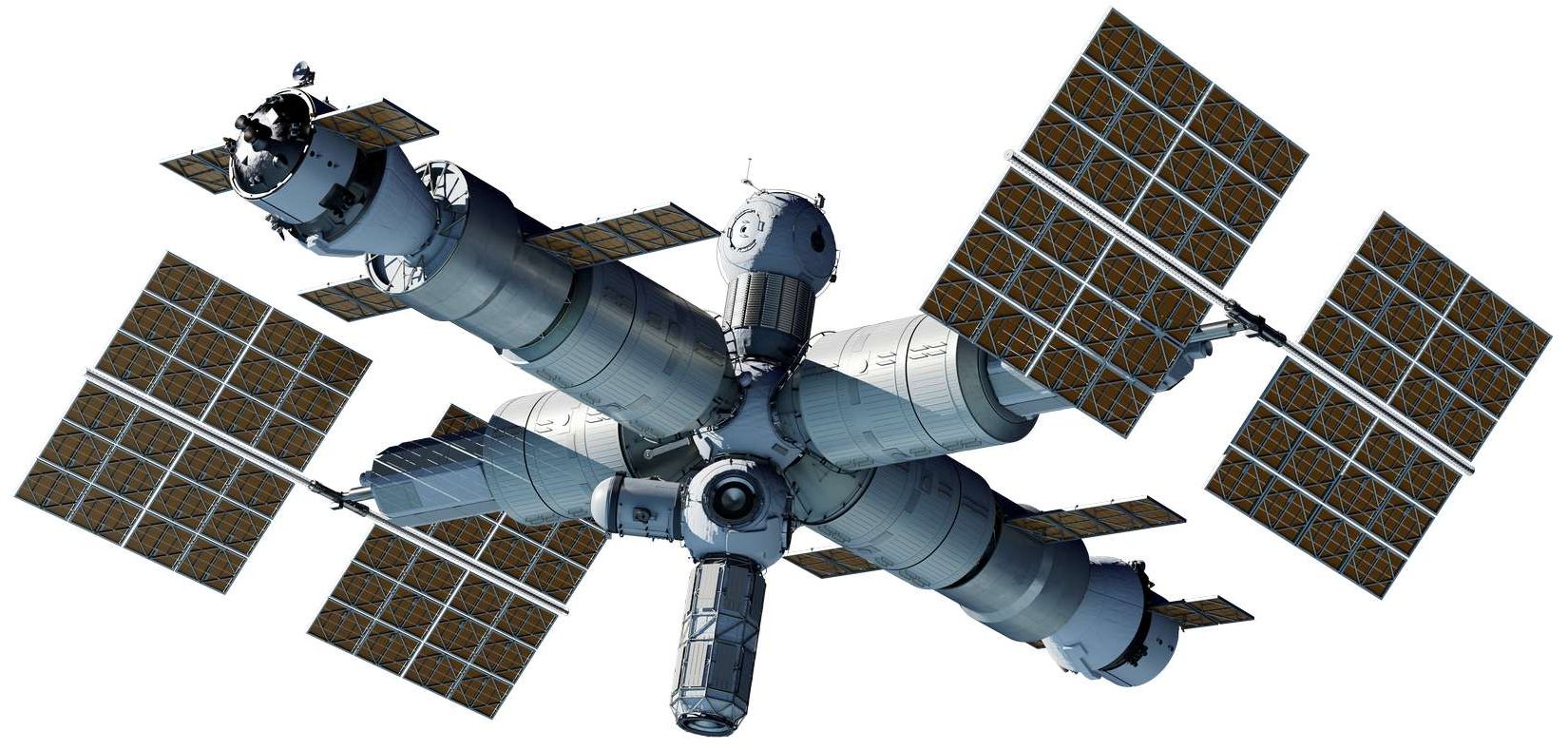
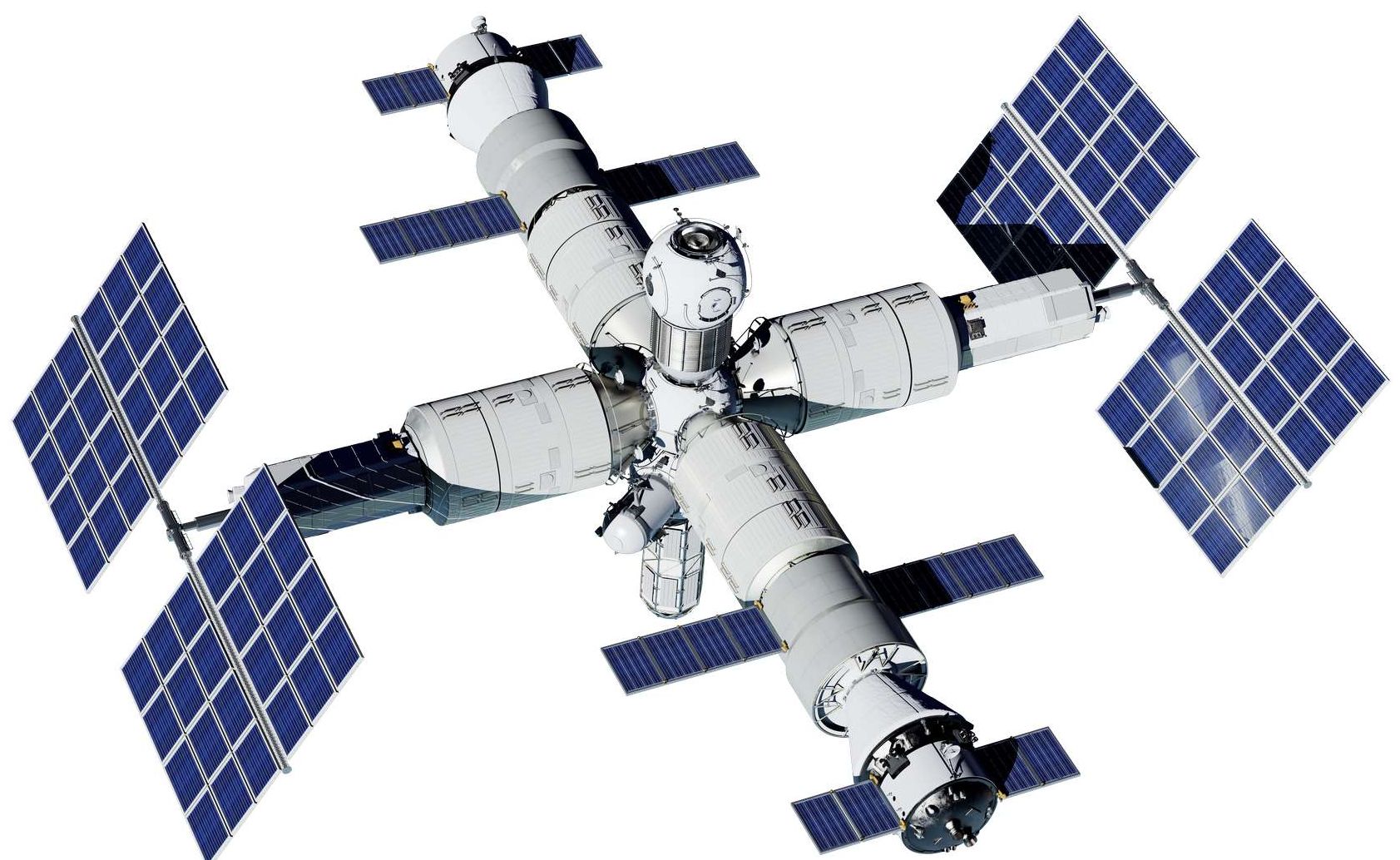
Kozhevnikov: The Russian orbital station in its full configuration will outwardly resemble the Mir station. Their masses are also identical – about 135 tons, while the current mass of the ISS RS is about 73 tons. The overall dimensions of the ROS, taking into account the rotating solar panels, will be 48.9 × 31.9 × 22.4 meters. For comparison: the dimensions of the Mir station are 19 × 31 × 27.5, and the ISS RS is 25.6 × 22.9 × 29.7 meters.
The pressurized volume of the Russian Orbital Station will be about 450 m3, which is slightly more than twice the pressurized volume of the ISS RS and approximately 1.2 times the pressurized volume of the Mir station.
RG: Is ROS considered as a “stepping stone” to a manned flight to the Moon?
Kozhevnikov: Undoubtedly. It is already clear that the new station will help develop the technology of deep space flights. The option of assembling interplanetary expeditionary complexes on the RSS, including those for flights to the Moon, is being considered. In general, the station should be a testing ground in near-Earth orbit for everything new in space.
Interviewed by Natalia Yachmennikova, Rossiyskaya Gazeta
Images: Russian Orbital Station (ROS) Deployment Stages (172 KB); computer-rendered images 1 (201 KB), 2 (230 KB).
Linked from Russian space news