Populate and Perish: 2012
January
7/1: Collected letters
A new year begins. If there is one unfortunate certainty, it is that there will be more people in the world at its end.
A round up of letters, mostly from The Age, on population and urban planning issues:
5/11:
Constant growth cannot continue
THE UN Food and Agriculture Organisation’s warnings on the global decline of food production should remind us that no food supply is infinite (“Hard to swallow but food security threat is very real,” BusinessDay, 3/12). Australia has a huge land mass, and a “tiny” population. Yet human “carrying capacity” is proportional to availability of natural resources such as arable soils, water supplies and healthy waterways, not land size.
We are the driest continent, and many food bowls are being engulfed by urban sprawl. Climate change will devastate some of our food production, and the Murray-Darling food bowl is under severe stress. Meanwhile, foreign buyers are investing in our food chain, land and infrastructure. We feed 60 million people, but packaging billionaire Anthony Pratt has called for Australia to quadruple its food production? There are limits to growth.
Our environment and Mother Nature are not under the command and whims of business people. Current exponential growth rates of population and economic activity cannot continue indefinitely on a planet that has limited natural resources and a limited ability to tackle pollution.
– Kit James, Melbourne
Misplaced faith
CHRIS Berg is quick to highlight his blind faith in the market system to fix the world’s problems (“Phoney food fears ignore nimble market solutions,” 4/12). He suggests demand and higher food prices will bring new farmers into the market to provide more produce. How will market forces assist India, where in the north underground aquifers which sustain food crops for 100 million are fast being depleted?
He also suggests higher prices will make marginal land viable; how can higher food prices restore the productivity of land, especially when scarcer oil will drive up the cost of petroleum-based fertilisers that could do this?
Market forces aren’t positioned to save many threatened species whose habitats will be encroached on as marginal farming land is wrested from them in order to satisfy the ballooning appetite of humanity. Human ingenuity has gotten us only so far; it is dangerous and foolish to think technological advances and market forces will be the saviours of us and other species.
– Jonathan Page, Bentleigh
Why isn’t once enough?
I’M CONCERNED that some mothers feel the need for a second or third child (“Older mothers linked to earlier births,” 4/12).
Why can’t they stop at one? Our global population is too big already.
– Malcolm Pacey, Richmond
17/12 – on the practice of trying to buy “air rights” for apartment towers so that views are not obstructed; another disadvantage of high-density living.
Air belongs to all
IS THERE no limit to one developer’s hypocrisy in trying to buy the “air rights” (itself a questionable land use planning export from the US) to protect the view from his own (view-obstructing) 26-storey apartment (“A developer is trying to buy this space …,” The Age, 15/12)?
How much more evidence do we need that much is rotten in the Victorian planning system if those with money and friends in power (remember the residents of The Domain in St Kilda Road) can do a whole lot better at protecting their views and general amenity than the rest of the community, especially if you live in Moonee Ponds or Williamstown?
So much for “planning for all Victorians” and acting in the best interests of “present and future generations” as the Planning and Environment Act specifically requires. The added irony is that there is ample evidence of mental health and social functioning benefits from having attractive views, especially so for people on low and modest incomes, who typically can’t afford a holiday or weekend trip to the country.
– Bernadette George, Emu Park, Queensland
Don’t be deceived
IT NEVER ceases to amaze me that anyone is shocked and disappointed by the actions of the Baillieu government. There is no doubt that Victorians were angry at the arrogance shown by Brumby and some of his ministers, but did they really expect things to get better by electing a conservative party? If you are a commuter on public transport, a nurse, teacher, conservationist, a worker forced to work on Christmas Day or a public servant, have things improved? Voters should have realised that Mr Baillieu was the power behind the Kennett years of slashing and burning, when everything in the state had a price not a value. The wolf in sheep’s clothing has returned.
– Rod Oaten, Carlton North
Fooled again
THE Baillieu government’s cutting of public services (“Baillieu explains U-turn on job cuts,” The Age, 22/12) ought to remind Victorians of the saying, “fool me once, shame on you; fool me twice, shame on me.”
The Coalition went into the 1992 state election promising not to cut services to the public, and once in office slashed them. It made the same promise as it went into the 2010 election, and voters believed it. It’s time voters realised that cutting services to the public is in the Coalition’s make-up. Do not listen to its spokespeople. Take note, instead, of the Institute of Public Affairs, which provides the ideo-illogical blueprints for Coalition action.
– Chris Curtis, Hurstbridge
My thoughts exactly – as soon as the Liberals get in, they begin cutting funding to public services. People have disappointingly short memories!
We can’t afford to risk food security
THE labelling of food as “Made in Australia” when it is actually imported (The Age, 26/12) should be a warning about our food security. It is more than a political or economic issue. It is a vital one that will affect our survival. Mark Howden, the chief research scientist of the CSIRO’s Climate Adaptation Flagship, says climate change and high population growth could see Australia become a net importer of wheat by 2050 (BusinessDay, 3/12). Australia became a net importer of fruit and vegetables during the drought. If food is to be imported, where will it come from?
Australia’s golden wheat belt, stretching from Western Australia to central Queensland, is set to shrink, slashing productivity by up to 40 per cent. The nation’s ability to feed itself will no longer be guaranteed. The confusion of labels will give us a false sense of security about our self-sufficiency, when it is decreasing. We need a reality check, not just an adjustment to labels. There are constraints of growth, and the planet’s declining food production needs to be acknowledged. Infinite population growth is incompatible with securing Australians’ wellbeing. As Dr Howden said: “Risking food security is one thing you don’t muck around with.”
– Arthur Bassett, Blackburn South
3/1:
Stability is future
PLANNING Minister Matthew Guy says his new strategy will investigate tougher planning rules for developments outside existing town boundaries (“Wise planning will ensure surf ‘burbs are not just Waverleys by the waves,” The Saturday Age, 31/12). The government, with few viable industries, is almost totally reliant on population growth to maintain the economy.
Mr Guy rightly cautioned against coastal sprawl. However, “inland developments” will also cause environmental impacts – from increased traffic and human footprints to destruction of farmland. The costs of extending the infrastructure for water, energy, roads and public amenities will be passed on to all Victorians, many of whom are already struggling financially.
Australia has a very large ecological footprint compared with other countries, and Victoria is already in ecological overshoot. Population growth is not inevitable but is a political choice; “wise planning” should be about transforming our economy to one based on the principles of sustainability and stability, not growth.
– Chris Hooley, Viewbank
5/1 – on unwelcome development in Geelong, and the threat of foreign investment:
Bid farewell to a natural jewel
GEELONG has shaken off the dog days when it was viewed as an industrial graveyard, but what industries does that leave in Victoria? Agriculture is asset-intensive, but not in the number of employees it requires. We don’t have the resources boom of Queensland and Western Australia. Our big industry is “developments” and real estate, and our precious and picturesque Surf Coast is about to be engulfed and swallowed by generic housing estates (“Battlefield looms on coastal playground,” The Saturday Age, 31/12).
The Coalition is following the same erroneous route as Labor, under the illusion that wealth will be acquired through population growth. This time, the growth is about to impinge on Victoria’s coastal playground, with picturesque sleepy towns traditionally valued for wilderness, surf, reflection and summer family holidays to be engulfed by suburbia. Population growth is a political choice, not inevitable, desirable or uncontrollable. The only beneficiaries of this urban onslaught into the Surf Coast are the developers. Perhaps some of the new residents living in this transformed area, a shadow of the natural jewel it used to be, might put a nice picture on the living room wall of the once wild coast.
– Jenny Warfe, Dromana
Growth is political
THE expansion of housing estates from Melbourne to the Bellarine Peninsula, the Surf Coast, is a spread of suburban ills to iconic and sensitive coastal wilderness-recreational-farming areas.
“It’s a classic case of infrastructure-led development,” said Peter Dorling, executive director of the Committee for Geelong. He claims that “we are ready to take our share of Australia’s population growth.” It’s not about magnanimously soaking up population growth, something that is inevitable. Our population growth is a government policy, designed for short-term monetary benefits at the expense of long-term economic and environmental sustainability. It’s about trading in Victoria’s heritage, and sacrificing our state’s natural and social capital for economic benefits.
With business and growth-lobbyists pulling the strings of state government decisions, freeways, tunnels and roads will continue to be preferred over public transport, only begrudgingly built for the public. The growth implications of large traffic arteries ensure that we will have more frontiers and land openings, however controversial, to provide developer opportunities.
– Rod Binnington, Brighton
An unhealthy price
A POTENTIAL private foreign investor needs to apply to the Foreign Investment Review Board for consent to buy property in Australia only if the purchase price exceeds $231 million. The laws governing the purchase of real estate in Australia by overseas investors are relatively flexible. No one knows how much farmland is foreign-owned. It is easier for foreigners to buy in Australia compared with other countries. Argentina and other Latin American countries, targets for foreigners looking to buy big blocks of farmland, have tightened ownership laws. However, Australia is becoming more permeable. Foreign investors have grabbed a 30 per cent share of Australia’s apartment market and are leading the way in land grabs. It keeps prices “healthy” for investors.
– Vivienne Ortega, Heidelberg Heights
February
11/2: Collected letters
Yet another round up of letters, mostly from The Age, on population and urban planning issues:
The Age, 17/12/2011:
Air belongs to all
IS THERE no limit to one developer’s hypocrisy in trying to buy the “air rights” (itself a questionable land use planning export from the US) to protect the view from his own (view-obstructing) 26-storey apartment (“A developer is trying to buy this space …,” The Age, 15/12)?
How much more evidence do we need that much is rotten in the Victorian planning system if those with money and friends in power (remember the residents of The Domain in St Kilda Road) can do a whole lot better at protecting their views and general amenity than the rest of the community, especially if you live in Moonee Ponds or Williamstown?
So much for “planning for all Victorians” and acting in the best interests of “present and future generations” as the Planning and Environment Act specifically requires. The added irony is that there is ample evidence of mental health and social functioning benefits from having attractive views, especially so for people on low and modest incomes, who typically can’t afford a holiday or weekend trip to the country.
– Bernadette George, Emu Park, Queensland
Big picture: saving species
IT’S commendable that Zoos Victoria sees itself as “having one role in the big picture, which includes Parks Victoria, aquariums and so on” in the effort to save vulnerable species (“Zoos a breed apart for species on the brink,” 8/1).
Being “saved” by zoos’ breeding programs is only a Noah’s Ark, not a long-term solution to our rampant extinction rate. It’s only when species are self-sufficient, living naturally in the wild, that they can be considered to be “saved” for any period of time.
The Victorian government is proposing a subtle circumvention of the Flora and Fauna Guarantee Act so that timber operations in Victorian forests can continue unimpeded by the existence of endangered native species.
We need some big picture policies from our state government. On one hand they are funding zoos to save vulnerable species, but on the other hand they are clearing their habitats for urban developments, and propose watering down their protection.
– VIVIENNE ORTEGA, Heidelberg Heights
18/1:
Baillieu’s priority
PREMIER Ted Baillieu claims managing Victoria’s economy is his biggest priority (The Age 17/1). Given his sustained enthusiasm for blocking wind farms, dodging carbon dioxide emissions targets, approving coal-fired power stations, threatening green wedges and trying to water down protection for endangered flora and fauna, I can only conclude his real priority is to undo the past 30 years of environmental reform.
– Warwick Sprawson, Brunswick West
19/1 – comments rebuffing a pro-growth/capitalism article:
Growth cannot be unlimited
NIGEL Farndale tries heroically to argue that the capitalist growth economy has a future, but he fails to convince me.
First, the idea that quantitative economic growth must eventually cease due to resource limits is not a recent invention. It was propounded by none other than Adam Smith in The Wealth Of Nations, and by other classical liberal economists. John Stuart Mill argued that when the limits to quantitative economic growth were reached, the focus of human progress would happily shift to qualitative development in terms of knowledge, creativity, cultural achievement and the quality of human relationships.
Second, as the recent literature on the coming “great transition” or “great disruption” makes clear, with the support of science quantitative economic growth will not cease because humans choose that it should cease. It will cease because it will no longer be physically possible. Then, to paraphrase former Israeli foreign minister Abba Eban, humans will start to act rationally and build a steady state economy because we will have exhausted the alternatives.
– Paul Norton, Highgate Hill, Qld
The system is failing us
WHY bother rebuilding capitalism? We are actually living through the best of it – we have no world wars, no colonial armies stealing other people’s lands, no planned slash-and-burn environmental policies and growing equality between workers and bosses.
If the above were true, we ought to rebuild and renovate capitalism because of its sound foundations.
Unfortunately, capitalism’s inherent contradictions produce instability and fear in all of us – especially the capitalist.
Capitalism evolved out of feudalism and colonialism, whose remnants remain. Most of us can see that capitalism is failing us, but most of us are not in a position to alter the state of affairs. People have tried to create other forms of trade, and suffered army invasions, covert government operations and regime-change puppet governments for their efforts.
Capitalism, and the Australian constitution’s modus operandi, is a sacred cow of private property rights over human rights, treating all living things as a commodity to be traded and exploited – even people, through wages and conditions.
If it took Marx, a communist, to name capitalism, then it will take a community of thinkers and activists to free society from capitalism. Capitalists are welcome to apply.
– Leon Zembekis, Reservoir
Steady state alternative
IN PUTTING the case for capitalism, Nigel Farndale accepts that capitalism is a means to the end of economic growth and says that the idea that we can get on without such growth is “naive.” The important question, not discussed, is what is the alternative to endless economic growth? We cannot have endless growth in a finite world and to persist with this idea invites disaster. There is a better way and it is called “the steady state economy.” Basically, it involves living within the earth’s means. How this can be achieved is, I suggest, a matter which deserves far more public discussion.
– Geoff Mosley, Centre for the Advancement of the Steady State Economy, Hurstbridge
22/1 – in order to maintain quality of life, we can’t afford to keep taking everyone who wants to come here:
Fix problems first
TIMES have changed since Ted Baillieu’s great-grandfather “jumped ship” at 17 to settle in Australia. Now there are limited genuine Australian business opportunities. Living costs have soared and housing is the most expensive in the world. We have outlandishly long queues for public housing.
If our Premier really wanted to be benevolent, he would ensure Victoria’s infrastructure and budget shortcomings are fixed, address our housing crisis and protect our food security by ensuring inappropriate development does not occur on good agricultural land.
Lofty ideals of offering Victoria as a new home to the world’s dispossessed are honourable but there are practical constraints. We must ensure we have all the resources they need: medical, social, educational, transport etc. Our fast-growing population is putting these things at risk for many Victorians.
– JENNIE EPSTEIN, Little River
23/1:
We can’t cope with more high density
THOSE who call for high-density housing (The Saturday Age, 21/1) take a one-eyed view of planning policy. Melbourne has not been rated one of the world’s most liveable cities because of high-density housing. The opposite is the case. It is made up of green wedges, parks and a multitude of pollution absorbing trees.
Melbourne was built as a low-density city with low-density infrastructure. Planting a high-density city on top does not work. Examples of where this is failing include congestion on roads and public transport, increased pollution, overflowing sewerage systems and less open space. Does Melbourne need to expand by 1500 people a week? What about cutting immigration or regional towns taking more of the burden?
The Victorian Civil and Administrative Tribunal approves buildings at great pace, but it does not have a say in the infrastructure needed to cater for them. Inspired leadership is required to preserve our city’s livability.
– Mathew Knight, Malvern East
Critical heat factor
WITH regard to copying Paris-style development in Melbourne (Editorial, 21/01), it should not be forgotten that Paris has an “urban heat island effect” (where a metropolitan area is warmer than surrounding rural areas) of 2 to 3 degrees. That city is cited as an example of how deadly the effect can be: during the 2003 heatwave in Europe, when Paris experienced nine consecutive days with temperatures reaching 38 degrees, an estimated 4867 people died as a result. The effect is considered to have been an important factor.
The urban heat island effect also contributed to the death rate in Melbourne in the 2009 heatwave. Increasing urban density should not be sought without simultaneously requiring building and landscaping controls to mitigate the effect.
– Janet Russell, Blackburn
24/1:
Clearing the land …
SO THE Baillieu government is not doing enough burning of public land to protect towns at risk of fire (The Age, 23/1)? One wonders what percentage of fuel reduction, of any sort, has been done on the private land within those towns. Given environmental academic Philip Gibbons’ comments – that prescribed forest burning is only half as effective as clearing vegetation around homes – that question ought to be the focus of your investigative unit’s attention.
– Ian Symons, Cranbourne
… and caring for it
YOUR editorial asks: “The burning question is: is there a better way?” (The Age, 23/1). It is frustrating that there is no satisfactory strategy that can guarantee safety from bushfires for Victorians without further degrading our environment. A greater frustration is that the original Australians had the answers – a reverence for country and knowing how to manage the environment – that our forebears disregarded and derided. They insisted on a “better” use of the land. We have inherited the consequences of their presumption that mankind can control nature. I would like the fact that indigenous people understood the land to be included in the Australia Day celebrations.
– Rosalind Byass, Stawell
Control developers
YOU put forward the idea that “greater density enhances the quality of city living” (Editorial, 21/1). While this could be true for inner-city areas and disused sites close to the CBD, it could cause problems for other suburban areas. These middle-ring suburbs need a cohesive plan that prevents opportunistic developers buying cheaper land in side streets. They then seek to erect higher-density apartments, sell, and go. Such proposals need to be directed to sites in areas that are serviced by transport, retail and business outlets.
If the current ad hoc higher-density development proceeds unchecked in Melbourne and its suburbs, without the creation of appropriate controls and infrastructure, the quality of living will deteriorate for many of us.
– Elizabeth Meredith, Surrey Hills
26/2 – the massive increase in overseas students has too often been a smokescreen for immigration. I have absolutely no sympathy for the education providers who are part of this scam, and they deserve to go out of business:
It was ever thus
SHRUTI Nargundkar, of Education Access Australia, says that changes in 2009 to the immigration policy separating education from immigration, and more stringent student visas, had left private education providers in limbo (“Policies ‘deter’ overseas students,” The Age, 3/2). Historically, immigration and the provision of education to international students have been separate policies.
The Colombo Plan is best remembered for sponsoring thousands of Asian students to study in Australian tertiary institutions. Some 40,000 people did so in the 35 years after 1950 and it fostered cultural and diplomatic relations between nations. We trained professionals who returned to developing nations to help alleviate poverty.
These international schools would not be in “limbo” if students were genuinely here to gain qualifications instead of assuming they would also be awarded permanent residence.
– Margit Alm, Eltham
7/2:
Regrettable legacy
NEW-fangled urban activity centres in prime heritage suburbs like Kew will leave a regrettable legacy – authentic community shopping villages will rapidly be replaced by ugly, low-quality, high-rise blocks, bringing transient tenants, and queues for car parks, supermarkets, doctors and schools.
For property developers, who fill their pockets with the fat profits and walk away, it’s exceptionally appealing. All they have to do is buy the land, fast-track the project and minimise the need to consult with the community by paying $5000 to go straight to VCAT, budget for a good barrister, and put some contingency in the design. It’s a case of David and Goliath.
I doubt the Planning Minister has to live next door to one of these centres.
– Felicity Koch, Kew
Herald-Sun letters, 18/1:
Only wealthy few want bigger city
PREDICTABLY Andrew MacLead, of the strangely named Committee for Melbourne, talks of a bigger and bigger Melbourne.
After all, he is the voice of big business that want more and more people so that they make bigger and bigger profits and more and more developments, and he talks of planning Melbourne for eight million people. Naturally, he wants Melbourne to go up and to go out. Well, Mr MacLeod, most of Melbourne people don’t want Melbourne to get so big. According to the last poll, that’s 70 per cent of us.
We are all suffering under the increase of nearly a million people in Melbourne in the past decade, with virtually no increase in infrastructure, which is why we have overloaded hospitals and schools and sewer lines and polluted rivers and overcrowded roads and public transport.
The State Government should put a stop to immigration to Melbourne until they catch up with these shortfalls, otherwise we will end up no better than a Third World City.
– Mary Drost, Camberwell
17/1:
Immigration a numbers game
AUSTRALIA has a moral obligation to show the rest of the world how to live sustainably.
Our fertility rate is on the rise and we have had a record number of births in the last year. Australia’s population grew 1.4 per cent over the past year, nearly one-and-a-half times the global average.
Now is the time to implement a zero net migration policy, as immigration is the one thing we can control. We should not be assisting other countries like China, India and African nations to continue overpopuating by accepting their excess. Foreign aid should be tied to education and birth rates. The biggest lie Julia told was not the carbon tax, it was that that she opposed a big Australia and that she believed in a sustainable Australia
Growing a bigger population while selling off our finite mineral and energy resources and allowing foreign investors to buy up our food supply is anything but sustainable.
– Michael Collins, Forest Hill
6/2:
We’re being plundered
SO Westpac exports Australian jobs to India and the bean counters take their bonuses and pat themselves on their backs. Meanwhile, our resources are plundered with no lasting visible benefit to the country.
I am reminded of this native American proverb: “Only when the last tree has been cut down; Only when the last river has been poisoned; Only when the last fish has been caught; Only then will you find that money cannot be eaten.”
Paul Worden, Portland
11/2: Cheating the system
“China warns parents against Hong Kong ‘birth tours’,” H-S, 8/2 (also at The Age). Here is evidence that some people will go to great lengths to avoid birthrate control restrictions – in this case, Chinese women going to Hong Kong to have more children. It shows that some can be irrational when it comes to reproduction and they therefore can’t be trusted to do the right thing. The punishments are monetary fines, but in a future dystopia, or fictional one, these punishments could be a lot harsher (I’ll leave those to the imagination). If you look under my fiction tag you can see previous entries with examples of these dystopias.
11/2: Collected articles
I have a backlog of various articles from the last 4 months that I meant to comment on, so much linkage follows!
Herald-Sun:
“Should Australia’s population be controlled?,” 2/10/2011. Two opposing views, that in favor by Willam Bourke, founder of the Stable Population Party of Australia.
“House prices, economic fears drive Victoria’s fertility rate down,” 26/10. One of the few inadvertent good outcomes of an economic depression. Unfortunately the birth rate fall won’t last.
“Woman abandoned seven children before falling pregnant,” 29/10. Yet another example of how warped our welfare system has become; it all but encourages people to reproduce recklessly at taxpayers’ expense.
“Student visa rush fears,” 1/11. Abuse of the international student visa system by would-be immigrants. No surprises there.
“Bindi Irwin ready to take on the world,” 5/11. The daughter of Steve Irwin is concerned about population growth – hooray!
“But as I get older I want to tackle other huge issues, such as global warming and the human population – which I think is the elephant in the room that no one wants to talk about.
“What’s interesting is that the population increases by about 270,000 per day, which means the city of Brisbane would have to be built every week to accommodate all of these people. And it’s so scary.”
18/11 – a very brief article. The only solution stated is to try to feed the increasing numbers, not stop the growth in the first place!
UNITED NATIONS: Planet in crisis
SURGING population growth and climate change are driving the planet towards episodes of worsening hunger, which only an overhaul of the food system will, a panel of experts says.
“Baby capital Casey ahead of the rest with a runaway birthrate,” 25/11. Not something to be pleased about.
“The best doctors are only human,” 28/11. The dilemma on how far doctors should go to keep very premature babies alive as technology progresses. I would side with pragmatism and say there should be a cut-off point; before that, let nature take its course on whether the baby lives or dies. That policy, though, would incite an outcry (“Babykillers!”) as it is an emotive topic. But 1) it is hugely expensive to care for premature infants, who might be severely disabled because of being born too early and 2) the world is overpopulated as it is.
“Growling grass frog cost $2.6 billion,” 29/11. An endangered species of frog is holding up a housing development. Unfortunately the current Liberal State Government is in sympathy with the developers. I would like to see property developers become an endangered species (preferably shot on sight).
“Spending slashed by $11.5 billion to achieve budget surplus,” 29/11. Reducing the baby bonus as a cost-saving measure provoked a huge outcry, despite the reduction being a mere $500 ($5437 to $5000). “It’s just a crying shame, says mum” is one whinging mother’s reaction. Suck it up, lady! This shows how entitled a lot of people have become. The extravagance should have been cut out altogether.
“Nirvana away from building where wildlife won’t croak,” 6/12. An absurd proposal to move endangered animals away from proposed development sites. Would you like to be evicted from your house to make way for a development? (Well, that does happen, come to think of it, and it obviously is upsetting for the people being evicted, so it would be for animals too.)
“Population debate: Melbourne bursting at the seams,” 15/12. Planning Minister Matthew Guy challenges resident action groups to come up with answers on where to house Melbourne’s rapidly growing population. He cluelessly does not support reducing immigration, but it would certainly help. My own suggestion is to do this, and also to put a population cap on Melbourne to keep it livable and require residency permits for anyone wanting to move there (with preference given to Victorian residents and citizens). No room – no permit.
“Detainees on the run after breakout,” 9/1/2012 (and another article). No surprises that immigration detainees would try to escape! I wonder what the idealistic fools who want to release illegals into the community have to say about these sort of incidents.
From The Age:
“Home buyers priced out,” 11/12/2011. No surprises, as investors are favored through the morally bankrupt negative gearing scheme, and the high immigration rate. There are plenty of vacant houses, as a recent report revealed, but the wrong people are buying them up. I would like to see negative gearing abolished and investment properties seized by the government and given to renters (or else rented out by the government).
“Pressure to select site of third Melbourne airport,” 15/1/2012. Another symptom of excessive growth. And the ill-advisedly-privatized airport still does not have a rail link to the city.
“Give boat people a go: Baillieu,” 15/1. Idiotic opinion of the Premier. So illegals should be given the same benefits as those who try to immigrate the legal way? Bugger that! No wonder the welfare system is under strain. We should withdraw from the UN refugee treaty (which is outdated).
“Australia a ‘soft touch’ for asylum,” 22/1. That we certainly are. The number of “boat people” being intercepted each month has reached ridiculous levels. My own policy toward this issue would be a lot harsher.
“Liberals close door on green wedges advocate,” 23/1. The Liberal Party clearly don’t want any member opposing their policy of open-slather property development.
“Lost Irish generation finds its lucky break here,” 23/1. Australia is regarded as a “relief valve” for those from countries with troubled economies, such as is currently the case with Greece and Ireland. This trend should be actively discouraged!
“Bird flu mutation sparks fears of deadly pandemic,” 4/2. Scientists created a mutation of the bird flu that could be more readily transmitted and that that “could kill half the world’s population.” Another argument against high density living is that it allows pandemics to spread easily. (Wikipedia page)
“5800 more people, still no facilities,” 9/2. Development outpacing infrastructure, and yet more open land disappearing under housing estates.
Other sites:
“Moscow to double in geographical size to ease overcrowding,” Guardian, 14/7/2011. Moscow is also being ruined by overdevelopment, its forested regions under threat; its population is a staggering 11.5 million (as of 2010). The few opponent groups there are even less empowered than those in Australia.
“$200 billion plan for influx of two million people,” Stonnington Leader, 15/11. A nightmarish scenario, and one which many are opposed to. Melbourne’s much-touted livability will be utterly ruined; it is heading that way already.
“High-density housing rejected for pursuit of suburban dream,” Adelaide Now, 21/1/2012. Adelaide is also threatened by growth, though it is not as bad as Melbourne and Sydney – yet. Its government is also obsessed with growth. Not surprisingly, many people prefer low-density living to being crammed in to high-rise apartments like battery hens.
And that’s most articles out of the way. Phew!
16/2: Land grab
“Farm sale just like winning Lotto,” H-S. This is a dismaying trend around Melbourne and other cities, of farmers selling off valuable arable land to developers. They obviously don’t care about what will happen to their land or the environment (some of the land was initially put aside for native grassland); they are only greedily focused on short-term gain. We will all suffer for this in the future, and indeed are doing so now as the city relentlessly continues its cancerous population and urban growth.
“Celebrity heritage protesters should butt out of planning issues, says lobbyist,” H-S. The Committee for Melbourne chief executive criticized celebrities for supporting anti-development groups. The CFM is essentially a front for developers and business, neither who have interest in preserving the amenity of neighborhoods. A comment I sent in:
Developers are doing a lot more to “ruin the future of Melbourne for the future population” with their ugly high-density apartment towers! Residents should have every right to defend the livability of their suburbs, and if celebrities can aid them, so much the better.
“Brace yourself, highways to hell coming,” 5/2. Population growth and inadequate public transport are seeing freeways frequently gridlocked with increasing traffic. All the Government can think to do is scar the landscape with more roads, not tackle the problem at its source.
18/2: Tower travesty
“Mega Melbourne plan for skyscrapers in suburbs,” H-S (also at The Age). The latest idiotic proposal from so-called Planning Minister Matthew Guy and others is, in response to Melbourne’s unwanted and unnecessary growth, to massively expand the central business district and encourage the construction high-rise towers (developers must be rubbing their hands in glee). Of course this will destroy what character the city has left and turn it into yet another ugly megalopolis like so many other cities. Melbourne was nicer before the building of concrete-glass-steel skyscrapers, when its main buildings were the comparatively modest brick or stone structures of only a few storeys.
Letters in response to the planning criticism in my previous entry, H-S, 17/2:
Planners need to listen
ANDREW MacLeod, of the Committee for Melbourne, thinks Barry Humphries shouldn’t comment on planning because he’s not qualified in the area (“Stars should butt out,” February 16).
Mr MacLeod has no qualifications in planning either. Nor do most members of his committee.
Regardless, qualified planners have made many mistakes: think of the inner-city “slum clearance” programs of the 1960s or the old Gas and Fuel buildings.
Planners tend to make worse mistakes when they stop listening to the community. As well as being more democratic, genuine public participation produces better planning because it forces planners to justify their proposals.
This reduces the likelihood that they will make mistakes.
Melbourne needs more people like Geoffrey Rush, Barry Humphries and Mary Drost, and more planners who are prepared to share power with the public.
– Dr Paul Mees, senior lecturer in urban planning, RMIT
Possums, Barry should be heard
BARRY Humphries is a celebrity because of his keen observation and ability to show people and places in a humorous light.
He is eminently qualified to have a view on planning matters in his suburb of origin. Humphries is not just a dilettante, as implied by Andrew MacLeod. Furthermore, civic-minded residents such as Mary Drost are an essential force in mitigating adverse changes in established suburbs.
Andrew Macleod seems to have forgotten the concept of democracy and actually contradicts himself in saying that Mrs Drost is selfish to attempt to preserve gardens for people other than herself!
– Jill Quirk, East Malvern
22/2: Humans vs. kangaroos
Last night an ABC documentary, Kangaroo Mob, was screened, about the increasing competition for living space between kangaroos and humans in Canberra. Predictably the kangaroos are on the losing end, their habitat being eroded by the expansion of housing estates over grassland. The comments about supposed kangaroo overpopulation in the narrative could equally be applied to humans! I kept envisioning some aliens coming to Earth and deciding to “hold an annual cull to ‘manage’ the problem by keeping [human] numbers at ‘sustainable levels’”! To quote from a PDF from the documentary site.) We certainly would not like it if that were done to us. I previously mentioned the hypocrisy around animal culls in my 7/7/2010 entry .
I was infuriated at a news item on ABC TV last night (I don’t have a link) about how property developers are lobbying the Bailleu government to remove environmental controls and release more land around Melbourne for development. They are loathesome parasites who care only about making profit, no matter at what cost to the environment. An article in The Age today, “Native grasslands suffer ‘death by a thousand cuts’,” describes the threat to the remaining volcanic plains grasslands around Melbourne which are a valuable ecosystem but are viewed by many as open space to be built over.
Letter in The Age, 20/2:
OUR number plates should now read “Victoria – a property developer’s paradise.”
– Margaret Ludowyk, Brunswick
26/2: My published letter – 22/2
Got a letter published at long last, though only in my local paper (various ones sent to the major papers were not published – maybe they are tired of me!). It was in response to a letter in the previous week’s paper, commenting on “‘Jungle’ fear on units in Bentleigh,” about yet another unwanted housing overdevelopment of a local site. The letter was slightly edited – wonder why the [bracketed] phrase was removed?
I am a longtime Bentleigh resident, and am dismayed to see the ugly new developments now blighting almost every street. Houses and pleasant gardens are demolished every week to make way for massive monstrosities, and my suburb, like many others, seems to have become a permanent construction zone
with uncaring developers apparently given free rein by council and planning laws. The ongoing destruction is highly stressful and is destroying what made the suburb livable.
The Glen Eira Council have also been holding Community Plan Consultations where residents can voice their concerns over local issues until 29 February. I posted in the online forum (as “Suzanne”). I don’t know how effective it will be, or if this is only a token gesture to give the appearance of responding to community concerns. A lot of this is over ongoing overdevelopment (no thanks to Melbourne’s unwanted population growth, which is outside of Council control) and inappropriate development. The council just seems to “rubber-stamp” new developments without caring what impact these have. I hate to think what my suburb and others will look like in another decade – its once-pleasant amenity is relentlessly being destroyed.
26/2: Escape to Australia
“Greek community flies flag to help homeland,” The Age, 14/2; “Melbourne in a Greek rush as new wave of migrants arrive,” H-S, 19/2. Greece’s economy continues to implode, so guess where many citizens there are looking to escape to? Yes, the far-off paradise of Australia, where despite having our own problems with hundreds of people losing jobs every week, the Victorian Premier urges Greeks to migrate to Victoria:
THE Baillieu Government wants Greeks hit by the economic crisis to migrate to Victoria. Greek-born Multicultural Affairs Minister Nick Kotsiras yesterday put out the welcome mat for his former countrymen and women. “It’s important that we build this nation and I think that migrants add to our capacity to grow and develop and to provide jobs,” he said. “And so I encourage people from all over the world, including Greece, to apply.”
Mr Kotsiras said the Victorian Greek community’s Antipodes festival this weekend would be a chance to show solidarity with the ethnic homeland. He said it was estimated that thousands of Greek Aussies based in Greece had returned to Australia because of the country’s debt crisis.
The Baillieu Government has given the Greek community more than $3 million to build a cultural centre and to spruce up Lonsdale St’s Greek precinct.
There is a similar situation in Ireland, as noted in my 15/12/2011 entry. I guess you can’t blame people for wanting to escape bad situations, but what happens if Australia is beset by a similar crisis? There would be nowhere else to go. I doubt I would want to leave, even if I had the means (which I don’t).
The whole “nation-building” ethos is so anachronistic (along with colonialism and slavery); I can’t believe some still espouse it. An alternate slogan I would like to see adopted for Australia: “Small, smart and sustainable.”
29/2: Evacuate 13 million?
“Japan Weighed Evacuating Tokyo in Nuclear Crisis,” NYT/The Age, 27/2. This article describes the Japanese government’s then-secret plans to evacuate Tokyo after the earthquake and tsunami if the damaged Fukushima Daiichi reactor plant went into meltdown:
Mr. Kan and other officials began discussing a worst-case outcome if workers at the Fukushima Daiichi plant were evacuated. This would have allowed the plant to spiral out of control, releasing even larger amounts of radioactive material into the atmosphere that would in turn force the evacuation of other nearby nuclear plants, causing further meltdowns. The report quotes the chief cabinet secretary at the time, Yukio Edano, as having warned that such a “demonic chain reaction” of plant meltdowns could result in the evacuation of Tokyo, 150 miles to the south.
Not described in the article is how the government would undertake the immense task of evacuating a huge city of 13 million (though looking at the Wikipedia page, the greater Tokyo region is an astounding 35 million). Japan is pressed for space on its islands as it is (despite gloomy alarmist reports about a declining birth rate). Perhaps other countries might take some of the evacuees, assuming they wanted to go, but nearby China is overcrowded already, and places such as Australia are mostly desert and the infrastructure in the cities are not coping with the current population. So disasters like these demonstrate that a large and growing population rapidly becomes a liability in such times.
March
9/3: Oh no, please don’t
“Urgent calls to alter one-child policy,” The Age, 3/3. There is a push to gradually abolish this policy, the main reason being to encourage economic growth (i.e. produce future consumers – “Relaxing the one-child policy is ‘urgent’ to help shift the economy towards greater consumption”) – never mind the impact on China’s already-degraded environment, or the additional increase to its huge population. Another symptom of this current civilization’s growth addiction. If there is a population decline – mainly a decrease in births – there seems to be a panicked reaction to try to rectify this.
“Shanghai Gets Supersized,” Smithsonian, November 2011. A general overview of the city of 23 million – approximately Australia’s population – squeezed into an area of a little over 6 km2. A dystopian, polluted nightmare, but this is the future that technological types seem to find desirable. My reaction to such places is: Nuke it from Orbit.
“Big Australia looms as migration surges,” AN/PublicPopForum, 7/3. This unwanted increase when there are weekly reports of hundreds of job losses and rising unemployment. The asylum seekers are an extra burden on welfare. As noted in “ Australia a ‘soft touch’ for asylum,” the situation with illegal boat arrivals has reached absurdity, but a lot of idealistic fools would let them all in unchallenged.
19/3: A future timebomb
“Sir Bob Geldof calls for women to have fewer children,” The National (UAE), 16/3. The musician and activist made these remarks during a visit to the United Arab Emirates, but the Minister of Higher Education and Scientific Research, rejected this suggestion:
“It’s not entirely clear to me that the way to succeed is to stop having children,” said Sheikh Nahyan, also at the forum. “They are the future.”
He said it would be better to focus on food production and consumption, as well as energy, water, pollution, deforestation, biodiversity, urbanisation and disease.
Sheikh Nahyan also quoted the UN as saying “we should not ask whether we are too many, but what can we do to make the world better.”
A foolish and short-sighted response. The Middle East generally has a large and growing population of young people, many of whom are impoverished, and even some of those educated have little in the way of job opportunities. This has been one unpublicized motivation behind the “Arab Spring” – venting anger and frustration at their situation.
Like China, Middle Eastern countries are facing a “perfect storm” of rising populations and dwindling resources, and are scouring the world to alleviate this, mainly by buying up farmland in countries such as Australia and Africa, something which understandably meets with resentment from many citizens there. Something has to give.
But Geldof called on the UAE to accept the harsh reality now and avoid disastrous consequences later.
“They either find a cultural way to make this acceptable or they’re going to have an anthropogenic critical event,” he said.
Global consumption is also expected to increase by 1,600 per cent in the next 90 years.
“I think the tipping point has been reached,” Geldof said. “There can’t be more people on the Earth than we can feed.”
They can’t say that they haven’t been warned.
Speaking of celebrities, “Cherryl Barassi on hoons, suicide pills and ratbags in sport,” H-S, 3/3. The wife of a well-known former Australian footballer had a few incisive things to say, including opinions on population growth. In the print article this was also included in a sidebar:
“Overpopulation and rabid consumerism are destroying our one and only beautiful little planet. Even the one-percenters who run the show can’t be happy in this climate of greed and denial. We are the ka-ching dynasty.
“How about we cancel public funding of the IVF program, and any other breeding incentives, and make it easier to adopt around the world?
“I’m tired of hearing about rights, the right to have 12 children, 12 cars and 12 televisions in one household. I’d like to hear more about responsibility.”
19/3: Government-sanctioned vandalism
Two dismaying articles from The Age demonstrating an assult on the environment and residents’ rights by the Victorian Liberal government under Ted Baillieu.
“Baillieu reviews green laws,” 12/2. Native habitat is once again under threat due to the Liberal government’s seeking to remove excessive “red tape” (regulations). This despite that biodiversity is already much reduced:
Victorian National Parks Association executive director Matt Ruchel said numerous government and scientific reports over the last decades had shown Victoria as the most cleared and ecologically stressed state in Australia, with high numbers of threatened species.
“Planning reform blocks appeals,” 15/3. The overcrowding and destruction of once-pleasant established suburbs looks set to continue, and residents will not be notified, and have no right to appeal inappropriate housing developments near them. The anger and despair I feel at this is almost too much to be borne. And I am powerless to do anything about it. Planning Minister Matthew Guy is proving just as much an urban vandal as his predecessor, Justin Madden.
And, of course, a main factor behind each issue is Victoria’s continuing and relentless population growth, which is neither inevitable nor desirable (except to businesses such as the building industry which profit from it).
Some collected letters in response to both issues:
9/3:
Ultimate solution
THE Baillieu government wants to burn the forests and let cattle eat the high country, supposedly to save us from fires. Now it wants to clear vegetation from the waterways to protect us from floods (The Age, 6/3). Why don’t we all just move to the desert, where they have neither bushfires nor floods?
– Christina Cheers, Sunbury
13/3:
Fee must include price of extinction
THE article “Baillieu reviews green laws” (The Age, 12/3) highlights this government’s continuing systematic dismantling of environmental protection across Victoria. The native vegetation management framework forced an evaluation of native vegetation to protect our endangered species and ecosystems from development and offset damage done to more common species in areas where development was appropriate.
By “streamlining” the process where no ecological surveys are required, we will not know if the last of an endangered species is to have a house built on the last of its habitat. Will the new “offset fee” build in the price of extinction, as that is inevitable with what is proposed.
– David Blair, Healesville
14/3:
The most cleared state in the nation
THE National Parks Association noted at the weekend that Victoria is the most cleared and ecologically stressed state in the country. The Baillieu government’s latest plan in its almost daily attacks on what’s left of Victoria’s natural environment is the proposal to burn our forests for electricity (“East Gippsland timber destined for chips, power,” The Age, 13/3). The rationale is to encourage investment in the native forest industry. Investors should note that as the experience in Tasmania demonstrated, the public doesn’t support native forest logging and will not support burning of forests for electricity. There will be no certainty of future government support. It is disappointing that the only vision Ted Baillieu has for Victoria is one in ashes.
– Chris Owens, Lysterfield South
Feed the beast
THE construction of a “forest waste”-fired power station will cost millions of dollars and require a small full-time workforce to keep it going. An asset of that size will need to be fed constantly to “maximise the return on investment” and retain employment. What happens if the fiery furnace ever runs out of “forest waste” fuel? Simple. Just cut down some more trees. Any trees; habitat trees, endangered species, young trees, ancient trees – who cares? The power station will not be a “waste disposal unit,” it will quickly become a business imperative. This is gross environmental vandalism taken to the point of stupidity. Our heritage will just go up in smoke. This proposal needs to go into the furnace. Today.
– Charles Street, Euroa
Appeasing Nationals
IT IS like a nightmare to witness environmental gains of the past 20 years being chipped away by the Baillieu government as it appeases the Nationals for getting them over the line.
– Galena Debney, Glenlyon
16/3:
A house, land – but little else
AS A new government school on Melbourne’s fringe, we experience the daily challenges of life on the edge – “Sick suburbs” (Focus, 15/3). Little infrastructure and no public transport results in our students walking on the roadside to school. Students who are running late and their parents have to form car pools to arrive on time. The nearest shops are more than three kilometres away and the hopelessly inadequate roads are clogged with cars in the morning and afternoon peak periods. Accidents are a regular feature.
But these are only examples of the challenges that these communities face. There are no guarantees for funding of future stages of our school, no liaison between government departments in the development of infrastructure resulting in a new school, and no subsidised local bus routes. The local council is under pressure to provide for an exploding community, existing schools are bursting at the seams, and local state MPs are seemingly unable to do anything to garner support to address these pressing needs. Instead they blame everyone else. In our community, you get the “house and land” package – but little else.
– Michael Fawcett, principal, Tarneit Senior College, Taneit
Get it right at the start
WHILE poor planning in outer-growth suburbs is placing those living there at risk of poor health, the middle-ring suburbs in Brimbank are already there. Poor access to open space, bike paths and other forms of active/passive recreation in suburbs such as Sunshine underscore spiralling rates of type 2 diabetes and childhood obesity that are among the highest in the state. It is vitally important to “plan in” the infrastructure needed to build healthy communities. Trying to “retro-fit” badly needed open space and other social infrastructure in suburbs that are targeted for high population growth is proving near impossible.
– Sean Spencer, Sunshine
Our dead suburbs
I AM disturbed by Melbourne University planning expert Dr Carolyn Whitzman’s suggestion that the best solution to our urban planning crisis is more “mid-rise development” throughout Melbourne. In my experience, what qualifies as “medium density” in the eyes of urban planners involves denuding a typical suburban block of substantial vegetation before cramming it full of as many units as possible. If this sort of obnoxious development continues at its current pace, it will only be a matter of time before our existing suburbs are rendered as lifeless as the monotonous growth corridors.
– Heath McDonough, Eltham
Vital infrastructure
WHY do councils allow big developers to ride roughshod over town planning principles? Logic suggests all new housing estates should have parks and other recreational facilities, shops and health services. Tree-lined streets should be a priority. Why are town planners’ skills not being used by councils and developers? Spend the dollars now on proper urban planning or pay for it later with the huge social costs of obesity, isolation, mental health problems and family breakdown.
– Shelly Gray, Ballarat
17/3:
Population growth lazy and destructive policy
ADVOCATES of a “Big Australia” need to understand what will be the result: the environmental damage that will be caused, the natural resources and industries that will be needed, and the limits of the land to provide for the number of people that economists and politicians are always demanding.
Victoria’s economy has become heavily dependent on housing, and thus population growth. This is the laziest and most destructive way of propping up the economy. It’s also self-destructive if infrastructure continually lags behind the demands of swelling numbers of people.
Even the best intentions of professional town planning will not be able to avoid creating cities choked by increasingly claustrophobic developments, and urban sprawl along our coast encroaching on prime agricultural land. With Victoria the most cleared and damaged state of the country, we are already in ecological overshoot. Good health and human wellbeing must be taken into a holistic context. “Affordable housing” is an oxymoron while our state coffers depend on healthy housing prices.
– Rod Binnington, Brighton
Far-flung wastelands
IT WOULD be only fair if John Brumby and Justin Madden were sentenced to spend the remainder of their years in the far-flung wastelands of Melbourne’s outer limits. Such punishment might cause Ted Baillieu and his ministers to think more carefully about their responses to Melbourne’s planning problems.
– David Hancocks, Carlton
19/3 – on high-density apartment living:
Build on the cheap
A COMMON complaint from residents of new estates is that the facilities shown in the glossy advertising material fail to eventuate. The developer is blamed but the fault lies elsewhere. Planners provide for activities but do nothing positive to bring them about. Entrepreneurial effort is required to bring commercial and public services to markets on the fringe. The planning process creates large single-use zones and severely limits the space allocated to non-residential uses.
Provision of public goods such as recreation opportunities require public bodies to act directly. The developers make financial contributions, but these often become diluted in the general revenue of local government authorities. Also, most new councils lack the access that “old” suburbs had to crown land reserves.
So instead the state tries to do it on the cheap by drawing pretty maps that have little relationship to future reality. Action is required, not even more indicative planning.
– Colin Waring, Korumburra
Stack-’em-up flats erode quality of life
I WONDER how many politicians/developers ever live in the apartments they approve/build. Not too many, I think.
The Age’s Domain apartment guide is full of happy stories about people who have downsized from spacious suburban homes. But these people are living in top-dollar dwellings. For the majority of Melburnians the story is quite different.
I have lived in the inner city for many years, first in a house, and when that became unaffordable, a recently built one-bedroom apartment.
Most people think that as long as the other residents don’t hold wild parties a life of peace and privacy is possible. Wrong. Apartment living can be as stressful as the dreaded open plan office environment.
If I open my window, or the door to my courtyard and the people upstairs are on their balcony I can clearly hear their conversations. Even with all my windows and doors closed I know when they turn switches on and off, close cupboards and doors, shower, use the toilet, have sex, walk, sneeze and cough.
I live in a small, three-storey block of 11 apartments. The mind boggles at what life is like in new, high-rise, 70-plus dwellings. The media needs to stop spruiking apartment living as some kind of wonderful sea change for cashed-up baby boomers and start reporting the very real erosion of quality of life that these dwellings cause.
– Monica Clarke, Port Melbourne
31/3: A grim future
“Here’s a view of the world at 2050 – if you dare to look,” The Age, 21/3. This opinion piece presents a dismal view of the world midway through this century, with environmental devastation and extensive biodiversity loss due to human activity and overpopulation. It is not dissimilar to the hellish Earth presented in the Avatar movie. The Environmental Outlook to 2050 is available online, though annoyingly it is subscriber-0nly.
The report asks whether the planet’s resource base could support ever-increasing demands for energy, food, water and other natural resources, and at the same time absorb our waste streams.
The huge amounts of various waste products produced by 7 billion people does not get much attention in population arguments, but most of this waste is toxic and not recycled, so it ends up polluting the environment we depend upon – the land, air and oceans.
The purpose of reports such as this is to motivate rather than depress. The report’s implicit assumption is there are policies we could pursue to make population growth and rising living standards compatible with environmental sustainability.
We’re not yet at the point where the sources of official orthodoxy are ready concede there are limits to economic growth. But this report comes mighty close.
I very much doubt that the current rate of population growth can be sustained without even more damage to the environment – the outlooks are mutually incompatible. Implementing restrictions on such growth would be met with much resistance in the present day, but if things get really desperate as described in the article, I wonder if this opposition would change.
There is a tendency amongst many to mock and dismiss such opinions as alarmist, and assert that humans will find a technological fix (cramming us all into megacities seems to be a favored option). Indeed the very first reader’s comment below the article is breezily dismissive:
No i don’t worry about it because like most humans you are exaggerating. The worst thing never happens just like the best thing never happens … it will sort itself out. You will look back on this and feel somewhat foolish.
A saying I like is, “A pessimist is an informed optimist.” In other words, it is a realistic viewpoint.
A 22/3 letter in response:
The population threat
ROSS Gittins wrote about the release of various reports regarding climate change and the response to it based on these reports. These reports are designed to inspire people into action. Issues such as carbon emissions, economic growth, energy needs, alternative sources of energy, emerging or developing countries and so on. However, every time a report is mentioned or discussed in the media, the glaring omission is population growth.
Population growth is a hot topic that is difficult to discuss and even harder to deal with. Surely the time has come to raise this as a matter of urgency. While the world may be able to deal with increased growth, should it?
The world has enough problems with 7 billion people; what would it be like with 8, 9 or 10 billion people?
– David Love, North Balwyn
31/3: Please go away
This is my reaction to yet another series of articles in today’s The Age that almost celebrate Melbourne’s extensive and excessive population growth.
“It’s my kind of town, say 666,000 new Melburnians.” That’s how many people have been added in the last decade. No wonder transport and infrastructure are near collapse. This growth has been deliberately encouraged by politicians and businessmen in the name of profit. Melbourne used to be a fairly pleasant place to live – at least, in comparison to many other cities – but this livability is being increasingly eroded. I am angry and fed up with the situation, but I am not in a position to move, and there is nowhere else to go in any case.
“Melbourne struggling as population booms to more than five million by 2025 and 6.5 million by 2050,” H-S, 25/3. A similar article from last week (the Google search page links get around the annoying recently-introduced paywall for now). Here are the alarming statistics:
MELBOURNE’S booming population is generating a huge infrastructure to-do list with new analysis showing the city will need close to 10,000 new childcare spots, 5700 classrooms and about 3350 hospital beds by 2025.
About 1200 new residents are expected to move to Melbourne every week for the next 40 years as the city’s population swells to more than five million in 2025 and 6.5 million in 2050.
Just under 60 per cent of new arrivals will settle in one of seven growth areas: Casey, Cardinia, Hume, Melton, Mitchell, Whittlesea and Wyndham.
A detailed analysis of Melbourne’s growth by the Property Council of Australia paints a daunting task in term of future transport, health, education and housing needs.
Those include an extra 10,000 childcare spots by 2025 and 29,000 by 2050, about 3350 new hospital beds by 2025 and 8600 by 2050 and 5700 new classrooms by 2025 and 10,000 by 2050.
The big squeeze will also test Melbourne’s retirement and aged-care facilities as the city’s median age rises to 38 in 2025 and 41 in 2050.
An extra 13,600 aged-care places will be needed by 2025 – a figure which will rise to more than 60,000 by 2050.
The council also estimates the city will need to build an extra 380,000 houses and apartments over the next 12 years and close to a million by 2050.
Melbourne drivers will also be clocking up an extra 10 million kilometres by 2025 and 24 million by 2050.
Demand for energy will rise from 81,905 terajoules to 100,483 TJ in 2025 and 120,324 TJ in 2050 while water use will increase from 260 gigalitres to 318 GL and 412 GL over the same period.
Urban planners, local councils and key business figures are increasingly voicing concerns that little progress is being made on rolling out major infrastructure items needed to maintain the city’s quality of life.
TOWARDS 2050: BY THE NUMBERS
POPULATION
- 2011: 4.12 million
- 2025: 5.05 million
- 2050: 6.53 million
MEDIAN AGE
- 2011: 36
- 2025: 38
- 2050: 41
HOUSEHOLDS
- 2011: 1.76 million
- 2025:2.16 million
- 2050: 2.79 million
HOME SHORTFALL
- 2011: 27,622
- 2025: 381,573
- 2050: 1 million
CHILDREN (0-5) IN CHILDCARE
- 2011: 95,604
- 2025: 105,225
- 2050: 124,435
CLASSROOMS
- 2011: 25,134
- 2025: 30,809
- 2050: 35,204
HOSPITAL BEDS
- 2011: 14,743
- 2025: 18,084
- 2050: 23,381
POLICE OFFICERS
- 2011: 12,100
- 2025: 14,897
- 2050: 19,262
PEOPLE IN RETIREMENT VILLAGES
- 2011: 15,967
- 2025: 23,206
- 2050: 37,779
PEOPLE IN AGED CARE
- 2011: 30,231
- 2025: 43,813
- 2050: 90,777
TOTAL KMS TRAVELLED
- 2011: 36.15m km
- 2025: 46.1m km
- 2050: 59.88m km
ENERGY USE
- 2011: 81,905 TJ
- 2025: 100,483 TJ
- 2050: 120,324 TJ
WATER USE
- 2011: 259.44 GL
- 2025: 318.24 GL
- 2050: 411.45 GL
How about containing growth rather than continually struggle to accommodate more?
What I would like to see is the introduction of a residency permit – with priority given to Australian citizens and above them Victorian residents – and population caps for suburbs and the city as a whole. Let’s say 4 million (it is currently more than this). Housing would be provided for this number and no more. Unfortunately this idea is likely to remain a dream as people would protest about their freedom of movement being curtailed, but the alternative is having the city keep growing uncontrollably with governments forever trying to catch up with infrastructure, and never managing to. Ultimately the city will be surrounded by slums like most megacities of the world.
April
23/4: Collected letters
Herald-Sun:
30/3:
Family a matter of affordability
Mr Abbott is wrong with his nanny rebate scheme. It’s a mistake Mr Costello made with his baby bonus.
If you want children, fine, but make sure you can afford them.
I, and hopefully many of my advanced aged group, are fed up with federal governments encouraging population growth with handouts.
– Tim Stafford, Mt Eliza
2/4:
Start cuts with asylum seekers
WAYNE Swan says the Government will have to cut programs to ensure a budget surplus.
What about cutting immigration and doing something about the asylum-seeker issue?
We have thousands of people flooding into the country, not enough infrastructure, jobs or housing to support them, and yet he talks about cutting programs!
Chris Hodgins, Somerville
CYNTHIA (“Multiple issues for my daughter,” March 30 – see below), if a couple do not have adequate funds to raise a family, then don’t have one. I can’t say how fed up I am with my hard-earned paying for you all to raise your families.
– Kath, Richmond
Multiple issues for my daughter
MY daughter (after several miscarriages) has a son, eight months old, and is pregnant with twins – wonderful news for all of us.
Her dilemma is that she will have three babies under 12 months old.
Unfortunately, Centrelink does not recognise twins as a multiple birth, and therefore no additional help is forthcoming.
She and her husband run a business, much of which she can do from home, but with three babies, this is basically impossible.
She will have to hire a nanny. They are not part of the “upper income families” referred to by Liz Lochhead (“Tony’s nanny state is really a bit rich,” March 28).
Unfortunately, they will not be able to benefit from this wonderful suggestion by Tony Abbott.
– Cynthia, Echuca
6/4:
It just doesn’t seem right to me … we are losing jobs big-time, yet still we bring more people into the country. Am I missing something?
– B. Winstanley, North Altona
9/4:
Green line drawn in the sand
FED up with traffic congestion? Getting harder to find a nice, uncrowded place for a holiday?
Our economic system relies on ever-increasing consumption and continuing population growth.
Remember Peter Costello’s “one for mum, one for dad and one for the country”? Unless we can somehow come up with a different system that is sustainable, we can expect even worse traffic congestion (been to Jakarta recently?), more pressure to develop areas that we would rather keep natural and fewer places to “get away from it all.”
Next time you criticise a “greenie,” take a minute to think about their motives and the motives of those who put them down.
Who is really on your side?
– Daryl Backwell, Breamlea
23/4 – on reports about overcrowding in schools due to population growth:
ANOTHER example of the many problems associated with growth and growth policies. We really do need to slow and then stop population growth. We keep ignoring crises like this one in schools and incapacity on trains.
– Fred
IT WAS Peter Costello who said have one child for yourself and one for the country. Poor planning on his behalf, because now we have an overpopulated country with poor facilities and lack of schools.
– Gilly
The Age, 18/3:
New wave should stay put
SOME 65 years ago, after the end of the Second World War, Australia and indeed the world had potential for growth.
It is a different story now. Apart from the mining sector, there is no or little growth in Australia. Non-mining industries are struggling, with manufacturing contracting relentlessly; the “real” underlying unemployment rate is considerably higher than the published 5.2 per cent. Environmentally, from a carrying capacity viewpoint, Australia has reached saturation; more people will not enrich the country long-term. To believe that we can have endless economic and population growth is just kidding ourselves and will only lead to our demise.
What these young, skilled, energetic, enthusiastic professionals (“Another wave of European migration in the offing,” 11/3) should really do is stay in their own country and help turn the fortune of their country around, even if it comes at some pain. Running away from the problem will not solve anything either over there or here in Australia.
– MARGIT ALM, Eltham
1/4:
Two-child policy ideal
HOW much more money do we taxpayers have to shell out to subsidise these parasitic families, as suggested by Tony Abbott (“Abbott’s nanny state,” 25/3)? In most cases families don’t need nannies, they need grannies to look after the preschoolers.
Earth’s environmental problems are largely caused by families that have too many children. The “populate or perish” slogan from the 1950s should be replaced with populate AND perish in the 21st century. Two children good; four children bad.
– ADRIAN JACKSON, Middle Park
10/4:
An opaque system
URBAN planning is now focused on managing population growth rather than creating wholesome urban spaces, balanced with human needs, good amenities and environmental qualities. It has become a closed system of giving permits to developers, and public input is being eroded.
Melbourne’s population increased by 20per cent over the past decade, and urban sprawl is outstripping our state’s funds to provide infrastructure. “Planning” is seen as the magic solution to burgeoning populations, in the belief that it can conserve living standards and contain higher populations. Families need backyards, and urban sprawl is inevitable.
Last year the Centre for Independent Studies surveyed Australia’s local councils. More than half of the 121 councils that responded had increased their rates to “cope with population growth.” They struggle to protect economies of scale due to the demands for an economy based on growth – one that benefits a few privileged and influential business lobbyists at the expense of the majority.
– Anna Fletcher, Highton
23/4:
One problem, Ted
TED Baillieu tells farmers to prepare for the “ growing Asian food boom” (The Saturday Age, 21/4). I wonder if he has factored in the needs of the millions more people he wants to pack into Melbourne. Ironically, along with developer-controlled planning, his population obsession had led to a steady loss of good farming land around Melbourne. I am not sure where all this export food will come from, given that Australia was a net importer of fruit and vegetables during the recent drought.
Politicians who refuse to confront the issue of over-population, both here and overseas, must take responsibility for the inevitable worldwide food shortages.
– Pamela Lloyd, West Brunswick
28/4: Miserable Melbourne
The 7:30 Report for 27/4 featured an infuriating interview with Planning Minister Matthew Guy. Dismayingly but predictably, the only message he emphasized is finding ways to “accommodate” the increasing population, not try to reduce growth. Increasing population by immigration and birthrate is “sustainable” – yeah, right (not!) He and others in government and business are clearly trying to brainwash citizens into regarding growth as inevitable. Marvelous Melbourne is fast becoming Miserable Melbourne. An earlier article, “Make room: state population set to soar,” The Age, 24/4, gives no good news.
Victoria’s population is predicted to soar and the fastest-growing suburbs will be the city’s outer suburban growth areas and the CBD, Docklands and Maribyrnong.
A new report, Victoria in Future 2012, shows that the state’s population is expected to grow from 5.6 million to 7.3 million over the next 20 years, an average annual growth rate of 1.3 per cent.
Melbourne’s population is expected to grow at the same speed, from 4.1 million to 5.4 million, while regional Victoria’s growth rate will be slightly slower, at 1.2 per cent.
This growth in the state is expected to exert greater pressure on transport and other infrastructure, which is already struggling to cope with its current patronage.
Planning Minister Matthew Guy said these figures take account of the phenomenal population growth in Victoria, particularly in Melbourne, which is was due to a spike in overseas immigration.
“Many Melburnians dream of leaving city to improve quality of life,” H-S, 23/4 (copy and paste link into Google search to bypass firewall – works, for now). Gee, I wonder why <sarcasm> – maybe something to do with the massive population growth that the Government keeps advocating? Realistically, not many will move to rural areas due to difficult access to or lack of facilities such as health care and public transport.
More than one in 10 city dwellers want to relocate to regional or rural Victoria in the next three years, while up to two million will consider a move out of Melbourne “one day,” claims the research commissioned by Regional Development Victoria.
Announcing the results of a survey of 2000 adults living in Melbourne, Deputy Premier and Regional Development Minister Peter Ryan said more and more people wanted alternatives to the big city.
“Motivating factors are diverse, varying according to stage of life, but include things like a desire to raise their family in a less urban environment, having a greater sense of involvement in the community, housing affordability and business and employment opportunities,” he said.
A more even distribution of population growth across Victoria would benefit Victoria’s economy and environment, Mr Ryan said.
“Melbourne’s critical infrastructure such as public transport, roads and water supplies already face considerable challenges as a result of population growth,” Mr Ryan said.
“The government is engaged in a range of activities to promote the fantastic opportunities that exist outside of Melbourne and encourage more and more Melburnians to take the plunge and experience life in regional and rural areas.”
While the research conducted by ShopScience warned that not all those intending to one day move out of the city would do so, it calls on future marketing campaigns to address issues such as moving costs and real estate information to make the transition easier.
The survey also found that almost half of Melbournians are unlikely to move to regional or rural Victoria, warning any effort to try and convince them would be a waste of effort.
H/S letters from 25/4:
Too big and that’s too bad
LORD Mayor Robert Doyle claims “bigger is better,” but it ain’t necessarily so.
“Optimum size” is what we are looking for, and many analysts believe cities pass their optimum size at two million people. Melbourne is way, way past that. Infrastructure is not keeping up with population growth and so quality of life is declining.
Melbourne’s rampant growth benefits few and is at the expense of the majority.
– Jenny Goldi, Michelago, NSW
IT is interesting that Robert Doyle should accept the standards of mediocrity suffered by other cities as well as ours in congestion. Overcrowding and overpopulation are inevitable. Elections in October … folks, are you listening and watching?
– Walter Grahame, Mordialloc
“Abbott push for more overseas workers,” The Age, 27/4. Given the above problems, and hundreds of people losing their jobs every week, idiot plans like this are absolutely baffling. Another dismaying article from earlier in the week (not online):
Swan to boost immigration
By SHANE WRIGHT
TREASURER Wayne Swan is set to increase the migrant intake by thousands, to alleviate skills shortages in the mining sector and boost his Budget bottom line. Under pressure from the resources sector and his own Treasury, the Treasurer is expected to lift the number of permanent migrants by at least 5000, of which almost all would be skilled migrants. Expected interest rate cuts, aimed at boosting the construction sector, and signs the jobless rate is stable around 5.2 per cent, are giving Mr Swan the economic cover needed to lift migrant numbers. And they would also aid Mr Swan’s efforts to deliver a Budget surplus in the coming financial year.
Ever since taking office the government has dramatically altered migrant numbers in response to the economy. Before the global financial crisis, Mr Swan planned to lift the total migrant intake to 190,000 in a move estimated to boost government coffers by $3 billion, of which $1 billion would have gone into GST for the states. That number was slashed in 2009-10 by more than 21,000 in a move the government conceded would cost it more than $400 million. Migrant numbers were pushed up last year to 185,000 – still short of what was wanted in 2008-09.
The increase was made despite Prime Minister Julia Gillard’s own concerns about a “big Australia” and pressure from the opposition to crimp immigration numbers. There is support within Treasury to ultimately take the total migrant number to a record 230,000 because of the pressures evident in the mining and construction sectors.
The lift in migrant numbers, by increasing economic activity such as retail sales and housing construction, would help safeguard Mr Swan’s planned surplus. The Treasurer is also being aided by a collapse in interest rates on government debt which have now hit a record low of under 3.7 per cent. The low bond yields stand to save Mr Swan hundreds of millions of dollars in interest. A drop in bond yields late last year saved the government $1 billion in interest over the forward estimates. Mr Swan said the low interest rates on government debt validated his plans to take the budget into surplus.
“Singapore needs migrants to stabilise population, says report,” ABC Radio, 27/4. Singapore is in a more fortunate position of population decline. Why is it as soon as there is population decline (the intended result of family planning, etc.) governments go into a panic? They can’t keep growing populations indefinitely – the new immigrants will become old, too.
“An Aging Japanese Town Bets on a Young Mayor for Its Revival,” NYT, 26/4. Yet another doom-and-gloom article about Japan’s aging population.
Japan’s overall population fell by a record quarter-million to 127.8 million last year, hurt by falling birthrates and people departing for other countries. By 2060, the Japanese population is expected to fall by an additional one-third, to as few as 87 million – and 40 percent of those remaining will be over 65 years old.
127+ million crammed onto four relatively small, disaster-prone islands – a natural population decline should be regarded as a positive! As for dealing with old people, Japan is making advances in robotics, such as an exoskeleton powersuit, to help with tasks such as heavy lifting – such an exoskeleton would be very useful for older or injured people.
A 2008 article takes the opposite view, asking, “Does Japan have a population problem?,” presenting a more positive outlook.
May
25/5: Battery-hen living
“Hong Kong’s High-Density Housing & Cramped Living Conditions,” ChinaSMACK.com, 23/5 (via Kotaku). These are a series of photos showing the incredibly cramped living conditions that are normal for that city. To my view it looks rather hellish, though I suppose someone who grew up there would regard it as normal. I guess such cramped apartments are preferable to being homeless, but it seems a very Nature-deprived way of living – humans did not evolve to live like termites. I can’t imagine such conditions as being good for their long-term health. Many regard such dense living as desirable for its supposed reduced “ecological footprint,” but the people in the buildings still need all their supplies brought in from elsewhere. I would hate to have to climb up and down hundreds of stairs, or rely on lifts, just to go outside! If a fire took hold in one of those apartments, it would be a major disaster if the residents could not access fire escapes.
A recent Daily Mail article shows the even more nightmarish-looking Kowloon Walled City in China before its (thankful) demolition, an unplanned, unregulated and claustrophobic rabbit warren housing 50,000 or so residents. I don’t envy the children growing up there! They would undoubtedly have many health problems, given China’s pollution, and be very Nature-deprived if they never went outside its walls. The io9 sci-fi site mentioned the place a few times – a few commenters there seem to have romanticized views of the place as it resembled a science fiction dystopia.
Families are sqeezed together in tiny apartments, with all their possessions crowding the rooms. (I have to admit that my increasingly cluttered bedroom does not look too different, living in a small 3-bedroom suburban home with my parents! [Can’t afford to move out.] But at least I can go outside into the backyard or for a walk around the streets.)
“No room for a view,” The Age, 14/5. Melbourne CBD residents are increasingly facing a problem with overshadowing from the many tall apartments being erected, though on a much smaller scale than Hong Kong. Planning here is generally poorly-thought out, with developers given far too many concessions. Problem is that most cities have not been planned properly from their inception and have grown in a messy organic fashion over the decades or centuries – Kowloon was an extreme example of this – so new developments are shoehorned in as best city planners can.
“Population clock shows Japan faces extinction in 1000 years,” 13/5. Yet another alarmist article concerning Japan’s aging and declining population! It seems to have become a favorite trope. Given their advances in technology (somewhat exaggerated in an satirical Onion article from 2007, “Earthquake Sets Japan Back To 2147”), perhaps they will have robot helpers by then, and people won’t stop having children altogether, so the article is just silly. A couple of letters in response, 16/5:
Falling population
ANYONE who has battled crowds on Tokyo’s trains will welcome the news that Japan’s population is declining (“Population clock shows Japan faces extinction in 1000 years,” theage.com.au, 13/5). Japan is an overcrowded country with few natural resources, and its population needs to decline.
As for disappearing altogether, it’s not going to happen. When the population gets close to what is deemed ecologically sustainable, all the government needs to do is introduce baby bonuses to boost the fertility rate. After the baby bonus was introduced here, our fertility rate went from 1.7 to 1.9.
As for aging, look at the Okinawans. They live to a ripe old age and are largely independent as they age. Other Japanese can do the same once they are given a bit of space and fresh air – splendid side effects of a lower population.
– Jenny Goldie, Michelago, NSW
Act on East Timor
IT’S good to see the “urgent” matter of the extrapolated extinction of the Japanese race in 1000 years being raised.
But we never hear about the doubling of the population of East Timor (an infertile and seasonally dry country already food-insecure) within 25 years due to unwanted and preventable births happening now.
The Japanese may well decide to have more children – for example, when an average couple can afford a home with more than one bedroom. In the meantime, they have everything to gain from population shrinkage. The East Timorese, on the other hand …
– Jane O’Sullivan, Chelmer, Queensland
Addendum: Letter from MP Kelvin Thompson regarding Melbourne’s sorry excuse for high-rise planning, 27/5:
THE article “Chasing the sun among high-rises a heated issue” (20/5) raises very important issues about Melbourne’s headlong rush to high-rise.
The loss of sunlight is a very important point. As is the fact that high-density high-rise buildings have big carbon footprints, consume more energy, generate more pollution and detract public amenity through the large shadows they cast. The proliferation of high-rise development is threatening not only our environment, but also our social fabric.
I am a fan of the suburban backyard. I believe children who grow up in concrete jungles are subject to more bullying and are more vulnerable to traps such as crime and drugs. What do you call a kid in a backyard? A free range kid. I think free range kids have a better time of it than battery kids. The more high-rise developments that are shoved down the throats of local communities, the more our communities will be suffocated.
– KELVIN THOMSON, MP, Federal Member for Wills
30/5: Rats in a cage
“Police called to more than 100 disputes every day,” Herald-Sun, 29/5 (copy URL into Google search, click on link results to get around paywall). This was the headline for yesterday, the article saying that “Overcrowding is being blamed for rising neighbourhood violence.” Well, you don’t need to be a rocket scientist to come to that conclusion!
The 000 [emergency] hotline sent police to almost 42,000 neighbourhood disputes in Melbourne and Geelong postcodes – a 12 per cent jump in a year. Violence and ugly verbal feuds between neighbours are as common as family disputes, the focus of a decade-long police campaign. Police have less power to intervene in neighbour disputes. Residents have told of incidents including vicious verbal abuse and terrifying attacks with knives, fireworks and slingshots, often after complaining about noisy parties or local hoons. Freedom of Information data obtained by the Herald Sun reveals the most crowded and fastest-growing suburbs are most affected. […]
Sgt Amanda Napier, of St Kilda police, said “paper thin walls” in overcrowded suburbs drove residents to the brink. “The incidents in St Kilda I think would be attributed to the fact that there are so many flats which have paper thin walls and any sort of noise can be heard,” she said. Dandenong police Sgt Paddy Hayes said alcohol often fuelled noisy parties and fights. He said it was an issue in growth areas such as Casey, where housing density meant residents were “living on top of each other.”
Some cultures, such as that of Japan, have adapted social behaviors that enable their populations to live high density without too much conflict (though I suspect frustration comes out in other ways). Australian culture, however, likes its space, and the crowding and urban density resulting from sustained population growth is driving many mad (myself included). I will link yet again to an article from a few years ago, “London’s a rat hole”:
His scathing assessment was being submitted to the main opposition Conservative Party’s policy group focusing on quality of life. “Putting 10 million aggressive hominids into close proximity and inviting them to engage in serial acts of competitive individualism … for jobs, schools or parking spaces, could not be considered a reasonable idea,” Bayley said. “You put rats in claustrophobic circumstances and they become homosexual, murderous and cannibalistic in no time at all. Instead humans find ingenious solutions, underground car parks, coffee shops, Chinese takeaways, one-man buses, cycle lanes, tall buildings.”
H-S letter in response, 30/5:
Overcrowding so bad for society
IT is to be expected that all this overcrowding and high-density housing being forced on us is causing social problems (“Battle in the burbs,” May 29).
All you need to do is go back to the famous study of the behaviour of rats when forced to live in overcrowded conditions. The more overcrowded, the more aggressive they became. We behave much the same as the rats.
We all need a bit of space around us to keep our sanity and balance. The more packed-in they make our city, the more the police will be called on. When will any government wake up?
– Mary Drost, convener, Planning Backlash Inc
30/5: Housing vs. farmland
“The fertile fringe,” The Age, 26/5. Melbourne’s future food security was the focus of this in-depth article on the weekend. The inexorable spread of population-growth-spurred housing developments are consuming the fertile farmlands around Melbourne like fast-growing cancers. It shows an utter lack of foresight and planning from State governments, who seem only concerned with shoehorning in as many people as possible rather than trying to stabilize population growth, and the influence of greedy developers who are only concerned about making profits. Another growing threat is coal-seam gas and other mineral mining developments.
Australia initially seems to be a big continent with lots of space, but – as has to be pointed out again and again – much of it is desert with little fertile land, as this article extract notes:
We are being cautioned, however, against complacency. The Prime Minister’s own Science Engineering and Innovation Council has warned that Australia’s food capacity faces a challenges with a population forecast to rise to 40 million as fertile land is undermined by factors such as land degradation such as salination, and urbanisation.
Australia is one of the driest continents on earth. Its soils are ancient and depleted, and just 6 per cent of its total area, 45 million hectares, is arable land. Most intensive agriculture occurs on the fertile soil on a relatively thin strip of land along the coastal fringe. It is an area heavily and increasingly contested.
Australia is also among the most urbanised countries on earth, with the vast bulk of its population huddled on this coastal strip, their homes competing for space with farms, roads, factories, offices, shops, car parks, golf courses, native forests, plantation forests, native grasslands and national parks. Victoria is the most densely populated state, with more than 1500 new residents arriving weekly.
Under the same coastal band are vast seams of brown coal that have provided the fuel to power Victoria for decades and are now being eyed for additional uses, including gas. […]
In his many journeys to and from Melbourne, Vizzarri often ponders what has been lost under the housing and industrial estates he passes. “Australia is a big country,” he observes, “but all its people are concentrated on the eastern seaboard and that’s also where our best land is. I’d prefer that food going to Melbourne is produced on the outskirts; it was once upon a time.”
(If you were paranoid, you’d think it were some conspiracy to make Australia dependent upon imported food.)
You certainly can’t say that authorities and businesses have not been warned. But they seem to prefer to stick their heads in the sand and pretend we can carry on with this reckless growth and development indefinitely with no consequences.
Contrast this to the idiotic statement PM Julia Gillard made a few weeks ago that “We can be food bowl of Asia”; also “No reason why we can’t become a global food superpower.”
We know that global demand for food will escalate dramatically in the coming years, as the world population heads for 9 billion, while scarce resources of arable land and fresh water will become even more scarce. It isn’t just about sheer numbers, however, it’s about the changing nature of these populations.
In China, it’s planned that a further 350 million people will move – the largest internal migration in human history - from the countryside to the cities by 2030. This means fewer farmers and more consumers. Of the 580 million people living in south-east Asia, a quarter do not yet have access to electricity. As an Asian middle-class rises, with its associated consumer needs, the demand for food, energy and other resources is going to dramatically escalate.
As a planet and as a nation, we don’t have a choice – we simply must do much more than is being done to help feed a hungry world, and notwithstanding the obvious challenges and the doomsayers, we believe that we can.
WTF? I don’t see it as our responsibility to feed that region or any other if countries can’t or won’t contain their population growth. They should take responsibility for their own self-inflicted problems, not expect other countries to bail them out.
Letters in response, 28/5:
Independence of nation is at stake
THE article “City sprawl hits food bowls” (The Saturday Age, 26/5) raises alarm bells. Our city is renowned for its fresh fruit and vegetables grown locally. So I asked my local Italian-born greengrocer where his produce was grown. The answer was chiefly from the outlying areas of Melbourne such as Clyde and Werribee, the very areas targeted for housing developments. Only his seasonal/tropical fruit is shipped in from Queensland.
Will we soon be resorting to importing virtually all our fruit and vegetables from overseas, and will this put us in an invidious position internationally? If hostilities break out, will foreign powers cut supply lines and starve us into submission? Australian’s independence is at stake here. We need to be entirely self-sufficient in food.
– Lewis Prichard, Hawthorn
Low density like junk food
URBAN planning presents many challenges, and it is crucial to the future health of our state that decisions are made with a long-term view. To quote the parliamentary inquiry report released last week: “Traditional urban development patterns of low density sprawl which often force residents into patterns of little physical activity and car dependency are not health-promoting, and should no longer represent the dominant development pattern in Melbourne’s metropolitan fringe areas.”
Density done well makes for a very liveable city, while unbridled sprawl will swallow up our market garden areas as well as lead to worse health outcomes. If the Logical Inclusions Advisory Report suggests relaxing planning regulations further, it is far from logical. Poorly planned low-density housing is like junk food – cheap to start with but very costly in the long run.
– Margaret Beavis, Brighton
Premium will be paid
THE opposition’s planning spokesman, Brian Tee, says protecting food production areas is a difficult issue for all political parties. But it shouldn’t be a peripheral consideration, but something basic and vital to our future.
What is difficult for political parties is reining in a free-market economy based on the demands of perpetual economic growth. Australia already imports 34 per cent of fruit consumed and 19 per cent of vegetables. A 2011 Growcom report found these imports could disappear as the world population heads for 9 billion and countries retain their production for their own people.
A growth-based economy could mean that the 3 per cent of arable land in Victoria, which is half the nation’s, is buried under Melbourne’s sprawl, and we end up being victims of a healthy GDP – but with food prices at a premium.
– Vivienne Ortega, Heidelberg Heights
Targets harder to reach
YOU would not know from recent indications that the Baillieu government has set a target to double the state’s food and fibre output by the year 2030. The prospect of Planning Minister Matthew Guy rubber stamping more urban sprawl, thereby destroying productive land at Clyde North and Werribee South, is just part of the story. His decision last week to relax rules for the subdivision of farmland for housing, which will also reduce the productive capability of this land in favour of low-return hobby farming, also contradicts this policy goal.
– Ian Hundley, North Balwyn
Promote mid-sized cities
IN SUCH a lovely small state like Victoria, with established beautiful mid-sized cities such as Warrnambool, Portland, Ballarat, Bendigo and Bairnsdale, all of which could so easily be linked by a serious fast rail service to Melbourne, as well as across to Mt Gambier and Adelaide, one wonders why the Brumby and now Baillieu government keeps trying to condemn its citizens to ridiculously expensive, obesogenic distant sprawl or concrete jungles that no longer let in the sunshine in winter. Who benefits from this silliness? That’s right, the landholders holding the right parcels of land just before the rezoning.
– Bernadette George, Emu Park, Queensland
June
10/6: The coming collapse?
A report (home page) was released last week by the United Nations Environment Programme on the current state of the environment and what, if anything, countries are doing to avert damage. It is not a hopeful picture. This Herald-Sun article from 8/6 provides a summary (you would think that such an important topic would make headlines, but it was hidden away back on page 43):
Earth in danger zone
Critical thresholds being exceeded
THE Earth’s environmental systems “are being pushed towards their biophysical limits,” the United Nations Environment Program says.
The agency’s 525-page report on the health of the planet paints a grim picture.
It says: “Several critical global, regional and local thresholds are close or have been exceeded. Abrupt and possibly irreversible changes to the lifesupport functions of the planet are likely to occur.”
The report, released yesterday, says changes include rising sea levels, increased frequency and severity of floods and droughts, and the collapse of fisheries.
The report, which compiles three years of work by 300 scientists, says about 20 per cent of vertebrate species are under threat of extinction, coral reefs have declined by 38 per cent since 1980, green house gas emissions could double over the next 50 years, and 90 percent of water and fish samples are contaminated by pesticides.
It says little or no progress has been made over the past five years on almost a third of the main environmental goals, including global warming. Significant progress has been made on just four of the 90 most important goals, the report says.
“This is an indictment,” UNEP executive director Achim Steiner told a news conference in Rio De Janeiro. “We live in an age of irresponsibility that is also testified and documented in this report. In 1992 (when the first of the agency’s five reports was released) we talked about the future that was likely to occur. This report 20 years later (says) … a number of the things that we talked about in the future tense in 1992 have arrived. Once the tipping point occurs, you don’t wake up the next morning and say, ‘This is terrible, can we change it?’. We are condemning people to not having the choice.”
Dr Steiner said: “Change is possible. Given what we know, we can move in another direction.”
The report was released in the run-up to the UN Rio+20 conference on June 20 and 21.
A few reactions: “We’re breaking our planet once and for all, warn scientists,” io9; “Irreversible,” MetaFilter post; “Earth could reach ecological tipping point by 2025,” Population Matters. This article links to a similar report in Nature journal (also: “Earth summit: Rio report card” there). (Annoyingly it is subscriber-access only. Surely they could make such an important report free-access?)
The reports state that Earth’s various ecologies will reach a “tipping point” before this century’s end with possibly dire consequences for the lifeforms here. If it comes to pass, many species will go extinct, forests will be decimated, the oceans will be toxic waste dumps. In effect, the grim barren Earth depicted in Avatar will become reality. The article linked back in my 31/3 entry, “Here’s a view of the world at 2050 – if you dare to look,” also is worth a re-read.
The July U.S. edition of Popular Science, featuring a “Future of the Environment” special, has a diagram showing four possible futures depending upon the choices made now, reproduced below:
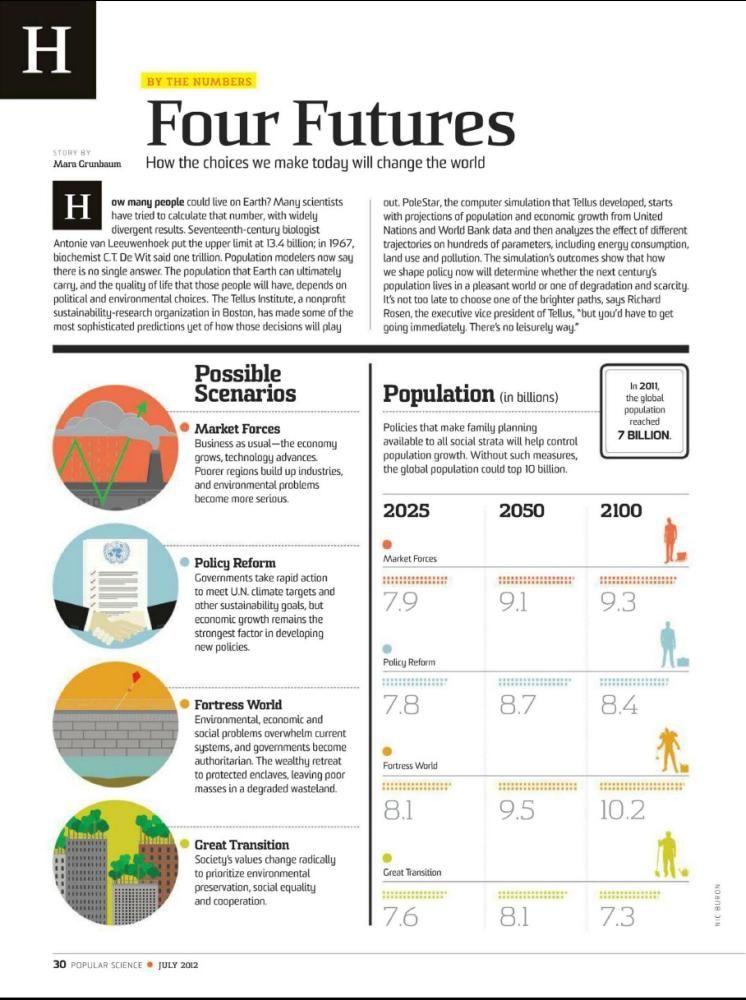
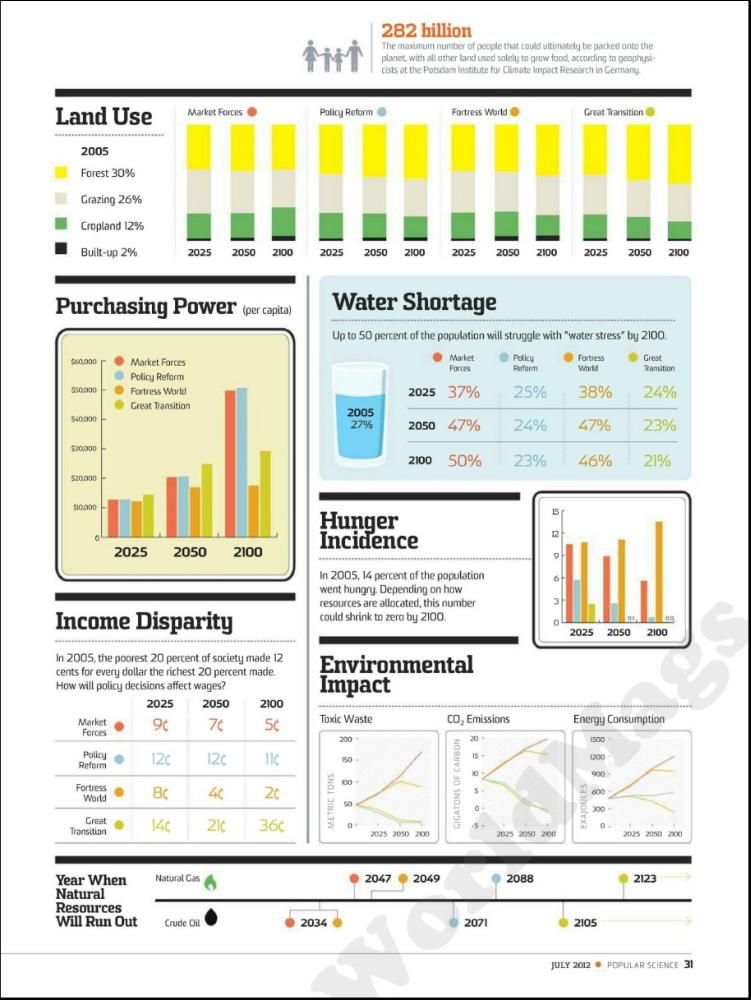
Is all this doom-mongering, crying wolf? A lot of people will think so and dismiss it, as they have global warming, as there are so many more pressingly immediate issues – keeping their job, paying off mortgages and bills, all the minutiae of daily life. As individuals there seems to be little we can do, so we shrug it off and carry on as usual. Nations are locked into the same destructive path of consumption and endless economic growth, and lack the will to change. If the dire predictions come to pass (and for the sake of other lifeforms here, one hopes they do not), humanity can’t say it was not warned.
July
1/7: Collected letters
Herald-Sun, 25/6:
Population alert
THE clowns are again reiterating climate-change nonsense, this time in Brazil. A waste of time and effort.
Who will be the ring master and both espouse and support our planet’s main problem, overpopulation? Poland has dispensed with the warming nonsense and others will follow. Nothing we do will affect the planet other than reducing population.
Please, one world leader stand up and promote population reduction. I know the Chinese are. Where in the developed world is the fortitude for the same? Your top hat awaits.
– Tim Stafford, Mt Eliza
27/6:
Tax welcomed
AS SOMEONE fortunate enough to have received a scientific education to university level, I do not feel we have a right to ignore environmental concerns in our quest for future existence on this planet.
It does concern me that various high-profile columnists espouse a mantra of continued population and economic growth, with their costs of unsustainable consumption and environmental change.
I for one do sleep more soundly at night with the thought that our government is implementing a carbon tax, no matter how ineffectual, as it is a start to recognising something that seems increasingly to be affecting us all.
Maybe it is time we all became more scientifically literate.
– Jim Royston, Heidelberg
Three weeks ago, the Victorian Bailleu government announced it would be rezoning yet more valuable farmland and green wedges around outer Melbourne for housing to accommodate the ever-growing population. Various developers, many of whom are lobbyists, will benefit, but the environment certainly won’t. A later article noted that “Urban spread poses new threat to endangered frogs,” but the government apparently does not care – for them, growth must come at any cost. I can feel only despair and anger at being so powerless to stop this destruction.
The Age, 14/6:
Boundary is a rubbery concept
DOES the state government have a mandate to open up thousands of hectares of green wedge land and farmland (“Government shifts green wedge boundary,” The Age, 13/6) for housing on the metropolitan fringe? Where is the democratic consultation and what are the long-term benefits of its plans?
What Planning Minister Matthew Guy considers “anomalies” were actually planned by the Hamer government to prevent Melbourne becoming a monolith of housing and concrete. There’s no “logic” in grabbing thousands of hectares of “logical inclusion” from green wedges, but there is pure greed for growth.
This extension of the urban boundary will be the fourth time it has been shifted since the Bracks government introduced it in 2002, so there’s no real boundary - it’s an imaginary rubbery line that expands with market forces and urban obesity.
When no one is in charge of properly regulating natural resources, cities grow in ways that are utterly unpredictable and without regard to optimising resources. Nature functions on balance, and perpetual growth is not natural. We could suffer the same fate as any other species whose habitat is destroyed by the blind pursuit of excesses.
– Vivienne Ortega, Heidelberg Heights
Try before you buy
PERHAPS there should be a scheme to allow people to try living on Melbourne’s furthest fringes for a week or so to see before they buy if they have the mental and physical stamina it takes. Try for a week driving to work on a scarcely moving freeway. Or be at the station by 7 a.m. to get a park and a spot to stand up in the train for 40 kilometres to the city.
Try booking your child into kinder or school and have a look at the sheer size of such educational facilities. (Note that size does not always equate with quality). Sit for hours in the only hospital’s emergency department. It is looking less and less appealing isn’t it? Perhaps we should encourage the Planning Minister and Premier to live such a week. It might make them less keen to jam more and more people into the city’s under-resourced fringe.
– Clancy Briggs, Berwick
Toxic consequences
IF I approached the state government with a planning proposal that would not only increase the cost of food, but also the levels of respiratory disease and other health problems, I would be quite rightly shown the door.
But this is what will transpire with the Baillieu government’s vision for greater urban sprawl and freeway development, concreting over Melbourne’s green wedges and farming belt to increase the costs of fresh produce and the levels of atmospheric toxicity.
The market will now capriciously determine all the worst possible scenarios, favouring short-term housing booms over long-term food security, freeways to the exclusion of rail infrastructure.
You’d think that with a degree in architecture, Ted Baillieu would possess some environmental sensibility that might embrace state decentralisation and a respect for the primacy of planning, but it seems not.
– John Ashton, Fitzroy North
A new model sorely needed
PLANNING Minister Matthew Guy says 37,000 lots of land will be developed over 30 years to house more than 100,000 people. This might boost the housing industry, but once the houses are built, there are no guarantees of employment near or far from the houses.
An economy largely dependent on land tax and stamp duty means perpetually being strangled by the challenges of meeting the costs of urban infrastructure, creating jobs in a declining job market, and relying on the cash flows generated by continually stretching the urban boundary. A report by National Australia Bank on Victoria’s health says the state faces challenges as the worst performing state, and that’s despite churning out more houses and land than we can currently sell. We obviously need a new economic paradigm not dependent on paving over irreplaceable open space just to create more empty houses.
– Jenny Warfe, Dromana
1/7: African apocalypse
Nigerian President Goodluck Jonathan showed recently that he realized overpopulation was a timebomb when saying that his country’s citizens should limit the number of children they have. Unfortunately, most of the religious leaders there castigated him on this issue, and having large families is an embedded part of the culture.
Two articles from April also looked at the social and environmental devastation that population growth is causing in Africa (as it is everywhere).
Across sub-Saharan Africa, alarmed governments have begun to act, often reversing longstanding policies that encouraged or accepted large families. Nigeria made contraceptives free last year, and officials are promoting smaller families as a key to economic salvation, holding up the financial gains in nations like Thailand as inspiration.
Nigeria, already the world’s sixth most populous nation with 167 million people, is a crucial test case, since its success or failure at bringing down birthrates will have outsize influence on the world’s population. If this large nation rich with oil cannot control its growth, what hope is there for the many smaller, poorer countries?
“Population is key,” said Peter Ogunjuyigbe, a demographer at Obafemi Awolowo University in the small central city of Ile-Ife. “If you don’t take care of population, schools can’t cope, hospitals can’t cope, there’s not enough housing – there’s nothing you can do to have economic development.”
– “Nigeria Tested by Rapid Rise in Population,” NYT 14/4
If Africa’s population increases according to the UN’s medium prediction, the continent will have about 3.6 billion people by the end of the century – raising its current share of global population from 12 per cent to about one-third. Nevertheless, its population could reach 5.2 billion or 2.4 billion by 2100, depending on whether fertility is 0.5 children above or below the UN’s medium estimate.
The population of the Sahel – those semi-arid countries bordering the Sahara – will double or more by 2050 at exactly the time that global warming is likely to have the harshest effects. As population growth and global warming coincide, the hunger and refugee problems in the Horn of Africa, and type of resource battles seen in Darfur or South Sudan, will multiply.
Worldwide, the UN predicts 15.8 billion humans by the end of the century if average family size remains around 2.6 children per woman, but 6.2 billion if it stabilises at 1.6 children. If fertility levels drop to the replacement level of 2.1, then there will be 10 billion people. (NS)
“How to defuse sub-Saharan Africa’s population bomb,” New Scientist 26/4
Wildlife there is already under serious threat; a lot of animal species are increasingly being corralled into wildlife parks that are surrounded by farmland, unable to traverse their ancient migratory routes. It is depressing to contemplate that the continent where humans first evolved – our ancient first homeland – may ultimately be turned into a wasteland by our species because we won’t or can’t restrict our numbers.
1/7:
Birth control key
MATT Wade’s report (“Children near starvation in world’s largest refugee camp,” 17/7) on the tragedy in Africa’s Dadaab refugee camp is heart-breaking. The clue to the cause of the problem is also in Wade’s report: overpopulation. One of the refugees has nine children, another has six children below the age of eight. The drought has dramatically exacerbated an untenable situation.
The only solution to poverty in countries such as Somalia is birth control. Developed countries give hundreds of billions of dollars a year for the economic development of poor countries. Any progress they make is swallowed up by the increasing population and the end result is increasing poverty.
It is time for us to reassess our options.
– Bill Mathew, Parkville
As always, the trinity of health care, family planning and education for women is the only long-term way to break the poverty and famine cycle in developing countries. Aid should be given only if these will be implemented also, otherwise such humanitarian disasters will continue.
“The Other Arab Spring,” NYT, 7/4. This opinion piece by Thomas L. Friedman notes that the revolutions that have shaken the Middle East since 2011 can be attrituted to the high population growth in the region, especially a high and unemployable youth population.
All these tensions over land, water and food are telling us something: The Arab awakening was driven not only by political and economic stresses, but, less visibly, by environmental, population and climate stresses as well. If we focus only on the former and not the latter, we will never be able to help stabilize these societies. […]
If you ask “what are the real threats to our security today,” said Brown, “at the top of the list would be climate change, population growth, water shortages, rising food prices and the number of failing states in the world. As that list grows, how many failed states before we have a failing global civilization, and everything begins to unravel?”
1/7: Loopholes
“Chinese couple pay to have second child,” Telegraph, 1/6. Another article proving that many selfish people will seek to circumvent whatever birth restriction policies are in place. My opinions on this were stated in my 11/2/2012 entry.
However, the [one-child] policy has never been evenly enforced. There are exemptions for ethnic minorities, for families where both parents were single children themselves, and for couples in the countryside whose first child is a girl. In addition, a growing number of rich families now choose simply to pay the fine, which is a multiple of between three and ten times the average after-tax income of the city where they live. Aspirational advertisements in Beijing, including propaganda posters from the local government, often now show families with two children, rather than one.
“China’s One-Child Policy’s Unexpected Issue: Infertility,” Forbes, 25/5. In an overpopulated country (and world) I can’t see this as a bad thing, sorry! I would like to see a ban on IVF – or at least not have it taxpayer-funded.
Huang Hefeng, director of the Zhejiang province reproductive medical center, said that factors like heavy workloads, stress, environmental pollution and unhealthy lifestyles are known to be related to a rising infertility level in China. The WHO expects infertility and sterility to be the third-most serious disease worldwide in the 21st century, after cancer and cardiovascular diseases.
29/7: Collected letters
Herald-Sun, 10/7:
Paradox in breakthrough
CONFIRMATION of the existence of the Higgs Boson, commonly known as the “God particle,” presents world powers with a paradox.
Since knowledge is power, human civilisation has, through conflict, harnessed technological breakthroughs principally to survive. Hence, “necessity is the mother of invention.”
The paradox I speak of is that we as a species now face a critical mass represented by population density versus resources.
Unless we can control the basic maths of our own numbers, we will become extinct before we harness the physics of the universe.
The irony is that studying the “God particle” will provide unimagined knowledge, technologies and the empowerment of humanity to adapt, overcome and survive by seeking out new worlds.
Unfortunately for humanity, “time” – or the lack of it – creates the paradox.
– John Godden, Neerim South
21/7:
Not fair for empty nesters to fly coop
IT is outrageous that a property investment company has the audacity to criticise older generations for living in the suburbs and houses of their choice (“Empty nesters sticking around,” July 18).
They have as much right to homes in areas convenient to them as young people with families.
Young families are being forced to build their own homes not because “empty nesters refuse to downsize” but because of Victoria’s booming population.
Our State Government and urban planners have been hijacked by the real estate industry, mortgage lenders and property developers. Property is too lucrative in an otherwise declining state economy.
The attack on Baby Boomers and our “aging population” is misdirected and irrational.
Older people bring wisdom and stability to societies, and contribute in many ways, including childcare.
If they downsized their homes to give way to young people in their suburbs, we would see an unsustainable influx of kids in our already overcrowded schools and childcare centres.
Even “empty nesters” have a right to enjoy gardens, spare rooms for family and guests, space for hobbies, pets, familiar neighbours and convenience.
– Margit Alm, Eltham
The Age, 2/7:
Plea for balance
THE latest environmental depredation wrought by the Baillieu government is its plan for the extension and development of the urban growth corridor to the north of Melbourne. A more detailed biodiversity study needs to be done to protect valuable grasslands. There are no new conservation reserves planned to address this problem, and no sign of a promised woodland reserve. The habitat of the endangered species, the growling grass frog, will be affected by a narrowing of the conservation corridor along the Merri Creek at Lockerbie. The proposed biodiversity link is inadequate because it is interrupted by quarries.
The development will be cut by new freeways and arterial roads. No rail link is planned. This will mean a great increase in traffic and its attendant problems. In addition, areas such as Hernes Swamp are designated for urban development, but are flood prone. Former politicians and planners had a vision for a balanced and sustainable development of Melbourne, including green wedges and conservation of rural land. It seems to no longer apply.
– Des and Ruth Shiel, Clifton Hill
12/7:
Feeling good costs
ALL the letters and media commentary I have read over the years in support of increasing the refugee intake have failed to outline proposals for funding the long-term costs of such an increase. Regrettably, too many people choose not to think through the practical implementation of what they seek. In the case of funding an increase in the refugee intake, should the federal government increase tax, reduce welfare payments, increase national debt, and/or cut public services? Which public services? Feeling good is all very well but it comes at a price. Are Australians prepared to pay that price?
– Eric Ash, Boreen Point, Queensland
17/7:
End Ponzi scheme
AN ECONOMY dependent on ever-increasing population is nothing more than a great big Ponzi scheme (“If our population doesn’t grow, the economy stalls,” BusinessDay, 16/7). Further, Matthew Kidman seems to suggest Australia should build its population by taking in the world’s needy and persecuted, or is he thinking of overseas trained doctors and the like?
Population growth must end some time and it may as well be now. We should be aiming for a gentle, managed decrease.
It’s high time creative minds worked on remodelling the economy. I have two areas particularly in mind for starters. First, older people who wish to continue working should be able to do so, and younger people suffering work stress when they should be spending time with their children should be able to do so.
Second, we must reduce the amount of materialistic rubbish sold and soon carted off to landfill and return to mostly local production of high-quality, long-lasting goods. Neither of these goals requires a fight against nature, only a change of attitude, which, I believe, would bring welcome relief to most of the population.
– Hilary Thompson, Sassafras
22/7:
Thud and blunder
ONGOING, artificially stimulated population growth distorts our planning process. Planning should be about improving the lives of all Victorians not of choosing who the government can afford to hurt most (“Planning for disaster,” Opinion, 15/7).
It is clear that with the current planning approach, life for people in Victoria, especially those in and around Melbourne, can only deteriorate. Unless there is a change in the infinite growth mentality of governments to one of steering this state towards population stability, most of each successive state government’s planning energy will go into tinkering around the edges of the work of its predecessors.
This will continue to be a series of political exercises in harm minimisation aimed at those most likely to vote the government back in and blundering through the living spaces of those who will never vote for them. In the end we will all be harmed as each side is successively turfed out by the voting choices of desperate citizens.
– Jill Quirk, president Sustainable Population Australia (Victorian and Tasmanian branch)
29/7: Cancerous cities
A collection of images published at Wired.com and The Atlantic Cities shows various satellite photos of cities by NASA’s Landsat satellite system – two images of each, from decades ago and more recent. All cities have grown alarmingly, deadly grey concrete swallowing up the green and brown land. It is disturbing to look at and realize how much pressure population growth is placing upon the landscape. Growth advocates love to counter with the argument that city densities should be increased by building upward rather than sprawling outward, but not everyone wants to live crammed into small apartments like battery hens. By keeping populations low people can have it both ways – minimize city spread and live in single houses with backyards.
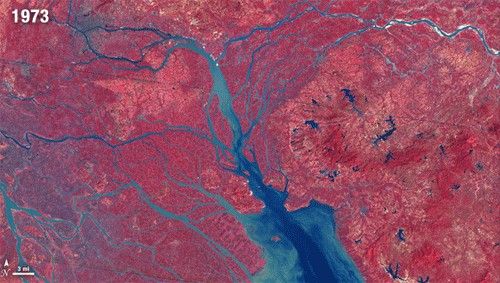
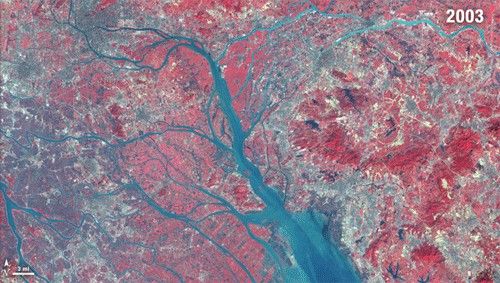
Pearl River Delta in south-eastern China, 1973 and 2003
August
1/8: If you’re thinking of moving to Melbourne …
Please don’t! That’s my reaction when I see threads on that topic on forums such as r/Melbourne, though I refrain from saying thus as I will inevitably get downvoted. I might sound churlish, but almost 1000 people a week are arriving, as reported in The Age and Herald-Sun today: “Growth pains on the city’s fringe” and “Booming in the ’burbs” – the latter reproduced below as it is not online:
THE booming outer suburbs have helped Melbourne post the biggest population gain of any capital city in the past decade. Almost 650,000 extra residents moved to Melbourne in the 10 years to June last year, pushing the total population up 18 per cent to a whopping 4.17 million. Census figures released yesterday show the top five areas for growth nationwide were all on Melbourne’s outskirts.
South Morang recorded the biggest increase, with the number of residents up 32,200. Point Cook, Caroline Springs and Tarneit in the west followed with growth figures of more than 20,000.
Demographer with id Consulting, Glenn Capuano, said affordable housing within 25km of Melbourne’s centre was helping lure residents from Sydney, where prices were much more expensive. An economic downturn in southeast Queensland was also behind the influx. It is expected to push Melbourne’s population to five million by 2025.
The Australian Bureau of Statistics figures showed inner-city development was further fuelling the population increase. The Docklands recorded the state’s fastest growth, with the area’s population almost 40 times higher than it was in 2001. Taylors Hill, Cairnlea, Point Cook and Tarneit were the next fastest.
Property Council of Australia (Victoria) executive director Jennifer Cunich said more infrastructure was needed for Melbourne to keep pace with its rapid growth. Ms Cunich said toll roads and government partnerships with the private sector were among ways to accelerate investment.
Rachel Mcminimee, who moved to Tarneit from the Dandenongs with husband John 10 years ago, said access to work and the city were big drawcards.
Melbourne’s population gains dwarfed increases in the state’s regional population, which rose about 6 per cent to 1.37 million.
Perth was the nation’s fastest growing capital, with the population up 26 percent, ahead of Brisbane. In NSW, 75 per cent of the state’s population growth was in Sydney. The city now has a population of 4.61 million.
Road traffic has become horrendous and infrastructure is simply not coping – and governments will never manage to catch-up with the unwanted growth. I have lived here all my life and can emphatically assert that quality of life is eroding rapidly and the crowding is extremely stressful and anger-inducing. We are not yet at the level of crowding of megacities of the world, but it seems that government and business wants to make Melbourne that way.
5/8: Iran going backward
Some dismaying news reported this week was that Iran had gone into panic mode by deciding to abolish its state-sponsored birth control program (mentioned in my 4/2/2009 entry ) due to a falling birth rate – its population is currently around 75 million. The usual fear of an aging and decreasing population is a reason given, but by any other definition the program has been successful, with women having access to family planning. Now it looks like that will be made much harder for them. The last thing the country wants is a surplus of young people – that factor is one reason for the revolutions in other Middle Eastern countries. A New York Times article from April, “The Other Arab Spring” notes:
Especially when you consider the other stresses. Nafeez Mosaddeq Ahmed, the executive director of the Institute for Policy Research and Development in London, writing in The Beirut Daily Star in February, pointed out that 12 of the world’s 15 most water-scarce countries – Algeria, Libya, Tunisia, Jordan, Qatar, Saudi Arabia, Yemen, Oman, the United Arab Emirates, Kuwait, Bahrain, Israel and Palestine – are in the Middle East, and after three decades of explosive population growth these countries are “set to dramatically worsen their predicament. Although birth rates are falling, one-third of the overall population is below 15 years old, and large numbers of young women are reaching reproductive age, or soon will be.” A British Defense Ministry study, he added, “has projected that by 2030 the population of the Middle East will increase by 132 percent – generating an unprecedented ‘youth bulge’.” […]
If you ask “what are the real threats to our security today,” said Brown, “at the top of the list would be climate change, population growth, water shortages, rising food prices and the number of failing states in the world. As that list grows, how many failed states before we have a failing global civilization, and everything begins to unravel?”
Another recent NYT article, “What Can Mississippi Learn From Iran?,” gives some details of Iran’s health care program, which a US state was looking to model for its own.
The Iranian reforms were relatively inexpensive to implement there. It was the early ’80s, just after the Ayatollah Khomeini’s return and the Iranian revolution, which had promised the country’s rural villagers the kind of social justice that had been lacking under the shah. At the time, more than half the population lived outside major cities, in or around more than 60,000 villages. The Iranians built “health houses” to minister to 1,500 people who lived within at most an hour’s walking distance. Each house is a 1,000-square-foot hut equipped with examination rooms and sleeping quarters and staffed by community health workers – one man and one or more women who have been given basic training in preventive health care. They advise on nutrition and family planning, take blood pressure, keep track of who needs prenatal care, provide immunization and monitor environmental conditions like water quality. Crucially, in order to gain trust, the health workers come from the villages they serve.
People who become very sick, or require surgical procedures, are referred up through a single, multitiered system: from health house to rural health center to district hospital. The integrated nature of the system is what makes it unique. Today, 17,000 health houses serve 23 million rural Iranians. Health disparities between rural and urban Iranians have narrowed; the Iranians have reduced rural infant mortality by 75 percent and lowered the birthrate. Iran’s reforms won praise from the World Health Organization, which has long advocated preventive, primary care.
And now they will abandon some or all of that? Utter madness.
24/8: Collected letters
Another round-up:
31/7, H-S:
Slower growth
THERE is nothing virtuous about perpetual growth – it is a cancer eating away at the world’s environmental balance, its diversity, its flora and fauna and its moral compass.
Once there may have been a need for growth, but that need has passed and growth is now more about wanton greed.
The planet is all we have and in a more enlightened and responsible era, growth will be condemned.
– Bruce Mullinger, Kurnell, NSW
2/8, The Age:
Growth is abnormal
IRRESPONSIBLE levels of population growth, encouraged by state governments, have resulted in increasing difficulties for residents, particularly in the outer suburbs (“Northern growth corridor residents driven to despair,” 1/8). It is negligent in the extreme to send people to the outskirts where infrastructure is inadequate. There has clearly been a lack of foresight as to how the city can continue to function with never-ending growth.
It is a no-brainer that transport infrastructure and services such as kindergartens are required before people move in to an area. If the necessities are not put in place first, the people of Melbourne will be living in a constant state of deficit of those elements that make a reasonable urban life possible. According to demographer Graeme Hugo, Australia’s annual rate of population growth is more than three times the average of advanced countries. It is time our politicians and planners stopped treating this as normal.
– Mark O’Connor, Lyneham, ACT
A related article from that link noted that almost 1000 people a week are immigrating to Melbourne (from interstate and overseas). No wonder traffic has become almost gridlocked in many areas, and housing unaffordable.
Melbourne was also recently voted most livable once again. The city is still much better than many others in the world – one reason being its relatively small population and low-density layout – but its livability is rapidly being eroded due to population growth and urban densification.
4/8:
Planetary predators
BARNABY Joyce is right when he says the $244 million threshold for an assessment of a proposed farmland purchase was so high it was ridiculous (“Hands off farm: Coalition,” 3/8). Globalisation has given rise to planetary predators trying to pry open weak national borders. Foreign owners of agricultural land will give priority to their populations, and only sell the leftover to Australia.
There is also prevalent an assumption that because we now produce more food than we need, this scenario will continue, despite climate change and global population growth.
Brazil and Argentina, poorer nations than Australia, have limited foreign land grabs. No agricultural land can be bought by foreigners in China. Australia is a leader in harnessing the short-term profits from globalisation, to our detriment.
– Vivienne Ortega, Heidelberg Heights
Selling off valuable arable land to other countries is foolish in the long-term for food security reasons. I wonder, though, if the government has plans to re-appropriate the land if the food security situation ever gets really dire?
14/8:
Discard convention
THE simplest and obvious solution to the boat influx is to withdraw from the 1951 Refugee Convention. Having an international organisation dictate to us on this global problem is inappropriate and contrary to our sovereign interests. We should be free to make a deal with Malaysia or Indonesia.
People smugglers see Australia as a “rich” country, an “immigration nation” and a soft target for resettlement. Yet this country is losing jobs, thousands of people a year are being turned away from housing and homelessness services, infrastructure is under pressure, and food security and environmental concerns in a continent largely composed of semi-arid desert are growing.
We should discard the UN convention and replace it with an orderly processing queue offshore. We could easily accommodate more refugees if we slashed our heavily imbalanced permanent skilled migration program, and our family reunions and unlimited temporary employer-sponsored intake.
– Vivienne Ortega, Heidelberg Heights
18/8:
Sort out our backyard
MICHELLE Grattan makes a valid point about the need to provide services, education and training for asylum seekers on Nauru and Manus Island (Comment, 17/8).
However, we need to look at the wider picture in our own cities. In Melbourne there have been reports of troubled youth in western suburbs who don’t have access to these services, education and training. A report on housing shortages for the disadvantaged this week highlighted further problems. Surely we need to look after our own backyard before we provide money for refugees who may or may not end up coming here. There is a limited amount of government money; it should be spent first on much-needed infrastructure to help those already living here.
– Irene Ritchie, Balaclava
I have been mostly refraining from commenting on the farcical situation involving asylum-seeker boat arrivals, but the situation is well and truly out of control (nearly 7000 arrivals this year alone). I can only feel exasperation at weak-willed Government policies that are all but encouraging this. Some idealistic fools in the Green political party are just as bad on this issue – they practically want to throw open the borders to all. Another concern is that many already in Australia are becoming a part of a disadvantaged underclass here. To put it bluntly, we can’t take in everyone in the world who wants to come here, not if we want to retain some quality of life and maintain the public services and welfare systems we have now. My own policy would be to withdraw from the Convention and refuse to take any illegal/boat arrivals (I could imagine the outcry at that!) – only accept applications when done the proper way.
I am also baffled by those who support illegal immigration (which is a massive problem in the USA) – they don’t seem to understand the meaning of “illegal.” Problem is, if you criticize their policy you get branded as “racist” and “xenophobic,” even if this never enters your argument.
September
2/9: What would aliens do?
A letter published in New Scientist magazine, 15/8:
Human cull
If a superior extraterrestrial intelligence arrived on Earth, as Anthony Wheeler suggests in his letter (21 July, p 30), then presumably it would be intelligent enough to realise that the sheer number of humans, all consuming resources, causes problems. It therefore seems likely that these beings would do as we do when faced with a less intelligent species becoming too numerous: cull it. It would be for our own good, of course.
– Steve Morrisby, Pinner, Middlesex, UK
Humans don’t hesitate to cull other species for our own convenience, but we would be very outraged if the same were done to us by aliens (or an Artificial Intelligence), though I suppose the action could be regarded as a sort of cosmic karma. A more merciful (though still controversial) alternative would be mass sterilization, with permits required for reproduction.
The previous letter mentioned there:
ET knows best
What is it that the Search for Extraterrestrial Intelligence (SETI) expects to gain from contact with aliens (30 June, p 28)? I suspect that like naughty children we are waiting for a superior being – maybe a mother figure – to tell us what to do. We know what we are going to be told: stop polluting the air with carbon dioxide, stop overfishing, stop replacing rainforests with palm oil plantations, and so on. We know what we should do, but we cannot bear to forgo low-cost energy and food to save the future. And when a superior intelligence imposes discipline on us, will it be with a carrot or stick?
– Anthony Wheeler, Mackay, Queensland, Australia
I rather wish aliens would come along and save the Earth, as humans aren’t doing a very good job of it! We need an impartial force to change things. Unfortunately, so far we seem to be alone in this part of the Universe.
15/9: Planning for destruction
“The Planning Guy” – profile of Victorian Liberal Government Planning Minister, Matthew Guy. I thought that previous Labor Minister Justin Madden was bad, but this one is far worse. The radical planning changes he is pushing through will give virtual free rein to developers and ruin Melbourne’s established suburbs by continuing overdevelopment and overcrowding, and pave over much of the remaining green spaces. Even Lady April Hamer, the widowed wife of the creator of the Green Wedges areas (ironically from the Liberal party of then), was moved to speak out last month against the changes. There is more commentary on the issue at (We) Can Do Better.
.An article from yesterday’s Herald-Sun (not online that I could find) reported that immigration had increased alarmingly:
Big leap in migrant numbers
AN influx of New Zealanders and foreign students has forced the Federal Government to sharply increase its immigration estimates. Net overseas migration has reached about 217,000 people a year – about 25,000 more than was predicted a few months ago. It means the so-called Big Australia target of 36 million by 2050 could be reached much earlier because the estimate is based on average net annual migration of only 184,000.
New Immigration Department data reveals a net influx of 39,000 foreign students for the year to September – more than double the number predicted by the department in a May report.
The net number of New Zealanders arriving has hit 31,300, compared with 17,900 predicted in May. New Zealand and Australian citizens have the unrestricted right to migrate between each other’s borders.
Monash University migration expert Dr Bob Birrell said yesterday the rising number of Kiwi arrivals was a worry in a contracting job market. “It’s unlikely that we need this influx – the sooner we regulate it the better,” Dr Birrell said.
There have been hundreds of job losses from various industries this year in Victoria alone – many from long-established businesses going under – so where are all these newcomers going to find work? It will mean extra competition with those already here. The population growth also increases demand for housing and public services (transport, health), both of which are not keeping pace.
An article from The Age last month, “54,000 refugees, no questions asked,” 22/8, reported that:
AUSTRALIA is facing a flood of economic refugees. But the big numbers aren’t from the north, they are from the across the Tasman where Statistics New Zealand yesterday announced the biggest exodus to Australia on record.
An extraordinary 53,900 New Zealanders moved to Australia in the year to July – around the entire population of New Plymouth, New Zealand’s 11th biggest city. […]
The Closer Economic Relations agreement with New Zealand means Australia is unable to control its trans-Tasman border. It is required to accept as permanent or long-term residents as many of New Zealand’s 4.4 million residents as want to move here. If present trends continue Australia’s annual intake from New Zealand will exceed 100,000 within five years. New Zealand has had no net arrivals over the past year.
It is definitely time to rethink that agreement! The exchange seems to be mostly one-way.
A H-S letter, 4/9:
Jobs going to foreigners
FOREIGN workers on controversial 457 visas have taken 13,680 jobs in Victoria at a time of increasing unemployment, job losses and double-figure youth unemployment in some areas.
Many Victorians are facing tough times.
Why then are jobs going to “temporary” foreign workers?
There’s nothing more permanent than a temporary worker, with many of them ultimately applying for PR and adding to population pressure.
Our Government imagined our economy would surge and grow, even in non-mining states.
This is not happening, and we have more skilled people than jobs and housing.
Employers can simply get the cheaper option of foreign workers instead of investing in, and training, willing Australians needing jobs. It’s a betrayal.
– Vivienne Ortega, Heidelberg Heights
Those who oppose these policies predictably get demonized as xenophobic – this opinion piece in The Australian, “Our future is as Asia’s nation of immigration” espouses the “need” for a big Australia; being a pro-business and pro-growth paper these type of articles are typical.
Gillard is the Adelaide Pom, wanting to freeze-frame the nation. The focus groups tell her to slow population growth, which is code for talking down the immigration intake. She has yet to confront voters with Australia’s need for more people. […]
Our future in Asia is as the world’s best immigration nation, that is, as Australians. But we need more, not fewer, Chinese and Indians to want to live across the country to prove it.
So according to that view, Australia should serve as a relief valve for extremely overpopulated countries. We can thus farewell the country’s livability if such growth continues.
28/9: Collected letters
Another batch of letters from The Age, in response to the article linked to last entry about Planning Minister Matthew Guy. Most feel the same negativity toward him and the planning system as I do. I did not comment on the planning reforms site as I did not know what to say specifically about the topics – not qualified enough.
18/9:
State caves in to vested interests
PLANNING has devolved into prying open reserved land such as food bowls, national parks, green wedges and extending the already stretched urban growth boundaries for housing and commercial developments. Once lost, these areas are gone forever. There is no agenda to balance natural wealth, livability, and future impacts – just a regime to ensure profits for developers and encourage urbanisation.
The state government, under Planning Minister Matthew Guy, is undemocratically removing restrictions to planning, and is actually undermining the whole meaning of the word, by moving towards open-slather land use (“The planning guy,” The Saturday Age, 15/9). It is a deregulation of any previous holistic planning, and is carried out under the guise of “economic development,” which really means caving in to vested, commercial interests.
What is not mentioned is Melbourne’s unprecedented rate of population growth, 200 people per day, 1500 per week, 75,000 each year. There is no population upper limit, and no population plan for Australia – or Victoria – except growth. This is placing pressure on all open spaces, including our coastal playgrounds – areas that should be reserved as natural sanctuaries.
– Margit Alm, Eltham
Basis of economics
MATTHEW Guy’s statement that the planning portfolio “is becoming an economic one rather than an academic one” ensures there is zero consideration for communities. Thus, a dollar-shaped scythe can shred our social fabric with little recourse from those in its path. Mr Guy, economics is about the efficient management of scarce resources, which include functioning infrastructure, breathable air, places of natural beauty and public safety. The proposed changes will make those resources far more scarce than they are now.
– Doug Mealy, Warrandyte
Ideology of greed
IT IS interesting to hear Mr Guy resort to the ideology word. Does he think politicians on his side of the planning fence are immune to ideology? They have one, too – one of greed, stupidity and short-sightedness. Green wedges are precious and deserve protection at a federal level to prevent short-term meddling for political and economic gain.
– Sue Aldred, St Andrews
Ode to Matthew Guy
HE LOVES a sunburnt country, a land of sweeping cranes, of haggard mountain ranges, of overcrowded trains. His love of far horizons, filled with concrete towers, he dreams of more of this, to exercise his powers. To achieve his main objective, he must always plan and try, to destroy all that’s pleasing, to one’s heart and soul and eye. As he gazes into the distance, at magnificent green wedges, he imagines how they could appear, without trees or even hedges. He must plan all this madness, to please developers bold, to have shoddy plans enacted, to maximise their gold. He has just announced his greatest plan, which does away with zones, just like a hapless vertebrate, deprived of all its bones. Though earth holds many wonders, wherever he may die, we know this urban wasteland, was due to Matthew Guy.
– Hilary Poad, Frankston
20/9:
Take our time
PLANNING Minister Matthew Guy says councils are best placed to consider his proposed changes to planning zones (Letters, 19/9). I think he will find that council submissions are just as critical as those of academics in the field.
One of the many concerns listed in the submission from of the Eastern Metropolitan Group of Councils is the allowable creep of commercial uses into residential areas. Not only will this provision affect peaceful residential neighbourhoods, but it also has the potential to strip small shopping areas of key businesses, similar to when bank branches closed down.
I am concerned about the one-month timeline for consideration of mountains of objections, let alone implementation at a time when councils are being re-elected. I urge the minister to allow proper public consultation and sufficient time for strategic reform.
– Jenny Henty, Canterbury
No faith, all right
WHAT can be said about a minister who proposes contentious and radical planning rule changes, invites opinion before deciding, then before the opinion deadline closes, effectively tells us the consultation was just pretend and he’s already made up his mind (Letters, 19/9)? Minister Guy’s blundering should no longer be tolerated by the Premier. Victoria cannot afford such undemocratic, high-handed behaviour.
– Greg Johnson, Eltham
22/9. The first letter echoed what I feel about how Melbourne has changed over the years – namely, not for the better. Tall skyscrapers have made Melbourne’s skyline increasingly ugly and, as he notes, are dehumanizing – they make one feel like an insignificant ant when walking under their towering shadows.
Paris perfect example of visionary planning
IF MATTHEW Guy ever becomes premier, God help the city of Melbourne, its residential streets, parks, reserves and green wedges. As an octogenarian, I have felt sadness, even grief, over the years as a succession of testosterone-driven politicians and developers has systematically turned a once-gracious Victorian city thoughtfully planned by our forefathers into just another American pile of phallic monuments to male enterprise. These create wind tunnels, block out the sunlight, and dehumanise its citizens.
Mr Guy has said the planning portfolio is becoming an “economic one rather than an academic one” – a view supported by Jennifer Cunich of the Property Council (surprise, surprise), that “Victoria’s planning system … should be used to stimulate economic growth.” So it’s the economy, stupid.
Well, Paris is one of the greatest cities. It is an example of visionary planning and aesthetic sensibility with its open spaces and magnificent gardens. It has controlled developers and the height of its buildings and preserved the best of the past. It is, consequently, a mecca for 28 million tourists annually, a source of billions of dollars in revenue. Think outside the square, minister.
– Bobbie Holmes, Hawthorn
Councils have agenda
MATTHEW Guy (Letters, 19/9), you have overlooked a few facts. Local councils have their own agenda (read: blinkers) and plans within their own zone. Local councils benefit from more rates – which come from more properties – as a result of development. Local councils don’t have the same over-arching view across the city (and state) that higher-level governments have. Their views are much more localised and self-concerned. Thus local councils don’t have the same concerns about how the “green wedges” (or lack thereof) can affect the city as a whole.
– Leigh Gardner, Wallan
Minister all-powerful
MR GUY maintains local councils are best prepared to consider planning issues. What he failed to mention is that the Planning and Environment Act 1987 gives the minister power to amend well-considered planning schemes. This undermines the democratic role of councils in planning. There have been 73 ministerial interventions from May to July this year – several opposed by local councils. The minister’s decision is final, with neither councils nor residents given an opportunity to make formal submissions or have these considered by a panel.
– Kathleen Hassell, Frankston South
24/9:
Community good must come first
ALAN March is spot on when he calls for strategic long-term planning for Melbourne (Comment & Debate, 21/9). The current ad hoc planning is beneficial for commercial interests but not anyone else, and even commercial interests find the uncertainty challenging. The proposed changes to Victoria’s zoning, which will include fewer rights of appeal, will inevitably undermine future planning.
Urban planning is a livability, environment and health issue. The potential for emission savings is obvious, with good public transport replacing endless traffic jams. In addition, the state government’s recent report into health and urban planning found that good strategic planning increases physical activity and community connectedness, with major health benefits.
– Margaret Beavis, Brighton
Irreplaceable assets
THOSE of us who live in the green wedge of Nillumbik are all too aware that when Planning Minister Matthew Guy speaks of balancing the needs of local communities, small business, farmers and the tourism and hospitality industries, he uses the same language as developers who are desperate to carve up the green wedges. We hear this talk of “balance” during council elections.
Without controls, the constant push by developers seeking personal gains from the green wedges will place too much pressure for our councillors to withstand and create a wasteful increase in the number of appeals to the Victorian Civil and Administrative Tribunal. Let us not give away Melbourne’s irreplaceable environmental assets for the benefit of a few.
– Ruth Bence, Warrandyte
Follow Sydney’s lead
SYDNEY is blessed with steady trade winds and a fortunate profile of hills and open waterways. Melbourne, by contrast, must create its attractiveness and livability in the Port Phillip Basin, a potential smog trap where, already, the air is often of poor quality. Yet Sydney has preserved large national parks to the north, south and west to ensure healthy air and to offer refreshment. Why isn’t a large tract between Werribee and Geelong preserved in perpetuity as farming land and park? Why aren’t large tracts of the Mornington Peninsula similarly preserved? We urgently need a Port Phillip Basin plan, not just a Melbourne plan. It is not too late to ensure a quality city, with quality air in a quality region. Will our government provide the necessary leadership?
Cherry Collins, Highton
A step forward
IN YOUR article on changes to planning zones (The Saturday Age, 22/9), some of my statement was cut. Let me make it clear. I share the concerns about the proposed changes to green wedges and the rural and commercial areas. I believe these should be put aside until more study and community consultation is carried out.
However, the residential zones to which I was referring have great merit, providing they include the changes that we residents and most councils are asking for.
– Mary Drost, convener, Planning Backlash, Camberwell
Economic migrants
IF some so-called asylum seekers prefer to return to their home country rather than be sent to Nauru (The Saturday Age, 22/9), they can hardly be called asylum seekers in the true sense of the world. I was opposed to offshore checks but clearly these need to be done. The 18 men who returned to Sri Lanka were economic migrants and the veracity of their applications is questionable.
– Simon Jenkins, Fawkner
25/9:
Constant change
PLANNING needs to be bipartisan. How can we ever have confidence in our planning laws if they change with each election? Matthew Guy was not elected to radically change planning regulations. Once acted upon, his proposals cannot be changed. Further, his attitude does not sound like a minister endeavouring to please the majority of the people, but rather is paternalistic.
The time allowed to lodge submissions is far too short; such a radical change to the green-wedge policy set out by the Hamer government requires widespread debate. If our political parties are unable to agree on the changes, then they should be taken to an election.
– Jo Grigg, South Melbourne
WILL Matthew Guy’s new planning laws apply equally in Toorak and Footscray West?
– Brian McKay, Daylesford
MR GUY claims the latest rewrite of planning zones will provide certainty. The main certainty seems to be that Mr Guy will do what he can to make sure developers get their way.
– James Deane, Yallambie
October
6/10: Colonization by stealth?
“The Unintended Consequences Of China’s One-child Policy,” io9, 3/10. I usually emit a groan when this topic comes up, as the critics of the policy come out in force. The article points out the issues with such a policy:
- Males outnumbering females due to a long-standing cultural preference for boys.
- “Surplus males” – men greatly outnumbering women, which can be an instigator of social unrest from frustrated males. This was “traditionally” (if not consciously) dealt with by war.
- The elderly outnumbering the young in a declining population.
As more than one commenter remarks there, however, what else was the Chinese government to do? If they allowed unrestrained reproduction the population would be even greater than the already huge figure (1.4 billion or so), with all the social problems and environmental damage that result (and still are afflicting the country, anyway). The policy does not apply to everyone, anyway – some ethnic groups, for example, are exempt (perhaps to keep them mollified?), and some cities are reversing the policy to address the aging problem (see previous entries with the China label).
Another traditonal way of dealing with “surplus people” is to export them, and China is certainly doing this – Australia is a popular destination. However this strategy can incite resentment amongst the host country’s citizens as they face increased competition for living space and jobs, as described this article: “In Africa’s warm heart, a cold welcome for Chinese,” Reuters, 18/9. Many African citizens are growing resentful of increased Chinese immigration there, as the latter can undercut them with cheap imported labor and goods. They also have no qualms about bribery when deemed necessary.
China is also, to put it bluntly, plundering the rest of the world for resources, such as Australia and Africa for minerals and farmland. This is also another potential source of conflict, though those raising alarm about this – such as recent controversy over the sale of a large cotton farm to Chinese investors – are invariably branded “xenophobic.” With future food and resource security at stake, though, why is this so unreasonable? I doubt the Chinese government has any scruples about their activities. In Africa’s case, China is effectively colonizing and exploiting the continent, as Europe did in the 19th and early 20th centuries – the term for this new version is neocolonialism.
[Edit, 28/10: forgot to mention Tibet as an example.]
28/10: Selling off Melbourne
“Alarm over city bribes offer,” The Age, 21/10 and “The land dragons.” A lot of property in Melbourne and surrounding suburbs is being bought up by overseas investors for development, often without regard for those who live around the usually ugly buildings that are erected. Quite a lot of people seem to regard a city full of skyscrapers as sophisticated and futuristic, and regard those who think otherwise as backwards Luddites. I find such buildings dehumanizing and they are claustrophobic to walk under as they block out the sun and sky. Melbourne was a pleasanter place before skyscrapers were built.
The developments do nothing to alleviate the housing affordability crisis and here as they are marketed towards wealthy buyers and investors (some also from overseas). I feverently hope the property market will catastrophically collapse and all these greedy parasites will lose their money.
Some letters from today’s Age in response:
See you later, Mr Xu
JEFF Xu says developers can go elsewhere – if we don’t adopt an exponential approach to growth (“The land dragons,” The Sunday Age, 21/10). Then, Mr Xu, we’ll be seeing you. Growth is the ponzi scheme of the economy. You make your money, walk away and leave us to pick up the pieces. I would rather you left before you make your money that way.
The current wailing from the under-resourced new housing developments on Melbourne’s agricultural fringe will be a roar within a decade. The centre of town will be a lightless slum, and the Matthew Guys, Ron Walkers and Jeff Xus will be long gone – but not forgotten. It is good that developers who are “taking us to the cleaners” are being named.
– CHRISTOPHER MONIE, Ballarat
Room to block view
AS ASIAN-financed boxes move further skyward, much charm in our city is slowly being diminished. Perhaps it is just as well that our suburban transport system’s use of external advertising, at least partially, obscures our view of the changing landscape.
– PAUL MURCHISON, Kingsbury
Weed out corruption
CITY of Melbourne councillor Ken Ong warns of a “‘subculture’ of corruption taking root in Melbourne” (“Alarm over city bribes offer,” The Sunday Age, 21/10). However, the subculture of corruption may have already taken firm root in a range of areas. We have small-scale entrepreneur “Mary” operating her business of ghost-writing assignments, and now large-scale, bribe-offering developer entrepreneurs at the big end of town.
Regardless of how business may be done in other countries, it is vital for the wellbeing of our society that we ensure things are done here with honesty and due process. Vigilant scrutiny and constant weeding out of any corruption before its poisonous roots go too deep is needed. Applause for Councillor Ong for his timely warning.
– DEBORAH MORRISON, Malvern East
Not our backyard
SHANGHAI property developer Jeff Xu says developers “can choose Canada … they can choose Shanghai.” I respectfully recommend choosing Shanghai for fulfilling high-rise fantasies; leave Melbourne alone. Australians like wide-open spaces; they want to see the sky, the ocean, the hills and plains, feel surrounded by nature. They do not want to live in crammed spaces removed from the environment. Melbourne is one of the world’s most liveable places thanks to its parks and gardens, not because of its looming towers in the CBD.
– MARGIT ALM, Eltham
“Chinese parents invest in overseas digs for sons and daughters,” Wentworth Courier, 5/10. This trend also drives up house prices and pushes out local citizens who simply want a place to live. Any hope of the government closing this loophole? Not likely.
November
24/11: Melbourne in 2050: unlivable
“Still liveable?,” The Age, 22/11. This in-depth article looks at the rapid growth of Melbourne – predicted at the current rate to reach 6.4 million in 2050 – and the failure of the State Government to keep up with the infrastructure required to support such numbers. New suburbs are being built on what was once farmland at great distances from the CBD, and the residents there have virtually nothing in the form of access to public transport. The current planning system favors developers at the expense of livability issues, and there is no move to change this. Of course, the basic problem is the relentless population growth the city has been inundated with – and neither State nor Federal Governments appear willing to tackle this issue by reducing the too-high immigration rate, and discouraging the high birth rate – too radical for our growth-based economy to contemplate. One academic quoted in the article does not believe population growth is a problem:
The state government’s 20-minute city proposal is “a complete pipedream,” says Carolyn Whitzman, associate professor in urban planning at Melbourne University. “Whether Melbourne has 4 million or 6 million people, we’re not travelling in a particularly equitable direction,” she says. “I don’t necessarily see population growth as a bad thing, it just has to be managed properly. Currently, we live in a socially divided and environmentally unsustainable city.”
Realistically, population growth is almost never “managed properly” – certainly not by Australian governments – and with most cutting funding such management is even more unlikely.
From a commenter in a related article:
Still more articles agonising about strategies for adapting Melbourne’s moribund infrastructure to cope with future population explosion, all predicated on the unspoken and unchallenged assumption that population growth is inevitable and sacred. None of the learned commentators and politicians dares mention the obvious solution – limiting population growth, which could be done with social pressure on parents to limit family sizes, and governments limiting immigration. Why the collective dread of mentioning this obvious fact?
– boxchester, Melbourne, November 22, 2012, 11:48AM
I feel like starting a Mattew Guy hate page on Facebook or something! The Planning Minister comes across as arrogant and condescending in his statements, such as this opinion piece: “The metropolis our forefathers built will continue to be vibrant and exciting,” H-S, 22/11, a relentlessly optimistic extolling of Melbourne’s continous expansion. (I would like to declare a fatwa on the word vibrant …) He is of the opinion that huge skyscrapers make a city “sophisticated” – “Mr Guy dismissed those who complain about over-development, saying: ‘If Melbourne is too successful, maybe they should move to Adelaide’.” (source) – presumably Adelaide is not yet wrecked as Melbourne? “Taller buildings, he said, were a symbol of a growing nation, a strong economy and can ‘define a city’.” (source) He wrote a rather patronizing opinion piece in today’s Herald-Sun: “The metropolis our forefathers built will continue to be vibrant and exciting” (behind a paywall, reproduced below):
BEING a born and bred Melburnian I know how much the 4.2 million of us care about the way our city looks and feels.
We’re very proud of our home, despite knowing it’s not a glitzy city like Sydney or a big mining town like Perth.
Rather, we’ve built a refined, elegant city that shows off when it wants to, but aims to impress those who live here more than anyone else.
This is probably why Melbourne has been rated the world’s most liveable city for two years in a row.
But maintaining that edge of livability over the rest of the world is becoming more and more challenging.
Population growth is still strong - more than 60,000 more people become Melburnians every year - and with them come mounting infrastructure, service, environmental and housing pressures.
Melbourne has always been a positive city; we confront issues and we deal with them.
It concerns me that some people are now very willing to write off Melbourne’s ability to manage the challenges of a growing city unless we stop people having children, ban any new central business district skyscrapers and cast a suspicious eye toward any overseas investor looking at our city.
Earlier this year, the State Government commenced a process to write a new metropolitan planning strategy.
This strategic vision will outline a clear, long-term plan for Melbourne, particularly dealing with how we manage growth and confront challenges such as housing affordability, environmental sustainability and our growing infrastructure demands.
Importantly, it will be a positive strategy to guide Melbourne’s livability in the long term.
Our CBD is changing and in particular it is expanding. Melbourne has to plan to use our central city area as a place to accommodate a greater population where people can walk to work, to the football, to transport or to a restaurant.
Population growth in our central city area also gives the chance for us to create a 24-hour CBD that is more than just bars and clubs, a concept being explored by the new metropolitan planning strategy.
Melbourne’s CBD is big, much bigger than Sydney’s or Brisbane’s, and has terrific sub-precincts within it.
FROM Chinatown to the hidden laneways, to the Paris End and West End, our high-rise buildings have not compromised the CBD’s vibrancy in the past and there should be no reason that with good street-level planning new towers would do so in the future.
Importantly, to ignore the role the CBD, Docklands, Southbank and now Fishermans Bend can play in accommodating inner-urban population, is short-sighted. Every high-rise apartment built in the central city area is one less apartment on inner-suburban streets.
Of course, a greater number of residential towers in the CBD will bring more people, more activity, a greater level of community interaction and, of course, more life. There is no doubt that people make a city and more residents in our CBD have transformed it from a 9-to-5 office precinct to one of Australia’s most active and energetic places.
Furthermore, the recent increase of interest in bigger skyscrapers for the central city gives Melbourne the excellent chance to begin to define our city through built structures.
Well-placed, well-designed skyscrapers can be a beautiful and striking addition to the character of a city.
But Melbourne is more than just the central city area.
The new metropolitan strategy is focusing on our infrastructure challenges; why it is so important to build the east-west tunnel and the Melbourne Metro rail project from Footscray to South Yarra.
It is looking at the future of our ports, a new third airport in the southeast and how Port Phillip Bay could be used for water transport. The strategy is examining a permanent urban growth boundary in certain areas, recognising that Melbourne cannot physically go on forever and the role that regional cities will then play in managing growth at a statewide level.
The city I love is not one that shuns opportunities; it is one that embraces them.
And everyone is encouraged to share their view on our city’s future.
Public consultation is a must to ensure that the vision for our city is one formed from its people.
Our forefathers left behind a city that was well planned and confident.
My aim as Planning Minister is to ensure that the new metropolitan planning vision will facilitate the Melbourne of the 21st century, one that I will be proud to see my children’s generation inherit.
Letters, H-S, 30/10:
Bigger not better
IF Melburnians love their city, then there’s quite a threat of significant change over the next 40 years, driven by unprecedented population growth and economic uncertainty.
What we really appreciate is not how high the buildings can rise, or a transformation to a monster mega-city. Bigger is not necessarily better.
Matthew Guy’s Ministerial Advisory Committee has released a discussion paper featuring ideas about how we can best manage our city’s future.
This discussion paper is about allowing property developers and investors continued access to our CBD and suburbs for their own vested interests.
Our population growth keeps outpacing funding available for essential infrastructure and public facilities. The growth model should be replaced by one of maintenance and improvements for Melbourne, and enhancements of what residents love about it.
– V. Ortega, Heidelberg Heights
24/11:
Guy gets rise out of people
BEVERLEY O’Connor’s criticism of the rampant high-rise development in Melbourne is welcome (“High-risk high-rise,” Nov 21). Planning Minister Matthew Guy loves it, but residents don’t. He is quoted as wanting a Manhattanstyle skyline, but Manhattan is ranked 50th in the world for its standard of living.
Developers rule. Their plans are normally approved. The minister has sole approval authority for any building over 25,000sq m (about 15 floors) and there is no right allowed for anybody to object.
Residential buildings are being crammed in as little as 10m apart, resulting in overshadowing, increased traffic congestion and a lack of sunlight, privacy, open space and resident amenities.
In New Quay in the Docklands, where developers do what they like, seven residential towers are crammed into an area of 400m by 150m, with another two to come.
There is virtually no control over project planning design and layout. Something has to be done.
It seems the only thing that will deter the minister is fear of the ballot box, and he should start to be worried.
– Roger Gardner, Docklands
Edit, 25/11: “Regional cities set to rise and thrive,” The Age. Features Matthew Guy’s views on population growth:
Mr Guy said he supported sustainable population growth, rather than growth at all costs. “The state government’s view is that population growth, the immigration component to it, has been one of our state’s success stories,” he said. “The state has changed inexorably, whether it’s just Melbourne, or suburbs or regional towns. There is a view that we can manage our population better by cutting off all overseas migration. That’s not true and I don’t subscribe to it. Population growth should be seen as a challenge, but not one that we can’t manage.”
So he is essentially an advocate of growth. I hope he does not become Premier (as some reports say he has ambition to).
December
29/12: High-density hell
Every time I visit Melbourne CBD (every few months by train) I am reminded why I don’t like cities and certainly wouldn’t want to live there as a resident! It is noisy, stinky and increasingly crowded, not to mention unbearably hot in summer with all the asphalt and concrete smothering the ground, the streets claustrophobically overshadowed by towering buildings. And this is the city again voted world’s most livable! I shudder to think what less-livable cities are like.
A new resident to the CBD made the mistake of complaining about how noisy it was – the main offenders being music venues – and oh was he castigated, both in the article comments and elsewhere (Reddit’s mostly-younger members being a predictable example). Well, seeing as governments are pushing for higher-density cities, this sort of conflict is going to happen a lot, so I don’t know why those castigating him were so offended. Is there any law that says cities have to be noisy, aside from fatuous bullshit about noise contributing to “vibrancy”? A lot of what passes for “music” is just loud noise pollution and the environment is better off without it.
There was a quite vitriolic post on Reddit – Urban Sprawl now biggest impediment to Economy – where those who objected to high density/urban consolidation being touted as the ultimate solution to our woes got downvoted and called NIMBYers (the usual predictably tired insult). They are anti-backyards (a wasteful allotment of space according to their philosophy) and think everyone should live crammed into apartment towers with a park or two providing lonely oases of greenery. I have given up arguing with people of that mindset as they have a quasi-religious conviction that high-density is the only acceptable way to live. Not so – reducing population growth would enable people to live in detached houses with gardens and backyards, and contain urban sprawl – it would also ensure that land is retained for local food production. But this alternative solution is unthinkable to high-density advocates.
I also found disagreeable this later related post, You want housing up, not out? – the HD advocates (I really need a catchy name for them) want to brainwash children into their cult:
My idea is to use an art/design competition to harness the imaginations of older children and effectively use their drawings as covert propaganda for the type of places we want to exist, after steering their little minds towards what we want them to draw. It’ll be asking primary school children to draw how they foresee their dream Australian lifestyle, or dream city in X amount of years. What will streets and cities look like? How will people live?
This Sustainable Living webpage from NSW Save Our Suburbs gives arguments against urban consolidation. (They don’t, however, advocate restricting population growth; rather, they encourage regional decentralization.)
My little utopian vision is of cities being mostly depopulated, and people living in smaller regional towns, each having its own sustainable power and food supplies, and connected by high-speed rail and Internet. A slower, environmentally-friendly and more relaxed society. I would like to see a “small, smart and sustainable” future for Australia; I emphatically reject the “big Australia” and frantic unsustainable push for endless economic growth that currently has us trapped.
29/12: Collected letters
Letters saved from the last month.
The Age, 26/11:
Tall syndrome
WHY is Melbourne so obsessed with tall buildings (“Building the future, prefab style,” The Age, 23/11)? Since landing here in 1965, I have observed the malaise of the Melbourne skyline and the growing alienation of the city from its street-level precincts. Give me any European city: Amsterdam, Copenhagen, Vienna, Berlin, and we don’t see this obsession with height. Why do we lack the determination to halt this 300-metre-plus madness? Surely more than just 3000 local residents and owners should have a say on how our city should look and function. Where is the social inclusionary policy to ensure at least 25 per cent of these 600 apartments are social housing units, the way some key European cities with higher density residential developments have done for years?
– Henk van Leeuwen, Elwood
System must be fair and orderly
FROM the articles in The Age criticising government policy on asylum seekers, one would think this is the majority view. It is not. In The Age poll (23/11), 67 per cent voted in favour of the tougher new conditions. Our migration and refugee system is a mess. Many formal migration applications languish in “in-trays” while others are fast-tracked. Boat arrivals and visa overstayers make a mockery of orderly process. This is the crux of people’s concern. We want an orderly, regulated, fair and modest immigration stream. Only when politicians do something to achieve this will community unease decrease.
– Geoff Hall, Mentone
4/12:
Minister for what?
LAST week I had to take my wife to Casey Hospital’s emergency department. As is usual in many EDs, the scene was chaotic. There was an expected wait of three to four hours for a bed. Although the staff were professional and tireless in their efforts, my experience highlighted the enormous problems that confront the state as we continue down the path of “expand at all costs.” As our population grows at breakneck speed, the essential services (health, education, transport, law and order) continue to be treated as afterthoughts.
Casey Hospital cannot cope with current demands, let alone those that will follow as Berwick, Pakenham and Cranbourne continue their massive sprawl into farmland. And this experience is not unique to the south-east growth corridor.
There is a distinct lack of planning around the expansion of housing estates. Railway stations are inadequate before they are even completed and road infrastructure continues to play catch-up. Until such time as the future needs of all Victorians are taken into account the Minister for Planning should be renamed the Minister for Building.
– David Glover, Berwick
I DON’T get humans – disastrously heating the planet, using up dwindling resources, and yet we’re still encouraging people to have more babies. Good thing we have Planet B to move to.
– Mick Webster, Chiltern
Sovereignty issue
“DEVELOPERS may have inadvertently compromised the majority of the council” (“Cash may gag council vote,” The Saturday Age, 8/12). What’s inadvertent about it? Surely they donated to Melbourne City councillors knowing full well what they hoped to get out of it. No such thing as a free lunch and all that. As for the councillors: whatever it takes to maintain power and all its perks, eh?
So, we sell off our city – and our farms – to the Chinese. The Kuwaitis are also getting in on the act of changing our skyline. We sell our infrastructure to overseas interests, and send profits offshore. But we cunningly maintain responsibility for costs. And we don’t bat an eyelid at airborne foreign nationals overstaying their visas by the thousands.
So just what does make Australia a sovereign country? That’s right. We stop people in leaky boats who seek asylum.
Our safe borders and all that cash from developers and investors are contributing to my wellbeing by, um, let me think. There’s a reason I’m sure. By God, I’m proud to be an Aussie.
– Margaret Callinan, Balwyn
Cracks are showing
THE general tone of commentary in The Age implies that Australians who are against asylum seekers arriving by boat are heartless and incapable of seeing what is right or wrong.
I resent both implications. Politicians should be guided by the wants of the majority of their constituents – partly because that is their mandate, but mostly because that is how to get elected.
There are 40 million refugees and if they are resettled satisfactorily, there could be a billion more. A tiny fraction of that number can wreck our economy in the short term (the cracks are already showing). Australians do not have to be heartless to see these threats.
– Patrick Shiels, South Clayton
Herald-Sun, 29/11:
Numbers game lost
EVEN the biggest environmental vandals agree on one thing; the world is overpopulated. The Middle East, Asia, India, China, Africa and South America are the most grossly overpopulated areas, about 700 per cent over capacity.
Australia would be the least overpopulated country.
We’re only 100 per cent over our human-carrying capacity and climbing.
The reason we’re climbing is because our traitorous major parties insist on continuing with mass immigration, despite the overwhelming opposition from the Australian people.
They argue that we can’t refuse because of the distressed circumstances of the countries these immigrants come from.
Overpopulation causes these distressed circumstances in the first place.
Are we supposed to become exactly like the countries these countries the immigrants are so desperate to leave?
– Frank Brown, Richmond
3/12:
Growth economy a vicious circle
A GROWTH-based economy flies in the face of any logic, or recognition that the world is finite and that life-giving resources are in rapid decline – not to mention the grave threats of peak oil and climate change!
It’s a way of digging ourselves into an abyss, with further to fall when we hit the limits to growth. Growing our economy is compounding further the threats and tangles we already have in Melbourne. Economic growth will consume us!
Our food bowls are under threat from urban sprawl, and the consumption of green wedges for housing and businesses, etc, is a symptom of excessive population growth.
The congestion on our roads is constricting productivity. Our politicians are living in a parallel past world of plenty, when we benefited from population growth.
Planning Minister Matthew Guy is not planning but facilitating zones for open-slather developments in reaction to high population growth.
It’s incredibly stupid to be driven by habit, and addicted to an economic model that’s not only expensive and environmentally threatening, but can’t be maintained into the future.
The next generations will be forced to accept less amenities, higher costs of living, loss of land, home ownership only for the privileged and a Melbourne destroyed by greed.
The planning we have today, rather than true planning for future contingencies and global threats, will make Melbourne, and Victoria, a worse place to live.
Any perpetual growth on finite resources, both natural and monetary, is madness and suicidal.
The growth-based economic model needs to be replaced by a steady-state, sustainable economy. The short-circuiting of a long-term habit will have its pains, but future generations will condemn us unless we do.
– Vivienne Ortega, Heidelberg
28/12:
City being zoned to death
NEIGHBOURHOOD disputes will escalate within councils and local communities with the rezoning policies that Planning Minister Matthew Guy wants to introduce.
It’s a re-engineering of suburbs where people live, to actually enforce less planning and less regulations with higher-density housing (in most areas) and more stressful living.
We should be moving away from a car-based mentality to more efficient, seamless, public transport. Fuel will inevitably continue to increase in price, along with all the other pressures causing the increases in the costs of living.
Our Government is locked into a retro past, when growth benefited and suited us.
Now, it’s causing discontent, the destruction of family-friendly communities and the erosion of our living standards.
Building cities is expensive, and the Government wants us, the voters, to quietly accept that Melbourne must be re-engineered to become bigger, denser and busier, jammed with traffic, noise and millions more people so they can continue to propagate their outdated growth-based economic model. Bigger is not necessarily better!
– V. Ortega, Heidelberg Heights