Populate and Perish: 2011
January
17/1: The year of 7 billion
2011 marks a dismal milestone, in that the estimated population of humans will reach 7 billion, a near-unimaginable number for which the Earth’s environment is suffering. World population estimates at Wikipedia shows the huge growth in the 20th century: in 1900 there was an estimated 1.6 billion; only 101 years later that has increased nearly seven times (despite various wars and revolutions killing millions). Despite claims population growth has slowed or is in decline, the projection is still 8 billion in 2025 and 9 billion in 2050 – given current rates, those numbers will probably be reached sooner.
“Asia tells its young: love is in the air,” The Age, 15/1. Despite various Asian countries having huge populations, their governments are getting in a lather about falling fertility rates and so are trying to reverse this through various policies. Well, when you educate and empower women, that’s what is supposed to happen!
In the category of “I shouldn’t say anything, but I can’t resist” is a response to this blog entry, “Oh, restricting IVF will save us from overpopulation, pestilence, war and famine?.” (I used to enjoy his blog, but not so much anymore.) I thought the one who originally emailed him had some valid points, but he equates access to IVF as a “human right”; that Medicare funding for it is as valid as doing the same for, say, a hip replacement operation. I think this comparison is spurious at best (as I have said in previous IVF-tagged posts).
“Burke rejects population goal,” The Age, 17/12/2010. Predictably, the Federal Government is avoiding setting a population target.
“Cities getting less liveable,” The Age, 20/12/2010. Population growth has increased house prices, strained services and is generally making life miserable for citizens. But the Government won’t address this.
“China faces up to growth cost,” The Age, 30/12/2010. China’s rapid population and economic growth are destroying its environment. Something’s got to give.
“Urban sprawl aided Aussie torrent: experts,” The West, 14/1 (also here). Deliberate encouragement of population growth and the accompanying urban sprawl helped make the disasterous Queensland floods even worse than they otherwise might have been. I believe that I can safely predict that governments will do nothing to remedy this, and the next floods will be even worse.
23/1: Livable – for now
Adelaide was voted Australia’s most liveable city, with Sydney getting the most negative votes. Population growth has contributed to the latter, and Melbourne is not far behind in increasing unlivability. The surveyors were the Property Council of Australia, a body which has a vested interest in promoting growth. Adelaide has a comparatively small population – a major factor in its livability – but if the PCA has its way (one representative on a TV news report was all but foaming at the prospect of the city’s growth), the city too will be ruined by inflated house prices, overdevelopment and lagging infrastructure.
“Baillieu Government releases land for two new Melbourne suburbs,” Herald-Sun, 23/1. This gets me foaming at the mouth in rage – the Liberal Government is continuing the reckless growth policy of its predecessors. More open land (and carbon sinks) around Melbourne will be smothered in housing estates, contributing to the environmental degradation of the region. It won’t result in lower house prices, not with investors and developers looking to make profits. It also further jeopardizes the city’s food security, with arable land disappearing under housing estates.
“Population 7 Billion,” National Geographic, January 2011. An overview of the world’s population numbers, but the article optimistically suggests that reducing consumption and good old “human ingenuity” will solve our problems rather than reducing growth.
But one can also draw a different conclusion–that fixating on population numbers is not the best way to confront the future. People packed into slums need help, but the problem that needs solving is poverty and lack of infrastructure, not overpopulation. Giving every woman access to family planning services is a good idea–“the one strategy that can make the biggest difference to women’s lives,” Chandra calls it. But the most aggressive population control program imaginable will not save Bangladesh from sea level rise, Rwanda from another genocide, or all of us from our enormous environmental problems.
But aggressive control certainly would help mitigate such disasters! Only a totalitarian world government could implement such a policy, though.
“№1 – and yes, it was the milkman,” H-S, 21/1. If this isn’t a flagrant abuse of government-funded IVF, I don’t know what is! 11 children – plus 3 from a previous marriage (natural or IVF is not stated) – and she still wants more. Apparently she’s got nothing better to do than contribute to overpopulation. Educated women supposedly want smaller families – that is one of the benefits stated for family planning aid in developing countries – but Australia appears to be going backward in that regard. Whether the children are “wanted” or not is irrelevant – her having so many is selfish and irresponsible. Removing government benefits for having 3 or more children (i.e. the 3rd child onward would not receive benefits) would prove a big disincentive, as well as providing IVF funding only for a woman’s first child. No government seems to have the courage to do that, however.
March
9/3: Fill ’er up
Another backlog of articles and such to list! I have neglected posting out of sheer despair; I feel so powerless and insignificant as nothing I say can do anything to change the government’s policies.
“No ‘we are full’ sign for Melbourne,” The Age, 7/3. With tedious predictability, Ted Baillieu’s Liberal Government has decided not to do anything to restrict Melbourne’s population growth as it is good for the economy. Certainly not for the residents who have to endure the erosion of living standards resulting from such growth! To say I am disgusted and disappointed is an understatement. The city I grew up in is essentially ruined. Disturbingly:
He said 84 per cent of Victoria’s economic growth over the past five years had come from population growth, compared with 71 per cent for Australia as a whole, an unsustainable situation that would require higher productivity from Victoria’s workers to reverse.
Earlier, however, Planning Minister Matthew Guy was saying, “Bigger may not be better for Melbourne.”
Victorian Labor politician Kelvin Thomson now has his own blog; he is one of the very few politicans who seem to understand that excessive population growth is not a benefit for Australia (or the world).
SPPA convener William Bourke wrote an opinion piece on the ABC News site, “Aging Australia: a crisis or triumph?,” saying that an older population is not necessarily something to be concerned about, despite the scare-mongering by businesses and politicians.
“Planet could be ‘unrecognizable’ by 2050, experts say,” 21/2. A planet of 7 billion is bad enough, but 9 billion will be even worse, as this article predicts. Feeding all those people is the main issue. In the rest of the natural world, animal, bird and insect populations tend to increase in times of plenty – but when famine strikes, many will perish from starvation (the boom and bust cycle). The “Green Revolution” has helped humans avoid this for the most part (at least where food is evenly distributed), but it is reliant on environmentally-unfriendly means of production such as synthetic (petroleum-based) fertilizers and monoculture crops controlled by corporations. The only way to avoid this cycle – with the prospect of millions fighting for dwindling resources – is to give everyone (i.e. in all countries) access to family planning, and remove incentives for having large families in times of plenty, even if this tends to go against human instinct to reproduce.
12/3: Urban nightmares
“The future is a high-rise world,” The Age, 22/12/2010. I have come to detest architects in general; most seem to be enraptured by the idea of cramming millions of humans into futuristic hi-tech cities, and rendering utopian artwork of such. One of the most extreme examples is that of housing up to one million people in a single tower in London (architect’s webpage) to accomodate its growing population. To me that sounds like a nightmarish way to live, crammed into a small space with that many people – “battery-hen living” is my name for it. The architect in the first article, Thom Mayne, seems to be one of those arrogant types who think city living is sophisticated and sneers at suburbs – I just want to slap him!
“What future for intelligent life in space?,” The Space Review, 7/11. This opinion piece by Stephen Ashworth asserts that colonizing space (as opposed to other planets) and exploiting its resources will enable humanity to keep expanding almost indefinitely. This comes across to me as “Space Cadet” thinking – an overly-optimistic view that going into space will magically solve humanity’s problems. Somewhat alarmingly, he notes that such expansion will supposedly allow the human population to expand hugely:
In this way, very large future human populations are conceivable. For example, John S. Lewis has reckoned that the material resources of the main asteroid belt, together with large-scale use of solar power, would allow at least 10 million billion people to support themselves (Mining the Sky, p.196). When one adds in the Jupiter trojans and the opportunities presented by the outer solar system, even larger populations become possible. Frank Drake and Dava Sobel have put the overall carrying capacity of our system at “more than a hundred billion billion human beings” (Is Anyone Out There?, p.128), while Marshall Savage suggests an even larger figure (The Millennial Project, p.303). We do not need to quibble over orders of magnitude in order to make the point that the propensity for economic and population growth characteristic of industrial civilization is well matched with the opportunities offered by its local environment, provided that the 21st century sees a shift of the focus of industrial and population growth away from Earth and onto large-scale development of the natural resources of near-Earth space.
It’s the same old infinite growth mentality that is causing so much damage to humanity and the environment on Earth. Realistically, I can’t see space colonies happening before mid- or late-century – if ever. And most people would want to stay on Earth, on which humans have evolved and are intensely adapted to.
China’s population reached 1.34 billion last year – attributed mainly to people living longer rather than more births. But now the furphy of the “aging population” is being raised:
Cai Yong said allowing more births now would help the country cope with looking after its large and growing elderly population. “To have a stable society, you better start now, to think ahead of time because it takes 20 to 30 years to have another generation come down the line,” he said.
And then they will be back to square one, because the increased number of young people born will grow old, and require yet more young people born to look after them … *Sigh*
16/3: Collected letters
A lengthy backlog of printed letters from mostly The Age, collected from the last 3 months, on overpopulation, overdevelopment and property planning issues. Unfortunately, none of the few I sent were published.
(I just found out how to make cuts so I don’t clog up the front page with long entries!)
Smallest of creatures plays a big role
Golden sun moths, like canaries in coalmines, could be regarded as indicators of ecosystem health (“Rare moth stalls housing plans,” The Age, 13/12).
They are just one component of a diverse flora and fauna of the rapidly shrinking western basalt plain grasslands. If they are threatened by rapid urban development, so too are many other species, such as legless lizards, whip snakes and dunnarts, as well as hundreds of plant species. Our Victorian volcanic plain bioregion is regarded as a biodiversity hot spot. As such, it attracts priority funding for conservation issues.
Unfortunately, it is also vulnerable and is often ignored by developers, shires, water authorities and machinery operators, who appear surprised when they are fined for breaches of the Environment Protection and Biodiversity Conservation Act.
While the “offsetting” process is not without problems, at least it makes land managers appreciate the cost and significance of further destruction of this grassland community.
Careful, seasonally appropriate, flora and fauna assessments must be made for any development in a native grassland area and the proper steps taken to preserve listed species or communities.
– Stuart McCallum, Victorian Volcanic Plain Biosphere, Bannockburn
Reason is required
I can appreciate Paul Bugeja’s concern (Letters, 14/12) for better planning to balance building up the inner city with new developments on Melbourne’s ever-expanding outer edges.
But the core issue is our unfettered population growth that is driving the need for all this additional accommodation.
Who is it, exactly, who wants all these extra people in Melbourne, causing the many problems that are regularly documented? Apart from developers, of course, and governments hopeful for a short-term economic boost, irrespective of the detrimental longer-term effects. Where is the voice of reason in the population debate?
– Andrew Verlei, Patterson Lakes
Beware the wedge
It is a shame that some people, like Paul Bugeja, resort to references to the opinions of others as NIMBY, seemingly as a way of dismissing their concerns.
I’m sure I am one of many who would like to see the remnants of the natural environment and amenity within the city enhanced and preserved, as well as maximum preservation of natural areas on the urban fringe. The only way to achieve this is to heavily moderate our population growth.
Creating an imaginary two-sided argument between one group called NIMBYs against another group as yet unnamed is simply falling into the trap of wedge politics.
– Jill Quirk, Malvern East
Ted: heed message Brumby ignored
Kelvin Thomson tells it like it is (“Brumby too cosy with business: Labor MP,” The Age, 15/12). The Brumby government had indeed cosied up to the big end of town, allowing planning policy to benefit developers to the detriment of communities. The explosion of bland, concrete high-rise apartments across Melbourne are a blight on our city, ignoring neighbourhood character, heritage and the views of residents.
This bulldozer approach to planning included the building of ever more freeways encircling our green open spaces and remaining green wedges with concrete. Together with a bigger-is-better population policy also driven by the big end of town, Melbourne is rapidly becoming decidedly less liveable.
Public transport has languished, with no new suburban rail initiatives (apart from the overdue South Morang extension), poor services and the myki fiasco, the cost of which could have helped finance new trains/trams and bus services as well as rail infrastructure, including new lines to Doncaster and Melbourne Airport.
These issues were significant in the election and, combined with an arrogance towards those daring to speak out against its policies, cost the Brumby government the election. If the Baillieu government fails to deliver on transport and planning and also becomes too cosy with business, the electorate will respond accordingly at the next election.
– Dennis O’Connell, Montmorency
Arrest the decline
William McDougall (Letters, 16/12) tries to lull us into a false sense of security about population growth by averaging out the increase over the past 40 years. But the recent growth rate of 2 per cent, if continued, will mean the population will double every 35 years.
First we had the Bracks government’s blueprint, Melbourne 2030, with an anticipated population of 4 million; then 10 years later the Brumby plan Melbourne@5 million; and now there is talk among developers and property interests that we must develop a plan for “Melbourne@8 million.”
The Brumby government could not keep up with provision of infrastructure and services for such a rapidly expanding population. It was judged accordingly at the ballot box. Victoria now needs a sustainable population policy to determine just how many people we can accommodate so our current living standards are maintained and the decline in our environment arrested.
– Julianne Bell, Protectors of Public Lands Victoria, Parkville
Data says differently
Those with a vested interest in population growth persistently make assertions not supported by the facts. Urban Development Institute of Australia’s Victorian executive director, Tony De Domenico, called Kelvin Thomson’s assessment – that population increase was a factor in the downfall of the Brumby government – nonsense. He said: “Increased population means more jobs, and that means more economic activity” (“MP’s claim rejected,” The Age, 17/12).
Bureau of Statistics data for 2008-09 show clearly the effect of population growth. The states with the highest rate of population growth suffered the greatest fall in per capita gross state product. In other words, Victorians became worse off, on average, because of population growth.
– John Coulter, Sustainable Population Australia, Scott Creek, SA
New planning broom
News of a significant decline in open space after a decade of population growth and high density development (“‘Garden state’ at risk as population flourishes,” The Age, 20/12), highlights the damage Labor’s planning policy, Melbourne 2030, has done to Melbourne.
With developers given almost free rein, particularly in inner suburbs with higher land values, a sharp decline in open space and green areas has brought a decline in livability. Increased congestion, greater pollution and social impacts are quite apparent. Little wonder the public moved to end this cram-and-stack policy through the ballot box last month.
Now the stage is set for a new vision for Melbourne, which should include a greater role for regional centres and less focus on the inner and middle suburbs, which have infrastructure that is clearly at breaking point.
– Mathew Knight, Malvern East
Labor must learn
I wonder which developer will be the first to offer John Brumby a job after his loyalty in transforming Melbourne into one of the most overdeveloped, overpopulated, over-taxed and over-priced cities in the world.
He has left many with the sour taste of declining living standards and quality of life, while rewarding his business mates. Daniel Andrews and Julia Gillard claim to have working-class roots, yet there is no acknowledgement from them of what Melbourne has become.
Labor, state and federally, should take heed of Kelvin Thomson’s recent comments. It seems he is the only Labor politician in touch with reality, and representing Labor’s true values. Labor will stay in the wilderness and continue to bleed votes if the Brumby legacy is perpetuated.
– Tony Smith, Burwood
Let’s aim for zero
The decline in Australia’s population growth rate from 2.2 to 1.7 per cent is most welcome (“Growth rate lowest since 2007,” The Age, 22/12).
Nevertheless, if this growth rate is maintained, Australia’s population will double in 41 years, that is, from 22.3 million to 44.6 million by 2051. This is not something to look forward to, especially with the uncertainties thrust on us by climate change and rising fuel prices.
Let us hope the growth rate steadily declines until it reaches zero. It will mean less intrusion on other species’ habitats, less demand on our water and energy supplies, and give us a chance to have infrastructure catch up with previous population growth.
– Jenny Goldie, Sustainable Population Australia member, Michelago, NSW
Houses as homes
The housing price boom always comes just before the bust. One tax minimisation manoeuvre underpinning this rampant inflation is negative gearing. Too often it leads to empty, decaying “deductions.” While cycling in wildly developing Brunswick, I see all varieties of homes, residents and lifestyles. One thing darkens those journeys: the number of “dead” houses. Not unkempt rental properties, but houses that have been empty for years, are in the queue for demolition and were likely to have been acquired as an investment. They are obviously about tax deductibility rather than appropriate development or urban progress.
The gradual reduction of negative gearing should have begun five years ago, but better late than never. The federal government should reduce the tax deductibility that owners can claim by 20 per cent each year. Let’s go back to houses being homes. No one needs a crash, so rein in the runaway now.
– Ken Taylor, Brunswick West
Diminishing habitat
Keith Dunstan (“Plagues be upon us – let’s hope for no divine retribution,” Opinion, 4/1) is deluded if he thinks that Melbourne has been visited by a plague of possums. The problem is the demise of the great Australian backyard.
Possums and birds were once accommodated in spacious, treed gardens. Now possums are being driven into small and fragmented habitats as trees are felled and gardens concreted over with wall-to-wall unit developments or granny flats. Not only is there no room for native animals, but we have kissed goodbye to those great Australian icons, the Hills Hoist and the backyard lawn.
– Julianne Bell, Parkville
Back the backyard
The Australia Day special (23/1) did a good job of cataloguing things people find valuable about their backyards. However, it did not expose the steady degradation of the urban environment due to the failure of successive governments to protect the backyard.
Under Victorian law, free-standing houses can be built to as little as one metre from the rear boundary. The broader environmental benefits of backyards in urban areas include carbon storage, rain absorption to maintain the health of waterways and to manage storm water, the maintenance of biodiversity, and mitigation of the heat island effect associated with the thermal mass of buildings and roadways.
We should introduce a minimum setback between the house and the rear boundary to reflect the real value of the backyard.
– Ian Hundley, North Balwyn
Don’t blame the backyard
I applaud Ian Hundley’s comment (“Back the backyard,” Letters, 30/1) on the environmental virtues of a backyard, denigrated by successive state governments and those charged with Melbourne’s development. The backyard fulfils a crucial environmental, social and cultural role. It should never be consigned to the dustbin of history – and judging by the continued desire of Australians to own their own detached home with a backyard, I doubt it will be. The quarter-acre block is not responsible for suburban sprawl and any of its attendant negative outcomes. Such outcomes are a long-standing failure of government policy, will and vision post-war to provide infrastructure for a reasonable life. Service and infrastructure provision should not be determined by housing choice and location.
Suburban sprawl, while certainly having problems that need to be addressed, has afforded more and more people the kind of privacy, comfort and access to services that were once the preserve of the wealthy.
– Ramsay Wright, Richmond
Demise of a well-loved institution
The demise of the quarter-acre block seems inevitable for the average Australian citizen and this is sad.
The alternative – boxes reaching skyward to house an ever-burgeoning population serving the corporate masters of consumerism – is frightening.
Despite the great benefits of technology, in the hands of some it becomes a scourge to future humanity. Sadly, the great majority seem incapable of weighing future gratification against long-term suffering.
– Paul Murchison, Kingsbury
Just what we don’t need: more buyers
Developers are lining their own pockets and magnanimously claiming that foreign buyers are “helping to create jobs in Victoria and boost new housing supply at a time when building activity had plummeted” (“Developers court overseas buyers,” The Age, 7/2).
There is no lack of buyers in Victoria, but a lack of affordability. We are being overwhelmed by the need for public housing, and homelessness is increasing.
Australians are being priced out of the housing market, and being bypassed by well-heeled foreigners.
We are being sold out by a lack of Australian leadership and patriotism, and betrayed by globalisation.
Overseas investors are encouraged to buy newly built real estate. How does this help the majority of Victorians if competition, and prices, continues to increase?
Land is not a limitless resource in what is already the most cleared and damaged state, and an economy that depends on housing also depends on unsustainable population growth.
– Vivienne Ortega, Heidelberg Heights
Points of property
I was surprised to read the Simonds spokesman say that a house counted for 28 out of 150 points towards permanent residency (“Developers court overseas buyers,” The Age, 7/2). As an experienced immigration practitioner, neither of those figures have any meaning to me.
There are two popular points tests in immigration use, one a general skilled test where points are allocated for things like language ability. The pass mark is 120 and no points are allocated for property ownership in Australia.
There is also a business skills points test, where some points are available for assets, including property. Sometimes visa applicants prefer to nominate assets in Australia because their value is more easily assessed. The maximum points available for combined assets is 15, with a total value of at least $2.5 million.
It’s a grave concern that property agents are providing incorrect immigration advice to visa applicants who may relay on that advice to their detriment.
– David Stratton, Melbourne
Mangled migration
Marika Dobbin’s article on courting overseas property buyers quotes Mark Vujovich, of Simonds Homes, as having 23 agents in China seeking investors. The article suggests that this apparently frenzied activity is actively supported by government.
What society has ever allowed private entrepreneurs to manage a substantial alteration to the mix of a nation’s people, with no calling to account by paid or elected officials? I cannot think of any case in history of traders planning the immigration of a moneyed elite from overseas, let alone 23 agents’ worth. One dreads the long-term effects.
George Zhang says that Australia, “is paradise … for small-business people” and “it is easy to recruit because there’s a lot of students who want to work part-time.” That does not seem to be of much value to the whole community in the long run.
– Paul McGann, Glen Waverley
No looking back
A free-standing house, garden (and room for a pet), an outside entertaining area and off-street undercover parking are still a dream for some (“Forget the ’burbs when there are trams and laksa on your doorstep,” The Age, 17/2). Three years ago, my same-sex partner and I moved from the inner city to the ’burbs.
Having lived in the inner city for the best part of 20 years, I’m well aware of its charms and attractions. For me these have diminished; primarily because the city struggles to cope with the pressures of increased population.
We have no regrets, preferring the sounds of birds, the odd barking dog and lawn mowers on the weekends, to trams, trains, traffic, and noisy late-night revellers.
It’s bliss to share casual pleasantries, rather than adjoining walls, the ceiling or floors with neighbours. As for the laksa, I’ve always cooked and we have room now to grow vegetables.
My sister lives in South Yarra and often walks to work in the CBD, not because of some keep-fit program but because the trains are canceled or too crowded and taking the tram is no viable option when travelling any real distance.
– Michael Graham Smith, Essendon West
Xenophobia, or vital concern?
Ross Gittins (Comment, 23/2) seems to claim that speaking out on the subjects of immigration and refugee arrivals is some form of xenophobia.
It is nothing of the sort. It is surely our civic responsibility to voice our concern to our political leaders and demand that the country should not continue its present direction. Our schools are overflowing, our roads and city centres are congested, our public transport is overloaded, house prices are going through the roof and our environment is being eroded by expanding urban boundaries – that’s the reality of Australia today.
All of these problems are directly caused by poor population management. To not stand up and voice our concern is just burying one’s head in the sand. Politicians who refuse to listen and understand the calls from a broad range of Australian society for a significantly reduced and better judged immigration, refugee and population policy are jeopardising Australia’s future prosperity and any chance of a harmonious future.
– Bernard Ellis, South Yarra
Costly growth
The world’s population is growing at the rate of 260,000 people every day, and that rate is rising. Yet world leaders do nothing.
Many influential people in Australia are pushing for a continuation of our recent rates of population growth, without regard for the consequences. It has been estimated that it costs $263,000 for every person’s infrastructure requirements. Governments thus have to find an additional $94 billion every year, compounding year on year, at our current rate of growth. If we froze our population today it would take at least 15 years to clear the backlog of demand for services.
A 2010 study published in the US found that the 25 slowest-growing metro areas outperformed the 25 fastest-growing in every category and averaged $8455 more in per capita personal income in 2009.
Population growth is economically bad as well as environmentally bad. We need to start pushing federal politicians to engage in encouraging all countries, starting with Australia, to introduce population control strategies before it is too late for our planet.
– John Blackborrow, Little River
SMH 13/2/2011:
Little boxes
Before considering further development in western Sydney, Barry O’Farrell should go to see the aerial photographs in Andrew Merry’s exhibition Boomburbs at the Museum of Sydney (“Green light for urban sprawl,” February 8). The existing urban sprawl of yardless McMansions cheek by jowl, and nary a tree in sight – or a human for that matter – is a terrifying sight. Not a solar panel on the huge expanses of roofs, either.
No more of the same for Sydney, please.
– Toni Pollard, Paddington
HS, 24/1/2011:
Cut welfare for the wealthy
Instead of extra taxes that will hurt those already struggling, why not cut back on expensive welfare handouts in order to fund the recovery of flooded areas?
The baby bonus is the most obvious. The Labor Government has promoted the idea of a sustainable population in the past. Cutting back (or even better, abolishing) the baby bonus would save billions. Taxpayers have been burdened with this policy, which was introduced to increase the birth rate, for a decade now. I doubt it’s as popular as it once was.
Also, increasing parental leave and all the expenditure associated with that increase should not go ahead, certainly not in these critical times.
Perhaps tax breaks given to parents with large families could also be reduced.
If the Government is concerned these cuts will not be popular, neither is increasing the cost of medication and education and adding other taxes to families already burdened by rising prices.
– Eleonora Symmonds, Warrnambool
April
2/4: Victoria: open borders
“Interstate raiders buying up Melbourne properties,” 2/4. More unwelcome competition for housing – but Premier Ted Bailleu reveals his true colors in this remark:
Despite pressure on housing affordability from rapid population growth, Premier Ted Baillieu said he was not about to close Victoria’s borders. He said he would never “put up the stop sign” to curb population growth, but warned Victorians will have to “endure” the problems of a growth rate that saw Melbourne increase by more than 1500 people a week last financial year. “You’d like to think, in government, that you could invest for the future. We’ll be investing to catch [up] because the previous Labor government allowed Victoria to fall behind,” he said.
Well, Melbourne is ruined. No hope from him, then, of curbing growth – just the opposite, continuing the insane growth mania begun by Jeff Kennett’s government and continued by Labor. Melbourne’s population is closing in on Sydney’s.
I wonder if one solution might be to introduce some sort of residential permit – that if a person wishes to live in Melbourne, they would need to apply; if there were no room they would be refused. Preference would be given to Australian citizens, and then long-term residents of the city first. The State Government should, ideally, refuse to issue any more land releases to developers, and set a firm boundary to limit expansion. I doubt anyone would have the courage to take those measures, though – there would be an outcry of “We should be able to live where ever we want!” A hotel, though, can’t accommodate an infinite number of people, and neither can a city – not if it is to stay liveable rather than turn into an overcrowded slum.
Trying to get people to move to regional centers is no solution – these are often poorly serviced and, despite vague Government assurances, will remain so for a long time. Most people thus tend to want to live in well-serviced areas, which the established regions of Melbourne provide. Successive governments have done a poor job of managing growth – it is a game of catch-up, and they never quite manage to.
Dick Smith suggested that families be discouraged from having more than two children, though the Herald-Sun article linked was something of a misquote, according to this post at PublicPopForum. Some clueless fool did respond:
MacroPlan economist Brian Haratsis said Mr Smith was an alarmist. A population of 40 million was inevitable and that “the only choice is if we want a really big Australia of 40 million to 80 million.” He said population debate in Australia had been stolen by “anti-growth people with a Green sentiment.”
80 million? What has he been smoking? Much of Australia is infertile desert, so populations are mainly limited to thin strips of land along the coastline. Where is he planning to fit them all, and where will their food come from?
19/3:
Coalition on notice on population growth
Finally someone in the state Labor opposition has faced up to why it lost the election (“Melbourne growth got away from us,” The Age, 18/3).
The rapid population growth that, as premier, John Brumby promoted and revelled in brought him down. He mistakenly thought that by packing people in around public transport corridors and pushing Melbourne ever further outwards without putting in more infrastructure, he could go on forever overcrowding us.
He was wrong. If you increase the population you have to also increase the infrastructure by the same amount otherwise you end up with overcrowded roads and trains and schools and hospitals and pressure on electricity and water and sewerage.
Because of John Brumby we have 20 per cent more people and a corresponding deficiency in infrastructure. The Coalition government is well advised to take note and slow down the growth until they catch up with infrastructure, or they will suffer the same fate.
– Mary Drost, Planning Backlash, Camberwell
26/3:
Sham consultation on sustainable population
I have read nearly all the (85+) published submissions that are supposed to be informing the government’s sustainable population strategy. Only business-based submissions support rampant population growth as experienced over the past 10 or so years. The only consequences they acknowledge is how such growth will be utopian for us all.
It is also clear from the framework that the government has no intention of putting the issues of sustainability into a scientific context – carrying capacity, water and food considerations, climate change impacts and so on. The government wants to leave sustainability in a nebulous form so it can’t be measured.
Some scientific facts need to be published on the realities of endless population growth and then an informed public should be able to vote in a referendum regarding future population outcomes for Australia.
Such decisions are far too important to be determined by the big end of town and politicians who are the puppets of business. The strategy bears all the hallmarks of becoming a sham consultation process.
– Tony Smith, Burwood
29/3:
High price of growth
The real impediment to fair housing prices is our population growth, boosted by immigration. Manipulating demand to outstrip supply means that competition for housing guarantees rising prices. The demand is ongoing and guaranteed.
Once petrol prices rise above $2 a litre, those who have bought in semi-rural and outer suburban areas will be punished due to lack of public transport.
The lack of true industry and manufacturing in this state means an unhealthy reliance on population growth. It is unsustainable and misanthropic – environmentally, socially and economically.
– Vivienne Ortega, Heidelberg Heights
H-S, 30/3:
Growth comes at a price
As a boy growing up in Brouin I loved fishing the small creeks for trout, blackfish and eels, and a special way to make some pocket money was to pick the abundant mushrooms from farmers’ paddocks and sell them by the roadside.
I now find it disturbing when driving back to our home in Bairnsdale to see the creeks and so much prime farming land being swallowed up by development of new estates.
– Vic Smythe, Bairnsdale
30/4: Baby bribery
“Dump baby bonus, says Anglican Church’s key advisory group,” Herald-Sun, 28/4 (ABC article also). This proposal by (surprisingly) a religious organization drew much controversy. Unfortunately the wasteful bonus looks here to stay, with both major political parties (Labor and Liberal) saying they would not abolish it – despite the considerable savings to be made if they did (278,000 baby bonus payments paid out last year at $5294 each equals nearly $1.5 billion!). They would not then have to cut medical research funding as the upcoming Budget threatens – a shortsighted policy if there ever was. I suppose they are more afraid of losing votes. Sadly, issues involving reproduction seem to bring out the worst irrationality in humans.
“Big Melbourne isn’t to be feared, you might find it’ll grow on you,” The Age, 23/4. An utterly deluded piece of drivel! He shares the bizarre conviction that bigger is better, despite the misery this policy inflicts on those living in the affected city. He does admit, almost as an aside:
Admittedly, the advent of 605,000 extra Melburnians since 2001 creates problems: worsening traffic, crowded trains and insufficient housing supply has driven prices to ludicrous heights. But for all the whingeing, the positives of the Big Melbourne far outweigh the negatives.
Oh no they don’t, mate!
“China’s crop supply dries up, spurring global prices,” 19/4. As China’s population increases, it is losing farmland – a lot of this due to urban growth. Perhaps one ultimate solution would be genetically-modified and processed algae for consumption (as I have read in a sci-fi novel or two, and was mentioned in the Avatar movie).
The factories sprawling from Jinan city, 350 kilometers (220 miles) south of Beijing, put Zhao on the front line of a clash between a policy of food self-sufficiency and industrial growth that made China the world’s second-biggest economy. Industrialisation is winning, signaling prices for crops like wheat and corn will rise as China is increasingly unable to feed itself and vies for supplies on global markets.
On a slightly different note, the parasitical organizations otherwise known as hedge funds can only see this as an opportunity for profit:
“China’s increased demand for agricultural commodities will mean an increase in prices for the entire world market,” said David Stroud, chief executive officer of New York-based hedge fund TS Capital Partners. “China can outlast any other bidders for the commodities it desires.” Investors should bet on crops in shortest supply in China, with wheat and corn now offering the best opportunities, he said.
In other words, they seek to profit from others’ misery.
“World’s future is a crowded place,” SMH, 30/4. An overview of the world’s increasing population and the issues involved. Though they seem overly optimistic; 9 billion is still a huge burden on the environment. Countermeasures such as educating women and giving them access to family planning are one way to combat growth, but it is too slow (over decades) and does not always work – as the many “educated” women in Australia having 3+ children demonstrate. Food shortages will be an issue. The well-worn example of the world’s population fitting into a given area is stated yet again, but this is utterly irrelevant to reality.
The world’s current population could stand, shoulder to shoulder, inside the borders of greater Sydney. That means there is enough land for all: how much they consume is the problem. Graeme Hugo warns that population reduction is not a silver bullet: “You need good environmental policy as well as good population policy.”
Much of that land is desert or otherwise unlivable, and reducing consumption can only go so far. Population reduction is ultimately the only sustainable solution.
Collected letters:
29/3:
High price of growth
The real impediment to fair housing prices is our population growth, boosted by immigration. Manipulating demand to outstrip supply means that competition for housing guarantees rising prices. The demand is ongoing and guaranteed.
Once petrol prices rise above $2 a litre, those who have bought in semi-rural and outer suburban areas will be punished due to lack of public transport.
The lack of true industry and manufacturing in this state means an unhealthy reliance on population growth. It is unsustainable and misanthropic – environmentally, socially and economically.
– Vivienne Ortega, Heidelberg Heights
10/4:
Big not best
RE: “Bleak houses: debt, welfare crisis in the suburbs” (3/4). A study in 100 of the largest US cities last year examined the relationship between growth and economic prosperity to determine whether certain benefits commonly attributed to growth are supported by statistical data.
The study found that faster growth rates were associated with lower incomes, greater income declines, and higher poverty rates. Unemployment rates tended to be higher in faster-growing areas. The 25 slowest-growing cities outperformed the 25 fastest-growing in every category. The findings raise questions about the policy of conventional urban planning and economic development strategies that pursue relentless growth of metropolitan areas.
An economy based on perpetual growth, and exploitation of finite resources, does not produce prosperity but rather redistributes earnings from the majority into the pockets of the elite.
– Vivienne Ortega, Heidelberg Heights
20/4:
Growth has limits
Treasurer Kim Wells said the state government would no longer be able to rely on booming house prices for windfalls, meaning developments that depend on population growth (“Victoria faces bleak budget,” The Age, 19/4).
Our politicians forget that infrastructure and public services must also grow along with population, and this costs money. Population growth only gives a shot-in-the-arm for big businesses and state coffers. It means larger long-term spendings.
The engine room of economic growth should be based on production, skills, higher education, innovation and manufacturing, not on dead-end and fatalistic routes of revenue collecting.
There are limits to physical growth. However, there are no limits to the growth of ideologies and ideas – something of which our leaders seem to be bereft.
– Vivienne Ortega, Heidelberg Heights
21/4:
Greed is big and only getting bigger
THE housing market in Melbourne is driven by two factors: greed and selfishness (“Room to move, but is a bigger home better?,” The Age, 20/4). Builders are happy to construct large houses, which result in big profits, and buyers want a home cinema room, rumpus room, multiple bedrooms with ensuites, and full air-conditioning. All this will generate a carbon footprint almost four times that of my 1960s 12-square house. Add to that the huge mortgages and personal debt involved and we have a situation that is untenable.
In some ways it is already too late as the outer suburbs of Melbourne are crammed to the brim with these large houses. Often they have no backyards and children are confined to indoors and passive activities.
When I look around Wantirna South, I see a forest of trees; when I look around new outer suburbs I see a forest of roofs.
We are debating the price of carbon and the need to reduce emissions. We are still building large houses that will stress our already overloaded infrastructure. Builders will continue to pander to market forces unless they are constrained by law.
Future generations will pay a high price for this greed and selfishness.
– Peter Cossins, Wantirna South
22/4:
Recipe for gridlock
Rapid population growth and increased car ownership don’t seem to rate a mention as the basic problem regarding the “tram jam.”
In 2006 there were 2.2 million cars registered in Melbourne. Monash University researchers have estimated that, if net overseas migration continues at 180,000 per year and Melbourne continues to receive 24 per cent of the total, then, by 2036, the numbers of car owners will increase by 1.3 million. This will put 3.5 million cars on Melbourne’s roads, a recipe for total gridlock.
It’s time to scale back migration to sustainable levels and stop advertising Victoria as “the place to be.”
– Julianne Bell, Protectors of Public Lands Victoria, Parkville
26/4:
Growth and gains
There are times when growth in human numbers is convenient and necessary to build up an economy of scale, to create a feasible and coherent society and justify infrastructure investments. However, over-growth is akin to obesity, or cancer, that “grows on you.” Growth over an optimum size means massive costs to re-engineer our city, outstripping funding and natural resources.
What would a bigger Melbourne (Comment, 23/4) achieve that can’t already be achieved? What’s to be gained? It’s all about those in power making more wealth from property development, and mega-stores growing and maintaining a bigger customer base. It’s not for the benefit of us, the average people, but the elite who will be shielded from the negative impacts due to their wealth.
– Vivienne Ortega, Heidelberg Heights
29/4 – in response to an article by former Victorian Premier Steve Bracks boasting of his party’s encouraging the state’s growth (despite the resulting stress and misery for those living there):
Addicted to growth
Some years ago, when sitting in a traffic jam, contemplating Melbourne’s rapidly declining livability due to overcrowding and breakdown of public services, I listened in disbelief to Steve Bracks bragging about Victoria being the fastest-growing state. He was proud of the mess he was creating. Clearly the penny still hasn’t dropped (Comment, 28/4) .
He turned the party into a stooge of big business, the opposite of what the Labor Party is supposed to be. He lost supporters and ordinary voters because of the private profiteering and overcrowding resulting from his manic belief in development.
I wouldn’t be recommending the Labor Party turn to him for advice on how not to lose elections.
– Don Gillies, Canterbury
25/4:
Brumby didn’t plan
The article “Big Melbourne isn’t to be feared” (The Saturday Age, 22-23/4) fails to recognise that the Brumby government, while opening the doors to rapid population growth, neglected the basic infrastructure to accommodate increased numbers. We will never catch up.
Hence, until we establish a stable population, our standard of living will continue to erode as housing unaffordability increases, overcrowding of hospitals continues and traffic congestion worsens.
– Lewis Prichard, Hawthorn
12 million next goal?
The growth promoters appear to have no end point in mind as to where population growth is taking us. It’s as though talking about a mid-century population projection amounts to being a futurist.
What happens in the decades following the “achievement” of a population of 8 million for Melbourne? Do we proceed to 12 million like London and then head for Mexico City’s population, when we would have the entire current population of Australia living at high density around Port Phillip Bay and its hinterland?
Let’s hope federal minister Tony Burke can come up with an 11th hour sustainable population policy.
– Jill Quirk, president Sustainable Population Australia (Victorian Branch), Malvern East
Death knell sounds
Serendip Sanctuary at Lara is internationally valuable. Of the 171 bird species recorded at Serendip, 19 are of particular conservation significance and are listed under the Environment Protection and Biodiversity Conservation Act and the Flora and Fauna Guarantee Act.
Serendip is representative of a landscape type now rare in Victoria. It has recently bred the eastern barred bandicoots, a species threatened with extinction due to some of the exact threats that will be exacerbated by a higher population at Lara.
Why is the Geelong council rough-riding over such a significant conservation achievement with their approval of more than 380 high-density developments right opposite?
– Vivienne Ortega, Heidelberg Heights
June
1/6: Breed for your country
“Trucking magnate Lindsay Fox urges Australians to have more children,” H-S, 25/5. Stupid remark from a greedy businessman whose company stands to profit from population growth. He has 6 children, so his environmental credentials are nil.
Herald-Sun, 25/5:
In 1900, when my grandmother was a young girl, the world’s population was about 1.5 billion. In 1950, when I was born, the world’s population was 2.55 billion. By 1985 when my children were born, it was 4.85 billion. Today, it is almost 7 billion. In just over four generations, the world’s population has increased almost fivefold, yet it took many millennia for the Earth to reach the first billion inhabitants. This is the crux of the carbon pollution problem. More people equates to more pollution, yet we still have leaders who say we must increase our population. These same leaders want a target on emissions, but not a target on population size. Population increases, coupled with a huge rise in consumerism in the developed world and aspirational consumerism in the developing world, have caused the rise in carbon dioxide emissions.
– Jacques Reed, Langwarrin
27/5, in response to the article linked above:
Lindsay Fox and his wife had six children by the time he was 30, and he says he would endorse that for everyone else. That made me wonder what would happen if the 5.5 million Australians aged between 20 and 39 decided to do as he recommends, and if their children did so too. Six children per couple means each next generation is three times as large. Then 30 years later, that next generation triples itself again. So in just 120 years there would be four triplings – that’s 81 times as many Australians of parental age, or about 445 million of them! And, since there would be more children than parents, the total population of Australia would be well over one billion … and ready to multiply itself roughly another 81 times in the next 120 years. It should be great for the trucking business, though I suspect they’d all be living on air.
– Mark O’Connor, Lyneham, ACT
“U.N. Forecasts 10.1 Billion People by Century’s End,” NYT, 3/5 (shorter article at The Age). A very alarming projection from the United Nations – 3 billion extra people! A nightmarish prospect. Educating women and giving them access to family planning is the main way to combat this, but as the article notes, it is a slow process.
“The idiocy of endless growth,” The Age, 30/5. An opinion piece from businessman Dick Smith (who has a book out on population, Dick Smith’s Population Crisis, which I have yet to see on bookshelves here).
This is why I am so disappointed that Australia has missed the chance to deal realistically with the challenges of an ever-growing population. Earlier this month, the federal government released its population strategy, and it is long on rhetoric and short on action. It mentions the word “sustainable” dozens of times – three times just in its title – yet never defines what this overused word means.
The report ducks entirely the question of just where we should be aiming in terms of our numbers in coming decades. This renders virtually meaningless any attempts we may make to plan for the future. How, for instance, can we expect to reach the government’s target of a 60 per cent reduction in carbon emissions by mid-century if we have no idea how many people we will have making those emissions?
The strategy makes grand statements about encouraging people to settle in regional areas, completely ignoring the reality that nearly all new migrants choose to settle in our major cities. Little wonder that federal Labor backbencher Kelvin Thomson described the report as a missed opportunity to map out a direction for Australia’s future.
To me, the report represents a wider malaise, which is the failure of leaders here and abroad to deal with the really big inconvenient truth: the impossibility of endlessly expanding our economy and population in a finite world. No politician or business leader dares mention that there are natural limits to growth, and that the evidence suggests we are already hitting against many of them.
Instead, they hide behind the near meaningless calls for sustainability, all the while accelerating us towards a precipice.
An article disagreeing: “Big population isn’t a problem if we plan for it,” 31/5. Well, from observation, few if any governments manage to adequately plan for growth – it is usually a disorganized attempt to catch up, and they never quite manage to. Planners from decades ago seem to have been more competent than the sorry excuses for planners today. Melbourne was initially a well-planned city but subsequent generations are progressively destroying this.
We want freedom of movement between the states. We want the freedom to choose our family sizes. We need skilled migration at least until the superannuation changes are implemented in full in 2025, and we need to take our fair share of humanitarian arrivals. Our population will grow. We need to get over it and make some effective plans for the future of the city.
Disagree with most – if you want to retain livability, you can’t expect to keep growing in the ways quoted.
2/6: Collected letters
28/5, Australian:
Small is better
The most consistently prosperous and stable countries with the best quality of life have been the smaller nations of Europe – Switzerland and the Scandinavian states. A big population does not automatically lead to national wealth and it certainly doesn’t enhance quality of life. People in the over-populated regions of the world are fleeing not just to escape poverty but to escape the many horrors that accompany over-crowding.
The call by Lindsay Fox (“Go forth and populate, urges billionaire,” 26/5) is mischievous because he assumes that more people will make this country richer. The measure of the worth of government policies should be quality of life, not GDP. One of the glories of this country so far is that, compared with most other nations, it is relatively uncrowded, yet governments seem determined to make Australia more congested.
The only people who seem to be demanding population growth are property developers and businessmen who want to sell more of their stuff.
– Christopher Nance, Fullarton, SA
5/5, The Age:
The fringe element
Some 63,000 economic migrants a year pouring into Victoria equates to more than 1000 new home seekers each week (“Home construction on urban fringe ‘excessive’,” The Age, 2/5). Existing Victorians are being squeezed out of home ownership.
Houses in Melbourne’s far-flung outer suburbs are being built in the hope that economic immigrants from (mainly) developing countries will be lured here to buy into them, as well as those who can’t afford to live nearer to facilities. It doesn’t matter that they will be abandoned by rising petrol prices, and the lack of public transport or essential infrastructure.
They are being considered as economic units, to be used to gain from. Such growth will benefit the privileged in established suburbs.
Our state government should be making policies for the benefit of Victorians, not outsiders and opportunist new arrivals. It’s not about being racist, but about priorities, and standing up for our sovereignty.
– Jenny Warfe, Dromana
7/5:
Will to avert tragedy
If humans don’t succeed in controlling population and dangerous climate change, these two forces will eventually cancel each other out. Once the fossil fuel-burning humans are gone, the climate will begin to revert to stability. Surely we humans have the intelligence and heart to prevent such a tragedy.
– Barbara Fraser, Burwood
13/5:
Limits are needed
Taking the proposition that “everyone has the right to seek and to enjoy in other countries asylum from persecution” (Letters, 12/5) to its logical conclusion would mean that Australia should allow the entry of any refugee claimant.
It is apparently churlish of Australians to want to control their borders; we should be willingly sharing all our resources with anybody who decides they want to turn up on our doorstep claiming refugee status.
There are probably several tens of millions of potential refugees who would like to make a new home in Australia, so such a position is untenable.
Most rational Australians understand this and are concerned about the impact on housing, education and social welfare systems. At some point a practical limit must be imposed.
– Greg Angelo, Balwyn North
16/5:
Population limit is vital, not optional
A population strategy that sets no “maximum carrying capacity” for Australia is worth less than the paper it is written on (“Growth strategy derided,” The Saturday Age, 14/5).
Clearly Australia can only carry a certain maximum number of people.
If we wish to maintain a reasonably liveable environment and remedy degradations throughout the country, we simply must determine the ratios of housing, supporting infrastructure, arable land and open spaces. Consideration must also be given to preserving the natural environment and maintaining species diversification across the nation.
Once the nation’s maximum carrying capacity has been determined, it is then a question of how quickly or slowly we are prepared to reach that maximum and by what means. It may well be argued that we have already reached, or are rapidly approaching, the maximum carrying capacity. All other decisions must flow from this.
Our politicians are irresponsible, if not grossly negligent, in not dealing with this fundamental and vital question.
– David Allan, Prahran
Bigger is not better
In a brilliant feat of political smoke screen, Population Minister Tony Bourke’s “do nothing” population strategy has been billed as a dramatic move away from Kevin Rudd’s “big Australia.”
The lack of a target is promoted as implying we will not grow big. This is after a budget that increased all immigration quotas to levels higher than the big Australia projection and allocated extra funding to speed up immigration.
The Gillard government has caved in to self-interested growth lobbies and abandoned the two-thirds of the electorate who don’t want a bigger Australia.
– Jane O’Sullivan, Chelmer, Qld
18/5:
Sneaking the numbers up
Julia Gillard has merely moved to try to diffuse the confronting reality of the Treasury prediction of at least 35 million people in Australia by 2050, hoping that a sham consultation process on a sustainable population strategy would appease or help people to forget such a looming outcome.
Population will now increase by stealth, as it has in the past decade or so, at the whim of big business and the government, with no input from constituents.
When polls show that two-thirds or more Australians do not support a big Australia, then it is high time there was a referendum.
– Tony Smith, Burwood
A couple of other letters disagree, including this one:
Why sustainable is a dirty word
Julia Gillard and Tony Burke are right to resist simplistic calls for caps on immigration.
All countries are part of a global system, despite those limited to a narrow, nationalistic view who think in the terms of the parish pump. Protectionism is the age-old device of keeping the outside at arm’s length and analysing our own capacity to fill our bellies and our cradles with our own products. Hence our growing use of such absurd terms as sustainability.
The idea that each nation should provide all its own goods and services is rooted in protectionism. Sustainability sounds as comforting as apple pie and motherhood, but it is a siren call with no future.
Take Singapore, the second most-densely populated country in the world. From swamps and fishing villages, it has risen, through modern efficiency, to be one of the world’s wealthiest centres, with an educated populace and life expectancies of about 82 years. How could that possibly be “sustainable”? Think immigration. Think imports and exports, which make balanced progress possible.
Australia’s population is not limited to so-called sustainable levels proposed by experts. Sustainable is a word better expunged from our vocabularies. Along with the parish pump.
– Malcolm Ronan, Balwyn North
Singapore has wrecked its environment with overdevelopment, and its authoritarian-style government is perhaps what keeps such an overcrowded island from erupting into chaos (though this can only be effective for so long – refer to the current unrest in the Middle East). Not a model to emulate! I have no desire to live like a caged battery hen, crammed into high-rise towers. Relying on imports and exports, rather than being self-sufficient, is a precarious way of living – if supplies should be cut, you’re in deep trouble. I would suggest the writer’s model is instead one with no future.
22/5:
Bigger ain’t better
Chris Berg is right. Of course both sides of politics want our population to continue to grow, despite PM Julia Gillard’s dismissal of a “big Australia” (“Charade must end, and both sides of politics know it,” 15/5).
It was all a charade to gain voter confidence after Kevin Rudd’s gaffe. Politicians deal only with short-term political gains and quantitative figures. The real world is a closed system with limitations.
That Australia needs more migrants because “our economy is begging for them” is based on the anthropocentric assumption that Australia is a bottomless pit with an infinite “carrying capacity.”
There are limits to growth. We are living on borrowed time with many vital natural resources.
Economic theories are infinite, but not the real world. Human communities are multi-dimensional and depend on nature’s provisions, environmental stability and sustainability. Basing population growth on the one dimension of economics is shallow policy and ignores human infrastructure and basic life-supporting needs, and the fact that even our resources boom will not last forever.
– Jennie Epstein, Little River
Skewed reasoning
Chris Berg refers to the “misanthropic views” of “stable population types.”
This is a bit like graziers being accused of cruelty to animals because they do not keep increasing stock numbers beyond the carrying capacity of their land; that anybody objects to industrial-scale battery farming is motivated by a hatred of chickens; or that the only people who do not hate cats are “cat ladies” who surround themselves with scores or even hundreds of increasingly emaciated, starving, disease-ridden and dying moggies.
– Ken Duxbury, East Kew
31/5:
Bye bye, boomers
Dick Smith (Comment, 30/5) makes some salient points about growth in Australia but misses one of the most important issues, boomers like him.
There is a demographic bulge in the population of taxpayers beginning to leave the workforce. Unlike millionaire Smith, they will need help (particularly with medical costs) from the increasingly smaller percentage of the population who will be income-earning and contributing.
There are several solutions: eliminate these burdens on the economy (unacceptable), decrease their entitlements (forcing the poorest into poverty and pain), increase taxation to maintain levels of care, turn our economy into a high-tech one where fewer workers have higher salaries to pay the needed taxes, import overseas workers to fill the gaps left by retirees and help pay for their deserved support.
– Lance Fishman, Upwey
Share the wealth
Thanks, Dick Smith, for daring to say aloud what we all knew, but were too embarrassed to admit. Of course overpopulation is the basic problem. The question is: what do we do about it? A one-child policy on the Chinese model? A global nuclear war? Perhaps we need an even more virulent form of the plague.
Apparently birthrates are highest where people are poorest. It might help to share the available wealth more equitably than we do. If only.
– Miles Maxwell, Newtown
2/6:
You’ll pay
The Committee for Melbourne highlighted why population growth is impoverishing us all. It is not a deficit in planning, but a lack of funds to build the planned infrastructure upgrades. It implies private investors will line up to pay, if it is planned.
They will only do so for a good return, which means citizens pay dearly in future instalments for what they have already paid for in past taxes: roads and rail to commute on, hospitals, schools and sewers.
While they’re still paying off today’s projects, citizens will be committing to more debt for the next phase of expansion, while commuting further and servicing even bigger mortgages. There is no happy ending, except for those in whose pockets the payments land – ably represented by the Committee for (the developers of) Melbourne.
– Jane O’Sullivan, Chelmer, Qld
5/6: Stop at two!
A dismaying article from last week’s local newspaper, Moorabbin Leader, not published on their site:
Is three the new two?
Going for number three? It seems more Aussie parents are opting for a third child
Many families are answering former Treasurer Peter Costello’s call to have one for mum, one for dad and one for the country. According to demographer Dr Rebecca Kippen from Melbourne University’s School of Population Health, having three children may be back in fashion.
“Our fertility rates have been dropping consistently for decades, but in the past few years we have seen that decline stop,” Dr Kippen said. “The average is between 2.2 and 2.5 children,” she said. And Australian Bureau of Statistics figures show the overall percentage of mothers giving birth to their third child increased from 12.2 per cent in 2007 to 14.1 per cent in 2009.
Dr Kippen said reasons for the “mini fertility boom” were an issue of great debate among demographers. “Has the baby bonus made a difference? Or is it because women who delayed having children in their 20s are now having them close together all at once in their 30s?”
For Mentone mum-of-three Stacey Ferguson, the image of a bustling household has always appealed. “My husband Justin and I are both from families with two children. Growing up we were both envious of friends with bigger families, it just seemed like a lot more fun and exciting,” Stacey said.
The couple got what they wanted and today have their hands full looking after Lachlan, 6, Kye, 3 and Tameika, 18 months. “After having two boys we were definitely keen to try for another,” Stacey said. “We would have been more than happy with three boys but trying for a girl was certainly a motivating factor.”
Stacey said jumping from two to three children meant a new car was needed, an education savings account was opened and it was harder to find one- on-one time with the kids. “We’re outnumbered now.” she laughs. “And of course we’re back to sleepless nights and nappies – but it’s all worth it.
“I love hearing the sound of laughter through the house as the three of them play together.”
Dr Kippen, co-author of the study “Taking Stock: Parents’ reasons for and against having a third child,” said parents considered the pros and cons when deciding whether to have a third child. Pros include trying for a different gender, wanting to replicate their own large family dynamic, or wanting a bigger family than they grew up in. Cons include the extra financial pressure, the need for a bigger house or car or the prospect of kids outnumbering parents.
Blackburn mother of two Giselle Jesse can certainly relate and is debating whether to go for number three. Giselle and husband Shaun are parents to Ethan, 4, and William, 2, and are “tempted” by the idea of a bigger family. “We never intended to have three children and trying for a girl is not really an issue because I’m quite a tomboy and relate well to the boys,” Gisefle said. “But Shaun and I both had large age gaps between us and our siblings and we would have loved having playmates close to us in age.” Giselle said having three children would add an extra dynamic to the family unit and reduce the chance of favouritism. But she’s also concerned about being able to give each child enough attention and the extra financial pressure on the family. “And of course the idea of getting up in the night to feed a newborn isn’t thrilling – but I’m not getting that much sleep now so maybe one more won’t make much difference.”
Please reconsider? The world is already 0verpopulated, large families are unnecessary in Australia as most children will survive to adulthood, and they are environmentally irresponsible. Transporting them and other activities can be a logistical nightmare. Children in large families tend to get “lost in the crowd” as they get less individual attention. I was one of two children in my family, and found that quite satisfactory! My maternal grandmother came from a family of 13, and that was a major reason she had only 2 children (Mum and my uncle) – she saw the toll a large family took on her mother.
Letter sent in (not yet published):
With the world already overpopulated, the apparent trend for Australian women to have 3 or more children is dismaying. There seems to be no consideration of the environmental impact of each extra child in the parents’ decision. One more does make a difference!
27/6: Needless destruction
“Auditor hits $2b road project,” The Age, 2/6. The controversial Frankston bypass road project (see 24/10/2010 entry ) was condemned by the state Auditor-General as unnecessary.
The promised economic benefits of the multibillion-dollar freeway may have been overstated and its potential negative impacts ignored, according to a report by the state Auditor-General, Des Pearson. In a landmark finding, the report criticises Victorian road authorities for failing to take account of “induced demand” – the idea that bigger and better roads encourage more traffic – when deciding whether to build new freeways. […]
Environment group the Pines Protectors fought to stop the road. Spokeswoman Gillian Collins said she was shocked by the frankness of the audit report. She said it showed the Linking Melbourne Authority had misled people about the need for the road and the cost of the public sector building it.
So the Pines Flora and Fauna Reserve was destroyed no thanks to an uncaring Government that can’t see beyond its myopic focus on economic growth.
Letters in response, 3/6:
State planners in parallel universe
The Auditor-General has officially confirmed what sustainable-transport advocates have long known: Victoria lags decades behind the rest of the world when assessing transport projects (“Auditor hits $2b road project,” The Age, 2/6).
In the UK, the “induced demand” from new roads was officially recognised in 1994. Since then, all motorway proposals have had to take into account the new traffic they create.
Yet in Victoria, planners still promote the benefits of new roads by reference to travel-time savings that only come about if no one takes advantage of the road to drive more often, or to drive further. Most transport economists and planners outside Australia recognise that the only effective measure to cut congestion is to improve alternatives to car travel, including first-rate public transport.
But in the parallel universe inhabited by our transport planners, it’s better to destroy irreplaceable heritage bushland for a road and flood the southern peninsula with cars than do anything about the woeful 75-minute weekend frequency on the only bus service to the region.
– Tony Morton, Public Transport Users Association, Melbourne
Need independent advice
The Auditor-General’s conclusion that building more roads creates more traffic congestion is exactly what a 1994 UK royal commission found. That both Labor and Liberal state governments have ignored world’s best practice and have allowed VicRoads to continually dictate road policy is a disgrace. A new independent roads authority that complements the proposed independent public transport authority should now replace VicRoads without delay.
– Nick Roberts, Shepparton
Grim vindication of fight
FOR the many local residents and others who fought against this road, the Auditor-General’s findings are grim vindication of our stand. About 60 per cent of the peninsula is dedicated to green wedge areas. When the Brumby government committed to this outsized expenditure, it could only find a trivial $1 million to upgrade the mediocre bus services on the peninsula and in Frankston.
The revelation by a senior transport authority source that the government was looking for a “shovel-ready” project as an economic stimulus measure is particularly damning. The Commonwealth refused matching funding and the project was quite unsuited for pump-priming purposes. It started too late and it is far too capital-intensive to be a worthwhile employer of labour.
– Ian Hundley, North Balwyn
Protection is worthless
For years community groups have been voices in the wilderness predicting “potential negative impacts” in the form of extraordinary damage to the environment, in particular to the heritage property Westerfield – a sanctuary for endangered species of native vegetation and wildlife. These massive roadworks also go through the heart of the UNESCO Westernport Bay and Mornington Peninsula biosphere reserve, supposed to have been protected under state government guarantees for future generations.
– Julianne Bell, Protectors of Public Lands Victoria, Parkville
One-way traffic
The Committee for Melbourne says it’s time that “we, the general community” engage in the debate on planning our future city (Comment, 31/5).
Multitudes of citizens have been trying to do just that over the years: protesting about our precious parkland being handed over to a private hotel behind the Royal Children’s Hospital or to private developers in Flemington; taking on VCAT over the demolition of heritage buildings for the sake of ugly, uninhabitable and energy-guzzling rabbit boxes; writing letter after letter about the loss of farmland to urban sprawl, or about the state of public transport.
I assure the committee that ordinary people are interested in planning issues.
But maybe it only wants us to engage when we support its vision?
– Pamela Lloyd, West Brunswick
“Baillieu reviews green wedges,” 24/6. Those voters who might have hoped the new Liberal State Government might have been more receptive to planning concerns would be very disappointed. The Liberals are continuing the destruction of the open spaces that help make Melbourne livable, here targeting the “green wedges,” areas of land set aside decades ago to provide some space and environmental buffers. Why do planners back then seem so much wiser than the sorry excuses for ones making decisions now? Premier Baillieu is a former architect and has ties to the real estate industry.
Letters in response, 27/6:
Turn back the tide before it engulfs us
The government will consider expanding development in Melbourne’s green wedge zones, ostensibly as an overhaul of planning (“Baillieu reviews green wedges,” The Age, 24/6). It’s really just about clearing more urban land for developments.
We are facing a slow and consuming tsunami spreading over our land, destroying biodiversity, increasing pollution, and now it threatens to eat away at our city’s “green” lungs.
“Planning” is a euphemism for growth. It has become the lazy and easy way to accumulate funds, from rates and taxes and political donations. The plan will offer no solutions to our housing affordability problem, or the supposed housing shortage. A lack of a population policy doesn’t help.
Our city’s growth will force more people to accept higher-density living. It means more stress for families from being confined indoors, and potentially more mental and physical health problems. It will add to our carbon emissions, and further increase our living costs. Green wedges were meant for trees, waterways, recreation, habitat, biodiversity and fresh air. Structures in green wedges will clog up our city’s respiratory system.
Melburnians might accept change, but Melbourne’s livability is not improving.
– Jenny Warfe, Dromana
Disaster is ever looming
I was shocked to read that the Premier is trying to make green wedges available to the property developers. He has a cornucopian view that we have unlimited resources for perpetual growth.
Our resources are definitely limited. It only needs one essential resource to become insufficient to lead to disaster.
– Malcolm Spittle, Dromana
Think more radically
While there are probably some places where the boundaries of Melbourne’s green wedges could be revised, analysis of probable population growth suggests a far more radical approach.
Even if the Melbourne region’s long-term annual population growth is a slow 1.3 per cent, there will be 8 million people hereabouts before 2065. Among scenarios worth considering is a multi-nodal Port Phillip metropolitan region with a railway circuit from the deepwater port at Hastings through Dandenong, Ringwood, Epping, Tullamarine, Laverton and Geelong, completed with a bridge or tunnel across the Heads.
A regional authority is urgently needed, with responsibility for integrating land use and transportation planning and a charter giving equal weight to sustainable development and environmental conservation.
– John Bayly, Glen Iris
An error of maths
The Board of Works set aside 2670 square kilometres for green wedges in its 1971 plan for Melbourne. The tenfold increase in their area that Ted Baillieu says has occurred (Editorial, 25/6) would mean that they now occupy 26,700 square kilometres. This is unlikely as the total metropolitan planning area is only 7673 square kilometres.
It seems the government has as much trouble with maths as it does with the concept of “green” in “green wedges.”
– Chris Curtis, Hurstbridge
One “solution” often touted to Melbourne’s excessive growth woes is to send all the surplus people to regional areas. But this is no real solution; transport and amenities are often inadequate in those areas. And not everyone there is enthused about the idea, as this snappy letter suggests:
Don’t make plans to send that extra million people that Melbourne can’t handle to regional areas. Solve your own problem, don’t just export it to us.
– Graham Parton, Stanley
The city that I have lived in all my life is being progressively ruined by greedy developers in cohort with uncaring governments. I can’t express enough my loathing for property developers in particular, who are razing the pleasant older houses and gardens in my suburb and many others. I would love to see them rounded up and shot or burned at the stake. They are opportunistic subhumans who should be exterminated like the vermin they are. An article from April about the uprising in Egypt describes developers as “justified targets” because they were part of the corruption and cronyism of the now-ousted regime. I would use that phrase for the ones here as well.
July
22/7: Famine crisis
A famine has been declared in the Horn of Africa region, due to drought (possibly climate change-related). Around 12 million people are affected. Such a disaster shows what a liability high populations become when the food supply is threatened. Imagine this happening in a developed country – say, if the food supply was cut off for some reason – and the chaos that would ensue. As I have asserted before, the only way to avoid such emergencies is to keep population growth restricted even in times of plenty when the natural instinct is to reproduce profligately (as happens in the natural world – Nature’s “boom and bust” cycle). Then if a drought comes there will be enough food to go around. Therefore the long-term aid to the affected countries should include educating women, access to family planning and medical care so their children survive to adulthood. From one of the LA Times articles linked to below:
Women who have no schooling give birth to an average of 4.5 children; with just a year or more of schooling, the number drops to 3. As education increases, the number of births drops. Girls in Africa who receive some education will have fewer children and have them later in life. Their children will be healthier, and more educated as well.
There’s a series of articles about overpopulation in the 21/7 LA Times:
- Defusing the population bomb
- The world’s biggest problem? Too many people
- Overpopulation debate comes to one conclusion
- Decrease the birthrate, save the world?
Most commentators are in agreement that overpopulation is a real concern – a root cause of many of the other world’s problems – but gets little attention due to the topic being taboo. One though, Alex B. Berezow, disagrees and brings out the tired example of the problem being due to distribution not numbers. But a lot of land is unsuitable for habitation, or would require environmentally-destructive methods to make it suitable. Another has an opinion piece that bigger families are better. Maybe, if you want home-grown workers! Children in such families tend to get lost in the crowd as they recieve proportionally less attention with the more siblings they have (as some article commentators noted). I doubt there are any “good reasons” for women in developed countries to have large families; it’s just selfishness on their part.
I have read Dick Smith’s Population Crisis (reviewed at CanDoBetter) and found it an informative summary of the overpopulation issue. It is written from a layperson’s viewpoint, so is more accessible than an academic text. Possibly the only disagreement I have is his assertion that coercive methods of population control are not necessary as women “when given the choice, make sensible decisions about the size of their family.” From observation, quite a lot don’t – many Australian women seem to be having large families (three or more children).
In a book review or opinion piece (it’s not clear which) in the Australian, the reviewer dismissively remarks:
To the best of my knowledge this is the first time in history that an important scientific question is dominating national and international politics. It has occurred before but not in such a way as to permeate global awareness. For example, the fear of an all-out nuclear war, so strong in the 50s and 60s, possessed a strong scientific ingredient but the debate was generally viewed more as a military and political than a science matter. Likewise, periodic fears about overpopulation, and especially the Club of Rome’s warning in the early 70s that the world’s fast-multiplying population might soon be short of food and minerals, carried a scientific component, part of which was ultimately seen as slipshod. These fears engrossed only a small section of the population in Western nations, then they faded.
Er … no! Those fears concerning overpopulation are more acute and relevant than ever, and certainly haven’t faded.
Collected letters from The Age. The first another annoyed response to the proposal of sending Melbourne’s surplus people to other parts of Victoria:
3/7:
Please stay away
I note correspondents referring to “decentralisation” as the solution to Melbourne’s overpopulation, some pointing out the relaxed lifestyle of provincial cities as a bonus (Letters, 26/6). Precisely how long will that, already fading, lifestyle last if you dump your excess baggage on us?
There will be people with dollar signs in their eyes who would simply love to wreck the rest of Victoria and my guess is they are the people who tell the pollies what to do. My response to “location, location, location” – is “p--- off, overpopulation destroys.”
– Christopher Monie, Ballarat
11/7:
Mere tinkering
Why do we need a carbon tax? Clearly the world is using too much carbon-rich fuel with resultant carbon dioxide emissions. Higher standards of living are only achieved by more consumption of worldly goods and the higher consumption of carbon-rich fuels. Population demand is the most significant driver in higher carbon dioxide emissions, and to tackle emission reduction while an ever-increasing world population continues unabated is like trying to correct a problem with only minor tinkering at the edges.
We may feel good because we are debating the pros and cons of small incremental changes but it does nothing to address the main cause of ever-increasing emissions.
– Llew Sandford, Shepparton
13/7:
Too many people
It was a supreme irony that on Monday, July 11 – World Population Day – most of The Age letters were about the carbon tax, but there was not a word about Australia’s population boom and its role in increasing our carbon emissions. Nor were there any opinion pieces on the subject.
Projections made at the end of 2010 indicate that, if allowed to continue at the rate of 2 per cent per annum, Australia’s population could reach 35 million by 2050. Melbourne could reach 7 million. It is shameful that Australia is the greatest per capita emitter of carbon pollution in the world. In the carbon tax debate, federal Labor MP Kelvin Thomson pointed out: “We can’t reduce our carbon footprint if we keep on adding more feet.”
No matter how much we fork out in carbon taxes, we will never reach our targets in reducing carbon emissions if we do not reduce our skilled overseas migration to manageable levels and work out a sustainable population policy for Australia.
– Julianne Bell, Parkville
Herald-Sun, 20/7:
I’m sorry, but unless there is a global policy of population reduction, no amount of [carbon] tax is going to make one bit of difference.
– Darryn, Northcote
22/7: Food security
“Great Tully sugar sell-off proves bittersweet,” The Australian, 6/7. The topic of food security has been getting some media attention in Australia recently, due to people realizing that foreign companies are purchasing vast tracts of farmland here. This means that food grown here by them will be sent overseas. Add this to the foolish government policy of letting developers build over arable land and Australia may well have to import food for its citizens in the future.
His concern is that Australia is selling off its food-producing capacity, piece-by-piece, without thinking through the implications of what foreign ownership means. “We seem to be selling off the farm so we can go offshore ourselves,” he told The Australian. “We’ve got large superannuation funds and other funds available for investment in this country, but the people running them overlook the significant assets in this country because they think they can always get a better deal offshore. I see that as a real shame, that people overseas can see the value in our businesses and enterprises here, but we can’t seem to.”
Perhaps if the food supply situation became dire, the Government could seize the land back in the name of national security? Other countries should take responsibility for containing their own growth, not expect to keep grabbing resources from others.
“A Future of Price Spikes,” Time magazine, 14/7, looks at the concern of rising food prices and says that technology has enabled Thomas Malthus’s predictions (the planet’s population grows exponentially, while food production increases arithmetically) to be staved off – for now. But rising populations and decimation of the environment are pushing technology to its limits, and the world has only about 3 month’s wheat storage in reserve should some sort of blight wipe out the world’s wheat crops (illustrating the danger of reliance upon a limited variety of food products). The article asserts that “what we need is a new green revolution” – better technology such as genetically engineering foods, hardier seeds, fairer food distribution. But the world’s population will continue to rise and environmental destruction will hamper the attempts to increase food supplies.
Little media attention was given to recent reports about human activity in the oceans – mainly overfishing and dumping waste – threatening to wipe out marine species, but the sea is another major provider of food so this is an obvious area of concern.
31/7: Terra Nova
There is a TV series of interest coming out late September called Terra Nova. Refugees from the year 2149, seeking to escape their ruined world, find a way to time travel back to prehistoric Earth and begin anew. The Earth in this future is overcrowded and overdeveloped, with most other species extinct – a scenario similar to the Avatar movie (and Stephen Lang, the actor who was “Colonel Quaritch,” is in Terra Nova also). The government of then is enforcing population control, which causes protests from silly irrational people, and one of the main families in the series who time travels has an illegal 3rd child.
Unfortunately, this seems to be again presenting population control in a negative light – as dystopian future novels or movies tend to do (see my 16/7/2009 entry ), presumably so as to give their characters something to rebel against. If they had practiced population control earlier, though, perhaps the situation would not have become so dire! Despite this annoyance, I’ll probably watch the series.
August
16/8: A broken society
The madness of last week’s London riots appears to be mostly contained, but the many issues that provoked it are unlikely to be resolved soon (if ever). Some of the rioting was simple criminal opportunism, but a lot of it was a venting of frustration from people who have few prospects and no say in their society. Is overpopulation one of the contributing factors? I would argue, yes – in my 18/7/2009 entry I said that crowding thousands of people together leads to more stress and thus violence, as humans are not evolutionarily adapted to live this way. This was the opinion given in the article “London’s a rat hole” (27/1/2009 entry ).
It is hardly surprising that many rioters seem to live in the ugly, inhuman, modernist housing projects that afflict London like the plague.
– David Thomson, St Kilda, 16/8
A counter-argument might be that countries such as Japan are even more overcrowded and their populations do not riot, but their pathologies merely are expressed in different ways. Their culture insists on extreme self-control, necessary for living so closely, but the suicide rate has long been one of the highest in the world, and the hikikomori phenomenon amongst mostly young people – extreme withdrawal for years on end – is well-known. Anger is turned inward rather than outward.
Many of the rioters are unemployed, and there are little in the way of jobs for them. It is simply impossible to provide meaningful jobs for everyone in a growing population, especially as many businesses and industries are “downsizing” to become more efficient, and outsourcing a lot of work to cheap (slave) labor in developing countries. Such frustrations were also a factor in the “Arab spring” uprisings earlier this year (which are still ongoing), and the Israeli housing protests over the rising cost of living (Israel is very overcrowded). Too many people competing for dwindling resources, living space and jobs.
An article in Business Week from earlier this year, “The Youth Unemployment Bomb,” looks at the social consequences of having a large, unemployed and educated youth population, and the inevitable disorder this creates. The article, though, somewhat unhelpfully suggests that the solution is to create entrepreneurs – start one’s own company. But not all people have the aptitude for that (I don’t), and there are only so many products and services that can be created; the market is arguably saturated with “stuff.” The article does not address the basic issue: that there is simply a massive overpopulation of young people (who will one day become old).
So that’s the situation in this year of 7 billion – how much worse will things get if and when the population reaches 8, then 9 billion?
16/8: Paving over Victoria
The continuing development and destruction of Victoria’s green spaces leaves me (and many others) in a frustrated rage. The current Government continues this policy, wanting to put up for development the Green Wedges around Melbourne – corridors established over 3 decades ago to provide some environmental breathing space. Unfortunately the deliberate encouraging of population growth (approximately 90,000 people a year) has these areas under threat. The Planning Minister, Matthew Guy, is proving as developer-friendly as his predecessor, Justin Madden, was. Some recent articles from The Age:
- “Review threatens to destroy ‘Melbourne’s lungs’,” 30/7
- “Open spaces to shrink as Melbourne grows,” 8/8 – public parks are also under threat.
Some letters:
1/8:
Minimal reforms, but destructive
Are the voters who elected to switch state governments late last year still feeling positive about the decision? The Baillieu government has certainly minimised its reforms to date, yet they have had impacts: from the petty abolition of obligatory “welcome to country” acknowledgments to the long-term socially destructive cutting of local library budgets.
Now we are being presented with a plan to destroy Melbourne’s green wedges. Open space is one of the things that makes a city like Melbourne viable. Every time open space is built on, that destruction is permanent. The government’s members might consider, from a self-interested point of view, the fate of Jeff Kennett, whose concentration on showy spectacle, and on the capital at the expense of regions, was his downfall.
By contrast, they could look at the legacy of Hamer, whose “quality of life” ticket was an electoral winner, preserving him a place in the affections of Victorians – including many born since his departure from office.
– David Nichols, lecturer, urban planning, University of Melbourne, Jacana
“Review” a euphemism
The fact that Planning Minister Matthew Guy couches his review of the urban growth boundary in terms of “logical inclusions” rather than “logical exclusions” (“Green or growth?,” The Saturday Age, 30/7) means that the long history of green wedges being eaten away at is to continue.
Those of us who have followed metropolitan planning policies since the adoption of the green wedge strategy 40 years ago know that “reviews” of the urban growth boundary are for one purpose only – to expand the land available for development to the profit of those who want to sell their land for subdivision. The original green wedge strategy was not a timing device under which the green wedges were to nibbled away year after year. It was a shaping strategy, meant to protect the green wedges for all time.
What a pity that today’s Liberal Party has moved so far from the ideals of Dick Hamer.
– Chris Curtis, Hurstbridge
Lungs of the city
Once gone the green wedges will be gone forever: there will never be the public money to buy them back. It will be too late to remedy the situation if our air quality deteriorates, and Melbourne becomes, like Sydney, a grubby, dirty city.
Plants improve air quality by removing pollutants. As the population and pollution of Melbourne increase, it would appear logical to not only preserve the green wedges but to find ways of increasing the amount of green on private and commercial land to maintain air quality.
By contrast, removing the green wedges will lead to a reduction in air quality, which will have a negative impact on public health. Before any building on the green wedges is allowed, surely there must be research carried out regarding the impact on air quality.
– Janet Russell, Blackburn North
Listen to communities
Last month, Matthew Guy had the audacity to dictate to the Surf Coast Council that Torquay would be rezoned even if the council did not approve. Fortunately, plans to rezone hundreds of hectares of farmland at Spring Creek in Torquay for new housing have been quashed (“Plans for rezoning scrapped,” The Age, 29/7).
Contrary to what developer Rob Burgess says, Torquay’s future will actually be more secure. The conservation of the area will be much easier to manage, council costs won’t escalate, and farmland can be preserved for future food security.
What should be the entrance to the Great Ocean Road – and a quiet holiday/recreational coastal resort – will now be saved from generic urban sprawl.
Planning should not mean enforcing growth and holding communities to ransom for public services unless they agree to developments for the benefit of those with vested interests. It should be about community consultation to enhance our environment, our lifestyles, improving public services, and securing our future.
– Jennie Epstein, Little River
Irreplaceable spaces
Brimbank bureaucrats’ bid to sell 14 parks beggars belief (“Brimbank council selling off parks to fix budget: MP,” The Age, 28/7). In a city of ever-increasing population density, these community-oriented green open spaces become ever more valuable for passive recreation; and councils never find the money to replace them.
– Elizabeth Meredith, Surrey Hills
5/8:
Keep wedge faith
Could I add a few words to the current controversy over Melbourne’s green wedges. My arguments are not about money, so perhaps they have little weight today, and of course I am attached to the ideas of my late husband, Dick Hamer.
I believe that his ideas were firmly based on a system of city planning that emphasises restraint, for the purpose of allowing families a better choice for themselves and for the environment – which is now all the more important.
We should also bear in mind that any encroachment into our green spaces is irreversible.
Speculators, of course, will disagree, but remaining faithful to the original intention of the green wedges would give us all a more disciplined, sustainable and welcoming city for future generations.
– Lady April Hamer, Alphington
9/8:
Destruction of a marvellous vision
The article “Open spaces to shrink as Melbourne grows” (The Age, 8/8) spells out the destruction of Marvellous Melbourne, once listed among the world’s most liveable cities.
Due to the vision of our city forefathers, notably our first governor, Charles La Trobe, Melbourne was ringed by parks and gardens that are now shrinking at an alarming rate as they are excised and alienated for commercial and sporting events.
Albert Park? Gone for a car race. Melbourne Park? Gone for tennis and soccer stadiums. Royal Park? Gone for a netball/hockey stadium, a residential development used as a games village for two weeks and now a hotel on the Royal Children’s Hospital site.
The list is endless. Under the Liberal government of Sir Rupert Hamer, we were the garden state and proud of it. Now Melbourne is the capital of the bogan state – endless urban sprawl of houses without backyards and lacking the public spaces/parks essential for the health and wellbeing of the next generation of Victorians.
– Julianne Bell, Protectors of Public Lands Victoria, Parkville
Underhand tactics
Along with other concerned residents, I recently attended two days of hearings at VCAT to voice my opposition to a poorly designed development proposed for our street.
The developer’s QC eloquently argued the merits of his client’s proposal, which ignores the existing scale of our street and the built fabric of the neighbourhood, manipulates traffic flow figures and thumbs its nose at local council guidelines that recommend moderate growth.
While I am in favour of urban consolidation where appropriate and when the design respects neighbourhood amenity, I am opposed to development underpinned by the exploitation and misinterpretation of regulations designed to protect communities.
Advertising a development during a peak holiday period and burying it in the back pages of the local paper may be legal but is underhanded.
If Melbourne is to continue being considered one of the world’s most liveable cities, then local councils must establish firm design development overlays for areas outside designated activity centres and the advertising of proposed developments must be carried out in a fairer manner than we have just seen.
– Phillip Schemnitz, St Kilda
10/8:
Green wedges did not stand chance
I fear Lady Hamer’s plea to keep the green wedge faith (Letters, 5/8) will be in vain and Sir Rupert’s invaluable legacy squandered along with Melbourne’s cherished open spaces (“Open spaces to shrink as Melbourne grows,” The Age, 8/8).
Unfortunately this is an era when money rules. The Green Wedges Coalition lobbied both major parties before the 2002 election. A meeting with then opposition planning spokesman Ted Baillieu was not reassuring, and we rejoiced when the Bracks government introduced Melbourne 2030.
But what chance did the green wedges have against the machinations of the development lobby? First 11,000, then 23,000, hectares were sacrificed to the gods of growth and greed. Now it’s open season on private and public open space.
Yet, as Hamer recognised, the greater the population the greater need for accessible open space. But in a democracy, circumstances eventually unite to create the perfect storm. A combination of aggressive vested interest, political expediency and public apathy is building up to a tsunami of rampant, ill-conceived development that is threatening to sweep before it all that Melburnians hold dear. How sad.
– Rosalie Counsell, Green Wedges Coalition, Harkaway
Costs exceed benefits
Our population growth is not inevitable. It’s imposed on us through economic immigration levels and an unrealistic economic model based on perpetual growth. Once growth continues beyond optimum levels, the costs exceed the benefits and the returns are negative. It’s all about greed, and the fact that Victoria has few economic activities except those that rely on population growth.
The Doctors for the Environment group warns about the health costs of urban sprawl, including the lack of exercise and obesity. It is also concerned about rising greenhouse gas emissions from higher-density living.
Planning used to be about ensuring the quality of life in our city, and protecting valuable natural buffer zones from developments. Now, it’s all about forcing the public to accommodate declining lifestyles so we can accommodate 1500 new residents each week.
– Jenny Warfe, Dromana
Independent experts
I have recently been involved in a planning case at VCAT and have become concerned at the heavy bias towards appellants/objectors who are prepared to invest the most money on expert witnesses. Given that more than 80 per cent of decisions are made in favour of developers, it is clear that, generally speaking, money wins.
When considering such esoteric issues as inappropriate overdevelopment, neighbourhood character, net community benefit and the perceived effects of traffic and parking, it is easy to organise an expert witness who will produce favourable testimony when being paid for that advice.
The answer is to have truly independent and impartial expert witnesses appointed by VCAT to assess each case on its merits, in a similar manner to medical panels. VCAT could appoint independent experts in contested fields such as heritage, urban planning, traffic management and so on, with enormous savings in time and money, to arrive at independent decisions that are fair and equitable for all parties.
– Robert Nave, East Melbourne
20/8: Future nightmare
A brief but alarming article hidden in the depths of the 19/8 Herald-Sun:
People tipped to top 10bn
The world population will reach seven billion later this year, with increases in the number of people in Africa offsetting a drop in the birth rate elsewhere, according to a new French study.
Looking much further ahead, the National Institute for Demographic Studies predicts a continuing rise in the overall population figures until the total stabilises somewhere between nine and 10 billion worldwide by the end of the century.
The growth in the global population has been soaring since the 19th century.
“It has increased seven fold over the last 200 years, topping seven billion in 2011, and is expected to reach nine or 10 billion by the end of the 21st century,” the report said.
Seven countries now account for half the world’s population. China tops the list with more than 1.33 billion people, with another 1.17 billion in India. The other five countries, in order, are the United States, Indonesia, Brazil, Pakistan and Nigeria.
Things are bad enough now with 7 billion!
Letters in response to a 16/8 H-S article, where some lobby group (Committee for Melbourne) had the gall to suggest anti-development protest groups were responsible for unaffordable housing:
Power to the protesters
The Committee for Melbourne, with its campaign to squash more and more people into our city (“Priced out of home,” August 15), should be renamed the Committee Against Melbourne.
The UK, approximately the same size as Victoria, has 10 times our population, but more than 85 per cent of them live outside London.
We have four million people (70 per cent of our population) in our capital city, and the de velopment industry wants to squeeze in another four million, when it should be developing provincial cities.
More power to the protesters who fight to preserve our suburban gardens.
– Chris Curtis, Hurstbridge
How to make suburbs worse
So the Committee for Melbourne is bothered about subdivisions being blocked in “nice areas.”
Does it not occur to committee chief executive Andrew MacLeod that if all current residents in a particular suburb cashed in their backyards to developers, the suburb would no longer be “nice?”
The “livability” of Melbourne is being jeopardised by the same thing that threatens reliability and quality of our food, water and energy – over population.
– Chris Hooley, Viewbank
Ugly inappropriate developments continue unabated in my suburb, and it is despairing to see. An opinion piece at CanDoBetter.net expresses the same sentiments over developments devouring what open land around Melbourne remains like a horde of locusts.
Some letters, 15/8:
Losing ground
Shaun Carney writes that we in Australia are not doing too badly (Opinion, 13/8), but there are key areas where we are behind the rest of the world.
Sweden has a small population but has one of the highest standards of living, is renowned for its top-quality scientific and technological development, and contributes 4 per cent of its GDP to research and development. The Republic of Korea has made great technological advancements in electronics, automobiles, ships, machinery, petrochemicals and robotics. Their GDP is driven by exporting manufactured products.
However, our spending is hampered by an increasing backlog of domestic infrastructure needs instead of being invested wisely to secure our future. Dividends from the resources boom, instead of being invested in R&D, communication, education and innovative knowledge-based industries, are being diverted to pay for an expanding population. We are being left behind as smaller countries progress.
– Jonathan Page, Bentleigh
Why do the world’s financial troubles get instant, remedial attention, and the far worse crises of climate change and human overpopulation don’t?
– Barbara Fraser, Burwood
17/8 – more on the Green Wedges from last entry:
Libs must stand up to pressure
The article “Libs face fund-raiser probe” (The Age, 15/8) reports on the failure to report political donations by property developers and the Liberals’ Business First group. The article said the controversy “highlighted the confluence of money, political candidates, lobbyists and property developers, especially in outer areas where re-zoning of green wedge land can be controversial.”
The sentiment echoes the findings of a recent Productivity Commission report on performance benchmarking. The commission reported that “60 per cent of Victorians felt that developers had too much influence over their developments being approved.”
Planning decisions have a profound impact on individuals and communities, permanently changing societies and the environment, to say nothing of individual financial losses. Home owners are often helpless and face a David-and-Goliath battle against well-resourced stakeholders, the developer industry and their experts. Planning is the frontline of many unfair and undemocratic practices and some serious corruption. It is where great fortunes are made.
The article also refers to Victoria’s “weak electoral laws.” The government needs to act to restore integrity to planning. A good start would be to limit and control political donations by developers, as other states have done.
– Ann Birrell, Albert Park
Affront to democracy
Planning Minister Matthew Guy says that discussion about possible changes to the Kingston Council’s urban boundary – into the south-east green wedge – “will not be open to general public submissions” (“Flight path businesses waved off,” The Age, 15/8)
Planning to consume any part of Melbourne’s “green lungs” without community consultation is an affront to democratic principles and inevitably will be limited in scope.
Green wedges are essential for a sustainable Melbourne. Analysts warn that Australia is not immune from a possible global food crisis. With food prices at record levels and with global population rising, any farmland within Melbourne’s reach should be preserved as “green” buffer zones and as a potential food source.
– Vivienne Ortega, Heidelberg Heights
Healthy outlook
The green wedge regions, which offer a wonderful array of wildlife and plants, are far too important to be further fragmented by more excessive housing development. They are very important for the hundreds of thousands of people from inner Melbourne and elsewhere who bushwalk, cycle, observe wildlife, picnic, kayak, visit wineries, galleries and community markets there, and undertake numerous other activities.
All have a common objective: to leave the city and the crowds, and to slow down and connect with nature. Human beings need to get away from urban areas to keep sane and healthy in body and spirit. Such places uplift and inspire and rejuvenate people.
This unique region is also environmentally essential for the health and well-being of the city of Melbourne. But too much growth will ultimately destroy this vital habitat.
– Steven Katsineris, Hurstbridge
18/8:
Failing the forest
There’s less than 8 per cent of old-growth forest cover left in Victoria. Conservationists have identified endangered species in this area that is earmarked for logging. The Baillieu government’s response? Review the Flora and Fauna Guarantee Act so that the existence of animals deemed threatened or endangered is less likely to derail logging proposals.
Just add it to the list: reassess green wedges for possible development, de-fund Environment Victoria to the tune of $1 million, let the cows back into our fragile Alpine National Park. With “leadership” like this, there’s little hope for Victoria’s environment with Ted in charge.
– Sarah Day, Brunswick
20/8:
Melbourne doomed to blanket development
There is nothing logical about the government’s “logical inclusion” of green wedges being consumed by urban sprawl (“Lib donors poised to hit paydirt,” The Age, 19/8). What is evident is that the donations given by developers to our state political parties is corrupting democratic, and consultative, planning processes.
The lack of manufacturing and industry in Victoria means that “developments” remain a vital source of employment, however unsustainable. They require perpetual population growth, and thus community needs and costs perpetuate too.
Green wedges safeguard rural and scenic landscapes, agricultural uses and water catchments. They also provide opportunities for tourism and recreation, and biodiversity.
Melbourne’s population is growing by more than 2 per cent a year, and is set to exceed 5 million by 2020.
At the very time that our need for green wedges is increasing, our access to them is decreasing.
Marvellous Melbourne is doomed to become a blanket of urban developments and endless infrastructure without softening buffer zones. Private patronage of political parties through donations needs to end.
– Rod Binnington, Brighton
History to repeat
The Liberal party in power is demonstrating that it has not learnt from history. This story is a re-run of the land scandals of the 1960s. The difference is that the undisclosed electoral donations have been exposed and it is much earlier in the life of a conservative government.
The question is whether the people of Victoria have learnt from history and whether they will eject this administration at the earliest opportunity. The problem is that “Lib donors” have three more years to wreck what’s left of the green wedges.
– Ken Rivett, Ferntree Gully
Ted’s true colours
The sight of Ted Baillieu spruiking Deloitte’s report on the effect of the proposed carbon tax on the Victorian economy makes me wonder if he, like his federal leader, is a science sceptic (“Baillieu’s carbon paper looks on both sides now,” The Age, 19/8).
Consider his recent record on the environment. First, against scientific advice, he allows cattle grazing in our Alpine Park. Then, despite decades of research and calls to do the opposite, he decides to downgrade our state’s capacity to lower its emissions. Then he signals to developers that he is willing to allow them to bitumenise our city’s green wedges and log precious native habitats.
Have his scientific advisers been replaced by advisers with degrees in business, or does he just not listen to those with degrees in science?
– Michael Weadon, Ballarat
October
1/10: Collected letters
Another truckload of letters!
22/8: Concerns about food security and foreign investors buying up Australian farmland, and on proposed development in national parks by a greedy Liberal government.
Tenants in our own country
THE sale of agricultural land to foreign investors is helping to kill off family farming across Australia (“Concern as foreign buyers secure agricultural land,” The Saturday Age, 20/8). Family agricultural businesses contribute to the economic and social well-being of rural communities. Corporate agriculture by its nature cannot be as involved in rural communities as family farms.
And family farmers cannot match the deep pockets of corporate investors. The $415 million paid by the Canadian pension fund for the failed MIS property, once a number of family farms, was beyond the reach of ordinary people.
It is said that foreign investment will inject money into Australia, but by and large this is a one-off event. It is the equivalent of digging up our minerals and selling them overseas. Once the resource is gone, it is gone, with subsequent profits heading out of Australia.
Increasingly, Australians will end up working on corporate farms as employees. Foreign investment will help turn into reality the saying that we will be “tenants in our own country.”
– Linda Brownstein, Benalla
Food security is key
BILL Shorten says the buying-up of agricultural land by foreign investors poses no threat to Australia’s food security. This shows an ignorance of history. Many famines, such as the Irish famine and the Bengal famine of 1943, when 3 million people died of starvation, were caused not by a lack of food being grown in the famine areas, but because it was exported by the foreign power (Britain in both these cases) that owned the land. The protection by a government of its national food sovereignty should be paramount.
– Vicki Swinbank, Northcote
The true custodians
THE complaints from some farmers over “rural raiders” appear more to do with xenophobia than any rational concern. And the idea that farmers, after a few generations, have insights that make them custodians of the land is risible when you consider the devastation farming has wreaked on Aboriginal culture over two centuries.
– John Wallace, North Carlton
Short-term benefit
A PEAK horticulture group, Growcom, recently warned Australians not to be complacent about food security. Up to 34 per cent of fruit and 19 per cent of vegetables consumed in Australia were imported. Our food export figures are skewed by Australia’s high exports of meats and grains.
The world’s main source of phosphate rock for food production is declining in quantity and quality. Peak phosphorus is anticipated in the coming decades, after which demand will exceed supply. Our agricultural system is increasingly dependent on imported phosphate.
Predictions show global food production must double in the next 40 years to keep pace with population growth. Australia, a dry continent, has limited arable land. Contrary to what Bill Shorten says, selling off our agricultural land is about caving in to the lure of short-term benefits, and a denial of the multiple global and domestic threats to something as vital as food security.
– Ilan Goldman, Mirboo North
Some see beauty, others dollar signs
THE state government is seriously considering private development of facilities in national parks (“Cruises, hotels and huts …,” The Saturday Age, 20/8).
The proposal outlined by Mark Stone, of the Victorian Employers’ Chamber of Commerce and Industry, is an attempt to privatise national parks by offering long-term leases and removing regulations that protect natural values.
Developers and operators will no doubt be encouraged that it is the Treasurer, and not the Environment Minister, who will be considering the proposal. They also have the sympathetic Mark Stone, who portrays private investors as being unfairly disadvantaged. After getting permission to operate on public land and aware of the protections in place, a “bunch of rules and regulations” unfairly minimises their profits.
With the reintroduction of grazing in the Alpine National Park and other recent moves on natural places, the Liberal Party and its backers again demonstrate that while others see beauty, wildness and poetry, they just see a few miserable dollar signs.
– Paul Sinclair, Thornbury
Nothing is sacred
WHAT next for national parks? Nothing is sacred when there is a buck to be made. And what about the small businesses already set up around the parks that provide accommodation, dining and other services to the many visitors? These small businesses are the ones that will be really hurt by the types of developments planned for the parks, but of course they don’t matter to politicians and developers.
– Joanne Owens, Churchill
23/8: Anger over planning decisions involving the loss of the green wedges – the Liberal party has donations from property developers.
Brompton Lodge illogical inclusion
LIKE the other 180 applications to rezone green wedge land described by Planning Minister Matthew Guy as “logical inclusions” for urban growth, Brompton Lodge is better described as an illogical incursion into the green wedge (“Lib donors poised to hit paydirt,” The Age, 19/8).
This is the only property recommended for urban rezoning by the Casey Council, which to its credit opposed the 2010 rezoning of rich market garden land. The council has applied for its food bowl to be rezoned back into the green wedge but has been told this is not part of the current process, despite Mr Guy’s commitment to consider logical inclusions in both directions.
Brompton Lodge is separated from urban areas by a golf course and by land owned by a nature conservation group. It is in the path of a proposed bandicoot habitat corridor from Cranbourne Royal Botanic Gardens to The Pines Flora and Fauna Reserve in Langwarrin.
This land cannot possibly be needed for more housing: the government said the 2010 rezoning provided enough land for 25 years. The only “logical” reason for this land to be “included” is to reward political donors.
– Rosemary West, Green Wedges Coalition, Edithvale
Whatever it takes
THE call for an investigation into the government’s planning process is justified (“Watchdog to probe Libs’ rezoning,” The Saturday Age, 20/8).
Entrepreneurs have long understood the value of doing whatever it takes to achieve land rezoning. In periods of rapid growth, massive profits are guaranteed. The community has the right to expect zoning changes to be based on sound planning, environmental and social policy.
We have government departments whose job it is to advise our political leaders accordingly, but it seems they are increasingly being sidelined in favour of a rewards-based program.
While legislation won’t prevent frank corruption, it can curb the opportunity for legal but improper influence on the decision-making process. Doing away with all political donations would be a good start, but a stronger planning framework is also needed. This cash-for-favours approach is an indictment on our government and a blight on our society. It must be stopped.
– John Counsell, Dandenong
Threats to state’s food
FOLLOWING revelations that foreign buyers are securing agricultural land, readers raised fears of loss of food security (Letters, 22/8). No mention was made of the loss of 40 per cent of our fruit and vegetable-producing areas on the outskirts of Melbourne, which the Brumby government zoned residential when extending the urban growth boundary in 2009, or of the decision by the Baillieu government concerning the “logical inclusion” of green wedge land, some of it agricultural, in the “growth areas,” which will see more areas of food production morph into residential gulags.
These changes to land use pose palpable threats to Victoria’s food security as well as to our environment and biodiversity while chiefly profiting developers and the construction industry. The situation is being exacerbated by the huge population boom. Will we see food wars break out when overseas landowners begin shipping off food supplies to their homelands?
– Julianne Bell, Protectors of Public Lands Victoria Inc, Parkville
27/8:Short memories
POLITICIANS have short memories, it seems. The opposition’s Brian Tee accuses Matthew Guy of riding roughshod over communities and setting a precedent for “wall-to-wall high-rises” (“Green light for St Kilda tower,” The Age, 26/8), a move that brings to mind Justin Madden’s similar contemptuous treatment of planning processes. And when in opposition, Guy said the 38-level towers planned for Box Hill would set a precedent for super high-rise development in key suburban centres from Frankston to Footscray. Now he is fulfilling his own prophesy.
While we continue to have a socially engineered “booming population,” “planning” departments will continue to use the resulting “housing shortage” as an excuse to continue to stonewall community concerns.
It’s all a circular cause and effect, and the only beneficiaries are the developers, planners, mortgage lenders and builders who have the financial power to influence processes for their own vested interests.
– Jennie Epstein, Little River
2/9: Suggestions that Australia should withdraw from the outdated Refugee Convention, which I would agree with, as the current ludicrous situation encourages people-smuggling; and more environmental vandalism from the Bailieu Government.
And the smugglers?
THE High Court decision represents an appalling failure on the part of a government which, until now, I have supported. Highly skilled and determined advocates have achieved another milestone in their long-running campaign to enable the setting up of an informal and lucrative immigration system to operate in parallel with Australia’s official and very successful program.The next step will be to make it very difficult, if not impossible, to prosecute captured people-smugglers.
Michael Pearce (Comment, 1/9) sums up the reality of the situation today (not 1954) and his suggestion that Australia withdraw from the long-outdated Refugee Convention has merit.
– Bruce Stillman, Fitzroy North
Judges way out of step
JUDGES are out of touch with reality and the community. They should be held responsible for the consequences of their actions such as: deaths as a result of illegal immigrants undertaking dangerous sea journeys; endangering naval and Customs personnel responsible for border protection; thrashing the Migration Act and destroying the sanctity of our borders; hindering orderly migration; encouraging people smugglers; depriving genuine refugees unable to pay smugglers an opportunity to resettle; and encouraging a lawyers’ picnic costing taxpayers thousands of dollars. No wonder judges have lost community respect.
Fred Menzies, North Dandenong
Act of vandalism
I WAS appalled by the Baillieu government decision to abolish fees for collecting dead trees and fallen logs in state parks (The Age, 1/9). This decision was made despite expert opinion that this will threaten 19 native bird species and some threatened reptile species. This so called “firewood” is home and habitat for native wildlife; you remove the homes, the wildlife can’t breed or shelter. Untold damage will be caused by this environment vandalism.
– Penny Guilfoyle, Newport
Growth not a must
LIKE Elise McGarvie (Letters, 1/9), I am of the generation who are unable to move out of their parents’ homes due to unaffordable and inaccessible housing. However, the solution is not increasing the density of residential suburbs. Backyards and living spaces are shrinking, and urban sprawl is threatening green wedges, coasts and farmland, under the political smokescreen of addressing the “housing shortage” in Victoria.
Successive state governments have caused, promoted and profited from manufacturing the housing “shortage.” The Melbourne 2030 plan is designed to increase our population to 5 million, and beyond. This growth causes pressure on land and housing costs, rates, and utilities. Governments create the problem and the public neatly complies by accepting population growth as inevitable – it isn’t.
– Beatrice Ortega, Heidelberg Heights
3/9: Where to house asylum seekers, when many Australian citizens can’t afford housing, the unwelcome change from houses as homes to investments, and the ugly new houses blighting many suburbs.
Asylum seekers with money to gain most
WHILE many people, including myself, appreciate the advocacy for asylum seekers by David Manne and the Legal and Immigration Centre, I suspect they have not thought through many implications of their successful High Court challenge.
Since there will now be a vastly increased number of asylum seekers, just where will they be housed if allowed into the community? I have had experience of trying to find housing for new migrants, and there is an acute lack of affordable and public housing. There is also a considerable likelihood that the number of humanitarian visas will be cut for many refugees from countries at least as deserving as Iraq, Iran and Afghanistan, which appears to be where most of the “boat people” are coming from. It will again be a case of those with the money (to pay the people smugglers) who will get the greatest advantages from the new situation. Does David Manne think this is fair?
– Nigel Hungerford, Hawthorn East
Place to call home
WHEN did residential property change from being somewhere you live, love and feel secure in to being a money-making venture, inflating prices and disenfranchising future generations?
The government must remove incentives to invest in residential property – remove the 50 per cent capital gains tax exemption and the deductibility of losses against other income, limit foreign ownership, and keep superannuation money out of the residential property sector.
It is trying to encourage younger generations to invest more in superannuation but they are too busy saving for or paying off large mortgages. A gradual withdrawal of incentives would see prices remain stable and allow younger generations to buy a place to call home.
– Alan Andrews, Malvern
Architectural ulcers
MICHAEL Beahan’s call for Carbuncle Awards (Letters, 2/9) is well overdue. I agree with his example of the Princes Park extension, which looks even more ugly from within the stadium.
My suburb of Port Melbourne has been infested by big and little carbuncles over the past few years, providing many candidates for such an award. These architectural ulcers often erupt in the most beautiful places so would be easy for judges to identify.
I’m sure other neighbourhoods could provide equally sufficient numbers of deserving carbuncles; local councils could be called on as experts to assist the judges.
– Michael Hutchison, Port Melbourne
12/9:
Trees good for us
HEALTH experts are calling for more trees to be planted across Melbourne to improve air quality (The Age, 9/9). The retention of indigenous vegetation provides many benefits such as improved health and well-being, as well as supporting life. Other benefits include reducing erosion, provision of buffer zones, improving soil and water quality, retention and provision of habitat, food and water for native fauna and biodiversity. The benefits are numerous; hence the need to keep our green wedges.
I do not agree that encroachment into our green spaces is irreversible (Opinion, 10/9). If vegetation has already been cleared then replanting upper, mid and ground-storey flora, in linkages, would be ideal.
The community expects the state government to render a balanced approach to governance, making informed decisions based on current policy.
– Sandra Simpson, North Melbourne
Good work undone
NOW that we have Planning Minister Matthew Guy working on a new strategy for Melbourne, we should fear that it is not about improving our city but undoing the good planning of former Liberal premier Dick Hamer. Councils have ominously been asked to nominate changes to green wedge boundaries. The only changes should be to enhance and affirm their original purpose. What “other purposes” could be superior to the original conservation intentions of being biodiversity buffer zones so we don’t end up with an urban sea of concrete infrastructure and housing?
A review of “logical inclusions,” for landowners who think their properties should have been included in the expanded urban growth boundary of 2009, is developer logic. Tearing down and cashing in on what was holistically planned and has been an integral part of keeping Melbourne marvellous, is opportunism and myopia at its worst.
– Jenny Warfe, Dromana
14/9:
More than money
WHEN the rivers run dry, the forests are gone, the sky is always grey, the oceans are dead and the land is just a bunch of holes, is it true that we can survive on money, Gina, Twiggy and Clive? I think not.
– Lionel Arnold, Frankston
Developer’s dream
THE proposed Raw House development for Rose Street, Fitzroy, isn’t about 2030, urban densification or saving energy (“It’s just Commons sense to be green,” The Saturday Age, 10/9).
It’s about developers moving into a low-rise, residential street and imposing a six-storey building, with 12 apartments and two levels devoted to a licensed venue open until midnight seven days a week.
This isn’t a plan for a green, anti-car, urban paradise. The developers don’t want on-site car parking because they’re into cost-cutting. Their own plan anticipates the venue would attract at least 15 cars a day.
A piddling 5000-litre water tank would be installed – insufficient for a small family, let alone this commercial and residential behemoth.
There have been 26 objections so far. The development would plunge homes and gardens into darkness and escalate alcohol-fuelled violence outside Rose Street homes.
– Jill Singer, Fitzroy
15/9:
Keep city liveable
MUCH of Melbourne’s livability status is intimately bound up with its bushland areas and green spaces. I hope the people of Melbourne can make the state government understand the importance of the woodland of the suburban fringe areas. The outer Melbourne region’s dams and weirs provide the unpolluted water the people of Melbourne drink.
Trees and other vegetation act as a natural water purifier, with the forest floor filtering mountain water that runs into the dams, keeping our water clear and pure. The region’s trees also give Melbourne its good air quality, inhaling carbon dioxide and releasing oxygen. The region provides habitat for wildlife, places for rest and leisure activities. And most importantly its forests store carbon and reduce the effects of climate change. These are just some of the myriad valuable ways green wedges assist Melbourne, the nation and the planet. We need to treasure and protect these precious natural assets.
– Steven Katsineris, Hurstbridge
21/9:
Investors favoured
THE group Australians for Affordable Housing is correct in claiming that efforts such as the federal government’s $7000 first home owner grant are “often contradictory and not effective” (“Government needs to make housing more affordable,” theage.com.au, 19/9).
However, per year, first home owner grants cost taxpayers around $1 billion, whereas negative gearing costs several billion. Negative gearing and halved capital gains have been around since 1987 and 2001 respectively, and these two nanny state “wealthfare” tax breaks are prime reasons why housing is unaffordable. Why governments prefer the interests of those who already own a first home over those who do not is beyond economic, social and utilitarian reasoning.
– John Mason, South Melbourne
Health benefits of gardens
I WAS astounded to read that some councils penalise people using spare land to grow food (“No vacancy: council’s rocketing rates sow seeds of frustration,” The Age, 20/9). The purpose of the rate increase is reportedly to discourage “land banking” and to increase the supply of housing. Surely there is a case for recognising the value of using blocks of land for growing healthy food, be it in private hands or for community groups?
Australia has the highest average house size in the world, with very limited space provided in new developments for private gardens. The mental and physical health-giving benefits of gardens and gardening are recognised around the world – hence the growing interest in school gardens, community gardens and home vegie patches.
– Richard Barley, Open Gardens Australia, Woodend
24/9: Planning issues. I now loathe Matthew Guy as much as I did the Labor Planning Minister Justin Madden.
Planning philosophy of state must change
VENTNOR is saved. Confronted by an unexpectedly savage backlash to his intervention, the Planning Minister has relented (“Baillieu hit by island debacle,” The Age, 21/9).
But this will be a real victory only if it translates into a change of philosophy by the Baillieu government, which promised an improvement on the Brumby government’s unbridled pro-development approach but gave us more of the same and worse.
We should probably be glad Matthew Guy so blithely attempted this sleight-of-hand rezoning. By riding roughshod over Bass Coast Shire’s extensively researched coastal strategy and trying to rush a decision through Parliament with only a week’s notice, he left little doubt that provision of more land for affordable housing was not the real motive.
Because The Agepublicised the issue (“Coastal council, minister at odds,” 16/9), the public had just enough time to galvanise into action. Other municipalities faced with similar threats may not be so fortunate. All communities deserve consideration. All adopted planning policies deserve to be respected.
– Rosalie Counsell, Green Wedges Coalition, Harkaway
Getting out of a jam
LET’S hope Matthew Guy has a similar change of heart regarding his decision to allow an increase in parking spaces for the Salta development in Burnley Street, Richmond (“Minister accused of meddling,” The Age, 21/9).
Unfortunately residents in our neck of the woods are neither well-heeled nor famous actors. The minister’s decision simply enables the developer to get out of a jam he created for himself by pre-selling units as having car parking spaces when they had nothing of the sort.
The developer had assumed he would get approval at VCAT for his amendment requesting approval for an increase in parking spaces. However, Yarra Council and VCAT both refused to grant the amendment. A stoush over a few car parking spaces is hardly something that warrants ministerial intervention – and further adds to the uncertainty in planning processes.
So why did the minister intervene in this trivial matter?
– John Belfrage, Richmond
Help from “well-heeled”
NOW that “well-heeled residents” able to call on support from “major Liberal players” can get planning decisions reversed (“Planning yes, but little forethought,” The Age, 23/9), it is clear we need some in the Shire of Nillumbik.
The environmental value of the area and the livability of Melbourne are threatened by a campaign to move almost 300 hectares of green-wedge land between Diamond Creek and Eltham North into the urban area.
This land was allocated to the green wedge in 1971 after a comprehensive and wide-ranging investigation of the entire metropolitan area by the Board of Works. Before that, it was zoned as rural.
– Chris Curtis, Hurstbridge
Libs’ legacy trashed
AS A former chairman, under Coalition and Labor governments, of the National Parks Advisory Council, I am concerned that the minister would consider changing the National Parks Act 1975 to accommodate the wishes of a local member of parliament (“National park protections ‘weakened’,” The Age, 23/9).
The objects of the act are clear – areas reserved for nature conservation allow recreational use (but not extractive uses such as firewood collection) if such recreational uses are consistent with the primary objective of conservation.
National parks and other reserves come under this act of parliament precisely so that governments cannot, on a whim, change conservation and management practices.
We have had long-term bipartisan (Liberal and Labor, but notably not Nationals) support for the sanctity of the National Parks Act, which has given this state the best park and reserve system in the country.
It must be disturbing for Liberal Party supporters to see the fantastic conservation legacy of Sir Rupert Hamer and Bill Borthwick “trashed” by a government supposedly led by their liberal successors.
Associate Professor Geoff Wescott,
– Deakin University, Burwood
28/9:
We are addicted to unsustainability
THE Planning Minister is, like his predecessors, in a spot. While he probably knows he is not doing the right thing when overriding the wishes of local councils and the community, he also knows the state relies on more and more developments – high-rise, low-rise, low-density, high-density, just keep building.
Without this continuous stream of brick, concrete and glass, Victoria’s economy would look very bleak. Until we get a government with the fortitude to reshape Victoria’s economy to a more sustainable industrial and knowledge-driven export powerhouse, along with a stable population, our planning ministers will have to obey the masters in Treasury.
Meanwhile, the community has to put up with ill-considered developments all over our paved-over Garden State.
– Bernard Ellis, South Yarra
1/10: The month of 7 billion
Sometime this month the population reaches an estimated 7 billion, the most people the Earth has ever had – and it continues to increase, at great detriment to the environment we all depend upon. I cannot feel optimistic about the future – i.e. that humans will manage to radically change their attitude and society. Things will likely continue on the same self-destructive path until the environment is devastated, and the world will look like the nightmarish hellholes depicted in Avatar and Terra Nova. I would like to be proven wrong, but given intractable human nature, I think I will be disappointed. (A post at the Dark Mountain blog echoes what I am feeling: despair.)
National Geographic online has a special section on the topic.
In unwelcome news, Australia’s population has reached 22.5 million, just over half that due to excessive immigration, the rest to high birth rates.
There was a report on A Current Affair a family with 15 children; I didn’t watch it on TV but have been unable to view the video due to some technical issue (not viewable on any of my browsers), so I don’t know if they are all biological or if some are adopted. If they are all biological the family is irresponsible in the extreme. Unfortunately Government child support encourages such extravagance.
There is a large families section in a parenting forum on The Age. The concept that educating and empowering women will result in smaller families seems to have bypassed the women there. A few of the posts seem defensive – well, they bring it on themselves by their excessive breeding! The women have no excuse but selfishness. They obviously don’t care for the environment – no matter how frugally they might live, every extra child born negates that. [Update 3/10/2011: Looking at some of the posts in that forum, is pregnancy and giving birth addictive for some women, bizarre as that concept may seem?]
17/10: Deluded environmentalism
“Be Afraid. Experts Discuss Hallowe’en Population Doomsday” (PPF/Huffington Post, 1/10) contains various opinions on how the world will cope with continuing population growth. Of note is the opinion of an environmental reporter, Fred Pearce:
“The issue for me is about consumption, for which there are worrying statistics. We are not overpopulated in an absolute sense, we’ve got the technology for 10 billion, probably 15 billion people, to live on this planet and live good lives. What we haven’t done is developed our technology.” When asked of the issue that needed most redress, he said: “We really need to kick the carbon habit and stop making our energy from burning things. Climate change is also really important. You can wreck one rainforest then move, drain one area of resources and move onto another but climate change is global.”
That is the fallacy a lot of environmentalists believe: that population growth can be coped with if everyone learns to live sustainably and “magical” technological fixes are applied (what these are I am not sure). Well, in reality that is unlikely to happen; a lot of people, including those in developing countries, want high living standards, which is fair enough, and would resent having to downgrade their lifestyle. His opinion does not address the sheer amount of waste that 15 billion people would produce, and it’s unlikely all waste would be recycled. With a lower population, everyone could enjoy high living standards, though the wasteful consumerism that drives current society is behaviour that should be changed. I certainly consider myself an environmentalist, but do not share that optimistic faith in technological fixes.
Collected letters:
4/10:
City can’t cope
JASON Dowling’s article “ Storm of protest as sewage released into waterways” (The Age, 3/10) is a testament to the fact that Melbourne’s population has grown far too rapidly and has outstripped the capacity of our sewerage infrastructure to cope.
Compounding the problem is that open spaces that absorb rainfall into the ground are diminishing as they are built over or paved over to accommodate ever-high population.
The government should show concern but instead it encourages more and more development, which is incrementally to our detriment. Citizens and government need to wake up while we can still do something about ensuring a sustainable future.
– Jill Quirk, Sustainable Population Australia (Victorian branch), East Malvern
6/10:
Price of growth
THE cost of traffic congestion financially, socially (more time commuting means less family time, more tiredness, illness and injury), and environmentally (pollution, loss of open space, habitat and biodiversity) is actually a cost of population growth. We always hear how we must have population growth to stimulate the economy, but we almost never hear about the costs. Traffic congestion is just one of many detrimental effects of high growth rates that are inevitably unsustainable.
– Jennie Epstein, Little River
26/10: An unnecessary expense
“IVF cuts result in 1500 fewer babies,” The Age. In this week of 7 billion, I look at that as a positive outcome – 1500 humans not born and adding to an already overstressed environment. Government funding for IVF treatments should be stopped altogether in my view; it is an indulgence that society does not need. Some comments from the article that agree:
- We have a global population problem, local population stresses, future issues of food and security, and you want me to pay my hard earned taxes to create more babies for people who, sadly can’t have babies without assistance? I’m sorry, but no. Yes, it’s sad that you can’t achieve your God-given human right to experience pregnancy and birth, but really, IVF is a rich Western luxury. In the scheme of things, with a finite health budget, I’d much prefer money to be spent on other things. It would be much better to push for better adoption laws. People can still have babies, but you don’t need to actually carry them in your tummy to have the loving bond, the happy family, and the maternal instinct that goes with nurturing a child. (Sorry but | Melbourne – October 26, 2011, 7:59AM)
- Marvelous sense of entitlement some people have. I want a child so other people should pay for it to happen. (Quantum of Solace | Melbourne – October 26, 2011, 9:01AM)
- Tax dollars should only be used to fund medical treatment where there is a clear clinical need to improve the person’s health. IVF does not fall into this category. It is sad that some couples cannot conceive naturally, but this should not lead to an expectation that the government should fund peoples wish for a family lifestyle. (MA | Melbourne – October 26, 2011, 9:20AM)
- Fiona: I don’t have “a child of my own” and I’m not in unbearable pain and I don’t feel like I am in an inescapable hell. These are your own extreme responses to what is a relatively common natural phenomenon. The world is full of people who have successfully adjusted to the less than optimal hand nature has dealt them. You can too. Not getting what you want is hardly a reason to plunge yourself into pain and hell. People who are unable to see, hear, walk or talk have a much more legitimate claim to being miserable yet I don’t imagine many talk about their lives as painful or hellish. It is only Western women with a sense of entitlement to have their every desire met who agonise like this over infertility, at the same time as they turn their cold, selfish hearts away from the millions of children languishing in orphanages around the world due to a lack of parents. Maybe nature actually knows what it’s doing! (M T Pockets – October 26, 2011, 9:23AM)
“7 billion reasons to rethink how we use the planet,” 17/10.
This has meant – in contrast to the many dire predictions that over-population would result in disaster – that population growth has also coincided with far greater longevity, and a much more comfortable and materially richer life than pre-industrial man could ever have dreamt of. A key reason that massive population growth has not led to disaster has been the extraordinary growth in agricultural productivity. However, while continuing dynamism in agriculture is likely, there are some indications that these benefits are starting to slow.
It’s industrialized food production that has enabled the human population to increase so alarmingly. But it is a precarious situation – if some virus were to wipe out the world’s main cereal food crops (rice, wheat, maize) it would be disastrous. There are reserves held in many countries, but these would only last a few months.
“Africa Blossoms: A Continent On the Verge of an Agricultural Revolution,” Time magazine, 31/10. This article dismayed me as it promotes the expansion of agriculture in Africa as a positive trend – but agriculture is already putting great pressure on animal populations and the few peoples living as hunter-gatherers. Commercial farming is a disaster for these groups, as is the buy-up of land by foreign countries and corporations (a practice that should be banned – and in Australia also).
Collected letters, 24/10:
Look after our own
ASYLUM-seeker families are expected to be fast-tracked into residential housing. Also, many could be released from detention on bridging visas and sent to regional towns with labour shortages (“Off the boat and into the bush,” 16/10). However, Australia already has a chronic housing shortage, including a severe shortage of emergency and other housing for our vulnerable and most disadvantaged citizens (“$46m help for the homeless,” The Age, 6/10). Charity begins at home; our citizens must take precedence over those not yet in our society. “Asylum” under the UN Refugee Convention was never meant to be interpreted to give a right to permanent settlement and should be decoupled from other migrant streams. Once asylum seekers and their families are embedded in regional towns, the reality is that they are likely to be fast-tracked to permanent residency rather than remain on bridging visas. This policy will only add to the pull factors that are already a problem.
– ARTHUR BASSETT, Blackburn South
31/10: The day of 7 billion
Today is that inauspicious day. Though it is a rough estimate at best (Cosmic Log: “7 billion people? How do they know?”) – I would think there are thousands more not counted for various reasons.
“Our number’s up, and that could be a procreation-led disaster,” The Age. Opinion piece saying that there needs to be marketing campaigns to persuade women to have fewer children. (Best comment: “Paradoxically our species is advanced enough to foretell our own demise, yet stupid enough to do nothing to prevent it.”)
Time magazine has a special section, The World at 7 Billion, devoted to population issues.
The graph below, from an article at ABC news, shows how the population has increased alarmingly since 1850 when the Industrial Revolution was underway, and jumped even more since 1950, with shorter periods of time between each extra billion. Worldometers has a page of data about population growth.
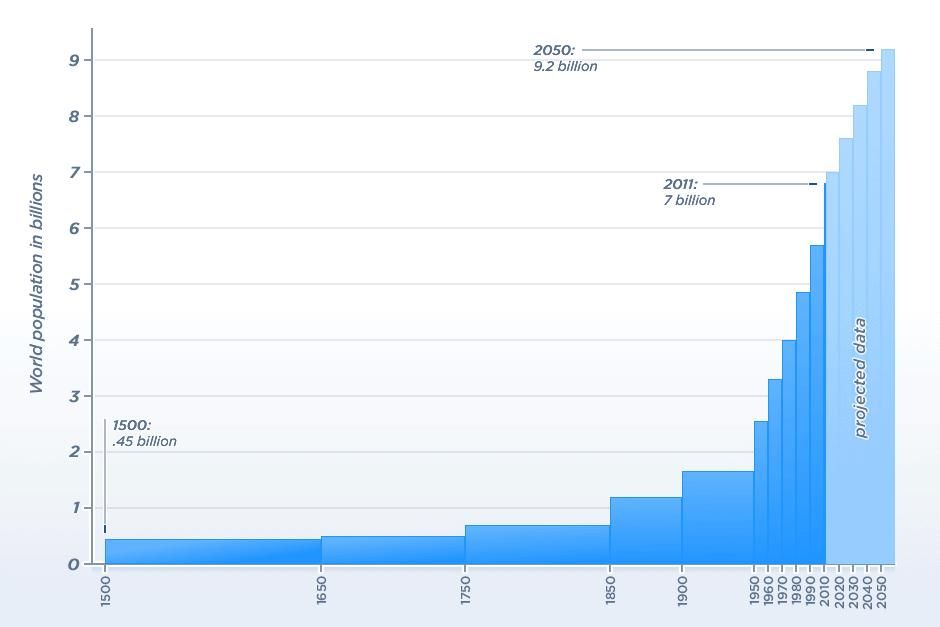
- 1804: 1 billion
- 1927: 2 billion
- 1960: 3 billion
- 1975: 4 billion
- 1987: 5 billion
- 1999: 6 billion
- 2011: 7 billion
- 2027: 8 billion (estimated)
November
5/11: Collected letters
From the Herald-Sun, 2/11:
SEVEN billion people now three billion when I was a boy – scary statistic not to be applauded.
– Jocko, Frankston
SEVEN billion people and the leaders at CHOGM talk about anything but the gross overpopulation of our planet. Who will be the first leader to state a plain birth-control policy in an attempt to reduce world poverty. Birth control and cessation of IVF will be a start.
– Tim Stafford, Mt Eliza
3/11:
YOU hit the nail on the head, Tim (Text Talk, November 2). It seems no pollie wants to take on the real world problem: too many people.
– Andrew, Maribyrnong
Battery hens in suburban pens
THE push from planners and developers to increase the density of our residential arrangements results in reduced area of gardens, reduced light through windows, reduced tree canopy and increased traffic. What is in this transformation for us? The question should be asked – just as the battery hen would surely like to ask – what is in it for her if her small cage size is further reduced? The push to cram us in is all about accommodating people who do not live here at the expense of those who do.
– Jill Quirk, East Malvern
Lifestyle lost in a mega-Melbourne
WE don’t want Melbourne’s population to be eight million. We don’t want to turn it into Manhattan. We like a house and garden and we like space. The idea of cramming eight million in here comes from the Committee for Melbourne, speaking for Big Business who wants more profit from selling more to more people, not caring if our lifestyle is wrecked because we are overcrowded and are short of infrastructure. It is time for governments to take action by slowing migration to a manageable level.
– Mary Drost, Camberwell
“Population growth sees myths reborn,” The Age, 1/11. Opinion piece by Paul Ehrlich.
26/11: High-rise hell
Some letters from the last few weeks:
6/11:
Ever-thinner slices
THE latest United Nations human development index (“Not quite Norway, but still a great place to call home,” theage.com.au, 3/11) shows it is clear that a nation’s population has little relationship to its ultimate economic strength. Countries that are better off per capita than Australia are smaller – Austria, Sweden, Denmark, Switzerland, the Netherlands and Norway.
High immigration is the key driver to a “big Australia” but is this likely to make Australians better off? No. According to the Productivity Commission’s annual report for 2010-11, two benefits often attributed to immigration, despite mixed or poor evidence to support them, are that immigration is an important driver of per capita economic growth and that it can alleviate the problem of population aging.
Among the 187 nations surveyed, Norway, Australia and the Netherlands topped the annual index while Congo, Niger and Burundi – with the highest population growth – came last. A rapidly increasing population mostly serves the interests of a few rich businesses, and produces more taxpayers for the government. For the rest of the public, it means our capital and social capital is cut into ever-thinner slices.
– Arthur Bassett, Blackburn South
We always pay
THE controversial north-east road link connecting the ring road and the Eastern Freeway remains a threat.
It’s all about perpetual growth, and removing obstacles. “Big Victoria” requires monolithic concrete infrastructure and transport access for the (mainly) imported goods to all the mega-stores and shopping centres. It also requires ignoring peak oil and common sense. Corporate Victoria has the power to hijack our government’s agenda.
The link would destroy parklands, wetlands, heritage artists’ sanctuaries, Yarra River walking tracks, havens for wildlife, picnic areas, and sporting facilities.
Without government funding, this tunnel/freeway would involve tolling and private operators. The costs – including the loss of Melbourne’s intrinsic values – are always passed on to average Victorians.
– Chris Hooley, Viewbank
26/11 – these are in response to a 25/11 letter, reproduced below them:
Still happy to fight
I’M SORRY the people of Toronto either had no success in protecting the sunlight on their balconies or were too dispirited to even try (Letters, 25/11). The people of Melbourne still have a bit of spunk left to speak out about unwanted high-rise and other developments that are seen as disadvantageous to them. Canada, like Australia, suffers from high population growth and developers flourish and dictate terms in such an environment.
– Jill Quirk, president, Sustainable Population Australia (Victorian branch), East Malvern
At mercy of speculators
WHAT’S good for Toronto is not necessarily good for Melbourne. Most Melburnians don’t appreciate high-rise human “termite mounds” (as one Southbank resident called this blot on the landscape) overlooking and overshadowing our Yarra River and surrounding residential neighbourhoods (“Southbank skyscrapers ire,” The Age, 24/11).
These apartments are probably not even for sale in Australia. With another big Southbank development, apartments were sold off the plan overseas. It seems we poor suckers are at the mercy of developers and property speculators.
– Lewis Prichard, Hawthorn
Rankings have message
MELBOURNE the most liveable city in the world? Too right. So, to all the planners, developers and councillors, why would you want to change it? And just where did those cities jam-packed with apartments, crawling traffic and block buildings abutting each other with no garden in between rank? All the way down there.
– David Cathie, Mordialloc
The letter from Toronto:
Get over it
TO A Toronto resident, the controversy about a skyscraper in Southbank seems almost quaint (“Southbank skyscrapers ire,” The Age, 24/11). The location for this building is the centre of a major metropolis, right? If the tower is well designed, everyone should just relax and get used to the fact that big cities have big buildings. And Freshwater Place residents have to get over themselves. Do they expect the city to stop growing just to spare them the hardship of less sunlight on their balconies? Perhaps they should have opted for property in Poowong instead. Ironically, an article about a proposed 240-metre residential tower in downtown Toronto also appeared in the Toronto Star: “Toronto’s skyline heads for the clouds.” The article quotes the architect as saying, “I think 100 storeys is completely do-able in Toronto; that’s sort of the next generation of height.” The residents of Freshwater Place should check out the accompanying photo and prepare themselves for their future.
– Michael Harris, Toronto, Canada
“In city’s middle-ring burbs, many towers rise,” 26/11. The dismaying sight of high-rise towers is now beginning to blight many suburbs, no thanks to the dysfunctional planning laws. People who oppose them are derided by architects and developers as “NIMBYs,” but the towers are an ugly eyesore and have a dehumanizing effect on the landscape over which they loom arrogantly. They block out sunlight and the sky, and give one a feeling of claustrophobia. They are touted as being environmentally-efficient, but virtually all current structures require vast amounts of power and water imported from elsewhere, and certainly could not be self-sufficient. They are primarily built for investors and to make money, not to help the environment.
A quote regarding such structures from a science fiction novel:
She glanced down between her boots through the transparent deck of the ship as it passed over the center of Jejeno. The city was both a tribute to isenj engineering skills and an indictment of their stupidity. The forest of asymmetric towers – bronze, brown, copper, tan – and narrow streets created endless canyons. Shapakti said that it was an echo of isenj origins as termite-like animals living in giant mounds, but Esganikan had seen almost identical soaring buildings in the images of Earth. It was how greedy species built: it showed space was at a premium because they had filled it and out-priced it – yes, she understood Earth’s economy now, she understood it very well – and they didn’t care about the intrusion on the landscape. It was a statement of their contempt for all other life.
– Karen Traviss, Ally
December
15/12: Who are the real vandals?
“Mornington vandals cause $500k damage,” The Age (also ABC News, H-S). Vandals attacked and damaged road construction equipment for the controversial Peninsula Link in Frankston. This is the same freeway that was brutally bulldozed through the Westerfield heritage woodlands last year (see 10/7/2010 , 24/10/2010 entries), despite a protest campaign. If this is a “targeted” attack, rather than random vandalism, then I support it! Harass and delay construction as much as possible; inconvenience the evil bastards in the construction industry and government who care nothing for the environment and who disregarded protests. They are evil by any definition. I do think of the Na’vi in Avatar who tried to fight the invading humans who were desecrating their land.
15/12: Australia as a relief valve
“When leaving home is the only way out,” The Age, 15/12. Economic migrants deserve no sympathy in my view. They should stay at home and fix their own problems!
Emigration has long been the Irish escape at times of greatest hardship. More than 2 million people fled the country during the Great Famine of the 1840s; half a million in the 1950s; and 200,000 during a downturn in the late 1980s. The Irish diaspora – of emigrants and their descendants – now vastly outnumbers the Irish at home and is estimated at more than 70 million people.
Critics say this history has taught Ireland’s policymakers to rely, like Aesop’s lazy donkey, on a lightening of the load through emigration whenever times get tough. A study of 90 young unemployed people by the Youth Council of Ireland this year found that 70 per cent thought they would emigrate and many believed the government was relying on it.
“It’s a handy way for them to export the problem and to cut the costs [of welfare payments],” says one. Another says: “I am sure it is built into the economic projections for the next five years because there doesn’t seem to be any meaningful policies being developed to help young unemployed people.” Youth unemployment is running at 24 per cent.
It’s a similar situation with the financial crisis in Greece – “Call for visa reforms to attract Greeks,” 25/6/2011: a lot of people there are wanting to emigrate to Australia in hopes of securing jobs here. But why should they get special treatment, or expect to come here at all? Australia has its own problems with unemployment; having a huge number of migrants come only exacerbates the problem and breeds resentment. Countries should be made to suck it up and take responsibility for their own situations rather than expect to send their “surplus” citizens elsewhere. (Incidentally there was an article addressing the issue of surplus workers, “The Age of the Superfluous Worker,” NYT, 24/11 – no, it’s not a nice term but the brutally unpleasant truth is that quite a lot of people, myself included, could be regarded as expendable; another symptom of an overpopulated world.) Ireland’s situation also demonstrates the fallacy of a growth-based economy, in this case one based on an overinflated property market (as is the same situation in Victoria).
“Taxpayers wear burden of 60,000 illegal immigrants,” Herald-Sun, 21/11. It’s no wonder the welfare system is overburdened if this alarming report is anything to go by; the main culprits being visa overstayers. I would be extremely harsh with such parasites: if caught, they would be fingerprinted, DNA recorded, then expelled from the country and banned from returning. This is where I diverge from the more liberal types, who seem to want to throw the borders open to all. I get so exasperated with their views on this issue; they are idealistic fools. (An example in other places is at MetaFilter, a long-running U.S.-based community weblog; the clueless majority there are in favor of leniency towards illegal immigrants coming into their country despite the huge costs in terms of jobs and welfare.)
Most illegal immigrants arrive on tourist or temporary work visas. Documents released to the Herald Sun under Freedom of Information show three-in-four illegals came here on visitor visas. One-in-seven arrived as students and one-in-15 disappeared after winning temporary residency. Monash University migration expert Dr Bob Birrell said they were the extreme of an even larger group, mostly students, who gained bridging visas as they sought to extend their stay beyond their original visas’ expiry. Dr Birrell said many of the 332,000 overseas students had expected to gain permanent residency once they finished their courses, only to discover that rule changes in 2010 meant this was more difficult, or impossible. Those with bridging visas were allowed to work and were “ferocious competitors” with local youths for low-skilled jobs, particularly in a tightening market.
Can you blame citizens for being resentful of immigration when it means increasing competition for resources? I am not anti-immigration, but the current too-high rate (200,000+ per year – “Migrant arrivals numbers to rise,” H-S, 15/11) should be drastically reduced. The international student program should also be curbed (it is often used as a “back door” to immigration). If the universities, who rely on their fees, don’t like it – too bad.