Populate and Perish: 2009
January
13/1: Overcrowding and terrorism
I began this blog last year, then stopped, but will try again this year. I have backposted entries from my static journal for 2008.
“How the city hurts your brain,” Boston Globe, 2/1. This article vindicates why I find cities such disagreeable places!
This research arrives just as humans cross an important milestone: For the first time in history, the majority of people reside in cities. For a species that evolved to live in small, primate tribes on the African savannah, such a migration marks a dramatic shift. Instead of inhabiting wide-open spaces, we’re crowded into concrete jungles, surrounded by taxis, traffic, and millions of strangers. In recent years, it’s become clear that such unnatural surroundings have important implications for our mental and physical health, and can powerfully alter how we think.
With the increasing world population, cities are only going to get more hellish to live in.
Regarding the Israel-Palestine situation, I was thinking that one (long-term) solution would be for Israel to give women in Gaza access to education and family planning! As noted in this article:
Gaza has become a giant warehouse of misery. It has no economic growth, no prospects, almost no civil order, yet about half the population is under the age of 17. The population has exploded amid economic privation. Women, living under Sharia law, are used primarily as breeding stock. Nizar Rayan, the most senior member of Hamas killed in the latest Israeli attacks, he had four wives and 14 children.
A Population Media Center blog entry, “Timely Book Puts Finger On Terrorist Attacks in the Gaza and Elsewhere,” reviews a book that addresses these issues.
Clearly as I read this book it is obvious to me after reading page 117 that the current Israeli Gaza attacks are certainly partially the result of Palestinian control of women who get little family planning and typically have 6 children. The 1950 population was 1 million, is now 3.1 million and could be 9 million by 2050. Sex and War reports, “Arab society is sexually chaste and few young men have sexual outlets prior to marriage but lack the financial independence to marry. Given the large pool of young men, the lack of opportunities, the sexual frustration and the inevitable resentment toward a dominant out group, it is hard to imagine a more perfectly conceived breeding ground for team aggression, in this case taking the form of terrorism.” Solution? First understand the problem, then take the actions suggested.
I like Cate Blanchett as an actress, but any more statements like this might make me rethink that!
She doesn’t even rule out more babies. “Who knows?” she says breezily. “Don’t close those doors. The world is very overpopulated, but we do make nice ones. They all look like Andrew. To say he has dominant genes would be an understatement.”
She has 3 children already (not that it shows!). Seems to pop them out effortlessly. (Source article) (Posted to ChildFree Hardcore)
18/1: One too many
“Chinese women ‘want more babies’,” BBC News, 16/1. A 2006 survey by Chinese family-planning officials found that most (70%) women want to have more than one child. The one-child policy, however, does not apply to everyone:
… in most rural areas couples are allowed a second child if their first is a girl. Different birth-control policies also apply to some ethnic-minority groups.
Other countries see the policy as draconian, but if it was not (mostly) enforced, the population would be even higher. There is a latent problem of a gender imbalance as female foetuses are sometimes aborted as male children are preferred, which will become increasingly socially disruptive with an increasing number of males not being able to find female partners.
The Chinese economy has to be kept growing in order to keep a growing population employed, but this is ultimately unsustainable in a world of finite space and resources, and environmentally destructive. As noted in “Chinese hit by growing pains,” The Age, 17/1:
“Unemployment of migrant workers on a mass scale implies severe political and social problems,” he says. “Any minor mishandling will cause social turmoil.”
(The migrant workers in this case are mostly peasants from the countryside who go to cities to look for work.) As I remarked in my 2/6/2008 entry, “Culling surplus males,” unmarried, unemployed young males tend to be the most troublesome elements in any society. Many will get killed off if a country goes to war, but this is a rather uncontrolled way to go about it. (If this seems rather callous, I am just looking at the problem from a pragmatic point of view.) Therefore if the Chinese government is to maintain control, it has to contain its population growth in some manner.
“How Many Chinese Are Enough?” by Gwynne Dyer also looks at the problem and comes to much the same conclusion: however unpalatable the one-child policy is, the alternatives are worse. One has to be realistic, not sentimental – individual rights must be overridden in this case for the survival of a society as a whole.
Most ecologists would say that China is well beyond its long-term “carrying capacity” even with its present population. Maybe the government is actually listening to them. Maybe it also knows that climate change will not be kind to China. There are things worse than a one-child policy. Famine, social disintegration and civil war, for example.
24/1: Overpopulation book
“Population Australia’s ‘big threat’,” The Age, 24/1. A recently-released book, Overloading Australia, is the subject of this article; it’s unusual for the overpopulation issue to get such attention.
In a provocative attack on water conservation schemes, such as Melbourne’s Target 155, the book Overloading Australia urges Australians to ignore water conservation, forcing politicians to rethink population and immigration policy.
Focusing on perhaps the most taboo aspect of environmental debate, authors Mark O’Connor and William Lines have argued that pro-immigration and “baby bonus” policies are at odds with plans to reduce carbon emissions and secure water supplies.
“The task of simultaneously increasing population and achieving sustainability is impossible,” the book argues.
Predicting Australian cities will suffer more congestion, pollution, loss of biodiversity and diminished services, the authors argue there is no point conserving water “until we get restraint in population.”
“Overloading Australia – new book about Australia’s overpopulation problem,” We Can Do Better, with some extracts (and at one of the authors’ website).
“Target 155” is the latest Victorian Government attempt at water conservation (rather than going to stricter Stage 4), in which each individual is encouraged to use no more than 155 liters a day. While one should not waste water, the fact that cities in a First-World nation have to go on these measures demonstrates poor planning by State and Federal Governments.
Ignoring water conservation seems sacrilegious, but if the government won’t reduce population growth, then more water will be used by these increasing numbers of people no matter how stringent restrictions are. Gardens should not be denied water as the plants and trees provide shade and a cooling effect in urban environments that otherwise have too much concrete and paving (“It’s time literally to go green,” The Age, 23/1).
There was also a related article in The Age A2 section – not online, annoyingly, so I scanned it in below. Liberal MP Ms. Louise Asher criticizes the unreasonable water restrictions, saying that with proper Government planning, a First-World city should not have been reduced to this. I agree with her, but am not inclined to vote Liberal, who are just as untrustworthy as the Labor Party – it was Jeff Kennett’s Liberal Government who privatized public utilites such as water and public transport, something I regard as a crime against the State.
Staying alive
Denise Gadd
The Age, 24 January 2008When Age photographer Penny Stephens took a picture of Louise Asher watering a tree in her front garden, the Opposition water spokeswoman pointed out that it was recycled water from her kitchen sink, not straight from the tap.
The bits of coriander and spring onion that she had washed in a bowl the night before for an Asian salad could be seen floating in the watering can and were proof enough.
These days it wouldn’t pay to be caught using tap water for your garden outside the prescribed watering times. And certainly not for someone in Ms. Asher’s position.
While she adheres to the stage 3a water restrictions – using automatic drip systems and watering by hand for two hours, twice weekly – the member for Brighton is unimpressed by the State Government’s response to these dry times.
Governments, she says, are elected to provide five basic services: police, transport, schools, hospitals and water. A failure to provide the last, instead resorting to tough water restrictions and now a daily target for each person of 155 litres of water, is outrageous, Ms. Asher says.
Targeting the domestic user – in particular, gardeners – and some industries such as turf growers, who had lost up to 90 per cent of staff because of the ban on watering new lawns, is beyond the pale, she says.
And the strain of being asked to adhere to a daily water usage of 155 litres has added another dimension to the crisis.
“Gardens add to what Melbourne is – we were once the Garden State – and I do object to people inferring that there’s a hierarchy of water use and gardening’s low. In the end, I’m a liberal and it’s about choice.
“I think the Government should supply water for a metropolis like Melbourne. It has a constitutional responsibility to provide adequate water, and this one hasn’t.”
Ms. Asher says that since the 155-litre daily target was introduced in November, people have had to choose between personal hygiene and keeping their gardens alive. She wants to know how the figure was arrived at.
“Where did they get figure from? Was it plucked from the air or a guess – which I think it probably was. And does it account for overnight visitors? It’s a very tough figure, especially if you’ve got a garden.
(It is calculated using the city’s daily water use by its population. The usage increases on hot days.)
Ms. Asher says the target is not mandatory unlike water restrictions. “Most people in my electorate will be good citizens who want to do the right thing. So sometimes there will be circumstances where plants will unfortunately die, which is a great shame.
“We do have to abide by the restrictions and there is the legal power to be fined if you don’t, but not the 155 target. The trouble is, there will be some in the community who will use as much as they want (despite the target).”
Ms. Asher and her husband chose not to install a water tank, believing they could keep their garden alive with the twice-weekly watering sessions and by reusing water from the shower, washing machine and kitchen sink. But since the introduction of the 155 target, the situation has worsened and they are now contemplating a tank.
“I had an expensive spray system, which was converted to a dripper system once the 3a restrictions were introduced, but now I don’t think we can do basic cleanliness and have the dripper system running on the allotted days.”
Ms. Asher says she gets angry with the Government every time she lugs a bucket from the shower “like Third World conditions” to either throw down the toilet, instead of flushing it, or on the garden.
“Every time a person fills a bucket from the shower or reuses theft water from the kitchen sink, they should think of John Brumby and the massive system failure to provide water to a sophisticated international city like Melbourne.”
Former premier Steve Bracks’ pledge in 2002 that water was a major issue for his government, and the subsequent appointment of John Thwaites as the country’s first water minister to solve the problem, have not amounted to anything, Ms. Asher says.
“The Government has been condemned by its own rhetoric. In my opinion, they should have built a small desalination plant, a dam and also made more recycled water available.
“The Eastern Treatment Plant at Carrum still hasn’t been upgraded to produce class-A recycled water and it won’t come online until 2012.”
The restrictions have also come at a cost to many, including those in the turf industry, nurseries and consumers who have been urged to buy less water-hungry washing machines and dishwashers.
They have also affected gardeners’ pockets she says, not just when replacing dead shrubs and trees or turning to different species to cope with the drought and lack of water, but also when upgrading irrigation systems as the restrictions have increased.
While Ms. Asher does not believe we should go back to the bad old days of people hosing their driveways and overwatering their gardens, she says the Government also has to demonstrate that it is committed to providing Melburnians with a modern, first-class water supply that does not involve restrictions or a daily water target.
Failure to install water tanks at Southern Cross Station and Federation Square, despite their inclusion in the original designs, was bad planning, Ms. Asher says.
“We don’t live in a desert and even Dubai doesn’t have restrictions. The Government has deferred investment and thought it could get away with it, praying for rain – and it hasn’t come.”
Allocating water is not an option, she says. “Melbourne is a modern city. There should be water for people to have showers, clean clothes and wash your hair. That’s basic hygiene. What’s wrong with that? If people don’t want to wash every day that’s their choice.”
The long-term use of grey water on gardens was an issue for plants and Victoria’s water tables, and Ms. Asher does not blame people for sinking bores to keep their gardens alive.
“It’s about amenity and lifestyle and if someone wants a garden and a swimming pool, they should be able to have one.
“We live in a society where people are allowed to choose and if gardening is your leisure activity and you like to have one, that is your right.”
27/1: Overloading Australia – the critics attack
“Murky agenda behind this green debate,” The Age, 27/1. A negative opinion piece by Brigid Delaney in response to the Saturday article featuring the book Overloading Australia. She expresses the usual counterarguments (and misses the point of the book).
Yet, if we want models of innovative and successful cities, we need look no further than New York and London, metropolises with high immigrant populations. It’s clear that if you stagnate population growth and diversity, you run the risk of slowing not only economic growth, but also the development of our inner lives: the new voices that join the dialogue citizens have with one another.
Economic growth cannot be contined indefinitely without harming the environment and using up resources. At some point it must end.
The “diversity” argument is one I am increasingly finding tedious (usually delivered in lecturing tones by earnest Lefties. I am a Lefty in some things, but sometimes want to punch certain others of that inclination in the nose!). Too much “diversity” and excessive encouragement of multiculturalism ultimately leads to social fragmentation. By all means welcome (a controlled intake of) migrants but support their integration. Also, New York and London are (like many other large cities) horribly crowded and stressful places to live, as noted in the article “London’s a rat hole,” Sydney Morning Herald, 8 August 2006:
His scathing assessment was being submitted to the main opposition Conservative Party’s policy group focusing on quality of life. “Putting 10 million aggressive hominids into close proximity and inviting them to engage in serial acts of competitive individualism … for jobs, schools or parking spaces, could not be considered a reasonable idea,” Bayley said. “You put rats in claustrophobic circumstances and they become homosexual, murderous and cannibalistic in no time at all. Instead humans find ingenious solutions, underground car parks, coffee shops, Chinese takeaways, one-man buses, cycle lanes, tall buildings.”
She then brings up the usual accusation of those who oppose excessive immigration as being “racist,” and, for good measure, mentions neo-Nazis. Which is getting rather off-topic as the point of the book is, that Australia has a fragile environment (mostly desert) that cannot support a large population, and even now it is overpopulated; capital cities are on water restrictions, and the south-east of the continent has been in drought since 1998. Continuing to bring in huge numbers of people – wherever they are from – will make things increasingly unpleasant.
The logical conclusion of the argument put in Overloading Australia is a reduction in personal responsibility: let the Government fix it, continue, even accelerate, our wasteful ways, and screw everyone else. How utterly depressing that argument is.
This was obviously a response to a comment in the original article:
Predicting Australian cities will suffer more congestion, pollution, loss of biodiversity and diminished services, the authors argue there is no point conserving water “until we get restraint in population.”
The “not conserving water” comment came out of exasperation with the current government’s water restriction policies. If the government won’t slow population growth, why should the people already here bother with observing restrictions? A rebellion, of sorts.
28/1: My published letter
First letter of the year in The Age, 28/1 :-). A response to an opinion piece about the book Overloading Australia, the subject of “Population Australia’s ‘big threat’,” The Age, 24/1.
It’s all about impact
For Brigid Delaney (Comment & Debate, 27/1) to imply that those who oppose excessive immigration are racist misses the point of the book Overloading Australia. The reason for limiting numbers is that Australia (or any nation) cannot continue to import huge numbers of people – no matter where they come from – without harmful social and environmental impact (already evident in Victoria). If we want to keep Australia liveable in future, we must reduce population growth.
– Suzanne McHale
Growth is the issue
Brigid Delaney trots out the usual spurious arguments against Overloading Australia.
The authors focus on immigration simply because it is the main driver of population growth, and it is population growth, not immigration per se, that is the problem.
No one who supports the basic thrust of the book denies that immigrants have made a contribution to this nation. No one wants to end immigration.
What we want is immigration that approximates emigration in size so you still get a flow of new people that can enrich our society, but not so many as to overload it in environmental terms. We are certainly on a trajectory for overload, if we have not passed it already. We should stop living “high on the hog” but, as well as getting off the hog, we need to get our numbers stabilised (and even reduced) as soon as possible.
– Jenny Goldie, president, Canberra region, Sustainable Population Australia, ACT
Sheila Newman also has a response on her blog: “Growthist responses to Overloading Australia.”
“Eight Is Enough,” New York Times, 27/1. A woman recently gave birth to 8 premature infants, no doubt with the assistance of fertility treatment. There is an option to reduce (abort) the extra foetuses. Creating such pregnancies is an irresponsible use of medical science as it puts great strain on the mother, as well as the taxpayer-funded medical system that is obligated to take care of the usually ill and sometimes defective infants. I agreed with this comment:
There is no way that people who push litters of fragile humans into our nation, society, and ecosystem should be accoladed and rewarded. I am weary of paying for this sort of thing, then facing demands that I also jump up and down and coo.
Repeal the tax deduction for adding more humans to the planet. If people want to be rewarded for breeding, then let them prove when their ONE kid is 25 that they raised a productive, healthy contributor to society. Then we can pay them a successful parenting annuity for 18 years amounting to what the tax break/deduction would have been.
I’m sick of the baby fetish, and I’m sick of pretending. Natalism has become our nation’s most disturbing fetish.
– Michael
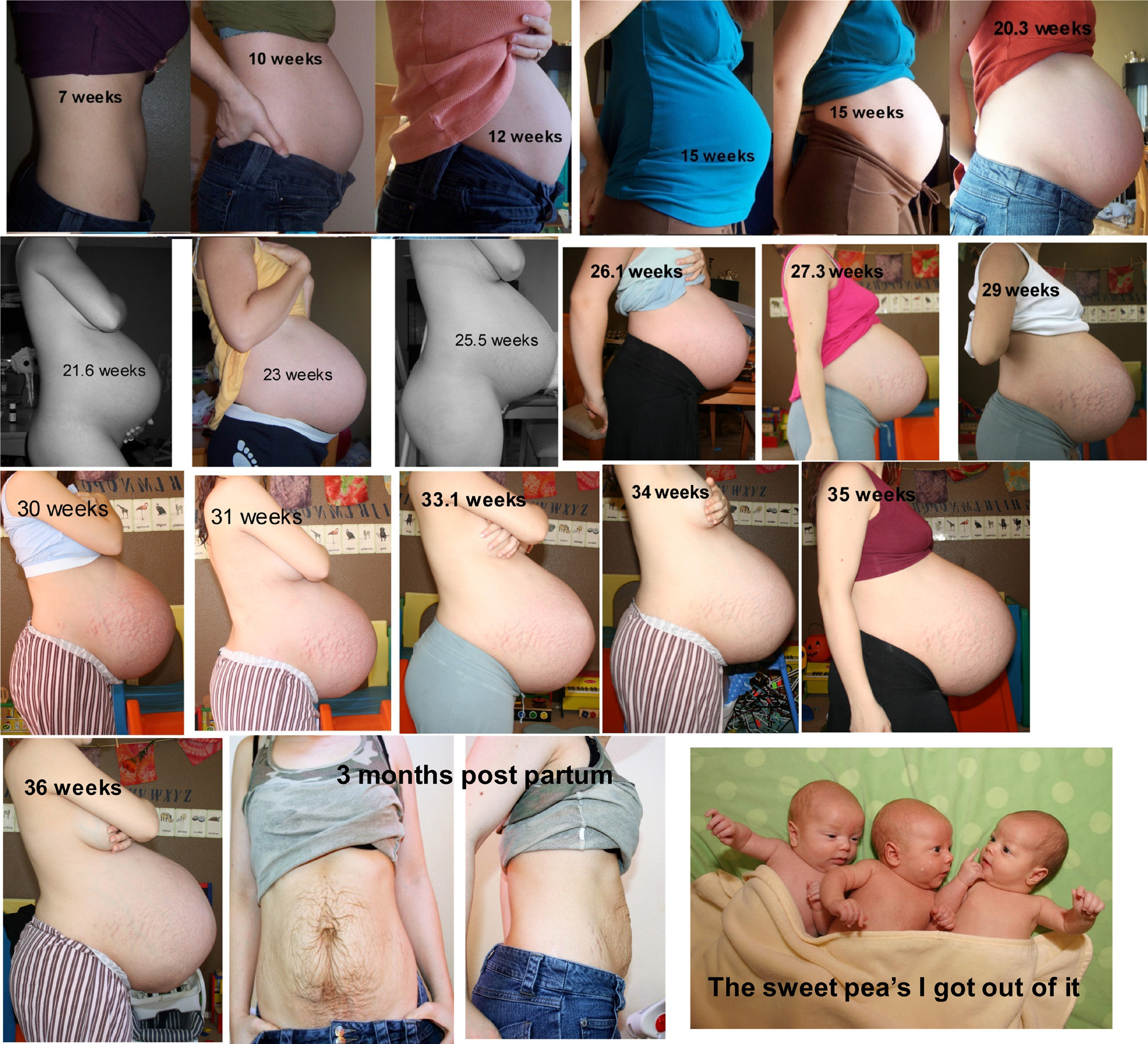
I hate to think of the damage such a pregnancy inflicts upon a woman’s body:
The mother was initially admitted to the hospital at about her 23rd week of pregnancy – which is fairly early – because she was suffering from severe back strain. “Her stomach was huge, indescribably huge,” Dr. Henry said. “At a certain point, we don’t even measure.”
As an example of such damage, a photo montage (possibly NSFW) of a woman who is “merely” pregnant with triplets!
February
4/2: Two is enough
It was revealed that the woman, Nadya Suleman, who recently had octuplets by IVF already previously had 6 children (also conceived by IVF). There is some public outrage. I find this comment irksome, though:
“A number of commentators are saying a woman with six kids should not be allowed medical treatment to have additional ones, and I think, at a common sense level, that makes good sense,” Mr. Tipton said. “However, to make that work, that means someone is going to start deciding for other people how, when and why they can have children. That’s a very big step and one that we might not be prepared to take.”
Well, “someone” damn well should decide! In my view she should be compulsorily sterilized! At the very least, she should not receive any government (taxpayers’) assistance with her family, as this only encourages others. People who chose to have large numbers of children are selfish as this adds to the competition for resources amongst an already too-large population.
“Green GP refuses to help women have large families,” Times Online, 1/2. “Dr. Pippa Hayes, a Devon GP, has a conscientious objection. She believes couples should restrict their families to two children – and says she would not help to provide fertility treatment for women who want to have exceptionally large families.” Someone with the right mindset and a sense of social responsibility! In the same issue, a U.K. environmentalist, Jonathon Porritt, said that there should be incentives to have no more than two children, and those who chose to have more are irresponsible (“Two children should be limit, says green guru”). Yes, this is social engineering, but if you want a liveable society, such engineering is necessary! Making the choice to have a large family should become regarded as socially unacceptable.
“One last chance to save mankind,” 23/1, New Scientist. Environmentalist James Lovelock is critical of the government attempts at being green (which I share the same cynicism for):
Not a hope in hell. Most of the “green” stuff is verging on a gigantic scam. Carbon trading, with its huge government subsidies, is just what finance and industry wanted. It’s not going to do a damn thing about climate change, but it’ll make a lot of money for a lot of people and postpone the moment of reckoning. I am not against renewable energy, but to spoil all the decent countryside in the UK with wind farms is driving me mad. It’s absolutely unnecessary, and it takes 2500 square kilometres to produce a gigawatt – that’s an awful lot of countryside.
He believes that humans will eventually learn to regulate their behavior, but things will get very unpleasant before that:
I’m an optimistic pessimist. I think it’s wrong to assume we’ll survive 2°C of warming: there are already too many people on Earth. At 4°C we could not survive with even one-tenth of our current population. The reason is we would not find enough food, unless we synthesised it. Because of this, the cull during this century is going to be huge, up to 90 per cent. The number of people remaining at the end of the century will probably be a billion or less. It has happened before: between the ice ages there were bottlenecks when there were only 2000 people left. It’s happening again.
“Tehran’s Health Patrol,” TIME magazine, 29/1. Despite the bad press Iran gets, it seems to be doing something right with health care, including enabling women access to family planning. In this regard, Iran is more socially progressive than many of its neighbors!
Women Health Volunteers arose out of a mix of necessity and pragmatism as well as a fundamental belief, expressed by Malek-Afzali, that “women are the axis of health development and health is the axis of sustainable development.” […]
Perhaps the program’s most crucial success was to introduce family-planning to revolutionary Tehran, an effort that has brought down the birthrate per female, from six children to two, with the full support of religious leaders. They at first urged Iranians to boost the ranks of the “soldiers of Islam” but then promoted contraception to stop the alarming growth in population. The lower birthrate is critical to a nation like Iran as its economy evolves. About 7000 women went door-to-door in Tehran and talked to mothers about the benefits of smaller families, informed them of the different types of birth control and handed out condoms and pills. “I must give credit to Iran’s religious leaders for a pragmatic and creative approach to family-planning,” says Dr. Mohamed Abdel-Ahad, an Egyptian who is head of the United Nations Population Fund in Iran.
“Water – another global ‘crisis’?,” BBC News, 2/2. Population growth is briefly mentioned as a factor in worldwide water shortages, but not the solution of reducing such growth!
A more populated world – and there could be another 2.5 billion people on the planet by 2050 – is likely to be a thirstier world. Those extra people will need feeding; and as agriculture accounts for about 70% of water use around the world, extra consumption for growing food is likely to reduce the amount available for those basic needs of drinking, cooking and washing.
“Planetary demographics and space colonization,” The Space Review, 2/2. There is a belief amongst some spaceflight enthusiasts that the overpopulation problem on Earth can be solved by sending off the excess people onto space colonies or other worlds. This is a foolish fantasy as:
- The development of sustainable space colonies could be centuries away – I can’t see it happening this century at least, unless there is some radical technological breakthrough.
- If the negative attitude towards regulating populations (i.e. “social engineering”) doesn’t change, then the off-world colonies will eventually face the same problems as on Earth – depletion of resources from overpopulation. So colonization is only sending the problem somewhere else (i.e. delaying the inevitable).
The very real problems of environmental degradation from overpopulation need to be solved this century if we want a still-habitable planet by its end.
5/2: Brumby the dictator
“Obsessed Brumby jackboots-up ‘development’ in Victoria,” Can Do Better. Am angry and frustrated to learn that Victorian Premier John Brumby is using rising unemployment as an excuse to fast-track various building projects, never mind what negative impact these have on local communities (i.e. inappropriate developments). Overdevelopment (namely high-rise apartments) is making the suburbs and city increasingly unliveable and unpleasant, but residents’ rights are overridden. The current Labor government is given large donations by various developers, an obvious sign of corruption. One feels helpless and powerless – letters can be written to the newspapers and so on, but that changes nothing. What can be done? Challenging the decisions in court costs money. Perhaps some form of civil disobedience, but I don’t know what.
“Melbourne is wrecked, and full,” Andrew Bolt, 30/1. Andrew Bolt is a Herald-Sun columnist whom I don’t often agree with (he denies climate change, for one thing), but he makes a good case here! Though building more dams is pointless if we don’t get adequate rainfall to fill them.
Imagine Melbourne growing 50 per cent bigger in your children’s lifetime, if not your own. That’s 50 per cent more people, cars, houses, gardens, air-conditioners and train travellers. Everywhere where’s there’s two, imagine three by 2050. Forget the social stresses of simply getting on with so many more immigrants, or of trying even to find a little elbow room. Consider this more basic problem: how on earth are we going to give all our new neighbours power, water, roads, land and trains when we don’t have enough for the people here already?
“Population: The elephant in the room,” BBC News, 2/2. Opinion piece by John Feeney on the topic few environmentalists want to confront, for fear of being seen as politically-incorrect. This generated a huge number of comments (now closed). It’s obvious that a lot of people are still in denial about the negative effects of growth, and seem to take the idea of population reduction/restrictions as a personal insult.
8/2: Competition breeds resentment
“As the Global Economy Sinks, Tensions Over Immigration Rise,” TIME magazine, 6/2. A report about the not-very-surprising fact that an influx of huge numbers of strangers will provoke resentment amongst residents in areas with high unemployment.
Some of these attacks can be attributed to simple racism, but it’s also reasonable to assume that the economic downturn is causing greater competition for jobs and rising frustration among locals. […]
And as economic pressures increase, the potential for conflict clearly grows also. “Traditionally … migrants don’t compete for [the] same jobs as native populations,” says Pandya. “But the moment [those native-born] people think they have to find any job, they will be in direct competition with migrants. That’s where friction arises.”
But the article does not mention that conflict comes not only from competition for jobs, but for resources generally: food, health care, housing, etc. Moral lectures from do-gooders promoting “diversity” are irrelevant in this case.
“The more humans, the better,” Dallas News, 13 June 2008. An article from last year by an economist called Walter E. Williams which typifies the mindset of population growth proponents. Here he uses the argument (as I understand it) that “human beings are the most valuable resource” – more specifically, that human intellect is a valuable resource, therefore if there are more humans there will be more intelligent people who will be more “productive” and this leads to prosperity for all.
There is absolutely no relationship between high populations and economic despair. For example, the Democratic Republic of the Congo, formerly Zaire, has a meager population density of 22 people per square kilometer, while Hong Kong has a massive population density of 6,571 people per square kilometer. Hong Kong is 300 times as crowded as the Congo. If there were any merit to the population control crowd’s hysteria, Hong Kong would be in abject poverty while the Congo flourished. Yet Hong Kong’s annual per capita income is $28,000. Congo’s is $309, making it the world’s poorest country.
People in Hong Kong live crammed into high-rise apartments (as shown in this Wikipedia photo), and a lot of the wealth generated is in the finance industry, which is ephemeral and can not be regarded as contributing to the intellectual development of mankind. The city is extremely crowded and has the usual environmental (eg. pollution) and social problems resulting from nearly 7 million humans crammed into such a small area.

It’s the same story in many countries – government interference with mankind’s natural tendency to engage in wealth-producing activities. Blaming poverty on overpopulation not only lets governments off the hook; it encourages the enactment of harmful policies.
He does have a point about dysfunctional governments contributing to poverty (using the example of Zimbabwe). But governments are still needed to regulate businesses and “wealth-producing activities” as many of these are environmentally and socially harmful.
A science fiction author called John C. Wright (who converted from atheism to Catholicism) is another example of one in denial, as this blog entry shows:
Overpopulation and underpopulation are relative rather than absolute terms. In a capitalist society, every new baby born is a new pair of hands to work, and the labor adds to the sum of human happiness; in a socialist society, every new baby born is a new mouth to feed, and the consumption is a drain on the resources of the world.
The socialist view is correct; there are finite resources, including jobs, so at some point population will outgrow resources.
I am not saying there are areas of the world which are not crowded, or whose laws and customs do not allow for the exploitation of resources needed to feed and house them. Clearly such areas exist: one of them exists within an hour’s walk of my house. I am not saying there is not poverty. I am not saying the world population is not growing.
I am saying there is not overpopulation in the world. The mass famines predicted by Paul Erlich did not occure. The mass death predicted by Malthus did not occure. The steady geometric growth rates seen during industrialization, due mostly to decline in the infant mortality rate, cannot be projected as a simple exponential growth rate: such predictions are bad science.
The “Green Revolution” of agricultural technology enabled the impact of massive population growth to be delayed – but not eliminated! It has also been environmentally devastating, involving much use of pesticides, water and loss of biodiversity. Again, the Earth does not have infinite resources. There is also famine in some parts of the world because the populations here have destroyed their local environment.
When those predictions are used to scare people (I know a woman in my office who expressed reluctance to have a second baby, on the grounds that the world was too crowded) an evil is done, and real people are harmed in a real way.
I would say that that woman is showing some social responsibility, and should be applauded! One less mouth to feed and a little more resources freed up for others.
Policies to restrict human growth are reactions to a nonexistant problem, and have a high, terrify cost in human lives. Overpopulation is a fraud. In order to exploit the resources of the solar system in an efficient way, and usher in an age of wealth and prosperity the likes of which history has never seen, we need more people, not less, because people are the one resource without which all other resource lay fallow.
As I pointed out in my 4/2 entry, the argument that humans will expand into space, so we need to likewise keep expanding the population to enable this, is spurious as the technology for mass space travel is at least decades or centuries away. Also we are in an “age of wealth and prosperity” – but only for some! Many humans are greedy and selfish, so wealth is not shared around equally. Colonizing the solar system will not magically create some utopia.
14/2: Bushfire holocaust
One week ago on Saturday 7, Melbourne saw its highest temperature since records began 150 years ago: 46.4°C. There were warnings in the previous days that Victoria was facing its “Worst fire threat in history.” That was no exaggeration! Bushfires raged across the state (some deliberately lit, which obviously did not help). There was initially no mention of deaths, so it seemed the fires would be like previous seasons: some properties lost, a lot of forest burnt.
The next day, though, reports of deaths began filtering through: first 14, then it kept climbing over the next few days. The current toll stands at 181, though this is expected to increase as razed towns are searched for bodies. The bushfire deaths exceed “Ash Wednesday” (16 February 1983, 75 killed) and “Black Friday” (13 January 1939, 71 killed) combined, with thousands more left homeless (around 7000 to date). Thousands of native and domestic animals have also been killed.
People are looking for something to blame. Climate change scientists earlier warned that fires would become more intense and destructive; this fire is some evidence of that. There are many letters in the newspapers blaming the Greens political party and environmentalists (presumably for opposing burnoffs), but if such people had their way, all the forests would be felled! (There’s no bushfires in deserts …) An Onymous Lefty has a few sarcastic entries on the reactionaries. Housing has impeded on bushland as population has increased, so more damage and fatalities are inevitable. If people choose to live in fire-prone areas, there is risk. And, no, you can’t chop down all the trees to make a region safe (as much as some people would want to) – the trees have as much a right to exist. The habitat of animals is destroyed when trees are felled.
Some (hopefully permanent) links on the 2009 bushfires:
- ABC News: Bushfire Emergency
- Herald-Sun: “Victoria in flames”
- MetaFilter: Victoria’s Bushfires
- Wikipedia: 2009 Victorian bushfires
“Solution for the world’s water woes,” BBC News, 10/2. Yet another article on solutions to the world’s fresh water shortages, but does not mention reducing population growth as a fundamental solution! People can only restrict their water use to a certain degree; one still needs to drink, use the toilet and bathe! If population keeps increasing this negates any water conservation efforts. A few commentators (including me) have pointed this out to the writer.
Daniel Tammet is a savant with Asperger’s Syndrome who has gained a measure of fame because he can recite 𝛑 to a huge amount and learn languages quickly (my more dour observation is that he’s certainly got a talent for self-promotion). But he instantly lost any respect I might have had for him, as he is an overpopulation denier, as demonstrated in this blog entry from 2006; he does not believe that the U.K. is overpopulated. He uses the spurious argument that if the population was distributed evenly across the land, then everyone would have an acre or so to themselves. This ignores the reality that there are mountains, lakes and wilderness areas where people couldn’t live. The U.K.-based Optimum Population site has a page on The UK’s population problem. 60 million people crammed onto a relatively small island is overpopulation by anyone’s standard.
20/2: Increasing people, declining jobs
Some articles on decreasing job opportunities and increasing unrest:
“As the Global Economy Sinks, Tensions Over Immigration Rise,” TIME magazine, 6/2. “And as economic pressures increase, the potential for conflict clearly grows also. ‘Traditionally […] migrants don’t compete for [the] same jobs as native populations,’ says Pandya. ‘But the moment [those native-born] people think they have to find any job, they will be in direct competition with migrants. That’s where friction arises.’”
“Rise in Jobless Poses Threat to Stability Worldwide,” New York Times, 15/2. Rising unemployment and prices is breeding resentment in many countries. Decreasing jobs due to automation and efficiency, combined with an increasing population is a potentially explosive combination. The only long-term solution is to reduce population growth – economies cannot keep growing indefinitely in a world of finite resources.
“Sponsorship system open to exploitation, say academics,” Herald-Sun, 20/2. A Monash University report (not online yet) recommends cutting the absurdly high rate of immigration (currently 200,000 a year) so as to protect local jobs for citizens. I could not agree more! Of course, they will get castigated for this, but quite a lot of article commentators agree. The high levels will only increase resentment toward immigrants who compete for jobs against citizens (as is seen in other countries such as Italy).
There’s a documentary coming up on SBS on 26/2 called Baby Boom to Bust, about the supposed threat to society from an aging population and declining birthrate. I thought a declining birthrate was supposed to be a good thing!
“Missing Children” – A two-part series about one of the biggest issues of our time: our aging population. By 2050 one out of five of us – over two billion people – will be over 65. In some developed countries there are so many elderly and so few births that the population is actually dying off. And in parts of the developing world, the numbers of old people are growing at an even more astounding rate. This series looks at the looming social, political, economic and human impact of a rapidly aging society. Part one looks at the lack of children being born throughout the world. In most countries across the developed world the fertility rate has fallen well below the replacement rate of 2.1 births per woman. With fewer children, who will do the work and pay the taxes in the future, not to mention care for all those baby boomers, who are living longer than ever?
(Mini-rant: the baby boomers will damn well have to look after themselves! They’ve wrecked the world for my generation and those following.)
“No Babies?,” New York Times, 29/6/2008. An alarmist article about the falling birthrate in Europe, making the absurd remark about the USA:
Which brings us to a sparkling exception. Last year the fertility rate in the United States hit 2.1, the highest it has been since the 1960s and higher than almost anywhere in the developed world. Factor in immigration and you have a nation that is far more than holding its own in terms of population. In 1984 the U.S. Census Bureau projected that in the year 2050 the U.S. population would be 309 million. In 2008 it’s already 304 million, and the new projection for 2050 is 420 million.
With a looming recession due to foolish and unsustainable economic policies, and thousands losing their jobs, an increasing population is definitely a liability!
The article does note that:
Meanwhile, in the midst of arguments about natalist and immigration policies come other voices and more elemental questions. Is it even possible to increase the population significantly? Is it even necessary? There are those who think that “lowest low” is not in itself a looming disaster but more of a challenge, even an opportunity. The change that’s required, they say, is not in breeding habits but thinking habits. […]
According to some, a declining population presents certain opportunities: to increase efficiency and livability, to change lifestyle and environment for the better. […]
But while few locals themselves may feel religiously inclined, the thinking is that if religious pilgrimage is the best card in your hand, you play it. This notion – embrace shrinkage in order to revitalize your economy, rather than trying to coax women to have more babies – is, according to more than a few observers of the European scene, the right tack. Or better said, it is one part of the best overall strategy – one that embraces population decline. For there are those who argue that low birthrate in itself is not a problem at all. Paul Ehrlich, the Stanford scientist who warned us about the “population bomb” in the 1960s, is more certain than ever that the human race is catastrophically straining the planet. “It’s insane to consider low birthrate as a crisis,” he told me. “Basically every person I know in my section of the National Academy of Sciences thinks it’s wonderful that rich countries are starting to shrink their populations to sustainable levels. We have to do that because we’re wrecking our life-support systems.”
New Scientist magazine published an article by Paul Ehrlich, “Enough already” (reproduced on my site as the NS article is, annoyingly, subscriber-only) suggesting the declining birthrate and aging population is not a bad trend.
Coping with this change will doubtless create challenges, but there will also be benefits. Whereas in a developing nation with high birth rates as many as half its citizens may be under the age of 15, in industrialised societies there are typically fewer than 20 per cent. Commentators raising alarms about aging populations neglect to mention that with fewer children, far less of their society’s resources will be needed to support and educate them. In addition, fewer young people means lower crime rates, because crimes – including terrorist acts – are overwhelmingly committed by people aged between 15 and 30. In the U.S., crime rates fell markedly from about 1990 on – 18 years after a big drop in the birth rate. We don’t think this is a coincidence.
Not all old people are infirm, and many can still make useful contributions to society! (E.g. volunteering, mentoring younger people.) Perhaps robots will be developed as assistants for the elderly (don’t assume you will be looked after when old). There will be a “hump” to get over when the old outnumber the young, but once the old have passed on and the young contine to have fewer children (assuming a sane population policy), these concerns will be allayed. This post at PublicPopForum explains this better than I do:
Every detailed international and Australian study shows the health costs of the aging population are manageable. Sweden and Japan are among a dozen or so countries which spend a lower portion of GDP on health than Australia but have older populations and equal or better health outcomes.
This has been known for some time. Epidemiologist Dr Michael Coory pointed it out in an excellent article in the Medical Journal of Australia in 2004.
But the scare-mongers with their own agendas are out there using this as an excuse to push measures to put more youth into the population. More of them anon.
One thing is for sure: the aging are here whether we like it or not and their health will have to be attended to. If we add more births and more immigrants, the total health bill can only be higher.
Next misconception: Getting a younger population through immigration. When the baby boom started, it was as if our friendly python has swallowed a goat. The aging goat is slowly passing through the system. While it does that it will always be a hump. It is an idiotic mistake to imagine that as the goat’s lump passes through the python that the way to bring the python back to standard shape is to attempt to fill out the rest of it with more goats from mouth to tail.
The high birth rates of 1945 to 1960 coupled with low infant mortality was an aberration the world has never seen and most likely will never see again. We should accept that aberration. The baby boomers will die off and the shape of population graph will return to normal.
Incidentally, “normal” is not the age distribution of 1950-1980 with a big bulge of young people.
Can we afford to look after the old people without more immigration? Yes, because more immigration compounds the problem. We have a dependency ration of 75 – 75 dependants for every 100. That is projected to get to 115 in 2050. Ouch, that’s a lot of people to support, you might say. Quick, let’s have some immigrants to fix it. Well, to keep a 75 ratio through to 2050 you would need an immigration program that would result in a population of 160 million. Taken through to 2100 we would have a population of 900 million. It would be far easier to support the existing old fogeys than all those immigrants, who themselves would get old.
We should just accept the baby boomer aberration and let it work through the system.
“Solution for the world’s water woes,” BBC News, 10/2. Yet another article on conserving water, but the author does not mention containing population growth! Again, some commentators (including me!) corrected this oversight. (The BBC has a site section called “The Green Room” addressing environmental issues.)
“Gaza population ‘rising rapidly’,” BBC News, 15/2. A sure way to increase violence is to cram humans into a confined area, and the continuing unrest in Gaza is a prime example. As I noted in my 13/1 entry, Israel should perhaps air-drop boxes of contraceptives and condoms!
The 8/2 Guardian newspaper had some articles on women choosing not to have children:
- “Why I don’t want children”: “Guess what I don’t want? Babies. I never have and I never will. Please don’t tell me I’ll change my mind. It’s patronising, and how the hell do you know anyway?”
- “The dummy mummy decade”: how ridiculously neurotic modern parenting is
- “Twenty other reasons not to have a baby”
20/2: Save Melbourne’s trees
“Doctor’s plea for trees,” The Age, 19/2. Dr. Greg Moore says that the trees which make Melbourne and its suburbs such a pleasant place are fast disappearing, decimated by both drought and overdevelopment. The replacement of trees and gardens with paved-over landscaping makes the microclimate surrounding a house hotter, and ultimately urban areas will be hotter. A landscape denuded of trees will turn into a desert; forests help attract rain. I wonder if the dramatic drop in rainfall over the last decade or so is related to the smothering of the land around Melbourne with housing estates comprising huge “McMansions” with no room for gardens like older-style houses had.
A reader’s letter in response:
Threatened species?
Dr. Greg Moore is so right when he states just how important trees are in our gardens and the danger all trees are in due to the drought (The Age, 19/2). The drought is not the only cause of the lack of trees. The area I live in was once full of lovely trees and gardens but now is being taken over by huge houses and hideous extensions to existing homes that take up the whole block. No room for trees or shrubs, just plenty of concrete.
No wonder they all need noisy air-conditioners running day and night.
– Linda Jarvis, North Balwyn
In contrast is another article, “Objectors do Melbourne no favours,” The Age, 20/2, accusing many residents of being “NIMBYs” who are being irrational in objecting to development. I wrote an irate letter in response, so I’ll see if it gets published (if not, I’ll post it below).
21/2: My published letter
I did get my letter I sent to The Age yesterday published :-), so I’ve reproduced it below, along with another:
Our right to protest
Jason Dowling (Comment & Debate, 20/2) says Port Phillip Council “succumbed to strong opposition” to the proposed skate park in Albert Park Reserve, and “has withdrawn the planning permit.” Another interpretation would be that many previous councillors were thrown out at the November elections in favour of candidates who specifically campaigned to save this particular area of parkland from inappropriate development.
It is easy to attribute planning outcomes to ill-defined terms such as NIMBYism, or people power, depending on which side of the issue you stand. I doubt such simplistic labels really help the planning debate.
The elephant in the room that the article fails to mention is climate change, and that more people are now prepared to stand up and be counted to save Melbourne’s precious areas of public green space.
The Age has played a strong role in raising community awareness on the importance of saving our parks. The protection of public parkland deserves to be recognised as a legitimate planning concern.
– Jonathan Raymond, St Kilda
NIMBY and proud
Many residents are “NIMBYs” because virtually all contemporary developments seem to consist of enormous ugly houses that fill up a whole block, leave no room for vegetation and loom intrusively over other houses.
Once-pleasant leafy suburbs are turning into high-density concreted wastelands, thanks to selfish and greedy developers, councils, the residents who choose such designs, and a State Government determined to encourage unsustainable population growth.
Residents who care for Melbourne’s future livability will continue to object to this uglification and the erosion of much-needed open spaces.
– Suzanne McHale
21/2: Growth is a problem, not a “challenge”
I saw a magazine ad for some energy company called Chevron, whose wording irked me as while they noted that the human population would grow in the future, they merely said that more energy would be required to satiate the needs of these numbers, nothing about reducing growth so less energy is required (of course, they stand to profit from increased energy demands). Text of the ad (there is a similar page on their site):
With our planet’s population continuing to increase, and the quality of life for millions in the developing world improving daily, our demand for energy is also growing. And to meet everyone’s needs 25 years from now may take 50% more energy than we use today.
Finding and developing all the fuel and power we need for our homes, businesses and vehicles, while protecting the environment, could be one of the greatest challenges our generation will face.
The key to ensuring success is found in the same place that created this need: humanity itself. When the unique spirit we all possess is allowed to flourish, mankind has proven its ability to take on, and overcome, any issue. It’s a spirit of hard work, ingenuity, drive, courage and no small measure of commitment. To success, to each other, to the planet.
The problem becomes the solution. This human energy that drives us to succeed has been there every day since the beginning.
And it will be with us to shape many tomorrows to come.
So join us in tapping the most powerful source of energy in the world. Ourselves.
And watch what the human race can do.
It’s a rather vaguely-worded feel-good ode to the “human spirit.” I might feel some respect for humanity if it manages to aquire the self-discipline to control its growth so it stops devouring the Earth’s finite resources like a metastasizing cancer. In all honesty I have little hope for this; I feel only a ruling Artificial Intelligence or some alien invaders would be able to impose such discipline to stop humanity destroying itself.
I hope there are some scientists out there who have the same concerns and would be able to secretly work on projects such as:
- Creating some sort of virus that would sterilize most of humanity;
- Creating an artificial intelligence that would take over ruling the world from humanity. The film I, Robot (which I enjoyed) featured an A.I. “… who had developed an interpretation of the Three Laws which supported the robots’ becoming a benevolent dictatorship, preventing humans from self-destructive behavior such as crime or environmental damage, to ensure humanity’s survival.” Predictably (and disappointingly), the A.I. was defeated.
If I were a billionaire, I would secretly finance projects such as these (as is done in some novels and movies). But I am not.
25/2: Grim future
There was a published reply to my 21/2 letter in yesterday’s The Age from someone who disagreed with me:
Liveable for all
Susanne McHale [Grrr! You spelled my name wrong – it’s Suzanne with a z!] (Letters, 21/2) talks about livability and the destruction of once-pleasant leafy suburbs. I’m not a developer and I have no economic interest in building. But you have to balance the fact that we have more people than houses in this city – already enormous in area for its population. We don’t need to talk about public transport and road congestion, do we?
The population will keep growing, with or without incentives. I support green and open spaces, good architectural design, and also a liveable city for most of its population, not just for the people in inner suburbs or the rich eastern suburbs. They can put it any way they want, but this is NIMBYism at its best.
– Sebastian Topet, Ivanhoe
Well, if the government makes an effort to restrict population growth, housing shortages won’t be such an issue! Also, the point I was making (perhaps not very clearly?) is that so many modern houses are huge and ugly – well, refer back to my letter. I wouldn’t have such a problem with development if houses were reasonably-sized (preferably single-storey), left ample room for vegetation (not those barren “designer gardens”) and had environmentally-friendly features such as solar power, water tanks, insulation and so on. But too many houses don’t – they are just ostentatious “McMansions” for people to show off in.
Another letter from the same day:
It’s in the plan(ning)
THE “modernisation of our state” (Letters, 23/2) is a matter of judgement. There are legitimately conflicting views as to what it should entail.
The denigration of citizen input as representing a NIMBY mentality reflects a political culture that has eroded any semblance of democratic process in urban planning in Melbourne.
Since the abolition of the Board of Works in 1982 and the neutering of councils in the 1990s, planning power has essentially been centralised with the planning minister – an easy target for property developers. Can the executive director of the Master Builders name any OECD country where local government and citizenry are as marginalised in land use planning as in Victoria?
– Angela Munro, Carlton North
A letter from today’s Sydney Morning Herald which makes a good point about the unsustainability of economic growth:
Growth fetish drives us to environmental disaster
The admission that worldwide carbon emissions will continue to rise despite the economic downturn, as reported on ABC radio yesterday, comes as no surprise. The seldom quoted correlation between economic growth, population growth and emissions growth will guarantee this.
With governments all over the world single-mindedly focused on expanding their economies, any new technologies will be able only to slow the rate of emissions growth. While desirable, that won’t save our bacon.
The unwillingness of politicians, business groups, academics and media commentators to acknowledge the absurdity of continuous growth is chilling. Possibly all are too frightened to admit that we have based our entire civilisation on a concept that has no credibility.
The transition to an economic system based on stable levels of production and consumption will be full of challenges, but continuing with the intellectually bankrupt system of endless growth can only hasten our headlong rush to environmental disaster.
The greenhouse charade that parades before us day after day, with a cast of well-scripted actors offering proclamations of how to keep the economy growing while reducing emissions, reminds me of the courtiers who complimented the naked emperor on his new suit of clothes.
So pervasive is the acceptance of continuous growth that it is almost impossible to conceive that so many people could be wrong about the wisdom of this system. In the end it was a young boy who pointed to the emperor and laughed out loud.
Sometimes I feel like that boy, but I am not laughing.
– Kris Spike, Castle Hill
Various governments’ “solution” to the credit crisis and economic downturn is merely more of the same: financially bail out the institutions who got their countries into this mess, and continue with the unsusainable policies of encouraging economic growth! The world’s growing population is the basic problem: all these people need to have jobs, but there are simply not enough (cannot be enough), so there will be increasing social unrest.
“The Vanishing Face of Gaia,” Times Online, 22/2. Review of a new book by James Lovelock.
Now in his 90th year, and still dauntlessly proclaiming unpalatable truths, James Lovelock is the closest thing we have to an Old Testament prophet, though his deity is not Jehovah but Gaia, his concept of planet earth. In his latest book, The Vanishing Face of Gaia, he warns, as he has before, that global warming is probably irreversible, and that once a tipping point is reached change to a new climate may be rapid. The Earth’s landmasses will be largely destroyed by flood and drought, and most of the world’s seven billion inhabitants will not survive. All this should make for a bleak read, yet Lovelock writes with such challenge that the effect is strangely exhilarating. […]
With his grandchildren, his American wife Sandy, and his 35 acres of woodland, wild orchids and badger setts “given back to Gaia,” he emerges as a happy, kindly man. Yet he does not always seem fully alive to the horrors that must ensue when the starving, terror-crazed masses of climate refugees arrive in the earth’s few remaining “lifeboats,” one of which, he believes, will be Britain. Observing that “genocide by tribal mobs is as natural as breathing,” and anticipating a “massive natural cull of humanity,” he seems to hark back to the scientifically detached Lovelock calmly eating his blood omelette. Yet he is still imagining ways to save civilisation – synthetic foodstuffs; a carbon-fibre disc orbiting the sun to protect us from its heat – and he has been allocated a seat on Richard Branson’s Virgin Galactic, so that he may at last see Gaia from space. Let us hope she is still habitable when he gets back.
I also feel that it is too late to prevent the upcoming environmental catastrophe; that “carbon trading” and all other efforts are useless token gestures, if continued population growth continues. By century’s end there will have been a massive environmental collapse and extinction of many species that will be very unpleasant for humanity. In 2050 I will turn 80, and I dread to contemplate what Earth will be like then. Younger generations will ask, “Why didn’t you do something to change things when you could?” and the only answer will be, “Governments would not listen.”
“A 10,000-year misunderstanding,” ABC News, 12/5/2008, says that only the discovery of fossil fuels (which are not unlimited) and agricultural developments has enabled such explosive population growth, but this cannot go on forever.
On April 14, 2008 we heard Robert Zoellick, head of the World Bank, calling for a crash program of food production increases to stave off the approach of famine. How many times does he think we can pull new “productivity rabbits” out of the hat when soil resources of the planet continue to be degraded to produce more food for the irresponsibly breeding horde?
At the core of our problems today has been our unwillingness to see the relationship between the population numbers that we have built up since the advent of cultivation agriculture, and the sustainability problems that we have been sidestepping for 10,000 years.
Many keen thinkers have understood that the driver enabling our numbers to shoot so far over long-term carrying capacity has been the one-time gift of fossil fuels, and that this overshoot has resulted in our rampant destruction of the biosphere. The global human population, before the start of the fossil-fuel revolution, was about 1 billion, while it is now about 6.7 billion and rising. These holistic thinkers suggest that without oil, the earth will only support about 2-3 billion people.
Their forward thinking has not yet included an understanding of the thesis that the other major factor that has enabled our numbers to shoot so far over long-term carrying capacity has been the one-time gift of erodible soils and the vast store of nutrients they contained – until we began to irreversibly mine them about 10,000 years ago with cultivation agriculture.
“Animal Extinction – the greatest threat to mankind,” The Independent, 30/4/2007: an alarming article on the mass extinction of species silently taking place around us – the sixth in the history of Earth (the fifth being the dinosaurs) – much of it due to human activity.
We now understand that the majority of life on Earth has never been – and will never be – known to us. In a staggering forecast, Wilson predicts that our present course will lead to the extinction of half of all plant and animal species by 2100. You probably had no idea. Few do. A poll by the American Museum of Natural History finds that seven in 10 biologists believe that mass extinction poses a colossal threat to human existence, a more serious environmental problem than even its contributor, global warming; and that the dangers of mass extinction are woefully underestimated by almost everyone outside science. […]
All these disappearing species are part of a fragile membrane of organisms wrapped around the Earth so thinly, writes Wilson, that it “cannot be seen edgewise from a space shuttle, yet so internally complex that most species composing it remain undiscovered.” We owe everything to this membrane of life. Literally everything. The air we breathe. The food we eat. The materials of our homes, clothes, books, computers, medicines. Goods and services that we can’t even imagine we’ll someday need will come from species we have yet to identify. The proverbial cure for cancer. The genetic fountain of youth. Immortality. Mortality. The living membrane we so recklessly destroy is existence itself.
It seems that humans will only try to do something about this when it is already too late … what is needed is a radical change in lifestyles, the economic system, social structure (and a reduction in human population); to systems that are more sustainable than the current orthodoxy of endless consumption. I hope the grim prospective future of humans fighting for declining resources in a devastated and barren world can be averted, but I am not optimistic.
This may all be “doom-mongering,” but isn’t it better to be safe than sorry? I do have despairing thoughts that, though there are many people concerned about overpopulation, this is a lost cause – few if any influential people in power (i.e. governments, corporations) are similarly concerned, and just wish to continue “business as usual” though this is destructive to the planet and humanity’s ultimate survival.
27/2: Human arrogance
“Destroy all humans!,” The Space Review, 10/7/2006. An old article that mentions the VHEMT site – the author (a spaceflight enthusiast) is not impressed, although he misses the point that the site is more highlighting the damage that human overpopulation is doing to the planet. A post on the VHEMT Livejournal explains this better (and rebukes the opinion that the thread starter made: “… but humanity has earned its place as the overlords of the earth and ultimately deserves to milk the earth until there’s nothing left.” With that attitude, there’ll be nothing left for their children either but a wasteland.)
I don’t think the majority in this group are actually seriously advocating species-wide suicide. It’s being used as a way of highlighting what damage uncontrolled population can have on a planet which has a fixed amount of natural resources. It’s trying to highlight the unsustainability of our “growth at any price” socio-economic system, and underline how sickening the whole “baby industry” is. That’s how I see it anyway.
Human arrogance (i.e. that we’re the greatest thing ever) increasingly irritates me. We can hardly regard ourselves as this when we continue to pursue activities that destroy the environment and will ultimately contribute to our extinction! This anthropocentric view is found a lot in science fiction (the “humans are special” attitude). In fact, the TV Tropes website has an entry on this theme.
On my early morning walks I look up at the stars (at least, the few I can see without my glasses and through light pollution) and ask any aliens who might be out there in that vast emptiness, Where are you? When are you going to come and save us from ourselves?
A letter from the 26/2 Sydney Morning Herald from someone with the “growth is good” mentality:
The end of growth means the end of civilisation
Those arguing for an end to economic growth seem not to understand the dangers of stagnation and decline (Letters, February 25). Unless economies grow, they stagnate. If they stagnate, the rate of profitability falls. If profitability falls, investment falls. If investment falls, there are very few new businesses, new technologies or new products.
No neat little iPods, mobile phones or the internet, or even blood pressure pills. If there are no new products, there are no new jobs. If people are already losing jobs, this will simply continue. Fewer jobs means less wealth for families, and lower standards of living now and in the future. No growth now means no pensions. And so on.
If this happens, it will make the current downturn look like a walk in the park. Governments will find it hard to raise taxes. There will be less money for environmental projects. Only wealthy societies can afford to spend on the environment. There will be less money for the arts, for schools and for health. This is how civilisations collapse, as in the Soviet Union. In the end, everyone gives up. The poor of Africa, India and Asia will remain poor.
Economic development and wealth creation are not some abstract economic theory, but affect everyone’s life. Buying, selling and trading are a part of human nature; collectivist ideologies are not. If there are no markets and no growth, there will be queuing and rationing instead.
– John Montgomery, Crystal Creek
Growth in a world of finite resources is unsustainable. And growth has nothing to do with innovation. Humans can still invent things in a steady-state economy. (Can anyone think of better counter-arguments?) A sardonic response below:
Those were the days
John Montgomery (Letters, February 26) argues that the end of economic growth means there will be no iPods, mobile phones or the internet. This is fantastic news and we can all revert to the simple life before gadgets took over. We can start writing letters again, talk face to face and even dust down the encyclopedias. The blood pressure pills will be in less demand and the jobs should pop up everywhere, complete with an invigorating dose of hard graft to improve our physical wellbeing.
– Jim Gentles, Coogee
Another letter that annoyed me, from The Japan Times of all places – on the topic of Japan’s declining birthrate:
Fruits of hyper-individualism
The Feb. 8 Natural Selections article, “City ecology explains Japan’s low birthrate,” provides all sorts of academic- sounding theories and buzzwords that make Japan’s low birthrate seem like just another inevitable result of an irresistible force. I would offer another reason.
The birthrate is tumbling in Japan and in the West because people simply expect more for themselves and view children as only part of that equation, at best, or as an obstacle to self-fulfillment. Add to this rather selfish tendency the high cost of raising children, the increasing reluctance (and inability) of women to stay home, and the ubiquitous availability of cheap birth control and abortion, and only a fool would be surprised at the outcome.
Yet, “official explainers” of this phenomenon see putting off children as a moral good since it facilitates individual self-fulfillment and protects Mother Earth from the scourges of overpopulation – a fear that has been repeatedly trumped up over the past several centuries.
Our forebears were unburdened by such reservations. If they wanted to have a good time between the sheets, children were the inevitable result. But they also had a lesser sense of self-entitlement. It was their duty as citizens, as children of God, to “go forth and multiply.” Children were considered a blessing. That’s why religious people today still tend to have many children, because they view each soul as a blessing from God, not as a personal burden or a drag on the planet’s resources. They are also fundamentally optimistic about human society, even if all the signs appear negative.
Does one sense much optimism in Japan? We are going to witness the chaos and disruption caused by viewing children as a burden. First Japan, and then many other countries, will begin to implode as the dearth of children result in an unsustainable economic model that was based on the assumption of population growth. Governments will be overwhelmed by the costs of caring for the ever-growing proportion of elderly citizens combined with the ever-shrinking tax base. Loss of productivity, bankruptcies and social upheaval will be sure to follow, making today’s economic crisis look like a passing headache.
In other words, women should do their duty and breed. As a woman, I find this insulting. One reason the birthrate is declining is that, with the availability of contraception and education, women realize they can do more with their lives and find other means of fulfilment rather than have children (or have fewer children, one or two). There is always the danger that these rights could be removed, as this story extract notes:
“Women have no rights, Don, except what men allow us. Men are more aggressive and powerful, and they run the world. When the next real crisis upsets them, our so-called rights will vanish like – like that smoke. We’ll be back where we always were: property. And whatever has gone wrong will be blamed on our freedom, like the fall of Rome was. You’ll see.”
– James Tiptree, Jr., The Women Men Don’t See
(That story makes a point that women might be safer hanging out with aliens :-)
I half-watched that SBS TV documentary, “Missing Children” (20/2 entry), which was the usual alarmist reporting on declining birthrates, in an Italian village and in Japan (I fell asleep halfway through). See that entry for arguments why a declining birthrate is not necessarily a bad thing.
“Outcry at ‘no job safe’ blunder,” The Age, 27/2. Every month it seems another company goes into receivership or decides to relocate manufacturing overseas to countries with cheaper labor (usually China). The latest casualty is Pacific Brands, with the loss of 1850 jobs and thus more strain on the welfare system. Thousands of people have lost their jobs since last year, yet Australia’s population continues to grow (like the rest of the world’s). Where are all these people (myself included) going to find work?
March
2/3: Keep migrants coming
“Despite job fears, we must keep migration door open,” The Age, 1/3. An apologist argues that we should keep immigration levels high despite fears from some that this will increase jobs competition.
Critics of immigration conveniently forget that immigrants do more than just work – they buy houses and consume products too. Hell, they even pay taxes. Adding more people into the economic mix is a recipe for long term growth – this is as true when the economy is slowing down as it is when the economy is booming. After all, there are a lot of things to do in an economy, even during a recession.
But those extra immigrants will require taxpayer-funded health care, social security and so on, too. Growth in a country of finite resources can’t be infinite. And, yes, it is reasonable for citizens to resent the extra competition from immigrants in a time of increasing unemployment.
He does have a point that undesirable jobs (eg. fruit-picking) tend to have high job vacancies. I don’t know what the solution for this is.
Sure, there are now a lot of people actively seeking work since the global financial crisis really hit six months ago. But there have been unemployed people since before then, and those jobs in the fruit-picking industry have long been unfilled.
Only when the finance industry’s brightest sparks begin seeking agricultural employment should we start denying farmers the labour force they need – and denying eager migrant workers the opportunity to earn. Ever since the First Fleet landed, Australia’s most pressing economic problem has been our population size. Our labour force has always been small, our consumer base small, and the size of our national market small.
Small is beautiful! Australia is mostly infertile land (desert) and cannot support a high population – it is already straining to support the 21+ million now occupying it.
Compounding this has been the fear of an inexorably aging workforce. But the credit crunch has presented long-term opponents of immigration with an opportunity to flog their favourite dead horse. Even more erroneous is the belief held by many opponents of immigration that we should limit the entry into Australia of certain non-Western religions because our cultures are incompatible.
Probably because religious fanatics who advocate blowing others up with suicide bombers tend to make citizens rather nervous!
Anyway,we have a moral necessity to maintain a high immigration intake. Much more than foreign aid, charity, Live Aid wristbands, and even the bulk-purchase of fair trade coffee, the most effective way we can help somebody living in the third world to crawl out of poverty is allowing them to move to the first world.
An even more effective and preventative method would be to help those impoverished countries become normal functioning ones so their citizens don’t feel such a pressing need to emmigrate.
“Young mums grab bonus,” Herald-Sun, 2/3. This reports the not-very-surprising news that the baby bonus has encouraged teenage pregnancies. Obvious solution: ban the BB for under-18s! Even better: scrap it altogether. I would instead not object to, say, government-funded 6 months’ maternity or paternity leave at minimum wage, which seems a reasonable compromise to me (a year, as some want, is too excessive to fund).
Also annoying is that IVF gets a Medicare rebate!
“Medicare rebates for IVF births in the same period were $295,000, which works out at less than $20,000 for each baby,” said Professor Robert Jansen, a director of Sydney IVF.
Infertility is not a painful, life-threatening or disfiguring condition, and should not be government-funded! The money could be much better used elsewhere (eg. funding the health care system).
“Despair and rage among Gaza’s youths,” BBC News, 27/2. Another not-very-surprising report on the overcrowding in Gaza, this focusing on the Angry Young Men who are a symptom of this, and the social unrest that results from boredom, hopelessness and unemployment among such – and who are prime recruitment material for militants. Israel should start air-dropping contraceptives (or put them in the water supply, if there is one)!
“How to survive the coming century,” New Scientist, 25/2. A worst-case scenario of how climate change might affect the environment this century, if the temperature rises by 4°C.
The good news is that the survival of humankind itself is not at stake: the species could continue if only a couple of hundred individuals remained. But maintaining the current global population of nearly 7 billion, or more, is going to require serious planning.
Well, obviously, we shouldn’t – it’s overpopulation that has got us into this mess!
So if only a fraction of the planet will be habitable, how will our vast population survive? Some, like [James] Lovelock, are less than optimistic. “Humans are in a pretty difficult position and I don’t think they are clever enough to handle what’s ahead. I think they’ll survive as a species all right, but the cull during this century is going to be huge,” he says. “The number remaining at the end of the century will probably be a billion or less.”
Others believe that the large population can be relocated to still-fertile areas of the world and crammed into megacities:
Imagine, for the purposes of this thought experiment, that we have 9 billion people to save – 2 billion more than live on the planet today. A wholescale relocation of the world’s population according to the geography of resources means abandoning huge tracts of the globe and moving people to where the water is. […] These precious lands with access to water would be valuable food-growing areas, as well as the last oases for many species, so people would be need to be housed in compact, high-rise cities. Living this closely together will bring problems of its own. Disease could easily spread through the crowded population so early warning systems will be needed to monitor any outbreaks.
That does not seem like a desirable way to live, though!
6/3: Population disaster
“Population explosion ‘heralds disaster’,” The Age, 6/3. An Australian professor of reproductive biology, Professor Roger Short, gives his opinion on the overpopulation crisis: that things will get very unpleasant during this century should current growth trends continue, and that countries with high proportions of unemployable and disaffected young men make them prime recruits for terrorism.
This poster at the Public Population Forum provides an answer to the question in my last entry (2/3) of finding people to do unpleasant jobs (eg. fruit picking) noted in my previous entry: innovate and automate!
Berg wonders whether laid-off Macquarie Bank alumni would be willing to pick pistachios, drawing on the same old tired rhetoric that immigration-as-a-cheap-labour-pool enthusiasts have used for decades. The answer to his question is that they probably would, if they were offered enough money. Which they certainly won’t be.
I know a fellow who grows nuts on a small/medium sized farm in the Southern Highlands of NSW. Using usual methods, he couldn’t gather and prepare his harvest for market by himself. Traditionally, he might have tried to employ pickers, for minimal wages, as some of his neighbours do. But the reality is that his margins are now so tight that pickers at almost ANY price would cost too much for the business to remain viable. This is where the “race to the bottom” hits rock bottom.
So, rather than sell out, or complain about a labour shoratge or how Australians won’t do certain jobs, he innovated. Drawing on his engineering background he built a machine for shaking the trees to drop the nuts ready for harvest. He built low cost and fairly low-tech machines for collecting the nuts, sorting and cleaning them, shelling them and bagging them ready for sale.
The bottom line is that he now runs the whole farm himself, without any seasonal workers. His farm remains viable. Cheap labour didn’t save it – innovation did.
The second part of SBS’s documentary on declining birthrates screened last night, this one entitled “Grey Tsunami,” about the hordes of old people who will comprise much of society in the next few decades, and the challenges entailed in preparing for this (which most governments haven’t). People will have to be prepared to work longer (which is fine if you have a fulfilling job or career, not so enjoyable if you don’t). Japan is looking at innovations such as robot helpers (I wouldn’t mind one of these!). Unless societies want to revert back to a system where women are forced to be breeders (as is the case in some countries), governments will just have to deal with the issue of aging. A society of mostly old people would likely be more peaceful and relaxed, so it is not necessarily a bad thing!
16/3: (Some) migrant cutbacks
“Skilled migrants cutback,” The Age; “Skilled migrant intake to be cut by 14 per cent,” Herald-Sun, 16/3: In a rare display of common sense, the Federal Government is making some cuts to the absurdly high migrant intake – admittedly only small cuts to skilled migrants (18,500 over the next three months – 14% of the annual intake – from 133,500 to 115,000 for the 2008-09 financial year).
“My large family: Love multiplies,” Sydney Morning Herald, 5/3. I believe people who choose to have large families should be penalized, perhaps through added child taxes (from the third child onwards), or no access to child-support services. There should be a campaign so that having large families becomes a social stigma. Such a choice is environmentally irresponsible, and puts extra strain on resources. There is also the simple logistics problem of coping with such a large number of children. The mother makes some of the usual mawkish statements about “love” to justify her choice:
I believe we are capable of so much more than we allow ourselves to give. There is always plenty of love to go round in our home and that’s for everyone who ventures through our door, not just our own family.
*Gags* Irrational and irresponsible are more accurate words to describe them.
“Double is trouble when caring for premature babies,” SMH 10/3. Babies tend to be the focus of excessive sentimental mawkishness. This article describes the social and medical costs involved in ensuring very premature babies survive (who might otherwise die), many of whom are multiples due to the use of IVF. I would legislate for a cut-off point (I am not sure what the viable age is – 37 weeks is the normal gestation), before which no medical care would be given (they would die or survive as nature intended). Something which would undoubtedly cause much outrage, but one has to be pragmatic – the health system is under much strain already. Prematures often have medical problems later on in life: “Many premature pupils ‘struggle’,” BBC News, 12/3. I’ll requote the comment back in my 28/1/2009 entry:
I’m sick of the baby fetish, and I’m sick of pretending. Natalism has become our nation’s most disturbing fetish.
21/3: Sick of being lectured to!
“Call to respect migrant rights,” The Age, 21/3. If there is one topic that arouses my ire these days, it is being lectured to by the pro-immigration/multiculturalism lobby. Their self-righteous moralizing ignores the fact that as job opportunities decline, increased competition for those which remain will incite resentment, no matter how politically-incorrect this may be, and it is thus irresponsible for the Government to keep increasing immigration numbers. Australia cannot continue to import huge numbers of people without serious damage to the environment and social structure. (I sent a modified version of that view to the Letters section, so I’ll see if it gets published.)
On the eve of Harmony Day, Laurie Ferguson also attacked employers who discriminate against new migrants because they lack local work experience. “Some employers think that someone who worked in an Australian factory for five weeks five years ago is a better guarantee than someone who has worked for 15 years in another country,” Mr. Ferguson said. “That’s just an incredible attitude and I hope it’s changing.”
Possibly because the first person is a citizen who speaks English and the second isn’t/doesn’t? That would be a reasonable “discrimination” in my view.
A similar article from earlier this week is “Welcome no longer,” The Age, 17/3.
The economic argument for maintaining a high level of immigration is that immigrants bring assets, and skills and education that improve the quality of the labour force. More migrants also help meet employer demand for skilled labour.
Maybe the Government should provide funded training programs for its own unemployed citizens instead? (I’d be one of them willing to take up such training!)
An example of the extremes invoked by such resentment were the riots in South Africa in May 2008 last year against the influx of refugees from Zimbabwe into already-impoverished communities. One cause given was “relative deprivation, specifically intense competition for jobs, commodities and housing.” (Wikipedia article) Those lecturing about “racism” totally missed the point.
“Booms in migrants and babies,” The Age, 19/3. Dismaying news! Australia’s population has jumped to 21.5 million, fuelled by the highest migration boom in almost 40 years, and population growth was the highest it had been since 1970. Victoria’s population is now 5,340,000, so no wonder the roads and public transport are not coping.
“Global crisis ‘to strike by 2030’,” BBC News, 19/3.
Growing world population will cause a “perfect storm” of food, energy and water shortages by 2030, the UK government chief scientist has warned. By 2030 the demand for resources will create a crisis with dire consequences, Prof. John Beddington said. Demand for food and energy will jump 50% by 2030 and for fresh water by 30%, as the population tops 8.3 billion, he told a conference in London.
Predictably, not a mention of reducing population growth, but only somehow accommodating the surplus numbers.
This letter (21/3) concerning IVF really aggravated me also as it is a blatant example of entitlement whinging:
Help to start family
I am writing to express my concern and dismay at the potential changes to means-testing of the Medicare safety net, which will affect IVF funding.
My husband and I are IVF patients trying to conceive our first child. We did not choose to take this path. No one chooses IVF, it is not a luxury, it is a need – a need to have a family.
There are two parts to our concern for all those who require IVF treatment.
Patients should not be required to undergo police checks to be eligible for IVF treatment and, second, means testing the safety net will put IVF out of reach for many people. This will result in only the rich being able to afford IVF.
– Lisa Campbell, Cranbourne West
I sent off a reply as a letter, also:
Lisa Campbell (“Help to start family,” The Age Letters, 21/3) needs to learn the distinction between needs and wants (hers is the latter). Infertility is not a disfiguring, painful or life-threatening condition. Before IVF was invented, people just had to deal with infertility and find other means of fulfilment. Taxpayers’ money should not be used to bring more people into an already-overpopulated world who would not otherwise be here – there are far more urgent social programs that need funding.
If it’s published, I wonder if I will get an irate phone call from her?
(I have a bit of PMT, so I am even more snippy and impatient than usual!)
23/3: My published letter – 23/3
Got the IVF letter (21/3 entry) published in today’s The Age:
Needs versus wants
Lisa Campbell (Letters, 21/3) needs to learn the distinction between needs and wants (hers are the latter). Infertility is not a disfiguring, painful or life-threatening condition. Before IVF, people had to deal with infertility and find other means of fulfilment. Taxpayers’ money should not be used to bring people into an already overpopulated world who would not otherwise be here – there are far more urgent social programs that need funding.
A related article from 22/3 Herald-Sun:
IVF babies warning
British couples having IVF treatment will be warned for the first time that their children have a higher risk of genetic flaws and health problems.
IVF babies may be up to 30 per cent more likely to suffer from heart valve defects, cleft lip and palate and digestive system abnormalities. They also have an increased risk of rare genetic disorders such as Angelman syndrome.
One reason for infertility in older women and men is poor-quality eggs or sperm (which decline as they age), so they obviously should not be passing these defects on. Another reason for men:
Infertility caused by DNA defects on the Y chromosome is passed on from father to son. If natural selection is the primary error correction mechanism that prevents random mutations on the Y chromosome, then fertility treatments for men with abnormal sperm (in particular ICSI) only defer the underlying problem to the next male generation. (Wikipedia: Infertility)
“Britain set to become most populous country in EU,” Guardian, 22/3. Britain is going to be an increasingly unpleasant place to live in as it gets ever-more overcrowded. Exacerbating the problem is the thousands of refugees anticipated as a result of climate change.
In addition, there is the issue of humanitarian responsibility. Britain is likely to be one of the few nations to survive the worst effects of climate change while other nations, particularly those in the developing world, have their farmland and fishing grounds destroyed. It could be argued that the UK has a moral duty to provide shelter for as many refugees as our shores can support.
It could also be argued that Britain has a greater responsibility to its own citizens first and foremost, and should not take in more people than it can handle.
But many climatologists believe that by then life on the planet will already have become dangerously unpleasant. Temperature rises will have started to have devastating impacts on farmland, water supplies and sea levels. Humans – increasing both in numbers and dependence on food from devastated landscapes – will then come under increased pressure. The end result will be apocalyptic, said Lovelock. By the end of the century, the world’s population will suffer calamitous declines until numbers are reduced to around 1 billion or less. “By 2100, pestilence, war and famine will have dealt with the majority of humans,” he said.
One of the few places to survive the worst impacts will be Britain. “Our climate will be one of the least affected by global warming,” added Lovelock. “As a result, everyone will want to live here. We will become one of the world’s lifeboats. The trouble, of course, will be that, even if we wanted to, we will not be able to pick up everyone. There will be some hard decisions to make.”
If governments of the least-afflicted countries wish their societies to survive, they will have to be brutally pragmatic.
27/3: IVF irrationality
A Herald-Sun columnist, Jill Singer, wrote an opinion piece on the negative aspects of IVF (“The IVF revolution is money badly spent,” 26/3. And has it aroused the ire of the “IVF lobby” mentioned in the article, if the comments are anything to go by! Clearly people with more emotion than sense; it seems that the reproductive urge brings out the worst irrationality in many. She notes some points that I did in my last (23/3) entry. I feel it is outrageous that taxpayers have to fund what is not a life-threatening, painful or disfiguring condition. She should not feel she should apologize for her views in the article, though!
No other country is as generous as Australia when it comes to pouring taxpayer dollars into the lucrative baby-making industry. We are subsidising the creation through technological intervention of more than 11,000 babies every year.
Medicare rebates cover the bulk of scheduled fees and the Medicare safety net kicks in to cover 80 per cent of out-of-pocket costs once a patient has spent just $1111.60 in any year (a mere $550 if you’re getting family tax benefits). What’s more, patients can elect to have an unlimited number of fruitless IVF cycles subsidised, regardless of their relatively advanced age or how many children they might already have.
Not surprisingly, the axe is hanging over the funding scheme for IVF as the Federal Government examines ways of reining in the annual $300 million safety net. Equally unsurprising is that IVF lobbyists are working overtime to ensure the status quo remains.
She notes that IVF children have a higher incidence of various defects:
All IVF carries risks for children, however. A systematic review of IVF studies conducted in 2005 revealed a 30-40 per cent increase in birth defects when comparing IVF and ICSI babies with naturally conceived children. The fact is that we are paying to create a faulty gene pool, turning Darwin’s theory about survival of the fittest on its head. What other species would be so foolish as to encourage this form of un-natural selection?
One commenter castigates her for advocating “eugenics,” but I can’t see anything wrong with that. It’s the same sort of irrational nonsense that the prospect of “designer” (genetically-engineered) babies arouses (“Fears over ‘designer’ babies leave children suffering,” New Scientist, 21/3). If I were to have a child (which I am not), I would make full use of genetic engineering if it were available (I would like to change a few things about myself).
“Population will pass 30 million by 2056,” The Age, 26/3. Disheartening predictions of Australia’s seemingly inexorable population growth, but no suggestion is made in the article that it should be reduced, only planned for. Another 3 million people in Victoria will make the state unliveable – it is bad enough now.
Even the most conservative estimates from the Australian Bureau of Statistics’ latest Social Trends report has the population skimming 30.9 million by 2056. That figure factors in a decline in the overall fertility rate from the present 1.8 babies per woman to 1.6, and a drop in overseas migration. Should more women suddenly start having more children and the number of migrants coming to Australia balloons to 220,000 a year, that figure could reach as high as 42.5 million by 2056.
A letter response from a member of the Public Population Forum:
We do have choice
Demographer Peter McDonald (“Population will pass 30 million by 2056,” 26/3) appears not to acknowledge that Australia does have a choice and can plan for what its future population will be. It does not have to be big. Mr McDonald talks up infrastructure as a way to prepare for a population 50 per cent higher than it is now in less than 50 years. No mention is made of any natural constraints to Australia comfortably supporting a significantly larger population. The question of the most critical resource – water – immediately springs to mind.
– Jill Quirk, East Malvern
“God ‘will not give happy ending’,” BBC News, 26/3. While I’m not religious, it’s noteworthy that the Archbishop of Canterbury, Dr. Rowan Williams, feels compelled to warn of dire times ahead for the human race if it does not desist from harming the environment, and that no deity will intervene to save us from ourselves (save an Artificial Intelligence or aliens).
Speaking on Wednesday he said just as God gave humans free will to do “immeasurable damage” to themselves as individuals it seemed “clear” they had the same “terrible freedom” as a human race. […]
Without a change of heart, Dr Williams warned, the world faced a number of “doomsday scenarios” including the “ultimate tragedy” of humanity gradually “choked, drowned, or starved by its own stupidity.”
28/3: My published letter – 28/3
Response to the opinion piece mentioned in my previous (27/3) entry. Worded this much the same as the previous IVF letter, but with mention of the article.
More urgent needs for money
I couldn’t agree more with Jill Singer (“The IVF revolution is money badly spent,” March 26).
Infertility is not a disfiguring, painful or life-threatening condition. Taxpayers’ money should not be used to artificially bring more people who would not otherwise be here into an already overpopulated world.
There are far more urgent health and social programs that need funding.
“The rise of the little emperor: How the one-child family could soon be in the majority,” Daily Mail, 28/3. More parents in Britain are choosing to have one child for various reasons. The article writer sounds vaguely alarmed at this trend, but I can’t see it as a bad thing – small families should be encouraged (and large ones discouraged) to help combat excessive population growth. And I can’t comprehend why women actively want large families (aside from the pragmatic reason of having “backups” if one child should die).
April
10/4: Water is a right, not a privilege
I have a collection of saved-up articles, so I will go through them here:
“Extreme Motherhood,” Newsweek, 17/3. Report on a rather disturbing religious fanatic organization called “Quiverfull,” whose aim is for its women members to bear as many children as possible. The Duggars (18 children and counting …) are the most notorious example. They forego all forms of birth control in the misguided belief that their deity wishes women to be primarily breeders. Aside from the obvious overpopulation issues this raises, such constant childbearing is deleterious to a woman’s health and body.
“Earth population ‘exceeds limits’,” BBC News, 31/3. Comment by a U.S. science advisor, Dr. Nina Fedoroff.
Next, a 1/4 Herald-Sun article on the mass worldwide unemployment resulting from the recession caused by financial greed and stupidity. This shows the disadvantage of a growing population when such a preventable event happens – there are simply not enough jobs for everyone, so social unrest and crime will increase. It also demonstrates that governments can’t see past the entrenched “endless growth” mindset. I could not find the article online, so I have reproduced it below:
Millions to join jobless queues
Bank chiefs say we will fare better than most
An extra 25 million workers could be thrown on the scraphead by the world’s leading devel oped nations, one of the world’s economic power- brokers has warned. Organisation for Economic Cooperation and Development boss Angel Gurria spoke of a “fully blown social crisis” unless decisive action is taken to halt the global economic crisis. “Restoring global growth is an economic and political priority, but also an ethical, moral, social and human imperative,” he told G8 labour ministers in Rome.
The bleak assessment came as the Reserve Bank admitted for the first time that Australia will fall into recession. But Australia’s unemployment rate is not expected to sink to the disastrous 10 per cent plus levels of other OECD countries. OECD chief economist Klaus Schmidt-Hebbel said jobless numbers in the Group of Seven rich nations would nearly double to almost 36 million and would rise by 25 million across the OECD as a whole by late 2010. The sombre analysis came ahead of G20 Summit talks in London starting tomorrow.
Prime Minister Kevin Rudd last night told a business forum in London the financial system cracked after decades of worshipping the “false god” of unfettered markets. “The truth is, sometime last September, something almost audibly cracked in the public’s trust in our financial markets,” Mr. Rudd said. He condemned “an ideology that says government intervention is, by definition, bad.” Mr. Rudd called for a balance between individual enterprise and the common good. “Over the last quarter of a century this balance has been eroded. Unfettered markets became worshipped as a god – and we now know that god was false.”
In its interim report, the OECD does not make a prediction on Australia’s unemployment rate, which is officially forecast by Treasury to reach just 7 per cent. Growth is expected to shrink by an average 4.3 per cent this year in the 30 OECD nations, while the world economy will shrink by 2.7 per cent. Deputy Reserve Bank governor Ric Battelino conceded Australia would go into recession. “There are limits on how much we can insulate ourselves from what is happening abroad. GDP is likely to fall in 2009,” he said.
But Mr. Battelino maintained Australia will fare better than other countries and says the worst of China’s economic problems have passed. Treasurer Wayne Swan agreed negative growth was inevitable. “The significant downgrade in global growth from the OECD and World Bank reflects just how severe this global recession has become,” he said. The OECD said China will grow by just 6.3 per cent and India by 4.3 per cent. “The world economy is in the midst of its deepest and most synchronized recession in our lifetimes,” it said.
“Time for rethink on water: adviser,” The Age, 3/4. A Victorian State Government adviser, David Downie, belives water should be treated as a commodity, not an essential service. The fallacy of this view is appalling – water is not a frivolity people can do without, and it is listed by the United Nations as one of humanity’s basic rights (see quote from the linked document below). A society should not have its essential services held hostage by rapacious private corporations! Unfortunately Victoria is one state that is in this situation, no thanks to Premier Jeff Kennett’s traumatic reforms and privatization through the 1990s. A disaster it has been, with prices constantly rising.
“Privatization” of water services is often a controversial issue, and the involvement of the private sector in water delivery has accelerated over the past decade. In many countries, private sector involvement has extended beyond selling water from trucks and supply of infrastructure to the full operation and management of water delivery systems. While governments under international human rights law may permit private sector involvement, their responsibilities remain the same. Steps must be taken to ensure that the sufficiency, safety, affordability and accessibility of water are protected from interference as well as ensuring that everyone will enjoy the right in the shortest possible time.Where it is involved, the private sector should be encouraged by governments to participate effectively in ensuring people’s right to water.
– The right to water
I commented about this on a 2007 libertarian blog entry, “Government’s water shortage,” (can’t directly link to the comment, but mine is #218). A few of the libertarian types sought to correct me (they believe privatization solves all problems), but I stand by my opinion. Some letters from The Age, 4/4:
Just another way to make money
A top State Government water adviser, David Downie, is asking Victorians to see water as a commodity rather than relying on our “traditional belief” that it is an essential service (“Time for rethink on water: adviser,” The Age, 3/4).
What a remarkable insight into the thinking of the State Government. Mr. Downie was one of the architects of the 2007 water plan that includes desalination and the north-south pipeline.
Let’s consider how well that plan has played out – cost blow-outs with both projects, a multinational company set to take over the desalination plant, the possibility that only a fraction of the intended water will flow through the pipeline from our inland rivers, billions of litres of water a year pumped out to sea rather than being used in industry, and our water-guzzling power stations relying on excellent-quality drinking water from the mountains near Mount Baw Baw. To pay for these projects, our water bills are set to go through the roof.
If this is what happens when you consider water as just another commodity, then maybe it’s time to revert to our “traditional beliefs” and demand the Government treat it as an essential resource that must be managed for the public good and the benefit of the environment, rather than just one more way to make money.
– Cam Walker, campaigns co-ordinator, Friends of the Earth, Fitzroy
Essential service
David Downie, there can never be any doubt that the supply of water is an essential service. Would you have water dribble out of taps according to one’s ability to pay? Would you have a company with the efficiency standards of Connex and the relevant minister controlling the on/off valve? Other countries have gone down this fraught road only to regret it. Water may be treated for our health but it is not a manufactured product to be sold according to whatever the market will bear. The true character of big business has been exposed by our current global financial difficulties, yet you advise that the supply of water be endangered by the gambling habits of brokers.
– Roger Green, Ferntree Gully
Selling hot air
It appears that David Downie, who is employed by the State Government, which theoretically represents the interests of Victorian residents, wants to hand over the sale of water to private industry, the same type of people that misrun our suburban rail network.
The excuse is that we should “consider water as a commodity rather than cling to our traditional belief that it is an essential service.” Try doing without water or anything containing water for a week and see how essential it is. Next they will probably try to sell us the air that we breathe.
– Lance Fishman, Upwey
“EcoGeek of the Week: Author, Paolo Bacigalupi,” Ecogeek, 4/4. An author who has some blunt opinions on overpopulation. I found this via an io9 entry – “The Best Green Technology Is Population Control.” The topic annoyed a few commentators, who voiced the usual asinine opinions (much of the commentary and articles on io9 tend to be such).
“G20 missed consumption, population issues: lobby group,” ABC News, 5/4. Statement by Sustainable Population Australia that “the G20 summit has failed to recognise that over-consumption and overpopulation are the reasons for the global economic turmoil.”
Some collected letters:
Swamps help to keep us all cool
Denise Gadd’s article on Phillip Johnson’s wetland ecosystem for the Melbourne garden show (Metropolis, 1/4) is a timely reminder of the effect of wetlands on lowering temperatures and guaranteeing moisture to surrounding areas.
It’s a wake-up call for governments, which have allowed the infilling of these systems in the past 30 years for housing and commercial purposes, in particular the western wetlands and those at Edithvale. Those under the West Gate Bridge, in which enormous numbers of waterfowl nested in 1992-93, are largely gone, with only two unappealing greenish ponds remaining. Ditto for much of the Laverton marsh areas and, if the Planning Minister has his way, those at Point Lonsdale soon.
I contend that this disregard for our natural waterways has added to the drying out of Melbourne in general and increased the impact of high temperatures on surrounding suburbs. Certainly it has contributed to the demise of waterbirds, few of which now have a wide choice of habitat to resort to in times of climatic stress.
– Loucille McGinley, East Brighton, The Age, 2/4
Less people, more power
What a waste of effort and what hypocrisy in 1 billion people switching off their lights for one Earth Hour. In that time, there were approximately 10,000 new consumers added to the planet.
From just one hour’s net increase in human numbers, and assuming they live in a Western lifestyle as they all wish to do, our tiny planet must provide in one year a princely 7 billion litres of water.
For this hourly net increase of 10,000 humans, there will be a carbon footprint of about 15,000 tonnes in the first year, and about 1.2 million tonnes in their collective lifetime. And this is only one hour’s production of our species.
Cessation of population growth will give our species a chance to compute a sustainable number of us depending upon how we wish to consume. Any other fix must end in disaster, as has occurred in many past civilisations as they overpopulated themselves into oblivion, no doubt with the blessings of their political leaders, economists, planners and other population zealots.
– Geoff Rankin, Brighton, The Age, 4/4
Lawns breathe life into environment
It seems the Brumby government spin doctors have people believing watering lawns is a waste of water. One per cent of water is used on gardens yet 10 per cent is wasted because of broken water mains each year.
Lawns cut and maintained at 50 mm or more provide three times more oxygen than trees and absorb three times more O2 than Australian trees. Green grass is an outdoor “climate control,” able to lower ground and air temperatures by up to 20 degrees. Lawns of 240 m2 provide enough oxygen for a family of four a day (at ground level). Grasses act as a dust and erosion filter for cleaner air and prevention of water runoff. Green grasses are fire retar dant, but dry, burning grass adds tonnes of CO2 to the air.
As there are many thousands employed in the long-suffering horticultural industry, it is time for those who profess to be green to realise where the solution to global warming really is. Green is cool.
– John Bird, (Supporter of Vic Coalition for Sustainable Water Use), Somerville, Herald-Sun, 6/4
12/4: IVF entitlement fanatics
“IVF baby is priceless, but who pays?,” The Age, 12/4. This article gives some details of the costs of IVF treatments, 80% of which is funded by Medicare. There is talk of paring back such rebates as part of budget cuts, but again the selfish irrationality of the lobby group, Access Australia, is evident:
But Access Australia, which represents IVF consumers, is taking no chances. It has been encouraging its members to flood the offices of Prime Minister Kevin Rudd and Treasurer Wayne Swan with angry emails. Sandra Dill, Access chief executive, argues that infertility is a medical condition like any other funded through Medicare and should not be singled out.
These fanatics seriously anger me. As I have said before, while infertility is a medical condition, it is not life-threatening, disabling or disfiguring – an infertile person can lead a normal life and perhaps find other means of fulfilment. Some ideas for curbing funding:
- Funding for one child per woman.
- No funding for women over 40 (when fertility declines and risks of birth defects increase).
“Water cut off in Mexican capital,” BBC News, 10/4; “Dry Taps in Mexico City: A Water Crisis Gets Worse,” TIME, 11/4. Mexico City is currently enduring a water supply crisis. It has a growing population of nearly 9 million (and ~10 million in the outer region), so you can imagine the ensuing disaster should supplies dry up altogether. This is an ominous warning for other drought-prone cities, such as those in Australia.
13/4: Sir David Attenborough joins the cause
“Attenborough warns on population,” BBC News, 13/4. This article reports that Sir David Attenborough has become a patron of the UK-based Optimum Population Trust, as he is very concerned at the drastic increase in human population during his lifetime.
On joining the Optimum Population Trust, Sir David said growth in human numbers was “frightening.” Sir David has been increasingly vocal about the need to reduce the number of people on Earth to protect wildlife.
I have enjoyed his TV nature documentaries for many years, so it’s nice to know he is concerned about the issue. For future generations – perhaps as early as mid-century – the documentaries may be poignant records of environments and species which have vanished by then, no thanks to their destruction by humans.
18/4: China’s surplus males
I have addressed this topic before (2/6/2008 entry) , but there has been two articles this week about the potential for social unrest that ensues from a population of single, unemployed young men. The cultural preference for boys in China and the one-child policy means that female foetuses are sometimes aborted.
“Chinese Bias for Baby Boys Creates a Gap of 32 Million,” New York Times, 10/4.
The Chinese government is openly concerned “about the consequences of large numbers of excess men for social stability and security,” the researchers said. But “although some imaginative and extreme solutions have been suggested,” they wrote, China will have too many men for a generation to come.
“With 32.7 Million ‘Excess Males,’ What Will Become of China?,” io9, 14/4.
“Sex Reversal,” Slate, 15/4.
The government is very aware of the problem and has openly expressed concerns about the consequences of large numbers of excess men for societal stability and security. As early as 2000 the government launched a range of policies to specifically counter the sex imbalance, the “care for girls” campaign. This includes changes in laws in areas such as inheritance by females, as well as an educational campaign to promote gender equality. These measures have had some success, with reports of lower sex ratios at birth in targeted localities.
In other words, the quota on children, translated through sexism into a quota on girls, has created a political problem for the government. And this, in turn, has forced the government to confront sexism economically and culturally. This policy change is being driven not by moral enlightenment but by practical necessity. The old problem was too many children. The new problem is too few girls. Without enough girls, the boys become unruly. So the government, following the same collective logic that inspired the one-child policy, has become the world’s biggest promoter of sexual equality.
A few commenters remarked that the time-honored method of dealing with a male surplus was a war, though this is somewhat uncontrolled and messy. The other rather drastic solution would be a controlled cull, as I noted in that entry. China can’t afford to relax its population policy if its government is to maintain social stability.
“The cut and thrust of secret men’s business,” The Age, 14/4. A short but positive profile of a doctor who has performed a huge number of vasectomies (13,000 to date!).
25/4: Growing like a cancer
“Pressure grows as Melbourne rockets to 4 million,” The Age, 24/4. Another dismaying report from the Bureau of Statistics, showing that Melbourne is growing at an alarming rate (an average of 1500 people coming here a week).
The label of Australia’s fastest-growing city might once have been one for which Melbourne yearned but these days it could be more of a burden for Premier John Brumby and his Government, adding to overcrowded trains, congested roads, housing prices, housing shortages and delays in hospital treatment. In the past, the State Government used to seize on figures showing strong population growth as evidence that Victoria was leading the nation. Yesterday Mr. Brumby was silent on the data showing even faster growth.
Because it makes life increasingly unbearable for those already living here! Increased stress due to increasing competition for resources and living space, which means that crime will invariably rise. The suburbs continue to spread across the once-open land like a metastizing cancer – but residents oppose increasing suburban density:
Despite the pressures of a booming population – much of it driven by overseas students and new migrants wanting to settle close in – growth in the inner and middle suburbs declined significantly, as rising costs and council opposition blocked many residential redevelopments.
And rightly, too! The suburbs as originally designed were intended to give some space for the residents of the houses, and avoid the squalor of overcrowded slums like those in London. Unfortunately that vision is being eroded as high-density developments intrude.
“Influx putting the brakes on travel times,” The Age, 24/4. The overcrowding is also leading to increased road traffic as underfunded, privately-run public transport proves inadequate to cope.
Melbourne is not yet at the nightmarish level of megacities such as Tokyo, Moscow, Mexico City or London, but it is heading in that direction.
“Move over, it’s getting crowded,” The Australian, 22/4. Good opinion piece on the negatives of population growth.
“Jason Kenney fires up the melting pot,” Ottawa Citizen, 18/4. An article about the Canadian Minister for Immigration and Multiculturalism who is taking the (now-radical) view of encouraging immigrants to integrate, rather than wall themselves off in ethnic communities – “Integration, not separation” could be a slogan; such a policy encourages social cohesion and harmony.
In the past two months, Kenney has been speaking out at newspaper editorial boards, chambers of commerce and universities, raising concerns over the language abilities of immigrants, the danger of ethnic enclaves, even the “radicalization” and “extremism” among some tiny pockets of immigrants.
Multiculturalism? “Marvellous, established, irreversible.” Just don’t expect taxpayers to foot the bill for cultural festivals. “We don’t need government grants for cultural communities to celebrate their customs,” said Kenney in an interview Friday.
He makes no apologies for diverting the focus of the multiculturalism department from anti-racism programming to what he calls community “bridge building.”
“The best way to combat bigotry, racism or stereotypes is for people to get to know each other,” he said. “I’m a little skeptical that sending people to sterile sensitivity-training seminars is going to address those who harbour racist sentiments.”
To the topic of space travel. I was reading the comments at a NASA Watch entry, “NASA Faces Tough Choices & Needs an Administrator Now,” and some of the commenters display a dislike of “greenies” (environmentalists) apparently because they have the audacity to suggest that humanity should learn to live within its means rather than look to space as a source of more resources to fuel endless growth (and that they are also to blame for the decline of the U.S. space program in general!). A comment by Dennis Wingo that exemplifies this:
We must recapture what is important about space, which is that we live in a solar system rich with resources and that it can be the ultimate legacy in history of the United States of America to open that frontier for all mankind. […]
Today in Japan, a man named Meadows received Japan’s highest honor for a book that is complete bullshit, which is that we live on this single planet, this is all that we have, and that we must learn to live with less. Dr. David Webb once told me that he was a member of the board of directors of the group that funded the study that Limits to Growth was based upon. After the Club of Rome report was provided to them, he asked why space development was not included as an alternate future. He was informed that none of the people in the study believed in space as an option (this was circa 1968). Dr. Webb then started on the path to teach people about the value of space and there is an ad on this page today for the graduate space studies program that he set up.
Space is the Black Swan of civilization, the disruptive technology that will allow us to look back on Limits to Growth as a quaint example of limited thinking about the future. […]
We will have an RLV when there is a market to support it. Get over it. We will have the support of society for our dreams, when we quit dreaming small dreams. We create markets, and we fulfill dreams, by the development of the economic resources of the solar system, beginning at the Moon, asteroids, and then Mars.
Getting to space is currently expensive and difficult, so mining the resources of the solar system is a long way off yet (I don’t see it happening before the end of this century, if ever, barring some technological breakthrough such as making nuclear fusion energy viable). This attitude does nothing to solve the environmental problems besetting Earth, and perpetuates the mentality of greed. Humans should learn to live within their means as it is the prudent and moral thing to do. (I have some difficulty creating a coherent argument to counter such a viewpoint – any better suggestions? The article, “The Dream Palace Of The Space Cadets,” provides some counter-arguments to some of the nonsense espoused by “armchair experts” in the space community – I wrote about this attitude in my 4/2/2009 entry.)
“Meadows” is Dr. Dennis Meadows, author of Limits to Growth – the Japanese award is described here.
26/4: Denying reality
“Depopulate and die of boredom,” The Age, 26/4. Oooh, the sheer cluelessness of this opinion piece is unbelievable!
Why cut Australia’s population to 7 million when it already suffers from too few people. It must take a rather active imagination to look at a map of Australia and think that it is too full.
If you look at a climatic map of Australia, you can see that much of the land is desert – not exactly habitable! The areas where many people live are facing a crises as the water supplies dwindle due to climate change. (Wikipedia: Climate of Australia, for more information)

Last week Sandra Kanck, the national president of the environmental group Sustainable Population Australia, urged the country to cut down its population from 21 million souls to just 7 million. To do so, she recommended we adopt a one-child policy, completely eliminating middle-child syndrome and saving the planet in the process. China’s one-child policy appears to have gone from a massive human rights violation that is universally condemned to “Hey, now that’s an idea.”
As I have noted in previous entries, China’s population is so huge that it must take drastic measures to restrain further growth if it wants to sustain social stability. “Human rights” is not a priority (and some might argue, a luxury).
Certainly, Sustainable Population Australia is just a fringe environment group, and criticising them for their warped moral compass is like criticising the Citizens Electoral Council for their bad economics. But the idea that we desperately need to shut down breeding for a while in order to save the planet is surprisingly widespread.
Quite a lot of people support SPA, which shows the concern people feel for the environmental degradation and overcrowding caused by overpopulation.
But if you believe that population growth will eventually lead to the collapse of our civilisation and planet, then the last millennium of human history must be very confusing. Over and over, we have demonstrated an extraordinary capacity to innovate our way out of any theoretical “limit to growth.” So it takes a strange sort of intellectual hubris to imagine that the exact moment you are alive just happens to be the exact moment in human history that we cross the “too many people” line. In the 1970s, zero population growth advocates were pretty sure the end was nigh, but humanity has managed to barrel on for a few more decades. Anyway, few species have found flirting with extinction a particularly effective survival strategy.
The anthropocentric belief that “human ingenuity” and technology can solve all man-made problems is sheer hubris – and can lead to disaster. The Earth has never before had to cope with such a huge human population – and the waste products emitted by such numbers. We are already seeing the consequences now – water, food and energy (eg. oil) shortages – and it could be said we are “flirting with extinction” now because of the doctrine of endless growth the world’s economies are in thrall to.
But we could spend all day debating the impact of population on the environment. I’m more concerned about another thing: can you imagine how excruciatingly boring Australia would be with only 7 million people? […]
Pretty much everything interesting and exciting about the world is the direct result of human action. Fewer people would mean fewer people doing cool stuff. How would life be without basil pesto, the British version of The Office, single malt whisky, SuperTed or Facebook? Nasty and brutish, sure, but agonisingly long.
I would not miss these at all – and Nature provides some exciting events in any case! Most so-called culture is unmitigated crap. I, for one, would be quite happy to live amongst a smaller population – less competiton for resources, more living space around oneself.
And let’s face it – whatever meaning has been imposed on the environment has been imposed by people. So when deep greens exalt nature as morally superior to humanity, it comes across as just a little bit stupid. When the chips are down, surely our loyalty lies with the human race.
Chris Berg is another “humans are wonderful” advocate. Yes, humans are clever and innovative, but these traits can be self-destructive. I don’t want to see humanity become extinct (I doubt few concerned about overpopulation do – else why would we be so concerned?); I would like to see humanity become wiser, more modest and frugal. We are a part of Nature, not separate from it! To be concerned about the environment is to take an interest in our own long-term survival.
I sent off a letter to The Age (don’t know if it will get published):
Chris Berg (“Depopulate and die of boredom,” The Age, 26/4) evidently hasn’t noticed that an Australian map shows most of the continent is dry, uninhabitable desert, with dwindling water supplies in many regions. I would happily live in an Australia (and world) with a smaller population as it means humanity and the environment would have a sustainable future – and would simply be pleasanter. The “go forth and multiply” mindset is well and truly outdated.
27/4: The next pandemic (maybe)
“Mexico flu ‘a potential pandemic’,” BBC News, 26/4; Wikipedia: 2009 swine flu outbreak. This new flu strain, which originated in Mexico, is causing much alarm as it has so far killed nearly 100 people there, and air travelers have spread isolated cases to other countries. The World Health Organization says it has the potential to become a pandemic; unlike the avian flu this one, derived from pigs, seems to be more virulently effective at spreading. Young people are more likely to be victims. With high population densities worldwide, a pandemic is only a matter of time, and overcrowded cities combined with accessible air travel make perfect conditions for a virus to spread.
While browsing The New York Times, I came across an environmental blog, Dot Earth, with the tagline, “Nine billion people. One planet.”
By 2050 or so, the world population is expected to reach nine billion, essentially adding two Chinas to the number of people alive today. Those billions will be seeking food, water and other resources on a planet where, scientists say, humans are already shaping climate and the web of life. In Dot Earth, reporter Andrew C. Revkin examines efforts to balance human affairs with the planet’s limits. Supported in part by a John Simon Guggenheim Fellowship, Mr. Revkin tracks relevant news from suburbia to Siberia, and conducts an interactive exploration of trends and ideas with readers and experts.
Seems that the author feels such population growth is inevitable! If worldwide measures were taken now (enforcing family size limits, giving women access to health care, family planning and education), that huge unsustainable number might not be reached.
One entry is titled, “U.N.: Young and Old Boom on the Road to 9 Billion”:
The United Nations Population Division has updated its population forecasts through 2050, and concludes that, despite a longstanding global decline in fertility rates, the world is still on a path to exceed 9 billion people by mid-century, with the vast majority of the increase coming in the world’s poorest countries.
In those countries, large proportions of the population are children or teenagers, who could contribute either to a large workforce and economic gains or – in the absence of education and jobs – to instability and conflict.
The other fast-growing group around the globe is the oldest segment of the populations, according to the United Nations – and that trend also can pose challenges, particularly in the absence of a large working-age population.
A world crammed with that many people – and polluted by their waste products – is a nightmarish scenario (I will be 80 in 2050).
29/4: He cannot be serious!
“Planning expert says Melbourne must destroy leafy eastern suburbs,” Herald-Sun, 29/4. Seems to be a week for dumb articles, as this outrageous proposal was published today: Jason Black, the president of the Planning Institute of Australia’s Victorian division, put forward a proposal that Melbourne’s eastern suburbs (which have a lot of established trees and vegetation) be forcibly acquired, demolished and replaced with high-density housing.
Mr. Black says spacious suburban blocks should be leveled and the homes replaced with three to six-storey apartment buildings. Mr. Black said at a Melbourne planning summit yesterday: “We need to realise that some of the fundamentals driving the Government’s 2030 development plan have changed and we need to rethink how we’re going to go about delivering some of the objectives and the vision.” The conference heard that metropolitan Melbourne would need an extra 850,000 new homes by 2036 if fertility and immigration levels remained the same. […]
But Dr. Bob Birrell, a Monash University population and urban research expert, said compulsory acquisition of middle suburban properties would not be acceptable. “I think this (redevelopment) would be a nightmare for people that live there and they would see it as expropriating them in order facilitate someone else’s growth objective and I could see why they would be so testy,” he said.
A letter I sent to the H-S (don’t know if it will be published):
Jason Black can surely not be serious in proposing to destroy the pleasant leafy suburbs that help make Melbourne liveable, and replace them with hideous cramped high-rise apartments (“Planning expert says Melbourne must destroy leafy eastern suburbs,” 29/4) – any government that tried that strategy would face a citizens’ revolution! Far better to restrict population growth so that housing demand is lessened and amenity can be preserved, though that would not please the greedy developers and construction industry.
It’s bad enough that this increasingly dictatorial government is intending to override councils’ decisions in order to fast-track planning and construction (“Brumby sidelines councils,” The Age, 16/4) – I wish enough people would get motivated to instigate a revolt and overthrow this government!
30/4: My published letter – 30/4
Got published, in today’s Herald-Sun! Same as my last entry (only slightly edited), but I’ll reproduce it below, along with another:
Plan to restrict population instead
Planning Institute of Australia Victorian president Jason Black can surely not be serious in proposing to destroy pleasant, leafy suburbs and replac ing them with hideous high-rise apartments (“Bulldoze the ‘burbs,” April 29). Any government that tried that strategy would face a citizens’ revolution. Far better to restrict population growth so housing demand is lessened and amenity can be preserved, though that would not please the greedy developers and construction industry.
– Suzanne McHale
Planners, politicians are out of touch
The Planning Summit referred to in your report, “Bulldoze the ‘burbs” (April 29) was for professionals, not for residents. It was too expensive for us, and they did not want any of us speaking. Planners and politicians are out of touch with reality and out of touch with the people.
It is time we had a summit on population. Do we want Melbourne to have a population of five million? Would it stop there? Let’s discuss alternatives. Let the people have a say. I challenge the Government to organise a population summit that includes residents.
– Mary Drost, convener, Planning Backlash (a network of 150 resident groups), Camberwell Plan to restrict population instead
“High-rise plan to halt the sprawl,” The Age, 30/4. Another plan to accommodate a projected population of 5 million by building ugly high-rise apartments along transport routes and shopping centers. These would overshadow the streets.
“Australia’s Dry Run,” National Geographic, April 2009. This is an alarming report on the degradation of a major river system in Australia (the Murray-Darling Basin) and the consequences for the people and animals dependent upon it (the river has been a major source of irrigation and water supplies). (If the article is taken offline, I will reproduce it below.) It shows how human carelessness can destroy an ecosystem. The capital city of Adelaide is precariously dependent upon the Murray for its water supply, and is now on permanent water restrictions.
May
4/5: Published letters (not mine)
My letter to the Sunday Age last week did not get published, but some others did, all very critical of that ridiculous opinion piece (26/4/2009 entry ). I will reproduce them below:
One-child policy may not be enough
Chris Berg’s response to reported comments of Sandra Kanck and a one-child policy was facile, ignorant and unscientific (“Depopulate and die of boredom,” 26/4).
Whether or not we like trees or crowds is utterly irrelevant to how many people this country can sustain. What is relevant is how much food can be grown in an energy-constrained world facing temperatures of up to six degrees higher by the end of the century.
Has Berg even heard about peak oil? Is he not aware that if and when we get even four degrees warming, we can kiss Australian agriculture goodbye?
Sandra Kanck certainly said we may have to consider a one-child policy. That may be what we will have to have if we do not stop our population exploding right now.
And exploding it is, with 1 million being added every three years or less. She mentioned 7 million in response to a question of what was an ecologically sustainable population for Australia. Given that many leading scientists are now saying the world can only support 1 or 2 billion, or less than a third of the current population, Australia having 7 million fits with that.
Even 7 million, however, may be too many in a post-oil world.
– Jenny Goldie, president, Canberra region branch, Sustainable Population Australia Inc
“Surprising,” really?
Chris Berg’s repulsive piece on Australian depopulation not only suffers from a lack of research, but trivialises a serious issue. Is it really “surprising” that this is an issue for people in a country where urban sprawl and extreme water shortages have become the norm, Mr. Berg? And as for your fear that depopulation will lessen the stock list of your boutique supermarket: many of the world’s “boring” places have given birth to beautiful things. Ricky Gervais (suburban Reading), single malt whisky (Scottish Highlands), pesto (my Nana’s kitchen).
Without crap places, there would be no shining gems for your “cultured” world to pillage.
– Madeline Farrugia, Abbotsford
Great minds v Berg
The world’s most respected scientists, including Sir David Attenborough, David Suzuki and Australian of the Year Tim Flannery, all agree: the world is overpopulated. I’ll take their views over Chris Berg’s any day.
With Australian oil production barely meeting half our needs and world prices on the way back up, and with water restrictions in cities and irrigators having to watch crops die, and with all the uncertainty of climate change, it beggars belief that an intelligent person could claim that this country needs to increase its population lest we “die of boredom”!
– James Ward, Adelaide
Look around the world
Chris Berg should spin the globe and examine Antarctica, the Sahara, the Gobi, northern Siberia, the Andes and several oceans patiently awaiting the blessings of civilisation.
– Brian Spittle, Gooseberry Hill, WA
Standing room only
Chris Berg writes that “over and over, we have demonstrated an extraordinary capacity to innovate our way out of any theoretical ‘limit to growth’.” It takes only simple maths to work out that continued growth of anything is insustainable. Yes, Australia is a big country with a small population. At present we are growing at 1.2 per cent per year, which doesn’t sound much. If we continue on this path, by the year 2700 we will have 1000 people per square kilometre, including the deserts. By year 3440, we would have one person per square metre – standing room only.
– Peter Seligman, Essendon
Logic, please
Chris Berg shows that we do not need a particular size population to be bored, we just need the Institute of Public Affairs. They have a template for it. Once you read one IPA article, you’ve read them all. They make the same assumption – private better than public, economic and population growth good, anything “socialist” bad, and that people who challenge these assumptions are deserving of insult, scorn, derision and a range of other put-downs.
Read the IPA articles and look for a well put-together, logical argument. You won’t find one, just the same repeated “template”: abuse, ridicule, cheap jokes and a little benevolent paternalism.
– Robert Yates, Diamond Creek
A Herald-Sun letter also mentioned my last one to the paper (30/4/2009 entry ):
Our gardens are our haven
I could not agree more with readers Suzanne McHale and Mary Drost (Your Say, April 30). I too deplore the destruction of lovely houses and beautiful gardens through bad urban planning. The prospect of ugly, high-rise apartments eating up the rest of our leafy suburbs fills me with horror. Throw in the issue of inadequate infrastructure and a population growing too fast, and Melbourne’s future looks bleak indeed.
The majority of people cannot wish to live crammed cheek by jowl in tiny boxes in hideous apartments, surrounded by people. I know I certainly don’t.
Melbourne must retain its parks and gardens (including the backyard variety) and nature strips. Leave us our precious open spaces, or we’ll all go crazy. The Labor Government’s insidious 2030 policy, in collusion with developers, signais the further decline of once beautiful Melbourne.
– Brigid Guymer, Blackburn
Crowded city is maddening
It appears insane we are planning to have another million people in Melbourne when our water supply is not only dwindling, but is under threat. The issue of population growth is one that we seem to ignore and which must have an impact on the issues of sustainability of resources, infrastructure, the environment and climate change.
– Joan Lynn, Williamstown
10/5: Overgrowth
A few articles collected during this week, so I’ll list them by date order.
“Higher immigration not an economic magic bullet,” SMH, 4/2. Article from February saying that increasing immigration has some benefits but also some negatives.
“Getting a UK job a song and dance,” The Age, 4/5. The UK is tightening its immigration requirements for foreign workers (Australian ones in this case) due to rising domestic unemployment. Some of those skilled Australians are needed back here!
“Melbourne needs to grow up and end urban sprawl,” The Age, 4/5. This editorial asserts that Melbourne’s urban sprawl must be contained – no disagreement there – but by accommodating the increasing population in high-density developments, not by restricting population growth:
The ABS outlook represents even more rapid growth than anticipated in the State Government’s Melbourne 2030 strategy, which has made little headway in preparing for the city population to expand by a third. A revolution in planning is needed because the urban area has already spread across 100 kilometres from south to north and east to west. A city this big – and a 10,000-square-kilometre footprint is big by any standard – is reaching the limits of growth. The Government is already struggling with the challenges of connecting and servicing the whole city, much less ensuring its sustainability. Some argue that the answer is to cap the population, since the forecast growth is based on assumed annual immigration intakes of 180,000 (slightly below recent levels). Yet how else will Australia sustain its economy and tax revenue as its aging workforce, dominated by baby boomers, retires?
Maybe we should adapt a different outlook – a steady-state economy, not a forever-growing and unsustainable one? A few letters were published in response. Most disagreed, but the third one, from the so-called “Friends of the Earth” organization, thought the plan a good idea, using that word I have come to loathe, “vibrant” – which apparently means having huge numbers of people swarming about. A lot of people are concerned about Melbourne’s unsustainable population growth, but the State Government just does not want to listen. We will know who to blame when Melbourne degrades into a nightmarish megacity in a decade or so.
Too much of this good thing will come at a price
Melbourne does need to grow up, but not in the way suggested. A mature city, as with any organism, does not grow, but develops sustainably. Growth is like a cancer – you can have too much of a good thing. We should not be enslaved by the economy, but use it as a tool to improve our quality of life, shifting resources to where they are needed – to support the elderly, the ill or the environment – instead of using it for baby bonuses and freeways that encourage higher population growth and car use, leading to yet more overcrowding and congestion.
– Jennie Epstein, Little River
Get off this wheel
Your editorial (4/5) does not appear to take into account that Bureau of Statistics projections of high immigration-fuelled population growth depend on past and present assumptions of immigration intakes.
If the Federal Government continues with its immigration policies, then future population growth projections will become a political self-fulfilling prophecy – and so will the need for ill-founded radical solutions to be forced on a disenfranchised electorate.
– Arthur Bassett, Blackburn South
Done well, it’s a solution
The issue of urban infill is such an emotive one that it can be hard to come out in support of Melbourne “going up rather than out.” Therefore, congratulations should go to The Age for yesterday’s editorial.
Urban infill is a key way we could finally rein in the seemingly endless urban sprawl that has Melbourne stretching for more than 100 kilometres from east to west. As anyone who has travelled to Western Europe will know, compact and dense cities can be beautiful, vibrant and liveable. Allowing for greater density in suitable locations should be encouraged. To achieve this we will need to be able to convince people that this doesn’t mean open slather for property developers, a legitimate concern. We need to ensure that growth planning gets this right.
At last week’s COAG meeting, the states signed up to uniform six-star energy ratings for new homes. This is a good start but still far short of what is technically possible and economically viable.
We urge the State Government not to rush forward with speeding up housing development without giving serious consideration to improving energy ratings in housing and channelling much of the new construction into infill rather than the urban fringe.
– Cam Walker, campaigns co-ordinator, Friends of the Earth, Fitzroy
Look after our heritage
It is true that the people of Melbourne will be unlikely to tolerate the imposition of developers in the process of increasing urban density.
What is also true is that the people of Melbourne seem to have no say at all in what developments of any kind look like. How is it that our political representatives are required to seek expert opinions on technical matters and not on the visual aspects when buildings are being created?
Melbourne is being subjected to a rash of buildings that look cheap, impermanent and ugly. I love modern but believe it must, and can, have grace and charm. I love “green” buildings but they must also offer peace and beauty to the people who live in them, and they must offer connections to the visual-scape around them.
We have a right to expect that our leaders will ensure that we enhance our heritage, modern or not. At the moment, we have multi-storey boxes copying historical styles, Lego-like concrete boxes with cheap-as-chips decoration and large, wiry public extravaganzas dominating our vanishing visual heritage.
Imagination, courage and a genuine desire to contribute to the whole community has been conquered by the big dollars that belong to only a few. Melbourne should not be for sale.
– Carol Oliver, Daylesford
RIP democracy
Your article spells out exactly what I have been predicting (“Rudd millions may bypass planning system,” The Age, 4/5). The Rudd billions (actually our taxpayer cash) is going to be put into the hands of the developers to build anything, anywhere.
The move to centralised planning that is obviously where Mr Brumby is taking Victoria will bring about the death of “marvellous Melbourne” and democracy. They don’t want to hear council or resident voices. Their planning zealots know better than us, the great unwashed.
Mr Brumby, give the people a voice. Have an open and honest discussion about how many people Melbourne can actually have without becoming unliveable. There are alternatives to overcrowding. If you lose touch with the people, it is time to go.
– Mary Drost, convener, Planning Backlash, Camberwell
“Quake survivors start bittersweet baby boom,” The Age, 6/5. Survivors who lost their children last year’s earthquake in China’s Sichuan province are being permitted to have another child. Yet again there is implied criticism of China’s one-child policy.
The motives are not purely humanitarian. The Government needs to quell resentment over its unpopular limits on family size. Sichuan has long been a battleground over the policy, with the Government strictly enforcing the one-child limit. (In many other parts of China, farmers can have a second child if the first is a girl, but not in Sichuan.) Among Sichuan’s predominantly rural population, most people have no retirement plans other than the ingrained Chinese tradition that children care for their elders. “The earthquake very much highlights the vulnerability of the one-child policy,” said Gu Baochang, a professor of demographics at the People’s University in Beijing. “These people are not covered by any social security program. They rely completely on their children for elderly support. And it’s not just money. Once they are old, without children they have no place in society.”
Introducing a social security scheme would seem an obvious solution!
“Migrant figures jump the slump,” The Age, 9/5. Another study of Bureau of Statistics figures showing Australian immigration has increased – but another report on the same day says the skilled immigration figures will be cut again (but not by very much):
Skilled migration intake to be slashed
Australia’s skilled migration intake will be slashed for the second time in the past two months.
Next week’s federal budget will cut the general skilled migration intake for the next financial year by about 7,000 people to 108,000, Fairfax reports. The government’s move follows a decision taken in March to shed 18,500 places.
The total reduction of 25,000 places will constitute a 20 per cent cut to the program. The cuts are the deepest since the previous recession, Fairfax reports.
The move is expected to go ahead despite figures released this week which show the unemployment rate fell from 5.7 per cent to 5.4 per cent, or 27,000 jobs, last month.
According to this letter-writer in the 8/5 The Age, advocating population control is “dangerous” because it encourages urban sprawl!
Destructive fantasy
In the debate over planning, a dangerous furphy has emerged – that of eliminating population growth as a “solution” to urban growth woes.
It is not simply that this is unachievable. It is dangerous because it perpetuates a destructive fantasy – that we can continue to help ourselves to what we want (quarter-acre sprawl) without having to face the inevitable consequences (an unsustainable, unliveable urban mess). The recession demonstrates how the Western world deluded itself that the good times would roll on without end. We now find ourselves bewildered because we refused to acknowledge that getting what we want would eventually exact its price.
Planners have known for decades that car-dependent sprawl would end in choked roads and destruction of livability. We cannot simply switch off urban growth just because we have realised the costs of doing it badly.
We need to transform our city into one that is capable of providing for our future. The one-dimensional sprawl we have pursued for 60 years is incapable of doing this.
– Kris Hansen, Ringwood
A reply I emailed in (not yet published):
Kris Hansen’s odd assertion (The Age, Letters, 8/5) that controlling population growth is “dangerous” because it encourages urban sprawl is lacking in logic – a low population density will contain such sprawl while ensuring people can still enjoy their quarter-acre blocks and gardens. Forcing people to live in high-density apartment towers is not an acceptable substitute, and is an environmentally-unfriendly solution.
“IVF a future investment,” Herald-Sun, 10/5. The virulent IVF lobby gets another hearing on Mother’s Day.
If the speculation of cuts to IVF funding is true, such treatments will be out of the financial reach of many Australian couples from next week. Having a baby could become a luxury. I’m appalled a Labor government would let that happen – making money a deciding factor in who has children. Infertility is not nature’s way of eliminating unworthy parents. Nor should it eliminate those with limited incomes.
In some cases, infertility is Nature’s way of eliminating genetically-defective parents (if IVF treatment is given, that infertility can be passed to the next generation). And if people can’t afford to have children, well, that is self-evident!
10/5: Small is happy
“One and only: singled out for the special treatment,” The Age, 10/5. This article says that single-child families are increasing (which would seem to conflict with the increasing birth rate?). Having one child is sometimes a deliberate choice, but sometimes because parents are older. Some parents, as featured in the article, have come from large families where they were “lost in the crowd” and conversely want their offspring to have more attention. In any case, it’s a trend to be welcomed. Small families should be actively encouraged worldwide as this will help reduce population growth – one way would be to provide government benefits for a woman’s first two children, but none after that (those who remarry and want more children would also not receive benefits).
The usual counter-argument is that the old will outnumber the young if this trend continues, and that there won’t be enough tax-paying young people to support previous generations, but it is a demographic trend that governments will just have to deal with. Not all old people are infirm, and they can still make useful contributions to society. Perhaps the idea of a fixed retirement age could be done away with – assuming older people can work in jobs they enjoy.
None of the above is intended to deny that we should plan carefully for the demographics of a population in which the number of older people is steadily rising (as the age-cohorts become more even-sized). But we should remember that the old are in many ways less of a burden than the young. Even in retirement, people are often highly productive, performing a myriad of useful and unpaid services, and deploying the skills and experience of a lifetime. By contrast the young, whether babies or school-age children, are too immature or too busy with their studies to be economically “productive” – and in fact need to be looked after by adults.
– Overloading Australia, page 100
This post at the Public Population Forum unfortunately brings racism into the topic – namely an overused assertion that white people are being “outbred” by people of other colors. She makes the mistake of associating skin color with culture, when they are entirely different things. Here’s how I try to express this:
Racism is defined as discriminating against or disliking a person purely because of their skin color and/or ethnicity. As all humans share the same biological makeup and heritage, such a distinction is superficial; skin color and other physical characteristics evolved to adapt to different locations and climates, and are not reflective of a person’s intelligence (or lack of it!). Therefore, on biological terms, such racism is illogical. It comes from a basic suspicion of people who “look different” from those one grew up with; such aversion can be overcome through education and familiarization.
Culture, however, is a different matter; it is not related to human biology. Some cultures are considered more desirable than others to live in, which is why there tends to be high rates of immigration to the former. Some cultures are just odious (eg. those which regard women as chattels) and deserve to become extinct. Culture is thus not relevant to a person’s race; people of different skin colors who grow up in a particular culture will share the characteristics of that culture.
The countries with high population growth are often those described as “developing,” which happen to be places like Africa, etc. Women in these countries often do not have access to education and family planning, and their role is primarily to reproduce. This is a cultural feature, one that can be overcome when women are given access to such facilities – something that women in First-World countries (USA, UK, Australia, etc.) take for granted. Educated women will often choose to limit their family size, or decide not to have children, as they have control over their fertility.
12/5: Space cadet growthists
Spaceflight is one of my interests, but I get very irritated by the growthists who seem endemic in the space community (many are of a Libertarian or Conservative political outlook, which tends to encourage such a mentality). They believe the human population can (and should!) keep growing indefinitely if humanity can access resources in the Solar System (via asteroid mining, etc.). Of course, the technology to enable this is nowhere near developed (perhaps not before the end of this century, if ever), but they continue espousing their deluded fantasies. This article, “The Philosophy of Space” by Dennis Wingo is an example of such thinking.
The reason for human spaceflight beyond the pure adventure is as old as mankind, moving outward to build a better life and make money. Obtaining riches for God and country as well.
The mentality that has got humans into trouble before (the current economic crisis being one): greed and hubris.
I use the New Scientist issue as a foil as it pretty much represents the arguments today that descend from the Club of Rome study and those that advocate the contraction of our industrial civilization and perpetual life on our one small planet as the only possible future that we have. Space advocacy at its finest rejects the notions embodied in this mindset and lays down the gauntlet to posit that not only is the future bright, it is unlimited through the economic development of space, our solar system, and the incorporation of its resources into our economic system here on the Earth. Rather than belabor this through highly technical explanations, a vision of the Earth in the year 2100 is laid out for inspection to see if it is more desirable than the bullet points above for the year 2099.
The mindset he derides espouses the philosophy of not living beyond one’s means, and caring for the environment. It is a prudent and sustainable way to live. His philosophy is about greed and exploitation, whether of Earth or of the space beyond it. For the forseeable future we are confined to Earth, and it is beholden upon humanity to live responsibly.
I found this via “Dennis Wingo – Why Space? Why Now?” at NASA Watch. Most commenters agree with him; one posting as “Reality” offers an opposing view. Of course Dennis Wingo virulently attacks him two posts down (perhaps he does not want to see the truth). There are also comments at the Public Population Forum.
Good luck with that. Technology has produced more freedom, longer lifespans, and greater opportunity for humans than any other cultural construct in the history of the planet. As for Gaia, maybe she likes plastic and created humans just to make some for her. What you are attempting here is to use a “good panic” to achieve some quasi-socialist-neoluddite world that is optimum as you see it. We are approaching these problems as human beings to create the conditions for the continuation of freedom and the expansion of humanity into the cosmos.
Technology has also caused a lot of problems (I am not anti-technology, but anti-misuse of it). As for the frivolous comment about plastic, read this online chapter, “Polymers are Forever,” from The World Without Us. He then inevitably mentions the “freedom” word (it had to come out sometime). It’s the typical Libertarian mentality: do away with governments and regulations so you can do whatever the hell you want – they see space as the “next frontier” which will enable them to do that.
An extract from an entry at the Steady State Blog on the Space Cadet mentality that technology can solve anything. They don’t address the possibility of going into space to find more resources – but as I noted, the technology to enable that could be decades away.
Substitution
Objection: “As we use up resources, we will find substitutes or alternatives.”
Reality: This argument is akin to the technology argument – it rests on the notion of humans using their cleverness to solve the problems of over-consumption of resources. Although people have demonstrated some successes in finding alternatives to meet needs when resources become scarce (eg., fiber optic instead of copper wire or particle board instead of timber), some materials and services are not so readily substitutable. What are the substitutes for clean supplies of fresh water, pollination, intact species habitat, or climate stability? Several characteristics of resource scarcity events are negative for long-term sustainability. Oftentimes substitutes are simply extracted from other areas of the planet to avoid local scarcity (eg., oil from the Mideast nations to feed U.S. demand). Scarcity and price increases often provide an increasing incentive to liquidate natural capital (eg., oil corporation profits when demand outstrips supply) even as alternatives are being developed. Substitutes are often not developed or manufactured sustainably. For example, in the search for a substitute for fossil fuels, renewable energy from biomass is spurring transformation of tropical forests into palm oil or sugarcane fields.
Case Study: What resources will be used as substitutes for Haiti’s forests and the ecological services they once provided? Economic growth on Haiti generated widespread deforestation, first through sugarcane planting, then through timber sales, and finally through subsistence farming and provision of fuel wood. Already impoverished, with only 1.4% of their land in forest, the citizens of Haiti face ongoing soil erosion, serious floods, and loss of biodiversity.
Technology
Objection: “Humans are clever. Our technology will allow us to manage any problems with resource use, energy, and ecological health.”
Reality: Some economists think that, because a particular production process can become more efficient (more output per unit of natural capital), there is no limit to economic growth. These economists and “technological optimists” are disregarding the second law of thermodynamics, the entropy law, which tells us that we cannot achieve 100% efficiency in the economic production process. When the entropy law is applied across all economic sectors, or in other words when the limits to efficiency have been reached, the only remaining way to grow the economy is by using more natural capital (including energy).
Case Study: Besides the limits to efficiency, there is another issue with technology. Societies have wielded it in many ways, some useful for long-term sustainability, and some harmful. When gasoline prices rose in the 1970s, automobile companies developed new technology to increase the efficiency of engines. Marked improvements in vehicle mileage occurred with a resultant drop in pollution from transportation. When gas prices dropped in the 1980s and 1990s, fuel efficiency in the United States stagnated. The technological improvements were used to provide increased horsepower to smaller cars and sufficient horsepower to big cars, trucks, and SUVs. Technology that could have continued to improve the fuel efficiency of the U.S. auto fleet was used instead to power bigger and faster vehicles, resulting in a less sustainable transportation systems and more pollution (eg., smog and greenhouse gases). In addition, technology has widely been used to increase the liquidation of natural capital. Readily recognizable examples include technologies for logging and fishing.
18/5: Trees = rain
From New Scientist, 16/5:
Land clearances turned up the heat on Australian climate
Deforestation by European settlers may be to blame for making Australia’s drought longer, hotter and dryer than it would be otherwise.
The “big dry,” Australia’s 11-year drought, has been blamed on greenhouse gases and natural variability. To see if deforestation played a part, Clive McAlpine of the University of Queensland in Brisbane and colleagues used a climate model to simulate Australian conditions from the 1950s to 2003. They then compared the impact of today’s fragmented vegetation, obtained from satellite images, with that of 1788, prior to European settlement.
Over much of south-east Australia, where the drought has hit hardest, less that 10 per cent of the original vegetation remains. The team’s model showed that this land clearance has increased the length of droughts in the area by one to two weeks per year. In years of extreme drought, the loss of vegetation caused the number of days above 35°C to increase by six to 18 days, and the number of dry days to increase by five to 15 days (Geophysical Research Letters, in press).
“Land clearing may be having a similar impact on the drought as greenhouse gases,” says McAlpine. Reforestation could minimise future droughts, he adds.
“It’s a nice piece of work,” says Andy Pitman of the University of New South Wales in Sydney, but he adds that the modelling needs to be confirmed.
Trees and vegetation attract and retain moisture, so it is not surprising to attribute one cause of the ongoing drought in south-eastern Australia to continued land clearance. Population expansion is accelerating this, with former open grasslands being smothered under the continued assault of housing developments (“More loss than gain in encroaching urban sprawl on threatened open plains,” The Age, 31/5/2008).
“David Attenborough: Our planet is overcrowded,” New Scientist, 15/5. An interview, where David Attenborough gives his views on the problem. He is somewhat restrained in his opinions, perhaps because he does not want to alienate.
The latest venture for this veteran of wildlife documentaries is as controversial as anything he has done in his long career. He has become a patron of the Optimum Population Trust, a think tank on population growth and environment with a scary website showing the global population as it grows. “For the past 20 years I’ve never had any doubt that the source of the Earth’s ills is overpopulation. I can’t go on saying this sort of thing and then fail to put my head above the parapet.”
There are nearly three times as many people on the planet as when Attenborough started making television programmes in the 1950s – a fact that has convinced him that if we don’t find a solution to our population problems, nature will. “Other horrible factors will come along and fix it, like mass starvation.”
Trying to pin him down about the specifics of what to do, however, proves tricky. He says it involves persuading people that their lives and the lives of their children would be better if they didn’t exceed a certain number of births per family. And that dramatic drop in birth rate rests on providing universal suffrage, education – particularly for women – and decent standards of living for all. It’s a daunting task, but the first step, he argues, is to acknowledge that population is a problem.
But isn’t the problem solving itself, as people have fewer children and population growth rates slow? Yes, he says, if you discount immigration, the UK’s population is more or less static, but it is not so elsewhere. This troubles Attenborough: sounding off about high population and fertility rates in other countries can sound patronising – or worse.
The world at the start of Attenborough’s career half a century ago was clearly a very different place. His passion about population seems to connect to a feeling that part of the joy of living rests in the natural world – a world without too many people, where seeking out wildlife means hard days canoeing rather than watching tourist boats arrive twice daily.
Two dumb letters (for obvious reasons) from the Herald-Sun this week:
Future needs population plan
The Budget speech and responses to it seem to have missed the most important issue. Australia is not producing enough children. If a society has a shrinking population, it will automatically have a shrinking economy. The most important issue for the Australian Government to grapple with is not the economy, but the shrinking population.
Where are the measures to ensure men at family-forming age (16-30) are able to earn an income that will support women at their prime age of fertility (16-30)? Women will not have babies if they cannot see reliable support into the future.
– Jeremy Hearn, Carnegie, 14/5
Jeremy Hearn (“Future needs population plan,” May 14): Babies are the solution to our problems. More babies, more workers, growing nation and more money.
– Brian Harris, Glenroy, 18/5.
Incidentally, Brian Harris has been writing anti-abortion letters to the H-S for years; he seems obsessed with the issue.
I sent in a letter, but it might be too late to get it published:
Jeremy Hearn (“Future needs population plan,” May 14) evidently hasn’t noticed that Australia’s population is already at an unsustainable level – with water supplies dwindling and infrastructure unable to cope with the increasing numbers – so the last thing we need are more babies.
23/5: Brumby the Dictator (continued …)
“Brumby’s planning law bypass,” The Age, 21/5; “Constructing a city behind closed doors,” 20/5. The Brumby State Government continues to change planning laws under the excuse of creating jobs, without caring what impact this will have on the residents who have to endure ugly and inappropriate development. Some letters from today’s The Age:
Residents left to deal with fallout
Having spent a day at VCAT this week and many hours preparing a submission in support of our council, which had refused a permit for a box apartment block for an otherwise single-dwelling residential street, we are dismayed at what may be built under the State Government’s takeover of planning regulations.
We argued that kitchens with no natural light and, in some cases, no space for a fridge, were not acceptable; that bedrooms with no direct natural light were not acceptable; that apartments requiring large inputs of energy to keep them liveable in summer and winter were not acceptable in this age of climate change; and that a basement car park on flood-prone land was inappropriate. We argued that the loss of privacy to neighbours, the lack of open space and myriad design faults had undesired social consequences.
And yet all this developer has to do is declare the least desirable unit as “social housing” and the plans will be rubber-stamped by the Planning Minister.
And who has to live with the fallout? Not the developer who walks away with his rich profits, not the Government ministers and bureaucrats who allowed this “development,” but the local residents who have to share their overstretched or non-existent community support services and put up with the eyesore dominating the previously pretty street.
When do we start labelling the Brumby Government as the second coming of Jeff?
– David and Lauren Gates, Notting Hill
Exemption scandal
As a town planner I would usually embrace Mr. Brumby’s fast-tracking of social housing. However, an examination of the details of the provisions highlights that the removal of these projects from the public realm is scandalous.
To qualify for the “social housing” exemption and be excluded from public participation and comment, there is no need to provide a minimum percentage of social housing. Indeed, since the announcement, a number of planning consultancies have begun offering to help commercial residential projects through the “social housing exemptions.”
Mr. Madden, a 100-unit commercial residential project with two social housing units is not social housing, but rather a “wolf scantily dressed in lamb’s clothing.”
– David Vorchheimer, Brighton
Long-term damage
Under the excuse of creating jobs, John Brumby is sacrificing democracy to increase his developer mates’ profits. This Government has been waiting for an excuse to bring in centralised planning, to get it out of the hands of councils and the dreaded residents. The real worry of this takeover is the long-term damage it will do to Melbourne and the state. Allowing developers to do what they want will change the face of Melbourne forever in a very short time and residents and their elected councils will be impotent.
– Mary Drost, convener, Planning Backlash, Camberwell
Bulldozing strategy
The latest bulldozing attempt by the Brumby-Madden behemoth reminds me of Albert Speers’ vision of a new Berlin – nothing must stand in its way. But instead of a misguided grand vision of a fascist state, we have a botched smorgasbord of developments that will be subject to abuse by those who will profit from them. There will be token amounts of social housing or educational institutions but in the end, the much bandied-about investment in infrastructure will be dominated by commercial profit rather than public good.
Your editorial (21/5) has accurately predicted the beginning of the end of an otherwise reasonably successful government. Like everything else, the notion of power has a way of corrupting the minds of well-meaning politicians.
– Alex Njoo, St Kilda
Perhaps frustrated residents can resort to illegal means to combat such developments, such as burning them!
“City’s growth boundary expanded,” The Age, 20/5. Melbourne continues to expand outward over the grassy plains like a metastasing cancer. The Planning Minister, Justin Madden, conveniently found that:
“We now know the grasslands are not as prolific in this area as originally thought,” he said in a written statement. This allowed the Government to look at a larger area for land use and transport.
I would like to see Madden given a public lynching! He has been Planning Minister for far too long and is corrupt and incompetent.
26/5: Totally clueless
Words fail me. From today’s Herald-Sun:
Population boost
The State Government has ruled out cutting population growth as a way of dealing with the acute water shortage.
Water Minister Tim Holding said rapid population growth should continue, despite record low dam levels.
“We’ve seen strong population growth in Victoria as something that’s contributing to the strong economy that we have, the strong jobs growth that we’ve seen, the growth in the building and construction sector,” he said.
The Water Minister’s refusal to consider restricting population growth to conserve dwindling water supplies is symptomatic of a government addicted to growth – despite the negative social and environmental consequences. The Brumby Government appears obsessed with protecting its mates in the building industry.
27/5: My published letter – 27/5
Got my letter in response to yesterday’s article published in today’s Herald-Sun:
The Water Minister’s refusal to consider restricting population growth to conserve dwindling water supplies (“Population Boost,” May 26) is symptomatic of a government addicted to growth – despite the negative social and environmental consequences. The Brumby Government appears obsessed with protecting its mates in the building industry.
June
6/6: Hidden resentment
In recent weeks there has been several attacks on international students from India. The letters below suggest additional reasons other than racism (which is undeniably a factor):
Hidden resentment
With regard to assaults on overseas students, dare one raise possible underlying reasons without being assailed with the usual ideology-based BRIX (bigot, racist, ignorant, xenophobe) discussion-stopper?
Is there a hidden concern that immigration is out of control? That, with an unknown population-carrying capacity, our nation is placing at risk its environmental capital, clearly limited by factors including fresh water availability, declining soil fertility and increasing salinisation?
Is there also a loss of social capital, with resentment at an influx of students seeking to use local qualifications to gain permanent residency for themselves and relatives, supporting with their fees a tertiary education system seemingly unwilling to accommodate all non-full-fee local applicants?
To what extent are such concerns, if widespread among their parents, being manifested among youth gangs by attacks on students from overseas? If so, remediation will require open discussion, not its suppression by hurling BRIX-type abuse at anyone concerned at current levels of immigration. In the longer term, debate can be less dangerous than its denial by ideology-based imputations of racism.
– John O’Connor, Cottles Bridge, 30/5
One agreed with him (below); two other letters didn’t:
Numbers just keep adding up and up
John O’Connor (Letters, 30/5) is to be congratulated for his prescience and willingness to look beyond the obvious racial bigotry and pinpoint the true causes of the assaults on overseas students and concomitant social problems. Tim Colebatch reported (The Age, 9/5) that immigration is soaring under the Rudd Government to record levels of about 300,000 a year. Perhaps 90 per cent of these new arrivals are moving into Sydney (no room) and Melbourne (no water).
Many people are concerned at these numbers and want, at least for a time, the system to slow down. Governments, state and federal, show no concern for community feeling and a pressure-cooker atmosphere now exists in the community, with racial attacks and rampant everyday violence.
This frustration will almost certainly reach its apogee here in Victoria next year when the Brumby Government seeks re-election. Should the rains fail this spring, then the high-population Brumby Government will face an electorate as mad as hell about why it has dried-out gardens and must wash in and drink muddy water.
– Tony Davidson, Glen Waverley, 1/6
And another in support:
Populate and perish – we must ask why
In response to the misrepresentations of Alex Njoo and William Maley (Letters, 1/6), two blindingly obvious points seem appropriate. Australia has been a nation of immigrants for some 60,000 years. Today, all Australian citizens must treat one another inclusively, and with due regard for our country’s sustainable future, while being wary of tendencies to divide into ethnic-based pseudo-tribes.
It emphatically does not follow that immigration at its present levels should be immune from questioning. We all need to know: what is Australia’s longer-term sustainable-population carrying capacity? What limiting factors may have already been exceeded? Should our tertiary education sector continue to act as a de facto immigration agency, additional to a large official intake?
We need a rational debate on this, the most important single issue facing us all. Refutation of population concerns is not even on Australia’s political radar. It should be.
– John O’Connor, Cottles Bridge, 2/6
International students (from India and elsewhere) are a lucrative income source for many universities, which have to substitute for decreased government funding. Personally I have little liking for universities and believe the IS program should be drastically curtailed; it is, as pointed out in the letters, another form of immigration. With resources such as water under strain (reservoirs are at their lowest-ever level and there is no prospect of good winter rains this year), why are we encouraging more and more visitors to come?
“Babies we must afford,” Herald-Sun, 1/6. Dumb opinion piece saying IVF should be supported because it creates more future taxpayers. Considering the expenses and medical complications IVF-created children can incur, it is a poor bargain!
13/6: Impeach Brumby!
That expresses the exasperation and frustration I feel with the current Victorian Government. Planning issues have been in the news again this week, and the Brumby Government (especially Planning Minister Justin Madden) continue to force their overcrowding and overdevelopment agenda, irrespective of how residents feel. Some articles from The Age:
- “Brumby tackled on urban sprawl,” 9/6. The “Green Wedge” zones supposed to retain open space are to be developed to accommodate a projected population of 5 million in Melbourne and surrounding suburbs. The Open Letter from councils is reproduced below.
- “Wedge politics,” 9/6. Some of the open areas are part of the diminishing Victorian Volcanic Plains Grasslands and include some of the last remnants of the plains grasslands, which are being smothered under housing estates.
- “Threat to grab power off councils,” 13/6. Justin Madden – whom I have come to despise (and the building industry as well), and who has been Planning Minister for far too long – is to override councils’ decisions on planning.
This Labor Government is just as bad as the previous Liberal Government under Jeff Kennett (who began the planning reforms that have led to this); I would not vote for either of them.
Dear Sirs,
Governments have to make difficult decisions. We understand that. However recent planning reforms have gone too far. In the past few months your Government has:
- Introduced legislation to deprive local communities of their normal rights to have their own elected Councillors make decisions on development applications in their larger shopping centers;
- Planned to appoint a government-dominated committee to
- make decisions,
- require local residents to write a blank cheque to pay for the committee, and
- demand Councils pay the cost of defending the committee’s decisions even where residents and Councillors may strongly oppose these decisions.
- Removed the rights of residents, Councils and VCAT to make decisions on development applications which are deemed important economy-boosting opportunities. The normal rights of residents have been taken away. Applications are now decided behind closed doors.
- Removed both the rights of residents to be advised of applications next door to them, and to express concern about applications involving social housing and private schools where government funding is involved.
These measures demolish the cornerstone of this state’s planning system – the rights of residents to have a say about their neighborhood. These rights are at the very heart of our democratic system of governance. The use of the economic downturn to justify the denial of these fundamental rights is short-term thinking with disasterous long-term consequences. How can communities have any confidence in a planning system where the ends justify the means?
It is time to reinstate residents’ rights. It is time to return democratic planning processes to the people who elected you to respect and protect those rights in our society.
All of this is attributable to a growing population. If the Federal and State Governments would have the foresight to restrict Australia’s population growth such pressures would be alleviated, but they are hopelessly addicted to growth.
“Australia turns back the clock to baby boomer era,” The Age, 5/6. A dismaying report of the current high rate of Australia’s population growth, due to both immigration and birth rate increase.
“The Top 10 Most Absurd Time Covers of The Past 40 Years,” Reason Online. This site has a byline of “free minds and free markets” which sounds suspiciously like it is a Libertarian site. №8 is “August 6, 1984: The Population Curse,” reproduced below:
Why So Worried? Using an upcoming U.N. conference in Mexico City as its hook, Time engages in some Paul Ehrlich-style doom-mongering about overpopulation.
Cue Ominous Music: “The consequences of a failure to bring the world’s population growth under control are frightening. They could include widespread hunger and joblessness, accompanied by environmental devastation and cancerous urban growth. Politically, the outcome could be heightened global instability, violence and authoritarianism.”
Oh, Just Settle Down: Since Time’s 1984 cover story, the world’s population has increased from 4.75 billion to 6.78 billion people. This year, the World Bank’s Poverty Analysis reported, “Living standards have risen dramatically over the last decades. The proportion of the developing world’s population living in extreme economic poverty … has fallen from 52 percent in 1981 to 26 percent in 2005 … Infant mortality rates in low- and middle-income countries have fallen from 87 per 1,000 live births in 1980 to 54 in 2006. Life expectancy in [low and middle-income] countries has risen from 60 to 66 between 1980 and 2006.” According to the peace advocacy group Ploughshares, the number of armed conflicts across the globe has generally been in decline since the mid-1990s (PDF). As for “authoritarianism,” with the fall of the Soviet empire, a far greater percentage of the global population lived under such regimes in 1984 than do today. Even the massive population in China is freer (if not actually “free”) than it was in 1984.
Well, we are already seeing the consequences of overpopulation (hunger, joblessness, environmental devastation, etc.), so what reality are the article writers living in?
“Pop the Pill and think of England,” New Statesman, 4/11/2002. An older article that explains why an aging and declining population is not something to be feared.
16/6: Repeating history
“Our civilisation will be just as fragile as those before,” The Age, 16/6 (reproduced below). An excellent article pointing out that our modern civilization could go the same way as others before us in history (the ancient Romans, Mayans, those in India and so on) due to resource depletion, environmental damage, greed and hubris. The current situation is unique in that the Earth has never had to cope with the sheer mass of 7 billion people before, nor the immense amounts of waste produced in the form of plastics that will persist for millennia. Our methods of storing information on digital media are fragile and are unlikely to last as long as those of the ancients, who carved their writings and art on stone.
We think of ourselves as more enlightened and aware than previous civilizations, but humans seem to repeat the same mistakes over and over again in history without learning from the past, and we are still doing it. It is a frustrating and avoidable cycle, but one we as a species seem locked into, in our current stage of evolution. Perhaps this is because we do not live that long and so can’t plan for the long-term future centuries or millennia away.
Our civilization will be just as fragile as those before
Geoff Strong
June 16, 2009 – 12:00 a.m.If it is true all good things must end, I wonder what will be our end. Having stood in the remains of Rome, ancient Greece and the ruined cities of Sri Lanka and India, I have reflected on the fantasy of their invincibility and the truth of their temporary might.
The artefacts of once wondrous civilizations draw me to the one thought: if there are archaeologists in the future, what conclusions will they draw about us? What will there be of value or magnificence in our lives to study?
Most believe this to be the most remarkable civilization ever – yet it could also be one of the most temporary. Technical prowess aside, it is the first with a truly global reach. Its common thread is the business activity that has spread tentacles to most parts of the planet.
But the past year has taught us the hubris of thinking this economic system will survive regardless. Is it unthinkable to wonder whether the whole of our global civilization can fall?
Many of us who grew up in the shadow of nuclear annihilation of the Cold War used to dwell on it all the time. Spike Milligan wrote a satirical play later made into a film entitled The Bed Sitting Room set in post-apocalyptic London nine months after World War III. “World War III, the Nuclear Misunderstanding, lasted for two minutes and 28 seconds – including the signing of the peace treaty.”
Even Britain has decayed before. As a Roman province its population was thought to be four million, yet after the Norman conquest, the Domesday book of 1086 records a population of less than two million.
Now that the main nuclear annihilation threat comes from the lunatic regime in North Korea, other horsemen have taken the lead in the apocalypse gallop: pandemic disease, economic famine and climate change pestilence.
We forget climate change is not just about a rise in temperature. Victoria’s trauma of Black Saturday in February was as much due to wind as to heat.
The increased power of moving air recently made an impact on one of our civilization’s most potent symbols. During one of the storms to hit south-east Queensland in recent months, a man was killed when a sheet of glass fell from a Gold Coast high-rise building, such was the force of the wind. If there was ever a symbol of the global business civilization, it is the high-rise. Like the pyramids of Egypt and the temples of Greece and Rome, the high-rise is the architectural representation of deepest beliefs – in our case money and the organisations needed to accumulate it.
Some may say they are our temples to greed. They were certainly the real and symbolic target chosen when jihadists attacked the West via the New York World Trade Centre in 2001.
Yet as the storms demonstrate, it takes less than attack by fuel-loaded aircraft to show their fragility. Just as tourists crawl over the skeletal remains of ruined temples and the unearthed pathways of old towns, will there one day be tours to the bony remains of our high-rise cities?
Most of us now feel global warming caused by our species is likely to change this planet into a place more hostile to humans.
Melbourne is growing rapidly and running short of water. We will have to rely on huge amounts of greenhouse-generating electricity for desalination and a similar amount to pump water through the north-south pipeline.
A testament to the importance of water is one of the most wonderful abandoned cities in India, Fatephur Sikri, near Agra. Its magnificent buildings were constructed by Mughal emperor Akbar and served as his empire’s capital from 1571 until 1585, when it was vacated due to an inadequate water supply.
Our civilization also seems to operate in ever-decreasing circles of endurance. Just as we seek to shorten the time it takes to do anything, we seem happy to accept decreasing lifespans of anything we create. At 70 years old, our timber house has lasted twice as long as a builder acquaintance told me is expected from a house built today. New raw-earth housing estates are smothered with brick-clad homes, many dressed up with mock columns and pediments.
But even more alarming is the fragility of the knowledge stored in the way we like to do it now – digitally. Fragments of stone writing from ancient Sumeria or Egypt still give us an understanding of their world. But try getting information from an ancient computer system, such as an early Apple – less than 20 years old but now useless.
What will an archaeologist, a thousand years from now, make of the millions of CDs, DVDs and computer discs unearthed as they sift through the remains of our rubbish tips? The mathematical and electronic wizardry that helped them make sense to us will be long gone.
Geoff Strong is a senior writer.
“Population and Sustainability: Can We Avoid Limiting the Number of People?,” Scientific American, 10/6. Feature article in the June 2009 Special Edition. It concludes that empowering women with access to education and family planning will help slow population growth.
Collected letters:
Population fallacy
IT IS a fallacy that we need high population growth to sustain our economy. Denmark has a stable population of 5 million, with a low birth rate and immigration rate. Its unemployment rate is the lowest in the European Union and is lower than Australia’s. The country exports more then it imports, its GDP per capita is similar to ours, and it provides a high level of foreign aid. In Australia we use population growth as an excuse to destroy our environment, our amenity and our democratic processes.
– Jennie Epstein, Little River, 15/6
Dreams shattered, all for Mr. Nice Guy
Your article (Insight, 13/6) portrays Planning Minister Justin Madden as Mr. Nice Guy. Fair suck of the sauce bottle. “Harry” is responsible for the destruction of Marvellous Melbourne, given his fixation with fast-tracking high-rise, high-density developments to accommodate the huge influx of migrants and students, and to make jobs for the construction industry.
His supporters point to European cities as successful examples of high-density living but fail to mention that those city fathers have always provided public gardens for the wellbeing of their citizens.
While our parks, gardens and golf courses are progressively alienated for yet more sports stadiums and housing developments, we are brainwashed into believing that we can no longer dream of owning a house on a quarter-acre block with the Hills hoist and a vegie garden out the back. We have to be content with living in high-rise human warehouses or outer-suburban, featureless gulags. Why should we forgo our dreams just because Madden and his boss, Premier John Brumby, support unsustainable levels of migration to the state and adhere to the fallacious belief that all growth is good?
– Lewis Prichard, Hawthorn, 16/6
“12yo pregnancy: ‘DoCS should have done more’,” ABC News, 16/6. In my view the girl should be forced to abort; she is far too young to undergo the stress of pregnancy. The affair is a ridiculous farce; children’s and teenagers’ “rights” are too lenient in Western society.
25/6: Planning outrage
Below is a collection of published letters from The Age over the last week, most opposed to the Victorian Government’s undemocratic takeover of planning issues.
15/6:
Population fallacy
It is a fallacy that we need high population growth to sustain our economy. Denmark has a stable population of 5 million, with a low birth rate and immigration rate. Its unemployment rate is the lowest in the European Union and is lower than Australia’s. The country exports more then it imports, its GDP per capita is similar to ours, and it provides a high level of foreign aid. In Australia we use population growth as an excuse to destroy our environment, our amenity and our democratic processes.
– Jennie Epstein, Little River
Sustainability=density
It’s not surprising that Justin Madden is under siege. A minority of wealthy people don’t want their suburbs disturbed. They speak in terms of “lifestyle,” “heritage” or “ambience.” But let’s get to the heart of it. They don’t want more people in their area. They especially don’t want more poor people. But they won’t express it in those terms.
If you look at the sustainability of cities, one factor stands out. Density of population. This is why Singapore is much more sustainable than Melbourne. A small minority is putting their own narrow interests ahead of the future. Go in hard Justin, and keep your eye on the scoreboard.
– Andrew Jennings, Frankston
[No, people simply don’t want to be crowded together like caged battery hens!]
18/6:
Cheers and jeers
Goodness me. All those building lobby groups so upset at the blocking of development assessment committees (“Building groups slam Opposition,” The Age, 17/6).
As a resident living in one of the “designated” (for maximum development) areas, I say thank you – many times over – to the State Opposition, the Greens and others who blocked the legislation in the upper house.
Please hang in there. We locals have been excluded from this so-called planning process by the State Government. How obscene, to watch one’s suburb treated as a mere resource, to be exploited to the max by the circling vultures.
– Olga Kimpton, Coburg
19/6:
Business as usual as state gives up
Justin Madden has announced 41,000 hectares of land is to be released to house another 415,000 people. This equates to a density of just over 10 people per hectare. At such a low density, we must assume this will be a car-dominated expansion with McMansions with one or two people per house as the standard. What happened to Melbourne 2030? What happened to sustainable development? Where are the green wedges?
The Government has clearly given up on all these things. Once again it is business as usual, with windfall profits to the tract housing developers and another huge chunk of our ever expanding city locked into a totally unsustainable growth pattern. C’mon Justin, you can do better than that!
– Peter Hogg, North Melbourne
Levy development stage
When is Justin Madden going to realise that land owners in the expanded urban growth boundary are not as stupid as he thinks? The growth areas infrastructure contribution, in its proposed form, will be a disaster.
In Madden-world, the boundary is a millionaire’s playground, a place where no one gets sick or divorced, where everyone is content to sit on their properties for decades, happily paying exorbitant rates while enjoying the sub-standard infrastructure they have put up with for years. Then when urban sprawl reaches them and they can sell (or their land is compulsorily acquired), they will hand over vast percentages of the sale price in tax to pay for infrastructure they won’t use and thank the Government for the privilege of being rezoned.
The Labor Government needs a serious reality check. The majority of land owners in the growth boundary are ordinary working families, who often have to sell because of illness or divorce or because they want, or need, to live elsewhere. This proposal will take away this basic right. Because the infrastructure contribution is levied at the “first property transaction” rather than at development stage, land owners must wait until development of their land is imminent before they can recoup enough money to pay their liability of $95,000 per hectare.
Infrastructure is expensive and the money for it must come from somewhere. But this proposal is unworkable and unfair. The infrastructure contribution should be paid at development stage.
– Jeanette Laffan, secretary, TAXED OUT Northern Group, Beveridge
Gluttony of growth
The Government’s plans to acquire 15,000 hectares of native grasslands and establish new reserves to “offset” the loss of 6918 hectares of grasslands that will be given over to new developments is pure tokenism and green-washing. The cancer of suburban growth will continue at the same rate under our present population growth rate. How can native grasslands absorb the greenhouse gas emissions, compensate for heat emitted from the extra concrete and roadways, increase our water catchment areas or offset the amount of water used or the infrastructure costs that will be relayed on to the public purse?
Not one problem is solved by this continual growth! In fact, it will exacerbate existing ones and add new ones. The only groups to benefit from this gluttony of growth are land developers, the construction industry and the State Government as it ensures the votes of the pro-growth sector.
– Vivienne Ortega, Heidelberg Heights
22/6:
What to eat when the farms are gone?
When rows of lookalike houses are sprouting on rezoned rural land around Melbourne, I wonder where all the beautiful, productive vegetable farms will be located.
I can’t believe that our Melbourne-centred Government is so obsessed with develop-mania that it will not attempt to protect producing farms in proximity to the hungry city. Who on earth is going to provide the fruit and vegetables, dairy products, lamb, pork and beef that we all demand? Do we really want to import food from Asia or Europe that we can grow or breed so successfully here?
There should be a subsidy that not only protects food farmers from the outrageous taxing that is mooted for land sales, but actively supports them so they may continue to produce the fresh food that nutrition experts are so anxious for a new generation to consume.
Let us insist that the ruthless rezoning and chopping into the so-called green wedges is reconsidered, and the beautiful farms remain for future generations to benefit from. I can never vote for a government that is so arrogant and stupid about zoning precious farm lands.
– Virginia Linton-Smith, Paynesville
It’s time, Mr Baillieu
Like many Victorians who feel that Victoria is reaching the tipping point – the point of no return with its population growth – I believe it’s incumbent on the Liberal Party and leader Ted Baillieu to enunciate exactly what policy his party has on the destruction of green wedges, slowing urban sprawl, providing adequate water and getting population growth under control.
Premier John Brumby says 2000 people a week are coming into our state (The Age, 18/6). This is up from the 1200 of only a few months ago.
Surely this sort of population increase would tax any government’s capacity to provide infrastructure and services and to safely absorb. Given this present Government’s record, this does not inspire confidence.
Who is controlling this massive surge in population? Certainly not our citizenry, who indicate time and again that this is not what they want.
The Liberal Party has been quiet on this issue and it’s time for Mr Baillieu to get off the fence and come out with a detailed response and, hopefully, with an alternative to the Brumby Government’s arrogant overriding of public concerns. What about it, Mr Baillieu?
– Tony Davidson, Glen Waverley
23/6:
Change course or wave farewell to our liveable city
I am appalled by the Government’s proposal to extend the urban growth boundary (yet again), and to effectively abandon the principles established under Melbourne 2030. Three years ago I stood in a paddock marked for development in Melbourne’s outer reaches as the then premier and the planning minister, Rob Hulls, launched the Growth Areas Authority. I was optimistic that a more sensible, efficient and sustainable urban form would come forward and define Melbourne’s outer suburbs. How wrong I was. The Government’s revised approach to the city’s urban growth boundary will doom Melbourne to become an average city of lost opportunity.
The fundamental problem is that the people responsible for the management and growth of Melbourne and, more importantly, establishing a long-term vision and strategy, are unskilled at what they do. Justin Madden and John Brumby, are, instead, swayed by developers and skewed economics. Developers are a clever bunch. They can innovate if they are required to. It is not about starting from scratch, it is about building upon some of the good work already done and giving Melbourne the vision it deserves.
– Adam G. Williams, AECOM Design and Planning, London, Britain
It’s Maddening stupidity
Let me try to get this straight. Melbourne is sprawling out of control and that’s why they brought in the 2030 plan. In the areas that they service, the railways cannot cope with passenger traffic and trains are grossly overcrowded. The peak period on the roads now lasts for much of the morning. There is a water crisis, with Melbourne’s water supply being only a quarter of its capacity.
The solution seems to be to cancel the short-lived 2030 and extend the built-up area, build houses over green areas and valuable market gardens and extend Melbourne’s population to 5 million. It is a triumph of stupidity over common sense and could well be described as Maddening.
– John Ackerman, Keilor East
Redress the balance
On a recent trip to Brisbane, we were told that more than 1200 people a week are moving to Queensland. John Brumby says that 2000 people a week are relocating to Melbourne. People are also flocking to Darwin at an alarming rate.
Given this huge internal migration, one can’t help but wonder where these people are coming from and why? There must be a lot of vacant houses in empty towns somewhere, or are these new arrivals coming from overseas?
Anyone wanting affordable accommodation, and work, might be interested in occupying the places these new people leave behind. Can someone tell those wanting to exit the cities where to go … politely of course.
– Craig Cahill, Blessington, Tas
Dreams and darlings
If Rob McClellan, the previous Liberal government’s planning minister, was the darling of the developers, then the Labor Government’s Justin Madden must be their dream come true.
– Don Owen, Hawthorn
24/6:
Where do we draw this grey line?
Week after week, letter writers to The Age suggest that the solution to urban sprawl is to limit Melbourne’s population growth.
We are yet to be treated to suggestions about how this should be achieved. How do we decide who is privileged enough to live here? Those of us who were here first and don’t want to see unit developments from our big backyards? Perhaps you need a family connection? An employment sponsor? A minimum bank balance?
Those who wish to see population growth limited clearly see the advantages of living in Melbourne, or they wouldn’t be so desperate to preserve their personal living standards. I am interested to hear how they propose to deny these advantages to others.
– Abby McKee, Greensborough
[A limit has to be imposed at some point – just restrict further immigration! A hotel, for example, only has a certain number of rooms and thus has to limit guests.]A populous plague
Articles in The Age regarding urban sprawl bring up the question of “why?.” One day some member of Parliament will let their gut hang out and make the point that is all too obvious – that there are just too many human beings on this planet, and something urgently needs to be done. I taught high school for 20 years, from 1970. Even back then the world was deemed to be overloaded. No one has taken much notice of the breeding rate of humans. We have become a plague species and unless we address growth of our population, will we not survive.
We have basically destroyed the ecosystem and the normal functioning of the entire biosphere. We think we are a clever species, but in reality we are quite the opposite.
If one wants to get out of a hole, the first thing one needs to do is stop shovelling. But we just shovel on at an increasing rate.
I have a feeling that we have left the matter too long and it is beyond rectification.
– Sumner Berg, Beechworth
More The Age articles:
- “Reserves to replace lost grasslands,” 17/6. Native grasslands will be lost with the urban boundary expansion, but the proposed reserves won’t compensate for this.
- “Go-ahead for urban expansion,” 18/6. Farewell to Melbourne’s open spaces and livability.
- “Opposition to a bigger Melbourne smacks of cultural snobbery,” 25/6. A riposte from Madden himself, accusing those who oppose his planning takeover as “NIMBYs.” He is a former footballer – what qualifications (if any) does he have in planning? (The prospect of this buffoon becoming a policital leader, as he has stated he wants to do, is nightmarish.) The Victorian Government’s approach is one of trying to keep pace with out-of-control population growth by authorizing ill-considered developments.
29/6: Mad at Madden
The Age readers were quick in responding to Planning Minister Justin Madden’s article (I sent in a letter but it was not published):
26/6:
Low density, high amenity can’t coexist
Justin Madden’s defence of his Government’s decision to abandon Melbourne’s green wedges and release huge tracts of land for development demands a response. Attacking critics as elitist is unworthy of a minister.
The proposed low-density developments will lock Melbourne into further unsustainability, with the car the overwhelmingly dominant mode of transport. With global warming and peak oil, this is locking in serious problems for the future. While I hope the new railway projects Madden talks about eventuate, his Government has been in power 10 years without any substantial extension of the rail or tram network.
With current rates of growth we will hit the 5 million population target within 10 years. Unless growth is substantially reduced – and that is not on the agenda – we will then see Melbourne at 6 million, 8 million, 10 million. The 10 people per hectare proposal for the new outer suburbs simply will not be able to cope and Melbourne will continue to devour prime farmland. There are few cities anywhere of the size of 5 to 10 million at the low densities being proposed for Melbourne.
The Government has been reacting to change after it has occurred rather than having a clear vision it is able to implement, while the Opposition remains silent. We cannot simultaneously have high population growth, low taxes, low urban densities, high amenity and a sustainable city. Something has to give. The question is what? Let’s have that debate.
– Peter Hogg, North Melbourne
27/6:
Far cry from suburbia of today
Justin Madden (Comment, 25/6) declares that he grew up in Airport West and therefore understands suburbia. Airport West is a far cry from the suburbs of today. It has a train, a tram, a vibrant shopping strip with lots of locally owned shops and employment opportunities. Few of the suburbs being built today have these things. Because public transport hasn’t kept up with growth, many households in outer suburbia have higher costs associated with having to run more cars.
This is an added burden on households on the fringe who can least afford it, causing increasing social disadvantage and household stress. It isn’t about snobbery, Minister Madden – quite the opposite. It’s about providing people with appropriate opportunities through better planning.
– Alison Lee, urban and transport planner, Collingwood
Migration patterns
Justin Madden’s statement that Melbourne’s growth “is lopsided and needs to change” displays a shocking ignorance of the factors driving sectoral growth, which were well documented in Suburbs in Time, a 2000 report by the Department of Infrastructure. It showed that despite lopsided growth, no major net migration moves to the north and west were occurring. The report concluded that migration patterns showed local, generally outward moves, mainly because of the desire to remain in familiar areas and close to family, friends and work.
The notion that limiting outward growth to the east or south will result in a redirection to the west or north is not supported by research carried out by the Government in 2000.
If constraints to the east are implemented, then land prices will inevitably rise and low-income groups will be greatly disadvantaged.
Increasing divergences between urban research and government policy and actions are deplorable and must be redressed urgently. There is a pressing need to re-establish a multifunction planning and development authority for a Melbourne-based region, staffed by experts, with security of tenure, modelled on the former Melbourne Metropolitan Board of Works.
– Geoff Harris, former acting director of planning, MMBW, Bentleigh
The real “elitism”
Justin Madden may not have realised, but the use of the word “elitist” to denigrate those arguing against your point of view went out with the Howard government. To argue against urban sprawl, against 1960s-style planning, against energy-hungry suburbs, is not elitist and to suggest so is insulting to the wide range of people who want to achieve a sustainable built environment.
The real elitism in Madden’s argument lies in the suggestion that Melbourne can continue to spread across vast areas, up to 44 kilometres from the CBD, consuming vast quantities of resources and natural heritage in the process, while in other countries people live happily – and consume fewer resources – in densities far higher than the 10 people per hectare that Madden advocates. As for the suggestion that the city is lopsided; just because the sprawl spreads beyond Cranbourne, does that mean it has to go to the You Yangs in the other direction?
– John Ford, West Melbourne
Stop mad growth
Justin Madden, you have missed the point. “Cultural snobbery” and “NIMBY-ism” are not my reasons for being against urban growth and I strongly doubt they are the reasons held by other Melburnians. We are against the destruction of green wedges and native fauna habitat that results from urban growth. A better answer for Melbourne lies upwards, but a perfect answer would involve an effort to stop this mad population growth.
– Lola Jones, Malvern East
This comment from the article “Property owners slugged an average $64 more,” Herald-Sun, 27/6, infuriated me (aside from the main subject of greedy and wasteful councils):
Wyndham City Council Mayor Shane Bourke said it was not an ideal situation for his residents and businesses to have the highest increase, but said he would listen to residents before anything was set in stone. “It’s one of these things which we’d prefer not to happen,” he said. “But we’ve just had 9000 people move in during the last 12 months and we know we’re going to average about 10,000 people a year over the next 30 years. It’s booming and there are challenges with it, but you’ve got to maintain infrastructure and it’s exciting to have so many people coming to our area.”
“Exciting”? WTF?? More like stressful and unsustainable. Growth should be made a dirty word; it is never good.
“World’s megacities ripe for ‘megadisaster’,” SMH, 17/6. A not-very-surprising article saying that cities with high populations are vulnerable to natural disasters (i.e. lots of people killed).
July
7/7: Dwindling supplies
An alarming article about our water supplies from The Age, 1/7:
Drought runs into 13th year
Melbourne has endured its driest first half year on record, with less than 50 per cent of the long-term average falling up until late yesterday afternoon.
The year’s rainfall up until 9am yesterday was 126.2 millimetres, 8 millimetres below the previous half-year record low of 134.5 millimetres set in 1967. The rain that fell later yesterday was not included in the half-year total, as the bureau applies a 9 a.m. cut-off time on the last day of the month when recording rainfall.
The bureau’s Victorian climate services manager, Harvey Stern, said Melbourne had not recorded above-average annual rainfall since 1996. “It is going to take many years of good rainfall to remove these deficiencies,” Dr Stern said.
Melbourne Water said the city’s dams had received about half the average inflow since the start of the year, with the reconnection of the Tarago reservoir last week providing the only real boost to water supplies this year.
I believe this “drought” is more climate change, and permanent – with dire implications for a city with an unsustainably-growing population. Reservoir storage reserves are at 26.5%, the lowest they have ever been.
“Melbourne suburbs are the best and the future’s in the west,” Herald-Sun, 7/7. A baffling opinion piece from Bernard Salt, who seems to think that Melbourne should keep expanding indefinitely and that population growth is a good thing.
Population growth supports job growth and business opportunity. Melbourne is growing at a record rate of 74,000 residents every year. Every 10,000 new residents expand the retail spending pie by $9 million and create demand for about 4000 new households. More jobs and rising business confidence are good for the future prosperity of this city and its residents.
Such growth puts pressure on resources, transport and utilities, and makes life increasingly stressful for residents. It can’t continue indefinitely.
Melbourne, and indeed Australia, must expand its population for two fundamental reasons. Developed nations have a humanitarian responsibility to accommodate a greater share of the world’s rising population. And with the imminent retirement of the baby-boomer generation (who first reach pensionable age in July 2011) we need to shore up the tax base by drawing young, fit, skilled migrants who can go straight into the workforce. Someone else has paid for these migrants’ education, health and defence: they arrive here, go to work and export tax to the rest of us. This is how we will fund the retirement of the baby-boomer generation.
We have no such responsibility – if other countries can’t or won’t contain their expanding populations, why should we have to cope with the fallout? The young migrants will eventually age and add to the strain on resources. And the baby-boomers will just have to look after themselves (or be euthanized!) – they have messed up the world for my generation and those following.
I sent in a rather snippy letter, don’t know if it will be published:
No, Bernard Salt, there are no positives in Melbourne’s population growth, just increasing strain on resources and utilities, as well as stress for residents. Australia has no responsibility to other countries who can’t or won’t contain their expanding populations – why should we have to cope with the fallout? And the baby-boomers will just have to look after themselves – they have messed up the world for my generation (Gen-X) and those following.
“Keep baby hope alive with IVF,” Herald-Sun, 7/7. Another entitlement whinge about how IVF is a “right” and should continue to be government-funded.
Surely having a baby is a basic right worth fighting for? Why, then, would we ever think of restricting access to IVF just to those who can afford it? […]
And so we must fight for the right of 11,000 babies to be born every year to parents who desperately want to have kids, but can’t for medical reasons.
Reproduction is not a “right,” and IVF certainly isn’t! People who can’t have children can find other means of fulfilment, and infertility is not in the same category as a life-threatening or disabling illness. IVF should not be taxpayer-funded! The world is overpopulated as it is.
A collection of letters from The Age, which often express opinions on various issues better than I can:
6/6:
A lottery no one wants to win
Mark Davis (Comment, 4/7) argues that Australia should triple its intake of refugees. Presumably, so should every other developed country. Irrespective of whether resettlement is doubled or quadrupled, the few who win the resettlement lottery hardly make a dent in the overall numbers of at least 35 million displaced persons/refugees in the world, with the numbers increasing.
Uprooting these people from their own culture and resettling them into an alien one is not the answer. In desperation they cling to their own communities and form a culture within a culture, which makes neither them nor the host country happy.
The problem requires an in-situ solution. Almost all conflict arises from an excess demand for the planet’s scarce resources – in other words: too many people crowding each other out on a planet that is fixed in size.
Time is overdue for global leaders to recognise this population explosion issue, take it seriously and afford it highest priority. The Climate Change Conference in Copenhagen in December would be a good starting point.
– Margit Alm, Eltham
30/6:
Wild about the west
I support Justin Madden in shifting the growth boundary in the west. I, like a lot of other people, do not want to be forced into living in overpriced, small high-rise living, where you can hear and smell what your neighbours are cooking.
The do-gooders, who usually live in the east, are trying to force their ideals on the working class; these snobs do not even know how to get to the west.
The land in the west is infertile and useless for farming. The so-called native grasslands are scattered and you cannot tell the difference between native grass and weeds. Native grasses will be catered for in the proposed growth extension in a more controlled way.
Some also want to stop population growth. Next they’ll want to limit families to one child. What comes first, the greenies’ ideals, or affordable land for hard-working families who want to build affordable housing on their own little block? The west is a great place to live; bring it on, Mr Madden.
– Lance Hughes, Melton
[Totally clueless. The “do-gooders” want to preserve livability and open space – and stopping population growth is the only way to ensure Melbourne has a sustainable future, and that people don’t have to live crammed together in high-density apartments.]Only way is up
Let me get this straight. High population growth encouraged by the Government is causing high levels of greenhouse gas emissions, price rises for water and power as we run low on supplies, rate rises up to three times the inflation rate to pay for new infrastructure, loss of productive farm land due to urban expansion, and loss of open space and tree cover in or near urban areas as they are infilled. Could someone remind me again how this is benefiting us?
– Jennie Epstein, Little River
1/7:
Disaster in waiting
Reports that 10,000 people are in Malaysia and planning to “migrate” to Australia using people smugglers are a cause for concern. The debate about whether the Government’s softened stance is causing this problem is irrelevant. The reality is that it is happening.
Refugee advocates who would throw open the doors to all comers need to recognise that even more will follow by example, regardless of whether these potential immigrants are “refugees” or not.
The world recession and continuing political unrest will further exacerbate the situation to the point of impossibility.
Like Grocery Watch and FuelWatch, the Rudd Government will soon have to abandon another election undertaking and further tighten immigration controls to avoid this potential catastrophe.
– Greg Angelo, Balwyn North
2/7 – a sarcastic letter about rising house prices, which are almost always reported positively, but in reality these only benefit greedy investors, developers and speculators:
Great, let’s party
Attention students, pensioners, the unemployed and low-income workers. It is time to celebrate the “housing recovery” (The Age, 1/7). Rental “yields” will continue to “climb,” the “damage” of cheaper housing is undone, and Melbourne prices have “soared” the fastest, “eclipsing” everywhere else in the country to reach “record highs.”
– Scott Fisher, Kiama, NSW
4/7:
Ask tough questions
Will extending Melbourne’s population solve the water shortage imposed by climate change? Will extending housing onto dwindling arable land feed those who live there?
Will exploding global population create the resources to support it? Won’t Government funding for first home buyers merely force up house prices?
Isn’t it time our politicians, and those who vote for them, think about the real questions we must confront? Answers are easy; it’s the questions we don’t ask that matter.
– Eric Mack, Eltham
A site called Hard SF has an opinion page, Can Space Colonization End Overpopulation? I have griped before (12/5/2009 entry ) about Conservative/Libertarian “Space Cadets” who think humanity can solve all its problems by expanding into space and continuing as before with its destructive and wasteful behavior, as there are supposedly unlimited resources in the solar system and beyond. The article makes clear the absurdity of transporting large numbers of people off-world.
Suppose, in order to accomplish all of these necessary projects it took 75 years rather than 50. At a 1% population growth rate, the Earth’s population in 2083 would be 13.8 billion with 138 million more each year. Suppose, all of this took 100 years. At a 1% rate, by 2108, the population would be 17.7 billion. It would be necessary to take 177 million people off-planet every year just to maintain Earth at 17.7 billion. If we consider 17.7 billion too many and want to reduce Earth’s population, it would be necessary to transport even more millions to other habitats.
I do not believe our current population growth will permit us enough time for this to be a practical solution. It seems that by the time we may be able to accomplish the technological marvels that would be required, the Earth’s population would already be at too great a state of crisis. Other means are needed that can help us avoid such a huge population which can be implemented in a shorter period of time.
16/7: Annoying stories
I was browsing through the Young Adult section in Borders bookstore today, and came across a series by a Gemma Malley that aroused my ire. Beginning with The Declaration and continuing with The Resistance, they are set in a dystopian future, a drug to prolong life has been discovered, and naturally is used by a lot of people. With an increasing population, though, this puts a great burden on society, so the solution is to ban those who take the drug from having children, with harsh penalties for those who disobey this. Fair enough, but from my brief skimming through the novel, the plot takes the irritatingly predictable theme of Resisting Authority, a trope that infects a lot of YA and adult novels.
In the year 2140, it is illegal to be young. Children are all but extinct. The world is a better place. Longevity drugs are a fountain of youth. Sign the Declaration, agree not to have children and you too can live forever. Refuse, and you will live as an outcast. For the children born outside the law, it only gets worse – Surplus status. Not everyone thinks Longevity is a good thing, but you better be clear what side you’re on … Surplus Anna is about to find out what happens when you can’t decide if you should cheat the law or cheat death.
Anna does not have a last name. She has no right to one. She is Surplus – an unwanted burden on fragile Mother Nature; a child born after the Declaration which outlawed all children to control the rising human population. The most she can hope for in life is to Know Her Place and be a Valuable Asset to Legal humans, who stave off mortality with daily doses of Longevity drugs. At age fourteen, she has learned to accept her bleak fate – but then Surplus Peter arrives at Grange Hall, and turns her world upside down. Peter refuses to accept that he is Surplus. He insists that Anna has a family – and he plans to escape from Grange Hall to reunite her with them.
The first novel has a website [Update 1/9/2013: now an Archive.org link]; from the “Inspiration” page:
I decided to put the questions to some friends. Would they, if given the chance to extend their lifespan considerably, give up the right to have children? The result was fascinating. Initially, all of them dismissed the idea out of hand; then, gradually, they started to consider it, to consider the temptation of a long, long life. After this consideration, about fifty percent still rejected the idea outright – some because the idea of living forever was abhorrent (“what would you do with yourself?”), some because the idea of not having children was too terrible. The others, to varying degrees, saw the temptation. Men were slightly more likely than women to agree; single men and women were more likely to agree than their married counterparts. Some older couples with grown up children thought long and hard and said that whilst they adored their children and wouldn’t be without them, they might perhaps have done things differently if given the chance again. Recently married couples were those most likely to be aghast at the idea; those who considered their chances of conceiving to be low (those who were resolutely single and those who had been (unsuccessfully) through the torturous route of infertility treatment) wanted details – how healthy would their extended life be; how would they feel physically and mentally a hundred years from now – but were generally open to the idea.
I realised I had the makings of a potentially terrifying new world, and one that many would recognise as only too credible. But I needed a protagonist, someone to lead us into this world, to expose its inner workings, its temptations, its horrific dark side. Everything comes with a cost; Longevity’s “cost” would be the end of new human life, the end of new thought, new energy; the end of youth with its naïve ambition, its determination, its belief in itself. And yet, I realised, as I mulled my new, inner world over in my head, there would, no doubt, be people who broke the rules, who ignored the Declaration. There would be mistakes; there would be rebels. In short, there would be children. Children that no one (except their parents) wanted; children who were considered a threat, a burden, a problem. Children who were Surplus.
There’s always an irrational few who spoil things for everyone else! There seems to be a vague preaching against population control, but I can’t verify this without reading the novels. I am certainly not buying them, but I may borrow them at my local library (if I can force myself to read them).
I can’t see much wrong with this; I don’t find such a world “terrifying”! I would certainly choose longevity over having children (I have done little in my life so far, and would like to have more time than the normal lifespan!). If society is to be sustainable into the future, some form of population growth control is a necessity, whether citizens like it or not.
“Mumbai faces acute water shortage,” BBC News 7/7. A city of 20 million with a water shortage – a nightmarish scenario, and a justification for population control. What happens if all water dries up?
“Sink immigrants’ boats – Griffin,” BBC News, 10/7. A member of the far-Right BNP made a statement that illegal immigrants’ boats should be sunk on sight, and to “Throw [the occupants] a life raft and they can go back to Libya.” I suspect this comes out of increasing exasperation at the never-ending flow of illegals, and many might agree with him (though not admit it). The U.K. is seriously overcrowded, and stress due to this will result in many adopting harsher attitudes towards immigrants, despite this not being politically-correct. Australia has the same problem of illegals coming in from the north (though not in the numbers that Europe gets). The brutal truth is that a country can’t take in everyone who wants to go there – it has limited space and resources, and should put its own citizens’ interests first. There should also be a U.N. taskforce to intervene in dysfunctional countries and take over their governments forcibly if need be, so the citizens of those countries won’t feel such a need to leave.
“Australia’s overseas education ‘a scam’,” AAP, 14/7. Not surprisingly, the growing international student market is also become an immigration racket. There are 500,000 students in Australia – using up resources. In my view the program should be ended – surely the education system in their home countries is not that bad?
18/7: Too many of us, says Apollo astronaut
The Apollo 11 moon landing 40th anniversary is currently underway. An entry at Cosmic Log, “Apollo 11: Where are they now?,” has this interview excerpt with Michael Collins (who remained in lunar orbit):
As seen from the moon, Earth looked fragile 40 years ago and probably would look even more fragile today, Collins said:
… When we flew to the moon, our population was 3 billion; today it has more than doubled and is headed for 8 billion, the experts say. I do not think this growth is sustainable or healthy. The loss of habitat, the trashing of oceans, the accumulation of waste products – this is no way to treat a planet.
Nice to see at least one astronaut has environmental sensibility!
A letter from The Age, 18/7, argues that high-density living decreases the risk of street violence because there are more people around:
The very high price of urban sprawl
Yesterday’s Age had two articles on the front page. One showed a perplexed Premier struggling to comprehend the spiralling street violence. The other told us what we have known forever: urban sprawl is costly and fraught with social problems.
The answer to the first article lies in the second. Higher-density cities are more able to manage day-to-day street violence than cities with satellite suburbs sprawling across the urban edges.
When density rises there is a blending of economic, social and cultural traits. Conversely, these traits are prised apart when new, isolated suburbs are constructed far away from the central activity areas where cultures and belief systems become secondary to personality.
There is often a cultural bias in these new suburbs and, in isolation, there is a far greater likelihood that violence will be used as a means of expression. For some, it replaces social, academic and economic deficiencies. Tolerance is more likely when cultural interaction is part of everyday life. Higher densities aid that interaction.
High-density cities are easier to police; to transport the population and to manage economically. Hong Kong has a density of 6400 persons per square kilometre, Paris 21,000, and Tokyo 33,650 – cities that people love visiting and living in.
Melbourne, by contrast, has a population density of about 1600 people per square kilometre and dropping. The contrast is significant.When Melburnians venture out, they are generally alone, especially at night. If our perplexed Premier wants to solve our urban crime problem, he will first need to resolve the issue of urban sprawl and low-density living.
– Graham Wines, Glen Iris
In my observation, crowding thousands of people together leads to more stress and thus violence, as humans are not evolutionarily adapted to live this way. This was the opinion given in the article “London’s a rat hole” (27/1/2009 entry ). High-density cities also drain the landscape around them of resources.
22/7: My published letter – 22/7
“The grass isn’t always green in Melbourne’s exclusive suburbs,” Herald-Sun, 21/7. This article about the cosmetic use of synthetic grass annoyed me enough to send off a letter, which got published (in an edited form):
The vanity of some residents is unbelievable. Synthetic grass smothers the soil under it, as well as reflecting heat in summer, and ultimately ends up in landfill. It does nothing to help the environment and this cosmetic use for it should be banned.
Original draft:
The vanity of some residents is unbelievable. Synthetic grass smothers the soil under it, as well as reflecting heat in summer (real grass absorbs heat and is cooler), and will ultimately end up in landfill. It does nothing to help the environment and this cosmetic use for it should be banned by councils.
“Our exploding population is the gravest threat Britain faces today,” Daily Mail, 16/7. Michael Hanlon bluntly states the dismal truth which many don’t want to acknowledge: the U.K. is seriously overcrowded, and this is only getting worse.
“Record number of arrivals swells population,” SMH, 19/7. Features alarming statistics showing Australia’s immigration and birth rates are the highest since the 1950s. There are two voices of reason in the end paragraphs:
But not all are convinced population growth is good for the country. Scientist Tim Flannery, who was the Australian of the Year in 2007, has questioned whether Australia’s natural resources can support even the existing population in the longer term. Mark O’Connor, the author of the 2009 book Overloading Australia said: “From any scientific point of view it’s straightforward: it’s crazy to be growing our population. We need to cut carbon emissions and secure food and water supplies.”
A letter, 20/7, answering the one quoted in my 18/7/2009 entry:
Roots of violence go beyond suburbia
Graham Wines from leafy Glen Iris (Letters, 18/7) thinks that we should all live in densely populated centres such as Hong Kong, Paris and Tokyo. I can assure him that, although they were interesting places to visit, after the novelty wore off I found them to be stiflingly claustrophobic. I have come to the conclusion that living in a pleasant suburb such as Glen Iris is probably the best compromise.
The large cities referred to by Mr Wines, in particular Hong Kong and Tokyo, are indeed safe but have completely different cultures to Melbourne’s.
As for Paris, I did not feel safe there. What about other densely populated cities, such as Rio de Janeiro or London? I would suggest that, due to their high population densities, they are more dangerous than sprawling Melbourne, not less.
There is violence in the home, in schoolyards, on sports fields, and on the roads. Violence is ingrained into the social fabric. Poor education, alcohol abuse and poverty are catalysts for brutal urges and their destructive consequences. No politician has the courage or ability to tackle these issues in a meaningful way.
Denying us the Australian dream is hardly the answer.
– Andrew Gardner, Melbourne
As I repeat endlessly, the only sustainable solution to the social and environmental ills caused by overcrowding is to reduce population growth!
“Indian student industry a study in shams and scams,” The Australian, 14/7. Another report on the corrupt education industry here. India’s basic problem is, of course, its huge population (2008 estimate: 1,147,995,904) – to quote one commentator:
I think the root cause of the problem is poor average students in India who have no hope of prosperity in Indian due to intense competition back home are inevitably falling pray to expectation of better quality of life in Australia.
26/7: Aging threat?
“Shanghai urges ‘two-child policy’,” BBC News, 24/7. China has a growing aging population, so some cities are wanting to increase the one-child policy to two children. Big mistake! China already has nearly 1.4 billion people; the last thing they need is to increase this.
Micky Bristow, BBC News Chinese and foreign experts have been saying for some time that China needs to change its strict family planning rules. If the country continues as it is, the proportion of elderly people in society will continue to increase. This is a problem because it will leave a smaller group of workers paying for the country’s retired population.
All these extra young people will one day be old, so, using this logic, even more younger people will be needed to support them … and this keeps growing exponentially until the population reaches some absurdly high and unsustainable number. Aging is a fact of life that countries just have to deal with; once that particular generation of older people have passed on, the population declines.
Coincidentally, there was an opinion piece in The Age, 25/7, on the issue of an aging population, and how it is not necessarily a bad thing: “We should celebrate enhanced longevity” (originally from The Guardian).
August
8/8: More IVF entitlement
“Arrivals are our engine for growth,” Herald-Sun, 29/7. Clueless opinion piece stating the usual argument that immigration is the cure for all economic ills. Young immigrants will also age, so even more younger ones will be required to sustain them, and so on until the population reaches absurd figures.
“AMA head Dr Andrew Pesce in IVF row,” Herald-Sun, 2/8. The new head of the Australian Medical Association dares to suggest that single women and gay couples should not have access to IVF because they are not technically infertile. Last year the Victorian Parliament granted lesbian couples and single women access to fertility treatment under the controversial Assisted Reproductive Treatment Bill.
Dr. Andrew Pesce, elected AMA federal president in May, told the Sunday Herald Sun that IVF should not be a “lifestyle choice” and use of the treatment by same sex couples went against the “natural order.” “Fertility treatment is there to treat diseases that cause infertility, it shouldn’t be there as a lifestyle choice,” Dr. Pesce said. “For example, single women (who choose IVF) don’t have a disease, they just don’t have a partner. Same-sex couples, they don’t have disease but they are using an option that gets around the natural order of things.”
Of course, such an opinion brings out the “PC Nazis” in full force, who castigated him, and he later retracted his statement. He should have stood his ground; such IVF treatments should not be taxpayer-funded. (I sent in a letter, but it was not published.) This entitlement attitude has gone too far.
“‘No need to expand city’s boundary’,” The Age, 8/8. Yet another article saying Melbourne could accommodate millions more people if unused land was utilized and high-density developments encouraged. As usual, not a mention of restricting population growth so that open land can be kept that way.
“Reduce intake of immigrants, MP Kelvin Thomson says,” Herald-Sun, 8/8. He makes the reasonable suggestion that reducing the unsustainably high level of immigration will make it easier for authorities to identify dubious types trying to enter the country.
14/8: My published letter – 14/8
Published in the Herald-Sun; a response to an article on road rage:
With continuing population growth, it’s no surprise that road rage incidents are increasing (“Road rage hits new low in Melbourne,” 12/8). Overcrowding induces stress, and such incidents are a symptom of this frustration.
A lot of social and environmental problems would be alleviated by there being fewer people, but not many want to acknowledge that.
30/8: Despairing at stupidity
I haven’t been posting due to depression and despair at the seeming pointlessness of trying to do anything to combat overpopulation – growth-addicted governments just don’t want to know, and the majority of humans think it doesn’t apply to them. I keep repeating the same opinions, but does it do any good?
“Footscray’s future as ‘St Kilda of the west’,” Herald-Sun, 24/8. The usual clueless enthusiasm about the growth of suburbs and how this supposedly makes them “happening places.” There is also this nightmarish prediction:
Ms. Sanderson, who heads VicUrban, the State Government’s sustainable urban development agency, told the Herald-Sun that in a few decades Melbourne could house seven million people, which would effectively make Werribee the “heart of the west.” […]
Cr. Clarke said that the western suburbs would feature prominently as planners looked as far ahead as the time when Melbourne might be home to 10 million people.
10 million people?! She can’t be serious? What the fuck (sorry, I have to swear, I am so incensed) is wrong with these idiots? Melbourne will be a living hell. Where will the water come from to supply such huge numbers? I despair for the future of the city I have lived in all my life. Things are bad enough now with overdevelopment and overcrowding. Melbourne is already ruined, and, when in the future I look back in anger, I will know exactly who to blame.
She also repeats the usual meaningless bullshit about “cultural diversity” and ends with:
“House prices have gone up 22 per cent in one quarter. We are so under-priced here,” Cr. Clarke said.
Nice for greedy investors, but not for those who just want a house to live in – or who pay council rates based on house values.
Equally incensing articles from The Age: “Western fringe gears up for housing boom,” 25/8; “Housing estate pushes urban sprawl limit,” 29/8. It’s a great time for greedy developers but not for the environment.
“We’ve got native grasses on the volcanic planes and they’ve been seriously affected by the rapid expansion to the west,” Dr. McPhail said. “We’ve also got to be very careful that we don’t take too much of those farmlands to the west of the city, simply because, as the world population goes towards 9 billion, food production is going to become increasingly important.”
“Young Britons give birth to huge population boom,” The Age, 29/8. No good news for the U.K. either with its already-huge population growing inexorably.
Roma Chappell, an ONS statistician, said: “For the first time in a decade, natural change exceeded net migration as the main driver of population change. “That’s actually quite exciting because it’s the highest fertility rate we have seen in the UK for some time. You have to go all the way back to 1973 to find a time when the fertility rate went higher.’’
“Exciting”? Lady, you should be concerned, not happy!
“Is population growth a Ponzi scheme?,” CSMonitor.com, 17/8. A thankfully more sensible article saying that an aging but stable population is not necessarily a bad thing – it is ultimately more manageable than a growing population.
Changing the subject a little: one snarky phrase I sometimes see expressed in debates about population growth is along the lines of, “If you want to reduce the population, why don’t you start by killing yourself, then?” My response: “Only if you go first! Also, I am not reproducing and so adding to growth.”
A roundup of some collected letters since I last wrote:
11/8:
Forget terrorism. What about water?
Labor MP Kelvin Thomson has suggested that we should reduce immigration because each new migrant might be a terrorist. That’s probably a bit of a long shot, but there are some other dead certainties that are much better reasons for reducing migration.
How about that we haven’t got enough water, or that our cities are sprawling unsustainably into farmland that used to grow food, or that our native wildlife is declining because of the increasing human impact, or that our roads are already overcrowded, or that we don’t like high density suburbia, or that our greenhouse footprint continues to grow as our population increases?
The probability of a new migrant being a terrorist is remote, but the probability that they will add to all these existing problems is a sure bet.
– Graham Parton, Stanley
On idiot councils unnecessarily felling trees in the regions affected by bushfires on “Black Saturday” in February this year (there are quite a lot of tree-haters), 15/8:
Extinguishing hope
Many Kinglake and Flowerdale residents are distraught by the unnecessary removal of trees. Under the pretext of safety, trees along many roads are being cut down, including live, large, hollow-bearing trees that are essential for many native species. It will take at least 100 years to replace them.
Recently everything was felled along the Number One Creek, even the tree ferns!
Some residents are being deceived into believing that clearing blocks of all trees will reduce maximum fire risk and that they will not need to build houses to the highest safety standard. Removing trees means less water, higher temperatures, no habitat for animals, no shade, more pollution and erosion, and has devastating psychological effects.
Trees with shoots along Bald Spur Road, where many people died, offered some hope for the future. But they were all cut down. Our trauma is being compounded to satisfy someone’s intent to take revenge on trees. It seems tree-haters have more rights than people who care about nature and the future.
– Hania Lada, Kinglake
21/8:
Time for a debate on population growth
Efforts to curtail greenhouse gases will prove futile if the increasing world population is not tackled. Australia’s annual population growth rate of 2 per cent means the population will double in 35 years. Regardless of assurances by politicians and big business, we have insufficient resources to support our quality of life and twice the number of people.
Why aren’t we having a debate about population? Governments will not take a lead because they and big business understand that the easiest way to stimulate economies is to stimulate demand via population growth – cynical short-term strategies.
Governments and business appear to be prepared to allow “natural limits” to halt population growth. But this term is really a euphemism for myriad negative influences on growth – food and water shortages, disease, war, economic hardship, environmental degradation and so on.
The sooner the world takes responsible action on population growth, the lesser will be the impacts of “natural limits.”
– Nicholas Howe, Malvern
When is enough?
My son accidentally Googled Windows “20000” in his search for a software patch. Just for fun we then tried to work out what our house might be worth in 18,000 years, allowing for annual growth of a modest 1 per cent. At this rate, doubling occurs every 70 years. Initially, this seemed uninteresting, but to get to my son’s search date required a whopping 257 doublings. The calculator had packed it in by now so we settled on five doublings (350 years from now): our house in the suburbs would exceed $16 million, a loaf of bread would push $100 and there would be more than 200 billion people on the planet.
One has to wonder at what point “sustained” growth must slow or stop. So here’s a few questions. What will “economic recovery” mean, long-term? How many years can we demand more and more? Do we have even a single doubling left up our collective sleeve? What does “double-digit growth” in China imply? Is there enough to go around? How much is enough?
We’re told that “growth is good.” But it seems to my son and I, two average Joes, that infinite growth is impossible. Could we be seeing signs of “the great mathematical slowdown” today?
– Matthew Blain, Heathmont
23/8:
Less would be more
Thornton McCamish has given us a truly insightful analysis of the state of social equity in Australia (“On the slide. Whatever happened to the classless society?,” 16/8). His remedy of “building a society we all want to live in” is equally admirable, but achieving equality needs to be seen as a part of the solution to an even bigger problem – the relentless war humanity is waging on the finite global environment.
The answer lies in replacing our dysfunctional, endless growth-based economy with a steady-state economy, one in which creativity and respect for all replaces the quest for material affluence and dominance.
– Geoff Mosley, Hurstbridge
24/8:
A visionary
The late Reverend Martin Luther King jnr. said, “Unlike the plagues of the Dark Ages … the modern plague of overpopulation is solvable with means we have discovered and with resources we possess.”
We’ve heard endless talk about sustainability. Population growth and growth in the rates of consumption of resources cannot be sustained. It’s dishonest to talk about saving the environment, conservation or climate change without stressing the fact that stopping population growth is a necessary condition for sustainability.
Our capitalist society worships growth. But growth at the cost of ecosystems and native species shows we humans are narcissistic and self-indulgent.
King said that alien visitors to our planet would observe that we spend “paltry sums for population planning, even though its spontaneous growth is an urgent threat to life on our planet.” He was a visionary before his time.
– Vivienne Ortega, Heidelberg Heights
29/8:
Total disconnect
On Jon Faine’s ABC talkback (27/8) Premier Brumby stated: “I have always supported population growth.” This statement highlights the total disconnect between the Brumby Government and reality.
The evidence for the impact of population growth worldwide on depletion of natural resources and climate change is overwhelming. And yet, here we have a government, that for some reason best known to themselves, believes that Victoria stands alone on this planet as being immune from the consequences of overpopulation.
Where is the leadership that will stand up to this insanity?
– Tony Jones, Healesville
September
1/9: Immigration debate
Yesterday The Age had some articles focused on immigration:
“Migration rules set for revamp.” There are a huge number of temporary residents (600,000!), competing for jobs with citizens.
“Want job, will travel.” Australia has one of the highest population growths (1.9%) in the world, a disturbing exception to most other developed countries, and much of it attributable to immigration.
Graeme Hugo, professor of geography at the University of Adelaide, says Australia faces a dilemma. “It is clear there are significant population constraints and we’ve seen that with water issues in recent times and the discussions about climate change,” Hugo says. “But on the other hand, 42 per cent of our workforce are baby boomers and over the next couple of decades they are going to be exiting the workforce.”
Migrants are needed to replace those retiring workers, he says, but whether the migration program needs to be as big as it has been is another question. […]
He says stopping population growth in itself is not a magic bullet to solve environmental issues. “It’s complex and it hasn’t been addressed in a comprehensive way in Australia. If we do have to have significant numbers of migrants, we have to have strong environmental policies.”
But stopping growth will certainly alleviate a lot of these issues.
“Workforce ripe for the picking.” Some employers prefer to employ immigrants as they are a source of cheap, compliant labor (the immigrants daren’t complain about inappropriate working conditions).
The consequence of so many temporary overseas workers and students seeking PR visas is that employers have a compliant labour force at their disposal. It also means more competition for a shrinking number of jobs, and more risk of the undercutting of Australian wages and conditions by this desperate workforce.
I am not anti-immigration as such, but anti-excessive immigration, which Australia – and many other countries – are having huge problems with (and inciting citizens’ resentment). Ideally, the immigration and birth rate should not outpace the death rate, as in a steady-state economy, but governments and businesses are obsessed with growth, and refuse to admit the negative consequences of this.
Published letters from the last 2 days. 31/8:
This is not planning, it’s pressure
Population growth and urban sprawl are out of control around Melbourne (“Housing estate pushes urban sprawl limit,” The Age, 29/8).
The decision to situate a large housing estate ostensibly belonging to Melbourne but outside the proposed new urban boundary 50 kilometres from the city at Wallan, to avoid infrastructure taxes, makes it clear that planning is not remotely to do with ensuring that Melbourne and its suburbs work well now and into the future.
“Planning” in Victoria is a misnomer. The Brumby Government’s pursuit of increased population for Victoria places immense and increasing pressure on Melbourne and its environs and is irresponsible.
– Jill Quirk, East Malvern
More of everything
Like Tony Jones (Letters, 29/8), I was taken aback by John Brumby’s interview on ABC radio, where he expressed actual enthusiasm for continuing population growth. So much for the once “most liveable” city and our “garden state.”
Now, as most people realise, overpopulation is at the root of almost all of Melbourne’s major problems, from water worries to road rage. Government and business interests may welcome the hordes of new arrivals, but our quality of life deteriorates quite dramatically, almost by the day. Gardens become concrete. Green becomes grey. What we lose in trees we gain in traffic lights. Commuting time doubles. Parking is a hassle. Air quality decreases and, across the bay, the horizon is, more often than not, a smoky blur. Violent crime is out of control. Depression and stress are common afflictions. We have a real sense of being hustled along in the proverbial rat race. Bigger, faster, greedier, richer.
Is this what we really want? Do economic imperatives really condemn us to this? Even if we have no choice but to cope with a burgeoning population in our once fair city, do we have to actively encourage it, as Mr Brumby seems eager to do?
– Vivienne Player, Beaumaris
1/9:
Think environment, then population
I am pleased to hear that Immigration Minister Chris Evans wants to have a “a more sophisticated debate” on immigration (“Migration rules set for revamp,” The Age, 31/8). Excellent. So let’s not worry about where they come from but with where and how we are going to house them.
What we do need is an environmental impact assessment. In light of climate change, does it make sense to grow our population at all?
We also need to debate what sort of society and built environment we want. Do we want a sea of buildings as far as the eye can see, as in New York and New Jersey? The State Government’s population growth-at-any-cost policies are leading to the disappearance of coastal caravan parks. Why? Because councils need to keep a 10-year land supply for housing. Where, then, can those less well off have their beach holidays?
Unfortunately, these issues will not get discussed because we see immigration through economic eyes. Immigrants are resources we use to further stuff up an already stuffed environment.
– Mark Axton, Somers
It doesn’t add up
Now that Melbourne is beginning to realise that it suffers an increasing problem of overpopulation, it seems ridiculous to seek to “solve” the problem by trying to overpopulate rural and regional centres.
Regional mayors trumpet how good it is living in their towns exactly because they don’t have the crowding that cities have. Then in a spectacular twist in logic, they advocate for a higher population. Meanwhile, the Federal Government insists that what we really need is more immigrants.
– Graham Parton, Stanley
19/9: The coming collapse
Australia’s population growth expectations have been revised; Federal Treasurer Wayne Swan yesterday revealed a prediction of 35 million by 2049. Most of the articles in the links below regard this as a good thing; a “challenge” rather than a concern. 35 million may seem small compared to the populations of many countries, but take into consideration that most of the Australian continent is desert, fresh water supplies are scarce and its soils are ancient and infertile.
From the Herald-Sun, 18/9:
“Higher fertility and migration triggers Aussie population boom.”
“Population boom ‘a recipe for tragedy’.” Senator Bob Brown seems to be one of the few politicians who does have a clue. Short article reproduced below:
Australian Greens leader Bob Brown has taken issue with Prime Minister Kevin Rudd for expressing enthusiasm for a growing population. The Federal Government has released revised estimates showing Australia’s population will increase from 22 million at present to 35 million by 2049, boosting 2007 estimates by more than 7 million people.
Mr. Rudd said “it’s great” from an economic perspective that Australia’s population was growing as other nations experienced a decline. But Senator Brown said Mr. Rudd needed to explain how population growth would affect economic prosperity. “This population boom is not economic wisdom, it is a recipe for planetary exhaustion and great human tragedy,” he said.
The environmental campaigner pointed out that when Mr. Rudd was born in 1957, the world’s population was three billion. “There are 6.8 billion now. There will be 9 billion by mid-century,” Senator Brown said, adding economic growth needed to coincide with a steady population.
From The Age:
“Millions of reasons for celebration – or concern,” 19/9. MP Kelvin Thomson is another of the rare politicians who find growth a concern.
But as anyone in Melbourne knows, there are drawbacks to rapid population growth. Labor MP Kelvin Thomson is worried: “We are sleep-walking towards environmental disaster.”
Mr. Thomson says 30 per cent of Australia’s bird species are already under threat, and wildlife habitats are falling victim to increased urbanisation and food production. And trying to cut carbon emissions by 60 per cent while raising population by 60 per cent, he says, is “trying to fight with both hands tied behind your back.”
“Another 13 or 14 million people will not give us a richer country, it will spread our mineral wealth more thinly and give us a poorer one,” he says. He wants the Government to aim for population stability, not growth.
“35 million Australians? Start preparing now,” 19/9. This editorial treats such predicted growth as a “challenge” and says we must adapt to it. I say, bullshit!
Many Australians will respond to all this with a deceptively simple question: why not cap the population? Closing borders to a growing global population in a world of finite resources would be problematic, but the main reason that is not a good solution is a demographic one. The forecast proportion of people aged over 65 has been revised down slightly to 22 per cent in 2049 – it is now 13 per cent – but that still means a much smaller proportion of Australians will be of working age. Migrants are significantly younger on average than the general population, so their arrival improves the ratio of workers to non-workers. Immigration is needed to ensure the workforce is big enough to fund and provide the services that all of us require.
“Congratulations – it’s a boomlet. (But now the fun starts …),” 19/9. Much the same: population growth will do wonders for the economy; it is a “challenge,” blah, blah.
From The Australian, who are even more clueless: “Population is destiny,” 19/9.
Meeting the needs of millions more Australians will also demand realistic investment in much-neglected infrastructure, especially dams and transport. It is clear the national interest is best served by growth. In a region where our neighbours are increasing by hundreds of millions, economic and population growth are essential for our long-term survival. The post-World War II axiom populate or perish should be updated to “populate and prosper.”
The usual argument of “demographics” is given in all articles; we must continue to encourage a high birth rate and import younger workers to support an aging population and to further economic growth. But that is merely delaying the inevitable; both groups will age too and will require even more young people to support them. Where does this insanity end? Such a policy in a world of finite resources is ultimately unsustainable and environmentally devastating.
Some published letters in The Age from the last few weeks on these topics:
2/9:
It’s no business for big business
Senator Chris Evans’ claim that immigration should be the nation’s labour agency, meaning a continued high intake of migrants, especially younger, skilled workers, is absurd (“Migration rules set for revamp,” The Age, 31/8).
The Australian population should be our normal source of workforce. Decisions about who comes to Australia should not be left to employers. Big employers have a long history of making bizarre ambit claims about the numbers they propose to employ. Often the real aim is to create a surplus of job seekers and thus bully governments into giving the go-ahead for short-sighted projects to create jobs.
The livability crisis should be a higher priority than importing “skilled and willing” (read “temporarily more docile”) workers from elsewhere.
Senator Evans bizarrely claims that his “attempts to have a more sophisticated debate about the topic have totally failed.” What efforts?
The book Overloading Australia documents him claiming in May 2008 that net immigration was less than half what the Bureau of Statistics says it was. Recently he claimed immigration had been “slashed,” when it was soaring. Now he admits we have “an unprecedented, unplanned migration wave.” He should resign and be replaced by a minister who serves the Australian electorate, not vested interests.
– Mark O’Connor, co-author, Overloading Australia, Lyneham, ACT
It’s time to debate, people
I agree that it is “time for a reality check on immigration policy” (Editorial, 1/9). I would go further and say it is time for a national population policy. Tim Flannery, in his Australia Day address in 2002, indicated that a population policy was vital for Australia to have an environmentally sustainable future.
He said the way to achieve such a policy was for the nation to engage in a truthful, vigorous debate, together with a government inquiry charged with setting an optimum population target. Once the target had been decided we should determine our immigration policy in light of it. This, Flannery believed, would take most of the hysteria out of the immigration debate.
In my view, the bipartisanship way the major parties have kept immigration policy debate out of the public arena is an affront to democracy. I believe an appropriate forum for debating a population policy would also act as a prophylactic in keeping irrational ideologies out of the debate.
– Arthur Bassett, Blackburn South
Questions about the boom
The boom in immigration, resulting from the wholesale granting of permanent residency to international students on the basis of skill credentials obtained here, is at last being reviewed.
The demographic distortion from this influx may have resulted in increased unemployment and disaffection among migrant and native young people.
Any net benefit from the “education industry’s “export” earnings might not withstand examination, with the money cycle involving repayment of loans from Australian earnings, plus huge long-term costs to Australia. Issues include the diversion of educational resources to service this trade and the downgrading of the perceived value of Australian qualifications.
– Forbes Sprawson, Hampton
11/9:
Mad Max future
I suggest David Spratt relax (Comment, 10/9). Federal and state governments are looking far beyond the coming decades when our country runs out of natural resources, and have formulated a long-term plan to base our economic and social future on the film industry.
Decades ago they tested the waters with Mad Max. Our response to the notion of living in a barren wasteland, killing for petrol to run obsolete machinery and drifting into extinction was enthusiastic. Now, thanks to our politicians, our descendants can all look forward to becoming permanent extras in an apocalyptic wasteland dystopia.
– Ray Leung, Elwood
“Jared Diamond on Australia’s overpopulation problem,” (We) can do better. The chapter “Mining Australia” from his book Collapse: How Societies Choose to Fail or Survive make for alarming reading; some paragraphs below:
The fallacy behind this policy of “filling up” Australia is that there are compelling environmental reasons why, even after more than two centuries of European settlement, Australia has not “filled itself up” to the population density of the U.S. Given Australia’s limited supplies of water and limited potential for food production, it lacks the capacity to support a significantly larger population. An increase in population would also dilute its earnings from mineral exports on a per-capita basis. Australia has recently been receiving immigrants only at the net rate of about 100,000 per year, which yields an annual population growth by immigration of only 0.5%.
Nevertheless, many influential Australians, including the recent Prime Minister Malcolm Fraser, the leaders of both major political parties, and the Australian Business Council, still argue that Australia should try to increase its population to 50 million people. The reasoning invokes a combination of continued fear of the “Yellow Peril” from overpopulated Asian countries, the aspiration for Australia to become a major world power, and the belief that that goal could not be achieved if Australia had only 20 million people. But those aspirations of a few decades ago have receded to the point where Australians today no longer expect to become a major world power. Even if they did have that expectation, Israel, Sweden, Denmark, Finland, and Singapore provide examples of countries with populations far less than that of Australia (only a few million each) that nevertheless are major economic powers and make big contributions to world technological innovation and culture. Contrary to their government and business leaders, 70% of Australians say that they want less rather than more immigration. In the long run it is doubtful that Australia can even support its present population: the best estimate of a population sustainable at the present standard of living is 8 million people, less than half of the present population. […]
As for freshwater itself, Australia is the continent with the least of it. Most of that little freshwater that is readily accessible to populated areas is already utilized for drinking or agriculture. Even the country’s largest river, the Murray/Darling, has two-thirds of its total water flow drawn off by humans in an average year, and in some years virtually all of its water. Australia’s freshwater sources that remain unutilized consist mainly of rivers in remote northern areas, far from human settlements or agricultural lands where they could be put to use. As Australia’s population grows, and as its unutilized supplies of freshwater dwindle, some settled areas may be forced to turn to more expensive desalinization for their freshwater. There is already a desalinization plant on Kangaroo Island, and one may be needed soon on the Eyre Peninsula. […]
To those of us inclined to pessimism or even just to realistic sober thinking, all those facts give us reason to wonder whether Australians are doomed to a declining standard of living in a steadily deteriorating environment. That is an entirely realistic scenario for Australia’s future – much more likely than either a plunge into an Easter Island-like population crash and political collapse as prophesized by doomsday advocates, or a continuation of current consumption rates and population growth as blithely assumed by many of Australia’s current politicians and business leaders. The implausibility of the latter two scenarios, and the realistic prospects of the first scenario, apply to the rest of the First World as well, with the sole difference that Australia could end up in the first scenario sooner.
Fortunately, there are signs of hope. They involve changing attitudes, rethinking by Australia’s farmers, private initiatives, and the beginnings of radical governmental initiatives. All that rethinking illustrates a theme that we already encountered in connection with the Greenland Norse (Chapter 8), and to which we shall return in Chapters 14 and 16: the challenge of deciding which of a society’s deeply held core values are compatible with the society’s survival, and which ones instead have to be given up.
21/9: Garden-hater
“Deceptive green of suburban gardens,” The Age, 19/9. Opinion piece by a Robert Nelson, who thinks that suburban gardens are environmentally-unfriendly because they take up space and encourage urban sprawl. So his “solution” is, predictably, to do away with planning regulations and cram housing together as much as possible.
With fewer private gardens, less water would be used and the streets would have people in them, with shops and cafes at ground level rather than the great Australian emptiness of our suburbs, where – as Baudrillard said of Los Angeles – you feel like a delinquent if you aren’t in a car.
Australians speak fondly of preserving the established character of their neighbourhoods and jealously guard against the alien aesthetics of large edifices occupying the full block. Their defence of the leafy ambience is an understandable NIMBY reaction; but it’s also a parochial immaturity that we must grow out of.
Mate, you’ve got it wrong – gardens provide habitat for birds and animals, help cool the microclimates surrounding houses and streets, absorb CO2 and make the urban landscape pleasanter. The solution to urban sprawl is containing population growth – then residents do not have to endure high-density living. There is nothing “immature” about opposing high-density developments.
Some letters from today’s The Age in response (also to the population growth prediction articles):
Balancing green with buildings
Robert Nelson’s piece (“Deceptive green of suburban gardens,” Comment & Debate, 18/9) is welcome. An alternative theme came to me: gardening in the leftover land between monstrous houses and their boundaries.
When I was growing up in the 1950s, the aspirational house was 12 to 14 squares (110 to 130 square metres) for the family of five. Now it is something like 22 to 40 squares for three to four people. Monash University, where Dr. Nelson teaches, once reinforced that “green dream” when the attraction of open space was a reason why people enrolled there. Now its Clayton campus struggles to “green” the leftover bits between its building ambitions. Unfortunately, the market has not embraced the inspirational approach of balancing green with buildings. How long does it take to change culture?
– Paul Thompson, landscape architect, Mooroolbark
Urban deserts only add to social stress
Robert Nelson’s proposal for saving the planet by abolishing suburban gardens is misguided. It takes no account of the environmental and social benefits of gardens, especially those with native plants. Even inner-city gardens provide habitats for native birds, lizards and insects.
They help provide cooler environments in summer, especially when houses are shaded by trees. They can be used to grow fruit and vegetables and keep poultry, thereby reducing reliance on the air-polluting transportation of food. And they encourage healthy outdoor activities that are less polluting than energy-powered indoor pastimes.
Turning our suburbs into urban deserts will only add to social stress, causing more of us to move to the countryside. Better technology, urban planning and a smaller human population are the solutions.
– Jason Foster, Mirboo North
Preserving our link to the land
Robert Nelson’s critique of the suburban garden lifestyle is shortsighted. He rightly draws our attention to the high cost of our low-density suburbs in the form of massive use of cars and the pollution they cause, but fails to consider their role in the future. In a no-growth society, the journey to work will be greatly reduced and much of it will be by public transport, foot or bike. Gardens will come into their own, not only as pleasant places to be but where we grow a substantial portion of our own food.
It is true that the creation of the suburbs had an aesthetic motive, but it involved a deep-seated reaction to high-density living based on thousands of years of living more closely with the land. Surely that relationship is worth conserving.
– Geoff Mosley, Hurstbridge
So many ways to reduce emissions
So, Robert Nelson wants to abolish the setbacks and sun-lit gardens of Melbourne, still one of the world’s most liveable cities, to make it more like London, New York and Seoul – far from the most liveable cities. Amazing. The reason he gives is that sprawl generates car travel, which produces greenhouse emissions. Yet such brutalising of Melbourne’s cherished green areas will take decades to strongly affect the world’s climate.
Dr. Nelson seems blissfully unaware of the plethora of suggestions to reduce emissions more quickly and with less damage to our city’s wonderful, hard-won features. These include appropriate public transport, transit lanes, reducing the number of children driven to school, green cars, incentives for employers who hire workers living nearby, harnessing the solar, wind and water recycling potential that exists within suburban backyards, local food, staggered working hours, telecommuting, high-standard bike paths and urban forestry.
A little more open-minded, lateral thinking and less vandalism, please.
– Ray Wyatt, Balwyn North
Curbing the sprawl
The editorial, “35 million Australians? Start preparing now” (19/9), provided an insightful overview of a looming catastrophe. Melbourne 2030 provided a sustainable alternative to the relentless urban sprawl. It had the potential to address congestion problems, facilitate public transport and encourage people to be less car-dependent, as well as enable the development of vibrant and dense communities. But it involved significant change.
Unfortunately, rather than engaging with the community, providing leadership and comprehensive back-up, it was delivered as a fait accompli. As a result, it was easy for powerful, single-interest groups and local government to scuttle the changes. In this instance, all parties must work together to find solutions. The problem is that there are no robust public forums where urban change can be debated and resolved. The Age’s intention to lead the debate is welcome.
– David Rayson, Albert Park
High-risk approach
Your editorial perpetuates the myth that an ever-increasing population is required so there will be enough workers to support retired people. However, its premise is false.
We have educated, skilled workers aged over 45 who are deemed “too old” by prejudiced employers. Proportionally, there are more older people than in previous generations, because they are living longer. Many are willing and able to work after a retirement age suitable for life expectancies a century ago.
Real wealth per head has doubled in the past 40 years and will probably continue on this trajectory. We will be able to afford a larger non-working population and still indulge in the waste of mass consumerism. Industries such as construction advocate increasing our population because it profits from building more sprawling suburbs and related infrastructure. The money would be better spent providing first-class housing, schools, hospitals and transport for the current population and investing in high-tech export industries. Taking 30 million immigrants from Asia, Africa or Europe will have no significant effect on those massively populated continents but would devastate Australia’s fragile ecology.
– Philip Shehan, Brunswick
29/9: Water wars
Another week of population articles, the first few from The Age:
“Our population explosion: more people, more damage,” 23/9; “Let’s think twice about growth by immigration,” 28/9. Opinion piece by Ross Gittins, on the wilful blindness of politicians towards the negative effects of population growth.
“Migration waves,” 26/9. Australia has a high rate of immigration, but is poorly-prepared to deal with the consequences of this.
“Australia’s population fairytale,” 28/9. Australia’s efforts at reducing greenhouse emissions are made futile by its high population growth.
While the Prime Minister was away, figures were released by the Treasurer in Canberra, and by the Population Reference Bureau in Washington, which showed Australia had the fastest-growing population in the industrialised world, and it is projected to reach 35 million in 40 years.
“Water wars loom in a nation of parched fields,” 26/9. Water shortages are already happening in parts of the world, and India is one such place – failed monsoons have farmers fighting over what water supplies are left.
According to Vandana Shiva, water shortages could split Indian communities along deeply entrenched divisions of caste and religion. “What we will start seeing is localised conflicts over water,” she says. “As livelihoods evaporate, along with water, you will see all sorts of cracks opening up in society.” Conflict is also possible between India’s majority rural population and its bursting cities. “People with power live in cities and, as the water crisis is deepening, what remains is being increasingly delivered to the cities,” says Shiva. […]
Scientists say the annual monsoon, on which about 40 per cent of India’s farmers depend, is likely to become more unpredictable. At the same time, the Himalayan glaciers that feed great rivers of the subcontinent upon which hundreds of millions of people rely are receding at a worrying rate. The World Bank says climate change alone could reduce the subcontinent’s crop yields by 30 per cent by the mid-21st century. Meanwhile, India adds more than 20 million new mouths to feed every year.
The predicted future of environmental disasters is here already, but most people go about their daily lives unheeding. Another grim article is “Animal Extinction – the greatest threat to mankind,” Independent, 30/4/2007, on the sixth great extinction of many species that also goes mostly unnoticed – much of it due to human activity.
We now understand that the majority of life on Earth has never been – and will never be – known to us. In a staggering forecast, Wilson predicts that our present course will lead to the extinction of half of all plant and animal species by 2100. You probably had no idea. Few do. A poll by the American Museum of Natural History finds that seven in 10 biologists believe that mass extinction poses a colossal threat to human existence, a more serious environmental problem than even its contributor, global warming; and that the dangers of mass extinction are woefully underestimated by almost everyone outside science. In the 200 years since French naturalist Georges Cuvier first floated the concept of extinction, after examining fossil bones and concluding “the existence of a world previous to ours, destroyed by some sort of catastrophe,” we have only slowly recognised and attempted to correct our own catastrophic behaviour.
New Scientist magazine had a population-themed issue for its 23/9 issue, the articles accessed at “The population delusion” link. The population problem is described as “complex,” in that it is not merely due to numbers of people. One writer, a “techno-optimist” believes that a population of 20 billion could be supported using technological advances. I suppose that would involve cramming millions into megacities like caged battery hens – no thanks! Even if that is possible, it doesn’t mean it should be done. The “technology can solve everything” mentality is dangerous, and is no substitute for simply limiting population growth.
29/9: Published letters
A collection of letters from the last week or so about population growth. I did not send one in as I felt I couldn’t add anything more to the discussion.
SMH, 18/9:
It’s not just paying pensions; population growth is bad news all round
Business groups will no doubt welcome the news of the runaway growth of the Australian population, but it is bad news for the country (“Population boom prompts pension fears,” September 18).
The article discusses population growth only from a financial point of view. The Treasurer will announce a forum of officials from Treasury, the Reserve Bank and the author of the pension review. No mention of town planners, transport planners, water or health experts.
Economic growth, driven by population growth, will make a few richer, but for most it means higher prices, degraded countryside, more crowded, dysfunctional cities, pollution and problems with transport and hospitals.
The Government should review population policies, not from a simplistic economic viewpoint, but looking at the total impact on the nation.
– David Knowles, Chittaway Bay
Population growth raises many challenges, but providing services to retirees is a minor hurdle. More important are the challenges of environmental impacts, the impossibility of carbon emission reductions, infrastructure overload and water and food security.
Barry Jones’s 1994 parliamentary report recommended a formal population policy be adopted. The Government said no. It said then its policies would result in an Australian population of about 23.5 million by 2051.
The submission of the Australian Academy of Science to that inquiry concluded a population of 23 million by 2040 was politically feasible and desirable. The academy must be dismayed at the 50 per cent population overshoot now being considered.
– Gordon Hocking, Oyster Bay
I’m confused. Kevin Rudd says it would be reckless not to introduce a trading scheme to reduce carbon emissions. But it is apparently appropriate to increase our population by 65 per cent in 40 years.
– Alan Taylor, Kirribilli
Tom Keneally is still writing fiction. He says our lack of will to decentralise, not immigration, is to blame for “the parlous condition of our environment” (“Our door should always be open,” September 16). You cannot put people in a desert and expect them to thrive. Efforts to grow cotton and rice in the Murray Darling basin have met with disaster. I don’t recall Frank Lowy, Harry Seidler, Frank Knopfelmacher and the others Keneally cites champing at the bit to move west of Bourke.
To produce food you need fertile soil and water, commodities of which Australia has a very limited supply. A sustainable population is one that can survive comfortably on what is available.
– Joe Gritching, Terrey Hills
20/9:
Immigration won’t keep us young
Your editorial recommends that Australia prepare for a much larger population (“Congratulations – it’s a boomlet. [But now the fun starts …],” September 18-19). Among the reasons is to ensure there are sufficient people of working age to support older Australians. You say 13 per cent of the population is over 65, but this is projected to rise to 22 per cent. That, apparently, is a problem.
If there were no immigration, and the number of births each year matched the number of deaths, 23.1 per cent of Australian females would be over 65, as would 19.7 per cent of males. That is, the high ratio of elderly folk is a consequence of this being a healthy place.
To avoid such a proportion of elderly people by encouraging immigration is an interminable quest. When the population does get to 35 million, someone will alert us that the only way to avoid having too large a proportion of elderly is to encourage more immigration.
The editorial mentions “a growing global population in a world of finite resources,” yet somehow neglects to mention that Australia is part of that world. Australia’s resources are also finite. Would it not make more sense to encourage senior Australians to continue to contribute, as the evidently good health of this nation allows?
– David Arthur, Maryborough (Qld)
It was ironic and disturbing that two articles on Saturday highlighted how badly Australia is handling the population issue (“Populate and perish: Sydney’s time bomb” and “Abortion couple not aware that they had broken the law”).
On the one hand we have evidence that we are in the midst of an unsustainable population explosion. On the other, a young woman has been prosecuted for taking the responsible decision to terminate a birth she did not want. For the past decade we have had excessive immigration and irresponsible fiscal programs rewarding people for overpopulating. It is time for governments to encourage responsible population control.
– Peter Hook, Naremburn
A clueless one who disagrees, 21/9:
Notions on population such as those expressed by David Knowles, Gordon Hocking, Alan Taylor and Joe Gritching (Letters, September 19-20) are neo-Malthusian claptrap. Today, on a percentage basis, fewer people suffer form starvation than in Malthus’s day. Furthermore, the poor and unfortunate can count on a degree of back-up in times of hardship because of stocks of food, medicine and materials available from wealthier countries. It is little known that the relative costs of energy and resources are in decline except when political and social unrest or interference destabilise markets and supply chains.
The Greens would have us believe we are on the verge of ecological and social collapse, because of our numbers. If this is the case, why are lifespans increasing worldwide, child mortality falling, age-adjusted cancer rates decreasing, mortality from many diseases declining, literacy and numeracy rates increasing and agricultural production per hectare increasing? Although desertification and land degradation is increasing in some parts of the world, in developed countries wilderness is on the increase.
This is the old eugenics movement repainted green. Fear and guilt are its stock in trade.
– Tim Mondzheyovsky, Newtown
The Age, 22/9:
Quality control starts with people
I endorse The Age’s commitment to engaging the public in the debate on Australia’s population (Editorial, 19/9).
However, I believe that The Age has been hoodwinked by the arguments used to justify an increase in the Australian population to 35 million.
Wayne Swan believes that an Australian population of 35 million is beyond his control and is unavoidable. Mr Swan includes climate change and an aging population as “two of our greatest challenges.” As if population increase via immigration will fix the perceived problems of an aging population. Why isn’t uncontrolled world population growth seen as a challenge?
Wayne Swan is interested in stimulating economic growth only via the most simplistic and least imaginative of mechanisms: population increase. It is unsustainable and he places Australia at risk. A 60 per cent increase in population will diminish the quality of life of current Australians. It diminishes food, water and environmental security.
Australians have a choice: they can either lamely accept a reduction in their quality of life, or they can engage in the debate and influence the future.
– Nicholas Howe, Malvern
24/9:
Endless growth is a dangerous drug
How marvellous. Melbourne hits 4 million and the extra millions just keep coming faster and faster – 75 years for the first, now only 22 years for the latest. Unsurprisingly, the economists are delighted. Somewhere between the basic science they learnt at school and gaining an economics degree, these proponents of perpetual growth must undergo a cognitive transformation. In science they learnt that growth is a temporary phenomenon. Individual organisms grow for a time, and then mature. If a particular species goes through a population growth phase, it will be at the expense of others and there will always be a limit to its expansion imposed by environmental checks such as water and food supply, space or disease.
Then in their economics courses, they learnt this was wrong. A healthy economy must continually expand, fuelled by ever more people consuming ever more resources. This dogma is spread far and wide, so most of us come to believe that growth actually can continue forever. Global warming? It’s a figment of the scientists’ imagination. Aging population? We need more growth to solve that one too.
Relying on population growth to solve our problems is like relying on an addictive drug. Ever increasing doses are needed to achieve the same effect and the ultimate result can be tragedy.
– Ralph Judd, Blackburn North
People, we must talk
With the revelation that Melbourne is growing by 90,000 a year, and Australia by 500,000 a year (The Age, 23/9), Ross Gittins’ article (Comment, 23/9) was timely. Population policy in Australia is the Rudderless ship (pun intended), careering along without regard to the carrying capacity of the land. Apparently because of the perceived short-term economic benefits of seemingly unlimited immigration (where the individual is reduced to a taxable consumption unit), government policy overrides any serious consideration of a sustainable population figure.
We are all aware of the inability of infrastructure to keep pace with immigration and with climate change, over-allocation of water resources and anticipated reductions in crop yields. It defies logic that we are not having a vigorous public debate regarding population policy in this country.
– Chris Owens, Lysterfield South
An end to business as usual
It was no surprise to read that the Business Council applauds the news that Melbourne’s population has hit 4 million and the country will reach 22 million within days. More people means more demand and more profit for business.
Never mind the thousands facing rental stress or homelessness because housing supply cannot keep up with such demand. Never mind the commuters pushed onto overcrowded public transport because the State Government cannot keep up the supply of infrastructure. Never mind all the other species that lose their habitat because Melbourne expands ever outwards.
This kind of growth is cancerous. It should be deplored. We need to tighten skilled immigration and temporary visas, abandon the trans-Tasman agreement so that we don’t have nearly 50,000 New Zealanders settling here annually, and leave just the refugee program intact, or even enlarge it, as it is a mere fraction of overall net migration. While we’re at it, get rid of baby bonuses. They’re the last thing we need in an overcrowded world.
– Jenny Goldie, Michelago, NSW
Find the equilibrium
Ross Gittins is spot on in pointing out the dream world inhabited by most economists and politicians, who don’t seem to understand the fundamental fact of the ecological limits of our planet.
There is, however, a need for a more fundamental overhaul of the world economic order than just population. We need to look beyond a growth-based economy powered by consumption and debt to strive for an equilibrium between a reasonable level of prosperity and a sustainable ecology. Economic growth should be directed predominantly to the developing world, where it would raise living standards and constrain population growth.
– Michael Hassett, Blackburn
We need more people pointing out the impossibility of reconciling increased population, current affluence and a healthy environment. Something’s got to give.
– Beverly Broadbent, East Brighton
26/9:
Keep it real
The idea that fake grass is better for the environment than real grass is a myth. The logic goes that synthetic turf does not need to be watered or mown and is therefore the obvious choice for ecologically aware gardeners. However, fake grass is a petrochemical product that takes a long time to break down. The manufacture and transportation of synthetic grass creates carbon, whereas real grass absorbs it. Artificial grass also damages the soil underneath and creates an inhospitable environment for the life that thrives in and around real grass, such as insects, worms and birds.
– Virginia van Engelen, Port Fairy
28/9:
Above all, water is a numbers game
Hearts go out to Indians enduring water shortages (“Water wars loom in a nation of parched fields,” The Age, 26/9).
Water is so closely tied up with food production that the possibility of famine looms large.
Farmer Chatan Singh, who is deep in debt because the rains and crops have failed, has eight children. India grows by 20 million people a year. Both exacerbate the growing crisis.
A country can only be sustained if its population and resources are in balance. India was able to sustain a large population for a long time as long as the monsoon came on time and the Himalayan snows melted in spring to feed rivers. Neither of these are certainties any more with climate change.
If your crops fail and you have no capacity to borrow, of course, it matters not if you have eight or two children – they all starve. But assuming Chatan Singh is borrowing to feed his family, we may assume his debts would be less if he had fewer mouths to feed. This principle works at a national level. It is thus vital that nations such as India include population stabilisation in their National Adaptation Programs of Action in the lead-up to climate change talks in Copenhagen.
– Jenny Goldie, Michelago, NSW
29/9:
Keep on growing
Congratulations to Ross Gittins (BusinessDay, 28/9) for pointing out that population growth is not only bad for the environment, but also to our economic wellbeing.
The question is, why do all four major political parties support unlimited population growth for Australia?
– Jeff Triplett, Broadmeadows
Herald Sun, 28/9:
Over-populate and kill quality of life
Congratulations to the Herald Sun for bringing out the full disaster of our state and federal governments’ population push (“Population boom a bust,” September 24).
As the population goes up, our livability goes down. Just ask people in the streets.
People are sick and tired of packed roads, trains, hospitals and a dangerous shortage of water, which we are being forced to share with another 112,000 people each year.
The Government fails to mention that more people means more pollution and a larger carbon footprint. The best way to clean up the atmosphere would be to put a lid on this huge increase of population.
Get migration levels down to a sustainable number.
Our governments obviously are under the thumb of big business, making their millions supplying more and more of us with more and more things.
Demand a population summit.
– Mary Drost, convener, Planning Backlash Coalition
Rudd unhouses the poor
Kevin Rudd, when in Opposition, attended the housing affordability summit and demanded solutions.
Since assuming power, he has increased immigration even further, driven up the price of existing housing by increasing the first-home buyer grant, and now he and Swan make it even easier for non-residents to buy Australian housing.
Surely Rudd must rate as the ultimate hypocrite? He has fuelled the housing bubble at the expense of renters and less affluent citizens while essentially government-guaranteeing house prices for the more affluent.
This is the extreme form of wealth shifting to benefit the rich.
Shame on you, Kevin Rudd, for the socio-economic impasse you are creating.
– Tony Smith, Burwood
Doubly stupid density planning
If the world is going through global warming as a result of demands from world population growth, then why on earth is Australia planning to nearly double its population in the next 40 years?
– Russ Picton, Goughs Bay
October
23/10: Fear the future
“City to top 7m people,” The Age, 23/10. More grim predictions of Australia’s population growth, with Melbourne reaching the nightmarish status of a megacity, and Australia climbing to 35 million. One politician expresses concern as to how the environment will cope with this (it is devastated already), but Prime Minister Kevin Rudd remains oblivious to such concerns.
Last night Prime Minister Kevin Rudd strongly disagreed with his Treasury chief on the merits of population growth, telling the 7.30 Report: “I actually believe in a big Australia. I make no apology for that.
“I actually think it’s good news that our population is growing,” Mr. Rudd said. “I think it is good for us, it’s good for our national security long term, it’s good in terms of what we can sustain as a nation.”
Words fail me.
“How many is too many?,” Herald-Sun, 30/9. Opinion piece by radio broadcaster Neil Mitchell, focusing on the taboo subject of restricting immigration.
It’s time to grow up. It’s time Australians were trusted to seriously debate what type of country they want and how many people they want in it.
It’s time to drop the political correctness that for years has meant anybody who questioned immigration levels was labelled racist, or a half-witted supporter of Pauline Hanson.
This is not about race. Australia does and should welcome people from anywhere provided they can add something to this one. This is about numbers, and the future. […]
It is predicted the population will be 35 million by 2050. Is that sensible? Will it be sustainable? Will an arid, underdeveloped country be able to cope? Or will it destroy living standards and create environmental disaster?
All this must be tackled. Long before climate change was a theory, let alone a political force, Australia was short of water. Where do find enough for 35 million people?
Roads are clogged, cities are sprawling and governments are struggling to keep up with the medical needs of the aging population.
“House prices to rocket by 20pc, forecast leading experts,” Herald-Sun, 14/10. The media always portrays such rises in a positive tone, but this means that people who simply want a home to live in (not an investment) will find this task even harder. The property market in Australia is out of control, and it is time to stop favoring investors (and, of course, restricting population growth would also help remedy the situation). Not helping matters is that the Federal Government recently removed restrictions on overseas non-residents buying residential property here. A relevant letter, 22/10:
Negative gearing heats up market
Increasing interest rates to curb the housing market is akin to using Roundup to kill the crop and the weeds. Although rates have been at 40-year lows not all segments of the community have benefited. Many credit card holders are paying about 20 per cent interest despite official rates being less than 4 per cent, while overdraft and business loan rates remain high.
The market is overheated for three reasons: generous negative-gearing laws, across-the-board first home grants and the opening-up of residential property to overseas investors.
The solutions are to restrict negative gearing so investors only enjoy tax advantages if they build low-cost housing; closing the residential market to overseas investors; and only providing first home grants for that section of the community that earns a combined weekly income of less than $1500.
Such measures would prick the housing bubble without putting in jeopardy what is at best a paper recovery.
– Joseph Toscano, Fitzroy
29/10: Perfect storm
“Australia faces famine, expert warns,” ABC News, 29/10. The idea of Australians facing famine seems unthinkable, but this could be a real prospect in the future as the “perfect storm” of population growth, water shortages, land degradation and climate change converge.
Treasury head Ken Henry this week said that Australia’s population growth is the biggest challenge to Commonwealth and state governments since Federation.
Professor Cribb agrees it will cause problems, and says governments must not forget future famine goes hand in hand with population growth.
“They have grossly underestimated the potential for population growth in Australia,” he said.
“If you get a major collapse in food supply in an area like the north China plains or the Indo-Gangetic plains, there will be hundreds of millions of refugees cut lose so we could easily see 20 or 30 million refugees arrive in Australia over a couple of years. […]
He says a range of issues have sparked current food production problems.
“Apart from the obvious things going on in the world food markets, there’s a colossal shortage of water emerging because cities worldwide are pinching the farmers’ water,” he said.
“There’s land degradation that’s proceeded unabated for about 30 or 40 years now. We’re losing land at the rate of 1 per cent of the world’s farmland every year.
“We’re running into energy shortages, we’re running into shortages of fertilisers, and on top of that you’ve got climate change. All of these things are making the agricultural environment much less certain.”
The main problem with increasing the food supply is that the population invariably expands to consume it. This was one consequence of the “Green Revolution” after World War 2. Perhaps one (rather draconian) solution is to demand that people either be sterilized or limit their children to two, in return for access to food.
“Rudd touts plan for better cities,” The Age, 28/10. PM Rudd regards population growth as a good thing and a “challenge” (yet another word I have come to detest), and is prepared to hold the states hostage to his demands.
“Perils of a bigger footprint,” The Age, 29/10. Australia cannot afford to avoid the population debate any longer.
A selection of letters from The Age and SMH. Incidentally, the newspaper sites are even more irritating to use and are badly-formatted; not all letters are put online. The papers themselves (like nearly all publications now) are almost worthless in terms of information.
Free at what price?
Chris Berg seems to suggest that Australia should allow global free movement of people just as we allow free global trade – for economic growth. Yet free trade has resulted in many Australian industries going offshore and our exposure to world financial losses. Free people movement in Europe is a cause of serious social problems as governments attempt to accommodate a flood of uninvited immigrants. Economic growth is a goal for Australia, but not the only goal. Regulation recognises that.
– Janine Truter, The Basin
We must put the serious questions ahead of profits
Peter Munro’s comprehensive examination of Australia and Melbourne’s population growth (“The big squeezy,” The Sunday Age, 25/10) was commendable in terms of getting comment from both sides of the debate.
Some opinions carry more weight, however, than others. When Treasury secretary Ken Henry asks if Australia’s natural endowments, including water, are capable of sustaining a population of 35 million, it’s a serious question. When Bob Birrell warns that a cost will be the loss of access to established detached houses for all but the affluent, we have to ask: is this a cost worth paying? When Ian Lowe says that adding another 4 million to 5 million people by 2020 could raise Australia’s greenhouse gas emissions by up to 25 per cent, we have to wonder how we reconcile that with Australia’s commitment to reduce emissions by up to 25 per cent by 2020.
On the other hand, when economists and business people clap their hands because of population-fuelled increased profits, it smacks of self-interest topped with profound environmental ignorance. Ian Lowe deserves the last say: “There is no prospect of solving our serious environmental problems … if we are committed to having the most rapid population increase of any developed country.”
Without an environment, there is no economy.
– Jenny Goldie, Michelago, NSW
Do it for the children
In 1965, leading urban economist Max Neutze tentatively suggested that the optimum population size of a major Australian city was about half a million. Melbourne now has 4 million and is heading for 7 million by 2049.
In 2006 I invited the audience at a meeting on population growth to vote on what they thought Australia’s optimum population to be. Responses ranged from 5 million to 20 million, with an average of 10 million to 15 million. We now have 22 million and are headed for 35 million.
In a recent ABC interview, Kevin Rudd welcomed this growth, but gave only national security as justification. No mention of economic or environmental effects. If national security is the motive, does his Government have a plan to achieve this, such as for the geographical distribution of the population? Would 7 million for Melbourne and Sydney be part of that plan? Does it have a realistic assessment of the economic and environmental sacrifices such growth would entail?
Our political leaders need to pull their fingers out and face up to their social responsibilities, and get business lobbyists out of their pockets. Our children and grandchildren deserve better.
– Robert Braby, Eltham
The prognosis is grim
It seems that the growth fetishists are among us again, this time advocating unsustainable population growth for Australia, Victoria and Melbourne.
In Listening to Grasshoppers, Arundhati Roy skewers their argument with forensic accuracy: “The higher the rate of this kind of growth, the worse the prognosis. Any oncologist will tell you that.”
– Jim Spithill, Chadstone
35m-person question
The Age is right to consider Ken Henry justified in questioning how this nation intends to support a growing human population (Editorial, 26/10). What appears to be missing in the cant about how this nation will cope with 35 million people is whether Australians want, need and must have such high population growth. The high immigration-fuelled population growth, comprising 63 per cent of net annual population growth, is calibrated by the Rudd Government and can therefore be revised downwards, giving Australia a different set of future projections. It is not enough for the Government, and special interest groups, to simply tell Australians that they must have 35 million or more citizens by 2050.
So far the bipartisanship of the major parties has kept the issue of high immigration-fuelled population growth and population policy out of the electoral arena. This is not only an affront to democracy, it takes no account of the precautionary principle concerning the impact of 35 million people on the built and natural environment.
– Arthur Bassett, Blackburn South
SMH, 24/10:
If human numbers boom, resistance will be futile
With our unprecedented and growing human population we have brought the natural environment to the brink of collapse. We search for life on other planets while we decimate complex species here. We are wealthier now than ever, but less happy and less optimistic.
Massive efforts are dedicated to “protect” nations from growing hordes of desperate people fleeing homelands ravaged by the wars and famines that inevitably result from the combination of limited resources and the growing number of humans.
We offer foreign aid to help improve survival rates (a good thing) but provide almost nothing in the way of family planning and access to contraception. Consequently, the populations of many poor countries are so numerous now, they will be forever dependent on aid. We do this while paying Australian women to produce babies.
If we insist on perpetuating the obsession for population growth, let’s open all our borders. Let people live wherever they like. It makes no sense that some can live on good land while others cannot.
If we are going to lay waste to the environment, let’s do it together to the short-term benefit and long-term detriment of everyone equally. Let’s end the protracted misery we have brought on all the other life struggling to share this planet with us.
– Larry Tofler, Tea Gardens
Keep talking, Dr. Henry (“Treasury chief and PM differ on growth,” October 23). Kevin Rudd’s response of welcoming population expansion is of deep concern. Can he really be oblivious to the limits on water and food in our arid homeland, let alone the difficulties of providing adequate education, transport and housing? We can only hope his intelligence will overcome his shallow political response.
– Andrew Scott, Pymble
Let’s be consistent. Kevin Rudd espouses the benefits of population growth, yet talks about the effects of global warming and environmental devastation. As the world’s population grows, land suitable for food production declines and demand increases, with hunger an obvious consequence.
It’s time Australia took a lead on issues other than global warming. Perhaps population growth fails to provide the international forum and media coverage politicians seek, but it is fundamental to so many problems. Reducing or eliminating it should be high on our agenda.
– Arthur Gates, Armidale
So the Association of Consulting Engineers has joined business and property interests and megalomaniac politicians in spreading the myth that Sydney’s population must reach 10 million by 2050 and there is nothing we can do about it (“Abolish councils, make drivers pay,” October 23). On the same day farmers tell us we must all live in high-rise apartments (“Food for thought: suburbs save farms”).
And what happens after 2050? More of the same, only more so, presumably. Animal liberationists must be chortling into their beer. Having forced chooks to live in great conglomerates inches from their neighbours, we are hell bent on visiting the same fate on ourselves.
– Norman Carter, Roseville
Profit or peril?
It seems mystifying that the property supplements in the Herald and elsewhere continue to celebrate the “good news” that Sydney property prices and rental returns are still very high and will keep rising in the foreseeable future. The reason the boom will continue, we are assured, is that increasing population, largely through immigration, will outstrip the supply of housing.
Yes, it is good news for speculators, developers and landlords. But it is bad news for most people entering the property market to get a roof over their heads. Home owners are told it is good news for them, too, but if your inner-city terrace is now worth $1 million, how does it profit you if all other houses cost the same?
One wonders if the happy smiles of the people pictured will be shared by their children when they enter an even more unaffordable market and in an even more crowded city.
– John Mahony, Avalon Beach
November
7/11: Growing like a cancer
Everytime I see that Victorian Government Transport “Plan” ad on TV (YouTube parody version), I want to throw something at it! “Victoria is growing” the voiceover man cheerily says – well, that’s not a good thing, is it? Life is getting very stressful for those living here. The Govt. merely seems obsessed with scarring the landscape with yet more freeways.
“Labour has been ‘maladroit’ in immigration policy, admits Home Secretary Alan Johnson,” Daily Mail, 2/11. A politician somewhat grudgingly admits that the U.K.’s immigration rate has had negative effects.
“Backyard blitz puts Aussie lifestyle under threat,” The Age, 15/4. An English professor is dismayed by the reduction of backyard size of Australian homes. Backyard vegetation also provides shelter for local birds.
“City’s population explosion threatens urban devastation,” The Age, 5/11. This article only concentrates on how to accommodate a large population, rather than trying to prevent such growth. It is not inevitable if governments have the will to combat it!
“Time to take in hand the birds in the bush,” The Age, 5/11. Native birdlife is diminishing rapidly in Victoria, due to land clearing and urbanization, both caused by population growth. The Brumby Government’s thoughtless approval of vegetation clearing around properties is not helping.
The Age letters:
1/11:
Perish the thought
In response to Peter Munro’s article “The big squeezy” (25/10) – do we really want 35 million Australians by 2050? There was a time when our nation’s leaders cried: “Populate or perish!” That cry is now public policy at state and federal level. The planet is racing towards the tipping point for oil reserves, potable water supplies and unstoppable climate change. We live in a society so accustomed to having it all we should update our national pledge to bring it in line with the logical outcome: “Populate AND perish!”
– Michael Virant, Kensington
That article portrays a grim view of Melbourne’s future, assuming that population growth is inevitable. Its livability will be destroyed if this becomes reality.
Herald-Sun letters:
7/9:
I’m 32 and lived in the one street in Croydon for 31 of those years.
I remember thinking as a child that there was so much space in Croydon. Not so now.
In the past few years I’ve seen townhouses popping up everywhere. I’m starting to feel hemmed in, in my own street.
Croydon, I love you. But you’re changing, and I don’t believe it’s for the better. I think it’s time I left.
– Nola Wernicke, Croydon
Unfortunately, the problem of overdevelopment is afflicting all suburbs, so moving is not really a solution, unless you go somewhere in the country – but then there is the problem there of lack of transport and facilities (such as medical care).
24/9:
We need more people pointing out the impossibility of reconciling increased population, current affluence and a healthy environment. Something’s got to give.
– Beverly Broadbent, East Brighton
3/11:
Hidden agenda on migrants
Australia’s population has been growing and growing over the past decade, and all we hear from our political leaders is either silence or what a great thing population growth is, never mind the environment or the cost of building new housing and infrastructure. The Labor and Liberal parties pretend to make a fuss about a few hundred boat people, but at the same time they are opening the door to hundreds of thousands of so-called skilled migrants. Their tough stance against asylum seekers is really just a way of disguising from the public their pro-immigration and pro-population growth policies.
– Lynne Skinner, Kangaroo Flat
6/11:
Get off the fake grass
The idea that fake grass is better for the environment than real grass is a myth that continues to be enthusiastically promoted by people with vested interests. The logic goes that synthetic turf doesn’t need to be watered or mown and is therefore the obvious choice for ecologically aware gardeners. However, fake grass is a petro-chemical product that takes a long time to break down – unlike real, living, organic grass. In addition, the manufacture and transportation of synthetic grass creates carbon, whereas real grass absorbs it. Artificial grass also damages the soil underneath it and creates an inhospitable environment for the life that thrives in and around real grass, such as insects, worms and birds. While real grass may not be perfect, it is surely a better option than synthetic turf.
– Virginia van Engelen, Port Fairy
12/11: Growth isn’t good
“The big leap,” The Age, 10/11. Residents of a seaside town, Torquay, are experiencing the unpleasant aspects of population growth.
Monash University demographer Bob Birrell says the entire world is aging and the massive numbers of migrants needed to increase the ratio of workers to pensioners could be more of a catastrophe than the problem it seeks to overcome. “It is not sensible policy to commit ourselves to building a new Canberra every year for the next 40 years,” he says, citing Canberra’s population of about 390,000, which is less than the 439,000 population growth this year. “To go to 35 million, it’s dumb growth. It diverts our scarce capital … to building more shopping malls and extending suburbia rather than increasing the productivity of our existing workforce so we can make more and export more.”
Former NSW premier Bob Carr says Australia is choosing to “play Russian roulette with water security” by encouraging such high population growth. He is incredulous that almost every development today is subject to an environmental impact statement except for “the most fundamental of all, a decision to ramp up immigration.” Carr, who launched Mark O’Connor and William Lines’ book Overloading Australia earlier this year, says people mistakenly think Australia is like North America, which has “serious rivers” and a fertile inland. “We are like North Africa – a fertile coastal strip and, a short distance inland, an arid zone where the soil blows away and the rains fall erratically. But people project the North American experience on to Australia and there are powerful business interests behind high immigration. The housing sector loves it. I don’t think the Australian people want it.”
Letters, 11/11:
Winners grin, but losers left to cope
Torquay residents’ concerns about water, amenity and environmental impact in the face of exponential population growth are entirely reasonable. (“The Big Leap,” Focus, 10/11). As residents see all these factors deteriorate, they may well wonder what benefits they are getting from huge changes to their town.
A footpath here or there, or a conveniently located supermarket, would not quite compensate for the lost tranquillity of a town that has tripled in population in three years.
To see who benefits from population growth, look at who advocates it. To see who pays and loses, look at who is forced to accommodate it and live with its consequences.
– Jill Quirk, president, Sustainable Population Australia, Victoria, Frankston
The disappearing people
I suppose now that Torquay has blocked a proposed housing development, those who would have lived there will just vanish. A population of 35 million people will demand housing, not the other way around.
– Edward Sainsbery, Eaglemont
From sleepy to dusty
Tina Lee of Torquay feels anxious about her part of heaven being transformed from a small hamlet into a big city-like coastal suburb. It’s also like that in the suburbs of Melbourne. Port Melbourne, where I was born some 73 years ago, was a sleepy hollow 10 years ago, with a population of about 7000. Now, on every corner, we have apartments, some on the beach as high as 16 storeys, and a population of about 16,000 – and climbing.
We also suffer from dust due to demolition, filthy streets, blocked drains, traffic disruption and no footpaths at all during building. We are in the midst of Melbourne’s new main sewer being installed, which will possibly take two years – more dust, more noise, more upheaval.
It is all happening due to the growth of Melbourne, for better or worse.
– Lois Daley, Port Melbourne
Following a path to ruin
Mary-Anne Toy has done a great service to the residents of this part of the world. However, she failed to note that we in the Surf Coast Shire pay virtually the highest rates in the state, with annual increases several times the rate of inflation.
The council is now hell-bent on erecting a $25 million-plus new chambers, together with sundry sports fields. This antipodean Taj Mahal is the wrong building at the wrong time in the wrong place, sited a few hundred metres from the shire’s northern extremity – making it much closer to Geelong than Anglesea, let alone Lorne.
Mayor Libby Mears maintains she cannot afford to pay for all the infrastructure to cope with the population boom, yet trumpets the wonderful (and unnecessary) splurge on the new chambers and associated facilities. She and her co-councillors seem to have forgotten that less than a dozen years ago the then council “lost” many millions of dollars.
An exhaustive inquiry seemed to come to the conclusion that no one was to blame. Many of us are waiting, fearful for a repeat of that disaster.
– Michael Muschamp, Torquay
“That’s it for sprawl: Madden,” 11/11. The incompetent oaf of a Planning Minister promises the urban growth boundary will not be moved again in his lifetime.
Planning and environment academic Michael Buxton, of RMIT University, said he had heard similar promises before. “This is the third time they have made this promise, originally it was made by [former premier] Steve Bracks,” Associate Professor Buxton said. “And it was made when the Government expanded the boundary in November 2005 and they just keep rolling out the same promises and the same inadequate solutions. “The promises are designed to try and fool people into accepting their inadequate solutions.”
“Growing population calls for big-picture focus,” 11/11. A rather unfocused editorial, saying that growth should be planned for, and that Australia can’t close its borders to the rest of the world. But if we don’t want our cities to evolve into the hellish megacities in the countries mentioned, we will have to put up restrictions.
“Shut the door on Kiwis to curb growth says MP,” Herald-Sun, 12/11. MP Kelvin Thomson, seemingly the only politician concerned with, and outspoken about, population growth, says that immigration from New Zealand should be cut, as well as immigration generally. (I thought NZ had a good quality of life – are things so bad there that people want to leave?)
Mr Thomson called for annual net immigration to be slashed from more than 200,000 now to just 70,000. This would stabilise the population at 26 million by 2050, instead of the 35 million predicted by the Government. Under the Thomson plan:
- Skilled migrant numbers would be cut from 114,000 to 25,000 a year and refugees would rise by 6000 to 20,000.
- The baby bonus would be abolished and family payments cut to lower the fertility rate.
13/11: My published letter, 13/11
In response to “Shut the door on Kiwis to curb growth says MP,” Herald-Sun, 12/11:
Migration ruining land, wildlife
Thank you, Kelvin Thomson, for giving concerned political constituents a voice on the issue of overpopulation (“MP wants to slash Kiwi migrant influx,” November 12).
For years, this festering issue has been taboo on both sides of Parliament and rampant population growth has been regarded as a fait accompli.
But as we all know, this growth is the direct consequence of government policy, or lack of it.
At the moment, our population destiny is being driven by excessive immigration and ridiculous baby bonuses, the result of smart lobbying by the big end of town who will profit handsomely from this population bonanza.
Yet we are watching our environment being destroyed and our wildlife decimated as record levels of land-clearing and habitat loss occur, all in the pursuit of more humans.
– Tony Smith, Burwood
People explosion damages nation
Thank you, Kelvin Thomson, for speaking out on the problems caused by excessive population growth.
If this growth is not restricted, the quality of life Australians have taken for granted will continue to decline and the environment will be destroyed.
– Suzanne McHale
This isn’t just a New Zealand thing. We need to restrict immigration from everywhere. This obsession with population growth is killing our country.
– Ang
The Age, 13/11:
Growth unstoppable
An important element that appears missing from your welcome coverage of the projected population increase is the innate momentum of growth. If our population is to grow to 35 million by 2050, it will not stop there, but will continue for at least another 30 to 40 years.
This is well illustrated by Australian Bureau of Statistics figures on Australia’s present rate of growth. Even though the fertility rate is below replacement rate, our population would continue to grow until the mid-2030s even in the absence of net immigration.
– John Coulter, Scott Creek, SA
Silly boat people. If only they had said they want to do a course in English, not classes. Then they would be fast-tracked into the country for a lead role in the great immigration scam: the international student rort.
– Tricia McDonald, Malvern East
But there are also deniers: “Population fear is nonsense: Tanner,” 13/11. Finance Minister Lindsay Tanner believes the idea of Australia being overpopulated is nonsense, as other countries have far higher population densities. He does not take into account that much of the Australian continent is desert and its soil is old and infertile, thus it cannot support a high population. Even if it could, a high population density is not desirable as crowding people together is an unpleasant way to live.
22/11: Too popular
“Melting pot set for population boom,” ABC News, 19/11; “South East Queensland: beautiful one day, now a building site,” The Age, 20/11. Queensland, long a popular destination for immigrants from other states, is full to bursting, and long-time residents are understandably fed-up with the influx, continuing construction projects and community tensions that ensue. But Queensland Premier Anna Bligh seems paralyzed with apathy towards the problem, saying all her government can do is try to accomodate the population surge. A government could halt such growth if it really wanted to (immigration border and quota controls, scrap the baby bonus, etc.) but none seem to.
Bligh acknowledged this week that south-east Queenslanders are beginning to think the lifestyle costs of population growth outweigh the economic benefits. “But population growth is a fact of life in Queensland. We cannot put up the barbed wire fence at the border, we can’t stop people having babies, so we have to find a way of coping,” she said.
More articles from The Age:
“Salad days under threat as sprawling city comes knocking,” 15/11. Housing development will cover much of the fertile farmlands (originally volcanic plains) surrounding Melbourne, threatening the city’s future ability to feed itself.
“How to feed the 7 million,” 17/11. Yet another opinion that regards the growth toward 7 million as inevitable, rather than something that should be prevented.
“World population growth slowing,” 18/11. Good news – but the momentum of growth means that it will continue climbing for decades yet. Also the VECCI chairman proves how addicted to continuing growth business is:
VECCI chief executive Wayne Kayler-Thomson said the average Victorian now retired at 60, and federal and state governments should aim to lift this to 65 by using sticks and carrots to make people put off their retirement, and get retired people to return to work part-time. But with Melbourne’s population expected to swell by 60 per cent in 40 years, he backed population growth, warning the alternative was to go backwards like Detroit and other cities in the US mid-west. “Can we afford to shut the gate strategically, economically or morally?” he proposed to the VECCI summit. “Sydney has also stumbled since the 2000 Olympics as it makes up its mind about the desirability of a larger population.”
If you want to keep Melbourne liveable, then we most certainly can afford to “shut the gate”!
“Perish the thought that we can handle a bigger population,” 19/11. Opinion piece by former NSW PM Bob Carr.
Tanner suggested people in high-density countries would consider strange our reservations about high immigration. The implication is that every last place on this battered planet should cheerfully sign on for the population explosion. I think other countries can understand that Australia has a narrow fertile coastal strip and the rest is arid and semi-arid. We resemble North Africa more than North America. Curious as we are, I think Australians don’t want to be packed tight, and remain attached to space, air, the natural world. And instead of more coastal suburbs they may even prefer the glimpse of waves breaking on golden sand through the branches of a eucalypt. Funny that.
The Age letters roundup: 14/11:
Waiting in vain for water projects
Lindsay Tanner (“Population fear is nonsense: Tanner,” The Age, 13/11) scoffs at fears of population increase but admits that one major barrier to sustaining a bigger population is the availability of water. But he is confident that “it could be overcome through desalination, water recycling and storm water harvesting projects.”
Victorians have been waiting in vain for water sourcing projects other than the desal plant. If it’s not a PPP (public private partnership) project with profits going to private operators, it seems the Government does not want to know about it.
In 2005, the City of Melbourne proposed a “sewer mining” project in Princes Park, which would have supplied recycled water for inner city parks, Melbourne University and the Zoo. It was to be funded jointly by the state and federal governments, with contributions from the City of Melbourne and City West Water.
Water Minister Thwaites refused to contribute Victoria’s share (from memory a miserly $13 million) and the project lapsed. The excellent proposals made by Monash University for stormwater harvesting at a 2008 parliamentary inquiry also do not appear to have been adopted.
– Julianne Bell, Protectors of Public Lands Victoria, Parkville
Counted like cattle
How can Australia be compared with Bangladesh? Lindsay Tanner is measuring the validity of a country in people per square kilometre, as if they were livestock!
Australia is deceptively large. However, it is the driest continent, with a limited “green” coastline. These areas contain fragile and unique ecosystems, and support a rich range of unique biodiversity. Australia’s spectacular coastlines, rivers, wildlife and vegetation is what we cherish.
Our carrying capacity should be assessed by independent ecologists, agriculturalists, climate change analysts, demographers and environmental scientists. Such an important issue cannot be left to ad hoc decision makers and business groups with conflicts of interests.
– Vivienne Ortega, Heidelberg Heights
Such vandalism
The famous demographer W. D. (Mick) Borrie remarked that when growth rates are high we tend to overestimate population growth, and when they are low we underestimate it. And so now, egged on by urban transport chaos and high immigration rates, forecasters are predicting that Australia will contain 35 million people, and Melbourne 7 million, within 40 years. The history of forecasting suggests this is an overestimate, massive climate-change-induced in-migration notwithstanding.
Yet some have seized on it to advocate policies regarded as a bad idea, such as the proposal to line tram and bus routes with five-storey buildings. It is doubtful whether settlers who live there will be convinced to forgo their cars, which they will then drive through our leafy suburbs, thereby ruining their amenity along with that of one of the world’s most liveable cities.
More sober and carefully managed responses to our urban amenity problems would seem wiser than misconceived, environmental vandalism on a scale that future generations might regret.
– Dr. Ray Wyatt, University of Melbourne
Captive to business
Minister Tanner shows the extent to which government is the captive of big business, property developers and construction unions. Aspiring to the population density of either Dublin or Bangladesh is nonsense. The issue is not one of population density, but human impact on the environment. Craven supplication to vested interests in business and unions is not what we expect from elected representatives. While we cannot control world population, we can at least exercise some control over our own population to minimise further environmental degradation.
– Greg Angelo, Balwyn North
Population
What point is Lindsay Tanner (The Age, 13/11) trying to make with his comparison of our population to that of Bangladesh? Is he also going to compare the standard of living, education and health care?
– Pauline Ashton, Maribyrnong
Lindsay Tanner argues that Australia is not overpopulated and points to Bangladesh as an example of how many more people could be squashed on to our island. There’s a compelling case.
– Graham Parton, Stanley
Why does Lindsay Tanner stop at Dublin when comparing potential population density? If more is better, we should be aiming for densities like Mexico City or Shanghai!
– Ross Tanner, Clifton Hill
It is hard to be optimistic about Australia’s future when the Liberals deny climate change and Labor cannot see the contradiction between increasing our population and reducing emissions.
– Don Garden, Kew
I can’t remember seeing any of Bangladesh’s cities mentioned in the most liveable list.
– Neville Garner, Blairgowrie
How convenient, shifting the blame on to immigrants for the unsustainable lifestyle of those of us already here.
– Akhdur Maruan, Brunswick
What madness
As Labor’S Lindsay Tanner points out, Australia could indeed house more people than Bangladesh (The Age, 13/11). All you need to do is cut our rations of food, water and space.
Doubtless our precious GDP numbers will increase as fast as our unmeasured quality of life and environment deteriorates! But who will vote for this madness? Oh I forgot, all the parties support population growth so it doesn’t matter who you vote for.
– Alan Ide, Murrumbeena
While he’s at it perhaps the Prime Minister could say “sorry” to the nation’s wildlife for its shocking rate of extinction since European settlement. Nah, let’s forget the apology and do something about it.
– Jill Barclay, Murrumbeena
Just nonsensical
Once again we see a senior Government member with his head in the sand over Australia’s population growth (“Population fear is nonsense: Tanner,” The Age, 13/11). Lindsay Tanner’s comments comparing Bangladesh with Tasmania show remarkable and worrying ignorance. Size says nothing about the population-carrying capacity of a land; Mr. Tanner is comparing one of the most arid countries on earth with one of the most fertile. This fertility has led Bangladesh, and many of its neighbours, to vast over-population that relegates many of its citizens to abject poverty.
With climate change, millions more are likely to starve to death as wells dry up and Himalayan glaciers retreat. Or, perhaps he knows this, but like most of our State and Federal Government representatives, he is also prepared to subject Australia to unsustainable population growth in the name of political self-interest.
What’s the bet that history will eventually show this stance, and the Labor and Liberal governments’ underwhelming response to climate change, to be the biggest leadership failure in Australia of all time?
– Andrew Verlei, Patterson Lakes
SMH, 14/11:
Plan now for a sensible limit to our population
I read that the Labor backbencher Kelvin Thompson has launched a 14-point plan to contain Australia’s runaway population (“Here’s looking at you kids: NSW leads a boom in babies,” November 12). At last someone in the Federal Government has recognised the stupidity of setting an ever-increasing population as an essential goal.
The economic benefits are far outweighed by factors such as the rapid depletion of water, food and building materials, and urban infrastructure such as transport that is already at breaking point.
The Federal Government’s population targets will make it impossible to reach any decent carbon reduction levels. Each immigrant from a non-industrialised country will, on arrival in Australia, become a carbon dioxide polluting unit at a tenfold increased level.
It will be hard for visionaries such as Thompson to convince Australians their wasteful lifestyle and hedonistic “quality of life” will need to be curtailed. But failure to do so will result in a rapid diminution of both.
– Mike Dibbs, Port Macquarie
Lindsay Tanner is a powerful voice in Government and to have him call for “substantial population growth” has to be taken seriously (“Tanner backs call for growth,” November 12).
He should travel to Wilcannia to see what our “inadequate” 21.5 million, with its demand for irrigated produce, has done to the once-navigable Darling River. There is a limit to population growth in Australia: water. Population planning should be based on our physical limits, not aspirational comparisons with Bangladesh.
– John Warren, Annandale
Lindsay Tanner shouldn’t send mixed messages about Australia’s population. Is he saying that Barry Jones, David Suzuki, Al Gore and Ken Henry are all laughable when they talk about the need to address population issues here? Does he really think we can continue to engineer our way out of overpopulation and climate-change problems such as water shortages?
I am happy for Tanner to reassure countries such as Bangladesh that we can take many more climate refugees. But we are going to have our own problems with poverty, pollution and starvation in the coming decades if we don’t urgently start planning for a slowing of our birthrate and a smaller intake of skilled migrants.
Europe’s slowing population and lead role to reduce emissions don’t appear to have had any dire economic impacts. We need smarter leaders to start planning now for an ethical slowdown in our population. It’s time to rewrite the economic textbooks and prepare for the likely millions who will be on our doorstep as climate-change refugees in the next 20 to 80 years.
– Ngaire McGaw, Seventeen Mile Rocks (Qld)
Peter Garrett deserves congratulations for rejecting the Traveston Dam (“Garrett decision to stop dam lauded as a triumph,” November 12). As a biologist, I appreciate having an Environment Minister willing to base decisions on the best available scientific information.
While headlines now shift to the controversy on locations of possible desalination plants, I suggest we first need to debate the human carrying capacity of the Australian continent.
As the science-literate Mr Garrett would be aware, the root cause of most, if not all, environmental degradation is the rapid growth in the population of our own species. We urgently need to determine how many people different parts of our country can sustainably support. Mr Garrett and his department should lead this debate.
– Tim Curran, Malanda (Qld)
Growth catastrophe waiting to happen
Bob Carr draws attention to the lack of thought behind the call by Kevin Rudd and Lindsay Tanner for greater growth, more population and, consequently, more demands on our limited resources, such as water (“Perish the thought that we can handle a bigger population,” November 19). We have introduced a new category – “catastrophic” – to warn of impending bushfire danger. Do we need a similar scale to warn of the results of unplanned and self-stimulated growth? Societies have collapsed from outgrowing their resources. Let us plan an escape route now while we are still at the danger level.
– John Warren, Annandale
December
3/12: Collected letters
A collection of other people’s letters on overpopulation and overdevelopment, from since the last time I wrote.
It’s no fun living in a concrete jungle
Paul Mees (Comment, 23/11) provides logical thinking about Melbourne residential densities, transport systems and trees. Single-dwelling lots take far too much blame for our transport congestion and overpopulation problems, when they actually offer many positives socially, health-wise and environmentally.
With the past 15-plus years of increased dual-occupancy and multi-unit development of former single-dwelling lots, we have witnessed a substantial loss of large trees (up to 50 per cent in places) throughout the metropolitan area. This is leading to increased urban heat island effects and severe strains on stormwater systems and electricity demand for summer air-conditioners. We need to retain our trees and gardens (with real trees – not urban-designer toy specimens) and sanity while creating more job opportunities near our regional activity centres to reduce demand for freeways and public transport.
We might also learn to grow our own fruit and vegetables again, avoiding the greenhouse emissions and higher prices associated with buying them in supermarkets. Otherwise, “the garden state” will become “just another hot, crowded, concrete jungle.”
– Dennis Williamson, Glen Waverley
Three cheers for Mees
Suburban garden lovers and supporters of the big backyard – that Australian institution – will cheer when they read Dr.Paul Mees’ article.
Dr.Mees, Melbourne’s transport guru, turns the tables on those muddle-headed urban planners who wrongly blame our gardens and backyards for low suburban density, which is in turn blamed for poor public transport and overuse of cars.
He says that, rather, Government should tackle our dysfunctional privatised public transport.
Our great-grandparents, who left overcrowded tenements in Britain and Europe for a new life in Australia, would never have dreamt that the Government would try to get us to abandon our suburban gardens and force us into high-rise units on tram lines or next to train tracks.
– Elizabeth Jackson, Fitzroy
Cut tax breaks
Perhaps, Ric Battellino (The Age, 26/11), the reason for the decline in first home ownership is more financial than anything else. It’s only since the reintroduction of negative gearing and the halving of capital gains tax that Australia has experienced unprecedented increases in house prices. These tax breaks, worth billions annually, perfectly suit the interests of real estate investors and speculators (who already own a home). But they have created record unaffordability for first home buyers.
– John Mason, South Melbourne
Growth is dirty word
Tony Brittingham and Sue Packham (Letters, 25/11, 26/11) expose the core truth about our “civilisation” – limitless growth. “Changing our lifestyles” and “adjusting” to a low-carbon world means valuing a healthy global environment more than a “better (material) life” for our kids. Indeed, such an environment is a must if all kids are to live securely.
Few believe conventional “progress” is possible without economic growth. Yet this is exactly what pressures the planet, through consumption of more and more resources and energy per person.
We all need to get our heads around the psychological, existential and economic challenge symbolised by deleting growth from our list of policy, and lifestyle, assumptions. Then we might get some real leadership in confronting our dire situation, way beyond fiddling with a farcical ETS.
– Ken Blackman, Hampton
Population push
Negative gearing and the halving of capital gains are not the sole factors in rising house prices (Letters, 27/11). An increasing population also drives demand, while the cost of borrowing plays a great part in determining house prices. During John Howard’s tenure the cost of money fell substantially, which in no small measure pushed up prices.
– Tibor Majlath, Greensborough
2/12:
A stand on migrants
I was dismayed to read the article about immigration (“Most back immigration,” The Age, 1/12). There was admiration for those who are happy with high rates of immigration and an implication that those who think we have too much are racist.
I am opposed to high levels of immigration because a higher population will cause some misery to our way of life and country. I am not racist – my antecedents migrated here during each of the past three centuries – but Australia has reached a point where it has suffered enough from man.
The best and worst intentions of an educated democracy are unable to prevent further population pressures from smashing up our beautiful country. Of course, there needs to be some migration flow and refugee resettlement here. More than that may make more profits and jobs in the short term, but wither our fragile land, Australia.
– Benedict Clark, Cape Paterson
SMH, 24/11:
Breaking point
Alan Garrity’s suggestion (Letters, November 23) that Australia is underpopulated compared with North Africa is spurious. Even our small population has strained the resources of this land to breaking point, largely because of how we live and how we exploit the land to feed many more than those who live here.
I dread to think what will happen to Africa when its people raise their standard of living and start exploiting their continent the way we have exploited ours.
– David Emerson, Woolloomooloo
Herald-Sun, 30/11:
There wouldn’t be any argument about climate change if we were honest about the real threat to the planet. The world is overpopulated. But of course, fertility control is taboo.
– Peter Boardman, Frankston
4/12: Population overload
“Population overload,” BBC Focus, issue 207. This article provides an overview of the population growth issue, and the problems facing campaigners trying to bring attention to it, noting that fewer people means other social and environmental problems can be alleviated. It also notes that even if reduction measures were put in place soon, growth would still continue for decades due to momentum:
Provided all populations reach a fertility below-replacement level, the UN projects that the world population could peak late in the 21st century, and then begin declining for the first time in hundreds of years. But to achieve that we have to put the brakes on population before 2050. The trouble is, population increase until mid-century cannot be avoided. High fertility in the past, especially in the developing world, has built an inevitable momentum that fuels population growth – like a car braking at high speed, it’s going to take longer to come to a complete stop. There is still a high concentration of women of child-bearing age alive, so even if global fertility rates suddenly dropped to replacement level, it would take ageneration or two for the population to finally stabilise.
Articles from The Age:
“Most back immigration,” 1/12: this only involved a survey of 2000 people; hardly representative. “Migration numbers at record high,” 4/12. Alarming statistics on the yearly immigration rate (500,000!) and high birth rate. This is also making housing impossibly expensive, much to the delight of greedy investors and developers, but few others.
The federal and state governments have strongly supported the surge in immigration, arguing that it adds to Australia’s skilled workforce, diversity and economic strength. Without it, the Australian economy certainly would have gone backwards in the year to June.
Never mind the damned economy, what about keeping Australia liveable?
“Giving women a choice key to family planning,” 3/12.
The key to preventing a near-doubling of global population by 2050 is to enable women in developing nations to choose the size and spacing of their families, according to the United Nations population chief. Thoraya Ahmed Obaid, who heads the the United Nations Population Fund, said research showed about 235 million of the world’s women would like to cap their family sizes but had no access to family planning. Rejecting approaches such as China’s One Child policy, she said that slowing down future population growth could be achieved only through voluntary means.
Nonetheless, the world environmental situation is so dire that limits on the number of children allowed should be considered by governments, no matter how draconian this seems.
“Population control best way to cut emissions,” 4/12. A proposed scheme by the Optimum Population trust to provide contraception to people in poorer countries.
The cost-benefit analysis commissioned by the trust claims that family planning is the cheapest way to reduce carbon emissions. Every £4 ($A7) spent on contraception, it says, saves one tonne of carbon dioxide being added to global warming, but a similar reduction in emissions would require an £8 investment in tree planting, £15 in wind power, £31 in solar energy and £56 in hybrid vehicle technology.
But clueless religious groups oppose this: “But it would be misleading if it was spent in this way. It should go to things like disaster risk reduction, food security and water.” Fewer people competing for food will mean more food and water available to go around.
9/12: My published letter – 9/12
This was in response to a real estate ad in the previous week’s local newspaper. My letter got edited a bit.
Original version:
The full-page real estate ad in the 3/12 [local paper] that gloated over rising house prices is an example of how warped by greed the market has become. Increasing property values also mean council rates rise, thus the cost of living goes up. Population growth means overcrowding and overdevelopment, making life ever more stressful for residents. The housing market is out of control, favoring greedy investors and developers, and it is time this trend was reversed back in favor of those who simply want a place to live in. No government so far seems to have the will to implement these measures, however, by curtailing population growth.
Edited for print version:
The full-page real estate ad in the [local paper] on December 2 that gloated over rising house prices is an example of how warped by greed the market has become.
Increasing property values also mean council rates rise, thus the cost of living goes up. The housing market is out of control, favoring greedy investors and developers, and it is time this trend was reversed back in favor of those who simply want a place to live.
16/12: Freeway mania
“Frankston Bypass to bury historical remnant bush at Westerfield,” Courier-Mail, 10/12. I can only feel disgust at the Brumby Government for its obsession with scarring the landscape with yet more freeways, and this particular freeway will cut through an ecologically-significant piece of remnant bushland. No amount of compensation will make up for the loss once that ecology is gone. As it is a compulsory aquisition, the old couple who own the land appear powerless to do anything to stop it – though surely they could take their objection to court? I can see why people rebel against governments out of sheer frustration when all else fails (I am wishing for civil war against the current one). The environmental credentials of the State Government are a joke; it only cares for growing the economy and population, and placating developers and the building industry.
“Expert calls for freeway projects to be scrapped,” The Age, 3/12. No more freeways should be built until there is a comprehensive transport plan in place, and money should instead be put into rail lines. That’s a forlorn hope, however, with the current Government.
“Victorian prep classes to be at bursting point as ‘one for the country’ kids start school,” H-S, 15/12. Former Federal Treasurer Peter Costello’s stupid remark in 2004 is unfortunately becoming reality as the birth rate has increased, no thanks to the baby bonus. We don’t need any more children.
China and India are, not surprisingly, among the highest source of immigrants. Both countries have such unsustainably huge populations that many have to go to other countries to find work. But they can’t expect to keep exporting their surplus people. The UK has a similar problem with its high immigration; there is a “spillover” of its citizens coming to Australia because the UK is so overcrowded. What happens when Australia in turn becomes unliveable because of growth? There is nowhere else to go.
Outspoken federal Labor MP Kelvin Thomson wants immigration slashed on the basis that rampant population growth is worsening urban congestion, harming the environment and exacerbating the water shortage. But his leader, PM Kevin Rudd, is a “big Australia man,” with the Federal Government predicting the population will grow to 35 million by 2050.
Could Kelvin Thomson please run for PM? He would definitely get my vote (I certainly won’t be voting for the Rudd Government again, and the Liberals are just as bad).
“Wake-up to the opportunities in population growth,” The Age, 11/12. An utterly inane opinion by columnist Julie Szego, who believes that Australia has some moral duty to import more people because other countries have high populations.
Changing course now would represent the triumph of selfishness, the NIMBY (not-in-my-backyard) ethos writ large. It would not help make cities more dense and habits less wasteful – quite the reverse. Lessen the pressure for change and the danger is complacency. Go down the misanthropic path and tomorrow’s suburban protesters (what, a new housing block /school/skate park? In my street?) are emboldened today.
People are NIMBYs because they want to retain their pleasant surroundings of gardens and space, not be crammed into high-density developments like battery hens. The article got a lot of scathing comments, including mine:
More people are an “opportunity”? Yes – if you don’t mind competing for dwindling living space, jobs and resources. European countries are facing social unrest from their massive immigration (remember the riots in France?). If you think population growth is a good thing, you are seriously deluded.
Expect a backlash
Julie Szego (Comment, 11/12) provides little information as to exactly what the opportunities are in population growth. In fact by references to congestion, water shortages, fraying social fabric and greenhouse gas emissions, she gives examples of how our lifestyle will be diminished.
She holds up Spain as an example because it absorbed 2.5 million immigrants, but fails to mention the impact it had as development ran amok, corrupting local councils.
In Europe there is hardly a nation that has not experienced a backlash against immigration. Right-wing extreme parties have proliferated and violence against minorities has escalated, often because migrants have a disproportionately high level of unemployment and are forced to congregate in slums.
– Don Owers, Dudley, NSW
Can’t cut footprint if adding more feet
I would like to correct four points in Julie Szego’s argument (Comment, 11/12) in favour of a 60 per cent population increase.
First, that “changing course now would represent the triumph of selfishness.” It is the exact opposite. We should be less selfish, and share this country with our wonderful wildlife, and keep it intact for our children and grandchildren. It would be utterly selfish to ruin our country for the sake of a bigger corporate bottom line now.
Second, that my proposal to scrap the baby bonus means “the future’s no longer worth nurturing.” Wrong again. I am in favour of nurturing the future, but you do that far better by putting money into educating and training young Australians.
Third, at no stage have I proposed a Chinese-style one child policy. My plan also involves a net 70,000 migrants each year.
Finally, that “climate change is a red herring.” Nonsense. Cutting Australia’s emissions by 60 per cent or more by 2050 is made much harder by population rising by 60 per cent during that time. It’s hard to reduce your carbon footprint when you keep adding more feet.
– Kelvin Thomson, federal member for Wills
Monument to greed
Graham Reilly (Insight, 12/12) said it all. Local residents with limited resources are obliged to be the custodians of the very “soul” of each local area while developers are given free rein to push the envelope as far as possible – and beyond – to maximise profit. They’re on a “search and destroy” mission called “planning by arithmetic.”
Meanwhile, the Planning Minister happily endorses every plot to curtail the rights of residents and the already limited powers of councils, so that the “soul” of Melbourne is forever dammed to a car-packed, grey, concrete monument to greed.
The unique qualities of our suburbs are lost to what is euphemistically known as “urban renewal.” Just what is the minister renewing? He is being handed unprecedented powers over our way of life.
– Ann Reid, Malvern East
Weight of numbers
The world’s human population is anticipated to rise quickly to at least 9 billion, but is likely to go higher if sufficient water and food can be found to sustain more people. This is easily the biggest crisis confronting humanity. All over the planet ecosystems are collapsing under the weight of human populations and species are being made extinct at cataclysmic rates.
My ancestors came here from Europe because it was overcrowded and without opportunities. They dispossessed Aboriginal populations who were living sustainably. That process continues. Why humans should decide to cram as many people on to the planet as conceivably possible is strange, given the history of overcrowding, environmental collapse, resource wars, and famines past and present.
The least we might expect is rational debate on this most important issue, not dictum from on high. Let’s think about where increased overpopulation might take us.
– Jim Walker, Caulfield
26/12: Housing greed
Letters from the Herald-Sun, both concerning housing, 7/12:
Why have our regulators allowed the building of suburbs full of large homes without eaves and with no room for shade trees? These homes require air conditioners and those coolers consume energy while pumping hot air into the small gaps between the buildings. The same developments have no associated energy-efficient public transport. Contact your local councillors and representatives and demand answers and accountability, followed by the appointment of planners who know what common sense is.
– Paul Worden. Portland
I suspect such poor planning is because of corruption and influence from property developers, who can bribe councilors and politicians in developers’ favor.
16/12:
Overseas buyers swoop on homes
The decision by Kevin Rudd to eliminate any residency requirements when purchasing Australian real estate has propelled prices into the stratosphere. Even 24-hour junkets are now being organised to purchase property and then fly back over seas, particularly from China.
Any auctioneer would have noted that since March this year, when any form of residency requirement was lifted, the successful buyer was almost inevitably from overseas. How does the PM expect every day Australians to compete with a plethora of multi-millionaires? Prices have become obscene. A million dollars, or close enough to, has now become an everyday benchmark. On the basis that real estate doubles roughly every 10 years, our children can look forward to paying at least $2 million for that same property.
– Lou Coppola, Hawthorn East
I wonder if this baffling and counterintuitive decision to make the housing market even more unsustainably competitive is because the Prime Minister has contacts in China? It makes being a citizen rather pointless – why bother, when non-citizens are given the same privileges?
“High property prices should be a warning for Singaporeans,” Asian Correspondent. Singapore also has a housing affordability crisis, brought on by both inflation and overpopulation. The only people who benefit are investors (a dishonest way to make money, in my view). As pointed out, one’s house might be worth a million dollars, but it is not the same as having money in a bank that can be accessed (unless you sign up for a dubious “reverse mortgage” scheme). High property values also mean council rates go up, making life even more difficult for home owners who don’t have a high income of real money.
And as for the “net worth” of property owners going up – well, yes, that’s true. But it’s not much use to home owners, who don’t actually get that money unless they sell their house and don’t need to buy another one. The only people who really benefit from houses rising ahead of inflation are those with investment properties, and they do it at the expense of those trying to enter the market to buy one single home.
A house should first and foremost be a place to live in. The property market is corrupted by greed and is out of control, and if the government had any sense of social justice, it would abolish investor-favoring schemes such as negative gearing – and also, of course, reduce population growth so housing demand falls.
“Melbourne property market bounces back,” H-S, 21/12. I am sick of seeing articles exulting over rising house prices, this being one. The spokesperson quoted in the article is from the Real Estate Institute Victoria:
Homebuyers would face rising costs if the industry failed to build houses at a rate that matched the population growth, Mr. Larocca said.
“We would like to see an increased rate in construction of housing.
“Unless that occurs, we’re likely to see next year that prices will continue to rise,” he said.
“It really is supply and demand. While the population continues to increase unless more houses are put on the market, the demand will continue to be more pronounced.”
Well, duh, reduce population growth and you won’t have to smother more land with unsustainable housing estates?
“Homing in on the big decisions,” H-S, 1/12. Articles like this make me despair; Melbourne is on its way to becoming a nightmare megacity.
But the days of larger homes may be numbered as new home seekers are pushed farther from the city in search of affordable land. Infrastructure – public transport, schools and hospitals – are incredibly expensive and cannot keep pace. Aside from those who are willing to put up with a commute to the city of more than an hour each way, our rising population will be increasingly squashed into existing urban boundaries aided by government polices that promote higher-density living. Developers will continue knocking down existing homes to make way for multiple units, to the anger of existing home owners, who will be forced to sit back and watch as the character of their neighbourhood changes. Our way of life is about to change dramatically in the next couple of decades thanks to higher fertility rates and the government’s drive to boost our population through migration. Australia’s current population of 22 million is expected to reach 35 million by 2049. To fit everyone in, someone’s dream will have to be shattered.
“Houses too big, say Greens,” SMH, 1/12. Houses built since the 1990s have become obscenely oversized behemoths, as the Greens political party point out.
The Government should consider “putting the brakes” on developers who are building ever larger houses on relatively small lots, he said. He also believed it was time to discuss imposing limits on how large new houses could be.
Of course, some will snipe that this is “Government interference” and “social engineering,” but regulations are necessary in any society. My parents’ home – the one I grew up in (family of 4) – would be tiny by today’s standards; it was built in the late 1940s. I am not sure how many squares it is, but it is a 1-storey weatherboard with: 3 bedrooms (originally 2, before the previous owners added an extension), a hall, 1 bathroom & toilet, 1 kitchen, 1 dining room, 1 laundry, 1 living room. Admittedly an extra room or two would be nice (not to mention another toilet!) as possessions accumulate! The Google Maps image below shows the house (at bottom of picture) beside a newer (1-storey) one built a few years ago.
29/12: Collected letters
Some recent newspaper letters (none mine).
The Age, 16/12:
Sorry, the eco-tooth fairy is not coming
Climate change is happening. Ask anyone in the bush. It seems as if only idiot politicians insulated from reality think that you can escape it.
I live about 100 kilometres from Melbourne on eight hectares. February taught me that I cannot rely on the CFA to come to my rescue.
I have installed sprinkler systems on my house and on my workshop, which with time, materials, and two petrol fire-fighting pumps cost about $15,000. I built myself a fire tanker from an old four-wheel-drive, with a new pump, $2000. I spent a couple of months clearing trees, undergrowth and ground litter from the fire-zone directions, which meant loss of working time. I installed a photo-voltaic electricity system, which will cost me a further $3000, after the rebate.
I drive to Melbourne, and I see the McMansions on the way. No verandas, not even eaves, relying only on cheap electricity to power their air-conditioners. I think: “I hope the price of power goes through the roof to show these fools that stupidity is not free.”
I see that these people have representatives, on both sides of the parliaments of this country, who believe in the eco-tooth fairy. I despair.
– Wolfgang Rebien, Welshmans Reef
Climate change; forget it. Population of the world in 2000, about 6 billion. 2050, about 9 billion; end of story.
– Stuart Young, Sorrento
Until politicians begin to ask how the environment can accommodate economics, rather than how economics can accommodate the environment, a sustainable future will never be realised.
– Will Hardiker, Thornbury
17/12, on the immigration scam disguised as international students:
Admission on visas
The straight-talking Indian consul-general seems to have settled in well to her life in Melbourne (“The joy of the envoy,” Insight, 12/12). What unsettles me, and I find insulting and undiplomatic, is her open admission that Indian students are here to gain permanent residency, rather than a skill.
No Australian politician seems to want to address this issue or look at the real long-term value to Australia. These trade courses do not come up to our own apprenticeship standards (even if all the colleges were well run). Thus, by definition, we are not producing skilled migrants – one of the factors on which permanent residency is based.
What is in it for Australia, apart from the course fees? Given the number of college collapses, you have to wonder how much of these fees actually remain in the country. Isn’t it about time we ended this hypocrisy?
– Graham Hogarth, Melbourne
H-S, 28/12:
Population growth bad for state
May I add to Brian Rockliff’s dismay (December 24) at the Brumby Government’s performance.
The core of Victoria’s problems comes down to the fact that the Premier is a very strong advocate of a massive population growth in the state (up to 2000 a week), and the serious side-effects this is having in unprecedented urban sprawl, traffic mayhem, water shortages, expensive housing and so on. No minister ever accepts responsibility. The most galling thing about this is that the coterie of Brumby ministers will eventually leave Parliament and be very handsomely rewarded by tax payers for the dreadful mess that this Government has created.
– Tony Davidson, Glen Waverley