Populate and Perish: 2010
January
12/1: Pompous ass
If there is one blogger who seriously irritates me (as this blog entry’s title indicates), it is author John C. Wright. He is a Catholic/conservative/libertarian (a former atheist who underwent a “conversion” after a heart attack), and, not surprisingly, he is anti-abortion, anti-contraception, and (the subject of this entry) does not believe Earth is overpopulated. On the contrary, the more humans the merrier! A recent Livejournal entry, “The Manifesto of the Cornucopians,” illustrates his viewpoint. He has a ponderously pompous style of writing that gives me a headache, so I can’t sum it up easily, but he denies that Earth is overpopulated, that there will ever be scarcity of resources, and that “human ingenuity” will find ways around any problems related to these.
He usually responds to any criticism with withering sarcasm, so there is little point in posting a counter-argument, but I did try anyway, in my usual incoherent fashion:
If ~7 billion people is not too many, how many is – 10 billion, 20 billion? Assuming humans never manage off-world space colonization, do we keep growing until the land is covered with continent-wide megacities, with no nature left? (Which was the nightmarish vision of Earth presented in Avatar, incidentally.)
It’s not only the sheer numbers of people that has a negative impact on the environment, it’s all the waste and pollution they produce – billions of tonnes of garbage in landfill, not to mention the oceans being used as a toxic waste dump. (See these photos of pollution in China for just one example.)
A Malthusian says that population growth (especially of Irish, Hindoos and Negroes) leads to disastrous scarcity of resources, resulting in mass famine, war, and apocalyptic megadeath.
That’s happening in parts of the world already. Not to mention the greatest mass extinction of species since the dinosaurs.
“Human genius” as touted here is dangerously close to hubris – technological “solutions” can have a nasty habit of backfiring.
I will copy any responses (which I confidently predict will all tell me how wrong and ignorant I am). If anyone else wishes to add to the discussion, feel free to – though there is little point in debating him, as he is utterly convinced he is right (as am I, admittedly).
As long as there are people with attitudes like his, there is little hope for Earth’s environment.
12/1: David vs. Goliath
“Bushland owners to fight bid for overpass,” The Age, 11/1. The owners of a heritage-listed bushland property are to fight the State Government’s compulsory land acquisition for a freeway bypass (mentioned in my 16/12/2009 entry ). I really hope they can win as the Brumby Government are environmental vandals. The Save The Pines! website is a support group.
A letter, 12/1:
Warped priorities
I sympathise with Simon and Joyce Welsh whose heritage-listed property, Westerfield, has been compulsorily acquired for the Frankston bypass (The Age, 11/1). It seems the State Government is hell-bent on destroying ecosystems and remnant habitat for the sake of its sacred freeways and other developments. Local governments, too, collude with developers to mount unrelenting attacks on the environment. Apparently all that is required to tear down a “protected” tree in the suburbs, for example, is for a developer to apply for a permit. The result is an increasing loss of habitat as vegetation makes way for McMansions. We need governments who have greater vision than building freeways, lining the pockets of developers or hosting events.
– Tim Hartnett, Mont Albert North
Much of Victoria’s wilderness has been destroyed already – the forests that once covered it decimated since the arrival of European settlers – so it is vital that remnant bushland be preserved.
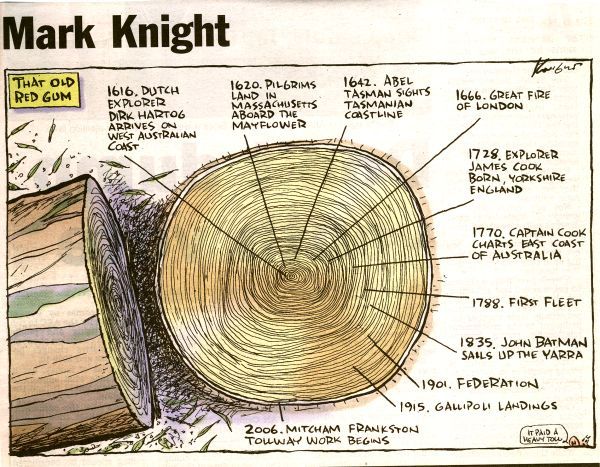
Back in 2006 a 400-year-old River Red Gum was felled to make way for a freeway. I will quote my 23/6/2006 journey entry from then:
Another tree murdered! This one a 400-year-old River Red Gum:
Tree was there first, but it had to go
Liam Houlihan, 23 June 2006
A 400-year-old tree that threatened to stump the Eastlink tollway has been chopped down by road builders. Dandenong council rallied to save the ancient River Red Gum, but was refused a last-ditch attempt for heritage protection.
Eastlink builders felled the tree about 9 a.m. yesterday, clearing the way for work to continue on the Dandenong Southern Bypass. Road builder Thiess John Holland said there was no feasible way to save the tree, near Hammond Rd, Dandenong South.
Dandenong Council admitted an oversight meant they had failed to protect it earlier. “I feel very sad today,” said Cr. John Kelly, who led the push to save the tree. “Unfortunately, we didn’t get our interim heritage order.” He said he was now pushing for the council to investigate whether there were similar old trees needing protection.
The tree was lopped just two days after its plight came to public attention.
“That might have quickened the process up,” Cr. Kelly said.
The main body of the tree was lifted onto a truck by a crane yesterday afternoon to be taken to council offices. It may be made into sculptures or art or erected in the ground with a plaque.
A tree that had been growing long before the first European settlers arrived here is now no more, no thanks to heartless developers and the overpopulated state’s insatiable need for more roads. It was rather isolated, the only tree near a busy road and housing developments. Perhaps it was once surrounded by forest.
This cartoon by Mark Knight provides some perspective:
14/1: Growth and greed
Three population articles in today’s The Age, two of them pro-growth.
“More people does not equal trashing our environment”: a minister (for migration) argues that population growth (though immigration) can be accommodated for with adequate planning. Given how hopeless the Brumby Government is at planning anything, his is wishful thinking. More immigration might seem to boost the economy in the short term, but those people will in turn grow old, and require even more people to support them – where does this end? We do not have infinite space, jobs or resources, and stating that people should curtail their standard of living is unacceptable – the most severe water restrictions will be futile if the population keeps increasing.
“Green wedges lost in the woods”: a representative from the Master Builders Association of Victoria says urban growth should continue, that people should be able to build big houses, that grasslands are “barren” and thus should be smothered over with housing.
Large homes have long been the obvious signs of affluence, success and in many cases, fertility. These are all social virtues that should be supported.
Greed is good, in short? What a load of self-serving bullshit. Large homes are environmentally-unfriendly and far from being “efficient.”
He was responding to an earlier article, “We need more green areas, not people,” 12/1, by a member of the Green Wedges Coalition.
“Reality check on growth”: by Bob Birrell, says that such a population increase will destroy quality of life for Australia’s citizens, and that the 35 million population projection is over-inflated as high migration programs have historically not been sustained. Both State and Federal Governments, however, have vested interests in maintaining growth:
Those involved in the building needed for the housing, services and employment required by new residents have a direct interest in high population growth. They include Victoria’s state government leaders, who are aware that the state’s main growth industry is city building.
Relying on building stuff can’t be sustained forever, though (as much as the industry would like it too). Mr. Birrell notes that:
Pursuit of the migration-driven 35 million target will generate increasing vexations as governments struggle to accommodate the extra numbers. Opposition will increase, as will critical attention to migration policies.
Many of the responding comments to the first two articles are quite good (and acerbic!). It is reassuring at least to see that commenters share my concerns about unrestrained population growth, though few politicans do, aside from Kelvin Thomson.
Some recent letters on the same topics:
6/1:
Preserving our green wedges
I am heartened that Planning Minister Justin Madden has stated “we are not in hurry to move the urban growth boundary” (The Age, 5/1). Melbourne has outgrown its optimal size, both in population and the surface area it covers. Our green wedges need to be preserved for their ecological value and food production. With the problems of “peak oil” (increased demand but plateauing of supplies) and the need to reduce our greenhouse gas production, it makes sense for farmland to be within closer transport distance. For example, the extensive market garden area on the south-eastern edge of Melbourne supplies much of our fresh produce. It has rich soils and a reliable rainfall. It should be preserved as a national treasure, not an area to be paved over for housing.
– Kit James, Melbourne
A defining moment
At last, democracy in action. Reading that the Government’s ridiculous decision to destroy our green wedges and further turn our once most-liveable city into a monstrous urban sprawl is being put on the backburner, due to Coalition and Greens resistance, is a breath of fresh air.
This is true bipartisanship that will shape what a 21st century Melbourne can be at its best. Let us build more efficiently, effectively and environmentally, improve our land use, curb our hunger for huge backyards and McMansions, and stop developers’ greed getting in the way of good planning. The challenge is upon us.
– Paul Bugeja, Caulfield North
Victoria has a population crisis, not a water crisis. By attacking the symptom (less water) rather than the cause (overpopulation), we live in a fool’s paradise while resolving nothing.
– Luke Hooper, Northcote
7/1:
Yes, there is a choice
Poor old developer, Delfin Lend Lease (The Age, 6/1), unable to open up more grasslands to flog off unsustainable future ghettos. Apparently the only way to afford a home in “Melbourne” is to buy one of its houses and enjoy all the future driving, health and social costs thereafter. There are no shortage of alternatives; for example, living regionally (it’s quicker to get the train to the CBD from Geelong than Berwick) or doing without a backyard and living near a park instead. But, as they say, it’s all about “My Choice.” Well, I would like the choice (having decided to live in a modest house, with no yard) of my countryside to remain as country when I escape town occasionally, rather than becoming one massive sprawl of obese housing estates so that private companies can flip a quick profit.
– Patricia Bakacs, Seddon
10/1:
Vanishing dream
While developers, investors and state government stamp duty coffers grow fat on Melbourne’s property boom (The Sunday Age, 3/1), we should all spare a thought for the average home buyer. With the median home price now $481,000 and rising, the Australian dream is becoming unachievable for the average Melburnian. While the Prime Minister and Premier crow about population growth, the next generation is slowly being locked out of the property market altogether, due to the spiralling cost. And those who are braving the market and purchasing a home are generally saddled with a massive mortgage, that may never be paid in their lifetime.
A debate on future population and migration levels is long overdue, along with a number of initiatives to direct growth to regional towns and cities.
– Mathew Knight, Malvern East
17/1: Collected letters
The articles linked in my 14/1/2010 entry generated a flurry of letters to The Age. (I did not send one as I seem to have fallen out of favor – the last few I emailed were not published.)
15/1:
Migration’s drain on public purse
Michael Danby justifies our having the highest per capita immigration program by saying it brings in extra tax revenue (Comment, 14/1). A single year of migration like 2008, he claims, can “add more than $800 million to the tax base in the first year.” So what? If this is to be Danby’s economic case for high migration, then surely he needs to ask: do recent immigrants contribute more to the public purse in taxes than they take from it in direct costs and subsidies?
Back in the 1990s, answering this question set the economist Russell Matthews a massive task of disaggregation. His findings are discussed in my book This Tired Brown Land. Professor Matthews found it took the average immigrant about 10 years to become (like the average older resident) a net contributor to the public purse; and the highest costs occurred in the first two or three years after arrival. It seems that the average net cost to the public purse per immigrant back then was some $34,500 – a result so unwelcome to the government that it never funded a follow-up study.
The most recent Australian Bureau of Statistics figure for annual net migration is 285,000. A very rough calculation suggests this intake might be a net cost to the taxpayer of $9.7 billion – without counting environmental costs or the loss of urban amenities through crowding.
– Mark O’Connor, Lyneham, ACT
Cancer that kills the host
I do not feel reassured that Michael Danby and his parliamentary committee colleagues believe we can cope with population growth. Population policy in this country does not consider the greater good of existing citizens or the long-term suitability of a higher population, but is driven by what suits the electoral cycle and vested interests.
The Government’s contention that Australia was unique in avoiding the global financial crisis does not mention that it was largely on the back of increased demand from population growth. This growth is also artificially propping up house prices, now considered among the highest in the Western world. Business naturally wants more consuming units for its products. The biggest cheerleaders are developers and builders, with the Master Builders Association (“Green wedges lost in the woods,” Online, 14/1) implying that building more McMansions in the urban wastelands on the fringe of the city is an altruistic public service.
It is time citizens demanded a voice on this issue, which is being decided behind closed doors. We live in a mostly desert land that is getting hotter and drier. Experience tells us that governments never provide good planning and appropriate infrastructure to support a higher population, only ad-hoc freeways and energy-guzzling desalination plants as an afterthought. Growth should not always be the goal. The only thing that keeps growing is a cancer – until it kills its host.
– Chris Owens, Lysterfield South
Fix the problems first
How out of touch with the concerns of ordinary Victorians is the MBA? It is interested first and foremost in builders making money. It says it supports a larger population because Victoria should sustain more people. Why should it? So the MBA can build more houses and make more money? Victorians do not want continuing urban expansion and do not want to be battery hens locked up in tiny apartments. The MBA dismisses congestion and scarce resources as a management issue despite the fact that it is a huge problem with no solution in sight. I would like the MBA to first sort out these problems and then it can push for the population to grow ad-infinitum. Probably until the whole country is covered with housing.
– Greg Delaney, Amaroo, ACT
Growth that is gentle
Proponents of perpetual growth may not realise that we do not have to abandon all growth. While unchecked economic/population growth is not sustainable, we can indulge ourselves in intellectual growth, humanitarian growth, growth in compassion, demolishing the poverty industry and dissolving the billionaires’ club. The list is endless. This generates employment and income and is gentle on the environment.
– Margit Alm, Eltham
On the home front
While I concur in general with Terry Barnes about consumerism (Comment, 13/1), I do not agree with his convoluted solution to limit the size of houses by imposing a surcharge based on floor space per person.
The problem of the ever-increasing size of private residences has been created in part by the tax-free status of owner-occupied houses irrespective of size or market value. This has resulted in the family home being the best “investment” one can have and in reality forms part of one’s superannuation.
A quick reality check would be for the Federal Government to introduce a capital gains tax on properties over a nominated value, say, $1 million, which would change with inflation. This would no doubt lead to loud dissent by the better off, but would create a fairer system.
– Barry Robinson, McCrae
Recipe for high debt
Let’s debate what is really contributing to rising household debt and not just consider fringe issues such as McMansions and entertainment systems.
In 1996, approximately 30 per cent of an average weekly income was needed to pay off a 25-year mortgage on a median-priced house bought by first home buyers in Australia. This figure was more than 80 per cent in 2008 and will probably be higher again this year. The increasing size of new houses does not explain these figures.
Stopping this debt madness will require tough medicine, including removal of an unfair taxation system and supply policies. Ironically, people who have enough money to buy houses enjoy significant tax benefits on capital gains; what’s more, if it is an investment, the taxpayer helps finance it through negative gearing.
Couple this with a cut in the supply of public housing and a rising population, and you have a recipe for spiralling housing costs and rising household debt.
– Linda Brownstein, Wangaratta
Michael Danby’s view that population growth is required to “maintain our generous care of seniors” (Comment, 14/1) fails to acknowledge that such growth generates future dependency by new generations of seniors, in greater numbers, who will in turn require a growing population to support them.
– Luke Hooper, Northcote
16/1:
Michael Danby (Comment, 14/1) believes we can manage our environment while continuing to grow our population. In medical terms this is called palliative care.
– Kyle Matheson, Mont Albert
Just because economic gurus don’t know how we can grow richer without a simplistic growth in population doesn’t mean it is impossible.
– Guido Stavenuiter, Balmain
“‘Don’t pander to greenies’,” The Age, 31/12/2009. I sent a letter in response to this, but it wasn’t published:
Mr. Gadiel’s objection to “extreme environment groups“ being enabled to challenge governments in court is hardly surprising, seeing as he is part of the property development industry – a group not known for its regard for the environment or residents’ rights. Hopefully the law changes that reduce the court costs for activists will be implemented, making it more difficult for greedy developers to get their way.
Some that were:
1/1:
Brownwashing the environment debate
Comments by property development group Urban Taskforce Australia (The Age, 31/12) demonstrate the importance of looking beyond the intemperate views of such groups in developing government policy.
Aaron Gadiel provided a scaremongering assessment of recommendations in the Hawke review of the Environment Protection and Biodiversity Conservation Act 1999. He suggests that reinstating provisions that remove cost barriers to parties seeking injunctions against environmentally contentious projects will “drench Australia in American-style litigation culture.”
However, only four such injunctions were granted under the act from 1999 to 2007, before the provisions were repealed.
It is disingenuous of UTA to paint environmental groups as not-in-my-backyard activists. Most serious environmental litigation is undertaken by those with more altruistic motivations such as species protection and safeguarding the planet for future generations. This may be contrasted with not-in-my-back-pocket industry groups, which, acting on behalf of their constituent members, are principally concerned with financial returns.
Removing cost barriers to the courts promotes access to justice opportunities, enhances scrutiny of government decision-making, and has potential to advance the rule of law in an area that the scientific community suggests will determine the future of the planet.
– Gregor Hupser, Public Interest Law Clearing House (Vic), Melbourne
Bring it on
Aaron Gadiel complains that legislative changes would give people who want to complain more of a voice in court, reducing “opportunities for Australia to get the urban development it needs.” Bring it on. I’d love to see what happens when locals have as much say as people whose only interest in the community is to make money from the community and leave.
– Graham Parton, Stanley
17/1: Damned if they do or don’t
Article reproduced below in case it disappears:
Study warns aborting girl fetuses will leave China with 24 million more men than women by 2020
Beijing – Abortions of girl fetuses are expected to leave China with 24 million more men than women over the next decade, according to a study that warns the imbalance will dash many young men’s chance at marriage and lead to increased crime.
China enforces strict family planning controls, including limiting most couples to having one child. Because of a traditional preference for male heirs, many families terminate pregnancies of girl babies in order to be able to continue trying for a boy. Infanticide of baby girls has also become a problem.
The study by the Chinese Academy of Social Sciences, reported in Chinese state media this week, specifically said such preferences were behind the ballooning imbalance.
“Sex-specific abortions are extremely commonplace, especially in rural areas,” the CASS report said. “The phenomenon of abortions of female fetuses is very serious.”
China bans tests to determine the fetus’ sex for non-medical reasons, but they are still commonly done, mainly by underground private clinics in the countryside.
The report said the male-female ratio at birth in China was 119 males to 100 females, with the gap as high as 130 males for every 100 females in some provinces. In industrialized countries, the ratio is 107 to 100.
The report is similar to other studies in recent years that warn of serious social problems because of the gap.
The official Global Times newspaper quoted researcher Wang Guangzhou as saying men with lower incomes would have trouble finding spouses in rural areas, leading to crime problems. The newspaper also said abductions and trafficking of women were widespread in areas with excess numbers of men.
The CASS study mirrors a report published last April in the BMJ, formerly known as the British Medical Journal, that said China has 32 million more young men than young women because parents facing strict birth limits abort female fetuses to have a son.
The BMJ study found even higher gender ratios, with 140 boys for every 100 girls in the 1-4 age range in Jiangxi and Henan provinces. The figures were based on data from 2005.
China imposed strict birth controls in the 1970s to limit growth of its huge population, noting that resources, especially land, were increasingly strained and that changes were needed in its new push to modernize. The government says the controls have prevented an additional 400 million births in the world’s most populous country of 1.3 billion.
Seems China can’t win either way – it has to get its population growth under control, but cultural preferences lead to a gender imbalance that could result in social instability. I have remarked in previous entries (2/6/2008 , 18/1/2009 ) that a brutally pragmatic solution would be to cull the surplus males (wars do that anyway, in an uncontrolled manner).
“MPs call for 70m population cap,” BBC News, 6/1. UK politicians seem to belatedly be realizing that their island might be a tad overcrowded at 61 million or so. It will be even worse at 70 million! Public resentment at high immigration levels is growing, and will result in social unrest if not alleviated.
“It’s ‘dog eat dog’ on London’s overcrowded Tube: report,” The Age, 2/12/2009. An earlier article describing how overcrowding, here on the railway underground network, leads to a “survival of the fittest” attitude. I’ll again link to the article, “London’s a rat hole.”
26/1: Stop breeding!
“Dick Smith says Australia should cut population by slashing immigration and encouraging women to have only two babies,” H-S, 26/1. A businessman who is against population growth is a rarity! The well-known entrepreneur has incited controversy by his comments, but discouraging large families should be a key population policy. While banning is probably a bit strong (and would probably evoke resentment), more passive measures could be used: no government benefits after a woman’s second child (and, more drastically, no access to government services for child #3 onwards), no baby bonus after two children, making large families socially unacceptable, and so on. Those who chose to have three or more children would have to financially support those extra ones themselves.
We live in a first world country where virtually all children are guaranteed to survive to adulthood, so the redundancy argument is no excuse to justify large families here. Most people’s genes are not so special that they need multiple copies of themselves. Those who have many children are also taking more than their fair share of resources.
The aging population is brought up again as a problem – namely, supporting them. Population increase to solve this is only a short-term solution, as those extra people will in turn need to be supported by an even larger population, until numbers reach ridiculously high levels. A line has to be drawn at some point. Perhaps euthanasia will have to be legalized as an option – it does seem preferable and more dignified in comparison to withering away in a nursing home, senile and incontinent. Developing robot helpers and exoskeletons are also another solution.
Unfortunately, Prime Minister Kevin Rudd wants a “big Australia” so no guidance can be expected from him. In his Australia Day speech he raises the usual alarm about an aging population and states as a fact that our population will increase to 36 million (a nightmarish prospect).
In the newsprint article (which was a bit different in wording) there was criticism from “family groups”:
Football identity and father of eight Grant Thomas has joined family groups in attacking Mr. Smith’s suggestion to discourage women from having more than two babies. […]
Thomas, the former coach of St. Kilda, was shocked by Mr. Smith’s comments. […] He said his big family brought him much joy. “Dick’s a much better man than me. I couldn’t face going through life only having made love to my wife twice,” he said.
This ignoramus obviously hasn’t heard of contraception, judging by the ridiculously large family he has. How can anyone justify having 8 children in a First-World country?
Family Council of Victoria secretary Bill Muehlenberg said it was scaremongering. “We had Paul Ehrlich in the 1960s saying exactly the same thing, that in the ’70s and ’80s millions of people would die of famine and starvation. Really, I would take him with a grain of salt.”
There are millions dying of starvation; does he not watch the news? These family organizations tend to be conservative religious fanatics, so they should not be listened to.
“Australia ‘must plan new city’ to cope with population,” The Age, 26/1. Demographer Bernard Salt, whose opinion is of dubious value, asserts that we need another city in the north, and that we are obligated to take in more people:
By 2050, the global population is set to grow to 9 billion from about 7 billion today. As a nation of 22 million with the resources of a continent, Australia had a moral imperative to take its share of migrants, Mr. Salt said. “We need to project that we are a generous nation,” he said. “You might get away with no growth for the next 10 years, but then those pressures build up. “The rest of the planet says, ‘We’re drowning in poverty and here’s Australia sitting on 22 million people, and they don’t want to accept migrants because it compromises the quality of their lifestyle’.”
Bugger that! Much of Australia is arid desert, so a large population is unsustainable – its environment is already severely damaged with the numbers we have. Other countries should take responsibility for their own problems and not expect to keep exporting their surplus people.
“Populate and pollute,” H-S, 20/1. An obvious way for Australia to cut its emissions levels is to reduce immigration levels.
The report said the Government was unlikely to meet its target of cutting year 2000 emissions by 5 per cent by 2020 if high population policies continued. “The Government is in a diabolically difficult policy situation,” the two demographers wrote. “The implication is that it regards population growth as more important than the achievement of greenhouse abatement targets.” Dr. Birrell and Dr. Healy said the Government had limited power to control fertility rates, but it could take decisive action on the migrant intake.
Prime Minister Kevin Rudd has been unapologetic about his support for a much bigger population, branding himself a “big Australia” man. “I think it’s good … for our national security long term, it’s good in terms of what we can sustain as a nation,” he said recently.
A collection of published letters from The Age:
18/1:
Population fantasy
John Bayly (Letters, 16/1) is living in cloud cuckoo land if he thinks that Australia can sustain a population of 70 million, even if the “dead centre” can provide solar and geothermal energy to support people living on the habitable fringes of the continent.
Day-to-day life for ordinary folk in Melbourne is fast becoming intolerable due to failure by the Brumby Government to provide efficient public services, plus pressure of increased population: more than 2000 settlers are arriving here each week. We are seeing the breakdown of public transport; regular road traffic jams; water shortages; overstretched hospital accommodation; unaffordable housing; and loss of residential amenity with increased density. All this is being compounded by climate change with extremes of weather, such as record high temperatures with threats of bushfires.
Just how many people can Australia sustainably support without destroying the environment and without affecting our standard of living?
The new warning “populate and perish” should be broadcast to all state MPs.
– Lewis Prichard, Hawthorn
No road to utopia
Michael Danby (The Age, 14/1) implies perpetual population growth is the pathway to utopia, but on what planet?
Time and time again, Mother Nature has wreaked revenge on those who forget that humans are but a small part of the world’s ecosystem, wiping out whole civilisations whose leaders acted like grasshoppers rather than ants, living for today and forgetting about tomorrow.
Profligate squandering of her resources has created sterile moonscapes where once there were verdant forests.
History has shown we live beyond our means at our peril. Yet Mr. Danby and his ilk want Australians to grow ever larger and richer.
Dying rivers, rising sea levels, diminishing soil fertility, intolerable traffic congestion, sprawling urban development, increasing social alienation – no problem. All we need is a bit of smart planning and a desal plant.
Money, money, money, must be funny, in a rich man’s world.
– Rosalie Counsell, Harkaway
19/1:
Michael Danby, here’s a novel idea. Why don’t we better train more people who are already here so we don’t need to bring in so many extra workers?
– Lorraine Bates, Surrey Hills
20/1:
Rudd warns that the aging population will “drag” down our growth rate. How disgusting that he considers aging to be a threat. Nobody stays young, and even the young migrants he lures here will age. Older people may not add to the gross domestic product – but if they worked most of their lives, they have contributed to the economy. Also, many retirees are self-supporting, and they often care for the elderly and children, as well as do volunteer work. The economy is supposed to serve us, not be our master to devalue people as unproductive burdens when they are no longer doing paid work.
– Vivienne Ortega, Heidelberg Heights
21/1:
A simplistic view
Peter Cosgrove, there are many valid reasons for wanting to stop the population growing that have nothing to do with racial tolerance. Water, for example, or some of the world’s worst species extinction rates, or how ongoing urban sprawl is eating up farmland and green space, or the inability to reduce greenhouse gasses while increasing the population. None of these are perspectives born of racism, yet any suggestion that we should limit our population to help deal with these problems is described as racial intolerance. I look forward to the debate about our population moving beyond this simplistic level.
– Graham Parton, Stanley
Poor, poor boomers
Thanks, Kevin Rudd, for asking younger generations, particularly “working families” to work harder for the older one. Let us work harder for the baby boom generation, who had free tertiary education, had their property values explode, milked the pension system dry and left the planet’s environment on the verge of disaster. It is becoming tiring being part of a generation that is held ransom for another generation’s voting population.
– Sarah and Brett Wilson, Ashwood
22/1:
Show us respect
Planning Minister Justin Madden has been charged with overseeing “the Government’s Respect Agenda, which aims to reduce alcohol-related violence” (The Age, 21/1). If Madden and John Brumby respected what Victorians value about our cities and environment and planned for future generations, young people might be inspired to follow their “respect agenda.” Protect our grasslands, forests, heritage, green wedges and streetscapes from developers who are the main objects of Government respect.
– Rosemary West, Edithvale
February
4/2: Population debate
Published letters collection. Some of the following letters refer to a series of population debates held on The 7.30 Report last week (which can be viewed in the January 2010 archive). I did not watch these as I would only feel frustrated – a lot of talk, but nothing serious done to reverse population growth.
SMH, 3/2:
Today’s migrants are tomorrow’s seniors
Yes, we have a looming crunch as the Australian population pyramid morphs into a population towerblock, and retirees threaten to outnumber the economically productive (“Injection of youth slows down the aging process,” February 2).
But the short-term solution of importing young workers is borrowing against the future. What will we do when they retire? No country can support an unlimited population. At some stage we have to adapt to the reality of greater longevity and a static population.
We are not just living longer – we are also healthier beyond 60. If the retirement age must be gradually raised to 70, then so be it. But even in the good times it is hard to get a job when you are over 50. Business must adapt, too.
– Derek Bolton, Birchgrove
Wayne Swan says the population may not be allowed to hit 36 million by 2050: the economic benefits of a large population would have to be weighed against environmental and infrastructure impacts.
Swan’s words sound familiar. The 1994 inquiry into Australia’s population “carrying capacity” recommended adopting a formal population policy, which would be informed by these considerations. The Keating government could not summon the courage to respond, and the Howard government’s response was finally revealed in 1999. It argued that no formal policy was needed because its policies would result in a stable population of about 23.5 million by 2051. Our population has already exceeded 22 million, and the results of the past 10 years of population growth are in: infrastructure is failing, our environment is in decline, with water security a major concern and attempts to reduce greenhouse gas emissions thwarted.
The Rudd government would do well to start work urgently on a population policy.
– Gordon Hocking, Oyster Bay
Wayne Swan again recommends that the aging members of the population gird up their loins and prepare to work into their twilight years. If only it was that simple.
I would like to see any of our relatively well-heeled “suits” find themselves in their late 50s trying to compete for semi-professional jobs such as office work with gorgeous young things – male or female – 20 or 30 years younger. There are 600,000 of us officially out of work, plus those the statisticians ignore – the underemployed, the unincluded and the totally demoralised who have given up hope of employment, no matter how much they have to offer.
Let’s talk honestly about finding jobs for everyone who needs one. Let’s start thinking about no-fault unemployment and adjust the demands of our social security system accordingly. And let’s not ask older people to humiliate themselves, yet again, trying to secure jobs in our youth-obsessed culture that many employers, young or old, are most unlikely to offer them.
– Virginia Rose, Verona
Come on Kev, don’t pussyfoot around. Legalise euthanasia and be done with it (us).
– Trevor Knight, Gilles Plains (SA)
The Age, 29/1:
Balanced approach
George Brandis has had a cheap shot at Julia Gillard over her decision not to have children (The Age, 28/1). With the world population rocketing towards 9 billion, leaving environmental devastation and significant human suffering in its wake, people who don’t reproduce are doing the world a great favour.
Aberrations in female fecundity like the vocal Angela Shanahan, who has had nine children, must be counterbalanced by women who have one or no children or we would be in a terrible predicament in a very short time.
The decision not to give birth does not indicate one dimensionality of a woman’s character as claimed. No human can have all possible life experiences. With empathy and imagination we can still put ourselves in the positions of others who have had a different life path.
– Jill Quirk, East Malvern
30/1:
Stop this madness until we have a plan
I have seldom seen a politician more comfortable with himself than Kevin Rudd explaining that neither the government, nor the other side of Australian politics has a population policy. And thus will take no responsibility for the consequences of Australia at 35 million.
However, if you look at the programs in place – social and financial pressure for more babies, unlimited immigration, and even legal sanctions against voluntary euthanasia – you would hardly know it. It appears a little disingenuous to me.
It may just be possible for Australia to cope with this number of people at this rate of increase but not without carefully co-ordinated management of our infrastructure. And that is simply not possible without a well-articulated and agreed policy framework. This has to be understood by all levels of government, the Opposition and by the electorate in general. There is a fat chance of this happening.
The fact is that the Government does have the means to influence our population. At present it is using this to encourage unlimited growth and is doing so in a policy vacuum. Simply hoping it will all work out in the end is not good enough. Could we please stop this madness until we have a plan.
– Kyle Matheson, Mont Albert
Not set in stone
It was apparent, watching Kevin Rudd being interviewed on television, that his enthusiasm for “a big Australia” was tempered by his realisation that the electorate is beginning to understand that the calibration of annual immigration is a matter of his Government’s policy and is not cast in stone.
The electorate is eager to know whether a “big Australia” is in the national interest. This question will continue to bedevil the Government and Opposition until an informed case, for and against it, has been transparently heard in the political and public arena.
– Arthur Bassett, Blackburn South
Aim to be self-reliant
One simple fact always gets lost in the climate change debate. That it is far better for humanity to act as if it is a reality. Reducing reliance on basic services, now provided by governments and multinationals, such as water and power, and changing to non-polluting, home-based systems, and reducing the use of fossil fuels must have an overall beneficial effect. It will also greatly increase the power of the individual to avoid being reliant on monopolistic, rapacious organisations.
Of course those who pay the deniers’ bills, and governments bent on perpetuating obsolete systems to benefit special interest groups and wealthy investors, do not like that idea. It is not climate change they aim to deny, but to constrain the power of the individual to act independently against it, and to restrict any ability to deny large organisations massive profits.
With a Government in thrall to the coal and oil industries, with its fuel-hungry desalination plants, and massive polluting power stations, we will continue to see decisions taken that ensure that all citizens pay their hard-earned cash to the rapacious for their basic services with ever less opportunity to opt out of the scam.
– Martin Dix, Healesville
It is worrying that Kevin Rudd thinks nothing can be done to control immigration numbers. Perhaps a population policy would be a start.
– Beverley Broadbent, East Brighton
2/2:
Less wasteful living
Kevin Rudd says we need a big Australia to fund services for our aging population. Commentators have also argued we need to work longer to enjoy the lifestyle to which we have become accustomed.
What Australians really need to do is consume less, waste less, drive less often and in smaller cars, and generally reduce our material wants. We will be happier and not supporting an economy that chokes our cities and wrecks the environment. We will have “quality of life” rather than just the “high standard of living” so beloved of politicians and economists.
In a land of finite and dwindling resources, repudiating the policy of economic growth as the solution to our problems is the only rational and morally defensible course of action.
– Rob Buttrose, Moonee Ponds
3/2:
Fill ’em up won’t work
Wayne Swan has joined the chorus of Kevin Rudd and Lindsay Tanner for a big Australia, based on an aging population. These mindless pollies make out that this is the solution when, in fact, it only makes a bigger time-bomb.
What happens when all the additional migrants age? We then have an even bigger aging population. Based on Rudd’s and Swan’s principles, we will need even more people in the following 40 years, after 2050. So will we march on to 70 million people?
Not to mention that the skyrocketing cost of essentials such as food, housing, energy and water will drive an even greater socio-economic divide in a decimated environment. Standards of living will continue to fall, especially for lower-income families, as our resources are stretched to the limit.
We need a realistic sustainable solution to an aging population, as opposed to filling up the country beyond breaking point. Pollies seem to view population growth and consumption as endless, no matter what the consequences, so long as the big end of town is rewarded. It is high time for a referendum on this so that at least all current Australians will have a say in this country’s population destiny.
– Tony Smith, Burwood
4/2: Community disillusionment
I am increasingly irritated with the Childfree Hardcore LJ community. I posted an entry about a woman musing whether to have more children (a 4th). There have been similar entries from others concerning overpopulation and/or large families (example: “Octomom”), so I thought it relevant. Apparently not, according to some commenters.
I find it strange that a community that exists for people who do not wish to have children has become a place to post about anything regarding other people having children. This isn’t an anti-overpopulation comm, even though a lot of it’s members are VHEMT members and the like. How does this directly relate to you being childfree? Yes, having four children is selfish, and I’m sure we all agree on that. You’re kind of preaching to the choir, here.
Yes, I thought members might like to read and debate it?
I come to this comm precisely because I don’t have to pretend that I give a shit one way or the other if people have kids. Because I really don’t. As long as the sproggen don’t get up in my face or ruin a movie for me, I don’t care if you have one or a baker’s fuckin’ dozen. Just keep that shit away from me. And frankly, how is this about being CF (hardcore or otherwise)? I mean if you want to talk about whether her waffling makes it harder for others to seek sterilization, that’s relevant to those of us in the comm who have been bingoed and denied reproductive rights. But asking if her decision is greedy? If I’m going to ask parents to refrain from considering my reproductive choices to be “greedy” or “selfish” – I figure I owe them the same consideration when it comes to their choices. So long as she can afford the kid and isn’t going to abuse it horribly how is this our damn business?
Most community entries are gripes about various children’s bad behavior! Also reproductive choices – in this case, having a lot of children – do affect others, in that it means there are fewer resources to share, and taxpayers will end up supporting those children in some way, such as (in Australia) through the baby bonus or government-funded health care (Medicare).
The community is not “hardcore” enough for me anymore (as in Pentti Linkola hardcore). There is inconsistency on what topics can be posted, and posts may be deleted at the whim of the moderators. There is much complaining about how child-centric society is, how women are judged by whether or not they have children, rights to contraception and abortion, a lot of examples of bad parenting, and so on. All of which I agree with. But if topics such as forced sterilization are brought up (an example being drug-addicted women who keep having children while on welfare) it brings down the wrath of the community. Rule №9: “This community, along with being pro-reproductive rights and against fat wank, does not endorse the idea that a group of people are inferior, evil, scary, or generally deserve to have their reproductive rights taken away for the good of society.” I disagree with the “reproductive rights” – as society usually ends up paying for the actions of irresponsible mothers in the form of welfare, society does have a right in this case to take away her means of having children (or more children if she already has any). There is too much emphasis on rights – identity politics – and not enough on responsibilities in our society, an issue that seems to elude a lot of forum members.
I will not bother to post there anymore; a lot of members come across as snarky bitchy females. I encountered those types at school; I do not want to have to tolerate them on the Internet. I have yet to find a community to my liking (there are none on LJ that I know of).
[Update 11/2/2010: I deleted the entry then quit the community. Here is a screenshot of the entry (321 KB).]

“Is it greedy to want a large family?,” The Age, 19/1. The original article which got me irate. To repeat what I said in the LJ entry: This columnist is mulling over whether to have another child (she has 3 already). My opinion: yes, it is greedy! She lives in a 1st-world country where her children are virtually guaranteed to survive to adulthood, and with access to birth control, so large families in this case are a selfish indulgence. Most people’s genes are not so special that they need to produce multiple offspring. There is also the damage multiple births do to a woman’s body. Most of her commenters (linked in the article) show the same selfishness, and encourage her to have another (there are a very few dissenting comments concerned about overpopulation).
Educating women and giving them access to family planning and contraception is generally supposed to result in them having smaller families (1-2 children), or no children. Unfortunately, in Australia this effect seems to be reversing!
16/2: Kelvin Thomson speech
MP Kelvin Thomson, one of the few politicans concerned about overpopulation, made an excellent speech at a Sustainable Population Australia meeting on 10/2 (also reproduced at the PublicPopForum). One of the points he makes is that the alarm over an aging society is misguided.
“New party wants population debate,” SMH, 8/2. Another concerned businessman, William Bourke, proposes a new political party focused on overpopulation.
Although he has never been involved in politics, Mr. Bourke, 39, said his instincts told him Mr. Rudd had slipped up badly last year when he said, “I actually believe in a big Australia – I make no apology for that. I actually think it’s good news that our population is growing.” Mr. Bourke says the huge increases in population forecast by the federal Treasury in its third intergenerational report are a direct result of government policies, including record immigration levels and the baby bonus. Yet the only public debate is on how to deal with the consequences of so many more people, not whether such growth is desirable. He said “the extreme and radical rate of population growth” meant more high-rise apartment blocks, overcrowded transport networks and loss of parklands were inevitable, and it was time for a national debate about whether this was what people wanted. Mr. Bourke said he and a small group of like-minded people expect to reveal the name and plans for the party within three weeks and where they want to run candidates.
Letter, The Age, 6/2:
Norway can do it
Lindsay Tanner says that unless our population grows rapidly, we will suffer “lower productivity and less economic growth.” But from 1997 to 2007, 13 OECD nations had higher per-capita economic growth than Australia, but lower population growth. The suggestion that population growth is necessary for a vibrant economy is unsupported by any empirical evidence, and contrary to the examples of countries like Norway and Germany, which are doing fine with stable populations. If they can do it, why can’t we?
– Charles Berger, Australian Conservation Foundation, Carlton
SMH, 9/2:
Immigration policy must reflect our country’s fragility
Your editorial says there “is a popular opinion that holds Australia must rein in its population growth or suffer severe environmental consequences” (“A big Australia needs even bigger investment,” February 8). I presume this opinion is popular because our population growth to date has already led to severe environmental consequences.
There is a vast amount of scientific evidence to suggest we have stuffed up our environment at every level, and continue to do so. Those who say adding millions more people to the equation will not harm the environment if we do things the right way are the ones who are burying their heads in the sand. While we have the current system of buying, selling and developing land, the environment will always suffer.
You say “we have been adapting to higher populations since day one of the colony.” I respectfully suggest you should have said we have been “adapting poorly.” And when you say “we occupy one of the largest land masses in the world,” you should have said “one of the driest and most infertile land masses in the world.”
You could say we “enjoy” one of the world’s lowest population densities if we liked to live throughout our continent, but we don’t. We largely stick to the coast, so the population density in our cities and towns is similar to many other countries. Those trying to get to work on the Sydney road system would no doubt vouch for this.
“But since when have we given up so easily?” That is what I would say about those wanting a population debate and, heaven forbid, a population policy. Going along with governments who are hooked on high immigration simply because of an unproven economic benefit is the easy path.
Being against massive immigration does not mean you are anti-immigrant. We are all immigrants somewhere along the way, but we should not let that allow us to give up on fighting for a better way for this ancient and fragile country.
– Andrew Cronin, Robertson
21/2: Population political party
“How many is too many? Australia’s people problem,” SMH, 19/2. A Sydney businessman named William Bourke is, like Dick Smith (see 26/1/2010 entry), concerned with overpopulation, to the point where he says he is launching a population-focused political party, named the Stable Population Party of Australia (some details at this entry in the PublicPopForum; they have an as-yet-unused site registered). [(Note, 22/6/2016: http://www.populationparty.com/; no longer owned by them)]
“Grey expectations not nearly as alarming as climate change,” The Age, 3/2. Criticism of the alarmist hype made by some politicians about Australia’s aging population.
But even the remaining 40 per cent of the increase can’t be attributed to aging. It includes allowance for the expected growth in the population from 22 million to 36 million. Obviously, 14 million extra people means (greatly) increased spending on healthcare, but this has nothing to do with older people’s increased need for healthcare purely because they’ve got older.
36 million is not inevitable! Such a population increase can be prevented if politicians have the will too (which none currently in power do).
23/2: IVF timebomb
“Infertility time bomb: IVF children have higher risk of infertility, obesity and diabetes,” Daily Mail, 23/2. There is some evidence that infertility problems can be passed on genetically for IVF-conceived children, as well as health problems caused by the procedure itself.
“There are genetic causes of infertility that you can pass on,” said Dr. Van Steirteghem. “It means that the next generation may be infertile as well and this is something all clinics should mention to the patients – that if there is a genetic origin that this genetic origin of infertility may be transmitted to the next generation.”
Fertility treatment is so common that one child in every primary school year group is thought to have been conceived in a fertility clinic. But the growth of IVF may have come at a cost to a small, but significant, minority of children. Studies have shown that test-tube babies are slightly more likely to suffer from birth defects. Because so many are twins and triplets, they are also at greater risk of low birth weight, obesity, diabetes and high blood pressure later in life. Doctors fear many IVF babies will also inherit the genetic mutations that caused their mother or father’s infertility.
So those are more problems that the public health system will pay for – which would have been unnecessary if IVF were never invented. That’s a major issue in the debate – this extra burden is preventable by banning IVF.
As usual the comments are heated (IVF brings out similar polarized opinions as abortion does). IVF in the UK and Australia is partly funded by the public health systems in both countries, which makes the issue more controversial. The point is usually raised that as various illnesses are paid for by public health care, why shouldn’t IVF be? The argument against this is that treating other illnesses don’t involve bringing another human into the world (who otherwise would not be there). IVF is unnecessary – it can’t be justified in an already-overpopulated world. At the very least, it certainly should not be taxpayer-funded.
A few comments (agreeing with my opinion):
There is a BIG difference betweem treating illness and having IVF. Yes, of course I have taken antibiotics, for ILLNESS. However, no-one has died from INFERTILITY!!! Your argument that just because people take treatment for illnesses means that IVF is necessary is ridiculous!
– Linda Duncan-Adam, West Des Moines
This is what happens when humans tamper with nature – nature will always win. There are good reasons why a percentage of all mammals – including humans – are infertile. Having a child is a privilege, not a right as so any infertile couples seem to believe! Let’s hope sanity finally prevails on this issue. I resent my taxes going on NHS funded treatment for the infertile, it is an obscenity and an outrage when there are children starving in the world.
– Goldie, Sussex, 23/2/2010 4:23
Surely common sense (yet again) should prevail in this issue. Just why does nature let some couples conceive naturally and some not? Maybe because those who can conceive naturally and easily have the best genes to pass on. And maybe nature is telling those who can’t conceive naturally that there could be problems with any offspring if nature allowed them to do so. But of course, to some people, a baby is the ultimate “must have,” and so they will go to any lengths to have one.
– Linda Duncan-Adam, West Des Moines
An entry on another blog annoyed me to the point of commenting – then I got castigated by some self-righteous females. Women like these seriously irritate me – they are of a leftist political view in which they think public health care should pay for everything. I am Leftist in many respects (and certainly support public health care), but my opinion diverges on this issue for previously-stated reasons. Such people are too focused on individual rights, and not on responsibilities to the society they live in.
I hate that term – “socially infertile,” as if someone who wants to become a parent so badly that they’re prepared to undergo the trauma of IVF has to justify why. It’s like the old debate on whether being gay is “genetic” or “chosen” – why on Earth does it matter? The point is that it’s not wrong, and that no-one should be discriminated against because of it. Same with those who, for whatever reason, cannot become parents without the aid of a particular medical treatment – they’re not going to apply for it unless they need it, are they? The reason is “I want to become a parent and can’t do so without this medical treatment.” It’s not a cosmetic procedure people are choosing to undergo because it sounds like fun, now, is it?
“Socially infertile” refers to lesbian couples and would-be single mothers who could otherwise concieve children naturally by mating with a man. There is no way IVF should be publically-funded for this – if they want children that badly, either adopt one – or mate in the normal fashion.
25/2: Aging alarmism
The topic of Japan’s shrinking and aging population seems to be brought up on a regular basis in the news. This lengthy article (via) at a Japan blog is a somewhat gloomy portrayal of a town with a declining population. But the country’s population is still over 127 million crammed onto 4 small earthquake-prone islands, so surely a population decline should be viewed positively! As for the aging component: “Japan is the robot capital of the world. They will be fine in my opinion” remarks one commenter.
“The Singapore Solution,” National Geographic, 1/2010. On the success of Singapore.
Perhaps the most troubling problem facing the nation is a result of its overly successful population control program, which ran in the 1970s with the slogan “Two Is Enough.” Today Singaporeans are simply not reproducing, so the country must depend on immigrants to keep the population growing. The government offers baby bonuses and long maternity leaves, but nothing will help unless Singaporeans start having more sex. According to a poll by the Durex condom company, Singaporeans have less intercourse than almost any other country on Earth. “We are shrinking in our population,” the MM says. “Our fertility rate is 1.29. It is a worrying factor.” This could be the fatal error in the Singapore Model: The eventual extinction of Singaporeans.
“Overly successful”? Again, with a high population density – nearly 5 million crammed into a small living space – a successful birth rate reduction program should be cause for celebration. But the “aging population” alarmist hype has led them to unwisely encourage an increased birth rate again.
“Congestion the ultimate cost of people ingestion,” The Age, 28/2. The dismaying fact that politicians are addicted to growth because it makes the economy look good. The immigration rate last financial year was an absurdly high 285,000.
Despite changing rhetoric, the reality is our leaders remain hopelessly addicted to population growth. It is a drug they are unlikely to kick any time soon. Size, for some misguided reason, has long been equated with importance. But there is another, more intrinsic reason for the addiction. Population growth is one of the simplest ways for a government to boost economic growth, which is in turn regarded as a key measure of political success. More people means more houses, more cars, more food consumed and more petrol burnt. All this is dutifully recorded by the Bureau of Statistics as an increase in Australia’s gross domestic product, which is in turn associated with prosperity. An apparently circular need to feed economic growth with population growth represents a significant flaw in our political system.
Letters, The Age, 2/3:
Wonderful news for investors
Melbourne’s property market record sales (The Age, 1/3) is wonderful news for investors, real estate agents and land developers, not to mention all the stamp duty revenue for the state government. All this population growth, manipulated by Kevin Rudd’s fetish for a “big Australia,” has created a land and housing “boom,” and people in this growth industry are becoming wealthy. The demand for housing is caused by population growth driven mainly by immigration.
We used to be a land of home owners, the “lucky country.” But not any more. Even professionals are being locked out due to excessive competition. Where is the justice if a few elite become wealthy at the expense of the general public?
– Vivienne Ortega, Heidelberg Heights
Population policy now
Here’s a simple solution to the ever-deepening problems of housing affordability, suburban sprawl, high-density development, traffic congestion, over-development of our beautiful natural surrounds and an increase in Australia’s carbon footprint: an independent population policy.
– Shaun Dumbrell, Williamstown
SMH, 6/3:
Limit immigration and our traffic woes will ease
The Herald’s front page article (“Life not so great in the fast lane … but now Labor wants to fix our cities, too,” March 5) shows graphically what can happen when a metropolitan area, in this case Sydney, has an uncomfortably large population: bumper-to-bumper traffic. Thirty years ago Sydney had space. You could drive around comfortably and buy a home without selling your soul.
Opposition political parties will tell you that governments are failing to maintain and upgrade infrastructure to keep pace with need. But what they and the governments won’t tell you is that the need is generated by population growth, and the main source of that here is excessive immigration numbers. This has nothing to do with race and everything to do with numbers.
Seeing what Australian governments over the past 30 years have failed to do, and noting the Prime Minister’s enthusiasm for another 15-20 million residents over the next 15 years (and be assured, the Libs intend the same), do you believe any future government will do better ? Already Rudd has raised the need for new taxes to fund hospitals. He and the opposition know that population growth creates increased demand for services but does not deliver the extra money to pay for them.
If population growth causes congestion and infrastructure problems (to name just two of a long list of negatives), why are federal governments persisting with immigration policies delivering record high numbers here?
– Vince Patulny, Kambah (ACT)
March
21/3: Crowding us in
“Two good to be true,” H-S, 14/3. Some scientific evidence demonstrating that smaller families (one or two children) are better for parents’ health!
“Overpopulation the great unmentionable in Queensland politics,” Courier Mail, 16/3. Queensland is one of the most populous states and the strain is showing (as with Victoria), yet its deluded politicians still promote growth.
One of the comments below that article:
Well, SCOTTY OF QLD, have you ever lived in China? Or that skyscraper capital of the world, Hong Kong? Have you any idea what effect it has on people’s psyche to live like crabs in a basket? To constantly fight over resources and space? To bring up children in a tiny flat situated a hundred or more feet up in the air? Nah, I thought not. Well, you might want to live like that, but I’m damned sure I don’t want to. Nor do I want this for my kids and grandkids. Instead of comparing Australia with Third World countries (and saying, god forbid! that we should ape them), why not look at examples of intelligent population and lifestyle and resources management, such as we see in the Scandinavian countries? It is not our fault if countries choose to overpopulate. Likewise, it is simply RUBBISH to say that if overpopuilated Third World countries can scrape along, Australia (which has more than 76% desert, in case you hadn’t realised!) should be able to manage a huge population too. Why do you think migrants want to come here? To escape the overcrowded, chaotic countries they are leaving behind – duh!
Various developers have been making the usual alarmist statements about housing and land shortages (of course, they stand to profit from this). In “High-rise push to halt urban sprawl,” 16/3, some are promoting high-rise towers as a solution – not a desirable one for reasons stated in the comment above. I certainly don’t want Melbourne and its suburbs to end up as nightmarishly crowded concrete canyons. “Australia faces housing affordability ‘time bomb’: developer,” 17/3 – another developer pushes for smaller and more dense housing. There is only so much land, and covering it with housing estates is not acceptable – open space is necessary for environmental and mental health reasons. Crowding people into towers is not acceptable either.
Greens leader Bob Brown is pushing for a population strategy inquiry – at last his party seems to have realized it is a simmering issue that won’t go away.
“For a new generation, Alpha will be better,” The Age, 20/3. The generation born this year has been dubbed Alpha. Their future could be difficult, and shows how misguided encouraging a high birth rate is – it means more strain on resources, and competition for jobs.
The last of the Alphas will be born in 2024. Australian National University head of demographics Peter McDonald says they may be our biggest generation yet. He says the number of births could be higher in the future because of large numbers of migrants having babies.
In 2050, when the eldest Alphas turn 40, the population is predicted to reach 35 million. Professor McDonald refers to the “echo effect” – if there is a larger population that will trigger another baby boom because there are more people to have babies. Mr McCrindle, however, predicts one in three Alpha females will not have children. Professor McDonald says the bigger generations generally face greater competition in the labour force, but with Australia’s skills shortage this is less of an issue.
“The aging population scare debunked” at PublicPopForum. Quoted below:
Pamela Kinnear’s 2001 study for the Australia Institute, “Population Aging: Crisis or Transition?” concludes:
Conclusion: Alarm over the ‘aging crisis’ is not justified by the evidence. The transition to an older population can be facilitated by promoting the well-documented benefits that accrue in societies that have equitable access for all citizens to healthcare, education, employment and retirement income. Policies should also focus on overcoming discriminatory attitudes to older people, ensuring security of employment over the life-course, and making a commitment to gender equity in both public and private spheres. Population aging is not a threat to Australia’s future but an opportunity to ensure decent living standards for all.
Judith Healy’s Study for the Australia Institute 2004, “The Benefits of an Aging Population”:
Far from being net receivers of help and support, older people are, in fact, net providers, at least up to the age of 75 years. They provide childcare, financial, practical and emotional assistance to family members including helping people outside the household with the tasks of daily living. Such unpaid caring and voluntary work adds up to a significant proportion of GDP, around seven per cent on some measures (Ranzijn et al. 2002; De Vaus et al. 2003). Grandparenting has become an important social role in an age when people tend to have more living parents than children. Not only does it benefit grandparents themselves who find that grandparenthood is an important aspect of their lives, but it also appears to benefit grandchildren substantially.
In addition, it is likely that older communities will be more law-abiding communities since older people are less inclined to commit crimes against property and people. The Australian Institute of Criminology (2002b) estimates that homicide rates will fall by around 16 per cent between now and 2050 and there is likely to be less crime altogether resulting in substantial savings in prison and policing costs in the future. Older people are involved in the community as active members of clubs with a large Melbourne survey reporting that one-third of men and one quarter of women aged 55-75 years belonged to a sporting club (Howe and Donath, 1997). They also attend musical concerts, theatres and art galleries more frequent ly than younger people, read more and visit libraries more often. Thus it is probable that the arts will benefit from an older Australia.
Letter from the H-S, 19/3:
I agree with Ian Thomas (50/50, March 17), the world should be practising zero (or even negative) population growth. Governments promote population expansion purely for monetary reasons, not the environment. The world cannot sustain such a large population.
– J. Meulblok, Buckley
24/3: Shrinking towns
A thread at MetaFilter, “Wolves, neo-Nazis and Germany’s population crash,” had links to articles about towns facing demographic collapse (in this case, parts of Detroit being bulldozed into farmland, and some towns in East Germany being deserted). I can’t see this as a bad thing (and bear in mind that the world’s population continues to increase inexorably). There’s a comment comparing population control to eugenics:
Exactly. More evil has been done in fear of a Malthusian crisis than has ever occurred from a Malthusian crisis. The Irish Potato Famine was partly a result of British policy that allowed it to occur – while millions died, the Brits exported food from Ireland – all those starving people were a “natural” purging of over-population, they thought, Malthus said so! Many other examples of self-fulfilling Malthusian prophecies. A lot of modern-day environmentalism is (uncomfortably) rooted in Malthus and Eugenics. One can see it even in some of the posts in this thread – it’s hard to touch Demographics without sounding like a colonial-era racists, so much of what we take as common truth is actually a holdover from 18th and 19th century racist and colonial mindsets.
There hasn’t been 7 billion people in the world before, though, so such a crisis is only a matter of time. A more informed comment:
One of the worst consequences of the imminent population peak would be if we lost our nerve and started encouraging more reproduction.
We’re – that is to say, all of humanity in general – is poised to dodge a bullet, if we don’t (in some sense literally) fuck it up.
Population growth cannot continue forever. We’ve pulled a bunch of neat stunts to keep the unprecedented population boom triggered by the Industrial Revolution going, but they have come at extremely high ecological cost. Those bills are just starting to come due, in the form of anthropogenic climate change, topsoil depletion, salinification, aquifer and groundwater depletion, soil and ocean nitrification … it’s a long list.
It would be incredibly stupid to encourage people to breed in order to preserve economic systems that were stupidly premised on continual population growth, rather than fixing those economic systems to cope with decline. A growing population is nothing to brag about.
We’ve held off Mr. Malthus for centuries and in all likelihood we can probably do it for a few more, with sufficient cleverness: built a ton of nuclear reactors, bioengineer salt-tolerant crops, desalinate seawater when the groundwater runs out, learn to love carp. Climate change might require some desperate measures, since it seems doubtful we’ll resist the temptation of all that coal and shale oil … I wouldn’t want to own real estate in Bangladesh. But most of our current problems probably can be solved, at least individually.
But many of those “solutions” will inevitably create their own problems – just as the Haber-Bosch process, which saved first Europe and later Asia from famine in the 20th century has created a host of problems that we’re going to need to tackle in the 21st – and there will be other, completely new issues. More and more balls to juggle, and we only need to drop one to create a true disaster.
So the question is not whether we can keep the whole growth mess trucking along for another century or so, the question is why would we want to. Why, when we have it within our reach to go another route: let the population begin to slowly decrease, while using productivity gains to maintain and spread the standard of living that right now only a small minority of humanity can hope to have.
If there is one thing – one single thing – that Western civilization has figured out in the late 20th century, it seems to be a way to stop population expansion without going down the traditional, bloody paths of war or famine. Women’s rights, reliable contraception, secularism, environmental awareness, retirement systems – whatever the magic ingredients are, they seem to finally be working.
It absolutely floors me that there are people who, when faced with what looks to me like the triumph, the saving grace of high-impact technological civilization in the face of so many obvious downsides and failings, so much oppression and industrialized death, want to snatch defeat from the jaws of victory by encouraging people – paying them outright, in some cases – to have more babies. Insanity.
My suburb, and city, are experiencing just the opposite – a demographic explosion. Traffic is horrendous; we seem to live in a semi-permanent construction zone due to constant demolition of houses and gardens with big ugly crowded dwellings built to replace them; violent crime and vandalism are increasing drastically no thanks to a higher population of ill-disciplined youths. For me, all this is extremely unpleasant and stressful. I find myself fantasizing about much of humanity being decimated by some virus epidemic; or of waking up one day to find all other humans had disappeared. Of course I would not last long either, but at least my environment would be peaceful in the interim. I want this chaos to end, to be destroyed.
Letter, The Age, 22/3:
We all pay a high price for growth
Alan Davies called for a more evidence-based analysis of the issues associated with growth (“Problems with fringe-dwelling are peripheral,” The Age, 19/3). He failed to offer any evidence that growth, either by sprawl or infill, improves any aspect of our lives.
Although Davies regards it as trivial, urban development claims more arable land globally than desertification, salination and erosion put together. Ten per cent of all arable land was lost to development in the 15 years to 2000. Australia’s high-quality horticultural soils are scarce and mostly localised, not coincidentally, near (or now under) our major cities.
The only argument for population growth is economic, but it benefits few at the cost of the many. A Florida study found that every dollar of benefit generated by new development cost between $1.38 and $1.72 for required additional services.
Another Florida report found that the fastest growing counties had the highest growth in taxes – to pay for all the infrastructure. The costs of growth, in environment, lifestyle, climate change or even just cold, hard cash, are much greater than the costs of aging.
– Jane O’Sullivan, Chelmer, Qld
April
1/4: Collected letters
Some letters. I tried sending two in but neither got published.
Herald-Sun:
19/3:
I agree with Ian Thomas (50/50, March 17), the world should be practising zero (or even negative) population growth. Governments promote population expansion purely for monetary reasons, not the environment. The world cannot sustain such a large population.
– J. Meulblok, Buckley
29/3:
Rudd not tuned in on population
Australians are feeling the pressure of an overstretched water system, health system, public transport and rising house prices because of over population.
Independent researchers and even the Greens are calling for a massive cut in immigration, and Kevin Rudd does nothing.
He is either completely out of touch with everyday Australians, or he is putting his own interests ahead of ours – either in recognition of the fact that migrants usually vote Labor or his own desire for a UN job.
– Alison Smith, Point Cook
30/3:
Thank God for China and its one-child policy. We need the same here. Population is killing our planet and its reduction is more important than any global warming debate.
– Tim and Christine Stafford, Mt. Eliza
31/3:
Fulfilling Rudd’s population wish
Is it any wonder that more and more economic migrants are try ing to get to our country?
After all, was it not a few months ago that our PM stated that he wanted a bigger Australia, and a rise in population to more than 35 million?
Would-be settlers can read, and obviously think we are an easy touch … which, of course, we are.
– P.A. Blyth, Williamstown, SA
The Age:
27/3:
City’s newest suburb
So Victoria’s population growth is the highest in the nation (The Age, 26/3). Are we supposed to celebrate the fact that the combined populations of Ballarat, Stawell and Ararat are arriving in Victoria annually?
Does John Brumby seriously expect us to believe Melbourne is going to continue to be the “world’s most liveable city” with this reckless growth?
Federal Treasurer Wayne Swan has put the states on notice regarding extending growth boundaries to accommodate this unparalleled growth and shortage of housing. I don’t think it will be long before Ballarat is our newest western suburb.
– Shaun Dumbrell, Williamstown
Not open for debate
Andrew MacLeod has told us we should not debate the size of the population of Melbourne as it, apparently inevitably, heads from 4 million to 8 million (“Docklands Mark II,” The Age, 26/3). But will we be allowed to debate the possibility of 16 million? 32? 64? 128?
When cells in the body grow uncontrollably, it is a disease called cancer. The same applies to the population of our city. Melbourne at a congested 4 million provides culture, entertainment, sport, universities and first-class hospitals. There is nothing that a city at a hyper-congested 8 million can provide that one of four cannot.
The green-wedge strategy adopted 40 years ago was not to have an ever-shifting boundary whereby green wedges were slowly converted to development corridors but to set the permanent shape for the metropolitan area. London has managed to retain its green belt for 60 years, while more than 80 per cent of the population of England lives outside its major city.
It is well past time that the government adopted a serious program to make some of our regional cities serious metropolitan alternatives to Melbourne, so that we can all preserve our suburban gardens.
– Chris Curtis, Hurstbridge
A scary future
As a teenager I’m worried that the population in Australia is getting out of control. As I get older, adults will find it increasingly difficult to buy a house. Is this how we want our future to be?
– Georgia Stewart, Kew
1/4:
More dangerous than crocodiles
Thank you for the reports on the human population surge in Melbourne (“People our biggest import as Melbourne gets squeezier,” The Age, 31/3).
Unfortunately the same claims can’t be made for the birds, butterflies, native grasses and orchids, frogs, skinks, quolls, and all the other non-economic populations that we are too selfish to share the planet with.
Victims in another way of this human population obesity are the suburban jam-makers and preservers, who see their old neighbours’ fruit trees chopped down for yet another set of grim concrete boxes, with their ugly and useless box hedges, and “gardens” of pebbles from some abused Chinese river bed.
And we humans think that crocodiles are dangerous.
– Pamela Lloyd, West Brunswick
1/4: Too popular
There’s been a steady deluge of articles about the population debate, as well as a related issue: housing affordability. Problem is, while the debate drags on, the population continues to grow. The housing shortage is directly attributable to growth, but no politician is game to drastically change the system. For me it is dismaying to see the older houses and gardens in my suburb and others be demolished and replaced with ugly cramped townhouses and enormous multistory houses with barely any room for vegetation, as well as open land be smothered with housing estates that are spreading like cancerous growths. I absolutely hate how Victoria has changed since the early 1990s, when Jeff Kennett’s Liberal government came into power and instigated a massive social upheaval which has been continued under the Labor government following it. It is horrid to live through. Victoria’s population growth is now the fastest in Australia. Popularity sucks!
“Inquiry call as population tops 22 million,” ABC News, 25/3. Various population experts, the Federal Opposition and the Greens want an inquiry into what population is sustainable for Australia. The last such inquiry was in 1971!
“Australia’s population growth is already leading to a range of pressures,” ABC News, 25/3. An overview of Australia’s population issues.
“Carr wants migrant intake cut to curb growth,” SMH, 25/3. Bob Carr, the former Labor premier of NSW, says Australia’s immigration intake should be slashed by half to slow population growth. The Stable Population Party is also quoted:
A new party pushing for a stabilised population capped at 23 million was gathering support, its Sydney convener, William Bourke, said. The Stable Population Party of Australia wants to keep the national population static despite a projected population increase to 9.2 billion globally, from 6.8 billion now. “Australia’s extreme population growth is either causing or exacerbating our economic, environmental and social problems,” he said. The main problems were housing affordability in cities, soaring power prices, scarce water resources and a straining health system. Migration and inducements for families to have more children were contributing.
“Australian population growth double the world average,” H-S, 26/3. Australia’s population growth is 2.1% – higher than China, the US, Canada, Indonesia and most other nations. This should be considered a disgrace!
“Victoria’s population boom could be recipe for disaster says Labor MP,” H-S, 26/3. MP Kelvin Thomson again is a sole voice speaking out against unchecked growth.
8/4: Population Minister
On 3/4, PM Kevin Rudd announced the appointment of a Population Minister, in the form of Tony Burke, who is already Minister for Agriculture. It seems that, in an election year, he is realizing that his assertion of supporting a “big Australia” is at odds with the views of many citizens. Whether this appointment actually achieves anything seems dubious; it appears more of an appeasement to such citizens. Tony Burke is to spend “12 months writing a population strategy” – conveniently ending after the Federal election.
A letter from the H-S, 7/4:
Population debate overdue
Rudd has finally woken up to the fact that a growing majority of voters do not agree with government policy of the massive population increase being forced on us. It is overloading our infrastructure and damaging both environ ment and the quality of the wonderful Australian way of life. However, one wonders whether he is serious or not? If he’s really serious, he would have appointed Kelvin Thomson Minister for Population.
Thomson is the clear-sighted MP who was courageous enough to speak out in Parliament last year and ignite the population debate across Australia. We owe him a debt of gratitude.
When will the Victorian Government and Opposition appoint a minister and shadow minister for population? Victoria is being swamped more than any other state in Australia. Time to say, “we are full.”
– Mary Drost, convener, Planning Backlash, Camberwell
Not surprisingly, property developers oppose any curb on population, because it will affect their profits – never mind the environmental and social cost. Urban Taskforce Australia are the enemy!
Tony Burke claimed today that “it is impossible to cap the nation’s population growth.” Bullshit! They’re the government – they could cap growth if they really wanted to, but they are beholden to corporate donors and business lobby groups such as the one previously mentioned.
The Age letters, 3/4:
Given Melbourne’s over-population, the government should stop wasting taxpayers’ money on major events designed to attract more people.
– Matthew Engert, Preston
5/4:
Sustainability is the key for the 22m already here
Now that Prime Minister Kevin Rudd has appointed a Minister for Population (“Rudd flips on ‘big Australia’,” The Sunday Age, 4/4), the appointee needs to look not just at what might not be sustainable in the future but, rather, what’s already unsustainable for many of the 22 million people at present coastally crowding Australia. He should have been put in the job yesteryear.
Incredibly, shamefully, our indigenous people are still sheltering under bits of wood and scraps of corrugated iron and there’s virtually no social housing program worthy of the name.
Renters are paying almost as much as home buyers and the immigration influx has no regard to the shrinking overall resources. Government-hoarded land needs to be freed up and councils need to stop allowing landlords to pack houses to the rafters and charging families by the room.
Too much time is being spent cataloguing already recognised public health problems and listing piecemeal solutions that are one, two or even three federal elections away.
Hotels and liquor outlets don’t need to be open all night long and it might be good to see more than just one politician actually physically exercising in public.
It’s the present that’s the problem. Fix that and the future will take care of itself.
– Brian Haill, Frankston
Zero is the marker
Well done, Kevin. Devoting some attention to this global issue, following your earlier over-the-top enthusiasm for a projected 2050 population of 35 million in this dry, dry land, is welcomed.
Overpopulation is a world problem, not just a coming Australian issue. But I worry that this will become migrant bashing when it really hinges on fertility, worldwide. Already, the Liberals’ new right-leaning leadership is turning the announcement into a call for a loathing of the handful of asylum seekers who arrive here by boat.
Let’s forget the previous government’s mantra of “one for mum, one for dad and one for the country” and stop funding the third and subsequent births and get back to the real universal need – zero population growth. If Tony Burke is to make a mark, that has to be his contribution to stabilisation of the world’s population.
– John Gourlay, South Yarra
On the wrong foot
While it’s wonderful that the government has at last recognised the need for a population policy, and given Tony Burke the job of writing it, it seems to have already decided some important aspects of it. For example, one of Burke’s jobs is to determine what size population we can sustain, while another is to see how we can boost the population in rural areas. Isn’t that jumping the gun a bit?
If he can find any rural areas with too much water, food and fibre production, wildlife and clean air and not enough high-density living, where the people want more traffic and crime, then maybe he could suggest increasing the local population.
Until then, perhaps it would be better to work on finding the sustainable level, rather than starting with the assumption that the rural population is too low.
– Graham Parton, Stanley
People issues to ponder
Tony Burke will be Australia’s first Population Minister and will draw up a strategy on how to support the growing population and its effect on infrastructure and services, housing, congestion, the environment, agriculture and water.
It seems his brief is to take population growth as a given and come up with some ideas on how to cope with it.
If we have a Population Minister, people might think we have a population policy. Questions for Minister Burke: Will you establish a figure for our maximum desirable population after a rigorous assessment of our limits to growth? Then, will you tell us what you will do to prevent this total being exceeded?
– Roy Arnott, Reservoir
6/4:
Given Melbourne’s overpopulation and associated problems, perhaps the Victorian government should stop wasting taxpayer money on major events designed to attract more people here.
– Matthew Engert, Preston
Asylum not the issue
IT IS heartening that Kevin Rudd has taken note of the electorate’s disapproval of his own views on population policy, even back-flipping on his vision of a “big Australia.”
It is disheartening that he has chosen to announce his about-face during renewed and dated rhetoric directed at him by the Opposition Leader following the increased arrivals of asylum seekers.
Even more worrying is Tony Abbott’s populist response, linking border protection with the population debate. If politicians continue to link asylum with immigration, then an independent population policy will never be achieved.
The issue of asylum and skilled migration intake are separate in policy and quota. Australia has a tiny quota for genuine refugees that pales in comparison to the government’s massive immigration quota.
Asylum and “boat people” are a red herring that will ultimately blur and confuse the electorate in what is a serious debate. The debate is about whether Australia will choose to be smaller and smarter or, like Tony Abbott’s mouth, be big and stupid.
– Shaun Dumbrell, Williamstown
7/4:
Close our borders
I teach English to new migrants, and, at a personal level, their reception couldn’t be better (Alison Sampson, Comment, 6/4). But, in a few years, migration has quadrupled, and got out of control, delivering 1 million people every 3.2 years. In the same short time, Australia’s education system has fallen rapidly behind other OECD countries that aren’t taking such numbers. Health systems creak; crime accelerates. It’s all our youth I worry about, not recent migrants. How can Ms Sampson be so narrow?
Tim Colebatch, on the same page, rightly asserts that quadrupling immigration in a decade has crippled the housing market for future generations.
Australia is not the inevitable, or sole, destination of the world’s migrants. But the future hopes of young couples to own a home are disappearing with every new million arrivals.
What about those who are already here? Close the borders now. God knows we have enough problems internally.
– Robin Rattray-Wood, Rosanna
8/4:
Population
The government’s plan to double Australia’s population in the next 40 years must be a scheme to attract new Labor voters: nobody currently living in Australia seems to think it’s a good idea.
Warwick Sprawson, Brunswick
Population growth is a global, as well as a local, problem and a major cause of climate change. The two should be tackled the same way – with global and local solutions.
– Julia Thornton, Surrey Hills
Run on the cheap
We live next to a railway station in the inner suburbs, and a medium-density redevelopment is under way a few doors up (Tim Colebatch, Comment, 6/4). The unfortunate part about this is not the building, which is mediocre enough, but the cars. Parking is already under pressure because of the station.
No off-street parking has been provided, nor does the council require it – and there is always an expectation that every household will be able to have one or more cars. What makes this a bad idea in narrow inner-Melbourne streets is, as always, the car.
There is no magic bullet to solve overcrowding. Increased housing density will just lead to other intractable problems.
Turning down the immigration tap while we work out what we’re going to do about it is a good start. Reinstating the Foreign Investment Review Board’s role is another. As my dad always used to say, “This country is being run on the cheap.” Nothing has changed.
– Charles Meo, Northcote
27/4: Housing greed
“Foreign home buyers backflip,” The Age, 24/4. The Federal Government reversed its baffling decision to allow foreign investors to buy homes in Australia unimpeded. Though I have to wonder if this is due in part to an election taking place later this year.
I am utterly sick of this country’s obsession with housing – more accurately, the property market being regarded as a form of wealth generation. A house is first and foremost a place to live in. I am also sick of living in what seems to be a semi-permanent construction zone, sick of the increasing overcrowding and overdevelopment that is making my neighborhood and many others stressful to live in, sick of the ugly monstrous houses that are blighting once-pleasant streets. This columnist expresses similar feelings:
Our suburbs are changing as swathes of properties are being bought by foreigners seeking a home purely as an investment. Because they’re investors, often they’re not personally interested in the communities they are buying into. For some there’s no respect for community, history or heritage. Perfectly good houses that come with large leafy gardens are being flattened to make way for massive mansions with tiny courtyards. Many of the buyers are families of overseas students, and other temporary residents who have little connection with the area they buy into. The real trouble is that we can’t turn back the clock. Daggy, but liveable – and affordable – houses are being razed and replaced by monstrosities that sometimes soar three storeys.
I honestly wish the property market would collapse. I want the quiet neighborhood back that I used to live in, want these ugly new houses razed. I would like to firebomb the housing estates spreading like cancers over what open land remains around Melbourne.
I have not been writing much out of such despair. I am powerless to do anything to stop this destruction.
A collection of letters from The Age:
10/4:
Population
In the year of biodiversity, Michelle Grattan writes an entire article on population without mentioning the word “environment.”
– Julia Thornton, Surrey Hills
Ever since huge numbers of immigrants have been arriving in Australia, the majority of the population has always been against their arrival. We are continuing the tradition.
– Con Vaitsas, Lakemba
Given the rapid population increase that is putting pressure on housing, hospitals and the transport network, what is the government’s policy on increasing the death rate?
– Roger Farrer, Hampton
Politicians asking wrong questions
If climate change represents the “greatest moral challenge of our time” then population growth represents the greatest moral foundational question of our time, especially considering Australia’s coal-fired per capita carbon emission rate. While we have a moral obligation to accept as many refugees as possible, immigration policy is another matter.
What is the ethic of poaching skills from developing countries? Unfortunately, politicians of both persuasions, in alliance with the business lobby, have pre-empted the outcome of any debate with the dubious premise that rapid population growth is both desirable and necessary, the only pertinent questions being where and when, not how and why.
Crowded cities, choked transit routes, pressure on food and water resources and a general loss of public amenity are just a few likely problems that, according to Prime Minister Kevin Rudd, represent challenges we can rise above if “we do it properly.” Do it properly? Hmmm, let’s have a look at the evidence so far. Two words say it all. River Murray.
– Dave Mack, Macclesfield, SA
Growth end in itself
A point largely overlooked in the debate is that growth has become an end in itself akin to a religious belief. Once, economic growth was a means to the end of meeting people’s needs. Now growth is an end in itself and population growth is the means, feeding it through increases in consumption and the labour force.
Many years ago anthropologist Professor Bill Stanner compared this worship of growth to a cargo cult in which he said “God is goods, and the GNP the outward and visible sign of his glory and his power.” He could have added “and to hell with the environment.”
– Geoff Mosley, Hurstbridge
Lower family size
The human population explosion is about more than crowded Melbourne trams; it’s a global issue, and I commend Kevin Rudd for reversing John Howard’s policy of denying aid to overseas family planning programs. Rudd pledged up to $15 million over four years to such programs. This means, for example, that East Timor – which now has to import food – might have a chance of lowering its average family size of seven children. It’s also more likely the mother will not die giving birth to her final baby.
Tony Abbott must talk about his policy on aid to family planning and maternal health programs for our neighbours.
– Pamela Lloyd, West Brunswick
Start slowing now
That majority of Australians who are happy with a population of 30 million but not happy with 36 million needs to recognise that unless we put policies in place now, the population isn’t somehow going to slow down at 29.5 million and stop at 30. The bigger it gets the faster it grows, so we need to start slowing down now.
Incidentally, when we reach 30 million there will be the same amount of water as there is now so we’ll need to get used to having about a third less water each. As we will also have reduced our total carbon emissions by then, too, we will have to cut them further by another third.
– Graham Parton, Stanley
Cut complacency
Michelle Grattan’s comments on the broader solution to managing Australia’s population are concerning (Comment, 9/4). The argument for “sustainability” earned a half-paragraph, with reasoning that we will simply work something out. We live in one of the driest countries. Australians do not need encouragement to be complacent.
– Angus Carter, Albert Park
11/4:
Less is more
What welcome news you bring. The Rudd government is going to consider population levels seriously, hopefully as part of a long-term strategy for a sustainable Australia. I believe a population of 20-25 million is a good target. This will allow infrastructure to catch up with demand, environmental degradation to be curtailed, housing pressures to ease, greenhouse gas targets to be met, adequate water resources to be found – the list goes on. Our addiction to raw growth must be changed to an enthusiasm for sustainable development, putting quality before quantity.
– Gordon Payne, South Fremantle
26/4:
Welfare for well-off
While it is heartening that the government has reversed its foreign investment real estate policy (“Foreign home buyers backflip,” The Age, 24/4), it needs to do much more if it is serious about tackling the issues of affordability and access.
Our housing system is increasingly divisive and continues to lock an increasing number of people out of home ownership and into relatively insecure rental arrangements. It is appalling that government policies support this and the wealth creation of an increasingly small proportion of the population – property investors and real estate agents.
Negative gearing and other tax perks that drive demand and inflate prices are a form of welfare. It is perverse that taxpayers are subsidising those who least need assistance, reinforcing social and economic exclusion in the process. Surely the government is responsible for the welfare of all its citizens?
– Sonia Martin, Camberwell
Insensitive agents
Estate agent Adam Gillon might get a “warm, fuzzy feeling” about overseas property buyers being at his auctions (The Age, 24/4) but he clearly doesn’t have adult children like myself who feel hopeless and dejected about ever being able to get into the property market.
In the current real estate climate it is insensitive comments like Gillon’s that give real estate agents a poor reputation.
– Diana Holten, Surrey Hills
May
3/5: Cramped city
Tokyo’s population has reached an astonishing 13 million (13.1 million as of 1/4), packed into a dense urban area of 2000 km2 (Victoria, in contrast, has 3.4 million people in nearly 9000 km2). I suppose some would say that such density is an efficient use of space, but to me it sounds nightmarish. Granted, Japan has a cultural mindset that allows people to mostly live civily in such crowded conditions (one can imagine how those from a relatively uncivilized and violent Australian culture would cope – namely, not at all!), but it is hardly a desirable way to live.
Some officials in China are pushing to ease the one-child limit, because of alarmism over an aging population. (However, the one-child limit does not apply to ethnic minorities and rural families.) The surfeit of younger people will supposedly slow down economic growth. But the population is still growing, expected to reach 1.4 billion in 2026 before shrinking – how do they expect to find employment and resources for such huge numbers? Some are opposed to relaxing the limit.
Still, not all experts agree the one-child rule should be dropped. Li Xiaoping, a researcher at the Chinese Academy of Social Sciences, welcomes the coming population decline, saying it will ease food and water shortages and limit pollution. Writing in the state-run China Daily newspaper, Li said the government should stand firm on the one-child limit while finding ways to boost the earning power of a smaller work force.
“Taiwanese solution to soaring house prices: don’t have kids,” The Age, 27/4. Like Australia’s housing market, Taiwan’s is also out of control, no thanks to investors, and one inadvertent result has been a decline in fertility. Its population at over 23 million is only a little more than Australia’s, but crammed into a small island, so such a decline is a good thing – but not according to the writer, who raises the usual aging population alarmism.
But not having children creates even bigger costs ahead. Right now, Taiwan has 6.8 people of working age for every retiree. But preschools are already closing for lack of children, and the population is set to shrink dramatically. By 2032, demographers project, Taiwan will have just 2.5 potential workers for every retiree – and by 2056, just 1.4. If nothing changes, Taiwan – like China, Japan and Korea – will slowly become economically unviable.
“The shock of the old: Welcome to the elderly age,” 8/4. This article states that an aging population is not necessarily a bad thing, and even a positive thing in many respects – one being that the pathological social obsession with youth might abate. Society will need to make some adjustments, such as being prepared to employ older workers, but it won’t be the disaster many doomsayers predict. Another positive aspect not mentioned: with fewer young males around, violence should also lessen.
“Too many people packed into dirty, crowded cities,” Daily Telegraph, 11/2. An opinion piece by businessman Dick Smith, who has become an opponent of population growth (one of the good guys, in other words!). Australia should not seek to emulate the megacities of the world, which are horridly overcrowded.
June
11/6: Fat city
A short news article from the 10/6 The Age on a statement by MP Kelvin Thomson:
Melbourne growing obese: Labor MP
Federal Labor MP Kelvin Thomson has described Melbourne as “obese” in a scathing attack on the Victorian government’s decision to expand the urban boundary by thousands of hectares. “Melbourne is becoming an obese, hardened-artery parody of its former self. Extending the urban growth boundary is like a man rapidly gaining weight who thinks he can solve the problem by loosening his belt,” he said in a statement. He said the expansion would destroy nearly 7000 hectares of volcanic plains grassland, would add thousands of cars heading to the CBD every day, would create a massive infrastructure bill and contradicted the state government’s Melbourne 2030 planning blueprint. A planning amendment is before State Parliamentto expand Melbourne’s urban boundary by 43,600 hectares and allow for an estimated 134,000 new homes. It is expected to pass with the support of the opposition.
– Jason Dowling
A more detailed press release is reproduced at the PublicPopForum.
Melbourne is getting more unpleasant to live in as each year passes, the population increases and the city grows further like a cancer. Yet all the media can do is exult over rising real estate prices (good for investors and developers) and how the “building boom” supposedly benefits the economy. The Herald-Sun article below is an example (not available online):
More people, more homes: Victoria leads nation in building boom and urban sprawl
Outer suburbs in Victoria are booming with a mass of new homes built. Victoria is the growth capital of the country and in the past year has had four of the top five fastest-growing regions by population.
The Population and Residential Building Hotspots report by the Housing Industry Association showed Whittlesea north top the list with an incredible $484 million worth of new building approvals in 2008-09. There was 18 per cent population growth in Whittlesea north in the same period. Wyndham south took second place with 13 per cent growth, and Cardinia Pakenham and Melton east were fourth and fifth.
The HIA says Victoria has the fastest growing population, and building works must keep accelerating in areas of demand.
But a leading urban planner said the push to the fringes meant the gap between the “haves and have nots” was rapidly increasing. HIA Victorian executive director Gil King said there was no sign of boom suburb growth slowing.
“Victoria has had the nation’s fastest population growth, meaning demand for housing is higher than other states,” Ms King said. “It is crucial that the Victorian Government continues to introduce measures that aim at stimulating housing supply, including the promised expansion of the urban growth boundary.”
Senior urban planning lecturer at the University of Melbourne Dr Alan March said he was concerned about the low density of developments in growth areas and questioned how growth would spread. “One of the great problems we suffer in this growth is going into areas that are poorer in the levels of services that they have, compared to existing areas,” Dr March said. “And there’s not a great range of housing choice.”
Dr March said first home buyer grants were pushing prices up and there must be more assistance given to people in boom suburbs.
“If you look at data over the past 20 years, we are seeing a greater distance between the haves and have nots,” he said.
Of course the HIA wants more houses built as it profits their members! Never mind the damage to the environment. The fragile native volcanic grasslands that provide breathing space are being subsumed under a mass of housing – but most people tend to see these regions as “worthless” and open land that should be built over.
I get angry and despairing at this continuing destruction, enough so to hope for a firestorm to destroy the housing estates.
20/6: Collected letters
A collection of letters from The Age over the last 2 months.
18/5:
Stable population key to our future
In an act of seemingly good planning and policy, hundreds of homes will be added to three of Melbourne’s largest public housing estates at a time when the waiting list for public housing is nearing 40,000 (“Public housing gets boost,” The Age, 17/5).
The crisis at all levels of housing means that our federal government, with the support of state governments, can implement its high-density social housing agenda under the guise of a much-needed, but manufactured, social necessity.
Our population growth is not inevitable and neither is the public’s displacement from home ownership. In a stable population, most houses would already be existing, or inherited.
Children should not be raised in hot-houses, and we should expect escalating violence and crime.
Crises such as peak oil, the global population blow-out and climate change demand more functional, sustainable, self-supporting towns, rather than heat-trapping high-rises and environmentally destructive urban sprawl.
– Vivienne Ortega, Heidelberg Heights
30/5:
Missing the point
“Foreign Property Fear Exaggerated” (23/5) misses the point. There are two issues regarding foreigners purchasing property. The first is whether foreigners were making illegal purchases in breach of the FIRB rules. I doubt whether this is a significant factor but it’s hard to know when the FIRB reviewed only 58 sales. The second is Rudd relaxing the FIRB rules making it much easier for temporary residents to legally purchase property. These purchases were not identified in the FIRB review because they’re legal transactions. Therefore, to conclude fears over foreigners purchasing our homes are exaggerated on the basis the FIRB did not identify illegal purchases is ignorant.
The fact is Rudd has reduced the visa eligibility period from three years to one year, broadened the definition of “existing dwelling,” and abolished the $300,000 cap for student visa holders. These changes, none of which have been reversed, have had a significant impact. The Age’s own survey concluded 30-40 per cent of sales between Camberwell and Doncaster may have been to foreigners. You don’t need an economics degree to conclude these changes have priced local families out of the market – and they have every right to be angry.
– Stephen Roberts, Box Hill North
11/6:
Earth has limits
David Milner (Letters, 10/6) queries the notion that perpetual economic growth is a bad thing. There are two main reasons why it is. The first is that it is impossible. The earth has limits. The failure to recognise this is one reason why there is such widespread environmental damage and why billions of people live in poverty. Things will get much worse if we stay on this path. The second is that there is a better way that avoids these consequences – the steady state economy.
– Geoff Mosley, Hurstbridge
13/6:
Population control a must
“People could be a threat to ecology” (6/6). Could Be? We are! Humans are the greatest threat to the balanced ecology of this planet. The excessive growth of the human species at the expense of all other living creatures, both flora and fauna, cannot go unchecked without the ecological system breaking down.
The Rudd government needs to take the lead to curb the growth of humans on this planet.
Carbon tax, carbon trading and now mining tax are side issues compared with the unchecked growth of the human species.
– Bob Greaves, Mount Eliza
17/6:
In response to Premier Brumby’s dubious plan to alleviate Melbourne’s growth problems by forcing people into rural areas, which are ill-equipped to deal with such growth, and would spoil their amenity:
One-track plan will ruin our lifestyles
It appears that John Brumby, having made Melbourne a not-so-liveable city, is planning to divert some surplus population to some regional cities.
Residents of Castlemaine and Bendigo have a good lifestyle, community spirit and access to parks, gardens and countryside. House prices, though increasing, are not insane and you can generally park your car near where you want to go without paying mega-bucks for the privilege.
We also have a rail link to Melbourne, which works tolerably well, except on very hot days, when the lines buckle. There is a limit as to how much more the line could take since former transport minister Peter Batchelor removed, at great expense, large sections of the parallel line. The single line doesn’t handle the delays well, as trains have to wait for those travelling in the other direction.
An increase in population will bring increased difficulties with these single-line sections of the track and probable meltdowns.
Mr. Brumby might find it to his advantage to try to limit population growth rather than exporting the surplus to us, for most of us are not going to be happy about it. We like our lifestyle the way it is.
– Cedric Buck, Castlemaine
What’s the point in shifting all those public sector jobs to rural areas – there’s no water here; you’ve already piped it to Melbourne. Leave the jobs in Melbourne and reap the so-called benefits of encouraging population growth for the past few decades.
– Graham Parton, Stanley
18/6:
Sold lie on growth
It is nonsense to state that Melbourne or regional Victoria’s record high population growth is evidence of prosperity. Study after study has concluded there is no link between population growth and an increase in per capita wealth. Population growth damns us to unaffordable housing, increased pollution, loss of native habitat, strained infrastructure, and a growing wealth divide. How is any of this evidence of prosperity?
John Brumby may seek to spread the pain, but the real political backlash will come when Australians realise they are being sold a lie.
– Vladimir Stoikovich, Brunswick East
19/6:
Victorians aren’t hankering for more
To implement a cohesive growth and development strategy for Victoria, we need to recast our thinking away from the dichotomous Melbourne/regional, city/country mindset. We need to think of ourselves simply as Victoria. Because that is the eventual outcome of a push for growth in regional Victoria – a blurring of lines between city and country lifestyle.
But do Victorians wish to make this change in thinking, let alone change their way of life? I think not. There is no impetus for change. Only the government and businesses are crying out for growth to feed their greedy budgets. Everyone else loves the way they live, and all are reeling from a decade of far-too-rapid change.
Victoria is a very liveable state, and livability is all about size. Melburnians love their city because it is big, without being huge. It has world-class amenities without the Tokyo commuting times. Regional Victorians equally enjoy their open spaces and smaller towns, but appreciate their easy access to big cities. Country people have no burning desire to become citified.
Mr. Brumby seems deaf and blind to his constituents. Over to you, Mr. Baillieu.
– Cecilia Litchfield, Balwyn
Sustainable sign
Why is an apparent downturn in the building industry so often reported as a negative thing (“Victoria props up ailing building,” The Age, 17/6)? Surely it’s an indicator that we are slowly moving towards a sustainable society. We can’t keep on pushing the urban boundaries into former green areas, or cramming ever more people into densely populated suburbs, or forcing people into rural areas thus destroying country character.
– Graham Parton, Stanley
John Brumby has “detected a hunger for growth” in regional cities. From whom did he “detect” this hunger – politicians and developers perhaps? Australians wanting a sustainable future detected something else – the start of a large political backlash.
– Shaun Dumbrell, Williamstown
20/6: Environmental vandals
“Australia’s global footprint one of the worst,” The Age, 6/5. The discovery and settlement of Australia by European explorers was arguably the most disastrous event in the continent’s history – for both its environment and indigenous population – and the destruction is still ongoing. The Federal and State Governments’ supposed concern about the environment is just empty rhetoric. Greens Senator Bob Brown said that Australia and humanity are sealing their own fates. I will probably vote for the Greens in the Federal election later this year, though I don’t agree with all their policies; they seem to be the only party with some integrity left.
“Melbourne’s livability under threat as population grows, experts warn,” Herald-Sun, 14/6. I now have the misfortune to live in the fastest-growing state in Australia, and it is hell, as far as I am concerned. Premier Brumby did acknowledge that Victoria’s population has been growing too fast, but then repeated the furphy that growth was necessary to deal with an aging population:
Mr. Brumby said it was important Victoria and Australia maintained population growth to deal with an aging population. “When all of the baby boomers go through, for every seven baby boomers there will just be two people who are productive in the community,” he said.
Following this line of reasoning, those younger people will also grow old in the future, and require yet more people to sustain them. Where does this idiocy end?
The state in which I grew up is being ruined, both socially and environmentally, and the blame starts with Premier Jeff Kennett’s policies in the 1990s, followed by the Labor Government.
20/6: Thou shalt not breed
“Thou shalt not breed: Anglicans,” The Age, 9/5. The Anglican Church caused a minor flurry in May when it issued a statement saying that the baby bonus was environmentally irresponsible and should be scrapped (replaced by paid parental leave).
Wading into the population debate, the General Synod of the Anglican Church has warned that current rates of population growth are unsustainable and potentially out of step with church doctrine – including the eighth commandment, “Thou shall not steal.”
In a significant intervention, the Anglican Public Affairs Commission has warned concerned Christians that remaining silent “is little different from supporting further overpopulation and ecological degradation.”
“Out of care for the whole of creation, particularly the poorest of humanity and the life forms who cannot speak for themselves … it is not responsible to stand by and remain silent,” a discussion paper by the commission warns. “Unless we take account of the needs of future life on Earth, there is a case that we break the eighth commandment – ‘Thou shall not steal’.”
Approving letters, 16/5:
They’ve got it!
Congratulations to the Anglican Church for its courageous and principled stand on population growth. Accumulated and overwhelming evidence over the past 40 years has highlighted the folly of human self-interest and arrogance as the species continues to breed unabated while totally disregarding its effect on the world’s finite capacities.
Without halting population growth, the environmental and resource problems cannot be mitigated. A stand-out example is global warming, where the effect of the projected growth in local and global population will completely negate any reductions in carbon dioxide emissions.
Sustainable development is an oxymoron in the face of population growth and it should be challenged every time it is uttered.
– Robert Boffey, Macleod
Curb the growth
The Anglican Church should be congratulated and supported wholeheartedly (on its call for a population curb in Australia).
Probably, this is the first time that a Christian church has taken such a momentous leadership direction. Most Western nations have near zero or negative population growth; but population growth is taking place in developing countries, by up to 5 per cent a year.
The biggest threat to world peace and civil society in the future will come from unsustainable population growth. People in most developing countries do not have sufficient water to drink or land to grow food, let alone materials to build shelter. In many poor countries, any economic progress they make is swallowed up by increasing population. Global warming and climate change will certainly make life more difficult in such countries. It is only a matter of time before large numbers of refugees from overpopulated countries seek to move to less populated countries. This will result in warfare, death and destruction.
It is to be hoped that all churches and political parties take the Anglicans’ lead and seek to curb population growth as a policy initiative around the world.
– Bill Mathew, Parkville
Thou shalt not mislead
The headline about the Anglican Public Affairs Commission discussion paper on population issues was misleading. Neither explicitly or implicitly does the paper argue that people should not have children. Rather, it suggests that the government incentive to have more children – the baby bonus – be removed and replaced by increased paid parental leave so as to strengthen the time parents are able to have with their babies.
The article also said that the paper came from the Anglican General Synod. In fact, it was prepared by the national Public Affairs Commission and will be considered by the General Synod at its meeting in September.
– Professor John Langmore, chairman, Anglican Public Affairs Commission
“Hoping for some gains amid the growing pains,” 12/5. This article aroused my ire as the couple profiled are displaying environmental irresponsibility by having so many children (four with another on the way).
Although Mrs. Smith admitted money was sometimes tight for extra-curricular activities for the children, she said there were benefits to having a large household. “I love having a big family. There’s never a dull moment and always plenty of laughs, and a few tears,” she said. “Our aim was to start with two and then we quickly went to four and then we thought if we’re going to do it they can grow up together. When they are older they will be best mates.” Last year the budget brought some pain for the family – they were hoping this year would not be the same.
Well, if your budget is tight, stop breeding! Of course they expect Government handouts. A similar article featured a couple with five children and another on the way. What the hell is wrong with these people? We live in a society where most children can be expected to survive to adulthood, and contraception is readily available, so there is little excuse anymore to have large families. Such couples should also be classified as “environmental vandals.” They should be penalized from child #3 onwards, either actively with extra taxes, or passively by withdrawal of Government funding for extra children.
Australia is not the only nation promoting family growth; I came across this news item at the Kremlin.ru site: “Ceremony awarding the Order of Parental Glory to parents of large families.” Even if Russia’s population is declining, there is (as of 2002 census) just over 141 million – over 6 times that of Australia’s – hardly any reason to be concerned yet!
July
7/7: First female (childfree) PM
Haven’t felt like writing due to the usual frustration and despair, so I have accumulated another backlog of articles.
So Australia has a new Prime Minister, and the first woman PM, at least until the actual Federal Election sometime this year. Julia Gillard is unmarried (she has a partner) and childless by choice, which is certainly a first for a national leader
“I wasn’t someone who in my teenage years or even in my 20s was saying the big thing I want to do in life is have kids.” […]
Her childless status has been scorned by political opponents, with Liberal senator Bill Heffernan sparking a storm in 2007 by saying she was “deliberately barren” and therefore unqualified to run the country.
And barely a day had passed when a letter was printed bemoaning the fact she wasn’t a mother:
I’ll cheer when a mother is PM
I can well imagine the conversations around the water cooler yesterday; certainly all the women on Facebook are thrilled that a woman has been elected prime minister. Childless women are incredulous that Julia Gillard has been elected despite being unmarried and childless. Those of us with children are perhaps less surprised.
I would consider it more of an achievement if she had children and been made prime minister, because a woman with children, to some extent, can never have the drive and single vision to compete with a man for such a position.
A man who is a “success” will have a supportive partner, who is caring for his children as only another parent can, while he climbs the ladder of success. How rare for a career woman to get that same level of support.
I’m not blaming men. Women such as Gillard are unlikely to choose a partner who is content to stay home with children, or work part time around school drop-off and pick-up. I accept that motherhood is not for everyone, but the day a mother is elected as prime minister is the day I will celebrate true equality.
– Hariklia Heristanidis, Malvern East
The writer evidently didn’t read Julia’s remark about not wanting children. And if a childless man had similarly been elected, would he get such criticism?
Of interest is that the PM said that she was against a “Big Australia,” in an obvious rebuke to Kevin Rudd’s earlier statement. Unfortunately one of the major election issues is that of asylum seekers (“boat people”), who are a relatively small part of Australia’s immigration intake, rather than the huge numbers coming in via legal immigration (eg. to work here) and the high birthrate. An example is given in the article “Skilling time: migrants wait for lucky break,” mentioning couples from various countries immigrating to Australia (some reluctantly because of separation from family and culture).
Ms Arori, who is expecting a baby next month, said: “In our country [India], there are opportunities but we were not getting them. It was very difficult to survive over there.”
A main reason there is lack of opportunity in India, the UK and other countries mentioned is that all have high populations! Thus there is huge competition for limited jobs. This is an example of the spillover effect – people leaving one country for one with perceived better opportunities, but in turn the population of Australia is growing and people here are now facing the same problem, thus inciting resentment against migrants. If Australia’s population becomes huge, there is nowhere else for its citizens to go (assuming other countries keep growing also).
(I might note that I am not against immigration as such – my Dad is a UK immigrant, for one thing – but am against excessive immigration.)
“The PM’s dilemma: letting the ‘right’ people in,” The Age, 4/7. More details of what Julia will have to deal with if she wishes to slow growth. Whether she is serious about this – or just pandering to voters before an election – is unclear.
But when Gillard says she does not support the idea of a “big Australia,” what exactly does she intend to do about it? In broad terms, she has two options: either convince people to have fewer kids or cut migration by issuing fewer student, permanent or temporary visas.
The government is hardly going to start discouraging the former, given a number of its policies are designed to do exactly the opposite. Anyway, it is migration that has mainly been driving the population increase.
So if our new PM is serious about wanting to avoid a big Australia, the only realistic option is to slash our annual intake. That will in turn mean accepting lower rates of economic growth. It will also mean angering business groups. For years, migration has underpinned the economy by plugging skills shortages while fuelling construction and consumer spending.
We should be cutting the birth rate as well (abolish the baby bonus!) – Australia has one of the highest in the developed world, which is certainly nothing to be proud of, and sets a poor example to developing countries.
Businessman Dick Smith was delighted with the PM’s statements. I seriously want to shake his hand, or something! He doesn’t appear to have a personal website, though.
7/7: Victims of growth
Two examples of how human population growth is negatively impacting native fauna in Australia (who arguably have more right to the land than the foreign-born or -descended humans who now inhabit it).
“Fears cassowary may vanish,” The Age, 24/6. The habitat of endangered Cassowary birds in North Queensland is under threat from housing. This only adds to my hatred of greedy property developers and the politicians who give them free rein.
“Roo culling wrong, protesters say,” 7/7. Grey kangaroos are being shot for the annual cull in Canberra. Why?
The ACT’s parks director Russell Watkinson said culling was necessary to protect the environment.
“We have an overabundant number of eastern grey kangaroos,” he said, adding they were overpopulating areas after being hemmed in reserves because of urban development.
“The kangaroos are grazing the habitats of rare and endangered species down to bare earth.”
Start culling the humans who are overpopulating the area, instead!
Sometimes I imagine aliens visiting Earth and deciding to cull the human population for the exact same reasons as given in that article (replace the word “kangaroos” with “humans”). This would be a sort of cosmic karma!
8/7: Collected letters
Herald-Sun, 7/7:
Birthrate the main culprit
The credibility of those who joyfully welcome the arrival of new members to their own families, yet oppose the influx of asylum seekers on the basis of a perceived ensuing strain on Australia’s resources, is untenable.
If increasing population levels are indeed stressing infrastructural sustainability, then the national birthrate is the chief culprit, as this is much higher than the modest rate of asylum seekers coming here.
Such a mindset, which celebrates a home-grown “happy event” while decrying the entry of often desperate boat people to these shores, betrays its own thoughtless selfishness and cultural prejudices.
– Co Purssey, Elstemwick
Overstayers the real concern
I would like to see the media present the facts about who we should let into our country.
It is not well known that, as a signatory to a United Nations convention, Australia has an obligation to accept people seeking asylum until they are found not to have a genuine case. The real illegals are backpackers and other holiday-makers who overstay their visas.
There are many more of them than asylum seekers, and yet we seem to tolerate their presence.
If today’s leaders led us on this issue, as Malcolm Fraser did with boat people from Vietnam, we could have some real debate.
– Helen Perela, West Heidelberg
8/7:
Too many people in crowded house
I will review my position re garding immigration and asylum seekers when I can have a shower without worrying about how much water I use, turn on a light and not worry about the cost of electricity, turn on a heater with out worrying about the cost of gas and when I can go out without worrying about getting bashed.
It suits the Government to hold an election at the drop of a hat when it gives them an advantage at the polls.
Let’s see if they have the same attitude in terms of holding a referendum about increasing the Australian population.
– Grant McKay, Pakenharn
Legal migrants do more damage
Why all this fuss about refugees? Don’t people realise that the people who are flooding our cities, inflating our real estate values and putting strains on our community facilities are the legal immigrants – 180,000 so far this year?
Why don’t politicians mention the 50,000 overstayers who come by plane, not by boat? Why not mention the uncontrolled access to Australia by New Zealanders?
It is the above groups who are overstressing our social and physical environment.
We certainly need a population policy for sustainable development rather than a policy of scapegoating the most desperate.
In any case refugees do not threaten our jobs: rather they will do the work that we do not want to do, just as poor migrants do all round the world.
– John Addle, Ringwood East
10/7: Vanishing bushland
“Freeway builders admit damage to wetlands area,” The Age, 8/7. The Frankston Bypass, mentioned in my 12/1/2010 entry , is continuing construction despite protests, and the incompetent builders managed to raze part of a wetlands reserve. One wonders if this were “accidentally on purpose.” One can only feel frustration and anger at the Brumby Government’s maniacal obsession with building roads no matter how this damages the environment.
9/7:
Mindless vandalism
The mindless and unwarranted destruction of the significant heritage value and vegetation on the Westerfield property (The Age, 8/7), despite advice from environmental and conservation bodies regarding its importance, highlights the state government’s political expediency and short-term economic priorities.
If a tunnel had been included in the Frankston bypass project, the permanent damage now being carried out could have been avoided. More freeways carrying more motorised vehicles is not an acceptable excuse for this irresponsible environmental vandalism.
– Gloria O’Connor, Pakenham Upper
Picket Westerfields
All Victorians should picket the Westerfields reserve. This beautiful area of bushland belongs to all of us. The politicians have signed a deal and created a bill to deliver freeways that will deprive our children of our last suburban wild places.
– Yasmin Kelsall, Brunswick
10/7:
An act of vandalism
Victoria’s natural and cultural heritage is again in serious peril, this time from the construction of the Frankston bypass. A valuable wetland has been recklessly bulldozed by the private developers, Abigroup (The Age, 8/7). Under threat is Westerfield property, a state heritage-listed bushland sanctuary. With Linking Melbourne Authority’s approval, Abigroup is preparing to raze Westerfield before Heritage Victoria decides on an appeal to save it. Given that Westerfield could be preserved by tunnelling underneath, it is perplexing that our state government approved this vandalism.
Rather than monitor and enforce environmental protection standards for infrastructure projects, John Brumby and his ministers remain silent.
The government must act to ensure other nature reserves to be bulldozed soon for freeways, such as the Pines and Coomoora Woodland Flora and Fauna Reserves, do not suffer the same fate as those already destroyed. If not, may it be consigned to the dustbin of electoral history.
– Damon Anderson, Keysborough
Save our bushland
An astonishing treasure, Westerfield,is about to be bulldozed and it seems that few people know about it. It is remnant bushland in its original state with a diverse population of native mammals and birds, 45 minutes from the city, near Frankston. Why is it about to be destroyed? To create another giant road to get to places on the Mornington Peninsula already served by excellent freeways, highways, and all manner of roads. Once destroyed, this unique habitat cannot be replaced. Even on the peninsula itself there are very few places left of such significance. Is this the choice that we as a society want to make?
– Cecilia Cairns and Frank Burden, Carlton North
Perhaps they should resort to tactics such as those utilized by the Earth Liberation Front – nothing else is stopping the developer vandals.
10/7: Collected letters
A backlog of letters from The Age concerning environmental destruction, population growth, immigration and new PM Julia Gillard.
22/6:
Two letters on the Green Wedges, remnant volcanic grasslands now under threat from development no thanks to Brumby & Co.
Land grab stance is a pox on the two major parties
Before the 2006 election, Liberal, ALP and Greens MPs surveyed by the Green Wedges Coalition all supported the government policy to protect green wedges, “including the present boundaries.”
The uniformity of the major party responses suggested they had their respective campaign offices’ approval.
It is therefore disappointing for those who want green wedges protected for their environmental, recreational, and landscape values, open space and sustainable agriculture, to find the government proposing to move in Parliament today to amend the urban growth boundary to remove 43,600 hectares of green wedge land for urban development, among other controversial proposals in planning scheme amendment VC67 (“Greens warn of planning changes,” The Age, 17/6).
Equally disappointing are Coalition MPs’ comments that they will not oppose this disgraceful land grab, which will destroy
4600 hectares of western basalt plains grassland, up to 900 hectares of grassy woodland (plus giant red gums) in the Merri and Darebin Creek catchments and 4000 hectares of the south-east food bowl, where productive market gardens double as southern brown bandicoot habitat.
The Greens seem to be the only party whose MPs stick to their election policies and principles. No wonder polls show their votes increasing.
– Louis Delacretaz, Sassafras
Hold our urban boundary
Thankfully, Premier John Brumby has woken up to the fact that the population boom he has created is threatening Melbourne’s livability.
Now that he is spending $59 million to promote regional development as a more acceptable alternative to overloading the city, he surely has no need to push urban development out into the green wedges.
Let’s hope that this means Mr Brumby will now withdraw his draft planning scheme amendment VC67, which proposes to expand the urban growth boundary to take 43,600 hectares of green wedge land for urban development.
– Arnie Azaris, joint co-ordinator, Green Wedges Coalition, Sunbury
Losing our livability
Proposed amendments to the Planning and Environment Act to increase development around public transport networks, represent another shocking assault on Melbourne’s livability and amenity.
With the Brumby government trying to feed the endless hunger of developers for high-rise, high-density housing, it fails to recognise that many of the train and tram lines in Melbourne are well and truly at capacity already.
If that is not bad enough, the green wedges that have been preserved for decades, to provide Melbourne’s “lungs,” will simply be sliced and diced by developers. This will have a detrimental effect on air quality for future generations.
With all this infill and loss of green wedges, open space for recreation will become a thing of the past. If these amendments are passed, our way of life and livability will be lost for all eternity.
– Mathew Knight, Malvern East
23/6:
Region’s no answer
Distributing growth to regional cities won’t prevent further expansion into Melbourne’s urban growth boundary and nor is this a preventable solution.
The numbers of people moving to regional Victoria have always been minimal. The great majority of new arrivals to Victoria prefer to settle in Melbourne. John Brumby might think he’ll buy your vote with promises to “relieve the pressure” on Melbourne, yet - with 2000 people choosing Victoria as “the place to be” each week, most settling in Melbourne - this is a pipe dream.
If, by chance, 43,600 hectares of land within Melbourne’s growth boundary was saved from development, then 43,600 hectares of development would simply be allocated elsewhere. Don’t assume that your regional cousins want to lose their green wedges or livability either.
– Shaun Dumbrell, Williamstown
28/6:
Gillard’s firm hand
Australia’s growth rate is not “natural” but driven by immigration. People have been silenced on the issue of population growth because they might be labelled racist. This is very clever political control.
The issue is not about race but about caring for our nation, showing responsibility for future generations, balancing environmental resources, ensuring the survival of indigenous species and existing without continually stretching basic infrastructure.
Our present growth rate is about property developers’ greed. Let’s hope Julia Gillard, who has shown some common sense (“Gillard rejects ‘Big Australia’,” The Sunday Age, 27/6), is not overpowered by commercial forces.
– Vivienne Ortega, Heidelberg Heights
Don’t blame men or motherhood
Hariklia Heristanidis (Letters, 26/6) says women with children, unlike Julia Gillard, can never have the drive and single vision to compete with men to be prime ministers. If true, is this asymmetry peculiar to the Australian psyche and way of life?
Since 1960, when Sri Lanka’s Sirimavo Bandaranaike became the world’s first female head of government, there have been more than 60 women prime ministers, presidents and heads of state, many of them mothers with young children. The widowed Mrs Bandaranaike’s children were 17, 15 and 11 when she was elected prime minister. She was prime minister three times (1960-65, 1970-77, 1994-2000) and one of her daughters (also a mother) became Sri Lanka’s first female president.
Closer to home, the first woman to occupy New Zealand’s highest office, Jenny Shipley, is a mother of two.
We shouldn’t blame men or motherhood for gender imbalance in high offices.
– Hendry Wan, Matraville, NSW
Could we please use the term “child-free” in preference to “childless.” I doubt Julia Gillard feels she is lacking anything at the moment.
– Joanna Unferdorben, Brunswick
29/6:
Slow migrant intake
Julia Gillard’s policy statement on population is thoughtful and well judged. The rate of population growth is fundamental to every aspect of public policy, from health and education to greenhouse gas emissions. Slowing population growth will ease the difficulty of ensuring availability of water, housing and rail and road transport, and constrain destruction of biodiversity.
Communities need sufficient time to absorb immigrants: the social adjustments can only be gradual. Reducing the numbers will reduce the risk of potential conflicts. One reason there is opposition to accepting the tiny number of asylum seekers is resentment about the total immigration rate. Slowing the intake of migrants would reduce the perception of competition for jobs and housing. This might contribute to greater willingness for Australia to take a fair share of refugees from violent and repressive places.
– Professor John Langmore, chairman, Anglican Public Affairs Commission
7/7:
Opening floodgates
One important fact has been overlooked by the bleeding heart do-gooders among Age readers. The main body of asylum seekers are male. What will be the first thing they do following the granting of residency? Send for their wives and other relatives. So we end up with more immigrants who have more children.
I count myself to be lucky to live in Australia, having escaped from Britain where this kind of uncontrolled immigration has wreaked havoc with services from education to health. Read the British newspapers and see what Australia could become if you shrug your shoulders and let it happen. Stating this is not being racist. It is fact.
– Anthony Toone, Hampton East
England certainly does have huge problems with immigration; the irony is the writer has, in his own words, “escaped” for a better life, just as the genuine refugees seek to. The spillover effect again.
A sustainable population is one based on natural increase, not massive immigration. Skilled people and a quota of refugees is all we should allow.
– Philip Squire, Ashgrove, Qld
8/7:
Most desperate targeted
Why all this fuss about refugees? Don’t people realise that the people who are flooding our cities, inflating our real estate values and putting strains on our community facilities are the legal immigrants: 180,000 so far this year?
Why don’t politicians mention the 50,000 overstayers who come by plane, not by boat? It is the above groups who are stressing our social and physical environment.
We certainly need a population policy for sustainable development rather than a policy of scapegoating the most desperate.
– John Addie, Ringwood East
On inane comments by the Melbourne Lord Mayor, who thinks the city’s “vigorous growth” (in reality, barely-contained chaos) is a good thing:
Doyle is dreaming
Lord Mayor Robert Doyle, like all proponents of a larger Australia, uses emotive words such as “vigorous” (The Age, 4/7), which is supposed to conjure images of this wonderful, youthful-energy-filled utopia that will overcome an aging population and a lack of skills.
In reality, what you will have is overcrowding on a Third World level, increased crime, shortage of housing, unsustainable rents, water restrictions, a filthy city (look at any sprawling metropolis overseas) and horrendous traffic jams.
As a frequent visitor, I can attest that it is easier and quicker to drive around Sydney.
– Warwick Kent, South Cronulla, NSW
August
1/8: Seven billion and counting
With dismaying inevitability, the world’s population is to officially to top 7 billion in 2011 (The Age/NYT), and continue climbing to 9 billion by mid-century. (The SBS TV channel will have to update its slogan, “Six billion stories and counting …”) Yet they are still worried about an aging population! It’s a demographic hump that will just have to be dealt with – increasing the birthrate and a temporary supply of younger people is not a solution (they in turn will grow old).
The Australian Federal election is to be held on Saturday 21 August. Both candidates (Julia Gillard of Labor and Tony Abbott of the Liberals) have made some statements about their population policies (“No ‘top-gear’ rush to population growth: Gillard,” 18/7; “Population: focus turns on middle ground,” 19/7) but one has little confidence about their real commitment to sustainability.
“India’s population poised to top China’s,” 14/7. India is predicted to have 1.6 billion by 2050 – a social disaster as there is already poverty in parts of society and no social security. (National Population Stabilisation Fund)
I got a Facebook notice that Businessman Dick Smith ran an advertisement in Tuesday’s The Australian (which I missed as the message came the next day).
“Growth is good and a bigger Australia brings real social and cultural value” – The Australian editorial 21 July 2010
A Message from Dick Smith
The prime obligation of the Murdoch media is to maximise profits and returns to shareholders by supporting endless economic growth.
The Murdoch media has no obligation to show leadership in values such as our quality of life, sustainablility or a safe future for our children and grandchildren.
Please note this when you read all articles and, particularly, editorials in the Murdoch media.
www.dicksmithpopulation.com.au
For another view on the growth debate, see my documentary, “Dick Smith’s Population Puzzle” screening on the ABC at 8:30 p.m., Thursday 12 August. DVD available 13 August.
Dick Smith’s $1 Million Wilberforce Award will go to a young person who shows responsible leadership by communicating the impossibility of endless economic growth in a finite world. Details on the DVD.
Wilberforce Award Endless growth is not sustainable.
The editorial the next day countered, “No apologies, Mr. Smith, growth is good.” I strongly beg to disagree!
“Big business wants ‘Big Australia’,” The Age/SMH, 1/8. Opinion piece by Dick Smith.
The supporters of a “Big Australia” are mainly big business, who find it easier to increase profits by supporting an ever-expanding population. As a businessman, I’ve benefited from such lazy thinking – good for wealthy people like me, but downhill from now for most Australians. It is growth that comes with tremendous long-term problems and it’s vital that we start planning for the long-term future of this country.
Of course it would be foolish to argue that as a nation we have not been enriched by immigration. We are nearly all migrants to this country. But many studies have shown that high levels of immigration have a downside for the people already living here.
The economic wealth of the nation cannot be continually divided among more people without most having less. We live in a finite world and sooner or later we will have to stop growing. I believe we are rapidly reaching our limits in this extremely dry continent, where barely 6 per cent of the land is suitable for food production and water is scarce.
1/8: Myopic fools
“City to ‘grow’ 134,000 homes on farmland,” The Age, 30/7. I was infuriated enough to send a letter to the paper, but so far it hasn’t been published:
The Brumby Government and Opposition have demonstrated that they are nothing but environmental vandals in thrall to greedy developers by allowing expansion of Melbourne’s urban boundaries. Their short-sighted stupidity of allowing more open farmland to vanish under housing just beggars belief, as it threatens the city’s future food security and will increase pollution.
Letters in response:
31/7:
Victorians a rum lot
Well, it’s official. As we have suspected, state planning is not informed by sound policy and community interest but by big developers.
Liberal and Labor MPs have agreed to cover more than 4000 hectares of our highly productive horticultural land with tar and cement (“Green land cut back as Melbourne grows much, much bigger,” Online, 29/7)
So much for “allow[ing] time to assess the social conditions in new communities on the perimeter of the city” (“Gazing beyond the fringe,” The Age, 6/1).
So much for the advice of Australian agriculture, energy and environment specialist Julian Cribb, who believes we must stop building on arable land because future worldwide food shortages will make even climate change pale into insignificance by comparison.
Out with commonsense and democracy and in with political expediency. If it’s true we get the government we deserve, Victorians must be a rum lot.
– Rosalie Counsell, Harkaway
Housing on urban fringes is not cheap
The state government and the opposition are deluded in believing that housing on our urban fringes is cheap. Most of this proposed housing development is kilometres from train lines, and buses, where available, are slow and infrequent.
Casey and Manningham are examples of municipalities where families average more than two cars to get to work, schools, shopping, health and recreation services. The cost of running even two cars in the outer and fringe suburbs is $400,000 over 20 years; three cars is $600,000, according to our national motoring organisations. These costs will rise as oil prices increase and governments impose emission taxes.
Another cost the government and opposition have forgotten is the $100 billion required to service 134,000 new dwellings, mostly from the public purse. No wonder the land bankers and political donors are laughing.
– Brian Buckley, North Carlton
Some earlier collected letters:
11/7:
Big isn’t better
Regarding “Size does matter, Doyle tells PM” (4/7): Cr. Doyle stated “Sydney and New South Wales are losing people.” This is not the case. Sydney continues to grow at 50,000 people a year, according to the ABS. Perhaps the councillor means Sydney is not growing as fast as Melbourne. If the councillor sees the population rates of the cities as a competition, I am happy to have Melbourne win! Who wants higher density, less public space and fewer resources per person?
– Nicholas Car, Hornsby
Crowding not the answer
Melbourne’s lord mayor, Robert Doyle, argues for the inevitability of population growth.
Overseas immigration contributes nearly two-thirds of national population growth and can be changed almost instantly by federal ministerial decision. There is absolutely nothing inevitable about immigration-fuelled population growth.
Population growth benefits the few while the vast majority pay the costs in reduced housing affordability, congestion and pollution.
– Jenny Goldie, Michelago, NSW
14/7:
Population reform
Tim Colebatch’s article (The Age, 13/7) on Australia’s complementary problems of involuntary under-employment and our skills shortage is a valuable contribution to the public debate on population policy.
I endorse Labor MP Kelvin Thomson’s 14-point plan for population reform. Components include increased funding to tertiary and vocational education, while reducing skilled immigration, and funded by the nearly $3 billion that could be saved by ceasing the baby bonus and limiting child support payments to only the first two children of any couple.
– Kit James, Melbourne
28/7:
Why small is better
In the long term, freeways and buildings are not important. Our quality of life depends on good health, education, access to housing, open space and a healthy environment. The money spent on resource-sapping infrastructure for rampant population growth would be better invested in providing better quality services for a smaller number of people.
– Jennie Epstein, Little River
27/9:
Inequitable scheme
My wife is due to have our third child in January. She recently went back to work after taking unpaid maternity leave after the birth of our second child.
Under the government’s paid parental leave scheme, she will not be eligible for any payment. The rules state: “The primary carer must be in paid work and have been engaged in work continuously for at least 10 of the 13 months prior to the expected birth or adoption of the child, and undertaken at least 330 hours of paid work in the 10 month period.”
While I appreciate the need for such rules, they exclude families such as mine where our only error was to have our children too close together. Other than to take maternity leave, my wife has worked full-time and continuously since completing her education.
– Richard Morris, Viewbank
[If you are having financial trouble, why the hell are you having a third child? You are selfish in expecting government handouts to support this.]Mr. Abbott, some single, childless people – even women – know what a struggle it is to raise a mortgage and pay grocery bills.
– Patricia Watkinson, Hawthorn East
H-S, 25/7:
City has become too clogged
Several years ago I bemoaned the loss of parkland as grand sporting blots on the landscape were developed to the southeast of the city.
Now it’s even worse. Once you could see the river from Flinders St. Once you could see the river and the city from the Bolte Bridge. Once I felt comfortable in the city.
No more.
You ask why there is an increase in crime in the city? I would suggest that the systematic enclosure of a once-proud and open city is partly to fault. Let there be space and let us cherish that space.
Australia is not Singapore or Hong Kong, but our decision-makers are trying to make us exactly that, and I resent and reject that.
– David Becroft, Mulwala
The io9 sci-fi site had an entry about a short story, Amaryllis, that I found a bit irritating as it is about the theme of rebelling against the system – in this case, one that has instigated population growth control. I previously mentioned a series of novels with a similar theme (16/7/2009 entry) . I commented:
The main character struck me as selfish – putting her own wants ahead of others and the society she lives in, never mind how it might affect or inconvenience them. So I could only feel irritation, not sympathy – she would deserve whatever punishment they might mete out.
14/8: Arrogant architect
“A contrarian with a big idea for mankind,” The Age, 14/8 (scanned in as I could not find the article online). The architect profiled here, Austin Williams, surely is the embodiment of arrogance and hubris, and reinforces my general dislike of his profession. His attitude is still prevalent amongst business and governments.
The British architect is a firm believer in global population growth and disdainful of the green building movement. Where many see hopelessness in huge slums, he sees hope.
Architect Austin Williams is one person among 6.8 billion, The size of the world’s population alarms some people, particularly in light of the planet’s finite resources, but Williams champions growth, seeing in it increased opportunities to transform the world to our benefit.
“For me the enlightened response to population growth is to celebrate it,” the London-based architect and author says. “More people is a good thing: the more we attach value to humanity the more human we become.”
He has the mindset that human ingenuity and “cleverness” can somehow overcome any problems caused by such growth. Not always! Trying to engineer one’s way out can sometimes lead to worse problems in the future, causing inadvertent environmental disasters (dams are one example).
With assertive rhetoric about architects moulding the world according to their own aesthetic values, ManTowNHuman reads at times like the brainchild of a bunch of arrogant architects who have taken a leaf out of Ayn Rand’s individualist novel The Fountainhead.
That is the most accurate paragraph in the whole article.
Williams and his colleagues were not merely playing agents provocateurs in attacking sustainable design. “The fact that I found so many people reciting the mantra of sustainability without even questioning its meaning alerted me to its political problems,” he says. He saw in the “mantra of sustainability” the pernicious idea that people’s presence in the natural world is problematic. “Seeing the enviromnent as sacrosanct and humanity as somehow despoiling it is anti-human, in as much as it puts nature first and puts humanity second,” he says.
Without a liveable environment, humanity will cease to exist. We are not independent of nature, no matter how some try to pretend otherwise.
Williams deplores this kind of “miserablist” take. Where many see hopelessness in the huge slums of Mumbai or Lagos, he sees hope, and evidence of humanity’s great march of progress in action.
“You go to Lagos, they are living in utter squalor. However, even within the squalor there’s a potential for them to create industy and experience the ambition to get out of squalor,” he says. Even without effective government planning or adequate infrastructure, Lagos is developing as people work to improve their lives. It’s the same in other Third World slums.
How many will manage to escape their poverty, though? Slums are miserably unhealthy places to grow up in, and romanticizing them does the inhabitants no favors.
He says we are fortunate to be able to debate desirability of growth – and the problems it creates, such as congestion and sprawl – from a position of strength.
“Cities grow. That’s what they do … [But] you have some of the world’s most liveable cities.”
Australia’s cities are liveable because of their low population density. Unfortunately, that is changing due to uncontrolled growth. And governments are almost never able to provide adequate infrastructure to cope – they are continually trying to catch up, and never quite manage to (my state of Victoria being one example).
Resolving the issues of population, cities and housing is not easy, but we have the ingenuity to do it: “I see humanity as a source of fantastic creativity and potential, a source of wonder that has made the world today.”
Ruined the world today, more like. No point arguing with him, though – he is utterly convinced of his rightness. We hope that some day he will be made to eat his words.
September
17/9: Bad decision
“Aging China flags truce in one-child revolution,” The Age, 13/9. Some dismaying news that China is easing its 1-child policy because of alarm over who will look after their aging population. Perhaps they should consider alternatives such as developing helper robots. Their population is still growing, however:
By 2050 India is expected to have grown to 1.75 billion people compared with China’s 1.44 billion, according to the Population Reference Bureau. China’s population is now 1.34 billion and India’s 1.19 billion.
Ideally, I would like to see a 2-child policy implemented worldwide – but that would require a dictatorial world government to reinforce.
“Nation fertile ground for IVF,” Herald-Sun. IVF treatments in Australia are on the increase. I am adamantly against government funding for this procedure (on Medicare) and this should be abolished, though there would be an outcry as people get irrational when it comes to reproduction. There is no intrinsic “right” to IVF. With the world being already overpopulated, more people should not be created artificially.
“Strict curbs on IVF treatment a must, says Susie O’Brien,” H-S, 11/5. The taxpayer-funded treatment is being abused and should be reined in.
It’s made me realise that having babies through IVF is fast being regarded as a right, not a privilege. And this makes me profoundly uneasy. […]
And take the case of Victorian woman Kimberley Castles, who is serving three years in a minimum security jail for welfare fraud, and who is pushing to get IVF in jail. She has only seven months left before she turns 46 and becomes ineligible for in vitro fertilisation treatment. Although I don’t think any human rights should be denied to people in jail, this is one privilege that should not be granted to Castles.
Unfortunately the IVF was granted to her – despite her already having 2 children – because denying her treatment (and justly so, in my view) was a breach of her “rights.” What bullshit! There is no intrinsic “right” to reproduce, and certainly not at taxpayers’ expense while incarcerated, as in her case. In this society there is too much emphasis on rights and not enough on responsibilities.
“Big fall in IVF attempts as cost soars,” The Age, 13/8.
But instead they had increased the proportion of the total cost met directly by people seeking the treatment, said Sandra Dill, chief executive of the patient group Access Australia Infertility Network. “There are 1000 babies that won’t be born,” she said. “It’s not as if IVF’s a hit-and-miss thing. It’s highly successful.”
1000 people who won’t exist in an overpopulated world – that is a good thing!
17/9: Collected letters
A collection of letters from The Age:
6/8:
Proponents must prove benefits
I agree with Ross Gittins (“Stop beating about bush and talk about Big Australia,” 4/8). Bipartisanship on immigration has prevented Australia from having a formal population policy.
The size and rapidity of Australia’s population growth affects just about every aspect of Australian quality of life. Australia should have a population policy explicitly setting out a range of options for long-term population change, as recommended by the 1994 federal parliamentary inquiry into Australia’s carrying capacity.
The inquiry noted that every increase in population imposed extra environmental and social costs. It therefore recommended that proponents of radical change to immigration policy should bear the burden of proof in showing what policies they intended to adopt with respect to consequential impacts of the population changes.
The case for a big Australia has neither been heard nor answered.
– Arthur Bassett, Blackburn South
Rampant development
The doubling of Melbourne’s population in the next 50 years would be disastrous for the city. Already our planning schemes are gearing up for such a population explosion with rampant high-rise development, the development of arterial tunnels, towers competing for views and light and the over-redevelopment of supposedly heritage infrastructure. What does this do for the quality of life in our city?
The Committee of Melbourne’s criticism of current planning may have some merit. However, reform should focus on the need to increase the certainty of current stakeholders – resident and business – that their suburbs will not be subject to excessive upheaval, and, not, in allowing uncontrolled wholesale redevelopment for suspect reasons, by greedy developers in concert with our political elites.
The “hurt” to Melbourne will come from excessive redevelopment, not from failure to double our population. There may be some scope for increasing density, but let it be done sensitively, without the wanton destruction of neighbourhood character and community, as well as in a way that protects our cultural heritage.
Hopefully, The Age will use its membership of this group to ameliorate the committee’s unsustainable views.
– Bill Cook, West Melbourne
Ponzi-style mentality
The Committee for Melbourne describes an 8 million population for Melbourne as part of “normal growth.” It is crystal clear that most residents are against our ballooning population yet business keeps pressing for more.
The argument that we need more people to fund the retirement of our aging population has at its foundation a Ponzi-style mentality that we need ever more consuming units to support the existing. The accepted wisdom of never-ending growth is also a nonsense on a finite, overpopulated planet that implies a magic pudding of resources where everyone can aspire to a Western lifestyle without leaving the earth a barren shell.
I pity the other creatures trying to eke out an existence on this planet.
– Chris Owens, Lysterfield South
14/8:
Population
Dick Smith, you ripper. Populate and perish.
– Peter Liston, Southbank
Bravo Dick Smith. With every environmental indicator going south, someone is finally pointing out the bleeding obvious to our politicians.
– Ian Johnston, Boronia
Sustainable growth is the ultimate oxymoron, whether it is an ever-increasing population or extraction of finite resources. Anyone with a basic science background can see the problem. If only such people existed in our Parliament.
– David Blair, Healesville
5/9:
Too many to save
Asylum seeker/refugee advocate Marilyn Shepherd believes every person in the world fleeing internal conflicts has the “absolute right” to enter Australia. I would hope our own government would be the only authority with this absolute right to decide who comes into our country .
The US Committee for Refugees and Immigrants World Refugee Survey 2009 put the total number of refugees and asylum seekers at the end of 2008 at 13.6 million. Does Ms Shepherd suggest adopting an open door policy similar to many countries in Europe, which now face the huge social problems their relaxed attitude has caused.
The Iraqi and Afghan asylum seekers Ms Shepherd refers to could easily be resettled in the many neighbouring countries, all of which have similar language and culture – more practical than travelling all the way to Australia.
– Michael Burd, Toorak
10/9: This letter comments on a worrying trend of foreign companies quietly buying up land and water in Australia for their own food security. Why is the government allowing this? If the environmental situation gets dire, I hope the government will seize back the land in the interests of national security.
Tackle regional fire sale
The independents, who profess great concern for regional Australia, should now turn their attention to the accelerating takeover of regional Australia by foreign interests. At what point does foreign “investment” morph into a land/water-rush and handover of Australian control over basic land and water patrimony to foreign control? Are land/water reverse “investments” permitted in other nations? Are we being manipulated by overseas interests? Should farmers be routinely outbid at property sales by cashed-up foreign consortiums? Should there be tripartisan policy, with direct input from a concerned electorate?
Off the political radar is any public register of accelerating acquisitions of land and water rights by China, Singapore, Malaysia, Qatar, United Arab Emirates, Saudi Arabia, US and Europe to feed their own growing populations in a world adding an unprecedented four Australias each year.
Come on, Messrs Windsor, Oakeshott, Katter, or any politician concerned at regional Australia’s fire sale: demand answers to these vital questions.
– John O’Connor, Cottles Bridge
October
24/10: 8 million too many
“Time for Melbourne to think about its population surge,” Herald-Sun, 19/10. An alarming prediction that a population of 8 million in Melbourne is inevitable by 2060. A “business think-tank” is promoting such growth.
Committee for Melbourne chief executive Andrew MacLeod said a doubling of Melbourne’s population over the next 50 years was a “normal” rate of growth. He slammed suggestions the city’s population spurt should be capped, rejecting arguments by Prime Minister Julia Gillard and activist Dick Smith that Australia didn’t have the infrastructure to cope. A population cap was one of the “greatest threats” to Melbourne’s future as it would allow governments turn a blind eye to the reality of growth.
Well he is deluded (and greedy) – a lot of residents don’t want such a huge population as the city is under serious strain from its current numbers. Growth is not inevitable; governments have it in their power to contain it. Excessive growth is by far a greater threat to Melbourne’s future livability.
Demographer Bernard Salt also weighs in with his usual inane generalizations – does anyone take him seriously?
H-S letter, 20/10:
I have a question for Bernard Salt, who says Melbourne has the capacity to double in size.
London and Paris may have eight million people now, but what do they also have?
Answer: brilliant metros, undergrounds and vast, efficient commuter rail lines (plus lots of water).
They also have thousands of unhappy people trying to emigrate to Australia. Go figure.
– Sheila Walkington, Mornington
“Plan for hundreds of kilometres of new freeways,” The Age, 11/10. Governments seem to be obsessed with building roads, and the current State Government is no exception. This proposed plan will scar the landscape with yet more freeways, adding to pollution and will not lessen traffic congestion. There seems to be no enthusiasm for building railways instead, which would have less environmental impact.
“The Yarra monster is killing us,” 23/8. Melbourne (and Sydney) are sucking up resources.
“Melbourne is a parasite economy,” says Bob Birrell, the doyen of immigration and population studies in Australia. “Increasingly, the fiscal dividend from Australia’s mineral boom is having to be distributed to Victoria to pay for the needs of Melbourne’s population boom. That’s why the Victorian Premier, John Brumby, is constantly having to go cap-in-hand to the federal government for assistance.”
But the mining boom involves scarring the landscape with open-cut mines to strip the land of minerals, so it is parasitical in its own way. Both types of economies are unsustainable and environmentally damaging in the long term.
- Labor’s immigration net intake of 270,000 people last year drove a multiplicity of stresses, which forced the “big Australia” debate:
- By far the greatest beneficiaries of high immigration are the immigrants, not the resident population.
- High immigration lowers per capita productivity growth, a key to sustainable growth.
- It retards the growth of per capita wealth. It accelerates the rate of food importation. (Australia imported a record $8.5 billion worth of food in 2008-09.)
- It accelerates the increase in urban overcrowding and traffic congestion.
- It increases Australia’s greenhouse emissions, per capita.
- It makes it unlikely Australia can meet its targets of greenhouse gas emission reduction.
- It lowers Australia’s food security.
In short, there is nothing good about high immigration rates.
27/8:
Greens not threat
It is no surprise the Master Builders Association opposes the Greens (“Put Greens last: builders,” The Age, 26/8). The housing industry wants the urban growth boundary to be the boundary-for-the-day, to be extended whenever convenient.
And it resisted the five-star energy ratings for new houses – requiring improved insulation, window glazing and energy-efficient materials – which are vital to tackle our wasteful extravagance that threatens to accelerate climate change.
Proposed improvements are dismissed as too expensive. But the technology to reduce energy consumption to zero is available and cost-effective, as the new zero-energy house in Mernda demonstrates. The real threat to the state’s long-term economy is the housing industry, which wants unsustainable practices to continue forever.
– Robert Bender, Ivanhoe East
24/10: Environmental atrocity
The Pines Flora and Fauna Reserve has been decimated as the Frankston Bypass freeway construction now cuts through the once-pristine bushland. A photo gallery documents the destruction; it is a depressing sight. Two photos below show before and a simulated after (once the freeway is built):
Shame, shame, shame on this heartless uncaring government. Its environmental credentials are a farce. Australia’s disgraceful record of environmental destruction continues unabated (another example is the logging of old-growth forests in Victoria). Some letters in response below:
7/8:
Paradise paved over
John Brumby pledged last week to cut Victoria’s greenhouse gas emissions by 20 per cent by 2020 through cleaner power generation (The Age, 26/7).
Simultaneously his government signs contracts to construct more freeways, which will increase carbon emissions. In the process the historic Westerfield sanctuary and Pines Flora and Fauna Reserve for the Frankston Bypass, and Coomoora Woodland Reserve for the Dingley Arterial will be sacrificed. Yet in each case there is a viable alternative route that would preserve these invaluable environmental assets.
Why set a target to cut emissions, but authorise the destruction of natural carbon sinks. Is the Premier genuine or just a pretender, creating a smokescreen for short-sighted and unsustainable development by setting a long-term target for which he will never be held accountable? Even if emissions are eventually contained, what natural heritage will be left for future generations to enjoy once paradise has been fully paved?
– Damon Anderson, Keysborough
30/9:
Dark day as state shows its might
To say Tuesday was a sad day for democracy and for the environment is an understatement. But it is hard to adequately express the significance of the freeway protesters’ defeat at Westerfield, near Frankston (“Police arrest freeway protesters,” The Age, 29/9).
That 100 police are brought in to subdue protesters sends a message that no matter what people do to protect what they value, the state will bring in stronger forces to overpower them.
At that point there is nothing further that citizens can do to protect their environment and the only reasonable reaction is despair. A disengaged populace without hope fits best into the Brumby government’s “plan.”
– Jill Quirk, Malvern East
No more softly, softly
The Brumby government will not tolerate any interference with Peninsula Link freeway plans, even if it means the compulsory acquisition and destruction of pristine, privately owned, heritage-listed bushland complete with endangered species of fauna and flora.
This was carried out before a VCAT hearing pertaining to the historic site.
I was witness to the extraordinary events at the Westerfield site on Tuesday, when 100 or more police, including mounted police, arrived on the site equipped in riot gear, ready to defend construction workers against a tiny group of peaceful protesters, many of whom were in their 60s or over.
It appears that since former chief commissioner Christine Nixon retired, the era of softly softly “community policing” is over. We are well and truly back in the strong-arm-of-the-law era of the Kennett government.
– Rod Binnington, Brighton
No trust for Pallas
Roads Minister Tim Pallas should resign. Last week he assured the protesters that the bulldozing would not go ahead until the VCAT ruling was handed down.
On Tuesday, Mr Pallas suddenly switched. It is shameful when a minister of the state cannot be trusted.
These incredible protesters have picketed this area all through the cold winter. They deserve medals; instead they are arrested.
– Mary Drost, convener, Planning Backlash, Camberwell
Bullying shifts south-east
John Brumby, not satisfied with bullying Footscray residents affected by the $4.3 billion new rail line, from Southern Cross through Footscray to Little River, now bullies southern pensioners and retirees.
Mr Brumby’s message to residents in the west that the new rail line will go ahead regardless of the findings of any study on its impact on residents and the environment reeks of the bully-boy tactics well practised by his government.
Charging in to break up the Westerfield picket line, manned by locals in their senior years, is the latest new low for this government. Once again, Brumby’s mantra – regardless of residents and the environment – wins the day, but perhaps not the next state election.
– Darlene Reilly, Sunshine
3/10:
Biting the hand
If the ALP want to win votes from the Greens (“What’s eating Labor,” 19/9) they should not have bulldozed the Westerfield heritage bushland last week. And they should not bulldoze the environmentally significant Pines Flora and Fauna Reserve (also in the Peninsula Link reservation at Frankston) or the Coomoora woodland.
Nor should they be dreaming of putting a north-east link freeway through the Yarra Flats at Banyule. Nor should they have voted, with Coalition support, to take 43,600 hectares of green wedge land for urban development.
– Rosemary West, Edithvale
4/10:
Woodland lost, questions remain
State Roads Minister Tim Pallas justifies destruction of the Westerfield property’s heritage bushland to construct the Peninsula Link freeway with the claim that “work commenced in this area with all the necessary heritage and environmental approvals and permits in place following extensive planning” (Letters, 2/10).
Wrong, Mr Pallas. You must surely be aware that VCAT – our civil justice court – is hearing questions as to why native vegetation is being cleared from the site before “vegetation offsets” have been secured to comply with Victoria’s Native Vegetation Management Framework (“vegetation offsets” provide like-for-like vegetation at another location in lieu of that to be destroyed).
Westerfield’s rare and pristine “grassy woodland,” which has been destroyed in 48 hours, should have had the question of offsets resolved before clearing of any vegetation. The government should follow due process and not change soundly based laws that protect our environment.
– Joyce and Simon Welsh, Westerfield, Frankston
We are misinformed
Tim Pallas’s claim that the heritage-listed Westerfield land was available for clearing in June is misleading. Heritage Victoria’s final decision regarding the property was handed down on July 28. An appeal committee found the initial approval of March 17 was flawed. Final approval was given on September 9, meaning that if work was started in June it would have been without the necessary approval of Heritage Victoria.
There is a history of misinformation. In August 2007, Mr Pallas announced the statutory offsets for native vegetation cleared for EastLink and claimed that a parcel of land in Langwarrin was “now Crown land.” This statement was false then and remains so now, despite the law that these matters are to be finalised 12 months after construction starts.
The land remains in private hands and the $600,000 payment for its improvement remains in limbo, pending a planning scheme amendment and its subdivision from a larger site.
There are laws that govern the preservation of our landscape and heritage and norms that apply to truth and sound governance. These laws and norms have been treated with contempt.
– Jim Kerin, Frankston
(I also posted this at Avatar-Forums.com.)
December
8/12: Deceptive advertising
Haven’t been posting a while for the usual reasons, so I have another backlog of articles. I just get so frustrated that so many people, including those in power, are in denial about the population issue.
Found an organization, PopDev, through a blog entry. At first glance they appear to be concerned about population growth, but reading through it reveals they are more the opposite – namely that growth is not the issue, that population control is a violation of reproductive “rights,” that starvation is caused by unequal food distribution rather than numbers, that sterilization is eugenics by stealth, opposing excessive immigration is racist, and so on with the usual fallacious arguments. Groups like this are just as bad as the more blatant growth advocates such as those in business and politics. The blog entry itself, by some female, predictably associates opposition to excessive immigration with racism. I have come to loathe many leftist/liberal/feminist women because of such views, which are diametrically opposed to mine (though I consider myself feminist and liberal in some other areas) – see my 4/2/2010 entry.
Anti-growth push
A grassroots movement against population growth has emerged as more people feel free to debate immigration without being called racists, says a new study. Up to 87 per cent of Australians now reject further growth, according to an analysis of opinion polls by Swinburne University sociologist Katharine Betts. Growing concern over crowded cities and environmental damage had led to a new openness in discussing population, she said. Dr Betts said the latest polls showed that between 50 and 87 per cent of Australians wanted an end to growth. Her study will be released today in People and Place, the journal of Monash University’s Centre for Population and Urban Research. (Herald-Sun, 1/11/2010)
“Big families damage Australia – survey,” H-S, 27/10/2010. One in 3 Australians in a survey think that families should limit the number of children they have to minimize environmental impact. The informal website vote, though, indicates more out of the 476 who voted think the opposite.
“Stem the population growth – Australia’s already full,” Advertiser, 5/11/2010. Interview with Professor Paul Ehrlich, author of The Population Bomb. He says that the general public is more aware of population-caused problems than politicians and businesses.
“Aboriginal population booms,” 26/9/2010. I have mixed feelings about this: it’s good that their culture is not dying out (as was though it would in more racist times decades ago), but alarming that so many younger people (teenagers) are falling pregnant, with the attendent social problems – I doubt they would have education/access to birth control in remote communities. Given the neglect of Aboriginal health in general, I suppose it’s not surprising.
“Foreign investors buy up Australian land,” Yahoo News, 15/11/2010. Of food security concern is the ownership of agricultural land by foreign businesses. Perhaps if things get dire the government could seize back the land – they should take responsibility for their own food supplies and not expect to be able to strip other countries for these (again, population growth is a cause of this).
“PM has to think big on population, warns Treasury,” 14/11/2010. With dreary inevitability it looks as though the Prime Minister will not hold to her election promise of reviewing Australia’s population policy. A big Australia is not inevitable; the government could take measures to restrict growth.
8/12: Land grab
If there is one job occupation I have come to loathe and despise above all others, it is that of property developer. Opportunistic scum who care nothing for the environment or sensitive architectural design and are only out to make a profit – I would like to see them rounded up and burned at the stake! My neighborhood, like nearly all others, is being ruined by developers buying up homes, razing them and their established gardens and building enormous eye-gougingly-ugly monstrosities. On a wider scale, the open land around Melbourne is being concreted over with new housing developments by developers; this has future implications for food security (prime farmland being built over) and the environment (the loss of vegetation). The city is growing like a metastasising cancer and nothing is being done to stop it – yet again, population growth is the prime cause of this.
Some articles from The Age on this topic:
“In defence of the suburbs,” 12/10/2010. The loss of backyards barely rates a mention in urban policy, but they provide valuable room for vegetation and wildlife.
“State's boom on ‘shaky ground’,” 28/10/2010. Victoria’s recent growth has been due to population growth and construction – neither of which can be sustained indefinitely. “But the researchers warn this population increase to approximately 90,000 people coming to Melbourne each year has ‘led to delusions of endless growth’ within the Brumby government and the business community.” And residents are paying for this dearly as quality of life degrades.
“Developers scramble for land,” 6/11/2010. Developers are greedily buying the land released by the expansion of the urban growth boundary. “RMIT associate professor of planning Michael Buxton said sprawling cities were energy-consuming, economically inefficient, environmentally destructive and led to social polarisation. ‘The Victorian government has abandoned planning and is handing the city over to developers,’ he said.”
“Growing pains: Victoria’s population explosion,” 20/11/2010. An overview of why Victoria has had so much growth. The author regards it as a positive. I certainly don’t – being popular is not a good thing in this case as it is making life increasingly stressful for residents.
“Labor’s high-rise dystopia,” 24/11/2010. One reason that the Labor government was voted in was that they promised to discard Jeff Kennett’s free-for-all urban planning. But they well and truly reneged on that promise, and proved to be just as bad as the Liberals in favoring developers.
“Design trend takes child’s play out of backyards,” 25/11/2010. As house sizes have increased, backyards have all but vanished. Playing in the backyard was one of my favorite activities when young.
“Land shortage, price hike link a myth, claims academic,” 6/12/2010. Claims by developers that more houses need to be built because of shortages are misleading; the main factors are negative gearing that favors investors, readily-available home loans and the first home owners’ grant are factors.
“Planning must be for people, not developers,” 6/12/2010. Both the Kennett and Bracks-Brumby governments were influenced in planning policy by developers, who donated to both parties (a law should be brought against this!). Unfortunately the new Premier Ted Baillieu is also developer-friendly, so the ruination of Melbourne and its surrounding lands looks to continue.
“Melbourne heads north to Kalkallo,” 8/12/2010. More of the depressing same. Future generations are going to curse us.
8/12: Collected letters
A selection of letters from The Age, most on the planning issues mentioned in my previous entry.
Protecting livability
It is possible to accommodate growth without significantly changing the shape and character of Melbourne (“Baillieu pledges to curb high-density,” The Age, 25/10). Professor Rob Adams and his team have provided a blueprint in their report “Transforming Australian Cities.”
The report proposed medium-rise, high-density development along road-based public transport corridors (tram and bus) but just one block back from these corridors. This would leave existing suburbs as the new “green lungs” of our metropolitan areas.
However, Planning Minister Justin Madden, in his recent Planning Amendment VC71, has given the green light to high-rise, high-density development, which will destroy Melbourne’s character.
Madden’s plan allows for development along all public transport routes (tram, bus and rail) for up to 400 metres either side of the routes. Instead of developing the properties abutting road-based transport corridors, Madden is proposing 800 metre swaths of development along all public transport routes. So rather than having green lungs between the development corridors, much of the inner and middle suburbs will be turned into high-rise jungles.
In ignoring Professor Adams’ recommendations about livability and sustainability, Mr Madden appears to be putting the interests of developers ahead of the wider community.
– Paul Hobson, Camberwell
Design rates poorly
Australia’s new green rating scheme for houses (“Green rating for sold, leased homes,” The Age, 23/10) is all very well, but it’s not much good when so many houses continue to be built with poor design for temperature control.
Go to a new suburb and look at all the little boxes. There are no eaves, let alone verandahs, to keep the sun off windows in summer, and no space on the northern and western sides for deciduous trees that can shade houses in summer. Some don’t even seem to have adequate windows on the southern side to let in the cool breeze when the weather changes in summer.
No wonder so many have airconditioners. One can only hope their solar power units are up to it, if they have them.
– Jason Foster, Windsor
8/11:
More houses means less life on earth
So 13,000 lots will be subdivided from 1100 hectares of farmland to create the suburb of Lockerbie (“Stockland buys $4bn site for new suburb,” theage.com.au, 7/12). We should be promoting our “green lungs” and be revegetating Victoria, not bulldozing more land.
Climate change, water scarcity and rising fuel prices are driving forces contrary to urban sprawl. Our population boom is not inevitable and, however much it is cloaked in ecologically friendly wording, sustainable growth is an oxymoron on a planet with shrinking resources.
Prime food-growing land on Melbourne’s fringe is being lost to make room for thousands of new homes. Any efforts to reduce greenhouse gas emissions are outstripped and negated by more people.
The thrust to maximise our population and consume natural systems is what is threatening our future, and eating it away. Just like a bacterial culture growing in a Petri dish until all the nutrients are used up, we will end up in a sea of our own waste.
– Vivienne Ortega, Heidelberg Heights
Want to save the world? Plant a tree
Since the fires of 2009 there has been an increase in clearing of trees and other native vegetation around Melbourne. In the past 200 years we have cleared billions of trees for agriculture, grazing and human habitation. The loss of these trees and other vegetation has brought about many of the environmental problems we now face in south-eastern Australia.
We need to nurture and maintain trees; by conserving and replanting them we combat climate change, filter and purify our water, cool the earth, stop soil erosion, control salinity, provide shade and shelter, preserve habitat and wildlife.
We all want to protect our families and communities, but rather than helping, cutting down more trees will probably make things worse.
Every tree saved makes a difference to retaining a healthy environment.
– Steven Katsineris, Hurstbridge
Population growth a lose-lose situation
This past week, The Age has given voice to concern about urban sprawl (Editorial, 22/11), infill development (“Labor’s high-rise dystopia,” 24/11), housing affordability (“Melbourne now toughest city to afford a house,” 25/11) and the loss of backyards (“Design trend takes child’s play out of backyards,” 25/11). Where is the obvious synthesis of these issues?
Why is no one tackling the elephant in the room, population? Every year we funnel more and more people into our cities, and to what end? More people means more land use in total and less land available per person. It’s a lose-lose situation.
Environmental, farming and scenic values lose out as open land is developed for housing. Children lose out as backyards shrink or disappear altogether and both parents are forced to work full-time to pay for housing. Adults lose out as even backyardless shoeboxes become unaffordable, transport networks grow congested and essential services become oversubscribed.
Where is the benefit in any of this? We have the power to solve these problems permanently, through immigration policy. We could have sustainability and quality of life while maintaining humanitarian refugee and family reunion intakes. This could be done with the stroke of a politician’s pen. All it would take is the courage to stand up to business interests that profit from overpopulation at the expense of all Australians and the environment.
– Russell Edwards, Kilmore
Selling out locals
Developers are running property sales sessions in places such as Singapore, Hong Kong, Delhi and Beijing. At a major hotel in Singapore from November 11-14, developers were selling apartments in Melbourne off the plan, and offering stamp duty savings of $43,000.
Does this indicate that the apartments are not so easy to sell in Melbourne? Or maybe we don’t need the number of apartments that Planning Minister Justin Madden is so quick to approve? Could the approvals have something to do with developer donations?
– Mary Drost, Planning Backlash, Camberwell
What I want for Christmas is to no longer have Brumby and Madden destroying our heritage and environment, and hope for a sustainable future.
– Louise Page, Tyabb
Room to play
As a play researcher, I’ve been watching our neighbourhood and documenting the changes with increasing frustration (“Design trend takes child’s play out of backyards,” The Age, 25/11). Where is the push to build these McMansions coming from? Surely it can’t be because people genuinely want their children to live their lives indoors, rather than to play freely and safely in the backyard?
I know of a parent who was shocked when she saw her newly built home for the first time, and realised that there would be almost no backyard for her young children to play in. It seems that building plans are now being super-sized to fit the available space, rather than designed to give a balanced and healthy lifestyle.
I welcome Professor Tony Hall’s timely publication The Life and Death of the Australian Backyard, and hope it stimulates thinking and debate about the reasons for and long-term effects of this disturbing social trend.
– Judy McKinty, Glen Iris
4/12:
Pushed out of cities
The real story from the article reporting that “price growth is patchy” (The Age, 2/12) is that while prices for houses over $1 million may have declined, prices for the average home buyer across the state have soared 19 per cent in the last year. Prices in historically affordable suburbs such as Heidelberg have increased 30 per cent in the past three months.
With these kinds of prices in traditionally more affordable areas, low and middle-income buyers are being pushed further and further out of our cities.
We urgently need to tackle the distortionary tax arrangements, such as negative gearing and capital gains tax exemptions, that are fuelling house prices at the lower end of the market and driving a crisis of housing affordability for first home buyers and renters.
– Cath Smith, Victorian Council of Social Service, Melbourne
Ticky-tacky boxes
Voter backlash over planning issues might be eased not by immediately ceasing high-rise development but by the implementation of good-quality and aesthetically pleasing design.
Inner-city housing follows a common theme: a series of box-like apartments, all made out of ticky tacky, stacked several storeys high, each with a tiny rectangular balcony, and covered by vast, blank concrete walls painted ghastly colours.
But no shade of burgundy can cover the lack of imagination and creativity that goes into these soulless monstrosities. If we demand beautiful, sensitive buildings as part of planning requirements, we just might end up with something we can all live with.
– Lisa Aspland, Fitzroy