Populate and Perish: 2013
January
21/1: Freeway mania
The Peninsula Link is soon to open. This is the freeway vehemently opposed by environment groups as it cut through several reserves, including the Pines Flora and Fauna Reserve, heritage original native bushland. The aerial map images below show the extent of the destruction:
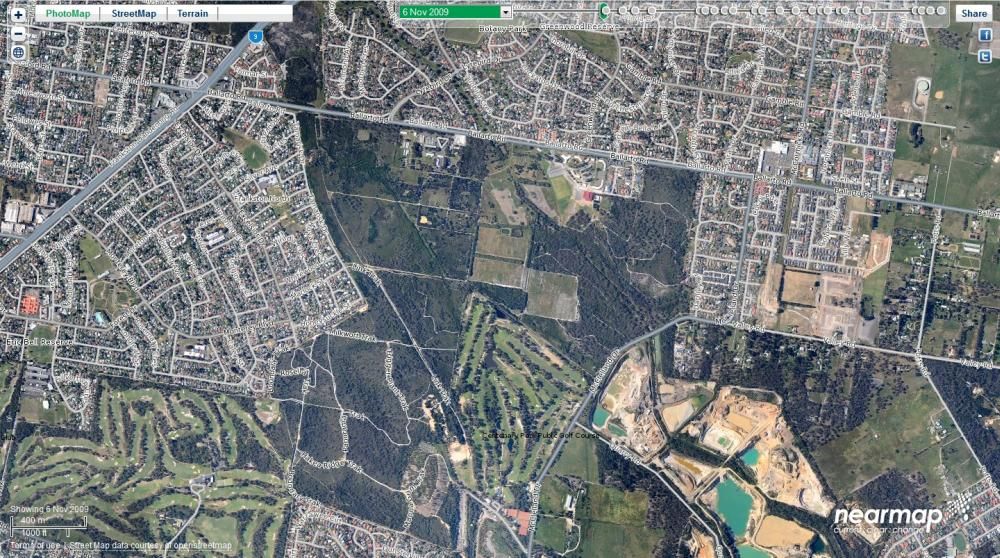
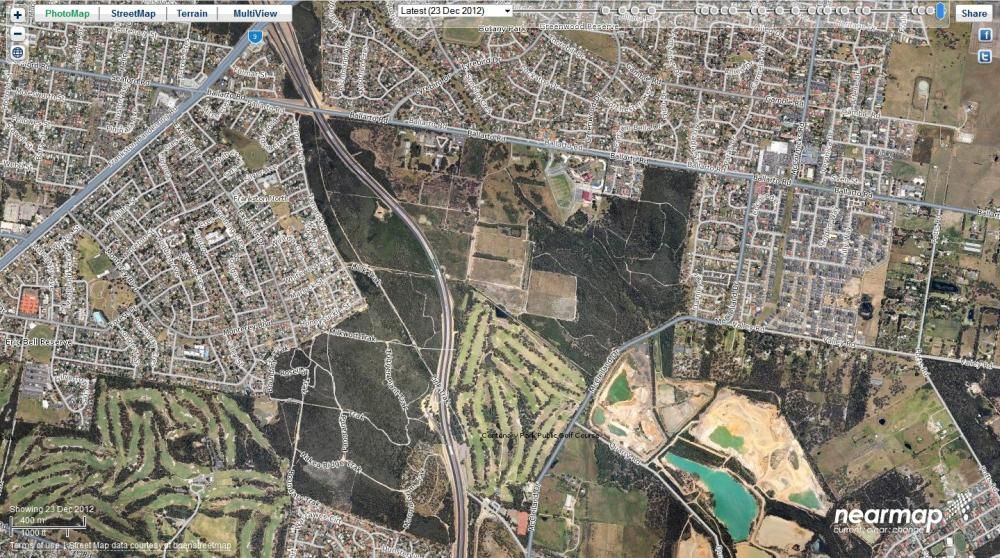
The Pines in 2009 and 2012
The remaining creatures living there will be subjected to the noise and pollution from thousands of motor vehicles passing through every day.
Those who participated in this vandalism – construction workers and others – should be thoroughly ashamed. How would they like their houses to be bulldozed while they were living in them? So much of Victoria’s vegetation has been cleared since European settlement and it is still ongoing despite supposedly greater environmental awareness now. The situation is much the same in other states.
Roads are one infrastructure item governments always seem to find funding for – despite making cuts to vital services such as health care – and there are more planned around Melbourne to scar the landscape. Population growth is one driving force (so to speak) behind road construction and there is no sign of either stopping, unfortunately.
A relevant letter from today’s Herald-Sun:
Precious peninsula
THE Government claims the new Peninsula Link freeway will cut the time of travelling between Mt Martha and Carrum Downs by 17 minutes, and save 40 minutes in peak time.
The aim is more than an expensive $759 million effort to reduce driving times for commuters.
The peninsula’s green wedges will be more accessible and be nibbled away for urban sprawl. More land will be opened for housing to soak up our population growth, set at full-throttle speed by government policies.
More of our environmental and social capital will be traded in so developers and investors can profit from Melbourne’s growth.
Housing on the peninsula won’t be affordable, but maximised by good location and the globalisation of the property market.
– Beatrice Ortega, Heidelberg Heights
More infuriating news is that the Victorian Planning Minister now has new powers to speed major projects. Which means he can override environmental concerns and residents’ protests against inappropriate developments in favor of business and developers. I feel so helpless to oppose these greedy growth-obsessed parasites and politicians, and it is incredibly frustrating to see the continuing destruction of the once-livable city and state I have grown up in.
Addendum: A letter, The Age, 29/1:
Destroying nature just to fulfil wants
AS PENINSULA Link opens to huge amounts of traffic and raves about the racing car-perfect surface, we should take a minute to think about what we have lost in order to save some time: hundreds of trees that were homes to wildlife, hundreds of hectares of precious habitat for endangered southern brown bandicoots, and the songs of birds. We’re going to lose more as development speeds up throughout the Mornington Peninsula and, in particular, the Tootgarook Swamp, which stands in the way of the Peninsula Link extension to Rye.
The cost, so often advertised as $756 million, will be more than $2 billion by the time we pay it off over 25 years. As we hear more and more of our human services being cut, education being slashed, and hospital beds being closed, I despair at our selfish desire for comfort over substance; and at our ability to leave a sustainable planet for the future.
– Gillian Collins, Friends of the Pines Flora and Fauna Reserve, Frankston North
News article, 31/1: “Peninsula Link blamed for more animal fatalities on Casey roads,” Cranbourne Leader.
March
18/3: Collected letters
Letters saved from the last two months.
The Age, 2/2:
Real truth is taboo
ROGER Howard’s explanation for the violence in Mali is simplistic (“High population growth a seed to rising unrest,” Comment, 1/2).
The fact is this violence has been fostered and triggered by a radical interpretation of the Islamic religion. The men who committed systematic atrocities against the Malian civilian population chose to do so and this choice was based on religious belief.
Howard then states it is “taboo” to expose his reality; that rapid population growth has caused these atrocities. No, it is politically incorrect to expose the real truth; that this is a result of a flawed religious belief system. If you doubt this, direct me to the corresponding unrest in Singapore, China and India.
– Max Dunn, Kew
High population growth and overcrowding exacerbates frustration and violence – one way this can be expressed is through religious extremism. And there certainly has been unrest in the other countries he mentioned: India has its own problems with extremism, there were recently protests in Singapore against increasing the immigration rate, and Government suppression in China prevents most (but not all) unrest.
Easing our conscience, but that’s about it
THE linking of high population growth with international violence raises the issue of where Australia can get best value for its aid dollar. At present we are committing ourselves to billions of dollars of future expenditure to accommodate refugees, the consequence of high birth rates and limited resources in the conflict zones.
If that money was instead put to tackling the causes of the turmoil by providing resources for family planning we could have some impact. With 80 million people born into poverty each year, taking 20,000 refugees may ease our conscience, but will not solve the problem.
– Peter Liston, Southbank
Price of growth
PROBLEMS with population growth – driven by an unsustainable immigration program and an unwillingness of state governments to decentralise – have arrived in Australia, too, in the form of high rents, house prices and council rates, and congestion on roads and rail and so on.
Wait until we have diesel shortages when peak oil turns into another nasty oil war in the Middle East or when Mother Nature throws so many fires, floods and storms at us that our power supply breaks down. People living in high-rise flats – where much of the additional population is crammed – will be especially hard hit.
We have seen during the Queensland floods how quickly shelves in shops can turn empty when trucks come to a standstill. When will these lessons be learnt?
– Matt Mushalik, Epping, NSW
13/3:
Please consult experts
Denis Napthine thinks population growth is “good for Australia, good for Victoria, good for the economy, good for our diversity and good for our quality of life” (“Regional growth on Premier’s agenda,” 9/3). Wrong.
It’s bad for our biodiversity, bad for our environment, bad for our food and water security and bad for climate change. Congratulations on becoming Premier. I hope you book an appointment with a scientist … soon.
– Lizette Salmon, Wodonga West
16/3:
Look to own backyard
Can Bindi Irwin please get an education in something like environmental science or sustainable design (Postcode 3000, 15/3). The total global population is not the most pressing of our environmental problems.
It is the per capita consumption of each and every one of us. The average Australian creates an ecological footprint 100 to 1000 times that of a person in a developing nation. Global population becomes a problem when every person on the planet gets to live like Australians or Americans. I wonder what is the ecological rucksack of the business empire she calls a conservation zoo, let alone her carbon emissions as she jets around the world saving “the environment.” Yes movie stars and celebrities can sell a message effectively but it starts to wear thin if they appear ignorant about their own housekeeping.
Who and what exactly does she think is destroying “the environment” if it’s not her and us?
– Judith Glover, faculty of design, Swinburne University
Explode the myth
Like most politicians, Denis Napthine suggests that population growth is needed for economic growth. Victoria has experienced Third-World levels of population growth over the past few years driven by immigration, with a commensurate decrease in our quality of life due to crowded roads, public transport, schools and hospitals. Added stress is placed on our water and electricity supplies.
Yet Victoria is now reportedly in recession. How can that be? Or is the link between immigration and economic growth simply a myth, perpetrated by developers and big business to drive their profits and by political parties who receive sizeable donations from these profiteers?
– Andrew Verlei, Patterson Lakes
Replies to yesterday’s letter stating the “it’s not overpopulation, but overconsumption” fallacy, 18/3:
Give Bindi a break
Judith Glover’s criticism (Letters, 16/3) of Bindi Irwin is unwarranted. If population growth isn’t the biggest environmental issue, it’s a dangerous multiplier on all the others contending for top spot. The tired criticism of celebrities such Al Gore or Bindi “jetting around the world saving ‘the environment’” needs context. Changing public opinion takes resources, especially when it’s against vested interests and religious dogma.
Celebrities such as Bindi, “Carbon Cate” and Dick Smith are critical to cut through to the public where serious academics rarely can. I’m sure at age 14 her education is not over, and perhaps when Bindi reaches university age she will do environmental science; till then lay off. Australia could do with more passionate, active kids like her.
– David Blair, Healesville
Missing the link
Judith Glover needs to first join the dots between overpopulation and subsequent resource scarcity. We should not be asked to feel guilty about maintaining a good quality of life with a reasonable amount of resources per capita just because other countries have failed to maintain favourable population-to-resources ratios. We can, however, support other nations to turn things around, through foreign aid aimed at educating females and providing access to voluntary family planning services.
– William Bourke, Wollstonecraft, NSW
Herald-Sun, 11/3:
Feeling the pinch
MELBOURNE is groaning under the planning and environmental implications of being capital of the state with the highest population increase of any in Australia, with no relief in sight.
Last year’s report by The Climate Institute said that Australia will face huge human and economic costs because its infrastructure is poorly equipped to handle more frequent extreme weather events and other consequences of climate change. Conservative estimates put the annual cost of unmitigated climate change at about $9 billion in 2020.
An estimated $10 billion is needed in Victoria alone to provide new education, health and transport needs for growth-area councils that have been in catch-up mode for at least 10 years.
Our nation’s resources are finite, so increasing the number of mouths our nation must feed solves nothing but a short-term financial requirement. More people means less of everything for everyone.
– Chris Hooley, Viewbank
12/3:
Growing pains
ALREADY the new Premier of Victoria, Dr Napthine, has declared that he’s all for the benefits of population growth because it’s good for our economic future.
All the evidence shows that the costs of growth can’t be stretched to service all the people we have. Hospitals are struggling, TAFE funding slashed, schools funding insufficient, public transport can’t keep up with demand, and people spend years waiting for public housing. Infrastructure and services should be improved and updated, not stretched any further.
While population growth has benefited us in the past, this model can’t keep being propagated. Victoria is at a standstill and jobs are going offshore. What benefited us in the past can’t be extrapolated into the future.
– V Ortega, Heidelberg Heights
13/3:
Bigger is not always better
BIG business and the Government want a big Australia.
What about the public of Australia? Do they want a big Australia? I am betting not.
Now because of the overpopulation of our cities, we are expected to change the hours of schools so the roads are not so clogged. I wonder how parents and teachers feel about this.
We are expected to pay tolls to update infrastructure.
People are sitting on our freeways for hours trying to get to and from work. Ask them if they want a big Australia.
We are already playing catch-up, while at the same time more and more people are being encouraged to come to Australia either through temporary visas or the offer of permanent residency.
This is not in Australia’s best interests. As a letter (“Growing pains,” Mar 12) stated, high immigration in the past has been useful to Australia. But times have changed and we do not need high immigration now.
Wouldn’t it be nice if the Gillard Government worked in the best interests of your average Australian?
– Chris Hodgins, Frankston
18/3: Developers’ paradise
If there is one thing I dislike about the subreddit r/Australia (and perhaps Reddit in general!) it is that it seems to be dominated by patronizingly smug young urban males. The main topic that incites this irritation is anything to do with urban planning . The prevailing opinion there is – to use one direct quote – “Taller buildings means higher density, less sprawl, less traffic, more efficient, better for environment.” Anyone who contradicts this view – such as suggesting that population growth should be restricted so that high density is not so necessary – is regarded with contempt (“NIMBYs!”) and downvoted.
This was in a thread about the latest ugly monstrosity for Melbourne predictably approved by Planning Minister Matthew Guy. Such extravagences are merely profit-making exercises for developers and mostly overseas investors, and do nothing to alleviate the housing crisis here or help the environment (as one commenter points out in the article comments: “Heating and cooling of common areas 24/7, running elevators 24/7. No access to air clothes drying – every apartment will be running a dryer. The energy consumption of apartments is higher than homes add to that they can not use green energy like solar, water catchment etc.”). I sincerely hope that the property market will collapse catastrophically, and an airplane fly into the building.
A Danish urban designer called Jan Gehl visited Melbourne last week and was critical of Docklands, and high-rise in general:
Professor Gehl is critical of high-rise towers as a planning solution. “The residential tower is the lazy architect’s answer to density,” he said. “My interest is ‘cities for people’ not ‘cities for developers’ and not ‘cities that make traffic happy’.”
Cities packed with tall glass-and-concrete towers are dreary, ugly and dehumanizing; the buildings are harsh and cold in aspect. Many of the ancient cities in Europe are pleasing to look at as their older apartment buildings are generally low-rise and made of stone, which gives them a warmer organic feel.
A recent article at io9 showed some designs of futuristic cities with a more organic look rather than the sterile glass-and-concrete metropolises usually favored by architects.
Some letters criticizing the development (and planning generally):
Herald-Sun, 2/2:
Protecting Shrine
IT is an outrage that embattled residents should have to keep defending the Shrine from manic planning ministers intent on destroying this sacred site (“Shrine in shadows,” Feb 28).
In March, 2010, Labor’s planning minister, Justin Madden, attempted to push through a high-rise on St Kilda Rd. The City of Melbourne joined residents in defeating the proposal.
Now the Shrine and surrounding Alexandra Gardens are threatened by a titanic residential and hotel tower. At night, the building will be lit up like a Christmas tree and will present a problem of light pollution to the surrounding suburb.
To many, it symbolises a one-finger salute from developers and Planning Minister Matthew Guy to the whole of Melbourne. Julianne Bell, Protectors of Public
– Lands Victoria Inc, Parkville
21/2:
High-rise needs restraint
MELBOURNE is a world-class city, having been recognised once again last year as the world’s most liveable city with a perfect score for infrastructure and an overall score of 97.5.
However, it seems the cause for our city’s impressive accolades are under threat due to a barrage of over-development.
There is seemingly no end to the huge high-rise buildings that Planning Minister Matthew Guy is willing to allow in such quick succession (Queensbridge Tower, Melbourne Tower and 450 Elizabeth St to name a few).
These decisions raise vast living and economic issues for our city, including oversupply, falling real estate values, soaring vacancy and further pressure on infrastructure and congestion.
These mega buildings threaten to cast a shadow over the integrity of our city in a very hasty time frame, and on a scale not previously seen in our city’s history.
The Paris end of Collins St, the elegance of Spring St and the cultural charm of Bourke St are what they are due to decades of rigorous planning consideration and decisions by predecessors.
These decision makers rewarded deserving and steady development, and had the foresight to reject development that would have compromised the essence of these precincts and, for that matter, our entire city.
– A Jones, Beaumaris
The Age, 5/2:
Developers top power pyramid
THE concept of an “independent government” planning panel is an oxymoron (“Panel endorses apartment towers in Armadale,” 3/2). The government overtly supports property developers and is in favour of increasing the height and density of Melbourne’s housing, even in outer-suburban areas. “Planning” has become synonymous with granting permits for developments and being dismissive of residents’ interests.
The panel also rejected a reasonable submission for more open space. VCAT decided the 600 objections to the proposed development was an “irrelevant consideration.” Increasingly, the property development industry is at the apex of the power pyramid. Healthcare, education, public housing and skills training are declining priorities.
Residents’ protests are set to dwindle as approvals are fast-tracked even further by prohibitive increases in VCAT fees. We can only question where our so-called democracy is heading when self-determination of our communities is being overridden by heavy-handed government departments and agencies.
– Margit Alm, Eltham
15/2:
Ban the cash
THE unfolding saga of apparent large-scale donations of money to the Doyle team in last year’s Melbourne City Council election (with the undoubted expectation on the part of the donors of favours from the recipients) is the latest case demonstrating the need for the banning of donations by companies to political parties and candidates in all elections (“Developer’s hidden link to Cr Doyle,” 14/2). This is the only way of minimising the steady erosion of our democratic process by self-serving companies wanting to gain an advantage over business rivals. Enough is enough. It is time for totally publicly funded elections at all levels of government.
– Robert Humphreys, Coburg
Locals on the outer
WHY should the “Developer’s hidden link to Cr Doyle” be a revelation? Frustrated and disillusioned residents in the City of Melbourne who have fought in vain against the imposition of unsympathetic high-rise developments, and even for the retention of heritage housing stock, are only too aware of the pro-development attitude of the City of Melbourne. We locals are not well represented on the Melbourne council, which is dominated by voters who live outside the municipality, expanding the opportunity for this inappropriate election fundraising. Where is the balance and transparency in local government and the planning process? How can the voice of the ordinary citizen ever be heard with these inbuilt dysfunction, let alone with the proposed rise in VCAT fees?
– Jennifer Cook, West Melbourne
(to write about: bindi irwin)
May
3/5: 23 million and counting
Australia’s population officially reached 23 million on 23 April; a milestone that was generally reported positively. The population is small compared to many other countries (as is pointed out with tedious regularity), but Australia does not have a great amount of habitable land, so most of the population tends to live along the coastline, and much of that is clumped into the major cities.
Melbourne is, unfortunately, leading the nation’s population growth, and the negative effects of this are ever increasing: chronic traffic congestion (is it a coincidence that road rage is on the increase?), increased housing prices, inappropriate high-density developments in suburbs, pressure on health care, public transport and other services … the list goes on. Little if anything about this manic growth is for the better. From my perspective – I live in a suburb of Melbourne – quality of life is definitely deteriorating and the stress from this is continual. The State Government makes nebulous promises about improving infrastructure, but at the same time they cut funding.
Much of that infrastructure seems to only involve building more environmentally-destructive roads – an example being this brief report from my local newspaper (also online):
Plants face chop
ENDANGERED vegetation will be removed to make way for the new Dingley bypass, despite objections from green groups.
Greater Dandenong Council has given VicRoads the go-ahead to rip out a large old tree and vegetation, classified as “of very high conservation significance,” from the 0.19ha swampy woodland in the Westall Rd reserve.
Four environmental groups have slammed the unadvertised proposal. They say an overpass should be built to protect them.
Engineering services director Bruce Rendall said the proposal was not advertised because no third party would suffer.
It is similar to the Westerfield heritage woodlands being bulldozed through in 2010 (see 10/7/2010 , 24/10/2010 entries) for the Frankston bypass. Native bushland continues to be razed for so-called “progress” and one feels so powerless and frustrated that it can’t be stopped. The Australian Aborigines lived here for 40,000 years or more, but in all that vast span of time they never did as much damage as did the arrival of European settlers in the last 200 years. The estimated population of Aborigines before settlement/invasion was around a million or so – something the fragile landscape here could cope with.
Some recent letters:
Herald-Sun, 23/3:
Population a threat
A FAST-growing population is nothing to smile about.
We live in one of the most arid countries in the world, with limited areas of good soil suited to agriculture.
We are in the process of impoverishing our own and future generations by building on and degrading the high-quality land we have left, as well as degrading and destroying our other natural resources such as waterways and forests. Many other species who share this country with us have little hope of surviving a human population explosion and climate change. Our numbers are our biggest threat to their future – and ours.
– Jennie Epstein, Little River
1/4:
People overload
AS the big Australia juggernaut rolls past 23 million people and currently continues unabated towards 39 million people by 2050, one must seriously question the unsustainable 1.6 per cent population growth over the past 20 years – and well into the future.
The impact in our major capital cities has resulted in cash-strapped state governments and councils scrambling to try to provide the required services or new infrastructure necessary to support the massively increased population.
No parliamentary party has a mandate for a “Big Australia.”
With a federal election this year, surely it is high time there was a referendum on the subject so that at least all voting Australians own the preferred outcome.
Considering the implication of such decisions impacts the very essentials of life – food, housing, energy costs, congestion, environmental impact and degradation, and overall standard of living – it is simply unacceptable for property developers and the big end of town to be unilaterally driving the outcome via parliamentary puppets as is currently the case. We all deserve our say on such a vitally important issue.
– Tony Smith, Burwood
29/4:
Get population priorities right
HAVE the people of Melbourne ever really cared that the population of their city was smaller than that of Sydney? (‘‘Growing pains us,’’ HS, Apr 25).
When population growth was lower and the pressures on schools, transport, hospitals, ambulance services, water and open space were not as great as they are now, most people’s priorities were no doubt their own private lives, rather than comparing the size of their city with one in another state.
The energies of Victoria’s leaders now seem to be largely taken up in dealing with population growth.
If the state’s population stabilised over the next few decades, the State Government could concentrate on providing adequate services and amenity to all, as well as having a reasonable chance of preserving what is left of our natural environment.
– Jill Quirk, president, Sustainable Population Australia, Vic/Tas
Old growth thinking
THE concept of perpetual growth – economic and demographic – is outmoded. We have access to limited resources in Australia, like it or not, and as they become scarcer, a small percentage of our population will undoubtedly benefit from the profits as the rest of us pay the price of higher costs for water and other essential services, poorer health services, congestion and loss of open space.
Other species that share our land are losing their habitat altogether. Moving our population growth to regional areas will not solve anything.
– Jennie Epstein, Little River
From The Age, 24/4:
When is there enough?
Since I was born in the 1960s the population of Australia has doubled. With a developing-world growth rate of 1.7 per cent, it will double again in another 40 years or so. Do we have a standard of living twice as good as in the 1960s? An economist, just looking at income and the gadgets we can buy, would say “of course.” But ask someone who has to spend more than two hours a day in choking traffic and who is made to feel guilty for watering their tiny garden on the edge of suburbia and you might get a different answer.
What the proponents of ongoing growth will never tell us is when there will be enough people in this country. When we’ve reached United States proportions of 300 million plus?
– Ralph Judd, Blackburn North
26/4:
A once strident catchcry from the 20th century, “populate or perish” would be better reworded for the 21st century as “populate and perish.”
– Reg Puddephatt, Warranwood
August
11/8: Embrace growth? No thanks!
“State government minister says Victoria should embrace growth,” Herald-Sun, 2/8. I read the statements by a Victorian State Government minister in this article with stunned disbelief. Despite all the problems population growth is causing Melbourne – which are acknowledged in the article – we should “welcome” it because it is supposedly economically and socially beneficial. Probably the only people benefiting from growth are parasitical property developers, as is mentioned near the end, as it means more homes being built (never mind the environmental damage from more land being built over). This is a prime example of a self-perpetuating problem: continually encouraging growth means that infrastructure and services are forever struggling to keep up, and never quite manage to. People are increasingly stressed from competing for dwindling resources, living space and jobs, which does nothing for the supposed “diversity” championed in the article – it’s more likely to lead to social disintegration.
11/8: Oh, China, no!
China is considering allowing couples to have more than one child, due to demographic panic over an aging population and labor shortages – as well as wanting more consumers. This would result in 9.5 million additional births in an already very overpopulated and polluted country. It will be an environmental disaster, considering that the country is already plundering other continents for resources (Australia and Africa being some).
As soon as a country’s birth rate goes into decline, its government seems to go into panic mode and do everything to encourage more births, no matter how this may negatively impact them in the future (see Iran). Those from a baby boom will one day be old too, and the cycle repeats itself.
Humanity as a species just can’t seem to commit to sustained long-term planning for the future – looking decades or even hundreds of years ahead. The type of society that is dominant now – a capitalist consumer economy – seems to preclude this. All that is heard as a policy in Australia’s upcoming Federal election is the mindless mantra of growth, growth and more growth. Any other way of thinking is heretical.
September
1/9: Melbourne most livable (again)
Melbourne was voted most livable for this year again for health care, education and infrastructure. Which bemused many, including me, as there is much to be improved in all these areas. It is certainly a better place to live than many other cities, but far from perfect.
I dislike this sort of publicity as this makes people more inclined to want to move here when the city and suburbs are already bursting at the seams and struggling to cope. Another article came out this week saying Melbourne was undergoing rapid population growth, which is dismayingly obvious to anyone who has lived here for a while – infrastructure is not coping with the influx.
Melbourne’s population is swelling by 2 per cent a year, adding more than 900,000 people since this century began – and putting it on track to be a city of 8 million people by 2050.
The Bureau of Statistics estimates that in mid-2012, the city’s population was about to hit 4.25 million, after six boom years in which it grew by almost half a million.
Recent bureau figures imply that Melbourne today is home to 4.35 million people – and 27 per cent bigger than the city it was at the start of 2000.
With a rapidly growing population squeezing into road and rail systems that are barely growing at all, this would intensify the strain on the city’s infrastructure, leading to increased congestion on the roads and overcrowding on trains.
The figures will probably seem miniscule compared with many major cities – Wikipedia has a list of these, where population for the highest is into the tens of millions. High density living is promoted as desirable because amenities are close together, but there is a tradeoff in loss of open space, stress from overcrowding, noise and other pollution, and limited access to nature. A properly-planned city might alleviate some of these negative factors, but few if any urban centers are; they tend to grow haphazardly over decades as more people are crammed in.
1/9: A sterilizing virus
I recently came across a link to a short story by Gregory Benford, A Desparate Calculus, about a group of scientists who create a contagious virus that has an unusual side effect: it renders its female victims infertile by triggering their ovaries to release all their eggs at once. The virus is generally not fatal (though vulnerable groups such as the elderly might die, as they can in ordinary flu outbreaks every year). The ultimate effect of this is that it will stop most of the next generation being born – though a few women will likely be resistant to its effects.
Given my outlook you can safely guess I didn’t see this scheme as a bad thing :-). I wonder if it would be do-able in reality; obviously it would have ethicists and the general public in hysterics should they find out, so it would need to be implemented surreptitiously. I feel the situation with the world’s rapidly growing population and ongoing biodiversity loss to be urgent enough to justify such a drastic course of action. It would not involve killing vast numbers of people already here, but would prevent (most) future people from being born.
I suppose that measures such as IVF from stored embryos, cloning and artificial wombs could be used to get around the virus, but the last two technologies are not developed and the first can be difficult to achieve.
There would also be issues of body autonomy; the few fertile women might become valued for their wombs, and lose reproductive rights such as access to contraception.
While there are some worthy efforts to give women access to family planning and education in countries that don’t have or allow these, these are just too slow – they may take decades to achieve, if ever. And even in developed countries, women’s access to contraception and abortion are at times under thread from conservative governments – some states in the USA have currently been trying to overturn laws allowing access to these.
November
23/11: One-child no longer
As part of a social reform initiative announced last week, China is to “relax” its one-child policy. There have been exceptions to it for years for certain groups, but this makes it officially-approved. Naturally my reaction was dismay (“the environment is now f*cked”). The policy has been criticized by some for being inhumane, but it somewhat it at least kept the country’s already-huge population from becoming even larger.
Someone on r/overpopulation did a rough projection of what population numbers might look like under a worldwide one-child policy. There is a decline to just over 6 billion by 2053, and 3.4 billion by this century’s end. As for a 2-child policy: “If 2 is input, the population would increase slowly until it peaks at 9 billion in 2063 before it slowly decreases, bottoming out at 5 billion in 2373.”
29/11: Growing out of control
Australia’s rapid population growth has had some media attention again in the last couple of months. As reported in the Herald-Sun, 25/9, Melbourne is the fastest-growing capital city and the downside of this is all too apparent:
A boom town
MELBOURNE’S population is booming, with 1350 people moving in each week, a government report says.
Victoria is expected to boast 5.41 million people by 2031.
Migration is the main factor behind the increase, according to the Growth Areas Authority 2012-13 annual report, released this month.
The growth is higher than any other capital city.
Melbourne has had the highest growth rate for the past 11 years, according to the Australian Bureau of Statistics.
In 2011-12, after deaths and people leaving the state were accounted for, Melbourne’s population grew by 77,242.
Melbourne MP Kelvin Thomson is practically the only politician who is outspoken about population growth, and was reported to be launching an NGO concerned with the issue. He was also profiled in an The Age article. Comments from other politicians there, though, show how locked into the growth-is-good ideology they are.
As reported in The Age, a report released by the Productivity Commission last week projected Australia’s population to reach 42 million by 2060, with Melbourne and Sydney housing 7 million each. While modest by many countries’ standards, it is a lot for a relatively infertile and dry continent with a fragile environment that is still being degraded and damaged by human activity.
Another report for Victoria said that the state’s population is growing by 100,000 a year – most of whom end up in Melbourne, to its increasing detriment.
Unbelievably, the Working holiday visa scheme in Australia is to be expanded, despite there being a growing unemployment issue here. Many are from countries with high unemployment and are financially struggling. Australia is essentially being treated as a relief or escape valve for other countries’ problems – but it should not be our role to serve as this. It is another betrayal of citizens by the government here.
29/11: Collected letters
Some recent letters concerning population growth projections in Australia (see my previous entry):
The Age, 8/10:
Services are lagging
While the government might celebrate Melbourne’s “growth,” most of us aren’t. An economy based on an expanding housing market and revenue for land and property developments means we become entrenched in accumulating debt. Spending on essential services is not keeping pace with the extra 100,000 people coming to Victoria each year. No wonder emergency departments are overflowing and a seat on the train is a thing of the past.
The Victorian State of the Environment Report (2008) reveals that population growth and human activity have had ongoing detrimental effects on soils, coastal areas, marine and river systems, climate and biodiversity. All indications are that Victoria has reached the limit of its capacity to support human populations without irreversible environmental destruction.
The growth we need is in vital skills, technological advancements and knowledge to future-proof our nation from multiple global challenges ahead, and they rely on intangibles. Intangible wealth can grow infinitely.
A coalition of planning and environmental groups has produced a sustainable population charter and is calling for the government to reduce immigration intake from the unmanageable rate of 232,000 to 70,000 per year – at which point our essential services might be able to catch up to our dramatic population growth.
– JENNY WARFE, Dromana
Job prospects falter
Melbourne’s population is swelling by 2 per cent a year and putting it on track to be a city of 8 million people by 2050. The great majority of our growth is not due to baby booms but to deliberate government policies.
According to the Bureau of Statistics, our fertility levels have only increased slightly from 1.729 in 2001 to 1.884 currently. Net overseas migration has been the main driver of Australia’s population growth and has outstripped natural increase since 2005.
Immigration policies remain popularly entrenched with both sides of politics, uninfluenced by the voting public. The current immigration policy is so high that it even affects the job prospects of skilled migrants, many of whom cannot find work in their preferred profession within their first year of settling in Australia.
Since population growth affects almost every facet of our lives, from our hip pockets, the environment and living standards, to our future and that of next generations, it’s time the issue was put into the public domain for democratic and transparent debate.
– MICHAEL BAYLISS, Reservoir
Papering over cracks
Our prosperity is based on a Ponzi scheme of building more and more houses and apartment towers, papering over a state economy where the value of our exports is approximately half our overseas imports.
– LEIGH PLEWS, Elsternwick
Tide will consume us
As residents of this once liveable and happy city we are witnesses to a tragic disaster as year on year we see the destructive forces of uncontrolled population growth.
The silence of politicians on this subject is witness to their ambivalence to the wishes of the majority of Australians, who know this unsustainable tide will consume us if steps are not taken. Big Australia must be abandoned and replaced with policies that nurture, educate and develop our population and create wealth based on neutral population levels, not this Ponzi policy.
– BERNARD ELLIS, South Yarra
Is it a choice?
In “Lockin’ out their generation,” Mark Bouris (Money, 1/9) notes that Generation Y change jobs frequently and “have ready acceptance of contract and ‘project’ employment” with “no entitlements.” He finds this a strange choice and suggests this generation will “just have to knuckle down.” Shortly before Ken Henry retired as Treasury secretary, he and then PM Julia Gillard acknowledged that true unemployment was about 12 per cent. Many factories and other wealth-producing businesses have since closed or scaled down.
Gen Y are in the same position as teenagers, older workers and migrants – list ad infinitum. There are more people looking for jobs than there are jobs. A rotten job is better than no job. And don’t employers love it.
– DON HAMPSHIRE, Sunbury
Quality of life will continue to deteriorate
More and more people are unable to afford to buy the dream – a house where their children can play in a backyard. Bill Shorten’s call for an even larger Australia when we already have very high levels of immigration will worsen this situation. It is estimated that each additional person to this country costs $340,000 in total infrastructure requirements. Last year under Labor, Australia’s population grew by 400,000, 60 per cent of which was due to immigration. The total infrastructure cost was $136 billion. Is it any wonder conditions continue to deteriorate for the majority of citizens?
Bill Shorten says he understands the critical importance of climate change and that he’s committed to a 60 per cent reduction in our emissions by 2050. However, his population policy would negate all the emissions savings made by individuals. Is this why Anthony Albanese, who has been infrastructure minister, gained much more support from rank-and-file Labor members? Do the members have a much better grasp of these critical situations than the pollies?
– John Coulter, Bradbury, South Australia
Contributing to strong economy
Professor Michael Buxton claims Plan Melbourne is a hoax and fails to put certainty into long-term planning for a growing population (Comment, 10/10). When then NSW premier Bob Carr declared in 2000 that Sydney was full after it had passed the 4 million mark, the lack of investor confidence and job losses are estimated to have set Sydney back a decade. Victorians cannot afford this approach. In Victoria the development industry directly employs about 310,000 full-time employees, contributes about 12 per cent of the state’s GDP and contributes $4.6 billion in taxes. With Victoria’s population expected to grow over the next 20 years to between 5.6 million and 7.3million, Plan Melbourne, with its long-term outlook, is responsible and necessary.
– Tony De Domenico, executive director, Urban Development Institute of Australia (Victoria)
[Comment: relying on the hope that growth will create jobs is a precarious way to run the economy – many jobs are short-term (such as constructing buildings) and many businesses tend to need less people if they become more efficient (such as manufacturing).]Headed for Carmageddon
Age readers continually voice concern over our car dependence and increased congestion, but few appear to register that it is caused by high levels of net migration. Monash University’s Centre for Population and Social Research advises that the number of cars registered in the Melbourne metropolitan area over the five years between the census of 2006 and that of 2011 increased by nearly 300,000. The total as at 2011 was 2,054,506. It is estimated, given the continuing population boom, that car numbers will have increased by another 120,000 in the past two years. Most of our suburban roads were built in the days of the horse and buggy and cannot take this increased traffic. Meanwhile the government ignores the ever-increasing calls to abandon the east-west link and instead invest in rail as the most efficient people mover. One train can replace 800 cars. Unfortunately, like human lemmings, we are headed for Carmageddon.
– Julianne Bell, Protectors of Public Lands Victoria, Parkville
The real threat to our way of life
The latest projections for Australia’s population (The Age, 27/11) made me choke on my breakfast cereal, but nothing like what the growth will do to choke our roads and hospital queues. Current responses to augment transport and health infrastructure will ameliorate only a tiny part of the problem. It will do nothing to stem the depletion of our limited water, clean air, fisheries and bushland. And what of our responsibility to share those precious resources with other species?
The projected population growth is a more certain threat to our way of life than climate change, and it is more within our control. However, governments are unashamed barrackers for it. Every effort being made to reduce individuals’ use of resources or quantity of waste will be made ineffective as the population grows. The “growth pushers” are the greatest threat to the lives of our children and the other beautiful species that call Australia home.
– Ian Penrose, North Warrandyte
It is not racist to debate growth
Your article states that the majority of the population increase will come from migration. I am concerned that this growth is inevitable. However, there has been no national debate or consensus that this growth is desirable or wanted. Any voice asking for such a discussion is decried as being racist, an implicit admission that most of the growth will come from Asia.
The promoters of growth refuse to accept the costs of increased population – congestion, pollution, declining social cohesion and the strain on education, health and housing. State governments are far behind current needs for infrastructure and it appears they will be playing catch-up for the next 50 years. Why can’t we voters have some input into our population future? Poor fella my country.
– Geoff Hall, Mentone
No, growth isn’t always good
Fifty million Australians when today’s babies reach their 80s. Will today’s politicians guarantee they will have a reasonable quality of life throughout this century of massive climate change and dwindling resources? I thought not. It’s all “growth,” isn’t it? I am glad I have no descendants to face up to the problems we have created.
– Mick Webster, Chiltern
Time to plan
A population boom is seen as good for the economy, but are we destroying all that is “liveable” about our cities in our pursuit of the dollar? Do our leaders see our children and grandchildren competing for their small share of diminishing resources and an ever-fading residue of “gross national happiness”? Is there any forethought in our governments’ planning?
– Vivienne Player, Beaumaris
Herald-Sun, 21/10:
Downside to growth
PLANNING Minister Matthew Guy keeps boasting about Melbourne’s population reaching eight million by 2050. It’s hard to feel any joy about it.
He talks of providing “affordable housing” and “jobs” but, on the contrary, the jobs market is shrinking while house prices are soaring.
While growth guarantees jobs in some sectors of the construction industry, other industries such as small business and manufacturing suffer due to soaring rents and outersuburb developments geared towards franchises.
The State Government should work on accommodating the people already here, including unemployed youth and skilled migrants who are struggling to find work.
As for “affordable housing,” a large proportion of our Government’s revenue comes from inflated housing and land prices. The ongoing costs of population growth are swallowing any revenues from growth.
Future generations should not be forced to inherit an overcrowded city.
– Michael Bayliss, Reservoir
23/10:
Plan for quality of life
PLANNING Minister Matthew Guy’s grandiose vision for Melbourne is for more towers and an abolition of height limits.
At least there is an expert planner, Guillermo Penalosa, who advocates a modest increase in density with more buildings of four to eight storeys at Fishermans Bend. In fact, Matthew Guy would like to demolish the profession of town planning altogether and simply allow developers the scope to do what they like.
His Plan Melbourne is more about fast-tracking our population towards 8 million people by 2050 than really improving our city.
People need to be accommodated with adequate open spaces, and “quality of life” needs to be the priority rather than the aim of a higher GDP, consumption rates and economic growth.
– Vivienne Ortega, Heidelberg Heights
3/11:
Addicted to growth whatever the cost
MIGRANTS are not “blamed” for high rates of population growth, as Planning Minister Matthew Guy warns (“Boom times warning,” HS, Aug 31). Having the immigration tap turned up full blast is a political decision, made at federal government level. State governments encourage and endorse the growth by accommodating and celebrating it as a sign of “progress.”
Mr Guy says the state’s population growth was higher in the 1950s and 1960s and migrants should not be singled out.
Back then, our population was small, houses were cheap, we needed labour and economies of scale needed to be built up. Now, in an era of declining natural resources, climate change, economic slowdown, overflowing demands for public services, traffic congestion and high unemployment, there is no economic rationale for such heavy rates of growth.
Many people are facing rising costs of living, unaffordable housing, rising poverty and entrenched debt. It is not migrants who are to blame for our population woes, but the greed of politicians who are addicted to “growth” at all costs.
– Margit Alm, Eltham
5/11:
Perish the thought
I’M proud to be in Kelvin Thomson’s electorate, with its diversity of residents from many migrant backgrounds (“Populate and perish,” HS, Nov 4). Many, including his migrant branch members, support his stance on population growth, overdevelopment, and reducing traffic congestion and council rates, to protect our way of life, environment and livability.
Even though they love their home country, they don’t want Australia to become like theirs – overpopulated, congested, polluted, noisy and people living on top of each other. They appreciate what we have (peace, space, room to move and breathe).
He is also right to attack the messiahs in the Labor Party who have lost touch with their supporter base and the concerns of their electorates.
– Vita Mezzatesta, Pascoe Vale
Federal level fault
IT is either dishonest or ignorant for Planning Minister Matthew Guy to accuse those of us wishing to lower immigration of blaming immigrants for Melbourne’s congestion and other woes.
To suggest we are ignoring other factors at play is ridiculous.
In the year ending December 2012, Australia’s population grew by 394,200, of which 60 per cent was from net overseas migration (235,900) and 40 per cent natural increase (158,300). Victoria had the highest numerical growth of all states of (99,500).
No, we don’t blame immigrants. We blame Federal Government’s policy.
– Jenny Goldie, president, Sustainable Population Australia
Bigger isn’t better
NOBODY would “blame” migrants for the overwhelming number who come to live in Melbourne.
Many must be disillusioned to find themselves in job queues, living in fringe suburbs with limited facilities and public transport, and dependent on welfare payments.
With a slashing of immigration levels to 70,000 permanent arrivals each year, as suggested by peak planning and environmental groups, we could stabilise our population to a manageable level.
It’s time Victoria, and Australia, left behind the shackles of the historical colonial mentality with its need for nation building.
The “immigration nation” and “populate or perish” phenomenon served us well in the past, but is now buckling our economy, causing the over-development of our city, increasing costs of living, and threatening our living standards.
Bigger is not always better.
– Beatrice Ortega, Heidelberg Heights
7/11:
Population nears its limit
WHILE all of us have benefited from immigration in the past (with the exception of indigenous Australia), Beverley O’Connor assumes that record-level rates of population growth will continue to benefit us (“Turning inward is not the way to put Victoria first,” Opinion, Nov 6).
This goes against Australian Academy of Science evidence that suggests we cannot pass 26 million people without substantial reductions in quality of life.
Much of our agricultural land is under threat and a net population increase of 250,000-300,000 people per annum can only make matters worse. Logic dictates that you cannot grow forever on a fragile continent.
By acknowledging the constraints of growth, Kelvin Thomson’s Victoria First organisation aims to preserve our living standards, environment, and the amenities we have traditionally enjoyed.
– Michael Bayliss, Reservoir
Growth a worry
IN the main, our politicians keep spruiking that population growth is needed to keep the economy growing. Have they ever thought there could be a limit to how much an economy can grow, and that such growth is destroying the environment?
Kelvin Thomson should be praised for raising an issue that needs to be addressed now.
Reducing immigration, but allowing for a system that will cater for asylum seekers, would be a first step in limiting population growth.
More people should be encouraged to forgo building oversized houses around city outskirts that are devouring our green belts and market garden land.
– James Lamb, Kilsyth
Think long-term
THE growth of Melbourne’s (and Australia’s) population has rarely been questioned, on the basis that continued population growth is an economic necessity.
It is unfortunate that our economic system seems to be based on the same principles as a Ponzi scheme – that is, it relies on ever-increasing numbers of people to join in. At some point, resources start running out.
An economic system based on infinite growth is unsustainable. We should be looking at ways of changing our economic system accordingly. The longer we wait, the worse shape our cities will be in.
– Daryl Backwell, Breamlea
Liveable no more
BEVERLEY O’Connor is on the merry-go-forward of an economy built on an ever-increasing population. But sooner or later we have to get off.
This unstoppable urge to overpopulate Melbourne is now making our once liveable city more unliveable with every person who is encouraged to come here.
– Dally Messenger, Docklands
Expanding headache
I DOUBT Beverley O’Connor has had the opportunity I have had of living in a Third World city and watching it grow from a manageable three million to a gridlocked nightmare of 12 million.
Is this what she wants for Melbourne? Most of us don’t.
A growing number agree with Kelvin Thomson and applaud him for founding Victoria First with the aim to reduce immigration to a manageable level.
The countries with the lowest standard of living are the fastest growing ones.
– Mary Drost, convener, Planning Backlash
Quality of life at risk
KELVIN Thomson’s Victoria First movement is about preserving the quality of life we take for granted for future generations rather than exploiting it for ourselves.
As a nation, a people and a species, we can choose to control our growth and move to a steady-state economy now, while resources are still plentiful, or we can have the choice forced upon our children when water, energy and space are only available to the privileged few.
– Chris Hooley, Viewbank
It’s down to policy
BEVERLEY O’Connor presents a vastly increased population for Melbourne as inevitable.
Bureau of Statistics figures reveal Australia’s population grew at 1.8 per cent – more than India’s – with net overseas migration of 238,300 people (60 per cent) in the year ending March 31, 2013, and natural increase of 159,100 people (40 per cent).
The bulk of our population growth comes as a direct result of government policies.
– Warwick Sprawson, Brunswick
8/11:
Point of agreement
BEVERLEY O’Connor says we should debate the “balance” on rapid population growth from time to time (“Turning inward is not the way to put Victoria first,” Opinion, Nov 6). This is the only point I agree on.
We are told that rapid population growth (2 per cent, the highest rate in the developed world) is necessary for the economy.
As a former councillor, mayor and Senate candidate standing on the issue, I know the enormous cost of the infrastructure required per additional person and daily witness the destruction of a spacious and relaxed Melbourne way of life, and the cost to the environment.
– Clifford Hayes, Brighton
Quality of life slipping
MELBOURNE and Victoria have absorbed huge numbers of immigrants in the past few years, yet we face billions of dollars in additional infrastructure spending to accommodate these people’s needs.
Immigration serves the needs of big business and the governments to which they donate, but for the rest of us our quality of life goes down the toilet.
No wonder our politicians rarely raise this topic.
– Andrew Verlei, Patterson Lakes
A GROUP that “promises to safeguard Victoria’s way of life, open spaces and its room to move and live”? Sounds excellent, Kelvin Thomson. Who would not want that?
– Suzanne, Hawthorn East