International Space Station Russian segment
Since the deorbiting of Mir in 2001, Russia’s sole manned spaceflight involvement has been with the International Space Station.
About the Russian Segment of the International Space Station
The International Space Station dates back to November 1993, when the Russian Space Agency and the National Aeronautics and Space Administration (NASA) signed an intergovernmental agreement on the joint creation of a manned research complex in low Earth orbit.
15 countries participate in the ISS project: Russia, USA, Japan, Canada, Belgium, Great Britain, Germany, Denmark, Spain, Italy, the Netherlands, Norway, France, Switzerland and Sweden.
Organizationally, the station is divided into Russian and American segments, which are controlled, respectively, from the Mission Control Center of the Central Research Institute of Mechanical Engineering (part of the Roscosmos State Corporation) in Korolev (Moscow Region) and the Mission Control Center at the NASA Johnson Space Center in Houston (USA).
The construction of the ISS began on November 20, 1998 with the launch of the Zarya Functional Cargo Block, designed to store consumable supplies and resource equipment.
In addition to it, the Russian segment of the station includes:
- The Zvezda service module, launched on July 12, 2000 and designed to control the Russian segment of the ISS and ensure the life of its crew;
- Small research module Poisk, launched on November 10, 2009 and designed to conduct scientific and applied experiments and provide extravehicular activities for cosmonauts;
- Small research module Rassvet, launched on May 14, 2010 and intended for conducting scientific and applied experiments;
- Nauka multi-purpose laboratory module , launched on July 21, 2021 and designed to conduct scientific and applied experiments and expand the functionality of the Russian segment of the ISS;
- Nodal module Prichal, launched on November 24, 2021 and designed for docking of the Soyuz manned spacecraft and Progress cargo ship.
For 22 years of continuous operation of the ISS in manned mode, 67 long-term expeditions have worked on board the station, the participants of which have performed more than 200 spacewalks and conducted over 3,000 scientific experiments.
As of 2023, “The average annual cost of operating the Russian segment of the ISS, taking into account the creation of launch vehicles and launches, is about 35 billion rubles.” Nearly $430 million USD. (Andrei El’chaninov interview, 10/4/2023.)
“Russia invests $14.2 bln into ISS since 1994,” TASS, 16/11/2023. “The contribution of the Russian Federation in creation and maintenance of the International Space Station (ISS) stands at $14.2 bln, according to General Designer of RCS Energiya Vladimir Solovyov. ‘Creation and operation of the Russian segment. Soyuz and Progress transport spacecraft – [$] 14.2,’ the presentation reads.”
Modules in orbit


Computer renderings of Nauka MLM and Prichal UM docked to the ISS in 2021, replacing Pirs
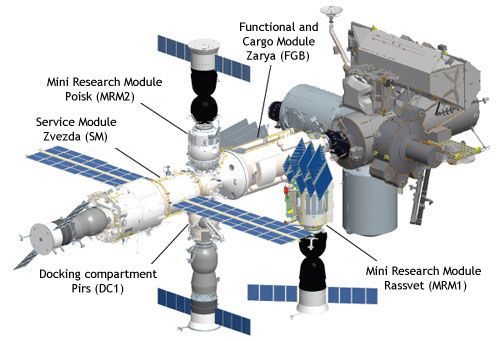


Orbital photos of the ISS RS when Pirs was docked
| MIM-2 Poisk МИМ «Поиск» (zenith – relative to Earth ↑) |
||||
| SM Zvezda СМ «Звезда» (← x-axis; direction of travel) |
FGB Zarya ФГБ «Заря» (x-axis; leads to rest of ISS →) |
|||
| MLM Nauka (replaced Pirs DC-1) МЛМ «Наука» (замена СО «Пирс») (nadir – relative to Earth ↓) |
||||
| MIM-1 Rassvet МИМ «Рассвет» (nadir – relative to Earth ↓) |
||||
| UM Prichal УМ «Причал» (nadir – relative to Earth ↓) |
||||
| English name | Russian name | English transliteration |
|---|---|---|
| FGB Zarya (Functional Cargo Block Dawn) | Функционально-грузовой блок (ФГБ) «Заря» | Funktsional’no-Gruzovoii Block Zarya |
| SM Zvezda (Service Module Star) | Служебный модуль (СМ) «Звезда» | Sluzhebnyii Modul’ (SM) Zvezda |
| DC-1 Pirs (Docking Compartment-1 Pier) | Стыковочный отсек (СО) «Пирс» | Stykovochnyii Otsek (SO) Pirs |
| MIM-2 Poisk (Mini-Research Module Search) | Малый исследовательский модуль-2 (МИМ-2) «Поиск» | Malyii Issledovatel’skii Module-2 Poisk |
| MIM-1 Rassvet (Mini-Research Module-1 Sunrise/Dawn) | Малый исследовательский модуль-1 (МИМ-1) «Рассвет» | Malyii Issledovatel’skii Module-1 Rassvet |
| MLM-U Nauka (Multipurpose Laboratory Module-Upgrade Science) | Многоцелевой лабораторный модуль усоверше́нствованный (МЛМ-У) «Наука» | Mnigotselevoi Laboratornyii Modul’ Usovershenstvovannyii Nauka |
| UM Prichal (Node Module Berth) | Узловой модуль (УМ) «Причал» | Uzlovoy Module Prichal |
| Launch date | Flight | Launcher | Delivered elements |
|---|---|---|---|
20 Nov 1998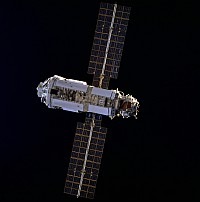 |
1A/R | Proton-K №395-01 from LC 81/23 | Zarya FGB module |
12 Jul 2000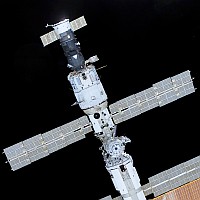 |
1R | Proton-K №398-01 from LC 81/23 | Zvezda SM module |
15 Sep 2001 at 23:35 |
4R | Soyuz-U №Ф(F)15000-677 from LC 1/5 |
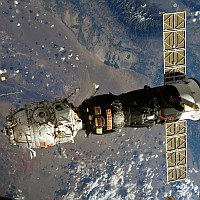 |
10 Nov 2009 at 14:22:04.057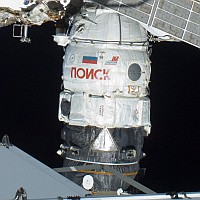 |
5R | Soyuz-U №Б(B)15000-121 from LC 1/5 | |
14 May 2010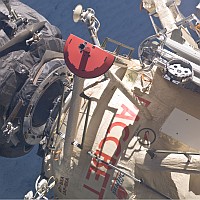 |
ULF-4 | STS-132 Atlantis |
|
21 July 2021 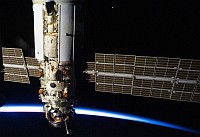 |
3R | Proton-M 8K82KM from LC 200/39 |
|
24 Nov 2021 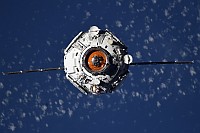  |
6R | Soyuz-2.1b №Я(Ya)15000-054 from LC 31/6 |

| Module | Zarya FBG | Zvezda SM | Pirs DC-1 | Poisk MIM-2 | Rassvet MIM-1 | Nauka MLM | Prichal UM |
|---|---|---|---|---|---|---|---|
| Mass in orbit, kg | 20,260 | 20,295 | 3580 | 3670 | 8015 | 20,350 | 4650 |
| Body length, mm | 12,990 | 13,110 | 4910 | 4049 (along the planes of docking units) | 6000 | 13,120 | 7230 |
| Maximum diameter, mm | 4100 | 4350 | 2550 | 2550 | 2200 | 4250 | 3600 |
| Volume of sealed compartments, cubic meters m/куб.м | 71.5 | 89 | 13 | 12.5 | 17.4 | 70 | 19 |
| Number of docking units (if applicable) | 6 | ||||||
| Number of hatches for spacewalks (if applicable) | 2 | ||||||
| Diameter of exit hatches, mm (if applicable) | 1000 | 1000 | |||||
| Photovoltaic cell area, sq. m (if applicable) | 28 | 76 | 56 | ||||
| Photovoltaic cell span, m (if applicable) | 29.73 | 10.7 | |||||
| Guaranteed average daily power supply voltage 28 V | 3 kW | 13.8 kW | 2.5 kW | 500 W | |||
| Power supply from the American segment | up to 2 kW | ||||||
| Crew habitat, cubic meters m/куб.м (if applicable) | 46.7 | 5.8 | 14 (useful volume) | ||||
| Fuel weight (if applicable) | up to 6100 kg |
Future modules?
The launch schedule for future Russian modules and the final composition of the Russian segment is still uncertain as the dates keep getting pushed back due to various issues. As of 2023, the status of these is unknown; it looks as though they will not be launched to the ISS at least, and may become part of the proposed Russian Orbital Station/Российская орбитальная станция (Rossiiskaya Orbital’naya Stantsiya).
| Date | Module | Launcher |
|---|---|---|
| As of April 2021: 2028 | NEM-1, Science-Power Module-1 НЭМ-1, Научно-Энергетический Модуль-1 – to be part of the proposed separate Russian orbital service station (российской орбитальной служебной станции) instead (the first module of this); so it will take 1.5-2 years to convert it into a new station  |
Angara A5 rocket from VostochnyiCosmodrome |
| 202? | NEM-2, Science-Power Module-2 НЭМ-2, Научно-Энергетический Модуль-2 |
Angara A5 rocket |
Links
- Air & Space: A Rare Look at the Russian Side of the Space Station
- Capcome Espace: LES ELEMENTS RUSSES (Russian elements; in French)
- Encyclopedia Astronautica: ISS
- Energiya: ISS Russian Segment; 15 years of continued human presence in space onboard the International Space Station (ISS)
- ESA: ISS infographics; ISS panoramic tour
- Khrunichev: manufacturer of FGB Zarya, SM Zvezda and FGB-2/MLM Nauka modules
- NASA: Image Chronology of ISS Assembly Sequence; ISS Artwork gallery; ISS overview, including a detailed Reference Guide to the ISS from September 2015. Screenshots of the Russian module information pages from the PDF guide: SM Zvezda, FGB Zarya, DC-1 Pirs, MIM-2 Poisk, MIM-1 Rassvet; Vehicle Fleet and Modules; Flickr photo galleries: Zarya FGB; Pirs Docking Compartment; Nauka Multipurpose Laboratory Module; Prichal Docking Module
- NASASpaceflight.com threads for future modules: MLM, “Russia’s Nauka ISS module arrives at Baikonur for final launch preparations,” 19/8/2020; Node Module, Science Energy Module(s)
- NK forum: Модуль МЛМ thread (MLM Module, in Russian)
- RussianSpaceWeb: The Russian Segment of the International Space Station
- Space.com: The International Space Station: Inside and Out (Infographic), 6/8/2010
- Wikipedia: Russian Orbital Segment
- Роскосмос: ISS Russian segment/Российский сегмент МКС (in Russian); local copy of English-translated pages describing all the current RS modules; Flickr gallery of exterior photos of the ISS taken by the crew of Soyuz MS-08 on 4/10/2018 for the Station’s 20th year anniversary; Soyuz MS-19 flyaround photos of the Russian Segment in its final configuration, 31/3/2022; video of the flyaround.
- ТАСС на МКС
- TsPK: local copy of English-translated pages describing five of the current RS modules (no Nauka or Prichal so far)


Updated: 3/12/2023