International Space Station – TsPK
Международная космическая станция
Computer translations of the TsPK/Gagarin Cosmonaut Training Center webpages featuring the ISS Russian segment modules. Acronyms are transliterations from the Russian alphabet versions. I have linked to the TsPK page for each module also (directly, and archived pages).
Functional cargo block Zarya
Функционально-грузовой блок «Заря»
The functions of the FGB Zarya include:
- maintaining the orbit and controlling the attitude of the ISS at the stages of the autonomous flight of the module and the flight of the Zarya + Unity link;
- ISS attitude control prior to docking with the Service Module (SM) – Служебным модулем (СМ);
- “soft” docking with the Unity module using the shuttle manipulator;
- active docking of Zarya + Unity with SM;
- docking to the lateral docking unit of the SSVP module Zarya of the spacecraft of the type Soyuz TMA, Progress M and M1;
- power supply to the ISS at the initial stage of assembly, incl. power supply for Soyuz TMA, Progress M and M1 spacecraft on the side docking unit of the Zarya module;
- reception, storage and delivery of fuel as part of the combined pneumohydraulic system, including the SM and Progress M and M1 transport ships docked to the SM. Reception of fuel from Progress M and M1 at the lateral docking unit of the SSVP of the Zarya module;
- partial maintenance of life support functions;
- storage of consumables.
The Zarya module was created on the basis of the FGB Transport Supply Ship (TKS). The design and layout scheme of the module was chosen based on the experience of creating the TKS and modules of the Mir station.
Zarya has a length of 12.99 m, a maximum diameter of 4.10 m, the volume of the hermetic case – 71.5 m3 (the largest module of the station Mir-Priroda – had a volume of only 65 m3). The launch mass of Zarya in orbit after separation from the launch vehicle is 20,040 kg. The mass of fuel in the module tanks is 3800 kg. The Zarya module will operate in orbit for at least 15 years. To launch the module into orbit, the Proton-K launch vehicle was used.
The Zarya module consists of an instrument-tight compartment (PGO) – приборно-герметичного отсека (ПГО), and a hermetic adapter (GA) – герметичного адаптера (ГА), separated by a bottom with a hatch with a diameter of 800 mm.
The sealed volume of the PGO is 64.5 m3. The volume for storage of goods in the PGO is 6.7 m3. PGO is functionally divided into three compartments: PGO-2 is the conical section of the FGB, PGO-3 is a cylindrical section adjacent to the HA, PGO-1 is a cylindrical section between PGO-2 and PGO-3. The surface of the pressurized hull is covered with micrometeoritic protection panels, and on top of it – with screen-vacuum thermal insulation. Coils of the temperature control system (SOTR) are welded to the pressurized housing of the PGO.
An active hybrid docking unit of the docking and internal transition system (SSVP-M) – системы стыковки и внутреннего перехода (ССВП-М), is installed along the PGO axis from the side of the conical bottom. The first after the hybrid docking station Zarya is PGO-2, consisting of a conical bottom and a conical shell connected by a frame with a diameter of 4.1 m. The instruments and assemblies of the station board system are mainly located here. On the floor of the conical bottom of the PGO, immediately behind the transfer hatch, there is a module control post, the onboard complex control system equipment and the module docking teleoperator mode equipment – TORU, телеоператорного режима стыковки модуля – ТОРУ. Further under the floor and wall panels in the area of the conical shell, there are equipment storage areas.
Behind the PGO-2 is the cylindrical PGO-1. Here, mainly instruments and units of service board systems are located. Under the floor of PGO-1 there are six buffer nickel-cadmium batteries, which remain for the entire period of operation of the module as part of the ISS. Both walls of PGO-1 are formed by removable panels. Behind them are service systems.
PGO-1 is followed by PGO-3, formed by a cylindrical shell of the same diameter as PGO-1 (2.9 m), and ending with a spherical bottom. Under the panels of the ceiling and walls of PGO-3 there are storage areas for equipment and materials. On the sides of PGO-3 there are two cylindrical niches in which drives of the B16 solar array orientation system are installed. Two foldable orientable solar panels are mounted on the drives outside.
On the outer surface of the PGO there are blocks of the propulsion system of the module. Two blocks of correction and rendezvous engines (DCS) – двигателей коррекции и сближения (ДКС), are installed at the junction of the conical and cylindrical shells. Two blocks with mooring and stabilization engines (DPS) and fine stabilization engines (DTS) – двигателями причаливания и стабилизации (ДПС) и точной стабилизации (ДТС), are installed in pairs at the junction of the conical and cylindrical shells of the PGO.
Outside the PGO there are also 16 fuel tanks; helium cylinders; panels of radiant heat exchanger SOTR; solar and infrared sensors of the motion control system and other devices used to control the movement of the module; command radio link antennas, telemetry control, command and measuring system, radio docking system “Kurs” and teleoperator control mode (TORU) – телеоператорного режима управления (ТОРУ).
The sealed/hermetic adapter (GA) is used to accommodate equipment that provides mechanical docking with the elements of the ISS, as well as a set of antennas for passive docking. Outside the GA, a capture unit is installed to ensure docking with the shuttle manipulator. The volume of GA is 7.0 m3. It consists of spherical and conical sections. With the large diameter of the conical section, the GA is attached to the PGO-3.
Inside the GA, the equipment of service and station systems is located. A quick-release air duct of the module ventilation system passes through the hatch between the GA and the PGO.
Two docking units are installed outside the GA: the axial one is a passive androgynous peripheral unit APAS, the lower one is a passive unit SSVP. On top of the GA, it was planned to install another passive SSVP, however, after the change in the design, a spherical cover was welded in its place. Also, outside the GA there are two blocks of DPS engines, a block of compressors for pumping fuel into tanks, antennas, docking targets, devices and panels for securing interface cables for power transmission, commands and data, means of securing cosmonauts, a PDGF socket for installing a Canadian remote manipulator, scientific equipment.
In order to improve the reliability of the ISS program, the FGB-2 backup module was manufactured by the M.V. Khrunichev company at its own expense. In the event of an unsuccessful launch of Zarya, this module could be prepared for launch into orbit and launched within a year.
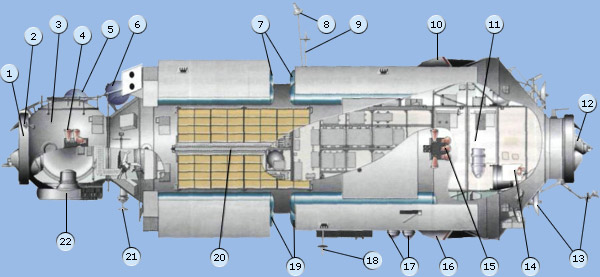
- Passive androgynous peripheral docking unit APAS.
- Antennas of the “Kurs” system.
- Sealed adapter.
- DPS engine block.
- Docking and rigging unit ERGF for capture by an American manipulator.
- Pump for transferring fuel components.
- Fuel tanks.
- Antennas of the “Kurs” system.
- Antennas of the command radio link “Comparus.”
- DKS engine blocks.
- Instrument-cargo compartment.
- Active hybrid docking unit SSVP-M.
- Antennas of the “Kurs” system.
- Module control post.
- DPS and DTS engine block.
- DKS engine blocks.
- Earth orientation sensors.
- Antennas of the command radio link “Comparus.”
- Fuel tanks.
- Solar panel.
- Antennas of the “Kurs” system.
- Passive docking unit SSVP.
Service Module Zvezda
Служебный модуль «Звезда»
The lead developer of the Zvezda SM was RSC Energiya, the main subcontractor was M. V. Khrunichev; the Salyut Design Bureau, which is part of it, carried out a number of design and engineering works, the Rocket and Space Plant manufactured the hull, assembled and partly tested.
Zvezda is the backbone of the Russian segment of the ISS. The SM provides for the operation of a crew of up to six people and the control of a station with a regularly changing configuration. At the ISS deployment stage, it is the basic module of the entire station, the main place for the life and work of the crew. This is the most complex and equipment-rich Russian module of the ISS.
Structurally, the SM consists of four compartments: three sealed ones – a transition compartment (PkhO) – переходного отсека (ПхО), a working compartment (RO) and an intermediate chamber (PK) – рабочего отсека (РО) и промежуточной камеры (ПК), as well as an unpressurized aggregate compartment (AO) – агрегатного отсека (АО), in which the combined propulsion system (ODU) – объединенная двигательная установка (ОДУ), is located. The launch mass of the Zvezda in orbit after separation from the launch vehicle was 20,295 kg. The SM has a hull length of 13.11 m, a maximum diameter of 4.35 m, the volume of hermetic/sealed compartments is 89 m3, the crew habitation volume is 46.7 m3. The estimated duration of the functioning of Zvezda in orbit is 15 years. When the module was launched, the small diameter of the SR with the folded solar panels (SB) – солнечными батареями (СБ) and the PkhO was covered with a head fairing.
The main external differences between the SM and the BB Mir affected the PkhO. Instead of five, only three docking nodes remained on it: one, axial, in front, one – from above, one – from below. Instead of two side units, sealed covers were welded on the SM. Moreover, instead of the old SSVP docking units, the upgraded SSVP-M with enhanced bearing capacity was installed at the PkhO. Only the old SSVP unit remained on the PK. On the housing of the small-diameter RO, a niche that became unnecessary was welded for the drive of the mounted SB.
Two SB modules have a span of 29.73 m, the area of their photovoltaic cells is 76 m2. The batteries generate a maximum power output of 9.8 kW. It is planned to mount four more additional batteries on the main SBs: one on each side of both SBs. After their installation, the power of the power supply system will increase to 13.8 kW.
Serious changes have affected the module systems. The Russian-made on-board computer was replaced with a DMS-R data processing system provided by ESA. Additional interfaces have appeared for the exchange of service and scientific information with the American segment of the ISS. Radiotelemetry systems BR-9TsU-5 and BITS 2-3 replaced a single BITS 2-12. Instead of instruments and antennas (including a rotary highly directional one) of the Antares system, for communication via a repeater satellite, the Lira system and a highly directional antenna with a single-stage bearing were installed. The Kvant-V command radio system was replaced by the Regul radio control and communication system.
In addition, a number of antennas of the Kurs automatic rendezvous system have been replaced. The control panels “Pluton” for the control system of the onboard complex have changed to more advanced “Mercury.” Instead of the internal cooling circuit KOH-V, air conditioning units BKV-2 and BKV-3 of the thermal control system, two units of the air conditioning system SKV-1 and additional heat exchangers appeared.
It is worth adding that a significant part of the equipment was not installed on the SM due to restrictions on the carrying capacity of the carrier. It was planned to deliver it on Progress and shuttles. Thus, part of the equipment and devices for Zvezda had already been brought to the ISS during the STS-88, -96 and -101 flights and was waiting in the wings in the cargo sections of the Zarya module (among them – a bicycle ergometer, велоэргометр, and a treadmill, бегущая дорожка).
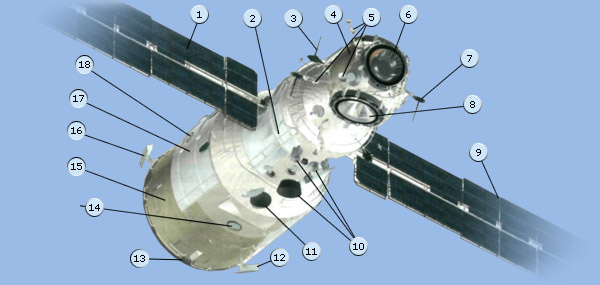
- Solar panels.
- Small diameter working compartment.
- Docking target.
- Transition compartment.
- Antennas of the “Kurs” system.
- Axial passive hybrid docking unit SSVP-M.
- Docking target.
- Lateral passive hybrid docking unit SSVP-M.
- Solar panels.
- Porthole hoods.
- Large porthole number 9.
- Antennas of the Regul system.
- Orientation engine block.
- Airlock camera.
- Aggregate compartment.
- Antennas of the Regul system.
- Large diameter working compartment.
- Porthole of an individual cabin.
Docking compartment Pirs
Стыковочный отсек «Пирс»
The Pirs Docking Compartment is an element of the Russian Segment (PK) of the ISS. It was designed and manufactured at RSC Energiya. SO1 has a dual purpose:
- it can be used as an airlock compartment for spacewalks of two crew members in space suits of the Orlan type;
- as a docking compartment, Pirs serves as an additional port for dockings with the ISS of manned spacecraft of the Soyuz TM type and automatic cargo spacecraft of the Progress M type. In addition, Pirs provides the possibility of refueling the ISS PK fuel tanks with oxidizer and fuel delivered on cargo transport ships.
SO1 Pirs is launched as part of a module cargo ship. After docking to the ISS, the PAO is separated and a passive docking port is opened at the stern of the compartment. For this, a command is given to trigger the pyro-locks. Reliable separation of PAO with the required dynamic parameters is provided by five pushers. Then the ship’s control system ensures the reduction of the PAO with the transition spacer from orbit and its destruction in the atmosphere.
The mass of SO1 with delivered cargo was 3676 kg, and without them – 2882 kg.
Pirs has a total length with docking units of 4.91 m, the maximum hull diameter is 2.55 m. The internal volume is about 13 m3. The docking compartment consists of a sealed body and equipment installed on it, service systems and structural elements that provide spacewalks.
In the central part of the Pirs hull, two annular frames with hatches for spacewalks are installed. Both hatches have a diameter of 1 m. Each cover has a porthole with a diameter of 228 mm. Both hatches are absolutely equivalent and can be used depending on which side of the Pirs is more convenient to conduct a spacewalk. Each hatch is designed for 120 openings. Manhole covers open inside the compartment.
The Pirs compartment has two docking nodes located along its longitudinal axis, active and passive. The SSVP-M active hybrid docking station is designed for docking to the Zvezda module. On the opposite side of the compartment, on the rear cover of the SO, there is a passive SSVP docking station to ensure docking with Soyuz TM and Progress M spacecraft. Transit lines for refueling pass through the SO.
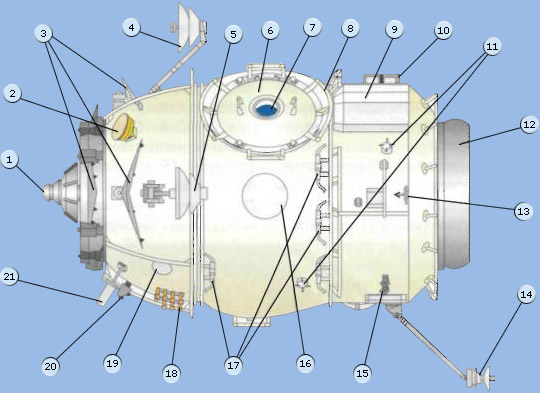
- Docking station SSVP-M.
- Telesystem antenna “Klest.”
- Shields for radio protection of antennas.
- Narrowly directed auto-tracking antenna 2ASF1M-VKA No. 1.
- Narrowly directed auto-tracking antenna 2ASF1M-VKA No. 2.
- Exit hatch.
- Porthole.
- Handrails for exit hatches.
- Block with hydraulic fittings for pumping fuel.
- The base point of attachment of the BTS.
- Magnetic-mechanical locks MMZ.
- Passive docking station SSVP.
- Rod with AR-VKA and 2AR-VKA omnidirectional antennas.
- Orientation antenna 4AO-VKA.
- Mounting unit of the BKDO block.
- Round sectors not covered by EVTI at startup.
- Electrical connectors.
- Board with connectors for connecting the equipment of the Kurs-P system.
- The cloth is sealed.
- Temperature control drain valve bracket.
- Omnidirectional antenna AKR-VKA.
Small Research Modules
Малые исследовательские модули
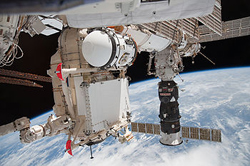
Rassvet (MIM-1, Docking and Cargo Module) is a module of the Russian Segment of the International Space Station, created by RSC Energiya by order of the Federal Space Agency of Russia on the basis of a ready-made hull for the previously planned Science and Energy Module (NEM), Научно-энергетического модуля (НЭМ). The main purpose of the module is to store cargo, it will also be used as a docking port for the Soyuz and some experiments.
On May 14 at 22:20 MSK MIM-1 Rassvet departed for the ISS aboard the shuttle Atlantis. The module was installed on May 18, 2010 at the nadir port of FGB Zarya.
Outside the module, a lock chamber and a radiation heat exchanger are installed, which will be used in another Russian scientific module. Also installed on the module is a spare elbow element of the ERA manipulator and a portable workstation for experiments in outer space.
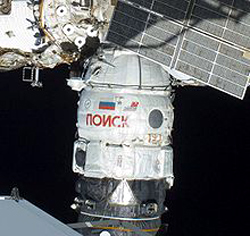
The Poisk module (MIM-2) is multifunctional, with the help of it, Russian Soyuz and Progress dock to the ISS, and MIM-2 supports docking both in manual and automatic modes.
Poisk also serves as a so-called locking point – a compartment through which cosmonauts go into outer space to carry out work on the outside of the station. Inside Poisk, the inhabitants of the ISS have three cubic meters of space at their disposal to accommodate cargo and scientific equipment with a total weight of up to 870 kg.
Linked from ISS Russian segment