Suzy McHale’s Journal: 2016
- January
- Sunday 3/1: Writer under pressure
- Monday 4/1: Future Melbourne; pet plague; nursing home neglect
- Tuesday 5/1: Aged care anger
- Saturday 9/1: Titles again; Japanese issues
- Sunday 10/1: Cull this idiot
- Sunday 10/1: A dark habit (NSFW)
- Monday 11/1: Demonizing welfare
- Tuesday 12/1: Refugee stupidity
- Thursday 14/1: Weather extremes
- Sunday 17/1: Women as property
- Monday 18/1: Russian budget cuts
- Tuesday 19/1: Fad diet
- Friday 22/1: Internet outage
- Saturday 23/1: Outage continues
- Tuesday 26/1: Reconnected at last!
- Saturday 30/1: Blargh, honk
- Sunday 31/1: Calorie stuffing; pregnancy horror
- February
- Friday 5/2: Science Party shill; sickening lettuce
- Tuesday 9/2: Jade armor; Star Wars burnout
- Friday 12/2: Gravitational waves detected
- Saturday 13/2: Samurai fashion
- Tuesday 16/2: Too many too fast; job insecurity
- Thursday 18/2: Family tree rendering notes
- Sunday 21/2: No more Herald-Sun; Space Cadets
- Thursday 25/2: Feral menace; Snow Flower
- Monday 29/2: Dentist dread; summer’s end
- March
- April
- May
- June
- Wednesday 1/6: Flame tree; winter has come
- Tuesday 14/6: Apple letdown; fat opportunity
- Friday 15/6: iPad 2 obsolete; eyes need sunlight
- Thursday 16/6: Elder neglect
- Friday 17/6: Landscape dreaming
- Wednesday 22/6: Footsore; party resignation
- Tuesday 28/6: Crossing removal marathon; foot still sore
- Wednesday 29/6: Welfare under fire again; my vote choices
- Thursday 30/6: Coffee shop closed; China bullies
- July
- Monday 4/7: Election aftermath; crossing construction
- Tuesday 5/7: Job insecurity
- Tuesday 5/7: MPA forum thoughts; Julia in Thailand
- Wednesday 6/7: Juno success; NASA site annoyances
- Monday 11/7: Temporary Windows 10 upgrade; Liberals back in power
- Wednesday 13/7: An icy blast; Windows issues
- Saturday 16/7: Childhood lost
- Wednesday 20/7: Sore hip; Russia in disgrace; violent games concern
- Saturday 23/7: Still sore; disillusioned with Russia
- Sunday 24/7: Welfare outrage
- Thursday 28/7: Elder abuse; the real welfare cheats; privatization a disaster
- August
- Tuesday 2/8: Cold and tired; remembered anime
- Wednesday 3/8: Filial duty
- Saturday 6/8: Site fussing; Olympics indifference
- Sunday 7/8: For clutter
- Tuesday 9/8: Census completed
- Wednesday 10/8: Census chaos; Spring signs
- Tuesday 16/8: A fine day; NGE completed; data storage
- Thursday 18/8: More Spring warmth
- Thursday 25/8: A planet next door; an insidious trend
- Wednesday 31/8: White follows pink
- September
- October
- November
- December
- Tuesday 6/12: Depths of despair; retail abuse
- Thursday 8/12: Second thoughts on Furries
- Friday 9/12: My letter published; GP visit
- Monday 12/12: Yet more dole bludger bashing
- Thursday 15/12: Another Star Wars movie; NASA site misdesign; uncaring Abbott
- Tuesday 27/12: Just watching
- Saturday 31/12: Monsoon day
January
Sunday 3/1: Writer under pressure
I had a quiet New Year’s Eve as usual; too hot to do anything anyway (nearly 40°C, like Christmas Day). My only resolution is much the same as last year’s: not to gain all the weight I lost in 2014!
I saw a Tawny Frogmouth bird on my early morning walk, sitting on a powerline leading to one of the houses. Saw one earlier this week, perhaps the same one, and that one a few weeks ago. It has a distinctive silhouette and birds are not usually up at that time (5 a.m. or so). I wonder where it could live as there is not much habitat for one now.
Author George R.R. Martin posted a lengthy blog entry on why the completion of his latest novel in the Song of Ice and Fire series is still a long way off. The Internet just about exploded in response. To me he seems a little burnt-out on the series, like his enthusiasm for it has long since waned and what he once enjoyed has become something of a burden (I may be wrong, of course). The pressure from impatient fans only makes this worse (I have yet to read the series).
Look, I have always had problems with deadlines. For whatever reason, I don’t respond well to them. Back in November, when I returned to Northwestern to accept my Alumni Award, I told the Medill students that was why I started writing fiction instead of getting a job on a newspaper. I knew even then that daily deadlines would kill me. That was a joke, of course … but there was truth in it too. I wrote my first novel, DYING OF THE LIGHT, without a contract and without a deadline. No one even knew I was writing a novel until I sent the completed book to Kirby to sell. I wrote FEVRE DREAM the same way. I wrote THE ARMAGEDDON RAG the same way. No contracts, no deadlines, no one waiting. Write at my own pace and deliver when I’m done. That’s really how I am most comfortable, even now.
He has been described as a “gardener” style of writer; not writing to a plan but whatever comes into his head – in fact he is quoted as saying that:
I think there are two types of writers, the architects and the gardeners. The architects plan everything ahead of time, like an architect building a house. They know how many rooms are going to be in the house, what kind of roof they’re going to have, where the wires are going to run, what kind of plumbing there’s going to be. They have the whole thing designed and blueprinted out before they even nail the first board up. The gardeners dig a hole, drop in a seed and water it. They kind of know what seed it is, they know if planted a fantasy seed or mystery seed or whatever. But as the plant comes up and they water it, they don’t know how many branches it’s going to have, they find out as it grows. And I’m much more a gardener than an architect.
I recognize that am like that too; the meandering journey of writing is more enjoyable for me than its ending. I would also be useless at meeting deadlines, and am the world’s best procrastinator.
Monday 4/1: Future Melbourne; pet plague; nursing home neglect
I decided to remove titles from each entry’s header as I can’t be bothered thinking of one for each entry (see 8/8/2015 entry). I also found out how to do a useful regular expression function in the process:
Find and replace <li><a href="#d14">Wednesday 14</a></li>, <li><a href="#d19">Monday 19</a></li>, etc. with <li><a href="#d14">14</a></li>, <li><a href="#d19">19</a></li> – dates and days vary, so a simple regex search will not work.
<li><a href="#d(\d\d)">.*?day(Note: space at end – regex interprets this literally as a space)<li><a href="#d$1">– the$1refers to the first regex item in brackets; this will ensure the item is not changed during replace. Subsequent items in brackets are referred to with $2, $3, etc. Using $0 means the entire match.
Source: http://manual.macromates.com/en/regular_expressions
In today’s Herald-Sun is yet another “special report” on future Melbourne at 8 million. They seem to be pushing a pro-population agenda, and using the method of repeating an idea until people think it is inevitable. This prospect invokes anger and despair in me as the once-livable city I have lived all my life in so far is becoming ever-more overcrowded and overdeveloped. Realistically, population growth tends to outpace resources and governments don’t want to spend the money to keep up; they would rather privatize assets – a dubious solution. As I can’t link to their subscriber-only website, the articles are reproduced below:
ANDREW JEFFERSON URBAN AFFAIRS andrew.jefferson@news.com.au
OUR CITY OF THE FUTURE
Melbourne will be home to 8 million people by 2050. Work has begun to ensure we remain the world’s most liveable city
By 2050 Melbourne will no longer be cramming its new residents into shoddy towers and will have discovered how to create walkable medium density communities
MELBOURNE is set to become a city of mini cities as its population moves towards eight million people by 2050, making it Australia’s biggest city.
Spanning 10,000sq km and including 31 local government areas, Melbourne is home to nearly three-quarters of all Victorians.
Suburbs such as Werribee, Sunshine and Melton in the west, Sunbury in the northwest, Broadmeadows, Craigieburn, and Epping in the north, Box Hill and Ringwood in the east, and Dandenong, Frankston, Cranbourne and Pakenham in the southeast are all set to take on the mantle of mini cities.
Social researcher Mark McCrindle said Melbourne was already developing into several cities within a city.
“We see this through the world – whenever there are cities that get to certain thresholds, it’s impossible for cities of many millions to have that one identity or even the one lifestyle, so you end up with these groupings within the one metropolis, and that’s certainly the way Melbourne is heading,” Mr McCrindle said.
“It’s our fastest growing city at the moment – it’s just overtaken Sydney in terms of its growth – and it will be the first city to reach eight million by 2055.
“It’s part of modern town planning that you’re getting the revitalisation of various areas and the mixed living developments with shopping hubs mixed in with residential.
“With that, people don’t have to travel to the CBD for work, they don’t have to drive to Chadstone to the shopping centre, they do it more locally and that creates that localised identity.”
To support growth in our suburbs, Melbourne will become a city of 20-minute neighbourhoods – places with access to local shops, schools, parks, jobs and community services all within a 20-minute trip from your front door.
One new mini city being created in Melbourne’s north is Cloverton at Kalkallo, north of Craigieburn.
Cloverton will eventually house up to 30,000 residents.
When completed in about 30 years it is expected to be the largest masterplanned community developed in Victoria, boasting eight schools, a tertiary institution, parklands and a retirement village.
While there is at least a 30-year supply of urban-zoned land on the fringe of metropolitan Melbourne to cater for first-home buyers, migrants, and those on low incomes, it is no longer deemed sustainable to accommodate most of our population growth by expanding Melbourne’s outer-urban areas.
For many Melburnians, aspirations to own a traditional quarter-acre block will change as subdivisions, infill housing, apartments, townhouses and units become more common in established areas.
The future will see Melburnians looking upwards as our suburbs embrace more medium-density living. It’s forecast more than a million of the 1.5 million new homes needed by 2050 will be medium-density living.
Three- or four-storey developments are already popping up in suburbs such as East Brunswick, East Coburg and Camberwell.
Professor Brendan Gleeson, director of the Melbourne Sustainable Society Institute at Melbourne University, said our suburbs were continuing to evolve.
“By 2050 Melbourne will no longer be cramming its new residents into shoddy towers and will have discovered how to create walkable mediumdensity communities with jobs and great public transport,” Prof Gleeson said.
“The hotter, wilder climate will be offset by a huge city greening program that will cool urban spaces while also improving livability.
“It won’t be life in the Jetsons but driverless electric vehicles will be a safe, sustainable form of transport.”
In the future, Dandenong will take on the unofficial title of capital of Melbourne’s growing southeast region.
Several key projects are now complete or under way, enhancing Dandenong’s appeal as a place to live, work and visit.
Another growing suburb in Melbourne’s west, Cairnlea, highlights how once contaminated land is being unlocked for residential development.
It is on the site of the former Albion Explosives Factory, a Commonwealth Department of Defence facility that operated from the early 1940s until the 1980s.
Today, Cairnlea is a thriving community with almost a third of the suburb devoted to public open space and grassland reserves.
Another booming city suburb in Melbourne’s west is Williams Landing, identified within the Plan Melbourne strategy as a key “activity centre”.
When finished, the 225ha community will house about 2400 homes, parklands, and sporting facilities next to the newly built town centre.
Population expert Dr Bob Birrell said new suburbs were needed as the demand for housing supply showed little sign of abating.
“For the next few years we can be sure that there will be an increased scarcity of detached housing in Melbourne because of the large number of young households who will be starting a family,” Dr Birrell said.
“They will be competing for this housing at the same time as the share of the detached housing stock occupied by older households is certain to increase because of population aging. “They show no interest in downsizing into the tiny apartments being built in the inner city. As a result there will be an increase in take-up of new house and land packages on the fringe – where the capacity for growth is enormous.”
JOHN MASANAUSKAS CITY EDITOR john.masanauskas@news.com.au
Land of plenty in CBD
VICTORIAN politicians love to boast about how much developable land inner Melbourne has compared with what’s on offer in Sydney.
At various gatherings recently, state Planning Minister Richard Wynne and Lord Mayor Robert Doyle have scoffed at Sydney’s much touted Barangaroo project – a 22ha precinct on the western side of the CBD.
Mr Wynne and Cr Doyle like to point out that Melbourne has several hundred hectares of land on the doorstep of its CBD that will be used for new housing and commercial developments.
The best known is Docklands, which is 60 per cent complete and has already attracted $10 billion in private sector investment.
The 190ha suburb has 10,000 residents and 53,000 jobs, with top firms such as ANZ, NAB, Medibank Private and Myer basing their national headquarters there.
By the time it’s finished in 2025, Docklands will be home to about 20,000 residents and 60,000 workers.
It currently has 14 projects under construction with a combined development value of more than $2.2 billion.
Harbour Town shopping centre at Waterfront City is set for a revamp, including a proposed Hoyts cinema complex.
Community projects include the recently opened Ron Barassi Sr Park, the soon-toopen Community Hub at The Dock, and the Harbour Esplanade redevelopment.
Near Docklands, across Footscray Rd, is E-Gate, a little-known industrial area targeted to eventually become a suburb of 10,000 residents.
Further down the redevelopment track is Arden-Macaulay, a precinct in North Melbourne that one day will become an extension of the CBD.
It will have three new local neighbourhood centres and five new parks, while the Government has confirmed the new Melbourne Metro station of Arden will be in the area.
“It is entirely industrial but we have control over it … right in the middle of that precinct is the recipe for community success,” Cr Doyle said. “And that’s the Arden underground railway station.”
By far the biggest urban renewal area in Melbourne, and in Australia, is Fishermans Bend – a 455ha precinct south of the Yarra River and west of Southbank, right on the CBD’s doorstep.
So far, at least 15 permits have been issued comprising 20 high-rise towers of between 20 and 49 storeys, and several smaller buildings. An additional 23 applications were lodged up to June 30, including plans for 26 towers.
The former government’s master plan included an underground train station, but Labor has opted for an alternative route. The most likely solution is an extension of tram services from Docklands.
Editorial: Plan for growth
WHAT kind of Victoria do we want? With population projections suggesting Melbourne is to become Australia’s biggest city by about 2050, Victorians must spend more time contemplating and debating the future of our great state.
As our special report today on the future of Melbourne makes clear, there is a pressing need to develop a stronger vision for future infrastructure needs if our capital is to retain its mantle as the world’s most liveable city under the weight of exponential population growth.
Premier Daniel Andrews will go down in history for wilfully tearing up the East West Link contract, wasting $1 billion and abandoning what would have been a transformative project for our state.
But the road was only one piece of the puzzle Victorians must put together to ensure we have the roads, rail network, ports, airports, housing and other amenities necessary for our future needs.
The state needs more major infrastructure projects and significant investment in rail and bitumen to get our public transport and road systems ready for an influx of residents.
Experts are predicting Melbourne will evolve into a series of mini cities within one giant metropolis, with a move away from the “great Australian dream” and a heavier reliance on medium-density housing.
Much more thought must go in to town planning before these developments spring up, lest we repeat the mistakes made in some housing estates and developments which were poorly planned and have failed to provide all residents need.
There are many decisions ahead in shaping the society we want to become, and we must turn our minds to them before it’s too late to ensure we remain one of the world’s most magnificent places to live.
“We are losing dogs and cats, and it is a great loss,” The Age, 3/1. I disagree with the premise of this opinion piece: domestic animals compete with wild ones for habitat (see this xkcd cartoon, Land Mammals) and there is arguably an overpopulation of them as with humans, and (as is mentioned) become feral pests in countries that humans bring them to – so I can’t see their decline as a bad thing. They are also bred for human needs, which doesn’t always benefit the animal (see 20/12/2015 entry). Some comments from the article:
I have no objection to dogs and cats and was around them lots as a kid but the progressive cloying anthropomorphism that has taken opver since the 1980s or thereabouts revolts me. Too many unfortunate cats and dogs in p[articular are treated as humans and we are all worse off for it. Dogs esp large ones once had kennels – Now they often share their owners beds. Where once they were kept outside and fenced off they are now inflicted on anyone who visits whether they like it or not and when you have some of the larger breeds the results can be disastrous as evidenced by the unfortunate young man mauled by his girlfriends otherwise lovely PBull only a day or so ago. I dont have all the answers but this just isn’t right.
- Commenter
- Andrew Nichols
- Location
- Brisbane
- Date and time
- January 03, 2016, 9:18PM
No Paul it’s no loss. In fact it’s quite bizarre that people who have evolved over millennia to move away from jungles and bush (surrounded by parasitic or predatory animals), would then revert to primitivity and seek them out to keep them domestically. Atavistic tendencies.
Dogs and cats are expensive, diverting money from people who have more worthwhile needs. They are extremely environmentally unfriendly, and equally bizarre is seeing Green types owning animals – a complete contradiction of everything they purport to believe in – but then, consistency was never their strong point.
Dogs and cats attack fauna, while dogs regularly attack and sometimes kill small children or the elderly, and they make offensive noise which their selfish owners refuse to acknowledge because it’s drowned out by their sense of entitlement.
Frankly, with the exception of guide dogs of the blind which do serve a purpose, the world would be far better off without them, and cats.
Yes the emotionally needy and lonely like to have unconditional attention from an animal that knows where its food-source comes from, but that’s hardly a reason to justify all the harm just outlined.
Put more effort and resources into humans.
- Commenter
- Michael
- Date and time
- January 03, 2016, 11:30PM
While I sympathise with anyone who loses a living creature to which they are attached, there are an estimated 20 million feral cats in Australia to which Paul briefly alludes. They started in homes as pets. They are decimating our fauna a a rate unequalled by any other creature other than homo sapiens (http://www.abc.net.au/radionational/programs/backgroundbriefing/feral-cats-re-write-the-australian-story/5802204).
The marauding dog packs in suburban Brisbane that kill other dogs, the pets that regularly maim children and adults are also now out of control.
Working dogs may ride alongside but their lives are only at best two thirds as long as their pampered cousins. All working dogs, including those in police, military and farm employ suffer this fate. Those on properties usually despatched with a bullet if lucky but the backs of shovels are still seen as humane, by some.
While I understand that people long for companions, owning a life has never cut it for me.
Observing wildlife in its natural splendour, has attracted me to all corners of Australia and the world. A much better way to enjoy creatures without holding them in bondage – even as a choiceless much loved pet.
- Commenter
- Troppo
- Date and time
- January 04, 2016, 1:11AM
Paul, the decline of cats, domestic or otherwise is to be celebrated. They account for the loss of millions of native birds and animals each year. The removal of cats from the Australian continent would herald in a new age for Australian wildlife.
Ironic that so many Green voting ‘progressives’ own cats.
- Commenter
- Jon
- Date and time
- January 04, 2016, 9:34AM
“Nursing home profits soar as patient care declines,” The Age, 2/1. A dismaying but not surprising consequence of relying on private operators to run nursing homes. This is one of the essential services that should never be outsourced to the private industry – they cannot be trusted to ensure the best interests of their residents. My parents are now elderly, though not infirm yet, and I am dreading the prospect of them going through this process – made worse by my own dire situation (not financially independent). I dislike the procedure of outsourcing elder care and “warehousing” old people rather than have them continue to live with their families and as a part of society – but infirmities such as dementia can make the latter difficult.
I wished we lived in a society where there was elder respect, as there was in some traditional Asian cultures (Japan, China) and indigenous cultures – though Westernization has eroded such respect in these, unfortunately. Respect is some compensation for the trials that can accompany aging. The Whirlpool forum has a lengthy post discussing the issue.
Tuesday 5/1: Aged care anger
I am experimenting with rearranging site navigation yet again – such as putting section links on the one index page, rather than a lot of sub-pages – so things are a bit chaotic.
Some letters in response to the nursing home article in my previous article (4/1):
4/1:
Turning a blind eye to achieving quality care
Published: January 4, 2016 – 1:53AM
AGED CARE
So “Aged care slides, profits soar” (The Age, 2/1). The 2011 Productivity Commission report Caring for Older Australians gave priority to financial issues over quality of care issues. Revenue recommendations were rigorous while recommendations on care issues, including staffing numbers and skills and training quality, were soft. Both major parties embraced the report. Co-existing with this finance bias has been the sale of public nursing homes by state and local governments. The Andrews government promised to close the stable door but, for the most part, the horse has bolted. In the acute health sector, we have a clear public-private balance in healthcare providers. Aged care has no such balance. In metropolitan areas, privatisation is almost universal. In the meantime, a trial in South Australia, established in 2013 by then social services minister Kevin Andrews, is reducing scrutiny of nursing homes (including auditing of provider claims) in the name of reducing red tape. Our federal politicians are turning a blind eye to care quality in the aged-care sector.
– Carol Williams, Elder Care Watch, Blackburn
Low nursing levels, low level of care
It is outrageous that nursing homes do not have recommended staffing levels. Elderly people with dementia or Alzheimer’s disease – and who, in some cases, have paid bonds of hundreds of thousands of dollars as well as continuing monthly payments – deserve the best possible care. By law, childcare organisations have staff ratios yet children are able to learn and notify carers if they are in pain, hungry or need to be toileted. Dementia patients cannot do this and will only become more in need of care as their condition worsens. Thankfully my mother, who has late-stage Alzheimer’s disease, is in a wonderful facility. However, in my search for a good home, I saw many where up to 15 dementia patients were cared for by one staff member. With an aging society, the number of people entering nursing homes will increase, profits will continue to soar and our most vulnerable citizens will suffer. Staff ratios must be put in place.
– Annie Jones, West Melbourne
Our current system has serious problems
Recently we moved our 93-year-old father out of a nursing home because we were not happy with the level of care. Once it was a not-for-profit venture and care levels were very high. However, it was purchased and repurchased by large companies that were more interested in generating profit than their residents and staff. On advice from Dad’s doctors, we moved him to a magnificent, family-owned venture. His health is improving and it is a joy to see the quality of care. The incredible aspect of our story is that the government’s nursing home quality assurance process rated the first home as “exemplary”. Something is very wrong with the system. Our elderly and most vulnerable deserve much better.
– Rowan Dowland, Chirnside Park
Better care, cheaper and the aged are happier
I recently wrote to Health Minister Sussan Ley suggesting that aged people be subsidised if they lived with their carer adult children. In my case, I am regarded as being disabled enough for my partner to receive 63 days per year respite from the hassles of looking after me. Apparently the current subsidy for low level care is $36.11 per day. This, or something close to it, would adequately reimburse my relatives for extra expenses involved in my care. I am sure it would provide satisfactory care for my needs, and for similarly assessed aging citizens, and it would be more pleasant. It would also cost less than placing people in aged care facilities.
– Bob Gunter, Red Hill
5/1:
Aged care: We all face same fate so we should take a stand
Published: January 5, 2016 – 8:45AM
If aged care reforms were working well, as claimed by Bentleys Chartered Accountants (“Aged care slides, profits soar”, The Saturday Age, 2/1), I should see the nursing home in which my disabled mother lives ensure respect at all times from all staff; maximum 10-minute response to activated call bells; professional detection of ailments of aging bodies such as “cradle cap” and an infected toe (rather than being alerted by family); seven-day-a-week opportunities for assisted short walks to build mobility; and a marked improvement in food quality.
These are not criticisms of individual staff but reflect corporate budget decisions made by the reputable, not-for-profit organisation that owns this and similar facilities, along with broader political decisions. “More choice and more options to pay” mean nothing when there is not enough staff and not nearly enough registered nurses on the job. Most of us will end up there if we live long enough (and have enough money). Time for aged-care warriors to awake.
– Linda Bennett, Brunswick
Paying more doesn’t buy protection
As a GP of 30 years, and one whose family members have required nursing home care, I have looked on in despair as government reforms have been made to entice investors into the market. Current standards ignore provision of nursing and carer ratios. Private facilities often promise the earth, but deliver the most basic of care. Profits are made by reducing staffing but also by providing bland meals that are cold or lack nutritious value.
On reading the glossy brochures, many believe that if you can afford a bigger bond, you may be able to protect your loved one from these acknowledged failings. Wrong. I have seen countless examples of poor care in “luxurious” homes. A close family member, supposedly receiving palliative care, was recently denied regular morphine because no Division One nurse was on duty overnight. Her family watched her distress with horror, anger and frustration that this is allowed to happen. The family had sought “best care” for their mother, and had to watch on as worst care was delivered. This occurred in a new, large “state of the art” facility in regional Victoria.
There are countless good facilities, with dedicated staff, and the not-for-profit model of care is by and large outstanding. However, that is due to individual and collective commitment and adherence to a philosophy of care rather than to profit.
Australians need to lobby politicians to ensure the care of the elderly is improved.
– Name and address withheld
A vicious cycle
The difficult environment caused by low staffing levels is compounded by added stress on the registered nurse in charge, who must not only supervise/educate the poorly trained carers, but deal with the often valid complaints from residents and families. This is driving away experienced nurses, which lowers the standard of care even further.
– Jacqui Smith, Murrumbeena
So little accountability
Why are taxpayers not asking more questions as to why aged care is sliding as profits for operators soar? Some 15 years ago your reporter Peter Ellingsen asked the same question, concluding that “except for (accreditation) The aged care industry is not held accountable for the billions it gets each year”. Since the system was deregulated, “proprietors can spend the money any way they like”. Before the introduction of the 1997 Aged Care Act (introduced under Bronwyn Bishop) proprietors were obliged to allocate a certain proportion of their funding for resident care – i.e. for staffing.
– Glenda Addicott, East Ringwood
Saturday 9/1: Titles again; Japanese issues
Decided to try entry titles again, for now. I just write whatever comes into my head, so I don’t put much effort into them sometimes; they are just a brief summary.
I watched Rashomon a couple of weeks ago (it is online at Archive.org). Did not like it quite as much as Ran, and I could not get into it at first, but it was lively and had no clear ending.
Came across a link to this 2012 article, “Anorexia: The epidemic Japan refuses to face up to.” My only muted reaction is that I would rather that than the grotesque obesity epidemic affecting Western society – bones are elegant, fat isn’t.
“Government weighs immigration to maintain population, boost workforce,” Japan Times, 6/1 (series reproduced here). This would be a big mistake, in my view – immigration is too often seen as a quick-fix solution to the supposed problem of a declining population, but as one of those interviewed there points out:
A self-professed conservative in the left-leaning Democratic Party of Japan, Yoichi Kaneko said he opposed the idea of opening Japan’s doors to more immigrants as it could result in higher costs for the rest of society.
Yoichi Kaneko says accepting more immigrants could bring about a large financial and social burden on Japan.
A former economist at the Organisation for Economic Co-operation and Development, Kaneko said the most active advocate of welcoming immigrants was the corporate world, which wanted to use foreign workers on low wages. But he said this overlooked the broader costs of housing immigrants, such as education and health care.
“The only cost companies will pay by accepting immigrants is just their salaries,” he said. But if the nation is accepting immigrants as long-term workers, “we have to think of managing their pensions and their unemployment insurance, as well as giving them a chance to learn Japanese,” he said.
Many immigrants are likely to bring families with them, and Japan will have to shoulder the expenses of providing proper social and educational support for them as well, he added.
Rather than relying on immigrants, Kaneko said Japan should overcome its labor shortages by developing “labor-saving technologies” that allow people to work with less manpower, which he believed will underpin the future of Japan’s economy.
“Take the nursing care industry, for instance. We can develop something like nursing robots or wearable robotics” to reduce the burden on caregivers who performed such tasks as lifting people up, he said.
If the nation depended on immigrants to solve the labor shortage immediately, “we would cease efforts to develop these kind of technologies,” Kaneko said, adding that Japan might also lose the chance to become a leading exporter of such technologies.
Those in r/japan at Reddit, where the link to the article was posted, are all for immigration (perhaps because most there are expatriates living in Japan), but I would strongly disagree as it is socially disruptive. An economy based on endless growth is unsustainable and environmentally damaging; instead they should aim for a steady-state economy, and other countries should too.
An overpopulation letter reacting to the report in my 4/1 entry, 7/1 Herald-Sun:
Population overload
IT is frightening to read that in just 35 years Melbourne’s population will double to 8 million (“Our city of the future”, HS, Jan 4) – and more frightening that none of the current 4 million inhabitants ever seem to have a say in this folly and stupidity.
Every day I read about traffic congestion, crowded hospitals, schools, jails and public transport overcrowding, not to mention the destruction of the environment.
It seems like we are governed by developers working in coalition with governments keen to collect more stamp duty or council rates without considering the impacts on those residents.
– David Clifton, Blackburn
Sunday 10/1: Cull this idiot
Some idiot in an overpowered or modified black car speeded past when I was about to go out on my bicycle ride early this morning (southward down the street where I live). Coincidentally, he zoomed past in the opposite direction when I came back. He – it is probably safe to assume he is a young male – was driving in an aggressive and dangerous manner. I was unable to read the number plate as it was still too dark the first time, and the plate was too small to be read from a distance the second time. I am not sure of the make of the car; the number plate was narrow and looked like one on a BMW.
I am absolutely fed up with these idiots; if I had my way, such aggressive young males would be culled from the population – and I am not the only one to feel that way; I wrote a Blogger post on this back in 2012. I am sick of feeling threatened by these morons if I see or encounter one. It sounds harsh, but their stupid impulsive actions can injure or kill others. They drive in a manner to intimidate others, effectively using the car as a weapon. The exhaust is modified to sound loud, a similar psychological effect to that of a menacing growl. I would have a complete ban on young people driving such cars; let them drive underpowered little hatchbacks! Imagine the whinging if that rule were instigated.
I would love to see self-driving cars become the majority – they would enable greater autonomy for the elderly and disabled – but there is a psychological barrier to overcome with the archaic and individualistic “car culture” in this country and many others; the unpredictable and irrational human element. The aggressive young males would likely see such cars as emasculating (or try to modify them).
On a more general level, such an issue is symptomatic of this society’s inability to enforce proper behavior; the insidious spread of Western popular culture, excessive individualism, consumerism and advertising subvert such efforts. The dubious “values” propagated by these infect other cultures as well, to the detriment of those.
Sunday 10/1: A dark habit (NSFW)
This next unpleasant topic I normally don’t mention out of distaste, but there was a (somewhat NSFW) post this morning in r/Australia at Reddit involving a government survey on “Harm being done to Australian children through access to pornography on the Internet.” Much mockery and cynicism ensues in the comments following the link to the article there (most are in the typical Reddit demographic – see 27/2/2014 entry). What I find disturbing is their cynical and jaded reaction – with their generation there now seems to be no shame surrounding porn, and I do not find this a positive development; it shows a lack of self-control and giving in to hedonism. In Reddit comments generally, people openly admit to viewing porn, and joke about it (similarly with using drugs, another topic but also demonstrating a lack of restraint). Despite their strident denials there, though, porn is ultimately degrading and harmful – read the (NSFW) Wikipedia article – and it is one of a few areas that should remain a taboo in society. This viewpoint would be scorned as “old-fashioned” and so on, but the older I get, the more reasonable some taboos appear.
I find the whole “think of the children” bullshit to be just that, an excuse to control what we see and read. To quote Heinlien: When any government, or any church for that matter, undertakes to say to its subjects, This you may not read, this you must not see, this you are forbidden to know, the end result is tyranny and oppression no matter how holy the motives.
I bet that if some of the snide know-it-alls commenting there eventually manage to find a partner and reproduce, some will change their outlook and realize maybe their children should be protected from such unpleasantness.
Monday 11/1: Demonizing welfare
Trashy tabloid Murdoch-owned newspaper the Herald-Sun is yet again demonizing welfare recipients with an article, “Cracking down on Centrelink fraud.” Some of the letters in response in today’s edition were dismayingly mean-spirited; others more reasonable:
WE need to remove all social security benefits – they don’t work and make people complacent and lazy.
– Daniel
ABOUT time they are cracking down on the fraudsters. I guess it’s back to the polls since most pollies would lose their jobs if they really delved deep.
– Ben
IF Centrelink is serious, then there should also be food vouchers linked to supermarkets given instead of money. This guarantees funds go to running the household for kids to be fed, rather than gambling and drugs.
– Will
MANY people say go find a job, without realising that on any given day, only a few thousand jobs are available and will be taken by the keenest. The work for the dole scheme is a joke; mostly people over 55 are taking it up rather than those leaving school, who need it to stop them landing on the street and getting into drugs.
– Brian
NOTHING happens to these people. I know someone who is claiming a disability pension but works 40-plus hours a week. I have reported him three times, Centrelink ask him, he says no and they leave it at that. He makes about $800 a week cash in hand plus the pension, which is about $350 a week. These people are running the country into the ground.
– Jay
THIS could easily be fixed if all government agencies worked off a single database.
– Michael
No one denies the need to crack down on Centrelink fraud, but one multinational that was recently tabled at the Senate estimates hearings did $1.7 billion in Australian sales and paid $467 company tax. Based on a 30 per cent company tax rate that should have been more than $500 million in tax paid.
– William
GENEROUS single person dole payments despite living with a partner – it’s been going on for more than 30 years and now they’re going to do something about it. Well done to the people at Centrelink.
– Michael
IF only the dole bludgers applied the same effort to gaining employment.
– Leigh
THE government will never really win when it comes to social security fraud. Dishonest people will always find a way to cheat. If they get caught they’ll end up paying back $10 per fortnight as they’re still unemployed. They’ll remain unemployed, so they don’t end up paying the debt in full.
– Grant
HAVING been on the dole myself, it’s almost impossible to live alone paying rent and expenses, so people sharing to save costs is the only way they can have any sort of quality of life. I’m still recovering financially from 12 months of unemployment and I only got through it by picking up some temp work (declared), which helped me pay a few bills.
– Ellen
WHY don’t these welfare “couples” find a job? They seem to be clever at figuring out ways to scam taxpayers, so surely they can apply some of that deviancy into finding paid work.
– Christine
If those with opinions like Daniel’s had their way, the unemployed poor would have to be foraging through garbage dumps to survive, as they do in many developing countries – see the Wikipedia entry Waste picker.
“Welfare experiment may have applications in Australia,” The Age, 8/1. Finland is experimenting with paying its citizens a basic income. Could this be applied in Australia? The attitudes of mean-spirited, welfare-hating people and politicians would be a big barrier to overcome, though. For me, a BI would enable me to continue living modestly and be able to afford basics such as dental care – all I want in life now is security, stability and access to health care.
Tuesday 12/1: Refugee stupidity
Two opinion pieces on the current refugee crisis in Europe, criticizing German Chancellor Angela Merkel’s breathtakingly ill-considered policy of mass asylum for refugees, and noting that allowing huge numbers of single young men into a country is asking for trouble and social unrest.
“Germany on the brink of migrant crisis,” The Age/NYT.
With the current migration, though, we’re in uncharted territory. The issue isn’t just that immigrants are arriving in the hundreds of thousands rather than the tens of thousands. It’s that a huge proportion of them are teenage and twentysomething men.
In Sweden, for instance, which like Germany has had an open door, 71 percent of all asylum applicants in 2015 were men. Among the mostly-late-teenage category of “unaccompanied minors,” as Valerie Hudson points out in an important essay for Politico,” the ratios were even more skewed: “11.3 boys for every one girl.”
As Hudson notes, these trends have immediate implications for civil order – young men are, well, young men; societies with skewed sex ratios tend to be unstable; and many of these men carry assumptions about women’s roles that are diametrically opposed to the values of contemporary Europe. […]
I do disagree with this sentence, though: “In the German case the important number here isn’t the country’s total population, currently 82 million.” Adding to an already-large population with many unemployed is just asking for social unrest (see Japan and immigration in 9/1 entry), and putting more strain on welfare (the latter should be restricted to a country’s citizens).
“European migrant crisis causing dangerous gender imbalance in region, expert warns,” ABC News. This was posted at Reddit.
Young male migrants. And why male?
It’s not easy to migrate all the way from Africa or Middle East, pay the smugglers, buy fake ID, etc. Only strong and rich can do it. And who’s strong and rich in muslim societes?
The sad part about this are the weak, sick and poor people (women, elders, sick children), who are left behind in shithole countries. The trip to Europe is simply too hard and expensive for them. They have to stay in countries not only destroyed by war and religious maniacs, but also abandoned by the richest, most energic and educated part of the society.
They should receive our help, not those aggressive and greedy young male economic migrants. (kalarepar)
I mentioned a study on the problem of surplus young males in my 5/12/2012 blog entry, and a study called “Bare Branches.”
“Dozens of ISIS sex slaves will find shelter on the Gold Coast after a journalist’s extraordinary journey,” Herald-Sun, 4/1. These are the type of refugees who do deserve shelter and should be given priority over young males.
“Our elderly need homes, not warehousing,” The Age, 11/1. A criticism of the corporatization of aged care, and how it is detrimental for those using it or working there.
Using language of facilities, scale efficiencies, corporatised operations and the generation of better margins enables investors, industry bodies and politicians to respond in solely economic terms, forgetting they are building a home where care is provided for us, our parents and grandparents.
Thursday 14/1: Weather extremes
More crazy weather yesterday, with the temperature reaching 42.4°C – first day of 40 or more for this year – then a late-afternoon windstorm that caused some damage, then the temperature dropped overnight to just a cloudy 19°C today, much more pleasant.
A website I visit, Planetocopia, was offline for a week or so as the domain name needed renewing, which was done yesterday, to my relief! I was able to access it through Archive.org, fortunately, but it is a reminder of how transient sites are over time. The majority of the site is devoted to the owner’s, Chris Wayan’s dreams (some of it is NSFW, with artistic nudity), and has over 3000 pages (!). It won’t win any design awards, but its primary purpose is for recording and disseminating information, so the design aspect doesn’t bother me (though professional web designers would sneer at it). He has some background information on putting his site together, taking a back-to-basics approach:
Techies will notice that my Luddite approach is parallel with RISC (Reduced Instruction Set Computing). Simple code runs way faster; simple HTML pages, with everything spelled out and nothing for a poor old overworked timesharing server to hunt for or assemble or fill in, load like lightning. If things go wrong, they’re easy to fix – an amateur can read the code.
The roots of my sitebuilding style weren’t RISC, but something older: Volkswagens. I grew up driving a hippie bus. It got 28 mpg and ran forever. You could fix it with pipe cleaners and duct tape. This site is a hippie bus – antique, underpowered, but simple, cheap and functional.
An approach I like – one I try to use for my site – and probably wise for future-proofing a site. Visiting these “old-fashioned” but fast-loading sites is quite refreshing when designers get carried away with the latest fads (see my 24/8/2015 and 19/3/2015 entries).
Sunday 17/1: Women as property
There was a thought-provoking and alarming comment on Reddit today on how women are regarded in cultures such as that of Afghanistan. It makes me very grateful I was born in Australia and not many other places in the world. I reproduced it below:
I’ve spent a significant time in the last 15 years in many of the countries that these asylum seekers are coming from, notably Afghanistan. The thing is, none of this surprises me, and not because these are bad people. In fact, the vast majority of people that I interacted with in these countries are no more evil than people in western countries. Some days, I think even less so, but that’s another debate.
The thing that I believe many people just have a hard time wrapping their heads around is how diametrically different local culture is to ours. In terms of equality, freedom, civil rights, democracy etc our culture has evolved in a truly profound way in the last century/couple of centuries.
Due to this, it becomes increasingly difficult for these people to understand or relate to our norms, but it also becomes increasingly difficult for us to fathom why other people have so much trouble embracing our norms.
I remember one day having been invited to a man’s house, and while he was sending his son to the kitchen to get the drinks and food his wife and daughters had prepared (it would have been improper for any of the women in his family to even serve us), he started telling me how important women rights were for him and how it was great that the west was doing so much. Thinking about it, I realized that this person genuinely thought that he was a paragon of women’s rights, and in his society he really would have been considered one, but by our norms even his ideals were patriarchal and bigotted.
The thing is, in many of these societies women have comparable rights and status to dogs in our society. You’re expected to take care of your dog and not mistreat it, but at the end of the day it’s your property and you do whatever you please with it. There are some people who think dogs should be taken care of, and there are even groups that call for equal rights (PETA) but they are viewed as fringe and extremists.
When we went in to namely Afghanistan, starting all these programs and throwing money around, it’s a little bit as if some country came to us throwing money around and started all these programs for dogs. Doggy university, doggy police programs (I guess that already exists), dogs in governement. As long as money is being thrown around, you don’t care, let them do their thing. But to you, your dog’s your dog, and though these weird people may be putting an outfit on him and sending him to work, he’s still only a dog to you. The day these people leave and the money stops being thrown around, your dog will go back to being a dog, hanging out on the couch while you watch TV.
Now imagine that you end up living in this foreign country. There are dogs everywhere and people are telling you: “These dogs are actually just like us.“ Do you really think you can begin to imagine these dogs being your equal?
Ok enough with the metaphor. But seriously, to a lot of these people the idea of women having rights is simply ridiculous. But there’s more. To many of these men, who have lived in a society where they have been forced to sexually repress themselves, the west is seen as a not only financial but also a sexual El Dorado. They have heard stories about how women are “loose and easy” and how all western women want sex. Coming from a society where many women are essentially hidden and never talk to non-family men, and coming to our society and having women dress and act in ways that we would consider as normal, is to these men the same as a women in a bikini staring at us and licking her lips is for us. The culture gap is just that big.
It’s when you combine these things, the lack of cultural belief that women are equals and the belief that all western women are dirty whores that you really get a powder keg.
Sometimes my young nieces in nephews will do something in public that isn’t appropriate, and you have to tell them “no you can’t do that, that’s not ok.“ When you tell them that, they often have a bit of a confused look, as if saying “really I didn’t know that.“ In many ways I feel like these migrants are the same.
The cultural gap is simply too wide, and integration either isn’t possible, or will require a lot of time and patience for each person. Now however, there is such an influx that this just isn’t possible. It’s like having special need kids. You need more staff to help them along, and if you have that special attention then it can work. But instead we are dropping hundreds of them into a one teacher classroom and acting surprised when there is pandemonium.
I came across this comment thread in my saved Reddit links:
Takuya-san 13 points 2 months ago:
Yep it never ceased to amaze me how many people in Japan get a job doing basically nothing (eg. pressing elevator buttons for you, cleaning a very small area too many times, standing in museums, etc.). You’d think with the current state of the Japanese economy these jobs would have been cut years ago, but they still seem pretty ubiquitous.
Although it’s not impossible to have near-full employment without these sorts of jobs. e.g. here in Australia we reached 4% unemployment (close enough to Japan’s rate) around 5 or so years ago.
sendtojapan[東京都] 40 points 2 months ago:
You’d think with the current state of the Japanese economy these jobs would have been cut years ago, but they still seem pretty ubiquitous.
Japan might be using these sorts of bullshit jobs as their own brand of welfare. I suppose it’s a choice between giving people meaningless work or just forking over welfare money to them every month.
Buck_Speedjunk[新潟県] 2 points 1 month ago:
Which is fine in the short term, but long term this means that people are deprived of the time and motivation to retool themselves (assuming they’re younger than, say 40). This is already something that Japan in general terms doesn’t do well, and in my unprofessional view, these “welfare arbitos” are exacerbating a deeper problem.
NeoMitocontrialCreat 7 points 1 month ago:
Um, retool themselves for what jobs? We’re facing this increasing problem in western countries too. Why else do you think we always hear about baristas with STEM degrees.
Buck_Speedjunk[新潟県] 3 points 1 month ago:
Hell, they could try and start their own business. They could start trying to compete locally in the things that the zaibatsu don’t do well. A friend of mine is working construction full time, and has a 5 year plan of opening a small local brewery, because he took a trip around the US and loved the variety of beer that didn’t cost 400 yen a bottle.
Not everyone wants to, or has the ability to, start their own business (I don’t). It seems to be an annoying assumption that everyone should be a nascent businessperson – a capitalist bias. The thread itself linked to an article about Japan having low unemployment but stagnating economic growth due to a shrinking population.
The Japanese economy is shrinking because Abe already succeeded in fixing Japan’s unemployment problem. Japan is simply in an odd situation where low and falling levels of unemployment aren’t good enough to ensure economic growth.
Or perhaps that is a sign that the Western economic growth model is broken, that population decline is a positive trend and that governments should look at adopting a steady-state economy?
Monday 18/1: Russian budget cuts
A Russian space program update – but no good news.
“Roscosmos 10-Year Budget Cut for Third Time,” 1/12; “Russia to Rewrite Space Program As Economic Crisis Bites,” 29/12, Moscow Times. The Russian economic crisis (a decline in oil revenue, Western sanctions due to Ukraine conflict) has affected Roscosmos, with its budget being cut for the third time.
Russia’s federal space agency Roscosmos will receive just 1.5 trillion rubles ($22.5 billion) in government funding over the next ten years, less than half of estimated figures cited by space officials earlier this year, a Roscosmos statement said on Monday evening.
The space agency was planning on receiving around 3.4 trillion rubles as part of the Federal Space Program 2016-2025 (FSP), a decade-long planning document that lays out Russia’s goals in space and allocates funding for them.
From a NASASpaceflight.com thread:
It is possible that Russian economy would not rebound at all. Russian companies’ share prices mostly did not recover from 2008 crisis, unlike Western ones.
Unlike worldwide 2008 crisis which did end, current crisis in Russian economy has no end in sight: sanctions are likely to remain until Putin retreats from Crimea which he won’t do; Russian companies have ~700bn of foreign debt which they can’t refinance (no one is willing to lend them money b/c of the sanctions); because of interest rate hike businesses are closing or downsizing (no, it’s not wishful thinking, I see numerous reports about this in Russian web); capital flight grew x2 in 2014; emigration of young educated people has increased too.
“Blow for new cosmodrome as officials say first manned launch is still a decade away,” Siberian Times, 25/8.
Russian space officials say they remain on target for the first unmanned launch from Vostochnyiin December this year. But plans for manned launches to commence in 2018 have been shelved, which means Russia will depend on Baikonur in Kazakhstan for another ten years.
Also (via NASAWatch) a director was caught embezzling Cosmodrome funds. “Russian Space Follies” in another post mentions Russian Moon base plans, now on hold.
President Vladimir Putin officially dissolved Roskosmos on 28 December (Decree №666), to be replaced by a state-run agency, Roscosmos State Corporation, merged with the United Rocket and Space Corporation.
So the future for Russian spaceflight looks very constrained for the time being.
Tuesday 19/1: Fad diet
I came across this Australian diet guru type called The Banana Girl, which led me down a rabbit hole of a rather cultish diet involving lots of raw food. Ridiculous amounts – “30 bananas a day” is literally that. There is a lot of weird pseudo-science rationalizing on her FAQ page, such as the section about weight: “We have come to recommend 2100 calories minimum for women and 3000 minimum for men.” And most of that from fruits and starches. Not surprisingly, quite a lot of participants complain they are gaining weight, such as this one. If he is eating 4000 calories a day, it is not surprising he is gaining weight! In a later post he tries to rationalize his weight gain and staying with the diet:
Yes, it’s true that I’ve gained a lot of weight (almost 30 kilos) on this lifestyle. It’s also true that I abused my body badly in the past by starving myself to get thin, and continuing to go hungry to try to stay there. Calorie restriction simply can’t be healthy (whatever anyone says): I’ve been there, I’ve done that, and boy does it suck. Starvation is a horrible experience. It isn’t good for the body or for the mind in any way, and I will never go back to the hell of calorie restriction. You need to eat until you feel no hunger at all.
And yes, it’s true that I’ve gained a lot of weight. I have. But! I’ve also gained so much happiness (I used to be depressed, and now I feel like I’m on cloud nine all day, every day). I smile again now. I sing to myself all the time. I have energy to exercise, to play an instrument, to study and to spend time with those I love. I feel the best I’ve ever felt in my life, even though I’m fat.
Here’s the amazing thing though – I’ve gained weight because my body is HEALING itself. Healing itself from the damage that I caused it. And when it’s done I know I’m going to be fit and toned and slim for the rest of my life (or until I become a really old man). I’ve finally come to a place where I love myself enough to allow my body to gain some weight and heal itself. That amazes me and I’m so happy about it everyday.
So, if you’re gaining weight on raw or raw till 4 and you’re following the actual program properly like me, then don’t worry about it. In fact, be happy about the fact that after all these years of self-abuse, you’re finally healing, finally recovering. Don’t go back to calorie restriction, or leave veganism, stick with it and I know we’re all going to make it. Love yourself enough to keep going, to keep living, because believe me when I say that you’re worth it. You ARE worth it.
Um, no, you’re eating a lot more calories than you expend and such weight gain is very unhealthy. A calorie is a calorie, whether it come from raw or processed foods. Fresh fruit and vegetables are certainly nutritionally better than processed foods, but everything in moderation! They are like the diametric opposite of the cultish keto/low-carbohydrate proponents (see 20/1/2015 entry). As a YouTube commenter pointed out:
5;02 have you learnt nothing from your experience? You gained weight because you were eating too much. If you’re eating 2500 calories a day with little exercise then you’re going to put on weight. It doesn’t matter what the food is, you will still gain weight if it is more calories than you need. if you reduce your intake the weight should come off again. What you say about ruining your metabolism is just an excuse for being fat and not doing anything about it.
Friday 22/1: Internet outage
The weather has been humid and there was a thunderstorm this morning, after which our Internet connection was not working when we returned home from going out. Dad rang the ISP who informed him that a lightning strike had taken out our suburb’s area network exchange, and Telstra (the communications network provider) had informed them that it would not be reconnected until Tuesday 26th! Which is obviously very dismaying and a real nuisance as an Internet connection is now a necessity. So I am going to be in withdrawal until it is repaired :-(.
Saturday 23/1: Outage continues
Dad rang the ISP again and the Internet outage is apparently due to a ADSL upgrade, not a lightning strike. Still won’t be back until Tuesday. Perhaps it was done this weekend as it is a long weekend because of the Australia Day holiday on Tuesday. I did manage to get WiFi on my iPad at Southland Shopping Centre this morning, though I can’t do much with it there. Wish I could afford a smartphone with an Internet connection!
Tuesday 26/1: Reconnected at last!
We are back online as of today, to our great relief! I feel quite isolated without an Internet connection, and I can’t hop online to look up various things, as I do a lot, so now there is some catching up to do. How did I ever manage earlier in my life without the Internet – I would hate to go back to that technology era!
Australia Day today, but I don’t feel much interested, and am indifferent to the patriotic flag-waving hype.
“Fat, frocked up and fighting back,” SMH, 23/1. Another “fat acceptance” article trying to justify the unjustifiable. They are not attractive and certainly not healthy (they are an increasing burden on the healthcare system).
“Six Billion in Africa,” Scientific American, February 2016. An alarming article about the high population growth prospects for the African continent. Alarming for its environment and animals, and certainly for the rest of the world. I would disagree with the proposal that “The first step is to recognize that women and couples, not governments, hold the right to decide how many children to have … But outside of China, where the new two-child policy still limits reproductive freedom, no one is proposing limits on family size.” The situation is dire and individual rights must give way to greater environmental ones in this case. Otherwise the process of educating and empowering women, laudable as it is, will simply take too long (possibly decades) and a lot of biodiversity will be lost in the meantime.
A relevant recent letter from The Age (23/1):
Food not only crisis
Barbara Chapman (Letters, 19/1) makes a compelling case for food aid to Ethiopia, a crisis that is looking like a re-run of the 1980s famine. This time, once the people are restored to health, could we rush to donate to family planning programs? Could our government make this an essential feature of our aid? In one decade Ethiopia’s population has grown by more than 40 per cent to almost 100 million people. These extra people not only need a lot more food, but have caused further deforestation, species loss and degradation of arable land.
Theres not much point in donating to save lives if governments blindly preside over unsustainable population growth, leading to even more famines and civil instability.
– Pamela Lloyd, West Brunswick
I had a short but most disconcerting dream this morning. I was half-awake and felt something jump on the bed and walk up alongside me to breathe on me under my bedsheet cover. It seemed to be the presence of our long-deceased cat. The presence was invisible, but the sensation of its paws bearing weight on the bed felt quite real, and the experience was overall quite unnerving. Perhaps it was sleep paralysis? I mentioned a similar dream previously in my 24/5/2014 entry.
Saturday 30/1: Blargh, honk
I have acquired a cold since Thursday, so the title is pretty much how I am feeling at the moment :-(.
Regarding the fad fruit diet I mentioned in my 19/1 entry, I have been watching a few YouTube videos by 18-year-old “dateswithlove” (Jess), including this one where she claims to have eaten 6000 calories that day (!). She is very thin, so I am curious as to where all those calories go. She surely must be either purging, exercising a lot or spending much time in the bathroom (or perhaps all three!). The recommended daily calorie intake at the Health.gov site is “from 1,600 to 2,400 calories per day for adult women and 2,000 to 3,000 calories per day for adult men. Within each age and sex category, the low end of the range is for sedentary individuals; the high end of the range is for active individuals.” So if Jess is to be believed, she is taking in at least twice the recommended intake for an adult male; in fact only athletes would consume the amount of calories she claims to.
Sunday 31/1: Calorie stuffing; pregnancy horror
I seem to have written a lot this month! I have also been fussing around with the navigation layout as I can’t seem to settle on one ideal scheme. For myself, I would prefer the main navigation to be reached after the main content, but an accessibility study suggests that navigation before content is the expected layout.
Still got my cold, though the worst of it seems to have passed (hopefully).
The weather has been mild for this time of year – mid-to-high 20’s – but somewhat humid, rainy and stormy – there was a thunderstorm last night, and on Thursday afternoon. It is much preferable to a 40°C heatwave! (See 15/1/2014 entry.)
“Dateswithlove” put up a new video, a meal plan and replied to a post about how she gets to 6000 calories:
– did you really have 6000+ calories in your last videos? Looks like a lot less to m …?
– Breakfast ? Around 2.5-3kgs watermelon and passionfruit (750-900cals). Lunch ? 3 bananas, large mango, goji berries, bukinis (450cals) 18 medjool dates (1000cals) Snack ? Hot chocolate – vanilla almond mylk, cacao, maple syrup (100cals). Dinner ? 1.4kgs potato chips, a head of cos lettuce and sweet chilli sauce (1100cals) Post dinner snack ? Entire box of nutrigrain cereal, 500g (2000cals) coconut water (60cals) 17 dates (950cals)
Total? Around 6500 if ya wanna be all specific and stuff
There is a massive amount of sugar in that diet, so I wonder how it is affecting her teeth? Though they look quite nice and white in her videos.
I thought I ate a lot, but she makes my daily intake look tiny. I find watching them curiously fascinating.
A Redditor asked, “What long-term effects did childbirth have on your body that you never would have expected?” Quite a long and rather gruesome (and NSFW in places) thread ensues! Goes to show that even a so-called “normal” pregnancy does some damage to a woman’s body. Yet again, reading that reinforces my decision and desire to not get pregnant.
February
Friday 5/2: Science Party shill; sickening lettuce
Had another spat on Reddit in a post concerning a political party changing its name (Futurist Party → Science Party) – presumably to appeal to young geeky types. They might almost have interested me but for their illogical stance on population growth (immigration); namely, “to increase Australia’s population by 20 million people over the next 20 years.” Seriously? Infrastructure and social services are not coping with the population number now, and the notion that doubling numbers will improve living conditions makes no sense. Their housing strategy is to “encourage density” – cram the growing population into apartment towers. No, thanks – battery-hen living is not my idea of a desirable lifestyle!
Also describing me as “an anti immigration fear mongerer” just made me laugh – I am not anti-immigration, but anti-excessive immigration; there is a difference. (And the twat who wrote that – someone from the party – has reinforced my inclination to not vote for them. I took a screenshot of the thread in case it vanishes.)
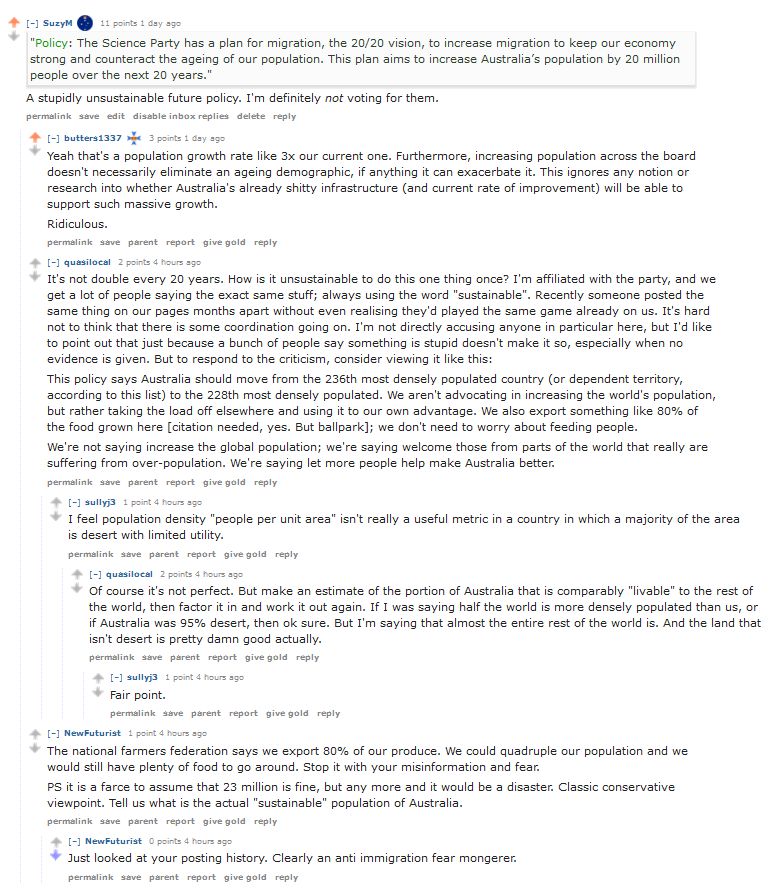
Their form of government seems based on a technocracy – not sure if that is a good thing or not. It seems to assume that humans will act a lot more rationally than they do in reality.
There has been a salmonella outbreak on some pre-packed lettuce products. I bought one of those on Monday, and ate some each day up to Wednesday! So far I have had no food poisoning symptoms, so if I am still well after the weekend I should be OK, I hope. I did wash the lettuce leaves before eating them.
Tuesday 9/2: Jade armor; Star Wars burnout
I still have no food poisoning illness, so I seem to have dodged a bullet with that salad salmonella outbreak.
I watched a documentary on SBS called “China – Treasures of the Jade Empire” (part of the BBC Secret History series). I like historical documentaries on Asian countries, particularly anything regarding warriors and emperors and such. This featured some wonderful jade burial suits that some in royalty were buried in. Dad had a book on a Chinese exhibition long ago (1970s) and I remember seeing photos of these suits in it.
I don’t think I can be bothered going to see the Star Wars movie, The Force Awakens, in cinema. It has been talked about, over-analyzed and hyped so much that I am just tired of hearing about it. I have read the novel and know what happens. It seems more like a carefully-planned marketing exercise to appeal to fans and sell merchandise – this Reddit comment expresses this dismay:
This is what kills me. From a business perspective it’s a no brainer. The merchandising is the gold mine. They could not make any Starwars shows or movies ever again and still be set financially because of the unlimited potential of making Starwars themed stuff. I’d do the same thing if I owned the franchise. You’d probably do the same. If not for your own enrichment then for the sake of using that money for the betterment of the world (charity, technological or medicinal research, what have you).
But from a fan’s perspective it all feels so cynical. I don’t feel like it’s my franchise anymore. The oversaturation of just Starwars themed stuff makes me want nothing to do with it. So much of this stuff seems to have little imagination or thought put into it. Starwars band aids. Starwars make up. Starwars tooth brushes. Starwars toe nail clippers. Starwars water. It all feels so coldly calculated by a marketing firm instead of people who care and put thought into what kind of stuff would be worth tying into the franchise.
I can’t fault or criticize them from a business point of view (unless there’s an argument to be made that oversaturation will eventually lead to exhaustion and have unintended harmful consequences to the IP), but it sucks being on the receiving end of the marketing push. Knowing that I’m the target demographic for this shit. People who grew up with Starwars and whose childhood birthdays and Christmases were largely shaped and defined by asking for and receiving Starwars action figures.
I also wonder the effect this all has on collectors. Do they see this stuff and buy everything they can get their hands on? Are they selective about what is worth picking up and what isn’t? Growing up I remember always walking straight to the toy isles at target and Walmart and trying to convince my family to pick me up a new Starwars figure on every trip. I still sometimes feel that pull when I’m out and about and see the new ones and then have to remind myself that buying that shit is a neverending black hole. Can’t imagine what it’s like for collectors and parents of kids who see this stuff every friggin place they go. Not just the toy isles but the friggin medicine isles, food isles, pet food isles. For f*ck’s sake.
And I know that this is nothing new. It’s always been this way from the beginning. But the criticism still applies just as forcefully with every new Starwars generation. I’m not even sure what I’d want to see happen. Less Starwars stuff maybe? I feel like my main disgust is that something so meaningful to my childhood becomes so watered down and so oversaturated that when you see it plastered on f*cking toilet paper it somehow loses it’s value and meaningfulness. Like the stories aren’t being told to convey some important anti imperialist message (with the prequels) or a classic coming of age story (originals) but just some so so movie made with the explicit purpose of being the vehicle by which they can just sell more stuff.
– Snow_Mandalorian
Friday 12/2: Gravitational waves detected
Gravitational waves have been positively observed for the first time, these from two black holes colliding and merging 1.2 billion light years away/ago.
Funnily enough, the first time I recall learning of them was in the movie Event Horizon, back in 1997 – an extract from the script:
WEIR: What you saw could have been an optical effect caused by gravitational distortion.
COOPER: (turning on Weir) I know what I saw and it wasn’t a f*cking “optical effect!”
MILLER: Hold on, what’s this “gravitational distortion?”
WEIR: It’s possible that a burst of gravity waves escaped from the Core, distorting space-time. They could be what hit the Lewis and Clark.
The effects of the wave were exaggerated a bit in the movie, though – in reality it distorts less than the width of an atom!
An r/worldbuilding post linked to a Guardian article, “How to survive a global disaster: a handy guide.” Of some interest is point number 2:
2. You need to go rural … but not too rural
You were probably expecting this, but let’s make it clear anyway. Cities are wonderful when everything is functioning but, as The Walking Dead made clear, they’re lethal when there’s no order, electricity or infrastructure. “If you stayed in the city, you’d be in more danger, there’s no doubt about that,” says Ahmed. “Generally speaking, when academics have run these scenarios on predictive models, cities are found to be extremely vulnerable simply because there are so many supply chains that are interdependent, and so many people there with you who are also dependent on these supply chains. People will be competing with each other for these scarce resources, which creates violence.”
However, the other extreme – total isolation – may also not be a good idea, for the reason given above. You need a group of differently skilled people who can work cooperatively in order to build your own supply chains and flourish. So, we’re talking ... small market town? “Yes,” says Ahmed, not altogether seriously. “Ideally you’d want to be somewhere in Kent.”
Which reinforces my desire to not live in an inner-urban area! High density be damned, and the people who promote such a way of living (the r/melbourne and r/australia subreddits seem to see densification as the solution to all ills, and downvote anyone who speaks against it).
“Australia’s population hits 24 million faster than expected,” The Age, 12/1 (warning: annoying auto-playing video). Very dismaying news, especially as Melbourne is the worst-affected when it comes to population growth: “Melbourne is projected to become Australia’s most populated city by the mid-2050s.” It certainly won’t be “most livable” by then.
The weather has been mercifully mild – mid-to-high 20s – if a bit humid, but it is bearable. Perth, in contrast, had four consecutive days over 40°C. Hopefully we won’t get it next! Weather bands tend to move from west to east across the southern end of the continent.
Saturday 13/2: Samurai fashion
I wish this would become mainstream fashion: traditional Japanese clothing styles reimagined for the real world (1, 2). I love the look of Asian-style traditional clothing; it hides the figure and is flowing and comfortable. Much of modern mass-produced clothing is so ugly and utilitarian.
Reddit post: “Japan must let zombie companies die.” I found the article linked to in this quite annoying, particularly the last rather presumptuous paragraph: “If Japan wants to generate long-term growth, it needs to allow creative destruction. New companies can’t grow when they are blocked by failing incumbents. The aspiring entrepreneur watching cartoons on his TV at Waseda University must be allowed to do his thing. Japan’s cycle of bailouts must end.” That ideology also leads to job insecurity and unemployment. A counter to this economic doomsaying is a 2012 New York Times article, “The Myth of Japan’s Failure.”
Part of what is going on here is Western psychology. Anyone who has followed the story long-term cannot help but notice that many Westerners actively seek to belittle Japan. Thus every policy success is automatically discounted. It is a mind-set that is much in evidence even among Tokyo-based Western diplomats and scholars. […]
Economic ideology has also played an unfortunate role. Many economists, particularly right-wing think-tank types, are such staunch advocates of laissez-faire that they reflexively scorn Japan’s very different economic system, with its socialist medicine and ubiquitous government regulation. During the stock market bubble of the late 1980s, this mind-set abated but it came back after the crash.
Tuesday 16/2: Too many too fast; job insecurity
“Bob Carr calls for Australian immigration to be cut by one-half,” The Age, 16/2. This in response to the unwelcome news that Australia’s population reached 24 million, faster than expected. I would cut it even further, to match the emmigration rate. There are simply too many people coming here too fast, and the infrastructure is not coping, and realistically governments will never keep up with demand. The population increase, mostly in the major cities, is also making life more stressful and unpleasant generally.
Relevant Reddit thread at r/Australia. Some agree with him, but a few display the usual group-think of promoting high-density tower living as desirable; it seems to be an obsession with the younger people in the Australian sub-reddits.
A current affairs program, The Drum, featured a brief report on Workplaces of the future (video link only at the moment) – “Job security is over” asserts the woman in the video. This is the hateful trend of casualization of the workforce, with the accompanying job insecurity and exploitation. It is a model supposedly embraced by younger generations who move from one temporary job to another and is a lifestyle that supposedly fosters “innovation” – employees who can’t cope are fired. Everything that unions fought to gain over the last few decades – balanced working hours, job security – has been eroded, and mimimum wages are in the firing line.
This is the mentality behind the “Innovation Nation” Liberal government strategy announced with great fanfare by PM Malcom Turnball that will supposedly foster young entrepreneurs by handing out taxpayers’ money to investors in the hopes that some are successful. I find the scheme dubious and it will surely be exploited by some for the worst.
I have been digitally recording some family trees and history, which is a tedious task. In 2000 I did a bit of family history research, typing up some trees – done on an electric typewriter as I did not have a computer then! The worst part is trying to find a structure to display a tree – this is difficult to visualize in HTML. I don’t want to use proprietary software (don’t have any family tree programs, anyway).
Thursday 18/2: Family tree rendering notes
I have been working on translating my family tree notes to web page format. I have tried HTML tables, but these are too unwieldy and complex. Nested lists work better, though these are horizontal in display – a snippet below:
- m. (2) Cole, Frederick □
- Cole, Frederick Cole Jnr. m. ?
- Cole, Doreen ○
- Cole, George □ m. ?
- Cole, Patricia ○
- Cole, Anthony □
- Cole, Nellie ○
- Cole, Frederick Cole Jnr. m. ?
The square □ represents a male, the circle ○ a female (see Gender symbol at Wikipedia).
There is also the option to use the <pre> tag (preformatted text), which preserves text spacing and is read vertically:
                 |  m. (2) Cole, Frederick □
                 |   |
                 |   +---------------------------------+-----------------------+
                 |  Cole, Frederick Cole Jnr. m. ?    Cole, George □ m. ?     Cole, Nellie ○
                 |   |                                             |
                 |   +                                  +--------------------+
                 |   Cole, Doreen ○                    Cole, Patricia ○    Cole, Anthony □
One important issue I found with rendering <pre> text is not to use the keyboard tab key – browsers treat spaces from tabs and spacebar spaces differently, and the layout will be messed up if both are used.
I can also create a webpage for each person and record more details on it. HumphrysFamilyTree.com has some thoughts on using hypertext to record such data.
Sunday 21/2: No more Herald-Sun; Space Cadets
I was rather annoyed to see that access to the Herald-Sun newspaper via my State Library account was no longer available; as the H-S site is subscription-only, the library account was a way of getting round this (see this Whirlpool forum topic and this PressReader blog post). The H-S is, admittedly, little better than a tabloid (it belongs to the much-reviled Rupert Murdoch) but it sometimes had some useful news, and the Letters page.
The weather has been pleasantly cool the last couple of weeks; unfortunately there are some hot days coming up to remind us that summer is not over yet! 37°C predicted for Tuesday, but cooling down again the rest of the week.
Doing my family trees had me thinking, I rather wish Western culture had the formal tradition of ancestor veneration, as some Asian cultures still maintain to a degree (Japan, China). It would give one a sense of connection with the past and reassuring ritual.
“In space no one can hear you dream,” Dwayne Day, The Space Review. A critique of mass entertainment’s presentation of near-future space exploration as difficult and dangerous – a contrast to the near-religious fervor that space enthusiasts demonstrate when discussing colonizing space. He does note (as I earlier have – e.g. 4/1/2014 entry) the strong analogy of space colonization with religion.
These religious aspects can be found throughout the writings of spaceflight advocates, the self-styled missionaries of the spaceflight religion. One of the most common arguments for space settlement is to achieve immortality for humankind by moving a portion of humanity off of Earth in event of catastrophe. The Space Review regularly publishes these kinds of appeals to transcendence. The advocates argue that humankind could be wiped out by natural disaster–typically a meteor strike–and settling the Moon and Mars would help avoid the species being wiped out. Other threats include manmade ones like war and environmental destruction. Often lost in these arguments is the fact that settlements in space would be highly vulnerable to human threats and simple mistakes. After all, blow an airlock and your Moon colony could suffocate; break the water purifier and the Mars base could die. Space is indeed a harsh mistress, with death much more easily possible than on Earth.
But beyond simply the ability to achieve immortality for humanity, there has often been a utopian aspect to space advocacy, a belief that space settlement will allow for the creation of new societies, coupled with a belief that these societies will be better than those on Earth. Robert Zubrin has advocated a version of this vision, claiming that the challenges of settling Mars will produce incredible technological rewards and a renewal of the American spirit. Many other space settlement advocates believe that space settlements offer the opportunity to throw off the shackles of oppressive government and start a new society, with fewer rules and a fantastic view of the lunar surface. As author Charles Stross noted six years ago, this view is often tied to mythology of the settlement of the American West, and a mistaken understanding of just how inappropriate that analogy is.
Any one expressing skepticism on the notion of colonizing space is treated as a heretic, and the topic brings out the indignant defenders of their religion.
One amusing comment listed the “Space Advocacy Bingo”:
Check off your card if you hear the argument …
- Lunar Helium-3
- Solar Power Satellites
- Zero Gravity Manufacturing
- Platinum Group Metals
- Evolutionary Imperative to Explore (Darwin in Spaaaaace!)
- Societal Imperative to Explore (Magellan in Spaaaaace!)
- Economic Imperative to Explore (Columbus in Spaaaaace!)
- National Imperative to Explore (Manifest Destiny in Spaaaace!)
- Space Race II, Yellow Peril Boogaloo
- Obama Killed the Shuttle!
- Loss of Will (National, Political, Millennial)
- Nitpickers and Beancounters ruin everything, this is all about VISION!
- Famous Space Skeptics (Proxmire/Mondale/Van Allen/Park etc.)
- Free Enterprise to the Rescue
- The Sun’s Going to Burn out in Only Four Billion Years, Better Hurry
- Spinoffs (The Space Program Gave Us Fire!)
- Airbreathing Launchers
- Nuclear Pulse Rockets (Orion)
- Ion / Electric Engines
- Inspiring Children
- Limits to Growth on Earth
- That Asteroid is Worth $10 Trillion!
- Science Fiction used as justification
- Thought experiment used as justification
- Nonexistent technology used as justification (“we should just develop a space elevator and then it will be easy!”)
- We did it already, it shouldn’t be so hard
- We Shouldn’t Care About Fatalities In The Space Program (aka “NASA is a bunch of wusses!”)
- Economies of Scale Will Bring Launch Costs Down
- Space Industry Doesn’t Pollute, so We’re the Real Environmentalists Here
- Military Use of Space (Rods From God)
- They laughed at Columbus/Galileo/Magellan/Amundsen
- If Only NASA would do better science/engineering/PR/get-out-of-the-way
- $ASTRONAUT says this is the only way
- Nixon killed Apollo
Double points if you add a quote from Jerry Pournelle or Rand Simberg in any context.
An earlier article, “Cargo cult exploration,” argues that sending humans into space is redundant in a lot of cases (an opinion guaranteed to really annoy the Space Cadet types!):
But the idea that human spaceflight is important because important explorers have always gone places to emplace their flesh in order to emplace their awareness and power is pretty simplistic. It’s cargo cult exploration. We do a lot of what should be called human space exploration right now, putting extensions of human eyes, and to some extent human hands, on other worlds. We do this without putting humans on rockets. Many of these human explorers are sitting in office chairs in Pasadena, driving rovers on Mars and watching over missions at the far reaches of the solar system. In the future, we may find that astronauts safely aboard a habitat orbiting an exploration site deep in a dangerous gravity well are needed to achieve virtual presence there, operating sophisticated electromechanical surrogates on the surface in near real-time.
Which provoked indignant (and unintentionally amusing) comments such as: “This is the most ridiculous article I’ve ever read on Space Review! We are physical beings and, as such, we need to physically explore the universe. If we just use robots and avatars then we might as well just be another episode of The Matrix. Please, no more articles by Dr. Lester.”
Um, I have no “need” – certainly not with the technology we have now. Perhaps if we had FTL spaceships and some habitable alien worlds I would go for a look (though not to live)!
Thursday 25/2: Feral menace; Snow Flower
There was a story on 7:30 Report last night featuring some feral cats being shot by hunters with bows and arrows. One of the hunters has received a lot of hate mail as a result. I am not sentimental about feral animals, so I find the fuss over this exasperating – they are a real menace to Australian native animals, killing thousands each year. Feral cats are vicious creatures and culling them is doing the environment a favor. Domestic animals (and feral descendants of these) are second only to humans in the environmental damage they cause.
I finished a novel called Snow Flower and the Secret Fan, by Lisa See. I found it quite compelling in its depiction of the closed-in traditional world of Chinese village women of that time; one that is intensely physically and mentally inwardly-focused rather than outward to the wider world. Women had very restricted lives and were considered worthless (not to mention being forced to endure the extreme unpleasantness of footbinding, graphically described), but still managed to have a rich inner life and friendships. (The author has a page on the writing of the novel.)
The narrator of the story was also presented differently in that she was not the usual woman rebelling against the system who is a stock character in most female-orientated stories these days, but one who is determined to continue her traditions despite the pain they cause her.
Perhaps it resonated because I am older, family is more important to me (though I am still reclusive) and the women being shut away in a room has a little similarity to my situation (I am something of a hikkomori); I have also long been more inward-focused on my internal fantasy life. I have no close female friends my age, something I do wish for at times.
Monday 29/2: Dentist dread; summer’s end
I have a dentist appointment for next Monday for a checkup and clean – and hopefully no other problems. My teeth are very coffee-stained (though I rinse my mouth after, and don’t put sugar in my coffee). I will be dreading it as usual – another cavity would feel like a moral failing for me, given that I am diligent in cleaning and have improved my diet a lot.
Last day of summer today! Some warm weather ahead still, though. I was thinking that without modern technology and comforts, the approach of winter would be something to dread – moreso in Europe, which has much more brutal winters than Australia.
March
Monday 7/3: Teeth OK, this time; summer not over
My dental appointment went well; no cavities this time, so another reprieve. Cleaning them took 30 minutes or so; the dentist said the brown staining was likely from the mouthwash I was using (Colgate Plax), which is a bit frustrating! I had the same problem with another brand (Dentyl) some years ago.
Someone on an eating disorders forum posted a photo of their teeth that are wrecked after years of bulimia – I saved it as a warning to not let myself go down that path:
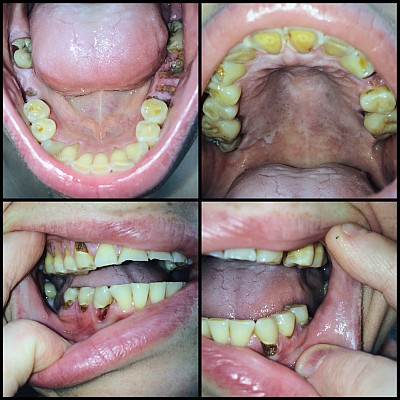
This is what approximately 13 years of purging on a very regular basis, combined with poor nutrition, does to your teeth. Only for the first two-ish years of my eating disorder did I not purge, and prior to that I was already experiencing gum recession. Yes, it’s disgusting. Yes, it’s ugly. Yes, it’s very very painful. And no, it doesn’t matter that I have good dental hygiene (and I do). This is what happens. This is what WILL happen if you don’t get some fucking help and take care of your teeth. Most of my teeth aren’t salvageable by this point; there’s not a single one that doesn’t have some degree of damage to it. I’m 30 and I’ll need dentures in the near future. Fun times.
I am thankful that I did not “discover” purging (through vomiting) during the time I had an eating disorder in my early 20s.
Just when I thought Melbourne had escaped the summer heat, all this week is forecast to be humid and warm to hot – night temperatures in the 20s, daytime in the high 20s-low 30s. Very unpleasant and sweaty!
The U.S. Presidential elections are held later this year (as is the Australian Federal election) – on 8 November (a day before my birthday!). I very much hope that Bernie Sanders will win, as his politics (Left socialist democratic) are kindest to the disadvantaged. However his Democrat rival Hillary Clinton seems more likely to, sadly – though she would still be preferable to any of the Republicans.
Wednesday 9/3: Heatwave; street tree gone; suicide rise; malevolent dentist
Last night was the hottest March night in Melbourne on record, close to 30°C. So much for escaping a heatwave this summer! It just came later as a nasty surprise.
The Claret Ash street tree next door, outside my bedroom window, was felled by local council workers yesterday. It was old and had been poorly and savagely trimmed so many times that it was almost splitting down the middle – it was under powerlines. It was sad to see it go as it had been there for decades; all my life so far. I will miss its deep mahogany autumn colors. It was one of the street tree varieties deemed unsuitable and targeted for removal. In one of their Street Tree strategy documents (from 2007), four trees I like are designated as “Problem Trees Species” (table below reproduced from the PDF document):
| Problem Trees Species | Recommended Replacement Species | |||||
|---|---|---|---|---|---|---|
| Species | Common Name | No. | Undesirable Characteristics | Replacement Species | Common Name | Benefits |
| Fraxinus excelsior ‘Aurea’ | Ash | 576 | Aggressive Roots / Infrastructure damage / Rapid decline and dieback/suckering habit |
|
|
|
| Liquidambar styraciflua | Sweet gum | 579 | Aggressive Roots / Infrastructure damage/ Suckering nature of roots | Acer platanoides | Norway Maple |
|
| Melaleuca sp. | Paper bark | 6338 | Aggressive Roots / Infrastructure damage Issues with shed leaves/debris | Tristaniopsis laurina | Water Gum |
|
| Prunus | Flowering Plum (pink blossom, red leaves) | 4819 | Short life / Poor branch and stem attachment / Soft wood and rapid decay development | Acer platanoides | Crimson Sentry (red leaves) |
|
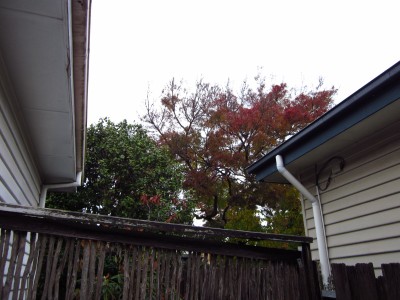
Street tree next door, in Autumn 2014
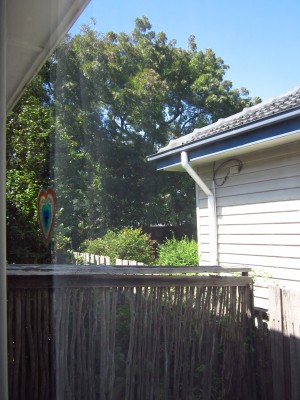
Street tree next door from inside my bedroom window, before it was felled that day on 8/3/2016
Street tree gone, 8/3/2016
“Middle-aged Australians drive rise in national suicide rate,” The Age, 9/3. Our society is getting meaner and more selfish no thanks to the prevalent Neoliberal ideology, so a rise in the suicide rate generally is not that surprising, sadly.
A malpracticing dentist who is on trial in France is like a character from a horror movie; he has wrecked a lot of patients’ lives. As a patient you naturally trust that the dentist you see will do their best for you, so this sort of crime exacerbates one’s dental phobia.
Tuesday 15/3: Creative block (still); violent young males
I have been feeling mentally and creatively dead for quite some time; I have not done any pencil drawings since early last year, and have barely used my graphics tablet in the last few months. All I do is sit at my computer and click through webpages, rather like a gambler sitting numbly at a poker machine. My worldbuilding project and story have been stalled for some time; I have spent too much mental energy fretting over which program to use to store information (see 15/9/2015, 21/9/2015 entries). I still want to develop it but feel like I am at a dead end at the moment, and it is frustrating as I feel I am wasting time, and my life generally. I have no ambition and nothing I want to do.
There was a pre-arranged street brawl by “ethnic gangs” on Saturday night in Melbourne’s CBD. The perpetrators were young males (not surprisingly). This unruly behavior should not be tolerated no matter what the youths’ circumstances, but it is not an isolated incident. Co-incidentally, the New York Times had an article a few days ago: “The World Has a Problem: Too Many Young People.” While governments have focused obsessively on the supposed disadvantages of an aging population, a surplus of youngsters is arguably more problematic. There are simply not enough jobs for them all, especially with increasing automation, and their frustration can lead to crime and violence. I will again link to my 5/12/2012 Blogger entry on this topic, which is fairly brutal in its implications.
Tuesday 22/3: Easter ahead; arrogant Apple
Had some hot weather last Wednesday and Thursday – though not as bad as the previous week – then a very windy day on Friday which wreaked the usual havoc around the city. This rough weather seems to be much more frequent now. This week is to be more pleasant. Hopefully the worst of the heat is over?
Easter this weekend. Over the last year I have managed to wean myself off having a daily chocolate snack and cake for the most part, so I won’t be getting or wanting any Easter eggs (though I might have a couple of hot cross buns on Good Friday).
There was a launch of some new Apple products today, though nothing especially exciting: a smaller iPad Pro and a smaller iPhone 7. All of which are unaffordable for me, so my interest is just academic :-(. There was a rather insensitive comment by a presenter at the event: “There are over 600 million PCs in use today that are over five years old. This is really sad, it really is.” An opinion piece takes exception to this, and I agree.
Few people would actively choose to use an older PC if presented with a newer one for free, but computers – especially Apple ones – cost a lot of money. There is nothing wrong about keeping an old computer working, unless Apple thinks not wanting to or being able to spend hundreds or thousands of dollars on a new computer is something to be ashamed of.
I have been keeping a dream diary on my offline site, so I haven’t been recording them here anymore. I have been more regular about recording them this year; before I only did this sporadically. My dreams are mostly, and not surprisingly, comprised of people and places relevant to me and my life, so they probably are not of much interest or meaning to others.
April
Thursday 7/4: Capitalist indoctrination; welfare-bashing
There was a report on ABC News last night about a holiday school program to give “primary school student entrepreneurs a head start … They are being taught basic business skills, 3D printing prototypes, web design and mobile app development at a course run in Melbourne by innovation consultants, Collective Campus.” My immediate gut reaction to this was a feeling of dismay; children are being taught to be cynical opportunists and become snared in the capitalist corporate culture where making a profit and accumulating stuff is the ultimate goal in life. It is the same disagreeable philosophy as the “Innovation Nation” strategy mentioned back in my 16/2 entry. Not everyone has the ability or desire to become an entrepreneur. I detest living in a civilization whose ultimate purpose is the mundane activity of buying and selling – the adulation of greed. I hate it that CEOs are regarded as idols to be emulated and looked up to – some older cultures regarded the merchant class with distaste and I wish we could adopt that attitude.
The latest disgusting propaganda piece in the Rupert Murdoch-owned newspapers’ war on the unemployed: “A quarter of all dole recipients shirking appointments and jobs.” Available online, surprisingly – though perhaps a deliberate move to encourage outrage (copy saved here). According to one commentator on the Australian Welfare News Facebook page: “Media push on right now against unemployed people: Sunrise, Today, Courier Mail, Herald Sun, Daily Telegraph, and probably a few more I haven’t found yet.” The unemployed seem to be regarded as almost criminals. I am sure many conservative Liberal voters would be happy to see the unemployed and welfare recipients foraging through garbage dumps to survive rather than get the dole. They ought to direct their anger towards the wealthy avoiding taxes (the current Panama Papers scandal).
I still feel creatively dead (15/3 entry). Feel like I am wasting time but I am just unmotivated and lethargic.
Saturday 9/4: Weight watching; body hate
I now frequently visit an eating disorder support forum called MyProAna. I am a member but mostly lurk. There is a lot of nonsensical media hysteria about supposedly pro-eating disorder sites on the Internet, but it is a safe place for people with such issues. Reading through what some of the members endure serves as a warning to myself not to let myself go down that path – mainly binging and purging (via induced vomiting or excessive use of laxatives). My only “purging” is through exercise, which is arguably less damaging – and it was thus when I had an eating disorder in my late teens/early 20s. I am somewhat restrictive in my eating now, but not to an extreme – I am not dieting as such (as in going on a specific eating regime, most of which are unsustainable in the long term). I don’t fast or skip meals – people who do this tend to binge in compensation. Though if I could eat whatever I wanted and not put on weight, I probably would indulge. My weight now is around 50kg which I am comfortable and look better at (compare with 11/9/2007 and 5/3/2013 entries), though I have to be wary of my tendency to comfort-eat – I have to consciously maintain self-control. The last time I was this low was in my 20s; then weight crept on again over the years. I don’t want to outgrow the smaller clothes I bought!
I have been following posts by a user named bittergreen. Some of what she writes is a mirror image of how I feel, and of some aspects of my life:
Posted by bittergreen on 03 April 2016 - 01:08 AM in Anorexia Discussions
I’m 31 and probably supposed to be a grown up, but honestly I’m still just a terrified kid. I hate and fear most things about being an adult and my mental health issues have ended up exempting me from many of them. I hate to say it, but I really do fit the stereotype of anorectics being afraid of growing up. I’m afraid of taking responsibility for myself and have no idea how to do so. Other than no longer living with my parents, there’s not much about my life that’s very adult-like. I’ve been on disability assistance for 11 years due to the severity of my mental health problems and thus don’t have a job, I never bothered to learn how to drive a car, I mostly find sex creepy and disgusting and the idea of being a sexual person horrifies me, I most certainly will never be having children because I have a major pregnancy/childbirth phobia … I’m pretty much just a kid in a body that keeps getting older. I have no idea how to function as an adult and I mostly don’t want to do so. And yeah, puberty was a MAJOR trigger for my eating disorder. It utterly horrified me.
It’s kind of interesting, thinking back to when I was a kid … I’ve realised that as a child, even though logically I knew I would grow up, on more of a gut level, I think I truly believed I would never actually become an adult. That was something that happened to other people, like horrific car accidents or getting cancer or having your house burn down. But it wouldn’t really happen to me. And in many ways, it hasn’t.
6. Do you feel like puberty or developing into an adult played a minor or significant role in your developing your disorder?
Ohhhhh hell yeah. Puberty disgusted me beyond belief. I’ve always abhorred the idea of having an adult female body. The words ‘woman’ and ‘feminine’ and ‘curvy’ and similar things make me want to puke. I remember around puberty I started getting waves of deep, overwhelming shame, often around my family, but just in general as well. When I began starving myself and lost some weight (I was never overweight; highest pre-ED BMI was 20.5), I recall that the waves of shame lessened and eventually stopped. I remember being so thrilled when I lost my period (and didn’t get it for over seven years), and I miss when I was really emaciated and had essentially no boobs. My ED was in part a way to control that feeling of repulsion. So yeah, puberty definitely had a huge impact. I’m in my 30s now and still can’t tolerate the idea of having an adult female body. Even a child’s female body isn’t my ideal, although I don’t want to be a guy, either. I just want to be sexless and genderless. Breasts disgust me, hips and curves disgust me, the idea of reproducing disgusts me, even sex pretty much disgusts me. I wish I could get my breasts removed and have an elective hysterectomy.
I definitely have issues with my sex and gender (although I don’t identify as trans or anything, and it’s mostly okay if people perceive me as a biological female), and puberty was a major trigger for my ED. It has very much been a way to deal with my discomfort surrounding the obviously feminine parts of my body. At my lower and lowest weights, I was essentially flat-chested. I was very glad that I had no real boobs, that I lost my period (although I ended up with severe osteoporosis as a result, because I didn’t menstruate for over seven years), and that I was just straight up-and-down with no grotesque lumps and curves. Honestly I just want all the feminine parts gone. Even the internal ones that have nothing to do with weight and appearance, like my uterus. I would get an elective hysterectomy and have my boobs removed if I could. I cannot express how much having an adult female body horrifies me. It’s not that I want a male one either … I just want to be plain. Genderless. Sexless. It all disgusts me. I dunno what’s up with me, haha.
Issues with my sex/gender are far from being the only catalysts for my ED, though.
Posted by bittergreen on 16 March 2016 - 08:09 PM in General Discussions
Yeah, I do. In terms of my ED, because I have a long history of being severely underweight, I feel like a failure because I haven’t been extremely low in many years now. My body can’t tolerate what I used to put it through to even one tenth of the degree it once could, so here I am hovering in a normal weight range but with my health still f*cking completely falling apart. And in terms of general life stuff, I feel like a failure because thanks to my mental health issues, I never finished my schooling, I haven’t had a job in 12 years, I’ve been on disability assistance for 11 years, I have almost no life whatsoever … the list goes on.
I hate, and have always hated, the reproductive aspect of being female; it is messy and painful and repulsive. If I could get rid of my organs without physical consequences I would. If I ever got breast cancer I would get a double mastectomy and not have them reconstructed. I hate how over-sexualized the society I live in is (see 10/1 entry). I suppose most would regard such thinking as mentally disordered, but I am fine with it. I still identify as female mentally and physically – I don’t have any gender identity issues, and certainly don’t want to be male – but would like my body to be neutral in appearance. I miss the slim smooth body I had as a child; the onset of adolescence ruined it.
I think that all I want now in life is stability, some form of financial support (such as a Basic Income), and access to health care and the Internet. I have no hope of a fulfilling career now.
Wednesday 20/4: Autumn colors; election dread
My favorite season of the year: Autumn colors are now appearing. A few random photos of deciduous trees around my neighborhood:


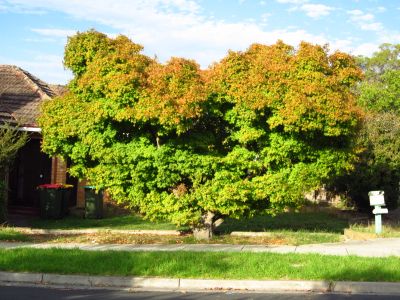
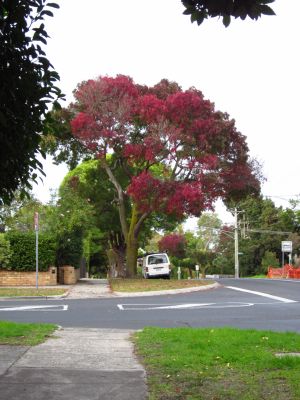
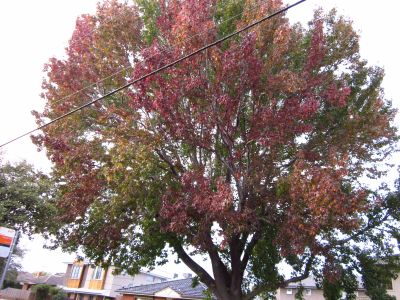
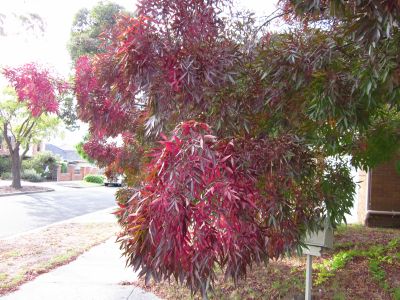
From left to right (or top to bottom): Golden Ash, Ornamental Pear, my favorite Japanese Maple soon to turn red; Claret Ash; my favorite big Liquidambar street tree; Claret Ash.
There are no vivid color displays like those in parts of the USA (“Fall” over there – which is probably a more accurate season name!). According to Wikipedia, going to see such displays is called “Leaf peeping.” I would love to see those for myself!
To more mundane and depressing news: the next Federal election has been set for 2 July. I am dreading the prospect of the Liberals being returned, seeing the damage their government has already done with cuts to such areas as health and welfare. Yet they can find $50 billion to spend on new submarines! Preparing for a potential invasion, however, seems rather pointless when our traitorous government is allowing land to be sold to foreign investors and corporations (the Kidman cattle landholding being one of the latest).
Tuesday 26/4: Yet more welfare-bashing
Another disgraceful attack on the unemployed – so-called “dole-bludgers” – from the tabloid Herald-Sun (can’t link to it online, so this comes via Australian Welfare News Facebook page) (see 7/4 and 11/1 entries for the previous):
Dole bludgers used medical loophole to avoid getting work
April 25, 2016 11:30pm
Simon Benson
National Political Editor
News Corp AustraliaDepression, muscular-skeletal problems and drug addiction are among the most common conditions used to avoid working.
MORE than 70,000 dole bludgers are exploiting a medical loophole to avoid having to get a job by claiming they are too sick to work.
In some parts of Sydney and the Central Coast more than 50 per cent of all dole recipients use GP sick notes to claim they are too unwell to hold down a job.
An investigation by the Department of Human Services has uncovered what the Turnbull government believes is widespread rorting of the medical loophole by some dole bludgers, as well as unscrupulous GPs.
The most common conditions that are used to avoid working include depression, anxiety, muscular-skeletal problems, drug addiction and alcohol dependence.
The figures, obtained by the Herald Sun, reveal almost 8 per cent of all Newstart, youth allowance and single-parent payment recipients use GP medical certificates to get around mandatory jobseeking requirements.
They are all welfare recipients who are deemed not to be sick enough to receive the Disability Support Pension.
Alarm bells were raised recently when data from the Department of Human Services discovered so-called “hotspot” suburbs and regions where authorities now suspect that scammers are shopping around for medical certificates.
The Central Coast leads the nation in the number of dole recipients claiming to be too unwell to seek a job, with 55.8 per cent claiming an exemption through a GP’s medical certificate.
Human Services Minister Christian Porter has ordered an immediate crackdown. Picture: Colin Murty
Sydney’s inner west – which includes suburbs such as Marrickville and Balmain – came in third with 30.4 per cent, just behind Brisbane with 30.8 per cent.
With the Budget facing a massive $190 billion welfare bill by 2020, Human Services Minister Christian Porter has ordered an immediate crackdown on the dole scammers – and has also threatened legislation to deal with the rorting.
One option being considered is using government doctors to assess people’s fitness to find work, as was done with the Disability Support Pension.
“I will not accept one urban suburb has eight times more illness than another,” Mr Porter said.
“It appears some people are taking advantage of the system at the expense of the taxpayer, and it has got to stop.
“A genuine medical condition such as depression that creates a temporary inability to search for work is one thing, but it is not reasonable to accept that some regions have eight times more people that have such severe anxiety or depression that they are unable to look for work.”
There are 727,778 people claiming Newstart – only slightly fewer than the 824,470 people who claim the DSP.
Another article on eating disorders in Japan. I don’t agree with promoting “plus-sizes” though! That is an unhealthy ideology that should be rejected.
The weather has been clear and sunny; nice Autumn weather.
May
Thursday 19/5: Uninspired; iTunes exasperation; election dread; dreaming of elsewhere
Half the month gone already! I have been in a depressive slump, so have not felt much like writing. I had thoughts of deleting my website again, but reinstated it. It sometimes feels like a burden, but it is still my personal home on the web, more so than my social and forum accounts scattered about.
I have been trying to organize the books in my iTunes library, but it is a nightmare to figure out – I still can’t fully understand it even after a few years of using. There is the library on my PC, and the one on my iPad 2, and the PC library will erase the iPad 2 library if synced; a stupid usability feature. I have a muddle of different books on both and trying to organize them is headache-inducing.
Australians are being bombarded with the Federal election campaign (though it is not as long as the U.S. one). I am dreading the prospect of the Liberals being returned, given the damage they have already done to social services and public healthcare (such as freezing Medicare rebates, threatening bulk-billing).
I get very fed up with Australia sometimes (mainly due to the awful Conservative government) and have vague thoughts of what other countries I might like to live in; the only ones that come to mind are Japan and the Nordic European countries. They are generally civilized and I like the latters’ political system (they have a strong welfare system and are generally liberal). Of course, in reality I can only speak English, have no career or skills and thus nothing to contribute – not to mention no money – and would get dreadfully homesick as all my history is in Australia. And every country has its own problems. So that thought remains just a vague daydream.
Friday 20/5: Star Wars thoughts
I watched the new Star Wars sequel, The Force Awakens, on Blu-ray a couple of weeks ago – finally got around to seeing it! Despite my initial enthusiasm last year (17/4/2015, 20/12/2015 entries), I ended up having no desire to see it in the cinema (high ticket prices are also a discouragement – currently $21. Bugger that!). Some thoughts (and I am echoing some fan criticisms):
- Visually, it was impressive – no surprises there! Could not fault the special effects.
- The story seemed very rushed, jumping from one scene to the next. I much prefer the more measured pace of the previous 6 movies.
- If you are not familiar with the story, much may not make any sense – not a sign of a good script, in my view.
- The movie seems like a mashed-up fan fiction of the original trilogy that tried to outdo those – Death Star version 3 (not a mere moon, but a planet!), Maz Kanata, a Yoda imitation (not a mere 900 years old, but 1000 years!).
- There were fan complaints that the worlds shown in TFA were limited in scope, in contrast to those of the prequels, and just imitations of the ones in the original trilogy (desert/ice/forest planets).
I also watched the first two prequel movies (The Phantom Menace and Attack of the Clones) on DVD at the same time; the first time I have done so (I previously have only seen them on TV, broken up by intrusive ads – obviously not the ideal way to watch them). A lot of fans hate them, but I actually quite enjoyed them! They were visually stunning, with a vast and imaginative array of landscapes, creatures and costumes (the first is worth watching just to see Queen Amidala’s lavish outfits). The story was not hard to follow, and even Jar Jar Binks was not too annoying. The special effects hold up well. I would put them above The Force Awakens in terms of story and visual enjoyment.
Thursday 26/5: Julia Boer
I have been watching more high-carb high-calorie videos similar to that mentioned in my 31/1 entry. I have developed an odd fascination with watching these videos; perhaps because I am getting a glimpse of other people’s lives in other countries. One person who has become somewhat notorious is a teenager, Julia Boer, who is only 16 and who has been sucked into the rather cultish vegan diet fad (she is a devotee of two notorious vegan gurus who go by the nicknames of Freelee the Banana Girl and Durianrider – both are Australian, embarrassingly!). She can come across as rude and brusque – and gets a lot of abusive comments. She was of a normal healthy weight a year ago (175 cm tall, 70 kg), but since adopting the HCHC regime has piled on the kilos and now is close to 100 kg.
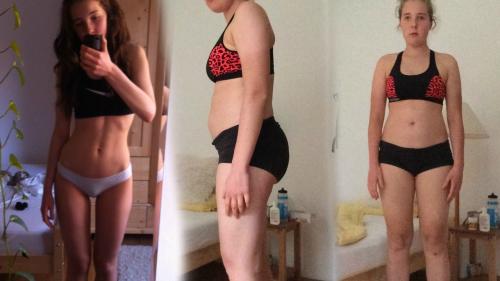
Julia Boer weight gain, 2015-2016
She has had a few unflattering threads about her in the Myproana forum, but I do feel sorry for her as she is clearly naïve, and otherwise seems a nice person (she looked a lot happier in her early social media postings from last year, before her infamy started). She has a YouTube channel, and some other social media accounts. Her diet as such is quite unhealthy (a pile of while rice with sugar and jam is one of her infamous concoctions); she eats 3000-4000 kcalories a day, so it is hardly surprising she is now overweight (she says it is due to “metabolic damage,” which is a nonsensical theory). She denies that her huge intake is causing Below are a couple of calorie count tables from her videos.

Julia’s infamous rice-sugar-jam combo
| Description | Amount | Unit | Calories (total: 3949) |
|---|---|---|---|
| Bananas, raw | 12 | medium (7″ to 7-7/8″ long) | 1260.24 |
| Brown sugar | 50 | g | 190 |
| Dates | 400 | g | 1128 |
| White rice, uncooked | 200 | g | 730 |
| Ketchup | 100 | g | 101 |
| Peas, green, cooked, boiled, drained, without salt | 350 | g | 294 |
| Potatoes, flesh and skin, raw | 1.5 | Potato medium (1¼″ to 3¼″ diag) | 246.02 |
| Description | Amount | Unit | Calories (total: 3971) |
|---|---|---|---|
| Oats, raw, dry | 180 | g | 700.2 |
| Sugar, white granulated | 130 | g | 503.1 |
| Raisins, uncooked | 60 | g | 179.4 |
| White rice, uncooked | 220 | g | 809 |
| Trader Joe’s jam, strawberry, reduced sugar | 200 | g | 303.99 |
| Apples, raw, with skin | 2 | medium (3″ diam) | 189.28 |
| Pears, raw | 1 | large | 131.1 |
| Pasta, whole-wheat, cooked | 700 | g | 1043 |
| Ketchup | 30 | g | 30.3 |
| Tomato sauce, low sodium | 200 | g | 58 |
She lives in Romania, in Satu Mare – it has a nice landscape. I don’t know what her parents are doing. She seems to travel a lot to neighboring countries, mainly Germany.
I find vegans irritating generally; they have the fervor of a religious cult and seem to spend a lot of time infighting, if their communities on YouTube and social media are any indication.
Below are some photos of my typical meals for a day. Breakfast and lunch are much the same every day. As is evident, I am no gourmet cook! I hate following recipes, so my preferred dinner option is to steam a heap of vegetables with some meat (usually chicken) or a processed frozen item (eg. fish fingers as below, or 2 salmon cakes). Also Mum’s dinner cooking, which are recipes, 4 times a week – I can’t accurately count kilojoules in recipes though. My kilojoule count is roughly up to 6000 a day or so (haven’t measured exactly). I am currently around 48 kg. I would love to stuff myself also (I love my carbs!), but like Julia I would expand rapidly!
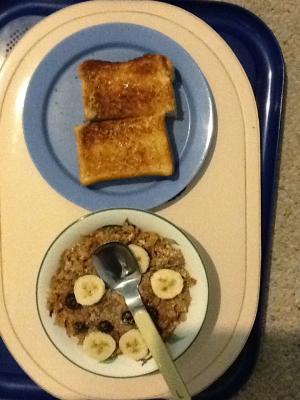
My usual breakfast – my favorite meal of the day! 1 cup Weeties, topped with some blueberries and banana slices, ½ teaspoon bran and teaspoon xylitol for sweetener, and ½ cup unsweetened almond milk. Toast is 1 or 2 thick slices of wholemeal bread, with a scraping of reduced-sugar marmalade. Love my carbs!
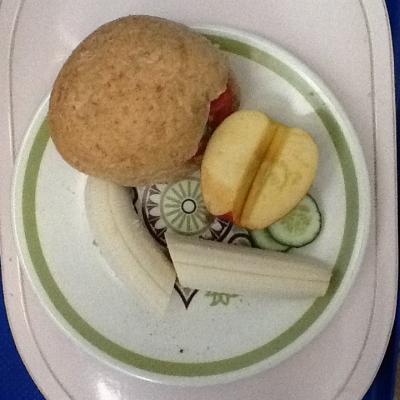
My usual lunch: wholemeal roll stuffed with a chicken slice (sometimes leftover meat instead), lebanese cucumber slices, ½ hard-boiled egg and a tomato slice; ½ an apple and a large banana. I have much the same every day. Up to early 2015 I used to have sweets, such as a slice of chocolate mud cake, but this was a huge amount of calories! (75 g slice = 1073 kJ!) Not surprisingly I was putting on weight then.
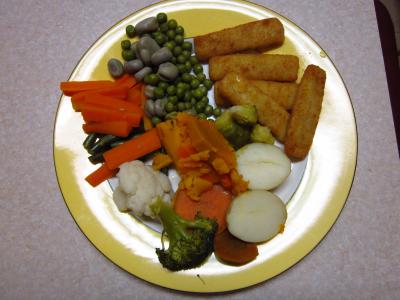
Typical dinner, when doing my own cooking (and not having Mum’s): 5 fish fingers and a heap of steamed veggies. Gourmet cook I am not! (I hate following recipes.) Dessert is a small – 175 g – tub of reduced fat/reduced sugar vanilla yogurt.
Saturday 28/5: Fat scammer
The cold weather has set in. The weather forecast for the next week is single-digit figures for nights, with 5°C on a couple of nights. Makes going out for my morning walk an ordeal though :-(.
One of the obnoxious “fat acceptance” bloggers goes by the user name of “Fat Heffalump.” She was featured in an article about this so-called “movement” I mentioned in my 26/1 entry. I happened to visit her blog today and was flabbergasted by one entry: “Help Get This Fatty to New Zealand!” She actually held a fundraiser so she could attend a dubious-sounding “fat studies” conference:
Well, I’m tickled pink to announce that I have been accepted to present a paper at the 2016 New Zealand Fat Studies: Identity, Agency and Embodiment Conference in Palmerston North in June. My paper, with the tongue-in-cheek working title “Hey! Fat Bitch!” will be on the long term abuse and harassment that fat people (particularly women and girls) face, be it from family, peers or strangers and how that affects our quality of life. But … I need some help. I have been working as a fat activist now for over 7 years without ever seeking any funds from anywhere. So I’m asking if folk can help me get to New Zealand with a GoFundMe campaign. I am seeking to raise the cost of flights, accommodation and the corresponding insurance, plus registration for the conference. Or at least put a significant dent in those costs!
Amazingly, she seems to have raised the money from some easily-scammed readers.
She also has this sidebar notice:
Anyone who trolls this blog with hateful messages and bullying of fat people will have those comments, along with their IP addresses, email addresses and any other details sent to their mothers, employers, school administration and other people I can track down in their lives.
She deserves all the scorn she gets. Like most fat activists she is defensive and angry – well, they bring it on themselves.
June
Wednesday 1/6: Flame tree; winter has come
My favorite neighborhood Japanese Maple has its Autumn colors at last! It seems to have colored late this year.
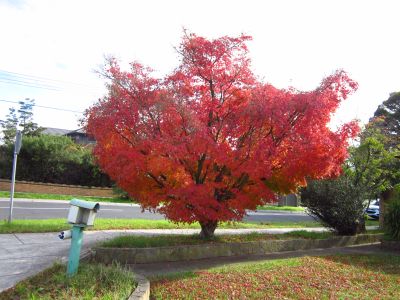
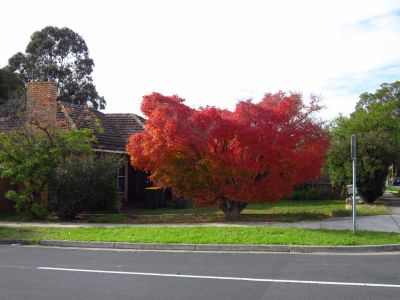
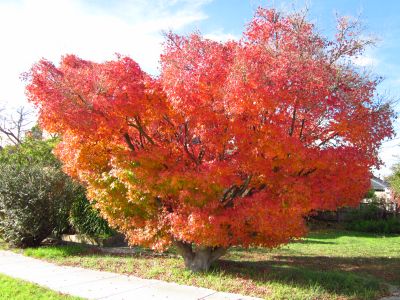
Yesterday morning was the coldest day of the year so far (and the coldest May morning in 5 years) – just below 4°C. And I go out walking in it! I have several layers of exercise clothing on but still get chilled; I can’t seem to generate enough heat. I am stunned to see other people out exercising in this weather in shorts or ¾ leggings and a t-shirt or long-sleeved top.
Tuesday 14/6: Apple letdown; fat opportunity
Apple’s World Wide Developer Conference took place early this morning (3 a.m. Australian time) but there was no new hardware unveiled, dashing many hopes. Not that I can afford any of it, but it is nice to fantasize.
“Increasing obesity levels are giving small business a chance to expand,” The Age, 13/6. I found the implications of this article somewhat disturbing; exploiting what is a very debilitating and expensive social health problem.
Friday 15/6: iPad 2 obsolete; eyes need sunlight
It looks like the next version of the iOS for iPad will not support the iPad 2 – as listed at the bottom of the iOS 10 page:
iOS 10 is compatible with these devices.
- iPad Pro 12.9-inch
- iPad Pro 9.7-inch
- iPad Air 2
- iPad Air
- iPad 4th generation
- iPad mini 4
- iPad mini 3
- iPad mini 2
Which is a bit dismaying as I can’t afford to upgrade to a new iPad (mine was a gift back in 2012). I guess older hardware can’t be supported forever, and the iPad 2 is definitely showing its age, but it still works OK for basic tasks.
I have been nearsighted since I was 13, and worn glasses since then. A theory given in recent years of why myopia has become an epidemic in modern society is that children are not getting enough daily exposure to sunlight as they are indoors most of the day at school and in front of TVs and computer screens, which causes the eyes in those genetically prone to lengthen abnormally. Maybe that explains why my sister and I are myopic, but our parents were not (they were born in the 1930s when there was no television). Sadly, in adults the damage is done and cannot be reversed. I hope there can be some sort of gene therapy to reverse myopia in the future; better than the primitive and sometimes debilitating laser surgery that is the only option now.
Thursday 16/6: Elder neglect
Yesterday was World Elder Abuse Day. Below are a couple of letters from The Age yesterday, one on the subject, the other being on the Liberal Party showing how little they value public health care. I have written about the topic of aged care before (5/1, 12/1 entries) and how dismal the current Western model is; of separating old people from the rest of the community rather than having them interact and participate as they once did in many traditional societies. One aspect I like about Asian societies is the traditional respect for elders, though sadly with the Western influence of selfish individualism this is being eroded.
Community approach
Imagine if it were acceptable to institutionalise babies until they were toilet trained, could eat politely and sit up appropriately in social settings? An abhorrent thought. So why do we warehouse our elderly, who often have similar care needs, when they are near their end of life?
Today is World Elder Abuse Awareness Day. We can have as many of these days as we like but we need to educate a culture of respect for the elderly, starting in primary school years. Many schools, with the best intentions, take children to nursing homes so they can interact with the residents. This teaches them that institutionalisation of our elderly is the norm.
Why can’t the children also see the elderly living where they desire – in their own homes, gardens and the community?
– Catherine Zuluaga, Balwyn
Our health matters
As a pensioner, I am deeply concerned about how and why the Coalition is cutting expenditure on health (“Health matters more than the economy, say over-50s”, 14/6). It professes to exclude pensioners (from these cuts) but this is rubbish. I am a diabetic and have heart problems. My pathologist has told me that the Coalition is reducing services to me. I am not voting for it.
– Graham Proctor, Melton
Friday 17/6: Landscape dreaming
I was feeling in a reflective mood, and wrote this today:
Imagining my local landscape a long time ago
Sometimes, when walking around my neighborhood on a bright sunny day, I try to imagine what the landscape I tread on might have looked like hundreds of years ago, before European settlers arrived at Port Phillip Bay in 1835 and inflicted their environmental and cultural devastation.
The indigenous people who lived here before were the Boonerwrung. They and the other communities who comprised the Kulin people had lived here for tens of thousands of years, an astonishingly long span of time compared to the relatively brief industrial civilization I live in – yet they did not bring the harm upon the landscape that my society has.
The hilly land might would likely have been forested with eucalypts and paperbarks; perhaps firestick farming by the indigenous people would have thinned it out in places. Instead of the ugly roar of traffic and machinery, the only sounds would have been those of Nature – birds, animals, the wind sighing through the trees, and the voices of the people who had been part of this landscape since time immemorial, singing their traditional songs and dances. The air would have been clean and full of natural scents and nectar, with the occasional burning and smoke from campfires. A few thousand years ago, volcanoes were still active and are remembered in indigenous stories.
From the top of a nearby hill, looking westwards when the air is clear, I can just make out what are the Brisbane Ranges on the other side of Port Phillip Bay, nearly 70 km away. A sprawling, polluted urban landscape blights the view. A long time ago nothing but a vast canopy of trees would have extended into the distance, and the bright blue of the bay itself shimmer in the sun.
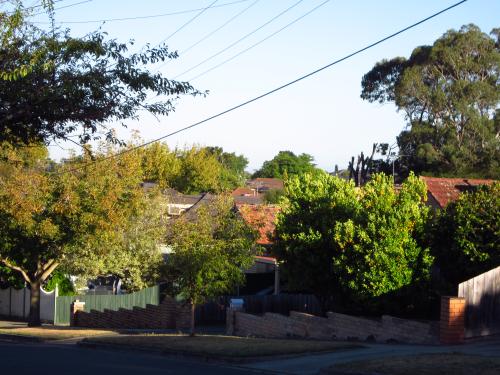
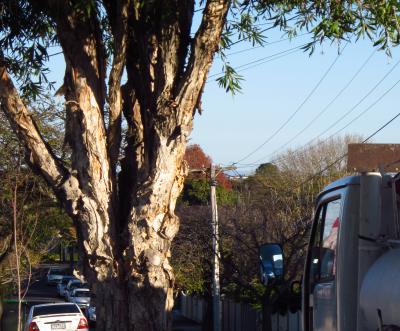
A bluish haze above the treeline to the middle and right of the photo (westwards) are the Brisbane Ranges – they are faint and hard to discern; I haven’t yet managed to get a clear photo of them.
To those who once lived here, the land would have been timeless; it had existed forever and would continue to do so forever. They had adapted their culture and skills to live in harmony with the environment rather than try to force change upon it. Their oral culture was deep and rich, passed down through countless generations. They could not have imagined the devastation that would come.
I wonder if the ancestral ghosts of those people still wander here, through a vastly changed land, paved and built over with foreign materials, the landscape cleared of much of its forests and native creatures almost wiped out. I feel a wistfulness for what was lost.
(Related entry: 23/7/2013.)
Wednesday 22/6: Footsore; party resignation
Winter solstice was yesterday. Days start getting longer from today. I am rather dreading summer, but the cold damp winter weather is not pleasant either. Warm mornings are easier to get up in!
I have managed to hurt my right foot; the ball of it has become very sore since Monday, probably due to overexercising. It might be Metatarsalgia. I can’t exactly stop walking to rest it, so will have to hope it heals gradually.
I decided to cancel my membership in what was the Stable Population Party of Australia, now Sustainable Australia (I joined on 18/4/2010). While I still agree with their basic philosophy, I was dismayed at their removing the “Population” from their name in September 2015 – as I commented on their Facebook page (screenshot below) – presumably to be more palatable to prospective voters but appearing more generic. I will still vote for them at the upcoming Federal election as they are the only party that mentions the population issue. I am still very concerned about overpopulation, but despairing that anything will be done to counter it; governments and business are too locked into the endless economic growth model.
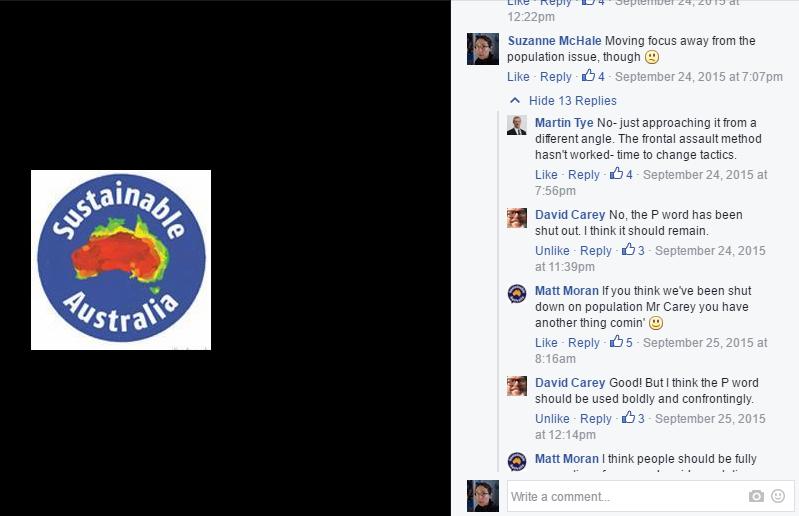
Tuesday 28/6: Crossing removal marathon; foot still sore
The level crossings at Bentleigh, McKinnon and Ormond stations are being removed, and the rail line through these is closed for a month so this can be finished (working around the clock). It is a massive construction project as the website page describes. I can hear the construction from over a kilometer away, and there is an almost constant stream of dump trucks going back and forth along the main roads carrying away excavated soil. Traffic flow will be much better once the crossings are gone; it should have been done years ago (or, if the builder then had any foresight, overpasses or underpasses built in the first place), but better late than never.
My right foot is still sore; it is located on the pad of my second toe. I am wearing a ball-of-foot cushion that helps a bit to relieve it. I have never had that sort of injury before. I was doing some low-impact aerobics videos barefoot the last few months, which seem to be the culprit.
Real winter weather has set in. A nasty cold front swept through on Friday, and Sunday morning was only 4°C or so, and in a poorly-insulated weatherboard house it is hard to endure. My hands get corpse-cold due to poor circulation.
The Federal election is held this coming Saturday. There is a high probability the Liberals will be re-elected, which has me in despair.
I still feel creatively dead; I have not done any real worldbuilding work for months, though I still like the world and characters. Perhaps it needs a reboot, but I just feel lethargic.
Wednesday 29/6: Welfare under fire again; my vote choices
The Liberals announced one of their Budget savings plans for the election and it is to crack down on welfare payments. Yes, the poor and vulnerable are being targeted yet again (previously: 26/4 entry); never mind making major corporations pay their fair share in tax. I loathe Scott Morrison from the depths of my being; he is a callous prick of a man. Sadly a lot of deluded and heartless people will vote them back into power as they perceive that welfare recipients are undeserving.
I have decided whom to vote for; below are my picks for the Senate and House of Representatives. I strongly believe in socialized healthcare, public services and so on, so I am generally politically Left.
My Senate vote (above the line):
- AK – The Greens (politically Left)
- D – Labor (Left)
- I – Sustainable Australia (reduce immigration; population policy)
- J – Pirate Party (support a Basic Income)
- C – Animal Justice Party (do mention reducing population growth)
- M – Renewable Energy
House of Reps vote (Goldstein):
| Preference order | Candidate | Party |
|---|---|---|
| 1 | HERCUS, Cheryl | The Greens |
| 5 | BISHOP, Trevor | Family First Party |
| 3 | CHELLAPPAH, Naren | Animal Justice Party |
| 4 | KAVANAGH, Lee | Drug Law Reform |
| 6 | WILSON, Tim | Liberal |
| 2 | COOTE, Matthew Ross | Labor Party |
I am still undecided as to whether to put the Greens or Labor first. There is a guide to the parties on this unofficial site.
Thursday 30/6: Coffee shop closed; China bullies
Dismayingly, the café – Romano’s – where my parents and I have had a daily coffee at Southland SC since Gloria Jeans closed in 2012 will also close after today; the staff there were only given notice on Monday. The Chinese owners did not want to renew the lease. Now we will have to find somewhere else and the familiar regulars will disperse again. The owners turned up around 9 a.m. (two women, or one was the wife of an owner; not sure). They had apparently gained a citizenship visa after two years ( a loophole that should be abolished) so were discarding the business with no regard for customers or staff at the end of the financial year (presumably for some tax benefit).
As much as I like aspects of Chinese culture and history, I have come to loathe their current government and its policies: they are international bullies (such as in Tibet, where they are systematically erasing the indigenous culture), want to dominate the world, and are plundering countries such as Australia and various African nations for natural resources to support their still-growing population.
July
Monday 4/7: Election aftermath; crossing construction
The Federal election was held on Saturday but there is no clear winner; neither Labor or Liberals have a majority so far. There are two independents, one Greens MP, one Nick Xenophon Team MP and Bob Katter. Vote counting is set to resume on Tuesday. Aside from the Greens, the other independents are mostly centrist or right-wing nutters, unfortunately. Why do these types keep getting elected?
Level crossing removal at Bentleigh, McKinnon and Ormond stations (28/6 entry) is continuing at a rapid pace, around the clock until 31st July. The dump trucks are not so frequent – most of the excavation was done last week. I went to the crossing to take some photos. There was a huge amount of soil to be removed and concrete poured.
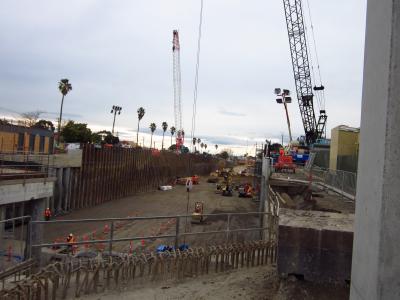
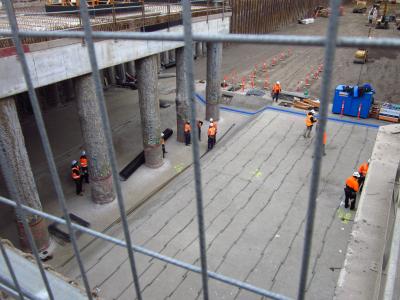
Tuesday 5/7: Job insecurity
Last night’s Four Corners documentary was “Future Proof,” on the future of work. This had a similar theme to the news report I commented on in my 7/4 entry; automation is decreasing the number of jobs available. Again there is a culture of pushing children to be entrepreneurs – hustlers, effectively. Another topic was of the uncertain future for the unskilled, who are scrabbling for whatever temporary casual and menial jobs they can get, competing with thousands of others. Job security is increasingly rare. (And my situation is dire: long-term unemployed, no qualifications, did not finish Year 12.) A Basic Income might help ameliorate this situation, but the current political climate of despising welfare recipents works against it.
JIM STANFORD CENTRE FOR FUTURE WORK, AUSTRALIA INSTITUTE: So the types of very insecure day to day work that are being facilitated by these new web based platforms cannot be the basis for the prosperity of the of the whole community. Are they a way to make a few bucks for people maybe. But they’re not anything like the sorts of permanent reliable income you need to have a healthy family and a healthy economy.
GEOFF THOMPSON: Canadian economist Jim Stanford is the founding director of the Australia Institute’s Centre for Future Work, which is partly funded by trade unions.
JIM STANFORD: You know this idea that you’re not going tohave a permanent job you’re just going to kind of work from one short term gig to another, is often portrayed as a kind of amazing new development but really there’s nothing new about it all that that model of work is centuries old in fact. If you look back to the early days of capitalism the way that early factories worked for example they didn’t offer people a 40 hour a week job in a factory they would bring you in for a few hours and send you home or even even better from the employer’s perspective they would let you take the work home, you know say in a textile factory, do the work at home and then bring it back when you were done. Funny it’s that starts to sound a lot like some of these web based businesses you know around doing odd jobs where you’re supposedly working but you know on an occasional basis from your own home without any guarantee at all about your income.
Compete, compete, compete. I am weary of living in a society where competition is the reigning mentality. I wish co-operation was more emphasized, but it won’t be in a capitalist society.
Tuesday 5/7: MPA forum thoughts; Julia in Thailand
I frequently visit the MPA forum. Two of the main subforums are Bulimia and Anorexia. It is a bit dismaying to see people half my age doing permanent physical damage to themselves, but that is the nature of a mental illness; rational behavior can’t be expected. Some hate the way they are and want help; others use their eating disorder as a way to cope with various issues. The forum is not judgmental either way. I don’t feel I should be either (after all I have been restricting my own intake a bit and have lost weight, and I am fine with it). Having people pester others about “recovery” is very annoying.
One epically long bulimia thread is “Pics of binge haul?” This is image-heavy, with users displaying photos of foods they have binged and purged (purging through vomiting), totalling thousands of calories. The amounts eating and expelled are quite astonishing sometimes.
Anorexics are at the other extreme. There are lot of threads on fasting or restricted calories (under 1000 a day, down to 200 or so). The problem with this restriction is that it can’t be maintained forever and one will likely end up binging to compensate. My own solution is to eat regularly at a higher calorie intake (1500 or so daily, haven’t measured exactly) and fill myself up at meals; that way I am satiated and don’t want to binge. Steamed vegetables are a good way to fill up without excessive calories (see my 26/5 entry). I like eating and do not want to deprive myself.
Julia Boer (also mentioned in that entry) is currently staying in Chiang Mai, in Thailand. She eats a huge amount of local fruits. Not surprisingly she had some “digestive issues” during her first week or so there. Though Thailand’s landscape is nice and its history and culture are rich and interesting, extremes of poverty are evident in its current society – a consequence of the low cost of living (if one is an expat). I am not sure if there is a welfare system at all. I wonder what the locals think of relatively wealthy tourists coming and larking about.
Wednesday 6/7: Juno success; NASA site annoyances
In some happy and non-political news, NASA’s Juno space probe successfully attained orbit around Jupiter yesterday after a 5-year journey (launched 5 August 2011). Its mission is to “Understand origin and evolution of Jupiter, look for solid planetary core, map magnetic field, measure water and ammonia in deep atmosphere, observe auroras.” (Wikipedia page)
I will also grumble again about how much I dislike the current design of the NASA website (last mentioned in 29/4/2015 entry); it is annoyingly obtuse and hard to find anything directly, unlike the previous static page designs. I really prefer older style static pages, such as NASA’s now-archived Human Spaceflight gallery; at least navigating it was relatively straighforward. If I disable Javascript via my Firefox browser’s Developer Toolbox (accessed by pressing the F12 key), the site becomes just a blank screen. The assumption for website developers now is that Javascript is enabled by default, but there are still times when users might disable it for various reasons (low bandwidth, security) or it does not render. It is a poor accessibility choice on the NASA website designers’ part. As I noted in the earlier entry when commenting on the website, if I try to access it via the Lynx text-only browser, the NASA site does not render at all!
Monday 11/7: Temporary Windows 10 upgrade; Liberals back in power
I finally undertook the chore of upgrading my main PC to Windows 10 yesterday, to ensure it was registered in the Microsoft database before the free update expires at the end of July. I then rolled back to Windows 8.1 today. I had been dreading the procedure, but I had no apparent problems with the process. Upgrading took around 2 hours; half of that was downloading the 3GB update. Unfortunately I got the “dumbed-down” Home version of Windows 10, where I have no control over updates. After rolling back I had to re-install some apps and shortcuts.
If and when I decide to move to Windows 10 again on this machine, I just download the ISO from Microsoft and use that for a clean install, as is recommended. I have done this procedure already on an old laptop of Dad’s (a 2009 Toshiba Satellite) and it seems to function quite well with Windows 10. I was able to select the Pro version of 10 during the clean install for that.
I am still not a fan of Windows 10; it is still unfinished and unpolished. As I said in my 29/7/2015 entry, I dislike the flat design appearance, in contrast to the gradients and shiny glass of Windows 7, or the Aqua interface for earlier versions of Mac OS X.
Dismayingly, the Liberals are back in power after the Federal election. Another 3 years of their budget cuts to public services and scapegoating of welfare recipients. I am extremely upset and angry at the deluded and selfish people who voted them back in. Not helping are targeted campaigns such as one at Chinese-Australians against Labor.
Wednesday 13/7: An icy blast; Windows issues
A cold front swept across Victoria last night bringing a brutal blast of frigid air, and snow to higher altitudes. It was very windy on my early morning walk and I was frozen despite four layers of clothing (admittedly thin layers – cheap K-mart exercise gear). It is only around 11°C outside and is lower with the wind chill factor. Living in a poorly-insulated weatherboard house does not help; with my poor circulation I seem to be permanently cold. I am actually longing for summer at the moment!
My Windows rollback was not trouble-free after all; I had to re-install some shortcuts and apps, and am having an issue with Notepad.exe crashing if I try to save a file in it. I may have to try a refresh, which I will have to summon up the mental energy to do again :-(. I am really tired of Windows and its bugs, and the endless updates – nearly 300 so far, all of which have to be downloaded again if Windows is re-installed, a major inconvenience and bandwith drainer. I wish Microsoft would release a cumulative updates file every so often for downloading, like they used to for Windows XP.
I really wish I could move to an Apple Mac computer, but it is unaffordable for me.
Saturday 16/7: Childhood lost
There was an article about teenage boys, “The secret life of teenage boys,” published a few weeks ago. I found it rather disturbing and oddly sad reading in parts, due to the jaded cynicism displayed by the teenager interviewed. It is like he has grown up too fast, and is an indiction on the lack of guidance for teenagers now. Rather than parents, relatives and other mentors providing role models and guiding them into adulthood as would traditionally happen, their role has been usurped by advertisers and popular culture whose only ultimate goal is to make a profit from their products that the teenagers consume.
Dark material such as pornography is readily available, and repeated exposure results in desensitization and the seeking out of ever-more extreme material for arousal (see 10/1 entry). As much as I like and appreciate the Internet, its dark side is an unfortunate consequence of its freedom. When I read about people in countries who are able to access the Internet for the first time, such as isolated tribes, I feel some dismay at the inevitable disruption this will cause in their society, similar to the effects of television.
Wednesday 20/7: Sore hip; Russia in disgrace; violent games concern
My sore right foot seems to have healed up (see 28/6 entry), but now my left hip has become quite sore! I think it might be tendonitis of the hip flexor as it is at the front and side. I can’t afford to see a specialist so will have to hope it gets better also. I also think I have Snapping hip syndrome as I have noticed a feeling of “clunking” in the area occasionally when I am walking, though it has not been painful so far. I have increased my exercise a little in the last few months, though only more of the low-impact exercise I have done for years (walking and aerobics videos).
Russia has thoroughly disgraced itself in its sports program as a systematic state-sponsored doping regime has been uncovered since 2014 (Wikipedia, BBC News, Guardian articles). There is talk of banning the country from the upcoming Olympics entirely. It is blatant and shameless cheating and lying on a massive scale and reflects poorly upon the culture there.
“Police chief warns against violent video games that reward rape and murder,” The Guardian, 19/7. This was linked to from Reddit, and it seems a reasonable enough concern; excessive watching of violent content may not incite most to go out and re-enact the violence for real, but it does cause desensitization.
“There’s very, very clear evidence that accessing violent media is a risk factor for aggressive attitudes and behaviours, and for becoming desensitised to violence,” Handsley said.
Rather than enacting the virtual violence in real life, Handsley said people who played violent video games more often developed a “mean and scary view of the world,” and assumed the worst of others’ intentions.
“The number of people that end up behaving violently or aggressively is only ever going to be very small, but the number of people who become desensitised or oversensitive to other people’s aggression is going to be greater, and that will have that broader, society-wide effect that we won’t necessarily be able to identify.”
She said it was frustrating that questions over the potential harms of violent video games were often oversimplified.
“The research of the impact on media violence tends to get boiled down to ‘is it going to make you a mass murderer’,” she said. “It’s much more complex.”
The effects were more likely to be “subtle but widespread,” such as less constructive interactions and relationships, and a “diminution of civility” in general.
“If you have inherent distrust of people, or read aggressive intent into words and actions that might otherwise be quite innocent … that’s going to have an impact at a societal level,” Handsley said.
Of course the predictable reaction from the gaming-obsessed mostly-male Redditors was the usual outrage at their precious games being criticized, and denial that playing violent games has any effect. (I did comment in there and can predict I will be downvoted, but what the heck.)
Saturday 23/7: Still sore; disillusioned with Russia
My left hip is still sore. I really should go see a specialist then probably a physiotherapist, but that option is simply unaffordable for me. It is probably some sort of overuse injury.
I am feeling quite disillusioned with Russia generally due to the sports doping scandal. President Putin is an autocratic meglomaniac and the culture there is intractably corrupt (eg. the 2014 Sochi Winter Olympics cost around $50 billion of taxpayers’ money, an obscene extravagence which could have undoubtedly been better spent on welfare, etc.). The country seems to be going backwards in terms of social and economic development. I cringe a bit when I read my Journal entries from 10 years ago, during the height of my interest in the country and its space program. I was a bit in denial. Despite those issues, I still like the space program there, though.
Sunday 24/7: Welfare outrage
Another welfare-bashing article to make my blood boil (previously: 29/6 entry); this suggestion from an entitled prick of a politician. The job market now is viciously competitive; what the hell does he think people will do after 6 months if they can’t get work? The “unintended consequences” might be to turn to crime or starve to death. (Article is under a paywall, so reproduced below.)
Six months dole – and that’s it
DOLE recipients would have their payments cut after six months under a proposal to help offset the cost of keeping more generous superannuation tax concessions for the well off.
LNP MP George Christensen will submit the plan to the Nationals partyroom and raise it directly with Social Services Minister Christian Porter.
Mr Christensen, a strong opponent to the Turnbull Government’s $6 billion superannuation reforms, said the Government could reverse some of the changes by taking an axe to the welfare system. The cost of Newstart – the dole – has reached almost $9 billion a year.
Speaking exclusively to The Sunday Mail, Mr Christensen said people on Newstart and those under the age of 45 years should be given six months to find a job – and if they failed they would be on their own.
Regional areas in Queensland have stubbornly high youth unemployment rates despite local farmers and business requiring backpackers or overseas workers to fill vacancies.
“We squibbed it last time,” Mr Christensen said, referring to the first Abbott government budget that tried to force the unemployed to wait six months before getting payments.
“Maybe if they know their dole will run out in six months they’ll go and get a job.”
Asked what the unintended consequences could be, Mr Christensen said he didn’t know, but “you can’t just throw your hands up in the air and say I don’t know what to do.”
He said he was annoyed by the dramatically-high cost of unemployment benefits at a time when farmers had complained a backpacker tax would devastate their businesses. The Government announced in its 2015/16 Budget that it would set a flat tax rate of 32.5 per cent on backpacker earnings.
“We need to take welfare and unemployment benefits,” Mr Christensen said.
“We’ve got farmers up our ribs about the backpacker tax. Every single farmer says ‘it will kill us’ because we won’t have any labour.”
He said business owners have told him some unemployed people tried to get sacked after a short period so they could go back on welfare.
Considering he has a generous salary at taxpayers’ expense, he has no right at all to criticize welfare!
Thursday 28/7: Elder abuse; the real welfare cheats; privatization a disaster
“Secret camera captures nursing home ‘suffocation’,” ABC News, 25/7. A shocking case of elder abuse, by a so-called carer (Corey Lyle Lucas is the miserable subhuman’s name) on a helpless dementia patient. The nursing home is privately-owned. This is a reason why aged care should remain in government hands, so it can be properly regulated and not be profit-driven. A letter in response in The Age:
Silence on elder abuse
Mr Turnbull responded quickly and appropriately to the report into the abuse of youths in the NT corrections system. How long before he responds to Monday night’s 7:30 Program into elder abuse? Over the past few years, there have been numerous reports of abuse in, and several inquiries into, aged care homes. The federal government’s “Future of Australia’s aged care sector workforce” (2016) received 73 submissions from staff and relatives who are extremely concerned about declining standards of care in aged care homes. Unlike in child-care centres, hospitals and schools, there is no federal legislative requirement for aged care homes to have mandated staff-to-resident ratios, skill prerequisites or even have a registered nurse on site.
Without registered nurses in aged care homes, the risk of elder abuse increases. How many more inquiries describing neglect and abuse will be needed before a royal commission into residential aged care is held?
– Sarah Russell, Northcote
Sadly the elderly are not respected in our society so I am not hopeful there will be any meaningful response.
Comment from a Reddit thread on the issue:
I’ve worked in aged care for the past 15 years, (there abouts, with a few years in disabilities.) Always dementia specific whilst working in aged care. On a whole, it’s gotten better in some regards … and shit like this happens.
What a waste of a person that care staff is, it sickens me to know that’s not the worst I’ve seen or heard. Something about the job breeds or attracts these kinds of people, every single home I’ve worked in has had some form of abuse, at best neglectfulness, at worst, this kind of abuse.
It is such a hard job … both mentally and physically, I’m sure I have some sort of PTSD from different things I’ve seen, from abuse, to bad deaths, to bad falls, to difficult residents, from people that have been bullied and hurt, and from the decline of residents that I’ve known for many years. There is not many opportunities to speak about these kind of things, and I feel that can breed resentment or despair in staff.
I’m not sure what the answer is, I feel very lucky to work where I currently work, where we have some beautiful staff and on site services. But far to often I see the cycle of young people come in and become jaded far to fast. Aged care needs more training, more funding and better staffing levels. All of which remain a dream.
As I said it has gotten better, they are now looking at person centred care, if your relative or friend has dementia, they are often able to maintain a better quality of life now days, compared to when I first started.
If I could offer any advice to people who are putting relatives into care, I would get them to ask these questions. What is your complaints system? What is your staff ratio to shifts? What activities programs does your facility have? What is your approach to palliative care? Where are the meals prepared, and what choice do they have? If the vibe of the home feels wrong, trust your gut.
Lastly, for visitors to homes, try and work with staff, the majority are good people, things can and do move quickly in nursing homes, the person that you visited a week ago can go downhill that quickly, people will fall, and they will soil themselves. Just talk to staff if you have concerns, if you aren’t satisfied with the facilities response, then go further.
If you ever suspect anything like this has happened, then for the love of god, don’t rest until you know for sure. If your relative or friend has withdrawn suddenly, or has unexplained bruises, (especially around the hands and wrists,) is constantly wet or dirty when you visit or has lost a large amount of weight quickly … then raise hell.
As for cameras in aged care, I’m for it.
– Kermit-Batman
“Federal Government aims to use data analysis to crack long-term welfare dependence,” ABC News, 25/7. More harsh measures for the vulnerable in society. On the same day, it was reported that politicians had enjoyed a lavish $144,000 taxpayer-funded trip to South America, supposedly to “build strong bilateral relationships.” Who are the real rorters?
“Privatisation has damaged the economy, says ACCC chief,” The Age, 27/7. This authoritative opinion validates what I have thought all this time! Privatization is a failed and damaging social experiment, and selling essential services to private companies whose first priority is to make a profit is a disaster for a country’s citizens.
August
Tuesday 2/8: Cold and tired; remembered anime
I am really over winter; it seems to have been particularly wet and cold, and I can’t cope with that sort of weather now.
A thread was posted on MPA, “Do You Enjoy Being Underweight/ Sick? What Keeps You Feeling Like This?” The replies there express how I feel somewhat. I am tired, unable to cope with the outside world, and feel overwhelmed and intimidated by life generally. Physically I want to be bony, light and delicate and frail, even. I feel cleaner and in control. I don’t care if my thinking on this is dysfunctional; I don’t want to return to what I was a couple of years ago.
Pure. Light. Clean. To dissappear. Outward reflection of inner world. Control. Invisible. Non sexual. To be reborn. Powerful. Immortality. To destroy myself. Fuse with the universe. Find myself. Lose myself. Be comfortable. Hide from life and myself. Not that I’m any good at it. My body wants to live … (#)
To happier things. I have a vague memory of watching an anime called Battle of the Planets when I was young (late 1970s; the anime screened from 1978-1980). I recall wanting a bird-costume like the character Mark wore! The version described was the Westernized version, so it must have screened in Australia at that time. (A related memory is of Andromeda in my 22/3/2015 entry.)
Wednesday 3/8: Filial duty
Another article on elder care and their place in our society was published in yesterday’s The Age; reproduced below:
Loneliness is a modern curse – and it needs our children to lift it
James Bartholomew
To be lonely is to suffer, and the grim fact is that more than a quarter of people over 65 who live alone are lonely.
Many of us quite like to be alone some of the time. But to be lonely is to suffer, and the grim fact is that more than a quarter of people over 65 who live alone are lonely.
None of us can be complacent about this. Nearly all of us will live to be over 65, if we have not passed that mark already. And the incidence of all people – not just older people – living alone is increasing. So the vast majority of us have a real chance of ending up lonely. That is the modern way. And many people will assume this is normal or has always been the case. But that is not true.
It is a new phenomenon. For most of human history, in most societies, the elderly have not been left alone. They have lived with or near their grown-up children. The dry statistics tell us this and so does our literature. In Jane Austen’s Emma, the climax of the story comes when, after all the ups and downs in their relationship, George Knightley finally proposes to Emma Woodhouse. Many people will have forgotten that she initially refuses him. Why? She loves Knightley, who is, among his many attributes, charmingly rich. But she refuses him because, “while her dear father lived, any change of condition must be impossible for her”. She believes she has an absolute, unbreakable obligation to stay living with her lone, elderly father.
The problem is overcome when Knightley offers to come to live with her at her father’s home after they marry. So all is resolved to make a lovely Austenesque happy ending. But it is a reflection of the culture at that time that Knightley does not question for a moment Emma’s insistence of staying with her father. It was considered normal and right.
The same assumption runs through the novels of Dickens and other authors, too. In Great Expectations, two minor characters, Clara Barley and John Wemmick, look after their respective, elderly parents. Clara Barley, like Emma, refuses a suitor because she must care for her old father.
Now, all that has changed. Many older people live in residential care, nursing homes or simply alone. It is rare these days to come across a family where an elderly parent is living with one of their adult children.
This big worldwide shift towards the elderly living alone or in institutions has caused one of the greatest increases in unhappiness the world has ever seen. Those elderly people living alone are three times as likely to feel lonely as others. They are also more likely to suffer declining health and mental abilities. Consequently they are more likely to enter nursing homes.
I believe that children have a duty to look after their elderly parents to the best of their ability. The way will vary according to each individual case. It could mean just living nearby and dropping in frequently. It could mean setting up a special bedroom on the ground floor which has facilities to make life easier for a parent who is disabled.
Such an effort may come as a shocking idea to some people brought up with the idea that their “self-actualisation” is the top priority in life. But doing your duty by your parents can be part of a far more profound self-actualisation than a life of selfishness.
Governments should bring it into their thinking that family care is a wonderful thing which should, at the least, not be discouraged by their policies. But the first responsibility to make it happen lies with the children.
Previously on this topic: 28/7; 16/6.
While doing a search through my Journal on the topic, I saw this entry from 8/5/2007. While I still feel the same way about not having children, I have changed a bit on elder care since then, seeing how isolated and ignored old people tend to be in our very individualistic society.
The author of that blog entry was Amanda (Chan?), a then-young Chinese-Australian (born 1986). I did find her rather crude and disrespectful anyway in her entries (some examples from her blog at Archive.org – NSFW for some entries), and boasting of being promiscuous is nothing to be proud of. She now seems to be yet another food blogger, a topic I find extremely tedious.
Saturday 6/8: Site fussing; Olympics indifference
I tried a different navigation layout for my site, but changed my mind (nothing new there!) so have spent the day altering and reuploading hundreds of pages. Fun – not! I have episodes where I am unhappy with various aspects and change or delete things, then decide I liked it the way it was after all *sigh*.
The weather has been fine – with chilly mornings (3°C yesterday morning!) but not raining at least. I really hope summer will have little rain as I am so tired of cold and damp.
The Olympics have started but I have no interest in them and feel they are an obscene waste of taxpayers’ money, particularly in Brazil where Rio has so much dire poverty and an economic crisis. They really should be discontinued – certainly in their current form – though they have a momentum that is difficult to stop now, and an industry built around them. Elite sports are one activity that should not be government-funded at all as they add no value to a society, unlike health care, public transport, the arts, etc.
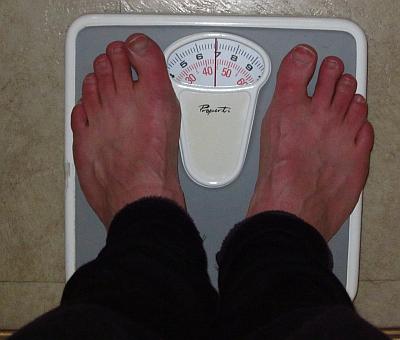
My current weight – hard to believe! Can I maintain it, though? (See 14/1/2015, 23/10/2014 entries for a comparison) (Apologies for my ugly feet!)
Sunday 7/8: For clutter
“Japanese ‘return doll souls to heaven’ in Shinto shrine ceremony,” ABC News, 6/8. This was an interesting report on the news from last night on the ceremonial dispatch of dolls no longer wanted. Shinto has a tradition of holding ceremonies for inanimate objects (which are also believed to have souls (Hari-Kuyo). As one who gets very attached to possessions and objects, this resonates with me. My possessions are part of my identity and give me a feeling of security; to lose them would be devastating. Someone posted on the MyProAna forums, “Are you a minimalist or a hoarder?” I am most assuredly a hoarder! The de-cluttering trend is not one I like.
- “Screw Minimalism–I Love Having Stuff, and I’m Not Afraid to Admit It,” Women’s Health Mag, 10/9/2015
- “Taking a longer view in defense of clutter,” Japan Times, 27/12/2015
Tuesday 9/8: Census completed
I completed the Australian Census online today; a fairly easy procedure despite all the fuss about some aspects of it. I am not too worried. The last one was 5 years ago (see 14/8/2011 entry).
Wednesday 10/8: Census chaos; Spring signs
Doing the Census online was not trouble-free for many; yesterday evening the servers crashed under the load! It is unclear whether it was a denial-of-service attack (as claimed by some), or due to the huge increase in traffic, or both. The servers were still unprepared despite the ABS saying earlier that “it had spent hundreds of thousands of dollars on load testing and said its servers could handle 1 million forms per hour.” I can’t recall it being this bad the last time!
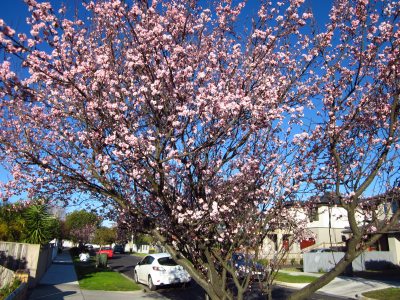
The weather has been a little warmer; up to 19°C yesterday. The first signs of Spring are appearing, such as the pink cherry blossom street trees coming into bloom; a happy event. (Sadly these trees are targeted for removal by the local Council – see 9/3 entry – and are not being replaced with similar pink ones.) The birds are beginning their dawn chorus in the early morning.
Tuesday 16/8: A fine day; NGE completed; data storage
The weather has been mild and sunny yesterday and today; it does lift my spirits a bit. This winter seems to have been so cold and damp, I will be glad to see it gone.
I now have all 5 volumes in the Neon Genesis Evangelion manga series (4 are 3-in-1; the last is 2-in-1, chapters 13 and 14). For some reason it seems to be my favorite anime and manga (though I don’t read or watch any others currently).
Someone was asking at r/worldbuilding what program to use for collating information about their world.
I have a habit of beginning a new world in say, a hierarchal note app, OneNote, or even MS Word, then getting frustrated and having to bounce back and forth between things to find info, and decide to move to a wiki, then get frustrated cause there’s SO much to move and organize that I get burnt out at not having fun actually building.
But, wikis are SO empty without a lot of info, and I find it depressing starting a world in one because I never know which pages to start up, or what I’ll need.
So, how does everyone do it? Do you just begin a new one in a wiki anyway and save the headache of moving all info into one, or do you just use note apps and deal with items not being linked together wiki-style, or do you start in one then move to another?
I end up abandoning my worlds and the stories that go with them out of frustration and depression.
(and before I get any hate about being a quitter, I do suffer from a number of mental illnesses that make this a real issue for me)
It is a similar problem to what I have – looking for that one perfect program – but all have some disadvantage that prevents me from committing to them. (See 21/9/2015, 15/9/2015 entries.) I keep coming back to creating my own HTML pages, which I can do in any text editor, though it involves a bit more manual work. A couple of posts from another subreddit:
tigerjerusalem:
As an avid note taker and control freak I’ve used everything: Evernote, onenote, Google Keep, simple note, Devon think and what not. Gave up on everything because I need to know where my files are and how to backup them.
Switched to plain text for notes, folders for organizing and Word in webview for articles from the Web. For tags, I use Tagspaces that works with my files instead of converting them to some obscure database.
spinwizard69:
This is the way to go if you value your data.
Plain text files do have their limitations but with things like Markdown and other text conversion utilities it is fairly easy to move a note into a more robust file. However one thing that I found that works for me is writing plain old HTML files.
Here is the thing with HTML and notes, the basics are fairly easy to manage and remember. Further keeping to the basics prevents a lot of browser compatibility problems. I like HTML for the ease of creating lists, be they bulleted or something else. Also a lot of my “notes” easily fit into tables and again basic tables are easy. A little CSS can dress up the file if needed.
Using the basics, and doing so from memory, has another positive effect your notes all end up looking the same. A theme if you will.
Of course this sucks with PDF’s. But the approach would be the same, use a file browser and the operating file system to take care of organization.
Thursday 18/8: More Spring warmth
A lovely sunny day, at 21°C the warmest since last May – but cold weather and rain are to return tomorrow :-(.
I would love to see the cherry blossom displays (sakura) in Japan – the Japan Guide website has a section about them.
Thursday 25/8: A planet next door; an insidious trend
Today it was announced that a near-Earth-sized rocky planet has been found in the Habitable Zone around the nearest star, Proxima Centauri, a red dwarf (part of a 3-star system; the others are Alpha Centauri-A and -B). It has been named Proxima Centauri-b. Its mass is about 1.3 times that of Earth. Whether it is habitable is unknown; the red dwarf puts out intense ultraviolet and X-ray flares.
“Bupa adds site to expand its Melbourne aged-care network,” The Age, 23/8. I find articles like this of great concern, because of the foreign developer involvement, the continued selling-off of government land (the site was once a primary public school) and the aged care issue. The insidious creep of private insurance into what used to be the public health system is a disturbing trend in Australia. Here, aged care is being pushed into the dubious for-profit sector where patients will only be looked after for as long as they are able to pay. For those who can’t, where do they go? Aged care should not be a “business.”
Wednesday 31/8: White follows pink
The Ornamental Pear street trees are blossoming in white now, as the pink Flowering Plums (what I call cherry blossoms) flowers are shed.
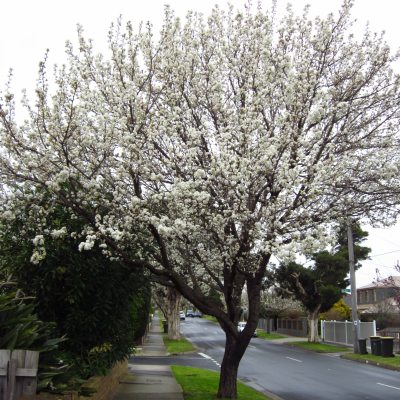
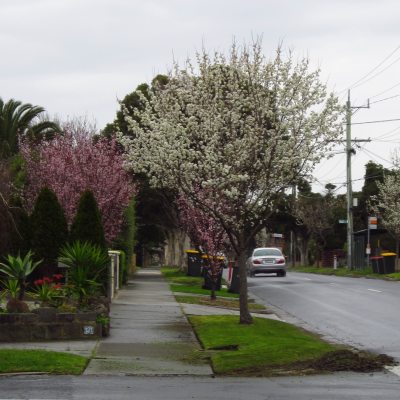
Plum and Ornamental Pear street tree blossoms in my neighborhood
September
Thursday 1/9: Winter gone; small comforts
Spring is here at last! The pink plum blossom is fading, and the white Ornamental Pear blossom is now blooming on the street trees (see 31/8 entry). The chill has gone out of the early mornings, though they are still a bit cold.
One object I have taken a liking to recently are what I call “fluffballs” – pom-poms on keyrings. They are soft and comforting to hold! There are cheap ones at K-mart and more pricey ones at various retail shops such as Seed and Witchery, which are nicer. The Seed ones are below $20; the Witchery ones were a ridiculous $30 (overpriced like their other products), so I certainly are not buying the latter. Cotton On had some last week going out for $1. They are almost like little creatures. I just like them! Yes, it is a bit childish, but I don’t care – I need any comfort I can get.

Fluffballs from Cotton On (mustard and brown) and Seed (ticked beige-pink); K-mart fluffballs
Comfort objects are a psychological trait, and they are not limited to children! Since childhood my comfort object has been a small pillow or cushion covered with a slip that is worn down to just the right sensation of softness. I keep it on until it disintegrates (I wash it periodically of course) then I have to find a new one. The cushion also needs replacing every few years. My childhood pillow had a green checked cover from what I can remember. Some might see such objects as an embarrassment, but I don’t care!
My current comfort pillow
Tuesday 13/9: Wet misery
We had some fine weather last week, but the rain has returned with a vengeance this week, frustratingly. There is flooding in parts of Victoria. At this point I would not care if it never rained again, I am that sick of it. It makes going anywhere an ordeal (I can’t drive, so must walk or catch public transport if I can’t get a car ride). Can’t dry the washing on the clothesline. Outside is mucky, soggy and dirty; the house I live in is old and dilapidated and I just hate it all. At this point I would not mind living in an apartment if I could afford it, as long it was not in one of those awful towers – perhaps in a small block of flats.
Wednesday 14/9: iPhone envy
There was more rain overnight and this morning, but sunny breaks appeared on the way home and for the afternoon, happily – though there is more rain due.
The iPhone 7 was announced earlier this week, and is being released in Australia on Friday. Of course I will not be able to afford one (or a phone of any description). There is also a new operating system being released, ios10, but it is not compatible with the iPad2, so my iPad and Dad’s have reached the end of the road as far as ios updates go. The updates have slowed them noticeably as their older processors and small RAM can’t meet the demands of the newer versions. I now find my iPad invaluable; it has, for most of the time, “just worked,” unlike my Windows PC. I don’t know what I will do if and when my iPad expires as I simply cannot afford another. I am grateful just to have received that one (Dad bought them when they were discounted a few years ago). Every time I walk past the Apple Southland store, I look wistfully inside, wishing I were one of those who could afford their products. I actually want to become part of the Apple ecosystem and “cult” as their products are beautifully designed and better-integrated than the utilitarian Windows. I used to be one of those who disdained the hoopla around the company, but I have to admit I have been converted :-) (Reddit post: Those who switched from Windows PCs, who used to hate Apple: WHY did you hate Apple? And what was the story explaining why you now use Apple devices?).
This was a comment on a post about a Mac user getting their first Windows laptop:
satysin 11 points 15 days ago
Am I the only one who sees the comments here (all valid I might add) and just thinks using Windows is quite depressing?
The top comments are:
- Install this free antivirus
- Edit your hosts file to avoid malware
- Use this free tool to replace basic functionality that should be included but isn’t
- Be careful installing programs to avoid junkware/adware/spyware
- Reinstall(!) Windows to remove the crapware it no doubt comes with
It all just sucks. I don’t mean the advice sucks, it is actually good advice, but just think about all this crap we put up with to use Windows. It really sucks. Imagine you were using Windows for the first time and you get the above list of all the things you need to do to have a not-so-crappy experience :-(
They should stay with Apple; they will likely regret moving to Windows!
There was a post on why Windows seems so fragmented, and another on why Windows seems so buggy:
themantis5000 118 points 18 days ago
“… the problems of Microsoft’s current testing regime: lack of internal testing (the people who did this were laid off), Insiders not testing on real systems (because they’re advised not to use it on their primary PCs), and Insiders tending to give poor feedback (they’re not professional testers, and Microsoft’s very weak release notes give no indication of what things have been changed and hence need testing in the first place).”
The Microsoft engineers who did internal testing of Windows were laid off. Microsoft no longer has an internal quality control department. No wonder Windows 10 and the first-party Windows Store apps are buggy and sloppy. This is awful.
Thursday 15/9: NEET-bashing
The Herald-Sun Murdoch tabloid newspaper had another in its series of welfare-bashing articles today: “Our NEET new class.” (NEET: Not in Employment, Education or Training.) I am effectively a NEET so it is particularly galling as the writer of the article clearly meant it to be pejorative against so-called “bludgers.” There are predictably outraged comments on the H-S Facebook post mentioning the article.
Natalie Beaton: And its these waste of space, good for nothing morons that should have their centrelink taken off them...... NOT the pensioners or single parents!!
Doug Lynch: Bloody wasters. Get a job you lazy $h!ts. If they are not actively looking for employment or education then cut payments off. At the very least they should work for the dole Monday to Friday, 9-5 doing community services.
Pamela Carroll: Lazy selfish people. Cut all funding to the 100,000 who refuse to work. At 14 I left school & held 3 part time jobs & went to night school to get from shop assistant to office worker. The only time I have been unemployed was of my choosing (raising children). I have traveled O/S using savings, never received handouts. Am now an aged pensioner after 40+ years of paying taxes. What have these ones done to deserve a regular payment made possible by decent hardworking people paying taxes.
Angela D’Alfonso: People like you make me sick and are a blight on our society. It is one thing if you cant work or find a job but to blatantly say you dont want to work, well guess what I dont want my taxes paying you benefits. No unemployment should be paid if you have never worked, I am sick of supporting people llike you. Hope you are proud of yourselves because no one else is
And so on. A lot of commenters humblebragging about how they “worked hard” and never relied on benefits. Well, working hard does not always guarantee you will succeed in life, and can mean a miserable and difficult existence just scraping by. The Protestant work ethic needs to die out. I suppose the commenters would prefer welfare recipients turn to crime or starve to death? This is another example of why a basic income is an increasing necessity, so citizens don’t have to do demeaning and pointless jobs, though the mean-spirited commenters there would not see it that way.
(Previous Murdoch articles: 7/4, 11/1)
Thursday 22/9: And more war on welfare
The Herald-Sun has been on the anti-welfare warpath again this week. Today, an editorial warning against so-called welfare dependency. “Encouraging self-reliance rather than welfare reliance is a better investment.” Uh, no, how about the government doing its duty in looking after its citizens instead of abandoning them? And better, consider introducing a basic income so that all citizens can at least have a basic quality of life? There is nothing noble about enduring shitty low-paying, low-status jobs in order to eke out a living; it is a miserable way to live.
There was also an offensive anti-NEET opinion piece from Rita Panahi yesterday (which I also copied in the article hosted here) – she is a female conservative columnist for the paper (of Persian descent). SBS featured a profile of her some months ago. She is rabidly anti-Left and seems rather ruthlessly ambitious and deliberately provocative in goading reactions from others.
And two letters from 21/9 actually criticizing the articles:
Wake up to welfare
ANOTHER inquiry to generate shock/horror in a gullible electorate and incite welfare bashers into a panicked frenzy (“Welfare shake-up”, HS, Sep 20). Another attempt to draw attention away from the government’s self-serving excesses.
The reality now is that there are not enough jobs to go around for the working population, much less for youth about to enter the workforce.
Full-time jobs have been reduced to part-time and casual, thus reducing working conditions and obligation on employers to provide holiday pay and sick leave.
When university graduates are forced into waitress jobs, when scientists are made redundant, when young families are forced into a cycle of poverty on welfare, the obvious reason is that there are not enough jobs available.
Most politicians would go through in less than 12 months what one so- called “welfare addict” costs during an entire lifetime.
For a nation that deludes itself on being a generous, tolerant, humane society, it callously resents provision for the less fortunate among us, who – if not through disability – are the product of a self-serving government.
– John De-Stefano. Kingston. Tas
New reality for youth
RITA Panahi’s view on youth being a burden on society is deeply offensive and goes against what is happening in the broader spectrum of society (“The messy reality of our NEET generation”, Opinion, Sep19).
As a 30-year-old who has grown up in Melbourne’s west, and experienced poverty and homelessness, I have worked my butt off to put myself through university.
I now work in mental health, and my fiancee is a nurse whose family suffered under the stolen generation. We are expecting our first child in February, and we’re still unable to save for a home. The more we save, the faster house prices rise.
This year, I will be entering politics with a key focus on youth issues. Where education was once free, it now costs thousands of dollars. Where housing was affordable to factory workers, the minimum wage no longer covers the cost of living.
The casualisation of the workforce is far greater today than it has ever been.
Millennials do not share the same economic wealth or opportunities as our parents did.
– Simon Vallone, Ardeer
The government also announced a disturbing plan to try “new, novel and brave” ways to break the welfare cycle; imitate the harsh model used in New Zealand.
This continuing threat to welfare from a callous government has me extremely stressed and anxious; I am certainly not the only one. Welfare is an extreme ordeal to qualify for now; if it weren’t for my parents I would likely be homeless and in dire straits. (There is a right to social security page on the Attorney-General’s website.)
If the government wants to save some money, try cutting funding for the wasteful and pointless Olympic sports programs:
Between the London Games and the present, the Australian Institute of Sport spent around $332 million on Olympic sports, including $304 million given to national sporting organisations under the AIS’s Winning Edge high-performance program, and $27.5 million given directly to athletes in Olympic sports as grants to support them whilst they train.
October
Sunday 2/10: Elder respect
Daylight Savings begins in Australia today. I don’t feel as antagonistic towards it as previously, perhaps because my sleeping patterns have changed a bit; I tend to sleep early in the evening and waken early in the morning. I have taken to pacing, reading or Internet surfing if I can’t sleep in the early hours.
Yesterday was International Older Persons’ Day. There was a good opinion piece in The Age last week, “Why International Older Persons’ Day is all about you.”
“Advanced” western society doesn’t seem to treat its elderly all that well. At least not in comparison with India, where the young fondle the feet of the aged in bids for precious blessings. Or China, where the Confucian code of filial piety is buttressed by an Elderly Rights Law that impels even the busiest and most self-absorbed to pay regular visits to senior relations.
We turn away from the sick, poor and lonely among our elderly. And a third of our pensioners live below the poverty line. Those who are plain pissed off with the pain and indignity of getting old, and vocal in bemoaning it, can quickly clear a room. That stuff, the impending death and emptiness of existence stuff, is kind of hard to hear.
The society I live in is one that worships youth, to its detriment at times. This trend is driven by marketers and business, who are simply out to make a profit. It is a dysfunctional social trend but I don’t know what could be done to counter it. Other societies, such as the traditional Asian ones, are regrettably following this trend as Western culture overwhelms them.
Below, two letters from The Age, one from an aged care director wanting fee deregulation (so he can make a profit), and a response rightly saying aged care should not be left to the dubious mercy of the free market. Aged care should be government provided and controlled. (Previous comment: 25/8, 16/6 entries.)
Abolish care fee limits
Recent carnage in the share price of aged care companies seems to suggest that restrictions on maximum charges for approved care recipients are biting. For more than 40 years the Commonwealth has limited the fees that aged care operators can charge. Subsidies for payroll tax have been eliminated, and funding for nursing care has been reduced with no capacity for operators to make up the shortfall. This is a serious case of “unconscionable conduct”. The Commonwealth sets high standards and yet limits the fees paid without regard for viability, market forces that would underpin an increased bed supply, or consumer choice and quality.
The aged care industry needs serious reform embracing increased competition and the abolition of fee control to encourage the building of new modern facilities. Child care fees are not controlled; why should aged care be any different?
– Graeme Croft, director, Innovative Care
Aged need protections
Graeme Croft refers to the slump in share price of aged care companies (Letters, 6/9). This followed analysts downgrading aged care stocks after the government issued new guidelines. The budget announced changes to the Aged Care Funding Instrument, causing providers concern about profits. Some privately owned aged care homes responded by charging additional service fees, including “capital refurbishment fees” and “asset replacement contributions”. These fees improved profits but did not provide any benefit to residents. The Department of Health has announced that these types of fees contravened the legislation.
So while I agree with Croft that the industry needs serious reform I don’t agree with his conclusion. The care of vulnerable older people is too important to be left to the free market. In an unregulated environment, these extra charges, up to $18 a day, would have gone unnoticed.
Croft also refers to the “high standards” set by the government. On the contrary, legislation falls remarkably short of demanding high standards. Unlike childcare centres, there is no requirement for aged care homes to have mandated staff-to-resident ratios. The accreditation and outcome standards also remain woefully inadequate. “Consumers” of aged care are often frail. They do not have the capacity to “drive” the residential aged care sector.
– Sarah Russell, Northcote (8/9)
Below, yet another inane tabloid article bashing the young and “handouts.” Apparently according to that newspaper (and Murdoch), everyone should be ruggedly individualistic and self-reliant, else one is a “parasite.” I see nothing wrong with accepting help from parents and don’t understand the stupidly masochistic view that one should endure great hardship rather than accept help.
Sponge society or evening the score? Generous parents give plenty
ANTHONY KEANE, News Corp Australia Network
October 1, 2016 12:30am
ALMOST three-quarters of Australian parents are giving their adult children financial help, prompting calls by some for them to tighten their purse strings.
From paying bills and university fees to buying household goods and even homes, it’s been labelled as “sponge society”.
But others say it simply reflects parents transferring their wealth earlier in life, when children need it more.
It also has created a large group of young adults who feel guilty about receiving the handouts.
Comparison website finder.com.au surveyed more than 2000 people and found that 74 per cent of parents say they are giving financial help to their children aged over 18, while 28 per cent of recipients say they are embarrassed or ashamed about it.
Spokeswoman Bessie Hassan said rising property prices, large tertiary education debts and the growth of unpaid internships were driving the giveaway.
“Many parents want to help their children but they are never going to learn the true cost of living if they are constantly receiving handouts,” she said.
“If you insist on giving money to your child, consider making it a loan, with strict conditions on when and how it is to be paid back.
“Some children may feel embarrassed to receive financial help from their parents because it strips them of their financial independence and it may make them feel inadequate if they have to rely on the bank of mum and dad.”
The Finder research described Victoria as the biggest “sponge state” with 65 per cent of adult children saying they receive financial help, while South Australians were the most independent. Queenslanders were the most embarrassed about receiving money from parents.
FAMILY WELFARE
Social researcher Mark McCrindle said young Australians should not feel guilty about accepting financial help.
“I think they should receive it with grateful thanks and hopefully have an attitude of passing it on themselves one day,” he said.
Mr McCrindle said there had been social change in recent decades and parents no longer saved to leave a large estate for their children.
“Now it’s reversed and the giving of money takes place when the children are younger and need it,” he said.
“The cost of living has never been greater, generations have never started working later in life, and they are starting in debt.
“It’s never been harder to get established, and parents are realising that it was easier in their day.”
Mr McCrindle said Baby Boomers represented one-quarter of the population but owned half the nation’s wealth.
They have an average net wealth of $1.2 million.
“The Baby Boomers were born at a lucky time and have had 50 years of an economic miracle, free degrees and tripling house prices,” he said.
“It’s not the young ones sponging – it’s intergenerational wealth recycling.”
Sunday 9/10: Nursing home shame
Gale-force winds across Victoria today, in excess of 100 km/h. They are blowing very hard where I am.
“Daughter’s nursing home nightmare: what happened to Nita?,” The Age, 7/10. Another all-too-common story of elder neglect in a for-profit nursing home, and another example of why aged care should be not-for-profit and government-controlled. (The Australian site mentioned is Aged Care Crisis.) The picture of her below after her ordeal I found quite upsetting; she looks so frail and abused.
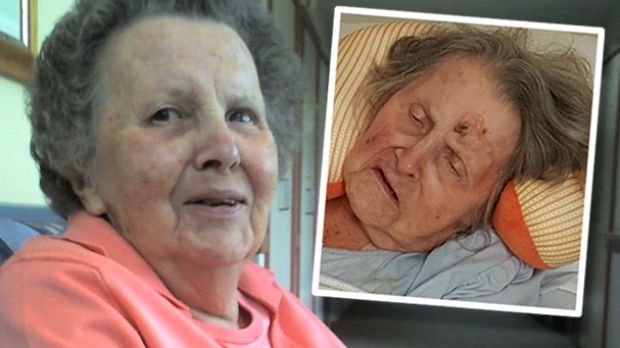
As I noted in my previous 2/10 entry, I do think a reason why aged care is so devalued is the lack of respect for older people generally in our society that worships youth (see Ageism article on that website).
Monday 10/10: A job best abolished
I find some attitudes towards job automation quite irrational and annoying. A case in point is automatic self-serve checkouts at supermarkets. I use these in preference as I dislike interacting with other humans – but a lot of other people see this differently, regarding the automation as a “threat” to jobs there. Some letters from The Age, 8/10:
Supermarket theft: Socially irresponsible – and economic madness
Interestingly, when interacting with supermarkets’ self-serve checkouts, customers are wont to mistake a mango for a potato (“‘It’s still shoplifting’: crackdown on checkout theft”, 7/10). National Retailers Association chief executive Dominique Lamb does not think this type of petty theft is excusable, adding that shoplifting costs the retail industry $4.5billion a year.
There was a time when supermarket shopping involved human participation. Enter short-term managerialism. Somebody fired many check-out staff and replaced them with machines. What a great idea. And some of those people who lost their jobs can now be re-employed as “loss prevention officers “, so it all balances out. This is how we progressively make sawdust out of our communities. We have seen this before on the trams and on the trains. At a time when we are beginning to think about corporate social responsibility, we should ask whether this degrading process is socially responsible. It does not even appear to make economic sense.
– Paul Johnson, Clifton Hill
The revenge of customers taken for granted
In its never-ending search to increase profits, Coles chose to reduce wages by reducing the number of check-out staff. It did not care that by doing this, the company would seem more remote, with less focus on customers, while also putting temptation in the way of some customers. Coles did not care about adding to the unemployment numbers in its quest for greater profitability. It is self evident that a greater number of check-out staff will mean less shoplifting. Theft is always wrong. However, it is also wrong to take customers for granted by expecting them to do unpaid work – checking and packing their own items – for the supermarkets.
– Chris Burgess, Port Melbourne
My heart breaks for big supermarkets’ pain
I was deeply moved by the plight of poor little Coles. To think that some people might actually steal from self-serve checkouts was shocking, to say the least. I am sure the losses are more than offset by the cost of not employing our sons, daughters and stay at home Mums who want to work a few hours a week. The police have better things to do than protect supermarkets’ greed.
– Eric Black, Northcote
Security staff should police these thefts
Coles sacks its checkout staff, forcing customers to serve themselves, all in an effort to increase corporate profits. When it finds that some customers are not paying for items at self-serve checkouts, it gets the police onto the case. The result: Coles outsources its security to a taxpayer-funded organisation with far more important work to do. Am I the only taxpayer who is angered by this? Coles, hire and pay for your own security staff. Or better still, bring back the checkout staff.
– Belinda Nemec, Fitzroy
Why I refuse to use the self-serve checkouts
So the police are being called to Coles and Woolworths because customers do not regard under-scanning the prices of goods on self-serve checkouts as a crime? While I am opposed to anyone stealing anything from anyone, I do have to wonder if the supermarkets regard taking the jobs and income from thousands of Australians so they can make higher profits as some form of criminal act?
Or is getting things cheaper by any means available just good business when you own the companies? I do not steal by using self-serve checkouts because I refuse to use them. I want to see Australian workers remain in jobs, thank you.
– Doug Steley, Heyfield
Speaking from long and unhappy experience, retail work is a shitty, low-status and extremely stressful job, and one I would be glad to see automated and abolished (pay everyone a basic income so they don’t have to do such work). I have nothing to show for all the time I spent doing such a job and I felt like a lower life form. I was stressed to the point of tears more times than I can remember, and to say I have PTSD from it might not be too much of an exaggeration. I never meant to spend as long in it as I did, but inertia took hold and I gave up on any further ambitions. I bet that few if any of the quoted customers ever had to do such work.
Friday 28/10: An archaic sport
A concerned letter from The Age in regards to the promotion of horseracing to younger generations:
Leave kids out of it
My stomach churned when I saw the photograph of the little boy in a suit and hat taken at the Flemington carnival launch (“Park life,” 25/10). It is bad enough that the gambling industry is saturating our public spaces with wall-to-wall advertising (just visit Southern Cross station) but to look to children as their saviour?
The horse racing industry is not and never has been the sport of kings but rather the sport of mugs, while making a public spectacle of oneself has become an art form. It is time to rethink our addiction to such pastimes, starting with the ridiculous Melbourne Cup public holiday.
– Steven Haby, Wonthaggi
Another letter, 7/11:
Normalising gambling
I am troubled that the final day of the spring racing carnival was devoted to introducing children to the sport of horse racing which, of course, exists for the main purpose of gambling. We have strict laws to prevent children from entering gambling areas of clubs and casinos. Why is it good policy to introduce them to horse racing? It is a myth that it is all about the love of good horses and a gala day at the track. Remove the gambling component and it would cease to exist. Scratching the surface of this “sport of kings” reveals “colourful characters”, race fixers and odd money launderer. Dressing impressionable children in their best “fashion in the field” outfits does them a disservice.
– Lance Sterling, Burwood
It is an archaic sport, cruel to horses and should eventually be abolished as an embarrassing relic of a less civilized time. I also detest being referred to as a “punter”; it is an insult. I hate the obsession with gambling that Australian culture has (amongst many other cringeworthy aspects of our culture). Ads for betting have also reached saturation level in the last few years.
Also outrageous is that the Government has contributed towards a $128 million dollar new racecourse grandstand; an indefensible waste of taxpayers’ money that could go towards a lot more worthy causes such as public health care and housing. The supposedly beneficial jobs in the construction are only temporary employment.
Friday 28/10: Underwhelming new MacBook
The new updated MacBook Pro was unveiled today at long last – but reception has been mixed and controversial. The main and only innovation is an OLED touchscreen replacing the function keys, and some features removed, such as various ports. It is also horrendously expensive; the cheapest in Australian prices starts at $1,999 (basic 13-inch with no touchbar) and goes up to $4,249 (15-inch, highest specs). There were no updates to the desktop Macs or Mac Pro. (This is all of academic interest to me as I can’t afford a Mac of any type.) A comment from Slashdot:
2016 marks the end of Apple brand loyalty. We have quite clearly reached the point where the roadmap Steve Jobs laid out has ended, and now Cook and Ives are on their own, screwing things up as they go.
The outrage about today’s keynote at AppleInsider is palpable. Among the common complaints are:
- These computers are overpriced and underwhelming. The price of the entry-level MacBook Pro was bumped up hundreds of dollars, and all they did was increase the price and remove ports from it. (The entry-level model only has two Thunderbolt ports (USB, etc. have been removed), and one of the ports has to be used for charging! What kind of “Pro” computer is that???)
- The mind boggles that they removed the “esc” key from a supposedly “Pro” computer.
- They removed the MagSafe connector, which is arguably one of the greatest features of Apple’s laptops.
- The only connections are Thunderbolt 3, meaning that you will need a dongle for anything you want to connect. Do you own an iOS device? Better hope you have a USB-C adapter for it.
- Removal of the SD drive.
Apparently Apple has also been sending out emails to some of its customers asking if they use features such as the headphone jack on their laptop. (Because of course, they’re going to remove it from there as well.)
This company has lost its mind.
Post-event Megathread at Reddit.
Monday 31/10: More welfare-bashing
Yesterday’s Herald-Sun had a rather nasty opinion piece, “Peta Credlin on how welfare dependence is ruining our economy.” She was the former controversial advisor to former Prime Minister Tony Abbott (she had a little too much influence over him). She is the very definition of a hard-hearted bitch.
But what about the nearly 40 per cent of people on the disability pension for depression or muscular-skeletal problems – conditions that can usually be fixed and that don’t preclude some form of work?
Depression can’t always be “fixed” that easily.
There are two issues here. First, the entitlement mindset – “my right” to be supported by the government; and second, the compassion mindset – the “community’s obligation” to support people doing it tough.
Because a society worth living in should look after all its citizens? There is nothing noble in enduring shitty low-paid, low-status jobs in order to survive; it makes for a miserable stunted existence. A basic income would ensure everyone could at least have a reasonable if modest standard of living. The conservative Liberals’ idea of “fairer” welfare is to make it so hard to get onto that almost no-one would try, leaving the less-well-off to fend for themselves.
November
Wednesday 9/11: Another year older; USA election day despair
I am 46 today.
U.S. Presidential elections today (Tuesday 8th in America). I have avoided commenting on these as I have nothing constructive to add, aside from the obvious hope that Hillary Clinton (Democrats) will win. Unfortunately it currently looks as though Republican Donald Trump might be the next President – the rest of the world’s worst nightmare. That would make three major nations in the Western world with nasty Conservative right-wing governments: USA, Australia and the UK. Why are people voting for these fanatics? Such governments care nothing for welfare or the less well-off; they want to create a class-divided society of great inequality, of a privileged class and slave underclass, of extreme wealth and poverty. I am angry and despairing that things will ever change for the better.
6:22 p.m.: It looks as though Donald Trump is President. I can’t believe it. Don’t want to believe it. I am in despair, as are a lot of other people. A disaster for progressives in the USA, and for the rest of the world.
Thursday 17/11: Still in shock
What a surreal and upsetting week for the USA, and I am doubtless one of many who feels that way. Things look grim for U.S. government services such as their version of Social Security and Medicare (plans to privatize them, apparently). The Conservative Republicans have control of the House and Senate also. Donald Trump appointed a racist white supremacist as Counselor to the President, which is an ominous start. There are threats to overturn Roe vs. Wade, a court decision which gave a woman a right to abortion (and thus control over her body) – emphasizing that women’s rights should never be taken for granted as they can be eroded. (Wikipedia for reference: Presidency of Donald Trump; ABC news coverage: US Election 2016.) MetaFilter has a Grief and Coping Thread: Election 2016 thread (quite long).
Another disturbing aspect is that Trump and the Australian PM, Malcolm Turnball, are both businessmen, which to my mind is not ideal for a politican. A government is not a business and should not be run as one – it is there first and foremost to look after its citizens, which is the antithesis of how a business operates.
I have just been feeling too agitated and tired generally to do much of anything. Went through another round of deleting then reinstating my website.
December
Tuesday 6/12: Depths of despair; retail abuse
I have not felt like writing; I have been in my usual depressive slump, not helped by the awfulness of last month’s U.S. election, the prospect of Trump as President for the next 4 years (barring a miracle such as him being impeached), and the continuing threats of social services cuts from uncaring Conservative governments (UK, Australia, USA) generally. How has our supposedly enlightened society come to this?
An example is an article published in The Age yesterday stated that “Hospitals, housing and dental services ripe for privatisation, says Productivity Commission report.” Privatization would see profits put before patients and there is no good outcome; it is a deliberate attempt by a Conservative government to abrogate its responsibility of care towards its citizens.
“‘I was spat on by a customer’: retail abuse on the rise,” The Age, 5/12. An example of why I hate such jobs and would rather starve to death than do that sort of work again (see 10/10 entry). Retail work is a degrading, low-status occupation. The sooner humans in this industry are replaced with robots, the better. There was a feature news item on a service robot in a shopping center this week, though the technology is still rudimentary.
Singapore is also using automation to replace humans in the food service industry, another positive trend.
”Younger Singaporeans aspirations are changing, and you can’t find many young people who will do low-skill jobs and stay with the firm for long. Neither can we continue to grow foreign manpower.”
Can you blame people for not wanting to do boring degrading jobs? Pay all citizens a basic income and automate drudge work as much as possible. Another The Age opinion piece from 19/11: “The case for a basic income, no questions asked.” The mean-spirited Conservative/right-wing types, though, would not support it as they still believe in the awful Protestant work ethic that sees any job, no matter how degrading, as somehow morally virtuous.
Thursday 8/12: Second thoughts on Furries
I read this post on Reddit a couple of months ago, “An Apology to the Furry Community,” and I have found myself increasingly liking the “furry” community (though not the NSFW aspects of it!). The people there generally seem tolerant and nice, and there is a high number of troubled people who find solace and support in the community. One does not have to have a “fursona” to participate (though could I include my alien character from my worldbuilding project?). I can even tolerate “Bronies” now (in contrast to what I wrote in my 31/12/2014 entry, which seems a bit harsh).
Friday 9/12: My letter published; GP visit
I had a letter published in The Age today, a quick response to the privatization article mentioned in my 6/12 entry – it was slightly edited (original by me is below it):
Heading down dysfunctional US path
I am dismayed to read of yet another push to privatise essential public services. Such proposals only add to the stress and anxiety of those who are less well-off and dependent upon such services, as profits will inevitably take precedence over quality and affordability. Do we really want to imitate the dysfunctional US system, where only the wealthy can afford treatment?
I am dismayed to read of yet another push to privatise essential public services such as health care and housing (“Hospitals, housing and dental services ripe for privatisation, says Productivity Commission report,” 5/12). Proposals like these only add to the stress and anxiety of those who are less well-off and dependent upon such services, as profits will inevitably take precedence over the quality and affordability of care. I cannot understand why the government wants to imitate the dysfunctional American system, where only the wealthy can afford treatment. Is this the type of society Australians want?
I visited the GP today for a prescription renewal. My current vitals:
- Weight: around 45 kg
- Height: 160 cm
- Blood pressure: 107/44 (I think?)
Contrast with my 5/3/2013 and 14/1/2015 entries.
He did point out I am underweight and asked if I were vomiting (gently querying if I were bulimic) – I am not throwing up, being well aware of the consequences of going down that path. He didn’t press the issue any further.
Monday 12/12: Yet more dole bludger bashing
“Welfare con job: Thousands of Aussies reject job offers to stay on benefits.” The latest round of dole recipient demonizing via Rupert Murdoch’s tabloid rag (previously: 31/10 entry). Dole payments are hardly “generous”; they are well below mimimum wage, and getting the dole in the first place is very difficult and stressful (deliberately made so). One can hardly blame people for not wanting to do shitty drudgery jobs such as the mentioned fruit-picking or working in an abattoir.
I hope Murdoch dies a painful death; it would serve him right for the misery he has inflicted upon others.
“Scrap welfare and pay everyone, even the jobless, a living wage,” The Age, 9/12. Another article about implementing a Basic Income. Hopefully the idea will become mainstream, though the mean-spirited attitude such as that displayed in the Herald-Sun articles and comments will be a challenge to overcome. I am virtually unemployable in my mental and physical state, not to mention my lack of qualifications and age. A Basic Income would at least remove some of the stress from my life.
“Why I’d rather raise a bogan than an upper-middle prat,” Herald-Sun, 10/12. An opinion piece that is another example of the loathesome Protestant work ethic where any job, no matter how demeaning, is better than none. I spent years in a low-status job I hated and it did nothing to improve my character. If I’d had children there is no way I would take the harsh view of the author of this stupid article. More generally, her attitude is an example of Western society’s pathological fixation on rugged individualism. I could probably safely surmise that she (Wendy Tuohy) is of the type who believes illnesses such as depression are just a sign of mental weakness, that one afflicted by it just not trying hard enough and that they should “just snap out of it.”
“MCG upgrade calls amid terror fears,” Herald-Sun, 11/12. A proposal for a taxpayer-funded $1 billion upgrade to the Melbourne Cricket Ground to thwart terrorist attacks.
The bold plan – which features parks, bars and shops on a new plaza over the rail tracks – was revealed in May and is being investigated by a government taskforce into the city’s stadiums. The AFL’s $300 million bid to revamp Etihad Stadium and Eddie McGuire’s $1 billion “Victoria Stadium” next to the MCG are also being considered.
Of all the obscene wastes of money, sport is the worst, and there is no way government funds should contribute toward this. I detest organized sport and I would like to see it defunded alltogether.
Thursday 15/12: Another Star Wars movie; NASA site misdesign; uncaring Abbott
The new Star Wars movie, Rogue One, has opened today to the predictable hype. I will not be going to see it but will wait for the DVD. Cinema prices are ridiculously high now – over $20 for a ticket – and I don’t feel much desire to see the movie anyway.
In my 6/7 and 29/4/2015 entries I commented unfavorably on the Javascript-heavy aspect of the last NASA website redesign, where it does not render at all with JS disabled, or via a text-only browser such as Lynx; a very poor design decision. An online website design book also comments on this, quoted below:
Despite JavaScript’s fragile error-handling model, web designers became more reliant on JavaScript over time. In 2015, NASA relaunched its website as a web app. If you wanted to read the latest news of the agency’s space exploration efforts, you first had to download and execute three megabytes of JavaScript. This content – text and images – could have been delivered in the HTML, but the developers decided to use Ajax to retrieve this data instead. Until all that JavaScript was loaded, parsed, and executed, visitors to the site were left staring at a black background. Perhaps this was intended as a demonstration of the vast lonely emptiness of space.
I actually prefer the older versions of their site, which while using some outdated HTML by today’s standards, at least loaded fairly quickly. I have come to strongly dislike the recent web design trend of relying on Javascript to render essential website elements; it makes a site annoyingly flickery and unstable, and puts a heavy load on one’s browser to process all the scripting (my PC audibly strains with effort on visiting some of these sites). Old-fashioned websites that simply use HTML and CSS are much more stable.
“Tony Abbott slams pensions for people with ‘bad backs, a bit of depression,’” The Age, 15/12. Some insensitive comments from the previous Prime Minister. Considering that he will receive a generous parliamentary pension, he has no right to criticize the vulnerable.
Mr Abbott said people were turning down jobs because they did not like them, an echo of his 1999 comments when, as employment minister, he called people “job snobs”.
“These might not be the jobs you want to do for the rest of your life but a job is a job...You have to take it, you just have to take it,” Mr Abbott said on Wednesday.
Mr Abbott said he was proud of his government’s crackdown on people receiving the disability support pension.
“If people are doing the best they can for themselves and for their families and it is literally impossible for them to find work, fair enough. [But] we were far too ready to put people on the DSP [disability support pension], with bad backs, a bit of depression and so on. These are not permanent conditions.”
Why should someone have to do a job they hate? They will be resentful and it won’t advantage their employer either. I utterly detest the opinion that any job is better than no job.
The miserable bastard Liberals have also reduced funding for public dental care, which already has long waiting lists.
Tuesday 27/12: Just watching
Christmas Day was quiet (spent it at home with my parents as usual) and hot (35°C or so!). Now it is unpleasantly humid; I prefer the dry heat.
I am lacking in energy and have done little of creative interest; I am just passively consuming the creative work of others. I am currently enjoying a worldbuilding project called “Vilous,” by a Japanese woman who goes by the online nickname of “Mick39,” and a few others. There is a wiki that describes the creatures in that world (some of it is NSFW). A lot of it is translated from Japanese so the phrasing is odd (Japanese, like Russian, has a different grammar structure than English, which makes direct translation difficult and machine translation comes out garbled).
A book series I have been enjoying is the Pearl Saga by Eric Van Lustbader. I have actually managed to finish the first of the three books (The Ring of Five Dragons) in the series (an achievement for me these days!), and am slowly working my way through the second volume. It is a mixture of fantasy with a little science fiction. The descriptions are lush and evocative, and worldbuilding is richly detailed. I like the way he involves women; some are heroes and some villains, but they are not just side characters to the men. One of the major characters has both a male and female dwelling in the same female body (done via magic). Sadly the series is incomplete, and the author is currently involved with writing Jason Bourne thrillers, and it does not look as if he will return to the world anytime soon. (I did send him a tweet saying I was liking the series.)
Saturday 31/12: Monsoon day
Melbourne had some intense weather on Thursday. It had been unpleasantly humid for most of the week, and on Thursday it culminated in a storm front crossing the state during the afternoon and heavy downpours (25 mm of rain in 30 m!), and the usual damage and havoc across the city and suburbs. It was a sampling of the monsoonal weather that is typical in South-East Asia. The unpleasant humidity has finally gone today.
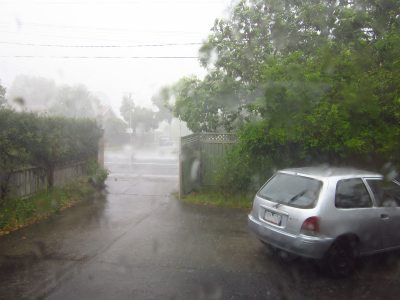
View of the downpour from our front window