Suzy’s Space: 2012
February
15/2: Wicked Witch of the West
A few weeks ago there was a lengthy article about mining magnate Gina Rinehart, now Australia’s richest woman. It was not a flattering profile, as is much I have read about her; I last mentioned her here in my 27/5/2011 entry. She is right-wing in the extreme, an outlook inherited from her late father, Lang Hancock, who was ruthless and not a particularly nice person. An article quote concerning his attitude to Australian Aborigines:
At one point, Hancock suggested forcing unemployed indigenous Australians – particularly “no-good half-castes” – to collect their welfare cheques from a central location: “And when they had gravitated there, I would dope the water up so that they were sterile and would breed themselves out in the future.”
The land for these personalities is merely something to exploit; environmental concerns are anathema to them. She wants to use cheap (i.e. virtually slave) imported labor in her mines; she does not want to pay a mining tax. Recently she has been increasing her share portion of Fairfax Media, produces of newspapers such as The Age, presumably in order to exert more influence in getting her views across. Another somewhat more amusing effort is an attempt at propaganda poetry. She does not like to be crossed and has people afraid of her. I have a particular loathing of bullies, though, and that is what she seems to be, to me.
She would be a perfect candidate for the RDA in Avatar; indeed, she would eat Parker Selfridge for breakfast.
27/2: Entrapment
“China’s promise of easier living herds Tibetan nomads into jobless penury,” The Age, 20/2. Here is yet another example of ensnaring a once-independent indigenous people by enticing them into “civilization” and the capitalist system so that they become dependent upon it to survive. It is a sad story repeated again and again throughout history, and one which is still happening in parts of the world, in developing countries such as Africa and South America with their indigenous peoples – governments forcing them to abandon their traditional lifestyles, in a misguided attempt to seem sophisticated to the rest of the world (i.e. Western nations). In the article it is Tibetan nomads being enticed away from the traditional life that has sustained them for centuries, to find themselves the most disadvantaged in the new society they have joined. Such people are arguably the last truly free humans, unlike us so-called civilized humans who are trapped in the complex web of the society we have created, and bound by all the wearisome obligations required to survive in it.
Tibetan nomads roam the grasslands at high altitudes in summer, usually in village-like communities of a dozen or two - free to herd their yaks and sheep in whichever direction the grass is lush and weather fine. Their yaks are their best friends, used to lug tents and equipment, for meat and milk, which is in turn used for butter and yoghurt. Even their dung is dried and burnt for fuel. Family, song and dance are vital to the culture, as is faith – just about all nomads in the region are devout Tibetan Buddhists.
For Losang, a lifetime in the expansive grasslands of Qinghai’s mountains has ended abruptly. He knows he’s likely to never earn enough to accumulate a self-sustaining herd again, having spent most of the money he got from selling his herd on his house. He also finds he has greatly underestimated cost of living in a world where nothing comes for free. “When I was a nomad I ate meat everyday, drank yak milk tea and wore sheepskin robes, now I can’t. I have to buy everything. And I even have to eat [vegetables],” he says.
A letter in The Age, 22/2:
Lure of prosperity
IN ITS attempts to preserve territorial integrity, the Chinese Communist Party is using immense investment in its volatile Tibetan and Uighur-populated regions.
The idea is to lure the rural people to trade in their subsistence living for some sort of newfound prosperity. But such policies are substandard and culturally destructive.
Unlike Australia with its multicultural attitude, China insists on the “Han” being the central identity of all Chinese. Such unity has helped hold China together for 2000 years. Nonetheless, it is this strong belief in their superiority that results in such disrespect towards minority groups. The anticipated outcome of such policies is simple: by diminishing other culture, the likelihood of separatism is also diminished, and Chinese sovereignty and economic development are sustained.
– Gerard Papas, Balwyn North
March
15/3: Billionaire bogans
“We’re bankrolling Bernie’s bogan daughter, says MP,” H-S, 14/3. Victorian Labour MP Kelvin Thompson made some unflattering remarks about Grand Prix boss Bernie Ecclestone and one of his daughters (Wikipedia: Bogan) – she is effectively acting like the typical nouveau riche. The GP, the first race of which has been held in Melbourne for over a decade (no thanks to then-Premier Jeff Kennett), gets taxpayer funding, a controversial issue (as is holding it in the city rather than a specialized racetrack). I do not support the GP and would like Melbourne to stop hosting it – aside from the funding issues, it is a noisy, environmentally-unfriendly spectacle (I wonder how it affects the animals and birds who live around Albert Park – the cars are extremely loud). I certainly have no liking for Bernie, who is an arrogant jerk who thinks he can order politicians around. His response came today.
There are a lot of people struggling to survive, so flaunting one’s wealth can be seen as offensive. It’s an issue of fairness – of some getting more than their fair share. Australia used to be perceived as an egalitarian country without the strict class system of other cultures, but this has become eroded in the last two decades or so.
I commented in a relevant GP thread at the Whirlpool forum. Perhaps I should have started a separate thread in the news section, but the sports section thread seemed like the logical place. Anyway, others there took offence, calling me a “troll” and such (apparently you are not allowed to have dissenting opinions). There are quite a few condescending ad hominem attacks from those defending their precious race, which doesn’t improve my opinion of them (here I can at least pay them the same courtesy). (Interestingly, one of the posters, “Sarah,” appears to be female; she accused me of being a “whinging female.”) Apparently they care more about sports spectacles than putting that taxpayers’ money to better use. (I took screenshots of the relevant pages below in case the posts are deleted.)
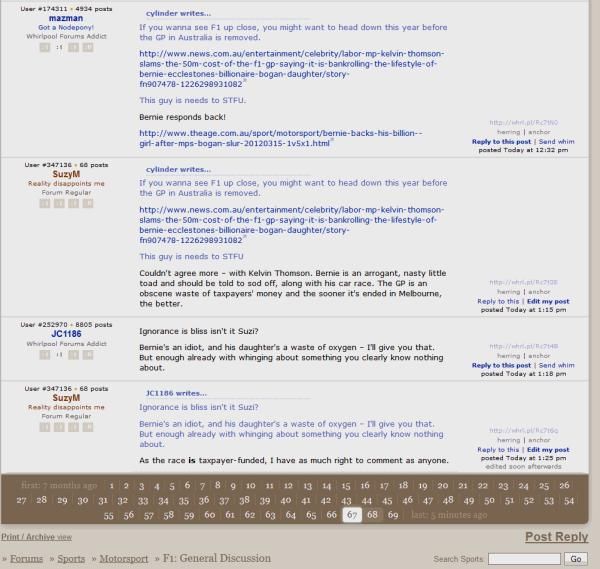
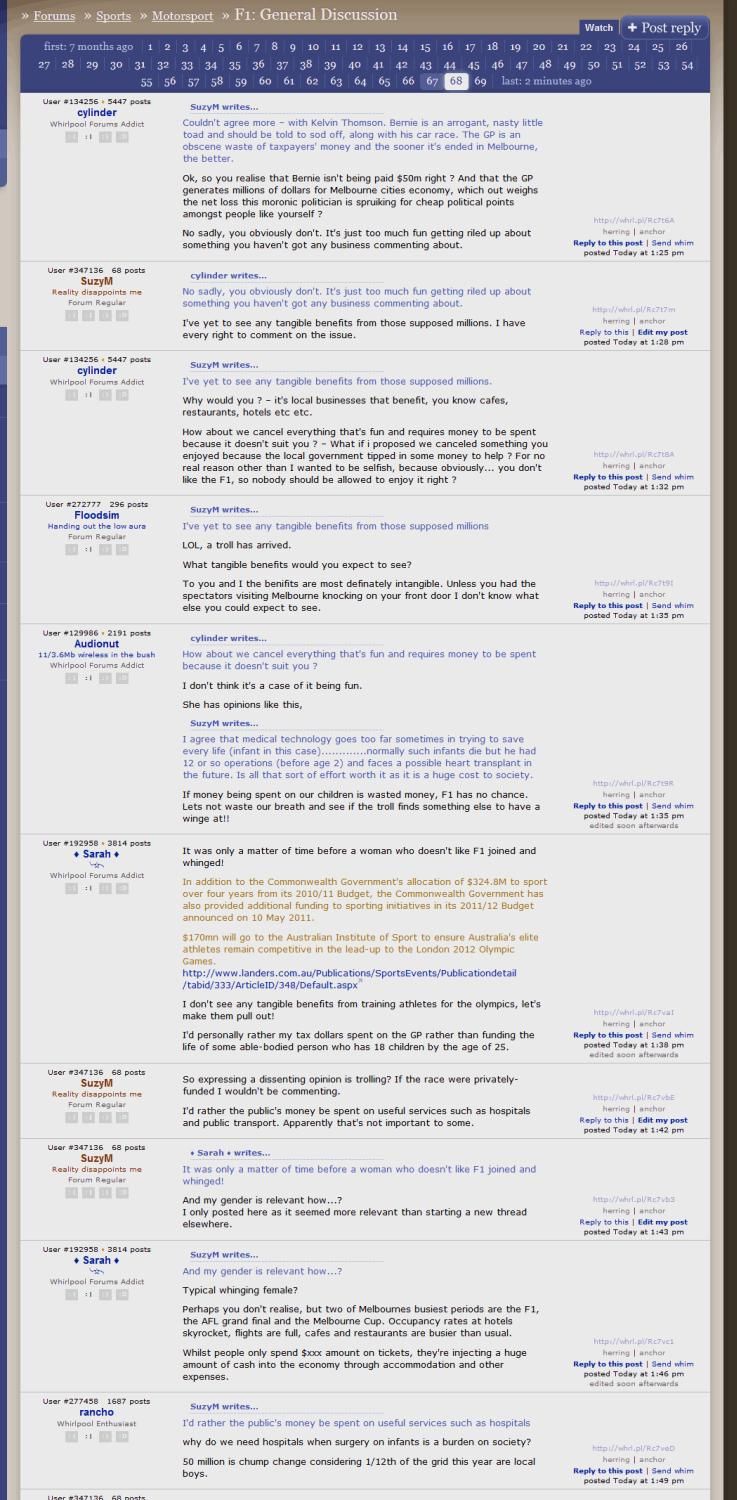
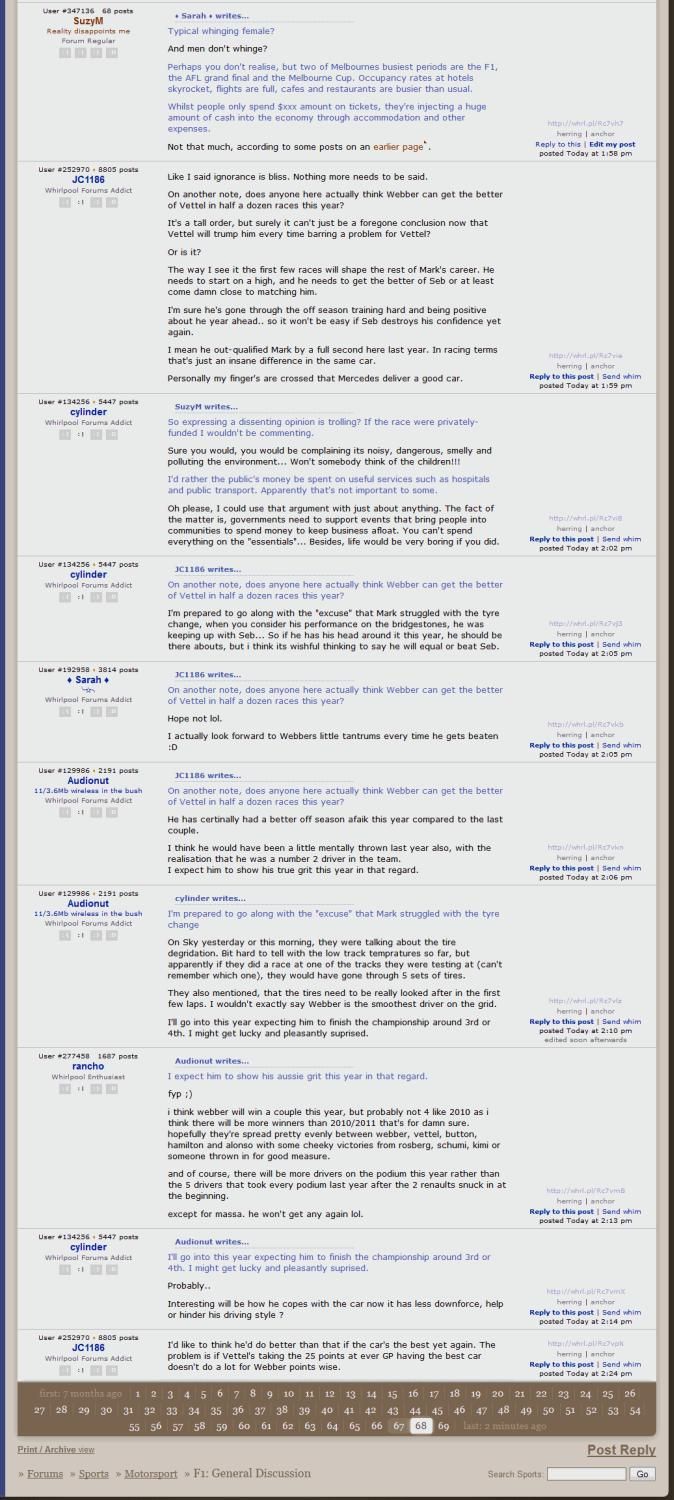
Professional sports should not receive government funding in my view; they are a frivolity. That view apparently makes me not “fun” according to those forum posters (I’m surprised they didn’t call me a “wowser”). I would love the GP to be canceled here just to see those morons (or should it be bogans?) whinge.
Edit, 17/3: A letter published in The Age, 16/3:
Ban the grand prix
I OBJECT to the grand prix. It costs the state an enormous amount of money that would be better spent on education and health. It takes over the public space of Albert Park. It celebrates hoon behaviour (driving cars too fast and making too much noise) and, in this time of climate crisis, dirty, obsolete petrol-burning cars. We need to celebrate transport that uses renewable energy sources. I suggest everyone boycott the grand prix and request that the government not allow it to take place in Victoria again.
– David Feith, Elwood
So there are others who have the same opinions as I do about it!
Edit: More letters published in The Age, 19/3:
Sick of being taken for ride
IT IS odd that Ron Walker can’t understand the non-acceptance of his grand prix (“Walker keeps faith as public’s embrace wavers,” The Saturday Age, 17/3). After all, a plethora of objections were there from the outset. Melburnians don’t like losing parkland. They were horrified when more than 900 trees were felled at Albert Park on a single day. And they know they are being taken for a ride when asked to pay for tickets that are given free to favoured customers at service stations. And what would the annual $50 million annual subsidy do for schools, hospitals and childcare centres?
Many are aggravated by the annual beat-ups to promote the race. But Walker has lately left it to his mate in London to come up with the regular “shift the race” threat each year.
Back in the era of Lex Davidson, Lou Molina and Stan Jones I was an avid GP follower, but not any more. For the past 10 years I have been paying off the repairs to my home after compaction work at Albert Park. And I have come to see car racing as a dishonest and reprehensible business that has no claim whatever to being a sport.
– Mark Hill, Middle Park
Chalk and cheese
RON Walker’s latest ploy to defend the growing waste of public money is to claim that other major events and venues like the tennis centre cost more. Maybe they do, but tennis is a sport and Formula 1 is a business. We can watch tennis and enjoy every serve and battle at deuce, and start at every grunt. We can even play the game ourselves.
In Formula 1 we are lucky to see the top of a driver’s helmet as he follows the leader through a concrete and steel mesh tunnel to the inevitable waste of a bottle of champagne, followed by the deposit of a large sum of money in a tax haven.
If I want to see businessmen strut their stuff I can walk up Bourke Street or William Street and there they all are, clutching their briefcases, glued to their mobile phones, hurrying from meeting to lunch to meeting. Be brave, Ted, get rid of it.
– Lewis Luxton, Ocean Grove
Stands are temporary
RON Walker frets that we don’t love his grand prix. A considerable part of the huge annual cost of staging the race in Albert Park results from having to move so much of its infrastructure in and out of the park. If the money were used instead to build a suitably-sited permanent racing circuit, say at Avalon, there would be no problem.
– David Cunningham, Castlemaine
Race encourages hoons
APART from the gross waste of public money, here are two reasons why the race is not embraced. The shrill shrieking of the cars permeates the inner suburbs, making even a visit to the Botanic Gardens unpleasant on the weekend.
And the race encourages extra-hoonish behaviour by some drivers. I was almost run down walking across a pedestrian crossing in my suburb on Friday by a car accelerating to more than 70 kmh. And on Sunday morning two motorbikes made a noisy “GP circuit” around our local streets.
– Peter Gerrand, West Melbourne
Different perspective
THE race loses millions, causes widespread disruption and pointlessly consumes large amounts of a dwindling, finite energy source. Ron Walker’s concern, however, is that the umbrellas are all arranged in a nice straight line for race day. He obviously has a sense of perspective. It’s just not the same one held by the majority of Melburnians.
– Benjamin John Doherty, West Melbourne
Figures don’t add up
IF THE Grand Prix Corporation wants the public to believe its attendance figures, it had better start by requesting no aerial shots of the park to be shown on television. The footage I have seen shows large areas with no spectators, very sparsely occupied grandstands and, on the ground, empty corporate boxes.
– Margaret Hilton, Aberfeldie
The grand prix
IS RON Walker kidding? Take the noise, the disruption to the city, the environmental issue and incitement to the hoons and petrolheads to behave badly. Does this give him a clue?
– Julette Alexander, South Yarra
RON, perhaps it’s time to realise the event has run its race.
– Allan Gibson, Cherrybrook, NSW
UNLIKE the cricket or the tennis, F1 has one major beneficiary at the top, and a lot of people don’t want to be seen putting a single penny into the pocket of Bernie Ecclestone.
– Pete Smith, Richmond
Edit, 28/10: “Albert Park inhabitants don’t duck for cover,” The Age, 18/9. “THE first study of Albert Park Lake’s black swans during the grand prix has found that while the birds don’t flee the annual event, the four-day car race is stressful and could have long-term effects on their lifespan and breeding.” The extreme noise levels from the F1 cars are highly stressful for any unfortunate creatures there – it must also damage their hearing, too. Try mentioning this to any fans, though, and you’d just get sneered at.
17/3: A barrage of sound and light
“Is Silence Going Extinct?,” NYT Magazine, 15/3. This article is about a much-overlooked negative aspect of modern life: noise pollution. It is difficult to find anywhere in the world that is free of human-made sounds – mainly that of various engines. This has deleterious effects on both wildlife and humans. Birds can’t hear their songs and have to adjust these or perish. Human noise pollution is also plaguing the oceans and deafening the various creatures there.
Sadly, the issue is not taken seriously by many – an article in io9, “All the noise we’re making is driving birds crazy,” takes a humorous or mocking tone, as do the more inane comments.
The main offending cause of sounds are the hundreds of mechanical devices used – engines of all sorts, air conditioners, music blared out from speakers. Unlike the sounds of nature (the wind, the rustling of leaves and swishing of grass, birdsong, burbling rivers, animal and insect noises), mechanical sounds are harsh and ugly and are undoubtedly a major contributor to stress and ill-health; a daily barrage upon the senses. The increasing aggression in society could in part be aggrevated by noise pollution.
This noise is, of course, amplified in urban areas. I live in a suburb of Melbourne and the noise is almost constant – mainly from vehicles (engines, exhausts, and screeching tyres from idiot hoons – young men in fast cars) and overhead aircraft. In summer, the hum of the rooftop evaporative coolers that have sprung up on nearby houses like ugly toadstools is almost deafening, drowning out birds in the garden. The only time of relative quiet is in the early morning hours (around 2 a.m. to 5 a.m.) but there is still traffic around. In the actual city it would be even worse – yet another reason I have no desire to live in apartment towers.
Entering a shopping center (or mall, to use the American definition) is to be overwhelmed by a cacophony of noise and light from all directions – a visual and aural assault. At times I feel like shutting down, so unpleasant is the experience.
Light pollution is also a growing intrusion everywhere. Barely any stars are visible from where I am – I have never really seen the Milky Way in its full glory (I have no means to travel). Light blasts one’s retinas from street lights, car headlights, shopping centers, decorative lighting around houses. There seems to be a mania in society to light up the night and stay up all night.
24/3: Raping the land
“Look at the land now. It’s been raped. That’s how I see it. The land has been raped. You know, Mother Earth has been raped. Look at it. Trees are being cut down. Things are taken out of the land and not beingg put back properly. The water is being abused. The animals are being abused, you know? Where will they go? It’s our land, it’s my land, it’s my father’s land and we should have access to it, you know? And I believe in progress, you know, to make things better. But not to totally erase what was there before, and doing so, you know? Not to totally erase away a life or a whole nation, you know? Just for progress? No, I don’t think so.”
– Rose, Fort McKay First Nation
I happened to watch part 4 of a documentary series, Bruce Parry’s Arctic, a couple of weeks ago; this one was filmed in Canada. The lament from the woman was the most memorable for me (this YouTube clip has the segment), and the absolute devastation that tar sand mining inflicts upon the land is deeply depressing to see. The air apparently stinks of tar, and all greenery and life has been erased, resembling the aftermath of a nuclear explosion, or the surface of the Moon. The First Nation tribe featured there are making much money from the royalties (though the ones featured have mixed feelings about it) and outsiders coming in to work earn huge amounts, but it is a devil’s pact – short-term gain (money) for long-term pain (on the environment).
There are still plenty of fossil fuels available on Earth, but the most-readily accessed sources are nearly depleted (peak oil), so companies have to turn to more unconventional sources to feed our rapacious industrial society; the process is even more environmentally devastating than conventional oil extraction. Making matters worse is the decline of oil coinciding with increasing demand due to population growth and the economies of developing countries such as India and China requiring oil as they modernize with all the consumer greed that entails. Modern agriculture also requires petroleum-based fertilizers.
Mining for minerals is also fueling Australia’s economy (China is a major customer) but it is equally devastating to the landscape, with huge open-cut mines scarring regions such as the Pilbara in the west of the continent. Many would see the desert here as useless and empty, but deserts have their own ecologies.
Coal-seam gas mining is a threat in Queensland and Victoria as the process of fracking can contaminate ground water and ancient aquifiers (such as the Great Artesian Basin in Australia), and there is heated opposition to property being invaded by companies to explore for gas.
In a desperate search for funds, Victoria’s Liberal Government has announced a plan to export brown coal reserves, much to the dismay of environmentalists. It is used to generate electricity here and is very polluting.
Most indigenous cultures regarded the land as sacred; a view alien to the culture I live in. A couple of well-known relevant Native American quotes:
Treat the earth well: it was not given to you by your parents, it was loaned to you by your children. We do not inherit the Earth from our Ancestors, we borrow it from our Children.
– Ancient American Indian Proverb
Only when the last tree has been cut down; only when the last river has been poisoned; only when the last fish has been caught; only then will you find that money cannot be eaten.
– Cree Prophecy
May
23/5: Animal slavery
Someone at the Whirlpool forum posted a thread about animals in circuses, being against the practice. Surprisingly some circuses in Australia still use exotic animals (lions, elephants, etc.) despite this being increasingly discredited. I have never been to a circus, but find the idea of those animals being used for entertainment degrading for them even if they are treated well. Using animals for entertainment generally is akin to slavery in my view (and it is not that long since some humans – mainly tribal peoples – were put on display for so-called “entertainment” in the last century in human zoos).
Typically for the site, in that thread some reply with inane comments like “Oh look, the drama queen fun police are here to impose their stupid version of morality on everyone” or “Here we go again. The animal libs at it again pushing there agenda again” (animal liberationists seem to be despised by some types). I suppose they would find bear-baiting or dog-fighting acceptable?
I recently read a 2010 article about orcas (killer whales) in captivity: “The Killer in the Pool.” Imagine taking a person from everything they had known and keeping them in confinement for years, and being made to perform tricks – they would eventually go mad. Orcas are intelligent and highly social animals, and to abduct them from their families and keep them in captivity for decades is nothing short of barbaric. There was an attempt earlier this year to sue Sea World for effectively keeping orcas in slavery, but it was dismissed in court. (Predictably the case received mostly mocking comments on Whirlpool and no doubt elsewhere; proof that a lot of humans are indifferent when it comes to animal captivity.)
To answer another point that always seems to be brought up in these sorts of discussions (as it was in that thread), I don’t find it a contradiction to oppose animals being used for entertainment yet for myself to eat meat. Predators hunting prey is part of Nature’s cycle, and humans evolved as omnivores. Ideally, animals used for food would be killed humanely.
[Update 31/5/2012: “Circuses and Zoos are crimes against wildlife” at The Habitat Blog.]
23/5: Food addicts
There has been much media attention given in recent years to the problem of rising obesity in Western society (USA, Australia, UK), mainly due to lack of exercise and ready availability of high-calorie processed foods. And there is something seriously wrong with society when even adolescents are resorting to stomach-banding surgery in order to lose weight, and how they can get so overweight in the first place. I also notice quite a few overweight younger children around, which is quite dismaying to see.
Processed food is deliberately designed to be addictive:
Hooked on junk food
JUNK food is as addictive as drugs, studies in animals and humans show. Foods rich in sugar, salt and fat trigger biological mechanisms that are just as strong and hard to overcome as drug addictions. An article in New Scientist magazine says one lawyer even believes there is enough evidence for a legal fight against the fast-food industry for harming our health, similar to class actions against tobacco giants. Researchers speculate the mounting evidence could lead to tougher regulation of junk food. (Herald-Sun, 2/9/2010)
Another more detailed article: “Fatty Foods Addictive as Cocaine in Growing Body of Science,” Bloomberg, 2/11/2011. Of course, the food corporations are in denial (as were tobacco manufacturers) but the evidence is mounting and the cost to society is enormous, in terms of diseases such as type-2 diabetes, heart disease and other obesity-related problems. Governments should definitely take measure to combat them, such as restricting the numbers of fast food chain outlets and taxing them heavily. Last week there was a Victorian council proposal to increase the rates of fast food outlets to discourage their proliferation. There would predictably be protests of “nanny state” (such as some of the usual rather tiresome protests in this Whirlpool forum post) but everyone has to pay for the resulting strain on the public health care system.
I find fast food (such as McDonald’s) as addictive as anyone else, but manage to restrain myself to only occasional indulgences (every few months or so). I just read this article, “The ugly truth about having a gastric bypass: The frank diary from an obesity nurse,” which provides motivation to try to not get to that size! I notice that the obese people featured all got that way simply through overeating addictions:
She tells me she’d always been big but really piled on the pounds when she had children. She felt lonely and the more depressed she became, the more she ate. Now hugely overweight, she has type 2 diabetes.
I talk to grumpy Dave while doing some routine checks. He opens up and tells me his story. It’s quite a typical one. He used to be a plumber but thanks to his junk-food diet got so fat he found it difficult to fit under people’s sinks. Then his knees got so painful he had to give up work. Stuck on incapacity benefit and with no self-esteem, his weight ballooned until now, aged 38, he weighs 30 stone.
Obese people are addicted to food in the way some people are to alcohol, cigarettes and worse. It’s a mental health issue.
A combination of readily-available junk food and depression can become a disabling and disfiguring condition for many. It’s easy to criticize them for lacking self-control, but learning this can be difficult and being depressed does not help. I am prone to comfort eating and it is hard sometimes to resist indulging – I could end up very overweight if I did not exercise.
December
5/12: Culling the herd
Via a post on Reddit, I came across this article: “MP says violent youth not being ‘culled’ by war,” ABC News, 16/11.
A WA Labor MP has told state Parliament more violent people are on the streets because they are not being sent off to war.
During Parliamentary debate about the classification of video games, the Labor member for Forrestfield Andrew Waddell said the people who commit the violence would have in the past been sent off to war.
“The reality is we are not culling the young anymore,” he said.
“We are not sending them off to a foreign battlefield to actually kill other people and so consequently that is why they are on our streets.”
Unlike others who reacted to this (the Redditor commenters were indignant, perhaps not surprising as the prevalent users of that site are young males), I did not feel particularly shocked as I have been thinking along similar lines for a few years. Many years ago, in the 1990s, I read a book by nuclear activist Helen Caldicott called Missile Envy (1984) where she wrote that wars were a way for the older males in power to have their younger rivals killed:
It is always the old men who send the young men off to die in their wars. […] It is never the people who make the decision to kill who get killed. It is the boys who usually don’t even know what the dispute is about, let alone understand the intricacies of international politics. The old men act out their fascination with killing, their need to prove their toughness and sexual adequacy by using innocent pawns. This dynamic has been occurring for thousands, if not millions, of years.
There have been news articles on the problem of “surplus males” in societies that favor male babies over female (the latter may be aborted or abandoned). Such trends are prevailent in some cultures such as those of India or China.
This trend could lead to increased levels of antisocial behaviour and violence, as gender is a well-established correlate of crime, and especially violent crime. Gender-related violent crime is consistent across cultures. Furthermore, when single young men congregate, the potential for more organised aggression is likely to increase substantially, and this has worrying implications for organised crime and terrorism.
– “Too Many Men Could Destabilize Society,” Terra Daily, 29/8/2006
What happens to a society that has too many men? In this provocative book, Valerie Hudson and Andrea den Boer argue that, historically, high male-to-female ratios often trigger domestic and international violence. Most violent crime is committed by young unmarried males who lack stable social bonds. Although there is not always a direct cause-and-effect relationship, these surplus men often play a crucial role in making violence prevalent within society. Governments sometimes respond to this problem by enlisting young surplus males in military campaigns and high-risk public works projects. Countries with high male-to-female ratios also tend to develop authoritarian political systems.
– Bare Branches: The Security Implications of Asia’s Surplus Male Population
Having been menaced (though not physically assaulted so far) by groups of young males on occasion, my attitude has hardened and I am increasingly inclined to almsot wish for another war! In Australia, there are real problems with male gangs going around and bashing people just because they feel like it, and driver aggression on the roads is commonplace. There is an underlying violence and nastiness in our society that seems to have become prevalent in the last couple of decades. Living in a society that focuses too much on “rights” and that does not discipline its young, does not help, as does a habit of excessive alcohol consumption.
Warfare is therefore a socially-accepted method of culling surplus young males, who otherwise can become troublesome elements in society, especially if they are unemployed and single with few prospects. Most violent crime is committed by young males. Few in power who start wars would be consciously aware of this motive, though. And, given the random nature of war, it unfortunately means that good men can be killed also.
Women can be violent too, but in general they lack the physical strength of men and tend to not be perceived as threatening. Testosterone – or excessive and unchanneled amounts of it – is the basic problem with male violence, and in a society that poorly initiates its young men, their energy will emerge in dysfunctional ways.
Edit, 11/12: this article from The Age last Saturday, “The salad days of a white-bread kid,” mentions young male violence in Australia and gives a few theories as to why there seems to be so much anger out there:
We drive like extras in Death Race 2000 and see any move to be overtaken as an attack on family honour that must be thwarted immediately.
So instead of emailing dial-a-quote experts for their views, your columnist sought out some street coppers and over cool drinks raised the hot subject: “What the hell is going on out there?”
They identified three major shifts that aren’t that pretty at all.
- Deadbeat dads who disappear. Many young male offenders have grown up without a male role model in their lives. “No one has ever shown them how to be a man,” one policeman said. “We see 25-year-olds carrying on like spoilt 12-year-olds,” said another.
- Ice. The spread of the drug has led to a serious spike in street violence. Police say male and female users become spooky-violent, leading to an increased use of capsicum spray and foam.
- Internet. Increase in racial and sexual vilification, easy access to hardline pornography, hate-filled blogs on (un)social media, open invitations to crash parties and the new phenomenon of online bullying have left police to deal with a whole new culture of bad behaviour.
It is easy to condemn a generation and see points of difference as points of weakness. But DNA has not changed – they are the products of the world we gave them.