Cosmonaut survival training
Survival training is an essential requirement for flying in a Soyuz spaceship, as it could land anywhere between 51.6° north or south if the ballistic descent was off-course. The crew would, in theory, be rescued in three days. There is a specialized department at Star City devoted to such training, and the gear provided to crews is extensive, providing for landing on sea or earth.
The survival training is intended to psychologically prepare the crew for the stresses of an off-nominal landing in any of several environments, as well as learning the practical skills necessary to cope in such difficult conditions with the equipment provided: that in the descent capsule, the portable emergency kit, and what materials can be utilized from the surrounding environment – e.g. tree branches for constructing a shelter frame.
Training is both theoretical and practical, and is divided into three stages:
- Preliminary training: This takes place at the Yu. Gagarin Cosmonaut Training Center (ЦУП, TsPK) and involves lectures from instructors in various aspects of survival methods, as well as getting acquainted with the equipment used.
- Direct training: This is carried out in the relevant environments; e.g. at sea, in the forest and the desert (the last at Kazakhstan). Here the crew can integrate what they have learnt and gain valuable practical experience. Some survival tasks learnt include learning to build a makeshift shelter, firing the TP-82 (ТП-82) pistol and firing off flares (smoke and light).
- Independent integrated training: In this final stage the crew are dumped in a wilderness area (usually the forest around Star City) for a couple of days with the Soyuz descent capsule-trainer and left to fend for themselves. There are two or three “exotic” training sessions a year (sea, winter, desert). Crews who will be going into space the following year partake in these.
Equipment used in the training includes a full-scale mock-up of the Soyuz capsule (including its parachutes), portable emergency kits and various items of survival clothing. Helicopters, trucks, airplanes and boats provide support for the training sessions.
Full medical support is also provided, and the cosmonauts’ health is carefully monitored during the course of training. The crew and instructors all receive basic first-aid training as well.
Survival training can encompass winter, mountains, desert, swamp, ocean recovery, parachuting and zero-g. It takes place on (or just above) Earth. This page focuses on after-landing survival in Earth environments.
Environments
The official TsPK website has various Russian-language news articles on the survival training cosmonaut crews undergo, under the tag «Подготовка» (Preparation). Below are some example articles (linked to the originals) detailing training in different environments by various crews.
Desert
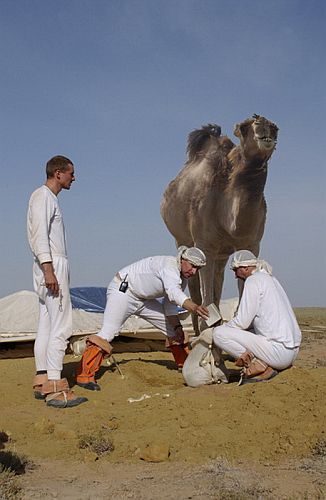
Save yourself from heat and dehydration: cosmonauts start training in the desert
6/7/2021
Two days in the open air with a limited supply of water – in such conditions, the cosmonauts who flew to Baikonur to participate in the summer training session must “survive.” Crews are practicing how to wait for help if the lander lands in the desert and rescuers do not immediately find it.
Now the daily air temperature in Kazakhstan rises above +40°С. Once in a desert or semi-desert, which has sparse vegetation, a person runs the risk of suffering from the scorching sun and dehydration.
“Cosmonauts should build a ventilated sun shelter and try to conserve water. Each crew has six liters of water for two days of training,” said Aleksandr German, head of the TsPK department.
The cosmonauts also have a supply of food, but on the first day it is recommended to do without it or eat at night, when the heat subsides. It is necessary to take into account the fact that the products from the wearable emergency stock (NAZ, НАЗ) are sublimated, which means that they will need to be diluted with water, which will reduce its supply.
During the day, participants in the training should be under cover, and for spending the night, lower the awning and sit on top of it. If the crew is not in danger, it is better not to make unnecessary movements, because they contribute to dehydration.
“In order to protect the body from water loss, it is necessary to hide from the sun, exclude movements, conversations, and it is even desirable to close your eyes. In addition, it is necessary to comply with the established schedule for water intake,” said Aleksandr German.
From time to time, cosmonauts will have to perform the tasks that instructors related, for example, providing medical care in case of sunstroke or insect bites. It is also necessary to work out a plan for interaction with search and rescue services.
Participating in the training session were Konstantin Borisov, Kirill Peskov, Oleg Platonov, Aleksandr Gorbunov, Alexei Zubritskii, Aleksandr Grebenkin. Today, they were given theoretical and practical training on the ground. On July 7, the first three cosmonauts will begin training as part of the crew.
The first conditional crew is preparing for an overnight stay in the desert
7/72021
This morning, test cosmonauts Konstantin Borisov, Kirill Peskov and Oleg Platonov began training to practice actions after landing the spacecraft in the desert. For two days their conditional crew will “survive” in extreme conditions.
Heat, a limited supply of water, deserted terrain are factors that cosmonauts must take into account in order to ensure their own safety and maintain health.
The crew must select and clear a site for the construction of a temporary camp, then build a primary sun shelter and wait for the evening under it. When the heat subsides, the cosmonauts will have to complete the construction of a shelter for spending the night in safe conditions. The tasks of “survival” in the desert area also include the extraction of water by condensation, the development of interaction with search and rescue forces (SRS), поисково-спасательными силами (ПСС), the provision of medical assistance to the “victim.”
The next crew to start training will be a conditional crew consisting of test cosmonauts Aleksandr Gorbunov, Alexei Zubritskii and Aleksandr Grebenkin.
Training in the desert: the second conditional crew is waiting for rescuers
13/7/2021
Training of 2018 cosmonauts continues at Baikonur. Now the second conditional crew, consisting of Aleksandr Gorbunov, Alexei Zubritskii and Aleksandr Grebenkin, “survives” in the desert. They will spend two days waiting for a meeting with the search and rescue group. In the meantime, their main tasks are to escape from the sweltering heat and scorching sun in the daytime, create conditions for a safe overnight stay in the open air, and prevent dehydration of the body.
Cosmonauts have at their disposal only the gear and equipment that can be in the descent vehicle during landing. The portable emergency supply (NAZ, НАЗ) is designed to help the crew survive an abnormal landing in any climatic and geographic zone. The parachute is used to build shelters both in the winter forest and in the desert hot from the sun. In addition, cosmonauts can use lodgements, that is, chairs from the descent vehicle.
Almost all items are multifunctional. For example, a metallized film from NAZ saves from cold and heat, and not only an awning is made of parachute fabric, but also supports for it. Homemade bags are stuffed with sand and folded into posts, on which a fabric “roof” is attached. Lodgments can also be used to support the awning. At night, the awning is lowered, the cosmonauts are placed on top of it, leaving the edges of the shelter raised, which, along with a ditch dug nearby, protects them from representatives of the desert fauna.
“In the daytime, when the sun is shining, the crew should be under cover and do nothing. The lack of dynamics is part of the cyclogram, no matter how paradoxical it may sound,” said Aleksandr German, head of the TsPK department.
On the first day of training, the crews select and clear a camp site, build a shelter, and begin collecting water by condensation. Despite the fact that initially they have at their disposal six liters of water for three (a container with water at the NAZ), cosmonauts must be able to extract it using improvised means. In general, any tests for “survival” are aimed at ensuring that in an emergency a person can hold out as long as possible while waiting for help.
Cases of landing crews in mountainous and forested areas, as well as on the water surface, are rare, if we talk about domestic manned cosmonautics. Kazakhstan is the main space harbor of the country, the place of launch and landing is separated by only a few hundred kilometers. Therefore, the risk of getting into an emergency situation here is somewhat higher than in other climatic and geographical zones.
“Cosmonauts don’t land in the desert; they land to the north, in the steppe. Over the past twenty years, there have been several prerequisites for autonomous actions of the crew before the approach of the search and rescue forces, even after a regular landing,” said Aleksandr German. “There was also an emergency situation, as a result of which the crew of Nikolai Budarin landed far from the calculated landing site, and the first helicopter with rescuers arrived to them only after 4.5 hours. It was May 2003, a very strong wind was blowing, which, by the way, also leads to dehydration.”
On the final day of “survival” the crew of Aleksandr Gorbunov, Alexei Zubritskii and Aleksandr Grebenkin will have to go to the meeting point with the rescuers. Cosmonauts usually go through another test – they provide first aid to the “injured,” based on the situation that the instructors will simulate. At the end of the two-day training, it will be analyzed with the participation of specialists from the test and training team of the TsPK.
Cosmonauts survive the heat
14/7/2021
A mock crew of Aleksandr Gorbunov, Alexei Zubritskii and Aleksandr Grebenkin completed their training in the desert. According to the conditions of the test, their descent vehicle deviated from the calculated landing point and landed in a place where the search and rescue forces could only reach after two days.
At the first stage, the cosmonauts had to clear a place for the camp, build first a temporary, and then the main shelter. The scorching July sun, exhausting heat, a limited supply of water – the crew was in extreme conditions. In order to protect themselves from dehydration and preserve their strength during the daytime, the cosmonauts tried not to move or talk. The actions provided for by the training cyclogram were performed during those hours when the heat subsided.
Working out interaction with search and rescue forces (SRS) is an important part of the training process. The crew must maintain radio contact with rescuers and indicate their location with light signals.
“During water survival training, cosmonauts work out their skills in handling signaling devices. And here they are already using them to interact with search and rescue forces. Conducting a radio exchange, they must promptly activate signal cartridges. At night, you need to be able to show your location to the rescuers who are on the helicopter, and in the daytime, in addition, indicate the conditions for the helicopter to land: the direction and strength of the wind near the ground, ”said Aleksandr German, head of the TsPK department.
During the training, a situation is worked out in which the crew must leave the camp and go towards the rescuers, conducting radio exchanges with them and correcting the movement according to the instructions of the PSS, ПСС. Another test that the cosmonauts go through is the provision of medical assistance to an “injured” comrade. Based on the results of the training, a detailed analysis is carried out.
For two conditional crews, the tests are completed. Konstantin Borisov, Kirill Peskov, Oleg Platonov, Aleksandr Gorbunov, Alexei Zubritskii and Aleksandr Grebenkin “survived” in the desert of Kazakhstan. But they still remain in Baikonur. The test cosmonauts of the 2018 recruitment have a unique opportunity to see the launch of the Nauka, «Наука» module, which is scheduled for July 21, 2021.
Mountains
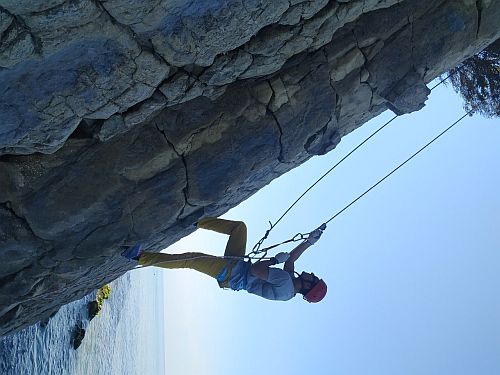
Cosmonauts completed a survival course in mountainous terrain
22/10/2015
The Yu.A. Gagarin Cosmonaut Training Center conducted survival courses in mountainous terrain. Training of the 2010 recruitment test cosmonauts took place in the Tuapse region of the Krasnodar Territory for five days. He headed the group, which included cosmonauts Denis Matveev, Sergei Prokop’ev, Andrei Babkin and Ivan Vagner, Hero of Russia, pilot-cosmonaut of the Russian Federation Aleksandr Skvortsov.
In the event of a forced landing, the crew of a transport manned spacecraft must be ready for autonomous operations before the arrival of search and rescue forces in any climatic and geographical zones.
“Training in a mountainous wooded area is aimed at ensuring that the cosmonauts not only get acquainted with the features of the relief, but also understand what dangerous phenomena and natural formations can be in the mountains,” said Aleksandr German, the instructor for preparing cosmonauts for actions in the event of an emergency landing of a manned transport ship. “They need to learn the rules of proper behavior in the mountains: movement, choosing a safe area for the duration of their camp, as well as interacting with search and rescue services, providing first aid to the victim and transporting him.”
This type of cosmonaut training is associated with increased danger, dictated by the presence of mountains, a large elevation difference, steep slopes, screes, glaciers, crevices, abysses, a rarefied atmosphere, and rapidly changing weather.
“Given these factors, the requirements for self-organization and work in a group are as high as possible,” said Viktor Ren, Deputy Head of the Department for Extreme Types of Cosmonaut Training at TsPK. “Morale, psychological and emotional stress is much higher here. At the same time, all of these factors contribute to the active development of physical strength and endurance, increased attentiveness and prudence, coherence and similarity in the group, the development of high discipline and responsibility to oneself and teammates.”
The trainings were held under the supervision of a test-training team, which includes instructors, a doctor and a psychologist from the Cosmonaut Training Center, as well as under the supervision of specialists from the Tuapse branch of the FGKU YuRPSO MChS of Russia (ФГКУ «ЮРПСО МЧС России»).
In the mountains, the main thing is to trust yourself and the equipment
16/9/2019
Mountains are not only and not so much picturesque places as a challenge to man. They are fraught with many dangers and barriers. Sometimes it is necessary to overcome tens of kilometers, crossing rivers and passes, encountering stony and loose slopes, precipices, rockfalls and avalanches. And in extreme types of cosmonaut training, training on actions in the event of an emergency landing in a mountainous area is not accidental.
When launching a rocket from the Baikonur Cosmodrome, the possibility of an emergency landing in the mountains is small. However, it is worth recalling on April 5, 1975, when the cosmonauts Vasily Lazarev and Oleg Makarov, due to an accident at the launch of the Soyuz launch vehicle, were in an unplanned landing site, in the Altai mountains. And if we take into account the future possibility of launching transported manned ships from the Vostochnyi Cosmodrome, the probability of landing in the mountains of the Far East in case of an emergency or emergency greatly increases.
Therefore, TsPK instructors teach cosmonauts to survive in any conditions. From September 9 to September 13, 2019, on the basis of the Emergencies Ministry Rescue Training Center in the village of Krasnaya Polyana, training was held for actions in case of an emergency landing in mountainous terrain, in which cosmonauts of the Roscosmos cosmonaut team – Andrei Borisenko, Sergei Korsakov and Oleg Novitskii – took part. The training program included theoretical and practical lessons, training in working with climbing equipment, as well as a comprehensive one and a half day’s training, during which cosmonauts climbed Mount Achishkho, overcoming talus, water barriers and setting up a camp in the Khmelevskii Lakes region.
“People who do not have much experience walking in the mountains, either as a tourist or as a climber, find it difficult to get involved in the process,” said TsPK instructor Aleksandr German. “However, our cosmonauts showed themselves perfectly: they maintained the pace, and they complied with all the recommendations. We worked out with them various evacuation options in the event of an emergency landing in the mountains, the main ones are either the crew picks up the helicopter, or you need to wait for the rescuers and descend with them on the ground. In the second case, they just need the ability to use climbing equipment.”
Aleksandr Viktorovich added that over the past week the cosmonauts worked out several methods of climbing and lowering from the mountains and the optimal use of the composition of the portable emergency reserve (NAZ), which is available in the descent vehicle. “We tried crossing the mountain rivers with them,” said Aleksandr German. “And the height of 2200 meters became our top point. And all this time, the cosmonauts behaved like real climbers [smiles].”
It is worth noting that Andrei Borisenko and Oleg Novitskii, despite the experience of space flights, took part in training on actions in the event of an emergency landing in mountainous areas for the first time. “I was in the mountains before that, of course, but I didn’t do such ascents,” Andrei Ivanovich admitted. “It was interesting to try it yourself. The instructors gave us useful basics that can come in handy when landing in the mountains. But it’s also very useful as a common development.”
Oleg Novitskii, during his years as a pilot in the North Caucasian Military District, took a survival course in the mountains, which included the construction and arrangement of shelters, the search for firewood, food, and orientation on the ground. But he got acquainted with climbing equipment for the first time. “Most of the practical training was aimed at ensuring that we trusted this equipment and were able to overcome some of our unconditioned reflexes,” Oleg Viktorovich said. “For example, if the precipice has gone, you do not need to hold the line, but rather let it go, because there is insurance that will work for you. And if you hold the sling with your hands, then the equipment may not work correctly, thereby only harming yourself. We need to competently and calmly work even in such an extreme situation.”
The cosmonauts trained under the guidance of practical instructors of the extreme training department, a physician and psychologist of the TsPK medical department, with the participation of professional mountain training instructors at the Emergencies Ministry Rescue Training Center in the village of Krasnaya Polyana.
“For psychological training, it is important that we have tested the mining equipment and understand that it is reliable,” added Andrey Borisenko. “We now have at our disposal some basics of how to use it.” If we talk about the possibility of using climbing equipment in the event of an unplanned landing site after a six-month space flight, then the crew, of course, cannot perform these actions, because normal physical condition is still required. But if this happens at the launch site, when the crew is still at the peak of their form, these skills can certainly be applied.”
Indescribable sensations: cosmonauts passed tests in the mountains
22/9/2021
Training in the mountains involves survival tests. In the event of a forced landing, the ship’s crew must be ready for autonomous action before the arrival of search and rescue forces in any terrain and in any weather.
For the test cosmonauts of the 2018 recruitment, the summer and early autumn turned out to be tense. In July, they trained in the desert of Kazakhstan, escaping from the sweltering heat and dehydration, and in September, together with the TsPK instructors, they went to the mountains. Previously, cosmonauts participated in other trainings, one way or another related to extreme types of training, so they can compare their feelings and analyze what is more difficult.
“I had to be in the mountains, but I didn’t go along the ridges with belays and didn’t do rock climbing on a sheer cliff. An indescribable feeling when you hold on to your fingertips and stand on your toes, and 10-15 meters under you. A partner is insuring from below, and there is a safety rope, nevertheless, everything freezes inside,” said test cosmonaut Aleksei Zubritskii.
According to Aleksei, the test in the mountains is not the most difficult of all possible, but it allows you to feel the danger.
“The spirit is breathtaking, and it is comparable to jumping while undergoing special parachute training. There are moments of risk and a sense of danger,” the cosmonaut noted.
Many other types of training related to survival involve the division of cosmonauts into conditional crews of three people each. Cosmonauts train in mountainous terrain as a whole group. This time there were seven of them: Konstantin Borisov, Aleksandr Gorbunov, Aleksandr Grebenkin, Aleksei Zubritskii, Sergei Mikaev, Kirill Peskov and Oleg Platonov.
To conquer the mountain peaks, TsPK instructors and their wards traditionally go to the Tuapse district of the Krasnodar Territory. Tests always begin with theoretical preparation. The cosmonauts are introduced to the types of belay devices, taught how to handle equipment, show the main knots, explain how to move along various mountainous terrain, and are reminded of the rules for providing first aid to victims.
“Then, on a low slope, we worked out the skills of ascent and descent, including using parachute lines and rings on spacesuits. After all, if the descent vehicle lands in the mountains, we will not be able to use the professional equipment of climbers. We simply won’t have it. While waiting for the rescuers, only improvised means will have to be used, including, of course, the contents of a wearable emergency supply,” explained Aleksei Zubritskii.
The main part of the five-day training is a two-day hike through the mountains with an overnight stay in a grotto. The cosmonauts moved in tandem, trying to find the best route in the difficult mountainous terrain.
Training on crew actions in case of an emergency landing in mountainous terrain is aimed at developing physical strength, endurance, attentiveness and fostering high discipline. The cosmonauts practiced various techniques of movement in the mountains and improved their teamwork skills.
Practical exercises were carried out under the supervision of specialists from the TsPK and the Ministry of Emergency Situations of Russia.
“Pull the guy to the mountains …” Roskosmos, 4/1/2022
Steppe
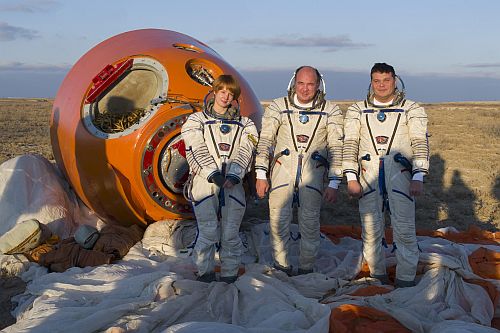
“Steppe and steppe all around”
5/12/2019
The regular landing area for the descent vehicle (SA) of the spacecraft is the steppe of Kazakhstan. And it does not always work out that the crew lands exactly in the place where the search and rescue services are waiting for them. The slightest emergency situation during the descent can lead to many kilometers deviation from the planned landing point. What to do then? Wait for help in the SA or go outside on your own? After a long period of weightlessness, the body can hardly endure gravity, and the steppe is fraught with many dangers. That is why the plan for preparing cosmonauts for extreme activities includes training on the actions of the crew in the event of an emergency landing in the steppe in winter, which takes place at Baikonur from November 25 to December 6.
Experts note that the new type of training is partly similar to the training that took place in the tundra near Vorkuta, but there are still differences. Therefore, the first to test survival in the steppe was the crew of TsPK instructors (commander Aleksandr German, flight engineers Ruslan Yeltsov and Aleksandra Tyurina). “The main thing the crew had to deal with was the cold,” said Aleksandr German. “There is practically no material for lighting a fire, and at night the temperature reached minus 15 degrees. But everything went smoothly. So the cosmonauts went to training confident that the advice we were giving them was working.”
The first two-day training on the actions of the crew in the event of an emergency landing in the steppe in winter were the test cosmonauts of the Roscosmos cosmonaut detachment Sergei Kud-Sverchkov, Nikolai Chub and Pyotr Dubrov. According to legend, the SA landed somewhere in an undesignated point of the Kazakh steppe, and the search and rescue services could not immediately find it. The mock-capsule lies on its side, i.e. the seats are almost in a vertical position, which is not very convenient, besides, it is necessary to control the level of carbon dioxide in a confined space. Therefore, the cosmonauts change from their Sokol spacesuits into flight suits and go outside to assess the situation. Frost and wind make you quickly put on also heat-protective suits, and then there is room for improvisation.
“Survival in the steppe is a combination of factors from training in a wooded and swampy area in winter and in a desert in summer,” said Sergei Kud-Sverchkov, commander of the first conditional crew. “Minus temperature, greatly reduced by the wind, lack of firewood and natural shelters, limited amount of water. But we have an experienced crew. Both Pyotr Dubrov and Nikolai Chub went through survival in the forest in winter and in the desert, so we imagined what awaits us and discussed the tactics of action in advance.”
As Anatolii Zabruskov, head of the TsPK department, explained, one of the features of this type of training is the active use by the cosmonauts of the SA simulator both for changing clothes, resting, and for building shelter using parachute fabric, parachute lines and medical capes.
“Unlike the forest, there is little work here,” said Sergei Kud-Sverchkov. “On the one hand, it’s good that you don’t sweat, you don’t feel like drinking, on the other, you don’t get warm. You need to be careful and correctly choose the mode of activity, because if you sweat, it is impossible to dry clothes on a modest fire, bred in the steppe. As a shelter for sleeping, we tried different options. We tried to sleep in the SA, where only one person can comfortably accommodate for relaxation. They built a shelter from a parachute, laid out a multilayer bedding from a medical cape and Trout wetsuit so as not to sleep on bare ground, they were as close as possible to the fire, which was lit thanks to the bushes and roots found. Because of the cold at night, we slept very little, we filled up during the day in turn.”
“During the training, the first crew felt good, the guys were full of energy and motivated to go through survival,” summed up Anatolii Zabruskov. “Moreover, they made interesting proposals regarding the composition of the portable emergency kit (NAZ, НАЗ), which we will promote when compiling the NAZ for a new generation ship. Any training that we conduct in various climatic and geographical zones involves a much greater amount of work and tension for the crew than is required in reality. This is done on purpose to give the cosmonauts confidence that they will be able to cope with any emergency situation, and wherever they happen to be upon landing, they will be able to save their lives and health.”
The crew of Mukhtar Aimakhanov, Dmitrii Petelin, Anna Kikina and the third (Denis Matveev, Andrey Fedyaev, Sergei Korsakov) passed the test of the winter steppe.
Winter steppe conquered
10/12/2019
Successful completion of training on the actions of the crew in the event of an emergency landing on the steppe in winter depends not only on the level of training of the cosmonauts, but also on weather conditions. This climatic and geographical zone is characterized by a sharp change in temperature, moisture, direction and strength of the wind. Externally, the steppe is not as terrible as the mountains or the open sea, but rather insidious.
For an unprepared person, a lot of dangerous surprises await here, such as the lack of elementary shelter from the cold and bad weather, hypothermia from a cold night without a fire in the open air, dehydration, etc. But our cosmonauts are ready for any, even the most severe tests.
Last week we talked about how the first week of “survival on the steppe” went at Baikonur. We note right away that all the cosmonauts returned to Star City alive and well, and shared with us their impressions of a new type of extreme training. Perhaps the most comfortable weather conditions went to the second conditional crew consisting of test cosmonauts of the Roscosmos cosmonaut detachment Mukhtar Aimakhanov (commander), Dmitrii Petelin and Anna Kikina. It was, of course, cool, but the weather allowed them to be very active and work outside. It rained only once, and in the daytime it was even sunny.
The second simulated crew left the descent module simulator (DS), тренажёр спускаемого аппарата (СА), at dusk. The cosmonauts had to build a shelter for the night in a short time and stock up on firewood for making a fire. Properly distributing duties, they quickly coped with this and then took turns keeping watch at night in order to get in touch with search and rescue services every hour and respond as quickly as possible to any surprise.
“It was far from the first survival for me,” said Anna Kikina. “Even before joining the cosmonaut corps, my activity was connected with extreme training. And, already being in the detachment, we went through various survival courses – in the desert in summer, in wooded and swampy areas in winter, on the water, etc. Therefore, we knew what awaited us and what would be at our disposal.”
On the morning of the second day, the crew of Mukhtar Aimakhanov began to improve their temporary shelter with the expectation that it might get colder, windy, rain or snow. To improve shelter, the cosmonauts used not only the parachute and its lines, but also Forel, «Форель» (“Trout”) overalls and even the inner lining of the SA, made of Bogatyr, «Богатырь», fabric. In order not to sit on the bare ground, they laid out the “floor” with a layer of bushes, and used medical capes as a reflective shield to keep warm. They also built a good signal fire, which was lit with a single match and flared up in 40 seconds so that the crew could be detected from the air.
But the third conditional crew, consisting of test cosmonauts of the Roscosmos cosmonaut detachment Denis Matveev (commander), Andrei Fedyaev and Sergei Korsakov, was the least lucky with the weather in all two weeks of training. On the first night it rained, then it got colder, and it started to rain with snow and strong gusts of wind (felt more than 15 m/s). Even in ordinary life, we do not like such weather, to put it mildly. And on the expanses of the Kazakh steppe, this became a test for the cosmonauts, who quickly adjusted to the climatic conditions.
“Initially, the introduction was such that there is no fuel for a fire in the steppe,” said Denis Matveev. “But in fact as it turned out, it’s elm. At the base, its stems are quite thick, dry and well broken or chopped with a machete. This bush helped us keep the fire going all night long and not freeze.” The commander of the third crew stressed that he was very lucky with his colleagues.
“Andrei and Sergei are well prepared,” added Denis Matveev. “Everyone wanted to contribute to the common cause to the maximum. We did a lot of work thanks to the comfortable psychological atmosphere in the crew. We worked hard and together to achieve our goal.”
Recall that “survival in the steppe” was held at Baikonur from November 25 to December 6. This is a new type of extreme training for cosmonauts, which is a hybrid of training in the desert in summer and in wooded and swampy areas in winter. Viktor Ren, Deputy Head of the TsPK Department for Extreme Training, Hero of the Russian Federation, noted that in more than forty years of organizing and conducting the so-called “survival in various climatic and geographical zones” with his participation, for the first time, three crews in a short period of time, lasting 10 days, experienced completely different weather conditions. Only in terms of temperature conditions from +6°C to −17°C and wind strength from complete calm to gusts of more than 15 m/s, not to mention rain and dense fog. These diversified conditions forced all the crews to show high activity and creativity, which allowed them to successfully cope with the training program for actions in the event of an emergency landing in the steppe in winter, brilliantly completing all the assigned tasks.
Water
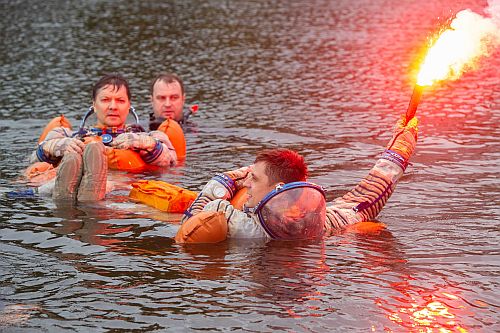
The crew of Oleg Kononenko worked out emergency situations in case of splashdown
11/6/2021
On the basis of the Noginsk Rescue Center of the Russian Emergencies Ministry, cosmonauts are training to practice the actions of the crew after landing the descent vehicle on the water surface.
On June 10, 2021, the ISS-69 crew consisting of Oleg Kononenko , Nikolai Chub and Andrei Fedyaev took part in the so-called “short” training session. Indeed, it does not last long, because the proposed circumstances require the cosmonauts to act as quickly as possible. If a leak is detected in the descent vehicle, the crew must urgently leave it. 8 minutes are allotted for the self-rescue operation.
“When the command comes to leave the ship, we must put on gloves, life belts and fasten the units of a wearable emergency supply (NAZ). It is very difficult to do this on your own due to the fact that space is limited and, in addition, the spacesuit restricts movement. Therefore, the crew commander helps the rest to equip themselves,” said test cosmonaut Andrei Fedyaev.
“Being in the center seat, the commander has the opportunity to help both the cosmonaut who is to his left and the one to his right. I am the first to leave the descent vehicle, otherwise my colleagues will not be able to get out,” explained Oleg Kononenko, ISS-69 crew commander. “In general, the responsibility for the actions of the crew lies with the commander. If he managed to properly organize the work, the training will be successful and all tasks will be completed.”
During training, test cosmonaut Nikolai Chub received congratulations on his birthday. Holidays are not a reason to disrupt the process of preparing for a flight. “If I’m lucky to celebrate my birthday in orbit, I’ll probably not forget it, but the fact that it coincided with training is commonplace,” Nikolai Chub said. “For me, this is not the first cycle of training on the water. Usually at the time of their conduct it was very hot, the temperature in the descent vehicle exceeded 40 degrees. It's much cooler now, it's easier to train.”
Andrei Fedyaev and Nikolai Chub are preparing for their first expedition to orbit. Their commander Oleg Kononenko made four flights, he almost always spent his birthday in a working environment. “I was born on June 21, and this day usually fell on the period of preparation for the flight: either skydiving, or “surviving,” or passing exams. It also happened to celebrate a birthday in space,” said Oleg Kononenko.
This year, water survival started on June 7 and will end in the third part of the month. Six crews, which, in addition to Roscosmos cosmonauts and NASA cosmonauts, included cosmonaut candidates and space flight participants, will practice survival skills in case of emergency situations on the water surface. In addition to the “short” training, there are “long” and “dry” workouts, each of which differs in the type and volume of tasks performed.
Cosmonauts learn to survive if they land on water
16/6/2021
On June 24, 2021, the cycle of trainings on the actions of cosmonauts after landing the descent vehicle (DS) – спускаемого аппарата (СА) – on the water surface, which are held at the Noginsk Rescue Center of the Russian Emergencies Ministry, will end.
Skills are practiced by six crews – officially approved and conditional. In addition to active Roscosmos cosmonauts and NASA cosmonauts, cosmonaut candidates, space flight participants, as well as TsPK instructors are participating in the training. Some are just learning to survive in the event of a splashdown of the descent vehicle, others are maintaining their skills, and still others are directly preparing for a space expedition.
The process is provided by a test and training team: instructors, doctors, psychologists, divers, translators and other specialists of the Cosmonaut Training Center, as well as NASA representatives.
First, the crews undergo theoretical training, and then perform the tasks of the so-called “dry,” “long” and “short” training.
According to the “dry” training scenario, cosmonauts and cosmonauts conduct a “general rehearsal” of evacuation from the descent vehicle on land. According to the cyclogram, the crews are practicing taking off the Sokol spacesuit, changing into flight, heat-protective suits and Trout wetsuits inside the descent vehicle. The purpose of this type of training is the psychological preparation of cosmonauts and cosmonauts for actions in emergency situations after landing on the water surface and the development of operator skills in the SA.
The work of the cosmonauts during the “long” training follows a similar scenario, but the descent vehicle is in the water, and the crew's tasks include evacuation from the spacecraft. Having taken blocks of a wearable emergency supply (NAP) and leaving the descent vehicle, the cosmonauts and cosmonauts work out interaction with the search and rescue service.
According to the condition of a “short” training after splashdown, the crew “detects a leak” in the descent vehicle, through which water quickly flows. Having a small reserve of time before the “flooding” of the SA, the cosmonauts and astronauts urgently leave the ship. Changing from space suits to wetsuits is not performed.
“In general, in the event of a splashdown, the crews must wait for search and rescue formations, remaining inside the vehicle. It is necessary to leave it in several cases, for example, if the ship leaked and quickly filled with water, as well as when the rescuers were waiting for a long time – from six hours or longer,” explained Anatolii Zabruskov, head of the extreme types of cosmonaut training department of TsPK. “There are other emergency situations that we work out. For example, the algorithm of actions when the ventilation of the spacesuit and the air conditioning system of the descent vehicle are turned off or a weak leak is detected in it, which is determined simply by the presence of moisture. In both cases, the main task is to change clothes and provide yourself with the necessary equipment before leaving the apparatus.”
According to Anatolii Zabruskov, learning to change from a flight suit into a set of clothes that will save you from the cold in cramped conditions is a very important moment of preparation. The launch and descent route of the spacecraft passes, among other things, over bodies of water with a sufficiently low water temperature.
The only splashdown in the history of Russian cosmonautics to date occurred just on the ice-covered surface of Lake Tengiz in Kakhastan at an air temperature of minus 20 degrees after the failed docking of the Soyuz-23 spacecraft to the Salyut-5 station. In the process of splashdown, the descent vehicle overturned, the hatch was under water, it was not possible to open it. The cosmonauts spent ten hours waiting for rescue and almost died, including due to lack of air, because oxygen supplies were running out. After this incident, water survival training became mandatory for cosmonauts.
Water Survival Facts and Figures
25/6/2021
From June 7 to 24, 2021, on the basis of the Noginsk Rescue Center of the Ministry of Emergency Situations, training was conducted on the actions of cosmonauts when landing a descent vehicle on the water surface. Six crews were tested by water. For cosmonaut candidates Aleksandr Kolyabin and Harutyun Kiviryan, who started general space training, these were the first survival trainings. Along with the cosmonauts, they learned to cope with emergency situations.
For most of the other participants in the training, the main task was to maintain the previously acquired skills. Roscosmos cosmonauts Oleg Kononenko, Sergei Prokop’ev, Dmitrii Petelin, Nikolai Chub, Andreii Fedyaev, Anna Kikina and NASA cosmonauts Laurel O’Hara and Frank Rubio participated in the testing of technical and human resources. Traditionally, the TsPK instructors were also part of the conditional crews. By the way, Anna Kikina and Frank Rubio flew in from the USA shortly before the start of training. Changing time zones, a long flight can be considered an additional burden on the body, but the cosmonaut and cosmonaut adequately coped with the complicated conditions.
Recall that the crews performed the tasks of the so-called “dry,” “long” and “short” training, having previously undergone theoretical training. During the “dry” and “long” trainings, among other things, they had to change from the Sokol, Сокол, suits into the Trout, Форель, wetsuits, first on the shore, and then in the descent vehicle on the water. In the “short” training, it is important to meet the standard. Eight minutes are given to secure the watercraft, and retrieve the portable emergency supply units (NAZ, НАЗ) without changing from the spacesuit to a wetsuit, and then, within one and a half minutes, the entire crew leaves the descent vehicle.
Speed is important because, according to the training conditions, the apparatus allegedly leaks and quickly fills with water. If it is not damaged as a result of splashdown, the cosmonauts should evacuate on their own only in case of a threat to their health and life. The descent vehicle is airtight, buoyant and stable on the water. Its systems are designed for a long (up to three days) stay of the crew inside the apparatus that made a splashdown.
NAZ Granat-6, Гранат-6, provides life support for cosmonauts at wind speeds up to 10 m/s:
- at least 24 hours (if the temperature is from +25°C to +50°C)
- at least 72 hours (if the temperature is from −50°C to + 25°C).
The time of autonomous stay afloat at water temperature from −1°C to +30°C and sea state up to five points is at least 12 hours.
The main task of the crew in the event of a splashdown is to be prepared, including psychologically, for a long stay in a closed limited space of the descent vehicle with a shortage of water supplies, a violation of the body's thermoregulation system and a possible attack of seasickness. And although the chances of landing on the water surface are very small, cosmonauts, cosmonauts and flight participants are carefully prepared for any emergency situations.
Acquaintance with the “rotorcraft rescue”
21/10/2019
What to do if the descent vehicle with the crew lands at an off-design point, which the ground equipment of the search and rescue forces cannot approach? And even landing a helicopter turns out to be impossible, for example, in a forest or a reservoir with a swampy shore? In this case, a decision is made to evacuate the cosmonauts aboard the helicopter, which is in the hover mode. Cosmonauts go through these rather rare skills once in their professional career. The second time it is repeated in case of emergency.
Last Friday, October 18, 2019, in Sochi, a general space training group (группа общекосмической подготовки, Gruppa Obshschekosmicheskoi Podgotovki) (ОКП, OKP), took part in training to get on board a helicopter in hover mode from land and water. Each of the eight candidates for the 2018 recruitment cosmonauts (Konstantin Borisov, Aleksandr Gorbunov, Aleksandr Grebyonkin, Aleksei Zubritskii, Sergei Mikaev, Kirill Peskov, Oleg Platonov and Evgenii Prokop’ev) made three ascents: two from land in a flight suit and the Sokol spacesuit, and one from the water surface in “Trout” wetsuits.
Before working out the evacuation actions, the OKP group underwent preliminary training under the guidance of the head of the TsPK department Anatolii Zabruskov, the head of the department Aleksandr German, and other TsPK specialists. The cosmonaut candidates also underwent a pre-flight briefing on safety measures and the procedure for handling equipment on a helicopter, which was conducted by specialists from the Southern Regional Search and Rescue Detachment of the Russian Emergencies Ministry under the leadership of the detachment chief Andrei Pazynich. They also ensured the safety of work during the training itself.
Climbing from land and water surface has its own nuances, which must be kept in mind. In particular, if the rescuers are evacuating the cosmonauts from the ground, then one cannot immediately take on the cable. It is necessary that it first touch the ground to discharge static electricity, and only after that you can work with outboard equipment. There are two options for evacuation: using a helicopter winch and a rescue sling. On Friday, they worked out the rise with the help of a sling, in which the cosmonaut candidates were seated in turn. Here is a very complicated and responsible procedure: not to make unnecessary grasping movements and not to allow fuss when approaching the helicopter door.
There is another difficulty from the water: strong air currents come from the “rotor-winged rescuer,” which throw sea spray right in the face. Sometimes you can’t see anything, you have to close your eyes and act by touch. In this part of the training, the cosmonaut candidates were greatly assisted by the chief specialist of the TsPK department, Aleksei Khomenchuk, who skillfully played the role of a rescuer.
“It was not difficult, because Anatolii Zabruskov, Aleksandr German, Aleksei Khomenchuk and other TsPK instructors prepared us very well,” said Konstantin Borisov. “It is evident that they have a lot of experience, which they share with us. Therefore, it was clear what to do, how to behave. The meaning of the training is to understand how to hitch yourself, understand the harness system and help yourself get on board the helicopter correctly. Since you don’t encounter this in ordinary life, everything happened under a strong emotional impression. And here the main thing is that if you suddenly need such a skill, muscle memory will work.”
If from land the ascent was practiced by all candidates for cosmonauts at once, then in the Black Sea they were divided into three crews. “We have gained serious experience in working in a team,” says Aleksandr Grebyonkin. “When we were divided into crews, we were taken to the point by boat, and then we had to make a figure on the water – a tandem or a star, depending on the command that was given to us. And here, especially in conditions of poor visibility due to spray, mutual assistance is indispensable.”
As the Deputy Head of the TsPK Department for Extreme Types of Training, Hero of Russia Viktor Ren, noted, the OKP group completed the program for this type of training in full. And now the cosmonaut candidates have an idea of what the final stage of search and rescue will look like if they land at an off-design point where only a helicopter can reach. “The guys clearly know the procedure: what postures they should take when climbing, how to prevent or stabilize their rotation, what signals to give, how to perceive commands that come from both the helicopter and the ground,” summed up Viktor Alekseevich, hoping that in real life, these skills will not be required of them.
Winter forest
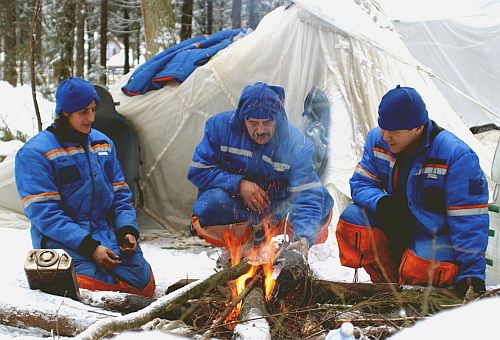
Working days: cosmonauts learn to “survive” in the forest
1/2/2022Winter forest survival training usually takes place during the harshest month of the year, February. Last year it lived up to its reputation: there was a hard frost. One of the conditional crews, who spent the night in the forest, had to face a sharp cold snap.
“The temperature at night reached minus 25 degrees, but it was dry. We had the opportunity to sit by the fire in the open air and not be afraid that it would rain,” said cosmonaut Andrei Fedyaev .
This year, neither cold nor rain should be feared, at least for the first conditional crew. The thermometer is just below zero. But it turns out that such weather cannot be called comfortable for the training participants.
“Now it’s still relatively warm outside. Physical labor causes the body to lose moisture. The guys will have to spend time and effort drying their equipment. In addition, they will have difficulty lighting a fire, the firewood is not dry enough. Yes, and maintaining the fire will not be easy. It is easiest to cope with the tasks at a temperature of 10 to 15 degrees below zero. These are optimal weather conditions,” said Anatolii Zabruskov, head of the TsPK Cosmonaut Training Department for Extreme Types of Training.
Candidate cosmonauts Harutyun Kiviryan, Aleksandr Kolyabin and Sergei Teteryatnikov were the first to start training for the actions of the crew during landing in a wooded and swampy area in winter. They will spend almost two days in the forest. While waiting for the rescuers, it is necessary to find a suitable place for an impromptu camp, clear the area, collect firewood, light a fire, build two types of shelter: a hut and a wigwam.
Cosmonaut candidates must keep in touch with rescuers: report their location, give signals. An obligatory part of the tests is the provision of first aid to the victims.
Aleksandr Kolyabin, Sergei Teteryatnikov and Harutyun Kiviryan completed a course of theoretical and practical preparation for testing in the forest. How successfully they will cope with the tasks set will be assessed by their mentors at the end of the training. A special request from Harutyun Kiviryan: the crew commander is given a separate assessment, determining how competently and effectively he managed the wards.
By the way, during the period of general space training, each of the cosmonaut candidates will take the role of a crew commander at similar trainings in various climatic and geographical zones.
Following the cosmonaut candidates, two more conditional crews will demonstrate their “survival” skills in the forest, where they plan to include Roscosmos cosmonauts and NASA astronauts. The training cycle will end on February 10th. These are carried out in order to prepare cosmonauts for a possible emergency situation associated with the landing of a descent vehicle in a similar area under similar weather conditions.
The first conditional crew completed training in the forest
2/2/2022Cosmonaut candidates Harutyun Kiviryan, Aleksandr Kolyabin and Sergei Teteryatnikov successfully coped with the tasks during the training on the actions of the crew during landing in a wooded and swampy area in winter. Recall that they started testing on January 31 and spent almost two days in the open air.
Summing up the preliminary results of the training, Anatolii Zabruskov, head of the TsPK cosmonaut extreme training department, stressed that the weather conditions complicated the situation. In particular, due to the abundance of snow and dampness, the training participants spent a lot of energy collecting firewood and kindling a fire, but in the end they passed all the tests with dignity.
In reality, only the crew of the Voskhod-2 spacecraft, on which cosmonauts Pavel Belyaev and Alexei Leonov flew, had to wait for rescuers in the forest. forced loss of precious seconds) the descent vehicle landed at an off-design point – in the middle of a snow-covered forest 180 km from Perm. Only on the third day the rescuers were able to evacuate the crew. Before meeting them, Pavel Belyaev and Alexei Leonov used all means at hand to survive in the winter forest.
Since then, cosmonauts have been trained to act in a similar situation. Under the terms of the training tests, they must set up camp in a safe place, do everything possible to maintain strength and health, and constantly keep in touch with rescuers.
According to the training cyclogram, the conditional crew builds two types of shelters. The main material for the hut are branches of needles, for more reliable shelter – “wigwam” – parachute fabric is used. It is necessary to strictly observe the rules of its construction: the “wigwam” must correspond to the number of people, be warm and at the same time have good ventilation.
No less important skills are associated with the ability to make fires and keep the fire going for a long time. One of the main tasks is not to freeze in the winter forest, to protect yourself from injuries, to avoid any possible dangers. Of course, if necessary, each cosmonaut will be able to provide first aid to his comrade. This time, a procedure was worked out for when a crew member stumbles and gets injured on the way from the camp to the place where the rescuers are.
Konstantin Borisov and Oleg Platonov, should start training on the actions of the crew during landing in a wooded and swampy area in winter. The third in their conditional crew will be the TsPK instructor.
Cosmonauts continue to practice survival skills in a snowy forest
4/2/2022Training for the actions of the crew during landing in a wooded and swampy area in winter can be carried out according to full or reduced programs. If survival skills have not yet been acquired or have been lost over time, a test lasting two days with overnight stays in the forest is required. Cosmonauts who have completed this stage of preparation for flight no more than five years ago usually become participants in reduced training.
Oleg Platonov and Konstantin Borisov “survived” in the winter forest three years ago. Then they were candidates for cosmonauts, and now they are test cosmonauts. The third member of their conditional crew was the TsPK instructor Dmitrii Zakotenko. Specialists who train cosmonauts also need to maintain similar skills. On the morning of February 3, the crew began testing in the forest and by the evening of the same day completed the tasks assigned to it. According to the training participants, high snowdrifts and the need to work in an intensive mode added to their difficulties. But previous experience helped to overcome them.
Recall that the “survival” is preceded by a course of classes, during which the cosmonauts are reminded of the rules for ensuring the safety of the crew in a wooded and swampy area in winter. They must know how to build a shelter, make a fire and keep the fire going, how to communicate with rescuers by radio and provide first aid to the victims. Before training, cosmonauts get the opportunity to work out individual elements on the ground. Therefore, by the beginning of the tests, each of them approaches sufficiently prepared, regardless of the degree of preservation of the previously acquired skills.
“Robinsons” in the Snow: Cosmonauts Train for “Winter Survival”, Roskosmos, February 2022
Soyuz survival kit
As the Soyuz capsule could land anywhere between 51.6° north or south if the ballistic descent was off-course, the survival gear on-board must provide for landing on sea or earth. The equipment provided is extensive and comprehensive. Its acronym is НАЗ, NAZ (Носимый Аварийный Запас, Nosimyi Avariynyi Zapas) – Portable Survival Kit.
The book Russia’s Cosmonauts provides some details of the NAZ:
Every Soyuz craft carries a Granat-6, «Гранат-6» (Pomegranate) survival pack, which includes a “Forel” («Форе», Trout) hydro-suit – a one-piece orange nylon flotation suit with attached rubber soled feet and a hood trimmed with “CCCP”. The suit contains a “Neva,” «Нева» inflatable collar with an emergency mouthpiece, emergency beacon and a signal device on the shoulder. It also has rubberised cuffs, Velcro-close pockets on the legs (with ten pairs of small rings on the legs and eight pairs of grommets on the boots), and a pair of brown jersey mittens with separate thumb and index finger stalls, with watertight cuffs and adjustable orange nylon wrist straps. There is also a TZK-14 cold weather suit, with a royal blue nylon zip front anorak with attached mittens. This has two slash pockets with contrasting zips and a draw closed waist. Also included is a wool knit balaclava, a lined wool knit cap with button flaps, wool gloves, one pair of shearling socks and one pair of nylon over boots, elasticised at the top with Velcro-close at the heels. There are three other orange nylon packages in the pack. These contain survival equipment including a large canteen, a soft flask, dried food, a medical kit, a frying pan, signals and flares, a machete (which also doubles as the shoulder rest of the rifle/shotgun), a Makarov pistol with cartridges (TP-82m), a foraging bag, fishing tackle, and metal wire garrottes for use as a saw as well as for hunting. The combination of the “Forel” suit and thermal suit is intended to keep the wearer alive for up to twelve hours, if needed, in water of 2°C, with an ambient air temperature of -10°C (14°F). Coupled with the shelter of the descent craft, it is hoped that the clothing and supplies could support a cosmonaut for up to three days in conditions of severe cold.
The package weighs around 32.5 kg and is located in two triangular carrying cases that wedge snugly between the cosmonauts’ seats. The package is produced by the Zvezda Production Association. The first kits, called NAZ (portable emergency kit), were produced by Zvezda in 1960–61 and were carried on Vostok craft. After the problems encountered during the ballistic return of the TMA capsule containing the JSS-6 expedition crew of Bowersox, Pettit and Budarin, a satellite phone system has since been added to the kit.
What is available in the rescue spacecraft was clearly shown by TsPK lead engineer, Vasilii Zakotenko: “The worn emergency reserve (AZ), Носимый аварийный запас (НАЗ), consists of three packets. The first contains water (six liters for three days for three crew members), the second – three meals, medical capes and a first aid kit, in the third – everything you need to create a camp and survive in it (machete, light signals, lantern, knife, radio station, etc.). Plus, the СА, SA has flight, heat-shielding suits and «Форель», Forel (“Trout”) overalls, which have positive buoyancy.”
– TsPK, “Without ‘Trout’ on the water
The photo illustration link and extract below are from MiG Pilot Survival: Russian Aircrew Survival Equipment and Instruction by Alan R. Wise (1996 Schiffer Military History Books).

In Russian, a survival kit is designated as a Portable Emergency Kit, or by the abbreviation NAZ, НАЗ. The number or letter following the designation is relative to the series of kit of a particular application. For example, the NAZ-3 used aboard the Soyuz spacecraft is the third model spacecraft kit and not a predecessor of the NAZ-7 used in ejection seat-equipped aircraft.
The NAZ-3 is contained in two orange triangular aluminium containers with grey canvas tops and zippers. They are stowed between the seats. The NAZ-3 is designed to serve the three cosmonauts for 72 hours and includes (left to right, top to bottom in photo):
Makarov pistol and ammunition; wrist compass, 18 waterproof matches with striker; machete; fishing kit; strobe light with spare battery; 8 fire starters; folding knife; antenna; 3-pair wool gloves; signal mirror; NAZ-7M type medical kit; penlight; R-855-YM or R-855-A1 radio; two “Priboy 2S,” ПРИБОЙ-2С radio batteries; three wool balaclava hoods. Not shown are containers, three PSND, ПСНД hand-held flares; 15 mm flare set; whistle; sewing kit; insect repellent; wire saw; rations and 2-liter water container.
The pistol is used for shooting game should the crew be stranded for more than a few days, or scaring off wolves, bears, tigers, etc.
This extract from Star-Crossed Orbits: Inside the U.S.-Russian Space Alliance by James Oberg, describes a different type of on-board gun:
Russian participation means that there are guns on board the ISS, and the guns belong to the Russians. This is not quite as alarming as it sounds, and officially it’s no secret. However, I could never find any mention of this design feature on NASA web sites or mission press kits. Actually, it’s a safety feature, and not an unreasonable one.
American astronauts who trained for the 1995–1997 Mir visits, and later as part of the Soyuz spacecraft crews for the International Space Station, encountered a unique feature that cosmonauts need to master: target practice. They have to know how to load, aim, and fire the special survival gun that has been on board all Soyuz spacecraft throughout their 30-year history.
The triple-barreled gun can fire flares, shotgun shells, or rifle bullets, depending on how it’s loaded. The gun and about 10 rounds for each barrel are carried in a triangle-shaped survival canister stowed next to the commander’s couch. The gun’s shoulder stock opens up into a machete for chopping firewood.
Familiarization with the gun usually takes place during survival training in the Black Sea, when the crews train to safely exit a spacecraft floating on the water (although a firing range at the cosmonaut center at Star City near Moscow is sometimes used for training). After floating around in the water for a day or two, the astronauts and cosmonauts take a few hours to fire several rounds from each chamber off the deck of the training ship.
“It was amazing how many wine, beer, and vodka bottles the crew of the ship could come up with for us to shoot at,” astronaut Jim Voss told me. “It was very accurate,” he continued. “We threw the bottles as far as possible, probably 20 or 30 meters, then shot them. It was trivial to hit the bottles with the shotgun shells, and relatively easy to hit them with the rifle bullets on the first shot.”
“It is a wonderful gun,” agreed Mir veteran Dave Wolf. “I found it to be well balanced, highly accurate, and convenient to use.”
Mike Foale trained with the gun and found it to be pretty standard. “Other than firing flares, bird shot, and a hard slug from its three barrels, during sea and winter survival training, I can’t say it is very unique,” he told me. He added, as if in reassurance, “The Soyuz commander controls its use.”
Every Soyuz spacecraft carries such a gun, although none of these guns have ever been unpacked in flight. And they have never been needed, with the exception of an incident in 1965, when bears (or wolves – the story varies) chased two far-off-course cosmonauts. The guns are often presented to crew members as postflight souvenirs. Although several survival kit bags have shown up at space auctions, I’ve never seen any of the guns for sale.
On the Soyuz TMA-11 flight in October 2007 the pistol was not carried for the first time in 20 years, as reported in the Guardian. There was a shortage of the special ammunition required for the gun – the original ammunition had deteriorated and no new bullets were available. Soyuz commander Yurii Malenchenko instead carried an ordinary pistol/handgun (a Makarov PM, Пистолет Макарова ПМ).
Russians blast off without space pistol
By Bonnie Malkin and agencies
Last Updated: 1:36am BST 15/10/2007Russia is sending a cosmonaut into space without a fearsome triple-barrelled “space pistol” for the first time in 20 years, due to a shortage of ammunition.
Yuri Malenchenko will join colleagues on a flight to the International Space Station (ISS) today, but he will travel without the specially-designed weapon.
Created in 1982 and in service since 1986, the TP-82 pistol was not primarily designed to fend off hostile extra-terrestrials.Instead it is meant to protect the shuttle’s crew if they land in a hostile environment back on earth.The unique pistol has three barrels which fire hunting rounds as well as rifle bullets and signal flares. Its butt serves as a machete and a spade.However, the gun’s original ammunition has deteriorated so much it is no longer viable and no new bullets are available.
Nevertheless, the cosmonaut will not risk going into space completely unarmed. “Malenchenko will be taking with him a simple pistol,” a Russian space official said.His will not be the only weapon on board the flight. ISS crew commander and US astronaut Peggy Whitson will be wielding a “kamcha” – a traditional Kazakh horse-whip, which a Russian space official advised her to take “as a symbol of a commander’s authority on board.” “I do not believe I will have to use it,” she said in Russian with a smile yesterday. “Well, let’s have it, just in case.”
Soyuz crews with a U.S. astronaut on board are also provided with an Iridium/Motorola-9505 satellite phone and a Garmin GPSMAP 76 handheld GPS unit, which can be used anywhere on Earth, though the batteries might fail in very cold weather. The 9505 model, introduced in 2003, was upgraded to a newer version:
For the CDR, it was time again for the recharging of the Motorola Iridium-9505A satellite phone brought up on Soyuz 16S, a monthly routine job and his third time. [After retrieving it from its location in the TMA-12/16S descent module (BO), Sergei was to initiate the recharging of its lithium-ion battery, monitoring the process every 10-15 minutes as it takes place. Upon completion at ~4:50 p.m., the phone will be returned inside its SSSP Iridium kit and stowed back in the BO’s operational data files (ODF) container. The satphone accompanies returning ISS crews on Soyuz reentry & landing for contingency communications with SAR (Search-and-Rescue) personnel after touchdown (eg., after an “undershoot” ballistic reentry, as happened during the recent 15S return). The Russian-developed procedure for the monthly recharging has been approved jointly by safety officials. During the procedure, the phone is left in its fire-protective fluoroplastic bag with open flap. The Iridium 9505A satphone uses the Iridium constellation of low-Earth orbit satellites to relay the landed Soyuz capsule’s GPS (Global Positioning System) coordinates to helicopter-borne recovery crews. The older Iridium-9505 phones were first put onboard Soyuz in August 2003. The newer 9505A phone, currently in use, delivers 30 hours of standby time and three hours of talk, up from 20 and two hours, respectively, on the older units.]
– ISS Daily Report: 5 July 2008
From a 12/4/2024 interview with Head of the Cosmonaut Training Center Maksim Kharlamov:
RG: What is included in a cosmonaut’s portable emergency reserve today – the so-called NAZ?
Maksim Kharlamov: The functionality is unchanged: assistance in survival. In addition to food and water, there are matches, a first aid kit, fishing gear, a walkie-talkie, sunglasses, and a flare gun. There is a machete that can be used to cut down trees and dig the ground. Well, if something happens, protect yourself from a wild animal. A new NAZ, with more modern equipment, is also being developed.
RG: Once upon a time, the NAZ included a pistol specially designed for cosmonauts. Will it be returned?
Maksim Kharlamov: In the form it was, no. But I know that RKK Energiya is carrying out the work, Once upon a time, the TP-82 transforming pistol was removed because it no longer complied with the law. It was replaced with PM, which our officers had. Then, when the Cosmonaut Training Center became civilian, the pistol was completely excluded.
The Sydney Powerhouse museum has an example of a NAZ-3 kit, from which the following description is taken.
7/3/5 Emergency kit, portable, NAZ-3, used on Soyuz TM-9, metal/canvas/cloth/plastic/synthetics, Zvezda, USSR, 1989
Description
Emergency kit, portable, NAZ-3, used on Soyuz TM-9, metal/canvas/cloth/plastic/synthetics, Zvezda, USSR, 1989
Contains a range of survival gear and equipment for use by cosmonauts in the event of an off-course landing. The complete kit weighs 32.5 kg and consists of several components:
- Hydrosuit and mittens.
1/1. Hydrosuit: “Forel” (trout) hydrosuit. One piece orange-coloured rubberised amphibious floatation suit, for use in emergency water landings. The suit has an attached hood made of yellow foam rubber trimmed in orange grosgrain which has an adjustable chin strap of bright orange nylon webbing, The integral rubber-soled boots can be cut off and used as overboots for crossing marshy terrain. They are fitted with metal lace-up rings and red plastic grommets from foot to knee to aid this conversion. Long sleeves have grey rubber cuffs. A “Neva” self-inflating floatation vest is also part of the suit and is attached at left and right front breast via bright orange nylon webbing straps and aluminium buckes. It fastens at centre front with bright orange webbing straps and a white plastic clip and ring. It also includes a backup manual inflation tube, emergency beacon and signalling light which is laced into a small pocket at right front with bright orange lacing. Gusseted pockets at left and right front thigh with flap that fastens with velcro, the right pocket contains four bright orange nylon laces for the boots. Centre front opening with a metal zipper to neck. There is an inset belt of grey webbing that fastens into place at centre front waist with velcro.
- 1/2/1:2. Mittens: the suit comes with a pair of brown, foam-insulated nylon jersey mittens, with thumb and 2 wide finger stalls (ie: 3 fingers are meant to fit in last finger stall). They have a grey rubber gusset inside the opening and a bright orange webbing strap around the wrist which is adjustable via metal slip buckles.
- Cold weather suit: “TZK” cold weather suit, for use in case of landing in arctic/subarctic regions.
- 2/1. Parka: padded hip length parka with hood, made of royal blue cire. It includes integral mittens with a opening at inside wrist that fastens with velcro. Two diagonal slash pockets at left and right front at hip level that fasten with white nylon zippers and two inside patch pockets at left and right breast. Drawstring of white cotton cord at waist. The parka carries two applique patches depicting the Zvezda logo at right front, and the state seal of USSR, with the Soviet standard (CCCP) on the left shoulder. Centre front opening fastens with white nylon zipper and overflap that fastens with four metal press studs. Machine sewn and fully lined with orange nylon.
- 2/2. Jumpsuit: padded full length jumpsuit made of the same royal blue nylon as the parka. There is royal blue and white striped ribbing around the hight round neck and the cuffs of the long sleeves. Two patch pockets at left and right front breast and two patch pockets with diagonal openings at left and right front hip. The waist is elasticised and the centre front opening fastens with a white nylon zipper and seven metal press studs. The MIR space station patch is attached at the right front pocket. There are white elastic stirrup straps attached to the hem of legs. Machine sewn and fully lined with grey polyester satin.
- 2/3/1:2. Overboots: pair of padded overboots made of royal blue nylon to match the parka and jumpsuit. Simple slip on style with elastic around the top edge and a short tab at the bottom of the heel with velcro to adjust fit. Fully lined with grey polyester satin.
- 2/4/1:2. Ugh boots: pair of simple slip on sheepskin boots to be worn beneath the overboots. Both are marked on the sole 40-41. One boot has serial number 1313, the other is marked 1117.
- 2/5/1:2. Gloves: pair of brown wool knit gloves with ribbed cuffs to be worn beneath mittens of the parka, marked “6”.
- 2/6. Cap: peaked cap made of royal blue wool knit to be worn under parka hood. Has buttoned earflaps with dark blue plastic buttons and a covered button topknot. Marked: 8307, B.A.N. in Cyrillic, the initials of cosmonaut Alexander Nicholaievich Balandin. Machine sewn and lined with knitted grey wool.
- 2/7. Balaclava: royal blue wool knit, to be worn under the cap and/or parka hood. Carries the same label as the cap.
- “Granat-6” (pomegranat) survival kit consisting of 3 separate containers. Each container has an orange nylon canvas casing fitted with braided nylon cords, metal clips, velcro tabs and zippers.
- 3/1. Water container: rectangular water container made of plastic with plastic screw on lid and grey webbing strap across top, with external drinking tube held in place via orange webbing loops. Orange nylon cover has two white nylon cords attached with metal clips at the ends. Black stencilled markings in Cyrillic include serial number and the word “water”.
- 3/2. First aid/mess kit “Block 2”: roughly rectangular package with two compartments. Both ends fasten with a metal zipper, orange webbing straps and slip buckles, one end also has straps and velcro. Attached to one end via metal D-rings are two red nylon cords with metal clip at each end. Serial number and contents stencilled on side in black. (The hypodermic needles and drugs have been removed.)
- 3/3/1:2. Survival supplies “Block 3” and batteries (2).
- -3/3/1. Roughly rectangular package is in two parts bound together by lacings, and has four compartments which fasten with velco or red nylon zippers. Contains a range of survival supplies including radio, machete, fishing tackle, matches, flares, wire saws etc. Nylon webbing carry strap and two long lengths of dark navy blue nylon cord with metal clips at each end. (Originally the kit also included a military issue pistol and cartridges).
- 3/3/2-1:2. Two identical batteries, silver cover with black markings in Cyrillic.
Production notes
The “NAZ-3” (Nositoi Avaroinoi Zapac – Portable Emergency Supply) kit was designed for use with Soviet Soyuz spacecraft in the event of an off-course landing in an inhospitable area (such as Siberia or the Ural Mountains) or in water, from which the crew could not be quickly rescued. It was designed to provide survival gear for a crew of three for three days, and the complete kit would have included the Forel and TZK suits for all three cosmonauts.
The NAZ emergency kits were designed by the Zvezda Design Bureau from the beginnings of the Soviet space program. A certificate from Zvezda, in Russian, with a certified English tanslation, signed by the agency’s Director, G.I. Severin, accompanies the NAZ kit and confirms its design and manufacture by Zvezda.
The NAZ-3 kit was manufactured by the Zvezda Design Bureau in its own facilities, probably in Moscow.
History notes
This kit is certified by Zvezda as having been flown on board the Soyuz TM-9 mission, which was launched to the Mir space station on Feb 11, 1990 and returned to Earth on August 9, 1990.
This kit was produced by the Zvezda Design bureau and returned to it after Soyuz TM-9 flight, which was fortunately incident free. The Forel and TZK suits in the kit bear the initials of cosmonaut Alexander Balandin, the Flight Engineer on that mission, to whom they were assigned. Zvezda consigned the kit to the Sotheby’s New York space auction 16/3/96. It was Lot 367.
SoyCOM: 3.21. Носимый Аварийный Запас (НАЗ) (post-landing survival kit)
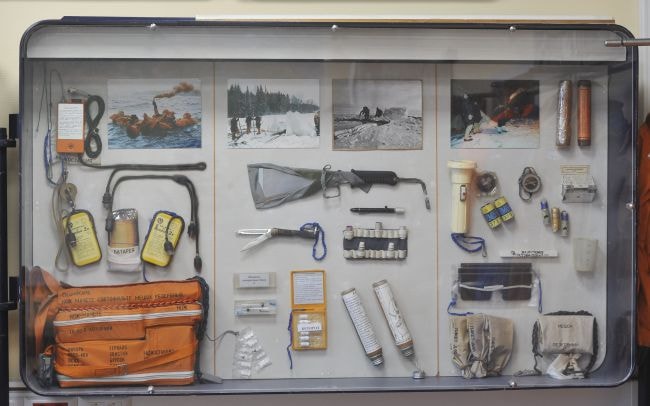
НАЗ purpose
The “Granat 6” НАЗ is designed for the Soyuz spacecraft crew life support at the off-nominal landing site during not less than 3 days.
НАЗ composition
The НАЗ Kit is made up of the following component groups:
- Emergency radio and illumination aids;
- Camp outfit;
- Water/Meals group;
- Weapon;
- Medical Aid Kit;
- Individual buoyancy aids;
- Thermal protection garment.
Unit 1
The Unit 1 bag is made of orange capron. In the bag there are: potable water canister, crew checklist for off-nominal solid ground landing/water splashdown and a polyethylene flask. At the bag side in the pocket there is a mouthpiece for water drinking.
The 6-liter canister is made of Aluminium alloy and has two orifices: the greater one and the smaller one. The smaller orifice is used for inserting the mouthpiece and is covered with a thread plug. The greater orifice makes it easier to fill the canister with water, snow or ice to be melted and is covered with a coupling connector and a coupling nut. The crew checklist is put into a polyethylene bag and soldered. The soft polyethylene flask in tissue jacket is used for water stowage under the garment in cold weather.
Unit 2
The Unit 2 bag is made of rubberized tissue of orange color and has two pressure tight sections. In the upper section there are food rations and salt. In the lower section there are the medical aid kit and camp outfit articles. The medical aid kit contains medicines and dressing material. The medical kit composition and usage instruction data are on the label sticked to the kit cover inner part. The camp outfit includes: fishing tackle, dry fuel, wind resistant matches, needles/threads, wire saw (3 pieces). The medical cloak (3 pcs.) can also be used for precipitation/overcooling/overheating protection and for water collection. To provide for the crew meals there are three meal a day food rations for each crewman in the НАЗ Kit.
Unit 3
The unit is composed of two pressure tight bags connected to each other and to the raft which is laced up above. In the lower bag there is the emergency radio set with cables and power supply sources, signal/illumination aids, a lantern, light filters, a whetstone for sharpening knives, sticky plasters, a measuring glass and packets for vomit excreta. In the upper bag there are weapon, a machete knife in casing, the Air Force graded multi-tool knife and cartridges in bandoliers. The raft purpose is to provide for the Unit 3 positive buoyancy.
The emergency VHF band radio set purpose is to enable the off-nominally landed crew to communicate with the Search/Rescue Service planes and helicopters and to direct them to the crew actual position in the area. The radio set can operate in two modes: “Связь” (Communication) and “Маяк” (Beacon). The radio set is equipped with three power sources.
The weapon is a three-barrel pistol (“ТП-82” make). It is designed for light/audio signaling, hunting/game shooting and defense for beast-of-prey. For the upper two smooth-bore barrel shooting 12.5 mm cartridges are used, for the lower rifled barrel 5.45 mm bullet cartridges are to be used. The machete knife in casing can be used as a butt for the weapon. For giving light signals light signaling aids are used.
There are hydraulic combination suits (3 pcs stowed in one soft package) which are individual survival aids in case of the CA water surface splashdown. The suits have two eye-loops each to enable the crewman to be lifted from the water surface on board the hovering helicopter.
The thermal protection garment (3 sets, each stowed in 4 soft packages) is designed for the crew protection on the ground at the temperatures of down to −50°C and at the wind speed of up to 10 m/s. The set can be worn together with the underwear, flight suit and the hydro-suit. It consists of: combination suit, jacket, high boots, helmet, cap, fur socks and wool gloves.
Links
- The Atlantic: 1 Gun, 2 Batteries, 3 Balaclavas: What Was in Soviet Cosmonauts’ Survival Kits
- Encyclopedia Astronautica: NAZ-3
- Interview with Viktor Ren, 13/12/2019
- MSNBC.com: “Russia has the corner on guns in space,” James Oberg, 12 February 2008
- Richard Garriott’s Space Mission: Soyuz survival class (photo gallery)
- Russian Aircrew Survival Manual (Instruction №1907-2670)
- Russian Guns: ТП-82 (in Russian)
- Энциклопедия Вооружений (Encyclopedia of Armaments): ТП-82 (in Russian)
Updated: 14/4/2024