“Robinsons” in the Snow: Cosmonauts Train for “Winter Survival”
Svetlana Nosenkova, Russian Cosmos Journal, Issue 36, February 2022
At the beginning of the year, crews are traditionally trained in case of an emergency landing in the forest in winter. How the “recruits” of the Roscosmos Cosmonaut Squad, Harutyun Kiviryan, Alexander Kolyabin and Sergei Teteryatnikov, as well as their more experienced fellow test cosmonauts Konstantin Borisov and Oleg Platonov, coped with this test, are in our report.
The most favorable weather conditions for survival in the forest in winter are 10-15 degrees below zero and the absence of precipitation. At this temperature, it is easier for cosmonauts to stay and work in heat-protective suits.
48 hours in the winter forest
The first “newcomers” – cosmonaut candidates of 2020, Harutyun Kiviryan, Aleksandr Kolyabin and Sergei Teteryatnikov – went to explore the virgin land of snow. According to legend, their crew landed in a winter forest. Before the approach of the search and rescue forces, the guys should be able to organize such conditions that will allow them to save their lives and health on for two days.
In reality, the crew of the Voskhod-2 ship, Pavel Belyaev and Aleksei Leonov, had to wait for rescuers in a similar situation for the first time. On March 19, 1965, due to the failure of automation and the transition to manual mode, the descent vehicle landed in a remote snow-covered taiga 180 km from Perm. Only on the third day rescuers were able to evacuate the crew. Before meeting them, Pavel Belyaev and Aleksei Leonov used all available means to survive in the winter forest. Since then, cosmonauts have been trained to act in a similar situation.
The second incident occurred on April 5, 1975 due to a launch vehicle accident. Then cosmonauts Vasilii Lazarev and Oleg Makarov had to wait all night for rescuers on the slope of the Altai hill, overgrown with forest.
Prepare to avoid trouble
Anatolii Zabruskov, Head of the Department of Extreme types of cosmonaut training of the TsPK: “We have a unique department. We are preparing crews for such situations, the probability of which all manned cosmonautics is trying to reduce. Nevertheless, a cosmonaut must be prepared for any development of events, including landing in such conditions. We always wish cosmonauts that the knowledge, skills and abilities acquired during training in real flight conditions will never be useful to them in their lives.”
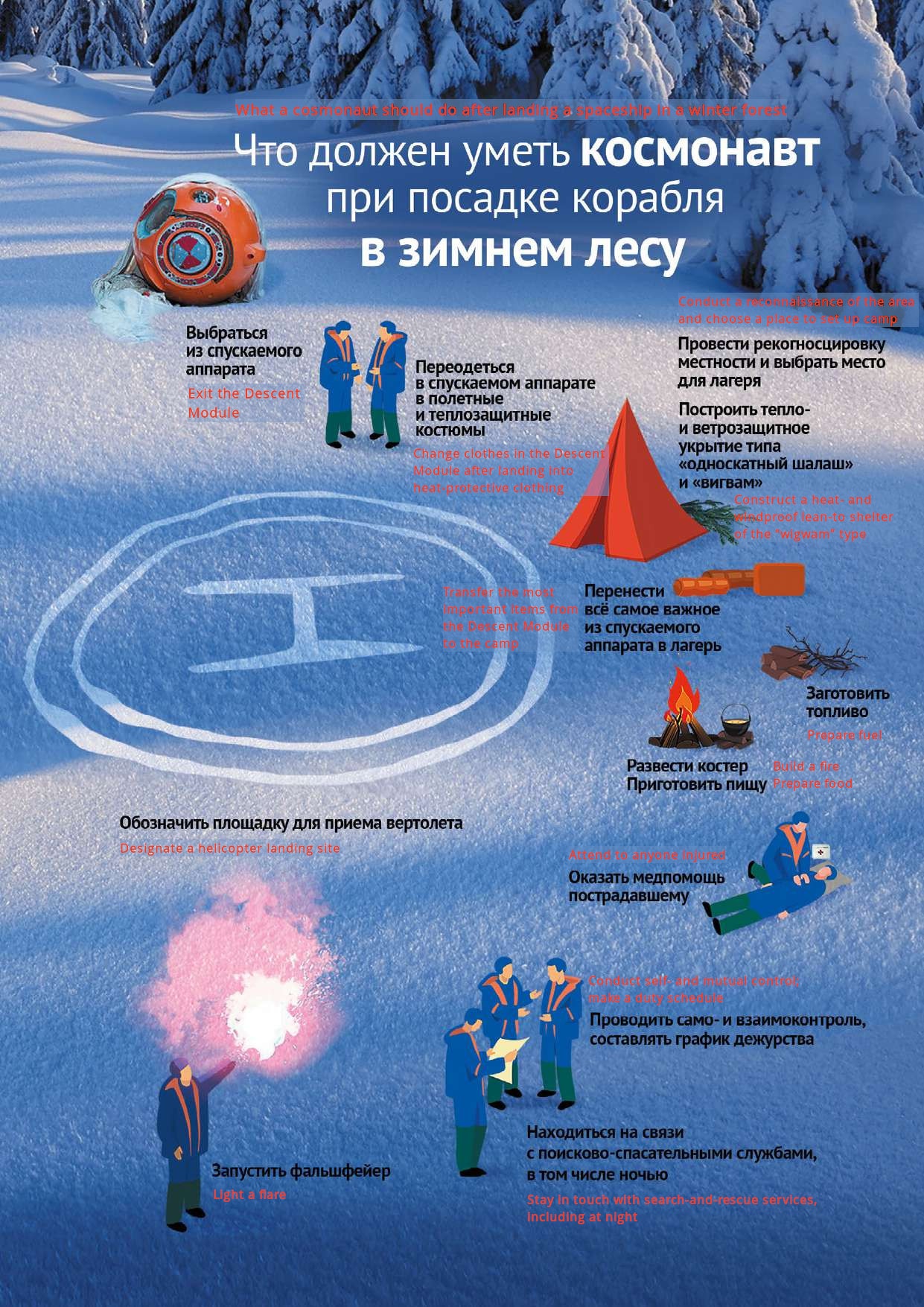
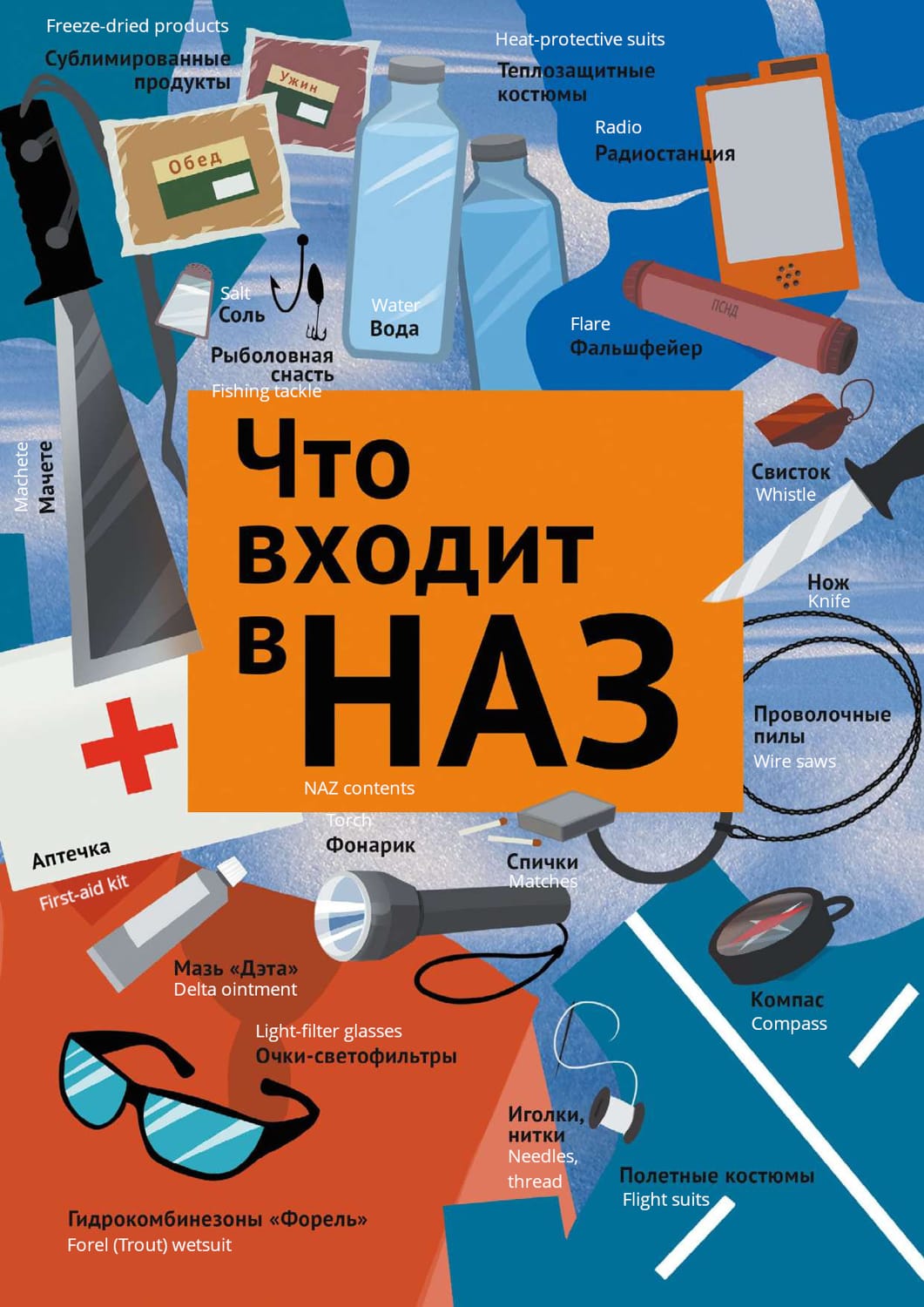
In the forest near Moscow, tests for “beginners” began without a hitch. Changing out of the Sokol rescue suits into warm clothes for the three of us in the descent vehicle is not an easy task, given that its free volume is only 2.5m3. Then the crew had to conduct a reconnaissance of the area and choose a site for setting up camp. The main condition is safety. It is necessary to find an open area, ideally a clearing, without tilted trees to prevent them from falling under the weight of snow. Walking through the forest on foot (without skis) at this time of year is very difficult – you fall into knee-deep snowdrifts or even higher. And it is even more difficult to clean the chosen site without having a shovel for snow removal. Arms, legs, various objects are used: for example, a metal box from a first aid kit from a portable emergency kit (NAZ, НАЗ), lodgements.
After clearing the site, it is necessary to collect firewood for a fire and build a lean-to hut. Next – an overnight stay, during which you need to monitor the campfire so that it does not go out, and periodically get in touch with the “search engines.” Therefore, the guys organized a duty. On the second day, the space “Robinsons” dismantled the hut, and on the same site, on a place warmed up by a fire, they built a tent from a parachute, where they spent the second night. Before the “lights out,” the guys were encouraged: they were finally “discovered”! However, according to legend, the helicopter could not land.
In the morning (it was already the third in the “search expedition”), a message was received: an opportunity to land at some distance from the camp was found. It remains to make a small pedestrian crossing.
And then – a new introductory, medical. Sergei Teteryatnikov “stumbled and injured his leg.” All this, of course, was according to the training plan, but it sounded quite plausible, given the high snowdrifts, under which tree roots and driftwood were hiding. It was quite possible to slip on a narrow path and get injured. His crewmates gave Sergei first aid and carried him on a stretcher to the evacuation site.
“I have never been in such a role. I hope that in the future such experience will not be needed. An awkward situation: I wanted to help the guys, but I couldn’t. But you had to go through that, too. Looking at them, I learned something. Thanks to them – they brought it quickly and accurately,” Sergei Teteryatnikov shared his emotions after the “rescue,” smiling.
At the end of the training, the commander launches a flare, indicating the location of the crew with a red signal color. In the first conditional crew, the role of commander was performed for the first time by Harutyun Kiviryan. “A very interesting experience. We were lucky that there were great guys in our crew: they supported, prompted, and performed what was required. Therefore, all the tasks that we faced were carried out quite effectively,” he said about his impressions.
When to go back to the forest?
During their career, cosmonauts have to “survive” in the winter forest repeatedly. For the first time, they undergo such training as part of general space training, then at the training stage as part of a full-time crew preparing for a long expedition to the ISS, or with regularity once every five years.
Worked out as taught
Despite the fact that such training takes place autonomously, the crew is monitored by the test and training team of the Cosmonaut Training Center (TsPK), which includes instructors, doctors, psychologists and other specialists.
“We look at their interaction in the team, what qualities are manifested in whom, how they perceive new experience – theoretical and practical, how they cope with the tasks set, how safe they act,” explained Svetlana Andreeva, a psychologist at the TsPK.
Specialists of the Center note that such trainings are quite a creative process. Crews who have received the same theoretical and practical training do some things are different. For example, the same bonfire can be kindled in one way or another, in a peculiar way they are approaching the construction of a shelter. However, there is not always enough time and effort for experiments due to weather conditions.
“It was difficult, but we managed,” said cosmonaut candidate Aleksandr Kolyabin. – We had such conditions: near-zero temperature, damp and a lot of snow. I had to look for firewood for a long time, then dry them so that they would start burning. We spent a lot of time on it, we were very tired.”
His crewmate Sergei Teteryatnikov added: “It was physically more difficult for the first day, because it was necessary to stock up a lot of firewood and the snow was still not very popular, firewood had to be taken out from under the snowdrifts. A lot of time and effort in the first day was spent on the preparation of firewood. On the second day it was already much easier. Especially considering the new home, which is warmer and more comfortable than in a hut.”
The crew commander Harutyun Kiviryan noted that the impressions from the last training remained good: “They showed well-coordinated teamwork, their skills, resourcefulness in various situations. Those solutions that we need they were told in the classroom, they turned out to be one of the most effective. So we worked out everything as it should be.”
The instructors of the TsPK were generally satisfied with the work of the cosmonaut candidates. Since this was their first autonomous complex training on the actions of the crew after landing in a wooded and swampy area in winter, there were still some comments, but they deservedly received credit.
Do not give slack
In the second conditional crew, who went to “survive” the day after
There were test cosmonauts Oleg Platonov, Konstantin Borisov and the instructor of the TsPK Dmitrii Zakotenko. They had undergone similar training three years ago, so they had a one-day training session. Interestingly, in winter of 2019 they spent two days in the winter forest near Moscow with almost the same composition. Then the commander was Konstantin Borisov, his crew included Oleg Platonov and Sergei Mikaev. This time the guys switched roles – Oleg took over the command.
Remembering their first “winter survival,” the cosmonauts note that it was much colder, and now the main difficulty is a large amount of snow, which makes it very difficult to move through the forest. In addition, the list of tasks, despite the shortened training time, remained the same. The second conditional crew also had to go through the entire cyclogram – from finding a place for a camp to building a hut and a tent, but at an accelerated pace.
“We worked as the instructors taught in the classes held before the test training. On there was no time for any abstract actions: it was necessary to build a hut in a short period of time, collect firewood, build a fire, then assemble a tent and build a fire again, only already a signal one. If we compare it with the training three years ago, this time everything was much more intense and dynamic,” Oleg Platonov said. And Konstantin Borisov added: “You don’t have time to rest – you’re on your feet all the time.”
The instructor of the TsPK, Aleksandr German, noted that the test cosmonauts met the expectations placed on them.
“Before any such training, we give the crew an installation so that they load themselves physically as much as possible, work intensively. Because after a real space flight, the state of their organisms will not allow them to do all the operations that they perform in preparation. But working with full dedication, they feel to some extent the same as after the flight. This time the task was for them to remember the tactics of behavior after landing in such conditions and restore their skills. The guys did not give themselves any slack, they did a lot and with high quality,” Aleksandr Viktorovich appreciated the work of the second conditional crew.
It is noteworthy that in the second half of February, Konstantin Borisov and Oleg Platonov will go to Baikonur as part of their specialization group to undergo training on the actions of the crew in case of an emergency planting in the winter steppe. This will be their first experience of such “survival,” which also has its own characteristics.
Diagrams
- Procedure for cosmonauts after landing in a winter forest (427 KB)
- NAZ contents (180 KB)
Linked from Cosmonaut survival training