Interview with Viktor Ren – specialist in extreme training: doctors have never taken cosmonauts away from training
13/12/2019, 17:00
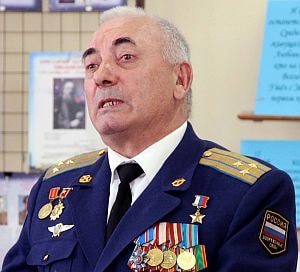
The practical training of cosmonauts consists of several elements, including training in conditions of short-term weightlessness, on centrifuges, in survival at sea, in the desert and wooded and swampy areas at different times of the year, and others. Not only members of the cosmonaut corps, but also instructors, doctors, and psychologists take part in the process. Hero of the Russian Federation Viktor Ren, Deputy Head of the Cosmonaut Training Center’s Department for Extreme Training, Центра подготовки космонавтов по экстремальным видам подготовки (Tsentra Podgotovki Kosmonavtov po Ekstremal’nym vidam Podgotovki), told TASS about how training in extreme conditions is changing, what innovations await future crew members in 2020, and what role instructors play in training.
TASS: In October, training for cosmonauts and candidates for cosmonauts on the water for the first time in 12 years took place at sea. What are its features?
Viktor: When training takes place on the water surface of a reservoir of small size and depth on the basis of the Training Center of the Ministry of Emergency Situations, the cosmonauts are not troubled by the elements and there is no specific psycho-physiological factor that exists at sea. Waves on the sea are such powerful natural formations that they can rock a descent vehicle weighing about three tons, like a small toy. This is a condition in which an cosmonaut may find himself at any stage of a space flight, especially during launches from the Vostochnii cosmodrome. There, the route for launching a manned transport spacecraft with cosmonauts on board will mainly run over the Sea of Okhotsk and the Pacific Ocean. And “marine survival” is a very important element of training, because in the event of failure of one of the stages of the launch vehicle, the cosmonauts will splash down into this element and operate in these conditions.
In the period from October 7 to 26, during training sessions that took place on the Black Sea in the universal seaport – the Imeretinsky terminal, the sea was, unfortunately, calm. I would very much like the cosmonauts to be familiarized with the harsher conditions created by the “heavy” sea during such training. This introduces serious nuances into their behavior and organization of activities both inside the descent vehicle and on the sea wave.
TASS: Do you have any idea when the water training will be held in 2020?
Viktor: We plan to conduct training sessions in the second half of June according to a similar scenario. This year we worked in the port, next year we want to go to the open sea nearby.
TASS: Are you considering more northern options for the seas?
Viktor: In order to preserve the health of cosmonauts and specialists from the test and training team, work can be carried out at a sea water temperature of at least +16°C. Any northern sea is not so warm, and the Far East, especially the Sea of Okhotsk, is stormy for 70-75 percent of the time so that we will not be able to conduct training, because we are limited by the waves – it should not be more than three points.
TASS: What tasks will be worked out during training at Baikonur, which started on November 25?
Viktor: Not always the conditions for landing in winter at a regular test site (Republic of Kazakhstan) correspond to the fact that rescue forces and equipment will arrive, provide assistance and assistance to the space crew immediately after landing. If the descent is carried out along a ballistic trajectory, the descent vehicle lands at an off-design point with a difference of hundreds of kilometers from the expected landing site, while the weather conditions are extreme – icing, snowstorm, severe wind conditions. This will not allow search engines to arrive at the point in the next few minutes and hours.
Cosmonauts need to be taught so that they can organize the most comfortable conditions for their stay on Earth, which will allow them to save not only life, but also health.
Specialists working as instructors for the practical training of cosmonauts have experience of surviving in the tundra above the Arctic Circle (the Vorkuta region, Tiksi) in more severe conditions.
TASS: Are there any temperature restrictions during training at Baikonur and in the Moscow region?
Viktor: No, there are no temperature restrictions. In the Moscow region, there were two extremely difficult positions during training in a wooded and swampy area in winter – it is +3°C with rain and up to −36°C in January-February. These are the two most difficult extremes for training. The most favorable temperature for training in winter is around −10-20°C.
TASS: Is it planned to resume training in the Crimea?
Viktor: We are ready to go to the Crimea to organize and conduct training at any time. But there is no such task in the plans for today or tomorrow.
TASS: How often do cosmonauts go through weightless flights in the Il-76MDK?
Viktor: As a rule, we carry out 16–20 flights per year in the interests of preparing candidates for cosmonauts and cosmonauts, while for candidates for cosmonauts – at least ten flights. Cosmonauts from the group of specialization and improvement – from six to eight flights a year.
TASS: How many extreme survival instructors work at the CTC?
Viktor: We have a small universal 32nd Department, consisting of 18 professional specialists. All 18 people participate in the training of cosmonauts, as you said, “for extreme survival.” Not all employees of the Department participate in different types of cosmonaut training at the same time. For example, only seven people from the Department take part in weightless flights, up to 12 people take part in boarding a helicopter in hover mode from land and water surface, and four people take part in search and rescue support for launches and landings of the Soyuz spacecraft, etc.
In “survival,” including at sea, up to 32 people work in the test and training team, since in addition to 18 practical training instructors (from the 32nd Department), it includes doctors, psychologists, photo and video operators, divers and representatives of other professions from various departments of the TsPK.
The test and training team is a group of professionals that solves all problematic issues related to the organization, preparation and conduct of cosmonaut training.
TASS: Have you ever needed medical attention while training?
Viktor: Throughout my entire practice, there has never been such a case that the doctors removed one of the cosmonauts from training and took them away. If a headache, insomnia, or someone is very worried before or during a workout, doctors immediately respond by suggesting some kind of medication.
TASS: Have you ever wanted to fly into space?
Viktor: I have a friend, Mikhail Novikov, with whom we have worked together since 1980 in the same team as part of the test department. In 1980, Misha and I wrote reports addressed to the head of the TsPK, twice Hero of the Soviet Union, pilot-cosmonaut Georgii Beregovoi with a request to be allowed to go through the appropriate procedures for entering the cosmonaut corps. He took our reports, read them carefully, and said: “You are military engineers, not military pilots. I don’t know what to do with the military engineers already recruited into the cosmonaut corps.” And then he continued against the background of the destruction of our reports: “Do an important test for manned cosmonautics, which you have been doing up to now, you are more needed there.” After leaving the chief’s office, I patted Misha on the shoulder and said: “Well, Misha, you and I were cosmonauts for exactly a minute.”
TASS: Will the TsPK produce the sea wave device that you patented earlier?
Viktor: At the beginning of the 2000s, during training with cosmonauts at sea in the Crimea, we conducted many experiments and determined how to mathematically describe all the processes that occur with the descent vehicle when it is on a sea wave. Our experts, who are related to the practical implementation of mathematical models in specific technical devices, said that based on the results of the research, it is possible to develop and manufacture a device that simulates the behavior of a descent vehicle on a sea wave in laboratory conditions. When we wanted to implement a device in the form of an operating unit for one task, this turned out to be not a very cheap pleasure.
We are now going the other way – we are collecting a range of tasks that could be solved using this mobile platform, including the installation of a descent and advanced return vehicles, helicopter simulators and a rover to prepare cosmonauts for on-planet activities, and so on.
When the price for a mobile multifunctional platform corresponds to the solution of the maximum number of tasks that we will tie to it, then we will make a decision on manufacturing.
TASS: How much does it cost to create such a device?
Viktor: We went to the city of Zhukovskii, looked at about such a mobile platform, it costs more than 100 million rubles. It’s just a platform. If you put a helicopter simulator on it, this complex costs 300 million rubles. And if this complex is made multifunctional, then its price may be half a billion. But this figure is approximate, I can not name the exact one.
TASS: What other devices have you developed for training cosmonauts?
Viktor: For example, a model of the Orlan spacesuit, which is successfully used in the process of training cosmonauts in zero gravity on a laboratory aircraft. We have transformed it from a hydro-model of a spacesuit in order to familiarize and take “first steps” by cosmonaut candidates and cosmonauts who are being trained in general space training and specialization groups who do not have space flight experience. The suit has the same ability to adjust the desired size and work with the controls as a standard one, but there is no glazing.
TASS: When was the last time changes were made to the training program?
Viktor: We have now made changes and approved a new guide for organizing and conducting cosmonaut training in various climatic and geographical zones. Literally in the near future we will submit for discussion and approve the guidelines for organizing and conducting test and training work on centrifuges.
In cosmonaut training programs, innovations appear only when necessary, which may be associated with the manufacture and implementation of new space and training equipment, special equipment, tools and equipment; change in the period and volume of cosmonaut training; the inclusion of cosmonauts in groups for solving special, previously unplanned long-term tasks in space flight. In all other cases – if necessary, but at least once every five years.
TASS: What other changes are planned?
Viktor: Now we are preparing proposals for changing the composition of the portable emergency kit, носимого аварийного запаса (NAZ, (НАЗ)): we want to add some new items and products to its composition, and remove unused ones. These ideas and proposals have been the result of numerous test and training activities carried out over the past decades.
Let me give you one notable old example. In the 80s of the last century, when we were determining how to use water in the desert, we, members of the conditional space crew (test participants), agreed to drink two sips every three to five hours. A total of six liters of water is provided for a total of three as part of a regular NAZ. When, by the middle of the second day of being in the desert, this supply of water ended, a showdown began, up to serious ones: “You have a bigger mouth,” “You have a sip more,” “You take more than two sips.”
We found the simplest way out of this situation: we proposed to introduce a measuring polyethylene cup with a capacity of 40 ml into the composition of the NAZ. Each test participant is required to drink 40 ml of water every two hours. This is strictly monitored by the crew commander
TASS: Will the NAZ for a future ship be very different from the existing stock?
Viktor: We developed and formalized proposals for a future NAZ cosmonaut, gave it to our management, the management sent it to the general director of the Roscosmos state corporation. Further, after the management has made a decision, we will study all our proposals together with RSC Energia specialists. I think that in January-February next year we will discuss a new generation of NAZ kit together with interested employees from TsNIIMash, RSC Energia, NPP Zvezda, and IBMP.
Interviewed by Ekaterina Moskvich
Linked from Cosmonaut survival training