Space Station Mir
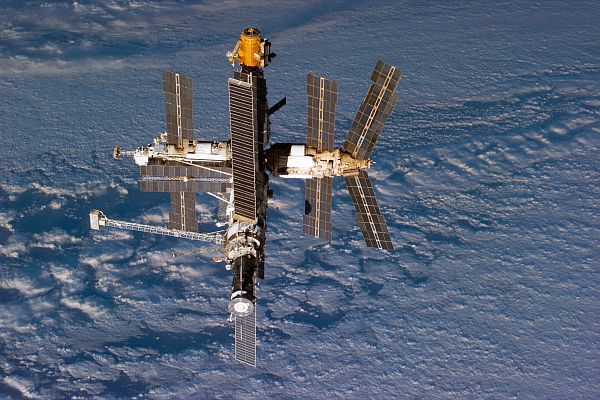
The crowning achievement of the Soviet manned spaceflight era was the Mir space station. As the Mir space station is deorbited (and now much-missed!), I will not go into detail about them on my site but instead provide links to other sites.
Originally intended for a five-year orbit until being replaced by Mir-2, the Russian space station Mir (“Mir” means either “Peace” or “World”) instead remained in orbit for 15. 104 cosmonauts and astronauts from various countries visited and lived on the station; it was continuously occupied from 1989 to 1999 (3640 days, 22 hours, 52 minutes), and had made more than 85 605 orbits by the time it was deorbited on 23 March, 2001. Despite a lot of silly hysteria in the media, Mir’s deorbiting went flawlessly, and what remained of the station came to rest on the seabed of the South Pacific.
Mir endured a few mishaps during its time in orbit; most notably an on-board fire and a wayward Progress supply ship poking a hole in the Spektr module. Considering that Mir spent 15 years in one of the harshest environments known, it did remarkably well!
Mir, itself, also endured a negative publicity campaign allegedly forced upon the U.S. media in exchange for NASA press passes, special access for interviews of NASA officials, and related government contractor sponsorship of their publications. Consequently, even as the European press portrayed Mir as an impressive monument to human progress, in the U.S.A. Mir was depicted as a “bucket of bolts” and an “orbiting trashcan”.
– Mir, MirCorp and a jealous NASA, SpaceProjects.com
From Chris van der Berg’s Mir Final:
But nevertheless I experienced a strong feeling of sadness. I thought about the hundreds of space flight experts in Russia, who had been involved in the Mir exploitation. For instance TsUP, the flight control near Moscow. The room for the control of Mir-operations was always a house full of specialists and scientists, who liked their job. With scanty wages, sometimes not fully paid they fulfilled for 100% of their responsibilities and in their specialities they showed enormous achievements.
In September 2000 I visited TsUP while a pass of the unmanned Mir complex was going on. It was sad to see the almost empty room with only a few operators and specialists, who, depressed by the knowledge of an unsure future, took their seats behind the monitors and keyboards. For them and their colleagues there is nothing to monitor anymore. What will be their alternative? Now thinking about them I felt like crying.
I myself can continue to enjoy my hobby with the monitoring of the International Space Station and other space objects, for instance radio amateur satellites. This will be not so intensive and less aimed at the distribution of information, but last but not least there will be something. For the duty crews and experts at TsUP, but also at a lot of tracking and calculation facilities, there will be nothing at all.
I also visited the so called Buran-hall during the ISS EVA with Malenchenko (STS-106). The operations fully stood under control of MCC Houston. No Russian controllers were involved. That what I saw and heard was for me no reason to be optimistic about the future role of the skilled and experienced flight control staff of the Russian side.
Gradually the control of the ISS has been shifted from Moscow to Houston and the attitude control of the complex has been transferred from the Russian Zvezda to the American Destiny.
So more and more the role of the Russian flight controllers will be decreased to a reserve one. Only the incidental operations with Soyuz ships and Progress freighters will remain a Russian task. All they can do now is to wait for Russian science operations on board ISS some time in the future.
Facts & figures
Composition
Mir was comprised of 6 modules, plus the Progress cargo and Soyuz transport ships that regularly docked and undocked:
| Module name | Designation & purpose | Launch | Reached orbit | Parameters | Descent & destruction |
|---|---|---|---|---|---|
| Core module Базовый Блок  |
17KS/17КС №12701 Base block | 19 Feb 1986 at 21 hours:28 minutes:23 seconds (UTC) on Proton-K №337-01 from Baikonur Launch Complex-200/39 | 20 Feb 1986 |
|
23 Mar 2001 at 05:59:36; impact zone at 160°W 40°S in the Pacific Ocean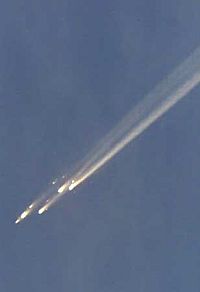 |
| Kvant-1 «Квант-1»  |
37KE/37КЭ №37010 Astrophysics module |
31 Mar 1987 at 00:06:16 on Proton-K №336-02 from LC-200/39 | Docked 9 Apr 1987 at 00:35:58 to aft (aggregative) unit |
|
|
| Kvant-2 «Квант-2» 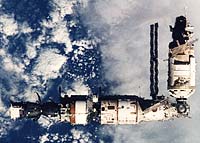 |
77KSD/77КСД №17101 Extension module |
26 Nov 1989 at 13:01:41 on Proton-K №354-01 from LC-200/39 | Docked 6 Dec 1989 at 12:21:28 to fore (transitional) unit (−X); undocked 8 Dec 1989 at 07:19:07; redocked 8 Dec 1989 at 08:19:04 to radial fore (transitional) unit (+Y) |
|
|
| Kristall «Кристалл» 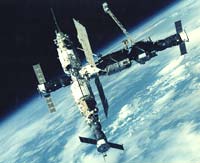 |
77KST/77КСТ №17201 Technology module |
31 May 1990 at 10:33:20 on Proton-K №360-01 from LC-200/39 | Docked 10 Jun 1990 at 10:47:22 to fore (transitional) unit (−X); undock 11 Jun 1990; redock 11 Jun 1990 to radial fore (transitional) unit (−Y); undock 26 May 1995 at 23:07:44; redock 27 May 1995 at 00:36:10 to longitudinal fore (transitional) unit (−X); undock 29 May 1995; redock 19 May 1995 to radial fore (transitional) unit (−Z) undock 10 Jun 1995 (for STS-71 Atlantis docking visit); redock 10 Jun 1995 to longitudinal fore unit undock 17 Jun 1995 at 02:51:56; redock 17 Jun 1995 at 04:30? to radial fore (transitional) unit (−Z) |
|
|
| Spektr «Спектр» 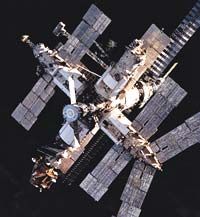 |
77KSO/77КСО №17301 Geophysical module |
20 May 1995 at 03:33:22 on Proton-K №378-02 from LC-81/23 | Docked 1 Jun 1995 at 00:56:16 to fore (transitional) unit (−X) undocked 2 Jun 1995 at 19:53:50; redocked 2 Jun 1995 at 21:30? to radial fore (transitional) unit (−Y) |
|
|
| Docking Compartment – SO (Stikovchnoy Otsek) СО (стыковочный отсек) 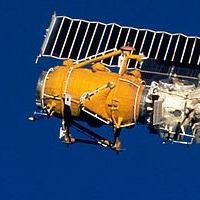 |
12 Nov 1995 at 12:30:43 on STS-74 Atlantis from Cape Canaveral, LC 39-A | Docked 14 Nov 1995 at 07:16:53 to Kristall |
|
||
| Priroda «Природа» 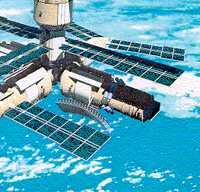 |
77KSI/77КСИ №17401 International ecology research module |
23 April 1996 at 11:48:50 on Proton-K №385-01 from LC-81/23 | Docked 26 Apr 1996 at 12:42:32 to fore (transitional) unit (−X); undock 27 Apr 1996 at 08:32; redock 27 Apr 1996 at 10:06 to radial fore (transitional) unit (+Z) |
|
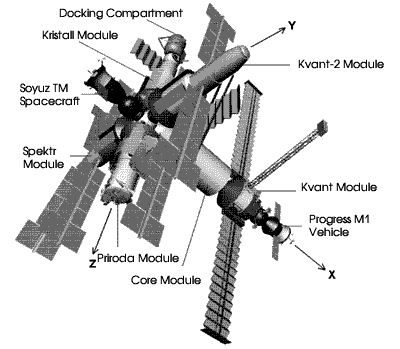
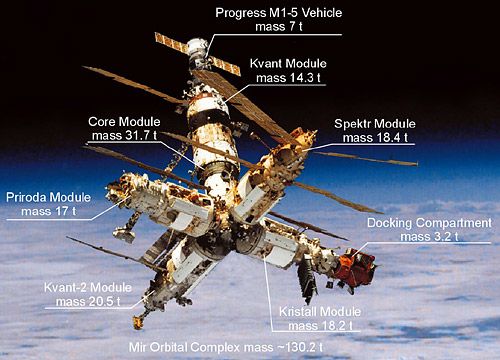
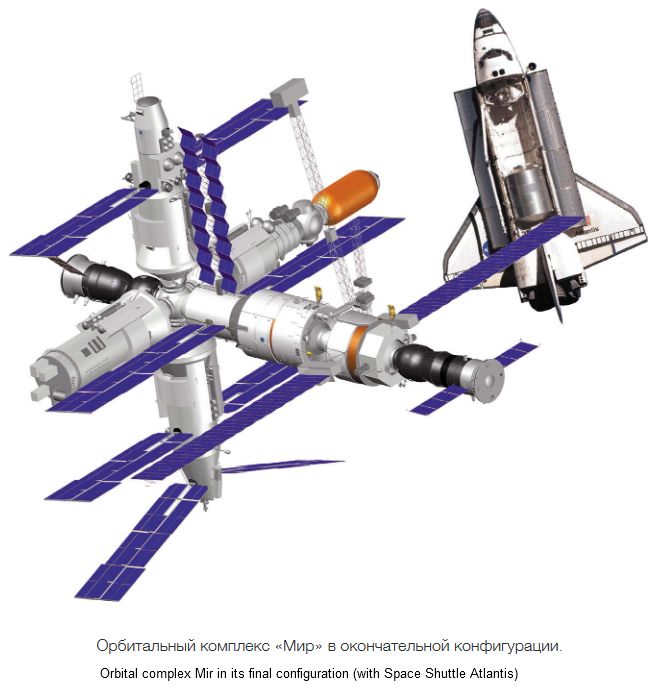
Energiya diagram of the final configuration of Mir. A larger version of this photo, and articles on Mir’s final day, can be found at the Energiya news section for March 2001.
Mir’s impressive record
Between 1986 and 2000, Mir was inhabited 90% of the time. From 1986 to 1999:
- 30 Soyuz spacecraft brought 80 astronauts to Mir, including 21 non-Russians.
- 9 US shuttles brought 57 astronauts to Mir, including 8 non-Americans.
- 84 different astronauts stayed on Mir on 137 different occasions.
- 22 Progress vehicles served the station.
- 23,000 science and research experiments were performed.
- 78 EVAs were carried out, totalling 352 hours in the vacuum of space.
- The record for the longest unbroken period of time spent on board is held by cosmonaut Valerii Polyakov, with 437 days.
From Mir, Le Voyage Extraordinaire, 1986–2001 by Jacques Villain, published by Le Cherche Midi (via the CNES site; see link below).
Diagrams
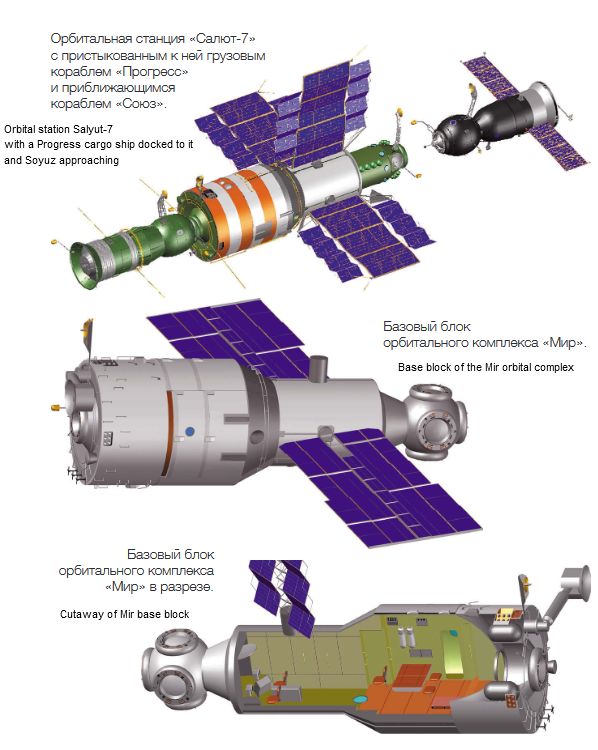
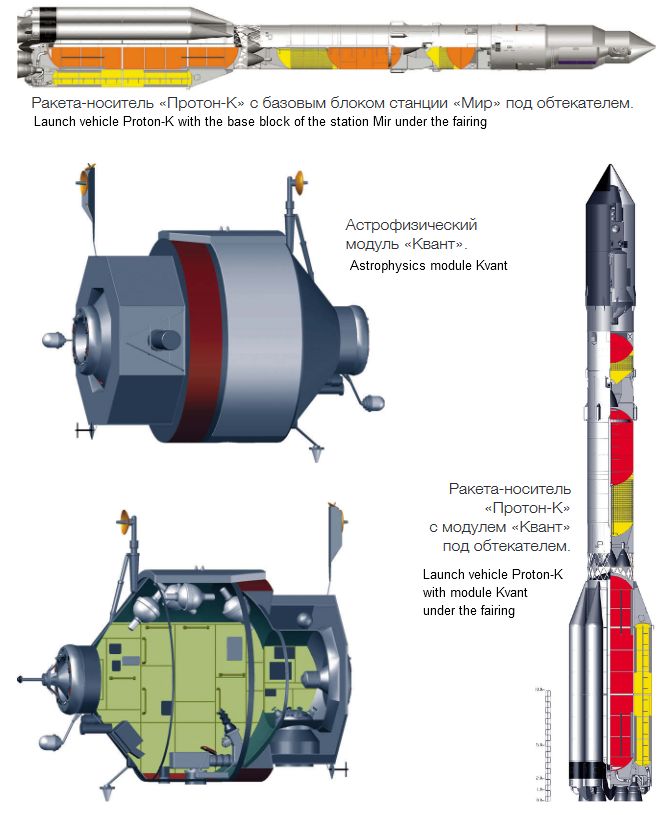
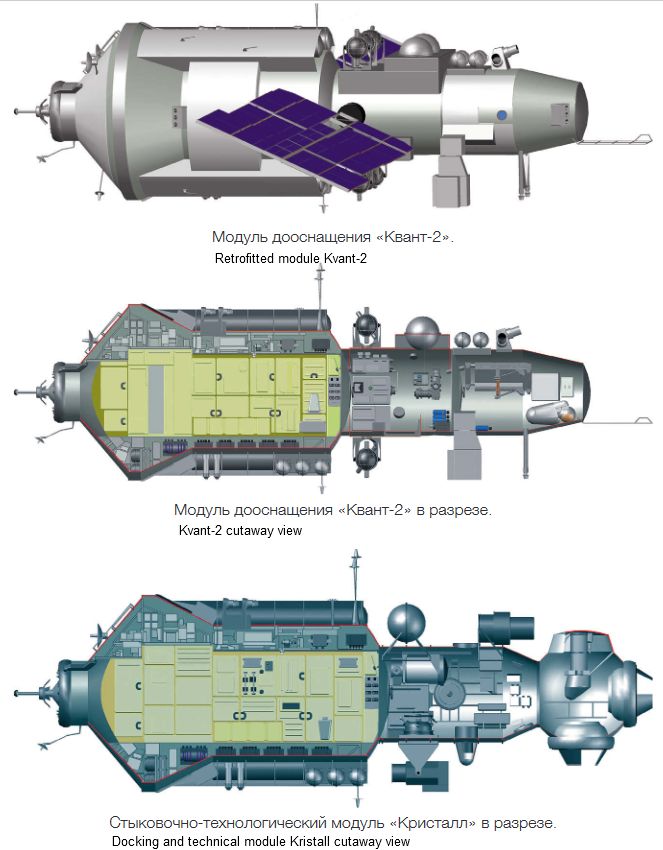
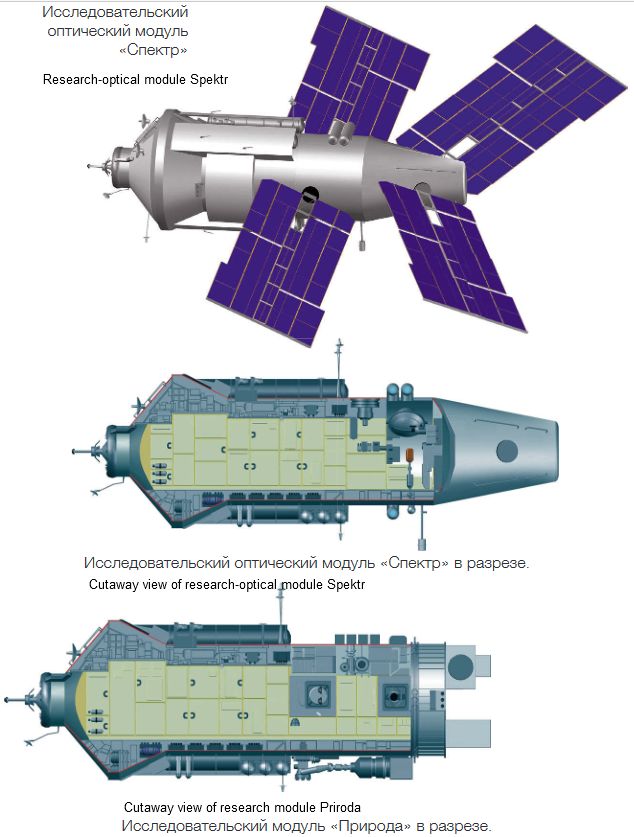
Diagrams of the Mir modules from Орбитальный комплекс «Мир» (Orbital Kompleks Mir) by Александр Железняков/Aleksandr Zheleznyakov, Владимир Гапонов/Vladimir Gaponov, Yauza books, Moscow, 2017: 1, 2, 3, 4, 5.
Links
- Avia.ru: Orbital Station Mir, Орбитальная станция «МИР», a Russian-language site
- Cato Institute: “Mir’s Heroic Death,” 23 March 2001.
- Chris van den Berg’s Mir News (1997 to 1999); also archived here
- CNES (French Space Agency): 2001, a Mir Odyssey
- Cosmic Dancer: “Cosmic Dancer” was a 3-dimensional sculpture created by artist Arthur Woods, launched to Mir on 22 May, 1993.
- Encyclopedia Astronautica: Mir
- Energiya: Mir section
- Gunter’s Space Page: Mir/DOS-7
- Houston Chronicle: 15 years of Mir online archive
- Information Center of Orbital Complex Mir
- Johnson’s Russia List: “The Legacy of Mir,” 2001.
- Mir-25: a small but interesting site featuring the crew of the 25th expedition to Mir (Soyuz TM-28) in 1998, including some questions and answers
- The Moscow Times: “May Mir’s Legacy Be as Enduring,”22 March 2001.
Over the last few years, much of the Western press coverage of Mir has had a distinctly uncharitable, almost juvenile flavor. The world has, almost gleefully at times, reported the station’s dotage, allowing its glory days to fade virtually to oblivion. Only in recent days have Western editorials begun to redress the balance.
[…] Russia has every right to be proud of Mir – proud of how it was conceived, what it achieved, what it symbolizes. Its legacy will continue as long as humankind continues to peacefully study, explore and develop space. Ultimately, Mir symbolizes the crucial advance from the militaristic competition of the early space race to a spirit of cooperation that we can only hope will never be reversed.
- NASA: Shuttle-Mir Web (also at the JSC History Portal): an extensive site featuring lots of photos from the Shuttle missions, interviews and other data
- NASA History Division: Shuttle-Mir: The United States and Russia Share History’s Highest Stage (SP-2001-4225). Online CD/book.
- Mir Hardware Heritage: an excellent NASA-commissioned history by David S. F. Portree.
-
New York Times:
- “What the Mir Can Still Teach Us,” 19 July 1997
- “American Megamillionaire Gets Russki Space Heap!” 23 July 2000. About the eccentric millionaire who founded the short-lived MirCorp.
- Popular Mechanics: “Why Mir matters,” 19/2/2016.
- Roskosmos: Orbital station Mir – English computer-translated local copy of the Russian site section, which from 2022 was geoblocked.
- Russian Space Web: The Mir space station
- Soviet Web Space: Mir Flight Log mission data page by Asif Siddiqi (Archive.org link). A listing of all flights to Mir.
- Sydney Morning Herald: “The Murder of Mir,” 10 February 2001.
- Terror in Space: companion site to an American TV series about the Mir space station, originally broadcast in October of 1998.
- TsPK: local copy of English-translated pages describing the Mir modules
- Visual Satellite Observer: After 86,331 Orbits, Mir Space Station’s 15 Years In Space Ends
Updated: 12/2/2023