Orbital station Mir – TsPK
Орбитальная станция «Мир»
- Base Block/Core Module
- Astrophysical module Kvant
- Retrofit module Kvant-2
- Technological module Kristall
- Research module Spektr
- Docking Compartment
- Research module Priroda
- Orbital complex Mir (1996)
Base Block/Core Module
Базовый блок
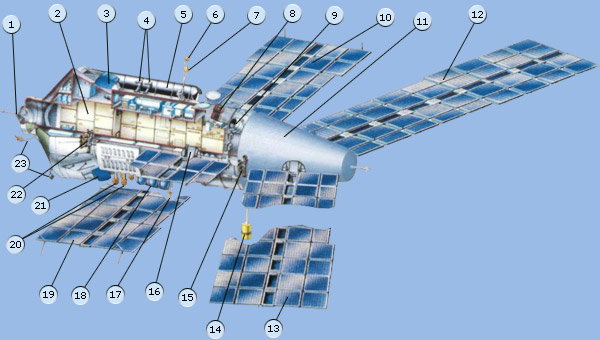
The Base Block 17KS No. 12701/Базовый блок, 17КС №12701, was designed to ensure the operation of a crew of up to six people and control the Mir complex with a changing configuration.
The main functions of the BB:
- provision of working and rest conditions for the crew;
- control of the operation of the main components of the orbital complex (OK)/орбитального комплекса (ОК);
- supply OK with electricity;
- provision of radio communication, transmission of telemetric information, television images, reception of command information;
- attitude control and orbit correction;
- providing the possibility of rendezvous and docking of modules and transport ships;
- maintenance of a given temperature and humidity regime of the living volume, structural elements and equipment;
- providing conditions for the exit of cosmonauts into open space;
- conducting scientific and applied research and experiments using the delivered target equipment.
The main developer of the Mir complex was NPO Energiya, the developer of the Base Block and station modules was the Salyut Design Bureau, their main manufacturers were the M.V. Khrunichev Plant of experimental engineering.
The starting weight of the BB was 20,900 kg; hull length – 13.13 m, maximum diameter – 4.35 m, volume of sealed compartments – 90 m3, free volume – 76 m3. The BB structurally consisted of four compartments: three sealed ones – a transition compartment (PkhO), a working compartment (RO) and a transition chamber (PrK), as well as an unpressurized aggregate compartment (AO) – переходного отсека (ПхО), рабочего отсека (РО) и переходной камеры (ПрК), а также негерметичного агрегатного отсека (АО).
The transition compartment was intended for docking four target modules and the transition of crew members to them. It could also serve as an airlock during a spacewalk, for which a pressure relief valve was installed on it. The length of the PkhO was 2.78 m, the hermetic/sealed volume was 6.85 m3. Five passive docking units (one axial and four lateral) were installed on the spherical part of the PkhO. On the axial and one side docking nodes there were receiving cones, on the other three side nodes there were covers. Transport ships and modules had to dock to the axial node. For re-docking the modules on the side nodes, two sockets were installed on the PkhO for capturing the automatic re-docking system (ASPr)/автоматической системы перестыковки (АСПр), by the manipulator.
Brackets were installed on the outer surface of the PkhO, on which handrails, antennas of the Kurs automatic rendezvous and docking system, docking targets, a television camera, and side lights were attached. The outer surface of the compartment was covered with screen-vacuum thermal insulation. There were four portholes in the PkhO.
The working compartment was intended to accommodate the main part of the onboard systems and equipment of the BB for the life and work of the crew. The total length of the RO was 7.7 m, the maximum diameter was 4.15 m, the hermetic volume was 75.0 m3. Interior panels separated the living area from the control room, as well as from the RO compartment. There were nine portholes in the RO, one of which (No. 9) had a diameter of 50 cm. Two portholes were in individual cabins on the starboard and port sides.
In the small diameter zone of the RO there was a central control post of the Pluton station. A place was also provided here for the installation of equipment for the teleoperator control mode (TORU)/телеоператорного режима управления (ТОРУ). In the large-diameter zone of the RO, there were two personal cabins (1.2 m3 each), a sanitary compartment (1.2 m3) with a washbasin and a sewage device, a kitchen with a refrigerator-freezer, a work table with securing devices and means of heating food, a storage container water (volume 50 l) and its distribution unit, medical equipment, simulators for physical exercises (bicycle ergometer and treadmill), a device for measuring body weight in weightlessness. In the large diameter compartment of the RO there was an airlock chamber for separating containers with waste and small spacecraft.
On the sides and in the upper part of the small diameter of the RO, there were three niches in which the SB drives were installed. Two main SB panels with a span of 29.73 m and a total area of 76 m2 were attached to the side drives. A deployable delivered solar battery 10.6 m long was attached to the top drive. The maximum output power of the two main and mounted solar panels was 12.2 kW. Radiators were installed on the cylindrical parts, which also served as anti-meteorite screens. Handrails were fastened on the outer surface of the RO. In addition, outside the small diameter of the RO, sensors for orientation to the Sun and the Earth of the motion control system (SUD)/системы управления движением (СУД), sensors for the SB orientation system, astroblocks, antennas of the radiotelemetry system were installed. Antennas of the Kurs system, control and communication systems, a TV antenna, side lights were installed at the ends of the solar panels. Outside, the RO case was closed with screen-vacuum thermal insulation.
The transition chamber was intended to ensure the docking of transport ships and the 37KE module. The PrK had a diameter of 2.0 m and a length of 2.34 m. The internal volume was 7.0 m3. The launcher was equipped with one passive docking unit of the docking and internal transition system (SSVP)/стыковки и внутреннего перехода (ССВП) located along the longitudinal axis of the BB. For external observation, there was one porthole in the PrK, and a television camera was fixed outside.
The aggregate compartment had a cylindrical shape with a maximum outer diameter of 4.15 m and surrounded the transition chamber. AO was intended to accommodate the units of the joint propulsion system (ODU)/объединенной двигательной установки (ОДУ). The ODU included two corrective engines with a thrust of 315 kgf each and 32 orientation engines with a thrust of 13.3 kgf for the pitch, yaw and roll channels. The orientation thrusters were grouped into four blocks of eight thrusters each. The ODU also included four tanks (they could hold up to 558 kg of AT oxidizer and 302 kg of UDMH fuel); eight cylinders with compressed nitrogen (the mass of filling with nitrogen is 37 kg). ODU BB tanks could be refueled from the Progress cargo ships from the side of the AO and PkhO.
Outside, on the rear frame of the AO, a rod from the Antares antenna system was fixed. In addition, antennas of the Kurs system, a radio control and communication system, a television system, a telephone and telegraph communication system, and orbit radio monitoring equipment were mounted on the AO case. Sun orientation sensors and SB orientation system sensors, side lights, handrails were fixed at the AO.
When launching, the PkhO and the small diameter of the RO with folded SBs were covered with a head fairing (GO)/головным обтекателем (ГО). Telescopic cargo booms were mounted on two brackets (boxes) for fastening the GO on the port and starboard sides already during the flight of the station.
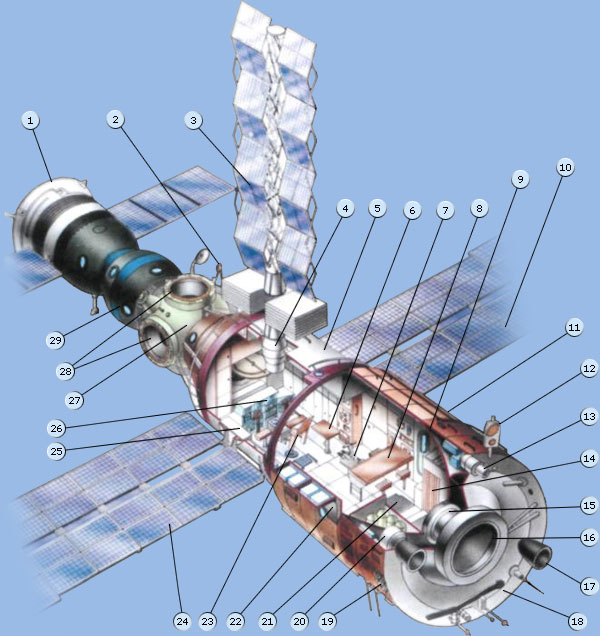
- Soyuz TM;
- antenna system Kurs, «Курс» (Course);
- delivered SB;
- drive delivered SB;
- small diameter RO;
- a device for measuring body weight;
- bicycle ergometer;
- desktop;
- personal cabins;
- main SB;
- large diameter RO;
- antenna system Igla, «Игла» (Needle);
- drive of a highly directional antenna;
- sanitary compartment;
- transition chamber;
- axial docking unit;
- corrective motors ODU;
- aggregate compartment;
- attitude thruster block;
- corrective motors ODU;
- treadmill;
- personal cabins;
- large porthole No. 9;
- main SB drive;
- main SB;
- central control post;
- transition compartment;
- side docking nodes;
- socket for gripping the ASPr manipulator
Astrophysical module Kvant
Астрофизический модуль «Квант»
On March 31, 1987 at 03:16:16 DMV/ДМВ, from the launcher No. 39 of the 200th site of the Baikonur Cosmodrome, using the Proton-K launch vehicle, a modular experimental transport vehicle (TKM-E)/ранспортный корабль модульный экспериментальный (ТКМ-Э) was launched into low-Earth orbit, which received the official name Kvant (Quantum).
Structurally, the ship consisted of two parts: the functional service unit (FSB)/функционально-служебного блока (ФСБ) 77KE No. 16601, and the scientific target experimental module 37KE No. 010 (TsM-E), целевого экспериментального модуля 37КЭ №010 (ЦМ-Э). The mass of TKM-E at launch was 22,797 kg.
The FSB was intended only for the delivery of the Kvant to the Mir station and was not designed for cosmonauts to visit. It didn’t even have a docking unit – the FSB was attached to the Kvant through a spacer, the separation was carried out with the help of pyrolocks. Four low-pressure fuel tanks were removed from it, and the high-pressure tanks were filled to 60%.
The Kvant module was designed to carry out a wide range of research, primarily in the field of extra-atmospheric astronomy. The mass of the module was 11,050 kg, the length (over the hull) was 5.8 m, the maximum hull diameter was 4.15 m, and the volume of the sealed compartment was 40 m3. The payload weight of the module was 4.1 tons, including scientific instruments – 1.5 tons, equipment for expanding the capabilities of the station – 2.6 tons.
Structurally, the module consisted of a sealed laboratory compartment (LO) with a transition chamber (PK) and an unpressurized scientific instrument compartment (ONP) installed around the PK – лабораторного отсека (ЛО) с переходной камерой (ПК) и негерметичного отсека научных приборов (ОНП), установленного вокруг ПК. The LO and the PK were designed to install the main structure of the service, experimental and part of the scientific equipment of the module, as well as active and passive docking units.
An active docking station was located in the forward part of the LO, providing docking to AO Mir. Further inside the lower part of the Kvant were the central control post, the astro-orientation device, the optical sight OD-5, the photographic complex MKF-6 and the infrared vertical sensor. There were six gyrodines on the ceiling inside the module. Behind the panels on the sides of the internal volume of the LO there were blocks of on-board computers, units of service systems and the Svetlana electrophoretic installation. Inside the LO was the delivered equipment for the station, incl. two sections of the mounted solar battery (MSB)/монтируемой солнечной батареи (МСБ).
Inside the PK there was an airlock chamber (SC)/шлюзовая камера (ШК), with a telescope “Glazar.” ShK made it possible to extract the captured cassettes from the telescope. At the end of the PK was a passive docking station for receiving transport ships.
A complex of scientific equipment Rentgen, «Рентген» (X-ray) (weighing 800 kg) was placed in the ONP. It was intended for research in the field of X-ray astronomy in the range from 2 to 800 keV. The complex included:
- telescope-spectrometer of hard X-ray radiation Pulsar X-1 (USSR) with a detector of gamma-ray bursts of cosmic origin;
- high-energy scintillation telescope-spectrometer HEHE (Germany);
- telescope with shadow mask ТТМ/СОМ15 (Great Britain, Netherlands) for imaging in the X-ray range;
- gas scintillation proportional spectrometer Siren-2 (also called 08RS; EKA).
Observations with the help of the X-ray complex were carried out in the mode of inertial orientation of the Mir complex on gyrodines with the orientation clarified by the crew using the orientation device. The instruments of the X-ray complex were controlled by commands from the Earth.
In addition, Kvant had the Ryabina-2 astrophysical equipment, the Ariel plasma and Source electron injectors for geophysical research, the Arfa-7 geophysical equipment and the Zond-Charge sensor, the Biocryst biotechnological installations, Recomb-K, Luch, Biocont, Biomagnistat, technical equipment Volna-2A and Indicator-E, experimental installation Speed.
Outside the module were antennas of the Igla rendezvous system, antennas of the Kurs rendezvous system (only from the PK side), star and solar sensors, radio telemetry and command radio link antennas, handrails.
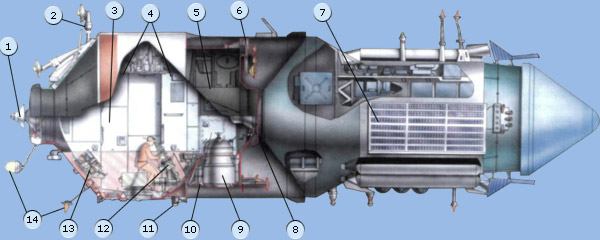
- active docking station;
- antennas of the Igla system;
- laboratory compartment;
- gyrodines;
- compartment of scientific instruments;
- antennas of the Kurs system;
- functional service block;
- passive docking station;
- lock chamber with ultraviolet telescope Glazar;
- transition chamber;
- optical block of infrared vertical;
- optical sight;
- central control post;
- antennas of the Igla system.
Retrofit module Kvant-2
Модуль дооснащения «Квант-2»
The Kvant-2 retrofit module (77KSD No. 17101, TsM-D/77КСД №17101, ЦМ-Д) was launched on November 26, 1989 at 16:01:41 DMV from launcher 39 of the 200th platform of the Baikonur Cosmodrome using the Proton-K launch vehicle. The developer and manufacturer of the module was GKNPTs M.V. Khrunichev.
Kvant-2 was intended to equip the Mir complex with equipment, scientific equipment, as well as to provide cosmonauts with access to outer space. In addition, Kvant-2 was used to deliver goods to Mir. The fuel remaining in the module tanks after docking was used to correct the station’s orbit and change its orientation.
The Kvant-2 module had a hull length of 12.4 m, a maximum diameter of 4.15 m, and a sealed hull volume of 59 m3. Its launch mass in orbit after separation from the RN-19565 kg.
The basis of the design of the Kvanta-2 module was a sealed case, which consisted of three compartments:
- instrument-cargo (PGO)/приборно-грузового (ПГО), which houses the main part of the instruments and units of service systems, retrofit equipment and delivered goods;
- instrumental-scientific (PNO)/приборно-научного (ПНО), where scientific equipment is concentrated;
- airlock special (ShSO)/шлюзового специального (ШСО), with the necessary equipment and tools for working in open space.
In the PGO, immediately behind the transfer hatch on the “floor,” there was a module control post with an operator’s workplace, and the equipment of the onboard complex control system. Further in the “corridor” of the PGO, under the “floor” panels, there were systems for regenerating water from urine and from condensate (SRV-U and SRV-K, СРВ-У и СРВ-К), buffer batteries of the module. On the port side, immediately after the hatch, there was a hygiene section with a shower cabin and a washbasin. On the starboard side were the Rodnik systems, the Elektron-V plant for producing oxygen by water electrolysis, and the Incubator-2 biotechnical complex.
The PNO housed control panels for the external turntable ASP-G-M/АСП-Г-М, a spectral camera MKF-6MA/МКФ-6МА, and locking equipment. The SPK was located in the ShSO, two Orlan-DMA spacesuits were stored. The compartment ended with an exit hatch with a diameter of 1000 mm.
An active docking unit SSVP-A/стыковочный агрегат ССВП-А, was installed along the axis of the module from the side of the conical bottom. A manipulator of the ASPR automatic docking system was fixed next to it. On the outer surface of the PGO there were blocks of the propulsion system of the module: two blocks of correction and rendezvous engines DKS (thrust 417 kgf) and four blocks of low-thrust engines, each of which included five berthing and stabilization engines DPS (thrust 40 kgf) and four engines of precise stabilization DTS (thrust 1.3 kgf). All Kvanta-2 engines used UDMH fuel and AT oxidizer. The fuel was located in eight cylindrical tanks installed outside the PGO under the radiators of the thermal management system (COTR). In addition, the PGO was equipped with: helium cylinders; panels of radiant heat exchanger SOTR; SOSB sensors; solar and infrared sensors SUD and other devices used to control the movement of the module; antennas of the command radio link, telemetry control, the Kub-Kontur command and measuring system and the Kurs radio docking system.
There were six gyrodines, two water storage tanks with a total volume of 300 l, two rotary solar panels with an area of 53.2 m2 and a power of 6.9 kW outside the PNO. On the outer surface of the SSO there were balloons with compressed air of the locking system, an optical star tracker, and a platform for mounting equipment exhibited in outer space. In addition, the ASP-G-M automatic gyro-stabilized platform was fixed to the ShSO. There was a video spectral complex on it, which included a black-and-white and color television cameras, an ITS-7D infrared spectrometer, an ARIZ X-ray analyzer, and an MKS-M2 multi-zone spectrometer. The operation of the complex could be controlled in three modes: by an operator from the MCC from a specially equipped workplace, by an cosmonaut from the module, and also automatically according to a given program.
Outside, the module was shrouded in screen-vacuum thermal insulation.
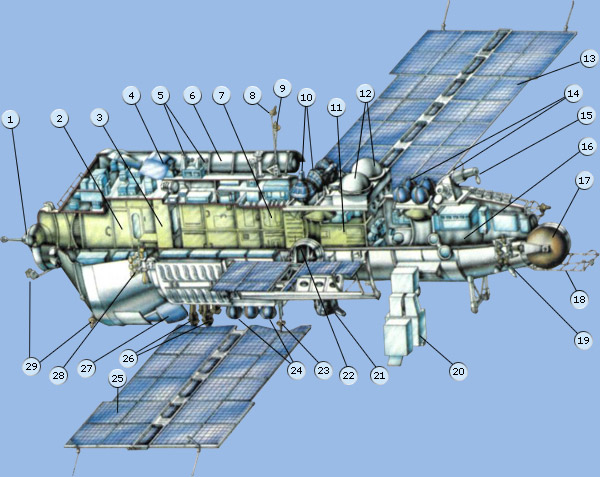
- active docking station;
- instrument-cargo compartment;
- hygiene section with a shower cabin;
- correction and rendezvous engine block;
- solar sensors of the traffic control system;
- fuel tank;
- block of the water supply system;
- antennas of the Kub-Kontur system;
- antennas of the Kurs system;
- gyrodines;
- instrumental-scientific compartment;
- water storage tanks;
- main SB;
- ball-cylinders with compressed air of the locking system;
- optical star tracker;
- airlock special compartment;
- exit hatch;
- cosmonaut exit device;
- small thrust engine blocks;
- automatic gyro-stabilized platform ASP-G-M;
- gyrodines;
- main SB drive;
- antennas of the Kub-Kontur system;
- helium cylinders;
- main SB;
- infrared vertical sensors of the motion control system;
- correction and rendezvous engine block;
- small thrust engine blocks;
- antennas of the Kurs system.
Technological module Kristall
Технологический модуль «Кристалл»
The docking and technological module Kristall (Crystal) (77 KST No. 17201/TsM-T/77 КСТ №17201, ЦМ-Т) was launched on May 31, 1990 at 13:33:20 DMV from the launcher 39 of the 200th platform of the Baikonur Cosmodrome by the Proton-K rocket.
The Kristall module was intended for pilot production of semiconductor materials, purification of biologically active substances in order to obtain new drugs, growing crystals of various proteins and cell hybridization, as well as conducting astrophysical, geophysical and technical experiments. The fuel remaining in the module tanks after docking was used to make corrections to the station’s orbit and change its orientation.
The Kristall module had a hull length of 12.02 m, a maximum diameter of 4.15 m, and a sealed hull volume of 64 m3. The launch mass of Kvant-2 in orbit after separation from the launch vehicle was 19640 kg.
In terms of service systems, Kristall was very similar to Kvant-2. The basis of the module design was a sealed housing, which consisted of an instrument-cargo (PGO) and instrument-docking (PSO) compartments.
The PGO housed the service systems of the module, the bulk of the cargo delivered into orbit (cargo containers were attached to the “floor” and “ceiling” panels), and the treadmill simulator. There were also technological installations in the PGO. The Krater-V resistive heating electric furnace and the Optizon-1 radiant heating unit were designed to work out the basic technological processes of pilot production of high-quality semiconductor materials. Resistive heating furnaces Zone-02 and Zone-03 were used to develop basic technological processes for producing high-quality metal alloys and semiconductor materials. The PGO also housed the Ainur universal electrophoretic complex for the purification of valuable protein preparations and a miniature garden – the Svet greenhouse, capable of automatically maintaining the necessary conditions for plant growth.
The PSO mainly served to house scientific equipment. There was a multifunctional installation Crystallizer ChSK-1 for fundamental research in the field of space materials science and technology. In the spherical part of the PSO, there were two cameras of the Priroda-5 complex for shooting the Earth’s surface with a resolution of 5-7 m.
Two reusable solar panels (MSB-2 and MSB-4) were installed on the PSO on rotary drives. When fully opened, the length of one panel reached 15 m. The area of two MSBs was 72 m2, they produced up to 8.4 kW. The design of the SMEs provided for the possibility of their dismantling and transfer to the Kvant module, and these works were planned for EO-7 and EO-8. On the outer surface of the PSO was a water tank of the Rodnik system.
There was a lock chamber in the PSO building, outside of which there was an ultraviolet telescope Glazar-2. Unlike the first Glazar on Kvant, the new telescope, thanks to the gimbals, could independently aim at given areas of the sky and did not require precise orientation of the entire orbital complex. Kristall also had astrophysical equipment: the Buket gamma-ray telescope-spectrometer, the Maria-2, Marina, and Granat spectrometers.
Two androgynous-peripheral docking units APAS-89 stood on the spherical part of the PSO. The axial unit was intended for docking the Buran orbiter. It was supposed to attach a unit of scientific equipment to the side APAS with the help of the Buran manipulator.
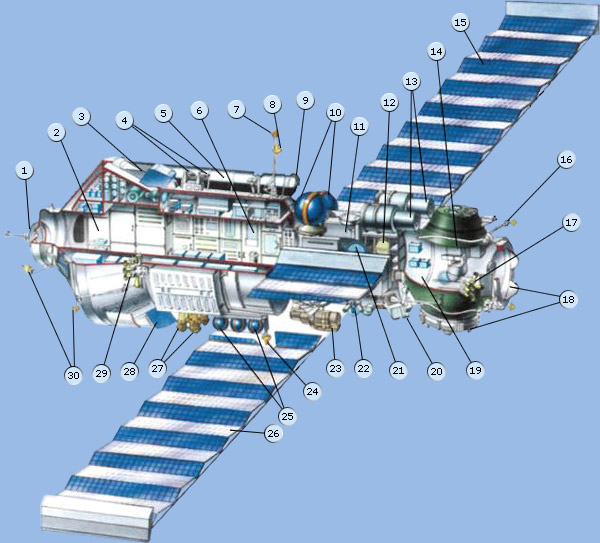
- active docking station;
- instrument-cargo compartment;
- correction and rendezvous engine block;
- solar sensors of the traffic control system;
- fuel tank;
- greenhouse Light;
- antennas of the Cube-contour system;
- antennas of the Kurs system;
- panel of the Rodnik system;
- water storage tanks;
- refrigerator;
- reusable SB drives;
- portable drives of reusable SB;
- photo complex Nature-5;
- reusable SB;
- antennas of the Kurs system;
- small thrust engine blocks;
- docking stations APAS-89;
- stand;
- spectrometer Maria;
- reusable SB drives;
- equipment Xenia;
- Glazar-2 telescope;
- antennas of the Cube-contour system;
- helium cylinders;
- reusable SB;
- IR vertical sensors of the motion control system;
- correction and rendezvous engine block;
- small thrust engine blocks;
- antennas of the Kurs system
Research module Spektr
Исследовательский модуль «Спектр»
The Spektr (Spectrum) research module (77KSO No. 17301, TsM-O/77КСО №17301, ЦМ-О) was launched on May 20, 1995 at 06:33:22 DMV from launcher 23 of the 81st pad of the Baikonur Cosmodrome by a Proton-K rocket. Spektr was the first to manage to dock with the station on the first attempt: on June 1 at 03:56:17 DMV, the module moored to the center node of the PkhO. On the night of June 3, it was re-docked to the lower node of the PchO, after which the crew of EO-18 opened the hatch into it.
The scientific equipment of Spektr was intended for the study of natural resources of the Earth, the upper layers of the Earth’s atmosphere, the own outer atmosphere of the orbital complex, geophysical processes of natural and artificial origin in near-Earth outer space and in the upper layers of the Earth’s atmosphere, cosmic radiation, biomedical research, the study of behavior various materials in open space conditions. Spektr brought additional sources of electricity to Mir and was used to deliver goods. The fuel left on the Spektr after docking was used to correct Mir’s orbit and change its orientation.
The module consisted of a pressurized instrument-cargo (PGO) and non-pressurized (NGO) compartments. The length along the hull was 14.44 m, the maximum diameter was 4.10 m, the volume of the sealed hull was 62 m3. The maximum span of the solar batteries was 23.3 m. The launch weight of the Spektr was 18,807 kg, the weight of the Mir spacecraft was 17,837 kg.
The PGO housed service systems, scientific equipment and delivered cargo. The maximum diameter of the PGO hull was 4.10 m, the minimum was 2.90 m, the length was 8.80 m, and the volume was 62 m3. An interior frame was installed inside the sealed case. It housed equipment requiring sealed conditions. Under the panels of the “floor” in the area of the conical shell, there was equipment for studying the flows of charged particles and electromagnetic radiation Taurus. Still under the “floor” were buffer electrochemical batteries and a set of equipment for studying the flows of charged particles and electromagnetic radiation Grif-1.
In the middle part of the pressurized housing of the PGO, there were two niches in which the electric drives of the solar array orientation system were located. Two panels of the main solar battery with an area of 56 m2 and a power of 6.9 kW were attached to them.
In place of the two removed Oktava launchers was the Swiss-Russian collector of interstellar atoms Komza. Next to the lock chamber were located 10 sites for attaching the exhibited samples. They later placed American exposition equipment. On the opposite side of the PGO there was a rotary rod of equipment for studying the own external atmosphere of the OC – Astra-2. Russian scientific equipment was located inside and outside the PGO: the Balkan lidar, the Priroda-5 photographic complex, the Phase spectrometer, the 286K binocular radiometer, the Breeze ultraviolet spectroradiometer, the EFO-2 photometer, devices for studying properties materials in open space: Jet, Thermophysics and Coefficient.
At launch, the Spektr module had 754.5 kg of American scientific equipment at launch: equipment for studying the cardiovascular system, metabolism, for experiments in the field of fundamental biology, technology, neurophysiology, supporting systems, etc.
The non-pressurized compartment was attached to the end frame of the NGO from the side of its spherical bottom instead of the power frame with the Oktava complex. The NGO consisted of two conical segments. The length of the NGO was 5.64 m, the maximum diameter was 2.90 m. Two electric drives were installed inside the NGO, on which two panels of additional solar batteries with an area of 76 m2 and a power of 9.3 kW were mounted. Later on, the Miras spectrometer was mounted at the end of the NGO. Also, Ryabina-4P equipment for the study of cosmic radiation, a Phoenix infrared radiometer and European scientific exposition equipment were attached outside the NGO.
- active docking station;
- instrument-cargo compartment;
- correction and rendezvous engine block;
- solar sensors of the traffic control system;
- fuel tank;
- antennas of the Kub-Kontur system;
- antennas of the Kurs system;
- KOMZ equipment;
- lock chamber;
- main SB;
- unsealed compartment;
- additional SB;
- additional SB;
- a rod with a sensor of the Astra-2 equipment;
- small thrust engine blocks;
- main SB drive;
- antennas of the Kub-Kontur system;
- helium cylinders;
- main SB;
- vertical infrared sensors of the motion control system
- correction and rendezvous engine block;
- small thrust engine blocks;
- antennas of the Kurs system.
Docking Compartment
Стыковочный отсек
The docking compartment (SO, product 316GK/СО, изделие 316ГК) was designed and manufactured at RSC Energiya for docking shuttles to the Kristall module without its preliminary re-docking from the side to the axial node of the PKhO of the Mir Base Unit. The compartment had a length of 4.7 m along the planes of the frames of the docking units and a diameter of a sealed compartment of 2.2 m. The end of the keel trunnion to the container of the additional SB) – 4.5 m.
The sealed housing of the RM was formed by a cylindrical shell with a diameter of 2.2 m and two spherical bottoms with a radius of 1.1 m. The sealed volume of the docking compartment was 14.6 m3. Two androgynous peripheral docking units of the APAS-89 type were installed along the axis of both bottoms: one for docking the SO to the Kristall module (APAS-1), the other for docking with the shuttle (APAS-2). One node was rotated relative to the other by 25° so that the jets from the shuttle’s upward thrusters would not hit the station. In the center of the hatch of the APAS-1 node, a porthole was made for a television camera, which ensures the docking of the shuttle + SO combination. In the center of the APAS-2 hatch was a docking target for the shuttle. Near each node there was a pressure equalization valve.
Power supply for all compartment systems was provided from the Mir station through connectors in the APAS-1 node. A fuse block and electrical sockets were installed inside the SO. Information channels for controlling SO systems from the shuttle went through a multiplexer-demultiplexer and two connectors on APAS-2. The shuttle software monitored the status and operation of the SO systems: the pressure and temperature inside the compartment, the operation of the fans of the thermal control system, the status and operation of both docking nodes. After docking with Kristall, all information from the SO went through two electrical connectors on the APAS-1 node to the Mira control information and computer complex.
Control panels for both docking stations, an APAS power supply unit, a pressure valve control unit, a power supply unit, and an SOTR control panel were installed inside the SO. To ensure the specified thermal regime from the outside, the compartment was closed with screen-vacuum thermal insulation. The active SO thermal control system included a hydraulic circuit with a circulating refrigerant and a block of automatic switches, electric heaters and fans. Fans also provided air circulation. To maintain the required parameters for the purity of the atmosphere, a dust collector was placed in the compartment.
The internal “walls” of the pressurized building were decorative panels, behind which electrical and pneumatic communications passed. Technological pressurization and pressure relief valves were welded into the spherical bottoms of the SO, which are used when testing for tightness on Earth.
Outside the SO, a reusable solar battery (MSB)/многоразовая солнечная батарея (МСБ), and a solar retrofit battery (SBD)/солнечная батарея дооснащения (СБД), means for capturing the SO by the shuttle manipulator, means for ensuring docking, a detachable ROA board, and handrails for moving cosmonauts outside the compartment were fixed.
The MSB, completely manufactured by the Russian side, was an exact copy of the two batteries launched with the Kristall module. At first, they planned to install it at the end of the Priroda module, but they preferred to fill the Priroda with American scientific equipment to the brim, and put the MSB on the SO for the time being. The SBD battery included a similar Russian mechanical part for deployment and retraction and American photoelectric converters (FEPs). The total area of two batteries was 76 m2. Later, the batteries were transferred to the Kvant module and installed there.
In the cargo compartment of the shuttle, the SO was fixed by the main mount (two trunnions on the port and starboard sides), stabilizing (one trunnion on the port side) and keel (one trunnion below). The rigging unit for the shuttle manipulator stood on a spherical bottom from the Kristall side.
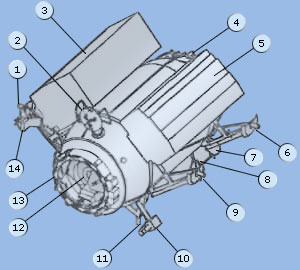
- trunnions of attachment points;
- node for capturing the shuttle manipulator;
- SB retrofitting;
- docking stations APAS-89;
- reusable SB;
- trunnions of attachment points;
- shuttle docking target;
- docking target TC Soyuz TM;
- trunnions of attachment points;
- television camera;
- trunnions of attachment points;
- manhole cover;
- docking stations APAS-89;
- detachable REA board
Research module Priroda
Исследовательский модуль «Природа»
The research module Priroda (Nature) (77KSI No. 17401, TsM-I) was launched on April 23, 1996 at 14:48:50 DMV from the launcher 23 of the 81st pad of the Baikonur Cosmodrome by the Proton-K rocket. On April 26, at 15:42:32 DMV (12:42:32 UTC), the module docked to the center node of the PkhO. On April 27, it was re-docked to the left side node of the PkhO.
The main purpose of Priroda was to study the surface and atmosphere of the Earth, the atmosphere in the immediate vicinity of the Mir, the influence of cosmic radiation on the human body and the behavior of various materials in outer space, as well as the production of extra pure drugs under weightlessness. In addition, the module was used to deliver cargo to Mir, and the fuel remaining in the tanks after docking was used to correct the station’s orbit and change orientation.
The length of the module along the hull was 11.55 m, the maximum diameter was 4.10 m, the volume of the hermetic/airtight hull was 65 m3. The launch weight with the head fairing and spacer was 23,500 kg, the mass of the module in orbit after separation from the launch vehicle was 19,340 kg.
The pressurized instrument-cargo compartment (PGO)/Герметичный приборно-грузовой отсек (ПГО) – the basis of the design of the Priroda module – served to accommodate service systems, scientific equipment, and delivered cargo. The sealed case of the PGO had a maximum diameter of 4.10 m, a minimum diameter of 2.90 m, a length of 8.86 m, and a volume of 65 m3. An interior frame was installed inside, on which blocks of service systems and scientific equipment were placed.
The PGO was conditionally divided into three sections: PGO-1, PGO-2 and PGO-3. The first after the docking station Priroda was PGO-2, which consisted of two shells in the form of truncated cones, connected by large diameters. It housed mainly instruments and units of the station board system. Under the panels of the “floor” and “walls” in the area of the conical shell, there were containers with American scientific equipment for experiments in the field of microgravity, fundamental biology, space science, for studying cardiovascular activity, to reduce the risk of future space development (total mass – 935.5 kg). On the left side of the PGO-2 was the control post of the French aerosol lidar Alice.
Behind PGO-2 was a cylindrical PGO-1 with a diameter of 2.90 m, where the instruments and units of the module systems were located. Under the “floor” there were buffer batteries, and above them – a frame with 160 lithium batteries with a total capacity of 6720 Ah, which provided power to the module during the autonomous flight stage. After docking with the Mir, the lithium batteries were dismantled and loaded into the Progress M-31 for disposal. Next were the blocks of the Ruchei-2 electrophoretic installation. Behind the side removable panels was the equipment of service systems.
During the launch of Priroda, PGO-1 housed the optical unit of the German optoelectronic stereo scanner MOMS-2P. Later, the crew carried the block into outer space and installed it in its regular place outside the PGO-1.
The third was the compartment PGO-3, formed by a cylindrical shell with a diameter of 2.90 m and ending with a spherical bottom. Inside were blocks of scientific equipment and some service systems and cargo. On the left side of the PGO-3 there were two windows: the optical unit of the Alisa system was installed on the one closest to the docking unit, and the optical unit of the Level equipment or the MOZ-Obzor infrared spectrometer could be installed on the one closest to the spherical bottom.
On the left side outside the PGO-1, a platform was made for installing the optical unit of the MOMS-2R stereo scanner. From the bottom of the PGO-3, a rod with a folded Traverse-1P side-scan radar antenna was fixed. The antenna was deployed after re-docking Priroda to the regular side node of the Mir PkhO. Numerous scanning radiometers of the Ikar microwave complex, RP-225, RP-600 and R-400 radiometers, an Ozon-Mir interferometer, a DK-33 photometer, etc. were installed outside PGO-3. There was also a universal workplace for interchangeable scientific equipment. At launch, there were instruments for studying the properties of materials in open space conditions Teplofizika and Coefficient, as well as a device for measuring the temperature regimes of jets of Struya rocket engines. Outside the PGO there were also a precision radio altimeter Comb, equipment for the study of cosmic radiation Kanopus, a space barometer Indicator.
The instrument frame on the spherical bottom of the PGO-3 was intended for the installation of scientific equipment. Two multi-zone scanning devices of medium resolution with a conical scan MSU-SK and high resolution on CCD structures MSU-E, as well as an Istok-1 scanning infrared spectrometer, a Dopi scanning Fourier interferometer and a SAREX-2 amateur radio antenna were installed here.
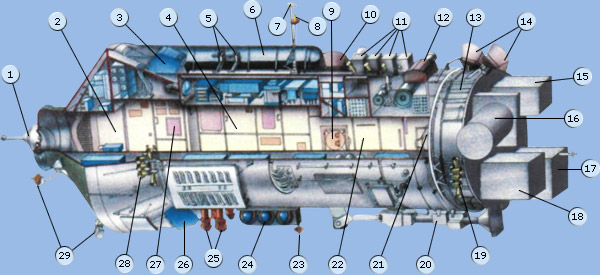
- active docking station;
- instrument-cargo compartment PGO-2;
- correction and rendezvous engine block;
- instrument-cargo compartment PGO-1;
- solar sensors of the traffic control system;
- fuel tank;
- antennas of the Kub-Kontur system;
- antennas of the Kurs system;
- optical unit of the Alisa system;
- panoramic radiometer RP-600 of the Ikar-N complex;
- route radiometers R-30, R-80, R-1 35 and RP-225 of the Ikar-D complex;
- interferometer Ozone-Mir;
- instrument frame;
- panoramic radiometer R-400 of the Ikar-D complex;
- scanning infrared spectrometer Istok-1;
- scanning Fourier interferometer Dopi;
- multi-zone scanning device of medium resolution with a conical scan MSU-SK;
- high-resolution multi-zone scanning device MSU-E;
- small thrust engine blocks;
- side-scan radar antenna Traverse-1 P;
- optical block of equipment Level;
- instrument-cargo compartment PGO-3;
- antennas of the Kub-Kontur system;
- helium cylinders;
- infrared vertical sensors of the motion control system;
- correction and rendezvous engine block;
- remote control equipment Alisa;
- small thrust engine blocks;
- antennas of the Kurs system.
Orbital complex Mir (1996)
Орбитальный комплекс «Мир» (1996 г.)
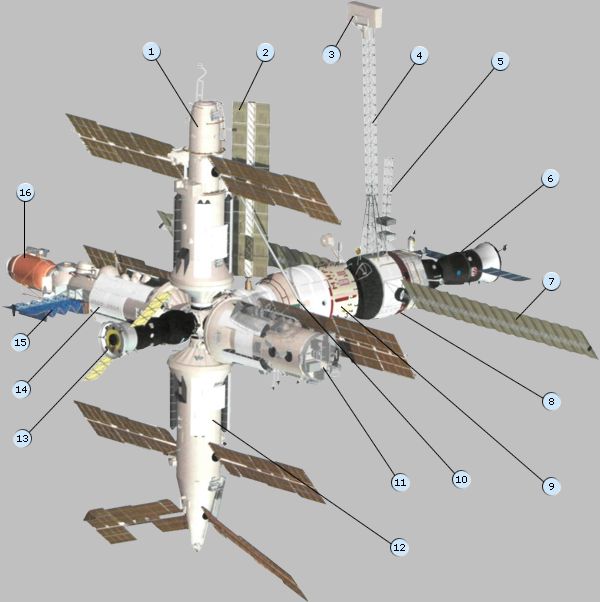
- Kvant-2 module;
- delivered SB;
- VSU;
- arm Sofora;
- arm Rapana;
- transport ship Soyuz TM;
- reusable SB;
- module Kvant;
- base block;
- cargo boom;
- module Priroda;
- Spektr module;
- cargo transport ship Progress M;
- module Kristall;
- reusable SB left on the Kristall module;
- docking compartment
Linked from Mir space station