Published letters
- Local newspaper, 6 March 2006
- Local newspaper, 11 October 2006
- The Age, 3 March 2008
- Herald-Sun, 6 March 2008
- The Age, 6 May 2008
- The Age, 5 June 2008
- Herald-Sun, 16 June 2008
- Herald-Sun, 3 July 2008
- Local newspaper, 16 July 2008
- Herald-Sun, 11 September 2008
- The Age, 28 January 2009
- The Age, 21 February 2009
- The Age, 23 March 2009
- Herald-Sun, 28 March 2009
- Herald-Sun, 30 April 2009
- Herald-Sun, 27 May 2009
- Herald-Sun, 22 July 2009
- Herald-Sun, 14 August 2009
- Herald-Sun, 13 November 2009
- Local newspaper, 9 December 2009
- The Age, 27 January 2010
- Moorabbin Leader, 26 January 2011
- Herald-Sun, 14 February 2011
- Herald-Sun, 7 April 2011
- Herald-Sun, 20 April 2011
- Moorabbin Leader, 20 April 2011
- Moorabbin Leader, 22 February 2012
- The Age, 9 December 2016
- Herald-Sun, 4 November 2020
- The Age, 17 June 2021
- The Age, 5 August 2021
Letters I have had published in newspaper print editions, listed in order of publishing date. The titles are given by the editors. Note that my opinions on some topics have changed since these were written.
Local newspaper, 6 March 2006
The first two were published anonymously by request; they were complaints about local vandalism. I was feeling rather irate when I wrote them, so they are somewhat strongly-worded!
To the parents of the teenage thugs who vandalize fences along […] Rd in the early morning of February 19: do you know the meanings of the words “parental responsibility,” “discipline” and “curfew”? Do you know where your children go at night, and do you even care?
I am getting very tired of being woken up at night by drunken louts roaming the streets, and of fearing what more damage will be done to our fence, and others.
Local newspaper, 11 October 2006
Several front fences in my street […] have had two graffiti attacks in the last two weeks – perhaps not coincidentally, it was school holidays.
The corner shops at […] Road have been covered in graffiti for years, and look like a ghetto.
This problem seems to be getting progressively worse and I am sick of seeing this vandalism everywhere.
Could we please have more police patrols at night in the area, or something? Could parents not let their teenagers roam the streets at night unsupervised? Also, banning the sale of spray paint would help.
The Age, 3 March 2008
On overdevelopment and overpopulation.
A house or bust
The Housing Industry Association is urging the Victorian Government to release more land for housing (“State urged to release land to ease crisis,” The Age, 1/3) – not surprising as it stands to make money out of constructing more and more houses. I guess it won’t be content until Victoria is smothered in housing estates.
Missing in all the agonizing over rising house prices is that a major cause of this is the growing population – something which the Government is deliberately encouraging and which is eroding the livability of Melbourne.
Herald-Sun, 6 March 2008
On overpopulation.
Reduce the population
Reducing population growth and thus the demand for housing is an obvious solution that politicians such as Mr. Brumby seem reluctant to acknowledge.
They are obsessed with “growth,” no matter what the environmental cost.
I am dismayed at seeing what has made Melbourne a liveable city – its open spaces and low urban density – relentlessly destroyed.
The Age, 6 May 2008
On overpopulation.
No winners in this contest
Those interviewed in “City’s house prices among cheapest” seem to regard population growth as a competition in which the city that can cram in the most people is the “winner.” They appear oblivious to the negative social or environmental consequences of such overcrowding. Reducing population growth would reduce demand for housing and help lower prices.
The Age, 5 June 2008
On a curious opinion piece supporting Melbourne’s “vibrant nightlife” (a much-overused phrase which I’ve come to detest). There is an odd attitude in society that staying up all night is somehow “cool,” while going to bed and getting up early isn’t (needless to say, I do the latter!). The letter was slightly altered by the editor.
Dreariness or drunkenness?
So, according to Larissa Dubecki (Comment & Debate, 3/6) people who like to get a good night’s sleep are wowsers! Humans didn’t evolve as nocturnal creatures, and the 24-hour modern lifestyle she espouses contributes towards sleep disorders. And I, for one, liked Melbourne when it was a “dreary, unexciting provincial city” with an “empty, useless city centre” – at least it wasn’t plagued by the drunken violence that is endemic now.
Original letter:
So, according to Larissa Dubecki (“Locking out modern life is not the answer,” The Age, 3/6) people who like to get a good night’s sleep are lazy and wowsers! Humans didn’t evolve as nocturnal creatures, and the 24-hour modern lifestyle she espouses contributes toward sleep disorders. And I, for one, liked Melbourne when it was a “dreary, unexciting provincial city” with “an empty, useless city centre” – at least it wasn’t plagued by the drunken violence that is endemic now.
Herald-Sun, 16 June 2008
On overpopulation. Two other letters on the topic were also published and highlighted in a box.
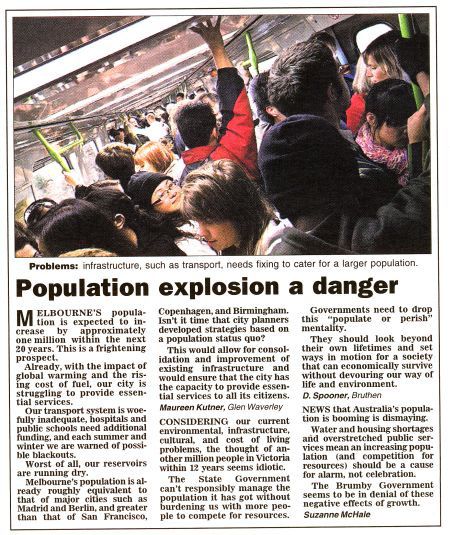
News that Australia’s population is booming is dismaying.
Water and housing shortages and overstretched public services mean an increasing population (and competition for resources) should be a cause for alarm, not celebration.
The Brumby Government seems to be in denial of these negative effects of growth.
Herald-Sun, 3 July 2008
On overpopulation. The letter was edited and most content cut out, presumably to fit in the “50/50” section.
The obvious solution to the housing shortage would be to reduce the absurdly high immigration rates.
Original letter:
The obvious solution to the HIA’s scaremongering regarding the housing shortage (“Crisis in home building,” Herald-Sun, 1/7) would be to reduce the absurdly-high immigration rates to ease this pressure – but then the HIA would not profit from this.
Local newspaper, 16 July 2008
On overdevelopment, which is ruining my suburb and many others.
Ugly suburb
[My suburb] used to be a pleasant suburb to live in, but it is dismaying to see this eroded by continuing overdevelopment.
No thanks to the liberal planning laws and an apparently-indifferent council, some selfish developers and residents are able to build the most intrusive, ugliest houses possible.
These enormous houses fill a whole block, loom over smaller houses and leave no room for a garden.
The modest houses and gardens that made the streets pleasant to walk along are being erased, and [my suburb], like many other suburbs, will eventually become a concrete wasteland of high-density apartments.
Is this the environment that residents really want to live in, or does no one care anymore?
Herald-Sun, 11 September 2008
On overpopulation. Only slightly edited.
Earth calling Mr. Thwaites
John Thwaites must be living in an alternative reality if he can’t see the negative effects population growth is having on Melbourne (“John Thwaites backs population growth in Victoria,” September 10).
Overcrowding and overdevelopment will make Melbourne increasingly unliveable.
Do we really want to emulate the dreadful megacities that blight other countries?
The Age, 28 January 2009
A response to an opinion piece about the book Overloading Australia, the subject of “Population Australia’s ‘big threat’,” The Age, 24/1.
It’s all about impact
For Brigid Delaney (Comment & Debate, 27/1) to imply that those who oppose excessive immigration are racist misses the point of the book Overloading Australia. The reason for limiting numbers is that Australia (or any nation) cannot continue to import huge numbers of people – no matter where they come from – without harmful social and environmental impact (already evident in Victoria). If we want to keep Australia liveable in future, we must reduce population growth.
The Age, 21 February 2009
Response to “Objectors do Melbourne no favours,” 20/2, where the author accuses residents who oppose inappropriate housing developments of being irrational NIMBYs.
NIMBY and proud
Many residents are “NIMBYs” because virtually all contemporary developments seem to consist of enormous ugly houses that fill up a whole block, leave no room for vegetation and loom intrusively over other houses.
Once-pleasant leafy suburbs are turning into high-density concreted wastelands, thanks to selfish and greedy developers, councils, the residents who choose such designs, and a State Government determined to encourage unsustainable population growth.
Residents who care for Melbourne’s future livability will continue to object to this uglification and the erosion of much-needed open spaces.
The Age, 23 March 2009
Response to another letter (duplicated below as I can’t link to it online):
Help to start family
I am writing to express my concern and dismay at the potential changes to means-testing of the Medicare safety net, which will affect IVF funding.
My husband and I are IVF patients trying to conceive our first child. We did not choose to take this path. No one chooses IVF, it is not a luxury, it is a need – a need to have a family.
There are two parts to our concern for all those who require IVF treatment.
Patients should not be required to undergo police checks to be eligible for IVF treatment and, second, means testing the safety net will put IVF out of reach for many people. This will result in only the rich being able to afford IVF.
– Lisa Campbell, Cranbourne West
Needs versus wants
Lisa Campbell (Letters, 21/3) needs to learn the distinction between needs and wants (hers are the latter). Infertility is not a disfiguring, painful or life-threatening condition. Before IVF, people had to deal with infertility and find other means of fulfilment. Taxpayers’ money should not be used to bring people into an already overpopulated world who would not otherwise be here – there are far more urgent social programs that need funding.
Herald-Sun, 28 March 2009
Response to an opinion piece. Worded this much the same as the previous IVF letter, but with mention of the article.
More urgent needs for money
I couldn’t agree more with Jill Singer (“The IVF revolution is money badly spent,” March 26).
Infertility is not a disfiguring, painful or life-threatening condition. Taxpayers’ money should not be used to artificially bring more people who would not otherwise be here into an already overpopulated world.
There are far more urgent health and social programs that need funding.
Herald-Sun, 30 April 2009
Response to a dumb proposal to demolish established suburbs and fill them with high-density housing.
Plan to restrict population instead
Planning Institute of Australia Victorian president Jason Black can surely not be serious in proposing to destroy pleasant, leafy suburbs and replacing them with hideous high-rise apartments (“Bulldoze the ‘burbs,” April 29). Any government that tried that strategy would face a citizens’ revolution. Far better to restrict population growth so housing demand is lessened and amenity can be preserved, though that would not please the greedy developers and construction industry.
Herald-Sun, 27 May 2009
Response to an article:
The Water Minister’s refusal to consider restricting population growth to conserve dwindling water supplies (“Population Boost,” May 26) is symptomatic of a government addicted to growth – despite the negative social and environmental consequences. The Brumby Government appears obsessed with protecting its mates in the building industry.
The article (not online) from the previous day:
Population boost
The State Government has ruled out cutting population growth as a way of dealing with the acute water shortage.
Water Minister Tim Holding said rapid population growth should continue, despite record low dam levels.
“We’ve seen strong population growth in Victoria as something that’s contributing to the strong economy that we have, the strong jobs growth that we’ve seen, the growth in the building and construction sector,” he said.
Herald-Sun, 22 July 2009
Annoyed at an article on the (unnecessary) cosmetic use of synthetic grass, which is environmentally-unfriendly. It was somewhat edited for print:
The vanity of some residents is unbelievable (“The grass isn’t always green in Melbourne’s exclusive suburbs,” 21/7). Synthetic grass smothers the soil under it, as well as reflecting heat in summer, and ultimately ends up in landfill. It does nothing to help the environment and this cosmetic use for it should be banned.
Original draft:
The vanity of some residents is unbelievable (“The grass isn’t always green in Melbourne’s exclusive suburbs,” 21/7). Synthetic grass smothers the soil under it, as well as reflecting heat in summer (real grass absorbs heat and is cooler), and will ultimately end up in landfill. It does nothing to help the environment and this cosmetic use for it should be banned by councils.
Herald-Sun, 14 August 2009
With continuing population growth, it’s no surprise that road rage incidents are increasing (“Road rage hits new low in Melbourne,” 12/8). Overcrowding induces stress, and such incidents are a symptom of this frustration.
Herald-Sun, 13 November 2009
In response to the article “Shut the door on Kiwis to curb growth says MP,” 12/11.
People explosion damages nation
Thank you, Kelvin Thomson, for speaking out on the problems caused by excessive population growth.
If this growth is not restricted, the quality of life Australians have taken for granted will continue to decline and the environment will be destroyed.
Local newspaper, 9 December 2009
Response to a real estate ad in the previous week’s edition. In retrospect, I could perhaps have worded it better (“enthused” rather than “gloated”).
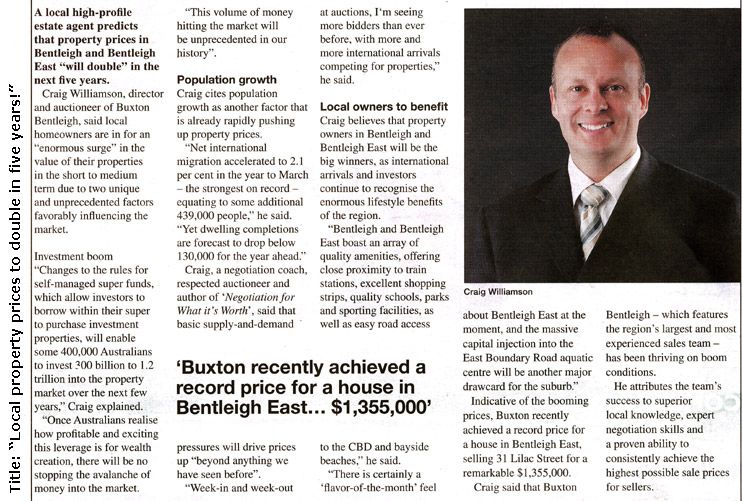
Original version:
The full-page real estate ad in the 3/12 [local paper] that gloated over rising house prices is an example of how warped by greed the market has become. Increasing property values also mean council rates rise, thus the cost of living goes up. Population growth means overcrowding and overdevelopment, making life ever more stressful for residents. The housing market is out of control, favoring greedy investors and developers, and it is time this trend was reversed back in favor of those who simply want a place to live in. No government so far seems to have the will to implement these measures, however, by curtailing population growth.
Edited for print version:
The full-page real estate ad in the [local paper] on December 2 that gloated over rising house prices is an example of how warped by greed the market has become.
Increasing property values also mean council rates rise, thus the cost of living goes up. The housing market is out of control, favoring greedy investors and developers, and it is time this trend was reversed back in favor of those who simply want a place to live.
The Age, 27 January 2010
Response to “Well-lit West Gate Bridge will be envy of Sydney, says minister,” 26/1 (also at ABC News). For some reason my letter got weirdly edited.
Original version:
As if Melbourne isn’t light-polluted enough already, now the West Gate Bridge is to be lit up as part of some ridiculous rivalry with Sydney. This stunt is a waste of money and electricity. The stars in the sky put on a better light show than anything humans can produce – when they aren’t obscured by light pollution.
Edited for print version – why the extra sentence and quotes around light-pollution?:
Light pollution
As if Melbourne is not “light-polluted” enough. Now the West Gate Bridge is to be lit up as part of some ridiculous rivalry with Sydney (Age Online, 26/1). Roads and Ports Minister Tim Pallas says the $20 million lighting upgrade will help make it look “better than the Sydney Harbour Bridge.” This stunt is a waste of money and electricity. The stars in the sky put on a better light show than anything humans can produce – when they are not obscured by “light pollution.”
Maybe whoever edited it was tired of my letters and wanted to make me look like an imbecile, or was inexperienced.
Moorabbin Leader, 26 January 2011
“Southland Station ‘back-pedal’.” I didn’t realize my brief comment was going to be published, so I didn’t leave my full name.
I would like a station stop at Southland [Shopping Center]; it would be very convenient as the others are a long distance to walk from.
Herald-Sun, 14 February 2011
Website comment published in the newspaper, responding to “Let's make Melbourne even greater, says Ted Baillieu”:
Suzanne McHale of Melbourne – posted at 6:59 AM February 14, 2011: “Our population has been growing quickly” – the main reason Melbourne’s livability is being eroded! Baillieu’s policy does nothing to address this, and is only encouraging suburban sprawl.
– Comment 21 of 154
Herald-Sun, 7 April 2011
An exasperated general letter (title not by me).
The voice of common sense
The Green-bashing that goes on in Your Say is really getting tedious.
The environment can exist without humans, but humans can't exist without the environment.
Ideologies aside, it is simple common sense that we should do our best to preserve and look after the planet that supports us.
Herald-Sun, 20 April 2011
To those letter writers who whinge about the “nanny state,” perhaps so many rules and regulations wouldn't be necessary if people could be trusted to act responsibly.
Moorabbin Leader, 20 April 2011
“Cheltenham residents concerned about development.” Published article comment.
The site should have become a park, which there are not enough of. Developers are getting free rein under current planning laws, and councils seem unwilling or unable to stop them.
Moorabbin Leader, 22 February 2012
In response to a letter in the previous week’s paper, commenting on “‘Jungle’ fear on units in Bentleigh,” about yet another unwanted housing overdevelopment of a local site. The letter was slightly edited – wonder why the [bracketed] phrase was removed?
I am a longtime Bentleigh resident, and am dismayed to see the ugly new developments now blighting almost every street. Houses and pleasant gardens are demolished every week to make way for massive monstrosities, and my suburb, like many others, seems to have become a permanent construction zone
with uncaring developers apparently given free rein by council and planning laws. The ongoing destruction is highly stressful and is destroying what made the suburb livable.
The Age, 9 December 2016
After a long hiatus, I had a letter published in The Age today, a quick response to the privatization article mentioned in my 6/12/2016 Journal entry – it was slightly edited (original by me is below it):
Heading down dysfunctional US path
I am dismayed to read of yet another push to privatise essential public services. Such proposals only add to the stress and anxiety of those who are less well-off and dependent upon such services, as profits will inevitably take precedence over quality and affordability. Do we really want to imitate the dysfunctional US system, where only the wealthy can afford treatment?
I am dismayed to read of yet another push to privatise essential public services such as health care and housing (“Hospitals, housing and dental services ripe for privatisation, says Productivity Commission report,” 5/12). Proposals like these only add to the stress and anxiety of those who are less well-off and dependent upon such services, as profits will inevitably take precedence over the quality and affordability of care. I cannot understand why the government wants to imitate the dysfunctional American system, where only the wealthy can afford treatment. Is this the type of society Australians want?
Herald-Sun, 4 November 2020
Cash is still king
ONE concerning trend as a result of the coronavirus is the increasing number of businesses refusing cash payments.
Cash is still legal tender, is no more likely to transmit the coronavirus than other surfaces, and many people (myself included) still find it more convenient than using a card.
Electronic payments can compromise one’s privacy, can have added fees and are also unusable if the network and power go down, as has happened several times.
Businesses should be required to accept cash.
Original:
One concerning trend as a result of the Coronavirus lockdown is the increasing number of businesses refusing cash payments. Cash is still legal tender, is no more likely to transmit the coronavirus than other surfaces and many people (myself included) still find it more convenient than using a card. Electronic payments can compromise one's privacy, can have added fees and are also unusable if the network and power go down, as has happened several times. Businesses should thus be required to accept cash.
The Age, 17 June 2021
Why we still need cash
I strongly disagree with Howard Brownscombe’s proposal to “outlaw cash” (Letters, 16/6). Cash is reliable (digital payment methods are unusable when power supplies are disrupted), secure and convenient. Electronic payment methods can compromise one’s privacy, can have added fees and are also unusable if the network and power go down, as has happened several times.
– Suzanne McHale, Bentleigh
In response to:
Cashless economy
Our government’s emphasis is on growing the economy by giving back to taxpayers more earned income to allow them to spend it while at the same time providing increased services needed. The concept is great.
I was disappointed that with COVID-19 the opportunity was not taken to outlaw cash completely. Think of the additional GST and tax revenue generated at no cost to hardworking Australians.
There would be some difficulties experienced by the older generation but what policy has zero negative effect on any age group? There is still time to outlaw cash and thus reduce the significant cash economy that reduces our tax revenue.
– Howard Brownscombe, Brighton
The Age, 5 August 2021
Our Christian values
I agree with Kevin Donnelly that the Lord’s Prayer should continue to be recited for parliamentary sessions. I am tired of the continued hostility towards anything traditional (and Western civilisation and values generally). Though many now want to deny it, Christian values are part of the foundation of modern Australia, and this should be acknowledged.
Original version:
I agree with Kevin Donelly’s opinion that The Lord’s Prayer should be continued to be recited for Parliamentary sessions. I am tired of the continued hostility towards anything traditional (and Western civilization and values generally). Though many now want to deny it, Christian values are part of the foundation of modern Australia, and it is important that this be acknowledged.
[Note, 15/6/2025: I was going through a mildly conservative phase when I wrote this (blame the stress from the Covid pandemic then); I do not feel this way now!]
Updated: 15/6/2025