EmGem wiki
A reference for my EmGem worldbuilding and story.
Entries in the main body are in alphabetical order, while the table of contents are in thematic and alphabetical orders.
Contents – thematic order
- Characters:
- Culture:
- Mission:
- System:
Contents – alphabetical order
- Amber
- Carnelian
- Characters
- Crew
- Darius Tiley
- Hibernation
- ISS Emissary
- ISS Emissary patch
- Jean-Pierre Verdier
- Kathy Colquhoun
- Project LISSA
- Onyx
- Pearl
- Garnet
- Sapphire
- Sardonyx
- Selena Flores
- Sequin
- Sergei Konstantinov
- The Octet
- Topaz
- Yuri Zolotyov
Amber
Life-bearing planet. It orbits the star Topaz in a fairly stable circular orbit.
Amber is an Earth-like world. Due to the closer proximity to its sun, Amber gets more ultraviolet radiation than Earth, but this is somewhat moderated by the sun’s being of a lower temperature than Earth’s G2V sun (K1V). It is named thus due to the subtle hue of its sun’s light.
The atmosphere is a bit thicker than Earth’s; oxygen content is 23%. Its sky color is K1V star: steel-blue fading to near-white at the horizon (#6e787c/rgb(110,120,124) to #ffffee/rgb(255,255,238)).
Average surface temperature is 18°C (Earth’s is around 14°C).
Minerals, rocks and gems are much the same as those formed on Earth.
Data
- Area
- 618,554,374.395 km2 (note: to calculate surface area of sphere: Area = 4πr2)
- Atmosphere
- 1.1 (16.17 psi/111.1 kPa) (N2, O2, Ar); 23% O2
- Axial tilt
- 16°
- Circumference
- 6.908 (44,082.5 km)
- Day length
- A day is the equivalent of 30 Earth hours (1.25 times longer than an Earth day)
- Density
- 4.8 g/cm3
- Diameter
- 14,031.71 km
- Distance
- K1V star: .62 AU or 92,750,680 km
- Escape velocity
- 12,320 meters/second
- Gravity
- 0.96 of Earth (using density of 4.8 and radius 1.1 of Earth’s); a human will weigh about 4% less on Amber
- Mass
- 1.16 of Earth = 6.92522 × 10²⁰ kg (6,925,200,000,000,000,000,000,000 kg)
- Moons
- Three
- Radius
- 7015.91 km (1.1 times that of Earth)
- Roche Limit (2.423 of a planet’s radius)
- 2.6653
- Size of star from planet
- K1V star: viewing angle = 1°; appears half again as large than the Sun does from Earth’s sky (0.5°)
- Temperature range
- −50°C to +50°C
- Volume
- 5.572 (1,446,573,940,288.983 km3) (note: to calculate the volume of a sphere: Volume = 4 πr3/3 (r3 × π × 4 ÷ 3 – in ASCII math: r^3 * \pi * 4 / 3 ))
- Year length
- K1V star: 226.6 days (365 × .62; 5438.4 Earth hours – .4 = 98 m or 1.6 hours)
Years and days
A day is the equivalent of 30 Earth hours (1.25 times longer than an Earth day). It divides into 8 × 210 minute-segments:
- midnight
- postnight/before dawn
- dawn
- preday
- midday
- postday
- sunset
- evening
A year starts and ends at the summer solstice (southern hemisphere); it is divided into quarters, delineated by solstices and equinoxes.
| Amber years | Earth years equivalent (K1V star) |
|---|---|
| 1 | 226.6 Earth days (.62 Earth years) |
| 2 | 1.24 |
| 3 | 1.86 |
| 4 | 2.48 |
| 5 | 3.1 |
| 6 | 3.72 |
| 7 | 4.34 |
| 8 | 4.96 |
| 10 | 6.2 |
| 11 | 6.82 |
| 12 | 7.44 |
| 20 | 12.41 |
| 30 | 18.6 |
| 40 | 24.83 |
| 50 | 31.04 |
| 60 | 37.24 |
| 70 | 43.45 |
| 75 | 46.56 |
| 80 | 49.66 |
| 85 | 52.76 |
| 100 | 62.8 |
| 110 | 68.29 |
- Amber years to Earth years: K1V star: multiply Amber years by 226.6; divide by 365
- Earth years to Amber years: K1V star: multiply Earth years by 365; divide by 226.6
References
Characters
Crew
Crew of the ISS Emissary.
- Darius Tiley: one of the billionaire funders of the mission. Born 1971. Reddish-brown hair; grey eyes.
- Sergei Konstantinov: Russian cosmonaut, Roscosmos; pilot and crew commander. Born 1970. Hazel-green epicanthic eyes; straight black hair; light brown skin.
- Yuri Zolotyov: Russian cosmonaut, Roskosmos; flight engineer. Born 1972. Blond hair and blue eyes.
- Jean-Pierre Verdier: French/ESA; crew medic. Born 1958. Grey hair (formerly brown) and blue eyes.
- Kathy Colquhoun: NASA/American mission specialist and generalist, cross-trained in various disciplines, one Space Shuttle flight to the ISS. Honey-blonde hair, amber eyes. Born 1968.
- Selena Flores (literal meaning of name: Moon Flower): NASA/Jet Propulsion Laboratory; biologist/astrobiologist. Hispanic – brown eyes, dark brown/black hair, mid-brown skin. Born 1972.
Darius Tiley
American billionaire entrepreneur, founder of Project LISSA; the sole one of The Octet who embarks on the interstellar mission. He has an obsession with spaceflight and, ultimately, finding and contacting alien life.
In appearance, he is nice-looking, well-groomed and tends to dress conservatively and in discretely expensive clothing.
In personality he is impatient, confident – even arrogant – and determined to get what he wants. He is reticent and prefers to keep a low profile, particularly since he has become immensely wealthy. He has little use for trinkets such as multiple international mansions or yachts, preferring to direct his wealth toward his obsessions (spaceships and – hopefully! – contacting aliens).
Biographical information
- Born
- 1972
- Eye color
- Grey
- Hair color
- Reddish-brown
- Height
- 6 feet (183 cm/1.8 m)
- Physique
- Slim
- Skin color
- White/tanned
- Weight
- 74 kg (BMI of 22)
- Religion/beliefs
- A bit of a mixture. Former LDS/Mormon Church. Also somewhat libertarian and a Mormon transhumanist.
Carnelian
The first planet of the Topaz system. It is a volcanic rocky world with a hot thick cloudless atmosphere – a “Hot Super Earth”; possibly the core of a gas giant that migrated inward. The atmosphere is blue around its apparent disk edge, but its surface glows deep red with tectonic activity, so it was named after the semiprecious stone. There is some simple bacterial life existing on it nonetheless as the atmosphere contains water vapor and free oxygen.
Data
- Axial tilt
- 8°
- Diameter at equator
- 22,000 km
- Distance
- K1V star: 0.185 AU (27,675,606 km)
- Year length
- K1V star: 0.079 Earth years = 29.04 Earth days orbit equivalent
Hibernation
A state of drug-induced torpor used for the crew onboard the ISS Emissary during its centuries-long interstellar voyage. They are awakened every so often to maintain health and fitness.
References
- Air & Space Magazine: Sleeping Their Way to Mars, April 2017
- Baen Books: Stasis: The Future of Suspended Animation, Philip A. Kramer, 2017
- Centauri Dreams blog: Dreaming to the Stars; The Realities of Interstellar Hibernation
- NASA: Torpor Inducing Transfer Habitat For Human Stasis To Mars, 19/7/2013
- Wired.com: The Hibernator’s Guide to the Galaxy, 24/11/2023
Pearl
The outermost moon orbiting Amber. It is mostly covered in ice and is a pale bluish-white color (#f0ffff).
Data
- Diameter
- 1800 km
- Radius
- 900 km
- Density
- 4.1 (RL = 2.953)
- Distance
- 48 radii (336 761.6736 km)
- Viewing angle
- 0.0026, 0.0052 (0.3 degrees – appears 2° smaller than Earth’s Moon in sky)
- Orbit
- 443.908 hours/18.49 days/14.8 Amber days
- K1V star: 12.25 yearly orbits
ISS Emissary
The interstellar starship that carries the crew to the alien world. It was built with private funding from The Octet and Mormon Church, with no government involvement at all, as was the preference.
Its crew of 6 are put into induced hibernation for the majority of the decades-long journey. For interstellar travel, it utilizes a laser- or microwave-propelled lightsail, the array for this being positioned at the L4 point between Sun and Earth.
In design, the ship is long and spindly, the majority of its length (z-axis) comprising the central backbone truss (it is in fact informally referred to as the backbone). At the bow is the hexagonal deflection shield and the huge laser sail is stored in and deployed from the rim of this. The habitation modules are in the center. Behind these, two or four large wedge-shaped radiators are arrayed around the backbone at right-angles to each other to dissipate heat from the two fission drives and thrusters at the stern end.
Two radial arms tipped by inflatable habitation modules extend from the central hab modules; a section of the latter rotate and the resultant centrifugal force induces gravity, so the top of each module faces inward towards the main body of the ship. One module is for hibernation; the other is for daily living, while the central truss module is for equipment storage and supplies, and work. The remote habs are accessed from the main body by a tunnel surrounded with a truss structure. A similar tunnel extends along the backbone of the ship.
The arms can fold up rearwards against the main truss while the ship is under acceleration or deceleration.
Truss and modules are hexagonal in cross-section; the shield is hexagonal. (An Arc Symbol theme as it is aesthetically pleasing.)
There is a Single-Stage to Orbit spacecraft docked to the central module, enabling the crew to be transported to a planet’s surface and back. This could alternatively be a future version of the SpaceX Starship.
Statistics
- Length
- 1.3 km
- Weight
- 400 tonnes (approx.)
- Shield
- 400 m diameter
- Backbone truss
- Front girder (shield to hab modules): 700 m long; rear girder: 300 m
- Radial arms
- 106 m radius each; spin at 2.9 revolutions per minute. These can fold rearward when the ship is under strong acceleration.
- Crew
- 6
- Interstellar propulsion
- Laser- or microwave-propelled lightsail, 8.5 km in diameter, hexagonal-shaped, 1 micron thick (microwave array is a 10 km per side square)
- In-system propulsion and maneuvering
- Fission-fragment rocket, powered by a thorium-based reactor drive (and one auxiliary drive)
- Acceleration
- Up to .3g
- Velocity
- Up to .1c
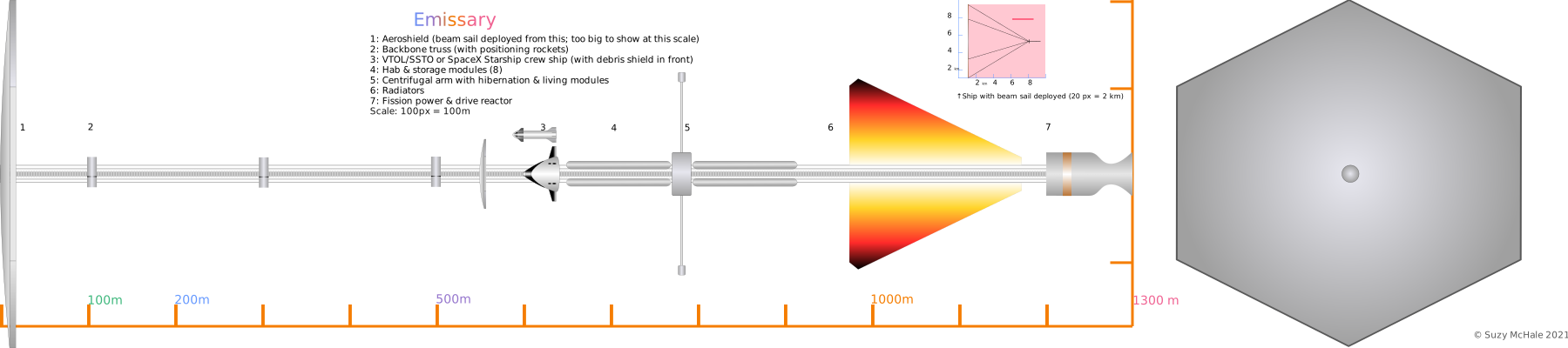
A stylized SVG diagram of the ISS Emissary.
References
A small selection of some of the online references I used.
- The Pegasus interplanetary spacecraft from the BBC TV series Space Odyssey: Voyage to the Planets was the major visual design influence for Emissary.
- Advanced Solar- and Laser-pushed Lightsail Concepts (1999)
- Atomic Rockets: Laser-Pushed Lightsail
- Interstellar: Solar Sails
- Roundtrip Interstellar Travel Using Laser-Pushed Lightsails: Robert L. Forward’s original 1984 paper
Mission parameter calculations
Sites used for mission parameter calculations (to K1V star 107 Piscium):
- UC Santa Barbara Laser Propulsion (Classical 1D) 6-24-16
- How to Calculate Time and Distance from Acceleration and Velocity
- Displacement Calculator
From the first link, pertinent entries (with “Use Circular Sail” and “Circular Comm Optics” both ticked; table is at the end of this entry). I am deliberately constraining myself using the results here.
- From data entries:
- Payload (kg): 400,000 kg (400 tonnes) (starship weight based on that of the Pegasus interplanetary spacecraft from the BBC TV series Space Odyssey: Voyage to the Planets, so it, like much of the design, is somewhat arbitrary).
- Sail diameter: 8500 m (not sure if this would be correct in reality?)
- Laser Array Diameter (m): 10,000 (again, arbitrary)
- Total Optical Power (GW): 300,000 (30 TW) (not a huge amount – though still more than current technology could generate – but the original Robert L. Forward laser-pushed lightsail used a massive 65 GW laser system! I though a smaller amount of power would be a bit more achievable, but at the obvious cost of a long travel time. The amount I used is yet again arbitrary).
- Target Distance (ly): 24.8 (to 107 Pisci – an orange KV1 star, cooler than our Sun)
- From the results:
- Peak Acceleration: 4.38 m/s^2 (0.447 g_n)
- Limiting speed: 2.40e+4 km/s (2400000km/s – 2400000000 m/s [2.40e+7 m/s] – 8.01% c
- Time to target star at limiting speed: 310 yrs (the crew of 6 are in hibernation; a technology not achieved yet but plausible).
More calculations, using the other two links:
- Peak Acceleration: 4.38 m/s^2 – 0.447 g_n (note: ASCII math: use ^ for superscripts; “_” [underscore] for subscripts.) (.44 of Earth gravity at 1 – near Earth’s surface, gravitational acceleration is approximately 9.81 m/s^2): 19.1844 m/s
- 17.37 years to get to 8.01% of c from 0 (and decelerate), so 34.74 years added to 310 travel time: 344.74 years one-way to cover 24.8 ly.
- Light years covered when accelerating and decelerating: 6.938 (round up to 7) ly, so 14 ly of the 24.8 crossed when accelerating and decelerating; 17.9 years spent at cruising speed.
- Time to get to limiting speed: 2,400,000,000 m/s / 4.38 m/s^2 (19.1844) = 547,945,205.47 seconds (17.37 years)
- With time known, distance covered: s = v_i t + 1/2at^2
- The second term drops out because v_i = 0, so all you have to do is plug in the numbers: s = 1/2at^2
- s = 1/2(4.38 m/s^2)(547,945,205.47)^2: 4.38 x 547,945,205.47 then square this, then halve it: 657,534,246,552,657,534.246771 m = 69.5 light years
- So, 17.37 years time taken and 6.938 ly crossed to accelerate to 8.01% of c.
| Inputs | Value | Unit | Outputs | Value | Unit | ||
|---|---|---|---|---|---|---|---|
| Payload | 400000 | kg | Sail Mass | 5.67E+07 | g | ||
| Use Circular Sail | TRUE | checkbox | Total Mass | 4.57E+08 | g | ||
| Use Optimal Sail Size | FALSE | checkbox | Areal Density | 1 | g/m^2 | ||
| Sail Diameter | 8500 | m | Laser Power in Main Beam | 3.00E+05 | GW | ||
| Sail Thickness | 1 | um | Flux on Sail | 0.00529 | GW/m^2 | ||
| Sail Density | 1 | g/cm^3 | Peak Acceleration | 4.38 | m/s^2 | 0.447 | g_n |
| Sail Reflection Efficiency (0 - 1) | 1 | L_0 | 220 | au | 3.29E+10 | km | |
| Sail Light Absorption (0 - 1) | 1 | Time to L_0 | 44.8 | d | 3.87E+06 | s | |
| Sail Front Emissivity (0 - 1) | 1 | Speed at L_0 | 1.70E+04 | km/s | 5.66 | % c | |
| Sail Back Emissivity (0 - 1) | 1 | Kinetic Energy at L_0 | 1.83E+07 | GW*hr | 6.58E+19 | J | |
| Use Circular Laser Array | TRUE | checkbox | Laser Energy in Main Beam at L_0 | 3.23E+08 | GW*hr | 1.16E+21 | J |
| Laser Array Diameter | 10000 | m | Electrical Energy at L_0 | 3.23E+08 | GW*hr | 1.16E+21 | J |
| Total Optical Power | 300000 | GW | Launch Efficiency at L_0 (KE / Electrical Energy) | 5.66 | % | ||
| Beam Efficiency (0 - 1) | 1 | Electrical Energy Cost at L_0 | 3.23E+13 | $ | |||
| Wavelength | 1060 | nm | Energy Storage Cost at L_0 | 3.23E+16 | $ | ||
| Electrical Efficiency (0 - 1) | 1 | Limiting Speed | 2.40E+04 | km/s | 8.01 | % c | |
| Electrical Energy Cost | 0.1 | $/kW-hr | Time to Target at Limiting Speed | 310 | yr | ||
| Energy Storage Cost | 0.1 | $/W-hr | Max Flux Absorbed by Sail | 0 | GW/m^2 | ||
| Peak Laser Comm Power | 1 | W | Max Power Absorbed by Sail | 0 | GW | ||
| Photons Per Bit for Communication | 1 | ph/bit | Sail Equilibrium Temperature | 0 | K | ||
| Laser Comm Wavelength | 600 | nm | Laser Comm Flux at Earth | 0.0000256 | ph s^-1m^-2 | ||
| Laser Comm Beam Efficiency (0 - 1) | 1 | Equivalent Photometric Magnitude m_v | 37.7 | ||||
| Use Circular Comm Optics | TRUE | checkbox | Laser Comm Rate Received in Array | 2.01E+03 | ph/s | ||
| Laser Comm Optical Diameter | 1 | m | Laser Comm Bit Rate Received in Array | 2.01E+03 | bits/s | ||
| Target Distance | 24.8 | ly | Laser Comm Wavelength at Speed at L0 | 635 | nm | ||
| Laser Comm Wavelength at Limiting Speed | 650 | nm |
4:58 AM 9/01/2022
ISS Emissary patch
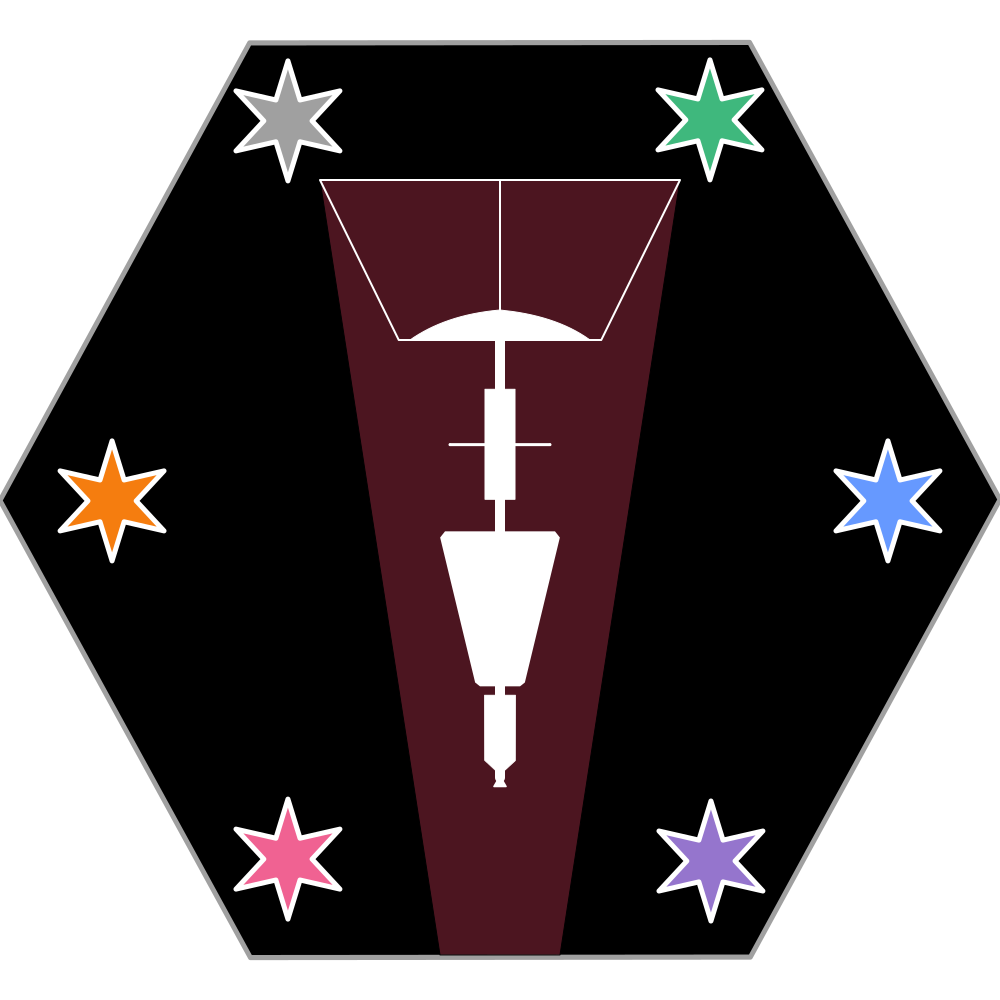
The crew patch for the voyage. On a grey-rimmed black background of space, six 6-pointed stars represent the crew, surrounding a stylized view of the ISS Emissary, with its (very truncated for the diagram) solar sail deployed in front of the shield. The patch itself is hexagonal, a shape found throughout the starship, such as the shield and the backbone in cross-section.
- Darius Tiley: grey
- Sergei Konstantinov: green
- Yuri Zolotyov: blue
- Jean-Pierre Verdier: purple
- Kathy Colquhoun: orange
- Selena Flores: pink
Background notes
Why these colors? Because they are my favorite colors! Also some (grey, green, blue) represent their wearers’ eye colors.
Jean-Pierre Verdier
A French medical doctor and astronaut-physician who has spent his career at the European Space Agency. He has been on one prior space mission to the International Space Station along with Sergei Konstantinov, Yuri Zolotyov and Kathy Colquhoun.
Biographical information
- Born
- 1958
- Hair
- Grey (formerly brown)
- Eyes
- Intense sapphire blue
- Religion/beliefs
- Atheist
Kathy Colquhoun
Female NASA/American mission specialist and generalist, cross-trained in various disciplines. She completed one Space Shuttle flight mission to the ISS.
Biographical information
- Born
- 1968
- Hair color
- Honey-blonde
- Eye color
- Amber
- Religion/beliefs
- Raised Protestant/Baptist, but now only nominally
Onyx
The nearest moon of the three satellites orbiting Amber. It is a charcoal-grey in color (#595959). It is tidally-locked to Amber, so that one side always faces the planet.
Data
- Diameter
- 2400 km
- Radius
- 1200 km
- Density
- 4.5
- Distance
- 24 radii = 168,380.8368 km (Roche Limit of 2.8518 radii)
- Viewing angle
- 0.8° (appears slightly bigger than Moon – Earth’s Moon is 60.27 radii from the Earth right now; it is 0.5°)
- Orbit
- 156.94 Earth hours/6.5 days/5.2 Amber days
- K1V star: orbits 34.65 times in a Amber year
Project LISSA
- Project LISSA: Long InterStellar Sleeper Ark (or Long Interstellar Starship Sleeper Ark). Overall name for the mission and project.
- LISSA is also the name given to the Artificial Intelligence that operates the ISS Emissary and interacts with the crew.
Garnet
The second moon of three orbiting Amber. it is an ochre-red in color (#c72), similar to Mars. It is used to measure time – 1 orbit equals 8 Amber days, the equivalent of a week.
Data
- Diameter
- 1900 km
- Radius
- 950 km
- Density
- 4.3
- Distance
- 32 radii (224,507.7824 km) from Amber (Roche Limit = 2.905)
- Viewing angle
- 0.0042, 0.0084 (0.4 degrees – appears 1° smaller than Earth’s Moon in sky)
- Orbit
- 241.63 Earth hours/10.06 days/8 Amber days (
- K1V star: 22.5 orbits in a Amber year (so an extra “leap day” in the last week every 2 years)
Sapphire
The third planet of the Topaz system. It is a Class II water cloud Jovian gas giant. It is in between Uranus and Saturn in size, and is a medium blue (#36a) with lighter blue (#7ca3d8) banded clouds. It has a faint and thin set of rings.
Data
- Axial tilt
- 20°
- Diameter
- 68,000 km
- Distance
- K1V star: 1.49 AU (222,900,827 km)
- Temperature
- 190 K
- Year length
- K1V star: 1.81 Earth years = 663.8 Earth days orbit equivalent
Sardonyx
The fourth planet of the Topaz system. It is a Class I ammonia cloud Jovian gas giant. It is a little larger than Saturn, has noticeable rings and its cloud bands are shades of tan in color (#a98047, #c3a171, #d7c1a1).
Data
- Axial tilt
- 18°
- Diameter
- 134,000 km;
- Distance
- K1V star: 3.23 AU (483,201,122 km)
- Temperature
- 118 K
- Year length
- K1V star: 5.8 Earth years = 2118.8 Earth days orbit equivalent
Selena Flores
Hispanic female astrobiologist who works for NASA/Jet Propulsion Laboratory. Literal meaning of her name: “Moon Flower.”
Biographical information
- Born
- 1972
- Eye color
- Dark brown
- Hair color
- Dark brown
- Skin color
- Medium brown
- Religion/beliefs
- Agnostic
Sequin
A thin metal disk used by the native aliens as a form of token for exchanging and tracking goods. A sequin has a hole in its center to enable it to be strung together with others. It is a fingerwidth (2.1 cm) wide.
There are four metal colors, in order from highest to lowest:
- Gold: octagonal shape, equals eight rose golds
- Rose gold: hexagonal shape, equals eight silvers
- Silver: square shape, equals eight coppers
- Copper: circle shape, lowest denomination

Sergei Konstantinov
Сергей Александрович Константинов was born in Russia – then the USSR – in the Moscow district. After graduating school he joined the Russian Air Force and became a Class 1 Air Force pilot. Aircraft flown: Yak-52, L-29, L-39, MiG-31, MiG-29 and Su-27; logged over 600 hours of flight time. He is a qualified parachute instructor (over 200 jumps). Sergei’s Russian Air Force rank at the time of the story is “Major.”
He was selected as a test-cosmonaut candidate of the Gagarin Cosmonaut Training Center Cosmonaut Office on 28 July 1997 (1997 Air Force group). Sergei is a qualified Soyuz commander-pilot (his flight callsign is “Нептун, Neptune”) and has had one 6-month tour (“Expedition”) on the International Space Station along with Yuri Zolotyov.
He enjoys flying, parachuting, running, athletics, photography, astronomy, reading (mainly science-fiction and fantasy books and movies). His elderly parents live in the suburb of Korolyov (formerly Leningrad), Moscow, in the State-provided apartment where Sergei grew up.
Rather shy, moody and reticent in personality. He is an only child and has not married. He is of mixed ethnicity (Slavic/Central Asian); his eyes are Asiatic/epicanthic in shape as he had a grandmother from Central Asia.
Biographical information
- Born
- 1970
- Eye color
- Hazel-green (mostly green with a little brown) – epicanthic in shape
- Hair color
- Black, straight (Asian-type hair) – worn in short military cut
- Height
- 5 feet 10 inches (177.8 cm/1.77 meters)
- Marital status
- Single
- Physique
- Thin, fit
- Skin color
- Light golden-brown (Asian-type tone)
- Weight
- 60 kg – fit-but-lean build (BMI of 18)
- Religion/beliefs
- Agnostic
The Octet
Eight multi-billionaires, including Darius Tiley, who have formed a secretive cabal to fund Project LISSA.
The American billionaire entrepreneur was one of a secretive collaboration of eight like-minded business people who were spaceflight enthusiasts, transhumanists and libertarians. Their vast collective wealth enabled them to employ the brightest specialists in developing the various technologies necessary in enabling humans to leave Earth.
They had a collective disdain for much of humanity – and certainly the cumbersome governmental systems in charge of a society that was enduring various forms of social and environmental collapse – so they were determined to go their own way with this ambition, legally or otherwise, and would keep it secret.
– Story chapter: “Dream”
Topaz
A K1V-class Star around which Amber orbits. Designated 107 Piscium by humans, it is 24.57 light years away from Earth.
| Class | Temperature in degrees Kelvin | Visual Luminosity | Mass (mass of our sun = 1) | Radius (radius of Sun=1) | Terrestrial Equivalent Orbit in AUs | Lifetime in billions of years |
|---|---|---|---|---|---|---|
| K1V (ffedcf) | 5080 | .28 | .766 | .788 | .61 (91,254,701.127 km) | long |
| 107 Piscium (K1V) (ffe0bc / ffedcf) | 5172 | .46 | .86 | .82 (570,999 km) | .61 | 6.3 |
| G2 (our Sun, for comparison) (fff5ec) | 5860 | .97 | .998 | 1.020 (696,340 km) | 1.05 | 10.100 |
| Element | Hex number |
|---|---|
| Star/sun | ffe0bc / ffedcf |
| Peak frequency and color | ffff00 |
| Chlorophyll | 3F6A03 |
| Bacteriohospin | 6410A1 |
| Carotenes | DB0000 |
| Phycoethrin | A91329 |
| Phycocyanin | 214A33 |
| Pheophytin | 2B4534 |
| Melanin | 6D663E |
References
- The Sun from 107 Piscium; 107 Piscium from the Sun
- Plants on other worlds
- Star colors hex codes: D65/D58
- Zompist.com: The nearest stars: a conworlder’s guide
Yuri Zolotyov
Юрий Леонидович Золотёв was raised in a Moscow State orphanage during the Soviet era. He was a world-class gymnast who competed in the Olympics before joining NPO Energiya as an engineer. He was accepted as a cosmonaut-candidate in the 1996 Civilian Engineer group. He has flown on one Expedition Crew to the International Space Station along with his long-time friend Sergei Konstantinov.
He enjoys gymnastics, running, winter sports, computers, mechanical tinkering. He is single. He is exuberant in personality though inclined to bouts of moodiness, much more extroverted than Sergei.
Biographical information
- Born
- 1972
- Height
- 5 feet 5 inches (1.65 meters)
- Weight
- 56 kg; muscular build
- Hair color
- pale blond
- Eye color
- icy blue
- Religion/beliefs
- Atheist
Updated: 18/11/2023