
Bill and Pam Waters’ personal website
Welcome!
This is the personal site of Bill and Pam Waters. You are very welcome to browse and comment as you see fit. Primarily the site was put together as an outlet for some essays and other material that Bill has written. So that from time to time the content of the page will change as the need arises and time permits. It is intended also to occasionally include photos and the like of friends and family and various bits and pieces that might be of interest.
About us
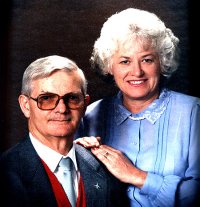
We are both Australians born and bred in Western Australia. We were married in May 1956 and brought six (6) children into the world; 3 boys and 3 girls. All are long gone now of course but a number still live near to us, while others migrated to other parts of Australia. We presently live in the state of Victoria, which is situated in the south-east corner of the continent.
On the 18th February 1960, after committing our lives to the lordship of God’s Son the Lord Jesus Christ, we were almost simultaneously born again. Thus we are Christians as defined NOT by a denomination but in the strictly Biblical sense.
At the end of 1962 with our three (3) eldest children we traveled from Western Australia to Ballarat in central Victoria, where Bill became Chief Engineer to Maf-Air Services Pty. Ltd., a commercial subsidiary of the Australian chapter of Mission Aviation Fellowship. During the early years of our time in Ballarat we added three (3) more children to our family.
We moved from Ballarat when Bill was employed by the-then Civil Aviation Authority (now CASA). After setbacks to Bill’s health we retired from the workforce at the end of 1991. Since that time we have travelled fairly widely throughout the Australian States and Territories.
Photo album
A collection of family photos from late 2004; click on thumbnails to enlarge.

Pam and Bill Waters on the Frankston Pier, Christmas 2004.

Frankston Pier.

Frankston Pier, hasn’t changed physically in thirty years, maybe longer?
Favourite links
Links of interest to us.
Christian
- Free Bible Study Software: This organization was started by a couple just out of Bible College and it aims to provide the Church with quality Bibles and Bible based material in electronic form at the lowest possible price. The software contains the very popular and user-friendly search engine QuickVerse for searching the material on the CD. Highly recommended to all who are serious Bible students as well as the casual home user.
- Rockdale Christian Books: This is a great source of Christian literature of all kinds, particularly in Australia; we have especially enjoyed being able to source secondhand books; nice people to do business with!
- QuickVerse: They were mentioned above but have available much more than just the best search engine you can buy, well you get it free at FreeBibleSoftware (certainly the most user-friendly).
Other
- Diabetes Australia: If you are a diabetic (Bill is Type 2) or even if you are not, this is definitely worth a look; for diabetics a must bookmark.
- Portland Communications: Have given these people a plug already on my Home page (host this site). They provide 15m of free web hosting space, which for the personal or home web site is ample in my reckoning.
- Suzy McHale: The web site belonging to my Web Site Editor, Suzy McHale; this is a brilliant site and worth a look and browse!!
Essays
- A thousand years not enough
- Abraham, the friend of God
- Academic Christianity
- Afraid of the truth
- Bible authors
- Choice
- Christian literature
- Christmas
- Church and State
- Conditional love
- Decisions
- Discernment
- Division
- Doubt: the enemy of faith
- Easter
- Enemies
- Father’s letter
- Fears
- Flying and me
- God’s character
- Help meet
- He spoke
- Obedience
- The obscenities of Man
- Opinions
- Perseverance
- Preachers
A thousand years not enough
Then I saw an angel coming down from heaven, having the key to the bottomless pit and a great chain in his hand. 2 He laid hold of the dragon, that serpent of old, who is the Devil and Satan, and bound him for a thousand years; 3 and he cast him into the bottomless pit, and shut him up, and set a seal on him, so that he should deceive the nations no more till the thousand years were finished. But after these things he must be released for a little while.
– Revelation 20:1-3
The removal of Satan from the Earth as it is described here, removes his influence on the affairs of men, a circumstance that has never occurred before, not in all the history of mankind. From the day of man’s creation Satan has been present, for it was on the day of their creation that Satan seduced Eve. From then on to this present day Satan has twisted and distorted the affairs of men and with astounding success.
The matter for conjecture has always been where in the affairs of men does Satan’s influence begin and end and then how much of man’s passed and present dilemma must be attributed to his all pervading disobedience? It is suggested that with the removal of Satan during the end times and immediately prior to the end of the thousand-year reign by the Lord Jesus Christ, the world will discover the answer to that question.
From the beginning of this end-time period - the thousand years’ reign of the Lord Jesus Christ - and for its entirety, the Earth will be under the absolute and majestic governance of the Lord Jesus Christ, with the aid of those whom He shall bring with Him. For the first time since the moments prior to man’s failure in the Garden of Eden, man will experience and be given the opportunity to live, love and work in an environment of perfect righteousness. Justice and mercy will be administered side by side with the highest standards of morality, for the first time in the history of mankind.
Will man, under these ideal circumstances and for the first time, lift himself out of the morass of unrighteousness and moral depravity in which he has wallowed for so many centuries? The scriptures give us the sad answer. “Now when the thousand years have expired, Satan will be released from his prison 8 and will go out to deceive the nations which are in the four corners of the earth, Gog and Magog, to gather them together to battle, whose number is as the sand of the sea. 9 They went up on the breadth of the earth and surrounded the camp of the saints and the beloved city.” (Revelation 20:7-9)
It seems to me too often today we are ready and quick to blame Satan for the woes of this world in particular the evil exploits and tendencies of man (of both sexes). Yet man’s apparent willingness to once again listen to Satan’s lies and lay siege to the Saints of God and His Beloved city, gives us cause to ponder again the exceeding sinfulness of man. As the “god of this world”, Satan’s influence has been subtle and yet powerful in the affairs of mankind - of that there is no doubt.
Yet for all that it was man who was disobedient at the first, a crime of such magnitude that only the death of God’s Son could provide the remedy. How telling and yet how sad it is that in the final day it will be man who provides the manpower to potentially assail the centre of righteous power in the beloved city.
Copyright ©: W.J. Waters
Revised: 8 February 2005
Abraham, the friend of God
Then the Angel of the Lord called to Abraham a second time out of heaven, 16 and said: “By Myself I have sworn, says the Lord, because you have done this thing, and have not withheld your son, your only son –
17 “blessing I will bless you, and multiplying I will multiply your descendants as the stars of the heaven and as the sand which is on the seashore; and your descendants shall possess the gate of their enemies.
18 “In your seed all the nations of the earth shall be blessed, because you have obeyed My voice.”
– Genesis 22:15-18
Introduction
It seems to me that to understand the intent of these verses, we must first place them in their context. They come near the end of a watershed episode in the saga, which was the life of Abraham. The first part of Gen.22 describes how Abraham under God’s direction, travelled away from his home in the Chaldean city of Ur. To a place he had never before seen, where God had said he must sacrifice Isaac his only and much loved son. Briefly what occurs is worthy of our attention for a number of reasons.
First, it gives us a most graphic and down-to-earth picture of the Christian attribute of faith; that particular and peculiar element of the Christian character, identified by the Apostle Paul in his letter to the Galatians. “But the fruit of the Spirit is love, joy, peace, long suffering, gentleness, goodness, faith, 23 Meekness, temperance: against such there is no law.” (Galatians 5: 22-23.)
As we read Abraham’s story again, we should note that his reaction to God’s instruction was, of itself, twofold. First, he both recognised and accepted that it was the eternal God speaking to him. Then as onerous and inexplicable as those instructions might have seemed he was immediately obedient to all that God asked of him. I think therein lies the perfect definition of faith. When we are obedient to what God says specifically to us, then we are exercising faith.
Another reason for believing that this occurrence in Abraham’s life is important to the Church day is, not only does Abraham’s obedience to God’s words expose the reality of his faith. But when queried by his son, “father, we have the wood and the fire but where is the lamb for a burnt offering?”, his immediate response was to give voice to that faith, consistent with the faith he has already shown. Abraham’s answer expresses his supreme confidence in the mercy and wisdom of God. “… God will provide himself a lamb for a burnt offering.” (Genesis 22: 8)
Hopefully we are beginning to see from the way Abraham immediately obeyed God’s instruction to leave his home and travel to a place he probably knew nothing about and then to sacrifice Isaac that if he believed without reservation and was obedient to God’s will for him, all would be well. His trust in God even at this early stage in his walk of faith had begun to develop into a deep and abiding strength of assurance and peace.
Abraham’s unearthly assurance and peace issued in the courage to spontaneously answer Isaac with complete confidence. God’s commandment and Abraham’s obedience to it, became to Abraham, all the substance and evidence (Hebrews ch.11:1) needed. So he was able to answer his son with unreserved assurance that all was in hand and all would be well. In the context of this truly amazing and life changing experience of Abraham’s, we should recognise in passing, that by his obedience to his father’s words of assurance and God’s timely provision of a sacrificial lamb, Isaac became a type of the Church.
Our text: Genesis 22:15-18
V15: “And the angel of the LORD called unto Abraham out of heaven the second time.”
While we may speculate about the identity of the one given the title, angel of the Lord. It is nevertheless abundantly clear from the angel’s words that the message he delivered came directly from God. So they carried with them all of the inherent authority of God’s word described so succinctly by Isaiah. “So shall My word be that goes forth from My mouth; It shall not return to Me void, But it shall accomplish what I please, And it shall prosper in the thing for which I sent it.” (Isaiah 55:11)
Note that this is the second time the angel is recorded as having spoken with Abraham. It was however the third time that God had communicated with him. The first occasion God communicated with him was at the very beginning of chapter twenty-two, when God gave to Abraham the directions, which were to challenge his attitude towards God, in other words examine his faith.
It is an interesting fact also that when the angel speaks it is from a place simply identified as “out of heaven”. Yet when God speaks the place from where He speaks, is not revealed. Does He do that to be mysterious or because as the Scriptures say He is omnipresent? “And He has made from one blood every nation of men to dwell on all the face of the earth, and has determined their preappointed times and the boundaries of their dwellings, 27 so that they should seek the Lord, in the hope that they might grope for Him and find Him, though He is not far from each one of us.” (Acts 17:26, 27)
V16: “and said: ‘By Myself I have sworn,’ says the Lord, ‘because you have done this thing, and have not withheld your son, your only son – :’”
As it is expressed in this verse, the certainty and finality of God’s complete commitment to what He was about to say, “by myself I have sworn, says the Lord” is almost beyond mortal comprehension. We should never forget also that God’s intention expressed through His words when or however they are spoken, can only ever be reversed or modified by God Himself?
The story of the patriarch Noah is a perfect example. In the account of the flood because Noah succeeded in finding grace in the eyes of the Lord, God reversed His original decision to eliminate the entire human race by saving just eight souls. Perhaps more importantly we will also do well never to forget that God cannot deny Himself. His character, His faithfulness, His mercy, these are eternal certainties that we can embrace to our hearts, with utter confidence. “Let us hold fast the profession of our faith without wavering; (for he is faithful that promised).” (Hebrews 10:23)
When God swears or vows by His own Name we should not need reminding that God is Triune. Or that all three, Father, Son and Holy Spirit bear witness to the truth of God’s word and the certainty that He will fulfil every promise He makes. “For there are three that bear record in heaven, the Father, the Word, and the Holy Ghost: and these three are one. 8 And there are three that bear witness in earth, the Spirit, and the water, and the blood: and these three agree in one. 9 If we receive the witness of men, the witness of God is greater:” (1 John 5:7-9) (For “witness” we may read testimony; testimony given or subject to the law; the Law of God Himself.)
It is extremely significant that in Genesis 22, when the Lord God set out to examine the faith of Abraham. He centred His examination on what appeared to be Abraham’s most prized possession; his only and beloved son Isaac. Clearly God’s intention with Abraham was to search out the depths and therefore the source of his faith. As we consider all that God accomplished later through this man’s life. It is little wonder that He needed to know at the outset what or who it was that occupied pride of place in Abraham’s heart. So we should not be surprised or dismayed that God’s test should take the form that it did. “For where your treasure is, there will your heart be also.” (Luke 12:34)
Nor should it surprise us that God would be exultant in His praise of Abraham for his almost childlike willingness to surrender such a treasure. For it was just such a sacrifice our Heavenly Father would make on our behalf many centuries later. The Lord Jesus Christ became quite literally the “ram caught in a thicket” (Gen.22:13).
In his book (The Gospel According to Jesus Christ), John Macarthur very forcibly makes the point that it is impossible to claim Christ as Saviour without submitting to Him as Lord of our life. As he did with Abraham, at some point in your life and mine the God of mercy will ask us the same question ‘who is lord of your life’? In this context remember the words of Joshua when he was asked the same question. “Preserve me, O God, for in You I put my trust. 2 O my soul, you have said to the Lord, ‘You are my Lord, My goodness is nothing apart from You’.” (Psalm 16:1, 2)
V17: “That in blessing I will bless thee, and in multiplying I will multiply thy seed as the stars of the heaven, and as the sand which is upon the sea shore; and thy seed shall possess the gate of his enemies;”
“That in blessing I will bless thee.” These emotion-charged words spoken to His much-loved Abraham are very difficult to expand upon. Our Heavenly Father it seems – if it were possible - was almost overcome with a deep love and respect for this simple man Abraham. The strength and power of God’s emotions towards Abraham expressed so simply in these few words is almost tangible. I believe it was Abraham’s childlike trust and obedience that stirred such emotion in God as evoked from Him the double affirmation, “in blessing I will bless”.
These words also express the overflowing abundance of the promised blessing that it would not be confined just to Abraham but would wash over many millions of saints down the centuries. The words “in blessing” were directed at Abraham personally and were for his ears only, prompted as they were by the quality and source of Abraham’s faith. With these words, God first promises a blessing to Abraham the man. However when we put the clause back together, “that in blessing I will bless thee”, it becomes not just a promise of temporal blessing but one that in its magnitude, embraces every promise God had made in the past or would ever make in respect of man. Except that it is God making the promise, one could almost be persuaded that the promise was made on the crest of an emotional; a love-filled moment.
Just as the trickle of water ends in a roaring torrent, so the words that end this verse convey the same promise of abundant, overflowing fulfilment, “thy seed shall possess the gate of his enemies.” Consider those words for a moment if you will. The gate is but the door to an eternal compound having insurmountable walls within which are confined all the devises of Satan and his emissaries. The Lord Jesus Christ by the power of His resurrection has abolished death, gaining the mastery over all the activities of the evil one. “And I also say to you that you are Peter, and on this rock I will build My church, and the gates of Hades shall not prevail against it.” (Matthew 16:18)
V18: “And in thy seed shall all the nations of the earth be blessed; because thou hast obeyed my voice.”
Here God’s thoughts return to the man Abraham, promising that out of his seed (Abraham’s) the Messiah would come. The lineage of the Lord Jesus Christ recorded by Matthew in his first chapter confirms that He was a direct descendant of Abraham, so fulfilling the promise made so long ago to Abraham, the friend of God.
God closes His prophetic utterances to Abraham on this occasion, with the qualification, “because thou hast obeyed my voice.” Which I think is somewhat akin to the commendation given to the Lord Jesus Christ on the mount of transfiguration. Matthew 17:5 … This is my beloved Son, in whom I am well pleased … If it were not God our Heavenly Father that made that statement about the Lord Jesus Christ we could be forgiven for saying it was perhaps the most monumental understatement ever made. To Abraham he says, “because of your love and trust Abraham I will do all these things with an abundance that you cannot begin to imagine.”
Conclusion
If we were to summarise these thoughts and their relevance to the Church today it might be as follows, yet perhaps not in this order.
- Every activity of man that can be shown to be an expression of faith, the kind of faith that is the fruit of the Spirit, has always, will always find grace in the eyes of the Lord God.
Galatians 5:22, 23: “But the fruit of the Spirit is love, joy, peace, longsuffering, kindness, goodness, faithfulness, 23 gentleness, self–control. Against such there is no law.”
Hebrews 11: “But without faith it is impossible to please Him, for he who comes to God must believe that He is, and that He is a rewarder of those who diligently seek Him.”
- God’s words are changeless; every word He says, first and last will accomplish His purpose.
Matthew 24:35: “Heaven and earth will pass away, but My words will by no means pass away.”
Isaiah 55:11: “So shall My word be that goes forth from My mouth;
It shall not return to Me void, But it shall accomplish what I please,
And it shall prosper in the thing for which I sent it.”
- The Scriptures tell us we are made in the image and likeness of God; that we have emotions therefore is but a reflection of an emotional God. Should we be surprised then when God expresses the emotion of pleasure in His children?
Genesis 1:26: “Then God said, ‘Let Us make man in Our image, according to Our likeness’…”
- God has never foregone His prerogative of sometimes speaking directly to His children and independently of all other agencies.
Genesis 22:1, 2: “Now it came to pass after these things that God tested Abraham, and said to him, ‘Abraham!’ And he said, ‘Here I am.’
Acts 8:29: “Then the Spirit said to Philip, ‘Go near and overtake this chariot.’”
- The rewards of faith are beyond our finite mind’s capacity to grasp.
Ephesians 3:20: “Now to Him who is able to do exceedingly abundantly – above all – that we ask or think, according to the power that works in us.”
- Obedience to God’s words is the work and evidence of faith.
James 2:21-23: “Was not Abraham our father justified by works when he offered Isaac his son on the altar? 22 Do you see that faith was working together with his works, and by works faith was made perfect? 23 And the Scripture was fulfilled which says, ‘Abraham believed God, and it was accounted to him for righteousness.’ And he was called the friend of God.”
- It is the privilege of every Child of God to speak to their Heavenly Father.
Matthew 6:9-13:
“In this manner, therefore, pray:
Our Father in heaven,
Hallowed be Your name.
10 Your kingdom come.
Your will be done
On earth as it is in heaven.11 Give us this day our daily bread.
12 And forgive us our debts,
As we forgive our debtors.13 And do not lead us into temptation,
But deliver us from the evil one.
For Yours is the kingdom and the power and the glory forever,
Amen.”
Luke 18:1: “Then He spoke a parable to them, that men always ought to pray and not lose heart.”
- The faith of every Believer will be sampled as to its quality and source at a time or times during their lifetime.
1 Corinthians 10:13, 14: “No temptation has overtaken you except such as is common to man; but God is faithful, who will not allow you to be tempted beyond what you are able, but with the temptation will also make the way of escape, that you may be able to bear it.”
- In this life, God’s mercy and man’s obedience is the perfect couple.
Jonah 2:7, 8: “When my (Jonah’s) soul fainted within me, I remembered the Lord; And my prayer went up to You, Into Your holy temple.”
Deuteronomy 7:12: “Then it shall come to pass, because you listen to these judgments, and keep and do them, that the Lord your God will keep with you the covenant and the mercy which He swore to your fathers.”
It seems then that the facts concerning Abraham as we have just considered them, illustrate the folly of believing that the Church need only read the Bible to be certain that it walks worthily of our Lord Jesus Christ. On the contrary and just like Abraham, once we have stepped upon the pathway of faith we will be intimately and variously guided at each decisive stage of our journey by the mind of God as was Israel in the wilderness.
The Church as a whole and as befits the Bride of Christ – has always had the combined facilities of the Holy Spirit, the Scriptures, prayer, Apostles, Prophets, Pastors and Teachers and a plethora of spiritual gifts. Such an abundance of loving and enduring care was intended to ensure an almost perfect moment by moment harmony of purpose and joy, between the Groom and His Bride.
Copyright ©: W.J. Waters
7 August 1997
Revised: 25 July 2005
Academic Christianity
It seems to me that all too frequently today you and I are involved in and are expected to embrace, an academic Christianity. By that I mean the kind of religious experience that neither requires nor nourishes more than our mind (soul). When called to worship, to bible study, to church meetings and yes even to prayer all too frequently it seems to me, we are simply being invited to participate in little more than an exercise of the mind.
To demonstrate what is meant by academic Christianity, consider two loaves of bread. The first is made to a price; it contains flour and yeast but not a lot more. The other is made having little concern for cost; it contains all the ingredients that make for a much more nourishing loaf of bread. One looks much the same as the other yet the first because of its lack of ingredients is cheap and contains a minimum of nutriment; it is nevertheless we may say academically a loaf of bread. The second although similar in appearance, is in reality, quite different. My point being that to see them together as far as loaves of bread go and for all intents and purposes they look the same, yet as concerns taste and their effect upon our bodies they are vastly different. You and I, I think, are too often being asked to buy cheap academic bread; essentially that which purports to be spiritual food but which does not come from our Heavenly Father. It comes too often in fact from the darkened and corrupt mind of man.
As an example of an academic experience the 2003 World Day of Prayer is a case in point as it was the “privilege” of our small local church to host proceedings for the area. Expectantly I along with some others of our congregation and people from other churches in the area looked forward to a time of concerted prayer but we were sadly disillusioned. I say disillusioned because not only was the entire service dominated by women - to the total exclusion of men - all prayers were read from a prepared program; never at any point in proceedings was the congregation invited to participate in a spontaneous time of prayer. In short as prayer meetings go, it was a complete farce; it was academic from start to finish. As members of the local church not only were we thoroughly disappointed in what promised so much but we were credulous that our church hierarchy could sanction such a travesty.
This is but one example of why I say even when we are called to these so-called religious experiences, our participation translates into sitting on a chair and being ministered to by people who don’t know for certain what their place is in the Church. These people have what seem appropriate names like minister or pastor or even Elder but when asked what spiritual gift or gifts they possess – are they an Apostle, Prophet, Evangelist, Pastor/Teacher? – they become confused and often aggressive at our presumption. What we in fact have today is an institution that calls itself the church but which is unable, for example to define what qualifies a person to become an Elder or Deacon.
As for the offices of Apostle and Prophet they just no longer exist or if they do, are grossly misrepresented. In short the church both ministerially and organizationally is without standards and therefore conviction. As a consequence, genuine Bible-defined ministries no longer operate in today’s church except perhaps by chance; you and I and many like us have been largely shut out of the ministry to the local Church.
Perhaps you are thinking that sounds like sour grapes, well let me remind you of what the apostle wrote to the Church at Corinth. “How is it then, brethren? Whenever you come together, each of you has a psalm, has a teaching, has a tongue, has a revelation, has an interpretation. Let all things be done for edification.” (1 Corinthians 14:26) Note the word “each” – does that mean that every one in attendance will wish to participate? The translators of the King James Version thought so because they used instead of “each” the words “every one”.
It seems to me the institution loosely called the church today has effectively all but eliminated any possibility of the Church ministering to itself in love. “But, speaking the truth in love, may grow up in all things into Him who is the head - Christ - 16 from whom the whole body, joined and knit together by what every joint supplies, according to the effective working by which every part does its share, causes growth of the body for the edifying of itself in love.” (Ephesians 4:15, 16)
In the institutionalised, mainline churches today, there are no scripturally defined avenues by which each person in the local assembly of Believers has the opportunity, indeed the responsibility to minister to the Body. But what we do have is a kind of suburban institute of religious performing arts; a place of theatre and academic learning not a living and vital example of the Church at work. A Church engaged in demonstrating to a sin-sick neighbourhood - in power and love - the presence of the Saviour of all mankind.
I think this situation has come about because there are and always have been those who would seek to lead the churches who do not believe all the Scriptures say; they do not believe in the inerrancy of the Bible. Consequently, they are severely limited in their capacity to teach or provide spiritual leadership in the power and demonstration of the Holy Spirit. And of course it is also unfortunately true that there are those in leadership and providing ministry that are not God’s Children at all. In that regard it might be said, that when the Lord Jesus Christ identified the tares among the Wheat. Perhaps it has not been as obvious to us as it should have been but some of those tares are to be found in places of leadership and ministry in the Church. “But while men slept, his enemy came and sowed tares among the wheat, and went his way.” (Matthew 13:25; KJV)
For the Church to be fed and to function as a coherent Christ centred Body, the right ingredients are essential. I further suggest that where any of these prerequisites are lacking, spiritual starvation and decay is inevitable.
- Those that would minister must be totally committed to the fact of, 2 Timothy 3:16, “All scripture is given by inspiration of God, and is profitable for doctrine, for reproof, for correction, for instruction in righteousness.” (KJV)
- They must be those ONLY that God has placed in the Church. 1 Corinthians 12:28, “And God hath set some in the church, first apostles, secondarily prophets, thirdly teachers, after that miracles, then gifts of healings, helps, governments, diversities of tongues etc.” (KJV)
- Every assembly of Believers, no matter where they assemble or what size they may be, must function in accord with Biblical principles. 1 Corinthians 14:26, “How is it then, brethren? Whenever you come together, each of you has a psalm, has a teaching, has a tongue, has a revelation, has an interpretation. Let all things be done for edification.” This sounds to me like the apostle’s description of a normal local church fellowship, worship and fellowship meeting.
In consideration of the first ingredient, there are a few obvious signs to look for when deciding the relative merits of those who would minister to the Flock. It must be accepted that when the Holy Spirit used the word ALL in 2 Timothy 3:16 that is precisely what He meant. Even in the spiritual realm fear of the unknown has its counterpart. Thus, contentious scriptures such as the Genesis account of creation and the fall of man, speaking in tongues, water and spirit baptism, the list is almost endless and these real concern and perplexity in the mind of some, they fear to discuss subjects such as these because of the controversy that they think surround them.
Each of the matters we have raised and as we said there are many more, engender fear, the fear of the unknown stemming from the heart of unbelief. Particularly in the hearts of some who unfortunately would lead and/or minister in the Church of the Lord Jesus Christ. Their fear stems basically from a refusal to accept God’s written words - the Bible - as the absolute truth that it is. These people whoever they are and whatever their station, must never be permitted to minister to the Body of Christ.
Since this particular matter of the authenticity of Scripture is of such vital importance to a preaching and teaching ministry I should like to pursue it a little further. I confess I am at a loss really, to decide whether these people’s fear is directed at the Scriptures themselves - they doubt that what the Bible says is really reliable and trustworthy, or whether they have it in their mind that perhaps there is no God at all. In which case their fear could be that they might be made to look foolish in the eyes of their contemporaries should they believe all that the Bible has to say? Another fear prevalent today focuses on exhibitions of spiritual prowess and authority, such matters as prophecy, speaking in tongues, the interpretation of tongues, healings, etc. These “teachers” so-called often have no experience of the supernatural themselves thus have little difficulty ridiculing those who do.
In fact the whole field of the miraculous has for some become - perhaps it has always been - a quagmire of fear. As I have said already, sadly the “some” includes many, who are leaders of what we loosely call today, the Church. These are the people, who failing to grasp the Scriptures for what they are, have no other course but to serve up a diet of academic religion which they fallaciously call Christianity. These are the ones that must be weeded out, as unworthy of the high office of Apostle, Prophet, Evangelist, and Pastor/Teacher.
Nevertheless I would appeal to those genuine among us and that God has placed in the Church who would and should lead and who should and would minister. I plead with you, put aside the distortions you have been taught concerning how the Church should behave and what spiritual gifts must only operate today. Read again the Scriptures that pertain to these matters and let the Holy Spirit open your eyes to see your place and ministry in today’s Church.
Are but you say what distortions, what do I subscribe to that is contrary to sound doctrine? Very well let me ask those among us who bear the title Minister, why do you submit to that title? Do I hear you argue that the title Minister denotes one who serves the Church of the Lord Jesus Christ? But I say to you, the Biblical title or term minister surely befits every Believer and his or her relationship to the Body, are we not all ministers? No we are not all Spurgeons or Moodys or Wesleys, but we are all ministers.
Why then are you not rather known officially as an Apostle, Prophet, Evangelist, Pastor, Teacher or Elder or the person who has this spiritual gift or that? Why do we avoid like the plague the title Apostle? Where has this teaching come from that denies the very existence of the place of the Apostle today? Like you, if you would but admit it, I have not found one passage of Scripture that declares the end of the ministry of the Apostle nor any of the other personages and gifts of the Spirit listed in Scripture.
“How is it then, brethren? when ye come together, every one of you hath a psalm, hath a doctrine, hath a tongue, hath a revelation, hath an interpretation. Let all things be done unto edifying.” (1 Corinthians 14:26; KJV)
“Are all apostles? are all prophets? are all teachers? are all workers of miracles? 30 Have all the gifts of healing? do all speak with tongues? do all interpret?” (1 Corinthians 12:29 & 30, KJV)
“And he gave some, apostles; and some, prophets; and some, evangelists; and some, pastors and teachers; 12 For the perfecting of the saints, for the work of the ministry, for the edifying of the body of Christ: 13 Till we all come in the unity of the faith, and of the knowledge of the Son of God, unto a perfect man, unto the measure of the stature of the fullness of Christ.” (Ephesians 4:11-13; KJV)
I suggest to you that the titles or names the Scriptures and therefore God has provided are not in common use and are not embraced today, because of false teaching. These Biblical titles are not used and are feared because of the expectations they imply. Paradoxically in some individual people this fear is unfounded because the ministry they provide reveals clearly that they are in fact a Pastor or Teacher, or Prophet or Apostle, etc.
Perhaps the real source of this fear of Biblical titles, may be the expectations of people and the doubt that they can live up to those expectations? From the moment we take upon ourselves the title or name God has given us in the Scriptures, inevitably it seems we are obliged to embrace a distorted view of what it is each of these persons so named are expected to do. The very real concern we have in prospect when we take to ourselves the God given titles of, for example, 1 Cor.12 & Ephesians 4:11, has several faces.
- Immediately upon identifying ourselves personally with one or more of those so named, we take upon ourselves the responsibility of ministering accordingly.
- Having so identified ourselves we must also then contend with the distorted expectations and ignorance of men.
- Then there are those who would ridicule our confession as either not appropriate or not applicable today.
But God be praised; we do not have to fear what men may say against us or indeed about us.
“What shall we then say to these things? If God be for us, who can be against us? 32 He that spared not his own Son, but delivered him up for us all, how shall he not with him also freely give us all things? 33 Who shall lay any thing to the charge of God’s elect? It is God that justifieth.” (Romans 8:31-33; KJV)
“Now I pray to God that you do no evil, not that we should appear approved, but that you should do what is honorable, though we may seem disqualified. 8 For we can do nothing against the truth, but for the truth.” (2 Corinthians 13:7, 8)
One final issue must be settled and that is how is each individual assembly of Believers to know with certainty who God has placed or with which spiritual endowment He has blessed each one that should minister? Very briefly if we assume that a particular gathering of Believers in a town or suburb have appointed Elders from their number. Then it becomes the duty of those so appointed, by prayerful consideration and examination, to determine how each member of the fellowship may minister; trial and error will be part of that process. The Apostle Paul’s instruction with regard to the choice of Elders or Bishops and Deacons, would quite logically be good advice in the matter of facilitating the ministry of individuals in the local Church.
“Not a novice, lest being lifted up with pride he fall into the condemnation of the devil.” (1 Timothy 3:6). 1
“And let these also first be proved; then let them use the office of a deacon, being found blameless.” (1 Timothy 3:10) 2
Let me repeat, the Body of the Lord Jesus Christ today is being offered inferior if not imitation spiritual leadership and what is worse, food that has little or no spiritual nutriment. And it would appear, this has resulted largely because those who would and should lead and those who would and should minister in the Church. Either refuse to minister, believing as they have been taught that they have no part in the ministry of the Church, or they have been shut out and denied the opportunity often for lack of denominational “training”.
Unfortunately there are some that have believed the lie and refused their Biblically defined identity, thinking to avoid their responsibility to the Lord Jesus Christ for the feeding of the Flock of God. These people seemed to have adopted the mind set which says, if I refuse the title then I do not have to meet the expectation. If I do not have to meet the expectation then I have avoided the responsibility. Others, I think the vast majority, have been effectively and deliberately shut out of their God given vocation of ministry to the Church, the Body of Christ, this has been effected by the deceit of man, aided and abetted by Satan.
Footnotes:
- 1: A novice may be one who is immature, not old enough or someone insecure in the faith but primarily one who is untried.
- 2: By the use of the word “also”, Paul equates what he is saying here, with the advice he gave in respect of the selection of Elders, that a novice should not be appointed.
Copyright ©: W.J. Waters
Revised: 9 February 2005
Afraid of the truth
After observing the behaviour and listening to the conversation of those I mix with socially and from listening to and reading what the various media present. I concluded quite recently that much of society is afraid of the truth. Almost universally, it seems there is a reluctance to tell the truth, read it or listen to it.
Parallel to this it seems, there appears also a distinct inability to analyse information and separate truth from error. Now whether that comes from a failure to recognise the truth or a refusal to accept what are facts and what are lies, I do not know. You might think there is nothing earth-shattering in my discovery, nonetheless it alarms me that every facet of society seems to be affected by this malady.
Coupled with this I think is a powerful element in society that is preoccupied with distorting the facts of a situation or an event. Therefore, most often, what emerges in the media and then in turn what is reflected in social conversation is a distortion if not a downright lie. This is evident in our courts of law, in advertising and in the media generally. For example, it seems to me the print media only ever tells the truth when it will sell newspapers. As uncle “Charlie” was heard to say, “I only tell the truth when it does not matter.” When recounting something newsworthy, conveying a truthful account it appears is not the primary aim.
Perhaps the best (or worst) example of this phenomenon is seen in advertising in all of its many forms. When assembling the ad the truth about a product or service or in any respect appears irrelevant; it seems to me advertising has become little more than a license to lie. Then again, in our courts we have the contradictory situation where on the one hand a judge or magistrate describes a crime or the convicted criminal as the worst that has come before him or her. Having so vehemently expressed these sentiments they then dispense a penalty equivalent to a smack on the wrist. Perhaps the worst trend of all is the apparent compulsive reaction to lie whenever we are confronted with the truth about our behaviour; almost without exception, we respond by vowing and declaring that what ever happened “was simply not my fault.”
As an example recently I had occasion to tell the management of our local shopping complex that my car had been struck by of all things, a golf ball. I had, I thought, parked my pride and joy with great care so that other not so careful drivers would not cause it damage. However, I had parked it in an area near to an adjoining golf practice range. It never occurred to me that it might be possible for a wayward ball to come over the high boundary fence and land on the car. Yet that is precisely what happened. Thinking the complex management should be aware that they and the golfing range management had a problem, I told them my story. The immediate and reflex response of the complex management was, “That is not our problem, go and tell them, not us.” First this surprised me but then I recognised that what they were saying had an all-too-familiar ring.
I thought their response was so typical of society as a whole today. My car was parked on the shopping complex property, the damage occurred while parked there but they were not interested “it is not our fault your car was damaged.” As I listened to their reply I thought, well what do you know, echoes of Eve, “The devil (serpent) beguiled me and I did eat” (i.e. it was not my fault). Why is it that when we are called to account for our responsibilities or something we did which was wrong? When confronted with the choice of admitting to the truth or lying, why do we immediately think to lie?
Irrespective whether we see the story of Adam and Eve and the events that took place in the Garden of Eden as fact or fiction and there really is no doubt they did take place just as they are recorded. A study of the story as it is recorded in the Bible can be most enlightening; especially as it relates to our discussion about society’s attitude toward the truth. So let us take another look at what happened when Eve or rather Adam was confronted by God after eating of the forbidden fruit. “So when the woman saw that the tree was good for food, that it was pleasant to the eyes, and a tree desirable to make one wise, she took of its fruit and ate. She also gave to her husband with her, and he ate. 7 Then the eyes of both of them were opened, and they knew that they were naked; and they sewed fig leaves together and made themselves coverings. 8 And they heard the sound of the Lord God walking in the garden in the cool of the day, and Adam and his wife hid themselves from the presence of the Lord God among the trees of the garden. 9 Then the Lord God called to Adam and said to him, ‘Where are you?’10 So he said, ‘I heard Your voice in the garden, and I was afraid because I was naked; and I hid myself.’11 And He said, ‘Who told you that you were naked? Have you eaten from the tree of which I commanded you that you should not eat?’12 Then the man said, ‘The woman whom You gave to be with me, she gave me of the tree, and I ate.’13 And the Lord God said to the woman, ‘What is this you have done?’ The woman said, ‘The serpent deceived me, and I ate.’” (Genesis 3:6-13)
The responses to God’s questions from Adam and Eve are factually correct. In Eve’s case, “The serpent beguiled me”, is what happened. As for Adam his reply, “The woman … she gave me of the tree and I did eat”, again is quite literally, what happened. Yet we must ask did either of them properly answer God’s questions? What were the questions? Let’s list them and try to understand the intent of each one and what we might consider an honest and complete answer.
- Where are you? (V. 9)
- Who told you that you were naked? (V. 11)
- Have you eaten of the tree … (V. 11)
Before addressing these questions, we should preface our study by first considering the status of these two we know to be our forebears. Adam and Eve were created in God’s image, perfect and complete, in terms of righteousness they were as God. In terms of moral rectitude, they were without fault. Nevertheless, it is true that their one disobedience left them morally and righteously bankrupt, that is by comparison with the righteousness demanded by a righteous and holy God.
Where are you?
Adam’s immediate answer, “I heard thy voice in the garden, and I was afraid, because I was naked; and I hid myself.” (Genesis 3:10) Notice he does not answer the question by saying precisely where he was but goes immediately into “damage control”. Nevertheless, for all that his reply was perhaps one of the most honest and forthright statements made to God recorded in scripture because in effect it is a confession of guilt. Notice in addition, that by not implicating his wife Eve or even Satan for that matter, he quite properly takes full responsibility for his condition and that of his wife.
It is worth reminding ourselves at this point that it is the God of all eternity asking the question. Thus we must conclude it was not that He did not know where they were but rather He was looking for an honest or truthful response. Not where they were He knew that but why they were so obviously hiding? So bearing in mind God knew their physical where abouts, the first of His questions “Where art thou?”, could be quite properly restated, “Why have you attempted to secret yourself?”.
As an aside, there is an interesting emphasis in this question, one alluded to early and that we would do well to consider if only in passing. Although it was Eve who brought about their present sinful condition, quite specifically and I think quite deliberately God addressed this His first question, to Adam. Why did He do that? First, because He knew very well that Adam too had disobediently eaten of the fruit but I think more particularly because Adam was Eve’s husband. Thus the first question was aimed at Adam because he was responsible for his marriage and so the conduct of his wife. And that is in perfect accord with the responsibilities in a marriage put in place by the Lord God.
I do not mean to infer that Adam was responsible for Eve’s disobedience. However, in accord with Scriptural principles in marriage, it was logical that when God had a contention or a concern in respect to Eve, He would first address Himself to Adam. “But I want you to know that the head of every man is Christ, the head of woman is man, and the head of Christ is God.” (1 Corinthians 11:3, NKJV)
If in the event Adam had been in a position to point to Eve and say, “My wife took of the fruit and ate it but I did not”. Then God may have turned away from Adam and centred His attention then on Eve. Since they were both culpable however God quite properly addressed His first question to Adam. We will not attempt an answer here but why really did Adam and Eve seek to conceal themselves, they must have known that to hide was futile? Is the first fruit of sin, the fear of God?
Who told you that you are naked?
At this point, I am quite sure you and I, if we had been God, would have been bursting with indignation and have demanded of Adam, “Have you eaten the fruit I told you not to eat?”, but then we are not God. Thus it is I think that this question is probably one of the most incisive asked of anyone in scripture. Of course, the simple answer to the question “Who told you that you are naked?” would have been, “No one told us.” However, that would have avoided both the question and several implications in it. At first glance, the question appears to avoid the real issue but as you begin to think about it, it is like the proverbial “six shooter”; it is loaded with all kinds of not quite hidden sub-questions.
Notice first God uses the word “who”, “who told you”? On the surface, the emphasis appears to assume that someone told Adam he was naked. Further, by using the personal pronoun “who”, God also seems to presuppose that the one who told Adam of his nakedness was a being of at least equal intelligence, at least capable of speech. Now the narrative leaves us in little doubt that the only humanbeings alive at that point were Adam and Eve. Therefore, whom could God possibly have in mind?
We should remind ourselves just at this point that God is the perfect “word-smith”, He is the consummate journalist, His ability to express Himself is without peer. Thus He has expressed this question with the utmost brevity and yet with total clarity. God is neither extravagant nor is He sparse with words; in simplistic terms, God is benignly suggesting to Adam that “since you do not have any knowledge of evil, you must have been told of your nakedness.”
From the forgoing, I think this question gives us the perfect opportunity to observe first hand the absolute righteousness of God. As we will discuss a little further on, the way God puts the question, it assumes Adam’s innocence and provides him with the opportunity if possible to absolve himself of any wrong doing.
Both Adam and Eve - quite suddenly it appears - became aware that they were naked. And I think this points to the probability that before their act of sin, the reality that they were not clothed had not occurred to them or was immaterial. Before their act of sin, their physical condition of undress was completely and appropriately in accord with their physical, mental and spiritual environment and status. So let’s think about one of those what I have called sub-questions. God’s question appears to ask, has there been a change in your physical state Adam, has there been a change in your mental balance, has your spiritual status changed?
Adam’s answer to the question “who told you that you are naked?” might have been “no one told me.” Yet, even that would not have been strictly true because he became aware of his nakedness immediately he ate the fruit of the tree of the knowledge of good and evil. While it may be true no one actually pointed to him and said you are naked. Yet, to be honest Adam could not but admit that he knew he was naked the moment he ate of the forbidden fruit. Bearing in mind that in Adam, God was dealing with one of the most intelligent men ever to walk this earth. All of these implications, shrouded as they were in an intense sense of guilt would have been coursing through Adam’s mind as he grappled with the questions of an inquiring God.
As we have already said in other words, the question makes no accusation as to guilt or innocence, if anything it errs on the side of the presumption of innocence. In the first place, it is a perfectly legitimate and unbiased inquiry from one person to another. Of course, had sin not occurred Adam might not have known quite how to answer the question? As we have already said, the fact they were not clothed would have been to them both, immaterial. In their state of innocence, the question of covering their bodies would not have arisen and the climactic environment of the Garden of Eden would have made it unnecessary.
What this question implies however should have been very clear to Adam. God is in fact saying to him since you are now naked and you are obviously acutely aware of the fact. Tell me what is it that has happened to bring about this state of mind that you can now recognise your nakedness and that knowing this makes you ashamed? It appears to me Adam, being the intelligent person that he was, was well aware of the implications of the question, “who told you that you are naked?”. Clearly his answer, “The woman whom You gave to be with me, she gave me of the tree, and I ate”, was a lame attempt to minimise what had taken place and of course to shift the blame. As we have implied already, nothing much has changed, has it?
Have you eaten of the tree?
This question is with out doubt the crux of this entire conversation. Everything quite literally, physically and spiritually hinges on the answer to this question. It seems almost that God has been loath to probe this possibility perhaps because He dreaded on behalf of both Himself and all mankind what the answer might be and what it would bring? Yet, as we know God is never caught by surprise.
Having observed people now for some near 70 years; men, women, and children deeply engrossed in all manner of enterprises, pursuits, ideals and goals. So thoroughly occupied are they that it seems all thought of responsibility toward God and eternity, is to all intents and purposes non-existent. However when one hears of the death of this person and that, some who were important members of society, others who brought fame to themselves and yet others who have gone to their grave in relative obscurity. In a fleeting moment, we are all finally made to face up to the ultimate question just as Adam is here. What about God?
For some life is a busy and rewarding whirl, full of opportunity and success. Then there are the rest of us for whom life is a “rainbow cake”; multi-coloured with success and bitter disappointment, joy and sorrow, abundance and poverty, health and sickness, hopeful and without hope and then all too soon death appears. Immediately and inevitably it seems when death is mentioned we think of God! Yet, it really should not surprise any one of us whether good or bad, healthy or sick, successful or otherwise we must come face to face with the last question, what about God?
It will be of no account what our life has been or accomplished. Those philosophies so dear to our heart where by we have comfortably consigned God, will abruptly become irrelevant. Finally, as in Adam’s case it may take little more than a heartbeat but for us it may take a lifetime yet nothing will deflect the question, what about God?
The question here to Adam was in other words, “Have you been disobedient to my words of instruction and warning? Have you deliberately and knowingly ignored my warning and ‘done your own thing’?” It can be said I think that this last question finally introduces a note of condemnation and accusation. The implication implicit in God’s question is undeniable: Adam, you have been disobedient to Me.
Each one of us will ultimately find our name in place of Adam’s, “… YOU have been disobedient to Me.” It will be at that moment the excuse “it was not my fault” will be exposed for the lie that it is and rejected by God, who is righteous and just.
Copyright ©: W.J. Waters
Revised: 9 February 2005
Bible authors
The Bible: is it a compilation of books written by apparently unconnected authors who set out independently to record the history, religion and culture of their nation? Then later some would say, through indeterminate means, the completed document achieved a certain immortality and inerrancy?
Or is it, rather, an immortal and inerrant, spiritual document, gathered together under the influence of the Holy Spirit of God? That at the same time is a record of the history of individuals and nations as they were observed through the eyes of both God and man?
As we read the various books of the Bible, the style of the writer is often quite obvious, it seems. We know that many individual authors - not just one - were involved in writing the sixty-six books of the Bible. As we suggested, the unique style of each writer is evident in the books they wrote. Yet the genuine Christian, on the other hand, knows that each book, indeed each clause and phrase, was inspired by God the Holy Spirit. In which case those same Christians might be justified in treating each book accordingly, turning a blind eye to the author’s style; accepting what is written as exclusively from God and let that be the end of the matter.
The point at issue I suppose is: do we just accept that the author of each book was the Holy Spirit and reject any thought of the writer’s style having any influence on the final product. Thus rejecting the notion that the prevailing social environment in which the various books were written did not exerted any influence. In crude terms were the books of the Bible written under the total control of the Holy Spirit? Were they simply written by men and later blessed by the Holy Spirit to become the Holy Bible? Or was each writer influenced by the Holy Spirit in such a way that what resulted was a melding of inspiration and the personal character of the author, integrated with the events and social conditions of the day?
In compiling the Bible, the Holy Spirit determined to create a document true to the divine will and purpose and that it should be and should appear to be, God’s word. Yet, at the same time, allowing the character and life experience of each writer to come through clearly and influentially. The many and varied experiences of the writers and of the people they wrote about coupled with the description of conditions that prevailed, shows us clearly that the Bible is not a theoretical treatise put together by a group of cloistered academics. Clearly the Bible is the aggregation of God’s words, embracing the full gamut of the history of people, emotions and reactions, of individual struggle and perseverance; of people who overcame. It also places before us a word picture of a God who loves and cares for every one of us.
However, and to put it as succinctly as I can, the Bible is finally the story of the Lord Jesus Christ, God’s only begotten Son; His Son’s Kingdom and His remedy for your sin and mine.
Copyright ©: W.J. Waters
16 August 1999
Revised: 9 February 2005
Choice
Someone once said, “We are in time for eternity”; that is to say, during the time allotted to us in this life we have the opportunity to prepare ourselves for eternity. Another phrase which has gained popularity today says, “Life is not a rehearsal”, in other words individually we will only get one shot at it, this is the real thing; this is all we get, there is nothing more. Quite obviously the two phrases are diametrically opposed to each other. The first assumes that there is a life beyond the grave. While the other sees nothing beyond the grave, everything stops or ends with death. How do you see it: is there more to life than just death?
You might be thinking that to some degree how we answer that question will depend largely on what we have been conditioned to believe and I think there is some merit in that. The fatalist would have no problem with the latter view because it accords with every thing that they know or understand in respect of this life, its origins and its final end; when we die that’s it. The religious person however, by their very nature and indoctrination, hold vehemently to the former view, that some form of existence - dependent on what they have been taught - continues after the death of our bodies.
The Christian viewpoint is at once more complex and more precise than either thought. It holds - or it should - that yes we exist after the death of our bodies but we may exist in only one of two states. The state of conscious death or the state of conscious life and both conditions are eternal or last forever. Christians also believe that every man and every woman has a decision to make during their time. Yet the decision to be made by each person does not really involve choice, for example between heaven and hell. It is rather a matter of, “Do I choose life or not?” Do I pluck the piece of fruit or do I take no action and leave it on the tree? It might be said of course that in doing nothing in fact I have made a choice.
Because you see, it is the Christian perspective that every person born enters life in a state of death and when they physically die they then enter a state of eternal death. Let me put that another way. The Christian believes that he or she was born spiritually dead and subject to physical death, born under God’s sentence of total death; body, soul and spirit. Further that this state of death or of being dead even while we live and breathe, persists. Chiefly because as I have said, from birth our spirit is dead, rendering us incapable of a relationship with God, who is Spirit; we are all therefore dead from birth. That is why the Christian believes the decision to be made does not involve choice, if a person does nothing in respect of this matter then their destination is sealed; they will spend eternity in a state of eternal death. The contention being that you cannot chose something you already have.
This can be likened to the person who boards a train only to discover part way through the journey that they are not going in the direction he or she thought. Thus it is clear if they do nothing and stay on the train refusing to get off, they will; beyond any doubt end up at the wrong destination. The decision to be made therefore is not do they stay on the train they are already there but rather do they get off and find the train that will get them to their desired destination.
Then again there is the person who is living in a state of abject poverty, sleeping where they can find shelter and not knowing where the next meal is coming from. When that person is offered a life of comfort and security, free of debt and privation, would that present them with a choice? I think not. It would be unnecessary for that person to choose poverty they already have that. But they would need to accept the offer of comfort and security in order to leave the life of privation. That is exactly the situation confronting every man or woman who refuses to make the decision to spend eternity in a state of conscious life but continues in their present state of death. Sounds all very depressing and final doesn’t it - but it does not need to be that way.
Many people, far too many, are at this very moment living in a state of death and if nothing is done they will spend eternity in a state or condition of conscious death. I have used the terms “conscious death” and “conscious life” because although eternally dead the one in that state is nevertheless fully aware of their condition. Conversely it naturally follows that in the state of conscious eternal life we will experience life and living in the spirit, the pleasure of which is quite beyond our imagining.
An episode in the life of the apostle Paul, recorded in the NT has something to say about what we might do to resolve this apparent dilemma. “But at midnight Paul and Silas were praying and singing hymns to God, and the prisoners were listening to them. Suddenly there was a great earthquake, so that the foundations of the prison were shaken; and immediately all the doors were opened and everyone’s chains were loosed. And the keeper of the prison, awaking from sleep and seeing the prison doors open, supposing the prisoners had fled, drew his sword and was about to kill himself. But Paul called with a loud voice, saying, ‘Do yourself no harm, for we are all here.’ Then he (the keeper of the prison) called for a light, ran in, and fell down trembling before Paul and Silas. And he (the keeper of the prison) brought them out and said, ‘Sirs, what must I do to be saved?’” (Acts 16:25-30)
The apostles, Paul and Silas had been imprisoned by the Romans. The jailer’s reaction to their being miraculously set free does at first glance seem a bit extreme. That is until we realised that the Romans would probably have put him to death for being so evidently careless with the prisoners put in his charge. His question of the apostles is therefore both relevant and intriguing, “Sirs, what must I do to be saved?”. Was his question prompted by a concern for his life at the hands of the Romans or did his anxiety centre on something else? What ever he was concerned for whether it was his present life at the hands of the Romans or his destination after dead is not clear. Nevertheless the apostles answered in terms that will go a long way to solving the dilemma facing the majority today. Why and how I must get off the road that leads to eternal death?
Paul and Silas, who were preachers of the Gospel of salvation, took the jailer’s question on face value and responded immediately by saying, “Believe on the Lord Jesus Christ, and you will be saved, you and your household.” (Acts 16:31) The apostles followed that up with a detailed explanation of the good news concerning sin - every man’s sin - and God’s mercy and sacrifice in payment for that sin; the death and resurrection of His Son, the Lord Jesus Christ.
That is the pathway to the life eternal or as it was termed earlier “conscious life”, “Believe on the Lord Jesus Christ and you will be saved.”
NB: Dear reader, if you feel the need to know more, can I suggest you find a Bible and read the first three (3) chapters of the Gospel of John, you will find his gospel in the New Testament.
Copyright ©: W.J. Waters
14 February 2005
Christian literature
If you, like me, regularly attend your local church, again like me you will be receiving Christian literature of all kinds: periodicals, booklets, prayer letters and the like. By this means you will be variously encouraged, chided, appealed to, informed, confided in and sometimes none to subtly castigated, all in the name of Christianity. Then there are articles, books and various types of other publications that tell us what this person or that thinks and what those of the past thought. Invariably and perhaps inevitably - it seems to me - the primary topic is the solving of our singular problems or those of the church, how the problems of today should be resolved.
We are constantly assailed by material written by the eminent people of our day and of yester-year who in all sincerity tried to set forth in as clear terms as possible what it is that will cure all our ills. Additionally, never before in the history of the church has there been so much published about what “Christians” believe. Religious bookshops are bursting with literature in all forms on every subject imaginable expressing what someone thinks is the most pressing topic of our time. As we look along the bookshelves, unless we have a particular subject or author in mind, choosing a book becomes something of a lottery.
Of course, in our libraries at home we will have books and articles on all manner of subjects, and legitimately so. Over the years, too, we tend to accumulate lots of reading matter that has little to do with Christianity but that need not condemn it. Our careers, our hobbies, the countries and subjects that interest and challenge us will inevitably lead us to buy books and the like. My fascination has been with the exploration of space in particular science fiction. I have always marvelled at the imagination of writers who can depict a scene or a story line that in purely practical terms is quite bizarre. However when it comes to spiritual material and what will best equip us for the rigours of life as a Christian warrior we really do need to be careful.
What then does constitute good reading material? Which book or article will be most likely to rightly motivate me and cause me to expend my energies in a manner likely to please my Heavenly Father? Who has the words that are most likely to progress the transformation of my fallen nature to that of the Lord Jesus Christ? Is it scripturally-based study material that encourages me to introspection and self-mortification? Or is it the writings of saints long past who it seems had great success in combating self and the wiles of the evil one? I would like to suggest just one simple criterion, which if followed will be most likely to guide you to books that are sound reading no matter when they were written or by whom. Thus equipped we will be able to establish very readily: what does constitute good reading material?
In terms of our spiritual encouragement and growth no matter what the subject or who the author might be, let us be in no doubt that unless the subject matter discussed takes as its central premise the Lord Jesus Christ. No matter how much lauded, well written or how authoritative it may seem. The book or article that does not give the Lord Jesus Christ the pre-eminence and extol His virtues has little or no place on my bookshelf. That is because, if what you and I read does not begin with the Lord Jesus Christ, who He is, taking from His life and His example. Then what that publication has to say will be either irrelevant or worse, designed to detract from the person, work and authority of the Son of God, the Lord Jesus Christ and thus the Church.
He is the image of the invisible God, the firstborn over all creation. 16 For by Him all things were created that are in heaven and that are on earth, visible and invisible, whether thrones or dominions or principalities or powers. All things were created through Him and for Him. 17 And He is before all things, and in Him all things consist. 18 And He is the head of the body, the church, who is the beginning, the firstborn from the dead, that in all things He may have the pre-eminence.
– Colossians 1:15-18; NKJV
Copyright ©: W.J. Waters
Revised: 09/02/2005
Christmas
When I think of Christmas it conjures up a vision of a mountaintop as though through out the year we have all been engaged in an inexorable climb toward this pinnacle we call Christmas, the “silly season” as someone called it. I also see an event, which is both a culmination and a beginning; of holidays and leisure. Winter is past and the glorious first flush of spring has been replaced by the hard slog - for the gardener that is - of summer.
In its own peculiar way Christmas brings with it emotions, attitudes and excesses that are not found in society at any other time of the year. There is a part of our society of course that welcomes the Christmas season in the same way it does other so-called events or highlights of the year. For example there is Easter with its eggs and rabbits and of course there is the start of the footy season with all its anticipation and media-generated hype, just to name two. Whatever the annual occasion, season or event, everyone has an opinion or an attitude; Christmas is no different, we are either aggrieved or elated; liberated or stressed.
Ostensibly and simplistically Christmas is a Christian celebration that both heralds and remembers the birth of its founder, the Lord Jesus Christ. It is a time when we are all asked to call to mind what happened around two thousand years ago and in remembering to rejoice and express our collective thanks. Hence we gather in our churches and then with work mates and families to party and give gifts.
After more than forty years of celebrating and enjoying Christmas with my wife and children. My emotions and opinions have ridden the roller coaster of first approval, followed immediately by disapproval. As we become engulfed yet again I am asking myself once more how do I feel about Christmas, what to me are the rights and the wrongs of what for some is the most expensive month of the year. Because the Lord Jesus Christ is both my Lord and my Saviour I have to start there. Coupled with that consideration I have to again ask myself what is the relevance of His birth or rather Christmas to society and to the Church today.
When the question is put in almost any company, “what does Christmas mean to you?” The answers one hears will be as varied as the weather on any day in Melbourne. Friends, it’s a time to remember friends either no longer with us or too far away to meet with. Families, it’s a time for families to meet over a meal and have fun spending time together. Children, it’s a time especially for children, it’s their time of fantasy, of Father Christmas and presents and waking up to the Christmas tree laden with gifts and goodies - that’s what Christmas is all about.
We all agree that Christmas has been exploited by commercial interests, hence the often-heard comment; “Christmas has been so commercialised that the real meaning has been lost”. Christmas brings with it the spectre of buying gifts - some welcome others not, some that unfortunately are just plain junk. Of spending way beyond our means “for the sake of the children”. There are those too in every society who are poor materially and in spirit, to whom Christmas is just another reason for regret and emotional pain. Considering all these things and others that we might speak of, it is little wonder that some avoid Christmas like the “plague”.
Nevertheless, as I said earlier Christmas is to all intents and purposes a season to remember the birth of the Lord Jesus Christ. So then what if any justification does the genuine Christian have for either celebrating or conversely ignoring this season of remembrance. It might help our perspective if we read again the story of the birth of the Lord Jesus as it is found in Luke’s Gospel.
And it came to pass in those days that a decree went out from Caesar Augustus that all the world should be registered. This census first took place while Quirinius was governing Syria. So all went to be registered, everyone to his own city. Joseph also went up from Galilee, out of the city of Nazareth, into Judea, to the city of David, which is called Bethlehem, because he was of the house and lineage of David, to be registered with Mary, his betrothed wife, who was with child.
So it was, that while they were there, the days were completed for her to be delivered. And she brought forth her firstborn Son, and wrapped Him in swaddling cloths, and laid Him in a manger, because there was no room for them in the inn. Now there were in the same country shepherds living out in the fields, keeping watch over their flock by night. And behold, an angel of the Lord stood before them, and the glory of the Lord shone around them, and they were greatly afraid. Then the angel said to them, “Do not be afraid, for behold, I bring you good tidings of great joy which will be to all people. For there is born to you this day in the city of David a Savior, who is Christ the Lord. And this will be the sign to you: You will find a Babe wrapped in swaddling cloths, lying in a manger.” And suddenly there was with the angel a multitude of the heavenly host praising God and saying: “Glory to God in the highest, And on earth peace, goodwill toward men!” So it was, w hen the angels had gone away from them into heaven, that the shepherds said to one another, “Let us now go to Bethlehem and see this thing that has come to pass, which the Lord has made known to us.” And they came with haste and found Mary and Joseph, and the Babe lying in a manger. Now when they had seen Him, they made widely known the saying which was told them concerning this Child. And all those who heard it marvelled at those things which were told them by the shepherds. But Mary kept all these things and pondered them in her heart. Then the shepherds returned, glorifying and praising God for all the things that they had heard and seen, as it was told them.
– Luke 2:1-20, The New King James Version
This of course is not the only account of the birth of Christ in the Bible, the event was also foretold in very many passages in the Old Testament (OT). That He was a significant figure on the world stage would be the under statement of history. Perhaps oddly though no where is there a record of the actual date of His birth. So we are confronted with the perhaps bizarre circumstance that on the one hand we have the historically documented birth of the most important man ever to be born past, present and future. Yet astonishingly we do not know, there is no record of the precise day or year He was born. That fact alone brings into question the generally accepted date on which the western world chooses to celebrate His birth and will be seen by some as sufficient reason not to participate.
A thorough reading of the Biblical accounts of both Christ’s birth and the passages in the OT, which point to it. Give no specific direction with respect to the desirability of an annual remembrance season or date. Yet a reading of just the one passage about His birth quoted earlier. Should convince even the sceptic that His advent was a moment of stupendous significance, witnessed as it was by the presence and participation of the Angelic host.
Putting aside the crass commercialism and ignorance that every year threatens to hijack this supposed commemoration we call Christmas. The birth of the Christ of God nevertheless heralded the commencement of the next and fundamentally crucial phase in God’s salvation plan. A plan that would see millions saved and finally the restoration of the Kingdom of God. Clearly this was the primary reason for the involvement of the Angelic host in a way never before seen, how could they possibly not be there?
These facts and that the Lord Jesus Christ is my Saviour and Lord encourage me to think that the Church could and should engage in an annual season of praise and thanksgiving. Yet it is suggested it should be a season and a celebration away from the influence of the world, held within the confines of a fellowship of Believers. Is such an event possible, could the excesses of the “tares” be thwarted just once a year from injecting their corrupting influence? I do not know but I should like to join with others of like mind and make the attempt.
Copyright ©: W.J. Waters
21 August 2000
Revised: December 2004
Church and State
It is not clear to me who first coined the phrase “the separation of Church and State”, but it is often used by people from all sorts of backgrounds and disciplines, although it is probably used more by the various media than anyone else. Each time I hear it used it both irritates me and at the same time has me asking does that person genuinely know what is meant by the term; do I know what it means? Or is it perhaps just another way of covertly saying, “I do not know how to express my thoughts on this issue but by using the phrase, I am bound to impress!”
It seems to me it might have at least two interpretations; first it may be saying that the State must not or must not be seen to coerce its citizens down a particular religious path. Or does it mean religion must not be the primary basis upon which legislation and so society is developed.
My first reaction of irritation, concerns its influence on the nature and direction of legislation. To this point, what we have said could be equally applied to any government and any religion. So let us take Christianity, its influence and impact upon government legislation.
This country (Australia) was founded - if nominally - on Christian principles; our constitution was drafted having in mind at least in part, Old Testament principles of law and morality. The same could be said of America, England, some of the former British Empire countries and many other so-called western nations. Of course, this assertion is hotly disputed by some but then so is the fact of the holocaust of World War 2 or that the Earth is round.
Thus in Australia we have democratic government at all levels of society, the rule of law and punishment, the principle of the presumption of innocence until proven guilty, the sanctity of life and religious freedom, etc, all of which are Biblical principles.
It is acknowledged and history leaves us in no doubt that religion in some form played a major part in the formation of every social regime of recorded history. For example Christianity as we noted earlier, to the worship of Caesar in the Roman Empire and in nations today (Buddhism, Hinduism, Shintoism and Islam, etc.).
Religion of course takes many forms, from that which is self-manufactured, to the belief system formulated by one zealot that for example gathers many adherents and finally that which is described as not of earthly concoction.
All religions recognise one or more Deities and promise follower’s peace in some form; joy in living, in some form, some thought for the hereafter and a few provide the follower with a form of certainty with respect to these and other issues. There can be no doubt the most powerful motivating force at work in the corporate emotions of man is religion; religion in either its aggressive or passive form or both.
It is true of course and as many regimes have found to their cost, the force of religion can be at the same time inexorable, unavoidable, and all pervading. The society that denies the influence of religion is dangerously unintelligent of its social environment. Religion, far from being separate from government in every regime, dictates both aggressively and passively the law and morality of the state and thus its people.
Further, it is inevitable that individuals who hold to strong personal religious precepts will find their way into places of social power. Some like Mahatma Gandhi (not a Christian) will bring about dramatic change by persistence, by very public demonstration and pure strength of will. Others like William Wilberforce (a Christian) will work within the Parliamentary system to bring about dramatic and life changing change, (he was instrumental in the abolition of slavery and the eventual setting free of slaves in the whole of the British Empire).
The argument also goes that the state must be separate from the church – whatever its persuasion - because citizens must be free to choose, they must never be coerced into a particular form of religious observation. This we are led to believe is the specific fear of those who subscribe to the notion contained in the phrase “the separation of Church and State.”
In effect, they express the concern that if the state is not seen to be separate from both the direct and covert influence of religion the potential would exist for all citizens to be forced to both acknowledge and even participate in a religious form for solely political purposes. Political ends, it is believed, that speak more of fanaticism, far-reaching political control and external aggression under the guise of the worship of a Deity.
We must acknowledge that these fears are, in general terms, not without precedent. For example, during the so-called Spanish Inquisition, men and women were persecuted and murdered for their presumed failure to adhere to Roman Catholicism. Even today, we have the example of the totalitarian religious rule of the Taliban in Afghanistan and the governments of a number of Middle-Eastern nations that govern according to the rule of Islam.
Clearly, the freedom to embrace religion is paramount if a society is to function without fear and with compassion coupled with the rule law and order. Yet just as clearly, it is utterly impossible to separate religion from the rule of government whether democratic or otherwise. To do that, a regime would first need to brainwash every citizen who aspired to any level of government and that would be impossible.
Copyright © W.J. Waters
27 May 2005
Conditional love
In this day of the discounting of seemingly everything, most of us are familiar with the ubiquitous rider “conditions apply”. If you buy almost anything you automatically agree to do or accept certain confinements or restrictions to the service or purchase what ever they might be.
If for example when I buy a discount plane ticket, in order to qualify for the cheaper travel I may need to depart between certain specified dates. If the ticket is coupled with accommodation then I will most certainly be confined to a certain type or level of hotel or motel. Conditions apply means that I may have my cheaper whatever, but when I part with my “hard earned”, I accept the conditions that apply, in whatever form they may take.
We may not have thought of it before but the same rider applies with respect to God’s love, “conditions apply”. God’s conditions go something like this: You are welcome to avail yourself of my love but I (God) demand that you accept the responsibility that goes with your acceptance of my love. That is, that you turn away from your life and attitude of disobedience, embracing with your whole being the Lord Jesus Christ who is my Son and accept that he is the only means whereby your sin may be forgiven you.
But I hear you say no such condition can be found in the so-called “love” chapter, 1 Corinthians 13. That is because, put very simply, that most beautiful chapter sets out to define what love is, NOT the source or the conditions for receiving such sublime love. My love for another may be of the most sublime kind ,without demand or reservation, yet that is but half of the equation. The object of that love can only experience the depths and warmth of what I feel if they intern reciprocate with love.
History records innumerable accounts of love not received or reciprocated and this is referred to as unrequited love; love that attracted no response, love that was never consummated, love that was left to wither. In its purest form true love has no faults: it is without blemish, it demands nothing yet gives its all; the sad fact remains however, love, true love is often unrequited. Which begs the question: is that the fault of love? I do not think so. No we shall need to look elsewhere if we are to discover what we may term this flaw in love’s great design.
In its simplest terms, the only condition that God’s love imposes is that it is reciprocated. The only need His love has is that the one He loves (you) should respond in the same way with the same passion, with the same care, with the same need and the same worship. Thus it is with God’s love.
Jesus said to him, “You shall love the LORD your God with all your heart, with all your soul, and with all your mind.”38 This is the first and great commandment.
– Matthew 22:37, 38; NKJV
Copyright ©: W.J. Waters
Revised: 9 February 2005
Decisions
During the final few years our second-eldest son was living at home, a seemingly insignificant incident occurred, which served to impress upon my mind the whole matter of decisions. Tim had just finished a telephone call and after explaining to me the situation he had just been discussing, asked me what should he do? I am disappointed to say that today I do not recall the circumstances that prompted his question; doubtless it was very important to him at the time. Perhaps typically however, I do remember my reply. Our son was, as I recall in his late teens and the problem that confronted him seemed to me like something he could and should handle himself. So my advice to him was that it was good to discuss problems with others but he would have to decide the important issues himself and now was as good a time as any to begin.
I went on to say, that life is after all, just a series of decisions, some quite simple, others more complex; some confront us moment by moment, others appear just once in a lifetime, but decisions are an intrinsic part of life. However, I went on to say he should keep in mind that while he was free to make his own decisions, he should never assume necessarily, that I or anyone else for that matter, would agree with him. No one could deny that he was perfectly entitled to decide for himself; however he should not expect that everyone would be supportive of him that was the price one paid for assuming the role of decision maker. He must be prepared to live - sometimes alone - with the consequences of each decision. Decisions, the way we make them and their effect has always fascinated me.
In today’s politically-correct society we have been lead to believe that the point about decisions is that we do not “make” them but rather they are “taken”. Well that may or may not be grammatically-correct but the matter of decision-making (or taking) it appears has become a very confusing exercise. What with the demand by some that we should consult, try to obtain consensus and above all compromise to hold as wide an opinion as possible? It is little wonder to me that good decision-making - yes, that is my preference - is a dying art. Well, it seems to me that we are in this malaise because the best principles of good decision-making have been lost or worse they are being ignored.
Clearly when confronted with the need to decide on an issue, there will always be at least two ways to go and very often it will appear there are more than just two. Just as clearly the direction we take will finally depend upon many factors, not the least will be personal choice - individual or corporate; as often as not strongly flavoured by a selfish bias. To my mind, experience has always shown personal bias to be a very unreliable basis for a good decision. That is because decisions of personal choice with their selfish bias, by definition, largely ignore the first principles of good decision-making. What then are some of the first principles that can ensure that a decision having been made will be shown in retrospect to have been a good one?
Let me suggest that the first principle of good decision-making is to define the primary objective. That is, the primary objective in respect of the circumstance or situation about which we must decide; what is it we expect or want to flow from the decision once made? The second most important principle flows naturally from the first. Once we have established and defined the primary objective - there can only be one - it must be permitted to provide the only focus for all subsequent consideration of the circumstance or situation. Most bad decisions come about because of a failure to observe these two principles:
- Primary objective
- Focus on primary objective
Take a quite simple and common decision which most of us have had to make and probably more than once in a life time, the purchase of a car. If we were to apply our first principle, what would our primary objective be? Would it be size: large, small? Colour, make or the amount of money we are prepared to spend? When should we buy and from whom? Should we pay cash or take out a loan? Some would argue one way and others another but what really is the truth of the matter; what is it which must be allowed to, in all honesty, dictate our purchase? Let us assume for the purpose of our example, that our primary objective or as it will be in this case, is the amount of money we are prepared to spend or that we can comfortably afford. So then for all practical purposes, that will be our primary objective or consideration not to spend any more money than we can afford. Having established that the amount of money available is to be our primary objective or consideration, when we set out to buy our car, all other cons iderations will be secondary. Now as we look at what is available, having narrowed our search to a price range, it remains to define the size we need, make, colour etc. but within the bounds of our primary objective or consideration, price.
Of course, if money were no object then that would present a different set of circumstances and so our primary objective would change. Perhaps then colour, make or maybe size would become our primary objective. However, to return to our example, it could be said that once our price range has been set we could then within that price range redefine or set a new primary objective. That could be the make of car we would prefer or the size, whether Sedan or Wagon or even colour. Even so, if we are to make a considered and rational choice of a motor car then we must first set our primary objective. Whether price, size, colour, make or whatever, if our choice or decision is to appear in retrospect to have been a good one, we must first ask ourselves what is it that should dictate that choice?
At first glance, we might be tempted to think that defining the primary objective in a given circumstance or situation would be a simple matter and I believe it is. I say that because in my experience the primary objective, consideration/outcome most often suggests itself. To go back to the example of buying a car, if for example we are limited to a certain amount of money then that must be the overriding consideration. If we have been honest with ourselves that factor will have made itself obvious - perhaps disappointingly - very early in our decision making process.
Having said that, in a corporate decision making process there is however no guarantee that the primary objective will be obvious to all, nor is it guaranteed to be universally accepted. Again it has been my experience that some declared primary objectives or outcomes were not genuine, they were counterfeit, conceived as it were in deceit. Which brings me to an essential prerequisite in defining the primary objective and that is honesty? The pursuit of what is honestly and truthfully the primary objective will require that we fully understand the circumstance or situation and all its nuances. Moreover, it will require courage to face and accept all those facts. As has been said already, the primary objective or outcome will often suggest itself but it is equally true that it may not find universal acceptance. That will inevitably be because of extraneous factors; personal opinions and biases, ignorance, pride or selfishness, etc.
The next hurdle to deal with is the temptation to think that once the primary objective or outcome has been honestly and truthfully defined. The matter of making a decision is just a stone’s throw away; history shows this is seldom the case. Once we have arrived at the primary objective a discussion should then follow which we hope will lead to our decision. Yet in that process what usually raises its ugly and perverse head is the spectre of the red herring phenomenon. In decision-making terms the deliberate or inadvertent inclusion of matters in the discussion process, which do not bear on the primary objective or outcome are red herrings.
We must see the inclusion of such matters or topics, as a failure to ensure that the primary objective is pre-eminent in all that we discuss. It is at this point in the process that courage and honesty again become essential to the process of good decision-making. The crucial need of the moment is to brush aside any attempt to hijack the discussion process in directions other than in the direction or within the confines of the primary objective. It is certain of course; that other legitimate factors already known to us will inevitably modify how we implement our eventual decision. Nevertheless, we must not permit them to interfere in the making of that decision.
Let me put all of that another way:
- The making of a good decision requires that our knowledge of the circumstance or situation should be as thorough and complete as possible; we fatally undermine many decisions at this point.
- The primary objective (or outcome) must be honestly, truthfully and courageously defined and accepted. It is not enough just to define the objective it must also be accepted. Otherwise, any subsequent discussion is bound to suffer from the influence of the red herring syndrome.
- Red herrings in any decision-making process are those matters introduced to the discussion that have no direct bearing on the primary objective or outcome. They may bear on the implementation of the decision but not the decision itself.
The most favoured red herrings are effects or consequences; if we do such and such, this or that will or might happen. Mostly these opinions are unsubstantiated claims made by “nervous nellies”. Since society is a conglomerate of all types and temperaments, this fact will be reflected in the make up of any discussion group. It is clear therefore that the red herring of consequences will inevitably come from those who are fearful. Who are of themselves indecisive or who do not like - for purely selfish reasons - the direction the discussion is taking? (These people have been described as those who do not wish to be confused by the facts).
- Both caution and aggression are attitudes that a decision making process can well do without and these kinds of attitudes should be discouraged. Yet perhaps the most insidious and damaging emotion when allowed to run unchecked in any decision-making process is enthusiasm.
For the Christian overriding all of these considerations however is the simple act of prayer. What is suggested is that before any discussion or consideration of a decision takes place. We need first to ensure that our motives are subject to the interests of the Lord Jesus Christ and His will, for a group or an individual. Human beings - and that includes Christians - are masters at disguising their innermost biases and motives.
Once we have as honestly as we can set the situation and our wants and fears before the Lord, asking that we will be satisfied with nothing less than His will. We will then be free to discuss and debate as much as we like because we will do so in the sure knowledge that having prayed He will direct our paths. “Trust in the Lord with all your heart, and lean not on your own understanding. In all your ways acknowledge Him, and He shall direct your paths.” (Proverbs 3:5, 6; NKJV)
A decision arrived at using the above criterion will have taken honesty, often great courage and always clarity of thought. Nevertheless on many occasions when we are called upon to decide an issue we will find that our mind can take us through the suggested process in a matter of seconds. Thus allowing us to make very good decisions, very quickly.
Copyright ©: W.J. Waters
13 February 1998
Revised: 9 February 2005
Discernment
All those associated with a religious organisation that lists itself as a Christian church, will know what is meant when we refer to either “the Lord’s Table”, “the Communion Table”, “Holy Communion” or “the Lord’s Supper”. They are all references to the same event that takes place in Christian churches at regular intervals, all over the world.
A long time ago the apostle Paul criticised the Christians at Corinth for the attitude of some of their number toward this rite, in part this is what he said.
“Therefore whoever eats this bread or drinks this cup of the Lord in an unworthy manner will be guilty of the body and bloodof the Lord. 28 But let a man examine himself, and so let him eat of the bread and drink of the cup. 29 For he who eats and drinks in an unworthy manner eats and drinks judgment to himself, not discerning the Lord’s body. 30 For this reason many are weak and sick among you, and many sleep. 31 For if we would judge ourselves, we would not be judged. 32 But when we are judged, we are chastened by the Lord, that we may not be condemned with the world. 33 Therefore, my brethren, when you come together to eat, wait for one another. 34 But if anyone is hungry, let him eat at home, lest you come together for judgment. And the rest I will set in order when I come.”
– 1 Corinthians 11:27-34.
Before we set our minds to understand the apostle’s specific concerns here, it might be helpful if we take a broader view of the first letter to the Corinthian Church. In the course of the complete letter, the apostle deals with a number of matters that were of concern. For example, in chapter one Paul urges unity and argues against the various kinds of divisions that congregations of people tend to throw up. In chapter five he deals with the damaging effects of sexual misconduct by some who considered themselves Christian and suggests how they should be treated.
The matter of one brother suing another is discussed in chapter six, and then in chapter seven he brings a detailed instruction on marriage and mixed marriages (where one in the marriage is not a Christian). Perhaps with these examples you can see the point that the evidence of this letter would suggest that much of what he wrote was in part in response to questions asked by the Corinthians. Much of it, too, dealt with issues that had been brought to his attention by concerned members of the Church at Corinth. Finally, he included, for example, chapter 12 – a beautiful definition of love; in other words, he also included much that was new to this young fellowship.
On another (and I think related) issue and to state the obvious, with each passing generation no matter how it is calculated (shall we say for argument’s sake each forty years?) the Church on earth, the Church universal is renewed. Some in the Church grow too old to bear the heat and burden of the day, others become physically infirm and can no longer labour in the way that they once did, and still others leave to be with their Lord.
My point being that the Church universal needs to be constantly taught and reminded of the truths of God and of what he expects from the Church where ever it is found in the world. Local congregations need to be reminded or taught what there responsibilities are to their members and to the wider community. Individuals need to be taught and reminded of their responsibilities to themselves, each other, the local Church to which they belong, and again to the wider community. Much in the same way as it is with succeeding generations of children; there is a constant need of schooling geared to the various age groups, teaching the fundamentals of our culture.
Similarly, with the Church there is a constant need with each passing generation for instruction in Godliness and in the mind of God, expressed as it is by the Head of the Church, the Lord Jesus Christ. In other words we need constantly to be both taught and reminded of our heritage, our obligations and our role in this world.
While we are on the subject of relevance and the Church of today, we might note that this letter to the Corinthian Church is undated as is every other letter and indeed gospel in the entire NT. This suggests that the manuscripts of the NT at least, were not written exclusively for the benefit of those to whom they were addressed. Rather, the Holy Spirit intended they should have a universal application, they met the immediate need and they went on being relevant throughout the ages down to the present day.
All of which leads me to say that in studying this and other letters written, in particular by the apostle Paul, we could take the narrow view and just study each issue highlighted and dealt with by the apostle then say to ourselves well he certainly set the record straight as far as that Church was concerned.
Rather, what I would like to suggest is that that approach would isolate each Church fellowship’s problems as if to say that the difficulties faced were some how peculiar to that Church. Now of course at the time the apostle wrote his letters to the individual fellowships he was indeed dealing with local issues. Yet if we put aside for the moment the purely revelational content of all that he wrote and brought together all of the issues and instructions noted in the letters to the various Churches. We would in fact have a manual of instruction and wisdom such as the world has never seen before.
Let me further suggest, that that is precisely what was intended by the Lord Jesus Christ when the letters were written under the hand of the Holy Spirit. It is my conviction that these letters were written in the short term to deal with local issues as they arose but for the long term they were written for succeeding generations of the universal Church to bring to the Church, instruction in unity of purpose, character and government.
Now let us return to our text. The matter of the Communion Table or the Lord’s Table continues to generate controversy in the same way, as does much that forms the doctrine of the Christian Church. From the evidence of our text, it was a source of concern in the early Church and I suggest only the detail has changed in today’s fellowships. For me personally my concerns centre on who should and who should not be invited to participate and then again should anyone be excluded? On this particular point it seems the philosophy that prevails is “one in, all in” thus, by and large, no distinction is made between who should and who should not participate. In part at least we shall address that issue as we proceed.
The concern raised by the apostle Paul and about which he wrote to the Corinthian Church, although in its precise detail may not have much relevance to today. Nevertheless, there is a principle intrinsic to this issue that does I think have an application today. That is the ability or otherwise of Church members to understand and properly appreciate the sanctity of what they engage in each time they participate in the Communion Table.
The apostle’s expressed reason for giving the Corinthian Church instructions concerning the conduct of the communion service are stated earlier in the chapter and this is what he says: “Now in giving these instructions I do not praise you, since you come together not for the better but for the worse.” (1 Corinthians 11:17) Quite obviously he had heard that the Church was failing to properly supervise the conduct of members, prior to and during the communion service and he was appalled.
To begin with however and as our starting point in this study, there is something we should note carefully and that is the way the apostle addressed himself to the Church at Corinth as he began to write this letter, which it iterates something we said earlier “To the church of God which is at Corinth, to those who are sanctified in Christ Jesus, called to be saints, with all who in every place call on the name of Jesus Christ our Lord, both theirs and ours.” (1 Corinthians 1:2) He addresses his remarks to two groups of God’s Children the first group is the saints at Corinth; the second group is the saints everywhere and by implication of all time. True we have given thought to this point already. However, it is important that we note this distinction again because it is a counter to those who would assert that this passage has little or nothing to teach us today.
Now to cut to the chase as they say, one of the pivotal words in the passage under consideration (1 Corinthians 11:27-34) and that focuses the apostle’s words of rebuke and instruction is in verse 29, is the word “discerning”. With this word, He accuses some in the Corinthian Church (and we may say potentially in all Churches where ever they meet) of conduct which demonstrates a serious lack of spiritual sensitivity. That is, that in their spiritual arrogance (or possibly ignorance) they have failed to appreciate the stature of the Person they purport to remember in worship and with drastic consequences. In passing, this again begs the question: do people who we know or suspect are not saints come under this umbrella of lacking discernment, and so should we invite to participate people who we know or strongly suspect are not saints, should we at least challenge them?
Let us be clear about this, the central criticism is that by their conduct, some in the Church have demonstrated their failure to discern the Lord’s body, that is the point at issue and this lack of discernment has resulted even in the death of some (“many are weak and sick among you, and many sleep”, verse 31). Thus, the apostle is asserting that the conduct of some in the fellowship indicated or was symptomatic of a mind set that lacked the spiritual capacity to recognise the centrality of the Lord’s body as it relates to the Gospel and specifically the Lord’s Supper.
Now some would say and no doubt did, and perhaps still do that the apostle’s reaction was a bit “over-the-top”. Some would say these people were simply enjoying themselves, having a good time; it is after all a time of celebration of all that the Lord Jesus Christ accomplished on the cross and later by His resurrection. However, and as we have said already, for a local Church to meet and acknowledge the finished work of the Lord Jesus Christ in a time of remembrance is one thing. But for some to celebrate in a manner that indicates they are oblivious to that same work of the Lord Jesus, accomplished as it was in and through the death of His body, is quite another matter.
Clearly, the apostle’s description of their conduct shows unmistakably that some in Corinth had become insensitive in their attitude toward the Communion Table and more specifically the One who was their Host. Theirs was a celebration of gluttony and abandonment, also revealing a total insensitivity to in particular the plight of Brothers and Sisters who lacked; who were quite simply poor. Not only so, but their behaviour demonstrated scant regard for the very Church they claimed to belong to and the Body of the Lord Jesus Christ. It is little wonder the apostle said what he did on this sad spectacle.
“Now in giving these instructions I do not praise you, since you come together not for the better but for the worse. 18 For first of all, when you come together as a church, I hear that there are divisions among you, and in part I believe it. 19 For there must also be factions among you, that those who are approved may be recognized among you. 20 Therefore when you come together in one place, it is not to eat the Lord’s Supper. 21 For in eating, each one takes his own supper ahead of others; and one is hungry and another is drunk. 22 What! Do you not have houses to eat and drink in? Or do you despise the church of God and shame those who have nothing? What shall I say to you? Shall I praise you in this? I do not praise you.”
– 1 Corinthians 11:17-22.
As we have said, uppermost in the apostle’s mind as he writes is not just the characteristics of their unacceptable behavior (which was appalling) but the object of their insensitivity: Brothers and Sisters in Christ, the Lord Jesus Christ and specifically His body.
Any persons’ conduct or behaviour may be divided into two predominant parts: its outward expression and its inner motivation. It should be thoroughly understood by every Christian that contrary to what we might think, our outward expression describes our inner motivation – whether it be good or whether it be bad – and with great clarity. Thus, to the observer, the evidence of our life reads like our personal autobiography. Each of us have personal characteristics, those things we do, say and think that collectively we call behaviour but it is the cause of those characteristics or what it is that prompts our behaviour that is crucial and I suggest is the central thrust of the apostle’s argument here in our text (1 Corinthians 11:27-34).
For this reason, the apostle openly dismisses as nothing of the sort, the activity the church declares to be a celebration of the Lord’s Supper. As we have already noted, this letter (1 Corinthians) was addressed firstly to all present in the Church at Corinth. Hence, we are able to say that since the behaviour of some was so serious, his criticism first questions the overall supervision and conduct of the remembrance meal, which criticism is aimed at the Elders. Secondarily, he questions the motivation of some in attending the church at all, thus calling into question their spiritual status. He calls “a spade a spade” when he declares, “… by your behaviour you obviously despise the Church of God and have nothing but contempt for those poor among you.” (1 Corinthians 11:22)
How then might this instruction from the apostle Paul be applied to the Church today. Putting aside for the moment the particulars of the behaviour of the dissident element, what is the central criticism leveled at this Church in respect of the Lord’s Table. It is this, far too many have failed and it is suggested continue to fail to discern the Lord’s Body, hence their reprehensible behaviour. What does that mean? Just this: they failed and continued to fail to appreciate that His Body and its sacrifice is the domain of every Believer irrespective of race, color, wealth, social status, male or female, all are the beneficiaries of His Body and its sacrifice. The sacrifice of His Body is the common denominator in the salvation of every Believer rich or poor, famous or unknown, male or female and for all it is unmerited.
Not only so but His Body was the body of the Lord of Glory the one of whom it was said, “For unto us a child is born, unto us a son is given: and the government shall be upon his shoulder: and his name shall be called Wonderful, Counsellor, The mighty God, The everlasting Father, The Prince of Peace. 7 Of the increase of his government and peace there shall be no end, upon the throne of David, and upon his kingdom, to order it, and to establish it with judgment and with justice from henceforth even for ever …” (Isaiah 9:6, 7)
Further, His Body and the death of His Body on the cross was the only sacrifice that God would accept for the remission of our sins. It was not possible that anyone else could have met the cost of the sin of all mankind, there was no other way, just as there was no other person.
My dear children, I am writing this to you so that you will not sin. But if you do sin, there is someone to plead for you before the Father. He is Jesus Christ, the one who pleases God completely.* 2 He is the sacrifice for our sins. He takes away not only our sins but the sins of all the world.
– 1 John 2:1, 2
One final point needs clarification I think and that is the use by many Churches of the noun “celebration” or the verb “celebrate” in connection with what would seem a most solemn rite. For the reasons that we shall now consider, on the face of it the idea these words engender does not seem to be appropriate. In other words, can we and should we see the occasion of the Lord’s Supper as a celebration, and if so what do we celebrate?
Let us ask ourselves then, why was the rite put in place and for what purpose; was it be a celebration? Since it was the Lord Jesus Christ who gave the Church the custom, then it is to him we should look for the reason. When the Lord Jesus instituted the communion table this is what happened.
And as they were eating, Jesus took bread, blessed and broke it, and gave it to the disciples and said, “Take, eat; this is My body.” 27 Then He took the cup, and gave thanks, and gave it to them, saying, “Drink from it, all of you. 28 “For this is My blood of the new covenant, which is shed for many for the remission of sins. 29 “But I say to you, I will not drink of this fruit of the vine from now on until that day when I drink it new with you in My Father’s kingdom.” 30 And when they had sung a hymn, they went out to the Mount of Olives.
– Matthew 26:26-30
Now it is important that we appreciate just when this event took place. As you might recall (it is all recorded in Matthew 26 from verse 17 onwards), the occasion was an evening meal which was very special because it was the annual celebration of the Jewish feast of the Passover. This truly was a celebration because it commemorated the occasion in Egypt when the angel of death passed over and left unharmed the occupants of those Jewish homes on which the blood of a lamb had been sprinkled on the lentil and door posts. See Exodus 12:7-14.
Now if you read the detail again (Matthew 26) you will see that it was during the Passover meal that the Lord Jesus demonstrated to his disciples - using the bread and the wine - what was to become the Lord’s Supper or the Communion Table.
Thus when the Lord Jesus began to speak about the bread and the wine and what they would represent, the Passover meal was the celebration and not necessarily what he was about to introduce by way of the Lord’s Supper. It is true of course that the blood of the lamb the Jews sprinkled on their door posts and lintel and later the flesh of the same lamb, which they ate was all symbolic of the Lord Jesus’ death (and later his resurrection) that was to take place not many hours hence.
There is little doubt that the events about which the Lord Jesus spoke as he explained what he was doing with the bread and the wine were not happy in prospect. He was in fact speaking of his imminent death, an unjust, undeserved death and cursed because he was to die on a cross. “Christ has redeemed us from the curse of the law, having become a curse for us (for it is written, ‘Cursed is everyone who hangs on a tree’)”, (Galatians 3:13) which is a quotation from Deuteronomy 21:23. Thus we conclude that on this first occasion of the Lord’s Supper there was as you would expect a very somber mood prevailing, any atmosphere of celebration over the Passover would have quickly faded as he spoke of his body and his blood.
In point of fact, with the life, death and resurrection of the Lord Jesus, the feast of the Passover became part of history and of no further relevance in the worship of the Eternal God. The Passover was the facsimile, the Lord Jesus Christ was the real thing and once we had the real thing the facsimile was of no further use or relevance.
This occasion, then, of the first Lord’s Supper was not celebratory, not in any sense and that is understandable. However, you and I and the Church of history, when we look back on the events of those few sad hours and days and because of those few sad hours and days have cause for celebration just as did the nation of Israel each year when it celebrated the Passover feast. Should the joy of our certain salvation because of Calvary overflow into the Church’s remembrance of Calvary in the Communion Table or Lord’s Supper?
Just some of the words the Lord Jesus spoke about his remembrance feast were these, “… do this in remembrance of Me.” (Luke 22:19) This then in the final analysis was the reason why the Lord Jesus Christ on the night on which he was betrayed instituted this feast of remembrance. Should we then remember his death with sadness and with humility in our hearts, are we eternally grateful and do we worship as we partake of the emblems of his broken body and blood so willing shed? Of that their can be no question.
Each time we join with our brothers and sister about the Lord’s Table, do we rejoice with thankful hearts as we remember the Lord Jesus Christ and all that his death and resurrection accomplished on out behalf? We who, except for the gracious intervention of the Lord Jesus Christ, because of sin were doomed to an eternity of pain and separation such that we are incapable of its comprehension. Should we celebrate in remembrance of Him? Hallelujah, what ever other emotion you and I might legitimately experience when we “join hands and hearts” around the Lord’s Table, joy and rejoicing cannot fail to be a part.
The Communion Table (or the Lord’s Table, or however you perceive it), is a celebration that is without parallel in the calendar of the Church because it commemorates and celebrates not just the death of the Lord Jesus Christ but his resurrection, his ascension, his Lordship – especially in every sphere of our lives, and his incipient return to establish his Kingdom in righteousness.
Copyright © W.J. Waters
26 March 2006
Division
Probably there is not a Christian (Biblical) truth or doctrine that Satan has not challenged and attempted to shroud in argument and controversy. Given our knowledge of Satan and his wiles, that fact should not surprise any of us. Yet, we really should ask at some point why this is so?
How is it that he is able to take the unassailable truth of Scripture and create so much doubt and confusion in the minds of people who should know better? Satan has subjected all our commonly held Biblically based beliefs to this most shameful treatment. Not only does it appear he has done it with impunity but he has gathered many devotees along the way.
It seems, given the appropriate environment of either or both sincere ignorance or unbelief, every truth, every doctrine will be the subject of at least two diametrically opposing interpretations and often more. The history of the Church provides ample evidence of this. For example: water baptism, should we sprinkle or should we fully immerse? Or the bread and the wine at the communion table: are they symbolic of the Lord Jesus’ body and blood or do they become His body and His blood? Indeed, does Satan actually exist - is he an actual evil angelic being or is he an imagined or mythical figure made up to represent evil?
Sadly, as the Church has searched its way forward, ignorance -particularly in respect of the Scriptures - has provided Satan with the perfect ingredient to combine with spiritual lethargy to incite untold confusion. In addition (and again sadly), it must be acknowledged that were it not for this activity of Satan most of the present-day Protestant denominations would not exist.
That is not to say that all denominations were founded on error or by Satan, far from it. Rather, many were founded - some with the encouragement of Satan - on a particular interpretation of a truth or a doctrine, which “as it were” sat right with some but did not sit quite right with the majority. Thus a division or denomination was formed. For example the Roman Catholic so-called church who some think is a Christian denomination was founded on the premise that at creation man was created with the twin forces of good and evil in conflict within them. Then the story goes, God added the gift of righteousness to give the balance of power to the good. Thus and as the Roman church explains it, at the “fall” man lost the gift of righteousness, which left him/her again with their capacity for good and evil in conflict.
So again it’s not surprising that facts of history such as the creation and the miracles and then the inspiration and interpretation of Scripture have been used by Satan to set the world against the Church and even brother against brother. Of course, as he did in the garden God called Eden; Satan has been carefully selective of subjects for controversy and in his choice of people to manipulate with his lies and guile.
While the activities of Satan are indefensible, it must be acknowledged he did not manufacture all the ingredients for controversy and argument, some elements were handed to him on a platter. The World Council of Churches is a perfect example; here we have an attempt by men (and women) to integrate all denominations or sects into one homogenous whole, on the basis of monumental compromise. Or there is the attempt by women - of both sexes - to establish gender equality in the area of Church leadership.
Primarily of course, the Church has failed to give its wholehearted loyalty to the proposition recorded in John’s Gospel and reinforced by the edict of Paul in his second epistle to Timothy. “Sanctify them through thy truth: thy word is truth.” (John 17:17) “All scripture is given by inspiration of God, and is profitable for doctrine, for reproof, for correction, for instruction in righteousness.” (2 Timothy 3:16) Perhaps in part this failure to trust God’s word implicitly is what the Lord Jesus meant when He made his accusation against the Ephesian Church in his letter to the Churches in Revelation. “Nevertheless I have this against you, that you have left your first love.” (Revelation 2:4) The Scriptures are true when all else fails or is found false!
When all our human logic and compromising appreciation of another’s point of view has been exhausted; if our concern really is for the truth of a matter then we must put aside our natural bias, seek for and hold to, the Biblical explanation.
Copyright ©: W.J. Waters
21 August 2000
Revised: 11 February 2005
Doubt: the enemy of faith
Probably there is not a Christian (Biblical) truth or doctrine that has not been challenged at some point. As a result, too much of what God the Holy Spirit has said to the Church has become shrouded in argument and controversy. Given our knowledge of man and the wiles of our common enemy, that should not surprise us.
Yet, we really should ask at some point, why this is so? How is it that some have been able to take the unassailable simple truth of Scripture and create so much doubt and confusion in the minds of people whom we are persuaded should know better? All our commonly held Biblically-based beliefs have been subjected to this most shameful treatment. Not only does it appear that this had been done with impunity but sadly many devotees have been gathered along the way.
It seems, given the appropriate environment of either or both sincere ignorance or unbelief, every truth, every doctrine will be the subject of at least two diametrically-opposing interpretations and often more. The history of the Church provides ample evidence of this. Sadly, as the Church has groped its way forward, ignorance and or unbelief particularly in respect of the Scriptures have provided the perfect ingredients to combine with spiritual lethargy to incite untold confusion.
Again sadly, it must be acknowledged if this were not so perhaps most of the present day “Christian” denominations would not exist. That is not to say that all denominations were founded on error, far from it. Rather, they were - some with the encouragement of Satan - mostly founded on a particular interpretation of a truth or a doctrine, (propounded by a singular personality) which sat right - as it were - with some but did not sit quite right with the majority. Thus a division or denomination was formed.
Truths such as the creation, the miracles, the inspiration and interpretation of the Scripture have been used by some to set the world against the Church and even brother against brother. Concurrently and as he did in the Garden of Eden, Satan has been carefully selective of subjects for controversy and in his choice of people to manipulate with his lies and guile.
While the activities of Satan are of course indefensible, it must be acknowledged he did not manufacture all of the ingredients for controversy and argument. Because we are sheep in need of a shepherd we can and have been gullible. Thus some elements were handed to him on a platter. Primarily the Church has failed to give unreserved loyalty to the proposition recorded in John’s Gospel and reinforced by the edict of Paul in his second epistle to Timothy: “Sanctify them through thy truth: thy word is truth.” (John 17:17) “All scripture is given by inspiration of God …” (2 Timothy 3:16)
The Scriptures are true when all else fails or is found false! When all our logic and our compromising appreciation of another’s point of view have been exhausted. If our concern is genuinely for the truth of a matter then we must abandon the natural bias of our mind and seek to hold to the Biblical explanation. But then only those born again and adopted into the Family of God through the Lord Jesus Christ can do that or have the will to show that kind of obedience.
Amen.
Copyright ©: W.J. Waters
Revised: 9 February 2005
Easter
Every year the ubiquitous season of Easter comes around and every year it brings its measure of controversy and concerns, not the least for the genuine Believer. Should I go to church on “Good” Friday?
If not, what activities should I avoid out of respect for those who do? Am I justified in ignoring the Good Friday service given that the largest proportion of the usual Sunday congregation will be there? Do the scriptures provide an alternative to the concept of Easter? These questions are not all that might be asked on this most vexed of subjects, not by any means. They do however provide a starting point for a more considered look at the matter.
The word Easter does appear in the Bible, “And when he had apprehended him (the apostle Peter), he put him in prison, and delivered him to four quaternions of soldiers to keep him; intending after Easter to bring him forth to the people.” (Acts 12:4, the King James Version) Firstly we should appreciate that this is the only instance in the entire Bible where the Aramaic word “Pascha” has been translated in this way; on every other occasion the word “Passover” has been used. Readers of the New King James Bible will note that it corrects this apparent anomaly. Put simply the above verse tells us that Herod, after he killed James the brother of John, took Peter prisoner with the intention of dealing with him after the Jews had celebrated the Passover.
As we may know the death and resurrection of the Lord Jesus Christ occurred one year almost to the day prior to Peter’s capture. In effect Peter was taken prisoner on the anniversary of the Lord Jesus’ capture and execution. Coincidently, the Passover occurred each year about the same time as the “vernal or spring equinox”- mid-March to mid April. One authority has it that Easter was the word used in the Germanic language to denote the festival of the said “vernal or spring equinox”, which annual event was brought about by or associated with the position of the Sun. So it is possible the translators of the AV deliberately chose to equate the arrest of Peter with the spring equinox rather than the Passover and hence their use of the word Easter.
All of which may well be true but beggars the question what has that to do with the Christian Church and how it might remember the last days and hours of the Lord Jesus Christ, nothing at all it would seem. It seems we owe our debt of “gratitude” for the continuation of this anomaly to the social and academic set of Rome, because they were responsible for enshrining Easter in the calendar of the day, as an annual “Christian” celebration. (They may also have been responsible for the spurious conclusion that the death of the Lord Jesus Christ occurred on Friday - but that’s another matter entirely).
It is clear from the NT that the early Church understood that the Lord Jesus Christ by His life, death and resurrection was the quintessential Passover lamb. That He was approved on numerous occasions by God the Father, demonstrated beyond doubt He was the one that the Passover pointed to; it was the painting, He was the real thing. All too sadly, history records that despite the advent, work and resurrection of the Lord Jesus Christ, the Jews continued to celebrate the Passover year by year in complete ignorance of His significance. The Church however did not make the same mistake; it ceased from a celebration - the Passover - that had been relegated to the past; to history.
This all seems to suggest that the present-day Easter celebrations have neither Scriptural foundations nor precedent. The matter does not rest there however? Did the Church set about to forget the death of its Saviour, the One who was the fulfilment of all that God had promised beginning with Adam and Eve? Of course not! How, then, did the embryo Church (and as a consequence the Church down to the present day) celebrate all that the Lord Jesus Christ accomplished on its behalf? It should be obvious but then, perhaps not.
First we should take note of something the Lord Jesus Christ said on the occasion of His last meal with his disciples. “And He took bread, gave thanks and broke it, and gave it to them, saying, ‘This is My body which is given for you; do this in remembrance of Me.’” (Luke 22:19) (And similarly with the wine at the end of the meal). In particular I should like us to note the words “do this in remembrance of Me.”
In the course of His ministry the Lord Jesus Christ instituted very little of what we might term formalised ritual, the kind that might be seen as necessary for all Christians to perform. In other words acts and attendances of a ritualistic nature that should be performed by all Christians, what the so-called modern institutionalised churches now refer to as the “sacraments”.
As we have just seen however, the Lord Jesus did ask that each time the disciples came together to eat a meal they might make it an occasion to remember Him. As a logical corollary, it was the apostle Paul in his first letter to the Corinthian church who added, “For as often as you eat this bread and drink this cup, you proclaim the Lord’s death till He comes.” (1 Corinthians 11:26). It is not necessary for us to dwell here on all the tributaries to the main theme of the Lord’s Supper, which as we have implied is that it was an occasion for remembering the Lord Jesus Christ, specifically His death.
So then in the context of our subject we may now have recognised that the only call the Bible makes to a recurring ritual relates to the advent, work and death of the Lord Jesus Christ; the Lord’s supper. Thus we may say that in the Bible there is no specific call to ritually remember His birth and similarly there is no call to remember His death except within the confines of the Lord’s Supper. It should be clear by now too that the ritual of Easter is pagan from start to finish, as is Christmas. This it seems to me is best illustrated by the avid involvement of both the pseudo-Christian denominations and the secular world.
On a more liberating note however, all that has just been said need not preclude you and me from using the occasions of Christmas and Easter in the furtherance of the Gospel, far from it. By letters, cards of greeting and other means we can convey the truth about the Lord Jesus Christ, communicating His love to those we love and who are for now outside His embrace. Perhaps the best words of encouragement in this regard were penned by the apostle Paul, “Preach the word! Be ready in season and out of season. Convince, rebuke, exhort, with all long suffering and teaching.” (2 Timothy 4:2) Although these were words of instruction written to an individual, they should be a source of great encouragement to us all to take any and every opportunity under the guidance of the Holy Spirit to “cast in the salt.” (2 Kings 2:21)
Copyright ©: W.J. Waters
16 August 1999
Revised: 31 January 2005 & 9 February 2005
Enemies
Our backyard adjoins a small nature reserve that retains some of the trees native to the area. Because we no longer own a cat or a dog and because of the shrubs and trees growing in our garden we are frequently visited by birds of many kinds. It is one of our great pleasures now to watch their comings and goings, to see them forage for morsels of food, which to us are invisible but are plucked up with unerring accuracy. We have noticed however that no matter how busy many of the smaller species might appear to be. As they feed, drink or just cruise around the garden, they appear forever alert for possible danger.
Their apprehension is evident by the impulsive and involuntary way they lift their head and peer about almost as often as they address their search for food. They are acutely aware (as indeed they have every right to be) that they have enemies: other birds and of course animals, cats in particular. I think some people are like that; they are constantly on the look out for the unexpected and are suspicious of people who they think might cause them harm in ways only they can imagine.
No one would dispute the observation that human beings when confronted by the unusual are predominantly curious. It is also a truism I think that for most of us curiosity is but a short step from apprehension. Danger signs are not always obvious to everyone but the instant we become aware that all may not be as it seems the body language quickly changes from curiosity to fear. Changes in our facial expression, hesitancy of step, nervousness, perhaps cessation of movement and a general air of anxiety take over. While these kinds of reactions apply to the dangers we can see, what of the dangers our eyes and our other senses cannot “see”?
Christians have been warned that their warfare and so their condition of alert watchfulness should not be directed exclusively at the things they can see. “For we do not wrestle against flesh and blood, but against principalities, against powers, against the rulers of the darkness of this age, against spiritual hosts of wickedness in the heavenly places.” (Ephesians 6:12)
It has been said and rightly so I think, “You should always know your enemy” and also, “Never underestimate your enemy.” It seems to me, therefore, that we do well sometimes to pause and remind ourselves that we do indeed have enemies. You and me as God’s Children I would suggest, have at least three enemies. Enemies that is, in respect of the assurance we have in our eternal security and also our day to day peace with God our Heavenly Father. Bearing in mind always that how we deal with our enemies will largely determine our effectiveness as God’s workmen.
These enemies I suggest are the world, the flesh and the devil1. To confirm this possibility we shall let the Scriptures speak for themselves, for we have no other standard or criterion by which to measure these matters.
(1 I have assumed, dear reader, that you understand that in the context of the person of the devil, he is also referred to in Scripture as Satan.)
The World
(It is the world of man’s making mostly at Satan’s provocation, the world system which seeks to exclude God the Creator, God the Saviour, that is but one of our enemies.)
“If the world hates you, you know that it hated Me before it hated you. 19 If you were of the world, the world would love its own. Yet because you are not of the world, but I chose you out of the world, therefore the world hates you. 20 Remember the word that I said to you, ‘A servant is not greater than his master.’ If they persecuted Me, they will also persecute you. If they kept My word, they will keep yours also.” (John 15:18-20)
“Who gave Himself for our sins, that He might deliver us from this present evil age, according to the will of our God and Father.”(Galatians 1:4)
“Adulterers and adulteresses! Do you not know that friendship with the world is enmity with God? Whoever therefore wants to be a friend of the world makes himself an enemy of God.” (James 4:4)
The Flesh
(All that constitutes man in his fallen sin corrupted condition and nature and includes all of mankind)
“Watch and pray, lest you enter into temptation. The spirit indeed is willing, but the flesh is weak.” (Matthew 26:41) “For I know that in me (that is, in my flesh) nothing good dwells; for to will is present with me, but how to perform what is good I do not find. For the good that I will to do, I do not do; but the evil I will not to do, that I practice.” (Romans 7:18, 19)
“I say then: Walk in the Spirit, and you shall not fulfil the lust of the flesh. For the flesh lusts against the Spirit, and the Spirit against the flesh; and these are contrary to one another, so that you do not do the things that you wish. But if you are led by the Spirit, you are not under the law.”
“Now the works of the flesh are evident, which are: adultery, fornication, uncleanness, lewdness, idolatry, sorcery, hatred, contentions, jealousies, outbursts of wrath, selfish ambitions, dissensions, heresies, envy, murders, drunkenness, revelries, and the like; of which I tell you beforehand, just as I also told you in time past, that those who practice such things will not inherit the kingdom of God.” (Galatians 5:16-21)
“But each one is tempted when he is drawn away by his own desires and enticed.” (James 1:14)
The Devil
(The devil or Satan is supremely the enemy of God but also ours by implication and association)
“He answered and said to them: ‘He who sows the good seed is the Son of Man. The field is the world, the good seeds are the sons of the kingdom, but the tares are the sons of the wicked one. The enemy who sowed them is the devil, the harvest is the end of the age, and the reapers are the angels.’” (Matthew. 13:37-39)
“For we do not wrestle against flesh and blood, but against principalities, against powers, against the rulers of the darkness of this age, against spiritual hosts of wickedness in the heavenly places. Therefore take up the whole armor of God that you may be able to withstand in the evil day, and having done all, to stand.” (Ephesians 6:12, 13)
“Be sober; be vigilant; because your adversary the devil walks about like a roaring lion, seeking whom he may devour.” (1 Peter 5:8)
It should further our understanding of what is suggested if we study the temptation or trial to which the Lord Jesus Christ was subjected to during and after His forty days of fasting in the wilderness. “Then Jesus was led up by the Spirit into the wilderness to be tempted by the devil. And when He had fasted forty days and forty nights, afterward He was hungry. Now when the tempter came to Him, he said, ‘If You are the Son of God, command that these stones become bread.’”
“But He answered and said, ‘It is written, “Man shall not live by bread alone, but by every word that proceeds from the mouth of God”.’ Then the devil took Him up into the holy city, set Him on the pinnacle of the temple, and said to Him, ‘If You are the Son of God, throw Yourself down. For it is written: “In their hands they shall bear you up, Lest you dash your foot against a stone”.’”
“Jesus said to him, ‘It is written again, “You shall not tempt the LORD your God”.’ Again, the devil took Him up on an exceedingly high mountain, and showed Him all the kingdoms of the world and their glory. And he said to Him, ‘All these things I will give You if You will fall down and worship me.’ Then Jesus said to him, ‘Away with you, Satan! For it is written, “You shall worship the LORD your God, and Him only you shall serve”.’” (Matthew 4:1-10).
This description of the trial or temptation of the Lord Jesus Christ is of interest for many reasons. Note firstly that the period of His testing by Satan was forty days, yet what happened during that period we are not told? It is clear that the forty days and forty nights was a time of fasting and preparation, which occurred prior to Satan’s final violation and was the form of preparation deliberately, chosen by God. Because if you will remember the Lord Jesus was led into the wilderness for this period of testing by the Holy Spirit. “Then Jesus, being filled with the Holy Spirit, returned from the Jordan and was led by the Spirit into the wilderness, being tempted for forty days by the devil. And in those days He ate nothing, and afterward, when they had ended, He was hungry.” Luke 4:1, 2.
Following this extended time of fasting, logically and understandably the Lord Jesus was hungry, just as any normal man would be. It has been said that beyond forty days of fasting the human body begins to consume its own flesh as distinct from its accumulated store of fat. Thus that he was hungry simply emphasised the frailty of his humanity again just as it would with any man. Yet conversely, perhaps, it also signified that during the period of the fast he had brought his body into a state of complete submission to his mind and Spirit. In this state of preparedness his mind would grasp with enhanced clarity the intent of Satan’s probing. Thus and by his Spirit He could and would respond in a manner wholly consistent with his love for his Father.
We should remind ourselves at this point that similarly when Satan brought his wiles to bear on Eve he did so at the outset, by involving primarily the appetites of her body (flesh). However in this encounter with the Lord Jesus, Satan in attempting to ensnare Him, by using the same method, made a mistake that bordered on the naïve. He (Satan) fundamentally erred in thinking that in his starving state the Lord Jesus would be an easy target. What he would not realise was that in fasting the Lord Jesus had brought his body under complete control such that it could not be appealed to by the offer of food.
In this state of fasting the mind and spirit dominate the body so that its appetites are totally ignored; they become, in fact, irrelevant. The body or flesh of the Lord Jesus at the moment of Satan’s initial assault was in complete submission to Jesus’ mind and Spirit; we would suggest it was thus incapable of arbitrarily responding to Satan’s suggestion of food.
At that first encounter and as we have read, Satan, assuming that the Lord Jesus’ weakness was in his flesh, suggested to the Lord Jesus that he might like to transform some stones into bread. Jesus in his response makes the clear distinction between the transitory and materialistic nature of hunger contrasting it with the everlasting efficacy of God’s word. My primary point being, however, that consistent with his subversion of Eve, Satan launched his assault upon the person of the Lord Jesus Christ via his bodily appetites; his flesh.
The apostle Paul highlights the potential of the flesh to fail us when he says, “But I discipline my body and bring it into subjection, lest, when I have preached to others, I myself should become disqualified.” (1 Corinthians 9:27) Clearly as in the case of the Lord Jesus, the apostle is not just concerned here about his body’s physical appetites. Satan’s attack will always be aimed at potentially the weaker element of all that is man. Hence the apostle finds the need to discipline his body that is, control it by the exercise of his will or mind and spirit that it should not fail him by instigating an act of disobedience, as was the case with Eve.
As we have seen already, Satan’s failure was that he naively directed his assault at the Lord Jesus’ body. Little realising that the Lord Jesus Christ via the medium of a forty day fast had made absolutely certain that His whole being - especially his body - was in total subjection, nay harmony with His determination to do His Father’s will in every respect, under all conditions and at all cost.
Let us take just one further experience of joy by extracting one more gold nugget from this passage and appreciate that this period in the life of the Lord Jesus Christ serves to demonstrate both that He was in every respect a man with all the accompanying physical frailties. A fact attested to in the way Satan’s assault took the form of a concerted physically, mentally and spiritually attack.
Further that God deliberately allowed Satan to exercise his wiles upon the Lord Jesus Christ to leave us, the world and indeed all eternity in no doubt that the Lord Jesus Christ was in every respect a man. It was vital that this fact should be established in order that the demands of God’s righteous judgement on sin should be and should be seen to be exactly met. The sentence of death fell upon man because of Adam’s transgression. Thus only the death of a man could properly atone for and pay the ultimate price for that sin. Glory be to God that Man was the Lord Jesus Christ.
Copyright ©: W.J. Waters
21 August 2000
Revised: 31 January 2005
Father’s letter
(This was a letter written by a loving father to his daughter who struggled with a failed marriage and the subsequent unwelcome attentions of other men.)
Whenever we set out to study people in general or in some way try to understand the motives of individuals - the reasons why they do and say what they do and say - we need to first try to appreciate that we are engaging in a study of the most complex and diverse of all of Gods’ creation. All of us are the most remarkable and intricate combination of body, soul and spirit. There is nothing even remotely like you and me, our children, our husbands, wives and all those myriad of other people we see every day. Each individual is unique in the entire universe, indeed to use Biblical terms, in all creation.
So the first thing to say is it is not for nothing that God describes us as made in His image and likeness. God does not waste words in idle chatter like we do some times. When he uses words at anytime about any subject we are wise if we consider carefully the implications of those words. What should we understand then from the statement that we are made in his image and likeness? Just this, you and me, our friends, children, husbands, those we work for and with, all are beautiful works of art. Not made or put together by a man but by God Himself, He is the artist and He is the artisan, He is the designer and He is the manufacturer.
It’s little wonder then that King David, of David and Goliath fame wrote in one of his Psalms, “I will praise You (God) for I am fearfully and wonderfully made.” That’s the first thing to say about people all people; the good, the bad, the ugly. We were created both beautiful and perfect, in mind, body and spirit. So whatever conclusion we come too after studying a person or a group of people just remember, “fearfully and wonderfully made.”
The next thing to consider is that we are all engaged whether we admit or nor in the pursuit of happiness. Most of the countries of the world in their constitution make reference to the pursuit of happiness as the legitimate occupation of every citizen. The American constitution was written with the express purpose of ensuring that each citizen would be free among other things to pursue the goal of happiness. Happiness it can be argued is the right of every person on the face of the earth. What may constitute happiness naturally is a multi-faceted thing. Excluding the silly and frivolous, happiness when all boiled down really means the absence of stress, an environment in which we are free to do as we please, safe and secure from lack and harm.
Unfortunately (and there is always a down side) it seems to everything in life, events occurred in the history of mankind that have made our pursuit of happiness little more than a desperate searching after the unattainable. A relentless fleeing from our guilt and from people who unbeknown to themselves (sometimes) are a threat to you and me and often to themselves. What we sometimes call experience is in reality a developing ability to recognise what and who it is that is a danger to our happiness. Armed with that experience you and I are - or should - be better able and so more successful in our pursuit of happiness.
Then, perhaps lastly, in this whole matter of the seeking after happiness is the consideration our individual responsibility to one another. This part of the equation is without doubt the most difficult, especially today with societies emphasis upon the rights of the individual and to “h**l” with the other guy. Very largely, most of us think we have a pretty good handle on what it is that would make us happy. But as to what it is that would make others, our children, husbands or wives or friends happy or conversely unhappy, well that is another matter and is the area of our greatest failure. There is a point of view abroad of course that would have us seek our own happiness without regard for the welfare of others. However they that subscribe to that theory sooner or later discover that attitude almost invariably has the opposite affect.
The real point at issue, however, is our responsibility to others and the recognition that our commitment to the care of others is as important as our need to find our own happiness. This is a personal matter affecting every one of us. We might start anywhere in trying to determine either what it is that another person does that upsets me so, or conversely we could ask ourselves what is it that I do that upsets or disturbs others.
It is of course sometimes true that the things we do and say as individuals and which upset other people are done unconsciously and not deliberately. Nevertheless it is often equally true that we do and say things deliberately to upset others. Putting all that aside there are also motives and impulses that are intrinsically part of who we are. And they are as much a part of each of us as the colour of our eyes or our likes and dislikes or any number of a thousand things. These traits and tendencies are the things that make us individual just as God made us individuals. We should however take this matter of motives and impulses just a few steps further.
Not withstanding what has occurred subsequently to mar His work. In the process of creating us perfect, God infused each of us with motives and imperatives that were equally perfect and which were intended to enable mankind to achieve God’s objectives. God’s intentions where we are concerned were and still are manifold. As concerns your problems Son/Daughter, we need only look closely at one or perhaps two of what we shall call God’s empowerments.
When we read the story or history of Adam’s relationship to God we can see that God only demanded a few things of him and by implication and association, Eve also. It might surprise you to learn that the first direction or commandment God gave to Adam and Eve was to have children. “Then God blessed them, and God said to them, ‘Be fruitful and multiply; fill the earth and subdue it; have dominion over the fish of the sea, over the birds of the air, and over every living thing that moves on the earth’.” (Genesis 1:28)
It is important at this point to remember that these words were spoken to two of the three most perfect people ever to walk the face of the earth. Next, this commandment was not just a few words spoken and that was the end of it. Their effect was to awaken the drive or imperative to procreate God had put within both Adam and Eve and every man and woman since. For reasons we will not go into now it was not coincidental that God put the matter of having children first in His directions to Adam and Eve. Right down to the present day, the drive within us all to produce children, can be traced directly to those first few words spoken to our forbears in the Garden of Eden.
I have used the words “imperative” and “drive” in describing the inner motivating force to procreate with which each of us have been born. But in a sense, perhaps, those words do not convey just how irresistible and powerful is this drive, this imperative within each of us. It is not the story of “the birds and the bees” but the amazing survival instinct of plants has much to say to us on this subject. It is an interesting fact that you may have seen yourself. If a plant becomes severely distressed very often its imperative to survive is so strong that with its dying breath as it were it will throw out just one last very small, frail flower, hopefully to produce seed and thus perpetuate the species.
In the animal kingdom (of which we are not a part, contrary to what many say) the same survival desperation is evident. Does a bird sit on a nest of eggs because it likes going without food and the freedom to fly where and when it chooses? Does a Lioness fight to the death to defend its young because it loves them that much? Does a Crocodile stand watch over its nest out of a love for its soon-to-be-hatched offspring? I think not! Is it simply instinctive? Yes it is but what is the nature of that instinct if it is not the imperative driven by desperation to procreate and thus ensure the survival of the species.
Since God instituted it or set it in motion, we must conclude and believe that the impulse and drive to have or produce children is morally, ethically and legally perfectly legitimate and reasonable. It is also almost as importantly a force, which can under some circumstances and with some people become irresistible. I believe that in the environment in which Adam and Eve lived, one of purity of thought and motive. The imperative and drive to procreate would have been limited only by Eve’s bodily limitations. Of such was the power of God’s imperative upon them both to, “Be fruitful and multiply; fill the earth and subdue it.”
It is my belief out of all my study of the Scriptures and people that the inner drive within each of us to procreate is second only to our drive to survive. There have been countless stories told, that testify to the extraordinary feats of strength and courage displayed by people just so they would survive. Now what I am suggesting to you is that similar magnitudes of both emotional and physical power are involved in the matter of procreation. Not with standing, the fact appears to have escaped the notice of many women however, that these forces are a thousand times more powerful in men than they are in the majority of women.
You will be well aware it is not women (well extremely rarely) who rape men but rather men who overpower abuse and rape women. It has been said that a 12-year-old boy when motivated can overpower a mature woman for the purposes of rape. Sadly the emotional and physical strength a man can bring to bear in such circumstances is little known and or believed by most women.
The wild card in all of this and it is the factor that potentially might become a serious problem for you, it seems to me, is the very tenuous grip others and we have on those forces in order to control and subdue them. Coupled with that is the very many in our community who have no desire for such restraint.
For both men and women the first weapon we have to aid us in this struggle is prayer. That is every day we need to submit our inability and our lack of desire to subdue these forces when they are inappropriate. I have said “our lack of desire to subdue” because above all we must be honest first with ourselves and then with God to have any hope of finding peace in any of life’s complexities.
Yet there are other things both men and women can and must do to minimise the inopportune onset of these innermost drives and forces. And this applies not just to controlling them in us but to assist those of the opposite sex from being subverted in their attempt to control them also.
YOU ARE ENGAGED IN WARFARE, THE ENEMY OF YOUR SOUL WILL USE ANY DEVISE OR OPPORTUNITY YOU GIVE HIM.
Let’s list a few of the things you can do to make life more bearable.
- What should I do?
- Avoid television and video programs that weaken my resolve to think constructively.
- Avoid the company of people who make me think negatively about them or about me.
- Keep occupied, read a book, watch a movie, do some cooking, have some friends in for a meal, go for a walk; an idle mind is my greatest danger.
- What about others?
- Always remember that the forces that drive a man's sexuality are far, far stronger than a woman’s and they are always simmering just below the surface.
- I must make sure I do not dress in a way that will provoke others.
- I must try not to provoke others by the way I act.
- Avoid being alone with any person unless it is appropriate to do so.
Of course you can not control the way others think of you and you can not avoid every circumstance and every person that is a problem to you. However you can do a lot to minimise the influence other people have on you and just as importantly the affect you have on other people.
Someone once said the most difficult thing for a man to understand is a woman (I do not believe that incidentally). On the contrary I believe that women can be either unconsciously or deliberately naive in their treatment of men. For instance how many times have you heard a woman - mostly young women - say when they are going out alone at night “I can look after myself.” That is a statement said for what ever reason that reveals an almost complete misunderstanding and underestimation of among other things the power of emotional forces at work in men and yes all men.
Most men, fortunately for society, are able to keep a lid on it and that’s just as well. Because for a woman, any woman to say that in a vulnerable situation “I can look after myself” is about as ludicrous as the man who is trapped in a cage with a lion and telling one and all, “no worries, I can look after myself.” As you well know, when out at night it’s no secret that in order to protect herself a woman must take all reasonable precautions to avoid potentially dangerous situations.
Never make the mistake of thinking that you can dress the way you like, say what you like and do as you please in the company of others and not generate a reaction. While it may not appear obvious you must believe that the power of emotion that can be stirred for example by a woman in revealing clothes if she were aware of it would terrify most women. Revealing, that is in the sense of either unnecessarily exposing parts of the body or otherwise accentuating areas or the whole of the body.
Please do not make the mistake of many people who simply say that’s his/her problem or it’s all in his/her mind, believe me when I say it is not that simple. Going back to something I said earlier, each of us whether we like it or not, have a responsibility to the other person to as far as possible not to put a stumbling block in their path by our thoughtlessness or callous indifference. If we do disregard the thoughts and feelings of others - as I have also said already - we expose ourselves, potentially to very real danger. Again please don’t think that I am overstating or exaggerating when in respect of women I use terms like “very real danger”. I understand that it is impossible for a woman to avoid some situations but with thought you can minimise the potential for problems for yourself and for others. And it’s worth a thought that as some one once said if you play with fire sooner or later you will get burnt.
For my last word on the subject always remember and constantly remind yourself it is the Lords’ great pleasure to hear you say from the heart that you are sorry. Equally it is His great pleasure to forgive you and to wipe the slate clean; to give each of us a new beginning and as often as necessary. Let us therefore come boldly to the throne of grace, that we may obtain mercy and find grace to help in time of need. (Hebrews 4:16)
Someone once said, “Man is a bewildering thing and that is my conclusion”, true, true indeed.
Please be assured I love you very much but that is not at stake here, I hope that what I have said makes sense and in some way helps you to understand a little more of one of life’s great mysteries, man.
In Christ
Copyright ©: W.J. Waters
Revised: 10 February 2005
Fears
In all of life’s problems and difficulties, one of the obstacles to rational thinking will always be our fear of the unknown. To make good decisions, ideally we will need to remain calm and not allow our fear and apprehension to cloud our decision making process. By that I mean, we shall need to see our circumstance as it really is and not through the haze of our emotion.
How wonderful it would be if we could all just step back as it were and dispassionately, almost cold-bloodedly, assess the situation in the light of the facts. Then, rather than allow ourselves to be panicked into a knee-jerk reaction, we would then have time to remember what our goals are and thus act with confidence to resolve the problem to meet those goals.
There are many fine examples in Scripture of people who have been very successful in doing just that. People who have acted with complete confidence under circumstances, which to the say the least were difficult. There are also examples of those who have had to be lead by the proverbial “nose” to the place where they could see the facts and goals; the wood of faith rather than the tree of fear.
In respect of the latter, my first thought was of Jonah, whose instant reaction, when called upon to perform a task for God, was to run away. He blindly turned his back on a task that for a Prophet should have been relatively straightforward. He did not even stop long enough to sit quietly for a moment and enquire of God what His intentions were and how best to carry out His wishes - he just bolted. Of course it is patently obvious what God’s intention was: that Nineveh should repent of their evil ways. Just as clearly Jonah had formed an opinion that God should not waste His time with the city of the Ninevites.
Even later, when as the result of his preaching, the people of Nineveh repented, Jonah still did not get it; instead, he became angry. Angry because God, in choosing not to destroy the city, had in Jonah’s mind made him look a fool. He just could not or perhaps would not see God’s intentions of love and mercy in the task he was given; he did not see God’s goal. “But the LORD said, ‘You have had pity on the plant for which you have not laboured, nor made it grow, which came up in a night and perished in a night. 11 And should I not pity Nineveh, that great city, in which are more than one hundred and twenty thousand persons who cannot discern between their right hand and their left and much livestock?’” (Jonah 4:10, 11)
Even so, after the Ninevites had repented, Jonah was still so involved with his personal opinion of the Ninevites that he was unable to appreciate and rejoice, as God did, in what his (Jonah’s) obedience had achieved. The entire city of Nineveh responded to God’s ultimatum - when it was finally delivered by Jonah - and repented. Consequently, its people and even their cattle were spared the threatened destruction. I’m quite sure the people of Nineveh would have been horrified and justifiably angry, had they known, that Jonah rather than bringing God’s message to them, had in the first instance, run away to hid.
Jonah - rather than firstly through prayer seeking to understand what God had in mind for the people of Nineveh, and how best to approach them - saw with his emotion and intellect all the so-called problems associated with the task he was given and panicked. Throwing his hands in the air, he ran in the opposite direction. As a direct result of his thoughtlessness and disobedience, the lives of every man, woman and child, in the city of Nineveh, teetered on the edge of oblivion for many weeks.
There is a somewhat similar story involving Elijah, who when he heard how Jezebel (a heathen princess, the wife of Ahab, king of Israel) was coming after him, bolted for the “hills”. Actually, the Bible says he went from Mt. Carmel in the north to beyond Beersheba in the deep south, as far as he could get into the wilderness.
“And Ahab told Jezebel all that Elijah had done, also how he had executed all the prophets with the sword. 2 Then Jezebel sent a messenger to Elijah, saying, ‘So let the gods do to me, and more also, if I do not make your life as the life of one of them by tomorrow about this time.’ 3 And when he saw that, he arose and ran for his life, and went to Beersheba, which belongs to Judah, and left his servant there. 4 But he himself went a day’s journey into the wilderness, and came and sat down under a broom tree. And he prayed that he might die, and said, ‘It is enough! Now, LORD, take my life, for I am no better than my fathers!’” (1 Kings 19:1-4)
Once again, the first reaction of a renowned Prophet was to give full rein to his fears and emotions. His thoughts immediately crystallised into fear and he ran. This is the same man of God; the same Prophet, who had but a short time before, ridiculed the 450 prophets of Baal, and then put them to death. How incongruous and how fickle we can be. “And there he went into a cave, and spent the night in that place; and behold, the word of the LORD came to him, and He said to him, ‘What are you doing here, Elijah?’ 10 So he said, ‘I have been very zealous for the LORD God of hosts; for the children of Israel have forsaken Your covenant, torn down Your altars, and killed Your prophets with the sword. I alone am left; and they seek to take my life.’” (1 Kings 19:9, 10)
His complaint as it is recorded here reveals a man who has panicked, pure and simple. As the result his assessment of Israel and the pronounced death threat were exaggerated. Certainly his life had been threatened but he did not pause long enough to consult with God as to what he should do. He panicked and put as put as much distance between himself and Jezebel as he could and in the shortest time possible. It is quite clear from the narrative that the real reason why he was alone and holed up in a cave in the wilderness was for no other reason than that he feared for his life. Not an unreasonable reaction when your life is threatened, do I hear you say?
Yet this was the man who not weeks before had called down fire from heaven to consume a huge water-soaked pyre. Further, his answer revealed a lack of trust in the God he served and he never for a moment gave thought for the wider picture, God’s picture. Contrary to his assessment there were still 7000 souls in Israel, who had withheld their allegiance from Baal and could not the same God who had so miraculously ridiculed the prophets of Baal, save his life?
Eventually it was because of those 7000 souls that God insisted Elijah return from where he had run. Not only so, but as if to illustrate to Elijah that it was still business as usual and that He, God was still in charge of events so that Elijah had nothing to fear. God had him perform some important ceremonial duties, on the way back from his hideaway. “Then the LORD said to him: ‘Go, return on your way to the Wilderness of Damascus; and when you arrive, anoint Hazael as king over Syria. 16 Also you shall anoint Jehu the son of Nimshi as king over Israel. And Elisha the son of Shaphat of Abel Meholah you shall anoint as prophet in your place.’” (1 Kings 19:15, 16)
Not surprisingly and perhaps poetically, it happened that one of the kings called Jehu was in the very near future responsible for the death - and a very messy affair it was - of his (Elijah’s) protagonist, Jezebel; the very person who had threatened his life in the first place.
Thus, like Jonah before him, Elijah by his impulsiveness and lack of faith lost sight of the larger perspective, god’s perspective. that is, he is always in control, always able and present to empower, protect, guide, and enlighten the understanding of his children. never forgetting to forgive and love them. It is that perspective that is first revealed to us in scripture and then enlarged upon by the spirit who dwells within. This view of God’s love and faithfulness must always be allowed to dominate both our thinking and more importantly our fear.
No doubt, this was in the mind of the Holy Spirit when He caused Paul to write in his letter to the Romans. “I beseech you therefore, brethren, by the mercies of God, that you present your bodies a living sacrifice, holy, acceptable to God, which is your reasonable service. 2 And do not be conformed to this world, but be transformed by the renewing of your mind, that you may prove what is that good and acceptable and perfect will of God.” (Romans 12:1, 2).
Another example of the cut-and-run brigade is to be found in the person of Job’s wife. When the going got tough for Job and for her by implication, she too was one who could not lift her eyes above her circumstance. her words are almost immortal, if not infamous. “Then his wife said to him, ‘Do you still hold fast to your integrity? Curse God and die!’ 10 But he said to her, ‘You speak as one of the foolish women speaks. Shall we indeed accept good from God, and shall we not accept adversity?’ In all this Job did not sin with his lips.” (Job 2:9, 10).
As these verses indicate and fortunately for everyone, particularly his wife, Job’s attitude was quite different; he was not about to panic and plunge headlong into a “knee-jerk” reaction, which would almost certainly have had catastrophic repercussions. Although in all honesty it must be said it was not that he understood what was happening to him, simply, that he was certain of two (2) things. He was convinced beyond all doubt that irrespective of the outward circumstances, God was intimately involved in the situation, in which he now found himself. Then secondly, God was worthy to be trusted with his life and all that pertained there to. I ask you to note specifically Job’s apparent reluctance to pre-judge the situation that confronted him and his somewhat simplistic response, to his wife’s suggestion that all was lost. Read again Job 2:9, 10, above.
For our instruction, in the Scriptures God has provided us with some wonderful examples, of Saints who did not hesitate to take Him at his word. Certainly they feared but they did not rationalise what appeared to be the facts and they did not act faithlessly but trusted. One such was Jehoshaphat; his story is found in 2 Chronicles. He examples one whose attitude and actions even while he was gripped by fear, has much to say to us about the obedience of faith.
1 It happened after this that the people of Moab with the people of Ammon, and others with them besides the Ammonites, came to battle against Jehoshaphat. 2 Then some came and told Jehoshaphat, saying, “A great multitude is coming against you from beyond the sea, from Syria; and they are in Hazazon Tamar” (which is En Gedi). 3 And Jehoshaphat feared, and set himself to seek the LORD, and proclaimed a fast throughout all Judah. 4 So Judah gathered together to ask help from the LORD; and from all the cities of Judah they came to seek the LORD. 5 Then Jehoshaphat stood in the assembly of Judah and Jerusalem, in the house of the LORD, before the new court, 6 and said: “O LORD God of our fathers, are You not God in heaven, and do You not rule over all the kingdoms of the nations, and in Your hand is there not power and might, so that no one is able to withstand You? 7 Are You not our God, who drove out the inhabitants of this land before Your people Israel, and gave it to the descendants of Abraham Your friend forever? 8 And they dwell in it, and have built You a sanctuary in it for Your name, saying, 9 ‘If disaster comes upon us-sword, judgment, pestilence, or famine-we will stand before this temple and in Your presence (for Your name is in this temple), and cry out to You in our affliction, and You will hear and save’.”
10 “And now, here are the people of Ammon, Moab, and Mount Seir-whom You would not let Israel invade when they came out of the land of Egypt, but they turned from them and did not destroy them - 11 ‘here they are, rewarding us by coming to throw us out of Your possession which You have given us to inherit. 12 O our God, will You not judge them? For we have no power against this great multitude that is coming against us; nor do we know what to do, but our eyes are upon You.” 13Now all Judah, with their little ones, their wives, and their children, stood before the LORD.
14 Then the Spirit of the LORD came upon Jahaziel the son of Zechariah, … in the midst of the assembly. 15 And he said, “Listen, all you of Judah and you inhabitants of Jerusalem, and you, King Jehoshaphat! Thus says the LORD to you: ‘Do not be afraid nor dismayed because of this great multitude, for the battle is not yours, but God’s. 16 Tomorrow go down against them. They will surely come up by the Ascent of Ziz, and you will find them at the end of the brook before the Wilderness of Jeruel. 17You will not need to fight in this battle. Position yourselves, stand still and see the salvation of the LORD, who is with you, O Judah and Jerusalem!’ Do not fear or be dismayed; tomorrow go out against them, for the LORD is with you.” 18 And Jehoshaphat bowed his head with his face to the ground, and all Judah and the inhabitants of Jerusalem bowed before the LORD, wors hiping the LORD.
19 Then the Levites of the children of the Kohathites and of the children of the Korahites stood up to praise the LORD God of Israel with voices loud and high. 20 So they rose early in the morning and went out into the Wilderness of Tekoa; and as they went out, Jehoshaphat stood and said, “Hear me, O Judah and you inhabitants of Jerusalem: Believe in the LORD your God and you shall be established; believe His prophets, and you shall prosper.”
– 2 Chronicles 20:1-20
What wonderful words of courage and faith these are; they should be read and re-read by each one of us for their sheer praiseworthiness! Against the odds as it were, assailed by fear for his life and that of his people. when all appeared lost, where there seemed no way out and no solution. he did what the Lord Jesus Christ was to exhort us to do in Luke’s gospel. “And he spake a parable unto them to this end, that men ought always to pray, and not to faint.” (Luke 18:1). Jehoshaphat did not just pray; he worshipped, he praised, he acted in faith nothing wavering. In a time of great danger to himself and his people he displayed the kind of leadership which causes us also to worship and to praise the Saviour.
This noble and virtuous attitude, of waiting and setting oneself to see the salvation of the Lord in the face of great difficulty or danger, was found also in Moses (see Exodus 14:13). The same instruction is offered as very worthwhile and sound advice in Lamentations. “The LORD is good unto them that wait for him, to the soul that seeketh him. It is good that a man should both hope and quietly wait for the salvation of the LORD.” (Lamentations 3:25, 26; KJV)
These examples of what I have referred to as the obedience of trust or faith and the impulsive lack of it, I think, show us the typical highs and lows of the commitment we have made to trust the Lord God, under any and all circumstances. It is not to my mind an overstatement to refer to this need to run when we are confronted with a difficult set of circumstances, as a tragic human trait. A frailty that will only find its demise in the overcoming presence of Christ Jesus and Him as Lord. His life in us will influence and change where needed our day-to-day attitude to the environment in which we find ourselves, causing us to rest peacefully irrespective of what might confront us.
The evidence from the New Testament, which although expressed on a more personal level, further demonstrates the same sad human trait. Conversely, it too provides wonderful examples of the kind of faith that trusts despite what may appear. What I believe we must appreciate is that your or my failure to accept the fact of the total control of every aspect of one’s life by the Lord Jesus Christ can have far more wide-ranging and sometimes permanent ramifications that may not be evident at first. As it has been expounded by some in recent years. Failure to genuinely and honestly submit our life totally to the complete oversight and control of the Lord Jesus Christ. In effect, amounts to the rejection of God’s gift of eternal life, because that gift and that life are in His Son, as the Bible says: “And this is the testimony: that God has given us eternal life, and this life is in His Son. 12 He who has the Son has life; he who does not have the Son of God does not have life .” (1 John 5:11, 12).
It is suggested that the Son of God has two primary emphases in the life of every genuine Believer. He is both Saviour and Lord. Not Saviour alone not Lord alone but our Saviour and Lord. As His title makes clear, “For there is born to you this day in the city of David a Savior, who is Christ the Lord.” (Luke 2:11). The apostle Paul’s letter to Titus makes the same point, “To Titus, a true son in our common faith: Grace, mercy, and peace from God the Father and the Lord Jesus Christ our Savior.” (Titus 1:4)
Both of these verses and they are but a sample, describe God’s Son as both Lord and Saviour. Indeed His most oft-used title “Lord Jesus Christ” describes Him as Lord: that is Lord of all, as He Himself said, “all power is given unto me both in heaven and on earth.” (Matthew 28:18) Jesus, which means Saviour and Christ, which means Messiah or King. Thus we may describe Him as Lord, Saviour and King of all, do we dare own Him as less.
Now let us return to the subject of our consideration, faith in the face of fear. Hence and as we have said already the appeal to us all is found in the Gospel of Luke. “And he spoke a parable unto them to this end that men ought always to pray, and not to faint.” (Luke 18:1).
The foregoing should suggest to us that, when we are confronted with any circumstance especially those that appear beyond our control, we should take a moment to look away from the so-called facts - no matter how daunting - and give thought to what might be in the mind of God concerning the matter. Since the Lord Jesus Christ is Lord of every aspect and circumstance of my life and the lives of my loved ones, what would He have me do in this circumstance? There is no better place to start in that regard than with the Scriptures; what if anything does God the Holy Spirit have to say on the subject? Armed with this mindset of prayer and openness of mind we are then in a position to begin to discover or unleash God’s purposes for the circumstance. There can then be a quiet confident assurance that all is well; the Lord God is in control and I have nothing to fear and definitely nothing from which to run away.
One final word and in defence of those exampled here who failed to wait upon their God in time of some perplexity and not a little danger. In the main these were simple people involved in extraordinary events of history. “We then who are strong ought to bear with the scruples of the weak, and not to please ourselves. 2 Let each of us please his neighbour for his good, leading to edification. 3 For even Christ did not please Himself; but as it is written, ‘The reproaches of those who reproached You fell on Me.’ 4 for whatever things were written before were written for our learning, that we through the patience and comfort of the Scriptures might have hope.” (Romans 15:1-4)
Copyright ©: W.J. Waters
Revised: 10 February 2005
Flying and me
I have often been heard to say “I hate flying”, and what is more it is true. Why? Because frankly flying has never been my favourite means of travel. Nevertheless, it was my duty to have to fly frequently in my chosen vocation, aircraft maintenance engineering. Throughout my working life, which was spent entirely in the aircraft maintenance industry, the necessity for me to have to travel by aircraft was a constant burden.
There were occasions when my presence was essential during a test flight for evaluation purposes. Or on other occasions to check that a new aircraft was complete and airworthy in every respect. Of course there was the odd occasion when I refused to fly, like the time an inexperienced owner asked if I would like to go on a short test flight with him. In declining the offer I said to him that with all due respect I had a wife and six children expecting me to come tonight and I would hate to disappoint them. Later in my career when employed by the Federal Government’s Civil Aviation department of the day, the use of the various airlines to travel in the course of my duties was common place. Nevertheless, during more than 40 years in the industry my dislike of air travel did not diminish.
Apart from delays due to weather or a malfunction prior to leaving, most times when it was necessary for me to fly the journey was uneventful but there were a few exceptions. It was while I was Chief Engineer for a light aircraft maintenance and overhaul company that one such unusual incident occurred. On the Ballarat Airfield, which was where we were situated during the late sixties through the seventies, was a small Agricultural operator called Field Air and we were responsible for the maintenance to their entire fleet of Piper aircraft. In addition to several Pawnee 235 agricultural aircraft, they also owned a Piper Cherokee that could transport four people (including the pilot). This was used by Field Air as a fast means of transporting people and parts around the country. Because of our close association with Field Air when their manager, Ray became interested in a modified version of the Pawnee he asked us (our manager Alec Jardine and me) to accompany him and his Chief Pilot John on an inspection an d evaluation visit.
That made four of us onboard the Piper Cherokee 235 that day and our pilot was John the Chief Pilot. Next to him in the front was his manager Ray, I occupied one of the rear seats beside my manager Alec. We were on our way to a town in East Gippsland, Victoria called Bairnsdale. Ray was both manager and part-owner of Field Air, which as I have said, owned and operated a small fleet of aircraft specifically designed for agricultural purposes: the spraying of liquids and the spreading of fertilisers.
The purpose of our trip as I have intimated was to visit a company that had made some significant changes to the design of the type of aircraft Ray owned. He was keen to evaluate the modifications firsthand and have John test fly an aircraft so modified. For our part, Alec and me, we were to provide an engineering perspective.
Two particular modifications interested us; one involved a significant change to the wing tips and the other the relocated fuel tank. Modifications to the wing tips, it was claimed, had significantly improved airflow in that region of the wing, which if true would greatly benefit the spraying characteristics of the airplane. For those who do not know, in broad terms as an aircraft moves through the air, the air pressure on top of the wing, any wing is less than that below the wing. As a consequence at each wing tip the high-pressure air below attempts to flow to the low-pressure area on top of the wing.
If you think of it this way when pumping up a tyre on the car the only reason the air in the hose in your hand goes into the tyre is because it is at a higher pressure than the air in the tyre. Thus when the higher air pressure below the wing spills off the wing tip it senses the lower pressure on top of the wing and naturally attempts to flow toward it. Now what that creates is a swirling effect rather like a tornado but turned horizontally, on its side. This phenomenon is known as wing tip vortices.
As far as spraying insecticide or weedicide from an aircraft is concerned this effect can disrupt the even distribution of spray droplets at the extremities of the spray pattern as it streams out from the rear of the aircraft. Wing tip vortices if left unchecked also cause droplets to congregate forming larger droplets, which again is not desirable for efficient spraying purposes. This newly designed wing tip promised to minimise that effect.
Some years before I had seen wing tip vortices at first hand. I was doing some engineering maintenance for a small aerial agricultural business during the winter spraying season in Western Australia. Part way through the season a crisis arose with one of our field staff and I was seconded to drive a truck that supplied and loaded the liquid chemicals into the aircraft, in this case a Tiger Moth. We were spraying cereal crops in what is known locally as the wheat-belt. On this particular day the crop was typically quite near to the paddock chosen as our base of operations. Our base consisted of a caravan, which was both accommodation and kitchen for the four-member crew and the 7-ton truck that I was driving, which also towed the caravan from job to job. On the truck was an odd assortment of 200 Litre Drums of aviation fuel, various chemicals and oil for the aircraft. The paddock we had selected of course served as the landing field for the “Tiger”.
As the day progressed toward sundown our “Tiger” was spraying backwards and forwards, like the proverbial tennis ball just about three (3) hundred metres from where I stood, so I had a grandstand view. On this day as usual I was standing beside the truck watching the “Tiger” work, trying to anticipating when it would return for another load. When gradually I began to notice something I had not seen before or since at least at such close hand, although I had been watching the job progress from my vantage-point for several hours.
As evening approached and the light began to wane I became aware of a strange phenomenon associated with the aircraft. Abruptly it seemed I could clearly see the entire spray pattern as it streamed out from the aircraft. What to that point had been just a vague blur began to sparkle and shine in the fading light of the setting sun. Because the landing field was somewhat elevated I was to some degree looking down on the “Tiger” and this made my view even better.
As it concerns my story, my point is that the wing tip swirl or vortices that began quite small at each wing tip increased dramatically in size as the distance from the aircraft increased. They looked for all the world like giant cones tipped on their side; I estimated they reached ten to fifteen metres in diameter before dissipating. What to that point in my aviation career had been just another principle of the theory of flight, became reality as it was wonderfully displayed before my very eyes, it was a sight never to be forgotten.
The effect of all this, is that where as closer to the fuselage or body of the aircraft the spray pattern and droplets are distributed evenly. At each tip on a normal wing because of this flow of air from bottom to top and the resultant swirl. The droplet distribution and size becomes uneven which can be quite detrimental to the crop being sprayed. The redesigned wing - the one we had come to see - it was claimed greatly reduced the swirl effect, providing a more clipped or clean-cut end to the spray pattern.
Several other modifications had been made but the other one of particular interest to Ray was the repositioning of the fuel tank. The aircraft in question was a low-wing monoplane (single wing) and in its original state carried fuel in a fibreglass tank mounted in the fuselage. Let me explain: up front, of course, was the engine; then came the fuel tank, next was the hopper that held the load of spray or fertiliser and behind all of this sat the pilot. The perceived problem with the location of the fuel tank was that it presented a potential fire hazard in the event of an accident. This fear had been born out on a number of occasions so was a cause for concern. In an attempt to address this problem these enterprising people in East Gippsland had locate a fuel tank in each wing, dispensing with the tank in the fuselage.
To continue my story, we had completed our appraisal of the aircraft, John had flown it and was quite satisfied as to its handling characteristics, it proved slightly quicker in flight than the standard aeroplane so that was a bonus. Thus the time came for our return to Ballarat and the warmth and comfort of home. Alec was due to fly to New Guinea the following day so he was understandably keen to get home and complete his preparations.
When we left Bairnsdale it was late in the afternoon but John figured we would just make it home before last light (sundown on a clear day). That assumed naturally that we did not encounter anything to delay our flight. My memory of events does not permit me to be too precise but I believe what I am relating took place in about the beginning of winter. From our position in East Gippsland that day the usual route to Ballarat would have been down the Latrobe valley to the vicinity of Moorabbin Airport, Melbourne’s general aviation airport. Then diagonally across the top of Port Phillip Bay below Melbourne, Ballarat was then on a northwest course. However because of low cloud and the potential for rainsqualls, John decided to detour east of Melbourne and take a course almost directly north to Shepparton which was near to the geographical centre of Victoria. He expected that north of the Great Dividing Range the weather would improve allowing him to set a direct westerly course home. However - and as t hey say in the classics “the best-laid plans of mice and men” and “it seemed like a good idea at the time” - such was not to be the case.
To the extent that we soon (about half to three-quarters of an hour later) arrived over Shepparton, it was a case of so far so good. But then everything seemed to go wrong. I should tell you at this point that John our pilot was highly experienced and thoroughly familiar with Shepparton and the surrounding district. Another snippet of information which will help in our understanding of the events as they unfold is that agricultural pilots invariably fly close to the ground not just when working but when they have to ferry from job to job or return home. This means that they have an intimate knowledge of where everything is in the areas that they work, Shepparton was one such place. As an aside, it’s hard to believe but I have had agricultural pilots say to me they feel insecure when on the occasion they are forced to fly at altitude; above about 1000 feet.
On our arrival over Shepparton it became obvious to John that the weather was deteriorating but more worrying was the fact that the streetlights were on all over the town and surrounding district. This fact was an uncomfortable reminded that time was not on our side, the worsening weather and lowering cloud base had dramatically brought forward the moment of last light. So what to do, after a hasty conference it was decided to land at Shepparton and have someone from Ballarat drive over and collect Ray, Alec and myself. It was concluded that that would ensure Alec would be home in time to make final preparations for his departure for New Guinea the next day.
What happened next is still a mystery to me and I am sure to John but we found ourselves flying low - about 200 feet - over Shepparton, its orchards and farms, which as I have said John knew like the back of his hand and yet he was completely disorientated. Try as he might he was unable to find the airfield. This was the airfield out of which he had flown hundreds, if not thousands of spraying and spreading sorties. Although it was late in the day this should not have been a problem as it is very common for agricultural pilots to end their day with a landing after dark. As we circled and turned this way and that over a township by now a blaze of light John became increasingly perplexed at not being able to find the airport; something, as I have said, he had done under similar circumstance many times before.
I am quite sure I was not the only one in the aircraft that day that began to feel the beginnings of uneasiness at this turn of events. John was a vastly experienced pilot of that I had no doubt; I was always pleased to find that he was to be my pilot when there was no alternative but to fly. Sadly I did not hold that view about every pilot it was my misfortune to have to fly with. I also knew John would not knowingly expose us to danger.
At the point when it registered - at least to me - that all daylight had gone, John suggested we should abandon any thought of landing and try to make for a place just over the Murray River in NSW. His suggestion was Tocumwal; it was slightly further north so probably unaffected by the bad weather and again it was familiar territory. This agreed we flew north to intersect the Murray; John’s plan was to cross the river and pick up the railway line used by the India Pacific Railway which ran east west, parallel to the Murray. On a clear night railway tracks are usually very easy to see particularly in moonlight. With the main line in view it would simply be a matter of following it west until the spur line to Tocumwal was found which would then lead us directly to the town and more importantly its airfield.
It goes without saying that by now it was quite dark and as was his custom John had the little aircraft at about 200 feet above the mostly flat terrain. After what seemed a long time, they say when danger threatens time appears to stand still. John’s relief was obvious in his voice when he announced that we had flown over the Murray and he had the rail lines in view. With that John banked the aircraft quite steeply, turning sharply so as not to lose sight of the rail line. Our course was now almost directly west and much to the relief of everyone it seemed we had broken through to a clear and cloudless night sky.
With the main rail lines in view we settled back somewhat relieved that at least the first part of the plan had been accomplished. At night in moonlight and even by starlight rail tracks look like ribbons of silver and that’s how they appeared this night as they snaked away ahead of us. Very soon John spotted what he thought was the spur line to our destination so once again he made a fairly sharp banking turn this time toward the north. When once again we were on an even keel we began to anticipate our arrival at Tocumwal.
What happened next was without doubt the most frightening few minutes of the entire journey. The spur line that John was unerringly following and that one moment snaked away ahead of us abruptly disappeared. It was no longer in front of us, we had reached its end and Tocumwal was no where to be seen. Immediately and so as not to completely loose our way, John threw the little Cherokee into a steep, 180-degree turn and came back onto the spur line.
It’s worth noting a few things at this point. First it was obvious to me but apparently not to others that John was beginning to panic because his movement of the flight controls had become jerky and rapid. Now even slow-flying light aircraft do not take kindly to this type of treatment. In the extreme it can result in catastrophic structural failure of the aeroplane. In particular sudden and rapid flight control movements while the aircraft is in level flight can and does place loads on the wings and their attachments that can cause serious damage.
I have since seen graphic evidence of this first hand in the accident of a medium-sized light twin. At the accident site I was puzzled by the appearance of sections of the right wing, where, it seemed to me the left wing should have been and vice versa. A more detailed examination of the control systems and the structure of the wings proved most revealing. In short the pilot had flown unprepared into total cloud cover, he then became disorientated, the aircraft’s forward speed increased because it began to dive - either initiated by the Pilot to get under the cloud and re-establish sight of the ground or as the result of his disorientation.
When he finally saw the ground it was little more than metres away. At the same time as he saw the ground he became aware that the aircraft was in a steep bank to the right. The evidence in the wreckage suggested that he impulsively and violently moved the controls to correct the right wing down condition and probably pulled back on the controls to avoid impact with the ground. So violent were the actions of the pilot that the resultant excessive loads placed upon the aircraft structure by the sudden change of airflow. Both wings, but particularly the right wing, simply snapped in two. The outboard pieces of the right wing arced over the aircraft, landing on the left side of the crash site, which as I said at the beginning is where I found them and what causing me to puzzle.
But back to our story, having fruitlessly followed one spur line the seriousness of our situation was impacting upon us all. I recall thinking and indeed praying, “Lord if I am to die this night, that’s OK I do not mind, I accept it is your prerogative to take me home whenever you choose”. But I went on to pray, “nevertheless Lord I am concerned that my death will leave my dear Pam with the enormous burden of having to raise six children all alone, far from our home state of Western Australia, family and friends?” I prayed more in regret than anything, to think that Pam should have to bare such a burden, seemed to me, dare I say it, unnecessary. My primary emotion I think at the prospect of death was one of sadness that I would be leaving behind the one I loved so deeply. Now as I relate this story it seems to me I was saying to the Lord Jesus “I am content to go to be with you but would it not make more, dare I say it sense for me to remain and continue to assist Pam in our marriage and family ?”
As we flew along the spur back to the main line John said to us all that if the next spur line did not lead us to Tocumwal then he would just have to put the aircraft down in a paddock and hope we survived. If to that point the seriousness of our situation had escaped anyone on board, those sombre words would have dispelled any doubt. Soon we were once again following the main line and John crouched forward over the controls peering into the night looking for the spur line that we all hoped would lead us to safety. His control of the aircraft although keeping us straight and level was still jerky clearly conveyed his near-hysteria. It occurred to me and perhaps to others on board that the fact of our presence with him and the responsibility this placed upon him was no doubt the major reason for his fear. On reflection it is probable that had John been alone in this predicament and flying his “Ag. Plane” he would have long before picked a suitable paddock and put the aircraft down without incident.
The next spur line came into view and as before John wheeled the little aircraft around to the right and began to follow the twin silver ribands. His conflicting emotions of fear and hope causing the aircraft to jerk from side to side as he desperately maintained eye contact with the rail line. Our relief was physical as much as it was emotional when John quietly informed us that the lights of Tocumwal were in sight and we were just minutes from the large and very welcome airfield. Although it was by now thoroughly dark, being the expert he was John located the airfield and placed the Cherokee gently onto the sealed runway. The rumble those tyres made as they rolled down the runway was the most reassuring sound we had hear in nearly two hours.
Later as we relaxed in one of the town’s hotels, perhaps we all noticed with heartfelt sympathy how John’s hand shook while sipping from a well-deserved drink. He was still understandably shaken from the ordeal that had potentially so nearly consumed us all.
Copyright ©: W.J. Waters
20 April 2000
Revised: 1 February 2005
God’s character
For the law was given through Moses, but grace and truth came through Jesus Christ. 18 No one has seen God at any time. The only begotten Son, who is in the bosom of the Father, He has declared Him.
– John 1:17, 18
In the person and face of the Lord Jesus Christ, God revealed to man of His multitudinous characteristics that He is one possessing in broad terms a will, an intellect and emotion. He deliberately chose to reveal Himself, His persona in the form of a man, a man who we should be careful to notice is made in the image and likeness of God.
In the person the Lord Jesus Christ God did not as some might have expected determine simply to humiliate the human race with a wanton display of His intellect or His power. The Lord Jesus was conceived like a man, all be it induced by the Holy Spirit, born like a man, was a child and grew to be a man, was employed like a man, lived and died like any man, except that He was without sin and so the grave could not retain a hold over Him.
We may also say that while it is undeniable God’s act of creation revealed His eternal character and His unthinkable - by you and me - capacity to create matter out of nothing, yet as to His nature of love and mercy and His benevolence towards mankind, it was through the Man, Christ Jesus that the Triune God has personalised all the facets of His nature; the character traits that were revealed piece by piece throughout the pages of the Old Testament (OT).
It is as if the truth about God, His Nature and eternal Godhead is of such pure distillation, that He could only permit just the merest sip upon sip to touch our spiritual and temporal palates via the pages of the OT. Thus the character and nature of the One Who was to come, the Lord Jesus Christ, God’s only begotten Son were allowed to gently fall like snowflakes; lest we become overwhelmed by His unutterable simplicity and power, and the magnitude of His majesty in this the human form of the Godhead.
Nevertheless it is true also that creation itself encompasses all the elements necessary to verify the existence of God and of His presence in our world. “Because that which may be known of God is manifest in them; for God hath showed it unto them. For the invisible things of him from the creation of the world are clearly seen, being understood by the things that are made, even his eternal power and Godhead; so that they are without excuse.” (Romans 1:19-20). Thus we have no alternative but to accept that each of us without exception is born with an innate awareness of God that caused the apostle Paul to declare that “we/they are without excuse”.
However, when God set out to reveal His character, His nature, the divine traits that reveal His personality and His priorities? He did so in the person of the Lord Jesus Christ so that He (Jesus) could say in all truth. “Have I been with you so long, and yet you have not known Me, Philip? He who has seen Me has seen the Father; so how can you say, ‘Show us the Father’?” (John 14:9) “Thus it could be said of Him by the apostle Paul, ‘For in Him dwells all the fullness of the Godhead bodily.’” (Colossians 2:9)
We might say then that God has provided man with a triple confirmation of His presence, of His majesty, His power and benevolence. In the order in which we may perceive them, first came creation, which as the Scriptures say is sufficient to confirm and demonstrate not just his presents but his eternal power and personality. “For since the creation of the world, His invisible attributes are clearly seen, being understood by the things that are made, even His eternal power and Godhead, so that they are without excuse.”(Romans 1:20).
Next there is all the information we have concerning God, His character and benevolence committed to writing which are the Scriptures. “All Scripture is given by inspiration of God, and is profitable for doctrine, for reproof, for correction, for instruction in righteousness.” (2 Timothy 3:16).
Finally the most compelling, complete revelation of God’s nature and benevolence came in the person of the Lord Jesus Christ. “Beware lest anyone cheat you through philosophy and empty deceit, according to the tradition of men, according to the basic principles of the world, and not according to Christ. 9 For in Him dwells all the fullness of the Godhead bodily.” (Colossians 2:9). In this process of communication with man; the life, death and resurrection of His Son the Lord Jesus Christ provides the ultimate practical and irrefutable evidence of the reality of God and of His love.
Copyright ©: W.J. Waters
Revised: 10 February 2005
Help meet
When God provided Adam with his wife Eve, little did he know that she was to become a responsibility that would finally be his undoing? Let us hasten to add however that that is not to say God deliberately planned it that way. Yet the brutal fact remains Eve did bring about Adam’s undoing and that is something with which the apostle Paul agrees. “And Adam was not deceived, but the woman being deceived, fell into transgression.” (1 Timothy 2:14)
In a very literal sense she became a responsibility from which he would find it impossible to escape; in defence of his character there is no evidence that Adam wished to, quite the contrary. Because it seems to me Adam’s taking of the forbidden fruit offered by Eve demonstrated his devotion to her because he did it in the full knowledge of the consequences. When God proposed in Exodus 2:18 to provide Adam with a “help”, it was in part, recognition of Adam’s need for physical and mental comfort, in other words companionship. From a purely practical point of view of course, it was also in order that the human race could procreate.
The fusion of these two lives in the first marriage was to add significantly to the male’s responsibilities before God. In a sense Eve was thrust upon Adam so that suddenly he found himself charged with the care of another; not a child who might be taught and nurtured but a fully developed adult capable of mature (relatively) thoughts and actions. The very existence of Eve and her relationship to Adam in marriage also created the first mutually dependent union. Just as surely as Eve was to become Adam’s dependant, Adam would become emotionally and physically dependent upon Eve. Tragically this new dimension to Adam’s life would all too soon have as its almost immediate issue, his and thus mankind’s greatest mistake.
Before going any further in this matter we should consider some background information with respect to these two, our forbears. Adam was created first and it was only after a mate could not be found for him from among the animals, that God determined to create Eve (Genesis 2:20). She is described by God in the Genesis record as Adam’s “help or helper” depending upon the translation we consult (Genesis 2:18). In speaking of a possible helper for Adam, God uses an interesting and revealing term. “And the Lord God said, ‘It is not good that man should be alone; I will make him a helper comparable to him.’” (Genesis 2:18). Compare that translation with that of the King James Version of the Bible. “And the LORD God said, ‘It is not good that the man should be alone; I will make him a help meet for him.’” (Genesis 2:18; KJV).
We will note that the NKJV uses the words “helper comparable” where as the KJV expresses the same Hebrew words as “help meet”. Interestingly each word “help”, “meet” and “comparable” is derived from the same Hebrew word “ezer” (ay’-zer). Having the meaning of “help, succour, one who helps”. Thus in the original Hebrew “help meet” or “help comparable” is written as “ezer ezer”. Of the two translations from which we have quoted Genesis 2:18, the one provided by the KJV is clearly the more accurate. While the use of the word “comparable” by the NKJV suggesting that Eve was similar to Adam both physically and emotionally is understandable because they were similar. Moreover, that fact is clearly established else where in Scripture. Yet Genesis 2:18 was not written primarily to tell us of that fact, rather it is intended to convey something much more fundamental and pertinent to us today.
In using the Hebrew word “ezer” twice and simultaneously the Holy Spirit asks us to appreciate primarily that Eve was given to Adam not simply as a “help” (a kind of “girl Friday”) who could share the task of tending the garden of Eden. Nor was the verse intended to tell us that Adam and Eve were in some sense identical. The simultaneous use of the word “ezer” profoundly conveys the idea or indeed the truth that Eve was most importantly one who would in every sense be appropriate to Adam’s needs. That I think is primarily what the verse was intended to convey.
It is true of course as some suggest that the NKJV infers she would need to be similar or as the verse says “comparable” to Adam in order that she might properly fulfil her role and God’s every purpose. She would need for example to be capable of bearing that roll alone would demand that she was intellectually, emotionally and physically, similar or of the same species as Adam. Clearly Eve was created because a helper comparable to him could not be found among the animals that God had created. “… But for Adam there was not found a helper comparable to him.” (Genesis 2:20).
The truth is, the Holy Spirit tells us earlier in Genesis that both Adam and Eve each in their own right express the image of God“So God created man in His own image; in the image of God He created him; male and female He created them.” (Genesis 1:27). So the fact that they would have to be and were of the same species or “comparable” was well-established very early in the Biblical narrative. Returning to Genesis 2:18, the verse is primarily concerned with expressing in simple terms that Eve was given to Adam to help him in the yet to be revealed tasks that God would ask of them both. As we have seen already in Genesis 1:27 the fact that Eve was intellectually, emotionally and physically his counterpart was known well before the statement in Genesis 2:18 was made.
In the beginning Eve had a mind similar to Adam’s, capable of logical and rational thought, a fact which would add rather than detract from his feelings of responsibility. Compounding all of those considerations and as the Biblical narrative will show, Eve would be a responsibility for which he would be answerable to God. With the creation of Eve, Adam was abruptly taken from a singular relationship with God, to a circumstance where not only was he responsible to God for his own conduct. But in one brief moment of time, he became responsible before God for the care and conduct of the life of another. Eve because of her dependence upon Adam in that sense became an authority in Adam’s life. As with all authority her existence would demand his time, attention and care; she was instantly an inescapable moral burden. Adam found himself on one hand with the joy and comfort of companionship yet on the other, inexorably coupled with a duty of care for Eve and accountable to a holy and righteous God.
Perhaps you are saying at this point that we are being presumptuous in our assessment that Adam was vested with the responsibility for caring for Eve as though this was implicit in their marriage covenant. In my mind there can be no doubt that Adam was vested with the responsibility for Eve’s care and conduct and this was intrinsic to their marriage covenant.
Let’s take a brief look at what occurred immediately after both Adam and Eve took and ate the forbidden fruit. “Then the Lord God called to Adam and said to him, ‘Where are you?’”(Genesis 3:9) In the context of our discussion why did the Lord God address the above question to Adam? Why did God not call for Eve in the first instance or at least also call her by name? After all she was the one who precipitated their disobedience. Well there is much we could discover if we were to fully explore that question. Suffice to say however, God asked the question of Adam because He held Adam responsible for the affairs of his marriage, in particular for the behaviour of his wife Eve, what other possible reason could he have had? It is this principle that the man is has primary responsibility for affairs in the marriage covenant and before God. This principle is still God’s standard for marriage as both the Old and New Testaments demonstrate unreservedly.
In his failure to lead the people of Israel across the Jordan River into the Promised Land, Moses has been described as the greatest failure of the Bible. I hesitated in what I am about to say out of a respect for what I do not know. Yet if we are to pursue this concept of the person in history with the greatest measure of culpability then Adam surely exceeds them all. For he quite clearly failed to exercise his God given duty of care over Eve when he left her alone with Satan and his evil intentions. Thus bringing sadness and hopelessness to bear upon all mankind.
To repeat I hesitated before writing the previous few sentences because of what I do not know. Did Adam know of Satan and his intentions? In other words, was he forewarned about Satan that he was the enemy of God? Why Adam and Eve were separated in the garden such that Satan could gain her undivided attention and tempt her? Was Adam aware that Eve might be the weak link in their relationship? While it is true Adam had a day-to-day speaking relationship with his Maker, nevertheless with the exception of the Lord Jesus Christ, he was the greatest innocent in history. I could be way off here but it seems to me that Adam in all likelihood had no reason to believe Eve was in any danger wandering the Garden alone.
The next and last question I should like to address here is, why did Eve act unilaterally and take and eat the fruit? With absolute certainty she knew that her actions would plunge her relationship with Adam into immediate conflict and bring the predicted and devastating response from God. Under the circumstances her actions were as inexplicable, as they were seemingly unexpected; Scripture gives us no inkling of disharmony in the marriage. Although it is true, if you will recall, Adam was told not to eat of that particular fruit before Eve was created. However we can be sure that Adam told Eve of God’s prohibition on the fruit of the tree of the knowledge of good and evil. Her conversation with Satan makes it quite clear that Eve knew the fruit was not to be eaten. “And the woman said to the serpent, ‘We may eat the fruit of the trees of the garden; 3 but of the fruit of the tree which is in the midst of the garden, God has said, “You shall not eat it, nor shall you touch it, lest you die”.’” (Genesis 3:2, 3). Eve’s words condemn her as guilty of gross disobedience. How gross, we have some inkling, do we not?
Eve’s conversation with Satan reveals as much perhaps about Satan as it does about herself. A lot has been written about the weaknesses of Eve’s character, which it is supposed led her to believe Satan’s lies. Yet from the narrative it is obvious she was under no physical duress or moral imperative to follow Satan’s lying suggestions. We can believe she had no particular need to take that fruit certainly not for food. So why then did she knowingly defy her husband and her Maker when she had such a close and loving relationship with both? What was it that caused her disobedience? Why would a person of such high moral and ethical integrity defy it would seem all logic and impose such an impossible dilemma upon her much loved husband? Does he eat the fruit in defiance of God and condemn himself for ever or does he refrain and lose his beloved wife?
The answer to this question lies mostly in Eve that much is clear. It is also evident that to attempt an answer we will - as we must - stay within the confines of Scripture. Having read and re-read the story of Eve’s encounter with Satan many times over, one thing seems plain. During her encounter with Satan, Eve never lost her capacity for independent thought. Contrary to her assertion that “the serpent beguiled me” (Genesis 3:13), it was Eve who noted that “the tree was good for food, and that it was pleasant to the eyes, and a tree to be desired to make one wise.” (Genesis 3:6) The attributes of the tree and its fruit were not - according to the Biblical narrative - brought to her attention by Satan. With her capacity for observation and with independent though she worked all that out for herself without any external assistance. In short Eve was no-one’s fool. Thus there can be no doubt in any logically thinking person’s mind that her subsequent action in taking the fruit was premeditated and purposeful. Yet again we continue to ponder the question: why?
As I said earlier, a lot has been written about Eve and what may have motivated her disobedient action. Certainly if we have learnt anything about human nature in the intervening years and from our study of Scripture, the enticement of the world - the world system with all that is visible - may after all be the greatest enticement of all. Who could express that fact better than one of our elders John the beloved. “Do not love the world or the things in the world. If anyone loves the world, the love of the Father is not in him. For all that is in the world - the lust of the flesh, the lust of the eyes, and the pride of life - is not of the Father but is of the world. And the world is passing away, and the lust of it; but he who does the will of God abides forever.” (1 John 2:15-17).
As we read John’s summation, we could be forgiven for thinking that he had Eve specifically in mind as he wrote those words. Without question, all of the points of enticement referred to by John were found at the door of Eve’s heart as she looked upon that tree that day and at the same time listened to Satan’s treasonous suggestions. Each of her observations as they are recorded in Genesis hinge upon what she could see and what she might gain by taking possession of all she thought the tree and its fruit represented. What it represented in truth of course was a world and a life without God.
I think the most telling statement of John in the above passage however is in the last sentence, “he who does the will of God abides forever.” There is no doubt that had Eve remained obedient to her Maker, turned her back on the tree and its fruit - we now know it represented the world and all its enticements - she too would have lived forever. Why did she fail this most crucial test?
To take out attempt to answer that ubiquitous question a stage further, let us consider the words of the apostle Peter. “Husbands, likewise, dwell with them (their wives) with understanding, giving honour to the wife, as to the weaker vessel, and as being heirs together of the grace of life, that your prayers may not be hindered.” (1 Peter 3:7). A sentiment, which I think, is echoed by the apostle Paul. “But I fear, lest somehow, as the serpent deceived Eve by his craftiness, so your minds may be corrupted from the simplicity that is in Christ.” (2 Corinthians 11:3). And, “For Adam was formed first, then Eve. And Adam was not deceived, but the woman being deceived, fell into transgression.” (1 Timothy 2:13, 14).
A number of points are worthy of note from these verses.
- The man, epitomized by Adam is nowhere alluded to as the vulnerable link.
- Eve is described quite graphically by the Holy Spirit as the “weaker vessel” (impotent, without strength).
- It was Eve who was identified by Satan as the weak link.
- It was Eve who Satan challenged with his guile.
- It was Eve who first ignored God’s dictate and who was the first sinner.
These facts about Eve quite pointed single her out as having a weakness capable of exploitation by an unscrupulous enemy. They also absolve Adam of any such weakness or at least suggest he was more secure in his relationship with God. Then our next question should rightly be, what was the weakness in Eve that Satan identified apparently with ease?
The evidence of Scripture suggests there was just one primary factor about Eve’s character that made her vulnerable. Clearly it was evidenced by her inability to trust the word of the Holy and Righteous God. Secondarily this inability or may we say unwillingness was evidenced by her failure to trust the word of her husband. Eve’s capacity or ability to trust was not as virile, as was Adam’s because she was not the male of the species.
At the time of Satan’s assault there were just two people on Earth: Adam and Eve. It must be said that on the evidence available in Scripture, when it came down to the vital matter of trust and taking God at his word, Adam was the stronger of the two. (As we have considered already that was the reason why Satan chose to attack Eve). Why was Adam initially at least, the stronger of the two? I do not know but the fact is inescapable. Firstly Satan aimed his assault at Eve and he did so quite deliberately because however we define her weakness he was aware she was the weaker vessel. Then finally the evidence or outworking of Eve’s weakness can be distinctly seen in her failure to trust God and His word.
It seems to me we may define faith as the God-given ability to obey what He says - His word. That being so, then Eve’s weakness was either a lack of faith, an inability to exercise the faith she was given or sadly a refusal to exercise her faith. Since Eve’s and later Adam’s action in the Garden of Eden brought down God’s total condemnation. We have no alternative but to conclude; as does the Scripture that theirs was an act of disobedience, both premeditated and without excuse. They knew God’s mind on the matter, they were equipped to obey His word and His desire for them but chose to ignore His authority and His warning; they both chose to disobey His word.
We shall allow the Scriptures to have the last word. “But without faith it is impossible to please Him …” (Hebrews 11:6).
Copyright ©: W.J. Waters
Revised: 10 February 2005
He spoke
It is an interesting phenomenon that whenever the Lord Jesus Christ is portrayed in movies, the only words the actor is given to speak are those recorded in the Bible. Which, it seems to me, has the potential to lead us to believe or leave us with the impression that the only words He spoke during His lifetime were those recorded in the Scriptures. That He never engaged in incidental conversation or spoke words pertinent to the occasion but not suitable for universal contemplation.
That of course, as we know from the Bible narrative, is quite simply not true. Both the gospels of Luke and John clearly state that only those things were recorded which would lead us to trust in the Saviour for our redemption. “This is the disciple who testifies of these things, and wrote these things; and we know that his testimony is true. 25 And there are also many other things that Jesus did, which if they were written one by one, I suppose that even the world itself could not contain the books that would be written. Amen.” (John 21:24, 25; KJV). While it is evident the reference to “many other things” refers primarily to the actions of the Lord Jesus Christ, nevertheless it is a fair assumption that His actions on most if not all occasions were accompanied by words.
With that in mind let us look in Luke’s Gospel and the occasion when Jesus walked along the Emmaus road in company with two of His disciples who were completely unsuspecting of His identity. “Then He said to them, ‘O foolish ones, and slow of heart to believe in all that the prophets have spoken! 26 Ought not the Christ to have suffered these things and to enter into His glory?’ 27 And beginning at Moses and all the Prophets, He expounded to them in all the Scriptures the things concerning Himself.” (Luke 24:25-27; KJV) This passage provides clear evidence that while the Lord Jesus Christ spoke with these disciples for perhaps several hours, only a very little of what He said is recorded in Scripture. Consider the many thousands of words He might have used in explanation as He brought to remembrance all that was written of Him in the Scriptures (the OT). Yet, perhaps strangely what He actually said has been deliberately omitted from Script ure by the Holy Spirit.
So it is obvious that not everything Jesus said and did is recorded in Scripture. The quotation from John 21 also emphasises that everything the Lord Jesus did say was inspired of the Holy Spirit so should be understood as God speaking to man. It is possible that the Lord Jesus Christ was a man of few words. Still, the words He did speak were God’s words with all the authority and efficacy one would expect when God speaks. “For He whom God has sent speaks the words of God, for God does not give the Spirit by measure.” (John 3:34)
The other significant element evident in almost every secular portrayal of the Lord Jesus Christ can be seen in the way an attempt is often made to heighten the power or impact of His presence. Perhaps to project the fact that He was at least a most significant historical figure; if not one who began to turn the-then world upside down? Of course we know Him as the only begotten of the Father, God incarnate, and the Person by whom God created the material universe. Yet according to the Biblical record, His presence - except on a few isolated occasions - passed almost unnoticed, probably in fulfilment of Isaiah’s prophetic words. “For he shall grow up before him as a tender plant, and as a root out of a dry ground: he hath no form nor comeliness; and when we shall see him, there is no beauty that we should desire him.” (Isaiah 53:2; KJV).
Notwithstanding, it is to me astounding that One so immaculate in speech, conduct and demeanour could pass with little or no contemporary or historical fanfare.
Copyright ©: W.J. Waters
Revised: 10 February 2005
Obedience
Now faith is the substance of things hoped for, the evidence of things not seen. (Hebrews 11:1)
Our text is what some regard as the definitive Biblical definition of faith; certainly it is a verse that many of us can recite from memory. Nonetheless that does not mean that we have a complete understanding of what the verse means. For many, Hebrews 11:1 has been a huge comfort, at times and in ways that we would find difficult to explain. Somehow in certain circumstances it has sounded just right; it has a beautiful symmetry to it, an almost unfathomable depth of truth from which we have derived great comfort.
As we read the verse again, we may note that in summary it tells us that faith can provide both the substance and evidence that a thing or a truth is fact, where these two elements do not appear to exist. Circumstances under which quite clearly something we hoped for or which we wanted to see happen, but there was no evidence that such a thing could or would occur. So the thing or event became what some would describe as a figment of our imagination. Nevertheless we do not hesitate to say, on the basis of Hebrews 11:1, that faith substitutes for the absence of physical and legal proof that something existences or will occur. All of which should leave us in no doubt as to the power and reality of the gift of faith. However, it seems to me the question still remains: what is faith?
It seems to me that of all sources of information, the Bible should and I believe does provide the answer to the question, what is faith? Let us look at just two events from the lives of the saints of old, summarised in Hebrews chapter 11, which I think will help us unlock this mystery. First the story of the man called Noah.
“By faith Noah, being divinely warned of things not yet seen, moved with godly fear, prepared an ark for the saving of his household, by which he condemned the world and became heir of the righteousness which is according to faith.” (Hebrews 11:7)
First we should note that this pen picture of Noah is all that we are given - in the NT - about this man’s capacity of faith. From this thumbnail sketch the Holy Spirit expects us to gain an understanding or at least add to our accumulated knowledge as to what is faith. There is not much to go on so let us look closely. What was it that motivated, yes galvanized Noah into building the ark? Did he fear what a deluge of rain could do in terms of death and destruction? Had he ever seen rain probably not in the form and certainly not on the scale of what was to come? Nevertheless from his conversations with God it is certain he knew that the coming rain would be destructive of life and things although as we have said not from firsthand knowledge. How did he know, God told him of course? He was “warned of God of things not yet seen”.
So after being warned about what a deluge of water could and would do, he probably sat trying to visualize what kind of vessel he would build. Since rivers already existed (having been put it place during the creation) no doubt he knew what a boat looked; a small boat. Although no Biblical evidence exists that he had any knowledge of the type and scale of vessel he was about to build. How did he in fact know what to build or how to build the ark; the special attributes it would need, its size, that it must be waterproof, etc.? We can read the whole story in Genesis 6; verse 14 of that chapter has this to say. “Make yourself an ark of gopherwood; make rooms in the ark, and cover it inside and outside with pitch.” (Genesis 6:14)
So the Holy Spirit’s point in the story of Noah is that the faith that he exercised in the building of the ark had its embryo in the words God spoke to him. Noah had nothing to base his plans for the future on - the Ark was to be his future - except for what God said to him. Yet as simplistic as it may seem, God’s words to Noah alone did not build the ark. The final necessary ingredient to the construction of the ark was Noah’s obedience to God’s words. Why was the ark built, when it appeared there was no need of such a vessel? Put very simply, because God told of the impending need and Noah believed Him and so obeyed in building the Ark.
Our next story is also highlighted in the book of Hebrews chapter 11 and concerns one Barak. “And what more shall I say? For the time would fail me to tell of Gideon and Barak and Samson and Jephthah, also of David and Samuel and the prophets: 33 who through faith subdued kingdoms, worked righteousness, obtained promises, stopped the mouths of lions, 34 quenched the violence of fire, escaped the edge of the sword, out of weakness were made strong, became valiant in battle, turned to flight the armies of the aliens. 35 Women received their dead raised to life again. (Hebrews 11:32-35)
While it is true that Barak had his doubts in that he said to Deborah (the Prophetess who brought him God’s words) “I will only lead these men to fight Sisera if you go with me.” And in addition it was not Barak who killed Sisera but the woman Jael. While Sisera slept in her tent, she drove a tent peg through his temple right through to the ground beneath. Nevertheless it was Barak who at God’s word - through Deborah - took a relatively small army of volunteers against Sisera’s vast army of chariots and men and defeated him, because God had promised him victory.
It is clear that Barak’s was not an all-consuming, all-conquering, all-enduring faith like that of Noah and others we might mention. Just the same, like the myriad number who would follow Barak down the centuries and those who preceded him, his faith was the product of his obedience to God’s words. “Then she sent and called for Barak the son of Abinoam from Kedesh in Naphtali, and said to him, ‘Has not the Lord God of Israel commanded, “Go and deploy troops at Mount Tabor; take with you ten thousand men of the sons of Naphtali and of the sons of Zebulun”?’” (Judges 4:6).
Barak’s experience has a further lesson for us that we will do well to heed. It seems he was apparently a fairly ordinary kind of person with perhaps some skills in leadership and he was obviously one given to obeying God although not over endowed with courage. He was not necessarily predisposed to trust the word of a woman either, even though he knew her to be a prophetess. Barak sounds just like many of us, inclined to be obedient, some what distrusting of others, particularly women (in places of leadership in the Church) and not all that courageous, except in a good cause, like when our life is threatened.
Yet here again we have the spectacle of a servant of God accepting - in this case God’s expressed promise of victory - as his substance and evidence (faith) that all would be well in a seeming impossible situation. All the evidence pointed to a war waged between two unequally matched armies with the most probable outcome, the slaughter of Barak and ten thousand brave part time Israeli soldiers. Nevertheless and just as in the case of Noah, in very simple terms Barak was obedient to what God had said and as a consequence was victorious.
What then is faith? I would suggest to you that it is nothing more or less than the obedience of God’s Children to His spoken words. To put that another way, faith is the ability we have (God give) to obey His word. The word may be written as they are in the Scriptures, or made known to us as they were to Noah, Barak, the apostle Paul, to the evangelist Philip and all the others and by the means recorded in the Old and New testaments. Yet mystery of mysteries, faith, without which it is impossible to please Him (Hebrews 11:6); the capacity to take Him literally at His word and act accordingly, is a gift from God. “For by grace you have been saved through faith, and that not of yourselves; it is the gift of God … not of works, lest anyone should boast.” (Ephesians 2:9).
Copyright ©: W.J. Waters
16 August 1999
Revised: 10 February 2005
The obscenities of Man
Having just watched the movie (Misery) starring Kathy Bates and James Caan (Bates won her Oscar in this movie), the brutality portrayed by Bates as a deranged fan of Caan’s character, started me thinking once again about man’s inhumanity to man. About the obscenities man the species has perpetrated since he was created both toward God and to his fellow man.
It is popular today to categorise cultural and sporting performances by giving them a score usually out of ten. A great performance gets a 9 or 10 where as a poor performance rates a 1 or 2. Another form of rating is to list events such as TV programs in a descending order 1 through 10.
Returning to my opening remarks, it occurred to me after watching said movie that if I were to list the five most horrendous obscenities man has committed what would they be. It was not the most pleasant of thoughts I know however the idea persisted and intrigued me, so here goes; my five most horrendous obscenities committed by man in his history so far.
- While chronologically speaking not the first, my very first thought was for the murder of Gods’ Son, the Lord Jesus Christ. The nature of this obscenity can be appreciated in part if we give thought to the concept that He was a man who was utterly without fault before God and certainly before men. But more than that He was God’s gift to mankind as the means of reconciliation between a disobedient humanity and the God who made us. Finally and worst of all He was God’s Son and at the same time part of the triune GodHead. This act demonstrated mans’ total rejection of God, who He is and His demonstrated mercy toward us.
- The action, which precipitated the first obscenity, was the disobedience of first Eve than very quickly Adam while they were in the idyllic confines of the Garden of Eden. Their refusal to acknowledge the sovereignty of God and agree to abide by His request not to eat of the forbidden fruit was undoubtedly the most selfish and self-centred act a human being could contemplate let alone commit. Not only so but that single act plunged the entire human race into a mire of sin, pain, suffering, humiliation and helplessness such that only the grace of God could conceive and achieve a rescue.
- The capacity to commit murder is also high on my list and it too evidenced itself very early in the history of man. The story of Cain’s murder of his younger brother Abel in a fit of jealous rage is well known to many of us. We remember it as the first recorded instance where one man took another’s life, deliberately and without regard for the sanctity of human life. Such was the magnitude of this obscenity that we hear God’s heart wrenching cry that Abel’s blood called out to Him. “And He (God) said, ‘What have you done? The voice of your brother’s blood cries out to Me from the ground.’” (Genesis 4:10) There can be no doubt that to arbitrarily take another’s life in whatever circumstance is inexcusable.
- For my next example of man’s contempt for all that is of God and the mercy He has extended to all men of every generation. We need look no further than mankind’s quite deliberate attempt to make Satan the centre of focus for his worship. When there is only One worthy of worship not just by humanity but by all, both in time and in eternity. This must cause us to gasp in astonishment at the utter arrogance of a being, the only being in the entire universe and beyond, made in the image and likeness of God. Treating its omnipotent, omniscient, merciful maker with such ridicule and despising. God who in the person of His Son the Lord Jesus Christ took upon Himself both man’s disobedience and its just penalty. Suffering the worst kind of death, one that was unimaginable in its pain and injustice. A death that encompassed an eternal aspect to it, one that we can only speculate about; separation from His Father, God.
- The last of the five aspects of man’s nature that I think must fill each of us with horror and loathing involves a gross distortion of the wonderful and God inspired relationship that might exist between a man and a woman. I refer to sexual deviation in all its many grotesque forms, rape, homosexuality and the many other forms of immorality, which I refuse to name. This behaviour of mankind has taken a sacred trust, which it was intended should be owned and cherished within the bonds of love and mutual respect. Instead using it as an excuse for the abuse in the first instance of the woman in the act of rape, causing such physical and emotional pain with unfathomable grief of spirit as is beyond the imagination, is to distort arguably - short of communion with Himself - the most precious and beautiful physical, emotional and spiritual gift God has bestowed upon mankind. Yet can we believe it, homosexuality receives the greater condemnation by the righteous and holy God because it is a practice that is unreservedly abhorred by God. An honest reader of the Bible will quickly discover that both Testaments of the Bible bear clear testimony to His total rejection of this practice.
The Bible is a book of tears, God’s and man’s. A litany of regrets about what might have been and yet the revelation of what can still be. It is a book about the most beautiful of people, about the Lord Jesus Christ, His love and his pain, the emotion and the experience undergone exclusively for our benefit, yours and mine. It is indeed a sad fact that much of the narrative and poetry of the Bible is a melancholy recital of man’s folly; intermingled with the story of a loving and caring God’s gentle chiding and shepherding toward a happier state. In that sense then, the Bible is not a happy book, except if you are one of God’s children, for mankind generally it does not have a happy ending.
Your life and mine can, however, have a happy ending, even given all the sadness. As I said earlier the Bible contains details about God’s relentless pursuit of you and me with the sole objective, our rescue. “Our rescue from what?”, you ask - why, from our sadness of course and all that that means. First we must understand the root cause of our sadness; put simply it is that we are not on speaking terms with God our maker. The reason for that unhappy circumstance is that we - all of us - are in the words of the Bible, “disobedient sinners”. We are in this unhappy state first because we were born that way and then because in our lives we continue to live that way. “Show me how to talk with God and I will do it”, is that what you are thinking? Then that is what I will attempt to do.
As is often the case in life sometimes we must first apologise for our behaviour before we can expect to carry on a reasonable conversation based on mutual respect. The next question you might legitimately ask is “what do I need to apologize for?” The Bible says and I quote, “for all have sinned and fall short of the glory of God.” (Romans 3:23). There in a few words is the reason I need to apologise to God and ask his forgiveness: “I am a sinner and as such I am an affront to His holiness and glory.” In short, in my present state I have been and I continue to be obnoxious to the holiness of God. So much so that I can neither talk to Him nor can I stand in His presence except as a criminal. Do you see now why you and I need to apologise and ask God to forgive us?
That’s a big ask you say. Yet, I would suggest there is an enormous benefit to be gained if we do; God’s unconditional forgiveness for starters. In addition we will come into a talking relationship with Him through His Son the Lord Jesus Christ and to cap it all off we will instantly gain eternal life. The alternative is almost too bad to contemplate, yet speak of it we must but not yet. For it is God’s greatest desire to speak to you and me as a Father to a son and some time in the future to welcome us to eternity with the words “Welcome home, My child.”
Copyright ©: W.J. Waters
2 February 2005
Opinions
Since you have purified your souls in obeying the truth through the Spirit in sincere love of the brethren, love one another fervently with a pure heart, 23 having been born again, not of corruptible seed but incorruptible, through the word of God which lives and abides forever.
– 1 Peter 1:22
We are all at some time or other asked for our opinion; be it in respect of sport, politics, food, a show or a movie; on any number of subjects. How we respond, what we say and how we say it will reveal not just our opinion but a lot about the sort of person we are.
Perhaps without knowing it the way we answer will also expose some things about our attitude to others generally and in particular the person asking the question. So that when you or I hold to a principle in respect of Scripture, whether relating to doctrine or Church ritual, how we express that principle - or opinion - is of crucial importance. That is never truer then when it comes to maintaining a loving and so caring relationship with a brother or sister in Christ.
Recently the Lord spoke to me concerning this issue because as some might know, I rarely with hold my opinion when asked and sometimes even when I am not. The Lord called to remembrance an occasion recently when I was asked why I had deferred becoming a member of the particular Reformed Presbyterian church that we attended.
Briefly and hurriedly I replied that during the ritual of acceptance into membership of the Church, part of that ritual would require me to publicly express complete accord with the Westminster Confession. In addition it would also require my agreement with the proposition that the Bible was inspired of God and therefore inerrant. I said that the latter would present no problems but was quick to add, rather forcefully that I would find the former task abhorrent and so unacceptable.
It was to the manner of my reply and not so much the content that the Lord was drawing my attention because it was typical of my past treatment of people. As it happened the timing of the question was not good, we, Pam and I were busy serving cups of tea and coffee after the morning service. We had more than a superficial relationship with this person so it was not an unreasonable question. However, the time and place I thought did NOT allow for a considered response or an analysis of what prompted the question, hence my terseness; well that was how I rationalised it at the time.
Of course it goes without saying I was almost completely ignorant of what had motivated the question and so failed to grasp what, if any, significance my reply might have had. It is entirely possible that the matter was not really all that important to the person at all. Nevertheless, I had failed them by not first at least trying to establish in what way the subject that prompted the question might be affecting them or how my opinion might affect them. In short, I had failed in my duty of love and care for the welfare of a fellow Believer and that is little short of inexcusable.
My hurried and ill-considered response might have had the effect of either discouraging future discussion of the subject, or worse, provided grounds for discouragement and loss of assurance; not to mention it was just plain rude.
As the significance of what I had been doing came home to me, as this example showed. It struck me that my actions in this case and on every other occasion, had the potential to cast a shadow of uncertainty and even mistrust over our fellowship in Christ. In my thoughtlessness, I had trivialised the dignity this person possessed in Christ along with the sanctity of the fellowship that is ours in the Church.
I will always be grateful to my Heavenly Father that some days later I could quietly apologize for my actions and provide a more circumspect response to the question.
“Therefore, as we have opportunity, let us do good to all, especially to those who are of the household of faith.” Galatians 6:10.
Copyright ©: W.J. Waters
Revised: 3 February 2005
Perseverance
It’s probable if we were to have any group of people view a scene for example of Cairns, North Queensland, Australia from the Karanda railway or of Melbourne from the atop the tallest building or the Keiwa valley from the Australian Alps, and ask them, what is it that is most outstanding in the scene before you?
Some would point to the wide variety features it was possible to see, some would single out particular buildings or a river or a township in the distance. Yet it is probable that some would overlook what appeared obvious to most and point out things that well you would think really were not much more than incidental. How high up we are, or isn’t everything a long way away?
You and I when we study the lives of the Saints of old can, without realising it and in a reverse kind of way may be guilty of the same thing. What is suggested is that we may tend to concentrate upon the wisdom of their writing and perhaps overlook the personal attributes that also made their lives so outstanding and memorable.
Some time ago, we - Pam and I - decided on a change to a paved area at the rear of the house. We had a path that led from a large paved area near the rotary clothesline but which ended near the last of three Camellias that grace the western wall of our house; the path just went nowhere. The plan was to link this “nowhere path” with one that lead to/from the side entrance to the house. As you would expect, there was the usual excavations and removal of lawn and dirt to be done, all of which is mundane but physically taxing nevertheless. One major difficulty confronted us however and I confess it had me more than a little concerned.
As I have said the new section of path would make the connection between the rear pathway that went nowhere and the one that ended at the cement step up to the side entrance. The problem was this cement step, which was approximately a metre and half long, had partially fallen away from the patio to which it was supposed to be attached. In its present state the step had a bit of a slope away from the patio but we had learned to live with it. However it seemed appropriate in deference to the new section of pathway that the step should be properly positioned in its original place.
The third day of our project dawned and it promised, as had been forecast, to be a hot one; at about nine o'clock the thermometer had climbed to twenty-seven degrees Celsius. Nevertheless out we went and continued with the excavations, all the time I kept looking with misgivings at the offending step. Just occasionally as we passed I would mutter to Pam, “Nothing is as simple as it first seems,” meaning that step was going to prove a very difficult task and dare I say it, bordering on the impossible, goodness knows what it might weigh?
So there we were - well perhaps me more than Pam - walking around in a dilemma: the step had to be righted. I knew I had to do it; the step was of solid concrete so I just knew it would be very heavy. Gradually however as I thought about it a plan for accomplishing this onerous task formed in my mind; I just wished the job was done. The step was in place and I could get on with the strenuous but nevertheless enjoyable task of laying the new pavers.
An hour went past and finally I could not stand the apprehension any longer, I would have to tackle that step. Bear in mind also, my heart - yes the thing that goes pump, pump - was literally not all there and also my sixty-fifth birthday had just passed and this “little” task would require a certain amount of strength, agility and ingenuity. I felt quite comfortable with the latter prerequisite but the former - my strength and thus my heart was yet to be tested. Well, I did persevere and after some grunting and a display of relative dexterity and cunning, not to mention some standing with hands on hips, the job was done. The step was positioned almost perfectly just where it was supposed to be and all that remained was the simple task of concreting it in place.
By this time the shade we had been enjoying had gone and the mercury had risen to thirty-three degrees, so it was time to pack up for the day. As we did so, I felt quite pleased that the step was now nicely in position and I gave thanks to the Lord for His blessing on our endeavours and the success of the morning’s work.
At the same time I was reminded of what is perhaps one of the least appreciated and most outstanding attributes that the genuine Believer possesses, the capacity to persevere; to simply keep going even when alone and apparently the task is hopeless. It is this quality of perseverance that is just one of the attributes of the Saints of old that we may perhaps have overlooked. Just as in the earlier examples, when looking at scenes it is possible to overlook one of the essential elements, perhaps we have overlooked the rich human attribute of perseverance.
Perseverance was intrinsic to the nature of the Lord Jesus Christ and also evident in the Saints of old but it can be taken for granted. Yet like the effect colour has on any scene, without perseverance the quality and so the fruitfulness of our life would be greatly diminished. The Bible contains many fine examples of this all conquering personal capacity to persevere but no doubt it finds its perfection in the life of the Lord Jesus Christ.
We might say His life of perseverance began with: “though He was a Son, yet He learned obedience by the things which He suffered.” (Hebrews 5:8).
That it continued with, “Seeing then that we have a great High Priest who has passed through the heavens, Jesus the Son of God, let us hold fast our confession. 15 For we do not have a High Priest who cannot sympathize with our weaknesses, but was in all points tempted as we are, yet without sin.” (Hebrews 4:14, 15).
It was present even when the task seemed impossible, “O Jerusalem, Jerusalem, the one who kills the prophets and stones those who are sent to her! How often I wanted to gather your children together, as a hen gathers her chicks under her wings, but you were not willing! 38 See! Your house is left to you desolate; 39 for I say to you, you shall see Me no more till you say, ‘Blessed is He who comes in the name of the Lord!’” (Matthew 23:37-39).
Near the end it was never more present than in His prayer in the garden of Gethsemane, “Again, a second time, He went away and prayed, saying, ‘O My Father, if this cup cannot pass away from Me unless I drink it, Your will be done.’” (Matthew 26:42).
His virtue and character of perseverance was there to the last moment, “After this, Jesus, knowing that all things were now accomplished, that the Scripture might be fulfilled, said, ‘I thirst!’ 29 Now a vessel full of sour wine was sitting there; and they filled a sponge with sour wine, put it on hyssop, and put it to His mouth. 30 So when Jesus had received the sour wine, He said, ‘It is finished!’ And bowing His head, He gave up His spirit.” (John 19:28-30)
To every Child of God this virtue of perseverance is your inheritance through your union with the life, death and resurrection of your Saviour, the Lord Jesus Christ, “Who is blessed for ever, Amen.” (Romans 1:25)
Copyright ©: W.J. Waters
25 February 1998
Revised: 3 February 2005
Preachers
Image if you will, you are just about to walking passed a house, when suddenly someone bursts out of the front door shouting “flames”, “heat”, and “smoke”. How do you think you would react? Probably like most people, after the initial shock, you would first be a little confused then no doubt you would think instantly “fire”! Then later and on reflection you might ask yourself “why in the world didn’t that person simply shout ‘fire’? Why give a kind of academic running (literally) description of conditions inside the house when a simple pragmatic shout of ‘fire’ would have immediately informed and alerted everyone?”
The above story sounds silly I know, but in essence in our communication that kind of academic, verses the pragmatic is rife today. We have it in the abortion so-called “debate” - that is the kind of debate we have when we are not really having a debate - where we seem to be able to describe the termination of a pregnancy for other than legitimate reasons using all sorts of academic phrases but we refuse to use the word that best describes it, murder.
Or the propensity of some in our community to label all unauthorised arrivals on our shores as refugees, where as in fact until proven otherwise they are illegal immigrants. Irrespective of their circumstance and some are quite sad they are nevertheless illegal immigrants and until we use those precise words we are in denial, an attitude that helps no one; neither the immigrants nor those charged with the onerous task of unravelling the mess. For you see in any situation or circumstance until we find the courage to use the precise words to describe it we are in a state of both mental and emotional confusion such that we may be incapable of contributing anything worthwhile to a resolution of the problem.
Having just read an article on the subject of Preaching, I am yet again appalled by the lack of Biblical terminology and thus the generalisations that are conveyed. Of course the words preach, preaching etc. are common in the NT, but once again I found cause to wonder do we really understand what the word means when we use it? 1
My specific concern is that from the tenor of what was said and from what the article apparently set out to convey, the words that should have been used were the precise Biblical words, prophet or prophecy. It seems to me the persistence on the part of some - perhaps the majority - not to use Biblical terms and words is endemic to Christian writing and preaching today.
Despite the documented stance of a number of denominations on this issue, the use of generalisations such as Minister, Missionary, Preacher and that dreadful term lay-preacher persist. One constantly finds words or terms that are either not found in scripture or if they are they are used to provide a generalised description of a person’s activity, not his specific spiritual gift. For example many churches, I think erroneously persist with the title Pastor to identify the one who singlehandedly shepherds their local church. These same churches would then seem to compound the problem by making an unscriptural distinction between Pastor and Elder.
While the words Pastor and Elder describe differing functions or ministries they nevertheless refer to one and the same person. The Presbyterians go so far as to make the unsubstantiated statement that the Pastor is the teaching Elder where as the rest are but ruling Elders. This perspective cannot be supported on at least two counts. First the Bible makes no such distinction and secondly and in any case it seems to me today the so-called “teaching” Elder often has more control over the conduct of local Church affairs than all the other Elders put together.
In generic terms of course those who minister are ministers and of course those sent on a mission to others are missionaries but for the sake of the Gospel and the Church are we not all ministers are we not all missionaries, are we not all preachers? The distinction that must be made is that we are not all apostles or prophets or evangelists, etc. “Now you are the body of Christ, and members individually. 28 And God has appointed these in the church: first apostles, second prophets, third teachers, after that miracles, then gifts of healings, helps, administrations, varieties of tongues. 29 Are all apostles? Are all prophets? Are all teachers? Are all workers of miracles? 30 Do all have gifts of healings? Do all speak with tongues? Do all interpret? 31 But earnestly desire the best gifts. And yet I show you a more excellent way.” (1 Corinthians 12:27-31).
The simple answer to the apostle’s question is no, of course not. But the Church does have some of each of these Spirit gifted persons so why do we not give these people the dignity of their title. Why do we persist in our use of generic terms when the precise word makes it perfectly clear who we are speaking of; because it is a Biblical term, we then have an authoritive definition to enlighten us.
Thus in the Church today we have apostles, why do we persist in calling them anything but; a popular name for them that we grew up with is “missionary”; not all missionaries are apostles of course that is understood, yet some most certainly are for they manifestly meet the appropriate criteria.
In the same way in every era of the Church it has been graced with Prophets; those with the gift of prophecy yet the Church has seemed incapable or unwilling to so name them, opting for the generic term Preacher. The oddest thing of all however is that we have been quite happy and comfortable with the title Evangelist, well some in the Church have anyway.
Why do I see the use of Biblical terms or words and distinctions as imperative? As I said earlier put simply unless we use Biblical terminology we have no legitimate means of defining what is meant when a generic term or title us used. If for example the term Elder is applied to a person then we are able to assess that person against the Biblical definition for instance found in 1 Timothy 3, thus we know exactly what is meant and who it is we are dealing with.
What we suggest is that only Biblical terms are capable of being Biblically define; only the Bible can define a Biblical gift or title. The instant a person is named on the authority of the Biblical definition an apostle, prophet, elder etc. The Church is then in a position to both recognise and utilise the various ministries so identified as best suits the needs of the local Church and the Church at large. When we use the generic term preacher or even teacher for that matter, if the Bible is our dictionary then we will be at a loss to accurately understand what is meant.
When any of us are asked to describe the type of preaching we are subjected to week by week it seems to me most would categories it as teaching and so do the hierarchy of the mainline protestant denominations today. Yet according to the Bible the primary ministry that should be most prevalent in the local Church is not teaching however but prophecy. Do you see what has happened we have discarded the title/term Prophet or Prophecy and so we are left with no alternative but to call these people who minister to us Pastor/Minister/ Preacher and we label their ministry collectively as teaching.
The apostle Paul in describing the functioning of a local Church meeting, while he encouraged teaching in a generalised way, his primary emphasis was on the deliverance of the prophetic message. “How is it then, brethren? Whenever you come together, each of you has a psalm, has a teaching, has a tongue, has a revelation, has an interpretation. Let all things be done for edification. 27 If anyone speaks in a tongue, let there be two or at the most three, each in turn, and let one interpret. 28 But if there is no interpreter, let him keep silent in church, and let him speak to himself and to God. 29 Let two or three prophets speak, and let the others judge. 30 But if anything is revealed to another who sits by, let the first keep silent. 31 For you can all prophesy one by one, that all may learn and all may be encouraged. 32 And the spirits of the prophets are subject to the prophets. 33 For God is not the author of confusion but of peace, as in all the churches of the saints.” (1 Corinthians 14:26-33).
Note that in verse 26 of the above the apostle uses generic terms such as “a psalm”, “a teaching”, “a tongue”, “a revelation”, “an interpretation”. But then notice that in the following verses he becomes quite specific and uses what we might term precise Biblical terminology. He refers to those who speak in tongues (v.27) and those who are interpreters (v.28) then prophets (v.29). Please notice the apostle does not refer to Teachers or Pastors or Preachers or even Evangelist for that matter. What he has described is a normal first day of the week, local Church worship meeting (service if you like).
The problem created by simply referring to the one in the pulpit, as a preacher is that we do not know what to expect in terms of ministry, is the one preaching, a teacher, a prophet, an evangelist or indeed an apostle? Not only so but this generic term preacher gives unqualified licence to said preacher to do what ever he/she likes with relative impunity and that is what happens. Similarly, since the institutionalised church refuses to use Biblical terms, the “preacher” himself could be and often is uncertain as to what precisely his ministry or gift is, so he is as much in the dark as to how he should minister as everyone else. In which case and this is not uncommon we have the spectacle of a Prophet knowing that the ecstatic deliverance of a prophetic message is frowned upon. Instead endeavours with varying degrees of success to deliver the message he is burdened with in a subdued tone the way he thinks befits a teacher.
Are we splitting hairs so to speak, being pedantic, no doubt some will think so, but let me say this if we refuse to use precise Biblical terminology then that is tantamount to saying to God the Holy Spirit “you were incapable of properly expressing your intent so we have made the appropriate adjustments for you”; as they say in the vernacular today “yeah right”.
It must be said most solemnly, the primary God given responsibility placed upon the Elders of every local congregation is that pronounced by the apostles Paul and Peter. “All Scripture is given by inspiration of God, and is profitable for doctrine, for reproof, for correction, for instruction in righteousness, 17 that the man of God may be complete, thoroughly equipped for every good work.” (2 Timothy 3:16, 17). Without doubt that implies and requires that Elders everywhere must demand Biblical precision from all who minister in their assembly.
Then from the apostle Peter, “The elders who are among you I exhort, I who am a fellow elder and a witness of the sufferings of Christ, and also a partaker of the glory that will be revealed: 2 Shepherd the flock of God which is among you, serving as overseers, not by compulsion but willingly, not for dishonest gain but eagerly; 3 nor as being lords over those entrusted to you, but being examples to the flock; 4 and when the Chief Shepherd appears, you will receive the crown of glory that does not fade away.” (1 Peter 5:1-4.) Implicit in Peter’s statement and to put it bluntly is a warning to every Elder, as if he was saying, “but if that seems all too much then it is time to pray, reassessing your position before God and the Church and either recommit or get out.”
Let me repeat it seems to me a significant component of these injunctions placed upon the Elders (those who shepherd the flock of God) must be never to depart from the clear teaching of Scripture and to ensure that everyone in the local Church does likewise.
1: The word or title preach or Preacher are generic in character for example a Hebrew word translated preach is baòsñar - pronounced baw-sar’ – and means “to call out to, that are bidden, call, cry (unto), (be) famous, guest, invite, mention, (give) name, preach, (make) proclaim (-ation), pronounce, publish, read, renowned, say.”
Similarly Preacher as it is found in Ecclesiastes is from the Hebrew goòheleth - pronounced ko-heh’-leth, meaning “assembler (that is, lecturer); abstractly preaching (used as a “nom de plume”, Koheleth): - hence preacher.
In the New Testament (NT), Greek words such as keôrussoô - pronounced kay-roos'-so and keôrux - pronounced kay'-roox - both mean to say “to announce good news - declare, bring (declare, show) glad (good) tidings, preach (the gospel); to herald (as a public crier), especially divine truth (the gospel): preach (-er), proclaim, publish.
Hence, without exception it seems, wherever the words preach or preacher are found they must be understood as generalizations; Biblical of course but generic at best and so imprecise.
Copyright © W.J. Waters
10 March 2005
First principles
Whether it is a natural bent with me or the result of following some very good advice, in most of the circumstances and situations of life in which I have found myself and that needed a decision, almost invariably my first reaction has been to establish what to my mind seems to be the most important issue and then try to let that dictate how I come to a decision.
During a lifetime of the inspection and diagnosis of engineering matters in and around the aircraft industry. Whenever I was confronted with a problem, my mind would automatically assemble the facts as I understood them then sort them as one does a hand of playing cards; attempting to put what seemed the most important at the head of the list. Using that process, I could then step back a pace in my mind and view the problem from a distance.
If for instance I was presented with an engine that simply would not run smoothly. In my mind’s eye I would picture the engine running roughly then I would fit all the known symptoms in to that picture, having done that, the probable causes seemed much easier to identify. That is not to say my solutions were always right but I did have my successes; perhaps I was more influence by what follows than I was aware.
There is no doubt in my mind that it is always worth our while to note and try to emulate the method God uses and has used to accomplish His purposes. In that regard what has impressed me is the way He always follows the pattern of putting first things first. What I have in mind is that if we will but look, we shall see that whenever God sets out to do anything, His plan when it is put in motion always starts with accomplishing the most important aspects first. Of course it goes without saying everything God does is important but I’m sure you understand what I’m getting at.
It seems clear that God always works from one logical position, to the next most logical position. His prioritisation of the steps or actions necessary to complete a task or plan always seems to me to be logical and perfectly harmonious. The writer of the books of Samuel attested to this. “As for God, His way is perfect …”(2 Samuel 22:31).
Let me try to illustrate what I mean. In the Bible, the opening verse of the first book says, “In the beginning God created the heavens and the Earth.” (Genesis 1:1) With this simple statement, the Eternal God confronts every product of His creative activity with the irrefutable statement that it was created and that it was created by God; this is the fact of its beginning.
Put another way, the very first and primary fact that must be comprehended by all mankind is that the material universe and that includes you and me, was created by God. Further, I believe it entirely appropriate to say and consistent with Genesis 1:1 that in what ever way man might choose to speculate as to his environment, his origins and his destiny, the facts written into the first verse are true.
Thus any and all speculation as to the origins man and the universe, if it is to be credible must begin with the fact of Genesis 1: 1. In effect, whatever mankind thinks or does that does not have at its starting point, the fact of Genesis 1:1 will be an affront to the Eternal God and a legitimate object of ridicule.
Next fact; the story of the actual process of creation begins with, “And God said, Let there be light: and there was light.” (Genesis 1:3). While some might argue that God could have accomplished His work of creation in total and universal darkness. Yet since God never does anything haphazardly but always logically, harmoniously and perfectly; we must look for a reason why His first act of creation was the introduction of light, with the stipulation that it must accord with His nature to do all things well.
There are a number of reasons that we might canvass. Perhaps He chose to introduce light first because it was a material world He was creating with many and varied life forms and they would by their very design be dependent upon light. We know from experience that light is essential for the long-term reproductive activity of Earth’s life forms. Because of course He knew this would be true long before he began his creation process. Also, because the Earth was to be the dwelling place of man and that he would be endowed at his creation with the faculty of sight, light would be utterly essential. Once again this demonstrates that from the beginning God was working to a preconceived, comprehensive plan.
There is one other reason, which I think goes to the heart of why God chose to bathe His creation activities with light at the earliest possible moment and that is that God Himself is light. “This is the message which we have heard from Him and declare to you, that God is light and in Him is no darkness at all.” (1 John 1:5). So, just as it is recorded, God’s first act of creation was to put His personal seal on all that was to follow and that seal it seems to me was the all revealing element of light, His light. With God there are no hidden agendas or things that appear to say one thing but in fact mean something else, what you see is what you get. It seems the every instant the work of creation began, at that very instant the first tangible element to appear was light because it is intrinsic to who God is; God is light.
Yet another first principle was given to us by the writer to the New Testament (NT) book of Hebrews who put it so perfectly. “But without faith it is impossible to please Him, for he who comes to God must believe that He is, and that He is a rewarder of those who diligently seek Him.” (Hebrews 11:6 - that He is God and all that implies and that He exists - Author’s note.) Simply put and it really is quite disarmingly simple; it is perfectly logical to expect that if we are to approach God and commune with Him then the first thing to do is to agree that He exists? From that confession will flow an acknowledgement that God is all that He should be and all that he must be to be God.
God, in order to establish the young nation of Israel after he had rescued it from slavery in Egypt, gave it His Law, which included the Ten Commandments. This action did basically two things: it provided the nation a moral and legal frame work upon which they could establish an ordered society; and it revealed the nature and character of the God with whom they would have to conduct a relationship. All of which took place a very short time after the nation left Egypt; again, another example where God put first things first. The very first commandment in God’s Law is, I believe, consistent with that principle. In answer to the question, “Which is the first commandment of all?”, the Lord Jesus Christ quoted from that same Law: “Jesus answered him, ‘The first of all the commandments is: “Hear, O Israel, the LORD our God, the LORD is one.” And you shall love the LORD your God with all your heart, with all your soul, with all your mind, and with all your st rength. This is the first commandment.’” (Mark 12:29).
The Lord Jesus set the seal and for all time on the first principle governing a relationship and communication with God, just as it was given initially to the young nation of Israel (Deuteronomy 6: 4). Further because it was sited by the Lord Jesus Christ as - “The first of all the commandments” - it is thus a principle that has its application to all mankind; this the first or principle commandment is binding upon every human being.
Thus we can see the Eternal God has set in order and in unambiguous language the first and most basic principles by which He will commence and sustain a relationship and a communication with any person.
With respect to the Gospel and God’s provision of a Saviour, there too he put first things first. If we go back and read again the account of the fall of mankind (Genesis 3), you will notice that in Genesis 3:11 immediately after first Adam and then Eve confessed to their error. God instantly placed an everlasting curse on Satan, dealing him a deathblow (prophetically). The God follows up immediately with the promise of a Saviour, however not just for Adam and Eve but for the entire human race. “And I will put enmity between you (Satan) and the woman, and between your seed and her Seed; He shall bruise your head, and you shall bruise His heel.” Genesis 3:15.
Please note that this promise of a Saviour who “shall bruise your (Satan’s) head” was made by God after Adam and Eve’s act of disobedience but before God thought to clothe their nakedness, in effect putting their eternal security before their physiological and biological comfort. Oh! That the world today would be so careful, as to put first things first?
Copyright ©: W.J. Waters
Revised: 1 March 2005
Saints
A story that generated much interest in Australia during the early 90’s was the prospect of Mary McKillep becoming this nation’s first saint that is, according to the Roman Catholic church. While I do not question for one moment the apparently virtuous life of Miss McKillep, it was the claim that she was to be our first saint, which disturbed me and was the motivation for this article.
Mary McKillep has long since gone to her place of eternal abode and one hopes for her sake, it was the place of eternal joy. My concern however is that Miss McKillep’s story and others like it, have the potential to mislead the casual observer into thinking that to become a saint one must first be a member of a particular church and meet the criteria prescribed by that church.
Let me explain my concern in this way. Whenever you or I try to attain to any position of privilege or responsibility - be it in education or indeed any kind of qualification or status, even the ubiquitous drivers’ license - it goes without saying that we will have to meet the prescribed criteria; an examination, a course of training or just the presentation of certain documentation, as in the case of a new bank account or passport. Always the terms for our acceptance will be that we satisfy the prescribed conditions as they are clearly set out, just so is it, I suggest, for anyone aspiring to be a saint.
The question, that we might then ask is, where does one look to find the conditions, which must be met in order that we might be called a saint? The Roman Catholic church has its rules, which in its opinion constitute the conditions for acceptance as a saint. What I want to suggest is that since the title or name “saint” comes from the Bible then logically, we should look there for the definition of what constitutes a saint, and the necessary qualifications.
(NB.: It is worthy of note, dear reader, that the bestowal of sainthood by the Roman church always occurs posthumously, so as to create I suggest, an air of mysticism and the like from which shamefully, Roman Catholicism derives much of its credibility among its devotees and from the world at large.)
There are a number of places in the Bible, which make it abundantly clear, that the word saint really is a Biblical term or title. For example, the Apostle Paul at the beginning of his letter to the Church at Philippi has this to say. “Paul and Timothy, bondservants of Jesus Christ, To all the saints in Christ Jesus who are in Philippi, with the bishops and deacons.” (Philippians 1:1)
Notice how Paul addresses his letter; he is quite specific in identifying the persons to whom he is writing, “all the saints … bishops and deacons.” We might notice also, that the address is put in such a way, that the phrase “all the saints” encompasses the bishops and deacons, confirming, logically that they too were first of all saints. Finally, the apostle’s letter, according to this first verse was written initially to all the saints in Christ Jesus that is a vital distinction and constitutes the primary qualification for anyone seeking to become a saint. They must be a person who is in Christ Jesus.
And on another occasion when writing to the Church at Corinth the same apostle said these words. “Paul, called to be an apostle of Jesus Christ through the will of God, and Sosthenes our brother, To the church of God which is at Corinth, to those who are sanctified in Christ Jesus, called to be saints, with all who in every place call on the name of Jesus Christ our Lord, both theirs and ours.” (1 Corinthians 1:1, 2)
With these opening sentences, in this his first letter to the Corinthian Church, the apostle is again very specific when identifying those to whom in the first instance, he is addressing his thoughts. In effect he says, this letter is from Paul and Sosthenes to, the church of God, which is at Corinth. Notice next how he immediately goes on to explain what he means by that statement by adding, to those who are sanctified in Christ Jesus and who are called to be saints. In simple terms he is saying, we are writing to the church of God at Corinth, that is, to all those people there who are both sanctified (set apart) in Christ Jesus and who as a consequence are called to be saints.
So we have established that when Paul addressed the church of God at Corinth, there were those in the church, who were both sanctified and called to be saints; so collectively this is the Church of God. It is of interest that the apostle with the very next phrase in verse two, broadens his reader base, both literally and prophetically, when he says, “with all who in every place.” Thereby including as beneficiaries of this letter, all like-minded people, who in any place or time, will read or listen to this letter.
Up to this point Paul has simply identified a group of people who he names as the Church of God. Now observe what it is that qualifies these people to be members of this Church of God and notice once again, how precise the apostle is with his description, read again at 1 Corinthians 1:2. Put simply, the members of the Church of God - wherever and in what ever age they may meet - and who are therefore saints, the apostle says, are all those who call upon the name of Jesus Christ our Lord.
(NB.: Paul and Sosthenes, to avoid any confusion added the phrase “both theirs and ours”, to make it clear in other words that the Lord Jesus Christ is Lord to us all.)
So there can now be no doubt that the Bible does refer to Christians as saints and from the same source we have identified who can be justifiably referred to by that name. In addition, a careful study of the above verses leaves us with no alternative but to conclude that every genuine Christian whether at Philippi, Corinth or elsewhere, was and is a saint.
In each of the letters cited above, the apostle’s greeting is so worded as to include only those who are genuine Children of God. Do you see that he does not address his letters to everyone who attends the church at Corinth and Philippi or anywhere else for that matter but only to those who meet the criteria for inclusion in the Church of God; these only are the saints of God.
We conclude then, that as with all of his letters to the Churches, the apostle Paul (and the other apostles) never assumed that all those who would read or hear his letters would be Christians, so he was at pains to identify those to whom he was primarily writing and he is quite emphatic; they are saints, everyone who calls upon the name of the Lord Jesus Christ; who call Him both Saviour and Lord; who therefore meet God’s criteria for being a saint.
There is no better interpretation of the criteria for becoming or being a saint, than the words penned - prior to his arrival in Rome - by the apostle Paul, to the Church there. “But what does it say? The word is near you, in your mouth and in your heart (that is, the word of faith which we preach): 9 that if you confess with your mouth the Lord Jesus and believe in your heart that God has raised Him from the dead, you will be saved. 10 For with the heart one believes unto righteousness and with the mouth confession is made unto salvation. 11 For the Scripture says, Whoever believes on Him will not be put to shame. 12 For there is no distinction between Jew and Greek, for the same Lord over all is rich to all who call upon Him. 13 For whoever calls on the name of the LORD shall be saved.” (Romans 10:8-13) Have you called upon the name of the Lord Jesus Christ; is He, right now both your Lord and your Saviour. Then God be praised, YOU are a saint.
Perhaps by now it comes as no surprise dear reader, when I tell you that in the early days of the Church, saints were very common - and I hasten to add - as they are today. Here are some more Scriptures that refer to saints and if we read carefully we will discover that each verse has something new to tell us about saints. “But now I am going to Jerusalem to minister to the saints. 26 For it pleased those from Macedonia and Achaia to make a certain contribution for the poor among the saints who are in Jerusalem.” (Romans 15:25, 26)
In Jerusalem during the time this letter to the Romans was written, the Jews and especially Christian Jews were very badly treated by the Romans. This period was to culminate in the complete removal of all Jews, Christian or otherwise from Jerusalem; it was the beginning of the dispersion to the four corners of the world of all Jews out of their land of Israel.
Macedonia and Achaia were the part of the Roman Empire, which is modern Greece today. The Christians there tended to fair better than most under Roman rule, hence they were more than able and willing to send alms to their Brothers and Sisters at Jerusalem.By so doing they fulfilled one of the Bibles directions to every Believer that we should, “Bear ye one another’s burdens, and so fulfil the law of Christ” (Galatians 6:2), which is a characteristic of a saint.
“Greet Philologus and Julia, Nereus and his sister, and Olympas, and all the saints who are with them.16 Greet one another with a holy kiss. The churches of Christ greet you.” (Romans 16:15, 16) A fond affection and dedicated loyalty epitomises the relationship between saints as is stated many times through out Scripture, hence the injunction here that these Believers should greet one another with the kiss of family, God’s family.
“Dare any of you, having a matter against another, go to law before the unrighteous, and not before the saints? 2 Do you not know that the saints will judge the world? And if the world will be judged by you, are you unworthy to judge the smallest matters? 3 Do you not know that we shall judge angels? How much more, things that pertain to this life? 4 If then you have judgments concerning things pertaining to this life, do you appoint those who are least esteemed by the church to judge?” (1 Corinthians 6:1-4) These verses clearly demonstrate the universality of the title “saint” as it applies - only applies - to Christians, in that the saints are here depicted as involved in the day to day administration of justice and impartiality among the Brethren.
Specifically, they are here encouraged, perhaps even exhorted to deal with matters of crisis that arise from time to time between Believers, by putting the issue before members of the Church (saints) for judgement. Why, because theirs is wisdom beyond that of the world and is characterised by two important ingredients, the first is love, which takes into account human frailty, both theirs and those they judge. Secondly, through prayer their judgement is without bias because it issues from the source of divine justice, God Himself.
“And He Himself gave some to be apostles, some prophets, some evangelists, and some pastors and teachers, 12 for the equipping of the saints for the work of ministry, for the edifying of the body of Christ.” (Ephesians 4:11, 12) It should be a sobering thought to all who would take the place of leadership in the environment of the Church that the central concern of the Lord Jesus Christ when placing these people - enumerated in the above verses - in the Church was to care for and prepare His saints for the ministry of reconciliation. To those who meddle in the orderly affairs of the saints or who attempt to thwart that process be warned, you oppose the One who has declared the saints to be both His Brethren and His Bride.
“But fornication and all uncleanness or covetousness, let it not even be named among you, as is fitting for saints.” (Ephesians 5:3) This verse, from the pen of the apostle Paul is so expressive of the virtues of the saint, every saint, as needs little embellishment by me.
It might interest you to know dear reader that the name or title saint is also found in the Old Testament. For example, Deut.33: 2; 1 Sam.2: 9; Job 5: 1; Psalm 30: 4; Psalm 50: 5; Psalm 79: 1, 2; while the word translated saint in these passages is not the same Hebrew or Aramaic word in every case. Nevertheless, the intent is the same: it depicts a faithful one; a holy one; one who is godly; one who is holy; one who is separate. In keeping with what we have already considered, the chief characteristic of the person called a saint is that they are set apart and made acceptable to God. That is by His actions on their behalf and by His deliberate choice. As someone once said, sainthood is characteristically godlikeness, which is not self-generated but God-endowed.
We may conclude then that the title Saint is a relatively common word in both the Old and New Testament narrative. Also that it is applied to all who through repentance and faith, have called upon God to save them, through the sacrifice of the Lord Jesus Christ. In each of the Scriptures we have studied, clearly the saints to which they refer, are just simple born-again Believers, as they are found in Christian church fellowships, the world over. They are therefore not people of some fanciful concoction of sentimentality and self-righteousness but members of God’s Family, Saints.
Did Mary McKillep qualify for Biblical sainthood, only the Lord of eternity and now Mary McKillep know the answer to that question? But what about you, have you yet qualified to be called a Saint? Now at this point it may be that you are saying, who cares there is no possibility that I will ever become a saint, well that could be just where you are wrong. Read again if you will, Romans 10: 8-13, which was quoted earlier and please understand that the one who wrote those words, wrote them especially for you and that they contain a promise from God to you!
Copyright ©: W.J. Waters
Revised: 6 February 2005
Salvation, the here and the now
With the last verse of his hymn based upon Psalm 134, Isaac Watts encourages us with these words:
He sent His Son with power to save
From guilt and darkness and the grave
Wonders of grace to God belong
Repeat His mercies in your song.
The second line reminds us that salvation as it applies to the Christian is not just a matter of being saved from the terrors of the grave, it encompasses much more, it impinges on the here and the now.
Probably the most conventional view of the subject of salvation is that people of all generations and cultures have been saved from eternal condemnation and granted eternal life. Yet it seems to me this view is true only as far as it goes, I suggest it is one dimensional, it does not encompass the whole of God’s plan of salvation.
Salvation then in the conventional view is to do with being saved from the consequences of our sin and receiving the gift of eternal life. This makes us safe from God’s wrath and ensures that we are secure for as long as we live on this earth and for the eternity to come. Now while that is all very true, however as a definition it falls far short of the “faith once delivered unto the saints” (Jude 3), i.e. the terms under which the Bible explains salvation.
Some would say paradoxically, the apostle Paul when writing to the Philippian church hints at a different emphasis as relates to our salvation. “12Therefore, my beloved, as you have always obeyed, not as in my presence only, but now much more in my absence, work out your own salvation with fear and trembling; 13 for it is God who works in you both to will and to do for His good pleasure.” Philippians 2:12, 13
Again the commonly held explanation of the phrase here, “work out your own salvation” simply says that once saved we enter a phase or state of being saved; the period that must be spent here on earth, now in a saved state. It follows then from that and for each of us who are saved, the next phase of our salvation of course will be spent in eternity. Thus it is argued the apostle’s encouragement to all of us to “work out your own salvation” merely urges us to do the best we can in the time left to us before we go to be with our Lord and Saviour. Of course, that too is fine but again it seems to me only as far as it goes, it does not adequately explain the apostle’s full intent.
What I hope to show and I trust we shall see is that in Biblical terms our salvation is many faceted. Just as a coin has two differing sides, which together make the whole and a diamond has many sides each bringing its own lustre to the whole. And just as one side of a coin or one side of a diamond does not represent the whole, so it is with salvation. For you see salvation is not just about being saved from our sins and being secure for eternity that is not the whole story there is much more to be appreciated about our common salvation.
What is suggested was foreshadowed by something the Lord Jesus Christ said, recorded in John’s gospel. “18 I will not leave you orphans; I will come to you. 19 A little while longer and the world will see Me no more, but you will see Me. Because I live, you will live also. 20 At that day you will know that I am in My Father, and you in Me, and I in you. 21 He who has My commandments and keeps them, it is he who loves Me. And he who loves Me will be loved by My Father, and I will love him and manifest Myself to him.” (John 14:18-21)
The question is often asked, “Short of reading my Bible, praying and seeking out the fellowship of others of like mind and spirit, what else can I do to change my attitudes and find comfort and purpose in this life?” What I mean is, the Lord Jesus is not here in the flesh for me to question Him and although I pray for wisdom, what do I do about those character traits of mine that constantly embarrass me and give me a sense of failure. It is precisely at this point and in answer to that question that the Lord Jesus spoke the words we have quoted above, “I will not leave you orphans; I will come to you.” What an enormous comfort that statement can be, I - the Lord of Glory, the Lord Jesus Christ, the Creator - will come and make my home in you.
Do you see that the period we have to spend on Earth after we receive the gift of salvation at God’s hand is a distinct part of the whole? It is vital that we grasp that this period of our salvation is crucial in the sense of our rescue from circumstance, self, and the wiles of the devil. Crucial not just to satisfy our own and legitimate personal concerns but in terms of our effectiveness in the fellowship of the Church and in the wider ministry of the gospel of our Lord Jesus Christ.
Clearly we have not been left to just twiddle our thumbs for the remainder of our lives or in other words to simply do our best to live a good life. Assuredly, we have been rescued from sin’s consequences and we are secure for eternity but as long as we live this life much, much more is required of us who are God’s Children. It seems to me we all need to be rescued (saved) as we have suggested from self (sin), circumstance and Satan.
How that happens and who accomplishes this aspect of our salvation is the central issue here. Note first that it is and has always been God’s purpose to change you and me. From the person we were at the moment of our new birth God has purposed to make each one of us into something else entirely. A people and persons acceptable to His holiness and righteousness and this process is called sanctification. The first part of God’s salvation plan for you and me has been accomplished if indeed we are today one of God’s Children by adoption through the Lord Jesus Christ.
Now it seems to me the only way that sanctification (the transformation of my former self) can happen is if God does it. He carried out the first part and thus He must accomplish the second, our sanctification. As we have suggested already, this second part of God’s salvation plan involves a transformation of the nature of our character traits.
We know very well of course that the only life that has ever, will ever satisfy God’s standard of holiness and righteousness is the nature of the character of the Lord Jesus Christ. Listen again to God’s words of commendation for His Son. “And suddenly a voice came from heaven, saying, ‘This is My beloved Son, in whom I am well pleased.’” (Matthew 3:17) Does not the power of those words make your heart swell with joy, indeed as the songwriter says, “What a Saviour!” His life, short as it was in some respects, has never been equalled in history, it was without reproach as He said himself, “Satan has nothing in me.” There was nothing in Christ’s life that the devil could point to and say ah ha!, here is failure, here is unrighteousness, here is sin, absolutely and categorically nothing.
Let us pause here for a moment and consider the twin subjects of nature and character. Character might best be understood as those traits that we each have that in their totality make us individual/different from every other person. Am I good at maths, do I like to ride a bike or to exercise, am I a lover of good food, do I panic easily or am I cool calm and collected, etc, etc.
These, and many more features of my makeup, distinguish me from everyone else, these are my character traits. Yet it is not my character traits that God condemns me for but my nature; in other words that part of me that motivates those character traits, how they are expressed as I live my life out and in the company of others. It is our corrupt nature that we have in common with every other human being that is condemned by God not my personal character.
Yes, it is true that it may seem as though my sinful self has developed character traits that are a gross affront to God. However, let me stress again if for instance, I am wont to become extremely angry at the drop of a hat so to speak, that may appear to be a character trait. What is suggested is that it would be if it was the love of a challenge or my sex or the size of my hands but it is none of those things that cause me to fly into a rage; it is my nature to fly into a rage.
In any situation that confronts me what is crucial is how I react, what is my response and what motives or causes that response, that is the question God is asking me. Finally note what God the Holy Spirit has said in this regard. “19 Now the works of the flesh are evident, which are: adultery, fornication, uncleanness, lewdness, 20 idolatry, sorcery, hatred, contentions, jealousies, outbursts of wrath, selfish ambitions, dissensions, heresies, 21 envy, murders, drunkenness, revelries, and the like; of which I tell you beforehand, just as I also told you in time past, that those who practice such things will not inherit the kingdom of God.” (Galatians 5:19-21)
Notice it was our nature to do all those evils, they were not prompted by our age or the colour of our eyes or even for some of us our love of good food - it is the lust of the flesh - our nature - that causes us to eat beyond what we need, not a character trait.
That is precisely why the Holy Spirit the author of all scripture wrote by the hand of Paul the apostle. “And we know that all things work together for good to those who love God, to those who are the called according to His purpose. 29 For whom He foreknew, He also predestined to be conformed to the image of His Son, that He might be the firstborn among many brethren.” (Romans 8:28, 29) There is nothing to misunderstand here it is quite clear God’s purpose has always been for you and me that the nature of our character should be changed so that it is the same as that of the Lord Jesus Christ. Not like it, not similar to it but the same; a perfect image, in fact identical.
Thus it is God’s purpose in seeking to transform us into the image of His Son that by nature our reaction to sin (the flesh), circumstance and the devil will be exactly like that of the Lord Jesus; this has always been God’s objective! For what reason, for the reason already stated by the Holy Spirit, “that He might be the firstborn among many brethren,” all God’s children, all displaying the same happy nature of character that loves and lives within the bonds of holiness and righteousness and for His namesake.
Whose task is it to accomplish this miracle in your life and mine? And let’s face it given the little you and I know of God’s holiness and righteousness and at the same time knowing our own bias toward all things evil/bad. A change of the magnitude such as we are contemplating would be a miracle indeed and so it is in fact. It is the Holy Spirit’s task to transform you and me into the image of God’s Son and I should hastily add without our help, All that is need is that we should be willing to be changed and that is all. The paths of history and of religion are strewn with the discarded remnants of failed attempts to live a life acceptable to God.
The change, the only change acceptable to a holy and righteous God is that accomplished by the Holy Spirit a life change that images the nature of the Lord Jesus Christ. Absolutely nothing else will satisfy a holy and righteous God, nothing.
In this regard please note the following. “But you are not in the flesh but in the Spirit, if indeed the Spirit of God dwells in you. Now if anyone does not have the Spirit of Christ, he is not His. 10 And if Christ is in you, the body is dead because of sin, but the Spirit is life because of righteousness. 11 But if the Spirit of Him who raised Jesus from the dead dwells in you, He who raised Christ from the dead will also give life to your mortal bodies through His Spirit who dwells in you. 12 Therefore, brethren, we are debtors - not to the flesh, to live according to the flesh. 13 For if you live according to the flesh you will die; but if by the Spirit you put to death the deeds of the body, you will live. 14 For as many as are led by the Spirit of God, these are sons of God. 15 For you did not receive the spirit of bondage again to fear, but you received the Spirit of adoption by whom we cry out, ‘Abba, Father.’” (Romans 8:9 to 15)
The emphasis in this passage is all to do with the work of the Holy Spirit in our lives. First and as we have considered already He (the Holy Spirit) lives/dwells in us who are born of God. Next while our bodies were pronounced dead by God because of our sin, “And you He made alive, who were dead in trespasses and sins.” (Ephesians 2:1) Yet Romans 8 makes it clear it is the Holy Spirit who has given “life to your mortal bodies through His Spirit who dwells in you.” Notice that the new life is here given to your mortal body, in other words where once our nature was biased toward wilful disobedience leading to all manner of bad /evil behaviour.
The presents of the Holy Spirit in us enables God to transform our rotten nature into the nature of the Lord Jesus Christ that is the life given to our mortal bodies, it is nothing less than the life of the Lord Jesus Christ. “I have been crucified with Christ; it is no longer I who live, but Christ lives in me.” (Galatians 2:20)
Thus, it is the life of the Christ of God that the Holy Spirit seeks to impart, to us and in us but dependent upon our willing cooperation. Only His life can transform our life from failure to success, from weakness to strength, from the ugliness of sin to the beauty of holiness. Finally as the secular world is wont say, “It won’t happen over night but it will happen.” It being the change to the nature of our character, it will require our willingness to change and the process of change will continue as long as we linger here.
There is in the Old Testament (OT) a beautiful story which will help us to grasp much of what we have been saying The story concerns a King of Judah, one Jehoshaphat, and it may be found in 2 Chronicles 20. We will just look at the story in its totality yet you are urged to read the whole epic story, even if just to refresh your memory. Jehoshaphat as we have said was a King of Judah who found himself confronted at one point in his reign by an overwhelming enemy.
In the context of what we have been discussing the actions of Jehoshaphat to this circumstance over which he had no control is a lesson for us all. The very first thing that he did was in his heart to trust the Lord God, his very first action demonstrates this fact for he called all of the people of Judah together for a season of fasting and prayer. These are just some of the words of his prayer, “… For we have no power against this great multitude that is coming against us; nor do we know what to do, but our eyes are upon You.” (2 Chronicles 20:12) His first reaction to an impossible circumstance was to trust God to change that circumstance which was manifestly, completely beyond his power.
That then is for us our starting point, a willingness to trust God to do something that is beyond our capabilities, change the nature of our character. But there is more we can take from this wonderful true story. Now take note of what God says to Jehoshaphat through the prophet Jahaziel and to the entire kingdom Judah. “Listen, all you of Judah and you inhabitants of Jerusalem, and you, King Jehoshaphat! Thus says the LORD to you: ‘Do not be afraid nor dismayed because of this great multitude, for the battle is not yours, but God’s. 16 Tomorrow go down against them. They will surely come up by the Ascent of Ziz, and you will find them at the end of the brook before the Wilderness of Jeruel. 17 You will not need to fight in this battle. Position yourselves, stand still and see the salvation of the LORD, who is with you, O Judah and Jerusalem!’ Do not fear or be dismayed; tomorrow go out against them, for the LORD is with you.” (2 Chronicles 20:15-17)
What glory, what joy that the Lord God of Abraham, Isaac and Jacob, the God and Father of our Lord Jesus Christ should give you and me such a powerful and overwhelming victory over self (our nature/sin), circumstance and the devil but that is what He promises if we will but trust Him. Finally, the wonder and glory of this true story is best described by the Bible narrative itself.
Jehoshaphat stood and said, “Hear me, O Judah and you inhabitants of Jerusalem: Believe in the LORD your God, and you shall be established; believe His prophets, and you shall prosper.” 21 And when he had consulted with the people, he appointed those who should sing to the LORD, and who should praise the beauty of holiness, as they went out before the army and were saying: “Praise the LORD, For His mercy endures forever.” 22 Now when they began to sing and to praise, the LORD set ambushes against the people of Ammon, Moab, and Mount Seir, who had come against Judah; and they were defeated.
– 2 Chronicles 20:20-22
Oh! dear soul it is this same all-conquering God who is our Father and His determination is to defeat the enemy of our soul and spirit; our evil nature, which all too often brings us to despair. Our victory is the Lord Jesus Christ, His life in us transforming us by the renewing of our mind, “And do not be conformed to this world, but be transformed by the renewing of your mind, that you may prove what is that good and acceptable and perfect will of God.” (Romans 12:2)
Also and finally, “not by works of righteousness which we have done, but according to His mercy He saved us, through the washing of regeneration and renewing of the Holy Spirit, 6 whom He poured out on us abundantly through Jesus Christ our Savior, 7 that having been justified by His grace we should become heirs according to the hope of eternal life.” (Titus 3:5, 6, 7)
Copyright © W.J. Waters
Revised: 7 March 2005
Second blessing
Those who have found fellowship in any one of the mainline Protestant churches over the past few years might know something of what is implied by my title. In the event that you are unfamiliar with the words “second blessing” and what they mean to imply it’s really quite simple. The second blessing is an experience that the Pentecostal/Charismatic churches term “the baptism of the Holy Spirit.”
Sadly, but perhaps not without cause, the doctrine of the baptism of the Holy Spirit as it is taught by some in the Charismatic fellowships and similar, has generated a good deal of distrust within the Christian community. It has also left casualties in its wake: people, Christians who have been spiritually devastated by the extravagant, we might say false claims made under the guise of this doctrine.
As I suggest, the “benefits” claimed for the experience of the “baptism of the Holy Spirit” have been the source of ongoing distrust and controversy in the churches for a long time now. The problem stems from the interpretation placed upon certain references in scripture that speak of the involvement of the Holy Spirit in the lives of Believers.
Charismatics generally see the term “baptism of the Holy Spirit” as descriptive of an experience apparently under gone by the early disciples. They point to several of what is thought to be examples where Believers have experienced this “second blessing” and that are recorded in the book of Acts. They will argue that you and I as Christians are first blessed with salvation, which as we know involves the Holy Spirit. Then later they believe we should receive the “second blessing” that of the baptism of the Holy Spirit. Some have even gone so far as to say that without the “baptism of the Holy Spirit” it is unlikely that we have been saved.
Others, not charismatic argue that each Believer receives the Holy Spirit at his/her new birth and that is the end of the matter. We might know that to achieve our new birth the Holy Spirit takes up residency in us as the gift of the Father to the Son and of the Son to those whom the Father chooses. As we will show later there is no doubt that the Holy Spirit does take up residency in each of us at our new birth but for some as I have said they consider that to be the end of the matter.
The dispute - and be in no doubt we are talking about a very seriously divisive contention within the ranks of the Protestant denominations - hinges, as I have said, on the interpretation given to the experience of Believers with the Holy Spirit, recorded in the New Testament. The book of Acts attributes the use of the phrase “baptism of the Holy Spirit” to the Lord Jesus Christ and it is this phrase as we have said to which Charismatics have attached the colloquialism “second blessing”.
At this point we should establish some facts about what the Scriptures do tell us concerning the involvement of the Holy Spirit with the Believer. We intend to show that at the precise moment of our new birth the Holy Spirit takes up residency in every Believer. Moreover, that this gift of God brings about and within each of us, firstly new birth then and at the same time imparts to us eternal life. Conversely, even though we may call ourselves Christian, without the presence of the Holy Spirit in us we possess neither new birth nor eternal life.
The Scriptures inform us quite categorically that as Christians - God’s adopted Children - we are sealed with the Holy Spirit. “Now He who establishes us with you in Christ and has anointed us is God, who also has sealed us and given us the Spirit in our hearts as a guarantee.” (2 Corinthians 1:21, 22) The presence of the Holy Spirit in the spirit or innermost being of every Believer sets us apart as belonging to the family of God. We are His blood bought Children, born again and that for eternity.
To further emphasise what we have been saying, consider the following passages. It is suggested that where possible these verses would be best understood if they are read within the context of the chapter from which they are taken.
“If you love Me, keep My commandments. 16 And I will pray the Father, and He will give you another Helper, that He may abide with you forever - 17 the Spirit of truth, whom the world cannot receive, because it neither sees Him nor knows Him; but you know Him, for He dwells with you and will be in you.” (John 14:15-17) With respect to the point at issue that the Holy Spirit comes into and seals every genuine Believer, so clear is it in these verses that there is no need of explanation.
Nevertheless, and we should be in no doubt about this, the Bible does speak of an experience involving the Holy Spirit, which the Lord Jesus Christ termed “the baptism with the Holy Spirit” and it is mentioned in respect of Believers only. Whatever the term means, or whatever the experience it seeks to describe, it cannot, it must not be swept under the proverbial carpet as too hard to interpret, too divisive or not relevant to today’s Christian. God forbid that we should ever do that with any scripture passage or Biblical concept.
We must be clear on this point no Scripture passage - what ever its subject matter - should ever, ever be ignored as too hard or worse not relevant. Frequently you and I discover verses and passages that are to use the apostle Peter’s words, “as also in all his [Paul’s] epistles, speaking in them of these things, in which are some things hard to understand …” (2 Peter 3:16) This fact, however, is not a licence for anyone of us to discard parts of God’s word as not worthy of our study, too hard or consider them irrelevant.
Let us be assured that we need never fear Scripture, any Scripture, just because we do not understand its intent or because an individual or denomination suggests it should be avoided. Yes of course we will come across Scripture verses that are to us completely incomprehensible and yes perhaps a little frightening. Nevertheless let me encourage you, on those occasions simply put the verse or passage to the Lord in prayer and if understanding does not come leave the matter there.
Be at peace, understanding may come when you least expect it or alternatively you may never in your lifetime see the depths of what is said. Does that matter? Of course not, if it were God’s intention that you should understand, then so you would. But remember always because the meaning or intent of a verse or passage escapes you that will never be reason to discard that verse or passage as irrelevant.
Now then let us take our spiritual courage in our hands and in “full assurance of faith” weigh these so-called controversial verses that appear to cause so much contention and discover if we can what they are saying; to whom and the implications if any for us today. The best place to start as always is at the beginning. The first and we should say the only time the precise phrase, baptism with the Holy Spirit, appears in Scripture is in the book of Acts.
And being assembled together with them, He (Jesus) commanded them not to depart from Jerusalem, but to wait for the Promise of the Father, “which,” He said, “you have heard from Me; 5 for John truly baptized with water, but you shall be baptized with the Holy Spirit not many days from now.” 6 Therefore, when they had come together, they asked Him, saying, “Lord, will You at this time restore the kingdom to Israel?” 7 And He said to them, “It is not for you to know times or seasons which the Father has put in His own authority. 8 But you shall receive power when the Holy Spirit has come upon you; and you shall be witnesses to Me in Jerusalem, and in all Judea and Samaria, and to the ends of the Earth.”
– Acts 1:4-8
Taking first things first, what then do we understand to be the “Promise of the Father” which in this passage the Lord Jesus goes on to say in other words “that I spoke about earlier”. What does He mean “the promise of the Father” and when did He speak of it earlier? Well one occasion was near to the end of his earthly ministry and it is recorded in Luke’s Gospel.
“Behold, I send the Promise of My Father upon you; but tarry in the city of Jerusalem until you are endued with power from on high.” (Luke 24:49) Should we interpret what the Lord Jesus says here as meaning that the promise of the Father and the experience of being “endued with power from on high” are one and the same? I think so, as other Scriptures passages will confirm. Yet this is not the first or the only occasion on which the Lord Jesus spoke of this promise of the Father to the Son and thus to us.
“If you love Me, keep My commandments. 16 And I will pray the Father, and He will give you another Helper, that He may abide with you forever - 17 the Spirit of truth, whom the world cannot receive, because it neither sees Him nor knows Him; but you know Him, for He dwells with you and will be in you.” (John 14:15-17) The facts related in these verses could hardly be misunderstood, it is also very clear that these promises of the Lord Jesus were made to all Believers.
“But the Helper, the Holy Spirit, whom the Father will send in My name, He will teach you all things, and bring to your remembrance all things that I said to you.” (John 14:26)
“But when the Helper comes, whom I shall send to you from the Father, the Spirit of truth who proceeds from the Father, He will testify of Me.” (John 15:26) If we can follow the train of thought that this particular verse presents we will see that it is the Lord Jesus who asks the Father to send the Holy Spirit to each of us. Thus we may say that it is the prerogative of the Father to grant the gift of the Holy Spirit at the request of the Son.
“Therefore being exalted to the right hand of God, and having received from the Father the promise of the Holy Spirit, He poured out this which you now see and hear.” (Acts 2:33) This verse quite clearly confirms that the promise of which the Lord Jesus speaks in Luke 24:29 and Acts 1:4 is none other than the Person of the Holy Spirit and His authority in our lives.
“That we who first trusted in Christ should be to the praise of His glory.13 In Him you also trusted, after you heard the word of truth, the gospel of your salvation; in whom also, having believed, you were sealed with the Holy Spirit of promise.” (Ephesians 1:12, 13)
“Or do you not know that your body is the temple of the Holy Spirit who is in you, whom you have from God, and you are not your own?” (1 Corinthians 6:19)
The above verses and there are many more, make it abundantly clear that the promise of the Father is indeed the granting of the gift of the Holy Spirit and the effect of His presence within each Believer. We have learnt also that the presence of the Holy Spirit within does not just seal us for eternity giving us eternal life thus making us one of God’s Children. We have also discovered that the Holy Spirit brings or imparts to us “power from on high.” (Luke 24:49) Or as it is described in Acts 1:“8 you shall receive power when the Holy Spirit has come upon you; and you shall be witnesses to Me in Jerusalem, and in all Judea and Samaria, and to the end of the earth.” One of the more significant words in each reference as we can see is “power”. We should then ask power for what purpose?
The obvious answer is that we might be witnesses but witnesses of or to what? Why witnesses to the Lord Jesus Christ naturally; witnesses of all that He is and all that He has accomplished both for us personally and for man generally and on God’s behalf. In short we will receive power after that the Holy Spirit has come upon us in order that we might witness to the Gospel of the Lord Jesus Christ and with God’s authority. 1
What that means is that our telling of the Gospel story and its implications will not be delivered in dependence upon our strength of character or powers of persuasion. But will be as God’s words, endowed with His authority and drawing upon His credibility as the only omnipotent, omniscient and omnipresent God. Our words and indeed our lives will carry that kind of persuasive authority and credibility because of the presence of the Holy Spirit in us, confirming and empowering what we say and do. That is what is implied in the statement of the Lord Jesus Christ “you shall receive power after that the Holy Spirit has come upon you.”
We should hasten to add that we do not mean to say that every time we witness to those standing by they will be powerless to resist and will flock into the Kingdom, hardly. As I have said the authenticity of what we say and the way we live with respect to the Gospel and the power to convict and convince is not ours but the Holy Spirit’s.
In just the same way the authority to bring to repentance and full salvation is also not ours, it too is the exclusive realm of the Holy Spirit, as He interprets the will of the Father. Thus we may say that while our witness to the saving grace of the Lord Jesus Christ will bear all the hallmarks of the Triune God. Nevertheless whether another repents or conversely utterly rejects what we say and do is finally God’s responsibility not ours.
To further illustrate that point, consider what happened on the day of Pentecost when Peter preached to the multitude attracted by what was happening with the disciples. “And with many other words he testified and exhorted them, saying, ‘Be saved from this perverse generation.’ 41 Then those who gladly received his word were baptised; and that day about three thousand souls were added to them.” (Acts 2:40, 41) How many people were drawn to the events of that day and thus listened to Peter, as under the power and authority of the Holy Spirit he preached the Gospel of the Lord Jesus Christ? It would be safe to assume I think that there were many more than about three thousand.
Also, it is more than likely that of the three thousand or so, some were brought into the fold be the preaching (witnessing) of others of the disciples. My point being that not all who heard the Gospel proclaimed under the power and authority of the Holy Spirit that day responded in repentance and faith. Only about three thousand souls that’s all, simply and only those called by God Himself in accordance with His determinate will and purpose. Will our experience be any different, I think not?
So far we have discussed what constitutes or is meant by “the promise of the Father” that it was the gift of the Holy Spirit to each Believer. God’s purpose in granting to each of us His promise we noted was to seal us for eternity and in order that we should witness to the Lord Jesus Christ and all that that implies. Now we need to discover the nature of this experience of the Holy Spirit as He comes to empower us for life including witnessing. (We shall stay with the use of the word “witness” as it is used by most translations of the Bible because I think it best expresses the thought of living the Gospel both in word and deed).
We have already thought briefly about the possibility that the baptism with the Holy Spirit promised by the Lord Jesus Christ as He spoke to the disciples just prior to his ascension (Acts 1). Might have been as it is suggested by some, an experience over and above the coming of the Holy Spirit to accomplish our sealing as God’s Children; in short a second blessing. Now let us look somewhat closer at that possibility.
It has been said that all those who responded in repentance and faith to the preaching of the Gospel before the Lord Jesus ascended were strictly Old Testament (old covenant) Saints. That is that they were not immediately and permanently indwelt by the Holy Spirit at the moment they repented of their sin and acknowledged the Lord Jesus as the Son of God. It is commonly believed that while the Holy Spirit was active in the lives of saints living under the old covenant it was at best a transitory presence and never permanent.
Conversely and as we have begun see the Holy Spirit under the new covenant takes up eternal residence in every Believer and nothing could be as permanent as eternity. This old covenant view of the Holy Spirit and His relationship to the Believer, with some possible exceptions - John the Baptist for one - does seem to be the position generally supported by Scripture so we will not spend time discussing it here.
This is where our study becomes just a little tricky to coin a phrase. Because if we accept that those who believed under the ministry of the Lord Jesus Christ, John the Baptist and the disciples sent out two by two, that they were indeed saints under the old covenant. Then we have to accept it seems that the Holy Spirit did not instantly seal them, as are we under the new covenant. That being the case then we will have no difficulty accepting that the baptism with the Holy Spirit promised by the Lord Jesus in Acts 1:4 was the coming of the Holy Spirit to the embryo Church as a once and for all (every Believer) experience. A sort of “set the Church in motion” kind of demonstration, the events of which we find described in Acts 2.
Just to recap what we have just said. If we accept the proposition that those who believed before the ascension of the Lord Jesus were not sealed by the Holy Spirit. Let us say because the Holy Spirit could not be sent until the Lord Jesus returned to be with His Father (and that is what the Lord Jesus said in John 16).
“Nevertheless I tell you the truth. It is to your advantage that I go away; for if I do not go away, the Helper will not come to you; but if I depart, I will send Him to you.” (John 16:7)
That being the case it would seem we have no alternative but to accept that the baptism with the Holy Spirit promised by the Lord Jesus Christ. Both sealed each Believer for eternity at the same time as it empowered those same Believers to live and preach the Gospel in the power and the authority of the Holy Spirit. There is little doubt that if we accept this position then there can be no justification for accepting the Charismatic view that the each Believer can expect to be baptised with the Holy Spirit as a second experience after being born again.
Yet we can not conclude the matter here because there are the experiences and perfectly valid experiences they are. Of small groups of Believers identified in the book of Acts, who we might have expected would have received the promise of the Father about the time of the events recorded in Acts 2, or at least at the moment of their being born again? As we study the detail concerning these small groups of people we will discover that not in one case they did even know that there was a Holy Spirit. The narrative provided is quite detailed so worthy of close study. In the first instance we have the apostle Peter being called to preach the Gospel to a small assembly of Gentiles.
“While Peter was still speaking these words, the Holy Spirit fell upon all those who heard the word. 45 And those of the circumcision who believed were astonished, as many as came with Peter, because the gift of the Holy Spirit had been poured out on the Gentiles also. 46 For they heard them speak with tongues and magnify God. Then Peter answered, 47 ‘Can anyone forbid water, that these should not be baptised who have received the Holy Spirit just as we have?’ 48 And he commanded them to be baptised in the name of the Lord.” (Acts 10:44-48)
In consideration of this passage and others like it, it is well that we remind ourselves that in considering the early history of the Church and that is what this study is about. As we try to unravel this matter of the second blessing, we will need to appreciate that there are matters and events recorded in the New Testament that are concerned exclusively with the embryonic Church. Matters associated with its beginnings and that occurred to set the Church on its earthly path. Then there are issues which are ongoing that we will find evident and at work or certainly should be in the Church up to the present day.
Thus we may say that the New Testament as does the Old Testament contains both an historical record, together with those instructions and examples relevant to all ages. It remains for us to attempt to determine the context of each passage under consideration. Is it strictly historical or does it contain an example or instruction relevant to the Church today? Should we expect a circumstance, event or experience to be repetitive or was it a one off, part of the Church start-up sequence? Finally, while what we have just said was a generalisation concerning the Church, it seems to me that the same principle might well be permitted to apply to the individual.
With that in mind let us apply ourselves to the passage, Acts 10:44-48. The most significant element of this record is that it is just that. The passage recounts the first occasion on which the Holy Spirit made it demonstrably clear that not just the Jews were to be the recipient of God’s mercy through the Lord Jesus Christ but the Gentiles also. Thus it does seem that the central point and purpose for the inclusion of these events in the Scriptures, was that the Gospel must be preached to the Gentile nations just as the Lord Jesus has said on several occasions.
It was when Peter recounted these events to the Church at Jerusalem that the embryo Church including the first apostles initially accepted the principle of the Gospel belonged to all nations and peoples not just the Jews, see Acts 11:14-18. Yes the narrative does detail the experience of individuals receiving the gift of the Holy Spirit and yes they did speak with other tongues (languages) and prophesy. We will have more to say on that subject later.
The next passage we should look at describes what happened with a group of young Believers at Ephesus and involves it the apostle Paul. “And it happened, while Apollos was at Corinth, that Paul, having passed through the upper regions, came to Ephesus. And finding some disciples, 2 he said to them, ‘Did you receive the Holy Spirit when you believed?’ So they said to him, ‘We have not so much as heard whether there is a Holy Spirit.’ 3 And he said to them, ‘Into what then were you baptised?’ So they said, ‘Into John’s baptism.’ 4 Then Paul said, ‘John indeed baptised with a baptism of repentance, saying to the people that they should believe on Him who would come after him, that is, on Christ Jesus.’ 5 When they heard this, they were baptised in the name of the Lord Jesus. 6 And when Paul had laid hands on them, the Holy Spirit came upon them, and they spoke with tongues and prophesied. 7 Now the men were about twelve in all.” (Acts 19:1-7)
There is an emphasis in the narrative of what took place here that is peculiar to this event and perhaps to history thus it will be well worth our careful study. I am sure we all appreciate that this detailed account of what occurred at Ephesus, has not been included in the Scriptures as a matter of passing interest but is included for our instruction. Once again and as with the previous passage, here too there is a central overriding point at issue, a matter which the Holy Spirit has taken great care to include in the Scriptures.
The apostle (or rather the Holy Spirit) does not waste words; he unhesitatingly states these men were disciples. This is born out in the way the first question put by the apostle both accepts the fact and goes straight to the heart and core of the Gospel experience. “Did you receive the Holy Spirit when you believed?” As we would expect, the question accepts and reinforces the fact that without the indwelling Holy Spirit the promise of the Father, we have neither eternal life nor do we have the capacity to witness to the Lord Jesus Christ in word or deed. Thus it is no surprise that the first question posed by the apostle should be this one.
Now that these men were disciples as I have said was not at issue the purpose of this first question was to show us whose disciples these men were. Alternatively, perhaps and as is suggested by the apostle’s second question, it was to establish for us, which baptism they had under gone, which probably amounts to the same thing. It is obvious that it was important to the Holy Spirit for us to appreciate precisely where these disciples were in their spiritual experience. The passage includes two questions from the apostle and two answers from the disciples. As the result of these questions and answers we are now aware that these men, these disciples in Ephesus knew nothing about the coming of the Holy Spirit and had received John’s baptism of repentance only.
The apostle’s course of action from this point was dictated by the answers provided by the disciples. It is perfectly clear from what the apostle does next that the promise of the Father had not come upon these men because they had as yet simply and only submitted to the need of repentance toward God. They had been obedient to John’s call for repentance and that was the extent of their spiritual experience, which was establish for our appreciation by Paul’s questions.
We might well ask at this point why was it so important for the apostle to establish whether they had received the Holy Spirit and then into whose baptism they had entered? If it had been left up to us today it is quite likely I think that we would have reasoned, well they are disciples so they must have already received the Holy Spirit. We would have assumed that He (the Holy Spirit) had come into their lives at their new birth but for some reason they were unaware of the fact. Most probably that would have been our attitude today because, rightly or wrongly that is the scenario the Church today is happy to accept.
With respect to these men at Ephesus it should be clear to us now that the promise of the Father, the gift of the indwelling Holy Spirit did not occur as the result of John’s baptism. We should also appreciate now that the Holy Spirit is seeking to have us understand that there exists a vast difference between the act of repentance and the further act of the exercise of faith in the finished work of the Saviour, the Lord Jesus Christ. Let us now try to summarise what we have learnt from these passages, Acts 10:44-48 and 19:1-7.
- Acts 10:44-48, the Holy Spirit’s reason for including this passage detailing the events surrounding Peter’s encounter with a body of Gentiles at Caesarea. Having been summoned there by the Holy Spirit through Cornelius a Roman Centurion. This is best expressed by the Scriptures themselves in the words of Peter. “Then Peter opened his mouth and said: ‘In truth I perceive that God shows no partiality. 35 But in every nation whoever fears Him and works righteousness is accepted by Him.’” (Acts 10:34, 35) While other conclusions might be drawn from the passage, Acts 10:44-48. The words of Peter just quoted served to inform the embryonic Church that its primary responsibility was to take the Gospel to every nation no less than it does to us today. Anything else that may be drawn is secondary.
- Acts 19:1-7: again I suggest the purpose which prompted the Holy Spirit to include this detail in Scripture was to demonstrate to the early Church and us today that repentance symbolised by John’s baptism was preparatory to the acceptance of the whole Gospel. The twin necessities of repentance and the exercise of faith in the finished work of the Lord Jesus Christ stands today as it did then as the only pathway to salvation.
In suggesting that other conclusions drawn from the above passages beside what I have identified as central, would be secondary. It was not my intention to discard all the other information that is given. Indeed there are some remarkable similarities in detail between the two accounts that should now be considered having regard to our study of the so-called second blessing.
When we look over each account in Scripture - there are just three - where the coming of the Holy Spirit to the disciples is detailed, we will notice immediately that in every case -
- The gifts of speaking in tongues and prophecy were in evidence.
- The gifts of tongues and prophecy were seen as evidence that the Holy Spirit had come into the lives of those present.
- The early Church interpreted the experience of the disciples at Caesarea and at Ephesus as equivalent to that experienced by the disciples in the upper room in Jerusalem on the day of Pentecost.
Having said all that we have uncovered more questions that need answers and we are now faced with several decisions that must be made or at least given some careful and prayerful thought.
- Was the experience of the disciples with the Holy Spirit recorded in Acts 2, Acts 10 and Acts 19 singularly a part of the initiation and foundation of the Church and in terms of the evidences - tongues and prophecy - never to be repeated at least in that way?
- Should the Church today see those same evidences in operation each and every time a saint is born again?
- Did the evidences of the presence of the Holy Spirit - speaking in tongues and prophecy - continue unabated or did they cease with the going down of the sun on the day of Pentecost or at least some time early in the history of the embryo Church?
- The disciples to whom the Lord Jesus spoke just prior to His departure to be with the Father had they already been sealed by the Holy Spirit. Or was that accomplished simultaneously with their anointing with power from on high on the day of Pentecost at Caesarea and Ephesus?
I should like at this point to recount my own personal experience with respect to the Holy Spirit. I make no apology for taking this course because it seems to me if we were to remove all vestiges of the personal experiences of the writers of the books of the Bible they would lack in colour and, of course, personal example.
Just a few months after both my wife and I almost simultaneously came to a saving knowledge of the Lord Jesus Christ, we each had an experience - once again at precisely the same moment - that left us in a state of awe and with the sense that the Lord’s return was imminent. At the time we were in separate rooms but our experience was identical a far as we could tell. As I recall we were each occupied with some task or other. At that stage of our marriage we had three of our six children to care for and the event of which I speak occurred at the end of the day so what ever we were separately doing probably revolved around them.
My experience started with what seemed like the imperceptible touch of a warm hand on the very top of my head. This sense of warmth or “hot flush” then very slowly “flowed” as it were down through my body and did not stop until it had infused my fingertips and the very ends of my toes. As I have said, I was left with a very deep and warm sense of a God centred awe and the impression that the Lord Jesus was soon to return. So powerful was that feeling that after it became clear that my wife had had the same experience and at the same time, we immediately went and sat by our children’s beds expecting at any moment that we would all be caught away. As we sat together we both expressed to the Lord our readiness to depart to be with Him.
I should make it quite clear that as I have described it is what actually happened and that is all, there is nothing else to relate as regards those few moments. Was it just a moment or two or did it stretch into minutes we could not tell. When to us - again we are unsure of the time it took - it seemed that the Lord’s return was not perhaps imminent we retired for the night.
The following day some time after our evening meal and after the children had been settled in their beds, we received a visit from the person who had been instrumental in our coming to the Lord. His arrival was unexpected but in view of the events of the previous evening most welcome. He at once explained - at what seemed to him to be the prompting of the Holy Spirit - that during the day he got the impression that he should visit us without undue delay. Of course we were both full of our experience of the night before and so told him all of the detail including that we each had the same experience and coincidently. His almost immediate response was to say that he thought we had probably both experienced the baptism with the Holy Spirit.
Our Brother went on to say that he had not had a similar experience but knew some Christian friends of his that had. For our part we had read in the book of Acts about those who had experienced what it called the baptism with the Holy Spirit but that was the extent of our understanding on the subject. We explained that contrary to the apparent experience of those in the Scriptures we did not speak in tongues nor did we prophecy. Again our friend explained that he knew that some of his Christian friends who had spoken in tongues and he thought that this had occurred subsequent to their receiving the baptism with the Holy Spirit. This of course was all new and exciting information to us.
My memory of those events is now somewhat vague so that whether we began to aggressively witness to our friends before or after this experience does not come readily to mind. Or whether my involvement with Campaigners for Christ and street evangelism began before or after the events of which we speak is not clear to me now. One thing is clear, however: from about the time of my conversion my demeanour changed dramatically from one of reticence and lack of self-confidence, to one of robust confidence and a willingness to communicate the story that had to be told and tell it we did.
What has all this to do with the baptism with the Holy Spirit or as it is termed the second blessing? Just this, where as before, my personality made it almost impossible for me to express an opinion with any real confidence and conviction. Now expressing the Gospel as far as it was my experience, became a driving force from within. With Campaigners for Christ, preaching, standing on a wooden box in Forrest Place, Perth, Western Australia (W.A.) became my great joy. My delivery and presentation of the Gospel at that time and as it continued throughout my life was with great force, motivated by deep conviction.
It is evident to me that whether the power from on high was received unwittingly at the time of my conversion, or during the experience of blessing in our home on the night of which we have spoken is not clear to me now but receive it we did of that we are certain. We are not Charismatics, neither me nor my wife; indeed we hold grave fears for the direction taken and being pursued by not just the Charismatic movement.
No doubt it would be entirely false to assume that the Charismatic denominations are the only ones in error and in gross error they are it seems to me. As we have suggested most if not all the Protestant denominations evidence gross departures from the truth given to the Church by the Lord Jesus Christ and recorded in the Scriptures for the instruction of the Church.
While relating the events surrounding my experience with the Holy Spirit and it seems to me that is what it was. Except for speaking in tongues and prophesying it occurs to me that what happened appears to parallel that of the Believers recorded in the book of Acts. (Several years later, perhaps five, my experience did include that of speaking in tongues but that is another story.) Not only was the anointing like as of fire but both me and my wife began to witness with great boldness and with some success. In addition it now seems to me that my preaching from a “soap box” in the centre of Perth and a pulpit in one of the suburbs was nothing more or less than the exercise of the gift of prophecy and or perhaps I was doing the work of the evangelist.
Finally as with many other experiences of the Believer so with this matter of the baptism with the Holy Spirit. It behoves us all to exercise caution when seeking to establish a definitive position as to what should and should not be the Scriptural case or president. When we read through the Scriptures noting each occasion on which repentance and faith has been expressed by individuals. The detail that the Holy Spirit provides varies greatly.
Does that mean that each individual experience of repentance and faith is different, perhaps? May we interpret that as meaning that there is no set pattern, perhaps? For example, the seeming lack of parallel detail in the various accounts of persons who were baptised in or with water. Does that imply that the actual method and mode of water baptism is not of paramount importance, perhaps? Can we take it then that for the Christian the how and the where of water baptism is not of primary significance, perhaps?
My point is this, whether we are considering repentance and faith or water baptism. The central issue that must precede every other consideration is that repentance and faith are experienced and that water baptism does occur. For the first, otherwise salvation shall never be experienced and for the latter because obedience to the Lord Jesus Christ and thus the Church demands it. Thus we may say that the detail of “how” may seemingly vary the fact but the necessity never.
In the same way please let me suggest that the baptism with the Holy Spirit should, indeed must occur for every Believer. So that we may speak in tongues, hopefully? So that we may exercise the gift of prophecy, hopefully? That we shall testify to the Gospel of our Lord Jesus Christ with due power and authority, absolutely and without question, for that was the expressed wish of the Lord Jesus Christ. “You shall be witnesses to Me in Jerusalem, and in all Judea and Samaria, and to the end of the earth.” (Acts 1:8)
It should be abundantly clear that the apostle considered that there existed a vast difference between the baptism of John and the baptism demanded by the instructions given to the Church by the Lord Jesus Christ and recorded in the Gospels, Matt.28:19 and Mark 16:16. We must ask then why that would be so? What do we know of the differences between the baptism of John and of that required of the disciples by Lord Jesus Christ?
To begin with we know John’s baptism took place prior to the death and resurrection of the Lord Jesus and many think under the old covenant. Another and perhaps equally important difference was that John’s was a baptism of repentance, as the apostle himself said in the passage we are considering, (Acts 19:4). So that where as John’s baptism demanded repentance and thus a turning away from disobedience back to obedience toward God; an acknowledgment that sin was present and a determination to deal with it under God’s hand. It was nevertheless a preparation, a part only of the whole, which would be completed by the advent and substitutionary atonement soon to be accomplished by the Son of God.
Baptism as the Gospel requires it, must be preceded by repentance and the exercise of faith in the Lord Jesus Christ for the forgiveness of sins. The one acknowledges sin and the need to repent the other adds the need of trust and faith in the finished work of the Son of God that was the chief difference. Because as we have seen already only repentance and faith in the Lord Jesus Christ will guarantee that God will grant the gift of the indwelling Holy Spirit.
1 Dear reader, the word “witness” also holds the key to yet another reason for the presence of the Holy Spirit with in us. As perhaps you know, another function of the Holy Spirit is to transform our lives into that of the Lord Jesus Christ. Hence, “But we all, with unveiled face, beholding as in a mirror the glory of the Lord, are being transformed into the same image from glory to glory, just as by the Spirit of the Lord.” (2 Corinthians 3:18) What is suggested is that under this circumstance to witness to the Lord Jesus Christ is also to reveal or exhibit His beautiful life to a world that is being increasingly consumed by all that is ugly.
Copyright ©: W.J. Waters
Sin
However, when He, the Spirit of truth, has come, He will guide you into all truth; for He will not speak on His own authority, but whatever He hears He will speak; and He will tell you things to come.
– John 16:13
It seems to me the subject of sin might not be all that well understood by many Christians, in particular and surprisingly that applies to some who have been Christians for many years? This gap in our understanding, again it seems to me has led to some rather bizarre notions; beliefs that I suggest have no support in scripture.
As a consequence we have the idea for example that a child (leaving aside children of Believing parents), could not possibly be destined for Hell? The argument goes something like this; surely a human being of such tender age could have done nothing to warrant such harsh treatment? In addition, surely a person (perhaps a Moslem or a Roman Catholic; indeed the member of any number of other sects) who has been subjected to total brainwashing from infancy, such that their concept of God is completely distorted; surely God could and would not condemn such to Hell? Further and when one comes to consider a long and productive life, surely if indeed God is good, they must go to Heaven when they die?
What is suggested is that such concepts and there are many more like them, are little more than wishful thinking, the musings of unenlightened minds. “Let no one deceive himself. If anyone among you seems to be wise in this age, let him become a fool that he may become wise. 19 For the wisdom of this world is foolishness with God. For it is written, ‘He catches the wise in their own craftiness’; 20 and again, ‘The Lord knows the thoughts of the wise, that they are futile.’” (1 Corinthians 3:18-20)
For the Christian the matter of sin is among the more important of life’s issues. It is with out doubt up there with the most significant of them. We have not used the word “arguably” in this context because as anyone who is a Christian or who has studied the subject in any depth will know. There can be no doubt that the Christian Gospel lays a heavy emphasis on the presence and effect of sin in the affairs of mankind. The word of the OT Saint Job finds its echo in the heart of every genuine Believer. “Therefore I abhor myself, and repent in dust and ashes.” (Job 42:6)
From here onward we shall assume, dear reader, that you have an earnest desire to learn the truth about this matter of sin. No matter how painful or perplexing that knowledge might prove to be. We shall examine the Christian Gospel for our answer and since it derives from the Bible, we shall make it our textbook. The truth is the Bible is the only document in existence that has anything authoritative to say on the subject of sin. “But He answered and said, ‘It is written, “Man shall not live by bread alone, but by every word that proceeds from the mouth of God”.’” (Matthew 4:4)
The Christian concept of sin is defined as the failure of man the species, to behave in a manner pleasing to God. Alternatively, it may be defined as the failure again on the part of man to obey the dictates of God. “Whoever commits sin also commits lawlessness, and sin is lawlessness.” (1 John 3:4) Something like the dog that has been hand raised from a pup and that on impulse and despite all the love it has been shown, inexplicably bites the hand that feeds it. Yet and hopefully as we shall see, this is a poor simile.
No doubt we have little difficulty with the notion that when two parties put their signature to a contract they have in fact agreed to certain standards of behaviour which are incumbent on them both. The contract once signed places an onus on both parties to comply with conditions stated in the contract. Any failure by either party to honor those conditions is an affront to the other party, and carries consequences. Sin as the Bible depicts it is first of all and without exception an affront to God, His holiness, His authority, and His integrity.
The Bible always portrays sin as a failure to exhibit a right behaviour toward a righteous and just God. Each Biblical example of sin exposes that act of sin as clearly contrary to God’s standards; in disobedience of what He has said, who He is and thus what He expects. “Thus says the Lord GOD: ‘This is Jerusalem; I have set her in the midst of the nations and the countries all around her. 6 She has rebelled against My judgments by doing wickedness more than the nations, and against My statutes more than the countries that are all around her; for they have refused My judgments, and they have not walked in My statutes.’ 7 Therefore thus says the Lord GOD: ‘Because you have multiplied disobedience more than the nations that are all around you, have not walked in My statutes nor kept My judgments, nor even done according to the judgments of the nations that are all around you.’8 Therefore thus says the Lord GOD: ‘Indeed I, even I, am against you and will execute judgments in your midst in the sight of the nations.’” (Ezekiel 5:5-8)
It seems to me we can take the analogy of the contract a step further. As we view the events in the Garden of Eden; in effect God created Man - male and female - and gave them every material benefit imaginable. This He supplemented with an exclusive one-on-one relationship with Himself. Man for his part was required to tend and keep the garden, have children but refrain from taking the fruit that God had forbidden them to eat. “Then the Lord God took the man and put him in the Garden of Eden to tend and keep it. 16 And the Lord God commanded the man, saying, ‘Of every tree of the garden you may freely eat; 17 but of the tree of the knowledge of good and evil you shall not eat, for in the day that you eat of it you shall surely die.’” (Genesis 2:15-17) All of which was in essence a contract, surely.
“You (man) can enjoy the environment into which you have been placed with the bonus of being able to and at anytime consult with Me (God) on any matter.” Moreover, in simplistic terms, in return I (God) require you (man) to properly care for your environment and not eat the forbidden fruit? Of course man had many other duties to fulfil apart from what we have said but in essence that was the situation prior to Adam’s disobedience.
As with every contract there was a penalty for failing to comply with the conditions stated. I do not really need to say that at no time was God going to renege on His part in the contract, even to suggest such a thing would be absurd in the extreme. However that was not the case with man, because renege is precisely what they did, they consumed some of the forbidden fruit. The punishment according to the conditions of the contract was immediate spiritual death then and there and at the same instant physical death began its fateful march. “But of the tree of the knowledge of good and evil you shall not eat, for in the day that you eat of it you shall surely die.” (Genesis 2:17)
There is one distinction that must be made here and which is often overlooked. The contract as we have termed it and as it was originally established between God and man, was not in fact an arrangement that said to man, you can please yourself in this matter of the fruit that I (God) have said you must not eat? On the face of it you might think that statement merely restates the obvious - but does it?
You would agree God’s charge to Adam and Eve was quite unambiguous: “You shall not.” So, and as a consequence no doubt, you would also agree then that man was not free to please himself irrespective of what God had said. In other words man could not then go ahead and please himself whether he ate of the fruit or not, he was under an obligation to obey God’s dictate, “You shall not eat”? We shall come back to this matter a little later.
We should understand that what God was saying in this unwritten contract was if you eat the forbidden fruit you will be doing three things. First you will be disobedient in respect of the terms of the contract, secondly that in turn would be an affront to my holiness and integrity. Thirdly, if and when you eat the fruit you will bring upon yourselves the consequence; total, body, soul and spirit, death.
Now if as some will say man had a free will; that he was created with a free will. Logically then he was perfectly free to exercise that will and choose either to eat the forbidden fruit or not? What I suggest is that man at the moment of his creation and down to the present day, did not; never has had a free will. He was capable of freethinking and obviously capable of being disobedient but he did not have nor was he ever given the freedom to be disobedient.
We suggest there is a vast difference between a will that is free to choose between one legitimate course of action and another and, a will that is free to choose between obedience and disobedience. It is clearly obvious no one is free to be disobedient least of all man in his relationship with God. Thus we suggest that man was perfectly at liberty to think and act but only within the terms of his contract with God, which agrees with the concept of all contracts.
As we have said, Adam and Eve were not free to act outside of the terms of the contract; they were not free to do as they saw fit. Because man did indeed revolt must never be interpreted, as that he was free to do so, he was most emphatically not free to disobey God’s direct commandment. The final seal on this point must be that God’s sentence of death was carried out to the letter.
Another and related matter in respect of free choice is, did man actually choose between life and death as some would suggest, probably not it seems to me? Consider man’s position before his act of disobedience. If we take a line through what man lost because of his disobedience then clearly and prior to his disobedience mankind was alive in every respect. In his body (obviously), in his soul (again obviously) and in his spirit (the death of a man’s spirit is the ultimate death). “Therefore, just as through one man sin entered the world, and death through sin, and thus death spread to all men, because all sinned.” (Romans 5:12)
Thus we suggest that prior to his disobedience he already had total life so it wasn’t that his choice was between life and death. He already enjoyed life, which included communion on a one-to-one basis with God. No if in fact he had a choice it was rather will I choose to die. When viewed in that way one can only marvel that our forebears could be so imbecilic. You and I perhaps would have said well in that case I will do as I have been told and refrain from eating the forbidden fruit and stay alive, again perhaps?
It was not much of a choice really was it? Yet first Eve then Adam made that fateful choice to die rather honour their commitment to a holy, righteous God and stay alive. Not only so but retain the dignity of who they were - made in the image and likeness of God - and their union with a loving and generous Almighty God.
Perhaps the underlying tragedy in all of this is that the self-same sentence of death that passed upon Adam and Eve is without doubt the lot of every man and woman born subsequently right down to the present time and beyond? All have inherited that total death sentence. (see Romans 5:12 above). The Bible is perfectly clear on this matter, the death sentence that God prescribed for Adam and Eve in the Garden of Eden should they fail to honor their part in the contract, would become the inheritance of every child born of every woman, with one exception and we shall speak of Him later.
To repeat, let there be no doubt in our mind, every child born into this world carries with it the exact same death sentence that fell upon Adam and Eve. Thus every child born is already spiritually dead at birth, will suffer physical death eventually and thus finally will be sentenced to the ultimate death of complete separation from God - body, soul and spirit - in eternity.
Another and related question should be clarified. Is a man a sinner because he sins or does he sin because he is a sinner? Put another way, does a man become a sinner because he commits sins during his lifetime or, does he commit sins throughout his lifetime because he starts out as a sinner?
The simple answer is that men/women behave in a manner contrary to God’s wishes and standard (they sin) because they are born (actually conceived) with the impulse to sin; it is a naturally inherited bias. Thus and but for the grace of God, irrespective of the kind of life a person leads from either extreme, be it very, very good or be it very, very bad, every person will suffer finally, total death; body, soul and spirit. Not because they have sinned but because they are sinners. “12 Therefore, just as through one man sin entered the world, and death through sin, and thus death spread to all men, because all sinned.” (Romans 5:12)
If, dear reader, you are indeed a Christian then you have nothing to fear from all that we have said, you are secure in Christ and nothing can change that. Nevertheless, the things we have said about sin so far should convince us that there are no degrees of sin. No one sinner is either better or worse because of the life they have led. As the Bible itself says, “the soul that sins will die” and that death applies to ever soul.
Sin causes death, total death in this life and in eternity. Someone once said, “Power corrupts and absolute power corrupts absolutely.” In just the same way we may say of sin, “Sin corrupts and it corrupts totally.” “The soul who sins shall die. The son shall not bear the guilt of the father, nor the father bear the guilt of the son. The righteousness of the righteous shall be upon himself, and the wickedness of the wicked shall be upon himself.” (Ezekiel 18:20)
In the event that you are not a Christian, dear reader, there is a way of escape from this dreadful death we have spoken of; the terrible dilemma that we have described. It was suggested earlier that there was One who was not subject to mankind’s dilemma in that He was not born with the same sentence of death upon him. His name is the Lord Jesus Christ and why was He so different? Because he was God’s Son that is, God conceived him by the Holy Spirit in the womb of Mary.
So that at birth he did not inherit the same death sentence as you and I did, for the good reason that He was without the sin bias and that was true of Him right from conception. “And the angel answered and said to her, ‘The Holy Spirit will come upon you, and the power of the Highest will overshadow you; therefore, also, that Holy One who is to be born will be called the Son of God.’” (Luke 1:35)
Why then did He die such a cruel death on a cross? He died of His own choice to right the wrong that man had committed in the Garden of Eden that is why He died. He died to take away the death sentence that you and I inherited at birth because of our parent’s (Adam and Eve’s) deliberate and wilful disobedience.
What do you need to do? Go down on your knees and admit to God that you are a sinner, thank Him that the Lord Jesus Christ died for you a sinner. Thank Him too for forgiving you and saving you and ask the Lord Jesus Christ to be both your Saviour and Lord; Lord of your entire life. Give to Him your husband or wife, your children, your work and ambitions, all of your possessions; your all, leave nothing out, confess your failures, the wrongs to yourself and to others, the guilt that you carry in your heart, all sadness and any sickness, disease or disability. Place everything before Him who is your Lord and Saviour, the Healer and the Lover of your soul.
… The word is near you, in your mouth and in your heart [that is, the word of faith which we preach]: 9 that if you confess with your mouth the Lord Jesus and believe in your heart that God has raised Him from the dead, you will be saved. 10 For with the heart one believes unto righteousness and with the mouth confession is made unto salvation. 11 For the Scripture says, “Whoever believes on Him will not be put to shame.” 12 For there is no distinction between Jew and Greek, for the same Lord over all is rich to all who call upon Him. 13 For “whoever calls on the name of the LORD shall be saved.”
– Romans 10:8-13
Copyright ©: W.J. Waters
Revised: 3 March 2005
Thy Word is Truth
For indeed, when we came to Macedonia, our bodies had no rest, but we were troubled on every side. Outside were conflicts, inside were fears 1. Nevertheless God, who comforts the downcast, comforted us by the coming of Titus, and not only by his coming, but also by the consolation with which he was comforted in you, when he told us of your earnest desire, your mourning, your zeal for me, so that I rejoiced even more. For even if I made you sorry with my letter, I do not regret it; though I did regret it. For I perceive that the same epistle made you sorry, though only for a while.
– 2 Corinthians 7:5-8
(1 NB: the word “fear” in our text is from the Greek word “phobos” which is defined as fear, dread, terror, and from which we get the English word phobia.)
Hearing the great Apostle Paul admitting to personal fear may perhaps seem strange and out of character to many of us, yet fear in its many forms is a thoroughly human characteristic. We might say it is intrinsic to human nature, part of the inheritance of mankind, the result of the disobedience of our forbears. Because of his estrangement from his Creator God, fear has become the Achilles’ heel of every man. His separation from God is the headwaters of his river of fear. It is quite certain then that fear is the one human factor that in every circumstance will inevitably raise its ugly head and play its part.
They are the things that we do no know which nourish fear. We might define fear as our anticipation of the unknown. It has been said; rightly I think that the fear of a thing is worse than the thing feared. That is I think largely because of the uncertainty created by what we do not know. A particular fear that has always both perplexed and saddened me is found in many otherwise sound Christians. It is the fear of Scripture, not all Scripture of course but just certain passages.
It is not my intention to debate the many apparently controversial passages of Scripture that have the capacity to generate fear. Instead I should like to put to flight the notion - the Satan-inspired idea - that a Christian may justifiably fear the literal interpretation of certain portions of Scripture. I am sure we have at sometime or other, been puzzled and even alarmed at the reaction of some people, when certain subjects or Scripture passages are introduced to a discussion. “Women keep silence in the Churches” (1 Corinthians 14:34); “baptism in the Holy Spirit” (John 1:33); “speak with tongues” (1 Corinthians 12:30); “prophecy” (1 Corinthians 14:5); “had all things common.” (Acts 2:44)
To note just a few of many passages from Scripture that you would no doubt agree have the capacity to guarantee a lively discussion between Christians? These Scriptures and many like them have always had the capacity to generate heated debate. I think that is so mostly, because of what we fear, as I said earlier, I think the unknown nourishes fear. Nevertheless why does the atmosphere in a discussion group suddenly become almost charged at the introduction of certain subjects, when in fact they are clearly and openly, discussed and illustrated in Scripture?
To my mind the simple answer is that we are afraid of these subjects either because we have been taught to fear them or they are matters we have not taken the trouble to prayerfully study. It is a sad fact that some Scriptures and the matters they discuss, have been shamefully distorted by those who should know better. Because of a bad experience or because of the excesses of some, these people have decided to treat some topics in Scripture as unworthy of discussion, and teach others accordingly. This has created uncertainty and encouraged ignorance that has engendered a fear of God’s word. Some Scriptures when we read them look all too hard, so they are relegated quite literally to the “too-hard bin.” Subsequently when ever we encounter them, we just quickly skip over them so that our ignorance and fear remains. To some of us there are Scripture portions which when they come into a discussion or a conversation, never fail to get our dander up, either because of a bad past experience or because of an ill-considered interpretation.
As in other endeavours of life this process whereby we lapse into a state of fear usually indicates we have quite simply failed to put first things first. What should I do when I am confronted with a portion of Scripture that I simply do not understand or have been taught must be ignored as no longer relevant? Either I have been told that that portion of Scripture and the concept it conveys does not apply to our culture. Or, the matter was important to the early Church but is now not relevant. Yet a feeling of unease persists and despite all that you have been taught, the thought still nags at you, perhaps, just maybe the matter does have some relevance to you and the Church today? What should my attitude be to that portion of Scripture, should I and can I; do as I have in the past, just switch off and metaphorically speaking just simply tear the passage out of my Bible?
This dilemma has been faced by all of us at sometime and on occasions has been one of those forks in our spiritual road. For it is in just such a circumstance as this that the fear of the unknown can do its worst work in our mind. For you see if we allow the fear of any passage of Scripture to take control of our mind so that it closes like a steel trap. Sadly we will have added to the accumulation of fear that regrettably resides in every one of us. The question that must be answered then is how can we guard against such fear, which in reality is nothing more or less than entrapment by our enemy the devil?
It is time I think to put first things first. While we can sympathise with the apostle Paul and it is true, in this life that as Christians we will be assailed by all manner of fears. Nevertheless let us be quite clear on this one matter, we should never fear our Heavenly Father and His words to us recorded in the Bible. While it is certain that in this life we will experience fear, nevertheless we will never have cause to fear what God has to say to us in the Scriptures. When we do find ourselves troubled by what the Bible has to say, on any subject, there are things we can and should do, which can set our mind at rest.
I hope not to make what we are contemplating more complicated than it perhaps is by the introduction of an aside. Yet it is imperative that we always endeavour to note and make the distinction between what the Holy Spirit actually says in Scripture and what others or we might think He says.
- Before we do anything, we should first pray and remind ourselves before God, that in the Scriptures it is God the Holy Spirit who speaks, so that first and foremost, what is said is true and utterly trustworthy.
- In the same posture of pray we should next remind ourselves that only the Holy Spirit can give us complete understanding as to the intent of Scripture, any Scripture.
- Then it is important we agree with the proposition, that if what we read makes plain sense then we should look for no other sense, except when we find we are encouraged to do so by the Holy Spirit.
- If after all of that, we still do not understand fully what is said, embrace what you do understand, thank the Lord for it, and quietly pass on.
- Never, never, never discard any portion of Scripture on the ground that it is not relevant to today that position has been, is now and always will be utterly preposterous.
Thus armed, we may read all Scripture, particularly that which in the past has had the capacity to alarm or puzzle us and wholeheartedly embrace and accept it as God speaking, and rejoice with a glad heart.
The single most effective way, in which Satan has stunted individual spiritual growth and created division within the ranks of Believers, has been to encourage the fear or distrust of what God has said. The history of the Church, indeed the history of man starting with Adam, is littered with examples of people, whose first reaction has been to distrust what God has said; in their ignorance and often disobedience they have discarded His words as irrelevant, creating confusion and untold misery for many.
The saddest example of all is Eve’s mistrust of what God had said about the tree of the knowledge of good and evil, when she took and ate of the forbidden fruit; you and I are part of that on going tragedy. Let me encourage you to trust and believe all that the Bible has to say, that it is both relevant and needful for the Church today, giving thanks in your heart to God our Heavenly Father.
Copyright ©: W.J. Waters
16 August 1999
Revised: 1 February 2005 & 9 February 2005