Suzy’s Space: 2009
June
27/6: A proper blog
I decided to delete my manual HTML journal at my main site, as it had become cumbersome and I wish to start afresh. Mid-year is as good a time as any to do this. A blog with search and tagging functions is easier to navigate, and there is no way I want to attempt copying, pasting and tagging 5 years’ worth of entries into a content-management system! (Does anyone go back and read them, anyway? I rarely do, though I wrote a few good entries.) There’s also the question of how much of myself should I put online? I do keep in mind that I am writing public entries.
I probably won’t write very often as I have not felt like it recently (all I have done in the last year or so is whinge about my health travails!), and my real life is very limited and boring. This blog is for general ramblings; the other two are more focused on specific topics. I named it “Suzy’s Space” as it is my personal space (insipid, but I am not good at thinking up clever titles).
I have been dithering for ages about whether to use Blogger or Wordpress; the compromise is to keep accounts at both! Both have good and bad points (with Blogger, I can edit the HTML and CSS code which I can’t at WP unless I have a paid account – which I don’t, and have no means to. WP has a better layout, administration and comments management, and extra pages can be added, but it can be slow and cumbersome. Both Blogger and WP can be exported as backups).
I had a lot of trouble trying to get the header background image to display for the “Suzy’s Space” Blogger template, though I had no problems with the other blogs; after much frustration I found that I had to remove the “s1600-h/” from the image URL, which the other header images didn’t have: http://2.bp.blogspot.com/_1A00a2K6hdk/SkWA7XX5cAI/AAAAAAAAARA/4I7KL-7bfes/s1600-h/blogger-header-ss.jpg. Weird! I am using the older blog template; the newer version is irritating to try to edit manually (uses a lot of custom code).
I realized that I have not changed the design of my main website since 2007 or so! I lost interest in tweaking it; the design is simple and uninspired, but not unpleasing. I code the pages myself; I like to have complete control!
28/6: Avatar anticipation
One event I am looking forward to this year – perhaps the only event – is the release of James Cameron’s science fiction movie Avatar (17 December in Australia). There is much anticipation on various websites (which I have linked to on the blog), and the secrecy surrounding the movie is only heightening this. I like the premise of the film as (unlike in the Halo console game) the main human character ends up siding with the aliens, there is an environmental message (which will undoubtedly annoy Conservatives) and the alien world looks interesting. The appearance of the aliens themselves is only vaguely known; no official images have yet been released:
- They are 9-10 feet (2.7-3 meters) tall and slender, with a tail
- They have blue skin (possibly striped like tigers)
- They have large yellow eyes
- Their facial features somewhat resemble those of the Geflings from The Dark Crystal movie
- Their hands have 4 digits (presumably 1 thumb and 4 fingers)
I have been creating my own aliens and world since late 2006, so this is another reason for my interest in the movie.
The Marketsaw blog seems to be one of the best sources of information; (the only legitimate image of a Na’vi is the early render shown in this entry).
The last movie I saw in a cinema was The Lord of the Rings: The Two Towers in December 2002! (I also saw the IMAX movie Space Station 3D [and once more in 2003!] and a short film, The Cosmonaut, that year.) I have not felt inclined to go since then, but I think I will make an effort for Avatar. I will certainly be buying the merchandise! December can’t come soon enough.
“Grown-up movies are an endangered species,” MSNBC, 11/6. This article laments that “grown-up” serious movies are ignored in favor of more escapist fare such as the new Star Trek or Transformers: Revenge of the Fallen. For myself, I want escapism – I get enough dreary reality in the real world! Nearly all the DVDs I own are science fiction-themed, and a few historical (I will compile a list sometime).
29/6: Creepy stories
I am reading Physics of the Impossible by Michio Kaku, and in the endnotes came across a mention of a story by Stephen King, The Jaunt, about an unpleasant side-effect of teleportation. I read the story – disturbingly creepy, like so much by him! Below is an extract, the last section:
The first human Jaunters had not been astronauts or test pilots; they were convict volunteers who had not even been screened with any particular interest in their psychological stability. In fact, it was the view of the scientists now in charge (Carune was not one of them; he had become what is commonly called a titular head) that the freakier they were, the better; if a mental spaz could go through and come out all right – or at least, no worse than he or she had been going in – then the process was probably safe for the executives, politicians, and fashion models of the world. Half a dozen of these volunteers were brought to Province, Vermont (a site which had since become every bit as famous as Kitty Hawk, North Carolina, had once been), gassed, and fed through the portals exactly two hand-miles apart, one by one.
Mark told his children this, because of course all six of the volunteers came back just fine and feeling perky, thank you. He did not tell them about the purported seventh volunteer. This figure, who might have been real, or myth, or (most probably) a combination of the two, even had a name: Rudy Foggia. Foggia was supposed to have been a convicted murderer, sentenced to death in the state of Florida for the murders of four old people at a Sarasota bridge party. According to the apocrypha, the combined forces of the Central Intelligence Agency and the Effa Bee Eye had come to Foggia with a unique, one-time, take-it-or-leave-it, absolutely-not-to-be-repeated offer. Take the Jaunt wide-awake. Come through okay and we put your pardon, signed by Governor Thurgood, in your hand.
Out you walk, free to follow the One True Cross or to off a few more old folks playing bridge in their yellow pants and white shoes. Come through dead or insane, tough titty. As the kitty was purported to have said. What do you say?
Foggia, who understood that Florida was one state that really meant business about the death penalty and whose lawyer had told him that he was in all probability the next to ride Old Sparky, said okay.
Enough scientists to fill a jury box (with four or five left over as alternates) were present on the Great Day in the summer of 2007, but if the Foggia story was true – and Mark Oates believed it probably was – he doubted if it had been any of the scientists who talked. More likely it had been one of the guards who had flown with Foggia from Raiford to Montpelier and then escorted him from Montpelier to Province in an armored truck.
“If I come through this alive,” Foggia is reported to have said, “I want a chicken dinner before I blow this joint.” He then stepped through Portal One and reappeared at Portal Two immediately.
He came through alive, but Rudy Foggia was in no condition to eat his chicken dinner. In the space it took to Jaunt across the two miles (pegged at 0.000000000067 of a second by computer), Foggia’s hair had turned snow-white. His face had not changed in any physical way – it was not lined or jowly or wasted – but it gave the impression of great, almost incredible age.
Foggia shuffled out of the portal, his eyes bulging blankly, his mouth twitching, his hands splayed out in front of him. Presently he began to drool. The scientists who had gathered around drew away from him and no, Mark really doubted if any of them had talked; they knew about the rats, after all, and the guinea pigs, and the hamsters; any animal, in fact, with more brains than your average flatworm. They must have felt a bit like those German scientists who tried to impregnate Jewish women with the sperm of German Shepherds.
“What happened?” one of the scientists shouted (is reputed to have shouted). It was the only question Foggia had a chance to answer.
“It’s eternity in there,” he said, and dropped dead of what was diagnosed as a massive heart attack. The scientists foregathered there were left with his corpse (which was neatly taken care of by the CIA and the Effa Bee Eye) and that strange and awful dying declaration: It’s eternity in there.
“Daddy, I want to know what happened to the mice,” Patty repeated. The only reason she had a chance to ask again was because the man in the expensive suit and the Eterna-Shine shoes had developed into something of a problem for the Jaunt attendants. He didn’t really want to take the gas, and was disguising it with a lot of bluff, bully-boy talk. The attendants were doing their job as well as they could – smiling, cajoling, persuading – but it had slowed them down.
Mark sighed. He had opened the subject – only as a way of distracting his children from the pre-Jaunt festivities, it was true, but he had opened it – and now he supposed he would have to close it as truthfully as he could without alarming them or upsetting them.
He would not tell them, for instance, about C.K. Summer’s book, The Politics of the Jaunt, which contained one section called “The Jaunt Under the Rose,” a compendium of the more believable rumors about the Jaunt. The story of Rudy Foggia, he of the bridge club murders and the uneaten chicken dinner, was in there. There were also case histories of some other thirty (or more … or less … or who knows) volunteers, scapegoats, or madmen who had Jaunted wide awake over the last three hundred years. Most of them arrived at the other end dead. The rest were hopelessly insane. In some cases, the act of re-emerging had actually seemed to shock them to death.
Summer’s section of Jaunt rumors and apocrypha contained other unsettling intelligence as well: the Jaunt had apparently been used several times as a murder weapon. In the most famous (and only documented) case, which had occurred a mere thirty years ago, a Jaunt researcher named Lester Michaelson had tied up his wife with their daughter’s plexiplast Dreamropes and pushed her, screaming, through the Jaunt portal at Silver City, Nevada. But before doing it, Michaelson had pushed the “Nil” button on his Jaunt board, erasing each and every one of the hundreds of thousands of possible portals through which Mrs. Michaelson might have emerged – anywhere from neighboring Reno to the experimental Jaunt-Station on Io, one of the Jovian moons. So there was Mrs. Michaelson, Jaunting forever somewhere out there in the ozone. Michaelson’s lawyer, after Michaelson had been held sane and able to stand trial for what he had done (within the narrow limits of the law, perhaps he was sane, but in any practical sense, Lester Michaelson was just as mad as a hatter), had ciphered a novel defense: his client could not be tried for murder because no one could prove conclusively that Mrs. Michaelson was dead.
This had raised the terrible specter of the woman, discorporeal but somehow still sentient, screaming in limbo … forever. Michaelson was convicted and executed.
In addition, Summers suggested, the Jaunt had been used by various tin-pot dictators to get rid of political dissidents and political adversaries; some thought that the Mafia had their own illegal Jaunt-Stations, tied into the central Jaunt computer through their CIA connections. It was suggested that the Mafia used the Jaunt’s Nil capability to get rid of bodies which, unlike that of the unfortunate Mrs. Michaelson, were already dead. Seen in that light, the Jaunt became the ultimate Jimmy Hoffa machine, ever so much better than the local gravel pit or quarry.
All of this had led to Summer’s conclusions and theories about the Jaunt; and that, of course, led back to Patty’s persistent question about the mice.
“Well,” Mark said slowly, as his wife signaled with her eyes for him to be careful, “even now no one really knows, Patty. But all the experiments with animals – including the mice – seemed to lead to the conclusion that while the Jaunt is almost instantaneous physically, it takes a long, long time mentally.”
“I don’t get it,” Patty said glumly. “I knew I wouldn’t.” But Ricky was looking at his father thoughtfully. “They went on thinking,” he said. “The test animals. And so would we, if we didn’t get knocked out.”
“Yes,” Mark said. “That’s what we believe now.” Something was dawning in Ricky’s eyes. Fright? Excitement? “It isn’t just teleportation, is it, Dad? It’s some kind of time warp.” It’s eternity in there, Mark thought. “In a way,” he said. “But that’s a comic-book phrase – it sounds good but doesn’t really mean anything, Rick. It seems to revolve around the idea of consciousness, and the fact that consciousness doesn’t particulate – it remains whole and constant. It also retains some screwy sense of time. But we don’t know how pure consciousness would measure time, or even if that concept has any meaning to pure mind. We can’t even conceive what pure mind might be.”
Mark fell silent, troubled by his son’s eyes, which were suddenly so sharp and curious. He understands but he doesn’t understand, Mark thought. Your mind can be your best friend; it can keep you amused even when there’s nothing to read, nothing to do. But it can turn on you when it’s left with no input for too long. It can turn on you, which means that it turns on itself, savages itself, and perhaps consumes itself in an unthinkable act of auto-cannibalism. How long in there, in terms of years? 0.000000000067 seconds for the body to Jaunt, but how long for the unparticulated consciousness? A hundred years? A thousand? A million? A billion? How long alone with your thoughts in an endless field of white? And then, when a billion eternities have passed, the crashing return of light and form and body. Who wouldn’t go insane?
“Ricky –” he began, but the Jaunt attendants had arrived with their cart.
“Are you ready?” one asked.
Mark nodded.
“Daddy, I’m scared,” Patty said in a thin voice. “Will it hurt?”
“No, honey, of course it won’t hurt,” Mark said, and his voice was calm enough, but his heart was beating a little fast – it always did, although this would be something like his twenty-fifth Jaunt. “I’ll go first and you’ll see how easy it is.” The Jaunt attendant looked at him questioningly. Mark nodded and made a smile. The mask descended. Mark took it in his own hands and breathed deep of the dark.
The first thing he became aware of was the hard black Martian sky as seen through the top of the dome, which surrounded Whitehead City. It was night here, and the stars sprawled with a fiery brilliance undreamed of on Earth.
The second thing he became aware of was some sort of disturbance in the recovery room – mutters, and then shouts, then a shrill scream. Oh dear God, that’s Marilys! he thought, and struggled up from his Jaunt couch, fighting the waves of dizziness.
There was another scream, and he saw Jaunt attendants running toward their couches, their bright red jumpers flying around their knees. Marilys staggered toward him, pointing. She screamed again and then collapsed on the floor, sending an unoccupied Jaunt couch rolling slowly down the aisle with one weakly clutching hand. But Mark had already followed the direction of her pointing finger. He had seen. It hadn’t been fright in Ricky’s eyes; it had been excitement. He should have known, because he knew Ricky – Ricky, who had fallen out of the highest crotch of the tree in their backyard in Schenectady when he was only seven, who had broken his arm (and was lucky that had been all he’d broken); Ricky who dared to go faster and further on his Slideboard than any other kid in the neighborhood; Ricky who was first to take any dare. Ricky and fear were not well acquainted.
Until now.
Beside Ricky, his sister still mercifully slept. The thing that had been his son bounced and writhed on its Jaunt couch, a twelve-year-old boy with a snow-white fall of hair and eyes which were incredibly ancient, the corneas gone a sickly yellow. Here was a creature older than time masquerading as a boy; and yet it bounced and writhed with a kind of horrid, obscene glee, and at its choked, lunatic cackles the Jaunt attendants drew back in terror. Some of them fled, although they had been trained to cope with just such an unthinkable eventuality.
The old-young legs twitched and quivered. Claw hands beat and twisted and danced on the air; abruptly they descended and the thing that had been his son began to claw at its face. “Longer than you think, Dad!” it cackled. “Longer than you think! Held my breath when they gave me the gas! Wanted to see! I saw! I saw! Longer than you think!”
Cackling and screeching, the thing on the Jaunt couch suddenly clawed its own eyes out. Blood gouted. The recovery room was an aviary of screaming voices now.
“Longer than you think, Dad! I saw! I saw! Long Jaunt! Longer than you think –” It said other things before the Jaunt attendants were finally able to bear it away, rolling its couch swiftly away as it screamed and clawed at the eyes that had seen the unseeable forever and ever; it said other things, and then it began to scream, but Mark Oates didn’t hear it because by then he was screaming himself.
*Shudders* Ugh! I used to read a lot of Stephen King novels as a teenager in the 1980s (favorites were Carrie and Firestarter) but have not felt inclined to for many years. He is a compelling writer who has a knack for memorable images; my only complaint is that he uses too much culture-specific slang and colloquialisms.
Another creepy story is A Colder War by Charles Stross (Wikipedia page), combining the Cold War and H.P. Lovecraft’s Cthulhu Mythos; it is one of those rare stories I feel compelled to re-read! The only complaint is again the use of slang (a personal dislike of mine).
More details on the Na’vi from Avatar from the latest entry at the Marketsaw blog:
The previous art is nothing like what the movie’s N’avi ended up like. No blue lines, no floating (as far as I’ve seen). The best description is luminescent (living) blue tall people with a lot of lion influences in the face. They’re about 10ft tall, so think more like double/triple the size of humans. They all seem to have long hair in a braid and a tail best described as lionesque (to connect to the Banshees or whatever they’re called). Their eyes are a lot bigger than human eyes, and bright yellow. It’s also one of the features that most draws you into believing this world. I saw the A Christmas Carol footage and although it’s an advancement from Beowulf, it’s not an evolution from it because the muscles around the eyes and eyelids are still dead. They don’t move, and really push the reality of it being mocap instead of people. That just doesn’t live. It’s still very much a fantasy world created as a story device/enhancement. Avatar is more about the world where the story happens to take place. If that makes sense. The clothing is very basic/tribal, so just cloths and belts. Neytiri wore a beaded headband with beads down her forehand, reminding me a bit of Indian/Mayan headwear. Jake had a rifle gun, Na’vi sized which he parades around a lot in the first scenes described. Norm has a bag with him (probably with vials to take samples).
30/6: Weird dream
Last night I had a peculiar dream about being in hospital (I have inevitably had these since my two operations): I was sitting on the edge of a table and some nurses were taking my organs out and laying them on the table! One kept asking me if I wanted to donate organs. I was feeling increasingly uncomfortable at seeing my organs and wanted them back.
I was as stunned as anyone else by Michael Jackson’s death on Friday. I had a major crush on him in my early teens (1980s), and Thriller was one of the first cassette tapes I bought (shows how long ago that was!), listening to it over and over again. There were posters of him pinned to my bedroom walls, and I even got the doll for a birthday present (all, alas, long since gone in one of my purges). I can’t add anything to the reams being written about him, only express disgust at the tabloids who have pounced on this like vultures.
This letter in The Age, 27/6, makes a good point about double standards, and I agree with her views about the degradation of women in Western society (I am sick of seeing scantily-clad women in films, advertising, etc.):
Distorted revolution
The French President’s recent denunciation of the burqa ( The Age, 24/6) as a sign of female enslavement has made me think. As a person who was born and lived many years in South Asia, I have been exposed to moderate forms of Islam and have developed deep appreciation of the values it promotes. But I don’t deny that when used as a tool of oppression, religion can be deadly.
However, the belief in the superiority of the Western cultural values promoting liberty and equality that underlies Sarkozy’s promulgation leaves me unconvinced. I have lived in the West for 13 years and its abject sexualisation of women makes me uncomfortable.
Female sexual power and autonomy asserted in the capacity to do whatever a woman wants with her body has made me wonder whether we are in fact witnessing a distorted revolution! Indeed, I believe that in many ways women are being reduced to the status of mere sexual objects, with their “power” really depending on their ability to ignite and satisfy men’s desire! This is an insult to all women who ought to be respected for who they are – their character, values and intelligence. This irony should serve as a stark reminder to anyone who unquestioningly assumes moral and cultural superiority of the West and denounce Islamic practices.
– Nive Achuthan, Brunswick
I am still feeling undecided about whether to continue here (my other two blogs here are for specific topics) or delete my old Journal or not (I am the world’s worst ditherer!).
July
1/7: “I love you …”
… Is not a phrase I can ever bring myself to say, regarding it as mawkish. This poster at MetaFilter (a community blog/forum) complains that her partner never says the phrase out loud, though he shows affection in other ways. I felt quite annoyed at her (as did some of the respondents) and thought her selfish.
I have read all the books in Stephenie Meyer’s Twilight series. I would not describe myself as a fan, but I do not hate them either (there are a lot of virulent and rather tedious hate sites devoted to the books, as there are for the Christopher Paolini’s Eragon series). A lot of women in my age group are rabid fans – not only teenagers – yet I felt neutral about the novels (I don’t know how I would have felt as a teenager). Vampires and other supernatural creatures do not interest me (they are a much-overdone trope), and I grimace with disgust when I see bookshelves devoted to paranormal romance; I am more inclined toward science fiction.
I generally do not find romantic novels interesting, as the “mating rituals” that are their subject bore me! I much prefer action scenes and technology (in video/DVD movies, I sometimes fast-forward through the romantic scenes). If I am bored/desperate enough, though, I will read anything (reading is my addictive drug).
4/7: Loners
“Dementia is greater risk for single people in later life, study finds,” Guardian, 2/4. As if I don’t have enough to worry about! I am unlikely to get married (and am not particularly interested in doing so), so I’ll have to hope that some of the other preventative activities there (exercise and thinking/daydreaming for me) are enough. I do believe that people who isolate themselves to an extreme are not mentally healthy – or that doing this can damage one’s mental health, as humans have evolved to be social creatures. (I like to be alone sometimes, but not to be lonely.)
Last week’s Australian Story – “The Highway Man” – on ABC TV featured such a man, John Cadoret, who had taken off 30 years ago and spent all that time wandering the roads, losing contact with his family (which upset them very much, understandably). He was a promising student at school, but became dissatisfied with his prospects and rejected a conventional life. He says he is content being a wanderer, but I tend to side with his mother in that he wasted his talents:
You’re not angry, you’re pleased that at long last you’ve found him. You’ve no idea what we go through. You do not know what we go through. You bring this child into the world and hope for the best for them, and they hurt you. They hurt you. He hurt me. He hurt me, I must admit. He did do well at school, very well at school. Grant got a scholarship, and he chose not to take it up. He could’ve gone on to anything. Instead, I mean, he chose the life of a swagman. You can’t fathom it. I’m a bit ashamed. I mean, you see him with his pack on his back and you wonder, is he going to be like that all the time?
Physically, he looked ill, with teeth missing and a gaunt body stooped under the weight of his backpack and possessions. He often scavenged for his food (eating what he could find on the roadside).
He’s not gonna be able to do it for much longer, I wouldn’t think, before his body gives out. If he gets sick, or is, gets hurt in any way, we won’t know. All of a sudden he’ll be in the middle of nowhere, so … and we’ll never hear of him again if he really gets hurt. And that’s it. And that’s difficult to think about.
“Woman, 85, lay dead in her flat for FIVE YEARS before anyone noticed,” Daily Mail, 3/7. This was in Edinburgh; there have been several cases like this in Australia, including one in a suburb near where I live in 2003 (“Shut away and forgotten, Elsie Brown died alone”). I sometimes feel that I will end up like this! In modern Western societies, with their emphasis on individualism, it is all too easy to.
“The curious incident of the straight-A student,” Guardian, 4/7. A profile of teenager Alex Goodenough, who has Asperger’s Syndrome, a mild form of autism. He is bright (I’d like to read his sci-fi stories!), but has trouble fitting in socially. I have traits of that myself, but have never been diagnosed. (A psychologist diagnosed me as schizoid in 1988 – there is some overlap in the two conditions.)
My lower back is still bothering me; it has been so since January – it suddenly became so sore then for a few days that I could barely move, then settled down (it has done so on occasion over the years; seems to be a problem area). I think my first operation last December aggravated it somehow, and the second one in May made it worse! It is sore when lying down in bed, and getting up, but not when standing and moving around. It is, however, not a priority now.
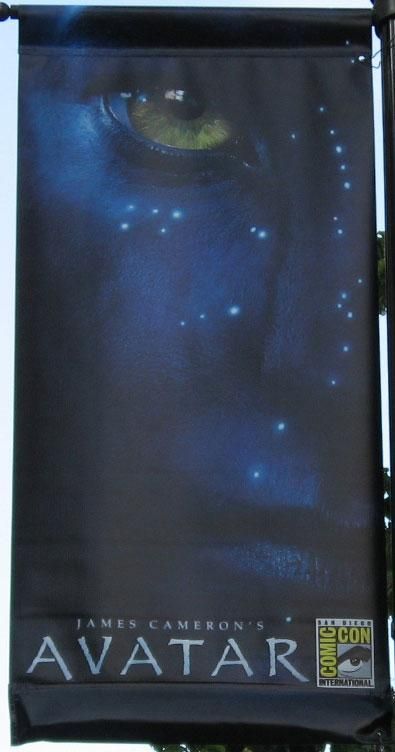
More information – and an image – for the Avatar movie at the Marketsaw blog. The face on the banner is of a Na’vi-human hybrid (Jake Sully).
UPDATE – July 2, 2009: Further info about differences between Na’vi and Avatars! Jim here again. Here is what my source has to say: “There is major difference between the Na’vi and the avatars. It was visible in the footage shown at Amsterdam, but the viewers were so stunned they didn’t notice. The Na’vi have four fingers and toes; the avatars have five. In addition to the eyes, the avatar’s nose is also slightly smaller than the Na’vi’s.”
ANOTHER SAME DAY UPDATE: Exclusive insider info on the Na’vi image in the poster – this is from a trusted source: “Since one of the viewers of the Amsterdam presentation already mentioned it, the avatars do look somewhat like their human counterparts. This means the Na’vi look less human. Larger eyes for one. (Jim: Actually heard Neytiri has a striking resemblance to Zoe Saldana).
8/7: Overpriced
“Debate rages over future of Australia’s book industry,” 7:30 Report, 7/7. There has been much heated debate over whether to remove parallel import restrictions for books in Australia, so that booksellers can bring in cheaper overseas editions. Publishers and authors are squealing in protest, but I can’t feel much sympathy for them; books in Australia are obscenely expensive (a paperback novel, for example, is AU$17-25 – U.S. equivalent, even doubled for the exchange rate, is up to AU$16). Books are a bit cheaper (30%) in department stores, but the selection there is limited. “An Onymous Lefty” has the same opinion on the issue.
This morning was the coldest in Melbourne this year so far, with any cars left outside coated in ice. Our outside thermometer read 0°C (about as cold as it can get here, though I guess that would be a mild winter temperature in some countries!).
9/7: A new body
“I, Robot,” Newsweek, 25/5. An interview with Ray Kurzweil, who wants to utilize nanotechnology to enhance his body, should this technology ever become viable. The article portrays him in a very negative light, though (there’s an entry on the article at the “Accelerating Future” blog). I want that technology too! I want nanotechnology (especially medical!), artificial intelligence, nuclear fusion and all the rest of it (I guess that makes me a Transhumanist?), but it remains tantalizingly in the future, and there is uncertainty over whether any of it can be made viable. H+ magazine has an article, “How Close Are We to Real Nanotechnology?” – which gives a timeline of 20-30 years away. Not close enough!
Watching my parents get old (they’re in their 70s), with all the accompanying ailments, is depressing, and I fear getting old. My body is not the one I had 10 years ago, and it is showing signs of wear-and-tear (as my two surgeries in the last 7 months testify), despite exercising regularly, not smoking, drinking, doing drugs, being overweight, or eating lots of junk food. (I am prone to stress and depression, though.) I am not so enamored of the idea of uploading one’s consciousness to a computer or robot body (I am dubious if that will ever be possible, as our consciousness is inextricably interwoven with our physical brain). I simply want to be able to repair my body so it is as new.
Modern surgery is still relatively crude compared to the possibility of nanotechnology (programming nanobots to repair one’s body at the molecular level, without the unpleasantness of being cut open). I envision a patient being given a capsule filled with nanobots; after swallowing it, these would circulate through the body and do programmed repairs, before exiting through the digestive system in the normal manner. The nanobots might utilize the body’s resources (eg. stored fat) to power their activities, so the patient would need to eat more before and after to replenish themselves.
If I were a multi-billionaire, I would be putting my money into supporting such research, not buying useless trinkets like jewelry or yachts! In fact, I would buy my own island, set up a secret hi-tech lab complex, hire a lot of scientists and let them loose (like in those “mad scientist” movies).
11/7: Animal lives
Although scientists – and humans generally – have long been reluctant to admit it, animals have their own form of intelligence, social structure, awareness and emotional lives. The articles I collected below illustrate this:
“Watching Whales Watching Us,” NYT, 12/7. On interaction between humans and grey whales in a particular region. Also notes that human-made noise (and other) pollution of the oceans is destructive to the creatures there (we can’t seem to visit any environment without messing it up).
“But thank goodness we’ve gone through a kind of cognitive revolution when it comes to studying the intelligence and emotion of other species. In fact, I’d say now that it is my obligation as a scientist not to discount that possibility. We do have compelling evidence of the experience of grief in cetaceans; and of joy, anger, frustration and distress and self-awareness and tool use; and of protecting not just their young but also their companions from humans and other predators. So these are reasons why something like forgiveness is a possibility. And even if it’s not that exactly, I believe it’s something. That there’s something very potent occurring here from a behavioral and a biological perspective. I mean, I’d put my career on the line and challenge anybody to say that these whales are not actively soliciting and engaging in a form of communication with humans, both through eye contact and tactile interaction and perhaps acoustically in ways that we have not yet determined. I find the reality of it far more enthralling than all our past whale mythology.” […]
A distinctive aspect of the new cognitive revolution that Toni Frohoff spoke to me about is that scientific facts, of all things, are now freeing scientists like herself to be more expansive storytellers. The accusation of anthropomorphism – of projecting our thoughts and feelings on other animals; of trying to guess at what a whale’s day might be like, or a chimp’s or an elephant’s – has been obviated by the increasing evidence that such creatures have parallel days of their own, ones as distinctly intricate and woundable and, ultimately, unknowable as ours. “I don’t anthropomorphize,” Frohoff told me. “I leave it to other people to do that. What I do is study gray whales using the same rigorous methodologies that have long been used to study the behaviors of other species and interspecies interaction. Those who would reject out of hand the idea that whales are intelligent enough to consciously interact with us haven’t spent enough time around whales.”
“An Elephant Crackup?,” NYT, 8/10/2006 (also at the Elephant Sanctuary site). Widespread culling of elephants, and competition for food and land with humans, disrupts family groups (elephants are intensely social like us) and traumatizes young elephants who are orphaned. Young male elephants in particular display aggressive behavior – like young male humans.
But in “Elephant Breakdown,” a 2005 essay in the journal Nature, Bradshaw and several colleagues argued that today’s elephant populations are suffering from a form of chronic stress, a kind of species-wide trauma. Decades of poaching and culling and habitat loss, they claim, have so disrupted the intricate web of familial and societal relations by which young elephants have traditionally been raised in the wild, and by which established elephant herds are governed, that what we are now witnessing is nothing less than a precipitous collapse of elephant culture.
It has long been apparent that every large, land-based animal on this planet is ultimately fighting a losing battle with humankind. And yet entirely befitting of an animal with such a highly-developed sensibility, a deep-rooted sense of family and, yes, such a good long-term memory, the elephant is not going out quietly. It is not leaving without making some kind of statement, one to which scientists from a variety of disciplines, including human psychology, are now beginning to pay close attention. […]
Elephants, when left to their own devices, are profoundly social creatures. A herd of them is, in essence, one incomprehensibly massive elephant: a somewhat loosely bound and yet intricately interconnected, tensile organism. Young elephants are raised within an extended, multitiered network of doting female caregivers that includes the birth mother, grandmothers, aunts and friends. These relations are maintained over a life span as long as 70 years. Studies of established herds have shown that young elephants stay within 15 feet of their mothers for nearly all of their first eight years of life, after which young females are socialized into the matriarchal network, while young males go off for a time into an all-male social group before coming back into the fold as mature adults.
“Taking Animals Seriously,” 19/6/2005. Of the cognitive similarities between animals and autistic people; this features Temple Grandin, who is well-known for her work with understanding animals.
Meanwhile, the better she understands animals, the clearer it is that they are not so very different from us. After all, a deficiency in a part of her own forebrain has made her far more similar to animals in her thinking process – yet she remains indisputably human. The differences between us are far smaller than most people think.
This assertion makes some people – even people who call themselves scientists – very uncomfortable, and some lash out at those who make the claim. It’s very important to them to believe that there is a vast, unbridgeable gulf between humans and animals. But to keep the gulf in place, they have to ignore vast amounts of important and useful evidence – evidence that will help us understand ourselves and animals.
Also notably:
I was also pleased to read about the role of older males in curbing aggression in adolescent animals. We aren’t the only species that gives rise to vicious gangs of adolescent males, when older males aren’t present to socialize them and keep them in line.
Boys do need fathers – or, at least, father-figures – in their lives for their proper socialization and psychological well-being, as politically-incorrect as it seems to be to say so, these days.
“Spirit of the Shrinking West,” National Geographic, February 2009. On the controversial culling of wild mustangs. Horses also have their own complex social groups, and the random culling practised disrupts these.
“The more we know about the emotional and social lives of horses, the more we realize that they draw on a powerful collective wisdom,” said Ginger Kathrens, as she pointed her camera at a band of mustangs on a ridge just beyond us. “They live in highly structured, hard-won family groups. If you arbitrarily pull horses out of that group, the consequences can be devastating for the remaining family members.” […]
It was a raw spring day, and we settled down with our backs to the wind and watched. A pale stallion named Cloud was keeping half an eye on his mares as they grazed the range on top of this rocky ridge and half an eye on us. Kathrens said that a stallion will fight – sometimes to the death – for the right to own mares, which he must then continue to defend from interloping bachelors until old age makes it impossible for him to carry on. As Kathrens described Cloud’s relationship to his own mares and then to his father, his mother, his brothers, and half brothers, she wove a storyteller’s tale of intrigue and interfamily squabbling, of unlikely alliances and terrible, sudden wars. There was even a case of what might be called love – a solitary and now elderly couple that broke the rules of wild horse society to be together. When the stallion that had won the mare let her out of his sight the night she was foaling, she escaped and sneaked back to her stallion of choice. “In some cases,” Kathrens said, “I’ve seen a stallion lose his mares in a BLM gather, and for that stallion, who has fought life-threatening battles for those mares, his life is over. He’ll end up on his own, and I don’t think it’s too strong to say that some stallions succumb to a form of depression.”
Humans would be greatly outraged and traumatized if aliens appeared and began culling us at random, yet we practise such slaughter on other animals without hesitation.
Regarding hunting: I actually don’t have any objections to sustainable sustenance hunting; humans evolved as omnivores, and hunting is part of the natural cycle. I do object to sport hunting, a wasteful and morally objectionable activity that merely satisfies male egos.
I feel that all animal sports – horseracing and so on – cannot be justified in any sense, and should be abolished for humane reasons. Unfortunately a lot of people’s careers depend on these activities, so phasing them out would be difficult.
If humans were to disappear from the Earth tomorrow, the natural world would continue on without missing us (though our polluting artifacts, such as plastic, would linger in the environment for centuries). Domestic animals, though, would have a hard time of it as they are bred to be unhealthily dependent upon us, and some are so inbred and malformed that they can barely function without our assistance, so these would eventually die out. I wonder if humans should even be permitted to keep pets at all, as so many people mistreat or neglect them. My view is that animals in general should simply be left alone, so they can live their own lives without interference (and a reduction in the huge human population would go some way to achieve that).
15/7: I want to go back
One of my favorite daydreams is of being able to travel back into the past – my past – and visit again the places and people that are now gone, as well as warning my younger self of what lay ahead, and of what decisions I should make. Whether my stubborn, self-destructive younger self would listen is another question, but if I had one wish granted, that is what I would want to do! I can identify several decisions in my life that changed its course, most not for the better. In the multiverse or parallel universe theory, that moment where I decided saw a divergence in my timeline, where in one timeline I decided “Yes,” and my life turned out very differently than in the timeline where I decided “No.” So perhaps I can take a peculiar comfort in that my self in a parallel universe might be successful in her life, unlike my self in this timeline!
Time travel to the past in this timeline may not be possible as it would violate causality, and there is no historical evidence of hordes of time travelers visiting past events. Thus, if one could travel back into the past, you would be shunted into a parallel universe, and perhaps be not likely to return to the one in the timeline you left; not an appealing prospect! The book by Michio Kaku that I mentioned in my 29/6/2009 entry , Physics of the Impossible, goes into detail about this, and the multiverse theory is one he finds the most plausible, as described in this interview, “Things We’ll Probably Never See,” NYT, 27/3/2008.
“I call [time travel] a class II impossibility, that might be realized centuries or millennia from now. Einstein’s equations, believe it or not, do allow for time travel. But there are still problems with time-travel devices. First of all, energy. Michael J. Fox put plutonium in a DeLorean and rocketed back to the 1950s. You can calculate that plutonium is not enough. You’re talking about the energy, basically, of a black hole or a star. The next dispute is stability – how stable are these time machines? If you go into it, will radiation kill you? Will it close up as you enter it? Now the question of the paradoxes comes in. If you do send an object back in time, what happens if you alter the past? What happens if you shoot your parents before you’re born?
My favorite solution is the many-worlds theory: when you go backwards in time and you save Abraham Lincoln from being assassinated, you’ve actually saved someone else’s Abraham Lincoln. Your past cannot be changed, and you’ve gone to a parallel universe. If the river of time forks into two rivers, you hop across rivers after the fork. Another interpretation is if you go smoothly into the past, you fulfill the past. You didn’t alter the past – it was meant to be this way. And the third interpretation is, I think, the most implausible: you go backwards in time, you’re about to pull the trigger to kill your parents before you were born, but there’s something preventing you from doing it. For example, there’s a law of physics, called gravity, that says you cannot walk on the ceiling. You may want to walk on the ceiling but you can’t do it. Igor Novikov envisions a law of causality that works like this. I tend to disagree. How would you devise a law of physics to prevent causality change when anything can change causality? Just by the fact that you’ve entered the past, you’ve changed the weather pattern. You changed the objects around you. I don’t see that as a very strong possibility.”
This theory is disappointing, though; I want so badly to go back (obsess about it), because my present-day life – the way it has turned out – is a total failure. I occasionally have dreams about this, where I am able to jump back to my past, and the memory of that time is vivid. A dream I recorded for 18/9/2006:
Last night I had a rather vivid dream that I was able to travel back in time, back into my past. In the first jump (I did it by holding something like a rock in my hand and jumping into some sort of cloud) I went back to 31 December 1988. I was outside my parents’ home and saw Dad. I told him I had come from the future. We had a conversation. I then jumped onto the garage roof (it was late afternoon as the sun was behind it) as I prepared to jump back further. I landed in 1998 in my bedroom (there was a desk and computer there, though I didn’t have one then), realized it was the wrong year, then jumped back to 1980 in my home. I woke up then.
Another related daydream, that is closer toward using magic, is of being able to transport the mind I have now back into the mind of my younger self, so that my older self – that has knowledge of my past – could guide my younger self toward making wise decisions, and thus avoid the dismal future I ended up in. I hate my pointless existence, hate the way the world is now, but death is the only way to escape it.
The world of quantum mechanics is bizarre. It exists alongside what we percieve as reality, yet the two worlds do not usually mix; reality rests on top of the quantum world rather like oil on water. Unlike predictable surface reality, in the quantum realm a particle can be in two places at once, or an object can be both alive and dead (before observation makes it decohere into one condition or the other). Maths and physics were, sadly, not my talents at school, so the complex mathematics involved is well beyond my understanding (I can only comprehend the “science for dummies”-type books).
19/7: Social disintegration
“Tough love needed for kids, says mother of violent teen,” Herald-Sun, 19/7. Wise words of an exasperated and despairing mother of a teenager who has been jailed for assaults. Every week there are media reports of vicious assaults (usually between young males) that leave the victims badly (and sometimes permanently) injured. Alcohol is a major factor in this violence.
She says society needs to get tough with violent youths; and respect, discipline and personal responsibility need to be instilled into children from an early age. She says Aaron, who has been in trouble since he was 16, would have benefited from this approach. Ms. Foster says boot camp-style diversion programs, forced army service, and tougher discipline in schools should be considered as part of a bid to stamp out rising levels of violence. She says violent thugs also should be forced to “look their victims in the face.”
“I think these are great ideas. I’m in favour of anything that will make a difference because I’ve seen and felt the heartache that these violent acts bring,” she said. “There’s a lack of discipline in schools and obviously parents need to take some of the blame. But political correctness seems to have taken away old-fashioned ideas of respect and responsibility. Kids these days know more about their legal rights than they do about personal responsibility and decency. Discipline has gone out the window. The idea that there are consequences for what you do needs to be re-instilled into teenagers. We have become this soft, touchy-feely society where everyone’s a victim and it’s got us into a whole lot of trouble.”
The abuse of alcohol is a curse in Australia (and many other countries, like the U.K. and Russia). In my view it should be regulated strictly like smoking is in Australia – advertising banned, places in which alcohol is consumed to be limited.
In the words of another article from the H-S, “hedonism, materialism and individualism” are the root causes of much dysfunction besetting modern Western society. Traditional-style cultures who get “infected” by Western culture (mainly popular culture) also develop the same ills (evident in the increasingly bad behavior of their children). First it seduces, then it destroys. The social experiment of liberalism (not in the political sense, but more “do whatever you want without consequences”) is a massive failure.
Also, as mentioned in my 11/7/2009 entry , boys need fathers, or at least older father-figures, to properly socialize and discipline them. I would surmise that many of these violent youths come from dysfunctional families.
Traditional cultures (hunter-gatherer and the like) had initiation rituals for their young people so they could earn their place in their society. Such rituals are sorely lacking in modern industrialized culture (getting one’s driving licence and being able to legally drink alcohol are poor substitutes). The society in which I live, though technologically-advanced, is severely dysfunctional and alienated. A phrase I thought of (or heard somewhere) that seems appropriate: “Your cleverness has outpaced your wisdom.”
20/7: Tree murder
I hate seeing trees felled, especially big and old trees. (A nearby street tree is being felled today.) The sound of chainsaws is harsh and ugly, and sets my nerves on edge when I hear one, as it means the death of another tree. Several large trees in my neighborhood have been cut down since the 1990s (mainly liquidambars) and their green leafy shade in summer is sorely missed.
I think I got the extract below from a site called “Champion trees” (the domain name seems to have been hijacked by some casino spammer, so I won’t link to it – could the death penalty be instigated for these parasites?); it is worth quoting:
In New Zealand a few years ago, I experienced more cogently than ever the sheer gravitas of trees. I was in the presence of Tane Mahuta, the world’s largest kauri, on the North Island. Kauris are conifers of the genus Agathis in the family Araucariaceae. Also in the family are Araucaria, the group to which the South American monkey puzzle tree belongs, and Wollemia, the so-called Wollemi pine, which was thought to have become extinct 120 million years ago and then turned up in a valley in New South Wales, Australia, in 1994. […]
… Kauris are the biggest of their family. The great trunk of Tane Mahuta rises like a lighthouse out of the gloom, 5 metres in diameter – it would touch all four walls in a good-sized living room – and 15 metres in circumference. It is straight up and leafless for 20 metres or so, then start the great horizontal boughs on which rests a virtual park, a floating island straight out of Gulliver’s Travels, with an entire ecosystem of ferns and flowers, lizards and goodness knows what else.
Tane Mahuta is about 2000 years old. By the time the Maori arrived it was already 1000. For the first 1400 years of its life moas strutted their stuff around its buttressed base. The largest of the moa species was the tallest known bird. They were harassed by commensurately huge, though short-winged, eagles that threaded through the canopy to prey on them. Today, the moas and their attendant eagles are long gone; Tane Mahuta lives on. […]
… Trees pose many challenges to modern industrial economies, not least to the greatest western conceit of all, that we can conquer nature or control it. This idea is still taken as a mark of modernity. One long look at a tropical forest is enough to reveal the nonsense in it. In the tropical forests of Central and South America there are around 30,000 different species of tree, with up to 300 kinds in any one hectare. Compare that with the US, with only 600 or so native species, or the UK with a mere 39. Each kind of tropical tree may harbour thousands of species of insects and other creatures. We can never know all the interactions between the trees, their inhabitants and their visitors, and even if we could we would not be able to control the system. It is of a type physicists would know as chaotic – innately unpredictable and therefore uncontrollable. All we can be reasonably sure of is that anything we do to the forest will reduce its diversity and hence its ability to adapt.
In Oxford in 1879, the English poet Gerard Manley Hopkins lamented the felling of poplars:
O if we but knew what we do
When we delve or hew
Hack and rack the growing green!We still don’t know what we are doing, and never can in any detail, but the hacking and racking continue more vigorously than ever. The only sane approach if we want this world to remain habitable is to approach it humbly. Trees teach humility. It would be a good idea to begin the renaissance with them.
– “Let the future take root,” Colin Tudge
If I were to go to the USA one of the few places I would like to visit are the remaining redwood forests in northern California; to walk amongst those huge ancient trees would be awe-inspiring. Tasmania also has some tall forests (under threat from logging) as does Gippsland in Victoria (also being logged).
As I have griped about in my other blogs, I am becoming increasingly aggrevated by certain elements in the spaceflight community who say we have to go into space because it is our “Manifest Destiny.” The words “freedom,” “frontier” and “leadership” are also frequently used. A recent example is an article mentioned in this NASA Watch entry. An astronaut, Scott Parazynski, climbed Mt. Everest earlier this year. As have hundreds of people, littering the mountain in the process. To me it seems a rather pointless, even disrespectful, endeavour. The “Mother Goddess of the Earth” does, however, take “sacrifices” most years.
A selection from the comments in that entry, displaying the mentality that annoys me:
Well done Scott for climbing Everest pushing the limits has its rewards. As a person that lives in New Zealand where Sir Ed Hillary came from i say to Scott quoting our hero “you knocked the bastard off” Ed would be proud of you.
The nations that lead on the frontiers, dictate the course of human history.
Agree 100% with Scott. A country that becomes complacent and is fearful of risk is a country that faces obslecence.
Europeans did more than just explore the new worlds that they discovered. They also colonized them.
It is Manifest Destiny that saw explorers from Europe trash the lands and indigenous populations they encountered, in the name of “Progress.” (I have been reading the Avatar scriptment which has this as a theme, so I have been thinking about this a lot recently.) Is “progress” worth it? As I noted in my previous 19/7/2009 entry, for all its advanced technology, modern civilization seems no happier and is seriously dysfunctional. While I wouldn’t want to forgo the advances such as medical care, I wish there were a way to reconcile both ways of living.
“A slow death by progress: If our global civilization dies, what’s left to replace it?,” 6/8/2006 (originally at TheStar.com, but no longer online). A speech by Ronald Wright that warns of the unsustainability of our society.
Our present faith in an ill-defined material progress and our capitulation to the market forces that claim to drive it (the very forces that turn fields into parking lots and forests into paper towels) may not seem religious, but is hardly less dangerous or delusional. When, how, and above all why did we start believing that the stock market must run the world? […]
The bets our ancestors unwittingly placed when they invented civilization now rest on a single high-stakes throw. We have in effect one big civilization, feeding on the whole world at such a rate that we can observe the exhaustion of natural capital within our own lifetimes, whether it be the loss of wildlife, clean water, coral reefs, rainforests, or topsoil. We are cutting old-growth trees everywhere, we are irrigating everywhere, we are mining and fishing everywhere. And no corner of the biosphere escapes our haemorrhage of waste. As each year goes by, the world loses an area of farmland greater than Scotland to erosion and urban sprawl, while 70 million extra human mouths must be fed.
Some years ago, I called civilizations “pyramid schemes,” partly because they build pyramids (costly but unproductive projects that may take the form of colossal statues, extravagant tombs, sumptuous temples, office towers, or missile shields) but mainly because civilizations often behave like “pyramid” sales schemes: thriving only while they expand, paying the present by stealing from the future, collapsing suddenly in political and environmental bankruptcy.
I posted a message at the SETI “Earth Speaks” site: “Please come and save us from ourselves!” Apparently someone was not impressed as they only rated it ½ a star out of 5! My own feeling is that humanity is incapable of changing its self-destructive behavior, and only the intervention of aliens (or perhaps an Artificial Intelligence) will do so.
22/7: Goodbye Geocities
Got an email saying the Australian version of the Geocities free website hosting is closing on 26 October. I started my first website there in 2003, so I feel a bit sad about it, though the website space (15 MB) and bandwidth provided seems hopelessly inadequate now. I could create and upload pages with no interference with my HTML code. Other free hosts now seem to assume people don’t want to use HTML code and have a “website for dummies” interface, which I find irritating. Google Sites, for example, has 100 MB of space but it does not allow users to FTP-upload their own pages from their computer, and images can only be uploaded one at a time, so it is inadequate.
My lower back still is sore (4/7/2009 entry ); the outside of my left leg also goes numb if I lie on it for some time. It has been doing that since around the time of my first operation; it seems to have become more pronounced since my second. I feel like I have aged 10 years or so since last year! I also underwent the delightful chore of having my right ear syringed after becoming blocked on 10/7 (same happened to it in March last year). Ever since I had the flu in June 1997 (my one and only bout of it so far), that ear has not been quite right. All I need now is to get swine flu!
I was looking at the prices for a small graphics tablet – but the cheapest (and smallest) is just under $200! It would be nice to have one to touch up or enhance my scanned-in drawings (a mouse is hopelessly clumsy), but it’s out of the question at that price.
24/7: Teenage dysfunction
A letter from The Age, 24/7, in response to a spate of teenage suicides at a Melbourne school, on why peer groups are particularly unhealthy for teenagers, without older adults around to moderate any dysfunctional behaviors. I remember as a teenager I sometimes preferred the company of older adults, who seemed less threatening than those my age.
Peer groups destructive
It is futile to think the anguish being caused by cyber-bullying can be prevented by concentrating on the “cyber” aspect. Despite all the hoo-hah we have heard about bullying, and the many vows to stamp it out, it has become more prevalent because so many of our young people either suffer it or inflict it on those around them, or both.
The same basic cause lies behind binge-drinking and other drug abuse, hoon driving, purposeless vandalism, and most violence. What is that underlying cause? It is anxiety. Like their elders, young people can be anxious about many things but the most difficult is anxiety about themselves: are they worthy of being liked, respected and loved?
Not so many years ago most individuals found their feet as self-controlling adults by mixing with older adults. Now our national obsession with education commits most to not growing up in an adult work environment but spending most of this time from 15 to 25 surrounded by others of the same age. Large peer groups are destructive places because unless you already have confidence in yourself as you are, others will try to put you down so they can climb higher.
We shall do little for the victims of bullying if we do nothing about the anxiety of bullies.
– David G. McKechnie, Horsham
This reminded me of an article I came across in 2006, “Why Nerds are Unpopular,” a thought-provoking essay by Paul Graham. Why smart kids are badly treated in American schools (which seem to have a particularly vicious caste system). Also, musings on why teenagers in modern society generally seem to be so troubled:
Life in this twisted world is stressful for the kids. And not just for the nerds. Like any war, it’s damaging even to the winners.
Adults can’t avoid seeing that teenage kids are tormented. So why don’t they do something about it? Because they blame it on puberty. The reason kids are so unhappy, adults tell themselves, is that monstrous new chemicals, hormones, are now coursing through their bloodstream and messing up everything. There’s nothing wrong with the system; it’s just inevitable that kids will be miserable at that age.
This idea is so pervasive that even the kids believe it, which probably doesn’t help. Someone who thinks his feet naturally hurt is not going to stop to consider the possibility that he is wearing the wrong size shoes.
I’m suspicious of this theory that thirteen-year-old kids are intrinsically messed up. If it’s physiological, it should be universal. Are Mongol nomads all nihilists at thirteen? I’ve read a lot of history, and I have not seen a single reference to this supposedly universal fact before the twentieth century. Teenage apprentices in the Renaissance seem to have been cheerful and eager. They got in fights and played tricks on one another of course (Michelangelo had his nose broken by a bully), but they weren’t crazy.
As far as I can tell, the concept of the hormone-crazed teenager is coeval with suburbia. I don’t think this is a coincidence. I think teenagers are driven crazy by the life they’re made to lead. Teenage apprentices in the Renaissance were working dogs. Teenagers now are neurotic lapdogs. Their craziness is the craziness of the idle everywhere. […]
Teenage kids used to have a more active role in society. In pre-industrial times, they were all apprentices of one sort or another, whether in shops or on farms or even on warships. They weren’t left to create their own societies. They were junior members of adult societies.
Teenagers seem to have respected adults more then, because the adults were the visible experts in the skills they were trying to learn. Now most kids have little idea what their parents do in their distant offices, and see no connection (indeed, there is precious little) between schoolwork and the work they’ll do as adults.
And if teenagers respected adults more, adults also had more use for teenagers. After a couple years’ training, an apprentice could be a real help. Even the newest apprentice could be made to carry messages or sweep the workshop.
Now adults have no immediate use for teenagers. They would be in the way in an office. So they drop them off at school on their way to work, much as they might drop the dog off at a kennel if they were going away for the weekend.
What happened? We’re up against a hard one here. The cause of this problem is the same as the cause of so many present ills: specialization. As jobs become more specialized, we have to train longer for them. Kids in pre-industrial times started working at about 14 at the latest; kids on farms, where most people lived, began far earlier. Now kids who go to college don’t start working full-time till 21 or 22. With some degrees, like MDs and PhDs, you may not finish your training till 30.
Teenagers now are useless, except as cheap labor in industries like fast food, which evolved to exploit precisely this fact. In almost any other kind of work, they’d be a net loss. But they’re also too young to be left unsupervised. Someone has to watch over them, and the most efficient way to do this is to collect them together in one place. Then a few adults can watch all of them.
The Large Hadron Collider, which was powered up to much fanfare (and fearful hysteria) last year before being shut down for repairs due to a helium leak, is still no closer to starting up due to two vacuum leaks being found. Now the start-up is set for mid-November. *Sigh* I want to see black holes!
The official site for Avatar is online (only a front page as of yet). There was a screening of movie footage at Comic-Con, so there are lots of reports coming out, mostly positive. There will be a free 15-minute preview screening at various cinemas worldwide on 21 August. I might try to see the preview if it is in a conveniently-located cinema (and at a suitable time).
I have to admit I feel a certain cynicism about the romance element, though; this theme of Avatar seems to pander to certain male fantasies, and the quote below from a James Cameron interview had me rolling my eyes a bit:
I mean, really, it was a fine line to walk between making them too alien. I think in some earlier images, when they started to leak and even with the banners some of the fans were saying, “Gee, I thought they’d look more alien, if you’re going to go to all this trouble with CG and everything.” But if it wasn’t a love story, if it was more of a film about first contact with an alien race I think it would be. But this is really a story about assimilation and Jake becoming one of them and starting to see through the eyes of people who are culturally different. It’s a love story, too. So the physiological differences, the more alien we made them in the early design phase we just kept asking ourselves, basically the crude version is, “Would you want to do her?” And our all male crew of artists were basically like, “No, take the gills out.”
There is a page for it at the TV Tropes site: Green Skinned Space Babe! (Blue-skinned, in Avatar’s case.)
I would, however, like to see the genders of the main characters reversed (female human, male alien) just for a change! I suspect this would attract a larger female audience ;-).
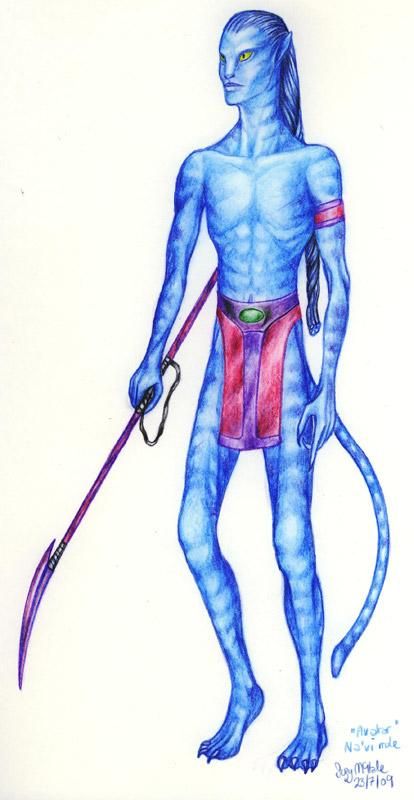
I also did a quick colored pencil concept sketch of a Na’vi – male, of course – wonder how close or not it will resemble official images when released? I did not add bioluminescent dots as this proved too fiddly with a mouse.
August
4/8: Local idiots
A post box up the road got stolen early on Sunday morning – I happened to see the two idiot drunken young males in a ute who did it. I reported this to the Post Office website, but I could not provide much beyond those details (i.e. no licence plate number). Such mindless vandalism is all-too-common – a combination of bored young (mostly) males and alcohol. If there is one useful purpose wars serve, it is to cull such surplus males from society – and the ones that survive have some sense knocked into them.
A short but violent storm raced through Melbourne on Sunday night; its path was narrow but it caused much damage. I was woken up by it, but it caused no damage here, aside from strong winds. It was not unlike a downburst. A mini-tornado did come through my suburb in the early 1990s and blew down fences. I was at work and remember a ferocious gust of wind rattling the windows.
Jupiter has been bright in the early morning for a few weeks (as was Venus, but it is getting lower on the horizon). The planet has a vaguely orange hue. The light from it takes around 35 minutes to reach Earth (average distance between both planets is 628,743,036,000 meters, divided by light speed at 17,987,547,480 m/minute, if I’ve done that correctly).
Pictures of the two main characters in Avatar (or, half their faces, at least) have emerged; the official poster is of the female Na’vi character, Neytiri (though there is still some doubt whether it is official or not):
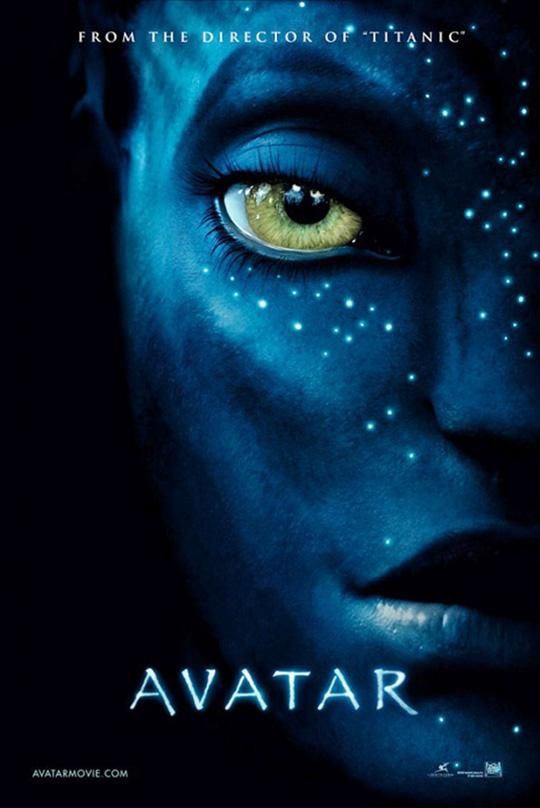
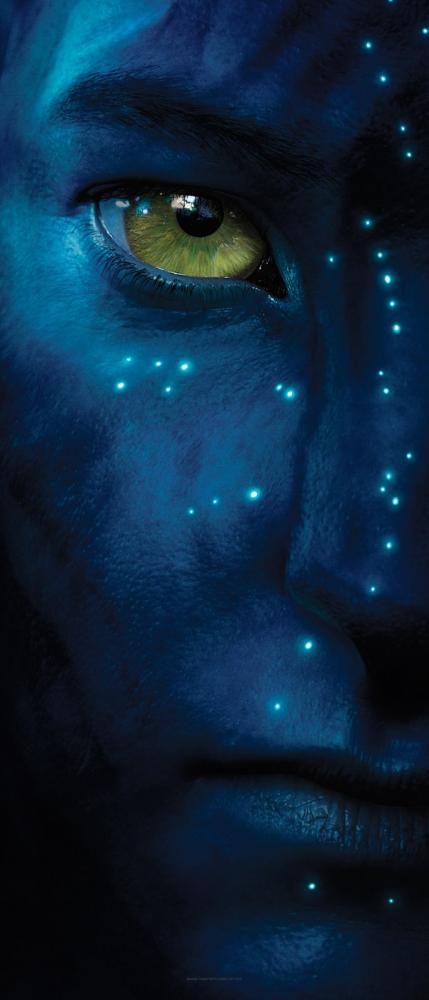
“Avatar Day” is on 21 August (a free screening of 15 minutes of the movie at 3-D capable cinemas). I don’t know if I will attend (I have a dentist appointment that morning, which will likely be dismal as I have a probable cracked tooth which I can’t afford to have repaired). There is a 3-D cinema in Southland shopping center where I go frequently, so perhaps it will have the preview screenings.
14/8: Darwin Awards candidate
Some unwanted drama in the local shopping center early this morning when an idiot speeding at 160 km/h crashed into shops there, his car bursting into flames and incinerated him, and part of Centre Road was closed off. (Reports at: The Age, Herald-Sun, ABC News.) I don’t feel sympathy for the driver (a young male, no surprises there), but it’s inconvenienced many people and the damage to the shops will take months to repair. Mum and I went for a look earlier; there were a lot of people doing the same. ( Darwin Awards site)
18/8: Tooth trouble
I haven’t felt much like writing at all. Dentist appointment on Friday, which I am dreading as my probably-cracked tooth is bothering me, and fixing it might involve procedures which I can’t afford (I don’t want to have it removed, though, as it is a lower molar). If dentistry were even partly-covered by Medicare, such issues would not be of so much concern. Last Sunday night I had a disturbing dream that my teeth fell out – I kept spitting them into my hand – probably because I have been fretting over this. 3 years ago I did not have so much as a filling. In terms of health, this year has sucked.
There were gale-force winds (over 100 km/h) on Sunday night and into the day, which caused the usual statewide damage. More unfortunate trees blown down.
“Avatar Day” is this Friday but I did not enter the competitions for tickets as the IMAX one was for a double pass (I have no one to go with), the Village Cinema one involved a “say in 25 words or less” competition which I hate (I can never think of anything clever to say), and the cinema times were inconvenient (5 p.m., during rush hour and too late in the day for me).
I am becoming irritated with the NASASpaceflight.com forum as the webmasters tend to delete threads without notice – one on why women didn’t post much to the NSF site was arbitrarily deleted (I had a reply in it). The thread was not offensive, so I am baffled as to their reasoning. It is annoying and rude.
Also irritating are the “Space Cadets,” as exemplified by the thread “Case for human exploration. (Fresh perspective needed).” I increasingly find myself agreeing with the negative view towards manned exploration as there are more pressing priorities such as the environment, health care and so on. The Space Cadets are out of touch with reality – space colonization is not even in most of the population’s awareness.
22/8: Avatar Day!
… Was yesterday in Australia, and I didn’t get to see the 16 minutes of cinema footage :-(, but the trailer was released. The Avatar-related sites just exploded – see Avatar Movie Zone and the Marketsaw blog for more, and pictures. Empire Online has a James Cameron’s Avatar Teaser Trailer Breakdown. The rest of the world still seems indifferent, or haven’t heard of it – none of the spaceflight forums I visit have mentioned the movie, despite its being sci-fi.
The Na’vi aliens do not look too much different from my drawing (see 24/7/2009 entry ). Their faces do look odd at first sight – especially those of the Avatar hybrids – but you soon get used to them. They do seem like idealized humans in some respect, being tall, impossibly slender and attractive (no overweight, disabled or elderly there, it seems). Also, the main female Na’vi character, Neytiri, is a real space babe (that is a tinge of jealousy in my writing!), so I can see the guys in the audience drooling over her *rolls eyes*. I would, as I noted earlier, like to see the roles reversed (female human protagonist and alien male), as I think this would appeal to a female audience more!
I was a bit disappointed with the color of the alien plants – boring Earth green! In the original scriptment they were blue and magenta, but James Cameron apparently thought having it green would make Pandora more “believable.”
There is already a considerable (and predictable) backlash against the movie as it has been hyped so much (though most of the general population hasn’t heard of it). I am intending to see the movie when it comes out in December (so far away!).
25/8: District 9
Today I went to see District 9, my first in-cinema movie since IMAX Space Station 3D in 2003. I had read the positive reviews about it, and the unconventional plot appealed. I enjoyed it very much! It was quite violent and there was a lot of swearing (but no romance, thankfully); this did not bother me (it is rated MA15+ in Australia). There were a few humorous scenes and lines. The aliens were sympathetic (the baby one, whose name I did not get, was cute), and the human protagonist was, thankfully, not the usual gung-ho macho type found with tedious predictability in American movies. I will definitely buy the DVD when this comes out.
South African accents sound almost like Australian ones, but are more abrupt. (“Fookin’” is my new swearword :-)) Again, it’s a nice change from the usual American ones in sci-fi movies!
I went to the 11:15 a.m. showing; there were only a handful of people in the theater (maybe 10 or so), which was nice!
More gale-force winds are coming through this evening (there has been a spate of these over the last 2 weeks or so), so yet more hapless trees blown down.
September
21/9: Sexy samurai
Had not felt much like writing, so a random collection of articles. Spring has arrived, much to my dismay, and the dreaded start of Daylight Savings is only 2 weeks away (it is nearly 6 months long now).
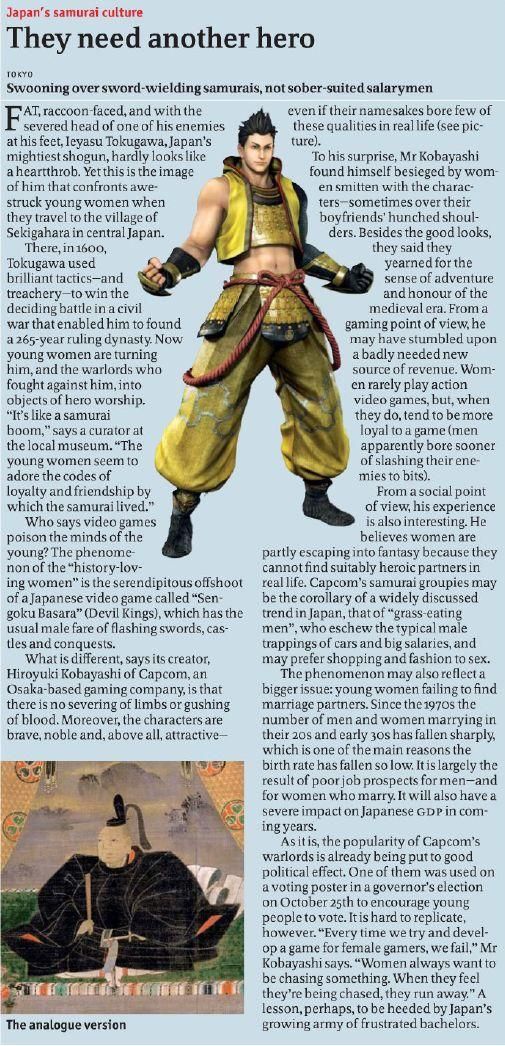
“Samurai are the ‘New’ stuff in Japan!,” (via As I See Japan … from L.A.). Many Japanese women are apparently so disillusioned with their politicians that they are idolizing ancient Samurai leaders instead! I can see their attraction – modern politicians are generally a boringly insipid lot!
Japan’s politicians have been trying to drum up election fever this summer, but followers of a growing craze are more excited about strongmen who have been dead for centuries – samurai warriors. A mania over feudal warlords has been sweeping Japan, capturing the imagination of many in a way that grey-suited lawmakers can only dream of as they brave the sweltering dog days ahead of an election on Sunday.
Japan’s medieval knights have become all the rage, battling it out in video games, on cinema screens and in manga comics as sexy sword-wielding hunks. Sales of their biographies have surged, their family coats of arms have been snapped up as lucky charms, and their former castles are being besieged by legions of fans yearning for a brush with Japan’s long-gone martial noblemen.
Samurai are some of my favorite ancient warriors; in fact I tend to like any ancient warriors (medieval and before) as their armor and outfits were more colorful compared to today’s pragmatically-but-boringly-dressed soldiers. Ancient warriors also generally trained in the necessary martial arts from childhood as using swords, bows-and-arrows, etc. requires more skill than using a gun (anyone can point-and-shoot). In my view, a more effective warrior is one who trains from childhood, rather than the modern method of processing a random bunch of teenaged or adult recruits (who may or may not last the course), but I don’t know of any country that does the former.
“Lost in the headlines are the compassion and hard work seen every day in hospitals,” The Age, 19/9. I thought this writer’s experience a good comparison of the U.S. and Australian health systems – the U.S. system sounds nightmarish, while Australia’s public health care, despite its problems, still gives access to all.
Lost within the gripes and agitations that get the headlines are the astonishing compassion, hard work and split-second decisions that take place every minute of every day in Australia’s public hospitals.
Having been exposed over some years now rather more than anyone might wish to the workings of emergency rooms and the wards, this writer simply wishes to declare admiration for those who labour, largely unsung, within that system.
No receptionists bound by the demand for insurance papers or cash in our emergency rooms, nor the excruciating demand upon such people to avert their eyes from suffering until proof of ability to pay might appear.
“Volcanic eruption in Australia ‘3000 years overdue’,” The Age, 21/9. Victoria has lots of extinct – or perhaps dormant – volcanoes; apparently some are overdue to erupt! That would certainly be exciting.
One peculiarity I encounter when reading people’s interests is those who list “girls” or “women” as an interest or hobby – mostly guys, obviously. It just seems funny (I have not seen any women who list “men” as an interest!).
October
23/10: Escape and emptiness
I have not felt like writing entries at all; I seem to have lost the urge to. It feels rather pointless.
“A World Wide Woe,” Newsweek, 8/10. On Internet addiction. Which I probably have to some degree, as my life in the real world is dismally limited. I feel no interest in much of anything. I could see myself ending up like the writer’s homeless brother in the article (I am like him already in some respects, with limited prospects).
Through the day I peppered him with questions, all meant to answer this one: why had he failed to make something of himself, and I hadn’t? It was a complicated question, but it was pretty clear by the day’s end that the most detrimental influence in his life, from an early age, was videogames and the Internet. We were both exposed to computers early on, but he had let them consume his identity. […]
My brother is outwardly content with his existence, rationalizing it by giving himself pep talks that at least he’s not slaving away for some evil corporation at a wage that’s beneath him. Andrew got his GED and tried several times to get a college degree, but anxiety and depression – two of the underlying symptoms that likely made computers and the Internet an appealing escape – kept him from being able to keep to a structure and conform. My mom had him tested for Asperger’s syndrome once and he showed symptoms but wasn’t diagnosable. He has been treated in the past for depression and anxiety, but says he never found the medications he was prescribed helpful. Is his obsession with the Internet an extension of these illnesses? It’s hard to say, but either way, the effect is real: once he finally gave up on college, he found it nearly impossible to find jobs that paid a livable wage.
When I look back at my life (or non-life), it seems to me that all I have ever really wanted is to escape – escape into my internal fantasy world. Living in the real world is a tiresome and stressful ordeal, but I have to maintain my body and existence in order to keep my mind going (though there may come a time when I can no longer be bothered to).
I was reading an article about bipolar disorder borderline personality disorder (Good Weekend, 15/8/2009, not online) and this paragraph perfectly described how I feel (though I don’t believe I have BD):
Yet at the center of Simpson’s emotional maelstrom and behind the self-hatred lies a chronic sense of emptiness, a “black hole” – an absence of self. It’s characteristic of the disorder but difficult for ordinary people with some sense of the inner “me, myself and I” to imagine.
– Fenella Souter, “Candles in the wind”
Some years ago I wrote about my personality, including this:
I feel hollow, like a void, like I am nothing; that I have no identity and no purpose. My life so far has been pointless and meaningless. That the only thing which keeps me motivated each day are my interests and daydreams, and without these – and underneath them – I am an empty shell, a non-person. I wrote these two verses in 2000 that express this inner emptiness:
There are no stars here
When I close my eyes
I am alone in this darkness
In the Universe of my mind.The void of space
Is the void within me
There is only emptiness
Where my soul should be.
A new Avatar trailer is being released on the Internet next week (and in cinemas today). Lots of photos have appeared in the interim.
On 1 October an ABC documentary, Tribal Wedding, was screened. Aside from giggling at the Australian couple wearing not very much, I kept thinking of how very like the Na’vi the tribe was (though admittedly not so glamorous) – living close to Nature and sustainably, everyone having a place within the tribe and so on (see PDF extract below). Some of the tribe had visited Western society and were horrified by it (one was baffled by how people living in the city didn’t know each other – described them as being like “ghosts”). It would be difficult for someone from modern industrial society to live like they do (I would find the lack of privacy and “everyone knowing everyone’s business” stifling), but I think there is a lot to learn from their society. I wonder how long such societies will be able to hold out against our culture, though – I think of it (consumerism) as an infectious disease for which there is no cure.
Background to traditional Vanuatu
The Namal live on Tanna island, which forms part of the Melanesian archipelago, stretching from New Guinea down through the Solomons and Vanuatu to New Caledonia. This area covers a quarter of all the world’s languages, and ancient, sophisticated cultures largely ignored by outsiders.
Although Christianity is widely spread throughout the 83 inhabited islands, it has done relatively little to displace traditional beliefs. The Namal are among those who have refused to convert to Christianity, while neighbouring villages combine traditional ritual and Christianity in a sophisticated and successful way.
Many of these societies have developed complex financial, economic, and trading systems that have sustained community-oriented cultures for centuries. Like the Namal, they regard modern money as a rather poor substitute for their system.
The local “stockmarket” revolves around pigs. They underpin the entire traditional economy. Poverty as we know it is almost non-existent in even the most remote areas, as everyone has land, food and culture. Only in the urban centres – the places where you need money to live – can you see signs of “real” poverty.
Social, spiritual and political life revolves around kava, a word used to describe both the pepper plant and the drink from which it is derived. It has a tranquillising effect without disrupting mental clarity. Drunk only by men in traditional culture, kava is used for medicinal and cultural purposes throughout the Pacific.
Apart from the existence of kastom tribes – the name used to refer to ni-Vanuatu tribal societies – Tanna is famous for its volcano, Mt. Yasur.
The rich volcanic earth is one of the reasons that the Namal can live so successfully from their gardens. Daily life revolves around tending the gardens, filled with such crops as taro, yam, maniok, island spinach and kava. Tropical fruits such as pineapple, mango and avocado are abundant. Men, women and children all share the work of cultivating food. Children do not attend conventional Western school. Instead, they learn from their many elders about all aspects of life, physical, spiritual and emotional. Relationships are monogamous and family is sacrosanct.
Families live in grass huts made from the jungle around them, as are all the accoutrements of daily life. Plates, bowls, clothing, all made from local grasses and vines.
Medicine also comes from the bush. Kastom doctors deal with everything from common colds to surgery, sometimes with results that astound Western doctors.
Supreme chiefs, like Chief Kuaru and Yapa in Tribal Wedding, have overall social and spiritual responsibility for the villages, while lesser chiefs are responsible for different aspects of the culture.
The nakamal – which is a gathering place for people around the base of a banyan tree – is like a village square, courthouse and church.
“Modern man ‘a wimp’, says anthropologist,” Independent, 14/10. An Australian anthropologist Peter McAllister holds such an opinion, and has a book out on the topic. There is certainly truth to his assertion – the Industrial Revolution and subsequent technological developments removed the need for much physical labor, and in a social sense it emasculated men. Most people living in cities are, from a physical perspective, sorry examples of humanity: overweight, unfit, bodies full of chemical toxins and the processed rubbish that masquerades as food.
29/10: I hate vampires!
Them, werewolves, zombies and all paranormal fiction, which seems to be taking up shelf space from science fiction, much to my dismay. These drearily predictable tales always feature some irritatingly feisty tattooed female taking on various supernatural denizens. What people see in them I don’t know, but I am thoroughly sick of this fad; it is so limited and dull in comparison to sci-fi. Books for teenagers are particularly infested with paranormal themes; it is rare to see sci-fi for that age group.
“Renaissance of the undead,” The Age, 10/29. Analyzing the vampire phenomenon; all a metaphor for, um, mating, apparently. Vampires do not appeal to me (I prefer aliens, which at least aren’t human!). I have read the Twilight series, but the novels did little for me (though I admire the author’s success). I don’t know if I would have liked them even if I were a teenager now.
Admittedly I find little to like in science fiction books now, also; they often use the same worn-out trope of some outsider (or ragged group of misfits) rebelling against the system, and I just get irritated to the point where I refuse to read such books. There is also much preaching about “freedom” (a word used so often, particularly by the citizens of a certain country, that it is meaningless – freedom from what?).
I am irritated at nearly everything (perhaps I am just getting old)? There is so much stupidity everywhere (particularly endemic on the Internet) that I would almost welcome the collapse of this particularly stupid civilization (though this would be unpleasant to live through). An alien invasion would be a welcome diversion from my problems, but, sadly, the chance of this happening seems remote.
Should we feel encouraged by our new awareness? Perhaps diminished? Suffice it to say humanity hasn’t given it a thought. Most of us, instead of looking outward, have spent the past 17 years sewing ourselves into an Earthbound straitjacket of cell-phoned, instant-messaged, Internetted connectedness that has made the species more solipsistic than ever. Forget jihad and global warming; we may just talk ourselves to death. One almost wonders whether all our endless communication about nothing, this clinging together, isn’t some fearful, subconscious response to our new knowledge that other civilizations have got to be out there, perhaps some that can run celestial rings around us. Are we afraid of what we newly know? Is that why we give it no serious reflection?
– “Across the Universe,” The Atlantic, May 2009
“How many yachts does a man need?” I posted this at the Orbiter forum back in June, but most responders seemed to take exception to my comment:
Five apparently – obnoxiously ostentatious oligarch Roman Abramovich just got another one. Wish he’d put his ridiculously excessive wealth to patriotic use and fund the space program! ([Personally, I hope he meets the same fate as the Romanovs])
But I stand by my opinion; such people are parasites on society. He could do a lot of good with his (ill-gotten) wealth, but instead chooses to spend it on useless trinkets. There is also the issue of fairness (which the responders didn’t seem to comprehend, and which I feel strongly about); he definitely has more than his fair share of resources. One of the original purposes of Communism was (as I understand it) to try to distribute resources more fairly, though human nature inevitable sabotaged this.
I spent a tedious afternoon upgrading to the new Blogger layout, which has previous and next entries at the bottom of each page (the older layout didn’t).
29/10: Hiding the stars
This year is the International Year of Astronomy. One of its aims is to:
Facilitate the preservation and protection of the world’s cultural and natural heritage of dark skies in places such as urban oases, national parks and astronomical sites.
Light pollution is a plague in industrialized societies, and Melbourne is no exception; I can now barely see any stars from the suburb where I live (and increasing housing density exacerbates the problem). Light reflected off a cloudy night sky is so bright I can read by it. There seems to be a mania for lighting up the night, and people have no idea what they are missing when they obscure the stars in glare. I can’t recall the last time when I saw a truly dark sky; perhaps not since my teenage years – on school camps and such. I see the night sky on my early morning walks (blurrily, without my glasses); I can make out the Orion constellation and Southern Cross, but that’s about it. The Milky Way is a pallid stream. Stargazing is good for the soul, but it is an enjoyment increasingly denied to people.
More articles:
- “Light pollution masks Southern Cross stars,” Guardian, 12/9/2007.
- “One-fifth of us have lost sight of Milky Way,” Cosmos Magazine, 9/6.
- “Is 24-hour lighting putting us on a path to depression?,” Daily Mail, 23/10. Night lighting is also bad for physical and mental health.
November
18/11: Chainmail bikinis
Yet another gripe of mine is the way women are often presented – more accurately, dressed (or not!) – in fantasy media (TV Tropes lists it as Breast Plate). Women warriors in particular are clad in the most ridiculously impractical outfits. Such images are usually male fantasies though, so grumbling about this is ultimate pointless – but my relentlessly practical nature finds such images irritating nonetheless. Below are a couple of random images.
An otherwise-good painting by fantasy artist Larry Elmore demonstrates this cliché perfectly:

Wearing even less (if that’s possible) is this image from a comicbook, Queen Sonja №1:

- No protection against weapons or weather
- Metal armor against bare skin will burn or freeze it in extreme conditions, not to mention being uncomfortable anyway
- Ladies with large busts need adequate support, which these outfits don’t give – running must be very uncomfortable!
- Admittedly, if fighting against men, such an outfit would likely distract them long enough for her to slaughter them before they could gather their wits enough to react ;-)
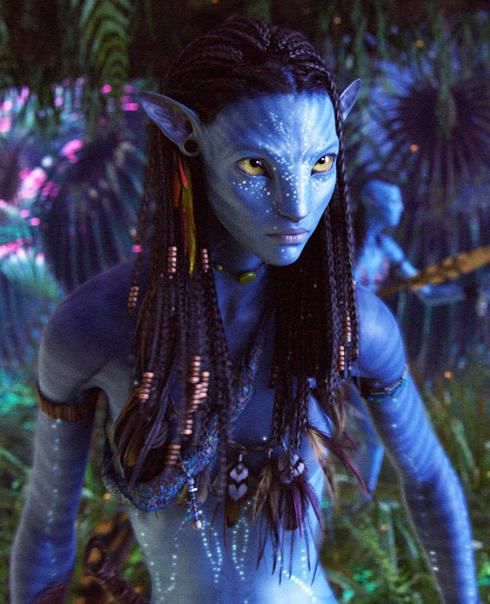
Onto a slightly different topic (but still female-related), there is an interview with James Cameron at Playboy magazine (a bit NSFW for obvious reasons!). He has previously stated that the main female Na’vi character, Neytiri, was designed to be attractive to men (to phrase it politely). This, however, incites fanboys (pathetically immature nerds) to post the nastiest lewd comments imaginable – an example is “Here's A Blueish Pic Of Zoe’s AVATAR Character!!” at Aint’t It Cool (NSFW because of the inane comments). I really wish JC had designed the Na’vi to be more alien – perhaps looking like the “Prawns” in District 9 – this would certainly be more challenging for the audience!
Such comments make me more than a little queasy, perhaps because in some vague way it is threatening to me as a female. A few weeks ago there was a MetaFilter thread, “Hi. Whatcha reading?,” on why women can find remarks or looks from strange men threatening, despite how innocent the latter might be – and there are a lot of responses. Women can never entirely trust male strangers (until proven otherwise) because there is always the prospect of rape. Young men in particular, especially groups of them, are threatening – something I have experienced (from a distance) over the years. If you are a women walking alone and pass a group of young men, they will almost always make lewd comments, even if you are dressed in baggy unattractive clothing. I have quite a few violent fantasies of what I would like to do to them (usually involving dismemberment, disembowelment, throat-cutting, explosions, etc.! If they could see into my mind as I was walking past, they might be more than a little disturbed). Unfortunately, such behavior seems to be inherently (human) male, so I don’t think all the education in the world will change it.
While women certainly do admire men on their physical appearance (I certainly do!), that is different, perhaps because such attention is not potentially threatening to men. Despite what I wrote above, I don’t hate men – but I do despise the badly-behaving ones (of whom there are too many!).
18/11: Tired of telepathy
Another trope I detest in speculative fiction (as well as vampires!) is telepathy. This is perhaps the most overused element, even in otherwise “hard” science fiction (author Anne McCaffrey and the Star Trek series , for example, are notorious for this), yet there is no scientific evidence for it – or other psionic powers. A brain produces very weak electro-chemical signals – what mechanism would be used to “project” these? And how would it be directed? A radio signal goes in all directions, so I don’t see how a single mind could be targeted.
Synthetic telepathy might be possible, though – “Synthetic Telepathy For US Military Borg-Style,” “Nerve-tapping neckband used in ‘telepathic’ chat” – where a neural implant or neck collar converts thought impulses into radio signals that can be transmitted to other implants.
One related aspect of the Avatar movie which bothers me is how the consciousness of the human operators is transferred to their hybrid Na’vi avatars. It seems to be depicted as a literal transfer, where the operator uses some sort of equipment to leave their brain and take up residence in their Avatar’s. The description in the scriptment:
The human volunteer then becomes a CONTROLLER. Using PSIONIC LINK technology, the human controller can remotely control the avatar body out in the wilds of Pandora. The controller receives all sensory input, and provides all motor control to the body. Essentially, the controller lives through the avatar, and is completely unaware of his own body while linked. Each avatar is genetically keyed to its respective human controller. […]
His head is fitted into a helmet-like device … a PSIONIC LINK INTERFACE which senses and transmits his mental energy, as well as filling his brain with the return signal. This is usually called, simply, the LINK. He is under the link because he is spending the voyage linked to his avatar body which is nearby in its own container. Like two twins in the womb they are communing at a deep level of pre-conscious intimacy, with the results that the avatar’s brain has been imprinted with the patterns of Josh’s cerebral cortex. The biological equivalent of initializing the hard-drive in a computer.
Psionics again! Also, in the scriptment ending, Jake’s mind is (spoilers ahead!) permanently transferred to his avatar’s while his human body dies. As one’s mind is, as far as scientists know, inextricably linked with one’s physical brain, I don’t see how such a transferral would be possible.
Perhaps James Cameron was thinking of robot teleoperators when he wrote that, but operators are still in their bodies, only seeing images transmitted from the remote robot. A possibly-plausible version of the avatars would be to use the aforementioned neural implants radio-transmitting images from the visual cortex, but the avatars would have to then be robots (or have much of their brain replaced with robotic controller elements, which is a bit gruesome).
“Ghost in the Shell: Why Our Brains Will Never Live in the Matrix” at h+ asserts that uploading the human mind into a computer or elsewhere – a desire of some transhumanists – is not possible: “biological software is inseparable from hardware.” However, brain transplants into grown clones, or repairing the brain neurons as we age might be possible with future technology. For my part, I would like my body repaired with nanotechnology so it is fully healthy, and the effects of aging kept at bay.
21/11: Hating sleep
“Parisians rue the end of the good nightlife,” The Age/Telegraph, 20/11. An article dispaying the baffling prevailing attitude that people wanting a good night’s sleep are somehow “uncool” or wowsers.
“Over the past 10 years, Parisian musical venues have paid a heavy price due to Parisians’ growing desire for ever-greater tranquillity,” the petition, initiated by an electronic music collective, said. If nothing was done, Paris would be “relegated from the City of Light to the European capital of sleep,” it said.
Oh, the horror! And this is bad, how …? Last year a similar article was published, focused on Melbourne: “Locking out modern life is not the answer,” The Age, 3/6. Apparently people who think night is for sleeping are lazy and wowsers, according to this article’s writer! Humans didn’t evolve as nocturnal creatures, and the current 24-hour modern lifestyle she espouses contributes toward sleep disorders and health problems (“Is 24-hour lighting putting us on a path to depression?,” DM, 23/10; “Cancer risk prompts call for review of shift work,” SMH, 8/1/2008). There is this curious attitude among many that people who go to bed and arise early (as I do!) are somehow odd, while staying up late, or up all night, is seen as trendy and cool. It’s time this ridiculous antipathy towards sleep was challenged. (And I liked Melbourne when it was a “dreary, unexciting provincial city” with “an empty, useless city centre” – it wasn’t plagued by the drunken violence that is endemic now.)
I am usually in bed around 10:30-11:00 p.m., and arise around 4:30 a.m. or so; I guess that makes me really odd :-). And I have been keeping this schedule since the early 1990s!
December
1/12: Exploiting the natives
Those who criticize the movie Avatar’s theme of colonial oppression as being clichéd or no longer relevant should be shown stories like “The World of China Inc.” (TIME magazine, 7/12), where this is still happening – in this case, Chinese companies exploiting Papua New Guinea for its natural resources, despoiling the environment, and some of the native tribal peoples fighting back.
“The Hadza,” National Geographic, December 2009 issue. These people in Tanzania are still managing to live the hunter-gatherer existence they have sustained for 10,000 years, though they are inevitably under threat from outsiders who want to “civilize” them – it seems impossible for outsiders to leave such people alone if they wish to be. If civilization were to collapse, it is these people who would survive best.
What the Hadza appear to offer – and why they are of great interest to anthropologists – is a glimpse of what life may have been like before the birth of agriculture 10,000 years ago. Anthropologists are wary of viewing contemporary hunter-gatherers as “living fossils,” says Frank Marlowe, a Florida State University professor of anthropology who has spent the past 15 years studying the Hadza. Time has not stood still for them. But they have maintained their foraging lifestyle in spite of long exposure to surrounding agriculturalist groups, and, says Marlowe, it’s possible that their lives have changed very little over the ages.
For more than 99 percent of the time since the genus Homo arose two million years ago, everyone lived as hunter-gatherers. Then, once plants and animals were domesticated, the discovery sparked a complete reorganization of the globe. Food production marched in lockstep with greater population densities, which allowed farm-based societies to displace or destroy hunter-gatherer groups. Villages were formed, then cities, then nations. And in a relatively brief period, the hunter-gatherer lifestyle was all but extinguished. Today only a handful of scattered peoples – some in the Amazon, a couple in the Arctic, a few in Papua New Guinea, and a tiny number of African groups – maintain a primarily hunter-gatherer existence. Agriculture’s sudden rise, however, came with a price. It introduced infectious-disease epidemics, social stratification, intermittent famines, and large-scale war. Jared Diamond, the UCLA professor and writer, has called the adoption of agriculture nothing less than “the worst mistake in human history” – a mistake, he suggests, from which we have never recovered.
The Hadza do not engage in warfare. They’ve never lived densely enough to be seriously threatened by an infectious outbreak. They have no known history of famine; rather, there is evidence of people from a farming group coming to live with them during a time of crop failure. The Hadza diet remains even today more stable and varied than that of most of the world’s citizens. They enjoy an extraordinary amount of leisure time. Anthropologists have estimated that they “work” – actively pursue food – four to six hours a day. And over all these thousands of years, they’ve left hardly more than a footprint on the land.
It is a surprisingly informal type of society, and women are not subservient like in some other h-g cultures. They live off the land entirely, with no need for agriculture. It is a hard life, though, and would be difficult for one brought up in civilization to adapt to.
There are things I envy about the Hadza – mostly, how free they appear to be. Free from possessions. Free of most social duties. Free from religious strictures. Free of many family responsibilities. Free from schedules, jobs, bosses, bills, traffic, taxes, laws, news, and money. Free from worry. Free to burp and fart without apology, to grab food and smoke and run shirtless through the thorns.
But I could never live like the Hadza. Their entire life, it appears to me, is one insanely committed camping trip. It’s incredibly risky. Medical help is far away. One bad fall from a tree, one bite from a black mamba snake, one lunge from a lion, and you’re dead. Women give birth in the bush, squatting. About a fifth of all babies die within their first year, and nearly half of all children do not make it to age 15. They have to cope with extreme heat and frequent thirst and swarming tsetse flies and malaria-laced mosquitoes.
For all our technological prowess, are people in modern civilization any happier? More and more to me, the civilization I live in seems sick and dysfunctional; obsessed with consumerism – getting more “stuff” – in a quest to fill an inner emptiness. In the process of this, the environment is being irreparably polluted and damaged, the sixth mass extinction of species silently continues, cities cover the Earth like metastasizing cancers. I almost wish this civilization would collapse, if only to save what is left of nature. Is achieving spaceflight worth destroying the planet we live on? People are not going to leave Earth in droves anytime soon (despite the wishful thinking of “Space Cadets”), yet contempt for environmental concerns is endemic on the space forums I visit (NASASpaceflight.com members, I mean you).
I feel disgust at governments and business (obsessed with the religious cult of this age: the Economy), and despair for the future, which I and the descendants of my generation will have to endure. The predicted disasters – overpopulation, water and food shortages, climate change, destruction of ecosystems, etc. – are already happening, yet governments are only making token efforts at change, such as instigating a dubious “Emissions Trading Scheme” which only benefits parasitical investment bankers (one of the most useless “professions” ever).
Avatar is quite pertinent as it deals with the themes of natives vs. invaders, destruction of the environment, living in harmony with nature, and so on. Though the hunter-gatherer Na’vi in the movie appear somewhat sanitized (I doubt there will be a scene showing the equivalent of eating a baboon’s brains!), not to mention idealized (all tall, very thin, attractive).
The marketing of the movie seems at odds with its philosophy though: it is being sponsored by a well-known soft drink.
“Avatar shares the same aspirational, edgy and unconventional brand values as Coca-Cola Zero,” noted Chip York, worldwide entertainment marketing director at the Atlanta-based beverage giant. “Working so closely with the studio and filmmakers has allowed us to create authentic and exclusive content that provides fans unique access into the world, deepening their Avatar experience.”
That sort of meaningless jargon-infested talk would be utter bullsh*t to the Na’vi (and the real-world Hadza above).
22/12: Avatar seen
Saw Avatar today. As I am not good at writing reviews, some random thoughts:
- I liked the space scenes with the cryogenic chamber and spaceship.
- The hologram computer display screens looked cool!
- The movie did seem very rushed, as many have commented (there were scenes cut out). I don’t think my bladder could have endured much longer, though! (Drinking a coffee before I went in probably didn’t help …) I was getting rather fidgety toward the end as the Last Battle scene did drag on a bit.
- There were a few mawkishly predictable scenes (particularly with the Na’vi, who embody every Noble Savage cliche there is – see also Mighty Whitey and Chief’s Daughter) and quotes (“You are not in Kansas anymore …”and “Get out of Dodge” – will people still be saying that in the 22nd century?).
- WTF is with the smoking?? Not a good image (especially considering there are younger children in the audience).
- The scene of the Na’vi communing with the Tree of Life was very reminiscent of this scene from Baraka (about 4 minutes in).
- The CGI was totally convincing – I could not discern between it and real people. The Na’vi looked real.
- The bioluminescent jungle was awesome! I think most people in the audience loved those scenes.
- Coming out into mundane reality afterwards really sucked.
Non-specific-movie related:
- The 3D did not bother me much at all, despite wearing prescription glasses under the 3D glasses. I found it easier to view if I didn’t try to focus too hard.
- I do wish food could be banned from cinemas (though as they profit from it, that isn’t likely); the person next to me was chowing down stinky popcorn for most of the movie, and I wanted to snatch it off him and dump it over his head! If people can’t go 2 or 3 hours without eating, they are in serious need of help.
In general, though, I enjoyed the movie. It was very different from District 9, and the two can’t really be compared (aside from the basic scenario of a man siding with aliens, which I have no issue with). D9 was more original in plot.
Those of a Conservative political view are taking great offense to Avatar, mainly because of its pro-environmental, “Humans Are Bastards” theme. According to them, environmentalist = Communist. While the message was not too subtle, caring for the environment and not trashing it would surely be just basic common sense (i.e. not fouling one’s own nest, especially the only habitable nest we know of), a view that should transcend politics. I might also add a big “F*ck you” to novelist John C. Wright and his sycophants (and all others of similar views); he has predictable taken offense to the movie’s themes, being a Conservative/Catholic. (I really shouldn’t visit his Livejournal as it tends to raise my blood pressure …)