- Extract from The Complete Book of 1980s Broadway Musicals
- Extract from The Mikado to Matilda: British Musicals on the New York Stage
- Extract from Musicals: the definitive illustrated story
- Links
A small Cats fan page, with book extracts and links.
Extract from The Complete Book of 1980s Broadway Musicals
Theatre: Winter Garden Theatre
Opening Date: October 7, 1982; Closing Date: September 10, 2000
Performances: 7,485
Lyrics: T. S. Eliot; additional lyrics by Trevor Nunn and Richard Stilgoe
Music: Andrew Lloyd Webber
Based on T. S. Eliot’s 1939 book of poetry Old Possum’s Book of Practical Cats (and other writings by Eliot).
Direction: Trevor Nunn (Gillian Lynne, Associate Director); Producers: Cameron Mackintosh, The Really Useful Company Limited, David Geffen, and The Shubert Organization (R. Tyler Gatchell Jr., and Peter Neufeld, Executive Producers); Choreography: Gillian Lynne; Scenery and Costumes: John Napier; Lighting: David Hersey; Musical Direction: Stanley Lebowsky
Cast: Hector Jaime Mercado (Alonzo), Stephen Hanan (Asparagus, Growltiger), Donna King (Bombalurina), Steven Gelfer (Carbucketty), Rene Ceballos (Cassandra), Rene Clemente (Coricopat, Mungojerrie), Wendy Edmead (Demeter), Christine Langner (Etcetera, Rumpleteazer), Betty Buckley (Grizabella), Bonnie Simmons (Jellylorum, Griddlebone), Anna McNeely (Jennyanydots), Timothy Scott (Mistoffolees), Harry Groener (Munkustrap), Ken Page (Old Deuteronomy), Kenneth Ard (Plato, Macavity), Herman W. Sebek (Pouncival), Terrence V. Mann (Rum Tum Tugger), Reed Jones (Skimbleshanks), Janet L. Hubert (Tantomile), Robert Hoshour (Tumblebrutus), Cynthia Onrubia (Victoria); The Cat Chorus: Walter Charles, Susan Powers, Carol Richards, Joel Robertson
The musical was presented in two acts.
Musical Numbers
Act One: “Prologue: Jellicle Songs for Jellicle Cats” (Company); “The Naming of Cats” (Company); “The Invitation to the Jellicle Ball” (Cynthia Onrubia, Timothy Scott); “The Old Gumbie Cat” (Anna McNeeley, Rene Ceballos, Donna King, Bonnie Simmons); “The Rum Tum Tugger” (Terrence V. Mann); “Grizabella, the Glamour Cat” (Betty Buckley, Wendy Edmead, Donna King); “Bustopher Jones” (Stephen Hanan, Anna McNeeley, Bonnie Simmons, Donna King); “Mungojerrie and Rumpleteazer” (Timothy Scott, Rene Clemente, Christine Langner); “Old Deuteronomy” (Harry Groener, Terrence V. Mann, Ken Page); “The Awfull Battle of the Pekes and Pollicles” and “The Marching Songs of the Pollicle Dogs” (Harry Groener, Kenneth Ard, Company); “The Jellicle Ball” (Company); “Memory” (Betty Buckley)
Act Two: “The Moments of Happiness” (Ken Page); “Gus: The Theatre Cat” (Bonnie Simmons, Stephen Hanan); “Growltiger’s Last Stand” (Stephen Hanan, Bonnie Simmons, Harry Groener, Reed Jones, Terrence V. Mann, Timothy Scott, Steven Gelfer); “Skimbleshanks” (Reed Jones); “Macavity” (Wendy Edmead, Donna King, Hector Jaime Mercado, Kenneth Ard, Harry Groener); “Mr. Mistoffolees” (Timothy Scott, Terrence V. Mann); “Memory” (reprise) (Betty Buckley); “The Journey to the Heaviside Layer” (Company); “The Ad-Dressing of Cats” (Ken Page)
Andrew Lloyd Webber’s hit London musical Cats was a hit all over again when it opened in New York and ran for eighteen years. The revue-like musical was based on T. S. Eliot’s 1939 volume of light verse Old Possum’s Book of Practical Cats, but what was whimsical on the printed page became overblown and pretentious in its musical adaptation. A short one-act version might have been mildly pleasant, but a full-length evening of the coy and seemingly endless goings-on among musical-comedy cats quickly became tedious. As a result, Eliot’s amusing words and Lloyd Webber’s music were more satisfying on the cast album than on the stage.
The thin plot dealt with a so-called Jellicle Ball, where the cats cavort and one (Grizabella, an old tabby from a cat house who used to be a prostitute) is chosen to ascend to the Heaviside Layer where she’ll be reborn into new life. The overly grandiose décor depicted a garbage dump where the cats hang out amid huge bottles, cartons, and other junk scaled to the proportions and perspectives of cats. And Grizabella’s ascent to the heavens took place on a science-fiction flying saucer–like contraption that literally propelled her high above the stage and up through an opening in the ceiling.
Cats was a musical for the tourists, a Disneyfied feel-good epic that ushered in the so-called British invasion of Broadway (Lloyd Webber’s Evita had opened in New York three years earlier, but Cats institutionalized British imports on Broadway as a trend that lasted for well over a decade). Cats was also the first in a series of musicals aimed at both tourists and the family trade, and to this day Broadway relentlessly offers children’s musicals, shows aimed at preteens and teenagers, constant revivals of tested family-fare musicals, and a continuing onslaught of jukebox musicals that regurgitate familiar songs from composer catalogs.
Prior to the New York premiere of Cats, one hoped it would live up to its advance reputation as the ultimate in dance musicals. But choreographer Gillian Lynne’s conceptions were mostly of the tried-and-true variety, and they never catapulted the show into the stratosphere. It’s conceivable that a series of electric dance routines created by a Jerome Robbins or a Bob Fosse might have transformed the evening into a memorable one, but Lynne’s creations were at best mildly pleasant.
The critics were generally impressed with the gargantuan production values and the nimble performers but were somewhat disappointed with the weak story line and choreography. But the show’s momentum was unstoppable. The public snatched up tickets, there were touring productions everywhere, “Memory” became one of the few show songs during the era to achieve old-fashioned Hit Parade popularity, and Cats became a musical that everyone seemed to know about, including those who don’t follow Broadway and musical theatre. At the end of the season, the show won seven Tony Awards, including Best Musical.
Frank Rich in the New York Times said that for “purely theatrical magic” Cats “unquestionably delivers.” And while he enjoyed the production values and the “tuneful” songs, he noted that the musical took a “cat nap” during the first act because there was a “lack of spine” to the evening. The show attempted to tell a story and to be the first British dance musical “in the Broadway tradition,” and both attempts failed. The “quantity and exuberance” of Lynne’s choreography didn’t “add up to quality” and there were “repetitive” movements of jazz and ballet “clichés.”
Clive Barnes in the New York Post said the production was a “triumph” for director Trevor Nunn and designer John Napier, but not for Lynne, Lloyd Webber, and Eliot himself. The staging was “sheer genius” and the scenery was “decorative virtuosity,” but there was a “creative paucity” to the choreography, the music was “breathtakingly unoriginal,” and Eliot’s view of cats was “cutesified.” Edwin Wilson in the Wall Street Journal noted that the spaceship-like contraption for Grizabella was “dazzling” and left you “breathless,” but then you started to wonder what it really had to do with Eliot’s “low-key” lyrics and Lloyd Webber’s “simple” melodies. He also noted that many numbers never quit while they were ahead and thus they continued with anticlimactic codas and became “increasingly repetitious.” Ultimately, there was a “wide, sometimes unbridgeable gap” between Eliot’s “simple” and “charming” words and the gargantuan production values.
Howard Kissel in Women’s Wear Daily praised the “superbly unified ensemble” that filled the stage with “excitement” even when there were “long stretches” that lacked “real ideas,” and he noted that Lynne’s dances were “conventional show business routines.” John Beaufort in the Christian Science Monitor suggested the special effects sometimes became “almost too much,” but he liked the score and found the choreography “dazzling.” And while Douglas Watt in the New York Daily News felt the “showy” production was “an overblown piece of theatre” and offered “nothing strikingly original” in its choreography, he mentioned that Lynne and Nunn did “their level best to keep things on the move” during the evening’s “lengthy arid stretches.”
T. E. Kalem in Time said the show was “a spectacle on a grand and staggering scale” that “sweeps you off your feet but not into its arms” because “the spectacle was the substance.” As for Lynne, she was a “fluent” choreographer but an “uninventive” one who relied on jazz, ballet, and acrobatics, all of which “in reiteration” became “anticlimactic.” Jack Kroll with Constance Guthrie in Newsweek said Cats was the “most extravagant” musical import Broadway had ever seen, but despite its “theatrical magic” and “beautiful tunes,” its “pretentiousness sloshes over the stage.”
The musical opened in London at the New London Theatre on May 11, 1981, and ran for a marathon 8,949 performances. Judi Dench created the role of Grizabella and was the first to sing “Memory,” but during previews she injured her leg and had to leave the musical. She was replaced by Elaine Paige. The New York production played for 7,485 showings and as of this writing is the fourth-longest-running musical in Broadway history (and is scheduled to be revived in New York during 2016). Geffen Records released both the London (CD # 2017) and Broadway (CD # 2031) cast albums, and in 1998 the musical was filmed for home video release with a cast that included Elaine Paige, Ken Page, and John Mills (the DVD was issued by Universal Studios).
The program noted that “Prologue: Jellicle Songs for Jellicle Cats” included additional material written by Trevor Nunn and Richard Stilgoe, and the lyric of “Memory” was by Trevor Nunn and was based on poems by T. S. Eliot (“Memory” includes lines from and is suggested by Eliot’s “Rhapsody on a Windy Night” and other poems of his “Prufrock” period). Further, some of the lyrics for “The Marching Song of the Pollicle Dogs” and “Grizabella, the Glamour Cat” were discovered among unpublished works by Eliot. The program notes also indicated the musical’s prologue was based on ideas from Eliot’s unpublished poem “Pollicle Dogs and Jellicle Cats,” and Growltiger’s aria was taken from an Italian translation of Old Possum’s Book of Practical Cats.
Awards
Tony Nominations and Awards: Best Musical (Cats); Best Featured Actor in a Musical (Harry Groener); Best Featured Actor in a Musical (Stephen Hanan); Best Featured Actress in a Musical (Betty Buckley); Best Director of a Musical (Trevor Nunn); Best Book of a Musical (T. S. Eliot); Best Score (lyrics by T. S. Eliot and music by Andrew Lloyd Webber); Best Scenic Designer (John Napier); Best Costume Designer (John Napier); Best Lighting Designer (David Hersey); Best Choreographer (Gillian Lynne)
Extract from The Mikado to Matilda: British Musicals on the New York Stage
(1981/1982)
A sung-through musical, based on T. S. Eliot’s poetry collection
Old Possum’s Book of Practical Cats
Score: Andrew Lloyd Webber (music), T. S. Eliot, Trevor Nunn, Richard Stilgoe (lyrics)
Original London production: 11 May 1981; New London Theatre; 8,949 performances
Original New York production: 7 October 1982; Winter Garden Theatre; 7,485 performances
Notable songs: Memory; Grizabella, the Glamour Cat; Bustopher Jones; The Moments of Happiness; The Journey to the Heaviside Layer; Jellicle Songs for Jellicle Cats; Old Deuteronomy; Macavity; The Old Gumbie Cat; Mungojerrie and Rumpleteazer; Mr. Mistoffolees; Rum Tum Tugger; Skimbleshanks; Gus, the Theatre Cat; The Ad-dressing of Cats; The Ballad of Billy M’Caw
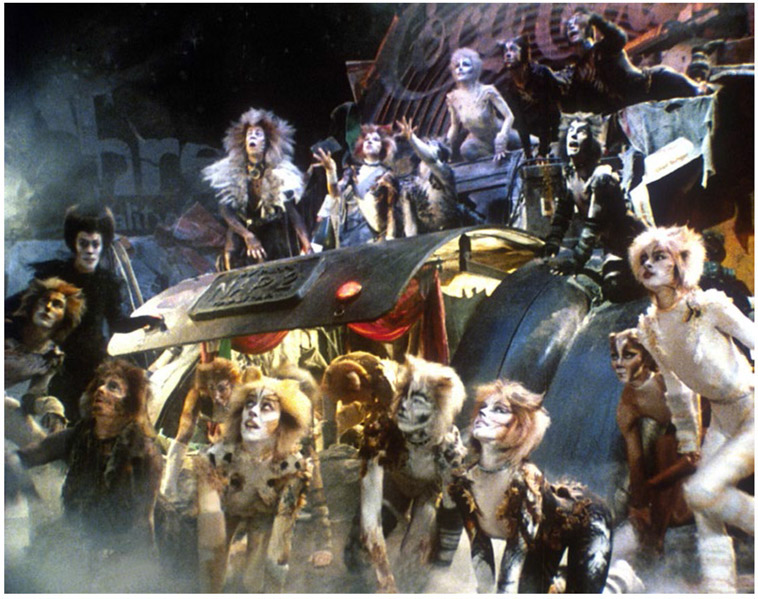
Not until The Lion King (1997) would a musical featuring only animal characters find such success on the musical stage. Shown here are members of the original cast of the 1982 record-breaking Broadway production. Photofest
A musical that some love to hate and others hate to love, Cats was nothing less than a theatre phenomenon. It is also a somewhat inexplicable megahit. The musical has no plot, no character relationships of any kind, and (of course) no humans in sight. What it did have is some beloved poetry turned into lyrics, vibrant music by Andrew Lloyd Webber filled with variety and vivacity, a runaway hit song, and a spectacular production with outstanding dance and design elements. It was a surprise hit in London, but one can argue that the source material, T. S. Eliot’s 1939 clever collection of poems titled Old Possum’s Book of Practical Cats, was a particular favorite in the British Isles, never out of print and over the years published in several editions with illustrations by various artists. Yet Eliot’s feline poetry was not nearly as popular in the States and Cats was a giant hit on Broadway and on tour. In fact, it became an international success and revivals have been presented both in London and New York, so one cannot dismiss Cats as just a phenomenon of its day. Yet the question remains: why is Cats such a sensation? One cannot attribute its triumph to mankind’s affection for pet cats. The feline characters on stage suggest cat-like moves and attitudes, but each is very human in its speech and personality. The musical is not using cats as a symbol; the whole enterprise is not a statement about life or something universal. (Theatre legend has it that when American producer-director Harold Prince was in London to meet with Lloyd Webber about directing The Phantom of the Opera, the composer took Prince to see Cats. The American was puzzled afterward and asked Lloyd Webber what it all meant. The composer told him it was just about cats, nothing more.) Yet director Trevor Nunn, who helped fashion the poems into a theatrical piece, called it a “dance musical” at first, then, as he developed Cats, saw it as a musical about redemption. Audiences didn’t ask what Cats was about. They just bought tickets and enjoyed themselves.
Like many British children, Lloyd Webber first fell in love with Eliot’s Old Possum’s Book of Practical Cats when his mother read the poems to him at bedtime. Also like many others, he committed some to memory and his affection for the poems never faded away. In 1977 Lloyd Webber started putting a few of his favorite poems to music for his own enjoyment. Three years later, a handful were performed at the summer Sydmonton Festival on Lloyd Webber’s country estate. In attendance was Valerie Eliot, the great poet’s widow, who was so pleased with the result that she agreed to a full-length musical based on Old Possum’s Book of Practical Cats as long as the poems were not altered and were not fashioned into a story with dialogue. A musical without a story posed a problem, but Lloyd Webber and director Trevor Nunn and choreographer Gillian Lynne agreed that dance would be the unifying factor, the unsung ten-minute Jellicle Ball being the climax of the production. While looking through some unpublished material Mrs. Eliot had given the creative team, Nunn found a fragment that referred to the “Heaviside Layer” and another, titled “Rhapsody on a Windy Night,” which Nunn rewrote as the lyric for “Memory,” the musical’s runaway hit. It was also Nunn who discovered the fragment about the faded “glamour” cat Grizabella, who was not in the published collection, and used her as the thread to hold the musical together. Unlike the other cats, who were introduced and then seem to disappear, Grizabella would return and, with the help of the other recurring character, Old Deuteronomy, she would ascend to the Heaviside Layer, a symbolic heaven of sorts. (Also, a section of Eliot’s Four Quartets were used for the short song “The Moments of Happiness.”) Cats was still thought of as a dance piece and all the characters would be cast with dancers. Rehearsals did not go smoothly, as the dancers/actors were confused about being in a musical that was so much a series of character specialties, and Judi Dench, who was playing Grizabella, injured a tendon in her heel late in the rehearsal process and was out of the show. There was also difficulty in raising the required 500,000 pounds for the elaborate show that involved a large cast, a complex setting (a junk-filled alley) with oversized props, and intricate costumes and makeup. Thirty-four-year-old producer Cameron Mackintosh, with only a few London credits to his name, joined with Lloyd Webber’s Really Useful Group to present Cats in the unpopular New London Theatre, which had an auditorium that swept around the stage on three sides. Scenic and costume designer John Napier used the odd space effectively, letting the set and the props spill out into the auditorium. Because there was so much dance in the musical, Lynne was made associate director. Dench was replaced by Elaine Paige, London’s original Evita (1978), as Grizabella, and Cats opened in 1982 to a very dubious future. Lloyd Webber had mortgaged his Sydmonton estate to finance the production, and Mackintosh had to take out ads in newspapers to find 250 investors willing to gamble on such an unlikely enterprise.
The London critics were not bothered by the lack of plot. On the contrary, for the most part the reviews were exemplary. The fondness for the Eliot poems was not diminished by putting them to music, and several critics pointed out the diversity of Lloyd Webber’s music. But most of the praise was for the dazzling production, from the ingenious design and the sprightly choreography to the adroit performances and Nunn’s directorial precision. At the same time, the London notices did point out that Cats was more entertainment than substance. As the London Observer commentator put it, “Cats isn’t perfect. Don’t miss it.” When the musical opened in New York a year and a half later, the Broadway critics were, for the most part, vicious. It was not the production itself that was the target of their disapproval, but the concept of a plotless musical about cats and Lloyd Webber’s music. Frank Rich, in the still-powerful position of critic for the New York Times, provided one of the few complimentary notices, noting that Cats “transports the audience into a complete fantasy world that could only exist in the theatre.” The Broadway production differed slightly from the London original. The interior of the Winter Garden Theatre, a traditional proscenium playhouse, was painted black and Napier redesigned his set so that it still extended out into the auditorium. There were a few changes in the musical numbers (the very-English “Ballad of Billy M’Caw” was replaced by an Italianate opera duet spoof and the music for “Mungojerrie and Rumpleteazer” was rewritten) but there were no attempts to Americanize the musical for audiences less familiar with Eliot’s original poems. None were needed, and Cats was as popular in New York as it was in London. Betty Buckley and Ken Page were the first of many Grizabellas and Old Deuteronomys, and some other members of the original cast went on to notable careers. One member of the chorus, Marlene Danielle, remained in the Broadway production throughout its entire eighteen years. Cats broke the record in both London and New York for the longest-running musical and held that position until Lloyd Webber’s The Phantom of the Opera came along.
| Character | 1981 London cast | 1982 New York cast |
|---|---|---|
| Grizabella | Elaine Paige | Betty Buckley |
| Old Deuteronomy | Brian Blessed | Ken Page |
| Mr. Mistoffelees | Wayne Sleep | Timothy Scott |
| Gus the Theatre Cat | Stephen Tate | Stephen Hanan |
| Macavity | John Thornton | Kenneth Ard |
| Jennyanddots | Myra Sands | Anna McNeeley |
| Rum Tum Tugger | Paul Nicholas | Terrence Mann |
| Munkustrap | Jeff Shankley | Harry Groener |
| Bombalurina | Geraldine Gardner | Donna King |
| Bustopher Jones | Brian Blessed | Stephen Hanan |
| Mungojerrie | John Tornton | Kenneth Ard |
| Rumpleteazer | Bonnie Langford | Christine Langner |
| Skimbleshanks | Kenn Wells | Reed Jones |
| Jemina | Sarah Brightman | Carol Richards |
| Growltiger | Stephen Tate | Stephen Hanan |
The haunting ballad “Memory” was not only the hit song of the musical, it went on to become the most successful theatre song of its era, with hundreds of different recordings internationally. Lloyd Webber had written the basic melody some years before, and it was considered for his musical Evita in 1978. While some music critics have taken Lloyd Webber to task because the music in “Memory” echoes Ravel’s Bolero in spots and there are supposedly snippets of music by others (including the flute solo in the Mamas & the Papas’ recording of “California Dreamin’”), the full composition is a wondrous piece of melody and harmony and very much in the Lloyd Webber style at his best. Nunn’s lyric, adapted from some phrases in Eliot’s work, is equally responsible for the success of the song. The imagery is simple but unforgettable. The way “Memory” is introduced in bits and pieces in Cats then finally sung in its entirety near the end of the show is not only theatrically potent but also helps unify the very scattered musical. No other song from Cats became popular on its own (though the cast recordings were bestsellers) because they are very specific character numbers. Poems do not always transfer to commendable song lyrics but Eliot’s feline verses are whimsical and playful in such a way that they often soar when set to music. Some poems suggested a certain kind of music, such as Old Deuteronomy’s hymn-like “Ad-dressing of Cats” and the rock star panache of “Rum Tum Tugger.” The minor-key “Grizabella, the Glamour Cat” has a funeral march tone while the fat gentlemanly “Bustopher Jones” has a lazy, debonair flavor. Many times Lloyd Webber was free to exercise his musical prowess with such varied musical styles as a languid waltz for “Old Deuteronomy,” a bluesy sound for “Mccavity the Mystery Cat,” 1940s jitterbug in “The Old Gumbie Cat,” 1960s pop music in “Jellicle Songs for Jellicle Cats,” a merry sing-along style for “Mr. Mistoffelees,” and rhythmic traveling music for “Skimbleshanks the Railway Cat.” Such a varied score opened possibilities for choreographer Lynne, so Cats was as thrilling physically as it was musically.
Talk of a film version of Cats, both animated and live action, has circulated for decades. In 1998 a video version was filmed in a London theatre with British and American cast members headed by Elaine Paige as Grizabella and Ken Page as Old Deuteronomy. Also featured was renowned English actor John Mills as the aged Gus the Theatre Cat. The video was a restaging of the London original and is a valuable record of that celebrated production. A 2019 screen version of Cats, directed by Tom Hooper, offered a starry cast that included Jennifer Hudson (Grizabella), Judi Dench (Old Deuteronomy), Ian McKellen (Gus the Theatre Cat), Taylor Swift (Bombalurina), James Corden (Bustopher Jones), and Idris Elba (Macavity).
Extract from Musicals: the definitive illustrated story
From Musicals: the definitive illustrated story
Cats (1981)
KEY FACTS
STAGE
Director: Trevor Nunn
Lyrics: T. S. Eliot
Music: Andrew Lloyd Webber
Set and costumes: John Napier
Venue: New London Theatre, London
Date: May 11, 1981 Key information
The show won two Olivier Awards: Musical of the Year; and Outstanding Achievement of the Year in a Musical for choreographer Gillian Lynne. The 1983 Broadway production won seven Tony Awards: Best Musical; Best Book of a Musical, Best Original Score; Best Featured Actress in a Musical (Betty Buckley); Best Costume Design, Best Lighting Design; and Best Direction of a Musical.
Who could have imagined that a poetry collection with neither plot nor story would provide the inspiration for a show that would transform musical theater forever? Cats took this genre to new levels of creativity and success.
As a child, Andrew Lloyd Webber had loved reading Old Possums Book of Practical Cats (1939), a book of poetry by T.S. Eliot, and he began setting Eliot’s verse to music in 1977. In order to experience how it felt to set music to pre-existing text, Lloyd Webber worked without a lyricist. However, with the rock musical Evita still in development, he kept the Eliot project on the back burner.
GRIZABELLA, THE GLAMOUR CAT
By the summer of 1980, Lloyd Webber was ready to perform some of his Eliot settings at his Sydmonton Festival. At this point, he was still thinking of the project as a possible television concert anthology. Eliot’s widow, Valerie Eliot, attended one of the performances, bringing several unpublished pieces to offer Lloyd Webber. It was this new material, particularly “Grizabella, the Glamour Cat,” that made him reconsider the project as a possible stage production.
Lloyd Webber enlisted renowned British theater director Trevor Nunn as a collaborator to help shape the show, which now included even more new material from Eliot’s widow. Nunn, realizing the importance of the spectacle, put together a team that included choreographer Gillian Lynne, set and costume designer John Napier, and lighting designer David Hersey.
INJURED DENCH BOWS OUT
By spring of 1981, rehearsals had begun for the London opening. Judi Dench, a British actress mainly known at that time for her work in Shakespearean roles, was to have played the pivotal character of Grizabella, but she snapped her Achilles tendon during rehearsal and was replaced by British singer and actor Elaine Paige. On May 11, 1981, Cats opened at the New London Theatre – its record-breaking run had started.
Cats went on to set a new benchmark for success in musical theater. Prior to Cats, most highly successful musicals started on Broadway and then opened productions in other cities after that. Cats continued the trend started by Jesus Christ Superstar and Evita, originating in London and then transferring to Broadway and the rest of the world. By 2014, Cats had been presented in more than 300 cities in more than 30 countries worldwide. Translations of the show have been written in Japanese, German, Swiss German, Hungarian, Norwegian, Finnish, Dutch, Swedish, French, Mexican Spanish, Argentinian Spanish, and Italian.
UNIVERSAL APPEAL
But language alone was never at the heart of Cats; its success was firmly rooted in the spectacle of scenery, costumes, lighting, makeup, and choreography. For example, the costumes Napier designed, along with the makeup, not only blended human and cat characteristics, but helped project the distinctive personality of each feline character. Napier’s set had very little in the way of magical onstage transitions, but the ambitious environmental setting put the audience in the middle of the action, with the characters moving from among the audience on to the stage. Cats, with its strong characters and simple story to follow, transcended all age and language barriers, and non-English speaking tourists seeing the show in London or New York did not lose out on a moment of the magic. The original West End production ran for an astonishing 21 years and held the record for longest-running London musical until Les Misérables overtook it in October 2006. The Broadway production was also a record-breaking success; it ran for 18 years, becoming the longest-running Broadway musical ever, although the Phantom of the Opera and the revival of Chicago later overtook it. Two generations of musicals fans grew up having Cats as their first experience of live theater.
STORYLINE
The theatrical event celebrated in Cats is a captivating spectacle set to the evocative poetry of T.S. Eliot, breaking with the long-standing tradition of a musical driven by a plot or story. The action takes place in a “giant playground for cats,” which is in fact a garbage dump, and the scenes are based around the cats’ interactions, thoughts, and experiences as described in Eliot’s poems.
CAST
Elaine Paige: Grizabella
Brian Blessed: Old Deuteronomy/Bustopher Jones
Sharon Lee-Hill: Demeter
Sarah Brightman: Jemima
Wayne Sleep: Quaxo/Mistoffelees
Jeff Shankley: Mankustrap
Bonnie Langford: Rumpelteaser
Paul Nicholas: Rum Tum Tugger
Finola Hughes: Victoria
PHOTO CAPTIONS
Image: Top cat
Elaine Paige originated the part of Grizabella for the original West End production.
Image: Cat’s eyes
Yellow cat's eyes staring out of the darkness, used here on the poster, created an instantly recognizable “identity” for the show.
P229:
Image: Feline playground
John Napier’s set, with its junkyard props, including trash cans and wrecked cars, created a sense of a parallel cat world.
Biographies
T.S. ELIOT (1888-1965)
Born and raised in Missouri, Harvard-educated Thomas Stearns Eliot moved to London in 1914, marrying in 1915. While working variously as a teacher and banker, he published his poetry under the mentorship of American expatriate poet Ezra Pound (1885-1972), who nicknamed Eliot “Old Possum.” Eliot became a British citizen in 1927. In 1948, he was awarded the Nobel Prize for Literature.
ELAINE PAIGE (1948-)
Paige, born Elaine Jill Bickerstaff in North London, made her West End debut in Hair in 1968, but Evita made her a star. After Evita, she continued to work with Andrew Lloyd Webber, starring as Grizabella in Cats and Norma Desmond in Sunset Boulevard. Paige also worked with Tim Rice on the musical Chess (1986). A single from Chess, “I Know Him So Well,” sung by Paige and Barbara Dickson, remains the top-selling female duet in UK chart history.
Links
- Cats musical wiki
- Cats the Musical – official site (and The Story of Cats; previous archived site versions)
- r/Movies: Official Discussion: Cats (note: Reddit users predictably hated it, so reviews are overwhelmingly negative; I feel differently – see my 20/5/2023; 15/1/2024, 7/4/2024, 20/6/2024 Journal entries).
Linked from Links page