Russian spacesuits
Details of the Russian Orlan spacesuit and Sokol pressure/rescue suit currently used in the ISS program. All Russian space- and pressure suits are named after birds. Orlan is Russian for “Sea Eagle” and the suit worn on the Soyuz spaceship is the Sokol or “Falcon”.
Predatory space birds: features of the names of Russian spacesuits
12/6/2022
Surely you heard these words in live broadcasts – “Falcon,” “Orlan,” “Berkut.” «Сокол» (Sokol), «Орлан» (Orlan), «Беркут» (Berkut). All these are the names of Soviet and Russian spacesuits used in astronautics. What types of spacesuits exist and where did the “bird” names come from – we tell in the Pro Space media material, created specifically for the Roscosmos State Corporation.
It all started back in the 1950s, when Plant No. 918 (now the Zvezda Research and Production Enterprise) began to produce space suits, helmets and ammunition for high-altitude aviation and stratonautics. It was in the late 50s that they began to use shoulder hinges, removable sealed gloves, oxygen masks and helmets in pressure suits. For example, look at the photo of the SI-3M high-altitude spacesuit, which still looks stylish. In such a suit, you can safely jump from the stratosphere from a height of 30 km.
The next step was the famous SK-1, which was worn by the astronauts of the Vostok spacecraft. And its modification SK-2 is for the first set of female cosmonauts. It was SK-1 that became the world’s first space suit. In total, 41 spacesuits of this type were created, including two pieces for Valentina Tereshkova and her understudy Irina Solovyova. The suit was used on the ships Vostok to Vostok-6.
The astronauts of Voskhod-1 went into space without space suits. Alexei Leonov and Pavel Belyaev on Voskhod-2 were to fly for the world’s first spacewalk. Both were dressed in Berkut spacesuits – the first product of Zvezda which was called the “Bird of Prey.” Since traditions are loved in aviation and astronautics, and there are superstitions, this has been the custom since Leonov’s spacewalk. A tradition arose to give names to Soviet and Russian spacesuits in honor of birds of prey.
After the return of Leonov and Belyaev to Earth, the Zvezda engineers read all the cosmonauts’ reports regarding the shortcomings of the Berkut spacesuit. And it was radically finalized – first of all, they added rigidity to it. It was because of the inflation of the Berkut that Alexei Leonov could not get back into the Voskhod-2 ship for a long time, he had to greatly relieve pressure.
The modified suit was named “Hawk,” «Ястреб» (Yasteb) and was used during the docking of Soyuz-4 and Soyuz-5. The astronauts were crossing open space in new VKD spacesuits. Exactly the same suits were on board Soyuz-7 and Soyuz-8, but they were not required. During the group flight of the three spacecraft Soyuz-6, Soyuz-7 and Soyuz-8, docking was not performed due to the failure of the electronics of the Igla automatic docking system.
Immediately after the “Hawk” in the family of birds of prey, another “chick” appeared – the spacesuit “Krechet,” «Кречет» for finding an astronaut on the surface of the moon. Unfortunately, the Soviet lunar program was closed – the spacesuit was never used for VKD.
After the death of the Soyuz-11 crew, the Sokol-K, «Сокол-К» rescue suit was developed, which was successfully used on spacecraft from Soyuz-12 to Soyuz-40. Sokol-K was created on the basis of the Sokol aviation spacesuit. Immediately after the creation and successful use of the Sokol-K, the Zvezda Research and Production Enterprise began to prepare its modification, which was called the Sokol-KV. “KV” was never used in space, only six spacesuits were developed for testing and training.
Thanks to the Sokol-KV, the legendary and most-used space suit in the world, the Sokol KV-2, was developed. It had two modifications – the first was operated from 1980 to 2002, and the second – from 2002 to the present time. In the second version, the suit became more ergonomic, comfortable and intuitive.
At the same time, the Sokol KV-2 also had a special modification for ejecting astronauts from the cockpit of the Buran spacecraft. It was called Swift, «Стриж» (Strizh) but was never used for manned flights (even on Soyuz). The main difference from the KV-2 was the khaki color, double glazing of the helmet, parachute and fire resistance. As you can see, space suits do not deviate one iota from the role of birds of prey in the life of astronauts.
The Swift also had a slightly simplified version – the high-altitude spacesuit “Cormorant,” «Баклан» (Baklan) for long-range military pilots. In general, it is similar to the Sokol-K converted for aviation.
Although the lunar “Krechet” was never used in space, it also gave “offspring.” Thanks to it, a whole family of VKD spacesuits appeared – the semi-rigid Orlans appeared thanks to the lunar program. “Orlan” has been in operation since the time of “Salyut-6” in 1978 and has six modifications – “D,” “DM,” “DMA,” “M,” “MK” and “MKS.”
The cosmonaut’s prophylactic load suit also received a bird’s name – it was called “Penguin,” «Пингвин» (Pingvin) The bird, although flightless, is predatory. Moreover, under water during the hunt, the penguin moves so grandiose that associations with flight involuntarily arise. The suit was used to create a load on the cosmonaut’s musculoskeletal system at the station. From here it got its name – because of the similarity of the figure of an cosmonaut, bent by the elastic elements of the suit, and an ordinary penguin.
Space suits and suits for space are not the only direction that has received animal names in Russian cosmonautics. One can recall the “Trout,” «Форель» (Forel’) wetsuit for rescuing astronauts after splashdown and the “Komar,” «Комар» (Komar) rescue radio beacon.
The tradition of naming spacesuits seems very beautiful to us. We look forward to the creation of Sokol KV-M and Orlan-L; let them continue the glorious tradition!
Orlan
- Terminology
- Development
- Orlan-M
- Orlan-MK
- Orlan-MKS
- Water cooling garment
- Orlan chronology
- Diagrams
- Gallery
- Links

The Russian spacesuits in use aboard the International Space Station are the latest variant of the Orlan series. Other previous suits have been:
- «Стриж», Strizh or “Swift,” intended for the Buran space shuttle.
- «Ястреб», Yastreb “Hawk” and «Беркут», Berkut “Golden Eagle” suits worn on Voshkod and early Soyuz flights.
- «Кречет», Krechet or “Gerfalcon” suit intended for the Soviet Moon landing program.
Like previous Orlan versions, the Orlan-M and -MK made by the Research, Development & Production Enterprise Zvezda (НПП «Звезда»), the company which has produced all Russian spacesuits and survival equipment since it was established on 2 October 1952. They are located in Tomilino, Moscow region.
Terminology
The Russian word for spacesuit is skafandr, скафандр (plural skafandry, скафандры). The “M” stands for modernized, modernizirovannyi, модернизированный. Russians don’t seem to have a formal acronym for a spacewalk (as in EVA). These terms are generally used:
- VKD, vnekabinnaya ili vnikorabel’naya deyatel’nost’, внекабинная или вникорабельная деятельность – translating roughly as out-of-cabin or -ship activity/work. (Thanks to Olaf Neumann for this)
- Vykhod v otkrytyi kosmos, выход в открытый космос – “going out into open space” (from Levan)
- Someone on the Novosti Kosmonavtiki forum suggested: ВКД (Внекорабельная Деятельность).
- “Vykhod” has also been used in the NASA On-Orbit Reports (выход, plural выходы – literally “exits”).
Development
ESA and Zvezda had begun development work on a joint spacesuit called EVA SUIT 2000 in the early 1990s, but this was canceled late in 1994 due to financial constraints on both sides. In 1995, when the Shuttle-Mir and ISS programs were underway, Zvezda decided to modify its next batch of Orlan-DMA suits destined for Mir with various improvements. Orlan-M suits numbered 4, 5 and 6 were delivered to Mir in 1997 and used for 36 spacewalks.
Zvezda and the U.S. manufacturer of NASA’s EMU suits, Hamilton-Sundstrand have also co-operated in ISS spacesuit development. Two Orlan suits were delivered to support training in the NASA hydrolab. The Orlan was also enabled so it could be used in the U.S. joint airlock, Quest, via a portable unit called the BSS-2M, БСС-2М; it is a suit control panel (БУС, BUS) and a bundle of hoses with electric cables. Parts from the U.S. EMU spacesuits can also be used in the Orlan-M, e.g. the headlamps and drinking water supply.
A main characteristic of all Russian Orlans is the duplication of all main life-support systems. There are two fans, two pumps, two hermetically-sealed shells, two sealed glass visors, two oxygen cylinders. Even if the metallic cuirass, made from an aluminum alloy, suddenly on cracks for some reason, this is not a disaster. From inside it is covered with a rubberized fabric.
What is the difference between Russian and American suits?
We have the Orlan, they have the EMU (Extravehicular Mobility Unit). The astronaut, who is to work overboard, climbs into the “halves” of the spacesuit, and a colleague helps to dock the “torso” and “trousers”. You can safely enter our Orlan alone through the door in the dorsal satchel.
In EMU, the pressure is lower than in the Orlan, so it is easier to move in a vacuum. Its gloves are softer and more elastic, but they fit so tightly in the palm that Americans are faced with the problem of frostbite on the fingertips. We had to install heaters. Due to the lower pressure in the American space suit, the process of removing nitrogen from the blood before work in outer space takes longer.
The Russian space suit is simpler in terms of desaturation (the pressure in it is higher), but the movements are more constrained. As for the tactile sensitivity of the Orlan gloves, this indicator is not critical: the entire working tool is designed to be taken and held roughly enough. The most delicate operation is the docking and undocking of electrical connectors, but they are also adapted so that they can be handled with gloves.
– Roskosmos, VK wall post, 11/5/2023
Orlan-M
The Orlan-M is a spacesuit of the semi-rigid type, with a hard aluminium-alloy torso (cuirass) and arms and legs made of a softer material. It is an improved version of the previous spacesuit, the Orlan-DMA, taking into account the operational experiences of those using this spacesuit. It is strictly for zero-gravity use; its current design could not be used on the Moon or Mars as it is too heavy.
- The Orlan-M can accommodate a greater range of anthropometric sizes: 165 cm to 190 cm height (instead of 185 cm for the DMA) and up to 112 cm for chest diameter (instead of 108 cm). The Orlan can be adjusted to fit different wearers by lengthening or tightening straps in the arms, legs and torso (as shown in the diagram below). Maximum chest diameter is 112 cm; maximum height is 190 cm. The arms can also be removed and replaced with new ones if damaged (eg. by a meteorite or space debris puncture).
- Radio communications have been modified so that two cosmonauts can speak and listen to each other simultaneously (which they couldn’t in the previous Orlan version).
- The metallic cuirass (the suit’s hard aluminium-alloy torso) is increased in size as are the arm and leg openings for the greater range of wearers’ heights. On the cuirass are fixtures for attachment of the USK, Cosmonaut Self-Rescue Device (УСК).
- An additional visor enhances the upper field of view and helps prevent the original one from misting up.
- A variable-length safety tether widens the cosmonaut’s area of operation.
- Improvements were also made in the ankle and pressure bearings; mobility and strength of the pressure gloves; a more reliable wrist pressure disconnect; back-up pump; snap hook for the safety tethers; fan, radio set, and the absorption capacity of the CO2 cartridge.
- The Orlan can be used in both the Pirs and U.S. Quest airlocks (the U.S. EMU can only be used in Quest).
- Some American EMU equipment, such as a 350 ml drink bag, side headlights and “Pampers” urine-absorbing garment, can also be worn.
- If a spacesuit’s serial number has a last even digit (2, 4, 6, etc.), then the spacesuit has blue stripes, if a last odd digit (1, 3, 5, etc.), then red stripes – a tradition of NPP Zvezda. (Via Anik)
-
From a webpage at the Made in Russia site:
Scientists pay special attention to ensuring the durability of spacesuits. A tiny particle of one tenth of one millimeter flying in outer space at 20 kilometers a second or so can break the spacesuit. Tests carried out on the Earth have proved this. In special devices tiny particles were accelerated at several kilometers an hour and were directed on a fragment of the fabric used for making the spacesuits. Particles of half millimeter in diameter broke through all the layers of the fabric easily. Though arrows of that size are unlikely to hit the cosmonaut’s spacesuit the designers have taken into account such a possibility. If the spacesuit is damaged, a special system is switched on and will maintain the required pressure inside the spacesuit during 30 to 50 minutes, depending on the size of the hole. This will make it possible for the cosmonaut to return to the station.
-
From ESA’s EVA Blog:
According to Gerhard Thiele, sneezing inside the EVA helmet is to be avoided at all costs “It’s a mess!” And if you get an itch, you might be able to rub up against the spacesuit, but other than that, there is not a lot you can do in an American EVA spacesuit. If however you are lucky enough to be in a Russian Orlan suit, there might be a solution. “There is a bit more room in the Orlan,” Thiele explained. “You can lean to one side and pull your arm out of the glove and sleeve. But mostly you are so concentrated during the spacewalk, that you might not even notice an itch.”
- Helmet lights were first introduced on Orlan-DM spacesuits (first use: 2 August 1985) on the Salyut-7 station. These lights had two filament lamps in each light. They were used in subsequent spacesuit versions until 22 February 2007 (Orlan-M). From then, a different type of light with 42 diode lamps in each light was used. A combination of Russian and US lights was also used on some ISS spacewalks. (Source)
-
The outer layer is made of Phenylon®, as described in this Nasaspaceflight.com post:
As I understand it Phenylon® is a Russian tradename for a material equivalent to Dupont’s Nomex® 0150 otherwise know to chemists as poly(m-phenylene isophthalamide) or PMPI for short.
This is a high-performance polymer, with high thermal and mechanical resistance, described by Dupont as “inherently flame-resistant, high-temperature fiber that will not melt, drip or support combustion in air. It also delivers outstanding resistance to a broad range of chemicals and is offered in paper, felt, fabric and fiber forms”
The natural color of Nomex® is usually described as “off-white” or “ivory,” and many variants are classed as non-dyeable.
The Orlan operates at a pressure of 0.4 atmospheres (EMU at 0.3 atm.), enabling a pre-breathe time of only 30 minutes (in the EMU pre-breathe is 12 hours in the Joint Airlock, or 4 hours in the EMU itself). The drawback is that the higher pressure means that the Orlan is somewhat more difficult to move in.
Before climbing into the Orlan, the wearer first dons long white underwear, then the blue-colored cooling garment, which is interlaced with cooling tubes through which water flows.
The Orlan is easily donned; the user floats into it via the backpack, whose door swings open like a refrigerator’s. All essential equipment in the backpack – hermetically-sealed shell, fans, water pumps, pressure regulators, oxygen cylinder, radio, etc. – has backups/duplicates. (NASA considers its EMU’s systems completely reliable, so they are not duplicated.)
The suits must be maintained and repaired in orbit by the on-board crew with special tools; they are not returned to Earth for maintenance as there is no room in the Soyuz spaceship. The Orlan has a useful life of 4 years or up to 15 EVAs, limited by its pressure bladder which is made of natural rubber (which deteriorates over time).
The suits are usually bundled into a Progress cargo ship and burn up when the ship is undocked and enters the atmosphere. Unfortunately this means that few suits worn in orbit will make it to museums, though removable parts of the suits (gloves, visors) can be souvenired and taken back to Earth.
A new scheme is to fit the suit to be discarded with amateur radio communications equipment, push it from the ISS during a spacewalk and turn it into a “SuitSat,” an orbiting Amateur Radio transmitter! The first was “launched” on 3 February 2006 by Expedition 12, to orbit for a few weeks before atmospheric drag pulled it towards Earth.
During Expedition 14’s stay in 2006, Suit №26 developed a leak and spare parts arrived on Progress M-58: two new arms that were attached by Mikhail Tyurin on 14 November (see photo ISS014-E-07859.jpg). A new leg was brought up on M-59. This would prolong the suit’s life until December 2007 (originally set to expire in December 2006).
| Official name | Orlan-M spacesuit, «Орлан-М» скафандр |
| Description | This spacesuit of the semi-rigid type was an Orlan-DMA spacesuit modification. The Orlan-M design took into account the experience of Orlan-DMA operations on Mir and the additional requirements imposed by operations on the ISS. The suit underwent the following modifications:
Power supply, radio communication and telemetry were available for self-contained mode (from the backpack) and via the 25-m electrical umbilical from the station. Owing to the above, the service characteristics (mobility, donning/doffing, field of view, etc.) were improved. The anthropometric ranges of chest circumference and height were improved (96-112 cm and 164-190 cm, respectively). The suit was provided with attachment points for SAFER. |
| Utilisation (operations) |
|
| Development and operation dates | Development and tests: 1995-1997. Nominal operations: 1997-up to the present |
| Quantity of manufactured spacesuits (as at 31 December 2002) |
|
| Nominal duration of the autonomous mode | 7 hours |
| CO2 absorption cartridge operating time (with airlock time included) | 9 hours |
| Suit positive pressure |
|
| Spacesuit pressure |
|
| Oxygen available (main and back-up) | 1 kg each |
| Amount of O2 emergency supply, manually activated (kg hr1−1) | 2 |
| Cooling water available | 3.6 kg |
| Assured heat removal |
|
| Total consumed power by the suit systems | Up to 54 W |
| Quantity of telemetry measured parameters | 29 |
| On-board system |
|
| Spacesuit weight (wet) | ~109 kg |
| Service life | Up to 15 VKDs (EVAs) over 4 years (no return to the Earth) |
| Source: Russian spacesuits (Isacc Abramov & Ingemar Skoog, 2003) | |
Orlan-MK
A new version of the Orlan, the Orlan-MK, was delivered to the ISS in September 2008 on Progress M-65 (Orlan-MK №1170004, blue stripes). Two more were delivered in 2009: Orlan №005 (red stripes) on Progress M-66, and №006 (blue stripes) on Progress M-02M. As with previous Orlans, NPO Zvezda are the designers and makers of the MK.
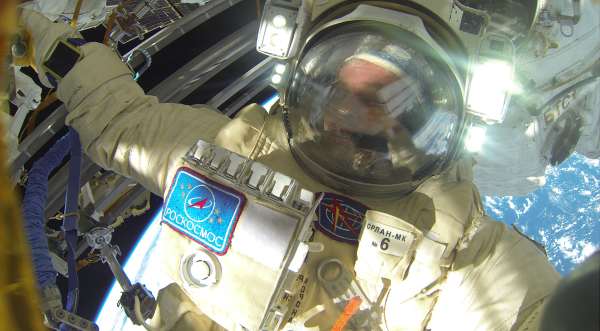
Sergei Ryazanskiy wearing Orlan-MK #6 (blue stripes) during Russian EVA-43, 17 August 2017.
The MK’s main development is the replacement of the radio-telemetry equipment (BRTA, БРТА) in the Portable Life Support System backpack with a small digital computer (located in the lower – nonhermetic – part of the suit). This computer will process information from the spacesuit’s various systems and indicate malfunctions. The necessary recommendations to deal with these are displayed on a new liquid crystal display (LCD) screen on the right chest part of the spacesuit. Cosmonauts previously had to memorize contingency plans.
If there is a life-support failure, the cosmonaut will hear a buzzer alarm through his headset – prompting him to look at the digital display – and the display color will change from green to orange, recommending what course of action to take. For example, a pressure drop will be indicated on the display with the instructions to insert the injector.
The Orlan-MK can work in two modes: with the digital computer (as the MK) or without (as the previous M version). Even if the main computer malfunctions, then a special additional unit will immediately take over.
In July 2010 the color of the display units was changed:
Fyodor Yurchikhin preformed firmware upgrades to the display units on all three Orlan-MK suits. The upgrade changed the backlighting from green to orange for all display modes. Crewmember reports and ground analysis post-RS EVA-24 determined that the green backlighting interfered with display character visibility from inside the suit looking through the helmet visor while the orange backlighting did not have interference. After the upgrade activity, the crew reported it was still difficult to see the characters on the display screen – the problem appears to be a suit issue and not display related. The possibility of using Fresnel lenses was suggested as a partial interim solution for visibility as distance from the display seemed to be a factor as well.
The spacesuit is divided into two hermetically-sealed shells: primary and reserve. Even if the cuirass is cracked, this is not catastrophic as it is coated with a rubberized fabric on the inside so external microscopic cracks do not influence the airtightness of the suit.
The Orlan-MK has a water supply for a cosmonaut to drink; the 1-liter container is secured to the inside of the suit’s front, and a tube with a mouthpiece is placed near the cosmonaut’s face.
It weighs around 120 kg, is certified for 4 years in orbit and 15 EVAs.
Orlan spacesuits have generally been reliable with few anamolous incidents. The spacesuit of Aleksandr Kaleri suffered a cooling system malfunction during the ISS-8 crew’s only spacewalk. It was later established that he had accidently pinched the cooling tubes on entering the spacesuit. The spacesuit designers made changes to ensure this did not happen again.
Spacesuit testing was conducted according to 50 parameters (which cosmonauts previously had to memorize during training).
As with previous Orlans, each Orlan-MK passed special strength testing. For example, in order to verify the strength of the glass visor, a pendulum was swung at it from the distance of a meter with a lead striker on its cone. The force of impact comprised more than 100 kilograms. Furthermore, the designers bombarded the spacesuit with particles having a diameter of less than a millimeter. Exactly the same particles travel in open space with a speed of tens of km/s and are capable of damaging skin. At first all sections of a spacesuit were tested separately, then they were checked as a whole. Moreover during the tests it must maintain pressures 3 times greater than those it will actually experience in space.
More on the Orlan-MK from Novosti Kosmonavtiki news №711:
24/06/2008/20:31 On the ISS next year crews will work in open space in the new “smart” Russian spacesuit
On the ISS, where crews are now working in open space, the complete replacement of the “Orlan-M” Russian spacesuit with the more modern “Orlan-MK” is scheduled. The first Orlan-MK will be taken into orbit at the end of this year on a Progress Russian cargo ship, and in early 2009, to the International Space Station will receive two more, Sergei Pozdnyakov – general director of the “Zvezda” Scientific and industrial enterprise, where all domestic spacesuits are manufactured – said Tuesday.
The new spacesuits will gradually replace the ISS Orlan-M at the end of their life, which have faithfully “served” several crews.
The Orlan-MK is the fifth Orlan version and the first computerized Russian spacesuit, Pozdnyakov said. In the process of donning the suit, it prompts the cosmonaut for the sequence of system checks he must follow before going out in open space and reports on the status of these systems. If there are abnormal situations – for example, increased consumption of oxygen, etc. – relevant information is displayed on the signal panel, with a warning beep and instructions on what procedure to follow.
The new “intelligent” spacesuit would avoid situations like what happened during the exit of ISS Expedition 9 in June 2004. At the very beginning of EVA activities, the TsUP Mission Control Center specialists recorded an oxygen leak in Michael Fincke’s spacesuit, and the crew was forced to return to the station. The determination of the cause of the pressure drop in the Orlan took several hours, and the EVA was postponed for a few days. Now the spacesuit itself will “communicate” with the cosmonaut as to the reason for his “malaise”.
According to Pozdnyakov, ISS Expedition 18, which will be launched into orbit in October, has already trained to operate the Orlan-MK. If a cosmonaut forgets a procedure during an EVA, a special program will help him translate into the more simple Orlan-M management regime.
The new EVA suit weighs 120 kg and has a service life of 15 EVAs within 4 years of operation. In open space it protects the cosmonaut from the low barometric pressure, ionizing radiation, solar power, and micrometeorites. The system uses a high-performance thermal method of diverting the heat emitted by man through a water cooling garment. The intensity of heat removal is manually controlled by the cosmonaut by reallocating water flows coming in the heat exchanger for cooling.
- M: Модернизированни
- Modernized
- Modernizirovanniy
- K: Компютеризированниы
- Computer-aided
- Kompyuterizirovanniy
Orlan-MK Operations Manual, 19 May 2011 (PDF, 2.7 MB)
| Weight of a spacesuit prepared for EVA in autonomous mode | No more than 114 kg |
| Guaranteed service life in orbit (when serviced by crew members) | 4 years |
| Guaranteed number of EVA (with replacement of consumable items) | 15 |
| The operating time of the life support system of the spacesuit in one cycle of work (from putting on to removing the SC) | At least 10 hours |
| EVA time (from opening to closing the airlock hatch) | Up to 7 hours |
| Working pressure in the SC during EVA, maintained automatically | 0.4 (+0.01/-0.05) kgs/cm2 |
| The spacesuit ensures its use by cosmonauts with anthropometric dimensions in the range |
|
| Source: NPP Zvezda | |
Orlan-MKS
The successor to the Orlan-MK will be the Orlan-MKS (also transliterated as Orlan-ISS), the first prototypes to appear in 2012, and to come into service by 2015. The “MKS” designation means that it has been modified, with a computer and a synthetic cover ( модифицированный, с компьютером и синтетической оболочкой).

Fyodor Yurchikhin wearing Orlan-MKS #4 (blue stripes) during Russian VKD-43, 17 August 2017.
A Roskosmos news release, 23 June 2010:
New EVA Space Suit to be Developed in Russia by 2012
New Russian EVA space suits will be developed by the end of 2011, Sergei Pozniakov, NPP Zvezda DG, told Interfax.
The suit designed under the order of the Russian Federal Space Agency are planned for use in the International Space Station.
The suits will be equipped by automatic thermal regulation systems, and rubber surface will be replaced by polyurethane, to extend life time of the suits.
The MKS will provide automatic temperature control for the microclimate inside the suit, rather than have the cosmonauts adjust this manually via the warm-cold switch.
Polyurethane will be used instead of rubber for the survival suit’s cover. Polyurethane is durable and does not tear when damaged; instead the material seals itself up. It will make the Orlan more mobile and comfortable. It will increase the spacesuit’s inflight life from 4-5 years to 6-7. At the same time the quantity of spacewalks in which it will be possible to use the new Orlan will be increased. The Orlan-M is calculated to last for 12 extravehicular activities of a duration of about 6 hours, the Orlan-MK for 15 EVAs, and the Orlan-MKS for 20 EVAs.
The latest model of the Orlan was delivered to the ISS on Progress MS-05 on 24 February 2017. One was onboard the previous Progress, MS-04 (“Russia to deliver 1st new-generation spacesuit to world’s sole orbiter in December,” TASS, 16/10/2016), but was lost along with the spacecraft due to launch failure on 1 December 2016. A third suit, the backup suit, was to be launched on MS-06. Under the safety rules on board the Station, there should be three suits: two main and one spare.
A new-generation spacesuit Orlan-ISS produced by NPP Zvezda is designed for extravehicular activity of the cosmonauts and is equipped with the automatic thermal control system. Its rubber pressure envelopes are replaced with polyurethane ones. This made their lifetime half as much again. At present no more than 15 EVAs can be performed in the Russian spacesuits, but Orlan-ISS is suitable for up to 20 EVAs. The spacesuit “brains,” i.e. the computer and operating program have been also changed. The computer tests the spacesuit by 50 parameters and displays them on the liquid-crystal display. (Energiya; NPP Zvezda)
The MKS does have a problem with the new polyurethane, however:
MOSCOW, March 27, 2018. / TASS /. The second spacesuit of the new generation Orlan MKS will be delivered to the International Space Station in July aboard the Progress MS-09 cargo spacecraft. This TASS said the director of the company-developer spacecraft SPE Zvezda Sergei Pozdnyakov.
“In July, the Progress truck will deliver another spacesuit, the Orlan MKS, it is now at the final checks, and in April-May we will give it to the customer,” said Pozdnyakov. He clarified that on the same truck a new polyurethane shell, specially made for the previous version of the Orlan-MK spacesuit, will be sent to the station. It will be installed in one of the Orlan-MK already at the station.
After July, Pozdnyakov noted, the company will be preparing the third spacesuit Orlan-ISS. “Another spacesuit is needed of course, a third one. This new one will fly away and we will closely work on the next one, the exit program is not so active, time allows,” he said.
By the end of the year, it is planned to complete two exits under the program of the Russian segment of the ISS. The next exit is scheduled for August 8, Oleg Artemyev and Sergei Prokopiev will go overboard the station. It is planned that Artemyev will perform work in the Orlan-ISS. The possibility is also being considered that Prokopyev will come out in a new spacesuit. The first spacewalk this year was made in February.
The Orlan-MKS differs from the previous version of the Orlan-MK with a new inner polyurethane sheath and a new automated water cooling system, which itself must adjust the most comfortable temperature for the operator. In this spacesuit, in particular, Alexander Misurkin worked behind the station during a record release (8 hours 13 minutes) on February 3.
The revision is not supposed.
The Orlan-MKS spacesuits will not be refined this year, despite astronauts' complaints about their inconvenience due to the new shell, Pozdnyakov added.
“Talks about the inconvenience of the spacesuit of the new generation Orlan-ISS really exist, and we ourselves have provoked them, because there is a new shell,” he said.
“There are certain problems, we understand them, and there are certain ways to eliminate them,” Pozdnyakov noted. “However, the suits of the new generation Orlan-ISS will not be changed by this year’s exits.” At the same time, the head of the Zvezda Scientific and Production Enterprise recalled that all the tasks assigned during the previous exits of the Russian cosmonauts overboard the International Space Station in the new spacesuit were performed in full.
A source in the rocket and space industry told TASS that, after exiting in a new spacesuit, astronauts complained about a more rigid polyurethane shell, as well as some discomfort when working with the Orlana-ISS thermal control system.
The third spacesuit “Orlan-ISS” will be manufactured by 2020.
August 21, 3:50 UTC + 3
As reported in the SPE Zvezda, after manufacture, it will be sent to the International Space Station
The third spacesuit for work in open space Orlan-ISS to replace the loss of the Progress MS-04 cargo vehicle during the accident will be manufactured at the end of 2019 – the beginning of 2020. This Tass on Tuesday reported in the press service of the SPE Zvezda.
“One more spacesuit, Orlan-MKS, to be sent into orbit is planned to be made at the end of 2019 – the beginning of 2020,” the press service said.
The Zvezda Scientific and Production Enterprise was supposed to deliver three Orlan-ISS space suits to the International Space Station – two to ensure that astronauts would go out into space and one reserve in case of the main failure in preparation for the exit. One of them was lost in the accident of the Progress MS-04 cargo ship, so it became necessary to retrofit the station with a third spacesuit.
The head of the Zvezda Scientific and Production Enterprise: a suit for Su-57 pilots prepared for flight tests
On July 10, 2018, the Progress MS-09 cargo spacecraft will depart for the International Space Station. Among other cargoes, it will deliver to the station the third spacesuit of the new-generation “Orlan-MKS” manufactured by the Russia’s NPP Zvezda. These suits are actively used by Russian cosmonauts, including when working outside the station. Sergei Pozdnyakov, Director General of the Research and Production Enterprise Zvezda, spoke in an interview with TASS about these spacesuits and the development of a new one for the promising “Federation” manned spacecraft, a new anti-g suit for pilots of the fifth generation Su-57 fighter and new helmets. [Note: only the information about the Orlan spacesuit is translated here.]
TASS: There were comments from the cosmonauts regarding the new Orlan-ISS spacesuits that it was inconvenient to work in them because of the new shell. There were also complaints about the new thermoregulation system. What exactly is wrong and what changes will be made?
Sergei Pozdnyakov: Indeed, the cosmonauts note that the sleeves of the spacesuit have become tighter. The new shell material is polyurethane, it is denser and not as elastic as the rubber that was used before. When adjusting the length of the sleeves, folds appear. This is especially evident in cosmonauts with short arms, when the suit sleeve is adjusted to the minimum length. In the future, several ways to solve this problem are outlined. One of them is to make the sleeves easily removable, which makes it possible to put sleeves with individual sizes for a specific cosmonaut. The Orlan-MKS No. 5 spacesuit has now been made, which should be delivered to the orbital station on July 10. Some changes have already been made to the design of this suit that improve working conditions.
As for the complaints about the new automated thermal control system, it works reliably. Although some cosmonauts are in favor of manual temperature control. But there were cases when, during the exit, the cosmonauts forgot to monitor their thermal state. It got to the point where the doctors from the Mission Control Center asked to stop work in order to bring the temperature back to normal.
TASS: In addition to improvements on the shell, is it planned to modify or modernize domestic spacesuits in any other way?
Pozdnyakov: As of today, the maximum and minimum lists of works that we would like to perform during the modernization of the spacesuit have been determined. At a minimum, we plan to modernize the sleeves and, possibly, increase the size of the entrance to the spacesuit in order to eliminate the inconvenience for large cosmonauts when using it. To simplify the maintenance of the spacesuit, change the location of the knapsack units. To the maximum – in addition to the above works – to build an automatic rescue system into the spacesuit and a projection system into the helmet to transmit information to the cosmonaut. It should be borne in mind that not everything can be made from domestic materials.
TASS: But you probably use imported components at your enterprise, don’t you?
Pozdnyakov: Yes, they are used. But it is not known whether they will be available to us in the future due to the sanctions policy of the West. In case of restrictions, we will perform work in the scope of the minimum list, only with Russian components.
TASS: How and why is it supposed to increase the entrance to the spacesuit?
Pozdnyakov: Recently, the anthropometric requirements for candidates for the cosmonaut corps have not been strictly observed. To date, there are cosmonauts, including active ones, whose chest volume is either on the verge of the maximum allowable size of a spacesuit, or exceeds them. So they propose to increase the entrance to the spacesuit or make it in the form of a trapezoid. This will require design changes and various strength tests. The entrance area will become larger, therefore, the force from the effect of internal pressure on the separation will increase. In addition, we plan to carry out work to improve maintainability, for which we are going to change the location of the units in the knapsack in order to improve access to them and simplify their replacement. This is important because our spacesuits operate for the entire period of operation without descent to Earth and they have to be serviced at the station. The Americans – earlier on the Space Shuttle, and now on the Dragon cargo ships – are returning spacesuits for repairs to Earth, we do not have such an opportunity.
TASS: Why can’t we return the suits to Earth?
Pozdnyakov: Our Progress cargo ships burn up in the atmosphere, and it is not possible to return spacesuits on a manned Soyuz due to restrictions on the dimensions and weight of the cargo. If a reusable ship appears, including its cargo version, then it will be possible to return the spacesuits for full maintenance, which is rational in every respect.
TASS: What will be the display system?
Pozdnyakov: Our specialists have been working on the information display system for a long time. Ideally, it should be like that of military pilots, for whom information is projected onto the glass of the cockpit canopy [i.e. a Heads-Up Display]. Moreover, the cosmonaut should not be given information about the spacesuit systems, this is the work of automation, but instructions on the work performed on the surface of the station (what, where and how to do) or advice in case of failures. The existing domestic display systems do not suit us in terms of dimensions and functionality. I am not ready to say now how to make this system optimal in terms of dimensions, weight, safety, but we are conducting such pre-design work in order to understand in which direction to move on.
TASS: Are you currently working on the creation of an automatic jet rescue system for spacesuits on the ISS?
Pozdnyakov: On an initiative basis, we dealt with this problem several years ago, when there was a financial opportunity. It was assumed that such a system with miniature jet engines would be built into the new suit. However, this is a very expensive development, and at the same time, it is still necessary to prove to consumers, and this is primarily Roskosmos and RKK Energiya, that a spacesuit with such a system is needed. In the preliminary work, we got a certain result: we showed that such a system can be created, determined the principle of operation, understood how to stabilize the rotation and automatically return an cosmonaut flying into space to the station. But the project did not go further due to the limited financial capabilities of the enterprise.
TASS: How much would such a project cost? And how long does it take to create a system, if it is funded?
Pozdnyakov: At least several hundred million rubles. Compared to the cost of rockets, this is a penny, but for our enterprise this is serious money. In terms of terms: pre-contract work and the production of a prototype for ground tests will take a year and a half, a full-fledged prototype will take another year or two.
TASS: How many new Orlan-MKS spacesuits should be at the station?
Pozdnyakov: For spacewalks, there should be three spacesuits – two main and one reserve. The outputs are all paired and spacesuits alternate so that they have approximately the same time to develop a resource.
TASS: At what stage is the development of a new spacesuit for the prospective “Federation” manned spacecraft?
Pozdnyakov: As with the entire ship, the first phase of development work is now underway. Our task is to produce a prototype of a rescue suit and a chair for an cosmonaut by the end of the year. The main difference between the new spacesuit and today’s Sokol is that it must be reusable. Now each cosmonaut has his own individual space suit and another cosmonaut cannot use it. When developing a new spacesuit, a range of its sizes will be determined. The cosmonaut has the opportunity to choose for himself a suit of the right size with a slight fit. The same suit can be used by different cosmonauts. After manufacturing several prototypes of such a spacesuit, we will determine a plan for further work. Then, taking into account the results of factory tests, we will manufacture spacesuits for ground tests as part of the ship, after which we will proceed to flight tests. Before the start of serial deliveries, we plan to produce up to 20 spacesuits.
When developing a new seat, we were tasked with moving away from an individual lodgement and making a chair that compensates for overloads during a hard landing, ensuring the rescue and safety of the cosmonaut. It should be universal, with adjustment for different cosmonauts. A model of such a chair has been made. A prototype is now in production, close to the prototype. We plan to start testing it at the end of this year or the beginning of next. The dimensions of the new chair have been increased in comparison with the existing ones, there is more space in the Federation spacecraft than in the Soyuz, and the cosmonauts will no longer have to take a “fetal” pose. The posture of the cosmonaut in the new chairs will be similar to the so-called Gagarin’s, reclining. The material from which the chair is made is aluminum alloy, composite materials are not used, as they give off emissions over time, that is, they “gas,” and this is unacceptable in the enclosed space of the ship.
TASS: And how will the tests be carried out, because there is no ship as such yet?
Pozdnyakov: The magnitude of the loads during normal or abnormal landing are known. Our equipment allows us to carry out the so-called dropping of chairs with mannequins from a certain height to a certain surface in order to check the operation of the shock absorbers. The dummies are equipped with modern recording and recording equipment, with the help of which all the loads acting on the cosmonaut are determined. Most likely, we will not carry out resets of the chair with the testers, if only in a gentle mode. Separately, we will evaluate the convenience and ergonomics of the chairs.
TASS: Is the development of a lunar spacesuit underway?
Pozdnyakov: There are no specific tasks yet. Of the known projects for a flight to the Moon, there is only a circumlunar station, but we do not know anything about it in detail. Serious international agreements on the exploration of the Moon, except for intentions, have not been signed today. There will be tasks – we will work.
TASS: Do Orlans have radiation protection? Is the issue of protecting the spacesuits in which people will work on the Moon or Mars is being studied?
Pozdnyakov: The Orlans have a rigid cuirass and a rigid satchel, made of aluminum with a thickness of more than 1 mm. The soft shells of the arms and legs are attached to the cuirass. At the height of the orbit of the International Space Station, at those doses, such a design effectively protects vital organs from radiation during exits – the head, heart, kidneys, liver, etc. As for personal protection against radiation under the conditions of the Moon and Mars, the exits to the surface are short-lived and this task is not for today. Work on the ISS is planned to be carried out until 2024, and maybe until 2028. […]
Cosmonauts on the ISS will receive a new batch of spacesuits for spacewalks
Roskosmos, 3/5/2023
Research and Production Enterprise Zvezda named after Academician G.I. Severin – by order of the Rocket and Space Corporation Energiya named after S.P. Korolyov (part of the Roskosmos State Corporation) – will manufacture a new batch of Orlan spacesuits for spacewalks from the Russian segment of the International Space Station. One suit is planned to be produced in 2024, and two more in 2025. They will be made using domestic materials. To continue the operation of the two Orlan-MKS spacesuits currently in use, spare parts have been created and are being delivered to the station.
Water cooling garment
This is a skintight bodysuit worn under the spacesuit to regulate body temperature by removing heat buildup. It is a blue-colored mesh suit woven with elastic tubes that circulate water through the suit. It is manufactured in 4 sizes. In Russian its name is: Костюм водяного охлаждения (КВО-М) – Kostyum vodyanogo okhlazhdeniya (KVO-M).
| Magnitude of heat removal | Up to 400 W |
| Total length of tubes | 65 m |
| Weight (refilled) | 3 kg |
Chronology
In this section is a history of the numbered Orlan spacesuits used on all Russian space stations previous to the ISS, listed in order of delivery into orbit. Dates are in day/month/year format. The Orlan data section on the ISS Russian VKDs page continues this for suits used on the station.
Orlans are not usually brought back to Earth because there is no room on the Soyuz to carry them, though crews might souvenir the gloves or helmet visor. The suits are usually discarded in a de-orbiting Progress spacecraft. Only one was recovered and taken back to Earth (№18 on STS-79 Atlantis).
The information up to Orlan №14 was adapted from one published in Novosti Kosmonavtiki №4, 2004: an article, “Orlanyi,” provides full statistics of all the spacesuits of the Orlan family used in orbit from the first delivery to Salyut-6.
Key to table headings:
- Order
- Order of delivery into orbit (flight order).
- Number
- Spacesuit serial number (comprised of 7 digits – XXX00XX; only the last two digits are given in the absence of information). Red stripes indicate odd production number, blue stripes even.
- Ship
- Orbital spaceship by which the spacesuit was brought.
- Delivery date
- Date of delivery to station (day/month/year).
- First use
- Date of first use.
- Last use
- Date of last use.
- Disposal
- Method of disposal.
- Total
- Number of official exits into open space + internal spacewalks that are not officially counted.
- Hours
- Total duration of official spacewalks in hours and minutes.
| Number | Ship | Delivery date | First use | Last use | Disposal | Total | Hours |
|---|---|---|---|---|---|---|---|
| Orlan-D used on Salyut-6 | |||||||
| 33 (red stripes) | Salyut-6 | 29 Sep 1977 | 20 Dec 1977 | 15 Aug 1979 | Salyut-6 deorbit | 3 | 05:11 |
| 34 (blue stripes) | Salyut-6 | 29 Sep 1977 | 20 Dec 1977 | 15 Aug 1979 | Salyut-6 deorbit | 3 | 05:11 |
| Orlan-D used on Salyut-7 | |||||||
| 45 (red stripes) | Salyut-7 | 19 Apr 1982 | 30 Jul 1982 | 8 Aug 1984 | Salyut-7 deorbit | 10 | 34:41 |
| 46 (blue stripes) | Salyut-7 | 19 Apr 1982 | 30 Jul 1982 | 3 Nov 1983 | Progress-24 | 3 | 08:17 |
| 47 (blue stripes) | Progress-19 | 23 Feb 1984 | 23 Apr 1984 | 8 Aug 1984 | Salyut-7 deorbit | 7 | 26:24 |
| Notes | |||||||
| One of Orlan-D spacesuits (№33 or №34) was removed by Progress-12. | |||||||
| Number | Ship | Delivery date | First use | Last use | Disposal | Total | Hours |
|---|---|---|---|---|---|---|---|
| Orlan-DM used on Salyut-7 | |||||||
| 8 (blue stripes) | Kosmos-1669 | 21 Jul 1985 | 2 Aug 1985 | 31 May 1986 | Salyut-7 deorbit | 3 | 13:50 |
| 10 (red stripes) | Kosmos-1669 | 21 Jul 1985 | 2 Aug 1985 | 31 May 1986 | Salyut-7 deorbit | 3 | 13:50 |
| Orlan-DM used on Mir | |||||||
| 7 (red stripes) | Core module | 20 Feb 1986 | 11 Apr 1987 | 30 Jun 1988 | ? | 5 | 18:23 |
| 9 (blue stripes) | Core module | 20 Feb 1986 | 11 Apr 1987 | 30 Jun 1988 | ? | 5 | 18:23 |
| Number | Ship | Delivery date | First use | Last use | Disposal | Total | Hours |
|---|---|---|---|---|---|---|---|
| 6 (red stripes) | Progress-38 | 12 Sep 1988 | 20 Oct 1988 | 27 Jul 1991 | ? | 14 | 69:04 |
| 10 (blue stripes) | Progress-38 | 12 Sep 1988 | 20 Oct 1988 | 25 Apr 1991 | VKD jettison (27 Jul 1991) | 9 | 39:32 |
| 8 (blue stripes) | Kvant-2 | 6 Dec 1989 | 26 Jan 1990 | 20 Feb 1992 | Progress M-17 | 10 | 50:24 |
| 12 (red stripes) | Kvant-2 | 6 Dec 1989 | 26 Jan 1990 | 20 Feb 1992 | Progress M-17 | 7 | 29:14 |
| 14 (blue stripes) | Progress M-7 | 28 Mar 1991 | 25 Jun 1991 | 22 Oct 1993 | Jettisoned during spacewalk on 29 Oct 1993 | 13 | 48:47 |
| 15 (red stripes) | Progress M-7 | 28 Mar 1991 | 8 Jul 1992 | 18 Jun 1993 | ? | 7 | 30:22 |
| 18 (blue stripes) | Progress M-15 | 29 Oct 1992 | 29 Oct 1993 | 8 Dec 1995 | Recovered by STS-79 | 13 | 54:32 |
| 25 (red stripes) | Progress M-17 | 2 Apr 1993 | 16 Sep 1993 | 13 Jun 1996 | Progress M-36 | 15 | 59:27 |
| 27 (red stripes) | Progress M-26 | 17 Feb 1995 | 12 May 1995 | 20 Oct 1997 | Mir deorbit | 12 + 1 | 55:58 |
| 26 (blue stripes) | Progress M-29 | 10 Oct 1995 | 20 Oct 1995 | 20 Oct 1997 | Mir deorbit | 12 + 1 | 61:22 |
| Number | Ship | Delivery date | First use | Last use | Disposal | Total | Hours |
|---|---|---|---|---|---|---|---|
| Orlan-M used on Mir | |||||||
| 1060004 (blue stripes) | Progress M-34 | 8 Apr 1997 | 29 Apr 1997 | 12 May 2000 | Mir deorbit | 14 + 1 | 72:22 |
| 1060005 (red stripes) | Progress M-34 | 8 Apr 1997 | 29 Apr 1997 | 16 Apr 1999 | Mir deorbit | 11 + 2 | 59:54 |
| 1060006 (blue stripes) | Progress M-36 | 8 Oct 1997 | 3 Mar 1998 | 12 May 2000 | Mir deorbit | 9 + 1 | 47:24 |
| Orlan-M used on ISS | |||||||
| 1280012 (blue stripes) | Zvezda | 26 Jul 2000 | 8 Jun 2001 | 25 Jan 2002 | Progress M-50 | 7 | 31:01 |
| 1280023 (red stripes) | Zvezda | 26 Jul 2000 | 8 Jun 2001 | 27 Feb 2004 | Progress M1-11 | 8 + 1 | 32:39 |
| 1280014 (blue stripes) | Progress M-SO1 | 17 Sep 2001 | 14 Jan 2002 | 27 Feb 2004 | SuitSat | 5 + 1 | 25:42 |
| 0520025 (red stripes) | Progress M1-11 | 31 Jan 2004 | 24 Jun 2004 | 6 Jun 2007 | Progress M-01M | 13 | 65:53 |
| 1130026 (blue stripes) | Progress M1-11 | 31 Jan 2004 | 24 Jun 2004 | 10 Mar 2009 | Progress M-02M | 11 | 61:25 |
| 0240027 (red stripes) | Progress M-49 | 27 May 2004 | 26 Mar 2005 | 10 Mar 2009 | Progress M-02M | 10 | 49:46 |
| Notes | |||||||
|
|||||||
Diagrams
Illustrations scanned from Russian Spacesuits:
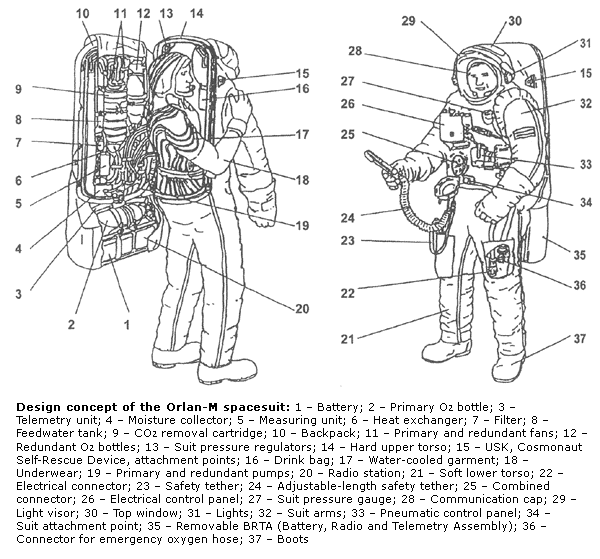
- Design concept of the Orlan-M spacesuit (44 KB)
- Comparison of the Orlan-DMA (a) and Orlan-M (b) HUTs (56 KB)
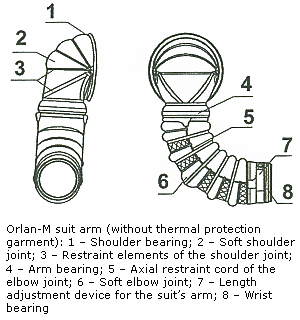
- Orlan-M suit arm (without thermal protection garment) (44 KB)
- Lower torso (legs) without the thermal micrometeorite (protection) garment (66 KB)
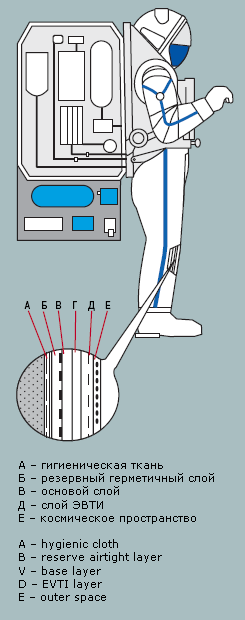
- Orlan spacesuit material layers (18 KB)


Miscellaneous images:
- Orlan-M adjustment points (43 KB)
- Orlan backpack (52 KB)
- Roskosmos: Evolution of the Orlan spacesuit (in Russian)


Gallery

Frank Culbertson, and Vladimir N. Dezhurov (ISS-3) wearing thermal undergarments for the Orlan. The blue cooling suit (KVO, КВО, костюм водяного охлаждения) is worn over the thermal underwear.

Orlan-MK №6 being prepared for launch on Progress M-02M, 16/4/2009
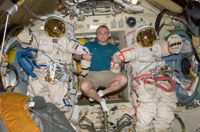
Maxim Suraev with two Orlan-MK spacesuits on the ISS (№4 blue stripes; №5 red stripes), 11/1/2010
Links
- Dave Akin’s Personal Web Site: Dissecting an Orlan wrist disconnect
- ESA Permanent Mission in Russia: “Orlan spacesuit” (Archive.org link). ESA and Russia co-operated in developing a suit called EVA SUIT 2000 in the early 1990s for use in the-then Buran, Hermes and Mir-2 projects, but financial problems saw all these canceled.
- Hamilton Sundstrand: Russian Efforts (Archive.org link)
- High-Tech Science: a privately-funded organization which promotes science and technology to U.S. schoolchildren. This section of the site features its collection of Russian and U.S. spacesuits, and related artifacts.
- My Little Space Museum: Orlan spacesuit page
- NASASpaceflight.com: posting by Anik at NASAspaceflight.com (19/8/2006 in the Current plan of launches to ISS thread)
- Novosti Kosmonavtiki: “Orlan-M for ISS,” №11, 2001
- NPO InterCoS: the Zvezda Museum page has 3 photos (1, 2, 3) of Orlan-MK №3
- NPP Zvezda: developers of the Orlan-M
- Orlan Spacesuit Training Manual (1998, 1 MB PDF)
- Popular Mechanics: Step Inside the Russian Spacesuit Factory – photo gallery
- Roskosmos news: “Baikonur: Progress M-02M Prelaunch Operations,” 16 April 2009. Photos of Orlan-MK №6 being given pre-flight testing at Baikonur before being launched on Progress M-02M.
- Roskosmos TV: ««Умный» скафандр» (“Clever spacesuit”), October 2008
- Space.com: “Orlan Overboard: The Suit Behind the Sat,” 3 February 2006.
- Spacefacts: EVA assignments of the Orlan spacesuits
- Spaceref: Orlan PDF operations manual (PDF, 2 MB)
- Space Travellers: Authentic Space Hardware: Orlan-M spacesuit
- ««Орлан» над Землей» (“Orlan over the Earth”), 21 April 2012
- Zvezda: Скафандр для работы в открытом космосе “Орлан-МК” (The Orlan-MK suit for work in outer space); Костюм водяного охлаждения (КВО-М) (Water-cooling suit)
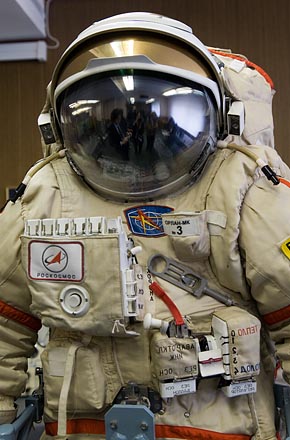


Sokol KV-2 rescue suit
The Sokol KV-2, «Сокол КВ-2» (“Falcon”) crew rescue suit was first worn in the Soyuz T-2 spacecraft on 5 June, 1980, and is still worn by crews today during launch and descent. Each suit is connected to an on-board life support system which supplies oxygen, electrical power, suit ventilation and water for the cooling garment worn underneath. It is considered part of the Soyuz life support system, KSOZh, КСОЖ. Each suit is tailor-made to fit individual crew members. In the Soyuz spacecraft they recline in Kazbek-U, «Казбек-У», seats which have custom-fitted molded liners.
The Soyuz is constructed of two layers: an internal and external. The internal part is made of an elastic-type material and keeps the suit pressurized. The external layer is made of a flame-resistant fabric called “Lavsan” or “Dacron”. The suit, including the helmet, is integrated; only the gloves are put on separately. The helmet has a soft cover and folds back when the wearer is upright; it can only fit over his head when he is lying in the aforementioned knees-up position.
The wearer climbs into the suit via the zippered front opening; into the legs first, then arms and head. The suit is then sealed by means of the “appendix,” flaps of cloth bound up by rubber bands. The wearer is fitted with biomedical sensors next to his skin. The blue knob on the front is a pressure regulator.
Unlike the Orlan, the Sokol does not have its own self-contained life-support system, but is connected to that of the Soyuz. It is thus not a “spacesuit” but a rescue, survival or pressure suit. There are four connections:
- an electrical cable for transmitting biomedical data;
- another cable for communications;
- a ventilation tube;
- an oxygen tube.
A mechanical regulator keeps the pressure inside the Sokol constant.
The Sokol is not particularly comfortable to walk around in due to its internal wiring and lack of ventilation (the wearer has to carry their own ventilator to avoid overheating). It is essentially designed to fit in the Kazbek chair, on one’s back with the knees up.
After manufacture of the flight suit, every crew member occupies the Kazbek seat with its custom-fitted couch liners and sits in the flight posture under positive pressure for 2 hours (under ground conditions). The suit is readjusted or upgraded by the outcome of this. The next stage of suit evaluation is repetition of the same procedure in the vacuum chamber, with simulation of oxygen supply to the suit helmet. The final stage of suit evaluation is the suit fit check at Baikonur prior to the mission, and spending time in the descent vehicle cabin of the real spacecraft. The final suit check and its preflight operation are carried out at the same time. These activities (at Baikonur) are carried out by a special Zvezda team …
All spacecrews undergo extensive suited training at the Gagarin Cosmonaut Training Center (Star City), besides the activities at Zvezda. The training includes time in the Soyuz spacecraft simulator where a number of unusual situations are simulated: surviving in uninhabited areas after landing, or in case of an unexpected splashdown of the spacecraft, learning to survive in the open ocean.
Zvezda has developed special ground support test equipment and a set of fixtures for preflight testing. The suits are ventilated with air supplied from cosmodrome ground sources during fit checks at Baikonur. To ventilate the spacesuits while the cosmonauts go to the launch pad, special portable ventilation units, PVU, ПВУ, were developed. They include a fan that takes in the ambient air in and supplies it to the suit and a self-contained electrical power source. The PVU comes complete with a heat exchanger that cools supplied air with ice (put into the heat exchanger prior to its usage). It should be noted that Zvezda has used these units since the Voshkod-2 mission.
– Source: Russian Spacesuits, Isaak P. Abramov and As. Ingemar Skoog, Praxis Publishing, 2003.
The Sokol KV-2 (Falcon) pressure suit, is white nylon canvas with royal blue trim. It has an attached pressurized hood with hinged plastic visor securing to blue anodized aluminum clavicle flange, trussed sleeves with adjustable articulating cables in upper arm and webbed belt lashings, pressure gauge on left sleeve covered by protective gasket, mirror on elasticized wristband (right wrist), detachable gloves, double-V-front zip closure, lace-up crotch with triangular placket, anodized aluminum umbilical interfaces on body for electrical, air and coolant line with attached cables and hoses, pressure equalization valve on chest, support sling wrapping from chest to back by means of webbed belts and metal clips, adjustable metrically calibrated webbed straps attached to metal rings on side seams and along crotch, pleated knees, two utility pockets on each leg, attached soled feet; rubberized cloth lining. […]
(Source: Smithsonian Sokol spacesuit exhibit)
Purpose
The Sokol-KV-2 rescue spacesuit is designed to provide vital functions and performance capability of the spacecraft crewmembers in case of decent module depressurization during the most dangerous phases of the mission: ascent, docking, undocking and descent.
Summary
The Sokol-KV-2 is a soft-type spacesuit. It is multilayer coveralls with integrated soft helmet and soft bootees, and removable gloves. The suit is cut out for a cosmonaut’s “sitting” position and provides the crewmember comfortable posture in the seat.
The spacesuit enclosure consists of the outer restraint layer and the internal pressure bladder.
The spacesuit pressure bladder is made of the rubberized kapron and rubberized knitted fabric.
The pressure bladder is glued to the restraint layer.
The elastic tubing of the ventilation and oxygen (gas mixture) supply system is secured to the bladder on the inside. The ventilating air is supplied to the suit legs, arms and helmet. The ventilating air and oxygen are supplied into the suit via the hose group inlet.
The spacesuit pressurization, cosmonaut’s breathing and partial cooling in the depressurized cabin are realized by oxygen (or gas mixture consisting of 40% of oxygen and 60% of nitrogen) supply to the helmet.
When there is no ventilation, the cosmonaut may wear the spacesuit:
- up to 1 hour if the pressure helmet is open and the gloves are removed (at the spacecraft cabin pressure of 760±40 mm Hg and the temperature of +25°С);
- up to 15 minutes if the pressure helmet is closed, the gloves are put on and the pressure regulator is open.
The spacesuits are manufactured in several sizes to fit the persons with the stature from 161 to 182 cm and chest circumference from 96 to 108 cm (sizes from 48 to 54) subject to additional personal fitting.
(Source: NPP Zvezda)
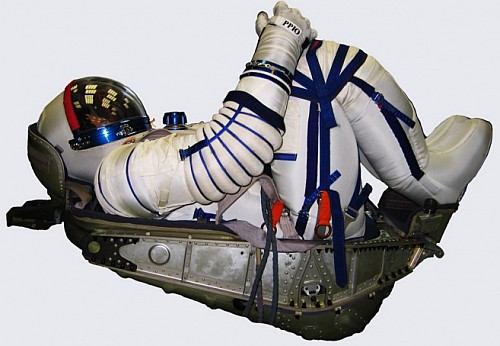
Sokol pressure suit fitted into its custom-made Kazbek-U seat.
Спасёт в любой ситуации
Save in any situation[…] The Cosmonaut Training Center has a special room where the Sokol KV-2 training suits are stored, the so-called “spacesuit”. There are “Falcons” of any size here – for astronauts from 160 cm to 193 cm tall and weighing from 50 kg to 90 kg. Most of these spacesuits that have already been in real flight, upon returning to Earth, continue to “serve” astronautics as simulators.
Trying on a spacesuit
For each cosmonaut and astronaut, a training suit is carefully selected taking into account its body proportions. Indeed, with the same height, one person may have longer legs, the other – the body or arms. For example, each spacesuit has the ability to adjust the length of the arms, hips, lower legs within 5 cm due to special tapes.
With the exception of gloves, the Falcon is a single unit, and in its front there is a V-shaped valve fastened with a zipper: it is through this valve that the spacesuit can be worn. Putting on a spacesuit is a rather complicated procedure, which astronauts and astronauts begin to work out in parallel with theoretical training on the ship’s life support systems.
Cosmonauts and astronauts are trained in a spacesuit by senior lecturer Viktor Bondarenko, lead specialist Timofey Egorov and specialist Oleg Upshinsky. In addition, employees of the department help to provide crew training in spacesuits: senior teacher Viktor Spirin, lead engineer Natalya Znachko, lead engineer Anna Suraeva. By the time the complex examination is completed, the astronauts and astronauts are already able to put on their spacesuit independently, not only in normal conditions, but also in gas masks or masks in the process of working out emergency situations.
How to put on the Falcon spacesuit? First, you put your feet in your trousers and put on the bottom of the suit, then – put your hands in the sleeves. What follows is perhaps the most difficult part of the procedure – you need to stick your head through the face mask ring.
After putting on the headset, it is necessary to pass the cable through the face mask ring and connect it to the connector inside the suit. Then carefully fold the elastic part of the containment with the “accordion” and wrap it very tightly with two rubber bands to ensure tightness. Next, the spacesuit is laced up and fastens with a zipper. Prior to connecting to the ventilation system in the Soyuz MS transport manned vehicle (TPK) or on the TPK simulator, to ensure comfortable conditions in the spacesuit, its ventilation hose is connected to a portable fan (it looks like a suitcase that every crew member carries with him).
So, the design of the “KV-2 Falcon” spacesuit includes two layers: power – outside and airtight – inside. “The inner shell of the spacesuit consists of rubberized knitwear, the outer one is made of lavsan material,” explained Dmitry Gaidukov, head of the department for life support systems. “The advantage of lavsan is that it is heat-resistant and durable. Elastic pipelines of the ventilation system and oxygen supply are attached inside the containment. Ventilating air enters the legs, the sleeves and the helmet, and the oxygen only into the under-the-hood space.”
Space Bestseller
The current modification of the emergency rescue suits has passed the excellent test of time and has been used for nearly forty years. The Sokol KV-2 was first tested in real space flight in June 1980 by the crew of the Soyuz T-2 spacecraft. Like any thing, the suit also has its own warranty period of four years. The manufacturer (NPP Zvezda) calculated this taking into account the fact that the most important thing in a spacesuit is tightness, and the material of the inner layer loses its strength properties over time. Maybe in six years the spacesuit will remain unscathed, but no one will risk cosmonauts.
The production of full-size spacesuits begins about 18 months before the flight by taking measurements from each crew member. At NPP Zvezda, the astronaut or astronaut first takes measurements while standing, then lying on an inclined slipway, where he is in the same position as in the lodgement. A total of about 72 measurements are taken. And then truly jewelry work begins – after all, the astronaut should be comfortable working in the Falcon, while in the lodgement of the chair. This suit is not designed to stand. His cut makes him bend forward (this is where such a strange walk from the conquerors of the Universe comes when they are dressed in Falcons). The task is to create a feeling of comfort when the astronaut takes his place in the chair of the Soyuz complex. Any inconvenience will turn into pain distracting from work in 20-30 minutes.
The main thing is trust
Therefore, when the full-size spacesuits are ready for flight, the crew again goes to the Zvezda Research and Production Enterprise – for fitting. If there are any inconveniences, they are eliminated and the spacesuit is tried on again. When the spacesuit is ready, the astronaut undergoes training in the pressure chamber in it.
“This technological test gives confidence to both manufacturers and users that the new Sokol is completely airtight and can save the life of an astronaut or astronaut in the event of an emergency – depressurization of the descent vehicle. The astronaut spends two hours in a pressure chamber with a pressure equal to or close to zero,” said Dmitry Gaidukov.
The crew conducts a leak test of the spacesuit during training at the CPC and at the Baikonur Cosmodrome, as well as immediately before the launch of the launch vehicle. To do this, the pressure regulator located on the chest just below the helmet is closed, and the valve for supplying oxygen to the spacesuit opens. This is done after the gloves are put on and the helmet is closed. On the left sleeve of the spacesuit there is a manometer, which determines the excess pressure inside the spacesuit. If the pressure in the suit increases to the set value in a certain time, then the leak test is successful. Then the regulator opens and the excess pressure is relieved.
During the flight, the controller is always set to “0.4”. In a normal situation, the spacesuit is simply connected to the atmosphere inside the ship, but if the pressure in the cabin decreases, the regulator will not allow the pressure in the spacesuit to fall below 0.4 atm (300 mmHg).
Everything is thought out to the smallest detail, including a face mask, for which soft glass is used – not breaking and not giving glare. “But at the same time it is easy to scratch it,” says Dmitry Sergeievich. “And to avoid this, before the flight, the standard glass is protected by an additional one – from aviation plastic. You probably noticed a red strip on the helmets of the astronauts – this is the place of fastening of the protective glass, behind which during training the regular soft glass is hidden. The first – plastic – layer is removed only after the astronaut has already placed and fixed in the lodgement before launch.”
Специалисты НПП «Звезда» готовят индивидуальное оборудование и снаряжение для космонавта Олега Артемьева
Specialists of NPP Zvezda prepare individual equipment and outfit for the cosmonaut Oleg Artemiev[…] The SOKOL KV-2 spacesuit is designed to ensure the life and performance of the crew members in case of depressurization of the descent vehicle in the most dangerous flight areas: launch, docking, undocking and descent. Spacesuits are also made individually for each astronaut.
“About 50-70 measurements are taken in order to make a spacesuit. And when it is already placed in the lodgement, even the location of the folds is taken into account. I will have a fitting in February, but I’m pretty sure there won’t be anything to redo. Excellent specialists work at NPP Zvezda,” the cosmonaut emphasized.
The Kazbek-UM chair is used in the Soyuz MS spacecraft. It consists of a frame, an individual cradle and an adjustable shock absorber-lift. The chair inlay is made in several stages. Measurements are taken from the cosmonaut, placed in a specialized bath with Plaster of Paris – first without a spacesuit, then in a spacesuit. On the basis of the plaster version, an individual cradle is made of polyurethane, its weight is no more than 7 kg.
“The lodgement is carried out so carefully in order to evenly distribute the load on the astronaut’s body. When landing or in case of an emergency, an individual lodgment will help minimize possible damage and avoid injury to the body,” said Oleg Artemiev.
The SOKOL KV-2 spacesuit is designed to ensure the life and performance of the crew members in case of depressurization of the descent vehicle in the most dangerous flight areas: launch, docking, undocking and descent. Spacesuits are also made individually for each astronaut.
“About 50-70 measurements are taken in order to make a spacesuit. And when it is already placed in the lodgement, even the location of the folds is taken into account. I will have a fitting in February, but I’m pretty sure there won’t be anything to redo. Excellent specialists work at NPP Zvezda,” the cosmonaut emphasized. […]
In many regions of Russia, abnormally cold weather is breaking records! To avoid frostbite and stay healthy, you need to warm up! Cosmonauts, for example, use special heat-protective suits to escape the harsh Baikonur weather. On the day of launch, the crew puts them on over the Sokol flight suits and takes them off. before entering the ship. The “polar bear,” «Белый медведь» (Belyi Medved’, as the cosmonauts themselves call the suit, is made of modern materials and protects against moisture, wind and cold. In such clothes it is comfortable even at −50°C. (TsPK VK Wall post, 11/1/2023)
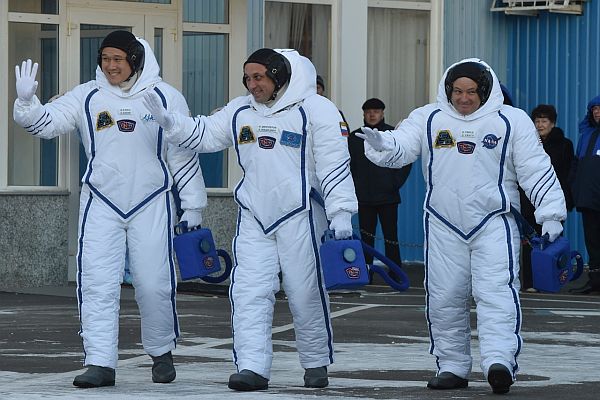
Soyuz MS-07 crew enroute to launch wearing “polar bear” cold-protective covers over their Sokol pressure suits, 17/12/2017
Technical data
| Official name | Sokol KV-2 rescue spacesuit, «Сокол КВ-2» |
| Description | The Sokol KV-2 spacesuit is connected to an on-board open-type ventilation system and is designed to provide a cosmonaut with normal hygienic conditions during a flight in a pressurized cabin and to support a cosmonaut’s vital functions in case of cabin depressurization. The suit is of the soft type with a two-layer enclosure (the outer restraint layer is made of fabric and the internal pressure bladder of rubber and a rubberized material). The helmet has a soft nape part and a sliding visor and is an integral part of the suit enclosure. Differences between Sokol K and Sokol KV-2: the lacing on the front opening is replaced by two zippers; helmet and, thus, visor dimensions are increased; the pressure regulator is integrated with an in-leakage valve and is arranged in the centre of the body under the helmet (it is located at the side on the Sokol K suit). In case of cockpit depressurization, pure oxygen is supplied to the suit. The pressure regulator provides two suit pressure modes. |
| Utilization (operations) | The suit was first used by cosmonauts Yu. Malyshev and V. Aksionov in 1980 aboard the Soyuz T-2 space vehicle. Suits have been used for all Soyuz T, Soyuz TM and Soyuz TMA vehicles. The suits are delivered to the ISS aboard the Space Shuttle for each crew member and are intended to support a possible emergency descent aboard the Soyuz TM or Soyuz TMA vehicles. |
| Development and operation dates |
|
| Technical characteristics | The suit provides the cosmonaut with:
|
| Quantity of manufactured spacesuits (as at 31 December 2002) |
|
| Technical Characteristics | Values |
|---|---|
| Time for crew stay in suit: ventilation ON, helmet open, gloves doffed (nominal operation) in 3-6 hr cycles | 20 hrs |
| Time for crew stay in suit: ventilation ON, helmet open, gloves doffed (emergency operation) incl. 30 hr continuous operation | 50 hrs |
| Time for crew stay in suit: ventilation ON, helmet closed, gloves donned | 1 yr |
| Time for crew stay in suit: ventilation OFF, helmet open, gloves donned | 1 hr |
| Life support time in case of CA depressurization | 125 min |
| Life support time in case of CA depressurization using ПхО O2 stowage tanks (pre-separation) | 90 min |
| Life support time in case of CA depressurization using CA O2 stowage tank (post-separation) | 35 min |
SoyCOM: Скафандр “Сокол-КВ-2” (СКФ) (“Sokol-KB-2” spacesuit)
Spacesuit purpose
The “Sokol-KB-2” spacesuit is the principal element of the КИЗС Individual Protective Equipment Set which is a part of the Soyuz spacecraft KCC Survival Aid Complex.
The “Sokol-KB-2” spacesuit is designed for maintaining life and operation support of the Soyuz crew in cooperation with spacecraft systems in case of the CA Module depressurization in critical flight phases (launch/orbit injection, docking/undocking/redocking and descent).
The КИСЗ Set jointly with the KCC Complex makes it possible to prevent the low pressure effect on the crew in case of the CA depressurization maintaining pressure in the spacesuit about 300 mm Hg by continuous oxygen supply.
In case of the CA splashdown landing after the crew egress the spacesuit ensures a crew member water buoyancy and stability by means of the “Neva-K” buoyancy collar and a capability of lifting him up on board hovering helicopter.
The KCC Complex which includes the КИЗС Set is designed for maintaining the crew life support parameters within the limits ensuring the crew safe return in case of the CA depressurization during launch/orbit injection, docking, undocking, redocking and descent flight phases. In that case the KCC issues emergency signals to the ПК СА Panel, automatically supplies oxygen to the spacesuits, prevents the CA atmosphere from overoxydation, equalizes the CA and environment pressure, switches on spacesuit fans during descent and relieves pressure from the CA oxygen tank prior to landing.
Spacesuit composition
The spacesuit set includes:
- “Sokol-KB-2” spacesuit (cuff mirror included)
- “ГП-7A-1” pressure-tight gloves (hygienic gloves included);
- ШЛ-10 headset
- underwear.
The spacesuit auxiliary equipment set includes:
- cotton/flax socks;
- launch highboots;
- launch gloves;
- launch scarf (for cold season launch).
The spacesuit spare equipment set for the Soyuz spacecraft includes:
- ГП-7A pressure-tight gloves;
- ШЛ-10 headset;
- underwear, socks;
- maintenance kit.
The maintenance kit is designed for the spacesuit flight maintenance as its nominal usage procedure and includes:
- stowage envelope;
- spacesuit drying aid;
- glove drying aid;
- pressure-tight helmet glass textile protective cover;
- package for helmet glass oiling;
- electric connector plugs;
- rubber tight plaits for pressurizing the “appendices”.
The maintenance kit is located in the БО Module, fixed to the wall near the “Сервант” (Servant).
Besides the “Sokol-KB-2” spacesuit the КИЗС Set includes:
- БР-1 distribution unit;
- БBУ-1 onboard fan unit;
- “Neva-K” buoyancy collar.
Spacesuit design
The spacesuit has soft type structure and is a two layer combination garment with built in soft helmet, footgear and removable gloves.
The spacesuit principal diagram is shown in Fig. 1.
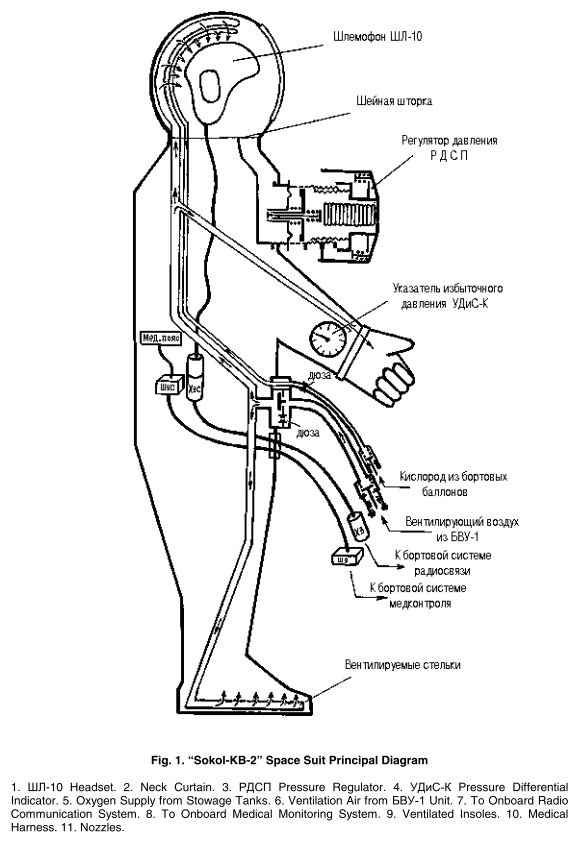
There is an opening in the front part for the spacesuit donning, on the left hand cuff the pressure differential indicator is fixed and on the right hand cuff there is a removable mirror for the donned spacesuit ext erior inspection (in particular for checking up the helmet locks).
The spacesuits are manufactured for standard sizes and for basically seated position for the cosmonaut comfort in the spacecraft seat. In order to allow for a cosmonaut specific anthropometric features individual fitting aids are provided.
The spacesuit consists of two shells: internal pressure-tight envelope and external structural shell.
Pressure-tight envelope
The pressure-tight envelope is designed to ensure the spacesuit pressurization and is made of rubberized capron fabric and in the joint areas – of rubberized knitted fabric.
There is a “big appendix” in the envelope (for the spacesuit donning) and a “small appendix” in the lower part (for urination). The “appendices” are made of rubberized cotton fabric and are pressurized by means of two rubber tight plaits.
Fixed to the pressure-tight envelope internal part are elastic pipelines for ventilation and for oxygen supply. Ventilation pipelines are laid to the trousers, sleeves and helmet. Pipelines feeding air to the feet are connected to the ventilation insoles. The oxygen supply pipe is laid to the helmet.
A neck curtain is pasted in the throat part of the envelope in order to prevent water from leaking into the suit when the cosmonaut is floating. In the initial position the curtain is stowed under a cover which is attached to the envelope throat by means of a drawstring. In case of a splashdown landing the cosmonaut pulls the drawstring and the curtain is released and then by pulling the curtain band ends he tightens the neck curtain The pressure-tight envelope is attached to the structural shell.
Structural shell
The structural shell is designed for maintaining the spacesuit shape under differential pressure and for the pressure-tight envelope protection. The shell is made of lavsan fabric and has built in structural bands with clasps in the sleeves, top part, and trousers area for the spacesuit fitting.
The spacesuit is donned through the structural shell opening which is covered by means of two structural zippers. The “big appendix” is fabric-reinforced along the zippers to prevent it from jamming.
In the “small appendix” area there is a physiological opening in the shell which is secured by lacing it up and covered by a fabric flap with velcro fastener.
The spacesuit frontal opening is reinforced by a transversal structural band which locks the shoulder joint cords and by a spring lock in the waist area.
In order to provide for the spacesuit mobility freedom there are soft joints in the structural shell shoulder, elbow and knee areas. The shoulder joints are additionally equipped with cord connections for a better mobility.
There is an adjustable frontal tightening band with a spring lock used to compensate for eventual spacesuit excess stretching out by the pressure differential.
Pressure-tight helmet
The pressure-tight helmet is manufactured integral with the spacesuit top and consists of the following elements:
- shell – the suit top part extension;
- pressure-tight joint;
- glass;
- ventilation and oxygen manifolds.
The helmet is tightly locked when its two half-frames get in full contact. The pressure-tight joint is fixed closed by means of two locks located on the helmet lower half-frame. At the moment of each lock closing its latch actuates and a specific click is heard.
The latch has a mechanical flag indicator which is protruding from the lock body in case it is not fully closed.
The helmet is unlocked by rotating the lower half-frame handle down and to the right up to the limit. This will move the lower half-frame arch until its bosses contact the latch and release them from the upper half-frame hooks.
There are ventilation and oxygen manifolds in the helmet for air and oxygen supply accordingly. The ventilation manifold has a receptacle for fixing the suit pressure charging. This operation is accomplished when the cosmonaut is floating after the splash-down landing and the neck curtain has been tightened. The helmet glass is made of strong polycarbonate material with yet a decreased abrasion resistance. To prevent the glass from scratches on the outside surface it is covered with the organic glass protector which is taken off after the crew ingress prior to launch.
ГП-7А pressure-tight glove
The ГП 7А glove is a rubber pressure-tight glove which is covered by fingerless structural shell with lock ring for connection to the suit sleeve.
The rubber glove consists of a finger part and the cuff part attached to it. The finger part has the capron knitwear reinforcement layer covered with rubber. At the finger flexion points there are bulges made for finger mobility enhancement. The cuff part is made of rubberized knitwear. The structural shell is made of lavsan fabric. The glove is connected to the suit cuff by means of the lock ring in which a hollow rubber hose (the “дутик”). The glove can be rotated about the longitudinal axis by the turnable hand connector at the suit sleeve.
The pressure-tight gloves are manufactured in three sizes: III, II Б and IV which correspond to the palm half-grip of 8, 8.5 and 9 cm.
To provide necessary physiologic/hygienic conditions for the crew member operation in the gloves hygienic cotton gloves are to be put on prior to the pressure-tight gloves donning.
Регулятор давления скафандра с подсосом РДСП-3М-01 (Air Suction Suit Pressure Regulator)
The РДСП-3М-01 pressure regulator is designed for maintaining necessary absolute pressure in the spacesuit in case of the CA depressurization and for building up pressure differential during pressurization tests.
The regulator has two pressure modes (0.4 and 0.27 kgf/cm2) and its functions are:
- to maintain preset absolute pressure (0.4 or 0.27 kgf/cm2) and to build up pressure differential (pressure adjustment);
- to prevent the suit pressure differential from rising above 0.45 kgf/cm2 (safety relief valve);
- provides for the crew capability of breathing the outer air while the helmet is closed and there is no suit ventilation (air suction).
The pressure regulator main parts are:
- body with three stops;
- valve with evacuated bellows (aneroid) and springs;
- cover with locks.
The bellows is the regulator sensitive element its operation principle being based on its elastic deformation /acting pressure relationship. The cover is the manual pressure adjustment aid.
The pressure regulator ensures one of the following conditions in the spacesuit depending on the cover position:
- When the cover is in the “0.4” position (i.e. at the medium stop):
- if the CA pressure is normal the bellows is compressed and the valve is open forced by the undervalve spring and the suit interior volume is connected to the environmental atmosphere; there is a capability of breathing the outer air while the helmet is closed and there is no suit ventilation;
- in case of the CA depressurization the bellows expanding gradually closes the valve at the level of P.CA=300 mm Hg and absolute pressure of 0.4 kgf/cm2 is maintained in the suit.
- When the cover is in the “Закрыто” (Closed) position (i.e. at the lower stop) the valve is closed forced by the over-valve spring and with the oxygen supply the pressure differential of 0.45 kgf/cm2 is maintained in the suit. This mode is used in the suit pressurization tests.
- When the cover is in the “0.27” position (i. e. at the upper stop) in case of the depressurized CA the bellows expands maximally and the load force acting on the valve is less than in the “0.4” cover position so the valve will close at a lower pressure level – at P.CA=200 mm Hg. And the absolute pressure of 0.27 kgf/cm2 is maintained in the suit. This mode is used when it is desirable to enhance the suit mobility for a short time period of no more than 5 minutes in the depressurized CA.
In order to transfer the regulator from the “0.4” to the “0.27” position it is necessary to pull the cover and screw it out till the upper stop.
In order to transfer the regulator from the “0.27” to the “0.4” position it is necessary to screw the cover in till the medium stop, pull it, pass the stop and then screw the cover out till that stop.
In order to close the pressure regulator it is necessary to screw the cover in from the medium stop to the lower stop then pull the cover and make sure it is screwed in home. The reverse operation is accomplished by screwing the cover out till the medium stop.
While the suit usage in flight is nominal the pressure regulator cover is to be in the “0.4” position except for presuurization test periods.
Указатель избыточного давления (УДиС-К) манометрического типа (Pressure Differential Manometric Indicator)
The УДиС-К pressure differential manometric indicator is designed for visual monitoring of the spacesuit pressure differential:
Р.ИЗБ = Р.СКФ − Р.СА
The indicator is implemented as a manometric capsule, its interior volume being connected to the space suit interior. The indicator principle of operation is based on the relationship between the pressure differential value and the elastic deformations of the manometric capsule – the indicator sensitive element which when deformed converts the pressure differential value into the capsule upper center linear displacement. This displacement is transmitted by the transfer/multiplying mechanism to the indicator pointer.
The indicator scale is graduated from 0 up to 0.45 kgf/cm2, the graduation marks being spaced at 0.02 kgf/cm2.
Spacesuit electric equipment
The electric equipment is designed to provide for the crew member radio communication (X3 umbilical) and medical monitoring (Ш9) with the spacesuit donned.
It consists of the pressure-tight electric lead through fixed to the suit shell, interior and exterior conductor bunches for the headset and medical harness connections to the spacecraft onboard systems.
Maintenance kit
The maintenance kit is designed for the spacesuit flight maintenance as its nominal usage procedure. The kit is located in the БО Module, fixed to the wall near the “сервант”.
Operation with the spacesuit
The “Sokol-KB-2” is a ventilation-type spacesuit.
While in nominal flight normal life support conditions in the suit are maintained by its venting with the cabin air. The air is fed to the suit by the onboard ventilation unit from the CA atmosphere at the flow rate of 180-200 nl per minute, that being sufficient for removing excess heat, breathing wastes and moisture from the suit. The coming air is fed through the elastic piping to the helmet, to the sleeves and to the feet by three approximately equal flows. The air goes out of the suit via the open helmet or via the pressure regulator when the helmet is closed.
In case of the CA depressurization life support conditions are ensured by constantly supplying oxygen into the suit from the stowage tanks. When the pressure in the CA falls down to 400 mm Hg the ventilation air supply to the suit is terminated and the constant oxygen supply is initiated. The suit ventilation manifold is isolated from the CA atmosphere (in the БР-1) and oxygen is pumped into the helmet. The oxygen flow rate of 20-23.5 nl per minute is enough for the breathing wastes and moisture removal from the helmet. When the CA pressure falls down to 300 mm Hg the pressure regulator closes maintaining absolute presure in the suit at 0.4 kgf/cm2 level. The pressure regulator also provides for the excess oxygen outlet from the suit.
zDiagrams
- Sokol diagram (75 KB). Source: Russian Spacesuits, Isaak P. Abramov and As. Ingemar Skoog, Praxis Publishing, 2003.
- Sokol KV2 pressure suit from the MARS Center (60 KB)
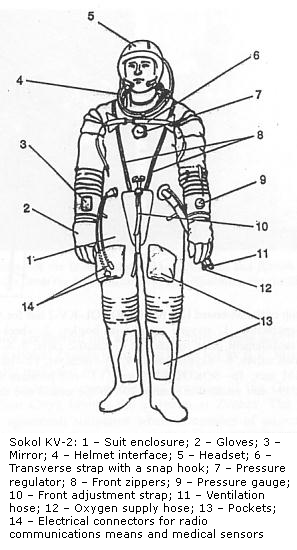

Gallery
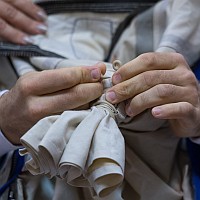
Closeup of Expedition 53 Soyuz Commander Aleksander Misurkin sealing the lining of his Sokol suit: twisting the inner material appendix and securing it with a rubber band.
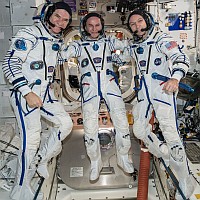
Expedition 52-53 crew members (from left) Paolo Nespoli, Sergei Ryazanskii and Randy Bresnik wearing their Sokol launch and entry suits in orbit, 4/12/2017.
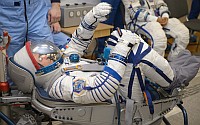
Expedition-61 cosmonaut Oleg Skripochka has his Sokol suit pressure checked a few hours ahead of his launch on a Soyuz rocket.
Links
- Kosmonavtika: The Sokol KV-2 pressure suit (in French)
- Mike’s Space Collection: Sokol (in German)
- NASA: Sokol photos; Flickr photos with sokolsuit tag
- Science Museum Group: Sokol space suit – Helen Sharman’s Sokol from 1991 on display.
- National Air and Space Museum: Pressure Suit, Sokol KV-2, Dennis Tito (and Archive.org link)
- Wikipedia: Sokol spacesuit
Updated: 12/5/2023