Russian spaceships
An overview of the two Russian spaceships currently in use with the ISS program.
Progress cargo ship
The Progress cargo spaceship, based on the same design as the Soyuz and developed by NPO Energiya, has been a major factor in enabling the Russian space program’s long-duration space station flights. It is a relatively cheap method of keeping a space station supplied. The original Progress design was first launched on 20 January 1978.
Like the Soyuz manned spaceship, the Progress launches on the Soyuz booster. It follows the same two-day flight profile from launch to docking. Also like the Soyuz, the Progress is constructed in three main sections:
- Cargo Module
Грузовой отсек - The spherical front end of the spacecraft, which is filled with cargo supplies. The crew enters this section after the Progress has docked and pressures equalized. After the cargo is removed, the area gets filled with rubbish, unneeded equipment and wastewater over the months the Progress is docked to the Station. All this is burned up when the spacecraft re-enters the atmosphere – an environmentally-friendly method of garbage disposal!
- Refueling Module
Отсек Компонентов Дозаправки - The middle part of the Progress, replacing the Descent Module of the Soyuz. The M-1 version has four fuel and four oxidizer tanks; the M version has two of each, plus two water tanks. Fluid connectors in the docking ring enable the fuel and oxidizer to be pumped to holding tanks in the Russian segment’s own propulsion system. The Progress thrusters can also use this fuel to increase the Station’s altitude or change its orientation (attitude) in space.
- Instrumentation/Propulsion Module
Приборно Агрегатный Отсек - In this last segment are contained the avionics for the spacecraft’s systems and sensors. Surplus fuel in this module (i.e. which hasn’t been used for rendezvous and docking) can be utilized to boost the Station’s altitude. This surplus fuel can vary from 185 to 250 kg.
A Progress mission usually follows much the same flight path as that of the Soyuz, launching into a 51.6° incline to the Equator to put the ship into the orbit path of the International Space Station, then undertaking a two-day catch-up to the altitude of the ISS, or the Fast Rendezvous Profile flight, which gets it to the ISS in only 3 hours or less.
Rendezvous and docking are automated, though TsUP and the Station crew monitor the Progress’s approach when it comes to 150 meters range. The «Курс», Kurs (“Course”) equipment controls this procedure; the active part is on the Progress and the passive on the ISS.
An example of a Kurs display showing a docking sequence (the Poisk module, via the Progress M-MIM-2 launch thread at NASASpaceflight.com): 1, 2, 3, 4, 5, 6, 7, 8. Status data and co-ordinates are displayed on the screen; some of the abbreviations are listed below:


- АВТ
- AVT
- Automatic mode
- ВКЛ: Включить
- VKL: Vklyuchit’
- On, turn on, activate
- ГСО: Готовность Системы Ориентации
- GSO: Gotovnost’ Sistemyi Orientatsii
- Readiness of orientation system
- Захват
- Zakhvat
- Capture
- ИМП: Импульс
- IMP: Impul’s
- Impulse; burn
- ИН: Инструкция
- IN: Instruktsiya
- Instruction
- Курс-П
- Kurs-P
- “Course” (radar rendezvous system)
- ЛСК: Лучевая Система Координат
- LSK: Luchevaya Sistema Koordinat
- Line-of-Sight Coordinate System
- Нет
- Net
- No
- Облет
- Oblet
- Fly-around
- Причал
- Prichal
- Dock(ing)
- СБ: Сближение
- SB: Sblizhenie
- Rendezvous
- ТМ: Телеметрия
- TM: Telemetriya
- Telemetry
- Тормож
- Tormozh
- Braking (deaccelerating)
Should the Kurs not work properly, the crew have a back-up called TORU (Оборудование Телеоператорного Режима Управления, Teleoperator’s Remote-Control Equipment) in Zvezda’s Work Compartment. This consists of a computer laptop monitor which shows the remote view from a camera on the Progress, and manual controls which remotely fire the spacecraft’s thrusters. The TV system is called the “Simvol-TS,” «Символ-ТС» (Symbol); a docking symbol is displayed on the screen, which the operator has to keep lined up with the docking target.
A Progress has enough propellant for 3 docking attempts. The fuel mass for the second and third docking attempts is not counted in the cargo manifest.
After being unpacked, the Progress is filled up with containers of assorted rubbish items during the next few months. A Progress ship being discarded burns up in the atmosphere after redocking, though occasionally it might stay in independent orbit for longer to perform experiments or tests, as was the case with Progress M1-4, which was undocked and flown in autonomous orbit for nearly three weeks for experiments before redocking.
One or two Progresses are docked to the ISS at a time (to the rear end of Zvezda) and one is undocked a day before the next Progress is launched. For example, in June 2003 the previous M-47 was left in place when the M1-10 arrived so both craft could be used to maintain the Station. M1-10 docked to the base of Pirs, but was later undocked to make way for Soyuz TMA-3.
The cost per kilogram for cargo on a Progress ranges from USD$22,000 to $25,000.
Launch failure
On the 136th launch of a Progress – Progress M-12M on 24 August 2011 – 325s into flight, the third (Block-I) stage failed, and the vehicle with the Progress attached re-entered after achieving a sub-orbital trajectory, crashing in Siberia. This was the first such incident since the first Progress launch in January 1978. The failure was initially announced as being caused by a malfunction in the gas generator in the Soyuz-U rocket’s third-stage engine (Block-I, Блок-и).
Variants
The original Progress, numbers 1 to 42, made flights to the space stations Salyut 6, 7 and Mir (one launched as Cosmos-1669 with an antenna system called «Игла», “Needle,” actually making 43 flights). There were 67 flights for the Progress M version, 11 times for the Progress M1 version, 12 times for Progress M-M and three times in special cases (Scientific Laboratory «Гамма», “Gamma” in 1990, Progress M-SO1 in 2001 and Progress M-MIM2 in 2009). The two versions currently in use are the Progress M and M1. Both versions are used to supply the ISS.
The table below (from somewhere in the Novosti Kosmonavtiki forum) lists the variants that have flown.
| Spaceship Корабли |
Ship modification Модификации корабля |
Beginning of operation Начало эксплуатации |
Launches Запуски |
|---|---|---|---|
| Progress | Original version | 1978 | 43 |
| Progress M | First modification | 1989 | 53 |
| Progress M-VDU | Second modification | 1992 | 2 |
| Progress M1 | Third modification | 2000 | 11 |
| Progress M-SO1 | Fourth modification | 2001 | 1 |
| Progress M/M1 | Fifth modification | 2006 | In use |
Two comparison tables for the Progress M and M1.
| Performance | Progress-M | Progress M1 |
|---|---|---|
| Mass, kg | ||
| Spaceship Mass | 7020-7320 | 7200-7420 |
| Cargo Dry Mass | 2100-2620 | 2230-2450 |
| Cargo Mass (in cargo module) | up to 1800 | up to 1800 |
| Rodnik Tanks Water Mass | up to 420 | |
| Propellant Mass | up to 1150 | up to 1950 |
| Orbital Module Gas Mass | up to 50 | up to 40 |
| Orbit Parameters | ||
| Height, km | up to 400 | up to 460 |
| Inclination, deg | 51.6 | 51.6 |
| Overall Dimensions, mm | ||
| Spaceship Maximum Length | 7230 | 7230 |
| Spaceship Maximum Diameter | 2720 | 2720 |
| Equipment Bay Diameter | 2100 | 2100 |
| Solar Batteries Span | 10,700 | 10,700 |
| Cargo Module Length | 2406 | 2406 |
| Cargo Module Overall Diameter | 2200 | 2200 |
| Docking Hatch Diameter | 800 | 800 |
| Three Additional Hatches Diameter | 470 | 470 |
| Delivered/Disposal Cargo Dimensions, mm | ||
| Rectangle Diameter and Diagonal | less than 750 | less than 750 |
| Length | 1500 | 1500 |
| Delivered/Disposal Cargo Mass, kg | ||
| Fixed on Frames | up to 200 | up to 200 |
| Packed in Containers | up to 50 | up to 50 |
| Disposal Cargo Total Mass, kg | ||
| In Cargo Module | up to 1500 | up to 1500 |
| Liquid Waste Mass | up to 420 | |
| Category | Progress M | Progress M-1 |
|---|---|---|
| Total payload limit | 2350 kg | 2230-3200 kg |
| Maximum pressurized (dry) cargo | 1800 kg | 1800 kg |
| Maximum water | 420 kg | up to 300 kg in cargo module |
| Maximum air or oxygen | 50 kg | 40 kg |
| Maximum propellant for refuelling | 850 kg | 1700 kg (up to 1950 kg max) |
| Propellant surplus available to the Station | 250 kg | 185-250 kg |
| Amount of rubbish disposal in the Cargo Module | 1000-1600 kg | 1000-1600 kg |
| Waste water | 400 kg | In Cargo Module |
| Cargo volume | 6.6 m3 | 6.6m3 |
| Name: | Progress | Progress-M | Progress-M1 |
|---|---|---|---|
| Designation: | 7K-TG | 7K-TGM | 7K-TGM1 |
| Maiden launch: | 20 Jan 1978 | 23 Aug 1989 | 1 Feb, 2000 |
| Total launched: | 43 (series is closed in 1990) | 48 (on April 2004) | 11 (on April 2004) |
| Key features: | Automated TKG, developed on the basis of Soyuz manned spacecraft | Automated TKG, with unified main systems as for Soyuz-TM manned spacecraft. Presence of solar panel increases margin of self-sufficiency. Added a teleoperator mode of control from board of orbital station (TORU) | Automated TKG, specially modified to deliver fuel components to the ISS |
| Total mass of delivered payload, kg: | up to 2300 | up to 2620 | up to 2450 |
| Limit mass for components, kg | |||
| in cargo compartment: | up to 1400 | up to 1800 | up to 1800 |
| propellant components: | up to 870 | up to 1150 | up to 1950 |
| gas: | up to 50 | up to 50 | up to 40 |
| water:: | up to 420 | up to 420 | up to 220 |
Original Progress
The first Progress, Progress 1, launched on 20 January 1978 to Salyut 6. The Progress relied on internal batteries for power, not solar panels.
Progress M
The modernized Progress M first launched on 23 August 1989 to Mir. The modernization was primarily of the flight control systems.
Progress M-1
The Progress M-1 version was a modified version that enabled the delivery of more fuel to the ISS for the orbital boosting and maneuvering systems. The tanks were fitted into the middle section while the water tanks were moved into the front Cargo Module. The extra fuel means less water can be carried, though:
Since the shuttle fuel cells generate water as a byproduct of electricity generation, the space shuttle was to deliver all water to ISS, hence the development of the Progress M-1 which replaced the water tanks with additional fuel. After the Columbia accident, Russia reverted to the Progress M to deliver water to ISS while the shuttle fleet was grounded. Perhaps they could have reverted to the M-1 after return-to-flight, but the announcement of shuttle retirement in 2010 has understandably made them reluctant to do so.
The M-1 first launched on 1 February 2000 to the International Space Station. It also has a new digital flight control system and new version of the Kurs automated rendezvous & docking system (Kurs-MM). Twelve tanks filled with a nitrogen-oxygen mix for the Station’s atmosphere are fitted around the outside, between the Refuelling and Propellant modules.
Progress MSO-1
The Progress M-SO1 version was a specially-modified version used to launch the Pirs docking module on 14 September 2001. The Pirs module replaced the standard cargo and fuel sections of the Progress. (SO, Стыковочный Отсек, Docking Module.)
Progress M-VDU
The Progress M-VDU version was a specially-modified version of the Progress-M used twice to launch the VDU propulsion unit to the Mir Space Station. The VDU module replaced the standard fuel section (OKD). On 15 August 1992 Progress M-14 (serial 209) was launched with the first VDU for installation on the end of the Sofora girder on the Kvant-1 module. The second VDU was launched with Progress M-38 (serial 238) on 14 March 1998 as a replacement for the old unit. (ВДУ, Выносная Двигательная Установка – VDU, Vynosnaya Dvigatel’naya Ustanovka, External Engine Unit) (Thanks to Marcel Stuij for info!)
Progress M-XXM
The designation Progress M-XXM (where XX = 01, 02, 03 etc.) has been chosen for Progress M cargo ships with a new onboard computer, TsVM-101, a digital telemetry system. Currently the Progress M cargo ships use an old onboard computer, Argon-16. Progress M-01M (№401) launched on 26 November 2008.
Progress M-15M launched on 20 April 2012 with a new Kurs-NA (NA, НА – новая активная, Novaya Aktivnaya, New Active) docking system that featured upgraded electronics and used less power; it was developed by the Research Institute of Precision Instruments (NII TP, НИИ ТП – Научно-исследовательский институт точных приборов).
Progress MS
This variant is to test various components of the modified Soyuz TMA-MS spaceship before the latter’s flight in 2016. The first in the series, Progress MS-01, was launched on a Soyuz-2-1a rocket on 21 December 2015.
Numbering
The Progress numbering system is somewhat complex. 11F615A55 is the article number and 7K-TGM is the manufacturer’s designation. The ships are also given serial numbers:
- Progress 1 to Progress 42 the serial number started with “1”: Progress 1 was 11F615A15 number 102, Progress 42 was 11F615A15 number 150.
- Progress M-1 to Progress M-49 the serial number started with “2”: Progress M-1 was 11F615A55 number 201, Progress M-49 was 11F615A55 number 249.
- For Progress M1-1 to Progress M1-11, the serial number started counting from “250” until “260”.
- Starting with Progress M-50 the serial number started with a “3,” that is 350, 351, 352, etc …
(Via Rui Barbosa at NASASpaceflight.com)
Raduga
«Радуга»
The Raduga was a small container that enabled payloads to be returned to Earth from Space Station Mir. It was discontinued as it did not have a good recovery record and took up valuable space inside the Progress. From Mir Hardware Heritage:
Return payload capability when equipped with Raduga (“Rainbow”) ballistic return capsule (figure 1-27). The Russians use this capsule to return small, valuable payloads from Mir. It was named Raduga largely for marketing purposes. The capsule is carried in the Progress M dry cargo compartment. At the beginning of Raduga’s return to Earth, the Progress-M completes its deorbit burn. At an altitude of about 120 km, the capsule separates. The Progress M undergoes destructive reentry, while the capsule makes an intact reentry, with landing and recovery in central Asia. Raduga is used to return up to 150 kg of payloads to Earth two or three times each year. Each Raduga capsule is about 1.5 m long, is 60 cm in diameter, and weighs about 350 kg empty. Use of the Raduga 44 ballistic return capsule lowers Progress M cargo capacity by about 100 kg, to a maximum of about 2400 kg. Progress M-5 carried the first Raduga capsule.
Name: Возбращаемая баллистическая капсула / Ballistic capsule cylinder / Vozbrashchaemaya ballisticheskaya kapsula
- Encyclopedia Astronautica: Progress M VBK.
Terminology
Some NASA officials refer to Progress and Soyuz flights by incorrect designations – e.g. Progress 18/18P (the 18th Progress flight to the ISS – which is in actuality Progress M-53). From Chris van den Berg’s ISSCOM 038 (25 August 2003) on the designation of Progress-es (it also applies to Soyuz flights):
Confusion caused by NASA self-conceit or ignorance.
Many interested persons use to their entire satisfaction the NASA status reports of the ISS. Those reports give very good information, but ridiculously mix up Progress serial numbers. For instance the most recent status report refers to the freighters Progress-10, Progress-11 and Progress-12. (Status report nr. 03.39, paragraph 5) In the past there have been remarks, also by prominent insiders, but this did not help. The use of these names has been caused by the fact that in the official ISS schedule the freighters get the abbreviation “P” and a number. It is wrong to write the word or name Progress plus that ISS schedule number. Using the word Progress demands the use of the official Russian name of the ship. So it would be correct to give only the “P” plus the number and between brackets the real Russian name.
It is quite normal that the Russians use their own names and serial numbers of their products and objects and these are fully respected and even registered by official international organizations, like for instance the IFRB in Geneva. Even a scientist that cannot be praised enough, Dr. Kelso, does not refrain from the Russian names and numbers.
The freighters of the type Progress-M1 are modifications of the older type Progress-M and designed especially to be used with the ISS, but the Russians still have some Progress-M freighters in stock and the situation in that economically harassed country demands the use of all still utilizable stuff.
History: And of course a lot of present NASA people still had to be born or at least to grow up so for them I want to lift a little corner of the veil:
Progress-10 choose open space in 1980 to serve space station Salyut-6. Progress-11 did the same in the fall of that year, also to bring all what was necessary to the Salyut-6 and the Progress-12 concluded the logistic operations for the Salyut-6 in the spring of 1981.
– C.M. van den Berg, NL-9165/A-UK3202
Diagrams
- Progress M cutaway, MARS Center (32 KB)
- Progress M launch profile (26 KB)
- Progress M re-entry profile (47 KB)


Gallery

Progress M-52 departs the ISS, 15 June 2005.

Aleksandr Kaleri at the TORU, ТОРУ workstation, practising docking procedures.

View from the camera on M-59 as it approaches to dock at Pirs. In the lower right-hand corner is Kurs («Курс») docking system data.

Raduga capsule illustration (Mir Hardware Heritage)
Links
- ESA infographic: Visiting vehicles: Progress
- NASA: NASA Space Station Progress page; Progress Gallery
- Russian Space Web: Progress page
- Space.com: How Russia’s Progress Spaceships Work (Infographic)
Soyuz crewed spaceship
The Soyuz («Союз», “Union”) spacecraft has been the workhorse of the Russian space program since 1967, and is currently the main means of transporting crews to and from the ISS. Sergei Korolyov originally conceived the Soyuz as a lunar ferry spacecraft (and it could still conceivably be used for that purpose).
The Soyuz is not reuseable; a new one is built for each flight and is docked to the ISS for 6 months. The old one is piloted by the crew returning to Earth; the central crew cabin separates from the other two compartments (these burn up in the atmosphere), and makes a ballistic re-entry, parachutes deploying to slow it down before touchdown on Earth.
The outward appearance of the Soyuz hasn’t changed much over the years, but the interior is equipped with modern avionics (a “glass cockpit”).
The Soyuz vehicle consists of 3 components: the Instrument-Assembly Module (Priborno-Agregatnyi Otsek, Приборно-Агрегатный Отсек); Descent Module (Spuskaemyi Apparat, Спускаемый Аппарат); and Orbital Module (Bytovoi Otsek, бытовой Отсек). They are described in more detail on the Soyuz components page.
On re-entry, the Instrument and Orbital Modules separate and are discarded; the Descent Module makes a ballistic (unpowered) descent through the atmosphere, deploys parachutes (hopefully!) and makes a soft landing in the northern Kazakhstan landing zone.
Both Utility and Descent Modules are covered with a charcoal-colored thermal insulation.
The Soyuz has a launch tower escape system, which is of some reassurance to its passengers! Should the rocket explode on the launch pad, or during ascent, explosive bolts are fired to separate the spacecraft’s descent module from its service module, and the rocket’s upper launch shroud from the lower. The escape system’s motor then fires, catapulting the module and shroud up and free of the booster to descend by parachute some kilometers away. Such an abort occurred in 1983 on the Soyuz T-10 mission (subsequently referred to as T-10-1 or T-10-a), with the two cosmonauts on board surviving intact.
To date there have been two fatal Soyuz flights: Soyuz 1 (death of Vladimir Komarov on landing; parachute failed to open) and Soyuz 11 (deaths of Vladislav Volkov, Georgii Dobrovolskii and Viktor Patsaev during descent because of an oxygen leak.)
There have been five main Soyuz variants that actually flew into space.
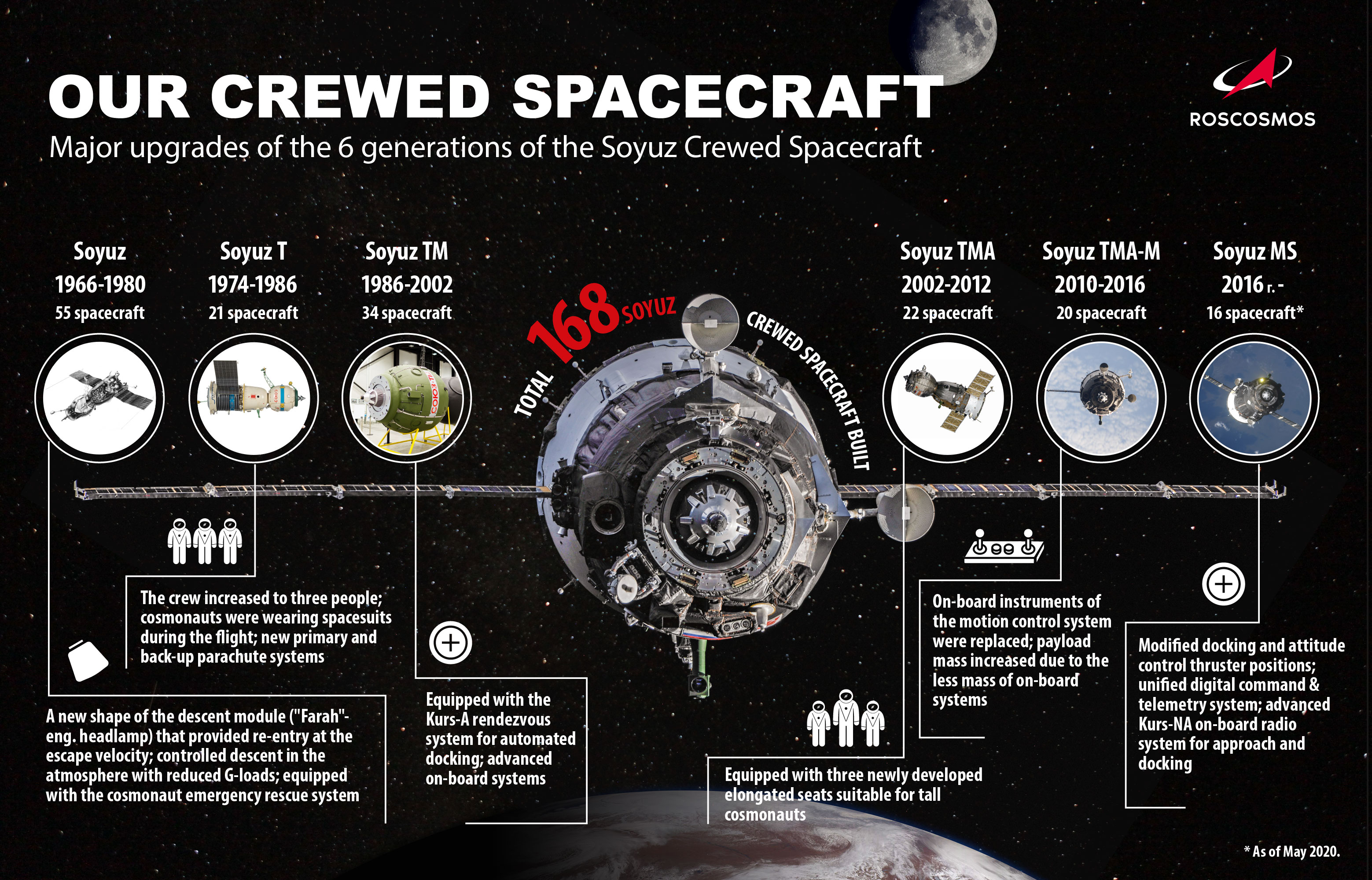
The table below (from somewhere in the Novosti Kosmonavtiki forum) lists the variants that have flown under the Soyuz designation.
| Spaceship Корабли |
Ship modification Модификации корабля |
Beginning of operation Начало эксплуатации |
Launches Запуски |
|---|---|---|---|
| Soyuz | Original/basic | 1966 | 55 |
| Soyuz T | First modification | 1974 | 21 |
| Soyuz TM | Second modification | 1986 | 34 |
| Soyuz TMA | Third modification | 2002 | 22 |
| Soyuz TMA-M | Fourth modification | 2010 | In use |
Previous versions
There were several sub-variants flying under the original Soyuz designation:
- 7K-OK: Soyuz 1 to 9. 9 launches. The first launch ended in disaster (death of Vladimir Komarov on landing).
- 7KT-OK: Soyuz 10 (aborted), 11. Two launches. Soyuz 11 was the second disaster (death of the three crew during descent).
- 7K-T: Soyuz 12, 13, 17, 18-1 (aborted), 18, 25, 26-29, 31-33, 35-40. 19 launches.
- 7K-MF6: Soyuz 22. One launch.
- 7K-T/A9: Soyuz 14, 15, 21, 23, 24, 30. Six launches.
- 7K-TM: Soyuz 16, 19 (Apollo-Soyuz Test Project). Two launches.
There were also many other variants that were planned, but never built, including the versions intended for transport to the Moon and back, such as the 7K-L1 Zond.
An article by Asif Siddiqi in Spaceflight magazine March 2003, “Soyuz variants – a 40-year history,” describes the variants in detail.
The next major variant was the Soyuz T. The 7K-ST flew under the Soyuz T designation. It could carry three spacesuited cosmonauts, had solar panels and digital computers. 18 attempted launches between 1978-1986, 15 of which were manned. The first launch (T-1) was unmanned. One, Soyuz T-10-1 or T-10-a, failed to reach orbit (as mentioned above) as it aborted at launch. (The following flight was designated Soyuz T-10.) Thus there were 14 actual Soyuz T flights.
The Soyuz TM was a modernized version of the Soyuz T and flew 34 missions between 1986 and 2002.
Soyuz TMA
The Soyuz TMA (200 series) ferries crews to the International Space Station and back to Earth. It made its first flight in November of 2002, replacing the previous Soyuz TM version, which had been in service since May 1986.
The following was taken from the Energiya TMA page.
| Name of characteristic, dimensions | Meaning | Remarks |
|---|---|---|
| Spacecraft mass, kilograms | 7220 | |
| Descent module mass, kg | ~2900 | |
| Crew, persons | 2-3 | |
| Orbit parameters | ||
| • inclination | 51.6° | |
| • altitude, km | ||
| ~ of insertion | 202/238 | (Perigree/apogee) |
| ~ during spacecraft docking | up to 425 | |
| ~ during spacecraft descent | up to 460 | |
| Geometrical characteristics of the spacecraft, millimeters | ||
| • body length | 6980 | |
| • maximal diameter | 2720 | |
| • diameter of living compartments | 2200 | |
| • solar array span | 10,700 | |
| Calculated mass of payload, kg (with a 3-person crew) | ||
| • delivered | up to 100 | |
| • returned | up to 50 | |
| Flying life, days | 200 | (Including the autonomous flight time) |
| Touchdown speed, meters/second | ||
| • with the main parachute system, maximum/nominal | 2.6/1.4 | (3.6/2.6 via Soyuz TM) |
| • with the reserve parachute system, maximum/nominal | 4.0/2.4 | (6.1/4.3 via Soyuz TM) |
| Launch vehicle | Soyuz FG | Developed for the Soyuz TMA spacecraft; it passed flight testing during the Progress spacecraft launches in the years 2001-2002 |
| Parameters | Soyuz TM | Soyuz TMA |
|---|---|---|
| Cosmonaut/astronaut height, centimeters | ||
| • maximum, in the standing position | 182 | 190 |
| • minimum, in the standing position | 164 | 150 |
| • maximum, in the sitting position | 94 | 99 |
| Cosmonaut/astronaut chest circumference, cm | ||
| • maximum | 112 | not limited |
| • minimum | 96 | not limited |
| Cosmonaut/astronaut mass, kg | ||
| • maximum | 85 | 95 |
| • minimum | 56 | 50 |
| Maximum foot length, cm | 29.5 | |
Soyuz TMA-M
The Soyuz TMA-M (700 series) was a digital upgrade of the first TMA, making its first flight in October 2010.
In April 2006 the head of Energiya, Nikolai Sevast’yanov, announced that a new Soyuz variant would be developed, that would have digital control systems (rather than the current analog «Аргон-16», Argon-16), a new telemetry system and a new Russian «Курс-Н», Kurs-N approaching and docking system (rather than the Ukranian Kurs in use).
The Soyuz TMA now is equipped with five different radio-technical systems, and this means that there are established on board five bulky and heavy transmitters, five receivers and five amplifiers, developed in the 70s, with the application of analog components. However, digital technologies will make it possible to combine all these systems into one compact block.
– NK №566
The new TsVM-101 computer (which weights 8.3 kg) will replace the Argon-16 computer (which weighs 70 kg – manufacturer’s page, in Russian). The analog telemetry system will also be replaced by a lighter digital equvalent called МБИЦ, MBITS. The TsVM-101 will initially be installed in the rear Instrumentation/Propulsion Module of the Soyuz and Progress, but it is planned to later move it to the Descent Module to take over re-entry control functions from the KS-020M computer that currently handles this, and enable the TsVM-101 to be reused. This will not happen before 2010.
The table below shows the TsVM-101 specifications, from the manufacturer’s page (I am uncertain of some translations).
| Микропроцессор Microprocessor |
1B812 1V812 |
| Регистр-регистр Register-Register |
24 млн.оп/с 24 million operations/sec |
| С плавающей запятой Set floating-point |
6 млн.оп/с 6 million operations/sec |
| Оперативная память RAM |
2 Мбайт 2 MB |
| Программная память Program memory |
2 Мбайт 2 MB |
| Условия эксплуатации Operating conditions |
ГОСТ РВ 20.39.304-98 гр.5.5 и 5.3 |
| Потребляемая мощность Power consumption |
от 40 до 60 Вт |
| Напряжение питания Voltage range |
+27; −5 В +27; −5 V |
| Габаритные размеры Overall dimensions |
370 × 236 × 142 мм |
| Масса Mass |
8,5 кг |
This photo (from the NASASpaceflight.com forum) shows the difference in sizes between the two generations of computers.

These developments will enable the ship to be cheaper, lighter and more spacious. Only Russian-made systems would be used. There will also be an improved cooling system for the hydrogen peroxide re-entry control thrusters, enabling the Soyuz to remain in space for up to a year. The ship would be designated Soyuz TMA-Ts, «Союз-ТМА-Ц», the “Ts” meaning Цифровой, Tsifrovoi, digital (later changed to “M,” presumably for “Modernized”).
The new digital system will first be test-flown aboard a modified Progress-M (beginning from serial number 401), currently Progress M-65 in August 2008 (with a “standard” Progress as backup should the systems malfunction). The first digital Soyuz will be Soyuz TMA-01M N°701, to fly in October 2010.
From 2010 there will be a transition period when old and new versions of Soyuz and Progress will be flown.
At the 2006 Farnborough Airshow Nikolai Sevast’yanov said that the next modernized Soyuz variant would be able to stay docked to the ISS for nearly a year (360 days), and also do a circumlunar mission (around the Moon), re-entering the Earth’s atmosphere at the planetary escape velocity of 11.2 km/second. The heat shielding for the Descent Module would thus need to be strengthened and thickened. The external hull design would otherwise remain much the same.
Soyuz Spacecraft Upgrade Ups Payload By 70 Kg
Roskosmos, 26/09/2010
New onboard digital command and control systems have helped increase the payload of Russia's manned Soyuz TMA-01M spacecraft by 70 kg, the head of the Energia space corporation said. The new equipment replaces the Argon analogue system that has been used for more than 30 years, Vitaly Lopota said. A Soyuz with a new digital computing and telemetric system will be launched to the International Space Station on October 8.
The new onboard computer, the СС-101, will be tested by Russian cosmonaut Alexander Kaleri, Lopota said. The Soyuz TMA-01M will replace the Soyuz TMA series spacecraft that have been used until now, Lopota added.
Design of transport human space vehicle Soyuz TMA-M is based on Soyuz TMA’s one which has been commissioned in 2002. The modification was customized by the Russian Federal Space Agency. Prime contractor is RCS-Energia. The vehicle of new series features the same range of objectives as the previous series.
Compare to the basic design, Soyuz TMA-M has the following upgrades:
- Units of the Guidance, Navigation and Control and Onboard Measurement system have been replaced with the modified ones, with up-to-date EEE-parts and enhanced SW;
- functional capabilities of the vehicle have been enlarged through deeper integration with the Russian segment computer system and GNC onboard computer control of the systems via multiplex exchange link;
- payload lifting capacity improved due to reduction of the onboard system mass parameters.
The updates cover one of the steps aimed at development of the advanced new-generation space vehicle (ACV). Flight certification of the units and hardware installed on Soyuz TMA-M will allow to implement relevant solutions for ACV. External view of the upgraded vehicle is similar to the Soyuz TMA one.
Flight tests of the vehicle will include two missions to the ISS. The third mission of Soyuz TMA-03M is considered as acceptance. Flight tests are to confirm proper execution of the nominal operations and off-nominal cases, maneuvers, etc.
Soyuz MS
This was another incremental upgrade to the TMA model, the last major upgrade before the next-generation vehicle was introduced. The modifications will initially be tested on the Progress cargo ship, designated Progress MS. First flight is (as of December 2012) to be in early 2016. As described in a forum thread at NASASpaceflight.com, the main modifications will be:
- higher power output from the solar panels through the use of more efficient photovoltaic cells
- different arrangement of the approach and orientation thrusters which should make it possible to achieve docking even if one of the engines fails or perform a safe de-orbit burn even “if there are two failures in the engines”
- a new system of mutual measurements for approach and docking. Instead of the optical device now used for control and manual orientation of the vehicle, a so-called “video orientator” is being developed whose work will not be hampered by orbital lighting conditions as is currently the case
- improved communications systems
- the old command radio link will be replaced by a unified command/telemetry system which will make it possible to receive telemetry via satellite and control the vehicle when it is not within sight of Russian ground stations
- GLONASS/GPS receivers which after parachute deployment and after touchdown will make it possible to send exact coordinates to Mission Control via the Kospas/Sarsat system
The onboard computer is a TsVM-101, ЦВМ-101.
From the Energiya website:
The manned transportation spacecraft Soyuz MS developed and built by RKK Energiya is designed to deliver the crews of up to three and their accompanying cargoes to the International Space Station (ISS), as well as to return them to Earth. When attached to the ISS, it also serves as a crew rescue vehicle and is kept permanently ready for emergency crew return to Earth.
The new-series spacecraft Progress MS and Soyuz MS were developed as a result of a radical upgrade of Progress M and Soyuz TMA spacecraft. The onboard command radio system Kvant-B was replaced with an integrated command and telemetry system with an additional telemetry channel. The new command radio link will make it possible to receive signals via relay satellites Luch-5, which will significantly increase the radio coverage zone for the spacecraft – up to 70% of an orbit. The spacecraft are equipped with an advanced onboard radio system for rendezvous and docking Kurs-NA. As compared with an earlier model, Kurs-A, it has improved mass and dimensions parameters and makes it possible to delete from the spacecraft hardware configuration one of the three radio antennas. Instead of the analog TV system Klyost, the spacecraft use a digital TV system, which makes it possible to maintain communications between the spacecraft and the station via a space-to-space RF link. Also included into the onboard equipment of the Soyuz MS and Progress MS series spacecraft to replace the equipment that is being phased out of production is a new Digital Backup Loop Control Unit developed by RKK Energiya, an upgraded Rate Sensor Unit BDUS-3A and a LED headlight SFOK. Thanks to the use of new ground and onboard radio systems, it became possible to use state-of-the-art data transmission protocols, which resulted in improved operational stability of spacecraft control system.
Most of the engineering solutions incorporated into the design of Soyuz MS and Progress MS spacecraft will be used in the design of the new-generation Crew Transportation Spacecraft, which is currently under development at RKK Energiya.
The propulsion systems on the Soyuz spacecraft have undergone significant changes over the entire history of operation and modernization.
Starting with the Soyuz TMA model, the layout of the berthing and orientation engines of the combined installation was additionally changed to:
- the flight program was carried out in case of failure of any one of the mooring and orientation engines;
- the safety of the crew and the orbital station was ensured in the event of two failures in the subsystem of the spacecraft’s CPS, including a failure (depressurization) of one of the fuel manifolds.
The structure of the Soyuz MS CDU includes 28 DPO – the subsystem includes two fully redundant collectors of 14 high-thrust DPO each.
Looking at the Soyuz MS, I would like to rejoice at the reliability of the ship and the safety of its crew. In the course of the analysis of the requirements for fault tolerance imposed on the ship as part of its participation in the work on the ISS, the Soyuz MS was finalized almost to perfection.
– Roskosmos, 14/9/2022
Diagrams
- Energiya: Accommodation of the equipment newly inserted onboard the Soyuz TMA-M vehicle. OMS: onboard measurement system (СБИ: системы бортовых измерений); GN&CS: guidance, navigation and control system (СУДН: системы управления движением и навигации); TCS: Thermal Control System (СОТР: Система обеспечения теплового режима).
- ESA infographics: Soyuz MS spacecraft infographic – Modules and Specs; Soyuz MS spacecraft infographic
- Glavkosmos: Major upgrades of the 6 generations of the Soyuz crewed spacecraft (and archived link)
- Two Soyuz diagrams by “Junior” (30 KB each): 1, 2
- RIAN: Soyuz TMA-M – a new series of the legendary Soyuz spacecrafts
- Wikimedia Commons: Soyuz rocket and spaceship



Gallery

Soyuz TMA-6 approaches the ISS to dock, 16 April 2005.

Soyuz TMA-9 (foreground) and Progress M-57 docked to the ISS.

Soyuz TMA-17 departs the ISS on 2 June 2010, showing a closeup of its probe-and-drogue docking cone.
Links
- Encyclopedia Astronautica: Soyuz
- Energiya: Soyuz TMA manned transport spacecraft; Soyuz TMA-M manned transport vehicle of a new series. Main characteristics, modifications, test results and some diagrams
- ESA infographics: Soyuz MS spacecraft infographic; Modules and Specs
- FP Space: Soyuz/Progress upgrades, 20/8/2007
- FGUP NII/ФГУП НИИ: Space radio measuring docking systems. A brief description of the Kurs docking system.
- Interspacenews.com: A Brief History Of The Soyuz Spacecraft
- James Oberg: “Consultant Report: Soyuz Landing Safety” and “Secrets of Soyuz.” No spacecraft is 100% safe, and the Soyuz has had a few minor mishaps and one near-fatality: the Soyuz-5 pilot, Boris Volynov, nearly met the same fate as the Columbia crew. Also: “Soyuz TMA – Improvements to the Russian Spacecraft”
- Jalopnik: How To Fly A Soyuz Space Capsule
- NASASpaceflight.com: the subscription-based L2 section has the Soyuz Crew Operations Manual (SoyCOM) – final (258 pages) available
- NASA Space Station: Soyuz information pages and Soyuz Gallery
- Popular Mechanics: “Russia's Workhorse Soyuz Space Taxi Gets a Makeover,” 5/7/2016 – details of the Soyuz-MS.
- Russian Space Web: Soyuz spacecraft. Features an interactive diagram.
- TASS speciaĺ projects: ISS EXPRESS – From two-day to ultra-short flights
Updated: 27/7/2023