Rockets
The two main rockets involved in the Russian ISS program to date have been variants of the Soyuz and Proton rockets. The Soyuz launches the manned Soyuz spaceships and crews, and the unmanned Progress cargo ships. The Proton has been used to launch heavy modules for the Russian segment. Both are featured here, and both have been launched from pads at Baikonur Cosmodrome in Kazhakstan.
Soyuz rocket
The Soyuz rocket variants are of the R-7 rocket family, originally developed from the R-7 ballistic missile, which first flew in 1957. To date, three variants of the Soyuz rocket have been used to launch Soyuz crewed and Progress unmanned cargo ships in support of the Russian manned space program: the Soyuz-U, the Soyuz-FG and the Soyuz-2.1a.
The Soyuz rocket is manufactured by Joint-Stock Company Rocket and Space Center Progress, JSC RKTs Progress (located in the city of Samara), Акционерное общество «Ракетно-космический центр «Прогресс», АО «РКЦ «Прогресс» (г. Самара).
| Properties | Soyuz-U | Soyuz-FG | Soyuz-2.1a |
|---|---|---|---|
| Starting weight, t. | ~ 308-313 | ~ 313 | 306 - 313 |
| Number of stages | 3 | 3 | 3 |
| Fuel components | Kerosene-oxygen for 1st, 2nd and 3rd stages | Kerosene oxygen for 1st, 2nd and 3rd stages | Kerosene oxygen for 1st, 2nd and 3rd stages |
| Engines | |||
| Stage 1 | 4 × RD-118 | 4 x RD-107A | 4 × RD-107A |
| Stage 2 | RD-117 | RD-108A | RD-108A |
| Stage 3 | RD-0110 | RD-0110 | RD-0110 |
| Booster blocks | For automatic spacecraft – RB Frigate; when launching transport ships, the acceleration block is not used | For automatic spacecraft – RB Frigate; when launching transport ships, the acceleration block is not used | Frigate |
| Cosmodromes | Baikonur, Plesetsk | Baikonur | Baikonur, Plesetsk, Vostochny |
| Payload mass, t. | |||
| Baikonur |
|
|
|
| Plesetsk |
|
|
|
| Vostochny |
|
||
Soyuz-U
Союз-У
The Soyuz-U’s first launch was on 18 May 1973, and its last on 22 February 2017 (with Progress MS-05).
Structurally, the Soyuz-U launch vehicle is designed according to the longitudinal-transverse division of rocket stages. At the first stage of the flight, the engines of the four side and central blocks operate; at the second, after separation of the side blocks, only the central block engine.
In the tail compartment of each side block is located an autonomous liquid four-chamber rocket engine of single inclusion RD-118, equipped with two steering nozzles.
The four-chamber rocket engine RD-117 with four steering nozzles is used on the central unit of the second stage. The launch of the LRE of the central and side blocks is carried out on Earth, which makes it possible to control the operation of the engines in transition mode and in case of malfunctions during launch, cancel the launch of the rocket. This significantly increases the safety of spacecraft launches to the ISS.
At the third stage, the RD-0110 propulsion system is used, consisting of a four-chamber single-engagement engine and four rotary steering nozzles (used to control the flight in three axes). After turning off the engine of the third stage and separating the space head part, the third stage performs a withdrawal maneuver. (Roskosmos)
Soyuz-FG
Союз-ФГ
The Soyuz-FG was a new version, with a modifed fuel injection system (форсуночная Головка – Forsunochnaya Golovka, fuel-injector’s head) on the engines of the first and second stages, but both have the same 11S510-PVB Blok-I third stage.
| Model | R-7 family |
| Code | 11A511U (FG: 11A511FG) |
| Class | Middle |
| Type | One-start |
| Developer | TsKB-Progress State Research & Production Rocket & Space Center |
| Fuel (all stages) | Kerosene |
| Oxidizer (all stages) | LOX (Liquid Oxygen) |
| Number of stages | 3 |
| Stage 1 length & diameter (mm) | 19,600; 3820 |
| Stage 2 length & diameter (mm) | 27,138; 2950 (FG: 31,800 length) |
| Stage 3 length & diameter (mm) | 7145; 2660 (FG: 6745 length) |
| Stage 1 engines | 4 × RD-117 (FG: RD-107A) Four-chamber liquid-propellant rocket engine with two verniers chambers |
| Thrust | 102,000 kg each |
| Stage 2 engines | 1 × RD-118 (FG: RD-108A) Four-chamber liquid-propellant rocket engine with two verniers chambers |
| Thrust | 96,000 kg |
| Stage 3 engines | 1 × RD-0110 Four-chamber LPRE with 4 verniers chambers |
| Thrust | 30,000 kg |
| Total height (mm): | 51,100 (FG: 49,476) |
| Diameter (mm) | 10,300 |
| Start mass | 313,000 kg (FG: 305,000 kg) |
| Payload lift capacity | 8000 kg |
From the NASA Expedition Crew Press Kits:
| First Stage Data - Blocks B, V, G, D (Б, В, Г, Д) | |
|---|---|
| Engine | RD-107 (Soyuz-U rocket has RD-118; Soyuz-FG has RD-107A) |
| Propellants | LOX/Kerosene |
| Thrust (tons) | 102 |
| Burn time (sec) | 122 |
| Specific impulse | 314 |
| Length (meters) | 19.8 |
| Diameter (meters) | 2.68 |
| Dry mass (tons) | 3.45 |
| Propellant mass (tons) | 39.63 |
| Second Stage Data, Block A (А) | |
| Engine | RD-108 |
| Propellants | LOX/Kerosene |
| Thrust (tons) | 96 |
| Burn time (sec) | 314 |
| Specific impulse | 315 |
| Length (meters) | 28.75 |
| Diameter (meters) | 2.95 |
| Dry mass (tons) | 6.51 |
| Propellant mass (tons) | 95.7 |
| Third Stage Data, Block I (И) | |
| Engine (meters) | RD-0110 |
| Propellants | LOX/Kerosene |
| Thrust (tons) | 30 |
| Burn time (sec) | 240 |
| Specific impulse | 330 |
| Length (meters) | 8.1 |
| Diameter (meters) | 2.66 |
| Dry mass (tons) | 2.4 |
| Propellant mass (tons) | 21.3 |
| Payload mass (tons) | 6.8 |
| Shroud mass (tons) | 4.5 |
| Launch mass (tons) | 309.53 |
| Total length | 49.3 |
| Time (min: s) | Event | Altitude |
|---|---|---|
| T −0 | Lift-off | – |
| T +1:58 | First-stage separation | 45 km |
| T +2:40 | Escape tower & launch fairing jettison | 85 km |
| T +4:58 | Second-stage separation | 170 km |
| T +9:00 | Third-stage cut-off | 205 km |
Soyuz-2
Союз-2
The Soyuz-2 is a modernized version of the rocket that is intended to replace the Soyuz-U, Soyuz-FG and Molniya-M rockets with one universal version. A digital control system installed in the equipment bay of the third stage increases the rocket’s accuracy, stability and controllability, allowing it to be fitted with a larger-sized shroud (ST fairing – external diameter of 4.110 m, length of 11.400 m) for its payloads . The use of advanced engines on the first and second stages, and a new engine on the third stage (the RD-0124) allows the rocket to increase its payload capability by 1000-1200 kg. The RD-0124 adds an extra 34 seconds of specific impulse that improves the rocket’s performance.
“We fly on the new Soyuz 2.1a rocket, which has already been tested on cargo ships. With a manned crew will fly for the first time. The missile has an improved engine management system of the first and second stages,” said Anatoly Ivanishin. He noted the increased accuracy of the launch, which will deliver the crew to the ISS: “In height, plus or minus 5 km.” (TsPK, 8/4/2020)
| RD-0110 | RD-0124 | |
|---|---|---|
| Thrust in vacuum: | 298.03 kN | 294.3 kN |
| Specific Impulse: | 326 seconds | 359 seconds |
| Combustion chamber pressure: | 6.8 MPa | 15.53 MPa |
| Engine mass: | 408 kilograms | 450 kilograms |
The Soyuz-2 was tested in two launch stages. The first launch, Soyuz-2-1A, had new control systems and telemetry devices, and the first and second stages used the modernized engines. It successfully took place on 8 November 2004 at the Plesetsk Cosmodrome for a suborbital misson with a test payload. The second Soyuz-2-1A launch took place on 19 October 2006 when MetOp-A, Europe’s first polar-orbiting satellite dedicated to operational meteorology, was put into orbit.
The launch of the Soyuz-2-1B rocket was in 21 December 2006, carrying a satellite called COROT. Helium tanks are fitted inside the oxygen tank for the 1B.
The Soyuz-2 is part of a European-Russian co-operative program.
The Fregat is a fourth stage that can reach orbit and operate autonomously as an orbital vehicle.
Refueling of the fuel components is in order of:
- kerosene
- liquid oxygen and nitrogen
- highly concentrated hydrogen peroxide
Oxygen loaded into the rocket evaporates, so there is a constant replenishment (replenishment of tanks) and discharge (drainage) of its vapor into the atmosphere. It is for this reason that the rocket gradually “paints” in a different color: at the start it is shrouded in a white cloud, and the walls of its tanks are covered with frost.
Diagrams
- ESA: Diagram of the Soyuz rocket with a Soyuz spaceship and Progress spaceship inside (122 KB)
- TsENKI: Diagram of the Soyuz-U with a Soyuz spaceship in the payload fairing (38 KB)
- Wikimedia Commons: Soyuz rocket and spaceship


Gallery
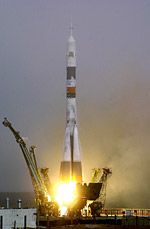
Liftoff of the Soyuz TM-31 rocket with Expedition 1 aboard, 31 October 2000.

Spectacular close-up of the rocket carrying Soyuz MS-16 at launch, 9 April 2020. (Roskosmos)

RD-107 first-stage engine – the Soyuz-U rocket has a modified version, the RD-118; Soyuz-FG has RD-107A

RD-108 second-stage engine – the Soyuz-U rocket has a modified version, the RD-117; Soyuz-FG has RD-108A
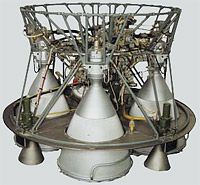
RD-0110 third-stage engine
Links
- Encyclopedia Astronautica: U, FG, 2.1a
- ESA infographics: Soyuz FG rocket infographic and liftoff sequence
- ESA Permanent Mission in Russia: Soyuz launch vehicle
- Roskosmos: Союз-У/Soyuz-U, Союз-ФГ/Soyuz-FG, Инфографика/Infographic – Состав ракеты-носителя «Союз-2» /The composition of the carrier rocket Soyuz-2
- Russian Space Web: R7 family, Launch vehicle for PPTS spacecraft
- Samara Space Center (ФГУП ГНПРКЦ «ЦСКБ-Прогресс»): manufacturers of the Soyuz rocket and other launch vehicles
- Space Launch Report: R-7/Soyuz Data Sheet
- Starsem, the Soyuz company: website for the company that undertakes commercial launches of Soyuz rockets and payloads. There is a Soyuz user’s manual that can be downloaded from the Soyuz performance page. Modernized Soyuz
- Wikipedia: U, FG, 2.1a
Proton rocket
The original 2-stage Proton rocket first launched in 1965 and has become one of the most successful and reliable Russian rockets in the commercial space industry. The three-stage version of the rocket, the Proton-K, launched the Salyut, Mir core module, and the Zarya and Zvezda ISS modules into orbit, while its replacement, the Proton-M, will launch the MLM Nauka. The normally-reliable launcher suffered two successive launch failures in 1999, which further delayed the launch of Zvezda until the cause of these was rectified. The Proton successfully returned to flight on 12 February 2000, clearing the way for the launch of the Russian Service Module.
The Proton K had 11 sub-variants, and is now decommissioned, replaced by the Proton-M.
The Proton is manufactured by FGUP GKNPTs Khrunichev (The State Space Research and Production Center named after MV Khrunichev), ФГУП «ГКНПЦ им. М.В.Хруничева».
| Model | Proton |
| Code | 8K82 |
| Class | heavy |
| Type | one-start |
| Developer | Salyut Design Bureau |
| Made by | Khrunichev State Research & Production Space Center |
| Fuel (all stages) | Nitrogen tetroxide (N2O4) |
| Oxidizer (all stages) | Unsymmetrical Dimethyl Hydrazine |
| Number of stages | 3 |
| Stage 1 length & diameter (mm) | 21,000; 7300 |
| Stage 2 length & diameter (mm) | 17,000; 4000 |
| Stage 3 length & diameter (mm) | 4000; 4110 × 3960 |
| Stage 1 engines | 6 × RD-253 (Khrunichev) |
| Thrust | 150,142 kg each |
| Stage 2 engines | 4 × RD-0212 (Khrunichev) |
| Thrust | 59,422 kg each |
| Stage 3 engine | RD-0213 (Khrunichev) (modified RD-0212) plus a set of RD-0214 vernier motors |
| Thrust | 62,143 kg |
| Total height (with payload in place) | 55,000 mm |
| Weight (fully fuelled) | 700,000 kg |
| Payload lift capacity | 20,000 kg |
Proton launch profile for Zvezda module:
| Time (min: s) | Event | Altitude | Speed |
|---|---|---|---|
| T −0 | Lift-off | – | – |
| T +2:06 | First-stage jettison | 43 km | 5920 km/h |
| T +3:03 | Zvezda fairing jettison | 77 km | 7520 km/h |
| T +5:30 | Second-stage jettison | 138 km | 15,840 km/h |
| T +9:47 | Third-stage jettison | 184 km | 27,040 km/h |
The orbit at third-stage jettison was 184 by 352 km. Orbit at ISS rendezvous was 384 km.
| Feature | Proton-K | Proton-M |
|---|---|---|
| Starting weight, t. | ~700 | ~705 |
| Number of stages | 3 | 3 |
| Fuel components | ||
| Stage 1 | N2O4 (nitrogen tetroxide/Тетраоксид диазота)/UDMH/NDMG/НДМГ (Unsymmetrical dimethylhydrazine/Несимметричный диметилгидразин) | НДМГ + АТ (same mix as Proton-K) |
| Stage 2 | N2O4/UDMH | НДМГ + АТ |
| Stage 3 | N2O4/UDMH | НДМГ + АТ |
| Engines | ||
| Stage 1 | RD-259 LPRE (6 pcs.), 971.4 tf / 1069.8 tf | 6 x RD/РД-276 |
| Stage 2 | LRE RD-0210 (3 pcs.) and RD-0211 (1 pcs.), - / 237.4 tf | 3 x RD-0210 and 1 x RD-0211 |
| Stage 3 | LRE RD-0213 (1 pc.), - / 59.36 tf (marching); LRE RD-0214 (1 pc.), - / 3.15 tf (steering) | 1 x RD-0213 and 1 x RD-0214 |
| Booster blocks used | Breeze-M and DM-03 Бриз-М и ДМ-03 |
|
| Cosmodrome | Baikonur (Launch Complexes 81/23, 81/24, 200/39, 200/40) | Baikonur (LC 200/39 for MLM Nauka) |
| Payload mass, t. | ||
| At NOO/НОО (200 km, inclination = 51.6 degrees) | 20.7-20.9 t | 22.4 |
| At GPO/ГПО (commercial spacecraft, коммерческие КА) | ||
| At GSO/ (Federal spacecraft, федеральные КА) | 2.6 t (RB DM) | |
| With the Breeze-M booster block | 6.3 | |
| With the Breeze-M booster block at GPO | 3.3 | |
| Diameter / length of used GO, m | 3.7 / 9.83 (GO development of NPO PM, ГО разработки НПО ПМ) 4.35 / 10 (RB DM, РБ ДМ) 4.35 / 11.6 (RB Breeze-M, РБ Бриз-М) 4.35 / 12.65 (low-orbit module, низкоорбитальный модуль) |
|
Diagrams
- ESA: Proton-K diagram (105 KB)
- TsENKI: Proton-K diagram (35 KB)


Gallery

Liftoff of the Proton rocket carrying the Zarya module to the ISS on 20 November 1998.
Links
- Encyclopedia Astronautica: K (the Proton 8K82K launched Zarya and Zvezda); M
- International Launch Services (ILS – a private launch services company): Proton heritage. There is a Proton Launch System Mission Planner’s Guide to download.
- NASA: Zarya and Zvezda galleries show some Proton launch images
- Roskosmos: Ракета-носитель (raketa-nositel’, carrier rocket) Протон-К/Proton-K, Протон-М/Proton-M, Инфографика/Infographics
- Russian Space Web: Proton family
- Space.com: Russia’s heavy-lift workhorse Proton rocket infographic
- Space Launch Report: Proton Data Sheet
- Wikipedia: K, M

Launch systems
The launch system structures at Baikonur for both Soyuz and Proton rockets are unique. Asif Siddiqi describes the conception for the R-7 in Challenge to Apollo:
One of the most expensive and time-consuming aspects in the development of the R-7 was the design of a launch structure to accommodate the unwieldy-looking missile. Originally, the plan was to assemble the missile at the launch pad in a vertical position. […]All the plans, however, proved unwieldy because of concerns about damaging the missile itself at takeoff. It was at this point that Mishin emerged with an original idea for a launch pad. The conception involved assembling the booster horizontally in a hangar and then transporting the rocket to the launch pad, where it would be raised into a vertical position. At the pad, the R-7 would be suspended “at the waist” above its center of gravity, about twenty meters from the base, by four identical and huge “petals”. Chief Designer Barmin, who was responsible for the design of launch complexes, later recalled:
The heavy rocket “hangs” on them [the “petals”] until its engines go into primary thrust mode. And then they pull away to the side simultaneously, and the gas blasts from all the operating engines exit in one large opening and escape the steppe through a special concrete conduit.
The petals would swing into motion not by any external hydraulic power, but by an ingenious system of counterbalanced weights that worked because of gravity. The engineers nicknamed the system Tyul’pan, Тюльпан (“Tulip”) because of the peeling nature of the petals at launch time. Each of the petals would contain work gantries and other systems required to fuel and test the rocket prior to launch. […] For more than forty years, Mishin’s original conception has serviced the space program; it was from the same type of launch pad that cosmonauts flew to the Mir space station from 1986 to 1999.
Rollout
How is the Soyuz assembled? Two of the four side blocks of the rocket (for example, “B” and “C”) are laid on the slipway, then the central one. After their assembly, two more remaining side blocks are installed on top. After assembling the package of the first and second stages, it is docked with the third, which is brought up on a docking and assembly trolley. Each of the blocks of all three stages of the Soyuz contains both fuel and an oxidizer. (Roskosmos)
Traditionally, the rocket is rolled out two days before launch at exactly 5 a.m. Moscow time (7 a.m. CST at Baikonur). Before the rollout, personnel and guests place coins on the rails for good luck.
The rocket with its payload is transported horizontally on a railcar from the preparation hangar at Baikonur to the launchpad. It only takes around 40 minutes for the rocket to be trundled out from the processing building, along the railroad track to the launchpad. It rests horizonally on a carrier and is pulled then pushed by the diesel engine.
The rocket is then raised to an upright position on the launchpad by a system of weights and pulleys, and is fuelled for launch (fuel is brought along and stored in railcars). The process takes about 2.5 hours.
The Kosmotrans company does all the transporting of cargo and people around Baikonur.
GUP NPF Kosmotrans
ГУП НПФ «Космотранс»Kosmotrans Scientific Research & Production Company State Unitary Enterprise (located in St. Petersburg)
The Kosmotrans Scientific Research and Production Company State Unitary Enterprise was founded in 1996 to take responsibility for the operation and maintenance of railway infrastructure at the Baikonur cosmodrome, and for the centralized deliveries of space rocket hardware from the manufacturers to the launch sites. Today, Kosmotrans provides for the transportation of cargo and personnel, including the launch crews, around the Baikonur cosmodrome. (Russian Institutes & Industry, ESA)
The rockets can launch in almost any weather. The launch criteria for the LV 11A11U is:
- temp −40°C to +50°C
- land wind speed less than 15 m/sec
Baikonur launch pads
The following descriptions of the Proton and Soyuz launch facilities are from the former TsENKI site.
Soyuz launch pads
There are two launch pads for the R-7 type rocket, located within sight of each other:
- LC 17P32 for LV R-7 type, Area 1, Launch Pad 5. Yurii Gagarin and, much later, ISS Expedition 1 were launched from here. This Energiya photo of a Soyuz rocket launching from the pad shows a sign reading “Гагаринский старт – Gagarinskii Start, [Yuri] Gagarin start/launch,” the name of the launch pad where Yuri Gagarin launched on his inaugural flight.
- LC 17P32 for LV R-7 type, Area 31, Launch Pad 6.

Leading developer of launch complex is the Federal state unitary enterprise V.P.Barmin Design Bureau of General Machine-building (KBOM), «Конструкторское бюро общего машиностроения» (КБОМ).
The facilities of launch and technical complexes are assigned for the LV R-7 type by:
- The Center 12C of Rocket & Space Corporation Energiya, Центром 12Ц Ракетно-Космической Корпорации «Энергия»
- Progress assembly and test complex factory, Сборочно-Испытательным Комплексом Завода «Прогресс»
- The Test Center KBOM, Центром Испытаний КБОМ
- The Engineering and Test Center of OKB Vympel, Центром Эксплуатации и Испытаний ОКБ «Вымпел»
- Lavochkin NPO (Scientific and Production Corporation), НПО им. С. А. Лавочкина
- NPO Applied Mechanics (Scientific and Production Corporation), НПО Прикладной Механики
- The Engineering and Test Center of Design Bureau of Transport and Chemical Machine-building, Центром Эксплуатации и Испытаний КБ Транспортно-Химического Машиностроения
Features of Launch Complex LV (Launch Vehicle) R-7 type:
The launching facilities with launch system for LV R-7 and Soyuz are complicated and original technical constructions. They are a multi-stage ferroconcrete building with the top part on the level of firing pad and a broad embrasure in the center. This embrasure goes into splayed deep gas duct. On the balcony-visor there is a launching system that is unique as regards to technical solution. On the mobile circular launch facility there are fastened four open worktip-up supporting girders. The launch vehicle looks like it is suspended on these girders. Articulate connection of supporting girders allows to bring them together up to closing in the top part to form the single ring. This ring is kept in a closed state due to the mass of the suspended rocket.
At the beginning of rocket movement during launch, the load on the force ring decreases and the supporting girders open under their own counterweights to allow passage of the rocket. Such scheme, the rocket suspension using supporting parts located near the center of gravity, allowed to refuse from reinforcement of LV’s end part when connecting the lateral and central blocs in one pack.
The maintenance girders are equipped with elevators to deliver the personal, cosmonauts and different technical means and materials. The girders are pulled apart and go down to a horizontal position before the rocket launching. On the mobile part of launching system there are two multi-stage maintenance girders also articulate connected and equipped with semiannular platforms, located on different levels. Closed around the LV, these platforms allow specialists to perform maintenance along the entire rocket surface.
On the supporting ring there are also cable-girders, which are used for supply and connection of cables, charging, drainage, pneumatic and other communications to the LV. During the launching these girders are disconnected and they recline under the action of counterweights.
Inside the launch facility there are stationary systems for charging with propellant components, thermostating, remote control, compressed gas supply, means for fire fighting, gas control and so on. In the bay of the launch facility there is a maintenance cabin, which can move over gas duct. The cabin has a multi-stage platform for maintenance of the lower part of the LV.
Rockets launched:
- Vostok, «Восток»
- Vostok-2
- Vostok-2M
- Voskhod, «Восход»
- Luna, «Луна»
- Molniya, «Молния»
- Molniya-M
- Polyot, «Полёт»
- Soyuz-L
- Soyuz, «Союз»
- Soyuz-M
- Soyuz-U
- Soyuz-U2
- Soyuz-U with Ikar
- Soyuz-U with US Fregat
- Sputnik, «Спутник»
- Sputnik-3
- Soyuz-FG
- Soyuz-FG with US Fregat
Post-launch maintenance by TsENKI specialists is a traditional and integral part of the life cycle of the launch complex. The technical condition of the systems, units, buildings and structures of the Vostok launch complex are examined, the list and scope of restoration work are determined. All work will last more than a month. During this time, specialists will renew the concrete coating of the gas duct, replace the thermal insulation of the ground cable network, paint the metal structures of the launch system and carry out other scheduled maintenance of units, systems and equipment.
The launch complex at Baikonur is being prepared for the launch of the Progress MS-20 cargo spacecraft
18/5/2022
Specialists of the Yuzhnyi Space Center, Космического центра «Южный» (a branch of the Center for the Operation of Ground-Based Space Infrastructure Objects, part of the Roskosmos State Corporation) have begun preparing the Vostok launch complex at site №31 of the Baikonur Cosmodrome for the upcoming launch.
The traditional construction of a joint launch crew took place the day before. The participants of the upcoming launch will prepare the launch equipment and transport and installation units, check the ground equipment for the preparation of the launch vehicle, spacecraft and telemetric measurement systems, carry out work to fill the receivers with compressed gases and receive rocket fuel components. The work will be completed on May 30, 2022, when a conclusion will be issued on the readiness of the complex to receive the Soyuz-2.1a launch vehicle. The launch of the Progress MS-20 cargo spacecraft to the International Space Station with its help is scheduled for June 3 at 12:32:55 Moscow time.
Yuri Fokin, First Deputy Head of Test Center №1, Chief Engineer: “All systems and units of the launch complex are regularly scheduled maintenance, measures to extend the assigned resource indicators, which ensure readiness for the intended use.”
The Vostok launch complex was developed at the Research Institute of Launch Complexes named after V.P. Barmin (a branch of TsENKI, part of Roskosmos). It includes 80 technological systems and units, 21 technical systems and 56 different structures. All systems and units of the complex are manufactured by domestic manufacturers, provide a full cycle of work and meet all international requirements and standards. Long-term operation of the complex in the most difficult climatic conditions has confirmed its high reliability, the possibility of wide use for launching spacecraft, manned and transport vehicles.
The first site of the Baikonur Cosmodrome – the road to the space age
20/8/2022
Launch pad No. 1 – the legendary Gagarin launch – became the first technological facility of the Baikonur Cosmodrome. It was from here on May 15, 1957 that the R-7 intercontinental ballistic missile made its first flight. And already on October 4, 1957, the world’s first artificial Earth satellite was launched. Subsequently, space flights of Yuri Gagarin, Valentina Tereshkova and many others were carried out from the first site, including all Soviet and Russian manned flights to the Mir orbital station.
A unique and complex technical structure, with hundreds of rooms for equipment, was erected in less than a year. No other launchpad at Baikonur was built so quickly. Under the future complex, the world’s largest pit was dug: depth – 45 m, length – 205 m and width – 100 m. Among the military builders, the launch complex was called the “stadium.”
The launch structure is an original design. This is a multi-storey reinforced concrete building, the upper part of which is at the level of the launch pad, with a wide opening in the center, which passes into a single-pitched deep flue.
On the “balcony-visor” of the launch facility, there is a launch system that is unique in its design. On the movable circular part of the launch system, four openwork reclining support trusses are fixed.
In the premises of the facility itself, there are stationary systems for refueling with fuel components, temperature control, remote control, provision of compressed gases, fire protection equipment, gas control, and others. In the niche of the launch facility, a service cabin retractable above the gas duct with multi-tiered platforms for servicing the lower part of the launch vehicle is installed. All systems are controlled remotely from the command post, controlled and documented.
Taking into account the experience gained during the operation of the world’s first launch complex for space rockets in 1958-1961, five more similar structures were created – one at Baikonur (“Vostok” on the 31st site) and four at the Plesetsk cosmodrome.
Gagarin launchpad in numbers:
- The area of the launch complex is 678 thousand square meters,
- The height of service trusses is 40 m,
- Number of technological and special technical systems: 114,
- Number of buildings and structures: 69,
- The volume of the oxygen storage is 400 tonnes,
- The volume of nitrogen storage is 24 tonnes,
- A total of 519 launches were carried out.
Last month, at the Gagarin launch, specialists from the Yuzhnyi Space Center (a branch of JSC TsENKI, part of the Roskosmos State Corporation) carried out an annual maintenance of systems and assemblies. Routine maintenance was carried out on the launch, transport and filling equipment, as well as on the gas supply, temperature control and fire extinguishing systems. The goal is to maintain the launch complex in readiness for launches of carrier rockets of the Soyuz-2 type after the modernization of the complex.
As of 14/10/2023, the Gagarin launch pad was to be retired:
The Baikonur launch complex, from which Gagarin flew, will turn into a museum
As Roskosmos clarified, this is necessary to preserve the historical heritage and to expand the attractiveness of the Baikonur tourist area
Site No. 1 (“Gagarin Launch”)/Площадка №1 («Гагаринский старт») can become a museum complex with samples of unexploited space technology placed there. This was reported to TASS by the press service of Roskosmos.
“The Roskosmos State Corporation has proposed to the Kazakh side to withdraw the Gagarin Launch from lease and create a museum complex on its basis with the placement as exhibits of real samples (models) of space technology located at the Baikonur Cosmodrome and which have no prospects for further use for their intended purpose,” noted the press service.
As the state corporation clarified, this is necessary to preserve the historical heritage and to expand the attractiveness of the Baikonur tourist area. The issue was considered at the ninth meeting of the Russian-Kazakh intergovernmental commission on the Baikonur complex, which was held on September 6-8 in Astana.
“The study of the issue of organizing work to create a museum complex on the basis of the Gagarin launch site has been entrusted to the interested government bodies of the Republic of Kazakhstan (Ministry of Digital Development, Innovation and Aerospace Industry, Ministry of Finance, Ministry of Tourism and Sports),” said Roskosmos.
Now, the press service clarified, the launch complex is the state property of Kazakhstan and is leased by the government of the Russian Federation until 2050.
Pad No. 1 (“Gagarin Launch”) is the oldest launch pad at the Baikonur Cosmodrome; the first artificial Earth satellite was launched from it, as well as the Vostok spacecraft with the world’s first cosmonaut Yuri Gagarin on board.
Currently there are no launches from the launch complex. In November 2021, the Russian Federation, Kazakhstan and the UAE signed a statement of interest in space projects, including the modernization of the Gagarin Launch at Baikonur. The launch complex was supposed to be modernized for launches of Soyuz-2 launch vehicles. Later, the Minister of Digital Development, Innovation and Aerospace Industry of Kazakhstan Bagdat Musin reported that Kazakhstan and the Russian Federation will search for another investor for the modernization project if the UAE delays in making a decision on this issue.
Proton launch pads
There are three Proton launch pads:
- Launch Complex 200, Launch Pad 39;
- Two adjacent to each other: Launch Complex 81, pads 23 and 24 (counted as one).
The leading developer of the launch complexes is the Federal state unitary enterprise V.P. Barmin Design Bureau of General Machine-building (KBOM).
The facilities of launch and technical complexes are assigned for the LV Proton by:
- The Center of Space Ground Infrastructure Operation, ЦентроМ Эксплуатации Объектов Наземной Космической Инфраструктуры
- The M.V.Khrunichev State Research and Production Space Center, ГКНПЦ им. М. В. Хруничева
- The Test Center TC-2 KBOM, Центр Испытаний ЦИ-2 КБОМ
- The Engineering and Test Center of OKB Vympel, Центр Эксплуатации и Испытаний ОКБ «Вымпел»
Features of Launch Complex LV Proton:
The launch complex for LV Proton includes a number of original engineering solutions. The constructional feature of launching and charging facilities and systems of complex, which provide pre-launching and launching of LV Proton, is that the attachment of charging, drainage, electric and pneumatic communications to rocket is carried out by remote control, and dismantling of all communications is carried out in automatic mode. In case of a need to drain the propellant components out of LV tanks after failed launch, it is not required reattachment of all communications to the rocket. There are no cable and cable-charging posts. Instead the original docking mechanisms of launch pad are in use.
Proton types launched:
- Proton, Протон
- Proton-K
- Proton-M
- Proton-K with RB
Diagrams
- Map of launch sites at Baikonur (78 KB). (Russian Space Agency)
- R-7 launchpad diagram (44 KB)
- Soyuz launch complex diagram (75 KB), from “Features of Simulation of Bearing Structures Units of Launch Complex for Space Rockets Family Soyuz” (in Russian).
- Baikonur launch complex diagram (in Russian) at the Roskosmos site (409 KB)


Gallery


Rollout sequence of the Soyuz TMA-6 rocket, 13 April 2005.

A locomotive pulls then pushes the rocket along horizontally.

The Soyuz TMA-6 rocket is pushed upright on the launchpad.

Launch of Soyuz TMA-22, 14 November 2011, in a −5°C blizzard (Energiya photo gallery)
Links
- Craig Mod: “Postcards from the Baikonur Cosmodrome,” September 2019.
- Encyclopedia Astronautica: Baikonur
- Energiya: The Energiya photo archive has plenty of photos of Progress and Soyuz launch preparations and launches, and there is a Launchers history section.
- ESA infographics: Baikonur infographic
- NASASpaceflight.com: Launch pads of Baikonur cosmodrome – Google Maps images of various launchpads by Anik
- Roskosmos: Байконур/Baikonur; Инфографика/Infographic; Baikonur 60th anniversary
- Russian Space Web: Baikonur Cosmodrome (NIIP-5/GIK-5)
- Slate.com: Spaceship Junkyard. Photo essay, 12 April 2006.
- Spacefacts: Baikonur launch sites with Launch Pad 1 highlighted
- Videokosmos: Russian space boosters
- ОФИЦИАЛЬНЫЙ САЙТ АДМИНИСТРАЦИИ ГОРОДА БАЙКОНУР – City of Baikonur website (in Russian)
Glossary
- НОО
NOO - низкая околоземная орбита
nizkaya okolozemnaya orbita
low Earth orbit - ССО
SSO - солнечно-синхронная орбита
solnechno-sinzhronnaya orbita
solar-synchronous orbit - ГПО
GPO - геопереходная орбита
geoprerekhodnaya orbita
geo-transitional orbit - ГСО
GSO - геостационарная орбита
geostatsionarnaya orbita
geostationary orbit - Протон
- Proton
- Союз-ФГ
- Soyuz-FG
- Союз-У
- Soyuz-U
Updated: 17/3/2024