Cosmonaut news
- 2000
- 2001
- 2002
- 2003
- 2004
- 2005
- 2006
- 2007
- 2008
- 2009
- 2010
- 2011
- 2012
- 2013
- 2014
- 2016
- 2017
- 2018
- 2019
- 2020
- 2021
- 2022
- 2023
- 2024
- Latest
News of the Cosmonaut Group, Отряд Космонавтов, from 2000 onwards, when the ISS became operational, and featuring items that piqued my interest. For ISS cosmonaut training reports, see the #Пилотируемая космонавтика (Manned Cosmonautics) tagged entries at Roskosmos. There is also a Cosmonaut assignments thread at NASASpaceflight.com, and GCTC has a cosmonaut tag for its news section (in Russian).
2000
The cosmonaut data below was derived from an excellent Springer-Praxis book, Russia in Space: The Failed Frontier? by Brian Harvey (2001), an overview of the Russian space program since the demise of the Soviet Union. This is the cosmonaut squad as it was in 2000:
Cosmonauts’ Group in 2000
Air Force pilots
- Afanas’ev, Viktor Mikhailovich
- Dezhurov, Vladimir Nikolaevich
- Gidzenko, Yurii Pavlovich
- Kondrat’ev, Dimitrii Yuri’vich
- Korzun, Valerii Grigor’evich
- Lonchakov, Yurii Valentinovich
- Malenchenko, Yurii Ivanovich
- Musabaev, Talgat Amangel’evich
- Onufrienko, Yurii Ivanovich
- Padalka, Gennadii Ivanovich
- Romanenko, Roman Yur’evich
- Sharipov, Salizhan Shakirovich
- Skvortsov, Aleksandr Aleksandrovich
- Suraev, Maksim Viktorovich
- Tokarev, Valerii Ivanovich
- Val’kov, Konstantin Anatolievich
- Volkov, Sergei Aleksandrovich
- Zalyotin, Sergei Viktorovich
RKK Energiya engineers
- Avdeev, Sergei Vasil’evich
- Budarin, Nikolai Mikhailovich
- Kaleri, Aleksandr Yur’evich
- Kornienko, Mikhail Borisovich
- Kozeev, Konstantin Mirovich
- Krikalyov, Sergei Konstantinovich
- Kuzhel’naya, Nadezhda Vasil’evna
- Lazutkin, Aleksandr Ivanovich
- Poleshchuk, Aleksandr Fyodorovich
- Revin, Sergei Nikolaevich
- Skripochka, Oleg Ivanovich
- Treshchyov, Sergei Evgen’evich
- Tyurin, Mikhail Vladislavovich
- Usachyov, Yurii Vladimirovich
- Vinogradov, Pavel Vladimirovich
- Yurchikhin, Fyodor Nikolaevich
Others
- IMBP:
- Karashtin, Vladimir Vladimirovich
- Lukiyanyuk, Vasilii Yur’evich
- Morukov, Boris Vladimirovich
- Star Town doctor: Kotov, Oleg Valeriovich
- Space Forces engineer: Shargin, Yurii Georg’evich
- TsSKB Samara engineer: Kononenko, Oleg Dimitrievich
- Salyut KB engineer: Moshchenko, Sergei Ivanovich
- Presidential adviser: Baturin, Yurii Mikhailovich
Selection of Russian cosmonauts, 1992-2000
Civilians selected from RKK Energiya, March 1992
- Lazutkin, Aleksandr Ivanovich
- Treshchyov, Sergei Evgen’evich
- Vinogradov, Pavel Vladimirovich
Civilians selected from RKK Energiya, April 1994
- Kuzhel’naya, Nadezhda Vasil’evna
- Tyurin, Mikhail Vladislavovich
Civilian selection, spring 1996
- Kononenko, Oleg Dimitrievich
- Kotov, Oleg Valeriovich
- Kozeev, Konstantin Mirovich
- Revin, Sergei Nikolaevich
- Shargin, Yurii Georg’evich
- Skripochka, Oleg Ivanovich
Pilot selection, summer 1997
- Kondrat’ev, Dimitrii Yuri’vich
- Lonchakov, Yurii Valentinovich
- Moshkin, Oleg Yur’evich
- Moshchenko, Sergei Ivanovich
- Romanenko, Roman Yur’evich
- Skvortsov, Aleksandr Aleksandrovich
- Suraev, Maksim Viktorovich
- Val’kov, Konstantin Anatolievich
- Volkov, Sergei Aleksandrovich
- Yurchikhin, Fyodor Nikolaevich
2001
July 2001
Yurii Gidzenko left the Cosmonaut Group on 15 July and was working on the staff of TsPK. He got a special contract to fly as commander of Soyuz TM-34, so this last flight, which took up space tourist Mark Shuttleworth in April of 2002.
September 2001
From Novosti Kosmonavtiki No..11, 2001:
As of on September 2001 of three Russian forces of cosmonauts consist 41 cosmonauts and one more (S. Moshchenko) is a cosmonaut-tester from GKNPTs Khrunichev. In the RGNII TSPK force are 21 cosmonauts; in the RKK Energiya force are 17 people; in the GNTS IMBP force are three. Of 42 cosmonauts 23 have space flight experience. Only formally on the posts of cosmonauts still consist the cosmonaut-testers of LEAHS Gromov (I. Volk, V. Zabolotskii, U. Sultanov and S. Tresvyatskiy); also Yu. Stepanov from the Russian Academy of Sciences and V. Severin from RPE Zvezda. There are presently two cosmonaut candidates: O. Moshkin (RGNII TSPK) and Yu. Loktionov (there is no order about his enrolment into any force still).
2002
A letter from Leon Rosemblum in Nethanya, Israel, published in Spaceflight magazine, October 2002:
Cosmonaut-candidate Oleg Moshkin was turned away from the Russian cosmonaut team by the chief of Yu. A. Gagarin Cosmonaut Training Center (RGNII TsPK) order of March 19, 2002. Moshkin also retired from the Russian Air Force by Air Force Commander-in-Chief order of February 11.
Lieutenant-Colonel Moshkin failed in the State Examination on general space training completion on November 25, 1999. Considering the examination results, he was the only among 8 candidates of the 1997 enrolment who was not granted the “test cosmonaut” qualification.
The Examination Commission stated that Oleg Moshkin didn’t fulfil the program of training flights on the L-39 jet plane, didn’t show a desire to study English, showed poor knowledge of Soyuz TM spaceship systems, extravehicular activity technique, and Earth surface observation methods.
Since examination before turning away, Moshkin remained as a status cosmonaut-candidate.
2003
14/2/2003
RKK Energiya engineer Sergei Avdeev retired. At the time of his retirement he held the record for the most accumulated time in space: 747 days, 14 hours and 22 minutes over 3 missions – just over 2 years’ total!
18/2/2003
Vasilii Lukiyanyuk retired, without ever getting a spaceflight. He was a IMBP doctor-cosmonaut who participated in some long-duration flight experiments.
April 2003
From Novosti Kosmonavtiki No..4, 2003:
“On training of the cosmonauts in RGNII TsPK” (a rough Babelfish translation):
From 25 February, 2003, after the reformation of crews in connection with a change in the ISS flight program because of the grounding of Shuttle flights as a result of the Columbia catastrophe, training cosmonauts and astronauts were composed of nine groups (according to training schedule):
Cosmonaut deployments: 25 February 2003 ISS-7 Yu. Malenchenko, E. Lu (backups: M. Foale, A Kaleri) ISS-8 W. McArthur, V. Tokarev ULF-1 (1st Shuttle flight) S. Krikalyov, J. Phillips, S. Volkov (backups: G. Padalka, M. Fink, O. Kononenko) ISS group-1 V. Korzun, V. Afanas’ev, T. Musabaev, V. Dezhurov, Yu. Onufrienko, S. Zaletin, Yu. Baturin, Yu. Usachev, A. Lazutkin ISS group-2 K. Val’kov, D. Kondrat’ev, O. Kotov, Yu. Lonchakov, M. Suraev ISS group-3 Yu. Shargin, S. Revin, N. Kuzhel’naya, S. Moshchenko, F. Yurchikhin, O. Skripochka ISS group-4 S. Sharipov, R. Romanenko, K. Kozeev, M. Kornienko EKA-1 P. Duque (ESA) EKA-2 A. Kuipers Thus, of 38 acting Russian cosmonauts, 31 were involved in the direct preparation in RGNII TsPK (as of 28 February, 2003).
Cosmonauts not presently involved with space preparation:
- N. Budarin is currently in orbit as part of Expedition 6.
- A. Skvortsov, from 24/11/2002, is located in the USA as RGNII TsPK representative at JSC, Houston.
- M. Tyurin and S. Treshchev are working in the cosmonauts’ division at RKK Energiya, expecting designations/purposes for their next assignments.
- P. Vinogradov and A. Poleshchuk pass the medical board.
- B. Morukov works in IMBP.
Another article in the same issue, “New ISS crews formed,” goes into more detail:
In connection with the Columbia catastrophe and the consequent stopping of Shuttle flights, the Russian and American specialists during February 2003 conducted a series of consultations and negotiations, as a result of which new flight plans and ISS crew compositions in 2003 were agreed upon.
Rosaviakosmos and NASA made the following decisions:
- To continue manned ISS operations
- To use Soyuz ships for delivery and return of crews;
- For these basic expeditions to consist of one Russian cosmonaut and one American astronaut.
The decrease of the number of crew to two is explained by the fact that it will now be necessary to conserve water and food products on the ISS as Russia cannot greatly increase the number of available Progress cargo ships in such a short time. The crews will now essentially be occupied with preventative maintenance and repair works, for which two are sufficient.
The following crews for 2003 basic expeditons were formed:
- Basic crew ISS-7: Yu. Malenchenko (ISS & Soyuz commander); E. Lu (flight engineer of both)
- ISS-7 backup crew: M. Foale (ISS commander, Soyuz flight engineer); A. Kaleri (ISS F.E., Soyuz commander)
- ISS-8: M. Foale and A. Kaleri (backups: W. McArthur – ISS commander; Soyuz F.E.; V. Tokarev – ISS F.E., Soyuz commander)
When the Shuttles resume flight, the initial ISS crew will be:
- S. Krikalyov (ISS commander, Soyuz F.E.), J. Phillips (ISS Science Officer), S. Volkov (ISS pilot, Soyuz F.E.)
- Backup crew: G. Padalka (ISS commander, Soyuz F.E.), M. Fincke (ISS Science Officer), O. Kononenko (ISS pilot, Soyuz F.E.)
These crews will be on a maintenance regime and be ready to start when the Shuttles resume flight.
Training of other available crews is temporarily stopped and cosmonauts are transferred into the general/common preparation according to the ISS program (studying the Soyuz TMA and so forth). The composition of the groups is now four. In connection with the fact that the fifth and sixth visiting ISS Russian expeditions have been abolished, the group of EP-5 (G. Padalka, P. Duque, O. Kotov) and EP-6 (A. Keypers) are disbanded. Training the crews is ended: ISS-8D (backups) (L. Chiao, M. Korniyenko, Ch. Kamarda), ISS-9D (R. Romanenko, D. Tani), ISS-10D (J. Williams, K. Kozeev, S. Williams). The formed crew ISS-10 (L. Chiao, S. Sharipov, J. Phillips) did not have adequate time for preparation. Basic crew ISS-9 (G. Padalka, M. Fink, O. Kononenko) now became the duplicating crew according to the program ISS ULF-1.
On 28 February 2003, ESA officially declared that the flight of P. Duque was transferred from April 2003 (on Soyuz TMA-2,) to the autumn of 2003 (Soyuz TMA-3), and the flight of A. Kuipers is transferred to the spring of 2004 (Soyuz TMA-4).
Thus, the 2003 ISS flight plan now appears as follows (on the basis of the fact that in this year Shuttles will not fly). In the beginning of May on Soyuz TMA-2 (No.. 212) is launched the ISS-7 crew (Yu. Malenchenko and E. Lu). After transferring from the ISS, Expedition 6 will complete fitting/landing aboard the ship of Soyuz TMA-1. In this case the Soyuz commander will be N. Budarin; in the flight engineer’s left seat K. Bowersox will be located, and in the right seat will be D. Pettit. In October-November 2003 the ISS-8 crew (M. Foale and A. Kaleri) will arrive for the ISS-7 crew change, who will launch aboard the ship of Soyuz TMA-3 (No.. 213). The ISS-8 launching crew will include European cosmonaut P. Duque. He will carry out a short-term flight and will complete undocking and landing with the ISS-7 crew.
But here, further flight plans for the ISS depend on the renewal of the operation of the Shuttles: for the change to crew ISS-8, naturally, will arrive the crew ISS-9, but either on the shuttle (crew of S. Krikalyov), or on Soyuz TMA-4 (probably W. McArthur and V. Tokarev). Only time will show how it will be in reality.
July 2003
Rex Hall, via Astroaddies, kindly provided this updated list, in answer to my query (thanks also to Jürgen P. Esders and Robert Pearlman).
| In space | Yu. Malenchenko (with Edward T. Lu) |
| ISS-8 (launch Oct 2003) | A. Kaleri (with Michael C. Foale) |
| ISS-8 backup | V. Tokarev (with William S. McArthur) |
| MKS-1 | V. Korzun, V. Afanasa’ev, Yu. Onufrienko, V. Dezhurov, S. Zalyotin, Yu. Baturin, Yu. Usachev and A. Lazutkin |
| MKS-2 | S. Val’kov, D. Kondrat’ev, O. Kotov, Yu. Lonchakov and M. Suraev |
| MKS-3 | Yu. Shargin, S. Revin, N. Kuzhel’naya, S. Moshchenko, F. Yurchikin and O. Skripochka |
| MKS-4 | S. Sharipov, R. Romanenko, K. Kozeev and M. Kornienko |
| MKS-5 (ULF-1) | S. Krikalyov and S. Valkov (with John L. Philips) – this Expedition Crew may be on the first Shuttle flight to go up after the Columbia disaster. Current Shuttle launch date (STS-114) is not until September 2004 to 10 October, 2004 |
| MKS-5 backup | G. Padalka and O. Kononenko (with Michael E. Fincke) |
| Based in Houston | A. Skvortsov |
| Working at TsPK | T. Musabaev |
| Working at IMBP | B. Morukov |
| Working at Energiya Dept. 291 | P. Vinogradov, M. Tyurin and S. Treshchyov (the latter two are still on their post-mission recovery regime) |
| Working in Energiya Dept. 292 | A. Poleshchuk |
| Resting post-mission | N. Budarin |
According to the JSC Career Astronaut Biographies page, there are (as of September 2003) 104 active astronauts (commanders, pilots, mission specialists) plus another 40 in management status. (This does not include foreign astronauts.) There are 42 Russian cosmonauts. All these spacemen and women, yet there are just TWO people in orbit! Many will be lucky just to get one flight in their careers, the way things are now.
An article of interest is “Costly astronauts wield too much clout,” by James Oberg.
September 2003
Joachim Becker from Spacefacts informs me that Valerii Korzun retired from the Cosmonauts’ Unit on 9 September, 2003, and has become deputy head of TsPK.
27/10/2003
Cosmonaut Yurii Lonchakov was appointed commander of the force of cosmonauts RGNII TsPK, replacing Valerii Korzun. (Novosti Kosmonavtiki №12, 2003.)
27/11/2003
Veteran cosmonaut Talgat Musabaev left the TsPK cosmonaut corps after being promoted to Air Force Major-General. (Thanks to Marius Werner and Olaf Neumann for this info!) M-G Musabaev has his own website at www.musabayev.com.
2004
From Novosti Kosmonavtiki №1, 2004 – “On training of the cosmonauts in RGNII TsPK”:
As of the end of November, 2003, training cosmonauts in RGNII TsPK was conducted in the composition of the following eight groups:
Cosmonaut training groups: November 2003 ISS-9-EP-6 The crews of the 9th basic expedition and 6th ISS visiting expedition – V. Tokarev, W. McArthur, A. Kuiper and S. Sharipov, L. Chiao, G. Tile. European cosmonauts A. Kuiper (Netherlands) and G. Tile (Germany) are preparing according to the program of the week-long visit during the Expeditions 8 and 9 crew exchange. The group was formed during November 2003 (the main crew began training from 3 November; the back-ups from 17 November) ISS group 1 V. Afanas’ev, V. Dezhurov, Yu. Onufrienko, Yu. Baturin, Yu. Usachyov, A. Lazutkin ISS group 2 K. Val’kov, O. Kotov, Yu. Lonchakov, A. Skvortsov, M. Suraev ISS group 3 Yu. Shargin, S. Revin, N. Kuzhel’naya, S. Moshchenko, F. Yurchikhin, O. Skripochka ISS group 4 R. Romanenko, K. Kozeev, M. Kornienko ISS group 5 G. Padalka, O. Kononenko, M. Fink (NASA), M. Tyurin, D. Tani (NASA), S. Volkov, S. Krikalyov. This group was reformed during September 2003. Earlier, this group composed two main crews set to fly when the Shuttle resumed flight: S. Krikalyov, S. Volkov and J. Phillips on the first; G. Padalka, O. Kononenko and M. Fink on the second. Now they are simply the group of cosmonauts who have passed general preparation for the ISS program. During September, M. Tyurin was added to the group; D. Tani was replaced by J. Phillips OKP-1 (New cosmonauts-in-training) A. Samokutyaev, A. Shkaplerov, A. Ivanishin, E. Tarelkin, A. Aimbetov, M. Aimakhanov (the last two are the cosmonaut-candidates from Kazakhstan) OKP-2 M. Serov, A. Borisenko, O. Artem’ev, S. Ryazanskii, S. Zhukov Cosmonauts presently not occupied with space preparation:
- A. Kaleri is currently onboard the ISS as flight engineer of Expedition 8.
- Yu. Malenchenko is in rehabilitation after his long-term flight (Expedition 7).
- D. Kondrat’ev from August 2003 has been in the USA at Johnson Space Center as RGNII TsPK representative.
- S. Zalyotin and P. Vinogradov are participating in the pre-election campaign as the candidates to the deputy of the State Duma RF of the fourth convocation (?).
- T. Musabaev is on leave.
- S. Treshchyov and N. Budarin are working in the division of the cosmonauts (№292) of Energiya; A. Poleshchuk heads the division of №29e (on extra-ship activity).
- B. Morukov is working at the Institute of Medical-Biological Problems.
Thus, as of 30 November 2003, there are 37 cosmonauts, including 9 cosmonaut-candidates. 27 cosmonauts are in spaceflight preparations at RGNII TsPK.
From a Polish space site, Loty Kosmiczne, and an entry in the Novosti Kosmonavtki forum comes this latest crew manifest:
On 11 December, 2003, the resolution of the international commission MCOP formed the sequential crews of basic expeditions on the ISS in the following compositions:
| Mission | Prime | Backup |
|---|---|---|
| TMA-4/ISS-9 (19 April 2004) | W. MacArthur | G. Padalka |
| V. Tokarev | M. Fink | |
| A. Kuipers | G. Tile | |
| TMA-5/ISS-10 (9 Oct 2004) | G. Padalka | Yu. Onufrienko |
| M. Fincke | D. Tani | |
| STS-121/ISS-11 (15Nov 2004) | S. Sharipov (Commander) | M. Tyurin (Cdr) |
| J. Phillips (Flight Engineer) | D. Pettit (FE) | |
| O. Kononenko (FE) | R. Romanenko (FE) | |
| STS-116/ISS-12 (14Apr 2005) | L. Chiao (Cdr) | J. Williams (Cdr) |
| Sunita Williams(FE/Science Officer) | C. Anderson (FE/SO) | |
| Yu. Usachyov (FE) | A. Lazutkin (FE) |
Sergei Krikalyov seems to have vanished from the roster! I don’t know what the story is there.
… After a subsequent look at the forum the next day, Sergei (along with S. Volkov and J. Herrington) has been moved to a later Shuttle flight (STS-122, crew S-15 – Expedition 12 or 13):
| Mission | Prime | Backup |
|---|---|---|
| ISS-11 | M. Tyurin | |
| D. Pettit | ||
| R. Romanenko | ||
| ISS-12 | L. Chiao | D. Williams |
| S. Williams | A. Lazutkin | |
| Yu. Usachyov | K. Anderson | |
| ISS-13 | Yu. Onufrienko | J. Herrington |
| Tanya | F. Yurchikhin | |
| a Russian cosmonaut | D. Kondrat’ev | |
| ISS-14 | D. Williams | M. Lopez-Alegria |
| A. Lazutkin | O. Kotov | |
| K. Anderson | G. Reisman | |
| STS-122/ISS-15 | S. Krikalyov | |
| J. Herrington | ||
| S. Volkov |
Here’s what one of those on the forum, “Shams/Шамс,” had to say (another Babelfish translation!):
Yes, the same compositions of crews I obtained from one of the American experts (with the reference, that they they were agreed on MCOP). I assume, many know this expert, since it is obvious that this information was obtained by not just one. By the way, on solution of MCOP in the crew ISS-13 the third will be R. Romanenko. However, thus far this info was not confirmed to me either by TSPK nor in RKKE, after recognizing only that the fact that MCOP was, but it is nevertheless necessary to wait the official solution of our, Russian MVK. For this very reason thus far these crews were not called. Although, on the whole that is clear that, the solution took place for the compositions of ISS-9-14. The recommendations of MCOP, as a rule, are carried out. But nevertheless there can be some small changes. For example, in TSPK it was said to me that in ISS-9D there will be nevertheless Chiao and Sharipov (they they already began preparation in the middle of November 2003), and Padalka-Fink will immediately begin preparation as basic crew ISS-10. And also, the duration of flight ISS-10 is determined by the beginning of the flights of shuttles. Now the launch of ISS-10 is planned on 9 October by 2004 on TMA-5, and ISS-11 on 15 November 2004 on STS-121 (second flight of shuttle). Hence follows that, the duration of flight ISS-10 comprises only 1.5 months. Thus, is already placed temporary reserve in that case, that start STS-121 will unavoidably move some period to the right. But if STS-121 leaves in April 2005, then crew ISS-11 will fly on TMA-6. Because of this, possibly, again it is necessary to re-examine crews. On the whole, the shuttles continue to introduce vagueness into further flight plans for ISS. Therefore let us wait, MVK. I hope it is not necessary to wait long.
5/4/2004
Some information from Olaf Neumann: Aleksandr Poleshchuck left the Energiya Cosmonauts’ Group on 25 March, 2004; and Vladimir Karashtin (of the IMPB) left his group back on 17 January, 2002! So I have removed their names from the Cosmonaut Group pages.
18/5/2004
Another update from Olaf: Yu. Onufrienko has left the TsPK Cosmonaut Group on 17 March 2004 and he is now the deputy director of TsPK Unit 1; Yu. Usachyov left the Energiya cosmonaut group on 5 April 2004 and now he is working in Unit 291 at Energiya.
More details via collectSPACE:
By the order of the Minister of Defense RF of 17 March, 2004, the airman-cosmonaut RF Yurii Onufriyenko is assigned to the post of the deputy chief for the 1 administration RGNII TSPK with the release from the post of instructor cosmonaut-tester. Recently Yu. Onufriyenko in accordance with the order of the chief of TSPK entered the new post, and left the force of the cosmonauts of RGNII TSPK. Yu. Onufriyenko was enrolled into TSPK in 1989 and completed two space flights. By the order of the leader of FKA of 5 April, 2004, airman-cosmonaut RF Yurii Usachyo was freed from the post of instructor cosmonaut-tester of the 1 class at will. Thus, from this date, Yu. Usachyov is retired from the force of the cosmonauts OF RKK Energiya. He was enrolled into the force NPO Energiya in 1989 and carried out four space flights. However, Yuri Usachyov continues to work in the 291-M division of RKK Energiya. It is assumed that soon 291-M Division will be created a small group of the cosmonaut-veterans, who will transfer thei r wide experience to young cosmonauts. The cosmonaut-veterans (as it’s assumed that official post will be called – the instructor-cosmonaut) will themselves not fly into space, but their activity, undoubtedly will be useful for the force RKK Energiya. With the withdrawal of Yu. Onufriyenko and Yu. Usachyov, there remains in RGNII TSPK 16 cosmonauts (Air Force pilots); and in RKK Energiya, 14 cosmonauts (engineers).
With the 9 new recruits, this now totals 39 active cosmonauts. Ten cosmonauts have thus left the group since 2000. Contrast this with the active NASA astronauts who number 144 in total, and who were recently joined by a new group of 11 recruits (pictured in this NASA photo).
27/5/2004
Some depressing news from Olaf that the only female cosmonaut, Nadezhda Kuzhel’naya, left the Cosmonauts’ Group on 27 May. She is doing a civil aviation correspondence course (from a school at Ulyanovsk) while working as co-pilot of an Aeroflot Tu-134 at Sheremetevo Airport (outside of Moscow). Guess she gave up hope of ever getting a spaceflight (she joined in 1994). As there were no women in the last group of recruits, no Russian women will go into space for many years yet. :-(
On the order of the leader of the Federal Space Agency (FKA) she was released from the position of cosmonaut-tester in connection with retirement on pension on the length of service.
There is still a chauvinistic attitude amongst some in the Russian space program that women need to be “protected” and that they really shouldn’t be going into space. Considering that Russia sent the first woman into space, this attitude is PATHETIC!!! NASA has sent many women into space, even one as a Shuttle commander (Eileen Collins).
Some articles on this topic:
- ABC News in Science: “No room for women in space, claim Russians,” 18/8/2003.
- Space.com: “Training of a Female Cosmonaut,” 26/1/2001.
- SpaceDaily.com: “Russia’s only female cosmonaut all dressed up but nowhere to go,” 27/6/2003.
Nadezhda did train as a flight engineer back-up for Soyuz TM-32, as backup for female ESA astronaut Claudie Haignere.
Out of curiosity, I had a glance at the astronaut pages of the main space agencies to see how many women were in each:
- ESA: none. 15 male astronauts currently in group.
- JAXA (Japanese Space Agency): 2 women (out of 8). Naoko Yamazaki, Chiaki Mukai.
- CSA (Canadian Space Agency): 1 woman (out of 6). Julie Payette.
- NASA: 30 women! Out of 144 active and management astronauts (just under a quarter of the total). Not including the two in the latest group of recruits.
And Russia … none. None at all. :-(
An updated list (from Olaf again!).
Composition of the Cosmonauts’ Group, May 2004
Отряд космонавтов РГНИИ ЦПК
RGNII TsPK Cosmonauts’ Group
- Дежуров Владимир Николаевич
Dezhurov, V. (2 spaceflights) - Маленченко Юрий Иванович
Malenchenko, Yu. (3) - Афанасьев Виктор Михайлович
Afanas’ev, V. (4) - Падалка Геннадий Иванович
Padalka, G. (2) - Залетин Сергей Викторович
Zalyotin, S. (2) - Шарипов Салижан Шакирович
Sharipov, S. (1) - Котов Олег Валерьевич
Kotov, O. - Токарев Валерий Иванович
Tokarev, V. (1) - Батурин Юрий Михайлович
Baturin, Yu. (2) - Вальков Константин Анатольевич
Val’kov, K. - Волков Сергей Александрович
Volkov, A. - Кондратьев Дмитрий Юрьевич
Kondrat’ev, D. - Лончаков Юрий Валентинович
Lonchakov, Yu. (2) - Романенко Роман Юрьевич
Romanenko, R. - Скворцов Александр Александрович
Skvortsov, A. - Сураев Максим Викторович
Suraev, M. - Иванишин Анатолий Алексеевич
Ivanishin, A.
– Кандидат (candidate) - Самокутяев Александр Михайлович
Samokutyaev, A.
– Кандидат - Тарелкин Евгений Игоревич
Tarelkin, E.
– Кандидат - Шкаплеров Антон Николаевич
Shkaplerov, A.
– Кандидат
Отряд космонавтов РКК «ЭНЕРГИЯ»
RKK Energiya Cosmonauts’ Group
- Калери Александр Юрьевич
Kaleri, A. (4) - Крикалев Сергей Константинович
Krikalyov, S. (5) - Бударин Николай Михайлович
Budarin, N. (3) - Виноградов Павел Владимирович
Vinogradov, P. (1) - Лазуткин Александр Иванович
Lazutkin, A. (1) - Трещев Сергей Евгеньевич
Treshchyov, S. (1) - Кужельная Надежда Васильевна
Kuzhel’naya, N. - Тюрин Михаил Владиславович
Tyurin, M. (1) - Ревин Сергей Николаевич
Revin, S. - Козеев Константин Мирович
Kozeev, K. (1) - Скрипочка Олег Иванович
Skripochka, O. - Юрчихин Федор Николаевич
Yurchikhin, F. (1) - Корниенко Михаил Борисович
Kornienko, M. - Кононенко Олег Дмитриевич
Kononenko, O. - Артемьев Олег Германович
Artem’ev, O.
– Кандидат - Борисенко Андрей Иванович
Borisenko, A.
– Кандидат - Серов Марк Вячеславович
Serov, M.
– Кандидат
Others
Отряд космонавтов ИМБП
IMBP Cosmonauts
- Моруков Борис Владимирович
Morukov, B. (1) - Рязанский Сергей Николаевич
Ryazanskii, S.
– Кандидат
Космонавты, не входящие в отряды
Cosmonauts not in the above groups
- Мощенко Сергей Иванович
Moshchenko, S.
(космонавт ГКНПЦ им.Хруничева – cosmonaut from GKNPTs Krunichev) - Шаргин Юрий Георгиевич
Shargin, Yu.
(космонавт КВР – KVP) - Жуков Сергей Александрович
Zhukov, S.
– Кандидат
Итого – 33 космонавта и 9 кандидатов в космонавты.
Total: 33 cosmonauts and 9 cosmonaut-candidates (not including the two from Kazakhstan).
NASA astronauts: 101 on active duty status (commanders, pilots, mission specialists) and 43 in management status.
19/6/2004
Latest ISS crew roster, from the Novosti Kosmonavtiki forum:
| Mission | Prime | Backup |
|---|---|---|
| ISS-10 | L. Chiao | W. MacArthur |
| S. Sharipov | V. Tokarev | |
| ISS-11 | S. Krikalyov | M. Tyurin |
| J. Phillips | D. Tani | |
| S. Volkov | R. Romanenko | |
| ISS-12 | W. MacArthur | J. Williams |
| V. Tokarev | A. Lazutkin | |
| S. Williams | K. Anderson | |
| ISS-13 | P. Vinogradov | J. Herrington |
| D. Kondrat’ev | F. Yurchikhin | |
| D. Tani | O. Kotov | |
| ISS-14 | J. Williams | M. Lopez-Alegria |
| A. Lazutkin | K. Kozeev | |
| K. Anderson | G. Reyzman |
On the ISS-10 crew (launched on Soyuz TMA-5 during October 2004) in the very near future will be included the 3rd crew member: either “kosmotourist” G. Olsen or a Russian cosmonaut. The launch of ISS-11 thus far is planned in 2 stages: Krikalyov and Phillips start on TMA-6 during April 2005, and S. Volkov on STS-121 during May 2005. But if the Shuttle is detained again, then Volkov will not fly. There are disagreements with NASA on the delivery of subsequent crews. We consider that they must be transported by the Shuttles (after the renewal of their flights), and Americans want 3-person crews to be carried by the Soyuz. Specifically, for this reason Russia proposed to carry out year-long ISS expeditions (beginning with ISS-10) in order on the second Soyuz each year to have the possibility to carry tourists and other paid cosmonauts (for example, a Malaysian cosmonaut is in the queue to fly). Thus far these questions are “on hold” and introduce vagueness into further flight plans for the ISS.
Prospective space tourist Greg Olsen was disqualified due to health reasons, according to some reports, though this has yet to be confirmed.
6/7/2004
The press service of the “Baikonur” Federal Space Center reports: Cosmonauts are being trained to survive in extreme conditions
On July 5 a large group of specialists arrived at Baikonur from Star City in order to train cosmonauts to survive in extreme conditions. 6 cosmonauts will participate in this training: Konstantin Valkov, Maxim Suraev, Oleg Kononenko, Mikhail Kornienko, Aleksander Skvortsov, Yurii Lonchakov. The cosmonauts are scheduled to finish theoretical training at the Gagarin Cosmonaut Training Center on July 6, and then they will start gaining survival skills in real steppe conditions.
7/7/2004
Cosmonauts continue survival training
6 cosmonauts participate in this training: Konstantin Valkov, Maxim Suraev, Oleg Kononenko, Mikhail Kornienko, Aleksander Skvortsov, Yurii Lonchakov. On July 7 the Cosmonaut Training Center instructors started a two-day steppe training, the space pilots will start the training on July 9. The main purpose of this training is to teach the cosmonauts to survive in various climatic zones in case of an off-nominal landing. Therefore the cosmonauts are given the equipment and food available at the Soyuz TMA spaceship (the so-called emergency supply).
12/7/2004
Cosmonaut Vladimir Dezhurov retired today.
Cosmonauts continue survival training
The cosmonauts continue survival training at Baikonur. The crew consisting of three cosmonauts – Yurii Lonchakov, Maxim Suraev, and Oleg Kononenko – finished the training on July 11. Konstantin Valkov, Mikhail Kornienko, and Aleksander Skvortsov will finish the training on July 12. (From TsENKI)
31/7/2004
Cosmonauts’ Group
The cosmonauts & astronauts are conducting preparations in 11 groups:
| Mission | Prime | Backup |
|---|---|---|
| МКС-10/ISS-10 | L. Chiao | W. MacArthur |
| S. Sharipov | V. Tokarev | |
| МКС-11/ISS-11 | S. Krikalyov | M. Tyurin |
| J. Phillips | D. Tani | |
| S. Volkov (from May 2004 he is at NASA JSC) | R. Romanenko | |
| МКС-12/ISS-12 | W. MacArthur | J. Williams |
| V. Tokarev | A. Lazutkin | |
| S. Williams | K. Anderson | |
| МКС-13/ISS-13 | P. Vinogradov | J. Herrington |
| D. Kondrat’ev | F. Yurchikhin | |
| D. Tani | O. Kotov | |
| МКС-14/ISS-14 | J. Williams | M. Lopez-Alegria |
| A. Lazutkin | K. Kozeev | |
| K. Anderson | G. Reyzman |
| ISS group 1 | Yu. Lonchakov, V. Afanas’ev, Yu. Baturin, Yu. Malenchenko, V. Dejurov. S. Zaletin & S. Treschyov |
| ISS group 2 | K. Val’kov, A. Skvortsov, M. Suraev |
| ISS group 3 | Yu. Shargin, S. Revin, S. Moschenko, O. Skripochka, O. Kononenko, M. Kornienko |
| OKP-1 (Training Group-1) | A. Samokutyaev, A. Shkaplerov, A. Ivanishin, E. Tarelkin & Kazakh candidates A. Aimbetov, M. Aimahanov |
| OKP-2 (Training Group-2) | M. Serov, A. Borisenko, O. Artem’ev, S. Ryazanskii, S. Zhukov |
| Space tourist G. Olsen | he was preparing for his flight with a special individual program, but the latest news is that he won’t be flying in October 2004 (maybe not ever) because of unspecified health reasons. So who will take the third seat is as yet unknown |
Cosmonauts not conducting flight preparations:
- G. Padalka: currently in flight.
- A. Kaleri: in post-flight rehabilitation.
- S. Volkov: at the NASA Johnson Center.
- N. Budarin: working at RKK Energiya.
- B. Morukov: working at IMBP.
So, on 31 May 2004 there are 32 cosmonauts and 9 cosmonaut-candidates. 27 cosmonauts are conducting preparations in РГНИИ ЦПК, RGNII TsPK. (Source: Novosti Kosmonavtiki July 2004, via Nick)
10/8/2004
An article appeared in The Moscow Times about another prospective space tourist called Sergei Polonskii, as described in “Construction Mogul Bargains for Space Ride.”
“It’s not hard to have a lot of money,” he mused. “It’s hard to know how to spend it with style.”
… Polonskii’s reputation, meanwhile, is at best mixed. On the record, his peers say he is known for keeping his word and there’s no project he has started and not finished. Off the record, they paint a less rosy picture, describing him as young and arrogant, someone known to stand important business partners up.
… Flying to space would not be the first way Polonskii has spent stylishly to distinguish himself within glittering Russian social circles.
18/8/2004
Space tourist update: Greg Olsen was apparently disqualified due to unspecified medical reasons. The diary was taken offline, so I have reproduced it here.
24/8/2004
Update: now it appears Mr. Polanskii won’t be going into orbit after all, due to (again) unspecified “health reasons,” and cosmonaut Yurii Shargin will go instead.
7/9/2004
Cosmonaut Nikolai Budarin retired.
23/9/2004
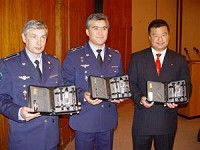
TsENKI: “Roscosmos leaders meet cosmonauts”. The FSA Head Anatolii Perminov and cosmonauts of the Main Expedition 10 (and backup crew) to the ISS (the launch is to be carried out on October 11, 2004) met in the Federal Space Agency. The cosmonauts and astronauts were congratulated on the successful completion of their training, and “Following the tradition of the past, the FSA Head gave the main crew members ‘Official Cosmonaut’s Chronograph’ of Swiss Watch company FORTIS and KOSMONAVIGATOR Watch as a present. Also following the tradition the cosmonauts presented a large photo with their signatures to the FSA Head.”
Russian cosmonaut deployment/2004
In orbit: MKS-9/EP-6 – G. Padalka, M. Fincke.
MKS-10 (ISS Expedition 10): L. Chiao, S. Sharipov, Yu. Shargin. MKS-10D (backups): W. McArthur, V. Tokarev. The deployments of Soyuz crews in 2005 are dependent on the Shuttle return to flight. But it is assumed that Krikalyov and Phillips will fly a 2-person mission in April 05. Volkov would then go up on STS 121 and staying on board. This would work with a Shuttle launch on schedule. They would return on the Shuttle.
A return to visiting crews for October is likely.
The third seat on the April 2005 launch would have been Olsen but he was disqualified, so probably a European astronaut [to be Roberto Vittori].
| Mission | Prime | Backup |
|---|---|---|
| MKS-11 | S. Krikalyov | M. Tyurin |
| S. Volkov | R. Romanenko | |
| J. Phillips | D. Tani, D. Pettit | |
| MKS-12 | W. McArthur | J. Williams |
| V. Tokarev | A. Lazutkin | |
| S. Williams | C. Anderson | |
| MKS-13 | P. Vinogradov | J. Herrington |
| D. Kondratyev | F. Yurchikhin | |
| D. Tani | O. Kotov | |
| MKS-14 | J. Williams | M. Lopez-Algeria |
| A. Lazutkin | K. Kozeev | |
| C. Anderson | G. Riesman |
| MKS Group 1 | Yu. Lonchakov, V. Afanas’ev, Yu. Baturin, Yu. Malenchenko, V. Dezhurov, S. Zalyotin, S. Treshchyov |
| MKS Group 2 | K. Val’kov, S. Volkov, A. Skvortsov, M. Suraev |
| MKS Group 3 | Yu. Shargin, S. Revin, S. Moshchenko, O. Skripochka, M. Korniyenko |
| OKP Group 1 | A. Samokutyaev, A. Shkaplerov, A. Ivanishin, E. Tarelkin, A. Aimbetov, M. Aymakhanov |
| OKP Group 2 | M. Serov, A. Borisenko, O. Artem’yev, S. Ryazanskiy, S. Zhukov |
| IMBP | Morukov |
| JSC Houston | S. Volkov. Likely to be replaced soon as his training develops |
| Energiya departments 292 and 293 | Budarin and Kaleri (resting post-mission) |
| Canada | Thirsk is undertaking Soyuz training |
| ESA | Reiter is training for a long duration mission. Likely to be Expedition 15 with a Russian and American |
(Source: Rex Hall)
11/10/2004
The second training of Soyuz TMA-5 crews in a descent module was carried out on October 9, 2004 at Baikonur. The crews inspected the spacecraft, checked their belongings, equipment and loads stowage, and accepted the spaceship. The crews were also trained to use the “Iridium” satellite telephones. After the training the spacemen answered several questions:
Chiao: “Russian techniques are very reliable. Their spacecraft and launch vehicle are ready for the mission and I think everything will be fine. We checked the rocket and ready for the flight.”
Sharipov was asked a question how a possible delay of the Shuttle mission could influence their works. Sharipov’s answer was: “It was planned that we are to collect loads for their delivery to Earth aboard the Shuttle. If the Shuttle mission is not performed, we will collect loads, but they’ll be delivered later. We have a tough schedule for this period – to receive and unload the Progress, to carry out a spacewalk, then to receive the Shuttle.”
If the Shuttle mission is canceled, the task will be easier.
Question: Do you feel tired?
Answer: Just a little. We are in agitation, we have intensive trainings. We are ready for works and sure that we will be able to do everything. And about the trainings: We are satisfied with the today’s training. The rocket is ready for the mission. It’s very good.
After the training the spacemen visited the Gagarin Launch Complex and a museum on Site #2 of Baikonur.
– TsENKI
13/10/2004
Sergei Zalyotin (Air Force, Colonel) is leaving the cosmonaut group and has been elected as a deputy in the Russian Parliament (Duma, Дума), representing the Tula region. He commanded the last Mir mission (Soyuz TM-30) and the first flight of the Soyuz TMA.
Total in Cosmonauts’ Group: 31 cosmonauts and 9 cosmonaut-candidates (not including the two from Kazakhstan).
Total NASA Active & Management astronauts: 96 active, 47 on management status (143 total), plus the 11 recruits in training.
22/10/2004
MSNBC.com: “An unusual path to space and back,” James Oberg. Profile of Yurii Shargin.
12/11/2004
From the Novosti Kosmonavtiki news release №434:
12/11/2004/15:56 In Russia a united Cosmonaut Group will possibly be created
Roskosmos is examining a question about the creation of a united force of cosmonauts, reports RIA Novosti. “Now we examine the question about the creation of the united force of cosmonauts, which assumes expansion and, it is possible to say, the rejuvenation of personnel so that the young personnel would supplement its numbers,” said Aleksei Krasnov (the chief of the administration for the manned programs of the federal space agency) on Friday in Zvyozdnyi Gorodok (Star City).
At present in Russia there are three forces of cosmonauts. The first – most numerous and formed of military pilots, resides at the cosmonaut center of training at Zvyozdnyi Gorodok, outside Moscow.
Energiya has its small force of civil cosmonauts located in the suburb of Korolev, north-east of Moscow.
Furthermore, the number of cosmonaut-physicians prepared in Moscow the Institute of Biomedical Problems, among which is the world long-duration flight record holder, Dr. Valerii Polyakov.
Most likely, a united force of cosmonauts will be based at TsPK, the Yurii Gagarin Cosmonauts’ Training Center.
Russian version, Русская версия: В России, Возможно, Создадут Единый Отряд Космонавтов.
A posting by Shams at the NK forum on 12/11:
Recently, two additional cosmonauts left the force: Dezhurov and Budarin. The precise dates of orders as yet I do not have, I hope to establish this on the following week. I am turned to Aleksandr Zheleznyakov – as yet there is probably no point (as there are no dates) in placing this communication in the “news”. According to the preliminary information, Dezhurov remains working at TSPK, and Budarin already works as shift flight control officer in GOGU at TsUP. Now in Russia there remains 29 active cosmonauts and 9 candidates in cosmonauts. In the force TSPK – 14 cosmonauts, RKK Energiya – 12 cosmonauts, IMBP – 1 cosmonaut, and still Shargin and Moshchenko. In this year it is likely no one else will depart.
15/11/2004
From the Novosti Kosmonavtiki news release №435:
Roskosmos considers that Russia must have a united Cosmonaut Group
The head of Roskosmos, Anatolii Perminov, considers that Russia must have a united force of cosmonauts. He made this statement on Monday in the course of an Internet-briefing.
“I generally consider that it is necessary to make a united force of cosmonauts. But now their forces are composed of TSPK, RKK Energiya, and the Institute of Biomedical Problems,” he said.
According to Perminov, the force of cosmonauts recently considerably decreased. “In it remains about twenty people. We try to organize so that all our cosmonauts compulsorily would fly,” he noted.
Commenting on the situation, in which proved to be Russia in connection with the recent withdrawal of one force of the cosmonauts of the last woman, Perminov he said: “I consider that this is incorrect, woman, on the contrary, stimulates the fitness for work of crew. And by the way, with the woman as leader, all matters are solved more systematically.”
In the USA, the state of affairs concerning the cosmonaut-women radically is differed from Russian. For example, the aircraft commander of the first “shuttle,” which will fly after the catastrophe of shuttle Columbia, will be a female U.S. Air Force Colonel, Eileen Collins. For her this will be the fourth launch and the second – as the commander.
Russian version, Русская версия: Глава Роскосмоса Считает, Что Россия Должна Иметь Единый Отряд Космонавтов.
29/12/2004
From the Novosti Kosmonavtiki news release №445:
Soon the Cosmonaut Group will be replenished
Soon the force of cosmonauts in Zvyozdnyi Gorodok [Star City] will be completed, the leader of Federal Space Agency Anatoliy Perminov stated to journalists on Tuesday. “I obtain from the leaders four each month, and also letters from individual persons with the request to examine candidates for the flights into space. It is clear that the force of cosmonauts must be renewed,” said A. Perminov. He reported that at present to the flights into space are prepared approximately 20-30 people.
“We have the practically united force of cosmonauts,” said A. Perminov, answering a question about the association of the forces of cosmonauts in the Zvyozdnyi Gorodok existing today, and also at the firm Khrunichev. A. Perminov supported the step-by-step transfer of the center of training cosmonauts in the Zvyozdnyi Gorodok from the department of the Ministry of Defense RF into Roskosmos. “We thoroughly study this question, this possibility to date,” said A. Perminov.
He explained, that at present financing the center of training cosmonauts is achieved along the line of the Ministry of Defense RF and Roskosmos in a 50-50 relationship. “Therefore we can not immediately take complete financing for ourselves. It is necessarily a step-by-step transfer,” said A. Perminov.
Russian version, Русская версия: В Ближайшее Время Отряд Космонавтов Будет Пополнен.
2005
February 2005
An updated Cosmonauts’ Group status for this month; thanks to Rex Hall via collectSPACE!
Russian Cosmonaut Group deployment, February 2005
MKS-10 – in space on ISS: Leroy Chiao, Salizhan Sharipov.
2005 missions: The deployments of Soyuz crews in 2005 are dependent on the Shuttle return to flight. The third seat on the April 2005 launch would have been Olsen but now disqualified so Vittori has been confirmed under a contract with ESA for two missions in 05.
| Mission | Prime | Backup |
|---|---|---|
| MKS-11 | Krikalyov | Tyurin |
| Phillips | Tani | |
| Vittori (Italy /ESA) | Thirsk (Canada) | |
| STS-121 | S. Volkov (the schedule still assumes a Soyuz launch for this crew) | |
| MKS-12 | William McArthur | Jeffrey Williams |
| Valeri Tokarev | Aleksandr Lazutkin | |
| Thomas Reiter | Leonid Eyharts |
Reiter might be given the 7th seat on STS-121 and stay on ISS.
The following crews are assumed to be launched on the Shuttle. Russia has entered into 3 commercial agreements for third seats on Soyuz in 2006 and 2007 with Malaysia, South Korea and Chile. Russia and the US need to conclude a new deal on American use of Soyuz.
| Mission | Prime | Backup |
|---|---|---|
| MKS-13 | Pavel Vinogradov | John Grunsfeld |
| Dmitri Kondratyev | Fyodor Yurchikhin | |
| Dan Tani | Oleg Kotov | |
| MKS-14 | J. Williams | Michael Lopez-Algeria |
| Aleksandr Lazutkin | Konstantin Kozeev | |
| Clayton Anderson | Gregg Riesman |
| MKS Training | Sunita Williams |
| MKS Group 1 (Flown candidates for missions awaiting assignment) | Yurii Lonchakov, Viktor Afanasyev, Yurii Baturin, Yurii Malenchenko, Sergei Treshchyov |
| MKS Group 2 (Air Force unflown candidates) | Roman Romanenko, Sergei Volkov, Aleksandr Skvortstov, Maxim Suraev |
| MKS Group 3 (Engineers unflown candidates) | Sergei Revin, Sergei Moshchenko, Oleg Skripochka, Michael Korniyenko |
| OKP Group 1 (Air Force candidates) | Aleksandr Samokutyayev, Anton Shkaplerov, Anatoli Ivanishin, Yevgeni Tarelkin, plus the Kazakhstan candidates (Aidun Aimbetov, Muzhtar Aimakhanov) |
| OKP Group 2 (engineer candidates) | Mark Serov, Andrei Borisenko, Oleg Artem’yev, Sergei Ryazanskii, Sergei Zhukov |
| IMBP | Boris Morukov |
| JSC Houston | Konstantin Val’kov |
| Energiya departments 292 and 293 | Aleksandr Kaleri |
| Resting post-mission | Gennadii Padalka and Yurii Shargin |
| Canada | Thirsk is undertaking Soyuz training |
| ESA | Reiter is training for a long duration mission likely to be Expedition 12 with a Russian and American. Launch on a Soyuz. Eyharts is his back-up |
7/4/2005
From Novosti Kosmonavtiki news release №466:
07/04/2005/09:44 Russian Federal Space Agency announced that the Cosmonauts’ Group will be enlarged
The Russian Federal Space Agency Roskosmos declared that the force of cosmonauts will be enlarged, reports the site www.vor.ru. The need for this arose in connection with the planned increase in the crews of the International Space Station after the renewal during May of the flights of the American shuttles. The selection of the candidatures of pilots and engineers has already begun. In all will be selected 12 people. In the Russian force of cosmonauts there are currently 44 people.
Russian version, Русская версия: Российское федеральное космическое агентство объявило о дополнительном наборе в отряд космонавтов.
22/4/2005
Novosti Kosmonavtiki photo gallery: “Expedition training at NPP Zvezda”. Cosmonaut Sergei Revin and Astronaut Sunita Williams during an Orlan spacewalk training session.
13/5/2005
From Novosti Kosmonavtiki news release №473:
13/05/2005/10:23 In Zvezdni Gorodok the crew of the 10th Expedition will today solemnly meet
The cosmonauts who returned on 25 April from the half-year Expedition on the ISS, will on Friday, according to tradition, solemnly meet in Zvezdni Gorodok, in Moscow. “Official congratulations and well-deserved rewards will be obtained by the Russian Salizhan Sharipov, the American Leroy Chiao, and Italian Roberto Vittori,” reported the representative of the Gagarin Cosmonaut Training Center to RIA “News”.
Russian version, Русская версия: В Звездном городке сегодня будут торжественно встречать экипаж 10-й экспедиции.
14/5/2005
From Novosti Kosmonavtiki news release №474:
NASA has declared the composition of the 12th Expedition to the ISS
NASA officially declared the names of the members of the 12th crew of International Space Station, which must leave in orbit in autumn of the present year. In it are included American astronaut William McArthur and Russian cosmonaut Valerii Tokarev.
It is also declared, that the astronaut of European space agency Thomas Reiter will complete endurance flight on board the ISS together with the Russian and American associates. He will leave for space on board the shuttle Atlantis during September of this year or only later, depending on the timetable of the renewal of the flights of the renewable ships.
Russian version, Русская версия: НАСА объявило состав 12-й экспедиции на МКС.
14/05/2005/00:05 The cosmonauts of the 10th Expedition on the ISS were awarded Yurii Gagarin’s decorations
The cosmonauts returning from the the 10th Expedition to the International Space Station – Salizhan Sharipov and Leroy Chiao – were awarded the decorations in the name of Yurii Gagarin and the medals of NASA. Italian Roberto Vittori, who worked on the ISS for a week within the framework of the visiting Expedition, was also rewarded, reports RIA News.
“It was not a simple flight, and was unique in its intensity, and the crew worked ‘excellently’, for which Roskosmos presents to you one of its highest rewards – of Yurii Gagarin’s signs,” said Nikolai Moiseyev, the deputy of Roskosmos, transferring to the cosmonauts a box containing the rewards.
“Leroy Chiao passed preparation to one astronaut kit; therefore to me it is especially pleasant to present to him and to his crew a well-deserved reward,” noted John Newman, the director of the manned programs of NASA, from his side. He also sequential time certified, that the flights of shuttles will be renewed soon. “Soon the shuttle will fly again, and partners can continue work in orbit,” he said.
“We hope that the shuttles finally will begin to fly, and on the ISS will work not two, as now, and not three, but six people, but without the shuttles the building of station will be stalled,” noted Vasiliy Tsibliyev, the leader of the Gagarin Cosmonaut Training Center, from his side.
“The flight was actually complex, but all tasks, which were placed before us, we carried out. We were pleased that we did everything in orbit,” replied Salizhan Sharipov, the flight engineer of the crew of the 10th Expedition. “There was aboard a very good psychological situation, and I, Leroy Chiao, am very grateful for the fact that we were lucky to work together – we could work together still half a year,” he added. “I feel, that Salizhan Sharipov – is as my brother,” emotionally and in good the Russian language noted aircraft commander Leroy Chiao.
Russian version, Русская версия: Космонавтов 10-й экспедиции на МКС наградили знаками Юрия Гагарина.
28/6/2005
From Novosti Kosmonavtiki news №483. All of the 2003 cosmonaut candidates passed their exams after two years of initial training.
29/06/2005/00:01 Examinations are passed successfully
In TSPK (named after Yu.A. Gagarin) on 27-28 June of this year took place the handing over of examinations by cosmonaut candidates Sergei Zhukov, Aleksandr Samokutyaev, Yevgeny Tarelkin, Sergei Ryazanskii, Andrey Borisenko, Anatolii Ivanishin, Anton Shkaplerov, Oleg Artem’ev, Mark Serov, Aidyn Aimbetov and Mukhtar Aymakhanov. The examinations assumed commission under the chairmanship of the first deputy chief of TSPK, Major General Valerii Korzun. All candidates passed in the examinations with excellent results.
On 5 July under the chairmanship of the chief of TSPK, Vasiliy Tsibliyev, is planned a session of the Department of Examinations (MVKK), who will decide the awarding to candidates of qualification of either cosmonaut-tester or cosmonaut-researcher, taking into account estimation according to final exam results, and also the level of the passage of the program of general spaceflight preparation.
Russian version, Русская версия: Экзамены сданы на отлично.
Cosmonauts become candidates
S. Shamsutdinov, Novosti Kosmonavtiki/News of Cosmonautics
27 and 28 June, 2005. In RGNII TSPK named after Yu.A. Gagarin, at the end of the two-year general spaceflight preparation course (OKP, общекосмической подготовки), nine Russian and two Kazakhstan cosmonaut candidates passed the state examinations:
- Samokutyaev Aleksandr Mikhaylovich, Lieutenant Colonel, RGNII TSPK candidate;
- Shkaplerov Anton Nikolayevich, Lieutenant Colonel, RGNII TSPK candidate;
- Ivanishin Anatoliy Alekseyevich, Major, RGNII TSPK candidate;
- Tarelkin Yevgeny Igorevich, Major, RGNII TSPK candidate;
- Artem’ev Oleg Germanovich, RKK Energiya candidate;
- Borisenko Andrey Ivanovich, RKK Energiya candidate;
- Serov, Mark Vyacheslavovich, RKK Energiya candidate;
- Ryazansk, Sergei Nikolayevich, GNTS IMBP candidate;
- Zhukov, Sergei Alexandrovich, Roskosmos candidate;
- Aimbetov, Aidyn Akanovich, candidate from Kazakhstan;
- Aymakhanov, Mukhtar Rabatovich, candidate from Kazakhstan.
According to the OKP program in the period from June 2003 through June 2005, the cosmonaut candidates passed the following preparation courses:
- The theoretical bases of cosmonautics: the theory of PKA flight, the PKA administration system, basis of space navigation, basis of the ISS computer systems, basis of aviation and aerospace biomedicine and psychology.
- The technical training: construction and onboard systems of the Soyuz TMA and Russian Segment, practical training on the trainers and the stands, life-support systems and spacesuits, photo-preparation, conducting telecasts, basis of robot technology, acquaintance with the launching system.
- The bases of scientific studies and experiments: space technology and materials science, biotechnological experiments, biological studies, astrophysics, space studies of the geosphere and geophysical experiments, the ecological monitoring of natural environment by the PKA crews.
Novosti Kosmonavtiki №8, 2005: «Кандидаты стали космонавтами».
29/8/2005
Cosmonaut Aleksander Lazutkin was grounded at the beginning of August due to an unspecified medical condition (something related to his heart), as described in this ITAR-TASS article (via collectSPACE):
A replacement has occurred in the composition of the backup of the 12th Prime Expedition to the International Space Station, which must leave for orbit at the beginning of October. At the beginning of August Aleksandr Lazutkin, for medical indications, was removed from the composition of the backup crew of ISS-12. Instead of him Mikhail Turin was assigned, who had backed up the commander ISS-11 Sergei Krikalyov (now working in orbit). In the backup team, despite the practice of changing the entire crew in the case of the disease of one person, this time only one swap occurred. Jeffrey Williams, as before, backs up NASA astronaut William McArthur, and as the understudy of the third space tourist Gregory Olsen appears the head of the Russian representation of the “Space Adventures” company, Sergei Kostenko.
Russian version, Русская версия:
Врачи сняли Александра Лазуткина с подготовки к полету на МКС
29/08/2005, 13.25МОСКВА, 29 августа. Корр. ИТАР-ТАСС Елена Зубцова. В составе дублеров 12-й основной экспедиции на Международную космическую станцию, которая должна в начале октября отправиться на орбиту, произошла замена.
В начале августа Александр Лазуткин по медицинским показаниям был выведен из состава дублирующего экипажа МКС-12, вместо него назначен Михаил Тюрин, который дублировал работающего сейчас на орбите командира МКС-11 Сергея Крикалева.
В команде дублеров, вопреки практике менять весь экипаж в случае болезни одного человека, в этот раз произошла всего одна ротация. Астронавта НАСА Уильяма Макартура по-прежнему страхует Джеффри Уильямс, а дублером третьего космического туриста Грегори Олсена выступает глава российского представительства компании «Спейс эдвенчурс» Сергей Костенко.
ISS crews designation, as of 29/8
From the Novosti Kosmonavtiki forum: ISS crews designation. Some tidbits and gossip (Konstantin Kozeev has been eating rather too well! Aleksandr Lazutkin developed a heart ailment and had to be removed from training).
Thus, at long last I report about all changes in the ISS crews.
At the end of July 2005 the Soyuz TMA crews were affirmed. In the basic crew was assigned two members of the ISS-12 expedition: Valerii Tokarev and William McArthur, and also Gregory Olsen (9th Visiting Expedition); in the backup crew were assigned Aleksandr Lazutkin, Jeffery Williams and Sergei Kostenko (the latter Head of the Diplomatic Mission of company Space Adventures in Russia; Olsen’s backup).
However, at the beginning of August an unforeseen situation happened. While located at the training session in the Johnson Space Center, on 9 August Aleksandr Lazutkin suddenly felt bad. He was urgently delivered to the cardiological department of one of the hospitals of Houston, where he was detained for several days. The Russian doctors who urgently arrived established that Aleksandr requires a comprehensive medical examination and a course of special treatment. On this basis he was removed from further training and taken off the composition of the crew. In the middle of August A. Lazutkin returned to his native land, and now has passed inspection and maintains a regime specified by doctors.
Mikhail Turin was urgently recalled from leave to replace Aleksandr Lazutkin, who at this time rested at the Ladoga Lake. Turin passed the training for the ISS-11 backup crew, and therefore in summer was assigned to the new training. On 18 August Mikhail began training in the composition of the ISS-12 duplicating crew together with Jeffrey Williams and Sergei Kostenko. Already in the middle of September the crews of the 12th expedition have completed training, and they will pass complex examinations.
Because of the removal of A. Lazutkin from training, a change also occurred in the composition of the ISS-14 basic crew: instead of Lazutkin, M. Tyurin is included in this crew. The ISS-14 duplicating crew was also correspondingly adjusted. During June 2005 on requirement NASA from the crew was brought out K. Kozeyev and he was transferred into the preparation into the group “ISS Group 3”. It turned out that Constantine had recently put on considerable weight and could not work in the American EVA spacesuit: he simply could not get in. Instead of K. Kozeyev it was intended to appoint M. Tyurin to the crew, but, as mentioned above, he was unexpectedly assigned elsewhere. The place of the Russian member of the ISS-14 backup crew, until now, remains vacant. Thus far in this crew only two astronauts are assigned: Michael Lopez-Alegria and Garrett Reisman.
On 15 August RGNII TSPK began the preparation of the new group of cosmonauts, which was designated “ISS-15/16/17”. The solution about the creation of this group was accepted at the session of the MCOP international commission of 20-22 June 2005 in Canada. Subsequently from this composition will be formed the crews of the 15th, 16th and 17th expeditions on the ISS.
The composition of the group was agreed to at the end of July. It is comprised of seven Russian cosmonauts (Yurii Lonchakov, Aleksandr Kaleri, Sergei Volkov, the novel of Romanenko, Maxim Surayev, Oleg Kononenko, Mikhail Korniyenko) and seven NASA astronauts (Peggy Whitson, Sandra Magnus, Gregory Chamitoff, Michael Barratt, Timothy Kopra, Robert Behnken, Nicole Stott). It is assumed that three European cosmonauts (Leopold Eyharts, André Kuipers, Frank de Winne) and also Canadian Robert Thirsk and Japanese Koichi Wakata – will later also be included in the group. All five will be subsequently included in the compositions of the ISS basic expeditions.
Attention is drawn to the fact that among the Russian and American astronauts there are many novices who still have no spaceflight experience.
Of 14 people, only four have experience of spaceflight: A. Kaleri, Yu. Lonchakov, P. Whitson and S. Magnus.
According to the unofficial information, the predistribution of Russian cosmonauts on the ISS crews is also known.
It is assumed that to the basic crew ISS-15 will be assigned O. Kotov (Soyuz commander, ISS flight engineer) and F. Yurchikhin (Soyuz commander, ISS flight engineer). At present theyare preparing to be backups for the ISS-13 crew. The commander of the 15th expedition will be P. Whitson. In the ISS-15 backup crew is M. Surayev (Soyuz commander, ISS flight engineer) and M. Korniyenko (Soyuz and ISS flight engineer).
In the ISS-16 crews there must be one Russian each. Moreover, it was planned that the commander of the 16th Expedition basic crew would be M. Tyurin, and Yu. Lonchakov would be his backup. In connection with the fact that Turin is now assigned to Expedition 14, probably, Yu. Lonchakov will probably become commander of ISS-16, and one of the experienced Russian cosmonauts will be assigned as his backup.
Finally, it is intended to form the ISS-17 crew in the following compositions: basic crew – S. Volkov (Soyuz commander, ISS flight engineer) and O. Kononenko (Soyuz and ISS flight engineer); backup crew – R. Romanenko (Soyuz commander, ISS flight engineer) and A. Kaleri (Soyuz and ISS flight engineer).
On 15 August only seven Russian cosmonauts were beginning their training. It is expected that the astronauts will added to the training somewhat later.
Russian version, Русская версия:
Итак, наконец-то сообщаю обо всех изменениях в экипажах МКС.
В конце июля 2005 г. были утверждены экипажи «Союза ТМА-7». В основной экипаж вошли два члена 12-й экспедиции на МКС Валерий Токарев и Уилльям МакАртур, а также Грегори Олсен (9-я экспедиция посещения); в дублирующий экипаж были назначены Александр Лазуткин, Джеффри Уилльямс и Сергей Костенко (глава представительства компании Space Adventures в России; дублер Олсена).
Однако в начале августа случилась непредвиденная ситуация. Находясь на тренировочной сессии в Космическом центре Джонсона, 9 августа Александр Лазуткин внезапно почувствовал себя плохо. Он был срочно доставлен в кардиологическое отделение одного из госпиталей Хьюстона, где находился в течение нескольких дней. Срочно приехавшие российские врачи констатировали, что Александру требуется всестороннее медицинское обследование и курс специального лечения. На этом основании он был отстранен от дальнейших тренировок и выведен из состава экипажа. В середине августа А.Лазуткин вернулся на родину, и сейчас проходит обследование и соблюдает режим, предписанный врачами.
На замену Александру Лазуткину был срочно вызван из отпуска Михаил Тюрин, который в это время отдыхал на Ладожском озере. Тюрин прошел подготовку в дублирующем экипаже МКС-11, и поэтому с лету смог подключиться к новой подготовке. 18 августа Михаил приступил к тренировкам в составе дублирующего экипажа МКС-12 вместе с Джеффри Уилльямсом и Сергеем Костенко. Уже в середине сентября экипажи 12-й экспедиции завершают тренировки, и будут сдавать комплексные экзамены.
Из-за отстранения от подготовки А.Лазуткина произошло изменение и в составе основного экипажа МКС-14: вместо него в этот экипаж включен М.Тюрин. Подвергся корректировке и дублирующий экипаж МКС-14. В июне 2005 г. по требованию NASA из экипажа был выведен К.Козеев и переведен на подготовку в группу «МКС-гр3». Оказалось, что Константин в последнее время значительно прибавил в весе и не может работать в американском выходном скафандре: он просто в него не влезает. Вместо К.Козеева в экипаж предполагалось назначить М.Тюрина, но, как выше говорилось, он неожиданно по лучил другое назначение. Место российского члена дублирующего экипажа 14-й экспедиции до сих пор остается вакантным. Пока в этом экипаже числятся только два астронавта: Майкл Лопес-Алегриа и Гарретт Рейзман.
15 августа в РГНИИ ЦПК началась подготовка новой группы космонавтов, которая получила обозначение «МКС-15/16/17». Решение о создании этой группы было принято на заседании международной комиссии MCOP 20-22 июня 2005 г. в Канаде. В последующем из ее состава будут сформированы экипажи 15-й, 16-й и 17-й экспедиций на МКС.
Состав группы был согласован в конце июля. В нее вошли семь российских космонавтов (Юрий Лончаков, Александр Калери, Сергей Волков, Роман Романенко, Максим Сураев, Олег Кононенко, Михаил Корниенко) и семь астронавтов NASA (Пегги Уитсон, Сандра Мэгнус, Грегори Чамитофф, Майкл Барратт, Тимоти Копра, Роберт Бенкен, Николь Стотт). Предполагается, что в состав группы позднее будут также включены три европейских космонавта Леопольд Эйартц, Андре Кёйперс, Франк Де Винн, а также канадец Роберт Тирск и японец Коити Ваката. Все пятеро впоследствии будут включены в сотавы основных экспедиций на МКС.
Обращает на себя внимание тот факт, что среди российских и американских космонавтов много новичков, которые еще ни разу не летали в космос. Из 14 человек опыт космических полетов имеют только четверо: А.Калери, Ю.Лончаков, П.Уитсон и С.Мэгнус.
По неофициальной информации, стало также известно предварительное распределение российских космонавтов по экипажам МКС.
Предполагается, что в основной экипаж МКС-15 будут назначены О.Котов (командир ТК и бортинженер МКС) и Ф.Юрчихин (бортинженер ТК и МКС). В настоящее время они проходят подготовку в составе дублирующего экипажа МКС-13. Командиром 15-й экспедиции может стать П.Уитсон. В дублирующий экипаж МКС-15 планируются М.Сураев (командир ТК и бортинженер МКС) и М.Корниенко (бортинженер ТК и МКС).
В экипажах МКС-16 должно быть по одному россиянину. Причем, командиром основного экипажа 16-й экспедиции планировался М.Тюрин, а его дублером – Ю.Лончаков. В связи с тем, что Тюрин теперь должен слетать в составе 14-й экспедиции, вероятно, командиром МКС-16 станет Ю.Лончаков, а в дублеры ему будет назначен кто-то из опытных российских космонавтов.
Наконец, экипажи МКС-17 предполагается сформировать в следующих составах: основной экипаж – С.Волков (командир ТК и бортинженер МКС) и О.Кононенко (бортинженер ТК и МКС), дублирующий экипаж – Р.Романенко (командир ТК и бортинженер МКС) и А.Калери (бортинженер ТК и МКС).
15 августа к подготовке приступили пока только семь российских космонавтов. Ожидается, что астронавты подключатся к тренировкам несколько позднее.
Вот такие пока новости.
13/9/2005
From Novosti Kosmonavtiki №11, 2005:
By the RF President’s Decree of 13 September 2005, for courage and heroism that was evident during international space flight, to RF airman-cosmonaut and Yu.A. Gagarin RGNII TSPK cosmonaut-tester Colonel Sharipov. To Salizhan Shakirovich is awarded the title of Hero of the Russian Federation. Salizhan Sharipov completed two space flights. During the first, he flew on the shuttle between 22-31 January 1998, but during this flight of any state reward honored not was the Title of Hero of Russia. S.Sh. Sharipov carried out his second flight on the ISS (long-duration) and the Soyuz ТМА-5 spaceship as part of the crew of the 10th Expedition, which took place from 14 October 2004 to 25 April 2005.
Russian version, Русская версия:
Указом Президента РФ от 13 сентября 2005 г. за мужество и героизм, проявленные во время международного космического полета, летчику-космонавту РФ, космонавту-испытателю РГНИИ ЦПК имени Ю.А.Гагарина, полковнику Шарипову Салижану Шакировичу присвоено звание Героя Российской Федерации. Салижан Шарипов совершил два космических полета. Первый раз он летал на шаттле 22-31 января 1998 г., но за этот полет никакой государственной награды удостоен не был. Звание Героя России С.Ш.Шарипов получил а второй полет – на МКС (длительный) и корабле «Союз ТМА-5» в составе экипаа 10-й экспедиции, который он выполнил с 14 октября 2004 г. по 25 апреля 2005 г.
19/9/2005
From Novosti Kosmonavtiki news №501:
The new ISS crew at Baikonur test their individual seats
The members of the crew of the 12th Expedition to the ISS – Valerii Tokarev, William McArthur, and the space tourist Gregory Olsen, who arrived the day before at Baikonur, will be fitted in their flight spacesuits and will test the individual seats of the Soyuz spacecraft, reported a Roskosmos representative to RIA Novosti on Monday.
“The day before, the crews of the 12th basic and back-up Expedition to the ISS flew from Zvezdni Gorodok (Star City) to the spaceport Baikonur, arriving for conducting the training in the descent vehicle of the Soyuz. At the spaceport they will try on their Sokol suits, which are manufactured individually, and test the seats in the ship,” he noted.
After the completion of training, the Soyuz TMA-7 will be transported to the servicing station at Area №31 of the spaceport for conducting the servicing by propellant components and by the compressed gases of its engine installation. The launch of the Soyuz-FG carrier rocket containing the manned spacecraft Soyuz TMA-7 is planned for 1 October, 2005.
Russian version, Русская версия: Новый экипаж МКС на Байконуре опробует индивидуальные кресла-ложементы.
21/9/2005
“Aleksandr Lazukin medically-grounded” posting at collectSPACE: “A few days ago I was in Novosti Kosmonavtiki in Moscow and incidentally met with Lazutkin. He said he was grounded forever.”
From Novosti Kosmonavtiki №12, 2005:
In the middle of October 2005 the Russian Federation airman-cosmonaut Salizhan Sharipov was directed to the mission to the Johnson Space Center (NASA) as the representative of Yu.A. Gagarin RGNII TsPK. At this post S. Sharipov replaced the cosmonaut-tester Konstantine Val’kov, who worked in the Johnson Center from September 2004. After a break, K.A. Val’kov will again resume the preparation at TSPK in ISS group 2.
By the RF President’s Decree of 31 October 2005. Aleksandr Yur’evich Kaleri – instructor-cosmonaut-tester №1247, deputy division head of RKK Energiya – is rewarded with the Order of Friendship. “For selflessness and a high level of professionalism that was evident with the achievement of 195 days of space flight, and strengthening friendship between the peoples,” the edict said. This state reward to A.Yu. Kaleri honored him during his fourth space flight, which he carried out from 18 October, 2003, through 30 April, 2004, on the ISS and Soyuz ТМА-3 as part of the eighth Expedition Crew.”
Russian version, Русская версия:
В середине октября 2005 г. летчик-космонавт РФ Салижан Шарипов был направлен в командировку в Космический центр имени Джонсона (NASA) в качестве представителя РГНИИ ЦПК имени Ю.А.Гагарина. На этом посту С.Шарипов сменил космонавта-испытателя Константина Валькова, работавшего в Центре Джонсона с сентября 2004 г. После отпуска К.А.Вальков вновь приступит к подготовке в ЦПК в группе «МКС-гр2».
Указом Президента РФ от 31 октября 2005 г. №1247 инструктор-космонавт-испытатель, заместитель начальника отдела ОАО «РКК «Энергия»» Александр Юрьевич Калери награжден орденом Дружбы. «За самоотверженность и высокий профессионализм, проявленные при осуществлении 195-суточного космического полета, и укрепление дружбы между народами», - говорится в указе. Этой государственной награды А.Ю.Калери удостоен за свой четвертый космический полет, который он выполнил с 18 октября 2003 г. по 30 апреля 2004 г. на МКС и корабле «Союз ТМА-3» в составе экипажа 8-й экспедиции.
3/10/2005
From Novosti Kosmonavtiki news №504:
03/10/2005/11:05 The cosmonauts created one additional glorious tradition at Baikonur
Cosmonauts are superstitious people, and pay special attention to tradition. During the recent preflight training in Baikonur, the duplicating crew of International Space Station Basic Expedition 12 was borne one additional remarkable tradition, reports a correspondent of Kazinform. During the entire week prior to the launch, Russian cosmonaut Mikhail Turin, NASA astronaut Jeffrey Williams and Roskosmos representative Sergei Kostenko ran the required program of traditional measures with pleasure. Among them was an encounter with the association for the administration of the internal affairs of the Baikonur space complex, which ensures order and safety with conducting of the launching of automatic spacecraft.
Present gift for all inhabitants of Baikonur city became the appearance of members of the duplicating crew at the holiday of the “gold autumn of Baikonur”.
In the sign of respect for the city, which becomes a native place for many cosmonauts, understudies recently began to accomplish excursions to Baikonur. This time they not only visited the sights, laid flowers to the monuments to the trailblazers of space, but also visited the spaceport history urban museum, becoming its first visitors after its recent repair. Here they placed sequential tradition, after leaving autographs on a special stand. Now all space crews, which attend museum, will be painted here, and this will become one additional relic of the spaceport history museum.
The veterans of the urban museum, who remember encounters with the first Soviet cosmonauts, expressed hope that will revive one additional forgotten tradition of Baikonur – by entire world, with music by an orchestra, with colors to meet the cosmonauts arrived here, the worthy sons of its earth, real heroes.
Russian version, Русская версия: Космонавты заложили на Байконуре еще одну славную традицию.
4/10/2005
From Novosti Kosmonavtiki news №504:
04/10/2005/00:01 Into space – with her husband?
Helen Serov, an engineer of Mission Control Center, and wife of Mark Serov a member of the force RKK Energiya, presented documents for enrolment into the force of cosmonauts and now is pass testing to the readiness to fly into the beyond the clouds they gave. On this reported the newspaper Chelyabinsk Worker for 28 September.
But the probability that Helen Serov will be able to become a cosmonaut is small. Today in Russia there is not one woman, who is prepared for space flights.
Russian version, Русская версия: В космос – с мужем?
Encyclopedia Astronote: “On the activities of the 2006 selection” | «О начале и ходе набора 2006 года» – news of the next cosmonaut selection.
2006 selection
The intention to select the next group of cosmonauts was mentioned for the first time by the head of the Federal space agency of Russia (Roskosmos), Anatoly Perminov, even in the autumn of 2004. But, as the information was vague, it had not attracted special attention.
On 7 April 2005, more precise information appeared. During this day, the Roskosmos press-secretary, Vyacheslav Davidenko, reported to the Interfaks agency that in 2005 12 additional people will be selected to add to the cosmonaut group. In this case, according to him, six people will be selected from the Energiya Rocket & Space Corporation, and six additional people from the Cosmonaut Training Center at Star City, Zvezdni Gorodok.
According to information from Sergei Shamsutdinov, who reported this on the Novosti Kosmonavtiki forum, at present (April 2005) preparatory work is taking place. The medical stage of the inspections of aspirants (in IMBP and TsVNIAG) will begin from the autumn of 2005. Probably, from the end of 2005 to the beginning of 2006, the first aspirants will obtain admittance to the GMK. But in the spring of 2006 they can take place in the GMVK, which will select candidates for the new collection.
On 28 September 2005, in the newspaper Chelyabinsk Worker, there appeared a note about the first aspirant, who passed the medical examination for enrollment into the force. This was the wife of cosmonaut Mark Serov, 28-year-old Helen Serov, an employee of RKK Energiya. Thus is obtained one additional confirmation of the fact that the selection has actually began.
8/12/2005
From Novosti Kosmonavtiki №519, the ISS Expedition 13 crew has been announced:
The crew of the 13th expedition to the ISS is named
8/12/2005/14:12 The names of the crew members of the 13th Basic Expedition onboard the International Space Station were officially named yesterday. The launch of the Expedition takes place in the spring of 2006.
Participants in the crew are Russian Pavel Vinogradov and American Jeffrey Williams. Together with them will fly the first Brazilian astronaut Marcus Pontes, to whom on 7 December of this year the main Roskosmos medical board gave approval to the flight.
Russian version, Русская версия: Назван экипаж 13-й экспедиции на МКС.
12/12/2005
From Novosti Kosmonavtiki news №519: The latest ISS crew roster.
12/12/2005/10:11 The ISS-13 and ISS-14 crews are agreed upon
In the period from 30 November through 2 December 2005, the session of the MCOP international commission took place in the USA, at which were discussed questions concerning the formation of sequential crews on the ISS.
As a result of multi-party negotiations (Roskosmos, NASA and ESA) it was possible to form an ISS flight program for 2006, and in the preliminary order to also agree on compositions of crews ISS-13 and ISS-14.
Designated ISS crews for 2006: 12 December 2005 Mission Prime Backup ISS-13/TMA-8 (22 March) Pavel Vinogradov – ISS and Soyuz commander Michael Finke – ISS commander and Soyuz flight engineer Jeffrey Williams – ISS and Soyuz flight engineer Fedor Yurchikhin – Soyuz commander and ISS flight engineer ISS-14/TMA-9 (13 September) Michael Lopez-Alegria – ISS commander and Soyuz flight engineer Peggy Whitson – ISS commander and Soyuz flight engineer Mikhail Tyurin – Soyuz commander and ISS flight engineer Yurii Malenchenko – Soyuz commander and ISS flight engineer The ESA cosmonaut Thomas Reiter (and his understudy Leopold Eyharts) will become part of the third crew member of ISS-13, already in orbit (launch on 3 May, 2006, on STS-121). For the changeover, T. Reiter must launch on 1 October 2006, (STS-116) Sunita Williams – third member of crew ISS-14. She will work on the station until the arrival and changeover of the following NASA astronaut on STS-118 (launch on 15 March 2007).
It is assumed that the third seat in the Soyuz TMA-8 will be occupied by the first Brazilian cosmonaut, Marcus Pontes (EP-10, VC-10), and on the Soyuz TMA-9 will fly the fourth “kosmotourist,” Japanese Daisuke Enomoto (EP-11), but the agreement concerning his flight is not thus far signed and he has not yet begun preparations.
Although the compositions of crews ISS-13 and 14 in principle are coordinated, nevertheless there remained some questions, which are subject to refinement, which are now solved operationally.
It is expected that the final decision of MCOP in the form of a resolution will be accepted by the following week, and only then it will be possible to consider that the crews are affirmed.
In the first quarter of 2006 the negotiations of the parties will be continued for the purpose of forming the of crews ISS-15-18 for the years 2007-08.
One should also note that the crew ISS-15 must comprise two Russian cosmonauts and one NASA astronaut, who will arrive at the station on STS-118 (for the changeover of S. Williams). Hence it follows that on Soyuz TMA-10 (launch on 9 March 2007) will fly two Russian cosmonauts (members of the ISS-15 crew), and the third seat, most likely, will be occupied by the first South Korean cosmonaut (EP-12, Visiting Crew 12).
– S.Sh.
Russian version, Русская версия: Согласованы экипажи МКС-13 и МКС-14.
Other sources:
- Novosti Kosmonavtiki forum discussion (in Russian): «МКС-13: недопонял …». Yuriii Malenchenko apparently does not wish to be under the command of Peggy Whitson!
- NASAspaceflight.com: Flight crew assignments discussion.
2006
27/1/2006
From Novosti Kosmonavtiki news №529:
Future cosmonauts learn to survive in freezing weather in the Moscow forests
Future space crews are learning to survive in winter in an unknown locality in the Moscow area, Yurii Gidzenko, the representative of the cosmonauts training center (TsPK, Zvezdni Gorodok, Moscow region), told Interfaks on Thursday.
“The planned training of the actions of crews in case of a non-standard landing of the descent vehicle in winter in the marshy and wooded country continues. Yesterday the first crew, composed of two Russian cosmonauts and one U.S. astronaut, completed the accomplishment of their mission. Today the second group began training,” said Gidzenko, who leads control of special specific preparations at TsPK.
He explained that this training has its place in the space training program in the event, if after landing in a non-standard region, the crew is not immediately rescued by search and rescue forces, but after an extended period of time.
“Therefore the cosmonauts must know how to survive during the 2-3 days, using the emergency supplies kit [NAZ, the emergency supplies equipment, is stored in the Soyuz descent vehicle], means of improvisation, parachute, trees, fallen trees,” explained Gidzenko.
He explained that the first crew was comprised of novices Romanenko, Mikhail Korniyenko, and also American astronaut Garrett Reysman. During three days and two nights, after quickly setting up camp, they waited until the arrival of the search and rescue group.
“Today Maksim Surayev, and also American astronauts Nicole Stott and Timothy Kopra began the training course. In three days U.S. astronauts Michael Barreta and Sandra Magnus, and also Oleg Artem’ev, will begin the same testing in the winter scaffolding,” reported Gidzenko.
According to him, the management TsPK did not intend to postpone the planned training of cosmonauts because of the strong frost in the Moscow region, despite the fact that two women are in groups – Americans Stott and Magnus.
“In our time we conducted such trainings in the environs of Vorkuta at a temperature of minus 40 degrees,” said Gidzenko.
According to him, the more difficult the conditions during training, the easier it will be for cosmonauts to cope in a real situation, if it suddenly happens.
According to Gidzenko, in the course of training the crew members, after exiting the descent vehicle, remove their spacesuits and put on heatproof suits. “Then they select a place for the camp, make shelter and light a signal bonfire for the rescue helicopter,” said Gidzenko.
According to him, not one of the cosmonauts who completed training was frozen. “The entire training is under the control of the test brigade, of which the physicians are part of, and who are teamed with the cosmonauts and monitor them constantly,” explained the TsPK representative.
He reported that at the disposal of cosmonauts were improved heatproofed (thermal) suits, which make it possible to endure low temperatures for a long time. “Although they are without electric heating, high quality swan’s down is used in their production as well as sintepon (polyester filling) with vacuum padding,” explained Gidzenko.
He also reported that at the disposal of cosmonauts during survival training is a large machete-knife and a unique signaling-hunting three-barreled pistol. This is a pistol produced by Tula. Two upper barrels are calculated for the hunting cartridge for small and large game, and the lower is grooved, under the cartridge of a caliber of 5.45 mm. The machete-knife can be used as a butt for the pistol,” explained Gidzenko.
It might be remembered that in the history of Russian manned cosmonautics there were cases involving searches for cosmonauts after their return from space. In particular, writes the site NEWSru.com, this occurred in 1965 with the cosmonauts by Pavel Belyayev and Aleksei Leonov.
Russian version, Русская версия: Будущих космонавтов учат выживать на морозе в подмосковных лесах.
MosNews: “NASA Astronauts Survive Freezing Russian Temperatures,” 31/1.
10/3/2006
From Novosti Kosmonavtiki news №538:
The ISS crew passes pre-launch examinations
The international crew of the 13th ISS expedition prepared for the delivery of preflight examinations on Thursday. In the basic crew composition are Russian Pavel Vinogradov, American Jeffrey Williams and Brazilian Marcus Pontes. The understudies [back-up crew] will undertake the session together with the basic crew.
The cosmonauts “will conduct prelaunch complex training in the mock-ups of the ISS Russian segment and the Soyuz spacecraft, the latter on which the crew must launch to the station on 30 March,” the representative of the cosmonaut training center, Sergei Tafrov, told ITAR- TASS.
In the exam, practical tasks are included as well as theoretical questions. Maksim Kharlamov, the division head of the cosmonaut training center, reported to journalists that these comprise “different contingency situations that can arise on the ISS and the Soyuz, and also tasks with respect to special medical aid in orbit.”
For example, for the present ISS 12th crew, comprising Valerii Tokarev and William MacArthur, it was necessary at the examinations “to put out a fire” on the ISS, to cope with an “emergency” in the Vozdukh system and a “defective” on-board computer, and to render first aid to each other. It was necessary to overcome still more “emergencies” so they could land a Soyuz.
The examination session will extend over two days to 14 March, and then the interdepartmental commission will finally affirm the compositions of the basic and duplicating crews. Then the crew will leave for Baikonur where they must test the spacecraft and spacesuits.
Pavel Vinogradov and Jeffrey Williams will stay in orbit for half a year. The first Brazilian astronaut in history, Marcus Pontes, must “visit” the station for ten days and return to Earth together with the 12th crew on 9 April.
Russian version, Русская версия: Экипаж МКС перед стартом сдает экзамены
17/3/2006
Cosmonaut Viktor Afanas’ev retired today :-(. He reached the age limit for military service (born in 1948). Via Mgr. CSc. Antonín Vítek at Astroaddies:
Afanas’ev, Viktor Mikhailovich left the post of deputy commander of RGNII CPKG according to the order issued by Secretary of Defence of the Russian Federation dated March 20th, 2006 and order issued by the Commander of RGNII CPGK issued on April 17th. He was transferred from cosmonaut group and Russian Armed Forces to the retirement on the same day.
According to Shamsutdinov from Novosti Kosmonavtiki, in the Russian cosmonaut group there are only 17 active cosmonauts now and only 6 with previous spaceflight experience.
7/7/2006
MSNBC.com: “A quiet man gets the spotlight in space,” James Oberg. profile of Valerii Tokarev.
7/5/2006
FPSpace: “Russia’s ISS crewing plans”.
Novosti Kosmonavtiki’s Sergei Shamsutdinov reports that Russian Space Agency, Star City and RKK Energiya officials have reached preliminary agreement on the Russian crew members for Expeditions 15 to 19:
Designated Russian ISS crews: 7 May 2006 Expedition Prime crew Backup crew EO-15 (Soyuz TMA-10 N°220 - March 2007) F. Yurchikhin, O. Kotov R. Romanenko, M. Korniyenko EO-16 (Soyuz TMA-11 N°221 – September 2007) Yu. Malenchenko A. Kaleri EO-17 (Soyuz TMA-12 N° 222 – March 2008) S. Volkov, M. Kononenko S. Krikalyov, M. Surayev EO-18 (Soyuz TMA-13 N° 701 – September 2008) A. Kaleri S. Padalka EO-19 (Soyuz TMA-14 N° 702 – March 2009) S. Krikalyov, M. Surayev S. Sharipov, O. Skripochka These assignments are preliminary and subject to change. Kaleri is reportedly not eager to perform another back-up role and wants to get down to EO-18 training straightaway. If Krikalyov flies EO-19, he will become the first Russian to fly seven missions.
Note that EO-18 will mark the introduction of an improved Soyuz TMA with a new computer system, replacing the old Argon system. The new system will first be tested on three Progress missions (serial numbers 401, 402, 403) beginning in late 2007. This is only one in a series of Soyuz modifications that have been planned since the late 1990s and are now gradually being implemented. Others (to be introduced later) include a Russian-built Kurs-N rendezvous system (replacing the Ukrainian Kurs) and an improved cooling system for the hydrogen peroxide re-entry control thrusters. The latter modification should allow Soyuz to remain in orbit for one year.
Soyuz numbers 701 and 702 will be new-model Soyuz with digital control systems.
Original posting at the Novosti Kosmonavtiki forum: Планы по МКС-15-19.
23/5/2006
- Energiya press-release: May 23, 2006. Korolev, Moscow Region. “Ceremonial events on the occasion of the 40th anniversary of the Corporation space corps took place at S.P Korolev Rocket and Space Corporation Energia.” Current and former Energiya cosmonauts attended.
- Federal Space Agency: Празднование 40-летия отряда космонавтов РКК «Энергия» им. С.П.Королева.
- Novosti Kosmonavtiki gallery: Празднование 40 летия отряда космонавтов в РКК «Энергия». 23 мая 2006 г.
25/5/2006
News of the latest group of recruits, the 2006 group. No names yet, unfortunately! There might be a woman amongst them (Elena Serova, wife of cosmonaut Mark Serov).
From Novosti Kosmonavtiki news №554 (The news seems to have since disappeared from that edition?):
The Cosmonaut Training Center has completed the sequential recruiting of candidates for spaceflight
The future candidates for the Cosmonaut Group have been selected from the number of military pilots, reported Interfaks-AVN, quoting the group’s commander, Colonel Yurii Lonchakov.
“For approximately one-and-a-half years we selected aviation candidates to study at the Cosmonaut Training Center. Throughout this time, more than a thousand military pilots passed through the unique filter of medical and other tests. From them has been made a preliminary selection of six people,” reported Yu. Lonchakov.
According to him, the six military pilot candidates will be subsequently joined by civil specialists, selected from the Energiya Rocket & Space Corporation (Korolyov, Moscow region), GKNPTS Khrunichyov (Moscow) and TSSKB Progress (Samara). “I think that the total number of group will be, at a maximum, 11 to 12 people,” said Yu. Lonchakov.
Yu. Lonchakov explained that the recruiting of cosmonauts has been accomplished as needed. The initial general preparation course will take approximately two years.
Russian version, Русская версия:
Центр подготовки космонавтов завершил очередной набор кандидатов на полеты в космос
Из числа военных летчиков выбраны кандидаты в будущий отряд космонавтов, сообщил «Интерфаксу-АВН» в среду командир отряда полковник Юрий Лончаков.
«В течение примерно полутора лет мы отбирали в авиационных частях кандидатов на учебу в Центре подготовки космонавтов. Всего за это время через своеобразное сито медицинских и других проверок прошло более тысячи военных летчиков. Из них, предварительно, отобраны шесть человек», – сообщил Ю.Лончаков.
По его словам, к шести кандидатам из числа военных летчиков впоследствии присоединятся гражданские специалисты, отбор которых проходит в Ракетно-космической корпорации «Энергия» (Королев, Московская область), ГКНПЦ имени Хруничева (Москва) и ЦСКБ «Прогресс» (Самара). «Думаю, общая численность группы будет, максимум, 11-12 человек», – сказал Ю.Лончаков.
Ю.Лончаков пояснил, что набор в космонавты осуществляется по мере необходимости. Курс общекосмической подготовки рассчитан примерно на два года.
Novosti Kosmonavtiki forum discussion: Новый набор в отряд космонавтов.
13/6/2006
From the FKA site, a report of crew sea training; the crew compositions were for this training:
Cosmonauts from the Gagarin Cosmonaut Training Center conducted ISS crew training at Sevastopol’
During the period from 26 May through 10 June 2006, training was conducted for crew preparation in case of a nonstandard Soyuz TMA landing on water. The basic task of the training was the physiological training of cosmonauts in case of a nonstandard landing of the descent vehicle on water. The crew compositions were:
ISS crew compositions: 13 June 2006 ISS-15 prime crew (for 26/5/2006)
- Kotov, Oleg Valer’evich (RGNII TsPK)
- Yurchikhin, Fedor Nikolaevich (RKK Energiya)
- Anousheh Ansari (USA UKP)
ISS-15 backup crew
- Romanenko, Roman Yur’evich (RGNII TsPK)
- Kornienko, Mikhail Borisovich (RKK Energiya)
- Daisuke Enomoto (Japan UKP)
Provisional crew (for 2/6/2006)
- Lonchakov, Yurii Valentinovich (RGNII TsPK)
- Artem’ev, Oleg Germanovich (RKK Energiya)
- Skripochka, Oleg Ivanovich (RKK Energiya)
ISS-17
- Volkov, Sergei Aleksandrovich (RGNII TsPK)
- Kononenko, Oleg Dmitrievich (RKK Energiya)
- Tani, Daniel (NASA) ISS-16
Russian version, Русская версия: Центр подготовки космонавтов им.Ю.А.Гагарина провёл тренировки экипажей МКС в г.Севастополь.
July 2006
Novosti Kosmonavtiki magazine №08 July 2006 has a page online with updates concerning the Cosmonaut Group: «Сформированы экипажи МКС-15»:
ISS Expedition 15 is formed
At the beginning of June 2006 Roskosmos and NASA formed the crews of the 15th ISS basic expedition in the following groups:
The basic crew:
- Fedor Yurchikhin – ISS commander and Soyuz flight engineer;
- Oleg Kotov – ISS flight engineer and Soyuz commander;
- Clayton Anderson - ISS flight engineer 2.
Duplicating crew:
- Roman Romanenko – ISS and Soyuz commander;
- Mikhail Korniyenko – ISS and Soyuz flight engineer;
- Gregory Chamitoff [1] – ISS flight engineer 2.
It is assumed that soon the ISS-15 crews will be affirmed by the MCOP international commission. It is remarkable, that among six cosmonauts and astronauts included in the ISS-15 crews, five have not yet flown into space; only F.N.Yurchikhin has in his active membership one short-term flight on the shuttle.
Two Russian members of the 15th ISS expedition (commander and flight engineer) will bedelivered to the Station by the Soyuz TMA-10 ship (№220); the planned starting date is 9 March 2007; the third ISS-15 crew member (flight engineer 2) will first be Sunita Williams. She must launch earlier, during December 2006, on the shuttle STS-116. Sunita will replace Thomas Reiter on board the Station and she will work as part of the crews of the 14th and 15th expeditions. For the changeover during June 2007 Clayton Anderson will arrive on the shuttle STS-118. First he will become part of the ISS-15 crew, then he will continue work at the station as the third member of the 16th expedition.
To the third seat in the ship Soyuz TMA-10 is assigned the U.S. citizen Charles Shimoni, who intends to carry out short-term flight as the tourist according to the program of the visiting ISS crew. During June 2006 Charles Shimoni approached the IMBP medical board to acquire permission to begin training. After obtaining the admittance of the main medical board (GMK) he will be able to begin flight preparations at RGNII TsPK.
Cosmonaut training
At the end of June 2006 the basic ISS-14/VC-11 crew (M. Lopez-Alegria, M. Tyurin, S. Williams, D. Enomoto) and duplicating crew (P. Whitson, Yu. Malenchenko, K. Anderson, A. Ansari) left for the USA for the final training session in the Johnson Space Center. The crews are approaching the completion of their training. At the end of August of 2006 the cosmonauts will pass complex training examinations at TsPK. The launch of the two ISS-14 crew members and VC-11 tourist planned on 14 September 2006, aboard the ship Soyuz TMA-9 (№219).
In the period from 26 May through 9 June sea training was conducted in Sevastopol in the Crimea, in which participated four conditional crews:
- Commander O. Kotov, flight engineer F. Yurchikhin, space flight participant A. Ansari (from 26 May through 2 June);
- Commander R. Romanenko, flight engineer M. Korniyenko, space flight participant D. Enomoto (from 26 May through 2 June);
- Commander Yu. Lonchakov, flight engineers O. Skripochka and O. Artem’ev (2-9 June);
- Commander S. Volkov, flight engineers O. Kononenko and D. Tani (2-9 June).
The cosmonauts of the TsPK force – Yu. Lonchakov, G. Padalka, S. Sharipov, A. Skvortsov, A. Samokutyaev, A. Shkaplerov, A. Ivanishin and Ye. Tarelkin – passed flight training in May-June on the L-39 trainer aircraft at the Eiskogo, Ейского air school base.
The cosmonauts of other groups during June were occupied with planned preparation. They studied the Soyuz TMA onboard systems, ISS Russian and American segments, and also completed training on the simulators.
Composition of the training groups of cosmonauts and astronauts in RGNII TsPK: 30 June 2006 ISS-14/VC-11 Michael Lopez-Alegria, Mikhail Turin, Sunita Williams, Daisuke Enomoto and Peggy Whitson, Yurii Malenchenko, Clayton Anderson, Anoushe Ansari ISS-15 Fedor Yurchikhin, Oleg Kotov, Clayton Anderson, Roman Romanenko, Mikhail Korniyenko, Gregory Chamitoff ISS-16/17 Yurii Lonchakov, Aleksandr Kaleri, Sergey Volkov, Maxim Surayev, Oleg Kononenko, Maykl Barratt, Sandra Magnus, Timoti Kopra, Robert Benken, Nicolas Stott, Garrett Reyzman ISS-Group 1 Yurii Baturin, Gennadii Padalka, Salizhan Sharipov, Sergei Treshchyov. ISS-Gr. 2 Konstantine Val’kov, Aleksandr Skvortsov ISS-Gr. 3 Sergei Revin, Sergey Moshchenko, Oleg Skripochka, Yurii Shargin ISS-Gr. 4 Aleksandr Samokutyaev, Anton Shkaplerov, Anatoliy Iivanishin, Yevgeny Tarelkin ISS-Gr. 5 Andrei Borisenko, Mark Serov, Oleg Artem’ev, and also Kazakhstan cosmonauts Aidyn Aimbetov and Mukhtar Aimakhanov Cosmonauts not presently occupied with spaceflight preparation
- Pavel Vinogradov carries out his spaceflight on board the ISS as the commander of the 13th Expedition.
- Valerii Tokarev is undergoing a course of rehabilitation after his prolonged space flight.
- Dmitriy Kondrat’ev has been situated on an assignment in the USA from May 2006, serving as the representative of RGNII TsPK in the Johnson Space Center at NASA.
- Sergey Krikalyov, Aleksandr Lazutkin and Konstantine Kozeev work in the cosmonauts’ division at RKK Energiya.
- Boris Morukov and Sergei Ryazanskii work at IMBP.
- Sergey Zhukov works as the Director-General of ZAO Technology Transfer Center with Roskosmos.
As of 30 June 2006, in Russia there is a total of 37 cosmonauts; 28 of them consist of different training groups.
Footnotes/2006
- [1]
- Chamitoff; earlier in NK was accepted writing “Chamitoff,” but, according to the astronaut himself, his surname should be transliterated [from English to Russian] as “Shamitoff,” Шамитофф.
30/7/2006
- CollectSPACE: Russians shun chance to join cosmonaut corps.
- FP Space: Russia desperate to recruit new group of cosmonauts.
10/8/2006
From Novosti Kosmonavtiki news №570:
10/08/2006/00:02 – Russians do not want to be cosmonauts
The attempt to recruit the new generation of Russian cosmonauts failed for the first time in 40 years – the rare possibility to join the fCosmonaut Group attracted only a handful who desired it, writes Kommersant.ru. Entire the 16th collection of cosmonauts since 1966 was announced in the past year by the gigantic state space corporation Energiya, which develops and constructs spacecraft. In the Soviet epoch a similar declaration regularly attracted 3500 aspirants …
However, now the situation has radically changed. Energiya attracted only tens of claims in one-and-a-half years, of which only one – 28-year-old Helen Serov – was accepted for the examination. The remaining competitors did not even pass the medical commission.
According to Vladimir Khodakov, a specialist for the production of automatic spacecraft, today only a few cosmonauts manage to actually get a spaceflight, and this is one of the main reasons for the deficiency in those desiring to be one … But, probably, there is a more serious problem – money.
Russian version, Русская версия: Россияне не идут в космонавты.
11/9/2006
From Novosti Kosmonavtiki news №576:
11/09/2006/00:04 Cosmonauts from Star City solve mathematical problems on the airfield of the Berdskeyeo helicopter regiment
Eleven cosmonaut-testers from Zvezdni Gorodok arrived at the airfield of the Berdskeyeo helicopter regiment in order to prepare their bodies and nerves for off-nominal space situations, reports the site www.amic.ru. In the landing area is presently encamped a “Mission Control Center” tent, equipped with digital computer technology. The training hall for the cosmonauts is open sky, main sport apparatus is a time-monitored personal parachute, air “delivery” is by a leased Mi-24 regimental helicopter. But the central objective of the jumps is not the exponential foibles of the “space”-trained body, but a ten-second “brainstorm”: during the free fall the cosmonaut must solve an arithmetical problem. Moreover not a plain “from point A to point B,” but from the field of higher mathematics with the “space” incline, reports the Evening Novosibirsk.
“We call such trainings psychological,” says Colonel Sergey Malikhov, the chief of the paraborne service of the center of training cosmonauts. “Only imagine this: height of four thousand meters, the delayed jump, cosmonaut, equipped with sensors, on the whistle flies downward, in this case he solves the problem aloud, he follows the altimeter in order to be in time to pull the ring, and simultaneously he tries not to be disturbed. Because our physicians follow from the Earth: if the pulse was brought down, the entire leap was all for nothing. A cosmonaut must have strong nerves and a cool head. Here we jump for an entire month – nerves are strenghtened.”
In the Novosibirsk sky the cosmonauts strengthen their nerves already for a third year: earlier they jumped in Rostov and Krasnodar, but because of the intrigues of Chechen fighters they moved to Siberia. True, nowadays the cosmonauts are not transport with the weather: instead of the full thirty days they jumped only twenty-two – rain means nonflying weather.
Russian version, Русская версия: Космонавты из Звёздного решают математические задачи на аэродроме Бердского вертолетного полка.
5/10/2006
From Novosti Kosmonavtiki news №581:
05.10.2006/16:39 Russian cosmonauts will pass their rehabilitation at Bashkiriya
Russian cosmonauts will pass their post-flight rehabilitation at the sanatoriums of Bashkiriya, reported RIA Novosti. The appropriate agreement was signed in the capital city, Ufa, by the Bashkiriya government prime minister Raphael Baydavletov and the chief of the Russian Yu.A. Gagarin Russian State Science Research Cosmonaut Training Centre (RGNII TsPK), Lieutenant-General Vasilii Tsibliev.
The Krasnousol’sk, «Красноусольск», sanatorium was selected as the place for the postflight restoration of cosmonauts, the government of Bashkiriya reported.
“This is a better place for the rehabilitation of cosmonauts,” said Tsibliev at the document signing ceremony.
According to him, Bashkiriya became the only region of Russia where the sanitation and health sanitation of cosmonauts will be organized.
“Within the framework of this agreement will be subsequently signed an additional document, which regulates preflight pilot training under the conditions of the recreational system,” added Tsibliev.
According to him, the sides will together treat the post-flight rehabilitation of Russian cosmonauts in the sanitation and health establishments of Bashkiriya.
Also planned is a joint agreement and performing of scientific research work on the improvement of health-improvement- rehabilitative procedures, procedures of reducing treatment, used in the post-flight rehabilitation of cosmonauts.
According to the Premier of Bashkiriya, the interests of the parties serves also the activity in the attraction of young people of Bashkortostana to the creative activity in the field of cosmonautics. There is planned the organization and conducting of youth educational, technical and artistic competitions, and mobile exhibition exposures in the republic that are dedicated to the history and achievements of cosmonautics.
RGNII TsPK already has experience of successful joint operations with the scientific research institutes and the laboratories of Bashkiriya in the region of improving the system of training cosmonauts. In particular, Bashkir honey is included in the onboard food rations of ISS crew members.
“We understand the importance of the task entrusted in us; therefore let us do everything we can in order to justify high confidence,” said the Bashkiriya Head of Government.
The agreement about the collaboration of the republic and RGNII TsPK was accepted during July of this year, when the representatives of the Center visited Bashkiriya. Then it was noted that, according to the results of a survey conducted by RGNII TsPK of monitoring Russian health resorts, the sanatoriums of Bashkiriya proved to be most suitable for conducting the post-flight rehabilitation of cosmonauts.
According to the data of the specialists of the Center, the level of equipment and the enlisted potential of the establishments of the recreational system of region correspond to all presented requirements.
The initiative is supported by the President of Bashkiriya, Murtaza Rahimov.
The Cosmonauts’ Training Center is directing the RF agency on the selection of cosmonaut candidates and training of the cosmonauts of all categories and specialties for flights on any manned automatic spacecraft, on development and improvement of the system of training cosmonauts, medical support of preparation for cosmonauts and their rehabilitation after the fulfillment of space flights, creation and arrangement of technical equipment for training of cosmonauts.
Within the period from 1961 through 2006 in the Yu.A. Gagarin Cosmonaut Training Centre was trained 422 people of 30 countries of the world. From them, 212 completed space flights.
– A.ZH.
- Russian version, Русская версия: Российские космонавты будут проходить реабилитацию в Башкирии.
- Wikipedia: Bashkiriya/Bashkortostan.
11/10/2006
The 2006 cosmonaut selection group was announced on the Russian Federal Space Agency site. There is one woman among the selection of seven, Elena Serova (wife of Mark Serov, 2003 selection). All the 5 military selections are pilots from the Russian Air Force (VVS) and some from the PVO (Air Defence Force) as well.
11-10-2006 About the session of the interdepartmental commission for the selection of the cosmonauts
On 11 October, in the Roskosmos building under the leadership of A.N. Perminov and the Management of the Russian Federal Space Agency, there took place an interdepartmental commission session for the selection of cosmonauts. The commission is based on the proposals of the S.P. Korolev Rocket & Space Corporation Energiya, the Yu.A. Gagarin Russian State Science Research Cosmonaut Training Centre (RGNII TsPK) and the Russian Federation State Scientific Center - the Institute of Biomedical Problems of the Russian Academy of Sciences concerning the represented candidatures to the enrollment into the force of cosmonauts by cosmonaut candidates, and also for the guaranteeing of timely preparation and fulfillment of the manned space flights on the ISS.
The decision was made:
To recommend the appointment of A.N. Ovchinin, S.N. Ryzhikov, A.A. Misurkin, O.V. Novitskiy, M.T. Ponomarev, N.V. Tikhonov, and E.O. Serova to the post of cosmonaut candidate in in the appropriate organizations and to charge RGNII TsPK and Energiya to solve a question about the attachment to RGNII TsPK of N.V. Tikhonov and Ye.O. Serov for the period of their general cosmonaut space preparation. To charge RGNII TsPK with organizing the routine basic spaceflight preparation of A.N. Ovchinin, S.N. Ryzhikov, A.A. Misurkin, O.V. Novitskiy, M.T. Ponomarev, N.V. Tikhonov, and E.O. Serova according to the program of preparation for the cosmonaut-testers.
Names of the cosmonaut candidates (aged between 24-35 years):
| RGNII TsPK candidates | |
|---|---|
| Misurkin, Aleksandr Aleksandrovich Мисуркин, Александр Александрович |
Born 23 September 1977, Major, the VVS and PVO 4th Army (Rostov-on-Don) (zone of responsibility – North-Caucasian VO) Род. 23 сентябрь 1977, майор, 4-я армия ВВС и ПВО (Ростов-на-Дону) (зона ответственности – Северо-Кавказский ВО) |
| Novitskii, Oleg Viktorovich Новицкий, Олег Викторович |
Born 12 October 1971, Lieutenant Colonel, the VVS and PVO 4th Army Род. 12 октябрь 1971, подполковник, 4-я армия ВВС и ПВО |
| Ovchinin, Aleksei Nikolaevich Овчинин, Алексей Николаевич |
Born 28 September 1971, Major, the 70th individual test-training air regiment of the special designation named after Seregina RGNII TsPK Род. 28 сентябрь 1971, майор, 70-й отдельный испытательно-тренировочный авиаполк особого назначения имени Серегина РГНИИ ЦПК |
| Ponomarev, Maksim Vladimirovich Пономарев, Максим Владимирович |
Born 20 February 1980, Captain, the Special-Purpose Command (staff – Moscow) (zone of responsibility – Moscow VO) Род. 20 февраль 1980, капитан, Командование специального назначения (штаб – Москва) (зона ответственности – Московский ВО) |
| Ryzhikov, Sergei Nikolaevich Рыжиков, Сергей Николаевич |
Born 19 August 1974, Major, the VVS and PVO 14th Army (staff – Novosibirsk) (zone of responsibility – SibVO) (now entire military aviation is subordinated to armies VVS and PVO, but not to military districts; there is no Transbaikal military district now generally, it was included SibVO) Род. 19 август 1974, майор, 14-я армия ВВС и ПВО (штаб – Новосибирск) (зона ответственности – СибВО) (сейчас вся военная авиация подчиняется армиям ВВС и ПВО, а не военным округам; Забайкальского военного округа сейчас вообще нет, он был включен в состав СибВО) |
| Energiya candidates | |
| Serova, Elena Olegovna Серова, Елена Олеговна |
Born 22 April 1976, works in TsUP. Род. 22 апреля 1976 г.; окончила МАИ; супруга космонавта М.Серова |
| Tikhonov, Nikolai Vladimirovich Тихонов, Николай Владимирович |
Born 23 May 1982 Род. 23 мая 1982 г.; в 2005 г. окончил МАИ, медкомиссию в ИМБП начал проходить будучи еще студентом. |
- Russian version, Русская версия: О заседании Межведомственной комиссии по отбору космонавтов.
- Novosti Kosmonavtiki forum: О заседании Межведомственной комиссии по отбору космонавтов.
From the Energiya site:
International Commission on cosmonauts selection has decided in favor of enlisting seven new cosmonaut candidates as members of Russian cosmonaut corps. Among them are the employees of RSC Energia after S.P. Korolev, the engineers Yelena Olegovna Serova and Nikolai Vladomirovich Tikhonov.
Cosmonaut candidates are to get down in the established order to general space training to be conducted at RGNII CTC after Yu.A. Gagarin under test cosmonauts program.
13/10/2006
Vesti.ru: «Космос как предчувствие». Video about Elena Serova and her husband Approximate translation below:
Anticipating space/2006
Russia may become the first space power that will send a conjugal pair into orbit. Though it seems that the peak of the space race has long ago been surmounted, not all “firsts” have been achieved. China declared that 35 women are being prepared for spaceflight. They already train at the spaceport to the utmost extent and master the simulators at the Chinese People’s Liberation Army Aviation University.
In the Russian Cosmonaut Group there is only one woman. Elena Serov is preparing for space in a 12-meter room of a hostel in Korolev. Here she lives with her husband, also a cosmonaut, and their small daughter. In 8 years of this life the husband has been ideally prepared for endurance flights in enclosed space. “Sometimes we joke between ourselves, that for us weightlessness is not sufficient, in order to master another altitude,” acknowledges Elena.
However, at the orbital Station there is considerably more room. And for Elena it will be where, at long last, she can spread out. Especially as Russian women have not flown into space for 10 years. “A man has many tasks: to launch into space, to fly to another planet. As you consider this, can some men exist there?” she muses. As cosmonauts acknowledge, they can, but with great difficulty.
Recently they met space tourist Anousheh Ansari in orbit, who provided a big inspiration. “Not by chance is humanity so arranged, that this combination of men and women is harmonious,” notes Mikhail Tyurin, the commander of the 14th ISS Expedition.
If Elena and Mark Serov go into space, they will be the first family pair in orbit, but the intimate details, as the saying goes, are is not discussed. However, they can fly separately. Her husband agreed, that jealousy is not for the cosmonauts. “Cosmonauts are highly-motivated people; therefore adultery in orbit is impossible,” Mark is confident.
Of 400 people who have visited space, only 33 have been women. From these there are only three Russian women: Valentina Tereshkova, Svetlana Savitskaya and Elena Kondakova. Savitskaya indicates that sexual discrimination is present, and she recalls, that for some reason men’s mistakes in space are always pardoned, but not for women: “if a woman makes one tenth of this error, they immediately say: ‘This is female weakness’.” Therefore, women, who go into space must understand, that they can’t make mistakes.“
Doctors reject conversations about the incompatibility of the female organism and weightlessness. Some scientists even assert that woman cosmonauts in orbit have fewer problems with heart disease. Concerning the recent fainting of astronaut Heidemarie Stefanyshyn-Piper’s during her formal speech after returning to the Earth, doctors consider this a completely natural reaction of any human organism. “We witnessed men fainting after flights of the same duration. The fact is that a solution about the formation of forces, unfortunately, not only and so many does not depend on medicine. There are no medical limitations in regard to this,” says Valerii Bogomolov, the deputy director for the medical support of flights of the Institute of Biomedical Problems (Russian Academy of Science).
Now the most difficult period remains for the family of Serovs – awaiting flight. Nadezhda Kuzhel’nova from the Cosmonaut Group did not make it to this stage: two years ago she left on a pension, without ever having visited orbit.
But the Serovs, as they say, anticipated going into space even from the student bench of the Moscow Aviation Institute. “We had a general dream, but we did not suspect that it could be carried out. But, as the saying goes: if we want it very much, it is possible to fly to space,” laughs Elena.
For three-year-old Lena it is difficult to get used to the thought that her Mum and Dad will fly away into space. But her parents assert that she will understand this as she gets older.
30/11/2006
Test cosmonaut 3rd class Sergei Treshchyov retired today voluntarily. He will continue to work at RKK Energiya, in the 291st test department. Konstantin Kozeev and Aleksandr Lazutkin are due to retire in the near future. Konstantin has had problems keeping his weight down. Aleksandr had heart problems (faintness, a feeling of heartburn, chest pains) when he was in Houston on 1 August 2005 for training as part of the Expedition 12 backup crew. He was taken to hospital and an ECG revealed an abnormal heartbeat. He had a blockage in an artery, which was removed by the insertion of a catheter. He recovered well from the ordeal, but it effectively grounded him from spaceflight.
10/12/2006
NASASpaceflight.com forum: posted by Olaf, some changes in the leadership of the Energiya Cosmonaut Group:
- Aleksandr Kaleri is now the chief of flight service at Energiya, replacing Aleksandr Aleksandrov. The deputy commander to replace Kaleri has not been appointed yet. Aleksandrov is now the adviser to the Energiya president.
- Salizhan Sharipov is the new first deputy commander of the GCTC Cosmonaut Group, replacing Afanas’ev who retired this year. Yurii Lonchakov is the commander of the GCTC Group.
- Pavel Vinogradov is the commander of the Energiya Cosmonaut Group.
2007
5/2/2007
Energiya official press release: February 5, 2007. Korolev, Moscow region. “New appointments have been recently made in the S.P. Korolev Rocket and Space Corporation Energia Management.” Cosmonaut Sergei Krikalyov has a new assignment: Vice-President of Manned Flights.
Sergei Shamsutdinov posted an entry in the NK forum saying that he had spoken with Sergei K. and confirmed that he was keeping his flight status (backup for Soyuz TMA-12; commander of TMA-14 to launch in March 2009). He also added that only 15 out of the 36 active cosmonauts have flown, and Kozeev and Lazutkin are to leave soon. In his opinion, Baturin and Shargin will make no more flights. If Vinogradov’s very frank interview in NK is any indication, he will fly no more either. Thus there remains only 10 skilled cosmonauts! Such is the consequence of Russia’s involvement in space tourism.
Cosmonaut deployments (thanks to Rex Hall at Astroaddies!):
| Mission | Prime | Backup |
|---|---|---|
| MKS-14/TMA-9 | Tyurin; Lopez-Alegria (NASA) | |
| Shuttle | S. Williams (NASA) | |
| MKS-15/TMA-10 | Yurchikhin, Kotov, Simonyi (SFP) | Romanenko, Kornienko, Chamitoff (NASA) |
| Shuttle | Anderson (NASA) | |
| MKS-16/TMA-11 | Malenchenko, Whitson (NASA), Malaysian cosmonaut | Sharipov, Fincke (NASA) |
| Shuttle | Tani (NASA) | Magnus (NASA) |
| Shuttle | Eyharts (ESA) | De Winne (ESA) |
| MKS-17/TMA-12 | S. Volkov, Kononenko, South Korean cosmonaut | |
| Shuttle | Magnus (NASA) | Stott (NASA) |
| MKS-18/TMA-13 | Sharipov, Fincke (NASA) | Lonchakov, Barrett (NASA) |
| Shuttle | Wakata (JAXA) | Noguchi (JAXA) |
| Shuttle | Chamitoff (NASA) | Creamer (NASA) |
| MKS Group 1 | Padalka, Baturin, Tokarev |
| MKS Group 2 | Val’kov, Skvortsov |
| MKS Group 3 | Revin, Skripochka, Moshchenko, Shargin |
| MKS Group 4 | Ivanishin, Samokutyayev, Shkaplerov, Tarelkin |
| MKS Group 5 | Artem’yev, Borisenko, Serov, Aimbetov, Aymakhanov |
| Candidate Group | Initial Training |
| Houston | Kondrat’ev |
| ESA-st | Eyharts, De Winne |
| Canada | Thirsk |
| Japan | Wakata, Noguchi |
| IMBP | Morukov, Ryazanskii |
| Energiya Dept. 291 | Lazutkin, Kozeev |
| Postmission | Tokarev |
| ZAO | Zhukov |
Aleksandr Kaleri is preparing at Energiya for the ISS-18/TMA-13 flight in 2008 (too early to begin training at GCTC yet).
26/3/2007
NASASpaceflight.com: information via Anik.
New information from Sergey Shamsutdinov (one of editors of Novosti Kosmonavtiki magazine): On March 6 the Russian Main Medical Commission (GMK) has declared Konstantin Kozeev and Aleksandr Lazutkin unusable to spaceflight due to medical problems, therefore they will leave RSC Energia’s Cosmonaut Group very soon … Also the new commander for the backup Expedition 17 crew is Gennadii Padalka now (instead of Sergei Krikalyov)… And Yuri Lonchakov, not Michael Barratt, will be the commander of the backup Expedition 18 crew …
Sergei is still commander of ISS-19/TMA-14, but does not want to train in the backup crew (too busy).
30/3/2007
Some unflown cosmonauts from the Cosmonaut Group appeared on a show called What? Where? When?, «Что? Где? Когда?» on 30 March on the First, Первому channel, competing against television viewers. The participants: Sergei Zhukov (team captain), Anatolii Ivanishin, Sergei Ryazansky, Aleksander Samokutyaev, Anton Shkaplerov, Mukhtar Aimakhanov (Kazakhstan). Unfortunately they lost (6:3). (NK news №617, №618; photogallery of the event.)
29/4/2007
Current status of the cosmonauts.
| Cosmonauts of GCTC Detachment | |
|---|---|
| Baturin, Yurii Mikhailovich | Deputy Commander of GCTC Detachment, Instructor-Cosmonaut-Tester of 2nd Class, 2 spaceflights |
| Ivanishin, Anatolii Alekseievich | Cosmonaut-Tester |
| Kondrat’ev, Dmitrii Yur’evich | Commander of Group of GCTC Detachment, Cosmonaut-Tester |
| Kotov, Oleg Valeriovich | Commander of Group of GCTC Detachment, Cosmonaut-Tester, 1 spaceflight |
| Lonchakov, Yurii Valentinovich | Commander of GCTC Detachment, Cosmonaut-Tester of 2nd Class, 2 spaceflights |
| Malenchenko, Yurii Ivanovich | Instructor-Cosmonaut-Tester of 2nd Class, 3 spaceflights |
| Padalka, Gennadii Ivanovich | Instructor-Cosmonaut-Tester of 2nd Class, 2 spaceflights |
| Romanenko, Roman Yur’evich | Cosmonaut-Tester |
| Samokutyaev, Aleksandr Mikhaylovich | Cosmonaut-Tester |
| Sharipov, Salizhan Shakirovich | Deputy Commander of GCTC Detachment, Cosmonaut-Tester of 3rd Class, 2 spaceflights |
| Shkaplerov, Anton Nikolaevich | Cosmonaut-Tester |
| Skvortsov, Aleksandr Aleksandrovich | Cosmonaut-Tester |
| Suraev, Maksim Viktorovich | Commander of Group of GCTC Detachment, Cosmonaut-Tester |
| Tarelkin, Evgenii Igorevich | Cosmonaut-Tester |
| Tokarev, Valerii Ivanovich | Commander of Group of GCTC Detachment, Cosmonaut-Tester of 3rd Class, 2 spaceflights |
| Val’kov, Konstantin Anatolievich | Cosmonaut-Tester |
| Volkov, Sergei Aleksandrovich | Cosmonaut-Tester |
| Cosmonauts of RSC Energia Detachment | |
| Artem’ev, Oleg Germanovich | Cosmonaut-Tester |
| Borisenko, Andrei Ivanovich | Cosmonaut-Tester |
| Kaleri, Aleksandr Yur’evich | Instructor-Cosmonaut-Tester of 1st Class, 4 spaceflights |
| Kononenko, Oleg Dmitrievich | Cosmonaut-Tester |
| Kornienko, Mikhail Borisovich | Cosmonaut-Tester |
| Kozeev, Konstantin Mirovich | Cosmonaut-Tester of 3rd Class, 1 spaceflight |
| Krikalyov, Sergei Konstantinovich | Instructor-Cosmonaut-Tester of 1st Class, 6 spaceflights |
| Lazutkin, Aleksandr Ivanovich | Cosmonaut-Tester of 3rd Class, 1 spaceflight |
| Revin, Sergei Nikolaevich | Cosmonaut-Tester |
| Serov, Mark Vyacheslavovich | Cosmonaut-Tester |
| Skripochka, Oleg Ivanovich | Cosmonaut-Tester |
| Tyurin, Mikhail Vladislavovich | Cosmonaut-Tester of 3rd Class, 2 spaceflights |
| Vinogradov, Pavel Vladimirovich | Commander of RSC Energia Detachment, Instructor-Cosmonaut-Tester of 3rd Class, 2 spaceflights |
| Yurchikhin, Fyodor Nikolaevich | Cosmonaut-Tester of 3rd Class, 2 spaceflights |
| Cosmonauts of IMBP Detachment | |
| Morukov, Boris Vladimirovich | Commander of IMBP Detachment, Cosmonaut-Researcher of 3rd Class, 1 spaceflight |
| Ryazanskii, Sergei Nikolaevich | Cosmonaut-Researcher |
| Cosmonauts not included in Detachments | |
| Moshchenko, Sergei Ivanovich | Cosmonaut-Tester |
| Zhukov, Sergei Aleksandrovich | Cosmonaut-Tester |
| Shargin, Yurii Georg’evich | Cosmonaut-Tester of 3rd Class, 1 spaceflight |
| Russian cosmonaut candidates | |
| Misurkin, Aleksandr Aleksandrovich | Candidate for cosmonaut-tester for GCTC Detachment |
| Novitskii, Oleg Viktorovich | Candidate for cosmonaut-tester for GCTC Detachment |
| Ovchinin, Aleksei Nikolaevich | Candidate for cosmonaut-tester for GCTC Detachment |
| Ponomarev, Maksim Vladimirovich | Candidate for cosmonaut-tester for GCTC Detachment |
| Ryzhikov, Sergei Nikolaevich | Candidate for cosmonaut-tester for GCTC Detachment |
| Serova, Elena Olegovna | Candidate for cosmonaut-tester for RSC Energia Detachment |
| Tikhonov, Nikolai Vladimirovich | Candidate for cosmonaut-tester for RSC Energia Detachment |
30/4/2007
GCTC preparation Groups:
| Mission | Prime | Backup |
|---|---|---|
| MKS-16 (ISS Expedition 16) | Whitson | Fincke |
| Malenchenko | Sharipov | |
| Tani | Magnus | |
| Eyharts | De Winne | |
| Reisman | Kopra | |
| MKS-17 (ISS Expedition 17) | Volkov | Padalka |
| Kononenko | Suraev | |
| Magnus | Stott | |
| MKS-18 (ISS Expedition 18) | Fincke | Lonchakov |
| Sharipov | Barratt | |
| Wakata | Noguchi | |
| Chamitoff | Creamer |
ISS preparations – 30 April 2007:
| MKS-gr1 (ISS Group 1) | Baturin, Kaleri, Tokarev |
| MKS-gr2 (ISS Group 2) | Kondrat’ev, Skvortsov, Valkov |
| MKS-gr3 (ISS Group 3) | Moshchenko, Revin, Skripochka, Shargin |
| MKS-gr4 (ISS Group 4) | Ivanishin, Samokutyaev, Tarelkin |
| MKS-gr5 (ISS Group 5) | Aimbetov, Artem’ev, Aymakhanov, Borisenko, Serov |
| EP-13 (Visiting Crew 13) | Prime/Backup: Shukor/Bin Khaleed |
| OKP (General Space Preparation) | Novitskii, Misurkin, Ovchinin, Ponomarev, Ryzhikov, Serova, Tikhonov |
| Yuzhnaya Koreya (South Korea) | Ko San, Yi So-yeon |
Cosmonauts not included in GCTC preparation groups:
- Yurchikhin and Kotov are performing spaceflight aboard ISS as the Expedition 15 commander and flight engineer-1 accordingly
- Tyurin is on post-flight rehabilitation at GCTC
- Shkaplerov is GCTC representative at JSC (replacing Dmitrii Kondrat’ev, who was there twice more than previous representatives)
- Kozeev, Krikalyov, Lazutkin and Vinogradov are working in RSC Energia
- Morukov and Ryazanskii are working in IMBP
- Zhukov is working in Roskosmos
15/6/2007
From Novosti Kosmonavtiki news №633:
The new (2006) group of cosmonauts will prove their proficiency in free flight and under the canopy of a parachute
The new group of cosmonauts admitted to general spaceflight preparation in October of last year, today begin the first serious test. As Yurii Gidzenko – the head of the Special Preparation Department of the Cosmonaut Preparation/Training Center (TsPK, ЦПК) – informed an ITAR-TASS correspondent, “from 14 June to 14 July in Yeysk, the cosmonauts candidate for will undertake the first of two stages of special parachute preparation (SPPK, Специальной парашютной подготовки, СППК)”. Such preparation is intended to determine the speed of thinking, control and other qualities of the future cosmonauts, he specified.
Seven recruits – among whom there is one woman, an engineer from Rocket & Space Corporation Energiya, Elena Serova – will demonstrate the psychological stability and skill to operate in an extreme situation, which is so necessary in the cosmonaut profession. Before the candidates start tests from a great height, they will undertake more than 20 fact-finding jumps from heights of 1 km up to 1.5 km, Gidzenko specified. That completed, the future cosmonauts will demonstrate these qualities during 2-3 control jumps from a height of 2.5-3 km, to where they will be flown with a Mi-8 helicopter.
Before the “examination” test, each candidate will receive their task on a card at which he can glance only before jumping from the flying machine, explained the ITAR-TASS correspondent in TsPK’s search and rescue and paraborne service. In the set time before opening a parachute, in free fall mode, and then under a parachute canopy, the examined should solve the tasks put in “ticket” in a set time and, through a built-in helmet microphone, comment on the actions in an extreme situation.
Comments are stored on a small dictaphone fixed to the belt of the cosmonaut, then psychologists will analyse this, and physicians will decipher the data from special devices monitoring the condition of the basic bodies during a jump. The sensors of these devices are attached to the body of the examinee, enabling them to monitor his medical parameters in online mode, TsPK said. Besides this, an operator flying by a line records the pose and behaviour of the cosmonaut on a videocamera, and these records are analyzed also by experts on the ground.
The second stage of SPPK for the new group will take place in following year. “Now we shall teach the cosmonauts to jump with a parachute and to speak during a jump, which in itself is not easy, and at the second stage the card with tasks becomes more difficult,” Gidzenko explained.
Russian version, Русская версия
19/6/2007
NASASpaceflight.com forum posting by Anik is news that R. Romanenko and M. Kornienko are now in MKS Group 2 and MKS Group 3. At the beginning of June the Expedition 17 backup commander G. Padalka was replaced by M. Suraev. The new Expedition 17 backup flight engineer-1 is O. Skripochka.
20/6/2007
GCTC preparation groups:
| Mission | Prime | Backup |
|---|---|---|
| MKS-16 (ISS Expedition 16) | Whitson | Fincke |
| Malenchenko | Sharipov | |
| Tani | Magnus | |
| Eyharts | De Winne | |
| Reisman | Kopra | |
| MKS-17 (ISS Expedition 17) | Volkov | Suraev |
| Kononenko | Skripochka | |
| Magnus | Stott | |
| MKS-18 (ISS Expedition 18) | Fincke | Lonchakov |
| Sharipov | Barratt | |
| Wakata | Noguchi | |
| Chamitoff | Creamer |
| MKS-gr1 (ISS Group 1) | Baturin, Padalka, Tokarev |
| MKS-gr2 (ISS Group 2) | Kondrat’ev, Romanenko, Skvortsov, Val’kov |
| MKS-gr3 (ISS Group 3) | Kornienko, Moshchenko, Revin, Skripochka, Shargin |
| MKS-gr4 (ISS Group 4) | Ivanishin, Samokutyaev, Tarelkin |
| MKS-gr5 (ISS Group 5) | Aimbetov, Artem’ev, Aymakhanov, Borisenko, Serov |
| EP-13 (Visiting Crew 13) | Prime/Backup: Shukor/Bin Khaleed |
| OKP (General Space Preparation) | Novitskii, Misurkin, Ovchinin, Ponomarev, Ryzhikov, Serova, Tikhonov |
| Yuzhnaya Koreya (South Korea) | Ko San, Yi So-yeon |
Cosmonauts not included in GCTC preparation groups:
- Yurchikhin and Kotov are performing spaceflight aboard ISS as the Expedition 15 commander and flight engineer-1 accordingly
- Tyurin is on post-flight rehabilitation
- Shkaplerov is GCTC representative at JSC
- Kaleri, Kozeev, Krikalyov, Lazutkin and Vinogradov are working in RSC Energia
- Morukov is working in IMBP
- Ryazanskii is on special parachute preparation with OKP cosmonauts
- Zhukov is working in Roskosmos
5/9/2007
Cosmonaut Mikhail Kornienko climbed Mt. Kilimanjaro in Africa!
S.P. Korolev RSC Energia, Korolev, Moscow region. Cosmonaut tester of the S.P. Korolev Rocket and Space Corporation cosmonaut team Mikhail Borisovich Kornienko, upon his return to Moscow after climbing mountain Kilimanjaro (5895 meters high) as a member of a team of three mountaineers, was received by the Head of the Federal Space Agency A.N. Perminov.
M.B. Kornienko accomplished this climb while being on vacation. On the highest peak of Africa he left one copy of the Roskosmos commemorative badge and planted the flag of S.P. Korolev RSC Energia. The second copy of that badge that had been to the top of Kilimanjaro, M.B. Kornienko handed over to the Head of Roskosmos.
A.N. Perminov pointed out the high level of preparedness of the cosmonaut tester for working in extreme conditions, which allowed him, the only one of the whole team, to overcome the difficulties of the climb in its final phase.
Russian Federal Space Agency: Космонавт вышел на «малую» орбиту – покорил Килиманджаро (Cosmonaut has reached a “small” orbit – he conquered Kilimanjaro).
17-23/9/2007
GCTC preparation groups:
| Mission | Prime | Backup |
|---|---|---|
| MKS-16 (ISS Expedition 16) | Whitson | Fincke |
| Malenchenko | Sharipov | |
| Tani | Magnus | |
| Eyharts | De Winne | |
| Reisman | Kopra | |
| EP-13 (Visiting Crew 13) | Shukor | Bin Khaleed |
| MKS-17 (ISS Expedition 17) | Volkov | Suraev |
| Kononenko | Skripochka | |
| Chamitoff | Kopra | |
| MKS-18 (ISS Expedition 18) | Fincke | Lonchakov |
| Sharipov | Barratt | |
| Magnus | Stott | |
| Wakata | Noguchi | |
| Kopra | Creamer | |
| MKS-19 (ISS Expedition 19) | ? | Walker |
| MKS-gr1 (ISS Group 1) | Baturin, Kaleri, Padalka, Tokarev |
| MKS-gr2 (ISS Group 2) | Kondrat’ev, Romanenko, Skvortsov, Val’kov |
| MKS-gr3 (ISS Group 3) | Kornienko, Moshchenko, Revin, Shargin |
| MKS-gr4 (ISS Group 4) | Ivanishin, Samokutyaev, Tarelkin |
| MKS-gr5 (ISS Group 5) | Aimbetov, Artem’ev, Aymakhanov, Borisenko, Serov |
| EP-13 (Visiting Crew 13) | Prime/Backup: Shukor/Bin Khaleed |
| OKP (General Space Preparation) | Novitskii, Misurkin, Ovchinin, Ponomarev, Ryzhikov, Serova, Tikhonov |
| Yuzhnaya Koreya (South Korea) | Ko San, Yi So-yeon |
Cosmonauts not included in GCTC preparation groups:
- Yurchikhin and Kotov are performing spaceflight aboard ISS as the Expedition 15 commander and flight engineer-1 accordingly
- Shkaplerov is GCTC representative at JSC
- Kozeev, Krikalyov, Lazutkin, Tyurin and Vinogradov are working in RSC Energia
- Morukov & Ryazanskii are working in IMBP
- Zhukov is working in Roskosmos
15/10/2007
Current status of the cosmonauts. (Changes since the last list in April are bolded):
| Cosmonauts of GCTC Detachment | |
|---|---|
| Baturin, Yurii Mikhailovich | Deputy Commander of GCTC Detachment, Instructor-Cosmonaut-Tester of 2nd Class, 2 spaceflights |
| Ivanishin, Anatolii Alekseievich | Cosmonaut-Tester |
| Kondrat’ev, Dmitrii Yur’evich | Commander of Group of GCTC Detachment, Cosmonaut-Tester |
| Kotov, Oleg Valeriovich | Commander of Group of GCTC Detachment, Cosmonaut-Tester, 1 spaceflight |
| Lonchakov, Yurii Valentinovich | Commander of GCTC Detachment, Cosmonaut-Tester of 2nd Class, 2 spaceflights |
| Malenchenko, Yurii Ivanovich | Instructor-Cosmonaut-Tester of 1st Class, 4 spaceflights |
| Padalka, Gennadii Ivanovich | Instructor-Cosmonaut-Tester of 1st Class, 2 spaceflights |
| Romanenko, Roman Yur’evich | Cosmonaut-Tester |
| Samokutyaev, Aleksandr Mikhaylovich | Cosmonaut-Tester |
| Sharipov, Salizhan Shakirovich | Deputy Commander of GCTC Detachment, Cosmonaut-Tester of 2nd Class, 2 spaceflights |
| Shkaplerov, Anton Nikolaevich | Cosmonaut-Tester |
| Skvortsov, Aleksandr Aleksandrovich | Cosmonaut-Tester |
| Suraev, Maksim Viktorovich | Commander of Group of GCTC Detachment, Cosmonaut-Tester |
| Tarelkin, Evgenii Igorevich | Cosmonaut-Tester |
| Tokarev, Valerii Ivanovich | Commander of Group of GCTC Detachment, Cosmonaut-Tester of 2nd Class, 2 spaceflights |
| Val’kov, Konstantin Anatolievich | Cosmonaut-Tester |
| Volkov, Sergei Aleksandrovich | Cosmonaut-Tester |
| Cosmonauts of RSC Energia Detachment | |
| Artem’ev, Oleg Germanovich | Cosmonaut-Tester |
| Borisenko, Andrei Ivanovich | Cosmonaut-Tester |
| Kaleri, Aleksandr Yur’evich | Instructor-Cosmonaut-Tester of 1st Class, 4 spaceflights |
| Kononenko, Oleg Dmitrievich | Cosmonaut-Tester |
| Kornienko, Mikhail Borisovich | Cosmonaut-Tester |
| Kozeev, Konstantin Mirovich | Cosmonaut-Tester of 3rd Class, 1 spaceflight |
| Krikalyov, Sergei Konstantinovich | Instructor-Cosmonaut-Tester of 1st Class, 6 spaceflights |
| Lazutkin, Aleksandr Ivanovich | Cosmonaut-Tester of 3rd Class, 1 spaceflight |
| Revin, Sergei Nikolaevich | Cosmonaut-Tester |
| Serov, Mark Vyacheslavovich | Cosmonaut-Tester |
| Skripochka, Oleg Ivanovich | Cosmonaut-Tester |
| Tyurin, Mikhail Vladislavovich | Cosmonaut-Tester of 2nd Class, 2 spaceflights |
| Vinogradov, Pavel Vladimirovich | Commander of RSC Energia Detachment, Instructor-Cosmonaut-Tester of 2nd Class, 2 spaceflights |
| Yurchikhin, Fyodor Nikolaevich | Cosmonaut-Tester of 3rd Class, 2 spaceflights |
| Cosmonauts of IMBP Detachment | |
| Morukov, Boris Vladimirovich | Commander of IMBP Detachment, Cosmonaut-Researcher of 3rd Class, 1 spaceflight |
| Ryazanskii, Sergei Nikolaevich | Cosmonaut-Researcher |
| Cosmonauts not included in Detachments | |
| Moshchenko, Sergei Ivanovich | Cosmonaut-Tester |
| Zhukov, Sergei Aleksandrovich | Cosmonaut-Tester |
| Shargin, Yurii Georg’evich | Cosmonaut-Tester of 3rd Class, 1 spaceflight |
| Russian cosmonaut candidates | |
| Misurkin, Aleksandr Aleksandrovich | Candidate for cosmonaut-tester for GCTC Detachment |
| Novitskii, Oleg Viktorovich | Candidate for cosmonaut-tester for GCTC Detachment |
| Ovchinin, Aleksei Nikolaevich | Candidate for cosmonaut-tester for GCTC Detachment |
| Ponomarev, Maksim Vladimirovich | Candidate for cosmonaut-tester for GCTC Detachment |
| Ryzhikov, Sergei Nikolaevich | Candidate for cosmonaut-tester for GCTC Detachment |
| Serova, Elena Olegovna | Candidate for cosmonaut-tester for RSC Energia Detachment |
| Tikhonov, Nikolai Vladimirovich | Candidate for cosmonaut-tester for RSC Energia Detachment |
10/11/2007
NASASpaceflight.com posting by Anik:
According to Sergei Shamsutdinov (one of editors of Russian Novosti Kosmonavtiki magazine), the new GCTC representative at JSC is Aleksandr Samokutyaev now, which has replaced Anton Shkaplerov.
12/12/2007
Cosmonaut candidates visit the Khrunichev Center
Today, for the purpose of acquaintance with the activities of one of the most important enterprises of the rocket-space industry, the cosmonaut candidates and the instructors of the Yu. A. Gagarin Cosmonaut Training Center visited GKNPTs Khrunichev.
The state space scientific and industrial center named after M.V. Khrunichev was selected on purpose. The old enterprise has almost a half-century length of employment in the field of creation and operation of rocket-space technology.
The Center has a special role in the implementation of the manned programs of the USSR and Russia. Here was created the “Salyut” orbital manned stations and the TKS transport supply ships, the large-dimension modules for the Mir orbital complex, and the FGB Zarya and SM Zvezda modules for the International Space Station. At present, according to the ISS program, work is conducted here on the creation of the third module, the Multifunctional Laboratory Module.
The manager of the rocket-space plant, Victor Latyshev, described all this to his guests. The instructors of TSPK – V. Kolyasnikov, A. Radchenya and A. Larin – and also the cosmonaut candidates O. Novitskii, A. Ovchinin, S. Ryzhikov, A. Misurkin, M. Ponomarev, E. Serova and N. Tikhonov visited the assembly shops of the space center, and with their eyes they saw the process of assembling the “Proton-M” heavy carrier rocket, and boarded the full-scale copy of the legendary complex Mir.
Taking into account that the encounter in GKNPTs Khrunichev passed on the threshold of the New Year, the center management presented memorable gifts to the cosmonaut candidates.
«Кандидаты в космонавты посетили Центр имени Хруничева», Khrunichev.
2008
17-23/3/2008
GCTC preparation groups for March.
| Mission | Prime | Backup |
|---|---|---|
| MKS-17 (ISS Expedition 17) | Volkov | Suraev |
| Kononenko | Skripochka | |
| Chamitoff | Kopra | |
| EP-14 (Visiting Crew 14) | Yi So-yeon | Ko San |
| UKP (Spaceflight Participant) | Garriott | Halik |
| MKS-19A (ISS Expedition 19A) | Padalka | Suraev |
| Barratt | Walker | |
| Kopra | Creamer | |
| Stott | Coleman | |
| MKS-19B (ISS Expedition 19B) | Lonchakov | Kondratyev |
| De Winne | Kuipers | |
| Thirsk | Hadfield |
| MKS-gr1 (ISS Group 1) | Baturin, Kaleri, Kotov, Onufrienko, Tokarev |
| MKS-gr2 (ISS Group 2) | Romanenko, Skvortsov, Valkov |
| MKS-gr3 (ISS Group 3) | Kornienko, Moshchenko, Revin, Shargin |
| MKS-gr4 (ISS Group 4) | Ivanishin, Samokutyaev, Shkaplerov, Tarelkin |
| MKS-gr5 (ISS Group 5) | Aimbetov, Artemyev, Aymakhanov, Borisenko, Serov |
| OKP (General Space Preparation) | Novitskii, Misurkin, Ovchinin, Ponomaryov, Ryzhikov, Serova, Tikhonov |
Current locations
- Volkov, Kononenko, Yi So-yeon, Suraev, Skripochka and Ko San are all in prophylactic rest (March 20-24)
- Chamitoff, Kopra, Fincke, Magnus, Wakata, Lonchakov, Barratt, Stott and Noguchi are at NASA
- Sharipov is at JAXA (March 19-22)
- Garriott and Halik are on vacation
- Creamer is at NASA
- Walker is at NASA since March 21
- De Winne is at ESA
- Thirsk is at CSA
- Kondratyev is on vacation from February 26 to March 28
- Skvortsov is at NASA since March 21
- Samokutyaev is GCTC representative at JSC
Cosmonauts not included in GCTC preparation groups:
- Malenchenko is performing spaceflight aboard ISS as the Expedition 16 flight engineer-1
- Krikalyov, Tyurin, Yurchikhin, Vinogradov are working in RSC Energia
- Morukov is working in IMBP
- Zhukov is working in Roskosmos
8/4/2008
Current status of the cosmonauts. (Changes since the last list in October 2007 are bolded):
| Cosmonauts of GCTC Detachment | |
|---|---|
| Baturin, Yurii Mikhailovich | Deputy Commander of GCTC Detachment, Instructor-Cosmonaut-Tester of 2nd Class, 2 spaceflights |
| Ivanishin, Anatolii Alekseievich | Cosmonaut-Tester |
| Kondrat’ev, Dmitrii Yur’evich | Commander of Group of GCTC Detachment, Cosmonaut-Tester |
| Kotov, Oleg Valeriovich | Commander of Group of GCTC Detachment, Cosmonaut-Tester of 2nd class, 1 spaceflight |
| Lonchakov, Yurii Valentinovich | Commander of GCTC Detachment, Instructor (?)-Cosmonaut-Tester of 2nd Class, 2 spaceflights |
| Malenchenko, Yurii Ivanovich | Instructor-Cosmonaut-Tester of 1st Class, 4 spaceflights |
| Padalka, Gennadii Ivanovich | Instructor-Cosmonaut-Tester of 1st (?) Class, 2 spaceflights |
| Romanenko, Roman Yur’evich | Cosmonaut-Tester |
| Samokutyaev, Aleksandr Mikhaylovich | Cosmonaut-Tester |
| Sharipov, Salizhan Shakirovich | Deputy Commander of GCTC Detachment, Instructor-Cosmonaut-Tester of 2nd Class, 2 spaceflights |
| Shkaplerov, Anton Nikolaevich | Cosmonaut-Tester |
| Skvortsov, Aleksandr Aleksandrovich | Cosmonaut-Tester |
| Suraev, Maksim Viktorovich | Commander of Group of GCTC Detachment, Cosmonaut-Tester |
| Tarelkin, Evgenii Igorevich | Cosmonaut-Tester |
| Tokarev, Valerii Ivanovich | Commander of Group of GCTC Detachment, Instructor-Cosmonaut-Tester of 2nd (?) Class, 2 spaceflights |
| Val’kov, Konstantin Anatolievich | Cosmonaut-Tester |
| Volkov, Sergei Aleksandrovich | Cosmonaut-Tester, 1 spaceflight |
| Cosmonauts of RSC Energia Detachment | |
| Artem’ev, Oleg Germanovich | Cosmonaut-Tester |
| Borisenko, Andrei Ivanovich | Cosmonaut-Tester |
| Kaleri, Aleksandr Yur’evich | Instructor-Cosmonaut-Tester of 1st Class, 4 spaceflights |
| Kononenko, Oleg Dmitrievich | Cosmonaut-Tester, 1 spaceflight |
| Kornienko, Mikhail Borisovich | Cosmonaut-Tester |
| Kozeev, Konstantin Mirovich | Cosmonaut-Tester of 3rd Class, 1 spaceflight |
| Krikalyov, Sergei Konstantinovich | Instructor-Cosmonaut-Tester of 1st Class, 6 spaceflights |
| Lazutkin, Aleksandr Ivanovich | Cosmonaut-Tester of 3rd Class, 1 spaceflight |
| Revin, Sergei Nikolaevich | Cosmonaut-Tester |
| Serov, Mark Vyacheslavovich | Cosmonaut-Tester |
| Skripochka, Oleg Ivanovich | Cosmonaut-Tester |
| Tyurin, Mikhail Vladislavovich | Instructor (?)-Cosmonaut-Tester of 2nd (?) Class, 2 spaceflights |
| Vinogradov, Pavel Vladimirovich | Commander of RSC Energia Detachment, Instructor-Cosmonaut-Tester of 2nd (?) Class, 2 spaceflights |
| Yurchikhin, Fyodor Nikolaevich | Cosmonaut-Tester of 3rd Class, 2 spaceflights |
| Cosmonauts of IMBP Detachment | |
| Morukov, Boris Vladimirovich | Commander of IMBP Detachment, Cosmonaut-Researcher of 3rd Class, 1 spaceflight |
| Ryazanskii, Sergei Nikolaevich | Cosmonaut-Researcher |
| Cosmonauts not included in Detachments | |
| Moshchenko, Sergei Ivanovich | Cosmonaut-Tester |
| Zhukov, Sergei Aleksandrovich | Cosmonaut-Tester |
| Shargin, Yurii Georg’evich | Cosmonaut-Tester of 3rd Class, 1 spaceflight |
| Russian cosmonaut candidates | |
| Misurkin, Aleksandr Aleksandrovich | Candidate for cosmonaut-tester for GCTC Detachment |
| Novitskii, Oleg Viktorovich | Candidate for cosmonaut-tester for GCTC Detachment |
| Ovchinin, Aleksei Nikolaevich | Candidate for cosmonaut-tester for GCTC Detachment |
| Ponomarev, Maksim Vladimirovich | Candidate for cosmonaut-tester for GCTC Detachment |
| Ryzhikov, Sergei Nikolaevich | Candidate for cosmonaut-tester for GCTC Detachment |
| Serova, Elena Olegovna | Candidate for cosmonaut-tester for RSC Energia Detachment |
| Tikhonov, Nikolai Vladimirovich | Candidate for cosmonaut-tester for RSC Energia Detachment |
7/5/2008
Salizhan Sharipov was removed from the ISS-18 crew on 7 May 2008 due to unspecified health problems. There’s a thread at NASASpaceflight.com about this. In August he was “soon” to leave the cosmonaut detachment. His Astronaut.ru page says (approximate translation):
On 13 May, 2008 – on the basis of the conclusion of the medical commission of 7 May 2008 – there was announced the suspension of Sharipov from preparations for the flight and the withdrawal from the crew of ISS-18 and the spaceship Soyuz TMA-13 for medical reasons. A final decision on the fitness of S. Sharipov for space flight will be made by the medical commission at the end of 2008. According to certain media, he was disqualified due to psychological problems.
10/7/2008
Groups of preparation in GCTC for July.
| Mission | Prime | Backup |
|---|---|---|
| MKS-18 (ISS Expedition 18) | Fincke | Padalka |
| Lonchakov | Barratt | |
| Magnus | Stott | |
| Wakata | Noguchi | |
| EP-15 (Visiting Crew 15) | Garriott | Halik |
| MKS-19A (ISS Expedition 19A) | Padalka | Suraev |
| Barratt | Walker | |
| Kopra | Creamer | |
| Stott | Coleman | |
| MKS-19B (ISS Expedition 19B) | To be decided | Kondrat’ev |
| De Winne | Kuipers | |
| Thirsk | Hadfield |
| MKS-gr1 (ISS Group 1) | Baturin, Kaleri, Kotov, Sharipov |
| MKS-gr2 (ISS Group 2) | Romanenko, Kornienko, Skripochka, Skvortsov |
| MKS-gr3 (ISS Group 3) | Moshchenko, Revin, Shargin, Valkov |
| MKS-gr4 (ISS Group 4) | Ivanishin, Shkaplerov, Tarelkin |
| MKS-gr5 (ISS Group 5) | Aimbetov, Artem’ev, Aymakhanov, Borisenko, Serov |
| OKP (General Space Preparation) | Novitskii, Misurkin, Ovchinin, Ponomaryov, Ryzhikov, Serova, Tikhonov |
| Cosmonauts of GCTC Detachment | |
|---|---|
| Baturin, Yurii Mikhailovich | Deputy Commander of GCTC Detachment, Instructor-Cosmonaut-Tester of 2nd Class, 2 spaceflights |
| Ivanishin, Anatolii Alekseievich | Cosmonaut-Tester |
| Kondrat’ev, Dmitrii Yur’evich | Commander of Group of GCTC Detachment, Cosmonaut-Tester |
| Kotov, Oleg Valeriovich | Commander of Group of GCTC Detachment, Cosmonaut-Tester of 2nd class, 1 spaceflight |
| Lonchakov, Yurii Valentinovich | Commander of GCTC Detachment, Instructor(?)-Cosmonaut-Tester of 2nd Class, 2 spaceflights |
| Malenchenko, Yurii Ivanovich | Instructor-Cosmonaut-Tester of 1st Class, 4 spaceflights |
| Padalka, Gennadii Ivanovich | Instructor-Cosmonaut-Tester of 1st (?) Class, 2 spaceflights |
| Romanenko, Roman Yur’evich | Cosmonaut-Tester |
| Samokutyaev, Aleksandr Mikhaylovich | Cosmonaut-Tester |
| Sharipov, Salizhan Shakirovich | Deputy Commander of GCTC Detachment, Instructor-Cosmonaut-Tester of 2nd Class, 2 spaceflights |
| Shkaplerov, Anton Nikolaevich | Cosmonaut-Tester |
| Skvortsov, Aleksandr Aleksandrovich | Cosmonaut-Tester |
| Suraev, Maksim Viktorovich | Commander of Group of GCTC Detachment, Cosmonaut-Tester |
| Tarelkin, Evgenii Igorevich | Cosmonaut-Tester |
| Tokarev, Valerii Ivanovich | Commander of Group of GCTC Detachment, Instructor-Cosmonaut-Tester of 2nd (?) Class, 2 spaceflights |
| Val’kov, Konstantin Anatolievich | Cosmonaut-Tester |
| Volkov, Sergei Aleksandrovich | Cosmonaut-Tester, 1 spaceflight |
| Cosmonauts of RSC Energia Detachment | |
| Artem’ev, Oleg Germanovich | Cosmonaut-Tester |
| Borisenko, Andrei Ivanovich | Cosmonaut-Tester |
| Kaleri, Aleksandr Yur’evich | Instructor-Cosmonaut-Tester of 1st Class, 4 spaceflights |
| Kononenko, Oleg Dmitrievich | Cosmonaut-Tester, 1 spaceflight |
| Kornienko, Mikhail Borisovich | Cosmonaut-Tester |
| Krikalyov, Sergei Konstantinovich | Instructor-Cosmonaut-Tester of 1st Class, 6 spaceflights |
| Revin, Sergei Nikolaevich | Cosmonaut-Tester |
| Serov, Mark Vyacheslavovich | Cosmonaut-Tester |
| Skripochka, Oleg Ivanovich | Cosmonaut-Tester |
| Tyurin, Mikhail Vladislavovich | Instructor(?)-Cosmonaut-Tester of 2nd(?) Class, 2 spaceflights |
| Vinogradov, Pavel Vladimirovich | Commander of RSC Energia Detachment, Instructor-Cosmonaut-Tester of 2nd(?) Class, 2 spaceflights |
| Yurchikhin, Fyodor Nikolaevich | Cosmonaut-Tester of 3rd(?) Class, 2 spaceflights |
| Cosmonauts of IMBP Detachment | |
| Ryazanskii, Sergei Nikolaevich | Cosmonaut-Researcher |
| Cosmonauts not included in Detachments | |
| Moshchenko, Sergei Ivanovich | Cosmonaut-Tester |
| Zhukov, Sergei Aleksandrovich | Cosmonaut-Tester |
| Shargin, Yurii Georg’evich | Cosmonaut-Tester of 3rd Class, 1 spaceflight |
| Russian cosmonaut candidates | |
| Misurkin, Aleksandr Aleksandrovich | Candidate for cosmonaut-tester for GCTC Detachment |
| Novitskii, Oleg Viktorovich | Candidate for cosmonaut-tester for GCTC Detachment |
| Ovchinin, Aleksei Nikolaevich | Candidate for cosmonaut-tester for GCTC Detachment |
| Ponomarev, Maksim Vladimirovich | Candidate for cosmonaut-tester for GCTC Detachment |
| Ryzhikov, Sergei Nikolaevich | Candidate for cosmonaut-tester for GCTC Detachment |
| Serova, Elena Olegovna | Candidate for cosmonaut-tester for RSC Energia Detachment |
| Tikhonov, Nikolai Vladimirovich | Candidate for cosmonaut-tester for RSC Energia Detachment |
18/7/2008
Salizhan Sharipov retired.
11/8/2008
Groups of preparation in GCTC for July.
| Mission | Prime | Backup |
|---|---|---|
| MKS-18 (ISS Expedition 18 – launch on Soyuz TMA-13/ |
Fincke (CDR) | Padalka |
| Lonchakov (FE) | Barratt | |
| Magnus (FE) | Stott | |
| Wakata (FE) | Noguchi | |
| EP-15 (Visiting Crew 15 – launch on Soyuz TMA-13) | Garriott (SFP) | Halik |
| MKS-19 (ISS Expedition 19 – launch on Soyuz TMA-14/ |
Padalka (CDR) | J. Williams |
| Barratt (FE) | Suraev | |
| Kopra (FE) | Creamer | |
| Stott (FE) | Coleman | |
| MKS-20 (ISS Expedition 20 – launch on Soyuz TMA-15) | De Winne (CDR) | Hadfield |
| Romanenko (FE) | Kondrat’ev | |
| Thirsk (FE) | Kuipers | |
| MKS-21 (ISS Expedition 21 – launch on Soyuz TMA-16) | J.Williams (CDR) | Walker |
| Suraev (FE) | Skvortsov | |
| MKS-22 (ISS Expedition 22 – launch on Soyuz TMA-17) | Kotov (CDR) | Wheelock |
| Creamer (FE) | Shkaplerov | |
| Noguchi (FE) | Furukawa | |
| MKS-23 (ISS Expedition 23 – launch on Soyuz TMA-01M) | Kaleri (CDR) | Tyurin |
| Kornienko (FE) | Samokutyaev | |
| Caldwell (FE) | S. Kelly | |
| MKS-24 (ISS Expedition 24 – launch on Soyuz TMA-18) | Wheelock (CDR) | Coleman |
| Skvortsov (FE) | Borisenko | |
| Walker (FE) | TBD | |
| MKS-25 (ISS Expedition 25 – launch on Soyuz TMA-19) | S. Kelly (CDR) | TBD |
| Kondrat’ev (FE) | Ivanishin | |
| Skripochka (FE) | Revin |
| MKS-gr1 (ISS Group 1) | Baturin, Malenchenko, Sharipov |
| MKS-gr2 (ISS Group 2) | Artem’ev, Moshchenko, Serov, Shargin, Tarelkin, Valkov |
| OKP (General Space Preparation) | Novitskii, Misurkin, Ovchinin, Ponomaryov, Ryzhikov, Serova, Tikhonov |
15/8/2008
From Anik at the NSF forum:
Salizhan Sharipov and Yurii Shargin will soon leave the cosmonaut detachment [Salizhan left in July – see above]. Kazakhstan cosmonauts Aydyn Aimbetov and Mukhtar Aymakhanov have finished the training in GCTC in July and await possible assignment into the crew of Soyuz TMA-16 spacecraft. This assignment depends on result of negotiations between Roskosmos and Kazkosmos.
27/11/2008
The new GCTC/TsPK representative at JSC is Evgenii Tarelkin now.
2009
23/2/2009
Oleg Kotov is now a Deputy Commander of the Cosmonaut Group of the TsPK. He is also an instructor-test-cosmonaut. Sergei Volkov is also named as an instructor-test-cosmonaut.
27/3/2009
Sergei Krikalyov is assigned Chief of GCTC/TsPK. He is the first civil head (Начальник) of the GCTC/TsPK, which was transferred from the Russian Ministry of Defence to become an agency reporting to Roscosmos (Federal Space Agency). He was released from his duty as instructor-test-cosmonaut 1st class (thus he is retired from the Cosmonauts’ Group). There is a timeframe of 9 months for the transferation from the military to the civilian TsPK; this extends to the end of June.
Official FKA/Russian Space Agency press release:
By the order of the head of the Russian Space Department, from 27 March 2009, the Hero of the Soviet Union №97, the Hero of Russia (the Gold Star of the Hero №1) Sergei Konstantinovich Krikalyov, is appointed to the post of the chief of the Federal state budgetary establishment, the Yu. A. Gagarin Russian State Scientific-Research and Test Centre of Cosmonaut Training Research (RGNIITsPK) since 30 March of this year.
On 27 March, as communicated by a submitted statement, the 1st class instructor-cosmonaut-verifier of the Open Society RKK Energiya, and the assistant to the Open Society general designer of RKK Energiya, Sergei Konstantinovich Krikalyov, has been released from the position of the 1st class test instructor-cosmonaut, according to the order (№44 dated 27 March 2009) of the head of the Russian Space Agency.
2/4/2009
Valerii Tokarev will come back to the Cosmonauts’ Group of the TsPK as an instructor-test-cosmonaut. Gennadii Padalka retired from the Air Force (VVS) and is now a cosmonaut of the civilian TsPK. Yurii Gidzenko is now the First Deputy of the Head of the TsPK (don’t know the exact date for these).
Yurii Baturin left TsPK and the Cosmonauts’ Group.
Cosmonaut Sergei Moshchenko retired from the Cosmonauts’ Group this month. He did not get a spaceflight.
2/6/2009
All cosmonaut candidates of the 2006 selection group (TsPK/VVS-14 Selection RKKE-14 Selection) have passed their examination, five with a qualification of “Excellent” («отлично»), and Ovchinin and Serova with “Good” («хорошо»).
9/6/2009
The 7 cosmonaut candidates received the designation of “test-cosmonaut” (космонавт-испытатель).
27/7/2009
Yurii Malenchenko left the Cosmonauts’ Group and the Russian Air Force (VVS).
2010
9/2/2010
After leaving the Cosmonaut Group last year, Yurii Malenchenko returned when RGNII TsPK was reorganized into FGBU NIITsPK.
28/4/2010
A press release from the Russian Federal Space Agency, Roskosmos. Two new cosmonaut-candidates from Energiya have been named. The Russian-language page also provided a table of current cosmonauts (reproduced below). Oleg Artem’ev, Mark Serov and Sergei Zhukov are not listed as they are on other assignments.
Cosmonaut Selection Interagency Board Meeting Took Place in Roscosmos
Chaired by Roscosmos Head Anatoly Perminov, the Cosmonaut Selection Interagency Board meeting took place in Roscosmos premises. The Board reviewed the list of active cosmonauts and named two candidates of RSC-Energia. They are Sergei Kud-Sverchkov and Andrei Babkin, both are assigned to go through test cosmonaut training course at GCTC.
The Board also made several decisions concerning ISS crew assignment of active Russian cosmonauts and qualified the corps of RSC-Energia, GCTC and IBMP.
The Board ordered GCTC, RSC-Energia, IBMP to prepare and coordinate a new draft Provision about Russian cosmonauts. In addition, it was decided to establish a joint Roscosmos cosmonaut corps.
In 2010, IBMP is to prepare a special life science experimental program for ISS RS to be submitted to Roscosmos for further acceptance.
| Number No.п/п |
Position Занимаемая должность |
Name Фамилия, Имя, Отчество |
Spaceflights Количествополетов |
|---|---|---|---|
| 1. | космонавт-испытатель, командир группы Cosmonaut-Researcher, Group Commander |
Вальков Константин Анатольевич Val’kov, Konstantin Anatolievich |
None |
| 2. | инструктор-космонавт-испытатель Instructor-Cosmonaut-Researcher |
Волков Сергей Александрович Volkov, Sergei Aleksandrovich |
1 |
| 3. | космонавт-испытатель Cosmonaut-Researcher |
Иванишин Анатолий Алексеевич Ivanishin, Anatolii Alekseievich |
None |
| 4. | космонавт-испытатель | Кондратьев Дмитрий Юрьевич Kondrat’ev, Dimitrii Yur’evich |
None |
| 5. | инструктор-космонавт-испытатель | Котов Олег Валериевич Kotov, Oleg Valeriovich |
1в н/вр. в полете |
| 6. | инструктор-космонавт-испытатель | Лончаков Юрий Валентинович Lonchakov, Yurii Valentinovich |
3 |
| 7. | инструктор-космонавт-испытатель | Маленченко Юрий Иванович Malenchenko, Yurii Ivanovich |
4 |
| 8. | космонавт-испытатель | Мисуркин Александр Александрович Misurkin, Aleksandr Aleksandrovich |
None |
| 9. | космонавт-испытатель | Новицкий Олег Викторович Novitskii, Oleg Viktorovich |
None |
| 10. | космонавт-испытатель | Овчинин Алексей Николаевич Ovchinin, Aleksei Nikolaevich |
None |
| 11. | инструктор-космонавт-испытатель | Падалка Геннадий Иванович Padalka, Gennadii Ivanovich |
3 |
| 12. | космонавт-испытатель | Пономарев Максим Владимирович Ponomarev, Maksim Vladimirovich |
None |
| 13. | космонавт-испытатель, командир группы | Романенко Роман Юрьевич Romanenko, Roman Yur’evich |
1 |
| 14. | космонавт-испытатель | Рыжиков Сергей Николаевич Ryzhikov, Sergei Nikolaevich |
None |
| 15. | космонавт-испытатель | Самокутяев Александр Михайлович Samokutyaev, Aleksandr Mikhailovich |
None |
| 16. | космонавт-испытатель | Скворцов Александр Александрович Skvortsov, Aleksandr Aleksandrovich, Jnr. |
в н/вр.в полете In flight |
| 17. | космонавт-испытатель | Сураев Максим Викторович Suraev, Maksim Viktorovich |
1 |
| 18. | космонавт-испытатель | Тарелкин Евгений Игоревич Tarelkin, Evgenii Igorevich |
None |
| 19. | космонавт-испытатель, командир группы | Шкаплеров Антон Николаевич Shkaplerov, Anton Nikolaevich |
None |
| Energiya cosmonauts ОАО «РКК «Энергия» имени С.П.Королева» |
|||
| 1. | космонавт-испытатель | Борисенко Андрей Иванович Borisenko, Andrei Ivanovich |
None |
| 2. | инструктор-космонавт-испытатель, заместитель руководителя НТЦ Instructor-Cosmonaut-Researcher, Deputy Head of NTTs |
Виноградов Павел Владимирович Vinogradov, Pavel Vladimirovich |
2 |
| 3. | инструктор-космонавт-испытатель, руководитель НТЦ Instructor-Cosmonaut-Researcher, Head of NTTs |
Калери Александр Юрьевич Kaleri, Aleksandr Yur’evich |
4 |
| 4. | инструктор-космонавт-испытатель | Кононенко Олег Дмитриевич Kononenko, Oleg Dmitrievich |
1 |
| 5. | космонавт-испытатель | Корниенко Михаил Борисович Kornienko, Mikhail Borisovich |
в н/вр.в полете In flight |
| 6. | космонавт-испытатель | Ревин Сергей Николаевич Revin, Sergei Nikolaevich |
None |
| 7. | космонавт-испытатель | Серова Елена Олеговна Serova, Elena Olegovna |
None |
| 8. | космонавт-испытатель | Скрипочка Олег Иванович Skripochka, Oleg Ivanovich |
None |
| 9. | космонавт-испытатель | Тихонов Николай Владимирович Tikhonov, Nikolai Vladimirovich |
None |
| 10. | инструктор-космонавт-испытатель | Тюрин Михаил Владиславович Tyurin, Mikhail Vladislavovich |
2 |
| 11. | инструктор-космонавт-испытатель | ЮрчихинФедор Николаевич Yurchikhin, Fyodor Nikolaevich |
2 |
| Russian Academy of Sciences cosmonaut Российская академия наук (ГНЦ РФ-ИМБП РАН) |
|||
| 1. | космонавт-исследователь | Рязанский Сергей Николаевич Ryazanskii, Sergei Nikolaevich |
None |
Кудь-Сверчков Сергей Владимирович
Sergei Vladimirovich Kud’-Sverchkov
Родился 23 августа 1983 года в городе Ленинск Кзыл-Ординской области Республики Казахстан
Born August 23, 1983 in Leninsk Kyzyl-Orda region of Kazakhstan.
Окончил в 2006 году Московский государственный технический университет имени Н.Э.Баумана по специальности ракетные двигатели
He graduated in 2006 from Moscow State Technical University named after Bauman specialty rocket engines.
Ученая степень, ученое звание: не имеет.
Знание языков: английский (читает и может объясняться).
Государственные награды: не имеет.
Работа в прошлом
Work experience:
| 09.2000-06.2006 | Студент Московского государственного технического университета имени Н.Э.Баумана Student of Moscow State Technical University (Bauman), Moscow |
г.Москва |
| 08.2006-12.2009 | Инженер 2 категории открытого акционерного общества «Ракетно-космическая корпорация «Энергия» им. С.П.Королева» Engineer Category 2, Open Joint Stock Company Energia, Korolev, Moscow Region |
Московская область,г.Королев |
| 12.2009-н/вр. (present) | Инженер 1 категории открытого акционерного общества «Ракетно-космическая корпорация «Энергия» им. С.П.Королева» Engineer Category 1, Open Joint Stock Company Energia, Korolev, Moscow Region |
Московская область,г.Королев |
Бабкин Андрей Николаевич
Andrei Nikolaevich Babkin
Родился 21 апреля 1969 года в городе Брянск
Born April 21, 1969 in Bryansk
В 1995 году окончил Московский авиационный институт имени Серго Орджоникидзе по специальности системы жизнеобеспечения, кандидат технических наук
In 1995 he graduated Moscow Aviation Institute named after Sergo Ordzhonikidze, specialty life-support systems, candidate of technical sciences.
Владеет английским языком (читает и переводит со словарем).
Государственных наградне имеет.
Работа в прошлом
Working experience:
| 07.1986-07.1987 | Студент Брянского института транспортного машиностроения Student Bryansk Institute of Transport Engineering, Bryansk |
г.Брянск |
| 07.1987-05.1989 | Служба в Вооруженных Силах Military service |
|
| 05.1989-08.1990 | Студент Брянского института транспортного машиностроения Student Bryansk Institute of Transport Engineering, Bryansk |
г.Брянск |
| 08.1990-02.1995 | Студент Московского авиационного института имени Серго Орджоникидзе Student at the Moscow Aviation Institute (Ordzhonikidze), Moscow |
г.Москва |
| 04.1997-10.2007 | Инженер 2 категории, инженер 1 категории открытого акционерного общества «Ракетно-космическая корпорация «Энергия» им. С.П.Королева» Engineer 2nd category, engineer 1st category Open Joint Stock Company Energia, Korolev, Moscow Region |
Московская область, г.Королев |
| 10.2007-н/вр. (present) | Ведущий научный сотрудник открытого акционерного общества «Ракетно-космическая корпорация «Энергия» им. С.П.Королева» Leading Scientist Open Joint Stock Company Energia, Korolev, Moscow Region |
Московская область, г.Королев |
4/5/2010
Sergei Zhukov is now a member of the TsPK cosmonaut group of the TsPK as a test-cosmonaut due to an order by the head of the TsPK, Sergei Krikalyov.
14/10/2010
The Number of Cosmonaut Candidates will Increase
On Oct. 12, Interagency Board chaired by Roscosmos Head Anatoly Perminov qualified Oleg Artemiev as test cosmonaut of RSC-Energia. The Board also recommended to appoint Alexey Khomenchuk (GCTC), Denis Matveev (GCTC), Sergey Prokopiev (Aviation Corps) as cosmonaut candidates, and ordered GCTC to arrange their spaceflight training as test cosmonauts. RSC-Energia’s Sviatoslav Morozov and Ivan Vagner are also planned to go through the training as cosmonaut candidates.
GCTC Chief Sergey Krikalev offered to have an open contest to select new cosmonauts. He stated that not only GCTC and Energia shall provide their cosmonaut candidates, but also other companies of the industry, as well as science cities.
Roscosmos Head Anatoly Perminov reminded about the history, when the first cosmonauts had been selected from thousands of candidates from all Russia. “There are many worthy candidates in our country, but there are given no chance to become cosmonauts,” Roscosmos Head stated.
The Board decided to set up a sequence in the responsible authorities which is to take into account the remarks by Roscosmos Head, including development of the unified Cosmonaut Corps under GCTC.
– Source: Roskosmos news
19/11/2010
Six new cosmonaut candidates, approved by an interdepartmental commission on 26 April and 12 October, have begun an 18-month training course at GCTC, Star City, starting 15 November and ending July 2012. The candidates, all male, are:
- Andrei Nikolaevich Babkin (RSC Energiya)
Андрей Николаевич Бабкин - Aleksei Mikhailovich Khomenchuk (GCTC)
Алексей Михайлович Хоменчук - Sergei Vladimirovich Kud’-Sverchkov (RSC Energiya)
Сергей Владимирович Кудь-Сверчков - Denis Vladimirovich Matveev (GCTC)
Денис Владимирович Матвеев - Svyatoslav Andreievich Morosov (RSC Energiya)
Святослав Андреевич Моросов - Ivan Viktorovich Vagner (RSC Energiya)
Иван Викторович Вагнер
Source: CollectSpace. Selection details (in Russian) at Space Encyclopedia ASTROnote.
23/11/2010
United Cosmonaut Corps to be Established in Russia this Year
Three cosmonaut corps of Russia will be united in a single one under Gagarin Cosmonaut Training Center by the end of 2010, GCTC Chief Sergey Krikalev told Interfax-AVN. According to him, the decision has been made already; only formalities are remaining to finalize the process. Currently, there are three corps in Russia: GCTC’s with 22 cosmonauts, RSC-Energia’s with 17 cosmonauts, and IBMP’s with one cosmonaut.
– Source: Roskosmos news
11/12/2010
Roscosmos Head Signs the Order to Establish United Cosmonaut Corps
Roscosmos Head Anatoly Perminov signed the Order “About Establishment of Roscosmos’ United Cosmonaut Corps” of Dec. 7, 2010.
The order defines completion of Roscosmos Cosmonaut Corps establishment in GCTC by Jan. 1, 2011.
The Corps is to unite cosmonauts of three groups - GCTC, RSC-Energia and IBMP – in a single infrastructure in order to “enhance cosmonaut selection and training effectiveness and to maintain coordinated national policy in human space missions”.
– Source: Roskosmos news; Russian version; official Order
2011
21/4/2011
TsPK news: “In Russia, women do not go on to become cosmonauts” – cosmonaut Elena Serova
Russian girls do not want to become astronauts, because they see that in Russia women fly little in space, says the only woman in the detachment of Russian cosmonauts, Elena Serova.
“Where do the same will take women who want to fly into space? They’re seeing that Russian women are not in space, there is little good examples. Flew to – and the girls would go to the astronauts and would bring many benefits to his state,” – she said in an interview agency “Interfax-AVN.”
According to her, during the last set of girls in the cosmonaut had not filed applications with the desire to become an astronaut. She recalled that before her astronaut corporation “Energy” was ten years Kuzhelnaya Nahezda, who never flew in space.
According to E. Serova, in the 2000s, a cosmonaut, “Energy,” trying to get Anna and Natalya Kolesnik Zavialova. “Both – clever girl. But, unfortunately, it so happened that they did not pass. Upon delivery of the internal exam in the” energy “did not collect the necessary points,” – said E. Serov.
“For my part, knowing how serious it is, I started preparing much earlier, almost a year. It was the same and in preparation for the medical examination. Before you take the test on the cycle ergometer, my husband and I bought the bike home, and I worked every day, getting ready, “- she added. “And now I have to prove their worth. I try my best. They tell me to run ten laps – I’m running. Wow raised the level of physical fitness,” – she said.
“When I came into the cosmonaut corps, I could not brag that she was athletic development. Sailed so-so, but thanks to the strong swimming instructor pulled. Now I have everything at a good level is: swimming, and jogging, and skiing” – added astronaut.
She agreed with that of the female astronauts in men sometimes there are biases. “Women have to work twice as much to prove their worth” – explained E. Serov.
E. Serov was born April 22, 1976 in the village Vozdvizhenka (Primorskiy Kray, RSFSR). In March 2001, she graduated from the Faculty of Aerospace MAI with the qualification “engineer”. Since August 2001, worked in the Rocket and Space Corporation “Energia”. October 11, 2006 has been recommended for admission to a candidate for cosmonaut detachment Corporation “Energia”.
2012
14/2/2012
“Russian Cosmonaut Recruitment Drive Lures 43 Applicants,” RIAN. The selection runs between 27 January and 15 March. On 6/2 the Astronaut.ru site reported that the competitive commission on selection of the group of cosmonauts of Russian Space Department has considered documents of 25 applicants and has admitted 4 of them to an internal stage of selection.
21/2/2012
NASASpaceflight.com posted photos of some of the 2010 candidates in a forum thread.
5/4/2012
The Chief Medical Commission (GMK) decided that Konstantin Val’kov (1997 selection group, no spaceflights) found not fit for special training for health reasons. Based on this decision, he may be dismissed from the cosmonaut corps. Doctors also have serious concerns about Maksim Ponomarev (2006 group, no flights). Chances are that he will also be expelled from the squad.
27/4/2012
TsPK: On April 25 at the Cosmonaut Training Center YA Gagarin was held a regular meeting of the Bid Committee for the selection of candidates for the astronauts. As of this day, the CPC received 268 applications from those wishing to become astronauts. Among them, 42 staff the space industry, 153 the applicant from other organizations, 17 soldiers (4 from the space industry). Also among the 24 applicants of the fair sex [i.e. women], four of them work in the aerospace industry. The Competition Commission considered 171 nominations from applicants. 60 folders of documents from applicants will be considered in the near future. According to the results of five meetings of the Competition Commission decided to allow the applicants to undergo 31 full-time stage. At present, specialists of the Center and RSC Energiya are testing pre-screened applicants for compliance with the requirements for candidates for the astronauts. According to the results of tests 16 applicants initiated the selection of full-time, was denied further participation in the contest. On Monday April 30, the reception of applications and documents from applicants will be completed.
26/6/2012
TsPK: Open competition for the selection of candidates for the Russian Space Agency astronauts. Statistics
In the Cosmonaut Training Center held its regular meeting of the Competition Commission for the selection of candidates for the Russian Space Agency astronauts. To date, the CTC has received 304 applications from those wishing to become astronauts. Among them are 50 staff members of space industry, 234 candidates from other organizations, 24 soldiers (4 from the space industry). Also among the 43 applicants of the fair sex [i.e. women], four of them work in the aerospace industry. The Competition Commission considered 261 applications from the applicants. Under consideration are a set of 43 documents. To participate in full-time stage of the competition the Commission has selected 50 applicants. Specialists of TsPK and RSC Energiya is carried out to test them for compliance with the requirements for candidates for cosmonauts. According to the results of tests, 25 applicants who had started the full-time stage of selection were denied further participation in the contest. Also, competitive commission on selection of candidates for the astronauts decided to end the reception of additional documents from those applicants, who were informed about the need to provide the missing information. Documents must be sent no later than June 30, 2012.
1/8/2012
Posted at the NK forum (page 99 of “О космонавтах и астронавтах”):
In May-July 2012 the Minister of Defence of the Russian Federation dismissed from the armed forces in reserve: Colonel Sergei Volkov, Dmitry Kondratyev, Y., Yuri V. Lonchakov, Roman Y. Romanenko, Aleksandr Skvortsov, Maxim V. Suraev, Samokutyaev Aleksandr, Oleg Novitsky, Lieutenant Tarelkin Eugene I., Misurkin Aleksandr, Ovchinin Alexey, Sergey Ryzhikov. All of them have retained the position of cosmonauts. In August, colonel Shkaplerov Anton N. and Ivanishin Logunov, Colonel Khomenchuk Alexis, majors Maxim Ponomarev and Sergei V. Prokopiev will be transferred to the reserves. After that, the cosmonaut CPC becomes completely civil.
3/8/2012
TsPK news: A meeting of the Interdepartmental Qualification Committee (Межведомственной квалификационной комиссии, MVKK) took place at the GCTC to evaluate the 2010 cosmonaut candidates group. The committee included representatives from the Federal Space Agency, Gagarin Cosmonaut Training Center, Energiya, and the Institute of Biomedical Problems. The meeting reviewed documents describing the results of the cosmonaut training program and the results collected from the State exam of the candidates Andrei Babkin, Ivan Vagner, Sergei Kud-Sverchkov, Denis Matveev, Svyatoslav Morozov, Sergei Prokop’ev and Alexei Khomenchuk.
The test cosmonaut candidates passed a set of positive evaluations in their 2010 State exam. Based on the documents reviewed and the results of the discussion the Committee decided:
- Assign the “test cosmonaut” qualification to candidates Prokop’ev, Matveev, Kud-Sverchkov, Vagner (viewer’s left to right in TsPK photo)
- Re-consider the “test cosmonaut” qualification for candidates Babkin, Morozov after the successful completion of certain types of training courses OCP.
- Re-consider the “test cosmonaut” qualification for candidate Khomenchuk at the commission meeting in October 2012.
At the end of the meeting MVKK chief Sergei Konstantinovich Krikalev congratulated the former cosmonaut candidates with qualification certificates and handed them to the test cosmonaut. In the near future will be the appointment of cosmonaut candidates Vagner, Matveev, Kud-Sverchkov and Prokop’ev to post-test cosmonauts.
4/9/2012
Posted at the NK forum (page 103 of “О космонавтах и астронавтах”): Maksim Ponomarev was found not fit for special training for health reasons. On this basis, he will soon be expelled from the Cosmonaut Group.
5/9/2012
Cosmonaut Oleg Kononenko granted the qualification “Cosmonaut Class 1”
Instructor-Cosmonaut-tester O.D. Kononenko by order of the Federal Space Agency of the exemplary performance of two space flights particularly difficult for the International Space Station was granted a qualification “Cosmonaut Class 1” (Космонавт 1 класса). His first space flight occurred on transport manned spacecraft Soyuz TMA-12, which launched on April 8, 2008. The crew also included commander of the WPK and the 17th main expedition, Russian cosmonaut Sergei Volkov and cosmonaut-researcher Yeon Lee (South Korea). During the flight lasting 198 days, O.D. Kononenko performed two spacewalks. For his work in the 17th Expedition to the International Space Station in 2008, Oleg Kononenko and Sergei Volkov were awarded the title of Hero of Russia. On his second flight, which took place from December 2011 to July 2012 on Soyuz TMA-03M, Oleg Kononenko was commander of the 31st ISS long expedition. During the joint work on the International Space Station with the other members of the crew – astronauts Andre Kuipers (ESA) and Donald Pettit (NASA) – the Russian cosmonaut conducted more than 30 scientific experiments carried out in open space for the Russian program, worked from the cargo vehicle Progress M-13M, Progress M-14M and Progress-M15M, reception of manned spacecraft Soyuz TMA-04M as well as other important and critical operations.
6/9/2012
On Thursday it was announced that cosmonaut Colonel Dmitry Kondrat’ev left Roskosmos. In March he was awarded by presidential decree the title of Hero of Russia, and now Kondrat’ev retired from the armed forces and did not write a statement of acceptance in the squad as a civilian astronaut. Third week Dmitry Kondrat’ev worked in a commercial entity unrelated to the space sector, and is not planning to return to the space program.
A post at FP Space linked to articles saying he had resigned in protest over the civilianization of the Cosmonaut Group (he had been assigned to a 2014 mission to the ISS).
8/10/2012
Roskosmos: At a meeting of the Federal Space Agency of the Interdepartmental Commission for the selection of cosmonauts (ERM), including passing an open competition. The committee included representatives of the Federal Space Agency, the Gagarin Cosmonaut Training Center, RSC Energia, and the Institute of Medical and Biological Problems. The open competition for the selection of candidates for the astronauts was conducted from January 27 to September 5, 2012 and consisted of two phases: full-time and correspondence. Correspondence addressed to the stage of the documents of applicants to meet the criteria and eligibility requirements. During the full-time stage of the competition, candidates were selected for compliance in:
- The requirements for physical education;
- Moral and psychological needs;
- The requirements for education and professional competence;
- Medical requirements.
The deadline to the Competition Commission received 304 applications to take part in the competition. For the full-time phase of the competition 51 people were admitted, all of whom were tested; 9 people completed this phase with positive results. As a result, IAC selection in the cosmonaut has decided to allow eight contenders the passage of space training:
Blinov, Oleg Vladimirovich/Блинов Олег Владимирович: Born in 1978 in the village of Kirov-Chepetsk Tatars region, Kirov region (Oblast). In 1998 he graduated from the Kirov Military Aviation Technical School in “Technical maintenance of aircraft and engines.” Graduated with honors. In 2001 he graduated from the Vyatka State Agricultural Academy, specialty – mechanical engineer. Previous job: FGBU “Yuri Gagarin Cosmonaut Training Institute” (TsPK). Chief engineer for operations for EVA and EVA from airlocks. Experience in the aerospace industry for over 10 years.
Chub, Nikolai Aleksandrovich/Чуб Николай Александрович: Born in 1984 in Novocherkassk, Rostov region. In 2006 he graduated from the South-Russian State Technical University, specialty – engineer (“Management and Informatics in Technical Systems”). SRSTU graduate student. Previous job: OOO “Space Tu”. Has more than 150 parachute jumps, including flights to suit wingsuit (costume-wing). Russian and European record holder in 2011 in the class of large wingsuit-formations.
Dubrov, Petr Valer’evich/Дубров Петр Валерьевич: Born in 1978 in the city of Khabarovsk. In 1999 he graduated from Khabarovsk State University. Software Engineer, specialty “Software computers and automated systems”. Previous job: OOO “CBOSS International Development”.
Fedyaev, Andrei Valer’evich/Федяев Андрей Валерьевич: Born in 1981 in Serov, Sverdlovsk region. In 2004 he graduated from the Krasnodar Military Aviation Institute in “Operation of air transport and air traffic control”. Military pilot 2nd class.
Ignatov, Ignat Nikolaevich/Игнатов Игнат Николаевич: Born in 1982 in Kremenchuk, Poltava region of Ukraine. In 2004 he graduated from the Zhukovsky Air Force Academy. Engineer “Technical maintenance of aircraft electrical systems and flight control and navigation systems”. Previous job: FSBI SRI “Yuri Gagarin” (TsPK). Lead Test Engineer for EVA work in the hydrolab. He has more than 500 hours under water. In the space industry for more than eight years.
Kikina, Anna Yur’evna/Кикина Анна Юрьевна: Born in 1984 in Novosibirsk. She graduated from the Novosibirsk State Academy of Water Transport (with honors). An engineer “Protection in Emergency Situations” (2006), economist-manager in “Economics and Management” (2008). Previous job: OOO “Radio Siberia Altai”. Master of Sports in polyathlon (all-around), and rafting, winner of silver medal “Ski Track of Russia” (2011).
Korsakov, Sergey Vladimirovich/Корсаков Сергей Владимирович: Born in 1984 in Frunze (Bishkek NV), Kirghizia. A graduate of Bauman (2006), with honors, an engineer by profession in “Rocket Engines”. Previous job: OOO “Info Capital Group”.
Petelin, Dmitrii Aleksandrovich/Петелин Дмитрий Александрович: Born in 1983 in Kustanai Kazakhstan. In 2006, he graduated from South Ural State University. An engineer at “Aircraft and Helicopter.” Previous job: Ltd. “NEC”. Development engineer third category of department “aircraft design”. Experience in the aviation industry for over six years.
30/10/2012
Roskosmos: The group of eight candidate cosmonauts, formed through a Roscosmos open competition to select a cosmonaut, visited the Baikonur launch complex to oversee the launch of the International Space Station cargo vehicle (THC) Progress M-17M and missile launch Space (ILV) Proton-M, intended for injection into orbit Russian communication satellites Luch-5B and Yamal-300K. This trip for the candidate cosmonauts will be their first visit to the space center, and is a study in the framework of general space training (GST). The purpose of the program is the acquisition of knowledge, skills, abilities and qualities that form the basis of qualification to be a test cosmonaut. The general space training (OCP) program will take place over one and a half years, and provides a variety of types of training, such as: technical training on-board systems and equipment manned spacecraft (PKA), the preparation for the implementation of applied research and experiments in the PCA, preparation for extravehicular activity (EVA), the preparation to act when landing in extreme conditions different climatic zones, biomedical training, special flight and parachute training, and the physical and human training. Upon completion of training the candidate cosmonauts will take the state exams.
12/11/2012
TsPK: Cosmonaut candidate Andrei Babkin (2010 selection) was awarded the title of Test Cosmonaut by the MVKK (межведомственной квалификационной комиссии – interdepartmental evaluation commission).
Two others from the 2010 selection left the Cosmonaut Group: Aleksei Khomenchuk (3/12/2012) and Svyatoslav Morosov (22/11/2012).
2013
5/9/2013
“Russian Cosmonaut Resigns Space Station Command for ‘Better Job’,” Space.com. Cosmonaut Yurii Lonchakov, due to command the ISS in 2015, resigned for a position at Gazprom (a state-owned gas company). A Daily Express article reported that he “has a bank loan and his wife was not happy with his income – he thought he had done enough in space and he got an offer he could not turn down.” A cosmonaut earns the equivalent of £18,396 a year, according to the article, and would earn double that at Gazprom.
2014
9/4/2014
Roskosmos news: Former Roscosmos cosmonaut Yuri Lonchakov was appointed head of the Research Training Center Yuri Gagarin Cosmonaut (CPC). The Head of the Federal Space Agency Oleg Ostapenko signed the order on April 7. Earlier, on April 1 Lonchakov was appointed acting head of the CPC. This appointment followed after the contract of the the former CPC head, Sergei Krikalev, was not renewed.
Sergei Krikalyov resigned after his 5-year contract expired, and may look for a new job in the space industry.
6/8/2014
Roskosmos news: Appointments at the State TsNIIMash (ФГУП ЦНИИмаш) – former cosmonaut Sergei K. Krikalev started to work in the post of Deputy General Director of FSUE TsNIIMash – the main Roscosmos scientific organization. In this role, he will develop plans for manned missions in the framework of development of deep space.
22/9/2014
“Not a Woman’s Profession,” Air & Space Magazine. A report by Anatoly Zak on the first Russian woman cosmonaut (and the 4th overall) to launch in 20 years (!), Elena Serova.
2016
From the Astronaut.ru website, translated:
2016 Group
The first official information on holding the next recruitment was given on January 12, 2015 in one of the transmission of TV Roskosmos stories devoted to the 55th anniversary of Cosmonaut Training Center. Under this program, the next cosmonaut group will be announced at the beginning of 2016. Preference will be given to candidates from the specialized enterprises, although the recruitment will remain open.
March 6, 2015. A new cosmonaut group could be recruited as early as 2016, said Yuri Lonchakov, the chief of the Gagarin Cosmonaut Training Center, RIA Novosti reported. In an interview to Rossiyskaya Gazeta he said, “If the ISS will fly until 2024, it must be already set to begin in 2016.”
August 10, 2015. New open competition for recruitment to the Russian cosmonaut group is scheduled for the spring of 2016, the head of the Gagarin Cosmonaut Training Center, Yuri Lonchakov, told reporters. According to him, the group will be open, but the selection criteria are more stringent than at the time set in 2012.
In October 2015 the magazine Novosti Kosmonavtiki (Cosmonautics News) reported on its website that recruiting the group may be delayed at least until 2017.
6/5/2016
GCTC: Cosmonaut Oleg Kotov retired.
May 4, 2016: by the order of the chief of the Cosmonaut Training Center Oleg Kotov was dismissed at his own request with an instructor-cosmonaut-tester of the 1st class. Thus, the Russian Space Agency astronaut comprises 35 active astronauts.
Oleg Kotov was enrolled in the cosmonaut group in 1996. During this time he visited three times in the orbit (2007; 2009-2010; 2013-2014) and six times worked in an open space (over 37 hours). The total time in space is 526 days over three flights.
23/5/2016
Energiya: “RSC Energia Cosmonaut Corps is 50 years!”
2017
28/2/2017
Cosmonaut Sergei Volkov retired from the Cosmonaut Group and on 13 March was appointed as leading specialist of the Star City cosmonaut team. (Source: NASASpaceflight. com forum)
5/4/2017
“Russia’s Cosmonauts Training Center plans to beef up recruitment,” TASS News. The Center’s Chief, Yuri Lonchakov, said the center planned to double or even triple the number of candidate applicants for the 17th cosmonaut recruitment.
April 2017
A post by B. Hendrickx at the NASASpaceflight.com forum:
TASS quotes Star City chief Yuri Lonchakov as saying that Gennadi Padalka has offered his resignation from the cosmonaut team. A final decision will be made at a meeting of the Interdepartmental Commission (MVK) in about two weeks, but Padalka himself told TASS that he will leave the team on April 28. He says he wanted to make a sixth flight and become the first human to reach a cumulative flight time of 1000 days, but that he’s been waiting in vain to get a new flight assignment : “I have no choice but to leave. I’m fed up sitting around and doing nothing. I have no prospects for another flight and there’s no work for me at Star City either.”
The Russians have said they will not return to a three-man crew until after the MLM/Nauka module arrives. With the launch of MLM now apparently on indefinite hold, it looks like there will be few flight opportunities for Russian cosmonauts in the coming months or even years. (TASS)
Meanwhile, the usually well-informed Sergei Shamsutdinov of Novosti Kosmonavtiki magazine says on the NK forum that the MVK will also have to make a decision on the departure of two more cosmonauts, Sergei Revin and Aleksandr Samokutyayev. Shamsutdinov says that their retirement from the cosmonaut team has been recommended by the Chief Medical Commission (GMK), indicating they’re being grounded for medical reasons. Samokutyayev is expected to remain at Star City in the capacity of deputy head of the cosmonaut team, but Revin will leave Star City altogether. (NK forum)
24/4/2017
“Roscosmos excludes three cosmonauts from space team,” TASS.
The inter-departmental commission for the selection of cosmonauts and their assignment to the crews of manned spacecraft and stations made a decision at its April 21 session to recommend the Gagarin Cosmonaut Training Center to relieve Sergei Volkov of the duties of a 1st class test-cosmonaut and cosmonaut-instructor of the cosmonaut team, Aleksandr Samokutyayev of the duties of a test-cosmonaut and cosmonaut-instructor and deputy commander of the cosmonaut team and Sergei Revin of the duties of a 3rd class test-cosmonaut of the cosmonaut group.
Earlier, cosmonaut Gennady Padalka who is a record-holder for the most time spent in outer space announced his decision to quit the cosmonaut team. He motivated his decision by the absence of prospects for performing his sixth space flight to set a record of 1,000-day stay in outer space. His current record is 878 days spent in outer space.
14/5/2017
From NASASpaceflight.com forum: On May 10, 2017, by order of the head of the CTC, Sergei Revin was relieved of his post as a test cosmonaut of the 3rd class and appointed to the position of leading specialist of the cosmonaut corps of the CTC. The order for Samokutyaev is expected in the second half of May.
22/5/2017
Via NASASpaceflight.com forum: On May 22, 2017, by order of the head of the CTC, Aleksandr Samokutyaev was relieved of his post as an instructor-test cosmonaut. He remained on the post of deputy commander of the cosmonaut detachment of the CTC. In the detachment of the CTC there were 27 active cosmonauts, half of them (13 people) had not yet flown into space.
24/11/2017
TsPK: A new Chief of Star City was appointed, Pavel Vlasov (Павел Власов), replacing Yuri Lonchakov, who apparently had personality conflicts with various personnel. Pavel is the first non-cosmonaut to head the Gagarin Training Center since 1972.
Pavel Vlasov was appointed head of the CPC
Today the general director of the State Corporation ROSKOSMOS Igor Komarov introduced the staff of the Cosmonaut Training Center named after Yu.A. Gagarin’s new chief is Pavel Vlasov.
“For us it was a difficult decision that the CPC will be headed not by an astronaut,” said Igor Anatolyevich. “But we are sure that, given the great experience that Pavel Nikolaevich has in his leadership is also a difficult activity, you will find a common language, and those serious tasks that are now, especially when approving new programs and the release of manned space in the next 10th anniversary on a new horizon, will be successfully resolved.”
After that, the new head of the Center spoke with the cosmonauts and the leadership of the CPC, outlined the principles that will guide his work, the priority issues and the ways to solve them.
Pavel Nikolayevich Vlasov was born on October 13, 1960 in the city of Lebedin (Sumy region).
Education
- 1981 – Kharkov Higher Military Aviation School for Pilots named after SI. Gritsevets;
- 1989 – The school of test pilots named after A.V. Fedotova;
- 2011 – Additional education Moscow School of Management Skolkovo.
Work experience
1981-1987: Pilot-instructor of the Kharkov Higher Military Aviation School of Pilots named after. S.I. Gritsevets; 1989-2002: test pilot of the Russian Aircraft Corporation MiG; 2002-2010: Deputy Director General for Flight Operations – Head of the Flight Test Center named after M.Sh. A.V. Fedotova – Head of the flight service – Senior Test Pilot of JSC Russian Aircraft Corporation MiG; 2010-2012: Head of FSUE Flight Research Institute. M.M. Gromov; 2012-2017: Director General of JSC Flight Research Institute. M.M. Gromov.
State awards
Hero of the Russian Federation. Awarded the Order of Courage. Honored Test Pilot of the Russian Federation, Honorary Aircraft Builder, Laureate of the National Prize of the Federal Service for Military-Technical Cooperation “Golden Idea” and the National Public Award of the Transport Industry of Russia “Golden Chariot.”
2018
6/7/2018
Cosmonaut Sergei Ryazansky completes his work at the CPC
TsPK: On July 16, 2018 will be terminated the employment contract FGBU “Research Institute of the TsKK named after Yu.A. Gagarin” with the instructor-cosmonaut-tester of the 1st class of the cosmonaut instructors group of the cosmonaut detachment S.N. Ryazan. This decision was made in connection with the transfer of Sergei Nikolaevich to another job.
From 2015 to the present time, the cosmonaut combined his activities in FGBU “NII TsPK named after Yu.A. Gagarin” with the leadership of the all-Russian public-state children’s and youth organization “Russian movement of schoolchildren” (RDH). High level of professionalism, responsibility and diligence allowed the Hero of Russia, the pilot-cosmonaut of the Russian Federation S.N. Ryazansky prepare and brilliantly perform his second space flight from July 28 to December 14, 2017 as commander of the TPK “Union MS-05”, a flight engineer of the ISS-52/53 and at the same time to be the leader of the RDS.
Upon returning from the expedition and after completing the full course of rehabilitation, Sergey Nikolaevich decided to end his cosmonaut career in order to fully apply his organizational experience as chairman of the Russian schoolchildren’s movement.
“I am grateful to the Cosmonaut Training Center for joint work, trust and the opportunity to implement large-scale projects,” said Sergei Ryazansky.
In the detachment of astronauts they are sure that S.N. Ryazan will be able to unite and bring to a new level the public organization he leads, with full dedication, and be useful in the development of leadership potential. At the same time, it is possible that the cosmonaut can return to the CPC to resume training on new space programs.
11/8/2018
Roskosmos, TsPK: Eight new cosmonaut candidates have been presented in Moscow.
August 10, 2018 by results of the meeting of the interdepartmental commission (MVK) announced the results of the selection of candidates for the cosmonaut detachment in 2017-2018. Named eight new candidates who will continue training in the CPC named after Yu.A. Gagarin for further support of the Russian space manned program.
The results of MVK’s work were announced by Dmitry Rogozin, Director General of the Roskosmos State Corporation, Sergey Krikalev, Executive Director for Manned Space Programs, Yuri Gagarin Pavel Vlasov and the director of the Institute of Medical and Biological Problems (IBMP) RAS Oleg Orlov.
According to the announced data, eight people will start the general space training in the CPC, which will begin in September this year: Borisov Konstantin Sergeevich (born 1984), Gorbunov Aleksandr Vladimirovich (born 1990), Grebenkin Aleksandr Sergeevich (1982) Zubritskii Alexei Vitalievich (born 1992), Mikaev Sergey Nikolaevich (born 1986), Peskov Kirill Alexandrovich (born in 1990), Platonov Oleg Vladimirovich (born in 1986) and Prokopyev Evgeny Valerevich (born in 1986). After successfully passing the general space training and passing the exams, candidates for cosmonauts will be enlisted in the detachment of Roskosmos.
The campaign to select cosmonauts began on March 14, 2017. Then MVK decided to hold a tender for the selection of candidates for cosmonauts of Roskosmos. The goal is to select the best specialists who, having the skills of working with space and / or aircraft, will work on the program of the International Space Station (ISS), will be trained in piloting a new Russian spacecraft Federation, and possibly become the first Russians , which will fly to the moon.
According to the terms of the competition, six to eight candidates were selected. At the selection they had to go through several stages. First, candidates were tested for their eligibility for education and professional suitability, and the applicants had a body of knowledge necessary for the successful completion of training programs for cosmonauts. Then a complex of medical examinations followed, which became the next stage of selection. Also, a necessary condition for victory in the contest was the passage of a set of events assessing the psychological qualities of applicants and physical training.
In addition, future cosmonauts were given the following general requirements:
- a candidate for cosmonauts of the Russian Federation may be a citizen of the Russian Federation; the age of applicants should not exceed 35 years.
- Applicants must have higher education in engineering, scientific or flight specialties and have work experience. Experience in the aviation and rocket and space industry of the Russian Federation is welcomed.
- An important factor in the selection is the availability of abilities to study space technology. The applicant should demonstrate the ability to understand the basics and principles of building technical systems, understanding their physical nature, the ability to memorize technical information, terminology and technical characteristics. Of course, everyone needs to have knowledge of interaction with computer technology, and also to know a foreign language (English) as part of the requirements of non-linguistic institutions of the Russian Federation.
Spacefacts has a page featuring the candidates, as does Space Encyclopedia ASTROnote (in Russian).
BORISOV Konstantin Sergeevich (born 1984)
GORBUNOV Aleksandr Vladimirovich (born 1990)
GREBENKIN Aleksandr Sergeevich (1982)
MIKAEV Sergey Nikolaevich (born 1986)

PESKOV Kirill Alexandrovich (born in 1990)
PLATONOV Oleg Vladimirovich (born in 1986)
PROKOPYEV (or Prokop’ev) Evgeny Valerevich (born in 1986)
Zubritskii (or Zubritskii) Alexei Vitalievich (born 1992)
15/8/2018
“Russia Just Selected a New Group of Cosmonauts. What For?” Anatoly Zak, Air & Space Magazine.
2019
2/4/2019
Cosmonaut candidates began testing in the isolation chamber
For the group of general space training (GST, recruitment of 2018), consisting of Konstantin Borisov, Aleksandr Gorbunov, Aleksandr Grebyonkin, Alexei Zubritskii, Sergey Mikayev, Kirill Peskov, Oleg Platonov and Evgeny Prokopyev, began the next stage of preparation – the study of the neuro-psychological stability of candidates for cosmonauts in isolation conditions with a cycle of controlled continuous activity at the Kvant stand, better known as the isolation chamber.
The main objectives of the study include: assessment of the neuropsychic stability of candidates for cosmonauts to the given conditions of vital activity; determination of the level and dynamics of emotional tension and fatigue; study of the individual style of the cosmonaut candidate’s activity, psychological characteristics and peculiarities of the person’s adaptive abilities to the simulated conditions.
“Test solitude” passed all domestic astronauts, starting with the first detachment. Moreover, even the twice Hero of the Soviet Union, Georgy Beregovoy, who received his first “Golden Star” for participation in the Great Patriotic War, wrote in his book “Three Heights” that the isolation chamber is a difficult test, the results of which are very important for future space flight. “No, the isolation chamber has nothing to do with it,” wrote George Timofeevich. “My nerves are in perfect order, consciousness, as never before, is fresh and clear. If what her impenetrable walls are to blame for, cut off the walls from the outside world, does it really help me to rethink my own fate.”
Tests are conducted in a special room in the medical administration of the Cosmonaut Training Center. At the same time, complex habitat conditions are simulated, such as the imposed rhythm of activity, the closed space of limited volume, constant artificial lighting, the absence of two-way voice communication, continuous activity (wakefulness) and others. The main parameters of the environment are: air temperature – from +20° C to +25° C, atmospheric pressure – ground pressure, air composition – normal.
The course of the study is controlled by highly qualified specialists of the CPC: psychologists, doctors, engineers, nursing staff. Communication between the candidate for cosmonauts and the duty crew is carried out only through a computer connection. Throughout the cycle, the operator is conducted around the clock video surveillance.
Specialists of the medical department of the CPC note: studies in the isolation chamber are so complex that they are unlikely to be repeated during space flight, but its individual elements may be useful in the future. “If an astronaut could work with dignity in such a difficult situation, it means that in lighter conditions he will feel good,” notes Aleksandr Vasin, head of the department of the CPC, neurologist responsible for the isolation chamber study. “Passing the isolation camera gives you confidence in yourself. In addition, we develop recommendations for each cosmonaut candidate, which help him to take into account his mistakes, weaknesses, and, in the course of his further professional training, compensate them by working on them.”
The first to test in the chamber was the cosmonaut candidate Yevgeny Prokopiev. Being awake for 64 hours, he will have to perform, in strict accordance with the cyclogram, the full range of planned psychological tests, professionally imitating tasks and physical exercises, operations related to the medical control of his physical condition, keep diary records and reports. In addition, his program contains a variety of creative tasks and works. Personal time provided by the schedule, the candidate for astronauts will spend in accordance with their preferences allowed by the research methodology.
– TsPK news, Google translation
19/4/2019
The CPC announced a new recruitment for the cosmonaut corps in 2019
MOSCOW, April 19. / Tass /. The Cosmonaut Training Center (CPC) named after Yu. A. Gagarin this year will announce a new recruitment for its squad, TASS chief Pavel Vlasov told TASS.
Earlier, Vlasov told TASS that he admits the possibility of announcing a new selection next year, during which the CPC expects to attract as many candidates as possible, including women.
“This year we will announce this competition. We need to prepare a number of organizational documents,” said Vlasov, without specifying specific dates for the announcement of recruitment.
He recalled that the last set lasted almost two years. “This year we are announcing a competition, and then there will be a procedure that this year will not end exactly,” the head of the Cosmonaut Training Center specified.
Earlier it was reported that the Russian government allocated 126.68 million rubles from the federal budget to ensure the selection and training of astronauts in 2019 under the state program “Space Activity of Russia.”
Roscosmos plans to induct a new set of cosmonauts in 2020. On August 10, 2018, the results of the 17th selection were announced, during which eight people joined the team.
Launched in March 2017, the 17th set of astronauts was open, applications were accepted from citizens of the Russian Federation not older than 35 years old, having a higher education in engineering, scientific or flight specialties with work experience. There were 420 applicants in total.
– TsPK news, Google translation
3/6/2019
Roscosmos announces selection in the cosmonaut corps
State Corporation Roscosmos and the Yu.A. Gagarin Cosmonaut Training Center announced the selection of a cosmonaut corps! The campaign starts on June 3, 2019 .
The goal is to select the best specialists who will work in order to ensure the implementation of the Russian Federal Space Program.
Any citizen of the Russian Federation who meets the requirements can participate in an open competition. According to the terms of the competition, it is planned to select up to four people who will join the Roscosmos cosmonaut detachment.
Full information about the selection in the cosmonaut corps in 2019 can be found on the website of the Cosmonaut Training Center.
Requirements for applicants:
Contestants have to go through several stages:
- selection for compliance with the requirements for education and professional suitability provides for the applicants in the candidates for cosmonauts a body of knowledge necessary for the successful completion of training programs for cosmonauts;
- a complex of medical examinations will allow the next stage of selection of applicants;
- Successful completion of a set of activities that allow assessing the psychological qualities of applicants is a prerequisite for winning the competition;
- candidates will also be required to be tested for compliance with the requirements for physical fitness.
A complete list of personal and medical documents submitted by applicants to the competition commission, as well as regulatory exercise can be found on the website of the Cosmonaut Training Center.
Documents are sent by Russian post with the notification to the address: 141160, Moscow region, Star City, head of the FGBU Research Institute of CPC named after Yury Gagarin with the note “To the commission on the selection of candidates for cosmonauts.”
13/12/2019
Retirement of cosmonaut Fyodor Yurchikhin.
Cosmonaut Fyodor Yurchikhin completed his work at the CPC
On December 13, 2019, the employment contract of the Federal State Budgetary Institution Scientific Research Institute of the CPC named after Yu.A. Gagarin was discontinued with the instructor-cosmonaut-tester of the 1st class of the cosmonaut corps, F.N. Yurchikhin.
Fedor Nikolaevich decided to continue his career in one of the leading enterprises in the space industry.
2020
23/1/2020
Meeting with the Roscosmos cosmonaut group
The Director General of Roscosmos State Corporation Dmitry Rogozin met with members of the cosmonaut corps on January 23, 2020. The meeting was attended by both experienced cosmonauts of Roscosmos and representatives of the 2018 recruitment.
During the event, the leaders responsible for the main areas of activity of the State Corporation presented the development prospects of Roscosmos. The reports touched upon the plans of the industry for the coming years, primarily related to manned space exploration. Details were considered of the details of the new manned transport system (PTK NP Orel), as well as the new launch vehicles and their configurations used.
In addition, the leadership announced the main stages of the construction of launch complexes for the Angara launch vehicle family and superheavy class, as well as plans for the construction of related facilities.
4/2/2020
Sole woman in Russia’s team of cosmonauts is included in flights plan
MOSCOW, February 4. /TASS/. The sole woman in the team of Russia’s cosmonauts, Anna Kikina, has been included in the list of candidates for space flights, the CEO of Russia’s space corporation Dmitry Rogozin has told TASS in an interview.
“Anna is on the list,” Rogozin said, without mentioning when her space mission was due.
“When there is a proposal from the cosmonauts training center a corresponding commission of Roscosmos will consider it,” Rogozin said.
The commission’s forthcoming session is due after talks with NASA on reserving seats for US astronauts on Russian spacecraft.
Last time Russia’s woman cosmonaut was on board the ISS in September 2014-March 2015. Yelena Serova spent in space 167 days to have become the first Russian woman on the international space orbiter. All in all four women cosmonauts from the Soviet Union and Russia have been in space so far. Serova’s predecessors were Valentina Tereshkova (the first-ever woman in space), Svetlana Savitskaya (the first woman to have made a spacewalk), and Yelena Kondakova.
13/2/2020
2018 recruitment astronaut candidates nominated their group logo
Inspired by the tradition of creating emblems at the stage of general space training (OKP) and consulting with experienced comrades from the sets of 2010 and 2012, candidates for the cosmonauts of the year 2018 decided to create their own logo. It symbolizes the values uniting the group and the general vision of the astronaut profession.
The emblem is made in the shape of a circle in restrained blue and white colors. White color symbolizes nobility, blue – honesty. These personal qualities, in the opinion of the OKP-2018 group, are fundamental to the profession of an astronaut.
The central element of the composition is the view from the moon to the earth. This is a reference both to the 50th anniversary of the first photograph taken by man from the surface of the moon, and to the next goal of manned space exploration, which is further exploration of the satellite of our planet.
The five-pointed star on the lunar surface symbolizes the landing on the lunar surface and refers to the beginning of the space age, which opened thanks to the genius of Soviet engineers and scientists. This is a tribute to the foundation laid during the Soviet Union, and the desire for promising moon exploration, in which astronauts of the 2018 set can take part.
The Soyuz MS transport manned spacecraft (TPK) and the promising TPK depicted on the emblem as manned space objects – the first flights of the astronauts of the year 2018 will presumably be connected. A group of OKPs has already begun to study these ships and stations.
The names of the candidates are written around the perimeter of the emblem, reflecting equality, mutual assistance, support, team spirit and a high level of motivation for each of them to reach the level of knowledge and skills necessary to complete a space flight as a professional test astronaut.
The days when the final composition of the set was approved, August 9 and 10, 2018, became significant for future astronauts . This is just the middle of the period when the Sun is in the constellation Leo. These days began the formation of a single team. Therefore, the emblem depicts eight bright stars of the constellation Leo (Algieba, Denebola, Zosma, Chertan, Rasalas, Adhafer, Algenubi, Subra) – by the number of candidates for astronauts currently passing the OKP.
Work on the logo continued for more than six months. Two main ideas were considered, and after choosing one sketch, together with a professional designer and space enthusiast Alima Feyzulina, over 20 different ideas were created. Candidates for the 2018 astronaut recruitment thank Alim for their professionalism, high quality work and patience in the process of working on the logo.
Candidates for the 2018 test cosmonauts have already received a circulation of stripes and now wear the logo on their training jumpsuits.
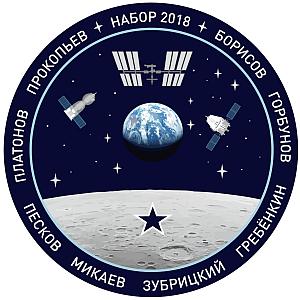
7/3/2020
Russia’s Cosmonaut Group is 60 years old today!
Today, the Russian Cosmonaut Squad celebrates its 60th anniversary. On March 7, 1960, by order of the Commander-in-Chief of the Air Force №267, the first twelve pilots were appointed to the position of listener-astronaut. In the structure of the Cosmonaut Training Center, a unit was created with the name “Cosmonaut Squad.” (Отряд космонавтов, Otryad Kosmonavtov) On March 15, 1960, the first group of students began theoretical classes, which took place in Moscow at the MV Central Airport Frunze. Since July 1, 1960, the CPC relocated to the Moscow Region, where preparation continued. […]
As of January 2020, 283 people received cosmonaut qualifications in our country, among which 122 (43%) completed 264 flights with a total duration of more than 27,992 days. Four times in space, four representatives of our country worked. For 60 years of manned space exploration, 225 people worked in open space, including 66 Soviet and Russian cosmonauts. Domestic astronauts made 283 spacewalks with a total duration of 1296 hours 13 minutes (more than 54 days), which accounted for 70% of the total time of extra-space activity of all cosmonauts on the planet.
Now there are 32 people in the Cosmonaut Roscosmos Detachment, 12 of them have made one or more space flights, and 8 are undergoing general space training. (Roskosmos/TsPK)
7/6/2020
Roskosmos: Cosmonaut team admission: first results
9/7/2020
Aleksandr Skvortsov was assigned the following class of test cosmonaut 1
Based on the order of the Roscosmos State Corporation on July 7, 2020, cosmonaut Aleksandr Skvortsov was assigned the following class: a test cosmonaut of class 1.
Classification is assigned depending on the quantity and quality of flights performed.
In the first profession, A. Skvortsov is a military pilot of the 1st class, having mastered the aircraft L-39, MiG-23 and Su-27. He has a total flying time of more than 1000 hours. He performed three space flights, the total time of which is 545 days. During the second space expedition, Aleksandr Skvortsov successfully completed the tasks of two planned spacewalks.
Currently, Aleksandr Skvortsov is a test instructor-cosmonaut – the head of the group of candidates for cosmonauts and continues to undergo training in the cosmonaut team of Roscosmos as part of the specialization and improvement group.
31/7/2020
Nikolai Tikhonov dropped out of the cosmonaut corps
On July 31, 2020, the employment contract with test cosmonaut Nikolai Tikhonov was terminated.
Nikolai Tikhonov was enrolled in the cosmonaut corps in 2006. In June 2009, after completing a course of general space training, at a meeting of the Interdepartmental Qualification Commission (IQC), he was awarded the qualification “test cosmonaut.” Later, he underwent training as part of the specialization and improvement group under the ISS program.
From June 2015 to October 2016, he trained as part of the ISS-49/50 backup crew as a flight engineer of the Soyuz MS-02 TPK and an ISS-49/50 flight engineer. From December 2017 to April 2018, N. Tikhonov was trained as a member of the ISS-57/58 prime crew as a flight engineer of the Soyuz MS-10 TPK. The composition of the crew was changed due to the revision of the ISS flight program.
From June 2018 to February 2020, the cosmonaut was trained as part of the ISS-63 crew as the commander of the Soyuz MS-16 TPK and the ISS-63 flight engineer. From February to July 2020, he was trained as part of the specialization and improvement group under the ISS program.
Nikolai Tikhonov decided to leave the cosmonaut corps in connection with the new data on the state of health.
Currently, the Roscosmos cosmonaut corps includes 31 people, of which 23 are active cosmonauts and 8 are candidates for test cosmonauts.
29/9/2020
Cosmonaut certificate number 148 was awarded
Test cosmonaut Sergei Kud-Sverchkov was awarded an international certificate of the International Aviation Federation (FAI).
This event took place today at the 17th site of the Baikonur cosmodrome during the formal ceremony of raising the flags of the countries participating in the international manned launch of the Soyuz MS-17 spacecraft. The event has been held since the 1970s, is revered by all generations of cosmonauts and symbolizes the official start of the final stage of cosmonaut training for a manned launch.
The ceremony was attended by the main and backup crews of ISS-64: Sergey Ryzhikov, Sergey Kud-Sverchkov, Kathleen Rubins, Oleg Novitsky, Peter Dubrov and Mark Vande Hei, raising the flags of Russia, the USA and the Republic of Kazakhstan. It was also attended by representatives of the State Space Agency Roskosmos, the administration of the city of Baikonur and specialists from the CTC, providing pre-launch training of the crews.
But today a surprise was prepared for the flight engineer of the Soyuz MS-17 TPK during the formal event. The head of the operational group, the most experienced Russian cosmonaut, Yuri Malenchenko, presented Sergei Kud-Sverchkov with the cosmonaut certificate number 148.
Such a document, in accordance with the current FAI rules, is issued to every cosmonaut who is preparing to perform his first space flight. The certificate is of international importance. On its last page, in five languages, a request is set out to assist astronauts in various situations. The document was signed by the President of the Russian Cosmonautics Federation, USSR pilot-cosmonaut, twice Hero of the Soviet Union V.V. Kovalenok and sports commissar of the Russian Cosmonautics Federation N. B. Bodin.
Sergei Kud-Sverchkov will take his certificate with him on October 14 for space flight and, according to tradition, will put onboard stamps on board the International Space Station.
24/11/2020
Cosmonaut candidates take the State Exam
On November 24 and 25, 2020 at the Yu.A. Gagarin, a group of candidates for test cosmonauts in the set of 2018 is passing the State exam. The final test determines the level of theoretical knowledge and practical skills acquired by candidates during a two-year course of general space training.
Today at 9 am, Konstantin Borisov, Aleksandr Gorbunov, Aleksandr Grebenkin and Alexey Zubritskii started taking the State exam. Tomorrow the final test is to be passed by Sergei Mikaev, Kirill Peskov, Oleg Platonov and Evgeny Prokopyev.
The list of questions included in the 12 tickets of the State Exam is approved by the head of the CPC and is issued in advance to the cosmonaut candidates for training. Each exam ticket includes four questions in the following areas of the general space training program:
- training in the theoretical foundations of cosmonautics;
- technical training in the design, onboard systems and equipment of manned spacecraft;
- fundamentals of scientific and applied research and experiments in space flights;
- preparation for extravehicular activities.
During the presentation, the examinees used onboard documentation and visual aids. The general space training course with Konstantin Borisov, Aleksandr Gorbunov, Aleksandr Grebenkin, Alexey Zubritskii, Oleg Platonov, Sergey Mikayev, Evgeny Prokopyev and Kirill Peskov began in the fall of 2018. For two years, the cosmonaut candidates have been trained at the CTC under a program that includes:
- technical training in onboard systems and manned spacecraft equipment;
- studying the basics of scientific research and experimentation;
- preparation for extravehicular activities;
- preparation for actions when landing in extreme conditions of various climatic and geographical zones;
- medical and biological training;
- special flight and parachute training,
- physical training, legal regulation of the activities of cosmonauts, learning English.
Summing up and evaluation of the performances of the candidates for test cosmonauts will take place tomorrow after the end of the second examination day. The Interdepartmental Commission for the State Exam includes representatives of the Cosmonaut Training Center, Rocket and Space Corporation Energia named after S.P. Korolev, Center named after M.V. Khrunichev and the Institute of Biomedical Problems of the Russian Academy of Sciences.
2/12/2020
Test cosmonaut qualification awarded to candidates who successfully passed the State exam
Today, December 2, 2020, at the Yu.A. Gagarin, a meeting of the Interdepartmental Qualification Commission (ICQC) took place. By the decision of the commission, the qualification of a test cosmonaut was awarded to Konstantin Borisov, Aleksandr Gorbunov, Aleksandr Grebenkin, Alexei Zubritskii, Sergey Mikayev, Kirill Peskov and Oleg Platonov. They completed a two-year general space training course and successfully passed the State exam.
Head of the Yu.A. Gagarin Pavel Vlasov addressed the participants of the event with a welcoming speech.
“Congratulations to the test cosmonauts and CTC staff who conducted the training. A very important stage has come to an end, but you cannot relax and lose motivation. Keep moving forward and see you at the next stages of preparation,” said the head of the Center.
The advisor to the head of the CTC, Hero of the Russian Federation, pilot-cosmonaut Yuri Malenchenko presented the heroes of the occasion with certificates confirming their new status. Representatives of enterprises and organizations of the rocket and space industry took part in the meeting of the MVKK and the solemn ceremony.
“You have a long way ahead, there is a lot to be done,” said the head of the RSC Energia flight and space center, Hero of the Russian Federation, pilot-cosmonaut Aleksandr Kaleri to his novice colleagues. “A good basis has been created for the further development and improvement of the acquired skills. Keep learning and moving towards your goal.
“The next stage of preparation will be very important for you. Competition will intensify, and only your knowledge, skills, abilities will determine who gets on the crew and flies into space. You have shown yourself well, do not slow down,” stressed Oleg Kotov, Deputy Director of the Institute of Biomedical Problems of the Russian Academy of Sciences, Hero of the Russian Federation, pilot-cosmonaut.
The parting words were joined by representatives of NPP Zvezda Gennady Glazov and the Khrunichev State Scientific and Practical Center Mikhail Musailov. The test cosmonauts who received certificates today were selected to the Roscosmos cosmonaut corps following the results of the second open competition announced in 2018. According to them, the theoretical part of the general space training was no less significant than the practical one. A group of then cosmonaut candidates attended lectures and seminars, where they studied the structure of a spacecraft, a station, and got acquainted with the methods of conducting scientific experiments. In two years they have mastered about 50 disciplines and passed about 60 tests and exams. (Roskosmos/TsPK)
Certificate numbers:
- Konstantin Borisov: 221
- Aleksandr Gorbunov: 222
- Aleksandr Grebyonkin: 223
- Alexey Zubritskii: 224
- Sergey Mikayev: 225
- Kirill Peskov: 226
- Oleg Platonov: 227
Evgeny Prokop’ev did not pass the State exams. (He is the younger brother of the current cosmonaut Sergei Prokop’ev.)
2021
28/1/2021
Cosmonaut selection 2019: winners announced
The Interdepartmental Commission (IAC) for the selection of cosmonauts and their appointment to the crews of manned spacecraft and stations within the framework of an open competition for the selection of candidates for cosmonauts of the Russian Federation (the competition started in 2019) decided to recommend the FSBI Research Institute of the CTC named after Yu.A. Gagarin appoint four people to the positions of test cosmonaut candidates of the Roscosmos Cosmonaut Corps. The decision came into force on January 27, 2021.
The cosmonaut’s profession will be undertaken by Sergey Irtuganov, Aleksandr Kolyabin, Sergey Teteryatnikov and Arutyun Kiviryan. In the near future they will start studying the General Space Training (GST) course, which will take place over two years.
The campaign for a new selection of astronauts began on June 3, 2019. Then the MVK decided to hold a competition to select candidates for the cosmonaut corps of Roscosmos. The purpose of the selection is to select the best specialists who will work in order to ensure the implementation of the Russian Federal Space Program.
All contestants had to go through several stages:
- Selection for compliance with the requirements for education and professional suitability;
- complex of medical examinations;
- a set of measures to assess the psychological qualities of applicants;
- testing for compliance with the requirements for physical fitness.
Roscosmos State Corporation congratulates on passing the selection!
Candidate test cosmonauts of the Roscosmos detachment
Irtuganov, Sergey Georgievich
Иртуганов Сергей Георгиевич
Was born on August 10, 1988 in Ulyanovsk.
Education
- In 2010, he graduated with honors from the Ulyanovsk Higher Aviation School of Civil Aviation (Institute) with a degree in Safety of Technological Processes and Production, specialization in Search and Rescue Flight Operations in Civil Aviation, and was qualified as an engineer.
- From 2007 to 2010 he was trained at the military department of the VUS Shturman IL-76, upon graduation he was awarded the rank of lieutenant.
Kolyabin, Aleksandr Sergeevich
Колябин Александр Сергеевич
Was born on January 12, 1987 in Protvino, Moscow Region.
Education
- In 2009 he graduated from the Krasnodar Military Aviation Institute named after A.K. Serov (Higher Military Aviation School of Pilots [Military Institute]).
Teteryatnikov, Sergey Alexandrovich
Тетерятников Сергей Александрович
Born December 19, 1988 in the village. Uspekhovka Mineralvodovsky district of Stavropol Territory.
Education
- In 2011 he graduated from the Naval Engineering Institute (VMII), faculty Operation of steam gas turbine power plants
Kiviryan, Arutyun Harutyunovich
Кивирян Арутюн Арутюнович
Born on August 23, 1993 in the city of Maikop of the Republic of Adygea.
Education
- In 2015 he graduated from the Baltic State Technical University VOENMEH named after D.F. Ustinov, was awarded the qualification “engineer” in the specialty “Rocket Engineering”.
- From 2012 to 2015, he was trained at the military department on VUS Operation and repair of shipborne cruise missile complexes, upon completion he was awarded the rank of lieutenant.
- In 2019, he studied at GAPOU Technical School named after S.P. Korolev, specializing in “operator of machine tools with programmed control” after graduation was awarded the qualification “Operator of machine tools with programmed control of the 4th category.”
26/2/2021
Cosmonaut Andrei Borisenko completes work at the CTC
Today, February 26, 2021, is the last working day of cosmonaut Andrei Ivanovich Borisenko at the Cosmonaut Training Center. Andrey Borisenko terminated his labor agreement with the Yu.A. Gagarin CTC and dismissed from the post of instructor-test cosmonaut – head of the cosmonaut group of the cosmonaut corps. This decision was made on the basis of the recommendation of the Chief Medical Commission.
Andrey Ivanovich decided to continue his career in one of the leading enterprises in the space industry. The cosmonaut began his career at the CTC in 2003.
Andrey Borisenko is the 110th cosmonaut of Russia and the 519th cosmonaut of the world. He performed two space flights, in one of which he was the commander of a long-term expedition. The total duration of his flights was 337 days.
2/3/2021
Blog: The Life of a Cosmonaut
“Welcome to the blog of Roscosmos cosmonauts 2018 group. In the first person, we tell you about the professional life of a test cosmonaut! The purpose of the blog : to create a direct channel of transmission of facts about the profession, while doing it firsthand and in real time.” (In Russian; Google Translate link)
16/6/2021
Sergey Krikalev will head the new organization responsible for the ISS
The cosmonaut, according to the head of Roscosmos Dmitry Rogozin, is the most experienced person for this position.
SAINT PETERSBURG, June 15. / TASS /. Cosmonaut Sergei Krikalev will head the new structure that will support the current activities of the ISS. This was stated by the head of Roscosmos Dmitry Rogozin at a press conference in the framework of the Global Conference on Space Exploration GLEX-2021.
“We have an agreement with him [Krikalev] to form a so-called operating organization, which should take over the function of ensuring the current activities of the ISS,” Rogozin said.
He explained that at the moment this function is performed by RSC Energia. “It turns out that it makes the modules, ships, and also operates the station. This causes a certain conflict of interest,” Rogozin said.
“It is important for us today to create an organization that will rely on several ones: this is the Main Operational Control Group, the Mission Control Center, the Cosmonaut Training Center, Roscosmos.
Negotiations with NASA
Krikalev on Wednesday will hold talks with two high-ranking representatives of NASA, Rogozin said. “Tomorrow, two high-ranking NASA representatives will arrive in Russia. Sergei Krikalev will meet with them to negotiate with them. It is in development of our today’s conversation with [NASA head Bill] Nelson,” Rogozin said.
He noted that he held the second negotiations with Nelson, following which the parties agreed to hold the first face-to-face meeting in the fall at one of the international conferences.
Astronauts will control the creation of new technology
According to Rogozin, members of the Russian cosmonaut corps will be part of the department for special examinations of manned cosmonautics, including overseeing the creation of space technology at enterprises. “We are creating, within the framework of the STC, a department for special examinations of manned cosmonautics as part of all members of the cosmonaut corps,” Rogozin said.
According to the head of the state corporation, it will work according to the “military acceptance” type. Astronauts, at their request, will be assigned to specific enterprises. “All organizations will accept cosmonauts who will exercise control over the creation of new space technology,” Rogozin explained.
The global conference on space exploration was originally supposed to be held in St. Petersburg on June 9-11, 2020, but due to the pandemic it was postponed to 2021. The forum is held annually in different countries. This year it took place in St. Petersburg from 14 to 18 June.
An alternative report, initially via a post on the Behind the Black blog:
Russian cosmonaut fired for giving space station film a rocket
A former cosmonaut was removed from a senior management post at Russia’s space agency after he criticised plans to shoot the world’s first feature film on board the International Space Station. Sergei Krikalev, who spent over 800 days in space during his career, told the Open Media website that he was dismissed after he spoke out against the production of Challenge, a drama that tells the story of a female surgeon forced to operate on a cosmonaut in space.
Russia last month picked a famous actress and an award-winning director to produce the ground-breaking film. Yulia Peresild, 36, and Klim Shipenko, 37, are due to fly to the ISS on a Soyuz space rocket in October. They will undergo training including centrifuge tests and flights in zero gravity. Shooting for Challenge is due to take place at the same time as Tom Cruise is scheduled to star in a Hollywood film on board the ISS. Cruise, who will be 59 in October, will travel to space with director Doug Liman as part of a project involving Nasa and Elon Musk’s SpaceX rocket company. The competing films have led to talk of a celebrity space race between Russia and the United States.
Krikalev, 62, was the only person with experience of space travel among Roscosmos senior management. He flew into space six times between 1988 and 2005. He was onboard the Mir space station when the Soviet Union collapsed in 1991 and his return was delayed by over five months after funds ran out. He did not explain exactly why he was against the film. However, his stance was supported by other former cosmonauts. “A cosmonaut prepares for flight for many years and when the left or right seat of a Soyuz is given to a passenger, this pushes back the timing of an expedition into orbit for someone,” Sergei Zhukov said.
Roscosmos denied that Krikalev had been fired, saying he had been given a new post as an adviser.
12/7/2021
Recruits of the Roscosmos Cosmonaut Corps were officially presented to the staff of the CTC
At the Yu.A. Gagarin, a presentation of four recruits who are now undergoing general space training (OKP) took place. Sergei Teteryatnikov, Aleksandr Kolyabin, Sergei Irtuganov and Arutyun Kiviryan are candidates for the 2020 open enrollment cosmonauts.
Before joining the Cosmonaut Corps, Sergei Teteryatnikov’s career was associated with the operation of submarines. Aleksandr Kolyabin served as deputy commander of a fighter squadron. Sergey Irtuganov graduated with honors from the Ulyanovsk Higher Aviation School of Civil Aviation and received an engineering degree. Arutyun Kiviryan worked as a 2nd category test engineer at RSC Energia.
The 2020 cosmonaut candidates have embarked on the OKP at various times. Someone needed less time to change their activity and place of residence, some more.
Arutyun Kiviryan has been training for three months. For example, he has already had a chance to survive on the water and train in conditions of short-term weightlessness.
“We try to do everything the instructors say. At the moment we are coping with the tasks set, I hope this will continue. We are ready for anything,” said Arutyun Kiviryan.
“This is the best job in the world because I love it. There is everything that we wanted, what we were striving for.” Sergey Irtuganov shared his impressions.
The cosmonaut candidates answered the questions of the CTC specialists, told of their professional achievements, hobbies and skills.
So, for example, it turned out that everyone, with the exception of Sergei Teteryatnikov, has experience in skydiving. But Sergei has other skills that will help him get trained. Teteryatnikov is a submariner, before him there were no specialists of such a profile in the Cosmonaut Corps.
“I would like to wish the astronaut candidates perseverance in achieving their goals and the perseverance required to master new knowledge. The work will not be easy, but interesting,” said the head of the CTC, Maxim Kharlamov.
The recruits will have to undergo a two-year general space training, and if in the future they successfully pass the state exam, they will receive the qualification of test cosmonauts.
21/7/2021
TASS interview with the head of the CTC Maxim Kharlamov
Cosmonaut Training Center. Yu.A. Gagarin (CTC) traditionally takes part in the International Aviation and Space Salon (MAKS), which takes place in Zhukovsky near Moscow. This year, at the air show, the CPC will organize interactive communication with cosmonauts, and will hold a number of meetings with partners. The head of the CTC Maxim Kharlamov told TASS about participation in MAKS, changes in the center, a new recruitment to the cosmonaut corps and the preparation of actress Yulia Peresild with director Klim Shipenko, whose flight to the International Space Station (ISS) is scheduled for October 2021.
– Maksim Mikhailovich, what will the Cosmonaut Training Center present at MAKS?
– The CPC, directly the cosmonauts and the leadership of the center, will participate in the International Aviation and Space Salon. We have planned working meetings, signing a number of agreements with enterprises with which we interact and cooperate.
– Will zero gravity flights be organized on the IL-76MDK laboratory aircraft for the visitors of the air show this year?
– We planned to make several zero gravity flights, we had such an agreement with the organizers of the salon, however, due to the restrictions associated with the pandemic, we had to abandon this idea at the final stage.
– Will there be interactive communication with astronauts within the framework of MAKS?
– Yes, this is part of the CPC participation program in the salon. The center will present a stand for the visitors of the exhibition, within the framework of which a simulator for practicing manual docking of a manned transport spacecraft with the International Space Station will be presented. It is also planned that cosmonauts will participate in meetings with visitors to the exhibition. We invite everyone interested in information about space to the Roscosmos pavilion, where an interactive meeting with cosmonauts will be held daily at 11 o'clock.
– Maksim Mikhailovich, since June 1 you have headed the Cosmonaut Training Center, do you plan to carry out any structural changes in the CTC or in cosmonaut training?
– Some changes were started in the CPC at the time when I was the deputy head of the center. First of all, we plan to complete these changes. First of all, they relate to the systematization of the scientific activities of the Cosmonaut Training Center, the formation of clearer, more significant areas of scientific activity, all other changes will be insignificant and will be associated with the optimization of the activities of the CTC.
– Earlier, the head of Roscosmos Dmitry Rogozin said that cosmonaut Oleg Kononenko would be appointed your first deputy for flight training. Has he already officially entered office?
– Oleg Kononenko from July 19 took up the post of instructor-test cosmonaut – deputy head of the CTC – the commander of the cosmonaut detachment.
– How will Oleg Dmitrievich fulfill the duties of the Deputy Head of the CPC during the flight into space? Will someone replace him or will he work from orbit?
– During a space flight, Oleg Kononenko will first of all perform that part of the duties associated with a manned flight, because he remains an instructor-test cosmonaut, and the functions related to the organization and management of the training of cosmonauts will be performed by another employee, temporarily appointed to fulfill these responsibilities.
– Has the assignment of cosmonauts to enterprises already begun? Will this affect their preparation for the flight?
– The work on assigning cosmonauts to enterprises has begun. The candidates have already been identified who will work at all major enterprises in the industry associated with the manned program. In addition, the cosmonauts are already included in the Scientific and Technical Council (STC) of Roscosmos. I think that the work on the inclusion of cosmonauts in the scientific and technical councils of enterprises will be completed in the near future.
– What work is currently being done with the hydro laboratory? When will its normal operation begin?
– The hydro laboratory is now at the stage of testing, complex debugging of systems that are involved in the training of cosmonauts. I think that work directly on the training of cosmonauts will begin in the hydro laboratory in November 2021.
– The pilot Galina Kairova, who did not pass the final of the competition for filming the film Challenge, was offered to continue the selection to the cosmonaut corps on a professional basis. Did she take part in the additional recruitment to the squad? Is her candidacy being considered or will she have to wait for a new set of astronauts?
– Galina Kairova and I are in constant contact. We know that now she continues her professional activity and is retraining for a new type of aircraft. I think when the next recruitment to the cosmonaut corps is announced, we will definitely invite her to take part in it. The preliminary consent from Galina to participate in the selection was received.
– Do you already have a plan for a new recruitment to the cosmonaut corps? When can it be announced?
– At the beginning of this year, we started preparing a new set. The decision on recruitment is made by Roskosmos, we plan to contact the State Corporation with such a proposal in the middle of next year.
– Now a new simulator for a promising spacecraft is being created. Will he use VR technology?
– We have started to create simulators for a promising ship. Now we are mainly paying attention to the creation of a complex simulator, which is necessary for practicing the activities of astronauts for flight on this spacecraft with docking with the ISS. We plan to use VR technologies, we are working on this issue together with Roscosmos, but these technologies will be more applicable when creating simulators for the lunar program. For example, now we are testing this technology in a centrifuge.
– How will the imitation of weightlessness be ensured there?
– The imitation of weightlessness on the new simulator of the transport ship is not provided, for this we have other technical means of training, where we practice the activities of cosmonauts in conditions of weightlessness.
– Has a program for training cosmonauts for flight aboard the promising Orel spacecraft been developed?
– There is no program as such yet. Requirements for the training of cosmonauts, the functions of cosmonauts are now being developed, and the technical documentation of the regular spacecraft is being analyzed. I think that in the next two or three months we will start developing the program itself.
– Has the helicopter training for space-based activities of cosmonauts begun?
– We have returned to this type of special training for cosmonauts as helicopter training. It was used by the center about 40 years ago. Now there is a need to return to the helicopter as a means of preparation for practicing the landing of an astronaut on the lunar surface. We are working on this task now. So far, this is the development of technology at the level of research work. However, we have developed a helicopter flight training program. I think we will start its implementation next year after the completion of the “Constellation” experiment.
– Will there be any changes in the flight training of cosmonauts?
– We have multifaceted flight training, it includes training on L-39 aircraft, on a laboratory aircraft for visual observation. Helicopter training is something newly acquired. A new type of training in the center.
– Did you have to adjust the cosmonaut training program due to the coronavirus pandemic? Have all astronauts been vaccinated?
– In the last year, adjustments in the training program due to the coronavirus were not required. Everyone who, for medical reasons, from the astronauts is recommended to be vaccinated, were vaccinated. We have a schedule of appropriate vaccinations. In the near future, the entire squadron will be vaccinated. At the moment, the coronavirus as a whole does not affect the training of astronauts.
– Are there any cases of revaccination in the unit?
– And how! If the Ministry of Health recommends revaccinating every six months, we strictly follow its recommendations.
– How do the instructors assess the training of Yulia Peresild and Klim Shipenko, who are preparing for the flight in October?
– In general, the results of their training are assessed positively, they cope with the program. Let's see how they will act when it comes to training in a carriage, to complex training. Our forecast is positive.
Interviewed by Ekaterina Moskvich
1/12/2021
Oleg Skripochka retires from Roscosmos Cosmonaut Corps
On December 1, 2021, Hero of Russia, pilot-cosmonaut Oleg Skripochka is completing his work in Roscosmos Cosmonaut Corps. Oleg Ivanovich Skripochka decided to continue his work at the Gagarin Cosmonaut Training Center as the leading specialist of the methodological department.
Oleg Skripochka is the 107th cosmonaut of the Russian Federation and the 516th cosmonaut of the world. He joined the Cosmonaut Corps in 1997 and performed three spaceflights since then with the total duration of 536 days, 3 hours and 49 minutes. Throughout his career, Oleg Skripochka performed three spacewalks spending 16 hours and 39 minutes in open space.
GCTC management, colleagues from Roscosmos Cosmonaut Corps and GCTC employees thank Oleg Skripochka for his years of service at the Center and his great contribution to the Center's work, and are confident that he will apply his experience in the role of a cosmonaut mentor during their preparation for new missions.
2022
31/3/2022
Aleksandr Misurkin completes his activities in the Roscosmos cosmonaut corps
Today, March 31, 2022, is Aleksandr Alexandrovich Misurkin’s last working day at the CPC. He completes his activity in the cosmonaut corps of Roscosmos.
Hero of Russia Aleksandr Misurkin – 116th cosmonaut of the Russian Federation / 528th – world. He was enlisted in the cosmonaut corps in 2006.
Performed three space flights, the total duration of which is 346 days 07 hours 04 minutes. Made four spacewalks.
The management of the Center, colleagues in the cosmonaut corps of Roscosmos, employees of the CPC thank Aleksandr Alexandrovich for his great contribution to the development and popularization of domestic cosmonautics, note his high professionalism, competence, responsibility and wish him success in his future activities!
12/4/2022
Sergey Krikalyov: “At that time, many changes were taking place on Earth” – Arguments and Facts interview.
“Like a living organism.” The head of the CPC, ЦПК spoke about the training program for cosmonauts
61 years ago, cosmonaut Yuri Gagarin set off on the first space flight in the history of mankind: the Vostok launch vehicle launched the Vostok-1 spacecraft, on board of which he was. After one revolution around the Earth, passing through the dense layers of the atmosphere at an altitude of 7 km, Gagarin ejected from the descent vehicle and landed in the Saratov region.
Now the cosmonaut corps of Roskosmos includes 26 cosmonauts and four candidates. About how many people will be on board the promising Orel spacecraft during the first flight, which of them have a chance to go into orbit on the American Crew Dragon ship when the “recruits” come to the detachment, the head of the Cosmonaut Training Center, Maxim Kharlamov, told TASS in an interview.
2021 was marked by the training of four non-professional flight participants at once, and the CPC also tested accelerated training of crews with such flight participants. How do you rate the work done?
I rate it very highly, especially in terms of its significance in relation to promising programs. In practice, a methodology was developed for quickly adapting the program to prepare for a specific task a person who does not have professional functions on board the International Space Station to maintain the operability of its systems. However, it is envisaged that this person will be able to perform the intended work on board. This story is very useful in the future, when scientists, researchers, geologists, doctors will have to go into orbit. You can come up with a whole variation of such problems. We worked out the initial experience of implementing such a training program last year.
Is there any further improvement of the space tourist training program? What innovations are expected?
This methodical work is like a living organism: all programs, schedules, curricula are constantly being improved depending on the accumulated knowledge, experience, depending on the comments made by the crew members who performed the flight. This work is ongoing. It can be affirmatively said that the programs will be improved, the methods of some classes will be optimized.
Is it possible to shorten the training program for space tourists?
Theoretically, yes. You just need some experience, it will accumulate. This reduction can be achieved by additional workload for professionals, depending on the specific conditions in which they work and depending on the number of professionals on board.
How Russia switched to short flight patterns to the ISS TASS tells how manned flights to the orbital station have improved
Has a program for preparing a space tourist for a spacewalk already been developed? How will it differ from similar training for a professional cosmonaut?
Such a program has not yet been developed, but its development does not require special qualifications or large time costs. We have standard programs in two directions: a program for working with a spacesuit (works in a spacesuit, they do not depend on which exit is performed) and a program in a hydro laboratory – practicing extravehicular activities in water on module mock-ups. It is always developed for a specific output, a specific task. When such a task is defined, then a program will be developed.
Has the representative of Norway really completed initial training at the CTC? Will he be a new participant in space flight? What stages of preparation did he go through?
Yes, we had such a representative, he went through several elements of training with us, but without any flight obligations. It is not known what will happen next.
Do you often undergo training without flight obligations?
There are such cases. In general, the CPC often implements elements of flight preparation for those who want to experience extreme sensations. For example, spinning in a centrifuge, putting on a spacesuit, weightless flights, practicing survival in the forest. There are many such areas.
Are such experiments possible in a hydrolaboratory?
Theoretically, they are possible, but so far we are not conducting them, because there is a lot of work on training full-time crews. This is possible at a later stage.
During the pandemic, did commercial training stop?
Commercial training without flying obligations has been reduced to almost zero due to restrictions.
Have the restrictions been lifted?
They're filming right now. At first, we are resuming excursion activities in small groups, slowly starting to lift restrictions, looking closely at how the situation will develop.
If we talk about professional cosmonauts, it was previously reported that cosmonaut Anna Kikina could become the first Russian woman to fly on the American ship Crew Dragon. Has her training in the US increased?
The number of trainings she did not increase, because her training program in Russia and NASA was built back in 2021, based on the possibility of flying on an American ship. We are still walking along it. In March, she was in training in the United States, returned at the end of the month. It was a short program.
Due to the geopolitical situation, do astronauts have difficulties with training in the United States? What about the astronauts at the Cosmonaut Training Center? How do they get there?
Training of astronauts in Star City is planned in the near future, until they arrive. As for the astronauts, the training continues, we bought tickets with transfers for their return. They did not experience any major difficulties. Prices, of course, have grown a little, but technically all this turned out to be feasible.
Has a group of cosmonauts been created, whose training is different due to the fact that they will take part in cross-flights?
Theoretically, everyone has a chance to fly on Crew Dragon. And then this delta appears in his training program: ship systems, special equipment, and so on. There is no such thing as having a separate group that will fly on American ships. Against the background of the total duration of preparation for the flight on the Soyuz spacecraft, in the Russian and American segments, this is a very small period of time, so there is no need to implement all this in advance.
Has the CTC started developing a training program for cosmonauts aboard the Oryol spacecraft?
The CPC has not started directly developing a training program for the Orel flight, there is no need for this yet. In the presence of our experience, such a program is developed quickly, when we receive the documentation, the initial data on the ship. Until the time has come when such a program should be developed. But we started developing simulators for this ship, made a preliminary design, and now we are at the stage of developing design documentation.
And when will the simulator appear?
The simulator should appear in full functionality no later than a year before the planned manned flight.
How long will it take to develop a training program approximately?
“This is absolutely cost-effective work. Our experts get acquainted with the documentation in the process of getting acquainted with the ship. Specialists in their areas are working out which systems should be used for training. When this needs to be implemented directly in the program, a team will gather and form it in a short time. It's about weeks. And then the most experienced cosmonauts will go through this program, and we will improve it.
The first manned flight of the Oryol spacecraft is scheduled for 2025. Now there is an understanding which of the cosmonauts can join the crew?
We have not yet appointed candidates who should fly on the first ship, but in one way or another, all astronauts participate in the development of ship systems, in scientific and technical councils, where development approaches are considered, technical documentation is considered. Astronauts, especially experienced ones, are involved in the process.
How many cosmonauts will be on board the new ship during the first flight?
We’re guessing two.
Launches of the Orel spacecraft will be carried out from the Vostochnyicosmodrome. Is it planned to pay special attention to training at sea in training?
Probably not. We have this kind of training – survival on the water surface. He gets a lot of attention. Each formed crew undergoes such training. This approach will continue in the future.
Deputy Head of the CTC – Cosmonaut Commander Oleg Kononenko is a member of the ISS-69 crew, which will go into space in the spring of 2023. Has it already been decided who will perform his functions as deputy head of the center and commander of the cosmonaut detachment?
In the detachment, he has a deputy who will perform his functions. There are even two of them: Oleg Novitsky and Andrey Babkin. As for the deputy head of the center, let's look at the circumstances.
Earlier, you announced plans to apply to Roscosmos in mid-2022 with a proposal for a new recruitment to the cosmonaut corps. Do you have any idea when the appeal will be sent?
“So far we are not sending this appeal. We have some questions for Roskosmos to clarify the prospective flight program. When these issues are clarified, then we will probably clarify our request. Previously, we had an intention next year to begin the selection of several people. To present the final calculations, it is necessary to understand the flight program, the specified dates, when the promising transport ship will be launched, when the lunar program will begin, how the ISS will be operated. At the moment, Roscosmos has not confirmed the extension of the ISS.
Do you have any special wishes for the set?
I see no reason for special wishes yet. The selection procedure and the very formation of this set, approaches to selection will remain the same. They fully cover the immediate needs.
To what extent are cosmonauts involved in the process of creating the Russian Orbital Service Station?
The development of preliminary design materials has just begun. This is the very beginning of the journey, but cosmonauts, according to the decision of the head of Roscosmos, Dmitry Olegovich Rogozin, are members of scientific and technical councils (NTS) of all leading organizations, this is a fairly effective mechanism that ensures the participation of cosmonauts in the development of promising manned spacecraft. All these questions are considered in one way or another by the NTS, and the cosmonauts participate in them.
How does the involvement of cosmonauts to work at the enterprises of Roscosmos affect?
Positively. Cosmonauts are happy to actively participate in the discussion of technical documents and approaches, principles of creation and development. This has a very good effect on the professional status of astronauts.
Maybe the cosmonauts offer to conduct some experiments on the ISS?
There is an experiment called “Protective Composite.” Our performer on board was Anton Shkaplerov. This is an example when the CTC is the initiator and co-organizer of this experiment, and we, together with the cosmonaut, are promoting its implementation on board the ISS. Even when Shkaplerov was preparing for the flight, work was carried out jointly with Belgorod University to prepare this experiment, and during the flight he performed it. Cosmonaut Aleksandr Misurkin had the same experience with the Lazma experiment.
How do experts assess the general space training of cosmonaut candidates?
Well rated. All four are doing well, so far we have no critical problems with them.
And when are they expected to have state exams at the end of the OKP course?
In the middle of next year.
Interviewed by Ekaterina Moskvich
29/4/2022
Hero of Russia, pilot-cosmonaut of the Russian Federation Aleksandr Skvortsov completes work in the cosmonaut corps of Roscosmos
Today, April 29, 2022, Hero of Russia, pilot-cosmonaut of the Russian Federation Aleksandr Aleksandrovich Skvortsov is completing his activities in the Roscosmos cosmonaut corps.
Aleksandr Skvortsov is the 105th cosmonaut of the Russian Federation and the 510th of the world. He has three space flights with a total duration of almost 546 days, and two spacewalks. During his work on the ISS, he conducted dozens of experiments from various fields of science under the Russian scientific program (medicine, space biology, biotechnology, physical and chemical processes, etc.). He performed work with Russian and foreign cargo ships, maintenance of the ISS onboard systems, onboard photography and video filming, and much more.
The management of the Center, colleagues in the cosmonaut corps of Roscosmos, the staff of the CPC thank Aleksandr Skvortsov for his high professionalism, many years of work at the Center and his great contribution to the development of domestic manned cosmonautics, and wish you good health, strength to achieve your goals and space success in everything!
1/5/2022
Hero of Russia Aleksandr Skvortsov explained why he left the cosmonaut corps
MK.ru (Московский Комсомолец, Moskovskii Komsomolets)
In the spring of 2022, two more of his colleagues parted ways with the space profession
Three cosmonauts immediately left the space “team” of Russia – the Roscosmos cosmonaut detachment – this spring. These are Aleksandr Skvortsov, Aleksandr Misurkin, who made three flights to the International Space Station, and Andrei Babkin, who never flew into space. “MK” found out the reasons why this happened.
In the spring of 2022, two more of his colleagues parted ways with the space profession
So, on the last day of March, 44-year-old cosmonaut Aleksandr Misurkin wrote a letter of resignation. He was enlisted in the detachment in 2006, performed three space flights, the total duration of which was 346 days 7 hours 4 minutes. The total duration of his work in outer space is 28 hours 13 minutes. The 116th cosmonaut of Russia, Hero of the Russian Federation Misurkin became famous for the record for the duration of the stay of cosmonauts outside the ISS. So in 2013, Aleksandr, together with Fedor Yurchikhin, worked in the EVA (extravehicular activity) mode for 7 hours 29 minutes, and in 2018 the same Aleksandr Misurkin with another partner, Anton Shkaplerov, spent 8 hours 13 minutes in outer space, breaking his own five-year record prescription. The cosmonauts' task was to install a new broadband communication system module, which they successfully completed.
On April 29, following Misurkin, the Roscosmos cosmonaut detachment was also left by the Hero of Russia, pilot-cosmonaut of the Russian Federation Aleksandr Skvortsov. Skvortsov is the 105th cosmonaut of the Russian Federation, “extreme,” who remained in the detachment from the 1997 recruitment. It included cosmonauts Sergei Volkov, Maksim Suraev, Yuri Romanenko and Yuri Lonchakov, who had long since left manned cosmonautics. Skvortsov, like Misurkin, flew into Earth orbit three times, staying there for a total of almost 546 days and making two spacewalks with a total duration of 12 hours and 34 minutes.
Skvortsov distinguished himself by a number of successfully conducted scientific experiments on board, high-quality maintenance of the station’s on-board systems, and on-board photography and video filming. The next flight of the cosmonaut as the ISS-70 crew commander (the 67th crew is currently working on the ISS) was scheduled for 2023. Aleksandr Skvortsov was supposed to “take out” the first flight of newcomers: Konstantin Borisov and Oleg Platonov. However, a year before the start, one of the most experienced members of the squad changed his mind.
“Having got acquainted with the program of the future flight, I reconsidered my decision,” Aleksandr Skvortsov commented on his departure to MK. “Expedition ISS-70 is planned as an annual one. Despite the fact that for health reasons I am still suitable for flying, it is already difficult for me to fly for such a period. It would be nothing if the program included interesting work on the Russian segment, but most of the time there I would have to work for the Americans, that is, help them carry out their experiments. Sorry, but there is no proper motivation for this. In a few days I will be 56 years old – I do not want to celebrate my 60th anniversary in orbit. We must stop in time. Note that I am leaving the detachment without any resentment, I am grateful to fate for connecting me with TsPK, I respect Rogozin [Dmitrii Rogozin, General Director of Roscosmos – author].
As became known to MK, instead of Skvortsov as a member of the ISS-70, it is possible that Aleksei Ovchinin, who was in the plan on the ISS-71, will go on a flight.
Another cosmonaut of the detachment, Andrei Babkin, says goodbye to his profession, having never flown to the ISS. Each cosmonaut has his own destiny by which they joined the TsPK in 2010, in 2018 Babkin was supposed to become an understudy for Nikolai Tikhonov. But due to the shuffling of crew members associated with the frequently changing plans of Roscosmos at that time, Nikolai Tikhonov was removed from the main crew, and Andrei Babkin from the backup team along with him. As a result, at the time of launch, members of the ISS-57/58 mission, Russian cosmonaut Aleksei Ovchinin and NASA astronaut Tyler Hague (Талер Хейг), were on board the spacecraft. The launch, as is known, ended in the failure of the Soyuz-FG launch vehicle. Fortunately, the cosmonauts managed to escape.
In 2020, the same Tikhonov and Babkin were again put, only now both of them – in the main crew. But unfortunately, Tikhonov injured his eye and was removed for “medical reasons.” As a result, understudies were sent to the ISS – Anatolii Ivanishin and Ivan Vagner, and Babkin, by coincidence, was again out of work.
He made another attempt to go into space in October 2021. The cosmonaut was looking forward to this flight, preparing carefully. But, apparently, it was not his fate to be in orbit. The management again changed crew members in connection with the flight to the ISS of the Russian film crew of the film Challenge. After that, the cosmonaut, already in his sixties, had nothing to hope for. In early April 2022, he wrote a letter of resignation.
26/6/2022
Cosmonaut Anna Kikina leaves for the USA to prepare for the flight to the ISS
On Saturday, June 25, 2022, Roscosmos cosmonaut Anna Kikina will travel to the United States of America to undergo the next stage of preparation for space flight on the American manned spacecraft Crew Dragon.
As part of a week-long training at SpaceX, Anna Kikina will undergo training with a spacesuit, including fitting it to individual sizes, and will take part in lectures on the latest changes in the operation of some systems of the Crew Dragon spacecraft.
The launch of the Crew Dragon spacecraft with the Crew-5 crew, which may include Roscosmos cosmonaut Anna Kikina, is scheduled for September 1, 2022. Earlier, the Prime Minister of the Russian Federation Mikhail Mishustin signed a decree allowing the State Corporation to negotiate with NASA on the implementation of the agreement on “cross flights.”.
22/7/2022
Roscosmos presents updated portraits of cosmonauts
In 2021, the next set of Roscosmos cosmonauts was completed. The galaxy of space explorers has been replenished by four newcomers who are currently undergoing the stage of general space training. Prior to this, 16 more candidates were selected for the squad during the recruitment of 2012 and 2018.
In total, there are 29 people in the Roscosmos detachment today, three of them are on board the Russian segment of the International Space Station, performing their heroic duty. Considering that two thirds of the detachment have no flight experience, the press service of the Roscosmos State Corporation decided to present the faces of future space explorers, those whose names will soon be put on a par with Yuri Gagarin, Alexei Leonov, Valentina Tereshkova, Valerii Polyakov, Sergei Krikalyov and others.
Pavel Kassin, a hereditary photographer, photojournalist, editor, has been working in political photojournalism for more than 30 years, ex-director of the photo service of the Kommersant publishing house, was invited to create portraits of the astronauts.
Sincere, deep portraits convey the essence of the profession, reflect the everyday and global heroism of the cosmonaut’s work. Portraits in photography are a genre that continues the traditions of portraiture, in which a person becomes the main object of the image, and one of the main tasks of a photo portrait, the difference between the genre, is the desire to capture not just photographic features, but the character, mood and inner world of a person.
25/7/2022
Roscosmos cosmonauts will make three flights on American ships
The agreement between the State Corporation Roscosmos and the National Aeronautics and Space Administration (NASA) within the framework of the International Space Station program provides for three flights of Russian cosmonauts on American manned spacecraft and three flights of American astronauts on Russian manned spacecraft.
These cross flights are planned to be carried out in 2022-2024 – twice a year.
In accordance with the agreement, NASA astronaut Francisco Rubio will go to the ISS on September 21, 2022 on the Russian manned spacecraft Soyuz MS-22, and Roscosmos cosmonaut Anna Kikina – no earlier than September 29, 2022 on the American manned spacecraft Crew Dragon (Crew-5 mission). ).
In the spring of 2023, NASA astronaut Laurel O’Hara is scheduled to fly on the Soyuz MS-23 spacecraft and Roscosmos cosmonaut Andrei Fedyaev on the Crew Dragon spacecraft (Crew-6 mission).
In July 2022, within the framework of the ISS program, Roscosmos and NASA signed an agreement on cross-flights of Russian cosmonauts on American manned spacecraft and American astronauts on Russian manned spacecraft. This will make it possible, in case of cancelation or significant delay in the launch of a Russian or American spacecraft, to ensure the presence on board the ISS of at least one Roscosmos cosmonaut and one NASA astronaut to service the Russian and American segments of the Station, respectively.
22/8/2022
Yuri Borisov discussed with cosmonauts the prospects for the creation of the Russian Orbital Station
Director General of Roscosmos Yuri Borisov, during a visit to the Cosmonaut Training Center, discussed with the cosmonaut corps the future of Russia’s manned program, including the creation of the Russian Orbital Station.
“Some of you will open the way to the Russian Orbital Station,” said Yuri Borisov addressing the cosmonauts.
According to him, the creation of a national station opens up opportunities for scientists to conduct new research. For example, if a polar orbit is chosen, the station will be located in an area with increased radiation, which will allow collecting statistical data on a person’s stay in such conditions, developing means of protection against radiation, which will be useful for deep space flights in the future.
Yuri Borisov also said that the station could be eternal due to replaceable modules, and a new generation of spacecraft would serve it. In addition, the head of the state corporation is convinced that despite the national principle of creating a station, friendly countries can be involved in the project.
“I think that the station should be open to friendly countries, for international research,” said Yuri Borisov.
Work on the creation of a national station and transport space infrastructure will be included in the concept for the development of manned cosmonautics.
Oleg Kononenko, the commander of the Roscosmos cosmonaut corps, during a conversation with the head of the State Corporation, asked to prevent interruptions in the manned program of Russia during the transition from the ISS to the ROSS, citing NASA data on the degradation of the American astronaut corps during the transition from the Skylab station to the Space Shuttle.
“This is confirmation that such things should not be allowed, the school of manned cosmonautics should not be lost,” said Yuri Borisov.
During his acquaintance with the cosmonauts, Yuri Borisov said that at one time, as a developer, he was directly involved in the creation of the onboard complex of the Russian segment of the ISS, which is still used at the station.
“So many years have passed, but it still works. Only sometimes we change components,” said Oleg Kononenko, the commander of the cosmonaut detachment.
In addition, Yuri Borisov told the cosmonauts about the challenges facing the rocket and space industry today – about plans to commercialize the services of the rocket and space industry with an emphasis, in terms of cosmonauts, on conducting scientific experiments, and building up Russia’s orbital grouping with the transition to conveyor production of satellites.
“It is the main source of development of the industry,” said Yuri Borisov.
During a working trip to the Cosmonaut Training Center, the General Director of Roscosmos visited the Soyuz MS spacecraft, where at that moment one of the crews preparing for flight was training, visited the ISS Russian Segment simulator, examined the centrifuge designed to simulate overloads at different stages of space flight, as well as a simulator for preparing cosmonauts for work in outer space. Then the delegation of Roscosmos got acquainted with the technical capabilities of the hydrolaboratory, and the instructors of the Center demonstrated to the leadership of Roscosmos the tools that cosmonauts use to perform work in outer space.
30/12/2022
Cosmonaut Mukhtar Aimakhanov completes work in the Roskosmos cosmonaut corps
On December 30, 2022, Mukhtar Aimakhanov left the position of test cosmonaut in the Roskosmos cosmonaut corps after the decision of the Chief Medical Commission, which took place at the TsPK on December 28, 2022. Mukhtar Rabatovich will continue his activities at TsPK as a leading specialist in the training of cosmonauts.
AIMAKHANOV Mukhtar Rabatovich
Date and place of birth: January 1, 1967, p. Dzhusaly, Kyzylorda region.
Education:
- 1988: Chernigovskoe VVAUL (Черниговское ВВАУЛ) with the qualification “pilot-engineer” («лётчик-инженер»);
- 2002: Adilet Higher School of Law with qualification of lawyer;
- 2009: Russian Academy of Public Administration under the President of the Russian Federation with the qualification of economist.
Activities in the cosmonaut corps: In May 2003, Mukhtar Aimakhanov was enlisted as a candidate for test cosmonauts of the cosmonaut corps of the RGNITsPK named after Yu. A. Gagarin, where he underwent general space training. In June 2005, at a meeting of the Interdepartmental Qualification Commission, he was awarded the qualification “test cosmonaut” («космонавт-испытатель»). From 2005-2009 M. Aimakhanov was trained as part of a group of specialization and improvement. From August 14, 2014, Mukhtar Rabatovich held the position of test cosmonaut of the Roskosmos cosmonaut detachment, where he received training as part of the specialization and improvement group.
2023
21/2/2023
“Lance Bass was kicked off a Russian spaceflight two decades ago – now he’s back,” Eric Berger for ArsTechnica. A stupid clickbait title (and the reporter is a Ukraine shill, like most spaceflight enthusiasts in the West). Of interest is the podcast on Sergei Krikalyov’s stay on Mir during the (unfortunate) fall of the USSR. “Krikalyov is probably the most interesting Russian cosmonaut of all time, aside from his hero, Yuri Gagarin. Now 64, Krikalyov has spent more than 800 days in space, was one of the first Russians to fly on the space shuttle, and was a member of the first expedition to the International Space Station. Today, Krikalyov is more relevant than ever, leading Russia’s crewed spaceflight programs and providing a vital, trusted link between NASA and Russia’s space program at a time of high tension between the two countries on Earth. […] If there is one disappointment, it’s that Krikalyov is not a participant. Bass said a series of interviews was arranged last year but was canceled after Russia invaded Ukraine.”
14/3/2023
Anton Shkaplerov left the cosmonaut corps
Russian cosmonaut Anton Shkaplerov, who made four long-duration flights to the International Space Station, has completed his activities in the cosmonaut corps of the Roskosmos State Corporation.
He continues to work at the Cosmonaut Training Center named after Yu.A. Gagarin as deputy head of the department for the selection and training of cosmonauts for flight and ground tests and operation of manned spacecraft.
Anton Shkaplerov was enrolled in the cosmonaut corps on May 29, 2003. In the period from 2011 to 2022, he performed four space flights with a total duration of 709 days 8 hours 5 minutes 25 seconds and three spacewalks with a total duration of 21 hours 38 minutes. In 2013, Anton Shkaplerov was awarded the title of Hero of the Russian Federation with the Gold Star medal and the Pilot-Cosmonaut of the Russian Federation badge of honor.
15/3/2023
Russian cosmonauts will undergo helicopter training on the Eurocopter AS 350
MOSCOW, March 15, TASS. The Federal Air Transport Agency gave the Cosmonaut Training Center (TsPK) permission to implement the program for the initial training of pilots of the Eurocopter AS 350 helicopter. This was reported on Wednesday by the TsPK press service.
Earlier, the head of the TsPK, Maksim Kharlamov, said in an interview with TASS that helicopter training of cosmonauts was used about 40 years ago, but the need to return to the helicopter as an element of training appeared again.
“The Federal Air Transport Agency issued the Cosmonaut Training Center a certificate of compliance with the requirements of aviation regulations in the training of specialists in flight training programs. The TsPK is allowed to carry out initial training of pilots on a Eurocopter AS 350 helicopter,” the report says.
Now the general space training of cosmonauts includes training in a centrifuge, in an isolation chamber, two-day survival in a wooded and swampy area in winter, flights with a short-term creation of weightlessness, parachute jumps and others.
A new flight training program will be implemented at TsPK
The Federal Air Transport Agency issued the Cosmonaut Training Center a certificate of compliance with the requirements of aviation regulations in the training of specialists in flight training programs.
TSPK has been approved for initial pilot training on the Eurocopter AS 350 B3 helicopter.
17/3/2023
“Candidates for Belarusian cosmonauts to be approved with partners in ISS – Roskosmos,” Interfax. “On February 22, Roskosmos Executive Director for Manned Space Programs Sergei Krikalyov said that the first flight of a Belarusian female cosmonaut to the ISS was moved from the fall of 2023 to the beginning of 2024 due to an emergency involving the Soyuz MS-22 spacecraft. Roskosmos said on December 28, 2022 that the main medical commission had selected six candidates from Belarus for a space flight. Recommendations for the selection of the main cosmonaut and backup were sent to the Belarusian side. Cosmonaut Training Center head Maksim Kharlamov said on December 24 the name of the candidate from Belarus for a space flight and their backup will become known in 2023. ” (Roskosmos: Republic of Belarus/Республика Беларусь tagged news.)
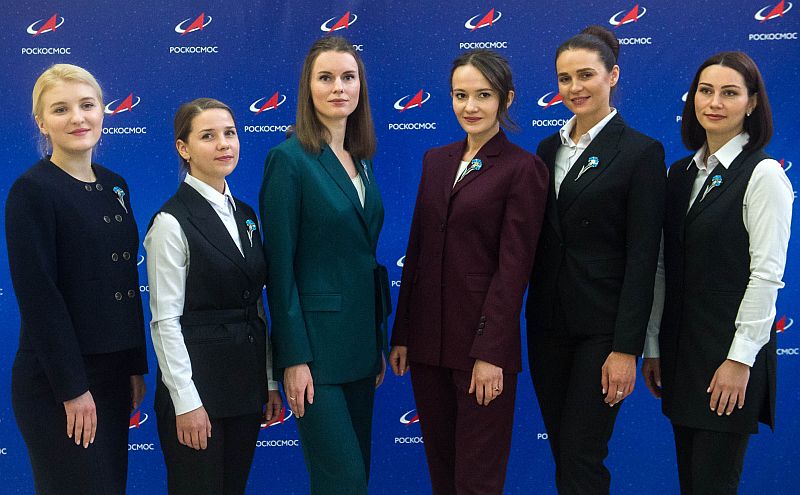
The six Belarusian female cosmonaut selection candidates (“Aleksandr Lukashenko visited the Cosmonaut Training Center/Александр Лукашенко посетил Центр подготовки космонавтов,” TsPK, 24/12/2022).
20/3/2023
A cosmonaut on the ISS photographed the flags of Russia and China for the official visit of Xi Jinping
TASS special correspondent Dmitrii Petelin noted that the crew members are closely following the news from orbit
ISS, 20 March. /TASS/. TASS special correspondent, Roskosmos cosmonaut Dmitrii Petelin photographed the flags of Russia and China against the background of the Earth. The picture was timed to coincide with the start of the official visit of President of the People’s Republic of China (PRC) Xi Jinping to Russia.
The cosmonaut specified that the crew members are closely following the news from orbit. “It will not be possible to follow the meeting of the Russian and Chinese leaders online, but we, of course, follow the news,” Petelin said.
On March 20, 2023, the state visit of the President of the People’s Republic of China (PRC) Xi Jinping to Russia began (it will last until March 22). During the talks with Russian President Vladimir Putin, issues of further development of comprehensive partnership and strategic interaction between Russia and China will be discussed.
As Yurii Ushakov, aide to the head of the Russian state, told reporters earlier, the narrow format talks on March 21 are expected to be attended by Deputy Chairman of the Security Council of the Russian Federation Dmitrii Medvedev, Foreign Minister Sergei Lavrov, Deputy Prime Minister Dmitrii Chernyshenko, Defense Minister Sergei Shoigu, head of the Central Bank Elvira Nabiullina, Director of the Federal Service for Military-Technical Cooperation Dmitrii Shugaev, Director General of Roskosmos Yurii Borisov.
12/4/2023
“Russia to hold open procedure for admitting new members to cosmonauts’ team,” TASS news.
The Russian team of cosmonauts experiences a shortage of personnel and plans to hold an extra procedure of admitting new members, Roskosmos cosmonaut Anton Shkaplerov told TASS on Wednesday on Russia’s Cosmonautics Day celebrated on April 12. “On the contrary, we have a shortage of personnel and plan to additionally select people for the team of cosmonauts,” he said, replying to a question about competition upon the selection of new candidates.
Assessing the prestige of the profession, Shkaplerov said that a change of generations was currently underway in the Russian cosmonauts’ team. “It is time for experienced veterans to hand over their posts to younger members and there are few of them. That is why, we are now holding an open selection procedure. Previously, we preferred to hire military pilots for the post of crew commanders, whereas now any wishing person can file documents to the team and check himself,” he explained, citing the example of female cosmonaut Anna Kikina who had earlier worked as a radio host in Altai. On March 12, Kikina returned to Earth aboard the Crew Dragon spacecraft.
“TASS Challenge movie interviews – Yulia Peresild, Anton Shkaplerov”
13/4/2023
“Belarus’ first woman cosmonaut to come to Russia for training in late summer,” TASS news.
Russia expects Belarus’ first female cosmonaut to arrive in Russia for pre-flight training in late summer or early autumn, Sergei Krikalyov, executive director for manned space programs of the Roscosmos State Corporation, told TASS on Wednesday on the sidelines of a celebration at the State Kremlin Palace marking Cosmonautics Day. The flight is scheduled for the spring of 2024.
“We expect [her to arrive] about six months [before the flight], maybe a little earlier. The flight is scheduled for the spring. So [we expect her] in late summer or early fall,” Krikalyov said in response to a question.
19/4/2023
Cosmonauts reacted sharply to the possible presentation of the Hero of Russia star to Peresild
“If the award happens, it will devalue the feat of real cosmonauts.”
Professional cosmonauts reacted sharply to the idea of awarding actress Yulia Peresild the Star of the Hero of the Russian Federation for a 12-day flight to the ISS. The members of the Guild of Russian Film Actors came up with the intention to award one of their colleagues with the country's highest award.
We phoned the director of the Guild, Valeria Gushchina, and she confirmed her intention to file an application with the Ministry of Culture of the Russian Federation the other day.
“So far, we do not have any documents in this regard,” said Valeria Aleksandrovna. “On Friday there will be a meeting of the board of the Screen Actors Guild, at which we will discuss this issue. But, as I said earlier, the idea, the desire (to propose to award Peresild with the star of the Hero of Russia) has matured with us, it remains only to clad it in a written appeal. We were sure that this issue had already been resolved in the Ministry of Culture of the Russian Federation ….”
Recall that the flight into space of actress Yulia Peresild and director Klim Shipenko took place on October 5, 2021 on the Soyuz MS-19 spacecraft. The commander of the ship, Anton Shkaplerov, was the only professional cosmonaut due to the fact that the Soyuz MS ship is designed for only three crew members. Within Roskosmos itself, on whose funds this flight was made, many were then unhappy with the fact that for the sake of a feature film the funds so necessary for serious research in space were being spent, and the previously built flight schedule of the Russian cosmonaut corps was also being disrupted.
Commentary of the pilot-cosmonaut, Hero of Russia Elena Serova:
If this award happens, it will devalue the feat of real cosmonauts. After all, they undergo the most difficult training before going into space, they are awarded only for special services to the Fatherland! With all due respect to the artists, tourists who flew to the ISS for a short time, as part of the visiting program, until recently, the Title of Hero of Russia has never been awarded. Our film crew, in fact, was brought into orbit as tourists.
That’s who I would give the second Hero for that flight, so it’s Anton Shkaplerov, who alone controlled the spacecraft, designed for two pilots. The ship was specially modified so that he had the ability to control it. Not only that, he single-handedly coped with the emergency situation that arose when they docked with the station. I would give the second Hero to Petr Dubrov, who, because of this project, stayed in space for half a year longer than planned … Their work was amazing!
I do not mind that, in addition to the rather big fees that Yulia Peresild and Klim Shipenko probably received, the management additionally appreciated their work, but this should still not be the country’s highest award.
Commentary of pilot-cosmonaut, Hero of Russia Fyodor Yurchikhin:
I would like to ask those leaders of Roskosmos who, before the start of the cinematic project, just like many cosmonauts, expressed their negative attitude towards it: do they consider it appropriate to award artists the country’s highest award for their work? Is this normal, given that professional cosmonauts wait a long time after their flights to be awarded? I would like to ask the professional community of cosmonauts: is this normal for them?
At the end of March, at the invitation of the Union of Journalists of Russia, I participated in the award ceremony for the best correspondents who today write their reports from the country’s hot spots for courage in the performance of their official duty. Many of them were posthumously(!) awarded not the stars of Heroes, but the Order of Courage. I would like to ask their widows and orphans, the entire journalistic community: will it be normal for you if, against the background of the exploits of your relatives and colleagues, participants in a short-term space flight, non-professional cosmonauts are immediately given a Hero star?!
I have always opposed this project being implemented at public expense. I believe that if Yulia Peresild and Klim Shipenko are given the highest state awards, then it would be fair to give the titles of People’s Artists of the Russian Federation to those cosmonauts who accompanied them on the flight: Oleg Novitskii, Anton Shkaplerov and Petr Dubrov, and those active members of Roskosmos who helped them on Earth, to give the titles of honored artists.
Author: Natalia Vedeneeva
27/5/2023
Vladimir Putin signed the Decree “On the Establishment of the Order of Gagarin”
The President of Russia signed the Decree “On the Establishment of the Order of Gagarin”/«Об учреждении ордена Гагарина». It is awarded to citizens of the Russian Federation for successful manned flights, their training and organization, for outstanding achievements in space activities, research and development of new rocket and space technology, as well as in the field of personnel training. The Order of Gagarin can also be awarded to foreign citizens, as well as entire teams of organizations, regardless of their form of ownership.
The Order of Gagarin is awarded to citizens of the Russian Federation:
- for the successful implementation of a manned space flight, a manned space flight program for the exploration, development, and use of outer space;
- for outstanding services in the organization and successful implementation of space flight, the space flight program for the exploration and development of the use of outer space;
- for outstanding services in the implementation of state policy in the field of space activities, including in the interests of the defense and security of the Russian Federation;
- for outstanding services in the development, production, testing and trouble-free operation of rocket and space technology, the creation and implementation of new technologies and the conduct of effective scientific research;
- for great merits in the training of scientific and engineering personnel.
The Order of Gagarin can be awarded to foreign citizens for effective participation in international cooperation with the Russian Federation in the field of exploration and use of outer space.
The Order of Gagarin can be awarded to groups of organizations, regardless of the form of ownership, for high achievements in the development of domestic cosmonautics (space activities), in the implementation of state policy in the field of space activities, in ensuring the defense and security of the Russian Federation in outer space.
The badge of the Order of Gagarin is a five-pointed star framed by silver rays. In the field of the star is a portrait of Yuri Alekseevich Gagarin in a pressure suit helmet. From the lower right beam to the upper beam there is a symbolic image of a rocket taking off, followed by a long trail.
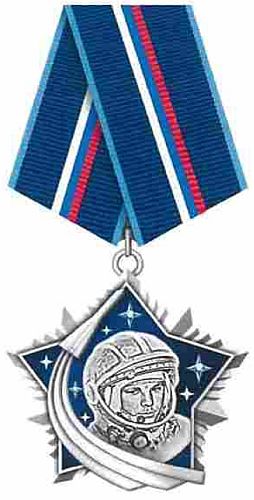
16/6/2023
The cosmonaut corps received new recruits
June 16, 2023
Today, the Roskosmos cosmonaut corps has been replenished with three testers, Arutyun Kiviryan/Арутюн Кивирян, Aleksandr Kolyabin/Александр Колябин and Sergei Teteryatnikov/Сергей Тетерятников.
In honor of this event, the recruits of the detachment held a press conference in person. At the event, the cosmonauts were accompanied by the Deputy Head of the Cosmonaut Training Center – the commander of the cosmonaut detachment Oleg Kononenko and the Center’s press secretary Irina Rogova.
“Based on the results of the general space training of participants in the open recruitment in 2020, the Interdepartmental Commission reviewed the results of the State Exam and decided to award the qualification “test cosmonaut” to these cosmonaut candidates. The commission and employees of the Center were very pleased with the results of the exam, noting the high level and depth of knowledge of the material,” summed up Oleg Kononenko.
The test cosmonauts answered journalists' questions, spoke about themselves and the tests they had passed on the way to becoming part of the cosmonaut corps. The participants of the third open enrollment have different fates, but they have always been united by one thing: the dream and desire to become an cosmonaut.
“After completing my studies and before joining the detachment, I worked at RKK Energiya. I always followed the news of cosmonautics and planned to enter the cosmonaut corps. As soon as the information appeared on the official website, I began to collect the necessary documents,” said Arutyun Kiviryan about his choice.
The detachment of cosmonauts has changed since the first selections: you can become a part of it without having the qualification of a pilot. But representatives of the aviation industry still come to the detachment, fascinated by the sky and the conquest of heights.
“Initially, when I was thinking about where to go after school, I chose the profession of a pilot, realizing that this would be an intermediate stage on the path to becoming an cosmonaut. I originally went to be an cosmonaut. Flight activity is a preliminary stage,” Aleksandr Kolyabin shared.
The cosmonauts thanked the instructors and teachers for the responsible and professional approach to their training, and also spoke about the most interesting and difficult training.
“Special preparation is the best moments of preparation, you are always in dynamics, in motion. I discovered a lot for myself: I jumped with a parachute, plunged into hydrolaboratories. In flight training, we learned how to fly an airplane, before that I had nothing to do with aviation. Each individual stage was a small step that developed me,” said Sergei Teteryatnikov.
At the press conference, a large number of questions were asked, the answers to which revealed the versatility of the personalities of the new test cosmonauts of the detachment.
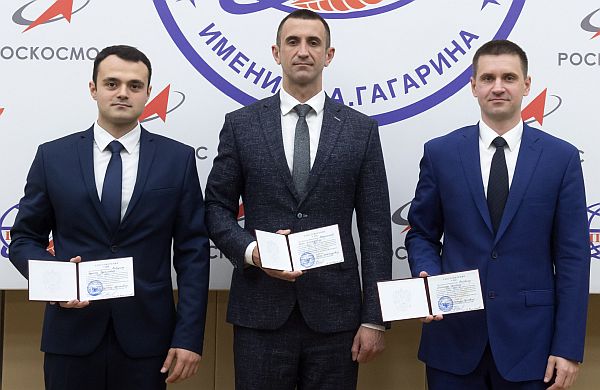
Left to right: Arutyun Kiviryan, Sergei Teteryatnikov and Aleksandr Kolyabin with their test cosmonaut qualification certificates, удостоверения космонавтов-испытателей.
20/6/2023
Sergei Krikalyov is awarded the Mongolian award
The Embassy of Mongolia in Moscow hosted a ceremony of awarding state awards to Russian citizens who have made a significant contribution to the development of cooperation between the Russian Federation and Mongolia.
In accordance with the decree of the President of Mongolia, Ukhnagiin Khurelsukh, the Medal of Honor “100 Years of the People’s Revolution” was awarded to the Executive Director for Manned Space Programs of the Roscosmos State Corporation, Hero of the Russian Federation, Hero of the Soviet Union Sergei Krikalyov.
The award was presented by the Chairman of the State Great Khural of Mongolia Gombozhavyn Zandashatar/Председатель Великого Государственного Хурала Монголии Гомбожавын Зандашатар, who is in the Russian Federation on a working visit.
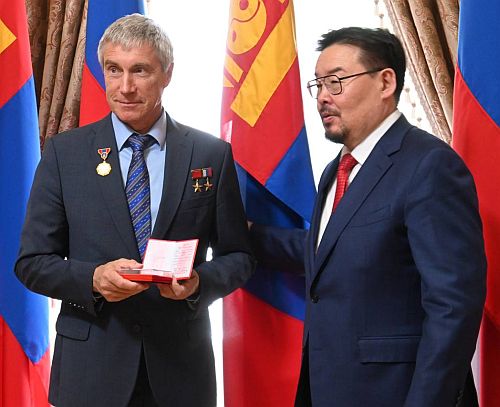
10/7/2023
Roskosmos State Corporation and the Cosmonaut Training Center announce the start of a new selection for the cosmonaut corps!
The Roskosmos State Corporation and the Yu. A. Gagarin Cosmonaut Training Center announce the start of an open competition for the selection of candidates for cosmonauts of the Russian Federation.
The goal is to ensure the fulfillment of the tasks of the Federal Space Program of the Russian Federation.
Any citizen of Russia who meets the requirements for applicants can participate in the competition. According to the results of the competition, it is planned to select candidates for cosmonauts who will join the Roskosmos cosmonaut corps.
Applicants for participation in the selection submit to the competition commission packages of documents according to the list of personal and medical documents. Applications and documents (copies of originals) are accepted until October 30, 2023.
Documents are sent by mail with notification to the address: 141160, Moscow Region, Star City, to the head of TsPK with the note “To the competition commission for holding an open competition for the selection of cosmonauts candidates of the Russian Federation in 2023.”
Copies of the original documents received by the tender committee are not returned to the applicant. The confidentiality of information received by the tender committee is guaranteed in accordance with Federal Law No. 152-FZ “On Personal Data” dated July 27, 2006.
All documents submitted by the applicants can be checked by the tender committee for the accuracy of the information contained in them in accordance with the established procedure.
The competitive commission in the course of the absentee selection examines the documents, determines the applicants who do not meet the selection requirements, and notifies them of this. Refusal to the applicant does not require special justification and is brought to his attention by phone or e-mail. The remaining applicants are subject to personal verification (testing) for compliance with the requirements for professional suitability during the full-time selection stage.
The competitive commission by phone or e-mail calls the applicants who have passed the absentee selection to TsPK for in-person selection to check their compliance with the established requirements. The decisions of the Interdepartmental Commission on selected applicants are published on the websites of the State Corporation Roskosmos and TsPK, and are also communicated personally to all selected cosmonaut candidates.
This is the fourth open selection for the Roskosmos cosmonaut corps, in which any Russian citizen under the age of 35 can participate. Eight astronaut candidates were selected in 2012, eight in 2018, and four in 2021. Now there are 26 people in the Roskosmos cosmonaut corps.
24/7/2023
Belarusian space flight participants were officially introduced at the Cosmonaut Training Center
Today, approved candidates from the Republic of Belarus for a space flight, Marina Vasilevskaya/Марина Василевская and Anastasiya Lenkova/Анастасия Ленкова, were introduced to the management and specialists of the TsPK.
Deputy Head of the Cosmonaut Training Center, Cosmonaut Detachment Commander Oleg Kononenko announced the decision of the Interdepartmental Commission, which determines the composition of the main and backup crew of the 21st visiting expedition to the ISS. The participants of the space flight were allowed to train on the TsPK simulator complex.
The training program for Marina Vasilevskaya and Anastasiya Lenkova will include studying the systems of the Russian segment of the station and the transport manned spacecraft. They will have to get acquainted with the scientific program, as well as undergo biomedical training. The list of planned activities includes training on actions in case of an emergency landing on the water surface and in a wooded and swampy area in winter.
The meeting was attended by representatives of the departments of the Center responsible for the training and health of the crew. The candidates from the Republic of Belarus thanked them for the warm welcome and talked to the journalists.
Media representatives turned to Oleg Kononenko, who will meet the EP-21 crew on board the station.
“We will be especially looking forward to the new crew. We have to be on board the ISS for almost a year, we will be glad to see new faces who will tell us the latest news from Earth about our relatives and friends. Plus, I got a little acquainted with the scientific program of the Belarusian side, it is very interesting,” said the commander of the cosmonaut corps. “I would like to wish that the time that spaceflight candidates spend here lives up to their expectations.”
In addition to the representative of the Republic of Belarus, Marina Vasilevskaya, the main crew included Roskosmos cosmonaut Oleg Novitskii and NASA astronaut Tracy Dyson. Together with Anastasiya Lenkova, Roskosmos cosmonaut Ivan Vagner and NASA astronaut Donald Pettit were appointed members of the backup crew. The launch is scheduled for March 13, 2024, the visiting expedition should last 12 days.
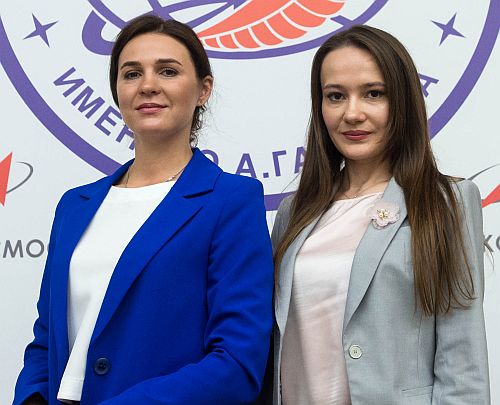
Belarusian space flight participants Marina Vassilyevskaya (left, blue jacket) and Anastasiya Lenkova (right, grey jacket).
2024
18/1/2024
Roskosmos VK post: By Decree of the President of the Russian Federation Vladimir Putin No. 46 of January 18, 2024, Sergei Krikalyov, executive director for manned space programs of Roskosmos, was appointed special representative of the President of the Russian Federation on international cooperation in the field of space.
4/2/2024
“Russian cosmonaut sets new record for most total time in space — more than 878 days,” ABC News. “Today at 11:30:08 Moscow time, cosmonaut of the Roskosmos State Corporation Oleg Kononenko, currently participating in a year-long expedition on the International Space Station, became the world record holder for the total duration of space flights.”
12/4/2024
28/5/2024
Roskosmos announces the winners of the fourth open selection for the cosmonaut corps
Based on the results of the fourth open selection for the Roskosmos cosmonaut corps on May 27, 2024, the interdepartmental commission decided to recommend to the Yu.A. Gagarin Cosmonaut Training Center to appoint four competitors to the positions of candidate test cosmonauts.
In the near future, Anastasia Burchuladze , Elchin Vakhidov , Vladimir Vorozhko and Aleksandr Zherebtsov will begin two years of general space training. Based on the results of general space training and the state exam, candidates for test cosmonauts will be awarded the qualification of “test cosmonaut.”
The fourth open selection for the Roskosmos cosmonaut corps took place from July 10 to December 20, 2023. During the process, TsPK reviewed 296 applications with packages of documents from applicants, of which 80 belonged to women. At the same time, 72 applications were sent by military personnel, and 51 by specialists in the rocket and space industry.
Based on the results of three previous open selections, eight cosmonaut candidates were selected for the Roskosmos cosmonaut corps in 2012, eight in 2018, and four in 2021.
Burchuladze Anastasia Georgievna
Бурчуладзе Анастасия ГеоргиевнаBorn on May 13, 1996 in the city of Arkhangelsk.
Education:
- in 2014 she graduated from secondary school in the city of Serpukhov, Moscow region;
- in 2018, she graduated from the Moscow Aviation Institute with a bachelor’s degree in Aircraft Engines;
- in 2020 she graduated from the Moscow Aviation Institute, master’s degree in the field of training “Aircraft Engines,” diploma with honors.
Experience:
- from September 2015 to October 2018 – technician at the directorate of the Institute of Aerospace Designs, Technologies and Control Systems of the Moscow Aviation Institute;
- since February 2019 – design engineer at the Scientific and Production Association named after S.A. Lavochkina (city of Khimki, Moscow region). In addition to her main job responsibilities, she is a member of the Council of Young Workers of the enterprise.
Hobbies:
While studying at school from 2012 to 2013, she was involved in gliding at the Central Gliding Aero Club in the city of Orel (independent management). She was fond of dancing and toured with the school ensemble.
Currently – snowboarding, participating in 5- and 10 km running marathons, handicrafts (cross-stitching, knitting), fitness.
Vakhidov El’chin Anverogly
Вахидов Эльчин АнвероглыBorn on April 17, 1993 in the city of Novosibirsk.
Education:
- in 2009 he graduated from secondary school in the city of Severodvinsk, Arkhangelsk region;
- in 2014 he graduated from the St. Petersburg State Marine Technical University, majoring in “Marine Power Installations” with the qualification “Marine Engineer”;
- In 2014, he graduated from the military officer training program.
Experience:
- since September 2014 – engineer, senior engineer at the 109th military representative office of the Ministry of Defense of the Russian Federation in the city of Vilyuchinsk, Kamchatka Territory.
Hobbies:
Plays for the “Ocean” hockey team of the submarine forces of the Russian Pacific Fleet (participates in championships, tournaments among military personnel, and is a member of the night league); snowboarding, wakeboarding, jeeping. He is interested in programming in Swift (mobile application development) and professional video editing.
Vladimir Nikolaevich Vorozhko
Ворожко Владимир НиколаевичBorn on September 14, 1997 in the city of Armavir, Krasnodar Territory.
Education:
- in 2015 he graduated from secondary school in the city of Armavir, Krasnodar Territory;
- in 2020 he graduated from the Krasnodar Higher Military Aviation School named after Hero of the Soviet Union A.K. Serova. He has a medal “For excellent completion of a military educational institution of higher professional education of the Ministry of Defense of the Russian Federation.”
Experience:
- from October 2020 to February 2021 – senior instructor pilot;
- since February 2021 – ship commander.
Hobbies:
Has one category in polyathlon (swimming, skiing, running, grenade throwing, shooting, strength gymnastics). Writes poems. Studying history. He is interested in handicrafts (making products from leather, cardboard, paper).
Zherebtsov Aleksandr Nikolaevich
Жеребцов Александр НиколаевичBorn on November 8, 1990 in the city of Salyan, Azerbaijan SSR.
Education:
- in 2007 he graduated from high school in the city of Tikhoretsk, Krasnodar Territory, with a silver medal;
- in 2012 he graduated from the Air Force Academy named after Professor N.E. Zhukovsky and Yu.A. Gagarin (branch in Krasnodar);
- in 2018 he graduated from Rostov State University of Economics, bachelor’s degree in Jurisprudence, diploma with honors.
Experience:
- from November 2012 to July 2013 – senior pilot of the aviation squadron;
- from July 2013 to June 2015 – senior pilot of the aviation squadron;
- since June 2015 – senior pilot, commander of the aviation flight of an aviation squadron.
1st class pilot.
Hobbies:
Electronics, auto and motorcycle engineering, studies architectural and landscape design, jurisprudence.
29/7/2024
Denis Matveev completed his work in the cosmonaut corps
On July 29, 2024, Hero of Russia, pilot-cosmonaut of the Russian Federation Denis Matveev completed his work in the Roskosmos cosmonaut corps. Denis Vladimirovich will continue his activities at the Center, training cosmonauts.
Denis Matveev is the 126th cosmonaut of the Russian Federation. He was enrolled in the cosmonaut corps in 2010. Performed one space flight from March 18 to September 29, 2022. Denis Vladimirovich went into outer space four times, where he spent a total of 26 hours and 8 minutes.
The Center’s management, squad colleagues, and TsPK employees thank Denis Matveev for his significant contribution to the Russian manned space program, for his many years of work at the Center, and are confident that he will be able to apply his experience as a mentor to cosmonauts preparing for new flights.
2/9/2024
Two engineers and two pilots: TsPK presented four candidates for test cosmonauts
Anastasia Burchuladze, El’chin Vakhidov, Vladimir Vorozhko and Aleksandr Zherebtsov successfully passed all stages of the fourth open competition for selection into the Roskosmos cosmonaut corps. And, starting from September 2, 2024, they will begin two years of general space training.
In 3,695 hours of instruction, beginners will have to study the theoretical foundations of cosmonautics, the design, on-board systems and equipment of manned spacecraft. They will undergo training to carry out scientific and applied research and experiments, comprehensive training, and preparation for extravehicular activities. Also, the training program requires preparation for actions after landing of manned spacecraft in extreme conditions of various climatic and geographical zones: winter survival and sea survival, special flight and parachute training, medical and biological training, psychological and humanitarian training.
The head of the Cosmonaut Center, Maksim Kharlamov, addressed the cosmonaut candidates with a welcoming speech:
“You went through a difficult selection procedure and deservedly found yourself at TsPK. But now you have to prove that you are worthy of this choice. The general space training program is a test. The people at TsPK are principled, value and care about their work, so they will provide all the necessary knowledge. Then everything depends on you.”
Then the cosmonaut candidates answered questions from TsPK specialists and told a little about themselves.
The only woman among the newcomers, Anastasia Burchuladze/Анастасия Бурчуладзе, was born in Arkhangelsk. In 2014, she graduated from secondary school in Serpukhov, Moscow region. She entered the Moscow Aviation Institute in the field of training “Aircraft Engines” and in 2020 received a diploma with honors.
Anastasia Georgievna has experience as a technician at the directorate of the Institute of Aerospace Designs, Technologies and Control Systems of the Federal State Budgetary Educational Institution of Higher Education “MAI,” as well as a design engineer at JSC NPO Lavochkina.
While still studying at school, Anastasia Burchuladze was involved in gliding sports and was fond of dancing. Now her hobbies include snowboarding, participating in 5 and 10 km running marathons, handicrafts, and fitness.
Test cosmonaut candidate El’chin Vakhidov/Эльчин Вахидов was born in Novosibirsk; in 2009 he graduated from a secondary school in the city of Severodvinsk, Arkhangelsk region. Then he studied at the St. Petersburg State Marine Technical University, majoring in “Marine Power Plants” with the qualification “Marine Engineer.”
Starting from 2014 and before joining TsPK, E. Vakhidov worked as an engineer and senior engineer in the military representative office of the Russian Defense Ministry.
“When I learned about open selections, I realized that it is quite possible for a healthy person who believes in himself, with certain knowledge, to get into the cosmonaut corps.”
El’chin Vakhidov is fond of hockey, he is also involved in snowboarding, wakeboarding and jeeping. The cosmonaut candidate’s hobbies include programming in the Swift language (mobile application development) and professional video editing.
Vladimir Vorozhko/Владимир Ворожко was born in the city of Armavir, Krasnodar Territory, where he graduated from secondary school in 2015. Five years later, in 2020, he received a diploma from the Krasnodar Higher Military Aviation School of Pilots named after Hero of the Soviet Union A. K. Serova. He has a medal “For excellent completion of a military educational institution of higher professional education of the Ministry of Defense of the Russian Federation.” He served as a senior instructor pilot and ship commander before transferring to the TsPK.
“I am interested in history, and the history of manned cosmonautics in particular. My advice to future participants in the selection is to develop their abilities and increase their ambitions in every possible way. This way you can achieve anything. If you believe in yourself, then everything will definitely work out.”
Vladimir Nikolaevich has 1st category in polyathlon (this discipline includes swimming, skiing, running, grenade throwing, shooting, strength gymnastics). In his free time, he writes poetry, studies history, and even makes leather goods.
Aleksandr Zherebtsov/Александр Жеребцов was born in the city of Salyan, Azerbaijan SSR. In 2007, he graduated from high school in Tikhoretsk with a silver medal and entered the Air Force Academy. Professor N. E. Zhukovsky and Yu. A. Gagarin (branch in Krasnodar). Then, after receiving a diploma in 2012, he received a second higher education at the Rostov State Economic University in the field of training “Jurisprudence,” diploma with honors.
Before joining the Cosmonaut Training Center, Aleksandr Nikolaevich served as a senior pilot and then as an aviation flight commander of an aviation squadron. 1st class pilot. He is interested in electronics, auto and motorcycle technology, and studies law.
“My father was a pilot. As a child, I asked him a question: how to become an cosmonaut? To which the answer was received: first you need to become a fighter pilot, and then, through a selection process that was closed at that time, you can get into the cosmonaut corps. That’s what I did.”
After two years of general space training, candidates for the cosmonaut corps will take state exams in September 2026. If beginners pass them successfully, they will receive the qualification “test cosmonaut.”
Let us remember that the fourth open competition for the selection of Roskosmos cosmonauts was held from July 2023 to May 2024. During the process, the competition commission reviewed 296 applications with packages of documents from applicants, 80 of which belonged to women. At the same time, 72 applications were sent by military personnel, 51 by specialists in the rocket and space industry.
Based on the results of three previous open selections, eight cosmonaut candidates were selected for the Roskosmos cosmonaut corps in 2012, eight in 2018, and four in 2021.
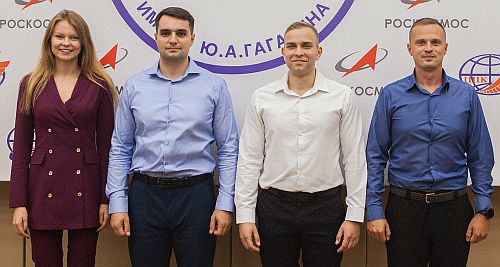

5/9/2024
Two computer-translated Russian articles on the controversy surrounding cosmonaut Andrei Babkin’s resignation.
Updated: 13/9/2024