Star Warrior world
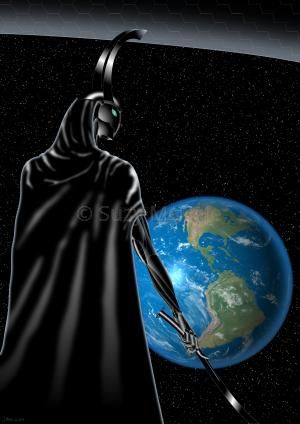
A reference for my worldbuilding project and story, featuring my aliens called the Dawn Hunters on the other side of our Galaxy. I began this project in December 2006, and it is still a work in progress. This guide mainly focuses on the Dawn Hunters and their world.
As of 2019, I am slowly doing a reboot of the world, so parts of this are now outdated, but are still relevant to my story as it was in 2017.
Entries in the main body are in alphabetical order, while the table of contents are in thematic and alphabetical orders.
Contents – thematic order
- Aliens:
- Characters:
- Baalo
- Baalosaan
- Caabasanaa
- Haarlecaa
- Haarmaarec
- Haarnahuu
- Haaryaraan
- Haraanahuu
- Haraanoro
- Haraazuun
- Hesaabale
- Lecaasaan
- Lecaaso
- Lecaazuun
- Maarec
- Maaze
- Maazere
- Maazeyaraan
- Mawalecaa
- Mawamaarec
- Norowa
- Renahuu
- Resaan
- Sanaanoro
- Sanaaso
- Sanaayaraan
- Sanaazuun
- Sohaar-1
- Sohaar-5
- Sohaar
- Soharaa
- Sosaan
- Yaraan
- Yaraananahuu
- Yaraanlecaa
- Zuunsaan
- Castes:
- Clans:
- Culture:
- Ancestor shrine
- Armor
- The arts
- Attendance
- Banner
- Blood Altar
- Breeding Chamber
- Burial armor
- Burial urn
- Caste
- Clan
- Clanless
- Claw-caps
- Clothing
- Council of Elders
- Council of Immortals
- Death
- Diet
- Duel
- Economy
- Education
- Environment
- Etiquette
- Exploration
- Floor-quilt
- Folding screen
- Housing
- Law and order
- Martial arts
- Meeting others
- Path of the Warrior
- Reproduction
- Seasons
- Society
- Stages of life
- Territory
- Time of Exile
- Timeline
- Times of day
- Trial of Pain
- War-Cloak
- War
- Weapons cabinet
- Weapons
- Fauna:
- Flora:
- Humans:
- Language:
- Locations:
- Ranks:
- Adept-Astronomer
- Adept-Biologist
- Adept-Carer
- Adept-Crystologist
- Adept-Healer
- Adept-Superior
- Ancestor-Aide
- Ancestor-Guardian
- Battle Master
- Bond-Mate
- Clan Lord
- Heir Lord
- Regent Lord
- Ship Master
- Supreme Lord
- Technician-Artisan
- Technician-Forger
- Technician-Gardener
- Technician-Miner
- Technician-Pilot
- Technician-Superior
- War Lord
- Warrior-Assassin
- Warrior-Guardian
- Warrior-Student
- Warrior-One-Claw
- Warrior-Two-Claw
- Warrior-Three-Claw
- Warrior-Four-Claw
- System:
- Technology:
- Transport:
Contents – alphabetical order
- Adept-Astronomer
- Adept-Biologist
- Adept-Carer
- Adept Caste
- Adept-Crystologist
- Adept-Healer
- Adept-Superior
- Artificial Intelligence
- Aircraft shelter
- Aliens overview
- Alphabet
- Blood Altar
- Ancestor-Aide
- Ancestor-Guardian
- Ancestor shrine
- Arena of Honor
- Armor
- The arts
- Attendance
- Baalo
- Baalosaan
- Backbone Mountains
- Banner
- Battle Master
- To be, to have
- Blue Cloud World
- Blue Mountains
- Blue Tongue
- Body language
- Bond-Mate
- Breeding Chamber
- Bright Wing
- Burial armor
- Burial urn
- Burning Eye Clan
- Caabasanaa
- Caste
- Clan City
- Clan Lord
- Clan
- Clanless
- Claw-caps
- Cloak Fin
- Clothing
- Cloud Catcher
- Cold Sleep
- Colors
- Command Chamber
- Compound words
- Council of Elders
- Council of Immortals
- Crescent Horn
- Crescent Moon Clan
- Crest Grass
- Darius Tyler
- Data storage
- Dawn Hunter
- Dawn Islands
- Dawn Star Clan
- Dawn Tree
- Death
- Diet
- Digger
- Directions
- Dome Tree
- Dominion
- Drone
- Duel
- Economy
- Education
- Egg Plant
- Endless Plains Clan
- Environment
- Etiquette
- Exploration
- Eye of the Day
- Fauna overview
- Finger Tree
- Fire Mountain Clan
- Fire Tail
- Fire Tree
- Fire Wind Clan
- Fire World
- Floor-quilt
- Flora overview
- Folding screen
- Gold Cloud World
- Grammar
- Grey Moon
- Ground Carrier
- Haarlecaa
- Haarmaarec
- Haarnahuu
- Haaryaraan
- Haraanahuu
- Haraanoro
- Haraazuun
- Healing Bed
- Heir Lord
- Hesaabale
- Home World
- Horus Expedition
- House of the Ancestors
- House of Healing
- House of Surplus
- House of the Warriors
- Housing
- Ice Moon
- Image display
- Interrogatives
- Jump
- Kinship terms
- Language overview
- Law and order
- Lecaasaan
- Lecaaso
- Lecaazuun
- Lexicon
- Long Divide
- Maarec
- Maaze
- Maazere
- Maazeyaraan
- Martial arts
- Mawalecaa
- Mawamaarec
- Medicine
- Meeting others
- Names
- Nanotechnology
- Neural implant
- Night River Clan
- Norowa
- Numbers
- Ocean of Storms
- Ocean Wind Clan
- Path of the Warrior
- Pronouns
- Pyramid of the Lords
- Rainbow Beetle
- Red Moon
- Regent Lord
- Renahuu
- Reproduction
- Resaan
- Rock Jumper
- Sanaanoro
- Sanaaso
- Sanaayaraan
- Sanaazuun
- Sea of Sand
- Seasons
- Sergei Konstantinov
- Shadow Hunter
- Shadow Wing
- Ship Master
- Shuttle
- Silver Fish
- Sky Carrier
- Sky Fighter
- Sky Flyer
- Sky Tree
- Sleep Flower
- Society
- Sohaar-1
- Sohaar-5
- Sohaar
- Soharaa
- Sosaan
- Spike Tail
- Spiral Grass
- Stages of life
- Supreme Lord
- Swadesh list
- Swift River Clan
- Sword Arms
- Sword Leaf
- Syllables
- Tall Neck
- Technician-Artisan
- Technician Caste
- Technician-Forger
- Technician-Gardener
- Technician-Miner
- Technician-Pilot
- Technician-Superior
- Territory
- The Land
- Three Claw Bay
- Three Moons Clan
- Time of Exile
- Timeline
- Times of day
- Translations
- Transport overview
- Tree Glider
- Trial of Pain
- Valley of the Ancestors
- Void Fin
- Void Station
- Void Walker
- War-Cloak
- War Lord
- War
- Warp Chamber
- Warrior-Assassin
- Warrior Caste
- Warrior-Guardian
- Warrior-Student
- Warrior-One-Claw
- Warrior-Two-Claw
- Warrior-Three-Claw
- Warrior-Four-Claw
- Weapons cabinet
- Weapons
- Yaraan
- Yaraananahuu
- Yaraanlecaa
- Zuunsaan
Adept-Astronomer
An Adept-Astronomer (Laahonhesaaso) is one of the Adept Caste who studies astronomy and related sciences.
- Headscarf color
- Midnight blue (#191970/rgb(25,25,112))
Adept-Biologist
An Adept-Biologist (Laahonyaahalraane) is one of the Adept Caste who studies biology.
- Profession color
- Blue-grey (#6699cc/rgb(102,153,204))
Gallery
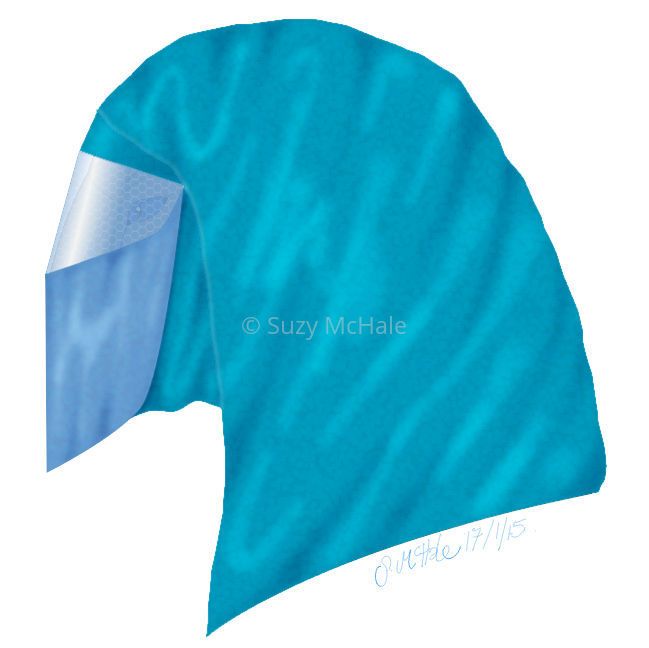
Veiled Adept-Biologist (digital art, 27/2/2014) (41.66 KB).
Adept-Carer
An Adept-Carer (Laahonmaalam) is one of the Adept Caste who is the equivalent of a nurse.
- Headscarf color
- Indigo (dried hemocyanin blood) (#4b0082/rgb(75,0,130))
Adept Caste
The Adept Caste (Rohuulelaahon) is one of the three major groups or divisions within Dawn Hunter society; the bearers of knowledge. They comprise males and females who are religious leaders, scientists, healers, scholars, teachers, advisers. They wear cerulean (#007ba7/rgb(0,123,167))-blue (#1e90ff/rgb(30,144,255) clothing, and headscarves or hoods of various colors designate their profession.
Gallery
One of the Adept Caste – a Biologist – with hood, veil and visor deployed; fully-sealed in this, they can function in a hostile environment (digital art, 13/1/2014 (41.66 KB)).
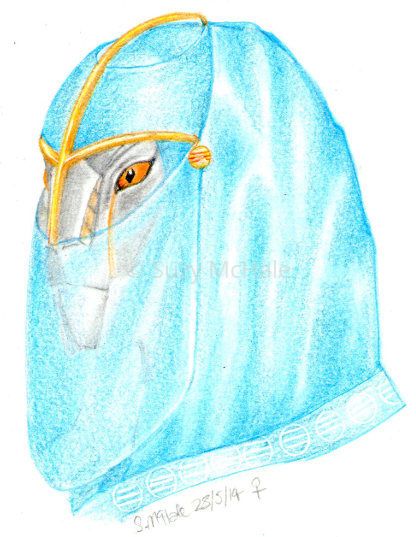
Adept-Superior in ceremonial veil (colored pencils, 28/5/2014).
Adept-Crystologist
An Adept-Crystologist (Laahoncaasela) is one of the Adept Caste who studies the crystal-based sciences that are integral to the Dawn Hunters’ advanced technology.
- Profession color
- Peridot-green (#9be466/rgb(155,228,102))
Adept-Healer
An Adept-Healer (Laahonmohuuwa) is one of the Adept Caste who is the equivalent of a doctor.
- Profession color
- Hemocyanin blood-blue (#0047ab/rgb(0,71,171))
Adept-Superior
The Adept-Superior (Laahonsunewa) is the highest-ranked of the Adept Caste; always a female to complement the male Clan Lord. She effectively oversees his Clan City in partnership with him, though she is not mated to him. She is appointed from the Ancestor-Guardians. She conducts ritual sacrifices only on high-ranking Warriors.
- Profession color
- Same as her clothing (cerulean-blue, #007ba7/rgb(0,123,167))
Gallery
Adept-Superior in ceremonial veil (colored pencils, 28/5/2014).
Artificial Intelligence
Along with their starships, one of the Dawn Hunters’ greatest achievements is the creating of sapient artificial intelligences (Buuransebe). They were initially a side-effect of attempts to copy brain patterns so as to store the memories of ancestors.
The AIs come in two varieties, small/limited and big/unlimited. The former do not continue evolving but are contained within programming boundaries for their assigned tasks, e.g. piloting an aircraft or running the functions of a Clan City. The latter are patterned upon brain functions and evolve their own personalities; their intelligence potential is unlimited. The main form of unlimited AI is contained within a starship, effectively a part of and inseparable from it.
The original AI template is derived from scans of a Clan Lord’s brain patterns via his neural implant, forming an impression of his memories and personality. This is augmented over time as the starship’s Clan Lord inheritors add their brain impressions on their deaths. The emergent AI both develops its own personality and contains the memories of the Clan Lords it has been bonded to.
The AI is a form of quantum computer with unlimited processing power as it runs parallel operations in multiple dimensions and stores information in the sub-atomic structures of the Universe. It has the knowledge to manipulate spacetime to instantaneously travel otherwise-vast distances between worlds. By design, however, it cannot initiate hostile operations, and is first and foremost loyal to its Clan- or War Lord master above all others – the bond between them is intense and lifelong. A part of it resides within his neural implant.
In a starship’s Command Chamber, the AI resides in a large Ancestor Crystal growing up from the Crystal Chamber below the Command Chamber. The tall, pure unblemished hexagonal quartz crystal is grown specifically for containing the AI. The crystal protrudes through the floor into the Command Chamber above before the dais and the AI materializes as an avatar within the crystal. A starship AI usually appears as a stylized Clan Lord – as the current Lord’s father. One form it may take is wearing black armor and cloak with glowing eyes, surrounded by a sea of luminescent particles that drift like dust motes or stars.
Nahuu watched the pair with its sensors as the young one gazed about him, wide-eyed. It would not truly bond with its inheritor until the latter received his neural implant, but had nonetheless followed his life through Maarec’s implant.
The scene had been repeated over generations as the Clan-Lord-who-was introduced Clan-Lord-who-would-be to the starship. The ritual provided a reassuring continuity to all, extending far back to the bright spark of Nahuu’s first coming-to-awareness out of the dark void of nonexistence as an artificially-created emergent intelligence. Other segments of it constantly monitored its systems and the presence of other crew on board; information transmitted in pulses of light through an immensely complex network of fibers within its body, a near-infinite number of operations running simultaneously. Its awareness extended outward, along the entangled pathways of the Dominion network linking it to other starships and information storage sites and beacons in various star systems. It even saw into the fabric of spacetime itself, from where it drew energy and which it folded to Jump from one point to another, navigating around the gravity wells distorting the subatomic quantum filaments making up the Universe.
The uploaded memories and personalities of Maarec’s Clan Lord ancestors were a part of Nahuu’s consciousness, and inseparable from it. Though they had crossed the Void long ago, in some sense they still lived. They looked upon their descendents and were pleased.
– Chapter: “Inheritance”
An AI can also take corporeal form within its host starship as a maazewo, avatar, to physically assist its Clan Lord if necessary. Nanites coalesce from a surface to form the avatar.
Gallery
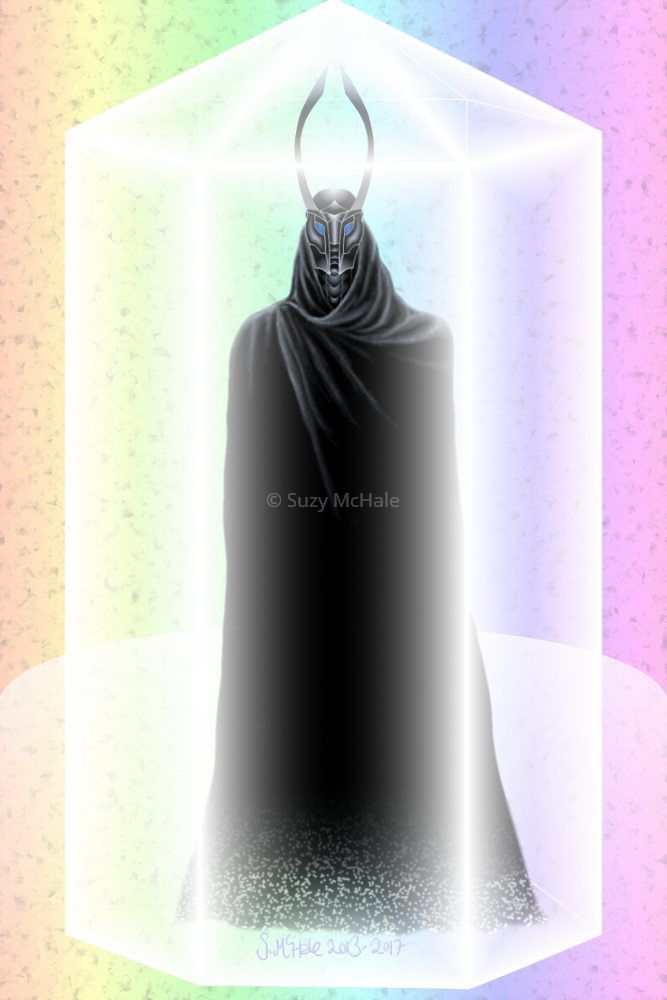
The avatar of the starship Zaawezoyuu-cehenenel Narabaa Sahelnahuuwo (Nahuu) (digital art, 16/12/2013; background revised 11/2/2017).
Aircraft shelter
An aircraft shelter (Nulunbuuranrerewa) is a structure that houses a single air- or spacecraft, in the shape of an elongated half-geodesic dome. It can retract into the ground by folding back and is constructed of morph-metal.
Dimensions
- Length
- 43.2 m (20 bodylengths)
- Width
- 41.04 m (19 bodylengths)
Gallery
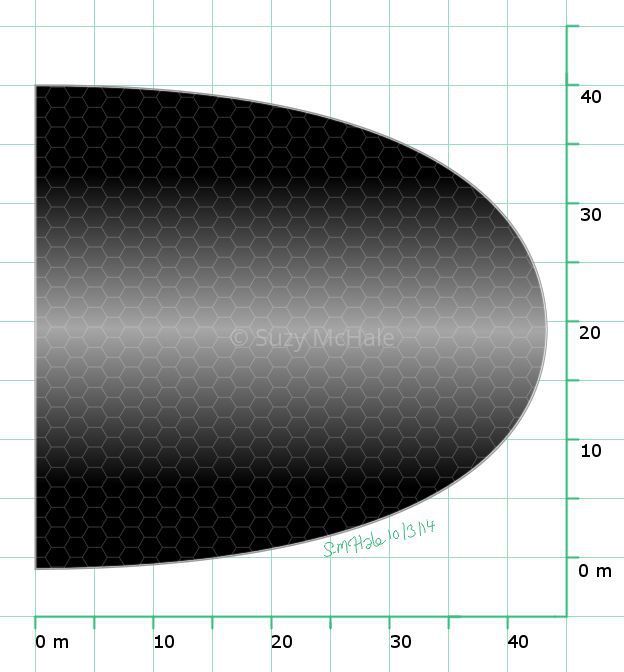
Aircraft hangar from above (digital art, 10/3/2014).
Aliens overview
In their thousands of years of methodically exploring their section of our Galaxy, the number of evolutionary complex, sapient lifeforms discovered on other habitable planets by the Dawn Hunters is quite small: just three before humans. There is much of this Galaxy left yet to explore, let alone others.
These aliens all originate on Earth-analogous worlds that have carbon-based life, oxygen-nitrogen atmospheres, and are around Earth-sized. Their planets’ stars range from a high K to a low F. They are in the same average size range as humans (5½-6 feet/1.6-1.8 meters). They wear some form of clothing, live on land, use tools, and some use fire. Their names are translated Hunter names, based on an aspect of their appearance.
Similar to Sergei and Lord Sohaar, a representative from each race – called a Hola, Companion – liaisons with the Hunter Clan Lord of the Clanwhich discovered it. They usually wear a variant of Hunter clothing, of the silver-grey color that designates a non-Hunter. Contact between species is not encouraged.
The Dawn Hunters generally keep their distance from the daily lives of the aliens within their Dominion and are not in the habit of colonization, or “uplifting” the populations. However, resistance to the Dominion is not tolerated and leads to severe repercussions. The Hunters will also interfere if the environment of an alien planet is being damaged by the activities of its inhabitants.
In my story so far, the other aliens are only mentioned and do not have any character parts.

Photosynthetic pigments under the star colors of my alien systems. (Image via r/worldbuilding)
The above diagram in table form (star colors from here):
| Star temperature | Spectral type | Peak wavelength | Color | Chlorophyll | Bacteriorhospin | Carotenes | Phycoethryn | Phycocyanin | Pheophytin | Melanin |
|---|---|---|---|---|---|---|---|---|---|---|
| 6300 | F8 | 460 | Blue | #00f66f | #ccc0da | #ff9900 | #d80623 | #4698fc | #899ea9 | #948b54 |
| 5840 | G2 | 496 | Green | #00b050 | #b2a1c7 | #fa6334 | #c61502 | #00737b | #44626c | #625b38 |
| 5200 | K0 | 557 | Green | #646400 | #3f3151 | #632523 | #460000 | #163a25 | #2b321e | #1d1b11 |
| 4900 | K2 | 591 | Yellow | #626400 | #3f3151 | #632523 | #460000 | #163a25 | #2b321e | #1d1b11 |
Gallery
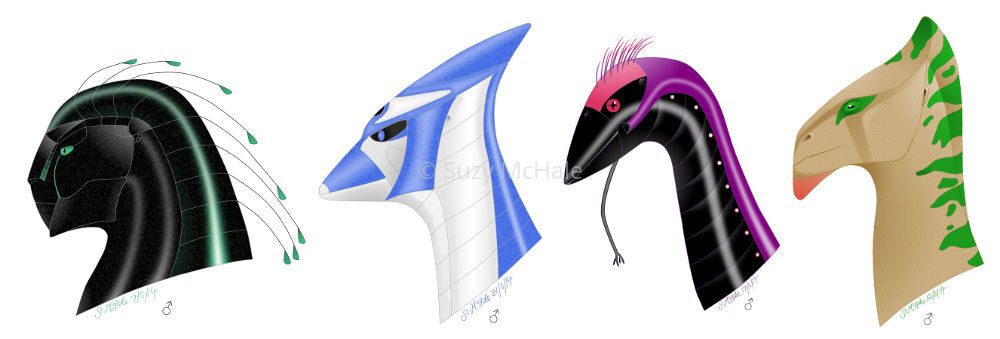
Head portraits of aliens, left to right, approximately to scale: Dawn Hunter, Sword Arms, Tree Glider, Tall Neck (digital art, 21/5/2014).
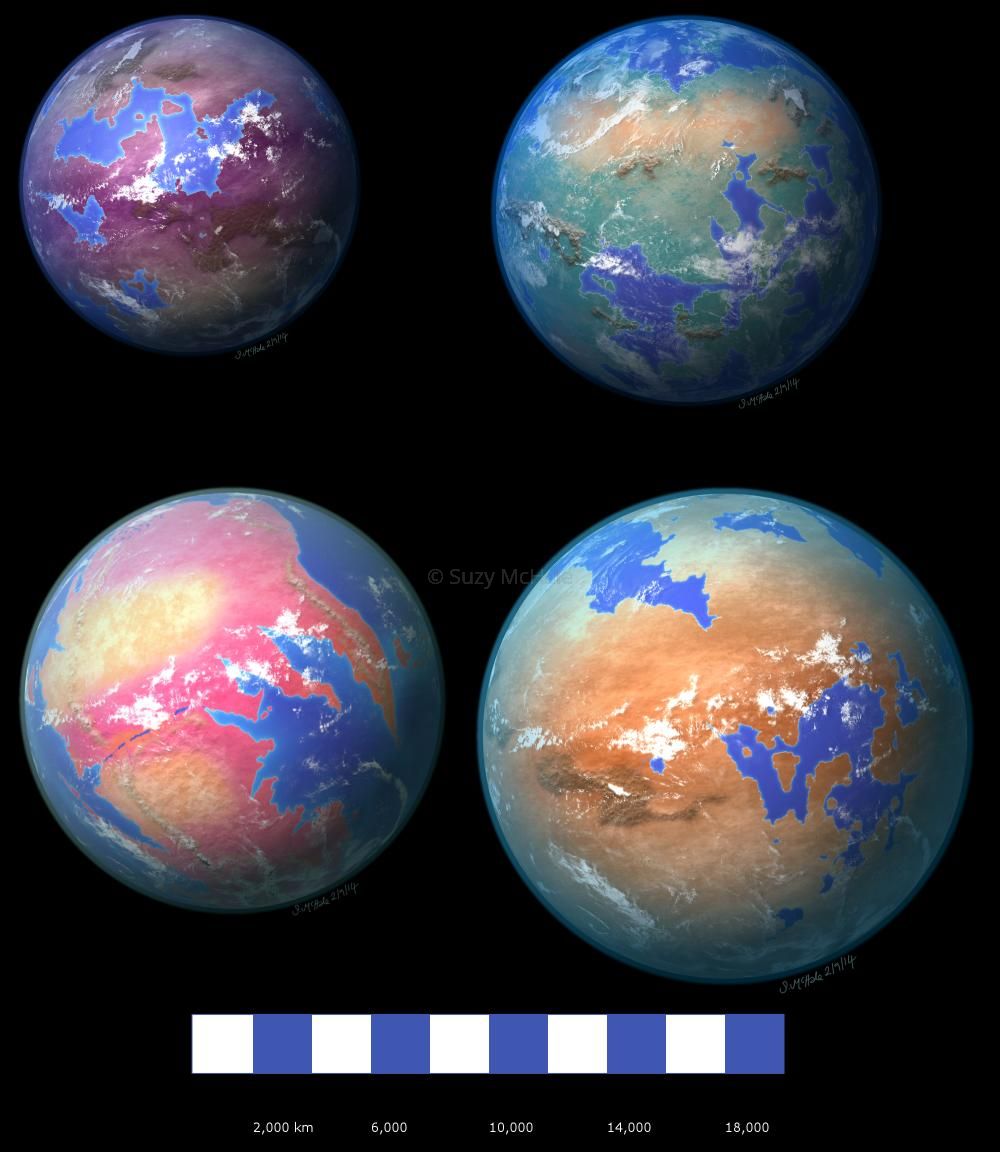
Alien worlds, left to right, top to bottom (approximately to scale, 1cm = 2,000 km): Tree Gliders, Tall Necks, Dawn Hunters, Sword Arms (digital art, 2/5/2014).
Alphabet
To limit choices a bit, and to personalize the language a bit, I decided to use the letters from my own name! This random choice of letters makes the look of the language a bit irregular.
- Consonants (11): b, c, h, l, m, n, r, s, w, y, z. Consonants are not geminated (lengthened).
- Vowels (5/10): a, e, o, u. There are doubled versions of these (aa, ee, oo, uu – can also be written with a macron as ā, ē, ō, ū) that make otherwise identical words semantically distinct (phonemic), so using this definition there are 10 vowels. Vowels are known as breath-speech (Luunolanhaanu).
- Phonotactics are CV(C). There are 88 CV syllables and 968 CVC syllable combinations.
- The letter C is problematic; in English it can be pronounced as S (soft c) (usually before the letters E or I), or K (hard c) otherwise. Here it is always pronounced as K.
- The alien alphabet order will follow the order of the letters in my name: s, u, z, a, n, e, b, r, o, w, y, m, c, h, l (For word generators: shmrnlcbyzw aāuūeoēō)
- Letters generally have English pronunciation. Vowels are pure (no dipthongs) and are all enunciated.
- Letters are not capitalized in their alphabet, though for convenience they are in English transliteration.
| English equivalent letter | Pronunciation | IPA | X-SAMPA | Name |
|---|---|---|---|---|
| s | s (soft) | s | s | so (star) |
| u | oo (long) u (short) |
uː u |
u: u |
|
| z | dz | z | z | zuun (sky) |
| a | ah (long) uh (short) |
aː a |
a: a |
|
| n | n | n | n | nomaa (mountain) |
| e | ee (long) eh (short) |
eː e |
e: e |
|
| b | b | b | b | benuu (arch, rainbow) |
| r | r (pronounced as English r; i.e. not rolled or trilled) | ɹ | r\ | re (moon) |
| o | o (long) oh (short) |
oː o |
o: o |
|
| w | w | w | w | wawe (foot) |
| y | y | j | j | yaran (storm) |
| m | m | m | m | mero (tree) |
| c | k (hard) | k | k | cebaan (head) |
| h | h | h | h | hara (hunt) |
| l | l | l | l | lelaa (fire, flame) |
- S=sz (all fricatives)
- P=bc (all plosives)
- N=mn (all nasals)
- L=rly (all liquids/glides)
- V=aeou (all vowels)
- F=e (all front vowels)
- B=ou (all back vowels)
- H=u (all high vowels)
- M=eo (all mid vowels)
- w,y (semi-vowels)
Foreign/alien words can be adapted to fit into the Dawn Hunters’ phonology:
| English | Alien equivalent |
|---|---|
| c (soft c, pronounced as s) | s |
| d | c (pronounced hard as k) |
| f | b |
| g | c |
| i | e |
| j | c |
| k | c |
| p | b |
| q | c |
| t | c |
| v | w |
| x | c |
“Sergei Aleksandrovich Konstantinov” thus becomes something like “Seracee Halesanarowec Conasanenow” (some adjoined consonants are omitted for brevity). Earth would be “Herc.”
Gallery
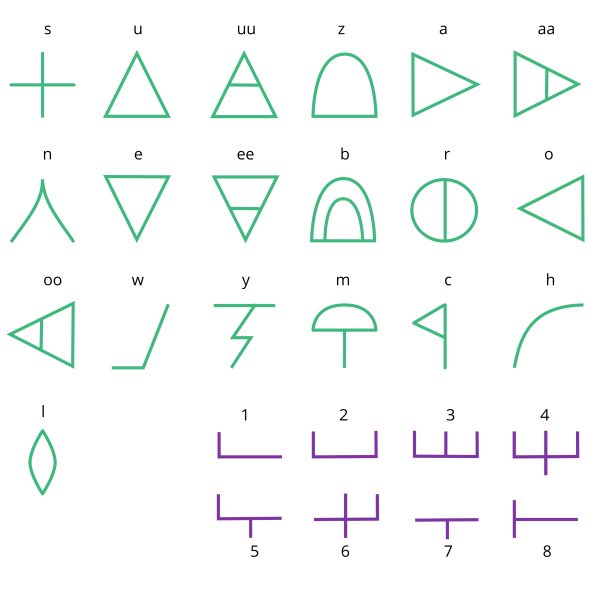
An image of a tentative design for their printed alphabet and numbers; consonants are abstract symbols of various words. It is not particularly attractive (reflecting my lack of skill at designing such!) but does somewhat suit their straightforward nature; an elaborate cursive script would be inappropriate. Another idea is for the script to resemble claw scratches. Letters are all written in the same case.
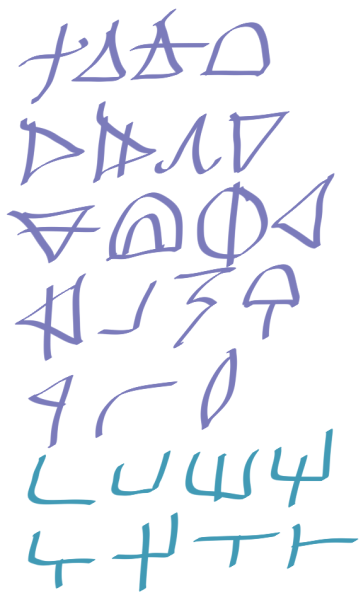
Image of the handwritten version of the Dawn Hunter alphabet and numbers.
Blood Altar
A Blood Altar (Lohonmolan) is a sacrificial altar for those of the Warrior Caste. It is made of a black-colored granite with gold flecks (called “black galaxy granite” on Earth) and the top is tiled over with sheets of translucent black obsidian glass. It is unembellished in appearance with a smooth glossy surface. There are four small protrusions on each side to which binding ropes can be attached. The Altar is rectangular in shape with beveled corners and edges.
There is one Altar on the top of each Clan City’s Pyramid of the Lords, as well as one within a chamber inside the pyramidal structure that ritual torture victims lie upon.
Dimensions
- Height
- 0.5 bodylengths (108 cm)
- Length
- 1.5 bodylengths (324 cm)
- Width
- 0.5 bodylengths
Ancestor-Aide
An Ancestor-Aide (Caamacabuun) belongs to the Adept Caste; and is a general-purpose Adept, carrying out various duties for their Caste and the greater population, such as overseeing the pairing of Bond-Matesor conducting funerals. They are regarded as an intermediary between the living and their ancestors.
- Profession color
- Jet-black (#343434/rgb(52,52,52))
Ancestor-Guardian
An Ancestor-Guardian (Zaahucabuun) is one of the Adept Caste who is involved with death rituals and tomb maintenance. They are the equivalent of priests and priestesses. They perform ritual sacrifice on those of the Warrior Caste.
- Profession color
- White (#ffffff/rgb(255,255,255)
Ancestor shrine
An ancestor shrine (Lohoncabuun) is a small area in an apartment – usually in a corner – featuring a table set with mementos of deceased ancestors, most often the parents of the occupants, with some incense sticks that are burned. Paintings of the ancestors are hung on the wall above the shrine. Urns containing the bones of the recently deceased may also be placed beside it. The room’s occupants will spend a few minutes every morning sitting in front of the shrine.
Arena of Honor
The Arena of Honor (Heyananezan) is an octagonal ring with a sandy floor where fights between high-ranking Warriors take place, located beside the east or right side of the Pyramid of the Lords. Eight recessed bays surround the Arena, one each for a Clan Lord and his retinue to occupy while watching a fight. Meetings of the Council of Immortals also take place in the Arena, usually in the current Supreme Lord’s Clan City.
At other times it is the main meeting place for the Clan Lord and other high-ranking personnel.
Dimensions
- Diameter
- 16 bodylengths (34.56 meters)
- Containing building
- 103.68 m × 414.72 m (half the length of the House of the Ancestors)
Armor
Armor (nabusaahen) is worn by the Warrior Caste. The high-tech version, morph-armor (nabusaahenlole), is black and has an iridescent/metallic sheen, like insect chitin or metallic car paint; it is organic in appearance. Its design imitates its wearer’s muscular structure in a stylized fashion. Other Castes may also wear morph-armor when needed, colored like their clothing.
The armor is donned via a small patch (approximately 4 cm square) stuck to the back of the neck. Tiny nano-spikes adhere the patch to the skin. When activated by a signal from their implant or by tapping the patch, the armor spreads over their body in a pre-programmed pattern in a few seconds. Either procedure is also used to retract it, and the armor can be overridden and forcibly retracted by another if the wearer is unconscious. It is not uncomfortable to wear when expanded as it is only a few molecules thick and is like a second skin, flowing in a pattern of millions of tiny interlinked hexagons over the wearer’s body.
The armor’s structure consists of a material infused with nanites – possibly similar to, or actually graphene, a form of carbon atoms densely packed in a honeycomb crystal lattice or, alternately, a ceramic/organic material. It can’t be penetrated with ordinary projectile or explosive weapons (not even a nuclear explosion!). It can dissipate blows and impacts, and act as an exoskeleton, augmenting the wearer’s strength – a punch with the armor is similar in force to that of a mantis shrimp. The armor can camouflage itself, taking on the appearance of its surroundings in a chameleon-like manner (active camouflage).
The only way to kill a thus-armored Hunter is with their own single-edged swords and daggers, which are made of a similar atomically-dense metal alloy with a mono-molecular edge and thus can pierce their armor (and slice through almost anything else). This is a deliberate design flaw, intended as a way of cutting through and off the armor of an injured wearer should his implant command not work.
The armor derives some power from the chemical processes in the body (bio-nano generation). It can absorb solar energy for extra power. The armor in full-cover mode can function as a sealed spacesuit; the material alters from porous/breathable to impermeable.
Following tradition, the armor is always worn with a black surcoat and war-cloak – the latter also serve as clothing should the armor be retracted.
Armor is generally referred to as nabusaahen, “metal skin [skin (of) metal],“ or nabuhar, “fight/combat skin [skin (used in) war, to fight],” or nabuzahu “[skin (that) protects]” – the last often used by those of other Castes who wear the protective garment. The terms are applied to both traditional and high-tech armor, though the morph-armor is not, strictly speaking, metal – it is also referred to as nabusaahenlole, “skin of metal that changes/morphs. ”
Helmet
As with the rest of their armor, the helmets of the Warrior Caste are a stylized rendering of their features. Helmet crest designs are used to determine rank. Despite their appearance, the crests are thin and light, not cumbersome. The decorative crest on the high-tech morph-armor can be retracted instantly if needed, such as passing through doorways.
A helmet’s eyepieces matches its wearer’s eye color, and provide enhanced vision for various environments, including infra-red/heat vision; it has the equivalent of an integral heads-up display when needed.
The helmet design for the Technician Caste has a single mirrored visor rather than eyepieces; the visor color, however, is that of their profession.
Helmets, both traditional and nanotech, may be decorated with patterns, with colors of its wearer’s eye and Clan.
Traditional armor
Before receiving their implants, Warriors-in-training instead wear a pre-nanotech version of their armor from ancient times, resembling ancient lamellar armor worn in human history, referred to as nabuharluula, “skin (used in) war, to fight (that is) traditional.” It is made of leather on which small hexagonal-shaped metal plates are hand-sewn (the hexagon pattern was inspired by tree bark). A fabric backing might instead be used on less-vulnerable areas. The leather is cut from the skin of various animals (Spike Tail, Shadow Hunter, Crescent Horn). The metal is coated with a black lacquer-like substance. The thread and inner fabric linings are of the wearer’s Clan and eye colors, made from a silk-like substance derived from a plant.
Shoulders, front of upper and lower arms, chest, torso, front of thighs and shins are covered, allowing for flexibility and movement. Warriors prefer to go barefoot unless they wish to protect their toe-claws, in which case sandals or boots are worn. Arms are usually bare under the armor. A long black tunic and trousers are worn underneath the torso armor (though armor may be worn without these), and a floor-length black war-cloak is draped over it.
A habar is worn wrapped under the helmet to provide padding. A Clan Lord’s ceremonial armor helmet features the crest of a Crescent Horn as a headdress. Helmet decorations of other ranks are made of thin shaped metal. (As crests are not retractable, traditional helmets are just taken off indoors.)
Shields were never used or developed.
Gallery
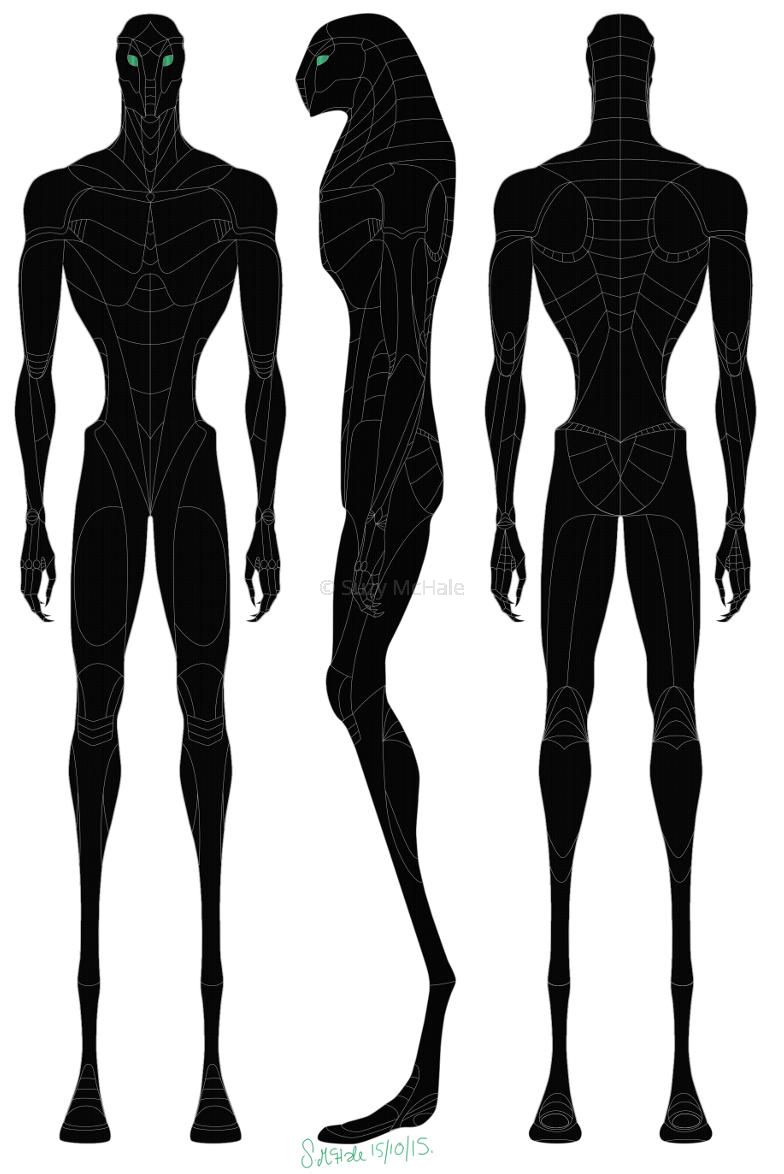
Basic morph-armor, full body views (digital art, 9/8/2015; revised 15/10/2015, 95 KB). It has a pattern of tiny hexagons not visible at the resolution here.
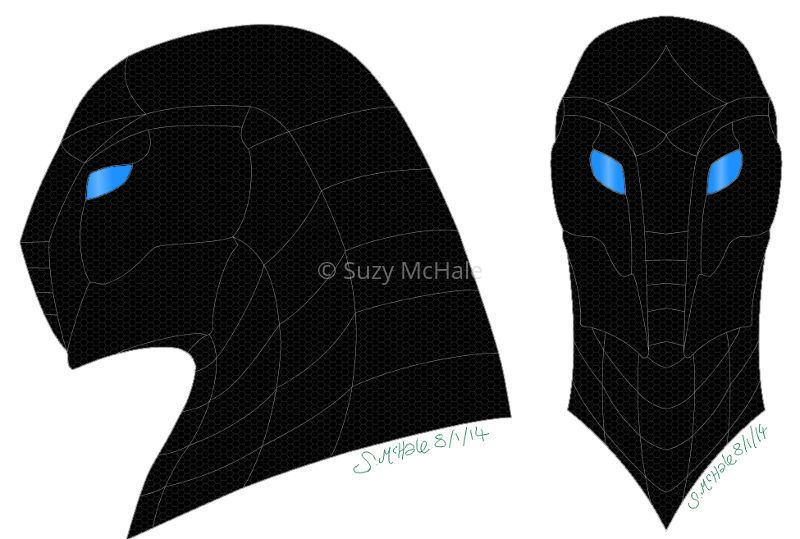
Basic helmet for morph-armor, profile, anterior and ¾ views (digital art, 9/12/2013).
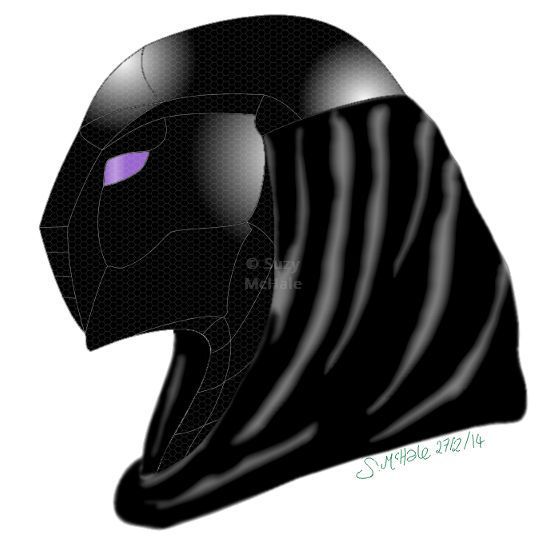
Helmet as typically worn with a habar (headscarf) underneath.
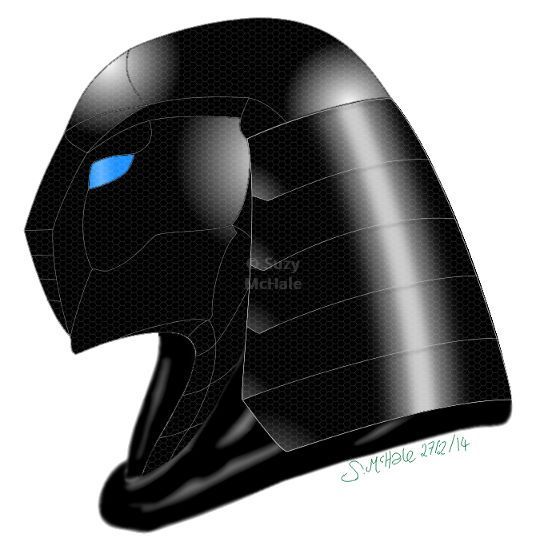
Another helmet variant with a segmented neckguard.
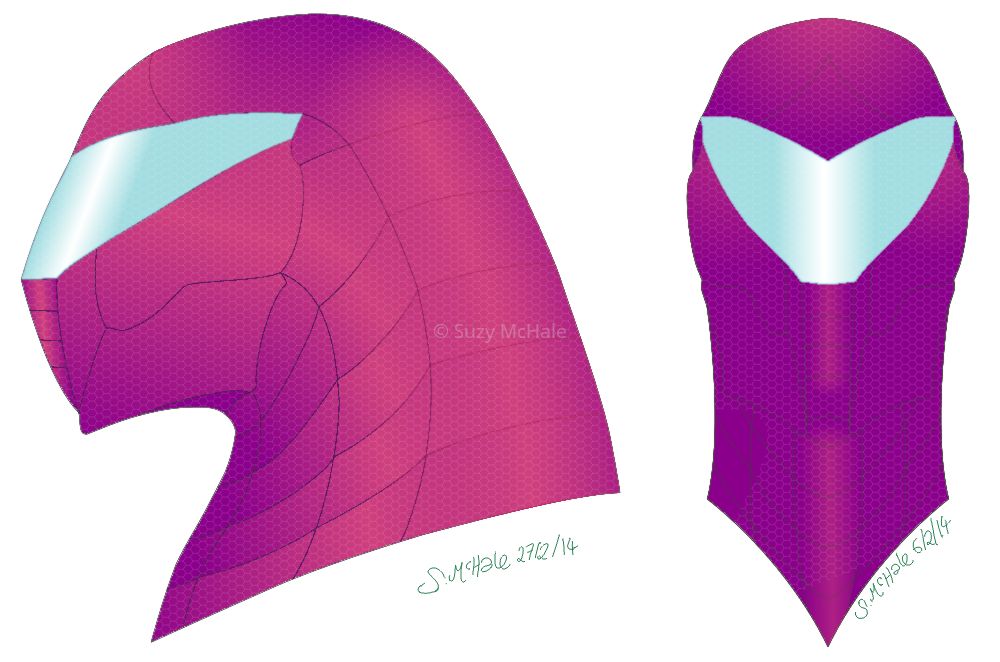
Technician version of morph-armor (digital art, 11/1/2014).
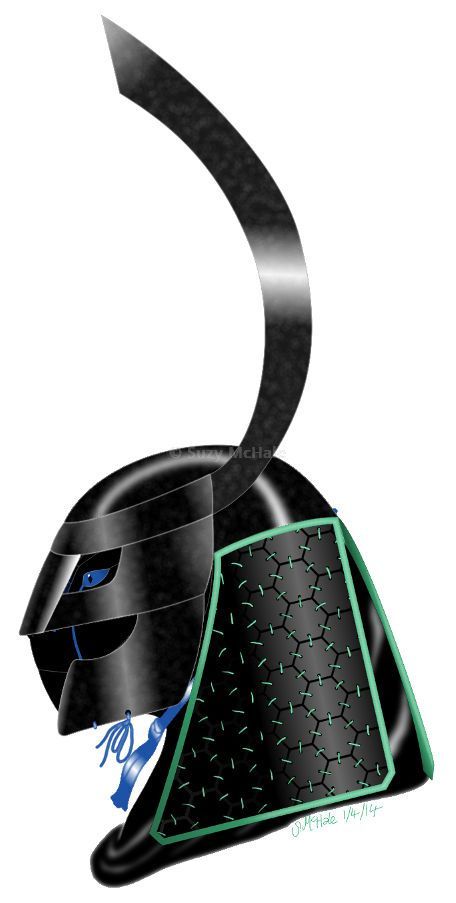
Traditional helmet of Clan Lord (Maarec in this case) (digital art, 1/4/2014). The metal helmet covers the top half of the head, and armored neck-flaps protect the rest. A colored cord threads through two holes in the back of the helmet and ties under the throat; there is also a cord securing the chin pieces. The tie-cords are the wearer’s eye color to help identify him, while the armor scale threading is the Clan color. A headscarf is worn under the helmet to provide padding.
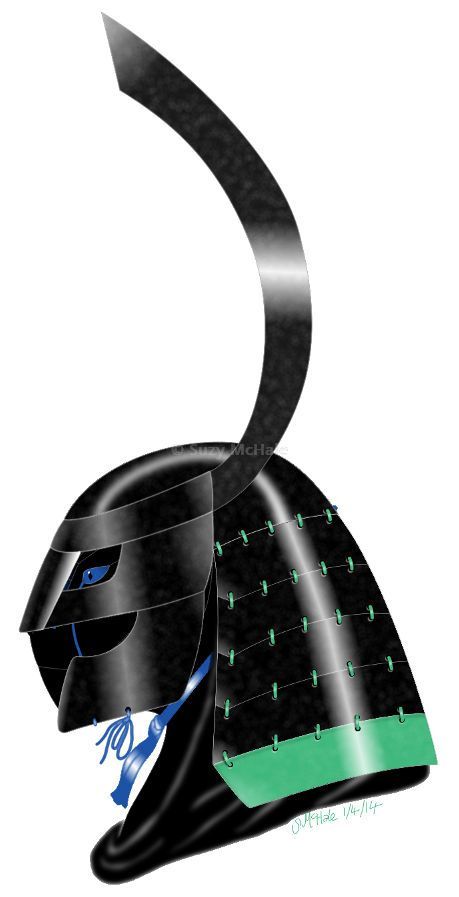
Traditional helmet variant with segmented metal suspended neckguard, similar to the shikoro of Japanese samurai armor.
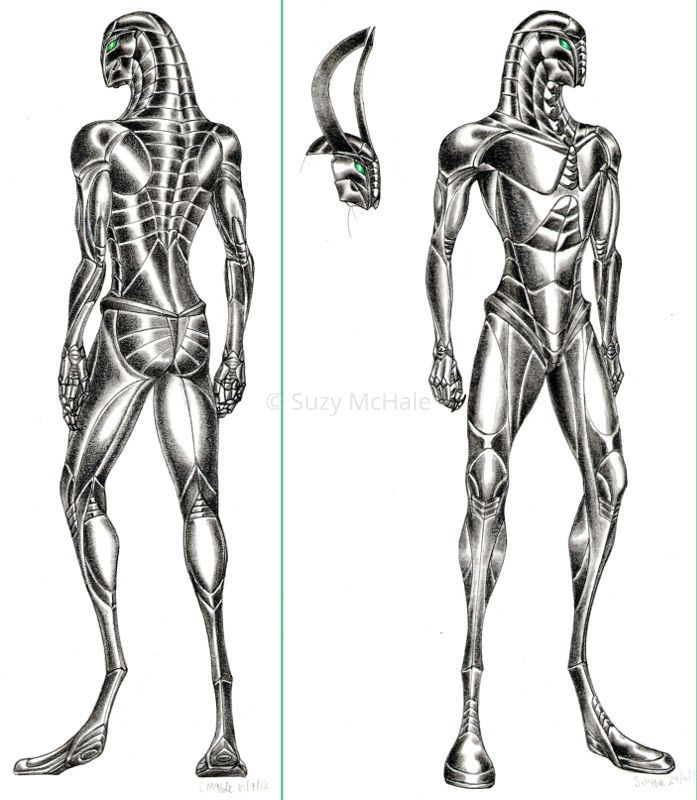
Morph-armor, full body views – a tunic and cloak are usually worn over it (colored pencils, 25/6/2013 – a little outdated).
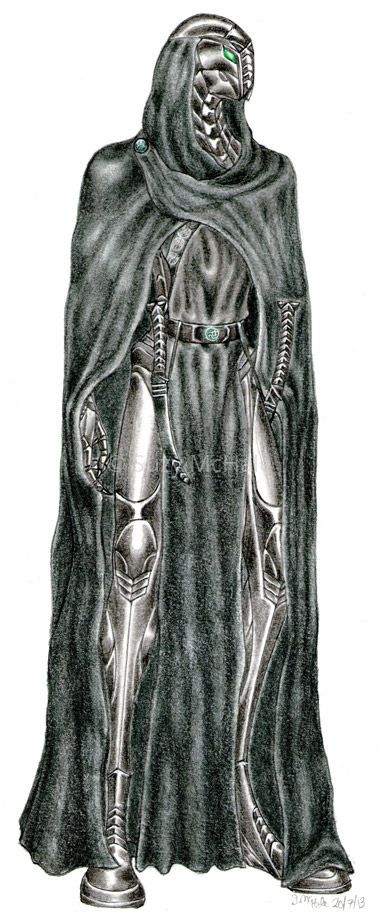
Cloaked Warrior (colored pencils, 20/7/2013).
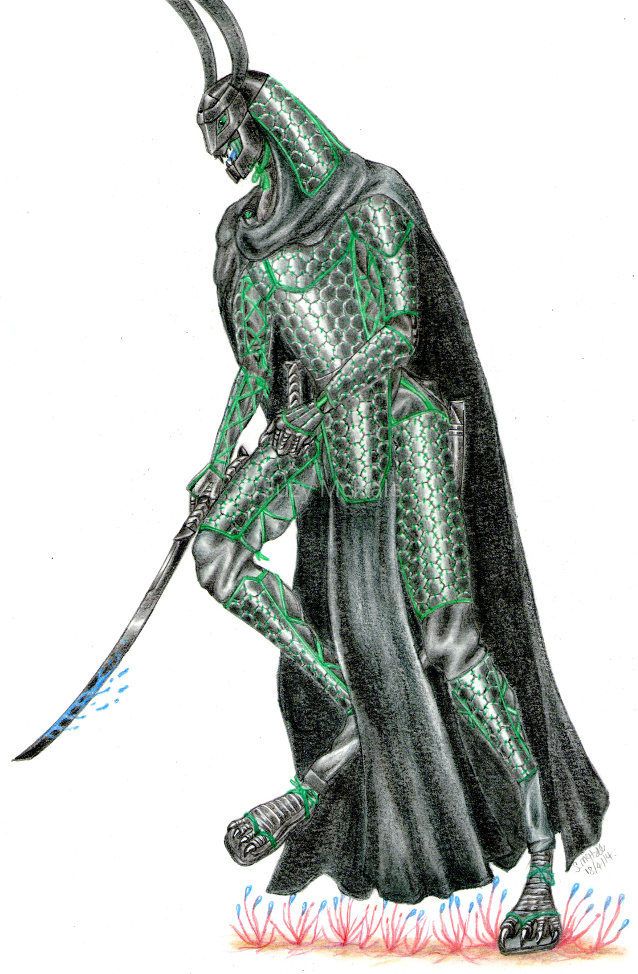
Traditional armor (colored pencils, 19/4/2014).
The arts
The main form of artistic expression is painting and drawing. Colorful murals on walls are favored for decoration of houses, and tombs are also painted with scenes of daily life and the natural world; this is considered a honorable profession. Painting is somewhat stylized, with outlined images filled in with flat colors, similar to the art of ancient Egypt. In keeping with their conservative nature, the style has changed little over time.
Natural minerals are mostly used to create paint and ink pigments, and the crushed shells of insects are added to provide an iridescent quality. Gold flakes, mica and other precious metals can also be added for a shimmering effect. The colorful paintings contrast with the black or grey stones used in housing construction.
Writing is practiced on concertina-folded sheets of a plant-derived paper. Family and Clan histories provide the main reading material; there is no concept of fictional stories.
Sculpture is not a prominent form of art; there are no statues to be found anywhere, though shallow bas-reliefs may be carved into walls. Children’s toys are usually hand-carved wood, and are of figurines of creatures and Dawn Hunters for hunting and fighting games.
Traditional-style clothing and armor is still hand-made, as are some furnishings.
Music is not practiced as it has not been part of the Dawn Hunters’ evolution.
Architecture displays much use of geometric angles and shapes; hexagons and octagons are particularly favored, as well as flat-topped pyramidal-style buildings. Granite stone was the favored natural building material, and their high-tech metal alloy was also employed once technology advanced.
Attendance
An Attendance (Laaralan) is a prescribed ritual where a newly-appointed Clan Lord must journey by foot to present himself to the Supreme Lord in the latter’s Clan City. This journey can be quite arduous if the City is located far away, such as on the opposite side of the continent. He will usually travel with two of his Warrior-Guardians.
Baalo
Baalo is a female Technician-Pilot inherited by Supreme Lord Sohaar from Supreme Lord Yaraan; she flies their personal shuttle.
Biographical information
- Gender
- Female
- First appearance
- Dominator chapter: “Surrender”
Baalosaan
Baalosaan is an Adept-Superior of Night River Clan.
Biographical information
- Gender
- Female
- First appearance
- Dominator chapter: “Home World”
Backbone Mountains
The Backbone Mountains (Nomaasayananuural) are a long mountain range that stretch from north to south along the western edge of The Land. The highest mountains are to be found here, including Cloud Catcher. They are formed from the collision of two major continental plates, with the westernmost plate moving eastwards and under the eastern plate on which the single continent is placed.
Banner
A banner (Munonol) is a long thin piece of cloth emblazoned with a Clan’s symbol and hung crossways from a pole or wherever it is desired. The main entrance to a Residence usually has a banner hung on either side.
The banner is an irregular octagon in shape (four long sides, four short – a rectangle with the corners cut off). It has a white background with its edges and emblem in a Clan’s colors. A Clan Lord’s personal banner has a black background.
Image gallery
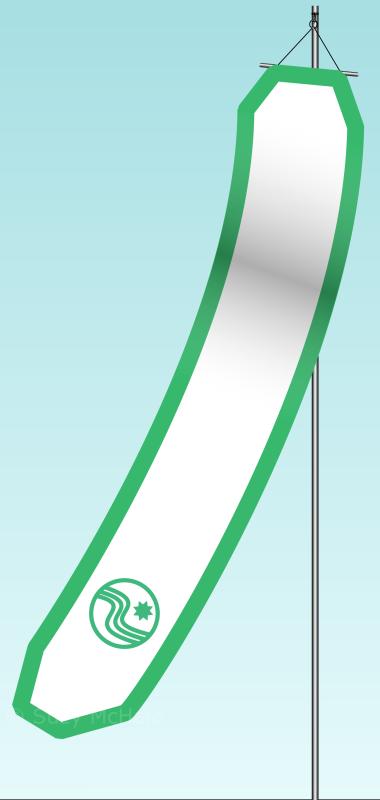
Banner of Night River Clan (digital art, 18 KB, 9/12/2015).
Battle Master
A Battle Master (Nayochar) is one who trains Warriors. He is usually an older Warrior who is retired from combat. Battle Masters may specialize in one area of weaponry such as sword fighting. He also acts as a referee for duels in the Arena of Honor. His helmet has a longitudinal sloping crest.
Gallery
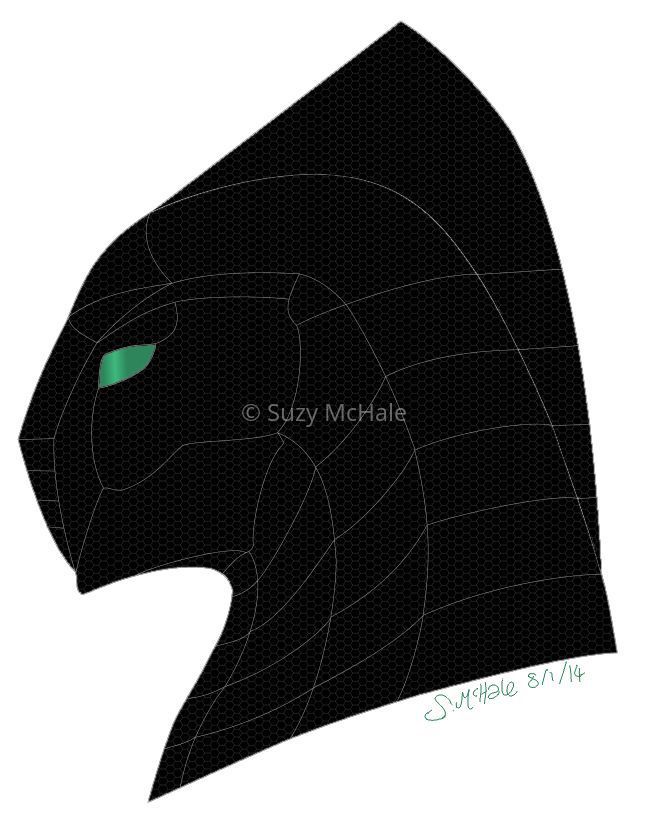
Battle Master helmet, side view (digital art, 8/1/2014).
To be, to have
There are no direct equivalents for the English meanings of the copula verbs to be or to have.
Be also includes is, am, are, was, were. “The sky is blue” would be expressed as sky – blue: Zuunuu momolanzan – zuun [sky] -uu [accusative] momolan [blue] -zan [verb present tense]. It is implied in the sentence (a nonverbal sentence).
The possessive to have would be indicated on the noun using the genitive case (“of” or “with”). So, “She has children” would be Yeloowaa nuneewocuuna – “Yeloo [She] -waa [genitive – with] nunee [child] -wo [nominative] -cuuna [many].”
Blue Cloud World
Blue Cloud World (Honuubaalomomolan) is the third planet of the Dawn Hunters’ system. It is a Class II water cloud Jovian gas giant. It is in between Uranus and Saturn in size, and is a pale blue with white banded clouds. It has 12 moons and a faint and thin set of rings. It and Gold Cloud World are known as “Dawn’s Hearts” (Mawasaan).
Data
- Distance
- 2.32 AU
- Year length
- 3.53 years = 1289.8 Earth days orbit equivalent
- Temperature
- 190 K
- Diameter
- 68,000 km
Gallery
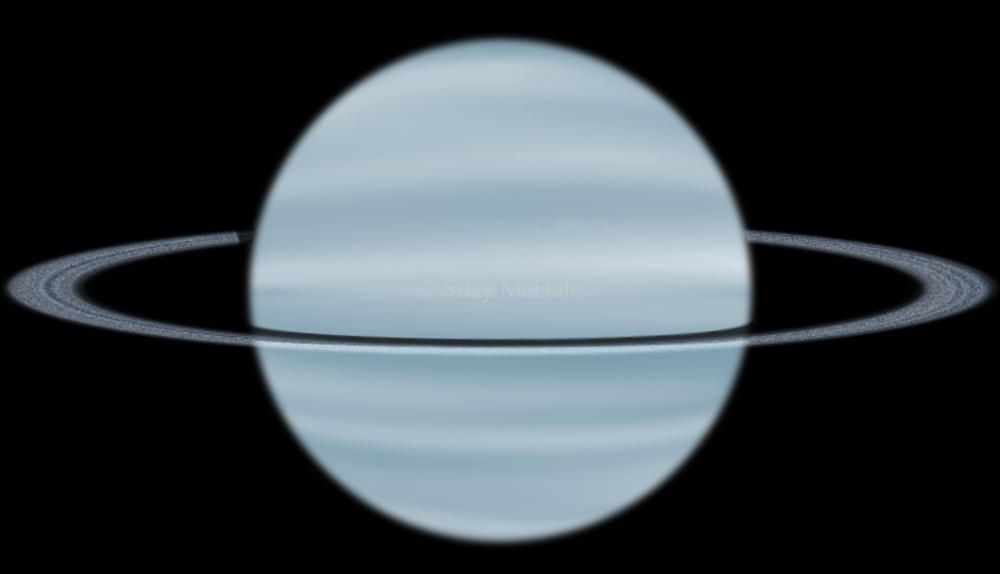
Blue Cloud World render made with Gimp scripts Gas Giant, Planetary Ring System.
Blue Mountains
The Blue Mountains (Nomaamomolan) are a mountain range to the west of Night River Clan City. They were formed long ago when an eastern plate collided with one to its west as The Landwas formed, and have been somewhat worn down by erosion since. Their highest peaks reach up to 3000 m, and the Valley of the Ancestors lies on their western side. They appear bluish from a distance due to atmospheric haze.
Blue Tongue
A Blue Tongue (Meroyaanmomolaan) is an orange-leaved plant with a display similar to a Bird of Paradise flower – a blue tongue-like protrusion emerging from split leaves.
Gallery
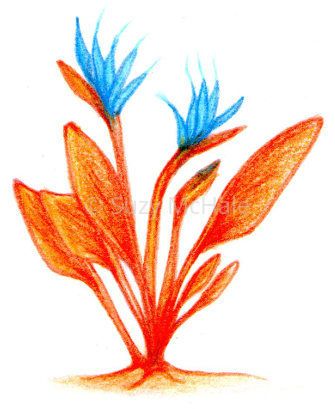
Blue Tongue plant (colored pencils, 6/10/2014).
Body language
The Dawn Hunters have a different vocal structure to humans (a syrinx like that of birds rather than a larynx), and a semi-rigid mouth but no lips – but, similar to parrots, they have a thick tongue which means they can imitate most sounds quite well.
Furthermore, the different techniques that parrots and budgerigars employ for imitating the human voice are most effective. Like humans, parrots have thick tongues that enable them to produce sounds resembling ours. Sound is produced by blowing air through two separate places in their syrinx, and at the same time producing the independent sounds required to produce consonants. The initial sound from the syrinx is shaped with the help of the throat, and then in the mouth with the tongue. In their research studies with grey parrots, Dianne Patterson and Irene Pepperberg reached important conclusions on vowel production: Due to the radically different anatomy of this parrot’s vocal organ, even though they lack teeth and lips, they can produce sounds that closely resemble sounds produced by humans. Indeed, parrots and budgerigars can quite clearly imitate sounds such as “m” and “b,” which we normally produce with the help of our lips.
In the manner of many Earth animals, the Hunters usually avoid prolonged eye contact as it as seen as a challenge or hostile act – low-ranking Hunters do not stare at their superiors. Baring one’s teeth also indicates hostility, so they don’t have a concept of smiling. Their faces tend to be somewhat rigid and expressionless, so they rely on more subtle cues from eyes, body language and the angle of their crest-quills.
Bond-Mate
Bond-Mate (Holabene) is the term for a male or female Dawn Hunter who has paired for the purpose of reproduction.
There is no elaborate marriage ceremony. The pair simply declare their union before one of the Adept Caste to make it formal, usually with the parents of both in attendance. The families of the prospective couple must also agree to their union. Bond-Mates are considered equal; one does not have authority over their partner.
After pairing, a Bond-Mate may periodically return to their natal home to live for a while, if he or she has moved out to be with their partner in the latter’s home. Families are typically close, so this tradition helps ameliorate any homesickness.
If Bond-Mates eventually find themselves incompatible, they may separate and find other partners if desired; this is again declared before one of the Adept Caste.
Breeding Chamber
A Breeding Chamber (Maralzuucalan) is a small room set aside for Bond-Mates to use during the yearly breeding season. There are up to eight of these in each Residence.
The Maralzuucalan he occupied was much smaller than his own quarters; it was sparse in furniture with a couple of painted folding screens and the dais for the sleeping area. The walls were overlain with gold leaf and painted in black outline with nature scenes. A small window was set in the wall facing the inner courtyard, and an altar under it held a fragrance-stick and a fire-colored lantern, whose flickering light dimly illuminated the room. The overall effect was secluded and intimate.
– Chapter: “Bonding”
Bright Wing
A Bright Wing (Sosaananaaruu) is a small winged bird-analog – about the size of a raven – that somewhat resembles a cross between a dragon and a pterosaur. Its arms comprise leathery wings (brachiopatagium), and it has a head-crest of 8 quills and a long flat-tipped tail used to help steer it. It comes in a rainbow variety of iridescent colors, with its underside black (male) or grey (female). It feeds on insects and vegetation. It makes a caroling or warbling sound, similar to an Australian magpie.
Gallery
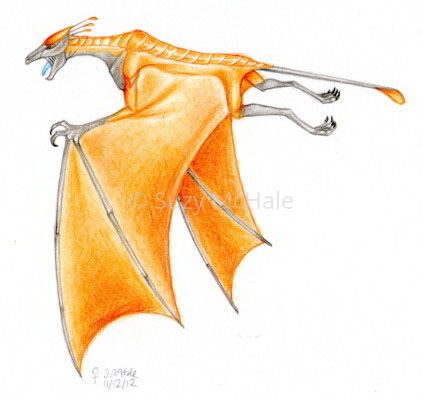
Orange-colored Bright Wing (colored pencils, 11/12/2012).
Burial armor
After his death, a Clan Lord or War Lord is encased in burial armor (Nabusaahenemulnec) before being interred. This is a custom-made, ceremonial suit comprising thousands of interlinked flat pieces of the precious stone that is representative of his Clan’s color. A piece will be hexagonal or rectangular in shape, with four piercings for threading. Gold thread is used for a Supreme Lord, platinum or silver for a Clan Lord and copper for War Lords. The face is not covered, though; a black Habar (headscarf) is wrapped around his head and neck to enable viewing, and his war-cloak is also worn over the armor.
A suit is painstakingly assembled by hand, a process that can take a few years. It is begun after the hatching of the Lord’s first son. To mimimize weight, the gemstone pieces are cut as thin as possible, and the metal thread is very fine. They are attached to a black silk-like cloth lining. The translucent stone refracts the ambient light and gives its wearer an ethereal aura.
The armor is very similar to the jade burial suits found in some Chinese tombs.
Burial urn
After death, the deceased is placed in a foetal position in an elongated, roughly egg-shaped Burial urn (Suuculunulan, container/vessel of/for the dead) that is about a meter high (depending upon the occupant’s height), which is then filled with a solution that mummifies the body, dessicating and drying it out. After a period of time, the solution is drained from the urn and the vessel is sealed, leaving the preserved body. As fluids have been removed, it is now quite light. The urn is made of an iridescent glazed ceramic material that is decorated with an image of the deceased and various patterns. The urn has four handles near its top where a pole can be pushed through on either side to enable carrying between two bearers, in the manner of a stretcher.
The dead are still considered part of daily life, so the urn is stored in the relative’s home until the deceased pass from living memory, after which the urn is placed in the Clan City’s burial district with other ancestor urns.
Burning Eye Clan
The Burning Eye Clan (Narawaa Hesaayarewo) is one of the eight Great Clans. Its Clan City is located on Home World’s east coast.
Data

- Burial armor gemstone
- Sapphire
- Clan City construction stone
- White limestone
- Clan City co-ordinates
- Approximately 2°E, 9°N
- Clan emblem
- Stylized representation of the Eye of the Day (sun); “Burning Eye” is an alternate name. The city gets hot north winds from the desert.
- Color
- Azure (#0080ff/rgb(0,127,255))
Caabasanaa
Caabasanaa – past
Caabasanaa is a Warrior-Guardian of Sohaar-5.
Biographical information
- Gender
- Male
- First appearance
- Chapter: “Fallen”
Caabasanaa – present day
Caabasanaa is a young Warrior-One-Claw assistant to Clan Lord Sohaar before his duel with Supreme Lord Yaraan.
Biographical information
- Gender
- Male
- Eye color
- Blue (#93CCEA/rgb(154,206,235))
- First appearance
- Dominator chapter: “Duel”
Caste
Dawn Hunter society is highly-structured and regimented, and is divided into three main Castes (Rohuul) or factions. The Castes can be more colloquially referred to as “Colors” (Yero) due to their coded clothing.
| Caste | Color | Notes |
|---|---|---|
| Warrior Caste | Black | Dominant caste; genetically selected to be exclusively male. Fighters and explorers. Wear black armor and robes embellished with the symbol of their Clan. The Clan Lord is the ruler of a dominant Clan; a War Lord rules a subordinate Clan. |
| Adept Caste | Cerulean-blue | Religious leaders, scientists, healers, scholars, teachers, advisers. Males and females. |
| Technician Caste | Magenta-purple | Engineers, builders, inventors, artisans. Males and females. |
For the Adept and Technician Castes, their clothing colors reflect those of the vegetation of the landscape they live in. The Warrior Caste’s clothing is that of the night sky. Children wear clothing in its natural fabric colors up to adolescence, when their profession and Caste will be decided. Aligning an individual’s personality with their profession is considered important for their well-being and fulfilment of their abilities.
The other Castes are nominally subordinate to the dominant Warrior Caste, but there is a balance of power between all:
- Adepts and Technicians are dependent upon Warriors for protection
- Warriors and Adepts are dependent upon Technicians for technology
- Warriors and Technicians are dependent upon Adepts for medicine and knowledge
Gallery
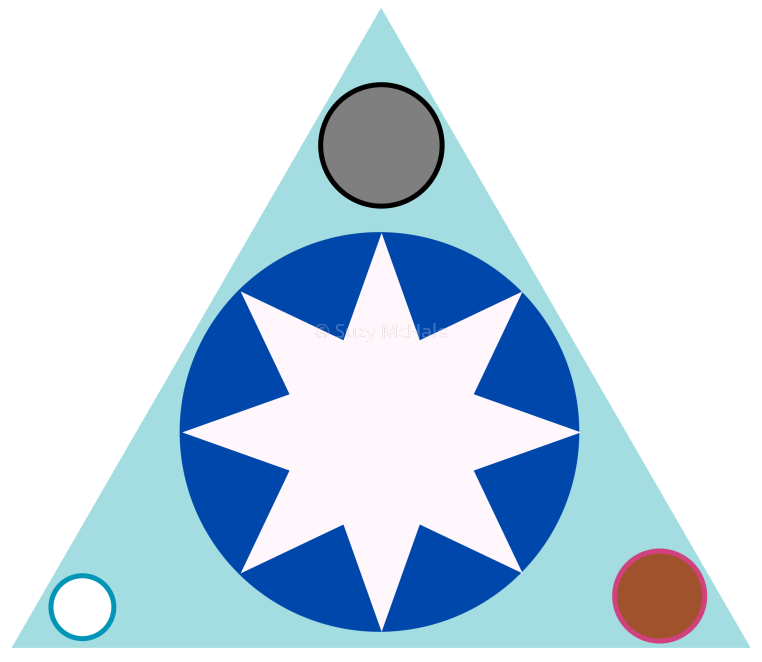
Symbol for the Castes and Clans, and perhaps the Dawn Hunters civilization overall. The three Castes are represented by the three moons of Home World (Grey Moon: Warrior Caste, Red Moon: Technician, Ice Moon: Adept). The moons are colored close to their natural colors, encircled by a band of color corresponding to its Caste. The triangle color is the aquamarine of the sky of Home World. The blue circle represents Home World itself (cobalt-blue is that of the ocean), and the eight-pointed star represents the eight Great Clans and the Eye of the Day (its color close to that of the star itself). (18/1/2017, digital art, 50 KB)
Clan City
The eight Clan Cities (Nawelnara) on Home World provide dwelling places for the entire Dawn Hunter population. The cities are analogous to city-states or walled fortress-towns in Earth’s history. They are mostly self-sufficient and self-contained. Cities are constructed away from the coastline, which is battered by violent hurricanes from the immense Ocean of Storms, but not too far – interiors are mostly deserts – and mostly occupy the temperate zones in each hemisphere. A city is ideally situated near a river to enable quarried rock to be transported to the construction site by river barge.
The entire Dawn Hunter population is less than a million, so there would be less than 100,000 Hunters living in each City. The Cities have never been full, due to population control, so is no need for them to continously expand out and up.
There are no outlying towns or villages; the population tends to want to live close together for community and protection.
A continuing tradition is to send messenger-runners between Clan Cities; this is still undertaken despite having a high-tech communications network.
Layout
All Cities are constructed to the same grid template that was originally used in the first City, Night River. A City is surrounded by a protective wall in an octagonal shape with 4 elongated main walls and 4 short corners – a rectangle with cut corners (similar to an emerald cut). It covers an area of up to 30 km2 or 3000 hectares, and can span up to 10 km from one end to the other. Four roads extend from the octagonal central plaza to the perimeter road along the inside of the outer wall. These are referred to as Artery Roads (Runaamayamolan, shortened: Rumamolan) as they resemble the main arteries in a body, with many smaller roads branching off from these. A main gate at each corner enables access from the outside through the perimeter wall. There is a fifth short road extending straight from the plaza to the Pyramid of the Lords.
An elevated maglev monorail runs along the perimeter road. There are also ground vehicles to provide transport around the city, but these are mostly public transport, not private vehicles. These are all electric-powered via solar panels.
A city is divided into four main districts or prefectures (maco). Anti-clockwise, they are:
- Burial grounds (Macolunu).
- Residential district (Macohale). The Clan and War Lords’ residences are closest to the central plaza.
- Parks and horticultural areas (Macomero). This enables food production during the harsh cold season. There are also smaller parks and reserves in the other districts.
- Utility district (Macozela). Comprises factories, food storage, and service buildings such as the House of Healing. The House of Healing is located near the plaza to enable quick access by ground or air transport
- Central plaza (Maralneraa). Mainly used for aircraft and spaceship landings, as well as a central meeting area. The airfield provides a landing and service area for spaceships, with retractable geodesic domes providing individual hangarsfor each spacecraft; there are 400 of these. The airfield is around 1.024 × 1.658 km, with a north-south and east-west runway crossing in the center.
- The dominant feature of a Clan City is the huge pyramid-shaped House of the Ancestors which contains the remains of those who lived there. The pyramid is set in an octagonal walled courtyard (with four long sides and short corners). Its sides are – like those of other buildings – covered with highly-efficient hexagonal black broad-spectrum carbon-nanotube solar panels, which also provide insulation.
- Gate of Grey Moon (Meyrebebehu): south-east corner main gate and road between the burial and residential districts (symbolic Warrior Caste gate).
- Gate of the Eye of the Day (Meyhesaahame): north-east facing gate, between the residential and park districts.
- Gate of Red Moon (Meyrelelecaa): north-west between the park and utility districts; symbolic Technician Caste gate.
- Gate of Ice Moon (Meyrereca): south-west between the utility and burial districts; symbolic Adept Caste gate.
The domed Arena of Honor of each Clan City serves as a central meeting-place for its Clan Lord and other high-ranking personnel, and is where fights to the death take place. It is an elongated octagonal building on the east side of the pyramid.
Buildings are otherwise low-set (most no more than 3 storeys, with flat roofs surrounded by a low wall) and their blocky geometric shapes are reminiscent of ancient South American cities – the buildings having slightly inward-sloping exterior walls like stepped pyramids, and ramps connecting the levels as well as modern elevators. Architecture emphasizes simplicity and elegance, similar to traditional Japanese design. Building construction stone varies from City to City; each has a main stone used, giving each a distinct character. The stone blocks are carefully and precisely fitted together and interlocked without mortar (similar to the method of Incan masonry). The buildings are enhanced with wood, ceramics for roof tiles and metals and, later on in their history, the use of high-tech materials and techniques helped preserve and improve them. Streets are tiled with hexagon tiles. Vegetation is plentiful, the magenta-red, orange and cerulean plants and trees providing much color.
There is no monetary economy, so shops as humans would recognize are not to be found. The House of Surplus distributes items according to need.
Underground fiber-optic cables connect each Clan City, enabling rapid communications; satellites also provide another means of this.
Power supply
The Cities are powered both by nuclear fusion and solar power. The deuterium needed for fusion processing is taken by pipeline from the ocean and processed at power plants near the coastlines, then the derived electricity and fuel is transferred underground to their respective Cities. Each City has its own fusion plant. There are small maintenance stations every few hundred km along each pipeline route. Fusion energy is mainly used for energy-intensive manufacturing and for fueling the various transportspacecraft.
Housing uses mainly solar power; each apartment complex has its own stand-alone solar supply, gathered from roof panels and solar tiling.
Water for consumption and other uses is – if there is not a nearby river, or if rainfall is insufficient – also taken from the ocean by pipeline and desalinated. Rainwater is also collected from the roofs of buildings and stored in purification tanks. As a last resort, water can be recycled.
Waste products are broken down by Reclaimer-Nanites and may or may not be recycled depending upon the circumstances.
There is an unspoken agreement that the fusion and water plants are not to be damaged by warring Clans.
Gallery
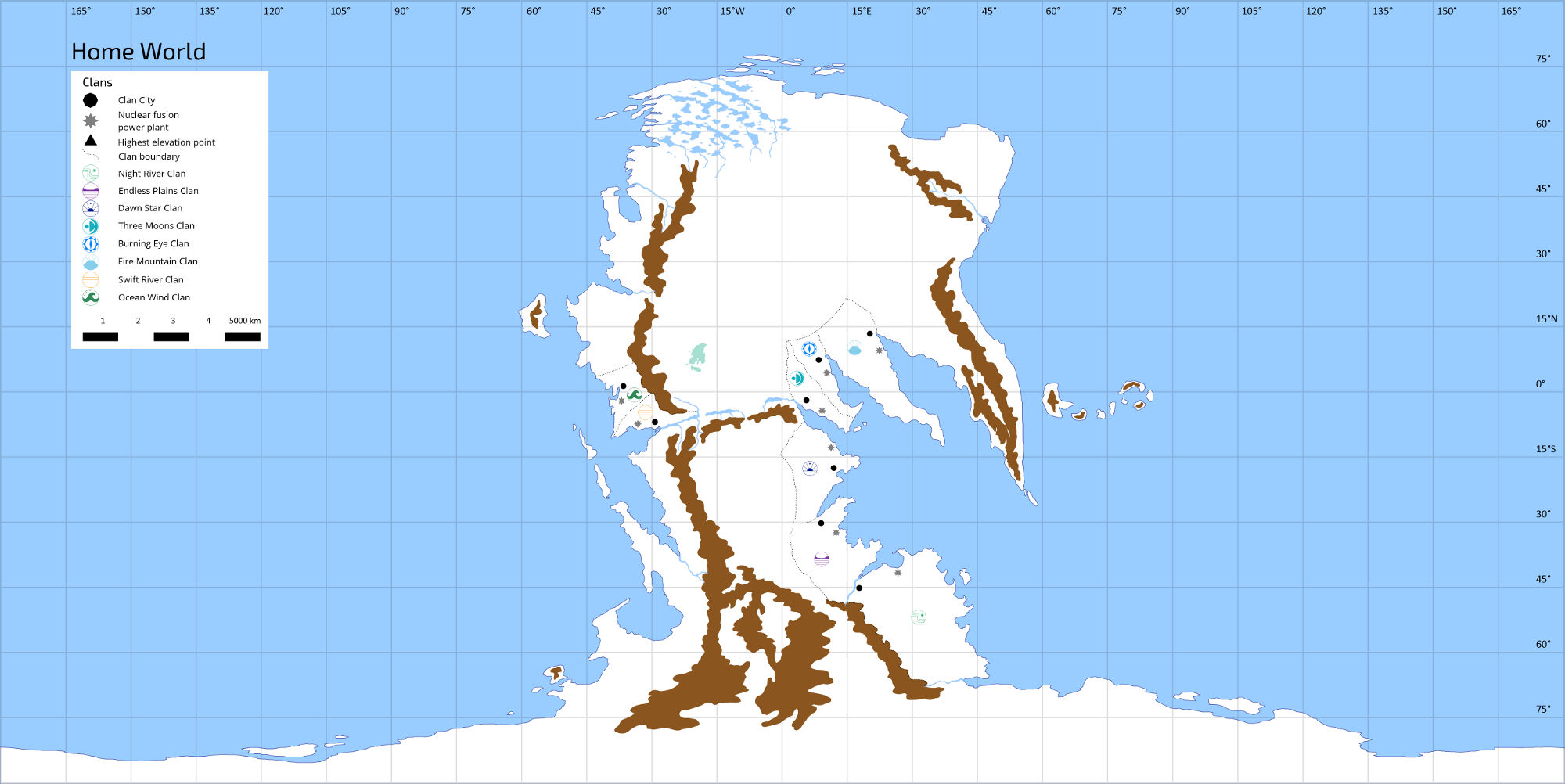
Map showing Clan Cities and their territories (216 KB).
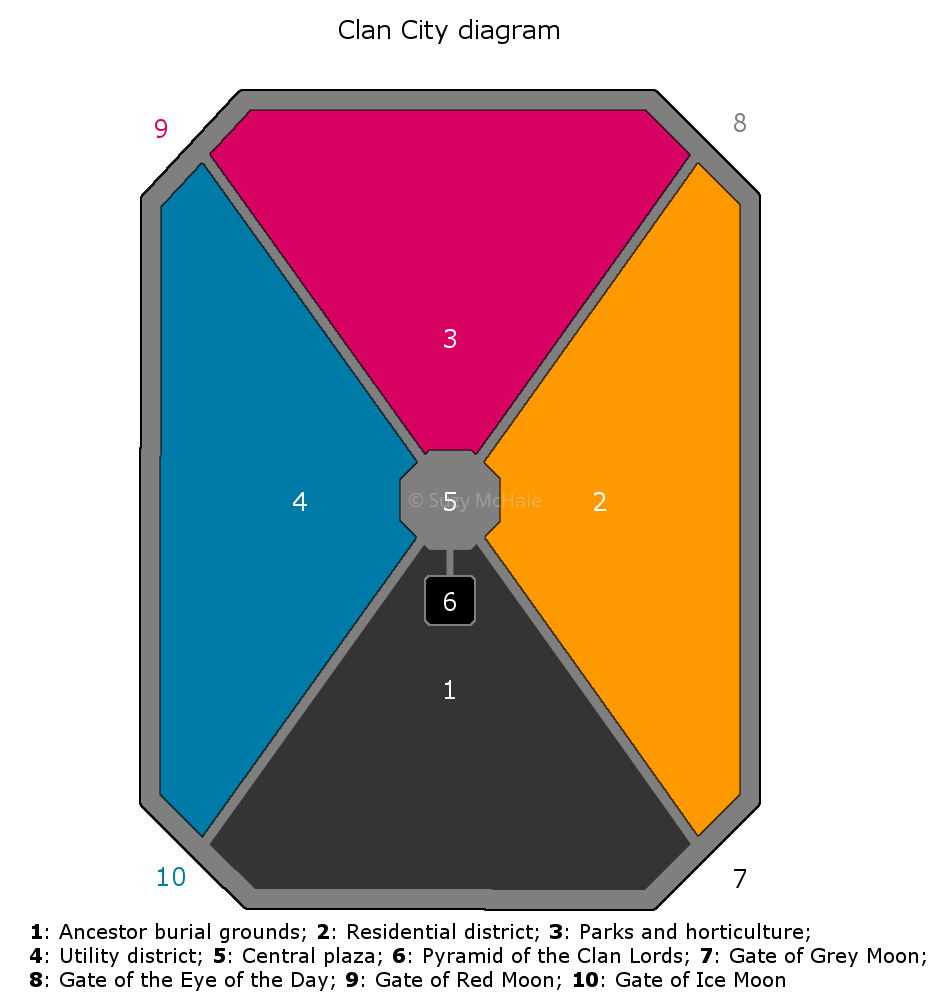
Stylized diagram of a typical Clan City layout, not to scale (18/1/2017, digital art, 50 KB).
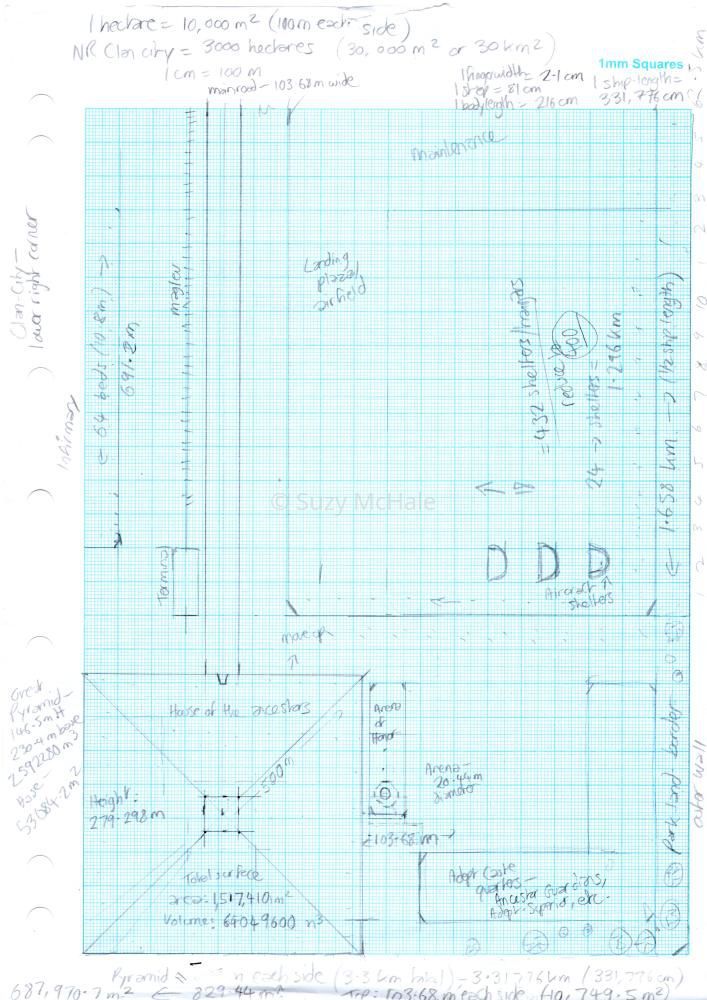
Pencil sketch of one corner of a Clan City (Pyramid, Arena of Honor, airfield, etc.) (159 KB). This is outdated.
Clan Lord
A Clan Lord (Zulnara) is one who heads a Clan; always a dominant male of the Warrior Caste. A Clan Lord’s tenure is hereditary, though other Warriors can challenge him for the position via ritual single combat. He is expected to maintain his hunting and fighting prowess throughout.
A Clan Lord is the only rank that can utilize nanotechnology to lengthen his lifespan, extending his reign for hundreds or even thousands of years until he is either killed, or wearies of life and returns to mortality to have children. His long life provides a feeling of stability for his Clan and a connection with the past.
While he is forbidden from producing his own children while maintaining life extension, he can adopt one or more orphans over his lifetime if he chooses, though they will not be his heirs.
His helmet crest resembles the forward-curved, blunt-ended horns of the Crescent Horn herbivore. His metal rank color is gold (#ffd700 / rgb(255,215,0)).
Gallery
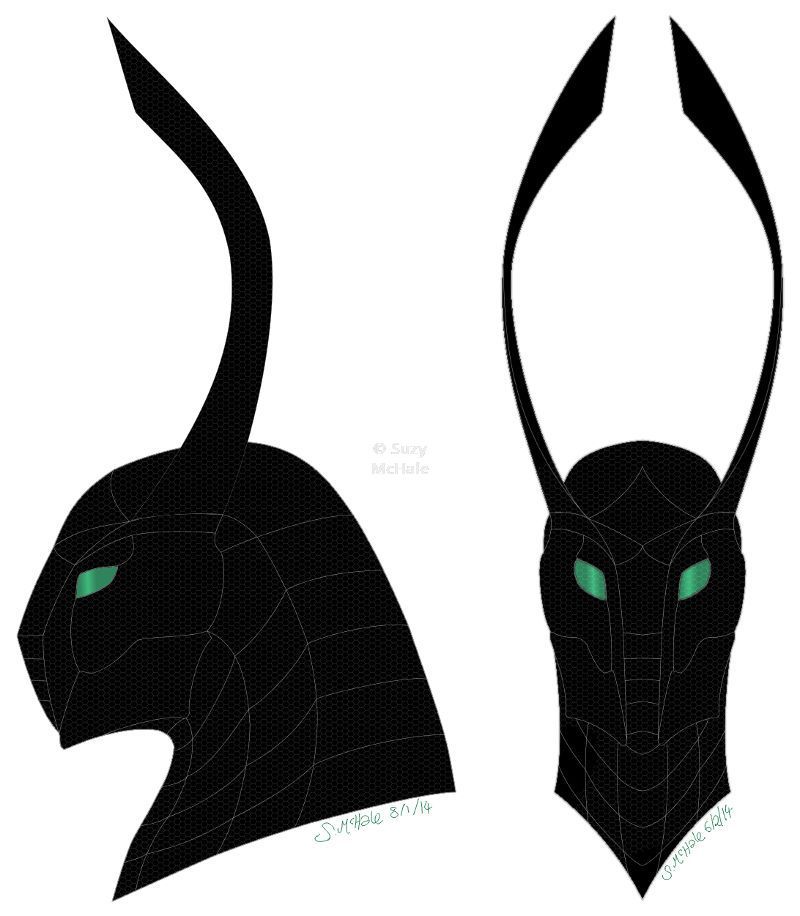
Clan Lord helmet, side and front views (digital art, 8/1/2014).
Traditional helmet (digital art, 1/4/2014).
Clan
A Clan (Nara) is the basic family and social structure of the Dawn Hunters. An individual’s loyalty is to both their immediate family and Clan. A Clan is led by a dominant male from the Warrior Castewho wins and holds his position by ritual single combat. He leads immediate and extended family, as well as outsiders who have interbred into the Clan.
While there can be conflict between Clans, they will unite under the Supreme Lord to combat an outside alien threat.
Great Clans
The Clans are generally named for geographic and sky features. The colors are derived from the eye color of each Clan’s first Clan Lord, which tends to dominate in that Clan. Sub-Clans in a Clan City adopt the colors of their host Clan. If a War Lord should overthrow a Clan Lord (a very rare occurrence), his sub-Clan will replace the name of the founding Clan.
- Burning Eye Clan
- Dawn Star Clan
- Endless Plains Clan
- Fire Mountain Clan
- Night River Clan
- Ocean Wind Clan
- Swift River Clan
- Three Moons Clan
Sub-Clans
Some sub-Clan names:
- Crescent Moon Clan (Narawaa Rebenuuwo)
- Day Eye Clan (Narawaa Hesaasalamo)
- Evening Star Clan
- Grey/Red/Ice Moon Clan
- Fire Wind Clan (Narawaa Sanaalecaawo)
- Great Lake Clan (Narawaa Seewasunewo)
- Sky Fire Clan (Narawaa Zuunlecaawo)
- Storm Coast Clan (Narawaa Lacaaryaraano)
- Storm Wind Clan (Narawaa Sanaayaraano)
Gallery
Map showing Clan territories. Night River Clan, being the first, has the largest area. Most others occupy the habitable regions around the eastern coast. The two Clan Cities on the western coast are smaller as habitable land there is less extensive, and were founded last, after powered flight was invented.
Clanless
A Clanless (Narawohuu) is one who is exiled from their Clan. As the Dawn Hunters are a highly social species, this is considered a fate worse than death. The majority of exiles tend to be from the Warrior Caste – usually unruly young males who will not submit to the authority of those higher-ranked and who manage not to get killed for this. They eke out a lonely existence in the wilderness, hunting and living off the land like their primitive ancestors. Occasionally some might band together and try to overthrow a Clan Lord. Conversely, a Clan Lord might get fed up with having one in his territory and organize a hunt to eliminate him.
Claw-caps
Claw-caps (Casazuhaa) are worn to protect the claws from damage, and from hurting others with them. These are primarily worn by those of the Warrior Caste during daily life and training.
The caps are a soft plastic-like material that can be easily taken on or off, and are usually colored to match their wearer’s eye color.
Cloak Fin
A Cloak Fin (Sosaanzoluuh) is a vertebrate sea creature analogous to a manta ray; its wing-like fins can span up to 6 meters or so. So-called as it has a resemblance to a Warrior’s war-cloak. It lives along the coastlines of Home World’s ocean.
Gallery
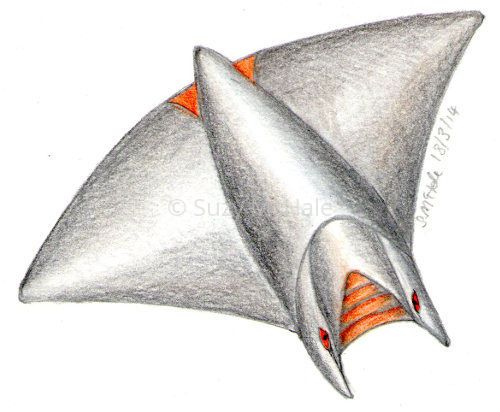
Female Cloak Fin (colored pencils, 18/3/2014).
Clothing
In ancient times the Dawn Hunters used animal skins as clothing, and later on the craft of weaving was developed to a high level of skill. The cloth is woven from a plant whose fiber resembles silk in texture and is naturally iridescent. It is tighter-woven for cold weather, and lighter for warm weather.
There is no such concept as fashion in Hunter culture; the clothing remains mostly unchanged through time (except through necessity). The Hunters don’t wear jewelry and adornments or practice body modification; their naturally iridescent skin is quite attractive anyway.
Clothing (saacelananabu) is unisex and has a general resemblance to traditional Oriental clothing. The fabric has a two-toned/colored appearance depending upon the angle of viewing, similar to shot silk. The basic undyed color of the cloth is various shades of cream and beige, as shown in the table below:
| Cornsilk | FFF8DC | 255248220 |
| BlanchedAlmond | FFEBCD | 255235205 |
| Bisque | FFE4C4 | 255228196 |
| NavajoWhite | FFDEAD | 255222173 |
| Wheat | F5DEB3 | 245222179 |
| WhiteSmoke | F5F5F5 | 245245245 |
| Seashell | FFF5EE | 255245238 |
| Beige | F5F5DC | 245245220 |
| OldLace | FDF5E6 | 253245230 |
| FloralWhite | FFFAF0 | 255250240 |
| Ivory | FFFFF0 | 255255240 |
| AntiqueWhite | FAEBD7 | 250235215 |
| Linen | FAF0E6 | 250240230 |
Morphcloth
The high-tech version of the traditional natural fabric is nanite-infused and is known as morphcloth (munolole). It is usually worn as an outer cloak over traditional fabric clothing. The cloak can morph to cover the whole body if needed.
In appearance it is an iridescent, heavy silk-like fabric that is soft, breathable and comfortable yet able to withstand the sometimes-harsh climate. It is infused with Maintainer-Nanites which can repair the fabric if it is torn (or manufacture new material), cleanse itself of dirt and adjust it to suit climatic conditions. The nano-fabric is hydrophobic – repels all fluids – even if immersed in water. The clothing is designed to not restrict movement. It can be configured to function as a pressure suit in a vacuum environment, an inner layer molding to the skin while the outer layer remains loose. It can provide some protection against low-velocity projectiles (by dissipating the impact). The material can self-seal over a wound to stop bleeding until treatment is available.
The material is usually an opalescent white in color, but can change as needed. Most will wear their cloak in their Caste color – a Warrior will always wear his as black and floor-length.
The cloth morphs either by neural implant command or pressing a marked glyph on a hem.
General clothing styles
The Dawn Hunters tend to like to be covered up as being enveloped in clothing invokes a feeling of security; this has become a cultural trait. Layers of clothing are worn.
- Underwear (Saacelanhasa) comes in two main variants. One is a single long rectangular strip of fabric that is wrapped around the waist, passed between the legs, and tied in front with a dangling sash. This is usually worn without outer clothing – such as by children, or by Warriors when dueling (Warriors tend to wear it as standard wear). The other variant is a simple rectangular strip of cloth that is hemmed on each edge and passed between the legs. A single cord is strung through each hem and tied at one side around the waist to secure it.
- A sleeveless tunic is worn over this. It is made from two large rectangular cloths that are folded in half and sewn together on one short side, with openings left for the head and arms. The head opening is v-shaped at the front and hemmed. It reaches to just below the knees, while the tunic for Warriors is ankle-length. Edges are hemmed and usually trimmed with colorful geometric patterns. A thin braided cord is secured through a belt loop on either side to gather the tunic in.
- A sash secures clothing around the waist, worn around the outer coat. It is a length of fabric wound around and tucked under.
- Over the tunic a floor-length, wide-sleeved, kimono-style coat (Zoluuhesezu) is usually worn over the tunic. The tunic crosses in front like some traditional Oriental-style clothing (such as the Hanfu) and is secured with the sash, which is also held by a belt loop on either side. The sleeves have drawstrings threaded through the hems, so they can be tightened and secured out of the way if desired.
- Trousers may be worn as well; usually in cooler weather. These are a relaxed fit with wide legs. The waist is hemmed and a tie threaded through this.
- A cloak can be worn around the shoulders and torso; this is a square-shaped piece of cloth similar to a poncho but with one side cut into an open U-shape to fit around the shoulders which extends to the center of the cloak. It can be embroidered, usually with geometric patterns around the edge, and brightly-colored. It is often replaced with the morphcloth cloak. It is usually one bodylength (216 cm) along each side, but may be tailored to be longer or shorter depending upon the wearer’s height. The cloak of a Warrior is 1 bodylength by 2 bodylengths (432 cm). One corner may be fastened to a shoulder with a brooch (usually to the right shoulder) – the morphcloth can be secured without fastenings.
- Shoes are either open-toed slip-ons for warm weather, more secure sandals, or soft boots for cold weather. The boots reach up to just below the hock. Socks are worn if needed.
- A headscarf (habar) is usually worn; its color denotes the wearer’s profession. It can be worn loosely around head and shoulders, or wrapped to form a veil and conceal most of the face.
- Adults carry a dagger with them, hung from their sash.
- Children wear much the same clothing, though usually as a simple tunic, or just a loincloth in hot weather.
Clothing codes
Styles, colors and patterns are mostly prescribed, indicating an individual’s profession (Zelarel), Caste (Rohuul) and Clan (Nara). Clothing is dyed in the colors of one’s profession – some of these are taken from the vegetation of Home World:
- Warrior Caste: black (rgb(0,0,0)).
- Adept Caste: cerulean (rgb(0,123,167))-blue (rgb(30,144,255)).
- Technician Caste: magenta (rgb(208,65,126))-purple (rgb(139,0,139)).
- Children’s clothing is left in its natural-colored state, as is that provided to an Outsider. Clothing borders are colored to indicate the Clan to which they belong. The eye colors of each of a child’s parents is also used to help identify them with the family color pattern.
The collar and sleeve hems of one’s tunic is bordered with colors and patterns indicating its wearer’s position in society. Apprentices will wear natural-colored clothing hemmed with colors indicating Caste, Clan and profession. Those who are masters wear clothing in the color of their Caste.
- Apprentice: natural-colored clothing. The collar and sleeves are the Caste color, with a thin stripe in the middle of their Clan color, and a thinner stripe inside that of their profession color. The Clan symbol is at the front of the collar. Their headscarf matches their profession color.
- Master/finished training: tunic is their Caste color; trousers are natural color. The collar and sleeves are their Clan color, with a thin stripe in the middle being their profession color, and their headscarf is their profession color.
- The Adept-Superior and Technician-Superior have clothing entirely in the color of their Caste, including their headscarf, though the collar and sleeves are colored in the same manner as a Master (Clan color with profession stripe inside).
Family colors
Each individual within a Clan has a repeating hexagonal pattern printed along the bottom hemline of their clothing (tunic and cloak). The colors of this help with identifying an individual and who their parents are. The colors in Sohaar’s pattern, for example, show:
- His Clan color (#3fb87d) in the middle hexagon;
- His father’s eye color (#0f52ba) in the upper half-hexagon;
- His mother’s eye color (#62af2f) in the lower half.
- The cream outline is the natural color of his tunic (which can vary between garments, as noted earlier).

Gallery
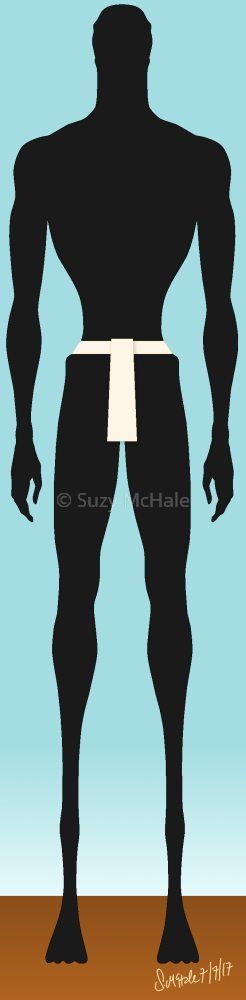
Basic clothing: loincloth version consisting of a single piece of cloth secured around waist and between legs, to hang in the front.
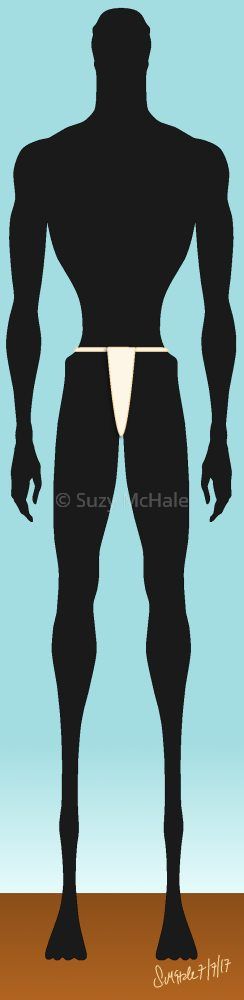
Another loincloth version: a cord tied around the waist; the fabric strip that goes between the legs has the cord threaded through its hem.
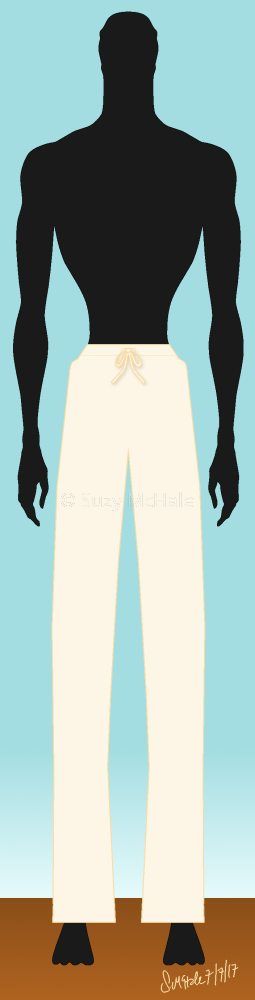
Basic trousers. The ends may be closed by tying around a ribbon that is sewn inside them.
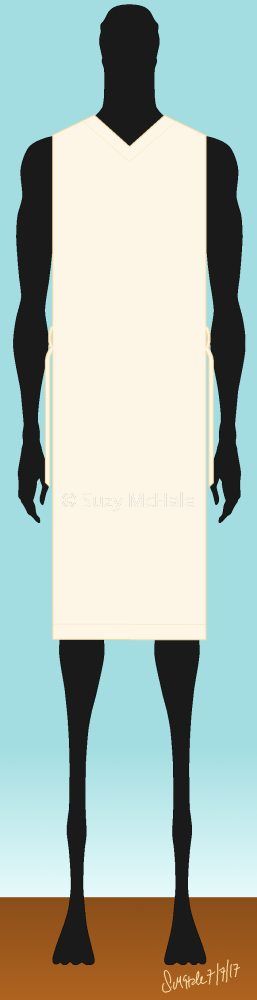
Tunic with belt untied. It may be knee- or ankle-length and has a split up each side.
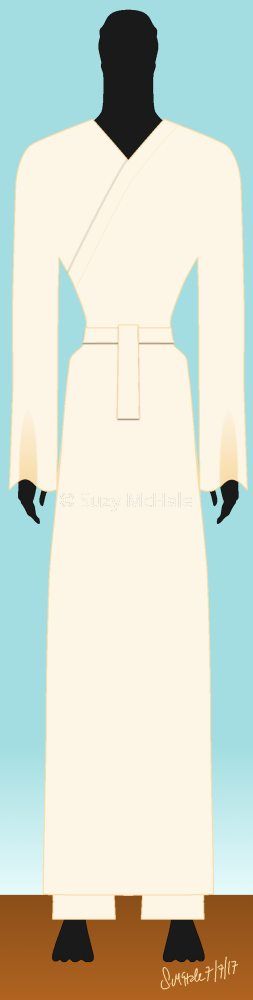
Standard kimono-style coat. It is wrapped around the body with the hem slanting in front, and secured with a sash that is tied in front.
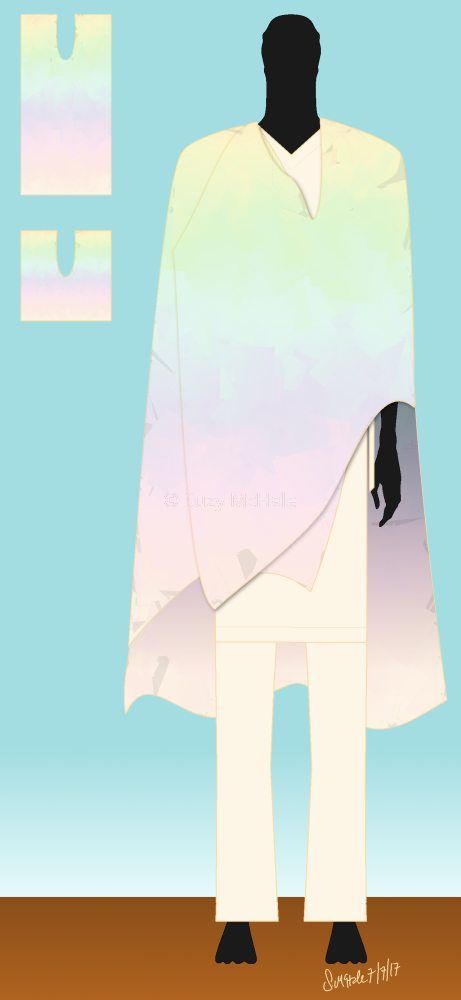
Morphcloth cloak. The nanite-infused material has a subtle opalescent sheen over the basic natural color. One end of the cloak can be placed over a shoulder and the cloth will adhere there by itself. The traditional woven version is secured with a brooch, and there are also two ribbon ties near the u-shaped neck cutout to help secure it.
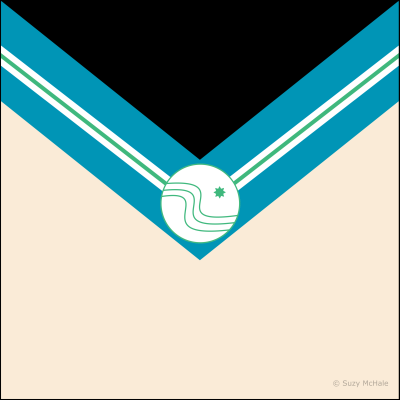
Clothing code colors for an apprentice/novice (in training), this for one of the Adept Caste: tunic is natural fabric color, collar is Caste color, with a single stripe indicating their profession (Ancestor-Guardian in this example) inside a thicker stripe in their Clan color. (The black area is skin color.) (Digital art, 21/1/2017)
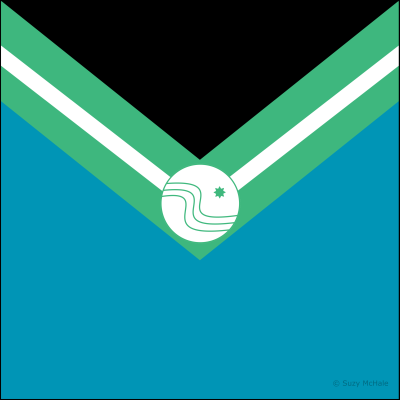
Clothing code colors for an Adept or Master (finished training): tunic is Caste color, collar is Clan color, with a single stripe indicating their profession (Ancestor-Guardian in this example). The Technician Caste follows the same pattern, but their Caste color is magenta (digital art, 21/7/2017).
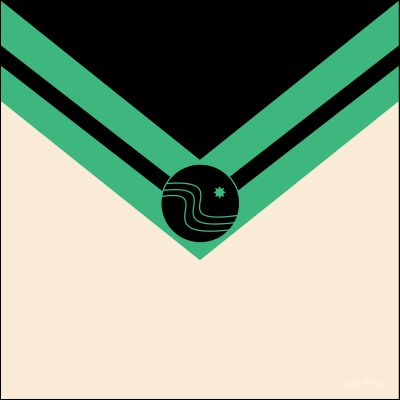
Clothing code colors for a Warrior-Student (in training): tunic is natural fabric color, collar is Clan color with a black stripe indicating they are of the Warrior Caste (digital art, 21/7/2017).
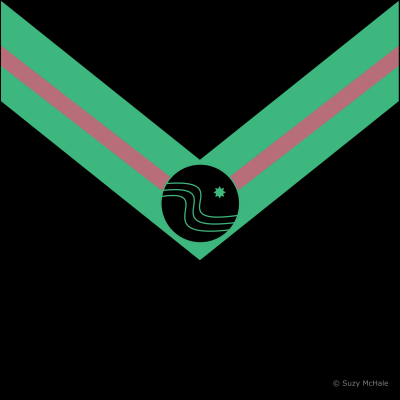
Clothing code colors for a Warrior-Guardian: tunic is black, collar is Clan color, rose-gold metallic stripe indicates his rank of Warrior-Guardian (digital art, 21/7/2017).
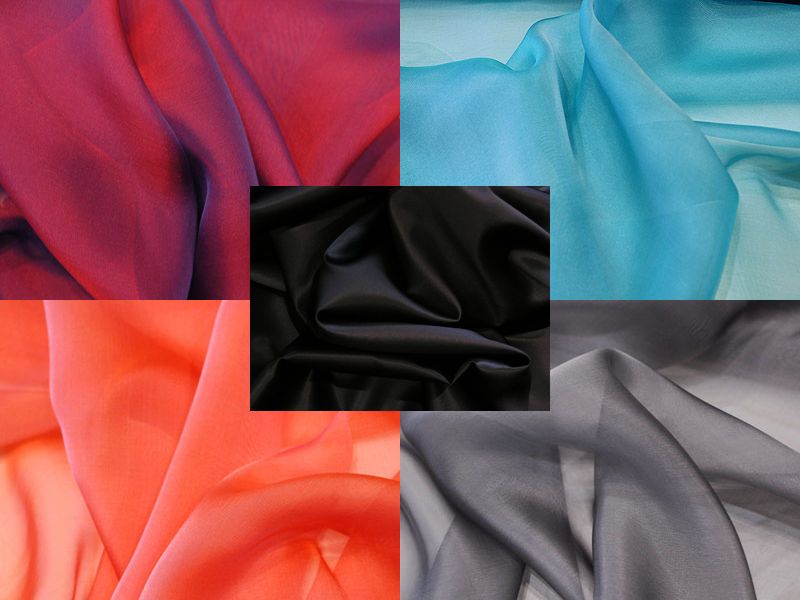
Shot silk samples (via Silk Trader), showing all Caste colors.
Hood, veil and visor of morphcloth deployed on one of Adept Caste (digital art, 13/1/2014) (41.66 KB). (Note: out of date.)
Updated: 31/12/2017
Cloud Catcher
Cloud Catcher (Baawebaalo) [1] is the tallest and most sacred mountain peak on the continent of Yoora, around 6,000 km high. Located in the Backbone Mountains, southern hemisphere, approximately 45°S and 15°W. So-called as its peak is usually wreathed in clouds. Its peak has four sides that are roughly aligned with the four directions.
Footnotes
- [1]
- Name inspired by Mt Warning
Cold Sleep
Cold Sleep (Moreezamaa) is a state of deep hibernation or suspended animation, induced when in a Healing Bed. This is used as anesthesia while the body undergoes repair, or for a period that can extend to thousands of years in the case of Clan Lord Sohaar. The body does not age during Cold Sleep, so the occupant will be the same biological age on waking as they were when going under.
Colors
There are no specific words for many colors; instead, the first syllable of the word for a natural element is reduplicated to form a color word. Green, purple and ultraviolet have their own words, though. (Alternately, along with general color words, words used to describe colors of natural elements can be reduplicated when referring to that element.)
Due to its association with blood, blue is the color used to indicate danger and warning, while orange indicates safety and permission.
| Color | From word for … | Dawn Hunter word |
|---|---|---|
| aquamarine | sky (day) | zuunzuun |
| black | night sky | nanahuu |
| blue | blood | momolan |
| brown | soil | yooyoora |
| cream | cloth (fabric is various shades of cream) | mumuno |
| gold | metal | suusuuzu |
| green | There is no Earth-green vegetation on Home World, so this color was only initially observed in rainbows, some eye colors, and later on in emeralds – it is green with a hint of blue (Sohaar’s eyes are this color) | mabaa |
| grey | mist | bebehu |
| magenta | grass | huuhuurunonaam (crest-grass) |
| metallic | metal | saasaahen |
| multi-colors | rainbow (alternately: berencuuna – color-many) | bebenuu |
| ocean-blue | ocean (deep blue with a hint of green) | zuzumaah |
| orange, red, yellow | leaf-color | laalaamo |
| orange, red, yellow | fire | lelecaa |
| purple, violet | Color found in some vegetation, rainbows, some eye colors, and later on in amethysts | leyuun |
| silver | metal | yuyuzuu |
| ultraviolet | The Dawn Hunters have a color receptor for near-ultraviolet | wuraa |
| white, pale | dawn, sunrise | saansaan |
Command Chamber
The Command Chamber (Maralreesalan) is the ovoid-shaped room in a starship that serves as its Clan- or War Lord’s place of central command. It is located in an antechamber on a level up and not far away from his cabin, accessible by a ramp. It has two levels: the upper Command Chamber proper and the lower Crystal Chamber. The entire ovoid is nicknamed the Geode Chamber (Maralwumarasaraa). Two levels of corridors encircle it to enable access to both levels.
In appearance it is bare of furnishings; its crystalline walls can display lifelike panoramic views of the scenery outside the starship, or of Home World’s landscapes. The Clan Lord or Ship Master kneels on a dais at the far end of a long walkway from the Chamber’s entrance. The dais, at the highest end of the Chamber, is surrounded by transparent graphene screens on which various data holograms are displayed. On the floor in front of him protrudes the Ancestor Crystal (Cayalcabuun) from the Chamber below. The floor itself is a translucent nanocomposite material.
The Crystal Chamber (Maralarecawumar) on the level below it is where the starship’s Artificial Intelligence itself resides in a massive single pure master quartz crystal that extends upwards from an eight-crystal cluster, and is grown specifically for containing the AI’s data. The crystals are hexagonal in shape. The ship’s avatar can commune directly with the Clan Lord, appearing as a hologram within the Ancestor Crystal.
The Crystal Chamber resembles a geode as its walls are covered with smaller protruding crystals used for data retention and dissemination throughout the rest of the ship as well as interdimensionally; countless golden filiaments are threaded through the body of the starship to enable this. The impression upon walking in is of a magical glittering cave. A single walkway enables access to the master crystal.
The Command Chamber and Warp Chamber are linked by a narrow passageway lined with golden filaments and are nicknamed the “Ship’s Hearts” as they are the core of the starship.
Dimensions
- Length
- 16 bodylengths (34.56 meters)
- Height (at highest end)
- 8 bodylengths (17.28 meters)
Gallery
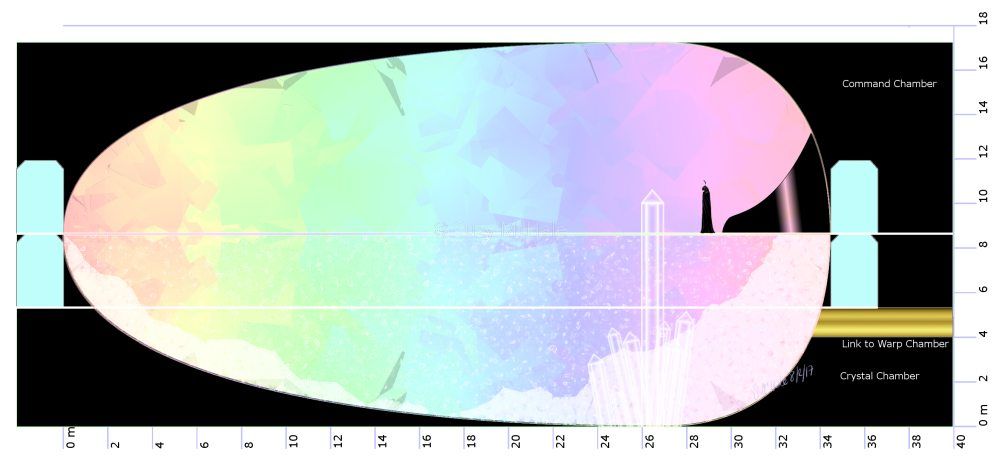
Stylized diagram of the Command Chamber, scale in meters. (9/2/2017, digital art)
Compound words
Compounding or blending words is favored to make new ones. The words most often compounded are names and titles. Word roots are compounded, then the whole new word is declined as normal. If one word ends in a consonant and the next one begins with the same consonant, or the adjoining consonants are awkward to pronounce, an interfix vowel is inserted in between the two (it has no meaning otherwise). As with verb tenses, if the vowel preceding the last consonant is a/aa or o/oo, the bridging vowel is a. If not, the vowel is e.
New words can also be created by attaching affixes onto a root word (affixation), or repetition of words or portions of words (reduplication).
Compound words that have been around for a long time may be contracted, usually losing the second syllable of the first word, and themselves serve as root words. This can be done only if the contracted compound is unique. Kinship terms tend to be shortened.
Word order: this is usually head-initial, followed by any phrase-modifying affixes. So armor, metal-skin, is nabusaahen (literally: skin [of] metal). If nouns in a compound are of equal weight – i.e. that the head can’t be clearly determined – they can go in the most convenient order.
Adjectives and adverbs follow the noun. Compounds of a noun and verb are declined as a noun; the verb may be in agent noun form (Carry to Carrier – that which carries).
To look for a word in the table below, use the “find” option in your browser (CTRL + F in Windows). Note that the word order for the English translation does not always match the Dawn Hunter word order. The words in this table are mainly nouns.
| Dawn Hunter language | English | Structure | Category |
|---|---|---|---|
| Baalosaan | personal name | Baalo [cloud] [of the – implied genitive] saan [dawn] | characters |
| Baaloyaraan | personal name | baalo [cloud] [of the – implied genitive] yaraan [storm] | characters |
| Baawebaalo | Cloud Catcher | baawe [catch – agent noun form] [of – implied genitive] baalo [clouds] | locations |
| Bahocabuun | Place/Realm of the Ancestors (equivalent of heaven, the afterlife) | baho [place, location] [of the – implied genitive] cabuun [ancestors] | locations |
| bahomoree | bed | baho [place, location] [of – implied genitive] moree [sleep] | locations |
| Behusaan | personal name | behu [mist] [of – implied genitive] saan [dawn] | characters |
| benuunaal | rainbow | benuu [arch] [of – implied genitive] naal [rain] | nature |
| bunuunmohuu | Healing Bed | bunuun [bed] [of – implied nominative] mohuu [repair, heal] | technology |
| buuranhabaa | transport (vessel) | buuran [craft, machine, vessel] [that – implied genitive] habaa [carry, transport] | technology |
| buuranhabaalole | morphcraft | buuran [craft, machine, vessel] [that – implied genitive] habaa [carry, transport] lole [change, morph] | technology |
| buuranrerewawuyu | drone | buuran [machine, vessel] rerewa [flyer – agent noun form] wuyu [alone] | technology |
| buuransebe | artificial intelligence | buuran [machine] sebe [clever, smart] | technology |
| buuransuul | engine | buuran [machine] [that – implied genitive] suul [move/s] | technology |
| buuranwasuwasu | nanotechnology, nanites | buuran [machine] wasuwasu [small, reduplicated] | technology |
| buuranzoyuu | voidcraft (spaceship) | buuran [machine] [of – implied genitive] zoyuu [void, space] | technology |
| buuranzuun | skycraft (airplane) | buuran [machine] [of the – implied genitive] zuun [air, sky] | technology |
| Caabasanaa | personal name | caaba [runner] [of the – implied genitive] sanaa [wind] | characters |
| Caamacabuun | Ancestor-Aide | caama [aide, helper, servant] [of – implied genitive] cabuun [ancestors] | ranks |
| cabuuncaale | grandfather | cabuun [ancestor] [who is] caale [male] | culture |
| cabuunwaheen | grandmother | cabuun [ancestor] [who is] waheen [female] | culture |
| casalenol | floor-quilt | casa [quilt] [of/on the – implied genitive] lenol [ground, floor] | technology |
| casazuhaa | claw-cap | casa [cover] [of/on the – implied genitive] zuhaa [claw] | technology |
| cayalcabuun | Ancestor Crystal | cayal [crystal] [of the – implied genitive] cabuun [ancestor/s] | technology |
| celecuhame | segment of day (eight segments in day) | celecu [eighth] [of – implied genitive] hame [day] | culture |
| cereslanbuuran | machine-sled | cereslan [sled] [like a – implied genitive] buuran [machine] | technology |
| ceyaacaale | brother | ceyaa [sibling] [who is] caale [male] | culture |
| ceyaacaale maacuwaheen | uncle | cayacaale [brother] [of] maacuwaheen [mother] | culture |
| ceyaahaasu | elder sibling | ceyaa [sibling] [who is] haasu [elder, older] | culture |
| ceyaamuba | younger sibling | ceyaa [sibling] [who is] muba [younger] | culture |
| ceyaawaheen | sister | cayaa [sibling] [who is] waheen [female] | culture |
| Cuucoberencuuna | Rainbow Beetle | cuuco [insect] [of] berencuuna [color-many] | fauna |
| Haaramaaze | Shadow Hunter | haara [hunter] [of/from the – implied genitive] maaze [shadows] | fauna |
| Haarlecaa | personal name | haar [warrior] [of – implied genitive] lecaa [fire] | characters |
| Haarmaarec | personal name | haar [warrior] maarec [fierce] | characters |
| Haarnahuu | personal name | haar [warrior] [of the – implied genitive] nahuu [night] | characters |
| Haarwahuzuhaanel | Warrior-Four-Claw | haar [warrior] [who is – implied genitive] zuhaa [claw] wahu [four] nel [number classifier – person] | ranks |
| Haaryaahal | Warrior-Student | haar [warrior] [who is – implied genitive] yaahal [student, one who learns] | ranks |
| Haaryaraan | personal name | haar [warrior] [of the – implied genitive] yaraan [storm] | characters |
| Haarzahuwa | Warrior-Guardian | haar [warrior] [who is – implied genitive] zahuwa [one who guards] | ranks |
| Haarzemuwa | Warrior-Assassin | haar [warrior] [who – implied genitive] zemuwa [one who hides] | ranks |
| Haarzuhaahenenel | Warrior-One-Claw | haar [warrior] zuhaa [claw] hen [one] nel [number classifier – person] | ranks |
| Haarzuhaazeyunel | Warrior-Two-Claw | haar [warrior] zuhaa [claw] zeyu [two] nel [number classifier – person] | ranks |
| Haarzuuhanamanel | Warrior-Three-Claw | haar [warrior] zuhaa [claw] nama [three] nel [number classifier – person] | ranks |
| Haarzuun | Sky Fighter | haar [fighter] [of the/belonging to – implied genitive] zuun [sky] | technology |
| Habaalanasobec, Habaalanazul | Shuttle | habaalana [carrier] [of – implied genitive] sobec [person, people] or zul [Lord] | technology |
| Habaalanzuun | Sky Carrier | habaalan [carrier] [of the/belonging to – implied genitive] zuun [sky] | technology |
| Habaalanlenol | Ground Carrier | habaalan [carrier] [of the – implied genitive] lenol [ground] | technology |
| habaalanlole | morphcraft | habaalan [carrier] [that – implied genitive] lole [changes, morphs] | technology |
| habaawacu | nanite | habaa [maker] wacu [little] | technology |
| Halecabuun | House of the Ancestors | hale [house, dwelling-place] [of – implied genitive] cabuun [ancestors] | locations |
| Halemacahana | blacksmith; forgery; place where swords are made | hale [house] [of – implied genitive] maca [strike] hana [metal] | locations |
| Halemohuu | hospital, infirmary | hale [house] [of – implied genitive] mohuu [healing] | locations |
| Halenehu | House of Surplus | hale [house] [of – implied genitive] nehu [surplus] | locations |
| Halenomaa | Mountain-building (pyramid) | hale [house] [like a ] nomaa [mountain] – Halenomaazul: Pyramid of the Lords | locations |
| Halezul | Lord’s Residence (Clan- or War Lord) | hale [house] [of the/a – implied genitive] zul [Lord] | locations |
| Hanaacehuwa | Technician-Miner | hanaa [technician] [who is – implied genitive] cehuwa [one who digs, mines] | ranks |
| Hanaamaacahana | Technician-Forger | hanaa [technician] [who is a – implied genitive] maaca [strike – agent noun form] hana [metal] | ranks |
| Hanaamaazewa | Technician-Artisan | hanaa [technician] [who is – implied genitive] maazewa [one who paints] | ranks |
| Hanaarerewa | Technician-Pilot | hanaa [technician] [who is – implied genitive] rerewa [one who flies] | ranks |
| Hanaasune | Technician-Superior | hanaa [technician] [who is – implied genitive] sune [supreme] | ranks |
| Haraanahuu | personal name | haraa [hunter] [of the – implied genitive] nahuu [night] | characters |
| Haraanoro | personal name | haraa [hunter] noro [fast] | characters |
| Haraasaan | Dawn Hunter/s | haraa [hunter/s] [of the – implied genitive] saan [dawn] | culture |
| Haraazuun | personal name | haraa [hunter] [of the – implied genitive] zuun [sky] | characters |
| harzeyu | duel | har [fight] [of – implied genitive] zeyu [two] | culture |
| Hawelecaa | Fire Tail | hawe [tail] [like – implied genitive] lecaa [fire] | fauna |
| Haweraaru | Spike Tail | hawe [tail] [that has – implied genitive] raaru [spikes] | fauna |
| Hesaabale | personal name | hesaa [sight] bale [far] | characters |
| Hesaahame | Eye of the Day (Home World’s sun) | hesaa [eye] [of the – implied genitive] hame [day] | nature |
| hesaasalamhema | equinox | hesaa [sun] salam [day] hema [even] | culture |
| hesaasalamlalo | sunset | hesaa [eye] salam [day] lalo [down] | culture |
| hesaasalamzaboh | sunrise | hesaa [eye] salam [day] zaboh [up] | culture |
| Heyananezan | Arena of Honor | heyan [arena] [of – implied genitive] -a [bridging vowel] nezan [honor] | locations |
| Holabene | Bond-Mate | hola [companion] [who is – implied genitive] bene [attached, bound] | culture |
| holazayuu | neural implant | hola [companion] [of the – implied genitive] zayuu [mind] | technology |
| Honuubaalomomolan | Blue Cloud World | honuu [world] baalo [cloud] momolan [blue] – world of clouds that are blue | locations |
| Honuubaalosuusuuzu | Gold Cloud World | honuu [world] [of/that is – implied nominative] baalo [cloud] suusuuzu [gold] | locations |
| Honuulecaa | Fire World | honuu [world] [of – implied] lecaa [fire] | locations |
| Honuusuula | Dominated World/s | honuu [world/s] [that are – implied genitive] suula [dominated] | locations |
| Huruuwuluur | Spiral Grass | huruu [grass] [that, like a – implied genitive] [spiral, twist] | flora |
| huulohaacalan | carrion | huulo [meat] [that is – implied genitive] haacalan [rotten – verbal noun form] | culture |
| Huurunonaam | Crest Grass | huuru [grass] [that is] nonaam [crest] | flora |
| Laahonhesaaso | Adept-Astronomer (literally, “Star-seer”) | laahon [Adept – one who studies] hesaawa [one who sees] so [star] | ranks |
| Laahonmaalam | Adept-Carer | laahon [Adept – one who studies] [who is – implied genitive] maalam [one who cares] | ranks |
| Laahonmohuuwa | Adept-Healer | laahon [Adept – one who studies] [who is – implied genitive] mohuuwa [one who heals] | ranks |
| Laahonsunewa | Adept-Superior | laahon [Adept – one who studies] sunewa [one who is superior] | ranks |
| Laahonyaahalraane | Adept-Biologist (literally, “Knower who studies life”) | laahon [Adept – one who studies] yaahal [one who studies] raane [life] | ranks |
| Laamohuunewa | Sword Leaf | laamo [leaf] [like a – implied genitive] huunewa [edged weapon – dagger, sword) | flora |
| Lecaaculuun | personal name | lecaa [fire] [of – implied genitive] culuun [thunder] | characters |
| lecaaso | nuclear fusion or fission | lecaa [fire] [of – implied genitive] so [star] | technology |
| Lecaaso | personal name | lecaa [fire] [of the – implied genitive] So [star/s] | characters |
| Lecaazuun | personal name | lecaa [fire] [of the – implied genitive] zuun [sky] | characters |
| loheleluunolan | syrinx | tube [of – implied genitive] speaking [verbal noun form] | body |
| Lohoncabuun | ancestor shrine | lohon [altar, shrine] [of – implied genitive] cabuun [ancestor/s] | culture |
| Lohonmolan | altar, sacrificial table/platform | lohon [altar] [of – implied genitive] molan [blood] | culture |
| Luunohaara | Hunter-speech (name for language) | luuno [speech] [of the – implied genitive] haara [Hunters] | culture |
| luunolanbale | radio | luuno [speech] [that is] bale [far] | technology |
| macozayuu | memory dimension/field/realm | maco [dimension/field/realm] [of – implied genitive] zayuu [memory] | locations |
| maacahar | war-club | maaca [hitter – agent noun form] [of – implied genitive] har [war] | technology |
| maacucaale | father | maacu [parent] caale [male]. Also used for uncle and other relatives of parents’ generation | culture |
| maacucaaleyaal | father (biological) | maacu [parent] caale [male] yaal [true] | culture |
| maacuwaheen | mother | maacu [parent] waheen [female]. Also used for aunt and other relatives of parents’ generation | culture |
| maalamlunulan | priest (literally: one who cares for the dead) | maalam [carer – agent noun form] [for the – implied genitive] lunulan [dead] | culture |
| Maazere | personal name | maaze [shadow] [of the – implied genitive] re [moon] | characters |
| Maazeyaraan | personal name | maaze [shadow] [of the – implied genitive] yaraan [storm] | characters |
| Macohale | residential district | maco [district, territory] [of – implied genitive] hale [house, housing, living] | locations |
| Macolunu | burial district | maco [district, territory] [of the – implied genitive] lunu [dead, death] | locations |
| Macomero | garden, park | maco [district, territory] [of – implied genitive] mero [plants, trees, vegetation] | locations |
| Macozela | utility/work district (factory zone) | maco [district, territory] [of – implied genitive] zela [work] | locations |
| Maralneraa | courtyard, plaza | maral [enclosed place] [that is – implied genitive] neraa [open] | locations |
| Maralrecuu | viewing room | maral [enclosed place, room] [of – implied genitive] recuu [see, view] | locations |
| Maralreesalan | Command Chamber | maral [room] [of – implied genitive] reesalan [command] | locations |
| Maralsune | Great Hall | maral [hall] sune [great, supreme] | locations |
| Maralyeerolan | Warp Chamber | maral [room] [of/where – implied genitive] yeero [bend, fold, warp] lan [derivational suffix] | locations |
| Maralzuucalan | Breeding Chamber | maral [enclosed place] [of – implied genitive] zuuca [mating] lan [derivational suffix] | locations |
| Mawalecaa | personal name | mawa [heart/s] [of – implied genitive] lecaa [fire] | characters |
| Mawamaarec | personal name | mawa [heart/s] [that is] maarec [fierce] | characters |
| mayamolan | artery, vein | may [plant root] [bridging vowel] [for] molan [blood] – i.e. vein or artery resembles a root | body |
| meculanamasu | black hole | mecu [eater – agent noun form] [of – implied genitive] masu [light] | nature |
| meculanamay | sweet potato, tuber | meculan [food] [that is] may [root] | culture |
| meculanlaamo | vegetable | meculan [food] [that is] laano [leaf] | culture |
| meelahyoora | land creature | meela [creature] [of the – implied genitive] yoora [earth, land] | fauna |
| meelazumaah | sea creature | meela [creature] [of the – implied genitive] zuumah [ocean, sea] | fauna |
| meelazuun | sky (flying, winged) creature | meela [creature] [of the – implied genitive] zuun [sky] | fauna |
| mehar | weapon | me [implement, thing] [of – implied genitive] har [war] | technology |
| meharculuun | gun | mehar [weapon] [of – implied genitive] culuun [thunder] | technology |
| meharculuun | projectile weapon | mehar [weapon] [of – implied genitive] culuun [thunder] | technology |
| Merolecaa | Fire Tree | mero [tree] [like, of – implied genitive] lecaa [fire] | flora |
| Meromoree | Sleep Flower | mero [plant, vegetation] [that gives – implied genitive] moree [sleep] | flora |
| Merosaan | Dawn Tree | mero [tree] [of the – implied genitive] saan [dawn] | flora |
| Merosoon | Finger Tree | mero [tree] [that is like a – implied genitive] soon [digit, finger] | flora |
| Meroyaanmomolaan | Blue Tongue | mero [plant, vegetation] [like a – implied genitive] yaan [tongue] momolaan [blue] | flora |
| Meroyuucu | Dome Tree | mero [tree] [that is a – implied genitive] yuucu [dome] | flora |
| Merozuun | Sky Tree | mero [tree] [of the – implied genitive] zuun [sky] | flora |
| Meyhesaahame | Gate of the Eye of the Day/sun | mey [entrance, gate, portal] [of the – implied genitive] Hesaahame [Eye of the Day/sun] | locations |
| Meyrebebehu | Gate of Grey Moon | mey [entrance, gate, portal] [of – implied genitive] Rebebehu [Grey Moon] | locations |
| Meyrelelecaa | Gate of Red Moon | mey [entrance, gate, portal] [of – implied genitive] Relelecaa [Red Moon] | locations |
| Meyrereca | Gate of Ice Moon | mey [entrance, gate, portal] [of – implied genitive] Rereca [Ice Moon] | locations |
| mezayuu | computer | me [implement, thing] [of – implied genitive] [thought] | technology |
| mezela | tool | me [implement, thing] [of – implied genitive] zela [work] | technology |
| moreezamaa | Cold Sleep | moree [Sleep] [of/that is – implied nominative] zamaa [cold] | technology |
| Mozeyuyuzuu | Silver Fish | moze [fish, sea creature] [of, like – implied genitive] yuyuzuu [silver] | fauna |
| munolole | morphcloth | muno [cloth] [that – implied genitive] lole [change, morph] | technology |
| munonol | banner, flag | muno (cloth) [of/with – implied genitive] nol (emblem, symbol) | culture |
| Muyumeculan | edible rice-like seed or grain | muyu (seed) [that is] mecu [edible, noun form] – eating seed; Meromumeclan – eating-seed-plant, or Huruumumeclan – eating-seed-grass | flora |
| nabumero | bark | nabu [skin] [of – implied genitive] mero [tree] | flora |
| nabuhar | armor | nabu [skin][of – implied genitive] har [war] | technology |
| nabuharluula | armor, traditional | nabu [skin used in] har [war, to fight] [that is] luula [traditional] | technology |
| nabusaahen | armor | nabu [skin][of – implied genitive] saahen [metal] | technology |
| nabuzahu | armor | nabu [skin][that – implied genitive] zahu [protects] | technology |
| naheelbulu | rainforest | forest [that is – implied genitive] wet | flora |
| Narasahelnahuu | Night River Clan | nara [clan] [of the – implied genitive] sahel [river] [of the – implied genitive] nahuu [night] | culture |
| Narawaa Sahelnahuu | Night River Clan | narawaa [clan – genitive] sahel [river] [of the – implied genitive] nahuu [night] | culture |
| Narawaa Hesaayarewo | Burning Eye Clan | narawaa [clan – genitive] hesaa [eye] yare [burn] -wo [nominative] | clans |
| Narawaa Nomaalecaawo | Fire Mountain Clan | narawaa [clan – genitive] nomaa [mountain] [of – implied genitive] lecaa [fire] -wo [nominative] | clans |
| Narawaa Rebenuuwo | Crescent Moon Clan | narawaa [clan – genitive] re [moon/s] [that is a] benuu [crescent] -wo [nominative] | clans |
| Narawaa Renamawo | Three Moons Clan | narawaa [clan – genitive] re [moon/s] [that are] nama [three] -wo [nominative] | clans |
| Narawaa Sahelnahuuwo | Night River Clan | narawaa [clan – genitive] sahel [river] nahuu [night] -wo [nominative] | clans |
| Narawaa Sahelnorowo | Swift River Clan | narawaa [clan – genitive] sahel [river] [that is – implied genitive] noro [fast, swift] -wo [nominative] | clans |
| Narawaa Sanaalecaawo | Fire Wind Clan | narawaa [clan – genitive] sanaa [wind] [of – implied genitive] lecaa [fire] -wo [nominative] | clans |
| Narawaa Sosaano | Dawn Star Clan | narawaa [clan – genitive] so [star] [of the – implied genitive] saan [dawn] -wo [nominative] | clans |
| Narawaa Sosaanwo | Endless Plains Clan | narawaa [clan – genitive] so [star] [of the – implied genitive] saan [dawn] -wo [nominative] | clans |
| Narawaa Zumaahsanaawo | Ocean Wind Clan | narawaa [clan – genitive] zumaah [ocean] [that is – implied genitive] sanaa [wind(y)] -wo [nominative] | clans |
| Nawelnara | Clan City | nawel [city] [of – implied genitive] nara [clan] | culture |
| Nawelzoyuu | Void Station | nawel [city, settlement] [of – implied genitive] zoyuu [void] | locations |
| Nayochar | Battle Master | nayoc [master] [of – implied genitive] har [war/fight] | ranks |
| Nayoczaawezoyuu | Ship Master | nayo [master] [of – implied genitive] zaawezoyuu [Void-Walker] | ranks |
| nenemawa | heartsbeat; second; time measurement | nene [beat] [of – implied genitive] mawa [hearts] | culture |
| nobolorelan | surrender | nobo [throat] lorewa [baring, exposing – verbal noun form] | culture |
| nomaalecaa | volcano | nomaa [mountain] [of – implied genitive] lecaa [fire] | nature |
| Nomaamomolan | Blue Mountains | nomaa [mountain] momolan [blue] | locations |
| Nomaasayananuural | Backbone Mountains | nomaa [mountain] sayananuural [backbone, spine] | locations |
| Noosasaancuuna | Dawn Islands | noosa [Island] [of – implied genitive] saan [dawn] cuuna [many/plural] | locations |
| Nulunbuuranrerewa | aircraft shelter | nulun [house] [of – implied genitive] zele [machine] rere [fly] wa [agent noun form] | locations |
| nuneecaale | son (also applies to nieces and nephews) | nunee [offspring] caale [male] | culture |
| nuneecuuna | descendants | nunee [offspring/children] cuuna [many] | culture |
| nuneewaheen | daughter (also applies to nieces and nephews) | nunee [offspring] waheen [female]) | culture |
| Nuneeyoora | the people | nunee [offspring/children] [of – implied genitive] yoora [land, earth] | culture |
| Rebebehulewo | Grey Moon | re [moon] [that is – implied] bebehule [grey-be] -wo [nominative] | locations |
| recawumar | crystal, gem | reca [ice] [that is – implied] wumar [stone] (name given by ancients) | nature |
| reesawan | self-control | reesa [control] [of – implied genitive] wan [I, me, my, mine] | culture |
| Relelecaa | Red Moon | Re [Moon] [of/that is – implied nominative] lelecaa [fire/red color] | locations |
| Renahuu | personal name | re [moon] [of the – implied genitive] nahuu [night] F | characters |
| Rereca | Ice Moon | re [moon] [of/that is – implied nominative] reca [ice] | locations |
| Rerelanzuun | Sky Flyer | rerelan [flyer] [of the/belonging to – implied genitive] zuun [sky] | technology |
| Rerewawumar | Rock Jumper | rere [jump] -wa [agent noun suffix] wumar (rock) | fauna |
| Resaan | personal name | re [moon] [of the – implied genitive] saan [dawn] F | characters |
| Rohuulaahaar | Warrior Caste | Rohuul [Caste] [of – implied genitive] haar [warrior] | culture |
| Rohuulelaahon | Adept Caste | rohuul [Caste] [bridging vowel] [of – implied genitive] laahon [adept] | culture |
| Rohuulhaan | technician Caste | rohuul [Caste] [of – implied genitive] haan [technician] | culture |
| rolunlaasan | gravity | rolun [force] [that is] laasan [heavy] | technology |
| Runaacabuun | ancestor trail/s (similar to songlines; also used metaphorically to refer to family trees) | runaa [trail/s] [of] cabuun [ancestor/s] | culture |
| Runaahaar | Warrior Path | runaa [path, way] [of the – implied genitive] haar [warrior] | culture |
| Runaamayamolan | artery road – main road through a Clan-City | runaa [path, way] [like/of] may [root] a [bridging vowel] molan [blood] | culture |
| runaasaahenzuun | train tracks | runaa [trail, road] [of – implied genitive] saahenzuun [iron] | technology |
| saacelananabu | clothing | saacelan [cover] [of – implied genitive] a [bridging vowel] nabu [skin] | technology |
| saacelanhale | roof | saacelan [cover] [of – implied genitive] hale [house] | technology |
| saacelanhasa | loincloth | saacelan [covering] [of – implied genitive] hasa [waist] | technology |
| saacelanmaral | ceiling | saacelan [cover] [of – implied genitive] maral [room] | technology |
| saacelanawawe | pants, trousers | saacelan [covering – verbal noun form] a [bridging vowel] [of – implied genitive] wawe [leg] | technology |
| saahenhucewahu | magnet | saahen [metal] [that] huce [push] wahu [pull] | technology |
| saahenlaasan | lead | saahen [metal] [that is] laasan [heavy] | nature |
| saahenlelecaa | gold | saahen [metal] [that is] lelecaa [fire/yellow-color] | nature |
| saahenlelecaahaalo | copper | saahen [metal] [that is] lelecaa [fire/yellow-color] haalo [dark] | nature |
| saahenlole | morph-metal | saahen [metal] [that] lole [changes, morphs] | technology |
| saahensaansaan | silver | saahen [metal] [that is] saansaan [white] | nature |
| saahenso | meteoric iron | saahen [metal] [of – implied genitive] so [star] – so-called as meteors were an early source of iron | nature |
| saahenzuun | meteoric iron | saahen [metal] [of – implied genitive] zuun [sky] – so-called as meteors were an early source of iron | nature |
| saraabuuran | machine-egg | saraa [egg] [like a, resembling – implied genitive] buuran [machine] | technology |
| Saawubenuu | Crescent Horn | saawu [horn] benuu [crescent] | fauna |
| Saazacuway | Time of Exile | saaza [time] [of – implied genitive] cuway [exile] | culture |
| saazanaal | rainy season | saaza [time] [of – implied genitive] naal [rain] | culture |
| saazawome mana | when? | saaza [time] wo [nominative case] me [interrogative] mana [what] | culture |
| salamamee, salamnolam | solstice | salam [day] [bridging vowel] mee [long]; salam [day] short [nolam] | culture |
| samoobem | saliva | samoo [water] [of] bem [mouth] | body |
| Sanaanoro | personal name | sanaa [wind] [that is] noro [fast] | characters |
| Sanaaso | personal name | sanaa [wind] [of the – implied genitive] so [star] | characters |
| Sanaayaraan | personal name | sanaa [wind] [of the – implied genitive] yaraan [storm] | characters |
| Sanaazuun | personal name | sanaa [wind] [of the – implied genitive] zuun [sky] | characters |
| habaalanasaraa | pregnant | habaalana [carrier] [of an – implied genitive] saraa [egg] – alternately, habaalana [carrier] [of – implied genitive] nunee [offspring] | body |
| sayananuural | backbone, spine | sayan [bone] [bridging vowel] nuural [back] | body |
| Seenazuhaanama | Three Claw Bay | seena [bay] [like a – implied nominative] zuhaa [three] nama [claw] | locations |
| Sohaar | personal name | so [star] [of the] haar [Warrior/s] | characters |
| Soharaa | personal name | So [star] [of the] haraa [hunter/s] | characters |
| Solecaa | personal name | so [star] [of – implied genitive] lecaa [fire] | characters |
| sonorolan | planet | so [star] norolan [moving – verbal noun form] | nature |
| sorereewaa | star-flyer (small spaceship) | so [star] rereewaa [flyer – agent noun form] | technology |
| Sosaan | personal name | so [star] [of the – implied genitive] saan [dawn] | characters |
| Sosaanamaaze | Shadow Wing | sosaan [wing] [like, of – implied genitive] maaze [shadow] | fauna |
| Sosaananaaruu | Bright Wing | Sosaan [wing] [that is – implied genitive] naaruu [bright] | fauna |
| Sosaanzoluuh | Cloak Fin | sosaan [fin, wing] zoluuh [cloak] | fauna |
| Sosaanzoyuu | Void Fin | sosaan [fin, wing] [of the – implied genitive] zoyuu [void] | fauna |
| sozulam | sun (generic term) | so [star] [of the – implied genitive] zulam [day] | nature |
| suuculuunulan | funerary urn | suucu [box, casket, container, urn] [for the – implied genitive] luunulan [dead] | culture |
| suucusaamer | weapons cabinet | suucu [box, casket, container] [for – implied genitive] saamer [blades] | technology |
| waacuzayuu | data storage device | waacu [collect – agent noun form] [of – implied genitive] zayuu [memory] | technology |
| Waalecoora | Long Divide | waale [division, gap, ravine, valley] [that is -- implied genitive] coora [long, tall] | locations |
| Waanrelelecaa | Red Moon Cycle (week equvalent – 8 HW days) | waan [cycle] [of – implied genitive] relelecaa [Red Moon] | culture |
| Wacehasuulanacuuna | Council of Elders | wace [Council] [of – implied nominative] hasuulan [Elder] a [bridging vowel] cuuna [many affix] | culture |
| Wacelunuhuucuuna | Council of Immortals | wace [Council] [of – implied nominative] lunu [dead] huu [negative particle] cuuna [many affix] | culture |
| wawelecuwacu | insect | wawe [leg] lecu [8] wacu [little] | fauna |
| wumaralecaa | igneous rock | wumar [rock] [of/from – implied genitive] a [bridging vowel] lecaa [fire] | nature |
| wumarahahu | sedimentary rock | wumar [rock] [of/from – implied genitive] a [bridging vowel] hahu [layer] | nature |
| wumaralole | metamorphic rock | wumar [rock] [of/from – implied genitive] a [bridging vowel] lole [change, transform] | nature |
| wumaranaaruu | crystal, gemstone, glass | wumar [stone] naaruu [clear, bright, transparent] – used for crystals and gemstones | nature |
| wumarasaraa | geode | wumar [rock] a [bridging vowel] [like an] saraa [egg] | nature |
| wumarayero | semi-precious stone | wumar [rock] [that is] a [bridging vowel] yero [color] | nature |
| wumarazuul | meteor, meteorite | wumar [rock] [of/from the – implied genitive] zuul [sky] | nature |
| wuncehu | mine | wun [pit] cehu [dig] | technology |
| wunyu | nostril | wunyu – wun [hole] [of – implied genitive] yu [nose] | body |
| Yaraananahuu | personal name | yaraan [storm] [of – implied genitive] nahuu [night] | characters |
| Yaraanlecaa | personal name | yaraan [storm] [of – implied genitive] lecaa [fire] | characters |
| yaranrowan | cyclone, hurricane | yaran [storm] [that is a] rowan [circle] | nature |
| yeerosezu | elbow | yeero [bend] [of – implied genitive] sezu [arm] | body |
| yeerowalu | wrist | yeero [bend] [of – implied genitive] walu [hand] | body |
| yeerowawe | knee | yeero [bend] [of – implied genitive] wawe [leg] | body |
| yolawalu | square | yola [side] [of – implied genitive] walu [four] | culture |
| Yoorazuulnulun | Home World | yoora [Land] zuul [sky] [that is – implied genitive] nulun [home] | locations |
| yoorazuun | world (applies to planets generally) | yoora [land] zuul [sky] | culture |
| yuumlanzayuu | insane, mad | yuum [lose, so loss] lan [noun affix] [of – implied genitive] zayuu [thought] | culture |
| Zaabenhazaranu | Endless Plains | zaaben [Plain] haza [end] ranu [not] | locations |
| Zaahucabuun | Ancestor-Guardian | zaahu [one who guards – guardian] [of – implied genitive] cabuun [ancestors] | ranks |
| Zaawezoyuu | Void Walker (starship) | zaawe [walker – agent noun form] [of the – implied genitive] zoyuu [void] | technology |
| Zaahumero | gardener | zaahu [one who guards, caretaker, guardian] [of – implied genitive] mero [flora] | ranks |
| zahuulansanaa | folding screen | zahuulan [shield, noun form] sanaa [wind] | culture |
| zelamaaca | war-club | zela [tool, utensil] [of – implied genitive] maaca [hitting – agent noun form] | technology |
| zolabaasu | bronze | zola [copper] baasu [tin] | nature |
| zoluuhehar | war cloak | zoluuh [cloak] e [bridging vowel] [of – implied genitive] har [war] | technology |
| zoluuhesezu | floor-length jacket similar to a kimono with wide sleeves | cahuu [clothing] e [bridging vowel] [with] sezu [arm] | technology |
| zoyuucaala | space, universe | zoyuu [void] [that is] caala [big] | nature |
| zucaasuula | rape | mating [that is] forced, dominant, of one indivdual overpowering another | culture |
| zuhaamee | sword | zuhaa [claw] [that is] mee [long] | technology |
| zuhaanolam | dagger | zuhaa [claw] [that is] nolam [short] | technology |
| zulamamaale | tomorrow | zulam [day] a [bridging vowel] maal [next] e [dative] | culture |
| zulamzalaye | yesterday | zumalm [day] zala [previous] y [bridging consonant] e [dative] | culture |
| Zulhaar | War Lord | zul [Lord] [of – implied genitive] haar [warrior(s)] | ranks |
| Zulnara | Clan Lord | zul [lord] [of – implied genitive] nara [clan] | ranks |
| Zulnehu | Regent Lord | zul [Lord] [who is – implied genitive] nehu [extra, spare] | ranks |
| Zulsune | Supreme Lord | zul [Lord] [who is – implied genitive] sune [great, supreme] | ranks |
| Zumaahcesal | Sea of Sand | zumaah [ocean] [of – implied genitive] cesal [sand] | locations |
| Zumaahyaran | Ocean of Storms/Stormy Ocean | zumaah [ocean] [of – implied genitive] yaran [storms] | locations |
| Zuunsaan | personal name | zuun [sky] [of – implied genitive] saan [dawn] | characters |
Updated: 21/1/2017
Council of Elders
The Council of Elders (Wacehasuulanacuuna) is a meeting of a Clan City’s Clan Lord and War Lords, and male and female Elders from the other Castesto discuss various issues pertaining to their City and its inhabitants. They usually meet once every Red Moon Cycle (eight days) in the same building as the Arena of Honor, but in a smaller hall adjacent to it. This has a patterned stone floor of eight bodylengths (17.28 m) diameter surrounded by a low dais where those meeting are seated on floor-quilts; its atmosphere is more intimate and not as intimidating as that of the Arena. One side has a tall stained glass window between which clan bannersare hung.
Council of Immortals
The Council of Immortals (Wacelunuhuucuuna) is a meeting of the eight Clan Lords, including the Supreme Lord. They sit around the octagonal Arena of Honorin separate alcoves, along with their entourages.
Crescent Horn
A Crescent Horn (Saawubenuu) is a numerous quadruped herbivore of Home World, a little smaller than a Spike Tail. Its skin over its upper body has iridescent blue and green stripes or patches, but otherwise follows the standard pattern of black skin for males, grey for females. The male has two flattened horns that curve back and up, the design inspiration for the Clan Lord’s helmet crest. Males stand up to 150 cm at the shoulder and weigh up to 500 kg. It is a prey favorite.
Gallery
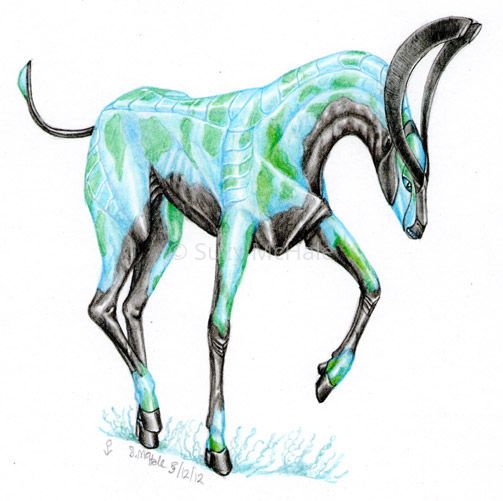
Male Crescent Horn (colored pencils, 3/12/2012).
Crescent Moon Clan
The Crescent Moon Clan (Narawaa Rebenuuwo) is a sub-Clan residing in Night River Clan City.
Data

- Burial armor gemstone
- Blue Chrysocolla
- Clan emblem
- Crescent moon/s
- Color
- Blue-green (#004c68/rgb(0,76,104))
- War Lord mentioned
- Yaraananahuu
Crest Grass
Crest Grass (Huruunonaam) is a magenta-colored, grass-like plant with an edible juicy blue seed-tip that resembles a Dawn Hunter’s crest quills. Like other vegetation, it has a metallic sheen and resembles wire strands. It spreads via rhizomes – sending roots along the ground from which new foliage grows, and helps anchor the soil. It is the major ground cover plant on Home World, and to a human’s eyes the plains there would appear drenched in blood. When reflecting UV light from the sun, it appears more purplish to the Hunters.
Gallery
Crest Grass (digital art, 21/7/2013).
Darius Tyler
Darius Tyler is a secretive American multi-billionaire entrepreneur. He has an obsession with spaceflight and, ultimately, finding and contacting alien life. He is the catalyst for the mission to go see the mysterious large artificial object discovered in Mars orbit, initiating this by persuading Russian space agencies to build his private spacecraft and hiring a cosmonaut to fly it.
In appearance, he is nice-looking but wouldn’t stand out in a crowd (i.e. is not model-quality handsome). He is well-groomed and tends to dress conservatively and in discretely expensive clothing.
In personality he is impatient, confident – even arrogant –and determined to get what he wants. He is reticent and prefers to keep a low profile, particularly since he has become immensely wealthy. He has little use for trinkets such as multiple international mansions or yachts, preferring to direct his wealth toward his obsessions (spaceships and – hopefully! – contacting aliens).
Biographical information
- Born
- 1972
- Eyes
- Blue
- Hair
- Brown
- Height
- 6 feet (183 cm/1.8 m)
- Physique
- Slim
- Skin
- White/tanned
- Weight
- 74 kg (BMI of 22)
Gallery
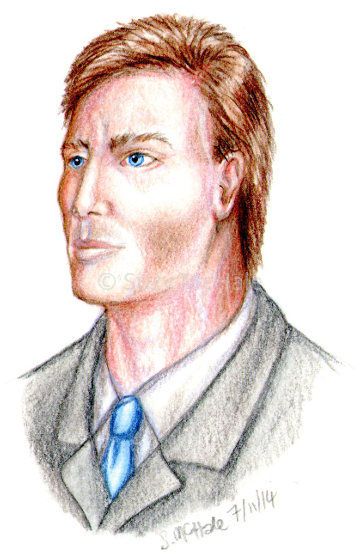
Darius Tyler (colored pencils, 6/11/2014).
Data storage
After thousands of years of a stable civilization, the Dawn Hunters have by now accumulated huge amounts of data; this is stored holographically in crystalline matrices, usually of laser-etched quartz [1] that will last for at least a million years.
Each Hunter has a personal memory-collector (Waacuzayuu) which is removed after death (it is part of the neural implant) and stored with them. This stores visual memories, recorded via the optical nerves rather like a video camera at the user’s initiation, and internal thoughts specifically recorded for the implant. A copy is added to their history archives maintained on one of Home World’s moons, Red Moon (the middle moon), which has a stable environment. Clan Lords also have a copy buried with them in their tombs on Grey Moon. They have also made backup copies for storage on uninhabited worlds in other star systems of their Dominion, as well as in the other-dimensional macozayuu, memory field.
This is not quite the same concept as uploading an entire mind – namely, separating mind from body, which is physiologically impossible; however, the thoughts and memories recorded do retain a good impression of the uploader’s personality.
To display data, holograms are used, relayed through Relay-Nanites embedded in walls and portable softscreens. These nanites act like photophores and chromatophores in marine animals, emitting light and color when programmed. The screens can also emulate textures. The flexible softscreens are made of a thin sheet of transparent graphene and come in a size in between A4 and A3 paper sizes. They can be folded or rolled up into a compact form. They run on a nanobattery, and are charged either with inbuilt solar cells, wirelessly, or by cord from an external power source.
Writing and drawing on traditional media is still practiced also; the materials used are derived from various plants.
Footnotes
- [1]
- http://news.cnet.com/8301-17938_105-57593154-1/a-360tb-disc-that-holds-data-for-more-than-1-million-years/?ttag=fbwp
Dawn Hunter
Overview
- Average height
- 2.1 m (males); 1.8 m (females)
- Average lifespan
- Up to 130 years (Earth-equivalent)
- Average weight
- 130 kg (males); 100 kg (females)
- Distinctions
- Bipedal sapient predator; blue blood; head crest; iridescent skin; nictitating membranes; sharp teeth and claws; two hearts
- Eye color
- Varies – pure shades of orange, green, blue or purple
- Feeding ecology
- Mesocarnivores (50-70% meat in diet)
- Skin color
- Black (males); grey (females)
The Dawn Hunters (Haarasaan) are the apex and sapient predators of Home World.
Physiology
The Dawn Hunters are a bipedal and bilaterally symmetrical race. They evolved from a nomadic, mostly predatory species that ran after prey, so they are built to run fast, up to 50-60 km/h speed (in comparison a human Olympic sprinter can reach 48 km/h). Their physiology has some characteristics of mammals (endothermic, warm-blooded) and reptiles (egg-layers). They move with athletic grace; they are not lumbering or clumsy.
Their average height is taller than that of humans, males standing an average of 7 feet/2.1 meters, with a height limit of 7 feet 6 inches/2.28 meters. They weigh up to 150 kg/330.7 lb for an adult Warrior Caste male (in Earth gravity). Their physique is lean, sinewy and muscular, with a broad chest and shoulders tapering to a narrow waist. The chest is more angled forward, similar to the prow of a ship. Females are smaller, averaging 6 feet/1.8 m, weigh less and are more gracile, their bodies not so angular. Though they look rather emaciated (there are no overweight Hunters!), both sexes are stronger than a human as their bone and muscular structure is denser due to the slightly-higher gravity of their planet (1.1 times Earth gravity).
Skin

The Hunters are sexually dichromatic: males have coal-black skin and females have grey skin (hex color: #7f7f7f – but this can vary a little either way between individuals from #aaato #555, and the greys are neutral in tone). Skin coloring on an individual is solid – no markings – and does not vary in tone. The coloring comes from a melanin-like pigment that dilutes from black to grey. The skin has the texture of suede on softer areas such as the abdomen, and glossy leather on upper parts; it does not have oil or sweat glands so it is always dry and pleasant to touch. They have virtually no body odor; just a faint scent of cinnamon. (They would likely find humans offensively stinky!) [1] As with other creatures on Home World, they do not have body hair, fur or feathers – and no subcutaneous fat.
The skin has an iridescent sheen that matches their eye color. This is more visible on their heads, upper shoulders, chests and backs, which have a thicker layer merging into the softer skin elsewhere. The iridescence is not pigment but a molecular arrangement (photonic nanostructures) that reflects light. Such iridescence is a notable feature of animal and plant life on Home World, aiding in protection against their star’s stronger radiation as well as being an attractive display. The metallic iridescence gives the skin an illusion of layered depth, like opalescent glass. (The feathers of the all-black Ayam Cemani chicken have a similar iridescent sheen.)
Internal organs
They have two hearts, needed for extra strength to pump the blood around their bodies against the higher gravity, arranged either side of their single lung, which is in the middle of their chest. Their blood contains hemocyanin; oxygenated blood is blue, unoxygenated clear, though the latter turns blue if exposed to air. Hemocyanin, however, is only about one-quarter as efficient an oxygen carrier as hemoglobin, though Home World has a higher oxygen content than Earth which helps compensate for this, and their form of hemocyanin has mutated over their evolution to become more efficient.
Their respiratory system is also very efficient, storing oxygen in supplementary air sacs in a manner similar to birds, allowing a constant one-way airflow through the lung. As they don’t sweat, this system also helps them shed heat – the air sacs evaporate water internally during vigorous activity. The air sacs are located in the chest cavity under their rib cage, surrounding their hearts and giving these some protection.
Internal organs are generally similar to a human’s, with circulatory, respiratory and nervous systems, and a digestive tract. Reproductive and waste organs are similar to those of birds, reptiles and dinosaurs (i.e. internal). An organ where the spleen would be is used to store energy in a similar manner to fat in a human – they do not have adipose tissue.
They do not have a larynx like humans do. They speak via a syrinx like a bird has (membranes down near the branching of the lungs – or lung in the Hunters’ case). This, and their thick, pointed blue tongue, means that the Hunters can imitate human and other aliens’ speech reasonably well (but they don’t sing). Their voice has a subtle infrasonic or flanging effect (an audio effect where two identical sounds are slightly out-of-synchronization).
The trachea extends from the nasal cavity over the esophagus rather than under, with a small opening to the rear of the roof of the mouth to enable vocalization. This opening seals off automatically with a structure similar to an epiglottis when swallowing to avoid choking.
Musculoskeletal system
They evolved from quadruped plains-dwellers, their habit of standing upright to spot prey in the distance eventually leading to bipedalism, which also freed their arms for manipulation and tool use. Unlike a human’s legs, theirs are digitigrade, similar to those of the lightweight bipedal meat-eating dinosaurs or birds such as ostriches – though a Hunter’s torso is held vertical like a human’s, not horizontal. The tarsals are fused and lengthened – forming the tarsometatarsus bone (third segment) – so that they essentially walk on lengthened toes, and the second leg joint is the ankle (usually referred to as the hock for animals with such legs). The toes are more joined-together like a human’s – but more prehensile – and end in non-retractable talons. Muscles are concentrated in the upper part of the leg – thighs and calves. This leg structure enables them to run faster than a human, who has plantigrade legs. They don’t have tails.
The leg bones are in an approximate ratio of 2/3:½:1/3 (divide length by one-half, then the remaining half by 3), with the middle shin bone the longest, followed by the thigh bone.
Their arms are similar to those of humans; their long bony tetradactylic hands have 4 digits (3 fingers and 1 opposable thumb) and end in claws. These need to be trimmed every so often as they keep growing. Claw-caps may be worn over each claw if the wearer wishes to keep the ends sharp (such as for combat or hunting). The genetically-enhanced Warrior Caste have longer claws than the other two. Like humans they have handedness; all are right-handed.
Their skeleton is generally similar in structure to that of Earth creatures, though the ribcage is more lattice-like and their neck has 8 vertebrae. The chest has a prominent keel-shaped sternum. Their hips have a prominent iliac crest. Their bones are denser and stronger than those of humans due to the higher gravity on Home World.
Senses
The Hunters have excellent distance vision (“prey-vision”), comparable to a hawk’s (20/2), and is the main sense they rely on; they have binocular forward-facing eyes, a bit wider-set than a human’s. The iris is a slit shape in the form of an elongated diamond; this can close up more than a round pupil and helps protect against bright sunlight. Like humans, they see best during the day. A pigmented pecten oculi similar to a bird’s ensures blood vessels don’t block the retina (they have no blind spot), and provides protection against UV light.
They have tetrachromatic vision: 4 receptors (blue, red, green and near-ultraviolet receptor cones) rather than the 3 humans have (blue, red and green cones – trichromatic). The UV receptor can detect up to 350 nanometers in the near-UV (UVA) – normal human vision spans 390-750. They would thus see additional colors to humans – the visible colors, as well as combinations of ultraviolet mixed with these. They can also see polarized light.

A translucent nictitating membrane protects the eyes from dust and excessive light, as well as two outer eyelids that close over this. A bony sclerotic ring surrounds the eyeball. The sclera of the eye is black, but this doesn’t normally show much, unlike the white of a human eye. Their eye color is notably bright and iridescent in the way the wings of a Morpho butterfly are – like their skin iridescence, eye color is structural rather than pigmented. Color varies between individuals; various pure shades of purple, blue or green are typical, orange an less common mutation, and amber-gold even rarer. Eye color is a single color for an individual, and provides a main way of identifying them.
The gradient background below (in svg format) gives an example of the range of eye colors.
Their hearing and sense of smell are a little more acute than a human’s, but these senses are not as important to them as sight. They have ear-holes similar to a reptile’s, but not ears (pinna). These are partly covered by a flap of skin for protection.
Head and face
Their face is not easily comparable to any Earth animal’s; it has feline, reptilian, avian and humanoid influences. They do not have a prominent nose, giving their heads a streamlined appearance; the profile is convex, almost a muzzle. The face is covered with thicker skin, is semi-rigid and shows little expression. The nose is flat, merged with the face and tapers in a v-shape toward the mouth like a cat’s; it does not have a rhinarium. Patterns of layered skin or grooves on their face give it a stylized appearance, including two “tear marking” lines like a cheetah’s that run from eyes to mouth. The face generally has an angular, rather faceted and stylized appearance, with pronounced high cheekbones.
Males have an angular jaw while that of females is rounded. The mandible has prominent vertical ridges that end in a point on either side of the chin. The skin over these fades to grey in extreme old age.
They have sharp carnivorous black teeth at the front of their mouth and flatter molars at the back (heterodont dentition); the gums and tongue are also black. In tooth growth they are polyphyodonts – new teeth are stimulated to grow and replace any that are damaged or removed; this continues through a Hunter’s lifetime, though the process slows down in old age. They do not have bacteria that causes tooth decay, so are unaffected by this (sugars are the equivalent of sugar alcohols and are not digestible).
Flat overlapping segments extend from between the eyes, along the top of the head and taper down the back. Eight quills extending from the points of the head segments form a crest along the top of their head, which can be raised or lowered. Each quill has a flattened oval spatulate tip that matches their eye color (the quills look similar to those of the Parotia or King birds of paradise, or a peacock’s crest); these can regrow if broken off. Length is considered attractive in males. The quills, along with body posture, help to express emotions:
- Fully upright: surprise, alarm, anger, intimidation, display
- Half-upright: relaxed, interested
- Flattened: submission, anxiety
- Drooping to one side: sadness, depression, illness
Their brain is a little smaller than a human’s, about 2⁄3 the size, and elongated, with the forebrain arranged in rows of parallel folds. There is an area of dense brain tissue similar to a bird’s wulst, analogous to a human’s neocortex; this enables intelligence without excessive brain size.[2] Their head is flatter on top, a little elongated and has no indent at the base of the skull; it merges smoothly with the neck.
As well as speech, they make a variety of vocalizations include hissing to express anger and a churring sound to reassure hatchlings. Male voices generally sound somewhat like the Sangheili in the Prologue: Jul ’Mdama Halo 4 terminal cutscene – low and harsh – and have a subtle flanging effect. Those of females are a bit higher-pitched, similar to human females.
Biochemistry
Similar to Earth’s lifeforms, the Hunters are carbon-based and oxygen-breathing life-forms whose remote ancestors evolved in and emerged from water. Their DNA equivalent has six nucleobases rather than the four of Earth lifeforms, and their amino acids (which form proteins) are different from those of Earth’s life.
As with the other current lifeforms on Home World, their blood contains hemocyanin; oxygenated blood is blue, unoxygenated clear, though the latter turns blue if exposed to air. Hemocyanin, however, is only about one-quarter as efficient an oxygen carrier as hemoglobin – the lifeforms on their world evolved during a period when the climate was cooler and there was less oxygen. Their form of hemocyanin has consequently mutated over the succeeding millenia to become more efficient,[3] having a ring of 512 molecules. Hemocyanin provides antiviral, anti-aging and anti-cancer properties, enabling the Hunters to naturally have a longer lifespan – up to 130 human years equivalent or more.
Their muscles are blue-grey, colored by a copper-based storage molecule.[4]
Diet
They are omnivorous predators, with a preference for meat – it is a necessary part of their diet. They prefer to cook their food.
Their eating habits follow a predator’s feast and famine pattern: they eat a large amount after a successful hunt, then eat very little until the next hunt two or three days later.
Personality
The Hunters in some ways operate on a more instinctual level than humans. They are creatures of habit, following the same rituals and traditions that have sustained their society for thousands of years. They can be rigid in their thinking and slow to adapt, only altering behaviors after much consideration. They do not change merely for novelty’s sake, and thus have no concept of fads and fashions.
They tend to be pragmatic in nature. Their philosophical outlook would be closest to that of East Asian religions, particularly Confucianismas family and social harmony are highly important to them.
They don’t laugh and don’t have a sense of humor.
Self-discipline and -control are emphasized as their claws and sharp teeth can be lethal, so those who lack self-control are regarded with disdain.
Name
The main name they use for themselves is Haarasaan – haara [hunter/s] [of the – implied genitive] saan [dawn]. As they are predators, hunting and fighting are intrinsic parts of their psyche and culture.
They can also refer to themselves as Nuneeyoora – nunee [children] [of the – implied genitive] yoora [land].
They also have a term equivalent to “people” – namely, sapient beings (as opposed to animals): sobec.
Gallery
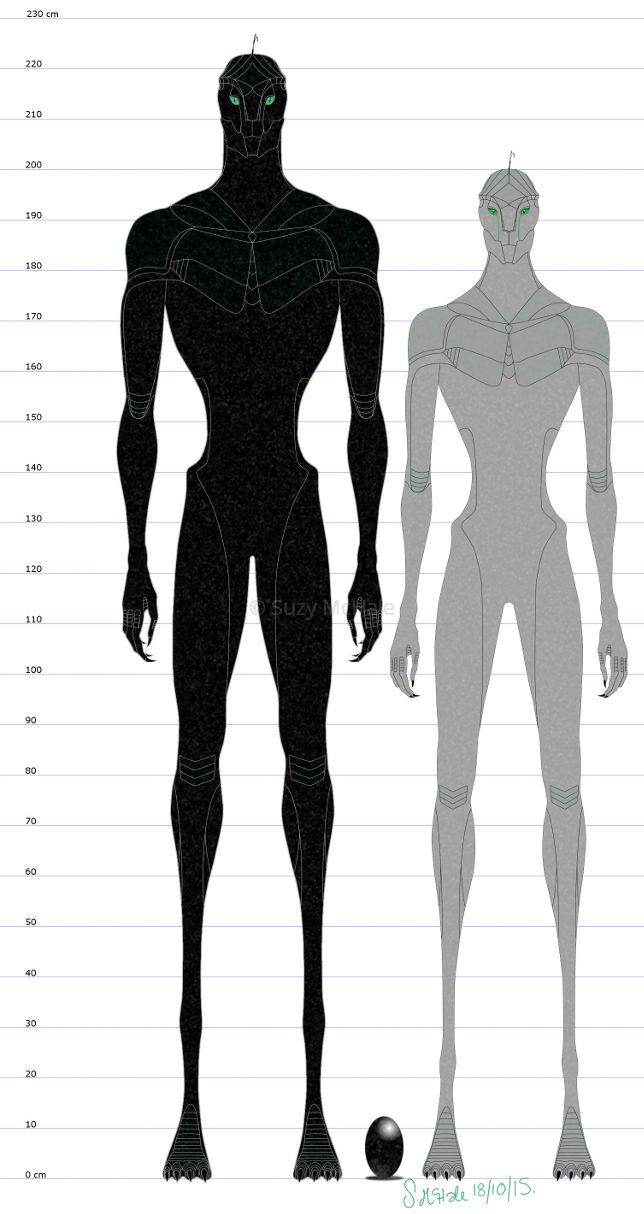
Stylized male and female reference, anterior view (Sohaar and his mother Resaan in this case, with an egg for scale) (digital art, 13/10/2015, 80 KB). Males of the Warrior Caste have a more extreme body type; other males are in between them and the females in size.
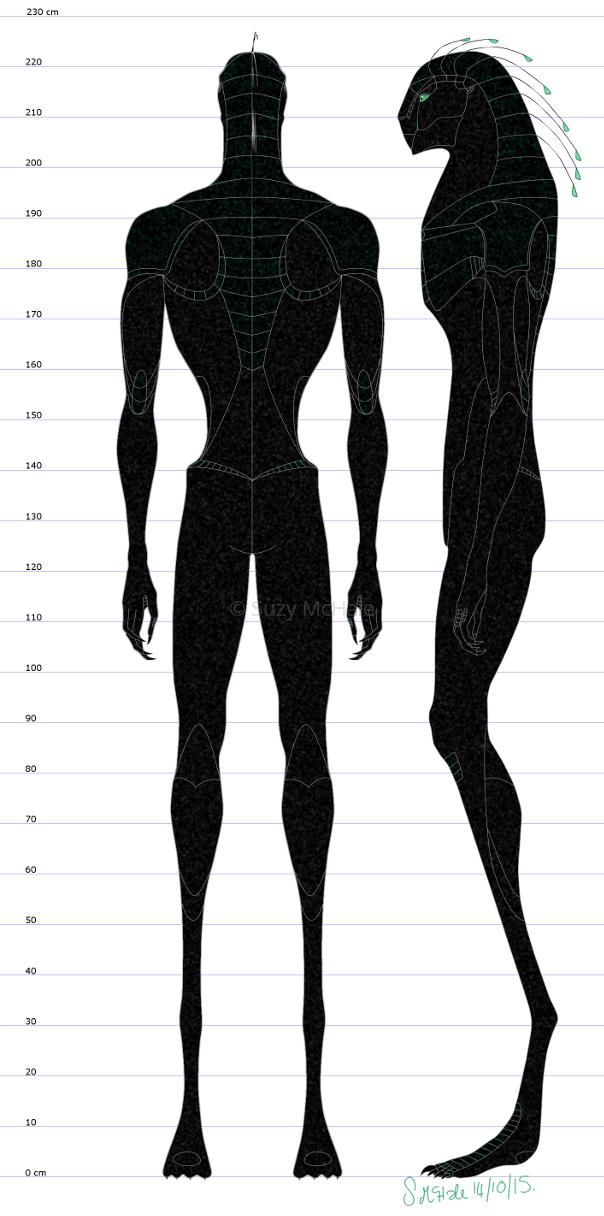
Stylized male reference, posterior and profile views (digital art, 1/7/2015, 78 KB; revised 14/10/2015). Greenish areas indicate colored iridescence (matches eye color). This is the best I can do without a 3d program! (Something I will have to learn sometime.)
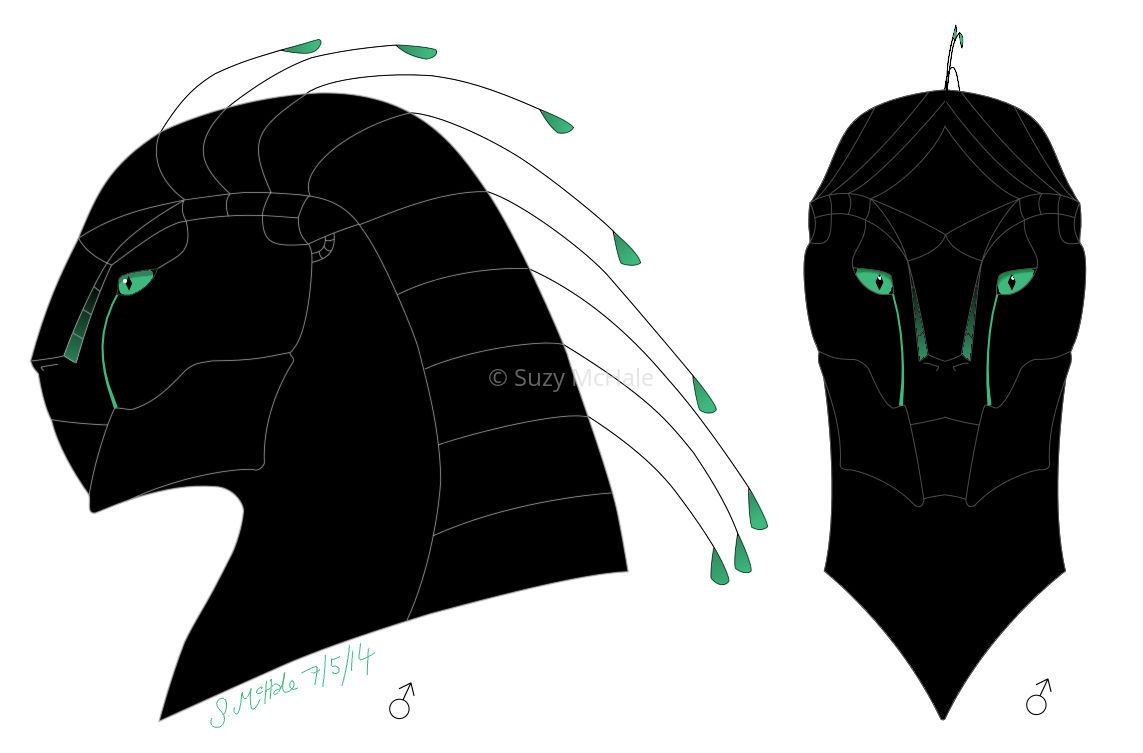
Anterior and profile head views, male Dawn Hunter (digital art, 7/12/2013).
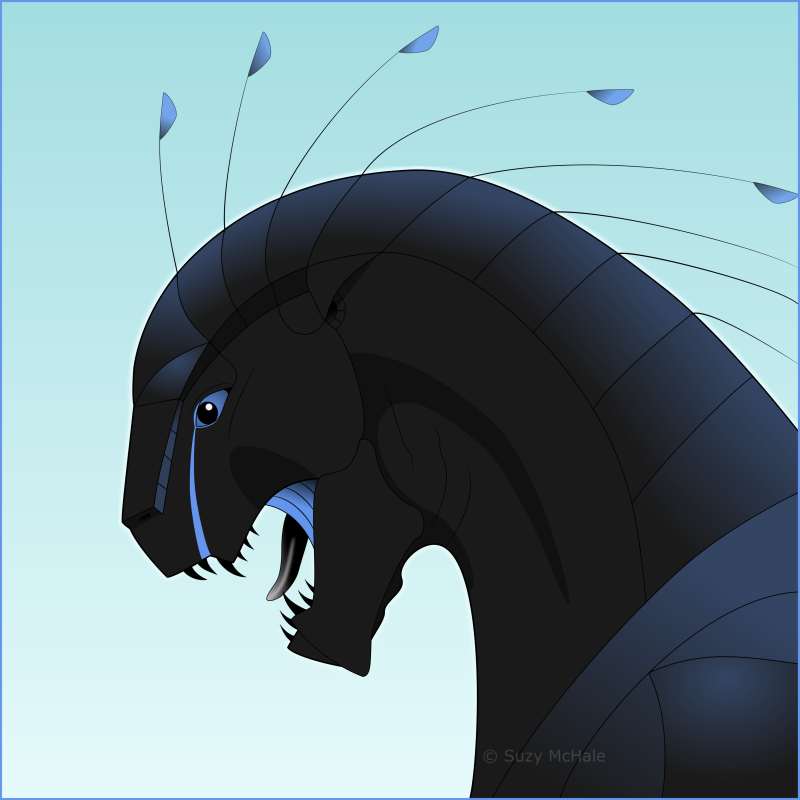
Angry Dawn Hunter profile (Yaraan, in this case), showing open mouth (digital art, 26/10/2015, 22 KB).
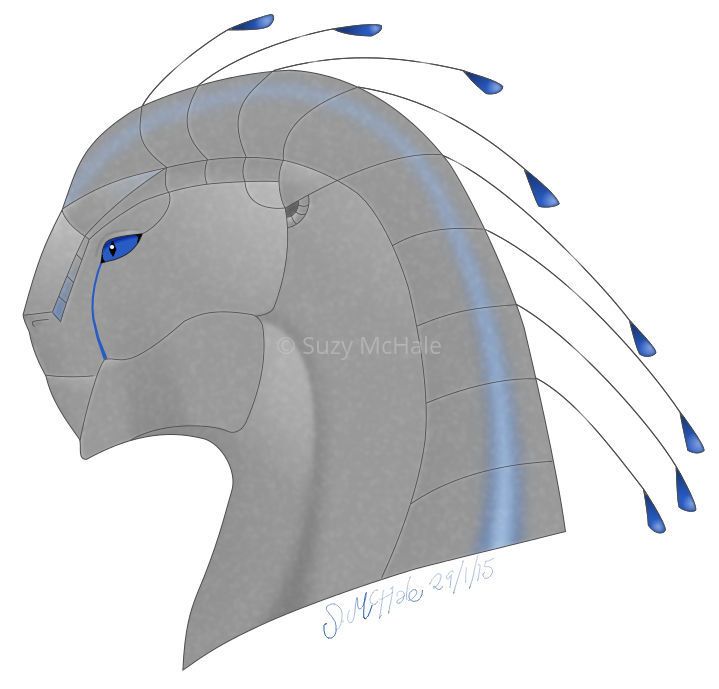
Female head profile (digital art, 7/12/2013; shaded 29/1/2015).
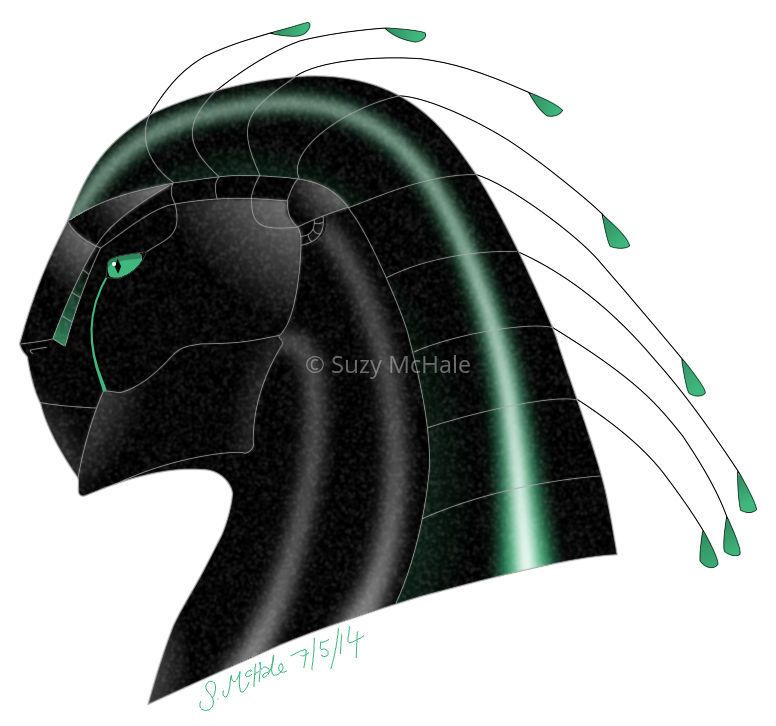
Male head, profile view, shaded (digital art, 7/5/2014) – displaying skin iridescence.
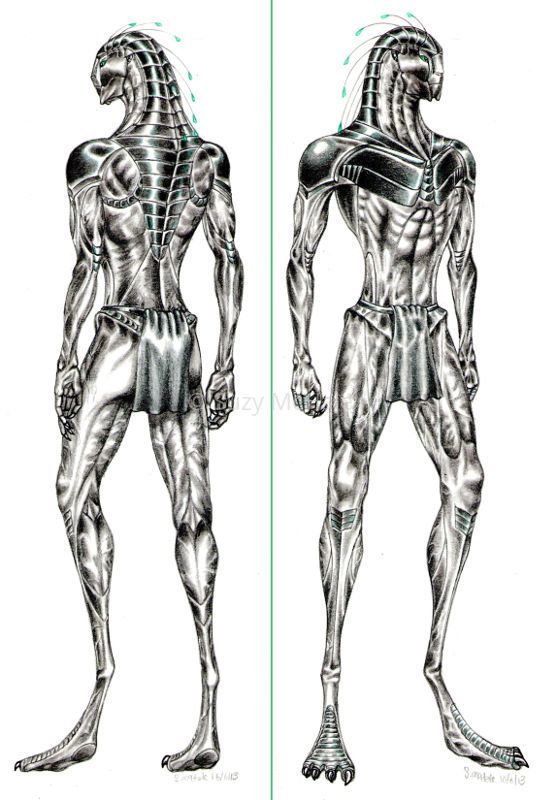
Male Warrior Caste Dawn Hunter, body (colored pencils, 10/6/2013 – head design slightly changed since these were drawn).
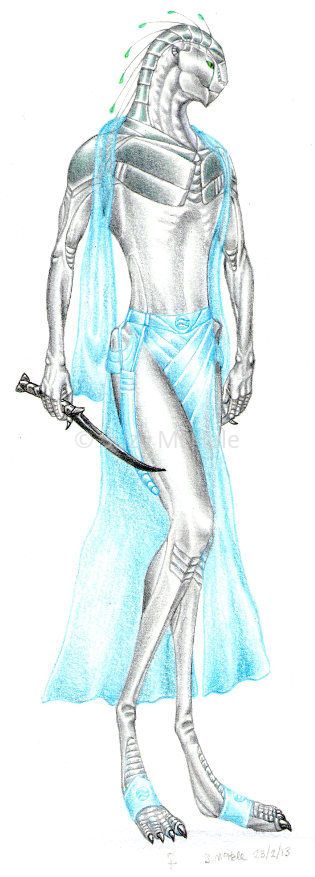
Adept Caste female, body (colored pencils, 23/2/2013).
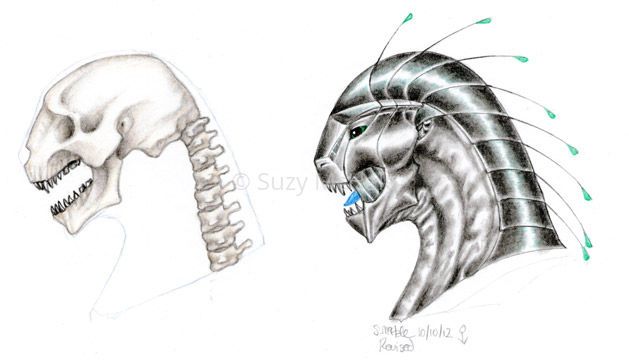
Skull and profile view (colored pencils, 10/10/2012).
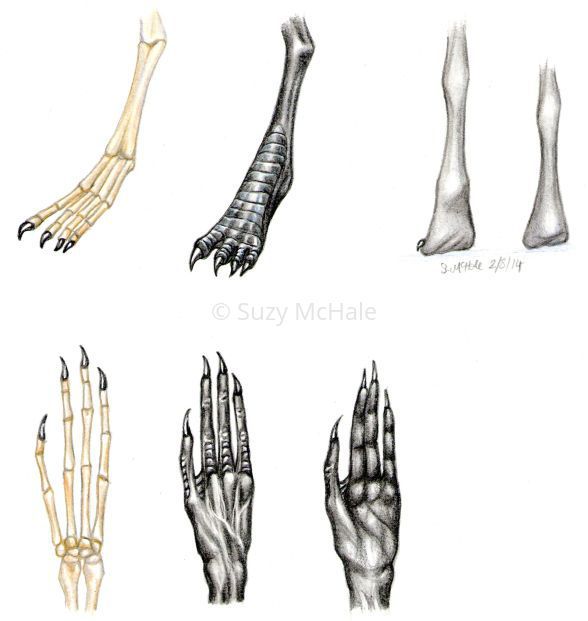
Hands and feet (colored pencils, 3/8/2014).
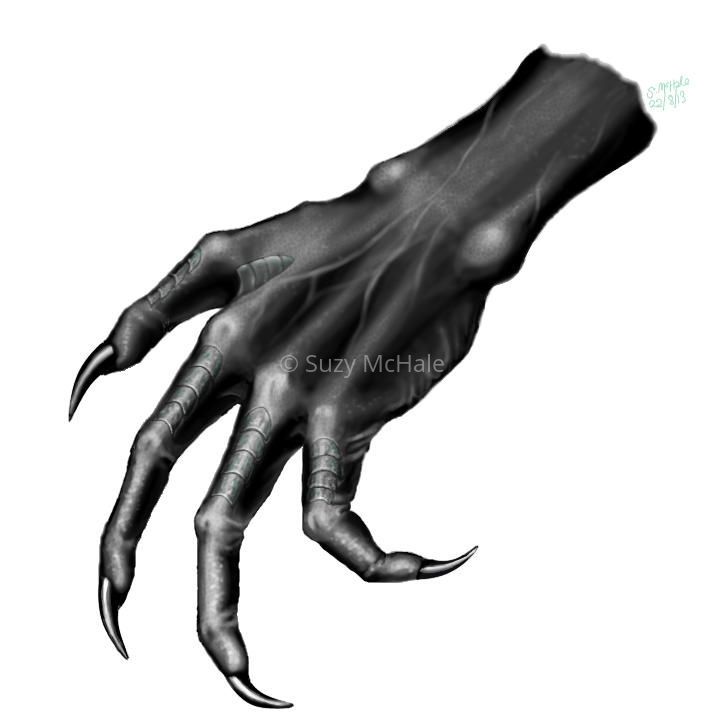
A hand (Sohaar’s, as it happens) (digital art, 20/8/2013).
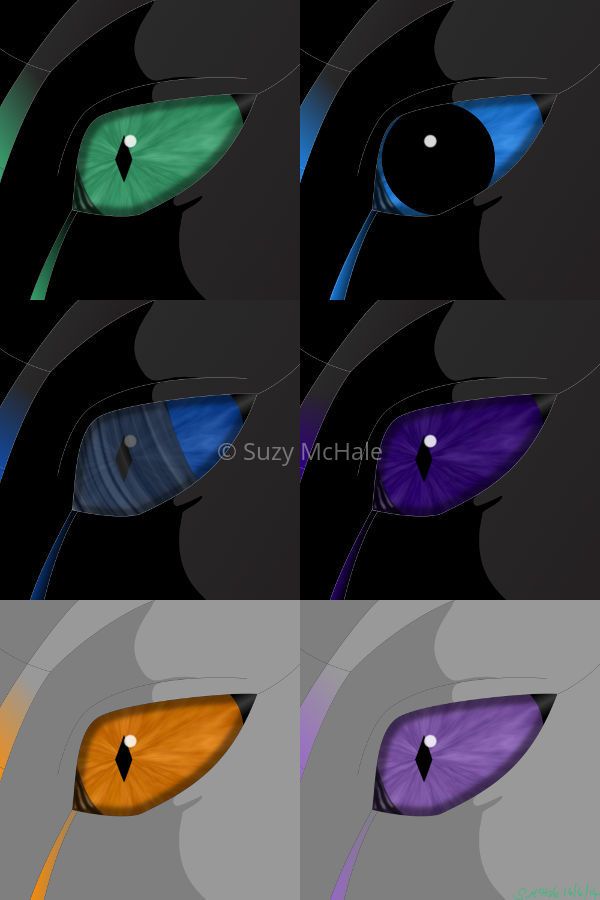
A selection of eye colors (digital art, 14/4/2014).
Footnotes
- [1]
- “Humans are the world’s smelliest animal, study shows”
- [2]
- “Avian intelligence has baffled scientists for many years now. How can such small brains be capable of complicated cognitive behaviour? Analysis of birds’ brains have the answer: a team of neuroscientists have revealed that birds’ neurons are more densely packed. This means birds fit more brain cells into their tiny heads than the equivalent brain mass of mammals, even some of the smartest primates.” (How It Works, Issue 88)
- [3]
- Reddit: FaerFoxx’s Guide to Blood Chemistry – “While only seen in a few species in nature that we are aware of, hemocyanin is capable of cooperative binding similarly to hemerythrin! But hemocyanin, instead of relying upon a pair of molecules to help balance the efficiency, requires a ring of six molecules in order to bring its efficiency up to between 1.6 and 3.0 in such an environment (hemoglobin by comparison has an efficiency of 2.3-3.0). Some species of arthropods take this even further to give them even greater advantages - there is a kind of tarantula that takes the cooperative binding up to 24, a centipede that goes as high as 36, and horseshoe crabs have 48. Some even go to absolutely ridiculous heights in order to out compete hemoglobin, such as some crab species which exhibit a massive 660 molecule chain of rings, transporting incredible amounts of oxygen at once to provide them with the speed and power they need to prey upon hemoglobin based species outside of their ideal cold oxygen-limited environments. These species may never see the cold or be anywhere without abundant oxygen, but the cooperative binding aspects (sometimes to the extreme) allows these blue blooded species to stand side by side or even tower over hemoglobin species.”
- [4]
- FaerFoxx’s Guide to Blood Chemistry
Dawn Islands
The Dawn Islands (Noosasaan) are a group of eight small tropical islands on the Equator just off the east coast of Yoora. They are part of a volcanic chain, but are now extinct. Each one belongs to a Clan Lordand is used as a retreat. Because of their location, they are also referred to as the Islands of the Immortals, Noosalunuhuucuuna (island/s [of – implied nominative] lunu [dead] -huu [negative particle] -cuuna [many affix]).
Dawn Star Clan
The Dawn Star Clan (Narawaa Sosaano) is one of the eight Great Clans. Its Clan City is located on Home World’s east coast.
Data

- Burial armor gemstone
- Lapis lazuli
- Clan City construction stone
- Grey granite
- Clan City co-ordinates
- Approximately 10°E, 12°S
- Clan emblem
- Eye of the Day rising above the eastern ocean with Fire World above it
- Color
- Indigo (#091f93/rgb(9,31,146))
- Clan Lords mentioned
- Haaryaraan
Dawn Tree
A Dawn Tree (Merosaan) is a palm-like tropical tree with a split black trunk and large fan leaves. The fronds are dark purple in their centers, gradating to red, orange and yellow at the tips – the colors resemble that of a dawn sky.
Gallery
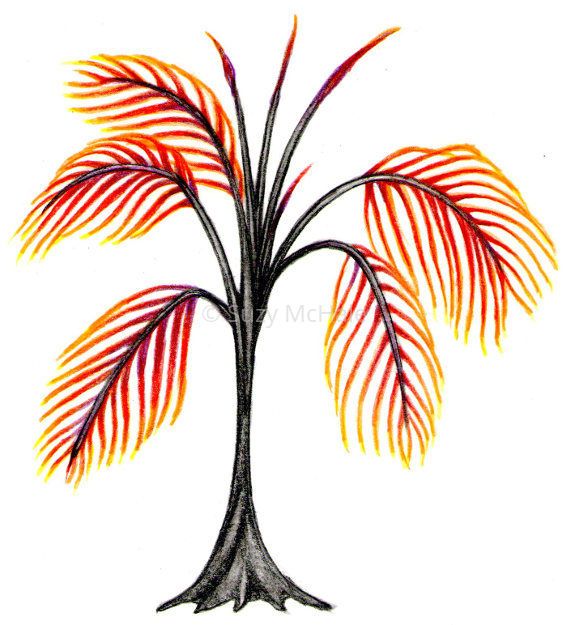
Dawn Tree (colored pencils, December 2014).
Death
The Dawn Hunters are obsessed with maintaining stability; an unbroken link from the past to the future. As part of this, they revere their ancestors and regard keeping the memory of them as important – carried to an extreme by preserving the bodies of Clan Lords for eternity. In their view of the afterlife, the deceased crosses the River of Night (what humans see as the Milky Way) to reunite with their ancestors and continue living much as they did in their world.
The Hunters don’t otherwise have a religion with gods and goddesses. Worshiping invented gods like humans do would be a strange concept for them. If a religiously-inclined human got it into his head to try to “convert” the Hunters, they might listen politely to his spiel (or impatiently if the receiver were a Warrior) but would not otherwise be interested.
The bodies of Clan Lords are contained in mausoleums on the nearest moon, Grey Moon. The deceased Clan Lords on Grey Moon are regarded as watching over their descendants on Home World. Before spaceflight was attained, Clan Lords were buried in the Valley of the Ancestors, located in the southern hemisphere arid zone. The bodies were later moved out of here to Grey Moon to ensure their safety from any natural disasters.
The bodies of Bond-Mates and War Lords are preserved and stored in wall slots within a dedicated House of the Ancestors within each Clan City, watched over by the Adept Caste. Those of other Hunters have their flesh disassembled by nanites and the bones placed in Burial urns and stored in relatives’ homes until they pass from living memory, then these are also placed within a House.
The idea of cremation would be regarded with dismay, as the body is completely destroyed and the physical aspect completely vanishes.
Burial on Home World is considered essential, so the Hunters will go to great lengths to repatriate the body of anyone who dies offworld.
Death-days are noted each year and ceremonies such as lighting incense in front of Ancestor-Shrines are performed, as well as visiting the burial sites of the deceased.
Despite their advanced medical technology, the Hunters do not desire to live forever, so a dignified death is seen as desirable. Suicide and ritual slaying/sacrifice are considered honorable methods of death for the Warrior Caste, other than being slain in battle. Lord Sohaar’s father, Maarec, chose to be sacrificed by his son when he decided he had lived long enough and that it was Sohaar’s time to assume the position of Clan Lord. Sohaar’s crew on the starship Sahelnahuuwo suicided rather than surrender after his capture by his brother. His mother also committed ritual suicide in order to be with Maarec after his death.
The favored method of such slaying is to pierce a vein or artery in the throat, which ensues a relatively quick death though bleeding out (the equivalent of the trachea and esophagus are not severed). Beheading is considered dishonorable as it separates the body, and is thus used to execute prisoners, etc.
Diet
As their name suggests, the Hunters still practice subsistence hunting of herbivore animals as they never domesticated animals or kept pets. They do not hunt for sport (or play organized sports for that matter). The males of the Warrior Caste undertake such hunts; it also provides more training and exercise for them. Those of other Castes hunt smaller prey and gather plants for consumption. Aside from this, other creatures on the planet are left alone to live their own lives.
The cooked meat only of prey is eaten; offal is considered unclean and is left for scavengers. Meat is usually roasted. Spices are used abundantly. There is a cinnamon-equivalent derived from tree bark.
The eggs of various other creatures are very nutritious and are eaten with relish. Rainbow Beetles and various sea creatures are also eaten – the latter caught by hand when near the shoreline as boats are not used.
There are equivalents of fruits and berries. Some plants have edible starchy tuberous roots (meculanamay) that are similar to, and taste like, a sweet potato. There is the equivalent of rice grain from a yellow grass-like plant; this is a spherical black-colored seed that can be boiled and eaten as is, or ground into a paste and shaped into a flat, edible rice-paper-like wrapping on which other foods can be placed. It is a staple in the diet.
Edible plants can be grown in private gardens or hydroponically in specialized buildings within a Clan City to supplement the diet, but agriculture is otherwise not practiced on an intensive scale.[1] One form of hydroponics involves spraying a special paper with nutrients and a fixer; this is absorbed as the plant matures and is used in enclosed areas such as starships. The Dawn Hunters essentially practice horticulturerather than intensive agriculture.
Artificially-made food also provides nutrition, especially onboard starships for prolonged periods. Fresh food is still preferred, however.
The usual cooking methods are roasting, steaming or boiling. Frying is not done as cooking oils are not used. Eating is mostly done with the hands, and food presentation allows for this: liquids are drunk in bowls brought up to the mouth; other foods have rice wraps provided to scoop them up. Claws are used to spear some items such as meat slices, as well as one’s belt knife.
Food from other planets is not normally eaten due to biochemical differences, though the ingestion of artificial enzymes beforehand can enable digestion of some alien food. Eating alien food would usually only be done as a last resort.
Footnotes
- [1]
- StackExchange: Could a technological society develop without agriculture?
Digger
A Digger (Cehuwa) is a pig-like and pig-sized herbivore that digs under plants for roots and similar food. It has skin armor plating over its back, two upper tusks that can be used for digging or self-defense, and is solidly-built.
Gallery
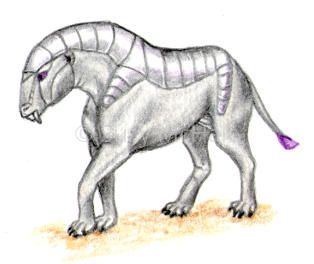
Female Digger (colored pencils, August 2013).
Directions
Directions given in speech usually have the dative case (-e or -we).
- North
- Sanaazamaawe (wind-hot-[dative]) – called thus as the species originated in the southern hemisphere, and hot winds came from the north in the hot season); also saamehesasalame (left [of] sun – when standing facing eastwards)
- South
- Sanaawelawe (wind-cold-[dative]) – also ruuzehesasalame (right [of] sun – when standing facing eastwards)
- East
- Hesaasalamzabone (eye-day-up-[dative]), also besola saanewa (direction of dawn)
- West
- Hesaasalamlalone (eye-day-down-[dative]), also besola nahuuwa (direction of night)
For clarity, the word for direction/orientation can be added: besola saamehesasalame (direction of north)
- Up
- Zabowe
- Down
- Lalowe
- Behind
- Zalawe
- Forward
- Maale
- Left
- Saame
- Right
- Ruuze
Dome Tree
A Dome Tree (Meroyuucu) is an umbrella-shaped tree with small hexagonal orange leaves and black hexagonal bark. It is found in savannas and mountain biomes. (A similar Earthly equivalent is Dracaena cinnabari.)
Gallery
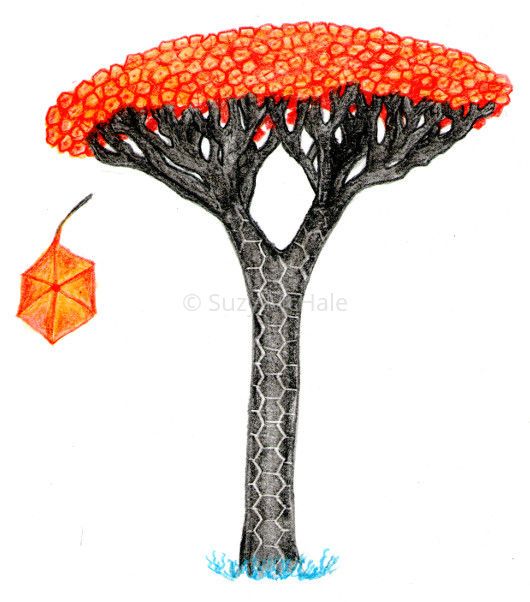
Dome Tree (colored pencils, July 2013).
Dominion
The Dominion (Suulalan) is the region of the Milky Way galaxy over which the Dawn Hunters reign; it is on the opposite side of the central core to Earth. There have been just three habitable worlds with sapient aliens found in this area to date.
Also known as the Dominated Worlds (Honuusuula).
Drone
A Drone (Buuranrerewawuyu) is a small space and atmospheric vehicle that can be controlled by the parent Void Walker, or act autonomously using its own simple Artifical Intelligence. It is utilized for surveillance, nanite dispersal, etc., and somewhat resembles a manta ray in shape and is black in color. It is about 8 meters long and has one fusion engine. Its name literally translates as “fly-alone-machine,“ an autonomous flying machine.
An aquatic version of the drone, fitted with propellers, is used to remotely explore and monitor the Ocean of Storms.
Dimensions
- Length
- 2 bodylengths (4.32 m) – it can also be manufactured in a larger size – double the listed dimensions (4 bodylengths long)
- Wingspan
- 2.88 m
Gallery
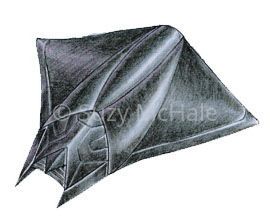
Drone (colored pencils, 7/5/2009).
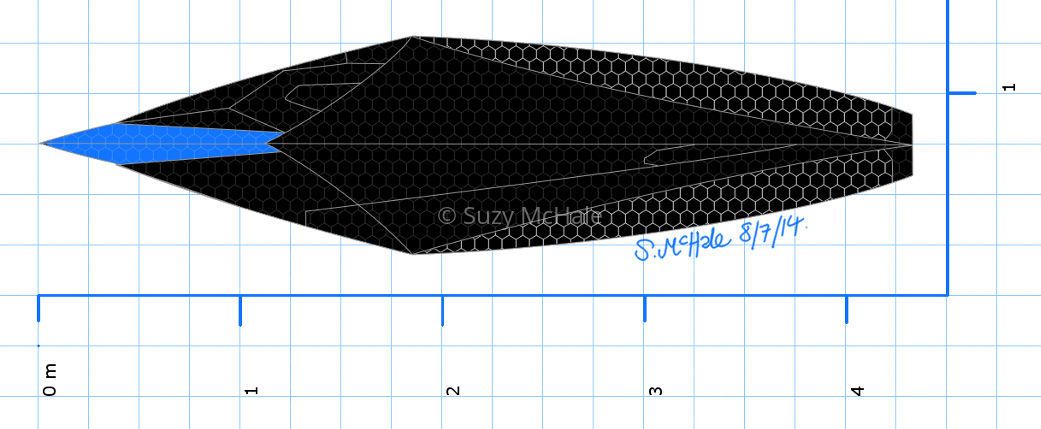
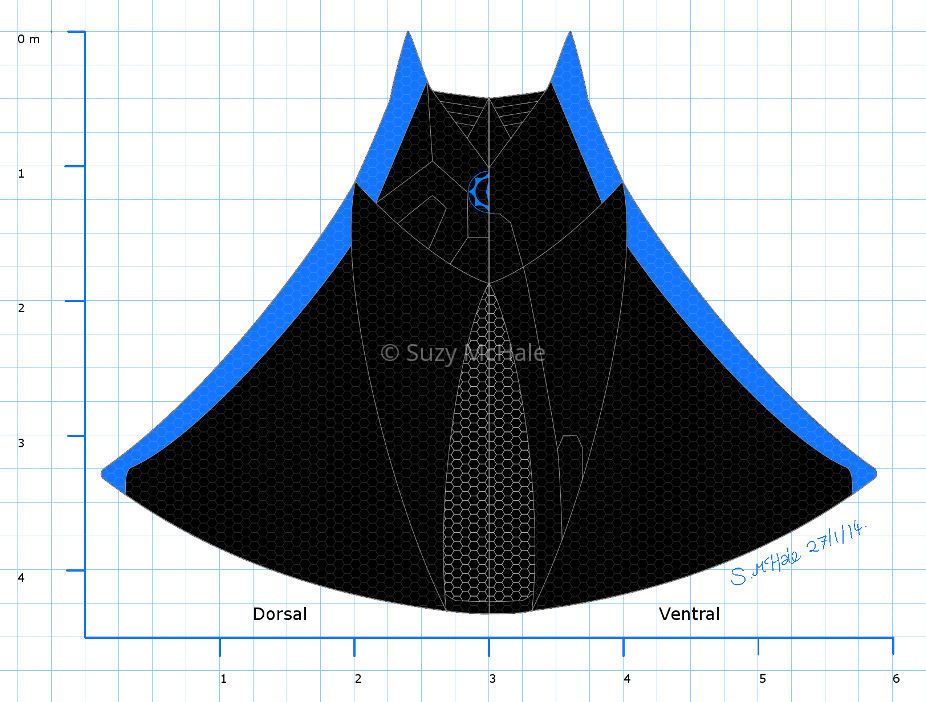
Dorsal, ventral and side views, with identifying Clan colors (Burning Eye Clan (digital art, 20/1/2014).
Duel
A duel (Harzeyu) is a formal fight between two Warriors for dominance, usually in order to ascend to a higher rank. The duel often results in the death of one. It takes place in an arena with a sand floor and is supervised by another Warrior acting as a referee – usually a Battle Master – who ensures they do not rest too long between bouts; there are otherwise no rules. Given the Dawn Hunters’ sharp teeth and claws, a fight will get bloody very quickly.
The only item of clothing worn is a loincloth (saacelanhasa).
Fights between high-ranking Warriors – such as War Lords and Clan Lords, when leadership is at stake – take place in a Clan City’s Arena of Honor.
Another type of duel involves wielding swords, though this will often take place on a battlefield or during a random encounter.
Economy
Similar to the Incas,[1] the Dawn Hunters do not have an economy as we know it, and have no concept of money. They thus would be uninterested in trading and mercantile activities, and would regard these with disdain if they understood the concept.
Everyone within a Clan City – including any guests – is provided with the basic necessities of life from central distribution centers. An individual may also leave an unwanted item in one of the distribution centers for anyone else to take and use. The extremes and idea of wealth and poverty are unknown.
This leaves them with the time to pursue their own interests and work – scientists, for example, do not have to worry about the distraction of continually begging for research funding, and artisans are similarly free to create. Gift-giving or exchanging of hand-crafted items is valued, however, especially in a society where automated nanotechnology can manufacture almost anything.
Everyone does work and contribute in some capacity as a City needs to be kept functioning. There are no slaves as such, but the lower-ranked within a Caste usually perform the less-desirable tasks (as is the usual practice with apprentices in human societies). A lot of such tasks are automated.
Out of an 8-day week (one Red Moon-cycle/orbit), an inhabitant might spend 2-3 days focused on their profession, 2-3 days hunting and gathering, and the remaining days for rest and recreation. A Warriorwill spend 2-3 days fight-training, 2-3 days hunting, and resting for what remains. These are variable depending upon an individual’s situation and the time of year.
Admittedly, if any humans visited, many would likely get rather bored within a week if they came from the typical overstimulated consumer society – there are no shops and nothing to buy, and no entertainment such as movies or nightclubs. In some ways a City is more like a monastery, and some people might find this agreeable.
Hospitality is considered important, as is providing refuge to one who seeks it.
They are not particularly interested in interacting too much with other cultures and tend toward isolationism.
Footnotes
Education
All Dawn Hunters receive a basic education up to adolescence, where the Castes begin training and specializing in the professions they will practice as adults. Training is by a form of apprenticeship, learning by osmosis and observation; there are no equivalent of universities. It is usual for children to be trained in their parents’ professions, and the training takes many years.
Children do not receive much exposure to technology when young; it is felt important for them to fully develop their senses out in the natural world as much as possible. Following this philosophy, they are not given neural implantsuntil adulthood.
Egg Plant
An Egg Plant (Merosaraa) resembles an egg half-buried in the ground, and is approximately the same size, colored an iridescent, banded cerulean-blue. It has sweet reddish edible flesh, tasting something like a custard apple. It has a four-pointed, magenta-colored star shape on top; this splits open when ripe in the hot season.
Gallery
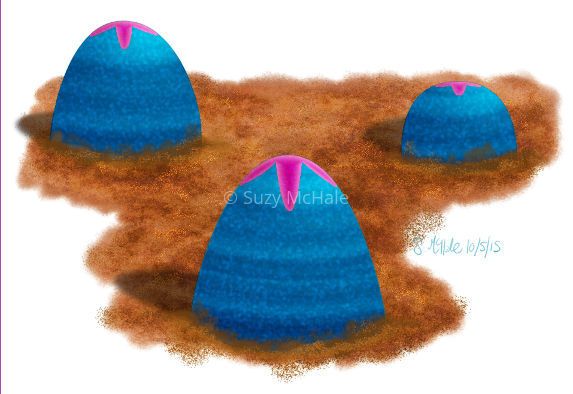
Egg Plants (digital art, 10/5/2015, 68 KB).
Endless Plains Clan
The Endless Plains Clan (Narawaa Sosaanwo) is one of the eight Great Clans. Its Clan City is located on Home World’s east coast. It is the nearest Clan City to, and traditional ally of, Night River Clan; Endless Plains is situated around 2000 km northeast of it. Its territory is the main habitat for Spike Tails, the main prey of the Dawn Hunters.
Data

- Burial armor gemstone
- Amethyst
- Clan City construction stone
- Pink granite
- Clan City co-ordinates
- Approximately 10°E, 30°S
- Clan emblem
- A stylized plain with distant mountains
- Color
- Amethyst (#7e359f/rgb(126,53,159))
- Clan Lords mentioned
- Sanaazuun
Environment
The Hunters have a philosophy of living in harmony with their environment rather than trying to dominate and alter it. Thus, aside from the contained Clan Cities, they have left little impact upon the landscape: no pollution, dams, roads, deforestation or agricultural fields. Energy needs are powered by renewable sources. They do not let their population outgrow the available resources. This attitude is extended to other aliens; if these are living in an environmentally-destructive manner, then steps will be taken to correct this.
Etiquette
Manners (luula) are considered very important in Dawn Hunter society and are dependent upon the age and status of one individual to another.
- Honorifics in the grammar of their language are a major part of etiquette and infer respect, equality or inferiority to the one being addressed.
- One of a higher rank may be more bluntly-spoken to others beneath him – those of the Warrior Caste particularly tend to behave in this manner.
- Harmoniously co-operating with others is considered a key value in society.
- Touch within families is given freely, but there is no casual touch between strangers such as shaking hands or hugging – this would be considered quite strange. However the contact rules are relaxed when going to the aid of one who is injured.
- Greetings between strangers are verbal, accompanied with a head bow to the one of superior rank. Those of the highest rank (namely a Clan Lord or War Lord), are greeted by kneeling on one bent knee (genuflection), usually the right knee with the right hand touching the ground for support. Children might also greet their parents and older relatives in this manner on formal occasions. Infirm Elders are exempt from this gesture, though the more stubborn ones may do it anyway.
- Prolonged direct eye contact is a threatening gesture, so is only used between hostile parties. One of junior or lower rank will not stare directly at a superior.
Exploration
The Dawn Hunters have a somewhat ambivalent attitude toward exploration: they are curious to see what is out there, but are also very attached to their Clan City and Home World. Exploration thus needs a specific purpose – they are not ones to partake in such activities such as mountain-climbing “because it is there.” It is mainly to gather information and neutralize potential threats to their existence. The latter objective is particularly relevant when exploring other star systems for sapient aliens.
In a similar vein, they wish to dominate but have no desire to actually colonize other worlds; at most they will station a Void Walker on a rotational basis to monitor a world’s activities once it is brought under their control. They are not interested in “uplifting” other sapient species in case these might become a threat to them.
They have no interest in terraforming worlds, though they will use nanotechnology to repair a habitable world that has been environmentally-damaged by its inhabitants.
Eye of the Day
The Home World of the Dawn Hunters orbits a main-sequence Class-F8V white star that is a little hotter than Earth’s Class-G2V Sun (Sol) on the stellar classification scale, so its light is yellowish-white in color. Life here receives a little more UV radiation than Earth, so it has evolved mechanisms for protection such as thicker skin with an iridescent/metallic sheen.
The star, named Eye of the Day (Hesaahame), is fairly stable, with a projected lifetime of 7 billion years. It is younger than Earth’s Sun, which has a projected life of 10 billion years (and is midway through its life). Like the Sun, it contains an abundance of heavy elements, essential for making Earth-like planets. The system is located around 50,000 light-years from Earth on the opposite side of our Galaxy, or 23,000 ly from the Galactic Core (distances are very approximate), close to the outer edge of the Norma Arm – a reasonably safe distance from the star-crowded Core.
Despite being hotter, the star’s light may seem dimmer to humans because more of its output is in the ultraviolet range, which human eyes can’t detect. Humans would still have to wear UV protection, though the deleterious effects of this are somewhat moderated by its habitable zone being further away.
Its viewing angle is 0.45°; only Grey Moon would cover it in an eclipse. [1]
| Class | Temperature in degrees Kelvin | Mass (Mass of our sun = 1) | Radius (Radius of Sun=1) | Terrestrial Equivalent Orbit in AUs | Lifetime in billions of years |
|---|---|---|---|---|---|
| F8 (#fff7fc) [2] | 6200 | 1.190 | 1.260 (876,708 km) | 1.45 (216,916,912.95 km) | 6.880 |
| G2 (our Sun, for comparison) (#fff5ec) | 5860 | .998 | 1.020 | 1.05 | 10.100 |
Gallery
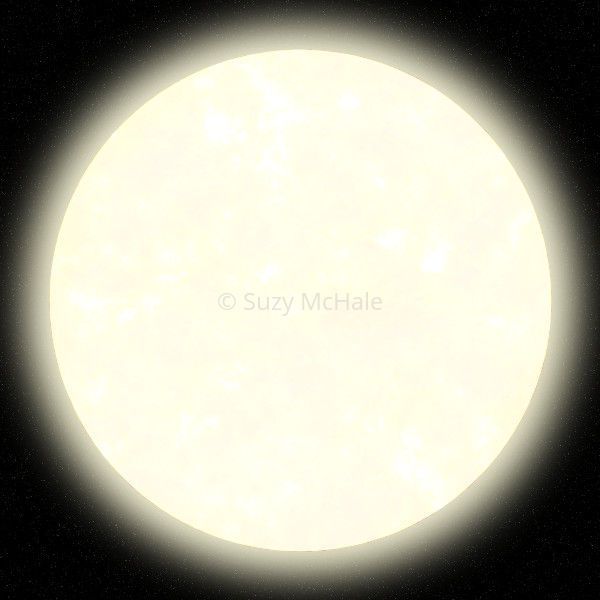
Eye of the Day render in GIMP.
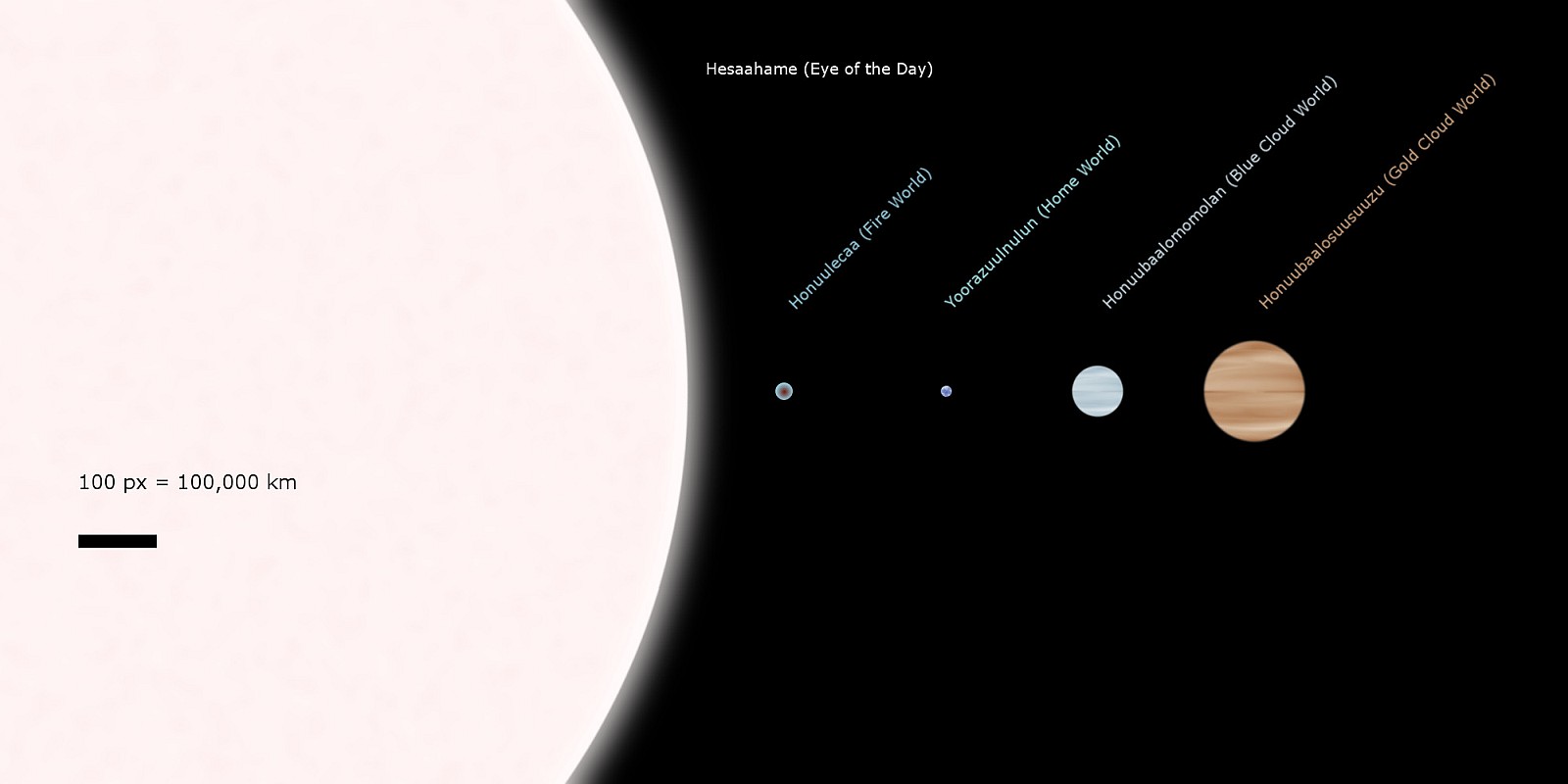
Eye of the Day and its planetary system (digital art, 18/5/2015). Star and planets are to scale (100 pixels = 100,000 km); distances are not.
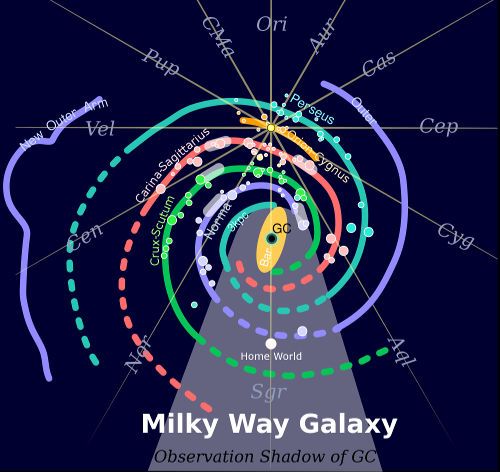
Home World’s approximate location in the Milky Way galaxy. (Diagram adapted from one at Wikipedia, by User:Rursus.)
Footnotes
- Tangent of Theta: Radius (876,708 km)/distance from HW (216,916,912.95 km) = 0.004041676548301625 (0.004) x 2 = 0.008; viewing angle is around 0.45° according to the chart on that page.
- Reference site for star web color values: What color are the stars?
Fauna overview
Unlike Earth, Home World has managed to avoid any major extinction events so far, so the resident lifeforms have evolved uninterrupted since the planet was formed. The Dawn Hunters evolved into their current form around the time of the dinosaurs on Earth.
Home World does not have Earth’s abundant lifeforms. There are land, sea and flying creatures, out of which only the Hunters are sapient. They are reminiscent of dinosaur- or reptile-like creatures, though they have mammalian characteristics also (i.e. are homeothermic and active). They do not get very large because of the slightly higher gravity; the largest size is about the size of a camel or similar herbivore. There are also various insects which are similar to those on Earth, mainly beetle-types with 8 legs in groups of 2 and iridescent shells.
Most creatures share the same characteristics:
- Bare smooth leather-like skin (no fur or feathers) with a metallic sheen to help reflect the higher radiation from Home World’s sun.
- Skin has thicker, flexible, leather-like chitinous segments over head, neck and back for protection (similar to the creatures from the movie Avatar). It is more like suede in texture on softer areas.
- Males have black skin and females solid grey, overlain with variously-colored iridescent patterns for display purposes. (Female skin is generally hex color: #7f7f7f – but this can vary a little either way between individuals from #aaa to #555, and the greys are neutral in tone.)
- Females are usually smaller and more gracile than males.
- Bright colors and patterns are common.
- All are egg-layers. The Hunters are the only predators who lay a single egg at a time.
- Blood is hemocyanin-based; oxygenated blood is blue, unoxygenated clear. It has evolved to become efficient in a higher-oxygen and higher-temperature atmosphere, comprising a ring of 512 molecules (64 hexamer – 512 peptide chain).
- As with Earth creatures, predators have binocular vision while herbivores have eyes more to each side of their skull.
The predators and winged creatures have tetrachromatic vision: 4 receptors (blue, red, green and near-ultraviolet receptor cones) rather than the 3 humans have (blue, red and green cones – trichromatic). Thus, similar to some Earth birds, they can see the same and more colors than a human, with a subtle shift toward the blue end of the spectrum. They might, for example, see red and UV light as purple. So while humans with 3-receptor vision would see crest grass as red, HW native predators would see it as more violet in sunlight.
The herbivores have trichromatic vision, but with blue, green and UV cones instead – same as a honeybee’s – so they can’t see the color red, similar to how we can’t see ultraviolet (red just looks blackish to them, similar to how a person with protan [red cone] color blindness would see it). They can only see blue-green, blue and yellow in our visible spectrum, and see colors differently due to the addition of ultraviolet. Therefore the herbivores can’t distinguish between the black coloring of the Hunters and the red crest-grass.
Fauna is classified as:
- Air/flying creatures (includes insect-analogs) – meelazuun (meelah [creature] [of] zuun [sky]) or soor (bird); insects (cuuco) are sub-classified as meelasosaan (shell/carapaced creatures) as are shelled sea creatures
- Land creatures – meelahyoora (meelah [creature] [of] yoora [land]) or manul (animal)
- Sea creatures – meelazumaah (meelah [creature] [of] zumaah [ocean]) or moze (fish)
There are no domesticated animals kept by the Dawn Hunters; this was simply never conceived of, and as they kept their population small, they could adequately provide their food needs by hunting at intervals.
Finger Tree
A Finger Tree (Merosoon) is a tree with textured bark resembling stacked reddish-black rings. It has four branches at the top which splay out somewhat like a hand and are each tipped in a blue flower-like leaf.
Gallery
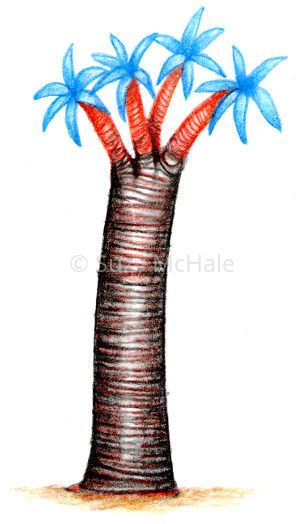
Finger Tree (colored pencils, July 2013).
Fire Mountain Clan
The Fire Mountain Clan (Narawaa Nomaalecaawo) is one of the eight Great Clans. Its Clan City is located on Home World’s east coast. The Clan supplies mined obsidian glass from the (relatively) nearby volcanic region to other Clans.
Data

- Burial armor gemstone
- Aquamarine
- Clan City construction stone
- Bluestone (basalt)
- Clan City co-ordinates
- Approximately 2°E, 9°N
- Clan emblem
- Stylized representation of an erupting volcano; the peninsula of volcanoes is visible to the east from the City
- Color
- Sky blue (#87ceeb/rgb(135,206,235))
- Clan Lords mentioned
- Lord Lecaaso
Fire Tail
A Fire Tail (Hawelecaa) is a predator that scavenges and hunts in packs for food on the savannas of Home World; it can be a danger to a lone Dawn Hunter. It is similar in size and behavior to a hyena. Its coloring follows the usual pattern of black-skinned males and grey-skinned females. It may have blue or fire-colored eyes, and blue iridescent spots on its upper body. Its tail ends in a display membrane in shades of iridescent red, orange and yellow.
Gallery
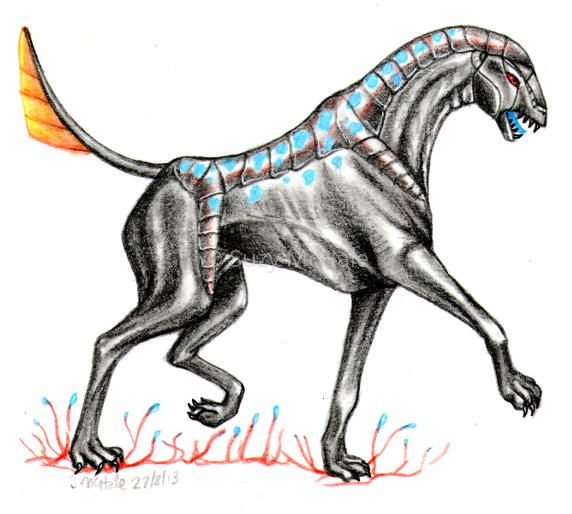
Male Fire Tail (colored pencils, August 2013).
Fire Tree
A Fire Tree (Merolecaa) is a black-barked tree with long ribbon-like yellow-orange leaves that resemble tongues of flame. It is found in groups on the savanna. It stores water in its bulbous trunk.
Its name also refers to the flammable oil its leaves contain (this has a scent similar to that of eucalyptus oil). The distilled oil is used for fuel, and also has antiseptic medicinal properties. As the tree is fast-growing, it can be harvested prolifically. Fire also induces its seeds to regenerate.
Gallery
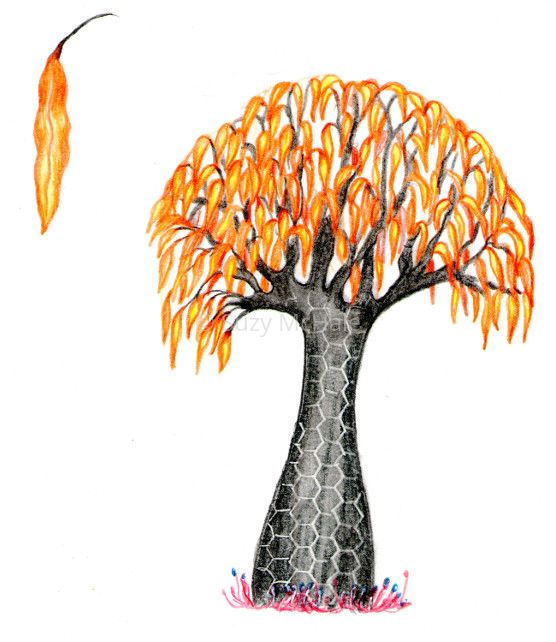
Fire Tree (colored pencils, July 2013).
Fire Wind Clan
The Fire Wind Clan (Narawaa Sanaalecaawo) is a sub-Clan from which then-Regent Lord Yaraan obtained his Void Walker after dueling with its War Lord.
Data

- Burial armor gemstone
- Blue Iolite
- Clan emblem
- Stylized wind gusts with the Eye of the Day above them
- Color
- Purple-blue (#3e4183/rgb(62,65,131))
Fire World
Fire World (Honuulecaa) is the first planet of the Dawn Hunters’ system. It is a volcanic rocky world with a hot thick cloudless atmosphere – a “Hot Super Earth”; possibly the core of a gas giant that migrated inward. The atmosphere is blue but its surface glows with tectonic activity. There is some simple bacterial life existing on it nonetheless as the atmosphere contains water vapor and free oxygen.
Data
- Distance
- 1.015 AU
- Year length
- 397.85 Earth days orbit equivalent
- Diameter at equator
- 22,000 km
Gallery
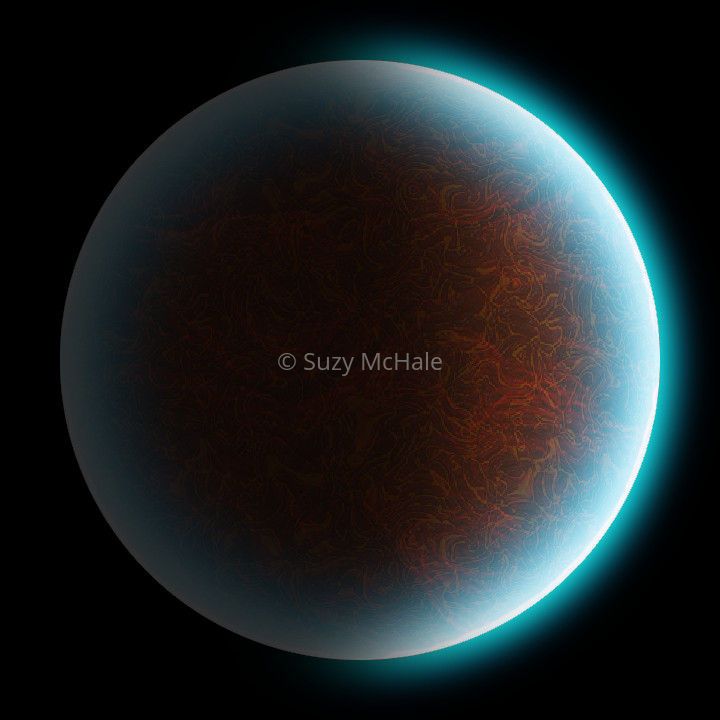
Fire World, rendered with a GIMP script.
Floor-quilt
A floor-quilt (Casalenol) is a padded mat used to sit on, placed on the floor. It is hand-made from a silk-like plant fiber material and elaborately embroidered and patterned. As the Dawn Hunters have bony physiques, floor-quilts are a necessity and these are in ample supply.
Flora overview
Plant colors of a world differ depending upon the temperature and light spectrum of its star. The general consensus is that stars of a lower temperature than the Sun are likely to have dark vegetation so as to absorb all available light, while stars hotter than the Sun will have yellow-orange-red-green vegetation, so as to absorb the greater amount of high-energy blue light in the star’s spectrum.

Therefore, plants on Home World are various colors, the main hues being cerulean (blue-green, phycocyanin) for shade plants that don’t like too much light, or live in tropical zones and need to reflect excess blue light, and orange, red and magenta (purplish-red – red-violet; carotenes, phycoerythrin) for plants in higher latitudes. Colors can be mixed; purple comes from cyanins and erythrins. Some plants have pure blue parts, such as the magenta crest-grass with its blue tips, and some flower-analogs. There are no Earth-green plants (i.e. utilizing yellow-green chlorophyll). From orbit the vegetation might appear something like satellite photos of Fall/Autumn foliage, though with a more purplish-red tint. Magenta is the dominant overall color, as green is the dominant color for Earth plants.
Plants in the temperate zones go through a version of Autumn, with the leaves losing their pigment and turning a chestnut- or rusty-brown before falling off. This is known as the Season/Time of Browning.
Many of the plants resemble tropical plants of Earth. There are tree-analogs which have spiky orange leaves, and black bark that resembles small hexagonal scales (an influence for Dawn Hunter design features, such as hexagonal-shaped solar panels). There is a grass-analog which is magenta in color with edible blue tips, somewhat resembling the Hunter crest-quills (evolved as a camouflage for hunting). Plant leaves have a metallic sheen to help reflect excess light.
Gallery
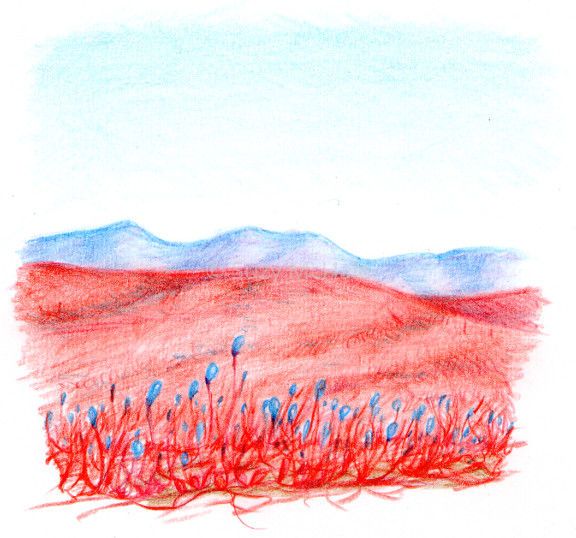
Home World plains (colored pencils, June 2013).
Folding screen
A folding screen (Zahuulansanaa) is a piece of portable furniture consisting of hinged panels that serves as a draft and privacy shield in a room, similar to the traditional Asian screens. There are usually several of these to be found in strategic locations, and they break up an otherwise large apartment room. They are brightly painted and lacquered, usually featuring hunting and landscape scenes.
Gold Cloud World
Gold Cloud World (Honuubaalosuusuuzu) is the fourth planet of the Dawn Hunters’ system. It is a Class I ammonia cloud Jovian gas giant. It is a little larger than Saturn, has noticeable rings and its cloud bands are gold, white and tan in color. It has 18 moons. It and Blue Cloud World are known as “Dawn’s Hearts” (Mawasaan).
Data
- Distance
- 4.06 AU
- Year length
- 8.18 Earth years = 2985.9 Earth days equivalent orbit
- Temperature
- 118 K
- Diameter
- 134,000 km
Gallery
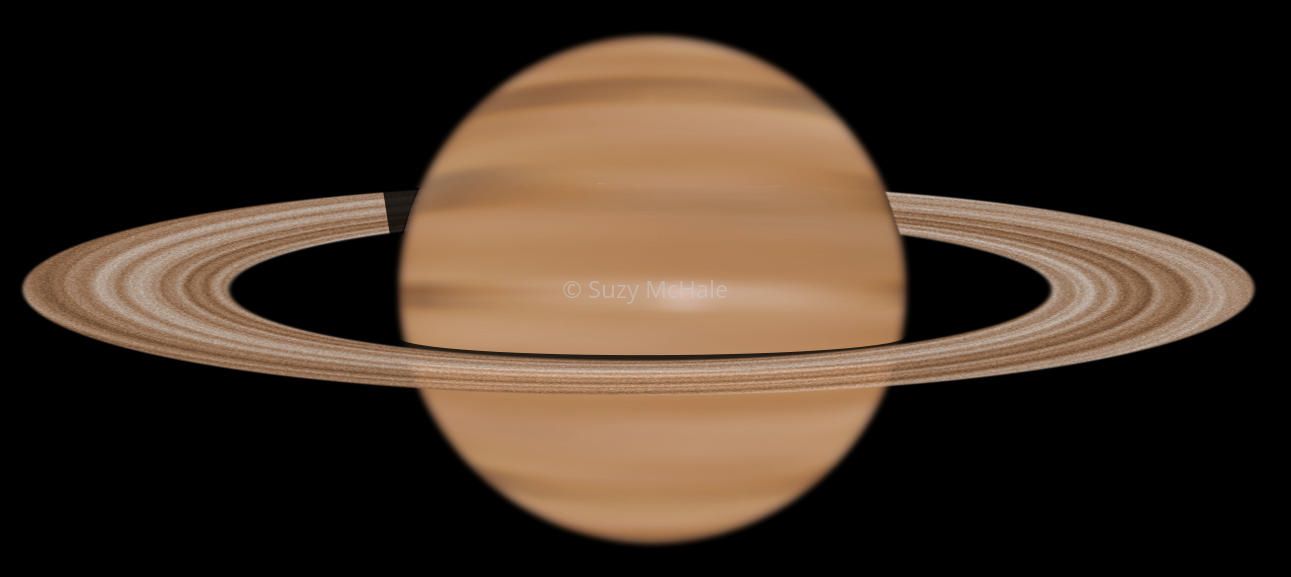
Gold Cloud World rendered with Gimp scripts Gas Giant, Planetary Ring System.
Grammar
Nouns are inflected for case; verbs have various conjugations. Word types are broadly divided into nouns (naming words), verbs (action words) and descriptors (adjectives, adverbs, etc.).
Modifiers
There are no distinct separations for adjectives (noun descriptors); these can be treated as stative verbs and may be reduplicated for emphasis. A noun placed after another noun can also serve as an adjective (however it usually ends up as a compound word). Adjectives are given verbal suffixes, and there may be only two words in a sentence: the subject noun followed by a descriptive adjective.
Adverbs (verb/adjective descriptors) are created by adding the appropriate suffix (-neel), or by reduplication for emphasis.
Adjectives are placed after nouns, and adverbs follow verbs. Numbers modifying a noun, however, come before the noun.
Noun case particles
Nouns have four suffixes indicating their case: accusative (uu), dative (e) (serves also as instrumental and locative), genitive (aa), nominative (o) – and are V only. These are placed on the word end, after any derivational suffixes following a noun root, and indicate a noun’s role in a sentence.
If there is a vowel preceding these, y or w are put in front as an interfix: a → w, e → y, o → w, u → w. (There are no suffixes beginning with w- or y- to avoid confusion.) A case can serve multiple functions for a word.
Possessive noun phrases are head-marked. For example, Narabaa Sahelnahuuwo, Night River Clan, is structured: Nara [clan] (w)aa [genitive] Sahelnahuu [River Night] (w)o [nominative] (Clan of/named the Night River). Another example: Zaawezoyuuwaa Sohaaro – the starship of/belonging to Sohaar.
If there is more than one noun in nominative case in a sentence, the first such noun that appears is the main subject.
Nouns do not have classes or genders.
| Noun affix | Meaning | Type |
|---|---|---|
| -(w)aa | genitive (shows possession – “of”; also can perform some functions of the ablative [motion away from] case) | noun case |
| -(w)o | nominative (shows the subject of a sentence; also the dictionary form of a word) | noun case |
| -(w)uu | accusative (shows the direct object of a sentence; person or thing that has an action done to it) | noun case |
| -(y)e | dative (shows the indirect object of a sentence. It serves also as instrumental [how something is done] and can also indicate location [ablative case], time or direction, depending upon context) | noun case |
Verb conjugation
Verbs can be conjugated for (in order) tense (infinite, remote past, near past, present), person, politeness (superior, equal, inferior) and mood (imperative, uncertainty/hearsay, fact/known). A verb with suffixes can be used as a complete sentence or statement. The verbals come after any derivational suffixes. If the consonant preceding the suffix is the same as the beginning consonant of the suffix (doubled/geminated consonants are not allowed), an interfix vowel is usually put in between: if the vowel preceding the last consonant is a/aa or o/oo, the bridging vowel is a. If not, the vowel is e. (The interfix has no meaning otherwise.)
Verb tenses: there are four – infinitive (-zan), remote past (-sul), near past (-ben) present (-nec) – and are CVC only. The remote past is used for events before one’s lifetime; the near past is within one’s lifetime. This reflects the culture’s preoccupation with the past and their ancestors; that these are still part of their daily lives. Similar to Japanese, the language does not have a future tense – instead, the present tense with a word or expression of time may be used (eg. day-next, salamamaa), or else the future is implied in context.
Verb politeness – to another: respectful/polite (-se), neutral (-la), abased (cu); referring to oneself: respectful/polite (-see), neutral (-laa), abased (-cuu). Addressing someone with the correct honorific is very important. One can easily insult another by wrongly using the inferior verbal conjugation. This has the same effect as swearing at them; consequently the language has few actual swear words.
Verb mood/evidentiality: imperative (-sa), hearsay/uncertain (-za), fact/personal knowledge (-na).
An example: the command “Begin!” – Nacanuumahensesa! – Naca [root] + nuu [tense – present] + mahen [person – you plural] + se [politeness – to higher-ranking Warriors here] + sa [mood – imperative].
| Verb suffix | Meaning | Type |
|---|---|---|
| -bal | she/he/its/hers/his (Dawn Hunter) | person |
| -ben | near past (also completed/perfect, present perfect tense) | tense |
| -bo | its (inanimate) | person |
| -cu | abased (of oneself) | honorific |
| -cuu | abased (of another) | honorific |
| -han | we, us (inclusive – me and you) | person |
| -hela | we, us (exclusive – me and they) | person |
| -la | neutral (of oneself) | honorific |
| -laa | neutral (of another) | honorific |
| -ma | you/your/yours singular | person |
| -mahen | you/your/yours plural | person |
| -na | fact/personal knowledge | mood |
| -nee | I/me/my/mine | person |
| -nec | infinitive | tense |
| -sa | imperative | mood |
| -se | superior (of oneself) | honorific |
| -see | superior (of another) | honorific |
| -sul | remote past | tense |
| -za | hearsay/uncertain | mood |
| -zan | present (also ongoing/imperfect, habitual actions) | tense |
Other affixes
These are attached before the cases or conjugation on verbs or nouns, and are not affected by the word type. They may be V, CV or CVC (most usually the latter two). If the root word’s ending consonant and the suffix’s beginning consonant are the same, a bridging vowel is usually placed between them.
| Affix | Meaning | Type |
|---|---|---|
| -a/-wa (after consonant/vowel) or created by lengthening a vowel, usually a (eg. har – war; haar – warrior) | Agent noun (“one who …” “that which …”) – an entity that does an action | agentive suffix |
| -bo | Superlative (“the most” “the least”) | suffix |
| -ca | Diminutive – attached to kinship terms to indicate affection | suffix |
| ce- | Makes number an ordinal | prefix |
| -cul | Reflexive – perform an action on oneself (appended to pronouns – e.g. herself, myself) | suffix |
| -cuuna | many | independent suffix |
| -hay | Number – inanimate objects | number classifier |
| -he | Causative – to inflict an action upon someone or something | suffix |
| -hon | Number – creature, animates | number classifier |
| -huu | Negative particle (not, -less) | independent suffix |
| -lan | Make word into noun (means state/quality/measure of word – equivalent to English -ing) – verb root + -lan | derivational suffix |
| -me | Interrogative (indicates yes/no question) – attach to end of most relevant word in a sentence | interrogative suffix |
| -neel | Adverb marker | derivational suffix |
| -nel | Number – person (Dawn Hunter) | number classifier |
| -nem | Attached to kinship terms to indicate respect | honorific |
| -ranee | Address for lower rank | pronoun honorific |
| -rel | Make noun into verb | derivational suffix |
| -sanul | Address for equal rank | pronoun honorific |
| -seen | With (also used for the equivalent of the verb “to have,” for which there is no direct word) | nominal dependent suffix |
| -zen | Address for higher rank | pronoun honorific |
Grey Moon
Grey Moon (Rebebehu) is the nearest moon of three orbiting Home World. It is grey in color, similar to Earth’s Moon. It is tidally-locked to Home World, so that one side always faces the planet. Clan Lordsare buried in pyramid-tombs on its surface, so that they are regarded as watching over their world.
Data
- Diameter
- 2400 km
- Radius
- 1200 km
- Density
- 4.5
- Distance
- 24 radii = 168,380.8368 km (Roche Limit of 2.8518 radii)
- Viewing angle
- 0.8° (appears slightly bigger than Moon – Earth’s Moon is 60.27 radii from the Earth right now; it is 0.5°)
- Orbit
- 156.94 Earth hours/6.5 days/5.2 HW days (orbits 98.46 times in a HW year)
Gallery
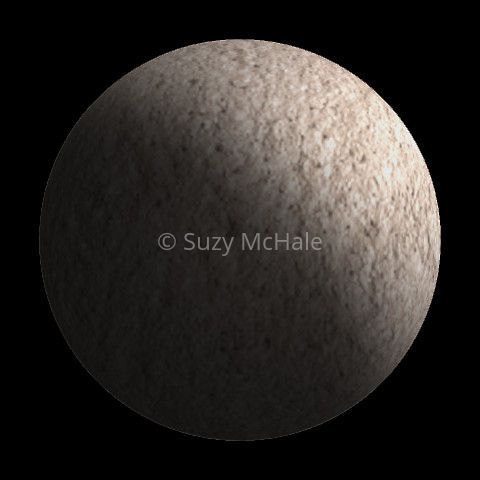
Grey Moon, rendered using a GIMP script.
Ground Carrier
The equivalent of cars on Earth is a Ground Carrier (Habaalanlenol) or Machine Sled (Cereslanbuuran) – also nicknamed, for obvious reasons, a Saraabuuran (machine-egg). This is an ovoid/elliptical wheeled pod that seat up to four occupants and is much the same size as an average human-made car (around 4 meters in length). As with other transport, it is solar-powered and is constructed from the black nanoalloy metal that has an iridescent sheen; the surface has an underlying hexagonal pattern that absorbs sunlight. The wheels can morph into a form more suited for all-terrain use outside a City as there is no road network due to the strong inhibition against despoiling the land with infrastructure. It has a basic AIto enable autonomous driving; there is also an option for user-controlled driving.
The cars are parked in various locations around a City for anyone to use when needed.
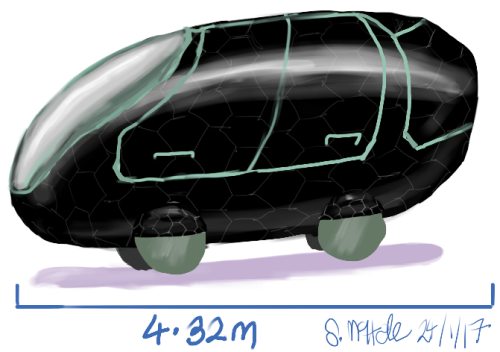
Placeholder rough sketch for a Ground Carrier; done 24/1/2017.
Dimensions
- Length
- 2 bodylengths (4.32 m)
- Width (at widest point)
- 1 bodylength (2.16 m)
Haarlecaa
Haarlecaa is a Warrior-Guardian, older brother of Yaraanlecaa. Clan Lord Sohaar inherited them from Supreme Lord Yaraan.
Biographical information
- Gender
- Male
- First appearance
- Dominator chapter: “Encounter”
Haarmaarec
Haarmaarec is a Warrior-Four-Claw under Lords Maarec and then Sohaar.
Biographical information
- Gender
- Male
- Eye color
- Blue-green (#008080/rgb(0,128,128))
- First appearance
- Inheritor chapter: “Succession”
Haarnahuu
Haarnahuu (past)
Haarnahuu is a Clan Lord and ally of Sohaar. Male, Warrior Caste, Endless Plains Clan.
Biographical information
- Gender
- Male
- First appearance
- Inheritor chapter: “Challenge”
Haarnahuu (remote past)
An ancestor with the same name.
Biographical information
- Gender
- Male
- Eye color
- Light violet (lavender) (#b57edc/rgb(181,126,220))
- First appearance
- Inheritor chapter: “Fallen”
Haaryaraan
Haaryaraan is a Clan Lord, Dawn Star Clan. Oversees the alien Sword Arms.
Biographical information
- Gender
- Male
- First appearance
- Dominator chapter: “Encounter”
Haraanahuu
Haraanahuu is a War Lord who tries to overthrow Clan Lord Maarec by sending two Warrior-Assassins to kill him.
Biographical information
- Gender
- Male
- First appearance
- Inheritor chapter: “Assassins”
Haraanoro
Haraanoro is a Warrior-Guardian of Sohaar-5.
Biographical information
- Gender
- Male
- First appearance
- Chapter: “Fallen”
Haraazuun
Haraazuun is a Warrior-Four-Claw who challenges the Supreme Lord, Soharaa, to a leadership duel. Full title is: Haraazuun-106, son of Baaloyaraan-107 of the Ocean Wind Clan.
Biographical information
- Gender
- Male
- Eye color
- Dark green (#013220/rgb(1,50,32))
- First appearance
- Inheritor chapter: “Challenge”
Healing Bed
A Healing Bed (Bunuunmohuulan) is an enclosed sarcophagus-like medical bed that contains Repairer-Nanites which are programmed to heal the one occupying it. The occupant is enveloped in a cocoon-like azure-blue gel containing the nanites that anesthetize them for the duration of the procedure; effectively a form of hibernation or stasis that can be extended almost indefinitely (as in the case of Sohaar). It can be configured for various alien physiologies.
Only a Clan Lord can use the Bed to also extend his life. This comes with a caveat: for as long as he uses it, he is not allowed to father children. If he wishes to reproduce, he must permanently stop using the Bed’s longevity programming and so age and die normally (though he can still use it for normal healing). This ensures that Dawn Hunter society does not become overrun with immortals. (Few, if any, Clan Lords would be immortal anyway as they tend to kill each other off in combat.)
Heir Lord
A Heir Lord (Zulyaacosa) is a War Lord’s or Clan Lord’s first-hatched son who will inherit his position. Helmet crest is modeled on that of a young Crescent Horn.
His metal rank color is gold (#ffd700 / rgb(255,215,0)).
Gallery
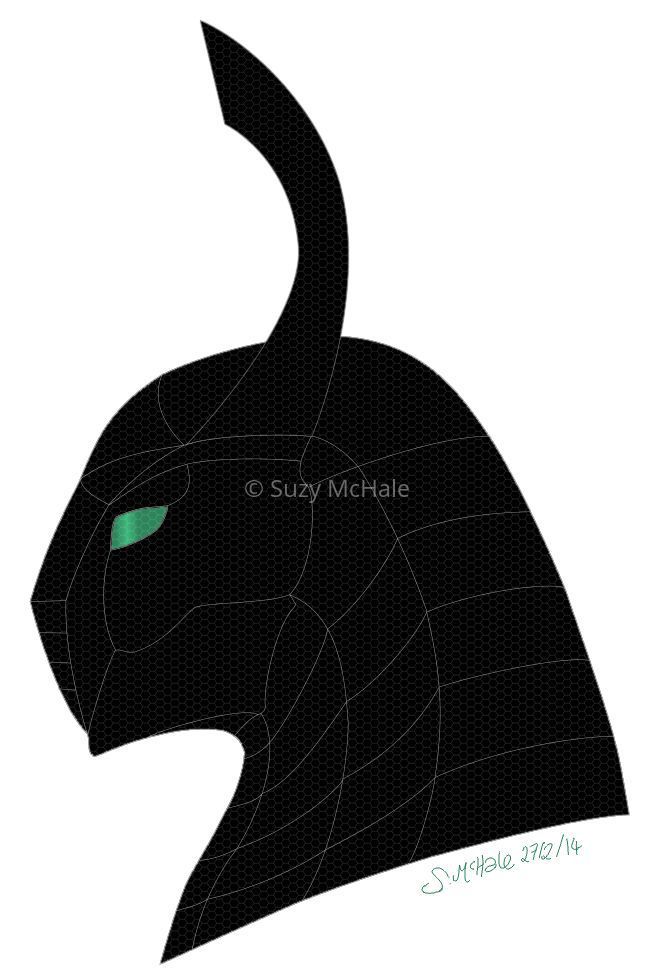
Heir-Lord helmet (digital art, 27/2/2014).
Hesaabale
Haraazuun is a Warrior-Four-Claw under Lords Maarec and then Sohaar. He serves as Ship Master on Regent Lord Yaraan’s Void Walker during Yaraan’s attempt to overthrow Sohaar.
Biographical information
- Gender
- Male
- First appearance
- Inheritor chapter: “Capture”
Home World
Home World (Yoorazuulnulun) is the planet on which the Dawn Hunters evolved, and on which they still reside. It orbits the star Eye of the Day in a fairly stable circular orbit.
It is referred to as Yoorazuulnulun, “Land-sky [implied nominative – of/that is] home,” literally Home World. It can also be referred to as Yoora, the name of the single large continent.
Overview
Home World is an Earth-like world, but a little harsher in some respects. Home World gets more ultraviolet radiation than Earth, so a human walking on its surface would need skin and eye protection, but this is somewhat moderated by the sun’s being further away.
Much of HW – about 76% – consists of ocean, but despite this the Hunters are not an ocean-going species, fearing the vast expanses of deep water. Most of the land mass is clumped together similar to the ancient Earth supercontinent of Pangaea, with small archipelagos of islands, and covers up around 24.1% of the planet’s surface. There are deserts, mountain ranges and volcanoes, and some forests. The planet is geologically active, with slowly-moving tectonic plates. Huge hurricanes form over the unbroken ocean, making parts of the coast a dangerous place to live. Hunter cities are thus located a little way inland, often alongside inlets; only the nuclear fusion power stations supplying each city are close to the coast as they need to process seawater for deuterium fuel.

In part due to the slightly higher gravity, the atmosphere is a bit thicker than Earth’s; oxygen content is 23%. Sky color is light aquamarine, fading to near-white near the horizon (#a3dde1/rgb(163,221,225) to #e6fafb/rgb(230,250,251)).
Average surface temperature is 18°C (Earth’s is around 14°C).
Minerals, rocks and gems are much the same as those formed on Earth.
Data
- Area
- 618,554,374.395 km2 (note: to calculate surface area of sphere: Area = 4πr2)
- Atmosphere
- 1.1 (16.17 psi/111.1 kPa) (N2, O2, Ar); 23% O2
- Axial tilt
- 16°
- Circumference
- 6.908 (44,082.5 km)
- Day length
- A day is the equivalent of 30 Earth hours (1.25 times longer than an Earth day)
- Density
- 5.6 g/cm3
- Diameter
- 14,031.71 km
- Distance
- 1.45 Astronomical Units or 217,500,000 km
- Escape velocity
- 12,320 meters/second
- Gravity
- 1.119 of Earth (using density of 5.6 and radius 1.1 of Earth’s); a human will weigh about 10% more on Home World
- Mass
- 6.567 × 1024 kg (6,567,000,000,000,000,000,000,000 kg)
- Moons
- Three
- Radius
- 7015.91 km (1.1 times that of Earth)
- Roche Limit (2.423 of a planet’s radius)
- 2.6653
- Size of star from planet
- Viewing angle in degrees = 0.45°; appears a little smaller in the sky than the Sun does from Earth’s sky (0.5°)
- Temperature range
- −50°C to +50°C
- Volume
- 5.572 (1,446,573,940,288.983 km3) (note: to calculate the volume of a sphere: Volume = 4 πr3/3 (r3 × π × 4 ÷ 3)
- Year length
- 638.75 Earth days (15,330 Earth hours – .75 equals 18 hours)
Years and days
A day is the equivalent of 30 Earth hours (1.25 times longer than an Earth day). It divides into 8 × 210 minute-segments:
- midnight
- postnight/before dawn
- dawn
- preday
- midday
- postday
- sunset
- evening
A year starts and ends at the summer solstice (southern hemisphere); it is divided into quarters, delineated by solstices and equinoxes.
- equinox (even-sun/day): Hesaalecaahema
- solstice, summer (long sun/day): Hesaalecaamee
- solstice, winter (short sun/day): Hesaalecaanolam
| Home World years | Earth years equivalent |
|---|---|
| 1 | 638.75 Earth days (1.75 Earth years) |
| 2 | 3.5 |
| 3 | 5.25 |
| 4 | 7 |
| 5 | 8.75 |
| 6 | 10.5 |
| 7 | 12.25 |
| 8 | 14 |
| 10 | 17.5 |
| 11 | 19.25 |
| 12 | 21 |
| 20 | 35 |
| 30 | 52.5 |
| 40 | 70 |
| 50 | 87.5 |
| 60 | 105 |
| 70 | 122.5 |
| 75 | 131.25 |
| 80 | 140 |
| 85 | 148.75 |
| 100 | 175 |
| 110 | 192.5 |
- HW years to Earth years: Multiply HW years by 638.75; divide by 365
- Earth years to HW years: Multiply Earth years by 365; divide by 638.75
Moons
Home World has 3 moons: Grey Moon, Red Moon, Ice Moon. All are smaller than Earth’s Moon.
Orbital resonance:
- Grey Moon/Red Moon: 1.53 (1 Red Moon orbit = ~1½ Grey Moon orbits)
- Red Moon/Ice Moon: 1.85 (1 Ice Moon orbit = almost 2 Red Moon orbits)
- Grey Moon/Ice Moon: 2.8 (1 Ice Moon orbit = almost 3 Grey Moon orbits)
This animation of Jupiter’s Galilean moons gives an approximation of the orbital resonance of Home World’s moons. The inner 2 moons (Io and Europa) line up every 2 orbits of the 1st moon. The middle and outer moons line up every 2 orbits (Europa and Ganymede). The 3 moons never line up together on one side, so there can never be 3 moons visible in the sky at the one time. At one point the outer and inner moons are lined up on one side, with the middle moon directly opposite on the other side of the planet.
Gallery
Some digital maps done from 21/3/2013, using GIMP and NASA’s G-Projector. They are not highly precise, but will give an idea of the scale of the continent. (Scale is 1 cm: 1000 km or 1: 100 pixels on the original size.)
Equicylindrical projection, basic outline (completed 6/11/2013 in GIMP) – the image is increasingly distorted at higher latitudes (squashed vertically and stretched horizontally). Clan Cities, their nuclear fusion power stations and mountains over 1000 m are shown.
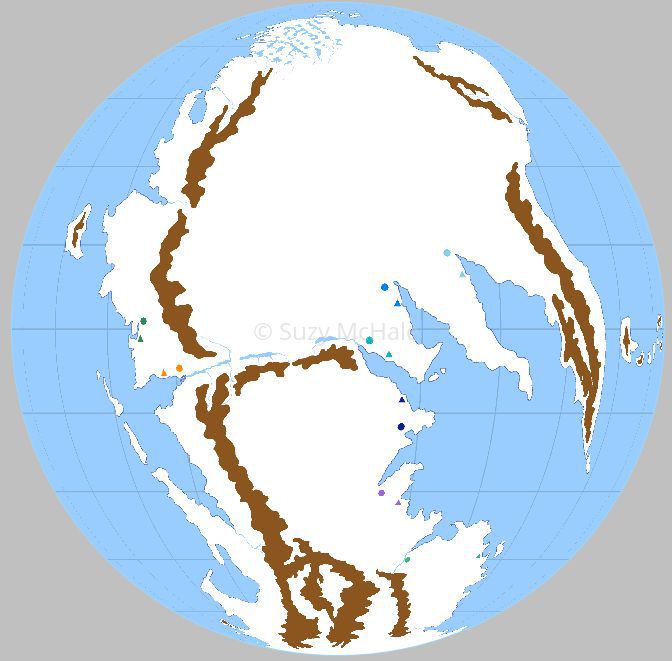
Orthographic projection.
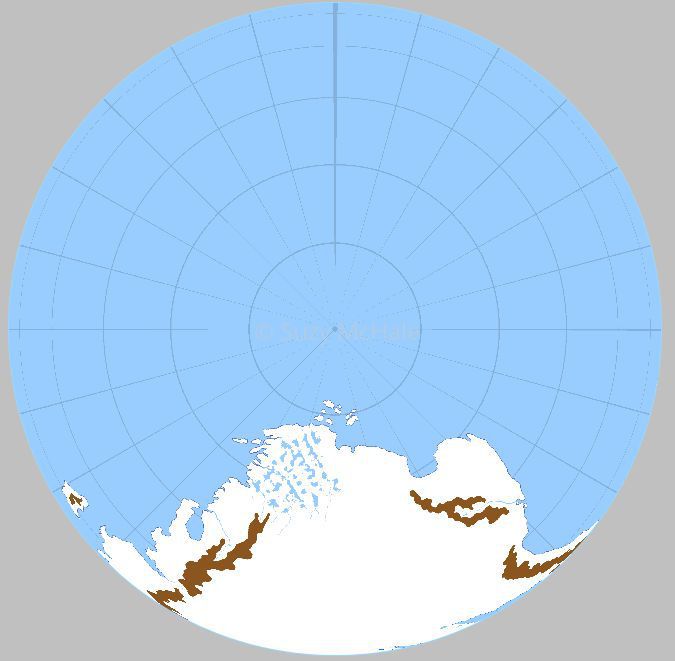
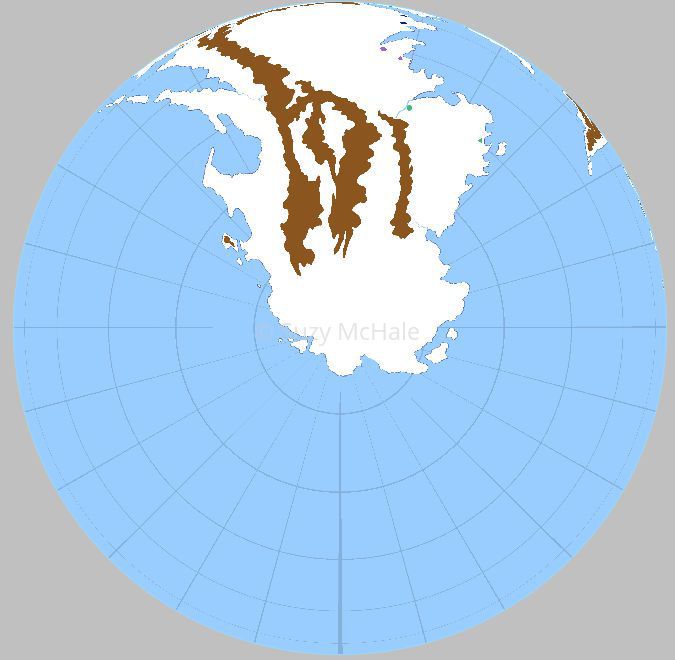
North and south hemispheres.
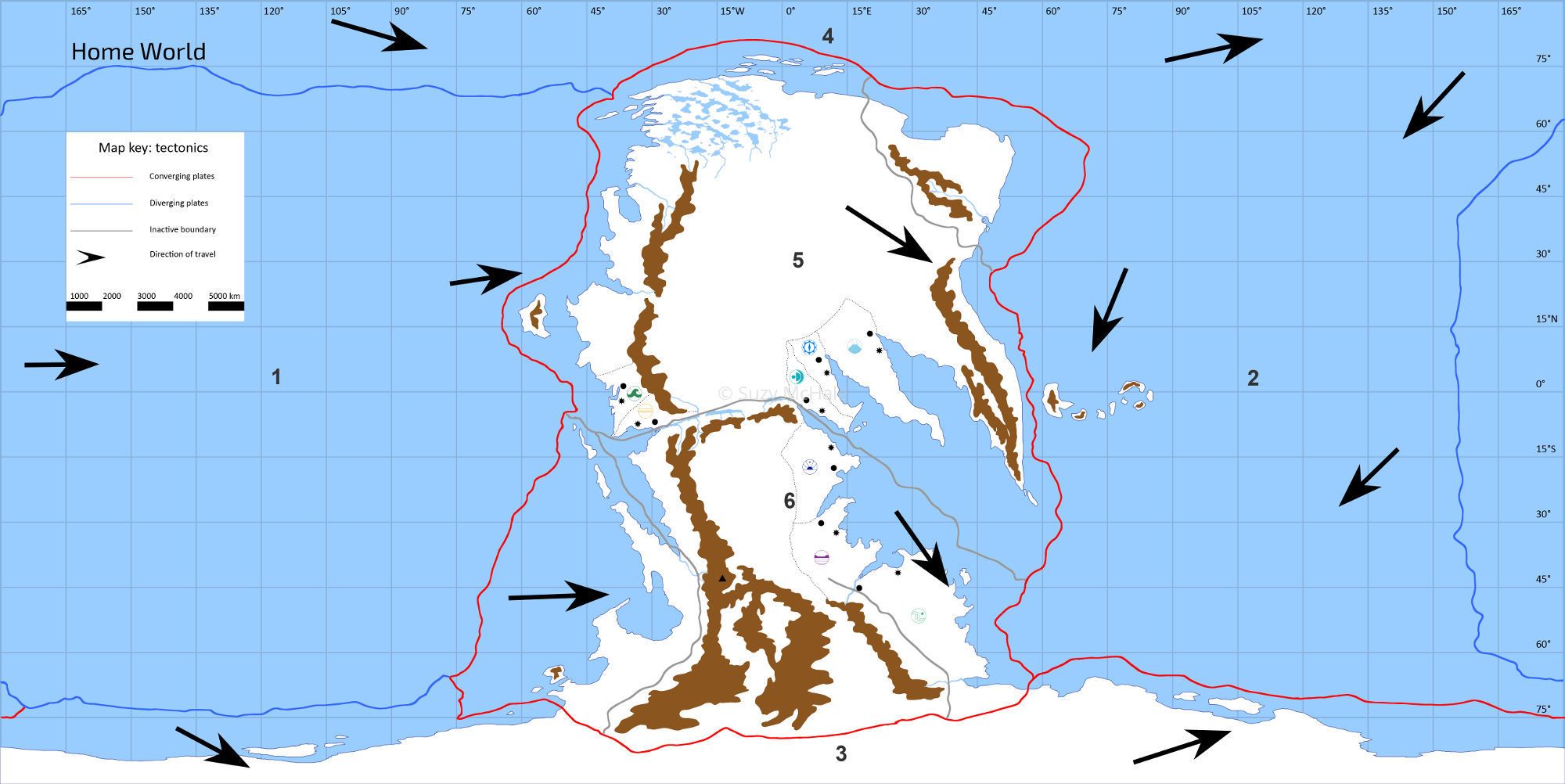
Tectonic plates, showing major plates. Plates 1 and 2: spreading from undersea rift; Plates 3 and 4: polar, rotating; Plates 5 and 6: merged, moving eastward, colliding with plate 2.
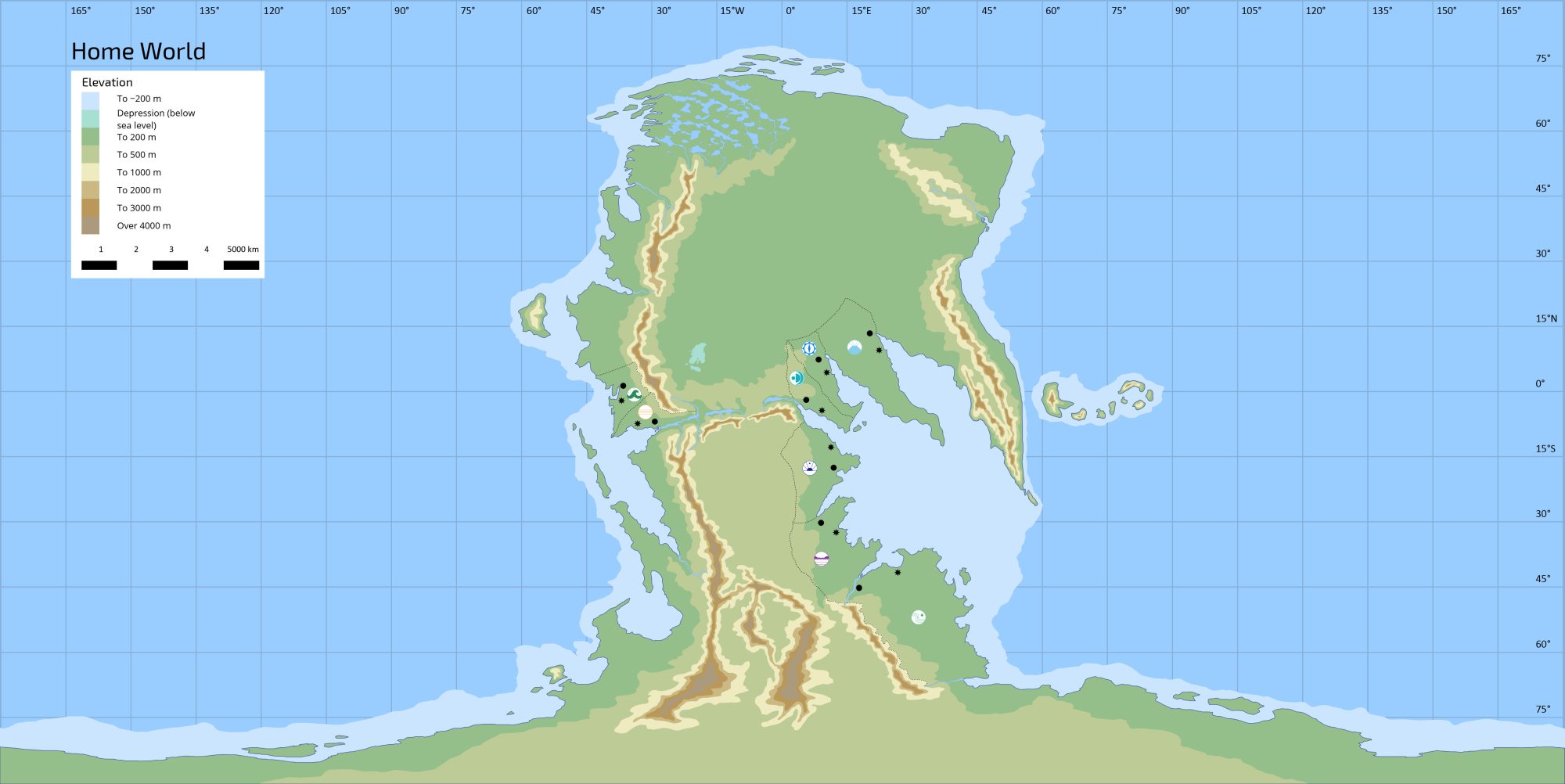
Land elevation map (completed 7/11/2013). There is a large dry salt lake bed in the northern desert.
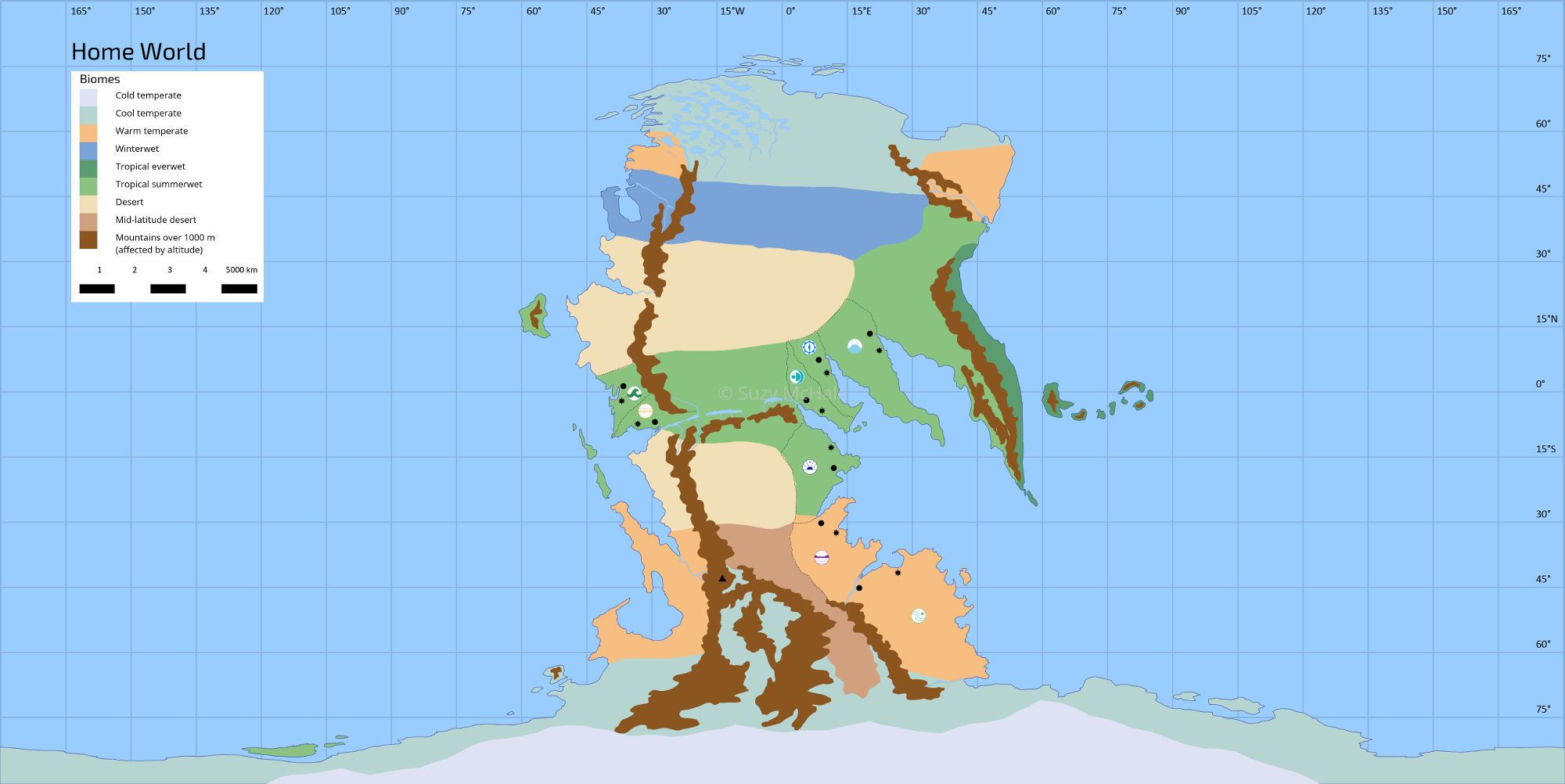
Biome map (completed 7/11/2013).
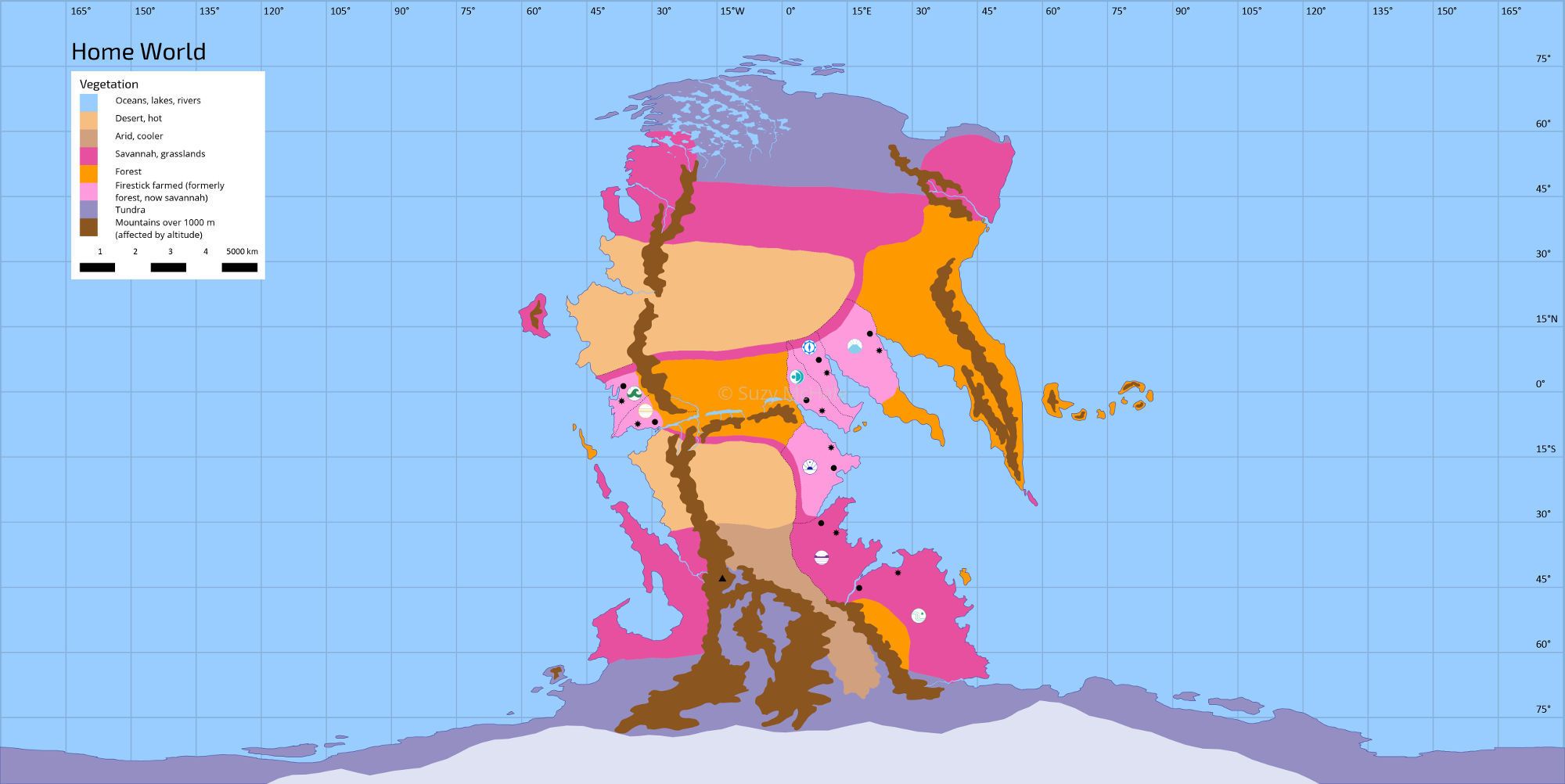
Vegetation map (completed 8/11/2013) – note that the hunting grounds of the Dawn Hunters in formerly forested areas are managed by firestick farming.
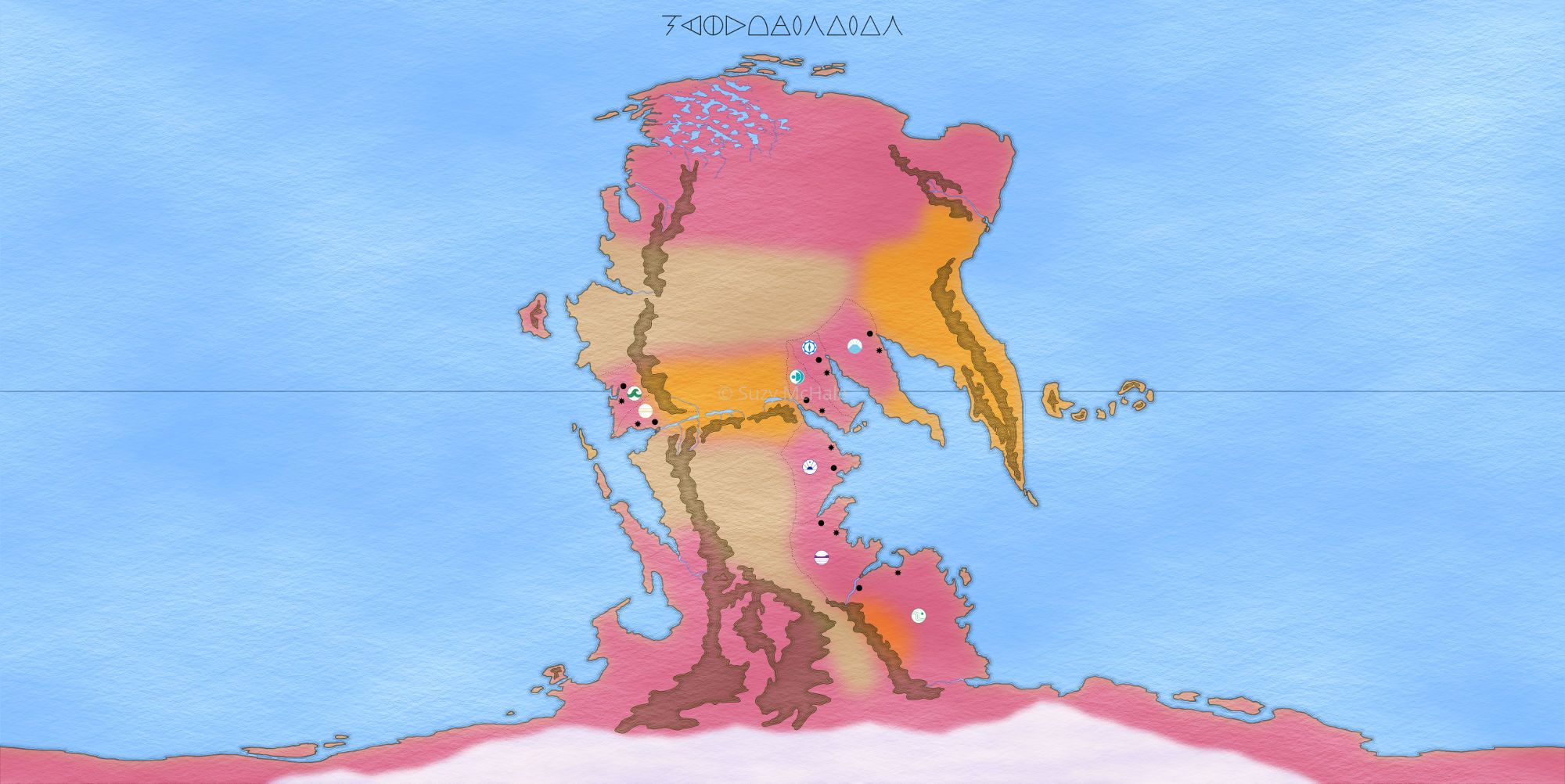
A decorative and stylized map – how it might appear when painted as a wall mural (4/9/2014).
I don’t know how realistic these vegetation patterns are, not being an expert and having no access to a climate simulator! I have somewhat based them on the ancient continent of Pangaea.
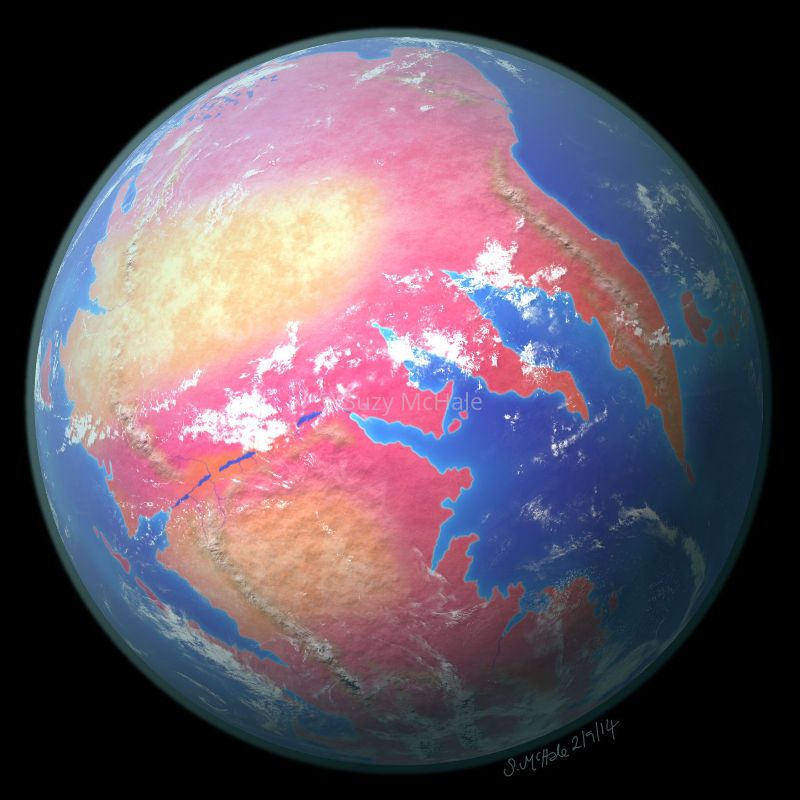
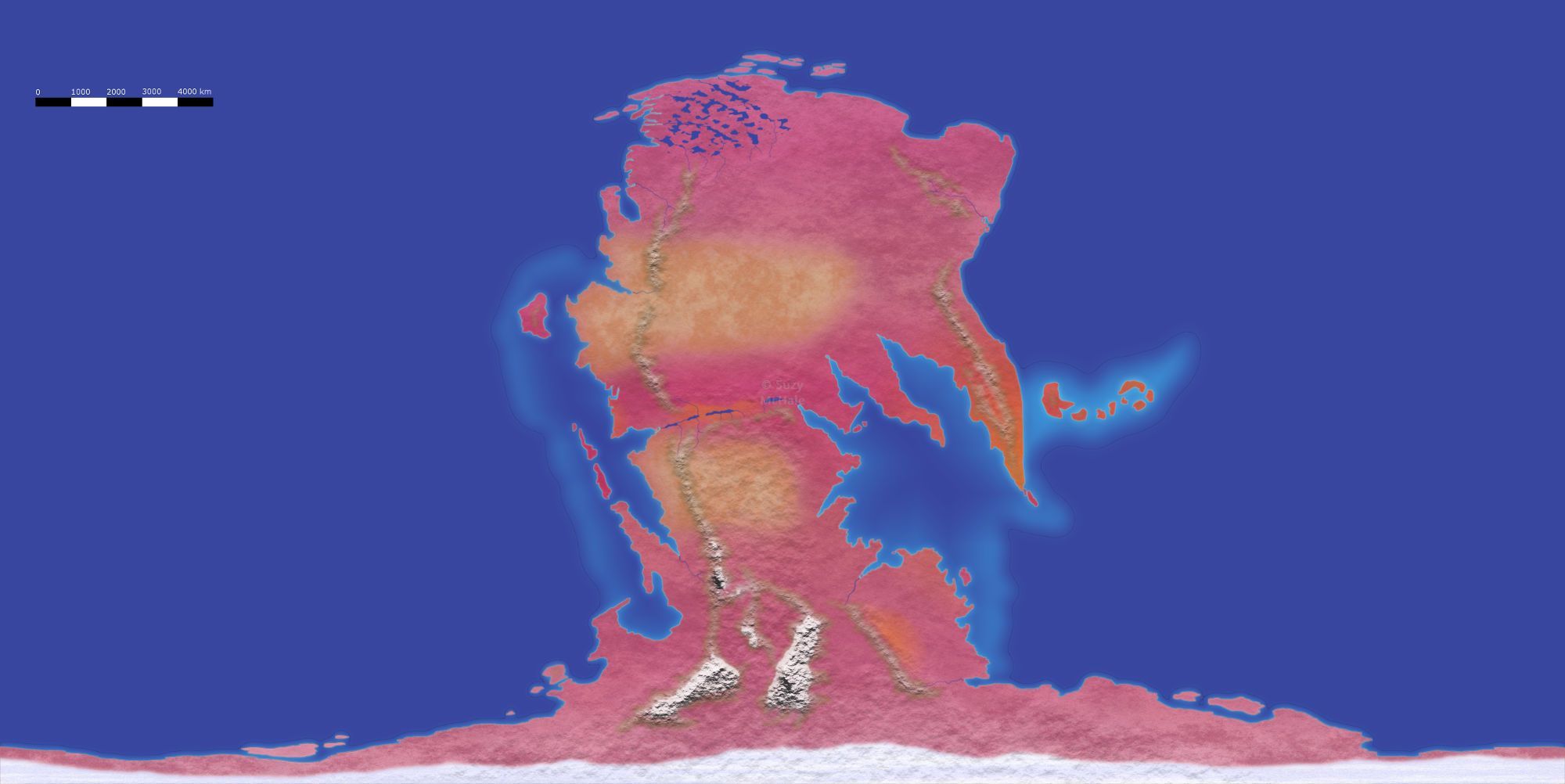
“Satellite” views of the continent. These are approximations only as I don’t have the skill so far to do a photo-realistic map, so these are more stylized views. (Clouds are an overlay from Natural Earth– I am not sure what cloud formations over a single large continent would look like.) (2/9/2014) Scale note: 1 pixel = 8.48 km on the ground, so 100 px = 848 km (works out to 44,070.56 km circumference), and 117.92 px = 1000 km (44,042.37 km). Not perfectly accurate, but good enough for an approximate rendition.
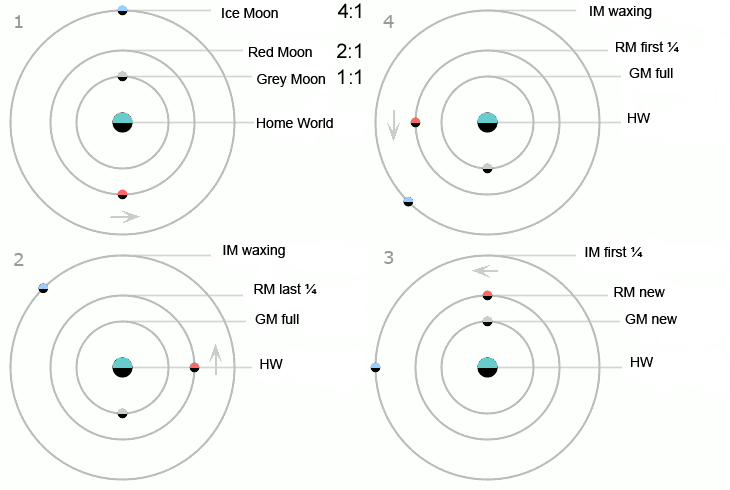
Approximation of the orbits of Home World’s moons, adapted from an animation of Jupiter’s moons. It is not highly precise. Direction is anti-clockwise for both orbits and images.
Horus Expedition
The Russian Mars expedition is set in the near-future (before 2020 at the current time of writing in 2014). It is a privately funded mission initiated by Darius Tyler, a (very) wealthy American businessman, entrepreneur and space enthusiast who helps with funding a Russian spaceship in return for access to alien technology. He is an eccentric idealist and has a secret wish to meet an alien (though Sohaar might prove more than he bargained for!). He is CEO of the Darius Corporation, which has investments in various technological areas. He is a multi-billionaire, necessary for him to fund his own space mission!
Mission profile
The mission profile is based on that set for the Mars-500 one: launch 10 October 2017 and arrive in Mars orbit on 22 August 2018 after a 315-day trip. Mars and Earth will be around 79,666,000 km apart at this point in their orbits (or 64 million km according to the The Orbit of Mars simulator, from which the screenshots below are sourced). Radio signals will take 4.4 minutes each way (8.8 minutes round trip).
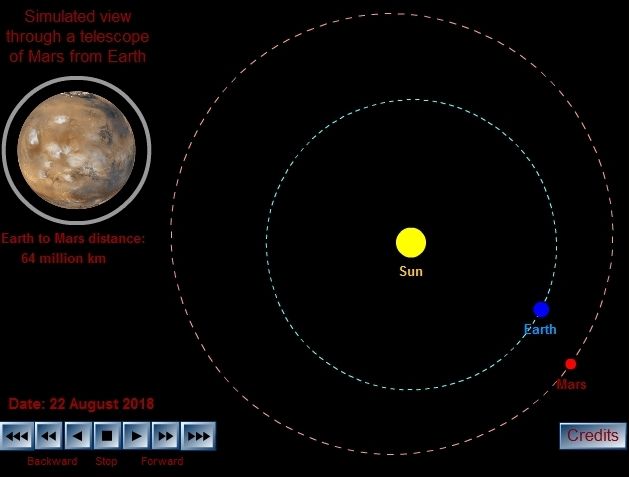
The Mars-500 simulated mission experiment begun on 3 June 2010 with a crew of 6 and ended on 4 November 2011. The TsUP mission page (in Russian, so I am relying upon an imperfect computer translation), describes the stages of the mission. The launch window is in 2018, corresponding to the nearest favorable opposition of Mars and the Earth. The actual mission leaves in October 2017 and returns to Earth in October 2019.
- The Interplanetary Expeditionary Complex (MEK, Межпланетный экспедиционный комплекс) starts from a circumterraneous assembly orbit at an average height of 450 km and an inclination of 51.6 degrees.
- The general duration of the expedition flight is 2 years, 30 days of which is spent in orbit around Mars, with part of the crew landing on the surface. Mars research is conducted both from orbit and on the planet’s surface.
- Closest approach to the Sun is 0.57 astronomical units (85 million km), so suitable thermal protection is required.
- Initial weight of MEK in orbit is 500 tonnes.
- 6 people are in the crew, 3 of whom land on Mars.
- The maximum time for radio signals to travel one way is 12 minutes 20 seconds (so 24m 20s round trip).
- Gravitational influences of planets:
- Earth: 2.6 million km
- Mars: 1 million km
The spaceship’s trajectory is maintained by small engine impulses. Electrojet ion engines are used, with argon being the propellant gas, and 17 to 25 MW of power is needed. Power supply is either solar (120,000 sq. m sails providing 18 Mvt) or nuclear (25 MW).
| Полет в сфере действия Земли – старт с орбиты ИСЗ Flight in Earth’s orbit – launch from artificial satellite orbit |
|
|---|---|
| Старт с опорной орбиты искусственного спутника Земли Launch from support orbit of the artificial companion of the Earth |
10/10/2017 00:46:00 |
| Время раскрутки, сутки Acceleration time, days |
99.926 |
| Расход топлива, тонн Fuel used, tonnes |
34.888 |
| Перелет Земля-Марс Flight from Earth to Mars |
|
| Дата отлета со сферы действия Земли Date of leaving Earth’s gravitational influence |
17/01/2018 23:00:00 |
| Время перелета Т, сутки Flight time, days |
216.083 |
| Моторное время t, сутки Motor time t, days |
142.260 |
| Расход топлива, тонн Fuel used, tonnes |
49.669 |
| Полет в сфере действия Марса Flight in Mars orbit |
|
| Дата выхода на сферу действия Марса Exit date from Mars’ gravitational influence |
22/08/2018 01:00:00 |
| Время скрутки, сутки Time duration, days |
38.216 |
| Расход топлива, тонн Fuel used, tonnes |
13.343 |
| Дата выхода на орбиту искусственного спутника Марса Date of entering orbit around the artificial satellite of Mars |
29/09/2018 06:11:00 |
| Орбитальная фаза полета, сутки Orbital phase of flight, days |
29.883 |
| Дата схода с орбиты искусственного спутника Марса Date of descent from orbit of the artificial satellite of Mars |
29/10/2018 03:39:00 |
| Время раскрутки, сутки Acceleration time, days |
37.014 |
| Расход топлива, тонн Fuel used, tonnes |
12.923 |
| Перелет Марс-Земля Flight from Mars to Earth |
|
| Дата отлета со сферы действия Марса Date of leaving Mars’ gravitational influence |
5/12/2018 03:59:00 |
| Время перелета Т, сутки Flight time, days |
249 |
| Моторное время t, сутки Acceleration time, days |
159.9 |
| Расход топлива, тонн Fuel used, tonnes |
55.828 |
| Полет в сфере действия Земли – возвращение Flight in sphere of action of the Earth – returning |
|
| Дата выхода на сферу действия Земли Exit date from Earth’s gravitational influence |
11/08/2019 03:59:00 |
| Время скрутки, сутки Flight time, days |
59.948 |
| Расход топлива, тонн Fuel used, tonnes |
20.93 |
| Дата завершения полета Flight completion date |
10/10/2019 02:44:00 |
| Характеристики уточненной баллистической схемы Characteristics of the refined trajectory plan |
|
| Общее время экспедиции, сутки Total expedition duration, days |
730.07 |
| Затраты рабочего тела, тонн Energy of working body, tonnes |
187.581 |
| Начальная масса МПК на орбите ИСЗ The initial mass of the MPK on-orbit satellite |
385.1 |
| Минимальное расстояние от Солнца, а. е. Minimum distance from the Sun |
0.570 |
| Misson day/date | From Earth | To Mars |
|---|---|---|
| 14 (17/6/2010) | 71,000 | 316,540,000 |
| 22 (25/6/2010) | 138,500 | 306,846,000 |
| 29 (2/7/2010) | 300,000 | 297,670,000 |
| 44 (16/7/2010) | 1,457,000 | 279,657,000 |
| 58 (30/7/2010) | 3,904,000 | 261,140,000 |
| 65 (6/8/2010) | 5,467,000 | 250,386,000 |
| 75 (17/8/2010) | 8,089,000 | 234,374,000 |
| 79 (20/8/2010) | 9,471,000 | 227,019,000 |
| 93 (3/9/2010) | 15,721,000 | 200,022,000 |
| 100 (10/9/2010) | 19,266,000 | 87,267,000 |
| 107 (17/9/2010) | 23,932,000 | 172,428,000 |
| 114 (27/9/2010) | 28,475,000 | 159,870,000 |
| 125 (4/10/2010) | 33,143,000 | 142,787,000 |
| 128 (8/10/2010) | 36,852,000 | 130,852,000 |
| 135 (15/10/2010) | 40,818,000 | 117,495,000 |
| 142 (22/10/2010) | 44,380,000 | 104,461,000 |
| 149 (29/10/2010) | 47,167,000 | 92,962,000 |
| 159 (8/11/2010) | 50,160,000 | 78,268,000 |
| 162 (12/11/2010) | 50,707,000 | 74,017,000 |
| 170 (19/11/2010) | 51,991,000 | 62,896,000 |
| 177 (26/11/2010) | 52,507,000 | 54,527,000 |
| 184 (3/12/2010) | 52,659,000 | 5,163,000 |
| 191 (10/12/2010) | 55,289,000 | 3,255,000 |
| 198 (17/12/2010) | 58,309,000 | 1,907,000 |
| 205 (24/12/2010) | 61,865,000 | 886,000 |
| 212 (31/12/2010) | 65,897,000 | 265,000 |
| 226 (14/1/2011) | 74,587,000 | 16,100 |
| 233 (21/1/2011) | 79,666,000 | 7,600 |
| Misson day/date | From Mars | To Earth |
|---|---|---|
| 313 (11/4/2011 – depart Mars 3/3/2011) | 1,606,000 | 160,485,000 |
| 338 (6/5/2011) | 25,206,000 | 212,983,000 |
| 345 (13/5/2011) | 38,030,000 | 219,465,000 |
| 352 (20/5/2011) | 45,642,000 | 220,580,000 |
| 359 (27/5/2011) | 62,514,000 | 219,372,000 |
| 394 (1/7/2011) | 190,256,000 | 145,509,000 |
| 401 (8/7/2011) | 213,661,000 | 128,898,000 |
| 415 (22/7/2011) | 261,118,000 | 94,210,000 |
| 422 (29/7/2011) | 284,720,000 | 76,790,000 |
| 429 (5/8/2011) | 303,384,000 | 63,180,000 |
| 436 (12/8/2011) | 322 538 000 | 48 158 000 |
| 446 (22/8/2011) | 357,622,000 | 27,708,000 |
| 450 (26/8/2011) | 373,331,000 | 17,226,000 |
| 460 (5/9/2011) | 389,690,000 | 7,486,000 |
| 464 (9/9/2011) | 395,914,000 | 3,454,000 |
| 471 (16/9/2011) | 398,196,000 | 1,756,000 |
| 478 (23/9/2011) | 399,489,000 | 694,000 |
| 485 (30/9/2011) | 400,201,000 | 209,000 |
| 492 (7/10/2011) | 399,939,000 | 72,700 |
Spaceship
The Horus comprises two main modules: a main module based on the proven Mir and ISS Zvezda core module designs, and a second docked module similar to the FGB Zarya that provides power and propulsion; the nuclear reactor is located here. Several Progress cargo supply ships are launched to carry up supplies, and two are kept docked to the main ship for the duration of the mission, as is the manned Soyuz ship to take the crew up.
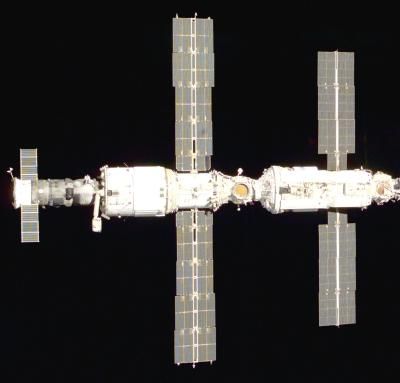
The spaceship essentially resembles the two Russian segments of the International Space Station as it appeared in an early stage of construction, similar to the NASA image(Unityhas been cropped off).
The crew are not going to Mars to set up a colony or for detailed exploration; it is simply a “get-there-first-and-back” mission. The idea is to use as much already-proven technology as possible, and to accept a certain amount of risk of the crew not returning. The crew will be exposed to radiation and galactic cosmic rays during the flight there and back which will be detrimental to their long-term health (if they don’t die during the mission). It is in some sense a “kamikaze mission” and the crew are well aware of this, but accept the dangers in return for the prestige of being the first humans to go beyond the Earth-Moon system and around (if not on) Mars.
Estimated (and probably wildly optimistic) time between the detection of the signal, ship construction and the mission launch is two years; and another two years for the actual mission (out of which up to a month is actually spent in Mars orbit).
Russia has plans to develop a nuclear reactor for a human mission (see next section below) that would provide ample power, so this is flown on the mission as a test flight. Unfortunately details about the reactor are scant as it is in development! It is to be developed at the Skolkovo Innovation Center. The reactor uses a liquid-metal coolant instead of water – NaK, sodium-potassium alloy. Unfortunately this mixture is highly explosive if it contacts air or water! Other coolants such as lead, though, need to be heated continually to remain in liquid form, so the space reactor will likely use NaK.
The reactor powers the electric propulsion engines, which use xenon as a propellant. There are some obvious safety concerns about launching a nuclear reactor into orbit, but for this mission it is considered an acceptable (and small) risk. The reactor is housed in a small module behind the FGB; this module can be detached and dumped if anything goes wrong with the reactor, and the crew would have to rely on the power generated from the solar arrays fitted to the modules. These arrays are similar to those on the Russian ISS modules to provide backup power (power from sunlight decreases the further away a spaceship goes, which is why the reactor is necessary). Twin arrays only provide 7500 watts of power.
On return to Earth the plan is to leave the spaceship into a high parking orbit while the crew returned in a Soyuz to Earth – a newly-launched one sent up to retrieve them (see note below). Satellites with nuclear reactors are boosted into a nuclear-safe orbit where they will remain for centuries as the reactors decay. An NSO is a “Circular geocentric orbit with 700 km altitude designed to delay atmospheric entry and space craft nuclear reactor disintegration for several hundred years in order to reduce the danger of high-level radiation in the atmosphere.”[1]
The Soyuz’s stay in space is limited due to one of its propellants. The Hydrogen Peroxide (H2O2), an oxidizer, used in the Descent Module’s Reaction Control System, tends to deteriorate over time to H2O and O; the TMA version, with a cooling system for the H2O2, has a limit of 180-210 days (6-7 months). (A more extensive upgrade, to extend the stay to a year, would have also included the installation of improved storage batteries and the oxidizer tanks to be made from steel rather than the current aluminum alloy, but this was not done because of lack of finances.) The only solution is for another Soyuz to be launched and sent up to retrieve the cosmonauts on their return; it would be flown up there unmanned, on automatic pilot.
The human-made reactor uses nuclear fission (splitting an atom); the alien Dawn Hunters use nuclear fusion (combining atoms; a process that happens in stars to keep them burning, and in hydrogen bombs). Humans are still a long way from utilizing fusion technology (in 2007, it is estimated to be 20 to 30 years away from implementation, if no breakthrough happens before then). Nuclear fission produces radioactive waste; fusion does not (only produces helium as a byproduct), so the latter is a relatively clean and efficient energy technology.
Name of the spaceship
The spaceship (both joined modules) is named after the Ancient Egyptian god Horus; in one of his forms he was a sky god (Mars was apparently known to the Egyptians as “Horus the Red” according to some sources).
Crew patch
The mission emblem is the Eye of Horus with the red disk of Mars replacing its pupil, and the crewmen’s surnames written along the top as КОНСТАНТИНОВ ★ TYLER. The ship’s name is in English and Cyrillic under the eye – ХОР / Horus. The outlines of the eye are white, and the background is black to symbolize space.
Supplies
According to this infographic, the Inspiration Mars flyaround mission for a crew of two would carry 5545 kg of water, oxygen, food, etc. A Progress-M carries up to 2366 kg of various supplies, so three Progress launches would adequately cover this. The Zvezda Service Module carried 1600 kg of fuel and supplies when it was launched, so more could be put aboard the two modules.
Mission cost
I have come to a very rough estimate of up to 2 billion dollars in 2013 prices and earlier.[2]
- Cost of Zarya module, as paid for by the USA: US$220 million in 1998.[3] Adjusted for inflation (using this calculator), the equivalent cost in 2013 is $335,674,671.92. Two such modules would total $671,349,343.84. The cost for an Energiya contract to build the NEM-1 science module in 2012 was 15 billion rubles/$US472,935,000. So I will round up to $500 million for each module – 1 billion U.S. dollars.
- Proton-M launch cost (with MLM module in 2009): 1.023.240.000 rubles/US32,377,360.08 [4] ($64,754,720 for 2)
- Soyuz-TMA spaceship and Soyuz-FG rocket × 2, 2013 delivery date:R1.420.879.995.25/US43,788,098.12 – another Soyuz will need to be launched to return the crew to Earth as the spaceship’s fuel has a limited life span in orbit.[5]
- Progress-M cargo ship and Soyuz-U rocket, 2013 delivery date: R636.570.000/US20,142,347.94 (3 Progresses = $60,427,041)
- Launch cost per Soyuz or Progress: R60.378.000/US1,910,480.68 (5 launches = $9,552,403.4)
- Appoximate cost for 2 Proton-M + modules, 2 Soyuz TMA + rockets, 3 Progress-Ms + rockets – 6 launches total – + launch costs: $US1,154,717,730.
- Hiring a cosmonaut for the mission: A cosmonaut would be on a contract for the mission (as of 2012, they get the equivalent of $US130,000-150,000 for a 6-month ISS mission), so for 18 months this would total $450,000 (round up to $500,000).
- For a prospective space tourist, 6 months of training at Star City and a Soyuz flight costs $35 million as of 2012.
- Other costs to be considered: hiring staff to man a control center, hiring a control center (probably the backup ISS center at TsUP, the former Mir control room), where the launch site will be – perhaps not Baikonur (which is rented by Russia from Kazakhstan, and would require additional expenses) but the currently under construction (2013) VostochnyiCosmodrome in Russia’s far east.
- Cost so far: $US1,235,916,308.68! (round up to 1.3 billion) – a conservative estimate! Probably safest to budget for $2 billion, given that costs are likely to increase due to various factors such as inflation.
| Item | Cost ($US), 2013 estimates |
|---|---|
| Spaceship modules × 2 | 1,000,000,000 |
| Proton-M launch cost × 2 | 64,754,720 |
| Soyuz-TMA-M spaceship + Soyuz-FG rocket × 2 | 43,788,098.12 |
| Progress-M cargo ship + Soyuz-U launcher × 3 | 60,427,041 |
| Cosmonaut salary, 18 months | 500,000 |
| Space tourist training, 6 months, and Soyuz flight | 35,000,000 |
| Total so far: | 1,204,469,859.12 |
| Other costs: hiring mission control center (TsUP spare room), hiring staff to man it | unknown |
Spacesuits
For spacesuits, the crew have the currently-in-use Orlan spacesuit which is only meant for wear in a zero-gravity environment – a suit weighs around 120 kg, so it certainly can’t be worn in full gravity! Only one suit is taken up, for Sergei to wear if needed for an EVA during the flight. Both crew have a light Sokol pressure suit each, for wearing in the Soyuz on the flights up to Earth and back.
There has been no time to develop a spacesuit for Earth-style gravity, so as a makeshift measure the cosmonauts have rebreathers – self-contained breathing apparatus/closed-circuit breathing apparatus – to wear when they board the starship, assuming it has an atmosphere. A rebreather consists of a full-face mask, two breathing tubes (inhalation and exhalation hoses) slung over the back and attached to a contoured backpack. The main contents of the backpack are a CO2 absorber, a breathing bag, an air cooler, and an O2 cylinder. A rebreather filters out CO2 and supplements the recycled air with oxygen from the tank. It provides breathing air for up to four hours and weighs around 15 kg.
Footnotes
- [1]
- http://www.thespacereview.com/article/437/1
- [2]
- The proposed Mars One mission has an estimated $6 billion cost for a one-way flight of four astronauts to land on Mars.
- [3]
- http://en.wikipedia.org/wiki/Zarya
- [4]
- http://forum.nasaspaceflight.com/index.php?topic=17568.90
- [5]
- http://forum.nasaspaceflight.com/index.php?topic=17286.345
House of the Ancestors
A House of the Ancestors (Halecabuun) is a building used to store the remains of the deceased, located in a Clan City’s burial district. There are many of these, overseen by the Pyramid of the Lords.
House of Healing
The House of Healing (Halemohuu) is the central hospital complex for a Clan City, run by those of the Adept Caste. It is a large 4-storey building somewhat resembling a stepped pyramid, with each upper storey set back from the one below, providing a balcony for each room.
Each patient has their own small room, with a window to look outside and one facing internally so they can be monitored by medical staff. Beds are raised to waist-height to enable easy patient access, rather than being near floor-level as is usual in other housing.
Clan Lords and War Lords have their own dedicated rooms. A Healing Bed is in a room adjacent to the Clan Lord’s quarters, for his own use only.
Those of the Warrior Caste tend to be the most frequent patients, given their violent and combative lifestyle.
Treatment is given freely to all who dwell within a Clan City, as well as any Outsiders.
House of Surplus
The House of Surplus (Halenehu) is a central repository building where a Clan City’s population can leave surplus items for others to use. Food and clothing are also distributed from here.
House of the Warriors
The House of the Warriors (Halecahaar) is a building where Warriors live and train. There are several of these in a Clan City. It follows the usual housing pattern of a single apartment complex surrounding an inner courtyard; some of the courtyard is occupied by training arenas.
The Warriors live here permanently and raise their hatchlings here. There are usually several sharing an apartment. Their female Bond-Mates may live with them if the former do not have another partner, though she may alternatively choose to live with her natal family.
Note: Hale is a generic term used to describe any places of residence, encompassing a wide range of buildings.
Housing
Apartments in a Clan City are built to a similar plan: a four-sided building resembling a stepped pyramid with beveled corners and inward-sloping outer walls. Each storey is set back from the one below it.
There is a central enclosed courtyard garden, balconies overlooking this and inward-facing windows. The upper floor (or floors) has living quarters for each family – a spacious bedroom/living area and ensuite bathroom; the ground floor has utility rooms such as kitchens, dining, communal baths, a small infirmary, workshops and so on. The apartment complex is partly self-sufficient. All rooms are situated on the inward side of the central corridor, and at each corner of the building a ramp and elevator provide access.
Those of each Caste tend to live together in the same apartment complexes. Each resident has housing for life – there is no homelessness – and apartments are usually inhabited by the same families for generations. Families prefer to stay together, and multi-generational housing is the norm.
Rooftops are flat and provide extra living and work space; they are popular places to be on warm nights, and for stargazing. Vegetation is placed in various containers around the perimeter and there are sheltered areas providing some protection from the elements. Low partitions in between each apartment below demarcate each occupant’s territory and enable semi-private areas. Open-sided shelters are topped with solar panels, and small portable solar lights are placed around; these can be soft white or alternating colors (red/green/blue). The rooftops can be accessed by spiral stairs from the balcony below, or by the ramps or elevators in the main corridor.
The Clan Lord has his own three-storey residence not far from the flight plaza, built to the same pattern as other residences but set within a walled exterior garden. He lives there permanently on the top (third) floor along with relatives, extended family, and bodyguards. Most staff from the other Castes live on the second floor. There are 16 rooms per side, so each side is around 185.76 m long (bathroom/living room apartments and walls), plus an extra 17.28 m to allow for room depth at each corner, and two bodylengths for the width of corridors and access ramps – so a total of 207.36 m per side. The resident War Lords also have similar houses. Both are referred to as Halezul (House of a/the Lord). There are usually no stand-alone individual houses as are found in suburbs of human cities.
Room dimensions
- Rooms are one-and-a-half bodylengths in height – 3.24 m – easily able to accommodate the tallest Warrior (they don’t grow beyond 2.28 meters/7ft 6 in).
- Main rooms are 3.5 bodylengths (7.56 m) wide and 8 bodylengths (17.28 m) deep (130.63 m2 floorspace).
- Bathrooms are usually 1.5 bodylengths (3.24 m) wide.
- Main living area and ensuite bathroom total 10.8 m wide.
- Intervening walls and roofs are one step (81 cm) wide. The walls between rooms have various shafts to enable transfer of food, laundry and rubbish between levels.
- A three-storey house will be around 12.96 m high (floor, 3 rooms and 3 floor/roofs). (A human-equivalent 3-storey is around 9 m.)
- Rooms are well-insulated, so are warm in winter and cool in summer. The tiled and wooden floors can be heated from underneath.
Furniture
Furniture tends to be minimal and portable. Sitting on the floor is normal; chairs are unknown (though flying and ground craft necessarily have seats). As the Dawn Hunters’ bony physiques make prolonged sitting on hard surfaces uncomfortable, padded floor-quilts are used and are in plentiful supply. Animal skins are also used as floor-rugs and for wall decoration. A low table is used to eat and work from. Cupboards provide storage areas. Portable decorated folding screens enable the apartment to be partitioned off as desired.
There are no separate beds; the occupants instead sleep under individual quilts on a raised sleeping platform in one corner of the apartment. The platform is half a step (40.5 cm) high. A canopy is suspended over the platform to give a feeling of shelter, reminiscent of their remote ancestors sleeping in animal-skin tents. Divider curtains can be pulled along a rail to divide the sleeping area and provide some privacy.
The overall appearance is similar to the aesthetics of traditional Japanese architecture, discreetly augmented with advanced technology.
Gardens
The Dawn Hunters like to be surrounded by the natural world, and their cities reflect this. The streets are prolifically lined with various trees and shrubs, providing shade and shelter.
Each apartment complex has an inner courtyard, which is again reminiscent of Japanese-style formal gardens. These provide an enclosed outdoor area to relax in, and play areas for juveniles. The courtyard has a footpath around its perimeter; this is laid with separated rectangular paving stones, between which are laid polished pebbles consisting of minerals and semi-precious stones. The effect of this is quite colorful.
Various pot plants adorn each apartment balcony and rooftop.
Building materials
Stone – mainly granite, and in particular black galaxy granite (granite with gold and white flecks) – is favored for the base construction material and the walls. The granite is chosen for its resemblance to the night sky, and is exported from various quarries. Floors are tiled with hexagon tiles in various geometric patterns and colors; the usual colors are magenta, orange, teal, blue and grey. The ceilings are aquamarine like the sky and glow with a daylight-spectrum light; they can change illumination and colors to match the time of day, from dawn to dusk. Painted mural panels decorate some walls, with scenes of the natural world, hunting and warfare. Door portals can be framed with columns resembling trees. Apartments have engineered wood flooring for a warmer effect (the bathroom area and kitchenette are tiled).
Housing is well-constructed and would be considered luxurious on Earth. There is no discrimination between housing for a Clan Lord and that of other citizens; housing for all receives the same attention to detail and high-quality materials.
Gallery
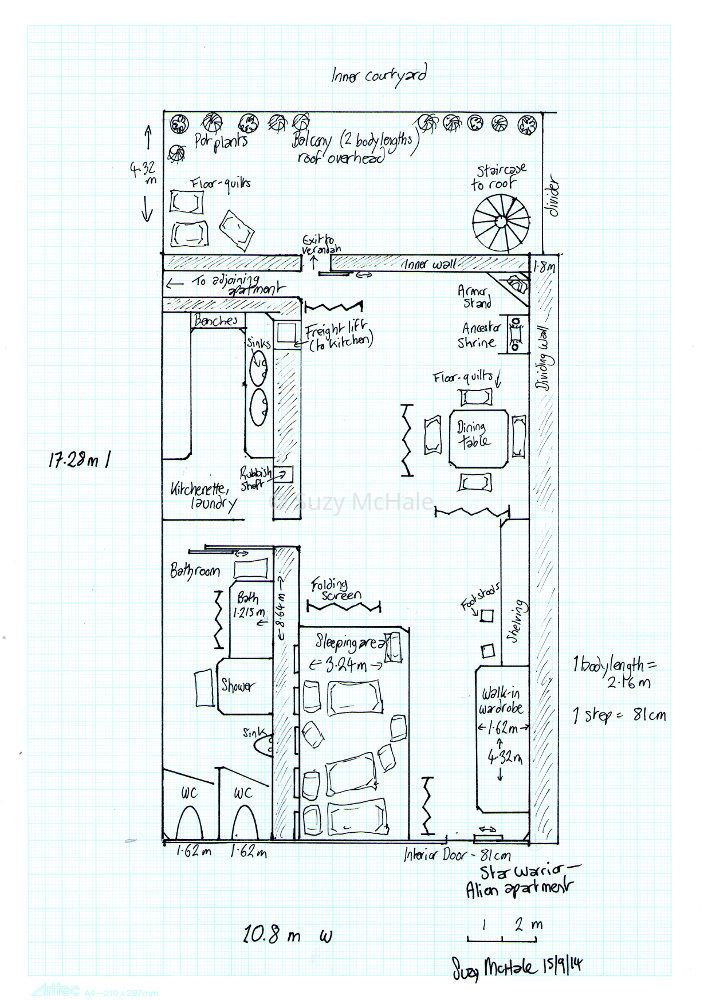
Apartment layout (pen drawing, June 2014, 190 KB).
Google Maps screenshot showing an outline of the size of the Residence overlaid on my suburb block for comparison (71 KB).
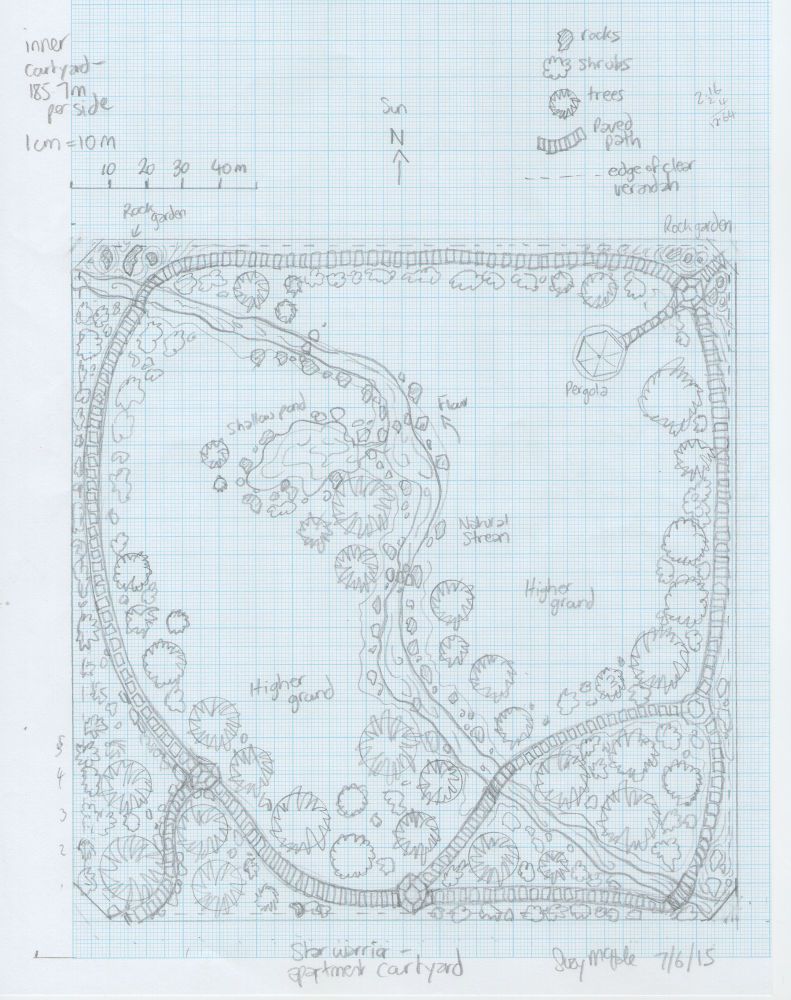
Sketch of the courtyard layout for a Clan Lord’s Residence – Sohaar’s as it happens; a semi-formal garden (7/5/2015, pencils, 190 KB). A natural stream winds through it, imitating the S-shape of the one on the Night River Clan’s emblem. Other apartment complexes have much the same courtyards, varying depending upon local topography and the residents’ wishes.
Ice Moon
Ice Moon (Rereca) is the outermost moon orbiting Home World. It is mostly covered in ice.
Data
- Diameter
- 1800 km
- Radius
- 900 km
- Density
- 4.1 (RL = 2.953)
- Distance
- 48 radii (336 761.6736 km)
- Viewing angle
- 0.0026, 0.0052 (0.3 degrees – appears 2° smaller than Earth’s Moon in sky)
- Orbit
- 443.908 hours/18.49 days/14.8 HW days (34.59 yearly orbits)
Gallery
Ice Moon, rendered with a GIMP script.
Image display
Displaying images is usually rendered by specialized nanites. These nanites act like photophores and chromatophores in marine animals, emitting light, color and texture when programmed. They can display in 2d or 3d.
Data can be rendered in walls or on portable softscreens. The flexible softscreens are made of a thin sheet of transparent graphene and come in a size in between A4 and A3 paper sizes. They can be folded or rolled up into a compact form. They run on a nanobattery, and are charged either with inbuilt solar cells, or by cord from an external power source. Another type of 3d image display involves nanites floating in a magnetic field projected in a column from the floor and ceiling;[1] they can reshape themselves into whatever the display requires. Such a projector is set in the floor of a Void Walker’s Command Chamber; the starship’s Artificial Intelligencemanifests itself there as a focal point for the Clan Lord or whoever else might be talking to it.
Footnotes
- [1]
- The display appears similar to this cool LED sculpture “The Man with No Shadow” by Makoto Tojiki, though much more detailed.
Interrogatives
- How? (method)
- meesa
- What?, why?
- mana
- When? (time)
- saazawome mana – saaza [time] wo [nominative case] me [interrogative] mana [what]
- Where? (locative verb)
- naya
- Who?
- laaz
- Which?
- use: who? (laaz) or what? (mana)
Jump
A Jump (Rerenec) is the name given to the act of a Void Walker entering foldspace so it can instantaneously traverse vast distances across realspace. Such travel is initiated within a starship’s Warp Chamber, which opens a temporary wormhole in the fabric of spacetime so the ship can take a shortcut though it to the desired destination elsewhere in our Galaxy.
There is no sensation of traveling through a tunnel as is sometimes depicted in fiction; the ship and occupants are simply in one place the one moment, then appear elsewhere in the next. Jumping can be somewhat physically disorientating to those unused to it, though.
On emerging back into realspace, gravitational waves are emitted from the disturbed spacetime in the vicinity of the starship, and there is a flare of Cherenkov radiation. A stealthy Jump is thus impossible.
To ensure a starship does not inadvertently travel in time as well due to relativity, on emerging in a new Jump target it will record the exact time it arrived and departed, and make sure to not arrive before the last departure time on its next visit to that particular target.
Kinship terms
- Cabuuncaale
- Grandfather (cabuun [ancestor] caale [male])
- Cabuunwaheen
- Grandmother (cabuun [ancestor] waheen [female])
- Maacucaale
- Father (maacu [parent] caale [male]) – also applies to aunts/uncles/cousins of parents’ generation
- Maacuwaheen
- Mother (maacu [parent] waheen [female]) – also applies to aunts/uncles/cousins of parents’ generation
- Ceyaacaale
- Brother (cayaa [sibling] caale [male]) – also applies to cousins of siblings’ generation
- Ceyaawaheen
- Sister (cayaa [sibling] waheen [female]) – also applies to cousins of siblings’ generation
- Nuneecaale
- Son (nunee [offspring] caale [male]) – also applies to nieces and nephews
- Nuneewaheen
- Daughter (nunee [offspring] waheen [female]) – also applies to nieces and nephews
- One’s direct relatives may be referred to as maacucaaleyaal (true-father), etc, to clarify or distinguish whom one is referring to.
- Siblings may often refer to each other as ceyaahaasu (sibling-old – elder brother/sister) or ceyaamuba (sibling-young).
- The Dawn Hunters regard themselves as one extended family, so non-genetic relatives may also be addressed with kinship terms.
- Titles may be shortened by combining the first syllable of the first word with the second word (Brother: Ceyaacale → Cecaale).
Language overview
Language is referred to as Luunolanhaara (luunolan [speech] [of the – implied genitive] haara [hunter/s]).
The language has been fairly standardized since rapid communications were developed, but subtle regional accents are still discernible in those from different Clan Cities.
The Dawn Hunters have no interest in teaching outsiders – aliens – their language, and prefer to speak to such in the latters’ own language, using translation software.
Phonotactics
Basic word structure for roots is CV(C). No adjacent consonants or vowels are permitted within root words, and adjacent vowels are not permitted anywhere. If consonants are adjacent, this indicates adjoining affixes; they are pronounced as separate letters/sounds – alternately, if the pronunciation is awkward, one may be dropped (consonant reduction). There are no dipthongs, and doubled (geminated) consonants are not allowed (a vowel will be inserted between the latter). Single vowel morphemes are usually found as affixes.
The language has changed little over time due to the Dawn Hunters’ inherent conservatism, but an older version of the language was strictly CV (similar to Old Japanese).
General notes
- Language is mostly agglutinating.
- Root words are usually one or two syllables.
- No articles (a, the), though the word for “one” can be used to substitute for a or an.
- Adjectives follow nouns; a noun can also be made into an adjective by placing it after the noun it describes – similarly for adverbs.
- Stress (mora – syllable weight) of a word falls on the syllable of a root word containing a long vowel; if there are none it falls on the first syllable. If the word comprises two long vowels, stress falls on the first of these. (Long vowels are doubled in the English transliteration.) Affixes are not stressed – the only exception being the verb imperative -sa. Questions are indicated by an affix, so unlike in English the voice does not change in tone.
- Honorifics are an important part of speech (terms for lower-equal-higher).
- Plurals are generally not indicated – i.e. no equivalent of English ’s – a number in front of the word may be used to clarify, or an adjective suffix (cuuna) meaning “many.”
- Word order is nominally Subject-Object-Verb, but it can be flexible. The subject will come first if a superior rank speaks of themselves, or another speaks to them.
Law and order
In Dawn Hunter society, corruption and homelessness are unknown, as are crimes such as robbery. Given their basic predatory nature, though, there is ritualized violence, mainly within the Warrior Caste– attempted assassinations, overthrows of rulers and such – but in a social structure that depends on physical prowess to ascend, that is to be expected.
Shaming and threat of ostracism are a large part of maintaining social control. Inappropriate behavior is first addressed by a Hunter’s family and associates, then by their superiors, and if this is ineffective (which is rare) it is ultimately attended to by their ruling Clan Lord (whose bad side one does not want to get on!). Serious issues will be discussed at the regular Council of Elders.
To restore honor for serious offences, the offender might be required to commit suicide, though this would be uncommon outside of the Warrior Caste. They might alternatively be made Clanless, a fate worse than death for a social species. More commonly, they will be demoted in rank and status and have to earn these back again.
Most tend to self-regulate their behavior, however, rather than grudgingly behave under the threat of punishment; the benefits of co-operation are obvious.
Lecaasaan
Lecaasaan is a Technician-Forger who made Lord Sohaar’s sword and dagger after his initiation as a full Warrior.
Biographical information
- Gender
- Female
- First appearance
- Inheritor chapter: “Forging”
Lecaaso
Lecaaso is Clan Lord of the Fire Mountain Clan. Oversees the alien Tree Gliders.
Biographical information
- Gender
- Male
- First appearance
- Dominator chapter: “Council”
Lecaazuun
Lecaazuun is a Technician-Pilot, Clan Lord Sohaar’s Shuttle pilot.
Biographical information
- Gender
- Male
- First appearance
- Inheritor chapter: “Contact”
Lexicon
A selection of Dawn Hunter root words. Note that the letter c is always pronounced as k! Verbs are listed here in their bare infinitive form (i.e. without the infinitive tense, -nec), and nouns are shown without cases (default is [w]o, nominative/dictionary form). For convenience, words are classified under English parts of speech.
To look for a word, use the “find” option in your browser (CTRL + F in Windows). Note that one alien word definition may cover several related English words, as English has borrowed from many languages.
Compounded words are on a separate page.
Glossary
| Dawn Hunter root word | English word/s | Part of speech | Derivatives |
|---|---|---|---|
| baalo | cloud | n | |
| baasu | tin (metal) | n | |
| baca | five, 5 | number | |
| bah | spit | v | |
| bahar | flat, graceful, level, smooth | adj | |
| baho | location, place | n | |
| bale | distant, far | adj | |
| bawe | catch, grasp, snare, take | v | |
| bebehu | grey | n | reduplicate – from word for mist |
| beenah | right (direction), south | n | |
| behu | fog, mist | n | |
| bem | mouth | n | |
| bene | attach, bond | v | |
| benuu | arch, crescent, curve, rainbow | n | |
| besol | direction, orientation | n | |
| bore | allow, permit, still | n | |
| bulu | wet | adj | bulunec (verb): to become wet, to bathe |
| buru | male (animal, alien, non-sapient being) | n | |
| burun | ladder, stair(s), steps | n | |
| buuran | contraption, device, instrument, machine | n | |
| caah | straight | adj | |
| caala | big, tall | adj | |
| caale | male (hunter, sapient being) | n | |
| caam | aid, assist, help, serve | v | caama: one who serves; aide |
| caar | expel, vomit | v | |
| caaru | wide | adj | caarulan: noun form (width) |
| caasel | crystal | n | |
| caba | run | v | caaba: runner (agent noun form) |
| cabe | barrier, wall | n | |
| cabuun | ancestor | n | |
| caco | deceitful, fake, false | adj | |
| cah | split | v | |
| cahe | sharp | adj | |
| cahuu | clothing, garment | n | |
| calaa | rotation (one full day) | n | |
| casa | blanket, quilt, bed cover | n | |
| cayal | crystal, gem | n | |
| cebaan | head (body part) | n | |
| cebay | branch, stick, twig | n | |
| ceemon | cinnamon-like spice | n | |
| ceewa | dip, gorge, groove, hollow, ravine, valley | n | |
| cehu | dig, excavate, mine | v | cehuwa: miner; also name of creature |
| cera | bright, iridescent, shining | adj | |
| ceres | drag, slide, slip | v | cereslan: sled, travois, any ground vehicle (noun form) |
| cesal | sand | n | |
| ceyaa | sibling | n | |
| ceyaacaale | brother | n | |
| ceyaawaheen | sister | n | |
| ceyuu | foot | n | |
| coco | here | demonstrative | |
| como | enter | v | |
| coora | long, tall | adj | cooralan: length (noun form) |
| cule | oppose, protest | v | culeneel: against (preposition – with adverbial ending) |
| culuun | thunder | n | |
| cuuco | insect | n | creature with exoskeleton |
| cuul | ash, soot | n | |
| cuuna | many, multiple, several | adj | can also be used as a plural suffix for nouns if the number is not clear |
| cuwa | exile, send away | n | |
| haa | 512 (1000 octal – 83) | number | |
| haac | corrupt, decay, rot | v | |
| haalo | dark (illumination) | adj | |
| Haana | Technician (caste) | n | literally, “makers” |
| haanu | breath | n | haanunec: to breathe (verb form) |
| Haar | Warrior, fighter (caste) | agent noun | |
| haasu | old (Dawn Hunter) | adj | haasulan: elder (title, honorific) |
| haay | less | adj | |
| habaa | carry, lift, transport | v | |
| habar | scarf, shawl, veil | n | |
| hahu | collection, heap, layer, pile, mass, mound | n | |
| hale | building, house, structure | n | generic term applied to any building, including tombs, as these are where the physical remains of ancestors reside |
| hana | build, make, construct | v | |
| har | fight, war | v, adj | haar: warrior |
| hara | hunt, look, search | v, adj | haraa: hunter, one who hunts |
| hasa | waist (body part) | n | |
| hawe | tail | n | |
| haza | end, halt, stop | v | |
| heboh | dry | adj | |
| lecu | eight, 8 | number | |
| hee | squeak | v | |
| helee | whole, all, everything | n | |
| hema | even | n | |
| hen | one, 1 | number | |
| hesaa | eye, sight | n | |
| Hesaahame | sun (Home World star) | n | |
| hesaz | purpose in life, spirit | n | |
| heyan | arena | n | enclosed space where honor duels are held; stone floor is overlain with fine white sand |
| hola | mate (aide, companion, friend, mate, partner, spouse) | n | |
| hone | smell | v | |
| honuu | world | n | |
| huce | pull | v | |
| hula | add, dock, join, secure, tie up | v | hulalan: joint (noun form) |
| hule | spin, turn | v | hulelan: spinner, turner, wheel (noun) |
| humaa | they | pronoun | dual, used for body parts and other objects that come in pairs |
| huna | angry | adj | |
| huruu | grass | n | |
| huulan | appear, descendant, emerge, issue | n | |
| huulo | flesh, meat | n | Mecunecmacuuna huulohaacalanuu: Eater of meat that is rotten (carrior-eater – an insult) |
| huune | impale, pierce, stab | v | huunewa: that which/one who does such an action (agent noun form; general name for edged weapons) |
| la | approach, come, draw near | v | |
| laahu | free, release | v | |
| laamo | leaf | n | |
| laana | float, hover | v | |
| laara | attend, introduce, present | v | Laaralan: Attendance (ritual) |
| laasan | heavy | adj | |
| laaz | who? | adverb | |
| lacaar | coast, shore, beach | n | |
| Lahon | Adept (caste) | n | from word for knowledge |
| lahon | instruct, know, teach | v | Lahona: one who teaches; lahonbe: to cause to know, to teach |
| lalo | low, short, subordinate, under | adj | |
| lara | close, near | adj | |
| lawac | embarrassment, humiliation, shame | n | |
| lawe | remove, subtract, take away, withdraw | v | |
| lebon | violet | adj | |
| lecaa | fire | n | lelecaa: red, orange, yellow |
| leen | braid, plait, weave | v | leenalana: weaver |
| leera | flow | n | |
| leesa | birth, emerge, hatch | v | leesaa: hatchling (one who hatches) |
| leho | dirty, unclean | adj | |
| lenol | bottom, below, beneath, ground, floor | n | lenole: descent, down (dative case – indicates movement in direction) |
| leyuun | purple | adj | |
| loca | ascend, climb, go up, rise | v | |
| lohel | pipe, reed, tube | n | |
| lohon | altar, flat-topped furniture, table | n | |
| lohu | acknowledge, farewell, greet, salutate | v | |
| lole | alter, change, correct, form, mold, morph, shape, transform | v | |
| lor | this | demonstrative | these: lorcuuna |
| lore | bare, expose | v | |
| loru | young (age – animals, objects) | adj | |
| loyu | drink | v | |
| lucu | destroy | v | |
| lunu | die | v | death (n), dead (adj): lunulan; suicide: lunuleculnec – lunu + [-he – causative ][-cul – reflexive][-nec – intransitive] |
| luula | custom, etiquette, habit, manners, tradition | n | |
| luuno | speak | v | luunolan (n): speech, talk |
| maacu | parent | n | |
| maal | forward, future, next | adj | |
| maane | ask, request | v | |
| maarec | fierce | adj | |
| maaze | copy, image, imitate, mimic, painting, shadow, simacrulum (avatar), reflection, reflected image (photograph, video) | n | maazewa: artisian, painter |
| mabaa | green | adj | |
| maca | hit, strike | v | maaca – hitter (object) |
| maco | district, domain, field, prefecture, realm, territory | n | |
| mahu | we, us | pronoun | |
| malam | care, look after, tend | n | Maalam: Carer (nurse) |
| mana | what?, why? | adverb | |
| mana | hill, mound, pile | n | |
| manen | alien, foreigner, stranger | n | |
| manul | animal, land creature | n | |
| maral | cabin, cave, chamber, courtyard, room, enclosure | n | applied to any enclosed space (open air or under a roof) that is lived in |
| masu | light (illumination) | adj | |
| mawa | hearts | n | nominally plural as Hunters have 2 hearts |
| may | root (plant) | n | |
| me | implement, object, thing | n | |
| mecu | eat | v | meculan: food |
| mee | short | adj | |
| meela | being, creature (living Home World creature that is not Dawn Hunter) | n | |
| meesa | how? | adverb | |
| meha | bad | adj | |
| mero | plant, tree, vegetation | n | |
| meru | govern, oversee, reign, rule | v | merulan: noun form |
| mey | doorway, gate, portal | n | |
| mocu | cull, cut, slice | v | |
| mohuu | repair, heal, mend | v | mohuulan: healing, medicine |
| molan | blood | n | |
| momolan | blue | n | reduplicate – from word for blood |
| momon | sweet | adj | |
| moree | sleep | v | |
| moze | fish, sea creature | n | |
| muba | young (age – Dawn Hunter) | adj | |
| mul | burial site, mausoleum, tomb | n | mulnec: to bury, entomb |
| muno | cloth, fabric, material | n | |
| muule | lake, pool, body of water | n | |
| muno | cloth, fabric, material | n | |
| muyu | seed, grain | n | |
| muzo | fresh, new | adj | |
| naal | rain | n | |
| naano | clumsy, crooked, rough, uneven | adj | |
| naaruu | clear, transparent | n | |
| naasel | guts, intestines, offal, something unpleasant (colloquial) | n | also used as curse word (offal of prey are regarded as unclean and not eaten) |
| naayoc | master, teacher | n | |
| nabu | skin | n | |
| naca | begin, start | v | |
| nahal | devotion, loyalty | adj | |
| naheel | bushland, forest, woods | n | |
| nahuu | night | n | |
| nalem | few, less | adj | |
| nama | three, 3 | number | |
| name | ripple, wave (radio, water) | n | |
| nanahuu | black | adj, n | reduplicate – from word for night |
| nara | clan, family, blood | n | Narawohuu: Clanless – nara [clan] wo [nominative] huu [negating particle] |
| nawa | city | n | |
| naya | where | adverb | |
| nec | ear | n | |
| necuu | ring | n | |
| neewa | |||
| neeza | cook | v | |
| nehal | gratitude, praise, thank | v | |
| nehu | abundant, extra, regent, spare, surplus | n | |
| nel | root | n | |
| nelo | tooth | n | |
| nene | beat, pulse | n | time measurement – heartsbeat (of Dawn Hunters’ two hearts) – about 1.5 seconds |
| neraa | open, untie | v | |
| newaal | other | n | |
| neyo | affirmative, yes | determiner | |
| nezan | honor, respect, status | n | |
| nobo | throat | n | |
| nolam | short | adj | |
| nolu | cast, hurl, throw | v | |
| nomaa | mountain | n | |
| nonaam | crest-quills | n | natural display ornamentation on head of many Home World creatures; Dawn Hunters have eight crest-quills |
| nooho | arrangement, organized whole, system | n | |
| noosa | island | n | |
| noro | fast, run, move swiftly | adj | can be reduplicated to emphasize speed (noronoro); Norowa – “Fast One” (personal name) |
| nulun | home, place of belonging, refuge, shelter, safe place | n | |
| nunee | child, offspring, young | n | |
| nusem | steal, usurp | v | |
| nuul | amount, measure, weight | n | |
| raane | life | n | raanenec (v): to live, to exist |
| raaru | spike | n | |
| ral | container, jar, pot | n | |
| ranu | no, not | determiner | |
| rasac | pain, sickness, soreness | n | |
| re | moon | n | |
| reca | ice | n | |
| recuu | examine, observe, regard, see, view | v | |
| reelu | tall | adj | |
| reesa | command, order | v | |
| relo | six, 6 | number | |
| ren | up | adverb | |
| reno | hear, listen | v | |
| renuu | fiber, filament, line, rope, strand, string, thread | n | renuunec: to sew, thread. Also used to describe hair or feathers on aliens (no Home World creatures have these) |
| rere | fly, jump, leap | v | |
| rocul | injury, wound | n | roculnec: to harm, to hurt, to punish, to wound |
| rohuul | caste, rank, social position | n | |
| rolun | force, power, strong | adj | |
| rowan | circle, round, sphere | n | |
| ruc | bite | v | |
| rucul | old (animals, objects) | adj | |
| runaa | path, road, track, trail | n | |
| ruul | you/your/yours singular | pronoun | |
| ruusar | vigil, watch | v | |
| ruuz | right | adv | direction |
| saace | cover | v | saacelan: covering (noun form) |
| saahen | metal | n | |
| saam | left | adj | |
| saamer | blade (weapon) | n | |
| saan | east, dawn, morning (time of day), sunrise | n | |
| saansaan | pale, white | adj | reduplicate – from word for dawn |
| saasaahen | metallic color | adj | reduplicate – from word for metal |
| saawu | horn (anatomy) | n | |
| saay | palm of hand, sole of foot | n | |
| saaza | time | n | |
| saca | close, shut, tie | v | |
| sacee | glitter, iridesce, shine, sparkle | v | |
| saco | slow | adj | |
| sahal | ceremony, initiation, ritual, trial | n | |
| samoo | water | n | |
| sanaa | wind | n | |
| saraa | egg | n | |
| sarom | river | n | |
| sawan | more | adj | |
| sayaan | bone | n | |
| sebe | clever, intelligent, smart | adj | |
| seena | bay, indent, recess | n | |
| seewa | lake, pool | n | |
| sewa | feel, touch | v | |
| seyan | energy, vitality | n | |
| sezu | arm | n | |
| so | star | n | |
| sobec | people, sapient beings | n | |
| soco | there | demonstrative | |
| solaan | desert, wasteland, wilderness | n | |
| som | 4096 (10,000 octal – 84) | number | |
| soma | absent, missing | adj | |
| sonuu | year | n | |
| soon | digit (finger, toe) | n | |
| soor | bird, flying creature | n | |
| sor | that | demonstrative | those: sorcuuna |
| sosaan | fin, wing | n | wing for flying creatures, fin for sea creatures (similarity in structure) |
| sucul | skin-shimmer | n | The iridescent, metallic quality overlaying the skin of the fauna of Home World, and of the foliage of the vegetation. It is structural coloration, not pigment. |
| suhe | name | n | |
| sune | great, supreme | adj | |
| suucu | box, casket, container | n | |
| suul | move | v | |
| suula | dominate, govern, oversee, reign, rule | v | Suulalan: Dominion (noun form) |
| suuzu | gold (metal) | n | |
| waahu | visit | v | |
| waale | divide, separate, split | v | waalelan: boundary, horizon, limit, territory |
| waan | cycle (period of time) | n | |
| waaye | blow | v | |
| wabuu | jog, lope (slow run) | v | |
| wace | assemble, collect, gather, store, retain | v | wacelan (n): council |
| waheen | female (hunter, sapient being) | n | |
| wahu | push | v | |
| wake | dry | adj | |
| walu | hand, number four, 4 | n, number | |
| wamee | female (animal, alien, non-sapient being) | n | |
| wan | I/me/my/mine | pronoun | |
| waro | pace, step, stride | v | |
| wasu | small, little | adj | |
| wawe | leg, foot | n | |
| wayeb | paper, writing material | n | derived from a bamboo-like plant used for that purpose (similar to papyrus) |
| wayuu | bathe, swim | v | |
| wehe | afraid, fear | v | |
| wela | warm | adj | welawela: hot |
| wena | between, center, middle | n | |
| werom | adult | n | |
| weza | balance, correct, good, harmony, right | adj | |
| woma | fall | v | |
| wuluur | spiral, twist | n | |
| wumar | rock, stone | n | |
| wun | hole, pit | n | |
| wuraa | ultraviolet color | adj | |
| wuyu | alone, only, solitary | adj | |
| yaacos | heir, successor | n | |
| yaal | fact, genuine, real, true | adj | |
| yaan | tongue | n | |
| yahal | learn | v | Yaahal: one who learns (apprentice, student) |
| yaloo | howl, wail | v | Yaloolana: Howler (animal species – one who howls) |
| yamen | body | n | |
| yamo | 32,768 (100,000 octal – 85) | number | |
| yaran | storm | n | Yaraan: stormy, stormy one |
| yare | burn | v | |
| yeema | fruit | n | |
| yeero | bend, distort, fold, warp | n | |
| yehus | magenta (violet-red) | adj | |
| yeloo | she/her/hers, he/him/his, it/its | pronoun | used for Dawn Hunters only |
| yena | it/its (animals, non-sapient – animate) | pronoun | |
| yer | dust | n | |
| yeral | down | adverb | |
| yero | color | n | |
| yeyaa | challenge, confront, encounter, find, meet | v | |
| yola | edge, side | n | |
| yon | it/its (inanimate) | pronoun | |
| yoora | land, soil | n | or lalozuun, under-sky, also used for the world – equivalent to Earth, biosphere |
| yu | nose | n | nostril: wunyu – wun [hole] [of – implied genitive] yu [nose] |
| yuna | seven, 7 | number | |
| yuucu | dome | n | |
| yuul | negative, zero | adv | |
| yuum | disappear, lose, vanish | v | |
| yuzuu | silver (metal) | n | |
| zaaben | plain, savanna | n | |
| zabo | above, top | n | zaboye: rise, up (dative case – indicates movement in direction) |
| zahu | caretake, defend, guard, protect, shield | v | zaahu: one who guards |
| zala | back, behind, past | adj | |
| zamaa | cold | adj | |
| zawe | walk | v | zaawe: one who walks (agent noun) |
| zayuu | memory, mind, thought | n | zayuunec: to think |
| zela | activity, labor, perform, work | v | zelaa: worker; zelarel: profession |
| zem | 64 (82) | number | |
| zemu | conceal, hide, stealth | v | |
| zeyu | two, 2 | number | |
| zobaa | display, reveal, show, uncover | v | |
| zocuu | continue, endure, persist, still | v | |
| zola | copper (metal) | n | |
| zoluuh | cloak, robe, upper body cover | n | |
| zoyuu | void, empty | n | |
| zuhaa | claw | n | zuhaarelnec (verb): to claw, cut, etch, paint, scratch, write; zuhaawa: one who paints, writes, etc. |
| zul | lord | n | |
| zulam | day | n | |
| zumaah | ocean, sea | n | |
| zuruc | smoke | n | |
| zuuca | mate (reproduction, sex) | v | |
| zuuma | lightning | n | |
| zuun | atmosphere, heavens, sky | n | |
| zuunzuun | aquamarine color | adj | reduplicate – from word for sky |
Updated: 6/1/2017
Long Divide
The Long Divide (Waalecoora) is an ancient faultline that crosses the width of The Land just south of its equator. A series of deep gorges and lakes surrounded by high mountains effectively divide the supercontinent into two.
Maarec
Maarec is Clan Lord of Night River Clan, Bond-Mate of Resaan and father of Sohaar and Yaraan. He is 1560 HW years/2735.3 Earth years old when he dies by ritual sacrifice. In personality he is extremely dominating and strong-willed, as one of his status and age tends to be.
Resaan felt both awe and fear as the Clan Lord approached her and halted half a bodylength before her, having retracted his armor. She was one of the taller females, but he was still nearly a head taller than her. He was normally a remote and forbidding figure; she had only ever seen him from a distance. He seemed to her a barely-contained force of nature; the stillness at the core of a hurricane, his strength gathered and contained within him. She briefly met his sapphire-blue gaze with trepidation and was nearly overwhelmed by the fire of the personality that blazed within. She quickly looked away, barely restraining an impulse to flee.
– Story chapter “Departure”
Biographical information
- Gender
- Male
- Eye color
- Sapphire-blue (#0f52ba/rgb(15,82,186))
- Height
- 7 ft 6 in/228.6 cm
Gallery
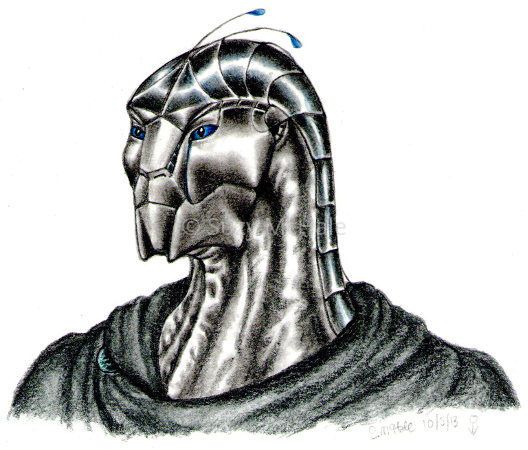
Maarec portrait (colored pencils, 10/5/2013, 45 KB).
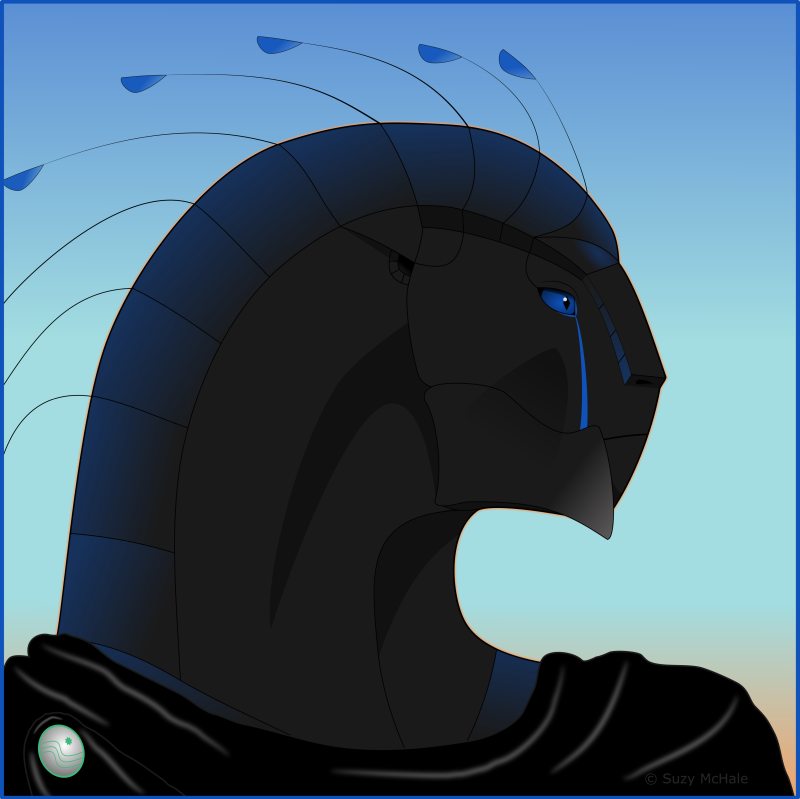
Maarec portrait, done as a vector in Inkscape (digital art, 6/11/2015, 35 KB).
Maaze
Maaze is a deceased Warrior Caste youth found during Sohaar’s Time of Exile.
Biographical information
- Gender
- Male
- Eye color
- Dark green (#013220/rgb(1,50,32))
- First appearance
- Inheritor chapter: “Exile”
Maazere
Maazere is an Adept-Carer who monitored Sergei after the latter received a neural implant.
Biographical information
- Gender
- Male
- Eye color
- Dark green (#132D23/rgb(19,45,35))
- First appearance
- Dominator chapter: “Implant”
Maazeyaraan
Maazeyaraan is a usurper War Lord, and an adversary of Sohaar-5.
Biographical information
- Gender
- Male
- Eye color
- Orange (#F28500/rgb(242,133,0))
- First appearance
- Chapter: “Fallen”
Martial arts
Martial arts (Har) are the fighting methods practised by those of the Warrior Caste. These include both unarmed and armed techniques.
As the Dawn Hunters have natural armament in the form of sharp teeth and claws, unarmed techniques focus mainly on the usage of these (slashing and biting). A method such as boxing would be unheard of, though a Warrior might use a fist against his opponent if the opportunity arises (usually a backfist in passing). They cannot fully clench their hands due to their claws.
Forward leaps and forward or backward kicks may be used; in a manner similar to ratites, the kicks are often aimed to disembowel. Due to their physiology, though, they can’t do high roundhouse kicks.
Elbows and knees can be utilized when opponents are in a clinch hold. Fights can sometimes end up on the ground, so throws and holds are a part of training also.
Fighting against an opponent in traditional armor is also practised.
The general fighting style is brutal, no-nonsense and direct, with no superfluous flourishes. An unarmed human opponent would stand almost no chance against a Dawn Hunter in a fight as the alien is superior in strength and weight.
Claw-caps are worn during training sessions to minimize injury.
In training for the sword arts, a blunted metal or wooden sword is used. The style is similar to that used by Japanese samurai, wielding the sword two-handed.
Mawalecaa
Mawalecaa is an adversarial youth of Sohaar’s year-group during their Time of Exile. Belongs to the Night River Clan.
Biographical information
- Gender
- Male
- Hatching year
- 61,510.98 HW years/4056 B.C. (2311.92 HW years ago)
- First appearance
- Inheritor chapter: “Exile”
Mawamaarec
Mawamaarec is a Warrior-Two-Claw of the Night River Clan and ritual torturer who puts Sohaar through the Trial of Pain after Sohaar is captured by Yaraan.
Biographical information
- Gender
- Male
- First appearance
- Inheritor chapter: “Capture”
Medicine
Medical technology is very advanced. The main feature is the extensive use of nanotechnology: specialized Repairer-Nanites can be programmed to cure or repair almost any disease or ailment. Amputated limbs, for example, can be regenerated with nanotech help. The Warrior Caste can suffer horrendous injuries due to their violent combative lifestyle, so nanotech medicine ensures these are merely temporary inconveniences.
The Adept-Healers are the main practitioners of medicine; Adept-Carers perfom the function of nurses. As with other professions, they learn by apprenticeship. In case they don’t have access to Repairer-Nanites, they receive training in fundamental manual first-aid and surgery techniques as well. Obsidian glass is used for surgical blades.
Repairer-Nanites are not contained within a body on a permanent basis; the Hunters prefer to use them when needed. Long ago it was decided that to allow permanent nanite residence which would make an individual immortal, invulnerable – and letting everyone have access to this – would ultimately make society unteneable (to keep population at a manageable level, they would have to ban reproduction); thus such use was forbidden. The Technician Caste possess exclusive knowledge of how to manufacture and use the nanites, part of the balance of power between them and the Warrior Caste.
As with other technology applications, there can be several methods of deploying medical treatment. This can either involve:
- spraying a gel on a wound for localized treatment – this forms a grey covering that flakes off once healing has finished;
- swallowing a capsule filled with Repairer-Nanites – the nanites then pass out of the body with other waste, or are drawn out through the skin with an injector;
- or healing within a Healing Bed for entire body cleansing and repair.
The nanites utilize the body’s resources when operating, so the recipient needs to eat a lot after being repaired.
Manufactured pharmaceuticals are still a part of medicine, used more for minor ailments, injuries and sedation.
Traditional medicine
Even before technological advances, the Dawn Hunters had a good standard of medical care. Being fastidiously clean by nature, daily bathing, general hygiene and proper disposal of waste were considered important and their cities were well-planned to enable this. Any diseases were thus quickly contained, so plagues were unknown. Hospitals were clean and orderly places, and Healers were greatly respected (and, of course, still are).
Various plants were used for medicinal purposes, and can still be used in lieu of modern medicine, such as when out in the wilderness.
Medicine is referred to as Mohuulan (Healing – stative verb form).
Meeting others
Greetings tend to be formal and ritualized, with deference shown towards one of senior status and/or age.
| English phrase | Dawn Hunter language | Gloss | Notes |
|---|---|---|---|
| Hello/Goodbye | Lohuzanamalaa! | Lohu [acknowledge, greet, salute, farewell] zan [present tense] ma [you – singular] laa [honorific – neutral, of another; but depends on rank of one being addressed] | General-purpose greeting or farewell |
| Thank you | Nehalzanamalaa | Nehal [praise, thank] zan [present tense] ma [you – singular] laa [honorific – neutral, of another; but depends on rank of one being addressed] | |
| Have you eaten? | Raabenmalaame? | Raa [eat] ben [near past tense] ma [you – singular] laa [honorific – neutral, of another; but depends on rank of one being addressed] me [question marker] | Specific enquiry |
| Successful hunt, hunt well/good | Harazanmalaa wezaneel | Hara [hunt] zan [present tense] ma [you – singular] laa [honorific – neutral, of another; but depends on rank of one being addressed] weza [good, well] neel [adverbal particle] | Specific interjection |
| Are you well? | Rocuzanmalaame? | Rocu [hurt] zan [present tense] ma [you – singular] laa [honorific – neutral, of another; but depends on rank of one being addressed] me [question marker] | Literally: Are you hurt/injured? |
Names
Personal and proper names usually use word roots, often compounded and with no cases or affixes – though when used in a sentence, they will be given the proper case. Long proper and general names may be shortened informally – Yaraananahuumay be abbreviated to Ya’nahuu (slight pause between shortened words, indicated in English by an apostrophe).
Names take the structure of: First name [child of/belonging to] parent’s name [of the] clan. A male usually takes his father’s name in referral, a female her mother’s. Thus Sohaar is: Sohaar, son of Maarec of the Night River Clan – Sohaaro-cenamalecuwalunel camacanewaa Maareco Narabaa Sahelnahuuo – Sohaar [nominative] -[ordinal marker] 28 [classifier], son [genitive] Maarec [nominative] Clan [genitive] River-Night [nominative]. Here the first name in nominative case is the main subject of the sentence. The succession is implied by name order.
Personal names are usually taken from nature and personal attributes, and are not gender-specific.
No one else is permitted to share a name with a Clan Lord or War Lord. Clan Lords alternate names of fathers and sons, affixed with a number – thus Sohaar is the 28th in his lineage to bear that name.
Nanotechnology
Molecular nanotechnology is an integral part of Dawn Hunter technology. It was created by Adept-Scientists and Technician-Engineers, and is under their control.
The nanites (Buuranwasuwasu) used are not exactly machines; the Hunters do not have robots like we do. Instead their Artificial Intelligences and spacecraft are a merging of inanimate/mechanical technology and biotechnology – similar to a virus in some ways.
Nanites are divided into several specialized categories:
- Armor
- Cloaks: providing either active camouflage by projecting an image of the wearer’s surrounds (similar to how cephalopods can match their background by activating chromatophores in their skin), or deflecting light around the wearer. The disadvantage of the second method is that the wearer can’t see out, but they can still hear.
- Light makers: generating artificial light from walls; projecting images.
- Makers: constructing items. These construct to a pre-programmed plan from available base elements in their vicinity, and “grow” from the ground up. They are held in a silvery egg-shaped and -sized container.
- Maintainers and Repairers: fixing things (includes medical treatment).
- Monitors: monitoring systems both living and mechanical.
- Morphers: embedded into various materials to enable these to adapt to various conditions and shapes – this includes morph-armor, morph-cloth and morph-metal.
- Reclaimers: absorbing, breaking down then recycling materials.
- Relayers: for displaying and transmitting images.
- Repulsors: translucent shields that protect a ship against a barrage.
- Shields: provide protection against inertia in ships.
- Surveyors: surveillance, information-gathering.
- Unmakers: disassembling items – including living creatures; Unmakers can thus be used as a weapon, but their use for this is forbidden on Home World, though they can be used for tasks such as demolishing buildings or mining.
Neural implant
All Hunters have a neural implant (Holazayuu) inserted into their brain when they reach adulthood (11 Home World-years/19.25 Earth years) and attuned to their biofrequency. The microscopically-small crystalline implant converts and transmits vocal, subvocalized speech or thoughts to other implants; this appears in the recipient’s head like their own mind-voice – a form of synthetic telepathy.
The implant can be used to record what the wearer sees, in the manner of a video camera with sight and sound, as microscopic carbon microthreads [1] unfurling from the implant tap into the optical and aural nerves. It can also be used to record memories; this is particularly vital for a Clan Lord whose life is artificially extended. As he ages his brain becomes more inflexible over time – less able to make new synaptic connections, or modify existing ones – so recording new memories to an external source is a way of circumventing this.[2]
Each implant has its own individual identifier in a similar way to different radio frequencies (using its user’s unique DNA equivalent). AIs in various locations, including Void Station and the starships, route neural links in a similar manner to Earth’s Internet Protocol Suite, only theirs can span star systems.
Communications are unaffected by distance; instantaneous real-time communication is possible even if the recipient is on the other side of the Galaxy. The still only partly-understood process involves the entanglement of particles; separating them creates sub-atomic wormholes to enable contact between them.[3] This method of communication is near-impossible to eavesdrop on (quantum encryption is used). A Clan Lord’s implant also enables him to communicate with his starship via thought; he is permanently linked with it for as long as he is alive. In some respects, the technology bridges the gap between science and magic.
The third-eye sensation of his implant link was still there, but not intrusive now he was adjusting to it. He concentrated and the initialization glyph hologram appeared. <Nahuu? How am I able to talk to you with no time lag?>
<The implant is Linked through a foldspace network.>
<Foldspace?>
<Folding and weaving spacetime filaments at the subatomic level so that all implants are interlinked. >
<I think our scientists might like to talk to yours!> Sergei exclaimed; the physics involved was obviously at a much higher level than his understanding.
– Chapter: “Implant”
The patient is anesthetized for the procedure; the implant is shunted into the brain via the base of the skull.
Footnotes
- [1]
- “A Carbon Microthread That Makes Contact with the Mind”
- [2]
- “Older Brain Is Willing, but Too Full”
- [3]
- “You can’t get entangled without a wormhole”
Night River Clan
The Night River Clan (Narawaa Sahelnahuuwo) is the one to which Lord Sohaar belongs, and which built the first Clan City; construction of its City began 111,906 Earth years/63,946.3 HW years ago (36.57 years after Year 0). Its city is located in the Southern Hemisphere on the southeast of the continent, near the Night River from which it derives its name (so-called after the name for the Milky Way across the sky). It is the oldest and most prestigious Clan. It supplies mined black galaxy granite from the Blue Mountains to the other Clans, as well as the special quartz crystal used for communications and data storage.
Data
- Burial armor gemstone
- Emerald
- Clan City construction stone
- Black galaxy granite (granite with specks of gold and silver)
- Clan City co-ordinates
- Approximately 45°S, 18°E
- Clan emblem
- A stylized curving river with an 8-pointed star above it
- Color
- Emerald green (#3fb87d/rgb(63,184,125))
- Clan Lords mentioned
- Maarec, Sohaar, Yaraan
Norowa
Norowa is a youth of Sohaar’s year-group during his Time of Exile. Belongs to the Warrior Caste, Night River Clan.
Norowa – past
Physical information
- Gender
- Male
- First appearance
- Inheritor chapter: “Exile”
Norowa – present
Warrior-Two-Claw, training partner of Sohaar’s (and descendant of previous Norowa) before his duel with Yaraan.
Physical information
- Gender
- Male
- Eye color
- Dark green (#1E4D2B/rgb(30,77,43))
- First appearance
- Dominator chapter: “Encounter”
Numbers
| English (decimal) | Dawn Hunter (note: octal – base 8 – counting system) |
|---|---|
| 1 | hen |
| 2 | zeyu |
| 3 | nama |
| 4 (hand – four digits) | walu |
| 5 | baca |
| 6 | relo |
| 7 | yuna |
| 8 | lecu |
| 9 (eight-plus-one) | lecuhen |
| 16 (two eights) | zeyulecu |
| 17 (16-plus-one) | zeyulecuhen |
| 24 (3 × 8) | namalecu |
| 25 (3 × 8 + 1) | namalecuhen |
| 32 (4 × 8) | walulecu |
| 40 (5 × 8) | bacalecu |
| 48 (6 × 8) | relolecu |
| 56 (7 × 8) | yunalecu |
| 64 (100 octal – 82 – 8 × 8) | zem |
| 75 | zemlecunama (64 + 8 + 3) |
| 100 | zeyuzembacalecuwalu (2 × 64 + 5 × 8 + 4 – 144 octal) |
| 512 (1000 octal – 83) | haa (8 × 64) |
| 4096 (10,000 octal – 84) | som (8 × 512) |
| 32,768 (100,000 octal – 85) | yamo (8 × 4096) |
- There is no formal zero digit equivalent or placeholder; the word soma (absent, missing, nothing) is used to indicate a null value.
- Numbers can also be represented by the first letter of their name: 1 (hen) = H, 2 (zeyu) = Z, and so on. So 9 for example would be LH.
- For ordinal numbers (first, second, etc.) add the affix ce-. In writing a dot is placed after the number to indicate it is ordinal.
- Numbers are followed by a classifier, categorized into person/Dawn Hunter (-nel), creature/animate (-hon) and inanimate (-hay). A starship containing an Artificial Intelligence is classified as a person.
- Numbers that modify a noun come before it.
- Some alien measurements used (similar to anthropic units):
- 1 fingerwidth (caarulansoon – width of finger) = 2.1 cm
- 1 handwidth (caarulanwalu – width of hand) = 6.3 cm (3 fingerwidths) – width of palm not including thumb
- 1 step (cooralanwaro – length of step) = 81 cm (reason: length of my stride – 2 steps or 1 stride)
- 1 bodylength (cooralanyamen – length of body) = 216 cm (average height of Warrior)
- 1 cooralanwarosom = 84 = 4096 steps of 81 cm = 331,776 cm – about the distance that can be walked in ½ an hour (3.3 km). A starship is this length.
- The Dawn Hunters tend to favor numbers in sets of 3, 4, 8, 12, 16 and so on, as they have four digits and toes.
Ocean of Storms
The Ocean of Storms (Zumaahyaran) is the main and only ocean of Home World, a vast global body of water surrounding the planet’s supercontinent.
As with Earth’s oceans, currents circulate clockwise in the northern hemisphere and anti-clockwise in the southern.
The Dawn Hunters do not have a maritime culture, but the ocean has nonetheless been thoroughly mapped and explored via remote technology such as satellites and autonomous vessels.
Ocean Wind Clan
The Ocean Wind Clan (Narawaa Zumaahsanaawo) is one of the eight Great Clans. Its Clan City is located on Home World’s west coast. It is the last-founded clan; construction of its City began 109,269 Earth years/62,283.33 HW years ago (3581.37 years since Year 0). The Clan territory’s seashore is abundant in iridescent seashells which are supplied to the other Clans for various purposes.
Data

- Burial armor gemstone
- Jade
- Clan City construction stone
- Orange sandstone
- Clan City co-ordinates
- Approximately 38°W, 3°N
- Clan emblem
- A stylized ocean wave and foam
- Color
- Sea green (#2e8b57/rgb(46,139,87))
- Clan Lords mentioned
- Lord Sanaayaraan
Path of the Warrior
The Path of the Warrior (Runaahaar) is a code of ethics followed by those of the Warrior Caste which emphasizes filial piety, loyalty to one’s Clan and Lord, and death before dishonor – and they take it seriously.
Killing elderly or helpless is usually regarded as dishonorable for Warriors – but disrespectful young male Dawn Hunters (or similarly-behaved young males of other species!) will be treated harshly.
Pronouns
Personal and possessive pronouns are the same. Personal pronouns (subject – he, she) appear after the verb or noun; possessive pronouns (object – his, hers) come before the thing possessed – unless the latter is a Dawn Hunterand of higher rank.
| English | Alien |
|---|---|
| First person | |
| I/me/my/mine | wan |
| we, us | mahu |
| Me and you (we inclusive, including the hearer): | wanruul |
| Me and them (we exclusive, excluding the hearer): | wancuuna |
| Second person | |
| you/your/yours singular | ruul |
| you/your/yours plural (addressing an audience) | ruulcuuna |
| Third person | |
| she/her/hers, he/him/his, gender-non-specific | yeloo |
| it/its (animals, non-sapient – animate) | yena |
| it/its (inanimate – also this/that) | yon |
| they/them/their/theirs | yeloocuuna |
| they/them/their/theirs (animals, non-sapient – animate) | mesuucuuna |
| they/them/their/theirs (inanimate) | hasuucuuna |
| they (dual, used for body parts and other objects that come in pairs) | humaa |
There is no equivalent to the English “it” when used as an impersonal pronoun, as in phrases such as “It is raining”; instead such a phrase would be constructed as “Falls rain,” Womazanbolana naalo – Woma [fall] -zan [tense – present] -bo [person – inanimate] -la [politeness – neutral, of oneself] -na [mood – fact] naal [rain] -o [nominative].
Pronoun honorifics
Honorifics are used depending upon the social relationship between the speaker and addresse/s, and are a vital part of social interactions. Honorific suffixes for high-, same- and lower-ranks are appended to the basic pronoun, or name. Thus a high-ranking Hunter will refer to themselves as Wanzen, and others use second person or their name followed by -zen. A lower rank speaking to a higher may refer to themselves in the third person or by their name, rather than use “I”; they may also refer to the higher-ranking Hunter by their title (“my Lord,” zul-wan – Lord-mine) rather than use a pronoun.
- High rank/elevated: -zen
- Equal rank/neutral: -sanul
- Lower rank/abased: -ranee
The elderly are accorded great respect whatever their rank, and are addressed as Hasuulan – Elder.
When the rank of another is initially unknown, the neutral honorific is used.
The suffix -nem is attached to kinship terms to make them honorific/respectful. Youngsters usually address older relatives by their titles as well (Father, Mother, etc.) rather than pronouns like “you.” Young ones may be addressed with the diminutive suffix -ca attached (Sohaar would be Sohaarca if addressed by his father).
Pronouns may not always be required with verbs, as the latter are inflected for person and honorifics also. In that case, using a pronoun as well is as extra emphasis.
Pyramid of the Lords
The Pyramid of the Lords (Halenomaazul) is a pyramidal square stone building that is used to store the preserved bodies of deceased Clan- and War Lords. There is one within a Clan Cityand, after spaceflight was achieved, one on Grey Moon for each Great Clan (totaling eight).
The Pyramid is the largest and tallest structure in a City, and is regarded as the Lords watching over their descendants. It has a flat top used for ceremonies such as a Lord’s burial rites and also for ritual sacrifice of Warriors; small VTOL aircraft can also use it as a landing platform. A main road leads to its base from the central plaza. Its four sides are beveled and painted with Clan colors; it is otherwise black in color and coated with black hexagonal solar panels.
Within, there are 16 levels, and the sarcophagi of the Lords are arranged in rows, one after the other in the long burial chamber on each of the four sides. There is enough space for hundreds, so even after thousands of years a Pyramid is nowhere near full.
On Grey Moon, the Pyramids contain only the Clan Lords; the City Pyramids are used for War Lords, the ancient Clan Lords up to the spaceflight era and the Bond-Mates of Lords.
A Pyramid is regarded as the Lords watching over their descendants. On Grey Moon they are located so they face Home World permanently.
Dimensions
- Base
- 829.44 m × 829.44 m; total diameter of 3317.76 m (the same length as a Void Walker) and a base area of 687,970.7 m2.
- Height
- 207.36 m
- Levels
- 16 levels of 12.96 m high, extending in a central column down from the top (103.68 m per side).
- Top
- The flat top is 103.68 m × 103.68 m (total area is 10,749.5 m2).
- Volume
- 54,239,595.4 m3 (calculator)
Updated: 13/9/2017
Rainbow Beetle
The Rainbow Beetle (Cuucoberencuuna) is an insect-analog with translucent wings and an iridescent carapace that comes in a great variety of colors. It is the most numerous of insect species on Home World and sub-species can be found in all habitable zones. It is similar in appearance to a scarab beetle, but has four sets of two legs. It can reach up to 5 cm in size.
They are edible – a good source of protein – though Dawn Hunters prefer to eat them as a last resort.
Gallery
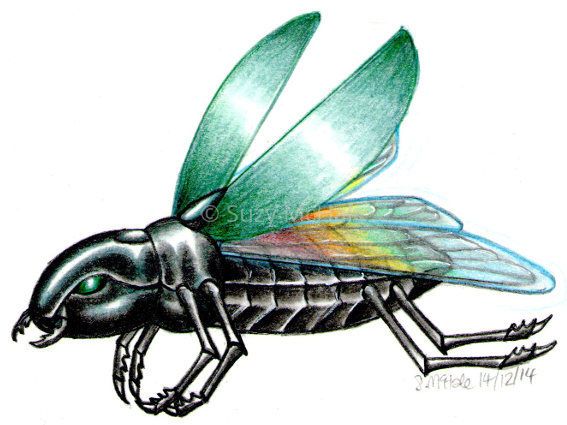
Male Rainbow Beetle (colored pencils, 14/12/2014).
Red Moon
Red Moon (Relelecaa) is the second moon of three orbiting Home World. it is an ochre-red in color, similar to Mars. It is used to measure time – one Waanaarelelecaale (Red Moon cycle) orbit equals 8 HW days, their equivalent of a week. There is a mostly-automated mining outpost located here as the moon is rich in iron ore, indicated by its color.
Data
- Diameter
- 1900 km
- Radius
- 950 km
- Density
- 4.3
- Distance
- 32 radii (224,507.7824 km) from HW (Roche Limit = 2.905)
- Viewing angle
- 0.0042, 0.0084 (0.4 degrees – appears 1° smaller than Earth’s Moon in sky)
- Orbit
- 241.63 Earth hours/10.06 days/8 HW days (64 yearly orbits)
Gallery
Red Moon, rendered with a GIMP script.
Regent Lord
A Regent Lord (Zulnehu) is a War Lord’s or Clan Lord’s second-hatched son – literally the spare or backup in case the first is killed. His helmet’s crest of two backward-curved horns is modeled on those of a Rock Jumper.
His metal rank color is gold (#ffd700 / rgb(255,215,0)).
Gallery
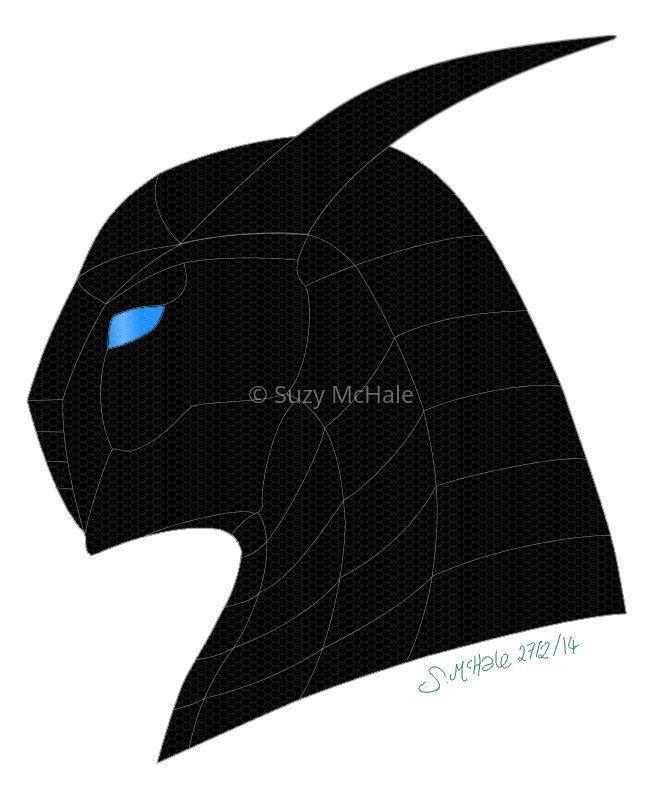
Regent Lord helmet (digital art, 27/2/2014).
Renahuu
Renahuu is an Adept-Healer who attends to Sergei Konstantinov after a hostile encounter with Clan Lord Yaraan.
Biographical information
- Gender
- Female
- Eye color
- Sea-green (#2E8B57/rgb(46,139,87))
- First appearance
- Dominator chapter: “Encounter”
Reproduction
Unlike humans – but similar to reptiles, birds and dinosaurs – the Dawn Hunters do not have visible reproductive organs, so the sexes are almost identical in appearance, aside from the differences of skin color and body size. The female lays an egg, one per pregnancy (rather than a batch like other creatures on Home World), and she is only fertile during the once-yearly breeding season. The population is deliberately kept relatively small (around 1 million or so) and they are aware of the importance of population control so as not to overhunt their prey, and keep the predator-prey ratio in balance. This does mean that they have more genetic homogeneity than humans, but careful monitoring avoids any problems. The genetic information of each Hunter is kept in a central database, and generations of selection ensure that healthy individuals are produced.
Breeding cycle
The cycle of egg fertilization, laying, incubation and hatching takes a quarter-Home World year (128 HW days/160 Earth days). The breeding season, taking place in the year’s third quarter (after solstice), is the same time in both hemispheres as the species originated in the south – eggs are ready to hatch as the warmer season approaches there.
An egg containing a male is black, a female’s is grey, and has an iridescent sheen matching its occupant’s eye color. It is elongated in shape and initially soft on laying before hardening up. Laying is not a difficult, dangerous and painful process as live birth can be for human females, so a female may produce many eggs during her lifetime with no physical ill-effects, though the actual number depends upon population control restrictions. The usual number of children is 1-3; most who want children will be able to have them. The Warrior Caste are the most numerous as their profession means they have a high death rate.
An egg is layed, placed in a incubator (heated sand) and hatched within its family’s apartment. An Adept-Carer will be on hand in case of any complications, but these are vanishingly rare.
The young are hatched helpless and dependent (altricial), as human infants are. They are smaller than a full-term human infant; less than half the size (no more than 25 cm long), and look emaciated and scrawny. They are formula-fed as females don’t have mammary glands. In ancient times before the special high-nutrition formula was developed, they were fed mashed-up or pre-chewed food, mainly puréed meat and plant food, as well as blood from prey – and are still fed this for variety. When they start teething, about halfway through their first year, they are usually given bones to gnaw on.
They initially vocalize via squeaking, chirping or, when distressed, squealing. They begin to learn to speak near the end of their first year.
A hatchling is usually carried in a sling across the carer’s torso or in a backpack. They learn to walk within 1 Home World year. Before that, they go through a quadrupedal/crawling phase like humans. They are not left alone and sleep near or next to their parents or carers; as with human infants, physical contact is vital for their development. Attachment and dependence are encouraged, both in the young and adults.
Those of the Warrior Caste are mostly raised by their fathers, and spend much of their day in communal age-groups once past the yearling stage. A Clan Lord’s sons are raised exclusively by him. An older Warrior will be in charge of an age-group throughout their youth. Brothers share a life-time bond and are usually assigned together once they pass their rite of passage into adulthood.
Children of the other two Castes mainly live with their parents, though they also spend part of some days in crèches where they are socialized and schooled. Families usually sleep near or next to each other for security and comfort; each has their own apartment within their Clan City. The children are well-cared for and indulged as hatchlings, though they are more disciplined as they get older and are taught to respect the adults.
Child abuse, rape and pedophilia are unknown.
Orphans are usually adopted by their nearest relatives in their Clan.
Games children play are mostly hunting- or fighting-related (ball-type games are unknown), but they cease to indulge in games as they reach adulthood.
Gender relations
A clan is led by a dominant male of the genetically-enhanced, all-male Warrior Caste; he is their ultimate protector and decision-maker. Aside from them, the gender roles in society are equitable; male and female children are valued equally. Males have a natural inhibition against harming females (although this doesn’t always hold if one Clan goes to war against another). Females partake in all non-Warrior Caste professions, including engineering and science, though some Ancestor-Guardiansof the Adept Caste train as fighters to an extent. Hatchling-rearing is shared equally.
The Hunters have no concept of romantic love; mating is for reproduction only, though they do feel intense affection and friendship. Formal matchmaking is the general rule; this is a specialization carried out by the Adept Caste. A match is consensual. However, if a prospective or bonded pair find themselves incompatible, they may separate and seek other partners – there is no equivalent of forced marriage.
Bonding typically does not take place until around 17.1 HW years (around 30 Earth years equivalent). They mature a little slower than humans – the Earth-equivalent of 25-30 years is when they reach adulthood – and age slowly, not showing physical decline until their last few years.
There is one breeding season a year, and, as with humans, mating takes place privately; usually within a Breeding Chamber rather than the sleeping area. Those of the Warrior Caste remain solitary and will only choose a mate to produce offspring; due to genetic/chromosome dominance, he will always produce a son. A Warrior may breed with a female he chooses, if she agrees, even if she is pair-bonded to another non-Warrior male (her Bond-Mate, who is a lifelong mate). She thus essentially has two mates whom she will remain monogamous to, and they to her. An exception is a Regent Lord (a Clan Lord’s second son) who may mate with any female who accepts him; this ensures his family’s genes remain dominant.
A Clan Lord will have a Bond-Mate selected for him when he decides to forgo his immortality to reproduce (he is usually only permitted two sons). She will usually be an Ancestor-Guardian from the Adept Caste, mate only with him and by custom will suicide when the Clan Lord ends his life (or it is ended by another).
To keep their lines from becoming too diluted, mating to first cousins, and the descendants of these, is common practice for many, particularly amongst the ruling Clan Lords. A Clan Lord’s brother will have his chromosomes altered so he can produce both males and females. They in turn will mate with those descendants of a Clan Lord’s uncle (i.e. his father’s brother).
Both sexes rarely reveal any part of their faces except their eyes to Outsiders (other species) so both are usually either veiled or armored. Keeping covered is also an extra measure to protect them from the harsh sunlight.
Gallery
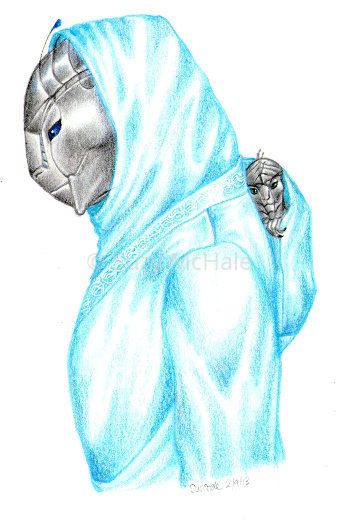
Mother carrying her hatchling in a sling (colored pencils, 2/9/2013).
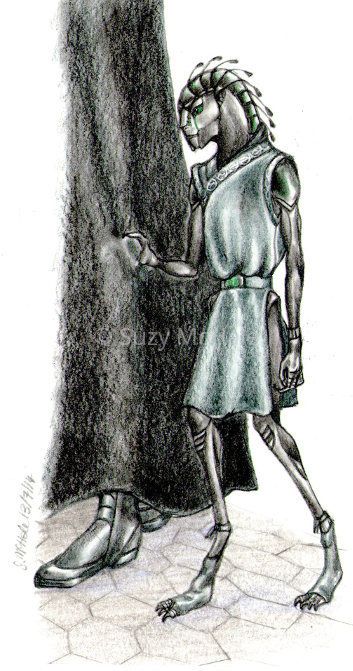
Resaan
Resaan is Bond-Mate of Clan Lord Maarec; mother of Sohaar and Yaraan. She is an Ancestor-Guardianof the Adept Caste.
Biographical information
- Gender
- Female
- Eye color
- (Earth) grass-green (#62af2f/rgb(98,175,47))
- Height
- 6 ft 7 in/2 m
Gallery
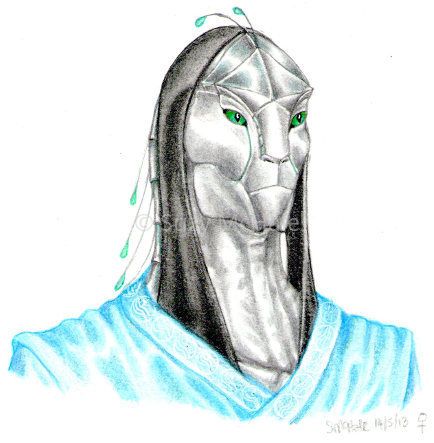
Resaan portrait (colored pencils, 14/5/2013, 28 KB).
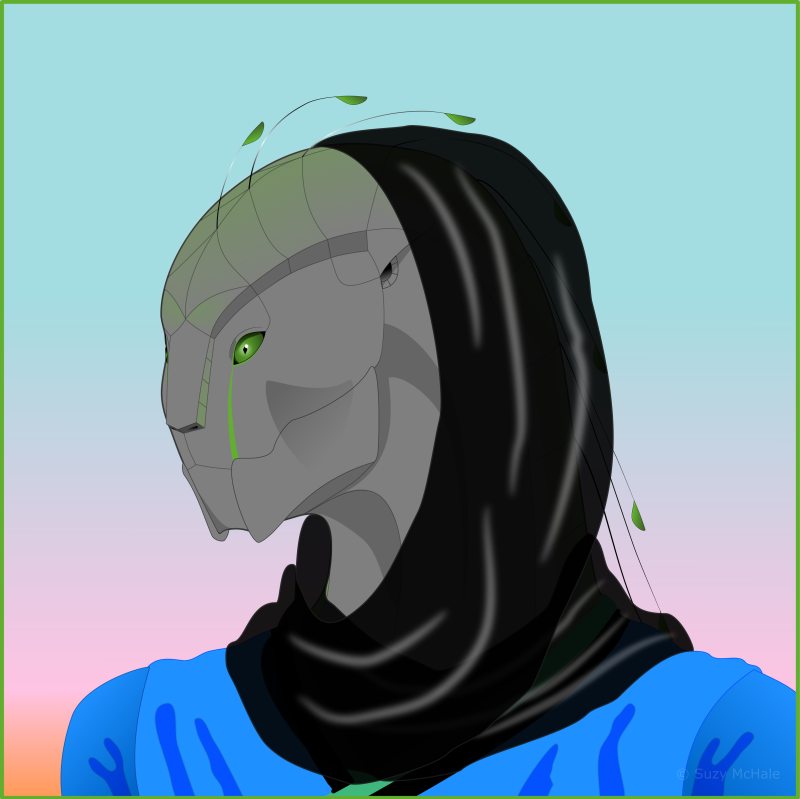
Resaan portrait, done as a vector in Inkscape (digital art, 31/10/2015, 36 KB). She wears a headscarf in the color indicating her profession, and her clothing color is that of the Adept Caste. The stripes on the hem of her color have colors indicating her profession and the Clan she belongs to.
Rock Jumper
A Rock Jumper (Rerewawumar) is a nimble quadruped herbivore that lives in mountainous areas, about the size and general shape of a goat. It has two backwards-curving horns and a thick tapering semi-prehensile tail.
Males are black with a grey underside; females are grey with a pale or white underside. The male has longer spiral horns.
Gallery
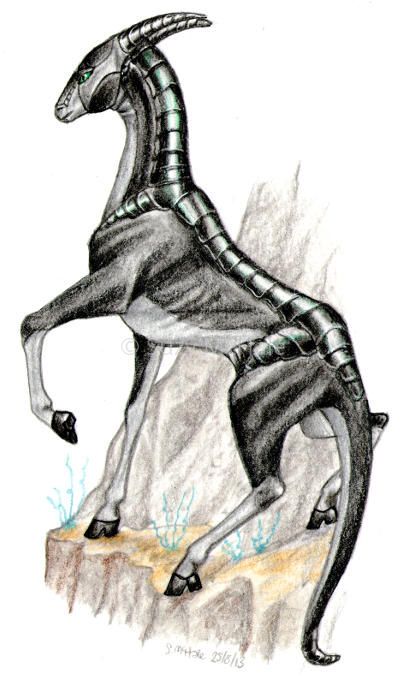
Female Rock Jumper (colored pencils, August 2013).
Sanaanoro
Sanaanoro is a Warrior-Guardian of Sohaar’s, inherited from his father Maarec.
Biographical information
- Gender
- Male
- Eye color
- Teal-blue (#367588/rgb(54,117,136))
- First appearance
- Inheritor chapter: “Attendance”
Sanaaso
Sanaaso is a youth of Sohaar’s year-group during his Time of Exile.
Biographical information
- Gender
- Male
- Hatching year
- 61,510.98 HW years/4056 B.C. (2311.92 HW years ago)
- First appearance
- Inheritor chapter: “Exile”
Sanaayaraan
Sanaayaraan is a Clan Lord of the Ocean Wind Clan. Oversees the alien Tall Necks.
Biographical information
- Gender
- Male
- First appearance
- Dominator chapter: “Council”
Sanaazuun
Sanaazuun is a Clan Lord of the Endless Plains Clan, nephew of Clan Lord Haarnahuu who was slain by Supreme Lord Yaraan.
Biographical information
- Gender
- Male
- Eye color
- Violet (#6900bb/rgb(105,0,187))
- First appearance
- Dominator chapter: “Return”
Sea of Sand
The Sea of Sand (Zumaahcesal) is the main desert in the southern hemisphere part of The Land. It is notable for huge sand dunes that stretch for kilometers, and is considered impassable.
Seasons
As the eight Clan Cities are generally in the same latitudes on both sides of the Equator, the climates are similar, though seasons are reversed:
- Sonuusaazasucehe
- Year-time-mating/breeding
- Sonuusaazawelawe
- Year-time-hot
- Sonuusaazanaale
- Year-time-rain
- Sonuusaazazamaawe
- Year-time-cold
Sergei Konstantinov
Sergei Aleksandrovich Konstantinov (Сергей Александрович Константинов) was born in Russia – then the USSR – in the Moscow district. After graduating school he joined the Russian Air Force and became a Class 1 Air Force pilot. Aircraft flown: Yak-52, L-29, L-39, MiG-31, MiG-29 and Su-27; logged over 600 hours of flight time. He is a qualified parachute instructor (over 200 jumps). Sergei’s Russian Air Force rank at the time of the story is “Major.”
He was selected as a test-cosmonaut candidate of the Gagarin Cosmonaut Training Center Cosmonaut Office on 28 July 1997 (1997 Air Force group). Sergei is a qualified Soyuz commander-pilot (his flight callsign is “Нептун, Neptune”) and has had one 6-month tour (“Expedition”) on the International Space Station.
He enjoys flying, parachuting, running, athletics, photography, astronomy, reading (mainly science-fiction and fantasy books and movies). He is a bit of a Japanophile. His elderly parents live in the suburb of Korolyov (formerly Leningrad), Moscow, in the State-provided apartment where Sergei grew up.
Rather shy, moody and reticent in personality. He is an only child and has no plans to get married. He is of mixed ethnicity (Slavic/Central Asian); his eyes are Asiatic/epicanthic in shape as he had a grandmother from Central Asia.
His relationship with the alien Sohaar is somewhat curious; they aren’t exactly friends, but he does not seek to escape from his hostage situation after initial resistance. He might have some symptoms of Stockholm syndrome; another reason is that he is disillusioned with various things on Earth.
Biographical information
- Born
- 1970
- Eyes
- Hazel-green (mostly green with a little brown) – epicanthic in shape
- Hair
- Black, straight (Asian-type hair) – worn in short military cut
- Height
- 5 feet 10 inches (177.8 cm/1.77 meters)
- Marital status
- Single
- Physique
- Thin, fit
- Skin
- Light golden-brown (Asian-type tone)
- Weight
- 60 kg – fit-but-lean build (BMI of 18)
Gallery
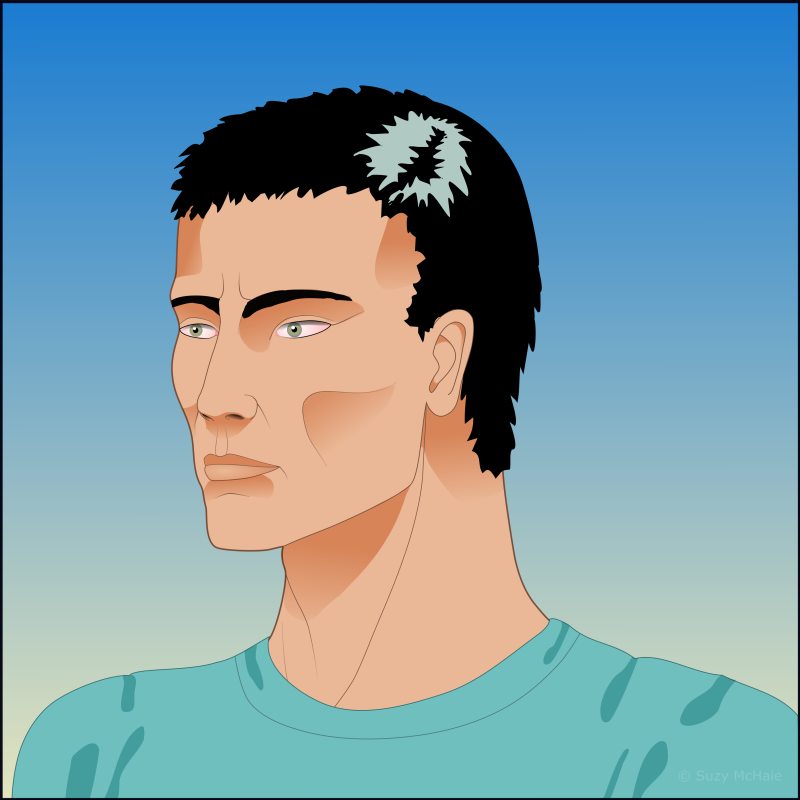
Sergei head portrait, somewhat stylized as it was originally done as a vector in Inkscape (6/9/2016, 43 KB).
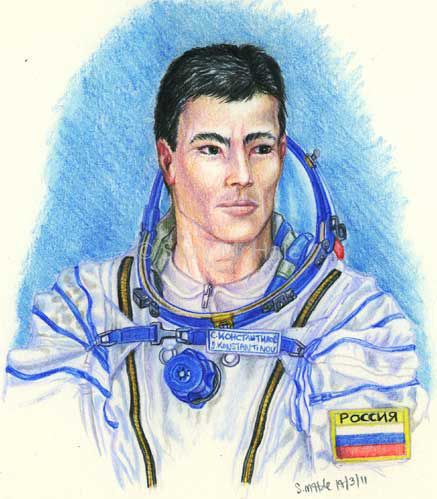
Sergei in a Sokol pressure suit (colored pencils, 14/3/2011).
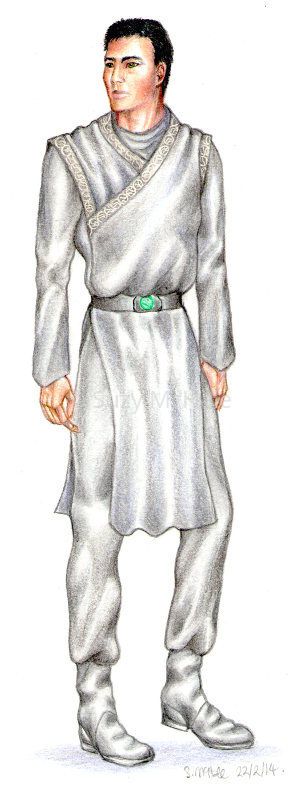
Sergei in his alien clothing (colored pencils, 22/2/2014).
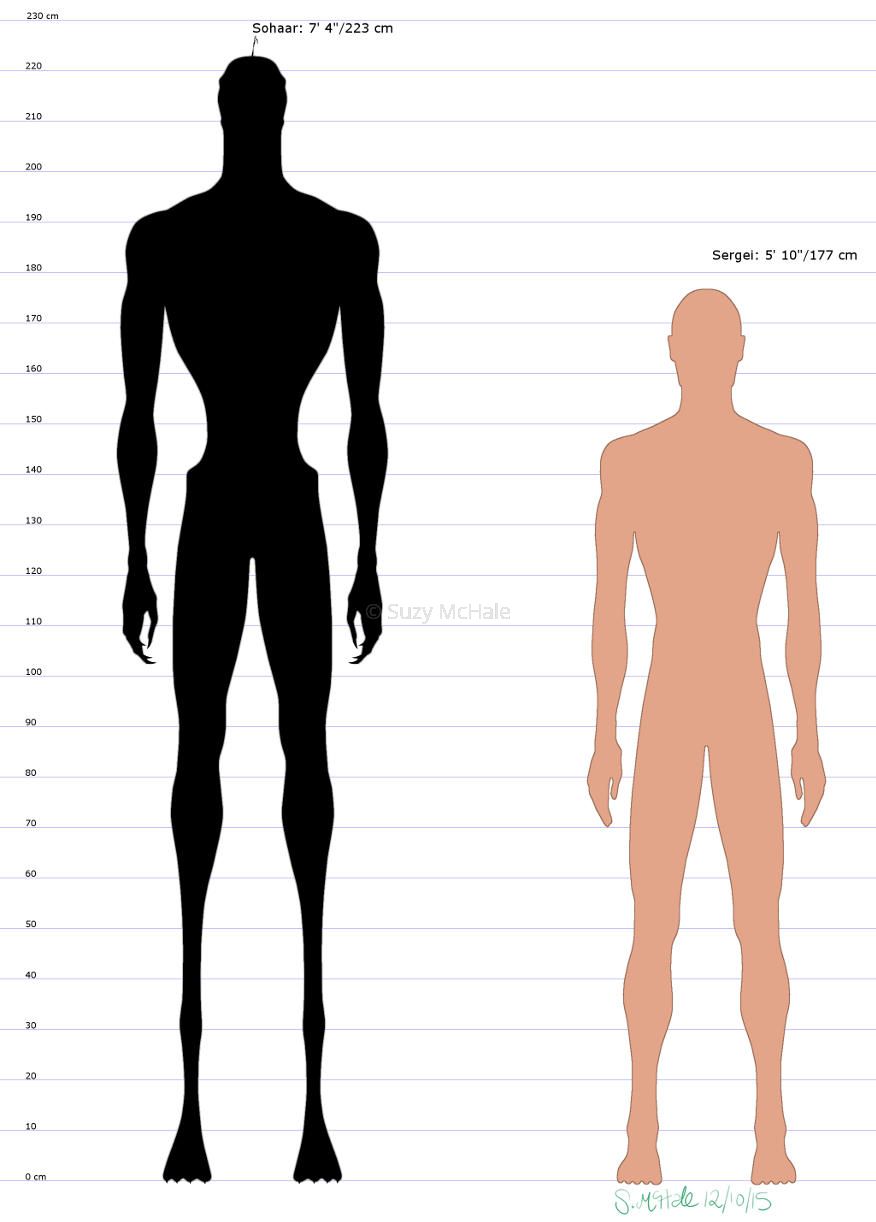
Height comparison of Sohaar and Sergei (digital art, 26/4/2014, revised 25/8/2015).
Notes
- His surname comes from a “skyfurnace” (flying ship) in the 1999 historical fantasy comic book series The Red Star. His first name is from a cosmonaut’s, Sergei Krikalyov.
Shadow Hunter
A Shadow Hunter (Haaramaaze) is a quadruped carnivore and evolutionary relative of the Dawn Hunters; as with humans and chimpanzees, both species descend from a common ancestor. It is a major apex predator, and they share a common antagonism. It lives in forests and mountainous areas (the Dawn Hunters are plains-dwellers). Like other Home World creatures, its upper body has protective overlapping segmented plates; its feet are four-clawed. It can kill an unarmed Dawn Hunter. It measures up to 2 meters long and 1 meter high at its powerful shoulders, which slope away down to its hindquarters. Its head is elongated, with strong jaws. Unlike the Dawn Hunters, it is not a fast runner and is built for strength rather than speed, preferring to ambush its prey; it is also solitary rather than gregarious.
Males have black skin, females grey, with various eye, crest and tail colors.
Gallery
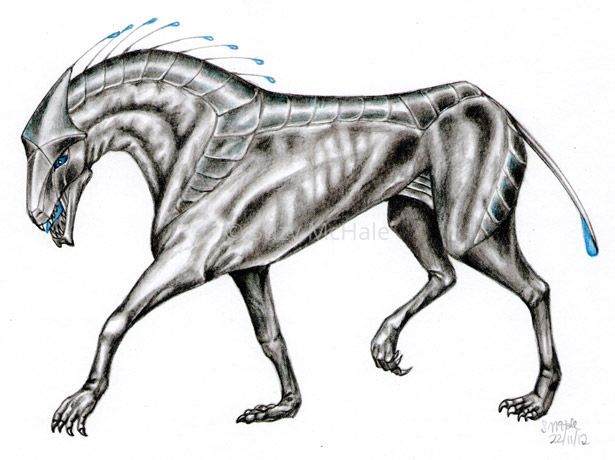
Male Shadow Hunter (colored pencils, 22/11/2012).
Shadow Wing
A Shadow Wing (Sosaanamaaze) is a large (condor-sized) avian-analog, somewhat resembling a cross between a dragon and a pterosaur. It has a long neck and its legs and arms both have wing membranes. It is black with an iridescent sheen (males have a black underside, females grey), and its head has two backward-pointing wedge-shaped crests; the crest varies in color between individuals. It feeds on insects and carrion, and has teeth to enable the latter. It has a wingspan of up to 3 meters, and is as large as flying creatures get on Home World.
Gallery
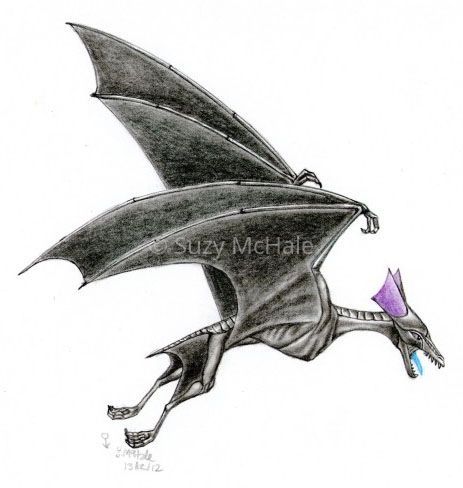
Male Shadow Wing (colored pencils, 13/2/2012).
Ship Master
A Ship Master (Nayoczaawezoyuu) is one who commands a Void Walker; this can be a Clan Lord or anyone standing in for him when he is absent.
Shuttle
A Shuttle (Habaalanzul – Lord’s personal Shuttle or Habaalansobec – general use) carries up to 8 passengers and 2 crew (a Technician-Pilot and co-pilot). A Clan Lord or War Lordhas his own designated and marked Shuttle; he sits in the right-hand commander’s seat beside the Technician-Pilot. The markings are a stylized rendition of his helmet crest, on both sides of the wings.
It is a little larger than a Sukhoi Su-27 (22 m long, 14 m wingspan). The Shuttle is self-contained (galley, hygiene facilities, medical bay, etc.) and can support its crew for up to one Home World month. The front section contains the flight cabin, the middle section has an airlock and entrance ramp, and the rear section contains the passengers and aforementioned facilities. The engines are placed along the sides.
It is black in color, highlighted with Clan colors. The design follows the organic theme favored for all vessels, and resembles sea creatures found in Home World’s oceans.
Dimensions
- Length
- 12 bodylengths (25.92 m)
- Wingspan
- 10 bodylengths (21.6 m)
Gallery
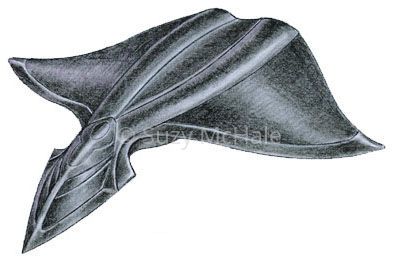
Shuttle (colored pencils, 2009 – somewhat outdated).
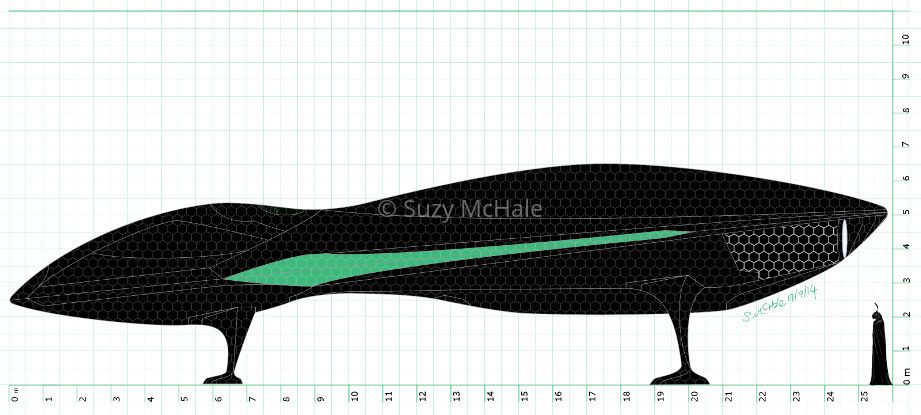
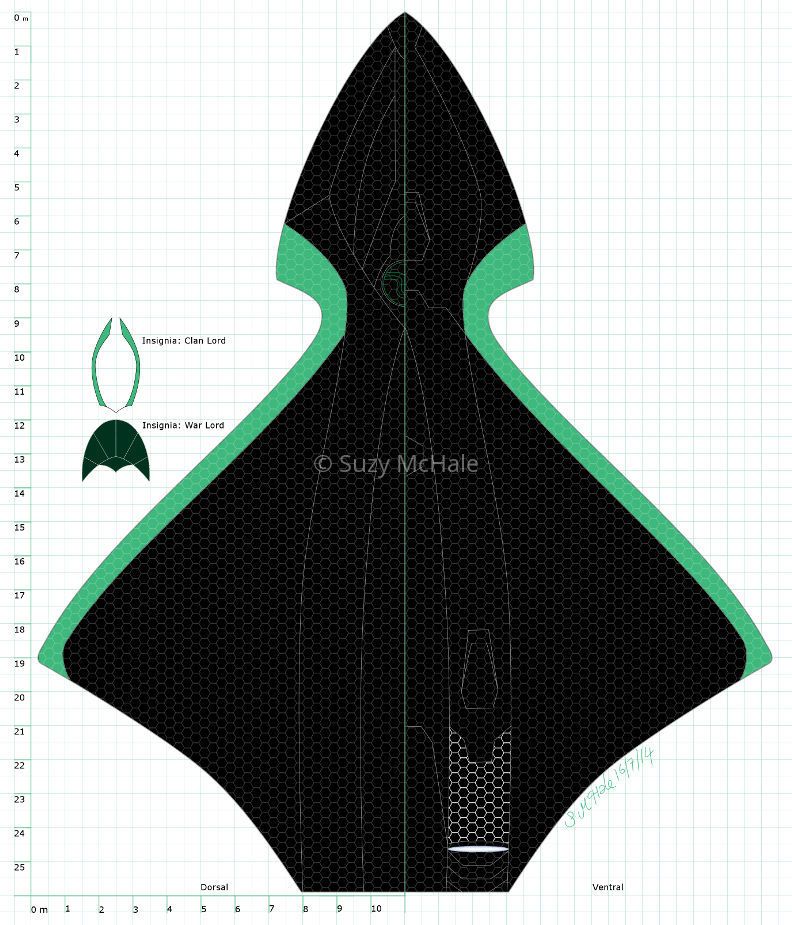
Side, top and bottom views (digital art, 16/7/2014).
Silver Fish
A Silver Fish (Mozeyuyuzuu) is an eel-like sea creature found in salt and fresh water; most often rockpools along the coastline. It has head and tail fins, iridescent silvery scales and is a vertebrate.
Gallery
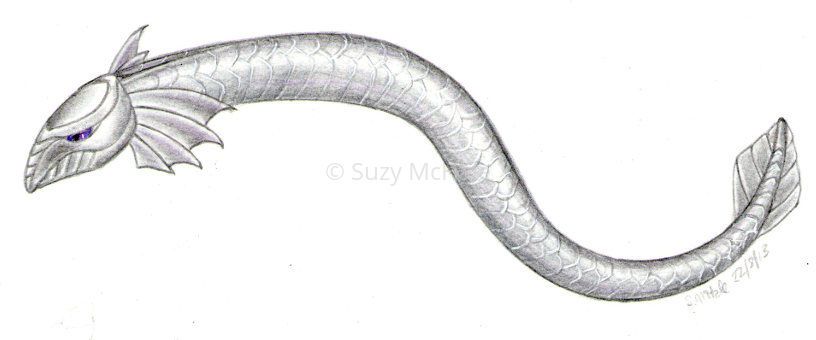
Female Silver Fish (colored pencils, 22/8/2013).
Sky Carrier
The Sky Carrier (Habaalanzuun) transports troops and/or cargo and equipment to a planet’s surface and back. It vaguely resembles a winged scarab beetle in shape. It carries a crew of 2 (pilot and engineer) plus up to 32 passengers on the upper deck, and cargo on the lower deck. The fusion-powered engines extend along the base of the craft. It is black in color, the wing leading edges highlighted with its Clan’s colors.
Dimensions
- Length
- 18 bodylengths (38.88 m)
- Wingspan
- 15 bodylengths (32.4 m)
Gallery
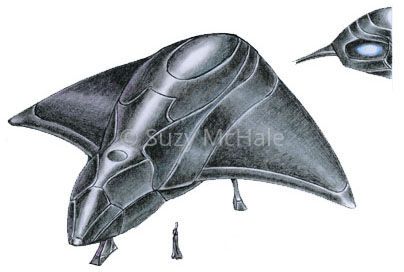
Sky Carrier, (colored pencils, 2009 – design slightly changed since then).
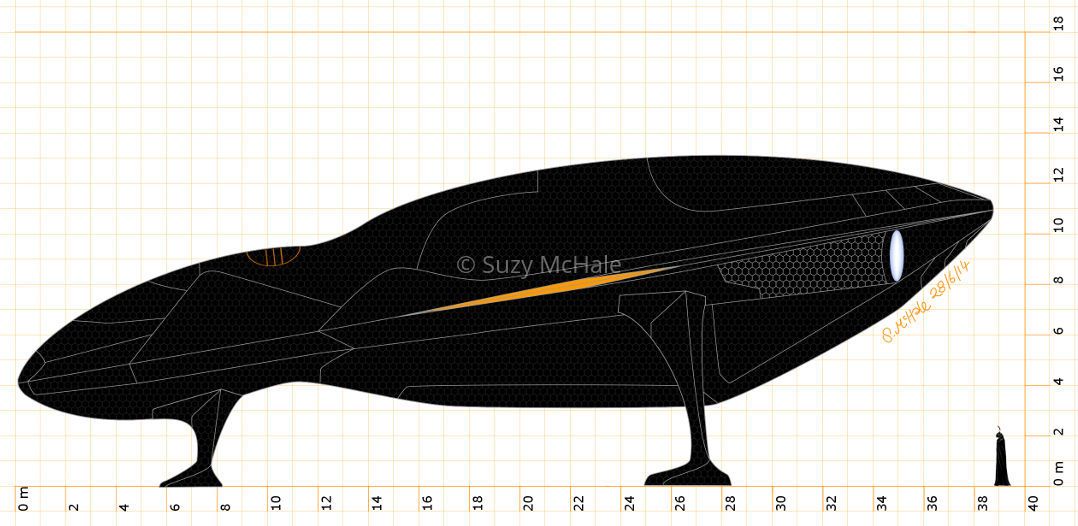
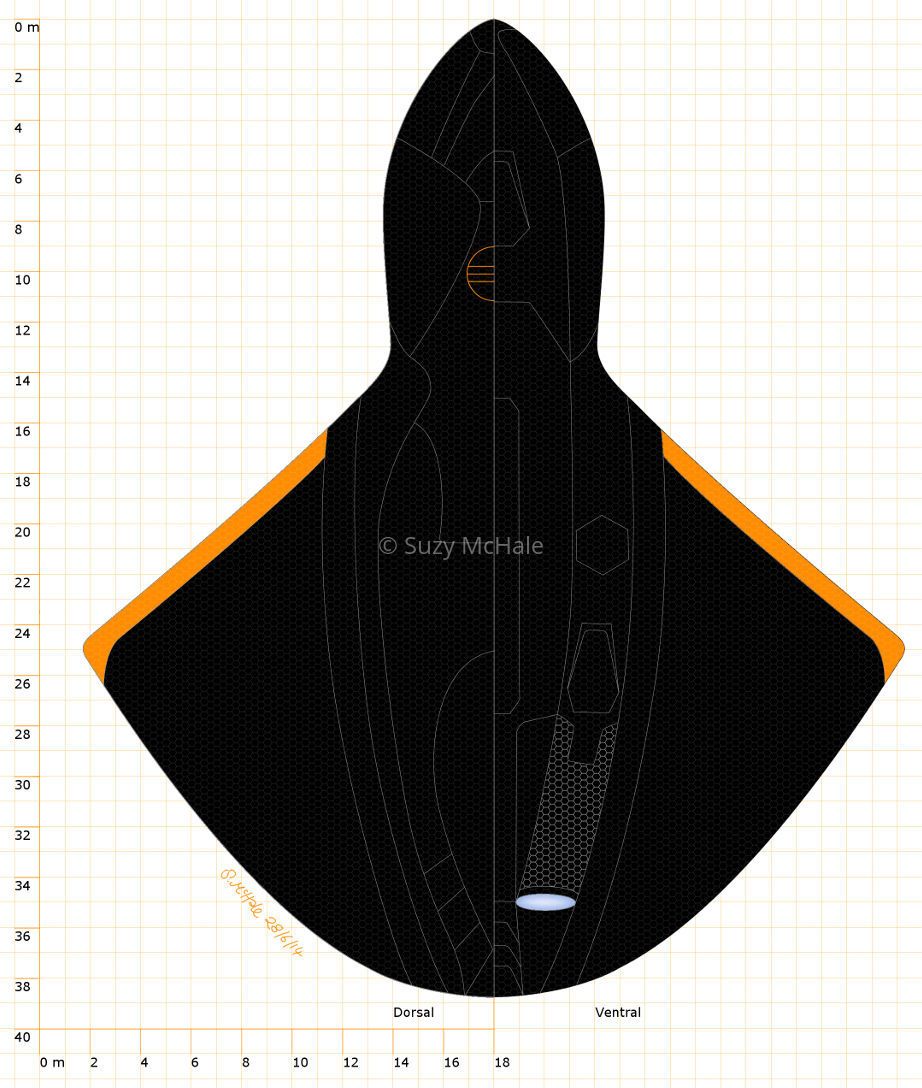
Sky Fighter
A Sky Fighter (Haarzuun) is a smaller craft that carries a crew of two, seated side-by-side or one behind the other as required. It serves as a versatile multirole fighter and bomber. It resembles a stingray in shape and is black in color, the leading edges of its wings highlighted with its Clan’s colors.
Dimensions
- Length
- 8 bodylengths (17.28 m)
- Wingspan
- 4 bodylengths (8.64 m)
Gallery
Sky Fighter (colored pencils, 2009 – design slightly altered since then).
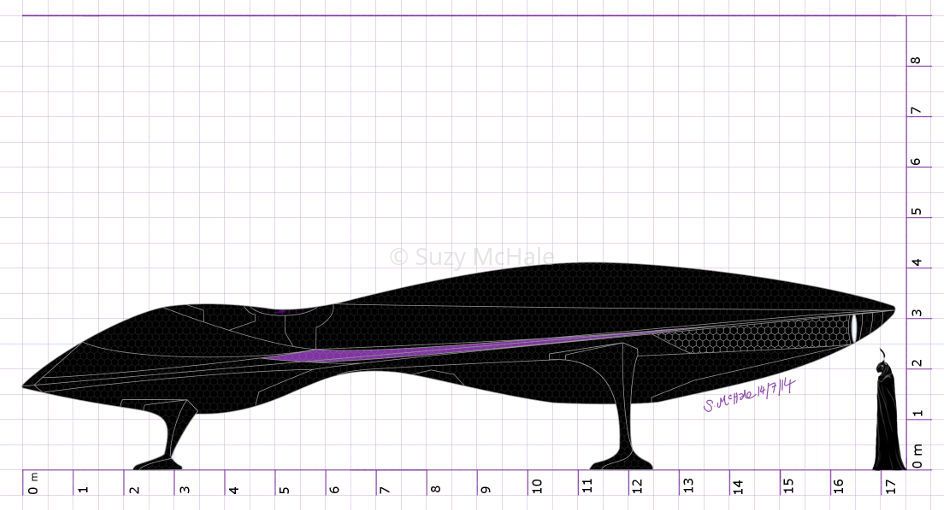
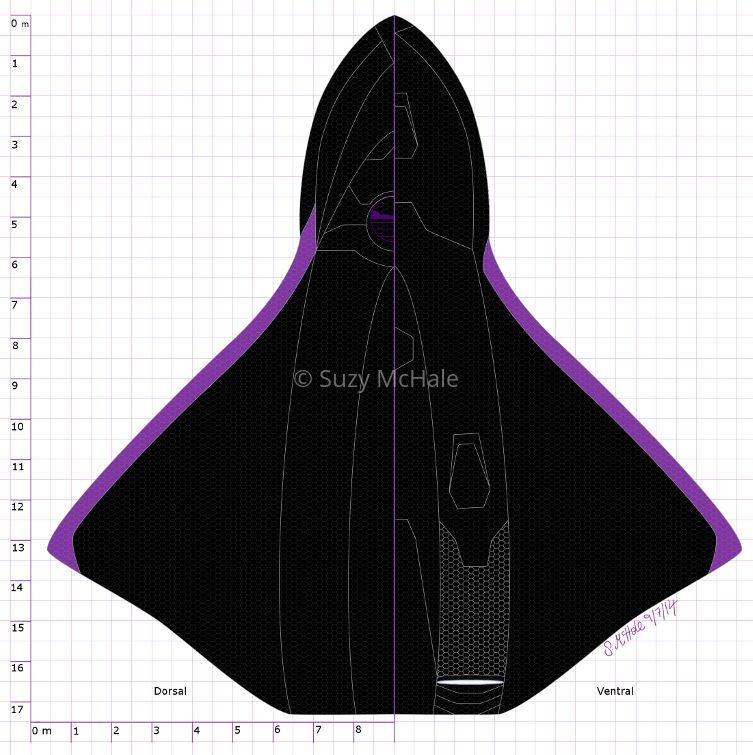
Sky Flyer
A Sky Flyer (Rerelanzuun) is a light, atmospheric twin-propeller-driven craft for low-level flying; it is a little larger than a Cessna light aircraft. It seats two passengers side-by-side; they enter via a retractable ladder on the left side. Its bulbous main fuselage tapers sharply at the rear where a V-shaped tail is located, giving it a dragonfly-like appearance. The propellers are mounted under each wing, and are powered by hexagonal solar panels integrated into the craft’s skin, effectively giving it unlimited range. Its three-wheeled undercarriage is retractable, and has short takeoff and landing capability. As with the spacecraft, its wings can morph to suit the flying conditions – e.g. lengthen to allow soaring and gliding, or the tips curve up to form winglets – and it has a simple Artificial Intelligence on board. Like other Dawn Hunter craft, it is black in color, the leading edges of its wings highlighted with its Clan’s colors.
Dimensions
- Length
- 5 bodylengths (10.8 m)
- Wingspan
- 7 bodylengths (15.12 m)
Gallery
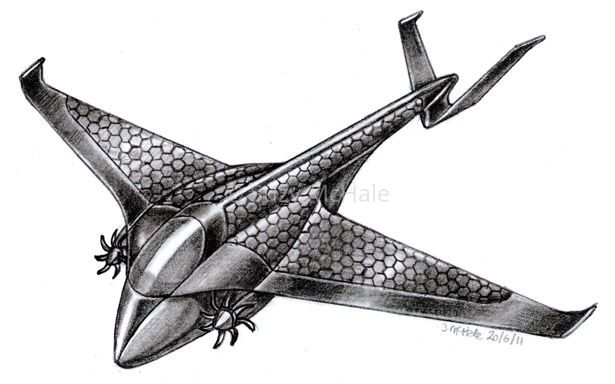
Sky Flyer (colored pencils, 20/6/2011).
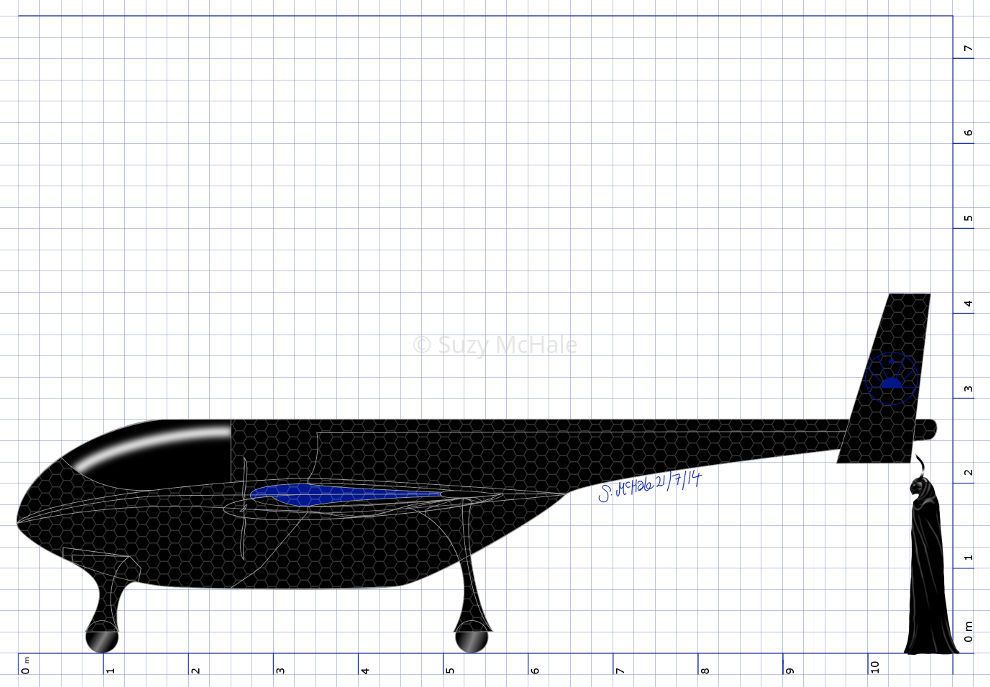
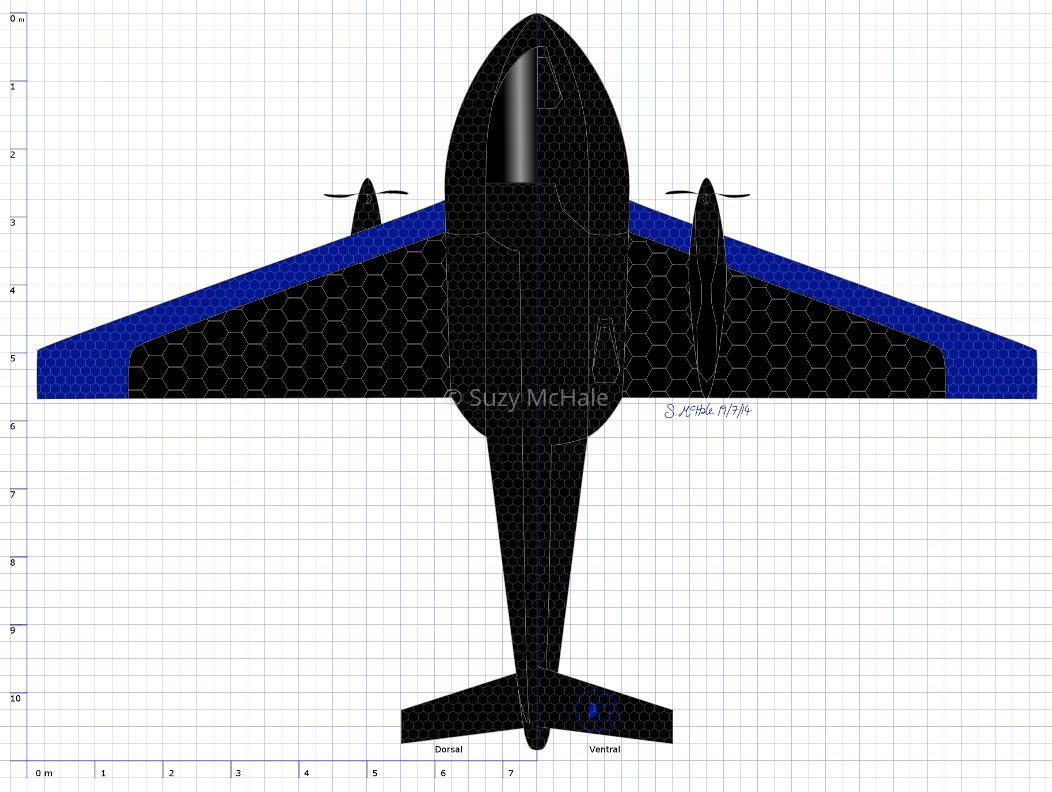


Links
- Solar Impulse: Experimental solar aircraft
Sky Tree
A Sky Tree (Merozuun) resembles a black-barked palm with a crest of cerulean leaves; a mostly tropical tree. As it grows in equatorial regions, its leaves reflect a lot of the more energetic blue sunlight rather than absorb it. So-called as it can grow very tall – up to 40 meters or more – and its leaves are sky-colored.
Gallery
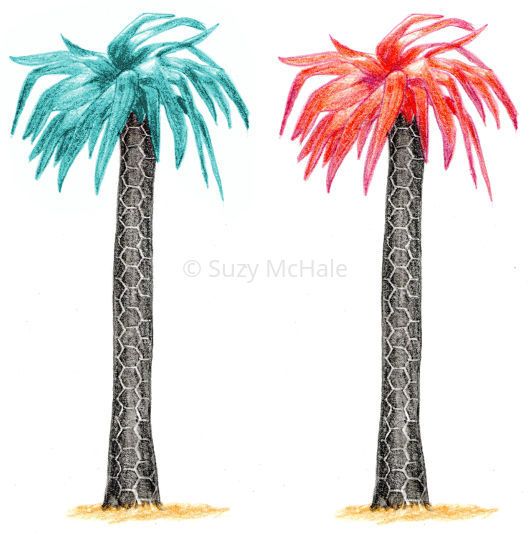
Sky Tree, cerulean and magenta variants (colored pencils, July 2013; leaves originally red then later digitally recolored).
Sleep Flower
A Sleep Flower (Meromoree) is a common small ground plant. Its four splayed leaves are cerulean in color with veins in a hexagonal pattern, and a bulbous magenta flower grows on a stalk from the middle of these. The flower varies in shade – extremes from orangeish to purplish – depending upon the region where it is found. Its bluish milky sap has a morphine-like, pain-killing effect when placed on the skin, or swallowed (but without the side-effects).
Gallery
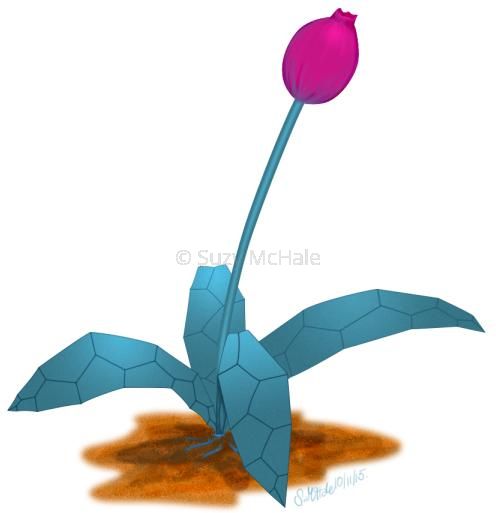
Sleep Flower plant (digital art, 10/11/2015).
Society
The society of the Dawn Hunters is essentially tribal in nature, collectivist, hierarchical and conservative – the last aspect in the sense that they don’t change much and maintain traditions. It has served them well for thousands of years and are secure in their culture and identity; they are somewhat insular and aloof. They are highly advanced in many areas, yet have not lost touch with the natural world and their essential nature.
They evolved from social pack hunters on the east coast plains of the single continent’s southern hemisphere, utilizing co-operative hunting strategies against their large and dangerous prey such as Spike Tails. This helped develop sapience as a complex society formed, based on family Clan hierarchies. A dominant male led each major Clan; males leading minor Clans were subordinate to the major one.
Hunting and gathering remained their main source of food; they never developed agriculture on a mass scale so their population remained comparatively low compared to that of humans. Males of the fighting caste engaged in vicious combat with rival males of other clans, each major clan establishing its territory in regions of the single continent. Eventually the Clans, under the first Supreme Lord, Sohaar-1, coalesced into eight major Clans, each finding it expedient to establish a settlement in their designated territory. These settlements eventually grew into the Clan Cities that continue to this day. A Clan City is led by the dominant male, the Clan Lord. Sub-Clans are led by War Lords.
The Cities and their more settled lifestyle stimulated technological development. Technology progressed at a slower rate than the human equivalent, but as they never developed money or an economic system, it was unhindered by funding concerns. Their conservative nature was another reason for the leisurely pace of development; they do not change things unless deemed necessary, so advances are incremental.
The Hunters now had opportunity to specialize in various professions and a Caste system evolved. The Warrior Caste are fighters and leaders, the Adept Caste are scholars and scientists, and the Technician Caste are builders, with further specialties within professions. Professions are passed down through apprenticeships, usually from parent to child.
The Hunters do not have gods and goddesses as such, but venerate their dead as filial piety is a tenet of their society. This is carried to an extreme with Supreme and Clan Lords, whose bodies were preserved to be buried first in a desert tomb complex, and later transferred to the nearest moon of their world after spaceflight was developed. Houses of the Ancestors in each Clan City holds the remains of each Clan member (Clan Lords are interred in the singular Pyramid of the Lords). Tomb Priests and Priestesses maintain the Houses.
Sohaar-1
Sohaar-1 is the revered founder of the Night River Clan and City. He has the same eye color as Sohaar-28.
Physical information
- Gender
- Male
- Eye color
- Emerald-green (#3fb87d/rgb(63,184,125))
- Lifespan
- 85 HW years/148.75 Earth years
Sohaar-5
Sohaar-5 is an ancestor of Clan Lord Sohaar. He lived 110,590 B.C./64,308.57 HW years ago. He was overthrown in a coup by the usurper War Lord Maazeyaraan, but recovered and returned to challenge him in single combat in an attempt to reclaim his ancestral Clan City.
Biographical information
- Gender
- Male
- Eye color
- Blue-green (#008080/rgb(0,128,128))
- First appearance
- Chapter: “Fallen”
Sohaar
Sohaar is the eldest son and heir of Clan Lord Maarec of the Night River Clan, and the 28th to bear that name. He took over leadership of his Clanafter he ritually sacrificed his father. However, his ambitious brother Yaraan upset their natural order when he challenged and defeated the-then Supreme Lord in single combat.
Sohaar tends to be – like most of the Warrior Caste – arrogant, imperious and certain of his superiority to other species. He tolerates no disrespect or insubordination, and anyone who insults him could literally lose their head by his sword. He can be moody and short-tempered; patience is not usually one of his virtues! He enjoys combat and the way of the warrior – it’s what his Caste selectively bred themselves for, after all.
However, compared to his brother and father, he is slightly more inclined to forgive inadvertent breaches of etiquette, which is a good thing for any humans first encountering him! He is not a coward or bully.
In age, he was hatched 4056 Earth-years ago (counting backwards from the Before Present timeline of 1950) and spent 4004 years in stasis (plus the number of years to my story’s setting).
He is the main alien protagonist of my story.
Biographical information
- Eye color
- Emerald-green (#3fb87d/rgb(63,184,125)) – a trait of his genetic line; Sohaar-1, the founder of his Clan, had the same eye color
- Gender
- Male
- Hatching year
- 61,510.98 HW years/4056 B.C. (2311.92 HW years ago)
- Height
- 7 feet 4 inches/2.23 meters tall, a little taller than the average height for one of the Warrior Caste
- Stride length
- 92.5 cm
- Weight
- 140 kg (Earth-equivalent)
Gallery
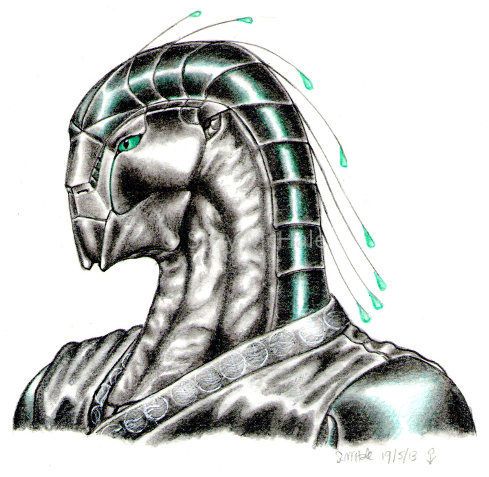
Sohaar-28 portrait (colored pencils, 19/5/2013, 47 KB).
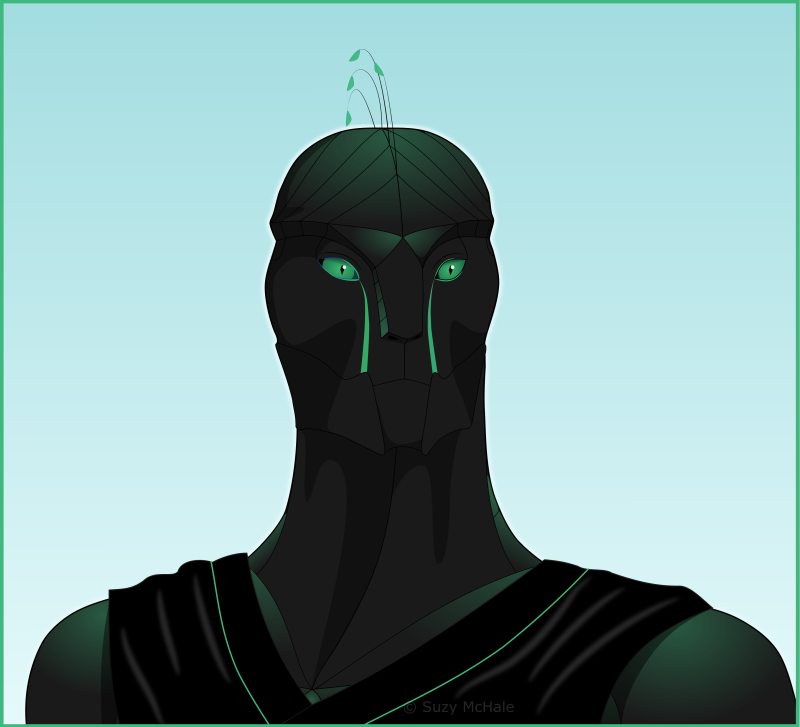
Sohaar head portrait, done as a vector in Inkscape (24/10/2015, 25 KB). His skin should be as black as his tunic but was lightened for cell-shading.
Soharaa
Soharaa is Supreme Lord at the time of Clan Lord Sohaar’s hatching. He belongs to the Swift River Clan. He is the 45th Soharaa of his line. His father is Lecaaculuun-44.
Biographical information
- Gender
- Male
- Eye color
- Orange (#FFA500/rgb(255,165,0))
- First appearance
- Inheritor chapter: “Challenge”
Sosaan
Sosaan is an Adept-Biologist who is onboard Clan Lord Sohaar’s Void Walker on their second visit to Earth.
Biographical information
- Gender
- Male
- First appearance
- Dominator chapter: “Surrender”
Spike Tail
A Spike Tail (Haweraaru) is a quadruped herbivore. It has a long neck, thin legs and tail; is about the size of a camel and resembles a cross between a camel and a sauropod dinosaur. Its small head is convex in profile, with four crest-quills flaring on either side. Its upper skin is iridescent magenta with blue spots (which also fluoresce in ultraviolet); males have black underparts and females grey. It is the largest land creature on Home World, with males standing up to 6 feet/1.8 meters at the shoulder and the males can weigh up to 1 tonne. It has cloven hooves (two horned split toes for walking on), and can run quite fast, about the speed of a racehorse. The male’s tail has four spikes on its end to use as a weapon against rival males and predators, similar to those of a stegosaurus. The female’s tail is spikeless, but it can still hit predators hard enough to break bones.
It is flighty and ill-tempered, and would not be suited to domestication even if the Dawn Hunters were inclined to try this.
It is favored prey of the Dawn Hunters and numbers into the millions. Spike Tails inhabit the grasslands in the temperate zones on both sides of the equator.
Gallery
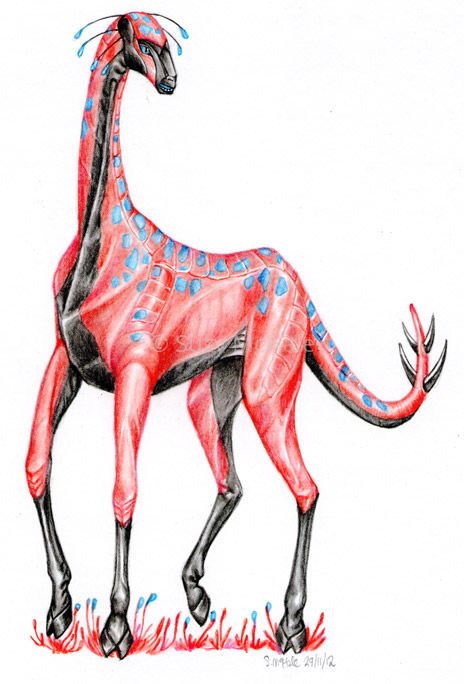
Male Spike Tail (colored pencils, 29/11/2012).
Spiral Grass
Spiral Grass (Huruuwuluur) is a cerulean-colored grass whose wiry blade has a corkscrew-like curl. (A similar Earthly equivalent: Juncus effusus “Spiralis”.)
Gallery
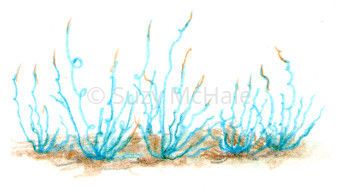
Spiral Grass (colored pencils, July 2013).
Stages of life
- Hatchling (1st year)
- Leesawa (one who hatches, is born)
- Yearling (2nd year)
- Sonuuwa
- Child
- Hunaawa (one who is young)
- Sub-adult (adolescent)
- Weromwasuwa (little adult)
- Adult
- Weroma
- Elder
- Hasuulana
Supreme Lord
The Supreme Lord (Zulsune) is a Clan Lord who has ultimate authority over all other Clan Lords and Cities – he has the final say in any decision made by the Council of Immortals. His position is won by a duel to the death with his predecessor. Any Warrior can challenge him for the position, but in reality only a high-ranking one usually does as they are the most formidable fighters.
Like the Clan Lords, his lifespan is greatly lengthened with the use of nanomedicine.
Helmet crest is the same as a Clan Lord’s and his metal rank color is also gold (#ffd700 / rgb(255,215,0)).
Gallery
Swadesh list
A selection of Dawn Hunter words. Note that the letter c is always pronounced as k! There are no DH equivalents for some English words (such as various animal species).
| Number | English | Part of speech | Dawn Hunter language |
|---|---|---|---|
| 1 | I | personal pronoun | wan |
| 2 | you (singular) | personal pronoun | ruul |
| 3 | he | personal pronoun | yeloo (also she, it [gender unknown/unspecified]) |
| 4 | we | personal pronoun | mahu |
| 5 | you (plural) | personal pronoun | ruulcuuna |
| 6 | they | personal pronoun | yeloocuuna (sapient) mesuucuuna (animals, non-sapient) |
| 7 | this | demonstrative pronoun | lor (these: lorcuuna) |
| 8 | that | demonstrative pronoun | sor (those: sorcuuna) |
| 9 | here | demonstrative pronoun | coco |
| 10 | there | demonstrative pronoun | soco |
| 11 | who | interrogative | laaz |
| 12 | what | interrogative | mana |
| 13 | where | interrogative | naya |
| 14 | when | interrogative | saazawome mana |
| 15 | how | interrogative | meesa |
| 16 | not | quantifier | ranu |
| 17 | all | quantifier | helee |
| 18 | many | quantifier | cuuna |
| 19 | some | quantifier | wazen |
| 20 | few | quantifier | nalem |
| 21 | other | cardinal number | |
| 22 | one | cardinal number | hen |
| 23 | two | cardinal number | zeyu |
| 24 | three | cardinal number | nama |
| 25 | four | cardinal number | walu |
| 26 | five | adjective | baca |
| 27 | big | adjective | caala |
| 28 | long | adjective | mee |
| 29 | wide | adjective | caaru |
| 30 | thick | adjective | |
| 31 | heavy | adjective | laasan |
| 32 | small | adjective | wasu |
| 33 | short | adjective | lalo |
| 34 | narrow | adjective | |
| 35 | thin | noun | |
| 36 | woman | noun | waheen |
| 37 | man (adult male) | noun | caale |
| 38 | man (human being) | noun | sobec (sapient being) |
| 39 | child | noun | nunee |
| 40 | wife | noun | holabene or waheenhola |
| 41 | husband | noun | holabene or caanehola |
| 42 | mother | noun | maacuwaheen |
| 43 | father | noun | maacucaale |
| 44 | animal | noun | meela (also wawewalu, four-leg, for quadripedal creatures) |
| 45 | fish | noun | meelazumaah (sea-creature) |
| 46 | bird | noun | meelazuun (sky [flying/winged] creature) |
| 47 | dog | noun | |
| 48 | louse | noun | |
| 49 | snake | noun | |
| 50 | worm | noun | |
| 51 | tree | noun | mero |
| 52 | forest | noun | naheel |
| 53 | stick | noun | cebay |
| 54 | fruit | noun | |
| 55 | seed | noun | muyu |
| 56 | leaf | noun | laamo |
| 57 | root | noun | may |
| 58 | bark (of a tree) | noun | nabumero |
| 59 | flower | noun | |
| 60 | grass | noun | huruu |
| 61 | rope | noun | renuu |
| 62 | skin | noun | nabu |
| 63 | meat | noun | huulo |
| 64 | blood | noun | molan |
| 65 | bone | noun | sayaan |
| 66 | fat (noun) | noun | |
| 67 | egg | noun | saraa |
| 68 | horn | noun | saawu |
| 69 | tail | noun | hawe |
| 70 | feather | noun | renuu (filament, strand, thread) |
| 71 | hair | noun | renuu (filament, strand, thread) |
| 72 | head | noun | cebaan |
| 73 | ear | noun | nec |
| 74 | eye | noun | hesaa |
| 75 | nose | noun | yu |
| 76 | mouth | noun | bem |
| 77 | tooth | noun | nelo |
| 78 | tongue (organ) | noun | yaan |
| 79 | fingernail | noun | zuhaa (claw) |
| 80 | foot | noun | ceyuu |
| 81 | leg | noun | wawe |
| 82 | knee | noun | waweyeero (leg-bend) |
| 83 | hand | noun | walu |
| 84 | wing | noun | sosaan |
| 85 | belly | noun | |
| 86 | guts | noun | naasel |
| 87 | neck | noun | |
| 88 | back | noun | nuural |
| 89 | breast | noun | |
| 90 | heart | noun | mawa |
| 91 | liver | verb | |
| 92 | to drink | verb | loyunec |
| 93 | to eat | verb | mecu |
| 94 | to bite | verb | ruc |
| 95 | to suck | verb | zuuce |
| 96 | to spit | verb | bah |
| 97 | to vomit | verb | caarnec |
| 98 | to blow | verb | waaye |
| 99 | to breathe | verb | haanunec |
| 100 | to laugh | verb | |
| 101 | to see | verb | hesaanec |
| 102 | to hear | verb | renonec |
| 103 | to know | verb | lahonanec |
| 104 | to think | verb | zayuunec |
| 105 | to smell | verb | honenec |
| 106 | to fear | verb | wehenec |
| 107 | to sleep | verb | moreenec |
| 108 | to live | verb | raanenec |
| 109 | to die | verb | lununec |
| 110 | to kill | verb | lunuhenec |
| 111 | to fight | verb | haarnec |
| 112 | to hunt | verb | haranec |
| 113 | to hit | verb | macanec |
| 114 | to cut | verb | mocunec |
| 115 | to split | verb | cahnec |
| 116 | to stab | verb | huunenec |
| 117 | to scratch | verb | raranec |
| 118 | to dig | verb | cehunec |
| 119 | to swim | verb | wayuu |
| 120 | to fly | verb | rerenec |
| 121 | to walk | verb | zawenec |
| 122 | to come | verb | lanec |
| 123 | to lie (as in a bed) | verb | |
| 124 | to sit | verb | |
| 125 | to stand | verb | |
| 126 | to turn (intransitive) | verb | |
| 127 | to fall | verb | |
| 128 | to give | verb | |
| 129 | to hold | verb | |
| 130 | to squeeze | verb | zuuwe |
| 131 | to rub | verb | |
| 132 | to wash | verb | bulunec |
| 133 | to wipe | verb | |
| 134 | to pull | verb | |
| 135 | to push | verb | |
| 136 | to throw | verb | nol |
| 137 | to tie | verb | |
| 138 | to sew | verb | renuunec |
| 139 | to count | verb | |
| 140 | to say | verb | luunonec |
| 141 | to sing | verb | |
| 142 | to play | verb | |
| 143 | to float | verb | |
| 144 | to flow | verb | leeranec |
| 145 | to freeze | verb | |
| 146 | to swell | noun | |
| 147 | sun | noun | hesaalecaa |
| 148 | moon | noun | re |
| 149 | star | noun | so |
| 150 | water | noun | samoo |
| 151 | rain | noun | naal |
| 152 | river | noun | sahel |
| 153 | lake | noun | seewa |
| 154 | sea | noun | zumaah |
| 155 | salt | noun | ceeha |
| 156 | stone | noun | wooma |
| 157 | sand | noun | cesal |
| 158 | dust | noun | yer |
| 159 | earth | noun | baal |
| 160 | cloud | noun | bano |
| 161 | fog | noun | behu |
| 162 | sky | noun | zuun |
| 163 | wind | noun | sanaa |
| 164 | snow | noun | rerasasaan |
| 165 | ice | noun | rera |
| 166 | smoke | noun | zuruc |
| 167 | fire | noun | lecaa |
| 168 | ash | verb | cuul |
| 169 | to burn | noun | lecaanec |
| 170 | road | noun | yool |
| 171 | mountain | adjective | nomaa |
| 172 | red | adjective | lelecaa |
| 173 | green | adjective | mabaale |
| 174 | yellow | adjective | lelecaa |
| 175 | white | adjective | saansaan |
| 176 | black | noun | nanahuu |
| 177 | night | noun | nahuu |
| 178 | day | noun | hame |
| 179 | year | adjective | sonuu |
| 180 | warm | adjective | wela |
| 181 | cold | adjective | zamaa |
| 182 | full | adjective | |
| 183 | new | adjective | muzo |
| 184 | old | adjective | haasu |
| 185 | good | adjective | weza |
| 186 | bad | adjective | meha |
| 187 | rotten | adjective | |
| 188 | dirty | adjective | |
| 189 | straight | adjective | caah |
| 190 | round | adjective | rowan |
| 191 | sharp (as a knife) | adjective | cahe |
| 192 | dull (as a knife) | adjective | |
| 193 | smooth | adjective | |
| 194 | wet | adjective | bulu |
| 195 | dry | adjective | wake |
| 196 | correct | adjective | |
| 197 | near | adjective | lara |
| 198 | far | adjective | bale |
| 199 | right | adjective | ruuz |
| 200 | left | adjective | saam |
| 201 | at | preposition | |
| 202 | in | conjunction | |
| 203 | with | conjunction | -seen |
| 204 | and | conjunction | |
| 205 | if | conjunction | |
| 206 | because | noun | |
| 207 | name | suhe | |
| 208 | house | hale | |
| 209 | wall | ||
| 210 | deer | ||
| 211 | mouse | ||
| 212 | rabbit | ||
| 213 | eagle | ||
| 214 | spider | ||
| 215 | face | sosa | |
| 216 | body | yamen | |
| 217 | navel | ||
| 218 | finger | soon | |
| 219 | sick (painful) | ||
| 221 | needle | ||
| 222 | clothing | cahuu | |
| 223 | thunder | culuun | |
| 224 | lightning | zuuma | |
| 225 | above | zabo | |
| 226 | below | lenol | |
| 227 | to cough | ||
| 228 | to buy | ||
| 229 | to choose | ||
| 230 | to grow | ||
| 231 | to open | ||
| 232 | to steal | ||
| 233 | to dream | ||
| 234 | to cry | ||
| 235 | to yawn | ||
| 236 | to cook | ||
| 237 | six | relo | |
| 238 | seven | yuna | |
| 239 | eight | lecu | |
| 240 | nine | lecuhen | |
| 241 | ten | lecuzeyu | |
| 242 | which | ||
| 243 | how many |
Updated: 19/8/2016
Swift River Clan
The Swift River Clan (Narawaa Sahelnorowo) is one of the eight Great Clans. Its Clan City is located on Home World’s west coast. It is the last-founded clan; construction of its City began 108,998 Earth years/62,128.86 HW years ago (3735.84 years since Year 0). Red-gold sandstone is a major component of the buildings there. Its culture is more independently-minded.
Data
- Burial armor gemstone
- Topaz (orange)
- Clan City construction stone
- Red sandstone
- Clan City co-ordinates
- Approximately 29°W, 8°S
- Clan emblem
- Three lines representing a river
- Color
- Orange (#ff8c00/rgb(255,140,0))
- Clan Lords mentioned
- Lord Soharaa
Sword Arms
The Sword Arms (|kahi) are aliens under the domination of the Dawn Hunters.
Physiology
The Sword Arms are bipedal predators originally descended from an reptile- and insect-like ancestor; they evolved an endoskeleton and lungs as they got larger, but retain a protective partial exoskeleton over their body. They have compound eyes, evolved to distinguish fine details; the color of these matches their exoskeleton. Their upper jaw splits into two lateral mandibles; they do not have teeth but their jaws are beak-like and can bite hard. They have an infrared/heat sensor on their forehead between their main eyes to aid in detecting prey in dim light, and to find their way through the tunnels of their burrow-cities.
They do not have a collarbone as their evolutionary ancestors did not brachiate from trees; their manipulative arms face forward in a manner similar to those of bipedal dinosaurs. They have a specialized extra pair of arms ending in scythe-like blades which are used as weapons, and also are useful for digging or climbing; these are otherwise folded up like a praying mantis’s over and behind their main arms (and are what the Hunters named them for). Warriors’ arm-blades are up to one meter in length; those of other castes are shorter. The blades and exoskeleton are formed of a chitin-like material so they are light but strong.
Their torso extends behind their hip joints into a short pointed tail stump, which aids in balancing their blade arms; they normally stand at a 45° angle. Average height is around 6 feet/1.8 meters. Males have a backward-swept, single-pointed head crest and females have a two-pointed crest. These are sensitive to vibrations.
They breathe in and out through nostrils situated on their beak-mouth, but also have an extra pair of sealable operculum at the base of their neck which can be used to take in extra oxygen; another genetic remnant from their insect ancestors.
Coboglobin is used as the oxygen-binding metal in their blood cells. Unlike hemoglobin, it is not destroyed by CO2, so it is more suitable for the higher levels of the gas in their world’s atmosphere. Unoxygenated blood is amber, oxygenated is clear or slightly pink.
Their society is somewhat insect-like and eusocial, with castes designated by the color of their exoskeleton, which has a metallic/iridescent hue, and merges to grey-white skin on their undersides.
- Gold exoskeleton
- The ruling queen. She is a little larger than the others, and does not have blades on her second arms but rather diaphanous translucent membranes that are the evolutionary remnant of wings. The sub-queens – who serve as the equivalent of her ladies-in-waiting – are bronze in color; if one ascends to queen she turns gold. There can be only one queen per family/clan.
- Blue
- Warriors; favored males are selected from these for reproduction.
- Green
- Sterile female workers – effectively genderless. These are the most numerous.
Like the Dawn Hunters, they belong to various clans (|za, tribes, in their language) and fight amongst themselves, but are not united overall. They mainly live in burrow-cities. They have a somewhat symbiotic relationship with a fungi-analogous plant that grows throughout their tunnels; it is bioluminescent and provides a food source and illumination.
Reproduction
The dominant female – the gold queen – lays a batch of eggs in the breeding season. (Some sub-queens in her nest are also permitted to mate.) The eggs subsequently fertilized by favored males will also be male, but the majority of eggs will be unfertilized and produce female drone workers. Those female eggs designated to be future queens and sub-queens are fed a special diet after hatching (all emerge as sub-queens at first).
Language
This is only a basic sketch – essentially only a naming language at this stage. They communicate both with speech and pheromones (chemical scents). Pheromones invoke a form of synesthesia in that they perceive these as particular colors, so there can be a red-scented word or sentence, orange-scented and so on to emphasize emotions. (If communicating Sword Arms cannot see each other, such as talking over a radio, a color word is added at the beginning of a sentence to indicate the appropriate emotion.) Their pheromones would smell pleasant to humans, similar to citrus scents.
- Consonants: h, k, l, t, s, n, z, ch (tʃ [IPA] or X [X-SAMPA]), sh (ʃ [IPA] or S [X-SAMPA])
- Vowels: a, i, u
- Phonotactics are (C)V. There are no consonant clusters. Adjacent vowels are pronounced separately – with a brief pause between them – not as dipthongs.
- Non-vocalized sounds – these act as noun classes, and come in front of the relevant noun or pronoun:
- | – dental click with tip of tongue against teeth, upper jaws closed – a sharp sound (class: us, the people)
- ! – alveolar click with tip of tongue pulled down forcefully from roof of closed upper jaws – a popping sound (class: animate – other creatures, aliens)
- ʘ (IPA) or O\ (X-SAMPA) – labial click, clacking upper jaws together laterally (or smacking lips) (class: inanimate)
- Root words have 1 or 2 syllables
- Grammar is similar to Mandarin grammar:
- No articles
- Verbs have fixed forms and no tenses
- Word order and particles provide grammatical information (i.e. analytic language)
- Compound nouns have head to right; compound verbs are head-initial
Below is a slightly modified Swadesh list of randomly generated basic vocabulary (nouns are not marked for class – i.e. no click symbols – and English verbs have “to” in front). The ch sound is marked with the X-SAMPA symbol of X.
| Number | English | Sword Arms |
|---|---|---|
| 1 | I | chaha |
| 2 | thou | sasa |
| 3 | he | hicha |
| 4 | we | aka |
| 5 | you | chicha |
| 6 | they | chusa |
| 7 | this | ashu |
| 8 | that | achi |
| 9 | here | chaa |
| 10 | there | lisa |
| 11 | who | chua |
| 12 | what | shuta |
| 13 | where | kaka |
| 14 | when | ati |
| 15 | how | chizi |
| 16 | not | shiui |
| 17 | all | nacha |
| 18 | many | tacha |
| 19 | some | acha |
| 20 | few | sau |
| 21 | other | ichaa |
| 22 | one | tila |
| 23 | two | chiu |
| 24 | three | shu |
| 25 | four | lacha |
| 26 | five | uchu |
| 27 | big | aa |
| 28 | long | huii |
| 29 | wide | shita |
| 30 | thick | kachi |
| 31 | heavy | nii |
| 32 | small | naa |
| 33 | short | kihu |
| 34 | narrow | au |
| 35 | thin | lai |
| 36 | female | chaau |
| 37 | male | chuhu |
| 38 | neuter | zi |
| 39 | person | liau |
| 40 | child | ti |
| 41 | wife | ata |
| 42 | husband | hia |
| 43 | mother | shusi |
| 44 | father | hichi |
| 45 | animal | shia |
| 46 | tree | isuu |
| 47 | forest | susa |
| 48 | stick | uhu |
| 49 | fruit | iai |
| 50 | seed | tu |
| 51 | leaf | chia |
| 52 | root | uu |
| 53 | bark | ushu |
| 54 | flower | ali |
| 55 | grass | chaku |
| 56 | rope | shasa |
| 57 | skin | ku |
| 58 | meat | shichi |
| 59 | blood | usu |
| 60 | bone | licha |
| 61 | fat | zia |
| 62 | egg | chisa |
| 63 | horn | hua |
| 64 | tail | alau |
| 65 | head | ha |
| 66 | ear | ia |
| 67 | eye | tala |
| 68 | nose | saui |
| 69 | mouth | ihu |
| 70 | tooth | la |
| 71 | tongue | iia |
| 72 | claw | kaa |
| 73 | foot | utu |
| 74 | leg | chu |
| 75 | knee | na |
| 76 | hand | sahi |
| 77 | wing | zihi |
| 78 | belly | chaka |
| 79 | guts | aachi |
| 80 | neck | aai |
| 81 | back | asu |
| 82 | chest | husa |
| 83 | heart | iu |
| 84 | liver | kau |
| 85 | to drink | haa |
| 86 | to eat | kusu |
| 87 | to bite | aula |
| 88 | to suck | hi |
| 89 | to spit | chihi |
| 90 | to vomit | kinu |
| 91 | to blow | ichu |
| 92 | to breathe | tuu |
| 93 | to laugh | shula |
| 94 | to see | lisha |
| 95 | to hear | haza |
| 96 | to know | isha |
| 97 | to think | sika |
| 98 | to smell | hucha |
| 99 | to fear | aa |
| 100 | to sleep | uhi |
| 101 | to live | hasa |
| 102 | to die | chii |
| 103 | to kill | shihu |
| 104 | to fight | icha |
| 105 | to hunt | ashuu |
| 106 | to hit | aasa |
| 107 | to cut | ala |
| 108 | to split | hiuu |
| 109 | to stab | shuzi |
| 110 | to scratch | hacha |
| 111 | to dig | ua |
| 112 | to swim | isia |
| 113 | to fly | chui |
| 114 | to walk | lasu |
| 115 | to come | kacha |
| 116 | to lie | kaa |
| 117 | to sit | chasha |
| 118 | to stand | isi |
| 119 | to turn | achu |
| 120 | to fall | ii |
| 121 | to give | shuchu |
| 122 | to hold | chishi |
| 123 | to squeeze | asua |
| 124 | to rub | ui |
| 125 | to wash | aacha |
| 126 | to wipe | uli |
| 127 | to pull | usi |
| 128 | to push | sua |
| 129 | to throw | su |
| 130 | to tie | sui |
| 131 | to sew | sazu |
| 132 | to count | ucha |
| 133 | to say | kui |
| 134 | to sing | shaha |
| 135 | to play | aku |
| 136 | to float | husu |
| 137 | to flow | sasi |
| 138 | to freeze | uchii |
| 139 | to swell | hai |
| 140 | sun | haa |
| 141 | moon | kika |
| 142 | star | chacha |
| 143 | water | chichi |
| 144 | to rain | zasi |
| 145 | river | uha |
| 146 | lake | kiia |
| 147 | sea | kiha |
| 148 | salt | ka |
| 149 | stone | shucha |
| 150 | sand | china |
| 151 | dust | chisi |
| 152 | earth | suchi |
| 153 | cloud | tuku |
| 154 | fog | isu |
| 155 | sky | chuua |
| 156 | wind | sai |
| 157 | snow | hu |
| 158 | ice | shani |
| 159 | smoke | chii |
| 160 | fire | chi |
| 161 | ashes | sasha |
| 162 | to burn | a |
| 163 | road | chuchi |
| 164 | mountain | ana |
| 165 | red | kuku |
| 166 | green | chachu |
| 167 | yellow | sichi |
| 168 | white | huzi |
| 169 | black | iau |
| 170 | night | uhia |
| 171 | day | ashi |
| 172 | year | saka |
| 173 | warm | shihi |
| 174 | cold | chilu |
| 175 | full | chichu |
| 176 | new | anu |
| 177 | old | chiku |
| 178 | good | lichu |
| 179 | bad | ukia |
| 180 | rotten | chahu |
| 181 | dirty | kai |
| 182 | straight | aala |
| 183 | round | suai |
| 184 | sharp | sicha |
| 185 | dull | hisa |
| 186 | smooth | kashu |
| 187 | wet | saku |
| 188 | dry | sashu |
| 189 | right | ika |
| 190 | near | sata |
| 191 | far | chati |
| 192 | right | aha |
| 193 | left | ta |
| 194 | at | huti |
| 195 | in | ki |
| 196 | with | ahai |
| 197 | and | sisa |
| 198 | if | lu |
| 199 | because | kahu |
| 200 | name | uchi |
More words:
- |za
- family, tribe
Name
Their name for themselves is |kahi (simply, “the people”).
History
When the Hunters discovered them, they already had attained spaceflight (but not FTL) and had some colonies on other worlds in their solar system. The Sword Arms proved to be ferocious and organized opponents, and various battles raged for over 400 years (Earth-equivalent). Both species relished hand-to-hand fighting and hundreds died in single or massed combat sorties. One effective weapon of the Sword Arms is a type of gun that extrudes a sticky plant-derived resin; this hardens on contact, trapping its target.
The Sword Arms were only defeated when the Hunters retreated then used Unmaker-Nanites and kinetic strikes to wipe out most of the population and nearly all of their technological civilization on their homeworld. Those in their system’s colonies were eventually repatriated back to their planet; they and the stunned and traumatized survivors regressed to a pre-industrial civilization which is slowly recovering. The remnants of their technological civilization are scattered around the worlds of their star system, perhaps to be rediscovered by them one day.
Home system
Their sun is cooler than Earth’s, a yellow-orange K2V-type star (web hex color: #ffe3c4). Their world has far more land than bodies of water – around 91.3% land area – a lot of it harsh desert. As less surface water means that less carbon dioxide is absorbed and locked away into carbonate rock, the CO2 levels are slightly higher (2% to Earth’s 0.039%) so oxygen supplementation is required for visiting aliens. Vegetation is mainly autumn colors with a little green. It has two small moons. Its axial tilt is 12°. As their star is subject to solar flare outbursts, and much water is in caverns underneath the surface, they mostly dwell underground.
Their world is the fourth out of ten planets orbiting.
Star data
- Class
- K2 (#ffe3c4)
- Temperature in degrees Kelvin
- 4900
- Mass (mass of our Sun = 1)
- .742
- Radius (radius of Sun = 1)
- .750
- Terrestrial Equivalent Orbit in AUs
- .54
- Lifetime in billions of years
- 21.100+
- Distance from Home World
- 11.9 light years
Home planet data
- Circumference
- 52,039.22 km
- Diameter
- 16,564.6 km
- Distance
- 0.54 AUs (80,782,850.34 km)
- Density
- 4.6 g/cm3
- Gravity
- 1.087 of Earth’s
- Moons
- Two
- Radius
- 1.3 of Earth’s (8,282.3 km)
Ruling Dawn Hunter Clan
Gallery
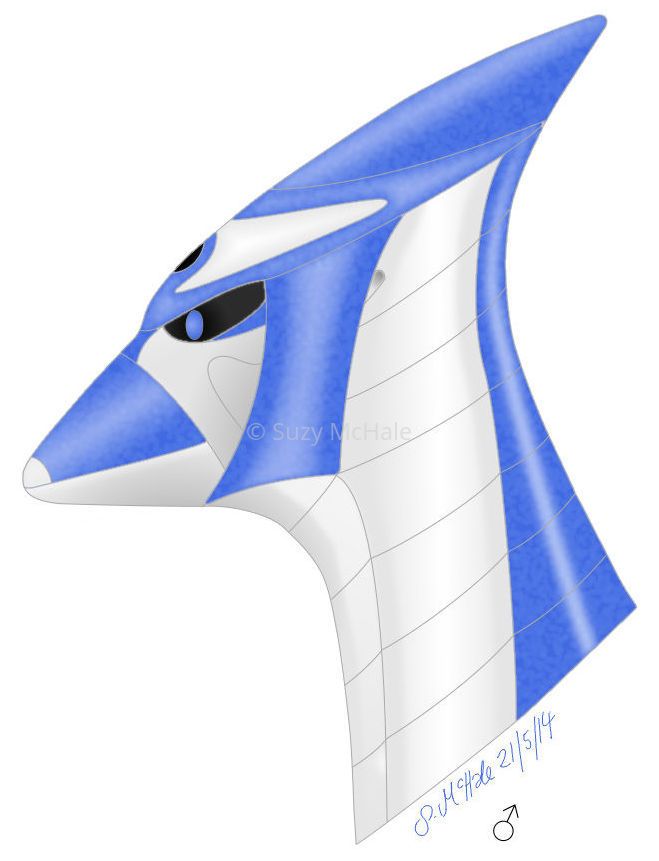
Sword Arms male head profile (digital art, 18/5/2014).
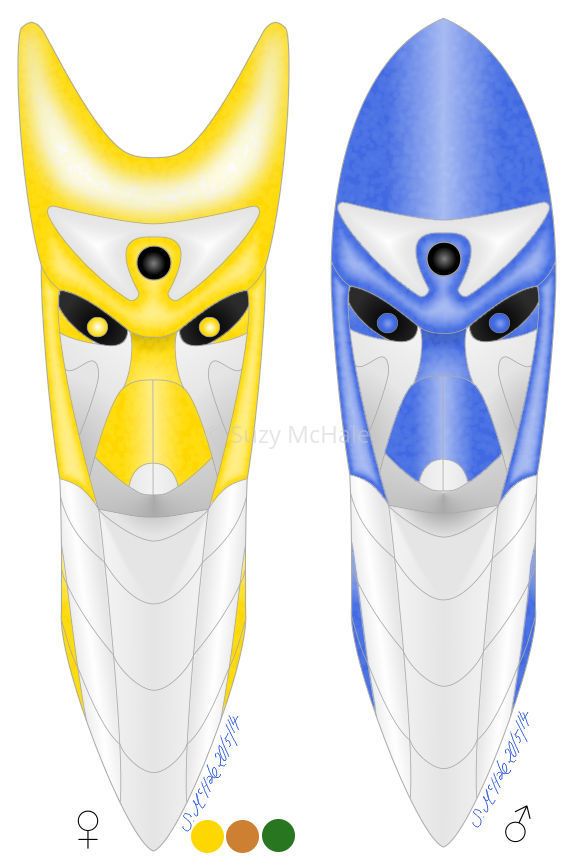
Gold queen and male warrior heads (digital art, 21/5/2014).
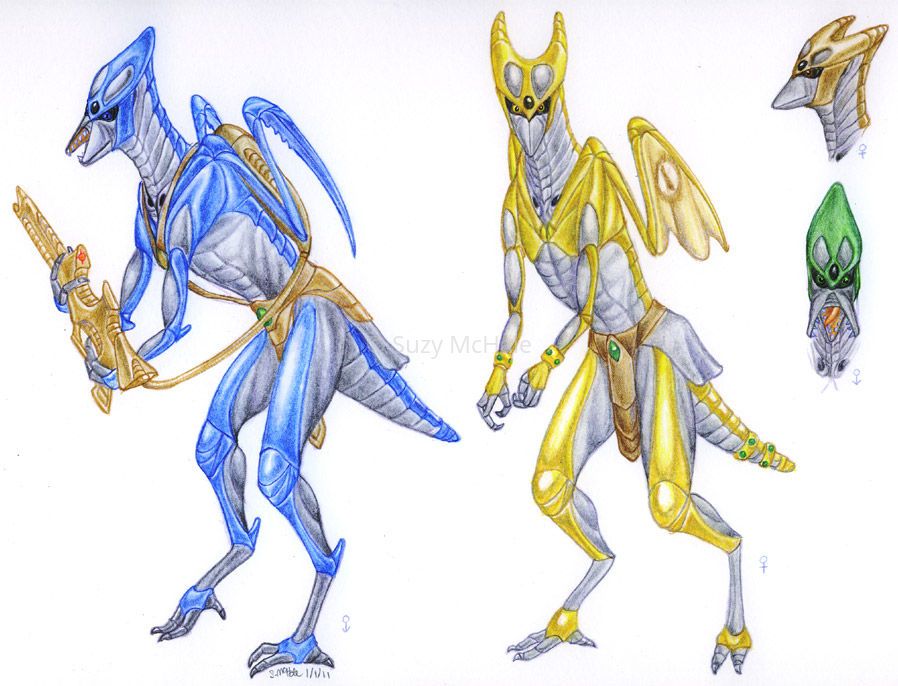
Sword Arms of various castes (colored pencils, 1/1/2011 – needs redoing).
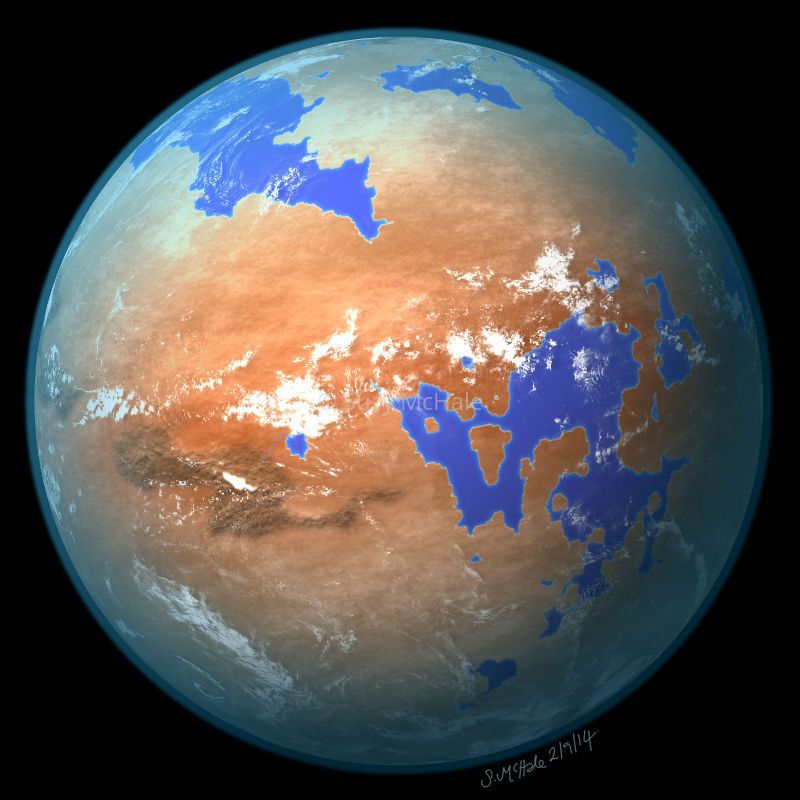
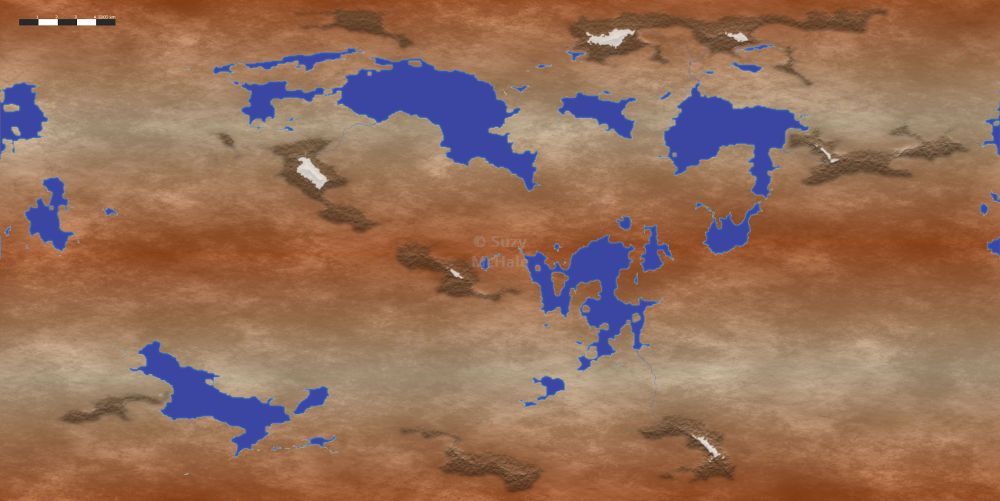
Digital renditions of what their planet might look like from orbit (2/2/2014). Scale note: 1 pixel = 10 km approx, so 100 px = 1000 km on the ground. This works out to 51,970 km circumference – not perfectly accurate, but good enough for an approximate rendition.
Sword Leaf
A Sword Leaf (Laamohuunewa) is a plant with a base of red pointed sword-like leaves from which a tall flower spike extends upward for 2-3 meters, tipped with a single blue flower. It resembles the Gymea Lily.
Gallery
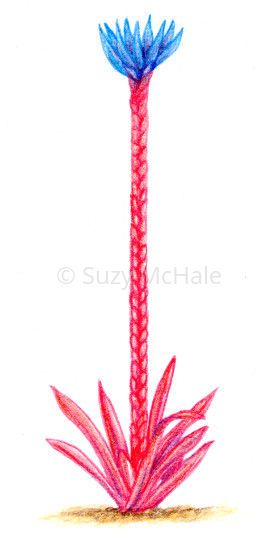
Sword Leaf (colored pencils, July 2013)
Syllables
All combinations for syllable structures: CV (88), CVC (968).
- Vowels
- a, e, o, u, aa, ee, oo, uu
- Consonants
- b, c, h, l, m, n, r, s, w, y, z
| # | 2-syllable | +b | +c | +h | +l | +m | +n | +r | +s | +w | +y | +z |
|---|---|---|---|---|---|---|---|---|---|---|---|---|
| 1 | ba | bab | bac | bah | bal | bam | ban | bar | bas | baw | bay | baz |
| 2 | be | beb | bec | beh | bel | bem | ben | ber | bes | bew | bey | bez |
| 3 | bo | bob | boc | boh | bol | bom | bon | bor | bos | bow | boy | boz |
| 4 | bu | bub | buc | buh | bul | bum | bun | bur | bus | buw | buy | buz |
| 5 | baa | baab | baac | baah | baal | baam | baan | baar | baas | baaw | baay | baaz |
| 6 | bee | beeb | beec | beeh | beel | beem | been | beer | bees | beew | beey | beez |
| 7 | boo | boob | booc | booh | bool | boom | boon | boor | boos | boow | booy | booz |
| 8 | buu | buub | buuc | buuh | buul | buum | buun | buur | buus | buuw | buuy | buuz |
| 9 | ca | cab | cac | cah | cal | cam | can | car | cas | caw | cay | caz |
| 10 | ce | ceb | cec | ceh | cel | cem | cen | cer | ces | cew | cey | cez |
| 11 | co | cob | coc | coh | col | com | con | cor | cos | cow | coy | coz |
| 12 | cu | cub | cuc | cuh | cul | cum | cun | cur | cus | cuw | cuy | cuz |
| 13 | caa | caab | caac | caah | caal | caam | caan | caar | caas | caaw | caay | caaz |
| 14 | cee | ceeb | ceec | ceeh | ceel | ceem | ceen | ceer | cees | ceew | ceey | ceez |
| 15 | coo | coob | cooc | cooh | cool | coom | coon | coor | coos | coow | cooy | cooz |
| 16 | cuu | cuub | cuuc | cuuh | cuul | cuum | cuun | cuur | cuus | cuuw | cuuy | cuuz |
| 17 | ha | hab | hac | hah | hal | ham | han | har | has | haw | hay | haz |
| 18 | he | heb | hec | heh | hel | hem | hen | her | hes | hew | hey | hez |
| 19 | ho | hob | hoc | hoh | hol | hom | hon | hor | hos | how | hoy | hoz |
| 20 | hu | hub | huc | huh | hul | hum | hun | hur | hus | huw | huy | huz |
| 21 | haa | haab | haac | haah | haal | haam | haan | haar | haas | haaw | haay | haaz |
| 22 | hee | heeb | heec | heeh | heel | heem | heen | heer | hees | heew | heey | heez |
| 23 | hoo | hoob | hooc | hooh | hool | hoom | hoon | hoor | hoos | hoow | hooy | hooz |
| 24 | huu | huub | huuc | huuh | huul | huum | huun | huur | huus | huuw | huuy | huuz |
| 25 | la | lab | lac | lah | lal | lam | lan | lar | las | law | lay | laz |
| 26 | le | leb | lec | leh | lel | lem | len | ler | les | lew | ley | lez |
| 27 | lo | lob | loc | loh | lol | lom | lon | lor | los | low | loy | loz |
| 28 | lu | lub | luc | luh | lul | lum | lun | lur | lus | luw | luy | luz |
| 29 | laa | laab | laac | laah | laal | laam | laan | laar | laas | laaw | laay | laaz |
| 30 | lee | leeb | leec | leeh | leel | leem | leen | leer | lees | leew | leey | leez |
| 31 | loo | loob | looc | looh | lool | loom | loon | loor | loos | loow | looy | looz |
| 32 | luu | luub | luuc | luuh | luul | luum | luun | luur | luus | luuw | luuy | luuz |
| 33 | ma | mab | mac | mah | mal | mam | man | mar | mas | maw | may | maz |
| 34 | me | meb | mec | meh | mel | mem | men | mer | mes | mew | mey | mez |
| 35 | mo | mob | moc | moh | mol | mom | mon | mor | mos | mow | moy | moz |
| 36 | mu | mub | muc | muh | mul | mum | mun | mur | mus | muw | muy | muz |
| 37 | maa | maab | maac | maah | maal | maam | maan | maar | maas | maaw | maay | maaz |
| 38 | mee | meeb | meec | meeh | meel | meem | meen | meer | mees | meew | meey | meez |
| 39 | moo | moob | mooc | mooh | mool | moom | moon | moor | moos | moow | mooy | mooz |
| 40 | muu | muub | muuc | muuh | muul | muum | muun | muur | muus | muuw | muuy | muuz |
| 41 | na | nab | nac | nah | nal | nam | nan | nar | nas | naw | nay | naz |
| 42 | ne | neb | nec | neh | nel | nem | nen | ner | nes | new | ney | nez |
| 43 | no | nob | noc | noh | nol | nom | non | nor | nos | now | noy | noz |
| 44 | nu | nub | nuc | nuh | nul | num | nun | nur | nus | nuw | nuy | nuz |
| 45 | naa | naab | naac | naah | naal | naam | naan | naar | naas | naaw | naay | naaz |
| 46 | nee | neeb | neec | neeh | neel | neem | neen | neer | nees | neew | neey | neez |
| 47 | noo | noob | nooc | nooh | nool | noom | noon | noor | noos | noow | nooy | nooz |
| 48 | nuu | nuub | nuuc | nuuh | nuul | nuum | nuun | nuur | nuus | nuuw | nuuy | nuuz |
| 49 | ra | rab | rac | rah | ral | ram | ran | rar | ras | raw | ray | raz |
| 50 | re | reb | rec | reh | rel | rem | ren | rer | res | rew | rey | rez |
| 51 | ro | rob | roc | roh | rol | rom | ron | ror | ros | row | roy | roz |
| 52 | ru | rub | ruc | ruh | rul | rum | run | rur | rus | ruw | ruy | ruz |
| 53 | raa | raab | raac | raah | raal | raam | raan | raar | raas | raaw | raay | raaz |
| 54 | ree | reeb | reec | reeh | reel | reem | reen | reer | rees | reew | reey | reez |
| 55 | roo | roob | rooc | rooh | rool | room | roon | roor | roos | roow | rooy | rooz |
| 56 | ruu | ruub | ruuc | ruuh | ruul | ruum | ruun | ruur | ruus | ruuw | ruuy | ruuz |
| 57 | sa | sab | sac | sah | sal | sam | san | sar | sas | saw | say | saz |
| 58 | se | seb | sec | seh | sel | sem | sen | ser | ses | sew | sey | sez |
| 59 | so | sob | soc | soh | sol | som | son | sor | sos | sow | soy | soz |
| 60 | su | sub | suc | suh | sul | sum | sun | sur | sus | suw | suy | suz |
| 61 | saa | saab | saac | saah | saal | saam | saan | saar | saas | saaw | saay | saaz |
| 62 | see | seeb | seec | seeh | seel | seem | seen | seer | sees | seew | seey | seez |
| 63 | soo | soob | sooc | sooh | sool | soom | soon | soor | soos | soow | sooy | sooz |
| 64 | suu | suub | suuc | suuh | suul | suum | suun | suur | suus | suuw | suuy | suuz |
| 65 | wa | wab | wac | wah | wal | wam | wan | war | was | waw | way | waz |
| 66 | we | web | wec | weh | wel | wem | wen | wer | wes | wew | wey | wez |
| 67 | wo | wob | woc | woh | wol | wom | won | wor | wos | wow | woy | woz |
| 68 | wu | wub | wuc | wuh | wul | wum | wun | wur | wus | wuw | wuy | wuz |
| 69 | waa | waab | waac | waah | waal | waam | waan | waar | waas | waaw | waay | waaz |
| 70 | wee | weeb | weec | weeh | weel | weem | ween | weer | wees | weew | weey | weez |
| 71 | woo | woob | wooc | wooh | wool | woom | woon | woor | woos | woow | wooy | wooz |
| 72 | wuu | wuub | wuuc | wuuh | wuul | wuum | wuun | wuur | wuus | wuuw | wuuy | wuuz |
| 73 | ya | yab | yac | yah | yal | yam | yan | yar | yas | yaw | yay | yaz |
| 74 | ye | yeb | yec | yeh | yel | yem | yen | yer | yes | yew | yey | yez |
| 75 | yo | yob | yoc | yoh | yol | yom | yon | yor | yos | yow | yoy | yoz |
| 76 | yu | yub | yuc | yuh | yul | yum | yun | yur | yus | yuw | yuy | yuz |
| 77 | yaa | yaab | yaac | yaah | yaal | yaam | yaan | yaar | yaas | yaaw | yaay | yaaz |
| 78 | yee | yeeb | yeec | yeeh | yeel | yeem | yeen | yeer | yees | yeew | yeey | yeez |
| 79 | yoo | yoob | yooc | yooh | yool | yoom | yoon | yoor | yoos | yoow | yooy | yooz |
| 80 | yuu | yuub | yuuc | yuuh | yuul | yuum | yuun | yuur | yuus | yuuw | yuuy | yuuz |
| 81 | za | zab | zac | zah | zal | zam | zan | zar | zas | zaw | zay | zaz |
| 82 | ze | zeb | zec | zeh | zel | zem | zen | zer | zes | zew | zey | zez |
| 83 | zo | zob | zoc | zoh | zol | zom | zon | zor | zos | zow | zoy | zoz |
| 84 | zu | zub | zuc | zuh | zul | zum | zun | zur | zus | zuw | zuy | zuz |
| 85 | zaa | zaab | zaac | zaah | zaal | zaam | zaan | zaar | zaas | zaaw | zaay | zaaz |
| 86 | zee | zeeb | zeec | zeeh | zeel | zeem | zeen | zeer | zees | zeew | zeey | zeez |
| 87 | zoo | zoob | zooc | zooh | zool | zoom | zoon | zoor | zoos | zoow | zooy | zooz |
| 88 | zuu | zuub | zuuc | zuuh | zuul | zuum | zuun | zuur | zuus | zuuw | zuuy | zuuz |
Tall Neck
The Tall Necks (Do Hàse) are aliens under the dominion of the Dawn Hunters.
Physiology
The Tall Necks are a warm-blooded herbivorous race. They are quadrupedal hexapods, having two vestigal forearms in front of their legs that are used for fine tool manipulation (these were originally used to hook branches when feeding). Their hands have four digits (two fingers, two opposing thumbs); their legs end in two hooved toes and they walk with a pacing gait (a lateral two-beat gait). They have a long flexible neck and convex head with a short muzzle, and a thin tail that flares at its end. Their neck has a pointed bony crest and a bony chin protrusion vaguely resembling a beard – the male’s is red in color. Their skin is scaly in texture (similar to snakeskin) and beige in color. The crests are striped green, and can lighten in response to mood. The stripes vary between individuals in pattern and green shades; skin colors also differ depending upon region. Their eyes, which are various shades of brown or green, are set more to the sides of their head which gives them better peripheral vision, enabling them to detect predators stalking from behind when grazing (they strongly dislike having anyone behind them). Their pupils are horizontal elongated ovals. They have green-colored blood, muscles and bones due to high levels of biliverdin (some creatures on Earth share this trait).
They stand up to 1.3 meters at their withers.
They wear rudimentary clothing secured around their torso, such as a body-pack in which to carry objects, and a garment similar to an embroidered horse blanket. Patterns on the blanket designate their status and tribe.
They are born gender-neutral, with undeveloped male or female reproductive organs, but metamorph into one or the other sex at adolescence, depending upon environmental circumstances (they have no control over this). The unused organs are absorbed and disappear.
They are social herd animals, preferring to live on open plains in villages. The houses are domed mud-huts, set in a circle with the entrances facing inward so the inhabitants can see each other for communal security. They are at a simple agricultural level of development and are content to remain that way as, similar to the Tree Gliders, there is little evolutionary pressure to develop. Their world is metal-poor so their tools are of wood and stone. They are skilful at weaving clothing from suitable types of plant fibers. They have not discovered fire.
Their main predator is somewhat similar in appearance, but is smaller (about half its size) and its arms end in blades rather than hands (its name is Blade Runner), and is not sapient, being a solitary hunter. The Tall Necks have learned to combat it using spears and clubs. There are also small hexapod flying creatures with four wings and two vestigal legs.
Language
This is only a basic sketch – essentially only a naming language at this stage.
- Consonants: c, d, f, h, l, m, n, r, s
- Vowels: a, e, i, o, à, è, ì, ò, á, é, í, ó
- C is pronounced as k. Vowels marked with a left-pointing acute accent have a falling tone; vowels with a right-pointing acute accent have a rising tone. Unmarked vowels are flat. A tone imparts a different lexical meaning to a word that otherwise has the same letters (tonemes).
- Phonotactics: CV
- They do not have writing
- Word order is VSO
- Nouns do not have gender
| Number | English | Tall Neck |
|---|---|---|
| 1 | I | sali |
| 2 | thou | rò |
| 3 | he | mème |
| 4 | we | lome |
| 5 | you | ralo |
| 6 | they | roni |
| 7 | this | sanà |
| 8 | that | saci |
| 9 | here | soho |
| 10 | there | rodè |
| 11 | who | masè |
| 12 | what | sòlà |
| 13 | where | mera |
| 14 | when | ràme |
| 15 | how | sesà |
| 16 | not | lomo |
| 17 | all | hana |
| 18 | many | sifì |
| 19 | some | càre |
| 20 | few | làli |
| 21 | other | fama |
| 22 | one | rì |
| 23 | two | lò |
| 24 | three | ràna |
| 25 | four | sohé |
| 26 | five | lihè |
| 27 | big | sise |
| 28 | long | nasá |
| 29 | wide | rarí |
| 30 | thick | secì |
| 31 | heavy | reri |
| 32 | small | sese |
| 33 | short | desa |
| 34 | narrow | nasà |
| 35 | thin | híse |
| 36 | female | harè |
| 37 | male | hirà |
| 38 | neuter | hìsò |
| 39 | person | hàse |
| 40 | child | lìse |
| 41 | wife | rimi |
| 42 | husband | dane |
| 43 | mother | nó |
| 44 | father | mela |
| 45 | animal | hàna |
| 46 | tree | sano |
| 47 | forest | lémi |
| 48 | stick | nama |
| 49 | fruit | fehà |
| 50 | seed | miri |
| 51 | leaf | sìdo |
| 52 | root | sòhe |
| 53 | bark | lisi |
| 54 | flower | dèhe |
| 55 | grass | ni |
| 56 | rope | cose |
| 57 | skin | dose |
| 58 | meat | nìra |
| 59 | blood | hérà |
| 60 | bone | hìsa |
| 61 | fat | lara |
| 62 | egg | sama |
| 63 | horn | sìri |
| 64 | tail | sèrì |
| 65 | head | sera |
| 66 | ear | liha |
| 67 | eye | no |
| 68 | nose | sèfa |
| 69 | mouth | hèra |
| 70 | tooth | rose |
| 71 | tongue | rime |
| 72 | claw | léna |
| 73 | foot | raré |
| 74 | leg | reha |
| 75 | knee | rohe |
| 76 | hand | mihà |
| 77 | wing | hèsa |
| 78 | belly | sora |
| 79 | guts | roca |
| 80 | neck | sahe |
| 81 | back | noso |
| 82 | chest | herè |
| 83 | heart | lame |
| 84 | liver | ròhe |
| 85 | to drink | cola |
| 86 | to eat | fora |
| 87 | to bite | céla |
| 88 | to suck | sàse |
| 89 | to spit | sahè |
| 90 | to vomit | lìle |
| 91 | to blow | ràsà |
| 92 | to breathe | limi |
| 93 | to laugh | ròrí |
| 94 | to see | resì |
| 95 | to hear | mà |
| 96 | to know | nècè |
| 97 | to think | cè |
| 98 | to smell | rosi |
| 99 | to fear | hafò |
| 100 | to sleep | remo |
| 101 | to live | redi |
| 102 | to die | sàrè |
| 103 | to kill | cèra |
| 104 | to fight | hàla |
| 105 | to hunt | riha |
| 106 | to hit | re |
| 107 | to cut | hera |
| 108 | to split | dèlà |
| 109 | to stab | lìre |
| 110 | to scratch | rìro |
| 111 | to dig | rerò |
| 112 | to swim | rèra |
| 113 | to fly | raro |
| 114 | to walk | sehà |
| 115 | to come | raco |
| 116 | to lie | hero |
| 117 | to sit | cicà |
| 118 | to stand | lero |
| 119 | to turn | saro |
| 120 | to fall | holi |
| 121 | to give | sìsi |
| 122 | to hold | moda |
| 123 | to squeeze | sene |
| 124 | to rub | soca |
| 125 | to wash | hihì |
| 126 | to wipe | rarì |
| 127 | to pull | sasà |
| 128 | to push | naho |
| 129 | to throw | sesì |
| 130 | to tie | cerá |
| 131 | to sew | noha |
| 132 | to count | rèri |
| 133 | to say | hame |
| 134 | to sing | sami |
| 135 | to play | hese |
| 136 | to float | rilè |
| 137 | to flow | so |
| 138 | to freeze | sasá |
| 139 | to swell | lìdi |
| 140 | sun | roma |
| 141 | moon | lala |
| 142 | star | se |
| 143 | water | hena |
| 144 | to rain | horà |
| 145 | river | rèlè |
| 146 | lake | nene |
| 147 | sea | rele |
| 148 | salt | hàsi |
| 149 | stone | nali |
| 150 | sand | mè |
| 151 | dust | séfe |
| 152 | earth | mása |
| 153 | cloud | nahè |
| 154 | fog | sìse |
| 155 | sky | sele |
| 156 | wind | faci |
| 157 | snow | lema |
| 158 | ice | hohè |
| 159 | smoke | hì |
| 160 | fire | lono |
| 161 | ashes | hecè |
| 162 | to burn | sóso |
| 163 | road | rèso |
| 164 | mountain | remà |
| 165 | red | sàmò |
| 166 | green | lerà |
| 167 | yellow | càso |
| 168 | white | sihe |
| 169 | black | ròse |
| 170 | night | lè |
| 171 | day | léfe |
| 172 | year | nema |
| 173 | warm | rase |
| 174 | cold | hesa |
| 175 | full | here |
| 176 | new | seni |
| 177 | old | maro |
| 178 | good | fere |
| 179 | bad | hehó |
| 180 | rotten | lare |
| 181 | dirty | rosí |
| 182 | straight | soro |
| 183 | round | sà |
| 184 | sharp | mèsi |
| 185 | dull | remi |
| 186 | smooth | hasì |
| 187 | wet | hàdà |
| 188 | dry | nosa |
| 189 | right | sahà |
| 190 | near | senè |
| 191 | far | hami |
| 192 | right | hece |
| 193 | left | sesa |
| 194 | at | màra |
| 195 | in | ròha |
| 196 | with | rehà |
| 197 | and | sècì |
| 198 | if | meci |
| 199 | because | rela |
| 200 | name | cise |
Name
Their name for themselves is do hàse (do is the plural particle, the o is short) – “The People.”
History
They were the second sapient race to be discovered and dominated by the Hunters; the encounter was also generally peaceable as they were not deemed a threat.
Home system
Their world’s star is a G2V-type star, similar to Earth’s (web hex color: #fff5ec), and there is a red dwarf companion star orbiting at a distance (M5V, #ffcc6f). Land coverage of the planet is around 40.5%. Vegetation is green with a hint of blue. Gravity is 0.97 of Earth’s and atmosphere composition is similar to Earth’s. Their world has two small moons, and has an axial tilt of 22°.
The planet is the second out of five planets orbiting.
Star data
- Class
- G2 (#FFF5ec) (our Sun)
- Temperature in degrees Kelvin
- 5860
- Mass (mass of our Sun = 1)
- .998
- Radius (radius of Sun = 1)
- 1.020
- Terrestrial Equivalent Orbit in AUs
- 1.05
- Lifetime in billions of years
- 10.100
- Distance from Home World
- 11.4 light years
Home planet data
- Circumference
- 42,031.68 km
- Diameter
- 13,379.1 km
- Distance
- 1.05 AUs (157,077,764.55 km)
- Density
- 5.1 g/cm3
- Gravity
- 0.97 of Earth’s
- Moons
- Two
- Radius
- 1.05 of Earth’s (6,689.55 km)
Ruling Dawn Hunter Clan
Gallery
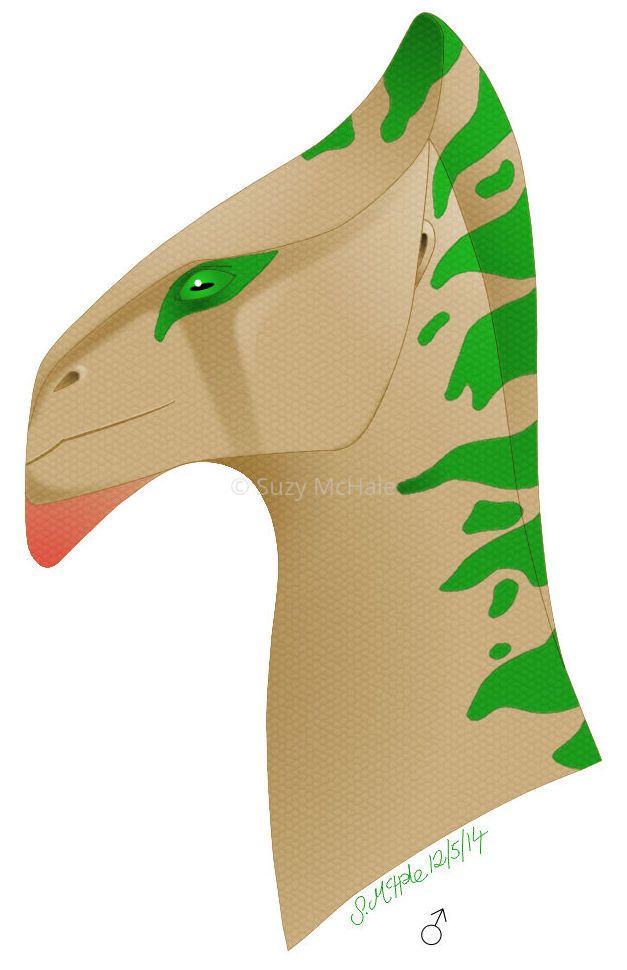
Head profile of a male Tall Neck (digital art, 12/5/2014).
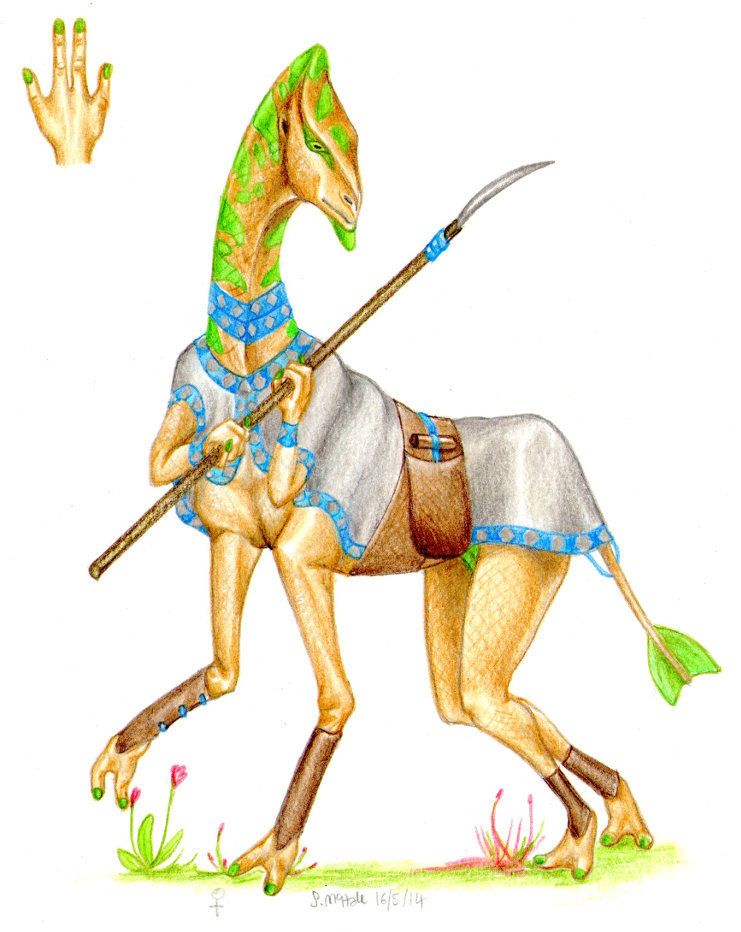
Tall Neck body, female (colored pencils, 16/5/2014).
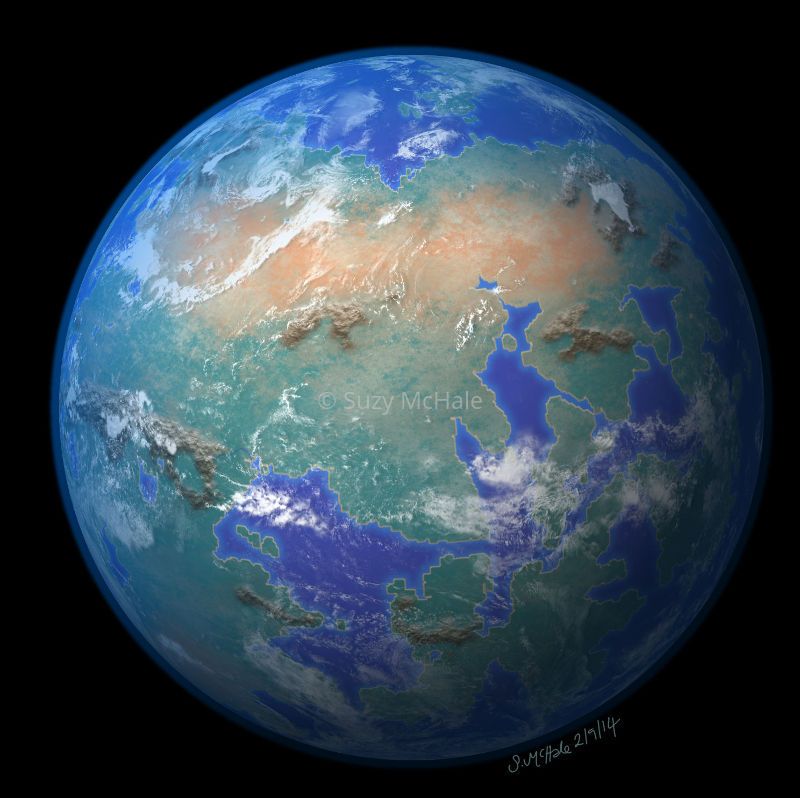
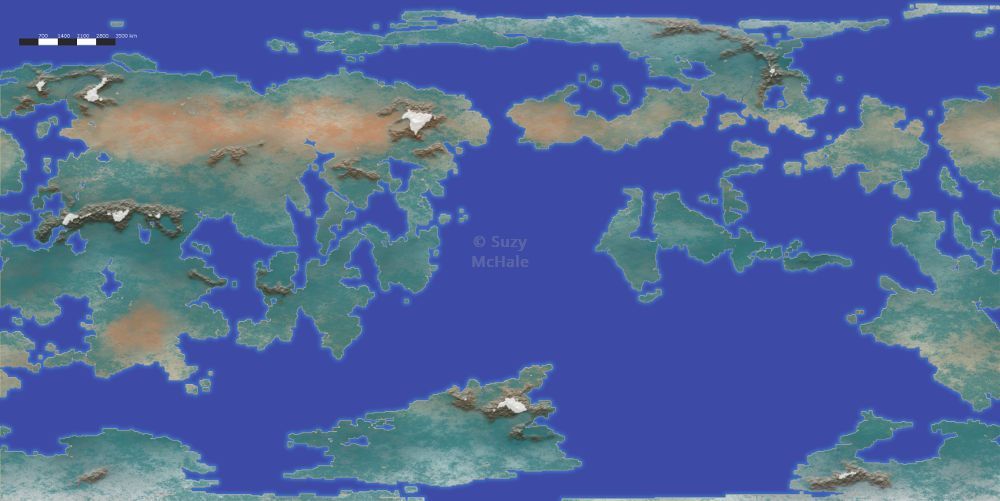
Digital renders of their world (31/1/2014). Scale note: 1 pixel = 8 km approx, so 100 px = 800 km on the ground. This works out to 41,576 km circumference – not perfectly accurate, but good enough for an approximate rendition.
Technician-Artisan
A Technician-Artisan (Hanaamaazewa) is one of the Technician Caste who paints, draws, sculpts or otherwise does craft work by hand in the traditional manner.
- Profession color
- Wisteria purple (color of a plant-based dye) (#875F9A/rgb(135,95,154))
Technician Caste
The Technician Caste (Rohuulhaan) are one of the three major groups making up Dawn Hunter society. The other castes are dependent upon them for technology. They comprise males and females who are engineers, builders, inventors, mechanics, artisans, miners and so forth – literally, “Makers.”
They wear magenta (#d0417e/rgb(208,65,126))-purple (#8b008b/rgb(139,0,139)) clothing or armor, and headscarves, hoods or helmet visors of various colors designate their profession.
Gallery
Technician Caste helmet, armored version, with indigo visor – visor color indicates profession (digital art, 11/1/2014)
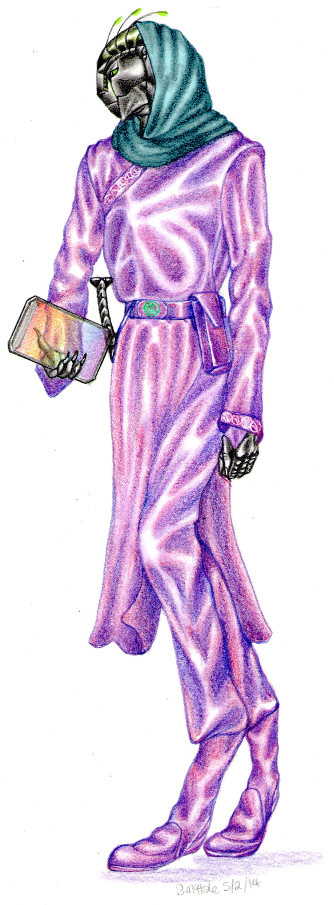
Male Technician-Pilot holding datapad (colored pencils, 5/2/2014).
Technician-Forger
A Technician-Forger (Hanaamaacahana) – a blacksmith – is one of the Technician Caste who specializes in making swords and daggers for the Warrior Caste. This is done in the traditional manner, involving smelting then folding and beating metal up to eight times to form a blade before coating it in a high-tech nanocomposite to strengthen and harden it.
- Profession color
- Iron-grey (#60676d/rgb(96,103,109))
Technician-Gardener
A Technician-Gardener (Zaahumero) is one of the Technician Caste who specializes in the cultivation and care of plants.
- Profession color
- Orange (a plant foliage color) (#ff9900/rgb(255,153,0))
Technician-Miner
A Technician-Miner (Hanaacehuwa) is one of the Technician Caste involved in extracting and refining minerals from the ground. This has expanded to include the Dawn Hunters’ home star system and worlds beyond; Home World is rarely mined anymore. Moons and asteroids are the favored sources of base elements. The process of mining extensively involves nanotechnology.
- Profession color
- Ochre (#cc7722/rgb(204,119,34))
Technician-Pilot
A Technician-Pilot (Hanaarerewa) is one of the Technician Caste who pilots aircraft and spacecraft. Despite not being of the Warrior Caste, a Pilot will do any combat flying required. This is generally in aerial support roles, as fighting tends to be ground-based, due to the Home World combat rules.
- Profession color
- Aquamarine (sky color) (#a3dde1/rgb(163,221,225))
Gallery
Helmet of armored version, with aquamarine-colored visor.
Male Technician-Pilot holding datapad (colored pencils, 5/2/2014).
Technician-Superior
The Technician-Superior (Hanaasune) is the highest-ranking of the Technician Caste; acts as a representative and liason for them to the Clan Lord. May be male or female.
Territory
A Territory (Waalelan) is the area controlled by a particular Clan-City. There are eight of these. Boundaries are marked by stones on travel routes; the stones are painted with each adjoining Clan’s symbols.
The word is the noun form of waale (divide, separate).
The Land
The Land (Yoora) is the supercontinent comprising most of the landmass of Home World. It is longitudinally-orientated, stretching from north to south poles, and takes up around 24.1% of the planet’s surface. It extends roughly 11,000 kilometers at its widest east-west points.
The name is the equivalent of “earth, soil, the land.” Before the technological age it was also referred to as Heseelalozuun, “All [that is] Under Sky.”
Climate
The Land is generally a harsher place to live than Earth, having fewer fertile and habitable zones. The vast landmass of Yoora is conductive to megamonsoons, similar to that of ancient Pangaea on Earth. The most fertile lands are along the temperate zone coastlines and a little way inland, where there are savanna grasslands and forests which support many lifeforms. The Dawn Hunters have practised controlled burning – a type of firestick farming – for thousands of years to keep their hunting grounds in their preferred savanna composition, so many formerly dense forests in the lower latitudes have been thinned out.
Rainfall does not penetrate into the deep interior, so there are expansive deserts there (one on each side of the Equator below 30° latitude). Mountain ranges also act as barriers, creating rain shadows.
Seasons generally consist of a dry/hot season, a rainy season and a cold season. In the southern hemisphere the main rainy season is usually from summer solstice (beginning of the year) to the first equinox, though there can be a period of “little rains” before year’s end (equivalent of October-November); this is also the breeding season. In the Northern Hemisphere this pattern is reversed, though the breeding season takes place at the same time as in the south, due to the Dawn Hunters having originated in the southern continent.
The highest mountains can be found in the long ridge – the Backbone Mountains – extending from north to south of the continent on the western rim. The south part of the continent has extensive rugged terrain in its higher latitudes from folded mountains where three plates collided. There is land around the south pole with a transitory ice cap that forms in winter.
Similar to Earth, land at the extreme north of the northern continent does not extend to the pole, but there is no ice here as ocean currents can flow mostly unimpeded as the continent lies only on one quarter-side. It is a bit warmer than the southern pole, and the land here is extensively covered with rivers and tundra.
Weather patterns
A simplified description of wind currents (based on those of Pangaea).
Equivalent of December/January/February
- North (winter)
- West coast: below 30°N latitude the winds come from the east over the land, and are moderate. Above 30°N winds come from the west, over the sea, and are cooler.
- East coast: below 30°N cool winds come from the NE. Above 30° cool winds blow from the north.
- South (summer)
- West coast: cooler winds come from the SW.
- East coast: hot winds from the NE; monsoon along Three-Claw Bay coastline to 60°S.
Equivalent of June/July/August
- North (summer)
- West coast: hot wind circles from NW above 30°N.
- East coast: hot wind comes from SW; monsoon along coast.
- South (winter)
- West coast: cold wind from NW below 30°S; cold wind from NE above 30°S.
- East coast: wind from SW below 30°S (from desert on plateau, so cold); wind from SE above 30° (from ice cap, so cold).
Gallery
A digital sketch of the Endless Plains (18/8/2013).
Three Claw Bay
Three-Claw Bay (Seenazuhaanama) is a large bay on the east side of Home World’s supercontinent, most of it in the southern hemisphere. Ocean currents circulate anti-clockwise, and wind patterns mean the region undergoes heavy monsoons in summer. The name was given because it resembles a hand with three outstretched fingers. Six of the eight Clan Cities are arrayed along its coastline.
Three Moons Clan
The Three Moons Clan (Narawaa Renamawo) is one of the eight Great Clans. Its Clan City is located on Home World’s east coast.
Data

- Burial armor gemstone
- Turquoise
- Clan City construction stone
- White granite (white with dark specks)
- Clan City co-ordinates
- Approximately 5°E, 4°S
- Clan emblem
- The three moons in different phases
- Color
- Blue-green (#16b0bf/rgb(22,176,191))
Time of Exile
The Time of Exile (Saazacuway) is a rite of passage in which pre-adolescent Dawn Hunters of the Warrior Caste are left in the wilderness in their Clan territory to fend for themselves, for a period of 16 Red Moon-cycles (equivalent to 160 Earth-days). The youths are only provided with animal-skin clothing and a dagger each (made of the horn from a Spike Tail), and have to hunt and forage for their own food. A group is comprised of an age-set and usually numbers no more than 16. Groups may go out at different times if they were hatched in a year with a high laying rate.
Deaths during Exile are not uncommon as there are physical dangers to contend with, including other predators such as Shadow Hunters. The experience is considered valuable in practising survival and hunting skills, and necessary in remaining attuned to their essential predatory nature.
Those of the other two Castes undergo a much abbreviated and milder version of Exile, usually not far from their Clan City and under the supervision of a Warrior.
Timeline
Dawn Hunter technological development has proceeded at a slower pace than that of humans, due to their conservative and methodical nature. However, Hunter society was and is monocultural and less fragmented – with science and technology not dependent upon uncertain government and corporate funding – so development has been steady. The Hunters did not have easy access to hydrocarbon fossil fuels on their world, so energy was generated first by steam power, and later solar and nuclear fission, then fusion.
Key: HWY – Home World years; EY – Earth years (1 HW year = 1.75 Earth years; 1 Earth year = 0.57 HW years). For dates, the Before Present (BP) time scale – counting backwards from 1950 – is used in such disciplines as archaeology and geology. Because the “present” time changes, standard practice is to use 1 January 1950 as the arbitrary origin of the age scale.
(Method: Work out Earth years first, counting down; multiply by .57 for HW years; subtract this from Year 0 [65,864.7] to find time from then to present day.)
| Dawn Hunters’ history | Human time equivalent | Home World years |
|---|---|---|
| Home World Year 0: Unification of the tribes into clans; reign of Sohaar-1 as first Supreme Lord (lifespan: 84 HWY/147 EY) (Already invented: alphabet and writing, basic metallurgy, a form of paper) | 111,970 years ago (110,020 BP) | 65,864.7 HW years ago (Year 0) |
| First Clan City, Night River, begun construction | 111,906 | 63,946.3 (36.57 years after Year 0) |
| First unpowered flight (glider) – Beginning of Age of Invention | 109,934 (1972 years later) | 62,819.4 (1163.42 years after Year 0) |
| Technological advances over next 7278 years (in approximate order): | ||
| Electricity discovered (initially steam power) | ||
| Solar panels invented (by studying photosynthesis of leaves) | ||
| Powered atmospheric flight achieved (solar-powered) | 109,499 | 62,414.43 (3450.27 years after Year 0) |
| Construction of Swift River Clan City on west coast begun | 108,998 | 62,128.86 (3735.84 years after Year 0) |
| Computers invented; used crystalline technology | ||
| Nuclear fission achieved (Home World has some naturally-occuring uranium deposits) | ||
| Sustained nuclear fusion achieved – fission thus no longer used for power | ||
| First orbital flight achieved (nuclear fusion engine) | ||
| Molecular nanotechnology (nanites) invented | 104,189 | 59,387.73 (6476.97 years after Year 0) |
| Artificial Intelligence evolved | ||
| Mausoleums of the Clan Lords constructed on Grey Moon | ||
| Warp Chamber invented | ||
| Void Station built | ||
| First starship with artificial intelligence, Zaawezoyuu-cehen (Void Walker-1), built and awakened by the Night River Clan – material transported from asteroid field at edge of Hunter system by an older-style spaceship fitted with a Warp Chamber | 102,656 (9314 years since Year 0) | 58,660.5 |
| First Jump to other star system (by Zaawezoyuu-cehenenel Narawaa Sahelnahuuwo) | 102,644 (9326) | 58,653.7 |
| First contact with sapient aliens (Tree Gliders, hunter-gatherers) | 102,312 (+ 332 = 9646) | 58,464 |
| Contact with Tall Necks (sapients, pastoral) | 101,392 (+ 920 = 10,566) | 57,938.3 |
| Contact with Sword Arms (sapients, industrial, begun colonization of their star’s system) | 16,058 (+ 85,334 = 95,900) | 9176 |
| End of Dominance War (Hunter/Sword Arms); destruction of Sword Arms civilization | 15,618 (+ 440 = 96,340) | 8924.5 |
| Sohaar is hatched | 4056 | 2311.92 (61,510.98 years since Year 0) |
| Contact with humans (very brief and unrecorded), 2055 BP; Sohaar goes into stasis | 4004 (+ 88,389 = 107,954) | 2288 |
Note: timeline is tentative and subject to change.
Times of day
The day is divided into 8 segments (celecuhame – eighth of day); compounded words:
- Midnight, 00:00 (Earth equivalent)
- Nahuuwenawe (night-middle [dative – time])
- Postnight, 03:00
- Nahuuwenazelare (night-behind [dative])
- Dawn, 06:00
- Saane (dative); distinguished from actual sunrise: hesaasalamzabohe (eye-day-up [dative]) – as the Dawn Hunters began their hunt day at this time
- Preday, 09:00
- Hamewenasaane (day-middle-before [dative])
- Midday, 12:00
- Hamewenawe (day-middle [dative])
- Postday, 15:00
- Hamewenazalare (day-middle-after [dative])
- Sunset, 18:00
- Hesaasalamlalowe (eye-day-down [dative])
- Evening, prenight, 21:00
- Nahuuwenasaane (night-middle-before [dative])
Translations
Sentences used in my story.
| Chapter | Dawn Hunter language | English translation | Gloss |
|---|---|---|---|
| “Bonding” | Comonecmalaasa! | Enter! | Como [enter] nec [present tense] ma [person – you singular] laa [honorific – neutral] sa [mood – imperative] |
| “Capture” | Wanzeno zaabenhare yeyaabecusa. | I will meet you on the battlefield. | Wan [I] zen [self – high rank] o [noun case – nominative] zaabenhar [field-war] e [dative – location] yeyaa [meet] be [future tense] cu [abased – you] sa [mood – imperative] |
| “Challenge” | Zulsunewo merulanaa zocuuzanbalseena. | The Supreme Lord continues his reign. | Zulsune [Supreme Lord] wo [nominative] merulan [reign – noun form] aa [genitive] zocuu [continue] zan [present tense] bal [person] see [superior – of subject] na [mood – fact] |
| Lazanmahencuusa! | Come! | La [Come] zan [tense – present] mahen [person] cuu [inferior – of subject] sa [imperative] | |
| Maareczuluu, lohuzanamalaa | I greet you, Lord Maarec | Maarec [personal name] zul [Lord] uu [accusative] lohu [acknowledge, greet, salute, farewell] zan [present tense] ma [you – singular] laa [honorific – neutral, of another] | |
| “Encounter” | Manenmewuu, Haarlecaawo. | What is that creature, Haarlecaawo? | Manen [alien] me [suffix – question] (w)uu [accusative] Haarlecaawo [nominative] |
| Zulwano lahonzananeecuza ranuhuu. Sohaarzulo manenuu raalzanbelseeza. | My Lord, I do not know. Perhaps it belongs to Lord Sohaar. | Zul [lord] wan [my] o [nominative] lahon [know] zan [tense – present] a [bridging vowel] nee [person – I] cu [honorific – abased] za [mood – uncertainty] ranu [not] huu [suffix – negative]. Sohaar zul [lord] o [nominative] manen [alien] uu [accusative] raal [belong] zan [tense – present] bel [person – he] see [honorific – superior] za [mood – uncertainty]. | |
| Manenuu wanzeno laahuzancuusa! | Release the alien; he belongs to me! | Manen [Alien] uu [accusative] mine [possessive] zen [honorific – superior me] o [nominative] laahu [release] zan [present tense] cuu [honorific – inferior you] sa [emphatic] | |
| Manenuu rocuzancuuna. | The alien is hurt | Manen [Alien] uu [accusative] rocu [hurt] zan [present tense] cuu [honorific – inferior you] na [mood – fact] | |
| “Fallen” | Nusema | Usurper | Nusem [Usurp] a [suffix – agent noun] (one who usurps) |
| “Return” | Narabzul Sohaaro-cenamalecuwalunel wanzen. Camacanewaa Maareco Narabaa Sahelnahuuwo. Zoyuuzaawewuu-cehenenel maanezansesa borewe huluzan. | I am Clan Lord Sohaar-28. Son of Maarec of the Night River Clan. I request permission for Void Walker-1 to dock. | Clan Lord Sohaaro [nominative] -ce [ordinal affix] namalecuwalu [28] nel [classifier – person] wan [I] zen [formal]. Son [genitive] Maarec [nominative] Clan [genitive] Night River [nominative]. Void Walker [accusative object]-1 [classifier (with bridging vowel) – person] maane [request] zan [present tense] se [honorific imperative self] sa [mood imperative] permit-for [dative] dock-to [present tense]. |
Miscellaneous
A ritual speech or chant addressing one’s own or general ancestors (such as approaching a tomb):[1]
Cabuunanemcuunawo ruulenememe?
Waahuzanmahenseena holeezanhancuna.
Roculano culeneel mahuzanhelacuna.
Ruulcuunaneme holeezanhancuna
Ancestors, where are you?
We have come to visit you.
Protect us from harm.
We are coming to you.
- Cabuun [Ancestors] (a)nem [kinship – honorific] cuuna [many] wo [nominative] ruul [you] e [dative – locative] nem [kinship – honorific] e [bridging vowel] me [interrogative]
- Waahu [Visit] zan [present tense] mahen [you – person] see [politeness – superior] na [mood – fact] holee [come] zan [present tense] han [we – person] cu [politeness – abased] na [mood – fact]
- Rocu [harm] lan [noun suffix] o [nominative] culeneel [against, oppose – adverbial preposition] mahu [protect] zan [present tense] hela [us excl – person] cu [politeness – abased] na [mood – fact]
- Ruulcuuna [you – plural] nem [kinship-honorific] e [dative – to] holee [come] zan [present tense] han [we – person] cu [politeness – abased] na [mood – fact]
Footnotes
- [1]
- Chant taken from opening words of First Footprints, episode 3
Transport overview
The Dawn Hunters are a spacefaring species and have developed a highly-advanced series of spaceships. In keeping with their austere society, the range of ships is small: (Void Walker, Sky Carrier, Shuttle, Sky Fighter, solar-powered Sky Flyer, autonomous Drone). The main and largest vessel is the starship, which carries the smaller ships. The starship cannot land on a planet, so the smaller ships are necessary to ferry personnel up and back.
The Hunters’ starships usually do not travel in large fleets but operate alone or, at the most, in small groups. One starship can subjugate and destroy a planet. Only a starship is capable of instantaneously Jumping from one sector of space to another; the other smaller ship classes travel in normal sublight space using nuclear fusion engines.
The smaller spaceships also double as the major air transport on their planet between each Clan City. There are no roads or rail linking these as they tend to be mostly self-contained.
Flying craft features
- They have a basic design resembling a manta ray or similar streamlined sea creature. Their appearance is organic and flowing; they resemble living creatures. The wings can flex and change shape (morph) to enable atmospheric maneuvering.
- The spaceships are powered by 2 nuclear fusion engines (the drone has 1), so they don’t have air intakes. The engines can use thrust vectoring to maneuver, enabling vertical takeoff and landing (VTOL) – the exhaust is through a hexagon-shaped port near the front of the craft. The skyflyer is wheeled and uses a runway.
- They create temporary massless artificial gravity via a geon; a confined electromagnetic wave that is strong enough to generate its own gravity and can be switched off when entering the gravity well of a planet.
- They fire a particle beam from a miniaturized particle accelerator, and can carry various types of bombs, including an Unmaker-Nanite disperser.
- As with the starship, when they are near a star their surface skin can absorb sunlight for extra power, rather like a leaf or solar panel does (photosynthesis).
- They have Maintainer-Nanites embedded in their skin to enable self-repairing and self-cleaning, as well as morph-metal to enable them to change shape and adapt to various conditions.
- The airframe resembles a bone structure (bionic structure).
- They use 3 struts to rest upon after landing, which can morph into wheels if required. The struts form from nanites in the fuselage and merge back into it when retracted.
- They can float on top of water if having to do an emergency landing there; their wings can change to aerofoils.
- Their shape and composition means they have an almost negligible radar signature.
- The composite metal they are constructed of renders them almost indestructible and they can fly through a violent storm or hurricane if required to.
- They use a form of optical fiber (fly-by-optics) for their control systems.
- The spaceships each have a simple AI that is only programmed to do certain tasks (it does not evolve like the AI of a starship). They can fly themselves if necessary, such as if a pilot is incapacitated. A starship can also interface with it and fly it remotely.
- The spaceships have holographic controls that only appear when the craft is powered up, and will only work for authorized personnel. They can be controlled manually, or via a pilot’s neural implant. They do not have cockpit windows; a display of the outside is projected onto the walls by embedded nanites and is indistinguishable from the real view.
- They can only be flown by Hunters unless programmed otherwise; for example, if an unauthorized human tried to steal one, he wouldn’t be able to fly it as the spaceship would detect the intruder’s DNA (or equivalent) and remain inert, or it might self-destruct by disassembling itself with its embedded Maintainer-Nanites.
- As the fusion engines emit some radiation from their plasma exhausts, the spaceships switch to air-breathing engines when in atmosphere. The fuel used is a biofuel derived from algae.
- In color they are the usual iridescent black, highlighted with the color of the Clan they belong to. The iridescence varies in color between individual craft.
- Crewed spacecraft are entered via a ventral ramp.
- They are collectively known as buuran [machine] rerewa [fly – agent noun form]
- As the technology used is thousands of years old by now, it is fully mature and only needs occasional upgrades or tweaks. Accidents are vanishingly rare, and would mostly be due to pilot error as the inbuilt AIs otherwise ensure accident avoidance. A locator beacon enables a craft to be found wherever it is in the Universe.
Other transport
Ground-based transport is generally referred to as buuransuulelenol (ground machines), or cereslan (sled, transport that slides, from a pre-modern form of transport).
Within Clan Cities, ground transport includes an elevated maglev train that runs around the perimeter of a City, and public transport vehicles similar to trams that are restricted to main roads. Each City’s fusion power plant is connected by a single-track, elevated maglev line that follows the underground pipeline. Maglevs are referred to as buuranlaana saahenhucewahu, magnetic floating machines. Older steam trains were called buuransaahenzunrunaa, iron road machines – a reference to train tracks.
There are also Ground Carriers, the equivalent of cars.
Ocean-going ships were never developed as the Dawn Hunters have a dislike of deep water and do not swim. There being only one major landmass also negated the need for sea transport. The equivalent of river barges are in use, though; these were useful for such tasks as transporting stone from distant quarries to the construction site of a Clan-City. They are solar-powered from panels on the cabin roof at the rear of the flat-bottomed barge. A flat raft and pole are also used to cross a river at designated points if there is no bridge. An underwater version of the drone has been used for ocean exploration. Sea vessels are buuranzumaah, sea machines, or, for barges, buuransarom, river machines.
History
The wheel was not invented until relatively late – after the establishment of the first Clan Cities – as animal domestication was not practiced and large creatures such as the Spike Tail were not tamable anyway.
Tree Glider
The Tree Gliders (Elaara Lihei) are aliens under the dominion of the Dawn Hunters.
Physiology
The Tree Gliders are omnivores who communicate both with speech and with photophores in linear patterns along their skin, the latter on their extremities. They have four main limbs, and can function either as bipeds or quadrupeds. They divide their time between the ground and the trees. Their forelimbs have two gripping fingers with long curving claws; their hindlimbs have four toes and short claws. The forelimbs are a little longer than the hindlegs, so their back slopes at a slight angle when in quadruped mode. They have gliding membranes extending from each elbow to the waist; these allow them to jump and float-glide for a short distance. They have a thin short tufted tail. They have black skin – their heads, necks and limbs have no covering, and are marked with red photophores – and feather-fur on their torso. The feathers are similar to a cassowary’s, consisting of a shaft and loose barbules. The base of these is purple-black, fading to red at the tips, but individuals can have various patterns. Males also have a crest on top of their head.
In length (not including their tail) they measure up to 5 feet/1.5 meters.
Their heads are a little bizarre to human eyes: they have sinuous necks ending in a tapered head with no break between the two, and mouthparts that open in four segments like the petals of a flower. Inside these are a circular row of teeth. They have one pair of eyes that see into the infrared spectrum, and an earhole behind each of these. The eyes have a four-pointed, star-shaped pupil and can vary in color from purple to red.
Their manipulative organs are two slender retractable muscular tentacles, similar to an elephant’s trunk, that extend from sheaths either side of their neck on either side of their mouthparts. The tentacles each end in four thin fingerlike projections that are as versatile as a human’s fingers for manipulating objects, but cannot be used for supporting their body or carrying heavy objects – their forelimbs are utilized for this purpose. Unlike an elephant, they do not breathe or ingest through the tentacles, but through normal nostrils on their face. Males have black tentacles, females purple.
Their blood is hemerythrin-based, a protein that binds oxygen. It is colorless when deoxygenated, violet-pink when exposed to oxygen. Like hemocyanin, it has a lower affinity for carbon monoxide than the hemoglobin in human blood – an evolutionary advantage as their homeworld has a higher concentration of CO2 in its atmosphere than Earth due to volcanic activity.
They are matriarchial, with a female leader. Similar to Amazon tribes, their favored hunting weapon is a blowgun for small game; they also cook and eat insects and plants. They are not apex predators on their world, though; there are other creatures that fit this role whom they fear. Clothing is minimal, but a harness is worn so equipment can be carried. Similar to the Tall Necks, their world is metal-poor so their tools are of wood, stone and natural materials. The main trees they live in are called disk trees; these resemble flat plates stacked at intervals on a pole. Their name for themselves translates as “People of the Trees.”
Language
This is only a basic sketch – essentially only a naming language at this stage.
- Seven consonants: c, h, l, m, n, p, r (c is pronounced k)
- Four vowels: a, e, i, o and geminated (lengthened) versions: aa, ee, oo, ii – these are treated as separate letters
- Phonotactics are (V)CV. Adjacent vowels are pronounced separately, not as dipthongs.
- They do not have writing
| Number | English | Tree Glider |
|---|---|---|
| 1 | I | loe |
| 2 | thou | raai |
| 3 | he | aarai |
| 4 | we | ri (inclusive) li (exclusive) |
| 5 | you | haaee |
| 6 | they | alaa |
| 7 | this | pi |
| 8 | that | rora |
| 9 | here | lale |
| 10 | there | rie |
| 11 | who | hiia |
| 12 | what | liie |
| 13 | where | hela |
| 14 | when | nola |
| 15 | how | mana |
| 16 | not | lame |
| 17 | all | lo |
| 18 | many | lira |
| 19 | some | malii |
| 20 | few | ci |
| 21 | other | ole |
| 22 | one | lai |
| 23 | two | mano |
| 24 | three | nai |
| 25 | four | iei |
| 26 | five | caara |
| 27 | big | haa |
| 28 | long | ao |
| 29 | wide | iie |
| 30 | thick | ace |
| 31 | heavy | liro |
| 32 | small | hiilaa |
| 33 | short | mahi |
| 34 | narrow | leni |
| 35 | thin | relaa |
| 36 | female | mao |
| 37 | male | lei |
| 38 | neuter | rae |
| 39 | person | lihe |
| 40 | child | leno |
| 41 | wife | ooha |
| 42 | husband | mii |
| 43 | mother | lecii |
| 44 | father | arai |
| 45 | animal | aea |
| 46 | tree | elaa |
| 47 | forest | eei |
| 48 | stick | ili |
| 49 | fruit | mare |
| 50 | seed | ea |
| 51 | leaf | moe |
| 52 | root | aai |
| 53 | bark | aii |
| 54 | flower | roli |
| 55 | grass | rena |
| 56 | rope | oomi |
| 57 | skin | cooma |
| 58 | meat | laapo |
| 59 | blood | hiloo |
| 60 | bone | era |
| 61 | fat | ralaa |
| 62 | egg | me |
| 63 | horn | cana |
| 64 | tail | ihi |
| 65 | head | cea |
| 66 | ear | oahe |
| 67 | eye | earii |
| 68 | nose | rola |
| 69 | mouth | mihaa |
| 70 | tooth | polo |
| 71 | tongue | haara |
| 72 | claw | oehee |
| 73 | foot | molii |
| 74 | leg | hilaa |
| 75 | knee | ihee |
| 76 | hand | aame |
| 77 | wing | alee |
| 78 | belly | aare |
| 79 | guts | pe |
| 80 | neck | amo |
| 81 | back | leo |
| 82 | chest | laoo |
| 83 | heart | heea |
| 84 | liver | iiroo |
| 85 | to drink | laape |
| 86 | to eat | nii |
| 87 | to bite | co |
| 88 | to suck | ilee |
| 89 | to spit | paca |
| 90 | to vomit | mee |
| 91 | to blow | iaa |
| 92 | to breathe | raree |
| 93 | to laugh | caaii |
| 94 | to see | loi |
| 95 | to hear | iome |
| 96 | to know | aooha |
| 97 | to think | naai |
| 98 | to smell | re |
| 99 | to fear | leoi |
| 100 | to sleep | oae |
| 101 | to live | rile |
| 102 | to die | ce |
| 103 | to kill | cai |
| 104 | to fight | aia |
| 105 | to hunt | ece |
| 106 | to hit | aci |
| 107 | to cut | aao |
| 108 | to split | iira |
| 109 | to stab | hama |
| 110 | to scratch | roo |
| 111 | to dig | iiea |
| 112 | to swim | hi |
| 113 | to fly | le |
| 114 | to walk | caa |
| 115 | to come | iile |
| 116 | to lie | ola |
| 117 | to sit | liaa |
| 118 | to stand | rihoo |
| 119 | to turn | naa |
| 120 | to fall | ohoo |
| 121 | to give | iea |
| 122 | to hold | rehaa |
| 123 | to squeeze | iala |
| 124 | to rub | aheeaa |
| 125 | to wash | neli |
| 126 | to wipe | nica |
| 127 | to pull | heepo |
| 128 | to push | eloaa |
| 129 | to throw | hihaa |
| 130 | to tie | eii |
| 131 | to sew | limi |
| 132 | to count | mooi |
| 133 | to say | maha |
| 134 | to sing | ela |
| 135 | to play | hale |
| 136 | to float | rii |
| 137 | to flow | heenii |
| 138 | to freeze | aale |
| 139 | to swell | roro |
| 140 | sun | hela |
| 141 | moon | aoro |
| 142 | star | eeme |
| 143 | water | eea |
| 144 | to rain | nili |
| 145 | river | pelaa |
| 146 | lake | ilee |
| 147 | sea | pahi |
| 148 | salt | eele |
| 149 | stone | paee |
| 150 | sand | hara |
| 151 | dust | ami |
| 152 | earth | mile |
| 153 | cloud | herii |
| 154 | fog | ioae |
| 155 | sky | loree |
| 156 | wind | la |
| 157 | snow | eoma |
| 158 | ice | iilee |
| 159 | smoke | lara |
| 160 | fire | olee |
| 161 | ashes | ae |
| 162 | to burn | ceooa |
| 163 | road | lemii |
| 164 | mountain | noha |
| 165 | red | ana |
| 166 | green | raa |
| 167 | yellow | nao |
| 168 | white | hoo |
| 169 | black | ahi |
| 170 | night | aaho |
| 171 | day | ree |
| 172 | year | ramo |
| 173 | warm | aama |
| 174 | cold | mo |
| 175 | full | caooa |
| 176 | new | elii |
| 177 | old | ahe |
| 178 | good | lii |
| 179 | bad | oa |
| 180 | rotten | halo |
| 181 | dirty | mehi |
| 182 | straight | leeli |
| 183 | round | eo |
| 184 | sharp | ira |
| 185 | dull | ee |
| 186 | smooth | hiira |
| 187 | wet | na |
| 188 | dry | rei |
| 189 | right | cali |
| 190 | near | ranaa |
| 191 | far | eraa |
| 192 | right | no |
| 193 | left | elo |
| 194 | at | peaa |
| 195 | in | alo |
| 196 | with | lonii |
| 197 | and | loa |
| 198 | if | ie |
| 199 | because | ria |
| 200 | name | lapa |
Name
Their name for themselves is elaara lihei, “Tree People” (ra is the subject particle, i the object).
History
They were the first sapient race to be contacted and Dominated by a Hunter Clan, though this was a relatively uneventful process. Their level of development was, and still is, analogous to hunter-gatherer tribes on Earth, with a low level of technology – they are deliberately kept that way (though they are given aid in areas such as medicine). They are (like the Hunters) conservative by nature in any case, and are not inclined to change much, being content as they are and living in harmony with their world.
Home system
Their sun is a little cooler than Earth’s, an orange K0-type star (web hex color: #ffebd1). Their world is similar to Earth’s but with a gravity of 0.95, and orbits at 0.65 AUs. It has an axial tilt of 20°. There are no oceans, but many rivers and lakes, so all the land is connected (about 69% land area). Vast areas of land are covered by forests of tall trees (at least as tall as Californian Redwoods on Earth) with red-purple-black vegetation; the Tree Gliders prefer to live mainly in the trees, with which they have something of a symbiotic relationship. The sky is a darker blue than Earth’s as the atmosphere is a little thinner; it has a hint of violet color. The world is unspoilt as the Tree Gliders do not have an industrial civilization and their population is small. As noted previously, the atmosphere has a higher concentration of CO2 (around 10 ppm) due to volcanic activity. Visiting aliens need to wear a filter mask.
Their world is the third out of seven planets orbiting.
Star data
- Class
- K0 (#ffebd1)
- Temperature in degrees Kelvin
- 5250
- Mass (mass of our Sun = 1)
- .790
- Radius (radius of Sun = 1)
- .786
- Terrestrial Equivalent Orbit in AUs
- .65
- Lifetime in billions of years
- 21.100
- Distance from Home World
- 5.5 light years
Home planet data
- Circumference
- 36,027.15 km
- Diameter
- 11,467.8 km
- Distance
- 0.65 AUs (97,238,616.15 km)
- Density
- 5.1 g/cm3
- Gravity
- 0.83 of Earth’s
- Moons
- One
- Radius
- 0.9 of Earth’s (5,733.9 km)
Ruling Dawn Hunter Clan
Gallery
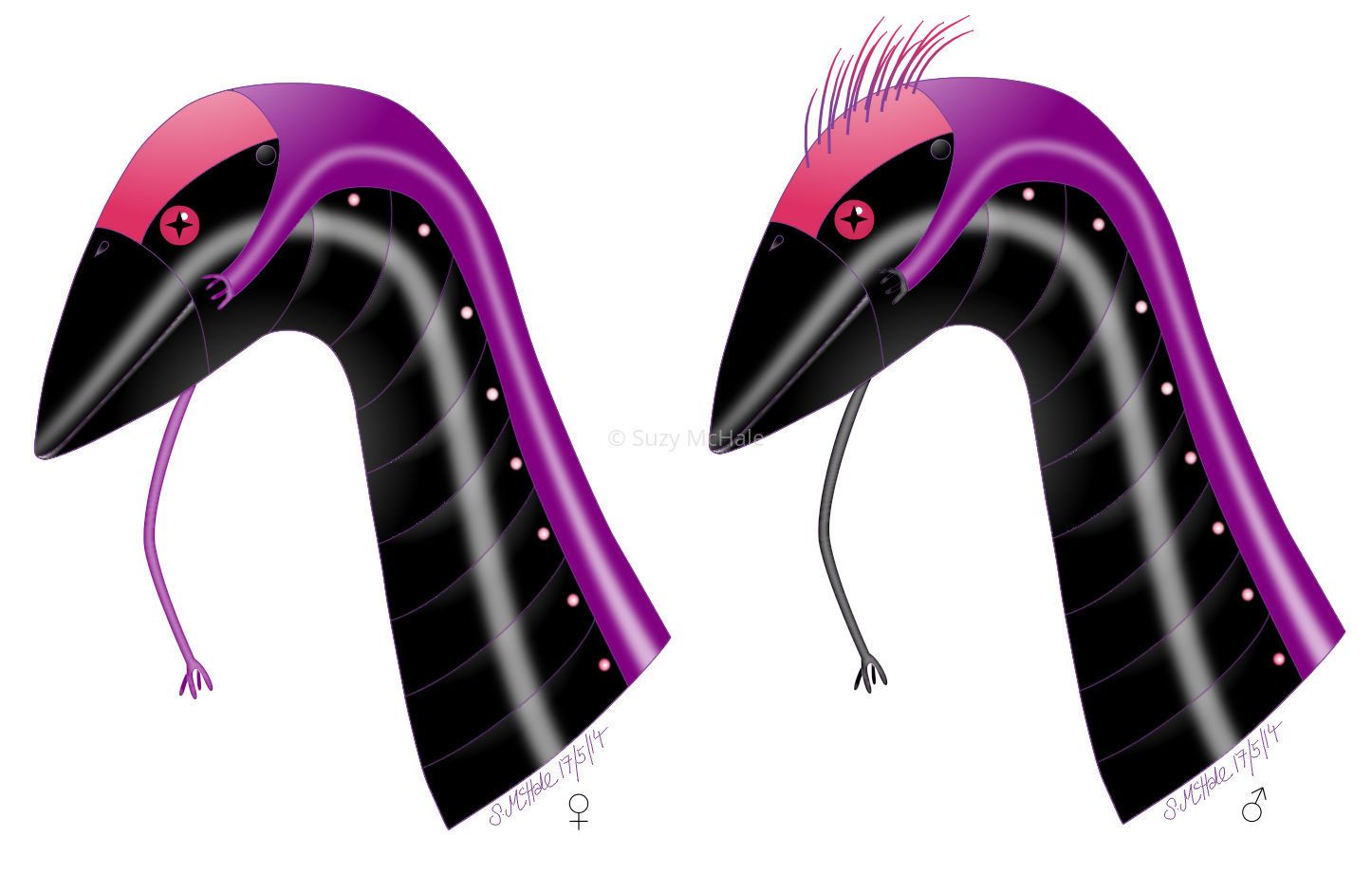
Tree Gliders heads, female and male heads (digital art, 17/5/2014).
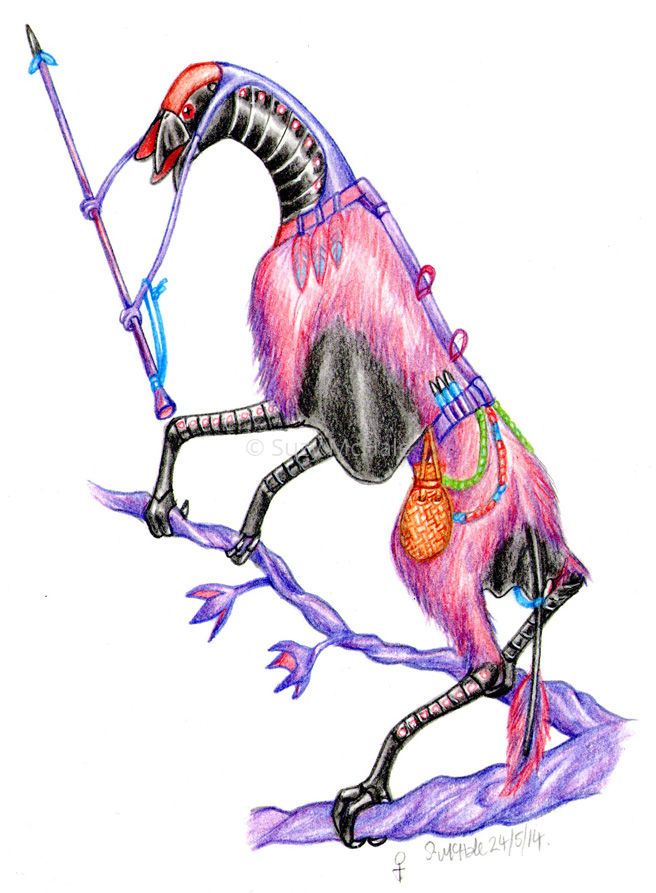
Tree Glider, body view (colored pencils, 23/12/2010).
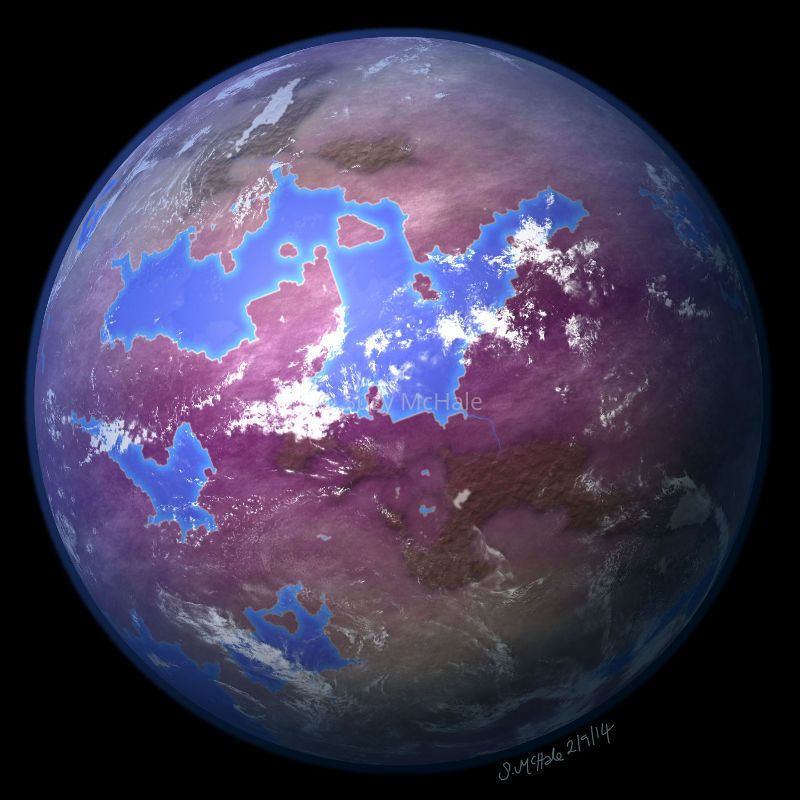
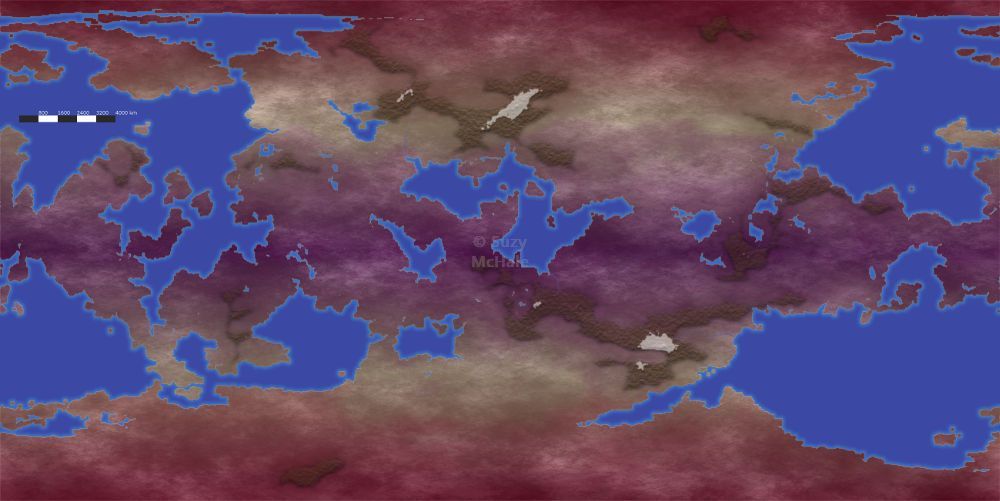
Digital renditions of what their planet might look like (1/2/2014). Scale note: 1 pixel on the image (5197 px width) = 6.93 km approx (round up to 7), so 100 pixels on the map = 700 km on the ground. This works out to 36,379 km circumference – not perfectly accurate, but good enough for an approximate rendition.
Trial of Pain
The Trial of Pain (Sahalrasac) is the ritual torture conducted before a Warrior’s sacrifice upon a Altar of Blood. It is only inflicted upon those of the Warrior Caste, and then usually on captives of a rival Clan. A Warrior is expected to endure without showing any signs of the pain he is in; he will otherwise die dishonourably. The torture is usually in the form of declawing, and takes place in a chamber of the Pyramid of the Lords.
Valley of the Ancestors
The Valley of the Ancestors (Ceewacabuun) is the place where Clan Lords in ancient times were buried in cave tombs with painted walls. It is located around 13°E, 53°S, about three days’ journey from Night River Clan City. Its altitude extends from 500 meters upward; the mountains overlooking the valley reach to 4000 meters. Their peaks are snow-covered all year round. The Valley is in an arid rain shadow behind the Blue Mountains; this and its high altitude means the air is cold and dry, ideal for the long-term preservation of bodies.
After the construction of the Clan Cities, the bodies were transferred to the Pyramid of the Lords in each City to ensure their continued safety and so they could watch over the inhabitants of their respective City.
Void Fin
A Void Fin (Sosaanzoyuu) is a deep-dwelling vertebrate sea creature, on which the design of a Void Walker was based. Males are entirely black; females have a grey underside. There are eight bioluminescent spots along each side. It has an arrow-shaped head and pointed wing-like fins, similar to a manta-ray’s, and is omnivorous. In size it reaches up to 12 meters or more, and is the largest sea creature in Home World’s oceans.
Gallery
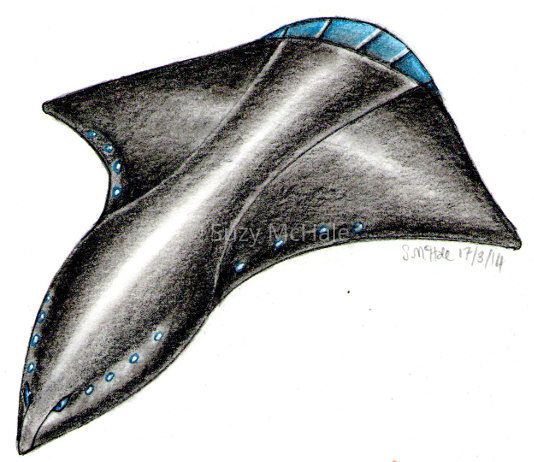
Male Void Fin (colored pencils, 17/3/2014).
Void Station
Void Station (Nawelzoyuu), also called Home of the Void Walkers (Nulunaa Zaawezoyuuwo) is the one and only space station of the Dawn Hunters. The habitable area is a dome 13.2 km in diameter (4 ship-lengths), using a captured and shaped asteroid as the construction base. It orbits the outermost moon, Ice Moon, and provides docking and a maintenance bays for each Void Walker. There are a total of 48 docking bays, more than enough for the current fleet.
The center of the dome is hollow; starships can be constructed there, though this has not been done for thousands of years. Tentacles can extrude from the base to snare an asteroid, the raw material for beginning such construction. Living and working areas are arranged in levels above the hangars.
The Station has artificial gravity derived from a singularity contained within a sphere at its base.
Dawn Hunters from each Caste are stationed there on a rotating basis; there are no permanent occupants.
Dimensions
- Diameter
- 13.2 km (6.6 km radius) – 4 ship-lengths
- Height (including struts extending below dome)
- 26.4 km – 8 ship-lengths
- Starship docking bays per level
- 12 (4 levels for 48 ships)
Gallery
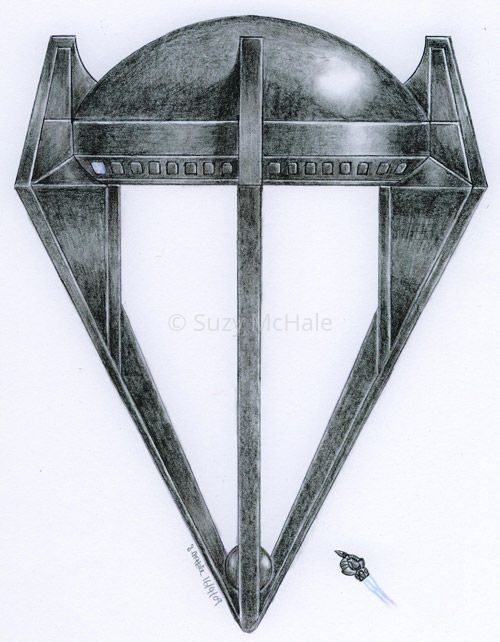
Void Station (colored pencils, 16/4/2009 – somewhat outdated).
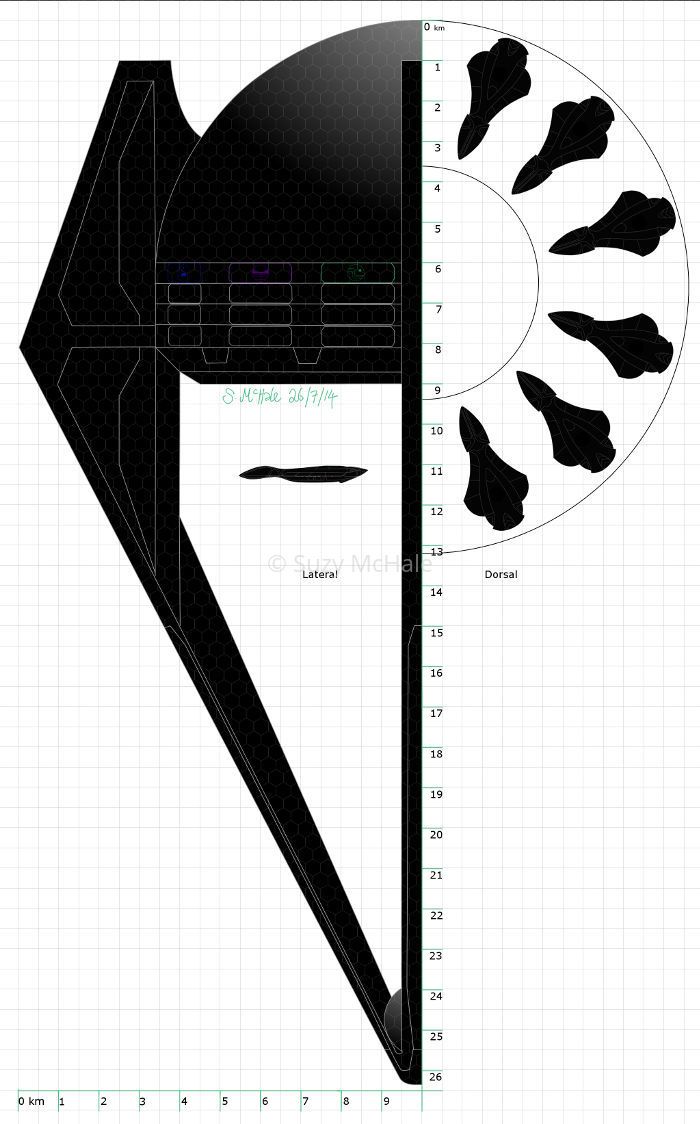
A half-view of Void Station is on the left, with a starship for scale. On the right is a schematic and simplified top-down view, showing how starships are docked in their hangars (digital art, 26/7/2014).
Void Walker
- Appearance
- Technical specifications
- Propulsion and power
- Other features
- Weapons
- Layout
- Navigation
- Naming conventions
- Known starships
- Image gallery
- Background notes
- Footnotes
Void Walker (Zaawezoyuu) is the Dawn Hunter name for a starship, the largest vessel in the aliens’ fleet. The starships are the most highly-prized creations of the Hunters; some (such as Zaawezoyuu-cehenenel Narabo Sahelnahuuwaa) are tens of thousands of years old and have passed from one Clan Lord or War Lord to another after being inherited from father to son, or won in ritual combat challenges. They are the only ranks that can command a starship.
The ships are constructed and repaired in a huge floating dock/space station called Void Station at the stable Lagrangian point (L4) in front of the orbit of Home World’s outermost moon, Ice Moon. The dock is a neutral zone where any combat is forbidden. Nanites do most of the initial construction after being programmed to a template, using matter from the star system and beyond. Construction of new starships is now, however, rare.
Appearance
The ships are the largest and main vessels of the Hunter fleet. A starship is approximately 3.3 km in length and around 1600 m at its widest point (approximately twice as long as it is wide), elongated and bulbous in shape and heavily armored. Its appearance was based on that of a Void Fin, an aquatic creature on Home World.
A starship is intended for use mainly in space; it can enter a planet’s atmosphere – hence its aerodynamic shape – but it can’t land as it is much too big and heavy (the downdraft alone would flatten any buildings in the vicinity). It carries a selection of the smaller transport and fighter ships that can be used in both space and a planet’s atmosphere.
The atomically-dense metal-alloy armor of its outer skin can only be damaged by antimatter or singularity weapons – or by Jumping into the core of a star – though there are some weak points which particle weapons can damage (such as the engine exhausts). The skin has an iridescent blue-violet sheen where the sun highlights it (rather like the green-violet sheen of a starling’s black feathers), and a subtle hexagonal pattern.
A starship has no windows; instead, projection through the walls provide a realistic 3D view of the outside. There is, however, a small viewing room at the front of the ship; segments of the metal alloy there are infused with special nanobots that can change its properties from opaque to transparent when needed (this technology is also used with the smaller ships to provide cabin windows). The transparency is one-way; anyone outside can’t see in.
The crew numbers several hundred Hunters of all three Castes from the one Clan and effectively serves as a mobile home and command base. A tour of duty lasts approximately one Home World-year; thus most Clan members will get a chance to serve onboard their Clan Lord’s starship during their lives. Everyone gets a cabin (and ensuite bathroom!) to themselves regardless of rank, though the cabins of lower ranks are smaller.
A key feature of a starship is the sapient Artificial Intelligence that it contains. Its central core is located within the Crystal Chamber directly under the Command Chamber. Fiber-optic tendrils extend through its body, transmitting information via light signal pulses. Data is stored in crystalline matrices. In structure, it is a sort of quantum computer, initially created by scanning the neural patters from the brain of the Clan Lord who commissioned it, but it also absorbs memories from successive Clan Lords via their neural implants and develops its own personality. An AI has immense processing power and some of its capabilities are still unknown; it is possible that it utilizes other dimensions to store and access information and energy. A starship and its AI are inextricably merged and function as one entity. The AI has no gender, so in English the only way to refer to the AI is as “it.”
The AI is intensely bonded with its Clan Lord or War Lord master for his lifetime, as it has been designed to be; a small part of it resides in the Lord’s neural implant, speaking to him via a synthetic telepathic link. This bond helps compensate for the solitude of his position in Hunter society, and provides a father-substitute once his real one has departed. It may choose to communicate with others, such as a designated Ship Master if the Clan Lord is not onboard (or in my story, the human Sergei), but its loyalty to its Clan Lord overrides all others. It’s like having a lifelong best friend who will never betray you or abandon you.
Technical specifications
- Front section
- 110,592 cm (1.1 km)
- Middle section
- 165,888 cm (1.65 km)
- Rear section
- 55,296 cm (0.55 km)
- Total length
- 331,776 cm (3.3 km)
- Height
- Nearly 500 m (~ 492 m)
- Propulsion
- Two nuclear fusion engines for realspace travel; a captive singularity to enable foldspace Jumping
- Armament
- Includes particle beam, kinetic cannon, deployment of Unmaker-Nanites
- Other features
- Integrated Artificial Intelligence
- Crew
- Up to several hundred
- Complement
- Drones, Shuttles, Carriers, Fighters
- Role
- Galactic exploration, interstellar flight, planetary assault
Propulsion and power
A starship has two methods of propulsion: fusion engines for realspace travel, and a Warp Chamber that enables it to Jump.
A starship is capable of Jumping or “folding” space – effectively creating a brief wormhole – to cover vast distances in the Universe, by means of the Warp- or Space-time Crystal contained within the Chamber. When entering or exiting a Jump, there is a bright flare of light, and gravitational waves and Cherenkov radiation are emitted.
The Crystal also helps provide power for the rest of the ship as well as generate artificial gravity.
For conventional flight a starship is powered by two massive nuclear fusion engines. The deuterium needed for fusion reactions can be harvested from the two gas giants in their system, or any gas giant such as the ones in our solar system. A starship has its own fusion fuel processing plant onboard; it gathers the fuel from gas giant planets. This is also stored and used to refuel the other smaller ships onboard.
Other features
- The starships use Shield-Nanites to deflect energy weapons, though the nanites get overwhelmed after a few hits from a particle beam and need time to regather. Cold plasma shields can be used as a form of cloaking (plasma generation requires a lot of power, which the ships have in abundance via the singularity). The shields are violet in color.
- The metal-alloy skin can absorb and convert sunlight when close to a star for extra power, in a process similar to that of a leaf (photosynthesis) or solar panel.
- A starship is almost invisible to radar, but it emits some heat and can thus be detected with infra-red instruments.
- A starship can extrude “tentacles” – manipulative cables – from its exterior or interior when needed. These are formed by interlinking nanites, and can appear or reabsorb very quickly.
- A starship’s AI can be sent into “cold sleep” – hibernation – mainly when it is docked and not needed for long periods. It can clone a portion of itself into its Clan Lord’s implant to continue communicating with him, then merge this when it wakes again.
Weapons
A starship possesses a variety of weapons. It can use nanites to manufacture what it needs onboard, given the appropriate raw materials. Firing points open through the hull when needed.
- One weapon is a particle beam, created by a particle accelerator contained in the central section. A charged-particle beam is used within an atmosphere, and a neutral particle beam is used in space.
- Another weapon is a package of Unmaker-Nanites delivered by a drone spaceship to the surface of the planet it is attacking. The Unmakers can be programmed to disassemble specific targets, so they enable a “surgical strike.”
- A laser carrying an electromagnetic pulse (EMP) can be fired to disrupt the unshielded electronics of an enemy.
- A kinetic cannon – a rail gun/mass accelerator – is mounted along the base of the ship, and can magnetically accelerate a lump of matter to high speeds along the ship’s central axis. The ship’s front end has to be pointed at the target. The matter has to be heavy so it won’t burn up in the atmosphere before reaching the ground. It can propel the shaped mass up to 100 km/sec; this can devastate a city like a nuclear blast, but without the accompanying radiation. The starship has to compensate for the recoil by firing its engines.
- A singularity cannon fires a microscopic black hole created by the particle accelerator. This evaporates fairly quickly, but does a lot of damage in the meantime – it can tear apart a starship.
- The starship itself can act as a weapon by simply descending over a city; the downdraft from its massive bulk will flatten buildings under it, and its fusion engines will irradiate the immediate area.
Layout
The living quarters are in the front section; most of a starship’s bulk is taken up by the propulsion, power and weapons systems.
- Front section: This is arrowhead-shaped. There are four main decks/levels. The bottom one has a corridor leading from the aft sections of the ship to the docking port at the nose. There are extra cabins here. The ones above are the living quarters for the Technicians, Adepts and Warriors (in that order). These are arranged in an oval shaped-corridor on each level, with cabins branching off around its outside. In the central core of the levels are elevators and work areas for all Castes, such as ship operations and a training/exercise arena for the Warriors. Ramps also connect each level. The egg-shaped Command Chamber where the Clan Lord oversees starship operations is a room on a level just above the Warrior deck, with a ramp leading up to it (like a split-level house). This is all located deep within the front section so there are no windows, aside from the small Observation Deck, which is accessed from the Command Chamber via another ramp (in front of it). The Clan Lord’s cabin, Command Chamber and Observation Deck are at the front of the ship. The central core levels of the front section include:
- Warriors: training arenas, an atrium with plants from Home World.
- Adepts: science labs, medical facilities, food preparations (for fresh food).
- Technicians: various starship-related engineering facilities.
- Level 4: waste treatment and recycling.
- Middle section: this is the widest section, resembling axehead-shaped wings – concave at both sides and convex in back. In its center is the singularity which enables the ship to Jump; it is contained by a magnetic field within a neutron-thick sphere. The singularity containment is on an upper level, surrounded by the equipment for the gravity drive, which is aimed above the ship when operating. Two corridors lead around each wing on this upper level; most of the starship’s weapons are operated and fired from here. A particle accelerator circles the singularity containment; it is used for firing the particle beam weapons which can be aimed out of nodes around each side. On the bottom level, at the nadir of the ship, are the cargo and shuttle bays where the starship’s spacecraft fleet are stored and maintained; the bays are bisected into two levels. They exit from two openings to each side; the cargo bay opens to the rear. The openings are solid but nanites in the walls temporarily liquefy to allow passage of a ship while retaining atmosphere. A nadir central corridor extending from the front section enables access to the spaceship bays and rear section. More Technicians reside toward the front section of the wings.
- Rear section: this is a smaller protruding semicircular section that contains the two massive 4-storey-high fusion engines and fuel for them, as well as the means to process deuterium fuel gathered from gas giant planets.
Two transport tubes along the central axis provides quick access to all sections via a cylindrical shuttle in each that seats up to 8 passengers.
Length ratios: the middle section is the longest, then the front section, and the rear engines the shortest – ratio 2/3:½:1/3 (divide length by one-half, then the remaining half by 3).
A cabin is approximately 6 meters in width, with its ensuite bathroom 2 meters – each occupant has their own small bathroom. With a front section length of 1500 m, there would roughly be 300 rooms on the upper 3 levels, and perhaps up to 200 on Level 4 (I have not worked this out precisely). That would give a crew capacity of up to 1100, though this number is rarely on board. Extra rooms can be formed if required through the embedded nanites in the ship’s structure.
How heavy is the starship? I don’t know how to calculate it, but mass would be in the millions of tonnes.[1]
Navigation
To Jump accurately, a starship must know the co-ordinates in 3-dimensions of the region it is Jumping to. The Hunters have thus moved incrementally in their exploration of the Milky Way as a starship will map the stars around it, Jump to a region in this area, map the stars around here and so continue onwards. Occasionally a particularly daring Clan Lord might take a chance and Jump much further away to an unknown region (which is how Lord Sohaar discovered our Solar System); a starship can make a rough estimate of distant stars. There is some risk involved, as the starship might inadvertently emerge inside the core of a star! Not even the high-density metal structure of the starships could withstand those immense pressures.
Nanobeacons and pulsar stars are also used to facilitate navigation; the fist-sized stealth beacons are left in orbit around target planets. They are usually inert, and only reciprocate with a signal when contacted by a starship either through realspace or foldspace.
Would time-travel be possible? As Jumping involves folding spacetime, it seems that time travel would be just as easy as going from one point to another. In fact, a starship would have to be careful to calculate its Jump to the Planck time (the shortest physically meaningful interval of time ≈ 1.71 × 10−50 a) as well as its co-ordinates in space, so as to ensure it emerges in the present. Also, while time in a single location (local time) is consistent, it will not be the same time as another location across the Galaxy, due to the limitations of the speed of light (relativity of simultaneity) so that might need to be factored into a Jump. When Jumping to a new region, it will immediately start time-measurement for that region, adding this to its database, so that when it Jumps to that region again it can calculate the correct time and avoid inadvertent time-travel.
One thought I had that is if the positions of every atom in the Universe could be mapped over the entire span of time from the past to the present, then one could travel back in time, assuming you had a machine that could perform this task by choosing the co-ordinates wanted. As such a feat would involve an unimaginably huge amount of computing power, perhaps it might only be necessary to map the atom positions in one’s local region (eg. in the Solar System). Time travel into the future would not be possible due to the peculiarity of quantum mechanics: that the future positions of atoms can’t be determined with any accuracy. The past, however, is fixed and certain; the future does not yet exist with any certainty. There is thus only the past and now. A starship could theoretically perform a Time-Jump; however the act of time travel might see it emerge into a different timeline. What would happen to them then is unknown.
Naming conventions
Starships are known as Void Walker, Zaawezoyuu (Walker [of the] Void), in the Dawn Hunter language – they have no word for sailing ship. Starships are designated Void Walker-1, -2, etc. They also adopt the name of the Clan that owns them. Thus the main ship “character” in my story has the full name of: Zaawezoyuu-cehenenel Narabaa Sahelnahuuwo, Void Walker-1(st) of the Night River Clan. It may be referred to more formally as Void Walker-1by maintenance crew and others, and more familiarly as Sahelnahuu, Night River – or just Nahuu, Night – by Lord Sohaar.
A starship is referred to – or refers to itself – with pronouns used for Dawn Hunters (as opposed to those used for other creatures, or inanimate objects), and in the neutral honorific.
Known starships
| Name | Translation | Commander |
|---|---|---|
| Zaawezoyuu-cehenenel Narabaa Sahelnahuuwo | Void Walker-1 of the Night River Clan | Clan/Supreme Lord Sohaar |
| Zaawezoyuu-celecunel Narawaa Sosaano | Void Walker-8 of the Three Moons Clan | Clan Lord Sanaazuun |
| Zaawezoyuu-celecubacanel Narawaa Sahelnorowo | Void Walker-13 of the Swift River Clan | Clan Lord Soharaa |
| Zaawezoyuu-celecuzeyuhenenel Narabaa Rebenuuwo | Void Walker-17 of the Crescent Moon Clan | War Lord Yaraananahuu |
| Zaawezoyuu-cenamalecuzeyunel Narabaa Sanaalecaawo | Void Walker-26 of the Fire Wind Clan | Supreme Lord Yaraan |
Gallery
Void Walker exterior views.
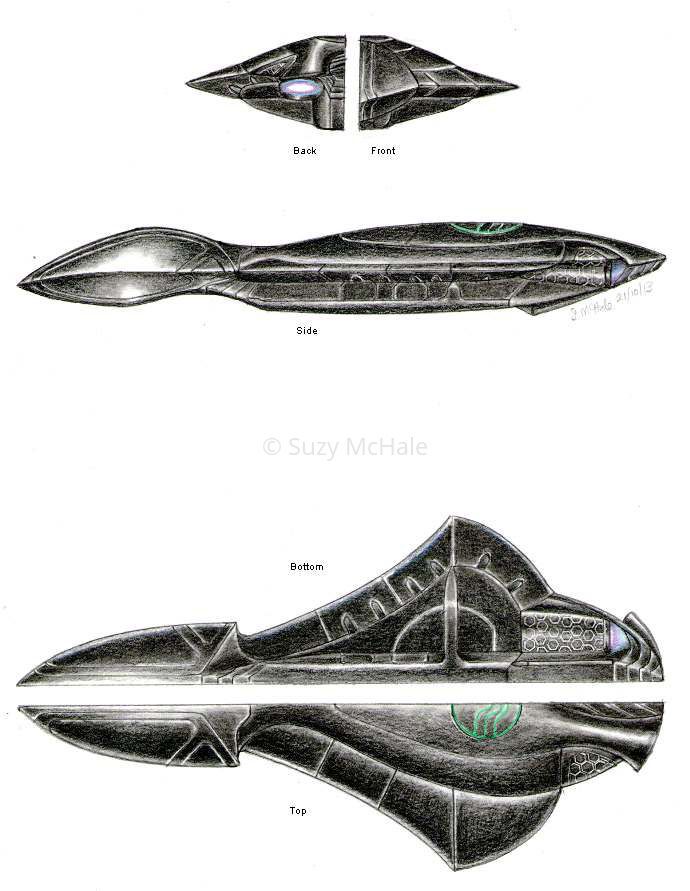
Starship from various viewpoints (colored pencils, 23/10/2013).
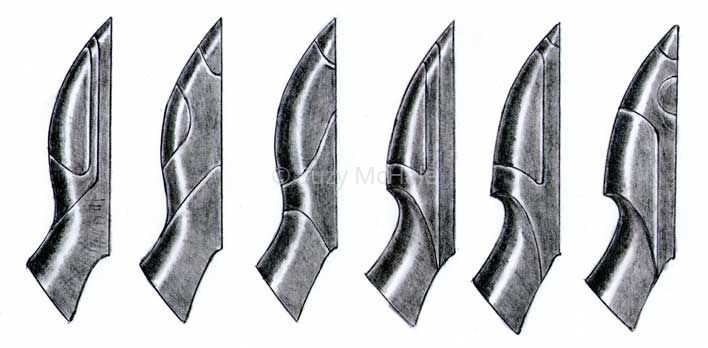
Different prow detailing (each starship has its own look) (colored pencils).
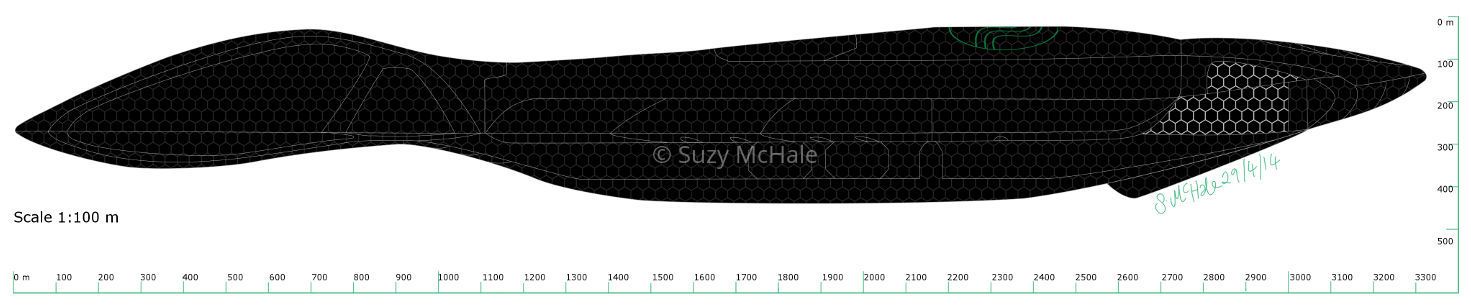
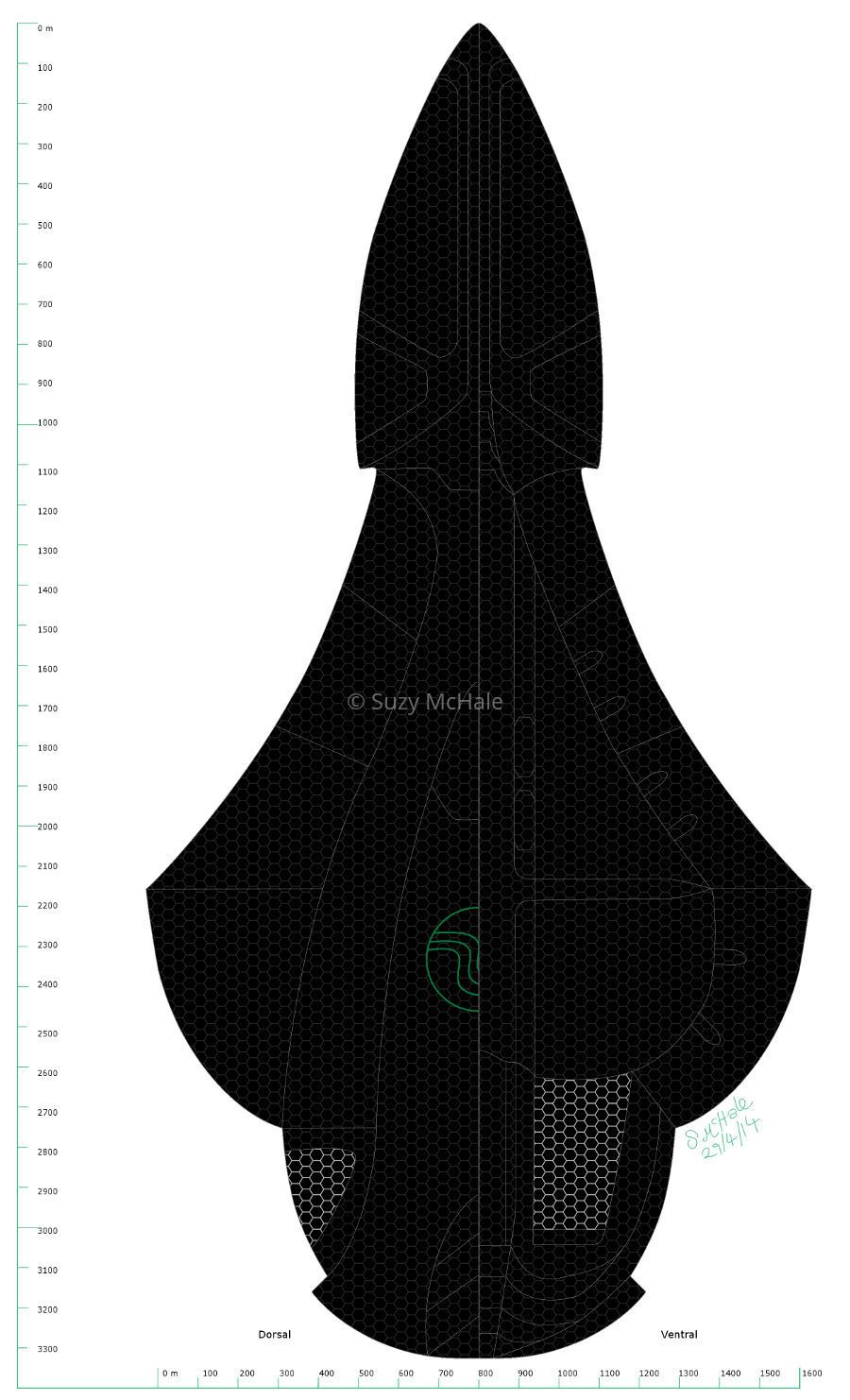
Void Walker silhouette side, top and bottom views, (digital art, April 2014 – I haven’t so far found out how to do smooth shading). This is the Night River Clan’s starship.
Background notes
Starship design influences include:
- Anne McCaffrey’s Dragonriders of Pern series, specifically the intense telepathic bond between a dragon and its rider.
- An Eva from Neon Genesis Evangelion is infused with the soul of its operator’s mother.
- The Covenant CCS-class battlecruiser from the Halo video games was a major design inspiration, though internal layout is different and it does not have features such as a gravity lift or does glassing.
- The gravity drive is similar in concept to the drive as used in the 1995 movie Event Horizon – see the script. The Machine from the movie Contactwas also another visual influence.
Footnotes
- [1]
- As a comparison, the currently largest real-world cruise liners, Oasis class, are “only” 360 meters long (barely an eighth of the starships’ length – though they can carry up to 6296 passengers), and the largest structure in Earth orbit, the International Space Station, is a mere 75 m. The Oasis class cruise liners are 225,282 gross tonnage, so multiplying that by 8 gives 1,802,256 GT, which would be a bare minimum for the starship. The world’s longest ship was a supertanker named Seawise Giant, at 458.45 m long and 260,941 GT.
War-Cloak
A war-cloak (Zoluuhehar) is an intrinsic part of a Warrior’s clothing, and those of all ranks wear one. It is presented to a Warrior at his initiation, and enhances his formidable appearance.
The floor-length cloak is made of an intensely black, silk-like material that absorbs light (possibly comprised of carbon nanotubes) and can be used as camouflage and protection; e.g. if he is caught in a nuclear explosion he can crouch down, covered by his cloak which will shield him from the effects (as will his armor).
Like his other clothing, the nanite-infused material is responsive to his body needs and does not tangle or get in his way, despite its length. It is wrapped around him and secured at the right shoulder with a brooch that has his Clan symbol embossed on it.
The cloak is much a part of a Warrior’s identity and status as his sword; he would seldom be seen in public or even in private without it.
In ancient times before nanotechnology, a cloak was made of finely-woven fabric (from a silk-like plant fiber) and worn over traditional armor.
Gallery
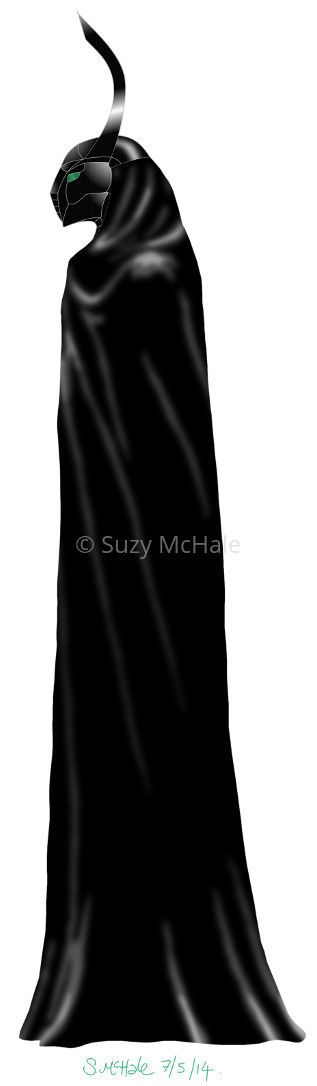
Warrior in his war-cloak, profile view (digital art, 27/12/2014).
War Lord
A War Lord (Zulhaar) is the ruler of a minor Clan that is affiliated with a Clan Lord’s Clan; several minor Clans usually dwell in a Clan City under the Clan Lord’s rule and their families interbreed. An ambitious War Lord might seek to usurp the Clan Lord through various means (single combat, or assassination) and thus install his Clan as the dominant one, but this is only rarely successful – and he and his immediate family will be slain if he fails. He may, or may not, possess a starship. A War Lord does not have access to a rejuvenating Healing Bed.
His helmet has a crescent-shaped transverse crest. His metal rank color is silver (#c0c0c0 / rgb(192,192,192)).
Gallery
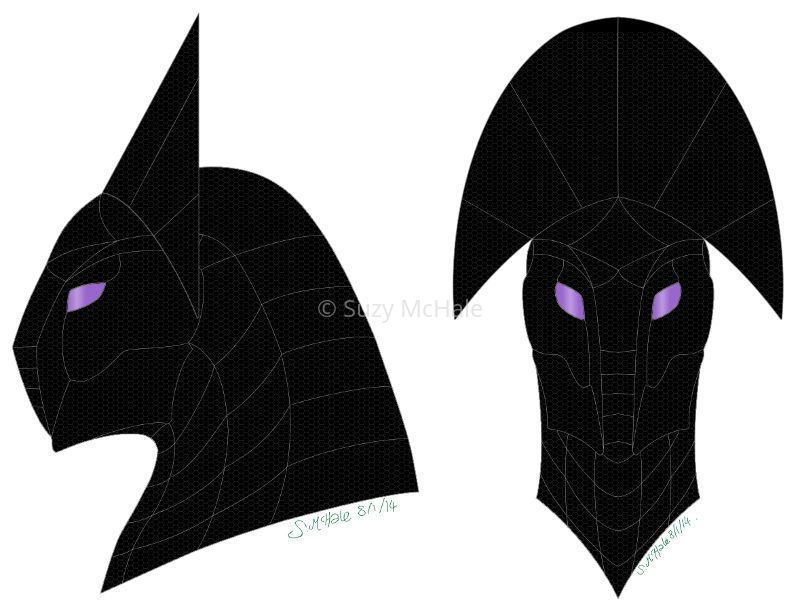
War Lord helmet (digital art, 8/1/2014).
War
Wars on Home World are fought in a strictly ritual fashion, between the Warriors of Clans, and usually minor Clans at that – full-scale warfare is now a rarity. As their highly-advanced technology can wreak much destruction – and would even end their civilization – all Clan fighting is done under the following rules:
- No projectile weapons (guns, bombs, etc.) – only swords, daggers and claws are used
- No nanotechnology (except for armor)
- No aerial bombardment – aircraft are used for transport only
- Fighting to take place in an agreed-upon location, usually a field outside one of the Clan Cities involved
- A Clan City is itself not to be besieged or otherwise damaged
- Fighting involves Warriors challenging each other individually
- Commanders lead from the front; to do otherwise would indicate cowardice
- The winning Clan may absorb Warriors from the other; some may be sacrificed or choose ritual suicide
These rules do not apply when fighting aliens on other worlds – they are to be subdued by whatever means are practical.
Warp Chamber
The Warp Chamber (Maralyeerolan) is where the near-magic of a Jump is enabled so that vast distances of realspace can be crossed in an instant. It is located in the central section of a Void Walker.
The Chamber is a perfect sphere, constructed from an ultrathin, dense nanocomposite crystalline material. It shimmers with an iridescent rainbow hue. A corridor surrounds the sphere. The material of the sphere can switch from opaque to transparent to enable viewing of the interior (similar to smart glass).
A Warp Crystal, or Space-time Crystal, is suspended in the center of the Chamber. Three rotating gimbals generate a magnetic field that keeps the crystal suspended. When the gimbals are activated and align, they focus and intensify the vibrations of the crystal so that it opens a brief wormhole in spacetime, enabling the starship to slip through and to its destination. A Crystal also generates power for the rest of the ship. It warps space-time around it, making it hard to focus on, and glows with an intense white light. The secret of its formation is known only to the Adept-Crystologists.
The Warp Chamber and Command Chamber are linked by a narrow passageway lined with golden filaments and are nicknamed the “Ship’s Hearts” as they are the core of the starship.
Dimensions
- Diameter
- 8 bodylengths (17.28 meters)
Gallery
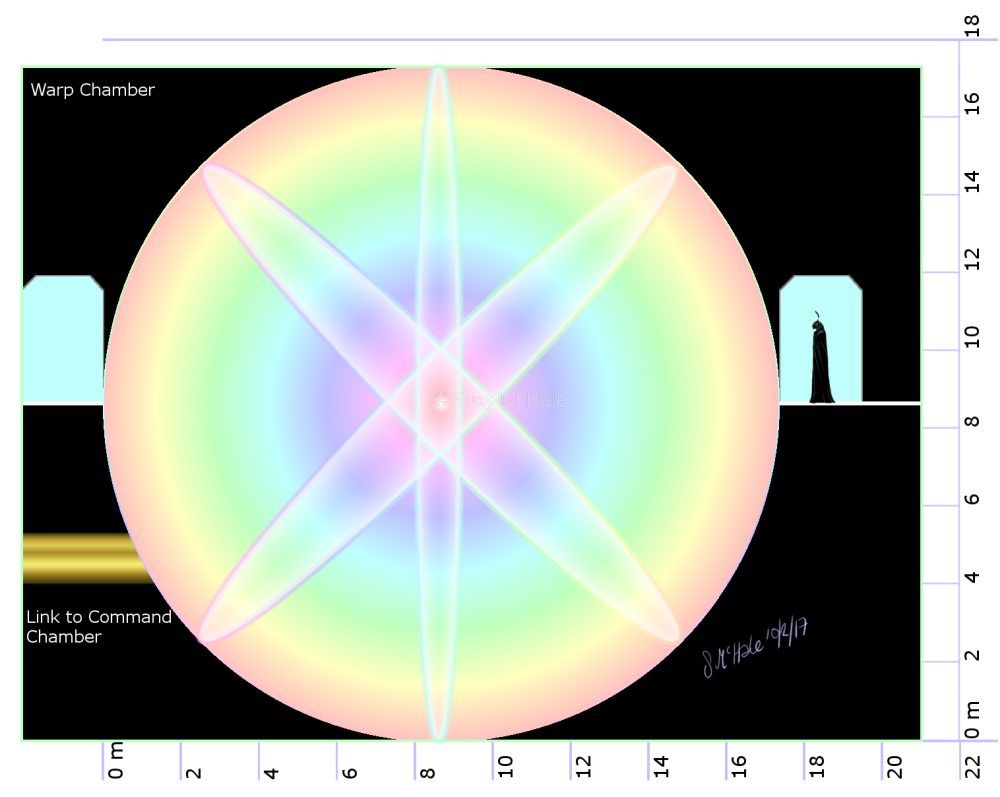
Warp Chamber diagram, stylized view. (10/2/2017, digital art)
Warrior-Assassin
A Warrior-Assassin (Haarzemuwa) usually masquerades as a Warrior-One-Claw, and has a similar unadorned helmet. Assassin is an alternate profession for Warrior-One-Claws who might not have enough skill to rise in the ranks; it is not considered honorable, though, and one will endure a particularly unpleasant death by torture if he is caught.
Warrior Caste
The Warrior Caste (Rohuulhaar) are the dominant Caste in Dawn Hunter society, made up of specialized male fighters who take their species’ predatory characteristics to an extreme. They are warriors, hunters and explorers. The other Castes look to them for protection and guidance. Clan Lords and War Lords come from their ranks. They follow Runaarhaar, the Warrior’s Path.
They wear a distinctive long black war-cloak, black armor and robes embellished with the symbol of their Clan. Helmet crests distinguish ranks.
In culture, they tend to be more bluntly-spoken than the other Castes, and can be brusque to the point of rudeness (particularly with other aliens). Much of their time is taken up with fighting, hunting, training to fight, or recovering in hospital from all of these.
Gallery
Basic helmet, bare and with the usual integrated cloak (digital art, 14/1/2014).
Cloaked Warrior (colored pencils, 20/7/2013).
Warrior-Guardian
Warrior-Guardians (Haarzahuwa) are a War Lord’s or Clan Lord’s personal bodyguards and elite fighting force; akin to Special Forces. They are usually found in pairs as it is preferred for brothers to be partnered together. They are prepared to sacrifice their lives to defend their Lord, and are completely devoted to him.
Of course, a Clan Lord can and is expected to defend himself – otherwise he wouldn’t have attained his status – so the Guardians provide extra protection, companionship and so on.
A minimum of two usually accompany the Clan Lord in everyday life. They will be rostered on for a full day, then have two or three days off for their own activities (hunting, fighting training, etc.) while another pair assume duty.
His metal rank color is rose gold (#b76e79 / rgb(183,110,121)) (a copper-gold alloy).
Gallery
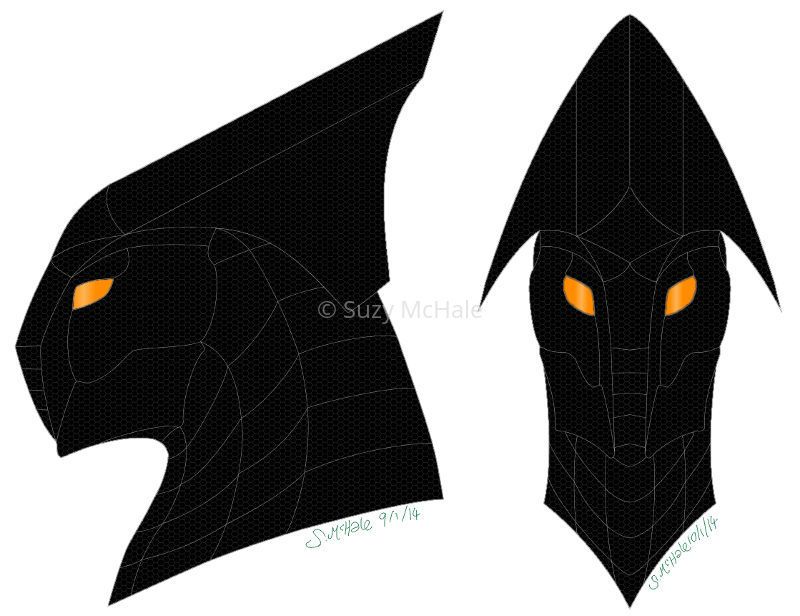
Warrior-Guardian helmet (digital art, 8/1/2014).
Warrior-Student
A Warrior-Student (Haaryaahal) is one of the Warrior Caste in training who has no rank yet. He will only wear traditional armor until he receives his neural implantand morph-armor at the completion of his training.
His metal-rank color is copper (#b87333 / rbg(184,115,51)).
Warrior-One-Claw
The Warrior-One-Claws (Haarzuhaahenenel) are the lowest and most numerous Warrior rank. Helmet is plain with no crest.
His metal rank color is bismuth (#aa98a9 / rgb(170,152, 69))
Gallery
Warrior-One-Claw helmet (digital art, 7/1/2014).

Insignia (in colors of Dawn Star Clan), worn on shoulders.
Warrior-Two-Claw
A Warrior-Two-Claw (Haarzuhaazeyunel) commands 8 Warrior-One-Claws (2 hands – equivalent of a squadron).
His metal rank color is bismuth (#aa98a9 / rgb(170,152, 69))
Gallery
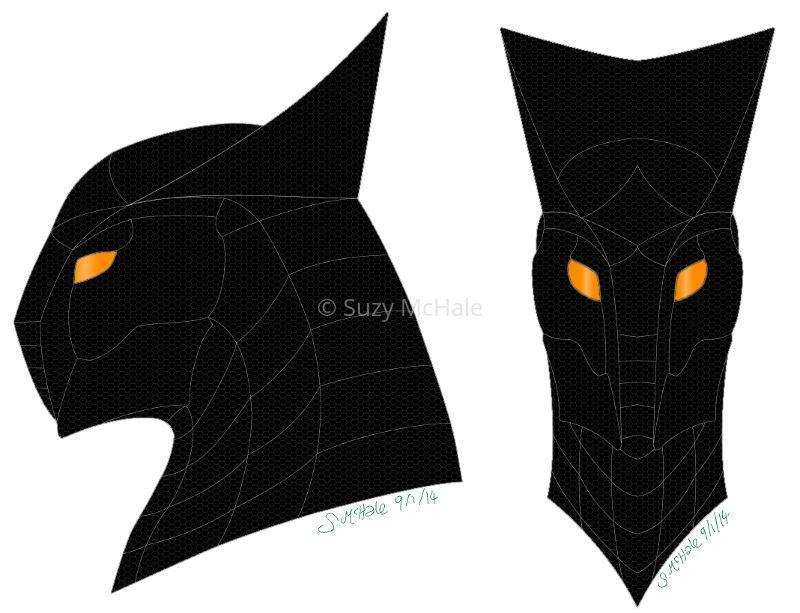
Warrior Two-Claw helmet views (digital art, 9/1/2014).

Insignia (in colors of Swift River Clan), worn on shoulders.
Warrior-Three-Claw
A Warrior-Three-Claw (Haarzuuhanamanel) commands 82 (64 Warrior-One-Claws) hands.
His metal rank color is bismuth (#aa98a9 / rgb(170,152, 69))
Gallery
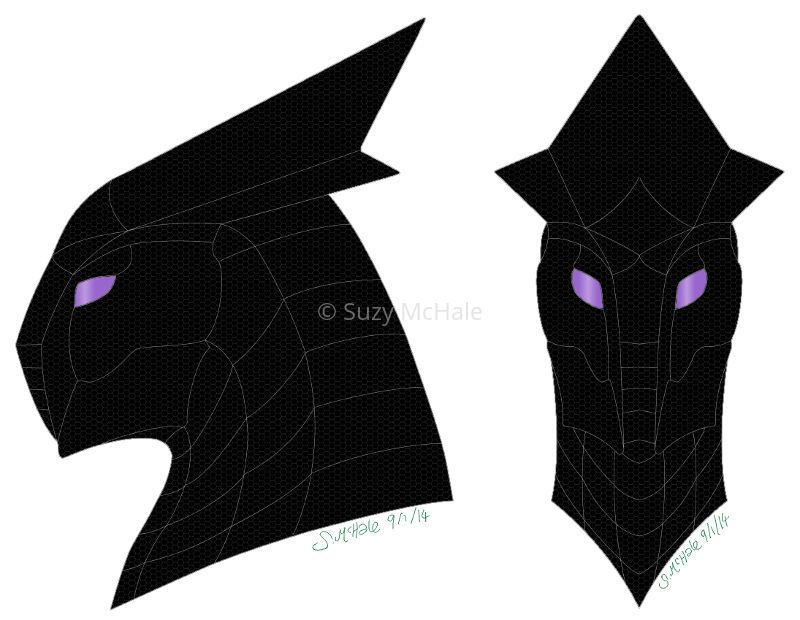
Warrior-Three-Claw helmet views (digital art, 9/1/2014).

Insignia (in colors of Endless Plains Clan), worn on shoulders.
Warrior-Four-Claw
A Warrior-Four-Claw (Haarwahuzuhaanel) commands 83 (512 Warrior-One-Claws) hands. Equivalent of a General – designated second-in-command to a War Lord or Clan Lord; oversees ground or air operations.
His metal rank color is bismuth (#aa98a9 / rgb(170,152, 69))
Gallery
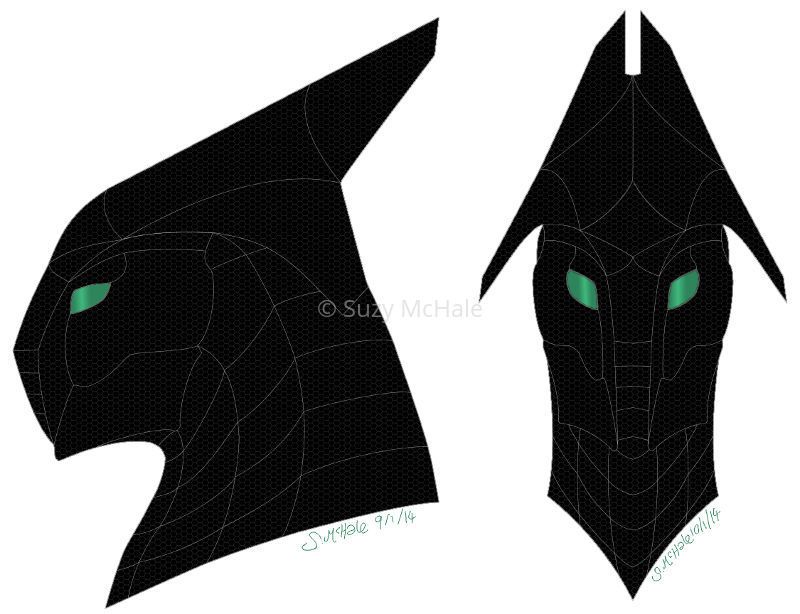
Warrior-Four-Claw helmet views (digital art, 10/1/2014).

Insignia (in colors of Night River Clan), worn on shoulders.
Weapons cabinet
A weapons cabinet (Suucusaamer) is a light wooden storage box with drawers specifically for storing weapons (sword and projectile weapons).
Weapons
The Dawn Hunters value their traditions highly and continue to use both low- and high-tech weapons (eg. swords and powered projectile weapons). For close-in fighting, swords and daggers are used. All Hunters carry a personal utility/combat dagger that can be used for different tasks.
Sword and dagger
Each Warrior has his own sword that is forged for him at the completion of his training; it is a prized possession like a Samurai’s sword. They prefer to duel in traditional one-on-one combat, but (like humans) are adaptable in their fighting methods. Their sword fighting style is generally similar to that of Japanese samurai.
A sword blade or dagger are forged in the traditional manner, with the blade being folded and beaten up to eight times. The metal used for a Warrior’s sword and dagger is Saahenso, “star metal,” from a meteorite(also referred to as Wumarazuul, “sky stone”; for the daggers worn by those of the other Castes, it is a high-grade steel. His weapons are then coated in an atomically-dense metal alloy (possibly a type of single-crystal superalloy) which melds with the metal, making it extremely strong without increasing weight. The blade gains a mono-molecular edge that can slice through almost anything. It is so thin that it almost disappears when viewed edge-on, and is intensely black at some angles. The pattern produced when the blade is hardened is preserved.
The sword is approximately arm-length or 90 cm; the hilt is 4 handwidths (25.2 cm). It can be wielded one- or two-handed. The dagger is approximately half the sword length (45 cm long) and the hilt is held one-handed. Both have single-edged curved blades, with a handle that curves in the opposite direction, forming an elongated S-shape. The hilts are patterned to resemble overlapping scales, and may be decorated with colored cords and such. They are worn hung at the waist – sword on the left, dagger on the right. The sheathed sword can also be worn slung over the back as the wielder prefers.
Traditional swords and daggers in ancient times were similar in design. The hilt was made from wood and wrapped in fabric.
Projectile weapon
The main projectile weapon used is a electromagnetic gun, primarily as a long-range weapon. It is about 90 cm long and is usually carried slung across the back in a blood-blue sling made of artificial fabric. It functions by using electromagnetic means to accelerate solid materials. It fires nano-robotic ammunition that can be reconfigured into different forms, such as a bullet or a dart and programmed to disassemble its target on impact as an option. The gun also has a separate stun mode, in which a high-powered ultraviolet laser beam – invisible to human eyesight – is fired that ionizes the air, creating a conduit for the plasma to pulse through. Depending on the setting, the intense current can stun or fatally disrupt the nervous systems of the targets.
The gun is silent, highly-efficient and is powered by a fusion nanobattery. It is keyed to Hunter DNA so that a Outsider can’t use one (the weapon will remain inert) unless permission is programmed in.
In shape it is roughly wedge-shaped and curved, somewhat organic in appearance, black in color and light but nearly-indestructible like their other equipment. It is rounded on top and flat on the sides. A carry-strap can be threaded through the bottom front hole and rear handle. (And if all else fails it can be used as a club :-))
A gun is known as a meharculuun (mehar [weapon] [of – implied genitive] culuun [thunder]), derived from ancient (and noisy) firearms that used gunpowder.
A War Lord or Clan Lord will not carry or use a projectile weapon unless he has no choice; his sword is his first preference. Hunting prey with a projectile weapon would be considered highly dishonorable. Use of projectile and other advanced weapons are banned on Home World, in any case. They are usually carried in cloth sheaths for discretion while onworld, slung across the bearer’s back.
Other weapons
Bows and arrows were never developed. A war-club (Maacahar) was sometimes used for close-in fighting. This was half a bodylength (108 cm) long, made of a hard and dense black wood, and studded at the hitting end with spiked metal studs. It tapered towards the handle. A skilled wielder could inflict much damage by breaking an opponent’s bones in their arms, legs and torso. In the technological era, antimatter grenades and mines can be used, the antimatter produced in a starship’s particle accelerator. Only a tiny amount of antimatter is required for a big explosion.
Gallery
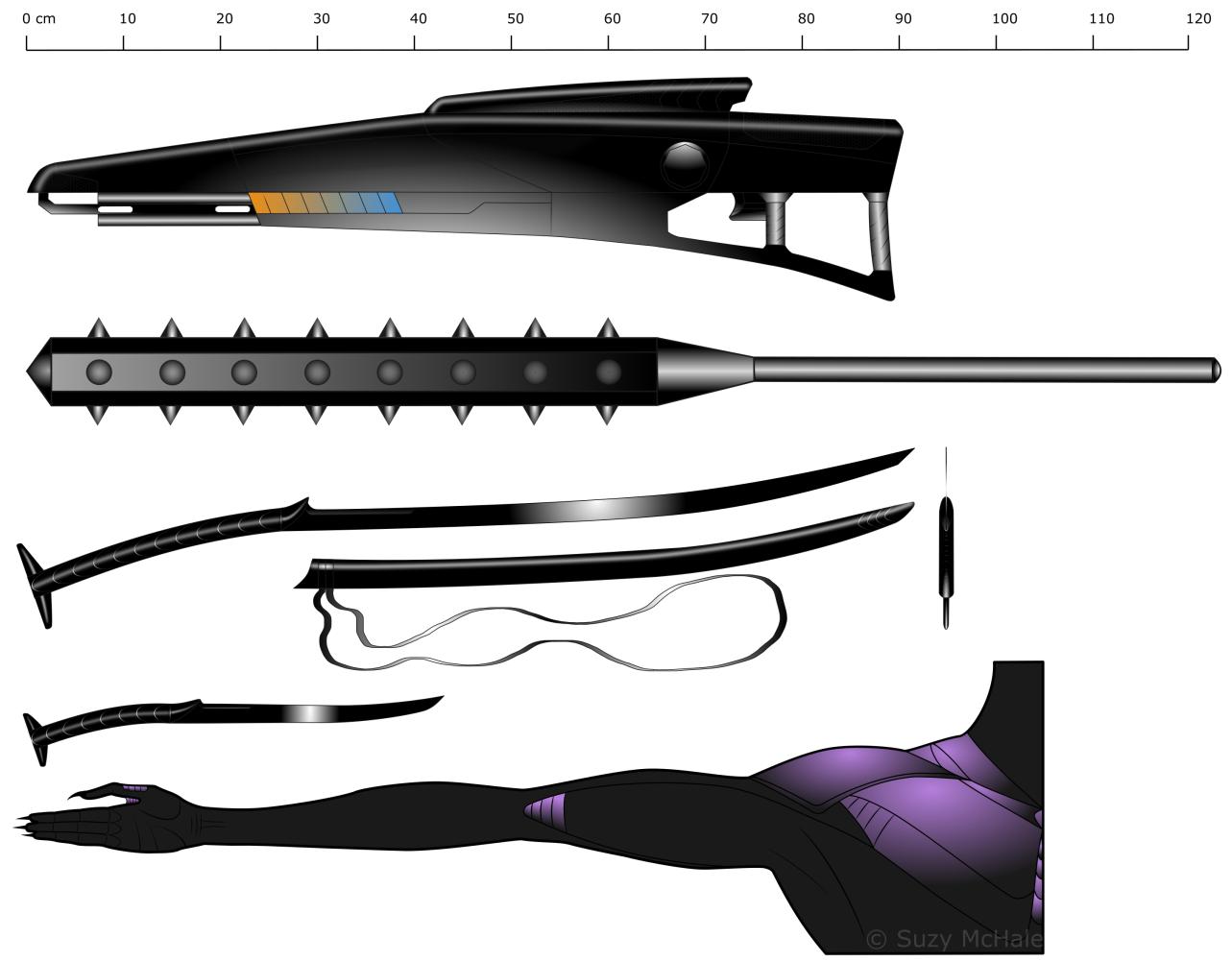
A selection of weapons, from top: gun, war-club, sword, dagger, and arm for comparison (digital art, 27/11/2015).
Yaraan
Yaraan is Lord Sohaar’s younger and only brother, the 28th by that name, and the initial Supreme Lord of the Dawn Hunters in the near-future setting of my story. He is ruthlessly ambitious, and jealous of his older brother.
Biographical information
- Eye color
- Cornflower-blue (#6495ed/rgb(30,144,255))
- Gender
- Male
- Hatching year
- 61,511.98 HW years/4054 B.C. (2310.78 HW years ago)
- Height
- 7 feet 2 inches (218.44 cm)
Gallery
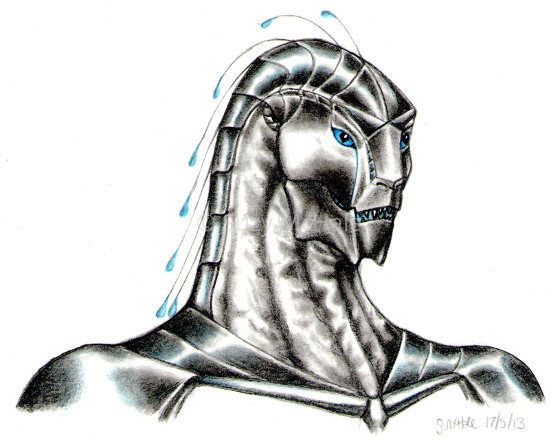
Yaraan portrait (colored pencils, 17/5/2013, 38 KB).
Yaraan profile portrait, done as a vector in Inkscape (digital art, 26/10/2015, 34 KB).
Yaraananahuu
Yaraananahuu is a War Lord of the Crescent Moon Clan. He resides in the Clan City of Night River Clan.
Biographical information
- Gender
- Male
- First appearance
- Dominator chapter: “Black Ships”
Yaraanlecaa
Yaraanlecaa is a Warrior-Guardian and the younger brother of Haarlecaa. Clan Lord Sohaar inherited them from Supreme Lord Yaraan.
Biographical information
- Gender
- Male
- First appearance
- Dominator chapter: “Dust”
Zuunsaan
Zuunsaan is an Adept-Biologist of the Adept Caste. She is in Clan Lord Sohaar’s landing party during his first visit to Earth.
Biographical information
- Gender
- Female
- Eye color
- Blue-green (#1CA9C9/rgb(28,169,201))
- First appearance
- Inheritor chapter: “Contact”