Star Warrior: old and outdated story chapters
Some chapters from earlier versions of the story.
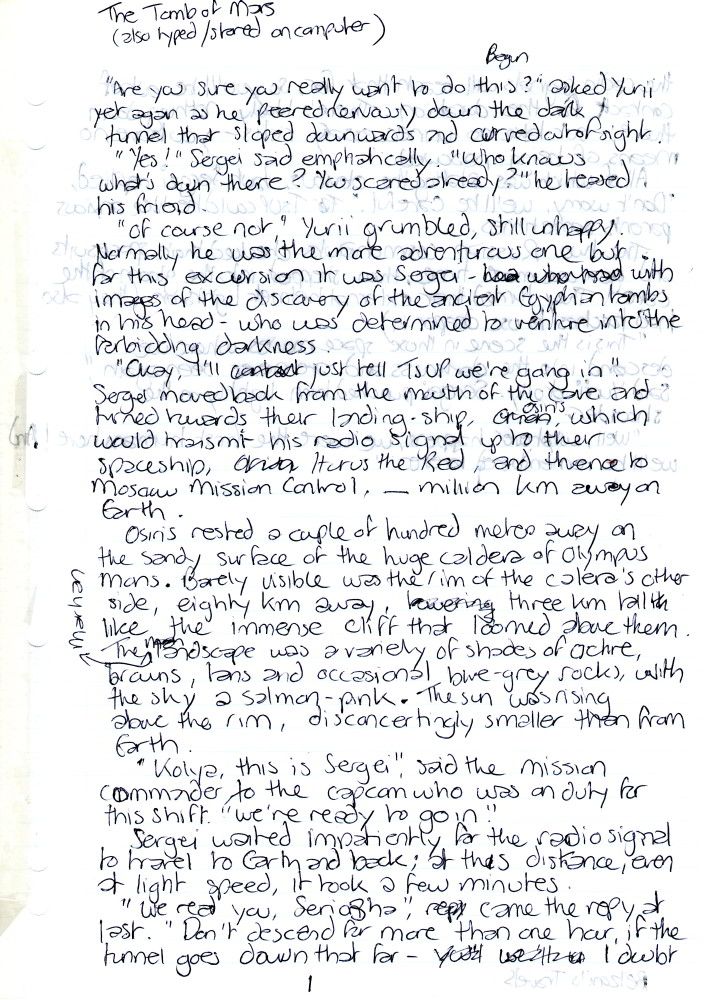
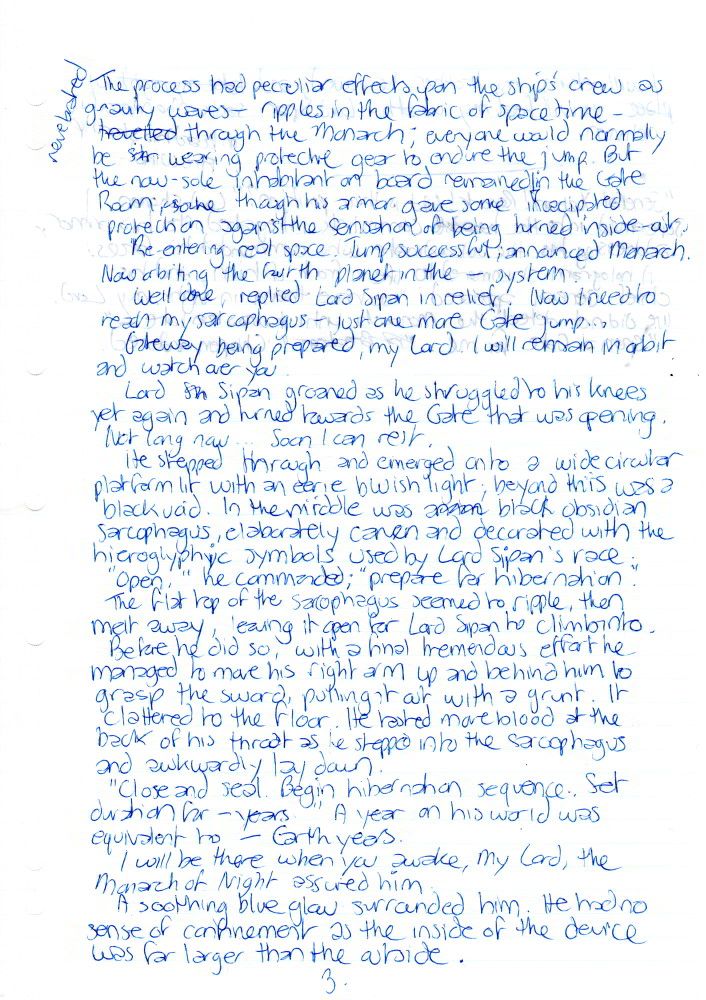
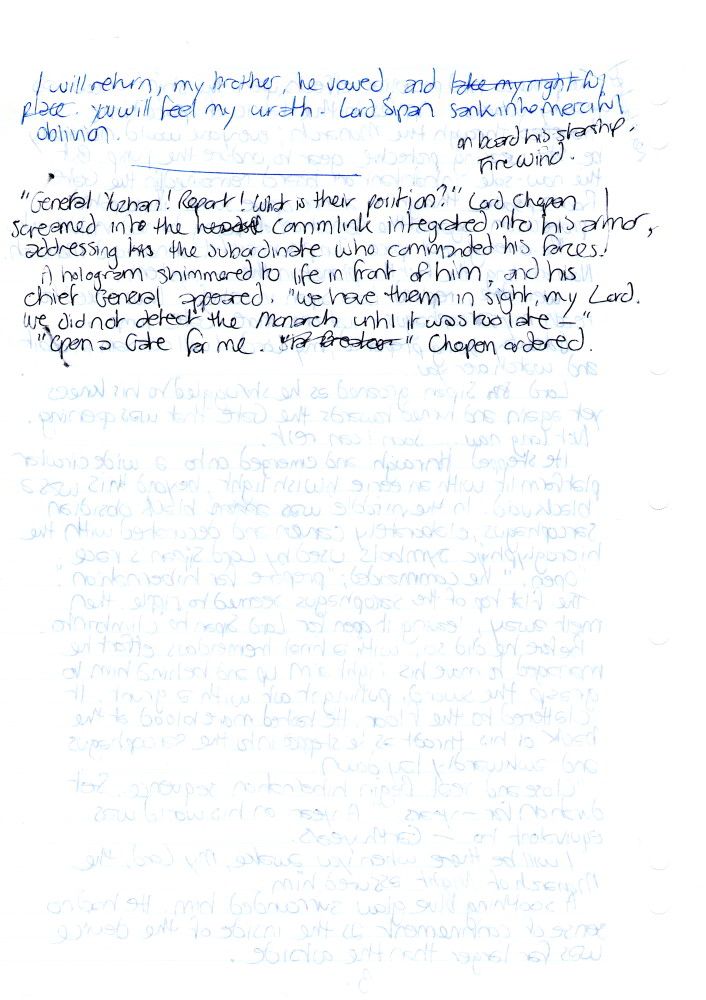
- The Tomb of Mars (undated, but likely December 2006) – scanned-in handwritten pages of my first draft chapter of the story: 1, 2
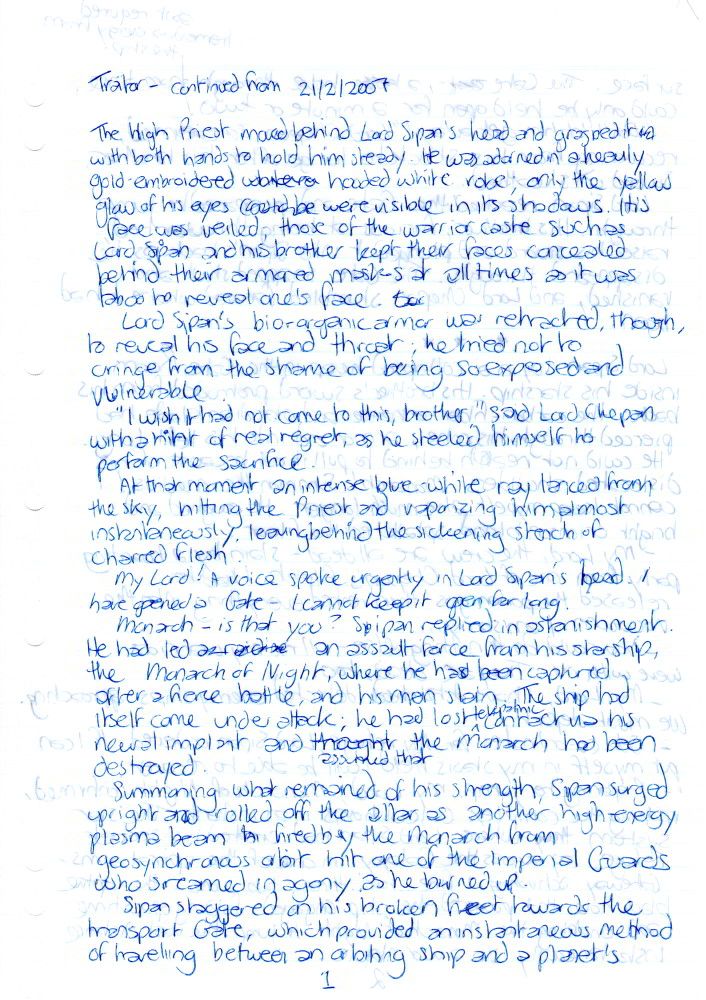
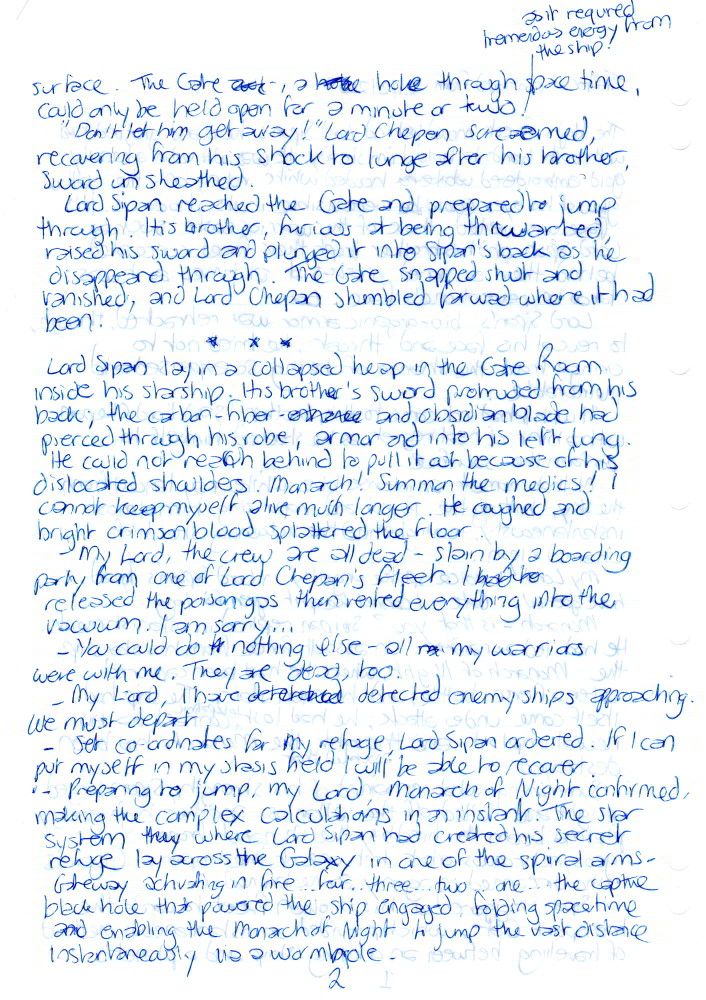
- “Traitor” (21/2/2007) – scanned-in handwritten chapter, pages: 1, 2, 3, 4
- “Awakening” (26/6/2007)
- “Awakening” (20/10/2007)
- “Ice Haven” (31/8/2009) – discarded chapter
Awakening
An now-obsolete version of this chapter, when my story was originally called The Tomb of Mars. Last updated 26 June 2007. Place & time: Mars, near-future
Descent
“Are you sure you really want to do this?” asked Yurii yet again as he peered nervously into the dark tunnel that sloped downwards into an ominous darkness.
“Yes!” Sergei said emphatically. “Who knows what’s down there? You scared already?” he teased his friend.
“Of course not,” Yurii grumbled, still unhappy. Normally he was the more adventurous one but for this excursion it was Sergei – head filled with images of the discovery of the ancient Egyptian tombs – who was determined to venture into the forbidding darkness.
“Okay, I’ll just tell TsUP we are going in.” Sergei moved back from the rectangular mouth of the cave and turned toward their landing-ship, Osiris, which would transmit his radio signal up to their spaceship, Khor Krasnota (Horus the Red), and thence to Moscow Mission Control, approximately 400 million kilometers away on Earth.
Osiris rested a few hundred meters in the distance, on the sandy surface of the huge caldera of Olympus Mons. Barely visible was the rim of the caldera’s other side, 85 kilometers away, towering three kilometers tall, like the immense cliff that loomed above them. The Martian landscape was a variety of ochre, brown, tan and occasional blue-grey shades, with the sky a pale salmon-pink. The sun was rising above the rim, its size noticeably (and disconcertingly) smaller than that viewed from Earth.
“Volodya, this is Sergei,” said the mission commander to Vladimir, the Operator Svyazi (Communications Operator) who was on duty for this shift. “We’re ready to go in.”
The signal took about forty minutes to make the round trip between Mars and Earth at the particular distance Mars now was in the two planets’ respective orbits, so in the interim the two Russian cosmonauts checked their skinsuits and gear once more. The communications time lag was one of the most frustrating aspects of being here (along with the ochre-red ferric oxide dust that got into everything). They wore lighter, flexible and much more comfortable skinsuits instead of traditional bulky spacesuits. The black skinsuits used elastic pressure rather than gas to keep their bodies at the equivalent of Earth’s atmospheric pressure. Carbon-fiber composite armor plates provided extra protection, attached to strategic places such as elbows and knees, and worn as a carapace over their upper torsos (Sergei’s armor was blue; Yurii’s was grey).
As well as their backpacks that supplied oxygen and filtered exhaled carbon dioxide, various pouches on their belts contained equipment such as tethers, repair patches for their skinsuits, and geological sample bags for rocks and soil. They carried some equipment individually: Sergei had a small digital video camera and a rock pick, while Yurii had a digital camera and a basic medical kit. Their only source of nourishment was a high-energy drink they could sip from a tube in their helmets.
“We read you, Seriozha,” came the reply at last, using the informal version of Sergei’s name. “All your systems check out nominal. Don’t descend for more than one hour, if the tunnel goes down that far – you’ll be out of radio contact for the duration. There’s likely nothing down there, but take no unnecessary risks – you have no means of being rescued. Schastlivo!” Vladimir wished the duo good luck.
All of which was stating the obvious, but Sergei replied, “Don’t worry, we’ll be careful!” Those in TsUP could act like anxious parents sometimes.
Sergei and Yurii stepped into the gloom of the cavern. They switched their external helmet lights on. “This is the scene in those space horror movies where we descend into the darkness and are never seen again,” Yurii remarked pensively.
Sergei slapped him lightly on the shoulder. “Well, whatever happens, we were the first humans here! And Russia was first on Mars! We’ll be remembered forever.”
“That could be the last we see of them,” remarked Vladimir apprehensively, as he removed his headset and leaned back in his chair. Like everyone else in the room he watched the two cosmonauts entering the cave on the large screen at the front of the control room; the view was transmitted from a camera mounted outside Osiris. A smaller screen beside it displayed a computer graphic of the ship Khor Krasnota orbiting Mars and the ship’s orbital ground track.
“We have to know what is down there – where that signal came from,” said the Russian government Minister emphatically, standing to one side of him.
“I just hope it isn’t at the cost of our cosmonauts’ lives,” replied the grey-haired Flight Director pointedly from the other side. He was a former cosmonaut in his fifties.
The mission photo and emblem of the two in question were displayed on two more smaller screens at the side of the main one: Sergei, the tall, thin, black-haired mission commander, and the shorter blond flight engineer Yurii. Both wore rather insouciant grins in their photo. Both were unmarried (one reason they had been selected for the mission) and rather good-looking.
The Flight Director glanced behind him at the balcony overlooking the Control Room floor. Various government and military types were seated there, watching the events unfold on Mars. Since the discovery of the obviously artificially-constructed cave entrance, no media had been permitted in the Control Room, which naturally made the rest of the world outside more curious (particularly the Americans, who were hastily assembling their own Martian mission). The secrecy had irked the Director and the rest of the Control Room team, but orders were orders.
[Needs expanding – if I get any inspiration!]
The abyssal bridge
“No way is this a natural cave,” Sergei insisted as Yurii took a digital photo, the flash lighting up a long slope that stretched perhaps a hundred meters before it turned sharply to the right. The walls and floor were squared-off and very smooth, of a black glass-like material.
“Looks like obsidian glass,” Yurii observed. “But how would anyone tunnel through that? Maybe they melted their way through it.”
The two cosmonauts started forward, walking carefully down the tunnel that descended at an angle of approximately 25 degrees. After six days on the surface of Mars they had adjusted to the low gravity somewhat, but were still rather unsteady and weak from nearly a year in zero gravity, despite daily exercising.
They reached the right-angled bend in the tunnel after ten minutes and stopped. Their helmet lights reflected in the walls and both stared in astonishment. “Someone’s been here before us! And they’re not human,” Sergei exclaimed. On the glassy surface were bas-relief carvings of a mural that stretched down the long corridor, accompanied by alien writing in a frieze along the top. Above this was another frieze of geometric patterns that glowed with an eerie blue-violet phosphorescent light.
The aliens depicted were humanoid in appearance – possessing a head, two arms and legs – though so enveloped in robes and armor it was impossible to ascertain their features. The scenes were of the aliens variously mutilating or torturing others who appeared to be foes, and trampling upon them. “I don’t think they’re friendly, whoever they are,” Yurii observed dryly. Sergei dug out the digital video camera, switched it on and began filming.
The bas-relief carvings were exquisitely rendered, but the subject matter emanated a menace which sent chills through the pair, and they stepped back rather hastily. “Maybe we should return and tell TsUP before we go further,” Yurii suggested.
“No, we can’t waste any time going back,” Sergei insisted. “I just want to see what is down there …” The tunnel continued descending past the range of their headlamps into a shadowy abyss. Sergei flicked his headlamps off; Yurii did so too. After their eyes adjusted, the blue-violet lighting strip, which was – like the mural – only on one side of the tunnel, glowed softly, enough for them to see their way down.
“Oh, wait, almost forgot …” Yurii stopped and pocketed his camera, opened an equipment bag strapped to his waist and, after some rummaging, pulled out two cloth patches: Soviet flag patches. He pulled off his own Russian flag velcroed to his left arm, replacing it with the Soviet flag, then did the same to Sergei. “Now we are heroic Soviet cosmonauts. As we should have been.”
They gave each other a mock salute, sharing conspiratorial grins. They had grown up in the Soviet era (Sergei born in 1970, Yurii in 1972) and regarded the catastrophic collapse of the USSR and subsequent chaos with dismay, anger and bitterness. Everything they had been taught was betrayed. Not that things had been perfect before, but the aftermath of the Fall (as they thought of it) was so much worse for many, while a greedy and powerful few looted the country’s wealth. The feared Soviet Empire became the derided Russian Federation where the archaic specters of the Tsars and religion re-emerged like recurring cancers, not to mention Islamic religious fanatics blowing themselves and others up. The space program had been badly affected and was still only a shadow of its Soviet-era self, though in better shape than it was in the 1990s. The successful landing of the first Russians and humans on Mars had thus been a great morale-booster (and had stunned the rest of the world).
As Yurii went to put the Russian flag patches in the bag, a wind swirled up from the dark tunnel and blew them out of his hand. He swore, and bent awkwardly to retrieve the patches. “That wind was freezing. I can feel it even through my suit.” They both shivered, not entirely from the cold, but continued on their way downward nonetheless.
They studied the mural during their descent. The carvings now appeared to tell a narrative of some sort. The focus was on two aliens, initially smaller versions of the large creatures – children, presumably, perhaps siblings – roaming through a desert wilderness and fending off ferocious-looking creatures. The children were robed like the adults and carried weapons. Then there was a scene that involved ritual combat between groups of older children in what resembled a Roman gladiatorial arena, followed by an apparent initiation ceremony. More combat scenes ensued, but now between spaceships and also invasion of other planets and subjugation of the populations there. The two aliens, now adults, commanded armies and seemed to be fighting each other.
The minutes passed and the tunnel stretched down with no apparent end in sight. It curved gradually to the right, apparently following the immense caldera rim of Olympus Mons. The cosmonauts glanced at their watches anxiously every so often. Ten minutes passed, then fifteen. They had no altimeter to measure altitude, or pedometer to measure the distance they had traveled, though as the average walking pace was five kilometers per hour they had traveled less than that so far. The tunnel was quite high – Sergei was six feet (1.8 meters) tall, and the roof was at least another two meters higher – but claustrophobic with the weight of thousands of tons of rock above and around it. The chill breeze blew up occasionally, and both felt an instinct to move quietly as possible.
“Half-an-hour,” Yurii noted. “How much longer?”
“Look, it ends down there,” said Sergei, squinting ahead into the darkness. The lights continued downward and around another bend.
After another five minutes of descending the tunnel finally came to an end, or at least another ninety-degree-angle turn to the right. Relieved that the interminable journey was nearly, Sergei and Yurii moved forward as quickly as they were able. They turned the corner and stopped, initially unable to comprehend the sight before them.
The tunnel ended here, opening onto a vista of immense space. The floor angled sharply beyond the end of the tunnel, to the left and out of sight.
“We must be at the center of the volcano,” said Yurii.
“But who could have built this?” Sergei wondered. He moved forward carefully, until he stood at the very edge of the cliff. He looked to either side of the tunnel edges. The vertical walls of the cavern – of the same black obsidian as the tunnel – stretched away into the distance in every direction, out of the range of visibility; he could not see the opposite side or ceiling. The side pathway continued on for some distance. There were no guardrails or handholds.
Looking down, he felt an abrupt wave of vertigo. Immeasurably far below was what looked like a glowing reddish river, tiny and narrow at their height. “There’s a lava lake down there!” Olympus Mons was 27 kilometers high (minus three inside the caldera) and the lava lake or river must be at least that far down.
“But Olympus is supposed to be extinct!”
“Apparently not. I guess it’s why we have been feeling those tremors sometimes since we landed.”
“So much for a safe landing spot!” Yurii said in dismay. He shuffled over beside Sergei and peered down. “Shit!”
They turned their attention to the footpath. “Looks like it ends over there, so let’s go see,” Sergei decided.
“I’m tired,” Yurii complained. “Just want to rest for a few minutes, first …” He lowered himself down and sat with his legs extended in front of him, leaning against the wall of the tunnel; he felt utterly weary after all the walking. “I’ll never be as fit as I was before the mission,” Yurii fretted; he had been a world-class gymnast before he became a cosmonaut, and competed in the Olympics in 1988.
Sergei remained standing as he did not know if he would have the energy to rise again should he sit. “And I don’t know if I will ever fly again.” He had been a fighter jet pilot in the VVS, Russian Air Force. “Maybe we gave that all up when we agreed to this mission.” They were well aware of the dangers to their physical health from a long mission, such as DNA damage from radiation exposure. “But we can’t worry about that now! Let’s get moving.” Yurii groaned and Sergei grabbed his left arm, hauling the cosmonaut reluctantly to his feet.
“There are no handholds or anything,” Sergei noted, looking at the precarious footpath. “We had better tether.” There was a two-meter-long bungee cord dangling at his waist, so he clipped it to Yurii’s equipment belt.
“Which means if you fall off, I get pulled off, too!” said Yurii.
“It’s what we were instructed to do –”
“For climbing up mountains!”
“Just do what I say, would you?”
They proceeded carefully along the footpath, all-too-aware of the sickening drop to the right, each keeping close to the smooth cliff face on their left; unlike the tunnel it was unadorned, with only the decorative lighting above. “Look straight ahead; don’t look down!” Sergei advised his friend.
A powerful gust of wind – perhaps a thermal convection current rising from the heat of the lava far below – blasted into them from behind. Both men staggered; Yurii, closer to the edge of the footpath at that moment, lost his footing and slipped, letting out a shriek over their comm link as he fell on his side and skidded over the edge, scrabbling frantically at the slippery surface. Sergei, turning around, grabbed the bungee cord and braced himself against the violent tug. Yurii was half-over the edge, legs dangling down into the void. “Hang on, I’ll try to pull you up; get a leg up!” Yurii, after some desperate squirming, managed to hook one leg up over the edge. Sergei, holding the rope taut, grabbed an arm and hauled as hard as he could (thankful for Mars’s one-third gravity, where Yurii weighed about 20 kilograms), bringing the rest of Yurii up. They both sprawled on the footpath, gasping for breath, hearts racing so hard they wondered if they would have heart attacks.
“Spasiba,” Yurii thanked him shortly. Sergei prudently decided against saying, “Told you so!”
Somewhat shaken, they continued onwards after a few minutes. “If we get a wind like that again, just crouch down so we don’t lose our balance,” Sergei advised. He glanced at his watch; they had been down here over an hour. Sergei had been counting his footsteps; it took about fifty strides to reach the far end.
A barrier of a burnished black metal replaced the wall beside them; it stretched up for perhaps 10 meters and in front of them for another 20 or so; there was a glowing line in the middle where they joined. On each door was a spiky symbol formed with the same bioluminescant light. Sergei reached up to touch the nearest symbol, hoping this would trigger the doors to open, but they remained unresponsive. Sergei thumped at the door with frustration.
“Dead end,” said Yurii. “Can we go back now?”
Intruders
He came to awareness after an indefinite period of no-time, where he did not think, feel or exist. His awakening was a slow and somewhat reluctant rising from the infinite depths of a deep, dark lake. He could not recall who he was.
<My Lord, there are intruders,> a voice echoed inside his head. A familiar, calm voice. <Intruders from Lapez, the third planet.>
That got his attention and he struggled towards full consciousness. <How long have I been in hibernation?>
<Two thousand orbits of this world, my Lord,> his ship answered – he recalled its name now, Monarch of Night.
He made a strangled noise. <You did not specify a time limit before you went under,> the ship added.
Memories were flooding back as his neurons fired. The last battle and the slaughter of his best warriors, his capture and torture, his brother preparing to sacrifice him and his escape. He did a quick survey of his body, flexing his joints; it was fully healed from the grievous injuries inflicted upon it. He had more immediate concerns, though. <They are the Pale Ones I encountered last time?> He used this term to describe the intelligent bipedal species who were somewhat similar to his, but paler in skin tone than his kind and physically weaker.
<Yes, my Lord, but they are from a different land, from the large land mass they call Russia. I have been following their communications. The cheloveki, humans, as they name themselves, have recently developed the ability to leave their world, but their technology is rudimentary.>
<Where are the intruders?>
<At the hangar doors.>
<Retract the doors and let them in.>
The symbols on the doors glowed brighter, then the doors began sliding smoothly open. The cosmonauts, stepping back, could feel the vibration through their feet. “I guess someone is at home!” Sergei said, relieved. Then what lay within registered. “Oh –” was all he could say, dumbstruck.
“What?” Yurii asked impatiently, pushing past Sergei to look. He also stopped and stared in amazement.
Sergei unclipped their tether and they stepped into the cavern. The wide, rectangular cavern was flat and bare; polished glassy obsidian etched with geometric patterns. Similar patterns ran along in a strip around the walls; these were illuminated from beneath with a blue-violet glow like the frieze outside. To the left, against the far wall, rested an object that appeared to be a sarcophagus. Beside it crouched a black spaceship several meters across.
“A real alien spaceship!” Sergei exclaimed delightedly. “Cool!” He hurried over to inspect it. The ship had a curved, organic appearance, as though it had been grown rather than constructed. Its two pointed wings arced forward in front of the main body, which was oval in shape; it crouched low to the ground on landing skids giving it a rather predatory aspect.
“Looks a bit like a … manta ray? It’s a bit bigger than a Su-27 ,” Sergei continued as he filmed with his digital camera, referring to the Russian fighter jet. “I guess this place is a hangar for it.”
“What is it made of? Haven’t seen anything like this material.” Yurii ran a hand over the slick black skin of the craft. It was overlain with a metallic blue-violet sheen and adorned with gold markings or insignia on the top and wings. “There’s some damage to the left wing, like it was fired upon.”
“Lasers, maybe? The skin is kind of melted in places.” Sergei shrugged, then turned towards the sarcophagus. “Anyway, let’s go look at the coffin or whatever it is.”
“So all this is for a tomb?” Yurii asked in bafflement as they walked toward the sarcophagus to inspect it. It was large – about three meters long by 1.5 meters high – made of black obsidian and covered with the now-familiar hieroglyphic relief carvings and creatures.
Yurii espied something lying on the floor near the sarcophagus. “Look at that! Looks like a sword.” They detoured to inspect it.
“Is that blood? Weird color,” Sergei remarked. The sword lay seemingly discarded upon the floor, which was splattered with blue-black stains, long-dried. The weapon was approximately 5 feet (1.5 meters) long, having a curved single-edged blade ending in an elaborately-carved hilt inlaid with gold; an artifact of deadly beauty like the spaceship. The blade was formed of a similar metal to the spaceship: intense black that shimmered violet-blue where the light reflected from it. “Don’t touch the blade – it could tear our suits.”
They turned back to the sarcophagus. Sergei and Yurii stepped onto a low ridge surrounding the coffin and strained to look at the top of it. “I guess that’s the one who is inside,” Sergei observed. The bas-relief on the lid depicted an imposing armored and robed figure clasping a long sword in front of it, standing on top of the bodies of defeated foes. Sergei reached out to trace a gloved finger along the carvings.
<I am ready to emerge,> Lord Sipan told his ship. <The humans will be dealt with. I doubt they are a threat.>
<Open,> he ordered the sarcophagus. The lid retracted, revealing two helmeted faces that stared down at him with startled expressions.
The bas-relief carvings on the lid of the sarcophagus began to glow, faintly at first then more intensely. Sergei jerked his hand away. “It’s opening!”
“You shouldn’t have touched it!” The elaborately-decorated lid of the sarcophagus abruptly retracted, revealing a black-armored figure floating in what appeared to be an azure void, arms crossed over its chest.
“… And it’s occupied!” Sergei exclaimed.
“Very observant … Oh, shit – it’s waking up!” Yurii added in alarm as the masked creature’s eyes opened, slanted and phosphorescent green. “I think we had better leave –” The cosmonauts stepped down and backed away hurriedly. Yurii remembered the sword and lunged for it, lifting it with some difficulty.
“And what do you think you’re going to do with that?” Sergei muttered sarcastically.
“You got any better ideas – oh, chyort!” The creature surged to its feet, stepped out of the sarcophagus and stood for a moment, glaring at them from its elongated, horned mask. It wore an organic-looking black armor covered by a black cloak that seemed to absorb light, and its build was tall and lean. It emanated an aura of barely-contained power and ferocity. An image of the Velociraptor dinosaur from the Jurassic Park movie came unbidden into Sergei’s head.
Yurii managed to raise the sword in front of him and waved it rather ineffectually.
The alien appeared to blink – nictitating membranes moving across its eyes – then moved towards them so swiftly that neither cosmonaut had time to react. The creature grabbed Yurii’s sword-holding arm with a long armored hand and hoisted him off the ground with little effort, until the cosmonaut was dangling a meter or so above the floor. The alien squeezed Yurii’s wrist until he yelped and dropped the sword; then the cosmonaut was flung contemptuously aside, crashing into the side wall. Yurii slid to the ground and lay still.
While the alien bent to retrieve the sword, Sergei darted around it and crouched beside Yurii. He could see his friend was still breathing, though there was a trickle of blood coming from his mouth. Sergei turned him over a little so he could inspect Yurii’s skinsuit’s life support backpack; it was somewhat dented but not leaking, he noted with relief.
Sergei partly turned to see what the alien was doing; for some reason it had paused with sword lowered. It was looking to one side; it seemed distracted.
The surge of irritation Lord Sipan felt at the defiant humans dissipated, for now. <Perhaps I will not slay them yet. They may be of some use. Monarch, you are able to talk to them?>
<My Lord, I can monitor their communications. I was awoken when radio emissions from Lapez> – Monarch used the Charnath name for azure-blue that Sipan had given Earth – <began approximately 59 orbits of this world ago …>
Monarch proceeded to download a heavily-edited information dump into Sipan’s neural implant. The starship had awoken out of its centuries-long slumber when the first radio signals began emitting from the third world, and the planet was now a blaring beacon of electromagnetic noise. The impression Monarch gained was of a disturbingly chaotic society, and the starship had expended much effort in extracting information that was actually useful from the morass of mind-numbing trivia that the humans seemed obsessed with. Monarch also provided resources for the main languages the cosmonauts used: Russian and English.
“Human. Lord Sipan wishes to speak to you.”
Sergei nearly jumped out of his skin as a voice, neutral in tone and speaking oddly-accented Russian, echoed through his helmet’s communications link. He stood up and turned to face the alien. “What do you want?”
A different, harsher voice came through his commlink, with the same accent but masculine in tone. “You. Human. Why you here?” The green eyes glowed rather menacingly. Sergei absently wondered if their glow came from a bioluminescence similar to that used by deep-sea creatures.
“Uh … we – my country, Russia – detected an artificial signal and sent a spaceship here – to Mars – to investigate.”
A groan came through Sergei’s commlink as Yurii returned to consciousness, and Sergei glanced at him; Yurii was sitting up, using his left arm to lever himself; his right arm hung limply. “You hurt my friend. You could have killed him!”
“You threaten me, you die,” Lord Sipan said flatly. Having made this point quite clear, he went on, “You come with me to spaceship.”
“Do we have a choice?” Yurii grumbled. “Seriozha, I think the alien broke my arm.”
“Ah, shit. Just try not to move it too much.” Broken bones would not heal well in zero-gravity. “I will put a splint on it when we get back to Osiris.” Sergei helped Yurii to his feet, then looked at the alien. “Why do we have to come with you?”
“You not reveal my presence to your commanders.”
“We have been down here over two hours already. Our commanders – TsUP – will be getting concerned. And,” Sergei added as a thought struck him, “if you kill us, others of our kind will come.”
The alien paused, as if he had not considered this possibility. Irritation clear in his voice, Lord Sipan repeated, “You come. Then I decide.” Sipan turned and strode towards the shuttle, clearly expecting the Russians to follow. Sergei slung Yurii’s left arm over his shoulder (somewhat awkwardly, as Sergei was taller) so that his crew mate could lean on him for support, and the cosmonauts reluctantly started after him.
“They have been down there nearly three hours,” said the Minister. “They must have found something.”
“Or something has happened to them,” countered the Flight Director with a concerned frown. “They have eight hours’ oxygen supply. I want to wait at least that long before doing anything else.”
“Very well. But if they are not back by then I will order the backup plan activated.”
Unwilling guests
Lord Sipan walked around the shuttle to inspect it; he had not been able to after landing as he was then too badly injured. The shuttle had some plasma burn damage to its upper surface, but otherwise seemed flyable. <I will pilot it myself,> Sipan told his starship. <I have not flown in a very long time.>
<Very well, my Lord. You are bringing the humans with you?>
<Yes. I will keep them alive for now. They may be useful as hostages. One is injured; I will need to bring him to my personal medical bay.> Sipan omitted the fact that he had inflicted the injuries. <I would also like to study their spaceships to gain an idea of their technology.>
Lord Sipan strode up the ramp, the cosmonauts limping behind him. They entered a small airlock chamber that divided the cabin and passenger hold. A trail of ancient dried blue stains were splattered over the floor and side panels. “What are all these stains?” Sergei asked him as the ramp closed behind him.
“My blood,” Sipan said tersely. He did not elaborate further. “Secure your companion in that seat.” He gestured to one of the eight forward-facing seats arranged four to each side of the hold. The seats were attached to points at the ceiling as though they had grown from it like stalactites. The inside of the ship was black like the outside, having the same organic appearance.
Sergei helped Yurii down into the seat, which molded itself to fit his shape (including his backpack), supporting his entire body. A flexible harness extended and secured him.
“You. To flight deck.” Sergei felt irritation about being ordered so tersely, but this was tempered by his curiosity. The pilots’ cabin was visible through the hatches from the passenger hold; they stepped through the forward hatch to access it. There were two pilots’ seats; Lord Sipan sat in the right-hand one, evidently the commander’s seat.
“Sit. Touch nothing.” Sipan figured he could keep an eye on the taller human better here.
Sergei turned awkwardly in his skinsuit to grin at Yurii at the rear; Yurii rolled his eyes at him. “You always find your way into the kabina, somehow,” Yurii said sarcastically over comm.
Sergei poked out his tongue, then turned back and tentatively settled into the co-pilot’s seat. Feeling the seat morph to accommodate his physique was somewhat unnerving, but he soon relaxed into it as the harness secured itself around him. Even with his oxygen backpack it was comfortable. Good to sit down, he thought with relief. His feet hurt and he was exhausted after the exertions of the last few hours. Yurii undoubtedly felt even worse. I can’t wait to get out of this suit. That reminded him: “Uh, Lord, uh, Sipan, our clothes and food are on our spaceships. Will we be able to retrieve them?”
Sipan turned from his preflight preparations to look at the human (Sergei tried not to flinch) and replied somewhat irritably, “Yes.”
The control panels that curved around Sergei and Lord Sipan came to life in a shimmer of green, blue and violet, the colors the aliens seemed to favor. Data in an angular alien script scrolled down the screens; these appeared to be made out of a glasslike substance. There were no windows; instead a softscreen wrapped around the front of the cabin, displaying the view outside as the ship awakened. The projected three-dimensional image was indistinguishable from the real thing. I suppose windows make a spaceship too vulnerable, Sergei surmised.
Reclining in his seat, Sipan curled each hand around a ergonomic control stick-like device at the end of each armrest; these were not unlike the ruchki upravleniya, hand controllers, used to steer the Soyuz spaceship. (Sergei, watching him surreptitiously, noted that the alien had four digits – three fingers and an opposable thumb.) His armour and seat were interlinked so that he essentially became part of the ship.
Awakening
An now-obsolete version of this chapter, when my story was originally called The Tomb of Mars. Last updated 13 October 2007.
Olympus Mons, Mars, near-future
“Okay, TsUP, we’re doing an equipment check, then we’ll go in,” said the Russian cosmonaut standing at the entrance to the cave. “Damn, Misha, this time lag gets tedious,” he grumbled to his companion over their private comm link. “Now we wait forty minutes for them to say ‘da’!”
“Laws of physics,” replied Misha with a shrug. “We need a wormhole to transmit through.” They gazed at their landing ship, Aelita, which would transmit his radio signal and video imagery up to their spaceship, the Akademik Sergei Korolyov, and thence to TsUP – Moscow Mission Control – approximately 400 million kilometers away on Earth. The signal took about forty minutes to make the round trip between Mars and Earth at the particular distance Mars now was in the two planets’ respective orbits.
Aelita rested a few hundred meters in the distance, on the sandy surface of the huge caldera of Olympus Mons. Barely visible was the rim of the caldera’s other side, 85 kilometers away, towering three kilometers tall, like the immense cliff that loomed above them. The Martian landscape was a variety of subtle ochre, brown, tan and occasional blue-grey shades, with the sky a pale creamy-pink. The sun was rising above the rim, its size noticeably (and disconcertingly) smaller than that viewed from Earth.
The communications time lag was one of the most frustrating aspects of being here (along with the ochre-red ferric oxide dust that got into everything). They wore lighter, flexible and much more comfortable skinsuits instead of traditional bulky spacesuits. The skinsuits used elastic pressure rather than gas to keep their bodies at the equivalent of Earth’s atmospheric pressure. A looser overgarment covered each skinsuit: a different color for each cosmonaut. Carbon-fiber composite armor plates provided extra protection, attached to strategic places such as elbows and knees, and worn as a carapace over their upper torsos.
As well as their backpacks that supplied oxygen and filtered exhaled carbon dioxide, various pouches on their belts contained equipment such as repair patches for their skinsuits and geological sample bags for rocks and soil. They carried some equipment individually: the commander had a small digital camera and a rock pick, while Misha had a digital video camera and a basic medical kit. Their only source of nourishment was a high-energy drink they could sip from a tube in their helmets.
“I have a bad feeling about this, Sergei,” said Misha once they had finished, peering nervously into the dark tunnel that sloped downwards into an ominous darkness. He moved to brush off some dust on the small commemorative plaque they had placed near the cave after they first stepped out six days ago.
“Who knows what’s down there? You scared already?” Sergei teased him. “Could be a lost city, buried treasure, an alien spaceship …”
“You read too much Lovecraft,” Misha grumbled.
Sergei rolled his eyes and refrained from further comment as they waited impatiently for the return transmission. Maybe we will find “wonderful things” like Howard Carter did. Imagination filled with images of the discovery of the ancient Egyptian tombs, he was determined to venture into the forbidding darkness.
Sergei occupied himself wandering around, picking up some small rocks and green olivine fragments and placing these in his sample bag. The pair had received a few basic geology lessons as part of their somewhat hasty training.
“We read you, guys,” came the reply at last; the voice belonged to Vladimir, the Operator Svyazi (Communications Operator) who was on duty for this shift. “All your systems check out nominal. Don’t descend for more than one hour, if the tunnel goes down that far – you’ll be out of radio contact for the duration. There’s likely nothing down there, but take no unnecessary risks – you have no means of being rescued. Schastlivo!” Vladimir wished the duo good luck.
All of which was stating the obvious, but Sergei replied, “Don’t worry, we’ll be careful!” Those in TsUP could act like anxious parents sometimes. “Entering cave at …” – he glanced at his watch – “oh-fifty-five minutes since airlock exit. We have seven hours five minutes of oxygen remaining.”
Sergei and Misha stepped into the gloom of the cavern. They switched their external helmet lights on. “This is the scene in those space horror movies where we descend into the darkness and are never seen again,” Misha remarked pensively.
Sergei slapped him lightly on the shoulder. “Well, whatever happens, we were the first humans here! And Russia was first on Mars! We’ll be remembered forever.”
“Not much consolation if we are dead.”
TsUP, Moscow Mission Control
“That could be the last we see of them,” remarked Vladimir apprehensively, as he removed his headset and leaned back in his chair. Like everyone else in the room he watched the two cosmonauts – Sergei in the blue spacesuit, Misha in grey – entering the cave on the large screen at the front of the control room; the view was transmitted from a camera mounted outside Aelita. A smaller screen beside it displayed a computer graphic of the interplanetary ship Akademik Sergei Korolyov orbiting Mars in a 4.5-hour equatorial orbit 2500 km above the surface, and the ship’s orbital ground track.
“We have to know what is down there – where that signal came from,” said the Russian Air Force Lieutenant-General standing to one side of him. He served on the United Nations Military Staff Committee and would report back to them via an encrypted satellite communications link.
“I just hope it isn’t at the cost of our cosmonauts’ lives,” replied the grey-haired Flight Director pointedly from the other side. He was a former cosmonaut in his fifties. He glanced up at the mission photo and emblem of the two in question, displayed on two more smaller screens at the side of the main one: Sergei, the tall, thin, black-haired mission commander, and the brown-haired flight engineer Mikhail. Both were unmarried (one reason they had been selected for the mission).
The Flight Director glanced behind him at the balcony overlooking the Control Room floor. Various government and military types were seated there – most Russian, a few from other countries – watching the events unfold on Mars. Since the discovery of the obviously artificially-constructed cave entrance, no media had been permitted in the Control Room and strict security constraints were imposed upon those who worked on the mission. Heavily-modified reports and photos were released to the media and public instead. The secrecy had irked the Director and the rest of the Control Room team, but orders were orders.
The Lieutenant-General moved back to the console assigned to him; the computer monitor display linked to the U.N. building in New York City via VoIP. “The crew are going in,” he told the others sitting in the Committee room there.
The mission was initiated in record time after the detection of artificial signals emanating from the Olympus Mons volcano on Mars. A photograph taken from one of the robotic spacecraft surveying the planet showed what appeared to be circular markings indicating a landing zone which a sandstorm had uncovered in the caldera. The signals and images were immediately classified and those who had detected them were forced to sign secrecy agreements. The United Nations Military Staff Committee had met in secret to discuss the possible threat and potential of acquiring alien technology.
The Russians had seen an opportunity to regain some of their lost pride since the demise of the Soviet Union and devastation of their space program. Those in the space community strongly urged the government and military to release funding for a small mission, appealing to national pride and patriotism.
Russia’s experience in long-duration spaceflight was still unparalleled, and they built a basic but functional spaceship, its structure similar to the Russian modules of the International Space Station. The lander was based on an European Space Agency design. Two cosmonauts were selected – Sergei from the Russian Air Force (VVS) and Misha of the Energiya Rocket & Space Corporation – trained, and launched from Baikonur in Kazakhstan on their nearly two-year-long mission.
[Having trouble coming up with a plausible reason for Russia to launch a mission, so the above will have to do!]
Olympus Mons, Mars
“No way is this a natural cave,” Sergei insisted as he took a digital photo, the flash lighting up a long slope that stretched perhaps a hundred meters before it turned sharply to the right. The walls and floor were squared-off and very smooth, of a black glass-like material.
“Looks like obsidian glass,” Misha observed. “But how would anyone tunnel through that? Maybe they melted their way through it.”
The two cosmonauts started forward, walking carefully down the tunnel that descended at an angle of approximately 25 degrees. After six days on the surface of Mars they had adjusted to the low gravity somewhat, but were still rather unsteady and weak from nearly a year in zero gravity, despite daily exercising.
They reached the right-angled bend in the tunnel after about two minutes and stopped. The floor was flat here. Their helmet lights reflected in the walls and both stared in astonishment as illuminated patterns appeared. “Someone’s been here before us! And they’re not human,” Sergei exclaimed. On the two jointed walls that formed the corner were etchings of a mural that covered the surface, accompanied by alien writing in a frieze along the top. From the depths of the etchings glowed an eerie blue-violet phosphorescent light, so the lines appeared lit from within. “Turn the helmet lights off so we can see it better,” Sergei ordered. He flicked his headlamps off; Misha did so too. After their eyes adjusted, the figures in the mural became clear.
The aliens depicted were humanoid in appearance – possessing a head, two arms and legs – though so enveloped in robes and armor it was impossible to ascertain any of their features apart from their eyes. The scenes were of the aliens variously mutilating or torturing others who appeared to be foes, and trampling upon them. “I don’t think they’re friendly, whoever they are,” Misha observed dryly. Sergei dug out his digital camera, switched it on and took some shots.
The etchings were exquisitely and precisely depicted in a formal style, as though they had been rendered by a laser. The subject matter, however, emanated a menace which sent chills through the pair, and they stepped back rather hastily. “Maybe we should return and tell TsUP before we go further,” Misha suggested.
“No, we can’t waste any time going back,” Sergei insisted. “I just want to see what is down there …” The tunnel continued descending at the same angle as the entrance tunnel. On the left side, where the wall met the roof, a thin frieze of frieze of geometric patterns that glowed softly with the same inner blue-violet-white light stretched down into a shadowy abyss. It provided enough illumination for them to see their way, and the cosmonauts continued onwards.
The minutes passed and the tunnel descended with no apparent end in sight. It curved gradually to the right, following the immense caldera rim of Olympus Mons. The cosmonauts glanced at their watches anxiously every so often. Ten minutes passed, then fifteen. They had no altimeter to measure altitude, or pedometer to measure the distance they had traveled, though as their walking pace was about one meter a second – 3.6 kilometers per hour – they had traveled less than that so far. The tunnel was quite high – Sergei was six feet (1.8 meters) tall, and the roof was at least another two meters higher – but claustrophobic with the weight of thousands of tonnes of rock above and around it.
Sergei reached into one of his utility belt’s equipment pouches and fingered the Soviet flag patch he had secretly brought along. Should have been coming here as a Soviet cosmonaut. He – born in 1970 – had grown up in the Soviet era and regarded the catastrophic collapse of the USSR and subsequent chaos with dismay, anger and bitterness. Everything he had been taught was betrayed. Not that things had been perfect before, but the aftermath of the Fall (as he thought of it) was so much worse for many, while a greedy and powerful few looted the country’s wealth. The feared Soviet Empire became the derided Russian Federation where the archaic specters of the Tsars and religion re-emerged like recurring cancers, not to mention Islamic religious fanatics blowing themselves and others up. The space program had been badly affected and was still only a shadow of its Soviet-era self, though in better shape than it was in the 1990s. The successful landing of the first Russians and humans on Mars had thus been a great morale-booster (and had stunned the rest of the world).
“Half-an-hour,” Misha noted, jolting Sergei out of his brooding. “How much longer?”
“Look, it ends down there,” said Sergei, squinting ahead into the darkness. The glowing frieze continued downward and around another bend.
After another five minutes of descending the tunnel finally came to an end, or at least another ninety-degree-angle turn to the right. Relieved that the interminable journey was nearly over (time passed: 1:52, Sergei noted), Sergei and Misha moved forward as quickly as they were able. They turned the corner and stopped, initially unable to comprehend the sight before them.
The tunnel ended here, opening onto a vista of immense space. The floor angled sharply beyond the end of the tunnel, to the left and out of sight.
“We must be at the center of the volcano,” said Misha.
Sergei shuffled forward until he stood at the very edge of the cliff. He glanced to either side of the tunnel edges. The vertical walls of the cavern – of the same black obsidian as the tunnel – stretched away into the distance in every direction, out of the range of visibility; he could not see the opposite side or ceiling. The side pathway, cut into the cavern wall, continued on for some distance. There were no guardrails or handholds.
Looking down, he felt an abrupt wave of vertigo. The cavern walls descended into an unmeasurable darkness. “Can’t see the bottom,” Sergei said. “Maybe the magma chamber goes all the way down! A twenty-seven kilometer fall!”
“I don’t want to find out!” Misha tugged Sergei back from the edge.
They turned their attention to the footpath. “Looks like it ends over there, so let’s go see,” Sergei decided.
“Just move carefully!” Misha warned him.
They proceeded cautiously along the footpath, all-too-aware of the sickening drop to the right, each keeping close to the smooth cliff face on their left; with the decorative frieze lighting above providing the only illumination.
A barrier of a burnished black metal replaced the wall beside them; it stretched up for perhaps 10 meters and in front of them for another 20 or so; there was a glowing line around the edges of the door or barrier. In its center was a spiky symbol formed with the same bioluminescant lighting: two interlocking semicircles rather like horns. Sergei reached up to touch the symbol, hoping this would trigger the door to open, but it remained unresponsive. Sergei thumped at the door with frustration.
“Dead end,” said Misha. “Can we go back now?”
He came to awareness after an indefinite period of no-time, where he did not think, feel or exist. His awakening was a slow and somewhat reluctant rising from the infinite depths of a deep, dark lake. He could not recall who he was.
<My Lord, there are intruders,> a voice echoed inside his head. A familiar, calm voice. <Two male humans from the third planet.>
That got his attention and he struggled towards full consciousness. <How long have I been in hibernation?>
<Two thousand, one hundred and seventy-four orbits of this world, my Lord,> his ship answered – he recalled its name now, Monarch of Night.
He made a strangled noise, then remembered: <Where is Warlord Tokhar?>
<I have not yet heard his signal ,> the ship told him.
More memories flooded back as his neurons fired. The last battle and the slaughter of his best warriors, his capture and torture, his brother preparing to sacrifice him and his subsequent escape. <Tokhar must have been captured and slain,> he surmised despairingly. Monarch did not answer that.
He performed a quick survey of his body, stretching and flexing his limbs; it was fully healed from the grievous injuries previously inflicted upon it. His armor expanded fromthe tattoo-like symbols around his wrists to cover his body. <The creatures are the ones we encountered last time, the Pyramid Builders of the desert lands?>
<They are from a different land, my Lord, from a nation they call “Russia.” I have been following their communications. The cheloveki, humans, as they name themselves, have recently developed the ability to leave their world, but their technology is rudimentary.>
<Where are the intruders?>
<At the hangar door.>
<Retract the door and let them in.>
The symbol on the door glowed brighter, then the door appeared to ripple as though a pebble had been dropped into water. The cosmonauts, stepping back, watched astonished as a hole appeared in the center and rapidly expanded outward to the illuminated rim, as though the door was melting. “Someone is home!” Sergei said, relieved. But the view within was blocked by a translucent glowing blue-violet wall.
“Looks like a forcefield,” Misha said.
Sergei warily poked at it with a finger; he withdrew it intact. “I think we can go through.” He stepped through with no ill-effects. Misha hesitated behind him.
What lay within registered. “Oh –” was all Sergei could say, dumbstruck.
“What?” Misha asked impatiently, as he emerged through the forcefield and alongside Sergei to look. He also stopped and stared in amazement.
The wide, deep rectangular cavern was flat and bare; constructed of a black metal alloy. The now-familiar geometric patterns ran along in a strip around the walls just below the roof; these were illuminated from within by a blue-violet glow like the frieze outside. The walls were decorated with more murals. In the middle, dominating the hangar, crouched a large black spaceship.
“A real alien spaceship!” Sergei exclaimed delightedly. “Cool!” He hurried over to inspect it. The ship had a curvaceous, organic appearance, as though it had been grown rather than constructed. It crouched low to the ground on three landing skids, giving it a rather predatory aspect.
“Looks like a … manta ray? It’s bigger than a Su-27 ,” Sergei continued as he took some photos, referring to the Russian fighter jet. “There’s no air intakes, so the engines might be chemical or nuclear.”
“What is it made of? Haven’t seen anything like this material.” Misha ran a hand over the slick black skin of the craft. An iridescent blue-violet sheen glimmered where the light reflected from its surface, like the chitin armor of a beetle.
Sergei rapped on the surface. “Some sort of metal, sounds like.”
Misha looked behind the spaceship and announced, “Tunnel here!”
“Let’s see the mural first.” Sergei and Misha left the spaceship to study the glowing mural which stretched around the side and back walls of the hangar, beginning on the left wall. The etchings here appeared to tell a sequential narrative; the curved, spiky alien script along the top described the scenes to those who could read it. On the left wall the focus was on two aliens, initially smaller versions of the adults – children, presumably, perhaps siblings – roaming through a desert wilderness and fending off ferocious-looking creatures. The children were robed like the adults and carried weapons such as knives and spears. The back wall began with an initiation ceremony, then came combat training between groups of older children in what resembled a Roman gladiatorial arena. Moving to the right wall, the two aliens, now adults, commanded armies and seemed to be fighting each other. One scene showed a warrior laying on an altar, being held down by others as an apparent sacrificial victim. More combat scenes ensued, but now between spaceships and also invasion of other planets and subjugation of the populations there.
Sergei finished photographing the mural. “They seem to be a warrior culture, if the murals are anything to go by. A rather brutal one!”
“I hope they live far away!” Misha shuddered.
“Now let’s see where that back passageway leads.” Sergei moved toward the doorway in the middle of the back wall.
They both entered the passageway and went down a short distance. Their attention was attracted by light coming out of a doorway on their right. They entered the room and stopped again. “So all this is for a tomb?” Sergei asked as they beheld the massive rectangular object dominating the center of the room that was reminiscent of an Egyptian sarcophagus. The same etchings of the fierce alien warrior decorated the walls.
They walked toward the sarcophagus to inspect it. It was large – about three meters long by 1.5 meters high – made of black obsidian and covered with the now-familiar hieroglyphic etchings and creatures.
Sergei espied something lying on the floor near the sarcophagus. “Looks like a sword.” They detoured to inspect it. “Is that stuff blood? Weird color.” The sword, shaped like an elongated S, lay seemingly discarded upon the floor, which was splattered with blue-black stains, long-dried. The weapon – when Sergei stood it on its end to measure it – came up to his chest. A slightly-curved single-edged blade ended in an elaborately-carved hilt; an artifact of deadly beauty like the spaceship. The blade was formed of a similar metal to the spaceship: intense black that shimmered blue-violet where the light reflected from it.
“Don’t touch the blade – it could tear our suits,” Misha warned him.
They turned back to the sarcophagus. Sergei and Misha stepped onto a low ridge surrounding the coffin and strained to look at the top of it. “I guess that’s the one who is inside,” Misha surmised. The etching on the lid depicted an imposing armored and robed figure clasping the same type of sword in front of it, standing on top of the bodies of defeated foes. Sergei reached out to trace a gloved finger along the carvings. At the head of the sarcophagus, lights blinked on a status panel.
<They are inspecting the hangar and have found the rear corridor,> Monarch informed its master; the ship could watch through embedded sensors.
<I am ready to emerge,> Lord Sipan told his ship. <The humans will be dealt with. Unless their technology has advanced greatly, I doubt they are a threat.>
<Open,> he ordered the sarcophagus. The lid retracted, revealing two helmeted faces that stared down at him with startled expressions. One of the humans said something – Sipan could see his mouth open – then both helmets moved out of sight as the men made a hasty retreat.
The etchings on the lid of the sarcophagus began to glow from within, faintly at first then more intensely. Sergei jerked his hand away. “It’s opening!”
“You shouldn’t have touched it!” The elaborately-decorated lid of the sarcophagus abruptly retracted, revealing a black-armored figure floating in what appeared to be an azure void, arms crossed over its chest.
“… And it’s occupied!” Sergei exclaimed.
“Very observant … Oh, shit – it’s waking up!” Misha added in alarm as the masked creature’s eyes opened, slanted and phosphorescent green. “I think we had better leave –” The cosmonauts stepped down and backed away hurriedly. Sergei remembered the sword and lunged for it, lifting it with some difficulty.
“And what do you think you’re going to do with that?” Misha muttered sarcastically.
“You got any better ideas – oh, chyort!” The creature surged to its feet, stepped out of the sarcophagus and stood for a moment, glaring at them from its elongated, horned mask. It wore an organic-looking black armor and a black cloak that seemed to absorb light. Its build was tall and lean, emanating an aura of barely-contained power and ferocity. An image of the Velociraptor dinosaur from the Jurassic Park movie came unbidden into Sergei’s head. He raised the sword in front of him and waved it rather ineffectually.
Sipan surged to his feet and stepped out of the sarcophagus to the floor. The humans had backed up to the doorway; the taller one, wearing a blue spacesuit, held the sword Sipan had pulled out aeons ago. Blue-suit brandished the sword uncertainly; he was clearly no swordsman. The shorter one, in a grey spacesuit, stood tensely behind him, ready to flee.
Lord Sipan moved towards them so swiftly that neither human had time to react. He grabbed Blue-suit by the throat with a long armored hand and hoisted him off the ground with little effort, until the man was dangling a meter or so above the floor. Terrified dark brown eyes gazed into incandescent green ones for a moment, then Sipan grasped the struggling human’s sword-holding arm with his other hand and squeezed the man’s wrist until he felt the bones grind together and crack, and the sword was dropped. Sipan flung him contemptuously aside. Sergei crashed into the side wall, slid to the ground and lay still.
Lord Sipan bent to retrieve his sword; the other human darted around him to check his companion. Dismissing them as a threat for the moment, Sipan straightened and continued his conversation with his starship.
<One attacked me. He has been neutralized … The humans have discovered me?> Lord Sipan queried his starship.
<Yes, my Lord. I have been monitoring their communications. I was awoken when radio emissions from Zaren-9-3> – Monarch used the Charnath designation that Sipan had given Earth, following standard procedure – <began approximately 56 orbits of this world ago …>
Monarch proceeded to download a heavily-edited information dump into Sipan’s neural implant. The starship had awoken out of its centuries-long slumber when the first radio signals began emitting from the third world, and the planet was now a blaring beacon of electromagnetic noise. The impression Monarch gained was of a disturbingly chaotic and fragmented society, and the starship had expended much effort in extracting information that was actually useful – mainly military data – from the morass of mind-numbing trivia that the humans seemed obsessed with. Monarch also provided resources for the languages the spacemen used – Russian and English – and tuned Sipan into the radio frequency they utilized.
This process took only seconds. Sipan did not notice Grey-suit’s escape attempt until the man dashed past him and out down the corridor.
<Halt download! One flees. I believe the other is unconsious, or dead.> – Sipan glanced behind him at the prone motionless form of the other cosmonaut. <I will deal with the survivor.>
Lord Sipan stepped forward tentatively; he still felt a little unsteady on his feet after the immense span of time spent in stasis. He exited the hangar and walked along the side path to the access tunnel entrance. Gazing up, he could see the human was beginning the long journey up to the surface. Sipan broke into a steady lope, his long digitigrade legs covering the distance effortlessly, cloak flaring behind him.
Misha glanced back as he continued the long run up the access tunnel. To his horror he saw the alien had entered the tunnel and had begun its pursuit. Misha whimpered inside his helmet – “Oh God oh God” – and burst into another frantic run. The tunnel stretched upwards in a seemingly endless incline. The faintest reflected glimmer of daylight was visible far ahead.
I am dreaming, please let me be dreaming, I want to wake up now! Misha pleaded frantically with his mind as he gasped for breath. Like many people, he occasionally had dreams of being chased by a shadowy thing that always caught up with him no matter how hard he tried to flee; the dream a remnant of the brain’s evolutionary past when the remote ancestors of humans were the prey of predatory animals. But his mind did not co-operate; this was the nightmare come to life.
He ran and ran while time seemed to stand still. His heart hammered in his chest. He turned once to glance behind him and wished he hadn’t; far down the tunnel a distant pair of glowing eyes was visible in the blackness as the alien pursued him with a steady relentlessness. Terror spurred Misha onwards and upwards.
He had not wanted to leave his crewmate, but felt an urgent need to warn those on Earth of what had awoken on Mars. I will kill that … monster once I get up there, he vowed. I knew coming down here was a bad idea.
After an eternity he reached the first bend and turned left. The tunnel entrance was at last visible; daylight had never looked so welcoming. Almost there … He wondered if his legs or his heart would fail first.
He covered the last hundred or so meters in a final burst of effort, reaching the entrance. He stumbled and fell to his knees, screaming over his radio, “TsUP – there is something down there! The alien hurt Sergei – it is after me!”
TsUP, Moscow Mission Control
“Bozhe moi.” The Flight Director didn’t know who made the exclamation behind him; he was, like everyone else in the Control Room, transfixed by the drama unfolding on the viewing screen, now twenty minutes in the past.
They watched the exhausted cosmonaut struggle back to his feet and stagger towards Aelita after his frantic transmission, stopping to look behind him a couple of times. Then a tall cloaked shadow appeared at the cave entrance, its green eyes glowing.
“What the hell is that?” exclaimed the Lieutenant-General standing near the Flight Director as everyone gazed raptly at the demonic-looking entity.
“It is stalking him,” Vladimir observed, his voice hollow.
As the alien emerged into sunlight and approached the ship, its appearance became clearer. It wore a helmet and organic-looking black armor, two flattened decorative horns sweeping dramatically back and upwards from the helmet, making the creature seem even more intimidating. It held a curved sword.
Misha fumbled at his waist and unholstered the automatic pistol he had brought to the surface. He turned and – assuming a shooter’s stance – aimed at the alien, then proceeded to empty the 15-round clip into its torso and head.
To his and Mission Control’s incredulity, the bullets had no apparent effect; they merely flattened themselves uselessly against the alien’s armor and fell to the ground, as evidenced by small puffs of dust as they landed. The alien flinched a little as they hit, then continued advancing towards a stunned and disbelieving Misha who stood as if paralyzed with the gun still aimed. Then, moving with incredible rapidity, it lunged at Misha and drove the sword through his chest. Misha collapsed and lay still.
“Oh, God,” muttered Vladimir, echoing the invocation of earlier.
“His ECG reading has flattened,” said the Flight Surgeon who had earlier been monitoring the vital signs of the spacemen from sensors in their skinsuits. “Sword probably went through his heart. Killed him instantly.”
“That is carbon-fiber armor it went through,” the General noted.
The alien put its foot on the fallen astronaut’s chest, tugged then withdrew the sword. Misha’s blood misted as it evaporated from the sword in the thin, cold atmosphere.
The alien nudged the astronaut with its foot, then picked up Misha’s handgun. It turned its attention towards the lander, moving towards it and stopping in front of the ascent pole, gazing upwards.
“What is it doing?” wondered the Flight Director.
“Could be inspecting the lander,” surmised the General. “If Konstantinov is still alive, he won’t be able to access Aelita.” He glanced around; everyone’s gaze was riveted on the screen.
Suddenly, and astonishingly, the alien crouched and leapt up and out of sight of the camera.
Olympus Mons, Mars
<The human has been slain,> Lord Sipan informed his starship.He prodded at the human with his foot; the cosmonaut lay inert with the unmistakeable stillness of death. He bent to pick up the handgun and looked at it, then placed it in an equipment pouch attached to his weapons belt for later study. He turned away. <I will now inspect their spacecraft.>
<I allowed the transmission through as instructed, my Lord.>
<The humans watching from the third world will know to fear me.>
The small spaceship was an unprepossessing, primitive-looking construction, resembling a cylinder on five stilts. What appeared to be an ascent vehicle rested on top of the main cylinder. He walked around the lander until he came to a flimsy-looking pole extending from a hatch high off the ground – nearly three times his height – halfway up the lander’s body. The pole had alternating spurs protruding from each side; presumably hand- and footholds. He stabbed his sword in the ground and left it standing near the base of the ladder; the sheath for his own sword had been removed from him after his capture. He crouched and jumped up as high as he could, managing to get most of the way up, grabbing the spars jutting out from the pole, which creaked alarmingly under his weight.
He climbed up the remaining length of the pole somewhat awkwardly (wondering why the humans had designed such a difficult method of entry) and pushed open the sealed door. Before entering, his helmet morphed into a more practical shape, the decorative horns retracting in nanoseconds. He crouched and squeezed through the entrance, closing the hatch behind him. A display of lights on a panel indicated the airlock was repressurizing; his own armor’s sensors informed him of this.
After the pressure was equalized – the digital display read 10:00 in the humans’ time measurement system – Lord Sipan unsealed the inner door and entered the main body, moving in an uncomfortable crouch. Cramped living quarters occupied this lower section which was laid out in a circle around a central core. He went into one of the crew’s bedrooms; there was barely enough space for him to turn around and look. Small rectangular-shaped colored images projected onto a flexible material were stuck to one wall; the images were of humans. He bent forward to look closer; the image on it was of a long-haired human; a female, from what he knew of the species. Turning around, he noticed a small, flat, rectangular black box on the bunk; Sipan picked it up but could not figure out its purpose so he replaced it. He backed out and went over to the ladder leading up to the ascent ship.
Curious as to what the humans used to power their spacecraft, he walked around the lander’s central core until he saw a closed hatchway with a black-and-yellow symbol upon it. Pushing it open, he beheld a cone that stood taller than him; his suit sensors told him it was radioactive. <This is their power source?>
<Yes, but it is nuclear fission, not fusion; their power generation technology is comparatively primitive.>
Sipan began climbing the access ladder which extended up through a cylindrical airlock; he could barely squeeze through. The hatches on each end had been left open. He emerged into an equally cramped cabin with a control panel and two seats for the human crew.
<I see nothing to rival our technology. Monarch, download the schematics of their ships to your database for future study by the Technicians. Are they armed?>
<There are no weapons aboard that I can detect. The human ships are for exploration only.>
<I will go back and retrieve my shuttle. Is the other human alive?>
<His life signs are steady.>
<I may take him as hostage. I will execute him if he proves resistant.>
Sipan retreated and made his way to the airlock, the hatch sealing behind him. He stared blankly at the blinking control panel. He would have just forced the outer hatch open but he wanted to leave the lander intact for now. <Monarch, activate the depressurization sequence.> The starship did so remotely, and Sipan exited, choosing to jump to the ground rather than risk an undignified scramble down the pole. He retrieved his sword, then walked back to the tunnel and vanished into its darkness.
Sergei let out a groan as he returned to consciousness. My arm hurts … “Misha? You there?” he croaked through his bruised throat as he opened his eyes, the metallic taste of blood in his mouth. He tried to move his right arm but winced as stabbing pain shot through it. Shit, I think my wrist is broken. The grasp of the alien’s hand had felt like a steel vise. He used his left arm to lever himself to a sitting position. After checking what he could of his spacesuit for damage (it seemed intact) he looked around the now-empty deserted room.
He used the wall beside him for support as he heaved himself to his feet, wavering as dizziness nearly caused him to lose consciousness again. He stood still until the nausea had passed, then moved forward to begin the long walk back to the surface – and halted as the alien re-entered the room at that moment. It stood blocking the doorway; Sergei resigned himself to his fate as he had no strength to try to fight the creature.
“Human. Lord Sipan wishes to speak to you.”
Sergei nearly jumped out of his skin as a voice, neutral in tone and speaking oddly-accented Russian, echoed through his helmet’s communications link. The voice pronounced the alien’s name as “Sai-pan,” like “Taipan.” He looked startled at the alien. “What do you want?”
A different, harsher voice came through his commlink, with the same accent but masculine in tone. “You. Human. Why you here?” The green eyes glowed rather menacingly with a light that gave no light. Sergei absently wondered if their glow came from a bioluminescence similar to that used by deep-sea creatures.
“Uh … we – my country, Russia – detected an artificial signal and sent a spaceship here – to Mars – to investigate.” Then in a sharper tone he asked, “My name is Sergei. What happened to Misha?”
“Your companion try to shoot me. I kill him,” Lord Sipan said flatly, watching as the human’s eyes widened in shock. “You threaten me, you die.” Having made this point quite clear, he went on, “You come with me to spaceship.”
“What? Why?”
“You are now my hostage. You come or you perish.” Sipan turned and strode out along the corridor, clearly expecting the Russian to follow. Which Sergei, numbed by what the alien had told him, proceeded to do – his only other option seemed to be inevitable death.
On reaching the shuttle, Lord Sipan walked around to inspect it; he had not been able to after landing as he was then too badly injured. The plasma burn damage to its upper surface had been healed by the microscopic azhi embedded in its skin. <I will pilot it myself,> Sipan told his starship. <I have not flown in a very long time.>
<Very well, my Lord. You are bringing the human with you?>
<Yes. I will keep him alive for now. He is injured; I will need to bring him to my personal medical bay.> Sipan omitted the fact that he had inflicted the injuries. <I would also like to study the orbital spaceship to gain an idea of their technology.>
Sipan sent a command to the dormant shuttle to lower its access ramp. He noted that the bloodstains on its surface had long ago been absorbed by the azhi embedded in its porous skin.
Sergei, reluctantly trailing the alien, reached the shuttle to see Lord Sipan striding up the ramp. Sergei followed him, entering a small airlock chamber that divided the cabin and passenger hold. As the ramp closed behind them, Sergei glanced to the rear of the ship at the passenger hold. Eight forward-facing seats were arranged four to each side of the hold. The seats were attached to points at the ceiling as though they had grown from it like stalactites. The inside of the ship was metallic black like the outside, having the same curvaceous organic appearance.
“You. To flight deck.” Sergei felt irritation about being ordered so abruptly, but this was tempered by his curiosity. The pilots’ cabin was visible through the hatches from the passenger hold; they stepped through the forward hatch to access it. There were two pilots’ seats; Lord Sipan sat in the right-hand one, evidently the commander’s seat.
“Sit. Touch nothing.” Sipan figured he could better keep an eye on the human here.
Sergei tentatively settled into the co-pilot’s seat, pressing his right arm against his torso so it did not move too much. The seat molded itself to fit his shape (including his oxygen backpack), supporting his entire body. A flexible harness extended and secured him. Feeling the seat morph was somewhat unnerving, but he soon relaxed into it. Even with the backpack it was comfortable. Good to sit down, he thought with relief. His feet hurt and he was exhausted after the exertions of the last few hours. I can’t wait to get out of this suit. He glanced down at the suit’s control panel to check its life support parameters: the time elapsed indicator read 03:04 hours since he and Misha had stepped out of the airlock, so there was just under 5 hours of oxygen left in his cannister.
The control panels that curved around Sergei and Lord Sipan came to life in a shimmer of green, blue and violet. Data in an angular alien script scrolled down the screens; these appeared to be made out of a glasslike substance.
The blank panels in front where windows normally would have been instantaneously morphed from opaque to transparent.
Lord Sipan felt the shuttle awaken after its over-2000-orbits hibernation on the red planet and respond to his input. His armour and seat were interlinked so that he essentially became part of the ship. It did not indicate any system anomalies via his sensor links. Reclining in his seat, Sipan curled each hand around a ergonomic control stick-like device at the end of each armrest.
To Sergei’s eyes these were not unlike the ruchki upravleniya, hand controllers, used to steer the Soyuz spaceship. Watching him surreptitiously, Sergei noted that the alien’s hands had four digits – three fingers and an opposable thumb.
After a few minutes, Sergei felt a slight vibration through his seat, then a hum increasing in intensity as what must be the engines started up.
The shuttle rose smoothly as Sipan pulled back slightly on the control devices, then moved forward slowly towards the entrance. It passed through the plasma shield, then out into the abyss of the volcanic chamber and hovered there for a few moments. The hangar door closed behind them, rebuilding itself in seconds. “We rise. Prepare yourself,” Sipan said to the human.
Sergei, trying not to contemplate the gaping void below them, looked at Sipan as if to respond, but only a grunt came out as he was flattened in his seat by the g-forces generated by the shuttle’s abrupt ascent. Can’t – breathe – was all he could think as his vision greyed out and a weight crushed his chest; his broken wrist throbbed painfully. He was dimly aware of daylight appearing above them as a circular opening expanded.
Lord Sipan had not yet activated each seat’s azhi shields that protected the shuttle’s occupants against the inertial forces of acceleration; he wanted to test the human’s resilience. He glanced at Sergei; the human was not coping with the crushing weight of acceleration and had briefly blacked out. Sipan’s armor enabled him to withstand much higher forces even without the shields. <The humans are frail indeed,> he noted to Monarch as he lessened engine thrust; he did not want his hostage dying prematurely. The shuttle emerged into daylight, the iris plates closing behind it over the access shaft. He ascended a little way then put the shuttle down near the lander. “You may retrieve possessions. You have one hour. If you are not back I destroy ship.”
Sergei glanced at Sipan, waiting for him to make a move, then realized the alien expected him to go by himself. Groaning inwardly, he struggled out of the seat (the harness released him automatically), carefully edged past the alien, then exited the cabin hatchway, which slid shut behind him. The airlock depressurized, then the ramp descended in front of him and he walked out into the hazy Martian sun.
Aelita waited several meters away, the aluminum hull burnished with red oxide dust. The alien shuttle had landed to one side, out of view of the fixed exterior camera that faced toward the tunnel entrance. Sergei deliberately moved to put himself in the camera’s visible range.
Is that Misha …? Sergei espied a grey-clad form lying on the ground near the lander. He hurried over, trying not to stumble on the rocks which lay scattered everywhere. “Oh, Misha, I’m sorry,” he mumbled, feeling a stab of anguish as he beheld the dead cosmonaut’s pale face, eyes and mouth frozen open in horror. Sergei instinctively went to close the dead man’s eyes, forgetting the other’s helmet was in the way. There was some dried blood on Misha’s chest around a small vertical cut where the sword must have gone through.
Sergei straightened, feeling he should try to bury his crewmate or make a cairn from the nearby rocks, but his broken right wrist would make the task difficult if not impossible, not to mention the alien impatiently waiting. Reluctantly turning away, he confronted the pole which extended to the hatch far above him; it attached to one of the legs, then bent to conform to the main body.
Placing a foot on the lowest spur, he began a slow and laborious one-handed climb, first gripping the pole with his knees, then reaching up with his left hand and holding a spur while moving his feet up. Mars’ one-third gravity made the task easier than it othewise would have been. After about five minutes he made it to the top and pushed the hatch inward.
After pressurizing and entering the main body, he temporarily switched off his suit’s life support system and unlatched his helmet with one hand, pulling it off over his head and placing it near the door; this would conserve his suit’s systems for a bit longer. Sergei headed for his cabin and began collecting the few possessions he had brought down from orbit: his laptop computer, spare clothing and some personal items. He shoved them into his sleeping bag; it was the only solution he had come up with on how to carry everything back out. He then went to the wash station and retrieved his hygiene kit, then to the galley and grabbed packages of what food remained, adding these to the sleeping bag. He clambered up to the cabin. Sergei briefly pondered, Should I try to launch and escape? … No, the alien would shoot me down before I got off the ground. I better power down the ship, he decided.
I should try to send a warning to TsUP. He turned on the radio and began urgently transmitting: “TsUP, this is Sergei. We went down into the tunnel and found what seems to be an alien base. The alien inside woke up and killed Misha on the surface and hurt me. I am now his hostage. I don’t know what he plans to do, but I have to go with him on his spaceship. I don’t know when I will be able to contact you again. Over and out.” Sergei switched off the radio – there had seemed to be a lot of interference and he wasn’t sure if his message had got through. With an anxious glance at his watch (over half-an-hour had passed already), he began the process of powering down Aelita through the laptop computer command interface, switching off the various life support systems. But I need to leave some power on for the exterior camera, he realized as another idea for contacting TsUP came to him, and decided against bringing the Topaz reactor offline, instead putting it on a low energy-conserving setting.
He hurriedly scrambled back down the ladder and returned to his cabin to retrieve the sleeping bag. How in the world am I going to get down the ladder with this? He twisted the top and slung the bag as best he could over his left shoulder, mindful of the laptop inside, then went to the airlock, placing the bag down before putting his helmet back on and starting his suit’s systems. He pulled the bag through, sealed the inner hatch, depressurized and pulled open the outer hatch. Five minutes were left of the allotted time. Shit! He turned around to descend backwards, standing on the pole spurs and gripping it with his knees as he wrapped his right arm around the pole and yanked the bag out with his left. It swung down and he nearly dropped it.
“Lord Sipan, I need more time! My wrist is broken and I can’t climb down fast.” No thanks to you.
“You have ten minutes. Your message was intercepted and blocked,” Sipan replied flatly.
Sergei started and blushed guiltily, despite himself. Chyort, I didn’t consider that! Now they won’t know what I’m doing.
The descent took nearly all of those ten minutes. Somehow he managed it, adrenaline surging painfully through him as he nearly slipped and fell a couple of times. His feet touched ground and he staggered as he regained his balance, slinging the sleeping bag over his shoulder again, glancing one last time at Misha. He then looked at the lens of the camera attached to a nearby strut of Aelita and mouthed, “Misha killed by alien; I am hostage,” hoping someone at TsUP could lip-read. Not that they could help me from there, anyway.
He reluctantly made his way back to the alien shuttle that crouched predatorily, black hull glittering in the sun. Lord Sipan was waiting at the foot of the ramp, Sergei noticed, cringeing inwardly as he reached the shuttle.
Without warning the alien lashed out viciously with the back of a clenched fist and struck the left side of Sergei’s helmet, knocking him off his feet. His head bounced inside the helmet and light flashed in his vision as he nearly lost consciousness again. “Disobey me once more and you will die painfully,” Sipan said, his voice laced with menace. The alien grabbed the sleeping bag and stalked back up the ramp with it, leaving Sergei to pick himself up, brush ochre-red dust off his suit and follow him, snuffling miserably as he tried to hold back tears of pain and helpless anger.
Sipan was shoving the bag into a locker in the rear compartment as Sergei entered the airlock. A subdued Sergei went back to the cabin and seated himself once more, the alien soon returning to his own seat. The hum of the shuttle’s fusion engines increased in intensity and it lifted off the ground, a hologram display indicating its struts folding up into the fuselage. After reaching a height of perhaps several hundred meters, he put it in hover mode and brought up another display showing the weapons systems.
<Bring plasma cannons online,> Sipan ordered the shuttle’s AI. The display showed the cannons powering up, then indicated they were ready to fire. He focused the sights on the lander below.
Sergei watched with increasing alarm. “What are –”
The cannons erupted, sending two spears of blinding violet-white light at Aelita. The lander disintegrated in a huge fireball. When it dispersed, Aelita was little more than a smoking radioactive ruin of warped aluminum struts and panels. Misha’s body had been consumed by the blast.
“Testing weapons,” Lord Sipan said tersely. “You have no more need of ship.” Sergei, fearing another blow to his aching head, choked back further protest, but wondered: Is he going to destroy the Korolyov too?
Lord Sipan touched a hologram symbol on the control panel and the air around each seat shimmered slightly as though surrounded by a water bubble. “You are now protected against acceleration,” he told Sergei.
The shuttle rose. Sergei tensed, expecting to again have to endure the crushing weight of g-forces, but he felt nothing, though the ground below fell away with astonishing rapidity. The pale sandy-pink sky darkened into the blackness of space.
<Atmosphere cleared, orbital escape velocity achieved. Rendezvous in ten dvel,> the shuttle AI informed Lord Sipan, stating the Charnath equivalent of minutes. The shuttle continued the climb to where the Monarch of Night waited in its 17,000-kilometers-high areostationary orbit.
TsUP, Moscow Mission Control
“Look, it’s Sergei!” exclaimed Vladimir, as a blue-spacesuited figure abruptly appeared on the large screen display, heading for the lander’s ascent pole. “But he’s coming from a different direction. Must have found another way out.”
“The alien has gone back in the cave, so perhaps he managed to evade it. Looks like he’s been hurt, though,” the Flight Director noted with concern as they watched the cosmonaut climb the pole in a slow and painful manner, avoiding using his right hand to pull himself up. “Vladimir, try to contact him. With the twenty-minute time lag, he should be inside by now.”
Vladimir began calling over the radio, but after a few moments said, “I can’t get through. Frequency is being jammed.” The FD looked at the Communications Officer on a nearby console. “Yurii, can you try another frequency?”
“Switched over, try now.” Vladimir did, but still could not get through. They tried a few more, but no success. “Video feed to Earth is nominal, but nothing else is getting through,” said Yurii.
“Something from outside Earth – from the direction of Mars – has been probing our satellite networks and Internet,” the General remarked to the Flight Director. “Perhaps it’s also causing the jamming.”
“Sergei is coming back down … what in the world is he carrying?” said the Flight Director. Everyone watched in bemusement as Sergei stepped off the pole and slung the sleeping bag, which appeared to be filled with stuff, across his back. He then stopped in front of the camera and mouthed something exaggeratedly before heading out of range. “What did he say? Can anyone lip-read?”
“Got video but no sound,” said Yurii. “Something about Misha?”
“Get me a copy of that scene and I will find someone to translate it,” the General told him.
Sergei walked to the right and offscreen. Fifteen minutes or so passed as they waited for him to return. Then, startlingly, there was a violet-white flash from above, an eruption of fire and the video display went blank.
“All telemetry lost,” reported Yurii.
“Seal the room; no one is to come or go,” the General ordered.
Tragic end to Russian Mars mission
RIA Novosti
The triumphant landing of the first Russians and humans on Mars appears to have gone tragically wrong after loss of contact with the two cosmonauts on the surface.
Mission commander Sergei Konstantinov and Flight Engineer Mikhail Tarelkin descended into a cave for a planned exploration on the sixth day of the mission and have not returned. They had 8 hours’ worth of oxygen and still had not appeared or made contact after the expiry limit had passed, the Flight Director of Moscow Mission Control told a press conference outside the control room. Media access to the room has been restricted.
“There is no indication they found an alternate route out, so we assume they perished somewhere inside the cave system,” he said. “The oxygen in the backpacks was all they had with them.” Mission Control was continuing to monitor telemetry from the lander and orbiting spaceship.
The Flight Director said the cosmonauts’ deaths would not be in vain. “Their work has provided much valuable data for use in planning future missions. The cosmonauts were well aware of the risks when they were chosen for the mission.” An investigation was underway. The cosmonauts will each be posthumously awarded the Hero of the Russian Federation medal. The Russian President declared next Monday a national day of mourning.
Ice Haven
Deleted and outdated chapter, last altered 31 August 2009. After Lord Sipan is awakened on Mars, he journeys to Earth to check up on the secret base he’d had constructed in Antarctica millennia ago.
Lord Sipan put his personal transport shuttle into hover mode, a few meters above the icy windswept landscape. Around him were the tops of rocky mountains, much of their mass covered by the huge ice sheet of the southern polar cap the humans called “Antarctica.”
<I see the outline of the hangar door. My base remains undisturbed after all this time,> he told his starship.
<I am monitoring military communications relevant to your atmospheric entry,> the Monarch of Night informed him. The starship was in a parking orbit around the Moon; its violet plasma shields cloaked it from radar, though not from normal sight. <A satellite in polar orbit has been retasked to photograph this area.>
<It is of no concern – for now,> Sipan replied. <Access to this region – and landmass – is difficult for the humans.>
On one of the touchscreens in front of him came an identification query from the security system of the base. Sipan replied by placing a finger on the screen, sending his biometric readout to the Artificial Intelligence within. After verifying his identity, the hangar bay door appeared to melt open from the center out, revealing a rectangular-shaped opening from which emanated an eerie purple-blue glow of bioluminescant lighting.
Lord Sipan edged the shuttle forward through the howling blizzard and into the hangar that had been tunneled from the side of the mountain. The door reassembled shut behind him. The shuttle turned around 180 degrees so it faced forward, then extended its three landing struts and settled upon these, fusion engines shutting off.
His seat harness released him and he stood up and made his way out of the cabin and down the lowered access ramp. Halting beside his ship, he looked around him. The base was of the same design as his refuge on Mars; tunneled and modeled to a programmed design by specialized Maker-Nanites. The walls, floor and roof were constructed of a metal alloy not found on Earth; they were etched with geometric patterns and battle scenes featuring Lord Sipan.
He retracted his helmet to inhale the thin cold air, his breath frosting; the atmosphere was still being warmed up to his preferred temperature of 15 degrees Celsius. His enhanced immune system was more than adequately equipped to cope with any alien viruses, though it was unlikely any would survive in this climate.
He turned left and walked to a doorway leading to the control room and attached facilities. The base was relatively small; more of an outpost. “Guardian, request status of stasis chamber,” he addressed the AI. It was a more limited AI than that of his own starship.
“Status unchanged,” replied the Guardian tonelessly.
“Begin awakening sequence,” Lord Sipan ordered as he continued to the chamber. Nine sarcophagi – less elaborate than his obsidian one on Mars and constructed from the same alloy metal as the base – lay in a row in the chamber. On each sarcophagus was a readout screen displaying the occupant’s identity and medical data; they were now in the process of being revived from their millennias-long hibernation.
“Estimated time for revival: one rotation of Zaren-9-3,” Guardian added.
[Note: I have no idea of how the United Nations or military would react to an alien incursion, so the below is speculation!]
In a secure room of the United Nations building in New York, the five uniformed representatives of the international Military Staff Committee met to review procedures to deal with the alien incursion.
“To summarize situation. We believe our cosmonaut, Sergei Konstantinov, is hostage on alien ship. Radiation flare detected in Mars orbit by Deep Space Network at 9:05 hours UTC. Similar flare detected two seconds later in Moon orbit at 9:07 and large object appears. It vanish from radar seconds later; maybe is cloaked. At 10:15 smaller spacecraft tracked entering Earth atmosphere from direction of Moon. Signal, maybe homing beacon, detected emitting from Antarctica. ” The Russian Lieutenant-General looked at the UK Colonel to continue.
“The alien spacecraft landed in this region east of the Transantarctic Mountains,” said the UK Colonel, indicating the spot with his laser pointer on the laptop projection screen at the front of the small room. “Either the Amundsen-Scott, McMurdo or Vostok Stations would provide convenient access points for a small task force to get to the area.”
“Vostok more isolated, few inhabitants,” suggested the Russian Lieutenant-General in heavily-accented English. “Easy to keep mission secret.” Offensive military operations were forbidden in Antarctica under the Antarctic Treaty System.
“I would prefer to use our stations, but they have large populations and are busy,” said the U.S. Army Colonel. “We will need to get clearance from the Australians for our transport airplane to pass through their military bases enroute to Antarctica, but that shouldn’t be a problem. So, Vostok it is then.”
“You are sending in a Special Forces team to reconnoiter?” asked the French Brigadier-General.
“Yes, a dedicated international strike force is under preparation, but is nowhere near ready. The selected Special Forces team is already well-integrated and ready to go.”
“We assume the aliens are hostile?” added the Chinese Major-General.
“If what happened to those cosmonauts is any indication, yes.”
“Core temperatures reached,” the Guardian announced over the PA system. “Awakening sequence completed.”
Lord Sipan had spent the day and night monitoring the revival with some trepidation. Here resided the last of his starship crew, junior ranks chosen from the three castes: four warriors of the black-armored zen-Sivarath, a Priestess-Acolyte and a Priestess-Healer of the blue-robed zen-Jornath, two Technicians and a Scientist from the purple-robed zen-Chaskath – all that one shuttle could carry. Sipan had selected them to be stored here while he returned to Charn to confront his brother; after defeating Supreme Lord Chepen, Sipan intended to return to the world he designated “Zaren-9-3” to bring it under Charnath dominance, being one of the rare worlds in the Galaxy with sentient life. Events had turned out otherwise.
Bioluminescent lights on the first sarcophagus glowed, then the lid retracted and the warrior within opened violet eyes and sat up slowly. Sipan had a tube of nourishing replenishment fluid ready and handed it to the warrior, who took the tube and sipped the iridescent pale blue liquid slowly, still disorientated from his immensely long sleep.
“My Lord … you completed your mission?”
“No, Sargan – I will update you when everyone has awakened.” Lord Sipan moved to attend to the others while Sargan clambered stiffly out of the sarcophagus (there were steps on the right side to climb down), his bio-organic armor expanding from a tattoo-like symbol around each wrist to cover his body. As a lower-ranked officer he wore a similar cloak to his Lord, but had a different helmet design: a crest around the back of his helmet. Markings on his black armor, visible in ultraviolet light, designated his rank. The symbol on his cloak was the same as Sipan’s, indicating both were of the Zaren Clan.
It took another half-hour for the group to awaken. Lord Sipan had them assemble in the Control Room and stood in front to brief them. “You have been in stasis for far longer than was intended. My mission to overthrow my brother was not successful and I was captured and tortured. The whole crew of the Monarch of Night were slain in battle; they died honorably.”
There were stunned murmurs from the group. “No one survived?” asked the Priestess-acolyte.
“No one, Amara. The Ship Priestess perished with them all.” She bowed her head to mask her anguish; she had been an acolyte to the elderly Ship Priestess, her grandmother. “Monarch will need to be re-consecrated so their ghosts can pass into the Void. You are now Ship Priestess.
“Monarch enabled my escape before I was sacrificed, and fled to my refuge on the fourth planet of this system. I was grievously injured and remained in stasis for four thousand and forty-two orbits of this world – over two thousand Charn years – before being awakened by a human expedition who had come to Mars.”
“Over two thousand years?” Amara repeated in disbelief. “That means all those we knew have gone.”
“Yes … I did not intend to remain in stasis for that long, but my ally, War Lord Tokhar, never came, and I had only instructed Monarch to awaken me when he did, or if there was other danger.”
“The … humans have attained spaceflight?” asked the female Technician-Engineer with interest.
“Yes, Soraya, but it is still rudimentary – they have only been to their planet’s moon, and to the fourth planet once. There is a small inhabited station orbiting this planet. But we now face a more immediate threat. Humans now inhabit this continent and this base has been compromised. The humans detected the homing beacons on the fourth planet and in this base, which I did not plan for when they were first built. Monarch informs me that a combat team is on its way here, comprising twelve male human warriors.”
“We evacuate, then?” asked Sargan.
“Not yet – I wish to confront them and evaluate their fighting skills and weapons. We have a small weapons caché stored here.” The four Warriors looked keenly interested. Sipan added, “You four are now promoted to be my personal Elite bodyguard – all the others whom I trained are gone.”
Sargan knelt before him, as did the other three. “We are honored, my Lord.”
Lord Sipan looked at the Ship Priestess. Unsheathing her dagger – a weapon all Charnath carried, regardless of their status – she came over. Taking Sipan’s extended hand – from which he had temporarily retracted his armor – she sliced a shallow cut along the inside of his right thumb. Sargan extended his hand and she repeated the action, then briefly pressed their thumbs together so that their blue blood intermingled. “You are now blood-brother to your Lord and will give your life for him.” The three other Elites were also thus bound.
Twelve grim-faced soldiers sat in the cargo hold of the LC-130 Hercules, a variant of the aircraft that was fitted with landing skids, though it would not be touching down for this mission. They were clad in snow camouflage white battle-dress uniforms, kevlar helmets and body armor. They carried submachine guns with depleted-uranium ammunition, grenade launchers and miscellaneous survival equipment in their backpacks. They wore parachutes as they would be dropped near the target. The U.S. Special Forces Alpha Team had been briefed on the threat they faced, though they were still trying to comprehend that they might actually confront an alien. Or aliens.
“We don’t know how many there are; we’ve only seen that one,” the briefing officer had told them two days earlier after they assembled for the mysterious mission. He glanced at the video still of the demonic-looking creature on the laptop projection screen. The soldiers in front of him stared with some disbelief at the image. “From what that still shows, the alien is about seven-foot-six and a warrior of some sort as it is armored. It was carrying a sword, or something resembling one.”
“Was that taken on Mars, on that Russian mission?” asked the Captain of the SF Team.
“Yes … for obvious reasons that footage was never released to the public. Needless to say, that information – like everything else in here – is to remain confidential.”
“So it’s a Martian?” the Captain continued.
“No, Captain Ramirez, Mars can’t support sentient life; its atmosphere is too thin. We believe the alien came from somewhere else; we don’t know where.”
The briefing officer flicked to a still showing the Russian cosmonaut firing his handgun at the alien. “As you can see, ordinary bullets had no effect; didn’t even pierce the creature’s armor. The alien then killed the cosmonaut by running its sword through his spacesuit – the weapon went through the carbon-fiber shell of the suit like it wasn’t there. You will be equipped with depleted-uranium ammunition that should, we hope, be more effective.”
“‘Hope’,” muttered another soldier. “You sure this isn’t a suicide mission?”
“There is an element of risk,” the briefing officer admitted. “Any of you can still opt out now.” No-one spoke up.
“Exiting in five minutes,” the pilot announced now over the comm. “Storm’s approaching.” The men tensed noticeably and made last-minute adjustments to their clothing and equipment as they got up and moved towards the back ramp of the aircraft.
“Spread out and conceal,” Lord Sipan told the four Elites as they exited the hangar into the blizzard outside, the two doors sliding shut behind them.“Do not move until I give the order.”
The warriors vanished into the driving snow; the five from the other castes sheltered inside the refuge, ready to evacuate in the shuttle should the need arise. Sipan remained near the entrance of his base, his cloak and armor shimmering then taking on the same colors as the landscape around him, crouching to present a smaller target and conserve his body heat. He held his multipurpose rifle ready; its sleek black alloy frame morphed to fit his hand, flickering bioluminescant lights indicating its nanite ammunition and power pack were fully charged. Depending upon the setting – controlled through his neural implant – the nanites would self-assemble into different types of projectile ammunition. The power pack provided energy for the plasma beam setting.
<Put your rifles on the plasma setting; the projectiles will likely be overkill for use against the humans,> he instructed the others via their implants. The ammunition was of a similar material to their swords; it was designed to pierce Charnath armor. <I also do not wish the humans to acquire any ammunition samples.> The ammunition dissolved after impact, but Sipan didn’t want to take any risks.
The helmet inserts covering his eyes switched to thermal mode. The humans were not far away now, having been transported by aircraft to a landing site near the location. Scanning the horizon, he espied the heat signatures of – he counted – twelve humans moving steadily towards the base, arranged in two groups. Holographic displays provided distance, weight and related information.
“Never mind the alien, the cold will kill us first,” one of the Alpha Team grumbled over their comm link.
“We’re not aiming to hang around, Reilly,” Captain Ramirez reassured him, though the intense cold was seeping through his thermal outer- and under-clothing and he tried not to shiver too much. The sky was dark despite being daytime as they had landed in the middle of an Antarctic winter. They couldn’t have picked a worse time to come here! he thought ruefully. He reached up and flipped down the infrared visor attached to his helmet; his men became visible as orange-yellow silhouettes against the cold blue and black of the background. The wind had increased since they parachuted in, and was strengthening into a blizzard.
Two hovercraft had been dropped also; they would return to these after completing the mission and ride them to the rendezvous pickup point. The trek to the target had taken most of the day.
“We’re just about on the location, sir,” the nearby Communications Sergeant announced, looking at the readout of the GPS device he held.
The mountainside loomed out of the driving snow, an intimidating granite wall that stretched up into the darkness. As they drew near, the rectangular outline of a wide portal became evident, a massive closed door barring entry, covered in strange patterns.
“It is real!” exclaimed one soldier as the SF team halted, staring in amazement at the alien construction.
“Base, we have acquired the target,” the Communications Sergeant reported over the satellite link. “No hostiles sighted as of yet.”
[Note: I am no expert on combat scenes, so this is rather brief!]
The humans were now clumped in a group, flanked by the mountain walls on each side; perfectly placed to be ambushed. <Close in and destroy,> Lord Sipan ordered. <But leave the commander alive for interrogation.>
As one, the Charnath raised their rifles and aimed at the human soldiers. A high-powered ultraviolet laser beam – invisible to human eyesight – ionized the air, creating a conduit for the plasma to pulse through. The intense current fatally disrupted the nervous systems of the targets. Five of the humans went down screaming and convulsing.
“Spread out! Fire at will!” the leader yelled. The remaining seven humans scattered, some seeking shelter behind rocky outcrops, raising their guns and firing into the gloom at an invisible enemy.
“We are under fire! Men down!” Comm radioed urgently.
Captain Ramirez halted, looking frantically around him through his infrared visor for the hostiles. Glancing behind, he saw the air shimmer oddly as though looking through a heat haze. Pushing up his visor, he blasted some rounds into the anamoly. Several bullets hit home, momentarily disrupting Sargan’s camouflage.
Ramirez started as a tall, lean alien with glowing violet eyes shimmered into view, clad in black armor and cloak. Its helmet’s crest was a different shape than that of the alien seen on Mars. It was stalking toward him. Alarmingly, it vanished from view again. Ramirez again fired wildly where it had been, but could not ascertain if he had hit the creature. Then light exploded inside his head as a heavy blow hit his skull from behind and he collapsed into darkness.
Lord Sipan and his Elites pursued and downed the remaining soldiers with plasma disruptors or swords. Highly-trained though the Special Forces soldiers were, it was difficult to fight opponents they could not see – not to mention ones who wore armor impervious to any human weapon – and the battle ended after a few minutes.
Turning off their camouflage, the five Charnath walked around inspecting the fallen soldiers to make sure they were dead – stabbing their swords through each torso – and gathered weapons and equipment of interest to take with them for further study.
“That was brief,” one Elite remarked to Sipan with disappointment in his voice. “They are easily slain.”
“We caught them by surprise. But do not underestimate them, Dakarn – from the information Monarch has gathered, the humans can be formidable fighters when they are organized in groups.” Dakarn’s posture indicated some disbelief.
Favoring his left leg, Sargan bent to inspect the prone human commander, turning him over faceup. “He still breathes, my Lord.”
Sipan, noticing his limp, asked, “You are wounded, Sargan?”
“I am only bruised; the projectiles did not go through my armor.”
Sipan came over, crouched and shook the commander, lightly slapping his face to revive him. “Hold him down while I question him,” Sipan instructed Sargan. After a few minutes the man groaned and opened his eyes, which then widened in terror as he saw the black-armored, glowing-eyed demonic creatures looming over him. He could barely breathe; the green-eyed alien had a knee on his chest while the other – the violet-eyed one – held his legs down. He recognized Green-eyes with its horned helmet as the “Martian.”
“Who are you? What is your mission?” Ramirez was startled to hear the alien speaking understandable if heavily-accented English.
“Captain Juan Ramirez. United States Army.” He said nothing else, determined to give as little information as possible. He felt the icy chill of the blizzard and the ground beneath him seeping through his clothing.
Sipan sensed the human’s determination and, grasping Ramirez’s right hand, twisted it and snapped the wrist bones as though breaking a twig. Ramirez screamed at the unexpectedly intense surge of pain. “What is your mission? Who sent you?”
Ramirez drew in a sobbing breath but said nothing else. He had completed the resistance to interrogation course as part of his training and braced himself for more pain.
Sipan broke his other wrist in the same effortless manner and repeated his question. No response, though the man’s body convulsed and twisted as he unsuccessfully tried to squirm away from his inhumanly strong captors. <He is more resiliant than I expected,> Sipan silently remarked to Sargan.
Lord Sipan grasped the man’s right arm again and now twisted it around and back at the elbow, snapping the joint there. More screams and struggling, but still no reply. “Your men are dead. I will spare you if you answer my questions,” Sipan offered, as he took hold of Ramirez’s left arm.
All dead? The news hit Ramirez like a blow and he felt sick despair and anger through his agony. “Fuck … you …” he snarled.
Sipan waited the few moments for his implant to translate the man’s words as a defiant insult. He broke the left arm he was holding, then moved down to Ramirez’s legs to start on them, but the man’s screams stopped and his body relaxed as he slid into unconsiousness again.
“He has evidently been trained to resist interrogation, my Lord,” Sargan noted. “Further questioning would be futile.”
“Very well. Leave him and return to the shuttle,” Sipan ordered. He and the others strode off toward the now-reopened entrance to the refuge.
The collected human-made weapons were placed into an equipment locker in the rear passenger hold and those not seated did so. “Tarim, begin preparations for takeoff,” Sipan told his co-pilot as he settled in the commander’s seat.
<I will have to destroy the base,> Sipan said to Monarch. <I cannot risk having more humans come and analyze our technology, now that they know the location.>
To the AI residing in the base he ordered, <Guardian, initiate base self-destruct sequence for Haven-2; upload yourself to Haven-1 on Zaren-9-4.> He could have had the nanites disassemble the base, but the other more destructive option would serve as a warning to the humans observing.
<Understood. Initiated.>
Ramirez came to again, the intense cold now penetrating to his bones and numbing the searing pain of his incapacitated arms. Lying on his back, he could see only the white haze of snow driven by the howling gale. He could not summon the strength to rise and find the Comm Sergeant – or, more accurately, his body – so Ramirez could try to call for rescue.
I don’t think they will come for me anyway, he thought despairingly; hopes for a rescue mission in this hostile, remote wilderness were futile as he had no way of reaching the designated pickup zone before succumbing to his injuries and hypothermia. I might as well be on the Moon. He tried to comfort himself with thoughts of his family and memories.
A sound like distant thunder intruded; he turned his head and stared at the side of the mountain. The base’s door had opened and a sleek manta ray-like black shape exited; an aircraft or spaceship of some sort, clearly not of human design. It hovered a few moments, then a violet-white glow flared behind it and the ship soared upwards, vanishing into the stormy sky.
Five minutes later, U.S. Special Forces Captain Ramirez and his immediate surroundings also vanished, in a massive annihilating explosion of white fire.
“We’ve had no further telemetry from the Special Forces team since we lost contact,” said the U.S. Army Colonel to the rest of the Military Staff Committee in their secure room at the U.N. building. His expression was pale and grim; they were all weary from the tension of the last few days. “Their last communication was that they were under attack from hostiles – more than one alien, it seems. Satellite data indicates a massive thermonuclear explosion at 19:35 UTC, and a spaceship – presumably the alien one – was tracked ascending from the area into orbit and on a trajectory toward the Moon.”
“Your men are gone, like our cosmonauts. I am sorry,” said the Russian Lieutenant-General sympathetically. The Colonel nodded in acknowledgement.
“We’ve leaked reports that the explosion was a meteorite impact,” the UK Colonel added. “I doubt the media will stay interested for long.”
The U.S. Colonel laser-pointed at the image on the laptop projection screen behind him. “As you can see, this satellite image shows a new crater in the area of interest. There is nothing left – the area was completely glassed. Our scientists speculate that it might have been an antimatter bomb of some sort, as there was a discharge of gamma rays and no radioactive fallout.”
“Antimatter? That’s a weapon we can only dream of,” exclaimed the French Brigadier-General. “Have there been sightings of any other ships? Are we to be invaded?”
“No, just that one; the Deep Space Network hasn’t detected anything else – nothing that looks like an invasion fleet – so it appears they might have just been visiting.”
“We are safe for now, so there is time to prepare,” said the Russian.
“Prepare with what?” snorted the UK Colonel. “There is the Russian Soyuz and the Chinese Shenzhou, neither of which – with all due respect – would stand any chance against an advanced alien spacecraft. They could possibly be used to deliver some sort of nuclear payload. Similarly with NASA’s Shuttle, which is now retired anyway and its replacement is still being developed.”
“Launch nuclear missiles at them?” suggested the Chinese Major-General. “But then we irradiate the planet beneath, too.”
“We are, as you say, ‘sitting ducks’,” the Russian muttered glumly. “We just hope they do not return.”