Back to the Stone Age
Chapter from Satellites in the High Country: Searching for the Wild in the Age of Man, Jason Mark, 2015
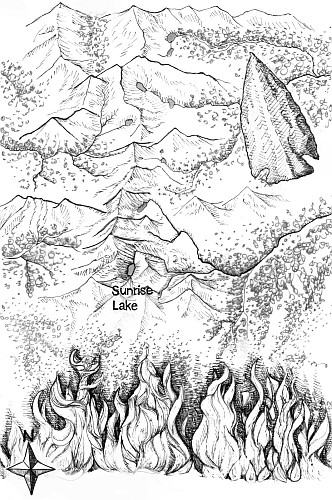
The first time I saw Lynx Vilden, I thought I had slipped into George R. R. Martin’s A Game of Thrones saga and had found myself north of the Wall, in the land of the wildlings. This was a few years back – August 2012 – and my partner, Nell, and I were backpacking on the eastern side of Washington’s Cascade Mountains, among the so-called Golden Lakes of the Sawtooth Ridge. During the previous two days we had encountered only one other person, a motorbiker who startled us one morning as he tore through the trails of the national forest. Besides that, the place was ours. So it was a surprise that evening when – as we played cards near the edge of Sunrise Lake – Nell grabbed my arm, hissed “Look over there,” and pointed to a lone figure moving along the lakeshore.
In the dusk light it was hard to tell whether it was man or woman. The getup didn’t help. The person was clothed all in buckskin: buckskin breeches and a buckskin jacket with a fur-trimmed hood pulled over the head. A long, thin knife in a leather sheath hung off a leather belt. A fishing pole was in his – or her – right hand. The figure moved quickly and stealthily through the trees. And then it was gone, disappeared into the shadows. Around the fire that night, Nell and I played the scene over and over. Who could it be? Were there other deerskin-clad strangers out there in the woods? But we saw no other signs of people – no campfire in the distance, no voices in the dark.
The next morning, after a somewhat restless sleep, the mystery partly resolved itself. While I made breakfast, Nell decided to scout around the lake, on the pretense that she was off for a bowel movement. I was having my first sip of coffee in the glow of the early sun when I saw her running down the slopes of purple lupine. As she reached our camp she said, “They’re making traps.”
Nell had crept through the larch groves until she came to a shelf of rock tucked into the mountainside and thought, If I lived up here, this is where I would be. Right then, coming over a small rise, she saw a man sitting next to a fire circle. His back was toward her, but she could see that he was hunched over some kind of assemblage of wood and fiber, crafting or repairing it. He was wearing a big black vest that looked to be made of bear fur. He had long, black dreadlocks.
Nell was telling me all of this when two people appeared down at the water’s edge: the person from the evening before with the fur-trimmed hood, now clearly a woman, and another woman, dressed in a buckskin blouse and buckskin skirt. I had to learn more and so I headed over to talk with them.
I’ve always found the etiquette of the backcountry to be a little tricky. To be sure, you want to be friendly to strangers on the trail. At the same time, few people go into the wilderness for chitchat, and it’s best to give folks their space. A plain “Good Morning” is usually enough, and that’s what I said as I strolled up to the pair.
The woman we had spotted at lakeshore at dusk seemed like she had spent a lot of time in the wild. Her corn-silk hair was pulled back into thin, blonde braids, and there were deep creases around her brilliant, blue eyes. She was sharp-featured, with a hawk’s nose, and the skin on her hands and face was weathered and tanned. She had on a pair of well-worn hide sandals. She looked tough.
She asked me my name and I told her. “I’m Lynx,” she said. The plot thickened: her voice had an unmistakable English accent.
We made small talk. Lynx asked how long we were out for. Just three days, I said. I asked how long they were out for. Three weeks, she answered. The whole time, the other woman just stared at me coldly. She was barefoot, her feet as hard and sooty as charcoal, and I got the sense that my mere presence was offensive. I found myself suddenly self-conscious about my modern gear – my polyester long johns and camp sandals, my Patagonia outershell and wool cap. I felt kind of like a faker.
Curiosity was killing me, but I didn’t want to be too nosey, so I wished them good luck. The friendly Lynx said the same, and I went back to the cup of coffee waiting for me at our tent site.
Not more than ten minutes later we saw the trio getting ready to leave. The man in the bearskin vest and the barefoot woman were wearing on their backs large wooden baskets stuffed with buffalo- skin bedrolls. Lynx had a small fur-and-leather pack no bigger than a breadbox. There couldn’t be much more in there than some dried meat, I recall thinking.
Just before they tramped off down the trail, Lynx came over to talk with Nell. I was washing the breakfast dishes down at the water, and missed the exchange. I came back to camp and asked what they had talked about. Nell said I wouldn’t believe it. They wanted batteries – AA batteries. They needed them for their digital camera.
“The Stone Age Living Project” is the name for the scene Nell and I had stumbled upon. Lynx Vilden wasn’t that hard to track down. Her Internet tail is long, including a pretty nice personal website, www.lynxvilden.com. She’s something of a rock star in what is sometimes referred to as “the ancestral skills” community. She travels around the world – from ancient cave sites in the south of France to the deserts of Africa – conducting trainings in primitive technologies. Her Paleolithic repertoire includes bow making and trap construction, hunting, animal processing, hide tanning, wild-plant foraging, making tools out of stone and bone, and fire starting, among many other skills and crafts.
She has been at this a long time. Lynx was born in London in 1965, a time when, as she would tell me later, “being a little girl in England meant staying clean and looking pretty.” Her instincts pointed in a different direction – toward “going out and playing in the woods and getting dirty.” She divided her time between her father and stepmother, who were salespeople for a company that made plastic cutlery, and her mother and stepfather, who were artists. (Her stepfather was principal of the prestigious Saint Martin’s School of Art.) Lynx took the artist’s path. She went to theater school, where she majored in choreography. She dove into the punk scene, and spent three years in Amsterdam partying hard because “what the hell, the world was going to explode anyway.”
Eventually she realized that she was “killing myself faster than I wanted to.” During a visit to her grandmother’s place in Sweden her life changed. Amid the wildness of the Nordic woods she realized that she didn’t need to drink and use drugs. “The forest saved my life,” she says.
Lynx (I never asked for her given name) came to the States, where she fell in love with the American wilderness and with an American man, with whom she had a daughter. She was drawn irresistibly to the wildest places. But, as she told me, she was “lazy, really,” and didn’t like carrying all of the weight required for a long trek into the backcountry. She figured she could lighten her load if she could find her own food, and she began studying hunting and wild foraging. In 1990 she made her first fire using a bow drill. “I found my passion at the tender age of twenty-four – and that’s my story,” she told me.
She has lived in wildlands ever since. For close to a decade she and her daughter lived in New Mexico, in the Taos area. Their place was an eight-mile hike from the nearest road. Eventually her daughter (who had grown up with squirrel-skin finger puppets for toys) said she wanted a “normal life” and moved to Seattle to be with her father. Lynx followed her to Washington and found a place alongside the Twisp River, right at the edge of the vast Okanogan-Wenatchee National Forest on the eastern slope of the Cascade Mountains.
Today, Lynx’s small patch of woods is the home of the Living Wild School, whose motto is “We’d rather live in the wild than survive in civilization.” The property serves as the base camp where she and others spend a season getting ready for their weeks-long, late-summer trip into the wilderness equipped only with Stone Age clothes, tools, and foods. “The Project” is how Lynx and the other wildlings refer to their experiment in fully primitive living. “After four months preparing, we go time-traveling,” Lynx likes to say. That bizarre morning on Sunrise Lake, Nell and I had happened upon the eighth annual Project.
In case you missed it, the primitive is having a comeback moment. Many people swear by the “Paleo diet” – which means lots of meat, nuts, and fruits, and no processed grains or oil – supposedly what our hunter-gatherer ancestors would have eaten. There’s a Paleo Magazine dedicated to “modern-day primal living.” Cable TV is chock-full of survivalist “reality shows.” Surf the channels and you’ll find Survivorman, Dual Survival, Naked and Afraid, Live Free or Die, and Ultimate Survival Alaska. There’s even a show on the Weather Channel titled Fat Guys in the Woods. Lynx told me that a month doesn’t go by without her receiving a pitch from a TV producer to do some kind of survival show. She refuses because “it’s not anything about cooperation, which is what we need. It’s a competitive thing that they’re putting out.”
There is, of course, a long modern tradition of fetishizing the primitive. It started with the Rousseauian celebration of the Noble Savage, continued through James Fennimore Cooper’s Leatherstocking Tales, and reached something of a climax as Teddy Roosevelt celebrated “the strenuous life.” At the height of the early-twentieth-century primitivist fad, a guy named Joseph Knowles became a national celebrity after venturing nearly naked into the Maine woods and living off the land for months. His dispatches from the wild – written in charcoal on pieces of birch bark – were a media sensation. (Knowles was later accused of being a fraud.)
We moderns have some deep desire to reconnect to the raw and the primal. We yearn for the wild. We want to be assured that it still exists, and we want to experience it – even if that means vicariously through our TV sets. The fascination with the primitive is evidence of how we are all suffering from what environmental journalist George Monbiot calls “ecological boredom.” Numbed by the human landscapes of the suburb and the city, we’re hungry for some taste of a more visceral, more intense way of living. We want to be reminded that there’s a wilder world somewhere out there.
At first, the Stone Age Living Project’s radical atavism just seemed like the thirst for the wild taken to the extreme. I thought of it as the backcountry version of Civil War reenactments – weekend warriors playacting as cavepeople in the woods. Who are these people? I wondered. And what are they hoping to accomplish?
As I learned more, I discovered that Lynx was part of something much bigger and much deeper. Across the United States there is a loose network of primitivists dedicated to keeping alive some glimmer of the old ways. It’s an underground movement of modern-day nomads and hunter-gatherers. I heard of a couple – Moira and Ray – who wander the national forests and BLM lands with a herd of goats that provide them with meat, milk, and portage. I learned of a similar nomadic goat herder, Cannon, who moves from the Arizona high desert to the low desert with the rhythm of the seasons, consuming more than a gallon of goat milk a day as he goes. I was told stories about Finisia (Fin) Medrano, who follows old Shoshone routes through the Great Basin by horseback and covered wagon. From New Mexico to Washington to California, I kept hearing tales of a guy named “Barefoot Doug” who had spent years living in the wilderness, much of it – yes, you guessed it – buck naked.
There are regular meetings of such folks, a “gathering of the tribes,” if you will, when the primitivists come together to trade skills and hone their ancestral crafts. Rabbit Stick in Idaho is the oldest. There’s an annual camp outside of Phoenix called Winter Count, and an annual spring convergence in California called the Buckeye Gathering. Down the road from Lynx’s place occurs a fall gathering, the Saskatoon Circle.
Primal living, Lynx and others believe, is a way in which to encourage an ethic of ecological responsibility. “We’ve got to get to know the earth again,” Lynx would tell me when, in a private conservation, I asked what, exactly, she was hoping to accomplish. “We can’t really get to know her if we’re always behind walls and beneath roofs and above floors, you know. I think if people could actually take off their shoes and feel the earth, sleep on the ground and feel the energy, be outside and feel the weather, eat from her – just to get to know her. It’s kind of like, imagine if you get to know a new person, you’re much more likely to take care of and protect that person.”
Creating that kind emotional connection is more likely to be long-lasting, Lynx believes, if it’s unmediated by modern technology. “I love it when people get that sense of awe and wonder. When you become a part of your environment, and if that environment is wild, then you become wild.” Rediscovering the oldest lifeways is a path through which to resolve the ancient tensions between wild nature and human culture and technology. Going primal is a way to prove that people aren’t separate from nature. “Why can’t we think we’re of the wild?” Lynx said. “Trying to get our niche back in the web of connectivity – that’s something to strive for.”
There are, of course, some human societies that have managed to remain (out of sheer isolation or out of choice) more or less in the Stone Age: hunter-gatherer tribes in the depths of the Amazon rainforest or the hinterlands of Papua New Guinea. Lynx’s Stone Age Living Project represents something unprecedented – a return to the Paleolithic past from the Anthropocene present. Against all the currents of history, Lynx and the wildlings are attempting to explore whether it’s possible for modern people to capture something from the primeval, bring it back to the present, and see if it can change our modern frame of mind. Epochnauts, I guess you could call them. The endeavor is every bit as ambitious – and every bit as vexed – as the campaign to reintroduce wolves to the Gila. It’s nothing less than an attempt at human rewilding.
When I contacted Lynx the spring after running into her in the mountains, I was hoping that I would be able to accompany her on one of the Stone Age excursions. Lynx quickly disabused me of the fantasy. If I wanted to go on “the Project,” she informed me via e-mail, I would have to participate in her four-month-long immersion course. That’s the time it takes to make your own clothes and tools and gather and dry your own food, all of it Paleolithic style.
Unfortunately, I didn’t have time for that kind of commitment. I would have to settle for Lynx’s Basic Skills Class, a one-week crash course in the elementals of primitive living that she teaches at her property, located about ten miles upriver from a town called Twisp. And so, on a September day, I found myself driving through the dramatic mountain passes of the North Cascades in a beat-up GMC Suburban that had been modified to run on veggie oil. The beast of a vehicle – nicknamed “Falcor” – was owned by a primitive skills enthusiast, Jamie, who had just finished a stint teaching at Alderleaf Wilderness College, a survival school not far from Seattle. She had a handmade bow in the back and a deer-hunting license she was eager to use. Her gray-green Carhartt pants were as much patches as original fabric. Before heading over the mountains, Jamie and I picked up a few other classmates. Craig and Sherie were a couple from Australia, where Craig teaches something called “natural movement” that combines martial arts, tai chi, and gymnastics. Also in our carpool was Shauna, a part-time yoga teacher and part-time gardener from Vancouver, British Columbia.
The other course participants would turn out to be just as eclectic. Charles was a long-haired troubadour (clarinetist, classical guitar player) from coastal Quebec who had hitchhiked his way across the continent to get to Twisp. Another Quebecois, Katherine (or Kat), had heard about Living Wild from a fellow employee at the natural-foods store in Ottawa where she works. There was a French-Spanish guy from Lyon – Eddyr – who was getting ready to spend the year with Lynx in preparation for the 2015 Stone Age Project. (Thanks to a 2013 documentary that aired on French TV, Lynx is big in the Francophone world.) A fifty-something fellow named Sylvan was also getting ready to spend a year at Living Wild; in an earlier chapter of his life, he had spent fourteen years at an ashram in Virginia. Rounding out the group was Willa, a twenty-one-year-old from New York City who skipped college to pursue an education in ancestral skills and who had recently completed a year at a survival school in Wisconsin called Teaching Drum. She had lost her bag on Greyhound, but she came well equipped with loads of crazy stories about surviving off of squirrel, raccoon, and opossum. “I can always tell someone who has done Teaching Drum,” Lynx said one night over supper. “They’re always hungry.”
Lynx’s place was a sight. Her scant three-acre parcel was scattered with all sorts of primitive shelters in various states of construction. Here, a hand-built lean-to made of logs and pine needles. There, a tent cabin and a yurt. Many of the shelters consisted of little more than a tarp slung on a line between trees and anchored by shipping pallets. Skins hung from tree branches. Hides were stretched over logs.
As we arrived, we were greeted by some of the long-timers who had spent the summer (or, in a few cases, longer) living with and learning from Lynx and then going on the 2014 Project, which they had completed only a week earlier. A guy named Matt welcomed us. He was wearing the kind of tight, thigh-length shorts popular among hipsters in Oakland and Brooklyn – only they were made of deerskin. He had on a headband and a necklace with a black stone hung on a sinew cord, and nothing else. With his almond-shaped eyes, coppery skin, and chiseled chest, he was like a Pleistocene Adonis.
The women were just as attractive. I’ll admit, I had expected the women would be hairy and scary. But here were these rosy-cheeked and bright-eyed women, fresh-faced lasses from Ontario and Devonshire who had traveled halfway across the planet to explore a primal way of life. And in the middle of it all was Lynx. She was like a primitivist Pied Piper, a den mother in deerskins whose positive spirit (none of that Doomer and Prepper stuff for her) had attracted a clan of idealistic twenty- and thirty-somethings.
The low-impact, high-tech style of wilderness adventuring that involves lots of fancy gear has a reputation for being so expensive that it’s exclusive. I figured I would find much the same with this particular wilderness subculture; after all, it takes some measure of privilege to go into the woods for months on end to prepare for going totally Stone Age. But while some of those at Lynx’s camp did come from affluent families, most of them were from humble backgrounds. Long-timers Jane and Jessie had been working at a nature camp outside of Exeter, England, when they dropped everything for the Stone Age Living Project. Jane had been the camp cook, and it didn’t sound like the pair of friends came from a posh circle. Another long-timer, Emma, had been living at her parents’ house in Ottawa while working at a grocery (she was the one who spread the word to Kat). Eddyr had been involved in the Indignado protests of unemployed youth in Spain. He and Charles both seemed to be living hand-to-mouth.
Regardless of background, all of the wildlings and aspiring wildlings shared a certain alienation with the postmodern world and a gnawing curiosity about life before humans domesticated much of Earth. That first night we sat around the fire passing the “talking stick” from person to person and sharing our stories. At one point, one of the Englishwomen, brown-haired and green-eyed Jessie, said, “I really liked the idea that I would have nothing separating me from nature – no Gore-Tex, no metal knife. Those things are useful, but they’re also a buffer. I wanted a sense of immersion, to be more immersed than I’ve ever felt in the wild, or with nature. And I wanted that immersion with a tribe, or a clan. Going on that journey with other people was really important to me.”
Jessie said the experience of living entirely Stone Age had allowed her to see afresh civilization’s imprint on the natural world. It was as if a veil had been removed from her eyes. “Our impact was so much less heavy than it would be in the normal world, but it was so much more visible than it would be in our daily lives,” she said. “After a few days, we had beat a path between the shelter and the fire circle. Normally, you don’t see where the oil is mined. That was what it was for me – recognizing the impact we have and getting more comfortable with that. Living wild – it gives you a real, direct sense of what it means to be human.”
In the firelight, the stars bright and clear above, Lynx shared an entry from her 2014 Project journal (paper, pencil, and corrective eyewear being some of the few “modern exceptions” allowed). The passage had to do with the psychological vertigo some people experience while living fully Stone Age. Lynx read to us: “This land, this world away from the madness, brings up so much questioning and deep introspection. We act like society’s refugees. We are in shock, suddenly unable to function in this new land. Have patience. It will come.”
We were standing in a circle on a beach of smooth rocks at a bend in the Twisp River. Lynx was wearing buckskin breeches rolled at the cuffs and a fringed buckskin tunic that showed off her rope-muscled arms. There were curved, inch-long pieces of carved bone in her ears, and a beautifully wrought stone knife in a sheath hanging from her neck. She was barefoot.
“The great thing about learning from the earth is that we can be in communion with everything around us,” Lynx said. “Start looking around, and you probably see a bunch of rocks. But I see a mountain of treasure. Every one is special and beautiful and unique. They are precious for all different reasons. I barely know where to start. All of them, separate beings. There’s fire in some of these rocks – you can smell it.”
When she’s teaching, Lynx’s theater background is apparent. She’s a natural performer, with an actor’s hungry joy when hitting her lines – “a mountain of treasure,” as though she were reciting Robert Louis Stevenson. It was Day One of the Basic Skills Course. Our assignment was to gather the materials for a bow drill from what we could find on the river bend.
A bow drill is a tool for making fire – basically, a stick that is spun against a flat piece of wood until the friction creates enough heat to ignite some tinder. The tool consists of a bow into whose string you twist the spindle, aka the drill. The wooden drill spins against another piece of wood, a flat one called the baseboard that sits on the ground. To keep the spindle straight you use a handhold called the socket, usually made from bone or stone. By sawing the bow back and forth you can create enough heat between the spindle and the baseboard to “birth a coal.”
Lynx suggested pliable willow for the bow. A piece of alder would be a serviceable baseboard. Red-osier dogwood makes an excellent drill. Before sawing off a demonstration willow whip with her stone knife, Lynx bowed slightly to the plant and said, “Excuse me.” When she had her bow piece in hand, she said “Thank you” to the willow and turned with a nod, her perfect London manners matched to an old-fashioned Native American courtesy.
For a socket she suggested one of the thousands of rocks scattered along the riverbank. Soon the ten of us were spread out on the beach, each bent over a pile of rocks. We spent the next hour or more tapping, pounding, knocking, scraping, and sanding our rocks to hollow out a thumb-sized divot in which to turn our spindles. To the rifle-toting deer hunters drinking beer just downriver, it must have sounded like a Stone Age sweatshop.
We hiked the short mile back to Lynx’s place, through the pasture where she grazes her three horses. Once back at the main camp, she showed us how to splice deer sinew to make the string for the bow, and we finished the day making cordage. As I twisted the helix of the cord – the sinew literally wrapping itself around itself – I thought of Milo Yellowhair, how he told me that all things work in cycles, circles within circles.
Day Two opened with storytelling by Lynx. Striking a thespian pose, she got down on one knee in a fire-starting position and as she sawed away on her bow drill she started to tell us the story of “Rainbow Crow,” a myth from the Chelan people (a mountain Salish tribe) about how humans came to tame fire. She began: “A long time ago, when the world was first new … it was the humans that suffered, because they had no clothes yet, they had no fur, and they would get cold. Well, back in those days, the animals and the birds didn’t fight with the humans, they actually had sympathy.” And so the animals and the birds who saw the People suffering from cold tried to help the People by bringing them fire.
First, Eagle, so big and strong, tried to fly to the sun and return with an ember for the People. “And he flew and he flew until his feathers started to smoke, and he got tired, and he came back and said, ‘It’s too far. I’m sorry. I can’t bring fire back to the People.” And as Lynx said this, her spindle popped out of her baseboard. Next, Hummingbird, so very fast, volunteered to make an attempt for the sun. “And she flew, and disappeared quite soon, she was so small, and her little feathers started to smoke, but she didn’t turn back, she carried on going, closer and closer toward the sun, and finally she, too, became too tired, and came back down.” As Hummingbird failed, Lynx’s spindle came flying out from the string just as the baseboard began to smolder. Finally, a bird with the most amazing plumage and voice stepped forward – it was Rainbow Crow. She flew to the sun through the heat and fire. “She didn’t stop. She carried on going toward the sun, until she was able to reach the sun, and take a tiny little spark from the sun, and she brought it in her beak back down to the People.” But the success involved a sacrifice: Rainbow Crow’s feathers were singed black and her once-beautiful voice had turned into a raspy croak.
As Rainbow Crow succeeded in the mission to the sun, Lynx’s coal caught. She carefully dropped the red nugget into a nest of cedar bark, where it smoked, and then, with a few puffs of breath, caught into orange flame.
Next it was our turn. While Lynx had made fire-starting look effortless, I quickly learned that, for a novice, it was anything except easy. I tried again and again, but couldn’t get it to work. My spindle wouldn’t stay in the socket, and I had to go back and tap out a deeper hole. When I did get the drill to spin, I lost energy before I could get the smoking wood to form a coal. Soon enough the notch in my alder baseboard was deep and polished black, yet I still didn’t have a fire.
My classmates were having an easier time of it. Charles quickly birthed a coal. Then the two Aussies nailed it. Soon after lunch Kat and Shauna both turned coals into fire. But as the afternoon wore on I was still sawing away, and beginning to feel like something of a Paleo failure.
Sometime around my fiftieth unsuccessful attempt, it hit me: this was one of my wildest adventures ever, and it was by far the most Promethean.
A celebration of human ingenuity, I was coming to understand, is at the center of Lynx’s efforts. She is awed by our ability to reshape the immediate world around us. “Homo sapiens – what does it mean?” she said the first day on the beach. “Man the toolmaker. We don’t have claws or teeth, so we had to develop something to have an advantage. And that advantage is tool making.”
Embracing the essential human gift of inventiveness is at the core of the Living Wild experience. It’s not a school for wilderness survival – it’s an attempt at cultural revival, the long-lost culture of living close to the land. And, even more radically, it’s an effort to illustrate that, for most of human existence, wild nature and human culture didn’t feel so separate, for the simple reason that our earliest technologies were birthed straight from the raw earth. By returning to the Paleolithic, Lynx wants to show, we can resolve the Edenic rupture that split humanity from the wild. We can become native with nature once more.
The erasure of the boundary between technology and wild nature was one of the most head-spinning elements of the Project, according to Lynx’s long-timers. Surrounded by only stone and bone and wood, it was difficult to tell where human invention ended and where “Nature” began. As Jessie said, “Just the aesthetic of looking at my friends and not seeing anything unnatural – there was nothing to take away from the experience.” Matt told me: “I felt like I was much more part of the land.” This merger between self and wilderness occurred – not by “leaving no trace,” as the modern backpacker code of ethics goes – but instead by using intelligence to refashion the elements. To live wild meant embracing human creativity: the sheer awesomeness of stripping tools out of stone and coaxing fire from wood.
The wildlings were just as much in love with their handmade creations as a gearhead who adores her GPS gizmos. Our second night at the fire, Jessie talked passionately about her relationship with the tools and clothes she had created. Tanning, she said, “is like alchemy. You take a dirty, smelly hide, surrounded by flies, and you turn it into something beautiful.” While she said this she fingered the hem of her charcoal-stained buckskin skirt as if it were the finest silk.
Lynx’s efforts at cultural restoration go beyond fire starting and knife making. She is just as interested in the ancient human arts of community. Every night after dinner we gathered for songs or stories, either around the fire where we cooked and ate or in the “Fire Lodge,” a simple but handsome, cedar-shingled octagon pavilion. Lynx uses the fire circle like a portal to the past, to see what we can retrieve from a time when face-to-face contact over a flame was the most important mode of communication.
That second night the women from Devonshire taught us a traditional English folk tune. It was a lilting melody, reminiscent of the rolling landscape of the British Isles. Together we sang:
Home, I’m going home
I need the land to feed my soul
Take me home Take me home
Over the green, green hills
And far away
Later, as I went to sleep with the song wedged firmly in my mind, I thought once more of the Lakota, and of longing, and of how our home on the land now feels “far away.” Although we may strive to return to a homeland in wild nature, it’s easier said than done.
The point was reinforced the next night – the third of the course – as I stayed up late talking around the fire with Matt, Shauna, Kat, and Jessie. Matt was telling us about the challenges of the Project, about how far we are from the knowledge of the deep past. “No matter where you go, you’re still you,” he said. “We can go into the wild wearing skins, but we’re still us, with all of our modern baggage.”
The Project had tested, in a very harsh way, the wildlings’ willingness to cast off that baggage, especially our society’s instinct for control. It had been a summer of brutal fires in the Eastern Cascades, as fires tore through 265,000 acres of forest in the surrounding hills, destroying nearly 300 homes. Lynx and her crew had been preparing to set off into the wilderness just as the fires were at their most intense, and some members of the clan were unsure whether it made sense to go. “My civilized mind was freaked out: This is ridiculous. This is not safe,” Jessie said she remembered thinking. “The smoke was all around, and we didn’t know where the fires were. The disasters were conspiring to test how committed we were to going out.”
For much of their time in the wilderness, the group was surrounded by great plumes of smoke rising up the shoulders of the mountains. The days were filled with haze, the evenings edged with an apocalyptic glow. Their lungs began to hurt. It felt, Lynx said, like being “an island in a sea of smoke while a lower world burned.” Sitting around the campfire telling us about all of this, Jessie said, “Rewilding humans is much more difficult than I thought. Because my whole brain, my whole mind, is domesticated … We still have what Jane and I called ‘Brain Radio.’ We were wearing buckskin out in the woods, but Brittany Spears was pumping in my head.”
Everyone drifted to their shelters or tents, but I stayed up, watching the flames. I was about to head to bed myself when Willa came running into the firelight. Awkward Willa, with her mop of hair and her big, square glasses, her once-white oxford shirt dusted with so much dirt and ash that it almost matched her khaki pants. We got to talking, and I asked about her story. She told me she was raised by vegetarians in Carroll Gardens, Brooklyn. She said she had often felt disconnected and alienated when she was growing up. Then in high school she had discovered Radiohead, and it made her feel less alone.
I had noticed she had a beautiful singing voice, and I asked if she knew any Radiohead songs well enough to sing. I’m a big Radio- head fan myself, and I suggested “Fake Plastic Trees” from The Bends or “Optimistic” from Kid A. She picked “The Gloaming,” a track from Hail to the Thief.
It’s a dark, electronic dirge, a postmodern epitaph for the waning hours of industrial civilization. In its frightful way, it felt like a more appropriate campfire song for this Human Age than some old folk tune.
I began to tap out a rhythm on my water bottle. With the yellow light of the flames flickering on her face, Willa sang alone in a low, haunting voice. The song, in part, goes like this:
Genie let out of the bottle
It is now the witching hour
Genie let out of the bottle
It is now the witching hour
…
They will suck you down to the other side
They will suck you down to the other side
They will suck you down to the other side
They will suck you down to the other side
To the shadows blue and red, shadows blue and red
Your alarm bells, your alarm bells
Shadows blue and red, shadows blue and red
Your alarm bell, your alarm bell
They should be ringing
They should be ringing
They should be ringing
They should be ringing
…
This is the gloaming.
“We learned to manipulate the Earth,” Lynx said the first day on the banks of the Twisp River, “and we learned to manipulate the world to such a degree that we’re on the verge of making it uninhabitable for ourselves and for other creatures. And it all started with sticks and stones.”
Or, in brief: our fires have gotten away from us. Nearly every technology is a double-edged sword that comes equipped with benefits as well as risks. The most obvious example is, of course, the twisted connection between energy and climate change. Abundant energy is a modern miracle, the very lifeblood of our society. And yet, as we know, when we figured out how to burn coal and dig up oil we ignited what is now a global conflagration. We are, indeed as Lynx said, “man the toolmaker.” But sometimes those tools can backfire.
The wild is supposed to be a refuge from such worries. The legally designated wilderness is an attempt to keep some places free from the dominance of human technologies. As I’ve noted, it’s an imperfect arrangement: a wilderness boundary can’t keep a wolf in, nor contain a wildfire, nor hold global warming at bay. But wilderness can still keep an engine out. If wilderness remains significant at all, it’s because of the bright line that says, No motor shall pass here. In the wild, if nowhere else, the size of space still matters. By forcing us to negotiate the land by horseback or on foot, the wilderness restores distance and scale. On the trail, a mile is made meaningful once more.
Now, however, this core function of wilderness is at risk from some of our newest inventions. The awesome telecommunications tools of cell phone and satellite easily vault over mountains and rivers. Our information technologies pose a uniquely twenty-first-century danger to the integrity of the wild as the latest leaps in technology threaten to shrink the mental space provided by wilderness.
Exhibit A: Google is busy making plans for what has been called “universal connectivity.” The information technology giant is expected to spend between $1 billion and $3 billion to deploy a fleet of 180 mini-satellites that will provide an Internet signal from the sky. The satellite connection may be augmented by high-altitude balloons and/or solar-powered drones supplying high-speed, broadband service. Someday soon, all of Earth might be a wi-fi hotspot. You’ll be able to check your e-mail and update your status from the farthest reaches of the bush.
Google is also engaged in an ambitious effort to photo-map some of the world’s most remote places, including wilderness areas. In the spring of 2014, the company unveiled “Google Treks,” an extension of its popular Street View program. As part of its “quest to map the Earth,” Google has sent explorers to Australia’s Great Barrier Reef, the Galapagos Islands, and Volcanoes National Park in Hawaii equipped with backpack-mounted, 360-degree, fifteen-lens arrays to photograph remote scenes. Thanks to Google, you can now raft through the bottom of the Grand Canyon and travel the “road to nowhere” in the Canadian Arctic without leaving the comfort of your laptop.
Perhaps these are modest, well-meaning domestications. Universal connectivity could provide Internet access to billions of people who have never experienced its promise. Photo-mapping the wilderness might provide biologists with important data, or give disabled people the chance to see places they otherwise never could. But make no mistake: those technological aspirations are domestications nonetheless. It’s a kind of taming by ones and zeroes that threatens to make wilderness obsolete.
Every generation has its own peculiar anxieties about technology. The twentieth-century wilderness movement of Aldo Leopold and Howard Zahniser was a reaction to the rise of the automobile. And I’ll bet that when the first telephone was installed in Yosemite Valley, someone called it a sacrilege. Each generation’s complaints about technology eventually seem quaint to its successors, and I’m sure that when every backpacker is wearing some kind of computer embedded on wrist or forehead, my rant here will be a charming anachronism.
Still, the impacts of today’s inventions are different from those of past generations, if only because the velocity of inventiveness has increased. Thanks to Moore’s Law (which says that computational power doubles roughly every two years), future shock is now a chronic condition; the technological baseline shifts every time Apple comes out with a new gadget. To understand how quickly technological change is occurring, consider this: we have just barely started to wrap our mind around the Age of Man, and already some Silicon Valley seers are trumpeting the impending arrival of the “post-human” era. Some futurists predict that we will soon meld the hardware of the human body with digital software to create augmented (or “improved”) humans and, in the process, make a leap forward to a species beyond Homo sapiens. Other futurists imagine something even more grandiose: supposedly, by the middle of this century we will arrive at what has been called “The Singularity” as we begin to upload individual consciousness into computers to achieve a godlike omniscience and immortality.
These techno-utopian fantasies should not be dismissed or underestimated. Some of the smartest minds in America are hard at work making them into reality. To me they reek of insanity. If we ever do achieve the everlasting life of synthetic intelligence, it will mark the final, perhaps irrevocable, departure from our birthplace in nature. At that point, it won’t even matter whether Earth is still habitable for humans – we’ll no longer live here. We’ll be residing somewhere in the mainframe.
If there’s any antidote to the fever dreams of those working for a cyborg future, it seems to me that it resides in the plain old embodiment offered by close contact with the wild. I think you know what I mean, the feeling of wind on skin, of icy ground underfoot, of a hard rain coming down. The visceral experience of wild nature – its implacable physicality – acts like a splash of cold water to the face, bringing us back to our five senses.
In the wilderness, forced to grapple with the uncompromising elements, we are sometimes reminded of original meanings. A web, for example, is something you get stuck in. A net is designed to catch and capture.
Once again around the fire, sharing stories in the dark. Matt was telling us about an experience he had while “on Project.” He’s the kind of guy who speaks carefully, each thought measured. As he talks he sometimes waves his hands back and forth, as if he were swimming through his words as they leave his mouth.
“One day, I was walking, just wearing a loincloth. On instinct I started to follow the curve of land. And I came to this beautiful waterfall, and I climbed up around it, and came to this small, grassy meadow that you could only reach from one direction. It was perched above this lake. At the edge of the meadow there was a field of boulders, rising into a massive wall of stone.
“A small stream ran through the meadow, curving back and forth. I knelt and put my face in the stream. And it was like I touched something ancient. There are no words for it.”
The wild does, indeed, resist definition. I’ve walked hundreds of miles over mountains and through canyons and across forests and deserts trying get closer to whatever that ineffable essence of wildness is. And I’ve kept on walking because – I guess like Lynx, Matt, and Jessie – I believe that in wildness resides a vitality missing from our domesticated lives.
A gardener quickly learns about wild vigor. My years at Alemany Farm – three and a half hand-worked acres and never enough bodies – showed how insistently the wild edges back. If I neglected a plot for a season, the next thing I knew I’d have a patch full of weeds. Clinging purslane or deep-rooted malva (both edible “weeds”) easily overwhelm a row of rouge d’hiver lettuce. Without yearly tending, the footpaths between the vegetable beds get tangled with morning glory.
“Nature has a place for the wild Clematis as well as for the Cabbage,” Thoreau wrote in his “Walking” essay. She does. But if you’re not careful about keeping some space between the two in your dooryard garden (probably via a hell of a lot of pruning), that clematis will quickly vine around your cabbages and choke them to death. There’s simply something tougher about wild things. A wild mustang is craftier than a horse that has been – I’ve always hated this expression – “broken.” A coyote is wilier than your average dog. I’ve kept chickens, and I’ve been grateful for the years of eggs and (eventually) weeks of soup they fed me. And I know that in intelligence and wit a barnyard hen is no match for a scrub jay.
Somewhere in the kernel of our consciousness we’ve always known that the wild has a unique power. How else to explain the many cautionary tales – Adam and Eve’s fall from grace and Prometheus’s heinous crime and the sadness embedded in the Epic of Gilgamesh – involving some kind of epic sundering of humans from wild nature? Even now, in the Human Age, our departure from the nomadic, hunter-gatherer way to the sedentary lifestyle of the farmer remains the biggest rupture in the human experience. The leap from the Paleolithic to the Neolithic changed our relationship to the rest of life like nothing else. In comparison, the much-celebrated move from the agrarian to the industrial (still under way in much of the world) just replaced the intimate drudgery of the farmyard with the alienated drudgery of the factory. And the transition from the industrial to the information age remains a work in progress; we still haven’t figured out how to substitute electronic bits for actual things. Few other inventions separated our species from wildness like the blade of the plow. Even a committed agrarian like Wes Jackson – founder of the Land Institute in Salinas, Kansas – speaks of agriculture as the first sin, the act that ended Eden.
Recent plant science confirms the insights of ancient myths. Researchers have found that as humans domesticated fruit and vegetables plants, we have bred much of the nutrition out of them. Over millennia, farmers selected for plant varieties that were less bitter and sweeter, while at the same time lower in fiber but higher in starch. That is, we bred for energy density, but at the expense of nutrients. The result? Spinach has seven times less phytonutrients than wild dandelion, phytonutrients being the compounds that health researchers believe are linked to lowering the risk of cancer, heart disease, diabetes, and dementia. Heirloom purple potatoes from Peru have twenty-eight times more beneficial anthocyanins than your typical russet potato. “Unwittingly, we have been stripping phytonutrients from our diet since we stopped foraging for wild plants some 10,000 years ago and became farmers,” according to Jo Robinson, author of the book Eating on the Wild Side: The Missing Link to Optimum Health.
I am unaware of similar science on wild meats versus farm-raised meat. But all the wildlings were convinced that there was something more – well, vital – about eating game. “Energetically, I think, there’s something that happens when you put wild foods in your body,” Lynx said. “I know that everything has an energy. If we feed ourselves with the energy of the wild, we’re putting the wild inside us.”
Matt told me, “There is something there in the wildness of that plant life or the life of that wild animal that makes me appreciate it so much more – if I am given the gift of its life for my sustenance. Maybe it’s just that appreciation. Maybe it’s the placebo effect. Or maybe it’s something real. To me it feels different to be eating that food. And it tastes very different. And it feels much more …” He struggled for words, then said, “More enriching. It feels more potent. More powerful, I guess.”
I admired the wildlings’ courage in pursuit of the primal. I, too, wanted to eat food that was more “potent.” I envied how feral they had become, how virile. But I was pretty sure I would never be able to follow them. Domestication is a habit of mind, and I’ll admit that although my aspirations might be bohemian, my impulses have always been bourgeois. Even in the middle of the wilderness, I like my creature comforts. I like my coffee and my lightweight, folding camp chair. I like the space fabrics that keep me warm and dry. I appreciate the modern magic of a lighter.
Still, when I think of all of the crap that I haul into the back-country, it makes me wonder: Who’s really playacting – Lynx or me? Because I know that all of the gear that gets me to paradise is dependent on depredations someplace else. The gas for the propane cook stove likely depends on fracking. Without a petrochemical plant somewhere, there’s no plastic to wrap the food in.
The Stone Age Living Project succeeds by showing how, through using only primitive tools in the wild, you could ease that cognitive dissonance. You could patch the age-old break between wild nature and human technology. But only for a short time. The experiment is just that – an experiment.
The open secret at Lynx’s place was that the 2014 Project had been, in some sense, a disappointment. Or, at the very least, a sobering wake-up call. The experience had revealed how impossible it is to “Live Wild” for any extended period of time. Yes, Stone Age living could soothe the tensions between wild nature and human culture, but only as a getaway.
Matt is a Brown University–trained engineer, and he referred to the Project as a “proof of concept,” one that illustrated the challenges of attempting to return to the Pleistocene. During their twenty-six days in the wilderness, the wildlings had never gotten close enough to a deer to take a shot with their handmade bows. They caught only a handful of fish using bone hooks. With the exception of foraged greens, all of their food had been gathered beforehand and carried with them. While the diet of dried buffalo meat, dried mushrooms, dried berries, and liberal dollops of preserved deer fat had felt filling, it was somehow less than fully nutritious. Many people complained that their stool was heavy and hard. Matt said he had never felt so weak and foggy-headed in his life.
“We could go out there and do it for a month – but we could not harvest enough food to sustain ourselves,” he told me. “That was a crux point. It was realizing we couldn’t sustain ourselves indefinitely. There was a clock ticking. At one point, Jessie said, ‘Is this vacation or is this life? If it’s vacation, it’s okay. But if this is life, we’re starving to death right now and we’ll all be dead in two to three weeks.”
Jessie later elaborated the point for me. “‘Living Wild’ is tricky, because out there we were dying, we were starving as a clan. And that was sad, because we weren’t living. We were visiting – and that was disappointing.”
None of this is news to Lynx. Having led the Project for ten years, she understands the contradictions of Stone Age living better than anyone. Lynx still has the self-deprecating vibe of the punk she once was, and she’s possessed of a healthy sense of irony (“a primitive girl’s handbag” is how she mockingly referred to one of her fur pouches). She is under no illusions about the limits of the Project, which is sustained in no small part by roadkill and hand-me-down hides donated by area hunters.
Lynx told me, “People hear about what we’re doing, or they see the pictures, and it looks very romantic – and it is. I’m absolutely a Romantic. But it’s also very real and very harsh and very unforgiving. And very challenging. And it’s not something that you can just jump into. The earth doesn’t give a shit if you die out there. Or, you’ll do a lot of damage out there. It has to be done conscientiously. Otherwise, we’ll have everyone going out and hunting and fishing and we’ll wreck the planet. We can’t all do this, because there’s too many of us.”
As everyone understood, the core problem of the Project was the need to be remote and apart from civilization. The only place where you can attempt to pull off Paleo is a place that’s also unfit for long-term human habitation – the alpine landscape of the high country. Alpine ecosystems are often areas that biologists call “depauperate.” That is, there’s not much wildlife there – or at least not much large wildlife, which is to say, game. Lynx summed up the predicament in one of her journal entries from the Project: “This high country is not a place for people to live. To journey through, to hunt, to pray on the bare, windy mountaintops close to the gods – yes. But not to live. The river valleys are the places for the people to live, where the roots and the berries and the fish and the deer are more abundant.” Her journal entry for that day closed with a lament for civilization: “What have we done? Forgive us. What have we done?”
What we’ve done is taken the best places for human homes. The wilderness conservation movement has been criticized for mostly protecting “rock and ice.” At first this alpine fetish was a Romantic hangover, but it soon became a political necessity: rugged, remote peaks were some of the only places remaining that hadn’t succumbed to human development. We built our cities in the areas endowed with the greatest natural wealth – New York City at the mouth of the great Hudson River, Seattle along the salmon-rich deltas of the Salish Sea, industrial centers ringing the shorelines of the Great Lakes. At the same time, we put our farms on top of the once-great plains. America’s tallgrass prairie is all but extinct, smothered under a carpet of corn. Across the continent, the most abundant places have all been paved or plowed.
This is the unresolvable dilemma of the Stone Age Living Project: the only spots where one can have the space to live wild are the places where there’s no food. And so the age-old script repeats itself – the nomads who are committed to hunting and gathering are pushed once again to the margins by civilization.
Lynx is working to address this challenge by securing a larger piece of land. She’s in talks with private landowners in Montana and New Mexico about using their property to go Stone Age for a longer period of time. She figures she needs at least 30,000 acres of wildlands. Someplace with sizeable populations of either elk or bison would be ideal. If she can secure such a site, she would like to attempt a yearlong Project with a clan of already-tested wildlings. She imagines that it would be the world’s first “Primitive Human Preserve.” If Lynx pulls it off, it would make for a tidy twist of history, finally fulfilling painter-conservationist George Catlin’s original North American preservation ideal of a land reserved both for animals and for people.
The Project would still be an experiment, an island of the Pleistocene in a sea of the postmodern Human Age. But it would be a major accomplishment nonetheless – a powerful bit of performance art that could tweak prevailing views about civilization’s relationship to wild nature. A Primitive Human Preserve would be a living reminder that “progress” does not move in one direction, and never has. There are no straight lines in nature, and progress is no different. Sometimes what we think of as technological progress also diminishes human well-being (think: chemical wonders vs. cancer). And often as not, social progress (that is, the expansion of human liberty) is random, shaped by stochastic disturbance, as ecologists would say. Many paths are available to us – trails that lead not necessarily backward, but sideways or at some unexpected angle. A Primitive Human Preserve would be a wilderness that’s not just a biological refuge, but also a last resort of the imagination. Keeping the wild is a way of leaving our options open to the unexpected twists of the future.
“Wilderness is a state of mind,” environmental historian Roderick Nash has written. The observation illustrates the importance of preserving the wilderness for civic reasons as well as ecological ones. At this point, to know that some lands remain outside the matrix – that we still have a true Away to which we can escape – is a necessity for political liberty.
Go back to the OED one last time. Wild: “not subject to restraint or regulation.” Also, “rebellious.”
As Gila-area hunting outfitter Brandon Gaudelli had reminded me, to be wild is to be free. Even in a mostly domesticated society, a dose of wildness – whether psychological or physical – is an essential condition for political freedom. Wilderness’s autonomy, its sheer self-will, frustrates the dictator and the king. So it has always been. The ancient Greeks’ wild Dionysian festivals were a time to flout convention. In Norman England, “the woods” were a place outside of the law. As the eminent ecological historian David Worster has observed: “Nature in its wilder state is a threat to authoritarian minds.”
The idea of the wild as an important ingredient of equality and freedom grew naturally in North America. Emerson, for one, understood the connection between wild nature and an open society. “In a good lord, there must first be a good animal,” he wrote in his Second Essays, “at least to the extent of yielding the incomparable advantage of animal spirits.” There’s an ecological awareness embedded in the line, a recognition that a healthy ecosystem is a republic without tyrants. There’s a suggestion of bio-mimicry, too, an encouragement for us to look to the elegant chaos of the untamed to order human affairs.
As his model, Emerson had not just the North Woods of New England, but also the vanishing example of Indigenous societies. When Europeans arrived in the imagined wilderness of the New World, one of the things that most amazed them was the egalitarianism of the societies they encountered. “Every man is free,” an explorer told an astonished British audience, discussing Indian life, and no person “has any right to deprive anyone of their freedom.” Even among the politically sophisticated Iroquois – famed for their multi-tribe constitution – there was no such thing as “a chief.” There were, to be sure, headmen and matriarchs, people who wielded great influence and gathered followers. There were taboos. But there was no compulsive authority. Decisions were made by the consensus of the council meeting, and no man could force another man to do something against his will. Such small-a anarchism – or, if you prefer, communal libertarianism – was a signature of pre-Columbian societies across North America, from the Cherokee to the Lakota to the Apache.
Many scholars argue that this model of political equality was among the most important trades of the Columbian Exchange. A living example of free and democratic human relations proved just as contagious as smallpox. Moving in the other direction, it infected the colonists and their cousins in Europe with new ideas about the political good. The wildness sparked at the Bastille in 1789 came, in part, by way of America.
In America the persistence of places beyond the ax and the plow has contributed to a culture of liberty. Freedom requires not just openness, but also capaciousness – a sense of the world as large and wide. The wild is a guarantor of liberty because it serves as an actual, physical escape. This ability to get away has been an essential part of the American experience. In US history the wilderness has been a last resort for the apostate, the nonconformist, and the fugitive slave. Empty, wild country gave Crazy Horse a place to go off alone and find the vision to lead his people.
The mid-twentieth-century minds behind the American conservation movement instinctively understood the relationship between wildness and freedom, having just witnessed the totalitarian horrors of the Second World War. In his “wilderness letter,” Wallace Stegner wrote: “If the abstract dream of human liberty and human dignity became, in America, something more than an abstract dream, mark it down at least partially to the fact that we were in subtle ways subdued by what we conquered.” Which is a poetic way of saying that the wilderness changed us. The open vistas of wild spaces helped mold the American spirit of fierce independence by providing us with what Stegner called “the geography of hope.”
That anarcho-wildman Edward Abbey made the point forcefully, writing: “We cannot have freedom without wilderness, we cannot have freedom without leagues of open space beyond the cities, where boys and girls, men and women, can live at least part of their lives under no control but their own desires and abilities, free from any and all direct administration by their fellow men.”
Here now in Anthropocene – all-encompassing and all-consuming and, therefore, with a totalitarian vibe about it – the wild’s civic value may be its most important virtue. As a political necessity, we need to keep some places outside the reach of our awesome new technologies.
Big Data in the backcountry? No thanks. Wi-fi in the Woods? I think I’ll pass. Because if we ever succeed in knitting all (or even most) of the physical world into the Internet, we could end up abolishing the sense of the Away. And we need the Away, as a political good as well as a psychological one.
Our Human Age is characterized not just by human omnipotence, but also by our civilization’s attempts at omniscience and omnipresence. Certain cultural values are embedded in every technology: the assembly line is about efficiency and uniformity, the automobile expresses the desire to conquer distance. If there is any cultural value inherent in the Internet, it’s the wish to see and know everything. We are almost everywhere, what with our constant connectivity and our Google Trek. But our amazing information and communication technologies threaten a kind of digital enclosure that is every bit as inimical to freedom as the enclosure movement centuries ago in Europe that pushed peasants off the land. The litany of incursions into our private lives is all too familiar: thousands of cameras mounted throughout our cities, real-time tracking of our cell phones’ locations, government sweeps of e-mail, corporate monitoring of every web search and credit card purchase. It’s not an exaggeration to say that, in our digital lives at least, we’re living in the Panopticon.
I’ll admit that, in some ways, omniscience is pretty awesome; I like as much as anyone being able to Google, say, the population of Reykjavik. Omniscience, however, doesn’t jibe with the essence of wilderness – a place still governed by mystery and wonder. The wild is unknowable, if only because most of the action there passes unseen. Or, as the Lakota would say, the wild is wakan – incomprehensible.
We need to defend the wild, then, because in an otherwise programmed and micromanaged society, it remains one of the last bastions of unpredictability. For now, the wild remains an oasis of anonymity in a world in which we are constantly tagged, pegged, and followed with digital breadcrumbs. In this era of NSA’s PRISM and the constant tracking of Big Data, having a few places that are disconnected and unmonitored seems more valuable than ever. And so, among its many other tasks, the twenty-first-century conservation movement will have to commit to maintaining the wilderness offline, as a place where citizens can walk unwatched.
The wildlings at Lynx’s camp understand this better than anyone. When I asked why she had spent a year at Living Wild learning ancestral skills, a woman named Epona told me, “I wanted freedom. I wanted to stay sovereign. And the only way I could do that was to go to the wildlands, the last public domain.” She was wearing long black earrings made out of buffalo hair and cooking her supper over an open fire. A raccoon pelt was hanging in a nearby tree. She said, “If I can make my own gear, I am more sovereign.” Sovereign – that is, the ruler of herself.
Thoreau understood all of this back when the telegraph and the railroad were novelties. “Walking” begins: “I wish to speak a word for Nature, for absolute freedom and wildness,” as I can’t help but emphasize. The essay, remember, is a celebration of the saunter – to stroll without destination or direction. To have the space to saunter is to be free.
When I think about the wilderness as a civic good, Thoreau’s famous dictum – “in wildness is the preservation of the world” – takes on yet another layer of meaning. Perhaps it was not written by Thoreau the naturalist or Thoreau the poet. Perhaps instead it was written by Thoreau the tax-resister, the political philosopher, the dissident.
I finally got a fire started by rubbing two sticks together. It was a wet, cold morning, and we were huddled in the Fire Lodge, eager for warmth. Each of us was working a bow drill or hand drill and trying to birth a coal when mine caught first. It felt great watching the flick of the flames, like I had cracked some ancient code.
We spent the rest of the day making knives or needles and sheaths or purses out of the bone and skin of deer forelegs. This was to be our final lesson of the course. In the days since the fire-starting instruction, we had learned the basics of primitive shelter building, glue making from pine pitch and deer hide, as well as how to set a deadfall. (We caught one mouse and one chipmunk, which together made about half a meal.) A whole day was given over to instruction about foraging medicinal and edible plants in the Eastern Cascade ecosystem. On the last night together we had a celebratory wildfoods supper of venison steaks, a mallow and dandelion and nasturtium salad, hawthorn berry cakes, and a rosehip and wild apple tea.
I loved every minute of it. But I couldn’t get away from the thought that Paleo living is an impossible model for humanity today. Epona’s partner, Alex, pretty well summed up the conventional wisdom at the Living Wild School when he said, “Seven billion people can’t all live this way. Probably the population of the United States can’t live this way.”
No, they can’t. Which leads perhaps to a uncomfortable conclusion: to protect what remains of the wild, we will have to commit to taming ourselves.
If we truly want to keep some places autonomous and self-willed, we’ll have to domesticate ourselves further. To share space with wild plants and animals will require that we shrink humanity’s footprint. This means, among other things, that we’ll need to have fewer babies and finally find a way to slow and then reverse human population growth. We’ll have to staunch our ceaseless consumption of the planet’s resources, returning to the old ethic that valued craftsmanship over quantity. More of us will have to live in cities, and those cities will have to become denser and taller. We’ll have to ditch the convenience of our cars for the camaraderie of the train and the bus. At the same time, we’ll have to further intensify our agriculture and grow more food on less land. We’ll have to use every electron more wisely. Those of us lucky enough to live in the wealthy nations will have to do much better at sharing the planet’s riches with the billions who remain energy-poor and calorie-hungry. In short, we’ll need to rein in our appetites and restrain our baser instincts.
For those of us raised on the romanticism of going “back to the land,” it’s a tough contradiction – recognizing that the clearest path to preserving the wild is by further taming the human spirit. But there it is: only by shrinking back can we allow wild nature to take back some more of the land it needs to thrive. Accepting this truth is part of the hard labor of forming new habits of thinking about wilderness and human civilization. It’s difficult in the way that hope usually feels difficult, when our heads tell us that the situation is all but hopeless.
Still, I’m glad that Lynx and the wildlings are out there. It makes me happy to know that some people still follow the old ways as best they can, moving in circles like the nomads of yore, hunting and fishing and foraging. I like seeing that there are still some people living close to the earth – living not “off” the land, but with it. The knowledge is a consolation of sorts. It gives me confidence that, even as the gloaming appears to deepen, someone is still carrying the torch.
Notes
“After four months preparing, we go time-traveling,” Lynx likes to say … This quote comes from the Canal Plus television documentary film that was produced by Eric Valli in 2013 and which has aired in France and Quebec. It’s titled, Lynx: Une Femme hors du Temps – in English, “A Woman Outside of Time.” One night at the camp, Lynx screened a special English-language version for us.
Knowles was later accused of being a fraud … For more on this incredible story, see Jim Motavalli, Naked in the Woods: Joseph Knowles and the Legacy of Frontier Fakery (New York: Da Capo Press, 2008). When it comes to today’s survivalist television shows, we’re all in on the joke (look, it’s Seth Rogen and James Franco naked in the woods!), so there’s no such thing as “fakery.” The very presence of the camera signals that the survivalists aren’t in real trouble.
It’s an underground movement of modern-day nomads and hunter-gatherers … Photographer Adrian Chesser has done some of the most evocative reporting on the subculture of contemporary primitivists. See Adrian Chesser, The Return (Hillsborough, NC: Daylight Books, 2014) . In April 2015 I deepened my understanding of the motives behind the neo-primitivist movement by attending part of the week-long Buckeye Gathering in the foothills of the Sierra Nevada.
But here were these rosy-cheeked and bright-eyed women … Eventually I realized that the wildlings all seemed to be glowing from within because they were still experiencing some kind of natural high after doing the Project. Their inner glow reminded me of how some people look when they return from Burning Man for the first time. I could tell that the wildlings were still on another planet.
Every night after dinner we gathered for songs or stories … The Living Wild School steers very close to appropriating Native American culture, what with its buckskin clothing and the telling of Indian tales. Lynx is aware of this, and she has what I think is a convincing response: at some point, every human culture engaged in hide tanning and storytelling. No one has a monopoly on bow hunting or starting a fire with a bow drill.
Lynx uses the fire circle like a portal to the past … New research confirms that the conversations that occur at night around a fire circle are a uniquely powerful form of culture creation and transmission. After spending 174 days living with the Ju|’hoan (!Kung) Bushmen of Botswana and Namibia, anthropologist Polly Wiessner concluded that the conversations that take place around a fire at night center on singing, dancing, spirituality, and “enthralling stories,” and that such interactions through the ages likely shaped entire cultures. See Polly Wiessner, “Embers of Society: Firelight Talk among the Ju|’hoansi Bushmen,” Proceedings of the National Academies of Sciences 111, no. 39 (September 2014): 14013–14.
The wild does, indeed, resist definition … For one of the more thoughtful discussions on how the wild eludes words, see Brooke Williams, “A Wild That Leaves Us Speechless,” Earth Island Journal, Autumn 2014.
Exhibit A: Google is busy making plans … I have written a couple of magazine articles about the new high-tech intrusions into the wilderness, and some of my earlier thoughts are repeated here. See Jason Mark, “Wifi in the Woods,” Atlantic Online (atlantic.com), August 10, 2014; also Jason Mark, “Where the Wild Things Are,” American Prospect Online (prospect.com), April 14, 2014.
Some of the smartest minds in America are hard at work making them reality … See Sam Frank, “Come with Us If You Want to Live: Among the Apocalyptic Libertarians of Silicon Valley,” Harper’s, January 2015.
Somewhere in the kernel of our consciousness we’ve always known … I’m very grateful to my editor for turning me on to the work of environmental philosopher Paul Shepard. For more on the primal relationship to nature, see his book, The Tender Carnivore & the Sacred Game.
How else to explain the many cautionary tales – Adam and Eve’s fall from grace and Prometheus’s heinous crime and the sadness embedded in the Epic of Gilgamesh … For a detailed treatment of what our ancient myths reveal about our long-lost relationship to wildness, I recommend the early chapters of Max Oeschlaeger’s The Idea of Wilderness. Oelschlager points out that the Hebrew Edhen (Eden) is variously translated as “paradise,” “plain,” and “hunting ground.” The original heaven on earth was a hunter’s paradise.
Even a committed agrarian like Wes Jackson … Jackson made this point (I’m sure not for the first time) during an April 5, 2013, talk at the David Brower Center in Berkeley, California, that I attended. A video is available at www.browercenter.org/programs/wes-jackson.
Recent plant science confirms the insights of ancient myths … See Jo Robinson, “Breeding the Nutrition Out of Our Food,” New York Times, May 25, 2013. It’s also important to note that while we are so proud of our domestications, they are in one sense relatively narrow. We’ve domesticated just twenty-six of the hundreds of land mammals on Earth. Most beings resist our efforts at taming, or else we have no use for them.
There are no straight lines in nature … I’ll admit that this common bit of rhetoric is more poetically true than precisely true. The slabs of ice on the Aichilik looked plumb straight to me, as do the hexagon cells of a honeycomb or the lines of rock at Devil’s Tower. An apple falling from a tree doesn’t take a serpentine route; it falls straight downward.
No man could force another man to do something against his will … It’s important to note that pre-Columbian cultures of political equality didn’t extend to women, who were often considered second-class citizens (at best).
Many scholars agree that this model of political equality was among the most important trades of the Columbian Exchange … Charles Mann makes the point emphatically, and eloquently, in a coda to his book, 1491.
That anarcho-wildman Edward Abbey made the point forcefully … I’m also reminded of a line from the poet Gary Snyder: “In a fixed universe, there would be no freedom.”
“Probably the population of the United States can’t live this way ” … Archaeologists disagree about the exact number of humans who lived on Earth before the invention of agriculture, but there is a general consensus that the number was in the mere tens of millions – say, the size of a single Asian megacity today.
At the same time, we’ll have to further intensify our agriculture and grow more food on less land … As a committed organic farmer, I want to make perfectly clear what I mean by this. Intensification does not necessarily mean industrialization. Studies in agroecology by, among others, the UN Conference on Trade and Development and the UN Environment Programme, have shown than organic farming methods can match or exceed industrial agriculture yields. The trick to doing so, however, is to increase total inputs of human labor. Yet another contradiction: even as we have to urbanize we probably need to increase the number of humans engaged in agriculture, at least in the industrialized world.
Linked from Links page