Pearl Saga notes – Eric Van Lustbader
- Behind the series
- Guide to major characters
- V’ornn societal makeup
- Pronunciation guide
- Discussion questions
- My notes
[Taken from the old version of his website.]

What I love most about writing Fantasy is that it allows me to create whole worlds from the ground up. I was a Sociology major at Columbia College, so working on a series like this is a dream come true. For some time, I had been consumed by the growing clash between technology and spirituality. I conceived of the war between the Kundalan and the V’ornn as a metaphor for this complex, on going struggle. I also wanted to write about how much males and females misunderstand one another. The best way to do that, I felt, was to put a male into a female’s body. The struggle of this heroine/hero occurs on many levels, and the opportunities to create triumph and tragedy, as well as surprising reversals are multiplied many times over. The unique nature of the main character has another side to it that is essential to what I wanted to do. I wanted to write a series that was, at its heart, a story about a love that transcends gender, species and, even, time itself. In real life (I often have trouble distinguishing real life from life on Kundala, just ask my wife!), I find the eternal nature of love a most comforting thought.
Behind the series
Though I’ve loved writing all three volumes of The Pearl Saga, Mistress of the Pearl has a special place in my heart. It was written during a difficult time for me, a time full of loss and disillusion. The plot of the novel you will discern for yourselves, but the sub-text of the story concerns love and loss.
The characters who populate it, new and returning, all in some way are profoundly affected by love. And yet, Mistress of the Pearl is not merely a traditional love story, for it is more concerned with the effects that love can have on people – all forms of love, romantic, familial, friendship.
Love has many aspects, and just as many consequences, often unforeseen, not all of them positive. One of the universal truths that defines love is that it is a form of letting go. When you love someone you lose yourself completely in the feeling. That’s often good – and just as often healing. But it can also have dire consequences, especially if you’re someone like Kurgan, my wonderful main antagonist. And if you’re Sahor, the former Gyrgon, you’re not equipped to deal with love at all. And as for my delicious Krystren, well, you’ll find out for yourselves. Suffice it to say that her devotion to her brother is the kind of love I’d imagined from the sister I’d always wanted and never had.
For me, Mistress of the Pearl was a form of letting go, a solace from my sorrow. Each day, when I returned to the world I’d so lovingly and painstakingly created, I felt both surrounded and supported by my characters. It may be strange to say, but it’s the truth. They – all of them – live for me, as I hope they will for you.
I am often asked how much research I have done for The Pearl saga. I did quite a bit at the beginning. In fact, the Kundalan society is for the most part based on that of ancient Crete, which was the last great goddess-based civilization before successive waves of male-dominated warlike people swept down from the north to invade and conquer all of Europe and what is now known as the Middle East.
To me, far and away the most interesting aspect of Cretan society was that males and females shared equally in power, and that is how I imagined Kundalan society before its moral and spiritual breakdown, and before the coming of the V’ornn. If you would like further edification, I would direct you to the wonderful book The Chalice and the Blade by Riane Eisler. I was so taken with her theories of archaeology that I named my heroine after her.
Otherwise, my research had mainly to do with language. Language, of course, is at bedrock both the engine that makes a civilization go, and the key that unlocks its beliefs and morays. I spent a long time thinking about and devising the languages of Kundala and of the V’ornn. It was a tricky thing. Since neither society was Earth-based I could not, as Tolkien-based fantasists do, call my characters Bob and Bill. On the other hand, I knew I could not make the names sound too alien because then they would be virtually unpronounceable.
The discerning reader will already have guessed that in this crucial way I am a Tolkienist, in that my fascination with language is complete, and so language finds its way into every aspect of The Pearl series. Character names, places and the phrases my characters speak in dialect are all important to me because, like Tolkien, I know that these words have the power to conjure up unconscious feelings in the reader, and in this way binds the reader more closely to the characters and deepens the dramatic events as they unfold.
In this vein, many of the wonderful place names on Kundala, such as Heavenly Rushing, Joining the Valleys and Exchange Pledges are actually translations from the Chinese of chi points, described to me by my acupuncturist. I chose these deliberately. Since the Kundalan culture is a spiritual one, I wanted names that created in the reader’s mind a sense of a connectedness between mind and body.
The language of the Korrush – in Veil of A Thousand Tears is based on Arabic, although again I have “molded” the words and phrases I encountered to better serve the novel’s purposes.
A final note about language: If the reader cares to take the time, many small jokes on language will be found within The Pearl series. To give just two examples, I named the birds gimnopedes, after the word gymnopedie, which the French composer and pianist Erik Satie (1866-1925) named a number of his compositions. In Satie’s music, I imagined their flight. Similarly, I named the hulking beasts hindemuths after the German composer Paul Hindemith (1895-1963), whose discordant compositions I find disturbing and ponderous.
Guide to major characters
Riane – The Dar Sala-at, savior of Kundala; the V’ornn Annon Asgera’s essence migrated to a Kundalan body
Giyan – Kundalan Ramahanm mother of Annon Ashera
Eleana – former Kundalan Resistance fighter; Riane/Ashera’s beloved
Thigpen – Rappa; Riane’s companion
Kurgan Stogggul – B’ornn regent of Kundala; sworn enemy of the Ashera
First-Captain Gynnn Kwenn – Kurgan’s Haaar-kyut commandant
Minnum – renegade sauromician
Courion – Sarakkonian captain
Krystren – Sarakkom Onnda; Courion’s sister
Sornnn SaTrryn – V’ornn prime factor; spice trader with the Rasab Sul tribe of the Korrush
Marethyn – former artist beloved of Sornnn Sa Trryn
Sahor – the former Gyrgon Nith Sahor, now reborn in a body that is half-Kundalan, half-V’ornn
The Nawatir – The Great Goddess Miina’s warrior; former V’ornn Pack-Commabder Rekkk Hacilar
Nith Immmon – Gyrgon ally of Nith Sahor
Nith Nassam – Gyrgon ally of Nith Batoxxx
Gul Aluf – Gyrgon Breeder
Deck-Admiral Iin Mennus – the new Star Admiral
Pack-Commander Teww Dacce – Iin Mennus’ trusted aide
Line-Commander Hannn Mennus – Iin Mennus’ brother
Fleet-Admiral Ardus Pnin – Iin Mennus’ enemy
Leyytey – armorer; Ardus Pnin’s daughter
Kirlll Qandda – V’ornn Deirus
Sagiira – blind sauromician
Konara Inggres – Ramahan, acting head of the Abbey of Floating White
Perrnodt – a Druuge, one of the first Ramahan
Majja – female Resistance fighter
Basse – male Resistance fighter; Majja’s compatriot
Kasstna – Resistance cell leader
Gerwa – Resistance cell leader
Medda – Resistance fighter
Tong – retired Khagggun; wyr-hound breeder
Raan Tallus – solicitor-general, administering the business affairs of the Ashera family
Haamadi – sauromician archon
Caligo – sauromician archon
Varda – sauromician archon
Lujon – Sarakkonian Sintire Kardinal
Guazu – Sarakkonian Sintire Kardinal
Bryn – a Hagoshrin
Asir – leader of the Abbey of Summit Window
Amitra – Asir’s wife
V’ornn societal makeup
The V’ornn are a strict caste society. Their castes are broken down thusly:
GREAT CASTE
Gyrgon – technomages
Bashkir – merchant-traders
Solicitor – Bashkir
Genomatekk – physicians
LESSER CASTE
Khagggun – military
Mesagggun – engineers
Tuskugggun – females
Looorm – prostitutes
Deirus – physicians relegated to taking care of the dead and the insane
Pronunciation guide
In the V’ornn language, triple consonants have a distinct sound. With the exceptions noted below, the first two letters are always pronounced as a W, thus:
Khagggun – Kow-gun
Tuskugggun – Tus-kew-gun
Mesagggun – Mes-ow-gun
Rekkk – Rawk
Wennn Stogggul – Woon Stow-gul
Kinnnus – Kew-nus
okummmon – ah-kow-mon
okuuut – ah-kowt
K’yonnno – Ka-yo-no
salamuuun – sala-moown
Olnnn – Owl-lin
Sornnn – Sore-win
Hadinnn – Had-ewn
Bronnn Pallln – Brown Pawln
Teyjattt – Tay-jawt
seigggon – sew-gon
skcettta – shew-tah
Looorm – Loo-orm
bannntor – bown-tor
Kannna – Kaw-na
Kefffir Gutttin – Kew-fear Gew-tin
Ourrros – Ow-roos
Jusssar – Jew-sar
Julll – Jew-el
Nefff – Newf
Batoxxx – Bat-owx
Boulllas – Bow-las (as in, to tie a bow)
Hellespennn – Helle-spawn
Argggedus – Ar-weeg-us
When a Y directly precedes the triple consonant, it is pronounced EW, as in shrewd, thus:
Rydddlin – Rewd-lin
Rhynnnon – Rew-non
Tynnn – Tewn
but:
K’yonnno – Ka-yow-no
Because the following word is not of the V’ornn language, the triple consonant does not follow the above rules, thus:
Centophennni – Chento-fenny
Triple vowels are pronounced twice, creating another syllable, thus:
Haaar-kyut – Ha-ar-key-ut
leeesta – lay-aysta
mumaaadis – mu-ma-ah-dis
liiina – lee-eena
N’Luuura – Nu-Loo-oora
Normally, in V’ornn, the Y is pronounced EA, as in tear, thus:
Gyrgon – Gear-gon
Sa is pronounced SAY, thus:
Sa Trryn – Say-Trean
Kha is pronounced KO, while Ka is pronounced KA, thus:
Khagggun – Kow-gun
Kannna – Kaw-na
Ch is always hard, thus:
Morcha – More-ka
Bach – Bahk
Skc is always soft, thus:
skcettta – shew-tah
Discussion questions
Questions for Eric Van Lustbader on The Veil of A Thousand Tears
The Veil of A Thousand Tears is the second volume of The Pearl Saga. Do you find it easier to write sequels, or more difficult?
Sequels are always more difficult, because to be consistent you inevitably start painting yourself into a corner. This is, ultimately, what led me to take a break in writing about Nicholas Linnear. That said, writing The Pearl saga is different inasmuch as I planned the series from the beginning. So, for me, planting seeds in each volume that will come to fruition in later volumes is a tremendous pleasure. It is like looking at a life in all its stages and being able to savor each one.
Early in the new book there’s a big shock for Giyan, one of your most sympathetic characters. Do you enjoy doing nasty things to your characters?
Oh, yes, indeed. I think that is one of a writer’s greatest pleasures, because characters cannot grow unless they are thrown into adversity. And, to me, there is no point in writing characters otherwise. Seeing them evolve in front of your eyes is one of the great joys of writing – and of reading!
We find out a lot more about the Korrush and its Five Tribes in this instalment of the tale. Did you undertake any research in order to create their fascinating culture?
A lot of the Korrush tribes’ culture came from my own head, but I did speak to some Arabists who have spent many years in the Middle East. I did not take anything word-for-word from what they said. Instead, I let it filter through my thoughts and color what came out on the page.
The theme of male-female relationships seems to be central to this book. What made you want to write about that?
I have been fascinated by male-female relationships ever since I can remember. It always struck me how much time men and women waste misunderstanding one another. Relationships between the sexes are a struggle; you’ve got to constantly work at it. And by working I mean talking honestly to one another. But the series, at heart, is also about love, the power love has to transcend gender and species. This is a very comforting thought for me.
The use of sorcery is very important in The Veil of A Thousand Tears. Is magic something you have a personal interest in, or any experience of?
Ever since college, I have done an enormous amount of research on world shamanism. Did you know that shamanistic rituals from the Ural steppes to Polynesia to Southeast Asia all contain the same themes and beliefs?
This I find fascinating, because it means that in some distant pre-history, we were all one culture. At bedrock, we are all moved by the same elemental forces, such as the hero who arises, is taught by the wise old soul, who eventually dies so that the hero can that his (or her!) rightful place as savior. Even today, this basic story has great power for everyone.
On the personal front, I became a second-level Reiki master some years ago. I cannot tell you how Reiki works, I simply know that it does. Perhaps this is the ultimate definition of sorcery!
The Gyrgon are masters of technology and have invented many amazing gadgets, but are, for the most part, seen as a sinister power in the books. Do you see technology as a bad thing?
On the contrary. But because of its great power, technology, like sorcery, has the potential to be misused. After all, technology and sorcery are only things – they must be wielded by people in order to work. In that sense, they are pure and innocent. It is the flaws in people – greed, ambition, envy, the thirst for revenge – that lead to the great suffering and disaster that both technology and sorcery can engender. This is, in part, what the books are about.
If you could possess any supernatural talent, such as the ability to Thrip, what would it be?
Since I travel a lot, being able to Trip would be very nice. Being invisible could be kind of cool, as well. Think of the conversations you could overhear. But, maybe, that wouldn’t be such a good thing, after all. Which only goes to prove, be careful what you wish for. As my characters learn in the books, corruption is the handmaiden to power.
What great technological advance do you think will be made this century, and will it improve our lives?
When you think about it, there have been so many technological advances just in the last five year it’s quite dizzying. And still we’re set on killing each other. I often wish someone would invent something that would free people from intolerance, but I think that’s too much to ask of science. What I do hope for – and what I think is just around the corner – are important breakthroughs in the field of bioscience. Ridding the world of AIDS and cancer would be my fondest wish.
The Ring of Five Dragons
Questions for discussion:
- This is the story of two societies, one technologically advanced, militaristic, and patriarchal; the other spiritually-based, nature-oriented, and based on a partnership of males and females. Where does power reside, for better and for worse, in each society?
- V’ornn society is based entirely on an iron-clad system of caste and hierarchy. Is there a caste system in Kundalan society? Are some societal hierarchies necessary or useful?
- Is there a Gyrgon spirituality? What does it consist of?
- In what ways are Gyrgon technomancy and Kundalan magic similar, and in what ways are they different? What do those differences say about the priorities of each society?
- Are there weaknesses in Kundalan society that the V’ornn have exposed and exploited? What does it say about the Kundalans that so many of them have turned away from Miina and their Goddess-based religion? How do people and cultures maintain their faith when terrible circumstances befall them? How much time and suffering are required for faith to be tested?
- By the book’s end, Riane has become the point of intersection of two genders and two very different cultures. What influences do you feel emerge as stronger? What psychological forces battle within her? What will become of Annon’s desire to avenge his family’s deaths, in the face of what Riane is learning as the Dar Sala-at?
- Kundalan women are portrayed in many ways as powerless, as victims, as prisoners, as slaves. Who are the powerful Kundalan women in the story? By what means do they achieve their power? What forms of power do V’ornn women possess?
- What are the most important lessons that the V’ornn can learn from the Kundalan? Would the V’ornn ever be willing to learn from a society that they have conquered? Is there anything constructive or positive that the Kundalan can learn from the V’ornn?
- Although they are twins, Bartta and Giyan could scarcely be more different. What do their differences symbolize about the rifts in Kundalan society?
- How do you feel about Eleana’s decision to keep a child conceived as the result of a rape, and about her reasons for doing so?
- Four of the book’s most crucial characters, including the Dar Sala-at himself, are teenagers. In what ways is this a story about coming of age?
My notes
Mainly for V’ornn biology.
- V’ornn: Have two hearts, three stomachs, one tri-lobed lung, turquoise blood. “V’ornn were hairless with long, smooth-skinned tapering skulls and a pale yellow cast to their flesh. Annon’s virtually colorless eyes and solemn mouth instantly set him apart from Kurgan, whose thin, angular face was made all the more so by contrast to his night-black eyes.” (ROFD, p 44) Kundalini: one day is 30 hours, one year is 777 days. A V’ornn year is 1890 days. (TVOATT, p157, ch 8)
- The Ancestor Tent was huge, covering one square hectare in the center of Axis Tyr. It was made of a neural-net monofilament the color of dried V’ornn blood, indigo, the color of mourning. (TVOATT, ch 2, p33)
- “The V’ornn brain,” Kirlll Qandda said to Marethyn, “is divided into nine main lobes.” As he spoke, he pointed to the holoscan glowing with lambent light. “To wit, the dual forebrains, four transverse lobes, two in each side, here and here, and beneath these six, the sylviat, where the senses are decoded, the sinerea, the central lobe where cortasyne and other chemicals are manufactured, and the ativar, that is, the primitive brain.” Marethyn, having been summoned by Kirlll Qandda, stood beside him in his small cramped office-cubicle in Receiving Spirit. It was overstuffed with diagnostic and research implements, holoscreens, photon projectors and ion simulators of all kinds, and row upon row of data-decagons. She saw none of those things, however. Her mind was filled with the guilt she felt at having used him. Her guilt was all the greater with the realization that to save Sornnn she would do it all over again.
- Kirlll’s forefinger moved. “The ativar is partially embedded within the sylviat. As such, it is almost impossible to get at. It is the most convolute of all the lobes, and it is the least understood.” (TVOATT, ch 26, Higher Consciousness)
Cover images at The Internet Speculative Fiction Database for The Ring of Five Dragons; The Veil of a Thousand Tears; The Cage of Nine Banestones/Mistress of the Pearl.
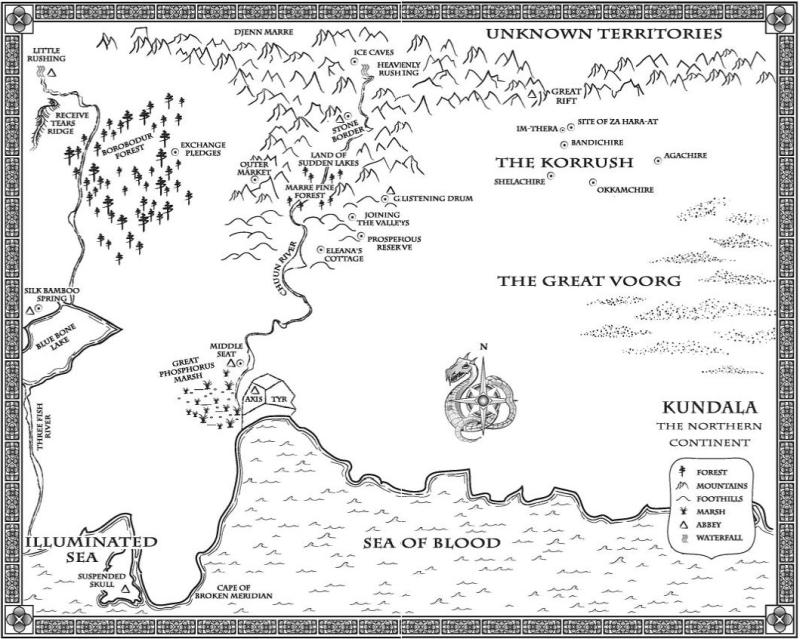
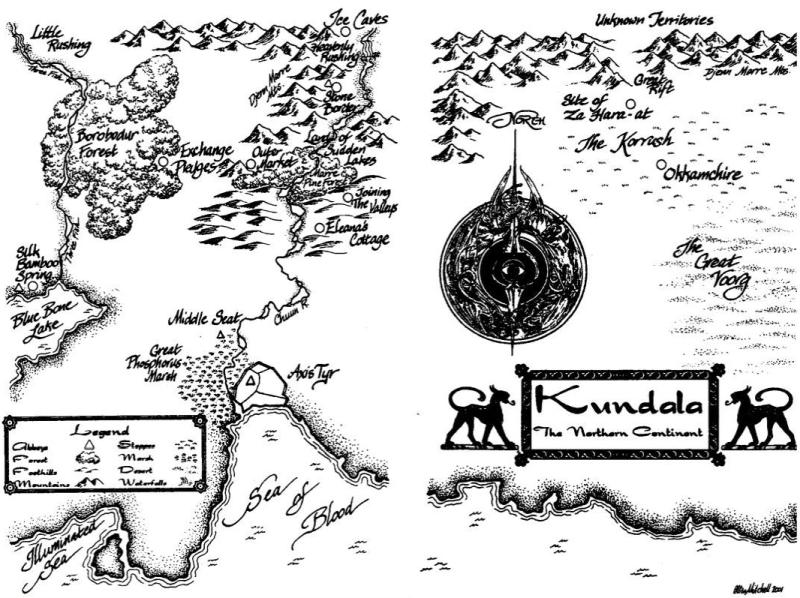
Maps of Kundala in the UK and US editions.
Linked from Books read