Orthe – notes
The Appendices from Golden Witchbreed and Ancient Light by Mary Gentle.
Cover art
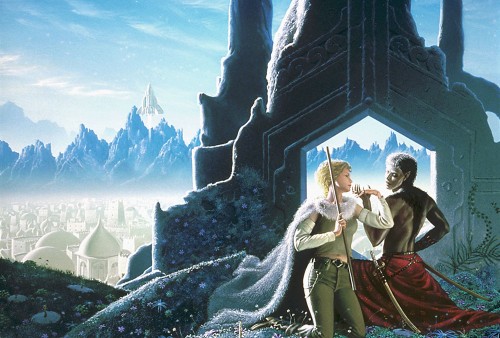
Golden Witchbreed cover art by Michael Whelan. Depicts the main human character, Lynne de Lisle Christie, and a male Orthean.
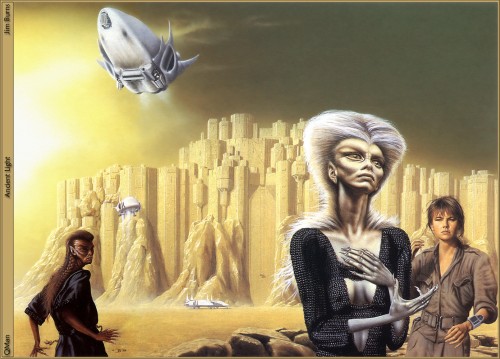
Ancient Light cover art by Jim Burns. Depicts the main human character, Lynne de Lisle Christie, and a male Orthean (on left) and female (main focus).
More cover images at The Internet Speculative Fiction Database for Golden Witchbreed and Ancient Light.
Description of the Orthe from Golden Witchbreed, Chapter 1:
A man walked out of the trade station, waved a careless hand, and headed towards me. He wore shirt, britches, high boots – and a sword belted at his hip. He was not human. An Orthean.
“Your pardon, t’an, you are the envoy?”
I recognized the speech of Ymir.
“Ah – yes.” I realized I was staring. “Pleased to meet you.”
For my part, I prefer aliens that look alien. Then when they ritually eat their first-born, or turn arthropod halfway through their life-cycle, it isn’t so much of a shock. You expect it. Humanoid aliens, they’re trouble.
[…] He stood well under six feet, about my height. His yellow hair was short, the hairline somewhat higher than I expected. As he glanced back, I saw that it was rooted down his neck, vanishing under his collar. Either the custom was to go clean-shaven or the Ortheans had little body-hair. There was none of that fine down that marks a human skin; his – as he held up his hand in greeting – I saw to be smooth, slick-looking, with almost a hint of a scale-pattern.
[…] The Orthean female opened a door. She wore a corded sleeveless jacket, and her thick black mane was done up in a single braid. Her skin was faintly patterned, and there were webs of lines round her eyes.
In the dim light her eyes seemed to film over as she watched me, and then clear again. The Ortheans have a “third eyelid,” a nictitating membrane like a cat’s eye. And something else. I looked at her calloused hands.
Put them side by side with mine and they would be no wider, but she had five slender strong fingers beside her thumb. And thick nails, kept filed down on all but the little finger, which sported a hooked claw.
[…] Later, in warmer waters, some of the crew stripped to the waist and I saw that the “marshflower” extended over his torso. The pattern grew larger and darker, almost black in places. Natural markings, I realized. Zu’Ritchie was not the only one with it, though his was most pronounced; and he was a little teased because of it.
The second shock – and it was only a shock because it was so like and yet unlike humanity – came when I saw the rudimentary second pair of nipples that both sexes carried low on the ribs. Most of the women were small-breasted compared to the Earth-norm, their bronze-brown nipples as small as the males’. I suspected that in times past, if not now, the Ortheans had littered a larger number of children at one birth than we ever did.
I watched Surilyn coiling a rope, the muscles moving smoothly under her brown skin. Her black mane was unbraided, and I saw that it rooted down her spine to a point well below the shoulderblades.
My own hackles raised at the thought. Almost us, and yet not us.
I wondered what other, less visible, differences there might be between our two species.
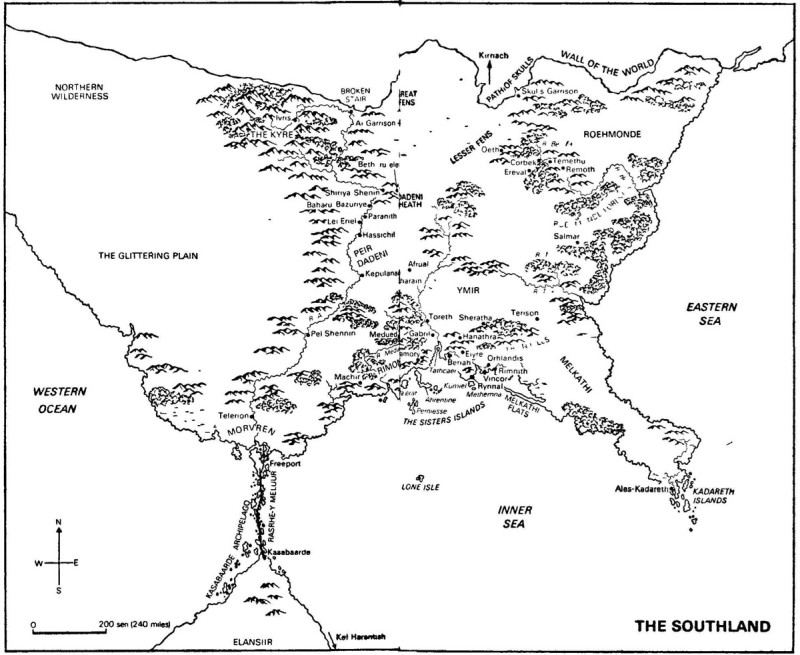
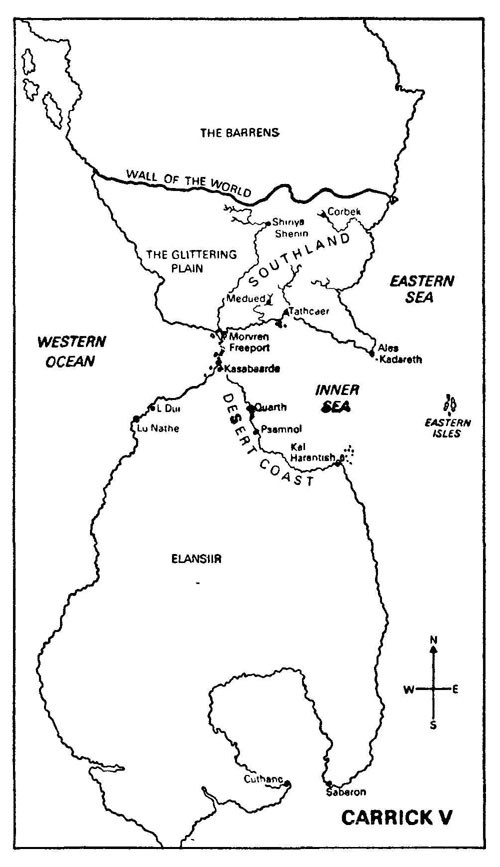
Maps
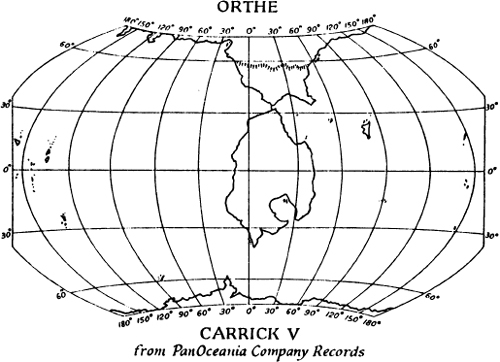
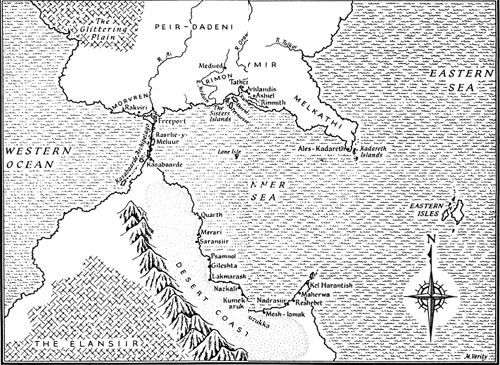
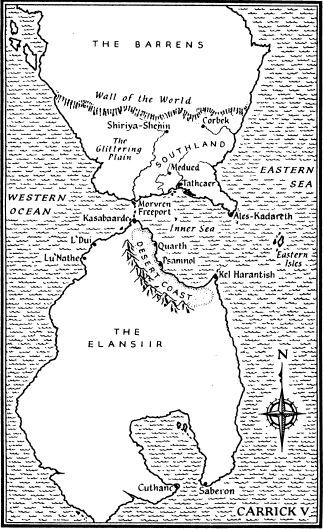
Principal Characters
Golden Witchbreed characters, in order of appearance
Lynne de Lisle Christie, envoy
Sam Huxton, marine biologist, head of the Dominion xeno-team:
Timothy Eliot, xeno-biology
Audrey Eliot, xeno-ecology (land)
John Lalkaka, geologist
Margery Huxton, xeno-ecology (sea)
Elspeth Huxton, her daughter
John Barratt, demographer
Dr. K. Adair, medical research
Carrie Thomas, xeno-sociology
Maurie Venner, assistant sociologist
David Meredith, envoy
Dalzielle Kerys-Andrethe, T’An Suthai-Telestre, Crown of the Southland, also called Suthafiori, Flower of the South
Evalen Kerys-Andrethe, her daughter
Katra Hellel Hanathra, First Minister of Ymir
Katra Sadri Hanathra, his sister, s’an telestre
Sadri Geren hanathra, her son, shipmaster
amari Ruric Orhlandis, T’An Commander of the Southland army
Ruric Rodion Orhlandis, her ashiren, called Halfgold
Sulis n’ri n’suth SuBannasen, T’An Melkathi
Hana Oreyn Orhlandis, First Minister of Melkathi
Nelum Santhil Rimnith, Portmaster of Ales-Kadareth
Telvelis Koltyn Talkul, T’An Roehmonde
Verek Howice Talkul, his son
Verek Sethin Talkul, his daughter
Sethin Falkyr Talkul, Sethin’s son
Asshe, commander of the northern garrison
Jacan Thu’ell Sethur, T’An Rimon
Zannil Emberen n’ri n’suth Telerion, Seamarshal of Morvren Freeport
Arlyn Bethan n’ri n’suth Ivris, T’An Kyre
Talmar Halten n’ri n’suth Beth’ru-elen, A Crown Messenger
Achil Maric Salathiel, l’ri-an to the envoy
Aluys Blaize n’ri n’suth Meduenin, a mercenary
Kanta Andrethe, the Andrethe of Peir-Dadeni
Eilen Brodin n’ri n’suth Charain, an intelligencer
Cethelen Khassiye Reihalyn, a minister in Shiriya-Shenin
Tirzael, an Earthspeaker
Branic, a Wellkeeper at Terison
Rhiawn, a Wellkeeper at Terison
Theluk n’ri n’suth Edris, an Earthspeaker
Arad, a Wellkeeper at Corbek
Dannor bel-Kurick, Emperor-in-Exile
Kurick bel-Olinyi, ambassador from Kel Harantish
Gur’an Alahamu-te O’he-Oramu-te, a barbarian woman
Speaker-for-the-People, a fenborn of the Lesser Fens
the Hexenmeister of Kasabaarde
Tethmet, a fenborn of the Brown Tower
Havoth-jair, a sailor
Orinc, of the Order House Su’niar
Ancient Light characters, in order of appearance
Lynne de Lisle Christie, special advisor to the PanOceania Company
Douglas Clifford, Earth envoy on Carrick V
Molly Rachel, PanOceania’s Company Representative
David Osaka, Company Commercial Liaison officer
Pramila Ishida, Company Administrative officer
Rashid Akida, Head of the PanOceania research team
Dinu Machida, climatology
Chandra Hainzell, xeno-biology
Jan Yusuf, xeno-demography
Joan Kennaway, medic
Ravi Singh, xeno-physicist
Corazon Mendez, Commander of the Company Peace Force
Ottoway and Jamison: lieutenants, her aides
Stephen Perrault, acting head of the PanOceania Liaison Office on Earth
Dannor bel-Kurick, Emperor-in-Exile at Kel Harantish Calil bel-Rioch, the Voice of the Emperor-in-Exile Pathrey Shanataru, aide to Calil
Sethri-safere, of the hiyek-family Anzhadi, a leader of mercenaries
Jadur, Wyrrin-hael and Charazir-hael: members of Sethri’s raiku
Hildrindi, of the hiyek-family Anzhadi, a keretne mystic Feriksushar, of Hildrindi’s raiku
the Hexenmeister, of the Brown Tower of Kasabaarde
Tethmet Fenborn, of the Tower
Annekt, a Kasabaarde trader
Haldin Damory, a mercenary of the Medued Guildhouse
Branic, her aide
Haltern n’ri n’suth Beth’ru-elen, a politician of the Hundred Thousand
Blaize n’ri n’suth Meduenin, an ex-mercenary
Nelum Santhil Rimnith, T’An of Melkathi province
Cethelen Khassiye Reihalyn, the Andrethe of Peir-Dadeni
Howice Talkul, T’An of Roehmonde province
Bethan n’ri n’suth Ivris, T’An of Kyre province
Geren Hanathra, T’An of Ymir province
Bekily Cassirur Almadhera, an Earthspeaker
Achil, an Earthspeaker
Jaharien Rakviri, s’an of Rakviri telestre
Haden Barris Rakviri, his arykei
Roxana Visconti, WEBcaster for the Trismegistus WEB
Mehmet Lutaya, WEBcaster for the Ariadne WEB
Glossary
Ai-Telestre – literally the Hundred Thousand, traditionally all the telestres existing between the Wall of the World in the north, the Inner Sea in the south, the Eastern Sea, and the Glittering Plain to the west. Unified by Kerys Founder after the fall of the Golden Empire.
amari – ‘born of no mother; motherless’. A term used in the Hundred Thousand, referring to a child born of a non-telestre mother (and usually a telestre father; but possibly adopted n’ri n’suth). The child is motherless in the sense that it is not of the earth of the Hundred Thousand; thus the amari are always slightly feared or shunned, since a different inflection can make this mean ‘without the (mother) Goddess.’ It has both a descriptive and a condemnatory use.
arniac – a small shrub that grows in the infertile soil of the Desert Coast. Broad red leaves, black berries, growing to a height of half a metre. The leaf when dried is used to make herb-tea, and the berries are a cure for headaches and fevers.
arykei – literally ‘bed-friend’, lover, pair-bond (in some rarer cases, a triple or quadruple bond occurs). Given that the care of children in the telestre is communal, the arykei relationship is not child-based, but depends on mutual temporary or long-term attraction.
ashiren – a child, nominally under fourteen; literally one who has not yet attained adult gender. Diminutive: ashiren-te.
ashirenin – one permanently ashiren, one who does not change to adult gender at age 13–15 but remains neuter. Change then occurs between the ages of 30 and 35, and invariably results in death. The ashirenin are rare, said to have strange qualities for good or ill. Most famous of the ashirenin is Beth’ru-elen.
ataile – tough-leafed herb growing mostly in Melkathi and the Rimon and Ymirian hills. When chewed, the leaves produce a mildly narcotic effect, and are addictive.
becamil – the webweaver-beetle, giving its name to the tough multi-coloured waterproof fabric spun from its web. Hives are kept commercially all over the Hundred Thousand.
Beth’ru-elen – called Beth’ru-elen Ashirenin, a latent Orthean who died at 35 during late change to female. Reformer and revolutionary. During exile from Morvren Freeport spent time in Kasabaarde’s inner city, formulated the philosophical and religious insights that led to the reformation of the church of the Goddess. Later became s’ an of one of the six founding telestres of Peir-Dadeni: the n’ri n’suth line is still in existence.
brennior – large quadruped used as draught-beast in the Desert regions. Sand coloured, thick hide, tri-padded foot, tailless. Short flexible snout. Poor sight, good hearing. Omnivore.
Brown Tower – home of the Hexenmeister in Kasabaarde’s inner city. Founded some ten thousand years ago on the ruins of an Eldest Empire settlement, for the preservation of knowledge. Most of the underground installations are defunct, though it is still said to have connections with the Rasrhe-y-Meluur and the ruins under the Elansiir. One of the two sole remaining instances of viable Golden technology.
chirith-goyen – or clothworm, the fibre-spinning larvae of the chirith-goyen fly. The fibre is woven into a light fabric throughout the Hundred Thousand, and is easily dyed.
chiruzeth – a substance created either by the Golden Witchbreed, or by their predecessors. It has been described as a semi-sentient crystal, manipulated by mental energy; and as a substance in some way analogous to human DNA/RNA. Techniques for altering it from its present inert form have been lost.
dekany – tuberous weed found in shallow waters of the Inner Sea; useful for rope-fibre but not for much else.
del’ri – staple crop of the Desert Coast, a bamboo-like plant with edible seed in the knobbled stems. Pale green, growing to a height of 2–21/2 metres. Harvested twice a year.
Desert Coast – general name given to that part of the southern continent that borders on the Inner Sea, and to the various ports and city-states there. Cut off from the wastelands of the interior by the Elansiir mountain range.
Earthspeaker – sometimes called the Landless. An office held by the members of the church of the Goddess after their training at the theocratic houses. They travel the Hundred Thousand, giving up their own telestres, and acting in a multitude of roles which may include priest, agrarian advisor, psychologist, healer, etc. The extent of their authority is impossible to define.
Emperor-in-Exile – hereditary ruler of Kel Harantish, chosen from the lineal half-breed descendants of Santhendor’lin-sandru’s imperial dynasty. A tyrant with absolute authority in Harantish’s highly-structured society. Claims the ancient right of ruling both northern and southern continents as the Golden Empire did.
fenborn – aboriginal race of Carrick V, now reduced in number and confined mainly to settlements in the Greater and Lesser Fens. Oviparous night-hunters living in stone-age culture. In the past carried out raids of considerable ferocity on north Rimon and Roehmonde, but have remained within the fen-borders since Galen Honeymouth’s treaty with them some two hundred years ago.
Fens – the Greater and Lesser Fens: marsh and fenland covering two thousand square miles, paralleling the Wall of the World and separating the provinces of Roehmonde (to which it is comparable in size) and Peir-Dadeni. Not least among the dangerous fauna are the fenborn.
ferrorn – see ochmir appendix.
galeni – a term used by the aboriginal Orthean species, the fenborn, to refer to that humanoid race now more generally regarded as ‘Ortheans’ (who are the product of genetic engineering, cross-breeding fenborn and the Golden Witchbreed). Galeni derives from the first T’An Suthai-Telestre to ensure the Greater and Lesser Fens were regarded as fenborn territory, the T’An Galen Kerys-Andrethe, called Galen Honeymouth.
Goddess – sometimes referred to as the Mother or the Sunmother, or occasionally the Wellmother. A sun and earth deity. The church was designed and set up by Kerys Founder as an anti-technology device after the fall of the Witchbreed. It was later transformed by Beth’ru-elen Ashirenin into a genuine religious movement. Now more of a philosophical discipline including a reverence for all life, and a recognition of reincarnation. They hold that their spirits pass through many bodies, reuniting in death with the fire of the Goddess (‘fire’ and ‘spirit’ have the same root-word in most Orthean languages); the main heresy holds that this is merely genetically inherited memory – possibly why the Hexenmeister is regarded with such deep distrust.
Golden Empire – the five-thousand-year rule of the Witchbreed race, under whose autocratic rule the two continents enjoyed peace, prosperity, and total slavery. Ended by Thel Siawn’s infertility virus, which gave rise to a war that devastated most of the southern continent, left the cities and land north of the Wall of the World in ruins, and is still visible in the transformation of Eriel to the Glittering Plain.
hanelys – commonly called tanglebush, a plant propagating itself by runners; 2–3 metres high, stems very hard black fibres with long thorns, yellow leaves during Hanys and Merrum, and small orange fruit in Stathern.
harur-nilgiri, harur-nazari – traditional paired blades, the former a kind of short rapier, the latter a kind of long knife. Used ambidextrously. Common throughout the Hundred Thousand.
Hexenmeister – ruler of Kasabaarde, guardian of stored knowledge, and a sequentially immortal personality. Head of an information-gathering network that spans two continents.
hiyannek – term of endearment on the Desert Coast, ‘best blood’, that is, best-descended.
hiyek – translated literally as ‘bloodline’, in the sense of family or lineage. The hiyek is the matrilineal-descent family upon which Desert Coast society is structured; and given their dependence on the canal system, it is perhaps not surprising that the root-word can also be translated as ‘water’. Blood is understood to be the carrier of past-memories within individual bloodlines. Whether this means that Coast Ortheans assume themselves reborn within the same bloodline, or only allow themselves memories that reinforce this concept, is unclear. A drug used to access these memories, keretnen-hiyek, can thus be translated either as ‘Blood of Memory’ or ‘Water of Truth’.
hura – species of hard-shelled water clam found in rivers throughout the Hundred Thousand.
jath – double-masted, ocean-going vessel, usually with lateen sails; design originating in Morvren Freeport.
jath-rai – single-masted small coaster or fishing boat.
K’Ai Kezrian-kezriakor – a Harantish term translating as ‘Emperor/Empress-in-Exile’, applied to the descendants (or supposed descendants) of Santhendor’lin-sandru, the Last Emperor of the Golden Witchbreed. The K’Ai Kezrian-kezriakor rules the settlement Kel Harantish, and the canal system upon which the hiyek-families depend for their survival. The ‘exile’ referred to is from the territory covered by the Golden Empire: the northern and southern continental land-masses. Abbreviation: K’Ai, Empress/Emperor.
Kasabaarde – a Desert Coast city with curious philosophies and influences. Sited at the point between the southern continent and the Kasabaarde Archipelago, gaining wealth from trade and tolls. Divided into trade-quarter and inner city, the latter run by the Order houses; both under the authority of the Hexenmeister.
kazsis – usually called kazsis-nightflower, a vine native to Ymir and Rimon. Bronze leaves, dark red blooms, the scent is particularly noticeable after dark.
ke, kir – neutral pronoun used for the young of the Orthean species, and sometimes for the Goddess.
kekri-fly – an insect with a short segmented body and triple paired wings; coloured blue, green, or black, with reflecting wing-surfaces. Fond of sewage.
Kel Harantish – once a garrison outpost of the Golden Empire, now one of the small Desert Coast city-states. Completely dependent on imports for survival. Home of the last surviving descendants of the Golden Witchbreed, and the Emperor-in-Exile.
keretne – translates as ‘eldest blood’, ‘truthful memory’, and refers to those Coast Ortheans, not necessarily old in a physiological sense, who have by gift and training a close access to their past-memories. The hiyeks, being mobile, have little use for literacy and records; they therefore rely on this oral culture-store.
Kerys Founder – credited with spreading the telestre system that arose after the fall of the Golden Empire, of unifying the Hundred Thousand and founding the Kerys telestre at Tathcaer. Led the first crusade against Kel Harantish, and began the Hundred Thousand’s long association with the Brown Tower. Set up the church of the Goddess to prevent the rise of another industrial society.
Kirriach – ruined city over the Wall of the World, once known as aKirrik. Part of the Golden Empire’s middle province, now called the Barrens, along with Simmerath, Hinkuumiel, Mirane, etc.
lapuur – the feathery-leaved tree of south Ymir, Rimon, and Melkathi; pale green trailing foliage, main trunk growing to a height of 3–4 metres.
leremoc – see ochmir appendix.
l’ri-an – one who is learning a trade or performing a paid service; usually a young adult or ashiren. Literally: apprentice.
makre – a form of double-lobed grain flourishing in temperate areas of the Hundred Thousand; particularly north Ymir, Rimon, and part of southern Roehmonde.
marhaz – the common telestre riderbeast, referred to as marhaz-mare, marhaz-stallion, marhaz-gelding; of reptilian ancestry like the skurrai. Cleft hooves, and a double pair of horns. The thick shaggy pelt is composed of feather-structured fibres. Enduring rather than speedy.
marshflower – skin blemish: a dappled pattern sometimes said to resemble the marshfern, and to be more common in those telestres that border the Great Fens.
Melkathi – that province distinguished by the Melkath language, comprising the Melkathi peninsula and the Kadareth Islands, the T’An Melkathi being resident in Ales-Kadareth. The most infertile telestres of all the Hundred Thousand, the most reluctant to accept Crown rule. Mostly comprised of heathland, bog, marshes, and sand-fiats. Ales-Kadareth has the name of being an old Witchbreed city, pirate port, and home of strange sciences. Famous for atheists, malcontents, heresy, and rebellion.
meshabi – robe worn by Coast Ortheans, consisting of a length of del’ri-cloth belted at the hip; a superfluous fold of which can be brought up to hood the head and back.
Morvren – small cluster of telestres holding land round the mouth of the Ai River; the Seamarshal is resident in the Freeport itself. Freeport has links with the Rasrhe-y-Meluur, Kasabaarde, and the Desert Coast; its language is a south-Dadeni dialect. A great maritime trading centre famous for voyages to strange places, river-craft, false coins, sharp practice, odd visitors, bureaucracy, and general moral irresponsibility. Rumoured to trade with Kel Harantish.
mossgrass – staple vegetation of the Hundred Thousand, a stringy-fronded species of lichen that roots shallowly in topsoil. Seasonal changes in colour.
n’ri n’suth – ‘adopted into the telestre of’: literally translates as brother-sister. A telestre child bears its mother’s name, its own name, and the telestre’s name.
ochmir – see Appendix 2.
Peir-Dadeni – the newest province, founded five hundred years ago by a group of rebels from Morvren Freeport. Follows the Ai River, bounded on the west by the Glittering Plain, and on the east, stretches from Morvren and Rimon up past Dadeni Heath to the Fens, and the Wall of the World. Keeps the pass at Broken Stair guarded. One founder was the reformer Beth’ru-elen, another the assassin Lori L’Ku, and another was Andrethe, from whom the ruling telestre takes its name. Famous for river-craft, trade, dubious frontiers, legends of Berani and the Eriel Frostdrakes; for the Heath’s skurrai, the river-port of Shiriya-Shenin, and for mad riders. Swears alliance with, rather than allegiance to, the T’An Suthai-Telestre.
raiku – the basic unit of the hiyek: a group-marriage. The ashiren of the Desert Coast families will spend a year alone in the cities of the Coast, forming small groups of four, five, or six, that will become their raiku: a lifelong bond of emotional and physical interdependence. This will often include members of the same birth, and stay within one bloodline; though exogamy is not frowned on. Raiku are numbered according to the groups formed within one year.
Kei-raiku: one who is outside the raiku, either by not yet having joined, or by losing one’s group by the deaths of the other members, or – very rarely – by expulsion.
Rainbow Cities – general name given to the settlements in the tropical regions of the southern continent, of which only Saberon and Cuthanc are large enough to be properly called cities.
rashaku – generic term for the lizardbird having the appearance of a small archeopteryx. Feathered wings, scaled breast and body. Four clawed feet, the front pair greatly atrophied; gold eyes with nictitating membrane. Distinctive metallic call. Size and plumage colour vary according to habitat: from the white of the rashaku-bazur (sea) to the black and brown of the rashaku-dya (hill country). Other varieties include the rashaku-nai (fens) and kur-rashaku (mountains).
rashaku-relay – the Wellkeepers train a species of rashaku-lizardbird in the carrying of messages between Wellhouses. The rashaky-dya, with its acute colour-vision, is most often used; they are trained to respond and fly to different destinations when shown different colour-codes.
Rasrhe-y-Meluur – commonly called Bridge Alley, a remnant of Golden Empire engineering; being a suspended tunnel-structure built on pylons from Morvren Freeport down the Kasabaarde Archipelago to Kasabaarde itself. Still passable, though uninhabited.
Rimon – central province, bordering the Inner Sea between Morvren and Tathcaer, sharing the Oranon River border with Ymir. Downland country, lightly wooded, having one main river, the Meduin. Famous for marhaz, grain, vines, wine, and border-river disputes with Ymir. The T’An Rimon is resident in Medued.
Roehmonde – northern province bounded by Ymir, the Lesser Fens, the Wall of the World, and the Eastern Sea. Hilly forested country, famous for mining, metal-working, charcoal-burning and hunting. The T’An Roehmonde is resident in Corbek, a city that never wholly accepted Beth’ru-elen’s reformation of the church. There are few large ports on the inhospitable eastern coast. Roehmonde is one of the largest and most sparsely inhabited provinces, a country of insular telestres. They guard one of the great passes down from the Barrens, the Path of Skulls.
ruesse – a substance, derived by a method which is unclear, from certain glands of the brennior-packbeast. Ingested, it causes paralysis of the respiratory system in Ortheans, death following rapidly. Its effects on humans are similar but much less severe. To humans, also, it has a characteristic scent, reminiscent of roses; this is undetectable by Ortheans.
rukshi – land arthropods, small and segmented with patterned shells and two pairs of claws. Now rare.
s’an telestre – landholder, elected to office by the adult members of the telestre, and having unspecified authority. More of an administrator than ruler, having more responsibility than power. The telestre is held in trust for the Goddess.
s’aranthi – a human, or humanoid offworlder. This derives from S’aranth, a name given to the first contact envoy in the Hundred Thousand, and translates literally as ‘one who does not carry harur-blades’, one who is weaponless. It is ironic that this should come to be applied to hi-tech offworlders as a general term.
saryl-kabriz – an organic poison, fatal to Orthean life, distilled from the bark of the saryl-kabriz bush. Has a characteristic sharp scent, difficult to mask. Not to be confused with saryl-kiez – a similar shrub, brown with blue berries. The sap, unlike that of the saryl-kabriz, is not a poison. It can be used as lamp oil; the scent is pungent.
seri – unit of distance, equal to one and one-fifth miles on the standard Earth scale.
shan’tai – ‘one outside the hiyek, or bloodline’, a stranger. This term of address on the Desert Coast can, according to inflection, have varying implicit degrees of welcome or rejection. The respectful greeting kethrial-shamaz shan’tai is an invitation to share water/blood/hospitality on a temporary basis.
siir – a thick-boled vine or creeper, fungoid, growing to a height of several metres, and spreading to cover wide areas of ground. In the Hundred Thousand it is allowed to spore; the yellow spore cases are then gathered and fermented into a green wine-like liquid. The effect on a human is slightly hallucinogenic. The name siir derives from a Witchbreed term meaning ‘fertile’. The plant was possibly created through their bio-engineering as an all-purpose food crop. A further derivation leads to the Elansiir, the ‘garden’ or ‘harvest-field’, a name applied to the central region of the southern continent, now made barren by war damage.
siiran – ‘shelter’; one of the underground chambers of the Desert Coast canal system, used as habitations, and also used to grow crops in uninhabitable areas. The term suggests a link with the Witchbreed food-crop siir, and possibly the canal system was constructed to raise these plants. Climatological changes following on war damage in the central Elansiir means that siir itself rarely flourishes on the Coast now.
skurrai – the telestre packbeast, referred to as skurrai-mare, skurrai-stallion, skurrai-gelding; double-horned and reptilian; basically a smaller stockier version of the marhaz.
skurrai-jasin – the skurrai-drawn carriage common in Tathcaer.
Sunmother – see Goddess.
takshiriye – the court or government attached to the T’An Suthai-Telestre, resident in Tathcaer (and Shiriya-Shenin during the winter season).
T’An – the administrator of a province: t’an, general polite term for strangers and visitors. Derives from ‘guest’.
T’An Suthai-Telestre – in the informal inflection, the Crown of the Hundred Thousand. Self-chosen from the T’Ans of all the provinces, re-elected on every tenth midsummer solstice. The unifier of church and telestres.
Tathcaer – capital of the Hundred Thousand, an island-city solely under Crown law, sometimes called the eighth province. Home of every T’An Suthai-Telestre since Kerys Founder. The Hundred Thousand have each a telestre-house in the city; also there are the Guild-telestres.
telestre – the basic unit of Hundred Thousand society, a community of any number between fifty and five hundred Ortheans living on an area of land. This unit is self-supporting, including agriculture, arts, and crafts. The telestre system rose spontaneously out of the chaos that followed the fall of the Golden Empire. Given the natural Orthean tendency to form groups, and their talent for making the earth yield, the telestre is their natural habitat.
tha’adur – a Peir-Dadeni term for the Andrethe’s court and governing officials resident in the city Shiriya-Shenin.
The Kyre – a province of remote telestres in the mountains that lie south of the Wall of the World and north of the Glittering Plain. Very insular in character, occasionally trading with Peir-Dadeni. Mostly they subsist on hunting. The province is very sparsely populated; the T’An Kyre is resident in Ivris, a market telestre. Famous for milk, cheese, wood-carving, mountain-craft, and lack of humour, popularly supposed to be a result of the appalling weather.
thousandflower – mosslike plant growing in woodlands over most of the Hundred Thousand, forms a thick carpet 10–15 cms deep, and varies in colour from light to dark blue.
thurin – see ochmir appendix.
tukinna – evergreen tree, thin-boled with black bark, twisted limbs, growing to a height of 10 metres. Foliage concentrated at the crown: scroll-like leaves, small black inedible seeds. Prefers northern climates (like Roehmonde forests).
Wall of the World – gigantic geological slip-fault that has split the northern continent in a northeast-southwest division; being now a range of mountains in which there are only two known passes from the Barrens to the Hundred Thousand: Broken Stair and the Path of Skulls. The barren land north of the Wall is occupied by barbarian tribes living in the ruined cities of the Golden Witchbreed.
Wellkeeper – title given to those members of the church who give up their own telestre to run the Wellhouses, sometimes called theocratic houses. These may be places of worship, of philosophy and refuge; working communes for adults or ashtren; universities or other places of learning; weapons training houses; or craft workshops.
Witchbreed – sometimes known as the Golden. Originally the humanoid race brought to Carrick V as servitors to the Eldest Empire – this being an apocryphal name given to the alien settlers who first landed some twenty thousand years ago, but died out soon after that. Nothing is known of the ‘Eldest Empire’, but it left its mark in the genetic structure of both the Witchbreed and the native race of Orthe. The Witchbreed had great talent for using and developing the technology that was left to them, and made use of both the physical and sociological sciences. They fell to a sterility virus. Sporadic instances of interbreeding took place between Witch breed and Ortheans, but in general the two species are not inter-fertile.
Ymir – the oldest province, with the most archaic form of language; occupying the land east of the Oranon that lies between Melkathi and Roehmonde. Good grazing on the Downs, good soil in the lowlands, and the many tributaries of the Oranon make this one of the richest provinces, famous for good harvests. The T’An Ymir is resident in Tathcaer. The telestres close to the city are famed for ship-building. Ymir is known for its theocratic houses, traders and merchants, beast-tamers, eccentricities of all kinds, and the most convoluted argumentative minds outside of Kasabaarde.
ziku – broad-leaved deciduous tree with edible fruit, grows to a height of 7 metres. Bronze-red foliage, dusty-blue fruit. Common in Ymir and Peir-Dadeni, preferring to grow near water. Hybrid form grown in Rimon with larger and more plentiful fruit, harvested in Stathern.
zilmei – found in north Roehmonde and Peir-Dadeni forests. Black and grey pelts, wedge-shaped skulls, and retractable claws. A bad-tempered carnivore. Distinctive hooting cry.
Ochmir
A game played in the Hundred Thousand, originating in the cities but popular everywhere. It is played on a hexagonal board divided into 216 triangular grid-spaces. The 216 counters are double-sided, the ideogram-characters traditionally blue-on-white and white-on-blue; and are divided into ferrorn, which must remain stationary when placed on the board; thurin, which may move one space (across a line, not an angle); and leremoc, which have complete freedom of movement. The object of the game is to have all the pieces on the board showing one’s chosen colour.
This is accomplished by forcing a reversal of the opposition’s counters, by gaining a majority of colour in a minor hexagon. The 6-triangle minor hexagons form a shifting, overlapping framework.
The distribution of characters means that a counter may or may not have a duplicate value on its reverse side; it is thus necessary to remember when placing a counter what is on the obverse.
A ‘hand’ of counters is drawn, sight unseen, from the ochmir bag on every sixth turn (a hand on Orthe is six). Only one move or placement can be made per turn, unless this results in a majority in a minor hexagon, in which case all the counter reversals are carried out. Since majorities are retrospective, the turning of one hexagon to one colour will affect the hexagon-frames overlapping it.
There are no restrictions on where on the board a game may begin, and it is usual for two or three separate pattern-conflicts to be set up. It is the ferrorn that determines the area of conflict.
Ochmir can also be played with three players (blue-white-brown), in which case the number of spaces that need be occupied for a majority in the minor hexagons decreases from 5 or 4 to 3. In this case there is also the shifting balance of alliances between players; and the game ends when one player gains the 144-counter majority of one colour.
A player may not turn own-colour counters to reverse. In the case of a 3-3 split in a minor hexagon it is left until the shifting framework divides it up amongst other hexagons. The game can be played with retrospective reversals even when all 216 counters are on the board. Ochmir is not only about gaining control, but about keeping it afterwards.
The game is based on manipulation, not territory; and on mobility rather than in rank. The value of the counters shift with the game; a player’s own counters are also those of the opposition. These themes of interdependence, mobility rather than on rank. The value of the counters orities to see a connection between ochmir and Ai-Telestre, and even to equate ferrorn, thurin, and leremoc with s’an telestre, T’An, and T’An Suthai-Telestre.
The Calendar of the Hundred Thousand
WINTER SOLSTICE: New year festival.
ORVENTA: the longest season, 11 weeks. Winter. Favourite season for the custom of keeping telezu. No trade, travel, planting, etc., owing to bad weather. One of the two main periods of activity for takshiriye and tha’adur in residence in Shiriya-Shenin. Practice of arts, music, sciences, etc. Usually the First Thaw festival occurs around Tenthweek.
SPRING SOLSTICE: festival of the Wells.
HANYS: 3 weeks. Spring ploughing and planting: busy time for the telestres. Prevailing westerly winds. Floods. Inner Sea liable to sudden storms.
DURESTHA: Early summer, 8 weeks. Long spells of hot weather. Travel possible, roads repaired. Guild ships leave for Desert Coast and Rainbow Cities.
SUMMER SOLSTICE: Naming day and midyear festival.
MERRUM: 9 weeks, high summer. Period of great administrative activity in the takshiriye, resident in Tathcaer. Favourite season for travel, trade, sea voyages, etc.
STATHERN: 2 weeks. Everything stops for the harvest. Culminates in
AUTUMN SOLSTICE: harvest festivals.
TORVERN: 4 weeks, early autumn hunting season; also the time for fairs and markets. The last season for travel before winter weather makes the Inner Sea impassable.
RIARDH: 7 weeks. Hunting season. The beginning of winter, preparation of provisions, storing food, weaving, etc. Some late autumn sowing. Usually includes First Snow Festival.
Note: the week consists of nine days, of which every Firstday is a feast-day, every Fiveday a holiday, and every Nineday a fast-day. The day has a length of 27 standard hours. With a 400-day year, this means that in practice the Orthean year is 85 days (12 weeks) longer than the Earth standard year.
Linked from Books read