Lynx Vilden articles
- Former wild child reveals why she swapped hedonism for Stone Age life
- Dreams of the Stone Age
- How to Prepare Now for the Complete End of the World
- The Woman Who Lives 200,000 Years in the Past
- Ancestral Skills And The Art Of Living Wild
- Lynx links
Former wild child reveals why she swapped hedonism for Stone Age life
Lucy Waterlow, Daily Mail, 25 October 2016
A British-born former punk rocker said she couldn’t be happier since she swapped hedonism for a back-to-basics lifestyle living alone in a remote forest.
Lynx Vilden, 50, who was born in London, aims to replicate the Stone Age with her way of life in the far reaches of America’s Pacific Northwest.
Using money she inherited, she bought a wood cabin and a five acre acre plot of land in the wilderness location, where temperatures can plummet to minus 15 in the winter.
Lynx Vilden, 50, aims to replicate the Stone Age with her way of life in the far reaches of America’s Pacific Northwest where she lives in a mountainous forest
The nature-lover has learnt how to live off the land, hunting, foraging and fire-building in order to survive.
Lynx shares her primitive way of life with presenter Ben Fogle on the new series of his Channel 5 show, New Lives In The Wild, which returns this evening.
She admitted she wasn’t always an eco-warrior but had an epiphany in her twenties after a hedonistic period living in Amsterdam as a punk rocker.
She said: ‘After abusing myself for a few years in Amsterdam I realised I had to clean up my act.
‘I had a lot of family in Sweden and I decided to go and live in the forest up there. It was a soothing and nurturing place for me and very beneficial to my survival at that age.’
Lynx has learnt how to hunt so she can eat meat to survive and wears clothes made from hide
In her youth, pictured, Lynx was a punk rocker living in Amsterdam. She realised she had to change her hedonistic days and ‘clean up my act’
Lynx shares her way of life with presenter Ben Fogle in the new series of his Channel 5 show, New Lives In The Wild
Ben stands in the snow in front of a wooden store room Lynx has built. She uses it to stockpile wood and food in the summer so she can survive the freezing winter
She then travelled through wilderness areas in America and attended a survival school to learn how to make her own tools, build a fire in less than 30 seconds and hunt.
She said it was then that she realised she wanted to do without mod cons for the rest of her life.
‘I lay down on the earth and said “this is what I want to do, protect the earth and live as low impact as possible and help others live that way”.’
She spent 25 years living in remote locations before making the mountain forest in the North Cascades of Washington state her home.
Despite having a wood cabin there, which has electricity powered by solar panels, a wood burning stove and satellite dish for a telephone connection, Lynx prefers to sleep in an ‘Earth lodge’ she made herself underground.
Ben beside an igloo Lynx helped him build. She has spent years learning how to survive in the wild and can build a fire in less than 30 seconds
She’s also made herself a store room from wood, which she uses to help her survive the harsh winters by stocking up on food during the summer months.
For food that needs to be kept cold, her ‘fridge’ is a hole in the snow.
The snow also comes in useful for washing and drinking, while in the summer she uses river water.
If she wants to wear makeup, she uses charcoal brushes her teeth using a twig.
She doesn’t need a toilet as she can go in the forest but one bathroom luxury she has created is a homemade hot tub, made from a tin drum with wooden planks across the bottom, heated by an open fire.
Lynx uses the forest as a toilet but she does have one bathroom luxury – a homemade hot tub
She invited Ben to join her in her hot tub under the stars surrounded by snow and trees and told him ‘you won’t get a better bathroom than this’
‘You won’t get a better bathroom than this,’ she said as she invited Ben to join her in the hot tub under the stars surrounded by snow and trees.
Meanwhile, for clothes, shoes and sleeping bags, she makes her own from the hides of animals she has killed to eat.
‘I counted all the hides I was wearing the other day when it was cold and it was 25 animal skins – deer skin, fox tails, wolf felt, coyote and reindeer,’ she told Ben.
She revealed her annual expenditure is $10,000 (£8,000) a year, which mostly goes on feeding the four horses she uses to help her sustainable way of living and to plough her way through the snow in the winter.
She earns her money by training small groups of students in how to live off the land like she does throughout the year.
They are her only visitors, aside from her daughter, Clara, 22, who lives in Seattle, so she admitted she can get lonely and would love to find a ‘sensitive caveman’ to share her lifestyle with.
She separated from Clara’s father when her daughter was two and raised her in the wilderness until she chose to go and live with her father in suburbia so she could attend school.
Lynx admitted allowing her daughter to follow her own path was the most difficult thing she has ever done.
‘The hardest time was letting her go and be a regular kid. I used to home school her but then she wanted to go to school. I felt like I was losing her to a culture but you can’t make them be little extensions of yourself,’ she said.
Ben learnt how to use a bow and arrow during his time with Lynx. She regularly teaches such skills to students to promote her primitive way of living – but it is a path her daughter, 22, chose not to follow
Clara told Ben on one of her visits to see her mother – where she always stays in the cabin – that it was an unusual upbringing being raised in the wilderness by her technology-shunning single parent.
‘I grew up in Montana three or four miles from town, it was remote and we were in a yurt with no electricity or running water,’ she said.
‘I was given worms for my eighth birthday and dressed in animal skins.’
Now studying at university, Clara said she often doesn’t get her friends’ references as she has ‘a massive pop culture gap from the nineties'.
She added: ‘I have never seen a Disney movie. Friends will joke “where were you, living under a rock somewhere?” and I am like “well, in a cave.”’
Ben said he admired how Lynx has learnt to live alongside nature during her 25 years of wilderness living. She raised her daughter in a yurt with no electricity or running water
Although she has chosen not to live in the same way now, Clara said she admires her mother’s sustainability and cooperation with nature.
Lynx said much of her primitive way of life has been trial and error.
She’s spent half her lifetime living in the wild and lessons she has learnt along the way include that worms do not make a great soup but bear fat is an excellent energy source when added to stews.
She enjoys teaching Stone Age masterclasses as she wants to show others how to live off the land and be at one with nature.
After spending time with Lynx and following her way of life, from fire building to sleeping in an igloo, Ben praised her spirit.
He said: ‘She is unlike anyone I have ever met before, a unique character with pulsating wild genes who needs to live as close to the earth as possible.
‘This is her grand experiment for where she thinks we should all be going.
‘She is the sort of person I will be telling my grandchildren about in years to come.’
Dreams of the Stone Age
Our primitive ancestors may not have been that primitive after all. It seems their stones, sticks and bones provided something our iPhones, robots and Botox can’t replace. CMC writer Lisa Richardson reports on how we space-age Homo Sapiens could use a tool or two from mankind’s prehistoric past.
All important ideas must include the trees, the mountains, and the rivers.
– Mary Oliver
University hadn’t panned out as Emma Doige had expected. “I had no friggin’ idea at 18 years old what I wanted to do,” she says, eight years later. “I pretty much drank and partied that year and a half away.” After her brother took his life, Doige dropped out and fled Ottawa, Ontario, for Whistler, British Columbia. It was there she saw a photograph that would alter her trajectory unexpectedly. The image – a group of Stone Age revivalists – popped up on her Facebook feed. “I saw it and said, ‘I don’t know who that is or what they’re doing or what it’s about, but I want to go.’”
Doige signed up for a basic course in primitive skills that September, five years ago. “How have more people not heard of this?” she wondered, as she learned how to make fire without matches and build a shelter without tools beyond the rocks, sticks and grasses that the land offered up. It seemed so obvious to her, so fundamental, so grounded. “I was totally thrown in, completely in awe,” she says. She couldn’t get enough of it, and although the teacher warned her she was too inexperienced and would have to work her ass off, she signed up the following summer for a three-month-long immersion in the Stone Age.
Doige’s parents drove her down to Lynx Vilden’s Living Wild School, a five-acre property in Twisp, Washington, that has become Vilden’s base for offering “dirt time.” She holds months of hands-on classes that teach you to live off the grid in rudimentary conditions, without running water, electricity or cell-phone service, and where you learn to reclaim ancestral skills, like harvesting wild edible plants, making deer-hide clothes, fire-starting, and making gourd canteens and burden baskets. Once participants have crafted their own Stone Age camping kit, they have the option of going out on a month-long walkabout, living as hunter-gatherers in the North Cascades. Vilden’s goal is to empower people, through Stone Age skills, to be more comfortable in the wilderness. It’s not survivalist, despite the post-Apocalyptic prepper vibe that a crew of deer-skin-clad, bow-and-arrow wielding neo-Neanderthals can conjure. Vilden says it’s about thriving – more pro-nature, than anti-civilization – although the two do not harmonize easily, as many of her graduates discover.
Vilden, a lithe, 52-year-old blonde with a Swedish-British mash-up of an accent, has pursued and taught primitive skills for over half her life, ever since studying with Tom Brown’s Tracker School and Peter Bigfoot’s Mountain School of Self-Reliance replaced her own punk-rock, hard-partying ways with a serious nature fix. Vilden makes the rules for her Living Wild immersions, and the rules are full-on from the paleo period: nothing from the modern world. Nothing even from the Bronze Age. It’s rocks, sticks and bones all the way.
There for several months, alongside a motley clan of seekers, Emma Doige found her rhythm around the campfire, tanning deer hides, preparing everything she’d need to go out into the mountains for one month: a full set of buckskin clothes and bedding, cooking pots and dried food, all made using only Stone Age tools. “It rained pretty much the entire time. But I loved it,” she says. “I was hungry for more.” They learned more than just friction fire-making, foraging, shelter-building, fishing, hunting, animal processing and tool-making: it was a different way of looking at the world, how to strip away the layers that insulate us from nature, go barefoot, listen to a stone to find the one that wants to be chosen as your implement, how to move with the land and accept gifts. They learned how to become part of a community that is as much an ecosystem as an outpost of civilization.
Doige went back again the next summer, in 2014, a year of wildfires, and she says she’d do it again. “As arduous as it was, it was also amazing,” she explains. “I learned so much about myself. When I’d moved to Whistler after my brother died, I didn’t experience as much healing as I could. At Lynx’s, just the dynamic of being and living as a clan was so fun, being held so powerfully by so many people I’d never met, people who were gentle and who wanted to be close to the land. It’s transformative. Completely heart-filling.”Going back to the real world, though, wasn’t easy. She’d become a girl from another time, wearing her buckskins through the streets of Ottawa, looking for like-minded souls, working as the manager of a health-food store and looking for a home to buy with her partner, which necessitated a mortgage, a nine-to-five life, and plugging back into the system. “It’s a powerful thing to know how to live with the land,” she says. “I just wish I had the balls to do it for real.”
“Our ancestors were bad asses,” says Matt Forkin, a 32-year-old engineer from Oakland, California. After Forkin graduated with a degree in mechanical engineering and sculpture, he worked developing solar panels, consulting and designing factories throughout Asia. “I saw firsthand how materials are made, how energy is made, and I was very saddened by the amount of destruction in all these processes,” he explains. “Even to make a solar panel does irreparable harm to the planet. It’s just the bread and butter of our world: destructive and unsustainable.” He wanted to explore other ways of being human, and he ended up at Vilden’s for two years, culminating in the one-month-long walkabout.
The summer of 2014, the North Cascades were ravaged by wildfires. Some people left the month-long walkabout, abandoning the project out of safety concerns. The remaining 10 were on the move constantly: wild food was hard to find and smoke was a constant reminder that what they were doing had very real stakes. Tensions mounted. “There came a point where some people were running low on food,” recalls Forkin. “There was some fighting. In the end, we said the most important thing is that we’re doing this all together. As a clan. As a family. If this was literally our family, we would choose to be generous, and that’s what we decided to do. It was a beautiful moment, but I wish we’d had that from the start.”
But being generous is not a modern way to think or behave, especially when scarcity sinks its fearful claws into our brains. Our contemporary, non-indigenous culture doesn’t have built-in methods of enforcing community. “None of us [on the project] grew up in a communal culture,” he says. “We grew up in a me-first social setting, not one where what’s best for all beings is the most important. It was hard for us all. It takes a lot of skill and energy.” It’s not just about shooting arrows. The tools might be the starting point, but as it turns out, they’re the smallest part of what it means to awaken your inner wild.
Jesse Jameson’s tool skills are hard to debate. For eight years, the primitive-skills movement took him deep down. He harvests all his own meat, is passionate about hide-tanning and is completely at ease in untamed spaces. Jameson spent three years at Vilden’s, two of them as her assistant, and he has taught on the circuit of primitive-skills gatherings across the country.
Recently, the 28-year-old from Sebastopol, California, has been rethinking things, trying to rebalance his life. “I’ve been living in a place of big ego and dogmatism of the skills,” he says, spoofing himself. “Oh, I’m learning the skills of my ancestors and I’m saving the world doing it. I’m so much better than you.”
After a trip to Laos and Cambodia last summer – his first major venture out of the primitive-skills milieu – he was struck by waves of realization. “I have spent all this time witnessing the seasons and spending months harvesting food,” he says. “But I realized how much I’d isolated myself, how beautiful cities are, how much culture I’d been missing being alone out on the land.”
He articulates a sense of loneliness, the fragmentation in the community, as everyone follows their hearts in a thousand different directions. Even amongst primitive-skills devotees, community is occasional. The desire to be self-reliant brings disparate individuals together, temporarily, to share ancestral know-how. Jameson fumbles with a sense of something missing. “I don’t know what it was like 500 years ago, but there had to be some major compromises for people to stick together,” he says.
In the present, we’re more accustomed to choice than compromise. To live a life truly enmeshed with the land and to subsist from it might require less self-reliance and a lot more interdependence, where being part of the collective doesn’t come with an opt-out clause.
Matt Forkin has interpreted that as a call to action. He could have returned to engineering, made good money and bought himself a little homestead to live close to the land. Instead, he’s opted in, and he’s trying to sharpen the lessons of the Stone Age to a fine point. “For me, primitive ways of living is one example, and the most complete example, of people living in such a way that they had a positive impact,” he says. “Our role as people is to be the caretakers of the Earth, not just to take care of our own needs but to interact with the land to make things better.”
Coming home from the Living Wild camp was disconcerting, noisy and intense after his two-year sojourn living as part of nature. And then there were all the jokes. “How does it feel to be back in the real world?” was what he would hear constantly from friends and family. He’d spent months going barefoot, eating nothing packaged, processed or even domesticated, with his senses on full alert. He had established intimate relationships with every life form around him, right down to the rocks. What he used, he had made from scratch. It seemed to him that he’d just left the real world, a vital, pulsing world, and re-entered one that was entirely fabricated.
But he is a fabricator. An engineer. A sculptor. A craftsman. The thread that runs through whichever world he’s in – the wild or the manufactured, the ancient or the endangered – is his passion for making things, for discovering better systems for making things, processes that don’t damage the Earth irreparably. Learning to make fire or a spear or a basket or a primitive fishing rod is ultimately just tool knowledge. Humans have always had a vexed relationship with their tools: our ingenuity and ability to make them is our super-skill, an expression of creativity and collaboration. It gave our species its edge, enabled us to flourish, dominate and eventually bring life on Earth to the brink of the sixth mass extinction. But we’ve also crafted exquisitely beautiful things out of the planet’s raw materials. We’ve collaborated with living systems. Most simply, the mindful harvesting of wood or animals helps eliminate the weaker and the diseased, a care-tending approach that yields healthier ecosystems for the human impact.
For Forkin, the driving modern question is not just one about how to minimize our negative impact, but how do we have a net positive impact? He’s working with non-profits and start-ups in California’s San Francisco Bay area, amongst the hubbub, to leverage technology and his engineering skills to craft entirely new ways of making things, inspired by an ancient way of thinking. “It goes back to trying to do something collectively,” he says. “I don’t have any models for it. It’s good in theory. But it’s tough. I’m trying to be part of the work to co-create a better economic future, to build systems to benefit all beings.”
Without any sense of obligation or interdependence to other living beings, our latest technologies are likely to enrapture us and enslave us. We let them take over, run amok, wreak havoc: fire, plows, guns, deep-sea ocean trawlers, fibre-optic cable, biological weapons, genetic engineering, robots, search engines. Having an impact, it seems, is part and parcel of being a human. Maybe it’s time to start embracing that and make it big – and beneficial. It’s not without precedent. It’s just a lost art, waiting to be reclaimed.
Lisa Richardson lives in Pemberton, British Columbia, and hopes to make up for her lack of basic survival skills by judicious selection of her Apocalypse team. That is, if they’ll join her.
Photo captions
Photographs by Kiliii Yüyan
- Jesse Jameson and Emma Doige, two members of the Living Wild Project.
- Fire on the mountain: The Living Wild group pauses for a rest on a ridge, a twice-daily ritual to scout the valley for encroaching forest fires, which has surrounded their camp on three sides. Living with intense forest fires is a dangerous but unavoidable part of wilderness living in the age of climate change.
- Weight of the world: During the project, the group struggles up a scree slope in 100-degree heat. Every person carries between 18 and 40 kilograms (40 and 90 pounds) of primitive gear as they migrate their camp to a valley with better hunting prospects.
- Cold smoke: The early morning is a difficult time to have a fire; the ground is damp and the air chilly. Neil is an expert in using a bow-drill friction set to make a fire.
- Locally sourced: Top: Matthew Forkin gathers saxifrage plants for dinner. Bottom: Forkin chases a marmot he’s shot with an arrow.
- Bagged: Jessie Watson Brown avoids a crowded bark shelter on a dry night by sleeping outside in her buffalo blanket, trying to expose as little of herself as possible to morning mosquitoes.
(PDF article/archived version)
How to Prepare Now for the Complete End of the World
Nellie Bowles, The New York Times, March 05, 2020
Lynx Vilden teaches people how to live in the Stone Age.
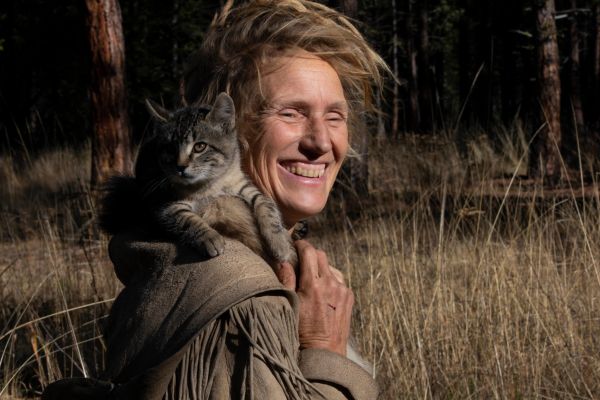
Image: Lynx Vilden, in the wild.
OKANOGAN COUNTY, Wash. – When the end comes, some will not be waiting in a bunker for a savior. They will stride out into the wilderness with confidence, ready to hunt and kill a deer, tan its hide and sleep easily in a hand-built shelter, close by a fire they made from the force of their two palms on a stick.
Four hours from the Seattle airport, in a valley called Methow, near a town called Twisp, Lynx Vilden was teaching people how to live in the wild, like we imagine Stone Age people did. Not so they could get better at living in cities, or so they could be better competitors in Silicon Valley or Wall Street.
“I don’t want to be teaching people how to survive and then come back to civilization,” Lynx said. “What if we don’t want to come back to civilization?”
Some people now are considering what it means to live in a world that could be shut down by a pandemic.
But some people are already living like this. Some do it because they just like it. Some do it because they think the end has, in fact, already begun to arrive.
A couple of times a year, Lynx – she goes by the name professionally, though it is not her legal name – teaches a 10-day introduction to living in the wilderness. When I arrived for this program, Lynx ran to me, buckskins flying, her hands cupped tightly around something that was smoking.
She held it toward my face. I closed my eyes and inhaled deeply. Confused, she moved her smoking handful to someone else, who blew on it lightly. It was an ember in a nest of seed fluff. Lynx was making fire.
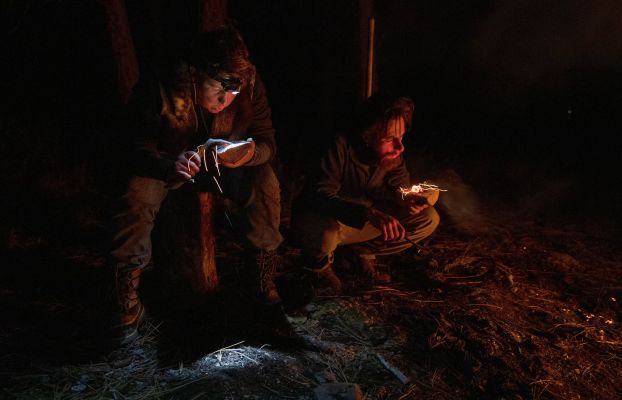
Image: Joan Kovatch and Louis Pommier.
Her property looks like a kidnapper’s lair from a movie. But her dream, she told those of us gathered, is a human preserve. Her vision is called the Settlement. It will have a school, where people can come in street clothes and learn to tan hides. But to enter the preserve itself will mean giving oneself over to it.
“You walk into it naked and if you can create from that land what that land has to offer, then you can stay there,” Lynx said. “It’s going to be these feral rewilded people. I’m thinking in two to three generations there could be real wild children.”
We set up our tents around her property. I had a sleeping bag from high school, a Swiss army knife and a stack of external batteries. It scared me that there was no cellphone reception. We communicated over the week in hoots. One hoot means hoot back. Two hoots means “gather.” Three hoots means an emergency, like near-death level.
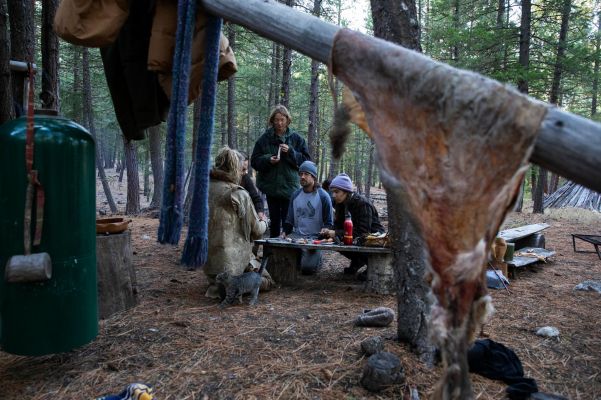
Image: Learning to make tools.
The class may have been there to go ancient, but they brought very modern food requests. In a group of seven, one student was a strict carnivore – Luke Utah, who likes a morning smoothie of raw milk, liver and egg yolk. Another was a vegan. One student said they were so sensitive to spice that even black pepper was overwhelming. One person was paleo, one was allergic to garlic, and one was gluten-free.
Louis Pommier, a French chef turned backpacker, was bartering his skill for attendance. He nodded empathetically as he heard these restrictions but would go on to mostly ignore them. The first night he made a chicken curry.
Many of the people who were there came feeling useless in their lives. Some had just quit their jobs. Lynx said many of the students who come for the monthslong intensives (another option) are divorced, or on their way to it. Several talked about feeling embarrassed at how soft their hands were, and how dependent they had gotten on watching TV to fall asleep.
We woke up the next morning and gathered around the open fire for boiled eggs. Soon we would learn how to chop down a tree. First Lynx greeted the tree. She put her hands on it.
“If you’re willing to be cut down, will you give a yes?” she asked. She tugged the tree. She calls it a muscle test. Apparently the tree said yes. “We have to kill to live,” she said.
Many students had brought elegant knives and axes from rewilding festivals – there’s a booming primitive festival circuit, with names like Rabbitstick Rendezvous, Hollowtop and Saskatoon Circle – but when confronted with an actual tree they didn’t want to use those. There was an old ax they used instead. Its head periodically flung off, each time narrowly missing someone. The tree eventually fell, a foot from my tent.
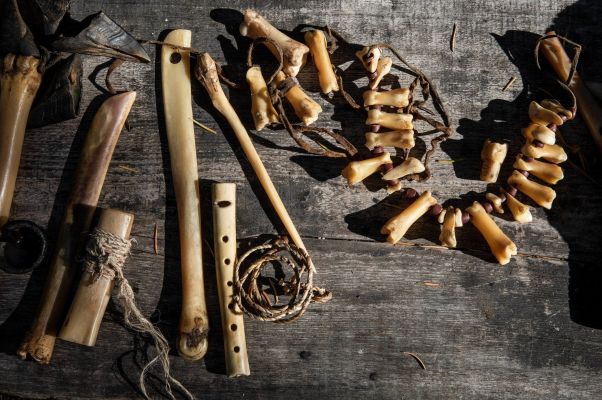
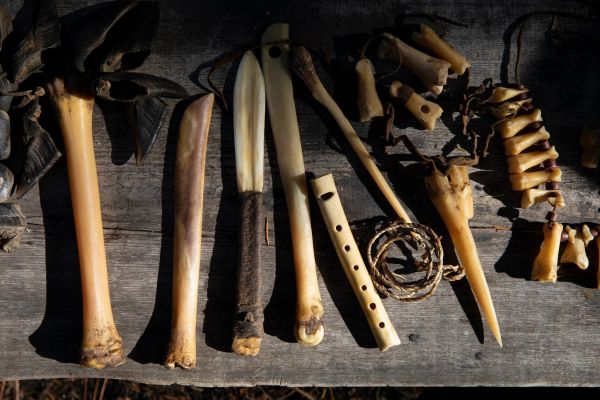
Image: Bone tools
The vibe was a mix of Burning Man, a Renaissance Fair and an apocalyptic religious fantasy. There was no doomsday prepper gun room – what would happen when bullets run out? Nor was there a sort of kumbaya, gentle-love-of-nature-yoga-class vibe. When Lynx told the story of killing her first deer, she said the deer, wounded, tried to drag herself away.
We shaved off the tree’s bark and got to the cambium, the soft inner layer of bark that we would boil in water. This would be used to tan hides. We learned on supermarket salmon skin. We tore into the plastic bags of sockeye salmon with stone shards, then descaled the skin with dull bones.
Lynx demonstrated how to process a deer hide using a hump bone from a buffalo. She sent us to go look for bones from the kitchen. Our job was to scrape off the muscle and fat. The hide was heavy, wet and beginning to rot.
Sometimes she played a deer leg flute while we worked.
That night was bitterly cold. I wore every piece of clothing I brought. Lynx coached us in warming big rocks by the fire, rotating them like potatoes, wrapping them in wool blankets. I heaved my two rocks, too hot to touch, covered in ash, into the sleeping bag with me.
“Another thing you can do to make a big cozy bed is just rake a pile of pine needles and just burrow in and put logs on either end so it stays together,” Lynx said.
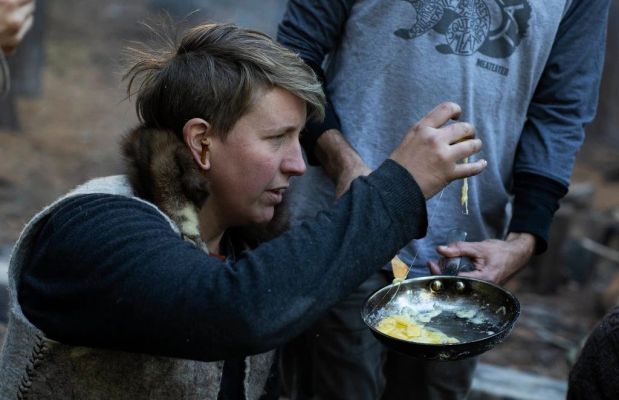
Image: Joan Kovatch
Lynx looks like Peter Pan, only 54 and with bone earrings. She is thin and quite beautiful, deeply wrinkled in a way that skin doesn’t usually get anymore. One day she wore red grain-on leather pants and her belt buckle was an elk antler crown. Another day it was a coat made of buffalo. She carried a Danish dagger made of a single piece of flint. On her belt was a little pouch made of bark-tanned salmon skin and deer hide holding a twig toothbrush, a sinew sewing cord and a bone needle, a piece of yerba santa for smudging.
She never sat or rested on an object, even to eat. She always crouched. She ate out of a tree burl that she had hollowed into a bowl.
Our clothes made a statement. We were not backpackers. No artificial colors, no carabiners and dangling straps and sexless sea foam green fleece. Here we wore tight leather pants. The whole point was to bring our animal selves here, and animal selves should attract mates.
One day Lynx wanted us to go to town for groceries. She wore her skins. We smelled disgusting. In town there was a church with a billboard that read, “Alert today, alive tomorrow.” There was a yarn store called Fiber next to an antiques store advertising itself as a nostalgic journey. We wandered down the aisles reeking of rendered, rotted deer fat and smoke.
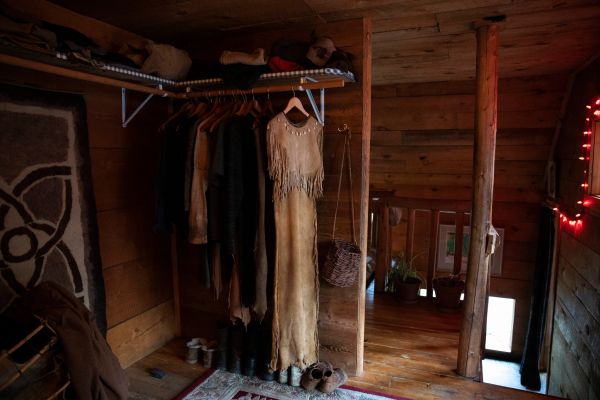
Image: Lynx’s closet.
“She’s like a blond-haired blue-eyed dressed up like a North American native person from a century ago, so she’s a striking image that’s easy to capture a lot of people’s attention,” Matt Forkin said. He is a hardware engineer with X, Alphabet’s experimental tech division. He has studied with Lynx, and is also now going in on some land in the Sierra Foothills with friends where they plan to go wild.
There are several of these new rewilding compounds emerging. One of the larger efforts is in Western Maine, where a group is working to replicate a hunter-gatherer community. What used to be a handful of bush-craft schools to learn these skills is now an industry of hundreds.
On a walk Lynx found some deer scat and handed it out, and a bit of stringy inner bark too, some dead limbs, mullein stalks. I asked what kind of plant a branch is called and she bristled.
“Naming something makes people think they know it when they don’t,” Lynx said. “It’s the golden torch light spindle. That’s what it does.”
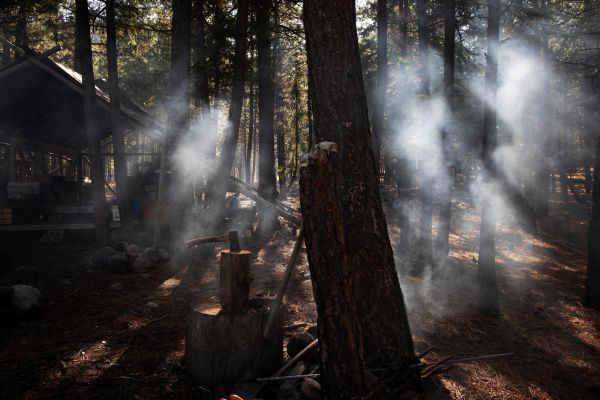
Image: Campsite
A group of her former students visited with stew, and we sat around a fire. They had two young children in tow, and homemade plum mead. They started just like us, they said. They were city people, mostly from the Bay Area. I visited their enclave the next morning.
Down a dirt road, past ramshackle cabins and horses, one group of permanently rewilding people have set up a series of yurts and shelters.
Epona Heathen, 33, used to have a different name and used to live in Oakland, Calif., working at a thrift store. She felt the call to wilderness while studying sociology at University of California, Berkeley.
“I’m writing this paper and the chair is wobbly, and I don’t know how to fix it,” Epona said of her time in the urban world. “I’m eating eggplant, and I don’t know where it grows.”
“One day I was like, ‘This is crap. We live month to month. We spend all our money on booze and coffee. We can’t save like this. We can’t live like this. We all talk about getting back to earth, but we didn’t know anything about it.’”
After some time on organic farms, they found Lynx. They decided to stay for a six-month Stone Age immersion.
“We had to come with 15 tanned hides and five pounds of dried fruit and five pounds of dried meat,” she said.
Her partner Alex, who is 31 and who worked at a grocery store as a wine specialist, bought a property nearby. Now about a dozen young people live there.
Epona’s yurt is 16 feet around and 12 feet tall, with a small wood-burning stove. She built curved bookshelves along the wall. Most of her food and medicine is dried in jars. There is a cat named Kitty and a dog named Arrow. She identifies as an animist.
“People say, ‘Oh when the apocalypse comes. …’ What are you talking about? It’s here. I’m a collapsist,” she said. “I’m not invested in maintaining the comforts we have.”
The Heathens, as the group named themselves, sometimes call the cities they came from Babylon, all the same, all fallen.
The biggest challenge, they’ve agreed, is that no one around them is old.
“Most of us are in our 20s and early 30s,” Epona said. “You start to see where the holes in society are, and our holes now are elders.”
That night, Alex took a horse over the mountain to visit some friends, while Epona stayed behind to host. She made deer, squash, and root vegetables stew. They had vats of plum mead and got the sauna going.
There are enough people on the hill for a variety of love triangles. Epona and Alex split. Now Epona is dating a young woman on the property.
Alex grew up in Montclair, N.J., and inherited some money. He is bald, muscular and tattooed. He said he used to be more dogmatic about living primitive, but that is changing.
“I just moved out of my yurt and into a house,” he said. “I got a second truck.”
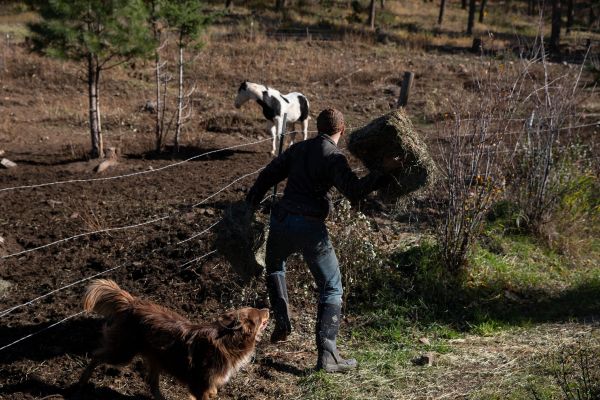
Image: Alex Heathen, feeding horses.
Roxanne, who is 26 and has bright curly red hair, was here for community, she said. She was working alongside Alex, rubbing salt into hides. She just moved a couple weeks ago and had been working at a coffee shop before this.
“You know, the thing about living the dream is it’s really hard!” she shouted, hauling another salt bag.
There is a main house down the hill, with a land line that everyone shares. The place is decorated in skulls and massive birds. There is a buffalo strung out to dry outside and a tall stack of deer legs at the door. More fit and dusty young people lounged inside. They were roasting a deer leg.
A sense of collapse underlies their opposition.
“From a purely rational engineering mind looking at the trends in the data, exponent times an exponent, our utilization of natural resources is way beyond the natural carrying capacity of the earth, and we’re seeing that in essentially ecosystem collapse,” Matt Forkin had told me. “In our lifetimes there is a very high chance we will see major social collapse. I do think there will come a time when these skills are practical for a large number of people.”
Alex made a gesture toward the small town over the hill and down the road. “Everyone is partying their final days away,” he said.
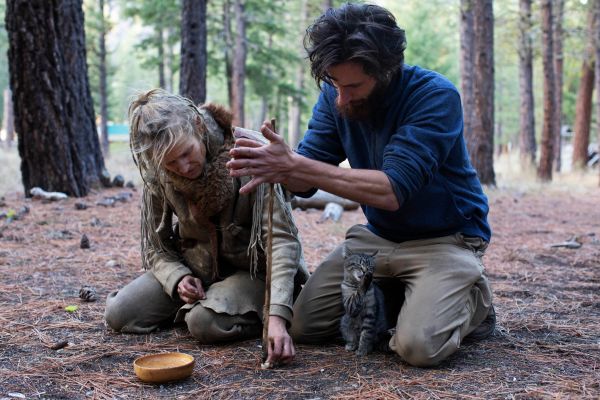
Image: Lynx Vilden and Louis Pommier.
Lynx was padding around in wool in her little cottage at the end of the property. She sleeps indoors in the winter. Her home is all exposed wood and overflowing planters, horns and old rattles. She was prickly and suspicious, upset that I had left her property to visit the Heathens.
Her daughter, Klara, lives in Washington, D.C. Klara’s boyfriend works for the World Bank.
“When I met him,” Lynx said, “my first question was, ‘Do you hunt?’ No. ‘Do you chop wood?’ He said, ‘I could try.’”
Lynx is single, and that is starting to bother her.
“The hard part is finding a partner to share it with,” Lynx said. “Maybe I’m getting to the point where people get fixed in their environments.”
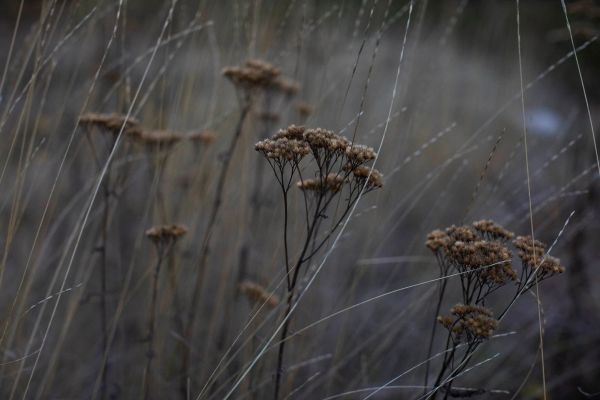
Image: Wild plants
She had a traditional childhood with traditional parents in London but left at 17 to play music. She moved to Sweden, went to art school. One day she met a man and they moved to Washington State to backpack. She went into the woods.
For a while, she was married to a man named Ocean. They had Klara. She home-schooled her in the mountains in Montana, but Klara went to live with Ocean. Lynx went farther into the wilderness.
But even she cannot escape money, yet. A week-long class costs $600. “I have to have my foot in two worlds to maintain some semblance of how I want to live in this world,” she said. Klara answers email for Lynx.
In September, Lynx will lead another fully Stone Age project, marching into the nearby public lands. All clothes must be handmade, all food gathered.
Lynx’s family still lives in London, mostly. Her sister is a freelance conservator.
We imagine that someone striking out into the wilderness is doing so to get away from everyone, to be alone. The people I met wanted the opposite. They want a life where they cannot survive even a day alone. They cannot get food alone, cannot go to the bathroom, cannot get warm alone. They want to be dependent.
“The city is actually the place of rugged individualism,” said my classmate Joan, who grew up in suburban Philadelphia and uses the pronoun they. “Here I’m using my hands and with people all day.”
Before being in the wild, they were addicted to video games and loved social media; very soon, Joan said, they were going to smash their smartphone. They were wearing a thick vest they had felted, with a full marten, body and head, sewn in as a collar for warmth.
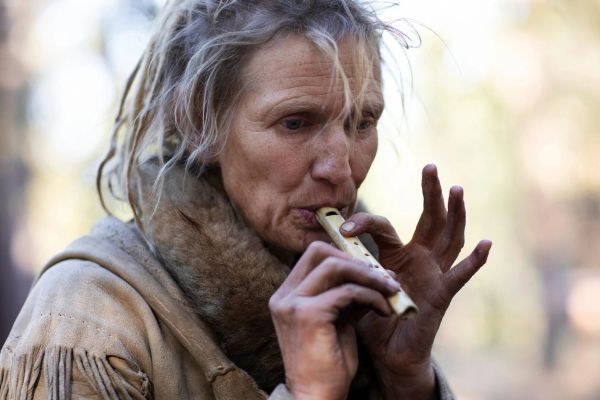
Image: Lynx Vilden plays a bone flute
“Some people don’t get it, but I prefer this life,” Joan said. “No, I don’t use toilet paper. I use moss and I like it better.”
Together, in the wild, everyone had to soften. One night, one of the guys said something offensive about gender roles, and a couple of us got annoyed. Then we all had to stop arguing because there was no one else to be with. I started arguing about politics with someone. Instead of going away, he had cold contraband beer, and I had nothing better to do than learn more about him. My only entertainment was the people around me. It made them more interesting.
“Really coming back to nature means responding to the social responsibility too. Someone says you have this personality flaw, you can’t just avoid them. You have to respond. You adapt,” Epona said. “Rugged individualism is a lie. Rugged individualism cannot survive.”
“There’s a social skill set of working in a community,” Luke Utah said.
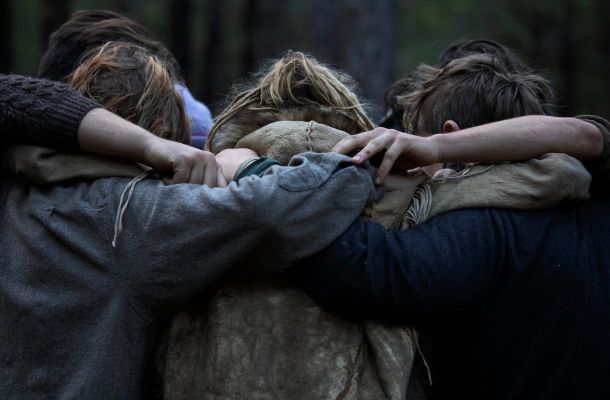
Image: Group hug
At one point, I got separated from the group. There was nothing I could do. I checked the river. I checked the houses. I checked the little pine needle burrows where people sometimes slept. I hooted once. I hooted twice. I sat and waited in a terror while it got dark.
Our time makes social obligation largely unnecessary. When I moved apartments, I hired TaskRabbits. When I got cold, I turned on the heat. In the woods, the evening entertainment I got was what we could provide one another. Now, suddenly, I did not want to be alone for a minute. The dependence felt amazing. I shrieked with joy when the group came jaunting back.
The next time I went to town, I dreaded the spasms of my phone wriggling back to life. I could feel the reception in the air, could feel being alone again. I was relieved to cross over the hill, out of service and back again to Lynx and my friends.
Deer legs are very useful. Their toe bones can be whistles and buckles and fish hooks. The leg bones become knives and flutes. Tendons become glue. I popped the black toes off into boiling water. Slicing with obsidian, I peeled the fur off and then the muscle and tendons. I sawed the ends off the bone. I used a twig to oust the marrow. The carnivore ate it. This would be my flute. (Ruth Fremson/The New York Times)
The Woman Who Lives 200,000 Years in the Past
Katherine Rowland, Outside Online, 2 April 2020
As we confront the reality of COVID-19, the idea of living self-sufficiently in the woods, far from crowds and grocery stores, doesn't sound so bad. Lynx Vilden has been doing just that for decades, while teaching others how to live primitively, too.
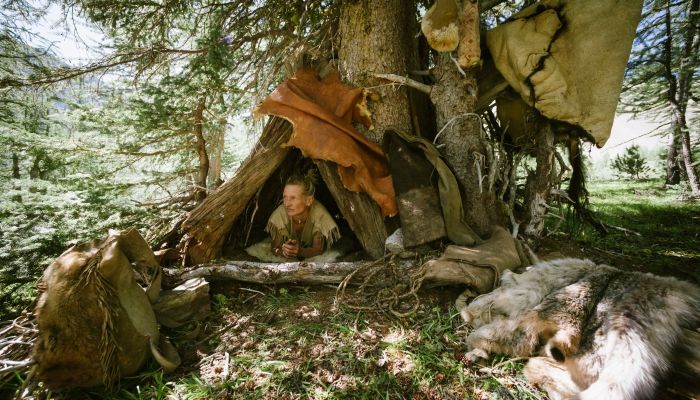
Image: Lynx Vilden in a self-built bark shelter
There is no easy way to reach Twisp, a blink of a town in north-central Washington’s Methow Valley. You could fly into Spokane and cut northwest for 175 miles. Or you could take a turboprop from Seattle over the mountains to the world’s apple capital, Wenatchee, and then get in a car and follow the Columbia River north for two hours. Or you could drive, as I’m doing, from Seattle through the electric moss of the North Cascades, slowing to a crawl through the ice-menaced range.
It’s November 2019, and I’m on my way to meet Lynx Vilden, a 54-year-old British expat who, for most of her adult life, has lived wholly off the grid. The slick roads don’t help my apprehension about what lies ahead: a three-day, one-on-one experience of “living wild.” The details are hazy. I’ve been advised to prepare for bracing climes and arduous excursions. “Wear sturdy shoes,” Lynx told me. “Bring meat.”
I’m four months pregnant and prone to sudden bouts of drowsiness, so after a roadside nap turns a one-hour delay into two, I send a text message to Lynx telling her I’ll be late. Only later do I realize how presumptive this is: she doesn’t have cell service or WiFi.
Until about ten years ago, Lynx also possessed no credit card, nor fixed address; her previous abodes – a tepee in Arizona, yurts in Montana and New Mexico, a snow shelter on the Lappish tundra – had neither electricity nor running water. This all changed when she received a modest inheritance from her mother’s estate in Britain that allowed her to purchase a remote five-acre plot some 12 miles outside Twisp. Now modernity, in the form of power outlets and a sink, is within easy reach, thanks to solar panels and a well that former occupants had installed on the land.
That doesn’t mean Lynx embraces it. When I finally arrive at the property in the early afternoon, she welcomes me to her wooded outpost wearing hand-stitched leathers. She heats her 900-square-foot log cabin – also the handiwork of the prior owners – by tending a wood-burning stove. For illumination she prefers the flicker of a tallow lamp, in much the same way that she favors water collected from the river to that which flows readily from her faucet. There’s a futon on the floor, but it’s mostly used by her 26-year-old daughter, who leaves the urban hustle to visit from time to time. Lynx prefers sleeping on the ground in a shelter she’s built deeper in the woods.
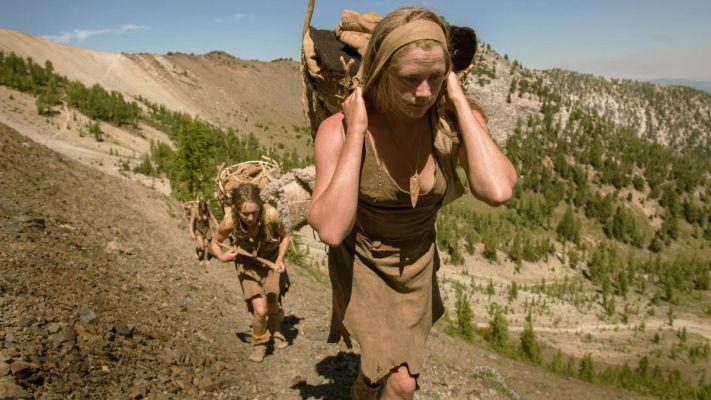
Image: Lynx calls her immersive Stone Age classes “projects.” A group of eight students participating in a 2014 project struggle up a scree slope in Washington’s North Cascades, while moving to a new camp in a valley with better hunting prospects. (Photo: Kiliii Yüyan)
Lynx (who doesn’t share her legal name) is not your typical back-to-the-lander. The lithe, blonde former teen punk, who grew up in the “concrete and dismal gray” environs of London, has become an unlikely torchbearer of humanity’s wild heritage. Her overarching aim is not to simply survive out here in nature but “to live as wild people lived” and to show others how to do so as well.
For two decades, Lynx has been running immersive programs that she calls Stone Age projects. After signing up, a group of fifteen or so students make their way to Twisp or to other farther-flung locales, like White Clouds, Idaho; Jokkmokk, Sweden; or the Rhodope Mountains in Greece, to learn skills from Lynx such as fire starting, shelter construction, bow making, and footwear fabrication. Once equipped with this knowledge, and having sewn their own buckskins and exchanged their toothbrushes for twigs, students have the option of heading out with Lynx into a nearby forest for as long as 30 unbroken days. They make camp, hunt and forage, and pass long hours in the intimacy of this tight tribal band.
Her approach to pedagogy can be ad hoc. Essentially, she says, she considers where in the world she feels most called (Mongolia was a desired near term destination before the COVID-19 outbreak) and what skills are relevant to living primitively in that place (this summer’s offerings include kayak building in Washington’s San Juan Islands). She then creates a class by going to a library or community center in Twisp, emailing her network, and seeing if there’s sufficient interest. While other survival schools can charge thousands of dollars for similar curricula delivered over one or two weeks, Lynx’s courses are priced for inclusivity rather than profit – her weeklong introductions cost $600, while her three-month immersions cost $2,500. She lowers or altogether eliminates her prices for friends, returning students, and those willing to barter.
What she’s offering is a tool kit for complete self-sufficiency, as both an antidote and a radical alternative to the frenzied pace and digital solipsism that so many of us rail against – and yet so few of us successfully resist.
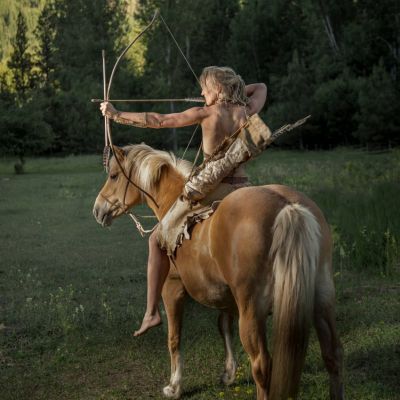
Image: Lynx posing with her handmade bow and arrow (Photo: Kiliii Yüyan)
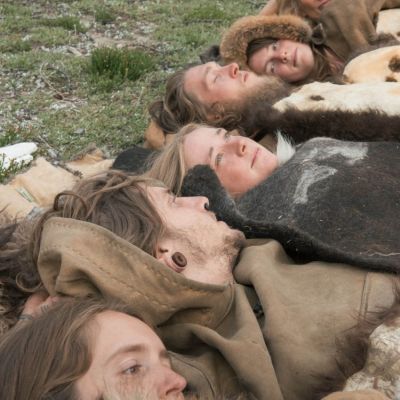
Image: Participants at the 2014 project resting at their low-elevation camp during the 30-day backcountry portion (Photo: Kiliii Yüyan)
If indeed our lives were better back when we lived in roving bands, would it be wise to consider how we might revive aspects of our deep past? That question tantalizes the motley group of modern-day hunter-gatherer celebrants. At conventions across the country, which have names like Echoes in Time and The Sharpening Stone, wild-food harvesters hobnob with mountain men and ancestral-arts buffs. There are more future-oriented primitive-skills practitioners, who overlap with doomsday and disaster preppers in their shared concern with survival in the inevitable absence of the System. Then there are those hoping to detox from our increasingly digital world, who advocate the virtues of forest bathing and extended smartphone sabbaticals. Even in popular culture, glorification of the Paleolithic abounds. YouTube channels like Primitive Technology draw millions of subscribers to demos of huts and spears, while a bumper crop of reality shows, like Naked and Afraidand The Great Human Race, subject brawny stars to purportedly aboriginal conditions.
But for all the scrutiny of the archeological record, the quotidian details of the Stone Age are largely speculative. “We’re trying to emulate this culture, but we have no idea how it works,” Alexander Heathen, Lynx’s friend and former student, told me. “We don’t have elders telling us how to do it.” As a result, the exercise of rewilding demands fluency in both skill and fantasy and a certain amount of romantic aspiration. It contains hopes for close-banded communalism, as well as the conviction that proximity to risk – to fire, to beasts, to heat, and to broken bones – is a boon to both the soul and the senses. There can also be a fair amount of wistful thinking, in looking to the deep past for a universal heritage. Our wild history is presented as a time before the world was scarred by borders, before politics, before race, before even the concept of identity carved out its demarcations of who belongs and where.
Some suggest that the primitive-skills community can run the risk of appropriating indigenousness. Practitioners of bushcraft draw liberally from the world’s traditions but are themselves typically white people, often endowed with at least some degree of privilege. “There is an inherent colonialism built into the primitive-skills idea,” says Kiliii Yüyan, a photographer, survival expert, and one of Lynx’s occasional collaborators, who is a Chinese-American descendent of the Nanai people of Siberia. “Part of the idea is that you can be air-dropped into anywhere and survive off the land. Indigenous literally means ‘of a place’ – survival is almost the exact opposite of that.”
There are grouse about, Lynx observes on our second day together. She proposes that we go for a hike so she can shoot one for our supper. Barring that, we could aim to dine on wild turkey, which she’s also spotted strutting around the creek banks and the woods. We ready ourselves in the fading afternoon. The sun is quick to slide behind the mountain slopes, and the surrounding forest throws shadows through the growing chill. Lynx takes an appraising look at the rifle she’s been cleaning and then glances at my camera. “Better to take the bow?” she asks. We agree it’s certainly the more primitive option. And besides, the swift hush of an arrow is less likely to scare off the flocks we’d like to eat.
We walk to the river that marks the limit of her land. There are no birds in sight, but Lynx beams as she gestures up and down the length of the shallow waterway. “Isn’t it beautiful,” she says. Deep in winter, she tells me, she’ll sometimes wake to a sudden silence. Slowly, she’ll realize: the river has frozen.
Abruptly, she turns and marches up a steep incline. Huffing behind her, I remember her offhand remark that it’s hard to find proper hiking companions because most can’t keep up. She points out another spot where the grouse have been congregating. “They’re everywhere until you want to go hunting,” she says peevishly, and lets loose an arrow through the birdless clearing.
It’s hard to be a hunter-gatherer these days. Never mind the struggle to meet Maslow’s tenets of survival: being wild verges on illegal. There are limits to how long you can spend on public land. Fires are frequently prohibited, and hunting is closely circumscribed. Lynx came up against the law in 2008, when a government officer attended one of her classes undercover. She was unaware of his identity until two years later, when she was charged for running a course on public land without a permit and for cutting down a freestanding dead tree. She was barred from the national forests of eastern Washington for a year. “Sometimes the laws of man and the laws of nature differ,” she says. “I choose the laws of nature.”
Lynx envisions a group with whom to share the toil and splendor of the days. This imagined band of 10 to 15 wild souls is utterly perfect, perhaps because it remains unrealized, suspended in the unbroken chrysalis of ideals. Indeed, even when groups come deliberately together, as they do for Lynx’s projects, it’s hard to stop attrition. “It’s easy to find exuberant, young, starry-eyed students who think they want to live on the land,” says Lynx. “But after that little honeymoon phase is over, they’re all like, ‘This is too hard.’” Thoughts of loved ones pull mightily, hunger pulls at the belly, ennui engulfs the mind.
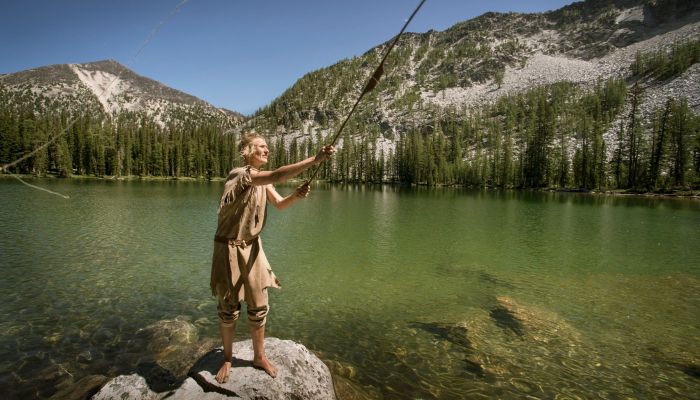
Image: Lynx casts a fishing line made of dogbane attached to her hunting bow in a lake near her home in Twisp, Washington. (Photo: Kiliii Yüyan)
Former participants I spoke with did mention the challenges of finding food and the fatigue of caloric insufficiency. “There was a lot of starving involved” is how Yüyan described the first project he completed nearly 20 years ago. But Lynx’s students also report that her expertise has deepened over the years. Steven Dirven, a former student, says his 2016 group enjoyed “delicious meals” of butchered bison, acorn flour, and roots and bulbs and bear fat, and he insisted, without a trace of irony, “Not many restaurants can compete with what we were eating.”
Many of Lynx’s Stone Age students have become more expert as well, continuing to come back for more of her projects. For this summer’s two-month-long course in the San Juan Islands, the prerequisite gear list includes 100 feet of plant-fiber cordage, a bone awl and needle, rawhide sandals, bark-tanned clothing, and a sap glue stick, along with one pound each of dried wild plants, dried wild meat, and rendered animal fat. A sizable number of mentees turned friends now live nearby in the Methow Valley, where they spin yarn and raise fowl and experiment with shifting forms of communal living.
This community is drawn to Lynx’s carefully crafted world, which, as Yüyan described to me, is deliberately stripped of jabbering distractions, surrounded instead by skins and bows and hand-carved vessels and the infinite permutations of the seasons. “Lynx really loves the aesthetics of Stone Age living, and I think that calms her down,” he says. “Everything in the modern world screams for our attention, and then you look at the natural world, and by and large, it’s a symphony of things trying to hide.”
Back in the woods, dark is falling. Lynx releases a last desultory arrow before leading us home. Her mood brightens when I remind her that we have the meat she’d asked me to bring, at the cabin. She’s gracious when I furnish the best steaks I could procure from Hank’s Market in Twisp: two dubiously gray slabs swaddled in cellophane. Lynx eats hers contentedly, plucking the pieces with her fingers and patiently gnawing the hide-tough meat.
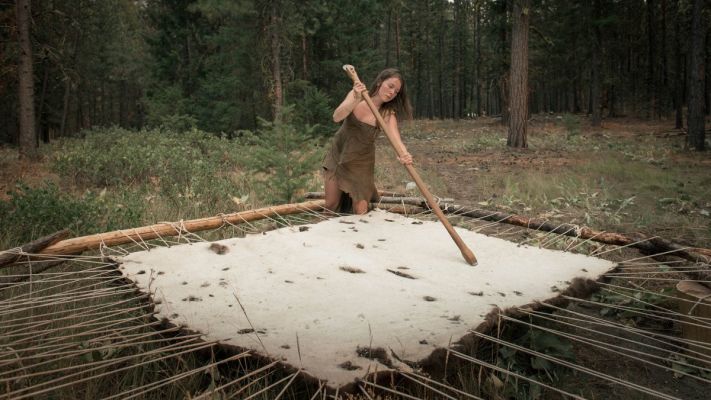
Image: A student softens a bison hide on Lynx’s property in Twisp before the backcountry segment of the 2014 project. The resulting tanned hide will provide an insulating layer that she can cover her entire body with when out in the wild. (Photo: Kiliii Yüyan)
Lynx never imagined that her days would play out in the woods. Growing up in London with her mother, a patternmaker, and her stepfather, a painter, she had wanted to be, among other things, an artist. Her adolescence coincided with the height of the British punk scene, and Lynx dyed her hair different colors and was christened “Loo,” as in toilet. “I could have been good at school, but I wasn’t very motivated,” she says. “I’m sure if I had been born ten years later, they would have stuffed me full of Ritalin.”
She left secondary school at 16, and, after a brief stint at the Chelsea School of Art and a period of drifting around in Amsterdam, she ended up in her mother’s homeland in rural Sweden, where she started developing a love of nature that would come to define her adult life.
A boyfriend convinced Lynx to travel to the United States when she was 21, taking her to Wenatchee, Washington, two hours south of her current home. She’d never seen real wilderness before. It was in the U.S. that she changed her name to Lynx and took the surname Vilden, meaning “savage” or “wild” in Swedish. She began hiking, awestruck, through the Cascades, but she says she was “lazy” and didn’t like carrying a backpack. “How did people used to do it? We didn’t have backpacks,” she says scornfully. “How did we make fire? What did we used to eat? At that age, I was going through a lot of, What did we do before?”
Lynx began learning to identify plants so that she could graze and gather on her hikes. She happened to stumble across famed tracker Tom Brown Jr.’s field guide to wild edibles and signed up for a weeklong class at his Tracker School, in New Jersey’s Pine Barrens. On the final day, she says, “I came out of the sweat lodge and just lay down on the ground and was like, I found it. This is what I want to do. I want to learn to connect with the earth and then share that with people. It was the beginning of my journey.”
Drawn to the healing properties of plants, Lynx pursued herbalism and wild medicine and wound up at the Reevis Mountain School, in Arizona’s Superstition Wilderness. One day, she told me, a guy rode up on a mustang stallion. “He’s got long braids and a big beard, which I’m a bit partial to, and I remember thinking, I’m going to marry that guy. And sure enough, I did.” Together, they drove around the country in an old school bus, hauling the mustang behind it in a horse trailer. Within the year, Lynx was pregnant.
By the time her daughter, Klara, was two, the romance had deteriorated, and Lynx and Klara decamped for Montana. There she spent the next decade living in a yurt and homeschooling her child. She tanned hides and made crafts, and in the summers she taught at the Boulder Outdoor Survival School in southern Utah. Lynx and Klara scraped by. When Klara turned 12, she opted to go live with her father in Washington State so that, she says, “I could learn in a more structured way and hang out with people my own age.” For her part, Klara told me that while her mom supported her in her interest in school and socializing, Lynx was not willing to compromise her own lifestyle. “I never resented her,” Klara says. “Even if I want different things, I feel really supported in whatever my path is.” The decision to let her daughter go was difficult for Lynx, though. The desire to close the distance between them led her back to Washington and, eventually, to Twisp.
Lynx is dogged by melancholy from time to time, and despite friends who are dispersed around the Methow Valley, she casts about for connection. Nights, especially, can be “pretty tough.” When no friends with trucks or other forms of transportation have been at her disposal, she’s walked out to Twisp River Road and waited for a passing car to take her into town to use the library or go to the store. If none came, she’d turn around and trek back home.
One night I drive us to neighboring Winthrop, a former gold-mining town that looks like a storybook version of the Old West. One of the local bars is having an off-grid evening, promising live music and no electricity. Lynx thinks this sounds fun and has brought along a fat lamp. But her enthusiasm dips when we arrive to find the lights above the bar alive with currents. Patrons were having too much trouble ordering in the dark, the waitress explains. On the way home, Lynx tells me her most recent paramour has spurned her, and she wonders aloud whether she is simply bad at relationships. But upon reflection, she concludes that, no, it’s that her love is too much, too fierce, too big, and more than most men can take.
Not for the first time, I wonder what it takes to resist the impulse to simply flick on the power. Or why not, say, move closer to the edge of town? But while I see comfort beckoning in the warmly lit homes down the road, Lynx explains that the seductive path for her is one of further retreat. “Do I want to get more enmeshed in a system that enslaves me? Not really. Sometimes I want to say, ‘Fuck it all,’ and get further out of society. Just go and live in the mountains and not come down.”
So what’s stopping her? I ask. She responds flatly, “I won’t do it unless I have a clan.”
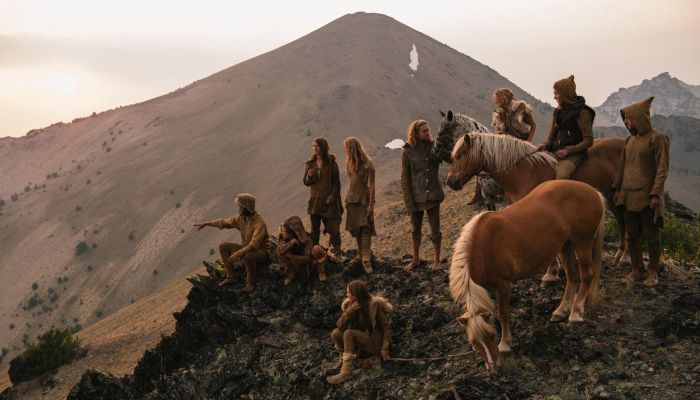
Image: Lynx and her students look out for wildfires on a ridge in the North Cascades during the 2014 project. (Photo: Kiliii Yüyan)
On our last afternoon, Lynx and I hike up to a nearby ridge. She plows ahead, cabled limbs swinging, seemingly oblivious to the branches that snap back behind her and hit me in the face. Her demeanor, like her way of life, contains elements of both pragmatism and poetry. During my time with her, she could be brusque, verging on impatient, clucking in disapproval as I offered the wrong sort of pine needles to feed the fire. On the peak, sweeping views unspool all around, and Lynx chews on jerky and drinks water from a hollow gourd before rising to pose for my benefit. She’s keenly aware of the cinematic beauty of her environment and the striking figure she cuts within it. “Hood or cap?” She postures with different headgear. “Rifle or bow?” she asks, nodding to my camera.
And yet she delights in detail and in the patient labor required of her lifestyle. Slowly, she scrapes wood with the broken edge of a rock to fashion arrows for her kit. She dresses hides with deer brains to produce a supple buckskin. Above all, she loves making fire. That night I squat on the ground as she enchants plumes of smoke from where the tip of her bow drill meets the notch of the hearth board. An orange ember appears, and Lynx scoops the coal baby into a nest of straw. As though her chapped fingers are impervious to flame, she holds the burning ball aloft, breathing it to life. “Fire is what makes us human,” she tells me.
But while Lynx does her best to maintain a primitive lifestyle, she is still a product of the 21st century in significant ways. After years of trying to commit to a single region, she now divides her time between the Cascades, northern Sweden, the Dordogne Valley of France, and occasional forays beyond. This breed of nomadism is a far cry from the migratory patterns of traditional hunter-gatherers, who followed the clement weather or their feeding herds. Indeed, if there is a major crack in Lynx’s Paleolithic persona, it is not that she sometimes uses a store-bought plastic toothbrush or indulges in the odd pizza. It’s not her penchant for reading classics by candlelight (when I visited her, it was Thomas Hardy’s Tess of the D’Urbervilles) or her use of the old computers at the Methow Valley Community Center to check her email, nor is it her competence with PowerPoint (she likes making slideshows to document her projects). It is that her fascination with the wide world – and her ability to hop on a plane in order to explore it – marks her as a thoroughly modern human.
Lynx is squeamish about the whole enterprise of travel, acknowledging the catastrophic carbon consequences of aviation and her extreme discomfort when moving through the surveillance theater of major airports. She prefers, she says, to travel with companions who can keep her anxieties at bay; she forgoes her buckskins when she flies. She chuckles ruefully at the irony that she soars around the globe to teach people how to elicit flames from rubbing sticks. But invariably, agitation bests her nesting instincts, and she heeds the call to roam.
Lynx considers her work to be on a multigenerational scale. Her great vision is to create a preserve for wild humans, in much the same way that pieces of the earth are protected for the benefit of native flora and fauna. The principles of conservation biology should extend to “the humans that want to rewild themselves,” she says. “We probably can’t become wild, but our children and our grandchildren could become wild if we had a place.”
It’s a fascinating proposition because, among other reasons, designating a place beyond the rule of law involves major legal intervention, requiring one to first subscribe to the very powers one wants to nullify. But Lynx’s reverie begins with something that looks very much like what she is operating today, with a school for learning primitive skills that abuts a pristine refuge. There, having amassed the knowledge one might need for surviving on wit and nature’s plenty, “You could walk naked out into the wild.”
Ancestral Skills And The Art Of Living Wild
The Explorers Journal, Winter 2023/2024
LES STROUD in conversation with LYNX VILDEN
A MEMBER OF THE EXPLORERS CLUB SINCE 2005, LES STROUD (A.K.A. SURVIVORMAN) IS AN AWARD-WINNING TV PRODUCER, MUSICIAN, AND AUTHOR. HIS CURRENT TELEVISION SERIES, WILD HARVEST, TEACHES VIEWERS HOW TO FORAGE AND TURN NATURE’S BOUNTY INTO AN EXTRAORDINARY CULINARY EXPERIENCE. LYNX VILDEN HAS BEEN TEACHING ANCESTRAL SKILLS IN THE UNITED STATES, EUROPE, AND BEYOND SINCE 1991. SHE IS THE AUTHOR OF THE NEWLY RELEASED BOOK, RETURN: A JOURNEY BACK TO LIVING WILD.
LES STROUD: Clearly, you have mastered the art of survival, as evidenced in your new book, Return: A Journey Back to Living Wild. What led to your fascination with ancestral skills and survival? Where did that come from?
LYNX VILDEN: I was raised in London, however my mother was Swedish, so we would spend our vacation time with my grandparents in southern Sweden. I would spend the school year in this very urban environment, and then the summers living with my grandparents on the edge of the forest in what seemed to me at the time like a vast wilderness. In reality, it was just a little forest with villages all around, but nonetheless I was enchanted by it. But it wasn’t until I was about 20 when I started traveling, hitchhiking around the world and started to experience true wilderness areas, such as the North Cascades in Washington state, where I truly felt at home. I was probably about 24 when I found out about Tom Brown Jr.’s Tracker School. I went there and it was like bing! A light bulb went off. Wow, here’s how to make fire. It was the kind of thing that I’d always wondered about when I was a little kid.
LS: I know that ping in your head that takes living outdoors to a whole new level. We can go camping, we can go canoeing, hiking, and sea kayaking, and such. But bushcraft and survival is another story altogether. I first fell in love with Nature and adventure through television – Jacques Cousteau and Tarzan movies. I wanted to be a hybrid Jacques Cousteau–Tarzan – fantastical thinking that came from reading books about the mountain men and watching Jeremiah Johnson, my favorite movie of all time. Like you, I really got into this whole notion of survival through a college course up in Canada. The first day, first class, we went outside, where I was shown lambsquarters, the first wild edible I learned about. And then we got to doing our shelters, which made me giddy. I just remember thinking: this is for me. I quickly became what used to be called a survival nerd or survival geek, part of a band of weirdos building shelters on weekends. We were not the norm. And Tom Brown Jr. was not the norm. He was a bit of a patron saint at the time. There was the Boulder Outdoor Survival School (BOSS) and David Holladay, Larry Dean Olsen, and all these people. We were, at least in the beginning, almost of a family. A sisterhood and brotherhood of people who knew we were geeks, nerds who liked lighting fires by rubbing sticks together. We got it and we didn’t care.
LV: After I went to the tracker school, I moved out West, and then I discovered the whole Rabbitstick scene and their gatherings. I met Holladay, as well as West Card and Steve Watts, who were some of my early mentors. I actually wound up working at BOSS for quite a few seasons back in the ’90s.
At the time, however, it was very much a male-dominated genre. That has really hanged in the primitive skills-gathering scenes over the years. The learning of bushcraft or ancestral skills has become more family-oriented and popular.
LS: You’re absolutely right about the change. Just look how big it is now. In the early ’80s, I was learning from John and Geri McPherson down in Kansas, and, as you mentioned, there was Rabbitstick, of course. David Holladay, who is the unsung hero of a lot of this, and I are still very close to this day. And, as long as we’re name-dropping people we know and love, there’s David Wescott. For me, however, it was always about the connectedness to Nature. I believe a lot of us understood that. Yeah, so we like flintknapping, but mostly we like sitting on the ground and communing with Nature.
LV: I do think there are a lot of hobbyists out there who go to the gatherings, only to return home and go back to their normal lives, jobs, families, and so on. For me, however, I began to embrace it not as a temporary experience but as a lifestyle. There was a little group of us who came together and were keen to truly live life in the wild rather than as weekend warriors. I basically moved outside where there was no electricity, no phones. We were bush hippies, really. We tanned hides and grew some food. We hunted deer and the like. We lived dirt-poor for years and years, but we were free. I raised my kid out there in the mountains of Montana.
LS: My story is almost the same as yours. Back in the ’80s, my then-wife, Sue, and I went and lived for a year off in the bush, in a little log cabin that we built in northern Canada, and tanned hides and all that. We raised our kids there. What I love to always come back to is the beauty of the skills, the passion for Nature, the beauty of the lifestyle itself despite its difficulty – not to mention the permissions one needs these days to live off the land.
LV: Here in southeastern Norway, where I have lived for the past three years, it is illegal to hunt with a bow and arrow and making a fire in the wilderness is pretty much impossible, legally. How do you do a Stone Age project without a fire? Yet the beauty of living in ancestral ways is that you’re hyper aware. You’re watching the forest, you’re watching life flow around, you’re part of this beautiful intrinsic web of life. When we are in Nature, something changes, something settles, and we start to feel more peaceful. It’s very deep-seated. It comes from our ancestry, our history, our connectedness to Nature. And I think that’s what we yearn for when we surround ourselves with all these modern things. Who doesn’t feel better when they go for a walk in the park, where there are some trees and there’s some grass there?
LS: We all know that shinrin-yoku (forest bathing) has become popular because it can do so much for the body and mind. If you take someone from the city, they head into the woods grumpy, and angry, and full of stress. The beauty that I find of being in Nature for Nature’s sake is that you don’t have that emotional option. Whether you like it or not, it is making you more healthy. It is de-stressing you. It is giving you a sharper mind. That’s why Nature is so powerful.
LV: When my students come and tell me, “I want to learn how to tan a hide; I want to learn how to make fire; I want to learn how to do flintknapping,” I tell them, “Okay, we can do all that stuff. But really, what you’re going to be learning is how to be still.” When you take these skills into your hands, really all you are doing is giving yourself a focus point, a way to stop thinking about everything else. So, to take elements from Nature into your hands and start to manipulate them and, in the process, come into that quiet space, you are entering an environment where Nature can do her work on people.
LS: I feel the same way when I take people out into the field, I am simply facilitating their connection to Nature. That’s it. The thing about bushcrafting skills is that they require you, as you say, to sit still, to use your fingers, to feel textures and smell smells, to get dirt up in your fingernails, and to slow down – almost like no other skill does. So, when we impart these skills to others, we give them some confidence, reassure them, help them to dissipate their fears, and then we get out of the way.
LV: There’s a guy from Switzerland who had attended a one-week class with me last year. This past spring, he came back for a monthlong program at one of my mini-immersions. A few weeks ago, he sent me an email saying, “I can’t tell you what has happened to me other than I took off my shoes and I started walking barefoot, and everything has changed in my life.” And he was thanking me for encouraging him to simply take off his shoes. I was like, “You took off your shoes and suddenly you were connected to the Earth in an entirely different way.” It was so beautiful, it almost made me cry.
LS: I never cease to be amazed at the power of Mother Nature, Mother Earth, of that spirit. Whatever you want to call it, there is an energy. And isn’t it interesting that science is catching up with our philosophical ramblings? Oh, the mycelium. Oh, the interconnectedness of the forest.
LV: Well, that’s what the Indigenous people and the mystics have been saying for thousands of years, right?
LS: Tapping into Nature’s energy is the original beauty attached to teaching bushcraft skills, survival skills, primitive skills. There’s an art, it’s a ballet with Nature, rather than being any struggle.
I know you love your flintknapping. I know you love your alone time and your own time of hunting and fishing. But as I see it, there is a great distinction in the skill sets, as well as the people who get into the varying skill sets. I see primitive Earth technology, I see bushcrafting, and I see survival skills, which, of course, dovetail.
For me, primitive Earth technology, primitive Earth skills, are the skills that come from our ancestors, from Indigenous cultures, First Nations. Of course, these skills are not only about survival, but about thriving, the art of survival, if you will, living in Nature in its purest form. And, one thing people forget in all of this, is that true survival on a grand scale is not about being alone, and it never will be. It requires a community. Being alone in an Indigenous culture 200 years ago was a banishment. They assumed you were going to die, that’s why they did it.
Then there is bushcrafting. It’s steel; it’s chopping wood; it involves guns, traps, and snares. You’re building a cabin, whittling, making camp chairs, using a smoker, and stuff like that. And it also has the capacity to be more of a solitary endeavor. Once again, I see that as a matter of not just surviving, but also thriving in the wild.
Survival, to me, throws that all out the window. I don’t care what I have to do. I’m lost, my friend has a broken leg. We’ve dumped the canoe, we’re not going to be rescued maybe at all, or at least it might be a couple of weeks. What do we need to do to survive? And, in my mind, that’s everything and anything – whatever is available no matter its source. There’s my little diatribe on that.
LV: I agree, especially on the point of the importance of community. And our ancestors were not interested in escaping society. They just lived in relative comfort. And part of that comfort, of course, is belonging to the land, belonging to a community, knowing the land, knowing the people you’re around. It’s far more than a matter of surviving. As you said, if you were banished from your tribe or your clan, then it’s as good as a death sentence. LS: You’ve devoted your life to largely living in the wild, so I have to ask you, do you miss life in society? How do you reconcile your earthy living with everything else that’s going on around you? Your relatives, your friends from school? How do you reconcile who you are with what is going on in the modern world?
LV: That’s a constant dilemma, actually, because it’s quite hard to do anything in this world unless you somehow keep up with what the rest of your culture or society is doing. I remember some years ago I thought, okay, I’m not going to drive a car for a whole year to see what happens. And so I’d ride my bike. I was still living in the U.S. and I’d ride my bike into town, only to have my partner drive by me on the way home, and I’d have all the heavy shopping bags. I realized that all my friends were actually getting in a car to come to see me struggle. And it’s the same thing with my teaching, too. If I decide that I’m not going to fly anymore, all my students fly from all around the world to visit me. It’s like, wow, if I was to fly to a different country, then it’s a whole lot less flying, which is better for the planet. So, I’m constantly asking myself, how can I be more sustainable? I’m trying to teach something about sustainability, and yet, you can’t help but be pulled into it. I’ve still been resisting, resisting, resisting. I don’t have a smartphone yet. I feel like I’m always 25 years behind the technology that everybody else is on. And it’s quite hard to function, actually, unless you have a great website and unless you have this and that and all of the modern things, like WhatsApp, a lot of these things.
I do have an electric bicycle, so I don’t have to walk the 17 kilometers to go into town to resupply. This is my modern-time thing. Even though I may be making it difficult for myself, I feel like life is better without all of these things. When my students come here to take a class for a one week, I have this little box, which I present on the first night. I’ll open the lid and it’s empty, and I’ll say, “Get your phone, turn it off, and put it in here. I’m taking it away.” And people feel a bit stripped bare when you tell them they’ve got to turn off their phone and stick it in a box, and they’re not going to be able to contact anyone for a week.
The cautioning that I often give people is that you need to be prepared. If you want to go out and live out there in Nature, that’s all you should want. To actually function out there, and to be concerned with your firewood and your shelter, you can’t also be worrying about the newest iPhone or what’s going on in Hollywood or on the political scene. I do wonder what’s it going to be 10 years from now. Is it going to be impossible to take someone’s phone away because it’s illegal not to have your phone on you, or something?
Personally, I know that I will always be in this push-pull relationship with needing to keep up somewhat with the times and technology, and at the same time resisting it because I get quite anxious and angry sometimes because I don’t understand how a lot of these things work. If I want to relax, then I just go back outside and hang out in Nature. And, like you said, it’s like, oh, okay, now I feel better. And yeah, we all need that.
At the end of the day, what I’m trying to do in my life is live the life that I love, and then drag some other people in to live it with me. I’m not the kind of person who just wants to go live in a cave all on my own. I’m very social and I like having people around.
LS: I hear you. But when we teach, we bring in this other side of it when we decide to share. When we decide to invite the outside world into ours, we are automatically stuck with society and the modern world, and news of politics and so on.
What I’ve learned is that we will always lead lives of conflict, which we cannot escape. I spent a year living in the woods like it was 500 years ago, and I took a camera and I filmed it. The difference between building our shelter and making sure my camera was charged, it’s two other worlds entirely.
As we speak, we are sharing our mutual passion for Nature and the sheer joy of a life in Nature. And I think we need to find solace in our small victories, in a way. Think about it this way: You’re wearing glasses. You’re talking on Zoom right now. My personal reconciliation has been that this is what I do. I happen to share well.
If I have a regret, it is this: without Survivorman, you wouldn’t have the survival television genre. As my own Canadian version of a bush hippie, I was there to teach. I created a show to share my love and to facilitate people feeling better about getting out in Nature with a skill set. Unfortunately, it became so profitable that another show was developed, Man vs. Wild, which couldn’t have been more inappropriately or poorly named. A producer kept trying to get me involved, and I said, “Look, you’ve turned survival into a competition. And as far as I’m concerned, I will die on this hill. It is never going to be about competing. Ever.” And David Holladay and I talked a lot about this. There is no such thing as competing in a survival situation. “So, no, we are not going to be on your show.” We’ve never looked at a survival skill, no matter how modern and technical or how rooted in ancient Indigenous cultures it might be, as a way to compete, beat, or subdue Nature.
By the way, get an iPhone!
Images
OPENING SPREAD: LYNX VILDEN (FAR RIGHT) AND A CLASS OF STUDENTS LEARNING ANCESTRAL SKILLS AT GAULSTAD IN CENTRAL NORWAY. PHOTOGRAPH BY ERIC BECKER. FACING PAGE: A PORTRAIT OF VILDEN BY KILIII YÜYAN.
YNX VILDEN SHARES STORIES AROUND A CAMPFIRE IN GAULSTAD, NORWAY. PHOTOGRAPH BY ERIC BECKER
PREVIOUS SPREAD: LYNX VILDEN AND STEPHANE GREMAUD LAUNCH A MOOSE-SKIN BOAT THEY BUILT ON A LAKE IN THE TELEMARK REGION OF NORWAY. PHOTOGRAPH BY EMMA CLAEYS. FACING PAGE: VILDEN’S HANDCRAFTED KIT. PHOTOGRAPH COURTESY LYNX VILDEN.
PREVIOUS SPREAD: LYNX VILDEN HAULS REINDEER HIDES TO THE 400-YEAR-OLD SAMI MARKET IN JOKKMOKK, SWEDEN. FACING PAGE: VILDEN FLINTKNAPS DURING A WORKSHOP IN FRANCE. PHOTOGRAPHS COURTESY LYNX VILDEN
LYNX VILDEN DEMONSTRATES HER ARCHERY SKILLS IN A PORTRAIT BY CY BACON.
Lynx links
- The Moon Magazine: Lynx Vilden | The Call of the Wild, 2013
- Kiliii Yuyan: Living Wild photo art project (2017)
- The Dark Mountain Project: The Sparrow and the Twig (29/3/2018) (Archived version)
- Thomas J. Elpel: Four Seasons Prehistoric Projects