Archived pages
A repository of old, archived pages that are mostly outdated for me (such as old opinion pages), but might be of some interest still. I have put everything on this page, so it is quite long! (Inevitably, some links will be broken/unavailable.)
- Alien life (20/9/2017)
- Crimes against architecture (13/10/2012)
- Favorite plants (29/12/2015)
- Favorite villains (and aliens) (7/4/2020)
- Favorite (fictional) villains (17/1/2018)
- Fictional aliens (18/11/2017)
- Likes and dislikes (7/6/2018)
- New World Order (3/7/2015)
- Opinions (26/10/2019)
- Overpopulation (29/12/2015)
- The war on gardens (13/5/2017)
Alien life
On this page are some of my speculations on alien life, of the sentient/sapient kind that we could possibly communicate with. I am not a scientist so these are only amateur speculations. I am focusing on the possibility of “real” aliens and am deliberately not including the pseudoscience of UFO conspiracy theories, which are most likely the result of overactive imaginations and wishful thinking.
Are there any?
It seems hard to believe that out of the billions of galaxies in our Universe, only our small planet has evolved life. As more and more planets are detected orbiting other stars, the chance of eventually finding life on other worlds is looking more hopeful. I am assuming that life in some form is common throughout the Universe; it would mostly comprise simple forms such as bacteria. Complex life takes much longer to evolve and needs particular conditions to enable this (fresh water, a receptive but still-challenging environment to induce evolution, a long-lived star). Thus I feel that the Rare Earth hypothesis is a more realistic view, in that complex life will be comparatively rare but still exist. Whether we could communicate with it is another matter!
Professor Andrew Watson believes that life on Earth-like planets only has a limited time in which to evolve, so it’s unlikely intelligent life exists elsewhere (“Time’s running out for ET to evolve,” ABC News, 22 April 2008) Needless to say, I hope he is wrong! Others provided counter-arguments to this.
Contact
Concerns have been expressed by various people about the implications of others broadcasting Earth’s presence in the Universe through efforts such as SETI. The feeling is that the recipients might be hostile, which might have dire implications for humanity. Sci-fi author David Brin is one of those concerned. These concerns tend to evoke exasperated reactions from me (snorting, rolling of eyes, etc.). My feeling is that humanity is already destroying itself though overpopulation, environmental devastation, etc., so a potential alien invasion would make little difference (maybe a “hostile takeover” with Earth “under new management” would be an improvement!).
Australian astronomer Ronald Bracewell, now of Stanford University, warns that other species would place an emphasis on cunning and weaponry, as we do, and that an alien ship sent our way is likely to be armed. Indeed, evolution on Earth is, as they say, red in tooth and claw. And it’s likely that any creature we contact will also have had to claw its way up its own evolutionary ladder and may possibly be every bit as nasty as we are – or worse. Imagine an extremely adaptable, extremely aggressive super-predator with superior technology.
– “Is anybody out there?,” The Age, 4 August 2007
Any sort of alien contact would prove that we were not alone; for humans to be the only sentient species in the whole Universe is a rather depressing prospect! So I would not worry too much, assuming they didn’t plan to eat us, which would be unlikely as life on other worlds would not find us biologically-compatible. (Also, my life is going nowhere so an alien invasion wouldn’t make much difference to me.)
A selection of news articles on this topic:
- The Age:
- “Star wars: who are we inviting in from the cold?,” 8/6/2008
- “Calling ET may not be a smart move, say some,” 9/2/2010
- Centauri Dreams blog: “SETI’s Dilemma: Break the Great Silence?,” 15/10/2007
- Lifeboat Foundation: “Shouting at the cosmos”
- Seed Magazine.com: “Who Speaks for Earth?,” 12/12/2007
Some “advice” to alien visitors I wrote a while ago: “Humans are best observed from a safe distance! Although they look fairly harmless physically, they are one of the most dangerous inhabitants of Earth (and have reached plague proportions). They spend an inordinate amount of time finding various ways to fight, kill and blow each other up. Humans tend to be irrational creatures and will be hostile to anything new. The most dangerous type of human tends to be the young males of the species, particularly young men who congregate together in groups and roam around at night. They will go out of their way to harass and hurt other humans (particularly females) or animals. So, approach with caution (and keep your weapons handy)!”
Of course, if the aliens were more powerful and technologically-advanced than humans, they would not have to worry so much (or at all!).
Body form
For possible body structures of aliens, I tend towards a more conservative viewpoint: that these are not likely to differ greatly from Earth lifeforms, given a similar environment, as the laws of biology, chemistry and physics are the same all over the Universe.
The most commonly seen body plan amongst vertebrates is that of the tetrapods, which include all mammals, birds, amphibians and reptiles. Some animal groups, such as the cetaceans, bats and most birds have been modified (e.g. front limbs become wings or flippers) but nevertheless, they are still tetrapods.
The invertebrates employ a much more diverse array of body plans, such as seen in insects (six legs, three body parts and an exoskeleton), cephalopods (no skeleton, hydrostatically stiffened tentacles, primary propulsion by squeezing water out of a mantle cavity), echinoderms (five-fold radial symmetry, external skeleton, movement by hydrostatically operated tube feet) and various phyla of “worms” (tube-shaped, movement by expanding and contracting parts of the body).
– Wikipedia: Body plan
Some people use the exotic invertebrate creatures found in the ocean depths as examples of forms aliens could take, the reasoning being that if these creatures are so alien-looking and bizarre, then real aliens could be even weirder. But deep-sea creatures can only assume their strange forms because they are not constrained by gravity but supported by water pressure, so a supporting internal or external skeleton is not necessary. If they are removed from their high-pressure watery environment they quickly perish. Thus space-travelling aliens are unlikely to be invertebrates, unless they could find a method of containing their bodies in environment suits filled with water.
There is doubt whether an ocean-dwelling intelligence would ever seek to leave its environment, anyway. Whales and dolphins are intelligent, but have remained in the same form for around ten million years as they have had no reason to change or evolve further; their aquatic environment is consistent. (“ET can’t call us if he’s wet,” ABC News, 12 July 2001 – which also suggests life-bearing planets with landmasses are likely to be rare.)
Insect-type (or crustacean) invertebrate aliens are popular in science fiction, but the insect and crustacean exoskeleton (a hard outer body and soft innards) has limitations. The exoskeleton is inflexible so an insect must breathe through tiny holes called spiracles. This is not an effective method of getting a lot of oxygen into one’s system, so insects are limited to small sizes. In the era of the dinosaurs when there was more oxygen in the atmosphere, prehistoric insects reached larger sizes (such as a dragonfly with a nearly-meter-long wingspan); higher temperatures also aided their metabolism. There are limits on the proportion of oxygen an atmosphere can have, though, as vegetation would spontaneously combust if oxygen was excessive! (35% O2 is around the safe maximum.)
Another limitation is the structure of the limbs; exoskeleton joints would not be able to cope with the stresses:
One estimate suggests that mammalian joints are called on to withstand forces as much as 100 times the animal’s body weight during normal locomotion. (In humans, the peak forces on the knee during running can be 15 times body weight.) Arthropods, even though they have more legs than mammals, have it even worse; their joints may see forces as great as 3000 times body weight, 30 times higher than mammals. Because joint contact areas are much lower in arthropods than vertebrates, the difference in stresses must be much greater. Now we come to the heart of the matter. As you scale up an ant, body mass must increase faster than joint surface area – indeed, the stress on the joint should increase in direct proportion to size.
Could insects evolve sentience, in a form that humans could communicate with? Some insects such as bees have a sort of hive-mind, and the concept is a popular trope in science fiction, but real-life social insects communicate by emitted pheromone chemicals, not mystical telepathy, so humans would find it difficult to talk to such creatures, unless they could replicate the pheromones.
Thus, human-sized intelligent insect aliens seem unlikely, though perhaps insect-analogs on another world could evolve into vertebrates and then develop sentience.
So that leaves vertebrates for the basic alien body structure. Vertebrates (creatures with an internal skeleton) on Earth have all evolved to have four limbs, either four legs or two legs and two arms (as well as a tail in some cases). This has been a common feature; even creatures that were the closest to aliens on Earth – the dinosaurs – had four limbs (and a tail). Why four limbs? Two obviously wouldn’t be practical, and six is apparently excessive. An even number of limbs is needed for locomotion (a tail provides extra balance for two-legged creatures that don’t walk upright).
Six-limbed vertebrate aliens do appear in science fiction, but in biological reality this body form seems not to appear on Earth.
- Six legs: could not walk – how would the legs co-ordinate? The middle pair of legs would bump into the front or back legs, unless the creature walked in a pacing style (the three legs on one side or the other moving forward), but even then the additional legs are extraneous. (A page on hexapods at the Furaha speculative biology site has, however, worked out a gait scheme for them.)
- Two arms, four legs, forming a centaur-type alien: never seen in nature (to my knowledge). How are the internal organs arranged, as the body is so long, and there is a 90° bend between the vertical and horizontal torsos? The centaur would get awful backache from holding its upper torso upright all the time! It is also top-heavy. It just seems to be an awkward body shape. (“Biology in Science Fiction” blog: Centaur anatomy) A possible alternative would for the creature to have a head and long neck as many Earth animals do, then a pair of vestigal manipulative arms in front of the first pair of legs.
- Four arms, two legs for a bipedal alien: the creature would not walk very well as it would also be top-heavy, and how would the extra pair of limbs fit into its skeletal structure?
Insects with their exoskeletons can have many limbs, but as explained above they are limited to small sizes.
Incorporeal energy-based lifeforms appear sometimes in science fiction but as the Internet Encyclopedia of Science points out:
Hypothetical life that exists without material bodies. The idea has been extensively explored in science fiction (see Childhood’s End) but, from the viewpoint of science itself, the concept of life based on “pure energy,” such as electromagnetic radiation, poses significant difficulties. A being made only of photons, for example, could not move slower than the speed of light and would essentially exist outside of the normal time stream of the rest of the universe.
How would the energy be contained? What would it use as sense organs, and what would it consume to enable it to keep functioning?
Don P. Mitchell believes aliens will have a similar chemistry to us:
My conclusion is that animal life is likely to be carbon-based and oxygen-breathing. In fact, I think it is likely to be RNA- and protein-based, but not using the same nucleotides and 20 amino acids found on earth. Countless varitions in basic biochemisty seem possible. Alien life might use RNA but not DNA. Perhaps thioesters are used in place of ATP, etc., etc. The structural support of larger organisms might be protein fiber, or polysaccharide fiber, perhaps with hard-mineral reinforcement. If laevorotatory isomers happen to be used, the biosphere might be extremely toxic to visitors from Earth.
Another speculation is for aliens to have evolved to a point where they decide to discard their physical bodies and upload into some form of artificial intelligence. The article “Don’t expect ET to be like us” by NASA historian Steven J. Dick asserts that this is likely to be the case for advanced aliens.
So I propose what I call the “intelligence principle”: that the maintenance, improvement and perpetuation of knowledge and intelligence is the central driving force of cultural evolution, and that to the extent that intelligence can be improved, it will be improved. Applied to life in the universe, this means that ETs will have sought the best ways to improve their intelligence, and in doing so may long ago have advanced beyond flesh and blood to artificial intelligence (AI).
I tend to disagree; he assumes that an alien culture will follow the same pattern as ours:
[…] because the one thing we know for sure is that civilisations older than ours will have undergone cultural evolution. And as we know from our experience on Earth, the pace of cultural evolution leaves other forms of evolution for dust.
But why should this be the case? Perhaps aliens may have a culture that sees stability as desirable, rather than constant change. They might see discarding their bodies as pointless, and instead possess the advanced medical technology to combat physical ailments.
But at least a touch of humanness is necessary, I think, if you want your human characters to have meaningful interactions with the alien characters. Even Lem’s alien ocean had to know that humans are another intelligent species and understand us enough to tap into our minds. I suspect that the greatest hurdle of our first first contact may actually be realizing that we should be trying to communicate at all. And even once we’ve settle on a physical means of communication, there is the difficulty in finding a common “universe view” – something that can even be a problem between different human cultures.
Another thing to consider is that almost all science fiction is told from the human point of view, and we are naturally inclined towards anthropomorphism – we ascribe human characteristics to objects and animals, and any aliens we meet will be perceived through this filter. While aliens might not really be human-like at all, we almost certainly will ascribe human motivations and emotions to them. Science fiction simply describes aliens through the eyes of unreliable narrators.
It is almost impossible to imagine how non-human creatures think – we can’t imagine how other animals see the world, though many display obvious intelligence and reasoning. We can, though, communicate with other mammals to some extent as we have features in common.
Links
More links of interest.
Articles
- The Age, The Conversation: “Why intelligent aliens might look like us”
- Arachnoid.com: Interview with an Extraterrestrial
- Ask MetaFilter: Why don’t we see coconut crab-sized insects?
- Athena Andreadis: Making Aliens: The Repercussions of Planetary Settlement
- BBC Focus Magazine: “Anatomy of a Living World” – conditions required for an Earth-like world.
- Cosmos: “Alien safari.” Alien life may develop into familiar forms due to evolutionary convergence.
- The Courier-Mail: “There is life out there but it’s probably stupid,” 15 /3/2008. Aliens are unlikely to have human-type intellgence.
- Guardian: “Don’t panic!” 5/7/ 2008. “Aliens! Kidnapping! Serial killers! How realistic are your chances of surviving a nightmare movie scenario?”
- H+ magazine: “Andorians, Klingons, Vulcans, and Romulans,” 21/4/2009. Ten of life’s 20 amino acids could be shared by life in our Universe as these form most easily due to the laws of thermodynamics.
- How Stuff Works: How Aliens Work
- IEEE Spectrum: “The Aliens Would Win,” 6/6/2012
- Internet Encyclopedia of Science: Alternative forms of life
- LiveScience: What Makes Earth Special Compared to Other Planets
- NASA Astrobiology Institute: “Unfamiliar Life,” 17/4/2002. The chemistry of aliens might be different from ours.
- NASA Astrobiology magazine: Alien Life topics
- NBC: “Aliens won't eat us – and we won't mate with them,” 14/6/2012
- New Scientist: “The face of first contact: What aliens look like,” 25/1/2010
- Scientific American: “The Color of Plants on Other Worlds,” April 2008
- Science News: “Alien Pizza, Anyone?,” 18/8/2007. Alien biochemistry could be different from ours, so they couldn’t eat our food.
- Science Not Fiction blog: “What Are Alien Species Like? Symmetrical, Solid, and Seeing (Probably).”
- Telegraph: “Aliens are likely to look and behave like us,” 25/1/2009.
- Wikipedia: Hypothetical types of biochemistry
Websites
- Don P. Mitchell: Alien Life
- Xenology Home Page: an online book from 1979
Updated 11/9/2017
Crimes against architecture
An essay and rant on a topic that I feel strongly about: overdevelopment in the suburbs and the eye-gougingly ugly styles of houses that comprise much of this development. This is an emotional issue for me as the familiar landscape of the suburb I grew up in and have lived in all my life so far is changing, and not for the better.
Under siege
Since the changes in planning laws introduced by Premier Jeff Kennett’s Liberal government in the early 1990s, all suburbs have been affected by new housing developments. Melbourne’s growing population and economy has exacerbated this, as well as policies such as negative gearing that encourages investors and developers to buy, demolish, rebuild and rent out houses. A culture of greed and excess has led to housing design changing from relatively modestly-sized homes to enormous ostentatious monstrosities. The planning laws are now a farce, with almost free rein given to property developers (now my most-despised profession).
The changes in the suburban landscape would be more bearable if the new developments replacing older-style suburban homes were aesthetically-pleasing and environmentally-friendly. But in most cases they are not. Instead, the typical types of houses being built are:
- Enormous double-storey box-like single homes that take up most of a block – the “McMansion” style.
- Two or more townhouses crowded onto a single block where one older house once stood, with little or no room for vegetation or a backyard.
- One of the worst designs currently in fashion are the large double-storey attached/duplex dwellings which are particularly intrusive and ugly, filling a whole block and crowded close together.
- Corner blocks have two or three multi-storey townhouses crammed onto them.
- The attached style of housing has become more prevailent in recent years, leaving even less room for open land.
These architectural abominations loom over the streets in a menacing fashion, overshadowing other smaller houses and blocking off the view of the sky. Unlike the modest older houses, the new constructions come across as arrogant and unfriendly. The effect I feel when walking down a street with such houses is one of claustrophobia.
The housing style currently in fashion is reminiscent of a charmless bleak utilitarian factory building, all angles and grey- or beige-rendered surfaces. It seems that developers and so-called architects have deliberately set out to create the ugliest houses possible. The houses have little or no room for a back- or front yard, and little if any vegetation is planted. The tiny gardens reflect the latest landscaping fads, consisting of mostly paving with a few small forlorn pot plants or small shrubs scattered around. There is no room for large shady trees which are such a haven in a hot land. There is no habitat for birds or other wildlife, even insects; the small scraps of land surrounding the houses are reminiscent of a concreted desert.
The architects who design these eyesores should be lined up and shot! Or, somewhat more moderately, banned from their profession. They know nothing about sustainable and aesthetic design: good design leaves room for vegetation, is environmentally-friendly and ample space between houses for privacy.
Every time I see an auction sign go up on a house in my neighborhood I feel a sick dread as more often or not it means the house will be demolished; the block of land it resides on “moonscaped” – cleared of all vegetation – and some ugly monstrosity replace it. This feeling is reminiscent of being under siege from a relentlessly-advancing army – of huge houses in this case – and it seems never-ending.
A nickname I thought for this process is “The Scouring of the Suburbs” – after the chapter title in The Lord of the Rings. It seems rather appropriate!
It was after nightfall when, wet and tired, the travellers came at last to the Brandywine, and they found the way barred. At either end of the Bridge there was a great spiked gate; and on the further side of the river they could see that some new houses had been built: two-storeyed with narrow straight-sided windows, bare and dimly lit, all very gloomy and un-Shire-like. […]
The travelers trotted on, and as the sun began to sink towards the White Downs far away on the western horizon they came to Bywater by its wide pool; and there they had their first really painful shock. This was Frodo and Sam’s own country, and they found out now that they cared about it more than any other place in the world. Many of the houses that they had known were missing. Some seemed to have been burned down. The pleasant row of old hobbit-holes in the bank on the north side of the Pool were deserted, and their little gardens that used to run down bright to the water’s edge were rank with weeds. Worse, there was a whole line of the ugly new houses all along Pool Side, where the Hobbiton Road ran close to the bank. An avenue of trees had stood there. They were all gone. And looking with dismay up the road towards Bag End they saw a tall chimney of brick in the distance. It was pouring out black smoke into the evening air.
– J.R.R. Tolkien, The Return of the King
There is no avenue to enable protest – emotional complaints of the new house’s impact on the suburban landscape are not considered valid by the authorities (namely VCAT, which usually rules in favor of developments) – so one is virtually powerless to do anything to stop the development. Few people seem to care anyway; there seems to be an apathy about these changes to the suburbs.
Philosopher Glenn Albrecht came up with a phrase, “solastalgia,” to describe the emotional impact of changes in the landscape on the people who inhabit it.
People are feeling displaced. They’re suffering symptoms eerily similar to those of indigenous populations that are forcibly removed from their traditional homelands. But nobody is being relocated; they haven’t moved anywhere. It’s just that the familiar markers of their area, the physical and sensory signals that define home, are vanishing. Their environment is moving away from them, and they miss it terribly.
– “Clive Thompson on How the Next Victim of Climate Change Will Be Our Minds,” Wired.com, 20/12/2007
The article is focused more on environmental and climate changes, but it expresses how I feel about the changes and ugly overdevelopment in my suburb and others: a continuing low-level depression and anxiety, perhaps a grieving, over the loss of what was familiar. A similar article published later is “Is There an Ecological Unconscious?,” NYT, 31/1/2010.
“There’s a scholar who talks about ‘heart’s ease,’ ” Albrecht told me as we sat in his car on a cliff above the Newcastle shore, overlooking the Pacific. In the distance, just before the earth curved out of sight, 40 coal tankers were lined up single file. “People have heart’s ease when they’re on their own country. If you force them off that country, if you take them away from their land, they feel the loss of heart’s ease as a kind of vertigo, a disintegration of their whole life.” Australian Aborigines, Navajos and any number of indigenous peoples have reported this sense of mournful disorientation after being displaced from their land. What Albrecht realized during his trip to the Upper Valley was that this “place pathology,” as one philosopher has called it, wasn’t limited to natives. Albrecht’s petitioners were anxious, unsettled, despairing, depressed – just as if they had been forcibly removed from the valley. Only they hadn’t; the valley changed around them.
In Albrecht’s view, the residents of the Upper Hunter were suffering not just from the strain of living in difficult conditions but also from something more fundamental: a hitherto unrecognized psychological condition. In a 2004 essay, he coined a term to describe it: “solastalgia,” a combination of the Latin word solacium (comfort) and the Greek root –algia (pain), which he defined as “the pain experienced when there is recognition that the place where one resides and that one loves is under immediate assault … a form of homesickness one gets when one is still at ‘home.’”
Perhaps there is some small comfort in the fact that the houses won’t last forever and will be themselves knocked down and replaced in a few decades. Hopefully with something better?
A letter from the 19 March 2007 “Youth forum” in the Herald-Sun – some children feel the same way I do about overdevelopment and the slow tsunami of houses covering once-open land:
We strongly believe there are too many houses being built around Melbourne.
We know that around Hoppers Crossing there are thousands of new homes.
It is important to save the land and all the animals living on it.
When they build new homes, builders destroy the environment and the animals end up dying.
If there are too many houses around Hoppers Crossing, we can’t have animals, ride horses, have farms or pretty countryside.
– Madison (9), Lara (8), Saffy (8) and Mohammed (9)
Shrinking backyards
A dismaying trend of upsizing houses is the consequent loss of backyard space. Houses in Melbourne are now built so large – or, alternatively, so many townhouses are crammed onto a block – that virtually the whole block is covered. This leaves little room for vegetation or outdoor play space for children. One of my favorite activities when young was playing in the backyard, either games with my sister or by myself, making up adventures for my various figurines (model horses and such). This type of unstructured and unsupervised outdoor play is valuable for developing the imagination and getting contact with Nature, and is much healthier for children than being inside all the time playing video games, watching TV or using the Internet.
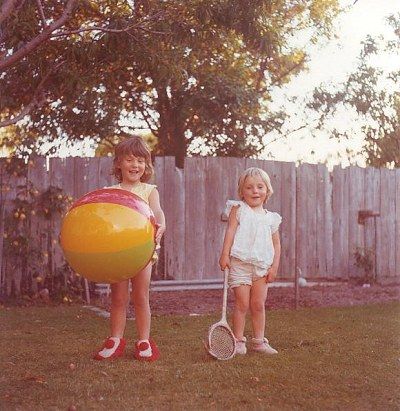
Public parks are no real substitute for backyards; the latter provide space for unsupervised play and privacy. A comment on an article linked to below notes this:
Outdoor and spontaneous play is part of a healthy childhood and child development. Although adult-supported play has many benefits, so does playing without adult interference and many children are missing out on this. For many children, simply heading out into the back yard whenever they like, unsupervised or with minimal supervision, is an impossibility because they are living in units – or for many who do have back yards, they are adult-oriented spaces rather than child-friendly. It’s also more difficult for parents who were once able to tell their children to “go outside and play,” but now are saddled with finding a good time to take their child(ren) to a local play area, walking, driving or taking public transport to get there, probably packing a bag and stroller with snacks, toys and other necessities. Even if it’s just a few minutes away, it’s not the same as kicking your children out into the garden so you can get a load of washing done or get a bit of peace and quiet while they make their own fun. Not having an outdoor play space for children at home means that play is more sedentary and outdoor play becomes more adult-directed rather than child-directed. This can limit children’s freedom, independence and creativity.
– Amy | Sydney – September 15, 2011, 2:30AM
A case study: my grandmother’s home
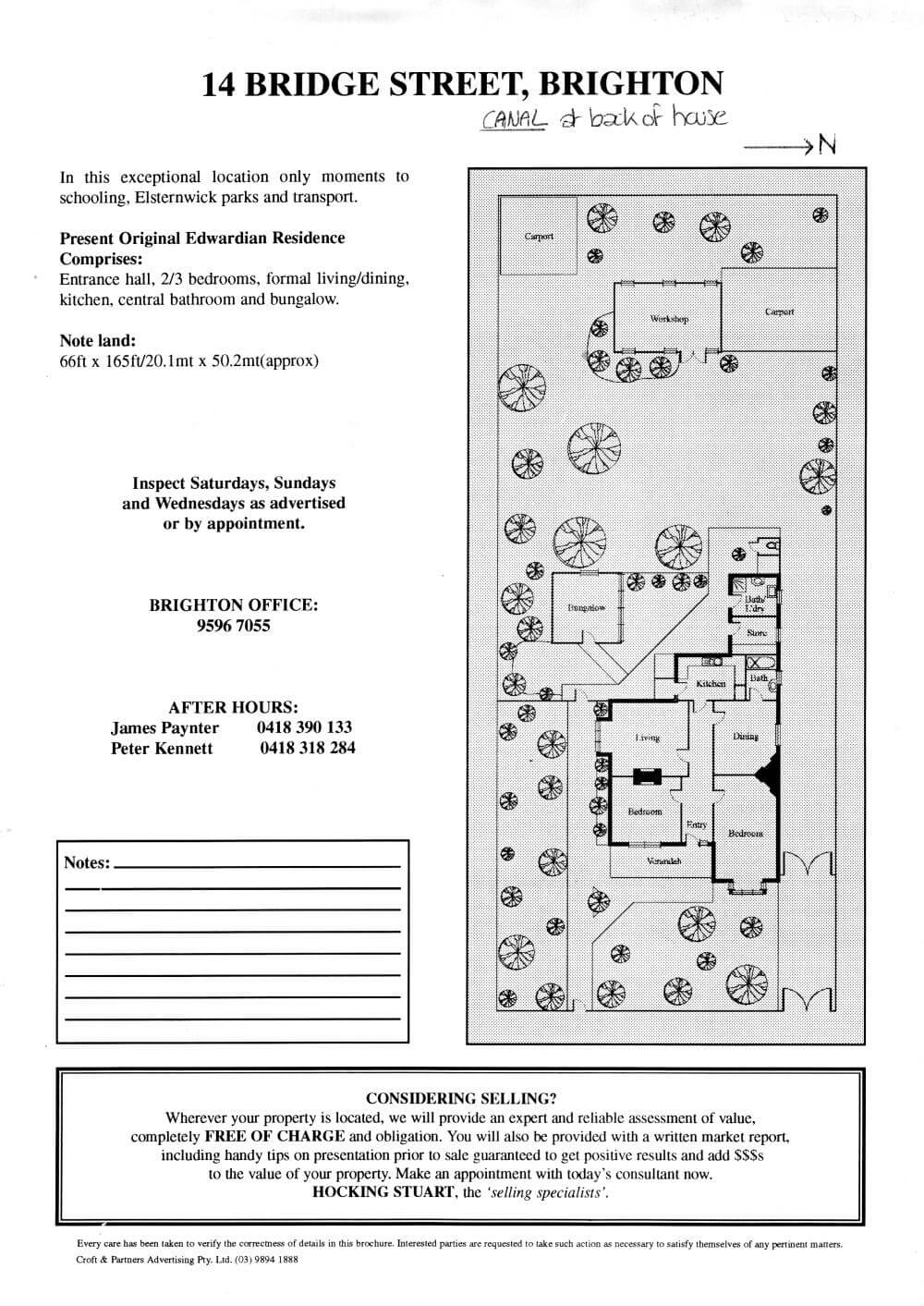
Located at 14 Bridge Street, Elsternwick (Google Maps view), this was an Edwardian-style house had been built around 1927, and my grandparents had moved there in 1941. Mum and her brother had grown up there, and it was a “second home” to myself, my sister and our uncle’s 3 children. It was about 15 minutes’ drive from my parents’ home, so we visited there regularly.
It was set on a huge block of land (about 1010 m²); the backyard was spacious and great fun for we children to run around in. A canal was located behind the houses on the street (Elster Street Drain); more fun places to explore. The house itself, though, was fairly small (two bedrooms) with an outside toilet and a bungalow (a small one-bedroom unit). It had not been too much altered from its original design, aimed at some form of self-sufficiency, with ample space for a vegetable garden, a workshed, carport and a chicken shed (the latter long disused when I was born). It had a musty atmosphere of age, and I rather liked this, as well as the surrounding old homes and streets in the area dating from early in the 20th century (before developers started coming from the 1990s onward and ruining this). The suburb was quite pleasant, with large gardens and close to amenities such as shops and a railway line.
Gran lived there for many years after Grandpa died in 1982, but she became increasingly frail and after a bad fall in 1997 resulting in a broken arm, Gran was moved to accommodation and her house would have to be sold to pay for her care. My last visit with Mum was on Friday 17 October 1997 to have the mains power disconnected. I had not visited the place very much in the previous few years or taken any photos; now I wish I had.
The house was ominously advertised as a “sensational multi-unit/townhouse development site,” which meant that after its sale the new owner-developer would demolish it. This was very upsetting, as the house and garden that we had known and explored since childhood would be erased, and only memories remain. It was demolished and replaced by four oversized ugly two-storey “Tuscan-style” townhouses which loomed menacingly over the street. The developer, being greedy as most are, squeezed as many homes onto the block as possible in order to maximize his profit. I would like to see him (whoever he is) burned at the stake (as I would all property developers).
These abominations have also sprung up along the rest of Bridge Street like ugly toadstools.
It might not have been so bad if, say, the developer had retained the original house (and renovated it), and built just one 1-story unit behind the main house. Or even better, if a family had moved in and renovated the house to live in it for a few more decades and continue its history. But that would have been too much to hope for in the current climate.
The house, like that of my parents’s, is embedded in my long-term memory, so it and the surrounding area appears in my dreams.

Gallery

Before and after – modest, well-kept older suburban houses and their typically ugly new replacements (two-storey duplex/attached dwellings)

Two adjacent houses demolished and turned into four.
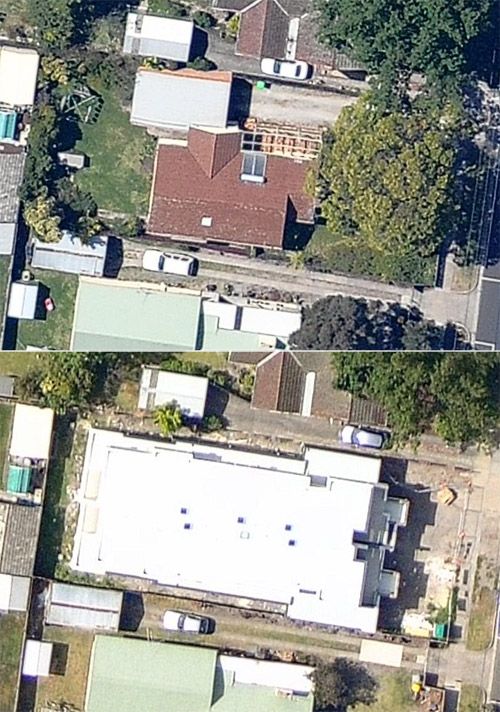
Before and after views of another neighborhood house (2009 and 2013). The old house was small with a large shady tree and plenty of space for a garden and vegetation. The duplex houses built after its demolition fill the whole block with only a narrow gap around its edges. The extensive roofing and paving help exacerbate the “heat island effect,” something very unwelcome in Australia’s hot climate.
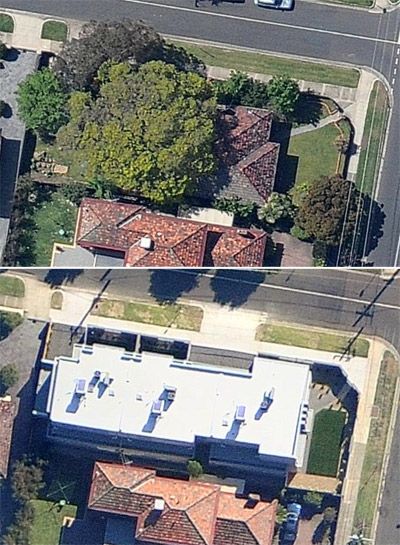
House and large tree gone, replaced with three attached 2-storey apartments that leave no room for any vegetation and overshadow the house next to them. By now (2013) I could sadly post hundreds of examples of this happening all over my neighborhood, let alone many others.

A new housing estate in my suburb, an example of poor urban planning: large houses crammed together with no room for trees or vegetation. It will certainly be a hot barren wasteland in summer – the houses are badly-constructed and need wasteful airconditioning just to stay cool.

Before and after – my grandparents’ home, and what replaced it – four townhouses crammed into where one house and a spacious backyard and garden once stood.
Links
Articles
- The Age:
- “New housing ‘failing future generations’,” 21/10/2006
- “Making a farce of five-star,” 21/5/2007. McMansions are energy-inefficient and environmentally-unfriendly.
- “The power of the HIA,” 27/10/2007. The Housing Industry Association has an unhealthily close relationship with various governments bordering on corruption as they strongly influence planning decisions.
- “More loss than gain in encroaching urban sprawl on threatened open plains,” 31/5/2008. The grassy plains surrounding Melbourne are under threat from overdevelopment; they are important to the environment but get overlooked.
- “Home is where the psyche is,” 6/11/2008. Childhood experiences of living space can dictate our choice of property.
- “Old houses are environmentally-friendly,” 4/1/2010. Old houses – those built pre-WW1 – were better designed for Australia’s hot climate.
- “Design trend takes child’s play out of backyards,” 25/11/2010. New house designs leave little space for backyards.
- “Days of the humble home at an end as goliaths invade suburbia,” 23/4/2011. The obscenely oversized new houses blighting many suburbs are symptomatic of the greed and selfishness that now dominates our society.
- “Yards a fading memory,” 11/9/2011. Another article on the decline of backyard space.
- “The darker side of urban development,” 8/11/2011. Poor urban planning means there is no “right to sunlight” – houses can thus be overshadowed by adjacent developments.li>
- “Demand for parks increases,” 17/3/2012. Public parks are under pressure as population increases and development styles see a loss of backyards. New housing estates do not provide adequate public recreational space.
- The Atlantic.com: “The Next Slum?,” March 2008. How the suburbs of “McMansions” in the USA are gradually decaying into slums.
- (We) Can Do Better: “Just because I’m nostalgic does it mean things aren’t really going downhill?,” 13/12/2011. Another experiencing solastalgia.
- The Conversation: “What has happened to the great Aussie backyard?,” 21/12/2011.
- Herald-Sun: “Garden state dies,” 5 April 2006. Andrew Bolt opinion piece on our disappearing gardens. I don’t agree that we should be openeing up more land for development, though – we should reduce population growth instead! That “dull farmland” is needed for food production and simple open space.
- Hunters Hill Trust: “Renovate or detonate?” (original article no longer online)
- Inside Story: Book review for The Life and Death of the Australian Backyard: a more academic book that is critical of recent trends in the increase in house sizes and decrease in backyard space, with subsequent loss of amenity and biodiversity. Unfortunately the book is rather expensive ($70!) but my library had a copy.
- Sydney Morning Herald: “Crowded land of giants,” 26/8/2003
Websites
- Marvelous Melbourne
- Save Our Suburbs: seems to be of little impact anymore.
- Sustainable Living (from the NSW SOS site): arguments against high-density living. These will only be achievable, though, if population growth is slowed – then people can have backyards while keeping urban sprawl contained.
Updated 13/10/2012
Favorite plants
Below are listed some of my favorite plants and trees; what I would plant in my dream garden. Many of these are in my neighborhood. I have linked them to their Wikipedia page where available.
Bushes & flowers
- Aeonium. This is a weird-looking succulent of which you can just break off a stem, stick in the ground and it will grow. This gets rather addictive! The flowers form striking radial patterns.
- Grevillea. An Australian native that forms a large bush with spindly red-yellow flowers. Honeyeater birds love it.
- Gymea Lily (Doryanthes excelsa). A bizarre, alien-looking New South Wales native that I first saw in a local park. It forms a cluster of sword-like leaves and sends up a tall flower spike with an orange flower on top.
- Lilac or Purple Hibiscus (Alyogyne huegelii). Australian native bush with purple hibiscus-like flowers. There is also a white variant. I also like the actual Hibiscus.
Trees
- Cherry blossom. There are quite a few varieties of these around my neighborhood. One that was used for a street tree has dark red leaves and pink blossom. Much used as a street tree in my neighborhood, but the current council does not seem to favor them and has felled many for some stupid reason, to my extreme annoyance.
- Claret Ash. A tall deciduous tree with fine green leaves that turn a lovely deep claret-red in Autumn. Another tree that is unfortunately being removed by my local council. A variant of this is the Golden Ash.
- Crepe Myrtle (Lagerstroemia). A tree with various colors of blossom; the pink ones are particularly attractive. It also has colorful Autumn foliage.
- Flax-leaved Paperbark (Melaleuca linariifolia). An Australian native that has been much used as a local street tree, but is again being removed by the local council. The tree blossoms with small creamy white flowers in November and December, giving it its nickname of ”snow-in-summer,” and a street planted with them looks quite striking.
- Jacaranda. A tree that displays showy purple-blue blossom in spring.
- Japanese Maple (Acer palmatum). I love this because of its colorful and delicate leaves, and association with Japan. The leaves of some turn bright red or orange in Autumn. Others have deep red or bright green leaves in summer. Walking through a grove of these is refreshingly cooling in hot weather.
- Liquidambar. A tall deciduous tree that provides extensive summer shade and has a bright Autumn display of red and gold leaves. This tree must have been popular in Melbourne in the 1950s or thereabouts, as there were a lot planted around my neighborhood, as well as being used for street trees. Sadly, trends have changed and many have been felled, both street trees and in private gardens. They are probably too big for a suburban garden, but are still a great loss for the landscape here.
- Magnolia: Has attractive white or white-pink flowers. I only learned a few years ago that it was one of the first flowering plants to evolve, so I think of it as the “dinosaur plant.” My grandmother had a nice pink one in her front yard.
- Native frangipani (Hymenosporum). A tall but sparse Australian native with creamy yellow flowers that extrude perfume at dusk.
Gallery
Photos taken by me.
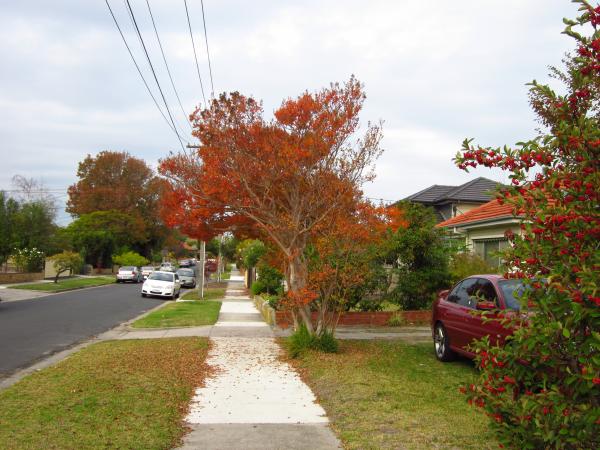
Crepe myrtle in Autumn.

Claret ash street tree in Autumn.
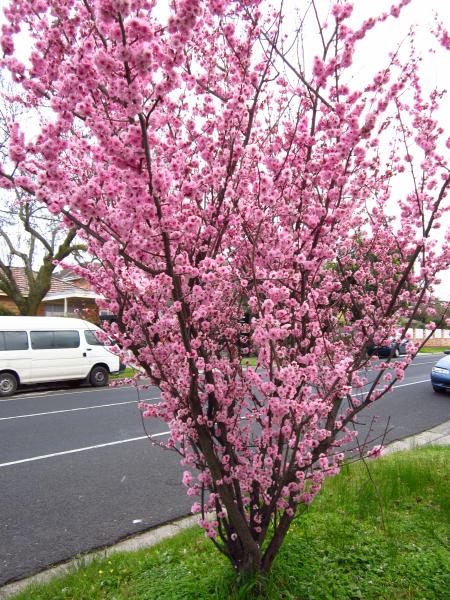
Pink cherry blossom street tree.
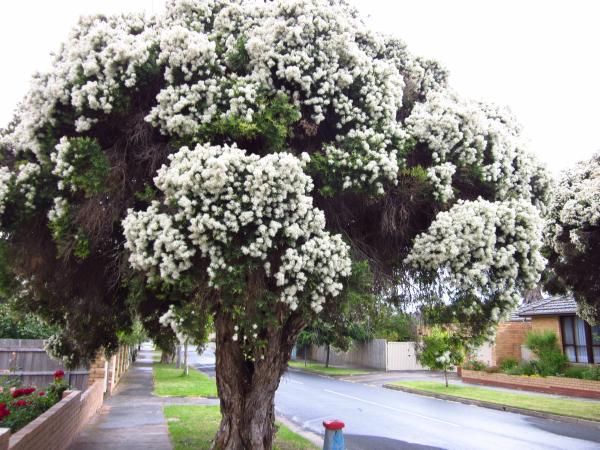
Flax-leaved paperbark street trees in blossom.
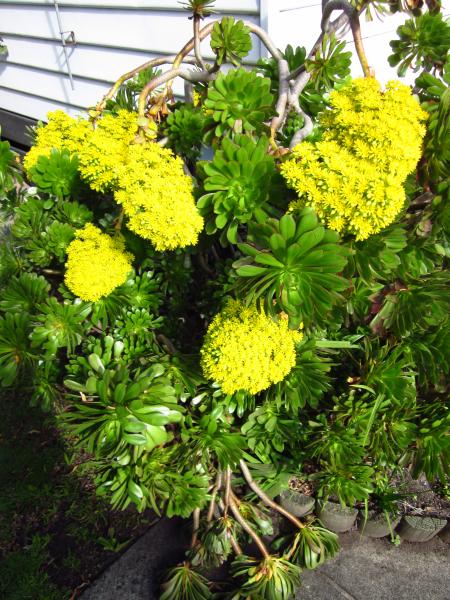
Flowering Aeonium in my parents’ front yard.
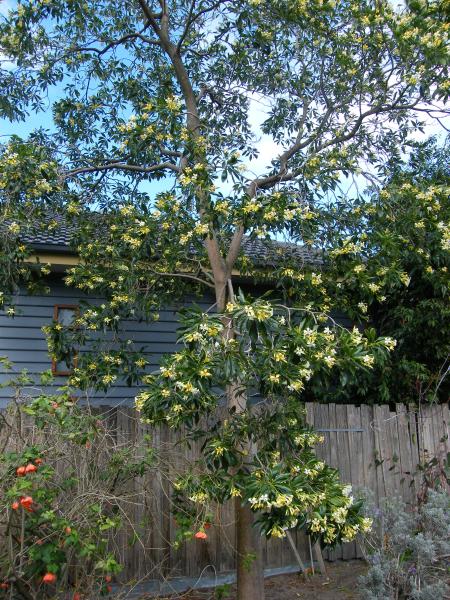
Native frangipani in my parents’ garden.
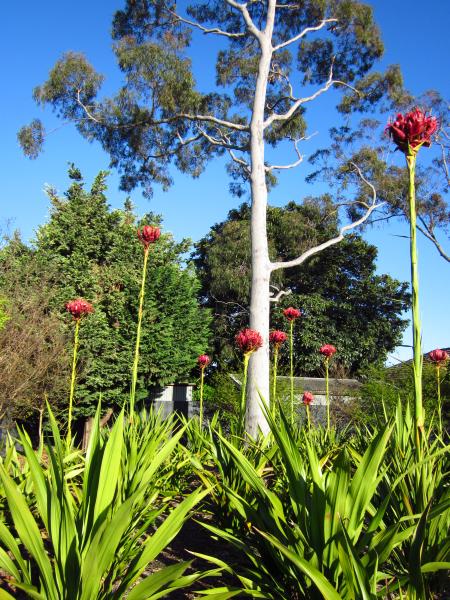
Gymea lilies in a local park.

Japanese maple in a nearby local garden with a fiery red Autumn display.

Grevillea in my parents’ garden.

Red hibiscus bush in my parents’ garden. This was already there when my parents moved in the late 1960s, so it is now quite old; at least 50 years.
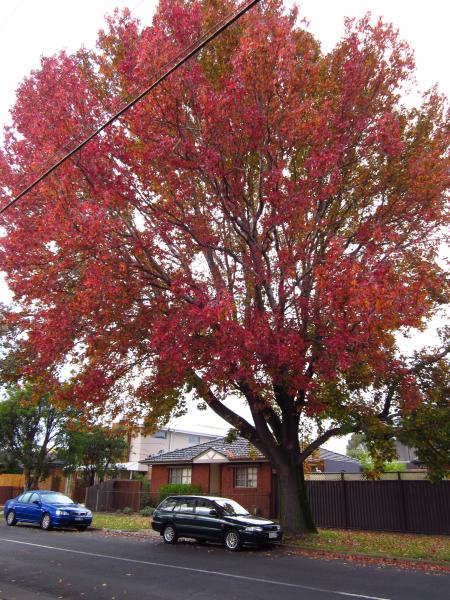
Liquidambar street tree in Autumn foliage; this one is a favorite as it is very tall.
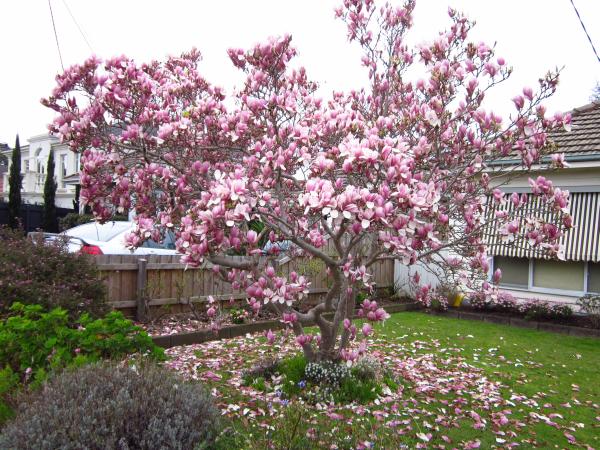
Magnolia in a front yard garden.
Updated 29/12/2015
Favorite villains (and aliens)
Here are listed some of my favorite fictional villains. I have long had a fascination with the “dark side” and these guys epitomize it for me! Some of these would also be on my “favorite aliens” list, as many aliens happen to be villains in science fiction movies and books (and are not necessarily villainous, just acting according to their natures).
I find the fictional villains fascinating because they represent what I call “majestic evil” – they have vast supernatural powers, rule worlds or galaxies and they just look cool in all those black robes and armor! Evil in the real world – “mundane evil”, that perpetuated by humans – does not interest me for the most part; it is banal and unpleasant. (For example, I despise people – mainly thuggish young males – who assault elderly people or who are cruel to animals; I think they should be executed.)
In the real world I am powerless and insignificant; occasionally I have been harrassed by other humans (mainly the aforementioned aggressive young males) and am unable to retaliate in any way. This leads to immense frustration and suppressed rage, so that is one obvious reason why I find my villains appealing: they would not tolerate such treatment and would reduce the offending humans to their component atoms in an instant! They are everything I am not: i.e. awe- and fear-inspiring and powerful beyond measure, and they do whatever they want.
I don’t necessarily like everything about my villains. There is no reason why a bad guy can’t have morals and a code of honor, and some of the villains are a bit lacking in that respect (e.g. Sauron). (Good personal hygiene and a stylish dress sense are also preferable!)
My villains (enhanced human or alien) are all male. I do like my villains to be good-looking and male! :-) (Mere mortal male humans tend to pale a bit in comparison. Sorry!) Interestingly, some (mainly the aliens) have quite a few female fans; my theory is that:
- they are more masculine than mere mortal human males in modern society and
- they are not likely to go around raping women (unlike many human males) – i.e. a woman would be safe with a non-human male. [Incidentally, this very lengthy thread at MetaFilter is on the topic of why women can feel threatened by strange men.]
Another feature is that they all wear a mask that adds to their aura of mystery and menace!
And another interesting (but probably irrelevent) note is that many of the villains’ names begin with “S”! Just like my first name!
Most of my favorite villains end up dead, alas. They should have consulted the Evil Overlord list for a list of what mistakes to avoid!
Dark Lord fashion tips
- For color, there is only one obvious choice: black. Black never goes out of style and looks cool and menacing!
- A mask and/or helmet hides one’s face and enhances the aura of mystery and menace.
- A long swirly black cloak is a stylish accessory, and adds an appealing soft contrast to hard armor.
- Armor should be contoured to flatter one’s figure. Spiky protrusions enhance the aura of evil, but might be impractical (i.e. one could impale oneself upon them).
- Glowing eyes look cool and evil – though not scientifically feasible as an eye sees from light entering the retina and being processed by the brain; thus if an eye is emitting light, one won’t be able to see! Glowing eyes would also make a Dark Lord an easy target in a dark room. But for fantasy purposes we’ll ignore this.
General Grievous
He is a cyborg who appeared in the third Star Wars movie, Revenge of the Sith. He is a fearsome fighter and military leader. His past is somewhat tragic as he was turned into a cyborg by the treachery of others. He looks cool. And, damn it, he’s just cute.
I was not impressed with his portrayal in the movie; he was underdeveloped – something of a caricature – and got killed off halfway through!
I also liked his bodyguards! (Want one for myself!)
I only saw Revenge of the Sith on DVD in March 2007 – nearly 2 years after it came out (I don’t like going to the cinema), so any Grievous merchandise had long since vanished from stores by then, sadly!
Appeal factors: fearsome warrior, looks cool, tragic antihero.
- FanFiction.Net: Her rival, his attempt by “Solid Falcon”; The Essences of Life by “Heimchen”
- Livejournal community: General Grievous
- Star Wars databank: General Grievous
- Supreme Commander: The Official General Grievous Fanlisting
- Wookiepedia: Grievous
Predator
An alien species who like going to planets to hunt the inhabitants there, including humans. Featured in four movies to date: Predator, Predator 2, Alien vs. Predator and AVP: Requiem. A Predator is humanoid in form, with an impressive physique, but a face only his mother could love :-).
Appeal factors: warrior race.
- Wikipedia: Predator
Sangheili (Elites)
The Sangheili (“Elites”, as named by humans) are part of the Covenant, the aliens threatening humanity in the Halo PC/X-Box game. (I don’t play computer games so I have never played Halo; I just visit websites, and enjoy looking at the graphics and artwork. The immature semi-literate halfwit males who proliferate on gaming forums don’t make me any more favorably inclined toward gaming – or humanity for that matter.)
I have no liking for the Master Chief or the other humans in Halo, so naturally I side with the Covenant!
As with the Predator, the Sangheili are a warrior race – obsessively so – thus they naturally appeal to me (the Sangheili facial design was influenced by the Predator’s). They could not be described as good-looking, however!
Appeal factors: warrior race, armor looks cool.
- Ascendant Justice: “I, Sangheili”
- Halopedia: Sangheili
- Photobucket album: extracts (.jpg images) from some Halo publications featuring Sangheili
- Halo Wars Game Guide: Arbiter
- Scenes featuring Sangheili from the Halo novels:
Saren Arterius
Saren is an alien villain from a 2007 computer game called Mass Effect. I happened across his profile while wandering around on Wikipedia for something else in August 2007. Saren is annoyed at humanity for various reasons (his brother was killed by humans in the First Contact War and he thinks humans are too “uppity”) and doesn’t think much of the species (he isn’t the only one! :-)). I like this forum user’s opinion (spelling mistakes theirs, link below):
I also think part of it has to do with me wanting to see a villan win in these kinds of stories. I am just about sick of seeing the human race win all of these space battles and wars. However cruel that may seem it is true, for example I wanted badly for the humans to fall in halo and lose everything. I want Saren to kick everyones butt and take names with a smile.
Appeal factors: fearsome warrior, looks cool.
- Bioware: Saren Arterius profile
- Mass Effect community: “Am I the only Saren Fan?”
- Wikipedia: Saren Arterius
Sauron
The main adversary in The Lord of the Rings trilogy, who wants his Ring back very badly. He is a spirit called a Maia and can assume various forms. In the opening battle scene of The Fellowship of the Ring he has the form of a tall fearsome warrior in cool-looking spiky armor; but after that he only appears as a fiery Eye. He needs the Ring to be able to take physical form, and after the destruction of the Ring he sort of evaporated. Presumably he is sulking somewhere.
He is a Dark Lord with awesome powers. What more do you need? He has disappointingly little “screen time” in either the books or the movies, so perhaps he could get his own novel, one day!
Even Sauron answered to a higher power: Morgoth, who was bigger and badder than him (Sauron was his “Chief Lieutenant”). Morgoth doesn’t feature in LOTR, though.
Appeal factors: awesome powers, Dark Lord.
Sith Lords
The Sith Lords are the main opponents in the Star Wars movies and books; they manipulate the dark side of the Force, are generally bad and don’t apologize for it! Their adversaries, the Jedi, can be irritatingly self-righteous. I find the Ancient Sith/Rule of the Strong era the most appealing. Some favorites include Naga Sadow, Freedon Nadd and Carnor Jax.
Darth Vader was the original Sith Lord and still holds a certain appeal, though he seems somewhat old-fashioned now (his 1970s-era armor really needs a redesign, but because of the order in which the movies were filmed, that can’t be done). He also converts back to the light side of the Force before he dies. Wuss!
Appeal factors: awesome powers, Dark Lords, look cool.
- Dark Brotherhood
- Star Wars databank: The Sith
- Wookiepedia: Sith Lord
Sutekh
I saw the Dr. Who episode Pyramids of Mars when it originally screened in Australia in the mid-1970s (1976?) and was captivated by Sutekh, particularly his mask! I have a recollection of trying to draw it. He was my first villainous infatuation, so I feel a particular fondness for him! I saw the two-part episode again in 2004 and it still was excellent. He was one of the alien Osirian race who was imprisoned in an Egyptian pyramid by others of his race (led by his brother Horus) after he became psychotic and wished to destroy everything. A signal from a pyramid of Mars kept him in stasis.
Appeal factors: Ancient Egyptian mythology, awesome powers, cool mask.
- BBC: Pyramids of Mars
- Tardis Wiki: Sutekh
- Wikipedia: Pyramids of Mars, Sutekh
Photo gallery
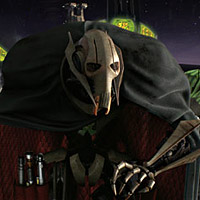
General Grievous (Star Wars: Revenge of the Sith)

Predators, unmasked and masked, wearing armor

Sangheili/Elite (Halo)

Saren Arterius (Mass Effect)

Sauron (The Lord of the Rings)

Sith Lord (Darth Vader, Star Wars)
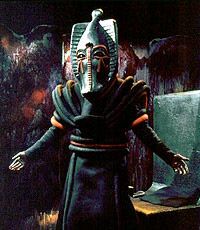
Sutekh (Dr. Who)
Updated 7/4/2020
Favorite (fictional) villains
Here are listed some of my favorite fictional villains, in alphabetical order. I have long had a fascination with the “dark side” and these guys epitomize it for me!
I find the fictional villains fascinating because they represent what I call “majestic evil” – they have vast supernatural powers, rule worlds or galaxies and they just look cool in all those black robes and armor! Evil in the real world – “mundane evil,” that perpetuated by humans – does not interest me for the most part; it is banal and unpleasant. (For example, I despise people – mainly thuggish young males – who assault elderly people or who are cruel to animals; I think they should be executed.)
In the real world I am powerless and insignificant; occasionally I have been harrassed by other humans (mainly the aforementioned aggressive young males) and am unable to retaliate in any way. This leads to immense frustration and suppressed rage, so that is one obvious reason why I find my villains appealing: they would not tolerate such treatment and would reduce the offending humans to their component atoms in an instant! They are everything I am not: awe- and fear-inspiring, and powerful beyond measure – enough to destroy worlds – and they do whatever they want.
I don’t necessarily like everything about my villains. There is no reason why a bad guy can’t have morals and a code of honor, and some of the villains are a bit lacking in that respect (e.g. Sauron). (Good personal hygiene and a stylish dress sense are also preferable!)
My villains are all male. I do like my villains to be good-looking and male! :-) (Mere mortal male humans tend to pale a bit in comparison. Sorry!) Interestingly, some have quite a few female fans; my theory is that:
- they are more masculine than mere mortal human males in modern society and
- they are not likely to go around raping women (unlike many human males) – i.e. a woman would be safe with a non-human male. [Incidentally, this very lengthy thread at MetaFilter is on the topic of why women can feel threatened by strange men.]
Another feature is that they all wear a mask that adds to their aura of mystery and menace!
And another interesting (but probably irrelevent) note is that many of the villains’ names begin with “S”! Just like my first name!
Most of my favorite villains end up dead, alas. They should have consulted the Evil Overlord list for a list of what mistakes to avoid!
Dark Lord fashion tips
- For color, there is only one obvious choice: black. Black never goes out of style and looks cool and menacing!
- A mask and/or helmet hides one’s face and enhances the aura of mystery and menace.
- A long swirly black cloak is a stylish accessory, and adds an appealing soft contrast to hard armor.
- Armor should be contoured to flatter one’s figure. Spiky protrusions enhance the aura of evil, but might be impractical (i.e. one could impale oneself upon them).
- Glowing eyes look cool and evil – though not scientifically feasible as an eye sees from light entering the retina and being processed by the brain; thus if an eye is emitting light, one won’t be able to see! Glowing eyes would also make a Dark Lord an easy target in a dark room. For fantasy purposes, however, these inconveniences can be ignored.
Saren Arterius
Saren is a relatively new alien villain from a 2007 computer game called Mass Effect. I happened across his profile while wandering around on Wikipedia for something else in August 2007. Saren is annoyed at humanity for various reasons (his brother was killed by humans in the First Contact War) and doesn’t think much of the species (he isn’t the only one! :-)). I like this forum user’s opinion (spelling mistakes theirs):
I also think part of it has to do with me wanting to see a villan win in these kinds of stories. I am just about sick of seeing the human race win all of these space battles and wars. However cruel that may seem it is true, for example I wanted badly for the humans to fall in halo and lose everything. I want Saren to kick everyones butt and take names with a smile.
Appeal factors: fearsome warrior, looks cool.
- Bioware: Saren Arterius profile
- Mass Effect community: “Am I the only Saren Fan?” (link no longer available)
- Mass Effect Wiki: Saren Arterius
- Wikipedia: Saren Arterius
Sauron
The main adversary in The Lord of the Rings trilogy, who wants his Ring back very badly. He is a spirit called a Maia and can assume various forms. In the opening battle scene of The Fellowship of the Ring he has the form of a tall fearsome warrior in cool-looking spiky armor; but after that he only appears as a fiery Eye. He needs the Ring to be able to take physical form, and after the destruction of the Ring he sort of evaporated. Presumably he is sulking somewhere.
He is a Dark Lord with awesome powers. What more do you need? He has disappointingly little “screen time” in either the books or the movies, so perhaps he could get his own novel or movie, one day!
Even Sauron answered to a higher power: Morgoth/Melkor, who was bigger and badder than him (Sauron was his “Chief Lieutenant”). Morgoth doesn’t feature in LOTR, though.
Appeal factors: awesome powers, Dark Lord.
Sith Lords
The Sith Lords are the main opponents in the Star Wars movies and books; they manipulate the dark side of the Force, are generally bad and don’t apologize for it! Their adversaries, the Jedi, can be irritatingly self-righteous.
Darth Vader was the original Sith Lord and still holds a strong appeal, though he seems a little old-fashioned now in appearance – his 1970s-era armor really needs a redesign, but because of the order in which the movies were filmed, that can’t be done. He also converts back to the light side of the Force before he dies. Wuss!
In the early years of the original trilogy – I saw the first Star Wars (Episode 4) in 1978 when I was 7 years old – I found him quite scary! Unfortunately this has been much diluted by subsequent Expanded Universe fiction, fan fiction and innumerable parodies. I do miss the mysterious, menacing villain he initially presented as.
Appeal factors: awesome powers, Dark Lords, look cool.
Sutekh
I watched the Dr. Who episode Pyramids of Mars when it originally screened in Australia in the mid-1970s (1976?) and was captivated by Sutekh, particularly his mask! I have a recollection of trying to draw it. He was my first villainous infatuation, so I feel a particular fondness for him! I saw the two-part episode again in 2004 and it still was excellent. He was one of the alien Osirian race who was imprisoned in an Egyptian pyramid by others of his race (led by his brother Horus) after he became psychotic and wished to destroy everything. A signal from a pyramid of Mars kept him in stasis.
Appeal factors: Ancient Egyptian mythology, awesome powers, cool mask.
- BBC: Pyramids of Mars
- Tardis Wiki: Sutekh
- Wikipedia: Pyramids of Mars, Sutekh
Updated: 17/1/2018
Fictional aliens
Creating aliens
For artists and writers, it is difficult to envision what alien life might be like. Ultimately, one can only use Earth life as a guide and try to create something unique but still biologically plausible.
There is some conflict between trying to create truly alien-looking aliens, and ones which are merely humans with bizarre heads (Rubber Forehead Aliens). Examples of the former can be seen in the DeviantART galleries of Nemo Ramjet and Abiogenisis; examples of the latter are many of the Star Wars- and Star Trek-style aliens. We can relate more easily to fictional humanoid aliens (such as the Na’vi in Avatar), but it is unlikely a real alien will resemble us exactly.
The “Biology in Science Fiction” blog has an entry on “How alien should science fiction aliens be?,” saying that most aliens in science fiction are not “alien” enough, in that they tend to have some human characteristics and can communicate more-or-less easily with humans.
I agree that when (or if) we meet another intelligent life form, it is unlikely to be bipedal, let alone humanoid. The problem is incorporating such an alien alien (for want of a better term) into an entertaining story.
I don’t see any reason why an alien could not be a humanoid biped – or a vertebrate at least – and if it has evolved on an Earth-like planet, they would have some traits that we could relate to and communicate with. The laws of physics, biology and chemistry are the same all over our Universe, so there are only so many ways life can evolve.
One view of aliens portrayed in science fiction – and a view that irritates me in the extreme – is that they are there merely as metaphors to explore the “human condition”:
… doesn’t this kind of ignore that the main point of aliens in an awful lot of science fiction isn’t to portray aliens at all, but rather to isolate and examine some specific parts of the human condition? Sure, some aliens are really just supposed to be alien, but I think that a significant percentage – quite possibly the majority – are intended to help us look at some facet of human existence in a new way by pulling it out of our own melange of traits and making it more visible for what it is, or what the author believes it to be.
A similar opinion from “The Best Aliens in Science Fiction”:
The best aliens for me have been those that served to illuminate our history and our very humanity, whether they played the archetype of simple antagonist or as misunderstood “commentator” on human prejudice, insecurities, greed, heroism, compassion and honor. I can think of several aliens who have provided excellent examples of this: the Martians in Ray Bradbury’s Martian Chronicles, Klaatu in The Day the Earth Stood Still, the aliens in Alien, and the “prawns” of Peter Jackson’s District 9. Each provided a platform for the exploration and exposition of human’s strengths and weaknesses. How we handle “the other” is a very compelling and illuminating topic. One worth revisiting. Author Brian Ott notes, “it is a profound mistake to interpret the genre [of science fiction] literally.” Science fiction is both “the great modern literature of metaphor” and “pre-eminently the modern literature not of physics but of metaphysics,” says Peter Nicholls, Australian scholar and critic. Ott reminds us that it is not what the aliens are but what they represent that matters.
This is seriously overthinking the issue – sometimes an alien is just an alien! Why can’t science-fiction aliens just be created for their own sake?
Favorite aliens
Some aliens that appeal to me from various media. These are all roughly humanoid, designed to be alien, but not too alien, so the intended audience can still relate to them – or perhaps because of unconscious humanocentric bias on the part of their creators. These types of humanoid fictional aliens can be described as “human, but better” – one example being the Na’vi. They are stronger, faster, idealized versions of humans – perhaps how we might improve and reshape ourselves should genetic engineering become viable. (The equivalent in fantasy fiction are creatures such as elves.) Humans are perhaps unusual among Earth creatures in that we have no natural weapons: no claws but useless fingernails, no armor, no sharp teeth. Our skin is covered with sparse hair rather than a protective fur coat or scales. Our senses are relatively weak due to our “domestication” through civilization. Thus, creating such aliens could be regarded as trying to compensate for our frailties.
Na’vi
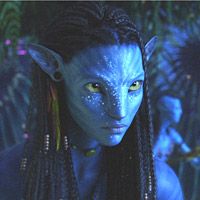
The Na’vi are humanoid aliens of James Cameron’s hugely successful Avatar movie. They are essentially idealized humanoid cat-people, with tall, lean physiques – “the embodiment of human wish fulfillment: taller, more slender, more muscular, and more athletically gifted than any human being could be,” as noted in The Making of Avatar. They were designed for audience appeal, so they are not as alien as they otherwise might be. The worldbuilding in creating the movie was extensive, though, with a lot of thought behind the science and alien lifeforms.
Design notes: Pioneering digital motion-capture technology ensured that the Na’vi looked very realistic with an appearance that would be impossible to replicate with the more usual method of a human in prosthetic makeup and body suit. Some early designs had them appearing more alien, but, as noted, they – and Neytiri especially – needed to appeal to the audience, so a more humanoid form was selected (essentially James Cameron’s original design).
Predator
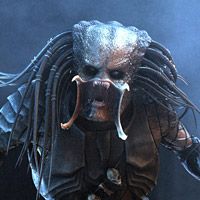
The Predators are an alien species who like going to planets to hunt the inhabitants there, including humans. Featured in five movies to date: Predator, Predator 2, Predators, Alien vs. Predator and AVP: Requiem. A Predator is humanoid in form, with an impressive physique, but a face only his mother could love :-). He has quite a few female fans though – see the Alien romances section below as to my opinion on why this is.
Design notes: the face is quite alien, but the body is essentially human – not surprising as the Predator is played by a man in an uncomfortable rubber body suit. I do notice that this has the effect of hampering movement in some scenes – they seemed a bit clumsy when fighting or grasping objects – and they are limited to human movements.
Appeal factors: warrior race.
Sangheili (Elites)

The Sangheili (“Elites,” as named by humans) are part of the Covenant, the aliens threatening humanity in the Halo PC/X-Box video game. (I don’t play video games so I have never played Halo; I just visit websites, and enjoy looking at the graphics and artwork.)
As with the Predator, the Sangheili are a warrior race – obsessively so – thus they naturally appeal to me (the Sangheili facial design was influenced by the Predator’s). They could not be described as good-looking, however! They do have female fans for the same reasons as the Predator does.
Design notes: Though bipedal, they are a little less humanoid than the Na’vi and Predator, with digitigrade legs and a turtle-like head with a long neck. Their mouth design – a top jaw with four lower mandibles that split open laterally – is biologically implausible, though. They have no bottom jaw so they would have a lot of trouble eating – or talking, for that matter.
Appeal factors: warrior race, armor looks cool.
I have never been much interested in gaming – have never played a computer game – but upon viewing the Halo 3 announcement trailer back in 2007, the world and lore of that game has enraptured me ever since. I have the novels, lore books and a ridiculous number of Sangheili figurines (always my favorite species from the start), not to mention gigabytes of collected Halo stuff on my PC!
Halo is probably the only game universe I have maintained a long-term interest in (just as with anime, the only one I like is Neon Genesis Evangelion). I had interest in Mass Effect also (favorite species: the Turians), but have lost much of this since ME3 or so.
The magic and atmosphere of Halo, for me, though, was ruined when 343 Industries took over in 2011 from the original creators, Bungie. I like Halo up to around the 3rd game; after that 343 began to exploit it commercially, changed much of the iconic design and colors (I hate the redesign of the Sangheili, for example, and the desaturated “gritty” visual design of later games and media, which has been regrettably trendy for a few years in games and movies generally) and revealed too much that was a mystery before. For me, the original Halo is the true visions.
Like many, though, I am not enthused about the direction the story went since Halo 4. I preferred that the Forerunners remained a mystery and so on. The one thing I liked about Halo 5 was traveling to Sangheilios.
My favorite faction from the game has always been the alien species, the Elites (human nickname for them) or Sangheili (proper name), who are part of the Covenant.
The Sangheili are a warrior race – obsessively so – thus they naturally appeal to me (the Sangheili facial design was influenced by the titular alien from the original Predator movie). They could not be described as good-looking, however, by human standards, though the original design as it appeared in the first three Halo games (and Halo: Reach) had a lethal elegance about them. Though bipedal, they are a little less humanoid than the Na’vi and Predator, with digitigrade legs and a turtle-like head with a long neck. Their mouth design – a top jaw with four lower mandibles that split open laterally – is biologically implausible, though. They have no bottom jaw so they would have a lot of trouble eating – or talking, for that matter.
I am not into gaming as such, so have never played Halo (couldn't afford an X-Box in any case), but I have been a fan since I saw the Halo 3 announcement trailer back in 2007, which enraptured me. I have the novels, lore books and a ridiculous number of Sangheili figurines (always my favorite species from the start), not to mention gigabytes of collected Halo stuff on my PC!
Another element I do not like are the artistic changes; the design up to Halo 3 was colorful and distinct, and I still prefer that look (including the old Sangheili appearance) to what 343 turned it into.
Halo is probably the only game universe I have maintained a long-term interest in (just as with anime, the only one I like is Neon Genesis Evangelion). I had interest in Mass Effect also (favorite species: the Turians), but have lost much of this since ME3 or so.
I like Star Wars, but I have not felt inclined to read most of the Star Wars novelizations, unlike those of the Halo video games, nearly all of which I have read (and own). Halo seems to interest me in a way Star Wars does not – perhaps one reason being that Star Wars has a lot more cultural visibility to the point where pop culture is oversaturated with its products.
Actually both Star Wars and Halo both have something in common: the magic of the original creations was ruined when they were bought and taken over by different companies (Disney from George Lucas/Lucasfilm in 2012, and in the case of Halo, 343 Industries taking over in 2011 from the original creators, Bungie). I like Halo up to around the 3rd game (note I have never played the games but am familiar with much of the lore and stories); after that 343 began to exploit it commercially, changed much of the iconic design and colors (I hate the redesign of the Sangheili, for example, and the desaturated “gritty” visual design of later games and media, which has been regrettably trendy for a few years in games and movies generally) and revealed too much that was a mystery before. For me, the original Star Wars and Halo are the true visions.
I still like the Halo gaming franchise; ironically I have never played a game (don’t have an X-Box and am not interested in gaming in any case). I have accumulated rather a lot of merchandise since 2007 or so; mainly books and figurines. My first mention of it in this Journal is in my 2/6/2007 and 3/6/2007 entries, the year Halo 3 came out, so my interest must have begun around then. I really liked the Halo 3 trailer (Bungie page; YouTube). I dislike the direction the story universe has gone since 343 Industries took over from Bungie (Halo 4 onward); the story has lost the atmosphere and mystery it had in the first three games. At least we got to see the Sangheili/Elite homeworld in Halo 5; the Sangheili are my favorite aliens in the game and are my only interest.
Turians

The Turians are aliens from the Mass Effect video game universe. They are humanoid but have avian, feline and reptilian influences in their design. Once you get used to their appearance they are oddly handsome. They have a lot of female fans.
Design notes: The Turians are, like the Sangheili, less obviously human in appearance than the Na’vi and Predator. They are one of the better-designed aliens.
Appeal factors: appearance, culture, warrior race.
Alien romances?
The prospect of romantic involvement with aliens is a topic explored in some science fiction, and other media such as video games (Mass Effect being one), not to mention certain sections of the Internet involved with fanfiction. The aliens in question tend to be (conveniently) more-or-less humanoid in appearance so romantic involvement is not such an outlandish idea as it might initially seem. In science-fiction-themed romance novels, the aliens are basically human with some exotic elements such as oddly-colored eyes (e.g. red or yellow). At the most they might be anthropomorphic – humanoid with animal features (such as “cat-people”; the Na’vi from Avatar being an example of this). The more “alien” aliens can be found in straight science fiction and games – some are described in the previous section.
A simple theory for why alien romances are a popular theme is the appeal of the exotic. One reviewer of The White Masai (an autobiography of a German woman who runs off to Africa and marries a Masai warrior) says:
What women will do for love, when the object of their desires is a warrior with beautiful hair. To the other reviewers who don’t understand why Corinne would ditch everything to live primitively in the Kenyan bush, her actions (comparable to Sarah Lloyd’s) appear to be based on an atavistic desire by modern women to find traditionally masculine men, with beautiful chiseled bodies, tremendous pride, weapons (swords, kris, spears) worn at the waist … as found among Masai, Samburu, Sikh and other men in the developing world.
Anthropologist April Gorry (who studied women who entered affairs with men in Belize) did a marvelous job in her doctoral thesis noting that modern women love competent, strong men, rather than the drones and eunuchs found in the Western workplace. That BMW cannot substitute for the ease with which men in traditional societies display mastery of their environment, from climbing a coconut tree and anchoring a boat to guiding female trekkers up Himalayan peaks. Corinne Hoffman’s tale is only the most extreme variation of a phenomenon involving perhaps 25,000 women per year.
The “Predator” alien previously mentioned, for example, has quite a few female fans (and fantasies …) despite not being conventionally handsome! He is a sort of idealization of the ultra-masculine male hunter, which a lot of women still instinctively find appealing (though they might be too embarrassed or “politically correct” to admit to it!). Although alien rather than from another “exotic” human culture, he does validate the reviewer’s observation.
Men have their fantasy aliens too – these can mostly (and sarcastically) be summed up in two words: female aliens with boobs. Neytiri in Avatar is an example of such “fan service” – James Cameron bluntly stated in a Playboy interview: “Right from the beginning I said, ‘She’s got to have tits,’ even though that makes no sense because her race, the Na’vi, aren’t placental mammals.” The lengthy forum threads devoted to her shows that JC achieved his aim here!
In reality, romances with aliens are probably unlikely! Aliens might not be physically compatible, might not have the same sexuality as humans (they could have a mating season, for example, and be uninterested outside of this) and both humans and aliens might find each other unappealing (humans, for example, are quite sweaty and stinky compared to many other mammals!). I could imagine some sort of platonic friendship if the two species could communicate, but nothing more than that – though one could possibly admire an attractive alien in the way we admire aesthetically appealing animals. I therefore tend to get irritated at the fevered imaginings of fangirls, such as in this Mass Effect forum thread devoted to a Turian character, Garrus. (Situations like this are not likely to happen, sorry! And there’s a lot more explicit on that site …)
Links
- “Aliens,” The Science of Star Wars chapter extract
- Atomic Rocket: Aliens
- The Biology of B-Movie Monsters
- Biology in Science Fiction: “The Kirk Effect or why aliens won’t be sexy,” and the two posts referred to. Something of a reality check!
- GWN: Creating Aliens
- The Galaxy Express: Zoomorphism in Science Fiction—In or Out? Are fictional aliens based on Earth animals an overused trope, or believable?
- Hard SF: Aliens
- Mia Molvray: Creating believable aliens
- Google Sites: My very small fan sites for Avatar and the Sangheili
- Paul Chafe: Designing Aliens
- S.L. Viehl: Adapting Earth Animals into Alien Lifeforms. Designing aliens for fiction.
- The Space Review: “Creating “believable” aliens: an interview with James L. Cambias”
- Unreality Magazine: “The Best and Worst Designed Alien Species in Video Games,” 10/8/2011
Some fictional worlds and aliens:
- Epona project
- Orion’s Arm: Xenosophonts (Alien Races) – examples of aliens
- Planet Furaha: a speculative alien worldbuilding site
- Wayne Barlowe: Expedition – examples of alien life on an imaginary planet
Updated 18/11/2017
Likes and dislikes
Listings of some of my favorite things, likes and dislikes. For some I have linked to mostly Wikipedia articles for more details.
Likes
- Ancient cultures – various aspects and aesthetics of their traditonal cultures appeal to me:
- Ancient Egypt
- China, during the reign of all its emperors. I hate what the 20th century revolution did to the country; this destroyed so much of its culture and history, and I have no interest in what it is now.
- Japan, during the Samurai eras. Again, I dislike its modernization period.
- Mesoamerica – Aztec, Maya, and also the Inca
- Animals: Arabian and thoroughbred horses, cheetahs, greyhounds, Siamese cats – all have an elegant form
- Anime/Manga: Neon Genesis Evangelion – mainly the EVAs, not the humans, and I’ve only watched the original episodes, and read the manga.
- Authors – their books are science fiction and fantasy themed (see my Books read page for more):
- C. J. Cherryh: I love her depictions of aliens, which are not just there to get shot at
- Eric Van Lustbader: for his “Pearl Saga” fantasy/sci-fi series
- Lian Hearn: fantasy Japan series “Tales of the Otori”
- M.C.A. Hogarth: an independently-published author and artist; my favorite worlds of her books are the Kherishdar and Jokka. (I do disagree with some of her views, though; she is a conservative, though not odious in the way John C. Wright is)
- Elyne Mitchell: author of the “Silver Brumby” series; I loved these as a child and they are still a good read
- Ricardo Pinto: author of “The Stone Dance of the Chameleon” fantasy (and perhaps sci-fi) series that is very different from the usual fantasy books
- Birds: Hummingbirds, peacocks – for their beautiful iridescent colors
- Black holes: wierd and creepy, yet they exist (according to current physics)
- Book genres: fantasy, science fiction (that includes aliens and spaceships). I also sometimes read historical fiction, mainly Samurai-related and Mesoamerican.
- Climate: warm and dry
- Clothing stores: Uniqlo, Witchery
- Colors: black, blue, green, grey, orange, pink, purple
- Cultures: Japan (for samurai and tech stuff), Scandinavian/Nordic countries, Russia (for spaceflight)
- Drawing
- Drinks: coffee (latte – skinny, no sugar, sweetened with artificial sweetener)
- Fabrics: cotton, silk
- Foods: bread, brown rice, chicken, fish, fruit, steamed vegetables, sugar-free chewing gum, yoghurt (no added sugar)
- Fruits: bananas, strawberries, kiwifruit, apples, mangoes, berries (blueberries, raspberries, blackberries, etc.)
- Gemstones: amethyst, opal, quartz, topaz
- Iridescence, metallic and sparkly objects – I am obsessed with and love these qualities in objects and creatures!
- Modesty
- Movies/films: Avatar, Contact, Event Horizon, The Last Samurai, Lawrence of Arabia, Lord of the Rings, Species, Star Wars and anything by Akira Kurosawa (but especially Kagemusha, Ran, Throne of Blood)
- Music:
- Musicians/groups: 30 Seconds to Mars, Chicane, Deep Forest, Enigma, Enya, Evanescence, Peter Gabriel, Loreena McKennitt
- Genres: electronic – ambient, dark ambient, techno, trance
- Mythological creatures: Phoenix, Firebird, Pegasus, dragons
- Names:
- Male: Alexander, Darius, Jai, Jared, Jordan
- Female: Anna, Cassandra, Jessica
- Peace and quiet
- Planet: Neptune – I like its color!
- Politics: generally Left-wing
- Reading – my addiction of choice :-)
- Sea creatures: manta rays, squid
- Seasons: late autumn (May, in Melbourne), spring
- Shoes: sneakers
- Sleeping: an escape from reality!
- Spices: cinnamon, salt
- Technologies: Artificial Intelligence, genetic engineering, nanotechnology, nuclear fusion
- Trees: cherry blossoms, conifers, birches, maples, liquidambars, Japanese maples (see my Favorite plants)
- Villains: Darth Vader, Sauron, Sutekh
- Writing
Dislikes
- Advertising: a plague on society.
- Alcohol
- Book genres: chick lit, crime & murder mysteries, romance, urban fantasy/paranormal fiction
- Books lacking a table of contents page – a real inconvenience!
- Bullies, vandals, drunken louts and similar annoying humans
- Capitalism
- Cars: 4WDs, Hummers, SUVs
- Celebrities
- Climate: humidity, extreme cold, rain
- Clothing: dresses, tight clothes, anything revealing
- Colors: red, yellow
- Corporations
- Decadence
- Door greeters at store entrances
- Drivers whom I’d like to obliterate with a shoulder-launched missile weapon: aggressive young males in high-performance/modified cars
- Economic rationalism
- Excessive use of irony and snark (endemic on the Internet)
- Fabric: wool, anything scratchy
- Fads and trends
- Fans, fandom and fanfiction – they ultimately ruin what they are a fan of
- Foods: oysters (I never have tried one, but they just look disgusting!), pork, red meat generally, anything with oil/fat or sugar
- Graffiti
- Greed
- Hedonism
- High-heeled shoes
- Insects: flies, mosquitoes, slugs, spiders
- Internet memes and quizzes on blogs – a pointless waste of time!
- Kissing: the “mouth-to-mouth” version – eww!
- Light pollution
- “McMansions” (a.k.a “crimes against architecture”)
- Men’s Rights Activists
- Militant vegans
- Opportunists
- Phobias: answering the telephone, deep water, spiders, thunderstorms
- Politics: Right-wing, fascism
- Pornography: not healthy, I dislike that it now seems to be accepted.
- Privatization of public utilities such as gas, water, electricity, transport – a crime against a country’s citizens!
- Professions: business executives, hedge fund managers, overpaid corporate CEOs, property developers, stockmarket speculators – all are parasites on society, and essentially useless (off with their heads!)
- Promiscuity: I don’t think this should be encouraged for either sex, and dislike how “sleeping around” has become acceptable in the society I live in.
- Reality
- “Reality TV”
- Season: winter
- Smoking
- Spammers
- Spitting
- Tattoos: a lot of them just look ugly and make one’s skin look diseased. I consider them as defacing otherwise-nice skin.
- Thunderstorms: they have an annoying habit of waking me up in the middle of the night with a deafening CRACK!, so I dive under my bedsheets in fright. I am sure they do it deliberately.
Updated: 7/6/2018
New World Order
- Political Zones
- U.N. World Government
- Government
- Economy
- Currency
- Environment
- Population control
- Animals
- Religion
- Miscellaneous
- Links
Sometimes I get very frustrated with all the things I see as wrong in the world and fantasize about what I would do to remedy them if I had the power (or was magically given such power). This page is a place for those ideas! Some of these are not politically-correct, and my version of ruling the world seems to be rather autocratic! Which is necessary to enforce this New (and hopefully better) World Order. I am only focusing on issues I feel strongly about. Humanity is destroying the environment of the planet it resides on and is approaching a point of no return, so radical measures are needed to change things.
This is a somewhat disorganized work-in-progress, so some ideas are only briefly noted so far.
Political Zones
One of my dislikes is nationalism, which has reached ridiculous proportions in the world and is a cause of wars. At some point the U.N. has to say “Enough! No more nations!”.
The continents are to be divided up into Zones, with each nation part of a Zone – similar to how states in a nation operate, or the European Union. Each nation will still keep its cultural identity and borders, but will politically be subservient to the Zone it is in (which itself answers to the United Nations World Government). Looking at this political world map (bigger world maps can be downloaded from this page at the CIA World Factbook site), the continents can roughly be divided into:

- North American Zone
- USA, Canada, Alaska, Greenland.
- South American Zone
- Every country from Mexico southwards.
- African Zone
- Egypt westwards (i.e. the African continent).
- Middle Eastern Zone
- Saudi Arabia to Iran and Turkey.
- European Zone
- All European countries.
- Russian Zone
- Russia plus Ukraine and Belarus (countries westward are part of the European zone).
- Central Asian Zone
- Central Asian countries plus India.
- South-East Asian Zone
- China, Mongolia, plus other remaining Asian countries on the continent (including Japan) and Indonesia.
- Asia-Pacific Zone
- Australia, New Zealand, plus all the island countries.
- Antarctic Zone
- Antarctica. A neutral environmental Zone; only scientific research activities allowed. Access strictly limited. The territorial divisions are to be abolished.
That makes 10 Zones; much simpler! And if countries don’t like it, too bad! This assumes the United Nations becomes a sort of World Government with real powers. The divisions are deliberately not too dissimilar to how the world tends to be informally divided anyway, so most countries in each Zone have some cultural similarities. There would also be no colonies, and no nation or Zone is permitted to have military bases in others (*cough* USA *cough*).
United Nations World Government
The United Nations is to be transformed into a World Government, with the power to overrule individual nations. Representatives from each Zone (9 Zones) has a seat at the Security Council; individual nations in each Zone will get a representative elected in turn.
The Secretary-General serves as the final decision-maker, and he or she is in effect a de facto World Leader – effectively performing much the same role as the current S-G but with more power – but decisions are still voted on by the other members. Each S-G is selected from a Zone in turn, serving for one period of 4 years.
The United Nations peacekeepers will be given full military powers to quell any conflicts in the Zones.
A dysfunctional government may be temporarily taken over by U.N. peacekeepers until the government is restored to normal.
All nuclear weapons are to be transferred to the U.N., who will have the ultimate authority to deploy them.
Government
The European socialist democracy model seems to be a reasonably balanced style of government; it is neither pure Communism nor capitalism but somewhere in between. The government provides free health care, public education, transport and infrastructure, and a basic level of support to its citizens. There is a free market to provide goods but it is regulated by laws. Each Zone has this style of government, its members comprising elected representatives from the nations within each Zone.
A book (which I haven’t read) called The Climate Change Challenge and the Failure of Democracy postulates that a liberal democracy is ill-suited for meeting the crisis of climate change.
But there is a third way between democracy and authoritarianism that the authors leave for the final chapter. Having brought the reader to the realization that in order to halt or even slow the disastrous process of climate change we must choose between liberal democracy and a form of authoritarian government by experts, the authors offer up a radical reform of democracy that would entail the painful choice of curtailing our worldwide reliance on growth economies, along with various legal and fiscal reforms. Unpalatable as this choice may be, they argue for the adoption of this fundamental reform of democracy over the journey to authoritarianism.
Liberal democracy is sweet and addictive and indeed in the most extreme case, the USA, unbridled individual liberty overwhelms many of the collective needs of the citizens. The subject is almost sacrosanct and those who indulge in criticism are labeled as Marxists, socialists, fundamentalists and worse. These labels are used because alternatives to democracy cannot be perceived! Support for Western democracy is messianic as proselytised by a President leading a flawed democracy.
There must be open minds to look critically at liberal democracy. Reform must involve the adoption of structures to act quickly regardless of some perceived liberties. It is not that liberal democracy cannot react once it sees a threat, for example, the speedy response to a recent international financial emergency. If governments can recognise a financial emergency and in an instant move heaven and earth (and billions of dollars, pounds sterling and euros) to contain it, why are they unable to do the same in response to a global environmental emergency? Quite simply our system is seen to live and breathe by the present economic system; the problem is that living and breathing within the confines of the world ecological systems is contrary to the activity of progress and development as defined within liberal democracy.
Economy
The current economic system is seriously dysfunctional and must be changed. It is based on the assumption of infinite growth, but we live on a planet with finite resources. The system also encourages rampant consumerism, greed and selfishness. Uncontrolled capitalism – the free-market economy – is an inhumane and predatory system. The rapacious consumer economy must end, and be replaced with a steady-state economy. Countries are to be encouraged to become as self-sufficient as possible and only trade in items they don’t have.
Large corporations are to be abolished as they have an unhealthy influence in the world – some are more powerful than many governments.
The stockmarket – another cause of economic insanity – is to be abolished.
The real “axis of evil” – the World Trade Organization, the World Bank and the International Monetary Fund organizations – are to be abolished. Their harsh economic policies have brought untold misery to millions of poor people.
Currency
All nations, as part of the Zones, are to share the same currency – a world currency (name undecided). Thus currency trading and speculation will be abolished.
Environment
The environment on which all life on Earth depends is in serious trouble, no thanks to human activity – namely that of modern industrial civilization. If humans are to survive into the long-term future they must learn to live sustainably. Environmental issues such as climate change began to get worldwide attention in the early 2000s; governments at last began to take the threat seriously.
Reducing population growth is one method of attaining this (see section below). Developing sustainable non-polluting technologies (such as solar and wind power, and nuclear fusion), moving away from the doctrines of endless economic growth and the wasteful consumer society will also help the environment. Whether the current damage to the environment can ever be repaired, though, is another issue.
All these disappearing species are part of a fragile membrane of organisms wrapped around the Earth so thinly, writes Wilson, that it “cannot be seen edgewise from a space shuttle, yet so internally complex that most species composing it remain undiscovered”. We owe everything to this membrane of life. Literally everything. The air we breathe. The food we eat. The materials of our homes, clothes, books, computers, medicines. Goods and services that we can’t even imagine we’ll someday need will come from species we have yet to identify. The proverbial cure for cancer. The genetic fountain of youth. Immortality. Mortality. The living membrane we so recklessly destroy is existence itself.
– The Independent, “Animal Extinction – the greatest threat to mankind”, 30 April 2007
Population control
There are simply too many humans on Earth, and overpopulation has created many environmental and social ills. Population reduction is to be given a top priority, as a smaller population would alleviate many of the problems besetting society. Some ideas (see Overpopulation – the human plague for more details) – these are the relatively benign measures:
- Women to be given equal rights and access to reproductive control and education in the countries that currently don’t allow these. The offending countries will be forced to if necessary.
- Various forms of contraception to be made affordable (even government-subsidized) and easily available.
- Women to then be encouraged to have no more than two children – for example, government benefits will be provided for the first two children only. If a woman chooses to have more, no social support will be provided for these subsequent children. Having large families (3+ children) is to be made socially unacceptable.
- Teenage pregancy to be discouraged by not providing any child support or government benefits to those under 18 years. The only government support will be for abortion or adoption. Having 11-year-olds get pregnant should be considered a national disgrace!
- In-Vitro Fertilization is to be banned. There is no logical need to bring into an overpopulated world people who otherwise would not be born. The knowledge of the technology will be retained, but there is no urgent need for it.
Animals
The treatment of other living creatures by humans through history has generally been one of exploitative cruelty, so animals are to be given various rights, though not on the same level as humans.
Animal wilderness sanctuaries are to be set up in all Zones where wild animals can live their lives without interference from humans. The only humans permitted within these Zones would be indigenous populations if these were their ancestral lands (living in a sustainable traditional hunter-gatherer-type lifestyle).
For domestic animals:
- Factory farming to be abolished – the mechanized slaughter and processing of millions of animals each year is a silent Holocaust.
- Animal sports (horseracing, greyhound racing, rodeos, dog fighting, etc.) to be abolished.
- Animal experimentation to be limited and only used if there are no alternatives. If medical technology advances enough, use of animals would ideally be phased out.
- Animals are not to be deliberately bred with deformities. Certain breeds of cats and dogs (such as Persians, English Bulldogs and Pugs) are so inbred and deformed they can barely function without human assistance, and suffer great pain and discomfort through their lives.
- Tail docking, ear cropping, declawing and other mutilations are to be banned.
- The keeping of pets to be restricted; e.g. pet stores banned from selling dogs and cats (which are bred in inhumane “puppy mills” to sell). Pet owners to require a licence.
- The consumption of companion animals (e.g. dogs) to be banned.
Religion
- Church and State are to be kept separate. The State is to be secular; theocracies are forbidden.
- Religious schools – government-funded ones – are banned.
- Religion is to be taught at school in the same context as mythology; i.e. that humans invented various gods throughout history in order to explain natural events and bring order to their universe. Children are to be taught critical thinking regarding religion so they can avoid being brainwashed by cults.
- People are free to practice their own religion as long as they don’t bother other people about it (i.e. try to convert them) and do not try to brainwash children.
Miscellaneous
- Daylight Savings shall be abolished! Time zones are complex enough as they are, without having to change them twice a year.
- Large megacities of millions are to gradually be reduced; people are to be encouraged to live in smaller towns and communities. Cities are a cancer on the Earth that suck up resources from the surrounding countryside, and the ultimate goal should be to raze them (or at least greatly reduce them) and return much of their land to nature or more environmentally-friendly buildings.
- All housing is to be ecologically-sensitive and built to harmonize with its surrounding environment.
- Housing is to be considered a basic right, and individuals investing in properties for material gain, as encouraged by negative gearing, will be abolished.
- Essential utilities and services such as gas, electricity, water, telecommunications, public hospitals and transport (mainly rail) are to be under governmental control, not privatized (the latter being a regrettable trend in many countries). Privatized services mean that profits go to the company and shareholders, rather than back to the government which can use such profits to upgrade infrastructure. Public ownership of such services mean the public are essentially shareholders.
- Indigenous peoples are to be given primary rights over their ancestral lands, where they can live in the traditional manner. Most hunter-gatherer societies lived sustainably within their environment, so such lifestyles should be preserved.
Links
- Jack Arcalon: New World Order: part one; New World Order: idea list: 1 to 60. More ideas, more coherent than mine.
- Wikipedia: Deep ecology
Updated: 3/7/2015
Opinions
- Abortion
- Animals
- Controlled crying controversy
- Crime & punishment
- Death
- Extinction
- Feminism
- Future vision
- Genetic engineering
- Immortality
- Opportunists
- Philanthropy
- Politics
- Race versus culture
- Religion
- Thinking too much
- Time travel
- Warrior culture
A place for short notes on my opinions, thoughts and beliefs, in alphabetical order. Note: As of 2019, some of this needs revising!
Abortion
I am emphatically pro-choice. For me, the argument is simple: NO woman should be forced to endure an unwanted pregnancy. Pregnancy and childbirth are the most dangerous ordeals a woman can endure. A fetus should NOT have priority over the woman carrying it. In the womb it is a potential human only, a collection of cells with no consciousness, and should not be regarded in the same light as a fully-grown and self-aware human.
Men should not get a say in whether a woman should have an abortion, as the man gets the easy part of the reproduction process, and could father hundreds of children in his lifetime (from different women) if he were so inclined! (As some men who kept harems did!) Therefore abortion is not men’s business (except for the doctors who perform it).
The government should also subsidize contraceptive products so that abortion should, in the words of President Bill Clinton, become “safe, legal and rare.”
Animals
In general, I have come to believe that animals should be left alone to live their own lives.
Domesticating some animal species – dogs, cats, cattle, horses and so on – has been a great service to humans, but this is not always reciprocated for the animals. Many have been bred to the point where they could not exist without human intervention, centuries of genetic selection deforming their bodies so they are a parody of their wild ancestors, and are in great discomfort from their deformed physique. I am inclined to think that pets should not be kept at all, as they are bred to fulfil selfish human needs. Many people seem to assume that humans have some inherent “right” to own other creatures, but that is a human supremacist view. We don’t own the Earth but share it with other living creatures; something modern industrial culture does not acknowledge.
I am not a vegetarian and am not against eating meat, though I don’t eat much of it myself. Animals predating on others is a part of the natural world and I don’t have much patience with people who are squeamish or emotional about such things – their attitude is symptomatic of how out-of-touch with Nature many people have become. Animals ideally should be killed humanely for food. Unfortunately the huge human population on Earth now requires industrialized production of meat to the detriment of the animals used – they lead highly unnatural lives confined in cages rather than being free to lead their own lives up to being killed.
Wild animals should ideally not be kept as pets or confined in zoos (the private sale and keeping of “exotic” pets should be banned outright). They are not domesticated and being in captivity leads to great psychological distress for them, even if they are well looked-after. Some species such as elephants or orcas can roam for hundreds of kilometers around their territories in the wild, but are restrained to a small enclosure in zoo conditions.
An excuse often given for keeping animals in zoos is that this is “educational” for humans visiting and enables them to interact with the animals, but it is hardly under natural conditions and is again catering to selfish human desires rather than the welfare of the animals. If I want to learn about animals and nature, I watch wildlife documentaries, which show the animals in their natural environment; this is a much more enjoyable way of educating people about them. Even if their lives are shorter in the wild than in a zoo, they are at least free to live without human interference until death.
Controlled crying controversy
Controlled crying – leaving an infant to supposedly settle itself by crying itself to sleep – has been found not to have a detrimental effect upon the infant, according to a just-released study. I feel rather dubious about this conclusion, though, as the infant can’t voice its opinion.
I have done some reading over the last few years of how traditional peoples and cultures rear their children, and now agree with the opinion that many of the methods of child-rearing in our modern society are very dysfunctional and harmful to both baby and parents. One of these is the practice of putting an infant to sleep in a room by itself, rather than near or with its parents or primary carer. This goes against our evolutionary history – if an infant were left by itself in the natural world, it would fall prey to predators. Babies also need constant physical contact; you only have to read the awful treatment of children in orphanages (such as those in Communist Romania) to see how much psychological harm lack of contact did.
This article on Post-Traumatic Stress Disorder notes how unnatural Western culture’s practice of solitary sleeping and child-rearing is. Some extracts:
There are obvious psychological stresses on a person in a group, but there may be even greater stresses on a person in isolation. Most higher primates, including humans, are intensely social, and there are few examples of individuals surviving outside of a group. A modern soldier returning from combat goes from the kind of close-knit situation that humans evolved for into a society where most people work outside the home, children are educated by strangers, families are isolated from wider communities, personal gain almost completely eclipses collective good, and people sleep alone or with a partner. Even if he or she is in a family, that is not the same as belonging to a large, self-sufficient group that shares and experiences almost everything collectively. Whatever the technological advances of modern society – and they’re nearly miraculous – the individual lifestyles that those technologies spawn may be deeply brutalizing to the human spirit. […]
When soldiers return to modern society, they must go through – among other adjustments – a terrific oxytocin withdrawal. The chronic isolation of modern society begins in childhood and continues our entire lives. Infants in hunter-gatherer societies are carried by their mothers as much as 50 to 90 percent of the time, often in wraps that keep them strapped to the mother’s back so that her hands are free. That roughly corresponds to carrying rates among other primates, according to primatologist and psychologist Harriet J. Smith. One can get an idea of how desperately important touch is to primates from a landmark experiment conducted in the 1950s by a psychologist and primatologist named Harry Harlow. Baby rhesus monkeys were separated from their mothers and presented with the choice of two kinds of surrogates: a cuddly mother made out of terry cloth or an uninviting mother made out of wire mesh. The wire-mesh mother, however, had a nipple that would dispense warm milk. The babies invariably took their nourishment quickly in order to rush back and cling to the terry-cloth mother, which had enough softness to provide the illusion of affection. But even that isn’t enough for psychological health: in a separate experiment, more than 75 percent of female baby rhesus monkeys raised with terry-cloth mothers – as opposed to real ones – grew up to be abusive and neglectful to their own young.
In the 1970s, American mothers maintained skin-to-skin contact with their nine-month-old babies as little as 16 percent of the time, which is a level of contact that traditional societies would probably consider a form of child abuse. Also unthinkable would be the common practice of making young children sleep by themselves in their own room. In two American studies of middle-class families during the 1980s, 85 percent of young children slept alone – a figure that rose to 95 percent among families considered “well-educated.” Northern European societies, including America, are the only ones in history to make very young children sleep alone in such numbers. The isolation is thought to trigger fears that make many children bond intensely with stuffed animals for reassurance. Only in Northern European societies do children go through the well-known developmental stage of bonding with stuffed animals; elsewhere, children get their sense of safety from the adults sleeping near them.
More broadly, in most human societies, almost nobody sleeps alone. Sleeping in family groups of one sort or another has been the norm throughout human history and is still commonplace in most of the world. Again, Northern European societies are among the few where people sleep alone or with a partner in a private room.
Is it any wonder mental illness is in epidemic proportions in our society? Some of it is certainly genetic, but the society we live in is also a contributing factor for many problems. And the only solution is for people to medicate themselves so they can cope (often inadequately).
An article from last year features a pediatrician, Howard Chilton, who is very critical of controlled crying:
And for Chilton, fact one is that, thanks to the evolution of our narrow, twisted pelvises (to assist upright walking) and our babies’ large heads (to accommodate big brains), all human babies are born developmentally premature, and, like premature infants of any species, need a lot of high-intensity, contact-based care for a long time.
Fact two is that standard baby nourishment – breast milk – is very low in protein, so it’s digested quickly and needs replacing frequently. (Ultrasound studies show that a baby’s stomach full of breast milk empties in about 35 minutes; a breast fills up in about the same time.) These two facts alone – high care and frequent feeding requirements – suggest that young babies are unlikely to be much good at lying peacefully in a room on their own for 12 hours.
Fact three. Until six months, babies have no grasp of object permanence. They cannot understand that when an object is removed from their sight, it still exists. So if a parent leaves, they have, in the baby’s mind, gone forever. Cue panic.
Fact four. Contrary to what many controlled-crying techniques suggest, prior to six months, babies cannot “learn” to sleep on their own. “Certainly not,” says Chilton. “They have no learning centres in their brains [yet]. In terms of a reproducible result – ‘We’ve done this today, so this is my understanding of what will happen tomorrow’ – that just doesn’t happen before six months.” […]
“Before six months, you’re just extinguishing,” explains Chilton matter-of-factly. “Eventually, the baby just gives up.” Fact five: “extinguishment” is the name given to evolution’s last effort at infant survival in extremis. Loss of parental contact is a serious danger signal for young babies, and they’re designed to cry and cry until it’s restored. But beyond a certain point, even a hysterical baby will stop crying, often quite suddenly. (Indeed, parents trying controlled crying often report this phenomenon.) This is because, in an evolutionary sense, an unprotected crying baby is broadcasting its whereabouts to predators. Instinct tells it that its parents have vanished, and that the sabre-toothed tiger that killed them is close. It falls silent in order to survive.
It’s thought, however, that such a baby is still under stress. In one 2012 study of controlled crying in babies as young as four months, researchers found that by the third day of the program, babies had stopped crying at sleep times, but their levels of the stress hormone cortisol were elevated. As the researchers put it, “Although the infants exhibited no behavioural cue that they were experiencing distress … [they] continued to experience high levels of physiological distress, as reflected in their cortisol scores.”
Crime & punishment
In contrast to many with leftist views, I have come to strongly believe in law and order and discipline; my views on these have hardened because of the increasingly evident social problems that stem from a lack of these (e.g. many young people running amuck and virtually being able to get away with murder because society has become so soft on them; they do not respect authority and their parents seem unable to control them – vandalism and graffiti are endemic in my suburb, and many others).
A major issue is the lack of proper mentoring of young people that earlier societies had; a lot of influence comes from popular and consumer culture and advertising, rather than the adults in their lives. These influences are purely about greed and selling products. Our society does a poor job of socializing its young, and the result is the disaffected and selfish behaviour that seems endemic today, not to mention a corrosive nihilism. Irresponsible adults are ultimately to blame; children merely imitate what behaviour they see around them.
A lot of humans unfortunately can’t be trusted to behave responsibly, so appropriate punishments should be applied to discourage misbehavior (e.g. vandals be made to clean up or pay for damages they caused).
I am somewhat undecided on the death penalty – execution is often not a deterrent – but I think it is appropriate in a few exceptional cases as a last resort, such as for serial rapists and serial killers, and the violent mentally ill, as it does permanently remove such particularly dangerous “rogue humans,” who are otherwise incurable (i.e. incapable of reform) and a danger to society for as long as they are alive. If they are merely imprisoned there is always a chance they could escape or be released by well-meaning authorities, and there is no guarantee that they will comply with whatever medication they are on to keep their impulses under control. (There have been a couple of gruesome cases where paranoid schizophrenics were released and went on to behead random victims.) In these cases I thus disagree with Amnesty International’s stance on the issue:
Amnesty International opposes the death penalty in all cases without exception regardless of the nature of the crime, the characteristics of the offender, or the method used by the state to kill the prisoner. The death penalty is the ultimate denial of human rights. It is the premeditated and cold-blooded killing of a human being by the state in the name of justice. It violates the right to life as proclaimed in the Universal Declaration of Human Rights. It is the ultimate cruel, inhuman and degrading punishment.
Death
We do not exist before we are conceived, and death is a return to that state of non-existence – the Void. Everything else is speculation (though I do hope there is some form of afterlife!). That’s about as much as I can figure out. Try to think back far enough to your earliest memory, then what happens if you try to go before that? Nothing – there is a void or blankness. A description I saw somewhere about the process of death is that it is like a droplet of water returning to the ocean, and merging with it.
You could die tomorrow, or in 50 years – you don’t know when your time will come. I am ambivalent about the prospect of my own death. For me, death will be a relief, to get away from my own sometimes-tormenting thoughts; not to have to think and worry about things (though the thought of death is still unreal – it’s still something that happens to other people). I have been mildly depressed for years and life is grey and rather meaningless (but I am too apathetic/cowardly to try to take my own life, so I guess I will wait around until I die). I do find upsetting the prospect of people I know dying, such as my parents.
Extinction
Humans, despite our thinking ourselves the center of the universe, could easily go the way of the dinosaurs. Perhaps if an intelligent species were to evolve several million years after our extinction, their archaeologists might dig up our bones and all our artefacts (not to mention our mountains of garbage) and wonder at the fate of this previous species. An extract from an article I read in The Age in 1996 (can’t remember its title):
Even humans are not immune from extinction. Using the standard assumptions about the statistics of populations, J. Richard Gott, an American scientist, has calculated that there is a 95% chance that humanity will become extinct somewhere between 5100 and 7.8 million years from now.
And the sun will also die in about 5 billion years, swallowing up the Earth as the sun expands into a red giant, and the Universe itself will eventually expand into nothingness in billions or trillions of years and the stars burn out. So, from that perspective, everything seems kind of pointless.
Feminism
I believe in the “old-fashioned” definition of feminism: Women should be able to do whatever they wish, without being told they can’t do something because they are a woman. Women should have the same equal rights to education as do men. Sadly, in many cultures, women are still regarded as lesser humans.
Women should have unimpeded access to contraception/family planning and abortion – have control over their bodies. Contraception should be made affordable (government-subsidized if necessary). Countries that neglect women’s rights should be invaded and their governments forced to remedy this! (Such as those where stoning a 13-year-old rape victim to death is considered acceptable.)
Many women in Western culture take feminism for granted, and now dismiss it as irrelevant and somehow embarrassing. This is dangerous: women’s rights were hard-won by women early in the 20th century, but these rights are precarious and vigilance must be maintained against an eroding of them. (See The List: The Worst Places to Be a Woman for examples of how women are still regarded as lower lifeforms in some cultures.)
A perversion of feminism, though, is the rise of so-called “raunch culture,” where women dressing and acting in a provocative manner has somehow become accepted in mainstream culture and fashion. Pornography is not liberating but enslaving. There is nothing wrong with dressing modestly, despite the derision the society I live in currently gives this concept.
I feel that promiscuity is not healthy behavior for women or men, and that both sexes should be held to the same standards.
I don’t hate men as a rule, but I do detest those who regard women as lesser creatures. Men’s Rights Activists also incite my ire – as I noted, women have been treated as lesser beings in most cultures throughout history and still are in some countries, so men have no right to complain about supposed injustices to their own sex.
“Women have no rights, Don, except what men allow us. Men are more aggressive and powerful, and they run the world. When the next real crisis upsets them, our so-called rights will vanish like – like that smoke. We’ll be back where we always were: property. And whatever has gone wrong will be blamed on our freedom, like the fall of Rome was. You’ll see.”
– James Tiptree, Jr., The Women Men Don’t See
(That story makes a point that women might be safer with aliens :-))
A future vision
Via a negative comment [1] in an entry at writer Charlie Stross’s blog, I came across The Dark Mountain Project, a movement that aims
to question the stories that underpin our failing civilisation, to craft new ones for the age ahead and to reflect clearly and honestly on our place in the world. We call this process Uncivilisation.
They question the idea of progress and technology always creating a better world; much evidence now demonstrates exactly the opposite. Many engineeering projects, for example, are guilty of hubris, believing they can control Nature – as in the case of dams such as the Three Gorges Dam – but Nature will always ultimately triumph, often to the detriment of humanity.
That commenter has the typical view that technology will triumph over everything and those doubting this are just Luddites. I am not anti-technology, but the way it is used now is simply unsustainable. The capitalist consumer society based on endless growth is simply not sustainable long-term and is environmentally destructive. And, no, we’re not likely to start mining asteroids or colonizing other worlds anytime soon. We must learn to live sustainably on this world. A few random ideas:
- Reducing population growth is important.
- Abandon the obsession with growth; move to a steady-state economy.
- Abandon the process of globalization; localize and try to produce as much as possible close to home.
- Ban the use of petroleum-based plastics.
- Destroy the stock market, which is a parasitical entity (almost a cult) and of no use whatsoever.
- Dismantle and reduce cities if possible, and encourage smaller communities to flourish in the countryside. These are psychologically healthier places for people to live in rather than in anonymous concrete towers.
- Encourage the development of sustainable power sources such as solar power.
This is effectively the downsizing of civilization, and it doesn’t necessarily involve abandoning the comforts of civilization such as medicine and heating in winter! The vision I have is of high-tech and simple, environmentally-friendly living combined, such as a house and garden with its own water supply and solar power, part of a small community connected to others physically by rail and virtually by high-speed Internet.
This would require a radical social change; too much for governments now to contemplate. I was disappointed at the response to the recent global financial crisis (2007-2008) – the so-called “solution” was to merely give billions to those who had created the problem, and get back to business as usual! It could have been a catalyst for change, but no one had the courage to try.
JulesLt | July 23, 2010 18:36
I’ve been having a similar frustration with the whole Dark Mountain / uncivilisation crowd prevalent with The Idler set (yet more metropolitan broadsheet wealthy retirees), Alan Moore and Copey.
One particular thing that annoyed – the vision of someone playing Street Fighter on a solar or bicycle powered (I forget which) Super Nintendo, because it epitomized so much that was ill thought out – for starters, a SNES requires vastly more energy to run than any of today’s low power miracles.
Arguably, the total energy required by the infrastructure industries to create a product like a modern smartphone is probably a lot more than was required to produce the NES, or early 8-bit garage computers, but there is no denying that in a post-civilized state you’d be a lot better off with a low-power portable system.
Secondly – it was the implication of ‘no new software’ that is expressed in that thought. Not ‘some kid showing a game he’d written on his bicycle powered computer’. We will perform plays and sit around campfires singing songs and listening to stories, in a world that seems, in an endless festival organised by the Mutoid Waste Company.
Where, I suspect, the storytellers and singers currently charging people to go to their Dark Mountain festival, etc, will somehow expect themselves to be exempt from spending 70% of their time farming enough food to stay alive, because they’re doing something useful.
There’s also something a bit Pol Pot about it all.
Although I love the Guardian article I linked having done a search on them.
(Originally written in my 24/7/2010 Suzy’s Space blog.)
Genetic engineering
I believe that genetic engineering – the technology of manipulating and altering human (and other species’) genetic codes – holds wonderful possibilities and governments should start seriously funding it (and not leaving it to private companies). GE is currently only in the very early stages, though, so how it might develop is unknown. Humans could use GE to improve themselves, such as eliminating genetic disorders and enhancing themselves physically and mentally (and perhaps creating new species of humans). The opposition to GE comes mainly from religious groups who fear that GE is “playing God.” One could equally argue that God gave humans intelligence so we could develop such technologies :-). GE would thus need to be done in secret to avoid terrorism from such groups.
Genetically-modified crops are, however, a different issue, as there is no predicting how such altered plants could alter (or harm) the environment, so it is best to proceed cautiously with this.
Immortality
To be immortal – to live forever – is a popular theme in science fiction and fantasy. But what does immortality really mean? Does it entail living on and on until the sun dies in 5 billion years (and perhaps the rest of humanity becomes extinct in the meantime), then still being around when the Universe expands into black nothingness after billions or trillions more years? Then what does an Immortal do with themselves? From that perspective, I think immortality, were it attainable, might be a curse. In fact, the worst punishment a person could receive would to be made immortal.
There are wealthy people who put themselves into cryonic storage after death (their whole bodies, or just their heads – yuck!), in the hopes that some future technology might revive them once again. Whether this is attainable is doubtful, given that freezing expands the fluid in body cells and destroys them. But medical issues aside, if such revival were attainable, I couldn’t imagine anything worse than being woken up again trapped in your body, in an unfamiliar world where everything and everyone you knew had gone, lost in the past.
An alternative to the above concept of immortality would be to have yourself cloned and your memories and self transferred to the new body (similar to the gholas from the Dune novels), if that were feasible. Repeat as many times as wanted/necessary over the centuries until you got tired of living. Obviously this technology is a long way off, if it is even feasible.
I wouldn’t mind living longer than the normal lifespan, though – as long as I could retain youth and health, and have a purpose in life, as so far I have done little with mine.
Opportunists
There is a type of human whom I especially despise who can be described as Opportunists. They are a particular personality type who are primarily interested in acquiring wealth and status for themselves, no matter how negatively this might affect other people, or society as a whole. They are basically selfish and greedy, and can be found in every type of society. Opportunism is a somewhat regrettable part of human nature, but most people can override this inherent selfishness if required. Dedicated Opportunists will not. Humans have an inherent sense of fairness, and Opportunists are an insult to this. (Fairness is not only limited to humans – other species such as chimpanzees and ants possess it too, as it helps social cohesion.)
One reason political systems such as Communism failed was the actions of Opportunists who exploited the system to their own advantage, and undermined the actions of people who tried to do the right thing. In Communist Russia, the system eventually collapsed in part because of Opportunists, who came out into the open as rapacious oligarches.
A slightly more benign form of Opportunist are entrepreneurs who create a product and business in order to exploit a percieved need. To live in a society where people are constantly trying to sell you one product or another gets tiresome, though. (An example that lingers in memory is from a documentary I watched on the eruption of Mt. St. Helens. Just before the eruption, some tourists were being evacuated along a road from the volcano, and some Opportunist-types were lined up there trying to sell them souvenir T-shirts. A volcano is about to explode catastrophically and they were selling T-shirts!! If they got caught in the volcanic ash, I don’t feel much sympathy!)
Confidence tricksters (con “artists”) are a particularly loathesome form of Opportunist as they exploit people’s good will in order to defraud them for the Opportunist’s own gain (usually profit-related). Victims of con artists will be much less trusting in future, which is a loss to a society as a whole. In my view, con artists deserve the death penalty as their selfish actions cause much psychological distress and social damage.
Philanthropy
In May 2017 there was a lot of media attention given to a $400 million philanthropic donation by mining magnate Andrew “Twiggy” Forrest and his wife Nicola to various charities and causes; the largest such donation in Australian history. On the surface it is a generous gesture, but this is the same man who has pushed for the patronizing welfare debit card for all recipients rather than monetary payments; the Australian equivalent of food stamps. Also, relying on the whims of philanthropists is still a poor and fickle substitute for the government doing its job with adequate funding.
An ABC program called The Drum also debated the gesture. Two of the panelists made some good points, transcribed below:
Jane Caro: “Philanthropy should always be seen as the icing on the cake, not the cake. People need to pay their tax. Now, I’m not saying not to be casting aspersions at Twiggy Forrest; I have no idea whether he pays all his taxes or doesn’t, but I would have like the super profits mining tax; I would have liked that; that would have been good. But what I would like to see is people paying the tax that they are expected to pay, whether they’re corporations or private individuals, because no child should have to rely on charity to get a decent education; no sick person or elderly person should have to rely on charity to get decent health care, and no indigenous community should have to rely on somebody’s goodwill and acts of charity to have decent living conditions. These should be provided by the whole of society, by us all getting in there and paying our due taxes.”
Dr. Michael J. Biercuk: “The bigger concern to me is that this is a kind of a form of privatization of government expenditure. I think as Jane said so eloquently enough that … the idea of providing basic services should not be supplanted by a reliance on philanthropy. That’s where I get a little nervous.”
Naomi Klein has also similarly stated her concern in a New York Times interview:
You argue that Democrats have to share the blame for Trump’s rise, partially in promoting the idea that the solution to vast inequality is to have nicer rich people, or philanthro-capitalism. Well, Trump’s pitch to voters was: “I’m rich. Sure, I have absolutely no experience in government, but the fact of my wealth is all the evidence you need that you can trust me to fix everything.” It’s an absurd pitch, but I don’t know how far away it is from why Americans have trusted Bill Gates to remake the American school system or Africa’s agriculture system. I don’t think there could’ve been a pitch as crass as Trump’s “I can fix America because I’m rich” without that groundwork laid by Davos and the Clinton Global Initiative.
There’s a quote in your book that the Trump phenomenon is an uncouth, vulgar echo of the dangerous idea that billionaires can solve our problems. I wonder if, also in Trump, we see a more uncouth and vulgar echo of another idea that the Democrats brought us: benevolent nepotism. Look at the structure of the Gates Foundation and this idea that, rather than trying to solve these huge global problems through institutions with some kind of democracy and transparency baked into them, we’re just going to outsource it to benevolent billionaires. Look at how the Gates Foundation allocates its money, and how it’s structured: it’s Bill Gates, his father and his wife and Warren Buffett — that has been interrogated a whole lot less than this current outsourcing of the world to Jared and Ivanka.
A similar concept is that of noblesse oblige, the somewhat condescending concept of the rich being benevolent to the less well-off, if they feel like it (such as patronizing charities); the drawback to relying on this is, as is noted in the Wikipedia article:
Noblesse oblige, while seeming to impose on the nobility a duty to behave nobly, thereby apparently gives the aristocracy a justification for their privilege. Their argument is “as nobles, we have rights, but we have duties also; so such duties validate our rights.”
Which is why charity should not be outsourced and privatized. The government is then shirking its responsibility towards looking after its citizens and relying on the whims of the wealthy to provide – in contrast to the government, which in theory at least should provide charity impartially.
(From 18/6/2017 and 23/5/2017 Journal entries)
Politics
I don’t adhere to any one political belief system as most have some elements I agree with or dislike. I tend to take ideas from various ideologies that appeal to me. In general, though, I am leftist/progressive and detest much of right-wing ideology.
I believe that a government should look after its citizens – has a duty to do so, in fact – and provide essential services such as social welfare, public transport, public schools and health care. Essential utilities (gas, water, electricity) should not be privatized (as has been the regrettable trend in many countries, including Australia) but remain under government control. In this I am generally more Left/liberal/socialist.
I find conservative views on these issues repellent; if they had their way the poor would be left to fend for themselves, scrabble for underpaid menial and degrading jobs or starve to death, and big business and corporations would run amuck. In Australia I would thus vote Labor/Greens/Democrats (Labor are the equivalent of the U.S. Democrats party). I don’t agree with all their policies but still find them preferable to the “survival of the fittest” ideologies of conservative/Right politics and the equally loathesome Libertarians (whose philosophy seems to be based on privatizing everything).
My views on law and order, however, differ somewhat to many with Left-leaning politics (see Crime, above). Excessive immigration and the subsequent pressure on infrastructure and services is also a concern; I believe immigration should be restricted – i.e. kept at a manageable/sustainable level – but I am not anti-immigration, and don’t believe any races should be discriminated against (see Race vs. culture below).
Race versus culture
Racism is defined as discriminating against or disliking a person purely because of their skin color and/or ethnicity. As all humans share the same biological makeup and heritage, such a distinction is superficial; skin color and other physical characteristics evolved to adapt to different locations and climates, and are not reflective of a person’s intelligence. Therefore, on biological terms, such racism is illogical. It comes from a basic suspicion of people who “look different” from those one grew up with; such aversion can be overcome through education and familiarization.
Compared to the other great apes, human gene sequences are remarkably homogeneous. If you can trace your ancestors back far enough, all humans are related; the identical ancestors point is up to 5000-15,000 years ago.
Race and culture are often regarded as the same. Culture, however, is not related to human biology. People of different skin colors and ethicalities who grow up in a particular culture will share the characteristics of that culture.
[…] in making the difference between races, it is not race that we think about, but culture: “… a common history, common laws and religion, similar habits of thought and a conscious striving together for certain ideals of life.”
– Wikipedia: Racism
Religion
My immediate family are Baptist Christian in belief. Dad converted to Christianity in 1982 as did the rest of my family, and we attended a local Baptist Church and Sunday School during the 1980s. For me it provided some socializing with other young people my age which I otherwise missed out on at school. I nominally converted to Christianity in my early teens but was never committed to it as I was more preoccupied with the characters I created in my own imagination.
To me there is no difference between ancient mythologies and modern religions; mythologies are merely religions that have gone out of fashion. I enjoy reading about the ancient gods; favorites include those from Egyptian and Norse mythologies. I also like elements of the so-called “New Age” movement, such as crystals. I also like the idea of ancestor veneration (not worship!) as found in Eastern religions, and other elements of these. So I do not commit strictly to any one belief, but enjoy elements of many.
I did go through an anti-religious phase when younger, but now I would now describe myself as agnostic – not unwilling to discount (and be hopeful that) there might be something more than the mundane reality around us. The strictly mundane “realistic” view of life – that there is no meaning and no afterlife – is profoundly bleak and depressing. I do, however, believe in such scientifically-proven ideas such as evolution; I am not a creationist! There are some areas, though, where science and religion seem to converge.
I am finding that I am generally tolerant of other beliefs as I get older. I find militant atheists extremely disagreeable and just as bad in their own way as religious fanatics (two extremes of a spectrum).
Suicide
Suicide in Western culture is generally regarded as an act of desperation or mental illness. While this can sometimes be the case, I believe it can also be chosen as part of a calm and rational decision to end one’s existence, and not always because of terminal illness.
Thinking too much
Thinking too much about philosophical questions such as the meaning of life is dangerous. Essentially, there is no meaning or purpose to our existence – it is a series of random events – so dwelling upon this will lead one to despair and depression. That’s why I avoid reading any philosophy books (though I get depressed over this topic anyway). Sometimes I believe consciousness or self-awareness can be a curse – other animals live in the moment and have no concept of such questions.
“If the Universe is just a puzzle box, it doesn’t mean a damn thing, does it? It’s not enough. Not any more; maybe it never was.” Rosenberg had reached a kind of ultimate logic, she thought. He must be spending his walking time addressing the final question science couldn’t answer, in this godless age: Why bother to live at all?
– Stephen Baxter, Titan
Time travel
Would time-travel be possible? One thought I had that is if the positions of every atom in the Universe could be mapped over the entire span of time from the past to the present, then one could travel back in time, assuming you had a machine that could perform this task by choosing the co-ordinates wanted. As such a feat would involve an unimaginably huge amount of computing power, perhaps it might only be necessary to map the atom positions in your local region (e.g. in the Solar System). Time travel into the future would not be possible due to the peculiarity of quantum mechanics: that the future positions of atoms can’t be determined with any accuracy (see Objective collapse theory). The past, however, is fixed and certain; the future does not yet exist with any certainty. There is thus only the past and now.
A type of time travel into the future is attainable if you are able to travel in space at or near light speed: local time slows down while the rest of the Universe continues at a normal pace (Time dilation). This is not a type of time travel that would be desirable for me; to emerge and find that everyone I had known was old or dead would be depressing.
For myself, I would like to time travel back to the past: my own past (in my lifetime) and to other eras, that of the dinosaurs being a favorite. I would like to revisit and take photos of places from my past that no longer exist, such as my grandmother’s house, and to see family members when they were much younger – this is one of my favorite fantasies as I am so unhappy in the present. I don’t know if I would be able to meet family members – a person claiming to be from the future would be thought to be delusional at the least! And how would meeting one’s younger self affect each version? As I have no memories of such an event it obviously hasn’t happened. That’s where time travel gets complicated (see the Grandfather paradox) – unless time travel into the past puts the traveler into a parallel universe that doesn’t affect the original timeline. Physicist Michio Kaku believes this last to be the most plausible of the various theories, as it avoids violating causality, and explains why there are no hordes of time travelers observing major historical events:
My favorite solution is the many-worlds theory: when you go backwards in time and you save Abraham Lincoln from being assassinated, you’ve actually saved someone else’s Abraham Lincoln. Your past cannot be changed, and you’ve gone to a parallel universe. If the river of time forks into two rivers, you hop across rivers after the fork.
– “Things We’ll Probably Never See,” NYT, 27/3/2008
However if there is more than one timeline in the universe, as described in the Many-Worlds Hypothesis, then time travel can be consistent – going back in time simply creates a new, consistent timeline, one of countless others created by quantum events. These timelines are each self-consistent, but as every act of time-travel changes the timeline and creates a new history, it is effectively impossible to travel to one’s own past; only to the past of a different timeline, created by your own presence and potentially very different to the one you started in.
– Orion’s Arm, Why No Time Travel in OA
You would presumably have no means of returning to the timeline you came from, which is rather depressing.
Another problem of time travel in either direction is that your body continues to age normally. Thus if you time travel and spend a year in the past or future, your body will be a year older when you return to where you left (i.e. in the present, from where you departed). Thus you would not be able to spend too much time in the past or future, in order not to age too much in the present!
A proposed hypothetical effect of the operation of the Large Hadron Collider (June 2008) was that it could enable time-travelers from the future to come back here! (“Time travelers from the future ‘could be here in weeks’,” Telegraph, 6/2/2008.) The high energies involved could result in the inadvertent creation of a wormhole (though it would be microscopic in size). Future travelers would, however, only be able to go back as far as the date of the first operation of the LHC (which is another way of explaining why there are no records of time travelers in our past).
- Wikipedia: Time travel.
Warrior culture
Since my teenage years I have had a fascination with warrior culture (male warrior culture) and war. This is something of a contrast to the usual “left-wing” views on such matters, and I make no apologies for it. I am under no delusion that war itself is “glamorous” (having had a relatively sheltered life, I probably sound a bit naïve). The aspects that fascinate me are the armor and weapons, and the male camaraderie (which, as a female, I am excluded from). All of the imaginary characters I create have been solitary male warrior types.
In 2007 there was news of the death of a Marines Major called Douglas Zembiec. Of interest are his views and attitude towards war and killing, which are unapologetically (and somewhat refreshingly) honest: he enjoyed it. Not a “politically-correct” view these days!
In an age when many prefer military personnel to be diffident and reluctant to engage in violence, Zembiec was proudly a throwback. “One of the most noble things you can do is kill the enemy,” he once said. […]
Zembiec seemed to revel in the experience of combat. In the magazine article, he was quoted as calling a firefight in Fallouja “the greatest day of my life.”
“I never felt so alive, so exhilarated, so purposeful,” he said the day after a battle in which two of his troops were killed and 18 wounded. “There is nothing equal to combat and there is no greater honor than to lead men into combat.”
Zembiec was widely admired among Marines. “We can dispute the politics of any war – Iraq, Afghanistan or any others,” said Bing West, author of two books about combat Marines in Iraq, “but we cannot dispute our need for warriors. Doug was our guardian.”
Sgt. Maj. William Skiles, who fought beside Zembiec at Fallouja, said he inspired great loyalty among his troops. “An entire company of Marines would trade places with him right now,” Skiles said from Camp Pendleton. “They would put down their lives for him.”
– LA Times (link no longer available)
From an LA Times 2004 profile:
It was the time of his life, he acknowledged later, for by his own definition Zembiec is a warrior, and a joyful one. He is neither bellicose nor apologetic: War means killing, and killing means winning. War and killing are not only necessary on occasion, they’re also noble. “From day one, I’ve told [my troops] that killing is not wrong if it’s for a purpose, if it’s to keep your nation free or to protect your buddy,” he said. “One of the most noble things you can do is kill the enemy.”
For his Marines, Zembiec asks for respect, not sympathy, even as one-third of his 150-man company became casualties. “Marines are violent by nature – that’s what makes us different,” he said. “These young Marines didn’t enlist to get money to go to college. They joined the Marines to be part of a legacy.”
He knows talk like that puts him outside mainstream America and scares the bejabbers out of some people. Modern America is uncomfortable with celebrating those who have gone to war and killed their nation’s enemy. Maybe it’s because American military hardware is thought to be so superior that any fight with an adversary is a mismatch. Then again, people who feel that way probably have not stared at the business end of a rocket-propelled grenade launched by an insurgent hopped up on hatred for America. […]
“He’s everything you want in a leader: He’ll listen to you, take care of you and back you up, but when you need it, he’ll put a boot” up your behind, said Sgt. Casey Olson. “But even when he’s getting at you, he doesn’t do it so you feel belittled.”
The image of Zembiec leading the April 6 charge had a lasting impact on his troops. Leading by example is a powerful tool. “He gets down there with his men,” said Lance Cpl. Jacob Atkinson. “He’s not like some of these other officers: He leads from the front, not the rear.” […]
My own generation of baby boomers went to college in order to express their individuality. Zembiec was searching for something else at the Naval Academy. “It was a culture of hardness and mental toughness and challenge. You’re there to be part of a team. It’s not about you.” […]
Would you want Douglas Zembiec in charge of U.S. foreign policy? Maybe, maybe not. Would you want him on your side if you – or your nation – got involved in a street brawl? Without a doubt. He is, as his fellow officers say, a military hybrid of modern tactics and ancient attitudes. “Doug is the prototypical modern infantry officer,” Clearfield said. “He’s also not that much different than the officers who led the Spartans into combat 4000 years ago.”
One trend that disgusts me is for corporate executives and business types to equate themselves with warriors in a metaphorical sense. Business executives read books like Management and Genghis Khan: Lessons for Multinational Business Enterprises (wonder what Genghis would think of that?!); there is even a website called CorporateWarriors.com (found after some random Googling), which “offers the nation’s finest career services to corporate warriors … If you are a courageous corporate warrior, we invite you to select from our extraordinary battle weapons and join us in the arena for the corporate challenge.” If businessmen think they are in any sense emulating the profession of warrior, they are sadly deluded; there is nothing honorable about the mundane process of making money, and a real warrior would regard them in disgust.
“Today we think of war as carnage. But war then was the primary profession; there was no such thing as business, the title of ‘tradesman’ or ‘merchant’ was despised, only war had any honor for a man, especially for a prince or king, allowing him to acquire wealth, advance his station, make a name for himself.”
The business world is a pallid substitute for what was once regarded as an honorable profession.
Updated: 26/10/2019
Overpopulation – the human plague
- The problem with agriculture
- China’s problems
- To other worlds?
- Domestic animals
- Countermeasures
- Personal impact
- Links
“Instead of controlling the environment for the benefit of the population, maybe we should control the population to ensure the survival of our environment.”
– Sir David Attenborough, The Life of Mammals
Populate and perish! Overpopulation has become a topic of great concern to me, but one that seems taboo in our economic-growth-obsessed society (and one that usually seems to invoke indignant reactions). I don’t consider it an exaggeration to regard overpopulation as the single greatest threat to humanity’s existence and environment today – most ailments afflicting society can be traced back to too many people competing for dwindling resources.
The world’s human population reached approximately 6.5 billion in 2006, 6.72 billion in November 2008 (only 7 years earlier, in 1999, it reached 6 billion), and continues to grow alarmingly – in 2011 it reached 7 billion. Humanity is now in plague proportions, putting an immense strain on the Earth’s environment. Cities, urban sprawl, roads and traffic are spreading like grey cancers over the continents, smothering the land underneath with concrete and asphalt. Wilderness areas are disappearing because of this encroachment, and many other species are pushed into endangerment or extinction.
Even worse, the type of society that has developed – one based on the pursuit of endless consumption – is ultimately unsustainable as resources are voraciously consumed. The immense amounts of waste produced because of this pollute the environment (plastics are particularly noxious as they can take thousands of years to break down). Humans are effectively fouling their own nest. The more humans there are, the fewer resources there are for everyone, and there is a subsequent decline in quality of life.
In the natural world, animal populations tend to increase in times of plenty, but die off when famine inevitably strikes – the “boom and bust” cycle. Technological innovations such as the “Green Revolution” – increasing crop yields through use of pesticides and artificial fertilization – have allowed the human population to reach an artificially high level and bypass this cycle … at least for the present era.
It is not unlikely, however, that our current industrial civilization will ultimately collapse, like others in history before it, such as the Mayans or Roman Empire. The collapse of this current one will, however, be many times worse than previous collapses as there are so many more people, and it is dangerously fragile and interdependent due to globalization – much of what we consume is obtained from far away, usually other countries – and reliant upon environmentally-damaging forms of intensive agriculture.

Screen captures from the Baraka film: caged battery hens and overcrowded slum apartments – not much difference! Unpleasant and stressful conditions for both species.
A little-noted aspect of high populations is that the more people there are, the less the individual matters as an individual is easily replaced (unless they possess a valuable skill or talent). It is impossible to see a population of thousands or millions of humans as individuals; they instead become an amorphous mass. Humans originally evolved in small family and tribal groups where most people knew each other (the upper comfortable limit seems to be two or three hundred). To live in a city of millions is thus a dehumanizing experience, and leads to stress and dysfunction. Even if a large population could be supported, would people really like to live in high-density regions, packed into multi-storey buildings like unfortunate caged battery hens? I certainly wouldn’t, and humans did not evolve to live like this.
Here’s China. How would you like to live there? Look at all those little window A/Cs. They’ve got power, at least for now. Humans can be packed in. Do you want to live like a termite? Are we termites? Come on, I want to be up on top of the hill where that chair is and I want to have some space around me – don’t you?
People don’t seem to want to think. We still allow people to have more than two kids. We encourage reproduction. We actually give you a discount for having kids. You should have to pay more when you have your first kid – you pay more taxes. When you have your second kid you pay a lot more taxes, and when you have your third kid you don’t get anything back, they take it all. Our tax system is completely backwards. But, then, so is our whole economic system.
– Eric R. Pianka, “The Vanishing Book of Life on Earth”
She glanced down between her boots through the transparent deck of the ship as it passed over the center of Jejeno. The city was both a tribute to isenj engineering skills and an indictment of their stupidity. The forest of asymmetric towers – bronze, brown, copper, tan – and narrow streets created endless canyons. Shapakti said that it was an echo of isenj origins as termite-like animals living in giant mounds, but Esganikan had seen almost identical soaring buildings in the images of Earth. It was how greedy species built: it showed space was at a premium because they had filled it and out-priced it – yes, she understood Earth’s economy now, she understood it very well – and they didn’t care about the intrusion on the landscape. It was a statement of their contempt for all other life.
– Karen Traviss, Ally
His scathing assessment was being submitted to the main opposition Conservative Party’s policy group focusing on quality of life. “Putting 10 million aggressive hominids into close proximity and inviting them to engage in serial acts of competitive individualism … for jobs, schools or parking spaces, could not be considered a reasonable idea,” Bayley said. “You put rats in claustrophobic circumstances and they become homosexual, murderous and cannibalistic in no time at all. Instead humans find ingenious solutions, underground car parks, coffee shops, Chinese takeaways, one-man buses, cycle lanes, tall buildings.”
– “London’s a rat hole,” Sydney Morning Herald, 8 August 2006
We touch on the subject of city dwellers, my tribe, as it happens. We’re a kind of helpless, infantilized race, in Bill Mollison’s eyes, living in a doomed dreamworld, lucky if we know how to tie a granny knot and incapable of feeding ourselves without the aid of a supermarket, a bijou delicatessen or a restaurant that hangs as rustic decor the kind of bushman’s tools he grew up using.
Cities, “cancerous” and “parasitic,” are the most unsustainable systems in the world, he says, sucking up resources and spewing out waste. “Look at New York. It doesn’t produce a single thing for anybody anywhere. It has no product of relevance to human beings. It’s just a great shit heap.”
– “A man for all seasons,” Fenella Souter
Finally, even most Asians choose for suburbia with lush gardens, when they get the chance (prosperity) for it. Their living in huge and densely packed concentrations is an adaptation out of economic necessity rather than a social preference. We humans haven’t diverged that much since we left the East-African savannas, and we still prefer the parks landscape.
– Comment, Centauri Dreams blog
Competition for employment is another negative effect of overpopulation. Various jobs have become more automated and efficient, requiring less manpower (or else jobs are “outsourced” to countries where labor is cheap) yet the population continues to expand, and all these “surplus” people need to find some means to make a living. They face a highly-competitive “employer’s market,” in which employers have a huge resource pool to choose from and can thus afford to be selective about whom they employ. Unfortunately, for those who don’t have the appropriate skills, menial, low-paying jobs (mainly in the service industry) are often the only option (if they manage to find work at all – some less desirable alternatives are to turn to crime, or starve to death). Higher education to attain the requisite qualifications is expensive and beyond the reach of many, so a lot of people may remain in such unfulfilling dead-end jobs all their lives – a dismaying waste of potential.
There is also the “spillover effect”: many citizens of highly-populated countries emigrate to seek opportunities they can’t find in their homeland. But economic immigration can incite resentment amongst a host country’s citizens, who have to compete even more for jobs (and some of the latter in turn might emigrate to other nations). There are only so many habitable places on Earth, however, and space colonization is a long way off, if it ever eventuates – therefore, overpopulated countries can’t expect to keep exporting their surplus people.
Drastic solutions are needed, and politicians and businessmen should stop irresponsibly urging people to have more children to “boost the economy” – the economy can’t keep growing indefinitely (as they seem to think it can) as there are only finite resources on Earth (and in space). The Earth’s environment is not coping now with nearly 7 billion humans; how much worse will it be when growth reaches 8 or 9 billion by the middle of this century as predicted?
The much-publicized “solutions” for climate change such as carbon emissions taxes or living more frugally are only superficial actions that do nothing to address the basic cause of environmental problems: more people competing for ever-dwindling resources. Reduce population growth and humanity’s environmental impact on the Earth will also be lessened.
Fewer humans will therefore make life pleasanter for everyone.
Rather than endless economic growth, a steady-state economy is a more desirable option; one that is not dependent upon ever-increasing consumption to function.
Let’s have a stationary world as opposed to one that’s based on growth-mania where everybody has to elbow the other guy and compete to get to the front and be concerned about who’s going to win and who’s going to lose every day in the stock market. In a stationary world, we can focus in on things that really matter – I love Mill’s phrase “the art of living.” Let’s get to work on improving the art of living.
– Eric R. Pianka, “The Vanishing Book of Life on Earth”
The problem with agriculture
In 1987, scientist Jared Diamond wrote an article provocatively titled “The Worst Mistake In The History Of The Human Race” – the “mistake” in his opinion being the development of agriculture that supplanted humanity’s previous hunter-gatherer existence. “With agriculture came the gross social and sexual inequality, the disease and despotism, that curse our existence.” It also enabled populations to expand far beyond their natural limits as food could be produced in much greater quantities than a hunter-gatherer lifestyle provided. The industrialization of agriculture – the mass planting, mechanized gathering, processing and export of crops – accelerated this expansion even more during the 20th century.
This, however, comes with a downside – if crops fail, mass starvation threatens as most people are entirely dependent upon food imported from distant farms, and there is no way hunting and gathering could sustain 7 billion people, even assuming they had the requisite skills (which most don’t). Most people in developed countries have been shielded from famine and are accustomed to an endless, even over-abundant supply of food (with the accompanying health problems). They are shocked at images of starvation from developing countries, but this is what happens in the rest of the natural world – Nature can be ruthless. This boom-and-bust cycle is inexorable: animal populations flourish in times of plenty, but are depleted when food becomes scarce.
The only way for humans to sustainably circumvent this cycle without mass starvation or, conversely, inflicting huge environmental damage, is to curb population growth and restrict how many children are born. This goes against natural instinct to reproduce profligately in times of plenty, but ensures that there will be enough food for everyone in leaner times. Adopting such a policy, however, would involve radical changes in how society functions – abandoning the infinite growth policy that economies are addicted to – and few would be willing to undertake this; certainly not governments or businesses who encourage growth. We are effectively trapped in a vicious cycle of more people requiring more food production which in turn encourages yet higher reproductive rates.
Agriculture requires huge amounts of land for crops, and this is another source of pressure upon wilderness areas along with cities. A worrying 2011 report in Time magazine is “Africa Blossoms: A Continent On the Verge of an Agricultural Revolution.” The expansion of agriculture in Africa is presented in a positive light here, but the continent’s endangered wildlife are already squeezed into nature reserves due to a growing human population, various animals unable to follow their ancient migration routes anymore. (The few hunter-gatherer peoples still living their traditional sustainable lifestyle are similarly threatened.) Agriculture will only add to this environmental destruction.
Another article on this theme is “AGRICULTURE: Ending the World as We Know It” by John Feeney.
China’s problems
China currently has the largest population (over 1.3 billion as of 2007) and it continues to increase (India is following closely with an estimated population of 1.2 billion as of 2009). Since the 1980s it has attempted to rein in this growth through a one-child policy, but this has had only a limited effect and many citizens try to circumvent it. A few groups such as ethnic minorities are also exempt from this law.
China needs to keep its economy growing to provide jobs for all these people, and thus must scour the world for more and more resources (such as minerals and metals). But there are only so many products it can make, only so many jobs it can provide, and the process of production is hugely damaging to the environment – consider the millions of plastic toys with the “Made in China” label which will eventually end up in landfill, polluting the environment for centuries. It shares the world with other countries competing for dwindling resources. This could all end in catastrophe before the end of the 21st century.
China’s one-child policy is criticized by those in Western democracies who see it as an impingement on individual rights. But China can’t afford to otherwise relax this policy – its already-huge population is having a worldwide environmental impact as they become more affluent.
Clearly, a rising birth rate would place an enormous burden on China’s social and medical infrastructure, which is far less developed than physical infrastructure like roads and rail. A change in emphasis will be essential. Hospitals will need vast new infusions of money and other resources. The weak system of homes for the elderly, child-care providers and other social services will have to be greatly expanded.
– TIME magazine, 29 May 2008
Where will the money and resources come from to provide for a massive population?
China also faces one of the most skewed sex ratios in the world: men outnumber women 1.2 to 1. The male surplus, which means many Chinese men will never be able to have a family, creates an ominous future; already, an underclass of young male thugs is proliferating in Chinese cities, a group easily recruited for crime. In Beijing’s worst nightmare, these angry young men could turn against the state. As scholars Valerie Hudson and Andrea den Boer wrote in a 2004 book, in the mid-19th century unequal sex ratios, which left men idle, contributed to armed rebellion in the Chinese countryside.
A radical solution might be to cull (as in kill) the surplus young males – wars, in fact, already tend to do this, though in a somewhat uncontrolled manner. In fact, that is something that could be done in any society with a surplus of single, young, unemployed males between 12-25 years (who tend to be the most troublesome elements – just consult any statistics for violent crime). A study called “Bare Branches: The Security Implications of Asia’s Surplus Male Population” focuses on the social implications of surplus males.
What happens to a society that has too many men? In this provocative book, Valerie Hudson and Andrea den Boer argue that, historically, high male-to-female ratios often trigger domestic and international violence. Most violent crime is committed by young unmarried males who lack stable social bonds. Although there is not always a direct cause-and-effect relationship, these surplus men often play a crucial role in making violence prevalent within society. Governments sometimes respond to this problem by enlisting young surplus males in military campaigns and high-risk public works projects. Countries with high male-to-female ratios also tend to develop authoritarian political systems.
Hudson and den Boer suggest that the sex ratios of many Asian countries, particularly China and India – which represent almost 40 percent of the world’s population – are being skewed in favor of males on a scale that may be unprecedented in human history. Through offspring sex selection (often in the form of sex-selective abortion and female infanticide), these countries are acquiring a disproportionate number of low-status young adult males, called “bare branches” by the Chinese.
Hudson and den Boer argue that this surplus male population in Asia’s largest countries threatens domestic stability and international security. The prospects for peace and democracy are dimmed by the growth of bare branches in China and India, and, they maintain, the sex ratios of these countries will have global implications in the twenty-first century.
Sounds harsh? Well, as a female, I have been menaced a few times in public over the years by groups of young males (verbally so far, not physically) for no apparent reason than being a female by herself – boys in groups seem to develop an irresistible urge to harass any vulnerably-looking females. Feeling threatened like that is extremely psychologically distressing and I have no way to retaliate (I do fantasize about eviscerating them). So, given that, my attitude has hardened and I would feel a lot safer if there were fewer aggressive young males around. How would you identify the aggressive ones, as, of course, not all males fit this description? One way is to catch those who roam the streets at night in groups or gangs – I see the results in my neighborhood the next morning (graffiti, vandalism). Another is to target those convicted of violent crimes. Note that humans don’t hesitate to cull other species (some being elephants and kangaroos) – species that are seen as being in competition with humans for land and resources.
Back on topic: China must therefore take stronger (and perhaps unpalatable) measures to reduce its population growth if it wants to keep its society stable.
To other worlds?
One solution much-touted by spaceflight advocates is to alleviate overpopulation on Earth by expanding into and colonizing the Solar System, (and, eventually, extrasolar planets) and exploit these other places for the resources required. The colonization of the Solar System is feasible in theory with current technology, but this would require people to live in artificial environments for however long they stayed in space; not a desirable prospect for most compared to the richness of Earth’s environment. Terraforming is way beyond humanity’s abilities for the foreseeable future.
Offworld colonies, assuming governments and private corporations were willing to fund them, could at best support a few thousand people, and transporting them to the colonies would be a years-long process with the only propulsive means now available, chemical rockets, which are slow and inefficient. Given these present-day restrictions, possibly habitable worlds in other solar systems are simply too far away to be contemplated, unless one is prepared to spend thousands of years’ traveling time in some sort of space ark. Any volunteers?
The Solar System is regarded by advocates as a near-limitless source of resources, and they see no need for humanity to restrict its growth; indeed, an expanding population will eventually force humans to expand its presence off Earth. I have some interest in the space program, but have become exasperated with the disdain that space colonization advocates have for suggestions that humans should try to live sustainably on Earth. They seem to take such views as a personal insult. An example of this thinking is Stephen Ashworth’s space advocacy website, which contains essays such as Why Go Into Space?, where he asserts that expansionists are morally superior (!):
The expansion of human activities into outer space is therefore an integral part of the growth of modern Western civilization. It is an assertion of our values of tolerance, liberty, progress, reason and democracy. Anybody whose main concern is to suppress or destroy this civilization will quite naturally find nothing of interest in space.
This to my mind is a disturbing example of hubris: of the Western mindset that the Earth and other worlds are there to be conquered and exploited by humanity; that humans are the pinnacle of evolution (“We are no mere ‘environmental abnormality’; we are here for a purpose; we are what nature has been working towards – unconsciously, unknowingly – for billions of years” – source). Space colonization with this attitude is a continuation of the policy that has caused so much devastation to Earth’s environment; of enabling reckless population and economic growth without care for environmental consequences.
A more realistic view of the Solar System “safety valve” theory:
Exoplanets as safety valves for excess populations or as new resource-providers are a non-starter on numerical grounds, quite apart from any technological, financial, physical, humanitarian or sociological objections that there may be. At most, at enormous cost, we may within the next century or two establish small inhabited outposts on the Moon, Mars and perhaps some of the asteroids or a moon or two of Jupiter (which would at least though, provide some refuges against dinosaur killers). Even if it were to be possible, the emigration of excess population to other planets can only postpone the moment by a few centuries when the population of all planets exceeds the capacity of those planets to support it. Neither can exoplanets be expected to provide replacements for dwindling terrestrial resources. Even within the solar system the cost in terms of the consumed resources of (say) mining a small asteroid would exceed the value of any useful products by a large factor. The same comment would apply a million million million times over to any attempt to provide any supplies of any material items from even the nearest exoplanet.
– Chris Kitchin, Exoplanets: Finding, Exploring, and Understanding Alien Worlds
“Can Space Colonization End Overpopulation?” at HardSF gives a good overview on why space is not a solution to overpopulation.
Domestic animals – the other overpopulation problem
As the human population has expanded, so has the numbers of the animals domesticated throughout history, the major species being cattle, sheep, goats, pigs, chickens, horses, cats and dogs (see “Farm Animal Populations Continue to Grow”). These animals have traveled with humans to every inhabited continent and become invasive species, competing with native animals for food and living space, and usually displacing the natives. An xkcd diagram shows that humans and domestic animals vastly outnumber wild creatures.
Domestic animals that are farmed require vast tracts of pasture for feed, and this, along with agriculture, results in clearance of wilderness areas. This National Geographic diagram from 2014 shows the percentage of undeveloped/wild land (46.5%) to agriculture (38.6%) and other (urban, etc.) (14.9%); a ratio likely to worsen for undeveloped land in the next few decades.

Animals kept as pets – such as cats and dogs in Western culture – can escape and become feral, breeding in vast numbers; this also applies to various farm animals. Australia is a sad example of a continent with unique indigenous species that has become overrun by the various introduced domestic animals since European settlement; the latter have caused much environmental damage, along with the industrial civilization that developed since then.
One solution is to encourage less consumption of meat; this, however, will not help the environment much if human population continues to grow, as farmland is still required for agriculture. If human population is stabilized and decreases, eating less meat will be more effective.
The other is to greatly restrict pet breeding and ownership; this would cause a lot of outrage amongst many, but is necessary to reduce the environmental impact such animals have. It would also see far fewer unwanted animals euthanized each year.
Countermeasures
In this section are ideas for combating the overpopulation problem (which would applied to all countries equally), in order from the benign to the unpleasant. Some of these verge on the totalitarian, but with so many countries either unwilling or unable to regulate their populations, they could be seen as necessary measures! Otherwise, Nature will – sooner or later – deal with excess populations far more brutally.
Some people would – with tedious predictability – try to subvert these measures (a lot of people seem to lose all rationality when it comes to reproduction) so harsh punishments would be necessary to discourage this (e.g. compulsory sterilization, or even the death penalty as an extreme deterrent).
One irritation in fiction is that population control is, more often than not, presented in a negative manner; as part of a draconian system that the main characters rebel against. (Examples can be found on the Population Control page at TV Tropes.) I wish authors and film makers would show some responsibility and stop depicting such characters as heroic. The population rules are often there for good reason – such as conserving scarce resources – and characters who rebel are in fact selfish and irresponsible, and thus deserving of whatever punishment they receive.
What would an ideal population figure be? Probably no more than one billion (1000 million) – a look at the World population estimates page at Wikipedia shows that the human population up to the 1800s was under this figure, and humanity did not have too much impact on the environment until the Industrial Revolution, when the population began a rapid increase.
Relatively benign methods
The following methods are already in use in many countries and are effective long-term strategies, but they can take decades for the results to show:
- The education and emancipation of women to be enforced by the United Nations in certain countries if necessary. Educated women tend to have fewer children as they realize they can do more with their life than only breeding! If there is certainty that their children will survive to adulthood, the impetus to have large families is reduced.
- Ensure all women have access to affordable contraception (government-subsidized if necessary), family planning, health care and abortion.
Coercive & passive measures
- Woman who want children are to be encouraged to have two children at most; any more would not receive any form of government support. (Or, alternatively, sterilize after the 2nd child.) Begin a campaign to make having a large family (3 or more children) socially unacceptable.
- Underage pregnancies (18 being the usual legal adulthood age in many societies) will not receive government support; the mother will be encouraged to either abort or adopt the child out. If she chooses not to, she will have to find her own means of supporting it.
- Women who get pregnant while on welfare will not receive child support payments. If you can’t afford it, don’t have it! (Also provide free contraception to those on welfare.)
- Incentives to have children, such as the “baby bonus” currently paid in Australia, to be abolished.
Draconian measures
- Of those who do have more than two children, only two of those children would be permitted to reproduce.
- IVF to be banned – why artificially produce more people who would not otherwise be here? Encourage people to adopt or sponsor a child, or contribute to society in other ways! The knowledge for the procedure will remain, but it would not be used unless there is dire need (e.g. humans in danger of extinction – not likely at the moment!).
- Men over a certain age – say, 50 – to be sterilized so that we don’t have geriatrics fathering children!
- Women to be given birth control implants from the onset of menarche to age 18, after which they remove the implant to have children if they wish. That idea is from this science fiction novel:
The Shaa, after their conquest of Terra, were perplexed by the varieties of sexuality displayed by their new conquests, and had wisely made no attempt to regulate any of its variety. Instead they’d insisted, in the most unsentimental, practical way, on minimizing the consequences: every Terran female had to be given a contraceptive implant at some point during her fourteenth year. Any woman having reached twenty-two, the age of maturity, could have the implant removed at any time by a physician, while younger women required the permission of a parent or guardian. The number of unwanted children, though not eliminated altogether, was at least brought within manageable levels.
– Walter Jon Williams, The Praxis
Extremely unpleasant and last-resort measures
- An even more drastic (and unpopular!) solution would be to genetically-engineer a contagious virus or nanotech plague that would cause infertility, and release it in those countries which are seriously overpopulated. Alternately, the virus or nanotech would sterilize everyone over a certain age (e.g. 5 years old) worldwide, so there would be no births for at least 13 years (assuming that 18 is recognized as adulthood).
- Active culling.
- Nature’s method of population control: war, famine, plague, environmental collapse, etc. This will reduce the population by killing millions, but this is obviously an unpleasant way to do it!
Personal impact
Melbourne has been undergoing rapid population growth since the 1990s, and this has put great strain on its infrastructure, as well as driving up house prices. The demand for housing is seeing overdevelopment in the suburbs as described in Crimes against architecture, ruining their ambiance. If this trend continues into the future, as it seems it will, Melbourne will not remain a livable city but turn into an overcrowded slum, as so many megacities are in the world – and they are extremely nightmarish and unpleasant places to inhabit if you like open spaces and nature.
The Victorian State Government keeps enthusing about how wonderful population growth is; how this proves Melbourne is a desirable place to live and how it will boost the economy, and so on. (I get so infuriated at this that I just want to slap some sense into the offending minister/s!)
In a speech that could have been ghost-written by any of the aforementioned Canadian growth-a-holics, Premier John Brumby of Victoria spoke of his Government’s plan to “manage growth,” because you see, growth is inevitable, and growth projections must be treated as, if anything, “pessimistic,” i.e. conservative. Thus Melbourne is going to grow at least 44% by 2030, with 6.2 million people by 2020. “Demographer Bernhard Salt has projected we will regain our title (sic) as Australia’s largest city within 20 years.” Note that the Premier treats a population growth plateau like a sports trophy to be raised aloft in triumph. Melbourne will regain its “title” like Muhammed Ali regained his title against George Foreman. Similarly when Victoria was “losing” people in the 1990s, presumably the state of Victoria was a “loser.” But now “the exodus has been turned around and people are now voting with their feet in favour of Victoria.” It is as if Premier Brumby is fighting an election campaign and people moving to Victoria are casting a vote for him. A commonplace illusion among Premiers, Governors and Prime Ministers.
They seem to not comprehend that such growth will destroy what makes Melbourne so livable: its low housing density and suburbs with space for gardens. Melbourne was not designed to be a high-density city and was all the better for it. Traffic is now horrendous and the dilapidated public transport system can’t cope with the population we already have. I dread to think what the city will be like in another decade or so.
I have never had any desire to have children, so I at least will not be contributing to population growth!
Unlike the fertile lands of Europe or the USA, Australia is a dry continent with ancient, nutrient-poor soils – much of it is desert, as a satellite map shows – and thus it cannot support a high population, something those who want to fill Australia up with people are unaware of (or don’t want to know). Boundless Plains? at Mark O’Connor’s site also shows maps of Australia’s relatively small proportion of abundant rain and fertile soils.

The Aboriginal peoples survived for 40,000 years or more on the Australian continent as hunter-gatherers, their sustainable lifestyle having minimal impact. European discovery and settlement was arguably the worst disaster to affect Australia’s fragile ecosystem, short of an asteroid strike. In only 200 years or so, much of its unique fauna has become extinct, flora has been damaged or wiped out (whole forests cleared), and exotic species introduced, irrevocably changing the environment here. The destruction continues apace. Continued population growth will only put more pressure on what remnant native life remains.
Various Australian politicians have been expressing concern about the supposedly declining birth rate for the last few years. The following newspaper article is an example of this kind of warped thinking:
Business of babies
A businessman is spending $200,000 on newspaper ads urging Aussies to have babies.
Electronics multi-millionaire Gary Johnston, 56, aimed to draw attention to the population woes in full-page ads in major papers.
“Where are the next-generation Shane Warnes or Ian Thorpes going to come from?” the Sydney father of four asks.
“The few young people left will be too busy taking care of old people, alongside being taxed out of existence.
“Something must be done to reverse the declining birth rate, and I hope this ad may help bring the matter to the attention of people still in a position to do something about it.”
Mr. Johnston, 56, has also put up $1 million for research into Australia’s water crisis.
– Herald-Sun, 24 April 2006
I wonder if he has made the connection between Australia’s INCREASING population and the ongoing drought and water shortage crisis. All he has to do is look at China, which has a huge population and is undergoing an environmental catastrophe. Given the environmental problems such as global warming and ever-scarcer resources that face humanity in the coming decades, urging people to have more children is irresponsible in the extreme. The main reason why businessmen like him want an increased birth and immigration rate is so that they can make more money from more people.
Australia’s birthrate has in fact been increasing, in part no thanks to the “baby bonus” payments introduced by John Howard’s Federal government in 2004, and which subsequent governments refuse to abolish. Apart from this, there are also generous family government benefits for each child.
As far as I am concerned, the fewer people the better. As noted above, I sincerely hope that some scientist genetically-engineers a contagious virus that would sterilize most of humanity! Little else seems to be effective.
Links
There are a lot of people concerned with the overpopulation issue; unfortunately few get into positions of influence. Below are some websites and articles. I also keep a blog, Populate and perish, where I comment on many more articles.
Articles
- ABC News: “A 10,000-year misunderstanding,” 12 May 2008. Innovations such as agriculture and the discovery of fossil fuels have enabled humans to live in numbers beyond the environment’s carrying capability for millennia, but we have reached a point where this is becoming unsustainable.
- ABC Radio National: “Apocalypse now”
- The Age: “Melbourne’s livability is sowing the seeds of discontent,” 25 October 2008 (not online). Crowding more and more people into a city with dwindling resources leads to increasing aggression and breakdown of society.
- BBC News: “More than 3m babies born from IVF,” 21 June 2006. That is 3 million more people who would not otherwise be here, and in an already-overpopulated world, it is irresponsible in the extreme. The comments in the article – that infertility is an “illness” and that governments should be obligated to fully fund IVF – are incredibly selfish.
- CNN: “This planet comes with limits,” 8 May 2014
- The Guardian: Crowded Planet: Global population hits 7 billion
- Los Angeles Times: “Beyond 7 billion” article series
- Mark Irons: A Rant about Overpopulation and Another Rant
- Mark O’Connor: Boundless Plains? – this page has maps showing much of Australia is infertile
- “Mining Australia”: Chapter 13 from Jared Diamond’s book Collapse: How Societies Choose to Fail or Survive
- New Scientist (note: articles are now behind a paywall):
- “Enough already,” 30 September 2006. A declining birthrate and aging population are not necessarily bad things. “Commentators raising alarms about aging populations neglect to mention that with fewer children, far less of their society’s resources will be needed to support and educate them. In addition, fewer young people means lower crime rates, because crimes – including terrorist acts – are overwhelmingly committed by people aged between 15 and 30.”
- “Special report: How our economy is killing the Earth,” 16 October 2008. The obsession with economic growth is damaging the environment and threatening our future.
- “The population paradox,” 19 November 2008. “Meanwhile many who want birth control can’t get it. In most of Asia and Latin America, women average 2.5 babies each. Still, people there say they want fewer. There is a huge unmet demand for birth control; 1 in 5 births – and 36 million abortions – in developing countries would not happen if people had more choice. The UN Population Fund published a report last week pointing out that population efforts must be ‘culturally sensitive’. This is crucial, as the most effective way to bring down birth rates is to empower people to control their own reproduction, free of coercion from within their society or outside.”
- “Doomsday book,” 7 January 2012. A 1972 book, The Limits to Growth, was discredited by many at the time as they wanted to believe growth could continue forever. The book is still relevant, and has been proven correct.
- New York Times: “C.I.A. Chief Lists Population as a Top Concern,” 1 May 2008. “Today, there are about 6.7 billion people sharing our planet. By midcentury, the best estimates point to a world population of more than 9 billion. Most of that growth will occur in countries least able to sustain it, a situation that will likely fuel instability and extremism, both in those areas and beyond.”
- The OregonLive.com: “Treading on a taboo,” 15 June 2008
- OzPolitic: Population and sustainability
- Richard Stallman: Why it is important not to have children
- Sydney Morning Herald:
- “Sick of the congestion? Time to talk about immigration,” 28 June 2008
- “Many in denial over rising population,” 19 December 2008
- Wikipedia: Overpopulation
- Australian Women’s Weekly, September 2014: “MEGA-FAMILY SYNDROME.” Large families are apparently a middle-class “status symbol” – never mind the world is already overpopulated!
- Yale Environment 360: “Too Many People, Too Much Consumption” by By Paul R. Ehrlich and Anne H. Ehrlich, 4 August 2008
Websites
- Biodiversity First
- Californians For Population Stabilization
- Canada The Sinking Lifeboat
- Center for the Advancement of the Steady State Economy
- (We) Can Do Better: campaigns about various issues, including overpopulation (Fact Sheets for overpopulation)
- Dick Smith Population
- Eric R. Pianka: “The Vanishing Book of Life on Earth,” from a PDF on his website
- The foolish pursuit of Economic Growth
- Global Population Speak Out
- Growth Bias Busted
- Growth is Madness!
- Human Population Growth and International Migration
- Population Media Center
- Optimum Population Trust (with a focus on the U.K.)
- Pentti Linkola fansite: a Finnish environmental activist who has more extremist views on population control (Wikipedia page)
- Reddit: /r/overpopulation
- Robert Lindsay: overpopulation blog category
- Stable Population Party of Australia
- Sustainable Population Australia and their Public Population Forum at Yahoo Groups
- United Nations Population Division; United Nations Population Fund
- The Voluntary Human Extinction Movement and their Livejournal Community
- Zero Growth
The Year of 7 Billion specials:
- National Geographic: 7 Billion
- TIME magazine: The World at 7 Billion
Updated: 29/12/2015
The war on gardens
I don’t know much about gardening, but I do know what I like! Here I describe some current Australian suburban garden fads and fashions that I loathe and which I’d like to declare a “fatwa” upon! This style of “designer” garden (designed by professional landscapers) is often used with the massive ugly houses now built that resemble factory buildings. I have been walking around the streets of my suburb for years, and seeing these awful trends replace the more traditional gardens is a dismaying sight – it’s as though a war has been declared on the latter.
Garden trends that should just die
The following non-native plants have been appearing like unwanted weeds in many trendy designer gardens (in some cases, these have replaced more traditional gardens). They are ugly and useless, providing neither shade nor shelter, and I would like to see them banned! These plants are also bird-unfriendly – there are no branches for them to perch in.
- Cocos Palm (and palm trees in general). There seems to be a weird obsession with palm trees – in case residents haven’t noticed, Melbourne is not in the tropical latitudes (for which I am thankful!).
- Yuccas: American desert plants. Please send all of these back to the Americas!
- Ornamental grasses. Tufted clumps of these resemble mange.
- Roses, and nothing but. While the rose flowers are pretty when in bloom, the rest of the plant – scraggly branches and thorns – is not attractive! (Thornless roses are preferable.)
Next, a list of miscellaneous stupid garden fads that I hate, for which various “lifestyle” TV programs are to blame.
- Pebble ground cover. The white pebbles are particularly irritating as they are glary in bright sunlight. Like paving, they radiate heat, rather than absorb it as plants and grass would. Use mulch instead!
- Artificial grass. You might as well lay plastic on the ground; this stuff is bad for the environment! (In fact it is a form of plastic, made from petrochemicals.) It looks ugly and fake, and it smothers the soil underneath and the life within it. There is nothing for birds to hop around and eat. Being plastic, it will also radiate heat, not absorb it as a real lawn would. (See “Turf Wars – Real Turf, Fake Turf and the Environment.”)
- Backyard decking. This so-called “outdoor living space” covers nearly the whole backyard with wooden decking, leaving no lawn and barely any room for plants.
- Vast expanses of paving.
These ill-considered garden features (sometimes advertised as “low-maintenance” and “drought-tolerant”) will heat up the microclimate around a house, which is the worst thing you can do in a country like Australia with its scorching hot 40°C+ summers. Cities tend to be hotter than the surrounding countryside because of all the concrete and paving that reflects heat. Vegetation, conversely, absorbs heat and creates a cooling effect that artificial shading doesn’t.
Such gardens do nothing to attract birds and other creatures; they instead emulate barren deserts and are dreary and unpleasant to look upon.
Good gardens
An environmentally-friendly garden should have a mixture of native and exotic trees and shrubs – preferably flowering and deciduous varieties – which will provide refuges and food for birds and other wildlife. Paving should be minimized. Some lawn expanse is desirable for open space and absorbs carbon dioxide (helping combat global warming). If there is room, deciduous trees can be planted northwards of the house to create cooling shade in summer when the sun is at its highest (in the Southern Hemisphere) and let sunlight through in winter.
Such gardens do require some work, but gardening is good for you (fresh air and exercise!) and once the plants are established, many do not need much maintenance. Watering is also necessary – somewhat difficult with water restrictions – but tank and “grey” water can be used. Such gardens help the environment and attract birds. A birdbath will also be appreciated by them.
Another advantage of having a garden is that you can grow your own produce (fruit and vegetables), which tastes so much better than the nutritionless imitations sold in supermarkets. With food prices going up, growing some of your own food will become a necessity for many – and those who have barren “designer” gardens will sorely regret these.
Gallery

Google Street Views of two ugly new houses in my neighborhood, showing their barren so-called gardens. The first house is almost entirely paved (blazingly hot in summer); the second has four of the offenses listed further down this page: white pebble ground cover, ornamental grasses, artificial lawn and Yucca plants.

House with a barren white pebble “garden” and concrete paving – reflects heat on a hot day
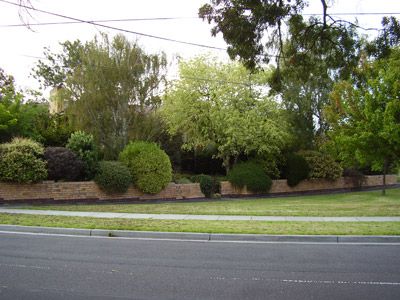
House with a pleasant garden full of shady bushes and trees. Unfortunately, since the photo was taken in 2008, the house was redeveloped and much of the garden altered and reduced.
Links
Articles
- Hello Hello garden shop: Modern landscapes has some examples of ugly garden plants described above
- The Age:
- “Paradises lost to developers and modern fads,” 17/1/2008. A lament for lost suburban gardens.
- “It’s time literally to go green,” 23/1/2009. Trees and plants in urban areas help absorb carbon emissions and cool down the surrounding environment.
- “Doctor’s plea for trees,” 19/2/2009. Neglecting watering trees and parks during a drought is not helping the environment. Too much vegetation is being lost to high-density developments.
- “Backyard blitz puts Aussie lifestyle under threat,” 15/9/2009. An English professor is dismayed by the reduction of backyard size of Australian homes.
- “A row of palm trees does not mean ‘resort-style living’,” 22/2/2010. On the peculiar obsession with palm trees that many gardeners and developers have.
- “Mother Nature is on the run,” 14/4/2012. Another lament for lost suburban gardens, under threat from developers.
- “My idea of Australia was a quarter-acre block with a shed, a lemon tree and a Hills Hoist,” 26/11/2012.
Websites
- ABC Television: Gardening Australia TV program site
- Greg’s Indigenous Plants & Landscapes
Related: Crimes against architecture
Updated: 24/6/2026