ISS Expedition 11
Sergei Krikalyov’s sixth flight and fourth long-duration mission; his first as commander.
Overview
Mission data
| Name | Role | Origin |
|---|---|---|
| Sergei Konstantinovich Krikalyov Сергей Константинович Крикалёв |
|
Energiya, Russia |
| John Lynch Phillips |
|
NASA, USA |
| Name | Role | Origin |
|---|---|---|
| Mikhail Vladislavovich Tyurin Михаил Владиславович Тюрин |
|
Energiya, Russia |
| Daniel Michio Tani |
|
NASA, USA |
| Call-sign, позывной | Bazal’t, Базадьт (“Basalt” – Sergei’s) |
| Launch | 15 April 2005 at 00:46:25 UTC |
| Launch vehicle | Soyuz-FG (11А511U-FG, No. Zh15000-014) rocket containing the Soyuz TMA-6 transport spacecraft |
| Launch site | Launch Complex 17P32-5, Area 1, Launch Pad 5, Baikonur Cosmodrome, Republic of Kazakhstan |
| Docking | 17 April 2005 at 02:10 UTC to the Pirs DC-1 nadir docking port |
| Undocking | 10 October 2005 at 21:49 from the Zarya FGB nadir docking port |
| Deorbit burn | 11 October 2005 at 00:19 |
| Landing | 11 October 2005 at 01:10 |
| Landing site | 57 km NE (41°N 67°E) of the town of Arkhalyk, Northern Kazakhstan landing zone |
| Landing vehicle | Soyuz TMA-7 |
| Flight duration | 179d 23m |
| Spacewalks | 1 |
Notes
- Launch of ISS-11 crew and Italian astronaut operating under the Program of visiting crew (VC-8) by transport manned spacecraft Soyuz TMA-6, flight 10S;
- Docking of spacecraft Soyuz TMA-6 to docking compartment Pirs;
- Operational support for loading and undocking of Soyuz TMF-5, Progress M-52, Progress M-53;
- Operational support for docking of Progress M-53, Progress M-54, Soyuz TMA-7 and Space Shuttles, LF1 and LF1.1 flights;
- Unloading of spacecraft Soyuz TMA-6, Progress M-53 and Progress M-54;
- Redocking of spacecraft Soyuz TMA-6 from docking compartment Pirs to Functional Cargo Block Zarya;
- Support of the Space Station functionality;
- Performance of extravehicular activity: two EVAs, one EVA on the USOS, one EVA on the Russian Segment (the Russian segment spacewalk was carried out, the U.S. one deferred);
- Performance of the science and application research program and experiments (“SVS,” “Relaksatsia,” “Uragan,” “Sprut-MBI,” “Diurez,” “Farma,” “Cardio-ODNT,” “Biotest,” “Profilaktika,” “Pulse,” “Gematologia,” “Pilot,” “Biorisk,” “Rastenia-2,” “Intercellular interaction,” “Statokonia,” “Regeneratsia,” “Prognos,” “Brados,” “Matryoshka-R,” “Diatomeya,” “Volny,” “Mimetik-K,” “Vaktsina-K,” “Biodegradatsia,” “Bioekologia,” “Interleukin-K,” “Meteoroid,” “Toksichnost,” “Plasma crystal,” “Identifikatsia,” “Skorpion,” “Ekon,” “Plasma-MKS,” “Kromka”), as well as contract-based commercial activities (GTS, MPAC&SEED, “GCF-JAXA,” “Rokviss,” “Neurocog-3,” “ETD”);
- Implementation of the Experimental Program under the ISM “ENEIDE” Project (“CRISP-2,” “BEANS,” “SEEDLINGS,” “FRTL-5,” “MICROSPACE,” “VINO,” “HPA” (this experiment will be conducted on the USOS of the ISS), “NGF,” “VSV,” “ETD-I,” “FTS,” “MOP-I,” “ENEIDE,” “LAZIO,” “EST,” “E-NOSE,” “HBM,” “SPQR,” “ASIA,” “GOAL,” “BOP,” “ESD,” “ARISS-4”) during VC-8;
- Crew handover to Increment ISS-12 and return to Earth of 2 members of Increment ISS-11 crew and the participant of Visiting Crew 9 (VC-9) by transport manned spacecraft Soyuz TMA-7.
(Source: Energiya)
Sergei was initially assigned as ISS commander for Expedition 10, along with Sergei Volkov and NASA astronaut John L. Phillips (they trained as back-ups for the original Expedition 7 crew). The Columbia tragedy of course threw future flight plans into disarray.
In October 2004, Sergei was assigned to Expedition 11, along with NASA astronaut John Phillips, to fly on Soyuz TMA-6 and they launched on 15 May 2005 (docked 17 May). Sergei was also the Soyuz pilot and commander. Cosmonaut Sergei Volkov was to have joined them on STS-121 a bit later, in June 2005, but his mission was unfortunately canceled, and he was to be replaced by ESA/German astronaut Thomas Reiter.
The crew was officially named on 23 November in NASA Press Release H04-383.
Sergei was the fourth civilian cosmonaut to pilot a Soyuz (sit in the commander’s seat in the middle) – the first civilian Soyuz commander was Nikolai Rukavishnikov, the second was Valeri Kubasov and the third was Aleksander Kaleri. To add to his many firsts, he would be the first cosmonaut to be a member of two ISS Expeditions, and the first spaceman to visit the ISS three times!
Events
| Mission | Launch | Landing | Purpose |
|---|---|---|---|
| Progress M-53 | 17 June 2005 | 7 September 2005 (burned up in atmosphere) | Cargo supplies delivery |
| STS-114/ |
26 July 2005 | 9 August 2005 |
|
| Progress M-54 | 8 September 2005 | 3 March 2006 (burned up in atmosphere) | Cargo supplies delivery |
| Soyuz TMA-7 | 1 October 2005 | Crew transport | |
| Expedition 12 | 1 October 2005 | Twelfth long-duration crew | |
| Visiting Crew 9 | 1 October 2005 | 11 October 2005 |
|
Sergei events
30 July 2005
Sergei reached 2 years of accumulated time in orbit today; beginning his third year in space
16 August
At 05:45 GMT/UTC, Sergei overtook cosmonaut Sergei Avdeev’s longstanding record of 747 d 14 h 14 m 11 s accumulated flight time!
27 August
Sergei’s 47th birthday
Gallery
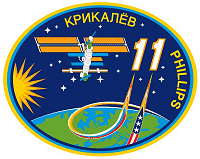
Expedition 11 mission patch.

Soyuz TMA-6/Visiting Crew-8 patch.

Expedition 11 crew (S. Krikalyov, J. Phillips).

Eneide/VC-8/TMA-6 portrait in Sokol spacesuits (R. Vittori, S. Krikalyov, J. Phillips).

Eneide/VC-8/TMA-6 in civilian clothes, 3 February 2005.

Expedition 11, in civilian clothes, 3 February 2005.
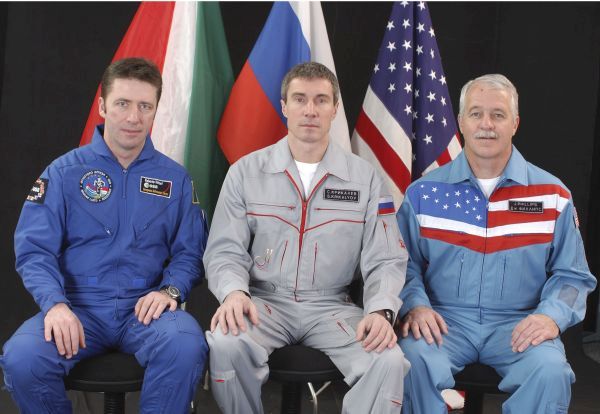
ESA Eneide/VC-8/TMA-6 in jumpsuits.
Canadian Space Agency photos
From their Soyuz Mission gallery (CSA astronaut Robert Thirsk was backup flight engineer for Roberto Vittori): 25, 22, 18, 19, 16, 15, 9.
Cup Noodle No Border Space Project
Sergei was required to appear in this Japanese ad for Cup Noodles, filmed during the Expedition 11 & 12 handover. Cosmonauts have been filming ads in space as part of their contracts since the 1990s on Mir, and the money goes into the Russian space program.
Some small screenshots I took during the video: 1, 2, 3, 4, 5, 6, 7, 8, 9, 10, 11, 12, 13, 14, 15.
Some scenes from TsUP. Representatives for the Nissin Cup Noodle company were, along with some TsUP personnel, co-ordinating the filming: 1, 2, 3.
Cup Noodle No Border Space Project. The site has disappeared, but a Flash movie copy is at YouTube: Nissin Cup Noodle CM (NO BORDER №7).
Element 21 Golf Company
Sergei did a promotion during Expedition 11, this for the “Golf Shot Around the World” mission, as described in this collectSPACE posting: Fore! ISS launched golf shot to go miles and miles …
He appears in two promotional photos with a golf club in the Zvezda module: Photo 1 and Photo 2.
Energiya photos
ESA Eneide photos
Photos from the Eneide gallery at the ESA Eneide mission page. I have linked to the high-resolution photos; right-click to download and save without opening.
Preflight
SEMKF4P256E (770 KB), SEMU34P256E (869 KB), SEMIG4P256E (681 KB), SEMFSZO256E (635 KB), SEMY2BW797E (375 KB), SEM83BW797E (1.4 MB), SEMT2EW797E (544 KB), SEM1WDW797E (417 KB).
Inflight
SEMEATW797E (1.38 MB), SEM3BTW797E (1.27 MB).
ESA Photolibrary
These photos from the ESA Photo Library for Professionals were found by doing word searches for “Krikalev” and “Vittori.” They show the TMA-6 crew training in the Soyuz simulator in March 2005.
eneide07064, eneide07065, eneide07066, eneide07067, eneide07068, eneide07069, eneide07070, eneide07071, eneide07072, eneide07073, eneide07078, eneide07079, eneide07100, eneide07101, eneide07106, eneide07107, eneide07108, eneide07109, eneide07110, eneide07111, eneide07183, eneide07184, eneide07186, eneide07188, eneide07189, eneide07194, eneide07195, eneide07196, eneide07197, eneide07200, eneide07203, eneide07204, eneide07206, eneide07207, eneide07215, eneide07216, eneide07218, eneide07220, eneide07221, eneide07298, eneide07300, eneide07301, eneide07302, eneide07309, eneide07311, eneide07317, eneide07328, eneide07338, eneide07340
Miscellaneous photos
Some small photos sent to me by Cezy, of TV footage on 24 March 2005 before the crew were to do the final test in a mock-up of the Zvezda and Zarya training modules in Star City: 1, 2, 3, 4, 5.
A blurry video screenshot of Sergei (at left, in the center seat) and Roberto Vittori in the cramped Soyuz cockpit during the ascent to orbit.
NASA photos
Quick links to all Sergei photos at the NASA galleries. The links will take you to a thumbnail page where you can download low- or hi-res versions.
Photo gallery start page (all photos together).
Preflight
- JSC2004-E-26700, 26709, 26713, 26715, 26778, 26779, 27265, 27296, 27298, 27303, 27309, 27318, 35704, 35709, 35710, 51822, 51826, 51830
- JSC2005-E-04415, 04418, 04451, 04452, 13488, 15133, 15134, 15135, 15138, 15140, 15142, 15219, 15222, 15224, 15903, 15904, 15905, 16079, 16288, 16291, 16293, 16296, 16309, 16320, 16321, 25161, 25162
- Crew patch: ISS011-S-001
- Crew portrait: ISS011-S-002
Inflight (Expedition 10 & 11 galleries)
- ISS010-E-24952, 24980, 24987, 24988, 25145, 25149, 25158, 25161, 25162, 25230, 25231
- ISS011-E-05137, 05155, 05504, 05510, 05513 05598, 05601, 06159, 06165, 06188, 06249, 07561, 07590, 07649, 08465, 08468, 09184, 09204, 09210, 09363, 09373, 09392, 09405, 09799, 09812, 09816, 09827, 10309, 11009, 11287, 11330, 11360, 11400, 11403, 11980, 11984, 12403, 12405, 12407, 12408, 12410, 12494, 12495, 12601, 12809, 13009, 13015, 13021, 13024, 13025, 13494, 13496, 13711
Postflight
- JSC2005-E-41362, 41364, 41486, 41487, 42709, 42710, 42717, 42722, 43606, 43609
- TMA-6 Landing in Kazakhstan
STS-114
- Training: JSC2005-E-03945; 03942
- Photo gallery start page (all photos together)
- Flight Days 5, 6, 8, 11
- Videos: Flight Days 3, 4, 5, 8, 12
- S114-E-5531, 5562, 5576, 5945, 5946, 6784, 7145
ISS Status Briefing Materials, June 13, 2005
- Main page
- 118030, 118032, 118034, 118038, 118040, 117841 (on the computer screen are Sergei’s insides!), 117845 (Sergei Volkov is beside Sergei K.), 117847
Novosti Kosmonavtiki gallery
- A meeting of Roskosmos and Expedition 11, 29 March 2005 – Встреча в Роскосмосе с экипажами МКС-11. 29 Марта 2005г
- Expedition 11 press conference at TsPK, 29 March 2005 – Пресс-конференция МКС-11 в ЦПК, 29 Марта 2005г
Links
- Canadian Space Agency: Soyuz Mission. CSA astronaut Robert Thirsk was a TMA-6 crew backup, and he kept a diary of his training.
- CBS Space Place: STS-114 mission archive
- Encyclopedia Astronautica: ISS EO-11
- Energiya: Expedition 11 mission section
- Eneide: Mission Information Reports
- ESA: Eneide mission page
- Houston Chronicle Space Station section
- Loty Kosmiczne: TMA-6
- NASA:
- Mission Control Center Status Reports:
- NASAWatch: Chronicles of a Space Station Expedition. Downloadable PDF NASA document providing a retrospective overview of the ISS-11 mission.
- Russian Space Web: TMA-6 page
- Space.com: Expedition 11 mission page
- Spacefacts: Expedition 11
- Spaceflight Now:
- Spacepatches.info: Designing the Expedition 11 patch. “The crew wanted to keep the design as simple as possible so they decided that the stars would just be for aesthetic purposes and 15 are there because it looks right. No particular meaning intended. Sergei Volkov jokingly said he is represented by the sun on the patch.”
- TsUP (Moscow Mission Control): «Союз ТМА-6»
- USSR Airspace (Alex Panchenko):
- Happy Birthday from Sergei in Cosmos
- Alex Panchenko patch: Sergei and Alex Panchenko designed a diamond-shaped personal patch for Sergei’s flight! “We wanted a patch to be in Diamond shape, as Soviet/Russian Academies graduation badges. Same time we wanted design to be very simple and basic, without complicate ideas and symbols. It took around 15 minutes for couple basic drawings on coffee shop napkins and it was done.” This is the official Soyuz patch.
Updated 12 Jul 2015
ISS-11 JSC Status Reports
- 05-19
- 05-20
- 05-21
- 05-22
- 05-23
- 05-24
- 05-25
- 05-26
- 05-27
- 05-28
- 05-29
- 05-30
- 05-31
- 05-32
- 05-33
- 05-34
- 05-35
- 05-36
- 05-37
- 05-38
- 05-39
- 05-40
- 05-41
- 05-42
- 05-43
- 05-44
- 05-45
- 05-46
- 05-47
- 05-48
- 05-49
- 05-50
Here on one page are all the ISS Status Reports for Expedition 11, as issued (usually weekly) by the Johnson Space Center in Houston, Texas. I have not included the STS-114 Status Reports. The reports cover the months from April to October 2005.
Note: CDT – Central Daylight Time (GMT/UTC −05 hours).
International Space Station Status Report #05-19
8 p.m. CDT, Thursday, April 14, 2005
The 11th crew of the International Space Station rocketed into space tonight, beginning a six-month mission.
The ISS Soyuz 10 spacecraft carried Station Expedition 11 Commander Sergei Krikalyov and NASA Science Officer and Flight Engineer John Phillips to orbit along with European Space Agency Astronaut Roberto Vittori.
The Soyuz launched at 7:46 p.m. CDT from the Baikonur Cosmodrome, Kazakhstan. At the time, the Station was flying in a northeasterly direction about 230 miles above the South Atlantic Ocean. With Krikalyov at the controls, the Soyuz is on course to catch up and dock with the Station at 9:19 p.m. Saturday, April 16.
The hatches between the arriving Soyuz 10 spacecraft and the Station will be opened at about 12:05 a.m. Sunday. Live NASA Television coverage of the docking and hatch opening will begin at 8 p.m. Saturday.
Krikalyov and Phillips will stay aboard the Station until October, while Vittori will spend eight days there conducting experiments. The Station residents will open the door for the Space Shuttle Discovery’s crew on their STS-114 mission to ISS in May or June.
Expedition 10 Commander and NASA Science Officer Leroy Chiao and Flight Engineer Salizhan Sharipov have been doing research and maintaining Station systems since October. With Vittori, they will undock from the Station and return to Earth April 24.
International Space Station Status Report #05-20
11:55 p.m. CDT, Saturday, April 16, 2005
New residents arrived at the International Space Station tonight to begin a six-month mission and to prepare for the arrival of the first Space Shuttle crew to visit the complex since November 2002.
With Expedition 11 Commander Sergei Krikalyov at the controls, the Soyuz TMA-6 spacecraft automatically linked up to the Pirs Docking Compartment at 9:20 p.m. CDT as the Soyuz and the Station flew over eastern Asia. Within minutes, hooks and latches between the two vehicles joined together to form a tight seal.
Aboard the Soyuz with Krikalyov were NASA Expedition 11 Flight Engineer and Science Officer John Phillips and European Space Agency (ESA) Astronaut Roberto Vittori of Italy.
Hatches between the Soyuz and the Station were opened at 11:45 p.m. Saturday. The two crews greeted one another with handshakes and hugs. The first activity scheduled for the five crewmembers was a safety briefing to familiarize the newly arrived trio with emergency escape procedures.
Krikalyov and Phillips will remain on board the Station until October. Vittori will return to Earth next week after eight days of scientific experiments on the complex under a commercial agreement between ESA and the Russian Federal Space Agency. The trio launched at dawn Friday from the Baikonur Cosmodrome in Kazakhstan for their two-day journey to the outpost.
Aboard the Station at the time of docking were Expedition 10 Commander and NASA Science Officer Leroy Chiao and Flight Engineer Salizhan Sharipov, who are wrapping up their six-month mission and who will ride home on their Soyuz TMA-5 capsule with Vittori on April 25 for a pre-dawn landing in central Kazakhstan. Saturday marked the 185th day in space for Chiao and Sharipov and their 183rd day on the Station.
Krikalyov and Phillips will relocate the new Soyuz from Pirs to the Zarya module docking port this summer.
On hand for the docking activities at the Russian Mission Control Center outside Moscow were NASA Deputy Administrator Fred Gregory, NASA Deputy Associate Administrator for Space Station and Space Shuttle Programs Michael Kostelnik, NASA Deputy Associate Administrator for Exploration Systems Craig Steidle and ISS Program Manager William Gerstenmaier along with Russian and European space officials.
On Sunday before they begin an extended sleep period, the new crew will transfer their custom-made Soyuz seatliners as well as cargo carried aloft on the Soyuz for the complex. Later in the day, initial briefings on the handover from the current residents to their replacements will be conducted and the new Soyuz’ systems will be deactivated.
Over the next week, Krikalyov and Phillips will familiarize themselves with Station systems and stowed equipment, conduct robotics training with the Canadarm2 robot arm, and receive detailed briefings on scientific payloads. Phillips and Chiao will also continue the maintenance and repair work on the cooling systems in the U.S. airlock Quest for the resumption of spacewalk capability from the Station this summer.
In addition, they will pack discarded gear and equipment for return to Earth on the Raffaello cargo module that will be brought to the Station on the Space Shuttle’s Return to Flight mission, STS-114, targeted to arrive next month on the Shuttle Discovery.
International Space Station Status Report #05-21
4:00 p.m. CDT, Friday, April 22, 2005
Aboard the International Space Station this week, one crew counted down its final days in space, headed toward a return to Earth on Sunday, while another crew began a six-month journey in orbit.
The five crewmembers aboard the Station had a busy week of briefings for the new crew, preparations for the old crew’s departure and preparations for the arrival of the Space Shuttle Discovery on STS-114, the Shuttle’s Return to Flight targeted for next month.
The 11th Station crew, Commander Sergei Krikalyov and NASA ISS Science Officer John Phillips, docked to the Station at 9:20 p.m. CDT Saturday. With them was European Space Agency (ESA) Astronaut Roberto Vittori of Italy. He is spending almost eight days on the Station working through 22 scientific experiments and activities.
Vittori is to return to Earth on Sunday with the two members of the Expedition 10 crew, Commander and NASA ISS Science Officer Leroy Chiao and Flight Engineer Salizhan Sharipov. They are scheduled to leave the Station at 1:41 p.m. CDT Sunday and to land in Kazakhstan at 5:08 p.m. Chiao and Sharipov will then travel to Kustanai, Kazakhstan, and on to Star City, Russia, about eight hours after their return to Earth, where they will be reunited with family.
The landing is about two hours before local sunrise. The area weather forecast calls for a chance of rain with near-freezing temperatures.
Sharipov will undock the Soyuz manually as a precautionary measure to conserve energy. Although the Soyuz’ backup battery charge is thought to be adequate if it were required for the undocking, that battery has shown signs of a reduced charge since the Soyuz was relocated among Station docking ports in November 2004. The primary battery is healthy.
The manual undocking is a practiced backup procedure for Soyuz operations, and is being done to ensure adequate backup battery power is available if it were needed for deorbit and landing. The manual procedures allow Sharipov to reduce the amount of time the Soyuz is on internal power before undocking. The undocking is routinely performed automatically by the onboard computer. Landing will occur as is normal on the second orbit after undocking.
Extensive briefings by Chiao and Sharipov helped settle Krikalyov, who was a member of the first station crew launched in late 2000, and Phillips, who visited the Station as a Shuttle crewmember in April 2001, in their new home. They also trained on the Canadarm2, the Station’s robotic arm, and were briefed on science activities as well as locations of equipment and supplies.
On Monday, Phillips trained with the Advanced Diagnostic Ultrasound in Microgravity experiment. He conducted his first experiment with the equipment on Thursday.
Tuesday the crew activated the Microgravity Science Glovebox and later in the week certified its readiness for use. Wednesday’s focus was the U.S. airlock Quest, with crewmembers flushing a cooling system and replacing a service and cooling umbilical, restoring the airlock to usable condition. Chiao and Phillips were back in the airlock on Thursday, resizing spacesuits to make sure the right equipment will remain aboard the Station after Discovery’s departure from its future mission.
A three-hour Soyuz descent training session kept Chiao, Sharipov and Vittori busy on Friday. All five crewmembers later participated in a change of command ceremony that formally passed command of the outpost from Chiao to Krikalyov.
International Space Station Status Report #05-22
6:00 p.m. CDT, Sunday, April 24, 2005
After traveling more than 78 million miles aboard the International Space Station, Expedition 10 Commander and NASA ISS Science Officer Leroy Chiao and Flight Engineer Salizhan Sharipov returned to Earth today. With them was European Space Agency Astronaut Roberto Vittori, who had spent eight days aboard the orbiting complex doing research.
After a flawless descent by the ISS Soyuz 9 spacecraft, Chiao, Sharipov and Vittori landed on target in north-central Kazakhstan, about 53 miles (85 kilometers) northeast of Arkalyk, at 5:08 p.m. CDT. Recovery forces arrived at the site within minutes of the touchdown. The area was saturated from recent rains and melting winter snow, so the first members of the recovery team to reach the scene decided to fly the crew to Arkalyk to meet with remaining members of the recovery team.
The crew’s friends and families are expected to greet them upon their arrival at Star City, Russia, about eight hours after landing. Chiao and Sharipov will remain in Star City for a few weeks of post-flight debriefings and medical exams before returning to Houston in mid-May.
Chiao and Sharipov spent 192 days, 19 hours and 2 minutes in space. They launched on Oct. 13, on the same Soyuz spacecraft that brought them home. For six months, the pair maintained systems and conducted scientific research onboard the Station.
Among their accomplishments on the Station was replacing critical hardware in the Joint Quest Airlock, repairing U.S. spacesuits, submitting a scientific research paper on ultrasound use in space and voting for the first time in an American Presidential election from space. They completed two spacewalks, including experiment installation and tasks that prepared the Station for the arrival of a new European cargo ship next year.
Aboard the Station, the Expedition 11 crew, Commander Sergei Krikalyov and Flight Engineer and NASA Station Science Officer John Phillips, are beginning a six-month mission that will include the resumption of Space Shuttle flights and two spacewalks from the Station. Expedition 11 is scheduled to return to Earth on Oct. 7, 2005.
Krikalyov and Phillips will have light duty for the next three days as they rest after completing a busy handover period. For the past week, they have been learning about Station operations from the two men who called the ship home since October. Chiao and Sharipov briefed Krikalyov and Phillips on day-to-day operations and gave them hands-on opportunities at Station maintenance: Chiao and Phillips restored functionality of the Quest for future spacewalks and practiced operating the Canadarm2 robotic arm.
International Space Station Status Report #05-23
3 p.m. CDT, Friday, April 29, 2005
The new crew members of the International Space Station completed their first full work week today as they conducted routine maintenance, continued to settle in and practiced photography to be used when the Space Shuttle returns to flight.
Commander Sergei Krikalyov and Flight Engineer and NASA Science Officer John Phillips were given time each day to orient themselves with the Station and where items are stowed. They also completed an emergency evacuation drill, a standard procedure for all new crews. The practice helps them learn the location of emergency equipment and departure routes.
Both crewmembers kept busy with Station maintenance and upkeep. Krikalyov conducted troubleshooting of the Russian Elektron oxygen generation system and the condensate removal system. The Elektron remains off-line, with oxygen being supplied from tanks in the Progress cargo ship, one of several oxygen supplies available. The next infusion of oxygen into the Station’s atmosphere from Progress will take place early next week.
Krikalyov also completed the transfer of water from the Progress cargo ship to storage tanks in the Zvezda module. Phillips updated the Station’s computer system with software specifically designed for this crew’s mission. He also installed a remote-controlled camera at the Destiny Lab’s Earth-facing window for a week’s worth of imagery from the EarthKAM experiment, which enables middle-school students around the world to take photos of selected sites on Earth. Thousands of students from more than 100 schools took part in this week’s operations.
Early today Krikalyov and Phillips were informed that NASA managers rescheduled the launch of the Shuttle Discovery to no earlier than July 13 on the STS-114 Return to Flight mission. The additional time is needed to complete a thorough analysis of the potential risks posed by several areas of possible ice debris from the Shuttle’s external fuel tank as well as an evaluation of several concerns found during recent launch preparations.
Today the crewmembers practiced with digital cameras the photographs they will take of Discovery as it approaches the Station for docking on the third day of the STS-114 mission. Phillips and Krikalyov will have about 93 seconds of time available to use the cameras and high-power lenses to capture two sets of images of the Shuttle’s heat shield. Discovery Commander Eileen Collins will guide the Shuttle through a slow back flip to allow the Station crew to image both the top and bottom of the vehicle. The images will be quickly transmitted to the ground for analysis.
Krikalyov and Phillips performed another step in preparations for the Shuttle visit this week as they cleared cargo from a hatch in the Unity module where a cargo container will be attached during that mission. The Station crew also conferred via space to ground communications with Discovery’s crew about the planned transfer and stowing of supplies.
Meanwhile, Expedition 10 Commander Leroy Chiao and Flight Engineer Salizhan Sharipov, along with European Space Agency Astronaut Roberto Vittori of Italy, arrived at the Gagarin Cosmonaut Training Center in Star City, Russia Monday morning. They rested, reunited with their families and went through medical tests following their landing in a Soyuz spacecraft. Chiao and Sharipov are expected to return to Houston in mid-May.
International Space Station Status Report #05-24
3 p.m. CDT, Friday, May 6, 2005
Commander Sergei Krikalyov and Flight Engineer John Phillips moved full speed ahead into their Expedition 11 maintenance and science work aboard the International Space Station during their third week in space.
Krikalyov replaced a liquid processing component of the Russian Elektron oxygen generation system on Thursday, but it failed almost immediately prompting additional troubleshooting Friday. The system separates hydrogen and oxygen molecules from water, and injects the oxygen into the Station’s atmosphere. Late Friday systems experts in Russia reviewed information gained from the earlier efforts. Oxygen is being supplied as needed from tanks in the Progress cargo ship, one of several oxygen supplies available.
Phillips was called upon to do some on-the-spot maintenance of a balky treadmill on Friday. It had stopped working, so he inspected electrical connections and prepared to downlink data from his last run so that biomedical engineers on the ground can try to track down the problem. Resistive exercise equipment and stationary bicycles will be used to provide the 2 1/2 hours a day of exercise prescribed for each crew member.
Also Friday, both crewmembers used the Robotics Work Station in the Destiny laboratory module to guide the Station’s Canadarm2 robotic arm through movements designed to enable later remote operation by ground controllers. The hour-long session also served as proficiency training for the crew.
Earlier in the week, Krikalyov fixed the Russian dehumidifier by clearing blockage from one of the system’s lines. Krikalyov also transferred wastewater from the Station into the Progress cargo ship’s storage tanks. Phillips packed items that will be returned to Earth on the Space Shuttle Discovery, and did routine checks of emergency medical equipment.
Scientific investigations for the week focused on work with a kidney stone experiment. Both crew members took pills – either a placebo or potassium citrate, which has been proven effective in reducing the formation of kidney stones in patients on Earth – recorded what they ate and drank and collected urine specimens for 24 hours. The samples will be returned to doctors on the ground for analysis and correlation with the dietary intake information.
Expedition 10 Commander Leroy Chiao and Flight Engineer Salizhan Sharipov remained at the Gagarin Cosmonaut Training Center in Star City, Russia, undergoing medical examinations and debriefings following their landing in a Soyuz spacecraft after six-months on orbit. They are expected to return to Houston in mid-May.
International Space Station Status Report #05-25
3 p.m. CDT, Friday, May 13, 2005
Expedition 11 Commander Sergei Krikalyov and Flight Engineer John Phillips continued routine maintenance and science experiments aboard the International Space Station this week as they wrapped up their first month in space.
The crew began the week observing Victory Day – the Russian holiday that this year marked the 60th anniversary of the end of fighting in the Soviet Union during World War II. The rest of the week kept Krikalyov and Phillips busy with maintenance and research activities.
The crew continued using the treadmill for exercise this week as engineers closely monitored data from the exercise sessions. However, after a broken restraint cable was found during a routine inspection today, the crew was asked to use other exercise equipment for the time being.
The treadmill stopped working for a time last Friday when a circuit breaker tripped inside the device. During a routine monthly inspection today, Phillips reported a broken restraint cable on the treadmill’s gyroscope. The treadmill, which is specially outfitted to isolate the vibrations caused by exercise from the rest of the Station, is equipped with a gyroscope to maintain the system’s stability.
Engineers will analyze photos of the restraint cable to determine if it can cause problems with the treadmill’s operation. Other exercise equipment aboard that is available to the crew includes two stationary bicycles.
The Station’s atmosphere was pressurized with oxygen from the ISS Progress 17 vehicle’s reserve tanks once again this week. The Station’s Elektron oxygen generation system, which can convert water into oxygen for the air onboard, is not operating. Russian engineers plan to send a new electronics box for the system on a Progress supply ship that will arrive in June.
Plentiful supplies of oxygen remain available aboard the Station from multiple sources. In total, oxygen supplies already aboard the Station coupled with those that are planned to be delivered by upcoming cargo craft could sustain the crew for at least the rest of this year, without use of the Elektron.
Through next week, the remaining oxygen supplies aboard the currently docked Progress will be used. Once those are depleted, Solid Fuel Oxygen Generation canisters may be used. 84 such canisters are aboard. Those canisters alone could supply the crew for at least 42 days if necessary. A large quantity of oxygen, enough to supply the crew for nearly 100 days, also is stored in tanks on the Quest airlock aboard the Station.
The Progress spacecraft now docked to the Station, Progress 17, will undock at about 3:10 p.m. CDT June 15. ISS Progress 18 is scheduled to launch from the Baikonur Cosmodrome, Kazakhstan, at 6:09 p.m. CDT June 16 and dock to Station on at 7:10 p.m. CDT June 18. The Station’s altitude was boosted on Wednesday to line up its orbit for the arrival of the new cargo craft. The Station’s orbit was raised by 1.5 miles at the perigee, or portion closest to Earth, to 226.1 by 214.2 statute miles. The new Progress also is planned to deliver even more oxygen supplies. Another Progress craft is planned to arrive at the Station in late August.
This week, both crewmembers worked on preparing excess equipment for return on the Space Shuttle Discovery in July on the STS-114 Return to Flight mission. They also performed routine maintenance on ventilation and life support systems in the Russian segment and verified a VHF radio communications link used during Shuttle rendezvous operations. Krikalyov continued work throughout the Russian modules with audits of various supplies and equipment.
Phillips’ work focused on some of the laptop computers aboard. He refreshed a Portable Computer System (PCS) laptop by deleting and then reloading information on the hard drive, which recovered its corrupted hard drive to serve as a backup. The PCS laptops are used by the crew to monitor the Caution and Warning system and manage the Station operating modes and the Command and Control System. Two required PCS computers are functional onboard with three additional hard drives now available as spares.
Phillips also worked with three Station Support Computers (SSCs) that were experiencing problems booting up. After the troubleshooting, two of the computers turned on, but the screens remained blank. They can be used for routing data in applications where a computer monitor is not necessary. The third laptop did not boot up and engineers are working on further troubleshooting procedures. There are enough operating computers available onboard for the crew to access e-mail, perform word processing and view the daily schedule of activities. Phillips also replaced an old battery in the laptop computer used at the Robotics Work Station that controls the Station robotic arm, Canadarm2.
Serving as the NASA Station Science Officer, Phillips began participating in the “Journals” experiment after completing his orientation to Station life. The investigation records crew members’ perceptions though the mission to obtain information to assist in the design of future spacecraft. Phillips also prepared for his first session next week with the Foot/Ground Reaction Forces During Spaceflight (FOOT) experiment. For the experiment, he will wear an instrumented garment called the Lower Extremity Monitoring Suit (LEMS) and shoes with force sensor attached. The experiment records 12 hours of data to help researchers better understand forces imposed on the lower body and muscle activity in weightlessness.
International Space Station Status Report #05-26
3 p.m. CDT, Friday, May 20, 2005
The Expedition 11 crew, now into the second month of its stay on the International Space Station, had a varied week highlighted by repair of an exercise treadmill, tests of an oxygen supply and preparations for the Space Shuttle’s Return to Flight.
Commander Sergei Krikalyov and Flight Engineer John Phillips began the week with the repair of a faulty restraint cable on the Station exercise treadmill. The broken cable, which is used to hold the treadmill’s gyroscope in place, had been detected during a routine inspection by the crew last week. The treadmill is one of three exercise options for the Space Station crew and has been operational since the repair.
On Wednesday, after removing contents from Pressurized Mating Adapter №2, which also serves as the forward docking port for Space Shuttles on the U.S. segment, and the Quest Airlock, Phillips depressurized the modules. This was done to rehearse procedures that will be employed during the STS-114 mission to conserve Shuttle nitrogen supplies during the spacewalk.
Throughout the week, Phillips set up and performed his first session of the FOOT (Foot Reaction Forces During Space Flight) experiment. He wore specially-designed leggings that allow researchers to capture data regarding forces and use of the lower extremity muscles. The data will help scientists design effective muscle and bone loss countermeasure programs for crewmembers involved in long duration spaceflight. The crew also worked with a variety of other U.S. and Russian biomedical experiments.
On Wednesday and Thursday, the Station’s atmosphere was repressurized with air and oxygen from the remaining supplies in the tanks of the docked Russian Progress cargo ship. The Progress tanks were depleted in preparation for its undocking next month.
The crew conducted test ignitions of two Solid Fuel Oxygen Generators (SFOG) canisters on Friday to verify their performance and activation procedures. Beginning Monday, two SFOGs will be burned each day to produce oxygen. There are more than 80 usable SFOGs currently on board, which can provide 6 weeks worth of oxygen for the two-person crew. Another Progress cargo ship is set to arrive on June 18 with additional oxygen in tanks and more solid-fuel canisters. Oxygen supplies onboard and those manifested on upcoming cargo vehicles can accommodate the crew into next year. The Station’s Elektron oxygen generation system, which converts water into oxygen, remains inoperable.
Earlier in the week, the crew performed routine inspections of emergency fire extinguishers and portable breathing apparatus as well as the routine monitoring of carbon dioxide and formaldehyde levels.
During the week, Krikalyov and Phillips were given information on possible photography of Earth sites including the Toshka Lakes in Egypt, the Florida coasts, Mexico City, and Hurricane Adrian as it passed over Central America.
International Space Station Status Report #05-27
3 p.m. CDT, Friday, May 27, 2005
The Expedition 11 crew entered its seventh week in space today, wrapping up a week highlighted by research, maintenance and training for photography tasks to be done during the Space Shuttle’s Return to Flight mission in July.
Commander Sergei Krikalyov and Flight Engineer John Phillips spent several days conducting examinations of each other using an ultrasound device that provides data on the ability of crewmembers to conduct detailed medical exams in space. The experiment could have future applications for telemedicine or rural health care.
Phillips also conducted work with a viscosity measurement experiment that collects information on the behavior of liquids in microgravity that have different thickness, or viscosity. The experiment may provide insight to researchers designing new hardware for space travel and could have industrial applications on Earth.
Phillips and Krikalyov spent part of Tuesday practicing photography techniques with digital cameras in the Zvezda Service Module. The techniques will be used to capture high resolution imagery of the condition of Discovery’s heat shield at a distance of 600 feet as the Shuttle approaches for docking on the third day of the STS-114 mission.
The crewmembers will use 400 millimeter and 800 millimeter lenses from two windows in Zvezda to focus on Discovery’s thermal protection tiles and the reinforced carbon-carbon shield.
Discovery Commander Eileen Collins will fly Discovery through a backflip as it approaches the Station, allowing Krikalyov and Phillips to document all sides of the vehicle. They will shoot as many frames as possible during the minute and a half Shuttle flip. Those images will be transmitted to the ground for analysis.
For the second week, the crew activated solid fuel oxygen generating canisters in Zvezda to replenish the cabin atmosphere. The canisters, one of multiple oxygen supplies that remain available onboard, are being used following the depletion of oxygen reserves in tanks in the Progress cargo vehicle and in the absence of an operating Elektron oxygen-generation system.
The next Progress cargo ship to launch to the Station in mid-June will carry new supplies of oxygen tanks and solid fuel canisters as well as electronic components for the Elektron. Oxygen supplies onboard and those on upcoming cargo vehicles can accommodate the crew into next year.
Earlier today, Krikalyov tested the voltage of some of the Elektron’s existing components to help Russian specialists in their ongoing troubleshooting efforts. Krikalyov confirmed that the electrolyzer unit, part of a system that splits water into hydrogen and oxygen, showed no voltage readings and is presumed to have failed.
Krikalyov also worked on a procedure to bypass one of the cables in the Russian segment condensate removal system that has developed a blockage.
The crew is scheduled for a light duty weekend, including routine housekeeping tasks and family conferences.
International Space Station Status Report #05-28
3 p.m. CDT, Friday, June 3, 2005
A new capability was added to the operation of the International Space Station this week as a final round of tests to commission remote control of the Station’s Canadarm2 robotic arm from the ground was completed.
The 60-foot-long arm was maneuvered by ground control Friday to move in, latch onto a fixture on the exterior of the Station, then release and move back out. The tests were the second and most complex remote control operations of the arm performed by the ground. A first set of tests, completed earlier this year, involved only basic movements. Completion of these two phases of commissioning will qualify the ground control capability to be considered for use during future Station operations if needed.
During the tests, the arm was controlled by the robotics officer, or ROBO, in the Space Station Flight Control Room of Mission Control. Aboard the Station, Flight Engineer and NASA Science Officer John Phillips monitored the activity. Normally, the arm is controlled by the Station crew using a robotics workstation in the complex’s Destiny Laboratory.
Other activities this week for the Expedition 11 crew included some brief additional troubleshooting of the Elektron oxygen generation unit on the Station. At the direction of Russian flight controllers, Commander Sergei Krikalyov tightened a valve in the unit, attempted to pressurize the system and checked for leakage. Similar attempts may continue in the future using other Elektron components and additional monitoring. The Elektron, a system that can derive oxygen from water for use in the Station atmosphere, remains inoperable.
The crew continues to replenish oxygen aboard the Station each day using two solid fuel oxygen generation canisters, canisters that contain chemicals that release oxygen when heated. Plentiful supplies of oxygen remain aboard the Station, and more is set to arrive on the next supply ship later this month. With reserves onboard the complex now plus those planned to arrive on future supply ships, oxygen is available to provide for the crew until at least January 2006 even without use of the Elektron. In addition, new Elektron components and spares also are planned to be launched aboard future supply ships later this year.
Phillips worked this week with an experiment that studies the forces involved as fluids of different thicknesses are mixed. The Miscible Fluids in Microgravity (MFMG) investigation may provide insight into how fluids dissolve, and, in particular, the role played by surface tension in that process. On Earth, gravity makes it difficult to study the role of surface tension during mixture. Information from the experiment may be useful in many processes on Earth and in space science experiments that deal with mixing fluids, among them are investigations that grow protein crystals of use in medical research.
Next week, the crew will begin packing trash and unneeded equipment in the Progress supply ship currently docked to the Station. The current Progress will be undocked from the complex on June 15. The next supply ship, ISS Progress 18, will launch on June 16 and dock to the Station June 18.
The crew is scheduled for a light duty weekend, including routine housekeeping tasks and family conferences.
The next ISS status report will be issued on Friday, June 10, or earlier if events warrant.
International Space Station Status Report #05-29
3 p.m. CDT, Friday, June 10, 2005
Aboard the International Space Station (ISS), the Expedition 11 crew is spending the latter part of its second month in space preparing for the arrival of new cargo. The Station commander quietly slipped into second place on the all time human space endurance list.
Cosmonaut Sergei Krikalyov and astronaut John Phillips conducted scientific research this week, while troubleshooting the station’s oxygen generator, stowing trash and other unneeded items into the Progress supply spacecraft for disposal next week.
Krikalyov, on his sixth voyage into space and third long duration mission (one on Mir and two on the ISS), surpassed fellow cosmonaut Valerii Polyakov on the space duration record list. He will become number one in August, passing cosmonaut Sergei Avdeyev (747 days).
This afternoon, the Station passed over the Gulf of Mexico offering flight controllers an opportunity to capture video of Arlene, the Atlantic hurricane season’s first tropical storm, as it tracked northward toward the U.S. Gulf Coast.
During the week, Krikalyov swapped the large liquid unit component in the Station’s Elektron oxygen generation unit in preparation for an attempt in two weeks to restore its use. New filters for its gas lines will arrive aboard the next Progress cargo spacecraft late next week. They will be installed before the crew attempts to reactivate the unit.
In the meantime, the crew continues to replenish the cabin atmosphere daily using two solid fuel oxygen generation canisters. The canisters introduce oxygen into the pressurized compartment by a chemical process. A plentiful supply of canisters is on board the Station, and more will arrive on the next supply ship June 18.
The onboard supply combined with future shipments can provide oxygen for the crew until at least January 2006, even without use of the Elektron. New Elektron components and spare parts are planned for delivery aboard supply spacecraft later this year.
Phillips put on his customized Lycra cycling tights this week for his second session of the Foot/Ground Reaction Forces during Spaceflight (FOOT) experiment. FOOT investigates the differences between use of the body’s lower extremities on Earth and in space, and changes in the musculoskeletal system during spaceflight.
Phillips wore the instrumented Lower Extremity Monitoring Suit, which measured his joint angles, muscle activity and forces on the feet during a typical day on the Station. FOOT could help explain the reasons for bone and muscle loss during spaceflight and aid in the design of exercise countermeasures. This experiment also has significance for understanding, preventing and treating osteoporosis on Earth.
Focused human physiological and biological Space Station research on astronaut health and the development of countermeasures to protect crews from the space environment will allow for long duration missions to explore beyond low Earth orbit.
Early next week, the crew will wrap up stowage of trash and unneeded equipment in the Progress docked to the Station, prior to its undocking Wednesday. The Progress departure clears the docking port on the aft end of the Zvezda module for the arrival of the next supply craft. The next Progress is scheduled to launch June 16 and dock the evening of June 18. NASA TV will cover the arrival live. This will be the 18th Progress to dock with the Station.
The crew is scheduled for a light duty weekend, including routine housekeeping tasks and family conferences.
International Space Station Status Report #05-30
6:30 p.m. CDT, Thursday, June 16, 2005
Carrying more than two tons of supplies, a Russian cargo spacecraft began a two-day trip to the International Space Station today after its launch from the Baikonur Cosmodrome in Kazakhstan.
The ISS Progress 18 resupply ship launched at 6:09:34 p.m. CDT (5:09:34 a.m. Baikonur time Friday). Less than 10 minutes later, it settled into orbit and automatic commands deployed its solar arrays and navigational antennas.
Shortly after the Progress launched, Expedition 11 Commander Sergei Krikalyov and Flight Engineer and NASA Science Officer John Phillips were informed of its arrival on orbit before beginning their sleep period. The Station was flying over Manchuria near the Russian-Chinese border at an altitude of 225 statute miles at the time of liftoff.
Engine firings are scheduled later today and tomorrow to raise and refine the Progress’ orbit and its path to the Station for an automated docking at the aft port of the Zvezda Service Module on Saturday at 7:44 p.m. CDT. NASA TV will provide live coverage of the linkup beginning at 6 p.m. CDT.
The Progress is carrying food, fuel, oxygen, water, spare parts and personal items for the crew, including 397 pounds of propellant, 242 pounds of oxygen and air, 926 pounds of water, and more than 3,097 pounds of spare parts, life support system components and experiment hardware. In addition, the Progress is carrying 40 more solid fuel oxygen-generation canisters as a supplemental source of oxygen, if required.
Also in the Progress is an additional digital camera that will be used by the Expedition 11 crew to capture images of the thermal protection system on the Shuttle Discovery during its docking approach during the STS-114 mission in July. The new camera replaces a similar camera that is no longer operable. The photos will be part of imagery-gathering efforts to determine whether the Shuttle has incurred damage to its tiles or the reinforced carbon-carbon coating on its wings during ascent.
Krikalyov and Phllips are scheduled to open the hatch to the Progress a few hours after docking Saturday to begin unloading its contents.
The Progress spacecraft that had been at the Station since March was undocked yesterday at 3:16 p.m. CDT as the two vehicles flew over Manchuria, near the Russian-Chinese border. Filled with discarded items, the ship fired its engines after undocking to move to a safe distance away from the Station and was deorbited, burning up in Earth’s atmosphere.
The next ISS status report will be issued on Friday, June 17, with an additional status report to be issued on Saturday, June 18 after the ISS Progress 18 docking.
International Space Station Status Report #05-31
3 p.m. CDT, Friday, June 17, 2005
After a busy week of preparations, the Expedition 11 crew on the International Space Station is ready for Saturday’s arrival of a Progress cargo craft bearing more than two tons of supplies and equipment.
Commander Sergei Krikalyov and NASA Science Officer John Phillips spent the week packing up and disposing of the previous cargo ship and making room for the new ISS Progress 18 spacecraft, scheduled to dock with the Station at 7:44 p.m. CDT on Saturday. It will dock at the aft port of the Zvezda Service Module.
Krikalyov and Phillips devoted Monday and Tuesday to filling the departing ISS Progress 17 with unneeded equipment and trash, and closed its hatch Tuesday afternoon. The spacecraft, which had been at the Station since March 2, was undocked at 3:16 p.m. Wednesday. It was commanded to deorbit and burned on re-entry about four hours after undocking. Friday was a light duty day for the crew in preparation for the new cargo ship’s arrival.
Progress 18 launched from the Baikonur Cosmodrome in Kazakhstan at 6:10 p.m. CDT Thursday. The cargo includes food, fuel, air, oxygen, 40 solid fuel oxygen generation (SFOG) cartridges and parts for the Elektron oxygen generation system. The air, oxygen and SFOGs will add to the existing supplies of oxygen aboard the Station. Flight control teams in Houston and Moscow hope the new parts will enable the crew to reactivate the Elektron, which has been out of service for several weeks. A new liquids unit that circulates water to be broken down into oxygen and hydrogen is to be launched later this year.
Crewmembers plan to open the Progress hatches Saturday, but won’t begin unloading the cargo until Sunday. Beginning Monday, they plan to use oxygen from the Progress to replenish the Station’s atmosphere instead of using the SFOGs.
Krikalyov and Phillips also worked this week packing equipment and scientific experiments and samples for return to Earth aboard Space Shuttle Discovery on its STS-114 Return-to-Flight mission. Discovery is scheduled to launch no earlier than July 13.
On Tuesday, Phillips became the first person to testify before Congress from space. He testified via satellite before the House Science Committee’s Subcommittee on Space and Aeronautics, telling Representatives what it is like to live and work in space. Astronauts Peggy Whitson and Mike Fincke, who previously served on the Space Station, testified before the subcommittee in person. Phillips found time to work with the Fluid Merging Viscosity Measurement experiment, designed to use microgravity to provide insight into behavior of how fluids, including molten materials, flow. Krikalyov worked with several Russian experiments.
The next Station status report will be issued on Saturday, June 18, after Progress docking, or earlier if events warrant.
International Space Station Status Report #05-32
8 p.m. CDT, Saturday, June 18, 2005
An unpiloted Russian cargo ship linked up to the International Space Station today to deliver more than two tons of food, fuel, oxygen, water, supplies and spare parts.
The ISS Progress 18 craft docked to the aft port of the Zvezda Service Module at 7:42 p.m. CDT as the Station flew 225 statute miles near Beijing, China. Within minutes, hooks and latches between the two ships engaged, forming a tight seal. The docking completed a two-day journey for the cargo ship since its liftoff Thursday from the Baikonur Cosmodrome in Kazakhstan.
As the Progress approached the Station, Expedition 11 Commander Sergei Krikalyov had to take over manual control of the docking of the Progress due to a Russian ground station problem that prevented commands to be uplinked to the cargo ship for its final approach for an automated docking. Nonetheless, Krikalyov executed a flawless linkup. NASA Flight Engineer and Science Officer John Phillips took video and still photos of the arrival.
The Progress is loaded with 397 pounds of propellant, 242 pounds of oxygen and air, 926 pounds of water and more than 3,000 pounds of spare parts, life support system components and experiment hardware. In addition, the Progress carries 40 new solid-fuel oxygen generating canisters as a supplemental source of oxygen, if required. The crew will open the Progress hatch later today but will not begin to unload the ship’s cargo until Sunday.
Among the items on the Progress is a new digital camera to be used by the Expedition 11 crew to capture images of the thermal protection system on the Shuttle Discovery during its approach to the Station during the STS-114 mission in July. The camera replaces a similar one that is no longer operable. The photos are part of the imagery-gathering effort to ensure that the Shuttle has no threatening damage to its heat shielding.
The next ISS status report will be issued on Friday, June 24, or earlier if events warrant.
International Space Station Status Report #05-33
3:00 p.m. CDT, Friday, June 24, 2005
The International Space Station crew spent much of the week unpacking and using supplies from the newly docked Progress cargo craft.
The crew members also began preparing the Station for a visit by the Space Shuttle on its Return to Flight mission that is targeted to launch in a window that opens in less than three weeks.
Expedition 11 Commander Sergei Krikalyov completed integrating the systems of a new Progress supply ship into those of the Russian section of Space Station. Krikalyov and Flight Engineer John Phillips also unpacked portions of the more than two tons of supplies on the cargo craft. The craft docked to the Station Saturday evening.
Along with food, fuel, clothing and new hardware, the Progress contained about 80 days worth of oxygen in tanks and solid fuel oxygen generators, plus supplies for further repair efforts on the Elektron oxygen generation system. The Elektron, one of multiple sources of oxygen available on the Station, derives oxygen from water. The system has been inoperable for a few months.
This week, Krikalyov installed a new supply of electrolyte in the Elektron’s liquids unit and a new set of aerosol filters. During initial test activation, the unit started up but immediately shut down. After a second activation it operated for less than half an hour before shutting down once again. Russian specialists at Mission Control Moscow are evaluating further troubleshooting. With the Progress oxygen supply and other supplies aboard the Station, enough oxygen is available to supply the crew for at least the remainder of this year without an operating Elektron unit. A new Elektron liquids unit also is planned to be shipped to the Station later this year.
The Station’s Pressurized Mating Adapter 3 was opened for the first time in four years this week to be used as storage space. The operation is part of the effort to prepare for cargo transfer operations during the Space Shuttle’s return to the complex. The Return to Flight Space Shuttle mission, STS-114, remains on track for launch in a window that extends from July 13-31. The Flight Readiness Review for STS-114 is set for June 29-30 at the Kennedy Space Center, and will conclude with the establishment of a target launch date.
One priority for the mission on Discovery is the delivery of supplies and removal of material that has accumulated on the Station since the grounding of the Shuttle fleet more than two years ago. The majority of that material will be moved on and off of the Station in a pressurized cargo module that will be docked to the nadir side of the Unity connecting module. This week, the Station crew verified the proper operation of the berthing mechanism at that docking port, which had not been operated in two and a half years. Phillips also began installation of a camera in the window of that docking port that is used to align the cargo module when the Shuttle is docked. Phillips halted the camera installation, however, when a circuit breaker tripped. Flight controllers have postponed his completion of the task pending further evaluation.
The next ISS status report will be issued on Friday, July 1, or earlier, if events warrant.
International Space Station Status Report #05-34
3:00 p.m. CDT, Friday, July 1, 2005
The residents of the International Space Station were informed today that they may welcome visitors arriving on a Space Shuttle in two weeks.
Senior NASA managers yesterday set a July 13 launch date for the Space Shuttle’s Return to Flight, a mission that will see the Shuttle Discovery fly to the Station. Commander Eileen Collins and her crew are scheduled to lift off at 2:51 p.m. CDT on the first U.S. space flight since the February 2003 loss of the Shuttle Columbia. Discovery will dock to the Space Station two days later, July 15 at 11:27 a.m. CDT.
The Space Station’s Expedition 11 Commander Sergei Krikalyov and Flight Engineer John Phillips spent time this week preparing the outpost for the first joint Shuttle and Station mission since Endeavour departed in December 2002.
In preparation for docking, Phillips continued installation of a camera used to align the Shuttle and Station during the link up. A circuit breaker had tripped during an installation attempt last Friday. Engineers determined a power supply was at fault. Once the power supply was replaced, Phillips completed the installation and checkout procedure Tuesday.
Krikalyov and Phillips also practiced taking photographs from windows in the Zvezda living quarters module in preparation for Discovery’s arrival. In two weeks, they will use two digital cameras with high-powered lenses to shoot the thermal tiles on the orbiter during its approach. The pictures will be sent to Mission Control to help engineers assess the health of Discovery’s heat shield.
The crew also operated the Station’s robotic arm, Canadarm2, as a checkout before Discovery arrives. In addition to verifying the system’s operation, the activity served as training for Krikalyov and Phillips. The arm was commanded to walk off the Destiny lab’s operating base to the Mobile Base System (MBS) on the truss Wednesday, and then back again Thursday. A similar procedure will be done during the Shuttle mission.
The arm will be positioned on Destiny’s base to observe the arrival of Discovery, for installation of the Rafaello Multi-Purpose Logistics Module and to support three spacewalks by the Shuttle crew. From the MBS operating position, cameras on the arm will be used for situational awareness during potential protective tile inspections the day after docking.
Phillips also prepared for Discovery’s arrival by consolidating equipment to make room for the nine-person joint crew and packing equipment for return to Earth on Discovery.
This week Krikalyov installed and tested equipment for another visiting vehicle. When the European Space Agency’s Automated Transfer Vehicle (ATV) arrives next year, it will use Proximity Communications Equipment (PCE), or space-to-space communications, to rendezvous and dock to the Station’s Russian segment. The ATV has the capability to bring more than eight tons of equipment and supplies to the crew.
The current cargo spacecraft docked to the Station, a Russian Progress vehicle, was used Wednesday to raise the Station’s altitude. The vehicle’s engines burned for five minutes, 18 seconds to raise the Station’s orbit to 221.5 by 215.9 statute miles. The boost began the adjustments needed for rendezvous with Space Shuttle Discovery. Another burn is scheduled for July 6 at 9:58 a.m. CDT to enhance the rendezvous opportunities during the Shuttle’s July launch window that extends from July 13 to July 31.
The Progress also was used to pressurize the Station’s cabin atmosphere with additional oxygen. Each day it was required, Tuesday and Friday, eleven pounds of oxygen were added to the atmosphere in the absence of continual oxygen generation by the Elektron system, which is not currently operating. Other supplies aboard the Station could support the crew for the rest of this year, if needed. Additional supplies and a replacement liquids unit, the heart of the Elektron, are scheduled to arrive later this year.
Phillips, serving as NASA’s Station Science Officer, conducted a physiological experiment Wednesday. For the experiment, Phillips wore a special pair of Lycra cycling tights equipped with sensors to study his movements. The sensors will gather data to help researchers better understand how arms and legs are used differently in space. This information could lead to enhanced countermeasures to help astronauts better maintain bone density and muscle mass during long duration spaceflights.
He also wrote in a journal and filled out a questionnaire for the Journals experiment. With this experiment, researchers hope to improve equipment and procedures to help astronauts cope with the isolation encountered during long duration spaceflight.
Monday, Phillips performed a training procedure and used a voice operated computer system for the first time on Station. Called Clarissa, the system was developed at NASA’s Ames Research Center in an effort to ease astronaut workload. Clarissa is “hands-free” and responds to astronauts’ voice commands, reading procedure steps out loud as they work, helping keep track of which steps have been completed, and supporting flexible voice-activated alarms and timers.
The next ISS status report will be issued on Friday, July 8, or earlier, if events warrant.
International Space Station Status Report #05-35
4:00 p.m. CDT, Friday, July 8, 2005
After a light duty three-day holiday weekend, the International Space Station Expedition 11 crew returned to work for a short, but intense week of science experiments, spacesuit preparations and packing for the upcoming Space Shuttle mission.
Commander Sergei Krikalyov and NASA Science Officer John Phillips spent much of their time this week gathering and packing items on board to be returned in the Raffaello Multi-Purpose Logistics Module (MPLM) during Discovery’s visit to the Station next week. The MPLM will weigh 18,166 pounds when it is launched aboard Discovery and 19,745 pounds when it returns, after supplies for the Station have been unloaded and unneeded gear loaded. The crew also made room for additional stowage in the Quest Airlock to be available during the docked operations. With a Wednesday launch, the Shuttle will dock with the Station on July 16.
Three spacewalks are scheduled during the mission using U.S. spacesuits. To maximize the efficiency of the batteries, Phillips conducted a series of charging and discharging cycles of the spacesuit batteries this week.
On Tuesday, the Space Station was raised nearly 4 miles in order to better position the complex for the Space Shuttle rendezvous. Engines on the docked Progress vehicle were fired for just over seven minutes, increasing the amount of days the Shuttle can launch and rendezvous on the third day of the mission.
Station television cameras captured video as it passed over then Tropical Storm Dennis. Late Wednesday, cameras captured views of the storm as the Station passed over the Caribbean, south of Haiti. Additional sighting opportunities for Hurricane Dennis are anticipated over the weekend and will be provided next week.
Throughout the week, the crew had numerous other Earth observation and photo opportunities including sightings of Mount Kilimanjaro in Kenya, the Nile River Delta in Egypt, and Hong Kong.
Krikalyov repressurized the Station atmosphere using oxygen from the newly arrived Progress vehicle. He also transferred water from tanks on the Progress to tanks in the Service Module.
Phillips and Krikalyov conducted the second of three sessions with the Renal Stone experiment. The experiment investigates whether potassium citrate can be used as a countermeasure to minimize the risk of kidney stone formation in space.
The crew ended its week with a live news conference with journalists at NASA’s Johnson Space Center and Kennedy Space Center. The weekend includes mostly off-duty time as well as routine housekeeping activities and conferences with management and support staff.
ISS status reports will not be issued during the STS-114 Space Shuttle mission. Station activities will be included in the Shuttle mission status reports, which are planned twice daily or as events warrant.
International Space Station Status Report #05-36
4:30 p.m. CDT, Friday, July 15, 2005
The International Space Station Expedition 11 crew worked this week on final preparations for the arrival of the Space Shuttle Discovery on its STS-114 Return to Flight mission, now on hold.
Commander Sergei Krikalyov and NASA Science Officer John Phillips worked to wrap up packing of items to be returned to Earth on Discovery, while continuing their scientific experiments, physical exercises and routine Station maintenance.
On Friday, the crew tested their Soyuz capsule’s motion control system. The test was in preparation for a relocation of the Soyuz spacecraft. The Soyuz is the crew’s lifeboat in the event an evacuation of the Station is needed and is the crew’s ride home at the end of its six-month stay on the orbiting laboratory.
With Discovery’s launch delayed, managers now plan to have the crew move the Soyuz next Tuesday from the Pirs Docking Compartment to the Zarya module to clear the way for a spacewalk planned in August. The move, originally planned to take place after Discovery’s mission, will free up the Pirs airlock for use by Krikalyov and Phillips during that spacewalk.
Krikalyov continued to use oxygen from the tanks of the unpiloted Progress cargo craft docked at the rear of the Zvezda Service Module to repressurize the Station’s atmosphere. He also completed transfer to the Station of fuel from the Progress for thrusters of the Russian attitude control system. On Monday the crew held a radio tagup with Discovery’s crew, and continued packing items for return on the Shuttle, an activity that continued throughout the week. On Tuesday Krikalyov and Phillips performed routine smoke detector inspections and on Wednesday made preparations for their Rendezvous Pitch Maneuver (RPM) photography. They will take pictures of the orbiter’s thermal protection system as Discovery does a slow back flip about 600 feet below the Station.
On Thursday Krikalyov and Phillips enjoyed a relatively light day. Duties included configuring cameras for the RPM maneuver.
The next ISS status report will be issued on Tuesday, July 19, after the proposed relocation of the Soyuz capsule at the Station, if it occurs, or earlier if events warrant.
International Space Station Status Report #05-37
6:30 a.m. CDT, Tuesday, July 19, 2005
Commander Sergei Krikalyov and Flight Engineer John Phillips left the International Space Station today for a short ride, relocating their Soyuz return craft from one docking port to another to free up a Russian airlock for a future spacewalk.
The quick Expedition 11 foray began with undocking from the Pirs Docking Compartment at 5:38 a.m. CDT while the Station flew above the Atlantic just east of the southern tip of South America. Redocking to the nearby Zarya Module’s nadir, or Earth-facing, docking port occurred at 6:08 a.m. CDT over Central Asia.
Krikalyov, seated in the center seat of the Soyuz descent module, guided the spacecraft as it backed away from Pirs to a distance of about 82 feet. With Phillips on his left, Krikalyov commanded the Soyuz to fly laterally along the Station about 45 feet, then rotated the capsule to align it with the Zarya’s docking port. After 14 minutes of stationkeeping, the crew began final approach and completed the linkup. Minutes later, hooks and latches in the two docking mechanisms established a firm connection between Soyuz and Zarya. After a series of leak checks, the crew was scheduled to re-enter the Station shortly after 8 a.m. to reconfigure its systems for normal operations.
The move clears the Pirs airlock for a spacewalk by Krikalyov and Phillips in August. Among the tasks planned for that spacewalk are removal of materials exposure experiments, installation of a television camera for the European Space Agency’s cargo-carrying Automated Transfer Vehicle and relocation of a cargo boom adapter.
The Soyuz is the crew’s ride home at the end of its six-month stay on the orbiting laboratory and would serve as a lifeboat in the event of a Station evacuation.
The crew will begin its sleep period at mid-afternoon today and wake up early Wednesday for a day off, with only exercise and a few routine housekeeping activities scheduled.
International Space Station Status Report #05-38
3 p.m. CDT, Friday, July 22, 2005
Expedition 11 Commander Sergei Krikalyov and Flight Engineer John Phillips got ready this week for two upcoming Space Shuttle launches and a Space Station spacewalk, and supported two different continuing science investigations.
With the 100th day of their six-month mission coming up on July 23, the International Space Station crew members reported in a Friday interview that they are eagerly anticipating Discovery’s arrival next week with tons of supplies, a new experiment rack and a replacement Control Moment Gyroscope (CMG) for the Station’s navigation system. They have been packing equipment that will return home on Discovery to free up much-needed space inside the outpost, and this week they began packing for the STS-121 mission of Atlantis that will follow.
Earlier in the week, Krikalyov and Phillips made a short foray in their Soyuz return craft, moving it from the Pirs docking port, which doubles as an airlock for Russian-suit spacewalks, to a Zarya docking port to configure the Station for an August excursion. The pair undocked from Pirs at 5:38 a.m. CDT Tuesday, and smoothly redocked at the nearby Zarya control module’s Earth-facing port at 6:08 a.m. CDT.
The post-Discovery spacewalk by Krikalyov and Phillips will involve retrieval of materials exposure experiments, installation of a television camera for the European Space Agency’s cargo-carrying Automated Transfer Vehicle and relocation of a cargo boom adapter.
Phillips supported research this week by setting up a digital still photo camera in the Destiny Laboratory’s window for the continuing EarthKAM student experiment. After the crew mounts the window camera, middle school students research requests for specific geographic targets, and with the help of university students, uplink commands to a laptop computer connected to the camera. The camera takes pictures at specified times, and the images are downlinked to the ground to be posted on the Internet for the public and participating classrooms around the world. The current EarthKAM run has taken photo requests from 43 schools.
Krikalyov spent time setting up and activating a plasma crystal experiment so that it could conduct automated experiments using radio frequency waves to affect crystal formation in microgravity. The experiment is a joint project of the Russian and German space agencies.
The next Station status report will be issued after STS-114, or on Friday, July 29, if there is a launch delay.
International Space Station Status Report #05-39
3 p.m. CDT, Friday, Aug. 12, 2005
After saying goodbye to the visiting Space Shuttle Discovery Saturday, International Space Station Commander Sergei Krikalyov and NASA Science Officer John Phillips spent much of this week preparing for a spacewalk they will conduct next week.
On their upcoming spacewalk, Krikalyov and Phillips will change out a Russian biological experiment, retrieve some radiation sensors, remove a Japanese materials science experiment, photograph a Russian materials experiment, install a television camera and relocate a grapple fixture. The six-hour spacewalk begins at 1:55 p.m. CDT Thursday. Live coverage on NASA TV will begin at 12:30 p.m. CDT.
At 12:44 a.m. CDT Tuesday, Krikalyov’s time spent in space will surpass that of any other human being. Krikalyov’s record will pass the one now held by Cosomonaut Sergei Avdeyev, who spent 748 days in orbit. Krikalyov is a veteran of six space flights, two long-duration flights to the Soviet Union Space Station Mir; two flights on the Space Shuttle; and, counting this mission, two flights to the International Space Station. Krikalyov was aboard the Space Station Mir when the Soviet Union disintegrated. He became the first Russian to fly on the Space Shuttle in 1994. He was a member of the Shuttle crew that began assembly of the International Space Station in 1998. In 2000, he was a member of the first resident International Space Station crew.
Krikalyov and Phillips had an off duty day on Sunday. On Monday they worked to unpack and prepare spacewalk tools and to ready the Pirs docking compartment, from which the spacewalk will be conducted. They continued spacewalk preparations for the rest of the week, checking the Russian Orlan spacesuits they will wear and talking with spacewalk experts in the Russian Mission Control Center and in Houston.
On Thursday, the Russian Vozdukh carbon dioxide removal system shut down aboard the Station. The system is one of multiple systems that can be used to scrub the Station cabin air. Flight controllers in Houston have activated a U.S. Carbon Dioxide Removal Assembly to perform that function while the Vozdukh is not operating. Russian specialists are continuing to analyze the problem.
The next Station status report will be issued on Thursday, Aug. 18, after the spacewalk, or earlier if events warrant.
International Space Station Status Report #05-40
8 p.m. CDT, Thursday, Aug. 18, 2005
More milestones met on the International Space Station this week, with the Expedition 11 crewmembers completing a spacewalk just days after the Commander became the most experienced space traveler in history.
The 4 hour 58 minute spacewalk by Commander Sergei Krikalyov and Flight Engineer John Phillips was the 62nd EVA in support of ISS assembly and maintenance, the 34th conducted from the Station itself, the 16th from the Pirs docking compartment.
The first job once Krikalyov and Phillips opened the hatch on Pirs at 2:02 pm CDT was retrieval of one of three canisters from the Biorisk experiment, a biomedical study of the impact of spaceflight on bioorganisms. Biorisk was installed on the Pirs module by Expedition 10 spacewalkers Leroy Chiao and Salizhan Sharipov in January of this year; the other canisters will be retrieved on later EVAs.
Next the spacewalkers moved to the large diameter section of the Zvezda module and prepared two experiment payloads for removal. MPAC, the Micro-Particles Capturer, uses aerogels and foam to collect natural and human-made orbital debris outside ISS; its companion experiment pallet, SEED (Space Environment Exposure Device), exposes samples of possible spacecraft materials like paint, insulation and lubricants, to the environment of low Earth orbit. Matroshka is a biomedical experiment collecting data on radiation absorption by crewmembers on long-duration missions, especially when spacewalking.
From there Krikalyov and Phillips moved to the aft of Zvezda to install a backup television camera to assist in docking of the European Space Agency’s Automated Transfer Vehicle, a new unmanned supply craft for ISS slated to make its first flight next year. While in the area the spacewalkers photodocumented the condition of an experiment called Kromka, which measures residue from the firing of the nearby jet thrusters, and exchanged sample containers in the materials exposure experiment SKK, the Russian initials for replaceable cassette container.
By the time the spacewalkers gathered together Matroshka, MPAC and SEED and their cluster of tools and transported them all back for stowage inside Pirs, they were about 45 minutes behind the timeline for today’s spacewalk. That delay, combined with an estimated two hours it would take to complete the last planned task—relocation of a Strela cargo crane adapter from Zarya to Pressurized Mating Adapter 3 on the Unity node—caused Russian mission managers to decide to forego the last planned task until a later spacewalk. The hatch to Pirs was closed at 7 p.m. for an official spacewalk duration of 4 hours, 58 minutes.
Today’s spacewalk was the first in Phillips’ career and the eighth for Krikalyov, who collected 36 hours and 10 minutes spacewalking experience on seven EVAs during his two missions to the Russian space station Mir.
On Tuesday, at 12:44 a.m. CDT, Krikalyov’s total time in space surpassed the record of 747 days, 14 hours and 14 minutes set by Cosmonaut Sergei Avdeyev. Krikalyov flew two long-duration flights to the Mir space station, two Space Shuttle missions, and was Flight Engineer on the first Expedition to ISS before this flight as Commander of Expedition 11.
The Russian Vozdukh carbon dioxide removal system has been shut down since last Thursday, and Russians specialists are working on a recovery plan. Meanwhile, the Carbon Dioxide Removal Assembly in the U.S. portion of the Station, which has been scrubbing the Station’s air since Vozdukh’s shut down, failed early this morning due to a stuck check valve, the latest instance of a known and understood problem. It is being managed back to operation by flight controllers in Houston, who reported to the crew that carbon dioxide levels on board ISS are well below the levels that would pose any danger. Plans call for Krikalyov to do troubleshooting on Vozdukh starting tomorrow.
International Space Station Status Report #05-41
8:30 a.m. CDT, Friday, Aug. 26, 2005
The residents of the International Space Station this week unloaded cargo delivered to them last month by Discovery’s astronauts, prepared for the arrival of more supplies and repaired a key component of the outpost’s environmental control system.
In the fifth month of their six-month mission, Expedition 11 Commander Sergei Krikalyov and NASA Flight Engineer and Science Officer John Phillips completed the unpacking of cargo bags transferred to the Station’s Zarya module from the Shuttle Discovery three weeks ago. They planned to unload other bags stowed in the Unity and Zvezda modules in the days ahead. All of the unpacked items were entered into the Station’s computerized inventory system.
On Friday, the crew will begin to fill the ISS Progress 18 resupply craft docked at the aft end of Zvezda with trash and unneeded gear. The Progress craft will undock from the complex at 5:23 a.m. CDT Sept. 7. It will be commanded to fire its engines to enter the Earth’s atmosphere and burn up over the Pacific Ocean.
That will set the stage for the 8:08 a.m. CDT Sept. 8 launch of the ISS Progress 19 cargo vehicle from the Baikonur Cosmodrome in Kazakhstan. EDT. Filled with more than 2.5 tons of food, fuel, oxygen, water and spare parts, Progress 19 will automatically dock to the Station at 9:50 a.m. CDT Sept. 10. The docking will be broadcast live on NASA Television.
Among the items to be carried aboard Progress 19 is a new liquids unit for the Russian Elektron oxygen-generation system that failed several months ago. The liquids unit circulates water through the Elektron, separating it into hydrogen and oxygen through electrolysis. The hydrogen is then vented overboard and the oxygen is circulated into the atmosphere for breathing.
While Elektron has been inactive, oxygen from the Progress 18 tanks has been used to repressurize the cabin atmosphere. Multiple sources of oxygen are available for use by the crew with ample supplies available.
On Tuesday, Krikalyov repaired the Vozdukh carbon dioxide removal system by replacing a faulty valve. Vozdukh shut down late last week, prompting the temporary use of another air-scrubbing system, the U.S. Carbon Dioxide Removal Assembly (CDRA) in the Destiny Laboratory.
Also on Tuesday, Krikalyov and Phillips took time to discuss life and work aboard the Station with students gathered at the Cincinnati Museum Center in Ohio. The educational event was broadcast to schools in the Ohio Valley.
On Wednesday, Phillips replaced a failed laptop computer used to house inventory and information about the Station’s medical supplies. The computer experienced problems three weeks ago during Discovery’s visit.
They also spent 90 minutes Wednesday practicing emergency procedures during an exercise that simulated the rapid depressurization of the Station’s cabin. Rehearsals of this nature are conducted periodically to maintain proficiency for the crew and flight controllers.
In addition to exercise and routine maintenance, the crewmembers stowed spacewalking tools they used last week during their excursion outside the Pirs Docking Compartment to retrieve experiments and hardware. The spacewalk was the only one planned for Expedition 11.
International Space Station Status Report #05-42
4 p.m. CDT, Thursday, September 1, 2005
The International Space Station’s Expedition 11 crewmembers completed 20 weeks in space this week and focused on an upcoming cargo ship exchange and computer software transition.
Commander Sergei Krikalyov and Flight Engineer and NASA ISS Science Officer John Phillips spent time packing the docked ISS Progress 18 supply ship with items no longer needed on the Station. The unpiloted cargo craft will be undocked from the Zvezda module’s aft port at 5:23 p.m. CDT Wednesday. The Progress will later burn up in Earth’s atmosphere above the Pacific Ocean.
A new supply ship, ISS Progress 19, will launch from the Baikonur Cosmodrome at 8:08 a.m. CDT Thursday. It will dock to the Station at 9:50 a.m. CDT Sept. 10. Food, water, fuel, clothing and other supplies will be among the two-and-a-half tons of cargo aboard. The craft will deliver a new liquids unit for the Station’s Elektron, a primary oxygen-generating system, as well as spare parts for the Station’s Vozdukh carbon dioxide removal system.
Also this week, Krikalyov and Phillips prepared new laptop computers for a software upgrade that will be performed later this month. They also conducted a routine rehearsal of emergency response procedures, simulating an emergency departure from the Station in the Soyuz; and checked out new blood pressure and electrocardiograph equipment that was delivered by the Space Shuttle last month.
On Monday, Phillips, who says he was inspired as a boy by history’s great explorers, took time Monday to discuss his mission in an interview with Oregon Public Broadcasting. Phillips talked about the similarities and differences of space exploration and the journey of Lewis and Clark for a series celebrating the bicentennial of that exploration of the American West.
International Space Station Status Report #05-43
9:00 a.m. CDT, Thursday, September 8, 2005
A new shipment of supplies is on its way to the International Space Station. The ISS Progress 19 resupply vehicle lifted off today from its launch pad at the Baikonur Cosmodrome, Kazakhstan, at 8:08 a.m. CDT (7:08 p.m. Baikonur time). Less than 10 minutes later, the cargo ship reached orbit, and its solar arrays and navigational antennas were deployed for its two-day trip to the orbital outpost.
At the time of the Progress launch, Expedition 11 Commander Sergei Krikalyov and Flight Engineer and NASA Flight Engineer and Science Officer John Phillips were flying 220 statute miles over the south Pacific Ocean.
Carrying more than 2 ½ tons of food, water, fuel, clothing, spare parts and other supplies, the new Progress is scheduled to automatically dock to the Station’s Zvezda Service Module on Saturday at 9:50 a.m. CDT. The craft will also deliver a new water circulation device called a “liquids unit” for the Station’s Elektron oxygen-generating system that has been inoperative for months. The new unit will be installed late next week to try to bring Elektron back into service.
Nearing the end of their fifth month in space, Krikalyov and Phillips completed packing the old ISS Progress 18 supply ship with items no longer needed on the Station and closed its hatch Tuesday. The unpiloted cargo craft undocked from the Zvezda module’s aft port at 5:26 a.m. CDT Wednesday. The Progress and its contents were commanded to deorbit and burned up in the Earth’s atmosphere over the Pacific.
Also this week, Krikalyov and Phillips replaced parts inside their treadmill exercise machine that is mounted in Zvezda. New components were delivered aboard the Space Shuttle Discovery in late July for a routine upgrade of the system. After two days of maintenance work, Phillips activated the treadmill machine and is testing it today. He reported that it is operating normally and is available for daily use by the crew.
International Space Station Status Report #05-44
Saturday, Sept. 10, 2005
A 2½-ton delivery arrived at the back door of the International Space Station today as an unpiloted Russian cargo ship linked up to the Zvezda module’s docking port at 9:42 a.m. CDT, filled with supplies for Expedition 11 Commander Sergei Krikalyov and Flight Engineer John Phillips and spare parts for repair to some Station systems.
The crewmembers were inside Zvezda monitoring the automated docking as ISS flew 220 statute miles above Central Asia near northern Kazakhstan at the time of contact and capture. Once leak checks are completed, Krikalyov and Phillips will open the hatch to Progress later today and will begin to unload its contents on Sunday.
The supplies include food, fuel, oxygen and air, clothing, experiment hardware, and Russian spacesuit components. The more than 2,700 pounds of dry cargo contained in this supply ship also include a new water circulation device called a liquids unit for the Station’s Elektron, the primary system for supplying oxygen for the crew to breathe and spare parts for the Vozdukh carbon dioxide removal system. Time is set aside in the crew’s schedule Sept. 15 for installation of the new liquids unit to attempt to bring Elektron back into service, months after it failed.
The remainder of the Progress payload includes 1,763 pounds of propellant for the Russian thrusters, 242 pounds of oxygen and air in tanks as a backup supply for the oxygen generated by Elektron and 463 pounds of water to augment the supplies left by The Space Shuttle Discovery during the recent STS-114 mission.
Some of the clothing and personal effects delivered to the Station today include items for the next resident crew of the Station, Expedition 12 Commander and NASA Science Officer Bill McArthur and Flight Engineer Valerii Tokarev. They are scheduled to launch from the Baikonur Cosmodrome in Kazakhstan Oct. 1 on the Soyuz TMA-7 capsule.
International Space Station Status Report #05-45
1 p.m. CDT Friday, September 16, 2005
The installation of a replacement part for an oxygen-generating system, unpacking a recently arrived cargo carrier and the disassembly of a radiation-detection experiment highlighted this week’s activities aboard the International Space Station.
Expedition 11 Commander Sergei Krikalyov and NASA Science Officer John Phillips are scheduled to activate the Elektron oxygen-generation system with its new liquids unit on Monday. The Elektron breaks down water into oxygen for use in the station’s atmosphere. The Elektron has not functioned for several months. Adequate oxygen supplies are available on the station from tanks and Solid Fuel Oxygen Generators.
The new liquids unit arrived aboard the ISS Progress 19 cargo craft, which docked to the complex at 9:42 a.m. CDT Saturday. The Progress craft brought 2.6 tons of cargo to the station. Krikalyov and Phillips began unloading the cargo on Sunday.
The Progress brought more than 2,700 pounds of dry cargo to the station, including food, equipment, supplies, clothing and components of scientific experiments. The rest of the cargo included fuel for the station’s thrusters, water and oxygen. Unloading continued intermittently through the week.
After a light-duty day Monday, the crew transferred Progress cargo and entered the items into the station’s computerized, bar-coded inventory management system on Tuesday. Much of Wednesday was devoted to disassembly of the Matroshka radiation experiment, retrieved from the exterior of the station during an August spacewalk, for return to Earth.
A major part of the European Space Agency Matroshka experiment, developed and built in Germany and operated through the German Space Agency’s Microgravity User Support Center in Cologne, is a human-torso-like device. It was launched on a Progress in January 2004 and installed on the outside of the Zvezda Service Module the following month.
Its interior is similar in density to a human’s, and 20 radiation detectors are mounted in positions of major human organs. Other detectors inside the station also gathered data for transmission to Earth and station computers. The experiment is designed to better understand the exposure of astronauts, including those making spacewalks, to radiation.
In addition to the Elektron liquids unit replacement, Thursday work included setup of hardware for the Foot/Ground Reaction Forces During Spaceflight (Foot) experiment. Phillips put on customized Lycra cycling tights for his fifth and final session of the experiment. Foot investigates the differences between use of the body’s lower extremities on Earth and in space, as well as changes in the musculoskeletal system during spaceflight.
During the session, Phillips wore the instrumented Lower Extremity Monitoring Suit, or LEMS, which measures joint angles, muscle activity and forces on the feet while exercising. During the final run, a special exercise protocol was used to measure forces Phillips experiences on the cycle ergometer and the Resistive Exercise Device.
Taking force measurements while running through the range of settings with each piece of exercise equipment helps determine the settings necessary to match the forces that bones experience during exercise on Earth. Matching those forces during exercise is critical to reducing the amount of bone lost while in weightlessness.
Also this week, flight controllers and engineers in Houston assisted with the transition aboard the station to a faster advanced portable computer software. The transition was completed Wednesday. Flight controllers also maneuvered station cameras to capture images of Hurricane Ophelia several times this week as it approached the Carolina coast.
International Space Station Status Report #05-46
9 a.m. CDT Friday, Sept. 30, 2005
Preparations for arrival of the next crew of the Space Station, scientific activities and maintenance highlighted this week’s activities aboard the orbiting laboratory.
Expedition 11 Commander Sergei Krikalyov and NASA Science Officer John Phillips also spent some time packing up for their own return home, readying their launch and entry suits. They checked out the Soyuz spacecraft that brought them to the station April 16 to make sure it is ready to take them back to Earth.
The 12th crew of the station, Commander and NASA Science Officer William McArthur and Valerii Tokarev, flight engineer and Soyuz commander, are scheduled to launch from the Baikonur Cosmodrome in Kazakhstan tonight at about 10:55 p.m. CDT. NASA Television coverage of the launch will begin at 10 p.m.
The new crew is scheduled to dock with the station a little after 12:30 a.m. on Monday. NASA Television coverage of the docking will begin at 11p.m. Sunday.
With the Expedition 12 crew will be spaceflight participant Gregory Olsen, an American businessman traveling to the station under a contract with the Russian Federal Space Agency. He will spend about eight days on the station and return to Earth with Krikalyov and Phillips. Their landing is scheduled for about 8:10 p.m. CDT Oct. 10 on the steppes of Kazakhstan.
Thursday managers at Mission Control Moscow said launch preparations were moving along flawlessly. Managers at Mission Control Houston said the station was ready to receive the new crew.
McArthur and Tokarev will spend the eight days they will share with their predecessors aboard the station in intensive handover briefings, learning about the spacecraft’s systems, processes, procedures, scientific experiments, the location of equipment and supplies. In short, they will be trying to learn all they still need to know before they begin their months in orbit alone.
Krikalyov and Phillips began the week with NASA flight controllers in Moscow exercising primary mission control. Mission Control Houston and the rest of Johnson Space Center were closed because of the threat of Hurricane Rita. Houston flight controllers resumed normal operations at 9 a.m. Monday.
On Tuesday Krikalyov and Phillips each spent more than an hour familiarizing themselves with Olsen’s scientific experiments. On Wednesday they continued preparations for arrival of the new crew, and on Thursday did predocking tests and more preparation for their own departure. Phillips regenerated METOX carbon dioxide absorbing cartridges for U.S. spacesuits. McArthur and Tokarev have a spacewalk scheduled in those suits in November.
Today’s schedule includes maintenance of the Elektron oxygen generating system, functioning again after Krikalyov replaced its liquids unit two weeks ago.
International Space Station Status Report #05-47
11:30 p.m. CDT, Friday, Sept. 30, 2005
The 12th crew of the International Space Station rocketed into space tonight, beginning a six-month mission.
A Soyuz spacecraft carried Expedition 12 Commander and NASA Science Officer William McArthur and Flight Engineer Valerii Tokarev to orbit. Gregory Olsen rode with them, beginning a 10-day space mission as part of a commercial contract with the Russian Federal Space Agency.
The Soyuz launched at 10:55 p.m. CDT from the Baikonur Cosmodrome, Kazakhstan. At the time, the station was flying in a southeasterly direction about 230 miles above the South Pacific Ocean, off the coast of Chile. With Tokarev at the controls, the Soyuz is on course to catch up and dock with the station at 12:32 a.m. Monday, Oct. 3.
The hatches between the arriving Soyuz spacecraft and the station will be opened at about 3:25 a.m. Monday. Live NASA Television coverage of the docking will begin at 11 p.m. Sunday.
Tokarev and McArthur will stay aboard the station until the spring, while Olsen will spend eight days there conducting experiments.
Expedition 11 Commander Sergei Krikalyov and Flight Engineer and NASA Science Officer John Phillips have been doing research and maintaining station systems since April. With Olsen, they will undock from the station and return to Earth Oct. 10.
International Space Station Status Report #05-48
4 a.m. CDT, Monday, Oct. 3, 2005
New residents arrived at the International Space Station this morning to begin a six-month mission that will carry them through the new year into next spring.
With Expedition 12 Flight Engineer and Soyuz Commander Valerii Tokarev at the controls, the Soyuz TMA-7 spacecraft automatically linked up to the Pirs Docking Compartment at 12:27 a.m. CDT as the Soyuz and the station flew over eastern Asia. Within minutes, hooks and latches between the two vehicles joined together to form a hard mate.
Aboard the Soyuz with Tokarev were NASA Expedition 12 Commander and Science Officer Bill McArthur and U.S. Spaceflight Participant Gregory Olsen, who will spend eight days on the complex under a commercial agreement with the Russian Federal Space Agency.
After two orbits worth of systems checks, hatches between the Soyuz and the station were opened at 3:36 a.m. CDT. Expedition 11 Commander Sergei Krikalyov and NASA Flight Engineer and Science Officer John Phillips greeted their colleagues with handshakes and hugs and the traditional offering of bread and salt. The first activity scheduled for the five crewmembers was a safety briefing to familiarize the newly arrived trio with emergency escape procedures. For Krikalyov and Phillips, today marked their 171st day in space and their 169th day on the station since they arrived in April.
McArthur and Tokarev will remain on board the station until April 2006. Olsen will return to Earth next week after eight days of scientific and photography experiments with Krikalyov and Phillips in the Soyuz TMA-6 spacecraft that is docked to the Zarya module. The new crew launched Saturday from the Baikonur Cosmodrome in Kazakhstan for its two-day journey to the outpost.
McArthur and Tokarev are scheduled to relocate the new Soyuz from Pirs to Zarya on Nov. 18.
Among the NASA officials on hand for the docking activities at the Russian Mission Control Center outside Moscow were William Gerstenmaier, NASA’s associate administrator for space operations, and Bob Cabana, the deputy director of the Johnson Space Center.
Later today, before beginning an extended sleep period, the new crewmembers will transfer Olsen’s custom-made Soyuz seatliner to the older Soyuz he will ride home in as well as cargo carried aloft on the new Soyuz for the complex. In addition, initial briefings on the handover from the current residents to their replacements will be conducted and the new Soyuz’ systems will be deactivated.
Over the next week, McArthur and Tokarev will familiarize themselves with station systems and stowed equipment, conduct robotics training with the Canadarm2 robot arm, and receive detailed briefings on scientific payloads.
International Space Station Status Report #05-49
3 p.m. CDT, Friday, Oct. 7, 2005
Following the docking of the Soyuz spacecraft early Monday morning, the space station is now home to a new crew. Expedition 12 Commander Bill McArthur and Flight Engineer Valerii Tokarev, joined by spaceflight participant Gregory Olsen, spent the week on board with the Expedition 11 crew performing handover and transfer activities.
McArthur, Tokarev and Olsen arrived at the Space Station at 12:27 a.m. CDT Monday, Oct. 3, and entered the orbital laboratory at 3:36 a.m. For McArthur and Tokarev, the station will serve as home for the next six months.
The crews began joint activities with safety briefings and a review of emergency escape procedures. The remainder of the first day together for the two crews included initial handover briefings, deactivation of the Soyuz spacecraft and drying and stowage of the Russian Sokol spacesuits worn during launch.
Handover activities continued throughout the week. On Tuesday, Expedition 11 Flight Engineer John Phillips and McArthur reviewed robotic arm software that provides graphical depictions of the station’s exterior to aid in arm operations. The following day, the two performed several maneuvers using the Canadarm2 to acquaint the new crew with how the robotic arm behaves in the space environment.
The crews also conducted experiments. The studies included the Intercellular Interactions experiment, a Russian study of the effect of microgravity on cell surfaces and intercellular interactions, and an experiment that studies the process of genetic material transmission in bacteria. Other experiment work included a study of the growth and development of higher plants in space, a study of changes in the human cardiovascular system in orbit and an investigation designed to help researchers understand the effect of radiation exposure on human organs.
The crews also fielded questions from media during a news conference and several interviews and received a special phone call from Russian Prime Minister Mikhail Fradkov. Fradkov congratulated the crews on their work and discussed his country’s commitment to the International Space Station program.
Also this week, the crews installed radiation monitors and temperature sensor switching units, inspected U.S. emergency power supplies and smoke detectors, and replaced a laptop computer.
The crews will have some brief off-duty time this weekend, but will focus on completing handover and preparations for Expedition 11’s return home. Expedition 11 Commander Sergei Krikalyov and Phillips are scheduled to undock from the station at 4:43 p.m. CDT and land at 8:09 p.m. CDT on Monday in Kazakhstan.
NASA Television coverage of the crew’s farewells will begin at 1 p.m. CDT Monday as they say their goodbyes and close the hatches between the station and the Soyuz spacecraft. NASA TV coverage of the undocking will begin at 4 p.m. CDT. Coverage of the deorbit burn will begin at 6:45 p.m. and continue through landing. The deorbit burn is scheduled for 7:19 p.m.
For continental North America, NASA TV is carried on an MPEG-2 digital signal accessed via satellite AMC-6, at 72 degrees west longitude, transponder 17C, 4040 MHz, vertical polarization. It’s available in Alaska and Hawaii on an MPEG-2 digital signal accessed via satellite AMC-7, transponder 18C, 137 degrees west longitude, 4060 MHz, vertical polarization. A Digital Video Broadcast compliant Integrated Receiver Decoder is required for reception. For information about NASA TV, including digital down link information, visit: http://www.nasa.gov/ntv.
International Space Station Status Report #05-50
8:30 p.m. CDT, Monday, Oct. 10
After traveling 75 million miles during six months on the International Space Station, Expedition 11 Commander Sergei Krikalyov and NASA ISS Science Officer John Phillips returned to Earth today. With them was American Greg Olsen, who spent eight days on the station under a commercial agreement with the Russian Federal Space Agency.
The Soyuz spacecraft with Krikalyov, Phillips and Olsen landed in north-central Kazakhstan, about 53 miles (85 kilometers) northeast of Arkalyk, at 8:09 p.m. CDT. The crew’s families will greet them at Star City, Russia, near Moscow, early tomorrow. Krikalyov and Phillips will remain in Star City for post-flight debriefings before returning to Houston in late October. Krikalyov and Phillips launched from the Baikonur Cosmodrome, Kazakhstan, April 14. They spent 179 days, 23 minutes in space. During their mission, they welcomed the Space Shuttle Discovery crew as it returned the shuttle to flight on STS-114.
While on the station, Krikalyov amassed more time in space than any human. He is a veteran of six spaceflights, including two to the Russian space station Mir, two shuttle flights, and the first International Space Station expedition. Krikalyov has 803 days, 9 hours and 39 minutes of time in space. On Aug. 16, he surpassed the previous record set by Cosmonaut Sergei Avdeyev of 747 days, 14 hours and 14 minutes.
The new station crew, Expedition 12 Commander and NASA Science Officer Bill McArthur and Flight Engineer Valerii Tokarev, will have light duty for the next few days as they rest from a busy handover. They will remain in orbit six months, during which they are planned to perform at least two spacewalks. The first spacewalk will occur in early November.
Links
- 2005 ISS Status Reports (ISS 05-19 to 05-50)
- STS-114 MCC Status Reports
- CDT: Central Daylight Time (GMT/UTC −05 hours)
ISS-11 Press Kit: Opening the Door for Return-to-Flight
As with previous expedition crews, NASA released an Expedition 11 Press Kit with details of the mission. The full Press Kit is in PDF format and is a hefty 5.2-megabyte download, so I have converted some of the pages into HTML-format below. The PK describes the mission, mainly from a NASA/U.S. viewpoint, so the focus is on the American part of the program. There are no Russian-language versions of these PKs that I know of.
You can download the full Press Kit (5.2 MB – to save without opening, right-click on the link and select “Save Target As”).
Contents
Below, a table of contents listing. I have noted the sections I extracted for this page.
- Mission Overview (page 1) – extracted below.
- Crew (5; not extracted)
- Mission Objectives (10) – extracted below.
- Spacewalks (19) – extracted below.
- Russian Soyuz TMA (20; not extracted) – refer to my Russian spaceships page at my “RuSpace” website for information about the Soyuz.
- Science Overview (42; not extracted)
- Payload Operations Center (47; not extracted)
- Russian Experiments (50; not extracted)
- U.S. Experiments (58; not extracted)
- Italian Soyuz Mission Eneide (92; not extracted)
- Media Assistance (111; not extracted)
- Media Contacts (113; not extracted)
Mission overview
The crew that will greet the first Space Shuttle astronauts to arrive at the International Space Station since November 2002 is scheduled to launch on April 15, 2005 (local time), aboard a Russian Soyuz spacecraft from the Baikonur Cosmodrome in Kazakhstan, replacing the American astronaut and the Russian cosmonaut who have been living and working on the Station since October 2004.
Russian Expedition 11 Station and Soyuz Commander Sergei Krikalyov, 46, and NASA Flight Engineer and Science Officer John Phillips, 53, will launch on the ISS Soyuz 10 (TMA-6) spacecraft for a two-day flight to dock to the Pirs Docking Compartment on the ISS. This will be the sixth flight into space for Krikalyov, more than any other Russian cosmonaut, and the second flight into space for Phillips, who previously flew on STS-100 in 2001 that delivered the Canadarm2 robotic arm to the Station. Phillips will launch on his 54th birthday.
Krikalyov will be making his third trip to the International Space Station, having first flown to the ISS on the STS-88 mission that delivered the Unity Module to link up to the first Station element, the Zarya Control Module. He was the Flight Engineer on the first Expedition mission in 2000 that began the permanent human occupancy of the complex. Krikalyov made three previous flights to the Mir Space Station. By the time Krikalyov returns to Earth this fall, he will have accumulated 800 days in space on his six flights, more than any other human.
Krikalyov and Phillips will be joined aboard the Soyuz by European Space Agency astronaut Roberto Vittori, 40, a test pilot for the Italian Air Force, who will be making his second trip into space and his second trip to the International Space Station. Vittori was part of a Russian/South African crew that delivered a new Soyuz return vehicle to the Station in 2002. Vittori will spend eight days on the Station, conducting a variety of experiments before returning home with the Expedition 10 crew, Commander Leroy Chiao and Flight Engineer and Soyuz Commander Salizhan Sharipov, in the ISS Soyuz 9 (TMA-5) vehicle that is docked to Zarya.
Once on board, Krikalyov and Phillips will conduct more than a week of handover activities with Chiao and Sharipov, familiarizing themselves with Station systems and procedures. They will also receive proficiency training on the Canadarm2 robotic arm from Chiao and will engage in safety briefings with the departing Expedition 10 crew as well as payload and scientific equipment training.
Chiao and Sharipov will assume formal control of the Station at the time of hatch closure for the Expedition 10 crewmembers shortly before they and Vittori undock the Soyuz 10 (TMA-5) craft from Zarya. With Sharipov at the controls of Soyuz, he, Chiao and Vittori will land in the steppes of north central Kazakhstan April 25 (local time) to wrap up six months in orbit. Vittori’s mission will span 10 days.
After landing, Chiao and Sharipov will be flown from Kazakhstan to the Gagarin Cosmonaut Training Center in Star City, Russia, for about two weeks of initial physical rehabilitation. Vittori will spend a much shorter time acclimating himself to Earth’s gravity due to the brevity of his flight.
Krikalyov and Phillips are expected to spend about 180 days aboard the ISS. After the Columbia accident on Feb. 1, 2003, the ISS Program and the international Partners determined that the Station would be occupied by only two crewmembers until the resumption of Shuttle flights because of limitations on consumables. Expedition 11 may see the resumption of a full three-person capability this summer with the addition of another crewmember on the STS-121 mission, dependent on the Space Shuttle’s Return to Flight activities and further discussions with the International Partners.
Krikalyov and Phillips will be on board the Station when Commander Eileen Collins and her six crewmembers launch on the Shuttle Discovery on the first post-Columbia mission. It will mark the first time since the STS-113 mission in November 2002 that a Shuttle will arrive at the Station. The two crews plan eight days of joint docked operations, including the resupply of the Station with several tons of food and equipment as well as three spacewalks out of the Shuttle’s airlock by Discovery astronauts Soichi Noguchi and Steve Robinson to practice orbiter thermal protection system repair techniques and, among other things, to replace a failed electrical gyroscope in the Z1 Truss that has been inoperable since June 2002. They will also install a “tool shed” on the U.S. Airlock Quest called the External Stowage Platform that houses spare parts for future Station assembly spacewalks.
American and Russian specialists are developing plans for two spacewalks Krikalyov and Phillips will conduct in August and September to outfit the Station with new external experiment hardware, install additional camera gear, and relocate and recover Russian science equipment on the Zvezda Service Module.
The first spacewalk is scheduled to be conducted in U.S. spacesuits out of Quest after the airlock is cleared for use once again following the replacement of a heat exchanger device that began with the Expedition 10 crew. A faulty heat exchanger was identified as the most probable cause for introducing rust and contamination into U.S. suits on the Station last year that forced subsequent spacewalks to be conducted out of the Russian Pirs Docking Compartment. The goal is to have the U.S. airlock available for renewed use by the STS-121 mission this summer.
The second spacewalk will be conducted in Russian Orlan spacesuits out of Pirs. Krikalyov is a spacewalk veteran, having logged seven excursions outside the Mir Space Station. The spacewalks will be the first for Phillips.
In addition to preparing for the return of the Space Shuttle to the Station during the STS-114 mission, Krikalyov and Phillips will see the Shuttle Atlantis visit the complex this summer with a crew led by Commander Steve Lindsey on a mission virtually identical to STS-114. Lindsey and his crew will also resupply the complex and conduct three spacewalks to test Shuttle tile and reinforced carbon-carbon repair techniques and to continue external outfitting of the outpost.
Once the Expedition 10 crew has departed, the Expedition 11 crew will settle down to work. Station operations and Station maintenance will take up a considerable share of the time for the two-person crew. But science will continue, as will science-focused education activities and Earth observations.
The science team at the Payload Operations Center at the Marshall Space Flight Center in Huntsville, Alabama, will operate some experiments without crew input and other experiments are designed to function autonomously. Together, operation of individual experiments is expected to total several thousand hours, adding to the more than 100 000 hours of experiment operation time already accumulated aboard the Station.
During more than six months aloft, Krikalyov and Phillips will monitor the arrival of two Russian Progress resupply cargo ships filled with food, fuel, water and supplies that will augment the renewed deliveries of supplies on visiting Shuttles. They will also don their spacesuits and relocate their Soyuz spacecraft from their Pirs docking port to the Zarya docking port in August to free up the Pirs airlock to support spacewalk activity from the Russian segment.
The ISS Progress M-53/18P cargo ship is scheduled to reach the ISS in June and ISS Progress M-54/19P is earmarked to fly to the ISS at the end of August. The first Progress craft will link up to the aft port of Zvezda and the second will dock to Pirs.
Also on the crew’s agenda is work with the Station’s robotic arm, Canadarm2. Robotics work will focus on observations of the Station’s exterior, maintaining operator proficiency, and completing the schedule of on-orbit checkout requirements that were developed to fully characterize the performance of the robotic system.
Krikalyov and Phillips are scheduled to return to Earth in early October after their successors, the Expedition 12, reach the Station to begin their six-month stay.
Expedition 11 Responsibilities for Return to Flight
The Expedition 11 crew will be preparing the Space Station for its first Shuttle visitors in more than two years. Initial preparations include packing equipment that will be sent home on the Shuttle in the Multi-Purpose Logistics Module, Raffaello, for refurbishment on Earth. This work was begun in February by the Expedition 10 crew. The crew also will rearrange material to clear the way for the Shuttle crew to enter through Pressurized Mating Adapter (PMA) 2 that has served as storage during the Shuttle downtime and to make room in the Station’s modules for the additional crewmembers.
During the Shuttle’s rendezvous with the Station, as Discovery reaches a point 600 feet below the Station, the Shuttle crew will perform a Rendezvous Pitch Maneuver (RPM), a three-quarter-degree-per-second backflip, so that its underside faces the Station. The Expedition 11 crew will use digital still cameras with 400 and 800 millimeter lenses and a detailed plan to photographically map the Shuttle’s underside for about 90 seconds before it continues on to docking. The images will be sent to Earth for inclusion in the collection of data that will be used by the Mission Evaluation Room (MER) and Mission Management Team (MMT) to evaluate the condition of the thermal protection system. That data will be part of the compilation of imagery to allow mission managers to make decisions on how the mission should proceed.
After docking and welcome ceremonies are complete, Shuttle and Station crewmembers will work together, lifting the Orbiter Boom Sensor System (OBSS) out of the Shuttle cargo bay using the Space Station Remote Manipulator System (SSRMS) and handing it to the Shuttle arm for use in additional thermal protection system surveys the following day. The Station arm, also known as Canadarm2, will be brought into play because the geometry of the combined Shuttle-Station configuration results in obstructions that prevent the Shuttle arm from maneuvering the OBSS out of its cargo bay cradles. The Expedition 11 crew also will help transfer spacewalk equipment and tools to Discovery for use during the three planned spacewalks, and will operate the Station’s robotic arm to provide video covers of the spacewalkers. That video will allow crewmembers inside the Station and experts in Mission Control to track and coordinate the spacewalks as they Progress. They also will depressurize the Quest airlock so that the two spacewalkers may open the exterior hatch, making it available as an emergency entrance in the unlikely event that there is a problem with the Shuttle airlock.
Diagrams:
- Flight and Stage Requirements (31 KB).
- Increment Overview (83 KB).
Mission objectives
Flight 10s tasks (in descending prioritized order)
These tasks, listed in order of International Space Station Program priority, are to be executed during this flight. The order of execution for these tasks in the nominal plan may vary, depending on timeline efficiencies. The following numbered tasks shall be accomplished for successful completion of this flight.
- Dock Flight 10 Soyuz TMA to DC1 Nadir port [Intravehicular Activity (IVA)] [Imagery]
- Rotate Expedition 10 crew with Expedition 11 crew, transfer mandatory crew rotation cargo and perform mandatory tasks consisting of the safety briefing for all crewmembers. [IVA]
- Transfer visiting crew’s cargo including Sokol suit, and transfer and install Individual Equipment Liner Kit (IELK) in 9 Soyuz. [IVA]
- Perform minimum crew handover of 12 hours per crewmember [IVA] [Robotics]
- Transfer critical items. [IVA]
- Undock 9 Soyuz-TMA from FGB nadir port [IVA] [Imagery]
- Perform remaining Joint Airlock recovery operations: [IVA]
- Cooling Loop flush
- SCU2 swap and leak check
- Perform USOS/Russian payload research operations tasks [IVA]:
- Mandatory daily maintenance for powered payloads
- Daily scheduled payload operations and data capture
- Perform ADUM, Journals and MSG Re-certification
- Perform PAO activities. [IVA] [Imagery]
- Conduct visiting crew operations [IVA]. The following activities are 10 Soyuz visiting crew activities (not listed in priority order) and support from ISS crewmembers will be on a non-interference basis.
- Perform additional 4 hours per crewmember of ISS crew handover (16 hours per crewmember total) [IVA]
- Perform photo/imagery survey on the ISS RS [IVA] [Imagery]
- Transfer remaining items. [IVA]
- Install Radiation Areas Monitors (RAMs) [IVA]
- Perform SDTO 13004-U, Russian Vehicle Docking/Undocking Loads on ISS, for 9S undocking from FGB nadir port. [Ground]
Note: I have not extracted the “Flight LF1 Requirements” section as this describes tasks assigned to the Shuttle crew.
Flight LF1 Undock to Flight ULF1.1 Dock (Stage LF1) Requirements
This section identifies ISS requirements applicable for Flight LF1 undock through Flight ULF1.1 dock.
Stage tasks (in descending prioritized order)
These tasks, listed in order of ISS Program priority, are to be executed during this stage. The order of execution for these tasks in the nominal plan may vary, depending on timeline efficiencies. The following numbered tasks which include no Station-based EVAs shall be accomplished for successful completion of this interval.
- Perform high priority USOS/Russian maintenance activities, including those systems required as Shuttle Launch Commit Criteria (LCC) for the next flight. [IVA] [Imagery]
Perform Treadmill Vibration Isolation System (TVIS) replacement, activation and checkout. [IVA] - Perform imagery of Orbiter TPS during rendezvous Rbar Pitch Maneuver (RPM) and downlink the data. [Imagery]
- Perform OBT for imagery of Orbiter during RPM [IVA]
- Complete 17 Progress trash loading and undock. [IVA] [Imagery]
- Dock 18 Progress M to SM aft port and transfer cargo. [IVA] [Imagery]
- Perform high priority U.S./Russian medical operations (average of 7 hours/week). [IVA] [Imagery]
- Perform high priority OBT (average of 2.67 crew hours per week) [IVA] [Robotics]
- Unpack and stow hardware delivered by Flight LF1 to permanent stowage locations. [IVA]
- Complete preparations for arrival of ULF1.1 including [IVA]:
- MSS prelaunch checkout [Robotics]
- Install and checkout CBCS.
- Prepack for ULF1.1
- Destow lab rack location LAB1O4 and remove Zero-g stowage rack (ZSR) for MELFI.
- Prepare Lab Starboard Common Cabin Air Assembly (CCAA) H/X for removal.
- Clear PMA 2 and NODE1 D2 of stowage.
- Clear EXPRESS Rack 3 for the European Modular Cultivation System (EMCS).
- Clear EXPRESS Rack 5 for SpaceDrums.
- EVA preparation:
- Airlock unstow
- EVA Tool Configuration
- SAFER checkout / Perform Joint Airlock cooling loop scrubbing and re-iodinization
- Replace failed General Luminaire Assemblies (GLAs) in the Joint Airlock.
- Perform Internal Thermal Cooling Loop (ITCS) fluid sampling not earlier than ULF1.1 launch. [IVA]
- Perform Respiratory Support Pack (RSP) checkout [IVA]
- Perform PCS transition from XDs (R8) to A31Ps (R9). [IVA]
- Perform high priority USOS/Russian payload operations (average of 4.5 crew hours per week). [IVA]
- Mandatory daily maintenance for powered payloads.
- Daily scheduled payload operations and data capture.
- HRF Rack 2 reconfiguration.
- Perform high priority PAO activities (average of 1.25 crew hours per week). [IVA] [Imagery]
- Perform remaining high priority USOS payload operations (average of 0.5 crew hours per week). [IVA]
- Perform medium priority USOS/Russian maintenance activities. [IVA] [Imagery]
- Reboost ISS with Progress as required. [Ground]
- Perform survey of S1 and P1 HRS radiators from RS windows (to be performed once, 6 months after completion during Increment 10). [IVA] [Imagery]
- Install permanent Fire Port labels and update SODF. [IVA]
- Assemble equipment to set up the proximity communications equipment (МБРЛ, MBRL) via the ATV – ISS RS radio channel: [IVA]
- Install the onboard computer system (БВС, BVS) network channel controller [КСК-2, KSK-2] in the nominal location for relaying multiplex exchange channel [МКО, MKO] interface signals to the SM МБРЛ hardware.
- Route the onboard cable network (БКС, BKS), install and connect the МБРЛ monoblock.
- Install the ATV control panel (ПУ, PU), route and connect the onboard cable network (БКС, BKS).
- Install and connect the antenna switch control unit (БУАП, BUAP).
Spacewalks
Note: The spacewalk using NASA EMU suits was later canceled due to time constraints (the schedule outlined in the Press Kit proved a bit too ambitious). A description of the Orlan-suited spacewalk is in a separate section on this page.
Two spacewalks are planned during Expedition 11 by Commander Sergei Krikalyov and Flight Engineer and NASA International Space Station Science Officer John Phillips. The first is scheduled in August; the other is scheduled in September.
Krikalyov has made seven spacewalks during his previous spaceflight missions. The spacewalks will be the first for Phillips who has experience in intravehicular activity support during a Space Shuttle mission.
The following activities are to be accomplished during the Expedition 11 spacewalks: U.S. Segment Extravehicular Activity:
- Install Materials International Space Station Experiment (MISSE) 3 & 4
- Replace S1 truss Multiplexer De-Multiplexer (STR MDM)
- Install Floating Potential Measurement Unit (FPMU)
- Install Video Stanchion Support Assembly (VSSA)
- Install Node 2 Shunt Jumper
- Install 4 Spool Position Devices (SPDs) at the S0/Node 2 location
- If required, install SPD on S1 Radiator Beam Valve Module (RBVM) F15 or F21
Russian Segment Extravehicular Activity (ВКД VKD):
- Relocate Strela adapter from Functional Cargo Block (FGB) to Pressurized Mating Adapter (PMA) 3
- Remove panel 3 of Micro-Particles Capture/Space Environment Exposure Device (MPAC/SEEDS)
- Retrieve Matroyska payload
- Retrieve Biorisk container №1
- Jettison Orlan spacesuit with radio
ISS-11 spacewalk
Expedition 11 were initially assigned to undertake two spacewalks, one using NASA EMU spacesuits, the other wearing Russian Orlan-M spacesuits. As things turned out, the schedule proved rather too ambitious, so the NASA spacewalk was postponed until the next Expedition Crew’s stay. The Russian spacewalk took place on 18 August.
Sergei wore Orlan-M №0520025, with BRTA, БРТА radio telemetry unit #13 installed. John wore №0240027 with BRTA #12. The spacesuits were fitted with U.S. EMU helmet lights. Both Sergei and John wore Russian flag patches and their suits had red stripes (there was one other suit with blue stripes), so it was hard to distinguish them! John apparently felt that he should wear a Russian flag as it was a Russian spacesuit.
Sergei was designated EV1; John was EV2. This was Sergei’s eighth spacewalk and John’s first one.
The duration of the VKD was 4 hours 58 minutes. Depressurization was at 18:46 UTC, egress from the Pirs airlock (Hatch VL-1 of 2) at 19:02 and ingress at 00:00 UTC.
VKD-14 objectives were:
- Removal of panel #3 of the Japanese/JAXA MPAC & SEED experiment on the exterior of Zvezda;
- removal of the Russian “Matryoshka” radiation measurement “human torso” from Zvezda’s hull and transfer to the Pirs DC-1 EVA hatch;
- removal of the SKK-3 replaceable cassette container on the SM cylindrical section (AO) for return to the ground;
- installation of the new SKK-5 sample plate in place of SKK-3;
- relocation of the deployed SKK-4 materials sample plate on its handrail at the SM AO end cone;
- removal of the MSN “Biorisk” experiment #1 from its location on theDC-1 for return to Earth;
- installation of an additional TV camera at the SM aft end to assist in ATM proximity operations.
One task was deferred: the removal of a Russian/US Strela-2 adapter from the EFGF (electrical flight grapple fixture) on the FGB module and its installation on the FRGF (flight releasable grapple fixture) on the PMA-3 (pressurized mating adapter #3). This task was deferred for a future spacewalk as the crew were running behind schedule – they were 45 minutes behind the timeline and the task would have taken at least 2 more hours, taxing the suits’ consumables. Other than this, the spacewalk was completed successfully.
My only disappointment with the spacewalk was that Sergei held the camera and took all the photos, so there were no outside photos of him in his spacesuit!
Gallery
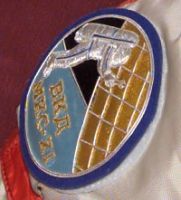
Both Expedition 11 Orlan suits featured this rather nice patch embroidered with ВКД МКС-XI – VKD ISS-XI (Roman numerals for 11). A silver-suited spacewalker floats near one of the golden solar panels.
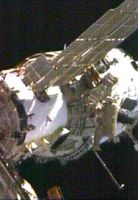
Screen captures of video images during the spacewalk.
Links
- ISS On-Orbit Status: 18 August
- JSC Station Status Report: 18 August
- NASA: Station Crew Completes Spacewalk
- ЦУП, TsUP: Выход в космос, exit into space: 18/8/2005
- MSNBC.com: “Spacewalkers collect science experiments”
Photo links
- NASA VKD photos: ISS-E-11944, 11947, 11948, 11949, 11958 (none of Sergei, unfortunately)
ISS-11 mission chronicles
Coverage of Expedition 11’s stay in orbit from April to October 2005.
April
15/4
- Soyuz 10S (Expedition 11+1; Sergei Krikalyov, John Phillips, Roberto Vittori):
- Kurs-A & Kurs-P short test (15 km) – 4/16 (Sat.), 9:34 p.m. EDT;
- Soyuz TV activation (8 km from ISS) – 9:42 p.m.
- Orbital Sunrise – 10:01 p.m.
- Flyaround – 10:01-10:10 p.m.;
- Stationkeeping & Start Final Approach – 10:10 p.m.;
- Docking – 4/16 (Sat.), 10:19 p.m. EDT (17/5 Sunday, 02:19 GMT).
A happy 54th birthday to John Phillips!
News & reports links
From Novosti Kosmonavtiki news №468:
15/04/2005/11:44 – Future records
For Sergei Konstantinovich Krikalyov, who left today for space on board the ship Soyuz TMA-6, new expedition in orbit became the sixth according to the calculation. Not one Russian cosmonaut has flown into space so many times. Now this is a new national record.
But Sergei Krikalyov has chance to improve one additional record. At the moment of launch, his total time in space was 624 days 9 hours 15 minutes 29 seconds, and through he were located in the 4th place in this index, being behind Sergei Avdeyev, to Valerii Polyakov and Anatolii Solovyev. The current expedition is calculated for 180 days. Thus, if does not happen something unforeseen, up to the moment of his return to the Earth, Krikalyov’s record will exceed 804 days. This will be a new world record.
God grant that this would happen.
Russian version, Русская версия: Грядущие рекорды.
Launch data tables:
| Event date | Begin | Operation | Finish |
|---|---|---|---|
| 13.04.2005 | 05:00 | Space rocket delivery to the launching complex | |
| 13.04.2005 | 16:00 | Final tests | |
| 14.04.2005 | 16:50 | 8G125 system tests | 19:00 |
| 14.04.2005 | 17:45 | Spaceship loading | |
| 14.04.2005 | 21:45 | Transport of the crew to Pad 254 | 22:45 |
| 14.04.2005 | 23:15 | State Committee meeting on rocket fueling | |
| 15.04.2005 | 00:15 | LV fueling with oxygen | |
| 15.04.2005 | 00:20 | LV cooling and fueling with nitrogen | |
| 15.04.2005 | 00:20 | Assembly I fueling with kerosene | |
| 15.04.2005 | 00:30 | LV fueling with kerosene | |
| 15.04.2005 | 01:10 | LV fueling with hydrogen peroxide | |
| 15.04.2005 | 01:30 | Hydrogen peroxide equalization | |
| 15.04.2005 | 01:45 | Crew’s report to State Committee Chairman | 01:50 |
| 15.04.2005 | 01:50 | Transport of the crew to LC | 02:11 |
| 15.04.2005 | 02:11 | Elevator ride | 02:16 |
| 15.04.2005 | 04:46 | Space rocket liftoff | |
| 15.04.2005 | 02:16 | Taking seats inside the spaceship | 02:41 |
| Order | Event | Actual time | Theoretical time |
|---|---|---|---|
| 1 | Liftoff | 0 | 0 |
| 2 | Rescue system propulsion jettison | 0 | 113.38 seconds |
| 3 | First stage separation | 0 | 117.80 |
| 4 | Payload fairing jettison | 0 | 157.48 |
| 5 | Second stage separation | 0 | 287.30 |
| 6 | Tail section jettison | 0 | 297.05 |
| 7 | Third stage propulsion shutdown | 0 | 524.96 |
| 8 | SC separation | 0 | 528.26 |
| Name | Soyuz-TM (11F732, Soyuz-TMA) |
| Orbit type | LEOel |
| Apogee, km | 245 |
| Perigee, km | 193 |
| Orbit inclination | 51.66 |
| Grad orbital period, min | 88.59 |
| Mass, kg | 7270 |
| Separated parts | Territory for rocket falling parts |
|---|---|
| Rescue system propulsion | No 16, Karaganda district, Republic of Kazakhstan |
| First stage | No 16, Karaganda district, Republic of Kazakhstan |
| Fairing | No 69, Karaganda district, Republic of Kazakhstan |
| Second stage | No 306, Altay district, Republic of Altay (Russia), East Kazakhstan district, Republic of Kazakhstan |
| Tail section | No 309 Altay district, Republic of Altay (Russia), East Kazakhstan district, Republic of Kazakhstan |
16/4
News & reports links
- 16/4 On-Orbit Status Report.
- JSC Station Status Report: 16 April.
- A screenshot from the ISS tracker at the TsUP site, showing the groundtrack of the ISS and Soyuz TMA-6 at 10:52 a.m. Moscow Time/5:52 p.m. in Melbourne.
TsUP, Moscow Mission Control, have an Expedition 6 section, with pages about the flight, the crew, experiments and a week’s timetable for the mission (times are Moscow Daylight Saving time – GMT+4 hours; the Eneide mission activities are not included):
| Date | Activity |
|---|---|
| Friday 15 April |
|
| Saturday 16 | Second (single-impulse) rendezvous maneuver. |
| Sunday 17 |
|
| Monday 18 |
|
| Tuesday 19 |
|
| Thursday 21 |
|
| Friday 22 |
|
| Saturday 23 |
|
| Sunday 24 |
|
| Monday 25 | TMA-5 de-orbiting and landing at 02:08 (22:08 GMT Sunday 24). |
17/4
Soyuz TMA-6 docked successfully to the ISS at 02:20 GMT. The spaceship did roll a bit around its vertical axis when it contacted the ISS, but this was dampened out once the docking probe was inside the cone. (Well, it’s Sergei’s first docking from the pilot’s seat, so he can be forgiven ;-).) The crew entered the Station at 04:46 GMT.
Main activities for today included payload transfers, swapping of the Kazbek seat liners in both Soyuz ships, drying out the Sokol suits, and an emergency evacuation drill. The Elektron oxygen generator was activated and has so far been operating nominally (it had been shutting off the last week or so because of the usual air bubbles in the gas/water separator).
News & reports links
- 17/4 On-Orbit Status Report.
- NASA TV images: Expeditions 10 and 11; Soyuz TMA-6 docking; View from TMA-6 docking camera.
- Eneide Mission Status Report 1.
- “Soyuz TMA-6 with ESA astronaut Roberto Vittori arrives at the ISS”.
- Space.com: “Space Station Crew Greets Replacements With Open Arms”.
- Spaceflight Now: “Soyuz brings 11th long-duration crew to station”.
- “Opening the hatch” by Maryam, who (unlike me) was able to get NASA TV and watch the crew arrival! “The Expedition 11 crew was greeted with the traditional bread and salt which is the Russian way to greet visitors in International Space Station. The hatch was opened after two hours and a half after docking at 8:44 a.m. Moscow time that occured over Eastern Asia. The Commander Krikalyov attempted to open the hatch after 2 hour pre-hatch procedures. However, the needed to equalize the pressure.”
Soyuz TMA-6 docking timeline
The docking timeline as posted at Spaceflight Now.
| Time | Event |
|---|---|
| 0145 GMT (9:45 p.m. EDT Sat.) | The Soyuz TMA-6 spacecraft is rapidly closing on the space station for docking just over 30 minutes from now. The craft is running a few minutes behind the scheduled timeline, but that should be no problem. The craft is running on its programmed robotic control, with commander Sergei Krikalyov poised to grab manual control for docking if needed. |
| 0207 GMT (10:07 p.m. EDT Sat.) | Soyuz is about 304 meters away from the station, moving toward the outpost at a slower pace now. Mission control reports that everything is progressing successfully tonight. |
| 0212 GMT (10:12 p.m. EDT Sat.) | The capsule has maneuvered around the station and aligned itself with the docking port on the Pirs module a few minutes from now. |
| 0214 GMT (10:14 p.m. EDT Sat.) | About 75 meters to go. Soyuz is closing at 0.3 meters per second. |
| 0216 GMT (10:16 p.m. EDT Sat.) | Now 50 meters separating Soyuz and the space station. |
| 0217 GMT (10:17 p.m. EDT Sat.) | Soyuz remains under control of its KURS automated docking system guiding the capsule to the station. |
| 0218 GMT (10:18 p.m. EDT Sat.) | Distance is now 20 meters. |
| 0219 GMT (10:19 p.m. EDT Sat.) | Soyuz appears to have a bit of roll error, perhaps 5 degrees or more. Controllers were just asking if Krikalyov was ready to take manual control if needed. |
| 0219 GMT (10:19 p.m. EDT Sat.) | Soyuz is within acceptable alignment. Standing by for docking. |
| 0220 GMT (10:20 p.m. EDT Sat.) | Docking. The Soyuz TMA-6 spacecraft has docked to the Pirs module of the International Space Station, delivering the Expedition 11 crew while flying over the coast of China. |
| 0222 GMT (10:22 p.m. EDT Sat.) | Over the next few minutes, the Soyuz docking probe will retract to allow hooks and latches to bring the spacecraft to a firm seal with the station. Hatches between the two vehicles will be opened a couple of hours from now. |
18/4
Sergei installed some telemetry equipment in the Orbital Module of TMA-6 and set up a laptop in Zvezda for testing the Russian satellite navigation system, then updated the Russian Operations Data File books. At 08:55 GMT the crew downlinked congratulations to Energiya president Yurii Semyonov for his 70th birthday! At 13:10 GMT the crew participated in a “live interactive TV news conference with U.S. and Russian media assembled at NASA Centers and TsUP/Moscow, via U.S. assets (Ku-band with S/G2) from the Lab module.”
News & reports links
- 18/4 On-Orbit Status Report.
- Eneide Mission Status Report 2.
- Space.com: “Six-Month Mission Begins for Fresh ISS Crew”.
19/4
Sergei was involved in discussing and setting up some Russian medical experiments (Braslet-M/Anketa, Pilot, Regeneration).
News & reports links
- 19/4 On-Orbit Status Report.
- Eneide Mission Status Report 3.
- Roberto Vittori’s diary from space: Launch day.
From Novosti Kosmonavtiki news №469:
19/04/2005/13:01 – Transfer of change occurs according to plan
The transfer of the change of crew ISS-10 to crew ISS-11 occurs strictly according to the outlined operating schedule, reported the Roskosmos information center. In this case the crews conducted minor equipment repairs, specially delivered to the station with the newly-arrived crew.
The dynamism of astronaut Roberto Vittori makes it possible for him to carry out several experiments during the day. they The day before he did the experiments ARISS, Crisp-2, AGROSPASE, NGF, HEARTBEAT MONITORING, AUDIO, MOP, are carry out the surveys of Italy. Yesterday he also participated in a telecast for the European space agency.
The ISS-10 and ISS-11 crews daily conduct the maintenance of the life support system.
The ISS-10 crew – Le Roy Chiao and Salizhan Sharipov – during these days are giving much attention to their physical exercises. Before their return to Earth, according to requirements, the physical exercises prescribed to them by physicians are necessary for them.
– Roskosmos press-service.
Russian version, Русская версия: Передача смены идет по плану.
20/4
Sergei had completed 5 h 50 m of functional handover activities and 2 h dedicated. He assisted Salizhan with the NEUROCOG experiment. The two Russians, along with Roberto, also partook in the traditional commemorative activities (“it usually consists of signing and stamping envelopes and imaging other memorabilia”).
News & reports links
- 20/4 On-Orbit Status Report.
- Roberto Vittori’s diary from space: Arrival at the Station.
- Eneide Mission Status Report 4.
- Expedition 10 took some awesome photos of Soyuz TMA-6 approaching to dock: ISS010-e-24857, 24861, 24868, 24875, 24877.
21/4
Sergei has now done 8 h 35 m of functional handovers, and 2 h of dedicated. He and Salizhan then charged the Motorola-9505 Iridium satellite phone stored in the TMA-5 Descent Module. He assisted Roberto in doing some photo & video imagery, then Sergei & John did an overview of the Crew Medical Systems equipment on the ISS. The crews also downlinked greetings to the Russian Veterans of the Great Patriotic War (WWII) on the 60th Anniversary of Victory Day. There are a few of the usual minor equipment malfunctions (Elektron, both Russian air conditioners [SKVs, СКВ] and CMG-3).
News & reports links
- 21/4 On-Orbit Status Report.
- Roberto Vittori’s diary from space: An outpost for humankind.
- Eneide Mission Status Report 5.
From Novosti Kosmonavtiki news №469:
21/04/2005/09:56 – A change of shift on the ISS
On 20 April of this year the “department” of the main post office was opened on the ISS, and both crews of the 10th and 11th expeditions were occupied by the franking of envelopes with portraits of Tsiolkovskii, Korolev, Gagarin, and with the emblems of previous expeditions using special inks. These envelopes will be returned to Earth after 4 days with the crew of the 11th expedition. Some of them will be transferred to the Museum of Cosmonautics of Russia, and some to the administration of the Latsio region in Italy, which sponsored the flight of R. Vittori.
Furthermore, Salizhan Sharipov will cut off the beans of the “moustached” peas planted by him during January, and these will be placed into a special packet for the return to Earth.
The official ceremony of transfer of control of the ISS from the crew of the 10th basic expedition to the crew of the 11th expedition is assigned for tomorrow on 22 April of this year.
– Roskosmos press-service.
Russian version, Русская версия: Пересменка на МКС.
22/4
Sergei now has accumulated 9 h 35 m functional handover time, and 2 h dedicated. He and John did a periodical test of the Vozdukh CO2 remover’s emergency valve closure system. Sergei installed new software for the Russian ASN-M satellite navigation system, then he did daily SOZh, СОЖ (life support system) maintenance and a Russian segment module airflow check. More Russian commemorative activities. The Changing of Command ceremony took place at 12:20 GMT, so Sergei is now officially in charge of the ISS! “Krikalyov and Sharipov also signed the usual formal Russian statements certifying RS handover/acceptance as specified in the RPS (handover) book, proper transfer of emergency procedures documents, and a list of 27 cargo items stowed on Progress-352/17P for deorbit.” The Elektron and SKV air conditioners are still off.
News & reports links
- 22/4 On-Orbit Status Report.
- JSC Station Status Report: 22 April.
- NASA TV image: Change-of-command ceremony in Unity.
- Roberto Vittori’s diary from space: Life on the Station.
- Eneide Mission Status Report 6.
23/4
Day 7 of joint operations; 2 days to go. Sergei’s functional handover time now totals 9 h 35 m, and 2 h 15 m dedicated. He connected Payload Laptop 3 for transferring the Russian satellite navigation system data and prepared an IMS (Inventory Management System) file. Checked the airflow sensors and two experiments (Regeneration and Bioekologiya). The Elektron and SKV air conditioners are still off.
Shock discovery of the week: Sergei wears reading glasses! Oh, dear!! Middle age is catching up with him!!! :-( Oh, well, they don’t look too bad on him.
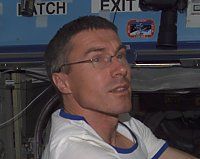
News & reports links
24/4
Final day of joint operations; TMA-5 departed at 21:44 GMT, so much packing, final transfers and handovers (“Are you sure you’ve got everything?”). Sergei did some air sampling. Farewell handshakes took place at 15:40 GMT, then the hatches between Zarya and TMA-5 were closed. Expedition 10 and Roberto Vittori landed safely at Arkalyk in Kazakhstan at 22:07 GMT.
News & reports links
25/4
First day alone for Sergei and John, and the beginning of the first week of their Expedition. An off-duty (rest) day after a hectic week. Sergei did the daily SOZh, СОЖ Russian segment life support systems maintenance. Sergei and John both completed their daily 2½ hours’ exercise routine. The Elektron and SKV air conditioners are still off (Elektron to be activated tomorrow; troubleshooting of SKVs is also scheduled).
News & reports links
26/4
Another rest day for Expedition 11. The Elektron oxygen generator was activated today and is so far working normally. Sergei and John did some packing of items to be returned on the upcoming STS-114 Shuttle flight. Sergei did the daily SOZh life support system maintenance in Zvezda (Russian crew members generally look after the Russian segment, as U.S. crew members look after the U.S. segment). Both did their daily 2.5 hours’ exercise. “As was the case for Salizhan Sharipov, Sergei’s daily protocol prescribes a four-day microcycle exercise with 1.5 hr on the treadmill and one hour on VELO plus load trainer (today: Day 2 of a new set).”
News & reports links
27/4
Sergei and John began the day with a 2-hour emergency evacuation drill. Sergei worked on troubleshooting the SKV air conditioners, then he & John continued cleaning out Unity. Sergei did the daily SOZh maintenance. He & John had a teleconference with the STS-114 crew (current launch day is 22 May), and had an hour set aside for ISS familiarization (which they will for the first two weeks). The Elektron ran normally for 3 hours, then shut down again.
News & reports links
28/4
Sergei and John conducted their first session of the periodic Russian biomedical assessments PZEh-MO-8 (body mass measurement) and PZEh-MO-7 (calf volume measurement). Sergei swapped a component for the BITS2-12 onboard telemetry measurement system and worked on the Rodnik water supply system, then took 2 photos of the SM aft-end passive docking assembly (SSVP StA, ССВР СтА) as is customary after Progress dockings. He & John also did their first periodic on-orbit hearing assessment (O-OHA) test. Sergei prepared a new laptop for the Russian Segment by installing a 60 GB hard drive while John had a go at the routine SOZh maintenance. At 17:05 GMT, “the crew downlinked two cordial TV messages of greetings and congratulations to TsUP/Moscow for upcoming events observing Victory Day and the heroic sacrifices made by Russians to win WWII (the Great Patriotic War, 1941-45).” (Victory Day is on 9/5.)
News & reports links
29/4
Sergei completed their first session of the periodic Russian MedOps test “Gematokrit” (MO-10), involving taking blood samples via pricking a finger (ouch). Sergei also did another Russian test, the MBI-1 SPRUT-K test. Sergei then “worked on the condensate water recovery system (SRVK-2M) in the SM to investigate the SKV2 air conditioner’s current inability to produce condensate flow to the SRVK.” He then continued transferring potable (drinking) water from the Rodnik in the Progress to Zvezda. He “conducted the weekly IMS (inventory management system) tagup with specialists at TsUP/Moscow.” He & John performed weekly maintenance of the TVIS treadmill. The Elektron is still off after two unsuccessful tries by Sergei to restart it yesterday. At 19:50 GMT, the crew was scheduled for their first regular (nominally weekly) teleconference with the ISS Flight Director at MCC-H.
News & reports links
- 29/4 On-Orbit Status Report.
- JSC Station Status Report: 29 April. “Early today Krikalyov and Phillips were informed that NASA managers rescheduled the launch of the Shuttle Discovery to no earlier than July 13 on the STS-114 Return to Flight mission. The additional time is needed to complete a thorough analysis of the potential risks posed by several areas of possible ice debris from the Shuttle’s external fuel tank as well as an evaluation of several concerns found during recent launch preparations.”
30/4
Saturday is housecleaning today for our crew (uborka, уборка), which involves 3 hours of “removal of food waste products, cleaning of compartments with vacuum cleaner, wet cleaning of the Service Module (SM) dining table and other surfaces with ‘Fungistat’ disinfectant and cleaning fan screens to avoid temperature rises.” Sergei transferred data for the “Matryoshka” measurement experiment, and completed a first session for the biomedical MBI-9 “Pulse” experiment. Sergei had his weekly private family conference at 13:35 GMT, via S-band/audio and Ku-band/NetMeeting video. He and John also had a weekly planning conference discussing the schedule for next week and a teleconference with ISS Program Management. The water transfer yesterday added 210 liters to the ISS water supplies. The SKV air conditioner is now operating nominally. “Update on Elektron: TsUP/Moscow is tentatively planning to have the crew replace the Elektron’s BZh-5 (Liquid Unit #5) with BZh-6 next w eek on 4/5 and 5/5.”
News & reports links
May
Our heroes begin their first full month in orbit. Follow the crew through each action-packed day as they fiddle about with various obscure experiments and fix things that break. Will the Elektron oxygen generator make it through another month without breaking down irreparably? (No.) Stay tuned!
1/5
1st of May holiday; crew off-duty. “At ~15:30 GMT, CDR Krikalyov conducted a teleconference via VHF with Patriarch Alexis II of the Russian Orthodox Church who extended best wishes on the occasion of today’s Orthodox Easter celebration.” (I hope this doesn’t mean Sergei is religious … :-() Sergei then did the daily routine SOZh (Zvezda life support systems) maintenance.
News & reports links
2/5
Labor Day holiday in Russia. Sergei did the regular early morning inspection, as well as a monthly inspection of circuit breakers & fuses in Pirs. He also performed the periodic inspection of the docking mechanism between the Progress and aft of Zvezda. He transferred remaining cargo from Soyuz TMA-6 to stowage in the ISS. He “started the regeneration cycle on absorbent bed #1 of the Russian harmful impurities removal system (BMP).” He then worked on the smoke detectors in Zarya and did daily SOZh maintenance. He and John had an hour set aside for ISS familiarization. Sergei also set up equipment for another regular test tomorrow, the “Russian PZE MO-9 ‘Urolux’ biochemical urine test.” One of the “joys” of Station life are such tests, mainly the regular obtaining of blood and urine samples (also known as “Ouch” and “Yuck”). The Elektron is still off.
News & reports links
3/5
Urine sampling (MO-9/Biochemical Urinalysis) for the crew this morning before breakfast. Fun – not. This is done every 30 days, and before & after spacewalks. Sergei worked on the Russian BMP, БМП harmful impurities removal system. He “also replaced the remaining five (of ten) smoke detectors (IDZ-2, ИДЗ-2) in the FGB Zarya, which have reached their nominal end-of-life.” He also did the daily SOZh maintenance. The Elektron is still off, so yesterday “the crew performed a 9.0 mmHg O2 repress from Progress M-52 oxygen tanks, after which the ppO2 read 157 mmHg.”
News & reports links
4/5
Sergei did his first session with a cardiological experiment, PZEh MO-1. He then replaced four dust filters (PF1-4, ПФ1-4) in Zvezda and did the daily SOZh maintentance. He & John spent several hours packing items to be brought back to Earth on STS-114. Another oxygen repress from the Progress as the Elektron is still off.
News regarding the third crew member:
Later this year, according to a just formalized bilateral agreement between Europe (ESA) and Russia (Roskosmos), Astronaut Thomas Reiter will become the first European long-duration crewmember on the ISS. (Reiter, from Germany, joins the Expedition 11 crew with Shuttle Mission STS-121/ULF1.1 [the one after STS-114/LF-1] and stay on until his return in 2006 with STS-116/12A.1, taking the place of the originally planned Russian Cosmonaut (Tokarev). It will be Reiter’s second long-duration mission aboard a space station, following his six-month stay on the Russian Mir during ESA’s Euromir mission in 1995.)
News & reports links
5/5
The Elektron is still off, despite heroic repair work from Sergei. “Sergei and John also conducted a familiarization checkout with the CMRS (crew medical restraint system) and its attachment system, unstowed from the CHeCS (crew health care systems) rack.” Sergei did the daily SOZh maintenance.
News & reports links
6/5
Another try at restarting the Elektron today, but the cranky oxygen generator shut down after 3 minutes. Sergei “configured the Progress M-52 (17P) Rodnik tank system for liquid waste transfer from the SM holding tank to the empty Rodnik water tanks.” Sergei and John had a session on the Canadarm-2 robot arm. Sergei checked electrical plug outlets in both Russian modules and did the weekly maintenance reboot of the ISS laptop computers. John did SOZh maintenance for a change. Sergei “held the weekly IMS tagup with specialists at TsUP/Moscow, discussing open issues concerning identification of equipment and storage locations for the IMS databases.” The TVIS treadmill went bung (a circuit-breaker tripped for some reason).
News & reports links
7/5
Crew rest day; 3 hours of uborka, уборка – housecleaning. Sergei recovered a log file on one of the Wiener Power laptops (Russian segment) and did the daily SOZh maintenance.
News & reports links
8/5
Sunday; off-duty. Sergei did the daily SOZh maintenance and some photography of the Persian Gulf for Russia’s Environmental Safety Agency (ECON).
News & reports links
9/5
Another off-duty day because of Victory Day holiday in Russia, celebrating 60 years since the end of the Second World War (Great Patriotic War in Russia). Sergei did the same as yesterday (SOZh maintenance, more Earth photography for ECON). Some lucky students in Osaka, Japan, got to do a amateur radio exchange with Sergei and John (a little whinge from me – why do students get all this cool stuff aimed at them? Don’t us older people matter?).
News & reports links
From Itar-Tass online:
ISS Expedition commander Sergei Krikalyov will congratulate his mother from orbit on Victory Day
Moscow, 9 May. ISS Expedition commander Sergei Krikalyov will congratulate his mother from orbit on Victory Day via satellite telephone. His wife Elena spoke about this to the ITAR-TASS correspondent. “In our family on 9 May it is always noted separately, my grandfather perished during the Great Patriotic War, and the mother of Sergei – Nadezhda Ivanovna, who now lives in the heroic city in the Neva, survived the siege of Leningrad,” emphasized Elena.
According to Valerii Lyndin, the official representative of Moscow Mission Control Center, “For Krikalyov and NASA astronaut John Phillips, the Day of Victory is a official weekend.” Lyndin explained, that “the holidays on the ISS are assigned according to an agreement of Russian and American sides to each expedition. In contrast to the majority of Russians, for the ISS crew off-days during May will be only Saturdays and Sundays, and also for us all the day on 9 May,” he explained. “On 10 May cosmonauts will work according to the usual timetable,” they elaborated at TSUP.
The leader of the group of the psychological support of the institute of biomedical problems RAN (Russian Academy of Science) Olga Kozerenko, noted that “the Russian cosmonauts and the NASA astronauts greatly love to look in orbit our films about the war. In all, in the onboard film library are more than 150 cinema and television films, among them, A quiet dawn here …, Officers, Into the battle go some old men, Ata-Baths dispatch soldiers,” added the psychologist.
According to Kozerenko, for cosmonauts during Day of Victory it is not necessary to raise “combat one hundred grams” for the veterans – on the ISS acts a “dry law,” that is much stricter than on the orbital complex Mir. “A good mood to cosmonauts is created not by warming beverages, but by the possibility of contact with relatives and the friends,” she noted, after recognizing that “on” Mir “during holidays it was permitted to accept a little alcoholic liqueur. Now, according to the rules of flight safety, even this is forbidden,” emphasized Kozerenko.
However, in the opinion of Salizhan Sharipov, who returned two weeks ago after a half year in orbit, “For the comfort and the best fulfillment of their responsibilities, for cosmonauts 50 grams of wine would be sufficient, which they usually give to submariners on a prolonged mission.”
– ITAR-TASS Corr. Olga Soshnikova
Russian version, Русская версия: «Командир экипажа МКС Сергей Крикалев с орбиты поздравит свою маму-блокадницу с Днем Победы».
10/5
Second session of the Calf Volume Measurement medical experiment. Sergei cleaned ventilator fans and grilles in Zvezda and a check of the electrical outlet plugs in all Russian modules (which are powering what equipment), then the daily SOZh maintenance. No troubleshooting on the still-inoperable Elektron today.
News & reports links
11/5
The crew each wore an acoustic dosimeter for 24 hours (done twice each Expedition). “The crew performed the periodic 3-hr. routine maintenance job on the RS (Russian segment)’s STTS, СТТС telephone/telegraph subsystem, including its audio paths and intercom stations.” Sergei did some work on the Russian LIV, ЛИВ video complex, installed a sound muffler in an air duct near his (starboard) crew cabin (kayuta, каюта) to quieten the ventilation fan (VKYu-1, ВКЮ-1) and completed the daily SOZh maintenance. The Elektron is still inoperable. At 14:27 GMT, the docked Progress performed an orbit korrektsiya, коррекция (correction) to increase the Station’s altitude by 1.1 km.
News & reports links
12/5
Sergei did preventative maintenance on the Russian segment ventilation systems (i.e. cleaning), then did an inventory of Russian light fixtures. He also did a tally of all the equipment stowed in Pirs. He “conducted the periodic (monthly) functional closure test of a spare emergency vacuum valve (AVK, АВК) for the Vozdukh CO2 removal system” and completed the daily SOZh maintenance. As with previous Russian crew members, on his task list was to take photos for the Russian Uragan, Ураган (Hurricane) Earth-imaging program, using the huge 800 mm camera lens. At 00:45 GMT, the crew downlinked TV greetings to participants of the ‘Zdorovaya Rossiya 2020’ (Healthy Russia 2020) symposium, to be held May 30-June in Moscow. (The event is sponsored by the Russian nonprofit organization ‘Healthy Russia’, implementing the joint US-Russian public service program ‘Zdorovaya Rossiya 2020’. The program is dedicated ‘to a healthy life style and prevention of risky behavior in the youth population’. CDR Sergei Krikalyov is on its Board of Trustees and an avid participant in the activities of the fund, supporting the aim of ‘healthy life style choices, i.e. be athletic, eat correctly, say NO to smoking and drinking’.)”
Yesterday’s reboost was successful, positioning the ISS for the upcoming Progress M-53 launch. The Elektron appears to have given up the ghost and will remain off until a new electronic box of its control system arrives on the Progress. The crew in the meantime will rely on O2 from the current Progress (lasts until May 22-23), then the SFOG/ТГК oxygen-generating candles (there are now 84 of these on board; 2 required per day for 2 crewmembers).
News & reports links
Roskosmos news, 12/5:
One-impulse Correction of the ISS Orbit is Performed
A regular working day on orbit for Expedition 11 crew of the International Space Station (Sergei Krikalyov and John Phillips) was as always hard and full of technical and scientific assignments.
By means of Progress cargo ship they performed one-impulse orbit correction. At present the ISS new orbital parameters are:
- Time period = 91.569 min
- Inclination = 51.66 deg.
- Hmin = 352.21 km
- Hmax = 375.91 km
- Orbit ascending is 1.2 km.
The crew is to carry out the following tasks – technical maintenance of the life-sustaining system, deal with reserve communications facilities, and work under American segment program.
Despite the large volume of works, the crew pays great attention to physical exercises; yesterday they made all necessary physical trainings.
The ISS systems operate at a normal mode, excluding broken Elektron unit (replacement is scheduled for June 2005), the crew members feel good.
Russian version, Русская версия: Проведена одноимпульсная коррекция орбиты МКС.
13/5
Sergei completed installing a muffler for his cabin fan, while John did monthly preventative maintenance for the Russian segment ventilation. Sergei recharged the Motorola-9505 Iridium satellite phone stowed in the TMA-6 descent module. John did the daily SOZh maintenance while Sergei serviced the ASU (loo). Fun. He then collected monthly sensor readings for the Pille-MKS radiation experiment, and installed 2 new foot pedals on the Russian VELO ergometer. Sergei did more Earth observations for the Russian Uragan (Hurricane) experiment.
News & reports links
14/5
Saturday, so three hours of weekly uborka (housecleaning). Sergei did the daily SOZh maintenance, and both he and John had conferences with the ground regarding next week’s schedule. The TVIS treadmill is damaged and currently unusable. Sergei had three items in his “job jar” to complete when he could.
News & reports links
- 14/5 On-Orbit Status Report.
- Space.com: “ISS Oxygen Generator Fails for Good, Station Managers Say”.
15/5
Sunday “rest” day (fewer chores than usual). The cabin atmosphere was given another repress from the Progress oxygen tanks. Sergei did the daily SOZh maintenance. Sergei had three more items in his “job jar” to complete.
News & reports links
16/5
Beginning of week 4 for Sergei & John. Both spent 3 hours on maintenance of the TVIS treadmill. Sergei set up equipment for his first Russian MBI-8 “Profilaktika” (countermeasures) fitness test, and did the daily SOZh maintenance.
News & reports links
17/5
Sergei began Part 1 of his Profilaktika fitness tests. He and John later collected air samples throughout the ISS. Sergei did an audit of the Russian segment docking assembly accessories (StA). He also continued the monthly cleaning of the Russian segment air ventilation systems, then replaced a magnetic recording memory device (ZU-1A) in the Zarya module’s primary radio telemetry unit (RTU-A) and did the daily SOZh maintenance, followed by another round of Uragan Earth observation photography.
News & reports links
18/5
Sergei & John cleaned out PMA-2 in preparation for the Shuttle docking. Sergei continued Day 2 of the Profilaktika fitness test and cleaning the air ventilation in the Russian segment. The cabin atmosphere was given another oxygen repress from the Progress tanks. Sergei began preparations for later use of the SFOG oxygen-generating candles, and the daily SOZh maintenance. Another Uragan Earth-imaging session.
News & reports links
19/5
Sergei performed the last part of the Profilaktika fitness test. He then did some maintenance of his Nikon D1X digital camera, cleaning the lens, and an IMS stowage audit, as well as the daily SOZh maintenance and another Uragan Earth-imaging session.
News & reports links
- 19/5 On-Orbit Status Report.
- MSNBC.com: “Mounting delays stress space station systems,” James Oberg.
From Novosti Kosmonavtiki news №475:
13/10/2005/17:10 – The ISS crew, on the requests of schoolboys, will conduct photography of the Earth from space:
The commander of the 11th ISS crew, Sergei Krikalyov, is not simply fascinated by photo- videotography as are many cosmonauts, but he is also a professional operator. Specifically, he worked with the special IMAX camera in the course of his previous flight on the ISS. The unique photography was later included in the Space Station 3D film.
Командир 11-го экипажа МКС Сергей Крикалев не просто увлекается фото- видеосъемкой, как многие космонавты, а является профессиональным оператором. Именно он работал со специальной камерой «IMAX» в ходе своего предыдущего полета на МКС. Отснятые им уникальные кадры позже вошли в фильм трехмерного изображения под названием «Космическая станция 3D».
Russian version, Русская версия: Экипаж МКС по просьбам школьников проведет фотосъемку Земли из космоса.
Of some interest (and concern) to Sergei is the controversy over who will head the Energiya company after the upcoming presidential elections on 28 May. The Russian government (via the Russian Space Agency) is pushing for a rather dubious candidate, N.N. Sevast’yanov, a businessman with a murky past and currently manager of Gazcom. (Somewhat curiously :-/, a lot of his immediate family have ended up in charge of all the company’s income and expenditure items.) Energiya wants its current president, Yurii Semyonov, to be re-elected. Energiya has put forward its case on its site:
- “Furnished information: it is up to You to decide!”.
- “Commentary of specialists on the materials presented by Roskosmos in connection with the upcoming RSC Energia stockholders’ meeting”.
- “On statement made by FSA official representative Vyacheslav Davidenko and published 11.05.05 by Internet-Edition NEWSru.com”.
20/5
The crew burned two SFOG/ТГК oxygen-generating candles for the first time today; the next burn is to be on Monday. Sergei worked on Russian payload laptop 3. He then did some communications tests in Zvezda and the docked Soyuz, and the daily SOZh maintenance. He & John had a 10-minute interview with CBS news, and teleconferences with the JSC Astronaut Office and Lead Flight Director at MCC-H.
News & reports links
- 20/5 On-Orbit Status Report.
- JSC Station Status Report: 20 May.
- “Space Station Crew to Ignite First Oxygen-Generating Candles,” Space.com.
From Novosti Kosmonavtiki news №475:
20/05/2005/09:48 – The ISS crew will combat noise with the aid of vibration insulators
The members of the 11th crew of International Space Station (ISS), Sergei Krikalyov and John Phillips, will continue the fight for the silence aboard begun by the previous crews, after placing special vibration insulators under the noisy fans of the Zvezda habitable module.
“Earlier with the aid of the special instrument cosmonauts measured the level of noise in different sections of station,” described a representative of Russian TsUP to RIA News. “On the basis of obtained data was comprised a unique “noise map” of the station, after which ground-based specialists gave indication to establish under all onboard fans special vibration insulators,” he noted.
“With this question dealt the previous crews, as a result of which at the station became considerably quieter,” specified the TsUP representative.
According to him, the problem of increased noise on the ISS existed from the very beginning of its building. “Some cosmonauts, who visited the station, in specific conversations told about background noise getting on their nerves, created by the working mechanisms and equipment,” noted the agency collocutor.
At the same time, other members of crews count the problem of that devised, and even they do not use earplugs at night, which are recommended by doctors. “Apparently, this depends on the specific features of rumor and nervous system of each person,” concluded the TsUP representative.
Russian version, Русская версия: Экипаж МКС будет бороться с шумом с помощью виброизоляторов.
21/5
Saturday: off-duty, except for 3 hours of uborka (housekeeping) and some voluntary activities. Sergei did the daily SOZh maintenance and more Uragan Earth-imaging photography. Both he and John conducted the weekly planning conference with TsUP and Houston, using the U.S. S-band (audio). The CDRA (carbon dioxide removal system) in the Lab (Destiny) failed.
News & reports links
22/5
Sunday: off-duty, and beginning of Week 5. Sergei did the regular morning inspection and SOZh maintenance, then had his weekly Private Family Conference at 12:00 GMT via the Russian TV system and Russian ground sites (while passing over them on Daily Orbit 2). He then conducted another Uragan Earth-imaging photography session, and his second session of the Diatomeya ocean-imaging photography.
News & reports links
23/5
Monday morning, back to work, ho-hum. For Sergei and John, session 3 of the periodic Russian biomedical assessment PZEh-MO-7 (Calf Volume Measurement). Two SFOG oxygen-generating candles were burned today (4 to date). Two candles will be “decomposed” each day from now on. More Elektron troubleshooting is scheduled for 27/5. Sergei did various maintenance chores and some work on readying the space-to-space radio system for the European ATV. John got a turn at doing the SOZh maintenance. “TsUP/Moscow is planning to perform the first step of upgrading the SM computers with the new version 7.01 software starting tomorrow.”
News & reports links
From Novosti Kosmonavtiki news №475:
23/05/2005/15:55 – The ISS crew will study “virtual photo-hunting”
The members of the ISS crew – Sergei Krikalyov and John Phillips – will study on Tuesday “virtual photo-hunting” on the Discovery shuttle. As reported by RIA News, the expert OF NASA, the cosmonauts will be trained in the precise aiming of the 800-millimeter lenses of two Kodak digital cameras into the illuminator, in front of which subsequently will fly the Discovery shuttle.
“Survey from onboard the ISS of the flying shuttle is necessary so that with the aid of the obtained photos we will be convinced of the integrity of its skin,” explained the expert. “Thus such, before the return of Discovery to Earth, the specialists of NASA will accurately know, did not occur the damages of the ceramic coating of the hull of ship, as this occurred on the shuttle Columbia that suffered catastrophe on 1st February, 2003,” he elaborated.
According to the expert, with conducting of the survey of the rapidly flying spacecraft it will be important for Sergei Krikalyov and John Phillips to be immobilized near the illuminators so that the photographs would come out clear.
“Unfortunately, there are no handrails for which it is possible to be gripped next to the illuminators of Zvezda; therefore in the course of training it is necessary to clearly visualize as under the conditions of weightlessness and limitedness on the time to ensure the immobility of body and camera itself,” noted the expert.
As described by the commander of the 11th expedition Sergei Krikalyov before his launch to the ISS, before the docking with the ISS, Discovery must carry out a so-called “somersault” and at distance of 200 meters will fly under the station belly-upward. Specifically, at this moment the crew will have to contrive to photograph the American spacecraft.
Russian version, Русская версия: Экипаж МКС займется «виртуальной фотоохотой».
24/5
A fifth SFOG/ТГК candle was burned today to produce oxygen; the other did not ignite. Sergei serviced the Russian BMP harmful impurities removal system, then prepared equipment for the Elektron generator test on 27/5. He also began upgrading the Russian segment computer system (BVS, БВС) to version 7.03., supported by TsUP. He also began setting up equipment for the Russian BIO-5 Rasteniya-2 (“Plants-2”) greenhouse experiment, where he will grow horse radish seeds, then harvest seeds from these plants and plant them. He did the daily SOZh maintenance. He & John practised for photographing the underside of STS-114. Sergei completed another Uragan Earth-imaging photography session.
News & reports links
From Novosti Kosmonavtiki news №476:
24/05/2005/14:14 – Cosmonauts will again attempt to make repairs on the ISS oxygen system
The continuing attempt to repair the oxygen generation system of the ISS will undertake into the medium crew, which works at the station, reports Interfaks. As reported by a representative of TsUP, tomorrow the cosmonauts will attempt to again verify all Elektron systems and will attempt to repair them under the management of specialists from the Earth.
We reminded you that the attempts to make the system of the generation of oxygen were undertaken by the cosmonauts of this and previous of expeditions for a period of several months, since the Elektron system malfunctioned.
Meanwhile some specialists assume that the innovation repair will be required system, for which will have to bring additional equipment from the Earth.
In Russian TsUP they note that this situation does not present danger for the cosmonauts, who work on ISS, since now on the station is located three times as great the reserves of oxygen than usual, and also plentiful stocks of the so-called oxygen cartridges, which are used in the solid-propellant generator of oxygen (TGK) – the alternative source of the production of oxygen on board the station.
Russian version, Русская версия: Космонавты снова попытаются починить кислородную систему МКС.
25/5
Sergei did his first session of the MO-5 MedOps experiment using the VELO cycle ergometer. He then installed a network channel controller box and used a Russian sound level meter to take noise readings in the Zvezda starboard crew quarters, then completed another Uragan Earth-imaging photography session. Reconfigured the STTS, and he & John had a 20-minute TV interview with ABC News. The computer software upgrade yesterday was successful.
News & reports links
26/5
John & Sergei completed an ultrasound scanning medical experiment with Sergei as the subject. Sergei installed mufflers on 2 SM fans. John did the SOZh maintenance. An Uragan session for Sergei. 9 SFOG oxygen candles have been decomposed so far (the 10th was a dud).
News & reports links
27/5
Sergei worked on the Russian segment condensate water processor, part of the currently-stalled SKV air conditioner system. He took more sound measurements in the Zvezda starboard crew quarters (after installing fan mufflers yesterday). He performed a test on a control box in the Elektron; the electrolyzer unit (which splits water into oxygen and hydrogen) is failed and needs to be replaced. He planted horse radish seeds in the Lada greenhouse for the BIO-5 Rasteniya-2 (“Plants-2”) experiment, and did the daily SOZh maintenance and a Uragan session. SFOG candles decomposed to date: 10, plus 2 duds (failures).
News & reports links
28/5
Saturday off-duty, so 3 hours of uborka (housecleaning). Sergei then did the daily SOZh maintenance, an Uragan photography session, and a Russian biomedical experiment. Both he and John had two weekly conferences with the ground.
News & reports links
29/5
Sunday: off-duty. Sergei did the daily SOZh maintenance. Sergei completed 3 voluntary activities from his “job jar,” including a Uragan photography session.
Expedition 11 recorded a video for the U.S. Memorial Day – actually John does all the talking while Sergei hovers like a silent ghost in the background.

News & reports links
30/5
Beginning of Week 6. Sergei did some computer software work and continued testing Elektron support equipment. He and John accessed the Z1 dome in the Truss (on the roof of Unity) to rearrange some stowage equipment. Sergei did the daily SOZh maintenance and worked on repairing one of the SKV air conditioners. SFOG oxygen candles: of the old set, 24 have been used since 20/5 (9 failed), 82 remaining.
News & reports links
From Russian Space Agency (FKA) news:
The c rew conducted the weekly cleaning of the Station
Weekly cleaning was the basic task for the Expedition 11 crew of Sergei Krikalyov and John Phillips at the International Space Station before the weekend.
Besides this, the crew conducted a weekly conference with the program management and a weekly planning conference.
In this case the “Hurricane,” “Pulse” and “Plants-2” experiments were continued.
The crew serviced the life support systems, carried out replacement and start of the solid-propellant oxygen generators, and also conducted works on the restoration of diagram and the switching on of the water condensate regeneration system.
Sergei Krikalyov and John Phillips completed all physical exercises. The health of the crew is good according to the data of the main operations group of control. The orientation of the complex is supported by the means of Russian and American segments.
Russian version, Русская версия: Экипаж провел еженедельную уборку станции.
31/5
Sergei and John had a medical emergency training drill, practising with the onboard defibrillator. Sergei then worked on a ventilation fan in the Soyuz Orbital Module (BO). He & John also had their second on-orbit hearing assessment. John did the SOZh maintenance. Sergei had a Uragan photography session. SFOG oxygen candles: “Three more SFOGs (Russian: TGK, ТГК) were used today, with one failing to ignite. As of tonight, a total of 17 candles of the old set have been decomposed on board since 5/20 (total attempts: 27 [i.e., 10 failures = 37% failure rate, instead of expected 20%]). With the actual failure rate, TGKs currently on board last for 24 days. Progress 18 (arrival 6/18) is manifested to deliver 42 ‘new’ SFOGs (zero failure rate) plus 110 kg (242 lbs) of O2.”
News & reports links
June
1/6
Sergei tested the new Russian segment software via laptop 2 at the Central Command Post computer 2 (KTsP-2, КЦП-2). Version 7.03 has still to be installed on Laptop 1. Sergei spent 3 hours cleaning Group B fan ventilators and grilles. The Vozdukh CO2 remover was reactivated after being shut down for the computer upgrade (the CDRS in the U.S. segment had been activated during that period). John did the daily SOZh life support system maintenance. Sergei inspected his radishes (i.e. the Rasteniya-2 experiment in the Lada-7 greenhouse), and conducted another Uragan Earth-photography session. SFOG/ТГК oxygen candles update: “Two more SFOGs (Russian: TGK) were used today, both successfully. As of tonight, a total of 19 candles of the old set have been decomposed on board since 5/20 (total attempts: 29 [i.e., 10 failures = 34.5% failure rate, instead of expected 20%]). With the actual failure rate, TGKs currently on board last for 25 days. Progress 18 (M-53, arrival 6/18) is m anifested to deliver 42 ‘new’ SFOGs (zero failure rate) plus 110 kg (242 lbs) of O2.”
News & reports links
2/6
Sergei completed the Russian segment software transition, and reconfigured the ventilation in the Soyuz Orbital Segment (BO) after repairing the fan there. Sergei inspected the BIO-5 Rasteniya-2 plants experiment and did some Uragan photography, as well as the daily SOZh maintenance.
News & reports links
- 2/6 On-Orbit Status Report.
- “Extra-Terrestrial Radio Contact: An educational experience like none other”. “Eighteen high school students from Brigidine College Randwick communicated via radio direct to an astronaut working in space aboard the International Space Station (ISS) on Thursday evening June 2.”
TsUP news:
The ISS crew completely renewed the “electronic brain” of the Station
RIA Novosti, 2 June, 2005.
The ISS crew renewed the software program on the central on-board computer of the International Space Station (ISS).
“First from Mission Control Center into the ISS computers they uploaded the ‘new’ program, and then the Expedition commander Sergei Krikalyov verified, as he worked, after connecting his portable laptop to the central station in the official module,” a NASA representative described to RIA News on Thursday.
“This is the planned operation, which is conducted regularly in proportion to the formulation of the new problems, and as a result TSUP seemingly constantly renews the electronic brain of the ISS,” he refined.
The ISS software on the international Station is improved constantly. It is delivered onboard as disks, which brought by Progress cargo ships, and also via the radio channels from TsUP. A previous “increase in the intellect” of the Station was realized on 21 July of the past year. Then for checking established software on-board computers were switched off by several seconds, and then it is again restarted. “We made the so-called restart,” explained Russian TsUP expert Victor Blagov to RIA News.
“It took a few seconds to reload itself – first we opened from the Earth, and then again included machines; however, first the crew installed the last version of program software, delivered to them on disk on 27 May by the flight of Progress M-49,” said Blagov.
Russian version, Русская версия: Экипаж МКС полностью обновил «электронный мозг» станции.
3/6
Sergei did some outfitting work on the STTS, СТТС, then a couple of experiments, reconfigured Russian Laptop 3 for the software upgrade (which was successful) and completed leak testing on Elektron Liquid Unit #5, which was found to be leaking. He did the weekly inventory management system tagup with specialists at TsUP, and the daily SOZh maintenance, as well as the daily Rasteniya-2 inspection and Uragan photography.
News & reports links
- 3/6 On-Orbit Status Report.
- JSC Station Status Report: 3 June.
- Space.com: “Space Station’s Robotic Arm Grapples ISS Under Remote Control”.
4/6
Saturday; off-duty, with 3 hours of uborka (housecleaning). Sergei did the SOZh maintenance, and Diatomeya and Uragan photography sessions (sea and Earth), as well as an EDT experiment session. The crew had their Weekly Planning Conference with the ground.
News & reports links
5/6
Sunday: off-duty. Beginning of week 7. The usual maintenance (John did the SOZh maintenance) and Sergei did more Uragan photography and checked the Rasteniya-2 plants experiment.
News & reports links
6/6
Monday morning Calf Volume Measurement for Sergei & John. Beginning of packing rubbish into the Progress for disposal (continues all this week). Sergei did the SOZh maintenance, then unpacked equipment for his second Russian PZEh-MO-9 Urolux urine test (bet he’s looking forward to that – not). He checked the Rasteniya-2 plants and did some Uragan Earth photography. Propellants were successfully transferred from Progress M-52 to four Zarya FGB overnight, via an automated sequence initiated by TsUP. Elektron update: “The onboard testing on Liquid Unit #5 (BZh-5) over the weekend has confirmed that the unit is indeed leaking nitrogen (N2) pressurization gas, and it has been declared no longer usable. TsUP is planning to have the crew perform more work on the remaining BZh-7 this week (6/9-10) before it can be retested. If the troubleshooting is successful, Elektron reactivation will be attempted after arrival of 18P/M-54 (6/18), which is expected to deliver new filters for the Elektron’s gas lines, but BZh-7 installation and electrolyte servicing will be done pre-18P.”
News & reports links
7/6
Second session of Biochemical Urinalysis for Sergei and John (done once a month). Sergei did more rubbish transfers to the Progress and the daily SOZh maintenance. They had a 20-minute interview with KNXV-TV in Phoenix, Arizona, using the new NASA Television Digital Satellite System. Another Uragan session for Sergei.
News & reports links
- 7/6 On-Orbit Status Report.
- Energiya photo-report: June 7, 2005. Baikonur Cosmodrome. “The Technical Management meeting took place, which made a decision to fuel Progress M-53 cargo vehicle with propellant components and compressed gases.”
8/6
Blood sampling (MO-10) for Sergei and John first thing this morning. Sergei completed a photographic survey of the thermal blanket covering on the Soyuz TMA. A couple of seams were open between the Descent Module (SA) and Instrumentation/Propulsion Compartment (PAO). Sergei then had more rubbish stowage in the Progress while John did the SOZh maintenance (Progress M-53 to be launched next week, 17/6). Sergei had another Uragan photography session and checked up on the Rasteniya-2 plants. Tomorrow he is to try replacing the Elektron’s Liquid Unit 6 (BZh-6) with the previously-used BZh-7.
(4 more photos in the Expedition 11 Gallery online, at long last.)
News & reports links
- 8/6 On-Orbit Status Report.
- Energiya photo-report: June 8, 2005. Baikonur Cosmodrome. “Progress M-53 filling was completed.”
9/6
Second cardiological test for Sergei (PZEh MO-1). He and John then spent several hours working on the Elektron, replacing the failed BZh-6 Liquid Unit with BZh-7. Sergei then ran a test of the back-up manual TORU docking system between Zvezda and the docked Progress, in preparation for launch next week. The crew had a 20-minute interview with CNN utilizing the NASA TV Digital Satellite system. Sergei requested 6 more hours for Progress rubbish loading.
News & reports links
- 9/6 On-Orbit Status Report.
- Energiya photo-report: June 9, 2005. Baikonur Cosmodrome. “Progress M-53 fuelled with propellant components and compressed gases was delivered to the Spacecraft Assembly and Testing Facility for final processing operations.”
- CNN: “Station crew: Housing stranded shuttle crew would be stressful”.
10/6
3½ hours of Progress trash stowage allocated today. Sergei tried to transfer KOH electrolyte (potassium hydroxide) from BZh-5 to BZh-7 but for some reason the fluid wouldn’t co-operate, so more troubleshooting needed. Sergei set up equipment for the Plasma-ISS experiment, IMS tagup, Rasteniya-2 plants inspection and Uragan photography. John did the SOZh maintenance.
News & reports links
- 10/6 On-Orbit Status Report.
- JSC Station Status Report: 10 June. “The Station commander quietly slipped into second place on the all-time human space endurance list … Krikalyov, on his sixth voyage into space and third long duration mission (one on Mir and two on the ISS), surpassed fellow cosmonaut Valerii Polyakov on the space duration record list. He will become number one in August, passing cosmonaut Sergei Avdeyev (747 days).”
- Energiya photo-report: June 10, 2005 Baikonur Cosmodrome. “Progress M-53 cargo vehicle was docked with the transfer compartment.”
Novosti Kosmonavtiki №6 is out, featuring Expedition 11 on the cover, with articles about them and an inflight chronology. (Unfortunately, only 3 articles are online; they stopped putting the whole magazine online from 2004 onwards.)
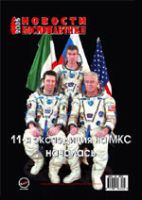
11/6
Saturday: off-duty, and 3 hours of uborka, housecleaning. John did the SOZh maintenance. Sergei did the monthly recharging of the Motorola-9505 Iridium satellite phone stored in the Soyuz descent module (BO). Both had private family conferences via U.S. segment S-band and Ku-band, and a joint weekly planning conference with the Ground. Sergei did some Uragan and other photography.
News & reports links
- 11/6 On-Orbit Status Report.
- Energiya photo-report: June 11, 2005 Baikonur Cosmodrome. “Designers’ inspection of the Progress M-53 cargo vehicle was completed in the Spacecraft Assembly and Testing Facility. Payload shroud roll on to the Progress M-53 spacecraft was performed.”
- Two nice photos of tropical storm Arlene: 08482, 08483.
12/6
Sunday: off-duty, and beginning of Week 8. Sergei completed some Uragan and Diatomeya photography, and inspected the Rasteniya-2 plants-growing experiment.
News & reports links
13/6
Independence Day holiday in Russia (June 12). Final preparations for Progress M-52 undocking. Sergei did some maintenance on the ASU toilet, changing major components, while John did the SOZh maintenance. Uragan photography and Rasteniya-2 plants inspection for Sergei. The latest mechanical failure (nothing dramatic): “Overnight, a primary local digital commutator (LKTs #2V36) in the SM failed, shutting down the Vozdukh CO2 scrubber and the BMP micropurification unit, which both share this commutator. Vozdukh was reactivated in manual mode and is operating properly. BMP remains off, and TsUP/Moscow plans to switch to the backup LKTs in the next few days, which will allow BMP restart. [The LKTs are part of the BITS2-12 onboard telemetry measurement system. They receive and transmit (to the local analog commutator, LKA) digitized data coming from different types of digital sensors.”
News & reports links
- 13/6 On-Orbit Status Report.
- “NASA announces Space Station status briefing”: media conference.
- “ISS Status Briefing Materials, June 13, 2005”. Various photos of the crew’s activities.
- Energiya photo-report: June 13, 2005 Baikonur Cosmodrome. “Orbital module of the Soyuz-U launch vehicle, containing Progress M-53 spacecraft was transported from the spacecraft processing facility for the general integration with LV.”
14/6
Final packing for Progress M-52 before undocking tomorrow, and hatch closure at 18:15 GMT. John did the SOZh maintenance. Sergei had his two optional tasks of Uragan photography and inspection of the BIO-5 Rasteniya-2 experiment.
Update on Consumables: As of yesterday (6/13), total oxygen (O2) on orbit is ~227 kg (~136 days). Progress 18, arriving on Saturday (6/18), will deliver an additional 85 days of O2, 96 days of water and 160 days of food. [18P cargo: 110 kg O2, 40 new SFOG candles, 442 L water, 192 total rations of food in 64 food containers (21 US, 43 Russian).]
Update on Elektron: After the initial difficulty of transferring electrolyte (KOH, potassium hydroxide) from Liquid Unit 5 (BZh-5) to BZh-7 reported on 6/10, Sergei made a second attempt on Sunday (6/12), per uplinked ground instructions, and this time completed the transfer of 100-120 milliliter successfully. More KOH will be delivered on Progress-353/18P.
Update on Micropurification System (BMP): After the failure of the primary local digital commutator (LKTs #2V36) in the SM, reported yesterday, the BMP remains off since its telemetry data are questionable. TsUP/Moscow plans to switch to the backup LKTs in the next few days, which will allow BMP restart. [The BMP is similar to the US TCCS (Trace Containment Control System).]
News & reports links
- 14/6 On-Orbit Status Report.
- Energiya photo-reports: June 14, 2005 Baikonur Cosmodrome:
- Photo-report: “A meeting of the Governmental Commission and the Technical Management was held where a decision was made to roll out the launch vehicle carrying Progress M-53 to the launch pad.”
- Photo-report: “The orbital module was integrated with the Soyuz-U launch vehicle in the processing facility.”
- Space.com: “ISS Astronaut Testifies Before Congressional Panel From Orbit”.
15/6
Sergei replaced the condensate water processor’s air/liquid condensate separator unit (BRPK) with a new one. He then changed out one of Zvezda’s eight 800A batteries, replacing failed #6. He collected readings for the monthly Pille-MKS radiation dosimetry experiment, did the daily SOZh maintenance and more Uragan photography and checking-up the Rasteniya-2 plants-growing experiment.
Progress M-52 was to undock at 20:16 GMT. M-53 is to launch on 17/6 at 00:09 GMT (05:19 a.m. at Baikonur).
News & reports links
- 15/6 On-Orbit Status Report.
- Energiya photo-report: June 15, 2005 Baikonur Cosmodrome. “At 5:00 a.m. Moscow Time, the transporter with the Soyuz-U launch vehicle and the Progress M-53 spacecraft left the Assembly and Testing Facility and arrived to the launch pad for the final pre-launch processing. The Soyuz-U-Progress M-53 system was erected on the launcher. First launch day activities began.”
16/6
2400 days in orbit for Zarya FGB today. Sergei & John did 3 hours of TORU training for the arrival of Progress M-53 and configured the TV subsystem (TVS) so it could download footage of the Progress arrival via U.S. Ku-band. 30 minutes of a Crew Medical Officer drill. M-52 successfully undocked last night at 20:15 GMT and re-entered over the Pacific.
News & reports links
17/6
Rest day for the crew as they had to sleep-shift for the Progress arrival. M-53 launched successfully last night at 23:09 GMT. 3 hours of uborka today (not tomorrow). Sergei worked on a failed Russian laptop and did the daily SOZh maintenance.
News & reports links
- 17/6 On-Orbit Status Report.
- JSC Station Status Report: 17 June.
- Energiya photo-report: June 17, 2005. Baikonur Cosmodrome. “In accordance with Russian commitments under the International Space Station Project, an Integrated Launch Vehicle Soyuz-U/Progress M-53 was launched from Baikonur launch site at 03:09:33 Moscow Time. The objective of the launch was to deliver, by means of Progress M-53 logistics spacecraft, cargoes to the space station that are needed for continuing its operation in manned mode, crew life support, and replenishing propellant tanks of the propulsion system.”
- AARL Web: “Fall Launch Viewed for ‘SuitSat’ as ARISS-US Delivers Hardware”.
18/6
An irregular day in preparation for Progress arrival. Wake-up as normal at 06:00 GMT, back to bed at 15:00 to 20:30, then work through the night to Sunday from 20:30 to 06:00. As it turned out, Sergei did need to do a manual TORU docking due to a problem in a ground station preventing TsUP from initiating the procedure. Docking was at 00:42 GMT, 19 June (04:42 Moscow Daylight Time), and aside from that glitch, all went well. Proof of the wisdom of back-up procedures! “The Progress is loaded with 180 kg/397 pounds of propellant, 109.7 kg/242 pounds of oxygen and air, 420 kg/926 pounds of water and more than 1361 kg/3000 pounds of spare parts, life support system components and experiment hardware. In addition, the Progress carries 40 new solid-fuel oxygen generating canisters as a supplemental source of oxygen, if required.”
News & reports links
- 18/6 On-Orbit Status Report.
- JSC Station Status Report: 18 June.
- MSNBC.com: “Space station crew brings in cargo ship”.
- Space.com: “ISS Commander Manually Docks Cargo Ship at Space Station”.
- Spaceflight Now.com: “Station commander remotely docks supply ship”.
Space station commander Sergei Krikalyov took over manual control of an approaching Russian supply ship this evening and remotely guided the robotic craft to a picture-perfect docking after problems prevented an automatic linkup.
The unmanned Progress supply craft, launched Thursday from the Baikonur Cosmodrome in Kazakhstan, was poised for final approach when a problem on the ground prevented Russian flight controllers from sending commands to initiate the procedure.
Krikalyov, one of the most experienced space fliers in the world, promptly took over manual control using a backup system known as TORU and guided the craft to a linkup at the aft end of the Zvezda command module at 8:42 p.m. EDT (00:42 GMT).
“I would like to congratulate you on the successful docking,” a Russian flight controller radioed the station. “I am proud of you.”
“I tried to do my best. Thank you very much,” Krikalyov replied. “I think it was very helpful to have all the TORU training. Say thank you to my TORU instructor.”
“Yes, he is here, he is getting ready for receiving a medal for this wonderful job.”
19/6
M-53 docked successfully last night, under Sergei’s manual TORU control. The new Energiya president, Nikolai Nikolayevich Sevast’yanov, congratulated him. Soft dock (probe in the docking cone) was at 00:41 GMT; hard dock (latches locked) at 00:50 GMT. Sergei & John then began cargo transfer procedures, to continue for the remainder of the week. They did get some other lifeforms for company – snails! (For the Russian BIO-11 “Statokonia” experiment.)
News & reports links
- 19/6 On-Orbit Status Report.
- Energiya photo-report: June 19, 2005 Korolev, Moscow Region. “Russian unmanned logistics spacecraft Progress M-53 launched from Baikonur on June 17, 2005, has docked with the International Space Station after two days of free flight in low Earth orbit. The spacecraft rendezvous with the ISS space station, its fly-around, stationkeeping and approach to the distance of about 120 meters were performed in automated mode, and the final approach was performed in the teleoperator control mode. The spacecraft made its approach to a free axial docking port on the Service Module Zvezda of the ISS. The initial contact occurred at 04:41:32 Moscow Time.”
20/6
Wakeup at the regular 06:00 GMT today, and beginning of Week 9. Fifth session of calf measurement, PZEh-MO-7. Progress unloading was the focus of today. M-53 brought 120 kg of gaseous oxygen and this was used today to refresh the atmosphere, rather than the TGK candles.
News & reports links
21/6
Summer Solstice (winter in Australia!). Focus of today was pressurizing and moving items for stowage into Pressurized Mating Adapter-3. Sergei did BMP, БМП bake-out and SOZh maintenance, a weekly check-up of IP-1, ИП-1 airflow sensors in the Russian segment and exported the Inventory Management System “delta” file (to track where everything is stored) to the IMS database.
News & reports links
22/6
A beautiful full Moon today, if Sergei and John looked out the windows. Hope they took some photos! Progress unloading continued, and PMA-3 was depressurized. Sergei made equipment preparations for Elektron repair work tomorrow. He swapped Russian laptop 3’s hard drive #6137 with #6156 from laptop 1 (which had Windows vers. 07.02 software). Sergei and John did maintenance work on the SRVK-2M, СРВК-2М condensate water recovery system in Zvezda. John did the SOZh maintenance. Sergei consulted the ground regarding his Eye Tracking Device experiment. “Krikalyov was briefed by ground specialists on the conclusions of a panel investigating the failure of the release of the primary parachute riser on the Soyuz-215/9S at touchdown on 4/24. [The most probably cause was an incompletely depressed release command button in the Descent Module, thus not engaging the end contacts, or an incorrect depression due ‘lack of operational skill’ with new Sokol gloves worn by the crew. The button, under its protective guard, allows only room for the index finger and button activation by its first phalange pad.]”
News & reports links
23/6
A small leak was detected from the Node (Unity) into PMA-3 (depressurized). Sergei did some repair work on the Elektron and ran it at 16 amps for 24 minutes before it shut itself down. More repair work tomorrow. Sergei did various more repairs and experiments, including the Plasma-ISS (Bridge-2) experiment. John did the SOZh maintenance.
More photos are up in the Gallery (page 18 on). (Sergei has an uncanny resemblance to a certain Vulcan in that blue skivvy!)
News & reports links
- 23/6 On-Orbit Status Report.
- NASA TV image: Sergei unpacking the Progress.
24/6
Soyuz Kazbek seat fit check today, followed by a 1-hour fire drill, the first for the crew. Sergei tried to restart the Elektron again but it refused to. John did the SOZh maintenance. The cabin atmosphere was repressed with 8 mmHg of gaseous oxygen from Progress M-53 tankage (SrPK, СрПК).
News & reports links
25/6
Saturday: off-duty, and the usual 3 hours of uborka, Station cleaning. Sergei did the SOZh maintenance, then had a third run of the Eye Tracking Device experiment. Sergei also has some snails to look after (BIO-11 “Statokonia” experiment) as well as the radishes. He also gathered equipment in preparation for the ESA ATV control panel set-up next week. Sergei and John had the usual teleconferences (weekly planning and with ISS Program Management).
News & reports links
26/6
Off-duty Sunday. Beginning of Week 10. The usual tasks and exercise. The cabin atmosphere was repressed with oxygen from M-53.
News & reports links
From TsUP news:
Week on the ISS (20-26 June)
(Based on the materials of site Spaceflightnow.com)
On the past week the crew of the 11th basic expedition was occupied with unloading and storing more than 2-x of tons of cargo, delivered on the ISS aboard the recently arrived cargo ship Progress M-53. Together with the foodstuffs, the fuel and the new equipment, on the Progress M-53 on the ISS was delivered 80-ti the daily reserve of oxygen in the tanks and the solid-propellant generators, and also spare parts for the Elektron oxygen generator system.
Furthermore, the cosmonauts began the preparation of station for the arrival of first after the loss of Columbia of shuttle Discovery. The possible dates of his start it is located in the range from 13th to 31st July, and 29-30 June in the Kennedy Space Center commission for readiness to takeoff will select the final starting date. The primary task of the flight of Discovery is the delivery onboard the ISS of cargo, and the return to the Earth of equipment and results of the experiments, which was accumulated sufficiently much after more than two years, which passed from the time of last flight of shuttle.
On the past week commander Sergei Krikalyov undertook the attempt to reactivate the Elektron: he replaced electrolyte in the liquid block of system and established the new unit of aerosol filters. Two attempts at starting ended in failure – the Elektron worked less than one-and-a-half hours. The reserves of oxygen existing in this time at the station will be sufficient, at least, prior to the end of this year, even if system Elektron does not work, but in the plans stands the delivery of a new liquid block for the Elektron even before the end of this year.
On this week for the first time in four years was re-opened the entrance into the airtight transition piece PMA-3, which will be used as storage for the cargo delivered in the shuttle. Airtight container-module with the loads delivered on the shuttle will be mated to it. Last week crew verified the work of the docking mechanism PMA-3, and it also began the installation in PMA-3 video camera, which will be used for the unloading from the shuttle and the docking to the station of container-module.
Russian version, Русская версия: Неделя на МКС (20-26 июня).
PY4MAB talks with Sergei Krikalyov
ISS Amateur Radio py4mab writes “Well, is very interesting talk with ham’s and other around the world, but talk with Astronauts abord the International Space Station is great. In this last Sunday (06/26/2005) I talk with Sergei Krikalyov and comemorate my fourth contact with ISS. Thanks to ARISS and thanks again to ISSFANCLUB and to Claudio. Alone I’m never talk with Cosmonauts in Space. Thank you very much.
Mauricio Beraldo PY4MAB
Poços de Caldas MG
Brazil”
27/6
Sergei began installing satellite navigation equipment for the ESA ATV, and then looked for equipment needed for flushing the water condensate remover line (MOK, МОК). John did the SOZh maintenance, and a ham radio session (he seems to be doing all the ham contacts so far). Sergei inspected his radishes (BIO-5 Rasteniya-2).
News & reports links
- 27/6 On-Orbit Status Report.
- New Scientist Space.com: “Space station gets HAL-like computer”. John is testing a voice-operated computer assistant called “Clarissa,” which he installed today.
- SpaceTravel.com: “Expedition 11 Crew Unpack Care Package”.
From Novosti Kosmonavtiki news №483:
27/06/2005/11:57 – ISS orbit correction is planned for 30 June
A sequential maneuver for the correction of the orbit of the International Space Station (ISS) for the forthcoming launch of the American shuttle will be initiated at 00.18 MSK on 30 June, the representative of Mission Control Center reported on Monday (TSUP). On this reports Interfaks.
According to him, the cosmonauts working in orbit – Sergei Krikalyov and John Phillips – are also prepared for the forthcoming flight of shuttle. “The cosmonauts are packing some things, which be subject to the sending on the shuttle, are checking the docking nodes, and also have carried out a number of the necessary operations for the arrival of the shuttle,” he reported.
Russian version, Русская версия: Корректировка орбиты МКС намечена на 30 июня.
28/6
Shuttle photography practice today for Sergei & John (photographing the Orbiter when it flips over and shows its underside to check for tile damage). Sergei continued his outfitting work of installing a satellite navigation system for the ESA ATV, and installed two new electronic blocks for the STTS, СТТС (telephone/telegraph subsystem) in Zvezda. John did the SOZh maintenance. The crew will have Robotics Arm (SSRMS) practice for the next two days. Also, a reboost of the ISS was to be done by the Progress tomorrow to put the Station in the correct orbit for the 13 July STS-114 launch.
More photos are up in the Gallery (page 20 on).
News & reports links
29/6
Sergei continued working on Zvezda’s condensate water recovery system (SRVK-2M, СРВК-2М) as condensate was not flowing properly from the air conditioners. Sergei tested the communications hardware (satellite navigation system) for the ESA ATV. He prepared equipment for the MBI-15, МБИ-15 “Pilot” experiment. He and John completed part of the SSRMS robotic arm checkout. Sergei did the SOZh maintenance, the daily inspection of the Plants-2 experiment and downloaded image files of Uragan Earth imagery accumulated over several weeks (via U.S. S-band). The reboost was reset for 20:03 GMT to avoid orbital debris.
News & reports links
30/6
Sergei conducted the Russian medical “Pilot” experiment for the second time to test his piloting skills in simulations (John also did the test later). Both crew completed part 3 of the SSRMS/robotic arm pre-launch checkout. Sergei installed a new mass measurement device (IM, ИМ) for the Russian PZEh-MO-8б ПЖ-МО-8 Body Mass Measurement experiment (done once a week). Sergei did the SOZh maintenance; John did weekly TVIS treadmill maintenance. Sergei did more work on the Elektron; a new one will be delivered on Progress M-54. The reboost yesterday was successful, as was the ATV PCE outfitting test (satellite nav equipment for ESA’s ATV) and Sergei’s work on Zvezda’s condensate processing system.
News & reports links
July
A busy month as the Return-to-Flight launch of STS-114 Discovery launched on 26 July – the first flight to the ISS since STS-113 (23 November-7 December 2002).
1/7
Sergei did the regular morning inspection, and a monthly inspection of fuses and circuit breakers in Pirs. Sergei dismantled the MBRL, МБРЛ ATV satellite navigational equipment after successful ground testing. He worked on the Russian payload server (BSPN, БСПН). John did the daily SOZh maintenance while Sergei prepared the Inventory Management System files for export to their database and had a weekly tagup with specialists discussing IMS issues. The crew were scheduled for their weekly teleconference with the lead flight directors at Houston and TsUP via U.S. S-band/audio. Another oxygen repress from M-53 (8.0 mmHg); the ppO2 (oxygen partial pressure) is 160.1 mmHg; cabin pressure is 760.8 mmHg.
News & reports links
- 1/7 On-Orbit Status Report.
- JSC Station Status Report: 1 July.
- CollectSPACE: “Live 8 from space,” forum topic. “Just read one of the newspapers in the UK, one of the astronauts aboard the ISS will be introducing some of the acts for the concert in Hyde Park in London. I hope it will be better than the concert, the cosmonaut’s name is Sergei Krikalyov, he will introduce Elton John.” – Paul Prendergast
4/7
American Independence Day holiday weekend, so no reports for the previous two days (2nd and 3rd – presumably the person who does them took a break). Also a holiday today (4th July). Sergei performed Part 1 of his second round of the Profilaktika (MBI-8) fitness test experiment. He did the daily inspection of the horse radishes experiment in the Lada-7 greenhouse, and the SOZh maintenance. John had a 10-minute ham radio (lyubiteljskogo radio, любительского радио – or радиолюбитель in my dictionary) session with students in Japan (the Sputnik-SM Kenwood D700 amateur radio station is set up in Zvezda).
News & reports links
5/7
The usual Russian biomedical assessments (calf and body mass measurements) first thing this morning. Sergei took his second MBI-1 SPRUT-K test (how body fluids adapt in 0-g), and part 2 of his Profilaktika (MBI-8) fitness test. He did some work on the Rodnik water supply system in preparation for transferring fresh water from M-53. He and John had another Orbiter photography drill. John did the SOZh maintenance; Sergei the IMS delta file transfer. They both had a conference with the STS-114 Flight Control Team discussing the mission timeline.
Wakeup at 03:40 GMT. Most of the day was spent on cargo transfers from Raffaello. The Shuttle crew and John participated in a PAO event with various news channels. Sergei was apparently not included; he did the SOZh maintenance in the Russian segment and other daily tasks. (He is getting a bit ignored during this flight :-(.)
News & reports links
6/7
Sergei had his first session with the European Neurocog experiment. Day 3 for both crew of the kidney stone experiment session (involving collecting urine samples. One of the delightful aspects of being an astronaut or cosmonaut). Sergei performed part 3 of the Profilaktika fitness assessment. He and John continued equipment transfer from the Crew Airlock and packing hardware for return to Earth on STS-114. John did the SOZh maintenance, Sergei the IMS file transfer. Sergei worked on the Rasteniya-2 plants experiment (maintenance is done each Monday, Wednesday, Friday and Sunday). Progress M-53 successfully initiated a reboost burn at 02:58 GMT to position the ISS for STS-114 rendezvous on Flight Day 3.
News & reports links
7/7
Sergei completed a second session of the MO-5 cardio experiment and day 3 of the renal stone experiment. He transferred water supplies from M-53 to Zvezda. In the Soyuz Orbital Module he worked on ventilation fans V1 and V2, then did the SOZh maintenance. He and John had a 30-minute teleconference with the STS-114 crew. A NASA media conference is scheduled for the crew tomorrow.
News & reports links
From Russian Federal Space Agency (RKA) news:
07/07/2005: The ISS orbit was raised yesterday
At 18 hours 58 minutes 10 seconds (Moscow Summer Time) by the means of transport cargo ship Progress M-53 was performed the single-impulse correction of the ISS orbit. The corrective pulse was 1.87 m/s. The orbital parameters after correction comprised:
- period, t: 91577;
- inclination i=51.663°;
- Hmax = 374.86 km;
- hmin = 354.16 km.
During these days the Station crew continues work on preparation for the encounter of the American ship Discovery, and also is preparing the necessary equipment for the return on it to the Earth. The orientation mode of station is supported by the means of Russian and American segments.
The health of the ISS commander Sergei Krikalyov and flight engineer John Phillips is good.
Russian version, Русская версия: Орбиту МКС подняли.
8/7
Sergei completed his first session with the European Neurocog experiment, then did the SOZh maintenance and set up the Elektron for a leak check. He and John completed the monthly CEVIS vibration isolator inspection. At 17:00 GMT the crew had a media press conference.
News & reports links
- 8/7 On-Orbit Status Report.
- JSC Station Status Report: 8 July. (Station activities next week will be included in the twice-daily in the Shuttle mission status reports for the latter’s duration.)
9/7
Saturday: off-duty, with the usual 3-hour uborka, housecleaning, scheduled. Sergei collected CO2 partial pressure readings in Zvezda and Destiny. John did the SOZh maintenance. The crew conducted their usual weekly teleconferences.
News & reports links
10/7
Sunday: off-duty. Sergei checked up on the Rasteniya-2 Plants experiment, and was assigned several photography duties from his “job jar” (voluntary task list). “At ~10:15 a.m. EDT, Phillips and Krikalyov downlinked a message of greetings and congratulation in honor of the 50th anniversary of Disneyland.”
News & reports links
11/7
Before breakfast, the crew’s third “Biochemical Urinalysis” (MO-9) session (urine collecting – yuck) done every 30 days. Several hours were assigned for pre-packing return-to-Earth cargo. Sergei serviced the Russian BMP harmful impurities removal system. Sergei had some experiment photography assignments (including Uragan Earth photography), and did the SOZh maintenance. “Over the weekend, the BVK-1 vacuum valve group of the Vozdukh carbon dioxide (CO2) removal system failed three times. After the first two times, it was restarted in Manual Mode. After the third failure, the valve group was removed & replaced with a spare. Vozdukh was then reactivated in Manual Mode and later transitioned into automatic mode. At present, it appears to be functioning nominally.”
News & reports links
From Novosti Kosmonavtiki news №486:
12/07/2005/00:26 – Spacewalk is abolished
The spacewalk of the crew of the International Space Station according to the American program is abolished.
“The spacewalk of Sergei Krikalyov and John Phillips planned in August in the interests of the American segment has been abolished,” reported Viktor Blagov, a key figure of Moscow Mission Control Center, today. Their reliefs – the ISS-12 crew – will carry out all works and scientific experiments for this spacewalk, the expert specified.
“Previously Krikalyov and Phillips already cleaned rubbish from the American airlock Quest, intended for the spacewalk in the American EMU spacesuits; however, they will not be able to use it according to the designation,” they said in TSUP. The fact is that an assistant – a third crew member – is required for the “entrance” into EMU. “They will have to await the German astronaut Thomas Reiter, who now will be able to fly on ISS only during September, when the second Shuttle leaves for orbit,” they explained at Roskosmos.
In the program of the 11th basic expedition two spacewalks were planned, they explained in TSUP. An extra-ship activity VKD in the interests of American segment had to be carried out during August, and according to the Russian program – during September, then exists after reception by the crew ISS of two Shuttles. The program was compiled before NASA declared about the shift of the planned March start of Discovery first on May, and then on July, which, correspondingly, moved the starting of Atlantis from July on September, ITAR-TASS reports.
Now Krikalyov and Phillips have to run only the Russian spacewalk program, even then, possibly, in a reduced version. “It is possible that the outlined on September launching of the Baumanets student satellite, created on the base of an expired Russian Orlan-M spacesuit, will be carried out by the crew of the 12th expedition,” noted Blagov.
According to him, it is planned that Krikalyov and Phillips will work in open space at the end of September for around an hour, for several days prior to the scheduled 27 September launch of the following expedition. The ISS -12 crew, composed of Russian Valerii Tokarev and American William McArthur, will leave for orbit from the spaceport Baikonur aboard the Russian Soyuz spacecraft. Together with them on ISS will fly the third space tourist, Gregory Olsen.
Russian version, Русская версия: Выход в открытый космос отменен.
12/07/2005/00:26 – The Shuttle crew, in the case of an emergency will stay on the ISS less than a month
Food products and water on ISS for nine people will be sufficient almost for the month. About this they stated in the NASA group in Moscow Mission Control Center. According to the source, “if in the course of the flight of the Shuttle Discovery are revealed any serious malfunctions, which cannot be made in space, crew will remain in orbit to the arrival of a rescue Shuttle.”
“In this case will be begun to operate the reserves of International Space Station,” refined the source. According to him, oxygen, food and water at the station for nine people (ISS crew of two people plus seven Shuttle astronauts of) will be sufficient for approximately a month. “Problems can arise with the toilet, whose reserves are not limitless,” he noted. The washroom at the Station, explained specialist, was calculated for a constant stay in orbit of two-three people, and on the Shuttle the entire life-support system was designed for the short (up to two weeks) flights.
But here problems with oxygen in orbit in connection with the arrival of the new tenants of the “orbital house,” in the opinion of specialists TSUP, will not likely arise. Besides the ISS reserves and the cargo ship Progress attached to it, oxygen tanks exist on board the Shuttle.
The commander of the crew working on the ISS, Sergei Krikalyov, even up to launch focused attention of management NASA to the serious problems with the subsistence, which can arise, if nine people for a long time are “trapped” at the station. He, in particular, asked NASA to examine the possibility of abridging the crew of Discovery to four people so that if necessary it would be to sufficient easily evacuate all those locating on the station with the aid of two three-seater Soyuz spacecraft. One such rescue capsule is constantly mated to the ISS. However, NASA management did not heed his agitations.
At the spaceport on Cape Canaveral (state of Florida) countdown has already begun before the launch of Discovery. The hours, which the last time were used almost 2½ years ago, when they counted off hours and minutes before beginning, completed by tragedy by the flight of Shuttle Columbia, was released is yesterday 18:00 hours USA East Coast time (on 11 July 02:00 MSK).
Now all operations on the preparation of Shuttle for the flight occur according to the timeline. The crew of Discovery, for which is in prospect to complete the first after the loss of Columbia flight in near-Earth orbit, already arrived at the spaceport. Launch is scheduled for 13 July on 15:51 (23:51 MSK). According to the forecast of meteorologists, there is 70% probability that during this day the weather will satisfy the necessary requirements.
On the whole, the flight of Discovery will become 114th in the space flight of American Shuttles. Seven astronauts will leave for orbit this time: commander Discovery, the first woman-commander of the Shuttle in the history of USA, Eileen Collins; Shuttle pilot James Kelly, and also mission specialists Japanese astronaut Soichi Nogumi and the Americans Wendy Lawrence, Stephen Robinson, Andrew Thomas and Charles Kamard.
They must test several new technologies, which ensure flight safety, dock with the International Space Station and deliver water, spare parts and other loads, and also complete three space walks. The flight, according to plans, will be prolonged 12 days and will be completed on 25 July by landing at the Cape Canaveral spaceport at 11:01 (19:01 MSK). (ITAR-TASS report)
Russian version, Русская версия: Экипаж шаттла в случае аварии продержится на МКС меньше месяца.
11/07/2005/11:55 – The ISS crew prepared 9 tons of cargo for return to Earth
The present ISS crew, Sergei Krikalyov and John Phillips, spent a large part of operating time over the past week dealing with collection and packing of items, to be returned to the Earth on board the cargo module Raffaello, reports Novosti.online.ru.
This module will be brought to the ISS by the Shuttle Discovery, which must leave for orbit on 13 July. In this module will be delivered to 8240 kg of cargo from the Earth to the Station. Discovery will mate Raffaello to one of the docking modules ISS, then they will unload it, and in the liberated space will load equipment, the results of scientific experiments and other loads, which were accumulated on the ISS over more than in 2½ years after the termination of Shuttle flights. Moreover into the return route to the Earth Raffaello will transport an even larger load – 8956 kg.
If the Discovery launch takes place in the time assigned, then it will be docked to the ISS on 16 July. Last week for the preparation for the docking, the ISS orbit was raised approximately 6.4 km. For this the engines of the Progress cargo ship attached to the station were fired for 7 minutes.
Russian version, Русская версия: Экипаж МКС приготовил для отправки на землю 9 тонн грузов.
12/7
Sergei completed a third session of the PZEh MO-1 cardiological experiment with John assisting. He changed out one of the eight 800A batteries in Zvezda (#1, failed). He and John collected air samples for testing. Sergei worked on the BMP harmful impurities removal system. He did the monthly cleaning of the Soyuz Orbital Modules BVN, БВН, fan & air heater assembly. He collected monthly radiation sensor readings, did the SOZh maintenance and Uragan Earth photography. “At ~8:30 a.m. EDT, over RGS (Russian ground stations), the crew downlinked congratulatory greetings to TsUP/Moscow to honor the upcoming 30th Anniversary of the successful Soyuz/Apollo docking conducted under the joint US/Soviet Apollo/Soyuz Test Program (ASTP).”
News & reports links
13/7
Sergei spent 90 minutes on the monthly Eye Tracking Device experiment (done in Pirs). He also had his first orthostatic endurance assessment sessionsession with the Russian Chibis suit. He charged batteries for the Kodak 760 cameras that will be used to photograph Discovery. He and John had another RPM training session later in the day. He replaced four dust filter cartridges in Zvezda (done monthly). The Motorola-9505 Iridium satellite phone (stored in Soyuz BO) was given its monthly recharging. Sergei did the SOZh maintenance and related chores.
“LF-1 Launch delayed: At about T-51 min, the LF-1 mission was declared a scrub for today. The scrub occurred when scheduled pre-launch simulations of the SSME ECO (Space Shuttle Main Engine/Engine Cutoff) sensors in the ET (External Tank) resulted in conditions which indicated a potential problem with one ECO sensor. This would violate an LCC (Launch Commit Criterion) which requires four good sensors (of four) at launch. The ECO sensors are critical for maintaining a steady flow of propellants to the SSMEs during ascent. A troubleshooting meeting is currently discussing the scrub, establishing a forward plan and identifying a new launch opportunity.”
News & reports links
- 13/7 On-Orbit Status Report.
- MSNBC.com: “NASA calls off Shuttle launch”.
From Novosti Kosmonavtiki news №486:
13/07/2005/00:06 – Week on the ISS (4-10 July)
The information about the activities carried out on board the International Space Station during the past week, is placed on the site of MCC-Moscow. Materials are prepared according to the data of site SpaceflightNow.
The first day of the past week in the Basic Expedition 11 crew on the ISS consisted of light duties. On Monday 4th July, during Independence Day oF the USA, additional leisure was given to cosmonauts, and from the following day they again continued intensive work, first of all on the preparation for the arrival of the Shuttle Discovery. Commander Sergei Krikalyov and flight engineer John Phillips spent much time on transfer and equipment packing and results of the experiments, which will be returned to the Earth in the cargo module-container Rafaello – it is cargo near 9-TI of tons. Crew also freed up storage space in the docking module Quest. The flight engineer began to prepare American spacesuits for the three space walks planned during the joint flight of Shuttle and ISS. In order to ensure the proper conditions for the forthcoming Shuttle docking on 15 July, on 6th July was carried out the second of two planned corrections of the ISS’s orbit.
The commander conducted the replenishing of station oxygen from the tanks of the cargo ship Progress M-53, and he pumped water from the reservoirs of the Progress into the tanks of official module Zvezda.
Both cosmonauts participated in the second session of the RENAL experiment according to the estimation of the danger of formation of kidney stones under the conditions of space flight.
With the aid of the television cameras established at the station, it was possible for crew to photograph the movement of Hurricane Dennis across the USA, and to also make photographs of Hong Kong, apex of Kilimanjaro and delta of the Nile.
At the end of the week the crew conducted press conference with the journalists, who were being located in the Kennedy Space Center.
Russian version, Русская версия: Неделя на МКС (04–10 июля).
15/7
After the delaying of the Shuttle launch yesterday, today was an extra rest day for the crew. It was proposed to reschedule the Soyuz relocation for next week (19/7), so Sergei and John began preparations for this. Sergei carried out a hot-firing test of the Soyuz’s SUD, СУД motion control system. He later did the SOZh maintenance. The crew had their eighth regular (weekly) teleconference with the Flight Directors at Houston and Moscow.
News & reports links
- 15/7 On-Orbit Status Report.
- JSC Station Status Report: 15 July. “With Discovery’s launch delayed, managers now plan to have the crew move the Soyuz next Tuesday from the Pirs Docking Compartment to the Zarya module to clear the way for a spacewalk planned in August. The move, originally planned to take place after Discovery’s mission, will free up the Pirs airlock for use by Krikalyov and Phillips during that spacewalk.”
16/7
Saturday: off-duty. 3 hours of uborka, Station cleaning. Sergei did the SOZh maintenance and downloaded some experiment data files to the ground.
News & reports links
17/7
Sunday; not quite off-duty because of preparations for the Soyuz move on the 19th. A 3-hour Soyuz training drill for Sergei and John for the relocation from the nadir ports of Pirs to Zarya. Sergei did the SOZh maintenance.
News & reports links
18/7
Start of Week 13. A shortened day so the crew could synchronize the Soyuz relocation with available Russian ground site VHF communication windows (available up to 20 minutes per orbit). Sergei and John began preparing the Station for unmanned mode (just in case something goes wrong and they have to de-orbit in the Soyuz, abandoning the ISS). “The relocation itself will begin with physical separation from the DC1 docking module at 10:35 GMT tomorrow morning. (At this time, Soyuz TMA-6 will back off, translate to the FGB and rotate around its long axis to index with the nadir port docking target. Final approach will begin at 11:08 GMT, with docking concluding the maneuver at 11:15 GMT. The maneuver times have been chosen to be within coverage of RGS [Russian ground sites]).”
News & reports links
- 18/7 On-Orbit Status Report.
- MSNBC.com: “Space station crew takes a brief road trip,” James Oberg.
TsUP news:
Tomorrow the ISS crew will go for a flight on the Soyuz
(Based on materials from ROL.Ru, on 18 July, 2005)
Tomorrow on 19 July the ISS crew of Sergei Krikalyov and John Phillips (John Phillips) will temporarily abandoned station. They have to undock the Soyuz spacecraft, on which they arrived flying to the ISS during April of this year. Until now, the Soyuz was mated to the nadir port of Pirs, and now it is planned to transfer and dock it to the Zvezda module in order to free Pirs for the planned exit of the crew into open space. This Soyuz redocking operation is always carried out in the manned regime.
The actual flight phase usually lasts about a half-hour. But before leaving the Station, the crew must preserve the ISS in the event that it is impossible to again dock the Soyuz, and it is necessary before the appointed time to return to the Earth. True, such an event has never yet happened. We hope that also it will not occur this time.
Russian version, Русская версия: Завтра экипаж МКС покатается на «Союзе».
19/7
The Soyuz relocation was carried out successfully. The crew had a longer working day (19 h 35 m, 11:50 GMT the previous evening to 19:25 GMT today) to accommodate Russian ground site passover times. The Station was prepared for unmanning, then the Soyuz undocked at 10:38 GMT and re-docked at 11:08 GMT with Sergei piloting. The crew re-entered the ISS at 12:58 GMT. There was a minor glitch when the “closed hatch” indicator did not come up after closing hatches between the ISS and Soyuz, but advice from TsUP resolved the problem.
News & reports links
- 19/7 On-Orbit Status Report.
- NASA TV image: Soyuz TMA relocating.
- MSNBC.com: “Space station crew redocks Soyuz”.
- Spaceflight Now.com: “Station crew drives Soyuz to new docking port”.
Maneuvering in orbit
19/07/2005, TsUP-M press-service
In accordance with the outlined flight program on 19 July, 2005, is produced ship rejoining Soyuz TMA from the docking module Pirs to the Functional Cargo Block Zarya. The change to the formation of the International Space Station was carried out for the purpose of enabling further work in the open outer space (spacewalks).
Before undocking, Sergei Krikalyov and John Phillips entered the ship and hatchways were shut.
At 14 hours 38 minutes Moscow time, Soyuz TMA separated from the station and then backed away from it to a distance of approximately 30 meters.
The craft commander Sergei Krikalyov performed further operations on mooring and docking with the use of the manual control system. Docking occurred at 15 hours 07 minutes 59 seconds. The time Soyuz TMA spent in autonomous flight was 30 minutes.
Work at the International Space Station continues. Both cosmonauts are healthy, they feel well.
Russian version, Русская версия: Маневрирование на орбите.
20/7
A crew rest day after the Soyuz relocation. Sergei reactivated some experiments that had been switched off. He did the SOZh maintenance and a weekly check of IP-1, ИП-1 airflow sensors in the Russian segment. The atmosphere was replenished with 8.7 mmHg of oxygen from the Progress. Sergei did a Uragan Earth photography session.
News & reports links
21/7
Sergei made preparations for a run of the Russian/German Plasma Crystal-3 (PK-3) experiment tomorrow. Later he partook in a live TV session with TsUP and the people involved in the experiment. He installed a closeout cover in Zarya (“The cover is a newly delivered swatch of imitation leather, 1473 × 736.6 cm in size, fastened with Velcro around its backside surface”). Sergei did the SOZh maintenance, and took an inventory of port crew quarters in Zvezda, then did another Uragan photo session.
News & reports links
22/7
Sergei began a new German/Russian TEKh-20 Plasma Crystal-3 (PK-3) payload experiment session. He later spent 3 hours cleaning Group-B ventilator fans and grilles in Zvezda, part of a new round of monthly preventative maintenance in the RS. John did the SOZh maintenance. A ventilator fan (VPRK, ВРПК) in the aft end of Zvezda was not working (reducing airflow from M-53), so it will need to be replaced. The crew had a 13-minute NASA digital satellite TV session with the Sun Sounds of Arizona TV station. Sergei did another Uragan Earth photography session. STS-114 launch is currently set for Tuesday 26/7 (in the U.S.).
News & reports links
23/7
Saturday: off-duty day. The usual 3 hours of uborka, housekeeping. Sergei and John’s 100th day in orbit since launch at Baikonur on 15 April. Sergei conducted a second Russian/German Plasma Crystal-3 (PK-3) payload experiment session. The crew had the usual weekly teleconferences (with ISS program management at Houston, and then with TsUP & Houston mission timeline planners). Sergei did the SOZh maintenance, some Uragan photography and checked the temperature of the snails experiment.
News & reports links
24/7
Sunday: off-duty. Sergei conducted a third experiment session for the Plasma Crystal-3 payload, then did the SOZh maintenance and a Uragan photography session.
News & reports links
25/7
Monday. Sergei and John did the PZEh-MO-7 (calf volume measurement) and PZEh-MO-8 (body mass measurement) experiments. A fourth Plasma Crystal-3 session for Sergei. Sergei was to replace emergency gas masks in Zvezda with three new IPK-1, ИПК-1 units brought on Progress M-53. He and John were scheduled for their weekly teleconference with Kent Rominger in the JSC Astronaut Office (so when did Sergei become an astronaut, and do they do a similar conference with the cosmonauts).
News & reports links
26/7
STS-114 lifted off on time at 10:39 a.m. EDT (14:39 GMT). Docking is scheduled for 7:18 a.m. EDT (11:18 GMT) on 28/7. Sergei conducted a fifth Plasma Crystal-3 session, then began charging the batteries for the Kodak 760 digital cameras that he and John will use to photograph the underside of the Orbiter during its Rendezvous Pitch Maneuver. He cloned two hard drives with Zvezda software version 7.03 (I would like to know what sort of program this is). He then replaced the #1 BRPK, БРПК air/liquid condensate separator unit in the condensate water processor, and did another Uragan Earth photography session. John did the SOZh maintenance.
News & reports links
From the Plasma Crystal Experiment news section:
End of July 2005: Days before the docking of space shuttle Discovery (STS-114) to the International Space Station the 11th ISS crew performs the plasma crystal experiment “PKE-Nefedov” of the MPE Garching in orbit. Main experimenter is cosmonaut Sergei Krikalyov (see picture →) who already performed the experiment as a member of the first ISS crew as the first physical experiment facility onboard the ISS in March 2001. This completes the circle: This 13th experiment session is expected to be the last one. The already finished successor of PKE-Nefedov, PK-3 Plus, will be launched to the Space Station in December 2005.
The fate of PKE-Nefedov is still undecided. If a return with a future space shuttle mission is not possible then the experiment will probably be “dumped”.
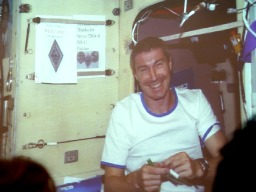


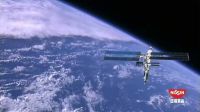
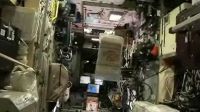
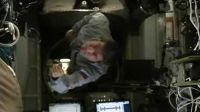
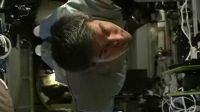

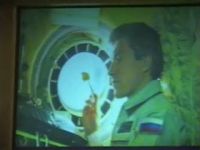


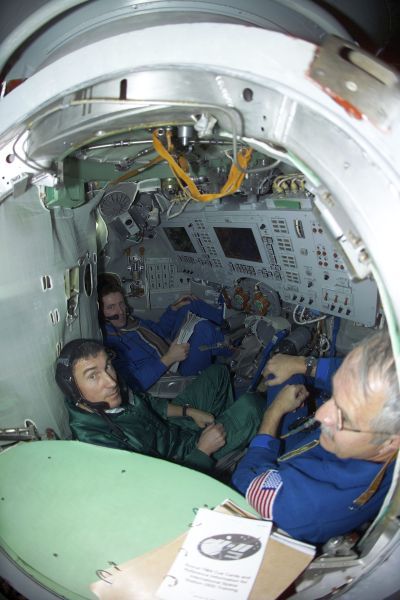
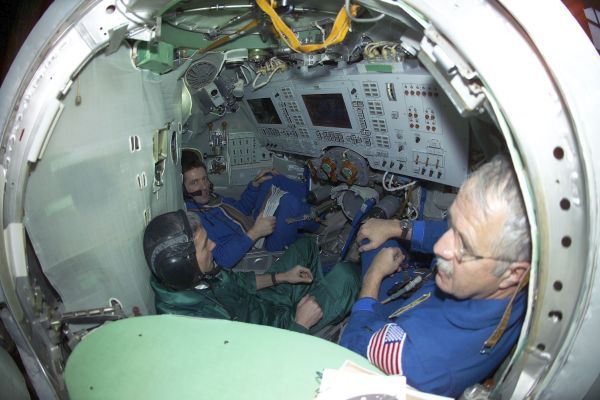
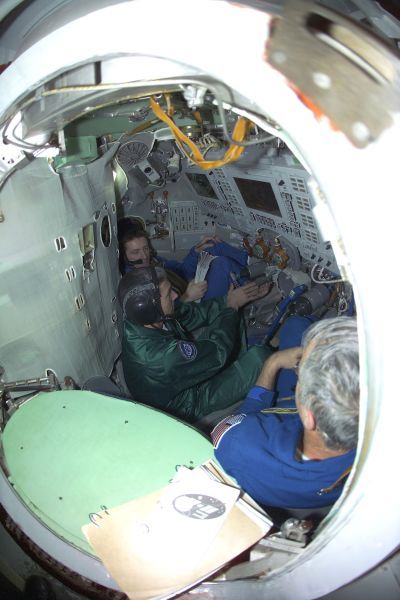
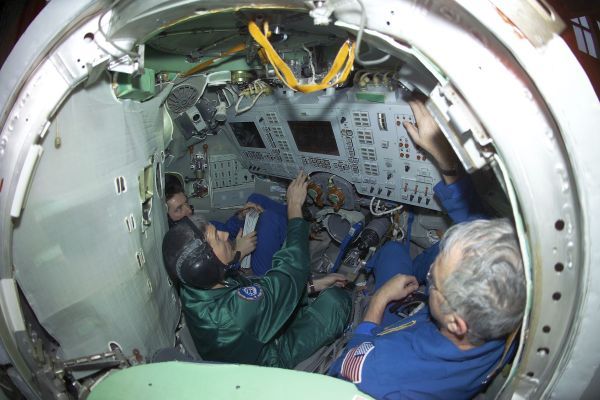
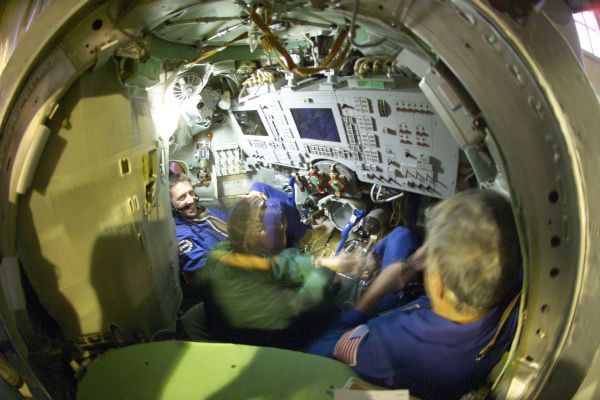
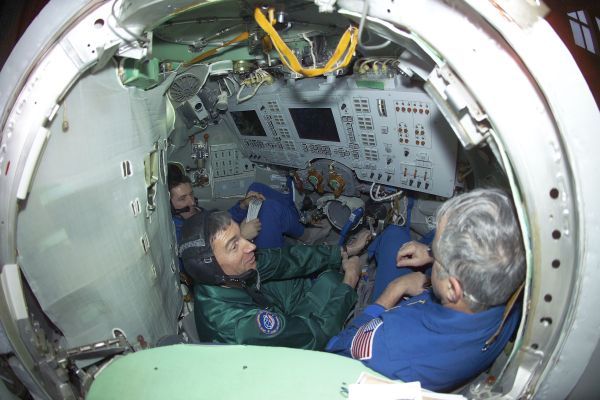
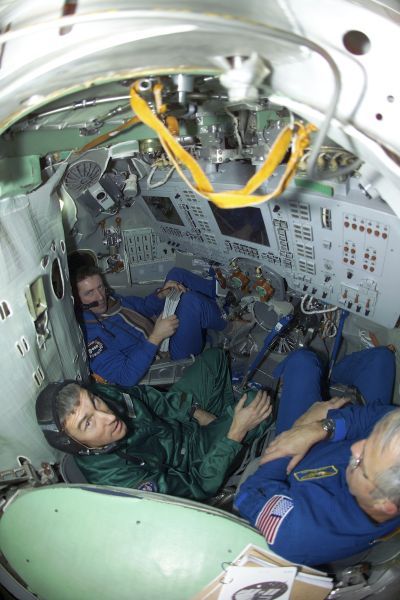
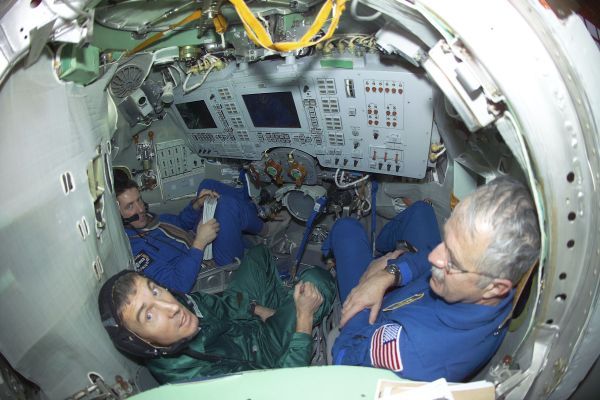
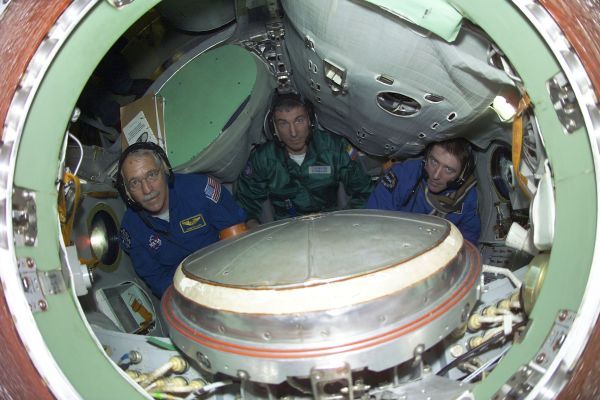
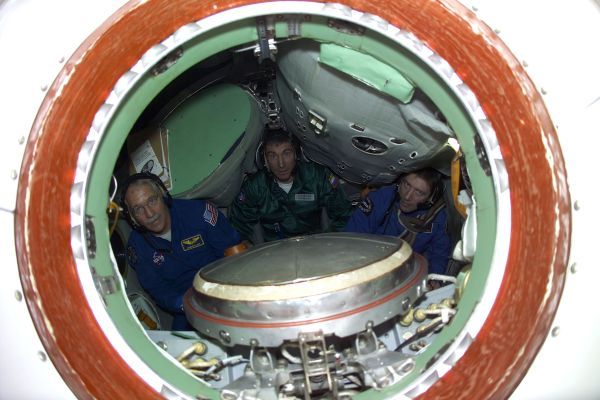
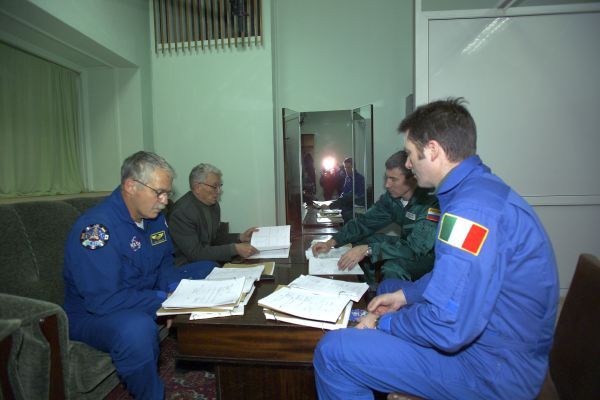
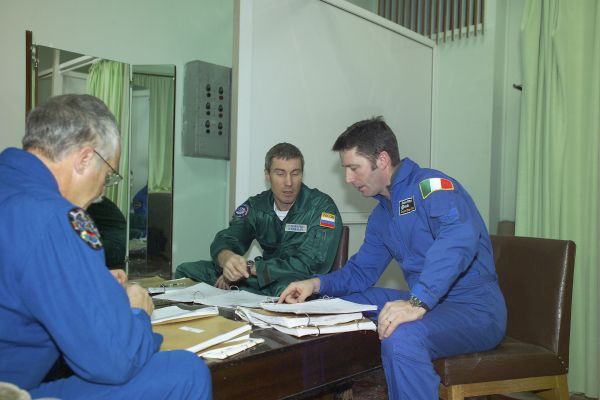
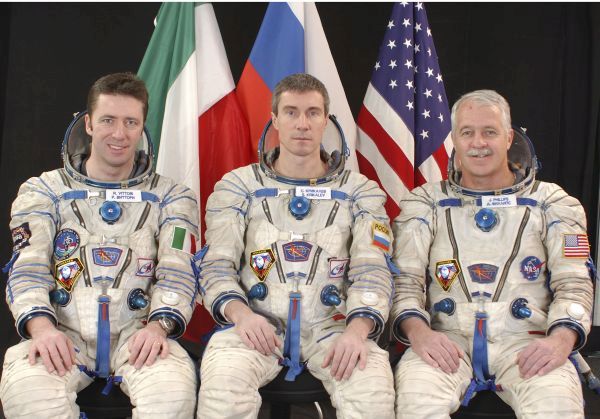
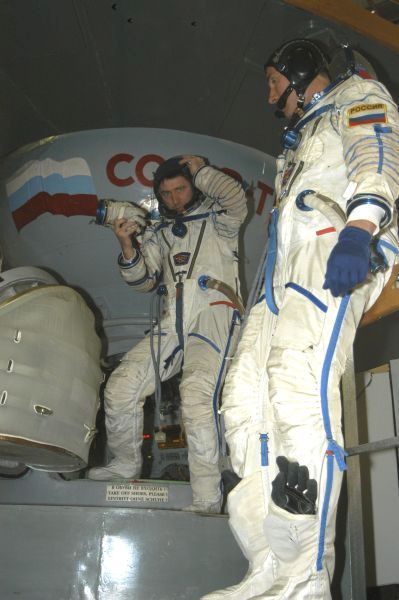
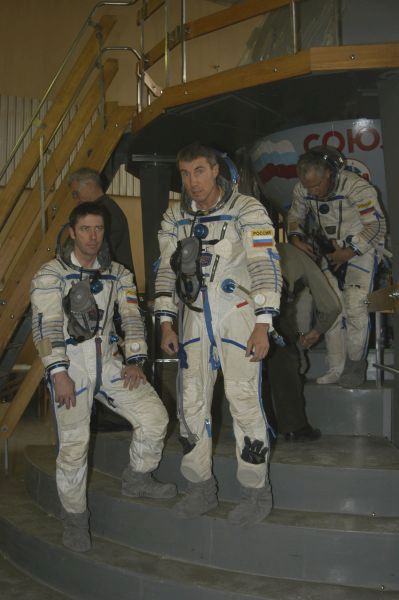
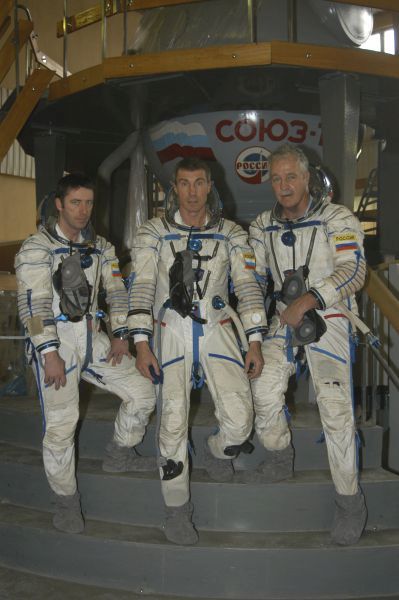
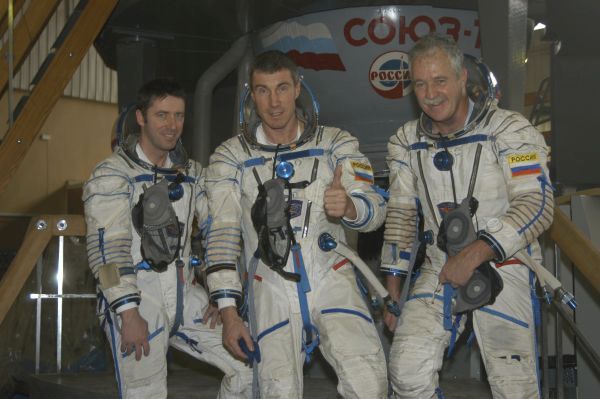
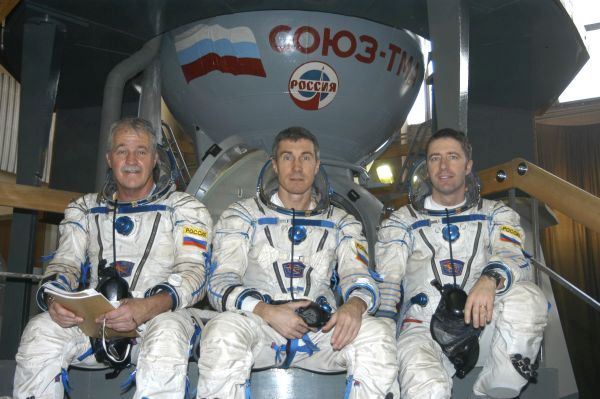
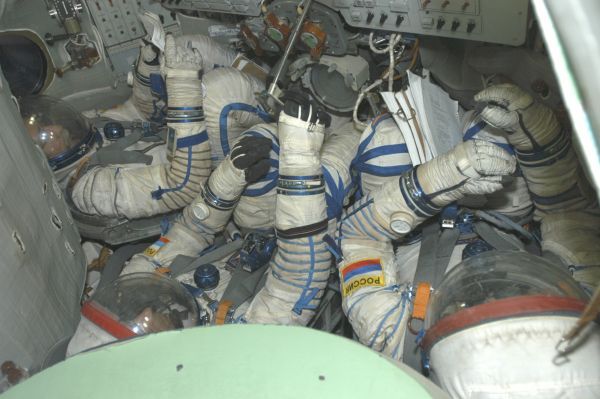
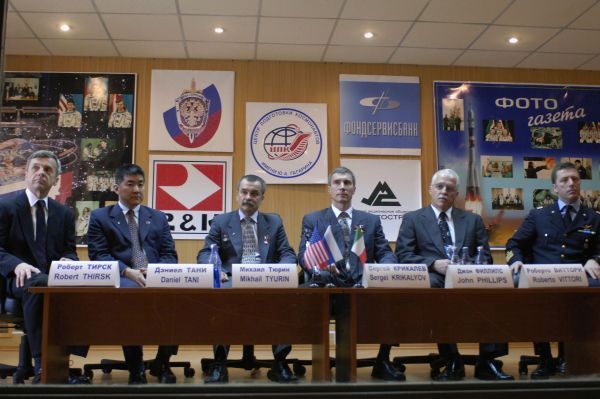
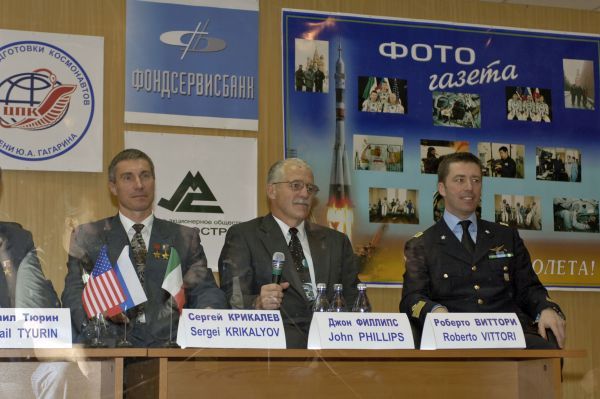
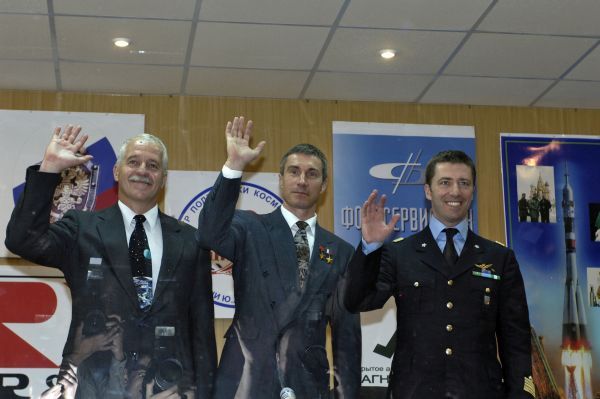
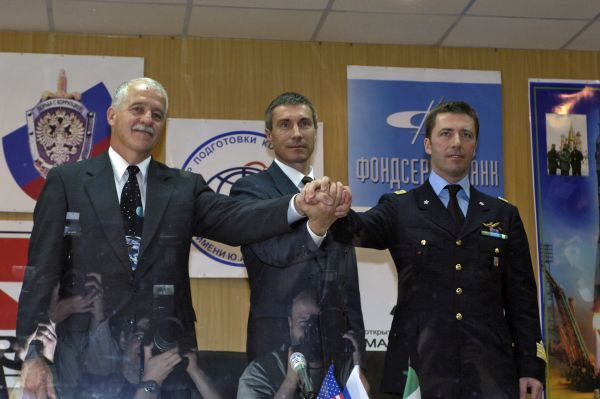
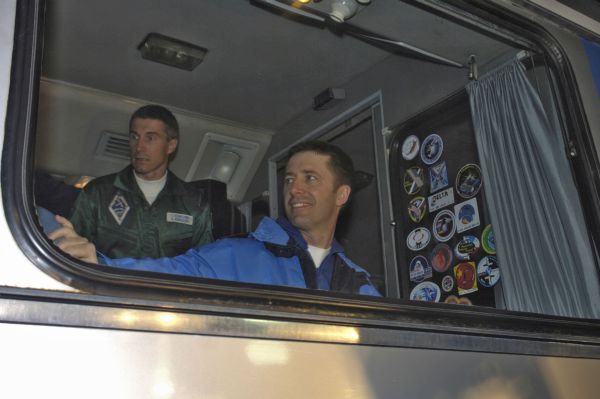
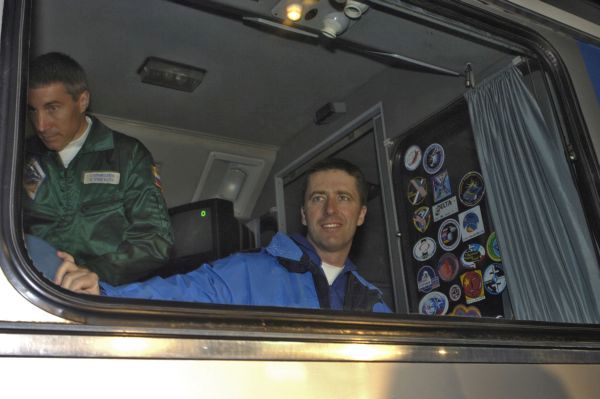
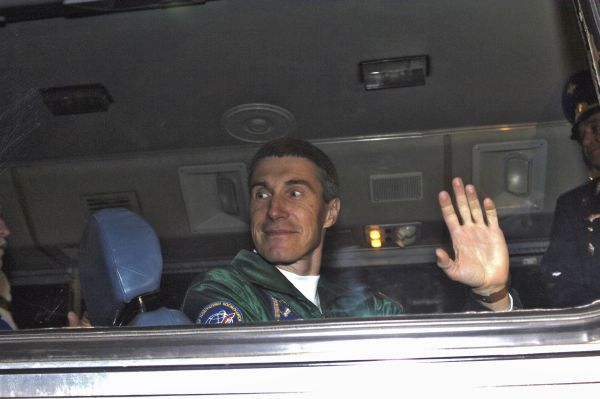
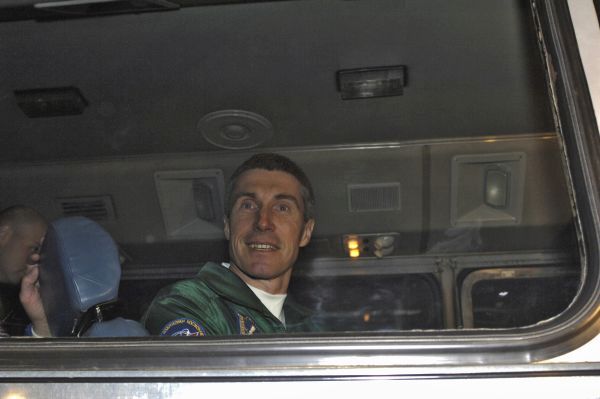
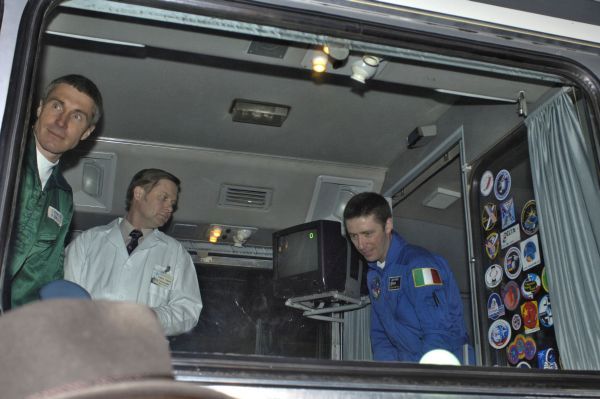
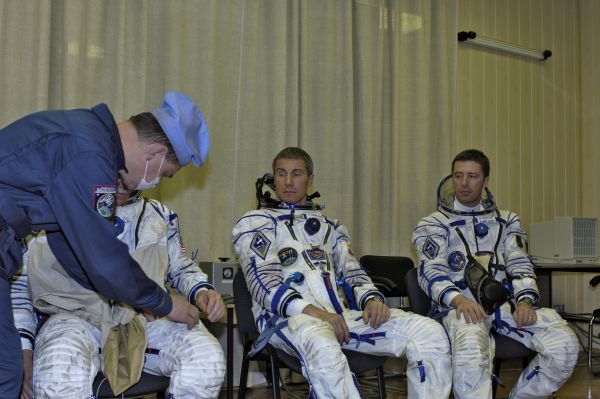
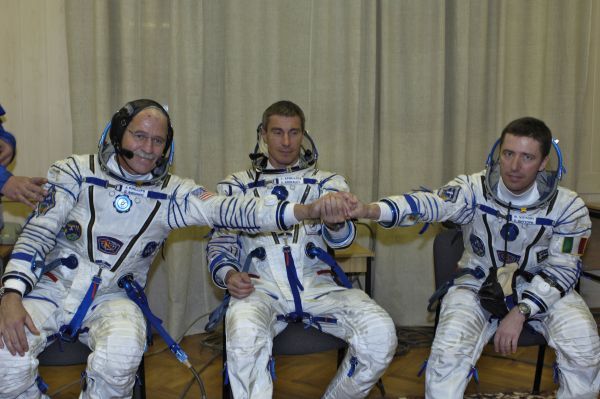
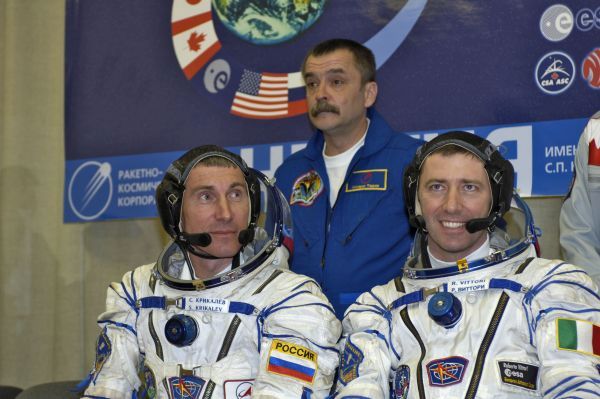
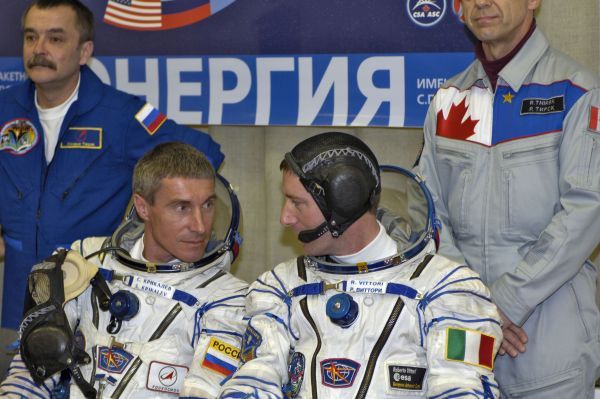
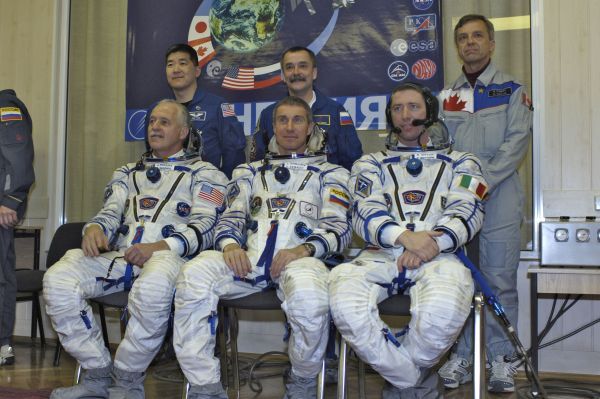
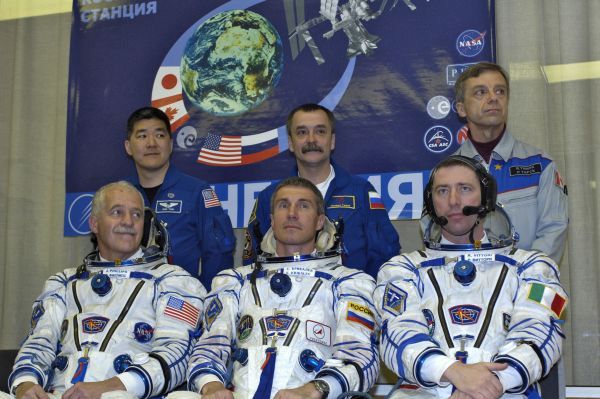
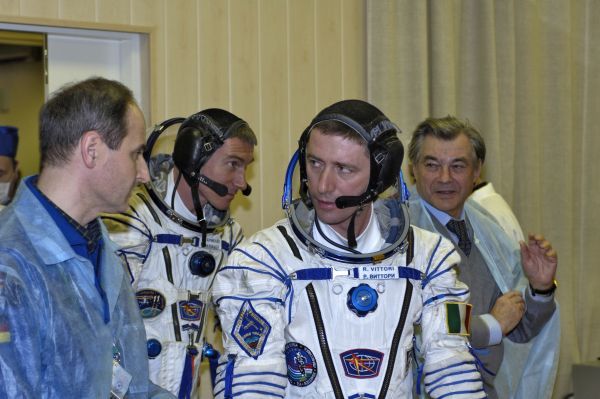
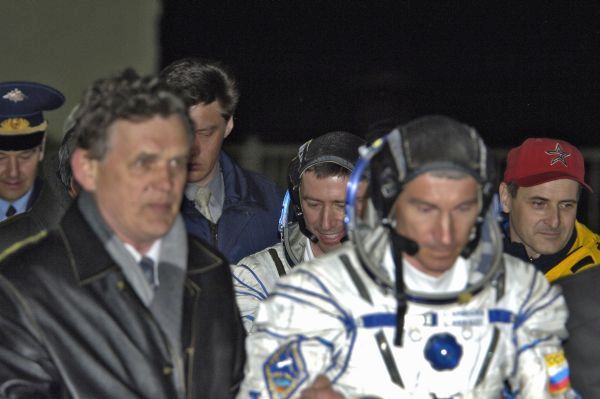
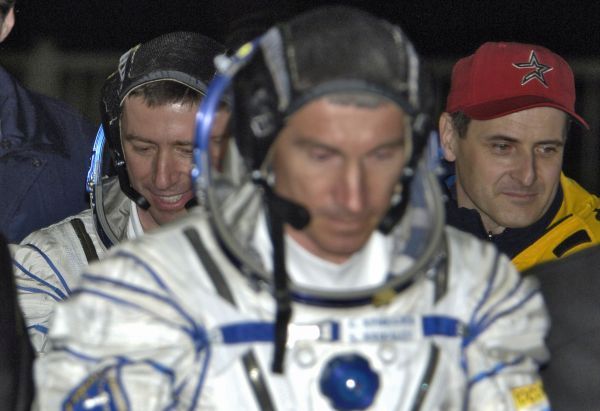
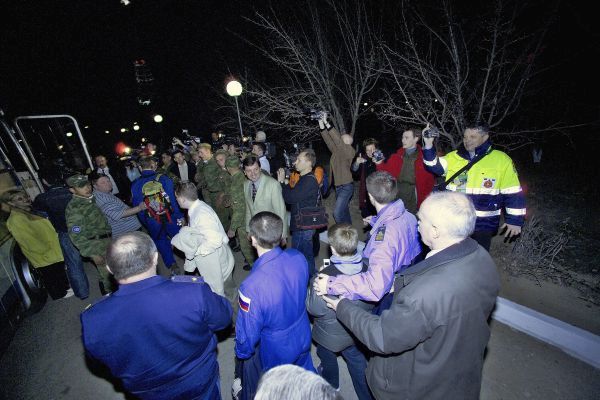
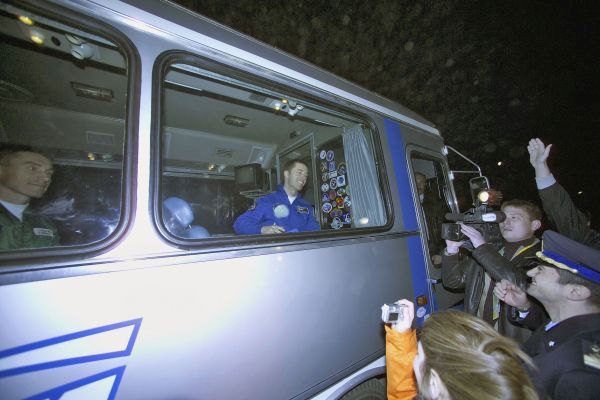
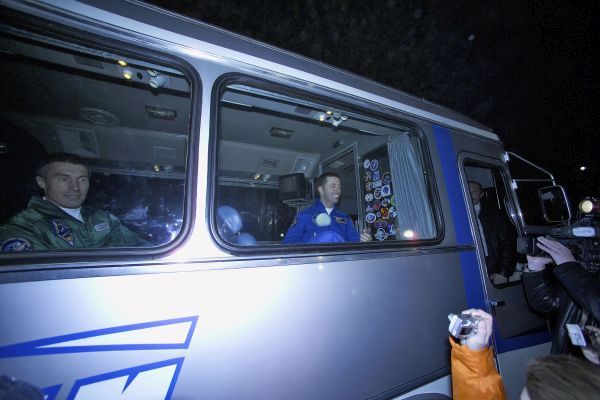
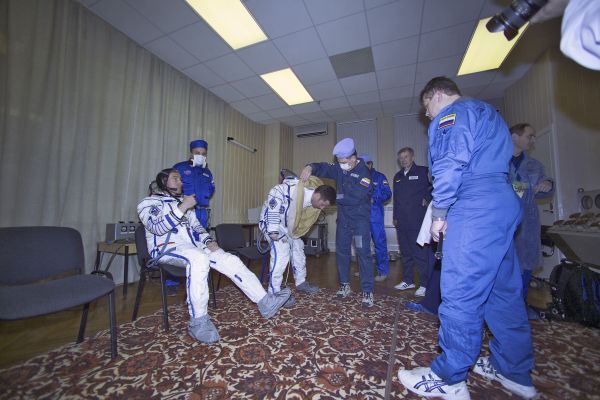
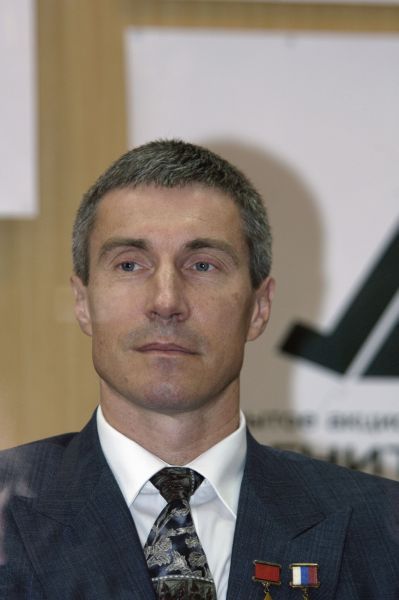
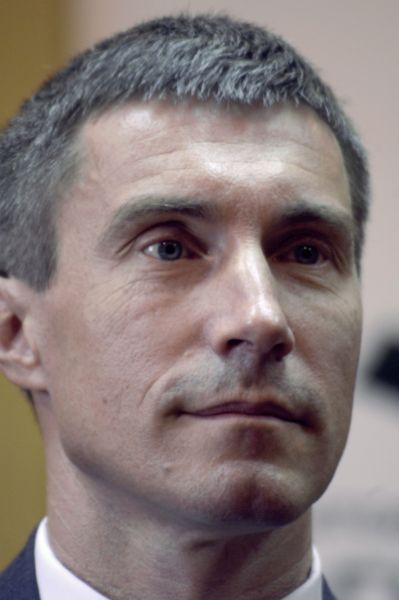
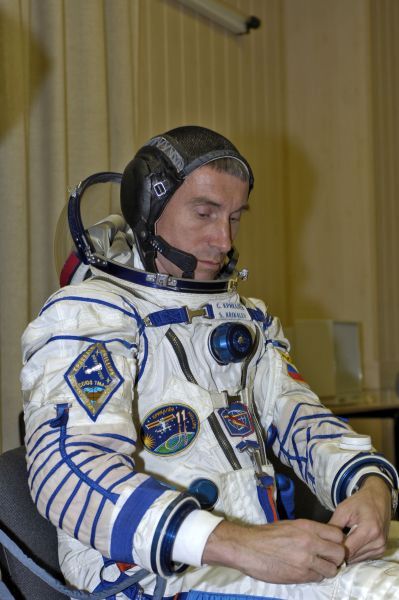
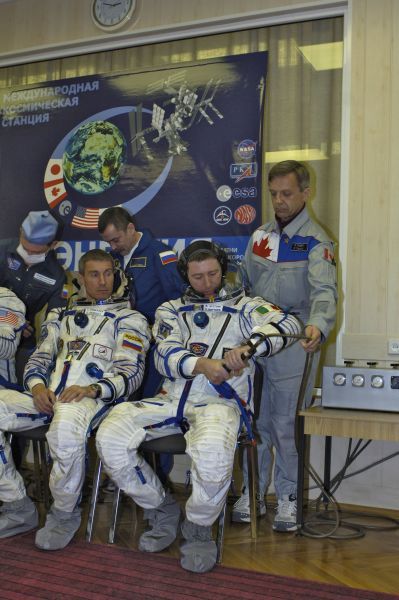
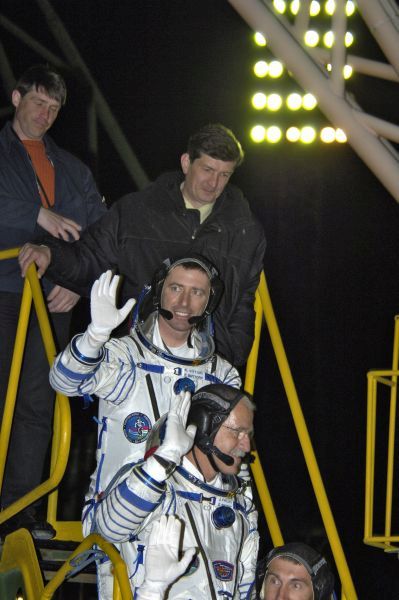
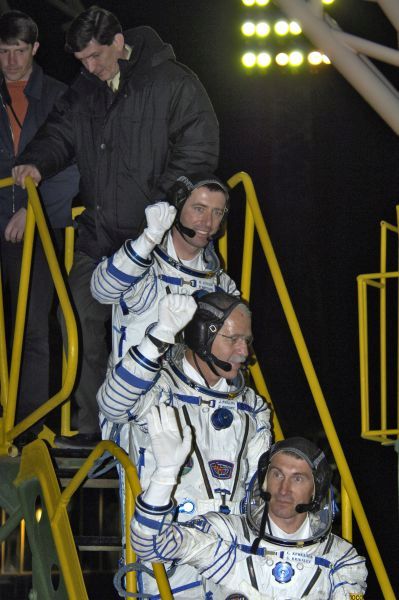
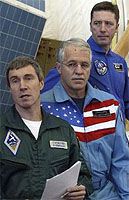
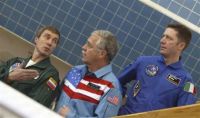
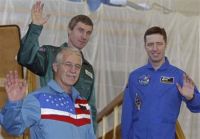
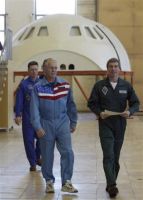
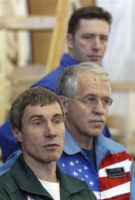
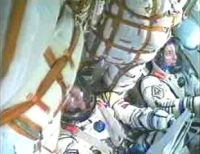


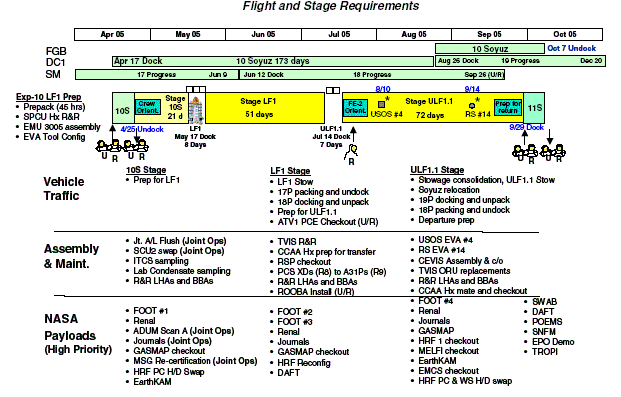
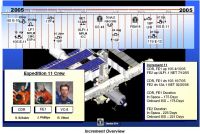
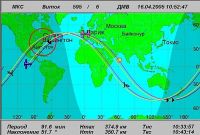
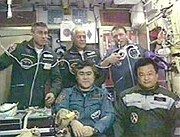
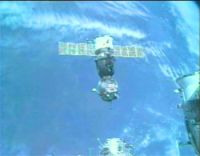
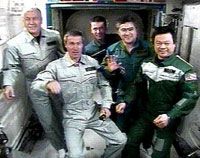
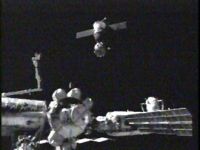
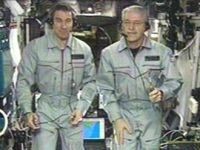
27/7
Preparations for tomorrow’s docking continued. Sergei prepared the cameras for photographing the Orbiter. He then did the SOZh maintenance. “At ~4:05 a.m. [08:05 GMT] the crew conducted a TV conference with the Soyuz-19 and Apollo crews of the joint US/Soviet ASTP (Apollo-Soyuz Test Project) ‘handshake in space’ that is observing its 30th anniversary.” The crew are synchronizing their sleep times with that of the Shuttle crew, so bedtime today and wake-up tomorrow is earlier by 2 h 20 m.
News & reports links
- 27/7 On-Orbit Status Report.
- Spaceflight Now.com: STS-114 docking timeline. (U.S. Eastern Daylight Time = GMT −4 hours.)
28/7
A Space Shuttle docked today at the ISS for the first time since December 2002. Discovery docked at 11:18 GMT after completing the RPM maneuver so Sergei and John could take photos of the Orbiter’s underside (no damage was detected from the photos later downlinked. Sergei operated the digital camera with the 800 mm lens; John the 400 mm lens). Sergei and John beforehand woke up at 02:39 GMT and completed final docking preparations. Sergei did the SOZh maintenance and the weekly maintenance reboot of Station laptop computers. Hatches were opened at 12:54 GMT. Welcome ceremonies: John rang the ship’s bell in Destiny, and Sergei presented the incoming crew with the traditional Russian bread-and-salt greeting. Sergei then gave the standard safety briefing for both crews. On board are now one Russian cosmonaut, six American astronauts, one Japanese astronaut and one Australian-born NASA astronaut (“our” Andy!!). Sleep period began at 19:39 GMT.
News & reports links
- 28/7 On-Orbit Status Report.
- STS-114 MCC Status Report #05.
- NASA TV image: STS-114 crew are welcomed onboard.
29/7
Main event for the day was transferring the MPLM Raffaello from the Orbiter’s cargo bay to the Node on the ISS, which was done successfully. Sergei prepared equipment in the MPLM vestibule in the Node for ingress. Sergei and Wendy Lawrence pressurized the vestibule, conducted leak checks, then opened hatches around 15:00 GMT. John did the SOZh maintenance. At 16:30 GMT the Shuttle crew retired into their Orbiter, depressurizing it to 10.2 psi to support the upcoming EVA pre-breathe protocol. Bedtime was at 18:40 GMT. Wakeup at 04:10 GMT tomorrow.
News & reports links
- 29/7 On-Orbit Status Report.
- STS-114 MCC Status Reports: #06; #07; #08.
- collectSPACE: “Racking up a record”.
- MSNBC.com:
- “Shuttle gap sets off station scramble”. “Facing a delay of uncertain duration before the arrival of the next Shuttle mission, astronauts on the International Space Station have been grabbing hold of anything extra they can beg, borrow or steal from the Shuttle Discovery to enhance the station’s long-term habitability, and even its survivability.” The Orbiter’s docking may be extended by one day (to 13 days) to support these activities; one being to fix the CEVIS motorized treadmill, which has kept breaking down. Extra light bulbs will also be scavenged from Raffaello (they keep burning out quick in the U.S. segment).
- “NASA may extend Discovery mission”.
From the Russian Federal Space Agency (FKA):
29/07/2005: The ISS crew consists of 9 people
Yesterday, at 15 hours 17 minutes (MSK) the reusable American ship Discovery, with seven astronauts aboard, docked on Thursday to the International Space Station (ISS).
Before the docking, the Shuttle carried out a maneuver in which it completed a “somersault” in orbit. During several minutes the cosmonauts, who work on the ISS, photographed the surface of American spacecraft.
The Shuttle is mated to the Destiny module of the ISS American segment.
The commander of the Shuttle Discovery is woman-astronaut and Colonel of the USAF, Eileen Collins, who has already visited space three times. The crew, which consists of six NASA astronauts and one astronaut of Japan, will have to verify the fitness of the Shuttle for work.
After the catastrophe of the Shuttle Columbia in 2003, the specialists of NASA developed a number of measures for flight safety, and also on the elimination of malfunctions on the Shuttle in space. The Shuttle delivered in orbit the Italian cargo module Rafaello and a new instrument for maintaining of attitude of station – a gyrodyne, to replace the one that malfunctioned, and also everything necessary for continuing the work of the ISS basic expedition.
Discovery will conduct a spaceflight of 12 days; for eight days of these the astronauts will work on the ISS. They will carry out three spacewalks; during one of them they will verify skin of Shuttle and, if necessary, work on the elimination of the emergent malfunctions will be conducted, being guided by recommendations from Earth. The launch of Discovery was the first after more than two-year-old interruption in the flights of American Shuttles from the moment of the loss of seven astronauts in the spacecraft Columbia.
“We hope that, according to the results of the first flight of the Shuttle Discovery, will be obtained the information, which will allow to launch the following ships. But if there occurs anything serious, we will fly two together, on the old scenario. At the end of August-September there will arrive associates from NASA and we will discuss questions of assignment by Russia additional services concerning the delivery cargo and crews,” reported Aleksei Krasnov, the chief for the administration for the manned programs of the Federal Space Agency. “The ISS crew will fly ‘two together’ for a minimum of half a year.”
“We greatly hope for the successful launching in the middle of 2006 of the European ATV cargo ship, which will deliver to the station a significant quantity of cargo, which will make it possible to increase resources for a stay in orbit of three people,” emphasized Krasnov.
Russian version, Русская версия: Экипаж МКС состоит из 9 человек.
30/7
Sergei achieved 2 years of accumulated time in space today!
He and John Phillips spent most of the day supporting Shuttle EVA-1 with the Canadarm-2 (SSRMS). While not thus occupied, they continued cargo transfers from the MPLM. Sergei did the SOZh maintenance. The Orbiter is to stay docked one extra day to facilitate cargo transfers. After studying the photos, the Orbiter has been cleared for re-entry.
News & reports links
- 30/7 On-Orbit Status Report.
- STS-114 MCC Status Reports: #09; #10.
31/7
News & reports links
- 31/7 On-Orbit Status Report.
- STS-114 MCC Status Reports: ;#11; #12.
August
1/8
Flight Day 7 for STS-114. Sergei & John spent most of the day supporting EVA-2, where the long-broken Control Movement Gyroscope-1 was replaced at last. Sergei started the regeneration cycle on absorbent bed #1 of the Russian harmful impurities removal system (BMP). He also did the daily SOZh maintenance and the weekly maintenance reboot of the Station laptop computers.
News & reports links
- 1/8 On-Orbit Status Report.
- STS-114 MCC Status Reports: #13; #14.
2/8
Week 15 for Expedition 11; Flight Day 8 for STS-114. Main activity was the cargo transfer from Raffaello. Sergei began his day with the regular morning inspection and monthly check of circuit breakers and fuses in Pirs. He and John later joined the Shuttle crew for a detailed review of tomorrow’s EVA-3. Sergei did the SOZh maintenance and regeneration cycle of absorbent bed #2 of the Russian harmful impurities removal system (BMP). At 10:45 GMT he and John conducted a press conference with reporters at TsUP. At 14:20 GMT both crews talked with President George W. Bush. Sergei had another Uragan Earth photography session assigned.
News & reports links
From Novosti Kosmonavtiki news №491:
02/08/2005/17:20 – Discovery commander assures they will return safely
The commander of the Shuttle Discovery, Eileen Collins, requested everyone not to worry, since she was reassured of the safe return of the ship to Earth. “I believe that this there will be a normal flight, and all engineering ship systems will work out regularly. Do not worry about us,” she said.
From his side, the ISS commander, Sergei Krikalyov, reported that into the medium, on 3 August, Discovery astronaut Steve Robinson will, during the work in open space, try to remove from a groove between the thermo-tiles of the Shuttle two pieces of thermal insulation strip.
Speaking about the living conditions of the joint stay of the Shuttle and ISS crews, Krikalyov noted that no one experiences no discomfort.
According to him, although the load on him and flight engineer John Phillips is now more than they experienced prior to the arrival of the Shuttle, they do not feel fatigue. “We arise for 2.5 hours earlier, and we go to sleep earlier in the same period. During the workday with the Discovery crew we are practically not seen, since each is occupied by the tasks assigned to them, but after supper we are in the evening gathered all together,” reported Krikalyov. On this transfers RIA News.
Russian version, Русская версия: Командир экипажа Discovery уверена в благополучном возвращении.
02/08/2005/17:20 – The crew of Discovery will not remain on the ISS
The crew of the Shuttle Discovery will not remain on the ISS, since the heat-shielding coating of the Shuttle in a good state, reported ISS commander Sergei Krikalyov.
According to the cosmonaut, who is located on board the ISS, the scenario previously was examined, according to which the crew of Discovery could be located on the Station during 45 days to the arrival of the rescue-ship Atlantis.
“If we saw significant damage, then, of course, it would not be possible for Discovery to return to the Earth without risk to the life of the astronauts,” refined Krikalyov.
It is assumed that Discovery will land at the Cape Canaveral spaceport on Monday 8 August. According to the plan, the Shuttle will be able to approach for landing four times – the first attempt at the landing after its passage through the dense layer of the atmosphere is scheduled for 12.46 MSK. About this transfers RIA News.
Russian version, Русская версия: Экипаж Discovery не останется на МКС.
3/8
Flight Day 9 for STS-114. Sergei and John spent most of the day supporting EVA-3, which was successful (the protruding Orbiter tile gap fillers were removed). Cargo transfers continued. Sergei did the SOZh maintenance. The newly installed Control Movement Gyroscope-1 was spun up.
News & reports links
- 3/8 On-Orbit Status Report.
- STS-114 MCC Status Reports: #16; #17; #18.
- NASA TV image: Expedition 11 and Discovery crews during a press conference, 3 August. Sergei and John are wearing polo shirts presented to them by the visiting crew (something that had become a tradition when Shuttles visited the ISS).
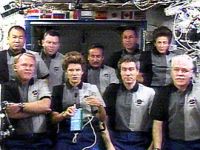
4/8
Crew day started at 03:40 GMT. Most of the day was occupied with cargo transfers to and from Raffaello. Sergei did the SOZh maintenance and related chores. “As a voluntary entry on his time available task list, Krikalyov was at liberty to take photo and video imagery of joint STS-114/ISS crew operations.”
News & reports links
- 4/8 On-Orbit Status Report.
- STS-114 MCC Status Reports: #19; #20.
- “Exploration – The Fire of the Human Spirit: A Tribute – To Fallen Astronauts and Cosmonauts”. Expedition 11 Flight Engineer John Phillips: ““To the crew of Columbia, as well as the crews of Challenger, Apollo 1 and Soyuz 1 and 11, and to those who have courageously given so much, we now offer our enduring thanks. From you we will carry the human spirit out into space, and we will continue the explorations you have begun. We will find those new harbors that lie out in the stars and of which you dreamed. We do this not just because we owe it to you, but we do it because we also share your dream of a better world. We share your dream of coming to understand ourselves and our place in this universe. And as we journey into space you will be in our thoughts and will be deeply missed.” (Sergei repeated this paragraph in Russian – no Russian version to be found, yet.)
5/8
Crew day started an hour earlier, at 02:40 GMT, to prepare for undocking tomorrow. Raffaello is safely back in the payload bay. Transfers continued. Sergei did the SOZh maintenance. “As a voluntary entry on his ‘time available’ task list, Krikalyov recharged the battery of his Russian DVCAM digital camcorder and again gathered imagery of joint STS-114/ISS crew operations to update RSC-Energiya’s ISS assembly stage chronicles. The photo coverage will also include Discovery’s undocking and Station flyaround tomorrow morning.” (These Energiya photo chronicles do not appear to be on their website, at least not that I could find?)
News & reports links
- 5/8 On-Orbit Status Report.
- STS-114 MCC Status Report #21.
- MSNBC.com: “Shuttle astronauts pack for homeward flight”. “The two space Station occupants were glad to get rid of the stuff, since it left them with a much tidier – and more spacious – home. One of them, cosmonaut Sergei Krikalyov, said before Discovery arrived that the place looked as messy as Russia’s old Mir Station.”
6/8
Discovery undocked at 07:24 GMT after crew farewells. Sergei videoed the flyaround with his camcorder. Light duties follow for him and John this weekend after the hectic week; packing and stowage of all the gear brought up.
Krikalyov thanked the Shuttle astronauts in turn along with ground support crews, saying “it’s really a big event for us because we were waiting for this flight for several years, more than three years already. And fortunately, everything goes smooth. We want to say thank you and wish you a good, soft landing.” (CBS News)
News & reports links
- 6/8 On-Orbit Status Report.
- STS-114 MCC Status Reports: #22; #23.
- NASA TV image: Farewell to STS-114.
TsUP news:
Discovery in autonomous flight
TsUP-M press-service, 06 August 2005
The crew activity program of the reusable American ship Discovery at the International Space Station is completed.
On 6 August, 2005, 11 hours 24 minutes (Moscow time), Discovery undocked from the Station and its flight in the autonomous regime now continues.
Its landing at the Cape Canaveral spaceport (state of Florida) is planned for 8 August at 12 hours 46 minutes.
The space watch of Sergei Krikalyov and John Phillips on the ISS continues.
Russian version, Русская версия:
«Дискавери» в автономном полете
Пресс-служба ЦУП-М, 06 августа 2005 года
Завершена программа работы экипажа американского корабля многоразового использования «Дискавери» на Международной космической станции.
6 августа 2005 года в 11 часов 24 минуты московского времени «Дискавери» отстыковался от станции и сейчас продолжает полет в автономном режиме.
Приземление его на космодроме на мысе Канаверал (штат Флорида) намечено на 8 августа в 12 часов 46 минут.
Космическая вахта Сергея Крикалева и Джона Филлипса на МКС продолжается.
7/8
An off-duty Sunday for the crew; beginning of Week 16. Crew wake-up at the normal 06:00 GMT. The usual light chores: Sergei did the SOZh maintenance and he and John completed the weekly 3 hours of uborka, Station-cleaning. Weekly planning conference at 12:35 GMT with the Ground. Sergei and John will start sleep cycle shifting on the 13th in preparation for the Russian spacewalk scheduled for 18/8. Sergei’s last spacewalk was in 1992!
News & reports links
8/8
Sergei and John began preparations for the upcoming Orlan spacewalk on 18 August. They both performed the mandatory Russian pre-EVA MedOps procedure MO-6 (hand-cycle ergometry) in Zvezda. They installed a BNP, БНП portable air repress bottle in Pirs (back-up in case the hatch’s pressurization equalization valve doesn’t work). John gathered some U.S. tools required for the spacewalk; Sergei unstowed payload to be installed outside (delivered on the last Progress). Sergei then compressed the bladder of Rodnik water pump #2 (BV2, БВ2) after doing #1 previously. He did the SOZh maintenance. “CMG-3 (control moment gyro #3) was successfully integrated into the USOS (US segment) steering law. Thanks to LF-1, for the first time since June 8, 2002, the ISS is again being controlled by four nominally functioning CMGs.”
News & reports links
From the Russian Federal Space Agency (FKA) site, preparations of the Soyuz TMA-7 spaceship that Sergei and John will ride home on (along with very lucky space tourist Greg Olsen):
Preparation has begun at Baikonur of the manned spacecraft Soyuz TMA-7
(From the site of Roskosmos, 8 August 2005)
Today, in the calculations of Roskosmos, will begin work on preparation for the launch of the Soyuz TMA-7 manned spacecraft, which arrived at the spaceport by rail transport on 6 August of this year – about this reported Oleg Urusov, press-secretary at FKTS Baikonur.
The Soyuz TMA-7 spacecraft was delivered into the assembly and testing housing at Complex 254 and established into the stand. Now the calculations Roskosmos are prepared for conducting of electronics-testing of the spaceship.
The launch of Soyuz TMA-7 to the International Space Station with the crew of the 12th Basic Expedition, composed of V. Tokarev and U. MacArthur (duplicating crew: A. Lazutkin and J. Williams) and with the space tourist G. Olsen, is scheduled for 1 October of this year from Complex 1 at the Baikonur spaceport.
Russian version, Русская версия: На Байконуре начата подготовка пилотируемого космического корабля «Союз ТМА-7».
9/8
STS-114 finally landed today at Edwards AFB after being waived-off yesterday due to bad weather in Florida, at 12:11:22 GMT. “From the Station, Commander Sergei Krikalyov and NASA Science Officer John Phillips sent their congratulations to Discovery’s crew and the flight control team in Houston.” (STS-114 Status Report #28.) Sergei and John underwent the periodical Russian biomedical assessments (PZEh-MO-7 and -8) before breakfast. They then reviewed timelines, data files and DVDs concerned with the upcoming Orlan spacewalk. Sergei did the SOZh maintenance, then set up equipment for a PZE MO-9 “Urolux” biochemical urine test tomorrow (done before and after a Russian spacewalk).
News & reports links
10/8
Biochemical Urinalysis (MO-9) for Sergei and John, before breakfast and eating (MO-9 is done every 30 days, and before & after a Russian spacewalk). Preparations continued for next week’s VKD-14 (Russian acronym for EVA), gathering necessary equipment. VKD-14 objectives are:
- Removal of panel #3 of the Japanese/JAXA MPAC & SEED experiment on the SM exterior;
- Removal of the Russian “Matryoshka” radiation measurement “human torso” from the SM hull and transfer to the DC-1 EVA hatch;
- Removal of the SKK-3 replaceable cassette container on the SM cylindrical section (AO) for return to the ground;
- Installation of the new SKK-5 sample plate in place of SKK-3;
- Relocation of the deployed SKK-4 materials sample plate on its handrail at the SM AO end cone;
- Removal of the MSN “Biorisk” experiment #1 from its location on the DC-1 for return to Earth;
- Installation of an additional TV camera at the SM aft end to assist in ATM prox ops; and
- Removal of a Russian/US Strela 2 adapter from the EFGF (electrical flight grapple fixture) on the FGB module and its installation on the FRGF (flight releasable grapple fixture) on the PMA-3 (pressurized mating adapter #3).
Sergei did the monthly recharging of the Motorola-9505 Iridium satellite phone, then the daily SOZh maintenance. “At ~18:55 GMT, the crew downlinked a TV message of greetings via S- & Ku-Band to the visitors of the MAKS-2005 Airspace Show in Russia, open from August 16 through August 21. The downlink also included the video footage taken of today’s EVA equipment preparations.”
News & reports links
From Novosti Kosmonavtiki news №493:
10/08/2005/14:51 – On the ISS the crew are preparing for a spacewalk
The ISS crew is preparing for a spacewalk. Sergei Krikalyov and John Phillips are scheduled to install on the external surface of the Russian segment equipment for the docking with the first European cargo ship Jules Verne of the ATV series. As Mission Control Center reported, “Krikalyov and Phillips must work outside almost 6 hours at night from 18 to 19 August.”
“The crew already conducted several trainings in the Russian Orlan spacesuit, and today Krikalyov and Phillips are to prepare the necessary equipment for the extra-ship activity,” noted the representative of TsUP. On Friday 12 August, the crew will be occupied for several hours by testing spacesuits, he refined.
As ITAR-TASS reports, also during the forthcoming space walk for cosmonauts they must install a television camera, which will be used for the docking with the first European cargo ship Jules Verne. Its launch is planned for the spring of the following year (2006).
According to the plan of TsUP, the spacewalk of Krikalyov and Phillips must begin on 18 August at 22:55 Moscow time, and be completed on 19 August at 04:45.
Russian version, Русская версия: На МКС готовятся к выходу в открытый космос.
11/8
Spacewalk preparations for 18/8 continue. Today, the equipment required was gathered into a bundle of not more than 1 m so it can fit through the Pirs hatch. Orlan suit consumables, replaceable ORU elements and personal gear were also gathered. Orlan suit numbers 25 and 27 are to be worn (fitted with U.S. EMU spacesuit helmet lights). Sergei then installed the second (of 2) BNP portable repress bottles in Zvezda. He transferred more potable water from Progress M-53 to Zvezda, and did the daily SOZh maintenance. “As part of the EVA assembly video downlink, the crew also sent down greetings to the participants of the Russian Geographic Society’s 12th Congress, requested by veteran cosmonaut V.P. Savinykh.”
News & reports links
12/8
Sergei sets a world record next week AND gets to go on a spacewalk. Fun! The crew began sleep-shifting two hours forward (08:00 GMT) and go to sleep at 11:30 GMT to support medical activities for VKD-14. Today they set up and checked out the VKD support panels (POV, ПОВ) and equipped the Orlan suits with their replaceable elements. Sergei will be wearing Orlan #25 (red markings) with BRTA radio telemetry unit #13 installed, while John’s suit will be #27 (also with red markings) with BRTA #12. Both crewmen completed a MO-5 MedOps protocol of cardiovascular evaluation on the VELO ergometer as a standard pre-spacewalk test (their normal daily exercise was reduced because of this). John did the SOZh maintenance. The crew had their weekly teleconferences with the JSC Astronaut Office and ISS Program Management at Houston. “Yesterday at 3:20 p.m. EDT, a recently (7/11) installed BVK-1 vacuum valve on the Russian Vozdukh CO2 (c arbon dioxide) removal system failed, causing the system to shut down.” The Carbon Dioxide Removal Assembly in the U.S. Lab and Russian LiOH canisters (38) are available as back-ups.
News & reports links
- 12/8 On-Orbit Status Report.
- JSC Station Status Report: 12 August. “At 12:44 a.m. CDT Tuesday [05:44 GMT], Krikalyov’s time spent in space will surpass that of any other human being. Krikalyov’s record will pass the one now held by Cosomonaut Sergei Avdeyev, who spent 748 days in orbit. Krikalyov is a veteran of six space flights, two long-duration flights to the Soviet Union Space Station Mir; two flights on the Space Shuttle; and, counting this mission, two flights to the International Space Station. Krikalyov was aboard the Space Station Mir when the Soviet Union disintegrated. He became the first Russian to fly on the Space Shuttle in 1994. He was a member of the Shuttle crew that began assembly of the International Space Station in 1998. In 2000, he was a member of the first resident International Space Station crew.”
13/8
Saturday: off-duty, with the usual 3-hour uborka, Station-keeping. The crew continued reviewing spacewalk procedures from Pirs for next week. Sergei did the SOZh maintenance. Both partook in the weekly planning conference with both TsUP and Houston.
News & reports links
14/8
Sunday: off-duty. Beginning of Week 17. Sergei did the SOZh maintenance and “As part of today’s morning inspection after wake-up, CDR Krikalyov did the periodic checkup behind Panel 139 in the Service Module (SM) on a fluid connector of the urine collection system, checking for potential moisture.”
News & reports links
15/8
More preparations for VKD-14 on the 18th. “EVA preparations today included:(1) attaching the LCG (liquid cooling garment) restraint straps of the Orlan-Ms; (2) suit fit adjustment for height (to be repeated as necessary during the dry-run and under reduced airlock pressure); (3) leak checks and valve functionality tests on the suits and their BSS interface units in the Pirs Docking Compartment (DC1) and Service Module Transfer Compartment (SM PkhO); (4) leak checking on the oxygen repressurization tanks (BK-3, primary & backup); (5) filling the DIDBs (disposable in-suit drink bags) and installing them in the suits, and (6) installing the Fresnel lens viewing aid in the helmets (at crew’s discretion).” Sergei did the SOZh maintenance. No luck with restarting the Vozhukh CO2 scrubber; the problem is thought to be in the electronic control circuitry of the unit. The U.S. CDRA continues operating in the interim.
News & reports links
From Novosti Kosmonavtiki news №494:
15/08/2005/00:07 – Preparation for the spacewalk
The space watch of Sergei Krikalyov and John Phillips continues on board the International Space Station.
In accordance with the outlined flight program the crew conducts preparation for the space walk that is scheduled for the night of 18-19 August 2005. Today the cosmonauts deal with testing the Russian spacesuits Orlan-M, in which they must work on the external surface of Station.
The basic tasks of the spacewalk are the dismantling and replacement of the separate elements of scientific gear on the official module Zvezda, the installation of a reserve television camera, and photography.
The discovery from the exit port of the Pirs section must take place at 22 hours 55 minutes Moscow time (18:55 GMT). The estimated time of the presence of crew in open space is 6 hours.
– The press-service of TsUP/MCC-M.
Russian version, Русская версия: Подготовка к выходу в открытый космос.
15/08/2005/15:57 – The ISS crew tries on the spacesuits
The crew of the International Space Station today carries out the completing trimming of the spacesuits before the space walk. On this Moscow Mission Control Center (TSUP) reported on Monday. Russian Sergei Krikalyov and American John Phillips today will spend a large part of working time remove to the trimming of the Russian spacesuits Orlan-M, which they at the end of the week will leave Station for 6 hours,” said a TSUP expert.
“During the preparation of Orlans, cosmonauts will “blow through” the suits with fresh air, will verify interphone headsets, will install American drinkable tanks into the Russian spacesuits, and also will free the hydraulic systems of cooling from the air bubbles,” described the expert. Furthermore, he added, Krikalyov and Phillips will fix on their spacesuits powerful lamps for the work in the complete darkness, fed from autonomous storage batteries .
The “fitting” of spacesuits is a very important operation, from which to a considerable degree depends the effectiveness of work outboard, they explained at TSUP. Thus, during the January output into space of the ISS-10 crew, for flight engineer Salizhan Sharipov it was necessary to make additional efforts because of the too-long sleeves of the Orlan, since sometimes the fingers of his hands did not reach to the tips of gloves. “On the Earth long sleeves can be curled up, and under weightlessness conditions this interfere with the laws of physics,” said the specialist, after explaining that “in space, the sleeves themselves return to their initial form.”
During the six-hour output, scheduled for the night of 18-19 August, Krikalyov and to Phillips are to install on the external surface of the Russian segment equipment for the docking with the first European cargo ship Jules Verne, whose launch is planned for the spring of 2006. Cosmonauts also must dismantle on the ISS Russian segment “Mr. Rendo” – the European mannequin, established outside a year ago within the framework of Russian-European experiment “Matryoshka”. Furthermore, the crew ISS-11 will remove from the external surface of Station one of the containers with the fungi and the bacilli, which was established in open space within the framework of the “Biorisk” experiment. ITAR-TASS reports about this.
Russian version, Русская версия: Экипаж МКС подгоняет скафандры.
16/8
747+ days in orbit for Sergei!!
“Today at 1:44 a.m. EDT, on this 124th day of Expedition 11, CDR Krikalyov beat Cosmonaut Sergei Avdeyev’s three-mission space-endurance record of 748 days. With his total of six space flights, Krikalyov thus has become the human with the most cumulative time in space, setting a new stay-time record with every further day in space. Congratulations, Sergei Konstantinovich!” Wakeup for the crew at 10:00 GMT today; bedtime at 01:30 GMT. Main activity for today was a spacesuit training “dry-run” to check out the Orlans. John did the SOZh maintenance while Sergei exported the Inventory Management System delta file.
News & reports links
- 16/8 On-Orbit Status Report.
- NASA: “Krikalyov Sets Time-in-Space Record”. “Mission Control Moscow also saluted Krikalyov’s achievement, and Krikalyov joked in Russian, ‘You’ll have to congratulate me every day from now on.’”
- MSNBC.com: “Cosmonaut sets record for most days in space”.
- New Scientist Space.com:“Cosmonaut clocks up record time in space”. “‘He’s a very impressive cosmonaut,’ says Jay Buckey, an associate professor of medicine at Dartmouth Medical School in Hanover, New Hampshire, US, who flew on the space shuttle Columbia for 16 days in 1998. ‘He’s been called upon at various times because of his reputation.’[…] The fact that Krikalyov has been repeatedly tapped for these long and critical missions suggests ‘he’s probably the best performer you’re going to find’ in terms of handling the stresses of spaceflight, says David Musson, a physician and psychology researcher at the University of Texas in Austin, US.”
17/8
VKD-14 preparations continued today (see the OOR link for detailed description).
News & reports links
18/8
VKD-14 was accomplished successfully; a nice complement to Sergei’s other achievement this week! Wakeup at 09:20 GMT, starting with the daily morning inspection, during which Sergei had to verify that Service Module (SM) windows 6, 8, & 9 were closed for protection. He & John underwent another MO-9 “Urolux” urine biochemistry test before breakfast (a second session was to be conducted after the spacewalk). The camera they would take outside was a Kodak DCS 760 (we eagerly await photos to appear in the Gallery!). They continued to configure the ISS for unmanned flight during their stay outside (just in case they couldn’t get back in!). Pirs hatch #1 was opened at 19:02 GMT after depressurization. The spacewalk lasted for 4 hours 58 minutes, shorter than planned, as one task was deferred – removal of a Russian/US Strela-2 adapter from the EFGF (electrical flight grapple fixture) on the FGB module and its installation on the FRGF (flight releasable grapple fixture) on the P MA-3 (pressurized mating adapter #3) – as they were running behind schedule. “‘Well, it’s a pity, we had it planned, I think we could have done it,’ Krikalyov complained. ‘If we had known, we wouldn’t have worked so hard.’ Mission Control replied there was not enough time and informed the two men in no uncertain times: ‘That’s it.’ They re-entered Pirs and closed the hatch at 00:00 GMT. This was Sergei’s eighth spacewalk, and John’s first.”
News & reports links
- 18/8 On-Orbit Status Report.
- JSC Station Status Report: 18 August.
- NASA TV image: Expedition 11 during spacewalk.
- TsUP: СПРАВКА по выходу экипажа МКС в открытый космос, information on the ISS spacewalk.
- Breaking News English: Russian breaks time-in-space record.
- MSNBC.com: “Spacewalkers collect science experiments”.
- New Scientist Space.com: “Successful spacewalk for Space Station crew”.
- Space.com: “Spacewalk Ends Early for Space Station Crew”.
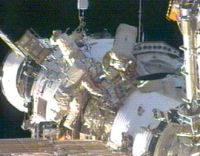
19/8
Wake-up today at 16:00 GMT and bedtime at the normal 21:30 GMT. As noted yesterday, VKD-14 was successful, aside from running out of time to do the last task. Most things are back to normal. Sergei had 2½ hours for troubleshooting the failed Vozdukh CO2 remover while John did the SOZh maintenance. The CDRA had failed but was successfully restarted.
News & reports links
From Novosti Kosmonavtiki news №494:
19/08/2005/09:54 – Spacewalk was completed before the appointed time
Cosmonauts Sergei Krikalyov and John Philips completed work in open space and returned onboard the International Space Station, after shutting transfer hatches. As RIA News reported in TsUP Moscow, the crew returned to the Station before the appointed time, after foregoing fulfillment by one of the tasks: dismantling of an adapter on the main module of Zarya. The reasons for this decision is so far unknown.
According to the data of TsUP, the cosmonauts carried out the following works:
- from the Russian segment of Station was taken one of the containers of equipment “Biorisk-MSN,” panel №3 of MPAC&SEED, and a detachable cassette with the models of different materials was substituted, the human body mannequin (“Mr. Rendo”), prepared in Germany, which was exposed under the conditions of open space from February of past year, was dismantled;
- in the job schedule on the guarantee of docking European automatic cargo spacecraft ATV, the crew established an additional television camera on the end part of the Zvezda service module.
Sergei Krikalyov and John Phillips dismantled scientific gear from the external surface of Station and transferred this into the Pirs section.
In the process of work on the external surface of Station the crew also verified the reliability of fastening equipment “Kromka-3,” and carried out necessary photography.
The time of operation of Sergei Krikalyov and John Phillips in the open outer space was 4 hours 57 minutes. Return to the Station occurred on 18 August at 23:59 UTC (on 19 August at 03:59 MSK).
Russian version, Русская версия: Выход в открытый космос завершился досрочно.
From RIA Novosti:
ISS crew commander to enjoy his birthday dinner
Zhukovsky (Moscow region), August 19 (RIA Novosti) – A Progress spacecraft will deliver to the International Space Station a birthday meal for Commander Sergei Krikalyov, the chief medical officer at the Gagarin Cosmonaut Training Center said at the MAKS 2005 aerospace show Friday.
“Krikalyov, who will turn 47 on August 27, will enjoy and treat his companion John Phillips to a head of Italian cheese Parmigiano, ham and tongue in sauce, which are absolutely new foods in orbit,” Valery Morgun said.
Viktor Dobrovolsky, the director of the Food-Concentrates Industry Research Institute, said Russian food contained no preservatives. He added that 80% of space food was produced at a Russian factory, whereas the other 20% was bought from other reliable suppliers. “Besides the specialized and, believe me, very delicious food that we produce, we order five kinds of instant porridge, several kinds of tea, chocolate and coffee with other manufacturers. But we still produce 80% of space dishes,” he said.
Russian version, Русская версия: Командира МКС на орбите будут баловать итальянским сыром «Пармежан».
20/8
Saturday: off-duty, with the usual 3 hours of uborka, housecleaning. Some final post-VKD cleanup activities for Sergei, then he did the SOZh maintenance. At 07:40 GMT he had private conference with friends at TsUP/Moscow via S- & Ku-band. Weekly planning conference for the crew with TsUP and Houston at 15:20 GMT. The Vozdukh was reactivated (manual mode 5) as was the second dessicant bed of the CDRA (the latter was to be switched off later if the Vozdukh behaved itself).
News & reports links
21/8
Sunday: off-duty. Beginning of Week 18 for the crew. The usual housekeeping tasks and light duties. Sergei did the SOZh maintenance. Teleconference with ISS Program Management. “Later, at ~10:00 a.m./02:00 GMT, Sergei had his weekly PFC (private family conference) via S-band/audio and Ku-band/NetMeeting video (which employs a USB camera at the SSC laptop). [Controllers had to overcome some temporary audio relay problems between Goddard and Sergei’s party at TsUP/Moscow, later also a 5-min. loss of video before the link was re-established satisfactorily.]”
News & reports links
22/8
The workday started with a debriefing with Ground on last week’s spacewalk. Sergei started the regeneration cycle on absorbent bed #1 of the BMP, БМП harmful impurities removal system, and did the SOZh maintenance.
Some outside spacewalk photos are on Page 27 of the Gallery – unfortunately, there are NO photos of Sergei :-(. Not happy.
News & reports links
23/8
First thing this morning for the crew were the periodic Russian biomedical assessments PZEh-MO-7 (calf volume measurement) and PZEh-MO-8 (body mass measurement). Sergei replaced the №2 vacuum valve package (BVK) of the Vozdukh. He and John continued post-VKD tidying-up. Sergei prepared and set up the Russian MO-21 Ecosphera air sampler and incubation equipment for atmospheric microbial air sampling scheduled tomorrow. John did the SOZh maintenance. At 15:45 GMT the crew had an interactive educational PAO event with some schoolkids in Cincinnati, Ohio (don’t you envy these schoolkids?). “At ~17:05 GMT, Sergei Krikalyov sent down a video greeting to the residents of Kazan on the occasion of the 1000th anniversary of this city of the Russian Republic of Tatarstan on 30/8. There will be public festivities, and, as Sergei noted in his message, the crew will see the lights of the millennium celebration on that day.”
Upcoming Progress events:
- 7 September – M-53 Undocking (10:23 GMT)
- 8 September – M-54 Launch (13:08 GMT)
- 10 September – M-54 Docking (14:49 GMT).
News & reports links
24/8
Sergei and John spent 1½ hours doing an emergency training drill for a cabin depressurization, and unpacking cargo from the recent Shuttle visit. Sergei did the SOZh maintenance, and various other tasks and experiments. The Vozdukh CO2 removal system is operating in Mode 5 and appears to be behaving itself.
News & reports links
25/8
Sergei performed some “get-ahead work” on the failed Elektron O2 generator by removing its failed Liquid Unit #7 (BZh-7, БЖ-7) and some other components, in anticipation of the new BZh to be brought up on M-54. He then did a 3-hour audit/inventory of onboard medical items, and loaded a software patch for a Zvezda payload server (BSPN, БСПН) problem. He also did the daily SOZh life support system maintenance.
News & reports links
From Novosti Kosmonavtiki news №496:
25/08/2005/10:38 – The ISS crew will participate in the celebration of the 1000th anniversary of Kazan
The crew of International Space Station will participate in the celebration of the 1000th anniversary of Kazan. As they reported today in Mission Control Center, “the commander of the 11th ISS Basic Expedition, Sergei Krikalyov already prepared video greetings to all inhabitants of the capital of Tatarstana.”
He noted during the period of communication of Krikalyov that he and NASA astronaut John Phillips “intended to observe from the orbit the holiday fireworks in the honor of the millenium of Kazan,” reports ITAR-TASS.
According to the expert, on the ISS there are several powerful cameras, with the aid of which the cosmonauts sometimes even make the photographs of their houses on the Earth.
Russian version, Русская версия: Экипаж МКС примет участие в праздновании 1000-летия Казани.
26/8
The long-delayed task of unloading Progress M-53 cargo was begun. Sergei then had to transfer urine (via pump-and-hose) to two Rodnik tanks in M-53 for disposal. He did some microbial air sampling then inspected the BIO-5 Rasteniya-2 plants growing experiment. John did the SOZh maintenance, then they both undertook the weekly TVIS treadmill inspection. At 17:25 GMT the crew had their 9th weekly teleconference with flight directors from TsUP and Houston.
News & reports links
27/8
С днём рожденья, Сергей! 47!
Saturday: off-duty with the usual 3 hours of уборка, Station-cleaning. “It’s the ISS Commander’s birthday. Born August 27, 1958, in Leningrad/Russia, today St. Peterburg (no “s” in Russian), he’s now looking back at 47 years. On the occasion of his birthday, CDR Krikalyov held two PFCs (private family conferences) today (at ~11:55 & 13:25 GMT), via S-band/audio and Ku-band/NetMeeting video (which employs a USB camera at the SSC laptop).” He made many ham radio contacts around the world, including a very happy Maryam! No respite from chores, however. Sergei did the daily СОЖ maintenance, then checked on the snails experiment and did a 4th session with the biomedical MBI-9 “Pulse” experiment. Weekly planning conference at 15:00 GMT with Houston & TsUP.
News & reports links
From Novosti Kosmonavtiki news №496:
27/08/2005/00:09 – To Sergei Krikalyov – 47 years
To the ship commander of the current expedition at the International Space Station Sergei Krikalyov on Saturday are fulfilled 47 years. The cosmonaut’s birthday will be noted in orbit.
Very recently Krikalyov “made” himself a not bad gift, after becoming record holder on the total duration of space flights. No-one has more time in space than he.
Russian version, Русская версия: Сергею Крикалеву – 47.
28/8
Off-duty Sunday. Sergei did the СОЖ maintenance and the weekly periodic checkup behind Panel 139 in the Service Module (SM) on a fluid connector of the urine collection system, checking for potential moisture, as well as daily inspection of the Растения-2 Plants experiment.
News & reports links
29/8
Week 19 underway for Sergei and John, and approximately 6 weeks to go! (The launch dates were moved back again because of the Shuttle re-grounding.) The crew spent several hours continuing the Progress M-53 cargo transfers and inventorying. Various tasks were carried out; Sergei did the СОЖ maintenance and set up equipment for the crew’s third blood testing session tomorrow (Russian MO-10 “Hematokrit”). At 16:45 GMT the crew had an “an interactive 12-minute TV PAO event with the Oregon Public Broadcasting System and Lewis & Clark College Humanities Scholar Clay Jenkinson.” This again used the new NASA Television Digital Satellite System.
News & reports links
- 29/8 On-Orbit Status Report.
- Space Daily: “ISS Crew Repair Carbon Dioxide Removal System, Prepare For New Supplies”.
Sergei’s birthday and long-duration flight record achievement were today noted on the Russian Federal Space Agency site!!
29/08/2005 Roskosmos congratulates the commander of the ISS Prime Expedition 11, Sergei Krikalyov on his birthday
The commander of the International Space Station (ISS), Sergei Krikalyov, who carries the “watch” in orbit, attained 47 years on Saturday.
The crew of the 11th ISS Expedition, headed by Krikalyov, must return to the Earth on 15 October, 2005. Sergei is the 67th cosmonaut of Russia and 209th cosmonaut of the world.
S. Krikalyov exceeded record in a total quantity of days of a stay in space. His accumulated time comprises more than 750 days.
Sergei Krikalyov was born on 27 August, 1958, in Leningrad, now Saint Petersburg. His parents live there still.
In 1978 he graduated from secondary school, in 1981 after completion of Leningrad mechanical institute to he was appropriated the qualification of engineer mechanics.
After completion of institute he worked in NPO Energiya. Was experienced the equipment, used in space flights, he developed method of operations in space he participated in the work of the ground-based service of control. In 1985, when arose malfunctions at the station Salyut-7, he worked to the group of restoration, developed the methods of docking with the unguided station also of the repair of its onboard systems.
Sergei Krikalyov was selected for the preparation for space flights in 1985, in 1986 he finished the course of basic preparation, and he was, to the period, he was directed to the group along the program of the ship of reusable use Buran. In the beginning of 1988 he began preparation for his first long flight at the beginning of 1988. During April 1990 S. Krikalyov began preparation for his second flight as the member of the duplicating crew for the eighth lasting expedition to the station Mir, which also included 5 space walks in, and work in the course of the week of Soviet-Japanese crew.
During December 1990 S. Krikalyov began preparation for the ninth expedition to the station Mir, which included 5 space walks. Soyuz TM-12 was launched on 19 May, 1991, with commander Anatoliy Artsebarskii, flight engineer Krikalyov and the British astronaut Helen Sharman. After a week, Sharman returned to the Earth with the previous crew, and Krikalyov and Artsebarskii remained on the Mir.
During the summer they carried out six space walks, in this case carried out different experiments and works on the maintenance of the station.
During July 1991 S. Krikalyov agreed to remain at the station Mir as the flight engineer with the following crew (which had to arrive during October), since the following two flights were united into one.
During two flights S. Krikalyov conducted in space more than a year and three months and completed seven space walks.
S. Krikalyov participated in the STS-60 flight, the first American-Russian joint flight aboard the reusable ship. Flight STS-60, which was begun on 3 February, 1994, was the second flight with the module Spacehab (Space Habitation Module) and the first flight with the device WSF (Wake Shield Facility).
After the STS-60 flight, S. Krikalyov returned to his work to Russia. He periodically was in the Johnson Space Center in Houston in order to work in the control center together with the CAPCOM and of personnel for administration in Russia, for the support of joint American-Russian flights. He supported the flights STS-63, STS-71, STS-74 and STS-76.
He is interested in swimming, skiing, cycling and sport aviation, and also by amateur radio contacts, especially from space.
Sergei Krikalyov is married to Terekhina, Elena Yur’evne (b. 1956), who works as an engineer at RKK Energiya. In their family grows a daughter, Ol’ga (b. 1990).
S. Krikalyov was the member of the national aviation commands of Russia and Soviet Union; was the champion of Moscow in 1983; and also of the Soviet Union in 1986. During space flights he was awarded the title “Hero of the Soviet Union,” he is rewarded with the Order of Lenin, is appropriated the French title “Officer of the Legion of Glory” and a new title, “Hero of Russia”. In 1994 he was rewarded with the medal of NASA.
Russian version, Русская версия: 29/08/2005 Роскосмос поздравляет командира 11 основной экспедиции на МКС Сергея Крикалёва с днём рождения
30/8
Third session of Russian MO-10 “Hematokrit” medical blood test sampling for the crew today. Sergei also also took his third MBI-1 “SPRUT-K” test, part of Russian medical research on the distribution and behavior of human body fluids in zero gravity. The main focus of today was 3 hours of emergency evacuation training, using the Soyuz. M-53 cargo transfers were also continued after that. John did the СОЖ maintenance. Two items of interest:
The CDR received the Go by Safety officials to remove the yellow tags from the 18P-delivered SFOGs (solid-fuel oxygen generators, Russian: TGK). [Yellow tags, more formally called “uncertified dual ops tags,” are used to identify (1) items not certified for ISS Operations (certification and/or paperwork not complete prior to launch); (2) items which have IP (International Partner) segment-specific certification (can be used in one IP segment but should not be used in anther IP segment); (3) items that could pose a safety hazard; and (4) items that are broken or expired. Blank yellow tags are flown so hardware can be tagged on-orbit as necessary.]
… The next major crew activity ahead will be the upcoming transition of the onboard PCS (Portable Computer System) laptops to a new software version, R9, and the step-up from the IBM 760XD laptops to the faster ThinkPad A31p NGL (Next Generation Laptop) platforms. In preparation for the transition, scheduled in a couple of weeks, John and Sergei will spend time on Thursday & Friday this week with “ghosting” several hard drives in order to get three A31p laptops loaded and ready to deploy for the transition to R9. The ghosting (“cloning”) activities will be discussed tomorrow in a conference between crew and ground specialists.
News & reports links
- 30/8 On-Orbit Status Report.
- Energiya photo-report: 08/30/2005 Baikonur Cosmodrome.
“The Technical Management meeting took place, which made a decision to fuel Progress M-54 cargo vehicle with propellant components and compressed gases.” - RIA Novosti:
From Novosti Kosmonavtiki news №497:
30/08/2005/17:24 – ISS will not go along the optimized orbit
On 30 August it became known about the fact that the Russian specialists made the decision not to correct the orbit of ISS for the docking with the cargo ship the Progress M-54, which launches at the beginning of September.
About this reported Aleksandr Kireyev, the leader of the service of the ballistic-navigational guarantee of Moscow Mission Control Center. “Usually we conduct the correction of the orbit of the Station in order to optimize phase for the rapprochement with the ship for the purpose of the minimization of the fuel consumption,” he reported. But on the eve of the July launch of the shuttle Discovery, Russian TSUP twice “raised” ISS to a given height. “We conducted the correction of the orbit so as to create optimum conditions for the docking both with the shuttle and with the ‘truck’,” noted Mr. Kireyev.
The Progress M-54 ship , which must launch from Baikonur on 8 September, will deliver to the ISS approximately 2.5 t of assorted cargo, including oxygen, water and food products. Furthermore, to the ISS they will send a spare unit for the defective Elektron oxygen regeneration system. On 7 September the Progress M-53 docked to the Station, together with the accumulated rubbish and used equipment, will be deorbited in the Pacific Ocean. Workers in orbit – Russian Sergei Krikalyov and American John Phillips –will, before the deorbiting, dismantle and transfer from the “truck” to the Station the Kurs equipment for automatic guidance and jointing, which subsequently can be will be used aboard the other spacecraft. The crew ISS-11 will conduct work on the dismantling of Kurs on 31 August, ITAR-TASS reports.
Russian version, Русская версия: МКС не пойдет по оптимизированной орбите.
30/08/2005/13:30 – Progress M-53 will depart for the “spacecraft cemetery”
The rubbish accumulated on the ISS and loaded on the transport ship Progress M-53 on 7 September will be undocked from the Station and during the same day it will be deorbited into the Pacific Ocean, reported the representative of ballistic service at TSUP to RIA News.
The “taking apart” of the Progress “is preliminarily outlined for 14.23 MSK, pulse on the braking to ship will be attached by its own engines into 17.26 MSK,” the splashdown of the “unburned elements of construction (NEP) in the calculated region of Pacific Ocean – for 18.13 MSK,” specified expert.
This ship not will be used as a scientific laboratory, as occurred earlier. Thus, Progress M-51 was unjointed from ISS, but was not immediately deorbited and for ten days it was used not far away from the Station for finalizing of a number of new programs.
The launch of the new space cargo ship to the ISS is planned for 8 September at 17.08 MSK, and its docking with the Station is outlined on 10 September at 18.49 MSK.
Russian version, Русская версия: «Прогресс М-53» отправится на «кладбище космических кораблей».
31/8
Sergei removed the Kurs rendezvous system from Progress M-53 and dismantled it, to be eventually returned on a Shuttle flight and recycled in a future Progress. He and John continued to work on M-53 transfer & loading, in preparation for its undocking next week. Sergei used Russian equipment to do microbal sampling of the Station and air data. He then set up equipment for his third Russian MBI-8 “Profilaktika” (countermeasures) fitness test, followed by several regular chores. John did the СОЖ maintenance.
News & reports links
- 31/8 On-Orbit Status Report.
- Energiya photo-report: 08/31/2005 Baikonur Cosmodrome. “Fueling of the Progress M-54 transport cargo vehicle with propellants and compressed gases was completed.”
September
1/9
“At this morning’s IMMT (ISS Mission Management Team) meeting, our Russian partners expressed sincere condolences and sympathy to the victims of Hurricane Katrina on behalf of RSC-Energiya and Russia and offered assistance.” As well as the regular morning inspection after arising, Sergei also did the monthly inspection of circuit breakers and fuses inside Pirs. He then performed Day 2 of the “Profilaktika” preventative health maintenance fitness tests (this replaced his normal exercise session for today). He and John continued loading rubbish into Progress M-53 in preparation for its undocking next week. Sergei did the daily SOZh, СОЖ Russian life support system maintenance. One of Sergei’s tasks: “Also on his voluntary ‘time available’ task list for today or tomorrow was a checkout of a new A31p laptop, identified as RSE1, for the visiting VC9 crewmember Gregory Olsen. [The checkout was to verify functionality of power supply, laptop lid LEDs, text creation with WordP ad, and opening/reading of a CD and a floppy disk. Afterwards, the RSE1 was to be stowed in the VC9’s sleep Station and the IOMS updated.]”
Upcoming Events (all times EDT):
- 09/07/05 – Progress M-53/18P undocking (6:23 a.m.)
- 09/08/05 – Progress M-54/19P launch (9:08 a.m.)
- 09/10/05 – Progress M-54/19P docking (10:49 a.m.).
19P is manifested to deliver to the ISS the following cargo: 800 kg propellants; 110 kg gas (oxygen/air, thanks to 14 additional gas tanks installed by RSC-Energiya externally for an extra delivery capability of 60 kg O2); 300 kg water; 1230 kg dry cargo, comprising 139 Russian cargo items (including a new Elektron-VM Liquid Unit and 16 SFOG candles) and 83 NASA items (including two IBM 760XD laptops).
- 09/30/05 – Soyuz TMA-7/11S launch (~11:54 p.m.)
- 10/03/05 – Soyuz TMA-7/11S docking (~1:20 a.m.)
- 10/11/05 – Soyuz TMA-6/10S landing (~9:06 p.m.)
- 10/18/05 – ISS Reboost
- 11/18/05 – Soyuz TMA-7/11S relocation (from DC-1 to FGB nadir port)
- 12/21/05 – Progress M-55/20P launch
- 12/23/05 – Progress M-55/20P docking.
News & reports links
- 1/9 On-Orbit Status Report.
- JSC Station Status Report: 1 September.
- NASA: “Progress Bringing Food, Water, Parts, Oxygen to Station”.
- Energiya photo-report: 09/01/2005 Baikonur Cosmodrome. “Progress M-54 fuelled with propellant components and compressed gases was delivered to the Spacecraft Assembly and Testing Facility for final processing operations.”
From Novosti Kosmonavtiki news №497:
01/09/2005/09:46 – On the ISS is carried out training actions in case of decompression
The ISS crew – Sergei Krikalyov and John Phillips – conducted on Tuesday planned training on the organization of urgent descent to the Earth in case of an emergency, which includes finalizing the algorithm of the behavior of cosmonauts in the case of creating the real threat for their life. For this case is provided special evacuation on the rescue spacecraft Soyuz, which is always docked to the Station.
The degree of risk with decompression is different – from the minimum, like the micro-leakage of air through the sealer of illuminator, which already occurred on ISS, to a serious contingency situation, which occurred at the Russian Station Mir, when a Progress cargo ship collided with it.
In the case of detection by the crew of the Station of leakage it is necessary, first of all, to report about this to the Earth. Then it is necessary to insulate the section, where pressure decreases, with the aid of the special instrument to determine the place of leakage, to pump in oxygen and to track further situation, following indications from TSUP, reports RIA News.
Russian version, Русская версия: На МКС проведена тренировка действий на случай разгермецизации.
2/9
News & reports links
Energiya photo-report: 09/02/2005 Baikonur Cosmodrome. “Progress M-54 cargo vehicle was docked with the transfer compartment.”
3/9
Saturday: off-duty and the usual 3 hours of uborka, уборка, housework. Sergei did the SOZh maintenance. He and John reviewed uplinked procedures for next week’s 6-monthly maintenance of the TVIS treadmill (over 2 days). Sergei had several items scheduled for his “time available” task list, including a session of the “Diatomeya” ocean observations program. At 14:00 GMT was the weekly planning conference with both Flight Control centers.
News & reports links
- 3/9 On-Orbit Status Report.
- Energiya photo-report: 09/03/2005 Baikonur Cosmodrome. “Designers’ inspection of the Progress M-54 cargo vehicle was completed in the Spacecraft Assembly and Testing Facility. Payload shroud roll on to the Progress M-54 spacecraft was performed.”
4/9
Sunday: off-duty; beginning of Week 20. Sergei did the periodic checkup behind Panel 139 in Zvezda, and the daily SOZh maintenance. He checked up on the “Rasteniya-2” plants experiment, and did another “Diatomeya” ocean photography session. At 09:30 GMT he had a Private Family Conference scheduled (via S-band/audio and Ku-band/NetMeeting video).
News & reports links
- 4/9 On-Orbit Status Report.
- Energiya photo-report: 09/04/2005 Baikonur Cosmodrome. “Orbital module of the Soyuz-U launch vehicle, containing Progress M-54 spacecraft was transported from the spacecraft processing facility for the general integration with LV.”
5/9
PZEh-MO-7 and MO-8 biomedical assessments this morning. Sergei removed electronics equipment from Progress M-53 to be recycled and completed final preparations for the 8/9 undocking. Sergei did the SOZh maintenance and various tasks. Three greetings downlinked: for actor Kirill Yurievich Lavrov’s 80th birthday; for the upcoming 40th Annual K.E. Tsiolkovsky Research Seminar/Readings at Kaluga; and for the opening of the International Amateur Radio Union Region 1 Conference from Russia, Europe, and Africa.
News & reports links
- 5/9 On-Orbit Status Report.
- Energiya photo-report: 09/05/2005 Baikonur Cosmodrome. “A meeting of the Governmental Commission and the Technical Management was held where a decision was made to roll out the launch vehicle carrying Progress M-54 to the launch pad.”
- Energiya photo-report: 09/05/2005 Baikonur Cosmodrome. “The orbital module was integrated with the Soyuz-U launch vehicle in the processing facility.”
6/9
Final preparations for the undocking of M-53 tomorrow, and closure of hatches. Sergei gave the Motorola-9505 Iridium satellite phone (stored in the TMA-6 Descent Module) its monthly recharging. Sergei performed troubleshooting maintenance on Communications Panel 1 (PA-1) in Zvezda (space-to-ground comm line 1), his weekly Inventory Management System tagup with specialists at TsUP/Moscow, and the daily SOZh maintenance, as well as some Uragan Earth-imaging photography.
News & reports links
- 6/9 On-Orbit Status Report.
- Energiya photo-report: 09/06/2005 Baikonur Cosmodrome. “At 5:00 a.m. Moscow Time, the transporter with the Soyuz-U launch vehicle and the Progress M-54 spacecraft left the Assembly and Testing Facility and arrived to the launch pad for the final pre-launch processing. The Soyuz-U-Progress M-54 system was erected on the launcher. First launch day activities began.”
7/9
Progress M-53 undocked at 10:26 GMT, did its deorbit burn at 13:26 and burned up in the atmosphere at 14:13. Sergei took digital photos from Zvezda window #26, and “also used the event for conducting a test of the Klest KL-154 television camera with video recording on the LIV experimental video complex (EVK) in the SM (which uses SECAM format).” Today’s other main focus was beginning the 2-day 6-monthly overhaul of the TVIS treadmill. Sergei had the usual small tasks to do, including the daily SOZh maintenance.
News & reports links
8/9
Progress M-54 launched perfectly at 13:07 UTC. Cabin air analysis day for Sergei and John, as well as the remaining TVIS treadmill maintenance session. Sergei did the daily SOZh maintenance and some fire alarm maintenance in Pirs.
News & reports links
- 8/9 On-Orbit Status Report.
- JSC Station Status Report: 8 September.
- Energiya photo-report: 09/08/2005 Baikonur Cosmodrome. “At 17:07:54 Moscow Time the Soyuz-U/Progress M-54 Rocket and Space Complex was launched from Baikonur cosmodrome. The launch objective is to deliver necessary cargoes to the International Space Station (ISS) to continue operation of the Orbital Complex and create habitation and working conditions for the crew under the ISS Mission Program and the Russian Side’s commitments under the ISS Project.”
- Spaceflight Now.com: “Space station cargo craft launched by Soyuz rocket”.
9/9
For the Progress docking tomorrow, Sergei and John did the standard 3-hour TORU teleoperator system simulator training (which provides a manual backup to the automated docking). Sergei configured the communications systems for covering the docking, then did the SOZh maintenance, as well as various small tasks (Uragan Earth photography, etc.). Weekly teleconference at 13:50 GMT with TsUP and Houston lead flight directors, then with the JSC Astronaut Office (Kent Rominger) at 15:25 GMT.
News & reports links
10/9
News & reports links
- JSC Station Status Report: 10 September.
- Space.com: “Space Station Crew Welcomes Fresh Cargo Ship”. (Site author’s exasperated note to reporters: it is Progress M-54 NOT Progress 19!!!! Kindly use the correct designation!!!! See Chris Van Den Berg’s ISS COMM 038 for comments on this.)
11/9
Sunday, but no rest day due to yesterday’s arrival of M-54 (rest day tomorrow). Beginning of Week 21. All the fun of unpacking the Progress and seeing what surprise “goodies” are inside. John did the SOZh maintenance while Sergei completed several regular tasks (including “Uragan” [hurricane] Earth-imaging and “Diatomeya” ocean observations).
Sergei responded in writing to emailed and uplinked questions of an Italian journalist, Patrizia Giongo, for the renowned weekly science magazine Newton. [“Which planet would you like to visit and would you accept to hibernate in order to get there, considering the long trip?”] – Newton magazine link (in Italian).
News & reports links
12/9
Crew wakeup at the usual 06:00 GMT. Sergei initiated the regeneration cycle on absorbent bed #1 of the Russian harmful impurities removal system (BMP, БМП) and did the SOZh maintenace and associated tasks. At 14:10 GMT the crew had their weekly planning conference with the Ground. “In the SM Sergei participated in a conference with TsUP/Moscow and the Russian scientific research ship Cosmonaut Viktor Patsaev (KVP) via VHF radio on Daily Orbit 3 (DO3). [A comm test between SM, Soyuz-216/10S and the KVP on VHF-2 (very high frequency #2) channel and the Soyuz SA-2 link was performed back in May (5/20) by Krikalyov.]” Also, computer software upgrades this week: ““The first day of the three-day transitioning of the onboard PCS (Portable Computer System) A31p laptops to the new R9 software version was successfully completed by the ground, without crew involvement. Tomorrow, crew support will be required.”
News & reports links
- 12/9 On-Orbit Status Report.
- MSNBC.com Cosmic Log: “Hams in Space”.
From Novosti Kosmonavtiki news №499:
12/09/2005/17:29 – To ISS crew gave the output
Working from April at the International Space Station Sergei Krikalyov and John Phillips in Monday rested today instead of Saturday, when they assumed in orbit the cargo ship Progress. As reported the official representative of Moscow Mission Control Center (TSUP) Valerii lyndin, “to the crew they today gave leave, and on Tuesday after dinner they will begin to unload the Progress M-54, which successfully was docked to ISS on Saturday.”
The “truck” delivered to the Station approximately 2.5 tons of different cargo, necessary for the subsistence of the ISS: fuel, water, oxygen, products and different equipment. Furthermore, with the aid of the Progress, at the Station they renewed the set of the Penguin loading suits, which make it possible “to drive away” the excess growth of cosmonauts after a prolonged stay in weightlessness. Food products, and also clothing, films and another “spiritual food” loaded onboard the “truck” are intended mainly for the reliefs of Krikalyov and Phillips – Valerii Tokarev and William McArthur – who must arrive in orbit on 3 October. Today they, together with the third space tourist Gregory Olsen, who will return to the Earth together with Krikalyov and Phillips, complete the two-day examination training at Zvyozdnii Gorodok (Star City). An interdepartmental commission will affirm the results of the examinations of crew ISS-12 and their understudies on Tuesday. ITAR-TASS reports about this.
Russian version, Русская версия: Экипажу МКС дали выходной.
13/9
Sergei continued working in Progress M-54, integrating its systems into the Russian Segment, and he and John later continued cargo transfers. He did the SOZh maintenance. “At ~11:05 GMT, Krikalyov downlinked a PAO message of greetings and congratulations to the attendees of the RMA Award Ceremony, to be held by MTV Russia on 9/21 on Vassilievski Drive near the Kremlin. [The ceremony will be attended by the best foreign and domestic performers, and the awards will be presented by representatives of the Russian elite of writers, musicians, athletes, and other prominent figures. Sergei’s videotaped downlink will congratulate the winners in five categories, from a list of names uplinked yesterday.]”
News & reports links
14/9
Progress cargo unloading continued. Sergei dismantled the Matryoshka payload system in preparation for its return to Earth. Sergei began “bake-out” (regeneration) of the #2 adsorbent bed of the BMP harmful impurities removal system, and did the SOZh maintenance. Tomorrow he attempts to reactivate the Elektron after installing the BZh-8 Liquid Unit. (Wish him luck!)
News & reports links
- 14/9 On-Orbit Status Report.
- Energiya press release: September 14, 2005 Korolev, Moscow Area. “At Korolev Rocket and Space Corporation Energiya under the chairmanship of Corporation President, General Designer N.N. Sevastianov took place the next session of the Board of Chief Designers on the Russian Segment of the International Space Station (ISS).”
Energiya photo-report. - Newton.corriere.it: “Record spaziale per Serghiei Krikalyov, l’uomo delle stelle” (in Italian).
15/9
Sergei and John at last began the repair of the Elektron today! They installed Liquid Unit #8 (BZh-8), but the planned activation was postponed until Monday 19/9 due to non-availability of Molniya satellite coverage. Sergei removed and replaced the SRV-K2M, СРВ-К2М condensate water processor’s BRPK, БРПК liquid/air separator which had reached its service life limit (450 liters min.). Sergei also completed Russian water and condensate quality sampling with the KAV, КАВ water sampler, and did the SOZh maintenance.
News & reports links
From Novosti Kosmonavtiki news №500:
15/09/2005/11:07 – The ISS crew will not be protected from the magnetic storm
For the present crew of the International Space Station (ISS) – Sergei Krikalyov and John Phillips – no special measures will be provided for additional protection from the 9-scale-number magnetic storm approaching the Earth, caused by a solar flare, transfers RIA News. The official representative of Mission Control Center (TSUP) in Moscow, Korolev – Valerii Lyndin – reported this on Thursday.
Russian version, Русская версия: Экипаж МКС не будет защищаться от магнитной бури.
16/9
Sergei performed another change-out of Zvezda’s condensate water processor (SRV-K2M) system, today replacing the BKV water conditioning unit’s purification column (BKBKV) with a new spare. He did some air sampling and collected monthly readings for the “Pille-MKS” radiation dosimetry experiment in the Russian segment, as well as the daily SOZh maintenance. Progress cargo unloading continued. At 15:30 GMT the crew had their 11th weekly conference with the TsUP and Houston Lead Flight Directors, via U.S. S-band/audio.
News & reports links
19/9
Week 22 underway. The Elektron was reactivated this morning and so far has been running normally (fingers crossed!). Sergei & John performed another session of the periodic Russian biomedical assessments PZEh-MO-7 (calf volume measurement) and PZEh-MO-8 (body mass measurement). Sergei later had his second orthostatic (hemodynamic) endurance assessment session with the Russian Chibis suit (Russian MO-4). Some minor maintenance tasks for the crew; they also began to prepare their equipment for the return to Earth on 11 October. Sergei did the SOZh maintenance, and set up equipment for his second session with the European “Neurocog” experiment, conducted tomorrow.
News & reports links
- 19/9 On-Orbit Status Report.
- Space.com: “ISS Oxygen Generator Functioning in Backup Mode”.
- Space Daily: “ISS Crew Reactivate A Fixed Elektron Oxygen-Generation System”.
From Novosti Kosmonavtiki news №501:
19/09/2005/16:17 – The ISS crew began “to pack trunks”
The crew of the International Space Station began “to pack trunks” and to prepare for their return to the Earth. “Working in orbit from April, Sergei Krikalyov and John Phillips today begin the preparation of equipment and personal effects for their return to Earth,” said Valerii Lyndin, the official representative of Moscow Mission Control Center (TSUP).
The cosmonauts must pack their things into special containers and secure these in the Soyuz TMA ship attached to the Station, on which the crew must return to the Earth on 11 October. From today the daily regime of the crew has changed. “The regime of the work of cosmonauts was reduced by 1 hour, in which Krikalyov and Phillips will now carry out additional physical exercises,” described Valerii Bogomolov, the deputy director of the Institute of Biomedical Problems Russian Academy of Science.
In particular, according to him, Krikalyov, the ISS-11 commander, “must run twice a day, mastering the necessary habits for the return to the Earth.” A specific routine of preparation for the descent is already developed for the crew, which the cosmonauts will begin to carry out in three weeks to the landing, Bogomolov explained. At present Krikalyov and Phillips “are in good physical shape,” the TSUP medical group noted.
The reliefs of the ISS-11 crew – Valerii Tokarev and William MacArthur – on the eve of the launch in Baikonur, where for them one must “fit” ship Soyuz TMA. On it the crew ISS-12 must leave for orbit on 1 October. Together with Tokarev and MacArthur on ISS with the 10-day mission of visit will fly the third space tourist, Gregory Olsen. The docking of the Soyuz with the Station is planned for the 3 October. ITAR-TASS reports about this.
Russian version, Русская версия: Экипаж МКС начал «паковать чемоданы».
20/9
Sergei collected a fluid sample from the SRVK-2M condensate water processor. He conducted his second session with the European “Neurocog” experiment. Later, in Zvezda he removed two bolts and a cross section element from behind the closeout panel 425 in the SM and repaired a damaged section of isolation in the cable network (BKS, БКС) from the condensate water processor control panel (PURV-K, ПУРВ-К). Both Sergei and John continued to ready their equipment and personal effects for return to Earth on 11/10. John did the SOZh maintenance, while Sergei was to do some photography for Russia’s Environmental Safety Agency (ECON).
News & reports links
From Novosti Kosmonavtiki news №501:
20/09/2005/15:37 – The Elektron works in the normal mode
The fitness for work of the Elektron oxygen regeneration system in the Russian segment of International Space Station is restored. Station commander Sergei Krikalyov installed a new liquid block (BZH) in the Elektron, delivered to orbit by the cargo ship Progress M-54, and from 19 September the system functions in the normal mode. The press-service of the Moscow Mission Control Center reports about this.
Russian version, Русская версия: «Электрон» работает в штатном режиме.
From TsUP:
Elektron works in the normal mode
20 September 2005, the MCC-M Press-Service.
The fitness for work of the Elektron oxygen regeneration system in the Russian segment of the International Space Station is restored. ISS commander Sergei Krikalyov installed in the Elektron a new liquid block (BZH), delivered in orbit by the Progress M-54 cargo ship, and from 19 September the system functions in the normal mode.
Troubles in the functioning of the Elektron were noted by specialists even in the past year, when the system refused airtight block BZH, which contains electrolyzer for the decomposition of water into oxygen and hydrogen. Several times cosmonauts produced its replacement, but the system of the regeneration of oxygen on board the Station worked unstably and periodically it went out of order.
On the ISS there are three regular systems of the guarantee of cosmonauts with oxygen. Besides Elektron, these are the solid-propellant generators of oxygen (the so-called oxygen cartridges), which release oxygen as a result of chemical reaction, and also the reserves of oxygen in the tanks, which are delivered to the station by Progress cargo ships.
Russian version, Русская версия: «Электрон» работает в штатном режиме.
21/9
Houston MCC shut down at 19:00 GMT because of the threat from Hurricane Rita, moving ISS monitoring to the Houston Support Group at TsUP in Moscow. Day 2 of renal (kidney) stone experiment session, which involved the not-fun task of the crew collecting urine samples throughout the day. Sergei continued obtaining water samples from the Russian segment for return to Earth on TMA-6. He and John conducted their second fit check of the Kazbek-U seats in the Soyuz. John did the SOZh maintenance.
News & reports links
22/9
Note: no On-Orbit Reports for a few days because of pesky Hurricane Rita (MCC Houston has been evacuated).
News & reports links
- 22/9 On-Orbit Status Report.
- Energiya photo-report: September 22, 2005 Baikonur Cosmodrome. “Preparation of Russian transport spacecraft Soyuz TMA-7 with Expedition-12 (ISS-12) prime crew and a space flight participant of visiting crew (VC-9) for launch to the International Space Station is continued.”
23/9
News & reports links
Energiya photo-report: September 23, 2005 Baikonur Cosmodrome. “Fueling of the Soyuz TMA-7 transport spacecraft with propellants and compressed gases is under way.”
From Novosti Kosmonavtiki news №502:
23/09/2005/10:43 – The ISS cosmonauts begin to prepare their bodies for Terrestrial gravity
Today Sergei Krikalyov and John Phillips conduct the first training in the Chibis (“Lapwing”) pneumo-vacuum suit, in which is created the flow of the blood to the lower part of the body due to a drop in the barometric pressure and thus it imitates the Earth’s gravity, reported the official representative of Moscow Mission Control Center Valerii Lyndin to ITAR- TASS.
The cosmonauts began the three-week stage of the physical training, which makes it possible to be better prepared for the forthcoming landing on 11 October,” explained Valerii Bogomolov, deputy director of the Institute of Biomedical Problems RAN (Russian Academy of science).
The final cycle includes, in particular, twice-daily training on the treadmill and the cancellation of exercises on the veloergometer (stationary bicycle).
“In the final stage of flight crews in the required order carry out a series of trainings in the Chibis, where is achieved the effect of terrestrial gravity by the creation of negative pressure on the lower part of the body,” described the leader of the TSUP medical group, Irina Alferova, to an ITAR-TASS correspondent.
According to her, during three weeks the cosmonauts “stand” in the airtight adaptation 4 times on 20 minutes, and during the preceding two days before the descent to the Earth the sessions of “artificial gravity” increase to 55 minutes.
In this case the physicians continuously measure the frequency of pulse and the arterial pressure of cosmonauts, noted Alferova.
“For half a year’s stay in weightlessness the muscles atrophy; therefore the bodies of cosmonauts must be previously prepared for the adaptation to the terrestrial conditions,” emphasized the leader of the TSUP medical group. Besides training in the Chibis, in the two weeks to the return home the ISS crews begin to assume special food additives, and directly to the day of descent – salt solutions in order to avoid the dehydration of their bodies during landing, added Alferova.
Russian version, Русская версия: Космонавты МКС начали готовить свои организмы к земной гравитации.
23/09/2005/10:38 – The crew of Basic Expedition 11 on the ISS carries out scientific studies and experiments
The duration of Basic Expedition 11 on ISS will be 175 days. In this time it is planned for the crew to conduct 39 experiments: from them – 35 experiments during the work of the previous expeditions and 4 experiments are new. Of interest from the point of view of applied science: a study of natural resources and ecological monitoring, geophysical and biomedical studies, and also the study of the problem of space power systems and engine installations.
In addition to this is restored the fitness for work of the Elektron oxygen regeneration system in the Russian segment of the International Space Station. spaceship commander Sergei Krikalyov installed in the Elektron a new liquid block (BZh, БЖ), delivered in orbit by the cargo ship Progress M-54, and from19 September the system functions in the normal mode.
Until today in the job schedule of the Expedition 11 crew conducting the completely new “SVS” experiment – the self-propagating high-temperature synthesis in space. Crew will transfer from TKG in the Service Module necessary equipment and will install it. Further – 4 sessions of experiment on the synthesis of inorganic materials and final procedures.
– the Roskosmos press-service.
Russian version, Русская версия: Экипаж 11 основной экспедиции на МКС проводит научные исследования и эксперименты.
From RIA Novosti:
ISS-11 crew to spend 175 days in space
16:27 | 23/09/2005
MOSCOW, September 23 (RIA Novosti) – Expedition 11 crewmembers aboard the International Space Station will have spent 175 days in space by the time they complete their mission October 11, Russia’s Federal Space Agency said Friday.
Agency spokesman Konstantin Kreidenko said that since boarding the station in April, crew Commander Sergei Krikalyov and NASA Science Officer and Flight Engineer John Phillips have conducted 39 experiments, including in ecology, geophysics, biomedicine and power engineering, and have repaired an oxygen regenerating system.
The Expedition 12 crew, comprised of Russian cosmonaut Valeri Tokarev and NASA astronaut William McArthur, heads for the ISS aboard a Soyuz rocket on October 1 (September 30, GET). Space tourist Gregory Olsen will fly to the ISS together with the Expedition 12 crew and return with members of Expedition 11.
Russian version, Русская версия: Длительность 11-й основной экспедиции на МКС составит 175 суток.
24/9
News & reports links
- NASA HQ ISS Status Report: 24 September.
- Energiya photo-report: September 24, 2005 Baikonur Cosmodrome. “Transport vehicle Soyuz TMA-7 loaded with propellants and compressed gases was delivered to the Spacecraft Assembly and Testing Facility for final processing operations. This day the vehicle was docked with the transfer compartment.”
- Space Daily: “Moscow Takes The Helm Of ISS Control”.
25/9
News & reports links
Energiya photo-report: September 25, 2005 Baikonur Cosmodrome. “Designers’ inspection of the Soyuz TMA-7 spacecraft was completed. Payload shroud roll on to the spacecraft was performed.”
26/9
Hurricane Rita passed with only minor damage to Houston MCC, so transition is continuing back to control from there. Launch of TMA-7 is set for 1 October at 15:54 UTC. After breakfast Sergei Krikalyov began his first session of the standard 24-hour recording of his ECG (electrocardiogram) under the Russian MedOps MO-2 protocol. He & John later worked in the Soyuz TMA-6 vehicle, dismantling the Kurs-A rendezvous and approach radar system of its SUDN motion control & navigation system and removing it from the crew transport ship, a three-hour job. These valuable components will be returned to Earth for reuse. They also took their third periodic on-orbit hearing assessment test. Sergei continued water sampling.
News & reports links
27/9
Week 23 underway for the crew. Early in the morning, before breakfast and first exercise, CDR Sergei Krikalyov and FE/SO Dr. John Phillips completed their fifth session with the Russian crew health-monitoring program’s medical assessment MO-9/Biochemical Urinalysis. Krikalyov completed his current session of the scheduled 24-hour recording of his ECG (electrocardiogram) under the Russian MedOps MO-2 protocol. The crew set up equipment for a session in the lower-body negative-pressure Chibis suit, and also familiarized themselves with Visiting Crewmember Greg Olsen’s planned science program (Sergei is assigned 5 hours to assist him). John did the SOZh maintenance. “At ~13:05 GMT, Sergei participated in an interactive PAO interview session with Tatyana Dragnysh, deputy editor of the glossy Russian journal Rossiysky Kosmos. [Rossiysky Kosmos is a full-color magazine, to be issued every two months starting in October 2005. It is supported by the Russian Federal Space Agency (FKA), the ‘Restart’ publishing firm, and several other enterprises, including TsNIIMash. The first issue will contain official Roskosmos articles, an interview with FKA Chief A. Perminov, CDR Krikalyov’s interview and much information about the history of cosmonautics, analytical articles, rare photos and important interviews.]”
News & reports links
- 27/9 On-Orbit Status Report.
- Energiya photo-reports:
- September 27, 2005 Baikonur Cosmodrome. “The Soyuz TMA-7 prime and backup crews inspected the transport spacecraft in its launch configuration in the Assembly and Testing Facility. Additionally the crews had a consultation on the kits of equipment that are to be delivered to and returned from orbit on-board Soyuz TMA spacecraft.”
- September 27, 2005 Baikonur Cosmodrome “Orbital module of the Soyuz-FG launch vehicle, containing Soyuz TMA-7 spacecraft was transported from the Spacecraft Assembly and Testing Facility to the Launch Vehicle Assembly and Testing Facility for integration.”
28/9
Sergei completed two pre-return medical tests (MBI-4, МБИ-4 & MBI-8). He set up work stations for Greg Olsen’s experiments in the Russian segment. He worked on the BIO-5 Rasteniya-2 (“Plants-2”) experiment and conducted a health check and downlink of noise level readings with the “Shumomer,” «Шумомер» sound level meter. He and John cleaned gunk out of the U.S. segment modules’ (Unity & Destiny) ventilation ducts & filters. “At ~20:20 GMT, the CDR set up the Russian TV equipment and then downlinked a joint a 20-min. message of greetings to the Presidium (Viktor G. Shevchenko) and members of the Security, Defense, and Law Enforcement Academy in Moscow.”
News & reports links
JAXA: Astronaut Soichi Noguchi Press Conference. “You can sense that someone is actually living in the Service Module. It is not just a spaceship or a place to set up equipment for experiments. It’s a place for human habitation. They have a dining table, and the STS-114 crew was invited over several times for meals. All nine of us got around the table and spent time talking. There is a private room for the Expedition Crew. The room was decorated with photos of cosmonaut Krikalyov’s family, his daughter and letters. It had a tiny window and you could see the Earth through it. It was like visiting someone’s home.”
29/9
Sergei & John supported a TsUP checkout of the TMA-6 SUD motion control system. Sergei performed Part 2 of his second onboard Profilaktika (MBI-8) preventive health maintenance fitness test, then set up equipment for and conducted the Pilot (MBI-15) flying simulation biomedical test. “At ~12:50 GMT, the CDR downlinked a video message with greetings to the participants of the opening ceremony of Space Week in Korea on 10/4, partly in Korean. [An Nyong Ha Sae Yo! Chook Ha Nam Ni Da! Hello! Congratulations or best wishes. The ISS crew welcomes the people of Korea to the space community and wishes for the success of this year’s 2005 World Space Week Festival.] The crew also sent down an address of greetings to students on the opening of the First Conference for Educational Science and its contest Experiment in Space. [The conference will open on 10/7 at the Moscow Palace for creative work of the youth and is partly sponsored by RSC-Energiya. The best projects resulting from the contest will be recommend ed for implementation in space.]” RSC Energiya reported the ISS Russian segment ready to receive Expedition 12.
News & reports links
- 29/9 On-Orbit Status Report.
- Energiya photo-report: September 29, 2005 Baikonur Cosmodrome. “At 5:00 a.m. Moscow Time, the transporter with the Soyuz-FG launch vehicle and the Soyuz TMA-7 transport spacecraft left the Assembly and Testing Facility and arrived to the launch pad for the final pre-launch processing. The Soyuz-FG-Soyuz TMA-7 system was erected on the launcher. First launch day activities began.”
- Space.com: “Space Station Astronauts Prepare for Crew Change”.
30/9
Sergei did the regular early morning inspection after awakening, followed by the monthly inspection of fuses and circuit-breakers in Pirs. He performed part 3 of the MBI-8 Profilaktika (“countermeasures”) fitness assessment series. He and John conducted the periodic air sampling in the cabin. Sergei replenished the Elektron’s water supply, used for electrolyis (separating oxygen and water). They did fit checks of their Kentavr anti-g suit garments, worn during descent. Sergei did the daily SOZh maintenace and Inventory Management System delta/update file. He and John were scheduled for their 12th weekly conference with TsUP and Houston Lead Flight Directors. The crew will sleep-shift for the Soyuz docking and transition period.
News & reports links
- 30/9 On-Orbit Status Report.
- JSC Station Status Report: 30 September (2).
- JSC Station Status Report: 30 September.
- Energiya photo-report: September 30, 2005 Baikonur Cosmodrome. “A meeting of the State Board was held at which the Soyuz TMA-7 and ISS-12 prime and backup crews were approved, as well as a decision was made to continue the Soyuz-FG/Soyuz TMA-7 rocket & space complex processing for filling and launch within the scheduled time – on October 1, 2005, at 7:54 a.m. Moscow time.”
- ARISS-Europe: “Sergei Krikalyov sends greetings to IARU Region 1 general conference”. (Thanks to Maryam for link!) (Screenshot of video message, 40 KB.)
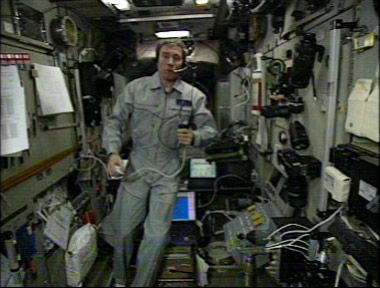
October
The first week of October was Sergei and John’s last week in orbit.
1/10
Saturday; off-duty, except for the usual chores and 3 hours of уборка, housework. Soyuz TMA-7 launched flawlessly on time early this morning at 03:54:53 GMT with the replacement crew of Expedition 12, and space flight participant Greg Olsen (who will return with Sergei & John). Docking is set for 05:32 GMT on 3 October. Sergei completed a 55-minute session in the Chibis lower-body negative-pressure suit, assisted by John, and a fifth session with the biomedical MBI-9 “Pulse” experiment, as well as the SOZh maintenance.
At 03:15 GMT, Sergei conducted a live TV interview with Peter Tolstoy, an anchorman of the Voskresnoye Vremya (Sunday Times) Show on Moscow’s Channel One, responding to a number of questions uplinked beforehand. [Q: “Here, on Earth, there is a lot of talk about noodles and camcorders that the Japanese are sending to you. What do you think about this up there in space?” A: “This is the second time that the Russian Segment of the ISS is getting a Japanese Hi-Def camcorder. The first occasion was when a similar camcorder was used for a year and a half by the Third, Fourth, and Fifth Expeditions. Scenes of Russian cosmonauts living at the Space Station which were recorded by the first HDTV camcorder were shown all over Japan. Today, Japan is one of our most reliable and steadfast partners. We have effective cooperation; run interesting experiments at the ISS developed by Japanese specialists. For HDTV camcorders, the crucial question is the CCD matrix degradation rate. Initially, we together with Valerii Tokarev will be the first to test the camcorder at the ISS, while overall it will be used at the ISS for at least a year. And yes, indeed, I will be eating noodles and the scene will be taped on the Hi-Def camcorder. Besides that, we will shoot the Earth through the window and will demonstrate the effects of zero gravity at the Station. During shooting, I will be the actor while Valerii Tokarev is going to be the cameraman.”]
News & reports links
2/10
Sunday; filled with activities for the upcoming TMA-7 docking. A short day for Sergei and John as they went to bed at 17:00 rather than 21:30 GMT, and woke up at 01:30 rather than 06:00 GMT. Sleep time tomorrow was to be at 19:30. Station day hours will be 07:30-11:00 GMT for the rest of the transition period. Sergei did the SOZh maintenance and “At 12:10 GMT, Sergei Krikalyov had his weekly PFC (private family conference) via S-band/audio and Ku-band/NetMeeting video.”
News & reports links
3/10
Week 24 for Expedition 11. Tonight Expedition 11 completes 172 days in space (170 aboard ISS), with seven days to go. Soyuz TMA-7 docked at 05:27 GMT; hatches opened at ~08:13 GMT. The incoming crew were greeted with traditional bread-and-salt. Sergei transferred the TMA-7 payload container and experiments to the ISS (tracked with the Inventory Management System). He powered down the Elektron O2 generator (reactivate on 6/10). The crews did the mandatory emergency evacuation drill, then began handover activities. “FE-12 Valerii Tokarev swapped out Greg Olsen’s IELK, ИЕЛК (individual equipment & liner kit, Russian: USIL) between the two Soyuz vehicles, TMA-6 & TMA-7, including the tailored Sokol spacesuit after its dryout, and installed Olsen’s personal seat liner in his couch in TMA-6. He also relocated the ISS Emergency Book from the TMA-7 spacecraft into the TMA-6 vehicle. [A crewmember is not considered transferred until her/his IELK, AMP (ambulatory medical pack) and ALSP (advanced life support pack) drug kit are transferred. After today’s installation of the VC-9 IELK, Olsen is now considered TMA-6 crew, and Expedition 12 has technically begun its residence aboard ISS.]”
News & reports links
- 3/10 On-Orbit Status Report.
- JSC Station Status Report: 3 October.
- NASA TV images: Expedition 12 enter the ISS; Expedition 12 welcome; Expedition 12 welcome (MSNBC.com).
- MSNBC.com: “Space station crew welcomes new arrivals”.
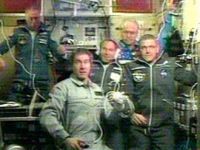
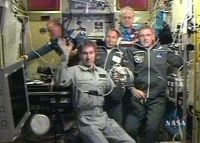
4/10
A busy day as handovers continue. “Day 2 of joint Exp.11/Exp.12 operations. Week 24 of Increment 11. Day 173 days in space (171 aboard ISS) for Expedition 11, with 6 days to go. Also: Day 2510 since first ISS launch (FGB/Zarya), and 1797 days of cumulative crew time aboard ISS.” Sergei and Valerii worked on Soyuz activities, then Valerii watched as Sergei serviced the Russian BMP, БМП harmful impurities removal system. They then completed part 2 of the BIO-10 “Intercellular Interaction” experiment. Sergei set up the AVR High Resolution Equipment at Zvezda window #9 and took some Earth photos, checked airflow sensors in the Russian segment and did the SOZh maintenance as a demonstration to the incoming crew. “At ~17:20 GMT, all five crewmembers participated in a live interactive TV news conference with U.S. and Russian media assembled at NASA Centers and TsUP/Moscow, via U.S. assets (Ku-band with S/G2) from the Lab module. [Of the 26 minutes time slot, 14 min were for U.S. med ia and 12 min. for Russian media. This was another in-flight event utilizing the new NASA multi-channel television digital satellite system. Due to the signal encoding and decoding required, the new digital satellite system has a 4-second audio delay between ISS and ground reception, and vice versa, for which the crew is prepared.]”
News & reports links
- 4/10 On-Orbit Status Report.
- NASA TV image: Expedition 11 & 12 press conference (Greg Olsen has the microphone). (MSNBC.com)
- MSNBC.com: “Space millionaire says the trip is worth it”. “Phillips said he can’t wait to devour ‘a hot steaming pizza and a big cold mug of beer,’ once he’s back on Earth. Krikalyov said a good cup of coffee, and fresh fruit and vegetables, sound good to him.”
- Space.com: “New Crew, Space Tourist Settle into ISS”. “Krikalyov added that he looked forward to once again savoring his coffee’s aroma in a mug, rather than merely drinking it out of a plastic bag as he does aboard the space station. ‘So nothing fancy, maybe simple stuff … we’re missing regular, normal Earth food,’ Krikalyov added.”
- Sci.space.station: Great ISS story.
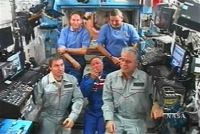
TsUP news release:
The joint flight continues
4 October, 2005. The MCC-M press-service.
The second day on board the International Space Station (ISS) work together Sergei Krikalyov, John Phillips, Valerii Tokarev, William McArthur and Gregory Olsen.
The transfer of change between the crews of the eleventh and twelfth basic expeditions and the execution of the program of scientific studies continues in accordance with the selected flight plan.
Today Valerii Tokarev is scheduled to prepare work equipment for conducting the biotechnological experiments “Bioekologiya” and “Conjugation,” and Gregory Olsen will conduct photography of the Earth’s surface and will carry out an experiment on the study of species composition of the microorganisms which dwell on the ISS.
At the end of the workday an onboard press conference with the crews for the accredited journalists will take place. The beginning of the press conference is at 21 hours 22 minutes Moscow time.
According to the results of radiocommunications and the data of telemetry, at the orbital Station everything is in order.
Russian version, Русская версия: Совместный полет продолжается.
5/10
5 days to go for Expedition 11. The day was occupied by handover activities. Valerii serviced the Russian BMP harmful impurities removal system, observed by Sergei (the Elektron is to be switched on tomorrow). Sergei completed the first part of his final training session with the Chibis lower-body negative pressure suit. Sergei also spent some time assisting Greg Olsen with various activities (a medical heart function test and some filming activities, as well as a ham radio exchange with Greg’s old school). Sergei also did the SOZh maintenance and some other tasks.
News & reports links
6/10
Another busy day of handovers. Sergei checked the temperature of the BIO-12 “Regeneration” experiment. “In a special demo/commercial called SCN (Space Cup Noodles) for Japanese industry, the ‘taxi’ visitor heated two packs of noodles in the water heater, then ate the ball-shaped noodles before the backdrop of the Service Module (SM) starboard crew cabin window. The carefully scripted scenes were filmed by CDR Krikalyov with the Japanese Sony HVR-Z1J high-definition camcorder, after a rehearsal of the script.” Sergei & Valerii conducted a new experiment called NOA (Nitric Oxide Analyzer) for VC-9. Sergei unstowed the Matryoshka-R “Phantom” hardware and disassembled it for transfer to Soyuz TMA-6 and return to Earth (recording the procedure with the Nikon D1X). He & Valerii checked the airflow sensors in the Russian segment. Sergei helped Greg with more video footage.”
At ~10:00 GMT, the crew conducted a live TV conference with the Russian Federation Prime Minister, Mikhail Efimovich Fradkov. [The Prime Minister, who had held high Government positions during the 90’s and served as Chairman of the Board and General Director of an insurance company from 1998-1999, again became a Government official in 1999 and was appointed to his present position in March 2004. The teleconference was rescheduled by Fradkov such that a temporary ISS attitude change to XPOP required by the earlier time was not necessary after all. During the morning IMMT (ISS Mission Management Team) meeting, Moscow extended thanks to NASA/Houston flight controllers for their extensive support in planning for this event.]
At 18:30, the two Expedition crews engaged in a live TV exchange with two US media, today with the Houston Chronicle (Mark Carreau) and SPACE.COM (Tariq Malik).
News & reports links
- 6/10 On-Orbit Status Report.
- Space.com: “Space Station Crew Change Going Well, Astronauts Say”. “Every bit of new science hardware and space station construction is vital to human exploration of space, Krikalyov said. ‘Our[space] station construction is the biggest technical experiment … where we learn how to build the space station and how to create something different,’ Krikalyov said. ‘I think this experiment is still going, and going well.’”
7/10
176 days in space (174 aboard ISS) for Expedition 11, with 3 days to go. A day filled with handover activities. Sergei prepared the current BIO-5 Rasteniya-2 (“Plants-2”) experiment for return to Earth. He filmed Greg Olsen again for the Japanese “Space Cup Noodles” demo/commercial and later provided assistance for photography. “Krikalyov, Tokarev and Olsen had several hours reserved for scheduled commemorative (Russian: ‘symbolic’) activity, a standard tradition for visiting guests and departing expedition crewmembers, usually consisting of signing and stamping envelopes and imaging other memorabilia. [VC9 items to be returned for Greg are on-orbit-stamped postcards, photos, wine labels, flags, cap, a book prototype, a T-shirt and other items. The crew also hand stamped non-Olsen envelopes that originally arrived with Progress 10P and in a kit for Roskosmos. The symbolic activities were photographed and videotaped with the Nikon D1X and Sony DSR PD-150P.] Both crews completed their scheduled exercise (the first for ISS-12); Greg was not assigned any. Valerii did the SOZh maintenance. At 13:20 GMT, Sergei assisted Greg with another ham radio session. The Elektron O2 generator was successfully reactivated yesterday.
News & reports links
From Novosti Kosmonavtiki news №505:
07/10/2005/13:58 – In the capital the first open conference “Experiment in Space” took place
On Friday, in the Moscow urban palace of children’s (youthful) creation on Vorobyevs mountains took place the first open practical-scientific conference “experiment in space,” transfers RIA News. Participants in the conference were greeted from onboard the International Space Station (ISS) by airman-cosmonaut Sergei Krikalyov.
Within the framework of conference the competition of schoolboys to the best project of experiment into space is passed. “To its participants it is proposed to try their forces in the development of research designs, including the creation of model, the actually acting instruments and systems for conducting of studies in space, to participate in development and conducting of experiments on board ISS or transport spacecraft,” they reported the manager by the sector of the promising space programs of palace Boris Pshenichner.
The competition winners will obtain the possibility to conduct the modification of projects and their preparation for the realization under the management of scientists and specialists.
The schoolboys arrived with their ideas to the competition from the Voronezh, Chelyabinsk, and Kaluga provinces, Korolev, Khimok and other municipal and Russia regions. The idea and defending of the projects will be continued to the end of the day.
“The program is calculated for a prolonged time, work with the schools constantly is conducted. Competition will go also subsequently,” added Pshenichner.
Russian version, Русская версия: В столице прошла первая открытая конференция «Эксперимент в космосе».
8/10
Day 6 of joint crew operations; 2 days left for Expedition 11. More handover activities, with scheduled activities done jointly so the incoming crew could learn from the outgoing. Sergei completed the first part of his final 1.5-hour training session in the Chibis ODNT, ОДНТ lower-body negative-pressure suit. In the TMA-6 he dismantled and removed a temperature sensor commutator for eventual return on the Shuttle and recycling. Expedition 11 and Greg Olsen had 3 hours scheduled for a Soyuz descent training exercise. Sergei transferred equipment to be returned in the Soyuz Descent Module. He and Valerii recharged the Motorola-9505 Iridium satellite phone to be carried on TMA-6 descent. Sergei did more filming of Greg Olsen for the Japanese noodles commercial. The change-of-command ceremony was to take place at 18:55 GMT.
News & reports links
From Novosti Kosmonavtiki news №505:
08/10/2005/00:01 – The ISS crew gathered the “space radish” harvest, but TsUP will not allow them to eat it
The ISS Russian segment today for one hour became an orbital “post office,” and then the season of the collection of the harvest from the space vegetable-garden began at the Station. As Valerii Lyndin, the official representative of Mission Control Center, described: “two Russians – Sergei Krikalyov and Valerii Tokarev in the company with the third space tourist Gregory Olsen (the businessman from the USA) will sign and carry out” the special stamping of “several ten space envelopes” for an hour.
In the program of NASA astronauts John Phillips and William McArthur, this so-called symbolic activity is not scheduled, they explained at TsUP. Together with the crew of the 11th permanent expedition and Olsen, philatelic souvenirs from the orbit will be returned to the Earth on 11 October. Part of them will, according to tradition, be displayed in the Rocket-Space Corporation Energiya museum, and the Museum of Russian Cosmonautics.
Today the ISS-11 commander Krikalyov gathers the long-awaited harvest of the second generation of space radish, reported Igor Podolskiy, the chief scientific worker of the Institute of Biomedical Problems (IMBP) of the RAN (Russian Academy of Science). “In truth, space farmer Krikalyov will not be able to try the fruits of his labor in the Lada onboard installation. Judging by the photographs, he grew the fifth-sixth of the root-crops of the second vegetation and furthermore we officially do not recommend to cosmonauts the eating of the vegetables grown in orbit,” the scientist noted.
“Before giving official permission to the tasting, we still should conduct much more work on a study of the influence of space on the plants,” explained Podolskiy. Nevertheless, he continued, the ISS-5 crew, at their own risk, tried the “mizuna” lettuce grown in orbit, and nothing happened to the cosmonauts.
Krikalyov will pack the orbital radish into small packets with a special gel and will take them back to Earth, where they will be thoroughly investigated by scientists. The “conducted on ISS experiment” plant “will make it possible to create hothouses, which will ensure the necessary biomass for the crews of future interplanetary vehicles,” they noted in IMBP. ITAR-TASS reports about this.
Russian version, Русская версия: Экипаж МКС собрал урожай «космической» редиски, но есть ее ЦУП не разрешил.
9/10
Day 7 of joint crew operations, with 1 day to go for ISS-11. Handover activities continued. Sergei completed the last part of his final 1.5-hour training session in the Chibis lower-body negative-pressure suit, to prepare his body for return to gravity. He then continued transferring equipment to Soyuz TMA-6 for return home (in the Descent Module). He aided Greg Olsen with some Earth photography. “After yesterday’s traditional Change-of-Command ceremony, today at ~18:50 and ~19:10 GMT, CDR Krikalyov and FE-12 Tokarev will sign the formal ISS Russian segment (RS) Handover Act, certifying RS handover/acceptance as specified in the RPS (handover) book, proper transfer of emergency procedures documents, and a list of cargo items stowed on Progress-354/19P for deorbit.”
News & reports links
From Novosti Kosmonavtiki news №505:
09/10/2005/18:41 – On the ISS it is a rest day and the routine of the crew’s activity is changed
On the ISS it is a rest day and the work routine of the joint crew is changed. As they reported in Mission Control Center, in the old residents of the station of Sergei Krikalyov and John Phillips, and also their reliefs Valerii Tokarev and William McArthur will awake today one-and-a-half hours later than usual – at 11:30 Moscow Summer Time (MSK), and to sleep they will also retire 90 minutes earlier – at 24:00 MSK.
The regime changes concern the space tourist – the 60-year-old USA businessman Gregory Olsen, they noted in TsUP. “For the cosmonauts, it is necessary to gather their strength before the critical undocking operation of the Soyuz TMA-6, aboard which Krikalyov and Phillips will return to the Earth, who have worked in orbit already more than 177 days, and also Olsen, who arrived on the ISS last Monday,” they explained in TsUP. “The ship, according to the timeline, must be undocked from the ISS at 01:49 MSK on 11 October and after five orbits land on the Kazakhstan steppe,” said expert.
In spite of this, orbital activities have been abolished – during the shift change it is stressed important each hour and furthermore to the returning themselves to the Earth after a half-year flight, it is necessary for the cosmonauts to complete the preparation of their bodies for terrestrial gravity. “For this, Krikalyov and Phillips will today be conducting sequential training in the Chibis pneumo-vacuum suit, in which, due to a drop in barometric pressure, is created the flow of the blood to the lower part of the body and thus is imitated the Earth’s gravity,” reported the TsUP Medical Group. “After a long stay in weightlessness muscles atrophy; therefore besides training in the Chibis, two weeks prior to the return home the ISS crews begin to use special food additives, and directly on the day of descent – salt solutions in order to avoid the dehydration of their bodies during landing,” said an expert. These procedures are not provided for 60-year-old Olsen – he stayed on ISS for only 6 days, they noted in TsUP, nevertheless, they will today study the third space tourist.
ITAR-TASS Reports About This.
Russian version, Русская версия: На МКС отменены выходные и изменен режим работы экипажа.
09/10/2005/11:01 – On the ISS the crew was replaced
On the night of Sunday 9 October, the crew was replaced on the ISS. Russian Sergei Krikalyov and American John Philips, who worked in orbit from April, transferred command to Valerii Tokarev and American to William McArthur.
The functions of the commander of ISS were transferred from Krikalyov to NASA astronaut McArthur. Tokarev will fulfill the responsibilities of flight engineer.
The mission of Valerii Tokarev and William McArthur will be prolonged for half a year. In this time they must conduct fifty experiments.
As television network NTV reports, on the solemn occasion Krikalyov transferred to his relief the flight log, and wished to introduce there numerous interesting records.
The new commander, William McArthur, thanked his associates and he named the honor to accept Station command from Sergei Krikalyov. According to McArthur, the work conducted by the crew was worthy of deep respect.
The crew of the 11th basic expedition will leave to the Earth on 11 October.
Together with them will return home the space tourist Gregory Olsen, who paid 20 million dollars for a week’s stay on the ISS.
Russian version, Русская версия: На МКС сменился экипаж.
10/10
Final day of joint crew operations. Crew wakeup time was shifted forward again to 17:00 GMT to accommodate the undocking and post-undocking activities. Much final packing and preparations. “With Soyuz TMA-6 no longer available as emergency CRV (crew return vehicle) for the coming Increment, Krikalyov ensured correct transfer of its three Emergency Procedures ODF (DAS EhP) books to the new CRV, Soyuz TMA-7, currently at the DC1 port (will be transposed to FGB nadir port on 11/18).” Greg Olsen entered TMA-6 at ~13:30 GMT, then the crew activated the spacecraft. Goodbye handshakes at ~14:44 officially ended Expedition 11’s tenure. Hatches were closed at ~14:45, then 60 minutes of leak checks followed.
News & reports links
- 10/10 On-Orbit Status Report.
- JSC Station Status Report: 10 October.
- New Scientist Space.com: “Record-breaking cosmonaut set for return”.
What will the Soyuz TMA-6/10S crew (Exp. 11 + Gregory Olsen) experience during today’s reentry/descent?
For the reentry, all crewmembers are wearing the Russian Kentavr anti-G suit. [The Kentavr garment is a protective anti-g suit ensemble to facilitate the return of a long-duration crewmember into the Earth gravity. Consisting of shorts, gaiters, underpants, jersey and socks, it acts as countermeasure for circulatory disturbance, prevents crewmember from overloading during descent and increases orthostatic tolerance during post-flight adaptation. Russian crewmembers are also advised to ingest fluid-electrolyte additives, viz., three sodium chloride tablets during breakfast and after the midday meal, each time with 300 ml of fluid, and two pills during the meal aboard Soyuz before deorbit.]
Before descent
Special attention will be paid to the need for careful donning of the medical belt with sensors and securing tight contact between sensors and body.
During preparation for descent, before atmosphere reentry, crewmembers settle down comfortably in the Kazbek couches, fasten the belts, securing tight contact between body and the seat liner in the couch.
During de-orbit
Dust particles starting to sink in the Descent Module (DM) cabin is the first indication of atmosphere reentry and beginning of G-load effect. From that time on, special attention is required as the loads increase rapidly.
Under G-load effect during atmosphere re-entry the crew expects the following experience: Sensation of G-load pressure on the body, burden in the body, labored breathing and speech. These are normal sensations, and the advice is to “take them coolly”. In case of the feeling of a lump in the throat, this is no cause to “be nervous”. This is frequent and should not be fought. Best is to “try not to swallow and talk at this moment”. Crew should check vision and, if any disturbances occur, create additional tension of abdominal pressure and leg muscles (strain abdomen by pulling in), in addition to the Kentavr anti-G suit.
During deployment of pilot (0.62 & 4.5 square meters), drogue (16 sq.m.) and main (518 sq.m.) parachutes the impact accelerations will be perceived as a “strong snatch”. No reason to become concerned about this but one should be prepared that during the parachutes deployment and change (“rehook”) of prime parachute to symmetrical suspension, swinging and spinning motion of the DM occurs, which involves vestibular (middle ear) irritations.
It is important to tighten restrain system to fasten pelvis and pectoral arch. Vestibular irritation can occur in the form of different referred sensations such as vertigo, hyperhidrosis, postural illusions, general discomfort and nausea. To prevent vestibular irritation the crew should “limit head movement and eyes movement,” as well as fix their sight on motionless objects.
Just before the landing (softened by six small rocket engines behind the heat shield): Crew will be prepared for the vehicle impact with the ground, with their bodies fixed along the surface of the seat liner in advance. “Special attention should be paid to arm fixation to avoid the elbow and hand squat” (instruction). Landing speed: ~9.9 m/sec.
After landing
Crew should not get up quickly from their seats to leave the DM. They were advised to stay in the couch for several minutes and only then stand up. In doing that, they should limit head and eyes movement and avoid excessive motions, proceeding slowly. They and their body should not take up Earth gravity in the upright position too quickly.
An interview with Sergei on the second-last day of his mission, by cosmonaut Yurii Baturin at Novaya Gazeta.ru (a tidied-up Babelfish translation):
The Fellow Countryman
Space wanderer Sergei Krikalyov tomorrow comes back to the Earth which he left for the longest term.
This modest, laconic cosmonaut behind a back not only space lines and work by the Soviet, Russian and American ships. He has observed Terrestrial cataclysms from space – natural, such as Hurricane “Rita” recently, or political, such as the disintegration of the USSR in 1991.
Sergei Konstantinovich Krikalyov – a person of the sky. The master of sports of the international class on sports planes. A participant in the international competitions. A European and world champion. A combination of engineering talent and piloting ability has naturally resulted in a space career for him.
He became a cosmonaut candidate almost twenty years ago, on November 10th, 1985. After the general space preparation, he prepared under the program Buran then it so happened that it was necessary at once, without duplication, having replaced an ill colleague, to launch as part of the basic crew to work at station Mir as the flight engineer. Within two years he again returned there and completed his half-year shift, but the program of flights had changed, and he had to remain and continue the mission with the new commander. He is the first of the Russian cosmonauts, having passed a full rate of preparation under the American program, to fly on the American Shuttle as a mission specialist. In a few years he again flew on the Shuttle, beginning the assembly of the International space station (ISS), and was the first Russian to stay on board.
And now the sixth flight of cosmonaut Krikalyov comes to an end. In August he surpassed a record of his colleague Sergei Avdeev on total operation time in space – 748 days. Tomorrow he comes back to the Earth. His total for today: 803 days!
With Sergei KRIKALEV working in an orbit, shortly before his returning to the Earth our observer, cosmonaut Yurii Baturin talks.
Q: You have executed five space flights and are finishing the sixth. And if to recollect the very first, with what feelings did you have at launch?
A: To me was entrusted “to close a gap in the program,” and I would not like to disappoint those who taught me and believed that I was able to do it.
Q: After the general space preparation, you prepared under the Buran program. Do you regret, that you did not fly on our shuttle, or has the U.S. Shuttle closed this theme?
A: I regret, that Buran has not gone as the program. It is possible to argue, whether Buran was economically justified and expedient in general, but that has occurred to this program, was not exact effective. To spend it is so much resources on creation of unique system and then it to not use at all?
The Shuttle has not closed a theme, but has given me new experience.
Q: In 1994 you, the first of the Russian cosmonauts, flew on the American Shuttle. How do you estimate the ships of this class – they have made the business and can leave? It is not a pity?
A: The end sooner or later comes to all. And it does not mean, that them it is not a pity. Simply it is time to put new problems and to solve their new means. The same and about the Soyuz ship.
Q: Now to the ISS. By then, as you prepared for two years under the program of the basic expedition, an off-schedule flight is suddenly appointed and you became a member of crew of the Shuttle to which operations on assembly ISS have been charged. As if a time machine had delivered you there even before the first expedition. The opportunity to glance in the future was interesting?
A: It was interesting to see all from the very beginning. And it was still important to apply the knowledge received in preparation on station for the last years, already in real flight.
Q: How much strongly does the present expedition differ from the first on ISS and from the very first – your flight on Mir?
A: All flights are different. And personal impressions are different. In general, to me has carried to observe of astronautics from within during enough long time. To observe not simply separate fragments, and dynamics. It is as a living organism: something develops, something degrades. There are new problems and priorities … are displaced.
Q: Remember, how we on March, 26th, 1991 in Houston saw off on direct translation Mir in five days after your returning with ISS?
A: Certainly, I remember. It is all our history … And with personal sensations …
Q: We will talk more in detail about personal sensations. Whether you can name the destiny happy?
A: Probably, I can. I managed to make much that would be desirable. It was possible to fly and in long flights, and in short. It was possible to work both at Mir, and on ISS. It was possible to work outside of station in a free space. It was possible to fly on Shuttle and completely to familiarize with system of preparation of cosmonauts in Houston. It was possible to fly on higher inclination and to see it is little bit more, than it is visible from a board of stations. But the most important – both on the Earth, and in space was possible to work with many present professionals who love and well do the business.
Q: In June, 1991 general designer Yu.P. Simeon has suggested you to remain onboard and to continue flight with the new commander, Alexander Volkov, till March of next year. As in a song about atlantov: “… Are put once, and change has not come”. Such situations happened in history of astronautics when it was necessary to remain. Peter Klimuk and Vitaly Sevastyanov on Salyut-4 during experimental flight Apollo-Soyuz. Later Sergei Avdeev. What sensations when “change has not come”?
A: Imagine the sensations of the sportsman to whom, during the middle of a distance, is informed that the distance is now twice longer. And it absolutely other sensations than when at once you are adjusted for long work. Already half of forces is spent, and it is necessary to change a rhythm that the remained half to stretch on an interval of time, three times greater.
Q: During your second flight (1991) there was a putsch. From onboard, what was clearly and not clearly occurring on Earth?
A: It was clear, that it is revolution, and it was clear, that it not for ever. But here that we at all did not expect, so that “revolution” has appeared so frivolous.
Q: And there was a disintegration of the USSR. How did you learn about it? Whether the feeling of loss of the country in space is terrible?
A: I had no feelings of loss of the country. There was no sensation, that this was all serious. As though someone plays renamings and titles. For the one who works in a floor or on “first aid,” the circle of daily duties and cares does not vary that write in newspapers. We in this sense too were “in a floor”.
Q: You are a Hero of Russia. And a Hero of the Soviet Union. Whom do yourself feel – as more a Soviet or Russian hero?
A: Probably, here it is impossible to judge. Titles are external attributes. And the sensation is internal. I simply did the business and in one conditions, and then – in others.
Q: You won plane and glider sports, and now have become the owner of a space record, having accepted “the vest of the leader” from Sergei Avdeev. His achievement remained for six years, so important for those who is engaged in rather safe increase in duration of work in space …
A: Space ways are inscrutable, though all orbits are calculated and known. I shall remind you, that I already spent 15 months on the Mir station, having finished the second flight, and Sergei Avdeev then just prepared to to the first. And here he already for a long time has established a record of stay in space, has finished a long career and some years on pension, and I have just now approached to the same duration. So, probably, I have accumulated such flight experience not because I often fly. Simply, I am engaged in it for a long time.
Q: And still. You lived in space longest in the world. Changed ships. Came back and again departed. Such a space wanderer. Would it be desirable to continue?
A: It would be desirable to do more. Duration for me has no great value. And if I was required to do something new where the experience accumulated in the previous programs would be useful, I shall depart again with pleasure.
Q: Soft landing and many meetings!
A: Thanks from all the crew. And to the readers of Novaya Gazeta, and to everyone who watches our work.
Yurii Baturin, and Novaya Gazeta observer, 10/10/2005.
Russian version, Русская версия: «Космический странник Сергей Крикалев завтра возвращается на Землю, которую покидал на самый долгий срок».
Photo of Sergei at Star City, before departure (36 KB).
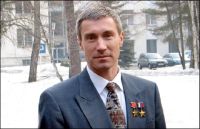
11/10
First day alone for Expedition 12. Soyuz TMA-6 landed safely early today with Expedition 11 & Greg Olsen aboard.
Soyuz TMA-6/10S, carrying the Expedition 11 crew plus SFP VC9 Gregory Olsen, landed successfully last night at 9:09pm EDT in Kazakhstan, with the crew in excellent condition. Recovery forces spotted the descent capsule on its main parachute ten minutes earlier and arrived at the landing site without delay. The crew was then flown to the city of Arkalyk for the regular program of suit doffing and medical checkups. Later, Sergei, John and Gregory and their RKA/NASA welcome escorts returned to Star City by RKA airplane. [Earlier in the day, ISS/Soyuz hatches were closed at ~14:45 GMT, followed by a slightly delayed undocking at 17:49 (instead of 5:43). Soyuz TMA-7/11S remains at the station as new CRV (crew return vehicle). During their mission, Sergei Krikalyov and John Phillips racked up 179 d 23 m in space (liftoff to landing) and ~177 d aboard ISS. Olsen’s “tourist” trip lasted 9d 21h 15m.]
Final stats on E11/E12 handovers completed during the joint period tally up as follows:
- CDR-11 Krikalyov: functional 1:50h; dedicated 7:30h;
- FE-11 Phillips: functional 13:35h; dedicated 14:10h;
- CDR-12 McArthur: functional 13:40h; dedicated 14:10h;
- FE-12 Tokarev: functional 3:00h; dedicated 7:45h.
Undocking timeline via Spaceflight Now.com.
| Time | Event |
|---|---|
| 1853 GMT (2:53 p.m. EDT) | The departing crew members have boarded the Soyuz spacecraft in preparation for today’s undocking from the International Space Station. The hatchway between the capsule and the station’s Zarya module was closed at 2:48 p.m. EDT.
Commander Sergei Krikalyov will be taking the center seat in the Soyuz, flanked by flight engineer John Phillips in the left seat and tourist Greg Olsen in the right seat. The undocking is coming up at 5:45 p.m. EDT. |
| 2125 GMT (5:25 p.m. EDT) | Everything is set for undocking, just under 20 minutes from now. The crew has donned and pressurized the Sokol spacesuits. Latches on the station-side of the docking mechanism have been opened. Flight controllers are not reporting any problems are clocks tick down to the departure of Expedition 11 from the station. |
| 2135 GMT (5:35 p.m. EDT) | Commander Sergei Krikalyov will undock the Soyuz manually – instead of in automatic mode with the onboard computer in charge – as a precautionary measure to conserve energy due to concerns with the capsule’s backup battery. The manual mode reduces the amount of time the Soyuz is on internal power before undocking, NASA says. |
| 2140 GMT (5:40 p.m. EDT) | The crew is still monitoring pressure readings between modules of the Soyuz with Russian flight controllers. |
| 2144 GMT (5:44 p.m. EDT) | Russian mission control has determined the pressure between the orbital and the descent modules is acceptable, indicating the internal hatch has a good seal. Undocking is expected shortly, just a few minutes behind schedule. |
| 2146 GMT (5:46 p.m. EDT) | The undocking command has been issued. The hooks and latches are opening to release the Soyuz capsule from the space station.
The station’s steering jets are inhibited to prevent any movements during the undocking. |
| 2147 GMT (5:47 p.m. EDT) | The headlight and television camera on the nose of Soyuz have been turned on. |
| 2149 GMT (5:49 p.m. EDT) | Undocking! With a gentle push by springs, the Soyuz TMA-6 spacecraft just undocked from the International Space Station’s Zarya control module while flying over East Asia.
The Russian capsule is bringing the Expedition 11 commander Sergei Krikalyov and flight engineer John Phillips, along with space tourist Greg Olsen, back to Earth this evening. Expedition 11 spent six months living on the station, while Olsen visited for a week. |
| 2152 GMT (5:52 p.m. EDT) | The Soyuz spacecraft has fired its thrusters for about 8 seconds, providing an extra boost in velocity to increase the rate of separation between the capsule and station. Over the two-and-a-half hours, the two craft will drift apart before Soyuz ignites its engines to brake from orbit for re-entry. Landing in Kazakhstan is expected at 9:09 p.m. EDT tonight. |
| 2349 GMT (7:49 p.m. EDT) | Now 30 minutes from ignition of the deorbit burn to bring the Soyuz back into the atmosphere. The spacecraft is flying over the equatorial Pacific Ocean on a southeasterly trajectory that will cross over the lower portion of South America before heading northeast above the Atlantic Ocean and Africa for re-entry. |
| 0012 GMT (8:12 p.m. EDT Mon.) | Soyuz is now passing above the extreme southern part of South America. The deorbit burn is now just 7 minutes away. |
| 0019 GMT (8:19 p.m. EDT Mon.) | Burn ignition! The Russian Soyuz TMA-6 spacecraft has commenced the four-minute deorbit burn. Engines on the capsule’s aft-end are firing to brake from orbit for the plunge back to Earth.
The capsule is flying backward over the southern Atlantic Ocean, just east of South America, on a northeasterly trajectory bound for Africa and eventually Central Asia where landing is expected at 9:09 p.m. EDT in the heart of Kazakhstan. |
| 0021 GMT (8:21 p.m. EDT Mon.) | Now half-way through this braking maneuver that will slow Soyuz by 258 miles per hour to send the craft toward atmospheric re-entry. |
| 0023 GMT (8:23 p.m. EDT Mon.) | BURN COMPLETE! The Soyuz capsule carrying Expedition 11 commander Sergei Krikalyov, flight engineer John Phillips and space tourist Greg Olsen has performed its braking maneuver, committing the craft for the return to Earth. Touchdown in north-central Kazakhstan is expected about 46 minutes from now. |
| 0030 GMT (8:30 p.m. EDT Mon.) | The first wave of recovery helicopters has taken off from the Kazakh town of Arkalyk – the staging site for the landing forces. It is a clear, starry morning there with good visibility and a temperature of 30 degrees F. |
| 0033 GMT (8:33 p.m. EDT Mon.) | Soyuz is crossing the equator over the central Atlantic and nearing Africa on its free fall toward the atmosphere.
In about 10 minutes, computer commands will fire explosives to separate the three Soyuz modules for atmospheric entry. The crew is strapped inside the Descent Module. |
| 0039 GMT (8:39 p.m. EDT Mon.) | Time to touchdown is 30 minutes.
Just above the first traces of the Earth’s atmosphere, computers will command the separation of the three modules of the Soyuz vehicle. With the crew strapped in to the Descent Module, the forward Orbital Module containing the docking mechanism and rendezvous antennas and the rear Instrumentation/Propulsion Module, which houses the engines and avionics, will pyrotechnically separate and burn up in the atmosphere. The Descent Module’s computers will orient the capsule with its ablative heat shield pointing forward to repel the buildup of heat as it plunges into the atmosphere. The crew will feel the first effects of gravity in six months at the point called Entry Interface, when the module is about 400,000 feet above the Earth, about three minutes after module separation. |
| 0044 GMT (8:44 p.m. EDT Mon.) | Separation of the Soyuz modules has occurred. The three segments of the Soyuz TMA-6 spacecraft have jettisoned apart, allowing the crew-carrying Descent Module to safely ferry the three men back to Earth. The no-longer-needed Orbital Module and Instrumentation/Propulsion Module are designed to burn up in the atmosphere. |
| 0046 GMT (8:46 p.m. EDT Mon.) | Entry Interface. The Soyuz is now hitting the upper fringes of the atmosphere at an altitude of 400,000 feet. The Expedition 11 crew members are beginning to feel the first tugs of Earth’s gravity after six months in space.
The entry guidance by the spacecraft’s onboard software package is scheduled to start in a couple of minutes. |
| 0049 GMT (8:49 p.m. EDT Mon.) | Twenty minutes to landing. The Soyuz continues its fiery plunge into the atmosphere. |
| 0052 GMT (8:52 p.m. EDT Mon.) | The crew should be feeling the period of maximum G-loads – four or five times normal Earth gravity – during entry. |
| 0053 GMT (8:53 p.m. EDT Mon.) | Recovery forces report they have spotted the Soyuz plasma trail streaking across the western night sky. |
| 0053 GMT (8:53 p.m. EDT Mon.) | The crew reports all is going well aboard the Soyuz. |
| 0054 GMT (8:54 p.m. EDT Mon.) | In the next few seconds, the onboard computers will start a commanded sequence for deployment of the capsule’s parachutes at an altitude of about 10 kilometers. Two “pilot” parachutes are unfurled first, extracting a 24-square-meter drogue parachute. Within 16 seconds, the craft’s fall will slow from 230 meters per second to about 80 m/s.
The parachute deployment creates a gentle spin for the Soyuz as it dangles underneath the drogue chute, assisting in the capsule’s stability in the final minutes before touchdown. |
| 0056 GMT (8:56 p.m. EDT Mon.) | Recovery forces continue to track the Soyuz. The first chute has been deployed. |
| 0057 GMT (8:57 p.m. EDT Mon.) | Once the drogue chute is jettisoned, the main parachute to be deployed. It is connected to the Descent Module by two harnesses, covers an area of about 1,000 square meters and slows descent to 7.2 meters/second.
Initially, the Descent Module will hang underneath the main parachute at a 30-degree angle with respect to the horizon for aerodynamic stability, but the bottommost harness will be severed a few minutes before landing, allowing the Descent Module to hang vertically through touchdown. |
| 0058 GMT (8:58 p.m. EDT Mon.) | Two-way communications between the recovery team and the Soyuz crew have been established. |
| 0101 GMT (9:01 p.m. EDT Mon.) | At an altitude of five kilometers, the module’s heat shield is scheduled to be jettisoned. This is followed by the termination of the aerodynamic spin cycle and the dumping of any residual propellant from the Soyuz. Computers also will arm the module’s seat shock absorbers in preparation for landing.
With the jettisoning of the capsule’s heat shield, the Soyuz altimeter is exposed to the surface of the Earth. Using a reflector system, signals are bounced to the ground from the Soyuz and reflected back, providing the capsule’s computers updated information on altitude and rate of descent. |
| 0105 GMT (9:05 p.m. EDT Mon.) | Mission control says the Soyuz is descending through an altitude of 3000 meters now. |
| 0108 GMT (9:08 p.m. EDT Mon.) | At an altitude of about 12 meters, cockpit displays will tell commander Sergei Krikalyov to prepare for the soft landing engine firing. Just one meter above the surface, and just seconds before touchdown, the six solid propellant engines are fired in a final braking maneuver, enabling the Soyuz to land to complete its mission, settling down at a velocity of about 1.5 meters per second. |
| 0109 GMT (9:09 p.m. EDT Mon.) | Standing by for confirmation from mission control of the Soyuz capsule’s landing. |
| 0110 GMT (9:10 p.m. EDT Mon.) | Touchdown confirmed! The Russian Soyuz TMA-6 capsule has landed in north-central Kazakhstan, capping the six-month voyage of Expedition 11 commander Sergei Krikalyov and flight engineer John Phillips aboard the International Space Station and the 10-day adventure of tourist Greg Olsen. |
| 0112 GMT (9:12 p.m. EDT Mon.) | The recovery forces report they have visual contact with the Soyuz and say the capsule has landed upright. |
| 0117 GMT (9:17 p.m. EDT Mon.) | The Soyuz’s night-time re-entry below the International Space Station provided quite a sight for the Expedition 12 crew now living aboard the orbiting outpost.
“Thanks for the great fireworks show. We had a wonderful view,” the space station’s new commander, Bill McArthur, just radioed Houston. |
| 0119 GMT (9:19 p.m. EDT Mon.) | A recovery team flying aboard a convoy of Russian military helicopters have landed nearby Soyuz to begin assisting the crew out of the capsule. The spacecraft touched down and remained vertical, unlike past missions in which capsules have tipped over. |
| 0120 GMT (9:20 p.m. EDT Mon.) | The landing point is 41 degrees North and 67 degrees East. |
| 0121 GMT (9:21 p.m. EDT Mon.) | A medical tent will be set up near the capsule in which the crew can change out of its launch and entry suits. Russian technicians will open the module’s hatch and begin to remove the crew, one by one. They will be seated in special reclining chairs near the capsule for initial medical tests and to provide an opportunity to begin readapting to Earth’s gravity. |
| 0128 GMT (9:28 p.m. EDT Mon.) | The crew members are now being pulled from the capsule at dawn begins to break over the landing site. |
| 0135 GMT (9:35 p.m. EDT Mon.) | Greg Olsen is enjoying a piece of fruit after exiting the spacecraft. |
| 0137 GMT (9:37 p.m. EDT Mon.) | “I feel great. I can’t wait to walk around and eat some real food and take a shower,” Olsen says. |
| 0145 GMT (9:45 p.m. EDT Mon.) | All three members of the crew are out of the Soyuz and appear to be doing OK now. |
| 0207 GMT (10:07 p.m. EDT Mon.) | A further update from the landing site indicates the Soyuz capsule actually did come to rest on its side.
Post-landing plans call for the crew to be flown from the site in helicopters within two hours of landing. They will be taken to the city of Kustanai for an initial welcoming ceremony. Then a Russian military transport plane will fly the crew to the Gagarin Cosmonaut Training Center in Star City, Russia, where their families will meet them. |
News & reports links
- 11/10 On-Orbit Status Report.
- NASA: “Eleventh Space Station Crew Back on Earth”.
- NASA TV images: Sergei waves as he closes the Soyuz hatch (Space.com); View of the ISS as TMA-6 backs away (MSNBC.com).
- MSNBC.com: “Millionaire, space station crew back on Earth”. (never mind the millionaire, what about Sergei?!)
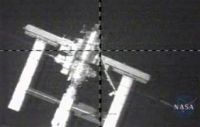
Soyuz spacecraft with ISS crew lands safely in Kazakhstan
RIA Novosti, 09:09 | 11/10/2005
Korolev (Moscow region), October 11 (RIA Novosti) – A Soyuz spacecraft carrying the 11th crew of the International Space Station, and space tourist Gregory Olsen, landed at 5:09 Moscow time (1:09 GMT) at the scheduled recovery area in Kazakhstan, Mission Control reported Tuesday. The commander of the search and rescue team watched the capsule told Mission Control that it had landed safely 57 kilometers southeast of the town of Arkalyk in northern Kazakhstan.
In all, four An-12 airplanes, 17 Mi-8 helicopters, and seven search and rescue vehicles were involved in the operation to locate the capsule.
The members of the 11th ISS expedition, Sergei Krikalyov and John Phillips, returned to Earth after six months in space. Olsen had spent a week on the ISS, pursuing his own research program and taking photos.
Now that the mission is over, for postflight news please return to the News section!
Links
Main sources of information:
- Johnson Space Center: JSC Station Status Reports weekly reports.
- NASA: Daily Expedition Crew Flight Plans in PDF format.
- Novosti Kosmonavtiki: News.
- Spaceref: Daily On-Orbit Status Reports.
- TsUP (in Russian):