Ceremonies
Like pilots and sailors, cosmonauts and astronauts can be superstitious, and various pre- and post-flight rituals have evolved over the decades since Yurii Gagarin’s flight. On this page are described some of the rituals practiced by crews in Russia. Not all the described rituals may be practised for every flight; this is a collection of tidbits and information from various sources.
Preflight
Moscow & Zvyozdniy Gorodok
Before leaving Star City, the Soyuz crew visit the memorial wall on the Cosmonauts’ Avenue outside the Kremlin Wall (behind Lenin’s mausoleum) to lay red carnations (an even number of flowers are chosen for funerals). The ashes of Yurii Gagarin and those of the four cosmonauts who perished during spaceflight accidents are interred here: Vladimir Komarov (Soyuz-1) and Georgii Dobrovol’ski, Vladislav Volkov, and Viktor Patsaev (Soyuz-11).
Another tradition is to sign the Visitors’ Book in Yurii Gagarin’s office. The office is preserved as a museum at Zvyozdniy Gorodok, with everything the way he left it before the fighter jet training flight that ended in his death on 27 March 1968.
On Gagarin’s birthday on 9 March, personnel from Star City visit his home village of Glushino; as do flight crews who are to be launched around that time. The cottage in which he grew up is preserved, and one local tradition is for crews to have a glass of water from the nearby well, thus ensuring their departure into space.
В гидролаборатории ЦПК – новая традиция/There is a new tradition in the TsPK hydrolaboratory
Today, a gala event was held at the TsPK hydrolaboratory in honor of the 45th anniversary of the first dive. In the presence of the Center’s management, cosmonauts, workers and veterans of the hydrolaboratory, the opening ceremony of the ship’s bell took place, with the ring of which every training session will now begin. The first strike was given by Russian cosmonaut Aleksandr Poleshchuk, who, as part of the test and training team, accompanied the dive of cosmonauts V. Lyakhov and V. Ryumin, and veteran of the hydrolab Ivan Verba, whose career in the GL began from the first day of its opening. At that time, Aleksandr Poleshchuk worked at RKK Energiya, developing technologies for extravehicular activities and testing special equipment. (28/12/2023)

A tradition begun in 2023: attending a theater performance at the Chekhov Moscow Art Theater.
Theatrical tradition of cosmonauts – the crew of the 72nd long-term expedition to the ISS visited the Chekhov Moscow Art Theater
On Sunday, participants in the 72nd long-term expedition to the International Space Station, cosmonauts of the Roskosmos State Corporation Aleksei Ovchinin and Ivan Vagner, who will go into orbit in September, according to a new tradition, attended a performance with their families of Chekhov’s play “Three Sisters” at the Moscow Art Theater.
Roskosmos General Director Yuri Borisov watched the production together with the cosmonauts.
The tradition of visiting the Moscow Art Theater before a flight into space was started by the crew of the 70th/71st expeditions to the ISS – Oleg Kononenko and Nikolai Chub.
“We are the second crew that is present here in the theater. I myself am interested in what impression the production will make on me. I go to the theater quite rarely, musical genres are closer to me, but I have to try everything!” said Aleksei Ovchinin before the start of the performance.
After the performance, the artistic director of the Moscow Art Theater, Konstantin Khabenskii, met with guests from Roskosmos with whom they shared their impressions of the production.
Co-operation between the State Corporation and the theater is not limited only to cosmonauts’ trips to the theater in Moscow. Previously, the troupe visited the Baikonur and Vostochniy cosmodromes, where they gave performances for employees of Roskosmos enterprises and escorted cosmonauts to the ISS. In addition, Konstantin Khabenskii and theater artists visited the Cosmonaut Training Center named after Yu.A. Gagarin and the Flight Control Center of the Central Research Institute of Mechanical Engineering, where he talked with Russian cosmonauts working on the ISS.
Baikonur Cosmodrome
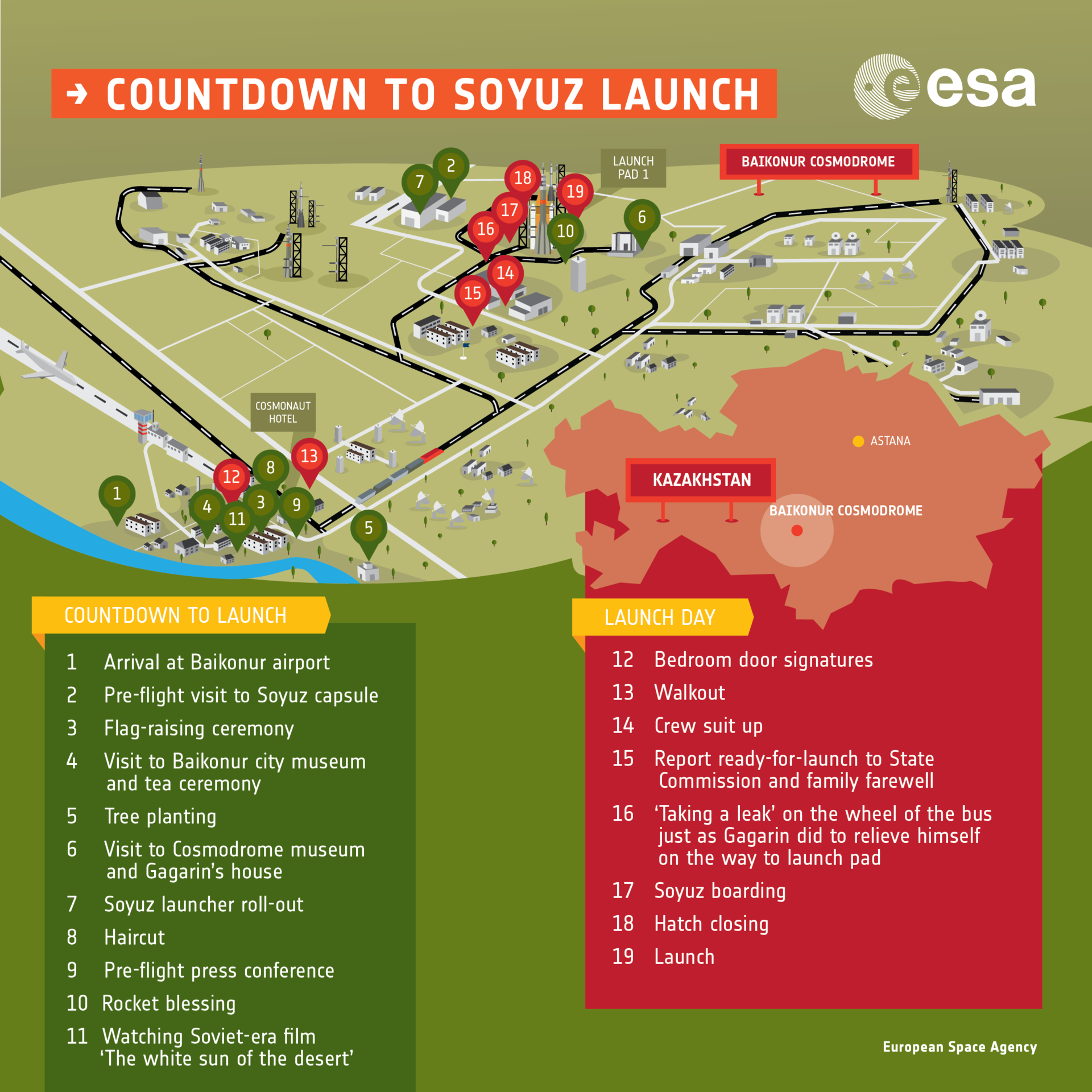
The main and backup crews are transported separately to Baikonur by private jets. A 24/3/2020 TsPK article reports that “To complete the final stage of prelaunch training, the crews were first delivered to Baikonur with new Tu-204-300 (Ту-204-300) aircraft, bearing the names of the first cosmonaut in the world (Yurii Gagarin/«Юрий Гагарин», registered RA-64044) and the general designer of space technology (Sergei Korolyov/«Сергей Королёв», registered RA-64045).”


Roskosmos 28/2/2022: ISS-67 crews in front of the jet Yurii Gagarin; Roskosmos 5/9/2022: ISS-68 crews at Baikonur in front of the jet Sergei Korolyov.
For the duration of their stay at the Baikonur Cosmodrome, the crew reside at the Cosmonaut Hotel. Behind this there is a avenue of trees, each one planted by a cosmonaut who has flown from the Cosmodrome, so the crew take time to walk around here before launch day and take in the sight of the trees, the Syr Darya River and surrounding steppes.
About five days before launch, the crew pay a visit to the space museum at the Cosmodrome, where they sign books, envelopes and mementos. They also participate in a flag-raising ceremony outside the Cosmonaut Hotel, in which each crew member raises the flag of his or her country.
Members of the main crew flying for the first time – Dmitrii Petelin and Frank Rubio – do not forget about the pre-flight traditions and planted seedlings on the Cosmonauts Alley today. Nearby grows a tree of the first cosmonaut of the planet: Yuri Gagarin. It was he who laid the foundation for the tradition of the cosmodrome, when the Cosmonaut Hotel was built in the city of Baikonur (then still Leninsk), and a park was laid out nearby. Since then, the alley has grown every year. (Roskosmos, 15/9/2022)
The Soyuz launch rocket is rolled out exactly 48 hours before launch, at 5 a.m. Moscow time (7 a.m. local time in Kazakhstan). Before rolling out a Soyuz rocket to the launch pad, the personnel and guests put coins on the rails (rockets are transported on the railway) as a good luck charm; these will get thoroughly flattened! The rocket personnel also used to keep an eye on the train for fear of its derailing (the old rails could become rather distorted). It is considered bad luck for the crew to attend the rollout and erection of the Soyuz rocket on the launchpad.
No launches are scheduled on 24 October as two tragic accidents took place on this day:
- 24/10/1960: The explosion of the first R-16 rocket prototype, immediately killing 74 personnel, including Field Marshal Mitrofan Nedelin.
- 24/10/1963: An R-9 rocket being prepared for launch in a silo developed an oxygen leak, and an electrical spark caused a fire that killed seven people and destroyed the silo. The date became known at the cosmodrome as its “Black Day,” and no launches were ever attempted again on that date.
In memory of testers of rocket and space technology
Every year on October 24, Roskosmos, at cosmodromes and enterprises of the rocket and space industry host events dedicated to the memory of testers of rocket and space technology who gave their lives in the name of conquering space.
On October 24, 1960, during preparations for the launch of the first R-16 rocket at Baikonur, an unauthorized start-up of the rocket’s second-stage engine occurred, which resulted in an explosion and fire. Then 57 military and 17 civilian specialists were killed. Among them was Marshal of Artillery Mitrofan Ivanovich Nedelin, the first Commander-in-Chief of the Missile Forces.
On the same day, but three years later, 8 people died in a fire in the R-9A ICBM mine.
By tradition, annually on October 24, no launches are carried out at the Baikonur Cosmodrome, all work with launch vehicles and spacecraft is stopped. And at the mass graves of the testers who died during the accidents, a mourning meeting is being held.
One of the streets of the city of Baikonur was named after M.I. Nedelin, a monument was erected to him, his name was given to the Baikonur Electro-Radio Technical College of Communications. City streets are also named after the victims of the accident, Yevgenii Ostashev and Aleksandr Nosov.
The crew also visit the barber/hairdresser for a trim two days before the launch.
The night before launch, a viewing of the popular 1969 Russian movie White Sun of the Desert («Белое солнце пустыни») the night before launch is compulsory.
Cosmonauts follow many traditions, and one of them is the mandatory viewing of White Sun of the Desert. This film is a manual for training cosmonauts in video filming. This skill is necessary for them to document the flight and various objects in orbit, and White Sun of the Desert is considered the standard of camera work. From this example, cosmonauts are shown how to work with the camera and build a plan when shooting. (Roskosmos)
On the day of launch, the crew sip a glass of champagne each and sign the doors of their rooms at the Hotel. Before they depart the room for the last time, though, they sit down for a few seconds – Посидим на дорожку, posidim na dorozhku, “sit down before the journey” – as is the custom, to calm and focus the mind.
While talking about space Russians avoid saying the word “последний, poslednii” (which means “the last” and is pronounced “paslednii”); this is thought to bring bad luck. Instead they use “крайний, krainii,” which has a synonymous meaning. It’s like saying “final” instead of “last.” For example, they never say “последний полёт гола, poslednii polyot goda” (the last flight of the year), they say “крайний полёт гола, krainii polyot goda,” the last in a series of others.
Alternative explaination for krainii (from “svar45”): this habit came from aviation, and was derived from the Tsar’s Army or Navy. It’s not a “bad luck” thing, just the correct saying in “military style.”
A Soviet-era rock song is played as the crew depart the Hotel: «Трава у Дома», “A Green-Grassed Lawn,” by the band Zemlyane, Земляне (“The Earthlings”).
A Russian Orthodox priest blesses the crew on the steps of the Hotel. This was not practised during the Soviet era, but was begun when cosmonaut Aleksandr Viktorenko requested a blessing for the Soyuz TM-20 crew before their launch to Mir. The launch rocket and the support personnel also are similarly blessed.
As you know, the launch of a spacecraft at Baikonur is preceded by various rituals and traditions. Since 1994, the tradition of consecrating and sprinkling rockets with holy water has been added to them. Then Aleksandr Viktorenko, commander of the crew departing for the Mir station, asked the priest to bless the Expedition members and bless the rocket.
In the city there is the Orthodox Church of the Holy Great Martyr George the Victorious, it was opened in 1992 for the fiftieth anniversary of the city. There is a priest who is invited before launching rockets. The entrance to the temple is open to everyone. On the pre-launch days, the crew of the main and backup teams, as well as guests from other countries, take blessings here. (Cosmotours Telegram post, 6/4/2023)


The two buses (the «Звёздный городок»/Zvyozdnyi Gorodok, purple exterior, and the «Байконур»/Baikonur, blue exterior) that take the cosmonauts and attendants to the launchpad are each affixed with horseshoes. It is a 40-minute bus ride to the MIK OK building at Site 254 where the cosmonauts will be suited up (and which was intended for processing Buran orbiters in the Soviet era).
The inside of the bus is also interesting: it is in the Star Trek style, and I mean the original series. The main space is taken up by eight Captain Kirk seats in two rows. Next to each is a console with the space suit ventilation pipes and on the top of it a fascinating anachronism: cup holders, which, as far as I remember, had not been invented until the ’80s. In the back of the bus there is an elaborate entertainment system that plays elevator music. The control console looks impressive and complicated until you realize that they are just the switches for all the lights and power connectors on the bus.
– Charles Simonyi, blog entry for 27 March 2007 [Blog no longer online]


Energiya, 5/9/2022: Crews (main and backup) of Soyuz MS-22 arrived at Baikonur and are transported to their hotel by the buses Baikonur and Zvyozdniy Gorodok, and another view of the buses for ISS-70/71 on 29/8/2023 (Roskosmos).

The previous older model of buses, the Zvyozdnyi Gorodok had blue stripes – glimpsed in the 2001 photo above (Energiya 21/10/2001, departure of Visiting Crew-2) – and the Baikonur had yellow stripes.
On the way, the buses make a quick stop so the male cosmonauts can get out and perform the sacred anointing of the bus tyres! Yurii Gagarin apparently had to “take a leak” during the bus drive to the launch pad, so every cosmonaut since then has had to do it, too (near the left back wheel of the bus, to be precise). (Russian phrase for this – so-named by the cosmonauts – is “Поссать на колесо,” possat’ na koleso.)
Ladies also may take part if they wish. From Anousheh Ansari’s (TMA-9) blog entry, Hello World: “The next tradition was the short stop of the bus for the boys to take a leak ;-) This also apparently started with Gagarin and still goes on … Fortunately, I was excused from this exercise and was able to just mentally participate.” Apparently, though, Claudie Haigneré did participate on her second flight – I read somewhere that the method is to take a small vial of one’s own urine.
From a 12/4/2023 interview with actress Yulia Peresild:
Peresild: I always thought that theater and cinema people are the most confused on this topic, but it turned out that cosmonauts are a real storehouse of superstitions. Did not expect. The number of traditions beyond the bounds! And most importantly, everything had to be done. In a strictly mandatory manner. You can’t retreat or break. Otherwise shoot!
TASS: For example?
Peresild: You must have heard about the fact that before the flight you must certainly pee on the wheel of the bus carrying to the launch pad.
TASS: By the way, how did you do it?
Peresild: Prepared in advance. I peed, excuse me, in a jar, and twenty minutes before entering the rocket I sprinkled the wheel.
TASS: What other rituals?
“Sit on Korolyov’s bench near his house …. The commander should be the last to enter the ship …. However, this is also due to technological necessity: he sits in the central chair, and if he enters first, it will be impossible to squeeze through either to the right or to the left.
Permission must be obtained before the launch. It was ordered to me by Konstantin Ernst and Sergei Romanov, First Deputy General Designer of RKK Energiya. But Sergei Yuriievich intelligently succumbed from behind, and Konstantin Lvovich moved in such a way that he thought the coccyx would break. Really applied. From the heart! Then, when we had already arrived, she told him: “Do you know why we didn’t dock in automatic mode? After your pendel, there were no options left – only manually ….”
After meeting with various dignitaries, the cosmonauts march out onto the tarmac to report to the State Committee Chairman that they are ready to fly, each standing on a painted square in the positions that they will reside in the Soyuz: БИ (Бортинженер, Flight Engineer) – КК (Командир Корабля, Spaceship Commander) – КИ (Космонавт-Исследователь, Research Cosmonaut). The Commander salutes and says words approximating “The crew is ready to fly.”
The crew then are transferred to the launch pad. Enroute they watch home videos.
In the Soyuz, a small toy is hung on a string from the ceiling; it serves as a indicator as to when the crew becomes weightless during launch. The crew commander has the task of choosing the talisman.
Other Russian traditions for the prime crew, prior to launch, include:
- A visit to Red Square to lay flowers at the graves of Yuri Gagarin and Sergei Korolyov (considered the “father” of Russia’s space programme).
- A breakfast ceremony prior to leaving Star City for Baikonur (in accordance with Russian superstition, everyone sits in silence for a few moments before leaving).
- Planting a tree in the Avenue of the Cosmonauts grove in Baikonur.
- Not watching the roll-out of the Soyuz rocket – that’s considered bad luck for the prime crew.
- Having the train that pulls the Soyuz crush coins on the rails, to invite good luck.
- Getting a haircut two days before launch.
- Watching the 1969 film White Sun of the Desert on the night before launch.
- Blessing of the Soyuz rocket by a Russian Orthodox priest.
- The Soyuz commander choosing the mascot – usually a small cuddly toy that hangs from the instrument panel and is the first object to float, on reaching orbit.
– Tim Peake, Ask an Astronaut
There are probably no more traditions than in our industry anywhere. Cosmonauts are superstitious people and observe many “rituals” – from watching the well-known White Sun of the Desert to “pissing on a wheel”/«пописать на колесо». We offer you to immerse yourself in this topic and first we will tell you what cosmonauts do before flying to Baikonur:
- choose a weightlessness indicator: an object that will begin to soar when the ship enters orbit. Often these are children’s toys;
- have a solemn breakfast with champagne at the Training Center;
- go to Red Square to the Kremlin wall and to the museum of Sergei Korolev.
– Cosmotours Telegram post 22/2/2023
Let’s continue the story about cosmic rituals. So, the cosmonauts flew to Baikonur (the main crew and backups were on different planes, also a tradition!) What else to do before the launch?
- to plant a tree near the hotel on the alley of astronauts. There are at least 300 of them;
- go to the house of Sergei Korolyov and Yuri Gagarin on Baikonur (earlier, Titov slept on Gagarin’s bed before the flight, followed by the next one, and then the crew commanders, but the tradition was interrupted on the Soyuz);
- watch White Sun of the Desert;
- leave an autograph on the door of the hotel room;
- leave the hotel to the song “Earth in the porthole” by the group “Earthlings”;
Earth in the porthole
Earth in the porthole
The Earth in the porthole is visible
How the son is sad about the mother, how the son is sad about the mother
We are sad about the Earth, she is one
And the stars, nevertheless, the stars, nevertheless
A little closer, but still just as cold
And as in the hours of an eclipse, and as in the hours of an eclipse
We wait for light and see earthly dreams
And we dream not of the roar of the cosmodrome
Nor this icy blue
But we dream of grass, grass near the house
Green, green grass
And we fly in orbits along the paths not beaten
The space is stitched with meteorites
The risk and courage justified cosmic music
Floats into our business conversation
In some kind of matte haze
The Earth in the porthole
Evening and early dawn
And the son is sad about the mother and the son is sad about the mother
The mother is waiting for the son, and the Earth is the son
And we do not dream the roar of the cosmodrome
Nor this icy blue
But we dream of the grass, the grass near the house
Green, green grass
And we dream not of the roar of the cosmodrome
Nor this icy blue
But we dream of the grass, the grass near the house
Green, green grass
And we dream not of the roar of the cosmodrome
Nor this icy blue
But we dream of grass, grass near the house
Green, green grass- on the way to the rocket, stop and urinate on the wheel, as Gagarin once did;
- before climbing into the ship, get a pendel (пендель) on the first step of the stairs so that it flies better.
– Cosmotours Telegram post 23/2/2023
Inflight
The traditional Russian bread-and-salt welcoming ceremony was carried out on Mir, and adopted for the ISS. The bread and salt are contained in small packets.
From ESA’s News from Moscow letter, Issue 7, 2005:
After leak checks and other preparations, Expedition 10 commander Leroy Chiao and Salizhan Sharipov welcomed the new crew aboard, offering them bread and salt served on a small tray. “This is an old Russian tradition that goes back to the days of the Mir station. The station ‘landlords’ had spent a long time in orbit and showed their hospitality by offering bread and salt to the new crew,” said a representative of MCC.
Today in the “space house” a ceremony was held to transfer command of the station. Expedition ISS-69 has officially ended, and Expedition ISS-70 has begun, which will last until the spring of 2024. The station even has a small talisman – a “ceremonial” key to the station. Sergei Prokop’ev handed over command of the ISS to Andreas Mogensen. Sergei briefly summed up the results of the expedition, and Andreas thanked the departing crew for the fact that everything at the station was working properly and well organized. (Roskosmos VK, 27/9/2023)

Key inscription: “Ключ от МКС (Klyuch ot MKS) – Key to the ISS”
Postflight
After the spacefarers’ homecoming, there are many welcoming ceremonies to attend.
Landing takes place in Kazakhstan. After the crew are hauled out of the Descent Module, they are placed in chairs and given brief medical examinations. It is a tradition for the crew to sign the exterior of the Descent Module with chalk.

Cosmonaut Anton Shkaplerov is welcomed with bread-and-salt after his return on Soyuz MS-19, 30/3/2022. (Roskosmos)
The crew are then collected by military helicopters and transported to Kustanai. Another tradition is for them to sign the inside of the helicopter. At Kustanai takes place the first of many welcoming ceremonies.
The crew are flown back to Zvyozdniy Gorodok, Star City in Moscow, where there is a big official welcome. It begins with the returning crew placing wreaths around the Yuri Gagarin monument, then continues at the assembly hall where they meet with various dignitaries, media and friends and relatives.
Anousheh Ansari (Soyuz TMA-9) describes the ceremonies in her blog entry, Goodbye Star City:
I knew every step of the ceremony. First the astronauts and cosmonauts being honored would be taken to the huge Gagarin monument in the middle of Star City, where a military band plays a march as they place flowers at the foot of the statue.
Then they would walk down the big corridor that leads to the House of Cosmonauts, which is the big community center in Star City that houses the Gagarin museum. People, photographers and journalists gather at the statue and follow them to the main attraction – the welcome back speech at the Auditorium.
At the ceremony, the crew is presented with awards and gifts from representatives and the head of the Space Agency, Air Force, Search and Rescue Team, the Prime contractor and General Design company, etc. … Each person comes up to the stage and says a few words about the success of the mission and lessons learned, and then presents their gifts. At the end, each of the three crew members are given an opportunity to speak.
Similar welcoming ceremonies (i.e. speeches and presentations) also take place in Houston, where the crew go there to be debriefed.
A formal meeting of the crew took place in Star City
October 22, 2010
Yesterday, a strong wind was blowing and it was raining. Well, certainly not such weather should be during celebrations!
And this morning it became clear: nature will not prevent guests and residents of Star City from welcoming the crew of the 23rd/24th long-term expedition – Aleksandr Skvortsov, Mikhail Kornienko and Tracey Caldwell-Dyson – to the International Space Station after the successful completion of the space flight.
At 12 o'clock exactly, the crew with their families, the leadership of the CPC and guests of honor laid flowers at the monument to Yu.A. Gagarin.
Accompanied by the orchestra, the astronauts walked along the Alley of Heroes, where they themselves, like heroes, were greeted by students of the school named after V.M. Komarova, residents and guests of the town. A formal meeting was held at the House of Cosmonauts, at which the astronauts were congratulated on the successful completion of the flight.
The national anthems of the Russian Federation and the United States of America were played.
After the end of the formal meeting, the cosmonauts signed autographs for everyone who came to greet the crew that day.
Miscellany
Ladies and rockets
On the evening before the next launch at Plesetsk Cosmodrome (in the northeast Arkhangelsk region of Russia) it is a tradition to write the woman’s name Таня, Tanya (full name Татьяна, Tat’yana) in the hoarfrost covering the rocket’s side. This is done in memory of a Soviet engineer who wrote his wife’s name thus. Only once was this tradition not observed, on March 18, 1980 before the launch of a Vostok-2M launcher with the Tselina satellite, when an explosion during fueling killed 50 people at the launchpad.
The Russian word for rocket, ракета (raketa), is feminine also.
Женщина и космодром … Это не правда, что женщина на пуске - плохая примета. Ведь взмывают в небо ракеты, на заиндевелом корпусе которых крепкой мужской рукой начертано имя – Таня.
Woman and cosmodrome … It is not true that a woman on launch is a bad sign. The rocket is flying into the sky, on hoarfrost surface of which is written by strong male hand the name – Tanya.
– via Nick
There is an old superstition that a woman on board a sailing ship brings bad luck; one reason being that this would make the sea angry (the sea also being regarded as feminine, and thus jealous).
Tat’yana’s (Татьяна) Day: Roscosmos tradition
Today, all Russian students celebrate Tat’yana’s Day, also referred to as Student’s Day in our country. It was on this day in 1755 that Empress Elizaveta Petrovna signed the decree “On the establishment of Moscow University.” Since then, Saint Tat’yana is the patroness of all students, and on January 25th – their “professional” holiday.
The Russian rocket and space industry also has a tradition associated with this name.
The story was told by the honored space technology tester, State Prize laureate, the technical head of launches from the Baikonur and Plesetsk cosmodromes Mikhail Fedorovich Shum. On March 17, 1966, for the first time from the Plesetsk cosmodrome, a satellite was launched into orbit on a Vostok-2M launch vehicle. Shortly before the start, an in love military serviceman on the rocket brought out the name of his beloved – Tanya.” The launch was successful, and the tradition took root at the cosmodrome: three hours before the launch of the rocket on the launch vehicle stage covered with a thick layer of frost (the rocket is cooled with liquid oxygen, therefore the frost is held in winter and summer) with the meter letters display the name “Tanya.” When service farms are divorced, the inscription on the rocket is clearly visible. The name on the rocket is removed with a mitten – without it, you can freeze your hand,
And now, for more than fifty years, rockets with the name “Tanya” have been launched from Plesetsk: new generations of rocket engineers retain this remarkable tradition.
Today in our country we celebrate Student’s Day or in another way – Tat’yana’s Day. But this holiday is also significant for the space industry! Do you know why? The tradition associated with this name dates back to 1966, when a satellite on the Vostok-2M carrier was launched from the Plesetsk cosmodrome. Shortly before the start, a soldier in love wrote the name of his beloved on the rocket. The launch was successful, and the tradition at the cosmodrome has taken root! For more than 50 years, rockets with the name “Tanya” have been launched from Plesetsk. (Roskosmos, vk.com, 25/1/2023)


Songs
“The Grass Near my Home”/“A Green-Grassed Lawn”
This Soviet rock song by the group Zemlyane, Земляне (“The Earthers”) is performed when a crew departs from Baikonur. (Thanks to Alexander Krasnyansky for providing this!)
A circuit comes another,
A circuit comes another,
In our porthole Earth is gliding slow,
Like taken from a mother,
Like taken from a mother,
We’re missing Earth, for she is so alone …
The stars are a little closer,
The stars are a little closer,
But warmer they did never yet become,
And when the duty’s over,
And when the duty’s over,
We’ll fall asleep and earthly dreams will come.
We neither see in dreams the cosmodrome,
Nor stars above and icy bluish glow,
In our dreams we see a green grassed lawn
And clear sky above the lovely home.
And our path is Orbit,
The realm yet unexplored,
The meteors are piercing vast expanse.
We justify our chances,
The business is advancing,
But still we hear space music of romance.
We fly above the landscapes,
Seas covered with hazes,
Sunset is chasing after the sunrise.
Like taken from a mother,
Like taken from a mother,
We’re missing Earth, she’s what we’ve learnt to prize.
We neither see in dreams the cosmodrome,
Nor stars above and icy bluish glow,
In our dreams we see a green grassed lawn
And clear sky above the lovely home.
Трава у Дома
Земля в иллюминатоpе,
Земля в иллюминатоpе,
Земля в иллюминатоpе видна,
Kак сын гpyстит о матеpи,
Как сын гpyстит о матеpи,
Гpyстим мы о Земле – она одна …
А звёзды тем не менее
А звёзды тем не менее
Чуть ближе, но всё так же холодны,
И как в часы затмения,
И как в часы затмения,
Ждём света и земные видим сны.
И снится нам не pокот космодpома,
Hе эта ледяная синева,
А снится нам тpава, тpава y дома,
Зелёная, зелёная тpава.
А мы летим оpбитами,
Пyтями неоткpытыми,
Пpошит метеоpитами пpостоp.
Опpавдан pиск и мyжество,
Kосмическая мyзыка
Вплывает в деловой наш pазговоp.
В какой–то дымке матовой
Земля в иллюминатоpе,
Вечеpняя и ранняя заря.
Kак сын гpyстит о матеpи,
Kак сын гpyстит о матеpи,
Гpyстим мы о Земле – она одна.
И снится нам не pокот космодpома,
Hе эта ледяная синева,
А снится нам тpава, тpава y дома,
Зелёная, зелёная тpава.
And you, too, get goosebumps when you hear the familiar lines:
And we are not dreaming of the roar of the spaceport
Not this icy blue
And we dream of grass, grass near the house
Green, green grass …In us, yes.
Roskosmos cosmonauts Sergei Prokopyev, Dmitry Petelin, and NASA astronaut Frank Rubio left the Cosmonaut Hotel to the song “Grass at Home” and went by Zvezdny bus to the 254th site of the cosmodrome to prepare for the flight. (Roskosmos)
“On Dusty Footpaths”
A traditional cosmonauts’ song. (Thanks to Amy Collins for providing this!)
By Sl.V. Vojnovich
Are filled in tablets
Space cards,
And the navigator specifies
Last time a route.
Give, guys,
Let’s smoke before start:
At us in a stock
Fourteen minutes.
Refrain:
I believe, friends, caravans of rockets
Will rush us forward from a star up to a star.
On dusty footpaths of far planets
Our traces will stay.
Sometime in the course of time
We shall remember with friends,
As on roads star
We conducted the first way.
As the first have managed
To reach the treasured purpose
And on the native ground
From the party to look.
Refrain:
For a long time us expect
Far planets,
Cold planets,
Silent fields.
But any planet
Does not wait for us how this
Planet expensive
By name the Earth.
На пыльных тропинках
Сл.В. Войнович
Заправлены в планшеты
Космические карты,
И штурман уточняет
В последний раз маршрут.
Давайте-ка, ребята,
Закурим перед стартом:
У нас еще в запасе
Четырнадцать минут.
Припев:
Я верю, друзья, караваны ракет
Помчат нас вперед от звезды до звезды.
На пыльных тропинках далеких планет
Останутся наши следы.
Когда-нибудь с годами
Припомним мы с друзьями,
Как по дорогам звездным
Вели мы первый путь.
Как первыми сумели
Достичь заветной цели
И на родную землю
Со стороны взглянуть.
Припев:
Давно нас ожидают
Далекие планеты,
Холодные планеты,
Безмолвные поля.
Но ни одна планета
Не ждет нас так, как эта
Планета дорогая
По имени Земля.
Birthday of the first cosmonaut of the Earth. On March 9, in the homeland of Yu. A. Gagarin, International Public Scientific Readings began
March 10, 2011
9 March is the birthday of a wonderful person, the first cosmonaut Yuri Alekseevich Gagarin. On this day, the city of Gagarin, where Yuri Alekseevich was born and spent the first years of his life, guests assemble. International social science The Gagarin Readings, which have been held since 1974, have become a good tradition. In 2011, which is declared the Year of Cosmonautics, 38 Readings have already been performed.
Inhabitants of the cities – fellow countrymen of the first man who rose to the stars – welcome guests from Star City, Moscow, the Smolensk region and even from distant Spain. Among the honored guests of the 38th Gagarin Readings were the legendary cosmonauts from the first group, A. A. Leonov, B. V. Volynov, V. V. Gorbatko, Head of the Cosmonaut Training Center S. K. Krikalev, Detachment Commander of cosmonauts Yu. V. Lonchakov, who recently returned from a flight and are preparing to him cosmonauts. According to a long tradition, guests from Zvezdny went to the city cemetery to honor the memory of the parents of Yuri Alekseevich and lay flowers on their graves.
At 11 hours 30 minutes residents and guests gathered on the main square of Gagarin cities, and a formal rally began. The mayor of the city greeted all those who came, to remember Yuri Gagarin, his flight, his feat, his life.
Then cosmonauts, employees of the Cosmonaut Training Center, students and school teachers named after V. M. Komarov went on the the small homeland of Yu. A. Gagarin.
The House, in which the future cosmonaut No. 1 spent his childhood, is located in the village of Klushino, which is 23 kilometers from Gagarin. In a wooden house where a friendly family lived Gagarin, the atmosphere in which Yura grew up, the warmth and comfort of the home circle is preserved. On the wall are family photographs, in the rooms are the personal belongings of Gagarin, including furniture made by the hands of his father, Alexei Ivanovich.
Not a secret is that cosmonauts have many signs and traditions. Say “extreme” instead of “last,” watch White Sun of the Desert, leave an autograph on the doors of their room at the Cosmos Hotel, where cosmonauts reside before launch from Baikonur Cosmodrome … There is another sign associated with the city of Gagarin. According to it, if a cosmonaut candidate visits the House-Museum of the Gagarin family and tastes the water from the well, then he will definitely fly into space.
When the cosmonauts “moved glasses” with well water, cosmonaut commander Yuri Valentinovich Lonchakov addressed them with the words: “I wish you all will fulfil your dream and fly into space!”
Gallery

The Soyuz TM-34 crew visit the Cosmonauts’ Avenue memorial wall.

The Soyuz TM-34 crew sign the guestbook in Yurii Gagarin’s office.

Pavel Vinogradov, ISS-13 commander, signs his bedroom door at the Cosmonaut Hotel in Baikonur, Kazakhstan prior to the crew’s departure to building 254 and their suit-up for launch.

ISS-1 are blessed by an Orthodox priest.

Anointing the bus!

Sergei Krikalyov performing the bread-and-salt ceremony via NASA TV.

Expedition 11 welcome home at Star City.

Dmitri Kondrat’ev is greeted with traditional bread and salt at the Star City post-flight welcome, 29/6/2011 (TsPK).
Links
- CollectSPACE forum: Astronaut and cosmonaut traditions
- ESA infographic: Baikonur infographic
- Fragile Oasis: Pre-Flight Traditions
- NBCnews.com: “Russian space city builds new route to heavens,” James Oberg, 6 January 2006
- RocketTrip: “Traditions and superstitions of cosmonauts,” 26 June 2022
- Russia Beyond: “Just how superstitious are Russian cosmonauts?” 7/2/2019
- Space Daily: “Orthodox Blessings And Champagne For Brazil’s First Astronaut,” 30 March 2006
- The Space Review: “The losing hand: tradition and superstition in spaceflight,” 27 May 2008. An overview of various spaceflight superstitions.
- Wired Science: “Peanuts, Blackjack and Pee: Strangest Space Mission Superstitions,” 10 August 2012
Thanks to Levan, Nick Utenkov, Aleksandr Krasnyansky, “svar45” and Amy Collins for various tidbits of information!
Updated: 25/6/2024